
13—
Textbook As Patriotism:
Clermont, January 1759
Le Boursier du Coudray's textbook, the Abrégé de l'art des accouchements , has just been printed in the capital. It is published on the rue St. Jacques by the widow Delaguette, official printer/bookdealer of the Royal Academy of Surgery, with royal approbation and privilege, and sells for 50 sous, or two and one-half livres. This is a momentous occasion; plans for the book have been in the works for years. Some ambivalence about the audience for the volume is evident in its full title (fig. 6): Abridgment of the Art of Deliver, in which we give the necessary precepts to put it successfully into practice. We have joined to it several interesting Observations concerning singular cases. A work very useful to young Midwives, and generally to all Students of this Art who wish to become skilled in it . The work is supposedly for women, but it is also for men; it is an abridged, practical manual, but it has added to it some stories of curiosities and freaks. For whom is this book intended? Why has the midwife chosen to write a book at all, when the vast majority of her country pupils cannot read?[1] Why has it suddenly appeared now, a year and a half after permission was first granted to print it?
An interesting series of events has led up to the midwife's decision to go public, to bother publishing, to become an author. Her successes in Auvergne have gradually emboldened her: the support of the intendant, the favorable reception of her machine in Paris, the popularity of her innovative lessons and demonstrations, her broadening fame. Yet her repeated requests for a pension, despite professed appreciation for her teaching and her invention in Versailles, have gone unheeded. Since France's 1756 entry into war with England the midwife has envisioned a larger role for herself, a grander kind of recognition. She has employed more and more the language of political significance to describe her work, has come to
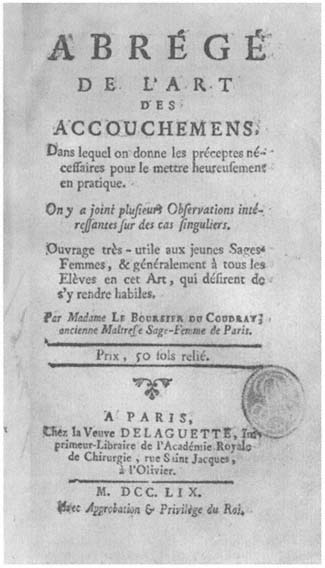
Figure 6.
Title page for the first edition of Mme du Coudray's textbook-
(1759). This one had no illustrations and was published in
the 12° format to be inexpensive. There would be five
subsequent editions.
Photograph courtesy of Special
Collections, University of Maryland Libraries.
see it as her patriotic duty to make her expertise more widely available. Saving future soldiers and cultivators of the earth for France is now crucial. Gradually she has reframed birthing as a matter of state.
In mid-1757 the midwife, who had already been writing up her lessons for some of her students, assembled them into a textbook and took them to Paris. She saw a new opportunity for her work. This was a difficult moment for the crown. Since the beginning of the war the Parlement had been resisting the new taxes necessary to finance it. The resulting disorder in the royal treasury had led to near chaos, and Damien's attempt to kill the king on 5 January 1757 only added to the sense that the monarchy's authority was disintegrating.[2] The midwife's book could perhaps make a small contribution to shoring it up. Presenting it in this light shortly after the regicide threat, she obtained approval to print the manuscript from the royal censor Morand, one of her former anatomy professors, on 2 July. That same month she wrote to the controller general reiterating her interest in a pension, this time placing her machine and now her book in the rhetorical context of patriotism and the war effort.
Apparently her timing was good, for suddenly things began to move. On 26 July Versailles informed the intendant of Auvergne that, although the financial demands of war made a regular pension for the midwife impossible, a handsome gratification would be forthcoming.[3] A month later, in connection with the imminent publication of the book, a gift of 400 livres was promised.[4] Although the actual appearance of the Abrégé has been held up this last year and a half—during which time her other old teacher, Verdier, added a set of notes and observations to her text, without attribution—the censor and accoucheur Süe has just last month given his enthusiastic approval to this longer version of the book.[5] And a flurry of correspondence has begun that will soon see the gratuity for the new author raised to 700 livres.[6] At the end of this year she will be charged by the king to launch a nationwide teaching tour. And as we already have seen, the bold "mission statement" letter she then writes to the intendants features the Abrégé centrally; in it she announces her authorship of a book on birthing before even explaining what the monarch expects her to accomplish on her travels.[7]
The Abrégé , then, is pivotal in the fashioning of the midwife's
special part in the obstetrical mobilization of the country. She and the authorities in Versailles agree that the book is a passport granting her agency, absolutely necessary if she is to function in a more public capacity and figure not just locally but nationally in the modernization and medicalization of France. Participation in literate culture seems a sine qua non; it will enhance the professional status of her art. "It is to be hoped that la dame Du Coudray will send her book to the intendants as she promised me," reads one ministerial directive. As if to confirm the special validating impact of her text, one intendant, upon receiving it, will claim to his subdelegates that it is "imbued with all the authenticity necessary for meriting complete confidence in the lessons she gives."[8] There is no question that the book makes possible her navigation in the public sphere.
The midwife's transformation through authorship from a humanitarian into a political actor can be seen immediately in the book's opening dedication to the intendant of Auvergne, Ballainvilliers:
A little work of this nature will doubtless seem very strange and inappropriate for the important affairs you administer to so much praise. Nonetheless, I do not hesitate at all in offering it to you; everything that has some utility earns an author the right to your goodness and protection. You understood in an instant, Monseigneur, the advantages of the machine that I invented to facilitate the Art that I treat. Your love for the bien public encouraged my zeal, and I perfected an invention that pity made me imagine. The students you gave me occasion to train already prove in the countryside the usefulness of my machine . . . [and] many subjects worship the protector of the art who saved them from falling victims to ignorance. Your name, Monseigneur, at the head of this book will never tarnish the brilliance of eulogies posterity will owe you. It is no less glorious to watch over the conservation of His Majesty's subjects in the bosom of his realm, than to chase from his frontiers and destroy the enemies of his State.[9]
Thus support for the midwife's work is as significant as victory in battle. She is up there in loyalty and importance with military generals, sustaining and defending her country. They kill foes, while she repairs, restores, preserves life. They do warfare, she does welfare. In the "Avant Propos" she continues the same argument: "I have put together these lessons and am venturing to publish them today less out of presumption, which twenty years of experience might have inspired in me, than out of the desire to make myself
more useful to my Patrie in this manner."[10] She claims, in a seeming contradiction, that "compassion alone made me an author," that empathy and identification with other females inspired her,[11] but she tries to reconcile that with her newer purpose. What began in Auvergne as genuine sympathy for the "pauvres malheureuses" (poor unfortunate women) has evolved into an understanding that the safe delivery of their offspring, of healthy future citizens, is of immense value to the nation.[12] France must be abundant and prosperous; children are an investment in that renewal. By the time the Abrégé appears in print, the midwife's focus has shifted significantly from mother to baby, her tone from sentimental to soldierly.
Some rather patronizing passages were added as the midwife assembled the book. In the lessons themselves she speaks as one with her students, but the printed Abrégé has numerous sections in which she speaks about them. "My whole object is to include in a few words the true principles of this Art and to present them from a point of view comprehensible to women of little intelligence. How many of these there are, who, without foreseeing any problem, meddle in childbirth, and how many unfortunates become the victims of this ignorance. . . . Since I do not write for the enlightened, I cannot err in expressing myself simply."[13] She consequently begs her readers not to pay attention to faults they might notice in her "diction," implying that her foremost desire is to convey useful information to these deprived rustics.[14] At the same time, she knows the book may be picked up by "more intelligent people likely to be interested in more extended instruction." For them she has added particular remarks (and the editor has added erudite footnotes) so the book can be read with "more satisfaction" and "more fruit."[15] After all, she is the bearer of city wisdom, of the latest obstetrical knowledge, which she will spread to petits endroits (small localities) but also way beyond.[16]
The midwife is trying to please many publics at once, including doctors, surgeons, and apothecaries. Seeking harmony with male practitioners, she acquiesces willingly to them, most of the time pointing the finger of blame at inexperienced or incompetent bonnes femmes .[17] The Abrégé is activist, interventionist, bold, but for all her confidence the midwife admits several times in the book to mistakes she nearly made, and praises the triumphs of great men in her field.[18] She has no airs, alienates no one, creates no sense of danger. Quite the contrary. She writes:
I ask the grace that I not be accused of passing myself off as a Doctor. I speak here only from a pure zeal for unfortunates deprived of all aid, either because the distance of the villages does not permit a doctor or able surgeon getting there in time, or because the poverty of these women prevents them from paying the suitable fees. It is in these pressing cases that I hope country midwives will be capable of giving the necessary help to women in danger. I cannot exhort them too strongly never to overestimate their supposed knowledge, and to be docile to the wise advice of experienced persons.[19]
Thus the author artfully constructs the image of midwives obedient to male medical authorities whom they will never challenge or compete with.
The Church must be placated too, of course. One of the first lessons her students learn is "the necessity of procuring baptism as soon as possible for those [babies] who seem ready to die."[20] She provides elaborate instructions for baptizing the child by syringe if getting it out alive seems impossible. "Child, if you are living, I baptize you in the name of the Father, the Son, and the Holy Ghost." Baptism must be given preventively to any child in abnormal presentation. "The time it will take to do this delivery could deprive the child of eternal happiness. We would reproach ourselves greatly if we neglected to do this." If all goes well and the baby survives to be taken to church, the priest must be informed that the private baptism (ondoiement ) has already taken place.[21] Thus any ecclesiastical authorities looking over the Abrégé should be sufficiently convinced of the midwife's piety.
Most of all, she strives to write a book that bridges from group to group. She is female, but not antagonistic to men; Parisian, but adaptable to the provinces. She is superior, but never scornful of her students, conveying to them her conviction that they can learn to do what needs to be done to save numerous babies from the jaws of death. She is schooled, but not so urbane that she cannot appreciate the robust earthiness of peasants. She can use the common terms for body organs as fluently as the learned ones, and does. She can use units of measure from town or country, describing cervical dilation by the size of a coin here, the size of a fish's open mouth there. The midwife's book, as she says on the first page, is not an obstetrical treatise. Of these there have been many, full of theory, Latin terminology, and ponderous references to authorities from antiquity. The Abrégé is an abridgment, a different, new genre, a
practical how-to manual, possibly the first of its kind in France. In fact, this text will generate a fad: short, clear, accessible childbirth booklets, often in question-and-answer catechism form, proliferate during the rest of the century.[22]
Journalists recognize immediately the usefulness of such a volume, reviewing it in the papers of the day. They sense the incongruity of the footnotes and the "Observations," which, written in a scholarly idiom and offering a titillating bit of the grotesque—dead babies that allegedly stayed in the unsuspecting mother several years, fetal bones found in a woman's excrement—really do not seem to fit with the practical text. (The editor of the Abrégé must have realized this himself, because after placing recondite notes in chapters 4, 9, and 10 he abandoned the idea completely.) The Année littéraire says the Abrégé contains nothing new for the learned but is helpful for those incapable of profound thought, and therefore it is good for humanity. It also recognizes how essential the publishing of a book is for the midwife if she aspires to practice her art nationwide.[23] The Mercure de France and the Journal de médecine herald the Abrégé 's appearance,[24] and Grimm's Correspondance littéraire remarks, "Here is the title of a useful work."[25] The Censeur hebdomadaire thinks it is wonderful, written with great precision. The tone is pleasing; the author writes "with a modesty that is the constant companion of true understanding, stripped of any vain parade of erudition." The work will surely help France, for midwifery is an "important function on which depends the hope, the strength, and the support of states."[26] The most enthusiastic review is in the Annales typographiques , a journal edited by three doctors. It explains in detail the great things du Coudray has been doing in Auvergne, including her ingenious machines. Prophetically, the reviewer hopes her "establishment" will spread everywhere and have many imitators. The book, a précis of her lessons, is "clear and methodical" and "contains all that is essentially useful in the art of delivery." The "Observations," on the other hand, which he recognizes instantly to be by a different writer, are "too erudite for the people for whom the Abrégé is intended."[27]
The Abrégé , then, has certainly attracted attention. In a time when women writers are mostly ignored and denied the courtesy of a reply, male reviewers at least do the midwife the honor of critiquing her. Hers is a fresh voice—something of a curiosity, but worthwhile.
Later, when she is on her mission and famous, when the novelty has worn off, newspapers will be far less charitable. Many will enter the lists against her.
The Abrégé is to become a key player in du Coudray's odyssey, a central character whose carefully timed appearances, in the form of five new editions over the next twenty-six years, will signal important developments in her life. This little volume serves its readers, but it definitely serves its author as well, now by establishing her reputation and catalyzing her mission, eventually also as a source of considerable revenue. She writes so as never to be dismissed as an empiric. Rather, she is an authority worthy of publicity and posterity, enhancing the ability of her readers, be they women or men, high or low.[28] Parts of it may appear to wildly flatter and overestimate her peasant audience, but she is aiming also at other publics, and she is being widely heard.
Of course, not everyone likes what they hear.