
State Law of Surface Waters:
Prior Appropriation[en4]State Law of Surface Waters:
Prior Appropriation[4]
Under the "riparian doctrine" which has prevailed from the outset in the humid eastern states, the right to use water from natural water courses is held by the owners of land adjacent to the water. The western states for the most part rejected the riparian approach, adopting the "prior appropriation doctrine" which allowed water to be diverted away from riparian land. (See map of surface water rights systems, Figure 2.1.)
The appropriation doctrine rests on two fundamental principles: (1) priority in time, and (2) beneficial use. The priority principle—first in time, first in right—allocates available water in times of shortage to those who first began their use of water from the source. Persons with the earliest priority may have their rights completely satisfied, while persons with the latest rights may receive no water at all.
This "first in time" rule is offset by three large exceptions. First, in most states, certain preferred users receive their full appropriation regardless of their priority. Preference is normally given to domestic and municipal uses and often to uses for agricultural purposes. Some states also provide a judicial mechanism through which preferred users may condemn the water rights of less preferred users. Second, appropriators may agree among themselves that during times of shortage the burden of the reduction in supply will be shared by a system of rotation or some other way. Third, sharing of shortage is often found in large projects where a number of irrigators share in the project's priority.
The term "beneficial use" is not subject to precise definition, but it generally includes two related, but somewhat different, concepts: social utility and engineering efficiency. That is, a use is beneficial if it involves some socially accepted purpose and if it makes a reasonably efficient use of water.
In the past most consumptive uses, particularly irrigation, have been considered beneficial. The types of uses socially accepted as beneficial uses have been increasing. Gradually, "instream" uses, such as the preservation of minimum flows to preserve fish, wildlife, and recreation values, which do not involve the "appropriation" of water, are becoming recognized as
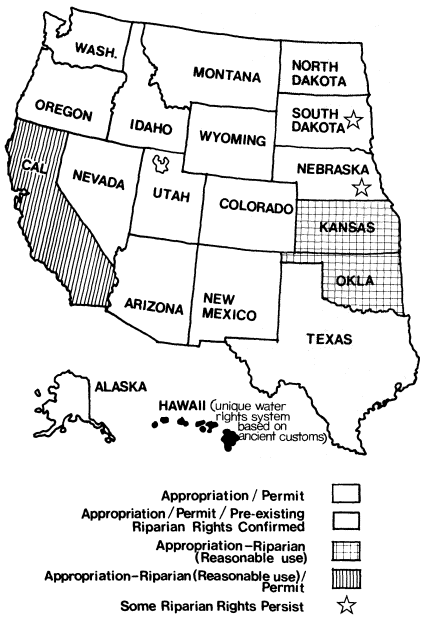
Figure 2.1
Surface Water Rights Systems
Source: Gary Weatherford (ed.) et al, Acquiring Water for Energy
(Littleton, Colorado: Water Resources Publications, 1/82), p.32.
John Muir Institute
beneficial uses. New energy-related uses, such as dewatering mines and slurrying coals, are being regarded as beneficial by most affected states, increasing the basis for competition and the justification for public regulation involving the exercise of broad administrative discretion in assessing trade-offs and balancing interests. Thus, beneficial use is a dynamic, not static, principle.
A person who wishes to divert water for a beneficial use must apply for a permit to a designated state agency. The typical scheme is generalized in Figure 2.2. Public notice is given and a hearing is offered to other right holders—sometimes to affected members of the public also—who object to the proposed diversion. The date of application usually determines the priority of the use.
The state will generally issue the permit if it determines that the proposed use will not interfere with existing uses ("nonimpairment"), that unappropriated water is available, and that the project is not otherwise contrary to the public interest.
Upon completion of the diversion and application of the water to a beneficial use, an appropriator must file proof of appropriation which, upon verification, is followed by the issuance of a certificate of a perfected right. This right extends only to the amount of water actually diverted and applied to a beneficial use, even if a larger quantity was originally intended. Under most irrigation uses of surface water, a significant portion of water applied returns to the watercourse as "return flow."
A purchaser of appropriation rights who merely continues the same use as his predecessor need only comply with local recording laws to perfect the right. An application for a new permit must be filed, however, if either a purchaser or the same owner intend to change the nature of the use, which may mean a change in the point of diversion or in the purpose or place of use. State approval helps to guarantee that the proposed change will not interfere to a greater extent than did the prior use with the existing rights of others, and that the new use is in the public interest.
The application process for proposed changes is similar to that followed for the initiation of new rights. Approval depends on a determination that other rights will not be impaired and that unappropriated water is available (in the event that the change of use is more consumptive than the prior use). Some states will not permit a transfer in the place of use if it involves the transport of water outside the watershed of origin or outside the state. And some states will not authorize a change in the type of
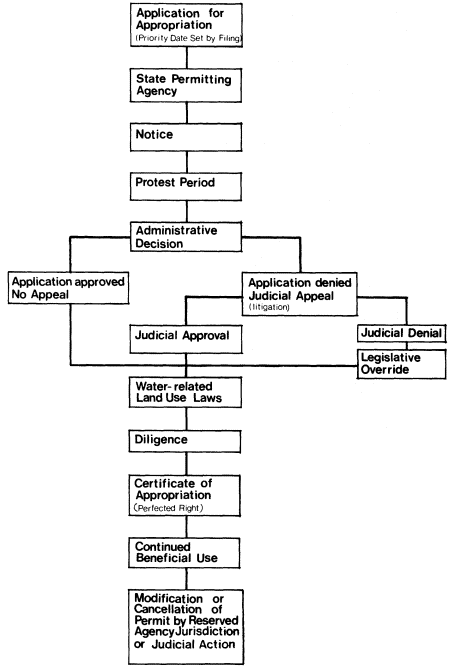
Figure 2.2
Permit Procedure: Prior Appropriation States
Source: Gary Weatherford (ed.) et al, Acquiring Water for Energy
(Littleton, Colorado: Water Resources Publications, 1982), p.50.
John Muir Institute
use where the prior use is preferred over that use which is to replace it.
With the prior appropriation doctrine thus described, the question arises: What relationship might exist between this prior appropriation system and diminished water for agriculture? The simple answer is that the system in most instances will (1) aid the farmer who desires to retire by selling his land and water profitably to nonfarmers; (2) compensate the farmer whose land and water is condemned against his wishes; (3) possibly reduce, under changing notions of conservation and "reasonableness," the amount of water the farmer has been diverting or consuming; (4) subordinate the farmer with junior rights to newly asserted senior rights, such as Indian water rights; and (5) provide a cause of action for the farmer whose water rights are impaired by one or more late-comer appropriators.
These results will occur in the following ways. Appropriative rights are quantified and, in most areas, marketable.[5] (See Chapter 18.) Individual farmers and farming interests themselves will reduce the water available for agriculture by selling out at attractive prices to nonagricultural users, such as cities and energy companies. Appropriative rights are property rights; if they are condemned by a public agency or authorized utility, compensation must be paid. For the farmer who continues to exercise his appropriative right, he may find that changing legislative, judicial, or administrative notions of "reasonable use" and "public interest" require that he be more efficient in his water use, that is, use less water on the same acreage. In some cases, he may be allowed to use the water saved on expanded acreage, in which case no overall reduction in agricultural water occurs. If the farmer's priority date is later than that of an unexercised Indian water right, the initiation of the Indian water use can reduce or eliminate the farmer's supply. To the extent that he is the senior appropriator in time, however, competing junior uses cannot lawfully impair his right, although problems of proof and costs of enforcement place practical limits on this protection.
Because irrigated agriculture enjoys 80 to 90 percent of the water consumption market in the West pursuant to these vested property rights, it is in a position generally superior to other water competitors. Agriculture acquired permanent rights in the water, with the aid of public subsidy, in the formative days of settlement and water rights administration. Within limits, those rights are subject selectively to superior claims and to
redefinition in the public interest. For the most part, however, irrigated agriculture will bargain from a position of strength in the competitive arenas of water scarcity, even though not all individuals or interests in the agricultural community are benefitted or protected in the process.[6]