
Chapter 7—
Global Assistance for Development:
Choosing an Appropriate Policy to Cope with Scarcity
The economic aid or technical and financial assistance that supplements local resources comes to African nations either unilaterally from a specific donor country or multilaterally through an international institution. In addition, some forms of aid are generated through the activities of regional and global groupings in which African and other developing countries participate. Examples of the three types of aid are unilateral assistance under the USAID program, multilateral technical and resource transfers through a set of United Nations agencies as well as affiliated or associated institutions, and regional aid under such arrangements as the ACP-EEC agreement over various forms of assistance.
At the outset it is useful to describe what we mean by "aid."[1] Furthermore, we feel it is necessary to make a conceptual difference between appropriate and inappropriate aid.
[1] The United Nations defines aid as "grants, and net long-term lending, for non-military purposes, by Governments and quasi-governmental international organizations." See William Clark, "What Is Aid?"Problems of Foreign Aid (Dar Es Salaam: Institute of Public Administration, 1965), p. 12.
The former is a transfer of resources and technology directly from a donor to a recipient, or the financial capacity to obtain them indirectly, which facilitates the attainment of development objectives. The latter is a transfer which contains encumbrances, set by a donor, that constrain a recipient from pursuing its development objectives.2. An example of inappropriate aid has been cited by E. O. Edwards, who pointed out that "some of the strings imposed on aid not only make projects more expensive but also create political and economic problems for the developing country."[3] His example is
a proposal, that cement be imported from abroad for a particular project when the domestic factory was operating at 50 percent of capacity and another setting as a prerequisite for aid that contractors from the aiding country be awarded construction contracts when domestic contractors were both unemployed and less expensive. Such proposals not only raise project cost but also tend to generate in the developing country antagonism toward aid that is just as naturally resented in the aiding countries.[4]
Aid, we feel, has three basic characteristics: first, it is assistance in implementing a program of social and economic development rather than relief from disaster; second, it is directed toward non-military purposes; and third, the transfer of funds is largely on an official basis between independent states either directly through bilateral agreements or through multinational organizations.[5] Aid neither includes direct foreign investment nor technical collaboration agreements. However, we are mindful
[2] The donor can impinge on the recipient in several ways, two of which are by insisting that resources and technology be used for specific purposes, and by requiring that the recipient change some of its ways and policies as a condition of received aid. See Albert O. Hirschman and Richard M. Bird, Foreign Aid—A Critique and a Proposal (Princeton University: Essays in International Finance, no. 69, June 1968), pp. 5–7; and, in the case of Ghana, see Ronald T. Libby, "External Co-optation of a Less Developed Country's Policy Making: The Case of Ghana, 1969–1972," World Politics 29, no. 1 (October 1976): 67–89.
[3] E. O. Edwards, "When is Foreign Aid Aid?" East African Journal 4, no. 4 (July 1967): 28.
[4] Ibid., p. 28.
[5] William Clark, "What Is Aid?" pp. 15–16.
of the fact that these transfers tend to enhance African opportunities to obtain needed resources. These can be obtained through bargains with multinational companies and other investors.
Aid, if appropriately given, could play an indispensable role in lifting the burden of underdevelopment from impoverished Africans considering the multiple planning objectives of increasing resource availability, allocating resources efficiently, and distributing output equitably. These are not separate goals and their interdependence is shown in Figure 15. The situation is one reflecting the trade-offs that relatively poor countries have to make between current consumption and investment for future consumption. In Figure 15, we have three production possibilities curves: P0 we assume reflects a nonaid position constrained by local resource availability. The level of consumption reflecting minimal subsistence, we assume, is C0 , and any level of resource use for consumption purposes less than this places striking proverty burdens on the great mass of people. At the same time, we presume that a minimal level of investment, financed by local savings (or nonconsumption), is required to provide a sustained increase in consumption possibilities in the future; for example, I1 . But in the case of local resource scarcity, C0 and I1 are not mutually attainable economic objectives. If the level of consumption is C0 , then only 10 investment can be reached at point A on the production possibilities P0 and community indifference curve

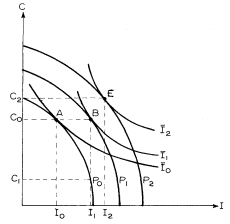
Figure 15
a broader sharing of an expanded output because supplemental resources are acquired and otherwise idle local ones are mobilized. In effect, a higher indifference situation I2 is reached at E.
This ideal model is in fact not without its real-world problems and costs. Let us now turn to three primary issues involving technical and financial assistance. The first relates to the adequacy of such efforts. Clearly the results of the First Development Decade under the United Nation's auspices were disappointing. The massive amounts of aid envisioned by the architects of this development strategy simply were not forthcoming from the rich and developed world.[6] Second, aid has been a question mark on the grounds that it tends in some cases to aggravate economic and political dependence on the parts of
[6] Tanzania's disappointment over levels of external economic assistance in the early years after independence contributed substantially to its 1967 policy decision on moving toward socialism and self-reliance. See Julius K. Nyerere, Freedom and Socialism (London: Oxford University Press, 1968), pp. 166–67, 237–39. Also see Henry Bienen, Tanzania: Party Transformation and Economic Development (Princeton: Princeton University Press, 1970), p. 413. For a discussion of this and other matters, see Gunnar Myrdal, The Challenge of the Poor World: A Programme for a Worldwide Fight (Paris: OECD, 1972); and Organization for Economic Cooperation and Development, Flow of Aid To Developing Countries (Paris, 1973).
African and other Third and Fourth World countries. It has been argued, in fact, that technical and economic assistance has developed a new kind of "imperialism."[7] It is alleged that a degree of structural dependence has so solidified within the global economy that "neo-colonialism has been promoted and there are therefore no grounds for taking a more optimistic view of the future."[8] The third issue has to do with the repayments of the debts incurred by recipient countries within the Third and Fourth worlds. A recent United Nations study called indebtedness and debt repayment one of the primary obstacles to financing development in many underdeveloped countries.[9] Foreign aid sources tend increasingly to lean toward repayable loans rather than outright grants, and this causes grave problems associated with repayments. One general exception, however, is China's foreign aid program, with its basic principle that aid must avoid bringing direct economic profit to the donor source. Clearly China seeks to attain political objectives through its aid program, but with an emphasis on eliminating directly observable economic gain. It not only offers loans free of carrying charges and interest and with extremely low (or no) servicing costs, but it also offers repayment terms more favorable than any other unilateral or multinational donor.[10]
With these points in mind, we shall turn to the matter of whether the volumes of aid transferred from the rich world to the poor have been substantial enough to promote an acceptable level of growth and development within recipient countries; that is, in conceptual terms, have African and other developing countries seen their production possibilities situations shift substantially (such as from P0 to P2 )?
[7] See, for example, H. Feldman, "Aid As Imperalism," International Affairs 43, no. 2 (1967): 219–35; Teresa Hayter, Aid As Imperialism (Harmondsworth: Penguin, 1971); and Barbara Stallings, Economic Dependency in Africa and Latin America (Beverly Hills: Sage, 1972).
[8] Marion Muskat, "Peripheric Capitalism?" Intereconomics, no. C22117E (May 1975), p. 146.
[9] UNCTAD, Debt Problems in the Context of Development (New York: United Nations, 1974), pp. 1-34.
[10] Wolfgang Bartke, China's Economic Aid (Hamburg: Holmes and Meier, 1974), pp. 3–215. Also see Warren Weinstein, Chinese and Soviet Aid to Africa (New York: Praeger, 1975).
The Adequacy of Foreign Aid
Whether the aid granted to developing countries has been adequate is obviously a matter of judgment. The criteria on which to base a sound judgment are not easily forthcoming. The situation is complex and it is a matter of perspective. Our perspective is that a more involved picture requires appraisal within the context of an overall aid strategy in which the financial volume of aid is only a part. The Report of the Commission on International Development recommended a tenpoint program for action:[11]
1. To create a framework for free and equitable international trade;
2. to promote mutually beneficial flows of foreign private investment;
3. to establish a better partnership, a clearer purpose, and a greater coherence in development aid;
4. to increase the volume of aid;
5. to meet the problem of mounting debt;
6. to make aid administration more effective (focusing, we assume, on the matter of the appropriateness of aid);
7. to direct technical assistance so as to integrate it with capital transfers that have employment and other developmental objectives;
8. to slow the rate of population growth and counteract problems associated with maldistribution of population inherent in too rapid rates of urbanization;[12]
9. to revitalize aid to education and research; and
10. to strengthen the multinational aid system.[13]
[11] Lester B. Pearson et al., Partners in Development (New York: Praeger, 1969), chaps. 1–3. Also see UNIDO Secretariat, "Technical and Financial Needs of African Countries for Bilateral and Multinational Aid," Economic Bulletin for Africa 10, no. 2 (1974): 87–97.
[12] See, for example, Frederick C. Terzo, Urbanization in Developing Countries: The Response of International Assistance (New York: The Ford Foundation, 1971).
[13] A strong plea for multilateral aid systems in preference to bilateral aid bargains is made on the basis of the dangers that "foreign aid that is supposed to transfer income from the rich to the poor countries becomes all too clearly, when it is administered by national governments,an instrument through which the rich impose their will on the poor!" See Albert O. Hirschman and Richard M. Bird, Foreign Aid (n. 2 above), pp. 15–16.
In this chapter we are primarily concerned with points (4) through (6) while recognizing that the others are important in achieving comprehensive goals of economic growth and development. For example, the various points raised in the report deal with shifting a community's production possibilities curve from P0 to P1 and then to P2 . In addition, the report is suggestive of the potential for mutual advantages on the parts of donors and recipients. It has been argued:
From a strictly economic and fairly abstract point of view, the issue may be seen as a matter of the relative productivity of capital. If capital can be more productively employed in the recipient economy than in the country supplying the aid, the transfer results in an overall gain for both economies combined, and this gain is larger the greater the volume of the aid. The benefit to the recipient will consist of this gain plus the concession the donor may make by providing the funds at a lower rate of interest than the yield available to him in domestic uses of funds. This concession is the only burden to the donor; it is proportional both to the volume and to the margin of "softness" so that the burden will remain constant if the volume of lending is increased while interest rates are raised appropriately.[14]
In the concluding chapter, we deal more fully with the matter of bargaining over the terms of net benefits inherent in aid transactions. We note, moreover, the trade-off that potentially comes about when aid occurs: that is, from the point of view of a recipient state, structural dependency might become more acute when resources are conceded by a donor state or combination of states through a multinational organization. Certainly the chances for the forging of close dependency relationships diminish as aid becomes multinationalized, particularly when recipient countries exert more influence over the operation of such organizations as the International Monetary Fund, World Bank Group, World Health Organization, Food and Agriculture Organization, and the various United Nations agencies.
[14] Goran Ohlin, Foreign Aid Policies Reconsidered (Paris: OECD, 1966), p. 87. Also see I. M. D. Little, Aid to Africa (London: Pergamon Press, 1964); and Paul Streeten, Aid to Africa (New York: Praeger, 1972).
In order to act as an effective catalyst for shifting a production situation from P0 to P2 , volumes of aid must be adequate enough to fulfill development requirements. The Pearson Report dealt with the issue of adequacy of aid and recommended that 1 percent of the national products of developed countries be transferred as aid. Table 22 shows that the rich OECD countries have not reached that level—in fact, their aggregate proportion is .77 percent.
Aid and the Cost of Structural Dependency
The transfers of public foreign assistance required for development carry with them an element of cost relating to structural dependency. For many opinion formers in Third World countries, aid is viewed as an interference in their internal affairs which entails undesirable consequences in terms of structural dependency. "Imperialism hides its new tactics under different forms of so-called 'aid' co-operation and association," declares one writer.[15] Another depicts the United States as effecting "a programme to vassalise Africa under the guise of granting it aids of some sort."[16] The upshot is considerable recipient skepticism and donor fatigue.[17]
At heart, Africa's fears over aid are related to its general misgivings about relations with powerful external actors and its profound uneasiness over the long-term effect of aid relationships. We shall concentrate here on the latter phenomenon.
[15] Ongonga Achieng, "The Mask of 'Aid to Poor Countries,' " Nationalist (Dar es Salaam), July 14, 1970, p. 4.
[16] Segun Durosola, Dollar Pressure in Africa (Lagos: Nigerian Study Circle, n.d.), p. 7. For further analysis of donor-recipient reciprocity, see Donald Rothchild, "Engagement Versus Disengagement in Africa—The Choices for America," in Alan M. Jones, Jr. (ed.), U.S. Foreign Policy in a Changing World (New York: David McKay, 1973), pp. 232–40.
[17] Expressing weariness with aid, France's President Pompidou, when passing through Ougadougou in the fall of 1972, remarked that he was little inclined to "continue an aid policy which was no longer wanted." Quoted in the Manchester Guardian Weekly (London), December 8, 1973, p. 15. On the anti-aid doctrines of France's Raymond Cartier, see West Africa, July 13, 1968, p. 810.
| ||||||||||||||||||||||||||||||||||||||||||||||||||||||||||||||||||||||||||||||||||||||||||||||||||||||||||||||||||||||||||||||||||||||||||||
Certainly Africa's greatest concern over foreign aid programs lies in its apprehension over succumbing to a new form of dependency. For many an African nationalist, reliance on a Western capitalistic order (neocolonialism) is as much an affront to local dignity, self-expression, and independence as was the direct colonialism of yesterday. Whereas the latter involved open control, the former covers a hidden control. In African eyes, such hidden control is the more threatening of the two in its long-term implications. Neocolonialism, asserts Kwame Nkrumah, enables France and its Common Market allies to penetrate francophone Africa more effectively than in the past. "Thus, even though independent in name, these countries continue the classical relationship of a colonial economy to its metropolitan patron, i.e., providers of primary products and exclusive markets for the latter's goods. Only now the relationship is covered up under the guise of aid and protective solicitude, one of the more subtle forms of neocolonialism."[18] Under these circumstances, aid is viewed as drawing "the unwary back into a neocolonialist relationship" rather than contributing in any genuine way to African liberation and self-fulfillment.[19]
From the African perspective, then, aid contains a gravely threatening element unwisely dismissed in donor states. At the heart of this anxiety is a fear of increased dependence on the Western capitalistic order. By definition, the very act of entering into an aid agreement places some limitations upon recipient (and donor) freedom of maneuver. Of course, they can always abrogate these agreements afterwards; however, the forwardgoing nature of the relationships tends to circumscribe the autonomy of decision-makers in the respective states.[20] Yet the
[18] Kwame Nkrumah, Africa Must Unite (London: Heinemann, 1963), pp. 175–76.
[19] Ibid., p. 183.
[20] Henry Bienen, "Foreign Aid and National Independence: Examples from East Africa," in Hadley E. Smith (ed.), Problems of Foreign Aid (Dar es Salaam: Institute of Public Administration, 1965), p. 266. On the way in which aid limits donor independence, see C. T. Thorne, Jr., "External Political Pressures," in Vernon McKay (ed.), African Diplomacy (New York: Frederick A. Praeger, 1966), p. 152. Also see Alvin Rubinstein, Soviet and Chinese Influence in the Third World (New York: Praeger, 1975).
critical anxiety uppermost in African thoughts is over dependence, not interdependence. African decision elites are apprehensive that bilateral aid from external governments will inevitably entail political "strings," necessitating compromises on their part which are antagonistic to African system goals on nonalignment, pan-Africanism, nonracialism, redistribution, socialist organization, self-reliance, and so forth. "In the majority of cases," writes Doudou Thiam, the former foreign minister of Senegal, "the states offering aid do not formally lay down any political conditions, but it often happens that they take an interest in a particular country either because they are sympathetic towards its internal political system or the attitude which it adopts towards the major international problems, or because of its strategic interest or economic potential. Often a great power has granted aid to a country and then cut it off because of the position adopted by the country concerned on some important political question."[21] In fact, as Thiam notes of American and Soviet aid practices, external aid projects have been terminated, leaving the recipient countries with partially completed plants and industrial complexes—and considerable bitterness.[22] What Africa fears most is some form of externally directed "remote control" which enables outside powers, under the guise of humanitarian gestures, to subvert the legitimate ends of African freedom and independence.[23]
Not only are African decision-makers apprehensive over possible dependency on the donors of public external aid, but they also have misgivings over the private company contacts encouraged by these external public agencies. The linkage
[21] Doudou Thiam, The Foreign Policy of African States (London: Phoenix House, 1965), pp. 99–100.
[22] British capital assistance to Tanzania of about Shs. 150,000,000 (but not the salaries of technical advisers and teachers) was suspended in 1965 following a falling out of relations on the Rhodesian issue. See Nationalist (Dar es Salaam), March 13, 1970, p. 1; and East African Standard (Nairobi), June 22, 1968, p. 1.
[23] A. Sékou Touré, "African Independence as an International Issue," in Yashpal Tandon, Readings in African International Relations, vol. 1 (Nairobi: East African Publishing House, 1972), p. 230. And for Sékou Touré's fears of external and subregional groupings, see Donald Rothchild, "America's Regionalism in Aid Policy," East Africa Journal 5, no. 4 (April 1968): 19.
between public and private interests here is very close in African eyes. Thus an editorial in a Kenya newspaper observed that the involvement of rich countries in economic assistance programs
seems to be motivated not by this kind of universal interest but by their own exclusive commercial and business interests which are sometimes even carried out without regard to the interest of some of their partners in development. . . . Foreign investment, for example, which often comes through multinational companies interested largely in profit maximization, power and the control of the local economy, can hardly be said to be of any eventual benefit to development.[24]
Therefore, economic assistance creates ties at the quasi-public level, allegedly limiting the political and economic options of domestic decision-makers. Because these African decision elites are intent upon attracting further external business interests, they order their internal priorities in such a way as to accommodate foreign investor demands. There is no question that investment by powerful multinational companies influences subsequent African public policies. These firms, with annual budgets considerably higher than those of some governments they negotiate with, are in a position to influence African choice processes. As a consequence, African elites have good reason to be wary of commitments to these private actors which may carry with then substantial unintended consequences.
Africa clearly faces a dilemma on the effects of aid. It needs the option of external assistance in order to relieve the citizenry's burden of generating savings for investment purposes all on their own—a fearsome task for those whose per capita incomes are often below $100 a year. Yet the potential costs of external reliance could be heavy indeed. Consequently, a yardstick for determining aid desirability seems essential. Perhaps reference to our distinction between appropriate and inappropriate concessions would be useful in this regard. As we conceive it, appropriate aid is a concession by a donor to a recipient (unencumbered by arbitrary restrictions) which fulfills the development objective set by decision-makers in the poorer country. Effective planning necessarily involves the avoidance
[24] Daily Nation (Nairobi), May 7, 1975, p. 6.
of inappropriate concessions as well as the aggravated dependence on external action that such relationships entail.
Debt Repayment:
The Cost of Aid
Repaying and servicing the debts inhering in transfers of aid is a serious fiscal problem in many Third World countries, particularly those whose required borrowings have resulted in aggravated dependence. External-debt-servicing costs impinge on the growth and development capacities of numerous African and other developing countries.[25] The Second and Third United Nations Conferences on Trade and Development (UNCTAD), held respectively in New Delhi in 1968 and Santiago in 1972, pointed out that external-debt-servicing is one of the most serious problems facing developing countries. UNCTAD's concern was echoed at the IMF-World Bank's meetings in Nairobi in 1974, and UNCTAD IV in that city. This group focused primarily on what might be done to deal with foreign debts once a country begins to experience their serious accumulation and servicing cost.
External debt begins to accumulate when a government is compelled to supplement local public revenue collections with borrowing from abroad in terms of loans and ancillary grants. A government is compelled to do this when its claims on the streams of financial wealth generated by extracting or cultivating physical wealth are not fiscally adequate. The degree of fiscal inadequacy is determined by the gap between what a government wants to do and what its public revenue collections alone would permit it to do.
Three African countries are selected for analysis: Liberia, Botswana, and Zambia. Liberia's selection is based on the fact that it has experienced, in the 1960s, and continues to experience serious external-debt-servicing problems. Botswana and Zambia were chosen because they appear to be entering into
[25] Cheryl Payer makes this and other points in The Debt Trap: The International Monetary Fund and the Third World (New York: Monthly Review Press, 1974).
early phases of external-debt accumulation. External-debt concerns will be with each country's government during the remainder of the 1970s. And the economy of each country has important common elements; each relies heavily on mining ores or public revenue or both; and each bears the impact of changing world-market prices.
In Chapter 4, we noted that the Liberian government's inability to collect sufficient public revenue was caused by supplementary external public borrowing. Both loans and grants became important sources of national finance. There was a shift in the composition of aid as loans became a progressively higher percentage of total aid. By 1965 such foreign transfers amounted to $30.4 million, or equivalent to 42 percent of the country's public revenue collections. This same high proportion persisted until 1968, when it decreased to 31 percent after the government had become concerned about the rising costs of debt-servicing because of heavy borrowing. In that year debt-servicing required 29 percent of the public revenue and 19 percent of the total revenue (public revenue plus foreign transfer). These figures rose to 33 percent and 24 percent respectively during the period 1968–1970, when debt-servicing payments began to exceed foreign transfers to Liberia by more than $1 million annually. Although figures have been decreasing during the 1970s, they remain seriously high. The capacity of Liberia and any other country to service her debts is usefully measured in three ways.[27] (1) The debt-service/exports ratio is the proportion of foreign exchange revenues earned from exports that is used to amortize and pay interest on external debts. The lower the ratio, the greater a country's capacity to service these debts, and this is particularly significant when the short term is considered. (2) The exports/gross domestic income ratio indicates the effect that exports have on economic activity in general. The higher the ratio, the greater the rise in exports relative to gross domestic income, and the greater the long-term capacity to finance external debt. This makes it easier
[26] Robert L. Curry, Jr., "Problems in Export-based Public Revenue Collections in Zambia and Liberia," Journal of World Trade Law 9, no. 6 (November–December 1975): 678–690.
[27] Pijush Kanti Mitra, "Debt-Servicing in Developing Countries," Journal of World Trade Law 6, no. 3 (May–June 1971): 388–91.
for a country to repay its external debts. Another long-term indicator is (3) the exports/imports ratio. The greater the ratio, the greater a country's long-term capacity. When exports rise faster than imports, this means that an increasing surplus (or decreasing deficit) is generated on current accounts. Such a country becomes more able to acquire foreign exchange with which to amortize and pay interest on its external debts.
Liberia's short-term capacity to service her foreign debts showed a moderately worsening trend. For the period 1964–1967, the ratio of debt-servicing payments to exports averaged 0.075 annually; during 1968–1970, it averaged 0.095 annually. But the country's longer-term capacity for debt-servicing was improving. Her ratio of exports to gross domestic income has risen moderately, averaging 0.46 annually during the period 1964–1967 and 0.49 annually for 1968 to 1970. The ratio of exports to imports has improved substantially, from an annual average of 1.23 during 1964–1967, to 1.60 for 1968 to 1970. During the 1970s, each of these ratios have improved until, in 1974, they can be estimated at 0.09, 0.50, and 1.50 respectively.
However, the burden of debt-servicing has been shifted to individual Liberians generally and not to the export industries. The shift of the burden was threefold during the late 1960s. First, various socially required public services have recently been curtailed; annual current expenditures increased by only $2 million, or 4 percent from 1967–1970 while gross domestic income rose by $79 million, or 24 percent. Second, gross capital formation expenditures have actually decreased; they totalled $21.2 million in 1967, but went down to $12.5 million by 1970. Third, a special "austerity" tax was placed on individual incomes; here the yield increased from $2 million to $6.6 million annually from 1967 to 1970. This rise by a factor of 3.3 is in contrast to Liberia's gross domestic income, which went up by only 25 percent during the same period. Carl Shoup and his colleagues found that this austerity tax was used primarily for debt-servicing, and that it was part of a generally regressive tax structure. They stated:
If the per capita, austerity, and individual income taxes are taken together, the progressive overall impact is very limited, with a strong
regressive element in the lower income ranges. The minimun overall effective rate of 4.75 percent occurs for an individual with an income of just under $600, jumps to 6.83 per cent for incomes of $600, falling again to 5.23 percent at $1,500, thereafter rising gradually, reaching 6.83 percent again only at earned incomes of $5,720.[28]
During the 1970s, Liberia's government has undertaken no special fiscal program to shift some of this load to export concession enterprises despite the fact that the long-run indicators of the country's debt-servicing capacity show that export sectors are relatively more able to absorb an increased burden.
Zambia's external-debt-servicing is low because of the economic boom enjoyed from independence in 1964 through the early 1970s. Zambia entered the 1970s with no serious external debt problem. In June of 1970, the country's official external debt was $176.4 million (Zambian Kwacha [ZK] was worth $1.56). About 75 percent of the total official lines of credit up to June 30, 1970, was contracted prior to independence in 1964. Just over 10 percent was payable in kwacha; in terms of foreign exchange, cumulative disbursements totalled $211.0 million, and annual repayments amounted to $34.6 million (including $8.8 million in interest payments). The major official lenders were the United Kingdom (40 percent), the World Bank (21 percent), Italy (16 percent) and Yugoslavia (12 percent).[29] The government's revenue sources are led by mineral and profits taxes levied on mining companies and in particular on those that extract, refine, and export copper. Generally increasing prices for and expanded exports of copper produced government surpluses, favorable balances-of-trade and payments, and a steady accumulation of foreign exchange during the period 1964–1970. For example, the ton price rose from ZK693, in 1964, to a record high of ZK1,750 in December 1973.[30] Copper tonnage increased from less than 500,000 in 1964 to a high of 747,500 in 1969, dropping to 681,100 in 1973. The govern-
[28] Carl S. Shoup, et al., The Tax System of Liberia (New York: Columbia University Press, 1969), p. 76.
[29] International Monetary Fund, Surveys of African Economics, vol. 4 (Washington, D.C., 1972), pp. 437–40.
[30] Republic of Zambia, Economic Report: 1973 (Lusaka: Ministry of Planning and Finance, January 1974), pp. 21–22.
ment's tax base, then, continued to expand.[31] But this expansion was slowing down, and in his 1975 budget message, the minister of finance indicated that some external borrowing would be required to supplement local revenue collections. At this juncture, Zambia is in a string position to pay debt-servicing costs. However these costs will likely accumulate because, among other factors, import inflation continues to require progressively more foreign exchange. Moreover the volatile nature of copper prices makes it impossible to predict whether Zambia will earn sufficient foreign revenues to cope with soaring import prices. A recent CIPEC conference in Lusaka generated some concern over whether the high copper prices of late 1973 and early 1974 would be maintained. It was generally concluded that copper prices would decline later in 1974—a change that was likely to persist during 1975. The Zambian government will have to pay increasingly higher prices for the goods that it imports—primarily material capital goods and other durables required in the production and distribution of public goods and services—for example, ambulances for medical care, bulldozers for rural road construction, and office machines for administrative services. Because of the uncertain nature of copper earnings, combined with the 1970 changes in tax and revenue policies, debt is likely to accumulate as the government supplements local revenue collections with unilateral and multilateral aid resistance from abroad. And this could make it even more difficult for Zambia to limit external debt accumulation without shifting even more serious financial burdens to its people.
Botswana's accumulation of external debt was not due to a decline in export earnings; it was due to increased demands for imports and public borrowing to finance them. The country entered the 1970s with insignificant external debt. It was only R14 million (1 Rand-$1.49) and almost 90 percent of this was accumulated prior to independence in 1968. The major lenders were the United Kingdom, international agencies, and South Africa. But external debt shows signs of accumulating largely because of the borrowing required by the government in order to finance mining development and rural infrastructures.
[31] Bank of Zambia, Report for 1973 (Lusaka, 1974), p. 20.
In the 1970s, Botswana faced a situation similar to that which Liberia experienced prior to the discovery of iron ore. There was no diversification, and Botswana relied on one source of foreign exchange earnings—cattle and meat products sold to one primary customer country, South Africa. However, this is changing because of recent ore and mineral discoveries that now offer the government of Botswana new and diversified opportunities to collect public revenues. But whether the government will gain adequate fiscal access to the stream of physical wealth generated from mining and exporting is another matter. There appears to be some important similarities to the Liberian experience—and some additional problems. One point on which their cases differ is that the time structure for repayment was short in Liberia—about eight years—and in Botswana it was spread over a much longer period.
The recent discoveries of various minerals and ores have been in Botswana's northeast region. The director of geographical survey reported the following summary statement in 1969:
The presence of deposits of asbestos, coal, copper, diamonds, gold and silver, kyanite, manganese and nickel has been noted. Other minerals recorded include ores of antimony, arsenic, bismuth and tungsten. Amongst others, chromite, fluorspar, graphite, gypsum, iron ore, lead, pyrites, sodium, carbonate and sodium bicarbonate-bearing brines, talc and zinc are known, in addition to limestone, fireclays and industrial ceramic materials, semi-precious stones and potential ornamental building stone.[32]
Such wide-ranging discoveries offer hope of significantly improving what has heretofore seemed a grim picture of this country's growth and developmental potential. Botswana's leaders have been quick to open its doors to direct foreign investment by private companies. For example, by 1973, Bamangwato Concessions Limited had invested R110 million, with the Botswana government raising another R60 million in grants, loans, and credits to finance the building of a new town
[32] P. Smit, Botswana: Resources and Development (Pretoria: African Institute, 1970), p. 12. Also see D. Lamberti, et al., "The Economy of Botswana," International Monetary Fund Staff Papers 17, no. 1 (March 1970): 153–73.
and supporting faciltities, in a promising copper and nickel mine at Selebi-Pikwe in the north;[33] mining officials anticipate that Selebi-Pikwe will produce some two million tons of copper-nickel ore as well as provide employment for two thousand people a year when it comes into production in 1973. In addition, a major discovery of diamonds at Orapa has been developed by De Beers; this mine, which operated at full capacity in 1971, produces over two million carats of diamonds as well as government revenues of R4 million per annum.[34] Although such mineral-based assets must not be allowed to obscure what remains a picture of overall underdevelopment, they nevertheless do provide an important multiplier effect. The gross national product of Botswana is predicted to increase as much as 15 percent annually in the 1970s, and investment in a variety of light industries and improved infrastructure can be expected.[35]
Botswana's export sector, therefore, will continue to lead the country's general economic growth, providing opportunities for development. Currently Botswana's export revenue derives primarily from the customs union involving South Africa and
[33] On the heavy input of government investment in these mining-related initiatives, see Dudley Jackson, "Income Differentials and Unbalanced Planning: The Case of Botswana," Journal of Modern African Studies 8, no. 4 (December 1970): 556.
[34] Christopher Joubert, "Still Awaiting the Real Impact from Copper," African Development, February 1973, p. 5; and Martin Curwen, "BDC Encourages Private Investors," African Development, February 1973, p. 9.
[35] Leonard M. Thompson, "South Africa's Relations with Lesotho, Botswana, and Swaziland," African Forum 2, no. 2 (Fall 1966): 73. See also Donald Rothchild, "A Hope Deferred: East African Federation, 1963–64," in Gwendolen M. Carter (ed.), Politics in Africa: 7 Cases (New York: Harcourt, Brace and World, 1966), pp. 219–23; and his Politics of Integration: An East African Documentary (Nairobi: East African Publishing House, 1968), Part IV; Arthur Hazlewood, "Problems of Integration among African States," in Arthur Hazlewood (ed.), African Integration and Disintegration (London: Oxford University Press, 1967), chap. 1; Peter Robson, Economic Integration in Africa (London: George Allen and Unwin, 1968), p. 262. Also see Martin Legassick, "The Southern African Bloc: Integration for Defense or Expansion?" Africa Today 15, no. 5, (October–November, 1968): 10; and Ronald Hyam, The Failure of South African Expansion 1908–1948 (London: Macmillan, 1972), 106.
the BLS countries (Botswana, Lesotho, and Swaziland). The government collects public revenues from export earnings, and these are supplemented by various direct and indirect taxes levied in Botswana. A new customs union agreement came into effect in 1970, and its revenue-sharing formula is expressed as follows:
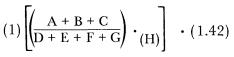
where A = c.i.f. value of a country's imports,
B = before tax value of production and consumer goods subject to excise (or sales) taxes,
C = excise and sales taxes paid on (B) above,
D = c.i.f. value of common customs area imports,
E = customs duties and sales taxes paid on D,
F = before tax value of goods produced and consumed in the area which, in turn, are subject to excise (or sales) taxes,
G = excise and sales taxes paid on (F) above, and
H = the value of the common revenue pool.[36]
The most notable new feature is the 1.42 multiplier, which in effect increases the proportional share distributed to the smaller countries by 42 percent. This has meant increased public revenue for Botswana. In 1969–70, under the old formula, the country's public revenue was R4.6 million. It rose to R5.1 million in 1970–71, and to R8.3 million in 1971–72.[37] But here is a key point: despite the increase, the negotiated figure of 1.42 has not resulted in public revenue from export earnings that is adequate to match the rise in public spending, particularly on imports from abroad. For 1977–78 the Development Plan projects spending at a level of 98.7 million Pula, the
[36] Customs Union Agreement Between the Governments of Botswana, Lesotho, and South Africa, December 11, 1969, Art. 14 (2).
[37] Republic of Botswana, National Development Plan 1970–75 (Gaborone: Government Printer, 1970), p. 121.
country's new currency, and 27.0 million of this is to be financed from foreign borrowing.[38] (1 Pula = 1 Rand.)
Imports climbed 37 percent from 1970 to 1971, mostly because of the rapid expansion in capital-good inflows destined for the mining sector. This is likely to persist in light of the continued expansion of the country's mining sector. "Future rates of increases," comments a recent International Monetary Fund survey, "will depend mostly on imports necessary for the construction of the copper-nickel complex at Shashe [and] projections indicated that imports would reach a value of about R80 million in 1972."[39] Later data proved this projection reasonably accurate, meaning a massive 75 percent increase in imports. By 1977–78, imports are predicted to climb to 119.6 million Pula. Such an increase has not been matched by increased export earnings. They are expected to exceed imports by 20.1 million pula in 1977–78, and the remainder of the balance of payments transaction outflows will exceed this amount.[40] Consequently, the country's government, a key importer, will have to borrow from external sources in addition to some local borrowing. The external aspect of borrowing could pose immense difficulties for the government in the future because external borrowing in loan form eventually means amortization or servicing costs. These could come at the expense of the use of public revenues to finance the development of an economic infrastructure and the provision of social services generally.
Reliance on external borrowing is likely to persist in Botswana. And with the current level of import inflation, the government could be required to borrow beyond the levels recently predicted for it. The countries from which imports of capital originate are experiencing inflation rates of from 12 to 15 percent annually. And this means higher import prices for Botswana. Together with the enormous increases in prices of
[38] Republic of Botswana, National Development Plan: 1973–78, Part I (Gaborone: Ministry of Finance and Planning, 1974), p. 57.
[39] Surveys of African Economies, vol. 5, p. 94.
[40] Republic of Botswana, National Development Plan; 1973–78, Part I, p. 24.
petroleum and petroleum products, this means more public expenditure requirements for the government as an importer. And unless export prices and quantities exported combine to generate potential public revenue, and unless the government actually gains adequate access to this stream of financial wealth, expanded borrowing seems inevitable.
Actually, there has been modest debt accumulation in Botswana since 1970. In that year, "the Government received transfer payments from abroad of R11.5 million and official capital imports amounted to R3.5 million."[41] By 1971, Botswana's external outstanding public debt amounted to R14.2 million. The funds spent on the servicing of debts could not be used to finance growth and development projects, a factor distressing to a poor land such as Botswana. "As a proportion of public revenue, outlays on this item have increased from 8 percent in 1964/1965 to almost 13 percent for 1969/1970."[42] The proportion has remained at about 10 percent in recent years owing in the main to extended repayment periods, a search for supplementary tax sources, and a slight increase in collections from the mines.[43]
Table 23 shows the government's outstanding external debt as of March 1971, and Table 24 shows the trend in external debt payments as a percentage of total revenue. The percentage is about one-fourth of what Liberia experienced in the 1960s, but it is instructive to note that the percentage for Botswana in the 1970s is about where Liberia was in the 1950s.
The government is obliged to undertake the development of infrastructure to accommodate the inflow of mining capital. If the projects produce the expected improvements in revenue collections, then supplementary borrowing will probably be minimal. But the word if is the key: it is less than certain that the financial outcome of these undertakings will be favorable to
[41] Surveys of African Economies, vol. 5, pp. 94–95. Domestic public debt amounted to another R5.2 million as of March 31, 1971. Most of this was owed to the De Beers Botswana Mining Company, two commercial banks operating in the country, and miscellaneous creditors (including the National Development Bank).
[42] Republic of Botswana, National Development Plan: 1973–78: Part I., pp. 49–57.
[43] Surveys of African Economies, vol. 5, pp. 41, 42.
| ||||||||||||||||
Botswana. Sufficient revenue collections, or fiscal adequacy, depend on the nature of concession agreements such as that involving ore with the De Beers Prospecting, Botswana, Limited. The government granted the company water and mineral rights and the company transferred R21 million worth of material capital (and technology). The company loaned the government another R2.2 million for road construction related to its mining activities. The government is to repay the loan out of the dividends derived from its 15 percent ownership in this venture. Revenue that the government collects is generated by a general tax system that is being overhauled. A recent International Monetary Fund report noted the following:
A growing need has been felt to revise the existing income tax laws to make them applicable to the mining enterprises and provide incentives for speedier economic development. Preliminary work on the restructuring of direct taxation has been completed by a team of experts from the Commonwealth Secretariat, and the International Monetary Fund has sent a legal expert to Botswana for six months under its technical assistance program to assist in revising the law.[44]
And the United States Agency for International Development
[44] Surveys of African Economies, vol. 5, pp. 97–98.
| ||||||||||||||||||||||||||||||||||||||||||||||||||||||||||||||||||||||||
has sent a team of experts into the country to develop a more effective tax-collection system.
The country's capacity to service its external debt is reasonably strong in the short run. The debt-service/exports ratio was 0.025 in 1969–70, and it deteriorated slightly to approximately 0.028 in 1972–73. The ratio is likely to increase given that the export-led growth that Botswana is experiencing—and may continue to experience during this decade is tied to external borrowing. One long-term indicator is also reasonably strong: the exports/gross domestic income ratio was 0.42 in 1969–70, and three years later it had improved to nearly 0.50. Again, this reflected export-oriented economic growth. But changes in the other long-term indicator signalled
trouble: the exports/import ratio declined from 0.45 in the earlier period to less than 0.40 in 1972–73. This is explained by the fact that the country's export expansion is led by imports of capital goods. Their prices, along with those of petroleum and other importables, are obviously increasing rapidly.
It is safe to conclude that at this point the country is in a good debt-servicing position—particularly in contrast to Liberia's situation. If the government can limit external debt accumulation (and control private foreign remittances), it should not be faced with shifting the external-debt-servicing burden to its people. However, debt-accumulation and servicing costs are problems that will continue to confront African regimes. The burden of international pricing, which shows commodity prices lagging behind those paid for petroleum and finished products, will be shifted to most Third World countries. This "debt-trap" will become an increasingly more serious obstacle to development unless African regimes can either improve their terms of external trade and finance, obtain some debt-forgiveness, or receive more favorable debt-servicing arrangements from private and public lenders.[45]
Summary:
Aid, Planning, and System Goals
Effective planning in African countries requires externally obtained supplements to local resource endowments. The external aid is economic and technical; it involves bilateral or multilateral transfers of resources and technology either directly or indirectly through transfers of financial assistance. The aid package combines both loans and grants, the former becoming an increasing portion of total aid transfers. Three key issues regarding aid relate to sufficiency, the implications for structural dependency, and the conditions of repayment.
There is a general impression that aid transfers have not
[45] On the seriousness of the debt-trap, see Payer, The Debt-Trap (n. 25 above). Also see Henry J. Bitterman, The Refunding of International Debt (Durham: Duke University Press, 1973); and J. P. Lewis and I. Kapur, The World Bank Group, Multinational Aid, and the 1970's (London: D. C. Heath, 1973).
been sufficient. The Pearson Report suggests a minimum assistance level of 1 percent of the GNPs of the developed countries, but data indicate that about .77 percent has been forthcoming from the OECD country group. As far as an individual African country is concerned, the minimum volume of aid that is required to sustain growth and development can be conceptualized, as in equation (1).
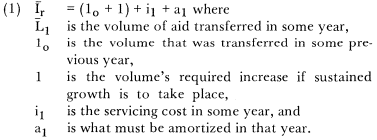
The aid deficiency or sufficiency is shown in equation (2)

The ordinary expectation is that for any African country,

[46] For a summary of aid donations by donor and recipient countries, see Roger D. Hansen, The U.S. and World Development: Agenda for Action (New York: Praeger, 1976), pp. 191–216.
The improving picture in Africa must be interpreted in the context of the fact that several countries (such as Nigeria, Gabon, and some others) are enjoying much better reserveadequacy performances than their continental neighbors. In addition, the continent as a whole has had to come a long way since 1950, when its aggregate picture was dismal to the point of despair. And there is one encouraging point having to do with the efforts of African and other Third World countries to guide the reform of the international monetary system.[47] The key to such a reform for the African countries lacking petroleum endowments is to shift world financial reserve shares in their direction.
Even if aid is sufficient and appropriate (given our definition of it) another question emerges. Is gaining aid worth the possible costs of structural dependency? Obviously each country's decision-makers must answer this question for themselves. But one key point that could serve to mitigate the seriousness of dependence on any one developed country or a small group of them has to do with reforming the entire aid-granting structure in a multilateral direction.[48] This includes not only the IMF and IBRD (or W'orld Bank Group), but it also involves WHO, FAO, UNIDO, UNCTAD, and other agencies.
A cost rather more apparent than reliance on a given structure of world economic power is the matter of payments for debt amortization and servicing. We have noted that there are some useful indicators of a nation's amortizing and servicing capacities. Our effort was directed toward an understanding of how three African countries drifted into serious debt-payment situations. Clearly, as more funds are used in amortization (a1 ) and servicing (il )—as in equation (1)—there is an impingement on the availability of aid. The opportunity to use aid to
[47] See the discussion about monetary reform in F. Modigliani and H. Askari, The Reform of the International Payments System (Princeton: International Finance Section, September 1971); Thomas de Vries, An Agenda for Monetary Reform (Princeton: International Finance Section, September 1972); and F. B. de la Giroday, Myths and Realities in the Developments of International Monetary Affairs (Princeton: International Finance Section, June 1974).
[48] The General Assembly session that convened in New York in the Fall of 1975 carried monetary reform as its major agenda item.
| ||||||||||||||||||||||||||||||||||||||||||||||||||||||||||||||||||||||||||||||||||||||||||||||||||||||||||||||||||||||||||||||||||||||||||||||||||||||||||||||||||||||||||||||||||||||||||||||||||||||||||||||||||||||||
| ||||||||||||||||||||||||||||||||||||||||||||||||||||||||||||||||||||||||||||||||||||||||||||||||||||||||||||||||||||||||||||||||||||||||||||||||||||||||||||||||||||||||||||||||||||||||||||||||||||||||||||||||||||||||
sustain growth and development is lost. Longer amortization periods and lower interest or discount rates, as well as reduced administrative costs, could go a long way toward lifting the aid repayment burden from the shoulder of individual Africans whether they are from Liberia, Botswana, Zambia, or elsewhere. This point on easing debt-servicing is inseparable from the Third World's efforts to affect aid-granting conditions within the United Nations group or through bilateral channels.
In brief, if economic assistance is obtained in an appropriate manner, it can play a significant role in alleviating Africa's developmental burdens. Certainly, inappropriately channeled aid concessions are likely to create additional burdens in the form of aggravated dependency, distorted patterns of resource mobilization and income distribution, and excessive debt repayment burdens. The critical matter of choosing a policy is to supplement local resource scarcities in such a way that growth and development objectives will be pursued unencumbered by inappropriate constraints. In effect, more external resources alleviate scarcity and permit expanded choices or options in pursuing the systemic goals outlined in Chapter 3.
An added dimension in the acquisition of resources is a form of quasi aid; that is, integration of commodity sales by the ACP countries through the Lomé agreement.[49] Still another is collective efforts by Third World countries to obtain access for whatever manufactures they might wish to export to the industrialized world.[50] The first operates within a center-periphery, manufactured products-primary products trade scheme. It seeks, primarily, to redress distributive inequities within this system. The second is a more fundamental, longer-range focus on modifying the basic trade scheme. It seeks added opportunities to manufacture and export finished products from developing areas. In each case, effective cooperation and bargaining
[49] See Isebill V. Gruhn, "The Lomé Convention: Inching Toward Interdependence," International Organization 30, no. 2 (Spring 1976): 241–262; and Alfred S. Friedeberg, "The Lomé Agreement: Co-operation Rather than Confrontation," Journal of World Trade Law 9, no. 6 (November–December 1975): 691–700.
[50] Robert L. Curry, Jr., "Africa and the Generalized System of Preference," Journal of Modern African Studies 10, no. 2 (July 1972): 285–289.
among Third World countries is required and not simply an illusion of such.[51] To protect against co-optation on a global scale in the name of cooperation, it is imperative to choose appropriate policies and strategies rather than avoid legitimate confrontation.
There is another point about external assistance that should be noted. The generally valid criticism persists that aid-granting tends to ignore rural sectors. But this tendency is being evaluated by some donors. For example, the object of Britain's aid-granting is now to discriminate in favor of the poorest communities in the poorest countries.[52] At a Labour Party conference held recently, Frank Judd, under-secretary for overseas development, said, "Our whole aid programme is being increasingly directed to the poorer countries and communities. Priority is given to requests for help to provide these people with counselling and supplies for preventative health care."[53] Some United States aid is moving in this direction. For example, USAID and Ghana's Ministry of Agriculture are considering an agreement under which assistance will be provided in the form of loans and machinery to improve small-scale farming. Technical advice, as well as seeds and fertilizers, will also be provided.[54]
The need, then, is for African decision-makers to negotiate both for global transfers of resources and allocations of them to rural sectors on terms considered by African spokesmen to be appropriate for African peoples.
[51] Some of the dangers of illusion are discussed by Karen A. Mingst, "Co-operation or Illusion: An Examination of the Intergovernmental Council of Copper Exporting Countries," International Organization 30, no. 2 (Spring 1976): 263–288.
[52] "Britain's Aid Policy," West Africa, July 5, 1976, p. 958.
[53] Ibid., p. 958.
[54] Daily Graphic (Accra), September 23, 1976, p. 12.