
Chapter Five
Promotion
The process by which a bureaucracy promotes its members to higher positions has tremendous practical implications. If we accept the notion that, in general, the higher one's position in the bureaucratic pyramid, the greater one's influence and impact, then it becomes plain that the promotion process determines who shall exert power and influence in the bureaucracy. The character and caliber of the bureaucracy's outputs, be they goods, services, decisions, or policies, will hinge, to an important extent, on who is promoted to the higher positions and how.
No less important are the effects of the promotion process and outcomes on the morale of bureaucrats. Unless it is handled with strict impartiality, without fear or favor, on the basis of generally accepted and objectively verifiable criteria, the promotion process has the potential of demoralizing a large proportion of bureaucrats. The structural imperative of bureaucratic organization makes it inevitable that the number of people who can be promoted decreases steadily as they climb the ladder. In other words, the number of potential beneficiaries of the promotion process will vary inversely with the proximity of each echelon to the summit. Can the process be managed in such a way as to placate those who are left behind? How can one ensure that only the most qualified will reach each higher stage in the climb?
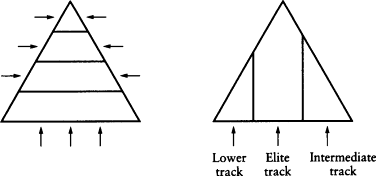
Fig. 2
Two Models of Promotion
Open Competitive Model | Closed Multitrack Model |
1. Promotion open to all regardless of mode of entry. | 1. Initial mode of entry determines the track each civil servant will follow. |
2. Lateral entry permitted at all levels. | 2. No lateral entry permitted. |
3. The principal criterion of promotion is demonstrated merit rather than length of service. | 3. Within each track, length of service plays a key role in promotion up to a certain point. |
In general, two polar models of promotion in a government bureaucracy can be postulated. The distinguishing attributes of the two models are displayed in figure 2. In the first model, which we shall call the open competitive model, all members of the bureaucracy, in theory, embark on their careers with equal chances of being promoted. The particular manner in which one has entered the organization has no bearing on one's prospect of upward mobility. Nor does the level of entrance examination one has taken predetermine the course, speed, and limits of one's promotion in future years. Such openness and flexibility also imply permeability. The organization permits and even encourages a steady inflow of fresh talent at all levels. It follows logically from the foregoing that the principal criterion of promotion shall be merit rather than seniority. This, of course, does not mean that length of service will not matter; rather it means that top priority will be given to demonstrated merit. Given the difficulty of measuring merit, however, length of
service will play a major role insofar as the promotion of those with more or less equal track records is concerned.
In the second model, which we shall label the closed multitrack model, the single most important factor that impinges on the promotion process is the mode of initial entry. Depending on the type and level of examination and evaluation one has undergone, one enters a distinctly demarcated track—an elite track that leads to the top, an intermediate track that allows one to advance only to a position of moderate authority, or a lower track that all but bars promotion to a managerial position. Such a multitrack system is maintained with a high degree of rigidity; very few persons are allowed to enter any of the tracks at points other than the starting line, and even fewer are permitted to cross the demarcation lines of each track at midpoint. Lateral entry into intermediate and higher levels of the hierarchy from the outside is virtually unheard of. Then, too, although merit does play an important role in promotion within each track, length of service is far more controlling here than is the case in the other model. With very few exceptions, members of each entering class within each track tend to ascend the ladder in lockstep up to a certain point.
It should be stressed that these two models neither conform precisely to the ongoing reality nor exhaust all the possibilities. In practice, some systems may represent modified versions of one or the other. Nonetheless, the United States comes closest to approximating the open competitive model, whereas Japan exemplifies the closed multitrack model better than any other country. The West German system resembles, although it does not duplicate, the Japanese system. The situation in Britain and France can perhaps be characterized as a mixture of both models; we may call it the open multitrack model. The chief distinguishing mark of this model is that those who have entered a lower track or an intermediate one are allowed to cross over to the elite track in the midstream provided that they can clear certain hurdles. Thus both the British and French systems set aside a large proportion of places in their administrative trainee program and in the Ecole Nation-ale d'Administration, respectively, for internal candidates that is, those who are already in the civil service.
In the remainder of this chapter, we shall probe the chief aspects of the promotion process in the Japanese civil service. The bulk of our discussion will be based on a combination of descriptive statistics and impressionistic evidence.
Salient Aspects Of The Promotion Process
The Multitrack System
We have already seen that the Japanese civil service employs a closed multitrack system. There are four readily identifiable tracks based on the level and type of the entrance examination taken by the civil servant. Track 1, which can be equated with the elite track, is open to those who have passed the type-A higher civil examination (type I since 1985) or its equivalent. Track 2 is open to those who have passed the type-B higher civil-service examination (abolished in 1985) or its equivalent; we shall label it the quasi-elite track. Those who have passed the intermediate civil-service examination (type II since 1985) are launched on track 3, which can lead to middle-level positions in the Japanese bureaucracy. Track 4 is reserved for those who have passed the lower civil-service examination (type III since 1985); these are the men and women who will perform the routine tasks of the Japanese government at lower levels.
As noted in the preceding chapter, however, the most meaningful distinction may be found between the elite track on one hand and all the others on the other. Although civil servants on the quasi-elite track are regarded as part of kyaria (career civil servants), along with those on the elite track, their status is not equal. The vast majority of the civil servants who are known as nonkyaria (noncareer) actually remain in the civil service longer than the elite bureaucrats.
It should also be recalled that it is by no means impossible for nonkyaria civil servants to rise to the level of section chief and even beyond. In fact, most ministries seem to have a few section-chief positions reserved for their exceptionally capable nonkyaria employees.[1]
Table 18 presents some data on the relative size of each track. Note that the data pertain only to administrative service I positions. Inasmuch as the breakdown between types A and B of the higher civil-service examination is available for new appointees only, the table is based on the latter. As we can see, both the number and proportion of track 1
[1] For profiles of nonkyaria civil servants who have attained the position of section chief or higher in selected ministries and agencies, see the series on "Nonkyaria no sekai" [The World of Noncareer (Civil Servants)], Kankai , Apr. 1983-Feb. 1984.
TABLE 18New Appointees to Administrative Service I Positions, by Mode of Entry | |||||||
Examination | |||||||
Year | Higher A | Higher B | Intermediate | Lower | Evaluation | Total | |
1961 | |||||||
N | 339 | 99 | 771 | 5,464 | 3,865 | 10,538 | |
% | 3.2 | 0.9 | 7.3 | 51.9 | 36.7 | 100.0 | |
1966 | |||||||
N | 511 | 140 | 849 | 7,546 | 1,741 | 10,787 | |
% | 4.7 | 1.3 | 7.9 | 70.0 | 16.1 | 100.0 | |
1971 | |||||||
N | 521 | 128 | 831 | 7,078 | 2,408 | 10,966 | |
% | 4.8 | 1.2 | 7.6 | 64.5 | 21.9 | 100.0 | |
1976 | |||||||
N | 528 | 187 | 987 | 4,759 | 1,666 | 8,127 | |
% | 6.5 | 2.3 | 12.1 | 58.6 | 20.5 | 100.0 | |
1981 | |||||||
N | 497 | 143 | 1,544 | 6,481 | 2,076 | 10,741 | |
% | 4.6 | 1.3 | 14.4 | 60.4 | 19.3 | 100.0 | |
1986 | |||||||
N | 549a | 0b | 1,916 | 6,711 | 2,677 | 12,096c | |
% | 4.5 | 0 | 15.8 | 55.5 | 22.1 | 100.0 | |
SOURCE : Jinji-in, Nenji hokokusho , 1962-87 (Tokyo: Okurasho, Insatsukyoku, 1963-88). | |||||||
a The number refers to those who have passed the type-I higher civil-service examination (HCSE). | |||||||
b The type-B HCSE was abolished in 1985. | |||||||
c This number is greater than the sum of all the preceding numbers in this row because it includes 96 civil servants who were rehired and 149 civil servants who were recruited through special examinations. | |||||||
(higher A) appointees have remained rather small. On the average, only about one in twenty new appointees in any given year is launched on the elite track. The smallest category, both in absolute and relative terms, however, is track 2 (higher B). Whereas the type-A (or type I) higher examination, the gateway to track 1, encompasses the whole gamut of specialties, numbering twenty-eight, the type-B higher examination, until it was abolished in 1985, covered only four fields of specialization: law, economics, civil engineering, and library science. The last-named field was available only in the type-B examination.[2] Track 3 (intermedi-
[2] Jinji-in, Komuin hakusho , 1985, p. 23.
ate) has steadily increased in size over the years, accounting, as of 1986, for I out of 6.3 new civil servants in administrative-service I positions. Not surprisingly, the largest category is track 4 (lower), which has absorbed about 60 percent of the new civil servants throughout the period.
The category of "evaluation" needs to be discussed briefly. Strictly speaking, this is not a separate track, for it encompasses civil servants who are equivalent in status to those in all four tracks. In 1985, for example, the National Personnel Authority certified 88 new appointees who had not taken any examination as "equivalent" to type-I graduates and 10 others as "equivalent" to type-II graduates. The former consisted of 47 doctorate holders, 17 holders of master's degrees, and 24 physicians, and all of the latter were holders of master's degrees.[3]
On the other hand, a small number of the civil servants who are hired through "evaluation" do take examinations that are described as "equivalent to the regular [civil service] examinations." In 1985 a total of 304 candidates took such examinations at the type-I level in such fields as shipbuilding, nuclear engineering, biology, forestry, textiles (sen'igaku ), design (ishogaku ), archaeology, and history of architecture. Twenty-nine of the candidates passed their respective examinations and were hired by eleven different agencies and ministries. In 1985 also, 77 out of 613 applicants were hired as intermediate-level civil servants in the same manner.[4] Although all of these civil servants are legally entitled to the same treatment as graduates of the civil-service examinations at their "equivalent" levels, it is doubtful that the legal stipulations are faithfully implemented. With rare exceptions, only those who pass the type-I civil-service examination have the privilege of launching their careers on the elite track.[5]
[3] Ibid., 1987, p. 45. It should be noted that, strictly speaking, physicians in Japan do not hold doctorates; their medical degree is officially called "Bachelor of Medicine" (igakushi ). Some physicians, however, earn postgraduate degrees—e.g., Doctor of Science in Medicine (igaku hakase ).
[4] Ibid., pp. 42-44.
[5] For a story of one such exception, see "Kanryo shusshin seijika genzan: Fujin no chi'i kojo kakeru" [Interview with Bureaucrats-Turned-Politicians: Gambling on the Improvement of the Position of Women], Kankai , Nov. 1985, pp. 88-96. The subject of this interview article is Kubota Manae, a Socialist member of the House of Councillors. She was hired by the Ministry of Labor in 1951, a year after her graduation from Keio University's Law Faculty. Although she had not taken any civil-service examination, she was treated as an elite-track civil servant; she retired as a division chief in 1982 and was elected to the upper house of the Diet in the following year. However, she lost her bid for reelection in 1986. See Asahi shinbun , 8 July 1986. In her interview with the Kankai magazine, she attributed her successful career in the bureaucracy to "luck."
Salience Of Seniority
Another striking characteristic of the promotion process in Japanese bureaucracy is the role played by the year of entry of civil servants (nenji ). Typically, recruitment occurs once a year, hence those who enter in the same year on the same track in effect become members of the same class. In a few instances, however, recruitment has occurred twice a year, thus giving birth to two separate classes in the same year. In all cases, however, the year of entry is believed to be all but controlling insofar as advancement on the career ladder is concerned. That is to say, members of the same nenji in a given ministry are promoted to the next higher level at roughly the same time until they reach that of assistant section chief (kacho hosa ).[6]
From then on, further advancement is contingent upon a combination of factors, of which seniority is but one. Those who are left behind usually resign. Finally, when one of the lucky survivors who have climbed nearly to the top reaches the peak of his civil-service career, namely, the position of administrative vice-minister (jimu jikan ), all of his remaining colleagues in the same entering class resign. In so doing, not only do they spare both themselves and the new vice-minister the awkwardness of substituting hierarchical relationships for erstwhile ties of equality, but they also clear the path for the advancement of their kohai (juniors or members of the succeeding entering classes).
The general pattern sketched above, however, needs to be qualified. First, because not all positions at the same level arc equal in importance, differentiation is bound to occur from the early stage. As we shall see shortly, service in certain key positions early in one's career enhances the probability of one's outdistancing the other members of one's cohort in the race toward the coveted title of administrative vice-minister. Second, the unwritten rule that one shall resign when one's classmate reaches the final destination is far from sacrosanct. In the 1945-83 period, the rule was violated at least once in all the twelve ministries. In the Ministry of Agriculture, Forestry, and Fisheries, deviations from the rule occurred seven times, and both the Finance and Foreign Ministries witnessed five exceptions to the rule. In many cases, however, classmates of the newly promoted administrative vice-minister who did not
[6] Tashiro Ku, "Nihon gyoseikan kenkyu, VIII: Gyoseikan no shoshin kanri, i" [A Study of Japanese Public Administrators, Part VIII: Management of Their Promotion, 1], Kankai , May 1982, p. 73.
resign were either assigned to or had already been occupying positions as chiefs of "external bureaus" (gaikyoku chokan ). That is to say, they were outside the regular chain of command of the ministries concerned and hence were not subject to direct supervision by the administrative vice-minister. In the case of the Foreign Ministry, this took the form of service as an ambassador abroad. In fact, it is a well-established pattern in the Japanese diplomatic service for an outgoing vice-minister to be appointed to a major ambassadorial post. This ensures that several senior ambassadors at any given time shall serve under their kohai .[7]
In the Ministry of International Trade and Industry, the top two civil-service positions the administrative vice-minister and the vice-minister for international affairs (tsusho sangyo shingikan )—are usually occupied by members of the same class, and both resign simultaneously.[8] In the Ministry of Justice, the administrative vice-ministership is not the terminal career position but a stepping stone to other, more prestigious positions. Although the ministry hires graduates of both the higher civil-service examination and the judicial examination, it is the latter who control the levers of power. Differentiated by the year of graduation from the Judicial Training Institute, nearly all of them are public prosecutors. Known as ateken , their supremacy in the Justice Ministry is sometimes described as "prosecutor's imperialism" (kenji teikoku shugi ). The highest position attainable by them is that of prosecutor general (kenji socho ), and the administrative vice-minister is several rungs below that position. Given all this, the appointment of a
[7] For data on the administrative vice-ministers of the twelve ministries and other agencies during the postwar period, see the series on "Jimu jikan kenkyu" [A Study of Administrative Vice-Ministers], Kankai , Jan. 1982-June 1983. For additional data on the Foreign Ministry, see Nagano, Gaimusho kenkyu , pp. 92-96, Nagano, Nihon gaiko no subete , pp. 297-300, and Nagano, "Kankai jinmyaku chiri: Gaimusho no maki," pp. 40-54. A particularly notable example of deviation from the general rule is the case of Sunobe Ryozo, who succeeded his kohai (a member of the 1941 entering class) as administrative vice-minister in the Foreign Ministry. A member of the 1940 class, Sunobe had previously served as ambassador to the Republic of Korea; his tenure as vice-minister lasted from July 1981 to January 1983.
[8] Nawa Taro, "Jimu jikan kenkyu: Tsusansho" [A Study of Administrative Vice-Ministers: The Ministry of International Trade and Industry], Kankai , Mar. 1982, p. 130. In 1987 the two top positions were occupied by members of the 1955 class: Fukukawa Shinji (AVM) and Kurota Makoto (vice-minister for international affairs). Both were born in 1932 and graduated from Todai's Law Faculty in 1955. Showa 62-nenban Tsusho Sangyosho meikan [Directory of the Ministry of International Trade and Industry, 1987 Edition] (Tokyo: Jihyosha, 1987), pp. 3-4; Seikai kancho jinji roku 1987-nenban , p. 452.
new administrative vice-minister does not precipitate a wave of resignations by his classmates.[9]
The "Elite Course"
As noted, the basic pattern of progression for elite-track civil servants remains the same until they reach the level of assistant section chief, that is, for the first ten years or so. Most ministries try to give their future leaders on-the-job training through the policy of rotation. In the Ministry of Finance, for example, the first six or seven years are set aside for such training (minarai kikan ). Although experience varies from individual to individual, most first-year trainees are assigned to a particular section where they are initiated into the mores of the "Okura [Finance Ministry] family."[10] They are expected to run errands for superiors and perform all sorts of routine, even menial, tasks.
During the second year, the trainees are likely to be assigned to one of the local tax offices to learn about the practical side of internal revenue and finance as "inspectors" (chosakan ). Third-year trainees turn their attention to more theoretical matters, devoting their full time to study either in Japan or abroad. Next, they are exposed to substantive work of the ministry in Tokyo, eventually being promoted to subsection chiefs (kakaricho ). In the fifth or sixth year comes the capstone of the trainee's career—appointment as chief of a local tax office (zeimushocho ). Besides entailing a fair amount of prestige and power, this provides the trainees with the first real opportunity to test their mettle. How they handle themselves in this leadership position will be closely monitored by their superiors in Tokyo.[11]
[9] Seto Shuzo, "Jimu jikan kenkyu: Homusho" [A Study of Administrative Vice-Ministers: the Ministry of Justice], Kankai , Nov. 1982, pp. 66-75; Ikeda Toyoharu, "Kankai jinmyaku chiri: Homusho Kensatsucho no maki" [Who's Who in Government: The Ministry of Justice and the Public Prosecutor's Office], ibid., Mar. 1981, pp. 30-41. In 1986, whereas a 1951 graduate of the Judicial Training Institute (JTI) served as the administrative vice-minister of the Justice Ministry, a 1947 JTI graduate occupied the post of prosecutor general. Three other persons in the Supreme Public Prosecutor's Office and all the chief prosecutors in the eight Higher Prosecutor's Offices had more seniority than the vice-minister. The preceding information was culled from Seikai kancho jinji roku 1987-nenban , pp. 311-22.
[10] Sakakibara, Nihon o enshutsu suru shin kanryo-zo , pp. 39-41. This book is based on Sakakibara's participant observations. I shall present more details on the on-the-job training of Finance Ministry bureaucrats in the next chapter.
[11] Takamoto Mitsuo, Okura kanryo no keifu [The Genealogy of Finance Ministry Bureaucrats] (Tokyo: Nihon Shoseki Kabushiki Kaisha, 1979), pp. 49-51. Fragmentary evidence suggests that appointment as local tax chief can occur as early as the trainee's fifth year and as late as his seventh year. Some trainees are not given this opportunity at all, whereas others are given the privilege twice in a row. See Showa 62-nenban Okurasho meikan [Directory of the Finance Ministry, 1987 Edition] (Tokyo: Jihyosha, 1986).
The second hurdle awaits the bureaucrat at the level of assistant section chief (kacho hosa ). Some bureaucrats are elevated to this level immediately upon completion of their training period. Others must undergo a few more years of apprenticeship. An assistant section chief must display competence in a wide range of activities: research, negotiation, and drafting bills and policy proposals. Those who receive high marks during their days as assistant section chiefs are given choice assignments when they are sent either abroad or to the field in the next round. Such "desirable" locations as embassies and consulates in industrialized democracies in America and Western Europe as well as major cities in Japan are said to be reserved for them.[12]
The bureaucrat encounters the third hurdle when he reaches the level of section chief after about ten years of service as assistant section chief or its equivalent in a number of different sections and units. In addition to demonstrating skills in research, negotiation, and legislative drafts-manship, as mentioned earlier, a section chief is called upon to engage in coordination, provide leadership, deal with personnel matters, and be knowledgeable about a wide range of matters. The manner in which one meets such a multiplicity of challenges will help determine one's chances of advancement in subsequent years. The verdict will come when a handful of classmates are picked as chiefs of the three core sections in the minister's secretariat (kanbo sanka )—the secretarial section, the documents section, and the research and planning section—and as chiefs of the principal section in each bureau, usually called the general affairs section (somuka ). For those who are passed over, the prospect of promotion to the position of bureau chief in the ministry proper becomes rather dim, which in turn implies that they may no longer be in the race to become administrative vice-minister.[13]
A review of the career patterns of fifty persons who have served as administrative vice-ministers in ten ministries reveals that forty-one (82 percent) had previously served as chief of either core sections in the secretariat or the principal section of a bureau. The pivotal role of kanbo sections is suggested by the fact that thirty-two persons (62 percent) had served as their chiefs. Of these, twenty-two had eventually become chiefs of the secretariat (kanbocho ). Twelve others in the sample had
[12] Takamoto, Okura kanryo no keifu , pp. 52-54.
[13] Ibid., pp. 54-63. All eight persons who held the position of bureau chief (including chief of the minister's secretariat) in the Finance Ministry in late 1986 had served as chiefs of either "core" sections in the minister's secretariat or principal sections in bureaus. All but one had also served as assistant chiefs of such sections. Showa 62-nenban Okurasho meikan , pp. 11, 40, 55, 61, 68, 81, 87, and 97.
also served as kanbocho , bringing the total number of former administrative vice-ministers with kanbocho experience to thirty-four (68 percent). All told, only six had not served in any of three key posts—kanbo section chief, chief of the principal section of a bureau, and kanbocho .[14]
It should be stressed that the relative position of the secretariat in the internal structural hierarchy of a ministry or an agency is not uniformly high. It is only in those ministries and agencies that have adopted the system of a "grand secretariat" (dai kanbocho sei ) that its chief outranks the chiefs of all bureaus (kyokucho ). Examples include the Ministries of Foreign Affairs, Transport, and Construction. As will be explained shortly, however, the Ministry of Construction has a dual hierarchy, one pertaining to administrative officials (jimukan ) and another to specialists (gikan ), hence the chief of its secretariat does not necessarily outrank chiefs of technical bureaus. In other ministries the secretariat is on a par with a middle-level bureau. In a few ministries, notably the Ministry of Posts and Telecommunications, the secretariat is at the bottom of the pecking order.[15]
Regardless of its position in the hierarchy, however, the work of the secretariat is intrinsically important. The well-known phenomenon of "sectionalism" tends to foster rivalry among bureaus within most ministries, as is suggested by such phrases as "there are bureaus but no ministry" (Kyoku atte sho nashi )[16] and "the bureaus that resemble 'independent kingdoms'" ("dokuritsu okoku" no yo na kakukyoku ).[17] This underscores the importance of coordination; the parochial interests and perceptions of the various bureaus must be adjusted and harmonized to further the goals of the ministry as a whole. Externally, the task of representing the ministry vis-à-vis politicians, the Diet, and interest groups must also be performed by a unit with a broad, ministry-wide perspective.
[14] These statistics were culled from the biographical sketches of fifty former administrative vice-ministers in Watanabe Yasuo, "Komuin no kyaria" [The Career Patterns of Civil Servants] in Tsuji Kiyoaki, ed., Gyoseigaku koza, dai 4-kan: Gyosei to soshiki [Lectures on Public Administration, vol. 4: Public Administration and Organization] (Tokyo: Tokyo Daigaku Shuppankai, 1976), pp. 193-98.
[15] Kyoikusha, Kanryo [Bureaucrats] (Tokyo: Kyoikusha, 1980), p. 76. An assessment of the relative rank of the secretariat can be obtained by reviewing the year of entry of incumbent officials as well as the career patterns of administrative vice-ministers. See the long-running series on "Kankai jinmyaku chiri" [Who's Who in Government] in Kankai , Jan. 1981-, as well as the series on administrative vice-ministers cited earlier.
[16] Ishii Masashi, "Kankai jinmyaku chiri: Okurasho no maki" [Who's Who in Government: The Ministry of Finance], Kankai , Oct. 1981, p. 45.
[17] Hashimoto Goro, "Kankai jinmyaku chiri: Koseisho no maki" [Who's Who in Government: The Ministry of Health and Welfare], Kankai , Dec. 1981, p. 39.
These pivotal roles are performed by the secretariat. Consequently, chiefs of its key sections dealing with general affairs, personnel, and budget need to be exceptionally well-qualified. Their duties expose them to the whole gamut of problems and issues confronting their ministry, challenging them to exercise and develop skills in compromise, negotiation, and a judicious balancing of diverse interests. In a word, a stint as a core section chief in the secretariat both broadens and tests the civil servant. Those who emerge from such experience with their reputation either intact or enhanced are marked for still weightier challenges thereafter.[18]
In short, the preceding discussion suggests that the promotion patterns of Japanese higher civil servants are affected by a number of factors: (1) nenji , or the year of entry; (2) the preentry record, notably grades received during university days and in the higher civil-service examination; and (3) the postentry record. The latter two are related, for an initial assignment to a core unit hinges to a large extent on the preentry record; such an assignment in turn affords the civil servant opportunities and challenges that are a cut above those provided by routine assignments. Creditable or outstanding performance in preferred posts has a snowball effect, allowing the civil servant progressively to build up his credentials. Being assigned to an important project also enables the civil servant to come into contact with senior persons in strategic places; getting to know them and, better yet, making favorable impressions on them will be definite assets in his future advancement.[19]
Jimukei Vs. Gijutsukei
Elite-track bureaucrats can be broadly divided into two groups: jimukei (administrative group) and gijutsukei (technical group). Those belonging to the former are known as jimukan (administrative officials), and
[18] It is extremely rare for a civil servant without previous experience as a section chief to be appointed as chief of one of the key sections in the secretariat. A random review of the career patterns of those who have served as chiefs of core sections in the secretariats of the various ministries suggests that they typically have behind them six to nine years of experience as "ordinary section chiefs" (hira kacho) . See Nihon kankai meikan [Who's Who in Japanese Government], vol. 33 (Tokyo: Nihon Kankai Johosha, 1981), and Seikai kancho jinji roku 1988-nenban .
[19] On the importance of being given challenging assignments, consult Ono Mitsuru, "Jimu jikan kenkyu: Kensetsusho" [A Study of Administrative Vice-ministers: The Ministry of Construction], Kankai , Dec. 1982, pp. 81-82. Criteria of good performance vary from ministry to ministry. In MITI they are said to include (1) ability to generate new policy proposals, (2) skill in translating the above into the language of legislation or regulations, (3) ability to do the necessary nemawashi ["root-binding" or preparatory work], (4) leadership ability, and (5) ability to promote intraministerial harmony. Nawa, "Jimu jikan kenkyu: Tsusansho," p. 132.
those affiliated with the latter as gikan (technical officials). Although this dichotomy is largely a function of one's academic background, strictly speaking, it is the field of specialization chosen in the higher civil-service examination that places an official in one of the two groups.
Those who choose—that is, are tested in—public administration, law, economics, psychology, education, and sociology are generally headed for careers as jimukan , and those who opt for any of the remaining fields are expected to become gikan . There being no formal educational requirements in the civil-service examinations, in terms of either the level of educational attainments or fields of study, it is theoretically possible for a candidate with technical background, such as agriculture, engineering, or the natural sciences, to choose public administration, law, or economics as his field of specialization. Given the highly competitive nature of the higher civil-service examination, however, such a candidate would need an extraordinary amount of preparation in order to succeed.
If we examine the distribution of higher civil servants at the entry level by their fields of specialization, we find that gikan outnumber jimukan by considerable margins. Whereas the proportion of jimukan has remained relatively stable at or near the 40-percent mark, there has been some notable change in the internal composition of gikan . The proportion of engineers and natural scientists declined from 50 percent in 1962 to 31 percent in 1980, but that of specialists in agriculture doubled during the same period, from 14 to 28 percent.[20] That such change occurred at a time when the relative importance of agriculture in the Japanese economy was steadily declining may seem odd. On the other hand, the number of people involved is quite small. More important, if agriculture has declined in importance as measured by its share of gross domestic product and by the proportion of people engaged in it, its political significance, albeit on the wane, has by no means diminished.[21]
[20] For relevant statistics, see "Showa 41-nendo kokka komuin saiyo jokyu (koshu, otsushu) shiken gokakusha no saiyo jokyo" [The Situation Regarding the Hiring of Those Who Passed the National Higher Civil Service Examination (Types A and B) in 1966], Jinji-in geppo , 196 (June 1967): 10-16; Jinji-in, Nenji hokokusho , 1971-1986 (Tokyo, 1972-87).
[21] The contribution of agriculture, forestry, and fishing to Japan's gross domestic product declined from 6 percent in 1970 to 3.2 percent in 1985. More dramatic is the decline in the proportion of the total labor force engaged in agriculture and forestry from 24.3 percent in 1965 to 9.6 percent in 1980. Prime Minister's Office, Statistics Bureau, Statistical Handbook of Japan, 1981 (Tokyo: Prime Minister's Office, Statistics Bureau, 1981), pp. 27 and 105; Management and Coordination Agency, Statistics Bureau, Statistical Handbook of Japan, 1987 (Tokyo: Japan Statistical Association, 1987), p. 26. The agricultural lobby demonstrated its political clout in 1986 when it successfully blocked the government's attempt to reduce the official purchase price of rice by 3.8 percent. In 1987, however, the government succeeded for the first time since 1956 in adopting a plan to reduce the official purchase price of rice by 5.95 percent. Asahi shinbun , 6 Aug. 1986; 2 and 4 July 1987.
TABLE 19Higher Civil Servants, by Year and Field of Academic Specialization (Percentages ) | ||||
Year | ||||
Field | 1949-59 | 1972-73 | 1986 | |
Law | 68.5 | 64.0 | 59.2 | |
Humanities and social sciences | 6.2 | 12.1 | 18.3 | |
Engineering, natural sciences, and others | 25.3 | 23.9 | 22.5 | |
TOTAL | 100.0 | 100.0 | 100.0 | |
N | 810 | 1,622 | 1,015 | |
SOURCES : The 1949-59 data are from Akira Kubota, Higher Civil Servants in Postwar Japan (Princeton: Princeton University Press, 1969), p. 79; the 1972-73 data are based on analysis of a random sample of higher civil servants listed in Nihon kankai meikan , vols. 24 and 25 (Tokyo: Nihon Kankai Johosha, 1972 and 1974); the 1986 data are based on analysis of a random sample of higher civil servants listed in Seikai kancho jinji roku, 1987-nenban (Tokyo: Toyo Keizai Shinposha, 1986). | ||||
What is of primary interest to us, however, is the phenomenon of unequal promotional opportunities for jimukan and gikan . Inasmuch as direct statistical evidence is not available, we shall examine data—provided in table 19—pertaining to the fields of academic specialization of the civil servants who have already attained the position of section chief or above. It is safe to equate those whose fields of academic specialization were law, the humanities, or the social sciences with jimukan and the remainder with gikan . Whereas only about four in ten elite-track bureaucrats at the entry level are jimukan , seven or eight in ten senior bureaucrats (section chiefs or above) turn out to be jimukan . To put it differently, the roles of the majority and the minority are reversed as the upper rungs of the promotional ladders are reached, with gikan turning into the minority. Table 19 also shows that the proportion of gikan among senior bureaucrats has not changed much during the past three decades, hovering around 23 to 25 percent. Among jimukan , on the other hand, the proportion of those who have studied law has
TABLE 20 Administrative Vice-Ministers, by Field of Specialization, 1981-87 | |||||||
Corea | Peripheryb | All | |||||
Fieldc | N | % | N | % | N | % | |
Law | 42 | 80.8 | 26 | 54.2 | 68 | 68.0 | |
Economics | 6 | 11.5 | 8 | 16.7 | 14 | 14.0 | |
Engineering | 3 | 5.8 | 10 | 20.8 | 13 | 13.0 | |
Agriculture | 1 | 1.9 | 3 | 6.2 | 4 | 4.0 | |
Other | 0 | 0 | 1 | 2.1 | 1 | 1.0 | |
TOTAL | 52 | 100.0 | 48 | 100.0 | 100 | 100.0 | |
SOURCES : Kankai , June 1981-Oct. 1987; Asahi shinbun , May 1986-Sept. 1987; Seikai kancho jinji roku 1987-nenban (Tokyo: Toyo Keizai Shinposha, 1986) and ibid., 1988-nenban (Tokyo: Toyo Keizai Shinposha, 1987). | |||||||
a "Core" refers to the twelve ministries (sho ) of the Japanese national government. | |||||||
b "Periphery" refers to the agencies (cho ) where the highest career official carries the title of administrative vice-minister (jimu jikan ). | |||||||
c "Field refers to the faculty (gakubu ) from which the administrative vice-ministers graduated. | |||||||
declined slightly, although they still constitute an overwhelming majority, whereas the proportion of those who have majored in the humanities and social sciences has increased appreciably.
A study by Tashiro Ku of 139 civil servants who were occupying the position of bureau chief in 1981 revealed that only 26 (18.7 percent) of them had majored in technical subjects in college. Fifteen had studied engineering, 6 medicine, and 5 agriculture.[22] Table 20 examines the situation at the summit of the bureaucratic pyramid. If we look at the core ministries only, we find a virtual monopoly of the top career post by jimukan . Of the four exceptions, one is not really an exception, because the person in question is a jimukan in terms of his bureaucratic career notwithstanding his graduation from Todai's faculty of agriculture. Hence there are only 3 gikan among the 52 persons who served as administrative vice-ministers in the core ministries during the seven-year period. All three are, in fact, beneficiaries of a unique system based on a custom that decrees the alternation of the top bureaucratic post in the Ministry of Construction between jimukan and gikan . This unwrit-
[22] Tashiro Ku, "Nihon gyoseikan kenkyu, V: Gyoseikan no kyaria keisei katei, 3," p. 73.
ten rule has been scrupulously observed throughout the postwar period.[23]
In the periphery—that is, such agencies as the Science and Technology Agency, the National Land Agency, the Environment Agency, and the Economic Planning Agency—the proportion of gikan rises to 29 percent. However, with a few exceptions, these agencies tend to be overshadowed by the core ministries in terms of both prestige and power.
In sum, although it is no longer as blatant as it used to be, the prewar bias against technical officials in Japanese bureaucracy has by no means vanished. It is plain that so far as promotional opportunities are concerned, administrative officials continue to enjoy a distinct edge over their technical counterparts.
Todaibatsu?
In the preceding chapter we noted that the University of Tokyo is the single largest source of both successful candidates in the higher civil-service examination and those who are actually hired by the various ministries and agencies each year. Given this, one should not be astonished to learn that the numerical preponderance of Todai graduates continues in the higher echelons of Japanese bureaucracy. But because the progressive diminution of the number of positions in the bureaucratic pyramid dictates an unequal distribution of rewards in the promotion process, the real question is whether graduation from Todai makes any difference in the process.
Table 21 provides some statistics that bear on the question. First, the overall proportion of Todai graduates among higher civil servants has remained quite high throughout the postwar period. It has ranged from a low of 58 percent (1986) to a high of 73 percent (1954). The proportion of Todai men among the higher civil servants in 1937 was 73 percent.[24] Second, although the proportion remained relatively stable until the early 1970s, it declined appreciably by the mid-1980s. Third, with a few exceptions, the proportion of Todai graduates is correlated
[23] Ono, "Jimu jikan kenkyu: Kensetsusho," pp. 76-78; Kobayashi Ken'ichi, "Kankai jinmyaku chiri: Kensetsusho no maki" [Who's Who in Government: The Ministry of Construction], Kankai , Sept. 1982, pp. 32-41; Kawana Hideyuki, "Kankai jinmyaku chiri: Kensetsusho no maki," ibid., Mar. 1987, pp. 42-56.
[24] Inoki, "The Civil Bureaucracy," p. 296. Inoki analyzed the biographical entries of 1,377 higher civil servants in the 1937 edition of Jinji koshin roku [Who's Who].
TABLE 21 Proportion of Higher Civil Servants Who Attended University of Tokyo, by Year and Level | ||||||
Level | ||||||
Year | 1 | 2 | 3 | 4 | Total | Na |
1949 | 58.7 | 80.7 | 67.8 | 64.0 | 65.8 | (386)b |
1954 | 89.7 | 80.5 | 82.6 | 69.8 | 72.7 | (339)b |
1959 | 95.0 | 85.8 | 72.7 | 63.1 | 68.5 | (365)b |
1972-73c | 93.0 | 83.1 | — | 66.8 | 70.9 | 960 |
1986 | 86.7 | 76.0d | 50.9 | 52.0e | 57.7 | 1,036 |
SOURCES : The 1949-59 data are from Akira Kubota, Higher Civil Servants in Postwar Japan (Princeton: Princeton University Press, 1969), p. 74; the 1972-73 data are from B. C. Koh and Jae-On Kim, "Paths to Advancement in Japanese Bureaucracy," Comparative Political Studies 15, no. 3 (Oct. 1982): 294; the 1986 data are based on analysis of a random sample of higher civil servants listed in Seikai kancho jinji roku, 1987-nenban (Tokyo: Toyo Keizai Shinposha, 1986). | ||||||
NOTE : Level 1 includes administrative vice-ministers (jimu jikan ) and directors-general (chokan ). Level 2 includes chiefs of secretariat (kanbo cho ), bureau chiefs (kyokucho ), and assistant bureau chiefs (kyoku jicho ). Level 3 includes division chiefs (bucho ) and assistant division chiefs (bu jicho ). Level 4 includes section chiefs (kacho ) and equivalents. | ||||||
aN refers to the total number of cases in the sample, not the number of Todai graduates. | ||||||
b Because Kubota provides only the number of cases for all three years (N = 1092), the yearly subtotals were estimated from the distribution of his total sample by year. | ||||||
c Level-3 civil servants were not included in this subsample. | ||||||
d When assistant bureau chiefs are excluded, the percentage increases to 83.4. | ||||||
e When senior section chiefs are examined separately, the percentage jumps to 68.1 | ||||||
with position level. That is to say, the higher the position level, the greater the proportion of Todai graduates.
There are three exceptions to this pattern: level 1 in 1949, level 2 in 1954, and level 2 in 1986. The 1949 data reflect the combined effects of the purge of higher civil servants under the Occupation and the Occupation's policy of encouraging the recruitment and promotion of non-Todai graduates.[25] The reversal of order between levels 2 and 3 in 1954 and between levels 3 and 4 in 1986 needs to be understood in the context of what level 3 really signifies. The positions of division chief (bucho ) and assistant division chief (bu jicho ) encompassed by this level do not fit neatly into the hierarchical ordering of ranks. Although divisions are technically below the level of bureaus, the former exist only in exceptional cases. Moreover, in terms of the seniority and grade level of incumbents, division chiefs are in some cases on a par with
[25] Kubota, Higher Civil Servants in Postwar Japan , pp. 74-77.
TABLE 22Higher Civil Servants (Core and Periphery), by University Background and Rank, 1986 | |||||||||
Admin. Vice-Minister | Bureau Chief | Section Chief | Total | ||||||
University and faculty | N | % | N | % | N | % | N | % | |
Tokyo law | 16 | 72.7 | 95 | 65.5 | 256 | 38.8 | 367 | 44.4 | |
Tokyo other | 3 | 13.6 | 26 | 17.9 | 94 | 14.3 | 123 | 14.9 | |
Kyoto law | 1 | 4.6 | 6 | 4.1 | 40 | 6.1 | 47 | 5.7 | |
Kyoto other | 1 | 4.6 | 2 | 1.4 | 35 | 5.3 | 38 | 4.6 | |
Other law | 1 | 4.6 | 6 | 4.1 | 71 | 10.8 | 78 | 9.4 | |
Other other | 0 | 0 | 10 | 6.9 | 163 | 24.7 | 173 | 20.9 | |
TOTAL | 22 | 100.1 | 145 | 99.9 | 659 | 100.0 | 826 | 99.9 | |
SOURCE : Based on analysis of higher civil servants listed in Seikai kancho jinji roku 1987-nenban (Tokyo: Toyo Keizai Shinposha, 1986). The table encompasses all persons holding the position of administrative vice-minister and bureau chief and a random sample of those holding the position of section chief in twenty-three government agencies, including all twelve ministries, in late 1986. | |||||||||
senior-level section chiefs or junior-level assistant bureau chiefs. Hence it is not unreasonable to ignore level 3 altogether in ascertaining general patterns of progression between levels.
As we saw in chapter 4, the number-two position in terms of university background is occupied by Kyoto University. In 1937, Kyodai provided 9 percent of higher civil servants.[26] Kyodai's share, during the postwar period, was as follows: 1949-59: 5.5 percent; 1972-73: 7.2 percent; and 1986: 10.5 percent.[27] Table 22 further illustrates the dominance of the two top universities in the upper rungs of Japanese bureaucracy. Note that, unlike the preceding table, this one pertains only to those civil servants who occupied positions of administrative vice-minister (jimu jikan ), bureau chief (kyokucho ), and section chief (kacho ) in twenty-three government ministries and agencies in 1986. It excludes others who occupied equivalent positions but did not carry the titles mentioned above. Nor does it include those who held the title of division chief (bucho ).
[26] Inoki, "The Civil Bureaucracy," p. 296.
[27] For the sources of these statistics, see table 20.
Aside from confirming the general patterns discussed above, the table shows that the elitist complexion of Japan's higher civil service is accentuated when Kyodai is added to the picture. The two universities together account for seven in ten higher civil servants overall, and their share of the pot increases to 89 percent at the bureau-chief level and to 95 percent at the vice-ministerial level. If we add up all law graduates in the table, we find that they account for 60 percent of the total, which is about the same as Todai's overall share. In other words, this table confirms the reality of the twin phenomena--dominance of both elite-university graduates and law graduates (hoka banno ).
To conclude from the preceding discussion that the top reaches of Japanese bureaucracy remain the exclusive club of alumni of the top two universities, however, would be a mistake. As table 23 shows, graduates of other universities do manage to reach the summit from time to time. Two of the three exceptions in the core are graduates of Kyushu University, one of the former imperial universities. The third, a graduate
TABLE 23 Administrative Vice-Ministers, by University Background, 1981-87 | |||||||
Core | Periphery | All | |||||
University and Faculty | N | % | N | % | N | % | |
Tokyo law | 38 | 73.1 | 23 | 47.9 | 61 | 61.0 | |
Tokyo other | 7a | 13.5 | 15b | 31.2 | 22 | 22.0 | |
Kyoto law | 2 | 3.8 | 2 | 4.2 | 4 | 4.0 | |
Kyoto other | 2c | 3.8 | 4d | 8.3 | 6 | 6.0 | |
Other law | 2e | 3.8 | 1f | 4.2 | 3 | 3.0 | |
Other other | lg | 1.9 | 3h | 6.2 | 4 | 4.0 | |
TOTAL | 52 | 99.9 | 48 | 100.0 | 100 | 100.0 | |
SOURCES : Kankai , June 1981-Oct. 1987; Asahi shinbun , May 1986-Sept. 1987; Sekai kancho jinji roku 1987-nenban (Tokyo: Toyo Keizai Shinposha, 1986), and ibid., 1988-nenban (Tokyo: Toyo Keizai Shinposha, 1987). | |||||||
NOTE : For definitions of "core" and "periphery," see table 20. | |||||||
a Economics: 6, agriculture: 1. | |||||||
b Engineering: 7, economics: 6, agriculture: 2. | |||||||
c Engineering: 2. | |||||||
d Engineering: 2, one each from agriculture and economics. | |||||||
e Kyushu University and Okayama University. | |||||||
f Tohoku University. | |||||||
g Kyushu University (engineering). | |||||||
h Keio University (economics), Kyushu University (engineering), Tokyo University of Arts and Sciences (Tokyo Bunri Daigaku ). | |||||||
of Okayama University, served as the administrative vice-minister of MITI from June 1984 to June 1986. The four universities represented in the periphery are Tohoku, Kyushu, Keio, and Tokyo Bunri Daigaku. Like Kyushu, Tohoku is a former imperial university, whereas Keio is a top-rated private institution of higher learning. In sum, five of the seven exceptions are graduates of universities that are "first-rate" (ichiryu ) by Japanese standards. If reaching the top is one's objective, then having proper academic credentials appears to be a necessary condition, albeit by no means a sufficient one.
The domination of the highest civil-service positions by graduates of the two top universities constitutes one of the striking continuities between the prewar and postwar periods. In the 1949-59 period, Todai provided 83.7 percent of the administrative vice-ministers, and Kyodai provided the remainder.[28] Table 23 shows that the picture has changed but marginally: Todai's share of administrative vice-ministerial positions in both the core and the periphery during the 1981-87 period was 83 percent--all but identical with the situation two or three decades earlier. What has changed is that, because of inroads by other universities, Kyodai's share has declined from 16.3 percent to 10 percent. In a word, although the elitist trend continues, the duopoly of Todai and Kyodai has begun to crumble slowly but surely.
A Comparative Perspective
Because of the paucity of hard statistical data on the promotion patterns of the Western industrialized democracies, we can make only broad, impressionistic generalizations by way of comparison. We have noted that systems of promotion can be differentiated along such dimensions as equality of promotional opportunities, permeability, and principal criteria of promotion. Such an approach allows us to posit two polar models of promotion: (1) the open competitive model and (2) the closed multitrack model.
These two models are exemplified by the United States and Japan, respectively. Although there are multiple modes of entry into the American federal bureaucracy--the presidential management-intern program serving as the functional equivalent of Japan's higher civil-service examination--mode of entry per se does not necessarily predetermine either the probability or the speed of the civil servant's
[28] Kubota, Higher Civil Servants , p. 77.
advancement in the United States. This is clearly shown by the frequency of lateral entry, a practice that not only allows what the Japanese would call yokosuberi (side slip) but gives the lateral entrant an equal opportunity of promotion. Whether merit always eclipses seniority in promotion decisions is hard to document. Nonetheless, the primacy of merit is underscored by such devices as the regularized system of performance appraisal, the Merit System Protection Board, and the Senior Executive Service.[29] An extensive use of political appointment, on the other hand, dilutes the role of merit to an appreciable degree.
In what specific ways does Japan approximate the closed multitrack model? And where do the three European democracies fit? That the initial mode of entry all but predetermines whether one will follow the elite track in Japan is beyond doubt. Only in the early years of the postwar period did exceptions to this rule occur. In recent years, it has become next to impossible for someone who has not entered the civil service via the type-A (or type-I) higher examination to become a "career" civil servant in the sense in which the Japanese use the term. An extreme manifestation of this trend is the emergence of what is known as beppyo-gumi (separate-list group) in the Ministry of Transport, to which those civil servants who have passed the type-A (or type-I) higher examination after entering the government service through other means are relegated. Also assigned to the group in the ministry are graduates of the type-B higher examination. For all practical purposes these people are not treated as full-fledged "career" civil servants.[30] In other words, it is not simply whether but also when one has passed the type-A (or type-I) examination that becomes a decisive factor in one's advancement.
To say that the initial mode of entry practically determines whether one will be launched on the elite track is not to imply that those who fail to get on the track will ipso facto forfeit an opportunity ever to attain an elite status, namely, section chief or above. Although their chances of being promoted to such high positions are patently slim, some of them will nonetheless make it. In a word, the Japanese system is not a completely closed one.
[29] David T. Stanley, "Civil Service Reform in the United States Government (1)," International Review of Administrative Sciences 48, nos. 3-4 (1982): 305-14.
[30] Uemoto Ryohei, "Nonkyaria no sekai: Un'yusho no maki" [The World of Noncareer (Civil Servants): The Ministry of Transport], Kankai , Sept. 1983, p. 154. It should be stressed that beppyo-gumi is not an official term.
In another sense, however, the Japanese system does resemble an exclusive club more closely than any of its counterparts in the Western democracies: its impermeability to lateral entry. To be sure, political appointees do exist in the Japanese-government bureaucracy, notably cabinet ministers, parliamentary vice-ministers (seimu jikan ), and, occasionally, an ambassador or a minister in the diplomatic service. The exceptions in the diplomatic service, of whom there have been but a handful in the entire postwar period, have consisted for the most part of women who had already risen to high positions in other parts of the government bureaucracy.[31]
What is the relative weight of merit and seniority in the promotion process in the Japanese civil service? For those who enter the elite track at the outset, promotion to the position of assistant section chief and perhaps to that of section chief or its equivalent as well may hinge primarily on length of service. On the other hand, merit does influence their upward mobility in a number of ways: first, their preentry record affects their chances of obtaining preferred assignments at the outset; second, their performance thereafter is closely monitored by their superiors, thus becoming a major factor in the latter's personnel decisions; third, because promotion of members of the same entering class does not always occur simultaneously with clocklike precision, nor are all positions at the same level equal in prestige, subtle but nonetheless real differentiation is bound to occur. In a word, it is possible for a select few to build up a better track record than the other members of their cohort. Cumulatively, all this may add up not only to a differential speed of advancement but also to an unequal distribution of its probability. In sum, although seniority is strongly correlated with advancement, the role of merit becomes increasingly salient as the higher rungs of the promotional ladders are reached.
Among the three West European countries with which we are concerned, only West Germany presents the possibility of approximating Japan in meeting the key criteria of the closed multitrack model. Like Japan, West Germany has distinctly unequal classes of civil
[31] The most recent "political" appointee is Akamatsu Ryoko, a career bureaucrat in the Ministry of Labor. She was chief of the ministry's Women's Bureau when she was appointed as Japan's ambassador to Uruguay in November 1985. That was actually her second stint in the diplomatic service, for she had previously served as a minister in the Japanese Mission to the United Nations. The first woman ever to serve as an ambassador in Japan's diplomatic service was also a political appointee recruited from the Ministry of Labor. Takahashi Hiroko, who became Japan's ambassador to Denmark in 1980, had been a career civil servant in the Labor Ministry. Asahi shinbun , 13 Nov. 1985.
servants, differentiated by their respective modes of entry, of which the Higher Service (hoherer Dienst ) stands at the apex. However, promotion from the Executive Service (gehobener Dienst ) to the Higher Service does occur, as does promotion from the Clerical Service (mittlerer Dienst ) to the Executive Service and from the Basic Service (einfacher Dienst ) to the Clerical Service. In fact, members of the Executive Service who are promoted to the Higher Service need not even be university graduates. They must, however, meet the following requirements: (1) provide demonstration of merit, (2) have had fifteen years of service, (3) be between the ages of forty and fifty-eight, (4) have attained the highest grade in the Executive Service, and (5) have completed a three-year preparatory period, which may be shortened but not dispensed with altogether.[32]
Because all this is not too different from lateral entry, the German system can be described as somewhat more permeable than the Japanese one. In fact, lateral entry in its unadulterated form--namely, entry from outside the government bureaucracy--is known to occur in the West German higher civil service. In theory, the positions of Division Head (Ministerialdirektor ) or above are to be filled by political appointment; in practice, many of those who ostensibly belong to such a "political class" are "non-political career officials."[33] Promotion within the Higher Service is said to be based primarily on "an overall assessment of ability, achievements, and attitudes," a process that entails the use of two assessors and assessment conferences.[34] In short, although West Germany appears to approximate the closed multitrack model, it displays a somewhat greater degree of permeability and flexibility than does Japan.
So far as Britain and France are concerned, both are considerably more open, in terms of promotional opportunities for their respective civil servants, than either Japan or West Germany. As already noted, not only do both explicitly provide for the entry of internal candidates into their respective elite tracks, but a sizable proportion of the latter do in fact enter the Ecole Nationale d'Administration and the administrative-
[32] Sumitomo, "Nishi Doitsu renpo kanri no nin'yo seido," II, pp. 13-14; Ulrich Becker and Berend Kruger, "Personnel Administration and Personnel Management" in Klaus Konig et al., ed., Public Administration in the Federal Republic of Germany (Antwerp: Kluwer-Deventer, 1983), p. 260; and Oertzen, "Public Personnel Management in the Federal Republic of Germany," p. 214.
[33] Johnson, State and Government in the Federal Republic of Germany , p. 190; Becker and Kruger, "Personnel Administration," p. 260.
[34] Ibid., pp. 260-61.
trainee program respectively. Moreover, promotion of nonelite-track civil servants to elite-level positions occurs on a much larger scale in Britain than is the case in Japan and West Germany.[35] Although lateral entry appears to be relatively rare in both Britain and France, their higher civil servants are quite mobile across departmental boundaries. Members of the French grands corps , in particular, may even move temporarily into the political arena or into the public or private sectors of industry.[36] In this connection, the higher civil servants in West Germany, too, are considerably more mobile than their counterparts in Japan. Mobility takes the form not only of interdepartmental transfers but also of movements between the Federal government and the Lander.[37]
The low frequency of lateral entry in Britain and France means that neither fits the open competitive model neatly. Because they are substantially more open than Japan, however, they do not seem to approximate the closed multitrack model, either. Hence the rationale for a new model: the open multitrack model. In a strict sense, all of these differences are matters of degree rather than of substance; no system is as open as it purports to be or as closed as it is theoretically capable of being. Nonetheless, marginal differences in the relative degree of openness should not be minimized. With these caveats in mind, we reach the inescapable conclusion that Japan does indeed lag behind the four Western nations in openness and flexibility.
[35] G. K. Fry, "The Administrative Revolution" in Whitehall: A Study of the Politics of Administrative Change in British Central Government since the 1950s (London: Croom Helm Ltd., 1981), p. 151; D. R. Steel, "Britain" in Ridley, ed., Government and Administration in Western Europe , p. 40.
[36] Howard Machin, "France" in Ridley, ed., Government and Administration , p. 92.
[37] Johnson, State and Government in the Federal Republic of Germany , p. 184. A West German scholar writes, however, that such personnel movements should be regarded as exceptions rather than the norm. See Oertzen, "Public Personnel Management in the Federal Republic of Germany," p. 215.