
Chapter One
The Parmenides
1. The Problem of the Parmenides
Plato's intentions are more enigmatic in the Parmenides than in any other dialogue. The first part depicts Socrates, in his youth, haltingly expounding his theory of forms to the aged Parmenides, who proceeds to demolish it with a series of five arguments, only to conclude that "on the other hand if anyone . . . does not admit the existence of forms of things or mark off a form under which each individual thing is classed, he will not have anything on which to fix his thoughts . . . and in this way he will utterly destroy the power of discourse" (135b-c).
For those who consider the theory of forms to be untenable, the dialogue is often welcomed as a sign that Plato himself came to see the error of his ways, and Parmenides' subsequent endorsement of the theory is interpreted as only a limited endorsement that does not extend to all the features of the theory that have come under attack. What remains, they suggest, is a modified theory that no longer postulates the forms as separate from things.
The dramaturgy of the dialogue, however, seems to point in the opposite direction. The Platonic Socrates who here as a youth falls victim to Parmenides' refutations is the same one whom Plato has previously portrayed as continuing to defend the theory in his maturity and even on his deathbed. We are even reminded of the future Socrates of the Republic by the presence of Glaucon, Adeimantus, and someone named
Cephalus (although not the same Cephalus who appears in the Republic ), none of whom serve any other function within the Parmenides itself. Cephalus, to be sure, is the narrator, but since he only repeats Antiphon's narration (127a) it would have been simpler to leave Cephalus (and Glaucon and Adeimantus) out altogether and have Antiphon—or better, Pythodorus, who was the original narrator from whom Antiphon learned it—narrate the story directly. It is as though Plato wanted to underline the gratuitousness of his inclusion of these names. If Plato wanted us to take Parmenides' arguments as decisive, it would be odd for him to make the victim someone whom he has already depicted as subsequently, and in greater maturity, unshaken in his adherence to the theory. It would make far more sense to cast one of Socrates' disciples (Phaedo, for example) as the defeated champion of the theory here (and someone like the Eleatic stranger as its refuter, since Parmenides would no longer be alive). But those who find the theory of forms too speculative for their taste tend to feel the same way about conclusions drawn from Plato's dramaturgy. After all, it is not inconceivable that Plato is simply giving Socrates a "fresh start" here.
The contrary interpretation, according to which Plato considered the theory of forms to be unscathed by these arguments, faces the difficulty of finding a plausible alternative explanation of the arguments, which do, after all, seem to be intended as refutations of the theory. To dismiss Parmenides' arguments as parodies of sophistry or as ironic jokes, as is sometimes done, is too easy. If we can pick and choose which of Plato's arguments to take seriously and which ironically, on as little evidence as this, there will be no escape from arbitrary and capricious interpretation. Moreover, in the dialogues immediately following the Parmenides —the Theaetetus, Sophist , and Statesman —Plato seems to be exploring alternatives to the theory, which suggests that he is indeed dissatisfied with it in some sense. One might reply that Plato, having said in previous dialogues all he had to say about the forms, is now exploring new avenues without renouncing the old; but in the Sophist he does speak as though being a "friend of the forms" is no longer an adequate position (246b ff.).
I shall argue that Plato intended these arguments to raise serious problems about the theory of forms, but that he did not consider the problems to be fatal. We shall see that the mature theory of forms has at its disposal the means to mitigate the devastating conclusions that Parmenides draws, and that Plato even gives us indications of where Parmenides' arguments may be assailed. But we shah also see that the objections cannot be dispelled entirely, so the question of how far Plato
considered the theory to be undermined by them admits of no simple answer. We shall have to take a detailed look at the arguments to see precisely where they lead us.
2. The Theory of Forms
In previous dialogues the forms have served a variety of functions, as causes, universals,[1] ontological paradigms, and referents of knowledge. Some readers have claimed that these functions are incompatible, and that the theory as a whole is incoherent. It is true that the functions are by no means identical, but they are nevertheless compatible and are even related in an order of conceptual entailment,[2] although I would not insist that the order of logical priority necessarily corresponds to the order of their discovery or of their importance in Plato.
1. The theory of forms is always linked to the primordiality of-goodness.[3] The nature of reality is not just a matter of chance or spontaneity, but a consequence of the fact that for Plato being is inseparable from value. The "forms" that reality takes are therefore not random but are consequences of what follows from the nature of goodness: "To the things known [the forms] not only their knowability, you must say, is provided by the good, but even their being and essence comes to them from it" (Republic 6.509b). Accordingly, the most important forms are always those that most obviously manifest value: goodness, beauty, virtue, justice, wisdom, piety, moderation, courage. The others must also be manifestations of goodness insofar as they manifest reality, but the connection is no longer explicit.
2. When Plato speaks of the forms as causes, as he does in the Phaedo , for example (100c ff.), it is dear that he does not mean that they actively produce an effect (efficient causality)—since the forms are not active. They are formal causes, whose power lies not in an activity on the part of the form, but in their capacity to be participated in by something else. Precisely what is meant by this is one of the aporiae of Platonic philosophy, but it is helpful to think of the forms as the possibilities of reality, possibilities of the kinds of things and qualities that can exist in accordance with the nature of reality. The Presocratics
[1] For convenience I use the term "universal" throughout to designate the Platonic "one over many." No post-Platonic connotations are intended.
[2] An earlier and less complete version of the following account was developed in PP 125 -26.
[3] Symposium 205e-206a; Phaedo 99c; Republic 6.509b; Phaedrus 245e; Philebus 13e, 15a; Timaeus 29e.
recognized that the material of which all things are composed must be eternal, and Plato recognized further that the possible forms that this material can take must in some sense be eternal as well. Understood in this way, forms are causes in the purely formal sense that a thing or quality of a certain kind could not exist if such kinds did not follow from the nature of reality. It is a necessary condition for the existence of a thing that such things be possible.
3. Now, if the forms are the possibilities of a kind of thing or quality coming into being, then each form will also be what all instances of that kind have in common, and it will accordingly have the character of a universal. This feature is not always emphasized by Plato (it is not evident in the Phaedo , for example), but it is explicitly mentioned at least in the Symposium (210b), Republic (596a), and Parmenides (132a), and was implicit in the early dialogues, in which Socrates searched for univocal definitions that exhibit the character common to all instances of a certain kind, a quest out of which the theory of forms may have developed.
4. Again, as universals, or the essence of what a number of things or qualities have in common, the forms abstract from everything extraneous and deficient, and so are purely and perfectly that essence. As such they are also paradigms of their kind. This will appear to be an unjustified transition if we think of a universal in purely logical terms such as a class, for a class is not a perfect instance of its members. On such a view the theory of forms will appear incoherent, and it is precisely this imputed incoherence on which the theory of forms is often thought to founder in the Parmenides . For Plato, however, the one that stands over the many and defines it is not a class but an independent ontological reality. As one over many it is universal, and as the bare essence itself it is the pure and therefore perfect quality. Conceived in terms of Plato's conception of reality rather than in terms of ontologies that are foreign to Plato's way of thinking, and based on very different assumptions, the forms' characteristics as universal and paradigmatic are not only compatible but necessarily connected.
5. Finally, as paradigms the forms are characterized by the same quality that particular things possess by participating in them, and are therefore in a certain sense (which will be clarified later) self-referential. Because they possess a determinate character they are in principle knowable—indeed, as paradigms they are the ultimate referents of all our knowledge, as Plato argues in the discussion of recollection in the Phaedo (74a-75a).
I have recalled these features of the theory because they seem to be what guided Plato in his choice of Parmenides' arguments, and perhaps even their order. (1) In the preliminary inquiry Parmenides attacks the valual aspect of the forms by asking whether there can be forms not only of noble things like the just, beautiful, and good, but also of "very ignoble" (

Let us go through the arguments now in turn, to see what they prove and what Plato may have thought they prove. After the preliminary inquiry, which is not strictly an argument at all, we shall find that although Socrates answers most of Parmenides' questions with alacrity, he becomes tentative at a crucial step in each argument but the third, using the word


3. Preliminary Inquiry (128e-130e)
The main part of the conversation begins when Socrates proposes to solve a paradox of Zeno's by means of the theory of forms. Only the conclusion of the paradox is given: "If beings are many, it is necessary for them to be simultaneously similar and dissimilar, which is impossible" (127e). Perhaps the argument itself (which Plato may have assumed his readers would be familiar with) was to the effect that we are
similar because we are all human beings (or share some other attribute), but dissimilar because we are distinct individuals.[4] Whatever the argument may have been, Socrates replies to it by speaking of similarity and dissimilarity as separate forms, whose very separation from the things that participate in them resolves the paradox: there is no contradiction in saying that I participate in similarity and dissimilarity, rather than being both similar and dissimilar (129a). The same goes for comparable paradoxes about the one and many, or rest and motion (129b-e).
Under Parmenides' questioning, Socrates says that there are forms themselves-by-themselves (



Not only is there a connection between reality and teleological goodness, but there is also a connection between philosophy's attempt to apprehend that reality, and moral goodness. Such a connection has already been drawn in detail in the Republic 's doctrine of the tripartite
[4] Such an interpretation is suggested by Socrates' extrapolation of the argument to the "one and the many" at 129c. Also see R. E. Allen, Plato's Parmenides (Oxford: Blackwell, 1983) 78.
[5] At least as far as is permitted by the nature of material necessity. Cf. Timaeus 47e-48a.
soul, and the present section contains a graphic reminder of that doctrine. Zeno remarks that he wrote his polemic when he was young, in a spirit of youthful combativeness (


Second, value is not the only factor that determines for Socrates what forms there are, for he introduced the theory in terms of the forms of "same and not-same, plurality and one, and rest and motion" (129d-e), which have no obvious connection with values. The valual aspect of the forms was introduced by Parmenides' questions; prior to that the characteristic that Socrates had emphasized was the forms' separation from corporeal things. The quality of the form as separate (


[6] This is rightly taken by Allen to be a way of emphasizing Socrates' immaturity (PP 67). Allen also refers to Euthydemus 273a, where Ctesippus is described as "insolent due to his youth" (n. 38).
for natural kinds, like human beings, fire, and water. These examples are not trivial or lacking in nobility, like hair, mud, and dirt, so his uncertainty about the existence of separate forms for the former three cannot be on account of an "unworthiness." They may be unconnected with value in an obvious way, but the same was true of sameness, not-sameness, plurality, oneness, rest, and motion, which Socrates himself had offered as his first instances of forms. The reason that it is difficult to think of human beings, fire, and water as separate from their corporeal manifestations must lie elsewhere. I suspect it lies in the fact that human beings, fires, and water actually exist in the physical world; whereas sameness, not-sameness, plurality, oneness, rest, motion, justice, goodness, and beauty never exist corporeally as such,[7] but only as attributes of physical things. There is no risk of identifying these latter forms with corporeal instances, because there are no corporeal instances of them as such; corporeal entities are (in Aristotelian terms) substances, not attributes. But since there are corporeal instances of substantial forms like human being, fire, and water, it would be harder to establish that their essential being lies outside themselves, somehow separate from individual human beings, fires, and waters.[8] Because Aristotle rejected the separation of forms from individual things, the forms of natural kinds—substantial forms or species—are for him the most important, and attributes have only a subordinate importance. For "Socrates," the reverse is true.
Third, Socrates nevertheless needs to recognize that in order to be consistent he must accept that what is true in some cases is true in all. Why should some things, but not others, owe their nature to formal causality, and how can Socrates divide the one from the other without being arbitrary? Hence his indecision about natural kinds. If the theory of forms recognizes that there is such a factor as formal causality opera-five in the world, then it must generalize the causal efficacy of forms to all cases. The forms' character as necessary causes of phenomena within
[7] That is why the "method of paradigms" is so important in the Statesman (277d ff.).
[8] Allen's interpretation here, although conceived in very different terms, ultimately points in the same direction: "Such Ideas [as Man, Fire and Water] are substantival; their distinctive feature is that, unlike those Socrates has just accepted, they have no opposite (Phaedo 104a-b, 105a, Republic VII 524d-525a). Since Socrates introduced the theory of Ideas to explain why qualification by opposites does not imply the identity of opposites, it may seem an open question, so far as the Parmenides is concerned, whether Ideas are required where opposition is not involved (as is true of Republic VII 523c ff.)" (PP 107). The connection between Allen's interpretation and my own may be expressed in Aristotelian terms: it is much more difficult to regard a substrate as separable from matter than so to regard the contraries by which it may be characterized.
the physical world must be insisted upon as rigorously as their separation from the physical world.
Fourth, as the end of the passage shows, Socrates' failure to answer successfully the questions posed by Parmenides is meant to illustrate his immaturity. He is too concerned with what others will think of him, and not yet fully committed to philosophy. In other words, like the young Zeno, he is still too much under the influence of the spirited part of his nature and its concern with repute, and not sufficiently dedicated to the rational. The defense of the theory of forms has not been put into the most capable of hands. Later, when Socrates has shown himself unable to cope with Parmenides' first four challenges to the theory of forms, Parmenides introduces the fifth and greatest challenge by saying that only "someone with much experience" (

4. First Argument: Participation (130e-131e)
The first argument focuses on the forms' function as causes, and con-dudes that the relation of participation, the mechanism of this causality, is incoherent. The argument turns on a dilemma: either (a ) the form will be whole and entire in each of the things that participate in it, or
[9] Cf. Mitchell Miller, Plato's Parmenides: The Conversion of the Soul (Princeton: Princeton University Press, 1986), 60 n. 24 (p. 219).
(b ) it will be partitioned among them. If a , "then being one and the same it will be whole in many separate individuals at once, and would thus itself be separate from itself" (131b). If b , then it will no longer be possible to maintain that the form is "one" (131c), a unity, as Socrates' theory had assumed (131a). To drive home the point, Parmenides adds three more specific reductios : the parts of bigness will no longer be big since they are small relative to the whole, the parts of equality will no longer be equal to equality since they are smaller than equality as a whole, and smallness will be larger than its parts since it embraces them all (131d-e).[10]
Clearly a is closer than b to representing the theory as put forward in previous dialogues (although, as we shall see, it can be misleading even to think of the forms as wholes since they are simple and incomposite, as at Phaedo 78c f.). In fact, by treating forms as if they were spatially extended and capable of addition, subtraction, and division, b exemplifies the confusion between formal and material causality that Socrates warned against in the Phaedo (96d f., 101a f.). Accordingly a is the horn Socrates tries to grapple with. In reply to Parmenides' conclusion at a , Socrates says: "It would not [be separate from itself] if it were like day, which is one and the same, is in many places at once, and yet is not itself separated from itself; so each of the forms too would be one and the same in all its participants at once."[11] Parmenides replies, however: "You make one and the same to be in many places at once, just as if you spread a sail over many people and then said it was one and the whole of it was over many. Isn't something like that what you mean to say?" "Perhaps" (

Socrates may well have misgivings about the substitution Parmenides
[11] This example, according to Proclus, derives from the discourse of Zeno (Commentary on Plato's Parmenides [Princeton: Princeton University Press, 1987] 229).
makes here. Commentators sometimes take Parmenides' point to be that, if Socrates compares participation to the presence of daylight to different individuals, we can still reply that the light that falls on one individual is a different part of the light than that which falls on another—like Parmenides' example of a sail.[12] But Socrates did not compare forms to light but to day (

Although the youthful Socrates is not quite quick enough to put his finger on what went wrong, his dubious "perhaps" suggests that Plato made the switch deliberately and sought to arouse our suspicion and make us pursue the matter further. It might be thought that Plato portrays Socrates as tentative here and in the other arguments only to show that Socrates senses defeat and would like to be able to find another answer. Certainly that is part of it, but there are three reasons why I doubt that it is the whole explanation. First, Socrates hesitates only at one crucial step in each argument, whereas if the hesitation were simply a matter of dramatic verisimilitude we should expect his hesitations to be more extensive. Second, each step where he hesitates is in fact a questionable rather than overwhelming one, which is the reverse of what we should expect on the other hypothesis. Third, Socrates is not made to hesitate at all in the third argument although he is again refuted, and this is what we should expect if the hesitations are flags of fallacious steps, for this argument (against conceptualism) is the one
[12] Both Allen (PP 116-17) and Miller (PP 49 n. 22 [209]) interpret Socrates in this way, and accordingly conclude that the retort is meant to show Socrates' lack of sophistication.
argument with which Plato is presumably in sympathy, and it does not in fact seem to involve any deliberate fallacies.[14]
The first argument shows, in any case, not only that the simultaneous presence of the forms to many individuals is unintelligible on the basis of our experience of spatial things, but also that it can be made intelligible on analogy with temporal units. The concept of participation has not therefore been shown to be incoherent, but neither has it been entirely vindicated. A weak interpretation of Socrates' point is that since it is possible for some things, like days, to be simultaneously present to many individuals without being divided, then such a situation is possible in general and may therefore be possible also for forms. Clearly this does not show that (or how) forms can be undividedly present to many things, but only that it is not prima facie impossible. Even giving a strong interpretation to his point does not help much. We can interpret it as an elliptical argument by analogy, assuming we are meant to understand that there is a certain resemblance between forms and temporal units in that both are aspatial. Thus, if a temporal unit can be undividedly present to many individuals because it is aspatial, then so can a form since it too is aspatial. This is only an analogy, however, because the way that formal causes may be present to multiple individuals would hardly be the same as the way this is true of temporal units; and because it is only an analogy, neither we nor Parmenides are required to accept the inference from the observed similarity (aspatiality) to the imputed one (undivided multipresence). That is why we resort to analogies only when we are not able to give an account of something in itself,[15] and so the need here to fall back upon (at best) analogy is an admission of a limitation in the explanatory power of the theory of forms.
The limitation is not merely contingent, a function of the Socrates' lack of sophistication,[16] for even in the Phaedo , where the concept of
[15] Cf. Republic 506c-d, Phaedrus 246a.
[16] Miller argues otherwise. He, too, believes that "in his portrayal of Socrates, Plato is serving notice that an indirect, analogical understanding of the doctrine of forms is not enough" (PP 65). But he takes this as a reflection on the as-yet-inadequate level of conceptualization on the part of young Socrates, rather than as a reflection on the limitations of the mature theory (56 n. 39 [217]). Young Socrates is not yet sufficiently adept at abstract conceptualization to understand the nature of the forms in themselves; he can only conceive of them in corporeal terms and therefore only in terms of simile and metaphor. The second part of the dialogue, Miller argues, is designed to address this deficiency by training him in abstract conceptualization. Thus the Parmenides functions as a kind of stepping-stone toward the Republic . "The elder Socrates' philosophical command of the theory of forms in the Republic is the goal, albeit retrospectively posed, toward which the conceptual labor prescribed in the Parmenides is a needed means . . . . The youthful Socrates' task is to appropriate fully, by critical and conceptual inquiry, what was given to Glaucon and Adimantus more in the manner of authoritative pronouncement and in the modes of image and analogy" (20). But since even the Socrates of the Republic con- stantly uses "image and analogy" in speaking of the forms, what reason is there to sup- pose that Plato believed a purely conceptual account to be possible? I agree with Miller that the Socratic wisdom of the Republic is more like the goal at which the Parmenides aims, than a rejected ideal from which it flees; but I do not think we are given any reason to expect that wisdom to be able to purge its concepts of metaphor and analogy.
participation receives the most extensive treatment, it is never characterized other than metaphorically. Socrates is uncertain there whether to describe the relationship between form and individual as presence (


5. Second Argument: Universals (132a-b)
The second argument is no longer concerned with the causal relation by which forms are somehow present to particulars, but with the aspect of forms as universals:[17]
"I think you believe that each form is one for some such reason as this," said Parmenides; "when many things appear to you to be big, perhaps there seems to you, as you look at them all, to be some one Idea that is the same in all of them, and from this you conclude that the big is one."
"What you say is true," he said.
"What about the big itself and the other big things; if you look at them
[17] Allen interprets the whole series of arguments as a single extended argument (e.g., PP 95, 168), but the connections he makes between them sometimes seem strained. In the present case he writes, "The Paradox of Divisibility [i.e., the present argument] assumes the second disjunct of the Dilemma of Participation: if there is participation, there is participation in parts of Ideas" (134). This seems unlikely for two reasons. First, there is nothing in the second argument to suggest that the members of the infinite regress are related as parts and wholes; even if there were, this would follow as the conclusion rather than being an assumption. Second, Allen acknowledges that "the implication of the [first argument] is that both disjuncts of the Dilemma of Participation are false" (130), in which case it would be odd to assume the truth of one of them as the basis for the next argument.
all in the same way with your soul, will not a single big appear again by which all these appear to be big?"
"So it seems" [
].

"Then another form of bigness will appear, beyond bigness itself and the things that participate in it; and after all these yet another, by which they will all be big; and each of your forms will no longer be one, but their number will be unlimited."
Best known by its post-Platonic name of the Third Man argument, this second argument, sometimes in conjunction with the fourth, has received far more attention than all the others combined. In an enormously influential article Gregory Vlastos argued that the regress arises from an incompatibility between the self-referential aspect of the forms (bigness is itself big) and the principle of separation or "nonidentity" (bigness is distinct from what is big).[18] These two principles are incompatible, however, only if the sense in which a form has its own quality is exactly the same as the sense in which corporeal things have it, and this is not in fact the case.
Let us begin at the point where Socrates again displays a certain hesitation, replying only "so it seems" when Parmenides suggests that if he looked at the big itself and the other big things in the same way, there would have to be another big to account for what they have in common. Here again there are good grounds for hesitation. Parmenides' instructions are to look at the form and things in the same way with our soul. "With our soul," because forms cannot be perceived with our eyes but only with the mind, that is, with reason. An integral part of the theory of forms has always been the insistence that the body perceives only individuals, and the mind (reason) only forms: rational knowledge is not sense perception but "recollection." The incommensurability between the two kinds of perceiving is why, for example, not only are the prisoners in the cave (who are at the level of sense perception) unable to see the forms outside the cave when they look, but the philosophers outside (who perceive the forms with their soul) are no longer able to see the individualities within. Consequently, while it is evident that the
[18] "The Third Man Argument in the Parmenides," Philosophical Review 63 (1954) 319-49. Cf. Wilfrid Sellars, "Vlastos and the Third Man," Philosophical Review 64 (1955) 405-37; Peter Geach, "The Third Man Again," Philosophical Review 65 (1956) 72-82; and Vlastos, "Postscript to the Third Man: A Reply to Mr. Geach," Philosophical Review 65 (1956) 83-94. All but the Sellars are reprinted in Allen, ed., SPM. The debate to which these articles have given rise continues to this day, but I am inclined to agree with Robert Turnbull ("The Third Man Argument and the Text of Parmenides ," in John Anton and Anthony Preus, eds., Essays in Ancient Greek Philosophy 3, Plato [Albany: SUNY Press, 1989] 203-25) that "most of the Vlastos-inspired controversy is irrelevant to the interpretation of that text and its context" (203).
form of bigness is to be perceived with our soul rather than our eyes, how are we supposed to perceive big things (individuals) "in the same way with your soul ," since individuals are perceived not by reason but by the senses? The term "soul," or psyche, may be broad enough to include both sense perception and reason, as it does in Aristotle, but one is hardly using the soul "in the same way" in both cases. What Parmenides suggests is simply inconceivable in terms of the mature Socrates' theory of forms.
We need not review the epistemology of the mature theory of forms, however, to see that this is so. The present argument is often discussed in terms of the post-Platonic example of the form of "man" rather than Plato's example of the form of "big," but this is unfortunate because Plato's example seems strategically chosen to illustrate something that is more obscure in the other. We can see from Plato's example that the form and the things cannot be looked at "in the same way" because "big" cannot be predicated univocally of both. Predicated of things , "big" means occupying more space than normal, and it clearly cannot mean this when predicated of the form since forms are aspatial (as we were reminded by the implications of the first argument). Plato could scarcely have chosen an example better calculated to show the impossibility of univocal predication, that is, of looking at the two "in the same way."
In fact this very example was used in the Phaedo to illustrate the incommensurability between forms and things. Big things can be both big and small at the same time, as Simmias is big in comparison with Socrates and small in comparison with Phaedo, whereas bigness itself can never be both big and small (102b-d; cf. 103b). It was on similar grounds that Socrates had earlier argued that it is impossible to derive the concept of equality itself from our sensible experience of equal things (74b-75b). Socrates had made a similar point earlier in the Parmenides , using an example that will become prominent in the second part of the dialogue, namely, that of the "one." He says that it is easy to show that the same thing is both one and many—since a corporeal thing is, on one hand, a collection of parts and therefore many, and, on the other hand, a discrete individual and therefore one—but that the one itself can never be many or the many itself one. Forms, in other words, display an absolute nature, while things display only an equivocal nature, and one cannot look at them in the same way. It is problematic how any predicate within the corporeal world can be applied univocally to an incorporeal reality.
On the other hand, neither can the predication simply be equivocal, as the fifth argument will show, for then the form and thing would bear no essential relation to each other and the theory of forms would be pointless. The only alternative is to take the dual predication analogically (as medieval theology does in explaining how predicates derived from the corporeal world can be applied to God) and say that bigness itself is not big in the sense of taking up space, but in some sense that is the intelligible analogue of taking up space. The reply to Parmenides' second argument, then, like the first, must fall back upon analogical reasoning. In the first argument it was a three-term analogy (forms are to things as temporal units are to things) such as Plato had used in the "affinity" argument of the Phaedo (78b ff.), and here a four-term analogy (bigness itself is to big as the intelligible is to the corporeal) such as he used in the Divided Line.
Once again the apparent refutation of the theory of forms contains within itself a reminder of how the objection can be met—in terms already familiar to us from the middle dialogues—but once again the implicit defense can do no more than partially vindicate the theory. In the first argument the analogy gave us no way of-understanding intrinsically precisely how a form is wholly present to many things, and here we find that we have no understanding of what bigness itself (or any form) is intrinsically, but only analogically.
6. Third Argument: Concepts (132b-d)
The next argument focuses on the forms' function as concepts. The youthful Socrates sees that the key to answering Parmenides' second argument is to show that the forms are fundamentally different from things, so that the two cannot be taken together in the same way. However he does not yet formulate this difference in the sophisticated manner of the Phaedo and Republic , but suggests instead that "each of these forms may be only a thought, in which case it would not be appropriate for it to exist anywhere other than in our souls; for in that way each would be one and would no longer suffer the consequences that were just mentioned." Since this is the only feature of young Socrates' defense of the theory of forms that was not part of the mature Socrates' conception of the forms in other dialogues, it is not dear why Plato introduces it here at all—only to depict it as completely rejected. It may be that because of Plato's opposition to materialism, and his elevation of the mind over the senses as the touchstone of reality, he was seen as an ally by some of those who (like the followers of Protagoras and Gorgias)
believe reality to be entirely subjective.[19] In that case this central one of the five arguments may be meant to signal his opposition to that extreme interpretation of his antimaterialism. The argument discussed in the next paragraph, in any case, seems to prefigure the refutation that Socrates undertakes against Protagoras in the Theaetetus .
In a series of steps Parmenides establishes that if the form is a thought, the thought must be of an independently real universal: (1) a thought must be of something, (2) namely, of something that is, and (3) it must be common to all its instances (132b-c). The point seems to be that conceptualism implies its negation, realism, because thoughts are of independently real existents, in which case conceptualism is incoherent. But why must the referents of thoughts be real independently of the mind? Although this premise may seem question-begging, it may instead have been taken from the historical Parmenides' claim that "it is the same thing that can be thought and that can be" (fr. 3), and "not without being . . . will you find thinking" (fr. 8.35-36).[20] We can interpret these fragments in a Platonic, rationalistic way, to mean that reason (thinking,

[19] Klaus Oehler may be right in suggesting that Plato is the ancient thinker who comes closest to modern idealism: "Der wesentliche Bezug dieses Denkens auf Öffent-lichkeit ist auch der letzte Grund, warum dieses Denken sich hie in der Weise spaterer Reflexion auf sich selbst zurückgezogen und ein im strengen Sinne philosophisches Selbstbewub tsein konstituiert hat, um von sich aus, aus seinem Inneren, die Welt 'systematisch' zu entwerfen, obwohl es gerade Platon, war, der dieser Moglichkeit von allen antiken Denkern, Augustinus ausgenommen, am nächsten gekommen ist" (Die Lehre vom noetischen und dianoetischen Denken bei Platon und Aristoteles [Munich: Beck, 1962] 105).
[21] Hans Rochol ("The Dialogue Parmenides : An Insoluble Enigma in Platonism?" International Philosophical Quarterly 11 [1971] 496-520) goes so far as to suggest that "this theory, concluding from the existence of thinking to the existence of an objectively existing object of thinking, is at the same time the gist and basic theory of Platonism" (506-7).
treats rationality as independent of reality, and that claims that the being of concepts may be confined to the mind.
Parmenides follows this with a further point, that if forms are thoughts, and things are what they are by participating in forms, then "either everything is made of thoughts, and all things think, or despite being thoughts, they are without thought." If I have interpreted this second, rather obscure part of the argument correctly, it does not seem to have much force, since the second alternative, that things may be constituted by thoughts without themselves thinking, is not absurd. However, the second horn would no doubt have seemed more paradoxical in the days before Berkeley and Kant than it does to us, Protagoras notwithstanding. In any case, the argument as a whole is the only one in which Socrates displays no hesitation (see above, n. 14).
Socrates had introduced this argument to circumvent the consequences of the Third Man argument, recognizing that the key to blocking the infinite regress is to deny that forms and things can be looked at by the soul in the same way. If the forms are concepts and cannot "exist anywhere other than in our souls," then clearly the soul cannot look at material things in the same way as forms. But this tactic turns out to be too extreme, for it would preclude any ontological relationship at all between forms and beings (a difficulty that arises on other grounds in the fifth argument). Parmenides' refutation makes this point, but only in a negative way: it rejects Socrates' inappropriate conception but without offering an alternative.
The middle dialogues give us a three-level ontology, comprising corporeal matter, thinking soul, and eternal forms. Whereas modern transcendental philosophy seeks to make form a function of mind, Plato's middle dialogues keep soul rigidly distinct from the forms. Knowing is not reflexive but is the soul's apprehension of something other than itself, and the first part of the present argument reaffirms this separation.[22] Whether this argument arose in response to misunderstandings of the theory of forms or conceptualist challenges to it is impossible to determine. Conceivably it is meant to make dear the difference between, on one hand, the Platonic position that truth is to be found in the mind as separated from the body and the physical world generally (e.g., Phaedo 65d-66a); and, on the other, the Protagorean position that truth is subjective , with no ascertainable objective referent.
[22] Hans-Georg Gadamer suspects that in the second part of the dialogue there may be hints even of a distinction between psyche and nous, which paves the way for the Plotinian position ("Plato's Parmenides and Its Influence," Dionysius [1983] 3-16).
The argument functions in another way as well. The first two arguments explored the purely ontological aspects of the forms, as causes and universals, while the last two introduce the epistemological dimension, first implicitly in the fourth argument's concept of paradigm, then explicitly in the fifth argument's focus on the problem of knowledge. The third argument is the transition between these pairs, and in its refutation of extreme conceptualism the relationship between being and thinking is briefly indicated.
7. Fourth Argument: Paradigms (132d-133a)
The way to reconcile the ontological function of forms with their epistemological relation to concepts is not, as Socrates now sees, by identifying forms with concepts but by thinking of them as paradigms that serve both as the ontological basis of individual things and as the referent of our concepts.[23] He proceeds, accordingly, to put forward a new interpretation of forms now as paradigms, although without explicit reference to their epistemological aspect.
"The most likely view appears to me to be this, that these forms exist in nature as paradigms and other things resemble them and are like them; and their participation in the forms turns out to be nothing but an assimilation to them."
"Then if anything," Parmenides said, "resembles the form, is it possible for that form not to be like the thing that resembles it, insofar as the thing has been made to resemble it; or is there any way that the like can be unlike the like?"
"There is none."
"And is there not a great necessity that the like participate in one and the same form as its like?"
"Necessarily."
"And won't that, by participation in which like things are made like, won't it be the form itself?"
"Absolutely."
"Then it is not possible for anything be like the form or for the form to be like anything else; otherwise beyond the form another form will always appear, and, if that is like anything, still another, and without end a new form will always arise continuously, if the form is like what participates in it."
"What you say is very true."
[23] As Allen (PP 163) and Miller (PP 56) note, the paradigm-copy model of participation would also offer Socrates a way out of the earlier dilemma of participation, since a model is neither divided among nor present in its copies.
"Then it is not by likeness that other things partake in the forms, but it is necessary m seek some other means by which they partake."
"So it seems" [
].

Here Parmenides does not merely ask Socrates to "look at the form and things in the same way," as he did in the second argument, but offers an argument why it ought to be possible to do so—the reciprocality of the relation of likeness. Socrates, who has already conceded the infinite regress in the second argument, now assents unhesitatingly to each of the preliminary steps, but he hesitates this time at the conclusion that Parmenides draws from them. From the point of view of the middle dialogues it is not surprising that Socrates hesitates. Parmenides' conclusion is that the infinite regress resulted from Socrates' claim that the forms are paradigms and therefore resemble the particulars in some way. However the regress does not follow specifically from this claim, but from Parmenides' treatment of the concept of resemblance as a symmetrical relation. In the middle dialogues the resemblance between forms and particulars is represented by the mature Socrates not as a symmetrical one but as one between unequals. In the Phaedo , for instance, using the example of equality, he says that particulars strive to be like the form but fall short (74d ff.), and he makes a similar point in the Republic in terms of the examples of the beautiful, the just, and the pious (479a). The relationship is thus an uneven one in the sense that the forms have an absolute perfection that the things participating in them can never achieve. Forms and things are ultimately incommensurable and cannot properly be set into a reciprocal relationship in the way that Parmenides proposes. It makes sense to say that equal sticks strive to be like equality itself, but not to say that equality itself strives to be like equal sticks. Indeed, the fifth argument will trade on this very type of incommensurability. And since the forms are self-referential in any case, there is no need to posit further forms to account for their nature; they are the ultimate referent both of themselves and of particulars.
On the other hand, if the resemblance between forms and things is ultimately incommensurable, how can it be a resemblance at all? If the forms are the standards against which particulars are measured, how can the latter be incommensurate with their measure? This is a fundamental aporia in the theory of forms, which was noted as early as the Phaedo , where Socrates, in passing, calls our attention to the difficulty of deciding whether or not things can be said to be "like" forms (74c-d).[24] But
although Plato seems to have been aware of the problem from the time he first elaborated the theory of forms, he gives no evidence of believing that it could definitively be solved. As in the first and second arguments, the "solution" seems to be that the resemblance between forms and the things they participate in is not a univocal one (and therefore does not give rise to an infinite regress) but an analogical one: the beauty of the beautiful itself is to the beauty of beautiful things as the absolute is to the relative, not different in degree—and certainly not symmetrical—but different in dimension.
Once again there is nothing in the fourth argument that the mature Socrates of the middle dialogues could not and did not answer, but once again the answers must ultimately fall back on analogy and thus lack the transparency to which reason aspires.
8. Fifth Argument: Separation (133a-134e)
There is an important introduction to the fifth argument, to which commentators do not always pay enough attention.
"Do you see, then, Socrates, how great the impasse is, if someone maintains that forms are marked off as entities themselves-by-themselves [
]?"


"Yes, indeed."
"You may be sure," he said, "that you do not yet, so to speak, grasp how great the impasse is if you maintain that each form is one and is something always marked off apart [
] from particular things []."


"How is that?" said he.
"There are many factors," he said, "but the greatest is this: if anyone should say that it is not even fitting for the forms to be known if they are such as we say they must be, no one would have any way to show the speaker that he was wrong, unless the disputant were a man of much experience and not without natural ability, and were willing to follow a long and complicated proof; otherwise he who insists that they are unknowable would be unconvinced."
(133a-c)
What is remarkable here is first of all Parmenides' claim that it would be an error to believe that if the forms are separate (


ides' words suggest that those too should be answerable, if only in an elusive manner. Remarkable too are Parmenides' words (in the last speech above), "if [the forms] are such as we say they must be," which imply that he shares Socrates' view. The context suggests that Parmenides is using the first person plural earnestly, and not as a patronizing form of the second person singular. If the previous arguments were to have been regarded as effective refutations, he could hardly include himself as one of the theory's supporters. And since the reference is specifically to the assertion that the forms are independent and distinct from things, Parmenides is here professing to share Socrates' advocacy of the theory of separate forms.
That the historical Parmenides should be portrayed as sympathetic to the theory of forms is perhaps not surprising in light of the terms in which the theory is stated above: "each form is one and is something always marked off apart from particular things." This statement could be taken equally as a depiction of Parmenides' own criterion of reality, except that the forms are multiple. Plato always speaks of Parmenides with respect, and it is widely agreed that he sees the theory of forms as an extension of the Parmenidean view of reality. Accordingly he may well have felt that Parmenides would have accepted the theory of forms. But that this dramatis persona Parmenides, who is leading an attack upon the theory of forms, should speak here as an advocate of that theory seems quite implausible unless his arguments are to be regarded not as hostile refutations but as the "friendly" criticisms of one who is sympathetic to the theory but not blind to its limitations. An awareness of its limitations would entail a rejection of the theory only if one were able to replace it with one that is free of such limitations, and Plato does not seem to have considered such an alternative possible.
The fifth argument is the longest of the five, and the one that Parmenides considers the most important (133b). In it the epistemological implications of the forms' character as paradigms become explicit for the first time in the dialogue. The argument may be summarized in the following steps.
1. "Whoever claims that the essence of each thing is itself-by-itself [


2. "Those ideas that are what they are in relation to one another [

"And the things among us that have the same names as those, will likewise stand in relation to each other and not to the forms." For example, if we are a master or slave we are master or slave of another person, not of a form, and the forms of mastery and slavery are similarly relative to each other, not to particular persons (133c-134a).
3. Thus "that which is knowledge itself would be knowledge of that which is truth itself," that is, of the forms; whereas "the knowledge that exists among us would be knowledge of the truth that exists among us" (134a-b).
4. Now, since "the forms themselves, as you agree [in step 1], we do not have, and they cannot exist among us"; and since "what each of these kinds themselves is, is known by the form itself of knowledge" [cf. step 3]; "then none of the forms is known by us, since we do not participate in knowledge itself."
"It seems not [

5. Moreover, since the forms are far more perfect than the particular things among us, it is appropriate that god's knowledge will be of them, in which case he will be unable to know our world, since "the forms there are not able to have any relationship to the things among us, nor the things among us to those there" (134c-d).
6. And in this case god will no more be able to know the things among us than we can know the forms, nor will the gods be able to be our masters since their commerce is with the form of mastery, which does not stand in relation to us at all (step 2; 134d-e).
The first three steps (to which the young Socrates assents without hesitation) could easily be accepted by the Socrates of the middle dialogues since they insist only on the separation of forms from things, and on the fact that we are not capable of absolute knowledge or wisdom, both of which claims are common enough in the theory of forms (e.g., Phaedo 66b-e). The fourth step, however, draws a more radical consequence from our alienation from absolute knowledge—that is, that we can have no knowledge of the forms—and it is here alone that Socrates hesitates. If we look at what has happened, we can see why his agreement is uncertain ("It seems not"), although he cannot quite identify what is wrong. Parmenides has argued from the fact that the terms constituting certain relations, such as mastery and slavery, stand in relationship only to other terms at their own level (forms to forms, particulars to particulars), to the conclusion that no relationship can exist between
forms and particulars, including the relation of knowing. Knowledge itself knows truth itself and knows those entities (


Beginning with the Meno , the mature Socrates bridges the gap between our corporeal realm and the realm of the forms by the concepts of participation and recollection: since corporeal things participate in the forms, we can recognize or recollect the forms from their limited presence in corporeal things. This does not quite enable us to know them as they are in themselves ("knowledge itself" or wisdom is not available to us), but it enables us to know something of the forms. Here, however, Plato makes the young Socrates respond to Parmenides' argument as if he had not yet formulated the bridging concept of recollection; and Parmenides has previously discouraged Socrates' attempts to formulate the concept of participation (perhaps Socrates' present hesitation indicates a suspicion that some such formulation can be found). It is ironic then that Parmenides should use the very term participation here, where the concept itself is conspicuously omitted: "Then none of the forms is known by us since we do not participate [

In step 2 was an even more pregnant reminder of the doctrine:
Those ideas that are what they are in relation to one another have their essence in relation to one another, but not in relation to the things among us—likenesses or whatever rise we call them; and we who participate in them take our names from them. And the things among us that have the same names as those will likewise stand in relation only to one another and not to the forms.
[25] Cf. Phaedrus 247d, 249d.
Socrates forthrightly asks, "What do you mean?" and Parmenides responds with the master-slave example. But although that example illustrates his point, Parmenides had just provided us with two that do not: participation and naming. We and all things in our world participate in the forms, and the predicates that apply to us are the names of the forms in which we participate, such as animal, just, beautiful, big, and even master or slave. If particular things are thus related to the forms by participation and naming, then our knowledge of these things is ipso facto a knowledge, however imperfect, of the forms, as the doctrine of recollection maintained.
This point is connected also with the lesson of the third argument: that thinking refers to a being that is not reducible to thought. The activities of thinking and knowing stand in relation to the forms without collapsing the distinction between thinking and being (forms). Like eros in Socrates' speech in the Symposium , thinking and knowing are functions of soul, and they therefore mediate between the corporeal and the intelligible or divine without belonging exclusively to either. The fifth argument arrives at its paradoxical conclusion by ignoring the mediating nature of knowledge and trying to account for knowledge entirely in terms of the opposite poles of the divine and the corporeal.
But although the mature theory of forms has the resources to withstand this final assault too, the latter was no more pointless than were the other critiques. We saw in the first argument that the relation of participation is conceptually aporetic, marking one of the boundaries where conceptual clarity begins to break down and give way to metaphor and analogy. There it resulted in a limitation as to what could be said about the role of participation in explaining the ontological relationship between forms as causes and the particulars that depend upon them. In this fifth argument it results in a similar limitation about the epistemological relationship between forms as paradigms and the particulars that enable us to know them. The doctrine of recollection may show that we are led from particulars to knowledge of the forms, and that Parmenides' dichotomy is therefore a false one, but recollection is no less metaphoric than participation. Parmenides' attack shows that it is far from obvious how the realms of particularity and of form can stand in relation to each other, and how therefore we are to conceive of the relations of participation and recollection that make knowledge possible. More than that, in emphasizing the deft, rather than the bridges, between human thinking and the nature of reality in itself, the fifth argument illustrates why all philosophical theorizing must ultimately fall short of complete adequacy to reality.
The argument concludes with a remark similar to the one that preceded it:
"And yet, Socrates, the forms contain these difficulties and still very many more besides them, if these ideas of things exist and we mark off [
] each form as something in itself. Therefore he who hears such assertions is at an impasse and contends that the forms do not exist, or, even if they do exist, it is very necessary that they are unknowable by human nature. And he thinks that there is something in what he says, and, as we just said, he is amazingly hard to convince. Only a man of very great natural ability will be able to understand that there is a certain genus and essence, itself-by-itself [], for each thing, and only a still more amazing man will be able to discover all these things and teach someone else to evaluate them properly."


"I agree with you, Parmenides," said Socrates, "for what you say is very much after my own mind."
"But yet," said Parmenides, "if anyone, in view of these and other such difficulties, will not permit the existence of forms of things or mark off [
] a single form in each case, he will not have anything on which to fix his thoughts, as long as he does not permit the idea of each thing to be always the same, and in this way he will utterly destroy the power of discourse. You seem to me to have been well aware of this."

"What you say is true," he said.
(134e-135c)
In the face of this seemingly unambiguous conclusion in favor of the theory of forms, why would anyone maintain that Plato regarded the preceding arguments as fatal objections to it? The usual response is that Plato still believes that some theory of forms is necessary, but that he is abandoning one of the most characteristic features of his previous theory, the separation of forms from things.[26] But to maintain this is to focus on the second main paragraph above to the exclusion of the first, where Parmenides maintains that "a man of very great natural ability will be able to understand that there is a certain genus and essence, itself-by-itself [



[26] Sayre, for example, writes, "What Parmenides obviously has omitted from this last-minute defense of the theory is any mention of the Forms as entirely separate entities . . . . What Plato has Parmenides saying is that certain aspects of this theory Socrates has been maintaining, here and in earlier dialogues, indeed are essential for intelligible discourse—namely those aspects providing Forms that are definite and always the same—but that the notion that these Forms exist in total separation from the things that participate in them not only is inessential but leads to endless difficulties" (PLO 22).
by-itself") is used interchangeably with

The same conclusion is implied by the passage with which the final argument began, where Parmenides said that someone "of much experience and not without natural ability, and . . . willing to follow a long and complicated proof" would understand why it would be wrong to "say that it is not even fitting for the forms to be known if they are such as we say they must be," namely, "marked off as entities themselves-by-themselves [



On the basis of this examination there seems no reason to conclude that Plato intended these arguments to be a refutation or recantation of the theory of forms, and several reasons to believe that he did not:
1. The arguments are easily answered on the basis of features of the theory that were prominent in the middle dialogues and that could plausibly be omitted here only by portraying Socrates as being in the early stages of developing the theory.
2. By having Socrates hesitate precisely at the point where such factors can be brought into play to repel Parmenides' attack, Plato seems to hint at the inconclusive nature of the arguments.
3. Not only the answers but the problems themselves were anticipated in the middle dialogues: the problem of giving nonmetaphorical accounts of participation and recollection, and the ambiguity of resemblance and predication with regard to forms and things, are clearly present in the Phaedo , where the complete theory was first introduced. Plato evidently recognized these problems from the beginning but felt that the theory was not vitiated by them.
4. The final argument begins and ends with speeches that show Parmenides to be Socrates' ally in the theory, a devil's advocate rather than nemesis, which would hardly be possible if the arguments were intended as serious refutations. The motive for exhibiting and even exaggerating these problems may have been partly to remind us that the theory of forms cannot be regarded as a dogma or perfected doctrine but only as a valuable (perhaps indispensable) although inexact way of interpreting the world.
In Plato's letters it is said that philosophical truth cannot ultimately be put into words, and must instead be nurtured indirectly in its recipient:
There is no composition of mine concerning these things, nor will there ever be. For it cannot be expressed in speech like other kinds of knowledge, but after a long attendance upon the matter itself, and communion with it, then suddenly[28] —as a blaze is kindled from a leaping spark—it is born in the soul and at once becomes self-nourishing.
(7.341c-342a; cf. 2.314a-c)
The authenticity of the letters has never been established conclusively, but on this point the letters are supported by the mythic, ironic, doubt-sowing character of the dialogues themselves, in which all words are uttered through mouths other than that of the author. The Phaedrus in particular gives direct support to this sentiment:
He who thinks that he has bequeathed in his writings some expertise [
], and he who receives them thinking that anything dear and firm will be in them, would be very simpleminded . . . if he thought that written words are more than reminders, to the one who already knows, of that about which they are written . . . . You might think that they speak with a certain wisdom, but if you question what is said, because you want to learn, they always say the same one thing.
(275c-d)

I think a much finer way of being serious comes about when someone, using the art of dialogue, takes an appropriate soul, and plants and sows it with knowledgeable words that are able to help both themselves and their planter; words that are not barren, but have within them seeds from which other words grow in other characters, which are ever able to make them immortal, and making their possessor happy to the greatest extent that is humanly possible.
(276e-277a)
Accordingly, the first part of the Parmenides may readily be regarded as Plato's way of showing that his own theory of forms (which is prominent in the Phaedrus ) is no exception to the limitations on the possibility of philosophical disclosure that the latter dialogue stipulates. The theory of forms, too, can at best be an insemination, never a dogma.
9. Transition to the Hypotheses About the One (134e-137c)
Parmenides had said that "only a man of very great natural ability will be able to understand that there is a certain genus and essence, itself-by-itself, for each thing, and only a still more amazing man will be able to discover all these -things and teach someone else to evaluate them properly" (135a-b). He now concludes, "What then will you do about philosophy? Where can you turn if these things are unknown?" (135c). Socrates is uncertain "at present," and Parmenides attributes this—as he had Socrates' reservations about forms of dirt, mud, and hair—to his philosophical immaturity. Socrates has tried to define beauty, justice, good, and all the other ideas before he has been trained in the kind of dialectic that seems to most people to be useless loquacity, but is in fact the means of capturing truth.[29] Socrates has been right to confine his attention to intelligible forms rather than sensible things, that is, to pay attention to likeness and unlikeness. "But it is necessary to do this as well as that: in the case of each hypothesis not only must you examine what follows if what is hypothesized exists, but also if it does not exist—if you wish to be more fully trained" (135e-136a). If we showed only what followed from the hypothesis that something exists, then any problems we encountered might convince us prematurely to reject our hypothesis; whereas if we also considered what followed from denying it, we might find the consequences more objectionable than those of accepting it. Thus the Theaetetus will show that the problems consequent on denying the existence of the forms are even more problematic than those that follow from affirming their existence. And in the second part of the Parmenides we will find that the problems of affirming the existence of the One will not be as severe as those of denying its existence.
With this, we are led into the second part of the dialogue, which is
[29] Zeno later seconds this: "The many are ignorant that without this passage and wandering through all things it is impossible for the mind to happen upon truth" (136d-e).
even more enigmatic than the first. Proclus (pp. 29-34) distinguishes four different ways of interpreting even the overall intent of the arguments, regardless of any disputes about their content: (1) "Aporetic," although not in our sense of the word as "inconclusive," but rather in the sense of elenctic or refutation. (2) "Gymnastic," in the sense of logical exercises intended to develop our powers of abstract reasoning. (3) "Ontological," in the sense of a study of the nature of the One. (4) "Ontological" in the sense of "ontic," that is, a study of the beings that derive from the One. We may add at least two more approaches that Proclus does not mention. (5) "Jocular": A. E. Taylor writes that "the Parmenides is an elaborate jeu d'esprit . . . . Its purpose is to 'have some fun' with Monists who regard the sensible as illusion, and very little more."[30] (6) "Logical," in the sense of working out the implications of the concept "one." With some exceptions, this latter has been the dominant interpretation at least since Cornford.[31]
Even those who agree, either that the arguments are positive demonstrations or negative refutations, do not agree on what they demonstrate or refute. The "aporetic" or elenctic view often held that the arguments are refutations of Zeno, but more recently it has been argued that they are refutations of the historical Parmenides (Cornford, Fried-länder), or even of Plato's own earlier theory of forms, whether on account of their unity[32] or their separateness.[33] In the more positive in-
[30] Plato: The Man and His Work (Atlantic Highlands: Humanities Press, 1952) 350. This approach, too, goes back to antiquity, according to Robert Brumbaugh (Plato on the One: The Hypotheses in the Parmenides [New Haven: Yale University Press, 1961] 5). W. F. R. Hardie makes an appropriate response to it: "It seems to me clear that the passage of transition . . . is calculated to lead us to expect that the second part of the dialogue will throw some real light on the difficulties which have been raised in the first . . . . The reference in the Theaetetus (183E) to the 'noble depth' of what was uttered by 'Parmenides' on this occasion seems to me to tell strongly against the view that the hypotheses of the second part are nothing but an obscure joke or a long and tedious parody" (quoted by F. M. Cornford, Plato and Parmenides [London: Routledge and Kegan Paul, 1939] 114).
[31] "It is a natural inference that a main purpose of the whole exercise must be to point out that even the apparently simplest terms, such as 'One' and 'being', which will appear at the threshold of any metaphysical discussion, are dangerously ambiguous" (Cornford, PP 110). Recent exceptions to the logical interpretation include Paul Fried-lander, Plato , vol. 3 (Princeton: Princeton University Press, 1969 [orig. 1960]); Egil Wyller, "Plato's Parmenides : Another Interpretation" (Review of Metaphysics 15 [1962] 621-40), which summarizes his book Platons Dialog Parmenides in seinem Zusammenhang mit Symposion und Politeia (Oslo, 1960); Brumbaugh, PO ; and Miller, PP .
[32] Maximilian Beck writes: "It is demonstrated indirectly in this dialogue, namely, by carrying the contrary thesis to absurdity, that ideas are neither unifies nor multitudes, neither wholes nor parts, have neither spatial nor temporal extension; ideas are beyond any quantitative category; they are purely qualitative identities" ("Plato's Problem in the Parmenides," Journal of the History of Ideas 8 [1947] 232-36 at 234).
[33] Thus Sayre. He argues that the four hypotheses under "if the One is" should be paired with their analogues under "if the One is not." In that case, he says, if we put together hypothesis I ("if Unity exists, then this Unity with reference to itself has no characters") with hypothesis VI ("if Unity does not exist, then this Unity with reference to itself has no characters"), we get the conclusion that a unity that refers only to itself (i.e., a separate form, according to Sayre) has no characters unconditionally (i.e., whether or not it exists) (PLO 44-46). In other words, the very concept of separate forms is empty. What Sayre does not notice, however, is that by the same logic we can arrive at the opposite conclusion by pairing hypotheses II and V. Hypothesis II is that "if Unity exists, then this Unity with reference to others has all (contradictory) characters," and hypothesis V is that "if Unity does not exist, then this Unity with reference to others has all (contradictory) characters." On Sayre's principles, therefore, the two together mean that a unity that refers to other things (a nonseparate form) is self-contradictory unconditionally (i.e., whether it exists or not). So Sayre's conclusion, that Plato is here repudiating the concept of separate forms in favor of forms that are not separate, is nullified. We shall find that as long as we concentrate only on the stated conclusions of the hypotheses, and do not penetrate to the implicit distinctions within the details of the arguments, we will not be able to reduce the appearance, of a mutual canceling-out of all the hypotheses, into a positive conclusion.
terpretations, candidates for what is being demonstrated include the nature and relationship of forms and things (Brumbaugh, Miller), the implications of the original "participation" refutation in Part 1 (Allen), and "a nonhierarchical linguistic ground intrinsic to all expression of thought" (Sternfeld and Zyskind).[34]
Whether "the One" refers to Parmenides' monism, as some of the above views hold, or to some Platonic principle, is not easy to demonstrate. Both views are defensible. The latter seems more plausible, however, for the first part of the dialogue deals with difficulties implicit in the theory of forms, and we would expect there to be a thematic continuity between the two parts. The forms are "one over many," and therefore Ones. Their unity was threatened in the first part by at least three of the arguments: the first, in which the forms divide into their individual manifestations, like so many pieces of a sail; and the second and fourth, in which the forms multiply in infinite regress. It would not be surprising, therefore, to find the second half of the dialogue devoted to these questions, whereas there seems no reason suddenly to introduce Parmenides' (or Zeno's) principles in order to refute them—except insofar as they may coincide with principles underlying the theory of forms as well. Not only is each form a One in itself, but all together are unified by their common origin in the good (Republic 6.509b). It may be, then, that the following discussions apply at one level to each of the forms, and at another level to the Platonic One, the good.[35]
[34] Robert Sternfeld and Harold Zyskind, Meaning, Relation, and Existence in Plato's Parmenides: The Logic of Relational Realism (New York: Lang, 1987) 90.
[35] The latter interpretation is often referred to as the Neoplatonic interpretation because the Neoplatonists saw their own doctrines in it. But not everyone who considers Plato to believe in an overarching transcendent principle is a Neoplatonist. Proclus's commentary on the Parmenides , which is the paradigmatic Neoplatonic interpretation, is dogmatic and question-begging to a degree that would deter most commentators from accepting the same appellation.
In the first part of the dialogue we found a due to interpretation in the fact that Socrates hesitated at a single crucial juncture of each argument but the one against conceptualism. Will a similar approach help us to understand what is going on in the second half? This possibility has had at least one defender,[36] but the evidence seems to be against it. Aristoteles hesitates some fifty-three times during the eight extended arguments, and there is no conspicuous pattern. suggested by the juncture at which the hesitations take place. The following chart shows how often Aristoteles hesitates in each hypothesis, and where he hesitates first (subsequent hesitations are often extensions of the initial one).
Hypothesis | Hesitations | Initial Hesitation | ||
I | 13 | 138e6: What neither has parts nor is a | ||
II | 22 | 143a3: The One that is will be unlim- | ||
Appendix | 2 | 156e2: The instant is in between | ||
III | 3 | 157d7: Something cannot be part of a | ||
IV | 3 | 159c4: The One and the others will | ||
V | 8 | 160e1: There is otherness in the One. | ||
VI | 2 | 163d8: The nonexistent One neither | ||
VII | 0 | |||
VIII | 0 |
If the hesitations were signals of flaws in the reasoning, the most flawed arguments, relative to their length, would be hypotheses II (if the One is, then everything will be inconsistently true of it in relation to the
[36] Brumbaugh (PO 14) believes that Aristoteles' hesitations are significant, but he makes no sustained attempt to show this. Cf. Allen's reply to Brumbaugh (PP 308 n. 78).
others) and V (if the One is, nothing can be said of the others in relation to the One). And the only ones free of flaws would be VII (if the One is not, everything will be inconsistently true of the others in relation to themselves) and VIII (if the one is not, nothing can be said of the others in relation to the One). But there seems no reason why Plato would want us to find the former two least persuasive and the latter two most persuasive. Nor does the initial hesitation seem always to coincide with a crucial step of the argument. This suggests that, unlike in Part 1, there is nothing to be gained by looking for keys to the refutation of Parmenides' arguments in the replies of his respondent.
Young Socrates was portrayed as astute and impressive, and it was his own theory that was under discussion. One would expect his moments of hesitation to be revealing about the status of the argument. Young Aristoteles, on the other hand, was chosen to replace him in the second part because Parmenides—professing himself old, and tired, and dreading the labors before him—wanted the youngest, least demanding, respondent (137a-b). The fact that he is introduced as "the one who become one of the Thirty [tyrants]" (127d) does not seem calculated to encourage our confidence in his perspicuity. Moreover, since the theory under discussion has nothing otherwise to do with him, his hesitations do not seem to be more than casual responses.
To illustrate his recommendation that we consider what follows both from the truth and falsity of a hypothesis, Parmenides uses Zeno's hypothesis "if the many exist": (I) if the many are, we must ask what must happen to the many themselves in relation to themselves and in relation to the One, and what must happen to the One in relation to itself and to the many; and (II) if the many are not, what happens to the One and the many, both in regard to themselves and each other (136a). Schematically, this may be represented as shown in Figure 1.
The eight hypotheses that are subsequently considered, however, are posed not in terms of the "many" but in terms of the "One."[37] A schema that began from the One and followed the same order as the preceding example would look like the following (Parmenides subsequently substitutes the term "the others" for "the many"). Comparing it with the actual order of the hypotheses (the last line) we can see that the first four hypotheses follow this schema exactly, but the last four do
[37] Strictly speaking there are only two hypotheses: if the One is, and if the One is not. The number eight is reached by specifying each of these two hypotheses in four different ways. It has become conventional, however, to refer to each of the specifications as a hypothesis, and I shall observe that convention here.
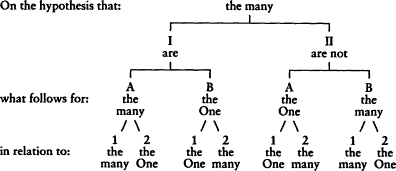
Figure 1
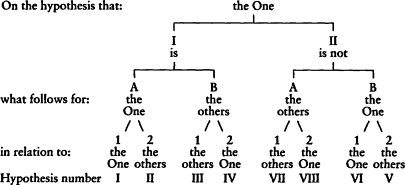
Figure 2
not (see Fig. 2). Because the previous hypotheses were based on the opposition between the many and the One, it seems likely that "the others" is meant as a synonym for "the many." In most of its appearances this seems to be the case, and in one place the equivalence is explicit (165e), but "the others" is denotatively less determinate, which will give the argument greater flexibility in places. (See below, note 44.)
A full treatment of the problem ought to repeat the eight hypotheses, once under the hypothesis that the others exist, and again under the hypothesis that they do not; or at least the eight hypotheses about the many should be added to the eight about the One. Moreover, Parmenides also says that he must do the same with likeness, unlikeness, motion, rest, genesis and destruction, and being and not-being. In other words one must consider each thing under both hypotheses, both in relation to itself and to every other thing that you wish, "if you are to
train yourself to see through to the truth in a completely masterful way" (136b-c). The eight hypotheses dealt with here are therefore arbitrarily limited, and any attempt to see them as representing an eight-part complete classification of the relationship between the One and the many would be questionable.
Even prior to Proclus there had been some question as to whether the hypotheses are to be regarded as eight or nine in number. The appendix to the first two hypotheses begins with the words:
Let us discuss it again for the third time. If the One is as we described it, being both one and many and neither one nor many, and participating in time: will it not be necessary, on one hand, that since the One is, it will at one time participate in being, and on the other hand, since it is not, it will also at some time not participate in being?
(155e)
The reference to "the third time" has convinced some readers, from antiquity to the present, that the appendix is a separate hypothesis, and that the entire argument should be construed as comprising nine sub-arguments rather than eight.[38] In that case, just as the third argument would reconcile the tension between the first two, the sixth might reconcile that between the fourth and fifth, and the ninth that between the seventh and eighth. The scheme might even be elaborate enough for the last group of three to reconcile a tension between the first two groups. Such an interpretation would accord well with Plato's proclivity for triadic groups, and even so intricate an architecture as this would be compatible with the care with which he wrote. But I cannot see any convincing way of so interpreting the present arguments. Moreover, even apart from the fact that the initial schema works by bifurcation and therefore implies eight rather than nine possibilities, the hypothesis with which the appendix begins is, "if the One is as we described it," which is a different order of hypothesis from the others ("if the One is" [i.e., "exists"], "if the One is not").
The basis for Plato's choice of the concepts dealt with within each hypothesis, and for the order in which they are presented, has been a matter of considerable speculation. Cornford makes a convincing case for ascribing it to the treatise of Zeno,[39] but it is not a question that will
[38] Proclus pp. 352, 402. The most recent defenders of this schema are Sternfeld and Zyskind, chap. 3.
[39] "From the fragments and from references in Plato and Proclus we obtain the following list of contraries which appeared in the various sections. Some conjectural items are added in italics [Cornford's sources have been omitted from this summary]: One and Many. Divisible and Indivisible. Finite and Infinite in number. At Rest and in Motion. In itself and in another . Same and Different. Like and Unlike. In contact and Not in contact . Large and Small. Equal and Unequal. This list corresponds pretty closely with the series of contraries in the Hypotheses of the Parmenides " (PP 57).
concern us here. More important is the question of what the arguments are intended to demonstrate.
The final contusion of the argument is that "whether the One is or is not, both it and the others, both in relation to themselves and each other, both are and are not in every way, and both appear and do not appear to be so" (166c). This leaves us with two alternatives: either the object of the discussion is to produce complete skepticism with regard to the powers of philosophy (i.e., misology), or the paradoxes are intended to motivate us to discern hidden distinctions that render the paradoxes apparent rather than real. Clearly the second of these two is what we would expect of Plato, especially in light of Parmenides' stated aim of developing Socrates' power of conceptual reasoning (135c-d); and an examination of the eight hypotheses will bear this out. In fact the seventh hypothesis introduces the distinction between false appearance and truth. In the following synopses of the hypotheses I have tried to reduce some very complicated arguments to what I take to be their basic structure. But whatever success I may have had in tracing that structure accurately has had to be purchased through the sacrifice of considerable richness of detail.
10. If the One Is (137c-160b)
Hypothesis I. If the One Is, What Follows for It in Relation to Itself: Nothing Can be Said of It (137c-142A)
The argument may be divided into two distinct sets of deductions, each of which follows from an initial admission: (a) that the One cannot have parts, and (b) that we cannot predicate of the One any attribute whose meaning is not identical with "one." (a) Since the One cannot be many, it cannot be a whole, which would imply multiple parts (137c-d); since it has no parts, it cannot have shape (it is indefinite,

even to exist (141e). Accordingly there is no name, logos, knowledge, or perception of it.
All the admissions that were deduced from a could have been deduced from b alone. None of the terms, "whole," "shape," "place," "motion," or "rest," means the same thing as the term "one," and therefore—according to b 's principle that nonidentical attributes imply a lack of unity—to predicate any Of them of the One is to introduce multiplicity and destroy its oneness. But Parmenides does not generalize that principle, and therefore makes use of two premises instead of just premise b . Even though Plato might have dispensed with principle a on grounds of logical economy, it is likely that he wanted to bring it in because of the important role that the whole-part relationship will have here (and subsequently in the Theaetetus ).
Hypothesis II. If the One Is, What Follows for It In Relation to the Others: Everything Is (Inconsistently) True of It (142A-155E)
This argument may be divided into four main sections, which are sequential rather than (as in Hypothesis I) parallel.
a. If the One is, it must participate in and therefore be different from being (


b. Since the One is divided, it cannot be a whole; it can only be parts limited by an extrinsic whole (144d). (This contradicts 137c, which states that to be a whole it must be divided into parts.)[40] Consequently the One is both one and many, whole and parts, limited and unlimited; and since it is both whole and parts, it is both in itself and in another.
c. From this it is fallaciously deduced (by equivocation) that the One must be not only at rest but also in motion, since "in another" means "changing." (But in fact "in another" was previously used in a
[40] There is a similar tension in the Theaetetus . At 204a-b Theaetetus distinguished between "wholes," which are not reducible to their parts, and "sums," which are so reducible. Socrates refutes this at 205a simply by begging the question against Theaetetus and assuming that a whole too is simply the sum of its parts.
very different sense, that of spatial inclusion.) And it must be not only the same as itself but other than itself as well, because it is "in itself" and the relation "in" can hold only between different things. (Another equivocation.) The One must also be both other than the others (by definition) and the same as the others (because it is other than itself: 145e-147b). Because it thus participates in sameness and otherness it must be both like and unlike itself and the others. It also follows that the One both touches and does not touch itself and the others (again because of the "in" relationship), and is both equal and unequal to itself and the others (147c-131e).
d. Finally, since the One is, and "is" implies present time, the One participates in time and grows older. But if it is becoming older than itself, then the latter is becoming relatively younger, so it is both older and younger than itself. However, the age difference between two existing things can never increase or decrease, so it must be the same age as itself. Consequently "the One both is and becomes both older and younger than both itself and the others, and neither is nor becomes either older or younger than either itself or the others" (153c). Accordingly, there is knowledge, opinion, and perception, as well as name, logos, and so on, of it.
These first two hypotheses obviously are designed to appear to contradict each other to the greatest possible extent. The challenge to the reader is to dissolve the contradictions as far as possible by drawing out suppressed distinctions, as part of the training referred to at 133c-d. Most obviously, some of the internal contradictions of II disappear if we distinguish a purely conceptual sense of "in itself" and "in another" from the spatial sense given to them in c . But the other ambiguities are less straightforward.
In hypothesis I there are no indefensible inferences. There are only inconsistencies with hypothesis II. Even the conclusion—that nothing can be said of the One, not even that it exists—makes sense if one pushes the historical Parmenides' own position to the extreme. At a purely literal level Parmenides' conclusion here may appear incompatible with the historical Parmenides' poem, which insists above all else that "it is." But the poem also avers that "it is one." The present argument shows that if we attempt to think the oneness of the world we must abstract from all determinations. As soon as we even conceive of a duality between oneness and the multiplicity of determinations, the oneness that we attempt to conceive collapses.
As for the exclusion of the One from the determination of existence in particular, it is important to notice how this conclusion is arrived at. The historical Parmenides had argued that "it" is not temporal: one cannot speak of it in the past tense or future tense, but only in terms of the timeless now (fr. 8.5). These claims were echoed in the course of the first hypothesis's argument, and it was then concluded that what does not exist in time cannot exist at all. Accordingly the argument shows only that the One cannot exist in the sense of having temporal existence. It does not occur to Aristoteles to wonder whether there might be some mode of being that is nontemporal. But Parmenides and Plato certainly thought that there was. The conclusion of this first hypothesis, that the One does not participate in being (


In both cases there is at work a distinction between "being" in the sense that is applied to temporal reality, and in some other sense that is related to the first only analogically. We saw that this "ontological difference" was pointed to in Part 1 by the Third Man argument: "large" cannot mean the same thing with reference to forms as it does with reference to spatial beings. The same is true of "existence." The being of forms is of a different order from that of physical things, and if we define existence with reference to the latter (as does hypothesis I), the former cannot be said to "exist." This conclusion follows whether we take the One to refer to the overarching principle of the good, or to the multiplicity of individual forms. Insofar as a form is a one-over-many with regard to physical things, it cannot be said to exist in their sense. And insofar as the good is the one-over-many with regard to the mul-
tiple forms, neither can it be said to exist in their sense. The three are related as individuality, form, and telos. In Plato, as in Aristotle, the formal cause and the final cause never completely coincide.
The inconsistency of hypothesis I with hypothesis II arises because the latter begins with a premise in flagrant contradiction to the "transcendent" position of hypothesis I. Whereas the first hypothesis ended by arguing that the One does not even participate in existence (


The first hypothesis conceives of the One in relation to itself, while the second conceives of it in relation to the unlimited many. The One of the first hypothesis is what is beyond being, like the Idea of the good, while that of the second hypothesis participates in being. It is the difference between a first principle conceived as independent of space and time (i.e., of being qua spatiotemporal existence), and one conceived as spatial and temporal. Hypotheses I and II do not ultimately contradict each other, because their conclusions are predicated of different subjects—of transcendent being in one case and of immanent being in the
[42] Proclus attests that "the visiting nature philosophers [were] the followers of the teaching of Anaxagoras" (p. 25). Brumbaugh (PO , and "The Purpose of Plato's Parmenides" [Ancient Philosophy 1 (1980) 39-48]) and Miller (PP 26-28) stress the importance of this for the context of the dialogue as a whole.
[43] Aristotle, Metaphysics A.6.987 25-988 1.
other. This explains the discrepancies between the two hypotheses on the nature of "whole" and "unlimited" (

Throughout the eight hypotheses, the ambiguity between whole and parts is reflected generally in an ambiguous use of the term "the One." In the first hypothesis the One implies a supervenient unity. In the second it refers not to a transcendent principle but to the aggregate of material reality. In the third it will refer both to the latter (qua whole) and to the unity of each part of the whole.[44] The ambivalences among these three senses of the One (transcendent unity, totality, individuality of each part) recur throughout the eight hypotheses and reflect precisely the moments of the whole-part dialectic: wholeness is the principle of unification, but since the entity itself is an aggregate of parts, the wholeness in some sense transcends the physical entity as such; on the other hand, since this wholeness is of the physical entity, the entity has an inherent integrity and so a wholeness that is immanent ; but this implies parts and therefore conceptual dissolution of the wholeness of the entity into component unities, which are themselves wholes.[45]
[44] The ambiguity of the term "others" depends on that of the term "One." The following chart shows how the two terms are used in the various hypotheses:
One | Others | ||
I | transcendent | [unspecified] | |
II | immanent, infinitely divisible | infinitely divisible [unities?] | |
III | [unspecified] | mediating between unlimited and form | |
IV | transcendent | without characteristics | |
V | conceptual | [unspecified] | |
VI | nonexistent | without characteristics | |
VII | nonexistent (unity) | apparent, not real, characteristics | |
VIII | nonexistent (unity) | nonexistent |
[45] I suspect that these are the same three senses that Proclus has in mind when he writes, "'The One' can be used in three senses. We have the One that transcends all beings, and that which is present together with all beings, which also, with the One, produces all the orders of beings, and thirdly we have that which is inferior to Being and which is, as it were, 'swallowed down' by it" (p. 381).
In the same sense that the One is both a whole and parts, it is both limit (whole) and unlimited (parts: 144e-145a). This is implicit also in the ambiguous way that "unlimited" (

This appendix, which combines both moments of the previous antinomy, concludes that the One sometimes participates in being and sometimes does not. But since it cannot "sometimes have and sometimes not have the same thing unless it receives it at some time and again loses it," it must go through successive stages of generation and destruction, changing from the One to the many and back again (155e-156b). The conclusion loses its paradoxical character if we can interpret these successive stages as changes of aspect or relation rather than changes of state. Such an interpretation is suggested by the previous antinomy, since the first hypothesis considers the One in relation to itself and the second considers it in relation to the others. The paradox was generated by obscuring the difference between these two aspects: reality appears
[46] Philebus 25b-27b, Sophist 246c-249d, Timaeus 47e-48a, Symposium 202d-203a, Phaedo 105b-c. Since the Statesman is there making use of the method of division, the synthesis is the unity of the two within the genus of measure.
as both one and many, depending on whether one looks to its unified character or its diversity.
Parmenides himself provides the foundation for resolving the paradox in this way. When the One alternates between unity and multiplicity it alternates between motion and rest, and when it does so "it is necessary for it not to be in any time." The point of change between motion and rest must itself neither be the one nor the other, "and there is no time in which something can neither be in motion nor at rest at once" (156c). Parmenides introduces the concept of the instant (


The concept of the instant provides us with the mediation between the Parmenidean and pluralistic antinomies inasmuch as it posits a point of contact between the timeless and the temporal, between the supervenient unifying principle of reality and physical reality itself. It is in this intersection, too, that we must conceive participation and recollection to occur, and accordingly the concept of the instant provides an elusive but nonmetaphorical substitute for the metaphors whose limitations were exposed by the arguments of Part 1.
Hypothesis III. If the One Is, What Follows for the Others In Relation to Themselves: Everything Is (Inconsistently) True of Them (157B-159B)
Here again, as with hypothesis II, the inconsistencies will turn out to be only apparent. Since the others are other than one they cannot be unities and therefore must consist of parts. The parts are parts not of a many (


[47] This is perhaps the most obscure passage in the dialogue. A literal, if not always intelligible, translation may be rendered: "If something is a part of a many, in which it itself is, it will be a part of itself, which is impossible, and of each one of the others, if indeed it is a part of all. For if it is not a part of one of them, it will be a part of the others besides this one, and thus it will not be a part of each one, and not being a part of each it will be a part of none of the many. But it is impossible for something that is a part of none of these many, of which it is not a part of any, to be any other kind of part at all" (157c-d).
The argument seems to be that if we call something a part of a many, this is different from calling it a member of the many, or a part of one of the members. To be a part of the many means to be a part of the many distributively , i.e., to be a part of each member. So in the case of something that is a part of a many in which it is also a member, then it must be a part of itself, which is impossible. Plato's point would then be that if we speak of reality in terms of wholes and parts, this should not be assimilated to the model of a sum (or a many) and its members.
parts of a whole they participate in one Idea (


We can see that this hypothesis develops the synthesis, only hinted at in the appendix, of the opposition established in the first two. Here is made explicit the opposition of limit and unlimited as connected with the One and the infinitely divisible many, and the ambiguity of the totality as a supervenient unity (whole) or mere aggregation (sum).[49] The relationship between the many and their supervenient character (whether as unified or unlimitedly divisible) is expressed in terms of participation in forms; the metaphor is reintroduced after the abstract formulation of the appendix. It is not therefore Plato's intention to do away with metaphor entirely, which would hardly be possible, but to make us aware of our reliance on it and the way that this reliance limits the transparency of our concepts. The Statesman , in fact, will defend the importance of metaphoric and analogic "paradigms."
Hypothesis IV. If the One Is, What Follows for the Others In Relation to the One: Nothing Can be Said of Them (l59B-160B)
Since the One and the others are jointly exhaustive, there can be no third entity to mediate between them, so they must be absolutely sepa-
[48] This disjunction between specific form and unity can only be ex hypothesi for Plato.
[49] Cf. Theaetetus 203e-205e.
rate, and the others cannot participate in the One. Since the others cannot in any sense be one, neither can they be many, since each would then be one part. Nor can we speak of them in terms of likeness or unlikeness, because then they would participate in two forms (


If the third hypothesis provided a positive mediation between the antitheses of the first two, the fourth provides its negative counterpart by showing that unless participation in forms is possible, we will have the result that Parmenides had warned of in the first part of the dialogue: "If anyone . . . does not admit the existence of forms of things or mark off a form under which each individual thing is classed, he will not have anything on which to fix his thoughts . . . and in this way he will utterly destroy the power of discourse" (135b-c). The present argument shows that some such postulation must be accepted if meaningful speech is to be at all possible. It thus anticipates the Theaetetus's pervasive argument that a world of flux without stable forms is unintelligible and would make speech unintelligible.[50] The premise on which this fourth hypothesis rests, that since the One and the others are jointly exhaustive there can be no tertium quid through which they can stand in relation to one another, had already been answered in the appendix in terms of the concept of the instant as the tertium quid between motion and rest, and between all such other oppositions. It had also been answered in the middle dialogues in terms of the relation of participation, by which the unity of the form and the multiplicity of corporeality are mediated. That very term appears here eight times in the half-page between 159d and 160b.
If Parmenides had asked whether anything could exist besides the One and the many , "the relationship between them" would have suggested itself as a possible answer. But because he had substituted for the term "many" the more general term "others,"[51] the question is put in a way that precludes that answer and exaggerates the paradox. His phrase "the things that are other than the One" (159b) must by definition include even the relations between the One and what is other than the One, and so arbitrarily excludes any answer.
Combining the first four hypotheses, Parmenides concludes that "if One exists, the One is all things and nothing at all in relation both to
[50] Cf. esp. 182c-183b.
[51] At the end of hypothesis VII "the many" is used as a synonym for "the others" (165e).
itself and to all others" (160b). We have seen, however, that although on the surface these conclusions appear to cancel one another out, reducing their mutual antecedent to absurdity, the details of the arguments reveal a consistent underlying teaching. They show how the theory of forms mediates the antagonism between the Parmenidean and pluralistic worldviews and overcomes the one-sidedness of each.
11. If the One Is Not (160b- 166c)
The second group of four hypotheses is odd in two ways. First, three of the hypotheses are absurd in their very formulation. If the One does not exist, it makes no sense to ask how the One is related to itself or to the others, or how the others are related to it. Second, it seems odd that Plato's Parmenides would even entertain the hypothesis that the One is not, since the historical Parmenides vehemently denied that it is possible to say or even think that "it is not."[52] Perhaps, then, the second four hypotheses are seriously meant to be what the first four only appeared to be: a reductio ad absurdum of the antecedent. In that case they would amount to an indirect demonstration of the One by showing the incoherence of its denial. This group, unlike the previous one, does not contain an implicit escape from incoherence. The arguments may further function as a way of preventing the first four from being taken as a reductio , for there is no point in rejecting the hypothesis that the One exists, on the grounds that it leads to absurdity, if the rejection of that hypothesis leads to absurdity as well. Even if this group functions as a reductio , however, the care that Plato has put into the arguments suggests that there is something to be learned from their content as well as their form.
Hypothesis V. If the One Is Not, What Follows for the One In Relation to the Others: Everything Is (Inconsistently,) True of It (160B-163B)
To say that the One is not, it must be that we can distinguish the One from other things, and we must therefore have knowledge of it. It must therefore partake of signifiers such as "that," "some," "this," and so on, and relations such as likeness and unlikeness, equality and inequality, and so forth, and we will be able to say what is true of it. "But if we say what is true, it is dear that what we speak of must exist" (161e). Not only does what-is-not thus participate in being, but what-is participates in not-being, insofar as its own nonbeing is not , and so being and
[52] Cf. fragments 2, 6, 7. Cornford, however, takes these hypotheses to be Plato's controversion of the historical Parmenides' claim (PP 220, 240).
not-being participate in themselves and in each other (162a-b). Since it participates in opposites it must change, but since it is neither in space nor capable of becoming other than itself it must be at rest. Thus it must both change and not change, both come into being and perish, and neither come into being nor perish.
This seems to be an indirect confirmation, by reductio , of Parmenides' warning against trying to speak about nonbeing. To speak of non-being is to treat it as a being, which leads to absurdity. In the Sophist a disciple of Parmenides will show that it is possible in one sense to speak of nonbeing, but only in a predicational sense, not (as here) in an existential sense. This indirect consequence of the present argument becomes the direct consequence of the next one.
Hypothesis VI. If the One Is Not, What Follows for the One In Relation to Itself: Nothing Can Be Said of It (163B--164A)
Since the One is not, it cannot participate in anything, and therefore none of the above qualities (nor any others) pertain to it.
Hypothesis VII. If the One Is Not, What Follows for the Others In Relation To Themselves: Everything Is (Inconsistently) True of Them (164B-165E)
The others must exist if we can speak of them, but they cannot be "other" than the One, for ex hypothesi there is no One, so they must be "other" than each other. They can only be so in general (


The contradictions are of course only apparent, since they are between what the many appear to be (as we imagine them now) and what they really are. The hypothesis reverses the Platonic worldview: the inner reality beyond. appearances is no longer the unity and form of things, but their diversity and formlessness. To be precise, given the indefinite and individual nature of these "others," Parmenides is talking
about what would later be called prime matter, or what the Timaeus calls chaos, that is, the material basis of existence hypothetically denuded of all form. Thus, as with the preceding pairs of hypotheses, the consequences of this first member of the fourth pair only apparently contradict those of its companion. Here we are made to realize that without oneness reality would reduce to unformed matter. The next hypothesis shows that nothing can be conceived or said about reality so conceived. As Aristotle was subsequently to conceive it, matter is only potentially for existence, which cannot become actual existence in the absence of form (unity).
Hypothesis VIII. If the One Is Not, What Follows for the Others In Relation To the One: Nothing Can Be Said of Them (165E-166C)
Since "many" is a plurality of ones, then if there is no such thing as "one," the others not only cannot be one, but cannot be many either. Nor do they even appear to be one or many, because what is cannot be conceived of (

12. Conclusion
To put the results of our examination of the second part of the dialogue as succinctly as. possible, the distinctions implicit in the first four hypotheses have led to the conclusion that unless there is something by which the limiting One and the unlimited many can stand in relation to each other, meaningful speech and thought will be impossible. The next four illustrate this point negatively by showing what happens if we try to conceive of the many otherwise than in relation to the One. Hypotheses VII and VIII show negatively and positively that reality without unity reduces to something like pure potentiality. Such a reality may appear (to our imagination) as a kind of existence (VII), but it cannot in fact exist without unity (VIII). In that case any attempt even to conceive or speak of it is deluded, for it will appear to be both incoherent in relation to others (V) and empty in relation to itself (VI).
The Republic's remark that the forms are grounded in the good, both in terms of their knowability and their existence (509b), shows
that all things in the world of becoming, which participate directly in the "specific" oneness of a form (being), also participate indirectly in an "absolute" One, the good, which is beyond being. The fundamental problem for the theory of forms is to give an account of the nature of these two relationships.[53] The first part of the Parmenides casts doubt on our ability to give a nonmetaphorical account of the nature of participation by things in forms (i.e., by "becoming" in "being"), while concluding, however, that unless we nevertheless affirm the existence of forms and participation we will not be able to account for the possibility of thought and discourse (135b-c). The second part of the dialogue has now shown, in its dizzying way, that a similar conclusion follows from a consideration of the relationship between our world of becoming and the One that is beyond being. Once we enter into the "gymnastic" dimension of these arguments and respond to their challenge to draw crucial distinctions, we can distinguish between the arguments that reflect genuine paradoxes, and those that are only formulated in a paradoxical manner but can readily be resolved by means of the distinctions with which Plato supplies us. This has led us to conclude that although the relationship between the temporal (becoming) and the timeless (the One) can be hinted at in terms of the concept of the "instant," a fully elaborated account remains recalcitrant, and the third hypothesis is forced to return to the metaphor of participation. But just as the first part of the dialogue concluded by saying that, despite the problems of conceptualizing the relation of participation, to attempt to do away with that relationship would destroy the possibility of thought and discourse; here too the fourth hypothesis shows the impossibility of dispensing with the relation of participation. And the final four hypotheses show that it is impossible to avoid the problems of the first four simply by doing away with the concept of the One (whether applied to the specific forms or to the good), for in that case the resulting paradoxes become wholly intolerable.
We now turn to the Theaetetus , which can, in fact, readily be interpreted as an exploration of the claim that, if someone does not recognize the existence of forms, "he will not have anything on which to fix his thoughts, as long as he does not permit the idea of each thing to be always the same, and in this way he will utterly destroy the power of logos."
[53] Cf. PP chap. 8 §5.