
The Changing Number of Cities
Compare with this population shift the changing number of city units displayed in figures 3 and 4. These graphs show clearly the relative stability in the total number of city governments until the second phase of urbanization in 1830, followed by virtually continuous and rapid expansion. A continued expansion in number of city units has accompanied the post-Depression phase, mostly in the smaller city category (fig. 3), which accounts for the stability and decline in metropolitan populations. Thus while urbanization, defined as the movement of population from rural places, may have reached stasis, the process of city building begun in the mid-nineteenth century continues today. As a direct consequence, there are more than five times as many city governments per capita today than in 1790. This indicates that in essence the urbanization process in the United States has consisted of two related but quite different movements, one demographic and the other political.
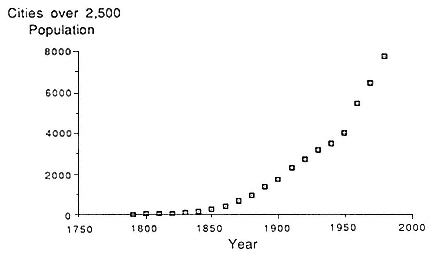
Figure 3.
Total Number of Cities over 2,500, 1790–1980
Source: Bureau of the Census, Historical Statistics of the United States, Colonial
Times to 1970 (Washington D.C.: Government Printing Office, 1975), 11, and
Statistical Abstract of the United States: National Data Book and Guide to Sources,
1982–83 (Washington, D.C.: Government Printing Office, 1982), 21.
More people live in vastly more cities. The age of the big city is over, but the age of cities continues with greater vigor than ever.
Figures 3 and 4, like figure 2, convey an immediate visual sense of the changing pace of what was an ordinary yet also extraordinary process. It was ordinary in that other nations were experiencing a similar or even greater residential relocation of people, but it was extraordinary in that no other built so many completely new cities. In Europe at the beginning of the nineteenth century, about 13 percent of the population lived in cities over 5,000 persons; for the United States the figure was only 3.4 percent. More specifically, comparing populations living in cities of over 10,000, in 1800 the United States was less urban than every European nation but Poland. However, ninety years later, only England and Wales, Scotland, the Netherlands, Belgium, and by a scant 0.4 percent, Germany, led the United States. And even more important, the United States made this transition by building physically and politically new cities. Of the 390 European cities with populations over 100,000 in 1979, 176 or 45 percent were "new" in the sense that they had had fewer than 10,000 persons in 1800. In sharp con
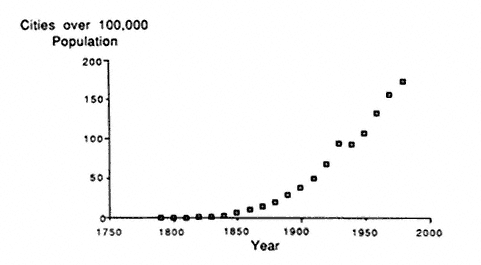
Figure 4.
Total Number of Cities over 100,000, 1790–1980
Source: Bureau of the Census, Historical Statistics of the United States, Colonial
Times to 1970 (Washington D.C.: Government Printing Office, 1975), 11, and
Statistical Abstract of the United States: National Data Book and Guide to Sources,
1982–83 (Washington, D.C.: Government Printing Office, 1982), 21.
trast, out of the 153 U.S. cities greater than 100,000 in 1970, only three had had over 10,000 in 1800 and only 23 had existed at all.[5]