
Six
"Immolated Sticks and Stones"
The Gothic Revival and Its Kindred Modes
If "Greek tragedy" can be defined as a dramatic or literary composition "with a serious or somber theme," typically of a person whose character is flawed by one or more major weaknesses such as pride, envy, or an overweening ambition "which lead inevitably to his downfall," Absalom, Absalom ! is certainly in that realm. Yet that novel, like much of Faulkner's work, also has elements of the genre of literature known as the Gothic Novel, "characterized by a gloomy setting, grotesque or violent extents and an atmosphere of degeneration and decay." Malcolm Cowley believed that Absalom belonged primarily to the latter mode, with Sutpen's Hundred taking the place of "the haunted castle on the Rhine." [1]
Likewise, the Greek and Gothic revivals in nineteenth-century architecture, whatever their differences and distinctions, had many affinities as well. While Greek Revival architecture was in one sense only the latest in a long series of neoclassical movements, it was also a romantic nineteenth-century revolt against the Renaissance and the subsequent centuries of commitments to the neo-Roman. It was thus a deeply consanguine cousin of the Gothic Revival, which had itself begun in the eighteenth century as a revolt against the reasoned order of classicism and had found a sympathetic model in the pointed arches, ribbed vaults, and flying buttresses of the medieval Gothic. Indeed in the pre-Renaissance Gothic and the pre-Roman Greek, nineteenth-century American romantics, particularly in the South, found comfort not only in "yesterday," but in the "days before yesterday."
Both revivals were an integral part of the "romantic" worldview, with its emphasis on the imagination and the emotions, an interest in the remote, and a predilection for melancholy. Given this state of mind, romanticism encouraged not only the revival of the Gothic, but frequently the design of anything remote and exotic, including the "Italian villa" and varieties of "orientalism." Furthermore, this interest in "irregularity" and picturesque asymmetry broke with the orthogonal rectilinearity of neoclassical forms and floor plans and planted the germ that would flourish in the twentieth century into what Frank Lloyd Wright would call "organic" architecture, an architecture that "grew" from the inside out to express its functional, aesthetic, and symbolic needs.
It was fitting that the neo-Gothic, like the medieval Gothic before it, should find its most convincing expression in church architecture and particularly, in the United States, in the work of Richard Upjohn (1802-1878). An Englishman who emigrated to America in 1829, Upjohn insisted that he was "an Episcopalian who happened to be an architect, rather than the reverse." With a great concern for reviving both the essence and the details of medieval English Gothic architecture, he was the major American advocate for the British organization that worked to promote those ends, the Cambridge Camden Society, and its publication, The Ecclesiologist .[2]
Upjohn's most famous building was Trinity Church, New York (1846), but he designed dozens of exemplary smaller churches throughout the Northeast. His message, furthermore, was sent to all parts of the country, including Mississippi, via the publication of his "ecclesiological" designs in Upjohn's Rural Architecture (1852). Yet Oxford, Mississippi, was the site of a structure, St. Peter's Episcopal Church (ca. 1855-60), not just based on a design from Upjohn's pattern book, but a building most certainly designed by Upjohn himself (Plate 7, Figs. 54 and 55). The circumstantial evidence is the church's complete affinity with Upjohn's ecclesiological style, while documentary proof is limited to a handwritten contemporary note on the back of the church deed, attributing the design to him. [ 3]
Upjohn was known to Frederick A.P. Barnard, another ardent Episcopalian, who had come from New England and had studied and later taught at Yale in mathematics, chemistry, astronomy, and related sciences. After teaching for sixteen years at the University of Alabama, he moved in 1854 to join the faculty of the University of Mississippi, where in 1859 he became chancellor. In 1861, opposing secession, he returned to New York, where from 1864 to 1889 he served as president of Columbia University. In the late 1850s, he also served as rector of St. Peter's and would have been instrumental in commissioning Upjohn, whom he had known of over the years
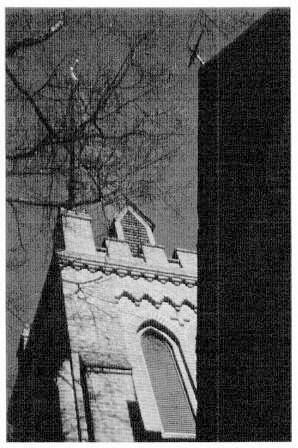
Figure 54
St. Peter's Episcopal Church, Oxford, Mississippi,
attributed to Richard Upjohn, architect (1859).
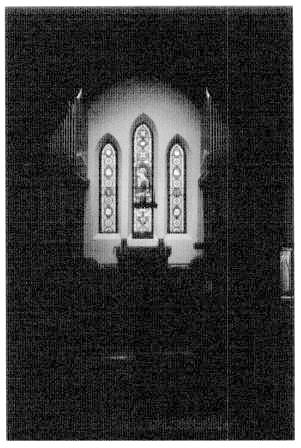
Figure 55
St. Peter's Episcopal Church, interior.
through their mutual interests in Episcopalian ecclesiology. While the stunningly carved, subtly lit sanctuary was finished ca. 1860, the imposing steeple was not completed until 1893, a gift of the Pegues family. St. Peter's was the church of many prominent Oxonians, including the writer Augustus Baldwin Longstreet and, in the twentieth century, the family of William Faulkner. [4]
Though in Absalom, Absalom ! Faulkner placed the wedding of Ellen Coldfield and Thomas Sutpen not in St. Peter's, but in the nearby Methodist Episcopal Church, his evocation of the event applied to all British-derived Mississippi denominations. In his depiction, he came close to proposing an ethnocentric interpretation of the importance of architecture: The crowd outside was quiet yet, perhaps out of respect for the church, out of that aptitude and eagerness of the Anglo-Saxon y or complete mystical acceptance of immolated sticks and stones .[5]
In Knight's Gambit , St. Peters's was a significant landmark on the Jefferson landscape for young Benbow Sartoris, returning by train in 1942 for a visit to Jefferson, on leave from the Army Air Corps: Then he was home: a paved street crossing not very far from the house he had been born in, and now he could see above the trees the water tank and the gold cross on the spire of the Episcopal Church . . . his face pressed to the grimy glass as f he were eight years old .[6]
Later, in The Town , the building, again slightly older than Oxford's St. Peter's, had become a tourist attraction: There is a small Episcopal church in Jefferson, the oldest extant building in totem (it was built by slaves and called the best, the finest . . . by the northern tourists who passed through Jefferson now with cameras, expecting—we don't know why since they themselves had burned it and blown it up with dynamite in 1863—to find Jefferson much older or anyway older looking than it is and faulting us a little because it isn't ).[7] Perhaps this was, on Faulkner's part, a recognition and a premonition of the fame and the tourists that Oxford had acquired, and would acquire, largely because he had immortalized it in his work.
In the mid-nineteenth-century revival of the Gothic and its kindred modes, the greatest theorists and practitioners of such persuasions in residential architecture were two men with similar names, Andrew Jackson Downing (1815-1852) and Alexander Jackson Davis (1803-1892). In his widely influential books, particularly Cottage Residences (1842) and The Architecture of Country Houses (1850), Downing stressed the relationship of structure and landscape, the latter meant to meander about and toward the building
so as to make both seem to be "natural" elements of an integrated composition. Downing was clearly partial to the Gothic: "There is something wonderfully captivating," he wrote, "in the idea of a battlemented castle, even to an apparently modest man, who thus shows to the world his unsuspecting vein of personal ambition." But since the castellated Gothic style never seemed "completely at home except in wild and romantic scenery," he advocated a more domesticated version, the "Tudor," and for those even more modestly situated, he recommended the "rural Gothic," which while "never misplaced in spirited rural scenery, gives character and picturesque expression to many landscapes entirely devoid of that quality." Downing's books were illustrated with designs of his own and of other selected architects, his undoubted favorite among the latter being A. J. Davis, who designed in both grand and modest versions of the popular modes of the day, including the Greek Revival. [ 8]
The most typical and popular image of the neo-Gothic "Downing-Davis house," as it came to be known, was the compact, two-storey residence, usually with a one-storey veranda across the front and a steeply-pitched roof, the long side of which was punctuated with a prominent central gable or with several large gablelike dormers, all richly trimmed with wooden, gingerbread ornament (Plate 8, Figs. 56 and 57). Though there were, surprisingly, no major manifestations of the type in Oxford itself, there were several impressive examples in Columbus and even closer in Holly Springs, approximately thirty miles to the north, a town in which Faulkner had early social connections and which he knew as well as he knew any Mississippi town next to Oxford and Ripley.
Particularly prominent there were the Gothic Revival homes of the Coxe family, "Airliewood," and the Bonner family, "Cedarhurst," both completed in the late 1850s. Cedarhurst was the home of the writer, Sherwood Bonner, who also served as the personal secretary of Henry Wadsworth Longfellow and hence lived in both Holly Springs and Cambridge (Fig. 57). The house's prominence as a type led historian Leland Roth to cite it in his discussion of the Downing-Davis legacy in his Concise History of American Architecture . Since the Bonnets built Cedarhurst relatively close to the street, the more spaciously sited Airliewood (Plate 8) is a clearer illustration of the type Faulkner used as the Benbow house in Sartoris: From the gate, the cinder-packed drive rose in a grave curve between cedars . . . set out by an English architect of the '40s who had built the house (with the minor concession of a veranda) in the funereal light Tudor which the young Victoria had sanctioned and around which even on the brightest days lay a resinous exhilerating gloom It was trimmed with white and it had mullioned casements brought out flora England .[9]
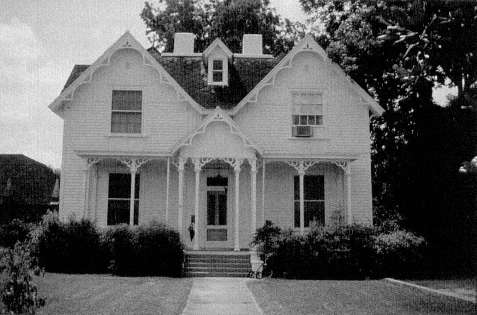
Figure 56
Episcopal Rectory, Columbus, Mississippi (ca. 1875). Birthplace of Tennessee Williams.
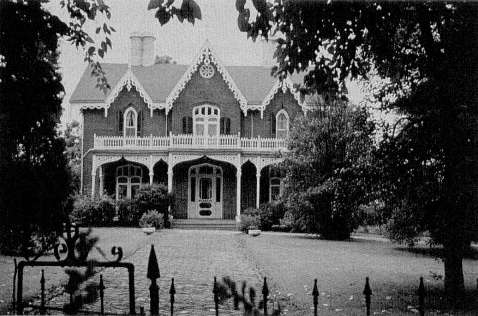
Figure 57
Cedarhurst, Bonner-Belk House, Holly Springs, Mississippi (1858).
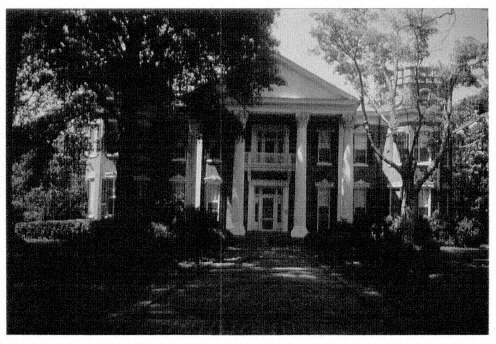
Figure 58
Walter Place, Holly Springs, Mississippi (1855).
In Mississippi, and throughout America, certain buildings combined the neoclassical with the neo-Gothic. Some of these were deliberately composed that way, such as the large and unusual Walter Place in Holly Springs, with its parapeted Gothic towers flanking a Corinthian-columned, Greek Revival center (Fig. 58). Other houses reflecting both styles were more often postbellum, Gothicized remodelings of antebellum, neoclassical structures or at least were buildings to which Victorian gingerbread scroll-work had been added to columns and porches. Examples of the latter included the Simon Spight and Chesley Hines houses in Ripley (Figs. 98 and 99) and the Oxford homes of the Isom and the Kennedy-Price-Shaw families, as well the one-storey house that Faulkner lived in as a child after his family moved to Oxford (Fig. 1). The Freedonia Church in neighboring Panola County, important in the life and work of Stark Young, combined a trabeated, neoclassical portico with pointed, neo-Gothic fenestration (Figs. 59 and 60). Like the Greek Revival Presbyterian Church in College Hill, it contained a separate entrance to the slave balcony at the rear of the sanctuary.
The grandest antebellum house in Oxford that was neither neoclassical nor neo-Gothic was the "Italianate" mansion designed in 1859 for the Pegues family by the
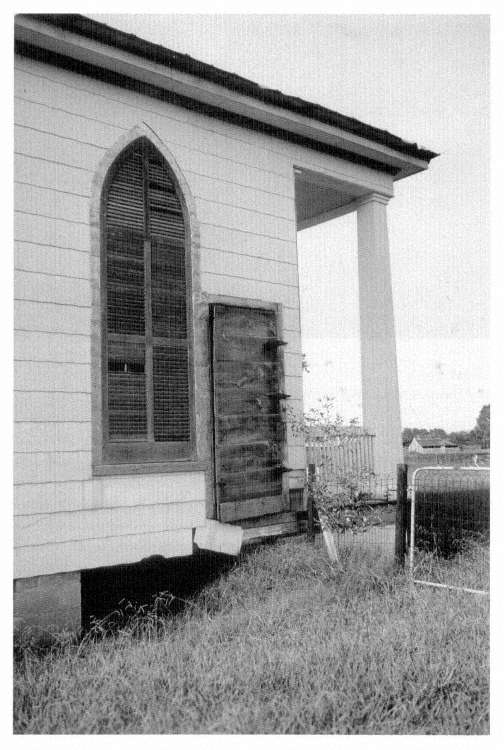
Figure 59
Freedonia Church, Panola County, Mississippi, John Scott McGehce, architect (ca. 1848).
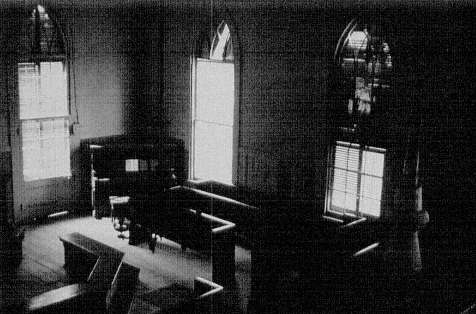
Figure 60
Freedonia Church, interior.
acclaimed architect Calvert Vaux (1824-1895) (Plate 9 and Figs. 61-64). Born and educated in England, Vaux emigrated to the United States in 1850 at the behest of none other than Andrew Jackson Downing, who invited him to become his partner, chiefly in the designing of the grounds and buildings of Hudson River estates in the English pastoral manner. After Downing's accidental and untimely death in 1852, Vaux worked with a number of partners, the most eminent of whom was the landscape architect Frederick Law Olmsted, with whom, in the late 1850s, he designed Central Park in New York. Then and later, he designed numerous houses, the plans and renderings of which he published, through five editions, in his widely influential Villas and Cottages (1857-74). His public commissions in the late 1870s would include New York's Museum of Natural History and Metropolitan Museum of Art.
Vaux's English ancestors had anglicized, as "Vox," the pronunciation of their originally French name, which Faulkner must have known and assumed was pronounced "Voe." Hence a possible explanation of his fascination with a "French architect," who appears in work after work from Absalom to Sanctuary to The Hamlet and Requiem for a Nun . Vaux's Pegues house in Oxford was not merely copied from his pattern book, Villas and Cottages , but was built from original drawings signed by the architect
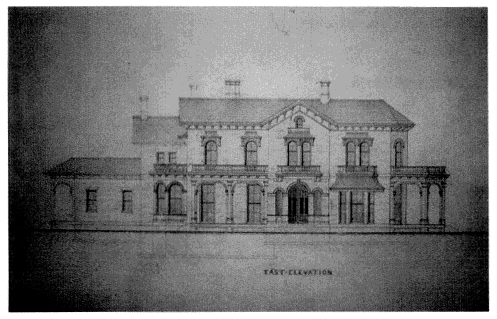
Figure 61
Pegues House, Oxford, Mississippi, original elevation signed by Calvert Vaux, architect (1859).
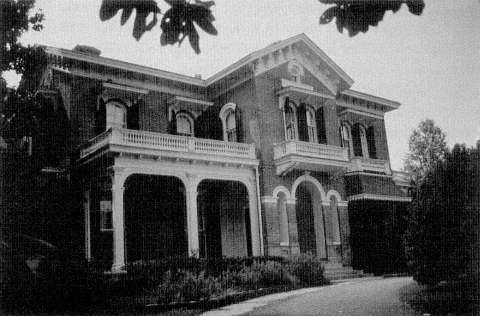
Figure 62
Pegues House, Oxford, Mississippi, Calvert Vaux, architect (1859).
(Fig. 61). If St. Peter's was attributed on reasonably good evidence to Upjohn, the Pegues house was assuredly designed by Vaux. Though Faulkner never literally described such a house in his work, he felt its presence in more indirect ways.
Thomas Pegues was descended from a prominent South Carolina Huguenot family and, with several brothers, moved through Alabama in the 1840s and settled east of Oxford near the community of Woodson's Ridge. In the early 1850s, he became quite prosperous, eventually owning 4,000 acres and 150 slaves. Then in the late 1850s, with a wife and growing family, he moved to Oxford and started to build his house. Pegues was active in the affairs of St. Peter's Episcopal Church, the most socially prominent congregation in town, as well as of the new University of Mississippi, of which he was a trustee, and it was probably through those activities, perhaps through F.A.P. Barnard's New York connections, that he learned of Vaux and Olmsted and engaged Calvert Vaux to design his house. The Italian style, argued Andrew Jackson Downing, Vaux's first partner, "addresses itself more to the feelings arid the senses, and less to the reason or judgment, than the Grecian style, and . . . it is far better suited to symbolize the variety of refined culture and accomplishment which belongs to modern civilization than almost any other style." [10]
The mansion was constructed of brick, molded by black slave craftsmen in kilns on the property (Plate 9, Fig. 62). Specially rounded bricks were devised for the curving bay window on the north side of the house. The round-arched main entrance echoes the shapes of the second floor windows, all topped by elaborate cornices supported by prominent brackets like those defining the roof eaves above them. Through then-novel sliding doors, the central grand stairhall opens north to double parlors and a small library; south, to the dining room and a "winter garden" conservatory (Figs. 63 and 64). Beyond this, the large kitchen with its huge fireplace is integral to the house, unlike the detached kitchen common to most neoclassical homes. No expense, apparently, was spared in the construction of this elegant villa, the full completion of which was delayed until after the Civil War. The careful and talented Contractor was none other than William Turner, the designer and builder of much of neoclassical Oxford. In 1864, when much of the town was burned, Union soldiers marched up the driveway and set fire to the house, but when hearing of the imminent approach of Confederate troops, retreated before carrying their task to completion. Family members extinguished the blaze, and one of the South's most significant houses was saved. [11]
In both the actual and the fictional landscapes of north Mississippi, the neo-Gothic and the Italianate modes were second only to the neoclassical in the power of their impact.
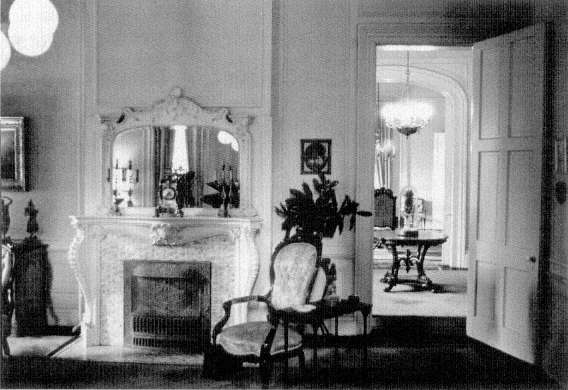
Figure 63
Pegues House, double parlors.
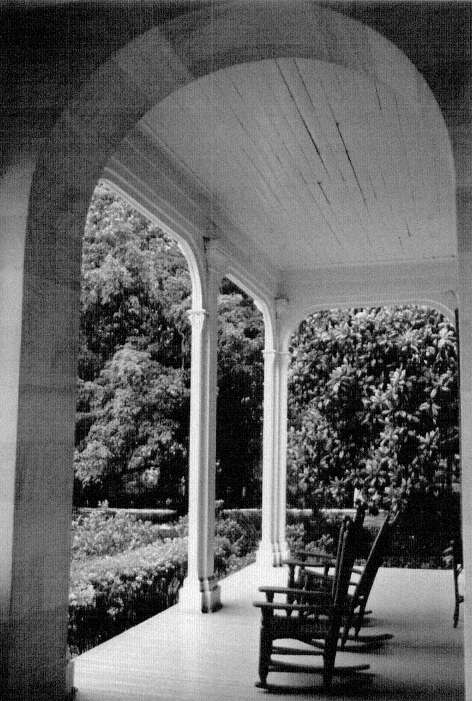
Figure 64
Pegues House, front porch.