
Immature Stage
Lava Fountaining
Low-viscosity basaltic magmas erupt as lava fountains and basaltic lava flows. The fountains range from a few meters to >600 m in height (Fig. 7.8). They deposit welded spatter (bombs and ash) in either a circular or oval apron around a central vent or as ridges parallel to a fissure. The spray of low-viscosity (<103 -poise) basaltic liquid is driven by expansion of magmatic gases. Basaltic glass pyroclasts from lava fountains range from vesicular bombs a meter or more across to spheres of a few micrometers. The coarser pyroclasts are deposited within a few hundred meters of the vent; finer ash, including filamentous Pele's hair, is swept downwind and deposited as ashfall.
The structures associated with lava fountains are <100-m-high spatter ramparts and scoria cones composed of mixed welded spatter and basaltic ash. Pahoehoe and aa basaltic lava flows overflow from cinder cones and spatter ramparts or from fissures outside
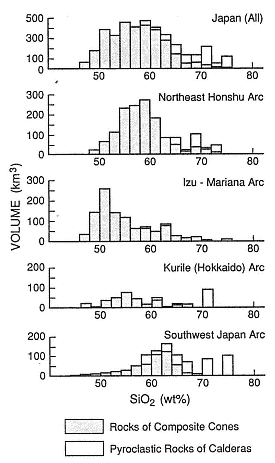
Fig. 7.6
Volume and weight percent of SiO2 from
Quaternary Japanese volcanic rocks. Patterned
portions represent lavas and pyroclastic rocks of
composite cones, lava domes, and pyroclastic
cones. Open portions indicate pyroclastic rocks
associated with large calderas.
(Adapted from Aramaki and Ui, 1982.)
| ||||||||||||||||||||
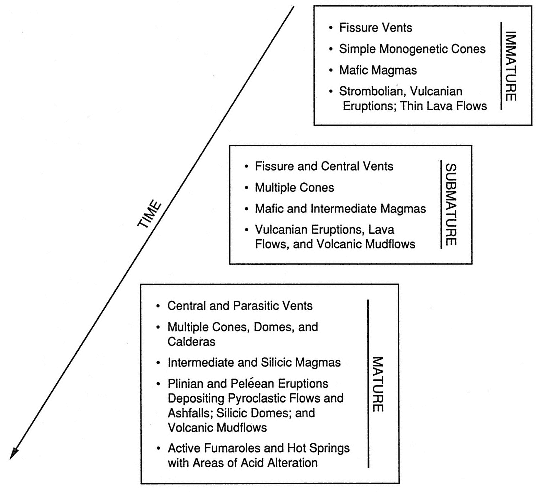
Fig. 7.7
The evolution and geothermal potential of composite cones.
these structures, as can be seen at Kilauea (Fig. 7.9). These structures are often over-whelmed by lava flows, buried by small lava shields, or cut by pit craters. The volume of the lava flows in these eruptions greatly exceeds that of the pyroclastic rocks.
At this early stage of composite cone development, there are only simple, monogenetic cones composed of basaltic lavas. These may occur singly or in chains along prevolcanic fracture or fault systems. Of course, there are exceptions to this simple categorization; for example, Fedotov (1987) reported that 4750-m-high Kliuchevskoi Volcano in the Kurile-Kamchatka arc of the USSR is a basaltic cone with an annual magma output of 60 × 106 m3 .
Strombolian Eruptions
Explosive bursts of solidified and partly solidified bombs, blocks, and ash are termed Strombolian , from activity at Stromboli Volcano, which is located along the chain of volcanoes that make up Italy's Aeolian Islands. Well-documented Strombolian eruptions consist of "weak to violent ejection[s] of partly-fluid blobs" (MacDonald, 1972;
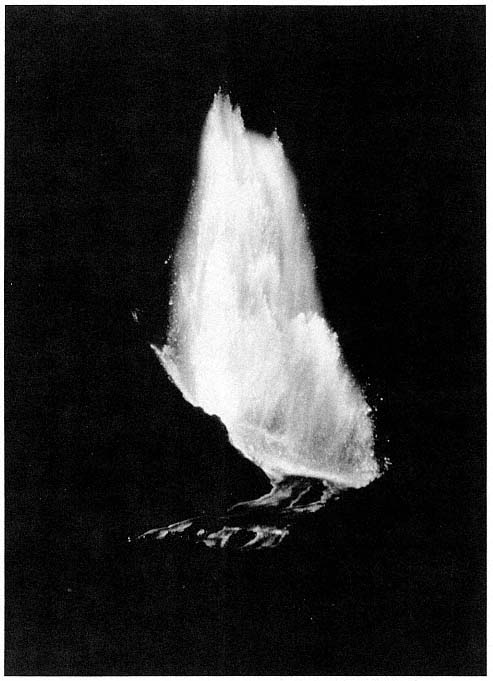
Fig. 7.8
This 300-m-high lava fountain occurred during the 1959–1960 eruption of Kilauea lki
in Hawaii. High flux, accompanied by a rapid release of magmatic gases, caused the
low-viscosity basaltic lava to fountain. This spray consisted of gases and droplets and
clots of lava. Similar lava fountains can occur during the early history of a composite cone.
(Photograph by the U.S. Geological Survey; Richter et al ., 1970.)
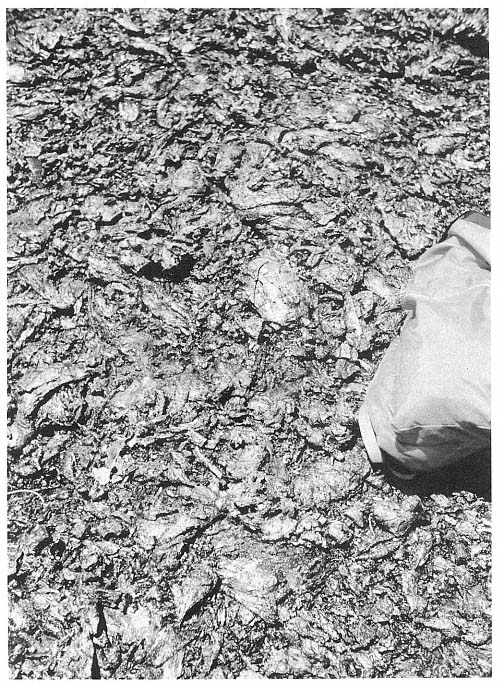
Fig. 7.9
Spatter rampart adjacent to a fissure vent at Kilauea Volcano in Hawaii. Partly molten bombs,
ranging from a few centimeters to several meters in diameter, fall out within a few tens or
hundreds of meters of the vent and form a resistant ridge or ring of welded scoria.
Self et al ., 1974; McGetchin et al ., 1974). Most of the pyroclasts fall ballistically around the vent and build up a scoria cone (Fig. 7.10); finer grained tephra is deposited on the cone and some is carried downwind. Fallout beds accumulate until they exceed their angle of repose, after which avalanches cascade down the flanks and into the crater (McGetchin et al ., 1974). Of the tephra erupted, ~50% is deposited in the cinder cone and 50% is deposited in fallout layers downwind from the cone (Heiken, 1978a).
Activity at scoria cones can rapidly alternate between lava fountaining, Strombolian bursts, and Vulcanian eruptions (discussed in the section on the submature stage of cone growth). Interbedded with the loose scoria fall and avalanche beds of many scoria cones are layers of welded scoria and finer grained phreatomagmatic tephra (for example, at Stromboli).
Pyroclasts in Strombolian deposits range from irregular, smooth-skinned, vesicular sideromelane droplets (basaltic glass) to blocky, crystalline, poorly vesicular tachylite pyroclasts. This spectrum of textural types is found in all size categories—from large bombs to scoria to fine ash.
Magma compositions represented in scoria cones vary from basaltic to basaltic andesite. Lava flows associated with Strombolian activity may be caused by overflows from crater lava lakes or eruptions from the cone flanks, which can even carry away part of the cone. Pahohoe, aa, and block lavas are all associated with scoria cones.