
1
Relics from Alien Parts An Introduction
It has been said that there are only two plots that really matter to stories and storytelling: "You go on a journey or a stranger comes to town."[1] If departures, returns, and unexpected arrivals make great material, then it may be that those we call headhunters have a real tale to tell. Not only do they go off on a journey, but they bring back a mute, disfigured stranger with them. And they tell stories about it. I know this because I have listened to them. I know, too, that there is something disquieting about finding wonder and grace in their songs of terror and blood and noise and death.[2] It is not a matter of surprise. After all, violence is no stranger to art: the bodies heaped or strewn across paintings, epics, and theater tell us that. I think the disquiet may have to do with finding oneself seduced by the spectacle and adventure of violence, by its clarity. It is the disquiet of thinking that you could be its victim or the one telling its tale. It is the disquiet that comes from assenting to a story of violence and acknowledging the passion and revulsion that quickened within you.
The force and seductiveness of headhunting stories remain real even when violence is left behind. In a sense, the headhunter's story always leaves violence behind—the bodies of the fallen are absent, elsewhere, just over the horizon of the senses. There is nothing "here" except the narrative and the dread trophy of the violent feats that happened "then and there." Consider, then, the oddness of a dumb, stolen head listening to the story that celebrates the death and dismemberment of its own person.[3] For many
traditions of headhunting, though, it is a narrative of some kind that remains as the only presentable or recoverable trace of violence. Some head-hunters—like the Ilongot men who have figured prominently in the work of Michelle and Renato Rosaldo—simply abandon the severed head of their victim, and return home to take up boasting and song. "We came home and sang and sang" goes an Ilongot headhunting story—a remark that prompted Michelle Rosaldo to say that celebratory song itself was the source of the "anger" that led men to kill (1980:56-57). Yet there are those, too, who have put the violence of headhunting behind them in a different way. Here I have in mind those headhunters who make their predatory raids in the past. Although they have long put away the headhunter's weapons, they conjure relics of violence from the past in order to animate the present. Their violence happens only in the commemorative work of ritual narrative and song. These are the kind of headhunters who people this book.
Where headhunters have put down their weapons and taken up song, the mimetic discourse of ritual offers an especially revealing look at violence. We see violence as a narrated form of symbolic exchange, something "figured" and "read," so to speak, through the discursive tensions linking dominant and oppositional social formations (Armstrong and Tennenhouse 1989; Chambers 1991; Feldman 1991; Medick 1987; White 1978), and shaped through the social poetics that frame experience (Herzfeld 1985; cf. Brenneis 1987; R. Rosaldo 1986). Nevertheless, the intrusions of history, along with the ambiguities of commemoration, complicate our readings of the headhunter's violence. Slippage, disjuncture, and irony begin to characterize the way in which a circumstanced and recalcitrant social world stands apart from the idealized vision of the headhunt. The edifice of ritual and all of its pragmatic concerns begin to tremble.
The problematic gaps between the discursive projects of ritual and the instabilities of the social world beg a story, too. What stories need to be told about headhunters who do not take heads, but who nonetheless stage rituals about headhunting? How should they be told? Consider the following narrative:
Long ago | Now | |
They took heads |
| They take effigy heads |
They take head-shaped surrogates | ||
They take coconuts | ||
They use coconuts bought in a market |

This simple narrative sketch posits an originary violence that has been displaced over time. It gives the terrors of the past an illusory firmness and clar-
ity. But each of the four "editions" or "versions" invites a different reading of the headhunters' story. If I close the tale with "They take effigy heads," a sense of violence lingers to haunt the present; the headhunter seems to be exercising choice. Closing the story with "They take head-shaped surrogates," I imply something else—perhaps that the headhunters' violence and capacity to act have been thwarted or contained. If I say, "Now they take coconuts," I am almost sure to raise a laugh, for the only sign of violence is a harmless, pathetic theft—one of the weapons of the weak. And last, should I close with "They use coconuts bought in a market," I risk giving the impression that contemporary headhunting is a masquerade or a relic amusement for those tamed or humiliated by historical change and the expansion of a commoditized world.
Other stories can be read in this narrative as well. It might be read as a fall from authenticity into fakery, a story in which "really real" violence and "really real" heads devolve into gesture and stage prop. Read from another prospect altogether, the narrative may look like the story of all simulacra, a story in which there is no distinction between originals and copies, between reality and representation. Yet still another reading may be the most common and troubling one: a story of progress, a story in which pagan violence is subdued and in which human characters ascend from a state of primitivism to one just shy of civility and modernity. This modernist story of progress has been a powerful one in the popular and intellectual traditions of the West. Those traditions have been instrumental in making a fetish of headhunters, headhunting, and the severed head: turned into extravagantly magical figures, trophy heads and headhunters have served a rhetoric of control in the West's encounter with "others" (cf. Fabian 1983; R. Rosaldo 1978; Trouillot 1991; White 1978). In short, these representations of other people's violence have played into the discursive violence emanating from colonial and postcolonial centers.
Among other things, this book is about the language, music, and violence of headhunting ritual, and about the cultural politics that have shaped them. Yet I hope it may help dislodge the cathected figure of the headhunter from that rhetoric which peoples our world with "savages," "pagans," and "monsters." My focus will be on the song and chant of a ritual headhunt called pangngae , a ceremony observed by a minority religious community on the island of Sulawesi, in Indonesia (see Maps 1 and 2). What makes this ritual so striking, these days, is its artifice. No one is killed, no actual head is taken. But its rhetoric of violence is unmistakable. By exploring the discourse of pangngae—especially its themes, its projects, and its situatedness—I hope to recognize what is at stake for the community when it convenes in the theater of ritual headhunting.
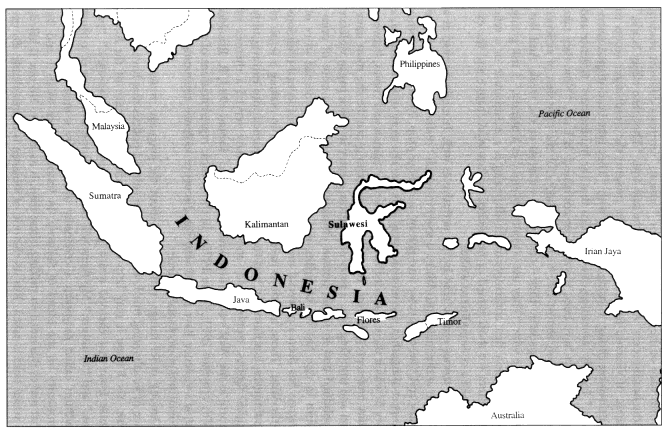
Map 1. Island Southeast Asia
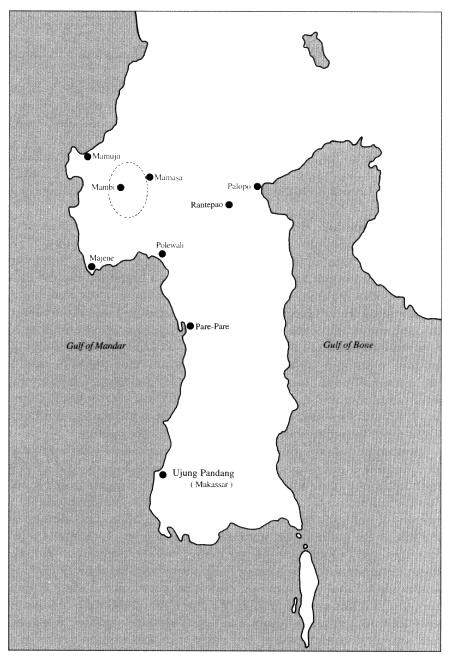
Map 2. South Sulawesi, Indonesia, showing study area
Objects and Encounters: October 1982 and July 1983
"It's a kind of harvest festival." The Kepala Desa —the head of the village district—was leading me over the paths to the hamlet of Lasodehata, where he planned to show me something about local ritual tradition. Though his remark was quite clear, I didn't know what to listen for. I was a stranger to Bambang (the name of the village district). I didn't know the people, I didn't know the place, and I certainly didn't know a euphemism when I heard one. Guided by wonder and literality, I simply went along with him.
Some months later, when I began to get a hold on the local language, I learned that Lasodehata means "the phallus of the debata (or spirit)." The story goes that when some settlers sank the first hole for a housepost on that site sixteen or seventeen generations ago, they hit a large red rock. The moment they did, the angry bellowing voice of a mountain spirit complained of the wound. The settlers made amends to the spirit and named the hamlet in commemoration of the event. Years later, civil and military authorities objected to the hamlet's name and changed it to Rantepalado, "the field of jackfruit"—although no jackfruit trees grow there. About the same time, I also learned that the "harvest festival" was called pangngae, and that pangngae means "to take a head" in raid or ambush. But on that day in October 1982, walking with the Kepala Desa, my working premise was that I was about to see something that had to do with harvest ceremonies.
Lasodehata was very still when we arrived. People must have been away in their gardens and coffee groves. We stood below the shuttered door of a large house, the comb from a nest of wasps or bees hanging beside it, set out to thwart malevolent spirit-beings from intruding into the house.[4] No one was at home, so the Kepala Desa found a neighbor, stationed him at the foot of the house ladder, and then let himself in, beckoning me to follow. Fine shafts of sunlight reached down from the thatch roof into the dim, smokeless room. A large drum hung not far from the door, cinched up near a rafter. I took a picture of it, and a few weeks later carefully labeled the slide: DRUM used in FERTILITY RITUAL, BAMBANG . Moments after telling me about the drum, the Kepala Desa pointed up toward the loft, saying, "Those instruments (Indonesian, alat-alat ) are blown to make a sound after prayers are made to the dewi padi (Ind. rice goddesses).'
I looked up, craning my neck to make out something I might recognize resting in the loft. I saw several large bamboo tubes—they looked like they might be flutes—and a snarl of plaited leaves. A small offering rack hung
next to the instruments. I fussed with my camera trying to find the angle, the right light, a sharp focus, and I vaguely recall lying on the floor peering upward through the lens. I took another shot. That one is labeled: RITUAL PARAPHERNALIA for Fertility Ritual, Bambang. Kept on rafters .
That was my first look at the relics from a headhunt. They had been put away after the previous harvest (March 1982), and with the exception of the drum have since been replaced. I take out those two photographs from time to time, usually to wind up remembering how on that day I had hopefully imagined sounds coming from a silent drum and sleeping flutes. I also remember Ambe Lusa, the Kepala Desa and a Christian of abundant good will and humor, who would die before I left the region with much-changed ideas about the harvest festivals he had described to me. His showing me that loft persuaded me to live and work in the area for the next three years, and I hold on to those photographs so that I can think back on the moment. But to erase my ethnographic naïveté and mistakenness, I have recaptioned them "Violence: Still-Life I," "Violence: Still-Life II " (see Figure 1).
Circumstances kept me out of the mountains for the next five months, and I would learn little about pangngae until the following October. Shortly after moving to the region, I found out that those who had turned to the church and the mosque had more or less forsaken the local ritual tradition that interested me, a tradition called ada' mappurondo . The mappurondo communities—that is, the groups of people who adhere to the traditional ritual order—were quiet and remote. During this time, it was largely Christians and Muslims who interpreted local culture for me.
Two months or so after settling in the area, I joined Christian acquaintances in wedding festivities at Salutabang, a village in Bambang with a significant number of mappurondo households. One of the mappurondo elders there, Ambe Teppu, confronted the host of the wedding. Mappurondo terraces had already been "wounded" by the till, putting into effect a village-wide tabu on noise, laughter, music, weddings, and other festive rituals. His anger went even deeper upon learning that my Christian friends had put on a surprise "culture-show" (Ind., pameran budaya ) for me as light entertainment and education, a show that included some old headhunting songs, a chant invoking the spirits of women's household rites, and a staged version of a dance that in ritual circumstances would involve trance. Ambe Teppu saw it not only as poking fun at ada' mappurondo, but as sacred things out of place. Bitter about what had happened, he would later scold the newlywed husband:
I have coffee beans. I will give them to you and you can roast them up and make coffee. I have sheaves of rice. Go ahead and take them, and cook up some rice. But this is my religion. I will give you my religion. But don't, don't turn my religion into culture.
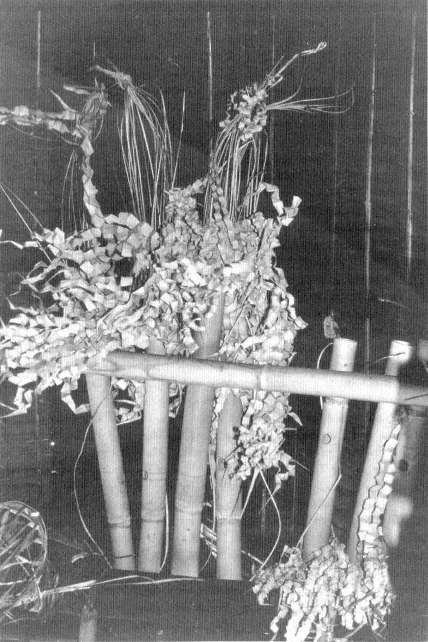
Fig. 1.
Violence: Still Life II. Bamboo flutes resting in the gable-end loft of a home.
These large, decorated flutes—called tambolâ—are unique to local headhunting cere-
monies. 1982.
For me the words stung. This was a version of "the raw and the cooked" quite unlike the one I had digested in preparation for research.[5] Ambe Teppu was taking aim against the arrogation of local tradition by intruding ideologies and social groups. Powerful institutions were competing with the mappurondo communities for the ideological control and social production of words, meanings, and practice (cf. Vološinov 1973; Williams 1977). Resisting a civil discourse that denied him a religion and treated his sacred tradition as "culture" and "art"—matters I take up in this book—Ambe Teppu was also protesting conduct that abused and concealed the real nature of mappurondo practices.
Though they were aimed at his nephew, I took Ambe Teppu's words as an admonishment for me as well. After all, I was part of a "culture industry," albeit of a different sort. Although I had no intention of turning traditional sacred practices into ethnic song and dance (Ambe Teppu's most immediate fear), I wanted to be sure that I did not slight the mappurondo communities' authoritative claims to their own traditions. Ambe Teppu's words also reminded me that though he and I had been situated in unique ways by the varied histories and politics that worked through us, both of us were caught up inextricably in the same world. I met him at a time when the discipline of anthropology was subjecting itself to a critique of its representational authority and its complicity in the politics of domination.[6] Ambe Teppu's reprimand was forged in a similar spirit: the politics of culture do matter.
I had not gone to Sulawesi with the idea of working on the problem of headhunting or violence, but with plans to explore the biographical and autobiographical strains of ritual discourse. And indeed, ethnographic reports on Sulawesi had given me the impression that headhunting ritual was a thing of the past. As in other parts of Indonesia, headhunting rumors were common forms of terror, linked now, as in the colonial past, to the presence of police, military personnel, workers from large construction projects, and other alien figures (Drake 1989; Erb 1991; Pannell 1992; Tsing 1993, forth.). When I learned, some months after meeting Ambe Teppu, that mappurondo "harvest festivals" are headhunting rites, I was drawn to them, for several reasons. For one thing, it is very clear to me that pangngae is the central ritual apparatus within the mappurondo communities for asserting their cultural autonomy: the community that no longer holds pangngae is in effect moribund. Just as ritual theater was the basic cultural idiom for the nineteenth-century Balinese state (Geertz 1980), the ceremonial headhunt of pangngae forms a political drama through which the mappurondo communities try to control their past and their present. By the
same token, the rituals are a means for these relatively egalitarian communities to display and read signs of spiritual and material potency (cf. Atkinson 1989; Errington 1989; M. Rosaldo 1980). But I do not of course mean to exorcise conflict from pangngae, for as Dirks (1994) reminds us, ritual can as easily exhibit or bring about conflict and instability, as put authority and order on display. For the moment I want to stress that the mappurondo communities' hold on autonomy, potency, continuity, and stability has been thrown into question by a civil order that contests or censures the very means for grasping them—the rhetoric of ritual violence. At stake is how pangngae will be claimed, reclaimed, or forgotten, and by whom. Conflict over ritual practice and representation is a fact of life for the mappurondo enclave in Bambang, and Ambe Teppu's protest was just one more skirmish in the ongoing struggle of a minority religious community to shape its own fate.
It would be misleading to describe this struggle as a struggle for identity. The conflict has to do with ritual practice and legitimacy, with authoritative claims to tradition, and with ways of coping with an uncertain world. For people who have remained faithful to ada' mappurondo, rituals are the events of time, memory, and tradition itself. Authoring and authorizing ritual "texts" are at issue in this rivalry with Christians, Muslims, and the civil administration. This brings me to another reason I was drawn to the ritual. The texts and textuality of pangngae not only were contested resources, but also promised a valuable point of entry into understanding the discursive construction of violence and ritual tradition. A study that dwells upon the discourse of pangngae, it seems to me, might take us far in coming to terms with ritual violence. At the same time, I think it will give us a glimpse of what the mappurondo communities have at stake as they negotiate their place in the world through a tradition of headhunting ritual.
Recent Commentaries on Regional Headhunting Traditions
Some of the more insightful commentaries on Southeast Asian headhunting traditions have shown a deep regard for local discourse and history. In particular, I have in mind here the work of the Rosaldos on Ilongot headhunting in the Northern Luzon region of the Philippines and, indeed, this book is in part an effort to resume the conversations they began. Let me sketch what I take to be their accomplishments, noting, too,
the works of others that have shaped my interest in the discourse of head-hunting ritual.
Putting headhunting into historical perspective has been Renato Rosaldo's key contribution (1980). In very general terms, he was able to show how headhunting works as a central moving force in the improvisation of Ilongot social life and in the shaping of local memory and historical thought. For example, headhunting, as part of a broader pattern of feuding, often motivated marriages and residential moves in the Ilongot communities. At the same time, it served as a focal episode in personal and collaborative recollections of the past. What is clear from Rosaldo's treatment of violence is that social improvisation and memory are mutually shaping: headhunting (as discourse and practice) was at once a way to apprehend the past and a way to respond to circumstances and contingencies of an ever-changing social world.[7] The historical turn taken by Rosaldo also helped debunk the image of the timeless primitive. Not only did Ilongot headhunting cease many times in the last century or so, but it was fundamental to local history as process and thought—that is, it was fundamental to measuring change and the passage of time.
More recently, Janet Hoskins has pushed the analysis of history and head-hunting in another, fresh and illuminating, direction (1987). Hoskins argues that sejarah , or "history," has become a new genre of authoritative discourse at local and national levels in Indonesia. National history turns Wona Kaka, a Sumbanese headhunter of the early twentieth century, into a heroic figure in the national resistance to the Dutch colonial order. Yet in the historical view of some Sumbanese, he symbolizes local resistance to encroachment and absorption by any outsiders, whether Dutch or Indonesian. As a result, the two histories compete with one another, each trying to claim this headhunter as its own heroic figure by "reinventing" his past and his heroism. The history of local headhunting is thus a contested cultural resource, rather than a formative episode in the reproduction of the social order. It is the proving ground for heroic figures crucial to the ideological control of the past. In a subsequent study, Hoskins (1989) revisits the problem of Sumbanese headhunting, this time with an interest in the historical transformation of "things." By examining the life history of a severed head, and tracing changes in its identity and value as it moves through eras of exchange, alliance, and trade between rival groups, Hoskins shows how the relics of violence can be historied and reappropriated in the changing currents of social life.
Michelle Rosaldo followed a different path in her work on Ilongot head-hunting (M. Rosaldo 1977, 1980, 1983). Unhappy with the shortcomings
of structuralist approaches, she proposed an alternative framework based on explorations into the "tones of thought" through which particular cultures associate severed heads with passion, mourning, fertility, and envy. Ilongot headhunting, in her analysis, was caught up in local discourses on emotions, in age- and gender-based social hierarchies, and in notions of personhood. Her understanding of Ilongot emotions found tragic reprise in Renato Rosaldo's "Grief and a Headhunter's Rage" (1984), written after her unforeseeable death in 1981. An important statement on emotion, ritual analysis, and the positioned subject, this essay showed once more that an exploration of emotion and meaning could render headhunting as a plausible and compelling cultural practice.
I think I can distinguish my own interests in headhunting by quoting a brief passage from the final remarks in Michelle Rosaldo's monograph (1980:231): she wrote that she was "involved in showing how particular modes of speaking are illuminated by the social actions and relationships such speech describes." In this book, I want to show how ritual modes of speaking are themselves modes of social action and relationship and, as such, are practices that shape the social and historical world in which headhunters find themselves.[8] This approach has the virtue of making central to analysis a body of discourse that Clifford Geertz (1973:448) might call a "story people tell themselves about themselves" (see also Ortner 1978; R. Rosaldo 1986). Ritual songs, narratives, and liturgies do not merely reflect or represent social life, but are of practical consequence. The politics of representation consist not only of struggles over signifiers and signifieds, but also of efforts to control the pragmatic acts and social relationships emanating from representational practice.
Although Michelle Rosaldo was able to show the rich conceptual realm in which Ilongot headhunting made sense, she did lead our attention away from the kinds of discourse that stirred the hearts of Ilongot men and gave their violence purpose: the ritual songs called buayat . Interestingly, the buayat is prominent in an opening vignette in her book (M. Rosaldo 1980). She reports about how, on her return to Ilongot country in 1974, she pulled out an old tape of a headhunting ceremony she and her husband had attended during their first stay—a sacrifice and songfest that celebrated the murder of a lowlander by an Ilongot youth named Burur.[9] Hearing the buayat, her friends demanded that she stop the tape: it was too wrenching and painful for their hearts. "[T]he song itself . . . made their breath twist and turn inside them; it pained them because it made them want to kill" (M. Rosaldo 1980:34). It seems to me that this ritual song was a criti-
cal form of discourse that stirred men to hunt heads, one that rendered headhunting morally intelligible and valuable to the Ilongot themselves (cf. R. Rosaldo 1984:190). As Rosaldo herself notes, the song celebrated and renewed the angry passions of the headhunter (1980:56); and she reports that Burur had been sullen and withdrawn over the failure of his kin to celebrate his accomplishment promptly (1980:68). To be fair, the buayat probably thwart in-depth analysis: Michelle Rosaldo explains that the songs have "no linguistic 'sense' of which Ilongots are aware," adding indirectly that they are distinct from the boasts shouted out in them (1980:54-55). It was also the case that by 1974 the buayat had gone the way of Ilongot head-hunting; they could not be retrieved for study. The same appears true of the boasting narrative song called tarapandet , which recounts a headhunter's journey (M. Rosaldo 1980:156-157).
For all of its ethnographic wealth and insight, the corpus of work by the Rosaldos does play down the significance of ritual in the analysis of head-hunting. This has prompted complaint from Peter Metcalf (forth.), who has explored Berawan headhunting practices in Sarawak, Malaysia (Metcalf 1982). He remarks that the Ilongot case may be atypical when measured against the elaborate headhunting ceremonies commonly found elsewhere in the island region (cf. McKinley 1976; Hoskins forth. [a] and [b]). I share with Metcalf a fascination for the place of ritual in social life, but I am not inclined to worry over whether Ilongot headhunting is "typical." The Rosaldos may have had purpose in writing against the privileged position of ritual in symbolic anthropology (e.g. R. Rosaldo 1984)—indeed, I have a hunch that they felt it necessary to work around ritual in order to get at the complexities of experience and history—but their ethnographic work bears sufficient trace of ceremonial discourse to convince me that ritual speech and song may afford important insights into headhunting throughout island Southeast Asia.
Violence and Ritual Discourse: Themes, Projects, and Situations
There is no one way to get at ritual discourse. For example, explorations into the poetics and politics of ritual speech in island Southeast Asia have included detailed accounts of: canonical parallelism (J. Fox 1988); entextualization and authority (Kuipers 1990); the problems of voice and
agency (Keane 1991); stylistic and thematic analyses of prayer (Metcalf 1989); the politics and history of genres (Bowen 1991); assertions of ethnicity and identity in a contested social terrain (Hefner 1985); oratory and political poetry (Atkinson 1984, M. Rosaldo 1984b); the efficacy of chant and its relation to local notions of power (Atkinson 1987, 1989); the eccentricities of trance accounts (Steedly 1993, Tsing 1993); the production of cultural coherence (Becker and Yengoyan, eds., 1979; Traube 1986); and the production of gender difference (Siegel 1978, Kuipers 1986, Rodgers 1990). Yet there is a common thread running through much of this literature: the authors recognize, albeit in different ways, that the history of society and the history of language are bound up with one another, and consequently that the study of ritual speech requires us to see how poetics and performance are situated in social life (cf. Fabian 1974; Bakhtin 1986; Bauman and Briggs 1990, 1992).
Much of the ethnographic literature prior to the historical turn in anthropology represented ritual not only as an instrument of tradition and traditional authority, but as a rigid, unchanging structure as well (cf. Kelly and Kaplan 1990). The same goes for ritual discourse, which commonly is portrayed as repetitive, formalized, conventionalized, and fixed (for example, see Bloch 1974, Rappaport 1979, and Tambiah 1985). In my experience, religious language is more supple and improvised than these descriptions would allow. Yet I would agree that ritual and ritual language show a certain stability through time. What troubles me is that we too easily forget that the fixity and formality we observe in ritual (and in tradition, for that matter) are not the properties of ritual language per se, but, rather, the outcome of a community trying to stabilize a body of discourse for continuous interpretive work. Whether that "stabilized" discourse serves the pragmatic interests of traditional authority or factors into the reformation of the social order depends largely on historical conditions, as Stanley Tambiah (1985) has pointed out. At issue for me is how communities produce, reproduce, and tactically alter ritual discourse in ever-changing social and historical contexts. In my view, there is no ur-text, no abstract cultural schema, no basically basic story or structure behind ritual.[10] There is instead an ongoing history of prior ritual events and texts being recalled and put in productive tension with the present.
As Jerome McGann has reminded us in his recent exploration of materialist hermeneutics (1991), texts are made and remade under specific social, historical, and institutional conditions, conditions that mark the horizon within which texts are interpreted and transformed (cf. Williams 1977). Dis-
cursive practices are always in service of one or more situated projects, and it is such projects that come to dominate (or set the grounds of struggle for) the pragmatic and hermeneutic dimensions of the textual acts in question (cf. Fish 1980, 1989). Different "versions" of a text, I would argue, trace its situatedness and throw light on the conflicts that determine its multiaccentuality. Indeed, remaking texts—in McGann's terms, "producing editions" (1991:33)—is a way to shape meaning (cf. Tedlock 1983, Fabian 1990). How this process took place in one specific Indonesian "situation" comes through clearly in the work of James L. Peacock (1968), who was able to show that differences and deformations of plot in performances by Surabaya's ludruk theater-troupes in the 1960s made sense with respect to the goals and ideological programs of opposed political camps. For traditional ceremonial discourse, I believe it is possible to demonstrate as well that rituals and their multiple stagings are made "for particular purposes by particular people and institutions, and [that] they may be used (and reused) in multiple ways, many of which run counter to uses otherwise or elsewhere imagined" (McGann 1991:47). Staging a ritual places it in historical relation to prior stagings and yet aligns it with immediate social goals, tensions, and anxieties.
For the mappurondo communities in Bambang, staging pangngae is part of a broader struggle to assert authority and control over their ritual tradition and their past. Yet there is no fixed way to do this. The communities instead bring out different "editions" of the headhunt in an effort to repeat the past and to respond to the contingencies of the present. Each performance narrativizes violence in keeping with living memory, and with the interests and problems of the moment. Because I have no record of ritual materials from the colonial or precolonial past except those recalled in the discourse of the present, my understanding of how the mappurondo communities fashion their headhunting ceremonies is limited largely to the horizons of a two-year period in the mid-1980s. I look, of course, to various liturgical genres in an effort to see what it is the communities are trying to accomplish. But central to my analysis is a genre of choral song called sumengo , which may be translated as "the singing." The songs are short: the typical sumengo consists of but three octosyllabic phrases sung by a song-leader and chorus. Yet the songs are so prominent in pangngae that it would not be off the mark to describe the ritual as a kind of sumengo-fest. In fact, the sumengo arc the principle textual and performative vehicle for narrativizing the violence of pangngae, and in that sense they are analogues to the Ilongot buayat and tarapandet discussed by Michelle Rosaldo. For this
reason, my exploration of different stagings or editions of pangngae rests largely on differences I noted in sumengo performances. That is, differences in sumengo performances suggested to me different ways to narrativize or aestheticize violence, and different ways to reproduce and make claims to ritual tradition in the theater of social life.
Much in this book is in keeping with text- and performance-centered ethnography (e.g. Becker 1979; Bauman 1977; Fabian 1990; Hymes 1981; Tedlock 1983), and with recent trends in practice theory (see: Ortner 1984, 1989; Dirks, Eley, and Ortner 1994). So as to elucidate a local narrative of violence and relate it to the flux of social history in the mappurondo communities, I will organize my exploration of pangngae largely in terms of its themes, its projects, and its situatedness. By "themes" I mean broadly and simply the subject matter of specific lyrics, liturgical texts, or canonical acts as they are generated in specific contexts of production and interpretation.[11] To give but a few examples, adornment, noise, and pity are themes that one commonly encounters in the representational and performative dimensions of pangngae. The challenge will be to relate them to the theme of ritual violence. By "projects" I mean the recurrent goals of the ritual. Although the search for prosperity might be considered the overriding point of pangngae, it is clear that the domination of an ethnic rival, the lifting of mourning prohibitions, the celebration of manhood, and the act of commemoration itself also factor into the ritual as purposive tasks. The themes and projects of ritual discourse, I should stress, are intertwined and lend each other intelligibility. It is through them that the mappurondo communities are able to conjure the headhunter's violence and give it significance. A look at the situatedness of pangngae can take us further still. In what kinds of communities do these rituals take place? What social conflicts and contingencies surround the headhunt? What events and forces lie behind and ahead of the ritual tradition we encounter today?
Let me outline, then, the structure of this book. Immediately after this introductory chapter, there follows a general social and historical sketch of the mappurondo enclave in Bambang. It should provide readers with a rough sense of the political culture and cultural politics surrounding pangngae. The next four chapters (Chapters 3 through 6) dwell largely on the themes and projects of mappurondo headhunting ritual, relating them very broadly to the social and cultural reproduction of the mappurondo communities. Chapter 3 explores the headhunting of the past and the way it is recalled in ritual discourse and oral history today. Here I try to make sense of headhunting and the polemics of ethnicity and highland-lowland exchange in the precolonial and colonial periods. I also use this discussion of history
to critique the excesses of structuralist and other symbolic approaches to ritual headhunting, and to recuperate the political import of violence and the trophy head.
Chapters 4 and 5 trace the processual features of a contemporary head-hunt from start to finish. Grief, violence, and solace are the key themes in Chapter 4; I relate them to the projects of mourning and making vows. As many readers will recognize, this chapter takes inspiration from and responds to Renato Rosaldo's "Grief and a Headhunter's Rage" (1984). Mappurondo practices suggest that the resolution of communal mourning is more significant than personal catharsis in motivating a headhunter's violence; that ritual refigures individual affect as "political affect" (consonant with the political import of violence); and that varied discursive forms such as vows, songs, and noise mediate the ways in which people (and the community as a whole) put grief behind them and resume their lives. I argue, then, that personal motives for taking part in contemporary headhunting spring not from powerful emotions but from obligations and acts made in discourse.
Chapter 4 follows pangngae from the time the headhunters leave their village to the time they return home. Chapter 5, by way of contrast, deals with the week of ceremonial activity that takes place after their triumphant return. Here I relate the politics of adornment and envy to the discourse of manhood, and to the local social hierarchies relating men to men and men to women. In this chapter we see males figured anew: they not only are valorous and violent as headhunters, but also show their virtuosity and authority as rhetoricians, as speechmakers. At the same time, the rivalry that linked the headhunter with his victim is now supplanted by a rivalry between husbands and wives.
Chapter 6 addresses the final project of pangngae: commemoration. In this chapter I try to locate the violence of pangngae in commemorative discourse itself, arguing that violence is both subject and generative force for its own reenactment in chant and lyric. I point out as well that commemoration is a mode of sociality. I look in particular at the social organization of choruses and relate such organization to everyday social hierarchy. But I also raise the issue of sociality to suggest that the politics of representation not only involve struggles for authority over signs, but also imply a struggle to inhabit distinct forms of social relationship.
Chapter 7 takes a look at differences in the commemorative work of four villages as they hold pangngae. Taking inspiration from McGann, I try to see how the discourse of pangngae has been situated and circumstanced—to scan, in other words, the performative and interpretive horizons for this ritual. Against a background of a tradition in crisis, I explore how agonistic
play, irony, trance critiques, and written texts have become commonplace in the headhunt. The violence and memory of headhunting, and the interpretive work linked to them, are now inseparable from writing, reading, and the excited play of voice.
Chapter 8 extends further my concern for the situatedness of pangngae. I finally come around to the Christian and Muslim efforts to claim or forget local headhunting practices, efforts that are worked out largely in terms set down by the Indonesian state. My "texts" in this chapter are not sumengo, but a tourist pamphlet, analyses of local tradition by two theologians, and the quips and remarks of friends. Against these portraits of headhunting, I return to the figure of Ambe Teppu, the man who reminded me that the politics of culture do matter, most especially for minority communities too small to count in state and national orders. I close with a brief look at the mappurondo communities in 1994, and with some reflections on this work as a whole.
A Note on Research in Sulawesi
Most materials for this study come from roughly 30 months of ethnographic research in the mappurondo communities of Bambang between October 1982 and August 1985.[12] have made no effort to disguise the places where I worked. Friends and hosts in the mappurondo communities, however, appear in these pages with their names changed. During the time I lived and worked in Bambang, I was able to witness and take part in pangngae eight times: twice in the village of Salutabang, three times in Minanga, twice in Rantepalado, and once in Saludengen. I recorded ritual songs and liturgical performances in each of those places, and all the lyrics that appear in this book are quoted from specific ritual performances. Day-to-day observations, casual conversation, household surveys, and village histories were the source of other materials that came to shape my understanding of ritual song and violence.
Much in this work hinges on the translation and interpretation of ritual speech and song, especially the sumengo. In an important sense, the project of translation and interpretation is an unfinished one. I keep going back to these songs, sometimes finding something I overlooked, other times finding new ways to connect the materials meaningfully to other features of mappurondo life and language. Readers will further extend and revise the project of interpretation. That said, it may be helpful if I provide a quick
sketch of my encounter with these songs, and of my tactics and methods of translation.
As may already be clear, the genres of ritual song peculiar to the head-hunt are subject to a rigid set of local tabus. This holds for ethnographic dialogue as well. Villagers may not sing, rehearse, or even discuss these materials unless it is "headhunting season," so to speak—a period lasting between three days and two weeks. These tabus necessarily shaped my work with singers, lyrics, and performance. In particular, they framed the contexts in which performers and I could comfortably engage in a give-and-take with one another. By placing my inquiry within the sphere of traditional practices, I put a partial check to my impulse to control ethnographic dialogue. At the same time, the sanctioned period for ritual performance gave me a chance to raise questions about the sumengo and other genres and to ask villagers to reflect on the meaning and significance of the material.
Listening in and listening to mappurondo headhunting ritual is complicated work. Gatherings are exuberant; conversations, songs, and drumming all take place at the same time. Liturgical acts will silence the talk and instrumental music, but these acts are often whispered or muttered, or demand choral responses that are difficult to make out. My understanding of ritual emerges from being there, and listening to tapes and reading transcriptions prepared by my Christian language assistant from Salutabang, Bombeng Rendeng (Papa Ati).
During the postharvest season of 1984, I moved from one village to the next as the headhunting rituals closed in one and began in another. Papa Ati joined me in Salutabang and shortly afterward we repaired to the mountain market town of Mambi—downriver and out of the orbit of mappurondo social space—where we would be free to work on transcribing and translating materials into Indonesian and English. Once basic transcriptions were complete, we would together explore the songs' lyrics. We then took our understanding of the songs back to the different mappurondo communities for comment in 1985, when ritual conditions next allowed. Most of those to whom we turned were men, but at Salutabang and Minanga we were fortunate to have the help of women who were skilled sumengo soloists. Interviews with soloists, ritual specialists, and other villagers supplied me with information on singing, the origin and history of headhunting, and on people's impressions of sumengo performances and their encompassing tradition. We also gathered new materials in 1985, and rushed to bring them into our conversations about pangngae.
Translating the songs was hardly straightforward. Translations emerged from talk between a native speaker/singer (raised mappurondo but now
professing to be Christian) and a stranger trying to become familiar with local tongues and with the life-worlds and political anxieties of the mappurondo communities. Talk was a mix of Indonesian and languages peculiar to Bambang and Mambi. Whole stories inform word glosses and the details of interlinear worksheets. The interpretive commentaries of villagers, too, were hardly straightforward, leading off, as they often did, into local history, personal memories, and other songs. But by and large the meaning of the songs and liturgies did not occasion much debate or disagreement. Interpreting the songs was not a pressing cultural problem; remembering them was. Sometimes people found songs enigmatic and beyond understanding. Other times singers and listeners acknowledged a plurality of meaning in the lyrics—and I have tried to capture some of that surplus of meaning in the chapters that follow.
The final months of fieldwork brought a fresh problem. Late in April 1985, I was able to attend pangngae at Saludengen, a village in which I yet had no friends or acquaintances. Aside from 45 new song texts, the ceremony yielded a performance style unlike those I had previously encountered. Further, it was in Saludengen that I discovered villagers who had begun to write down sumengo lyrics (though not the tune). Confronted with all of that, I had to rapidly reformulate my ideas regarding sumengo tradition and, indeed, headhunting tradition. I had opportunity to pursue some of my most important questions. Unfortunately, my visit was brief and many more questions had to go unasked.
Once again, I should stress that the work of translation and interpretation has not come to a halt. For example, working with ethnomusicologists after I returned home from Sulawesi gave me an opportunity to grapple with textual and melodic structures in ways I never imagined during my initial study (George 1989). Finally, in writing this book I have tried to place songs so as to help identify and make intelligible some of the key strains and themes in mappurondo headhunting ritual. That effort should not preclude further interpretive work—further "editions" in McGann's terms—by me or by others.