
Khumbu Sherpa Subsistence Strategies
In many respects Khumbu Sherpa subsistence is a typical high-altitude agropastoral strategy. Like other high Himalayan peoples Khumbu Sherpa have developed an integrated mix of agriculture and pastoralism based on the familiar crops and livestock varieties of the high country. And like other Himalayan peoples in these circumstances they have long supplemented the agricultural and pastoral resources of their high valley homeland by trade geared to obtaining lower-altitude-grown grains. Khumbu Sherpas traded crop surpluses and pastoral products, but they, like many other peoples who live along the Tibetan frontier, have particularly profited from playing a middleman's role transporting goods across the Himalaya between Tibet and the lower lands of Nepal and India. Since the 1960s this trade has dwindled and Sherpas have instead achieved a similar diversification of their subsistence by using cash to buy rice, maize, wheat, millet, and buckwheat grown in the lower Dudh Kosi and adjacent valleys and the Nepalese Tarai. Today, as for at least a century, Khumbu Sherpas do not need to achieve regional or household self-sufficiency in agricultural production. Instead they have the more limited goal of meeting household requirements in a small range of Khumbu staple crops.
Sherpa households' ability to obtain agricultural and pastoral products from regions below 3,000 meters through trade has enabled them to adopt a strategy of specialization in high-altitude-fit varieties of crops and livestock. At the same time, Khumbu Sherpas, like other high-altitude peoples, have made the use of a range of microenvironmental sites a prominent basis of their subsistence strategies. Within Khumbu itself Sherpas make adept use of the minor microenvironmental variations between different sites due to altitude, aspect, precipitation, and soil. Herding strategies for the various types of livestock all involve the
use of seasonal transhumance between lower and higher valley common pastures. Crops are usually planted in fields at a variety of altitudes. Some direct use has also been made of altitudinal and microenvironmental regions beyond Khumbu itself. Sherpas have never developed secondary agricultural areas in lower valley areas remote from their main villages in the way that some Bhotia peoples have in the western Himalaya, but like most other high-altitude peoples they have made use of environmental opportunities in adjacent regions for herding. Earlier in the twentieth century Khumbu Sherpas, like the peoples of Dolpo and Humla in northwestern Nepal, benefited from Tibetan winter pastures and some also took a few crossbreeds and sheep south to the lower valleys to serve as pack stock on trading journeys. In the Khumbu case, however, only a few families did so and then only on a quite small scale. Before the mid-1960s many families, like other Bhotias, devoted the winter to travels which might last five months and which were spent trading and visiting sacred places and shrines.
Since at least the late nineteenth century, and probably for long before, Khumbu subsistence has revolved around the cultivation of a very small number of staple crops which can tolerate the high-altitude conditions. Buckwheat is the main grain, grown in a biannual rotation with tubers. Some barley has also been grown in those few sites where it is possible to easily irrigate the fields, and the need to irrigate barley fields rather than cultural or political economic factors accounts for the distinct lack of emphasis on this preferred food. Formerly, Tibetan varieties of turnip and radish were the staple tuber crops, but during the twentieth century potatoes have become not only the most frequently grown tuber but the dominant crop in the region. Today more than 75 percent of all crop land is in potatoes, usually monocropped and often grown year after year without rotation.[19] Regional diets are today based primarily on potatoes, which are consumed in one form or another as the foundation of virtually every meal. Adult Sherpas typically consume more than a kilogram of the tubers per day, and a family of four requires between one and two metric tons per year for self-sufficiency in this staple.[20] Grain is much less important, and a well-to-do household might live well by local standards on less than 700 kg (10 muri ) per year.[21] Diet varies somewhat with wealth, particularly in the amount of grain consumed. Wealthier families also differ in their choice of grains, and eat rice, barley, and buckwheat rather than the millet, maize, and buckwheat of the poorer households. Rice, maize, and millet are all obtained from outside the region and much higher prices are paid for rice than for the other grains. Recent affluence has greatly increased the amount of rice being consumed today in Khumbu. During the past decade well-to-do families, especially those in Nauje, have also added more processed
foods to their diet. Instant noodles, refined sugar, powdered milk, and even such things as mayonnaise have become popular.[22] Some adverse effects on health and teeth are beginning to become evident.
Over the centuries Khumbu Sherpas have developed a set of different production systems to raise potatoes, buckwheat, and barley. Each makes use of different techniques and requires different knowledge. Some are in use throughout the narrow altitudinal reach of Khumbu whereas others are employed more specifically in a particular type of microenvironmental setting within the region. All of these crop-production systems are also linked with grazing and forest-use practices that furnish crucial field nutrients. Ten different crop-production systems can be identified in Khumbu today, all but two being unirrigated. Nine are based on the cultivation of crops in main terraced fields. The two most important systems in terms of the land devoted to them and the share of local food production which they account for are both unirrigated, single summer crop production systems. In one of these potatoes are grown in a mono-crop for decades with no rotation. In the other there is a two-year rotation between potatoes and buckwheat. Two other production systems that are now employed on a limited basis by a few families in some of the main villages build on these basic potato and buckwheat systems by adding intercrops. In one of these potatoes are intercropped with a Tibetan variety of radish and in the other a semivolunteer called to which produces an edible tuber is encouraged in either potato and buckwheat fields. There are also two production systems now practiced in Nauje which build on potato and buckwheat cultivation through following the main harvest with a second crop. Several families follow potatoes with a second crop of mustard that is grown as a green vegetable, not for its oil. A few families follow potatoes with a second crop of wheat or barley grown for fodder. In both cases the need for the second crop to mature before November limits the use of this system to the lower-altitude settlements of the region and often involves harvesting potatoes before they reach their full maturity in order to make field space available. Two further nonirrigated production systems are devoted to fodder. The most important of these is establishing and tending hay fields. In Nauje there is also some small-scale growing of nonirrigated barley and wheat as fodder crops. Finally, there are two crop-production systems in Khumbu that make use of irrigation. Both are very localized. The most important in terms of the area devoted to it is the cultivation of irrigated barley as a summer field crop. In this system barley is rotated biannually with unirrigated potatoes. The requirements of the agroecosystem for irrigation water in the late spring limit it today to a single site in eastern Khumbu. The other system is the household vegetable garden. Here water is carried by hand from the village water sources to the garden rather than being fed by a canal system
to the site, and is carefully delivered to the plants through hand watering in contrast to the techniques used to irrigate barley.
Agriculture is carried out by nuclear families on privately owned crop and hay fields. Khumbu Sherpas are all smallholders. Most families own less than a quarter hectare of land and wealthy families own little more than half a hectare. The tremendous productivity of potatoes, however, makes even this small amount of land sufficient to meet household requirements in all but the worst years. Indeed, the 1,200 kilograms required by typical Nauje families can be grown on only 600 square meters of land even in a relatively bad year. Elsewhere families have no trouble cultivating enough potatoes for their needs on less than 1,000 square meters of land, and those who own a quarter hectare of land may also reap two muri or more of buckwheat (120 kg), enough for household self-sufficiency in that grain (although far from the ten or more muri of total grain stocks required by a household). In good years families who own only a quarter hectare of land may be able to exchange or sell surplus potatoes or, as is more common, use them as fodder. In some years such a household may also have a surplus of buckwheat. Surplus production is mostly exchanged in Khumbu itself, but throughout the twentieth century dried potatoes have been exported on a very small scale to Tibet and some potatoes have been traded or sold as seed potatoes each January and February to Rais and Sherpas from lower-altitude areas. A relatively small number of families, however, sell potatoes or grain on an annual basis. The great majority of Khumbu families orient their crop production entirely to family consumption. Even the few households that often raise and sell a surplus have had their crop production practices less affected by commercialization than might be expected. These farmers do not, for example, base their decisions about which crops and crop varieties to plant on the basis of market demands and commodity prices. They maintain the same monocrop potato or biannual buckwheat-potato rotations as their fellow villagers, cultivate the same varieties of these crops, and raise them with the same fertilizer and labor inputs.[23]
Pastoralism is based on the care of several species of stock that are hardy enough to winter in Khumbu conditions that are kept for their direct contributions to the family of milk, meat, blood, hair, manure, draft power, and transport and also as sources of income from the sale of calves or their use as pack stock. Yak and especially the female yak, known in Khumbu as nak , are the preferred stock. Cattle, yak-cattle crossbreeds, and sheep are also kept on a small scale.[24] There is a very strong cultural preference for raising yak which is deeply entwined with local conceptions of wealth and status. During the past century the major emphasis in stockkeeping has been on the raising of nak kept both
as a source of milk and for crossbreeding with bulls to produce cross-breed calves that were commercially valuable for sale in Tibet and to middle-altitude Sherpas.
Herding emphasizes the use of the extensive Khumbu rangelands that are regarded as common property resources freely available to all Khumbu Sherpas. The use of some of these areas is regulated during summer by local pastoral management regulations intended to protect growing crops from livestock, reduce pressure on lower Khumbu winter pasture areas, protect areas that furnish wild grass for hay, and establish a form of rotational grazing of some high summer pasture areas. Today all herding is carried out entirely within Khumbu throughout the year. The full range of Khumbu pastoral resources from 2,800 to 6,000 meters is used. Cattle and crossbreeds are herded to high altitudes in summer and in winter are stabled in the lower floor of main village houses and fed fodder. The hardier yak and nak are taken to the very highest Khumbu summer pastures and also often spend much of the winter at high-altitude herding bases where they feed on what grass they can find in the snowy upper valleys and are fed hay that has been grown in nearby walled fields and stored in the high-altitude herding huts. This yak-herding pattern, with its distinctive reliance on year-round use of Khumbu pastures and the consequent importance of winter and spring moves to areas where hay and fodder supplies have been stored, is largely a development of the last sixty years. Previously many yak were taken to Tibet to winter and much less hay was grown in walled fields in Khumbu.[25]
Pastoralism, in contrast to crop growing, is much influenced by commercial concerns and has been for at least a century. Livestock make many contributions to household sustenance, but they are equally as important for many families as sources of income and this affects decisions about herd composition and size. The sale of crossbreed calves bred from nak was long a very important Khumbu industry, although less so in the recent past than formerly. Early in the century it was one of the most lucrative of all Khumbu entrepreneurial avenues. And at various times the keeping of yak and male crossbreeds has reached high levels when it has become especially worthwhile to own pack animals. During the past fifteen years the number of male crossbreeds kept in several Khumbu villages has increased markedly, reflecting interest in opportunities for their use as pack animals in the tourist trade.
Altitudinal Land Use
Khumbu Sherpas make use of a span of vertical environments which ranges from 2,800 to 6,000 meters (fig. 7). Microenvironments within this region vary in climate from cold temperate to arctic and in vegeta-
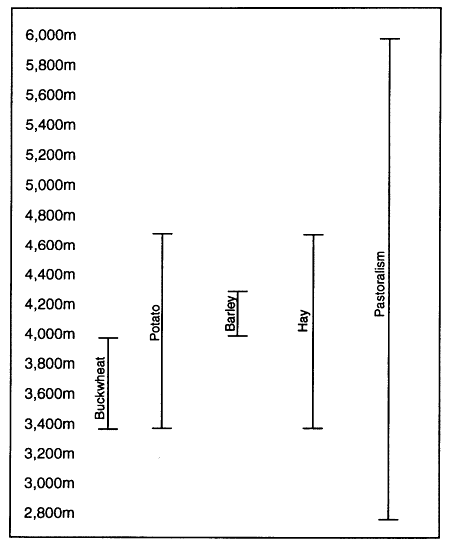
Figure 7.
Khumbu Historical Altitudinal Land Use
tion from temperate forests of pine, fir, birch, rhododendron, and juniper to subalpine forests of fir and rhododendron and high-altitude, alpine shrubland, and from temperate grassland to alpine tundra. Local knowledge of this diversity underlies agricultural and pastoral decisions in everything from terrace siting and crop selection to the timing of planting, the siting of herding huts, and the seasonal movements of
herds of different livestock species. Khumbu Sherpa subsistence strategies emphasize the use of some local microenvironments more than others. The most intensive use is made of the sunny, south- and west-aspect slopes. Here substantial amounts of land even above 4,000 meters have been put into crop terraces and hayfields and considerable grazing is done on other land. Remnant woodlands are much used as sources of forest products, especially as sources of leaves for fertilizer, and they are also often valued as grazing areas. Much less use is made of north- and east-aspect slopes for farming or herding, but the extensive forests below 4,000 meters in these areas have historically been valued sources of timber, roof shakes, and fuel wood. At the higher altitudes the subalpine forest, shrub, and grassland ecosystems and alpine ecosystems of both north- and south-aspect slopes are used for grazing. Below 5,000 meters in these areas much land is also put to the cultivation of hay. Here the difference between sunny and shady aspects is less crucial. The historical emphasis on the use of south- and west-aspect slopes between 3,000 and 4,000 meters has apparently had a role in diminishing the extent of temperate and subalpine forest-woodland ecosystems and in creating the relatively large expanses of shrub and grassland in these zones.
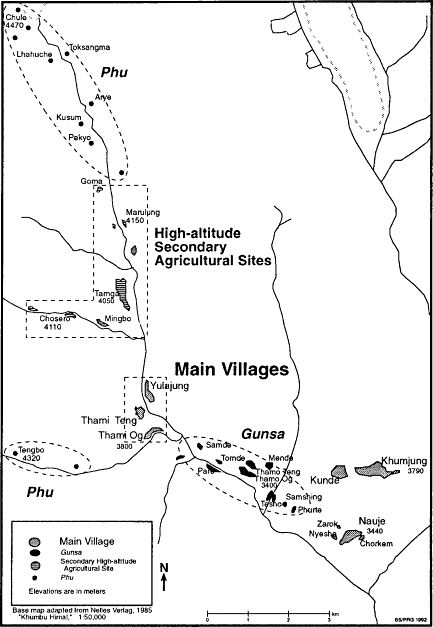
Whereas Khumbu pastoralism, as already mentioned, is carried out through the full vertical range of altitudinal land use, agriculture is conducted in a much narrower range of altitudes. Most crop fields are situated between 3,400 and 4,000 meters with only a relatively small amount of land in higher-altitude fields. Hayfields, by contrast, have been established from 3,400 to as high as 5,000 meters. Multialtitudinal crop production is common. Individual families may own fields that span a thousand meters in elevation. There are four different altitudinal crop zones associated with different types of main and secondary settlements: the gunsa; main village; secondary, high-altitude agricultural site; and the high herding settlement or phu (map 6 and fig. 8). Multialtitude cultivation increases flexibility in labor scheduling, extends the growing season (thus increasing the amount of land that can be cultivated by individual families), expands villagers' access to land beyond the relatively scarce area in the vicinity of most main settlements, and reduces the risks of crop failure by dispersing staple crop production across several different microenvironments. The small altitudinal range between the different crop sites, however, means that no advantage is gained in terms of widening the local crop repertoire beyond buckwheat, barley, and potatoes. Families with gunsa land are able to get an early start on planting potatoes and harvest them before the later-planted, main settlement fields have matured.[26] Generally only a small amount of land is farmed at these altitudes and many families own no gunsa land whatsoever. The main emphasis is on fields in the main village and
Map 6.
Multialtitudinal Agricultural Sites, Thamicho
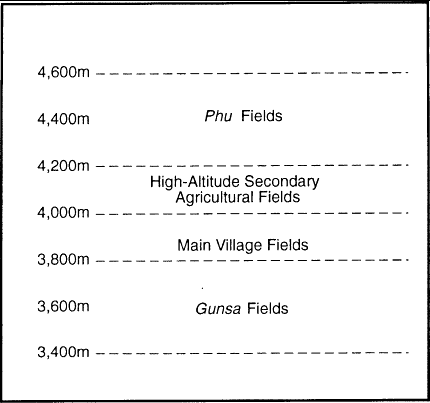
Figure 8.
Thamicho Multialtitudinal Crop Production
especially those immediately adjacent to the house. Most households have well over 50 percent of their total cropland in the main village. High-altitude, secondary agricultural sites are the next most important agricultural zones. Here large amounts of land are put to potatoes, and at Dingboche a roughly equal amount of land is in barley. Formerly buckwheat was also produced in some of these settlements. High-altitude fields above 4,000 meters yield smaller harvests than lower-altitude ones and usually only consist of a small patch or two of potatoes. Harvests at these high herding settlements, however, release families who spend a good part of the year with herds in the high pasture from the effort of transporting as many supplies from the main village.
Distances between gunsa and high-altitude fields may be great enough that in the often rugged terrain a day or more is required to traverse them. Thamicho families with gunsa fields in the lower Bhote Kosi valley at Thamo, for example, may have their highest fields eighteen kilometers up
valley at Chule or Apsona. Some Khumjung, Kunde, and even Nauje families have fields as far away as Dingboche, fifteen kilometers to the east. The distances involved often make cultivating high-altitude, secondary agricultural sites and high herding settlement fields from a single, main village base impractical, and many families shift instead back and forth between dwellings in different reaches of the valley a number of times during the growing season. These movements must also be coordinated with the requirements of herding, community regulations governing the timing of field work and grazing, and social responsibilities at two major summer festivals held in the main village and a third conducted in some high herding settlements.
Integration of Land-Use Activities
Life in Khumbu is a complex integration of the requirements of conducting crop production and pastoralism at the altitudinal limits of both (fig. 9). The use of forest resources is also interwoven with agropastoral-ism as well as making an essential contribution to the provision of fuel and shelter. Agropastoral practices must also be integrated with the seasonal rhythms of conducting long-distance trade and with the required commitments of time and energy for tourism work and business operations. I have not heard of any Khumbu Sherpa family during the twentieth century which specialized in trade to the total exclusion of agriculture, and no Khumbu Sherpa family today relies solely on earnings from tourism. Farming continues to be carried out by all households and ways are found to compensate for the scheduling problems and occasional labor shortages created by the demands of tourism employment. Even the families which have grown wealthiest from trade and tourism continue to place great importance on maintaining the cultivation of their land and many also keep livestock. Some are among the largest stockowners in their villages.
Khumbu crop production is intimately linked to pastoralism even for those families who own little or no livestock. Annual fertilization of potato fields is a fundamental principle of Sherpa agriculture and although everything from composted weeds and forest-floor litter to human waste is used, the most important soil additive is undoubtedly manure. This is so important that the route and timing of herd movements is decided in part on the basis of where household fields are located and when the optimal times are to supply them with manure. Families without sufficient livestock of their own either scour the slopes for dung or devote scarce cash to purchase it--in some places even doing so a year in advance in order to be sure of an adequate supply.
Crop production in turn contributes to pastoralism. Livestock are grazed in autumn on field stubble and fed fodder in winter, which includes
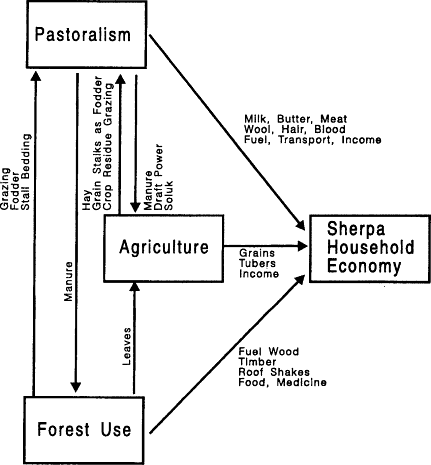
Figure 9.
Khumbu Sherpa Land-Use Integration
carefully dried and stored stalks of buckwheat, barley, and danur , a perennial plant believed to have medicinal and stimulative qualities for cattle. Large amounts of land and labor are devoted to the cultivation of hay that is grown on fields in the lower valleys and in some main villages as well as on a large scale above the range of productive potato cultivation.
Both crop growing and herding are further linked to forest use. Khumbu is at the upper limit of tree growth, and only its sub-4,000-meter, lower reaches support temperate and subalpine forests. Sherpas depend on these limited forest areas for timber and fuel wood and also rely on them for grazing and for soluk , dried leaves and needles scoured from the forest floor.[27] Open woodland in the vicinity of villages provides much-
used grazing and browsing, especially in winter, so much so that its intensity may be affecting forest regeneration in some areas. Forest-floor litter is gathered twice a year and carefully used as stable bedding, after which the urine- and dung-rich material is stored until spring when it is dug into the fields. In some areas and for some families this constitutes a far higher percentage of fertilizer by volume than does manure. The intensity of foraging for leaves and needles gives the forest in the vicinity of villages a freshly swept look and in places every fir needle or birch leaf seems to have been removed. Both the gathering of dead leaves and needles and grazing were permitted even in forests that were traditionally strongly protected by Sherpas from logging or lopping.
Economic Differentiation
The social complexity of indigenous societies has often been neglected or underemphasized in cultural ecological studies. Adaptive strategies and land-use patterns have often been generalized as if regions, settlements, and even individual households maintained the same practices. Yet there may be tremendous variation in household wealth, status, and political power within settlements, as well as contrasts among villages. This may affect lifestyles, types and scale of resource use, land-use practices, access to private and communal land, and the maintenance of local resource-management systems--all of which also can have considerable ramifications for local environmental change. The analysis of local economic and political differentiation may thus be as important an element in the study of environmental degradation as is the examination of the historical impact of national government policies on land use and resource management.
There is not as much differentiation of wealth among Khumbu households as is typical in many parts of Nepal where tremendous disparities in land ownership are common. There is no class of landless Sherpa families or tenant farmers in Khumbu, although there are a few families who own very little land indeed. Nor are there any great estates here like those in some other Sherpa-settled areas such as Shorung and Chyangma. Most families own enough land to harvest a supply of potatoes sufficient for their annual requirements, although in the relatively frequent years of bad harvests they may have some shortfall. No family today owns more than thirty-five head of yak and nak and almost all families, regardless of their wealth, carry out a substantial part of all the labor on their lands.[28] All share the same types of local knowledge of environment and agronomy, the same assumptions about the culturally correct ways of working the land, the same technology and techniques, and the same basic strategies for coping with altitude and Khumbu microenvironments and their
distinctive risks and opportunities. This makes it possible to discuss a "Khumbu Sherpa" pattern of agriculture and of subsistence more generally despite differentiation in wealth. Yet all Khumbu Sherpa families do not uniformly implement the same adaptive land-use strategies and practices. Differences in individual inclination and, to an even more important degree, differences in household labor, land, livestock, and fiscal resources, have led to several different ways of organizing agriculture and pastoralism. Individual families may practice more than one of these over a period of years as their resources change and make possible or impractical different subsistence practices.
Khumbu society has sometimes been regarded by casual visitors as remarkably egalitarian. Yet there are important differences of status, wealth, and power within communities and have been for many generations. There are such differences among Sherpas, between Sherpas and Khambas, and especially between both of these and Khumbu's few families of Hindu blacksmiths. And there are differences in power between ordinary families and those wealthy and powerful families Sherpas refer to as "big people." Differentiation of wealth is clear in diet, amount of fuel wood use, house size, style, and construction materials, and the amount of land and labor they control. It is also clear in subsistence' strategies, not only in stockraising and in some cases in crop selection but also in such small but important things as when crops are planted and harvested and how much manure is put on them. Social differences are thus significant for describing Khumbu land use and exploring possible processes of environmental degradation both before and after the social and economic changes of the 1960s.
The wealthy lived better by Sherpa standards even during the pre-1960 era of "traditional" society. They occupied larger and more luxuriously furnished houses. They owned enough land to produce not only plenty for family consumption but also surplus for sale. If they wanted to raise yak they did, and could afford to maintain the necessary secondary herding huts and hay lands. They could hire sufficient labor to care for their fields and livestock. They had the capital to conduct the most lucrative types of trade with Tibet and to do so without the backbreaking labor of hauling their own loads over the pass. They ate better, being able to afford imported tea and sheep meat from Tibet and rice from lower-altitude Nepal. They dressed better, were better educated, and were better able to accrue merit and social status through support for religion. In many cases they were also the hereditary political leaders and generally had louder voices in village assemblies and in the smaller meetings of village "big people." Formerly there were relatively few such well-to-do families in the region, a disproportionate share of whom lived in Nauje and had acquired their wealth from trade. Tourism has led
to general affluence in the region as compared with both earlier times in Khumbu and current conditions in neighboring regions. This has affected lifestyles and resource use across Khumbu. It has enabled a number of families who formerly were not among the "big people" to gain more local socioeconomic status and political power. Tourism income has not, however, ended regional economic differentiation. Some types of tourism work and business are more lucrative than others and certain families and villages have prospered more than others.
Wealth influences land use primarily through affecting crop-selection decisions. The amount of crop land a family owns is a crucial factor in its decision over whether to cultivate both grains and tubers or only tubers. Although there are some exceptions, most land-poor families tend to emphasize potato production. This tendency is spectacularly visible in the monocrop potato cultivation that has characterized Nauje where crop land has been more limited than in any other main village since the early twentieth century. Wealth may also influence decisions about the variety of potatoes planted, in that rich families can better afford to choose varieties that are highly regarded for their taste even if their yields are inferior to other varieties. Wealth may also affect the amount of manure and other fertilizers which can be worked into fields, since gathering manure tends to be more difficult for households that do not own large numbers of livestock or possess the wealth to purchase manure. Poorer households obviously cannot afford to hire agricultural wage laborers and indeed may have to postpone their own field preparation, planting, weeding, and harvesting if their poverty leads them to work as wage laborers in others' fields. It may not be merely good luck and fine agricultural knowledge that result in some of the wealthiest families in the region also having a reputation as good farmers. They often own some of the best land and can afford to take the best care of it.
Difference in wealth has also been a major factor in variation among households in pastoral practices and in changes through time in herding by individual families. During the past forty years fewer than 50 percent of Khumbu households have kept livestock and fewer still have practiced the yakherding with which Khumbu Sherpas are so identified and which is the local herding preference. There are rather at least four patterns of livestock ownership reflecting different degrees of wealth as well as types of knowledge, skill, and lifestyle preference. These pastoral patterns involve differences in herd structure and size, associated ownership of multiple-altitude herding huts and hay fields, use of hired labor or family labor specialization, patterns of movement in terms of altitude, periods and timing of absence from the home village, and impact on land in terms of areas affected and intensity. They may also lead to differing environmental impacts. Yak and especially nak herding has long been the pre-
ferred form of pastoralism, bringing with it great personal satisfaction in a culture that prizes these animals above all others as well as great social status. But yak and nak herding is a pursuit for relatively well-to-do households, requiring the ownership of high-altitude herding huts and hayfields and either the money to hire leaders or household members willing to take up a relatively difficult and lonely lifestyle for most of the year. The herding of cows and female crossbreeds (zhum ) is primarily carried out by families who own only a few animals and make use of their milk and manure within the household. Male crossbreeds (zopkio ) are the livestock of choice for many families in the lower parts of Khumbu, who are not heavily involved in other stockkeeping and want to invest in animals to be used to earn cash from tourism. The seasonal herding movements, grazing preferences, and fodder requirements of these different types of stock are distinct. The recent regional trend towards more families raising livestock and especially towards the keeping of small numbers of cows and crossbreeds has put greater pressures on some types of pastoral resources, especially on rangelands in lower Khumbu.
Different degrees of household involvement in trade and tourism have also made for enormous differences in cash income and wealth, which have also had repercussions for land use. Such wealth has historically enabled some families to acquire land and livestock, to hire herders, agricultural laborers, and woodcutters, and to consume more non-Khumbu-raised grains, meat, dairy products, and fruits and vegetables. Wealth from trade and tourism has allowed some families, particularly in Nauje and also now in Thamicho, to increasingly specialize their crop production by devoting their relatively small holdings exclusively to potato production. This means that all grain must be purchased.