
Granary Reserves and Food Supply
The nationwide granary system of the Qing stored large amounts of grain for leveling annual price fluctuations. "Ever-normal granaries" (changpingcang ) in each county built up their reserves during the eighteenth century using funds and grain obtained from a combination of regular state revenues, contributions for degrees, and transfers from surplus provinces and areas along the Grand Canal.[19] Local elites in many provinces also supplied and managed community granaries (shecang ) and charity granaries (yicang ). This extraordinary grain storage system, whose total reserves far surpassed the holdings of any other premodern state, did succeed for a while in amassing large amounts of grain and in using these reserves to level price fluctuations. Reserve holdings rose to a peak near the end of the eighteenth century, rising from 30 million to 45 million shi . This was a volume of 31 to 46 million hectoliters, equivalent to a weight of milled rice of 261 to 391 million metric tons.[20] Along with this growth in holdings, however, appeared many signs of corrupt management, rotting of grain, and ineffective use of grain for price relief. Although the official level of grain stores dropped back to 30 million shi in the nineteenth century, the real level declined even more rapidly. Furthermore, granary reserves were increasingly diverted to other uses. By the mid-nineteenth century, the use of granary reserves for military supplies had become a very common cause of depletion of the system.
The system functioned well in the eighteenth century as long as officials maintained adequate supervision over granary accounts, took care to prevent spoilage by turning over the stocks, and used grain only for price leveling. Gansu is an example of a province where latent destructive forces of the granary system appeared very early. Supplying military demands, in particular, was explicitly recognized as one of the functions of Gansu reserves. This made it all the more difficult to maintain high levels of reserves, despite the very great demands placed on Gansu by the center.
Since other studies have described the general functioning of the granary
[19] This discussion relies on references provided in Pierre-Etienne Will and R. Bin Wong, Nourish the People: The State Civilian Granary System in China, 1650–1850 (Ann Arbor, 1991).
[20] The shi was a volume measure of grain, equivalent in the Qing dynasty to 2.94 U.S. bushels, or 103.5 liters. Its weight varied by type of grain, but one shi of milled rice, the most common granary holding in south China, roughly equaled 185 pounds, or 84.1 kilograms. See Han-sheng Chuan and Richard A. Kraus, Mid-Ch'ing Rice Markets and Trade: An Essay in Price History (Cambridge, 1975), pp. 79–98.
system, here I shall only discuss certain aspects of the system that are peculiar to Gansu. The Qing empire demanded extraordinarily high amounts of grain storage from this poor province. Nearly all grain stored in Gansu was either wheat or millet. The Yongzheng emperor (1723–1735) set no fixed quotas for Gansu granaries, but in 1735 Gansu reported reserves of 750,000 shi .[21] In 1748, however, when the Qianlong emperor assigned new targets to all the provinces, he gave Gansu the very high total of 2.29 million shi .[22] By 1763 it had actually achieved only 1.28 million shi . After 1748 the emperor allowed most provinces to reduce their target levels, but he increased Gansu's targets because frontier military garrisons needed provisions.[23] By 1789, he had raised Gansu's target to 3.31 million shi , but it actually reported only 2.2 million shi (all figures here are given in Qing imperial units, or cangshi ). Gansu, a poor province whose population at best amounted to a mere 2 to 5 percent of the national total, was expected to store about 10 percent of the national aggregate in both 1748 and 1789. In fact, it accumulated stockpiles that accounted for 3.9 percent of national reserves in 1767 and 7.4 percent in 1789. This substantial rise in Gansu grain holdings raised it from thirteenth to fourth in size of holdings among the nineteen provinces storing grain.[24]
The target figures for 1748 and 1789, however, did not genuinely represent the required amount of stored grain in each province. At best, they revealed the expected role of each province in the granary system. It is unlikely that any Qing official seriously believed that Gansu would be able to collect over 3 million shi in 1789. Gansu's "deficit" of 1.1 million shi in this year did not necessarily signify severe inadequacies in its granary administration, but only the great limitations on the province's ability to extract large amounts of grain from a poor population. Since the northwestern provinces always maintained above-average levels of per capita grain reserves, they may well have stored enough grain to carry out their primary function of price leveling.[25]
Building up and maintaining such large reserves was always a difficult problem. Gansu had three important sources for grain besides the local agri-
[21] ZPYZ 53.44a, 45b.
[22] The grain measure used in Gansu, the jingshi , was equal to 0.7 cangshi , the standard granary measure used in the rest of the empire. Memorials in Gongzhongdang archive, Palace Museum, Taibei, Qianlong reign (hereafter GZD-QL ), 2.25, 1751/11/22. All the grain figures given here have been converted to cangshi . Prices, however, are given here in taels per jingshi . For comparison with other provinces, these prices should be raised by 14 percent.
[23] Daqing gaozong chunhuangdi shilu (Qianlong) (hereafter QSL-QL ), j.330.33-35 (1749/1/30).
[24] For 1748 figures, see Qingchao wenxian tongkao , 36.5195, 37.5205–5206, cited in Pierre-Etienne Will, Bureaucracy and Famine in Eighteenth-Century China , translated by Elborg Foster (Stanford, 1990), pp. 193, 196. For 1766 and 1789, see the tables in Will and Wong, Nourish the People .
[25] Maps in Will and Wong, Nourish the People .
cultural population: special allocations from the central government, transfers from Shaanxi, and merchant contributions for degrees. Central government officials, when they realized that especially large deficits and restocking problems plagued the Northwest, allocated large amounts of money to the region. They gave Gansu 3 million taels to restock its granaries in 1766, a year of good harvests, and 8,000 more taels in 1767.[26] These large transfers, however, were extraordinary, one-time measures. Shaanxi, a much more productive province because of the fertile land along the Wei River, could also supplement Gansu's supply in good years. In 1756, a bumper crop year, the emperor allowed the Shaanxi governor to buy more grain than his normal quota and send it to Gansu.[27] The governor could not, however, transfer grain regularly to Gansu, for fear of straining Shaanxi's supplies. Other Shaanxi governors blamed excess government demand from Gansu for driving up prices on the Wei River by causing competition between official and merchant purchasers.[28] "Contributions" (juan )—fees paid by local merchants and others to obtain lower-level examination degrees, bypassing the first level of the examination system—became the most common regular source of grain for Gansu. From 1741 to 1745 Gansu reported collection of over 1 million shi of grain from contributions. On the other hand, this controversial policy did not always work. In 1747 Governor Huang Tinggui reported collection of only 43,900 shi from contributions, despite his exhortations.[29] A 1766 edict prohibited reliance on merchant grain contributions, because officials feared embezzlement and the difficulty that grain purchases created for the local population.[30] Gansu, however, soon resumed the practice, once local officials realized that the province had no other way to maintain its grain reserves.
Through merchant contributions for granary restocking, the Qing rulers used their monopoly authority over literati status to extract resources from the merchant community for the benefit of the rural population. The Qing state, in principle, derived most of its revenues from the land tax, levying very small taxes on internal trade. In practice, however, ties between the state and merchants were much closer than the formal fiscal structure suggests. For example, even though licensing fees for brokers in local markets formed a very small fraction of total revenue, the Qing rulers used these fees effectively to supervise local markets.[31] The use of merchant contributions for
[26] Ibid., manuscript version, p. 72.
[27] GZD-QL 21/9/9.
[28] GZD-QL , Zhongyin, 1753/6/16, 1752/8/10, 1752/8/21; Yang Yingju 1763/6/11.
[29] ZPZZ, caizheng cangchu , 1747/4/11, cited in Will and Wong, Nourish the People , manuscript version, p. 84n.72.
[30] GZD-QL 13303; WXTK 37.5205, cited in Will and Wong, Nourish the People , manuscript version, p. 63n.23.
[31] Susan Mann, Local Merchants and the Chinese Bureaucracy, 1750–1950 (Stanford, 1987).
granary reserves shows that Qing officials not only accepted the presence of competitive markets but also recirculated commercial revenues back into agricultural subsidies. Price-leveling sales, loans to farmers, and relief distribution both stimulated agricultural production and facilitated the operations of the private grain market.
Allowing merchant contributions for granaries, however, led Gansu into one of the Qing dynasty's worst political scandals.[32] Wang Danwang, taking over as provincial treasurer in 1774, illegally commuted contributions from grain into cash, siphoned a sizable fraction off into his own pockets, and wrote fraudulent reports to the central authorities about the actual reserves in Gansu. He demanded that subordinate officials submit false reports of disasters to obtain famine relief funds from the central government. Those officials who cooperated donated part of these fraudulently obtained funds to Wang himself and kept the rest as a reward for collusion. The vast dimensions of this scandal were only discovered in 1781, after Wang had left the province, taking several hundred donkey loads of loot with him.[33] Grand Secretary Agui, sent to repress a Muslim rebellion there, exposed the huge deficits in granary accounts and set in motion an impeachment process that led to the execution of 56 officials and the banishment or flogging of more than 46. This scandal vividly illustrates the dangers of reliance on contributions and unorthodox methods to fill granary reserves. The early Qing suspicions of this method were justified: merchant contributions, in cash or grain, proved too tempting for wily and unscrupulous officials.[34] Wang's scheme devastated Gansu's granary reserves from 1774 to 1781, but they recovered under close supervision in the following years. Whatever the bureaucratic repercussions of the scandal, the measurable effects on prices, grain supply, and the local economy were slight.
Memorial reports on actual granary reserves in Gansu, as opposed to official quotas, confirm the great difficulty of maintaining stable grain reserves in the province (see Figure 3.1). In the late fall of each year, after restocking from the fall harvest, every provincial governor reported the total reserves held in his granaries. As the graph shows, Gansu's annual holdings fluctuated greatly, more, in fact, than almost every other province in the empire.
[32] Sources are from Shangyudang, QSL-QL, GZD-QL , 1774–1781; Qinding Lanzhou jilue . A brief discussion is in Will and Wong, Nourish the People . The most complete discussion in English is now Muhammad Usiar Yang Huaizhong, "The Eighteenth Century Gansu Relief Fraud Scandal" (Paper presented to the conference "The Legacy of Islam in China: An International Symposium in Memory of Joseph F. Fletcher," Harvard University, Cambridge, Mass., April, 1989).
[33] Shangyudang , 1781/7/12, p. 139.
[34] Officials, however, disagreed on whether grain or cash was easier to steal. For discussion, see R. Bin Wong and Peter C. Perdue, "Famine's Foes in Ch'ing China," Harvard Journal of Asiatic Studies 43, no. 1 (June 1983):313–14.
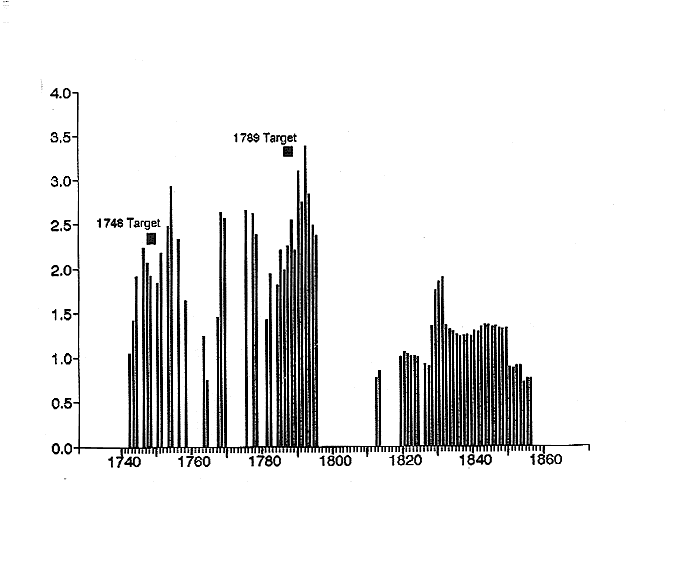
Fig. 3.1.
Reported Grain Reserves in Gansu Province, 1740–1860 (millions of shi )
Note: "1748 Target" and "1789 Target" refer to quotas assigned to the province in these years. The bars give the actual holdings.
(See text.)
Although reserves built up over the long term, from the 1740s to their peak in the 1790s, the military campaigns of the 1750s and 1760s reduced granary holdings drastically by siphoning off much of the ever-normal granary reserves to feed the troops. By 1769 the granaries appear to have recovered their level of 1753, but Wang Danwang's reign of fraudulent reporting, beginning in 1774, makes the figures for the 1770s suspect. The exposure of the relief scandal revealed that in 1781 true reserves had dropped to less than 1.5 million shi . Gansu experienced a genuine recovery in the 1780s and 1790s, when its granary accounts were under close scrutiny. Figures for the nineteenth century, by contrast, show that Gansu's grain holdings plummeted to a stabler but much lower level.
Gansu's granary reserves follow, in exaggerated form, the pattern of the empire as a whole. Year-to-year fluctuations were higher in the eighteenth than in the nineteenth century. Nineteenth-century granary officials undertook sporadic, short-term rebuilding campaigns, as in Gansu during the 1830s, but these campaigns did not offset a longer-term trend toward declining reserves. The figures for the nineteenth century are also more suspect, because the institutional controls over corruption, spoilage, and false reporting were looser. Rather than interpreting this drop as evidence of general decline in Qing administration, we can also view it as a shift in Qing policies away from the difficult methods of reliance on storage in kind toward greater reliance on the private market. Gansu, in this sense, pioneered moves by the Qing state toward injection of money into the regional economy. Governor Nayancheng's campaign of 1810–11 to relieve a drought that struck 30 counties exhibited further moves toward money and away from grain. He distributed 571,900 taels of silver and only 95,600 shi of grain to feed over 2,777,000 people.[35]
Any assessment of the Qing ever-normal granary system must distinguish between what the Qing officials expected it to do and how it really functioned. The Qing rulers designed the ever-normal granary system to serve only one goal: price leveling. In principle, each granary should have sustained itself. After an initial build-up period, during which reserves were increased through official purchases and grants, granary managers were expected to keep the granaries at a stable level without outside support. By selling at high prices in the spring and repurchasing at lower prices after the fall harvest, officials should have been able both to maintain reserves at constant levels and to use the profits to pay salaries and maintenance costs. Emperors frequently reminded local officials of their duties, required annual reports of them, and sometimes punished them for very small discrepancies in granary accounts. They expected regular and full restocking every fall. Of
[35] The principal source for this relief operation is Nayancheng, Zhenji (1813). Brief discussion given in Wong and Perdue, "Famine's Foes", pp. 304–9.
course, only perfect prediction of future market conditions could have maintained absolutely stable reserves, but regions with regular harvests could much more easily keep their granaries stocked than regions suffering from frequent, unpredictable disasters. Stability also required that grain stocks be used predominantly for price-leveling sales. If reserves were diverted to other uses, either as official levies or for sales below market prices, extra funds would be required to restock in the fall.
Despite these difficulties, many provinces did succeed in keeping reserve levels stable for considerable periods of time. This stability, however, reflected a variety of relationships between regional grain markets and official purchasing activity. In the Southwest, for example, extremely stable reserves reflected a very low rate of grain turnover in regions of relatively localized markets. In the Lower Yangzi, on the other hand, stability resulted from highly commercialized, well-integrated grain markets and low per capita reserve levels.
In this paper, I stress the very wide variability of Gansu's reserves and what it reveals about Gansu's grain market. Substantial diversion of grain for military use combined with frequent poor harvests produced widely varying annual reserve levels. Still, even though Gansu's granaries fell short of the ideal design of the Qing system, they had significant economic effects. In fact, high annual fluctuations could indicate that reserves were being used effectively to relieve harvest shortages. In a region of frequent disasters, the best way to use granaries would be to accept deficits in bad years and make them up in good years, balancing the reserves over a multiyear cycle. If we could be certain that most of Gansu's reserves were used in this manner, the fluctuation in reserves would indicate highly effective management.
They could, on the other hand, indicate widespread diversion and peculation. Some provinces reported the total amount of grain purchased and sold during the year, allowing us to calculate the turnover rate, equal to the total purchases and sales divided by the end-of-year stocks. Gansu, unfortunately, is not one of those provinces, so it is difficult to determine exactly how much grain was bought and sold on the market. A more detailed examination of famine relief distributions would help resolve this question. For now, we may say that price stability after the 1760s provides at least some evidence that granary reserves were used effectively during the late eighteenth century to relieve the impact of harvest disasters. Although Gansu did not meet its targets, its high per capita grain holdings meant that grain distributions did have a relatively strong effect on the local grain market.