
Chapter 6
The Jamb Sculptures with the Parable of the Ten Virgins
The Wise and Foolish Virgins and the Two Atlantids
The Wise and Foolish Virgins on the two jambs and in the lintel zone (nos. 1–5, 6–10) present the most complicated and puzzling archaeological problems of the central portal. Vulnerable because of their location, at least partially dismantled and reassembled in the restorations of 1770–1771, fractured and patched, the sculptures today show the combined effects of wear, manipulation, shifting stresses, mutilations, and two campaigns of restoration.[1] Often we can distinguish between the eighteenth-and nineteenth-century restorations because the earlier restorer proves more respectful of and simpatico with the twelfth-century work; thus his insets are less discordant than those carved by Brun. The earlier restorer also used plaster of Paris for repairs, which he protected with weather-resistant mastic. The plaster is crumbling away where the surface coating has chipped or scaled. The generous applications of mastic also partially mask the joints around insertions, as well as numerous cracks and some horizontal cuts made to facilitate the temporary removal of some of the virgins during the dismounting of the jambs. As the diagrams indicate, the restorations have created a confusing maze of insets in the sculpture—repairs that frequently include some of the surrounding masonry. The insets fall into two categories: first, those that remedy damage to a figure and its surround; and second, as noted earlier (see Chapter 2), the couvres-joints that repair and mask eroded masonry joints where they impinged upon the sculpture. Both the identification and significance of all insets in the jambs depended to a large degree on an understanding of the twelfth-century system of masonry construction of the portals. As also described in Chapter 2, beginning with the fifth
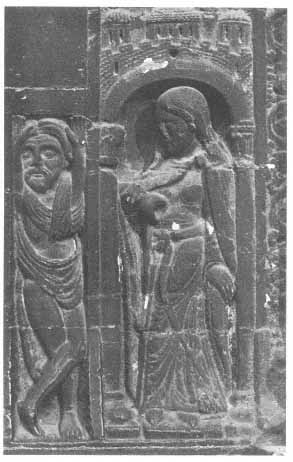
Fig. 25a.
Foolish Virgin no. 6 and Atlantid no. 6a, right jamb,
lowest tier
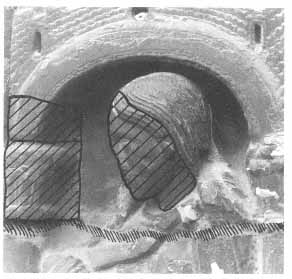
Fig. 25b.
Detail, diagram of restorations to head of Foolish Virgin
no. 6
horizontal bed, the stones of the portals measure 29.5 cm. Any deviation of more than 0.5 cm. from that norm invariably indicated a repair or couvre-joint.[ 2]
Differentiating between the couvres-joints and the eighteenth- and nineteenth-century stone repairs that also interrupt the masonry joints was complicated by the generous application of a protective coating, particularly noticeable over the surfaces of the lower figures. On the right jamb, the coating hardened into a shell-like surface through which the details of the twelfth-century carving remain visible (see especially Foolish Virgin no. 6, Fig. 25a). On the more weathered left, or north jamb, the chemicals of air pollutants seem to have attacked the coating and reduced it to a thick, heavily wrinkled skin or encrustation. The wrinkling proved especially troublesome in the analysis of restorations to the figures of Wise Virgins nos. 1 and 2. Because identification of recutting of twelfth-century carving depended as much on surface textures and stone color as on the character of the carving, only the most heavily recut areas could be positively identified. Wherever the coating prevailed, any subtler and lighter retouching was undetectable beneath the weathered mastic. Under such circumstances the analysis of surface conditions became more
tentative than usual, and therefore the text, rather than the diagrams, will note recut areas along with descriptions of what has survived of value where the protective coating proved most opaque.
A look at the photographs of the jambs (Figs. 6a-b, Plates X and XI), reminds us of the regular joints of the twelfth-century system governing the masonry of the embrasures and jambs. On both sides of the portals, the joints of the horizontal beds of stone can also be followed as they extend behind the nineteenth-century columns that replaced the lost statue-columns.[3] The insets that form a patchwork of repairs in the lower figures of the right jamb, Foolish Virgin and Atlantid, nos. 6 and 6a, best demonstrate the problems of the restorations and the importance of the masonry system in their resolution.
Besides providing a key to the identification of insets, the masonry system also helped to correct a longstanding error. The masonry joint of the upper edge of the sixth horizontal bed where it crosses the shoulders of Foolish Virgin no. 6 has been consistently mistaken for the joining of an inset. Earlier observers described the entire head as a nineteenth-century restoration, although the facial style and hair alone distinguish it from the restored heads of the other virgins.[4] The loosened triangular wedge of plaster of Paris that repaired the hair above the left shoulder provided additional evidence corroborating a twelfth-century date for some of the head. Newly exposed in 1968 because of the failed bonding, the surfaces showed all the characteristics of the twelfth-century limestone. In addition, the fluent lines of the striated hair, which curve to reveal the fully rounded, well-formed head, contrast strikingly with the hair of the nineteenth-century heads. The modern hair fits the head and stands away from the neck as stiffly as an English barrister's wig (see especially Wise Virgin no. 4, Plate Xa-b). The examination in the late 1960s and early 1970s seemed to indicate that the entire head of Foolish Virgin no. 6 had survived from the twelfth century, as stated in the article of 1973 analyzing restorations to the central portal.[5] In 1984, after eleven more years of weathering and attrition, a new look at the head produced evidence that has modified the earlier conclusions. The new evidence indicated that the hair immediately framing the face as well as the face itself belong to the restorations of 1770–1771, as diagrammed (Fig. 25b). The eighteenth-century hair and face continue the forms established by the twelfth-century head, but in front of the joint attaching the modern portion, the striations become somewhat coarser and more widely spaced.
The damages still visible on the face apparently were not deemed serious enough for a nineteenth-century replacement, and the restoration was then confined to the lost mortar patch at the back of the neck.
The eighteenth-century face has a charm absent from the restored faces of the next century. Foolish Virgin no. 6, looking down and to the left as dictated by the twelfth-century portion of her bowed head, has an easy grace as she stares at her empty lamp. She stands in a reflective pose, her head framed by the recess beneath the baldachin. Only the head and lamp project beyond the surface plane of the jamb, in contrast with her figure, which seems flattened and somewhat distorted because the feet and legs follow the demands of the inward slant of the masonry above the plinth (Plate XIa). The volume and projection of the head express two important qualities that distinguish the nascent Gothic style from the Romanesque. Yet with such contrasting artistic ideas in a single figure, it is small wonder that observers relegated the entire head to another period. Notably, in all the figures of virgins the degree of projection and undercutting increases from hem to shoulder, and originally the salience of their heads beneath the canopies reflected the new aesthetic.
Uncertainties surround the dates at which certain changes and excisions occurred in the jambs, nor are the reasons for all the alterations clear. For instance, some but not all of the niches that frame the virgins have been made narrower (see virgins nos. 2 and 3, Plate Xb). Although the insets repairing columns, capitals, and baldachins in those altered aedicules obviously date from the nineteenth century, the reasons for the changes, if they also date from that time, remain obscure. Another alteration affected the height of the jambs. The baldachins above virgins nos. 7 and 9 have been cut off, so that only small fragments or stumps at the springing of the arches remain. Since the 1770–1771 alterations increased rather than decreased the size of the portal, cropping the baldachins would have had the wrong result. The fact that portions are missing seems more explicable in terms of difficulties encountered in the original assemblage of the sculptural ensemble than as a later alteration.[6] Such an explanation presupposes that the jamb sculptures were not carved in situ, but rather in the workshop. A miscalculation or even a last-minute modification of the original plan could have necessitated the cropping of the uppermost baldachins.
An additional alteration in the original design occurred on the right jamb where the vertical rinceau bordering the niches ceases abruptly at the top
of the second niche. In addition, above the point the masonry immediately to the right of the niches becomes idiosyncratic and confused, even though it still conforms to the regular horizontal beds of the twelfth-century masonry system. Although the aberrations are difficult to explain, either in terms of the alterations made in 1770–1771 or as an aspect of the nineteenth-century restorations, they could represent another adaptation to difficulties encountered at the time of assemblage and installation of the sculpture.[7] Yet the narrowing of the niches, like the elimination of the vertical rinceau, would have increased the width of the doorway and thus could date from 1771. The cropping of the baldachins that reduced the height of the jambs seems less irrational when considered in terms of the great bronze doors, commissioned by Suger, that were cast for the central portal. Perhaps the dimensions of the finished valves failed to accord with the specifications for the jambs—measurements that had governed the planning and execution of the sculpture. Alterations in the jambs could have made the necessary accommodations to those discrepancies, whereas changing the dimensions of the bronze doors would have been extremely difficult.
Other arrangements in the altered niches also strongly suggest changes made prior to the nineteenth-century restorations. Although the evidence fails to certify a twelfth-century date for them, reconstructing the conditions and idiosyncracies of the jambs with which the restorer had to contend proved helpful in understanding the existing arrangements. For example, the off-center, asymmetrical baldachin above Wise Virgin no. 3 consists principally of a nineteenth-century inset. As the diagram shows, only portions of the left turret survive from the twelfth century (Plate Xb). The right turret was sacrificed when the niche was made narrower. If vestiges of the right tower had survived to the time of the restoration, or if the restorers had been responsible for the narrowing of the niche, we could reasonably expect the restoration to provide a balanced architectural superstructure having turrets on both sides of the dome. We may safely assume that the inset perpetuated an existing asymmetry. The vertical cut to the right of the same virgin's body must also date from the earlier alteration, for it pinpoints the areas excised to make the width of the niche consonant with the narrower baldachin. On the other side of the figure there is still ample space between her body and the frame. Wise Virgin no. 2, directly below, also appears to be squeezed by the column on her left, and again
the baldachin shows signs of accommodation to a niche narrower than originally intended. The somewhat lopsided canopy arches above the figure and rests on the outer, or right half of the abacus of the right capital. The other half of the abacus projects into the recess formed by the canopy. Once again the alterations must have preceded the nineteenth-century restoration, since the abacus and capital, both part of a nineteenth-century inset, follow the requirements of the twelfth-century column they surmount. Then, too, the twelfth-century column and baldachin, except for the generous layers of protective coating, appear unaffected by the restorations. Again, the inset apparently perpetuated an existing architectural anomaly.
In sum, although surrounded with uncertainties, the attempts to reconstruct the physical conditions that obtained before the restorations help to differentiate between the work done earlier and modifications attributable to the nineteenth century. Every stone in the jambs has been examined and every shred of evidence evaluated. Yet not every aberration has a sure explanation, nor can every contradiction be resolved with a verifiable hypothesis. Only by once again dismantling the much-abused jambs would all the questions raised by the anomalies be answered. Some of the secrets of the virgins probably lie hidden under mortar and cement which, in turn, are coated with mastic and grime. Yet asymmetry and deformations still notify the viewer of modifications to the original plan.
Despite uncertainties about the chronology or sequence of alterations, the detailed examination of the sculpture resulted in a number of conclusions concerning the accuracy of the restoration, the characteristics of the twelfth-century style, and the original appearance of the figures of the virgins in their niches as well as that of the two Atlantids supporting the jamb colonnettes.
The insets replacing the heads and arms of both Atlantids and most of the torso of Atlantid no. 1a rank among the most inept and distorting of the nineteenth-century work. The tiny, malformed arms and hands, incapable of bearing any weight, probably resulted from a misunderstanding of surviving fragments, if any, that might have guided the restorer. The original arrangements may have paralleled that of the Atlantid of the western portal of the duomo in Piacenza, who supports the twin columns below the statue of Adam. With arms raised and bent as they cross above his slightly protruding head, the Piacenza Atlantid bears the weight of the load on his elbows and forearms.[8]
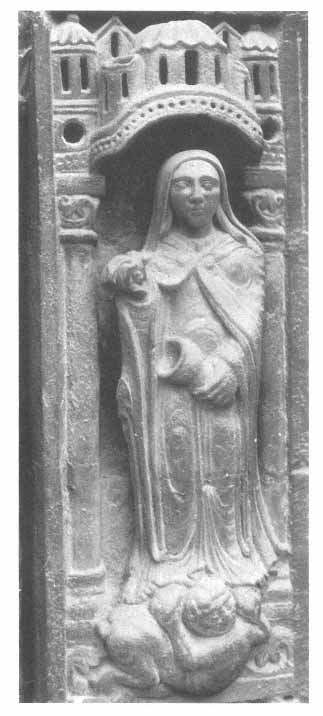
Fig. 26.
Foolish Virgin no. 8, right jamb, third tier
Except for the new head and the heavy mortar filling the masonry joint across the legs, the figure of Foolish Virgin no. 8 appears quite unspoiled by the restoration (Fig. 26). Despite her weathered and worn surfaces, she best demonstrates how the virgins once looked beneath their canopies. Although lightly recut on the surface of the right turret, the baldachin provides a splendid example of the architecture of the turreted canopies.[9] Penetrating the darkness of the recess, lancets and oculi pierce the towers, turrets, and gables.
The spatial reality of those architectural elements enhances the forward projection of the fully undercut baldachin. Erring in the restoration of the aedicule of Wise Virgin no. 3 (Plate Xb), the restorer provided it with the only baldachin above the first tier that does not attain a comparable degree of projection. As a result, Wise Virgin no. 3 seems crowded beneath her canopy. The six upper figures under canopies all project forward and thereby represent a major departure from the Romanesque respect for the surface plane (see Figs. 6a-b). Gone also is the frontal Romanesque figure centered under an arch. No longer do the contours of the frame determine the proportions of the figures. Quite short but still credibly proportioned, the virgins exist in the three-dimensional space created by their architectural frames.
No surgery has altered the spatial relationship of figure to frame for Foolish Virgin no. 8. Placed somewhat off center and turned slightly to the left, she stands with firm footing on a grotesque monster whose forward projection at least equals that of the baldachin above. Hunched and contorted, he reaches back over his head to grab at her feet. His pointed ears, leering grimace, and pose seem characteristic of twelfth-century Dionysian animal fantasies.[10] Only the loss of a portion of the scarf or cloth falling from the virgin's right hand has affected the way in which the figure originally filled the space. The broken surfaces beneath her hand and the jagged fragment on her right hip indicate that the lost portion of the scarf was fully undercut—a technical detail that would have enhanced the general sense of form and volume and underscored the extent to which the right hand projects beyond the frame. The turn of her left shoulder gives the impression that she is leaning against the right column. The flutter of the hem seems like a minor infraction of the frame, but the figure as a whole represents a major change in artistic attitudes.
In that same figure, the unusually fluid lower folds of the garment respond to the contours of her feet and spread across the rump of the monster. Alongside her right foot, the back hemline shows below the same thick, convoluted edges of the front hem. That inner or back hemline, so characteristic of Dionysian drapery, occurs in every figure on the jambs except Foolish Virgin no. 9 (Plate XIa-b) directly above, where heavy recutting apparently eliminated every trace of it. The interplay of curves, another preoccupation of the Master of the Tympanum Angels, enlivens the drapery of virgin no. 8 and seems especially important and effective in the drapery arrangements of virgins
nos. 1, 2, 3, and 6 and Atlantid no. 6a. Too little remains of the drapery of Atlantid no. 1a to make a valid stylistic analysis. Yet the arrangement of his loin drapery resembles that of his opposite number, whose closely spaced, concentric, U -shaped folds still have traces of an incised line accenting each ridge. Shadowy outlines of that stylization also survive on the ridges of the concentric folds that arch across the torso of Foolish Virgin no. 8. The motif appears in every other jamb figure except virgin no. 7 (Plate XIb), whose drapery, worn, recut, and coated on the surfaces, is now merely a parody of the original arrangement, especially in the upper half of the body. The highly stylized, circular fold that defines the left breast of virgin no. 8 also accents those of the other jamb figures (see virgins nos. 3, 6, 7, and 9). There, too, as in the draperies of the Master of the Tympanum Angels, we find other variants on the drapery convention that encircles and pinpoints joints (virgins nos. 3 and 6).
The drapery arrangement defining the legs of virgin no. 8 recurs with variations in all the jamb figures. The long fall of pleats beside and between her legs terminates in a convoluted hemline, and the concentric U -shaped folds, sometimes abbreviated into a curving hook, arch over the thighs and loop across the shins. On the virgin's right leg, the folds appear to form an oval encircling the smooth, rounded ridge of the thigh and knee—another favorite convention in the stylistic vocabulary of the Master of the Tympanum Angels. This exemplar of the Wise and Foolish Virgins also has the crumpled sleeve, the pointed shoe, ornamented cuff, and jeweled clasp—familiar twelfth-century details, but all somewhat weathered and worn.
Despite the virgins' many common characteristics, the sculptor took pains to differentiate each one in dress, pose, and in his handling of shared drapery elements, and, as the surviving evidence suggests, in headdress and hairstyle as well. Almost every canopy, niche, and figure contains some detail of particular interest, such as the swirl or loop of material that virgin no. 8 holds in her hand, and the monster at her feet.
Such distinctive details merit at least passing mention. Although badly worn and heavily coated with mastic, Wise Virgin no. 1 retains the outlines of especially lavish twelfth-century drapery distinguished by a profusion of folds. The closely repeated folds of her veil, mantle, sleeves, and tunic create a marvelously fluent and active linear pattern. The folds, so typical of the draperies of the Master of the Tympanum Angels, retain no traces of the characteristic
teardrop terminations, but in these worn surfaces their survival would be surprising. The trefoil arch of her canopy, an unusual architectural feature, has a counterpart in the baldachin above Foolish Virgin no. 8, although the latter is three-dimensional. Beneath the coating, the canopy above virgin no. 1 still has the outlines of the masonry system of the walls, and the tiled roof of the central gable appears particularly well preserved.
In the recess of the aedicule, a significant iconographical detail has survived from the twelfth century. Carved in low relief on the surface plane above the nineteenth-century lamp, an irregular protrusion 4.5 cm. high and 1 cm. wide completes the nineteenth-century flame, which rises to the height of 2 cm. from the bowl of the restored lamp. A similar projection, smaller and visible only from above, rises in the center of the bowl of the lone surviving twelfth-century lamp carried by Wise Virgin no. 4. Probably also a remnant of the original flame, that raised node indicates that in the twelfth century, the Wise Virgins of Saint-Denis bore lighted lamps as they went in with the bridegroom to the marriage. The virgins at Saint-Denis accurately illustrate Christ's parable of the ten virgins, which he likened to the Kingdom of Heaven. But only five of them were prepared to enter. Of the ten who went out to meet the bridegroom and the bride, “five of them were foolish and five were wise … the five foolish, having taken their lamps, did not take oil with them: But the wise took oil in their vessels with the lamps” (Matthew 25:1–4).
The figure and niche of Wise Virgin no. 2 seem noteworthy for the striking similarities of the drapery from waist to ankle compared with the folds defining the hips, laps, and legs of tympanum angels nos. III–V (Plate IIc-d). Without question, the same hand is responsible for both figures. Also noteworthy and still visible through the heavily coated surfaces, a delicately traced geometric pattern ornaments the border of the virgin's garment and, like the spiral columns and geometric design on socles beneath their bases, enriches the ensemble. On the plinth supporting the niche, a favorite Dionysian design recurs, consisting of palmettes emerging from clasps that gather and hold the stem of the rinceau.[11] Another motif decorating the wall of the turreted canopy consists of a row of zigzags alternating with incised lines that follow diagonal rather than horizontal courses. The latter, a decorative stylization, contrasts with the quite realistic masonry on the baldachin below, as it did in the Gate to Paradise in the first archivolt.
Wise Virgin no. 3 (Plate Xa-b) stands on a fantastic beast which hangs from the plinth by its fore and hind paws. The body and foreleg have been so severely cut back that the forward projection of the beast does not approach that of the monster in the parallel niche on the opposite jamb (no. 8). The garments of virgin no. 3, almost a copybook arrangement of familiar drapery conventions, include a pleated scarf draped over the left shoulder. Its fluted, folded-back edge is repeated on a larger scale in the cloth clutched in her left hand, which falls in a cascade across her thigh and down her left side. In the active hemline of her grown, the inner edges underneath the prominent symmetrical foldback meet neatly at the center in the manner preferred by the Master of the Tympanum Angels. That detail also occurs in the hems of Wise Virgins nos. 1 and 4. Guilhermy reported that the figure of virgin no. 3 looked as though she had been worn away by rain (“collée par la pluie”).[12] Today the comment still obtains, especially with reference to the left side of the torso and her left arm and hand. Nevertheless, the incised folds of the left sleeve and the circular folds defining the abdomen and left breast remain quite clear. With precocious naturalism, the sculptor modeled the contours of her breast but at the same time used the especially stylized convention of an encircling fold. The juxtaposition of those natural and stylized forms recurs in other figures on the jambs (see Foolish Virgins nos. 6, 7, and 9).
The uppermost figure on the left jamb, Wise Virgin no. 4, seems unexpectedly stiff and awkward in spite of the sense of motion her stance was intended to evoke. The loss of all the lower skirt drapery along her left side and the recutting of the figure from shoulder to toe detract tremendously from the effectiveness of the sculpture. In addition, the coarse carving of the nineteenth-century head and shoulders dominates the figure. The over-whelming volume and depth of that inset emphasize the badly deformed left shoulder. Yet despite overall recutting, elements of twelfth-century drapery survive in the hook folds defining the right leg, the incised folds of the left sleeve, and the stylized treatment of the lower left leg. Most of the inset replacing the left fingers has fallen away, but the left hand still shows a remarkable projection.[13] The disproportionately large hands, so startling in this figure, represent another characteristic shared by a majority of the virgins, whose bodies otherwise have quite normal proportions (see especially the twelfth-century hands of virgins nos. 6, 8, 9, as well as nos. 5 and 10 in the lintel zone, Plates IIIa and IVa).
In profile, the figures on the left jamb project increasingly in ascending order. A similar progression also occurs in the right jamb. Obviously no accident, the sculptor apparently tried to compensate for the steadily increasing distance of the figures from eye level. The same sophisticated formal progression occurs in the figures of the patriarchs in the archivolts, where the lower figures also appear flatter than the upper ones, and the depth of the surface modeling of richly patterned draperies generally increases in the higher locations.
Little survives of Wise Virgin no. 5, who approaches the Heavenly City from the lintel zone (Plate IIIb). Heavy recutting and three appallingly bad insets destroyed all but the rudiments of the twelfth-century pose. The crude inset that replaced her lower legs, together with recutting in depth from the waist down, caused the drapery below the hips to read as a series of lumps. Yet some of the grace and ease of the original pose survive in the interplay of curves and reverse curves along her right side from head to knee. Although the restorer deserves the ultimate blame for the present appearance of the virgin, the leftmost fracture of the lower stone of the tympanum wrought additional havoc as it passed through and bisected the figure vertically.
More remains of the twelfth-century sculpture in the figure of Foolish Virgin no. 10 at the opposite end of the lintel (Plate IVb), but only her hands, the lamp, the right side of her chest, and the trailing lock of hair above the right shoulder retain unretouched twelfth-century surfaces. Elsewhere, as diagrammed, insets and overall recutting prevail. In general the recutting simplified the drapery and reduced it to the basic schema. A vertical cut extending upward from the right end of the modern lintel stone bisects the lower half of her figure. Apparently made to implement the removal of the section of her figure directly above the new lintel, the surgical cut follows the horizontal of her shins, rounds the knees, and moves up between the adjacent sarcophagus and her right thigh, then curves to the right beneath her abdomen to meet the vertical cut. During the 1770–1771 restorations, that portion of the figure must have been removed to implement the replacement of the lintel stone. After it was in place, the excised portion of the figure of the virgin was reinserted and mortared securely. (A similar surgical cut running the length of Wise Virgin no. 1 must have facilitated the rebuilding of the lower left jamb.)
The pose of Foolish Virgin no. 10 appears unchanged, and the silhouette of the original head backs and informs the inset repairing her face and hair. The artist's characteristic attention to detail resulted in a splendid and noteworthy
assortment of hardware for the closed Gate to Paradise on the virgin's right. She holds the circular handle of twisted metal. Directly above, a mighty bolt, lock plate, and clamp, marvelous in their accuracy, bar her way to Paradise, but they are scaled to a gate many times the size of this one.
Below, in the first niche of the right jamb, the figure of Foolish Virgin no. 6 (Fig. 25a) provides visual balance for her counterpart across the doorway. All four figures in the lowest rank are modeled in low relief, and except for the head and lamp of virgin no. 6, do not project beyond the surface plane of the jambs. Yet the profusion of the folds of their drapery gives the two virgins in the first tier the visual importance they need as anchor-figures in the vertical rows. In the figure of virgin no. 6, minute details such as the geometric patterns on the border of her cloak, on the cords and the jeweled tassels of her sash, on the architectural elements of the baldachin, and even on the seams of her pointed shoes, all attest to the preservation of good twelfth-century carving beneath the shiny coating of mastic. The fluent folds falling from her left hip and the lines of the sash suffer minor distortions from the inset above her knees. Nevertheless, the drapery of the left hip, thigh, and lower leg provides close comparisons with the drapery defining the right hip and thigh of tympanum angel no. III, and the lower legs of angels nos. II and V (Plate IIc-d).
The drapery of Foolish Virgin no. 7 appears to be too coated and worn to have much interest or to provide valid comparisons. Even so, the general original arrangement still pertains in the upper half of the figure, and from the waist down some ornamental details survive on the cords and tassels of the knotted belt. The loop of drapery in her left hand seems to be a separate cloth or scarf similar to those held by virgins nos. 1, 3, and 8 and is not part of the other draperies of her garments.
Those scarves raise an iconographical question about the accuracy of the restorations of the virgins' heads. Although Guilhermy said that none of the vestiges of the original sculpture made any distinction between the apparel of the Wise and Foolish Virgins, he may have been mistaken.[14] The heads of Wise Virgins nos. 1 and 2 have veils, and traces of the original veil survive on the right shoulder of virgin no. 3. Unfortunately recutting destroyed all evidence for Wise Virgin no. 5, and no. 4 has no remnants of original hair or veiling. Across the doorway, the twelfth-century hair of Foolish Virgin no. 6 establishes her original unveiled state. The unrecut twelfth-century hair of virgin no. 10 extends up
to the level of her right ear and also lacks any vestige of a covering veil. In the figures of the other two Foolish Virgins, no remnants of head coverings survive. The two marvelous twists of hair that cross the breast of virgin no. 9 and extend to mid-thigh prove the most distinctive aspect of the figure. Although not conclusive, the combined evidence in no way contradicts the medieval customs or conventions that are attributable to the recommendations and urgings of Tertullian, an early Church Father, concerning the proper headdress for Christian women. To connote their status, he recommended that maidens leave their heads uncovered and that married women wear veils. Although not closely adhered to before the twelfth century and often ignored then, his recommendations became rigid custom from the thirteenth until the sixteenth century.[15] The surviving evidence in the jambs raises the possibility that those customs were honored in the figures of the virgins. A representation of the Foolish Virgins as maidens without veils would have been iconographically correct and would have differentiated them from the veiled Wise Virgins who, when “the bridegroom came … went in with him to the marriage” (Matthew 25:10).
Although general recutting pervades the surfaces of the drapery of Foolish Virgin no. 9 and ranges from heavy to light, her remarkable twists of hair survived untouched, and the area that they frame also proved to be free of reworking, except for the surface of the lamp. Nevertheless the shape of the lamp, a repetition of those held by virgins nos. 4, 6, and 8, seems to have the correct twelfth-century profile. The architectural surround also shows evidence of light recutting. Unfortunately the ensemble as a whole has been stripped of its original character.
The final figure on the right jamb, Atlantid no. 6a, allows two important comparisons that underscore the close stylistic relationship of the entire ensemble to the work of the Master of the Tympanum Angels. The insets and recutting in no way altered the basic and unusual arrangement of the drapery festooning his figure. The seemingly unique and idiosyncratic arrangement (except for the parody achieved by the restoration of figure no. 1a) has a counterpart in the scarves of the tympanum angels (see especially nos. II, III, and IV, Plate IIc-d). Moreover, although they are heavily coated, the concentric incised folds of the swag that covers his loins seem to replicate the lap drapery of the figure of Abraham (Fig. 24).
The unity of style of the sculpture of the jambs, of the inner archivolt, and of the upper tympanum angels creates a corpus of work from the hand of a most versatile artist, who is consistent in his attitude toward the human body, in his ability to make forms exist in three-dimensional space, and in the fluency of his line. Of the vast repertoire of drapery conventions, the Master of the Tympanum Angels had a distinct preference for a number of them, which he used with imagination and which have helped to establish his style. He gave the iconographically integrated sculptures of the jambs, lintel, first archivolt, and the center section of archivolts II, III, and IV a formal unity as well. Specific details, his stylistic trademarks, occur throughout this carefully ordered and well-planned ensemble. His artistic ideas emerge even in the small figures of the Resurrected Dead and in the surviving fragments of the scenes of the Damned. Although the hand of the Master of the Tympanum Angels does not appear in the figures of the patriarchs, even there he obviously had an influence.
The Jamb Colonnettes
On both sides of the portal, richly ornamented colonnettes stand in the angled recesses of the jambs. The shafts of the colonnettes in place today are copies, “moulées sur pierre factice” (molded of manufactured stone), taken from the original shafts now in the Musée de Cluny in Paris (Plates Xa and XIa).[16] To illustrate his eighteenth-century study of the signs of the zodiac carved in the Paris region, Le Gentil de la Galaisière published prerevolutionary drawings indicating that the designs on the pair of shafts molded and now used for all three portals originally adorned only the right sides of the north and south portals.[17] Unfortunately no such drawings exist for the central portal, but a recently discovered small fragment in the Musée Municipal de Saint-Denis contains designs that do not appear in either of Le Gentil's drawings (Fig. 27). The continuous vine on the fragment follows a vertical course, unlike the encircling spirals on the shafts pictured by Le Gentil and on their copies now in situ. The disposition of the rinceau and the little nude armed with a lance and shield resembles the combatants intertwined in a vertical vine on a fragment of a colonnette from Saint-Denis now in the reserve of the Musée de Cluny (inv. 11659a). The other face of the fragment has pairs of confronted birds. The tails of each pair terminate in a palmette that forms the support for a small nude
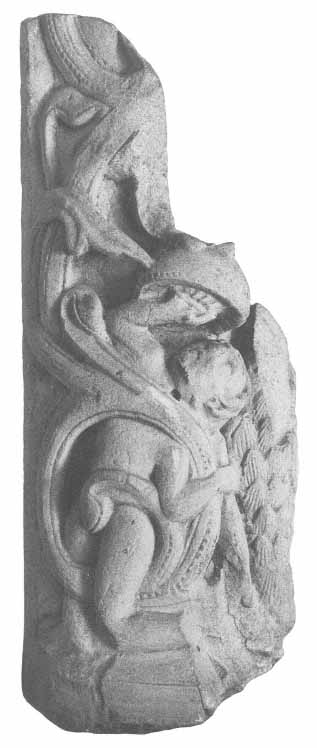
Fig. 27.
Fragment of the shaft of a recessed
colonnette from the right
jamb, central portal. Musée Municipal
de la Ville de
Saint-Denis
figure. The eighteenth-century engraving showing only that face of the shaft with the confronted birds testifies to the original location of the fragment on the left jamb of the right, or south, portal.[18] The monsters on the adjacent face of the fragment in the Musée Municipal, although upside down, closely resemble the confronted and adorsed monsters and birds on the Cluny fragment. The
lithe, active, and well-articulated bodies of the combatants on the adjoining face of each colonnette are also strikingly similar. Le Gentil's drawing did not show this face of the Cluny colonnette, which indicates that it was positioned so that one would see the combatants only on entering the church by the right portal.[19]
The two fragments—one in the Cluny, the other in the Musée Municipal—with the vertical rinceau and similar nude combatants must have been carved by the same artist. The thick trunks of the vines, their tendrils similarly disposed, link the two, as does the increased modeling of the forms compared with that of the two colonnettes now in situ. But taken as a whole, the decoration on all the colonnettes reflects the same taste for “surornementation,” or decoration that covers the entire surface. Characteristically, the highlights of the surfaces contrast with shadows of the negative spaces created by cutting back from the surface plane, and those shadows activate the overall designs. That preference for “surornementation” also governed the decorated surfaces of the Apostle basrelief discovered at Saint-Denis during the excavations of 1947.[20] It emerges again at Chartres in the decoration of the intercolonnettes between the statue-columns, and in other early Gothic doorways, especially at Le Mans and Bourges.[21] At Saint-Denis the small nudes that twist and turn in the tendrils of the vines reflect the same interest in human anatomy demonstrated by the sculptor of the Resurrection frieze in the lintel zone of the central tympanum.
As diagrammed, the bases of the jamb colonnettes consist of nineteenth-century insets (Plates Xb and XIb). In the lateral portals the bases, although recut and badly worn, retain designs identical to those pictured in the Le Gentil drawings. The lively figures, animal and bird as well as human, forming the bases raise the possibility that similar figures also occurred on the originals in the central portal.
The capitals surmounting the jamb colonnettes of the central portal survive from the twelfth century, although their unequal size and dissimilar design might cause one to think otherwise. On the left side, the joining of two horizontal masonry beds bisects the capital between its two tiers of stylized acanthus leaves. On the right jamb, the smaller, apparently truncated capital, also lacking a decorated abacus, may reflect adjustments similar to those affecting the virgins, their niches, and their baldachins.
Two long, rectangular panels decorated with stylized foliage in palmette designs fill the spaces above the capitals of the colonnettes. The designs, quite
consistent with the other ornament of the portal, show evidence of superficial recutting. The masonry joints that divide them into three parts conform to the regular twelfth-century beds 29.5 cm. high. Because Suger mentioned a lintel on which he had his famous petition inscribed, the symmetry of the panels on opposite sides of the portal has given weight to the argument that in the twelfth century, the tympanum rested on a lintel scaled to the overall height of the panels and supported by the trumeau with a statue-column representing St. Denis.[22] To perform its function, any lintel would have to span the doorway and rest on the jambs. Trisected by the joints of three beds of twelfth-century masonry, the panels present a structural arrangement incompatible with the hypothesis supposing an adjacent lintel commensurate with the heights of the panels. Then too, the continuous plain borders that frame the foliate panels would have separated them from any such lintel. Thus, the self-containment of the framed panels also seems at variance with the hypothesis.
In addition, the eighteenth-century drawing by Martellange (Fig. 2) shows the trumeau rising directly to the tympanum without an intervening lintel of any consequence. But if, in fact, the original design had included a substantial decorated lintel, then like the missing portions of the baldachins above the uppermost virgins on the jambs (nos. 4 and 9), the initial intention may have been sacrificed to expediency at the time that the portal was assembled. Like the one in place today, a narrow lintel above the foliate panels would have had formal as well as structural validity. The proportions of the panels and of the foliate designs, vertically organized and bold in scale, appear inconsistent with the visual demands of the hypothetical lintel. The panels seem designed to continue the supportive function implicit in the Atlantids and recessed colonnettes that decorate the jambs on the same axis. The sum of those parts would have constituted a design with the formal sophistication that characterizes the overall composition of the sculptural ensemble. The evidence strongly refutes the hypothesis that originally the portal included a lintel similar to those at Moissac and Beaulieu. In sum, all inconsistencies now apparent in the design may have their explanation in terms of the unforeseen adjustments to accommodate the great twelfth-century bronze doors.
The Decorated Plinths and Bases
Although the stated limits of this study preclude discussion of the lost statue-columns of the central portal (Fig. 1),[23] brief mention of the decorated plinths, bases, capitals, and abaci of the embrasures is necessary in order to supplement the diagrams of the jambs (Plates Xb and XIb). Carved under the direction of Debret, the eight decorated columns that replaced the statue-columns obviously date from the nineteenth century (Plate I).[24]
Decorated plinths above a flattened continuous torus serve as visual connectors between the decorated portions of the portal and the plain surfaces of the mural masonry that extend below today's pavement down to the foundations. The carved ornament in regular panels of lightly incised designs creates an uninterrupted horizontal band of ornament extending from the flanking buttresses across the embrasures and jambs (Plates Xa and XIa). Rather than one continuous design, each block supporting a column presents its own vegetal or geometric pattern. The original joint of the horizontal masonry beds lies in the upper narrow scotia between the torus and the plinth. As elsewhere, interruptions in or a lack of such a mortared joint betray the nineteenth-century insets, which are identified in the diagrams. Identical patterns originally decorated both faces of each projecting block. Deviations from the norm also disclosed the presence of a nineteenth-century masonry repair, as, for example, on the left jamb, in the first plinth to the left of Wise Virgin no. 1 (Plate Xb). On the assumption that the plinths presented almost the only original designs of the portal decoration still in situ, Stoddard analyzed the ornament in detail.[25] He described the designs as “almost draftsmanship with stone as a medium,” which accurately emphasizes the contrast of that decoration, originally about eye level, with the more deeply articulated relief of the ornament in the upper portions.
The same masonry bed containing the blocks of stone forming the plinths also includes the bases of the columns. That zone of the embrasures presents a number of interesting, if still unresolved, problems. An obvious formal distinction exists between the profiles of the twelfth-century bases of the nineteenth-century columns (bases composed of a torus, filet, slanting scotia, filet, and flattened torus) and the vestiges of the adjacent, continuous decorated molding, nearly columnar in profile, which, despite severe mutilations and recutting, still functions visually as a “base” for the undulating surfaces between
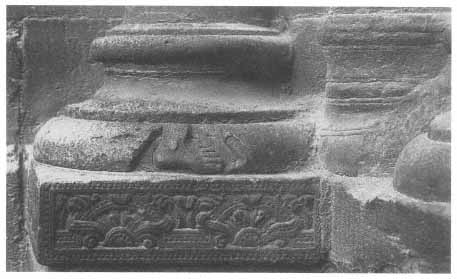
Fig. 28.
Base, plinth (restored), and intercolumnar molding on right side of portal, detail of fourth
embrasure
the columns (Fig. 28). Similar continuous moldings survive in better condition in the right embrasures of the right portal. Almost unretouched, that parallel arrangement authenticates the remains of the molding on the central portal as part of the original decoration.
Above that molding the twelfth-century masonry surfaces, although badly eroded and often replaced or recut, show no traces of any carved ornament. Proposals that the intercolumnar surfaces originally had decoration, as at Chartres, seem untenable.[26] Evidently those continuous curving or undulating surfaces that simulate attached colonnettes provided adequate articulation in the eyes of the twelfth-century master responsible for the central portal.
As diagrammed (Plates Xb and XIb), the twelfth-century bases supporting the nineteenth-century columns are either recut or restored with nineteenth-century insets. The bottom tori of some of the bases and the adjacent continuous molding retain curious anatomical remnants carved into their surfaces:
|
Any attempt to associate those vestiges with the figurate consoles beneath the feet of the statue-columns pictured in the Montfaucon drawings (Fig. 1) falters because the evidence proves too fragmentary to support conjectures.[27]
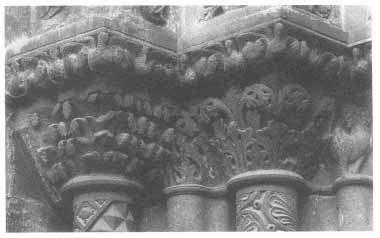
Fig. 29a.
Abacus frieze of twelfth-century heads in rinceau formed by the arched
wings of doves, below third and fourth archivolts, left
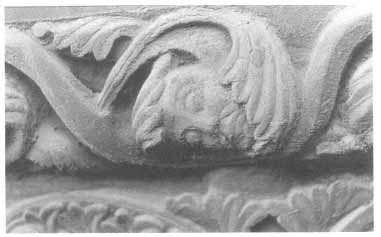
Fig. 29b.
Abacus frieze with twelfth-century head in foliate
rinceau, below second archivolt, right
The Capitals and Abaci
The capitals and abaci from which the archivolts spring create continuous friezes of ornament across the top of the embrasures (Figs. 29a-b and Plate I). Both survive in better condition than the sculptures in the lower portions of the portal. Only the first capital in the right embrasure, next to Foolish Virgin no. 9, underwent noticeable recutting. Its foliate palmette design with a clasp binding the elements together recurs frequently in the vocabulary of Dionysian ornament. The design of each capital, enhancing the visual unity of this band of ornament, continues across the entire masonry block. The blocks extend horizontally beyond the capitals to create the equivalent of a capital above the adjacent inter-columnar surface. And finally they penetrate the masonry behind the next capital in the stepped embrasure. The unbroken or continuous torus of the astragal provides an additional horizontal linkage, emphasizing the artistic intent to create a continuous frieze of ornament.
Each capital, or block, has a different design, which injects variety into the visual continuum.[28] Composed in an identical manner, the capitals of the clustered piers in the western bays within the portals provide another early example of the continuous capital—a concept conspicuous in Gothic sculptural decoration and distinct from the double capitals of Romanesque buildings.[29] With one exception, the designs on the capitals of the central portal typify the early Gothic development of stylized foliate patterns, often grouped symmetrically into several zones. The exception, the second capital in the left embrasure, presents adorsed, birdlike bodies with human heads turned toward each other. Part of an ornamental palmette design, those figures perpetuate Romanesque principles. Although slightly retouched, their heads and feathered bodies add to the corpus of surviving twelfth-century carving on the portal. An interesting variant on the arrangement of the stylized acanthus leaf occurs on the fourth capital in the left embrasure. Small projecting leaves with curled, drooping tips form four horizontal rows around the core of the capital (Fig. 29a). An unusual design, it also occurs among the pier capitals in the western bays and in the foliate ornament of the crypt.
The abacus frieze above the capitals provides a continuous horizontal accent even more prominent than that created by the astragals below the capitals. The scale, rhythmic flow, and deep undercutting of the abacus designs add to their visual impact. On the left side of the portal the frieze has a sequence of stylized birds whose arching, outstretched wings join to create an undulating line that encloses a series of small, slightly grotesque faces capped by leaves forming inverted palmettes (Fig. 29a). Except for recutting on the south face above the first column, the frieze appears untouched by the restorer. Across the surfaces of the four abaci on the right side of the portal, tendrils curve back from a vine with leaves that enfold or cup small heads. Although corroded and worn, the heads appear characteristic of the Dionysian facial style (Fig. 29b). The stem of the vine is continuous except for interruptions as it rounds some of the corners—another detail adding to the accumulating evidence that the entire sculptural ensemble was carved in the workshop, not in situ, and assembled on completion. Here on the right, or south side of the portal, as usual, the stone erosion is less severe than on the north side, and recutting above the jamb is lighter and more sporadic. The striated hair, beards, and mustaches, and the faces with bulging eyes provide examples in miniature of the facial style of Suger's workshops.[30]