
Glikele
I
First I got her letter: not handwriting but heartwriting, the signs you see on the paper accordion of an electrocardiogram: violet scratches, short flashes which, without warning, announce an impending, crashing thunder-clap.
Barely did I have time to plumb the secrets of her letter when here she is in person, in flesh and blood, chatty, the same violet scratches as in her letter etched on her silvery face.
Is this really Glikele, my first love? Glikele, the redhead, nine years old?
Her tresses are webs of old ash and the pins in her hair are rusty.
But her voice brings back the savor of childhood years, the savor of that voice is not changed.
"I don't know how to begin," she began. "You think I'm somebody else but that's not true. Every person is like somebody else, much more than himself, but I am only like myself, like two drops of gall. Yes, I really don't know how to begin, just as I don't know my age before my birth. So I'm going to shut up, ruthlessly, and let my tongue run free: Tongue-tongue, play out my lost world, or else I'll kill somebody."
When Glikele let her tongue run free, her familiar little voice crept into
my ear with the same fiddle tone as before. Her eyes too, I thought, are the same as before, the eyes of a girl: two little green watches with a phosphorescent glow in the dark. Surely the woman is right: she is only like herself, like two drops of gall. But why, hammers my skull, is the same another?
"Your best friend is the one you meet in a dream, he's always warning you and never betrays you," Glikele or her tongue said to me, nourishing me with her thoughts. "And that dream friend ordered me confidentially, as soon as the war against me began, to take my father's sacrificial slaughtering knife with me wherever I went. I already carried a warm, living slaughtering knife next to my heart. But I obeyed and, with a cold slaughtering knife, I protected my warm one."
"Do you remember, Glikele, when the two of us were children, I whittled a little stick for you in the forest, with your father's slaughtering knife?"
"My memory is my treasure. Listen to what happened: the three of us, I and my two slaughtering knives, ran away from Ponar, from under a heavy blanket of corpses. It was a winter night but I didn't feel I was naked as the day I was born.
"Where to go? Where? No Luckytown anywhere. But go, run away from here, till you're out of breath. Under my feet, the snow didn't make the slightest peep, for I was barefoot. When I turned around, the traces of my footsteps had become steps of light rising to I don't know who. What do you think? Can Elijah the Prophet disguise himself as a peasant woman? "
"If he can disguise himself as a beggar, a magician, he can also disguise himself as a peasant woman."
"As true as I wish both of us long life, so I believe in it. The ninety-year-old Papousha was Elijah the Prophet. She hid me in her hut, in a chicken coop under the oven so the cackling and squawking of the chickens would smother the crying of the child I gave birth to there.
"Do you know what is a day in black shrouds? I do. In the chicken coop, typhus consumed me and to stay there any longer was dangerous for the child. What do you think? Can Elijah the Prophet catch typhus?"
"I don't know …"
Glikele took me by the arm:
"Let's take a stroll in the other region."
When the two of us went toward the door and our two heads swam through the hanging mirror, I saw, I realized that my real existence was there, inside the hanging mirror.
Her arm in mine, like a squirrel curled around a branch, we let ourselves be carried off to the other region.
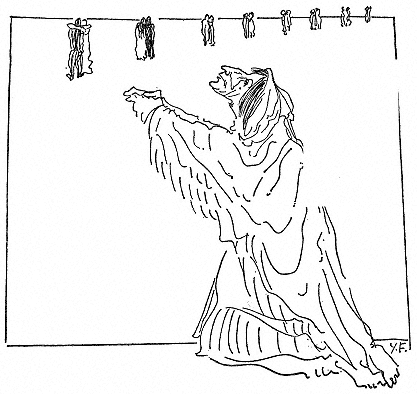
Yonia Fain, illustration to "Glikele."
When Glikele had come to me, the ripening summer was bursting with colors and odors and the sun cooled its muscles in the stream. Now the stream, as in a coffin, lies under a heavy cover of ice and a pale gray snow falls from the unextinguished fire in the sky.
In that pale gray snow, a single hut stands out with a chimney in the shape of a boot. A stooped old woman, loaded down with an armful of branches, hobbles over to us; at her side a dog barking shrilly leaps and scratches the earth under his paws.
"Glikele, that's where you gave birth," and I point to the hut. "I see your thoughts as clearly as I see the willows next to us. I can feel them as I can feel the willows."
"Cut them down or saw them up, can you do that too?"
"No, that I can't do. Maybe it's better to say: I don't want to."
"Then the tongue is superfluous since you know my thoughts anyway."
"Glikele, what you wanted to say just a moment ago is that there, you also abandoned the child."
"True."
"Suffering from typhus and burning like a torch, you ran away beyond the green pond. In the forest, you crept up to a fir tree and the merciful fir tree warmed you like a mother with her bark; later you had a guest, a she-wolf. You sucked her warm milk and that milk cured you."
"Instead of my child, I was the one who sucked. Do you think the she-wolf is still alive?"
"No, Glikele, the she-wolf has been in the other world for a long time now. The one who brought her down is the one who aimed his bullets at you. But you leaped down from the fir tree and your slaughtering knife sliced his breath."
"If that's how it was, I shall light a memorial candle for the soul of the she-wolf."
III
The closer we got to the hut, the farther it receded. The dog's barking also, strung on a silver thread, scattered its yelps in the snow. A wall of marble grew opposite us: Forbidden to Approach.
On the way back, through pale gray snow, the region grew summery again.
When the stars came out, we entered the living city. Young couples, like eagles with wings spread, were lying in wait for their prey — their own flesh.
Glikele stopped at a fountain where a water-dancer was ripping off her clothes:
"Now do you see my thoughts?"
"You want me to show you which of the lovers is your son?"
"I've been searching for him ever since I lost him. Every time I find him, it's as if a flow of melted lead were poured over me: it's always somebody else."
At that moment, Glikele tore herself away from me, fell on her knees before a disheveled young man who was kissing a girl right in the middle of the street.
"Papousha, Papousha," Glikele stammered from the ground, to stir some memory in her son.
The young man, freeing the girl from his embrace, picked Glikele up
from the ground and stroked her hair spun of old ash.
Now it was I who took Glikele by the arm. She was light, as if the ground underneath her had lost the force of gravity. Her little green watches began to gleam with a phosphorescent glow:
"Again somebody else … How long will he be somebody else?"
1977