
3—
The Passion Experience
I felt for the first time that indescribable current of communication flowing between myself & some one else—felt it, I mean uninterruptedly, securely, so that it penetrated every sense & every thought . . . & said to myself: "This must be what happy women feel."
I have drunk of the wine of life at last, I have known the thing best worth knowing, I have been warmed through and through, never to grow quite cold again till the end.
"The Love Diary"
Wharton recognized that to liberate her sexual nature, she must wrestle with her internalized mother and force from it the nurturance she needed. To illustrate this process, we focus on a major event, her love affair with Morton Fullerton, and examine two fictional creations that bracket it—first and principally, "The Touchstone," a novella written years before she met him but oddly predictive of aspects of the relationship, and second, The Reef, a novel written a few years after passion had departed. Edith Wharton used both stories to work on and if possible to work out life problems troubling her at the respective times. Written a dozen years apart, these two works stand here as examples of prediction and postdiction about a central event in Wharton's life, her first experience of passionate love.
Reworking the Maternal Imagery: "The Touchstone"
In "The Touchstone" (written and published in 1900, her thirty-eighth year) she tried to devise a way in which a separation of the good mother from the bad one might be accomplished. She set into dramatic interaction fragments of herself and of key childhood figures, but rather than have them reenact past scenes, she let them play out a reparative script that would refashion the maternal imagery.[1] "The Touchstone" is a story of guilt, of spiritual redemption, of attaining adulthood by working through unfinished maternal relationships. It enacts a process of spiritual rebirth that the author longed to achieve for herself.
The plot of "The Touchstone" manipulates various levels of Wharton's formative experiences as they impinged on her current problems. The narrative course is set by her guilt for negative feelings toward her mother and a deep need to renegotiate the relationship before it was too late. In 1900 her mother was paralyzed and near death in distant Paris. Although living in various places on the east coast during this time, Wharton was making frequent trips to Europe, including Paris, but rarely visited her. Wharton's very efforts to rid herself of the reproving maternal image served only to increase her guilt. Her mother's impending death, which occurred in 1901, would forever bar her from repairing the actual relationship. At this critical time Wharton was fighting her way out of a long period of depression and beginning to perceive herself as a professional writer. Each act that marked a separation of past and future, such as abandoning her place in Newport society and building her own home in Lenox, Massachusetts, each expression of her long-denied autonomy generated guilt as well as exhilaration.
Wharton came to realize that her now-remote actual mother was less important to her than the internalized one that was inhibiting her autonomy. If the omnipresent accusing mother was part of herself and to some degree her own
creation, it might be susceptible to modification. Her way of working on this was to incorporate into the character of the novelist Margaret Aubyn not only troubling aspects of herself as woman and writer, but also aspects of the mother she carried within, the creation of her own childish psyche that she now needed to exorcise or transform. Removing the mother-daughter antagonism from the actual interpersonal arena and locating it within the daughter's psyche renders the struggle independent of time, space, and the real mother's actions or intentions.
Writing "The Touchstone" facilitated Wharton's transition into personal and professional autonomy. It reads like a projective vision of events waiting to happen, a life script to be enacted as soon as Wharton found the right actor for the male lead. In devising this story of a woman's one-sided, selfless love for an immature man, Wharton formed a template by which she would recognize the kind of emotional experience she was seeking unconsciously. Indeed, reading "The Touchstone" prospectively in the light of the later Fullerton affair helps us understand Wharton's puzzling relationship with this man.
The tale depicts the spiritual-emotional growth of an impoverished young lawyer, Stephen Glennard, who, needing money to marry a beautiful and equally impoverished young woman, surreptitiously sells love letters written to him by Margaret Aubyn, a deceased novelist who had once loved him. Only after Margaret's death does he realize to what extent she had infiltrated his soul. The marriage he achieves with the proceeds from sale of her letters is damaged by his feelings of guilt for having betrayed Aubyn's selfless love for him. The spirit of the dead novelist seems to him like that of an accusing mother whom he has wronged. His project, then, is to transmute this persecutory mother-figure into an enabling one.
The author cast certain aspects of herself as the ardent but graceless novelist Margaret Aubyn and other aspects of herself as Stephen Glennard, a man oppressed by the memory of
Aubyn's generosity. In the multivalent character of Margaret Aubyn, Wharton reworked specific elements that derived from her own past, reflected her present, and anticipated her future. As an unappeasable conscience figure, Aubyn represents the persecutory aspect of Wharton's inner mother, and as a formidable woman writer with little confidence in her sexual desirability, she represents aspects of Wharton herself at the time of writing. Given Aubyn's multiple functions in the story, she represents not the self-centered, withholding aspects of Wharton's actual mother, but rather the obverse, a masochistic mother figure who achieves psychic omnipresence by inducing guilt. Furthermore, as a character who found fulfillment by giving feminine nurturance and forgiveness to an ungrateful man, she became a prophetic model for Wharton's future relationship with Morton Fullerton.
Wharton depicted Margaret Aubyn much as she imagined she herself might be perceived by men—as a homely and aggressively intellectual woman. Wharton feared that no matter how smartly she might dress, men would miss her essential femininity. She felt particularly self-conscious about the jutting lower jaw that marred the shape of her lower lip, a characteristic that Kenneth Clark, a devoted friend, called "her letter-box mouth, always her least attractive feature."[2] Of the consequences of such a defect, she wrote: "Just such a hairbreadth deflection from the line of beauty as had determined the curve of Mrs. Aubyn's lips" (11) made her "incapable ... of any hold upon the pulses" (4). Aubyn's moral superiority and "intellectual ascendancy" had made Glennard feel his own inferiority (11). She "combined with a kind of personal shyness an intellectual audacity that was like a deflected impulse of coquetry: one felt that if she had been prettier she would have had emotions instead of ideas" (10).
In short, says the narrator, "the attitude of looking up is a strain on the muscles; and it was becoming more and more Glennard's opinion that brains, in a woman, should be merely the obverse of beauty" (11–12). Although Edith Wharton was not yet a celebrated writer in 1900, we can easily see that
whomever else Margaret Aubyn may have resembled,[3] her creator was describing her own insecurities as a woman while imagining how achieving authorial success would serve only to exacerbate them. She was using "The Touchstone" to help locate and define a style of femininity compatible with childlessness and professional ambition, a style in which she herself could be successful.
To Stephen Glennard, Wharton consigned that part of herself seeking redemption from maternal tyranny. To him she entrusted the task of discovering the hidden beneficence, the occult capacity for nurturance folded into his inner vision of the dead Margaret Aubyn. Release of this hidden power required a violent personal agon. With the help of a spiritual guide in the form of his wife Alexa, Glennard is able to modify the destructive maternal image, to revise or rewrite it.
The story leads him through despair and guilt to a rebirth into fuller and freer adulthood. His violation of Aubyn's trust by publishing her letters and using the proceeds to fund his marriage to a second woman had generated a disabling sense of guilt. This moral lapse functions in the story as a "fall" that finally he must convert into something positive, an opportunity for emotional growth. By the end, he finds a way to liberate himself from the oppressive mother-figure that he had internalized as a voice of perpetual accusation. Having mastered the emotional alchemy necessary to transmute the negative presence into a nurturing one, he is freed to take on an adult role within his marriage.
Because the Aubyn-Glennard relationship occurred prior to the opening of the novella, it functions as a "prehistoric" event that haunts Glennard's life and diminishes his capacity for adult love. Glennard's revulsion against physical contact with such a mother figure as Aubyn serves a dual purpose in the story. Beyond signifying an oedipal barrier, it blinds him to Aubyn's essential femininity. Until he adjusts his relationship to this "first" woman, he can merely play-act the role of husband to the second. His marriage starts as a shallow pretense, symbolized by a picture-book house that "seemed no more
than a gay tent pitched against the sunshine" (28). For it to become a sturdy home that could withstand storms, Glennard must free himself from his mother-surrogate. First he must confront his disabling sense of guilt.
He finds himself imprisoned in "the windowless cell of . . . consciousness where self-criticism cowered" (32). His self-imposed guilt over publication of Aubyn's love letters brought her back into his life more forcibly than if he had married her. Although distanced first by geography and later by death, Margaret Aubyn has achieved psychic omnipresence, a state more threatening to Glennard than physical proximity. He becomes furious without a reasonable object for his rage.
Anger against whom? . . . against that mute memory to which his own act had suddenly given a voice of accusation? Yes, that was it; and his punishment henceforth would be the presence, the inescapable presence, of the woman he had so persistently evaded. She would always be there now. It was as though he had married her instead of the other. It was what she had always wanted—to be with him—and she had gained her point at last.
(32)
Glennard's initiation into sin alters his perception of personal relationships past and present, making him distrust himself and others. "Losing all sense of proportion where the Letters were concerned" (54), he begins to perceive everything as pointing to them and to his moral lapse. When virtually in the depths of despair, he sees in a magazine photograph of Margaret Aubyn, now dead, the femininity that had evaded him in living contact. That which was
feminine in her, the quality he had always missed, stole towards him from her unreproachful gaze; and now that it was too late, life had developed in him the subtler perceptions which could detect it in even this poor semblance of herself . . . Then a sense of shame rushed over him . . . The shame was deep, but it was a renovating anguish; he was like a man whom intolerable pain has roused from the creeping lethargy of death.
(61)
"Renovating anguish" and new perceptions arise from "the mere abstraction of a woman" found in a dim photograph. This disembodied image serves as transition from the maternal imago to a more realistic picture of the woman herself. As an abstraction from life, the photo is frozen and immutable, but vague enough to stir up memory and revive imagination. This movement cracks through his emotional stasis by rendering the imago susceptible to modification and preparing his soul for change.
Glennard arose the next day feeling spiritually revived, with a sense of Aubyn's nearness now become "the one reality in a world of shadows." He reexperiences their past in memory, at last prepared to reinterpret its meaning "like a man who has mastered the spirit of a foreign tongue" (61). However, he is now subject to remorse for failing to appreciate Aubyn while she was alive. The renewal process has only begun; there is more work to do.
Having avoided Aubyn's funeral, he must confront the reality of her death by visiting her grave for the first time. Here his first reaction is an esthetic one—what a hideous final dwelling place for this artistic woman! But he recovers his pious mood and experiences for an exalted moment amidst the odor of decaying flowers the presence of Aubyn's spirit, "not the imponderable presence of his inner vision, but a life that beat warm in his arms" (64). He has brought her back into a guilt-free intermediate region in which change can occur.
He can now benefit from the continuities between his first woman and his wife. Early in the story Glennard had placed Alexa's picture in the same silver frame where Aubyn's had "long throned," replacing one with the other but also recognizing their congruence. The women are counter-images of each other. Margaret Aubyn, like her creator, was a woman of the word—aggressively so, in that she not only spoke audaciously but made a successful literary career. The passive Alexa Trent spoke little, rarely read anything, and seldom wrote letters of more than one page (21). A woman of "smiling receptivity"
and few requirements, Alexa could sit with folded hands and wait for the movements of her husband's spirit. She preferred to leave troubling matters unspoken and resisted Glennard's requests for explanations.
To Glennard's astonishment, Alexa feels pity and love for poor neglected Margaret rather than the jealousy he expected. Alexa, the non-reader, insisted on reading precisely the book that her husband wished her to avoid, Aubyn's letters to himself. The two contrasted women reside in Glennard's psyche as polarities or complementarities. The first woman made possible his marriage to the second, and the second rescued the memory of the first, helping him refashion Margaret's memory into a usable past.
The theme of money running through "The Touchstone" stands for a base metal that awaits transmutation into gold. Margaret Aubyn's love, although experienced as tyrannical, provided a heritage that Glennard would eventually convert into usable currency. On the practical level, her letters funded his marriage, and, as her imperishable gift to him, they became the inheritance that he would either squander or invest. Of love and letters Aubyn gave liberally with little return. Glennard learns that
he stood for the venture on which Mrs. Aubyn had irretrievably staked her all . . . they might have stood for thrift and improvidence in an allegory of the affections.
It was not that Mrs. Aubyn permitted herself to be a pensioner on his bounty . . . She had no wish to keep herself alive on the small change of his sentiment; she simply fed on her own funded passion, and the luxuries it allowed her made him, even then, dimly aware that she had the secret of an inexhaustible alchemy.
(13)
Even of her literary gifts Aubyn was lavish, squandering "her rarest vintage" in letters to him. He found such prodigality oppressive when he was tempted to sell the letters:
He was almost frightened now at the wealth in his hands; the obligation of her love had never weighed on him like this gift of her imagination; it was as though he had accepted from her
something to which even a reciprocal tenderness could not have justified his claim . . . [Suddenly realizing that the letters could "fund" his marriage] he could almost fancy some alchemistic process changing them to gold as he stared.
(15)
The temptation was a reverse alchemy that would debase to utilitarian purposes the high gift of a woman's imagination. But Aubyn's gift of imagination contained the seed of its own ultimate reversal. It lay dormant awaiting Glennard's need, enabling him eventually to convert neurotic guilt into a manageable sense of ordinary forgivable human sin. But not without suffering.
By giving without stint and allowing Glennard to exploit her, Aubyn had generated in him a guilt so oppressive that only after severe penance could he accept forgiveness. At first Alexa is too prompt with compassion; her ready forgiveness for his sale of the letters fails to meet his need for atonement. He says:
"Don't you see that it's become an obsession with me? That if I could strip myself down to the last lie—only there'd always be another one left under it!—and do penance naked in the marketplace, I should at least have the relief of easing one anguish by another? Don't you see that the worst of my torture is the impossibility of such amends?"
(80)
Glennard demands punishment from a woman, one who can judge as well as forgive, who can provide cleansing antisepsis as well as healing balm. In his festering moral anguish Glennard craves the sting of Alexa's scorn, "since her contempt would be a refuge from his own," very much like a child demanding punishment from his mother:
What he wanted now was not immunity but castigation: his wife's indignation might still reconcile him to himself. Therein lay his one hope of regeneration; her scorn was the moral antiseptic that he needed, her comprehension the one balm that could heal him.
(55)
Alexa's mediation guides Glennard through the conversion process. Her assumption of his burden made him feel "like a
child coming back to the sense of an enveloping presence; her nearness was a breast on which he leaned" (78). With her help, the internalized Aubyn was transformed from one of the punitive Furies or Erinyes to one of the gracious Eumenides. In the fullness of time, after months of grinding anguish, he was released from the dead woman's terrible grip and enabled to reincorporate her into his psychic system as a blessing. With this much emphasis on confession of sin and female intercession the tale suggests a yearning on Wharton's part to move from a deterministic Calvinistic ethos to a Catholic one offering the hope of absolution from sin.[4]
The "great renewal" of the finale occurs gradually, like a spring thaw or like "laboriously learning the rudiments of a new language." Glennard has to grope for a correct view of Alexa "through the dense fog of his humiliation" (78). At the climactic moment, she helps him to a spiritual "turning" by offering a re-conception of his act—enlarging it from neurotic self-imposed guilt that bores ever inward to the broader concept of human sin, for which traditional remedies are available. Alexa's revisioning of Glennard's act, "an immense redistribution of meanings" (77), becomes the moral touchstone that allows him to perceive and acknowledge the true gold bequeathed him by Margaret Aubyn.
Like a good therapist, Alexa modifies Glennard's desperate fear of being a permanently doomed sinner by offering him the analogy of early Christians who purified rather than destroyed heathen temples. This transformational viewpoint allows him to eliminate the negative aspects of the Aubyn relationship and salvage the beneficial ones. His sexual resistance to the mother-figure, the unrecompensed benefits he took from her, his virtual destruction of her—are all in the nature of things, stages in achieving full adulthood. He says gropingly:
She wished the best for me so often, and now, at last, it's through her that it's come to me. But for her I shouldn't have known you—it's through her that I've found you.... I took everything from her—everything—even to the poor shelter of loyalty she's trusted in—the only thing I could have left her! I
took everything from her, I deceived her, I despoiled her—and she's given me you in return!
(81–82)
Alexa replies that Margaret Aubyn's sacrifice did not, as he thought, give him a wife, but rather gave him back to himself that he might become a real husband, thus lifting Glennard's burden of indebtedness. Because Aubyn's best recompense was the joy of giving (82), he need feel no guilt. Having destroyed and repaired the mother-figure, Glennard can now re-establish his marriage. The couple will progress from sojourning in a fragile holiday tent to dwelling in a sturdy, durable home.
By fusing a redemptive religious element with the psychological and the sexual, Wharton added the hope of grace and salvation to what otherwise must have seemed like psychic entrapment. In her own life, the triple nexus occurred early—in her childhood view of her mother as simultaneously an inscrutable Calvinist God and the super-ego that censored her thoughts and seemed to demand complete denial of the child's sexuality.
The needy child in Wharton saw herself as Stephen Glennard, who eventually learned to take from Margaret Aubyn what he required to assuage his anguish and to salvage his life. Lacking the kind of mothering she craved, Wharton substituted a vision of herself as provider of nurturance. This strategy is somewhat like that of elder daughters in motherless families who, deprived of nurturance themselves, bask vicariously in the maternal care they provide for younger siblings. Prominent in Wharton's childhood memories was a small furry dog, recipient of young Edith's tenderest empathic imagination. Reincarnations of Foxy were to accompany Wharton throughout life, pampered to the point of irritating less animal-infatuated friends. By assuming a maternal role with respect to small dogs, she could bring a measure of maternal solicitude under her own control, make sure that it was present in her world, and then identify with the recipient
of this, her own tenderness. Later in life she assumed a maternal posture toward Morton Fullerton, her lover, and following that toward other young men in her social circle.
About seven years after publication of "The Touchstone," the semi-maternal relationship between Margaret Aubyn and Glennard functioned as a paradigm for Edith Wharton's relationship to Morton Fullerton. In both life and fiction the older woman gave more than she received and in both she made of her relationship to a callow man a high imaginative experience.
Sexual Awakening in Mid-Life: The Fullerton Affair
"She felt like a slave, and a goddess, and a girl in her teens."
The Reef
When Henry James introduced Morton Fullerton to Edith Wharton in the fall of 1907, Fullerton was forty-two years old, she was forty-five and an established writer. She was preparing herself to shed an unsatisfactory marriage of more than twenty years and hoping for a last opportunity to experience love. By this time her need for profound emotional experience outweighed her disapproval of adultery and divorce. Feeling emotionally stagnant, her soul seemed to demand the tumultuous upheaval of passion. Even more than most women, and in more than just a physical way, she required what psychologist Sophie Freud calls "the passion experience," a focusing of all the psychic energies on a single point, on something or someone outside the self.[5] At the time of their meeting, Morton Fullerton had broken up a brief marriage with a French singer, had become engaged to his adoptive sister Katharine, and was probably frightened by this strange development. With a childless married woman such as Edith Wharton, he could indulge his predilection for familial eroticism without risk of commitment. The friendship quickly flowered into an
intensely passionate love affair for some months following Wharton's move to Paris in 1908.
Morton Fullerton has a bad reputation with Wharton's admirers. Leon Edel calls him variously "an elegant seducer," a "libertine," and a "middle-aged mustached Lothario." R. W. B. Lewis, Wharton's biographer, refers in his edition of her letters to Fullerton's "smiling selfishness" and "sheer slackness of nature." Although generally characterized as a rotter and a scoundrel, Fullerton liberated the sexuality of some remarkably discerning men and women. Furthermore, he was magnetic enough to retain their loyalty even after they learned that they were only a passing phase in his gaudy sexual history. To each he gave the sensation of a unique, transcendent love for a brief period, then moved on to the next. Few ever turned away from this "dashing well-tailored man with large Victorian moustaches and languid eyes, a bright flower in his button-hole, and the style of a 'masher'."[6]
Such was the ripened Fullerton whom biographer Leon Edel met in Paris, an expatriate from a provincial New England ministerial home who had been a brilliant success at Harvard and gone on to a journalistic career as the Paris representative of the London Times . Successful also in literary circles, he was a friend of George Santayana, Bernard Berenson, Henry James, and Oscar Wilde.
To those who perceived the scoundrel and masher in Fullerton, the idea that he could have been the lover of Edith Wharton seemed so improbable that for years biographers assumed that the man addressed in her torrid "Love Diary"[7] was the genteel diplomat Walter Berry. Although she did indeed have great love for Berry, she may well have publicized that fact in her memoir, A Backward Glance, as a red herring to throw people off Fullerton's scent.[8]
Wishing that there be no record of the affair, she returned or destroyed Fullerton's letters and begged him to do likewise with hers. Ignoring her repeated demands, he preserved hundreds of her letters, which are now open to public scrutiny just as she feared. He tended to hold on to letters even though
some of them had already led to threats of blackmail. At one point Wharton and Henry James helped him raise money to buy off a mistress, Henrietta Mirecourt, who threatened him with compromising letters she had found from Lord Gower and others from Margaret Brooke, the Ranee of Sarawak. In his needy old age Fullerton still had on hand letters from Henry James, which he sold to raise funds.[9]
Edith Wharton's passion for William Morton Fullerton is a mystery in the story of her life and a fascinating puzzle in the psychology of love. The recent emergence of hundreds of love letters she wrote to him (now in the archives of the University of Texas at Austin) intensifies rather than resolves the question of why she chose a chronically faithless man who was also bisexual. To probe the question of her choice we must ask why this particular man was able to release her long-imprisoned sensuality. Why did this moralistic woman yield so readily to an adulterous liaison, and why with a man whose sexual history and personal style pointed so clearly toward her ultimate humiliation? Beyond the obvious answers of age, need, and opportunity, we find a curious matching at the deeper levels of personality.
In Chapter 1 we saw indications of a secret sexual life that young Edith was able to pursue outside of direct maternal surveillance. By giving up normal expressions of sexual curiosity, she permitted herself a florid fantasy life that probably included incestuous elements and may have led to self-stimulation. Given her sense of maternal omniscience, she must have felt that she was being observed even in the "secret garden" of her fantasy, and judged herself guilty for enjoying substitute forms of eroticism. If the outer mother was deceived by Edith's renunciations, the inner one, that Calvinistic god of her own creating, was not. She would have to atone for her hidden pleasures, so that sexuality would never be possible for her without an element of guilt and punishment. This accords with the perverse strategy that psychoanalyst Louise J. Kaplan finds characteristic of sexually submissive women, a strategy designed to atone for unconscious guilt with conscious tor-
ment. Wharton's adult eroticism, according to Kaplan, "could flourish only in a forbidden relationship where sin and guilt were conscious," i.e., in an adulterous relationship into which was built an element of self-abasement.
Kaplan regards the Fullerton affair not as a grand passion but as a form of perversion, because of Wharton's "insistence on her worthlessness and her willingness to accept his tyranny."[10] Viewing this position as an unconsciously chosen sexual bondage, Kaplan observes: "When this subservience and submissive dependency on an idealized authority, an attitude typical of a young child toward the parents, becomes a pronounced feature of an adult relationship, it is tantamount to perversion."[11] In placing herself at the mercy of a man she herself had endowed with dominance, Wharton was, according to this theory, reenacting a childhood sense of maternal abandonment, with the added element of partial control. The lover "becomes invested with tyranthood by virtue of his physical and emotional comings and goings, which are interpreted as a giving of love and a taking away of love. In extreme submissiveness the erotic desire is not directed toward an actual person but rather toward a situation of tyranny.... The threat of abandonment is an essential ingredient of a perverse script."[12] Kaplan concludes, however, that unlike other slaves to submissive love, Wharton was able eventually to extricate herself sufficiently to regain her own autonomy.
With this picture in mind, we turn to Morton Fullerton—asking first and especially the nature and origins of his amatory style, which was appealing enough to awaken the repressed eroticism of such disciplined celibates as Edith Wharton and Henry James. Addressing the puzzle of Fullerton's appeal to such people, R. W. B. Lewis describes Fullerton's "dreamy vein of idealism" and his "inherited interest in religious matters: meditations on proofs of the existence of God alternated in his pocket diary with references to politics, literature, and art. But religious idealism mingled in Morton
Fullerton's make-up with a no less positively marked erotic impulse and a strong sexual appeal."[13] Fullerton's ability to fuse the religious with the erotic, even his libertinism, can be understood with reference to ideas current in turn-of-the-century artistic circles.
But to understand the lasting appeal of this emotionally exploitative man to morally discerning people requires another kind of inquiry. We must look to the origin of Morton Fullerton's affective life in his relationship to his mother, then to the extension of this to his adopted sister, and thence to an oddly diverse series of lovers. Few ever rejected him on ethical grounds; even Camille Chabert, the French wife he put aside shortly after she bore his child, remained obsessed with him for the rest of her life.[14]
The mustachioed libertine who was to arouse Wharton's slumbering sensuality had performed a similar role, according to Leon Edel, in the erotic life of Henry James. Edel places Morton Fullerton at the very center of James's awakening to homoerotic feelings, treating the encounter of the fifty-year-old celibate author with the young journalist as the opening wedge of a series of such late-life involvements.
The letters James wrote to Fullerton are undoubtedly love letters despite their ostentatiously hyperbolic tone. Thanking Fullerton for a letter, James wrote:
How, my dear Fullerton, does a man write in the teeth of so straight a blast from—I scarce know what to call the quarter: the spice-scented tropic isles of Eden—isles of gold—isles of superlative goodness? I have told you before that the imposition of hands in a certain tender way "finishes" me, simply—and behold me accordingly more finished than the most parachevé of my own productions.... You do with me what you will . . . You're at any rate the highest luxury I can conceive, and . . . I should wonder how the devil I can afford you. However, I shall persist in you. I know but this life. I want in fact more of you . . . You are dazzling, my dear Fullerton; you are beautiful; you are more than tactful, you are tenderly, magically tactile .
(September 26, 1900)
In 1907 he asked, "Can one man be as mortally, as tenderly attached to another as I am to you?" As in his letters about Wharton calling her an "Angel of Devastation," James dared to express genuine feelings under a mask of playful exaggeration. And like Fullerton's mother earlier and Edith Wharton later, James often sounded the wistful cry, "I want more of you!" Fullerton gave of himself intensely in brief encounters, but knew the value of making himself scarce.
Paradoxically, Morton Fullerton's own freedom from conventional constraints provided a model and a sanction for one so painfully inhibited as Wharton. She was delighted to experience at last "what happy women know," even though aware from the start that it would not last and would ultimately prove painful. She was ready for what Sophie Freud's research on women who first experience overpowering love in middle life defines as "the passion experience." Most of her subjects would endorse the following words from one of them who first experienced passion in her forties: "No matter that it ends in sadness because for a little while I've been in touch with what feels like the kernel of my soul."[15]
Fullerton, an experienced sensualist of eclectic appetites, would not long rest satisfied with an older married woman of little beauty who was also his senior in professional accomplishment. Indeed, she was to learn that he could not long rest satisfied with anyone regardless of age or appearance. Even from the beginning she prepared herself for the inevitable termination of the passionate side of the affair while trying to preserve other aspects of the relationship. Wharton maintained the connection through correspondence for the next thirty years, the duration of her life, despite Fullerton's dilatory responses.
Edith Wharton deluged her beloved with missives long after the passion died out, and like the letters of her fictitious novelist, Wharton's have become publicly accessible and many are now published, an eventuality that she dreaded.[16] Remembering her own novella about the posthumous publica-
tion of love letters, she frequently sounded the following note without success.
Cher ami—Can you arrange, some day next week . . . to bring, or send, me such fragments of correspondence as still exist? I have asked you this once or twice, as you know.... My love of order makes me resent the way in which inanimate things survive their uses!
(November 27, 1909)
His failure to comply did not stem the flow of her letters, and Fullerton was not one to destroy documents. He preserved letters from many of his lovers even after such records had caused him legal problems.
Wharton anticipated such behavior in "The Touchstone," which debates extensively the ethics of publishing private letters. Defenders of publication argue that "a personality as big as Margaret Aubyn's belongs to the world . . . It's the penalty of greatness—one becomes a monument historique . Posterity pays the cost of keeping one up, but on condition that one is always open to the public" (38). Proponents of the right to privacy (who nevertheless devour the letters), exclaim I believe it is a vice, almost, to read such a book.... it's the woman's soul, absolutely torn up by the roots—her whole self laid bare; and to a man who evidently didn't care . . . They're unloved letters" (36–37).
Much that Wharton says about Aubyn's motives for pursuing Glennard with unsought missives helps explain the mystery of her own attachment to Morton Fullerton. "The Touchstone" portrays the special intimacy attainable through letters in the absence of physical proximity:
Their friendship dragged on with halting renewals of sentiment, becoming more and more a banquet of empty dishes. [When they separated they] exchanged the faded pleasures of intercourse for the comparative novelty of correspondence. Her letters, oddly enough, seemed at first to bring her nearer than her presence . She had adopted ... a note as affectionately impersonal as his own; she wrote ardently of her work, she questioned him about his.
(12–13; italics added)
Wharton was to adopt just this kind of "affectionately impersonal" tone of professional banter when the affair descended from passion into camaraderie.
Paradoxically, Aubyn finally emigrated to Europe, leaving Glennard behind, in order, she said, to "see him always . . . to be nearer him" (14). Thereafter the current of her letters became a flood. Like Wharton in matters of the heart, Aubyn sees most intensely through the eye of imagination.[17] This conception of intimacy enhanced by distance helps explain why love letters provided Wharton an especially satisfying means of relationship.[18] Letters liberate the correspondents from mundane reality, giving fuller range to the imagination and permitting idealization of both partners. For a time, the Morton Fullerton of Wharton's imagination became her idealized "other self" as well as the mirror of the self she was yearning to liberate or create.[19]
The personalities generated in epistolary space could act out normally suppressed parts of the self, freeing them from domination by the public persona. Wharton had already prepared the way for this overthrow of conventional restraints by her reading in transcendental thinkers such as Whitman and Nietzsche, a tradition that Fullerton knew how to exploit in his sexual conquests. Good intellectual authority enabled her to build a bridge between religious and sexual anti-nomianism: "I feel as though all the mysticism in me, the transcendentalism that in other women turns to religion were poured into my feeling for you, giving me a sense of immanence, inseparableness from you" (April 2, 1908). Describing herself in "The Love Diary" as "Jenseits von Gut und Böse" ("beyond good and evil"), she threw herself into the religion of passion.
In letters to her lover, this proud, autonomous woman permitted herself to express long-denied emotional needs, to relinquish control and abandon the pose of self-sufficiency. Sometimes abasing herself to the point of begging for response, she marveled in "The Love Diary" that "I, who dominated life,
stood aside from it so, how I am humbled, absorbed, without a shred of will or identity left! . . . How the personality I had moulded into such strong firm lines has crumbled to a pinch of ashes in this flame!" (April 20, 1908).
From these ashes emerged her long-suppressed passional self: "You woke me from a long lethargy, a dull acquiescence in conventional restrictions, a needless self-effacement . . . all one side of me was asleep" (to Fullerton, August 26, 1908). Reveling in the marvel of this late awakening through which she overcame a lifetime of sexual and social inhibitions, she wrote of "throbbing pulses" and the "ripple of flame" stimulated by the mere sight of her lover (March 1908). During these first years of the affair, she composed and inscribed to Morton Fullerton erotic poems such as "Ogrin," celebrating the triumph of love over convention. After a particularly gaudy night at the Charing Cross Hotel in London, Wharton wrote the blank-verse poem "Terminus," which begins "Wonderful was the long secret night you gave me, my Lover," and then follows the spiritual-erotic communion to its conclusion: "And lying there hushed in your arms, as the waves of rapture receded. / And far down the margin of being we heard the low beat of the soul."[20]
The poem "Life," discussed above in Chapter 1, dramatizes an important aspect of Wharton's psychology—a yearning to be mastered by another, a situation that she could then transpose into her own form of domination. The reedpipe that had been rapt out of Lethean torpor by the female personification called Life expresses tremulous delight in being pierced into an instrument that will be played on by the god of love and then is so transported by ecstasy as to become the player rather than the instrument. The poem embodies swift alternations between dominance and submission, so that the precondition of rapture is to be rapt by another, whom the slave then proceeds to master. The reed merged with Life until "she became the flute and I the player. / and lo! the song I played on her was more / Than any she had drawn from me." As the reed finally says to Life, "thy bosom thrill / With the old subjec-
tion, then when Love and I / Held thee, and fashioned thee, and made thee dance / Like a slave-girl to her pipers."[21]
A pattern for this way of loving had been set much earlier in a poem written in Wharton's late teens that expressed her ideal of love:
Ah, yes, to you I might have been
That happy being past recall,
The slave, the helpmeet, and the queen,—[22]
In the course of Wharton's entanglement with Morton Fullerton she was to play all three roles—a slave (the self-abasing woman grateful for any crumbs of love), a helpmeet (the professional comrade who gave tactful advice), and finally a queen who would master the limitations of the affair by transmuting it into priceless experience and art.[23]
After transports of apparent communion came humiliating neglect. Fullerton, as was his wont in love affairs, began to distance himself. We flinch to see this proud woman abasing herself before his sudden indifference, begging for response, endlessly explaining her motives, trying to find a tone and the magic words that would bind him to her:
After nearly a month my frank tender of friendship remains unanswered.... My reason rejects the idea that a man like you, who has felt a warm sympathy for a woman like me, can suddenly . . . lose even a friendly regard for her, & discard the mere outward signs of consideration by which friendship speaks.
(August 26, 1908)
What you wish, apparently, is to take of my life the inmost & uttermost that a woman—a woman like me—can give, for an hour, now & then, when it suits you; & when the hour is over, to leave me out of your mind & out of your life as a man leaves the companion who had accorded him a transient distraction. I think I am worth more than that.
(Winter 1910)
In this Wharton echoes her earlier characterization of Stephen Glennard of "The Touchstone," who "requited [Margaret Aubyn's] wonderful pages, her tragic outpourings of love, humility and pardon, with the scant phrases by which a man
evades the vulgarest sentimental importunities" (5). Having thus envisioned and depicted a one-sided love, Wharton still chose a chronically faithless man, a bisexual with a marked preference for older women, who at the time of wooing her was engaged to his cousin and adoptive sister, Katharine Fullerton. Though Wharton did not know all this at first, her discoveries did little to diminish her attachment and may even have served to confirm it.
Wharton, like many of Morton Fullerton's lovers, provided virtually limitless forgiveness for his ethical and sexual lapses. She offered to him the kind of love she most craved for herself, unlimited acceptance despite recognition of faults. Although this one-sided love seems masochistic, it has its proud, autonomous element. Like Margaret Aubyn, Edith Wharton took responsibility to raise the crop for which the man had merely "supplied the seed." She "simply fed on her own funded passion" because, again like her character, "she had the secret of an inexhaustible alchemy" (13). This emotional and artistic alchemy that changes stones into bread, base metal into valuable currency, implies a covert mastery of self, man, and situation.
The relationship that Wharton anticipated in "The Touchstone" was fulfilled in life and then returned to literature in "The Mortal Lease," a sequence of love sonnets written during the affair that plays gravely with Fullerton's doctrine of the transcendental moment. After having complied with the doctrine for a while and experienced its transports, the speaker rejects the "sacramental cup" offered by the personified Moment, who flees, taunting the speaker that now she will never know whether the wine "globes not in every drop the cosmic show." The speaker retorts that her gift of imagination can amplify whatever she has kept from the experience: "I, that could always catch / The sunrise in one beam along the wall." In the final sonnet, she characterizes the lover's heart as a "velvet pliancy" that retains no image of passing experiences, in contrast to her own weary, scarred, and trampled heart, over which "a sacred caravan" moves "alone beneath the
stars."[24] In the term "velvet pliancy" Wharton indicates that she had taken Fullerton's measure very early in the game, but that nevertheless he would serve her needs.
Between this pair were emotional anomalies that dovetailed in odd ways. In the areas of maternal affection and sexual experience, Edith Wharton had been deprived, whereas Morton Fullerton had experienced excess. Wharton's early deprivation created a gap in her sense of being, a deficit to which she owed much of her shyness, fear of intimacy, and delayed sexual awakening. In an early letter to Fullerton Wharton wrote, using the economic metaphor that she often applied to the affections, of "the way you've spent your emotional life, while I've—bien malgré moi!—hoarded mine" (March 1908). Even at the height of her passion, the deprived hoarder was conscious that she had found in Fullerton a remedy for her inhibitions—a model and an authority for spending.
Morton Fullerton, on the other hand, had been almost smothered with maternal adoration. He was the older son of a poor and sickly New England minister and an intense, self-sacrificing mother with cultivated interests. His long residence in Europe as Paris correspondent for the London Times occasioned a great many letters from his mother and sister, allowing us a window into family relationships. Julia Fullerton was a worrier, a wife and mother who felt responsible for the solution of all family problems and burdened by this responsibility. She expected sympathy and admiration for her efforts, even for her intensity: "I sleep about four hours of the twentyfour ... and the rest of the time my brain is active." Often she assumed a role of abused gallantry: I smile tonight simply because it is my custom to smile on Sundays, but I am too tired."[25]
Although overinvolved with all her children, she took less pleasure in the adult children who lived nearby than in the distant one in Paris. William Morton Fullerton (Will, as the family called him) became the center of his mother's emo-
tional life. In her letters, she turned to him for sympathetic understanding: "To whom can I go but you?"
I shall never cease to be sad over the fate that took you away from me—It is cruel—It grows harder and harder for me to bear the separation.... Will, I want more of you.
(February 26, 1899)
Always the sense of loneliness comes over me at our separation, and the feeling that I must have you near. With a longing for you which can never be uttered.
(October 1, 1899)
You more than anyone else have the power to make me happy.... I long for you with such an intensity of feeling that it almost makes me sink from exhaustion sometimes—You are ever present with me.
[Thank you for the gift of a bracelet.] I have a good deal of the feeling a young girl has when her lover makes her a gift.[26]
Although coy enough to speak like a lover, Julia Fullerton was practical with money and free with bracing advice about wholesome Christian living and the management of business affairs. He would give her "untold joy" if he would "leave off tobacco and retire early." She recommended less dissipation and told him how to extract more vacation time from his chief in the Paris branch of the Times . She followed the stock market closely and provided staunch advice about saving money (withdraw savings only in case of positive need) to this son in his forties.
In addition to such practical virtues, Julia Fullerton could converse with her son on literary and cultural matters. She wrote of the new archaeological "finds" in Egypt, shared her reactions to "Quo Vadis" and the works of Kipling, and discussed with Morton her planned addresses to her literary club. She even corrected his spelling, and in 1897, when he was a professional journalist, suggested that he shorten his sentences and guard against stylistic ambiguities. With the exception of smoking, spelling, and Christian pieties, Edith Wharton was later to reiterate much of this advice.
Fullerton apparently basked in his mother's adoration and
concern but feared engulfment. He failed to answer most of her letters, causing her to beg him for replies, for news, for response. "To have to beg for love is humiliating," she wrote in 1904. "I cannot conceive of a harder thing to bear than for parents who idolize a child to feel that they have become of very little importance to that child."[27] She became so desperate that Rob, her younger son, berated Morton for neglecting her feelings. In the mother-son relationship originated a lifelong affective pattern—pursuit and acceptance of female adoration while returning only enough to maintain the flow of love in his direction.
Fullerton came to depend on the advice and devotion of practical, strong-minded women. Although he eventually distanced himself from his mother by the width of the Atlantic, he transferred some of his oedipal feelings to his adoptive sister Katharine, who grew up believing herself to be his true sister. Born in 1879 and about fourteen years younger than Morton, Katharine regarded him as her intellectual mentor and soulmate. He encouraged her erotic feelings and indulged his own under protection of a literal but deceptive interpretation of the incest barrier.
When Katharine learned just before her twenty-fifth year that they were not brother and sister but cousins, she proclaimed her lifelong passion for him and desire to marry him.[28] She wrote to him on November 9, 1907: "Ah, my own, my own—You know that I am quite simply desperately in love with you: that in your own sacred words ...'without marriage there is no life for you nor for me.' " After Morton dissolved his brief marriage to a French woman, Camille Chabert, he and Katharine became engaged despite serious parental objections. The parents blamed Katharine for seducing Morton's affections; for the family's blindness and deception over the years they showed no sign of contrition. Fullerton kept Katharine dangling for several years without marrying her, at the same time carrying on the affair with Edith. After giving Morton one last opportunity to claim her, Katharine married Princeton University professor Gordon Gerould in 1910.[29]
Despite the self-abasement she displayed toward Morton, Katharine was a strong-minded, authoritative, and somewhat feisty woman. She taught English for many years at Bryn Mawr College and eventually became a successful writer of fiction, essays, and criticism (including laudatory and discerning commentaries on the work of Edith Wharton). Wharton even helped place Katharine's first novel, Vain Oblations , with Scribner's. In 1922, long after her marriage, Katharine published a story that presents a slightly disguised version of her relationship with Morton, "East of Eden" (collected in Valiant Dust ).
All his life Fullerton had been playing with incestuous feelings in both directions, as a son toward his mother and as a father—and brother-figure toward his cousin. The overheated mother-son relationship was probably the source of his affair with a woman fifteen years older than himself, Margaret Brooke, the Ranee of Sarawak, as well as of the cruel game he played with Katharine's feelings. His engagement to Katharine narrowly skirted acting out his oedipal impulses within his own family. Over the years, Fullerton acquired considerable emotional versatility, a capacity to play variations on sexual roles, so that he would attract mother-figures and daughter-figures, men and women, and in general mentors to whom he could also teach a good deal by serving as a sexual liberator. Protean and amoral, he learned to alter the valence on his personal qualities, so that he could, for example, represent his self-indulgent weakness as a defiant refusal to play socially determined roles.
In terms of incest desires, Edith Wharton had yearned in imagination for much that Morton Fullerton flirted with acting out. Her interest in oedipal themes and father-daughter incest are pornographically revealed in the "Beatrice Palmato" fragment. This side of her responded to Fullerton's nimble games on the boundaries of incest. Her sense of conflict between a masculine professional identity and an ardent but stifled feminine self responded to Fullerton's alternating gender signals. He activated her repertory of repressed possibili-
ties, she affirmed his versatility. He was languid, she tough and disciplined. He was the spender, she the hoarder. He initiated her sexually, and she mothered him in practical matters, mentored him in professional ones.
His protean qualities are reflected in two of the women who adored him. There were many temperamental and stylistic similarities between Katharine Fullerton and Edith Wharton. Both women needed to explain and analyze themselves to a percipient other and found in Morton Fullerton an "other self" in which to mirror the selves they were creating through words. That self, in both instances, was the noble, self-denying woman whose fulfillment consisted in helping her man to true self-realization, an essentially maternal posture if not that of the "slave" who is also a helpmeet and queen. At especially exalted moments both women offered to make no worldly claims for themselves, mutual love being the only bond worthy of their high-souled devotion.
Wharton often played the self-abnegating mother to which Fullerton was so long accustomed: I could be the helpful comrade who walked beside you for a stretch & helped you carry your load . . . But the last words of all, Dear, is that whatever you wish, I shall understand; I shall even understand your not understanding" (Ransom Center, n.d.). In a similar vein, Katharine depicted herself as secondary, subordinate in importance, ready to be whatever he needed. She asked only to be near him when he needed her, yet claimed to be "ready with equal cheerfulness, to leave you when I hindered."[30]
On November 9, 1907, just after her engagement to Morton and shortly after he met Edith Wharton, Katharine wrote: "For pain of yours I could kill myself in sorrow; for disaster that puts you beyond the reach of my service, I think I should kill myself.... I am but the sword in your hand, my darling: a shield to hold above your head. Use me: for you I am tempered steel." And in words that might have come from Wharton, Katharine wrote on November 22, 1907: "There is something hopelessly and finally humiliating about being so much at another person's mercy, but perfect love casteth out pride."
Such self-sacrificing pronouncements suggest that it is autonomous women who offer extravagant self-abnegation as their love gift. And Morton Fullerton had enough experience with his mother's assertive self-denial to fear the other edge of that tempered-steel sword.
Katharine wrote to Fullerton for the rest of her life, through marriage, motherhood, and grandmotherhood, without significant diminution of affection. In 1940, thirty years after her marriage, she wrote to Fullerton:
I dream about you so often that it must prove I never, in my inmost consciousness, forget you . . . My dreams of you are always happy; there is never a cloud between us and we are always going on, on, not saying goodbye. I think that malgré tout, you and I must always have been a little in love with each other.
Both lovers exalted the importance of his work, the older woman doing so through helpful criticism and the younger through rapt admiration. Since for a period they were writing to him concurrently, Fullerton could enjoy triple measures of the adoration and concern his mother was still serving up to him. Katharine yearned to be his helpmeet, to serve what she called the "immortal part of him," his work. Wharton, on the other hand, spoke as his professional senior and mentor. She urged for his book a "franker idiom" and manlier style without the "heavy tin draperies" of the Times jargon, and if he lacked models, she recommended Emerson, Froude, and Arnold (October 25, 1910).
Throughout the earlier years of her correspondence Wharton continually fortified her lover with bracing advice—how to be more manly, independent, and better disciplined. In one remarkable letter written near the height of their affair, she tells him how to wean himself from his dependency on the Times in order to "recreate" himself and "begin an independent existence." If he will only "form habits of systematic daily work" and cultivate relations with the right people, he will "be Morton Fullerton, at his best & fullest" (October 25, 1910). Repeatedly, she tried to teach him to favor long-range
goals over immediate pleasures so that he might have better control over his life:
Your inclination to make the most of each moment as it comes, & spend the "small change" of present pleasure to the last penny, perhaps inclines you more than you are aware to consider the risks of striking out for yourself & living laborious days . . . You would have to do that with a certain austerity of purpose & resolution of will . . . & this interior discipline is exactly what I believe you need, & what would re-make your life & your personality if you accepted it now, for a few years, before you have stiffened in a few habits .
(May 17, 1910)
The two women shared with Morton Fullerton the consciousness of a psychic division between the imaginative and the analytic faculties. Wharton wrote to him that he and she "are almost the only people . . . who feel the 'natural magic', au delà, dream-side of things, & yet need the netteté, the line—in thinking, in conduct—yes! in feeling too!" (June 8, 1908). Like Wharton, Katharine, too, felt such a division, could love extravagantly, but despised sentimentality, and often broke into French at emotional moments. She wrote to Fullerton near the time of their engagement that she hated equivocal situations, "J'aime les situations nettes."[31] Having lived the most equivocal of lives, Katharine became an anatomist of the ambiguous.
The combination of ardor, intellect, and intense personal morality inclined both the older and the younger woman to make a religion of love, elevating the erotic with the mystic. Morton Fullerton's rather self-serving transcendental code of love, applicable to a wide variety of situations, fueled the ardors of even less distinguished women than Edith Wharton and Katharine Fullerton.
For a sample of his amatory style we must rely on the few surviving love letters that he wrote to other women. To a "darling," probably Margaret Brooke, the Ranee of Sarawak, he wrote at two in the morning:
The beauty, the safety of our love is our sensitiveness, our sense, our sanity; our lack of sentimentality, our deliberate
calm reckoning of the circumstances that have to do with it, that make it what it is, unique. We are both supremely intolerant of any laws that others make for us. We must create our own worlds. This may be sublimely, Satanically immoral, audaciously Promethean; but it is the way we are bound to live and be . . . It came to me just now that we at last were so wise and free, though mutually enslaved, and that all the rest of the world were fools relatively to us in our happy condition as the chosen of the gods.[32]
Echoing these words, one of Fullerton's amours, who signed the letter with her nom de plume, Blanche Roosevelt, wrote to him, I know no law not my own caprice and recognize no will not mine own volition. Yours I might bend to ... but not easily."[33]
Wharton's grounding in the antinomian ideas of Whitman and Nietzsche had prepared the way for Fullerton's assault on the already-shaky citadel of her New York proprieties. Shrewdly using transcendental dogma in his other courtships, he played on established romantic notions of souls so elevated above conventional limitations that their love consecrates itself. By invoking a higher law, he spiritualized the carnal not only for himself but for those lovers who required elevated doctrine in order to free themselves from sexual inhibitions and taboos. Such an invocation spoke particularly to autonomous, high-minded, literary women such as Katharine Fullerton and Edith Wharton.
The ardent sexuality that Wharton could not express within marriage erupted with adolescent fury in an adulterous liaison. Freud's views on the role of the illicit in thawing a woman's frozen sensuality seem particularly relevant to the timing, the intensity, and the liberation of her mid-life extramarital affair:
The long abstinence from sexuality to which [women] are forced and the lingering of their sensuality in phantasy have in them, however, another important consequence. It is often not possible for them later on to undo the connection thus formed in their minds between sensual activities and some-
thing forbidden, and they turn out to be psychically impotent, i.e., frigid, when at last such activities do become permissible. This is the source of the desire in so many women to keep even legitimate relations secret for a time; and of the appearance of the capacity for normal sensation in others as soon as the condition of prohibition is restored by a secret intrigue-untrue to the husband, they can keep a second order of faith with the lover . . . [Women] do not usually transgress the prohibition against sexual activities during the period of waiting, and thus they acquire this close association between the forbidden and the sexual.[34]
Circumstances had prepared Edith Wharton for a Morton Fullerton long before she met him. Like his other lovers, she found in him more than was really there, but something resembling her unmet needs. None of his women could build a home on Morton Fullerton's love, but each could construct around his polymorphous personality a shelter for her own homeless, placeless feelings.
Wharton's relationship to Fullerton was surely anguished, but it was not entirely negative. Although she sometimes complained that he treated their love like a "transient distraction," she always returned to his gift of "all imaginable joy." She wrote that "whatever those months were to you, to me they were a great gift, a wonderful enrichment; & still I rejoice & give thanks for them! You woke me from a great lethargy . . . a needless self-effacement" (August 26, 1908). This assessment resembles what one of Sophie Freud's clients reported about a late-life passion, experience: "I had been depressed by feelings of mental and soul stagnation. The experience gave me a will to live. I will be eternally grateful to have known what it is/was to feel—really feel. The person who loved me brought me back to being a whole person—allowed me to be me—gave me back a feeling of worth. I am grateful for my life."[35]
Edith Wharton was determined to complete her human experience by pursuing at whatever age and at whatever cost her long-deferred sexual education. In her "summer before
the dark," she was able to find in this shabby man "the thing best worth knowing" ("Love Diary," May 2, 1907). Despite the hurts and humiliations of the affair, she used it for her own development, turned it to creative uses. As she noted in a journal, "Ordinary troubles dry one up; they're as patching as the scirocco; but in every heart there should be one grief that is like a well in the desert. "[36]
Unexpected Obstacles: The Reef
A dozen years after writing "The Touchstone," when her love affair had come and gone, Wharton was still weighing its significance. But now, with adultery behind her and contemplating divorce, she used fiction to reflect on the role of passion in human life. In The Reef (1912), a novel of mid-life love, she depicted a woman yearning to break out of her sexual inhibitions but ultimately unable to do so. "Unexpected obstacle," the sharp first words of the novel, foreshadows the reef of inhibitions hidden beneath the flood of Anna Leath's rising passion.
At the time Edith Wharton wrote The Reef , she was learning about her husband's flagrant infidelities after years of sexless marriage and coming to a new understanding of sexuality in men as well as in herself. It was shortly before their divorce, and she was taking in the meaning of their belated sexual adventures, the gratifying as well as the sordid aspects. At age fifty, even after the Fullerton affair, she still had much to learn. She continued her emotional education by revisiting her own acquired and almost invincible sexual ignorance in the character of Anna Leath.
This most Jamesian of Edith Wharton's novels centers on a claustrophobic group of four characters intensely occupied with reading each others' intentions. At its opening, a thirty-seven-year-old diplomat, George Darrow, is hastening from England to France to resume a lapsed relationship with his first love, Anna Leath, now a widow living in France with her
young daughter and a grown stepson. At Dover, Darrow receives a brief telegram from Anna asking him to delay his visit to Givré, her French estate, because of an "unexpected obstacle." Very much chagrined to receive such a message while en route to Anna, he strikes up acquaintance with a vivacious young woman, Sophy Viner. While waiting in Paris for an explanation from Anna he spends a fortnight with Sophy, introducing the rapt and culturally deprived girl to the theater and sights of Paris. The two have a brief affair and part company. To Darrow it has been a pleasant interlude of little importance.
But months later, when he arrives at Givré to cement his engagement to Anna, he finds that Sophy has become her daughter's governess and is engaged to her stepson Owen Leath. Owen's grandmother opposes the match on grounds of class differences, but Anna, very much identified with and close to her stepson, promises the youth her support. Darrow knows Sophy's shabby social history and tries to protect her secrets, but cannot quite accept as a daughter-in-law a woman with whom he has had an affair. Caught in an ethical dilemma as well as an oedipal one, he equivocates with both women in the hope of directing Sophy away from his intended family without revealing his reasons.
Owen's correct perception that Sophy is still in love with Darrow reveals the underlying flaws in both prospective marriages. Sophy, preferring her idealized image of Darrow to an opportune marriage, renounces Owen and vanishes. But once Anna learns the truth, she is unable to commit herself to a man who had slept with Sophy while on his way to visit her. She becomes obsessed with lurid imaginings of their intimacies and vacillates at length between wanting the same for herself and regarding Darrow as tainted.[37] Unable to cross the threshold of passion, she finally dismisses Darrow and runs off in pursuit of Sophy, the woman who possesses the vital erotic secret. Sophy eludes her, and so, alas, does the clue to passional experience.
The Reef represents aspects of Wharton's love affair without the indiscretion of depicting a recognizable Morton Fuller-
ton. At the time of composing the book, Wharton was showing sections of it to him for comments. George Darrow in no way shares Fullerton's tendency to transcendentalize love; he is an eager lover but always moderate and practical. Wharton borrows from her furtive meetings with Fullerton the tawdry atmosphere of the Terminus Hotel, where Sophy and Darrow come together. This shabby setting could, according to one's perspective, either cheapen an affair or lend it an aura of participating in common human experience. Wharton's poem "Terminus" celebrates the transcendence of squalor by democratic Whitmanian rapture. Sophy is able to retain a transcendent view of her entire affair, whereas Darrow comes to feel the cheapness of hotel love.
Despite deliberate differences, a subtle resemblance persists between Fullerton's and Darrow's attitudes. When Darrow is forced to recall the episode with Sophy he realizes that "he would have liked to be able to feel that, at the time at least, he had staked something more on it . . . But the plain fact was that he hadn't spent a penny on it" (168). This is precisely the kind of economic metaphor in which Wharton had formerly written to Fullerton about his indifference.
The Reef utilizes primarily Fullerton's gift of sexuality as it affects the lives of two contrasting women. Sophy and Anna represent Wharton before and after the encounter with Fullerton, the repressed self and the self that finally experienced "what happy women know." Quite possibly Wharton realized by 1912 that she may have derived from Morton Fullerton more than was intrinsically there. Such a view is suggested by the tales under discussion in this chapter and by others ("The Letters," and "The Lamp of Psyche," for example) that represent women substantial enough to derive nourishment from "feeding on their own funded passion" in attachments to callow or inadequate men.
The Reef hints at the oedipal dimension of an intergenerational love knot but is more reticent about it than James's Golden Bowl, which it resembles in many ways. Anna Leath points at sexual infidelity as the horror that places Darrow
outside her pale, whereas what makes the two intended marriages genuinely impossible is that Anna would be marrying the former lover of her stepson's wife, that Owen would have married his stepfather-in-law's former mistress. Anna's dismissal of Darrow is also influenced by her overinvolvement in her stepson Owen and her unconscious horror of sharing intimate knowledge of Darrow with Owen's intended wife Sophy. Carnal knowledge crisscrossing these generational boundaries would make family life too claustrophobic for comfort. The drama that Darrow had selected for Sophy's introduction to Paris theater was Oedipe .
The Vital Secret
In The Reef as in "The Touchstone" Edith Wharton split aspects of herself between paired female counterparts. Anna Leath plays the sexually repressed woman Edith Wharton once feared she might remain. The part of Wharton that dared convention to seize her moment with Morton Fullerton is played by Sophy Viner, who possesses the "vital secret" of erotic energy. In this novel one part of the composite woman is in pursuit of the other. Unfortunately, Anna cannot hold on to the part of herself she has disowned for too many years.
Both women in love with Darrow are in need of a secure home. Sophy drifts from one sponsor to another. Anna is a young widow about to be displaced from her French estate by her stepson's marriage and needs a life partner and another home. Echoing the "gay holiday tent" of "The Touchstone" as a symbol of temporary shelter is the umbrella imagery of The Reef . Both Sophy and Anna make their first appearances in the novel under a cloth shelter, the one a parapluie, the other a parasol . Darrow meets Sophy when he offers her protection under his umbrella after her own had become inverted during a rainstorm. Sophy accepts with alacrity and allows Darrow to extend his protection beyond the flimsy umbrella to ten days of pleasure, culture, and love in Paris. An improviser in life, she can enjoy a collapsible shelter when she likes the man
who holds it over her head. In contrast, Anna Leath first appears sheltering herself from sunshine under a parasol at Givré (81), seeking protection from light and joy in order to preserve her ladylike complexion.
When pleased with Darrow, both women are willing to share his umbrella, and at critical points both decline the privilege. Refusing his offer of temporary shelter during a downpour, Anna ultimately excludes the possibility of a permanent one. Finally, somewhat like Fullerton, Darrow provides enduring shelter for neither Anna nor Sophy, a conclusion more cynical and world-weary than that of the more youthful, optimistic story "Touchstone." Sophy can do without Darrow's shelter, and Anna is not ready for it.
Unlike critics who feel they must choose between Anna and Sophy as bearers of the novel's message, I find it more useful to view these two women as mutually defining complementarities.[38] Like Margaret Aubyn and Alexa, Anna and Sophy are characterized by opposition on issues central to Wharton's interest. Sophy's background is vaguely déclassé. Anna's girlhood is a caricature of Wharton's, governed by an ideal of total emotional restraint and the "code of moral probity":
In the well-regulated well-fed Summers world the unusual was regarded as either immoral or ill-bred, and people with emotions were not visited . . . In a community composed entirely of people like her parents and her parents' friends she did not see how the magnificent things one read about could ever have happened. She was sure that if anything of the kind had occurred in her immediate circle her mother would have consulted the family clergyman, and her father perhaps even have rung up the police.
(85)
But inwardly Anna knew that her perceptions of social restraint were exaggerated; girls of her class who did not share such views enjoyed life, married, and prospered. "She perceived, indeed, that other girls, leading outwardly the same life as herself . . . were yet possessed of some vital secret which escaped her . . . They were wider awake than she, more alert, and surer of their wants" (85–86). She observed the way flirta-
tious girls of her own circle aroused men and wanted to try doing this herself but was prevented by some unknown obstacle. Feeling that she was experiencing life through a veil of unreality, she tried to break out by marrying. But she chose as her husband a dessicated collector of snuff boxes and was bewildered to find her emotional torpor unrelieved. Even after marriage and motherhood, this polished product of New York society remained sexually naive and emotionally virginal. When she meets Darrow again after the death of her husband and finds him still interested, she thinks that at last Prince Charming will awaken the sleeping beauty in her. But she underestimates the power of her ingrained psychic obstacles.
The reef on which her hopes founder is her suppressed self in the form of Sophy Viner, a young woman directly in touch with her desires. Sophy, who is spontaneous and lives for the moment, describes herself as "all for self-development and the chance to live one's life" (61). She is indeed impulsive, responsive, histrionic—oriented to the immediate and the actual. Less refined and cultured than Anna, even somewhat inarticulate, Sophy is close to and honors her own feelings. This governess of indeterminate social position is a woman in touch with herself, with the vital principle, with life.
No wonder that when Anna finds herself on the threshold of passion she looks to Sophy for guidance. While still ignorant of Sophy's previous affair with Darrow, she wants to keep the girl near her by promoting Sophy's match with Owen despite their obvious incongruities of social class. When Anna claims that this match is a precondition of her own marriage to Darrow, she overrides class barriers that so conservative a woman would normally have respected. Although she offers the vaguely noble reason of wanting Owen to enjoy happiness as great as her own, she clearly needs to keep this girl in the family. In order to emerge from layers of repression, her passional self needs Sophy's reinforcement. Sophy embodies the erotic principle that Anna had long before sacrificed to a false ideal of ladylike restraint and intellectual distancing. This governess is needed to lead into sexual maturity a grown
woman who had passed through marriage and motherhood without experiencing passion.
Like the ardent young Edith Wharton, Anna had renounced her sexuality in favor of words and ideas. Whenever, in their first and youthful love, Darrow had tried to kiss Anna, she "wanted to talk to him about books and pictures, and have him insinuate the eternal theme of their love.... [She] flew her little kites of erudition, while hot and cold waves swept over her" (87). Verbally fluent, Anna was always distanced from her own very real ardor. Now in early middle age, with a last chance to experience love, she is split off from a part of herself that she very much wishes to recover. But postponement has become a habit, and she uses the strategy of family obligations to sustain it.
Anna's telegram postponing Darrow's visit—" Unexpected obstacle. Please don't come till thirtieth"—is characteristic of her in that it subordinates Darrow to family matters and postpones engagement with him. The ego ideal of responsibility serves as an excuse to avoid the fulfillment that tantalizes and terrifies her. Sophy, in contrast, readily defers her own plans so she can be with Darrow. She is open to opportunity, lives for the moment, and considering her financial need, acts fairly irresponsibly. We see no sign, however, that Sophy takes her opportunities at the expense of others. Although she is rather inarticulate, Darrow underestimates her when he concludes that "remoter imaginative issues" were beyond her, that there were no "echoes in her soul" (61). She proves at the last to have the highest imagination and perhaps the noblest soul of them all.
Except for its impingement on his matrimonial plans, Darrow thinks little of his diversion with Sophy during a lonely interval. But Anna, like Oedipus, whose name was evoked early in the book, relentlessly pursues every detail of this event. Knowing that her obsessive pursuit of his private life during the time that she had let him down was unraveling her marriage plans, she cannot stop herself. On the one hand she would like to shut out the facts, but "at the same time she was tormented by the desire to know more, to understand better,
to feel herself less ignorant and inexpert in matters which made so much of the stuff of human experience" (294).
And suddenly she was filled with anger at her blindness, and then at her disastrous attempt to see. Why had she forced the truth out of Darrow? . . . But she had probed, insisted, cross-examined, not rested till she had dragged the secret to the light. She was one of the luckless women who always have the wrong audacities . . . She recoiled from her thoughts as if with a sense of demoniac possession.
(322)
Beginning to feel exasperated by Anna's excessive vacillations and scruples, Darrow asks, "Is it anything to be proud of, to know so little of the strings that pull us? If you knew a little more, I could tell you how such things happen without offending you; and perhaps you'd listen without condemning me" (316).
Starting to understand, Anna "discerned for the first time instincts and desires, which, mute and unmarked, had gone to and fro in the dim passages of her mind, and now hailed each other with a cry of mutiny" (316–17). She remembers that she had been a cold wife to Fraser Leath, and that he had sought consolation in certain back streets of Paris. Perhaps this is how men are, she thinks, and Darrow might be forgiven. She vacillates madly between rejecting Darrow for uncleanness and wishing to imagine with ever greater clarity the details of his transgression. She wants to despise the participants and yet to experience at Darrow's hands what Sophy had experienced.
Darrow's personal possessions in his room at Givré give Anna a feeling of cozy intimacy until she recalls that "this is what Sophy Viner knew":
And with a torturing precision she pictured them alone in such a scene . . . Had he taken the girl to an hotel . . . where did people go in such cases? Wherever they were the silence of the night had been around them, and the things he used had been strewn about the room ... Anna, ashamed of dwelling on the detested vision, stood up with a confused impulse of flight; then a wave of contrary feeling arrested her and she paused with lowered head .
(342; italics added; ellipses in original text)
When eventually Anna is forced to give up her too-long-protected innocence and recognize the "dark places" in her own bosom that she would "always have to traverse . . . to reach the beings she loved best" (353), she is left alone "in the desert of a sorrow without memories" (302). Her belated education has left her terrified by partial insights and lurid visions. She concludes with anguish, I shall never know what that girl has known" (296).
She has split the man who erred from the man she loved. intellectually, she comprehends that the good Darrow and the bad one were one person—a human being with much to offer her, and she tries to accept him. But at a deeper level she vacillates between alternating visions of the radically split image. Unable to bring together the two ways of seeing, she can only reject the torturing double vision. "But now she had begun to understand that the two men were really one. The Darrow she worshipped was inseparable from the Darrow she abhorred; and the inevitable conclusion was that both must go" (302).
Despite this loss, Anna gains something valuable from her costly experience:
She seemed to herself to have passed through some fiery initiation from which she had emerged seared and quivering, but clutching to her breast a magic talisman. Sophy Viner had cried out to her: "Some day you'll know!" and Darrow had used the same words. They meant, she supposed, that when she had explored the intricacies and darknesses of her own heart her judgment of others would be less absolute. Well, she knew now . . . the deep discord and still deeper complicities between what thought in her and what blindly wanted.
(319–20)
On ideological lines, connoisseurs of "renunciation" admire or condemn Anna Leath's final refusal to marry Darrow, but few comment on Sophy's renunciation of the opportunity to marry Anna's stepson Owen. Sophy renounces this socially and financially desirable match in order to cherish her own small flame for George Darrow. Sophy takes high ground in her renunciation of both Owen and Darrow, arguing for the Darrow of her imagination, which will be untouched by his
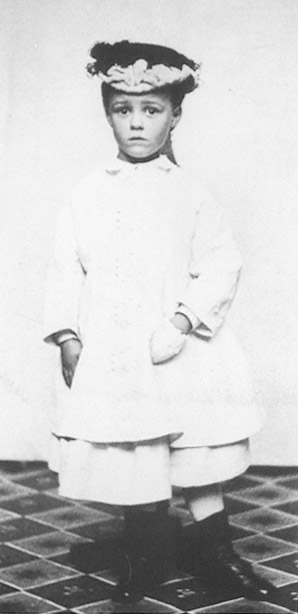
Edith Newbold Jones, age five.
Permission, Edith Wharton estate.
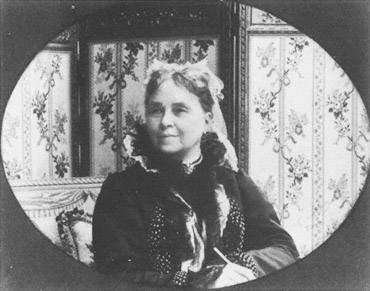
Edith's mother, Lucretia Rhinelander Jones.
Courtesy, Louis Auchincloss.
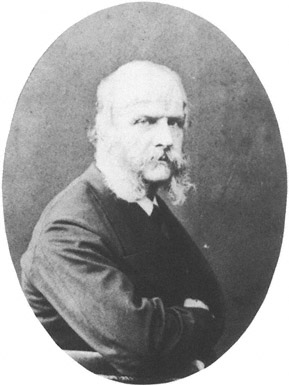
Edith's father, George Frederic Jones.
Courtesy, Beinecke Library, Yale University.
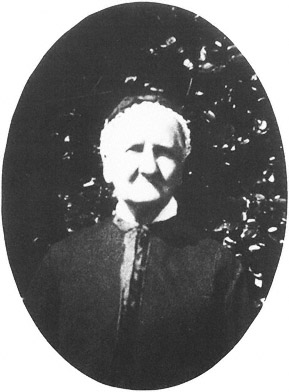
Edith's nanny, Hannah Doyle.
Courtesy, Beinecke Library, Yale University.
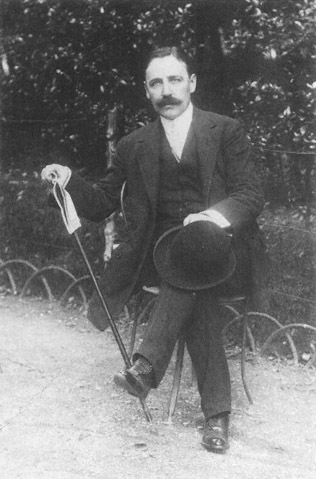
Edith's lover, William Morton Fullerton.
Courtesy, Beinecke Library, Yale University.
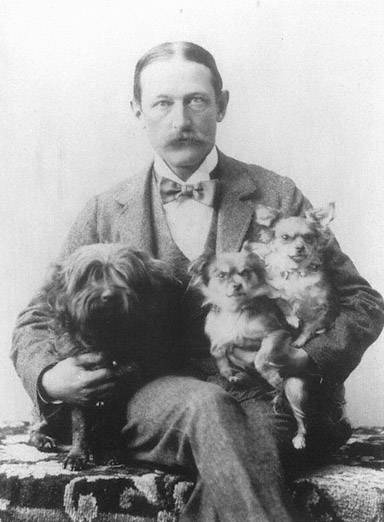
Edith's husband, Edward Robbins (Teddy) Wharton.
Courtesy, Beinecke Library, Yale University.
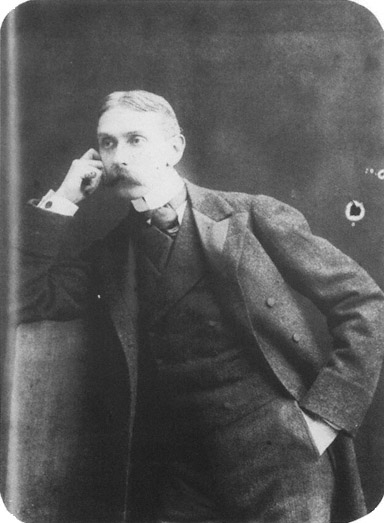
Edith's close friend and adviser, Walter Van Rensselaer Berry,
circa 1905. Permission, Edith Wharton estate.
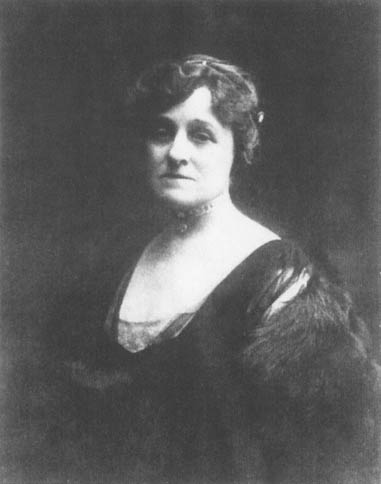
Edith Wharton, 1925. Courtesy, Lilly Library, Indiana University.
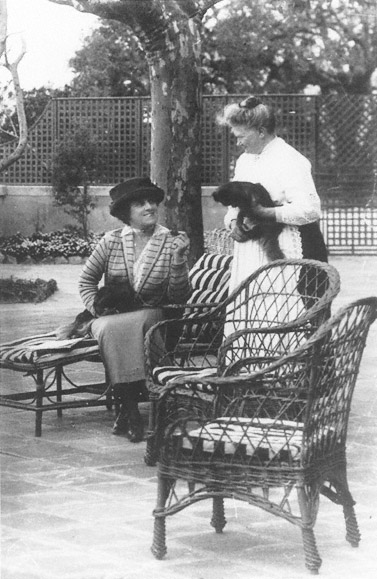
Edith Wharton, seated, and Catherine Gross at Ste. Claire le Chateau.
Courtesy, Lilly Library, Indiana University.
expected marriage to Anna. Sophy says that she does not regret her fling with him because she will always have Darrow to herself to cherish in her own way, an inner possession untainted by how little the brief affair or she herself had meant to him. Finally, even Anna realizes that "Sophy Viner had chosen the better part, and that certain renunciations might enrich where possession would have left a desert" (334).
Sophy compares her own dedicated way of loving to a man's casual slaking of his sex drive but accepts the difference. She says,
"I wonder what your feeling for me was? Is it like taking a drink when you're thirsty? ... I used to feel as if all of me was in the palm of your hand.... Don't think for a minute I'm sorry! It was worth every penny it cost.... I'd always wanted adventures, and you'd given me one, and I tried to take your attitude about it, to 'play the game' and convince myself that I hadn't risked any more on it than you. Then, when I met you again, I suddenly saw that I had risked more, but that I'd won more, too—such worlds! ... I've made my choice—that's all: I've had you and I mean to keep you.... To keep you hidden away here," she ended, and put her hand upon her breast.
(262–63)
What was casual to Darrow, Sophy makes into something of her own. Her idealism in this matches that of Margaret Aubyn and outstrips that of Anna Leath. It speaks, I believe, in the voice of Edith Wharton's unique form of autonomy—that of her mind and imagination, which could convert flawed experience into the nourishment she required.
Without the Fullerton experience, Wharton might have remained forever like Anna, married but virginal, yearning for a "fiery initiation" (319) but always cowering on the threshold. Instead, like Sophy, Wharton grasped what life offered, even though this connoisseur of fine environments had often to accept it in squalid station hotels with a man who did not keep her exclusively or even primarily in mind. She risked a great deal on this adventure, paid a high price in humiliation and anguish, but took away the valuable prize of the passion experience.