
Character Versus Personality: What's His Name
As a means of exploring the ethical dilemma of the "old" middle class in an increasingly secularized and consumer-oriented society, Cecil B. DeMille purposely focuses on small-town or village life rather than drawing room society in What's His Name . Since his credentials as an author had yet to be established, the credits announce that the film is an adaptation based on the novel by George Bart McCutcheon, a lesser light among Indiana Hoosiers such as Booth Tarkington and Theodore Dreiser. An author who sold over five million copies of such novels as Graustark (1901) and Brewster's Millions (1903), adapted on Broadway and in feature film, McCutcheon represented the Victorian sentimental tradition pervasive in genteel culture. What's His Name , published by both Dodd, Mead and Grosset and Dunlap in 1911, was a minor effort with strong autobiographical elements because it was written during an identity crisis in part attributed to failed theatrical ambitions. DeMille successfully translated the novel about a small-town soda jerk and a Broadway comedienne, inspired by Minnie Maddern Fiske, into a Progressive Era discourse on gender, marriage, and the family.[47]
A rewriting of domestic melodrama, What's His Name foregrounds inter-textual references to moral dilemmas in society dramas and in social rituals as performance. Pervading the film adaptation is the quality of a play-within-a-play that characterized parlor games such as the private theatrical
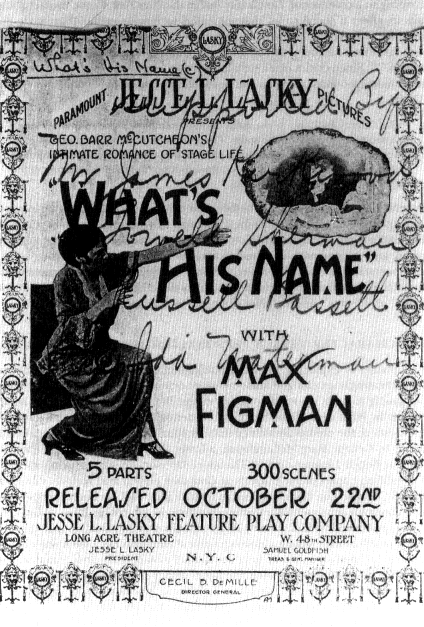
11. Advertisement for What's His Name (1914), a domestic
melodrama based on a minor novel by a best-selling author.
staged in The Charity Ball . DeMille thus constructs the mise-en-scène of an opening night, filmed at a Los Angeles theater, so that a high angle shot shows a conductor in the orchestra pit roped off from the audience in middleground and background. The composition of the shot, with the conductor's head peering out of the pit in extreme foreground, is unbalanced until the camera tilts up to reveal an usher leading a formally attired couple down an aisle and to their seats. Another well-dressed couple subsequently arrives and is also seated. DeMille shows the performance that follows by cutting between the proscenium stage photographed in extreme long shots and audience reaction shown in reverse angle shots. Clearly, the filmgoing audience, identified with theatergoers, was being positioned to engage in a series of moral judgments concerning the nature of performance in a scenario about the sanctity of the family.
Drawing attention to the elusive nature of performance, whether in the public or private sphere, Broadway stars Max Figman and Lolita Robertson come to life during the credits as figures in a billboard poster and astonish the puzzled billsticker. Figman had in fact appeared on stage with Robertson before their marriage and acted in productions associated with such noted theatrical producers as Augustin Daly, Charles Frohman, and Harrison Grey Fiske. Since the husband-and-wife team engaged in performance not only as characters wedded in the film but as Broadway stars married in real life, they added another dimension to the film's narrative structure as a play-within-a-play. Audience reception was undoubtedly influenced by fan magazine and news articles publicizing the fact that Figman managed his wife's career and that the couple made a point of traveling together with their children.[48] Such awareness introduced a note of false suspense into a domestic melodrama in which gender roles are dramatically reversed and then reconstituted during an ambiguous conclusion. Partly the result of his stage persona and of his publicity, Figman's portrayal of Harvey as a good-natured but ineffectual soda jerk is much more resonant than McCutcheon's extremely lackluster protagonist.
As an adaptation, What's His Name foregrounds authorial and intertextual issues to reveal the inscription not only of the director but of the novelist and leading actors. Although the contributions of McCutcheon, Figman, and Robertson should be taken into account in attributing authorship, Moving Picture World rightly noted that "the production must have been difficult on account of the condensation, but it is filled with signs of good direction."[49] DeMille's signature is unmistakable in the use of lighting effects, mise-en-scène, and editing to rewrite domestic melodrama as a film genre. A clever construction of the mise-en-scène, for example, conveys the sex-role reversal essential to the film's representation of a lower-middle-class family. Harvey, Nellie, and their daughter Phoebe eat their meals in a cramped apartment furnished with cheap goods. A plain dining table
occupies much of the foreground in a medium long shot that shows a crude hutch beyond the door in the rear wall. After leaving some money to pay for a bill, Harvey exits through the door to his left, while Nellie, clearing the table, looks out the window to see a poster advertising a musical comedy. DeMille apparently simplified, improvised, and eliminated shots while learning his craft because this scene is more revealing as detailed in the script: "Combination of Dining and Living Room: Nellie leaves the window—starts to carry the dishes out. Door bell rings, Nellie goes out, returns with butcher's boy, starts to pay the bill, glances through window, gives him $2.00, explains that she will pay other later. Butcher boy goes out."[50] Nellie, according to the script, is already engaging in selfish and extravagant behavior detrimental to her family's welfare. An inversion of the breakfast table mise-en-scène in the couple's New York apartment, where they have moved so that Nellie may pursue a stage career, is very telling. Although a door in the rear still leads to an adjoining room and a table is still prominently in middleground, the entry is now to the right and the time of day is evening rather than morning. Nellie returns home after a strenuous and discouraging day of rehearsal, while Harvey has busily been preparing dinner. Hanging on the rear wall is a sign, "GOD BLESS OUR HOME," an aphorism that for many Victorians meant material goods rather than spiritual blessings.[51]
DeMille's mise-en-scène in sequences filmed at the theater reveals that although Nellie has escaped the confines of housewifery in an uneventful small town, she is now in the clutches of venal and unethical men. On opening night, she commits a hilarious blunder that singles her out as a crowd pleaser but compromises her personal integrity. The semiotics of female performance was indeed complex and required an interpretation of a spectrum of behavior. Although Victorian women engaged in self-theatricalization in social engagements, such rituals were highly codified as opposed to self-display violating norms of modesty and decency. Acquiring notoriety, as Nellie did, by committing a comic faux pas that drew attention to herself was distinctly unladylike. A comedienne would in fact have found it more difficult than a dramatic actress to claim the mantle of art for her profession. What then does Nellie's performance signify? Clearly, she has embarked on a treacherous course of self-commodification that exceeds proper bounds and may thus be equated with prostitution. Progressive reformers, it should be noted, waged vigorous campaigns against sexual misconduct as a sign of urban change by advocating social purity and social hygiene.[52]
DeMille's inventive mise-en-scène unmistakably represents the precarious situation in which Nellie has become entrapped. A long shot behind the parted curtains of an aisle shows Fairfax (Fred Montague) and the company manager in the foreground as they frame the stage to negotiate a deal. A
repetition of this mise-en-scène backstage underscores Nellie's predicament. Costumed as a clown, she is squeezed in the background between the figures of the two men in dark formal attire as they dominate the foreground. A dialogue title conveys the manager's blunt proposal as he confronts the inexperienced chorus girl: "You'll get more salary and meet Mr. Fairfax, a millionaire, besides." As a matter of fact, the theme of self-display as prostitution was established earlier in the film when Ruby, a chorus girl, reluctantly introduces the manager, intent on engaging an attractive new recruit, to Nellie, by warning him: "If you're on the level, all right, if not, nothin' doin'." Since Fairfax is coded as a paunchy villain who represents plutocratic corporate greed, Nellie has become the object of class as well as sexual exploitation. She must choose, in other words, between domestic confinement that precludes personal and sexual gratification, and public exposure that transforms her into a commodity. Yet genteel reformers would consider Nellie and Fairfax to be equivalent in a setting of commercialized vice as an underworld analogue of corporate greed.[53] The chorus girl, like the millionaire, craves the power, prestige, and luxury that money buys. Attentive to her manager's rule, "No husbands wanted," she ensconces Harvey and Phoebe in suburban Tarrytown, assumes the stage name Miss Duluth, and flirts openly with Fairfax. Actresses were then commonly billed as "Miss" to enhance their attraction for male spectators, surely an aspect of commodification that implied prostitution.[54]
DeMille, who calculated that he spent 20 percent of his time in the cutting room, uses parallel editing to show the deterioration of family life as Nellie becomes a temperamental star and neglects her domestic duties.[55] On Christmas Day, Harvey's plight becomes painfully clear when gifts arrive for Phoebe and the servants while he is ignored. Sensitive to her father's dilemma, Phoebe attempts to console him with a present in a gesture that suggests she is a stand-in for her mother. A cut to Nellie's boudoir reveals the actress, absent from the family hearth even on Christmas, as she compares a modest pin from Harvey with a jewel-encrusted butterfly symbolizing her metamorphosis. Successive close-ups of each pin from her point of view emphasize the lure of temptation to which she succumbs. A cut back to the Tarrytown living room shows Fairfax arriving a short time later in formal dress with cane and bowler. Arrogant and pugnacious, he aggressively dominates the frame, demands agreement to a divorce, and provokes a scuffle. As the two men exchange blows, the Christmas tree is toppled and lies on the floor. Harvey is so distraught that he retires to his room, turns a portrait of Nellie face down on the table, and attempts to commit suicide by switching on the gas lamp. Fortunately, the serviceman arrives to disconnect the utilities so that the unhappy husband awakens, as if in a dream, in a shot with an earlier and happier Blakeville scene superimposed over the bedroom.
Undeterred, Fairfax returns with Nellie who demands custody of Phoebe, but, forced to choose between parents, the child turns to her father. Movers subsequently arrive to place the furniture in storage and cart away the Christmas tree as well as the "GOD BLESS OUR HOME" sign. An insert informs the audience that Harvey has notified his cantankerous Uncle Peter (Sydney Deane), who functions as his alter ego, that he and Phoebe are homeward bound. Parallel editing shows father and daughter traveling in extremely straitened circumstances, while Nellie entertains actresses of dubious character and travels to Reno to obtain a divorce. Symbolically, Harvey and Phoebe are abruptly awakened and ejected from a railroad car but find a ride home on a horse-driven wagon during the last phase of their trip. The journey from New York to Blakeville thus represents a move away from the sinful temptations of city life and a reaffirmation of traditional small-town and rural values.
DeMille's use of lighting effects is as significant as mise-en-scène and parallel editing to convey a didactic message that would appeal to sentimental middle-class audiences. Unlike his later adaptations, such as Rose of the Rancho (1914), The Girl of the Golden West (1915), The Warrens of Virginia (1915), Kindling (1915), and Carmen (1915), in which lighting effects are used throughout to advance the narrative, DeMille singles out specific shots representing the family for what he labeled contrasty lighting. Clearly, he had already used Buckland's talent to his advantage in The Virginian , their first collaboration and his first directorial effort, in campfire scenes absent in The Squaw Man , an otherwise superior film.[56] DeMille recalled years later that his lighting setups were not standard practice and that he had to issue specific instructions to cameraman Alvin Wyckoff:
I was trying to get composition and light and shadow, and I would say to him, "You musn't make this part so light, under the table musn't be light—it should be dark and back corner of the room shouldn't be light—it should be dark." So they all said, "He likes it 'contrasty '"—contrasty!—that was the phrase. I was known as the man who—there were some terrific battles because of that, because that meant expose it for contrast. It didn't mean shadow it, it just meant make the whites whiter and the black blacker.[57]
In What's His Name , DeMille began to codify the use of contrasty lighting to represent moral dilemmas such as those engulfing the family in a society, increasingly preoccupied with consumer values.[58]
The director first uses dramatic lighting effects in an intimate scene following a surprise backstage visit that reveals Nellie dining with Fairfax. At bedtime, Harvey and Phoebe are both lit in the foreground against a darkened background as they recite prayers and exchange an affectionate good-night kiss. Lying on the corner of the bed is a very large doll that serves as a substitute for the child. As both father and daughter assume maternal
functions in Nellie's absence, their relationship is endangered by incestuous feeling, a scenario rendered all the more intriguing by the fact that DeMille cast his only child, Cecilia, as Phoebe.[59] A variation of this mise-en-scène occurs later in a boxcar strewn with straw, signifying religious representations of the Holy Family in Bethlehem, as Harvey and Phoebe take shelter during their long journey back to Blakeville. DeMille moves his camera in closer for a medium shot, in contrast to a preponderance of medium long shots, as once again the father joins his daughter in prayer, tucks her under a jacket, and kisses her good night. Phoebe's gigantic doll occupies the space between them as Harvey falls asleep in the space to her right. All three are dramatically lit against the darkness of the boxcar but not from any naturalistic light source. Lastly, DeMille uses contrasty lighting to recuperate Nellie as a maternal figure after she spurns Fairfax in Reno, a sign of sexual restraint suitable for domestic rather than theatrical life, and responds to a telegram regarding Phoebe's illness. The description of the final tableau in the script is rather pedestrian and shows how much DeMille improvised to achieve his results on film:
Photographer's Studio: Harvey and Uncle Peter nursing Phoebe—Nellie on— Picture—Uncle Peter starts to become violent—Harvey stops him, indicates Phoebe. Nellie comes to other side of couch, kneels over Phoebe. Harvey opposite her—Phoebe tosses—Both start to put covers over her—and eyes meet—Nellie's head goes down on bed—Harvey watching her—Uncle Peter standing at head of bed, shows disgust, turns his back and walks away.[60]
As photographed, all four members of the family are lit in a medium long shot against the darkened backdrop of Uncle Peter's studio. Phoebe sleeps in the foreground as Nellie sits by her bedside to the left. Forming an arc, Harvey leans toward his repentant wife in a conciliatory gesture, while Uncle Peter stands rigidly apart in disapproval as a strong vertical in the center of the screen. Ashamed, Nellie lowers her head so that a broad-brimmed hat obliterates her from the family picture during a moment of restoration, reconciliation, and moral resolution.
DeMille's translation of domestic melodrama as an intertext from stage to screen represents the ethical dilemma of middle-class families caught between the values of self-denial signifying moral character, on the one hand, and personality defined by commodities and performance, on the other. A consumer culture, in other words, meant a rearticulation of gender roles or a remapping of private and public spheres that imperiled sentimental ideals about womanhood. Since What's His Name was based on a novel that, according to one critic, was condensed in the adaptation, a comparison of these parallel discourses shows how each author dealt with the issues of gender, marriage, and the family. McCutcheon's version avoids pronouncements about motherhood that could be interpreted as
saccharine and focuses instead on the inability of the title character to assert his manhood. A small-town soda jerk unable to comprehend the exchange value of commodity production in urban life, Harvey exemplifies sentimental traits such as selflessness, charity, and forgiveness. Nellie, on the contrary, gratifies her whims by obtaining a divorce and marrying Fairfax, as well as assuming custody of Phoebe. She is punished, however, by a fatal illness that provides the occasion for a reconciliation with her magnanimous former husband.
By contrast, DeMille shifts the focus of the narrative to sex-role reversals as these affect the welfare of the child. Although the lighting in the final shot of What's His Name renders ambiguous Nellie's recuperation as a maternal figure, the film nevertheless emphasizes "the potent effect," to quote a reviewer, "of the mother['s] love for her child." Granted, Nellie's rush to Phoebe's bedside may be interpreted as a narrative rupture, but she finally adheres to the dictum that the well-being of children is the purpose of middle-class family life.[61] As Beatrice DeMille stressed in a pamphlet advertising the Henry C. DeMille School for Girls, "only through home life may a rounded development be attained."[62] Significantly, DeMille's first three adaptations, albeit Westerns, have lengthy and meaningful sequences that emphasize adult commitment to the welfare of children, as do his prewar Lasky Company features such as The Captive (1915), Kindling (1915), and The Heart of Nora Flynn (1916). But his better-known Jazz Age sex comedies and melodramas, including Don't Change Your Husband (1919), WhyChange Your Wife ? (1920), and The Affairs of Anatol (1921), focus on companionate marriage or childless couples involved in marital and extramarital misadventures. The absence of children from these later features in effect underscores threats posed to family commitment in a secularized consumer culture.
Although focused on the disintegration of the family under the impact of a sex-role reversal, DeMille's adaptation addresses the crucial problem of masculine identity in an era when revolt against feminization ranged from silly posturing to fascist glorification of warriors. What was the fate of a young man molded according to sentimental principles espoused by genteel women and clergymen in charge of child rearing practices? What were the costs of genteel culture, in other words, for men who did not have the option of escaping into fantasies such as Orientalism or pursuing energetic adventures at home and abroad? Pathetically, Harvey represents the product of a lower-middle-class upbringing, that is, a lackluster white-collar worker with limited aspirations and mobility in a competitive marketplace. Critical response to this Milquetoast figure varied. According to the New York Dramatic Mirror , "the character presented by Max Figman retains a fund of good, manly qualities notwithstanding the burden of indignities." Certainly, Figman is not nearly as passive, inept, and inconsequential as McCutcheon's
unheroic hero. A Hartford Current reviewer, however, describes Harvey as a "weak husband," a judgment affirmed by the film's superego, Uncle Peter, in his disavowal of marriage as a threat to masculine independence.[63]
Since Uncle Peter is a photographer with privileged access to the nature of reality, his censorious behavior in the last scene, which takes place in his studio, renders the resolution as ambiguous as does the lighting. Although he occupies the center of the screen, he also stands apart from the family reunited in the foreground. Perhaps the curmudgeonly bachelor is too uncompromising in his dedication to the small-town values of self-denial, restraint, and thrift. Yet Harvey discovers that assuming a persona means playing oneself false in the only scene in which he enjoys celebrity status as the result of a performance. Dressed like Fairfax and sporting a cane and bowler, he returns to the drugstore to find that news stories about his divorce have portrayed him as a neglectful husband and a ladies' man, a reputation eliciting bravos from curious and admiring townsfolk, Basking in the limelight is cut short, however, by news of Phoebe's illness as a reminder of family obligations. For all his weaknesses, Harvey still personifies sincerity, a trait compromised in sophisticated parlor games and therefore associated with simple village life.
As opposed to Harvey, Nellie represents personality defined by performance and consumption and thus signifies the danger of the marketplace invading the privatized home. She is an actress who not only performs on stage but also portrays the penitent role of the absent mother in the final tableau. Self-theatricalization thereby compromises sincerity even in the back region of the house or in the inner circle of family relations. Yet the ethical conflict of What's His Name is not between the polarities of wealth and sexuality as symbolized by Fairfax, on the one hand, and selflessness as personified by Harvey, on the other. Rather, DeMille rewrites the moral contest as one between character based on the Protestant values of the "old" middle class versus personality representative of a "new" middle class invested in consumption.[64] Consequently, the film yields no easy solutions in terms of closure. According to the conventions of melodrama as a nostalgic reaffirmation of a golden age, the director resolves the moral dilemma in favor of small-town values. What's His Name reaffirms character as defined by "old" middle-class traits such as "benevolence, self-reliance, humility, sincerity, perseverance, orderliness, frugality, reverence, patience, honesty, purity, punctuality, charity," and so forth.[65] But in the final tableau, DeMille aptly sacrifices the moral clarity of a resolution in favor of an ambiguity more consistent with the uncertain values of a middle class in transition.
Given the context of social change in the Progressive Era, DeMille reformulates domestic melodrama in What's His Name to address the concerns of an evolving middle class. A discourse on the erosion of the Victorian practice of separate spheres, the film foregrounds moral issues regarding
the role of women in the family. Since an accelerated shift from a producer to a consumer economy occurred during a period of sustained inflation, debate grew about the wisdom of increased family spending to achieve a more refined standard of living. Essential to the survival of the middle class was the resourceful and prudent housewife who had negotiated transactions in the marketplace long before the advent of a modern consumer culture. She had been enjoined for decades to avoid extravagance and fashion, a sign of social ambition foreign to the "old" propertied middle class.[66] But women were being seduced by an increasing array of enticing consumer goods. Divorce cases, alarmingly on the rise among native-born Protestants, attested to the unreasonable demands and household neglect of wives who wished to increase expenditures. For middle-class audiences accustomed to discourse on the virtues of self-denial as opposed to comfort and refinement, the character of Nellie in What's His Name must have struck a resonant chord. As she is literally effaced by the low-key lighting in the final scene, a tableau that imparts a moral lesson, the actress represents the dangers confronted by the middle-class family in a secular age of increased consumption and leisure.
DeMille's early filmmaking style aptly conveyed such a message, even though a number of interesting details regarding characterization and plot are unintelligible due to a lack of medium shots and medium close-ups. Ruby is characterized as a questionable chorus girl, for example, because she is shopping for cosmetics and wearing a watch on her ankle, details in the script that escape the audience. What registers on account of the high ratio of medium long shots, however, is the intertextuality of feature film, stage plays, and parlor theatricals in Victorian sentimental culture. The director's visual style, specifically mise-en-scène, low-key lighting, and parallel editing, was thus appropriate for the reformulation of melodrama as a sermon for filmgoers accustomed to patronizing the legitimate theater. An unconventional narrative of a sex-role reversal certain to provoke censure, not to mention hilarity, the adaptation served to underscore the continuing need for social convention in middle-class life. As Moving Picture World concluded, "The story . . . has a philosophy that the average spectator will like."[67] DeMille's rewriting of domestic melodrama as a form of Victorian pictorialism thus succeeded as a cinematic articulation of the ideological concerns of both the "old" and "new" middle class at a historical crossroads.