
The Changing Proportion of Population Living in Cities
Let us begin by examining figure 2, which shows the percentage of the total population living in places with more than
2,500 people and in places larger than 100,000. The smaller value has long been considered the lowest threshold of what could be called a city: though arguably too small, it is a useful definition in its consistency, since it has now been applied by the various data gathering agencies of the U.S. government for almost two centuries. The larger value of 100,000 probably corresponds more to our contemporary sense of what constitutes a "real city," a minimally sized metropolis. The threshold value for the population characterizing a city, or village, or metropolis, is an elusive, perhaps shifting, and certainly much vexed question. It is therefore important to stress that such definitions are most useful in sketching large pictures of the world of cities, using sharp lines to suggest fuzzy concepts.[2]
After a slight initial urban expansion at the beginning of the nineteenth century, the urban population stayed relatively stable until about 1830, when it began a century-long burst of continuous expansion until 1930. The damper of the Great Depression proved to be the precursor of a general decline in urbanization's pace, so that it now appears that the demographic aspect of the urban transition—the creation of a largely urban populace—has been completed. One may therefore read figure 2 as delineating three urban eras: the first up to 1830, the second that of a century of expansion ending with the Depression, and the third, a period of relative stability.
The plot of the percentage of population in cities over 100,000 suggests that this three-phase process of urbanization was even more distinct for larger, metropolitan populations. In the first phase, up to 1830, there were no cities over 100,000. The second phase, lasting a century, saw the metropolitan population climb steadily to somewhat over one-fourth of the total population. And since 1930 this metropolitan population has remained steady or even declined slightly.
Some additional numbers, not shown on the graph, fill out the picture. The percentage of the population living in cities over a million highlights the process that has fostered the growth of middle-sized cities and small metropolises. In 1880, only 3.4 percent of the population lived in cities over a million. This percentage peaked in 1930 at 13.3 percent, and then it began a steady and consistent decline to 7.7 percent in 1980, a proportion lower than that at the beginning of the twentieth century.
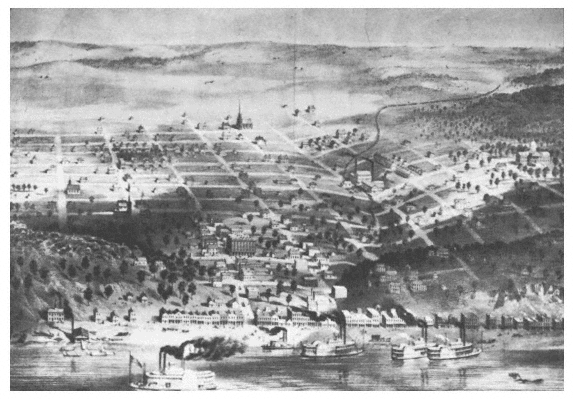
Sumner, Kansas, 1857.
This view is an artist's speculative vision, a crudely drawn sketch conforming
only to the grandiose plans of city building entrepreneurs; only a
few of these buildings were ever built. The blowing smoke tells us it was
a windy day in the artist's mind: but such was the bustle of this town-to-
be that a steamboat on the river doubled the speed of the wind, giving a
Daliesque vision of smoke blowing both ways in the foreground. Today
there are nine Sumners in the United States, but this is not one.
Source: Kansas State Historical Society.
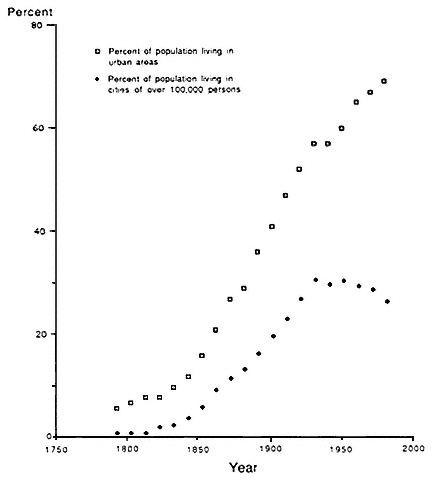
Figure 2.
Percent of Total Population Living In Cities, 1790–1980
Source: calculated from Bureau of the Census, Historical Statistics of the United
States, Colonial Times to 1970 (Washington, D.C.: GPO, 1975), 11–12, and
Statistical Abstract of the United States: National Data Book and Guide to
Sources, 1982–83 (Washington, D.C.: GPO, 1982), 21.
If we look at farm families as the obverse of urban families, a parallel divergence has occurred in the past fifty years. In 1930, when about 50 percent of the total population lived in places over 2,500, about 30 percent of the population lived on farms, leaving 20 percent in small villages and rural nonfarm residences. This has
changed dramatically and steadily, so that only about 3 percent of the 1980 population lived on farms, whereas 23 percent were other nonurban residents, a net increase of rural nonfarmers since the 1930 census.[3]
And very recently, this half-century-old trend away from the extreme of farm living has also emerged at the most metropolitan end of the population. The proportion of people living in the giant metropolitan areas—the seven cities with populations over three million—has declined by half a percent between 1970 and 1980. This latter shift, though slight, has caused considerable excitement and unease among urbanists. Some have termed the drop a new trend, one quickly labeled "counterurbanization" by Brian Berry. Clearly the trend is not new, but a half-century old, having begun in the Depression years, but masked until recently by data that focus on the standard metropolitan statistical area (SMSA), as well as by the baby boom, postwar prosperity, and rural migration from the South to large cities.[4] Whatever the future holds, it is fair to say that the century between 1830 and 1930 saw the most dramatic shift in creating modern urban America, and that the post-Depression era is one of sorting out and a drift toward moderation, toward the mean. Fewer people live in rural isolation; fewer in mass anonymity.