
The Parabolic Approximation and the Linear Dynamics Ratio
In an early analysis of uniform circular motion, Newton first approximated the circle by using a polygon; then he calculated details of the motion by assuming an intermittent force that acted only at the points at which the polygonal path touched the circle; and then he increased the number of sides of the polygon until the polygonal path approximated the circular path and the intermittent force approximated the continuous force. This early polygonal approximation was eventually employed in the demonstration of the area law, which was discussed above. Figure 2.4 represents such an approximation. The resultant motion along bc is the combination of the tangential displacement by that would have taken place if no collision had occurred at b and the radial displacement bx that would have been produced by the impulse at b if the body had been at rest.
In another early analysis, Newton employed the parabolic approximation rather than the polygonal approximation to analyze the same uniform circular motion. He employed elements of Galileo's kinematics and did not use collisions. In figure 2.5, the circular path is no longer approximated by a polygon, and the force acts continuously rather than intermittently. Critical to the new analysis is Newton's assumption that within the limits of very short time intervals (i.e., as the point x approaches the point b ) the force can be assumed to be approximately constant, both in
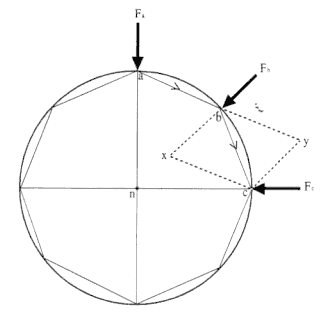
Figure 2.4
The circular path abc is approximated by the polygonal path
abc . After the impulsive force Fb acts at point b , the resultant
motion bc is given by the diagonal of the parallelogram
formed by the virtual displacement by and the impressed
displacement bx .
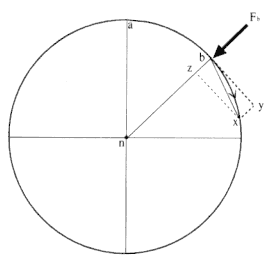
Figure 2.5
The line by is constructed tangent to the circle at the
point b , the line xy is constructed parallel to the radial
displacement bz , and the line bx is the diagonal of the
parallelogram byxz .
magnitude and in direction. Under the action of a constant force alone (i.e., no initial velocity) the displacement would be bz , or its equivalent xy . Under the action of the tangential velocity alone (i.e., no force acting) the displacement would be by . The observed motion along the arc bx is a combination of these two displacements.
Galileo has demonstrated that an initial velocity combined with a constant acceleration gives rise to a parabolic curve, as in ideal terrestrial projectile motion. Here the initial projectile velocity is the tangential velocity along the line by and the constant acceleration is supplied by the approximately constant force and acts along the radial line bn . Whiteside, the editor of Newton's mathematical papers, makes the following observation:
It will be evident that Newton presupposes that the central force acting upon a body may, over a vanishingly small length of its orbital arc, be assumed not to vary significantly in magnitude or direction, and hence that the infinitesimal arc is approximated to sufficient accuracy by a parabola whose diameter passes through the force-centre, with its deviation from the inertial tangent-line accordingly proportional to the square of the time.[37]
Newton does not speak to this approximation explicitly in the first edition of the Principia . In the revised editions, however, he adds the following corollary to Proposition 1 which makes explicit what is only implicit in the first edition. The approximate constant force F is compared to the force of gravity and the deviation xy is called the sagitta (literally the arrow in the bow of the arc).
Corollary 5. And therefore these forces [the forces F above] are to the force of gravity as these sagittas [the deviations xy in fig. 2.5] are to the sagittas, perpendicular to the horizon, of the parabolic arcs that projectiles describe in the same time .
Thus, Newton approximates the element of the circular curve in the vicinity of the initial point b by an element of a parabolic curve. The displacement of any future point x on the parabola can be found by using the parallelogram rule to combine the displacement by due to the initial tangential velocity with the deviation xy due to the constant force. The important property of the parabolic approximation, however, is that the magnitude of the force F is directly proportional to the displacement xy and inversely proportional to the square of the time.
As a preliminary review of the Principia , consider the following excerpt in which Newton develops his general theorem for a general force function based upon the parabolic approximation. Figure 2.6 is based on the diagram that accompanies Newton's statement of the general theorem. The center of force is located at point S (the sun) and the body is located at point P (the planet). If there were no force acting on the body, then it would travel along the tangent line PR to the point R . Because there is a
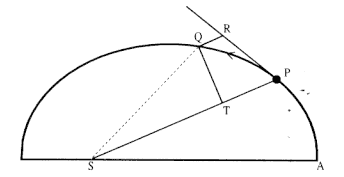
Figure 2.6
The line PR is constructed tangent to the curve at point P , the
line QR is constructed parallel to the line SP , and the line QT is
constructed perpendicular to the line SP .
force acting on the body, however, it travels along the curve APQ to the general point Q located beyond the given point P . The line QR is constructed parallel to the line of force SP and thus defines both the point R and the displacement QR , which is employed in finding the force.
The line QT is constructed perpendicular to the line of force SP , and the equal area swept out in an equal time is bounded by the lines SQ, SP , and the arc QP . As the point Q is brought very close to the point P , then the arc QP approaches the chord QP , and the area swept out is that of the triangle SQP , or one-half of the area given by the product of the altitude QT and the base SP . Thus, the time t is proportional to the area QT × SP .
In the situation described above, as the point Q approaches point P , the force is assumed to be constant, and the elemental arc of the given curve is approximated by the elemental arc of the parabola, which would be generated by the constant force and the initial tangential velocity at the point P (i.e., the parabolic approximation discussed above). The force F , therefore, is proportional to QR /t2 which in turn is proportional to QR /(QT × SP )2 , or as Newton chose to state it, "The centripetal force is reciprocally as the solid SP2 × QT2 / QR ."[38] The following is the statement that precedes Newton's demonstration of the theorem as it appears in the 1687 edition of the Principia :
[1] If a body P revolving around the center describes any curved line APQ,
[2] and if the straight line [PR] touches that curve on any point P,
[3] and if to this tangent from any other point Q of the curve , QR is drawn parallel to the distance SP,
[4] and if QT is dropped perpendicular to the distance SP;
[5] [then] I assert that the centripetal force is reciprocally as the solid SP2 × QT2 / QR,
[6] provided that the quantity of that solid that ultimately occurs when the points P and Q coalesce is always taken .
Following this statement, Newton provided details of the demonstration wherein the ratio of the displacement and the square of the area QR /QT2 × SP2 (i.e., what I have called the linear dynamics ratio) is a measure of the force at the point P in the limit as the point Q approaches the point P . Newton then used this ratio to compute the force for examples of various orbits and force centers. More specifically, it is the ratio of QR /QT2 that must be expressed as a function of SP . Thus, the ratio QR /QT2 is the "determinate" of the motion. Newton's exemplar solutions for direct problems can be distilled into the following general pattern of analysis.
Step 1. The Diagram . A drawing is provided that identifies the specific orbit corresponding to the general orbit QPA in the general theorem. The immediate position P of the body is located, and the line of force SP is constructed that connects the body P with the force center S . Then the future position Q of the body is located, and the two lines QR and QT are constructed. Thus, the three elements QR, QT , and SP of the linear dynamics ratio QR /QT2 × SP2 are identified in the diagram.
Step 2. The Analysis . Given the full diagram, Newton begins the search for the geometric relationships that will reduce the linear dynamics ratio to a useful form by expressing the discriminate QR /QT 2 as a function of the distance SP alone. It is in this search that Newton displays his command of geometry, conic sections, and mathematical insight; and it is here that the reader may well lose sight of the general structure of the dynamics in the flurry of mathematical details.
Step 3. The Limit . The general theorem holds only in the limit as the future point Q approaches the immediate point P . Thus, Newton need not search for exact geometric relationships, but only for one that will reduce to the desired functional form in that limit. Such relationships will eventually be sought out by others employing the methods of the calculus, but here Newton employs his geometric/limiting technique that serves in its stead.[39]