
Ciceronianism Matured in Le Istitutioni Harmoniche of Gioseffo Zarlino
For the observer some four and a half centuries hence, Gioseffo Zarlino explains the compositional practice of Willaert and ratifies its humanistic basis more thoroughly than any other musician of the sixteenth century. Zarlino defined his mission in his first and most ambitious publication, the massive Istitutioni harmoniche of 1558. His title glossed Quintilian's encyclopedic rhetorical treatise Istitutio oratoria, which had similarly served to codify the practice of Quintilian's master and model, Cicero. The
[56] The evidence about his connections with Willaert comes from the letters of Spataro. See Peter Bergquist, "The Theoretical Writings of Pietro Aaron" (Ph.D. diss., Columbia University, 1964), pp. 45 and passim; on Aaron's years in Venice from 1522 to 1535, see pp. 35-49.
[57] For the justification of the Italian language see the preface "a lettori" to his Lucidario in musica (Venice, 1545); fasc. ed. BMB, ser. 2, no. 12 (Bologna, 1969). Aaron's list of Italian musicians, in Book IV, Chap. 1, fols. 31-32, including "Cantori a libro," "Cantori al liuto," and "Donne a liuto et a libro," shows above all how little Italian musicians of the first decades of the century had entered the polyphonic mainstream (Costanzo Festa, Marc'Antonio Cavazzoni, Bartolomeo Tromboncino, and Marchetto Cara are the only well-known contrapuntists mentioned). The Italians' fame was instead as singers and improvisors.
[58] Title of the 2d ed. (Venice, 1529); the first ed. was called Thoscanello de la musica (Venice, 1523).
[59] Aaron wanted to regularize modes by emphasizing "regular" cadences over "irregular" ones. See the discussion in Bernhard Meier, The Modes of Classical Vocal Polyphony Described according to the Sources, trans. Ellen S. Beebe, rev. ed. (New York, 1988), Pt. 1, Chap. 4, pp. 105-6; orig. Die Tonarten der klassischen Vokalpolyphonie (Utrecht, 1974). He also connected mode to secular music, if indirectly, by specifically claiming that tenors could determine mode in any kind of composition, even those sorts unrelated to psalmody like the madrigale (Trattato della natura et cognitione di tutti gli tuoni di canto figurato [Venice, 1525]; facs. ed. BMB, ser. 2, no. 9 [Bologna, 1970], Chap. 2).
Mode figures as well in the supplement added to the 1529 edition of Toscanello. Essential on Aaron's concept of mode is the article by Harold S. Powers, "Is Mode Real? Pietro Aron, the Octenary System, and Polyphony," Basler Jahrbuch fir historische Musikpraxis 16 (1992): 9-52 (which relates Aaron's Trattato to the Venetian context on p. 20).
title page, conspicuously learned with its Greek motto, recorded his concern for musical issues pertaining to poets, historians, and philosophers (Plate 19):
The harmonic institutions of Mr. Gioseffo Zarlino of Chioggia in which, beyond materials pertaining to music, one finds explained many passages by poets, historians, and philosophers, as may be clearly seen in reading them.
Zarlino's choice of disciplines affirms his broader orientation toward the fivefold curriculum of the studia humanitatis, including poetry, history, and moral philosophy in addition to grammar and rhetoric, which were necessary to the first three. He emphasized both the practical and the philosophical — writing and thinking — and it is surely no coincidence that, like Tomitano, he opted to impart his teachings through the "reasoned" genre of treatise rather than the discursive one of dialogue. Zarlino's admission to the ranks of the short-lived Accademia Veneziana about the same time the Istitutioni were issued undoubtedly showed its founders' perception of him as a figure of wide learning, not only in music but in logic, philosophy, and ancient philology.
Despite these philosophical and encyclopedic leanings, Zarlino invoked in the proem to the Istitutioni the traditional humanistic tenet that man's superiority rests in speech: as speech was perfected and made beautiful over time, music was gradually added to it. In this way, through praises chanted to the gods, men could redeem their souls, move their wills, and reduce their appetites in order to lead a more tranquil and virtuous life. Zarlino's claim for music's power lying in its ability to persuade men to a better life with beautifully ornamented speech corresponds to that traditionally advanced by humanistic teachers.[60] As the study and practice of music eventually brought it to a separate disciplinary status from language, Zarlino continued, it fell on hard times, losing its former "veneranda gravità."[61] In modern times, however, music had found a redeemer: "The great God . . . has bestowed the grace of making Adriano Willaert born in our time, truly one of the rarest intellects who has ever practiced music, who . . . has begun to elevate our times, leading music back to that honor and dignity that it formerly had."[62] The agenda of the Istitutioni was thus to demonstrate how and why Willaert's method of composing had restored music to its ancient status.
In settling so fixedly on one composer Zarlino tacitly embraced Bembo's single-model theory of imitation as argued in De imitatione, which had largely held sway
[60] For a fundamental essay arguing the view that a belief in eloquence and the power of persuasion was the most distinctive aspect of humanistic thought see Hanna H. Gray, "Renaissance Humanism: The Pursuit of Eloquence," Journal of the History of Ideas 24 (1963): 497-514; repr. in Renaissance Essays from the Journal of the History of Ideas, ed. Paul Oskar Kristeller and Philip P. Weiner (New York, 1968), pp. 199-216.
[61] Istitutioni harmoniche, p. 1.
[62] "L'ottimo Iddio . . . ne ha conceduto gratia di far nascere a nostri tempi Adriano Vuillaert, veramente uno de più rari intelletti, che habbia la Musica prattica giamai essercitato: il quale . . . ha cominciato a levergli, & a ridurla verso quell'honore & dignità che già ella era" (ibid., pp. 1-2).
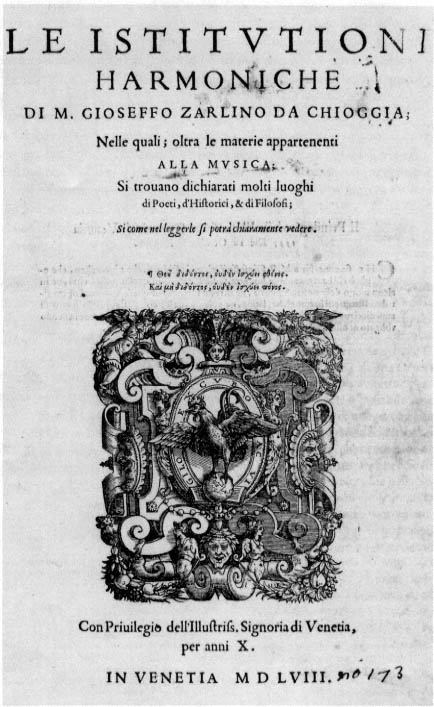
19.
Le istitutioni harmoniche (Venice, 1558), title page.
Photo courtesy of the University of Chicago, Special Collections.
in Ciceronian circles over the multiple-model theory of Pico. It is no surprise that Zarlino based his teaching on a modern-day master and not on one two centuries past, as champions of the lingua toscana had done, for even more than verbal languages, musical idioms were inextricably bound up with available technologies of composition.[63] Happily for Zarlino, his aged paragon had already been elevated to Parnassus in his own lifetime.[64]
Zarlino's Ciceronianism reached beyond the questions of technical or idiomatic imitation, however, into the deeper aesthetic crevices of his theoretical constructs. As for Bembo, beauty for Zarlino required elegance, purity, and restraint, all of which superseded other expressive demands. For this reason Zarlino issued several stern lectures to singers, cautioning them to perform only "with moderated voices, adjusted to the other singers." By singing in any other way, he warned, they would only create more "noise than harmony," and harmony could only be found by "tempering many things in such a way that no one [thing] exceeds the other."[65] For Zarlino these principles were universal. He assured singers that composers would try to outfit them with easily singable parts, organized by "beautiful, graceful, elegant movements," so that those who hear them might be "delighted rather than offended."[66] At this point in the Istitutioni he had already canonized beauty and grace in enumerating the six basic requirements of good composition: the second requirement dictated that music "be composed principally of consonances and only incidentally of a number of dissonances," and the third, that the voices "proceed properly, that is, through true and legitimate intervals born of the sonorous numbers, so that we acquire through them the use of good harmonies."[67]
The theme of avoiding offense resounds all through the Istitutioni. Some of Zarlino's famous observations on text setting seem superficially to free him from this Ciceronian straitjacket. A well-known passage (to which I will return), for instance, enjoins composers to match each word with the right musical sentiment
[63] On this issue see Howard Mayer Brown, "Emulation, Competition, and Homage: Imitation and Theories of Imitation in the Renaissance," JAMS 35 (1982): 1-48.
[64] The data presented by Creighton Gilbert, "When Did a Man in the Renaissance Grow Old?" Studies in the Renaissance 14 (1967): 7-32, indicate that by 1558, when Willaert was at least sixty-five, he would have been considered quite aged. For a summary of ways Willaert was mythologized during and after his lifetime see Einstein, The Italian Madrigal 1:321-24.
[65] "Ma debbe cantare con voce moderata, & proportionarla con quelle de gli altri cantori, di maniera che non superi, & non lassi udire le voci de gli altri; La onde più presto si ode strepito, che harmonia: conciosia che l'Harmonia non nasce da altro, che dalla temperatura di molte cose poste insieme in tal maniera, che l'una non superi l'altra" (Istitutioni harmoniche, p. 204). Zarlino also admonished in this chapter against excessive physical gestures by singers (ibid.), as Cicero had done for orators (Orator 17.55-18.60), with an emphasis on the impact on audience. See Hermann Zenck, "Zarlinos Istitutioni harmoniche als Quelle zur Musikanschauung der italienischen Renaissance, Zeitschrift für Musikwissenschaft 12 (1929-30): 577.
[66] "Cercarà . . . il Compositore di fare, che le parti della sua cantilena si possino cantar bene, & agevolmente; & che procedino con belli, leggiadri, & eleganti Movimenti; accioche gli auditori prendino diletto di tal modulationi, & non siano da veruna parte offesi" (Istitutioni harmoniche, p. 204).
[67] "La Seconda è, che sia composta principalmente di consonanze, dipoi habbia in sè per accidente molte dissonanze, collocate in essa con debiti modi. . . . La terza è, che le parti della cantilena procedino bene, cioè che le modulationi procedino per veri, & legittimi intervalli, che nascono da i numeri sonori; accioche per il mezo loro acquistiamo l'uso delle buone harmonie" (ibid., p. 172).
and to allow enough dissonance "so that when [the text] denotes harshness, hardness, cruelty, bitterness, and other similar things, the harmony may be similar to it, namely rather hard and harsh." Yet even here Zarlino continued with the caveat "but not to the degree that it would offend."[68] The expressive boundaries that had impelled Bembo some decades earlier to repudiate the "harsh, vile, and spiteful words" he perceived in Dante's Inferno were still firmly drawn.[69]
The same views led Zarlino to reject vehemently the claims of the chromaticists voiced in Nicola Vicentino's L'antica musica ridotta alla moderna prattica (Rome, 1555). In Part III, Chapter 80, Zarlino took passionate exception to the chromaticists' readiness to admit all the various intervals for what they professed were the oratorical ends of moving the affections. This was "most improper, for it is one thing to speak 'familiarly' and another to speak in song."[70] Nondiatonic steps, he argued, destroy modal identity — a pressing concern for contrapuntists who built their systems on the firm ground of diatonic modality.[71] In response to those who had warmed to chromatic theory he blustered, "I have never heard an orator . . . use in his speech such strange, garbled intervals as they use, and if they did I can't see how they could sway the mind of the judge and persuade him to their will, as is their goal; rather the contrary."[72] Perhaps this was Zarlino's sticking point with Rore, whose style on the whole would seem to have supported his precepts well; in any case, it is surprising that he cited — and perfunctorily at that — a mere three of Rore's works in the whole Istitutioni.
Like literary Ciceronians, for whom Bembo hovered censoriously in the background, Zarlino constantly advocated "variation" as insurance against excess. This principle grounds Part III, Chapter 29, which entreats musicians "to vary constantly the sounds, consonances, movements, and intervals," and thus "through diversity . . . attain a good and perfect harmony."[73] Zarlino's purpose in conveying these ideas is especially clear in Part III, Chapter 41, on the need to avoid parallel unisons
[68] "Debbe avertire di accompagnare . . . ogni parola, che dove ella dinoti asprezza, durezza, crudeltà, amaritudine, & altre cose simili, l'harmonia sia simile a lei, cioè alquanto dura, & aspra; di maniera però che non offendi" (ibid., p. 339).
[69] Cf. Chap. 5 below, nn. 70-71, and for the views of Tomitano, Girolamo Muzio, and Lodovico Dolce, nn. 72-76.
[70] "E grande inconveniente: imperoche altro è parlare famigliarmente; & altro è parlare modulando, o cantando" (Istitutioni harmoniche, p. 291).
[71] In addition to Zarlino's theoretical remarks see Mary S. Lewis on Zarlino's designation of the modes in the tenor part books of his 1549 book of motets, "Zarlino's Theories of Text Underlay as Illustrated in His Motet Book of 1549," Music Library Association Notes 42 (1985-86): 239-67. Zarlino's adherence to modal diatonicism should not be confused with his attitude towards modal ethos. For good reason Palisca has seen Zarlino's belief in modal ethos as half-hearted (On the Modes: Part Four of "Le Istitutioni Harmoniche," 1558, trans. Vered Cohen and ed. with an introduction by Claude V. Palisca [New Haven, 1983], p. xv).
[72] "Ne mai hò udito Oratore (poi che dicono, che bisogna imitar gli Oratori, accioche la Musica muova gli affetti) che usi nel suo parlare quelli cosi strani, & sgarbati intervalli, che usano costoro: percioche quando li usasse, non so vedere, in qual maniera potesse piegar l'animo del Giudice, & persuaderlo a fare il loro volere; si come è il suo fine; se non per il contrario" (Istitutioni harmoniche, p. 291). Cf. the passages from Cicero cited in Chap. 5 nn. 59-62, above.
[73] "[C]ercare di variar sempre li Suoni, le Consonanze, li Movimenti, & gli Intervalli; & per tal modo, dalla varietà di queste cose, verremo a fare una buona, & perfetta harmonia" (ibid., p. 177).
and octaves. Poetry, grammar, and rhetoric, he began, have all taken their cue from music, which teaches about good order and the hazards of repetition. To exemplify this in language one may consider a verse like "O fortunatam natam me consule Romam," where the reiteration of the syllables "natam," combined with the like-sounding final syllable "-mam," "give the listener little pleasure."[74] Repetition precludes beauty. "It is not permissible to use these strange modes of speech [i.e., repetition] either in prose or in poetry, except as used artificially or for special effects. The musician most particularly must eliminate from his works every unpleasant sound and whatever might offend the hearing. . . . He must regulate [his compositions] in such a way that one hears in them only good things."[75] Beauty, then, can only be grasped through the merging of elegance with diversity — that is, of decorum with variation.