
Chapter Five
The Distribution of Roles: The Macrostatus System
When every one is somebodee, Then no one's anybody!
—W. S. Gilbert, The Gondoliers
Introduction: Thar And Macrostatus Levels
Bhaktapur, like Fustel de Coulange's Ancient City, has a social organization largely constructed out of bounded, relatively autonomous units, or "cells" that are combined in successively more inclusive ones. Households with their own deities and religious practices are joined in patrilineal extended families with their own deities and practices. Patrilineal groups are in turn joined in wider inclusive units called thar s whose members have a common surname. The thar s are in turn organized into what we will call "macrostatus levels."
There is an essential difference between thar and macrostatus levels and the smaller units. The latter, household and extended families—as well as some smaller units within the family and some groupings of extended families—are all more or less alike throughout the city and provide vital nested "structural units" for the city. There is an essential difference between a certain man's role as, say, father, husband, leader of an extended patrilineal family group, that is his role within one of the constituent cells of the city, and his urban role as a Brahman, farmer, or untouchable, a role that is of direct importance to the city as a whole. Such urban roles are ascribed through membership in—that is, through being born into—a thar .
In contrast to smaller constituent units thar s and macrostatus levels are differentiated so that their outputs are elements in the pattern of the
city. For the city organization it is the public functions of thar s—their outputs into the public city life and their external relations with and hierarchical position in relation to other thar s and groups of thar s—that is important, not their internal organization. From the point of view of the city as a whole, what goes on within the thar s is of no importance as long as their essential outputs of goods, services, and differentiated kinds of social persons are maintained. Internal practices and organization vary considerably from thar to thar , but as long as they produce their necessary public effects, internal matters are not only immaterial to outsiders, but unknown and in fact hidden from them. In the same way the still smaller nested units that compose the thar s must have their proper outputs into larger units, but their inner affairs are no business of others. In fact, hidden and secret knowledge, procedures, spells, and protective deities are often thought to be essential to the unit's effective output into larger units, and eventually into the life of the city.
Thus for the kind of city organization we are concerned with—the city at its own level as an organized and organizing mesocosm—the outputs and groupings and hierarchical organization of thar s are the relevant elements. The internal organization of the thar s, and particularly of their component kin-based units are the city forms that most closely affect the "private" experience and early education of the city's people. "Private" in Bhaktapur begins with the internal affairs of a thar , and takes a deeper meaning as action jumps from each unit to the next smaller—that is extended family, household, one or another internal household grouping, and finally to an individual's "self" and "inner thoughts." We will in the next chapter discuss some of the "sub-thar " organization. This will be necessary for discussions elsewhere of "private lives," but for the purposes of this book it will be an excursus.
We will be writing about a variant of a kind of South Asian social organization that is usually, of course, called a "caste system," a system that is said to have elements called "castes" and "subcastes" and various clusters of such units. It has seemed proper (for reasons that will follow) for our discussion of Bhaktapur's social categories to avoid such terminology and some of the assumptions that it entails and to use either local terminology, or neologistic terms. Thus we will call that aspect of the city's hierarchical organization that provides a pattern to the city as a whole the macrostatus system , and distinguish it from the systems of status and social organization within the smaller cellular units, the city's collection of microstatus systems. We have called the gross hierarchical
arrangements of thar s that make a difference to the city as a whole macrostatus levels . In contrast to these there are, for example, hierarchical arrangements of the thar s within a macrostatus level , which are of no concern to people outside of that level, as there are also status rankings within the groups that constitute thar s.
To return to our conceit of the city as a ballet, it is thar membership that assigns the roles of the dancers. There are other miniballets within the thar s and within their component units, but they are not our present concern, although we will say something about them in chapter 6.
The Thar
Newars in Bhaktapur have, in addition to their given names (usually two), a surname that is their thar name.[1] That name allows Bhaktapurians to place each individual exactly in the macrostatus system. In order to try to obscure their "caste" membership some Newars in the relatively anonymous, socially heterogeneous, and mobile society of Kathmandu and other Nepalese cities often change their surnames to such ambiguous and mildly honorable sounding names as Srestha[*] ,[2] Singh, and the like in order to try to obscure low traditional status. But the use of such names in Bhaktapur would be obvious and futile attempts to escape traditional categorizations.
The Bhaktapur Town Panchayat's registry of the city's population has about 350 thar -designating last names for the city's Newar population. This list is not exactly equivalent to the actual number of thar s because in some cases thar members have the option of using one of a limited number of equivalent alternate thar names. Furthermore, in a very few cases the same name appears at two status levels and represents two different thar s. This is either because some function designated by the thar name (e.g., Tantric priest or physician) is performed by practitioners at different status levels, or because a family segment that was outcast for some transgression (usually an improper marriage) might have kept its original thar name when it was reduced to a lower status level. Thus the list of thar names actually represents about 340 different thar groups (see app. 2).
"Thar " is a term widely used in Nepal, deriving from a Prakrit term for "collection," and is usually translated in Nepali-English dictionaries as "clan" or "tribe." The significance of "thar " among the Newars differs from that of other groups of Indian origin in Nepal, the "Indo-Nepalese," as we will refer to them m contrast to the Newars through-
out this book. Thus Khem Bahadur Bista writes of the Indo-Nepalese Chetri that the thar name is no more than a family name, "equivalent to an Anglo-Saxon family name such as Brown" (1972, 31). Lynn Bennett (1977, 41), also writing of the Chetri, supports this usage:
Although villagers sometimes refer to thar as if it were a clan or even lineage unit, strictly speaking, thar is really nothing more than a last name shared by many different descent groups. Individuals with the same thar may or may not be patrilineally related. Yet, because of the vague sense of the thar as an extended patrilineage, there is a preference to marry outside one's thar .
She also notes and accepts an observation of Fürer-Haimendorf's (1966, 30) that Chetri thar s are not ranked, that "no thar is inherently superior or inferior to any other Chetri clan."[3] The Newar usage of "thar " is different from this.
It is possible to find some groupings of thar s in Bhaktapur that in their internal organization resemble the Chetri thar s. In comparsion with Newar thar s, however, Chetri thar s are a special case, representing one kind of internal organization found among some Newar thar s, and lacking the external hierarchical ordering that defines much of the meaning of thar s (or, sometimes, of sets of equivalently ranked thar s) in Bhaktapur. Newar thar s in Bhaktapur are heterogeneous units and have (or are thought by members to have) quite different kinds of corporate origins—common descent, or some shared trade in the past, or some common historical origin prior to settlement in Nepal or Bhaktapur, or some mixture of these.[4] Some are endogamous, some few are exogamous, while in others it is optional whether one marries within or outside the thar . In all cases marriages out of a thar must be made with only a limited number of other thar s at the same macro-status level.
The thar s are arranged in twenty distinct levels in Bhaktapur's urban macrostatus system. Those levels , while absolutely distinct in the minds of virtually all Bhaktapurians (although they may occasionally disagree on the membership of one or another thar in a particular level), do not have any local name (which is why we use a neologism "macrostatus level"). In some cases, however, a particular level or groups of contiguous levels may have a name (e.g., Brahman, Chathar, or Jyapu), and if not, there are various local ways of indicating which level is being referred to if that is necessary.
When people in Bhaktapur talk about someone's significant position and function in the macrostatus system, they will sometimes use a thar
name, sometimes a status-level term, and sometimes a "class designation" (see below). This depends in part on the context of the discussion, and is a matter of which social function or aspect is being emphasized and discriminated. In these discussions what the individual in question is said to "belong to" is not a thar or a status level but to a jat (a Nepalese variant of the South Asian term jati ), which simply means a kind or category. Italian, bird, and crow are all a creature's jat in one or another context and abstraction.
Our question in this chapter is what kinds of jat s, that is, what kinds of kinds are Bhaktapur's thar s? What are they made to do? The same question must be asked about the macrostatus levels. There are some twenty of these levels, ranked from Brahman to untouchable, and the 340 or so thar s are sorted among them. Sometimes a macrostatus level contains only one that (Brahmans, butchers, etc.), sometimes a group of thar s. These levels determine or are expressed by patterns of marriage, eating, and association and, for many groups, places of residence. In the traditional system they were—and for some groups still are—determinant of differential access to wealth and, in some cases, details of clothing, decoration, and house types. They are ranked from up (cwe ) to down (kwe ), and are associated, in classic South Asian ways, with theories and symbols of purity and pollution, which we will examine in chapter 11.
An Excursion. Caste, Class, And Varna[*]
If we take any summary definition of a "caste system," such as Bouglé's (as given in Dumont [1980, 21]), that a caste system is one that, "divides [a] whole society into a large number of hereditary groups, distinguished from one another and connected together by three characteristics: separation in matters of marriage and contact . . . ; division of labor, each group having, in theory or by tradition, a profession from which their members can depart only within certain limits; and finally hierarchy , which ranks the groups as relatively superior or inferior to one another,"—does Bhaktapur have a caste system? It has a hierarchical system of separated units (separated by marriage and aspects of contact), and the system ensures and controls most of the city's division of labor. It thus has a caste system by these criteria.[5] The problem with such a definition is that real local groupings, that is, thar s and status levels, are not necessarily characterized by all three of Bouglé's condi-
tions and the idea of "a caste" as a particular group in which all of Bouglé's criteria coexist is not generally useful, although it works for some groups, such as Brahmans and untouchables.
Some thar s resemble the units that are called jati in some other South Asian settings, while the macrostatus levels resemble more closely what David Mandlebaum has called "jati clusters."[6]Thar s are not always jatis in Mandlebaum's sense, however. In some clusters of thar s constituting a status level, the thar s may consider themselves equal and intermarry, and the cluster of thar s becomes in itself something like a jati , although the cluster itself is not, usually, named. In other clusters there is a disputed or agreed-upon internal hierarchy within the same macro-status level, and thar members do not marry other thar s within the level but only within the thar . It is in this situation where the thar s are like jati , and the thar cluster like a "jati cluster."
By avoiding terms such as "caste," "subcaste," and "jati " and rather discussing the variety of relations of thar s with occupation, marriage arrangements and macrosocial rankings, however, one can present Bhaktapur's status system without forcing it into a procrustean bed of generalizing analytic terms.
There is another kind of status designation superimposed on the system of macrostatus levels. Although many professions are thar -specific, there are some professions as there are elsewhere in South Asia that involve people from many thar s and more than one status level. The main ones in traditional Bhaktapur are farmers (jyapu ) and shopkeepers (sahu ).[7] There are other groupings that have some unity of definition, characteristics, or interests. There are craftsmen, priests, "unclean" thar s, and in earlier times (but still vividly represented in various symbolic enactments) the city's own royalty, court, and military.[8] Such groups are associated directly with differentiations in power, kinds of production, and differential control of resources and represent something like a "class" stratification superimposed on "caste." In recent years shifts in the economic and political system have caused the beginning of a dissociation of the relative unifications of the traditional system in which prestige, wealth, power, and purity were all controlled and ranked to reflect a common order. There has been a disruption of this unity for Bhaktapur, and a further disequilibrium produced by people's awareness of their relative poverty and low living standards in comparison to Newars and non-Newars elsewhere in Nepal—particularly Kathmandu and the towns in the relatively wealthy agri-
cultural and industrial area along the southern border of Nepal, the Terai. Some people in Bhaktapur speak of "class," barga (from Nepali). Thus Brahmans and members of other upper status levels talk of themselves as "middle class," madhyambarga , when thinking of larger, modern Nepal and its modern upper class, the pujipatti , people of a wealth and power that has nothing to do with their traditional thar heritage.
The classical concept of varna[*] , the ideal ancient Vedic four-level hierarchy of Brahman, Ksatriya[*] , Vaisya[*] , and Sudra, has as elsewhere in South Asia, a vague residual existence in Bhaktapur. People occasionally speculate on the relation of the macrostatus groups to these ancient classifications and occasionally make use of them to add further metaphorical point to some status distinction,[9] but the use of varna[*] is mostly an intellectual game, with no implications for Bhaktapur's society.
Who In Bhaktapur Is A Newar?
We will be concerned in this volume with the social and symbolic organization of the 99 percent of the city's population who are called by others and by themselves Newars, and, for the most part, with the 92 percent of the city's population who call themselves not only Newars but also Hindus.
The term "Newar" is used by those people whom other groups in Nepal refer to as Newars in a complex way. It is used in a general way by the "Newars" themselves to differentiate themselves from various kinds of outsiders, usually lumped as "Khae (n)," the western Indo-Nepalese "invaders" on the one hand and the "Sae(n) ," or Mongoloid hill peoples of northern origin, the Sherpas, Tibetans, Tamang, and so on, on the other. In Bhaktapur in reference to people living in the city, the maximal use of "Newar" distinguishes those groups who "follow Newar customs," from others living in the city, whom we will introduce later in this chapter as "non-Newars." Some of those non-Newar groups have lived in Bhaktapur since the time of the Newar Kings (for example, the Jha and Bhatta[*] Brahmans, and the Lingayat temple priests). These groups (and other "outsider" groups) are not Newars because although they have various functions in the city, they are not members of the central hierarchical and symbolically integrated system. They have not, in contrast to so many other groups over the centuries,
become incorporated into the "Newar" sociocultural synthesis. Such people are simply omitted from the listings "Newars" make for themselves and for inquiring outsiders of the members of Bhaktapur's "caste system." No one including members of those outsider groups seems to have any hesitation in saying that they are not Newars, in much the same way as tourists and visiting anthropologists are not Newars.
The usage of "Newar" is further differentiated internally within the "Newar community" in certain contexts. Middle-status and upper-status people will often use the term "Newar" to refer to the upper-status "ksatriya[*] " and merchant thar s, those that were traditionally attached to the courts, in distinction to the Brahmans above them and the Jyapu farmers and others below them. The "Newar Brahmans," the Rajopadhyaya Brahmans (below), although, in most contexts they consider themselves Newars, conform to this usage in certain contexts, and refer to those upper-status groups who were their traditional patrons in the Malla days as "Newars" in distinction to themselves on the one hand and to the remaining mass of people—that is, the farmers and all middle and lower groups—on the other. The very lowest thar s, for example, the Po(n) and Jugi, will also in some contexts refer to all the Bhaktapur's "core" thar s—including Rajopadhyaya Brahmans—above them as "Newars," and say that they themselves are not Newars. This may be considered perhaps as a rejection of the system in which they are disadvantaged and stigmatized, but it also reflects a hesitation by others above them as to whether they are in or out of the Newar society. They are, in fact, uniquely both. The same low-status people will refer to themselves as "Newars" in other contexts, where they are emphasizing their membership in the town system. For those groups that have been integrated into the core systems as "Newars" in the largest sense there seems to have been an historical process, where a group coming from elsewhere slowly finds a position in the system, perhaps functionally replacing or displacing another group, and slowly becomes defined as Newar, with some hesitation for decades or centuries among those people with long historical memories. These usages and equivocations should not obscure the point that there is a major difference between those who are essential role players and carriers of symbolic meaning within Bhaktapur's mesocosmic system—whatever play on the term "Newar" may be involved—and those, whatever their economic and occasional ritual contributions to the city may be, who are "non-Newars" because they are ignored by that system, not defined in or
given precise symbolic value by it except in perfunctory ways as one or another kind of foreigner.
The vast majority of the Newars of Bhaktapur think of themselves—and define themselves to the census takers—as Hindu, or more precisely as Siva margi (followers of the path of Siva) Newars, in contrast to Buddha margi Newars. We will return later in this chapter to the fairly complex question of what it means for a Newar to be a "Buddhist" rather than a "Hindu," and the various ways that such Buddhists are related to Bhaktapur's core macrostatus system.
The Macrostatus Levels: Newar Hindus, The Core System
In this and the following sections we will introduce all the thar s in the core system that have in themselves a differentiated macrosocial significance and the macrosocial levels into which these thar s are sorted. (In appendix 2 we list all of Bhaktapur's thar s, placed in their respective status levels.) We will also introduce m the following sections the Newar Buddhist groups and those non-Newar groups that are stable components of the city's population and who live within the city. We will return in much more detail to many of these thar s and other social units in later chapters. They are brought together here for a necessary overview of the city's social structure before we lose ourselves in the details and special issues of later discussions.
As we have noted, the list of thar names comes from Bhaktapur civic population records and is presumably complete. Their ranking in status levels is something else. Ranking is in the conception of individual rankers, among whom Brahmans—who represent and legislate the order that the "caste system" represents—have a privileged position. As seems to be true everywhere in complex South Asian social hierarchies, the Brahmans (and other upper-status people) are certain about the upper and lower ordering, but not sure of the details of the position of every one of the great number of middle—that is, for the most part farming—thar s, which are arranged in several middle-level strata. There are two bases for disagreements. One is the relative ranking of status levels—for example, are butchers higher or lower than some neighboring level? The other is the membership of a particular thar at one or another level. Ordering of status levels may be argued about by people in adjacent levels, but in these cases we accept the certainties of
upper-status people. We have rechecked membership in the middle-ranking levels with people of similar status, however, and accepted their disagreements as more "correct" than the Brahmans' disinterested guesses about such cases. There is still some uncertainty in our lists about the membership of some thar s in the farming ranks.
The view of the upper reaches of the system by low-status people is significant in ways that we will discuss later. Thus members of lower-level thar s consistently give certain of the upper-status thar s with priestly functions, such as astrologers and Tantric priests, higher status than they are given by their near peers. Members of lower-level thar s also tended to simplify and collapse some of the status levels.
Middle-level and upper-level thar s appear to agree exactly on the number and ranking of levels, however, and to a very large degree on the membership of each level. In Malla days the thar s were assigned to their proper levels in written documents setting out privileges, restrictions, and sanctions, as we have noted in our discussion of Jayasthiti Malla in chapter 3. The many legalistic written orderings of the status system in Bhaktapur helped stabilize and force agreement on status ordering,[10] more so than in other South Asian communities where the order is not so anchored.[11]
We will list the macrostatus levels (numbered by roman numerals) from the top down. In later sections we will discuss the "entailments and markers," that is, the significance of the levels. We will note some of the internal differentiations within the levels when they have some general significance elsewhere in the city organization.
I. Brahmans. These are all members of one endogamous thar ,[12] the Rajopadhyaya thar . They are sometimes referred to as "Dya: ("God") Brahmans" or "Newar Brahmans" in those contexts where it is necessary to distinguish them from other, "non-Newar," Brahmans in Bhaktapur itself, or from the Indo-Nepalese Brahmans of elsewhere in Nepal. There is also a lower, separate, nonintermarrying section consisting of three or four families, the "Lakhe Brahmans,"[13] with their own traditional low-status clients. We will discuss the Brahmans, along with Bhaktapur's other priestly practitioners, in chapter 10.
"Brahman"—or one of the Newari variants of the word—refers in Bhaktapur's usage to both the status level and the thar , which is (ignoring the Lakhe, as is usually done) its only member. This is characteristic of all levels with only one member thar . A problem in naming arises for
levels that contain more than one thar . Most of these levels are, in fact, not named, although they are clearly understood. They may be referred to, if necessary, sometimes by the name of one of their leading thar s, sometimes by some characteristic of the level that is relevant to the context of the discussion. The next two status levels (II and III) contain groups of thar s and do have names; these are the Chathar and Pa(n)cthar levels.
In the literature on the Newar social and economic system these two groups are collectively referred to as srestha[*] or sesya :.[14] These two terms are not used in Bhaktapur, where they are thought of as Kathmandu usages. The two groups of thar s are sometimes referred to as "Newars" (by themselves, by Brahmans, and by Jyapu s), and sometimes, particularly by the lower levels emphasizing their most visible economic function, as sahu or shopkeepers. Occasionally the lower thar s (who tend to separate out the two thar s with religious vocations in these two levels and to ascribe higher status to them) refer to the remaining secular thar s as girastha . That term, used in both Nepali and Newari, is derived from the Sanskrit term "grhastha[*] ," "householder," one of the traditional stages of life of classical Hinduism, upper-status people who had not yet renounced the life of the household.[15]
These two groups of thar s were traditionally the patron thar s who employed the Rajopadhyaya Brahmans as purohit s or family priests. They include the descendants of the Malla kings and the families of their advisors and administrators and also of the suppliers of various commodities required by the old court. All these families were traditionally landowners (with Jyapus as tenants before the land reforms), and many had members who worked as government functionaries, sometimes at high Royal Palace levels in Kathmandu during the Saha and Rana periods. These families now include most of Bhaktapur's shop owners and shopkeepers and people in various trading and business enterprises and provide many of the present-day members of the government bureaucracy in Kathmandu (to which they commute each day) as well as schoolteachers and other learned professionals. The two groups also include within them two thars with religious functions, astrologers, Josi (found at each of the two levels) and Tantric priests, Acaju, at the Pa(n)cthar level.
There are important contrasts between the two groups. Upper-level informants say that the term "Srestha[*] " used elsewhere would properly apply only to the Chathariya.[16] The Chathariya are thought to be "Ksatriya[*] " in origin; the Pa[n]cthariya are thought to be "Vaisya[*] "[17]
and to have close connections in religious practices and origins with the farming thar s.
II. Chathar. The general term "chathar " for the group that now includes thirty-one thar s means the "six thar s," and is of unknown origin to present informants. The group includes, as has been noted, descendants of the Malla kings and families closely involved with the Malla court as officials and to some limited extent as Royal provisioners and is said to be of Ksatriya[*] origin. One segment of the Josi or astrologers, are also included.[18] There are also several thar s who are said originally to have belonged to level III—Pa(n)cthar—but who rose into the Chathar category at various times after the fall of the Mallas.
III. Pa(n)cthar. This is a group of thirty-five thar s that seems to have had as a core group a set of thar s that provided services and provisions to the Malla courts. They include one important group of auxiliary priests, the Acajus, who specialize in Tantric procedures (chaps. 10 and 11). They also include a thar , Josi, whose specialty was astrology, which is also (and mostly) represented in the Chathar, and a thar whose name (Baidhya) indicates that its members were, traditionally, Ayurvedic physicians. Within the Pa(n)cthar level there are thirteen thar s (called the "Carthar," the "four thar s") who claim to be at a higher level within the Pa(n)cthar group, and there is some restriction of marriage between these two internal levels. As we have noted, upper-status informants say that the Pa(n)cthar is of Vaisya[*] origin, and that their religious customs are closer to those of the Jyapus than to those of the Chathar. This suggests a different origin for levels II and III. The Pa(n)cthar may have been derived in part from some earlier upper stratum of Newar society, while the Chathar may have shared with the Malla kings a more recent North Indian origin.
Brahmans, Chathariya, and Pa[n]cthariya are considered together, in some contexts, as the dominant high "castes" or levels of Bhaktapur society. The next large status-level cluster below them are the Jyapus or farmers. Between the high-status groups and the groups of farmers is another level, the Tini. This is one of several groups of priestly specialists scattered throughout the status hierarchy (chap. 11).
IV. Tini. This level consists of one thar , with the thar name Sivacarya, whose members have special priestly functions during the ritual
sequence following death for middle-level and higher-level groups. They are also auxiliary priests in an important rite of passage for girls, the mock-marriage or Ihi (app. 6). The Tini also serve as family priests, purohita , for one of the marginally clean thar s at level XIII, the Bha.
Male members of groups I to IV and of one anomalous thar of priests, the Jyapu Acaju, situated in the highest segment of farmers, have the exclusive right to wear the sacred thread upon initiation into their thar s, and, of very much greater importance in Bhaktapur's religious life, exclusive rights to Tantric initiation. Their families have special lineage gods, Aga(n) Gods. These rights place them in a special aristocratic sector of the city's Hindu religious life (chap. 9).
The next seven sections (levels V to XI) include the four separate levels of Jyapu or farming thar s (levels V, VIII, IX, and XI).[19] Mixed with the farming thar s, sometimes at the same status level, sometimes at separate levels, are a number of "clean" craft thar s. These Jyapu and craft levels constitute the middle range of the ranked macrostatus system. The group as a whole are often referred to collectively as "Jyapu," although the term may be used in more restricted ways.[20]
V. Jyapu (level 1) . A group of seventy-four farming thar s.
VI. Tama . This level has only one thar , with the thar name "Tamrakar." These are metalworkers in brass and bronze, makers of metal dishes, pots, small bells, and cast-metal god images and other equipment for rituals. As is the case with all thar s in the levels V to XII, some individuals also farm.
VII. Kumha: and Awa :. This section contains two thar s who are considered at the same level and who intermarry. They are the Kumha: or hereditary potters (whose thar name is Prajapati), and the Awa: or Awal, whose hereditary profession is masonry and tile roofing.
VIII. Jyapu (level 2) . This is a group of about 146 mostly farming thar s, but includes two thar s with occupational specialties who intermarry with other thar s at this level. One of the occupational groups is Kami (thar name Silpakar) who were traditionally wood carvers, one of the Newar high arts and now make furniture and do woodwork in the construction and repair of houses. The other is Loha(n)kami, or stone carvers.
IX. Jyapu (level 3) . This is a group of fourteen intermarrying farming thar s.
X. Chipi . This is a group of about six thar s, one of which uses the high-status name "Srestha[*] ." They are shopkeepers, in government service, and farmers.[21] There are two other thar s considered to be at the same level that are not usually included with the Chipi, and who form a separate section at this level.
XI. Cyo (or Cya) . A farming thar , with the thar name Phusikawa[n], which has some ritual functions during the death ceremonies of upper-level thar s.
XII. Dwi(n) . This level has one thar , Dwi(n). They farm and operate small shops and foodstalls. Their low status is now manifested in a thar duty to clean the courtyard of the Taleju temple.[22]
Levels I to XII are those levels that are, in ways that will be specified later, "clean" levels. Although all the hierarchical differences between status levels are associated with relative differences in purity, manifested focally in regulations regarding the consumption of boiled rice, starting with level XIII, which we call the "borderline clean thar s," another issue, that of classes and degrees of "absolute impurity," associated with increasingly extensive avoidances and prohibitions, becomes salient. These groups can be designated not only as "less clean" than some other but also, in one or another degree and sense, as "unclean." Starting with this level whose "uncleanliness" is the concern of only Brahmans and the most orthodox individuals—that is, those who attempt to mimic Brahmans' ways of life—in the upper-status thar s, each successively lower level is progressively more contaminating, in relation to the extent of the upper levels who are vulnerable to them, to the conditions under which they become polluting, and to the "quantities" of pollution that they can transmit.
XIII. The borderline-clean thar s. This group contains ten (or in some listings eleven) thar s who perform personal services or who engage in crafts or in "ritual"[23] activities that render them contaminating to high-status people. The thar s at this level do not intermarry or interdine together. Each group tends to marry members of the same thar in
other Valley towns. Each thar within the level tends to consider itself higher than the other thar s in the group. For Brahmans and for many or most individuals in the upper three or four levels, water touched by members at this level (and below) was considered polluting. in the last twenty or so years for less strict individuals in these upper levels, water-unacceptability has begun at level XV, the Jugi.
Many of the families and individuals in these thar s now make their living primarily from farming, small shops and business enterprises, and government jobs, but we will list the traditionally thar -ascribed occupations still practiced by some or many individuals in each group. Gatha are performers of the major ritual dance cycle, the Nine Durgas cycle, during which they incarnate a particular set of deities (see chap. 15). They are also growers of flowers for religious use. Bha perform actions in the course of upper-status death ceremonies to help assure a human form for the spirit of the dead person (chap. 10, app. 6). Kata: women cut umbilical cords and dispose of placentas following birth. Cala(n) lead funeral processions to clear the route and prevent inauspicious cross traffic at crossroads. Kusa: are litter or palanquin bearers. Nau are barbers, who do both cosmetic shaving and haircuts and are essential for major "ritual" purification (chaps. 10 and 11). Kau are ironworkers and blacksmiths. Pu(n) are painters of religious objects and makers of masks used in religious ceremonies. Sa:mi are pressers of mustard seed for the production of a commonly used kind of oil.[24] Chipa are dyers of cloth. A few remaining families m a thar called "Pasi" are now considered to be at this level. Some members of the Pasi thar traditionally had the duty on the tenth day following a death to wash contaminated clothes worn during the ten-day mourning period by the chief mourner in upper-status thar s (app. 6). This thar probably once had a considerably lower status.[25]
We call this group (level XIII) "borderline unclean" in that there is now an optional response to them by higher-status people as water-unacceptable and they are not considered by middle-ranked groups to be unclean. Their marginality is reflected in their treatment in previous descriptions and records of Newar status levels.[26] In contrast to the groups still lower than they are, they participate along with the clean thar s in one of the most significantly Newar rites of passage, the mock-marriage, or Ihi (app. 6).
Starting with the next group, the Nae, we enter the clearly contaminating segments of the status system.
XIV. Nae . There is one thar at this level, the Nae, who use various thar names. These are hereditary butchers who slaughter water buffaloes and sell their meat.[27]
Below this level there are some five or six (depending on whether the Halahulu are to be considered as a "macrostatus level") of the city's lowest ranks. Only two of these, Jugi and Po(n), now have more than a very few members, but those two are of major significance in the status system in both the services they perform and their use in giving intellectual representation and emotional significance to the low end of the status system (chaps. 10 and 11).
XV. Jugi . Members of this group use three thar names, Darsandhari[*] , Kapali, and Kusle. There is another thar , Danya, which is ranked with the Jugis by others, but that the Jugis and the Danyas themselves consider an inferior thar , performing pollution-accumulating services for the Jugis in the Jugis' death ceremonies. The Jugis are musicians, hereditary performers on the mwali , a double-reed instrument, and also on certain kinds of drums (Hoerburger 1975, 71-74). They have important functions during the course of death ceremonies (chap. 10, app. 6).
XVI. Do(n) . Members of this thar play a kind of trumpet, used during funeral processions of high-status people.[28]
XVII. Kulu . The members of this thar were traditionally drummakers, whose use of animal skins for drum heads accounted for their low status.
The next levels are the true "untouchables," whose functions and prescribed way of life follows traditional South Asian patterns. For Bhaktapur the focal and most clearly defined untouchables are the Po(n)s. The other two categories are ambiguous.
XVIII. Po(n) or Pore .[29] The members of this level are one thar , whose thar name is Matangi[*] . These are sweepers, cleaners of latrines, fishermen, and makers of certain kinds of baskets. They have important "ritual" functions as accumulators of pollution (in relation to death and more generally) and of "bad luck" (chaps. 10, 11). They must live just
outside the city boundaries, and thus help define those boundaries and the meaning of city space (chap. 7).
XIX. Cyamakhala :. The Po(n)'s function as transporters of fecal material may have been one of the occupations ascribed in earlier periods to a still lower thar , the Cyamakhala:. Nineteenth-century accounts give the traditional occupations of the Po(n)s such as fishermen, executioners, dog killers, and basket-makers (Oldfield [1880] 1974; Hamilton [1819] 1971; Earle 1901 [cited in Chattopadhyay 1923]; Hodgson n.d.), but specify that they will not remove "night soil" which is said to be the function of the still lower Cyamakhala: (Chattopadhyay 1923, 546, 558). One account (Hamilton) described the Cyamakhala: as "dressers of leather" and "shoemakers," which is what the Sanskrit origin of the name (Manandhar 1975, 123) means. There is one household in Bhaktapur that is still designated as Cyamakhala:. Some of its members have subordinate "ritual" relations to the Po(n)s, accepting polluting offerings during death rituals.
XXI. Halahulu . This is a miscellaneous category of true outcastes—drifters and beggars, Newars, and others, who have been excluded from the status system for one reason or another, but are sometimes listed as a lowest social category. There were none in Bhaktapur at the time of this study, but they were said to exist in Kathmandu.[30] They are inferior to the Po(n)s (as well as the Cyamakhalas:) and, it is said, sometimes perform polluting ritual functions for them.
The Macrostatus System: Buddhist Thars and Some Notes on Newar Buddhism
Buddhism may well have existed in the Kathmandu Valley from the time of the Buddha's own teachings. During the Licchavi period there is evidence for both Theravada and Mahayana versions. By the seventh century A.D. Vajrayana forms are attested (Slusser 1982, vol. 1, p. 39) that reached their "full flowering" 200 or 300 years later (ibid., 48) to become the dominant form of valley Buddhism. All three forms had been monastic, centering around monks and monasteries, vihara s. Starting at the end of the twelfth century, monastic life began the transformation that characterizes contemporary Newar Buddhism; the
monks began to marry (various reasons for the transition have been offered) and, following the Brahmanic pattern, established hereditary lineages of priests.[31] As many observers have noted, the priestly Buddhism that developed among the Newars is much closer to Newar Hinduism in its social, philosophical, and ritual forms than it is to classical Indian Buddhism. As Oldfield wrote in his nineteenth-century report on Nepal, "Buddhism ought to be considered as it is in Nepal as a branch of Hinduism and not as a distinct faith" ([1802] 1974, vol. II, p. 286).[32]
The descendants of the married monks are called "Bare" in Bhaktapur (in Kathmandu Newari, "Bare"), and are divided into two segments, a higher group who continued to act as temple and family priests, the Gubaju or Vajracarya, and a lower segment that does not take the special initiation required to become a priest, the Sakyas. While only the Vajracarya work as priests, both groups now work as gold and silversmiths, which previously, reportedly, was the thar profession only of the Sakyas (Locke 1976, 12). The two sections intermarry.
Traditionally associated with the Bare, whose priests they were, were various thar s of traders and craftsmen, collectively known elsewhere in the Kathmandu Valley as "Urae," a term not used for a social category in Bhaktapur.[33] It is difficult to know exactly which of the present thar s in Bhaktapur might have been designated as Urae. Different authors (e.g., Lévi 1905; Rosser 1966, 86, Chattopadhyay 1923, 521) have given different lists of associated thar s.[34] Their residue is found in some groups of merchants and craftsmen situated at the Jyapu level, who use Vajracarya either exclusively, or in conjunction with Brahmans as family priests.
Fürer-Haimendorf, in an influential article on Newar social structure (1956), suggested that those "castes" whose members employed Brahmans as hereditary family priests for domestic rituals be considered Hindus, while those who employed Newar Buddhist priests be considered Buddhist. But, as Colin Rosser subsequently pointed out "on grounds of religious belief and practice . . . it is incredibly difficult if not impossible to identify the vast bulk of the Newar population as being either Hindu or Buddhist" (1966, 78). Once we go beyond the Bare themselves and the one Urae thar —the Tuladhar—which persists in Bhaktapur as an exclusive patron of the Bare, the basis for any distinction becomes problematic. The Vajracarya priests also perform priestly services in different ways for various thar s, who are not, therefore, necessarily to be considered "Buddhists." There are some thar s who use
both Vajracaryas and Brahmans as priests, usually with the Vajracarya officiating at rites of passage and the Brahman at household puja s (worship) (app. 4). There are some thar s of marginally clean status—Sa:mi, Chipa, and some sections of Pu(n)—who exclusively use Vajracaryas. For such marginally unclean thar s the Buddhist priests compete with other non-Brahman priests in an "opportunistic" offering of priestly services to groups that the Brahmans will not serve (chap. 10).
The 1971 census asked people in Bhaktapur to identify themselves and their family members as "Buddhist" or "Hindu." As we have noted, about 3,000 of Bhaktapur's total population were so identified as Buddhist. As the average household size in Bhaktapur is six members, this would represent approximately 500 households. There are about 260 households of Bare (see table 1 [below, next section]). This would suggest that there are approximately 240 additional households among Bhaktapur's total of 6,484 households in 1971 that both use Vajracarya for some or all of their rituals and that identified themselves as Buddhists on the census. Which particular households these are within those various thar s which do use Vajracaryas in one way or another would require further studies.
The Newar "Buddhists," whatever the nature of their Buddhism might be, as Sylvain Lévi put it "extend Hindu society beyond the 'Brahmanic church'" (1905, vol. I, p. 244f.). For Bhaktapur they are, with the exception of the Bare (and perhaps the Tuladhars), an integral part of Bhaktapur's Hindu core system.
Non-Newars: Brahmans
There are two groups of Brahmans who have been in the Kathmandu Valley since Malla times, and who will be discussed in chapter 10. These are the Bhatta[*] Brahmans and the Misra or Jha Brahmans. They say they are not Newars, and they are not considered Newars by others. They serve in Bhaktapur as temple priests and as family priests within their own groups. The Bhattas[*] serve some families in one upper-status Newar thar as receivers of gifts in illness, and thus as surrogates for Newar Brahmans in a pollution-transferring service (chap. 10).
Non-Newars: Matha[*] Priests
There are three groups whose principal hereditary function in Bhaktapur is as priests of the imposing matha[*] s, centers for the reception of
Shaivite ascetics, usually wandering Indian renouncers, which were built by the Malla kings as acts of piety. They are still pilgrimage centers and hostels for renouncers and Shaivite pilgrims, still mostly from India. They have no connection with the internal symbolic ritual organization of Bhaktapur.
There are thirteen matha[*] s in Bhaktapur (Korn 1976). Their priests belong to three groups of families, settled in Bhaktapur since the Malla period, which are derived from medieval Indian sects traditionally associated with such matha[*] s. These are the Ja(n)gam of the Lingayat sect, and the Giri and Puri of the Gosain sect.
Non-Newars: Others
There is, in addition to these long-established groups, a miscellaneous residual of non-Newar Nepalis living and working in Bhaktapur:
1. Some families of officials and functionaries of the national government temporarily assigned to Bhaktapur.
2. A few Muslim households. These families have lived in Bhaktapur for generations and have a small mosque and burying ground within the city. They are shopkeepers specializing in bracelets, ornamental cords used for decorating women's hair, and plastic shoes. They also are knife sharpeners.[35]
3. Gaine. A few members of a non-Mongoloid "tribal" group who are traditionally performing musicians.[36] They perform for tourists in Bhaktapur.
4. Sarki. A low-status Indo-Nepalese "caste" of shoemakers. (There is no traditional Newar shoemaker thar .)
5. Dhobi, washers of clothes. For most (but not all) present informants they are non-Newars. They were included among Newar "castes" by the Muluki Ain of 1854 (Höfer 1979, 45) and by Lévi (1905, 235). They are not included among Newar "castes" by Rosser (1966, 86).
6. Tamang. These are members of a Tibeto-Burman-speaking hill tribe from the hills surrounding Bhaktapur. The few Tamang living in Bhaktapur are mostly painters of Tibetan-type Thang-ka s for the curio trade for tourists.
Thar, Macrostatus, and the Organization of Occupational and Ritual Roles
The organization of thar s into macrolevels sorts out their members into the hierarchical system, and in so doing organizes by level (and by larger groupings of macrolevels) much of their members' economic activity and standard of living. The levels they belong to determine whether they can be served by Brahmans, or by other priests, or—if they are sufficiently low—only by ad hoc priests in their own thar s. It is the levels that entail the organizing implications of the Hindu hierarchical system—purity; patterns of association, commensality, and marriage; and relative public esteem—to which we will return later in this chapter and in chapter 11. The relationship between status level and occupation is obscured by those status levels that include only one thar . When there is more than one thar in a status level, it is evident that levels join together occupational type s, not specific occupations. They sort such categories as court officials, shopkeepers, farmers, craftsmen, and providers of essential symbolic-ritual services that are demeaning to those who do them. Individual thar s may specify narrowly defined professions within these larger groupings. In those cases where there is only one thar at a particular level, this is simply a special case where occupation and status level coalesce so that the classical definition of a "caste" is approximated, but it is a special case of considerable interest. In some cases such as Tini and Tama: this exclusive convergence seems to be an historical residue of some problem in categorization. However, most of the examples of such "castes" are thar s that are essential not only for their specific vocation but also for the very definition, constitution, and maintenance of the symbolic component of the hierarchical system; Brahman, Nae, Jugi, and Po(n) are evident examples. It is also of interest that the isolation of thar s into discrete status levels as "castes" is represented at the top of the system with the Brahmans only (the king is traditionally included with various Ksatriya[*]thar s) but pervasively throughout the "unclean" thar s from level XIV down, each of whom is ranked at its own discrete level. This is one of many suggestions that Brahmans and the unclean thar s are joined closely in the same enterprise.
In contrast to the effects of all thar s on occupation because of their placement in a particular status level, and the resulting assignment of its
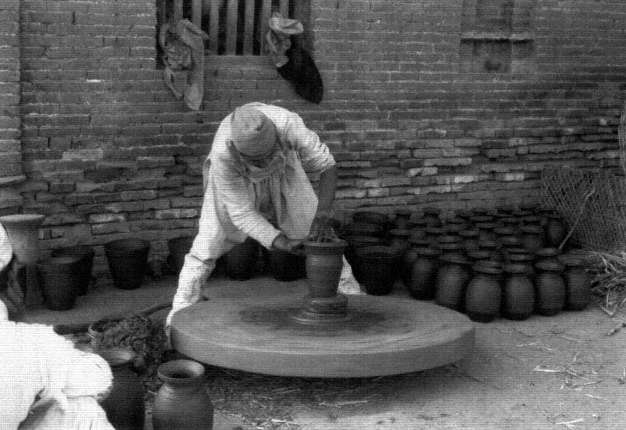
Figure 3.
A member of the Kumha: (potter) thar making pots on his wheel.
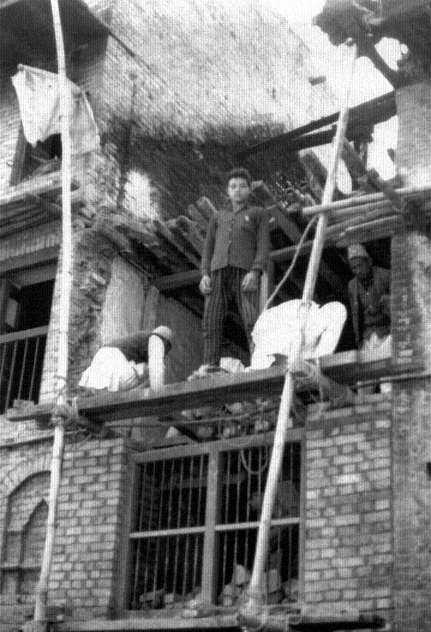
Figure 4.
Awa:s (masons) and Ka:mis (carpenters) building a house.
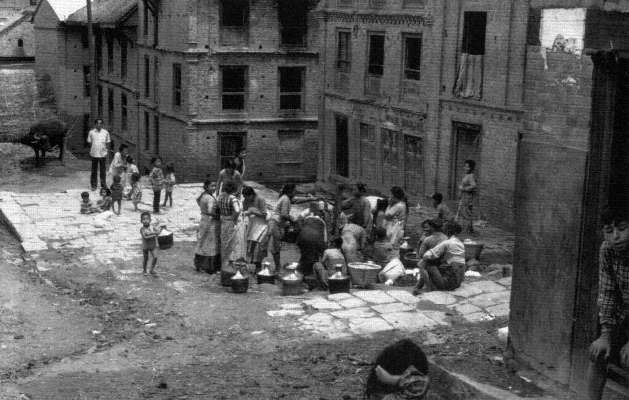
Figure 5.
Young wives chatting while collecting water at a communal tap.
members to some general class of activities (e.g., farming or shopkeeping), there are about forty-five thar s whose membership at present specifies for its members either a particular and exclusive hereditary trade and/or some hereditary "ritual" function, that is, a function in the marked symbolic realm of the city. There are various combinations of occupational and ritual functions. Some thar s have ritual functions that reflect their occupational functions (e.g., potters and carpenters). There are some groups whose hereditary occupational functions have disappeared but who may still have ritual responsibilities deriving from and faintly echoing those functions. There are groups with occupational specialties (e.g., Ayurvedic physicians) and no ritual functions. There are groups whose occupation is a ritual occupation, that is, entirely within the realm of marked symbolism (e.g., priests). Among these various groups there are some thar s whose ritual or occupational function accounts for most of the livelihood of most of the adult male members of the group (e.g., Brahmans, sweepers). In contrast, there are other thar s for whom the ascribed occupational or ritual function, while it is limited to the thar and tends to explain or justify its status in the overall system, may actually be performed by only a few of its members, selected in some way by the thar , and sometimes involving only a small segment of the selected member's time and economic activity. Such variety, which, furthermore, has shifted during the course of Bhaktapur's history, makes the question as to how thar membership determines differentiated ritual and occupational behaviors of its members very complex.
For the purposes of the city's organization, we may emphasize again that it is the output of the thar that is essential, not its internal affairs and organization—as long as those internal features guarantee that output. The important thing for the city as a whole is that sufficient numbers of the members perform their essential functions within the traditional system, and that their other economic functions and social behaviors do not appear dissonant with the status of the thar . The city is, in fact, differentially exigent and severe in its pressures on different thar s to maintain their traditional functions. This is for both material and "symbolic" motives. The city can now do without local drum makers if necessary, but for many reasons it cannot do without the economic and/or symbolic functions of, say, Brahmans, potters, and sweepers. The symbolic practitioners, in fact, must be locally in place. One can import pots from another town, but such actors as Brahmans and sweepers are essential constituting components of
the city system, and must be in place for the traditional system of city action to work at all.
In order to sketch the relation of thar s to differentiated urban roles, we will use an ad hoc sorting that, however, reflects some important contrasts in the implications of thar -assigned roles. In listing these specialized thar s we will briefly gloss their special functions that have been given already above, many of which will be discussed elsewhere in the book. The roman numerals following the thar names indicate the status level. Recall that occasionally the same thar name may occur at more than one status level.
1. Priests, auxiliary priests and "para-priests" (see chap. 10). Rajopadhyaya Brahmans (level I), Lakhe Brahmans (level I, lower section) (priests), Josi (level II) (astrologers), Acaju (level III) (auxiliary priests, with Tantric specialties), Josi (level III) (astrologers), Tini (level IV) (priests), and Acaju (level IV) (auxiliary priests, with Tantric specialties).
2. Thar s who are allied to group 1, the priests, in that their traditional roles, services, products, and behaviors are expressive of and constituent of a special component of the city's symbolic order, which is associated with purity and impurity, "ordinary" deities, and "priestly morality." We will delineate this component in later chapters, and contrast it with other aspects of symbolic order and of power. In contrast to the priests, the functions of these thar s are overtly stigmatizing or at least associated with a depressed status:[37] Cyo (level XI) (purifying services during the cremation phase of the death ritual cycle of upper-level thar s), Gatha (level XIII) (flower growers, deity-possessed performers as the "Nine Durgas"), Kata (level XIII) (cut umbilical cords and remove and dispose of placentas), Nau (level XIII) (barbers, purifyers), Pu(n) (level XIII) (painters of religious images and mask makers), Bha (level XIII) (death ritual services for upper-status thar s); Cala(n) (level XIII) (services in funeral processions of upper-status people), Khusa (level XIII) (esoteric services for one of the Tantric deities during the Mohani festival cycle), Sa:mi (level XIII) (oil pressers, special functions in the Biska: festival cycle), Nae (level XIV) (butchers, kill animals in some sacrifices in major temples), Jugi (level XVI) (tailors; performers on drums, trumpets, and shawms; important roles in the cycle of death ceremonies and other pollution-accumulating tasks), and Po(n)
(level XVIII) (sweepers, fishermen, basket makers; various important pollution representing and pollution accumulating functions).
3. Stigmatizing, occupational specialties with no marked symbolic functions. These are craftsmen whose craft has a traditional status-depressing implication, but who, in contrast to the other thar s listed in group 2, do not have (in the present at least) corresponding additional symbolic functions: Kau (level XIII) (blacksmiths, workers in iron), Chipa (level XIII) (dyers of cloth), and Do(n) (level XVI) (players of trumpets).
4. Nonstigmatizing occupational specialties: Baidhya (level II) (Ayurvedic physicians), Baidhya (level III) (Ayurvedic physicians), Tama: (level VI) (caster of metal pots, plates, and icons), Kumha: (level VII) (potters), Awa: (level VII) (house builders), Kami (level VIII) (wood carvers, carpenters), and Loha(n) kami (level VIII) (stone carvers). (In this group some families of Tama: and Kumha: have some ritual functions in some rites of passage.)
5. Thar s including members who have ritual or ceremonial functions in Bhaktapur's focal festivals (chaps. 12 to 16) and/or in association with the Taleju temple. This represents the "symbolic reconstruction" of the old society centering on the Malla court and the temple of its tutelary deity Taleju: from level II (above), Malla, Pradhana(n)ga, Hada, Bhau, Tacabhari, Muna(n)karmi, Bhari, and Go(n)ga; from level III, Madikami and Bhari; from level V, Suwal; from level VIII, Kalu, Caguthi, Muguthi, Haleyojosi, and Jatadhari; and from level XII, Dwi(n). (Among thar s included in other lists, those with additional special Taleju ritual and/or ceremonial functions include Josi [II], Acaju [III], Tama:, Kumha:, Gatha, Khusa, Pu(n), Jugi, Nae, and Po[n].)
6. We can add to this list those groups outside the Newar Hindu core group who have essential occupational or ritual functions. We noted previously some of the occupational specialities of these groups (shoemakers, knife sharpeners, washermen, etc.). Only two groups outside of the core group have ritual-symbolic functions for the core system. The Bhatta[*] Brahmans have a very limited (but theoretically interesting) function for one upper-status thar (chap. 10). The Bare Buddhist thar provides the children who become the "living goddess" Kumari and her attendant gods and goddesses during the major ceremonial cycle, Mohani (chap. 1.5).
There are, thus, some forty-five thar s in the core system, about 13
percent of the city's approximately 340 thar s, whose membership in itself (rather than through its status level) entails ritual and/or occupational specialties. For the city as a whole, seventeen of these thar s, particularly the upper-status ones, whose ritual activities are confined to the Taleju temple, are of minor differentiated importance. So it is, finally, some twenty-eight thar s, about 8 percent of the whole, whose members have major specializations—against the more diffuse background of farmers and merchants and craftsmen and specialists in being impure, which is organized by the larger macrostatus system. In addition to the total number of specialized thar s we need to consider their relative size and the number of households and individuals that they contain. Their combined size is, as we shall see, a larger percentage of the city's population than their numbers alone would indicate.
Thar And Macrostatus Demography
In an attempt to get some rough idea of the numbers of families and individuals in the various thar s and status units, we asked various informants for estimations of numbers of households in various thar s. Subsequently Gutschow and Kölver (1975), using an early version of our macrostatus and thar lists, gathered survey data on the numbers of households in many of the units.[38] The total number of households located by Gutschow and Kölver was 5,216. Assuming that the 1971 census report of 6,484 households is accurate, this sample is incomplete, but not biased in any evident way. Certain thar s are clumped in their report—for instance, some groups of Chathariya and the large groups of Jyapus. Their materials (with four additions from our informants' estimations), however, give a basis for estimating rather closely the number of households incorporated in various segments of the system. The previous section listed the number of thar s that had various kinds of differential significance. As some thar s contain only two or three households while others may contain hundreds, however, a composite listing of thar s and the number of thar s at each level gives us limited demographic information. The number of discrete specialized thar s is of a different kind of significance for the structure and organization of the city than the quantitative extent of their various memberships.[39]
Table 1, modified from Gutschow and Kölver (1975), gives what is probably a close approximation of thar and status level demography.
Table 1 shows that out of a total of 6,450[40] households all but some
Table 1. | ||
Level | Household | Number |
I | Brahman | 32 |
II | Chathar | 677 |
III | Pa(n)cthar | 247 |
IV | Tini | 2 |
V | Jyapu | 1,867 |
VI | Tama: | 19 |
VII | Kumha: | 419 |
Awa: | 99 | |
VIII, IX | Combined, Jyapu thar s | 1,420 (total) |
X | Chipi | 466 |
XI | Cya | 5 |
XII | Dwi(n) | 1 |
XIII | "Borderline clean thar s" | 437 (total) |
Gatha | 56 | |
Bha | 19 | |
Kata: | 2 | |
Cala(n) | 16 | |
Khusa | 1 | |
Nau | 46 | |
Kau | 27 | |
Pu(n) | 25 | |
Sa:mi | 160 | |
Chipa | 82 | |
Pasi | 3 | |
XIV | Nae | 177 |
XV | Jugi | 57 |
XVI | Do(n) | 4 |
XVII | Kulu | 1 |
XVIII | Po(n) | 90 |
XIX | Halahulu | 1 |
Non-Newar Hindu households | ||
1 | Sakya Buddhists | 260 |
2 | Misra and Bhatta[*] Brahmans | 26 |
3 | Matha[*] priests | 6 |
4 | Gaine | 7 |
5 | Sarki | 6 |
7 | Mushm | 3 |
8 | Dhobi | 2 |
9 | Other ethnic groups (Tamang and Indo-Nepalese) | 129 |
eighty are "Newar." Of the Newars, approximately 6,110 households are in the Hindu core system, while 260 households are Buddhist Bare households, which are not directly involved in the core system. For the broader hierarchical and functional divisions of the core system, 32 households are Brahman; 924 households are at the "sahu" levels; 4,389 households are in the several Jyapu farming groups; and 765 households are engaged in services, crafts, and professions that are considered in some way to be polluting. Of these polluting households 435 have a borderline status, and 330 are unequivocally polluting.
By adding other available information on the number of households in particular thar s within the status levels amalgamated in Table 1, we can suggest the number of households within those thar s that have differentiated functions. Arranged in the grouping we used in the previous section, the number of households are as follows:
1. Priests, auxiliary priests, and para-priests. Total of 333 households: Rajopadhyaya Brahmans (32), Josi level II (44), Acaju level Ill (85), Josi level III (120), Tini (2), Acaju level IV (50).
2. Thar s engaging in stigmatized ritual-symbolic activities. Total of 649 households: Gatha (56), Katha (2), Nau (46), Pu(n) (25), Bha (19), Cala(n) (16), Khusa (1), Sa:mi (160), Nae (177), Jugi (57), Po(n) (90).
3. Stigmatizing, nonritual occupational specialties. Total of 113 households: Kau (27), Chipa (82), Do(n) (4).
4. Nonstigmatizing occupational specialities. Total of 844 households: Baidya level II (3), Baidya level III (8), Tama: (18), Kumha: (508), Awa: (99), Kami (194), Loha(n)kami (14).
5. Thar s, some of whose members have ritual or ceremonial functions in Bhaktapur's focal festivals and/or in association with the Taleju temple. The total number of households in the seventeen thar s with such functions is about 650.
The number of households in the forty-five specialized thar s, is on the average far more than those in the nonspecialized thar s. When we listed all the thar s in the city with a specialized function, they represented about 13 percent of all the city's thar s, among which twenty-eight, or 8 percent of all the city's thar s, had major differentiating importance. In terms of the number of households, however, there are some 2,589, or 40 percent of the city's households that are in thar s having some differentiated importance to the city, and about 29.5 percent of the households in thar s having major specializations.[41]
The numbers of households in a thar that follow its traditional speciality,[42] and the number of individuals in a household who do, vary greatly from thar to thar . Sometimes women are involved in the thar specialization (e.g., farmers, barbers, as purifiers); sometimes they are concerned with subsidiary aspects of the speciality (Brahman's wives for some rituals), or perhaps exclusively with the general running of the household and with other nonspecialized or subsidiary economic activities. Moreover, we do not know from such enumerations how those who do not participate in a thar's traditional activities, activities that define the thar , are affected by their membership.
These internal questions are not our present concern, however. It is the Kumha: as potter, not as farmer or bank clerk, who concerns us here, that is his defining and constituting role in the hierarchical urban system that becomes interwoven with deities, symbolic space, and symbolic performances in the mesocosmic segment of the city's order. For such purposes these demographic notes give a rough idea of the available numbers of role players in that mesocosmic system, numbers distorted by social change and by the loss of some of the controls that may once have more closely regulated the supply of labor in such immobile societies.
Entailments and Markers of the Macrostatus Levels
Membership in a thar in itself may determine many features of an individual's life—occupation, aspects of marriage, residence, details of religious practices, and the various effects of the thar 's special culture and internal organization. Much of this may derive from the special history and distant origins of the thar itself and much from the effects of the thar 's incorporation, its way of being fitted into the macrostatus system. The thars are, in a way, the given raw materials thrown up by history on which the city-wide hierarchical system, the system of macrostatus levels, opportunistically builds. The macrostatus system is a means of ordering and making sense of its multitude of component units by ordering them into much simpler systematized groupings. That system is a typical Hindu "caste system," sharing the ideologies, the central metaphors of purity and impurity, the entailments of rank, and the rules for interactions among ranks that are found throughout South Asia. Such systems have been described frequently and at length, and we will simply sketch some of the entailments of Bhaktapur's twenty macro-
status levels here to indicate what Bhaktapur has maintained and emphasized in its Hindu orthodoxy.
Our sketch is concerned with the central rules of status ordering and their insisted-upon, publicly controlled, and sanctioned expressions. Deviations are internally controlled by family and thar councils, motivated by fear of loss of public respect and of economic and physical sanctions, and externally by people at superior levels who, if necessary, apply such sanctions. The rules concern—characteristically of Hindu status systems—mostly physical contact in relation to eating, drinking, and touching, and regulation of proper marriage. They also include for the lowest thar s rules regarding place of residence, and, until recently, clothing, decoration, and house type. In addition to these centrally important and carefully regulated behaviors there are many other important signs of status level—such as proper language and other behaviors indicating deference, respect, and adherence—and a host of more or less secondary or covert implications of status level, such as economic and educational opportunities, nutrition, differential vulnerability to disease, and many aspects of standards of living.
The centrally controlled behaviors are questions of traditional proper behavior, aspects of the dharma . The implications are often otherwise explained—as misfortune or the results of bad karma . The central system of regulations is highly conscious, involves clear rules and regulations, is based on pervasive and deeply felt ways of viewing the world, and is continuously symbolized and reinforced in ritual and symbolic forms. To anticipate later discussions, we may note here that the separation and ranking of the macrostatus system is considered a positive, dynamic, and activity-requiring process, the result of constant effort. People talk of "sending people to, and keeping them at" their particular level. Separation and ranking is in tension with other ideologies and experiences of blending and equality, and is not based on any theory of fixed, essential, "biological" differences justifying the hierarchy. It must be actively and constantly maintained.
The violation of central regulations is sanctioned, ultimately by the threat of expulsion of an individual, a family, or an entire thar from its status level. These regulations are central in that they constitute the hierarchical system, as the rules for the moves of chess pieces constitute the game of chess. The primary formula, which in itself implies all the separations and hierarchical rankings that make up the hierarchy is, as everywhere in South Asia, that boiled rice and certain boiled legumes (or "pulses") can be eaten only if prepared by a member of one's own
level or of a higher level. This rule is associated with ideas of impurity, which we will consider in chapter 11, and blends with other ideas about the status-derived purity of the provider of food, who must also be pure in other regards, not contaminated, for example, by contact with death or menstruation. From the point of view of any individual in the system there are two groups. There is an upper group including one's own level, from which one will accept boiled rice.[43] Below any individual and distinct from and in opposition to the upper segment in which he or she and his or her peers are included are those groups who will accept boiled rice from the members of that segment, but from whom they will not accept boiled rice. Boiled rice is the basic domestic staple grain of the Newars, and the regulation involves an unavoidable, salient issue. In relation to the acceptance of food, of "being fed," the group to which an individual belongs, except for Brahmans, is always at the bottom of an upper segment.
The process of being excluded by those above and excluding those below effectively slices the hierarchy into its levels.[44] The asymmetry has other implications, however. In the acceptance of rice, one is open to all above and to those at one's own level, and closed to all below. Thus, in terms of the acceptance of rice (which in the ideology of purity [chap. 11], implies the sharing of bodily substance), every individual is in the same "body" as all above (but always significantly at the lowest, most dependent position) and in opposition to all those below in rank. The refusal to take rice from those lower in status is one's own active (and conflicted) responsibility, supported by powerful ideas and feelings, many of which are related to dirt and disgust. But it is, in contrast, by the stigmatizing decision and action of others at superior levels, that our rice is rejected. Any given level gets carved out between its own strongly motivated restrictions toward those below it, on the bottom side, and something quite different, the rejecting behavior of other higher levels toward it on the top side. The solidarity of belonging to "one body" signaled to any individual by the downward flow of boiled rice is countered by an opposition, a radical breach in solidarity signaled by rejection of its upward flow. Looking down the system, one sees people who belong to, derive from, and depend on one, but whom one places on the other side of a barrier of disgust and pollution. Such complex asymmetries encourage in those given to reflection the kinds of intellectual complexity, the "sophistication," which, we have suggested in chapter 2, is an important distinguishing feature of Bhaktapur's people and the uses they make of its marked symbols.
While the differential acceptances and rejection of boiled rice carves out each successive step in the macrostatus system (as do the marriage regulations to which we will return), there are various other designations of differential purity that are arranged hierarchically and refer to particular status levels or groups of status levels, but which are not a regularly increasing and differentiating quality of each successive level. These mark hierarchy in a grosser way, and we may for convenience call them "classes of purity."
While (again typical of Hindu communities) a given group will not accept boiled rice from people in the levels below it, it will accept most other foods until a certain level is reached; at that level its members are considered so impure that no food, not even water, may be accepted from them. This group of people are called "Na[*] calae ma ju phu(n), " people from whom water may not be "moved," or "Tiye nae ma tya phu(n), " people who should not be touched while you or they are eating. In the first phrasing, it is understood that as water is not acceptable, then no other food and drink is acceptable.[45]
The first division, "water-unacceptability," produces a first large distinction among the levels in classes of purity. In the class of levels below the "water line" a second division is made to create a distinct lowest category, the "Tiye ma tya phu(n), " people who must not be touched—whether one is eating or not.[46]
In previous sections we noted which levels are considered in each of these categories. There is some variation in the placement of the level of water-unacceptability, depending on the status of the higher, "purer" person. This is reflected in our "borderline" level, level XIII. Middle and lower levels differ in their conceptions of water-unacceptability even in relation to thar s below level XIII, but every thar agrees on the position of at least two thar s—the Jugi as water-unacceptable and the Po(n) as untouchable, and these two thar s are the present-day inheritors and foci of these positions.
The Brahmans and the upper-status Chathar families who model themselves on them add another distinction. They further divide the group from which they will accept food and drink. Within this group there is an upper strata, those groups from which they will accept all foods except boiled rice and pulses, the groups—as they are sometimes categorized—from which they will accept "salt." These are the Pa(n)cthar and above. Below this group is a second strata, people from whom they will accept all foods that are neither boiled (and therefore, of course, not boiled rice or pulses) nor salted. This group, named by con-
trast with the segment below it, is often called the "people from whom one accepts water." These are for the most part the farmers and "clean" craftsmen.
There were in the past many associated markers of sequential status relationships and classes of purity. One of the most enduring of these has been respect levels in language. In ordinary usage, there are three respect levels indicated in pronouns and in a very few nonpronominal lexical items (most saliently verbs for coming and going and for eating and drinking). People use a formal language in addressing or referring to others who are of higher status than themselves or in addressing or talking about equals in formal situations and a familiar language for people of lower status or for equals with whom they have intimate relations. The third level is a high-respect language used for addressing royalty, Brahmans (and, usually, Buddhist priests), and deities. There are also customs for proper greeting, for respect gestures, terms of respectful address, and more subtle behaviors of deference and authority, which respond to and mark relative hierarchy.
In the past a variety of associated regulations brought some, at least, other aspects of life into accord with purity rankings. Much of this was directed to the lowest most impure classes and facilitated their identification and separation. Thus, according to some of the chronicles, in Malla times members of the butcher thar had to wear sleeveless jackets; sweepers, butchers, and drum makers were not allowed to wear caps, shoes, or gold ornaments; and the sweepers had to live out of the city, and were not allowed to have the roofs of their houses tiled (D. R. Regmi, 1965, part I, p. 647). Many of these restrictions lasted through the Rana period and are remembered by older people but are not enforced now. But some such regulations, although not supported (and, in fact, illegal) under modern Nepalese law, persist. Thus Po(n) untouchables must, in fact, still live beyond the city's boundaries and in simple houses. Another very salient spatial marking of the major polluting thar s also has persisted. This is how far into the space of a house a person of a given polluting class can penetrate. Untouchables can enter only the cheli , the ground floor, which is conceptually considered outside of the house (chap. 7). Higher levels of unclean thar s can go further into the house, at least as far as the first floor above the ground level, the degree depending on the claims to purity of the individual household or its thar .
Foods eaten at different levels are frequently used to indicate status differences. Among the most salient are the foods that the Brahmans
refrain from eating—certain vegetables and the meat of certain animals (water buffalo and [previously] fowl),[47] which are for others common Newar foods. At the other end of the scale is pork, which is eaten only by the lower segments of the unclean thar s, Po(n), Nae, Jugi, and the unclean Indo-Nepalese groups. It may be noted that pigs, like dogs, which are not eaten, are scavenging animals in Bhaktapur, eating, among other things, refuse of all kinds, including remnants of food in human feces. The low Newar groups further distinguish themselves from the Indo-Nepalese shoemaker and leatherworker group (Sarki), whom they claim eat the carcasses of animals that have died of natural causes, which the low Newar groups consider to be much more polluting than eating butchered pigs.
The separation and hierarchy organized by the macrostatus system entail rules about marriage, which make up part of the regulations for proper marriage (see chap. 6). Macrostatus regulations for a proper marriage depend on whether the marriage is a "primary" marriage—one contracted for perpetuation of the lineage.[48] Primary marriages should be within the same status level.[49] In those secondary unions in which the wife may be of a lower level, she cannot legitimately prepare boiled rice for her hushand, and their children will belong to neither the husband's thar nor to his level. They will either take the wife's thar name and level, or in rare cases be given a new thar name and placed at some intermediate level within the system. In these cases the man still is a member in good standing of his thar and can involve himself in its ritual, associational, and economic life—but his descendants no longer belong to it. If he were to marry or form a liaison with someone of an impure thar , however, he would be ostracized from his own thar and level.[50] All primary marriages and the majority of secondary marriages are endogamous within any given status level. The controls here, somewhat like the controls on boiled rice-taking, are asymmetrical. People at any given level are concerned only that their women should not be given as wives to men at lower levels. Their active control is directed to the lower boundary. They have no ritual or social objection to taking wives from levels above them (and when such marriages do occur, they are vaunted), but those upper levels will not, if they can possibly prevent doing so, provide wives for them. It is through each level's concern with maintenance of its lower boundaries that a segmented system of status-level endogamy is created.
We should note that the actual regulations for accepting wives do not
correspond exactly to the regulation for accepting boiled rice, and does not "map" the macrostatus levels as exactly. In Bhaktapur there are subgroups within some macrostatus levels who consider themselves as a higher subsection, and will accept wives only from the same subsection, even though they will accept boiled rice from all thar s at the same general macrostatus level. Other considerations affecting exogamy may also limit marriage to only one section of the general commensal group, or may force people to seek wives outside the city. Thus, while rice acceptance is always directly related to hierarchical relations of macrostatus units in the city, marriage choice is not. Food and contact regulations are constantly at issue and are enforced and reenacted in every act of eating and food preparation; arranging a proper marriage, in contrast, is hardly a daily issue for any given individual.
Status Ranking of and by Outsiders
People in Bhaktapur's core system rank all outsiders—both in and beyond Bhaktapur—into a hierarchical system of relative purity and impurity and, in turn, are ranked by at least some of those outsiders, most importantly by Nepal's dominant Indo-Nepalese. While the ranking of the internal components of the Bhaktapur core system is repeatedly represented and reinforced in symbols and concepts and in action and is very generally agreed upon, these external rankings are a different matter. The objects of Newar or Newar Hindu ranking may well be ranking the Newars in their turn by a different calculus, and do not accept (or sometimes care or know about) Newar decisions about their position. Some of the northern Mongoloid groups do not even accept the underlying assumptions which support the general notion of Hindu hierarchy.
We will list these external rankings in a summary fashion:
1. Groups within Bhaktapur: Buddhist Bare.
For Rajopadhyaya Brahmans, the Buddhist Bare (including both sections—priests and precious metal craftsmen) were considered water-unacceptable. The justifications given by Brahmans for their low rank are miscellaneous, but not necessarily more post hoc than other such justifications for status. These include their metalworking, their traditional performances on "contaminating" musical instruments, and their short seven-day period of contamination after death—such short periods being characteristic of low-level groups. Furthermore, the Bare do not, in con-
trast to Hindus, maintain a residual queue of hair in the course of the shaving of their heads at the time of (and in purification rituals subsequent to) boys' ritual initiation into their thar . This last, a reminder of their original status as monks (Buddhist monks' shaving of the entire head being a sign of renunciation of ordinary lineage and social ties), probably reflects one of the historical reasons for their ambiguous rank—recalling the ambiguous social ranking of all Hindu renouncers. For other members of upper-level thar s, Chathariya and Pa[n]cthariya, the Bare were considered on the levels of the Jyapus, and thus "water-acceptable."[51]
2. Groups within Bhaktapur: non-Newar Brahmans and Matha[*] priests.
Rajopadhyaya Brahmans traditionally considered the Jha and Bhatta[*] Brahmans and the Matha[*] priests to be water-acceptable. The Newar Chathariya, and Pa(n)cthariya treated them as they did the highest segments just below themselves; that is, they accepted all food except boiled rice and pulses from them. Middle-level and lower-level Newar groups accept rice from these priests. Conversely, the Jha and Bhatta[*] Brahmans accepted rice from neither Rajopadhyaya Brahmans nor the levels below them.
3. Relations to other non-Newar Nepalis, both in and out of Bhaktapur.
Newars in general divide non-Newar Nepalis into two groups. Mongoloid peoples, thought generally to have Tibetan connections, are called "Sae(n)." This term is said to derive from an old Newari term for a Tibetan[52] or, according to some, for Lhasa.
For the non-Mongoloid hill peoples, who are in large part the groups from western Nepal associated with the Gorkhali invaders, the term "partya ," or "hill-dweller" is used in polite reference.[53] The ordinary term, considered pejorative, is "khae(n), " derived, apparently, from the tribal designation "khas ."[54] This general term refers in some contexts to the upper-status divisions of the western Khas group, the Brahmans ("Khae[n] Brahmans") and the upper "Ksatriya[*] " divisions (the latter also referred to distinctively as "Chetri") but in other contexts also may include the very low status (generally untouchable) occupational Khas groups such as blacksmiths, tailors, shoemakers, and leatherworkers.[55] Furthermore, other non-Mongoloid hill groups who may be of dubious historical Khas connections, such as the Gaine, are included as Khae(n).
For Newar Brahmans, Partya Brahmans and Chetris are only water-acceptable. The Chathariya and Pa(n)cthariya, in general, accept all
foods and drink except boiled rice and pulses from the Partya Brahmans and Chetri. Those Khas groups untouchable to the Partya Brahmans and Chetri themselves are also untouchable for the Newars.
The Sae(n) were generally treated as water-unacceptable by Brahmans. The Chathariya and strict Pa(n)cthariya accepted water (but not boiled and salted foods) from them. Most, but not all, Jyapu accepted all food except boiled rice and pulses from them.
The residual group, neither Khae(n) nor Sae(n), are Muslims, and these are generally treated as untouchable by the highest levels, and water-unacceptable by those below them.
4. Partyas' conceptions of Newars.
As Lynn Bennett (1977, p. 30f.) puts it, for the Khas Brahmans and the Chetris,
The higher twice-born Newari castes . . . exist in a kind of "separate but parallel" status with respect to the high caste Parbatiya. The remaining castes. . .all fall under the rubric of matwat or "liquor-drinking." From the Brahman-Chetri point of view this large middle-ranking group includes most Newar and other Tibeto-Burman speaking peoples. . . . Members of this group . . . are touchable and water as well as . . . uncooked food or food cooked with ghee can be accepted by high caste individuals from them.
Newar untouchables and the clearly water-unacceptable groups (such as Nae and Jugi) are also untouchable or water-unacceptable to the upper-ranking Chetris and to Partya Brahmans. These rankings reflect the rankings and ambiguities of the Muluki Ain , the attempt to legislate a Nepalese national status system. Its attempts to integrate the entire Newar status system into a national system was very awkward for all parties, and "often deficient or ambiguous and at variance with the self-assessment of the Newar castes" (Höfer 1979, 140).
Envoi
The order generated and represented by thar and macrostatus level relates to hierarchy and specialization, separation and interrelation, although it hardly sorts matters in the simple manner of Bouglé's definition of a "caste" that we quoted at the start of this chapter. In one way or another, however, thar and status level in various combinations assign and control most of the differentiated production of goods and services necessary for Bhaktapur's traditional and early modern urban life.
This order ensures that the many specialists such as masons and
metalworkers—and above all, masses of farmers, will be replaced and maintained from generation to generation. It guarantees that "Ksatriyas[*] " will hold on to the places they have been able to capture, at least for the length of a dynasty. It also provides the priests and untouchables the exemplars and technicians of the system of marked symbolism which presently will concern us. The way that the precise roles and the more diffuse qualities that thar and level attribute and assign to the people who are born into them are—or are not—made use of by the symbolic order, and the ways that the symbolic order expresses and reinforces the status system will concern us in the following chapters.