
Chapter Seven—
The Ideological Molds of Paternalism and Conflict
The prevailing approaches to intergroup attitudes and group consciousness anticipate "consistency" in people's attitudes as the emblem of coherence, constraint, and crystallization in the way people think about their relations with another group. In particular, the policy dispositions of dominant group members toward subordinates should be a direct reflection of how positive or negative their feelings are toward subordinates. The latter, in turn, are thought more likely to assert their political rights when they feel hostile toward those who assert dominance over them. The only "inconsistent" attitude structure that has been the object of sustained scholarly attention is tolerance, that is, the advocacy of equal rights for another group despite negative feelings toward the group.
In this chapter, I explore the relationship between people's intergroup feelings and their policy dispositions. My approach to intergroup ideology does not anticipate a pivotal role for feelings of intergroup hostility. Nor does it anticipate that the magnet that binds attitudes and lends them coherence is "consistency" in the conventional sense. The extent to which groups pursue their interests must be disentangled from the issue of whether feelings of hostility pervade the relationship. The intersection of intergroup feelings and policy views holds considerably more subtlety and implicit finesse on the part of both dominant and subordinate groups than conventional approaches have anticipated.
My thesis is that the beacon to which dominant groups are drawn is the "inconsistent" attitudinal mold of paternalism—the combination of conservative or reactionary policy dispositions with positive feelings toward subordinates. How much paternalism is manifested in the three different relationships under investigation in this book? To what extent is paternalism displaced by "consistent" attitudes comprising negative
feelings and conservative policy views or positive feelings and affirmative policy views? And how empirically viable is the alternative form of attitudinal inconsistency, the configuration of tolerance?
The ideology of paternalism is geared toward eliciting deference from subordinates—warm intergroup feelings and conservative policy dispositions that comply with the dominant design. How successfully do the different dominant groups elicit such deference from their subordinates? What blends of feelings and policy goals are interlaced by subordinates to deal with the rigors of inequality, and how does this vary from one type of intergroup relationship to another?
I begin the chapter by discussing the featured role of consistency in the literature on attitudes and public opinion. This includes a brief discussion of the single empirical concept that has posited an inconsistent attitude structure—political tolerance—to assess its bearing on the prevailing preoccupation with attitudinal consistency. I then consider the factors that have contributed to the binding significance of consistency in attitude theory, and I challenge the underlying assumptions on which that significance rests. Following this, I address two different theoretical concepts that imply attitudinal inconsistency, but which have developed without reference to that issue. The first of these is "hidden" or "everyday" resistance, which depicts the attitudes of subordinates. The second concept is paternalism, which addresses the attitudes of dominant-group members. With those issues delineated, I turn my attention to the intersection of intergroup feelings and policy goals in my data for race, gender, and social class.
I begin that analysis by examining the ways in which positive and negative intergroup feelings are converted into policy goals by people in different kinds of dominant and subordinate groups. I then present a simple empirical scheme that allows us to identify broad configurations of intergroup feelings and policy views. As I address the meaning of each of the categories in the scheme, it becomes apparent that there is not a straightforward equivalence between dominant and subordinate attitudes and that the meaning of particular attitudinal compounds depends on the position of the person's group in an unequal relationship.
This scheme is used to make a baseline empirical assessment of the prevalence of alternative attitudinal configurations in the exchange of ideologies between dominant and subordinate groups in race, gender, and class relations. These data also suggest broader inferences about the dynamics that pervade the articulation of intergroup ideologies by unequal groups. In this way, we can delineate the intersection of the two basic parameters of intergroup ideologies—the expression of hostility or friendship and the pursuit of group interests.
The Issues
Attitudinal Consistency and Ideological Constraint
An assumption has run like a deep dye through public-opinion research that the hallmark of constraint, coherence, and crystallization in people's belief systems is consistency. Since Philip E. Converse's seminal article, "The Nature of Belief Systems in Mass Publics" (1964), students of public opinion have taken it as a given that consistency is the key indicator of whether attitudes have substance and meaning. A number of factors have conspired to foster the preoccupation with consistency in analyses of attitudes and public opinion.
The work that riveted the attention of political-opinion analysts on attitudinal consistency was Converse's 1964 article. His argument was located squarely within the context of mass political opinion in liberal-conservative partisan politics. He contended that most members of the mass public in the United States have only a hazy understanding of the terms liberal and conservative and that they have poorly formulated political opinions of their own. The issue stance of the average citizen fluctuates on the liberal-conservative axis, both over time and from one policy issue to another. Converse demonstrated empirically that correlations were weak between people's issue-stances on the same issues over time and between different specific issues at the same point in time. From this evidence, he argued that belief systems in the mass public generally lack constraint. He reasoned, further, that this lack of constraint derived from the low salience of political issues to most members of the mass public, as well as from poor information about both those issues and the broader political principles that could lend them coherence. This public-opinion muddle was contrasted with the political opinions of political elites: the latter were portrayed as having considerably more constrained belief systems and as being better schooled in the principles that bind specific issues together.
Converse's argument was very compatible with earlier work on voting and public opinion which had already decried the ideological confusion and lack of coherent political thought that reigned in the mass public. For example, the main conclusions of a major empirical study of political opinion by Berelson, Lazarsfeld, and McPhee (1954) were that the average democratic citizen lacks political interest, motivation, or knowledge and casts his vote in a way that is unconstrained by principles and without reference to considered thought about political issues. A similar argument was made in 1960, in a much-cited article in the American Political Science Review by McClosky, Hoffmann, and O'Hara. In an empirical comparison of the policy views of a sample of the mass public and a sample of the participants in the national conventions of the Republican
and Democratic parties in 1958, McClosky, Hoffman, and O'Hara argued that the mass public contrasted sharply with political leaders in having poorly formulated political ideologies and in being poorly informed and having low interest in politics.
Converse's research completed the indictment of the American mass public. This dismal depiction of nonattitudes withering the grassroots of democracy inevitably drew fire. Converse's paper was the lightning rod for a crop of articles that sprang up over the years from scholars who found the picture offensive or unpalatable, or who sought to defend or elaborate Converse's original argument. The ensuing debate has been catalogued by others (see especially Smith 1989). One line of research took off on the question of whether the level of (in)consistency has changed over time (e.g., Bennett 1973; Nie and Anderson 1974; Hagner and Pierce 1983; Kirkpatrick 1976; LeBlanc and Merrin 1977; Nie, Verba, and Petrocik 1976; Piereson 1978; Smith 1989), or whether changes in survey question-wording in the National Election Studies were responsible for the observed changes in consistency (e.g., Bishop, Oldendick, and Tuchfarber 1978a , 1978b ; Bishop et al. 1979; Brunk 1978; Sullivan, Piereson, and Marcus 1978; Sullivan, Piereson, and Marcus 1979). Another line of research raised statistical questions about how best to measure consistency, pursuing such concerns as measurement unreliability, the idiosyncratic properties of various measures of association, and the statistical confounding of true change in attitudes with mindless fluctuations in political views (e.g., Butler and Stokes 1974, 276–295, 316–337; Achen 1975; Weissberg 1976; Krosnik 1991). Meanwhile, Converse continued to develop and buttress his original argument with further empirical work, most notably with two articles titled (meaningfully) "Attitudes and Nonattitudes: The Continuation of a Dialogue" (1970) and, with Gregory B. Markus, "Plus ça change . . . The New CPS Election Panel Study" (1979).
In short, the publication of Converse's article in 1964 provoked an enduring research agenda and molded the way public-opinion analysts continue to think about attitudes. For all the energy that has been absorbed by the questions of how much consistency there is in the mass public and how to measure it, no one has paused to ask whether consistency is such a vital concept in the first place. It has been accepted intrinsically that consistency is the benchmark by which we judge whether attitudes have meaningful substance and whether they may reasonably be considered to belong to a coherent belief system. Indeed, consistency and constraint have been treated as equivalent terms.
There is only one form of attitudinal inconsistency that has engaged empirical analysts of mass political opinion, and that is political tolerance. This construct has been the subject of sustained empirical inquiry, but,
perversely, that research has done nothing to undermine the prevailing conception of attitudes as governed by the pressure toward consistency. The concept of political tolerance, as it emerged in empirical research on democratic norms, is concerned with the ability of democratic citizens to grant full civil liberties to groups with whom they disagree or whom they dislike. In other words, the concept posits a logically inconsistent attitude structure: can people override their negative feelings toward out-groups and support affirmative policies toward them? The concept is central to empirical democratic theory, and it has generated a substantial body of public-opinion research, starting with Stouffer's classic study, Communism, Conformity, and Civil Liberties (1955), and continuing actively to the present (e.g., Kuklinski et al. 1991). I have discussed that research in chapters 1, 5, and 6. What is of relevance here is that, despite the central position of that research in the literature on public opinion, it has not undermined the prevailing conception of attitude structure as bound by the pressure to be consistent.
There are probably three main reasons for this apparent disconnection. First, although tolerance was conceived as an inconsistent attitude structure, empirical measures initially focused on policy dispositions entirely, without heed to respondents' feelings toward the target groups. Respondents' feelings were simply assumed to be negative. But because feelings were not incorporated in measures of tolerance, the specific composition of the tolerant attitude was not acknowledged explicitly. This element was not highlighted in empirical work until Jackman (1977, 1978) and Sullivan, Piereson, and Marcus (1979, 1982) developed measures of tolerance that incorporated both feelings and policy dispositions. Second, tolerance was initially conceived as a difficult state to attain, something uniquely required and fostered by democratic political systems. The problem was posed in terms of whether people could overcome their natural tendency to express their negative feelings in negative policy dispositions and instead develop the restraint necessary to sustain political tolerance. Tolerance was thus thought of as the exception that proved the general rule of attitudinal consistency. Third, empirical research on tolerance showed that it was, indeed, a difficult state to attain. Although scholars have disagreed about the extent of its dearth (see, for example, Sullivan, Piereson, and Marcus 1979, and Abramson 1980), studies have generally found political tolerance to be present in no more than a minority of the population. By default, then, the consistency rule was reaffirmed by empirical analyses of tolerance.
The intuitive reliance on consistency as the cement of attitudes is not restricted to the literature on political opinion. Students of prejudice have conceived of that phenomenon as a lock-step of negative beliefs, negative feelings, and negative policy dispositions. The unprejudiced
person converts those negative values into positive ones: just as negative feelings fuel discrimination, positive feelings undermine it. Similarly, students of class consciousness have expected a proletarian "class-for-itself" to show its ripened political consciousness by adopting negative beliefs about and hostile feelings toward the dominant class, along with assertive policy goals and combative strategies. In the cases of both prejudice and working class consciousness, feelings feed policy dispositions.
In another variant of the consistency approach, Abercrombie and Turner (1982) reflexively use the presence or absence of a consistently applied moral code as a yardstick to assess the fiber of dominant ideology. Their reasoning is that if the dominant class propagates an ideology as a broad moral code to induce the compliance of subordinates, the same moral precepts will be used consistently to dictate the social behaviors of all members of society. They argue that dominant classes in history have not held their subordinates to the same moral code as they apply to themselves and that this means that dominant classes do not in fact have coherent ideologies that would qualify as viable instruments of social control. As I argued in chapter 2, however, this implicit reliance on consistency as the yardstick for the salience of an ideology is misplaced. Dominant groups are not in a contest for consistency: in the day-to-day business of eliciting compliance from subordinates, rigid consistency may be more of a political liability than an asset. Belief systems that are unerringly consistent are vulnerable to attack from all angles: the demolition of a single segment would cause the entire edifice to crumble. Additionally, there seems little practical compunction to apply the identical moral precepts to the group from whom one desires compliant behaviors as to the group whose design it is to govern: divergent roles in life would seem to call instead for flexibility in the application of an abstract moral code.
The common reliance on consistency in these different variants of research on attitudes, belief systems, and ideology is not a coincidence. It can be traced back to the way attitudes were initially conceived in classic attitude theory. An attitude is a purely theoretical construct that is not susceptible to direct empirical observation or measurement. What can be observed in human behavior is sporadic expressions of beliefs, feelings, and behavioral predispositions: in order to tighten their conceptual grip on such an unwieldy class of phenomena, attitude theorists relied on consistency as a key building block. Most definitions of attitudes have given a central place to an evaluative or affective disposition: the feelings that lie at the core of an attitude are thought to be supported by consistent perceptions and, in turn, to drive a stable predisposition to respond to the object of the attitude (see, for example, Allport 1935; Doob 1947). In this way, some order and predictability were carved out of a complex web of empirical phenomena.
The theme of consistency was to be replayed in a range of theories about the structure and characteristics of attitudes. Heider's balance theory (1946) posited that people press their cognitions into consistent configurations. A state of cognitive balance exists when an entity is perceived as having the same dynamic character in all respects (as when a person both admires and likes an object), when all parts of a unit are perceived as having the same dynamic character (as when they are seen as all positive or all negative), and when entities with different dynamic character are segregated from one another. A state of imbalance produces tension that creates pressure to reshape incongruent cognitions so that they come into line with the perceptual gestalt .
These postulates laid down a framework that was explored, developed, and elaborated in theoretical and empirical work by a large and influential school of researchers (see, for example, Newcomb 1953; Osgood and Tannenbaum 1955; Cartwright and Harary 1956; Rosenberg 1956; Festinger 1957; Abelson 1959; McGuire 1960; Cohen 1960; Abelson et al. 1968). Some of the most influential ideas to come out of this school of thought have been that incongruent perceptions cause dissonance in individuals that they are driven to resolve (Festinger 1957); that the affect an individual feels toward an object is tied logically to specific positive or negative perceptions of the object (Rosenberg 1956); that changes in evaluation are always in the direction of increased congruity with the existing frame of reference (Osgood and Tannenbaum 1955); that the greater the salience of a topic, the less tolerance the individual has for attitudinal inconsistency about that topic (Cohen 1960); and that the more directly two issues are connected with one another, the less the individual is able to tolerate inconsistent cognitions across those issues (McGuire 1960).
It thus became a theoretical maxim that attitudes can be identified by their internal consistency: the more salient a topic, the more the individual thinks about it and the more internally consistent the attitude becomes. A lack of consistency signifies the lack of an attitude. Research on political ideology, prejudice, and class consciousness simply built on that theory. Consistency became the standard currency of that research. People's attitudes are thought to manifest increasing internal consistency as they become more crystallized. Indeed, the standard procedure for testing the validity of specific questionnaire items is to check their consistency with other items on the same topic.
Consistency clearly has intuitive appeal to scholars as a magnet to organize the tangled web of beliefs, feelings, and behavioral dispositions that are observed in human expression. Two assumptions underlie this appeal. First, there is an implicit assumption that attitudes are self-contained and individually driven. This creates the theoretical imperative
to find the source of someone's policy dispositions toward an object within the structure of the attitude itself. Thus, discriminatory policy dispositions are driven by negative feelings, whereas positive feelings remove the individual's motivation for discriminatory policy goals and lay the foundation for affirmative policy dispositions. The feelings, in turn, are logically fed by the person's beliefs about the object. Second, there is an assumption that people have a need to be consistent when they think about something. As a topic becomes more salient, the individual thinks about it more often and more intensely: the pressures increase to mold the various idea-elements into a consistent mass. Inconsistency can only be tolerated on topics that receive little attention and are not salient to the individual.
Both of these assumptions are problematic. To begin, the assumption that attitudes are primarily the property of individuals is questionable. Although individuals are the bearers of beliefs, feelings, and behavioral dispositions, they do not hatch these thoughts and feelings independently. Instead, they borrow from the cultural repertoire that is available to them. This book is premised on the idea that the intergroup attitudes that individuals espouse are not formulated discretely out of their personal experience, but are the communal property of the group to which they belong. Second, as people grapple to understand the world in which they live, they do not work according to the principles of either originality or logic. Instead, they reach for ideas from those that float past them on a daily basis, ideas that are espoused convincingly by others, and that have the ring of truth that only familiar things can have. Various thoughts and feelings are borrowed as needed.
The principles that guide the adoption of specific beliefs, feelings, and behavioral dispositions are convenience and efficiency. People tend to think and feel whatever is convenient, and they tend to deal with an issue as efficiently as possible, thinking about it only as much as is necessary to satisfy the political and practical exigencies of the moment. As the political reality changes, the members of a group will adjust their views and feelings, gradually, in a piecemeal fashion. How those exigencies are seen and interpreted can vary within the group: individual variation could stem from variation in personal experiences or pressures, and from differential exposure to information flows. Thus, for example, the well-educated members of a dominant group may espouse a slightly different variant of their group's intergroup ideology: their prolonged experience in educational institutions molds them into an especially individualistic way of thinking and it also exposes them more directly to information flows that contain the latest ideas (Jackman and Muha 1984). But the prevailing force that shapes an individual's intergroup attitudes is his or her membership in a group that has interests to defend or
advance. The specific interests of the group and the history of its collective experience always limit the range of ideological options available to the individual actor.
Intergroup attitudes that are shaped by political exigencies are not perversely static. If political conditions remain unchanged, the prevailing intergroup attitudes will likewise remain in place. But as people respond to the political dynamics of the intergroup relationship in which they participate, old ideas are abandoned, gradually, if they are found to be less serviceable. New ideas drift into their place. At any single point in time, examination of a cross-section of attitudes in a group most likely uncovers a variety of elements, old and new, surrounding the prevailing theme. Similarly, individuals in the group have amalgams of thoughts and feelings that may contain residues from an earlier era along with the currently adopted line. As new information and ideas disseminate through the community in irregular flows, new patterns of ideological response emerge. An interesting example of this process is provided by Gamson and Modigliani (1987) in their analysis of the various packages of ideas that emerged in the unfolding public debate on affirmative action from the 1960s to the 1980s. In response to the policy initiatives of the federal government in the 1960s, a welter of competing ideas in the media were gradually reduced to an identifiable set of packages, out of which one emerged as dominant—the "reverse discrimination" argument. As I discussed in chapter 6, the "reverse discrimination" argument caught on because it resonated with the morality of individualism, and thus it provided whites with a basis for opposing affirmative action that felt comfortably principled and unbiased.
In such a dynamic and political process, the expectation of a clean consistency at either the individual or the group level defies political or common sense. The structure of intergroup attitudes conforms, not to what is consistent, but to what is politically expedient. Indeed, political expediency may dictate an inconsistent attitude structure.
Inconsistent Attitudes in Ideology
In the theoretical literature on intergroup attitudes and group consciousness, two different ideological modes have been posited that imply technically inconsistent attitudes. One of these, known as "hidden" or "everyday" resistance, is described as politically expedient for subordinate groups. The other is paternalism, and it applies to the politics of domination. The concepts of hidden resistance and paternalism have developed without reference to the empirical literature on attitudes, but each of these concepts has important implications for the structure of attitudes in intergroup ideology. The first of these, hidden resistance, has attracted a good deal of attention from scholars of group conscious-
ness, but it is problematic, with serious measurement ambiguities. The concept of paternalism has attracted less interest, and scholars have been wary of its subtleties. I discuss each concept in turn.
Hidden Resistance
An idea that has gained increasing currency among scholars of group consciousness is that a common, stable response to subordination is "hidden resistance," masked by visible acts of compliance (Genovese 1974; Cloward and Piven 1979; Anyon 1984; Scott 1985; 1990). The essence of the argument is that there is more resistance and alienation among subordinates on an everyday basis than a superficial observation of their behavior would suggest. This approach emerged out of the consternation of scholars as to why there has been little sign of an assertive conflict-orientation among subordinates. The argument is that we just were not looking hard enough. The major acts of compliance that are readily observable are depicted as politically expedient acknowledgments by subordinates of the superior might of their oppressors. Underlying such apparent conservatism are definite feelings of alienation from the dominant group which are expressed openly "in house" and which bubble up in acts of petty sabotage, dissembling, and minor infractions of the dominant will. This everyday resistance lies behind the grand theater of compliance (see, especially, Scott 1990, 1–16, 45–69). The expression of resistance is restricted to individual behavior, and it is channeled into hidden outlets that are safe from the scrutiny of the dominant group, or else it is disguised in such behaviors as fawning, feigned stupidity, or incomprehension.
This argument is interesting in that it highlights the subtleties that are nested in the interactions that take place between unequal groups. It also breaks free of the all-or-nothing approach to intergroup conflict. It is still, however, bound by the general parameters of the conflict model, seeking to bring the search for intergroup conflict to a fruitful conclusion by redefining the nature of conflict. In so doing, it introduces some serious definitional ambiguities that sometimes cloud the delineation of resistance beyond recognition. Major acts of compliance are discounted whereas petty acts of noncooperation or sabotage are given predominant weight in the assessment of subordinates' state of mind. Resistance becomes something individual (rather than a group action) and something private or camouflaged (rather than openly combative). Further, scholars acknowledge that acts of hidden resistance often also function as accommodative acts, buffering their practitioners from the worst indignities of subordination as they comply with its requirements (Genovese 1974, 597–598; Anyon 1984). Many acts of day-to-day "resistance" are safe precisely because they conform to the dominant group's expectations (such as beliefs that subordinates are childlike, irresponsi-
ble, emotional, or stupid), and such acts thus also function to reaffirm dominant ideology and legitimize the regime. Indeed, the line between accommodation and resistance becomes faint, and sometimes evaporates altogether (see, especially, Anyon 1984). Malleable rules about which behaviors are valid reflections of the underlying consciousness of subordinates and about how to read specific behaviors turn the observation of human behavior heavily into a matter of interpretation. This makes it difficult to verify or falsify the concept of hidden resistance.
Despite the ambiguities of the concept, we can extrapolate expectations for the structure of subordinate-group attitudes. It implies that subordinates refrain from threatening the dominant group on issues that embroil the conduct of their mutual relationship, but beneath this conservatism lie feelings of estrangement and alienation from the dominant group. These feelings are a part of everyday discourse among subordinates and are thus a part of their consciousness. What this implies, then, is that subordinates have conservative policy views that comply with the dominant will, but that they retain negative feelings toward the dominant group. Any negativism in their behavioral dispositions is restricted to safe areas that are petty or hidden from view.
Paternalism
Dominant attitudes that are paternalistic combine positive feelings toward subordinates with discriminatory policy dispositions. By taking over the definition of subordinates' interests, dominant groups bring themselves to believe that the inequalities that they seek to perpetuate are actually to everyone's benefit. This frees them to practice the inequality without any sense of unpleasantness or hostility. Instead, they can discriminate against subordinates while professing warm feelings toward them and indulging in a gratifying sense of duty and obligation. It is a central premise of the book that this ideological system is a favorite with dominant groups.
Yet paternalism has received remarkably little attention from scholars. Genovese's rich and sensitive (and controversial) portrayal of slavery in the American South features paternalism as the central organizing principle of that system of oppression (Genovese 1974), and Newby has used the concept with effect to analyze both rural labor relations in Britain (Newby 1977a ) and historical changes in the control of industrial labor (Newby 1977b ). There have also been a few scholars who have made use of the concept of paternalism to throw light on race relations or labor relations (e.g., Blumer 1951; van den Berghe 1967; Burawoy 1984).
There is a strain that runs through these discussions of paternalism, as scholars try to reconcile the dominant group's espousal of positive feelings toward subordinates with the presence of exploitation in the intergroup relationship. The subtle but shattering difference between
paternalism and benevolence lends itself both to a misconstruction of the dynamics of paternalism and to an edginess or defensiveness in using the concept. Analysts are torn between assimilating the many expressions of positive affect that emanate from the dominant group and contemplating the brutalities that are also manifested in such a system of inequality. It would seem that analysts experience some disbelief or puzzlement as they are confronted with these apparently contradictory phenomena. Warm feelings seem incongruous with a discriminatory intent, even in the minds of scholars who work with the concept of paternalism.
Indeed, both Genovese (1974) and Newby (1977b ) have argued that a paternalistic system of control gives subordinates a wedge to extract more concessions from the dominant group than they could otherwise obtain. In essence, they believe that the dominant group's espousal of warm feelings toward subordinates poses an internal contradiction in paternalistic systems of control. This contradiction causes a strain that clouds the relationship and leaves the dominant group vulnerable. They argue that subordinates can take advantage of the dominant group's sanctimonious casting of their relationship in terms of a sense of duty and mutual obligation to make a moral claim on some small transfer of resources. Both scholars see dominant groups who espouse paternalism as being vulnerable to giving away more than they bargained for, in order to preserve the legitimacy of their system of inequality. At the same time, the intrinsically demeaning character of paternalism is noted by these scholars, and Genovese is at pains to point out that paternalistic ideology did not prevent white salve-owners from practicing routine violence against their subordinates. These different themes are not integrated, however, and an ambiguity hangs over these analyses.
But it is precisely this ambiguity and subtle deception that makes paternalism such an insidious form of social control, and that generates the lure that it holds for dominant groups. Paternalism offers a way for them to have their cake and eat it too, a way to enjoy the fruits of expropriation without feeling they are taking anything, without having to wrest it away. Far from causing dissonance, expressing affection toward those whom one exploits comes as naturally as retracting your finger from a flame—as long as subordinates are duly compliant and loyal. If analysts sometimes trip up in the morality of paternalism, even as they are observing it from a distance, imagine how well that morality captures that awareness of the hapless participants who are living by its precepts.
In any system of power relations, it is an implicit rule that the dominant party must give some resources to subordinates. In order to facilitate social control, it is important to make sure that subordinates have something to lose. Groups who have nothing to lose pose a dangerous
threat, since they have no stake in the system, no resources to protect. The trick is to keep the exchange of resources as unequal as possible, that is, to extract as much as possible from subordinates while giving as little as possible in exchange. Paternalism, far from lessening the dominant group's control, actually makes it easier for the dominant group to obtain a more favorable exchange. First, paternalism presents the inequality less harshly and thus masks the inequality of the exchange. This leaves subordinates less offended and therefore less guarded. Second, in a paternalistic system, the dominant group has seized more control over the way subordinates' needs are defined. This makes it less likely that subordinates will demand something that the dominant group does not want them to have. And finally, as its trump card, paternalism trades a distinctly invaluable commodity in return for compliance: friendship. If subordinates are dependent on members of the dominant group for the fulfillment of their emotional needs and for their full acceptance in organized social life, the dominant group has an extremely potent weapon with which to extract their compliance.
The coercive potency of paternalism thus draws vitally on the "inconsistent" attitude structure that lies at its core. In order to grasp fully the special dynamics of this ideological system, it is critical to acknowledge this rudimentary point. Feelings toward a group are important, but not in the conventionally understood way of dictating logically consistent policy dispositions. Instead, feelings that are logically inconsistent can enhance the dominant group's ability to practice discrimination. For this reason, I argue that paternalism can become a highly crystallized ideological form that is hard to dislodge. Thus, attitudinal coherence and constraint should not be measured in units of consistency. Dominant groups have every reason to crystallize their thinking in the form of positive feelings toward subordinates and discriminatory policy dispositions.
Data
I begin my analysis by examining the extent to which people's intergroup feelings seem to influence their policy goals in the conventionally expected, logically consistent direction. Next, I investigate the various ways that feelings and policy goals can intersect, first by considering a simplified empirical scheme, and then by examining how the data for race, gender, and class fall into that scheme.
The Relationship between Intergroup Feelings and Policy Goals
How consistent are the data with the expectation that feelings drive policy dispositions, as dominant and subordinate groups face each other in their ongoing relations? Tables 7.1, 7.2, and 7.3 present data that address
that question, for race, gender, and social class, respectively. These tables show the percentages of each group with affirmative, conservative, and reactionary policy goals, according to the distinctions they draw between their own and the other group in their feelings of warmth.
Intergroup feelings are measured in terms of the distinctions people draw between groups, since they are a more sensitive and cogent indicator of affective boundaries than are people's absolute feelings toward the other group. In addition, recall from chapter 5 that people are generally much more likely to express an affective rift between their own and another group than to express outright negative feelings toward the other group. Thus, use of measures of affective differentiation between groups draws out feelings of rift where no absolute feelings of hostility may be present. They make a less exacting indicator of intergroup negativism than would absolute feelings.
Intergroup feelings are categorized slightly differently across the three tables, since the distribution of feelings varies somewhat from one intergroup relationship to another (see chapter 5). And feelings of warmth (rather than closeness) are presented, since the former seem more pertinent to the rudimentary issue of the presence or absence of intergroup hostility.[1] Similarly, the analyses in chapter 6 indicated that policy goals are reflected more sensitively when they are measured against people's existential perceptions. Policy goals are defined as in chapter 6: affirmative goals are those that advocate the government should be doing more than it currently is doing, conservative goals are those that urge no change , and reactionary goals are those that advocate the government should do less than it currently is doing.
Conventional conceptions of intergroup attitudes anticipate a substantial difference between the policy goals of those who draw intergroup affective distinctions and those who do not. If feelings drive policy goals, we should expect the percentage supporting affirmative policy goals to shift substantially and systematically as one moves from those who draw affective distinctions to those who do not. However, across the three tables, the data fall considerably short of that. Overall, the relationship between intergroup feelings and policy goals might most generously be described as loose. I discuss the data for race, gender, and social class, in turn, before drawing out the general patterns.
Race
Table 7.1 displays the figures for whites and blacks. Among whites, intergroup feelings range primarily between degrees of prefer-
[1] Intergroup feelings of closeness and warmth are in fact very highly correlated (see chapter 5, footnote 4). And when tables 7.1, 7.2, and 7.3 were reestimated, substituting feelings of closeness for warmth, the results were highly comparable.
| ||||||||||||||||||||||||||||||||||||||||||||||||||||||||||||||||||||||||||||||||||||||||||||||||||||||||||||||||||||||||||||||||||||||||||||||||||||||||||||||||
ence for their own group and affective neutrality, with just a tiny minority of whites (1.4 percent) saying they feel warmer to blacks than to their own group. Among blacks, intergroup feelings vary between degrees of preference for their own group and affective neutrality. In neither group does this variation in intergroup feelings bear distinctly on racial policy dispositions.
Among whites, the relationship between feelings of intergroup warmth and racial policy goals is nonmonotonic and of only moderate strength. There are only modest shifts in the percentage supporting affirmative policy goals (shifts of 10 to 20 percentage points) and somewhat larger shifts in the percentage advocating reactionary goals (15 to 30 points) between those who feel much warmer toward whites and those who draw no affective boundary. Policy goals shift more sharply among those few whites who go so far as to prefer blacks to whites: among those whites, the percentage supporting affirmative goals shifts about another 30 points beyond those who draw no affective boundary. Such an abundance of good feeling, however, is not only rare but it is more than should be required to remove any affective basis for racial discrimination. The three lefthand columns in table 7.1 represent a wide range of inter-
group feelings, and yet the shifts in policy goals that accompany that range of feelings are fairly limited.
Whites who express affective neutrality are, indeed, more likely than those who prefer their own group to take an affirmative stance on racial policies, but these differences are modest. And unless they go so far as to express an affective preference for blacks, it remains only a minority of whites who can bring themselves to support affirmative racial policy goals. The effect of feelings is consistently more pronounced in drawing whites away from reactionary policy opinions. But dislodgement from a reactionary position does not translate into a comparable increase in support for affirmative change.
Among blacks, the overwhelming preference for affirmative racial policies is budged only a little by their interracial feelings. Between those who draw larger and milder affective distinctions, there is no difference in their policy dispositions. And the move from making slight affective distinctions to making no distinctions in feelings of warmth between the two races brings but a moderate shift (of 8 to 20 percentage points) away from affirmative policy goals.[2]
Gender
Table 7.2 presents the data for gender. Recall from chapter 5 that feelings between men and women span a smaller range than for race or class. In general, neither gender draws an affective boundary between the groups, and feelings do not stray far in either direction. Although women show a stronger tendency than men to prefer their own gender group, women's gender feelings have no bearing on their policy goals. Among men, gender feelings have a modest effect on their policy goals: between men who feel warmer to their own group and warmer to women there is a shift of 11 and 21 points, respectively, in the percentage supporting affirmative policies to provide equal job opportunity and equal legal treatment for women. Most of that difference occurs between those who prefer their own group and those who draw no affective distinctions.[3]
Class
The data for class are presented in table 7.3. For ease of presentation, interclass feelings are dichotomized into those who feel
[2] Measures of association for the cross-tabulations in table 7.1 tell the same story of only moderate associations between interracial feelings and racial policy goals. For whites, Goodman-Kruskal gammas range from .27 to .40, and Kendall's tau-b's range from .16 to .26 (recall that these measures of association include those whites who express an affective preference for blacks over whites). For blacks, gammas range from .29 to .34, and tau-b's range from .12 to .20. Gammas are of course sensitive to the presence of cell N 's that are zero or small; the more stable tau-b's range from small to modest.
[3] Measures of association for the cross-tabulations in table 7.2 are uniformly trivial: for men, gammas range from .08 to .13, and tau-b's range from .05 to .08; for women, gammas range from .01 to –.04, and tau-b's range from .00 to –.02.
| |||||||||||||||||||||||||||||||||||||||||||||||||||||||||||||||||||||||||||||||||||||||||||
| ||||||||||||||||||||||||||||||||||||||||||||||||||||||||||||||||||||||||||||||||||||||||||||||||||||||||||||||||||||||||||||||||||||||||||||||||||||||||||||||||||||||||||||||||||||
warmer toward their own class and those who make no affective distinction or who prefer other classes; recall from chapter 5 that most people falling in the latter category have neutral interclass feelings (rather than preferring the other class). For respondents in the upper-middle and middle classes, the referent classes are the poor and the working class; for those in the latter two classes, the referent classes are the middle, upper-middle and upper classes. In both cases, people's feelings between their own and the referent classes are averaged.
Interclass feelings have only a modest impact on policy goals. Among the upper-middle class, there is a difference of 24 percentage points between those who prefer their own class and those who do not in their likelihood of taking an affirmative position on the issue of government-guaranteed jobs; but on the other two issues, the comparable percentage difference is only about 9 points. Among the middle class, interclass feelings show even less connection to people's policy goals. The impact of feelings is virtually restricted to drawing people away slightly from reactionary goals on two of the issues (providing welfare benefits and guaranteeing a minimum income)—and the percentage difference there is only about 11 points and 5 points, respectively.[4]
Among the working class, the effect of feelings is again quite modest: between those who express warmer feelings toward their own class and those who do not, there are percentage differences of just 6 to 10 points in the likelihood of taking an affirmative position on any of the three policy issues. Among the poor, the effect of feelings is just a notch stronger than in the working class.[5] Regardless of their interclass feelings, very few poor people endorse reactionary policy positions, but they are slightly more likely to move away from conservative policy positions to affirmative ones (by 9 to 21 percentage points) when they have warmer feelings toward their own class.[6]
[4] Data from tables that trichotomize interclass feelings indicate that, in the upper-middle class, there is little difference in policy views between those who prefer lower classes and those who have neutral feelings. In the middle class, however, those who prefer lower classes are more likely to take an affirmative policy stance whereas those with neutral feelings are little different from those who prefer their own class.
[5] Because so few members of the poor and working class express warmer feelings for higher classes than for their own class, an attempt to cross-tabulate policy goals with a trichotomized version of interclass feelings resulted in cell N 's that were too low to yield reliable data for those who preferred higher classes.
[6] Measures of association for the class cross-tabulations in table 7.3 are as follows: for the upper-middle class, gammas range from .13 to .44 and tau-b's range from .07 to .23; for the middle class, gammas range from -.02 to .16 and tau-b's range from -.01 to .08; for the working class, gammas range from .08 to .22 and tau-b's range from .05 to .10; and for the poor, gammas range from .19 to .50 and tau-b's range from .10 to .23. The occasional higher gammas are attributable to the presence of empty or near-empty cells in those cross-tabulations. The more stable tau-b's remain in a range from zero to modest.
General Patterns
Overall, the relationship between intergroup feelings and policy goals ranges from zero to moderate. The policy dispositions of whites show more of a connection to their intergroup feelings than is the case for other groups, but even among whites, the relationship is only moderate. Nor does the relationship between intergroup feelings and policy goals fall into a straightforward monotonic pattern that affects the main body of responses in a single thrust. In addition, there is no systematic tendency for the relationship between feelings and policy dispositions to be affected by the position of the group to which the person belongs (that is to say, dominant or subordinate), or by the type of policy issue at hand (that is, moderate versus more redistributive policies).
Instead, the impression these tables convey is that the prevailing preference of subordinate groups for affirmative policies and aversion of dominant groups to those same policies is buffeted only a little by the intergroup feelings that individuals hold. Clearly, people's intergroup feelings are too loosely coupled with their policy goals to be construed as the force that is driving the formulation of those goals.
Alternative Attitudinal Compounds
The analysis thus far has conceived of the relationship between intergroup feelings and policy goals in the conventional way—that is, in terms of the "consistency" between the two. That approach looks for positive feelings to go with affirmative policy goals and negative feelings to go with conservative or reactionary policy goals among the members of dominant groups and for the opposite relationship to hold among subordinate group members. I ask the reader now to abandon that mold of thinking. It restricts our thinking about intergroup attitudes to a narrow track that bypasses the very types of attitudes that are, I argue, the primary draw for groups. I suggest a new approach that delineates the various ways that intergroup feelings and policy goals may intersect.
An Empirical Scheme
In order to clarify the issues, figure 7.1 presents a simplified scheme that depicts the main ways that intergroup feelings and policy goals can intersect, for people in dominant and subordinate groups, respectively. Each axis is dichotomized. On the horizontal axis, intergroup feelings are divided into (1) those making no distinction between groups or even showing a preference for the other group (labeled inclusive feelings), and (2) those expressing a preference for their own group over the other (labeled estranged feelings). On the vertical axis, policy goals are divided into (1) those advocating affirmative change (that is, that the government should do more than it currently is doing), and (2) those taking conservative or reactionary positions (that is, that the government should do no more, or less than it is currently doing). Four
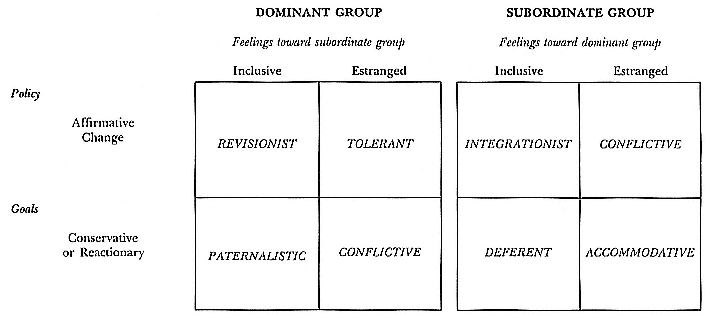
Figure 7.1
Paternalism and conflict: Alternative configurations of intergroup feelings and policy goals for dominant and subordinate groups.
distinct compounds of feelings and policy goals may thus be identified in dominant and subordinate groups.
The first thing that is highlighted by this scheme is that the meaning of particular configurations is altered entirely according to whether one is examining the attitudes of dominant-group members or subordinates. Among the members of dominant groups, those configurations that fall on the diagonal going from top left to bottom right (revisionist and conflictive attitudes) are the "consistent" ones that have been the target of scholarly scrutiny. They combine inclusive feelings with support for affirmative policy change or estranged feelings with conservative or reactionary policy goals. These are the attitudinal configurations that are commonly termed "unprejudiced" and "prejudiced," respectively.
Of the two "irregular" cells, one—the compounding of estranged feelings with affirmative policy dispositions (tolerant )—has received considerable attention from students of political tolerance. The other formally inconsistent cell—the compounding of inclusive feelings toward subordinates with conservative or reactionary policy goals (paternalistic )—has been bypassed in conventional approaches to public opinion and has fallen by the wayside as an awkward anomaly. It is this configuration, however, that holds the most promise for scholars in unraveling the dynamics of intergroup ideologies.
Among the members of subordinate groups, it is the configurations that fall on the opposite diagonal, going from top right to bottom left (conflictive and deferent attitudes), that have conventionally been treated as consistent. Subordinates are logically expected either to take a conflictive approach by expressing estranged feelings from the dominant group and demanding affirmative change, or to be deferent toward the dominant group by espousing inclusive feelings toward them (possibly even showing a higher regard for the dominant group than for their own) and adopting conservative or reactionary policy views.
Neither of the two "irregular" cells has been the object of investigation in public-opinion research on subordinate group consciousness. However, the accommodative cell (that combines estranged intergroup feelings with conservative or reactionary policy dispositions) is certainly implied by theories that postulate that subordinates express "hidden resistance" (Genovese 1974; Cloward and Piven 1979; Anyon 1984; Scott 1985, 1990). Such theories imply that although subordinates generally comply with dominant group demands, their compliance is nothing more than a tacit acknowledgment of the superior power of the stronger group that masks an underlying alienation in spirit that is manifested in small, hidden acts of resistance. If the compliance of subordinates is merely a veneer, we would expect them to populate the accommodative cell, espousing conservative or reactionary policy views but retaining alien-
ated feelings from the dominant group. Accommodation among subordinates might be regarded as the logical counterpart to tolerance in the dominant group: in each case, estranged feelings must be overridden to behave in a supportive way toward the other group.
The opposite "irregular" cell—the combination of inclusive feelings toward the dominant group with calls for affirmative change—I have labeled integrationist , because it reflects the spirit of the movement for racial integration in the United States in the 1950s and 1960s, as advocated by Dr. Martin Luther King, Jr. Despite the prominent position of the civil rights movement in recent U.S. history, this attitudinal compound has had no place in conventional analyses of group consciousness, since it is logically inconsistent. This configuration of feelings and policy goals might be regarded as the subordinate counterpart to paternalism in dominant groups: subordinates might find it strategic to moderate their demands for change with assurances that they feel no hostility toward those from whom they wish to extract concessions.
The simplified scheme that I have outlined identifies four main ways that dominant-group members and subordinates may blend their intergroup feelings and policy goals. The meaning of any specific compound of feelings and policy dispositions cannot be interpreted out of context but depends on whether the exponent is a member of a dominant or a subordinate group. Only one term is applicable to both kinds of groups—conflictive attitudes—but note that it is constructed quite differently, depending on whether one occupies a dominant or a subordinate position in an intergroup relationship. All the other terms are unique to dominant or subordinate groups. For example, it is not germane to ask whether subordinates are willing to override their estranged feelings and grant equality to the people who exceed them in status and perquisites. Similarly, the attitudinal state of deference is a prospect that members of dominant groups are spared.
Fitting the Data
The next step is to apply this empirical scheme to the data for race, gender, and class. To that end, figures 7.2, 7.3, and 7.4 present the percentages of the pertinent dominant and subordinate groups expressing each of the four possible attitudinal compounds, for race, gender, and social class, respectively. Intergroup feelings are measured in terms of warmth or coldness. And recall that since feelings are measured in terms of affective differentiation (rather than absolute feelings toward other groups), the effect is to create more respondents who are categorized as having "negative" feelings, since more people draw affective distinctions between groups than express outright negative feelings toward the other group. Policy goals are reported separately for each specific policy, in order to capture the variant reactions that
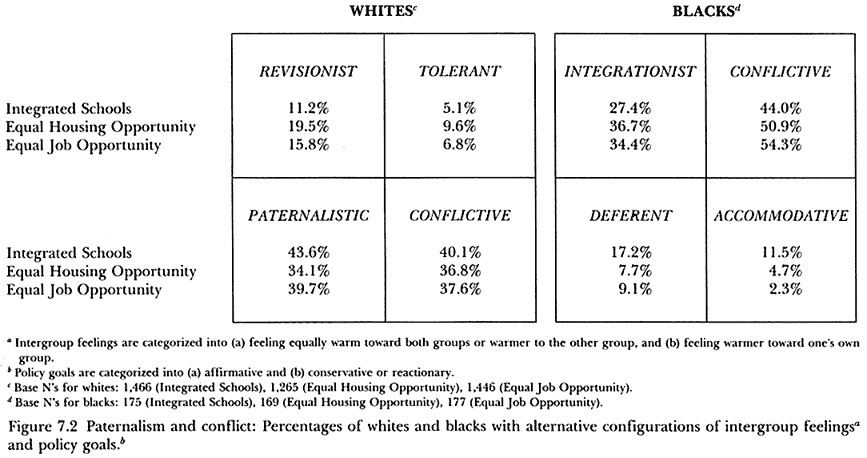
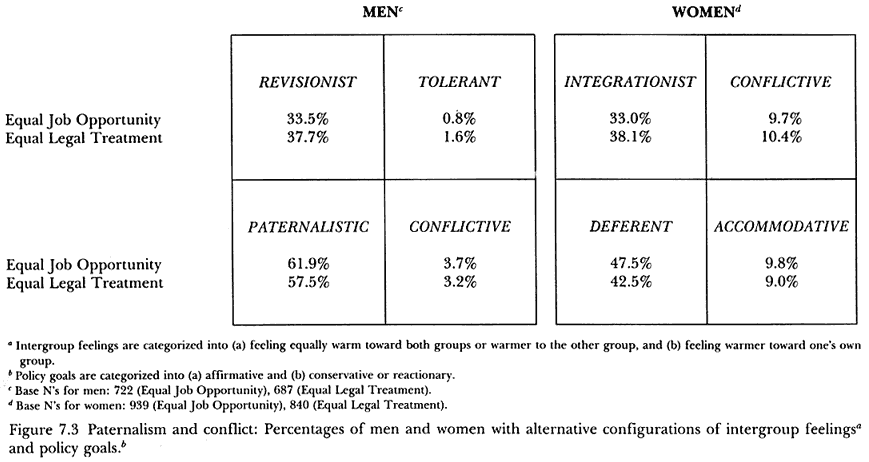
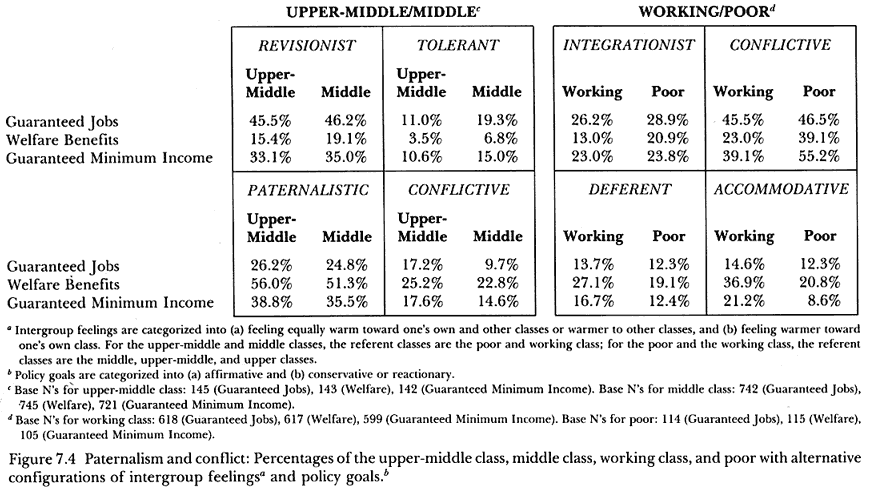
different policies elicit. Thus the patterns of attitudes can be mapped in the form in which they find expression in the evolving policy debate—around specific policy issues.
The construction of these figures focuses our attention on the structure of intergroup attitudes in a different way than the conventional approach. Instead of asking what percentage of a group with particular intergroup feelings support logically "consistent" policy goals, we now catalog the varying ways that intergroup feelings and policy goals intersect. The concern becomes, what percentage of each group compound their intergroup feelings and their policy goals in various alternative ways?
Two tiers of questions await us. First, what proportion of responses are logically consistent or inconsistent, and does that vary between dominant and subordinate groups or across the three intergroup relationships? Second, we move to the more important set of questions, which are unconstrained by concerns with logical consistency: What kinds of attitudinal compounds prevail among dominant and subordinate groups? What are the attitudinal blends by which dominant groups rule or concede and by which subordinate groups comply or resist? And what is the fit between the attitudinal compounds that are favored by dominant groups and the subordinates they seek to control?
Consistency
First, what percentage of responses fall into the logically consistent cells?[7] About 51 to 56 percent of whites, about 40 percent of men, between 41 and 63 percent of the upper-middle class, and 42 to 56 percent of the middle class espouse feelings and policy dispositions that are either consistently positive or consistently negative. Among subordinate groups, the comparable figures for those taking either a consistently conflictive or consistently deferent position are about 60 percent of blacks, about 55 percent of women, 50 to 59 percent of the working class, and 58 to 68 percent of the poor.
In general, then, the proportion of responses that could be considered conventionally consistent falls in the range from somewhat below one-half to just over one-half. The proportion giving consistent responses is somewhat less in the context of gender relations than for either race or
[7] Scholars have conventionally relied on measures of association to assess attitudinal consistency, but, as Weissberg (1976) has suggested, a more direct measure of attitudinal consistency is the percentage of respondents giving consistent responses—that is, the percentage giving responses that fall on the main diagonal when two attitude items are cross-tabulated. As Weissberg points out, measures of association can be depressed when there is restricted variance on the items (even if responses are very consistent), and two items can be strongly associated in the absence of consistency if responses on two items fall in the same rank-ordering.
class relations. And in all three intergroup relations, dominant groups show a slightly greater aversion to logically consistent responses. However, the proportion of logically consistent responses does not vary greatly from one intergroup relationship to another, or between dominant and subordinate groups.
Alternative Compounds
Overall consistency may not vary dramatically across groups or intergroup relationships, but there is substantial variance in the types of consistent responses that prevail. We turn now to the second tier of questions: What blends of feelings and policy goals are espoused by dominant and subordinate groups in the three intergroup relations? I start by comparing the prevalence of alternative types of "consistent" responses, and I then consider the prevalence of alternative "inconsistent" compounds. Finally, I evaluate the way dominant and subordinate attitudes dovetail with one another to form a patterned exchange in each intergroup relationship.
Among whites, consistently conflictive responses far outweigh consistently revisionist responses, by a ratio of at least two to one. And on the issue of integrated schools, conflictive responses outnumber revisionist responses among whites by almost four to one. Among men, however, consistently revisionist responses outnumber conflictive responses by more than ten to one: almost no men take a conflictive stance in gender relations. In the upper-middle and middle classes, the ratio of revisionist to conflictive responses fluctuates, depending on the extent to which the specific policy is redistributive. On two of the policy issues, revisionist responses outnumber conflictive ones in both the upper-middle and middle classes, by ratios between two to one and four to one. But on the issue of welfare benefits, conflictive responses either equal or slightly outnumber revisionist responses.
On the subordinate group's side, consistently conflictive responses far outnumber consistently deferent ones among blacks and the poor and working class. Among blacks, conflictive responses prevail by more than two to one on the issue of school integration (the most sensitive of the three race policy issues) and by more than five to one on the other two race policy issues. Only between 8 and 17 percent of blacks assume a deferent orientation in their racial feelings and policy goals. Among the poor and working class, the margin favoring conflictive responses over deferent ones is slightly smaller than for race. And on the most sensitive class policy issue (welfare benefits), the margin in favor of conflictive responses drops to about two to one among the poor, and it disappears completely among working class respondents. The poor and working class thus manifest just slightly more deference than do blacks, with the figures ranging from 14 to 27 percent among the working class and 12
to 19 percent among the poor. Among women, the ratio of deferent responses to conflictive ones flips around completely from that observed for blacks and the poor and working class. For women, deferent responses outnumber conflictive ones by more than four to one, with almost one-half of women taking a deferent position.
Thus, over the three intergroup relations, conflictive orientations are most heavily in evidence among whites and blacks: approximately 40 percent of whites and 44 to 54 percent of blacks take a conflictive stance. Gender relations manifest the smallest evidence of conflictive orientations: fewer than 4 percent of men and about 10 percent of women take this stance. In class relations, the poor manifest about the same proclivity as blacks for a conflictive orientation, and the working class lag just slightly behind them. The upper-middle and middle classes, however, do not match the propensity of whites for a conflictive orientation: among the upper-middle class, about 17 to 25 percent take a conflictive stance, and among the middle class, conflictive responses drop to between 10 and 23 percent. Note that in all three intergroup relations, even in gender relations, subordinates are more drawn to conflictive responses than are the members of dominant groups. I return to this point below.
The response pattern that draws dominant groups more than any other is a technically inconsistent one: paternalism. Paternalistic attitude blends are most in evidence among men, of whom about 60 percent evince such a response pattern. Among the upper-middle and middle classes, paternalism accounts for about 25 to 56 percent of responses, with the sensitive welfare-benefits issue drawing the most paternalistic responses. Finally, even among whites, whose propensity for conflictive responses exceeds that of any other dominant group, still between 34 and 44 percent take a paternalistic position—roughly the same percentage as take a conflictive position.
The alternative inconsistent attitude blend for dominant groups—tolerance—is the one that has received much more attention from students of intergroup attitudes, but it is the least common response pattern among dominant groups in all three intergroup relationships. Only about 5 to 10 percent of whites and a minuscule 1 to 2 percent of men indulge in affirmative policy dispositions with feelings that are estranged from the other group. Among the upper-middle and middle classes, as many as 10 to 20 percent take a tolerant position on the two relatively tame policies of guaranteed jobs and guaranteed minimum income, but only 4 to 7 percent ascend to a tolerant position on the more threatening issue of welfare benefits. It seems that it is far easier to discriminate against groups one likes than to give equal treatment to groups from whom one feels estranged.
A similar but less extreme phenomenon occurs among subordinates. In general, it seems to be easier to demand affirmative change from a group one likes (the integrationist response) than to accept the status quo from a group from whom one feels estranged (the accommodative response). Among blacks, integrationist responses sharply outnumber accommodative ones, with about one-third of blacks taking an integrationist position and only between 2 and 12 percent taking an accommodative stance. Interestingly, it is on the explosive issue of integrated schools that blacks yield the most. The figures are similar for women, with about one-third or more of women taking an integrationist position and about one-tenth taking an accommodative posture. Among the poor, integrationist responses have a smaller edge over accommodative ones, with about one-quarter of the poor expressing integrationism and about one-tenth being accommodative on the two tamer policy issues and about 20 percent taking each position on the tougher issue of welfare benefits. Among the working class, integrationism loses its edge over accommodative responses. On the two less demanding issues, about one-quarter of the working class take an integrationist stance, with either a smaller percentage or the same percentage taking an accommodative stance. And on the tougher issue of welfare benefits, integrationist responses are far outweighed by accommodative ones in the working class, with only 13 percent being integrationist and 37 percent being accommodative. Thus, overall, subordinates find it more difficult to be accommodative than to be assertively upbeat—but on issues that find stronger resistance among dominant groups, subordinates are somewhat more likely to yield, despite estranged feelings.
Finally, I consider how dominant and subordinate response-patterns dovetail with one another. Surely the response pattern that dominant groups crave from subordinates is deference—the willing and friendly accession to the modus vivendi. To that end, dominant groups drift easily into paternalism, extending the hand of friendship as they withhold resources. How successful are they in their endeavor? Is paternalism rewarded with deference, or is it met with rebuff?
It is in gender relations that paternalism has its fullest flowering, with about 60 percent of men expressing a paternalistic compound of warmth and discrimination. Consistently positive responses are the only other compound to be expressed by any significant number of men, with about one-third being revisionist and only minuscule numbers taking either a tolerant or a conflictive approach. In short, men's gender attitudes commonly include discriminatory policy goals, but estranged feelings from women are virtually absent. And it is in gender relations that deference is most in evidence: close to half of women reward men's paternalism with deference. Some women seek affirmative change, but when they
do so they are much more likely to take the route that is the subordinate counterpart to dominant paternalism—integrationism—than to be flagrantly conflictive. About one-third of women are integrationist. Only about 10 percent of women venture into a conflictive mode, and another 10 percent take the accommodative route. Note, however, that much as deference is the prevailing mode among women and conflictive attitudes uncommon, still deference is less in evidence among women than paternalism is present among men. And, by the same token, a few more women than men launch into a conflictive approach. It seems that the paternalistic-deferent mode of interaction holds somewhat more appeal for men than for women.
In class relations, the upper-middle and middle classes appear primarily as either revisionist or paternalistic, depending on the policy issue at hand. On the two more moderate issues, revisionists tend to equal or outnumber paternalists, but on the tougher issue of welfare benefits paternalists lead the way, with over half of these classes taking a paternalistic line on the issue of welfare benefits and only 15 to 19 percent venturing into revisionism. The poor and working class are much less likely to show deference than are women, although deference is slightly elevated on the sensitive issue of welfare benefits. And as in gender relations, fewer subordinates exude deference than seems called for by the rate of paternalism among dominant group members—indeed, this imbalance is stronger than in gender relations. Over the three policy issues, between 12 and 27 percent of the poor and working class express deference. Matching the class imbalance between paternalism on the one hand and deference on the other, the poor and working class are also considerably more likely than the upper-middle and middle classes to engage in a conflictive approach. Note, however, that on the tougher issue of welfare benefits, the conflictive tendencies of the upper-middle and middle classes are somewhat heightened and the temerity of the poor and working class slips somewhat. Over the three policy issues, between one-tenth and one-quarter of the upper-middle and middle classes take a conflictive stance, whereas the comparable figures for the poor are about 40 to 55 percent and for the working class about 23 to 46 percent.
The exchange of attitudes between blacks and whites is especially revealing. As whites face blacks, they find a group that is more combative than any other subordinate group. Among blacks, conflictive responses are at about the same high level as among the poor (44 percent on the sensitive issue of integrated schools and 51 to 54 percent on the other two issues). In addition, the level of deference among blacks is lower than in any other subordinate group (17 percent on the issue of school integration and less than 10 percent on the other two issues). The response among whites is that a higher percentage is drawn to the conflic-
tive mode than is the case for dominant class or gender groups—approximately 40 percent of whites assume a conflictive orientation. At the same time, however, it is interesting that whites still do not match the level of conflictive orientation found among blacks. In addition, despite the low levels of deference and high levels of conflictive attitudes among blacks, still about 40 percent of whites cling to a paternalistic mode—just as many whites as take a conflictive approach. Despite the failure of paternalism to elicit any significant level of deference from blacks, many whites still cling to this comforting ideological mode.
In each case, then, it is subordinates who seem to lead the way on the path to conflict—albeit with caution. In gender relations, this is manifested in women's slight lag in returning deference for paternalism and in their timid lead in venturing into conflictive dispositions. In class and race relations, where paternalism has less of a grip, these asymmetries between dominant and subordinate groups are more pronounced. The middle and upper-middle classes remain more likely to express paternalism than outright conflictive dispositions, and whites are as likely to express paternalism as conflictive dispositions, even as these dominant groups are confronted with subordinates who generally fail to be deferent and who seem more drawn to the conflictive path.
Conclusions
Consistency has been the centerpiece of theory and empirical research about attitude structure, mass political opinion, prejudice, and class consciousness. Attitudinal expressions that reflect something tangible have been routinely expected to follow the precepts of consistency. Only one attitudinal construct that involves a logically inconsistent configuration has been subjected to sustained inquiry, and that is tolerance—the extension of equal rights to subordinates despite negative feelings toward them. This construct has generally been regarded as the exception that proves the rule, a testament to the power of democratic norms to reshape humans' basic proclivity to form policy dispositions toward a group on the basis of their feelings toward the group.
Outside the bounds of attitude research, two concepts have been introduced that have important implications for the way intergroup attitudes should be conceived, but these implications have not been fully realized. The two concepts are hidden resistance and paternalism. Hidden resistance implies that subordinates retain negative feelings toward the dominant group as they yield to its will. Paternalism implies that dominant groups fuel their discriminatory dispositions toward subordinates, not with negative feelings, but with positive ones.
My approach, abandons the underlying premise on which rests the commonly held tenet that consistency is the glue of well-formed attitudes. Instead of portraying attitudes primarily as a property of individuals, I treat them primarily as the property of groups. The attitudes that prevail in a group are shaped by its collective experience: the moral framework imposed by societal institutions, and the political pressures and opportunities emanating from the structure of the intergroup relationship and the behavior of the other group or groups in that relationship. Individual group members are the agents of ideological forms, not the autonomous creators of those forms. Attitudes are selected from the available repertoire, not for their tidy logic, but for their political utility. As exigencies shift, so too does the array of attitudes in a group: new patterns of response work their way through information channels and gradually supplant older forms that no longer prove serviceable.
The data in this chapter indicate that, in all three intergroup relationships, and among both dominant and subordinate groups, the direction of intergroup feelings has only a moderate influence on policy dispositions. Like many other students of public opinion, I have found that consistency is not the hallmark of popular attitudes. However, I do not infer from this that popular attitudes are unwieldy or incoherent. Instead, I have argued that the question of how feelings and policy goals intersect should be laid open empirically. I outlined a simple empirical scheme that identified alternative configurations of intergroup feelings and policy goals. Each configuration holds a distinct meaning for the ideological messages that flow back and forth through an intergroup relationship.
An examination of the data through this lens demonstrates that formal consistency does not mechanically stamp the intersection of people's intergroup feelings and their policy goals. Instead, the importance of consistency appears stronger or weaker, as a function of the direction of people's feelings. Among both dominant and subordinate groups, negative intergroup feelings are more likely to find expression in logically consistent policy dispositions than are positive feelings.
Thus, the members of dominant groups find it very difficult to maintain affirmative policy dispositions toward subordinates unless they hold inclusive feelings toward them. The inconsistent attitudinal compound of tolerance does seem to stretch most people's capabilities too far: estranged feelings from subordinates are hard to repress when dominant group members formulate their policy goals. Conservative and reactionary policy dispositions, however, do not require estranged feelings to fuel them, and, indeed, they are more often fueled by inclusive feelings. The inconsistent attitudinal compound of paternalism draws as many whites as does a flagrantly conflictive approach, and it occupies a slight
lead over conflictive attitudes in the upper-middle and middle classes and an overwhelming lead over conflictive attitudes among men. Overall, inclusive intergroup feelings are more likely to accompany discriminatory dispositions than are estranged feelings, and holding inclusive feelings toward subordinates is more likely to result in discriminatory policy dispositions than in affirmative ones.
Among subordinate groups, alienated feelings from the dominant group are more likely to produce a consistent pattern of advocating affirmative policy change than they are to be found simmering quietly behind conservative acceptance of the status quo. It seems to be almost as difficult for subordinates to keep their negative feelings tamed in the formulation of their policy goals as it is for dominant group members, and unhappy accommodation to the dominant will is almost as unusual among subordinates as is tolerance in dominant groups. But, as with dominant groups, inclusive intergroup feelings provide less of a guide than do estranged feelings as to the way policy goals will be formulated. Inclusive feelings toward the dominant group sometimes lead to a deferent acceptance of the status quo and sometimes accompany a call for change. Indeed, in race relations, integrationist responses resoundingly outnumber deferent ones, and in class relations, integrationism usually predominates over deference. In gender relations, where deference is more common than in either of the other two intergroup relationships, integrationist responses are clearly outnumbered by deferent ones, but still a substantial minority of women (one-third or more) match inclusive feelings toward men with the advocacy of affirmative change.
We may think about integrationism as the subordinate counterpart to paternalism in dominant groups, whereby each group packages the pursuit of its interests with the expression of positive feelings toward the other group. Just as paternalism is an intuitively shrewd way to soften the presentation of dominant group interests, integrationism relies on the expression of affective inclusiveness toward the dominant group to sweeten the advocacy of affirmative change. It is interesting that dominant groups seem more drawn to such an ideological strategy than are subordinate groups.
We know from the data in chapter 5 that subordinates are more likely to withdraw emotionally behind group lines than are the members of dominant groups. The experience of underprivilege is more of a stimulant to the development of emotional boundaries between groups than is the experience of privilege. When subordinates develop estranged feelings from the dominant group, they find it more difficult to contain those feelings and continue endorsing the status quo than to translate them into an assertion of affirmative policy goals. Subordinates seem more inclined to engage in open resistance than hidden resistance. But
even though the dominant group is getting less compliance from subordinates than it seeks, dominant-group members generally resist the pull toward either affirmative change or intergroup conflict. Confined by their unwillingness either to grant concessions or to engage in flagrant conflict, the members of dominant groups find refuge in the haven of paternalism.
In an intergroup relationship that is structured with frequent, intimate, one-to-one contacts across group lines, paternalism holds the day. Almost two-thirds of men are paternalistic, and they are rewarded with deference from almost half of women, considerably more deference than is found in any other subordinate group. In race and class relations, the structure of interaction across group lines is less favorable to paternalism. The extreme spatial segregation of blacks from whites has seriously restricted whites' opportunities to invade the cognitive and emotional sensibilities of blacks, and blacks show less inclination to be deferent than does any other subordinate group. Yet even as about half of blacks take a conflictive orientation and only a tiny minority are deferent, still whites lag behind blacks in their readiness to be openly conflictive, and they are as inclined to cling to paternalism as they are to be conflictive. The structure of class relations is marked primarily by spatial segregation and aggregated communication channels between classes, especially between the highest and lowest social classes, but this pattern is broken by limited opportunities for personal contacts across the boundaries of adjacent classes. The former factor undercuts the suitability of class relations for the practice of paternalism, but the latter introduces some opportunities to penetrate the awareness of at least those subordinates who are most adjacent to one's own class in the step-wise chain of class contacts. These dual factors work to mitigate the tendencies toward conflict: even as the poor, and to a lesser extent the working class, manifest a pronounced proclivity for conflictive attitudes and only slightly more deference than do blacks, the upper-middle and middle classes retain a greater propensity for paternalism than for conflictive attitudes.
In the ongoing political game between dominant and subordinate groups, it is subordinates who lead the way to conflict, but even their efforts in that direction are wary. As each side attempts to engage the other while trying to avoid a strong counterreaction that could jeopardize current holdings, bold moves are a rarity. Dominant and subordinate groups demonstrate their mutual sensitivity in the way they shift their positions in step with each other as they move from one policy issue to another that is more, or less, threatening to the core of their relationship. On those issues that have less redistributive implications, such as guaranteed jobs in the class arena, dominant-group members are more inclined to be revisionist and subordinates push a little harder. On issues that are
more threatening, such as the class issue of welfare benefits, dominant group members move from tolerance to conflict and from revisionism to paternalism: subordinates retreat accordingly from conflict to accommodation and from integrationism to deference. By responding differentially to the various policy issues that are raised in an intergroup relationship, dominant groups can thus steer their attentive subordinates away from those issues that pose the greatest threat to dominant interests.
As the game continues, flexibility and differentiation are more common traits on both sides than is an unerring consistency. Far from indicating a lack of coherence or salience, these traits reflect the acute political sensitivities of both sides as they pursue their interests with intuitive care. For the same reasons, the ideological patterns that prevail are not flagrantly conflictive. Both dominant and subordinate groups show an inclination to package the pursuit of their group's interests in positive, rather than negative, feelings. This task is more difficult for subordinates, who must bear the daily offenses of underprivilege, and who are thereby often provoked into feelings of estrangement from the dominant group. But for the members of dominant groups, who can usually contemplate their daily experiences with greater equanimity, paternalism holds a magnetic lure that lingers on even as they are jostled by the wary and fitful ventures of subordinates into conflict. It proves difficult to abandon the trappings of an ideological system that so delicately obscures the raw pursuit of your own group's interests.