
II—
The Greek and Coptic Documents
I fought the law, and the law won
Bobby Fuller
To be a jurist in the mid-sixth century was to be at the leading edge of learning. The careers of such men as Agathias[1] and Tribonian[2] stand out against a background of the unknown thousands of provincial lawyers who kept the empire running. The phenomenon of the jurist as a man of letters, far from unknown in the English-speaking world and on the Continent, was also notable in Late Antiquity. The prose writings of Dioscorus of Aphrodito come from a literary background in which skill in classical learning stamped the local writer as a recognizable member of the shared culture.
The growing rhetoricization of legal acts[3] reflected a combination of
[1] Averil Cameron, Agathias (Oxford 1970) 1–11.
[3] There is abundant literature on the process of rhetoricization of the law, a process that had been going on since the heyday of the Second Sophistic. The broad theories of J. Stroux, Römische Rechtswissenschaft und Rhetorik (Potsdam 1944) are no longer accepted (cf. L. Wenger, Die Quellen des röm. Rechts [Vienna 1953]); see A. A. Schiller, Roman law (The Hague 1978) 569–571, 582–584. But compare F. Schulz, Roman legal science (Oxford 1946) 262–277, 295–299 (cf. 328–329). When the Florence concordance to the Greek Novels is finished, much work will be facilitated (cf. Honoré, Tribonian, chaps. 3 and 4). Much of the legal literature of this period still lurks in the adespota of Roger A. Pack, The Greek and Latin literary texts from Greco-Roman Egypt[2] (Ann Arbor 1965). We might think also of thejuristic fragments from the binding of Nag Hammadi Codex VIII (see NHS 16, Leiden 1981). The rhetoric of the law is seen even more in the praxis of the documents than in the prescriptions of jurists.
the classical training required by society and the permeation of language by scriptural and patristic echoes. A legal document as it came from Dioscorus's pen was far from a dull, flat-footed, matter-of-fact record of a transaction. But it was also not simply a verbose exercise in the sound of one's own voice or the freakishly antiquarian hunt for obscure words.[4] Even more so than a poem, a legal document was a mirror of his world, inasmuch as it was a working reality that actually effected something.[5] One could not be too careful in the face of the law[6] (especially as it had come to be understood by the 560s). The legal act and procedure were intimately bound up with their social context.[7] As a practicing member of the Egyptian bureaucratic elite,[8] Dioscorus consciously tried to do full justice (in every sense) to the problems that came his way. His travels, as well as his family background of philosophical learning,[9] high status, and involvement with monasticism, added to his competence as a professional.[10] In the Greek and Coptic documents that compose the body of his work, we can
[4] See H. Zilliacus, Zur Abundanz d.spätgriech. Gebrauchssprache (Helsinki 1967), esp. 20–25 (cf. 10), 62–68. R. MacMullen, "Roman bureaucratese," Traditio 18 (1962) 364–378, is overfull of unhelpful jargon. We are in the presence of matters other than the "leere Floskeln" beloved of classical critics (e.g., W. Spiegelberg and F. Rabel, "Ein koptischer Vertrag," Abh. Göttingen, phil.-hist. Kl., n.F. 16.3 [1916–17] 75–84). Cf. L. S. B. MacCoull, "Child donations and child saints in Coptic Egypt," EEQ 13 (1979) 409.
[5] Cf. Marc Bloch, The historian's craft (New York 1953) 168: "the vocabulary of documents is, in its way, only another form of evidence. . . . Each significant term, each characteristic turn of style becomes a true component of knowledge—but not until it has been placed in its context, related to the usage of the epoch, of the society or of the author." Also A. E. Samuel, From Athens to Alexandria (Louvain 1983) 9: "Because economic behavior is so indicative of over-all social attitudes, we can use the evidence of economic theory and activity to reveal those tacit assumptions about man and society which underlay the construction of social and cultural institutions." Even the act of making up a valid transaction reveals a world. A document was a dispositive thing: H.-J. Wolff, Das Recht der griechischen Papyri Ägyptens (Hdbuch d.Altertumswiss. 10.5.2) (Munich 1978) 141–144.
[6] Cf. L. S. B. MacCoull, "Child donations," pp. 409–415.
[7] R. V. Colman, "Reason and unreason in early medieval law," J.Interdisc.Hist. 4 (1974) 571–591, esp. 571–579—a brilliant study.
[8] See T. F. Carney, Bureaucracy in traditional society: Romano-Byzantine bureaucracies viewed from within (Lawrence, Kansas, 1971) II.117–122, 176–187 (cf. 78–83). Unlike John Lydus, Dioscorus does not voice open disillusionment with his job or with "the system."
[9] It is Dioscorus's papers that have preserved the Horapollon letters: J. Maspero, "Horapollon et la fin du paganisme égyptien," BIFAO 11 (1914) 163–195.
[10] Cf. F. S. Pedersen, "On professional qualifications for public posts in late antiquity," Class.etMed. 31 (1975) 161–213. As one might expect, though, breeding and connections counted. Dioscorus had both status as local gentry and educational attainment.
see how the functions of recording and of decision became fused.[11] In this process lay the seeds of the future of Coptic law.[12]
The documentary production of Dioscorus offers the penultimate stage of development—before the evolution that took place after the Arab conquest—in which to observe the perennial interpenetration of Reichsrecht and Volksrecht[13] in a late Roman province. And more: the polarities observable in the praxis of Aphrodito and Antinoë are not only those of the imperial legislation of Old and New Rome[14] vis-à-vis the inherited custom of the country.[15] The tensions also appear as an interaction between two modes of perceiving the role of the human intellect, one profoundly positive and one profoundly negative—an ambiguity that has continued to affect Coptic culture to the present day. The actions and transactions of Dioscorus and his fellow citizens show forth their definitions of truth, their mechanisms for finding out truth, and their underlying assumptions about how truth operates in human life.[16]
The style, in Greek and Coptic, in which these transactions are couched reflects the network of interlocking responsibilities[17] so characteristic of the Late Antique city (particularly in Egypt with its uniquely inescapable landscape).[18] Dioscorus's personal documentary style, as seen in its own time,[19] bears the imprint of several major influences. Besides the technical language he had learned and used as a working tool,[20] he every-
[11] Cf. B. Stock, The implications of literacy (Princeton 1983) 41–42; cf. 58–59.
[12] The position taken by A. A. Schiller in "The courts are no more," Studi E. Volterra (Milan 1969) 469–502, is rather extreme: he asserts that the non-Chalcedonian Copts' loathing for the "official" justice of the Chalcedonian government was so intense as to bring about the development of a whole system of private, personal, arbitration-based justice for the community. The actual situation surely did not draw such hard-and-fast lines before the conquest. (Afterwards became a different matter.) Cf. Colman, "Reason and unreason," pp. 573–575.
[13] So formulated after the title of Mitteis's classic work, Reichsrecht und Volksrecht in den östlichen Provinzen d. röm. Kaiserreich (Leipzig 1891).
[14] Cf. A. A. Schiller, "The fate of imperial legislation in late Byzantine Egypt," in Legal thought in the USA under contemporary pressures, ed. J. N. Hazard and W. J. Wagner (Brussels 1970) 41–60.
[15] For an earlier period, cf. E. Seidl, Rechtsgeschichte Ägyptens als römischer Provinz (Sankt Augustin 1973).
[16] The divisions in Late Antique Egyptian society are usually discussed as being those of center vs. periphery, of "classical" vs. "anticlassical" elements, along linguistic and confessional lines. (Cf. Chapter 3, n. 58.) These analyses do not work any more than does a simple Reichsrecht/Volksrecht methodology.
[17] Cf. Colman, "Reason and unreason," 573–575.
[18] P. R. L. Brown, The making of late antiquity (Cambridge, Mass. 1978) 3–4, 81–85.
[19] Zilliacus, Abundanz, pp. 6–8, 43–47, for examples.
[20] Ibid., 63.
where echoes the Scriptures and the liturgy. His Greek style appears modeled to a perceptible extent on the rhetoric of Cyril of Alexandria,[21] and his vocabulary shares elements with the philosophical usage of John Philoponus.[22] Of course, beneath the surface of his Greek lies Coptic syntax: the parataxis, the effective asyndeton, the aesthetic implied in an analytic language of particular verbal systems and word orders.[23] His Coptic style itself combines businesslike straightforwardness, vividness in narration, and imaginative embellishment. The tendencies visible in Dioscorus's prose can be seen taken further in such sixth- to seventh-century pieces as the Greek ecclesiastical letters in P.Grenf. II 112[24] and BKT VI 10677, and the Coptic synodal letter of Patriarch Damian in Epiphanius II 149–152. (Recognizable stylistic elements are still alive nearly three hundred years later, in the documents of the Hermopolite monastery of Apa Apollo.[25] ) Dioscorus's documentary work stands nearly midway in the history of that Late Antique Geschäftsprosa, which was itself an art form.
Dioscorus was a bilingual man functioning in a bilingual society. As Roger Bagnall has stated, "the Coptic papyri of the archive need editing, for without them any synthetic study of the world of Dioskoros would be a
[21] See A. Vaccari, "La grecità di S. Cirillo d'Alessandria," Studi P. Ubaldi (Milan 1937) 27–40; cf. L. R. Wickham, Cyril of Alexandria: select letters (Oxford 1983) xiv, for a decidedly negative opinion of Cyril's style. See also C. Datema, "Classical quotations in the works of Cyril of Alexandria," Studia Patristica 17 (Oxford 1982) 422–425.
[23] Cf. I. M. Diakonoff, Hamito-Semitic languages (Moscow 1965) 38–41. Coptic does not form certain kinds of compounds, and places weight in the noun more than the verb; this explains much. Zilliacus, Abundanz, p. 10, is surely wrong in not seeing many signs of Coptic interference in sixth-century Greek documentary style (from Egypt). (Cf. F. T. Gignac, Grammar of the Greek papyri of the Roman and Byzantine periods I [Milan 1976] 46–48.) Dioscorus's prose, however, is not to be dismissed as the bumblings of a babu who had never properly learned to think in or to employ the language of the high culture (cf. H. I. Bell, "An Egyptian village in the time of Justinian," JHS 64 [1944] 27–31, one of the milder condemnations of his style). Its charm lies in sharply rendered perceptions and unexpectedly happy juxtapositions. (For this sort of poikilia and variation as Late Antique stylistic traits, cf. the remarks of M. Roberts, "The Mosella of Ausonius," TAPA 114 [1984] 344 with nn. 8–10, 353.)
[24] Now redated to A.D. 557 by S. Bernardinello, "Nuove prospettive sulla cronologia del Pap.Grenf. II 112," Scriptorium 34 (1980) 239–240; cf. "Cronologia della maiuscola greca di tipo alessandrino," Scriptorium 32 (1978) 251–255.
[25] See M. Krause, "Das Apa-Apollon-Kloster zu Bawit" (Diss., Leipzig 1953), now finally to appear in printed form. The MSS are British Library Or. 6202, 6203, 6204, 6206; their oath formulas can be integrated with those collected by K. A. Worp, "Byzantine imperial titulature in the Greek documentary papyri: the oath formulas," ZPE 45 (1982) 199–223. My initial study of them will appear in BASP 24.
farce."[26] Unfortunately, our knowledge of the Coptic portion of Dioscorus's papers is not yet complete;[27] and, given conditions in Egypt, substantive results cannot be expected in any foreseeable future. In searching the Coptic documentary papyri in collections known to contain Greek items by Dioscorus, I have not found anything either in his hand or mentioning his name. Did the process by which the Dioscorus archive came to be scattered among numerous libraries affect only the Greek papyri? In any case, such Coptic documents as I have found to exist will be fully incorporated into the present treatment.
What little information we have of the circumstances of the second Kom Ishgaw find in 1905 or the clandestine diggings in 1937 and 1938, followed by over forty years of total lack of interest, does not even now enable the researcher to track down Dioscorus's Coptic pieces. Three boxes of Coptic material from the site were given by Lefebvre to the Cairo Museum;[28] however, because Jean Maspero could not read Coptic, they were put aside, and the fate of their contents is still unknown. Those sixth-century Coptic Aphrodito documents that have come to rest in the Vatican library, having been removed to safety at the time of the transfer of material to the then-new Coptic Museum, are not in Dioscorus's hand. We may assume, however, that he had kept them among his working papers. Perhaps they were inherited from his father, although the Vatican papyri contain few clues as to dating. Numbers 5 and 1 probably come from 535/6 and 536/7,[29] during Apollos's floruit and Dioscorus's youth. Their phraseology displays the characteristic fullness of Greek usage and legal idiom[30] we are later to find noticeable in Dioscorus's own work at the Aphrodito and Antinoë chanceries. But, apart from the normal "squirearchical" documentation (in Greek) outlined in Chapter 1, we do not hear Dioscorus's own voice in either language until 547/8, when he had become the heir to his estates and assumed the role of spokesman for his community.
The earliest preserved monument, the first extended piece of Dios-
[26] R. Bagnall, review of I papiri Vaticani di Aphrodito by R. Pintaudi, BASP 18 (1981) 177.
[27] See my overview, The Coptic archive of Dioscorus of Aphrodito," Cd'E 56 (1981) 185–193. Further pieces, it seems, lurk in the Cairo Museum among the material numbered S.R. 3733; I am still in process of preparing texts. Two are in the Ismaila Museum.
[28] P.Cair.Masp. III, preface; L. S. B. MacCoull, "Additions to the prosopography of Aphrodito from the Coptic documents," BSAC 25 (1983) 91.
[29] See L. Papini, Notes on the formulary of some Coptic documentary papyri from Middle Egypt," BSAC 25 (1983) 83–89, and "Annotazioni sul formulario giuridico di documenti copti del VI secolo," Atti XVII congr.intl.papirol. (Naples 1984) 767–776.
[30] L. Papini, ibid. (utraque ).
corus's prose writing, is the petition to the empress Theodora of 547/8, P.Cair.Masp. II 67283, written just at the end of the empress's life. This production dates from the eve of Dioscorus's journey to the capital, before he began (as far as we know) the composition of poetry. In this, his first work, we can see some of the elements that went into the formation of his mind: familiarity with his family's papers, reminiscences (perhaps) of Apollos's trip to Constantinople, knowledge of the workings of the chancery and, of course, the classics and the scriptures. In it we can already see many of the elements that are to be characteristic of his developed prose style: ornamental and emotionally expressive nouns, declamatory flourishes, biblical and classical reminiscences effectively interwoven. It builds in a crescendo from a simple opening identifying the petition's author and recipient to an elaborate rhetorical close that depicts the empress's healing hand protecting the land from evil.
The opening of the text is addressed by the Aphroditans to a deacon, Victor, and a body of officials (with the title



are punished, dwellings are made splendid, and the possessions of your native people are kept safe from being undermined or razed" (presumably by tax collectors illegally looking for that last keration).
In this splendid rhetorical closing, with the image of the healing hand adorning Egyptian civic life and enabling the good life to be led (an image resembling Hestia Polyolbos), Dioscorus has given, at the beginning of his career, a classic statement of Late Roman civic values. Could Apollos have seen Theodora, in 541, and come home full of tales? Perhaps. In any case, Dioscorus's striking image of the healing hand and the civic benefits it enacts both vividly recalls visual depictions of the Hand of God in Late Antique art and boldly states an ideal. The ideal was one of simultaneous visible splendor in the city's material structure and shining justice for its inhabitants. However imperfectly realized, still the ideal was there, and it is a merit of Coptic society to have clothed it in such all-enfolding and luminous imagery.
By the last years of the reign of Justinian, financial and social tensions at Aphrodito were an old story, and one familiar to the former young squire who had been to the capital of the empire and was no stranger to responsibility. The events that led to and prompted Dioscorus's career move from Aphrodito to the ducal court at Antinoë have already been sketched.[31] From 564 (probably) we have, in Coptic, the record of an arbitration[32] in a case at law that illustrates the sort of last-straw frustrations he had to endure in the business of estate management. Some eighteen months later he will have transferred to the Antinoë chancery, now jurist and poet rather than homebound landlord.
P.Berol. 11349,[33] drafted by another notary but with a small annotation in Dioscorus's hand, begins with the technical operative verb of arbitration,


In the first part of the narrative, Dioscorus speaks in the first person. He contends that Joseph, his tenant, has so imperfectly worked the land he has leased from Dioscorus that the field has not yielded its quota of tax
[31] Cf. MacCoull, "Dioscorus and the dukes," BS/EB 1987.
[32] Noticed by A. A. Schiller in his introduction to the second edition of KRU (Leipzig 1971).
[33] I am grateful to Dr. G. Poethke of the Staatliche Museen zu Berlin (DDR) for photographs of the papyrus. It is not, except for an annotation, in Dioscorus's own hand, but it yields a coherent text.
(demosion and phoros), and that therefore Dioscorus is unjustly stranded with the tax liability. At harvest time (Pachons and Payni), Dioscorus himself secretly checked the accounting and was so shocked at the outcome that he lodged a complaint against Joseph; thus, if the arbiter finds Joseph guilty, it is he who will (rightly) have to pay the tax. It seems that Joseph has also compounded his negligence by allowing animals with their herders to trespass across the field,[34] thus making the land even less able to yield its needed quota. Dioscorus concludes his accusation by alleging that Joseph has even acted in collusion with the (unnamed) boethos to cover up what he has done. Next, the arbiter records Joseph's flat denial of any negligence; then, switching into the first person, he states that he attributes the wrongdoing to Joseph the tenant, not to the owner who has brought the complaint, but that Joseph may not have known that his actions constituted negligence.
Unfortunately, no absolute date has been preserved in this document; however, the thirteenth indiction mentioned in line 37 would suggest the year 564, when Dioscorus was still at Aphrodito and being bedeviled by the Menas affair (see later discussion), rather than 579, when he was back home in what seem to have been comparatively peaceful days. At the end of the document it is recorded that Dioscorus takes his oath on the amounts of money involved and that, for his part, Joseph goes surety for the amount, presumably, of the tax. The end of the papyrus is lost, so we cannot know what judgment the arbiter formally pronounced.
Even in a bare narration like this, a plea at law that aims to tell simply the facts, we can discern features of Dioscorian style, this time in Coptic (and being filtered through the offices of a notary). "He made my portion into rust and blight," he says; he paints a picture of chicanery and deception undermining the fundamental ties of a society in which ancient custom (


During 565, the last year of Justinian's reign, Dioscorus pursued his career of land entrepreneurship and estate management, framing documents of sale in normal legal style as he had done in the previous fifteen years and more (e.g., P.Cair.Masp. II 67170–67171 and P.Lond. V 1686, recording his dealings with the Panopolite monastery of Zminos and refer-
[34] Compare J. G. Keenan, "Village shepherds and social tension in Byzantine Egypt," YCS 28 (1985) 245–259.
ring to his troubles with the Phthla shepherds). But it is when he is newly arrived in Antinoë the next year, filled with indignation at the behavior of Menas, the encroaching pagarch of Antaeopolis, that we see his next documentary productions in the high style.
By the autumn of 566[35] Dioscorus had moved to Antinoë. Personally and professionally it was a step up. As a nomikos probably on the ducal taxis, he would command the respect and the fees that were owed to a learned jurist with his experience; as resident in the first city of the Thebaid, he had the opportunity to increase his skill as a man of letters; and as a representative of his heritage, he would become still more deeply involved in the defense of Aphrodito against the perennial inroads of the Antaeopolitan pagarchy. Aphrodito's rights and his responsibility for them had brought him to the capital of the empire, and they would continue to claim him here at the seat of the duke. The wicked pagarch comes to be the central figure of his rhetoric—a plague out of the Old Testament, a raiding barbarian, almost an antichrist. (To what extent an annual tax requirement based on the pagarchy, rather than autopragia, was felt by contemporaries to be an irremediable flaw in the system is unknown.[36] ) In his first year at Antinoë, Dioscorus composed two of his grandest pieces of prose centering round this theme, P.Lond. V 1677 and P.Cair.Masp. I 67002. The didaskalia to Theodora has become grand-opera eloquence. Right at the beginning of his Antinoë period, Dioscorus pulls out all the stops.
P.Lond. V 1677, a petition to a magister, is a document written out of burning personal outrage. The affair of Menas, pagarch of Antaeopolis, is the very last straw that has driven Dioscorus to become a suppliant (and job seeker, as we have seen from his early poetry) at the ducal court. Menas has used his office in collusion with the unruly shepherds of Phthla—we have not heard the last of them—to damage Dioscorus's family holdings. To expose this wrong, he brings to bear every rhetorical figure and liturgical and scriptural echo he can orchestrate.
Dioscorus begins with a dative, in cheirographon style: "To my truly good master and philanthropic benefactor (

[35] P.Cair.Masp. II 67161; Bell's introduction to P.Lond. V 1674, p. 56. On the social and cultural attractions of the ducal capital, see MacCoull, "Dioscorus and the dukes."
[36] A question not raised in W. Liebeschuetz, "The origin of the office of the pagarch," BZ 66 (1973) 38–46.
sion], and also the Dorotheos of his poetry?) Next, his captatio benevolentiae is a decorative and elaborate period that centers on the word


In this state, "worse than the aftermath of a barbarian raid" (a topos Dioscorus will use several times), what can be done? Man is left


Dioscorus's word order and vocabulary reflect his deepest values. His most complex period here begins with



Close reading of a text like this rewards the historian with a wealth of meaning. When the documents of this period have been read at all, other than purely as sources of fact, they have been held up as laughable. How could these writers, using ten synonyms where a bare word would do,
[37] Keenan, "Village shepherds," 245–259.
inflate their petty troubles to sound like the end of the world? How could they have turned the skills of the free orator to such base ends? But this mode of criticism has been found wanting. We must listen from the inside. Dioscorus's feelings as a member of his society emerge nakedly from the texts he writes for specific cases. Egyptians especially, rooted in their landscape, were painfully aware of how fragile were the boundaries marking off their lives: green from dry, nurturing from barren and threatening. They also knew how shaky could be the fences between themselves and barbarism, physical and cultural. And they were clear about the priorities within their own world. To see justice and order and the saving splendor of hierarchy manifest in one human official[38] (addressed, too, by a resoundingly abstract title) was to feel that the earth was still under their feet. At his conclusion, Dioscorus repeats the concepts of soteria and diamone: above and below, a sureness in things.
In the small world of this one petition, Dioscorus is treating two of the most serious problems of his time: illegal tax encroachment by pagarchs, and the transfer of sown land to shepherds. He invokes both theological and civic values (reading

At the end of the indiction year 566/7, Dioscorus directly addressed the Duke of the Thebaid himself, Athanasius, both on his own behalf and in concert with the property owners (syntelestai) of Aphrodito. His second petition recounting the Menas affair, P.Cair.Masp. I 67002, also begins by calling itself a


"All justice and right dealing," he begins, "ever brighten the progress of your exalted authority, which is preeminently best; and we have long since received it [i.e., your authority] the way those in the netherworld once waited for the parousia of Christ, the eternal God." This striking figure was noticed even by Bell.[39] We have already seen how justice is a central theme in Dioscorus's poetry. Here he couples


[38] Compare the vision of the policeman's uplifted hand in Charles Williams's The greater trumps (London: Faber and Faber, 1954).
[39] Bell, "An Egyptian village,' p. 33.
Plotinian word for emanations. The coming of the duke is a kind of emanation of Justice itself. In the previous document, Dioscorus began with sound; here he begins with light, with the beams of justice lighting up the duke's advent the way Christ's Harrowing of Hell struck a beam of light upon the dazzled shades. The balanced endings of his clauses, with their metrical value as clausulae, meaningfully play one against the other; exousia, parousia. It is a beautiful picture (and one not found, it seems, in the iconography of the Coptic visual arts)—that of all the patriarchs and prophets and human forebears, and even the "good pagans," having their longings fulfilled at last. Just so are the Aphroditans' longings for justice to be fulfilled.
"For," he goes on, "after God, our Lord and Savior, the true helper and benefactor who loves humankind, we hold your Highness with all hope of salvation, who are everywhere praised and proclaimed and reported to us in all necessities, that you will extend a way out of our wrongs and deliver us from the unspeakable things, too many for this papyrus to contain, which have happened at the hands of Menas." Dioscorus constructs a doubly balanced sentence: first he pairs God and the duke, and then, branching off, he uses a pair of verbs to describe how the latter will




In the rest of this petition, Dioscorus's rhetorical style takes a scriptural turn. He describes his young children as "hardly knowing their right hand from their left" (I.12), which Gelzer noted as an echo of the last verse of Jonah.[40] The dishonest Menas, classically


[40] Archiv 5 (1913) 189 (footnoted by Maspero in his edition).
After a narrative of the pagarch's wrongs—imprisonments, confiscations—Dioscorus reminds the duke that the Aphroditans are his men "and men of the imperial house" (II.14–15). He returns to the opening theme: "And it is for us a work of prayer [a Copticism:

We have not heard the last of this pagarch's misdeeds. In another crescendo, Dioscorus recounts how Menas interferes (counterproductively, one would think) with the irrigation system, the lifeline of the Egyptian countryside, for his own short-term ends. After the responsible syntelestai had strengthened the canal at the time of the Nile flood, "for access and irrigation" (a sort of cross between a hendiadys and a zeugma), the pagarch impeded their work, acting




In the last twenty lines, Dioscorus once again describes the fury[42] of Menas and the shepherds, even to the pitch of hyperbole: "human blood ran like water over the land," he says. (In local mythology, a few stones thrown can be a massacre.) At the end, he recalls again the duke's parousia: "We clasp the knees of your Highness, whom we behold like those who see God" (III.21). The pagarch is "like a ramping and a roaring lion" (



[41] The houses of women religious at Aphrodito/Antaeopolis are listed in the survey of P. Barison, "Ricerche sui monasteri dell' Egitto bizantino ed arabo," Aegyptus 18 (1938) 121–122, 98. (Compare below, comments on P.Lond. V 1674.)
[42] Possibly also a scriptural echo; there are overtones of the descriptions of fierce destroyers in Isaiah and Jeremiah.

At about the same time as he wrote the previous document (566/7), Dioscorus was retained by the Antinoite monastery of the Apostles at Pharoou to compose another petition to the same duke (P.Cair.Masp. I 67003). While at Antinoë, he was to have more than one transaction with this religious house, comparatively distant though it was (see the comments on P.Cair.Masp. II 67176+P.Alex.inv. 689). Its full title was that of the "Christ-bearing Apostles." Could it have been the same place as the


In fact, Dioscorus had the closest possible family connection with this monastery, for it had been founded by his father, Apollos. We know that Apollos had entered the monastic life, although whether he joined before or after his journey to Constantinople is uncertain.[44] He subsequently spent the rest of his life in the monastery in the Antaeopolite nome that he founded, named Apa Apollos after himself (with the dedication to the Christ-bearing Apostles [P.Cair.Masp. I 67096, 573/4]), and for which he named Dioscorus curator. Apollos was dead by 546/7, twenty years before the present Greek document was written. But the identification is assured by the conclusion of P.Alex.inv. 689, written in Coptic in Dioscorus's hand and dated 28 October 569. It is addressed "to the pious superior of the monastery of Pharoou and its whole village, from Dioscorus, the most humble son of Apa Apollo of Pharoou" (lines 26–29). We can thus conclude that the house of the Christ-bearing Apostles, of Pharoou and that of Apa Apollos of the Christ-bearing Apostles were one and the same.
[43] Wilcken suggested (noted by Maspero in his edition) that this passage sounds like an acclamation. Compare the excellent overview by C. Roueché, "Acclamations in the later Roman Empire: New evidence from Aphrodisias," JRS 74 (1984) 181–199. The site of Aphrodito did not yield inscriptions. Could Dioscorus have been echoing local acclamations he had heard at Antinoë, both in his poetry and in his prose?
[44] J. G. Keenan, "Aurelius Apollos and the Aphrodite village elite," Atti XVII congr.intl.papirol. III (Naples 1984) 957–963.
Dioscorus thus continued to discharge his office as estate manager of his family foundation while he resided at Antinoë and made available to the monks' cause the best of his professional legal and rhetorical skills.
Dioscorus's opening is a variation on that of the previous piece: in this, too,


The monasteries, then, of the Thebaid are as glad of the advent of good ducal government as are the lay landowners. They look to the duke's authority as having the power to prevent that deep and painful wrong, the attempted alienation of church temporalia. This offense Dioscorus characterizes with the harsh infinitives


The religious and all who live in the face of the duke's


[45] On the inviolability and inalienability of ecclesiastical property in sixth-century Egypt, see Nov. Justin VII.11 (15.iv.535) (cf. Nov. Justin II. 5): A. Knecht, System des justinianischen Kirchenvermögensrechtes (Stuttgart 1905, reprint Amsterdam 1963); A. Steinwenter, "Die Rechtsstellung der Kirchen und Klöster," ZSS 50 (1930) 1–50; idem, "Aus dem kirchlichen Vermögensrechte der Papyri," ZSS 75 (1958) 1–34; M. Kaplan, Les propriétés de la Couronne et de l'Eglise dans l'empire byzantin (v -vi s.) [ByzSorb 2] (Paris 1976).
word we find in Dioscorus's poetry] for all those in authority in the whole eparchy, for two things: pity on us, and burning zeal [note the sound-play:


Dioscorus's prose here progresses by the device of paired epithets:





The matter at issue is one of six arouras of sown land that had been donated to the monastery by a widow, as an offering (


Already by late 567, Dioscorus had made his reputation as a lawyer at Antinoë. Ensconced as a

[46] On arbitration in Coptic law, I am indebted to the late A. Arthur Schiller for his unpublished papers that are kept in the Columbia University Law Library; and I am grateful to Roger and Whitney Bagnall for the opportunity to work on this material.
disputed inheritance. The proceedings of this case are recorded in a long text in Dioscorus's hand, P.Lond. V 1708.
Psates of Antinoë, who describes himself as working at the trade of making

The present arbitration, in Greek, does not begin with a technical operative verb equivalent to


The greater part of this lengthy document consists of the statements of the parties to the dispute, told in a straightforward narrative fashion. Dioscorus, the arbiter, states their names and relationships, adding that, in the crossfire (





The dispute began after the death of Psates's father, the widower Apollos, and concerned the alleged squandering of his bequeathed property. The event of his death is rendered by an outstandingly appropriate metaphor (line 29):

[47] Repeated by Bagnall and Worp, CSBE, 5 n. 21.
[48] Bagnall and Worp, CSBE, p. 5 n. 21 collected the uses of the word; they do not seem to fall into a perceptible pattern.
down the final liturgy, his life"). (Wilcken felt the force of the metaphor; Bell, surely not rightly, downplayed it.) Dioscorus hardly chose his metonymies at random: this one is deeply expressive of what was felt to be the very fabric of Egyptian city life at the time.
The parties carry on the story of their lives and wrongs, their thoughts moving in a world bounded by the expected horizons of economic class and personal concern. As craftsmen of Antinoë, they are concerned with keeping up appearances and with exact records of their finances; and, we can infer, they are aware of the bureaucracy that is set round and over them in the city. Such an awareness is probably what lies behind the repeated references in their testimony to the terms of office of certain officials. Psates ties events in his past to remembered markers: "in the second year that the gloriosissimus Apion was in office" (lines 82–83); "when recently Horion was taxiarch" (lines 86–87); "in Conon's time" (line 94). These signposts along the stream of memory, characteristic devices in a society that was so visibly a network of personal relations, led Bell to speculate on the possible "existence at Antinoopolis of a local system of dating by eponymous civic magistrates" (P.Lond. V p. 121). (Had that been the case, it would have had interesting consequences for the development of the eponymous Coptic lashane after the conquest.) It would seem that Antinoë had in fact no such official system. But we can unravel some of Bell's confusion about the presence and role of the taxiarch.
A military official called the


[49] The root metaphor in the word gives it a literary life, in, e.g., Cyril and ps. Dionysius.
[50] Cf. John Lydus, De Mag. 1.46. For discussion of the Lydus passages, I am grateful to Michael Maas.
[51] Maspero had already seen in 1912 (Organisation militaire de l'Egypte byzantine [Paris 1912] 85–88) that one can extrapolate from the Latin description of the office of the duke of the Thebaid in the Notitia Dignitatum. He was followed by G. Rouillard (L'administration civile de l'Egypte byzantine [Paris 1928] 42–47).
a village, the chief agens in rebus marked off chapters in the histories of Antinoë's inhabitants.
The rest of the document is sprinkled with the occasional rare word or rhetorical figure from Dioscorus's pen. "And this," Psates is made to exclaim with a fine abstract noun, "this is the return I get for my


The resolution of the parties' problems is bolstered at every turn by oaths: oaths on the Gospels (lines 228–229) and oaths taken in churches (lines 165–166, 243–244, 258). These sanctions are perfectly in line with, and acknowledged by, Justinian's Novel 74.5 of A.D. 538. They are equally natural to Coptic society (cf., later, CLT 5 [for Gospels] and BKU I 97 [for churches]).[52] But most of all, they tell us something about the values of all the parties to the case. The whole web of interlocking social relations is thus seen to be underpinned by a web of invisible constraints,[53] and made reliable thanks to these trusted points of reference. Matters are touched at their nodes of greatest tension by the felt power of that truth, which could simultaneously both prove and enforce the matter of the procedure.
Dioscorus was still busier in 568, being taken up with business affairs (as related in Chapter 1) and thus further exercising his style as a ducal lawyer who could be relied on to give of his best. But 569 was to be his annus mirabilis, the year of his most elaborate prose productions to date.
[52] Cf. E. Seidl, Der Eid im römisch-ägyptischen Provinzialrecht (MB 24, Munich 1935) II 50–52; but we can discount his remarks about survival of Pharaonic "Aberglaube."
[53] Compare again R. Colman, "Reason and unreason," esp. pp. 576–579, 586–587. One might almost discern the germ of something like an institution of "oath helpers" in Egypt.
His work visibly and expansively unites the Latin heritage of jurisprudence with the Greek-Coptic fabric of his culture.
P.Cair.Masp. III 67314 mentions a "coming fourth indiction" (III.16), which must be 570. Maspero termed the document a division of an inheritance, but in effect it really is a support agreement (

The first part of this document is framed in the first person by Asteria, and the second part in the first person by her sons. She begins by describing the death (


Asteria goes on to make provision for the rent (


[54] Cf. M. Drew-Bear, Le nome Hermopolite (Missoula, Mont. 1979) 225.
[56] See N. van der Wal, "Die Schreibweise der dem lateinischen entlehnten Fachworte i.d. frühbyz. Juristensprache," Scriptorium 37 (1983) 29–53. The point is that Latinisms and technical terms were distinguished by their script in juristic literary texts; but in the everyday documents of the actual praxis, they were simply there, completely integrated into the usage, quite at home. From literary texts, see J. Horn, "Latino-Coptica," Atti XVII congr.intl.papirol. (Naples 1984) 1361–1376.


In the splendid rhetorical conclusion of this document, Dioscorus uses his favorite procedural device of paired nouns, epithets, or phrases. Each son agrees to pay his yearly share at his own








Major Works Preserved in Coptic
The year 569 was also the year of a major and multidocumented law case, the affair of Anoup and Julius. Dioscorus acted twice as arbiter in their case, and recorded the depositions and his decisions in the matter in Coptic. It is really owing to the chances of preservation[58] that we know of this case in this language: in the bilingual society of Antinoë, where the same legal involvement could generate paperwork indifferently in Greek and Coptic,[59] things did not fall neatly along class or confessional lines. Hence, we cannot conclude automatically that the monks Anoup and Julius were
[57] Did Dioscorus know enough Ptolemaic history to be making, as well, a bit of a pun?
[58] See L. S. B. MacCoull, The Coptic archive of Dioscorus of Aphrodito," Cd'E 56 (1981) 185–193.
[59] For another example, see A. A. Schiller, "Interrelation of Coptic and Greek papyri," Festschrift F. Oertel, ed. H. Braunert (Bonn 1964) 107–119.
lower class or non-Chalcedonian: the old labels do not stick. This case, involving as it does a point of the law of monastic property, puts us right at the heart of Byzantine Egyptian society. Could those already in the monastic state own property at all?[60] Could monks inherit? Could they manage, and dispose of, their property?[61] In what sense were they the possessors of their monastic dwellings?[62] In a world where monasteries were, corporately, great landowners, the competence and activities of their members took on special importance.
Dioscorus begins recording the transactions of Anoup and Julius in a text dated 28 October 569, the divided P.Cair.Masp. II 67176r+P.Alex.inv. 689. The monastery involved is his family house, Pharoou (the Apostles, see previous discussion). In addition to the recently published text,[63] the following observations may illustrate Dioscorus's Coptic prose style of legal composition.
The beginning of the first half has been lost, and the text has suffered from abrasion in both parts, but enough can be read to yield connected sense. The text runs, in translation, as follows:
"(having) established a cession (
) in the name (?) of Apa Papnoute . . . whether my sons also, having become monks, shall inherit the cell (room) or not." She said, then, in the cession that if they become monks they will share in . . . (but) if not, no one shall inherit anything, neither my own nor a stranger. But if . . . there intervened another week of the fifteenth year (indiction [566]) of this assessment (?). When they heard these things, namely Anoup son of Apollo and Julius son of Sarapammon, they filed a countersuit against them, the mother not being the owner. But the sons agreed. . . . The cession was established with Apa Papnoute . . . showing that Apa Papnoute was made to agree . . . with the heirs.

I, Papnoute, saw everything which you (pl.) . . . with improvement. . . . They did not sell (it) without consideration, but . . . with regard to what the Lord put into my mind . . . Apa Papnoute and Anoup son of Apolo and Julius son of Sarapammon are to inherit in common, half and half, accord-
[60] See the paper of M. Krause, "Zur Möglichkeit apotaktischen Mönchtums," II intl.congr.copt.stud. (Rome 1985) 121–134. E. Wipszycka theorized, contrary to the earlier work of Krause, "Das Apa-Apollon-Kloster zu Bawit," that apotaktikos did not mean a special category of monks, let alone a legal status, but simply meant "coenobite" as opposed to anachoretes; see "Les terres de la congregation pachomienne . . . ," in Le monde grec. Hommages Cl. Préaux, ed. J. Bingen, G. Cambier, and G. Nachtergael (Brussels 1975) 634.
[61] See again, Steinwenter, "Byzantinische Mönchstestamente," Aegyptus 12 (1932) 55–64.
[62] See the literature, esp. Steinwenter, "Rechtsstellung," and "Vermögensrechte."
[63] L. S. B. MacCoull, "A Coptic cession of land by Dioscorus of Aphrodito," II intl.congr.copt.stud. (Rome 1985) 159–166.
ing to the dikaion of my house(s). . . . If Apa Papnoute should transgress this document (lit. "sale"), he is not to . . . their deposit. . . . Only if no improvement has been made in . . . so that they show their zeal at all times, performing their service in proper order . . . with each other without quarreling. For it is agreed (
) according to our scrutiny () (and) our counsel . . . that the sons Anoup and Julius, having entered the monastic life () according to the advice of Mesiane their mother, . . . are to share with Apa Papnoute, rightly and justly, going halves together. Hereafter, then, according to this plan, we have made judgment without dissembling.Give it to the pious superior of the mount of Pharoou and its whole village, from Dioscorus, the humble son of Apa Apollos of Pharoou. The Holy Trinity. And may I be protected from above by your prayers. Hathyr, new moon, 3rd indiction, 4th year of the reign and consulship of Fl. Justin (II) semper Augustus.


It appears that three years previously Mesiane, the mother of two sons by different fathers, had wanted to make a written property disposition (parachoresis) on behalf of those sons before they entered, with her support, the monastic life. (She had reinforced their vocation with a stipulation that if they remained laymen they would forfeit their shares in a dwelling [ri ] apparently handed down from a deceased relative.) This disposition entails two assumptions: first, that already professed monks could inherit immovable property; and second, that monks had some right of ownership over their cells. (Both these conditions are amply documented by the papyri.)[64] Later, the half-brothers Anoup and Julius have countersued (


The depositions of the parties are recorded in narrative fashion, giving the facts, whereas Dioscorus puts his judgment in slightly more rhetorical style. (Apa Papnoute, though, has a pious turn of phrase:


[64] Steinwenter, "Rechtsstellung," 'Vermögensrechte," and Das Recht der koptischen Urkunden (Munich 1955) 24–25, 50.
(





To reach its next phase, we have an intervening stage in Greek. The verso of P.Cair.Masp. III 67353 bears the earlier of Dioscorus's two versions of a disinheritance document, with a dating clause giving regnal Justin II 5, Hathyr 16, indiction 3 (12.xi.569). This, then, is Dioscorus's last major work of 569.
Since the first version of this genre of document appeared (in P.Cair. Masp. I 67097 v D, written later; see subsequent discussion), it has provoked lively discussion and comment from jurists (the literature is collected by Amelotti and Wurm).[66] The document in III 67353v is framed in the first person by an unnamed Antinoite; the named children, Dionysia, John, Paulina, and Andrew, are not identifiable from the papyri. Earlier opinion had held that this piece's companion never grew into an actual legal deed but was a rhetorical exercise on paper only. We cannot be certain, but I see no obstacle to there having occurred, in 569, an actual case;[67] the reuse of much of the material in the 570s, in longer and more ornamented form, would be due to Dioscorus's Handelian habit of self-borrowing, in poetry or prose, when inspired by a similar occasion. The style is Dioscorian: resounding abstract nouns, paired attributes, scriptural and old Roman allusions resonate throughout.
The text in III 67353v calls the piece a

[66] M. Amelotti, Le costituzioni giustinianee nei papiri (Milan 1971) 74–75; M. Wurm, Apokeryxis, abdicatio und exheredatio (MB 60) (Munich 1972) 92–95.
[67] So Wurm, Apokeryxis, p. 92.
I 67097 v D calls it a

After a "being of sound mind" preamble, the framer of the document describes his grievances against his children. Dioscorus coins the word


Then Dioscorus coins in succession three splendid abstract nouns: they have gone to the limits of


The document ends with an oath formula that invokes God and the imperial couple Justin and Sophia to see that the jurists of Antinoë continue to do their job of bringing settlement (


[68] Cf. L. S. B. MacCoull, "The imperial chairetismos of Dioscorus of Aphrodito, JARCE (1981) 46 n. 7.
[69] L. S. B. MacCoull, 'Dioscorus of Aphrodito and John Philoponus."

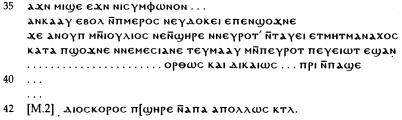
On the other side of P.Cair.Masp. III 67353—the side with writing across the fibers, in transversa charta fashion—Dioscorus returned, in 569/70, to the case of Anoup and Julius and their property. (Maspero had noticed that this side bore a 'long contract in Coptic," but could not read it.[71] ) Much of the surface of the papyrus is faded and abraded (see Figure 5), but enough connected text can be read to yield further information about the outcome of the affair. I give first a transcription and translation of the fragments.
(Glass 5)
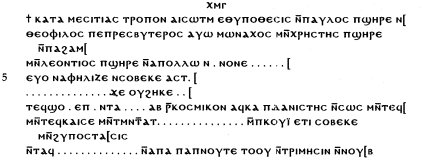
(Glass 6, fr. 2)

(Glass 2)

[71] In October 1933, the late Charles Kuentz had tried to transcribe this side (a copy of his notes toward a transcription, sent to W. E. Crum, is in the Griffith Institute at Oxford), but, as he was an Ancient Egyptologist and neither a documentary papyrologist nor a social historian of the Late Antique period, without much success.
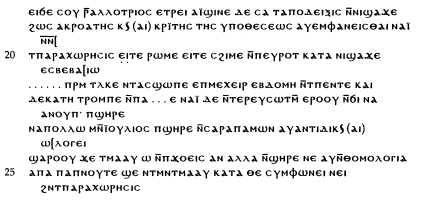
(Glass 5)

(Glass 1, fr. 4)
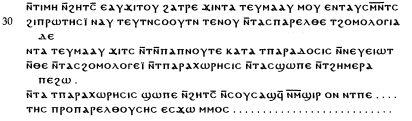
(Glass 6, fr. 1)
After the manner of an arbitration. I have heard the deposition of Paul son of N., (and) Theophilus the priest and monk, and Chrestes son of Paham, and Leontius son of Apollo. . . . They (Anoup and Julius) being minors . . . to live in the world. The creditor forgave it, with . . . the little ones still being minors, with property . . . (which?) Apa Papnoute gave trimesia of gold for . . . (Statement by Mesiane) . . . A cession without dispute . . . (the) sale which Apa Papnoute made . . . and his heirs for ever,
(I) agreeing that my husband bequeath to me and my children (?) . . . my sons wish to become monks. . . . if not, that no heir go to law with you over what is mine, nor . . . but if my sons enter upon the monastic life, you are to find the way to . . . them with respect to his five trimesia for this as concerns improving the property (philokalia), putting it toward . . .
(Statements and summing up by Dioscorus) If, therefore, they alienate a part of it, I have sought for the documentary evidence (apodeixis) of these words, as arbiter (
) and judge () of the deposition. They produced it for me as regards the cession, whether man or woman, according to these guaranteed words . . . the man from Telke. It was on Mecheir 7 that it took place, in the fifteenth year [indiction, i.e., A.D. 566]. . . . But these, when they heard them, namely (the ones of) Anoup son of Apollo and Julius son of Sarapammon, they made a countersuit (antidikaiologia) against them to the effect that the mother was not the owner, but rather the sons were. They agreed (that) Apa Papnoute was to go and close the deal with the mother in the way they had agreed in the cession . . . (to be) arbiter over their case at law . . . the priest, and also those brothers . . . saying: When the late (N.) was still alive . . . (?) . . . Apa Papnoute . . . (the) price for it, which they received double since their mother died, they established it upon their proposal (protasis). Now you are extending the agreement, though it has expired, which their mother accepted from Apa Papnoute according to the bequest (paradosis) of their fathers, as she agreed to the cession as it happened on the day that the cession took place, on the seventh of Mecheir. She having already come forward to speak (?) . . . and it had previously expired . . . without fighting about the agreements (symphonon). We dissolved them, as to the portion which seemed right to our counsel, that Anoup and Julius the sons, being ready (eager) to go into monastic life according to the counsel of Mesiane their mother and the readiness of their fathers . . . rightly and justly . . . half . . . Dioscorus, son of Apa Apollos.


Dioscorus's Coptic style in this document is comparatively restrained, technical, and to the point. There is not much hypotaxis: his construction proceeds mainly by circumstantial clauses, straightforward conditions, and balancing of pairs. What relative clauses there are are deployed rationally, and he does not deliberately use "purple-patch" ornament. This thoroughly practical Coptic prose is studded with the Greek juristic loanwords that are by now totally at home in the language.
P.Cair.Masp. III 67353r begins with the exact same technically operative phrases as does P.Lond. V 1709 (see later discussion):




but this is by extension and by the way.) Compare also SPP X 115.1, 214.4, 250.18, XX 193.1 for the noun. Further in Coptic, it appears later spelled


None of the four witnesses named is known from other papyri from Antinoë or Aphrodito:[73] Paul son of N., Theophilus the priest and monk, Chrestes son of Paham, and Leontius son of Apollo are new to the prosopography of Dioscorus's life. New too are some of the verb coinages with


For matters of being of legal age, compare KRU 89.11, 100.25. And for that figure of fear in any village, the danistes, compare KRU 16.48, 67.41, CO 189, Ep 260.10, 272.6, 520.2. The references in the text to the past, to the parachoresis and the philokalia made to the property, firmly bind this text to its predecessor, P.Cair.Masp. II 67176r+P.Alex.inv. 689. The question remains whether Mesiane's statement is being repeated from a past occasion, if she is dead by the time Dioscorus is drawing up this final document: the

Now Justinian's Novel 5.5 "defined the monk's profession as the
[73] MacCoull, 'Prosopography of Aphrodito," p. 92.
[74] It is, however, characteristic of Akhmimic; and we can see from the strong S flavor of Dioscorus's Coptic as seen in his glossary that this feature was part of his speech and may well have been an Akhmimicism (or Lycopolitanism).
moment when dominium passed from the monk to the monastery."[75] This piece of legislation was designed for the West; and how far its writ ran in the neighborhood of Antinoë is not easy to see.[76] There is no simply corresponding definition of just what type of legal act was needed to have the

The phrase


Dioscorus's clients were from a not unrespectable stratum of society. The late John had been not only a deacon but also a former


[75] R. Kay, "Benedict, Justinian, and donations 'mortis causa' in the 'Regula Magistri," RB 90 (1980) 169–193.
[76] A. M. Demicheli, "La politica religiosa di Giustiniano in Egitto: riflessi sulla chiesa egiziana della legislazione ecclesiastica giustinianea," Aegyptus 63 (1983) 217–257 sees the question along the old, and wrong, lines of linguistic-equaling-confessional division, and does not consider the real praxis of the documentary papyri. Nor does E. R. Hardy, "The Egyptian policy of Justinian," DOP 22 (1968) 21–41, move from the political to the social sphere.
ecclesiastical sphere with "official" Antinoë. Phoebammon and Victorine put a request (






On his deathbed and in front of witnesses, the late John had made an oral disposition (






Later the claim is made that Philadelphia, the new daughter, was not intended to receive any portion (lines 83–84, meaning that the last third would have been for Amanias). But this absurdity is, it seems, overturned by the seven witnesses to John's deathbed words, who have been fetched from Lycopolis/Siout to testify in the arbitration proceeding,[78] backed by the

After a further narrative of details, including Victorine's plea of her inability to obtain a marriage portion, the papyrus breaks off. But a case like
[77] L. Wenger, "Ein mündliches Testament in koptischer Sprache (P.Lond. V 1709)," Aus Novellenindex u. Papyruswörterbuch (Munich 1928) 45–58.
[78] Cf. Wenger, "Mündliches Testament," pp. 49, 58.
this is not just another example of the Coptic national sport of suing one's relatives. It is a window into a society in which minor clerics and officials, literate and at home with a bilingual bureaucracy,[79] were accustomed to having access to a dependable and trustworthy machinery for the redress of grievances. The history of Coptic (i.e., Coptophone) law, and Dioscorus's part in it, do not amount to only the creation of rhetorical flosculi. The Coptic legal documents from before the conquest—when the lively provincial culture of Egypt coruscated with every fashionable development, every trendy novelty, in literary and religious life—illustrate on the most basic level what Late Antique society was like where town life went on, where classical and Christian elements were totally blended into a civilized vehicle for dealing with ordinary human stubbornness. At about age fifty, Dioscorus of Antinoë could well feel that he had arrived in that society.
From Antinoë Back to Aphrodito, 570–573 and After
Later in 570 the inhabitants of Aphrodito had occasion once more to complain of the misconduct of the Antaeopolitan pagarch. They turned, naturally, to someone with ample experience in matters of this kind, who was competently representing their interests at the ducal capital. Dioscorus composed their petition P.Lond. V 1674 in Greek in his most highly colored rhetorical style, using old and new elements to paint a striking picture of society, its ills and its possibilities for good. Like his encomiastic poems, his practical prose pieces (like this one) were always fitted to the needs and patterns of the moment.
Somewhat in the manner of Handel called upon to produce an oratorio for the defeat of the Jacobites, or Bach having to put together the St. Mark Passion, Dioscorus was to reuse, or use in parallel, material from a companion piece, the draft petition P.Cair.Masp. I 67009, for his opening. And what an opening it is: like a fanfare, a joining of God and emperor, heaven and earth. "Divine Providence and our Christ-loving emperor," he begins, addressing the duke of the Thebaid, "have graciously deigned to proclaim
[79] Relevant here are the fascinating, and sometimes debatable, conclusions of E. Wipszycka in "Le degré d'alphabétisation en Egypte byzantine," Rev.Et.Aug. 30 (1984) 279–296. She concludes that there is a feeling that the combination of literacy and Christianity opened up ways of upward social mobility not previously open to lower-middle-class Egyptians. But she underestimates the pervasiveness of bilingualism; the use of Greek did not automatically imply "snob value" by any means. Nor did the use of Coptic stamp the user as "not quite."
your most eminent philanthropy as a gift to the struggling Thebaid. And they have deemed you (lit. "it," i.e., "Your Philanthropy")[80] worthy of rule, as being able to alleviate the bitter injustices (





But under the yoke of the pagarchy, the text continues, their life has been (line 17)



Once again, the ultimate outrage has taken place—violence against women religious. They are designated as

[80] For the use of this word as a title of address, see Zilliacus, Abundanz, p. 107.
[81] One might also speculate that theia pronoia was in people's minds in Egypt, in the third quarter of the sixth century, not only in an imperial and public context. There were gaps in the ecclesiastical rule, too: Dioscorus had lived much of his life in a world of sede vacante, Chalcedonian and non-Chalcedonian. The patriarchate also came under the scope of theia pronoia. Ever present beneath the this-worldly troubles of Aphrodito was the whisper of a sense of awareness that the web of visible Christendom was sometimes tenuous.
[82] Cf. again Keenan, "Village shepherds," pp. 245–259.
[84] Another text from his dossier is contained in Cairo Museum S.R. 3733 (unnumbered text); cf. BIFAO Bulletin du Centenaire (Cairo 1981) 427–435.


To reinforce their claims, the Aphroditans have taken a double oath. They have sworn




After a final summation of the problem, Dioscorus composes a rhetorical close to the petition, proleptically thanking the duke for comforting the leptoktetores of Aphrodito and entering in his deltion the particulars of what they have suffered. He constructs his sentences by his favorite method of pairs of epithets, thanking the duke's



bilities we have the duke to rely on. Dioscorus had, in his position, the duke's ear; and that ear could hardly have been deaf to the echoes of the classics and the New Testament.
On 16 November 570, Dioscorus produced his longest and most elaborate prose composition. He had been retained by Flavius Phoebammon, physician of Antinoë, to write his will.[86] Phoebammon was the son of the late Euprepeios, archiatros of Antinoë; that the profession ran in the family was not unusual.[87] He frames his will in the first person, terming it not just a diatheke but a diathekimaia boulesis (line 7), a will-and-testament, in the shape (taxis 'format') of a final written diatyposis, to be left unsealed for convenience (and with a disclaiming plea that his property [periousia ] is, after all, not much). The shaping of this document leads Dioscorus to create an intricate structure that, in all its rhetorical parts, serves a practical legal end.
After the dating clause and the statement of intent, the will really begins with a typical sententia: " The end of all things and of the human race is death, and it is totally impossible to escape; but for those rightly disposed (



As all mortals that exist are permitted by heaven to do (lines 42–43), the physician makes his will: it is to be


[86] For the literature on P.Cair.Masp. II 67151, see Amelotti, Le costituzioni, pp. 62–63; especially the early work of H. Kreller, Erbrechtliche Untersuchungen auf Grund der graecoaegyptischen Papyrusurkunden (Leipzig 1915).
[87] On physicians, see the work of T. S. Miller, The birth of the hospital in the Byzantine empire (Baltimore 1985). Cf. P.Cair.Masp. I 67006 v 6, 18, 20–21, 37, 57; 67057 I 13; II 67121.4; 67141 I v 22; 67155.1–2, at Aphrodito.
Greek,[88] and destined for a lawful place for the deposit of documents. In the still introductory next section, Dioscorus, the composer of the will, really excels as a painstaking writer of legal prose. The whole section (lines 51–73) that spells out the validity to be possessed in all contexts by every single particular of the will relies totally on Latinisms:


Phoebammon has enjoyed his life and property (cf. lines 209–210, discussed later, and Eccl. 5:18) thanks to the mighty Lord God and in a lawabiding manner (lines 67–71; Dioscorus stresses








Next come directions for Phoebammon's funeral. His sons are to do the
[88] On the preeminent validity of Greek, see Wenger, "Mündliches Testament," pp. 50–53.
[89] Van der Wal, "Die Schreibweise," does not take these documentary examples into account. In documents, the Latin words are not singled out by any special writing system or device.
[90] Possibly the famous one at Saqqara.


Charitable works are characteristic of this family of physicians. Phoebammon's next act in his will is to provide for the further endowing and running of the hospital (





[91] On burial ad sanctos, see P. R. L. Brown, The cult of the saints (Chicago 1980) 27, 31–35; also on inclusion of the deceased in the commemorations.
running beneath it all like an unmoving pedal point is the law—that Law, indeed, which it was his delight to meditate, and to articulate, day and night.
Phoebammon designates a tutor for his minor sons, the heirs (





Phoebammon, getting his breath, as it were, prepares to make another pious bequest to Apa Jeremias, "as I,



[93] For this and the later period, compare A. Masi, "L'actio protutelae nella compilazione giustinianea e nella dottrina bizantina," in Studi Senesi (Siena 1962) 197–218. An ecclesiastic was a good choice for epitropos.
[94] Compare the observations of W. C. Till on later documents in Erbrechtliche Untersuchungen auf Grund der koptischen Rechtsurkunden [he deliberately patterned his title after that of Kreller] (Vienna 1954) 65–66.
[95] On monastic boat services, cf. R. Remondon, "Le monastère alexandrin de la Métanoia était-il bénéficiaire du fisc ou à son service?" in Studi Volterra 5 (Milan 1971) 769–781. For skaphidia, see M. Merzagora, "La navigazione in Egitto nell' età greco-romana," Aegyptus 10 (1929) 125.
financial provisions, including one for a mysterious dependent called Athanasius (could it have been a love child?). The closing—Dioscorus's closing—is, as preserved, comparatively brief, stating that the will has been written with


In composing this will and expressing his client's wishes, Dioscorus blends elements from Roman law, classical literature, school philosophy, and the Bible into a highly colored and effective whole. By this period, true, it had become the done thing to use the writing of a will as an occasion for sententious meditations on death, eternity, and the evanescence of life. Dioscorus correctly follows the legal prescriptions for drawing up a will, while constructing his own variations on the theme of mortality and mutability. Much of the 307-line length of this document is taken up with pious foundations, a deeply embedded feature of Byzantine Egyptian society. With each contribution the testator makes to the Christian institutions of his world, new expressions of splendid reverence are found, not like adventitious ornaments stuck on, but like transparent windows, oeilsde-boeuf set with mica, in the text, through which quite another light diffuses. (We see here a little of the mental habit that by reflex adds "Blessed be He" to the divine names whenever they are spoken.) Dioscorus unrolls his prose rather like the unfolding of an inhabited vine scroll in the sort of Coptic sculpture with which Antinoë's great public buildings were covered—at every new curve there lurks another heraldic life form. The happy fusion of classical allusion and scriptural familiarity is alive and well in this kind of writing. It is hard to detect, in A.D. 570, the seeds in this society of something that will begin, in only another two hundred years, to jettison its languages and its memory, and huddle away with Arabic, in itself the carrier of totally alien values. The range of human possibilities we see in the Coptic society that produced this document was to be withered utterly. As yet, though, there is no shadow across the sun.
In the course of his life and activities, Dioscorus produced, along the way, a number of nondocumentary works in prose: his Greek-Coptic glossary,[96] paradigms in Greek grammar,[97] and marginalia to a life of Isocrates
[96] An indispensable tool, yes, for the interpretation of his poetry and the characterization of his dialect (and other things); but the article of B. Baldwin, "Notes on the Greek-Coptic glossary of Dioscorus of Aphrodito," Glotta 60 (1982) 79–81, is written by an author who has no Coptic. See my study, "Further notes on the Greek-Coptic glossary of Dioscorus of Aphrodito," Glotta 64 (1986) 253–257. The original publication is H. I. Bell and W. E. Crum, "A Greek-Coptic glossary," Aegyptus 6 (1925) 177–226.
[97] I am grateful to Professor A. Wouters of Leuven, author of The grammatical papyri from Graeco-Roman Egypt (Brussels 1979) (see esp. p. 18, n. 17), for corresponding with meabout his proposed edition, with comments, of all of Dioscorus's grammatica. If only more of his Coptic had survived.
(P.Cair.Masp. II 67175).[98] Even the last of these is of interest, as a kind of coda, in the way it lets us see Dioscorus's mind at work. To the left of the main narrative text are workpoints naming the classical categories that the orator (and often the jurist too) sought to embody:


On the recto of the fourth leaf of P.Cair.Masp. III 67325, we find a dating clause (in a land lease) giving the third regnal year of Maurice, Pharmouthi 10, indiction 3 (5.iv.585). The locality is Aphrodito.[100] On the first two leaves, in Dioscorus's hand, are a series of accounts of grain, fodder, wine, vegetable crops, and seed grain for holdings in the Aphrodito area for dates from a sixth to an eighth indiction—that is, 572/3–574/5—when Dioscorus had returned to his home village. The places are often familiar, the people less so, for example, the topoi Pherko (II r 11) and Victoros (II v 1), the holding '

[98] There is also his syncretistic invocation, P.Cair.Masp. II 67188: see L. S. B. MacCoull, "P.Cair.Masp. II 67188 Verso 1–5: the Gnostica of Dioscorus of Aphrodito," Tyche 2 (1987) 95–97. On his well-known ownership of the Homer and Menander codices, and their place in his life, cf. W. Clarysse, "Literary papyri in documentary 'archives," in Egypt and the Hellenistic world, ed. E. van 't Dack, P. Van Dessel, W. Van Gucht, [StudHell 27] (Louvain 1983) 43–61, esp. 55–57; cf. 73.
[99] On the impact of the syllogism as a tool for Late Antique thought, see F. E. Peters, Aristotle and the Arabs (New York and London 1968) 19–20.
of his children?). Camel herds, chickpeas, wine; so passed the days of an Aphroditan syntelestes. In a manner not unbefitting a Coptic grandee of fifties Assiut, the last in history that we see of Dioscorus, he is keeping his books. As Josephine Tey wrote in The Daughter of Time, "Truth is not in accounts, but in account books."