
Evidence for Measurement
Alongside the fields we have taken so far, which tend to support Koyré's judgement, there are others that show that it must be substantially qualified. We may review very briefly some examples from four inquiries in turn, geophysics, astronomy, harmonics, and optics, before pursuing the issue further afield.
[54] See below at nn. 116ff.
Geophysics
First, there is a famous case from geophysics: the estimation of the size of the earth.[55] Our first evidence here is, once again, in Aristotle. In the course of his discussion of the shape and size of the earth in De caelo 2.14, he first demonstrates its sphericity and then cites a number of considerations to show that it is "of no great size," in comparison that is, with the sphere of the fixed stars.[56] First, he notes that observations of the stars show this: "For a small change of position on our part southwards or northwards manifestly alters the circle of the horizon. . . . Certain stars are seen in Egypt and around Cyprus which are invisible in lands towards the north, and stars that are continuously visible in northern countries set in those regions."[57] He ends the chapter by remarking that "those mathematicians who try to calculate the size of the circumference [of the earth] say that it is 400,000 stades."[58]
Aristotle does not record the method that the mathematicians in question used. However, other sources report how two later investigators proceeded.[59] In the third century Eratosthenes is said to have
[55] The topic has received much scholarly attention. Following such earlier discussions as Nissen 1903, Berger 1903, Drabkin 1942–43, A. Diller 1949, Dicks 1960, the debate has been reopened recently by Taisbak 1973–74; I. Fischer 1975; Neugebauer 1975, vol. 2 pp. 652ff.; Newton 1980a; Rawlins 1982a and 1982b.
[56] Cael. 297b30ff. Elsewhere Aristotle puts it that the earth is small by comparison with the size of some of the heavenly bodies themselves: Mete. 1.3.339b7ff., and cf. the ambiguous Cael. 298a19f., though that is not shown directly by the argument from the changes in visibility of the stars at different latitudes.
[58] Cael. 298a15–17.
[59] Our fullest source is Cleomedes De motu circulari corporum caelestium 1.10.90.20ff., but there are further references to the question, not always consistent with Cleomedes' reports, in Pliny, e.g., HN 2.247f. and especially Strabo, e.g., 2.5.7.
based his calculation on observations of the shadow cast by a gnomon[60] at noon on the day of the summer solstice at two points on the earth's circumference, namely, Alexandria and Syene, which he assumed to be on the same meridian. At Syene there was said to be no shadow,[61] while at Alexandria there was one of a fiftieth of a circle, i.e., seven and one-fifth degrees. Taking the distance between the two places to be 5,000 stades,[62] Eratosthenes arrived by simple geometry at a figure of 250,000 stades for the circumference of the earth.[63] Then in the first century B.C. , Posidonius is reported to have suggested a method based on comparing observations of the star Canopus above the horizon at Rhodes and at Alexandria. Taking these two locations to be 5,000 stades apart on the same meridian[64] and the difference in altitude of Canopus to be "a
[61] It was, however, recognised that the lack of a noon shadow at the solstice applied over a distance of 300 stades (Cleomedes 98.4f.), a point that I. Fischer 1975, p. 154, takes to be tantamount to an uncertainty statement about whether Syene lies precisely on the summer tropic: contrast Newton 1980a, p. 383, for whom this is a case of the transformation of a vague observation into a precise statement.
[63] The figure of 252,000 stades ascribed to Eratosthenes in other sources, e.g., Pliny HN 2.247, Strabo 2.5.7, is generally interpreted as an adjustment motivated by the wish to give a round number for each sixtieth division of the circumference of the circle (see Dicks 1960, p. 146; cf. Heath 1913, p. 339); it also yields a round number for the value of a degree (700 stades), but whether Eratosthenes already used the division of the circle into 360°—as Hipparchus later did—is not certain; see below, n. 76.
[64] Again Cleomedes does not say how this figure was obtained. According to Strabo 2.5.24, Eratosthenes distrusted the estimates given for this distance (5,000 or 4,000 stades) on the basis of reports of sailing times and got a figure of 3,750 stades from sundial observations (which, if true, would involve pre-supposing the value of the circumference of the earth and reversing the procedure used in the Syene-Alexandria case): cf. Pliny HN 5.132; Neugebauer 1975, vol. 2, p. 653.
quarter of a sign" (of the zodiac, i.e., seven and one-half degrees), he obtained a figure of 240,000 stades for the circumference.[65]
Apart from other difficulties relating to the interpretation of these reports, the accuracy of the various recorded estimates of the size of the earth has been the subject of a protracted debate. Yet this has inevitably been quite inconclusive, among other reasons because, although our sources give the figures in stades, we have no certain indication of which of the several different stades used in antiquity is in question on each occasion.[66] The very fact that the stade was not standardised is, of course, significant. Nor is it clear that later estimates always represent an improvement in accuracy over earlier ones, despite the assumption of steady progress that has often been made, on this and other topics, by modern commentators.
The methods used by Eratosthenes and Posidonius are certainly sound enough in principle. But in practice inaccuracies could and did
[65] Cleomedes, 94.22, adds the rider that if the distance between Rhodes and Alexandria is not 5,000 stades, the figure for the circumference will be different but in the same ratio to that distance (see Taisbak 1973–74, who stresses the hypothetical nature of the argument and suggests that Posidonius was more concerned to describe a method than to reach a result; cf. I. Fischer 1975, pp. 161f.). Again, Strabo 2.2.2 ascribes a different figure for the circumference to Posidonius, namely, 180,000 stades, which some have taken as equivalent to 240,000 stades, using a different value for the stade (see below, n. 66), while others have seen it as a revised figure (Heath 1913, pp. 345f.), though Taisbak has recently argued that Strabo's reports are internally inconsistent. Ptolemy in turn adopted 180,000 stades for the circumference and at Geographia 7.5.12 claimed that this is based on "the more accurate measurements," but, once again, the value of the stade may not have been the same for Posidonius as for Ptolemy.
[66] Following Hultsch 1882, pp. 42ff., Lehmann-Haupt 1929 distinguishes seven different values of the stade; cf. also Dicks 1960, pp. 42ff. At HN 2.247 Pliny converts Eratosthenes' stades at eight to the Roman mile, though his further report, at 12.53, that Eratosthenes took the schoenus to be forty stades has been taken to suggest a figure of ten stades to the mile, assuming the schoenus is equivalent to the parasang and so to four miles. Pliny himself, however, while commenting on the different values given to the schoenus, translates forty stades as five Roman miles.
arise at three points especially: (1) in the measurement of the angles of the sun's shadow or of the height of a star above the horizon[67] (in the latter case refraction would be a complicating factor); (2) in the calculation of the distances between the locations from which the observations were made;[68] and (3) in the assumption that these locations are exactly on the same meridian[69] —although in some instances inaccuracy in one of these items acted to cancel out inaccuracy in another. Nevertheless, for our purposes the most important point is the simple one that already by Aristotle's time attempts to estimate the circumference of the earth had begun. In this context, at least, it appears that a definite quantitative result was sought, not, obviously, solely by direct measurements, but by calculation based on such measurements.
Astronomy
Astronomy offers a far richer range of examples. Koyré himself was prepared to grant that, exceptionally, Greek celestial physics was exact, but the question we must press here is whether the explanation of this
[67] Thus Posidonius' figure for the difference in altitude of Canopus (7 1/2 degrees) contrasts with an actual one of approximately 5 degrees.
[68] The problem of determining distances over land and sea continued to exercise later writers. Hero, for instance, who gives a detailed account of the construction and use of the dioptra—the chief surveying instrument used in triangulation—also describes a hodometer, a device for measuring distances on an overland journey by the automatic counting of the revolutions of a carriage wheel, thereby avoiding, as he says, the "laborious and slow" method using chains or cords (Dioptra 34.292.16ff.; cf. Vitruvius 10.9.1–4 with suggested adaptation for use at sea 10.9.5ff.: on the feasibility of such devices see most recently Sleeswyk 1979). The next chapter in the Dioptra tackles the problem of estimating greater distances, including across water, for example from Alexandria to Rome, where Hero suggests a method based on observations of a lunar eclipse (Dioptra 35.302.3ff.); see Neugebauer 1975, vol. 2, pp. 845ff. Ptolemy, in turn, discusses the difficulties in his Geographia (1.3–4) and expresses greater confidence in astronomically based calculations than in dead reckoning. Yet the former depended on accurate time-keeping, the difficulties of which we have already noted.
[69] Thus Syene is in fact some three degrees east of Alexandria, and Rhodes some one and a half degrees west of it.
exception is the one that Koyré tended to adduce, namely, the metaphysical gulf between the superlunary and the sublunary world.[70]
First, it is as well to stress the hesitancy of the first steps the Greeks took in observational astronomy.[71] Although attempts to determine the lengths of the solar year and the four seasons go back to the late fifth century B.C. (motivated in part, probably, by concern with calendaric problems), the number of actual observations carried out was not necessarily very great.[72] Even Eudoxus in the fourth century may have undertaken only limited precise observational work. One of the handicaps, at this stage, was the lack of a simple coordinate system and of the division of the globe into 360 degrees, and such evidence as we have from the fragments of Eudoxus' Phaenomena suggests that he identified and located individual stars quite imprecisely. Thus "beneath the tail of the Little Bear lie the feet of Cepheus making an equilateral triangle with the tip of the tail";[73] or, again, "over Perseus and Cassiopeia lies at no great distance the head of the Great Bear."[74]
By Hipparchus' time, in the second century B.C. , however, the situation had changed appreciably. First, there is firmer evidence for Greek use of Babylonian observational data, and, secondly, we have more specific information for sustained observational work carried out by the Greeks themselves, first by Timocharis and Aristyllus in the late third century,[75] and then by Hipparchus himself,[76] even though for much of
[70] See Koyré 1948/1961, pp. 312f., 1968, p. 38; cf. Sambursky 1956b, pp. 47f., and 1965.
[71] There is a brief discussion of the development of observation in early Greek astronomy in G. E. R. Lloyd 1979, pp. 169ff., and of the topic of observational error in astronomy and elsewhere in G. E. R. Lloyd 1982.
[72] See especially Aaboe and Price 1964.
[73] See Hipparchus In Arati phaenomena (In Arat.) 1.2.11.14.13ff., and cf. 5.19.52.1ff.
[74] Hipparchus In Arat. 1.6.2.54.23ff., and cf. the similar text quoted by Hipparchus from Eudoxus' Enoptron (Mirror) at In Arat. 1.6.2.56.2ff.
[75] See Ptolemy Syntaxis 7.1–3 especially, (H) 2.3.2ff., 12.24ff., 17.15ff., 21.16ff. The datable observations assigned to Timocharis, ranging from 295 B.C. to 272 B.C. , are set out by Pedersen 1974, appendix A, pp. 410f.
[76] The datable observations ascribed by Ptolemy to Hipparchus, ranging from 162 B.C. to 127 B.C. , are set out by Pedersen 1974, appendix A, pp. 413ff.See more generally Neugebauer 1975, vol. 1, pp. 274ff., who remarks, p. 277, that in Hipparchus' time a definite system of spherical coordinates for stellar positions did not yet exist; on the question of whether it was Hipparchus or Eratosthenes who first introduced the division of the circle into 360 degrees, see Neugebauer 1975, vol. 1, p. 305 n. 27, vol. 2, p. 590.
our evidence we continue to have to rely on such sources as Ptolemy, writing much later, in the second century A.D. Ptolemy himself not only reports his predecessors' and contemporaries' observations on many occasions but also provides the first extant comprehensive star catalogue. This is particularly valuable evidence, as the observations it is based on are not subject to interference from planetary models.[77] Books 7 and 8 of the Syntaxis give the longitudes and latitudes of over 1,000 stars in degrees and fractions of a degree, using seven simple fractions corresponding to 10', 15', 20', 30', 40', 45', and 50'.[78] Ptolemy tells us that he used the armillary astrolabe for these and other observations, often providing a certain amount of circumstantial detail on this.
Now, whether Ptolemy actually carried out the careful observations he says he made has become, once again, in recent years, the subject of heated controversy;[79] and the suggestion has been revived that his star catalogue in particular was plagiarised from Hipparchus.[80] The view I have argued for elsewhere is that this is an oversimplification, to say the least. Though he has taken Hipparchus' figures as his starting-point[81] (not to have done so would have been foolish), he has added
[77] The theory of the sun is, however, implicated when star positions are determined with reference to it or to the moon.
[78] Estimates are also given of the stars' magnitudes, though these are, of course, not based on measurement.
[79] See Newton 1973, 1974a, 1974b, 1977, 1980b, Hartner 1977, 1980, Moesgaard 1980b, Gingerich 1980, 1981. References to earlier literature will be found in G. E. R. Lloyd 1979, p. 184 n. 308.
[80] The idea that Ptolemy plagiarised an earlier Greek astronomer, Menelaus, was already suggested by Arabic astronomers: see Björnbo 1901; Dreyer 1916–17, pp. 533ff.; Vogt 1925, pp. 37f.
[81] Perhaps Newton's most telling argument is based on an analysis of the pattern of error in Ptolemy's catalogue: Newton 1977, pp. 237ff., 1979, pp. 383ff.
stars that were not included by Hipparchus, and where comparisons are possible, these suggest that he has done more than just take over Hipparchus' results and adjust these for precession.[82] However, the ramifications of this controversy need not detain us further at this point, for the simple reason that whoever was chiefly responsible, whether Hipparchus or Ptolemy, the catalogue as we have it is excellent evidence of sustained observations. It reveals both the degree of precision aimed at (of the order of 10') and the accuracy obtained (the mean error in longitude is of the order of a degree; in latitude, of half a degree).[83]
When we turn to the observations carried out in connection with the determinations of the parameters of astronomical models, the picture is complicated, in Ptolemy's case especially, by that controversy over the issue of the match—or mismatch—between his protestations of a concern for accuracy and his actual practice. Yet, to begin with the protestations, the evidence that both Ptolemy and, before him, Hipparchus were at pains to draw attention to the problems posed by the reliability of the data they had to work with is impressive. Ptolemy often expresses his qualms about the accuracy of some of the observations conducted by earlier astronomers, criticising their rough-and-ready character, and he indicates that Hipparchus already had similar doubts or reservations.[84] They were also alert to the differences in reliability of different kinds of data. Those derived from eclipses or occultations were recognised as more trustworthy than those involving estimates of wide angular distances or of absolute positions. Thus, Hipparchus used lunar eclipse data for his theory of the moon, even though these presupposed, of course, his model for the sun.[85]
Furthermore, both Hipparchus and Ptolemy drew attention to particular sources of inaccuracy in both naked eye and instrumentally
[82] G. E. R. Lloyd 1979, p. 184; cf. Gingerich 1981, pp. 42f.
[83] Cf. Toomer 1984, p. 328 n. 51.
[84] See Syntaxis 3.1 (H) 1.203.7ff., 14f., 205.15ff.; 7.1 (H) 2.2.22ff., 3.4f.; 9.2 (H) 2.209.5ff.
[85] See Syntaxis 4.5 (H) 1.294.21ff.; cf. 4.1 (H) 1.265.18ff.
aided observations.[86] Ptolemy refers to distortions due to atmospheric conditions or to the object being close to the horizon; in his Optics (though not generally in the Syntaxis ) atmospheric refraction is discussed.[87] The Syntaxis includes descriptions of the main astronomical instruments used, sometimes, though not always, with specifications concerning their size and construction,[88] and it issues warnings about particular sources of inaccuracy in their use. In one notable passage, where again he is following Hipparchus' lead,[89] Ptolemy writes of the errors arising from the faulty positioning or calibration of instruments. Referring to the use of equatorial armillaries, he notes that a deviation of a mere six minutes of arc from the equatorial plane in the setting of the instruments generates an error of six hours in determining the time of the equinox,[90] and of the bronze rings in the Palaestra at Alexandria he remarks: "For so great is the distortion in their position, and espe-
[87] Ptolemy Optics 5.23ff. (237.20ff. Lejeune); cf. also Cleomedes 2.6.222.28ff., 224.11ff. Distortions due to the object being near the horizon are referred to in Ptolemy's Syntaxis at, for example, 1.3 (H) 1.11.20ff., 13.3ff.; 9.2 (H) 2.209.16f., 210.3ff. (where it has been thought that refraction is possibly in mind: see Toomer 1984, p. 421 n. 8).
[88] See Syntaxis 1.12 (H) 1.64.12ff., 66.5ff.; 5.1 (H) 1.351.5ff.; 5.12 (H) 1.403.9ff.; 5.14 (H) 1.417.1ff. There are useful brief surveys of ancient astronomical instruments in Dicks 1953–54 and Price 1957.
[90] Syntaxis 3.1 (H) 1.196.21ff.
cially in that of the bigger and older one, when we make our observations, that sometimes their concave surfaces twice suffer a shift in lighting in the same equinoxes."[91]
To be sure, these expressions of a concern for accuracy have to be judged against actual performance. So far as Ptolemy goes, certain aspects of his procedures are not disputed and are indeed transparent enough. He repeatedly has recourse, throughout his calculations, to approximations and rounding procedures, some but not all of which he explicitly signals as such. Moreover, as the most recent detailed recalculation of his results goes to confirm,[92] quite a number of those approximations are biased towards establishing a preconceived value, often one he believes to have the authority of Hipparchus in particular or of tradition in general behind it. Sometimes he may well have worked back from such a result, not merely in that it influenced the approximations he introduced but also in his selection of the observations he presented.[93]
Equally, though, there are occasions when Ptolemy records data that do not simply confirm his conclusions—the very data on which the charge of fabrication has sometimes then been based.[94] Furthermore, in two cases, his theories of the moon and of Mercury, he made substantial modifications in his usual epicycle-eccentric model, introducing in both instances an extra circle in addition to the epicycle and the deferent.[95] Here the very complexities he thought necessary appear
[92] See Toomer 1984.
[93] See, for example, Czwalina 1959; cf. Newton 1977, pp. 266 and 307; Gingerich 1980, pp. 260ff.
[94] As, for example, in the case of the two sets of data presented in Ptolemy's discussion of the value of precession: Syntaxis 7.2–3 (H) 2.19.16ff., 25.13ff.
[95] For an account of the Mercury and moon models, see, for example, Pedersen 1974, pp. 159ff., especially pp. 192ff. and pp. 309ff.; Neugebauer 1975, vol. 1, pp. 68ff., 84ff., and 158ff.
to be quite gratuitous unless they are a response to what he perceived to be mismatches between the simple model and some empirical data, however and by whomsoever these were obtained.[96] Many of his procedures would be considered sharp practice, as well as slapdash, today—in some cases also, maybe, in his own day. At the same time, there are many contexts in which his practice can be taken to bear out, at least to some extent, his expressed concern over securing a comprehensive and reliable data base.
However hesitant its beginnings, Greek astronomy eventually achieved outstanding successes in developing detailed, quantitative models to account for complex natural phenomena. The mathematical models themselves were rigorous exercises in deductive geometry. But they were evaluated not just as geometry but on how well they matched the data—an essential point we shall return to in Chapter 6.[97] Greek astronomers were certainly neither as active nor as systematic as they might have been in confronting—or in recording the confrontations between—predicted theoretical positions and actual sightings. Yet from Hipparchus onwards, and I should say including Ptolemy, the quality of the data obtainable was a major preoccupation, not just in principle but also in practice. The rigour and exactness of the inquiry were its pride. But the point was not—or was not so much—that astronomy deals with the unchanging heavens, as, more simply, that it is based on mathematics.[98] In particular, the realisation that the exact-
[96] Cf., e.g., Gingerich 1980, pp. 261f.: "Ptolemy must surely have put credence in some specific observations here, or he would not have ended up with such an unnecessarily complicated mechanism for Mercury."
[97] See below, Chap. 6, pp. 304ff., 312ff.
ness and reliability of the data vary in different contexts is important, since it shows that there is nothing automatic about the accuracy of the data and that the degree of accuracy was a matter that had to be evaluated in the given circumstances of each part of the inquiry.
Harmonics
Two other areas of investigation, neither of which is tied to superlunary phenomena and both of which are regularly hailed as mathematical, will enable us to test the points I have just made. In harmonics there is a long-drawn-out dispute over the status of the perceptible phenomena, where the positions adopted range from an extreme empiricism all the way to the bid to reduce harmonics to pure number theory.[99] How far a particular investigator was committed to a search for exact quantitative data would depend on his position in that overall epistemological controversy. But, as is well known, Plato already knew a tradition in which the measurement of the phenomena was fundamental. In the seventh book of the Republic , 530dff., Socrates first agrees with a view he ascribes to the Pythagoreans, that harmonics and astronomy are sister sciences, but then he goes on to criticise as "useless labour" the business of measuring (

[99] We shall consider this below, Chap. 6 at nn. 41ff.
Moreover, elsewhere Plato provides some of our best early evidence for a recognition of the point that the exactness of sciences varies with their use of measurement, when, in the Philebus , branches of knowledge are stratified according to this criterion.[101] But in Republic book 7, after Socrates' critical remark, Glaucon too speaks of those who "lay their ears alongside" the strings, "as if trying to catch a voice from next door; and some state that they can hear another note in between and that this is the smallest interval which is to be used as a unit of measurement , while others contest that the sounds are the same, both parties preferring their ears to their minds."[102] Socrates distinguishes
these ultra-empiricists from the Pythagoreans,[103] but the latter too are criticised for "looking for numbers in these heard concords and not ascending to problems."[104]
Plato's testimony here is all the more impressive in that he is, at this point, a hostile witness. He disapproves of the methods he describes, at least for his present concerns, and insists that it is only the completely abstract study (the consideration of which numbers are concordant with one another and which not)[105] that is to be included in the educational programme of the Guardians. But measurement is an integral part of the procedures he criticises, indeed, both those of the ultra-empiricists who were engaged in an attempt to establish an audible minimum which could serve as a unit of measurement,[106]and those of the Pythagoreans in their search for numbers in heard concords. In the latter case we have other evidence concerning Pythagorean investigations—for example, on the monochord[107] —and it is clear that they had a particular motive for this study, namely, the bid to illustrate and
[103] R. 531b7; cf. 530d6ff.
[105] See R. 531c3–4.
[106] R. 531b2ff. suggests the use of at least two strings, tuned initially within a small interval of one another, one or both of which are then tightened or slackened to try to detect the point at which the audible difference disappears: I am grateful to Dr. Andrew Barker for clarification of the interpretation of this passage.
[107] See especially Burkert 1972, chap. 5, especially pp. 374ff., and cf. further below, Chap. 6 at nn. 37ff. It is, however, noteworthy that in one of the most substantial pieces of direct evidence we have concerning one of the more prominent Pythagorean theorists, namely, Archytas, various pieces of what purport to be empirical evidence are adduced to support a general conclusion concerning the correlation between pitch and the speed of a note, but no precise measurements are attempted: see Archytas fr. 1, Porphyry In Ptolemaei Harmonica (In Harm. ) 56.5–57.27 Düring; cf. Ptolemy Harmonica (Harm. ) 1.13.30.9ff. Düring; Porph. In Harm. 107.15ff. D.; Boethius De institutione musica (Mus. ) 3.11.285.9ff.; Theon 61.11ff.
support the doctrine that "all things are numbers."[108] Yet the contrast between the Pythagoreans and the ultra-empiricists shows that Plato had others in mind as well. Here, then, in an admittedly simple case, we can say that empirical inquiries involving measurement were undertaken before Plato—and we can follow their fortunes (not always auspicious fortunes, to be sure) in a long line of writers on harmonics from Aristoxenus down to Ptolemy, Porphyry, and beyond, though—to repeat—the importance attached to such investigations and the status accorded to the information obtained vary from one writer to another.[109] Harmonics is, however, certainly one of the first examples of the successful quantitative explanation of certain qualitative phenomena.
Optics
The evidence we have for the early stages of the development of optics relates mainly to certain purely geometrical aspects of the study.[110] Euclid's own optical treatise first sets out certain assumptions about
[108] We shall be returning to discuss this doctrine below, pp. 275ff.
[110] Aristotle already includes optics, along with harmonics and astronomy, among the "more physical of the mathematical inquiries" (Ph. 194a7f.), but the direct evidence for pre-Euclidean work is very limited: cf. Lejeune 1948, Mugler 1957, 1958.
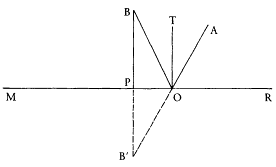
Figure 1
After Cohen and Drabkin, edd., 1958, p. 269 n. 1.
light rays and then proceeds deductively, more geometrico .[111] However, empirical tests confirming the laws of reflection are described, for instance, in Ptolemy's Optics , although we cannot pinpoint the date of their discovery.
He first sets out the three elementary laws (3.3.88.9ff. Lejeune): (1) objects that are seen in mirrors are seen in the direction of the visual ray that falls on them when reflected by the mirror; (2) things that are seen in mirrors are seen on the perpendicular that falls from the object to the surface of the mirror and is produced; and (3) the position of the reflected ray, from the eye to the mirror and from the mirror to the object, is such that each of its two parts contains the point of reflection and makes equal angles with the perpendicular to the mirror at that point. With reference to Figure 1, where MR is the mirror, A the eye, B the object, B' the image, O the point at which the visual ray
[111] As with the Elements , the textual tradition of Euclid's Optics has been subject to much reworking. One of the two extant versions is the result of editing by Theon of Alexandria in the late fourth century A.D. , and we cannot assume that the other has escaped similar revision and correction. Both versions are, however, strongly characterised by the deductive geometrical treatment of the problems, even though, as Suppes 1981 has recently stressed, the axiomatisation is, by modern standards, quite incomplete: cf. also Lear 1982, p. 189 n. 36.
strikes the mirror, and TO and BP perpendiculars to the mirror, these three laws state: (1)B' lies on AO produced; (2) B'lies on BP produced; (3) Ð TOA = Ð TOB. He then provides experimental confirmation of these (3.4–13.89.4ff. Lejeune).[112]
For our purposes the evidence for investigations of refraction is particularly important since, to judge again from Ptolemy, they included not just general discussions of the phenomenon but also measurements of its amount for different pairs of media carried out with apparatus that he is at pains to describe (Optics 5.8 [227.5ff. Lejeune]). The tables in Optics 5.11, 18, and 21 (229.1ff., 233.10ff., 236.4ff. L) setting out the amount of refraction for angles of incidence at 10° intervals from 10° to 80° first for air to water, then for air to glass, and then for water to glass, are remarkable from several points of view. They provide one of the clearest cases of an ancient scientist doctoring his results. Ptolemy has evidently adjusted these to fit his general law, even though that law itself is not stated. This takes the form r = ai – bi2 , where r is the angle of refraction, i the angle of incidence (the incident ray being that from the eye to the refracting surface), and a and b constants for the media concerned.[113] Nevertheless, the complexities of that general law are quite unmotivated unless Ptolemy has made some (and we may believe quite extensive)[114] empirical investigations involv-
[112] For discussion of these laws and of their pre-Ptolemaic background, see Boyer 1945–46; Lejeune 1946, 1957, pp. 47ff.
[113] The equation stated is one formulated by Govi 1885, p. xxxiii, but as Lejeune 1940–46, pp. 97ff., noted, it does not depend on the use of an algebraic expression, for Ptolemy could easily have set out the relationship in words; moreover, the use of first and second differences had been standard in other contexts, such as astronomy, since Babylonian times. A. M. Smith 1982, p. 237, has, however, recently argued against the view that Ptolemy had any such general theory, and indeed, that he was unable to find the law of second differences for both mathematical and methodological reasons. Yet in view of the fact that every one of the results in all three tables tallies exactly with this law and that they do so even where there are notable discrepancies between them and what the application of the sine law would give, this must be thought to make this highly unlikely.
[114] See Lejeune 1940–46, p. 94. A. M. Smith 1982, p. 234, also assumes that Ptolemy had observational data with a high degree of accuracy.
ing the measurement of angles of incidence and of refraction for these media—even if those investigations did not yield quite the results that were claimed.[115]
Weighing
So far I have concentrated exclusively on the exact sciences. But one simple measuring technique used in a wide variety of contexts was weighing ,[116] and this will now take us further afield, including into what we call the life sciences. Heavy and light were often cited as, or among, the differentiae of natural substances in both physics and physiology, but we must be careful, since they are sometimes understood in purely qualitative terms, on a par with wet and dry, or sweet, salty, and bitter.[117] Thus when in certain contexts in his mineralogical work On Stones Theophrastus differentiates varieties of pumice or of
[115] Lejeune 1940–46, p. 97, suggests that the second difference was applied to the middle range in the tables and that Ptolemy extrapolated from these to the (generally less accurate) results claimed for the extreme cases of angles of incidence for 10° and (especially) 80°. On the other hand, provided we assume, as in the cases Ptolemy discusses, that the incident ray from the eye passes from the less dense to the denser medium, the generalisations he sets out at 5.34.245.1ff. L, are unobjectionable, namely, that where i ' is greater than i , (1) i' : i > r' : r , (2) i' : r' > i : r , and (3) (i' - i) : i > (r' - r ) : r .
[116] Written evidence for standardised weights in Greece goes back to the Mycenaean period: see Chadwick 1973, pp. 54–58. Moreover, the archaeological record provides evidence for the standardisation of weights in the ancient Near East and the Indus valley at a much earlier date: see Hemmy 1931; F. G. Skinner 1954, pp. 779ff.
[117] Thus at GC 329b18ff. (cf., e.g., GC 326a7f., 329a10ff.), Aristotle lists heavy and light along with hot and cold, dry and wet, hard and soft, viscous and brittle, rough and smooth, dense and rare, among the tangible contrarieties. Moreover, when taken as definable in terms of a natural tendency to move in a certain direction (up/down), heavy and light run counter to the stipulation, in the Categories 5b11ff., that quantities have no contraries. However, at Metaph. 1052b18–31 Aristotle includes weight with length, breadth, depth, and speed among examples of what can be measured, where it meets the criterion that there must be units or standards of measurement by which weight can be determined.
metal-bearing ore by "heaviness,"[118] no actual quantities are mentioned. "Pumices," he says, "differ from one another in colour, density, and heaviness. They differ in colour inasmuch as the pumice from the Sicilian lava-flow is black, while in density and heaviness it is quite like a millstone. For pumice of this kind does indeed exist, heavy and dense and more valuable in use than the other kind. This pumice from the lava-flow is a better abrasive than the kind which is light [in weight] and white in colour, although that which comes actually from the sea is the best abrasive of all."[119]
Elsewhere, however, direct reference is made to weighing to distinguish heavier and lighter kinds of the same substance. The Hippocratic treatise On Airs Waters Places is much preoccupied with the differences in the waters that occur in different places, distinguishing those that are "hot" and "cold," "hard" and "soft," stagnant and free-running, turbid and pure and bright, as well as—frequently—those that are "heavy" and those that are "light."[120] The opening chapter
[119] Theophrastus Lap. 22. Cf. Lap. 39: "There are also many kinds of stones extracted from mines. Of these some contain gold and silver, though only the silver is clearly perceptible: they are rather heavy and strong-smelling. . . . There is also another stone like charcoal in colour, but heavy." At Lap. 46 the quantities of metals in gold alloys are said to be determinable by the use of the touchstone.
suggests that here we are dealing not just with vague general impressions, but with something measurable, for there we are told that waters "vary both in taste and 'on the balance.'"[121]
Measurement is also clearly involved in Archimedes' famous hydrostatical investigations. The story of how he detected the adulteration of
a gold crown by observing that it displaced more water than the equivalent weight of pure gold may well be inaccurate in the form in which we have it from Vitruvius.[122] But the extant treatise On Floating Bodies shows that he had a clear working conception of—even if he does not explicitly formulate—what we call specific gravity.[123] In book 1, chapters 3ff., he distinguishes between solids that are "equal in weight" (

Further evidence from the medical writers shows that they referred readily enough to weighing and measuring in particular contexts. For instance, in their pharmacology, the proportions of the ingredients in compound drugs, and the dose to be used, are often—though certainly far from invariably—specified by weight or otherwise by exact quantity, that is, by dry or liquid measure.[126] Thus On the Diseases of
[122] Vitruvius 9 praef. 9ff.
[123] The Arabic writer Al Khazini ascribes to Archimedes a device that could be used to determine relative specific gravities of different metals when weighed in water, in the Book of the Balance of Wisdom 4.1, on which see, for example, Knorr 1982b.
[124] De corporibus fluitantibus (Fluit. ) 1.3ff. (HS) 2.320.32ff.
[126] Already much earlier in Egyptian pharmacology, quantities are sometimes specified (as, for example, in para. 2 of the Papyrus Ebers: "to expel diseases in the belly: Another [remedy] for the belly, when it is ill: cumin 1/2 ro,goosefat 4 ro, milk 20 ro, are boiled, strained and taken. Another: figs 4 ro, sebesten 4 ro, sweet beer 20 ro, likewise" [Ebbell 1937, p. 30]), though this is not invariably the case (cf. para. 3 of the Papyrus Ebers: "another: wine, honey, colocynth, are strained and taken in one day" [Ebbell 1937, p. 31]). F. L. Griffith 1898, pp. 5ff., commenting on the prescriptions in the Petrie papyri, noted that the "quantities to be used are often left to the discretion of the practitioner to determine; but where necessary the amount is specified, though in round terms, by measure and not by weight," and he went on to argue that "a great advance was made when weight was substituted for measure, as in the Greek medical works." As we shall see, however, there is still plenty of indeterminacy in Hippocratic prescriptions too, as well as in those of later periods. On the measures used in the Ebers Papyrus, see Ebers 1890; for a comparison between Greek and ancient Near Eastern pharmacological recipes, see Goltz 1974, Harig 1975, 1977, 1980, Harig and Kollesch 1977. On the possibility of the deliberate withholding of information concerning quantities for reasons of secrecy, see, for example, Goody 1977, pp. 137f.
Women book 1 gives this prescription to promote parturition: "one obol of dittany, one obol of myrrh, two obols of anis, one obol of nitre: pound these till they are smooth, pour on them a cyathus of sweet wine and two cyathi of hot water; give to the patient to drink and wash her in warm water."[127] Many similar examples could be given—though
so too can others where the quantity of one or more of the ingredients, or the dose, is not specified exactly,[128] and after the Hippocratics, references to the problems of the standardisation of weights and measures and of correlating those used in different parts of the Greco-Roman world appear in the pharmacological sections of such writers as Celsus, Scribonius Largus, and Galen,[129] while tables of weights and measures begin to become common in specialist metrological writings.[130]
[129] See, for example, Celsus Med. 5.17.1c, CML 1.194.5ff.; Scribonius Largus praef. 15.5.23ff.; Galen (K) 13.435.1ff., 616.1ff., 789.2ff., 893.4ff. Cf. also Pliny HN 21.185 (though at 22.117–18 Pliny says that it is not possible to weigh out the powers of drugs "scruple by scruple," and at 29.24f. remarks that Mithridates' antidote that contains fifty-four ingredients no two of which have the same weight is clearly the product of ostentatious boasting).
[130] The remains of Greek and Roman metrological writings have been collected by Hultsch 1864 and 1866. The treatise devoted to weights and mea-sures in the Galenic corpus, (K) 19.748.1–781.3, is spurious, as is some of the corresponding material in the works of Hero: see Hultsch 1882, pp. 7ff.
A twofold contrast suggests itself. On the one hand, the simpler notion, found already in Empedocles' element theory,[131] that a compound consists of certain proportions of the constituent substances may be contrasted with the more precise idea that the quantities of the constituents are to be determined by weight .[132] Yet on the other, despite the progress made towards exact quantitative specification, that progress was still very incomplete. Moreover, quantitative specification when we find it—even when all the relevant quantities are stated—was often no more than window-dressing.
In interpreting this evidence we have to bear in mind, first, that the ingredients used are not chemically pure substances, and, secondly, that ancient doctors are frequently urged to modify the drug and the dosages in relation to particular patients .[133] Thirdly, as we noted in Chapter 3, some early medical writers insist that medicine, though a genuine techne , art or skill, cannot be made an exact study,[134] and
[131] Empedocles frr. 96 and 98.
[132] Apart from in the pharmacological contexts we have considered, the specification of the weights and measures of ingredients is common also in the extant Greek chemical and alchemical texts. See, for example, from the Leyden Papyrus X, pagina 1a.21ff. and 25ff. (Leemans 1885, p. 205); pag. 8a.28ff. (p. 225); pag. 11a.8ff. (p. 233); 24ff. (p. 235); Halleux 1981, nos. 4, 5, 56, 81, and 83; and Berthelot and Ruelle 1888, part 1.13.10ff., 2.31.7ff., part 4.19.1ff., 2.285.6ff. Cf. also Preisendanz 1973–74, P. 12.193ff., 2 p. 71. Although the reactions of various natural substances to fire were often remarked on, for example by Aristotle (cf. above, n. 52) and by Theophrastus, especially Lap. 9–17, no ancient scientist thought to make systematic observations of the weights of substances before and after combustion. Vitruvius 2.5.3, however, does note that in the manufacture of quicklime "about a third" of the weight of the stone is lost.
[133] See, for example, Vict. 1.2 (L) 6.470.7, 14ff.; Mul. 2.192 (L) 8.372.7ff.; cf., e.g., Pliny HN 25.150. Alternatively the dose is to be modified in accordance with the strength of the disease, as, e.g., at Mul. 1.78 (L) 8.184.17. It may also be noted that the problem of the identification of the active ingredients in compound drugs is further complicated when beliefs about their interactions, including their "sympathies" and "antipathies," have to be taken into account: cf. Pliny HN 22.106. Cf. Müri 1950, p. 189; Harig 1974, pp. 64ff., 83ff., 133ff., and 1980.
[134] Cf. above, Chap. 3 at nn. 89–103, on texts in VM, Morb. 1, Loc.Hom. and Vict. 3, especially.
some object specifically to appeals to such a procedure as weighing. When the writer of On Ancient Medicine protests that exactness in the control of diet is difficult to achieve, he says that "one should aim at some measure,"[135] but he then goes on: "but as a measure you will find neither number nor weight by referring to which you will know what is exact, and no other measure than the feeling of the body."[136] The treatise On Sterile Women , too, writes that treatment should be adapted to the particular patient, having regard to her condition and strength, which are not a matter of weighing ,


To these pharmacological cases we can add an admittedly limited number of other examples from medical writers at different periods where quantitative reasoning is in play in various physiological or pathological contexts. In the general description of the climatic and
[137] Steril. 230 (L) 8.444.1f.
[138] Cf. above, Chap. 3 at nn. 26ff., on the dogmatic claims to certain knowledge in such treatises as De arte , and below at nn. 150ff. on Hippocratic numerology.
epidemiological conditions encountered that is set out in the Constitution in Epidemics book 3, it is remarked, at one point, that the urine discharged was out of proportion to the fluid drunk, though here no specific quantities are mentioned.[139] In one of the case-histories in Epidemics book 7, however, we are told that a patient discharged more than a chous[140] of fresh blood in his stool and then, after a short while, a further third of a chous of coagulated globlets.[141] Specifications of the quantities of the lochial discharge or of the menses are also sometimes given in the gynaecological and the embryological treatises—though in several cases the quantities reported appear fanciful.[142]
Then Erasistratus, in a remarkable experiment recorded in Anonymus Londinensis,[143] tried to prove that animals emit invisible effluvia, by keeping a bird in a closed vessel without food for a period and then weighing the bird and its visible excreta. Comparing this with the original weight, he found, we are told, that there had been a "great loss of weight"—another case where, in our source at any rate, an observed difference in weight is remarked without any actual weights being reported.[144]
[139] Epid. 3.10 (L) 3.90.7f., cf., e.g., Morb. 4.42 (L) 7.564.4ff.
[140] A chous is estimated as between 2.52 and 3.96 litres in OCD .
[141] Epid. 7.10 (L) 5.380.20ff.; cf., e.g., 7.3 (L) 5.370.23ff., 372.1ff., where the exceptional quantities of milk consumed by a particular patient are specified; Epid. 5.14 (L) 5.214.1ff., 5.18 (L) 5.218.10; 5.50 (L) 5.236.16.
[142] See Mul. 1.6 (L) 8.30.8ff.: menses of two Attic cotylae "or a little more or less," i.e., c. 0.45 litres (cf. Aristotle, who claimed generally that female humans produce more menses than any other animal, e.g., HA 521a26f., and estimated the discharge of a cow in heat as "about half a cotyle or a little less," HA 573a5ff.; and contrast Soranus Gyn. 1.20, CMG 4.14.4, who gives a maximum figure for menstruation as two cotylae but who then devotes two chapters to pointing out how the quantity and duration may vary, 1.21–22, CMG 4.14.6ff., 15.1ff.). Mul. 1.72 (L) 8.152.3ff., Nat.Puer. 18 (L) 7.502.3ff.: the lochial discharge is one and a half Attic cotylae "at first" "or a little more" (Nat.Puer. adds "or a little less"). For discussion of these figures, see Bourgey 1953, p. 178 and n. 2; R. Joly 1970, p. 62 n. 2; Lonie 1981a, pp. 190ff.
[143] Anon. Lond. 33.43ff.; see von Staden 1975, pp. 179ff., and forthcoming. Further tests involving the weighing of fresh and "high" meat, and of a bladder empty and full of air, are reported in other contexts in Anon. Lond. at 31.10ff., 34ff. (purporting to present an Empiricist view), 32.22ff.
[144] It appears from a report in Galen UP 7.8 (H) 1.392.25ff., (K)3.540.8ff., that Erasistratus attempted to distinguish between different types of "air" by their "thinness" and "thickness," claiming that the air from burning coals is "thinner" than "pure" air, but Galen records no measurement in this connection.
Galen, especially, uses quantitative arguments on several occasions. In On the Use of Parts he remarks generally on the proportionalities between the fluids and solids taken into the body and those discharged or lost,[145] and elsewhere he specifies actual amounts of, for example, pus expectorated.[146] In On the Natural Faculties the difference in size between, on the one hand, the vena cava (together with the right auricle) and, on the other, the pulmonary artery is cited among the arguments to support the conclusion that some blood must pass directly from the right ventricle to the left through invisible pores in the septum, though—unlike Harvey—Galen does not attempt to measure the quantities or flow of blood exactly or even approximately.[147] Most notably of all, perhaps, a quantitative argument is adduced in the refutation of Lycus' view that urine is the residue from the nourishment of the kidneys.[148] That cannot be the case, Galen claims, if one considers the amounts discharged, which in exceptional cases may be as much as three or four choes.[149] If that is produced from nourishing the
[145] See UP 4.13 (H) 1.223.10ff., (K) 3.304.7ff. (where the quantity of drink consumed is proportional to the urine discharged), and UP 16.14 (H) 2.433.4ff., (K) 4.340.2ff. (where the nourishment taken in is equal to the material lost from the body).
[146] E.g., (K) 8.321.15ff. Cf. also (K) 11.227.9ff., blood expectorated up to two cotylae.
[147] De naturalibus facultatibus (Nat.Fac. ) 3.15 (H) 3.252.13ff., (K) 2.208.11ff. Cf. UP 6.17 (H) 1.362.7ff., (K) 3.497.9ff., where Galen reverses the explanation, putting it that there is good reason for the vena cava to be larger than the pulmonary artery, since blood is taken over from the right ventricle to the left through the interventricular pores.
[148] Nat.Fac. 1.17 (H) 3.152.17ff., (K) 2.70.10ff., on which see Temkin 1961, and cf. Temkin 1973, pp. 153f.
[149] Nat.Fac. 1.17 (H) 3.153.23ff., (K) 2.72.4ff.; cf. also (H) 3.153.13ff., (K) 2.71.12ff. Altman and Dittmer 1972–74, vol. 3, p. 1496, give a normal figure, for a 70 kg body, of 1.4 litres, with upper and lower limits of 2.94 and 0.49 litres. Galen's "three choes" is clearly more than five times the normal figure and more than twice the upper limit.
kidneys, one would expect even greater amounts of residue from the nourishment of the other principal viscera, where there is no sign of this.
Counting
Exactness in the medical writers is sometimes a matter not of weighing or measuring, but of counting .[150] Great importance is attached by many Hippocratic authors to the study of numerical relationships in connection with the determination of periodicities, notably in two types of context: (1) pregnancy and childbirth; and (2) the phases of diseases, especially their "crises," the points at which exacerbations or remissions are to be expected. In both contexts some of the ideas expressed have a solid basis. The normal time of gestation in humans is fixed to within fairly well-defined limits.[151] Before the advent of anti-biotics, studies were carried out that went to show that certain acute conditions such as certain pneumonias and malaria manifest quite marked periodicities.[152] In both fields, however, the proposals about periods and relations made in some Hippocratic texts go far beyond the range of what could be justified fairly straightforwardly by appeals to readily accessible evidence. Here the search for exactness led not to Koyré's "universe of precision" but to spurious quantification and ad hoc numerological elaboration.[153]
[150] The relationship between measuring and counting is discussed by Aristotle at, for example, Metaph. 1052b18ff., 1088a4–11, Ph. 220b18ff.: normally, counting is deemed a kind of measuring, but at Metaph. 1020a8ff. the two are contrasted where he distinguishes numbering quantities constituted by discontinuous parts and measuring magnitudes that are continua.
[151] Altman and Dittmer 1972–74, vol. 1, pp. 137f., specify a range of 253 to 303 days for humans and give corresponding figures for various other species of animals. Apart from in the medical writers, an interest in the topic is shown by Aristotle, who represents humans as exceptional among animals in the variation shown in the times of gestation of viable infants, e.g., HA 584a33ff., GA 772b7ff., and cf. Problemata 10.41.895a24ff.
[152] See, for example, Musser and Norris, cited by Osler 1947, pp. 49f., on pneumococcus lobar pneumonia, and Osler 1947, p. 491, on malaria.
[153] Aspects of this question have been discussed by Lichtenthaeler 1963,pp. 109ff.; R. Joly 1966, pp. 108ff.; Heinimann 1975; and Kudlien 1980, especially.
Number lore in Greek medicine must be interpreted in part against a background of Pythagorean beliefs, not just the general doctrine that "all things are numbers" but also more particular ideas concerning, for example, the importance of odd and even numbers and the correlation of that pair with other pairs of opposites. Odd is associated with right, male, and good, and even with left, female, and bad in the Table of Opposites reported by Aristotle, and we have other evidence that suggests that above/below, front/back, and other pairs were also sometimes incorporated into similar schemata.[154]
Yet the patterns of beliefs to which the medical theories we are interested in can be related include much besides Pythagoreanism. Many of the ideas attributed to the Pythagoreans are, in any case, widespread in popular belief. The positive and negative associations of some of the pairs of opposites included in the

[155] Cf G. E. R. Lloyd 1966, part 1, especially pp. 41ff.
[156] Hesiod Op. 765ff., 822ff.
[157] Solon 19 Diehl, and cf. below at n. 208, on Aristotle's criticism of farfetched theories correlating sevens. On the provenance of the ideas set out in the Hippocratic treatise Hebd. and on the date of that work, see Mansfeld 1971 with references to earlier literature. On the question of Near Eastern parallels to, and possible influence on, Greek ideas here, see Roscher 1904, pp. 85ff., 1906, 1911, p. 10 n. 9; Götze 1923; Reitzenstein and Schaeder 1926; Kranz 1938b; Mansfeld 1971, pp. 21ff. and 65; Burkert 1972, pp. 468ff.
We must recognise at the outset, therefore, that the pattern of beliefs against which Hippocratic numerological ideas are to be judged is complex. Moreover, those ideas themselves are extraordinarily heterogeneous. We may begin with some of those connected with pregnancy and childbirth. It would, of course, be futile to attempt to determine at what stage the Greeks were aware of the approximate time of gestation of the human embryo. When we reach the classical period, the view that babies born in the seventh, ninth, or tenth month are viable, whereas those born in the eighth month generally die, is widespread.[158] But many other beliefs in periods and relations are also found. Thus the idea that the male embryo moves first in the third month, the female in the fourth, appears in the gynaecological treatises.[159]On the Nature of the Child , to which we shall be returning, states that the male foetus takes thirty days at most to form, the female forty-two days, and also maintains that the lochial discharge lasts thirty days for a boy and forty-two days for a girl, a view also expressed in On the Diseases of Women book 1.[160]On Sevens , a treatise of admittedly doubtful date, claims that the human seed is "set" in seven days,[161] and On Fleshes states that it takes seven days for the embryo to acquire all its parts and elsewhere develops other theories of periodicities based on the number seven.[162]On Regimen puts forward an obscure theory
[161] Hebd. 1.1.8ff. Roscher, (L) 9.433.3f.
[162] Carn. 19 (L) 8.608.22ff., 612.1ff., 5ff.
about the concords or harmonies to which the movements of the developing foetus must correspond.[163]Epidemics book 2 section 3 chapter 17 suggests that the pains in pregnancy occur every third day when there is movement after seventy days, and, further, that they occur on the third day after the fiftieth, and on the sixth after the one-hundredth, and in the second and fourth months.[164]
It is not the case that suggestions about such topics as when a male or a female embryo begins to move in the womb invariably take the form of a proposal of a definite number. Epidemics book 6 section 2 chapter 25, for instance, probably suggests merely that males move earlier, and develop more slowly after they are born.[165] But references to particular numbers of days are very common, even though there is considerable disagreement about which are the significant ones. In some cases we may assume that the proposals are intended to be interpreted flexibly, merely as approximate suggestions of what may, in general, be expected.[166] But in others the theories are stated without qualification. Often the role of symbolic schemata is obvious enough, though, again, in other cases we can do no more than guess on what basis certain numerical relations were proposed. We may, for instance, compare the suggestion that male embryos move in the third month, females in the fourth, with the correlation of male with odd and female with even in the Pythagorean Table of Opposites. Again, it has been suggested that a figure of thirty days for males in On the Nature of the Child corresponds to a musical interval of a fourth (two-and-a-half tones, with each tone as twelve days), while one of forty-two days for females is equivalent to a fifth (three-and-a-half tones).[167] That is
[163] Vict. 1.8 (L) 6.480.21ff., 482.5ff.; cf. 1.26 (L) 6.498.17ff.
[164] Epid. 2.3.17 (L) 5.116.12f., 16ff. Cf. Epid. 6.8.6 (L) 5.344.10ff., 15ff.
[166] Thus Nat.Puer. 18 (L) 7.498.27ff. is concerned, in the first instance, to establish the upper limit to the periods considered, and at (L) 7.500.2ff. states that the rule applies generally and with some variation.
[167] Cf. Lonie 1981a, pp. 192ff.; cf. Delatte 1930.
conjectural, but more transparently that treatise maintains that the basis for the difference between the sexes here is that the female seed is weaker.[168]
Some insight into these theories can be gained from passages where the Hippocratic authors themselves are more tentative or reflective about their proposals. The writer in On the Eighth Month Child raises the question of whether women report their experiences in pregnancy correctly. "One should not disbelieve what women say about childbirth," we are told in one context.[169] Yet on the difficulties experienced in the eighth month the writer says: "Women neither state nor recognise the days uniformly. For they are misled because it does not always happen in the same way; for sometimes more days are added from the seventh month, sometimes from the ninth, to arrive at the forty days. . . . But the eighth month is undisputed."[170]
The writer's own view is that the principal phases of pregnancy consist of periods of forty days, and he is at pains to calculate the beginning of the seventh month with some precision: it begins after 182 days and a fraction, that is, half a solar year.[171] He endorses, in the main, the general view of the difficulties of the eighth month but at the same time claims superior, more exact, knowledge of how to calculate it. It is notable that he does not seek to contradict, so much as to make
[168] Nat. Puer. 18 (L) 7.504.24ff.
[171] Oct. 4, CMG 1.2.1.88.17ff. (Septim. 1 [L] 7.436.1ff.). The writer's view that the main phases of pregnancy consist of forty-day periods is set out, for example, at Oct. 1f., 5f., and 8, CMG 1.2.1.78.6, 80.13ff., 82.21ff., 90.9ff., 22ff., 94.1–14 ([L] Septim. 9, 446.15f., 448.21ff., Oct. 10, 452.13ff., Septim. 2, 436.15ff., 3, 438.14ff., 4, 442.7–22).
more precise, the traditional conception, including that of the danger to any child born in the eighth month, and indeed he continues to talk of the "eighth month child" even when his own theory is that, strictly speaking, this is inexact.[172]
On the Nature of the Child is another treatise that is critical of what women say about their pregnancies, flatly denying that they can be right when they assert that a pregnancy can last longer than ten months.[173] When he proposes his theory about the periods required for the formation of the male and female embryo the writer first argues on the basis of the analogy of the equivalent periods taken for the lochial discharge,[174] but when he recapitulates "for the sake of clarity" he cites what he calls a piece of research,

[172] Oct. 2, CMG 1.2.1.82.19 and 21; 5, CMG 1.2.1.90.18; 10, CMG 1.2.1.96.12 ([L] Oct. 10, 7.452.10 and 12, Septim. 2, 438.10, 8, 446.7).
[173] Nat. Puer. 30 (L) 7.532.14ff.: "But those women who imagine that they have been pregnant for more than ten months—a thing I have often heard them say—are quite mistaken" (cf. Aristotle HA 584b18ff., 21ff.). The Hippocratic author goes on to identify the source of their error, (L) 7.532.16ff.: "it can happen that the womb becomes inflated and swells as the result of flatulence from the stomach, and the women of course then think that they are pregnant," and it may be too that the menses are interrupted; cf. also (L) 7.534.10ff.
[174] Nat. Puer. 18 (L) 7.500.4ff.
[175] Nat. Puer. 18 (L) 7.504.2ff., 8ff.
show both by reasoning and by necessity, that the period of articulation is, for a girl, forty-two days, and for a boy, thirty."[176]
What is so striking about this passage is the disparity between the impeccable statement of method, and what the writer provides by way of the results of its purported application. He recognises very clearly that miscarriages would, provided the time of the miscarriage is known, yield telling evidence about the various stages in the development of the human embryo, male or female. Yet what he claims as his result is simply the complete and total endorsement of his theory. His statement of what miscarriages reveal is suspiciously vague and general, and although it may be too much to say that he has no actual evidence at his disposal at all, at least he does not here provide detailed documentation of any single case.[177]
Finally, the continuation of the text already quoted from Epidemics 2.3.17 shows that, within limits, questions could be raised about some of the periodicities that were proposed. After advancing his theory about pains on every third day when there is movement after seventy days, the writer proceeds: "Should the nine months be numbered from the [last] menstruation or from conception? Do the Greek months amount to 270 days, or is there an addition to these? Does the same apply for males as for females, or the opposite?"[178] Yet it is significant
[177] Contrast Nat. Puer. 13 (L) 7.488.22ff., which provides some circumstantial detail concerning the writer's observations of what he takes to be an aborted six-day-old embryo discharged by a prostitute owned by a kinswoman. Compare also the examination of the aborted embryo at Carn. 19 (L) 8.610.3ff., 5ff.
that even when, as here, certain questions are raised about accepted beliefs, those questions are formulated within the framework of those very beliefs. The writer clearly assumes that pregnancy generally lasts "nine months"; that is not in doubt. What is in question, rather, is how the nine months are to be calculated, that is, to put it bluntly, how the presumption of the nine-month period is to be validated.
There is thus a fair degree of disagreement both about what the significant periods in pregnancy and childbirth are and about how they are to be calculated. But that some calculation of days for some relations is correct is common ground to many authors. Theories about the periods at which the child born is or is not likely to survive are, in the main, based on popular beliefs which we may suppose to have originated in many cases long before the earliest Hippocratic treatises. The Hippocratic writers, for their part, are often critical of such beliefs, and sometimes they support their criticisms with appeals to what is claimed to be direct evidence. The importance of such empirical support is, we may say, certainly appreciated in principle. Yet in practice, in this context, what the Hippocratic writers offer is often little more than a more or less elaborate rationalisation of popular beliefs. In many cases the criticism is not that some popular assumption is too dogmatic and too precise, but that it is too imprecise—where the Hippocratic writer claims more accurate knowledge of the periodicities in question.
The second main area in which the medical writers develop complex theories of numerical relations concerns the periodicities of diseases, especially of "acute" diseases, that is, those accompanied by high fever. Here less is owed to popular assumptions, or at least there is no good evidence that the development of the classification of fevers into tertians, quartans, and so on antedates the period in which the Hippocratic writers themselves worked, although such a notion is not, of course, confined to them.
As already noted, certain diseases do in fact exhibit marked periodicities, and it is not too difficult to see this as one important and continuing stimulus to the elaboration of Hippocratic theories on the subject. Naturally enough, many writers share the general classification of acute diseases according to their periodicities: there were not
just tertians, quartans, quintans, septans, and nonans, but also semitertians, and as fevers that did not fall into any other category could be termed "irregular,"

Where paroxysms are on even days, the crisis too is on even days. Where the paroxysms are on odd days, the crisis is on odd days. The first period in those with crises on even days is 4, then 6, 8, 10, 14, 20, 30, 40, 60, 80, or 120 days. In those with crises on odd days the first period is 3, then 5, 7, 9, 11, 17, 21, 27, or 31 days. Further, one must know that if the crisis is on other days than those mentioned, there will be relapses and also it may prove a fatal sign.[179]
Offering a theory about the days on which sweating is beneficial in fevers, one of the Aphorisms repeats the same sequence of odd days, though adds to these the fourteenth and the thirty-fourth day.[180] The treatise On Humours recommends that if the paroxysms occur on odd days, the patient should be evacuated upwards on odd days, and that if the paroxysms are on even days, the evacuation should be downwards on even days—although if the periods of the paroxysms are different,
[180] Aph. 4.36 (L) 4.514.8ff. Other texts where the emphasis is on odd days are Aph. 4.61 (L) 4.524.3f.; Morb. 2.41 (L) 7.58.9ff., Morb. 3.3, CMG 1.2.3.72.14f., Morb. 4.46 (L) 7.572.1ff.; and cf. also Acut. 4 (L) 2.250.11ff.; Aph. 4.64 (L) 4.524.10ff.; Coac. 79 (L) 5.600.15f., 142 (L) 5.614.3ff.; Epid. 2.5.12 (L) 5.130.14f., 5.15 (L) 5.130.17f., 6.8 (L) 5.134.13ff., 6.10 (L) 5.134.16ff. See Kudlien 1980.
evacuation should be upwards on even days and downwards on odd ones.[181]On Diseases book 4, however, expresses a different view when it sets out to explain why deaths occur on odd days. "Thus the pain happens especially on odd days. Everyone knows that. . . . Those suffering from continuous fever who have been purged on even days have not been over-purged. But those who have been given a strong drug on the odd days have suffered from excessive purgation and many of them have died from this."[182]
Elaborate theories are not confined to sequences of odd or even days. Prognosis chapter 20, for instance, states
Fevers have their crises in the same number of days whether the patient survives or dies. The mildest fevers, and those that give the surest indications of recovery, cease on or before the fourth day. Those that are the most severe and accompanied by the worst signs cause death on the fourth day or earlier. The first attack of fever ends in this period, the second lasts until the seventh day, the third till the eleventh, the fourth till the fourteenth, the fifth till the seventeenth, the sixth till the twentieth day. In the case of the most acute diseases, the attacks continue up to twenty days, each one adding four days at a time, and then end.[183]
[181] Hum. 6 (L) 5.486.4ff.
Aphorisms , too, at one point, proposes a mixed theory, where the fourth, eighth, eleventh, and seventeenth days are particularly significant and the ones for the doctor to consider with special care.[184]
Some of the more complex theories relating to extended periods are quite fantastical. Yet it is certainly not the case that all that these Hippocratic writers were doing was giving free rein to their speculative imaginations. On the contrary, alongside the apparently dogmatic schemata put forward in some texts, others—especially in the Epidemics —show that even while their authors continue to be preoccupied with the problem of periodicities, they were prepared to recognise variations in the patterns of those experienced and to qualify the generalisations they proposed. First, it is worth noting that the detailed case-histories in Epidemics books 1 and 3 rarely concern diseases that fall exactly into a clearly defined category, such as quartans with exacerbations on every fourth day (calculated Greek style, including both first and last days of each period) or septans on every seventh—even though there are occasions when the case-history incorporates a note, for example, to the effect that the pains generally occurred on the even days.[185] Moreover, in the Constitutions in these books plenty of attention is paid to the differences between some individuals' experiences and those of others. Thus in Epidemics book 1 chapter 9 we read:
The circumstances of the crises by which we distinguished them were sometimes similar and sometimes dissimilar. Thus, two brothers who lay near the summer residence of Epigenes fell sick together at the same time. The elder reached a crisis on the sixth day, the younger on the seventh. Both relapsed at the same time, with an intermission of five days.
[184] Aph. 2.24 (L) 4.476.11ff.: "The fourth day is an indication of the seventh; the eighth is the beginning of the second week; the eleventh is to be watched since it is the fourth day of the second week; the seventeenth too is to be watched, for it is the fourth from the fourteenth and the seventh from the eleventh." Cf. Morb. 2.61 (L) 7.96.5f., Epid. 5.73 (L) 5.246.9ff.
[185] E.g., Epid. 1 case 1 (L) 2.684.9, Epid. 3 cases 3, 10 and 12 of the second series (L) 3.116.12f., 132.4f., 136.13.
After the relapse they reached a complete crisis together on the seventeenth day. In most cases the crisis was attained on the sixth day and, following an intermission of six days, a second crisis was reached on the fifth day of the relapse. In some the crisis took place on the seventh day, the intermission lasted seven days, with a crisis on the third day after the relapse. In others the crisis occurred on the seventh day, the intermission lasted three days, with a crisis on the seventh day after the relapse. In others a crisis took place on the sixth day, the remission lasted six days and this was followed by three days' relapse, a remission of one day, a relapse of one day, and finally the crisis. This happened to Evagon, the son of Daitharses. In others a crisis took place on the sixth day, the remission lasted seven days with a crisis on the fourth day of the relapse, as happened to the daughter of Aglaidas.[186]
Moreover, the treatise Prognosis , which proposes, as we have seen, an intricate theory concerning the periodicities of fevers, goes on to raise certain questions in this connection. "None of these periods," the writer remarks, "can be numbered in whole days exactly." Rather, they are like the solar year or lunar month, for neither of them is "such as to be numbered in whole days ."[187] Apart from this important reser-
vation about the calculation of periods by days, the writer observes that "it is very difficult to distinguish at the beginning between those fevers which are going to reach a crisis in a long period, for they are very much alike in the way they start. But you must pay attention from the first day, and reconsider as each four-day period is added, and thus the way the disease will develop will not escape you."[188]
In such texts from the Epidemics and Prognosis we have impressive testimony both to the doctors' determination to carry through a sustained programme of clinical observations and to the caution and open-mindedness with which they evaluated their data in their attempts to determine the phases of diseases. The outer limits to that open-mindedness are, however, apparent. Practitioners are advised not to jump to conclusions about the nature of the particular case they are dealing with: they are warned to expect that the exacerbations and remissions of different individuals in the same epidemic may vary; al-
though counting the days is the usual method of measuring the periods, they are sometimes told not to assume that periodicities will consist of multiples of whole days.[189]
Yet all this excellent advice is given on the basis of the assumption that the periodicities are there to find. They may be hard to identify: many fevers may simply be "irregular." But the presumption is that the periodicities will usually be determinable, and even that complex cycles of exacerbations and remissions will be. The more care and attention the doctors devoted to establishing the times of the crises, the more confident they could feel in their conclusions, not just in particular cases but in general. The grounds themselves of the general theory, however, were not examined critically, or not critically enough, and reflections on the causes at work generally presupposed that theory.[190] It was enough for the more cautious doctors that periodicities could sometimes be spotted. Meanwhile the more speculative theorists had no compunction in making the most extravagant proposals concerning complex numerological relationships.[191]
[189] This point is picked up and elaborated by Galen, for example, (K) 9.870.13ff., 933.12ff., 937.3ff., CMG 5.10.1.123.12ff., (K) 17A.246.4ff.
[190] Typical in this area are such suggestions as that quartans are produced by or associated with black bile, tertians and quotidians with other kinds of bile: Nat. Hom. 15, CMG 1.1.3.202.10ff., 204.8ff., 11ff.; cf. Morb. 2.40–43 (L) 7.56.3–60.24; Caelius Aurelianus De Morbis acutis 1.108 on Asclepiades.
[191] Later writers sometimes criticised the periodicities proposed by "Hippocrates," as Celsus, for example, did partly on the grounds of the inconsistencies detected between one Hippocratic text and another: see Med. 3.4.11ff., CML 1.106.25ff., and compare Galen's comments on this issue at (K) 9.868.11ff. and CMG 5.10.1.123.12ff., (K) 17A.246.4ff.; at Med. 3.4.12, CML 1.107.2ff., Celsus quotes the view of Asclepiades that no day was more dangerous to a patient for being even or odd, and at Med. 3.4.15, CML 1.107.23ff., Pythagorean numerology is singled out for criticism and said to have misled ancient doctors. Later still Caelius Aurelianus, for instance, notes that the periods in epilepsy, for example, are not regular and recommends that treatment should not depend on the number of the days but on changes in the disease, but he nevertheless takes the three-day periods as the starting-point for his discussion and offers advice as to how these are to be recognised: Morb. Chron. 1.105, 126.