
War Workers and Mothers in Training: Togetherness on the Home Front
The women's magazines of the war years paint a more benign picture of the mother/daughter relationship. Although the introduction of psychology and the rise of the experts found their way into the magazines, the conflict rendered so explicitly in both Now, Voyager and Mildred Pierce seems almost absent. Instead, we find an approach that has to do with the "new" responsibilities daughter must take on as mother enters the labor market. Primarily, these are organized around domestic tasks as daughter is urged to stand in for mom, acting as mother and housewife for dad and the boys: "With mothers doing war work . . . and with household help fast vanishing, lucky is the family that boasts a daughter! And lucky is the daughter who can learn at home the art of planning, buying and preparing meals for a family."[43]
Magazines such as Good Housekeeping promoted the idea of daughter as mother/housewife in training with regular sections such as "Cook's Kindergarten" and "Homemaker's Kindergarten" that paraded headlines like "Susan makes hot cross buns" and "Susan does the dishes in record time." Ads for household products often included mother and daughter using them together, marveling at how quickly the housework will now be done, or sharing war work, as in the ad series for "Tangee Natural Lipstick" ("mother does the seeding—daughter, the weeding"). Clearly, the aim was to present the woman war worker as fulfilling her patriotic duty and, most important, remaining devoted to the family and not producing significant disruptions: "Advertisers conveyed the message that employed women would not disrupt the family. . . . War workers were often shown in housewife/mother roles—working with or
taking care of children or doing housework in factory coveralls. Children pictured in these scenes cheerfully helped their mothers with household tasks, especially young daughters who were frequently dressed in coveralls and kerchiefs themselves."[44]
However located in the domestic this vision might be, what emerges from the women's magazines is both a sense of mother/daughter togetherness (be it in war work or in housework) and, to a lesser extent, mother serving as role model (albeit a "superwoman" one) for daughter. Except for the explicitly war-focused films, we see no consistent cinematic counterpart to the "togetherness" motif found in magazines.
The reasons for this discrepancy in media representations are in many ways quite simple. The women's magazines, very much like Hollywood films of the period, were explicitly enjoined in the war effort by the direct "guidance" of the propaganda efforts of the Magazine Bureau, which published the bimonthly Magazine War Guide from 1942 to 1945. Writers, editors, and publishers sat in on meetings of the bureau, received instructions for "helpful" and "patriotic" plot lines and characterizations, and were generally caught up in the combined war efforts. Indeed, this tie-in helped smooth the way for the astoundingly "back to the home" tenor of postwar magazine fiction and nonfiction:
The close connection between propaganda groups and the magazine industry throughout the war made unnecessary specific instructions to encourage the movement of women back to the home and to female fields in the labor force during demobilization . . . fiction and advertisements during this period portrayed war workers leaving their jobs for domesticity, office work, and unskilled jobs in manufacturing. This largely resulted from information writers had received from the government for two and a half years—information based on the assumption that new women workers would not remain in the "male" occupations once veterans returned and the dominant perspective of which highlighted the needs of the country.[45]
Like other media, magazines began to shift in midwar toward a more overt concern with the perils that the working mother offered to the smooth functioning of the family: "[T]he initial idea that working mothers could raise happy children was replaced by tragic portraits of families breaking under the strain of mother being away. By the spring of 1944, ads began dramatizing the unhappi-
ness of children with war-working mothers."[46] Yet editorials and nonfiction articles in the women's magazines continued to print pieces that provided very supportive views of working mothers. In an article entitled "Girls in Overalls" in the March 1943 edition of Parents' Magazine , Josephine Von Miklos writes very positively about women's work and cites reasons other than the patriotic for their continued involvement after the war. Stella Applebaum in February's issue of Parents' Magazine also argues strongly for the value of mothers at work, again stressing not only the patriotic but the personal and psychological benefits.[47] Nevertheless, by the late forties, the magazines too began to blow the horn of maternal neglect, deprivation, and the ever present "momism."
This is not to say that the shift from the sacrificial model to the malevolent model was straightforward and without deviations. Indeed, while the shift remains a dramatic one, there are a number of important exceptions, particularly in the war films of the mid-1940s. In both Since You Went Away and The Best Years of Our Lives , daughters are not the victims of maternal love gone awry, but rather the helpful and nurturant mothers in training, keeping the home fires burning while dad is off making the world safe for democracy. Like much of the wartime advertising that depicted daughters side by side with valiant victory gardening moms, these wartime films served to locate teenage and young adult daughters as mature and responsible apprentices to the arts of American domesticity. Mothers and daughters are often shown sharing domestic tasks such as preparing breakfast for a returning, drunken soldier in The Best Years of Our Lives or wearing matching aprons as they cook together in the kitchen of Since You Went Away . Indeed, mothers and daughters are here shown to be united in their war efforts and their desire to maintain a haven for the returning vets. In The Best Years of Our Lives , the good daughter is explicitly contrasted with the slatternly wife of the returning vet with whom she has fallen in love. Domestic charms win out, of course. Jane, the patriotic daughter of Since You Went Away , provides her mother with an example of bravery by working in the vets' hospital, thus gently pressing mom to do her part for the war effort by welding at the local munitions factory. In this wartime ethos, danger and discord are signified outside the world of putative domestic bliss or in
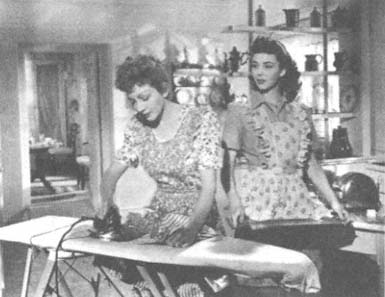
Fig. 9.
Mother and daughter sharing the joys of domesticity and keeping the
home fires burning in Since You Went Away . (United Artists, 1944;
photo courtesy of Museum of Modern Art Film Stills Archive)
the figure of (unpatriotic) independent women who have (selfishly) neglected to keep the haven heavenly.
There are, of course, more significant exceptions. But the exception is, in itself, telling. The film A Tree Grows in Brooklyn stands out as a somewhat different representation of mothers and daughters located outside of the two paradigms discussed thus far. Starring Dorothy McGuire as Katie, the mother, and Peggy Ann Garner as her daughter Francie, about twelve years old, A Tree Grows in Brooklyn is set in the tenement slums of 1920s Brooklyn.[48] The earlier date is significant because more "positive" mother/daughter relationships are often presented in films that locate them in an earlier era.[49]
The plot is relatively simple: a young family struggles to make ends meet in the slums of Brooklyn. Although A Tree Grows in Brooklyn is most often thought of as a touching coming-of-age story, this narrative of the young girl's development is intimately tied in
with the narrative of both mother and daughter and daughter and father. A neat split is set up early on between the hardworking, down-to-earth, pragmatic mother who essentially supports the family and the often unemployed, often drunk, funny, dreamy, lively man who is her husband. The children fall on either side, the boy—a street smart young tough—identifying with the mother, and the daughter—dreaming of being a writer—identifying with the adored father. This "pairing" is accomplished through both the dialogue and the visual aspects. In one scene, where mother and father are arguing over the future of Francie's schooling (Francie wants to transfer to a fancier school, and dad wants to lie to get her in there), the camera literally shows the mother and son and then cuts to the father and daughter, reinforcing the explicit message of opposition and alliances. Not until the end of this scene, when mother gives in, are all four shown within the same frame. The coming-of-age narrative is thus connected with the realignment of this familial mise-en-scène so that the daughter becomes reattached to mother.
One crucial difference emerges between this and the other films discussed thus far: the reversal of the motif of separation from mother as the hallmark of adulthood. Here Francie's move into womanhood is accessed not through the world of men, but through a new and deeper connection with her mother, a connection effected by a more realistic appraisal of the mother's life and her choices and, very crucially, by a sense that the daughter matters to the mother, that she can be a nurturer and caretaker.
The narrative can be seen as a move from daddy's girl to young woman rather than a move into a similar adoration of mother. Francie's adoration of her father is an Electra complex gone overboard: she enacts scenes with him that are completely inappropriate to their relationship as father and daughter. In one scene that sets the tone for their relationship, Francie rushes to the door as her father comes home, and they proceed to create a mise-en-scène of husband and wife (he even comes up behind her and kisses her) as she caters to his domestic needs ("I love to iron for you, Papa"). He gives her his fervent "things are going to be different one day—you won't have to iron for me" speech, which he should be giving to his wife. As Francie stands ironing, he reinforces his treatment of this
child as woman/wife: "You know something, prima donna, you're going to make somebody a mighty fine wife some day."
The contrast to this ideal husband/wife couple can be found in the scene immediately following, in which father goes up to tell mother, who is cleaning the steps, about his job and is disappointed at her less than enthusiastic response. As she "diminishes" the father, the camera cuts away to the daughter, gazing up lovingly at him, and he descends the stairs to waltz out with the daughter (singing "Here Comes the Bride!") while the mother looks on.
If the film stopped with this, if it produced the idea of pop as a great and fun guy and mom as a hard and uncompromising wet blanket, it would be no different from the majority of films on mothers and daughters. But as the film progresses, it also becomes infinitely more complex in its portrayal of a mother placed in an impossible position and a daughter infatuated with father but slowly learning the reality of mother's life. Mom is chastised for, as her mother puts it, forgetting "to think with your heart," and we agree with Aunt Sissy's concern over mother's statement that "My kids is going to be somebody if I got to turn into granite rock to make them." But this is never presented as the mother's inherent failing. To the contrary, not only is she shown to struggle personally with this question of her "hardness," but the hardness itself is seen as a consequence of a difficult situation: the prospect of a new baby, an out-of-work, dreamy husband, and the overwhelming reality of poverty.
After the father's death, the mother/daughter narrative surfaces more explicitly. The daughter resents the mother for his death, and the mother works to regain her daughter. The birth of the new baby not only is the catalyst that brings Francie back to her mother, but it is the moment that signifies her move into adulthood. Francie is now needed, as her mother tells her in the crucial scene that marks the beginning of the reconciliation. They are in the hospital where Aunt Sissy is having a baby, and Katie speaks to her elusive daughter about her need for her help when she has her baby at home:
Katie: "It isn't going to be long now. For me, I mean, with my baby. We can't come to a hospital. There isn't even going to be enough money for a woman to come and help. I'm going to need you Francie. Don't ever be far away. Neely—well, a
boy ain't much good at a time like this. I'm counting on you Francie. You won't forget that will ya?"
Francie: "All right Mama, I'll remember."
In this scene, as in the next one, where Katie is giving birth, Francie is standing, and her mother is either sitting or lying in bed, as if to symbolize the new power of the daughter. But unlike that depicted in many other films, it is not a power gained at the mother's expense, as in Now, Voyager when the psychiatrist looks down on the mother upon announcing her culpability. Conversely, we have here a power gained through an understanding of the mother's life.
The labor scene is one of the most moving film moments between mother and daughter. As the daughter begins to help her mother through her pain, both share a bit of each other's life: Francie reads her mother her essays, and the mother talks of her choices, the limitations of her life, how she misses the father. The knowledge that her mother needs her empowers both the daughter ("She only wants me now," she says to her brother) and the mother.
In an extraordinary speech by Katie, she speaks of the double binds mothers are put in, having to hold the family together in the midst of adversity and then being forced to make decisions that seem punitive and oppressive:
Katie: "It's so nice to have a visit from my daughter. I didn't want for you to have to grow up so soon. I didn't want for you to have to quit school. I tried to tell him that. He didn't mind about the baby but he never forgive me for wanting you to quit school. I told him, and he just went out. You never forgive me either."
Francie: "Please don't Mama."
Katie: "He would've bought you dolls instead of milk. I don't know, maybe you would've been happier, I don't know. I never would've thought of givin' ya that school like he did. And all them fine compositions of yours. I never read one of them. I should've had time. Johnny did. But I couldn't do no different. I don't know how I could do any different."
Later she continues to express this double bind as she is in the throes of labor and speaks at random about her life: "Who'll cry for me like that if I died. . . . I never did a wrong thing in my life but it ain't enough. . . . Oh, Sissy, I didn't mean to be hard like you
said. . . . If Johnny was here he could go to your graduation and I'd go to Neely's but I . . . I can't tear myself into two pieces . . . how'm I going to do both?"
The reunion of mother and daughter is not a simple matter of hugging, kissing, and bittersweet tears. The reunion, if one could really call it that, is about mutual recognition, a sharing of experience, and a deeper understanding of the choices mother was forced to make. There are no great epiphanies in this scene of coming together; yet the coming together is apparent in the daughter's caretaking, in the mother's expression of the double binds, and in the way this scene is tied to the daughter's coming of age.
This exception can be explained on a number of levels. First, A Tree Grows in Brooklyn was adapted from a best-selling "serious" novel (it was a Book of the Month Club selection), and it retains a certain literariness and staginess, as do films like I Remember Mama and Little Women . Second, it was not a classic genre film and thus was not subject to the strictures of most genre productions, such as the centrality of a narrative resolution centering on a male agent. More important, this exception provides an interesting contrast to the genre films discussed previously in that its historical, ethnic, and working-class setting allows this film to present a relationship that is both moving and complex and that renders neither mother nor daughter absent. The working classness and ethnicity allow for more space for mother/daughter mutuality in the context of a society still struggling with the incompleteness of the much vaunted "melting pot." The generic formulation here, a sort of ethnic historical one, subverts and rearranges the dominant cinematic codes in a way that "in the present" genres are unable to, given their rootedness in the dominant ideologies of the time. Perhaps all this suggests that the psychologizing is a primarily middle-class phenomenon.
What emerges from this overall transformation, then, is twofold. On the one hand, the move from Stella to Mildred signifies a shift from a vision of all-giving motherhood that locates women as sacrificial caretakers who derive deep pleasure from that sacrifice to an image of motherhood slightly off, possibly unhealthy, and almost certainly responsible for the psychic health (or, more often, ill health) of their offspring. On the other hand, the change is not just in images of motherhood (from sacrificial and benign to overpower-
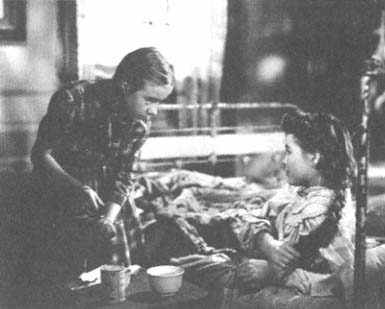
Fig. 10.
Mother and daughter find a tenuous and gritty resolution amid adversity
and the empowerment of daughterly care in A Tree Grows in Brooklyn .
(20th Century-Fox, 1945; photo courtesy of Museum of Modern Art
Film Stills Archives)
ing and controlling) but in the way the discourses of motherhood refract and interact with other significant social discourses.
The story of Stella's mothering is also a story of class, an uneasy story that applauds class ascendancy (and sees it as accessed through the father) but still maintains a sharp criticism of bourgeois "expert" values and modes. The story of Mildred's mothering (like Mrs. Vale's and Mrs. Brown's), on the other hand, is a purely psychological story. Even Mildred's class ascendancy is directly tied to her unhealthy desire to "give her daughter all she never had." Stella's original move up the class ladder was propelled by her own desires. Mildred is punished both for wanting too much for her daughter and for daring to think that a working mother/single parent can join the ranks of the entrepreneurial upwardly mobile. Linda Williams points out how the background of the war served to change the original intent of the novel written by James Cain and turn Mildred's mobility into an altogether more problematic affair:
"The indirect evocation of wartime ideology operates to judge Veda's—and by extension Mildred's—materialism harshly. In the original novel, Mildred's materialism encounters no such censure, because it arises directly out of her experience of want and social humiliation during the Depression. Similarly in the novel, Mildred's excessive mother love and spoiling of Veda appears misguided, but it leads to no crime."[50] The class motive for Mildred's working is now replaced with a basely materialist and neurotic one. Class as providing the context for the mother/daughter interaction thus disappears as that relationship is increasingly portrayed as having no context other than itself.
Although this metamorphosis in the representations of the mother/daughter relationship is significant and speaks to the strength and persistence of the postwar backlash and domestic surge, it is also important to stress the continuities. For all the daughters in these three films, the sign of their difference from their mothers is their popularity. Laurel's popularity in the "in" group crowds her less fashionable mother out. Charlotte's ability to be popular with the "common" cruise goers distances her from her more standoffish mother. Veda's worldliness and swirl of parties and polo matches stands in severe contrast to the life of her hardworking mother. This issue of popularity, and the mother's ability to access it for the daughter or deprive her of it, not only persists in the film images of the period but crops up continually in the women's magazines of the late thirties and forties. The connection between the new concern with popularity and the popularity of psychology is striking, as this passage indicates: "Somebody with a desire to help harassed young girls ought to endow, for mothers, a number of classes in advertising and public relations. The purpose would be to teach women how to speak of their daughters so that they seem well adjusted and worth knowing, rather than walking problems with a low popularity rating and enough complexes to supply a psychology textbook."[51]
But the most critical continuity, and the most lamentable one, is the legacy of loss in these films. In all the films discussed here except A Tree Grows in Brooklyn , indeed, in most representations of the mother/daughter relationship, mother and daughter are torn asunder, forever to be deprived of each other's company. Stella's daughter is forever lost to her, Mrs. Vale and Mrs. Brown die, and
Veda is booked for murder. In all these films, narrative resolution is firmly anchored to a permanent separation of mother and daughter, a separation that is both psychic and physical.
At least with Stella , we experience the loss of mother to daughter (and daughter to mother) as sad, wrenching, unhappily necessary. As Andrea Walsh points out, we do get some sense of Stella's activity, her decision making, her subjectivity: "These sacrifice films, though rarely feminist in ideology, are based on a feminist assumption that women can make choices. . . . They are, to an extent, authors of their own destiny. The fact that they are depicted as choosing subjects may be as important as the content of the life styles they choose."[52]
Conversely, in the other films, the loss is never depicted as loss, much less as choice, but as the inevitable separation of daughter from mother. Neither option constructs a discourse of constancy and mutuality. In the move from sacrificing Stella to maladjusted Mildred , we may have relinquished class and acquired psychoanalysis, but one thing remains constant: we have lost each other.