
PART ONE—
THEORY OF CULTURE
1—
Culture: Coherent or Incoherent
Neil J. Smelser
My objectives in this introductory chapter are the following:
—to examine some of the dimensions of the concept of culture, focusing on the issue of its degree of coherence or incoherence;
—to identify some methodological problems in the description and employment of the concept of culture, including a major methodological fallacy in the characterization of its coherence and incoherence;
—to review some imputed causes of cultural coherence;
—to suggest several resolutions of the problems revealed.
Major Dimensions of Cultural Analysis
Whatever the range of differences in the conceptualization of culture, the idea remains an essential one in the behavioral and social sciences. For decades it has been regarded as the central organizing base for social anthropology (sometimes, indeed, called cultural anthropology ) and is one of the several major objects of study and tools for explanation in sociology and political science (Smelser 1968), as the terms subculture, counterculture, organizational culture, civic culture, and political culture indicate. Conspicuous exceptions to this generalization are sociobiology and its forebears, which tend to link culture to genetic
or other biological factors, materialism in its Marxist and other guises, which tends to reduce culture to other forces, and rational-choice theory and its utilitarian forebears, which tend to freeze culture into simplified assumptions about tastes and preferences. These exceptions noted, the centrality of the concept must be affirmed.
Before the end of the nineteenth century, many social philosophers and historians tended to treat culture—it was not always called that—as a kind of idea, or spirit, or Geist that provided a basis for characterizing a society, denoting its advancement and distinctiveness, and capturing its integrity. Needless to say, such an approach almost dictated the corollary assumption that each civilization's culture possessed a coherent unity, or pattern, that encompassed its religious, philosophical, or aesthetic underpinnings. By further implication, the distinctive culture of society was something of an elitist conception, communicating that it was carried by the literate, urbane, self-conscious (and, by assumption, prestigious and powerful) classes in society; a society's culture was its "high" culture, only later to be distinguished from its "folk," or "popular," culture. This idea of culture continued to find expression in the twentieth century, for example in T. S. Eliot's ideas on culture and Christian civilization (1939, 1944).
The history of the idea of culture is multifaceted and includes a chapter on how its actual differentiation into "high" and "folk," or "culture" and "mass culture," was a part of the fabric of stratification and domination in various European societies.[1] A second theme, important for this essay, is the evolution of the term in anthropology in the late nineteenth century. Intellectual leaders in anthropology made the concept more inclusive than simply that of a coherent set of values and ideas. Tylor (1920), for example, expanded the notion to encompass "that complex whole which includes knowledge, belief, art, morals, law, custom, and any other capabilities and habits acquired by man as a member of society" (1). Lowie's definition was similar and excluded only "those numerous traits acquired otherwise, mainly by biological heredity" (1934, 3). Another feature of classical anthropological usage was that culture tended to be regarded as undifferentiated along class or other principles of social division; it was a concept that applied to whole societies. That formulation is perhaps understandable given that anthropology was then concentrating on simple, undifferentiated societies. It was certainly not consistent, however, with the growing differentiation and diversification of Western societies, which were then experiencing the decline of orthodox religions, cultural
mixing through migration, and internal class divisions associated with urbanization and industrialization.
In any event, the intellectual development in classical anthropology toward a conceptualization of culture as inclusive and common—as contrasted with exclusive and carried by elite cultural agents—set the stage for two questions that have shaped (or perhaps beset) thinking and debates about culture by social scientists for a century. First, how unified or coherent are cultures? And second, to what degree does a society's population share, or have consensus of, values and other ingredients of culture? (The two questions, while interrelated, are distinguishable from one another. The first concerns the issue of the integrity or integration of elements; the second concerns their degree of sharedness. A given cultural system may be tightly organized and coherent and either shared or not shared. The same may be true of a cultural system that is vague and inchoate. The dimensions of coherence and consensus thus can be conceptualized as constituting marginals for a fourfold table, and there are feasible entries for all four cells.)
Anthropologists and others began early to disagree on the question of coherence. At one extreme was Tylor's characterization of culture as a thing of "shreds and patches," which suggested a miscellaneous congeries of religion, philosophy, technology, customs, and artifacts held together by no principle whatsoever. (In a way it seemed "natural" that Tylor, opting for such an inclusive definition of culture, would be pushed in the direction of regarding it as incoherent.) Another, more active, form of incoherence was found in Durkheim's work on anomie (1951 [1897]), conceived as a state of "normlessness," whereby society did not set any limits to the desires of individuals by providing any kind of systematic expectations to regulate them. Under anomic conditions there appeared to be no basis for cultural order, and, according to Durkheim, the results of anomie were likely to be social and individual pathology.
Another group of thinkers could be found at the "coherence" end of the spectrum. Evolutionists like Morgan (1963 [1877]) and Engels (1964)—who adapted his thought—found a definite principle of cultural unity in the ingredients of a culture at each of several developmental stages of civilization (savagery, barbarism, and so on). The principle, consistent with materialist principles, was that a given level of technology called for a certain kind of religion, family structure, stratification, and other customs and mores. Each stage and substage thus manifested a coherent cultural "package." In another formulation Durkheim (1956
[1925]) found a unified cultural principle in every civilization, perpetrated through its educational system: "[in] the cities of Greece and Rome, education trained the individual to subordinate himself blindly to the collectivity, to become the creature of society . . . [in] the Middle Ages education was above all Christian; in the Renaissance it assumes a more lay and literary character." Perhaps the most extreme formulation of cultural unity appeared in the work of Sorokin (1937), who grouped all the major facets of a culture under a single organizing principle. For example, in a "sensate" culture, which emphasizes the external senses as contrasted with the internal spirit, the principles of secularism, empiricism, science, philosophical realism, utilitarianism, and hedonism all fell together in one logico-meaningful whole.
Benedict (1934), often regarded above all as the advocate of a position of cultural integration, actually manifested an intermediate position on this question. On the one hand, she found any given culture to be "permeated by . . . one dominating idea" (3); examples were the Dionysian and the Apollonian. This integration was achieved through a complex process of selection and exclusion: "Gothic architecture, beginning in what was hardly more than a preference for attitude and light, became, by the operation of some canon of taste that developed within its technique, the unique and homogeneous art of the thirteenth century. It discarded elements that were incongruous, modified others to its purposes, and invented others that accorded with its taste" (47). At the same time, Benedict found extreme incoherence in some cultures: "Like certain individuals, certain social orders do not subordinate activities to a ruling motivation. They scatter. If at one moment they appear to be pursuing certain ends, at another they are off on some tangent apparently inconsistent with all that had gone before, which gives no clue to activity that will come after" (223). The contrast between coherent and incoherent was associated in Benedict's mind with the contrast between simple cultures, such as the Zuñi and Kwakiuitl, and modern Western cultures. In particular, she described "our own society" as "an extreme example of lack of integration" (229).
Such were some of the divergences in early twentieth-century anthropology on the issue of cultural coherence and incoherence. That issue survives today, although not always in the same terms. For example, in his discussion of "common sense," Geertz (1983) argued that one could not demonstrate that it was a culture by cataloging its content because it was not formally organized—it was "antiheap wisdom." He added,
science, art, ideology, law, religion, technology, mathematics, even nowadays ethics and epistemology, seem genuine enough genres of cultural expression to ask . . . to what degree other peoples possess them, and to the degree that they do possess them what form they take, and given the form they take what light has that to shed on our own versions of them. But this is still not true of common sense. Common sense seems to us what is left over when all these more articulated sorts of symbol systems have exhausted their tasks, what remains of reason when its more sophisticated achievements are set aside (92).
In an even more recent formulation, Merelman (1984) regarded the degree of cultural coherence as the important element of American culture in explaining much about its class and political life. Modern American culture, he argued, is a "loosely bounded fabric", ill-organized, permeable, inconsistent, and tolerant of ambiguity. He regarded it as having arisen in part from the decline of three visions of American culture—puritan, democratic, and class-based—and from several distinctive historical experiences such as individualism, minimal age-grading, and immigration. The schools and the media are major agents in perpetrating loose-boundedness in culture. As his main thesis, Merelman argued that a loosely bounded culture obfuscates the stark division of labor, hierarchy, and fixity of the American social structure—in fact, a "gap between American social structure and American culture" (204). In addition, a loosely bounded culture made political mobilization for collective goals difficult and posed special difficulties for political regimes to legitimize themselves. In this formulation, the actual cultural content seems to take second place to its mode of organization as a determinant of sociopolitical life.
Two other theoretical issues, closely related to coherence, concern how perfectly cultures are realized or reproduced in the individual and in the social structure. With respect to the individual, some theorists regarded culture as manifesting itself in the individual in more or less complete form, mainly through the process of socialization. Durkheim (1956 [1925]) described the institutions of education and pedagogy as the main mechanisms involved in internalizing the ingredients of culture and in making conformity to them a matter of individual will. Freud (1930) formulated the process as the incorporation of the cultural prohibitions and renunciations of instinctual forces that culture had accumulated over the ages. Parsons (1955) treated socialization through the family as the main mechanism for internalizing and reproducing society's common culture.
These theorists, however, each added a qualification or twist to this more or less mechanical concept of the internalization of culture. Freud never regarded the victory of civilization (culture) as complete; he saw the erotic and aggressive side of humanity in constant struggle with and reassertion against culture. Durkheim, in his discussion of egoism (1951 [1897]), envisioned how the internalization of a coherent value and normative situation could produce conformity and freedom simultaneously. This internalization occurred in the culture of Protestantism and individualism, which, while itself coherent and passed from generation to generation, resulted in a most heterogeneous set of individual choices and styles traceable to a central cultural ingredient of individualism—freedom. Parsons regarded the process of socialization to values and norms as incomplete. This incomplete process could result in the phenomenon of deviance, when individuals take on behaviors and outlooks that are at odds with the dominant cultural orientations of society. At this point, however, the culture reasserts itself by bringing the deviant individuals "back into line" through processes of social control, such as resocialization, rehabilitation, and psychotherapy (Parsons 1951). One debate emerging from Parson's formulation was whether societal reaction to deviance was primarily a matter of reincorporation of deviants through social control or a matter of relegating them to a position "outside" the dominant culture, incorrigible or incapable of being reintegrated into society and thereby given a special "labeled" or "stigmatized" status in it (Becker 1963; Goffman 1963).
With respect to the institutionalization of culture into the social structure, we also witness a range of theoretical possibilities. At the one extreme we turn again to Durkheim (1950 [1895]) as a model. For him, "collective conscience" was a representation of all that was common in society. It stood above the individuals in society as a fact sui generis and constituted a set of organizing principles on the basis of it. The idea of collective conscience also carried the notion of consensus. People could not understand one another or communicate with one another if they did not have a common grasp of language, rules of interaction, and other cultural ingredients.
There is a tendency toward a "consensus" view of society in the Marxian tradition as well. In the high days of dominance of any kind of society—the most developed example was bourgeois society—there is a tendency for the dominant culture to become a common culture because the dominant classes can enforce it on the subordinate classes, as false consciousness, through the instruments of social control. (That
solution was unstable, for, in Marx's theory of development, class and revolutionary consciousness on the part of the subordinated classes arose in the later stages of capitalist development.) The same theme of consensus is found in neo-Marxist critical sociologists (for example, Marcuse 1964 and Habermas 1975). Those theories stress the ability of the technical-administrative-state apparatus to lull the masses into a state of acceptance of postcapitalist values and expectations through the manipulation of the mass media and through the soporific powers of the welfare state.
At the other extreme are formulations that depict a very imperfect reproduction of any common culture in the social structure. This "no common consensus" variant is found in versions of "cultural pluralism," in which different cultural systems—organized along religious, political, ethnic, and linguistic lines—constitute the culture, bound together, perhaps, by only a consensus on procedural rules of the game regarding conflict management and conflict resolution. One "culture conflict" variant is found in the idea of countercultures, which defy the dominant cultures. Another variant is found in the Marxian tradition, which considers the true class consciousness as, in one sense, a revolutionary "counterculture" in relation to the culture of the dominant classes; this variant is closely related to those that regarded the subordinated as "making" their own culture, which is independent of and largely antagonistic to that of the ruling classes (for example, Thompson 1963).
So much for a number of selected formulations of culture during the past hundred years. These formulations themselves, ironically, manifest a high degree of both incoherence and lack of consensus on the status of those very issues in the subject—societies—under study.
Imputed Sources of Cultural Coherence
In a recent essay on the concept of social structure (Smelser 1988), I noted a fundamental distinction made by most theorists who have used the concept. That distinction is between:
1. The designation and empirical description of structures of (a) activities (commonly called institutions ) that appear to be regularly and systematically related to one another and (b) the relations among collectivities (commonly groups, parties, or classes); this is social structure proper.
2. The reasons, causes , or explanations for these regularities; among the most common are ideas of survival or adaptive advantage provided by structure, meeting of functional requirements, economic domination, and the like; furthermore, these would constitute what we generally refer to as theories of social structure.
One conclusion I reached in the essay was that at the definitional and descriptive level most scholars revealed some consensus, despite serious methodological difficulties in measuring social structure. At the level of reasons, causes, and explanations, however, one could discover most of the major polemics in sociology—polemics that could be traced, moreover, to the major disputes over first premises and fundamental paradigms in the field.
A similar, but not identical, distinction can be made with respect to the issue of cultural coherence and incoherence. (The difference lies in the fact that the definition of culture is a subject of much uncertainty and ambiguity.) On the one hand, ethnographers and other empirical investigators have uncovered repeated patterns of beliefs, customs, values, and rituals that seem to persist over time. On the other, the reasons adduced for such patterning are multiple, and they are the subject for a great deal of theoretical difference and debate.
What follows is a sample of theoretical presuppositions about the reasons for a presumed cultural coherence that are found in the sociological and anthropological literature. These are not exhaustive, nor are all the subvarieties of each identified. This recitation, however, will cover a significant range of recent theorizing about culture.
An Expression of Psychological Conditions or Processes
Wuthnow (1987) described the emphasis on cultural coherence as an expression of psychological conditions or processes as the "subjective approach" to culture. Here I underscore not so much the contents, "ideas, moods, motivations and goals" (11), as the bases on which those contents are organized. One example of this approach is the "culture and personality" school that dominated post-World War II cultural anthropology. Its informing psychological perspective was the psychoanalytic. The integration of any particular cultural system (mythological or religious systems were commonly studied) was generally traced to some special feature of childhood socialization, some
developmental trauma, or a "cultural neurosis." An instance is found in the work of Whiting and Child (1953), who attributed cross-cultural differences in popular explanations of disease to the relative severity of child discipline at various phases of psychosexual development. Malinowski's (1948) treatment of magic and, to a large extent, religion was psychologically—but not psychoanalytically—derived, for it treated beliefs and practices as addressing practical and existential uncertainties. The same might be said for Weber's (1968) comparative treatment of world religions as, in part, different resolutions of the uncertainties and anxieties associated with the universal "problem of theodicy."
A Mode of Simplifying and Giving Meaning to the Complexity of Experience
The formulations of Geertz (1973) regard culture as simultaneously a product of and a guide to actors searching for organized categories and interpretations that provide a meaningful experiential link to their rounds of social life. As such, culture is both a simplifying and an ordering device. In a similar formulation, Berger and Luckmann (1967) found both cultural and social order arising from the processes of typification and reification that extend from situations of action and interaction—situations that are, without ordering, so uncertain and ambiguous that they could not be tolerated. The result of these processes is a system of patterned values, meanings, and beliefs that give cognitive structure to the world, provide a basis for coordinating and controlling human interactions, and constitute a link as the system is transmitted from one generation to the next. These formulations, like the psychoanalytic ones cited previously, are ultimately psychological, but rest more on cognitive, rather than motivational, bases.
A Reflection of Structural Pressure for Consistency
This emphasis is not unlike that just mentioned, but it contains elements of social-structural as well as cognitive consistency. An example is the phenomenon of the strain toward consistency among institutions and ideas in society, which is posited as a means of achieving cultural and social harmony among diverse and possibly contradic-
tory sociocultural elements. Another example is found in Weber's (1968) notion of elective affinity , which is invoked to explain why certain groups (for example, peasants and merchants) are drawn to one or another religious belief. Finally, Parsons (1951) depicts ideology (an ingredient of culture) as a system of elaborated and rationalized statements (including empirical assertions) that attempt to make "compatible" those potential normative conflicts and discrepancies between expectations and reality that actors confront. The logic by which such cultural integration is achieved is variable; it may rest on a general sense of appropriateness, on distortion in the interests of minimizing contradiction or conflict, or on some special stylistic motif (Levine 1968).
A Logico-Meaningful Working Out of First Premises
This line of analysis seeks to find consistency or coherence in logical or aesthetic tendencies in cultural organization. A prime example is the work of Sorokin, already mentioned, in which the first principles of the sensate mentality ramify and work themselves out in the realms of epistemology, philosophy, religion, the arts, and so on, and thus lend a consistent organization to sensate culture as a whole. A second example is the formulations of Kroeber (1944), who regarded cultural dynamics as involving first the selection of a few core cultural premises from the myriad of possibilities; second, the systematic differentiation, cultural specialization, cultural play, and elaboration of those premises; and, finally, the exhaustion and cultural decline of the premises.
The sociology-of-science approach of Kuhn (1962) bears a close formal relation to that of Kroeber; his notion of a scientific paradigm is that of cultural first principles, wherein permutations and combinations are gradually elaborated and played out through the work of "normal science." Scientific innovation—that is, the development of a new paradigm—arises as existing paradigms fail in their efforts to solve problems or exhaust their possibilities. Weber's theory of cultural rationalization is another example; in his sociology of music, Weber (1958b) tells the story of the development of first principles such as musical scale, harmony, and sequence into elaborated styles (baroque, Classical, and so on) as expressions of the possibilities of the basic parameters. The structuralism of Lévi-Strauss must also be placed in the tradition of assigning cultural coherence through the logico-meaningful working out of first principles; many of his analyses (1963) take the principle of
"paired opposites"—a universal principle rooted in the nature of the mind (if not the brain)—and its cultural elaboration. This type of structuralism derived in part from the work of Durkheim (1951 [1913]) and Durkheim and Mauss (1963), who, however, tended to treat cultural categories as "projections" of social-structural realities.
In a general formulation of this principle, Benedict (1934) asserted that all the cultures she identified were "permeated . . . by one dominating idea." Parsons (1953) posited a "paramount value system" that characterizes the cultural system of any given society (for example, universalistic achievement in the United States) and works its way through a diversity of social and political systems, including stratification. In all these examples there does not appear to be any special basis for selecting the cultural first principles—though in some cases universal, existential features of the human condition are specified—but a logic of symbolic consistency governs the process by which cultural coherence develops. (These bases for coherence reviewed thus far all meld, but, viewed generally, they correspond to the tripartite specification of analytic levels depicted by Sorokin (1947) and Parsons and Shils (1951) among personality, society, and culture itself.
An Expression of Domination
The main intellectual roots of this tradition of cultural analysis are found in the work of Karl Marx. In The German Ideology , he and Engels expressed the classic version:
The ideas of the ruling class are in every epoch the ruling ideas: i.e., the class which is the ruling material force of society, is at the same time its ruling intellectual force. The class which has the means of material production at its disposal has control at the same time over the means of mental production, so that thereby, generally speaking, the ideas of those who lack the means of mental production are subject to it. The ruling ideas are nothing more than the ideal expression of the dominant material relationships, the dominant material relationships grasped as ideas; hence of the relationships which make the one class the ruling one, therefore, the ideas of its dominance (1965, 62).
The twin themes of this formulation are cultural domination as such and, within that, the economic or class basis of domination. Examples of such domination, cited by Marxian analysts, are the imposition of salvationist religious ideas as soporific counters to workers' misery and the Malthusian theories of population and poverty as justifications for repressive poor laws (Engels 1987 [1845]). The meaning and coher-
ence of these cultural ideas are made intelligible by their reference to the situation of class domination in classical capitalism.
Much of the history of one tradition of cultural analysis can be read as a working out of themes and variations on the notion of culture as an instrument of domination. In fact, a certain line of theory on culture in the past decades is a variation on the theme of class domination. This theoretical tradition is marked by efforts to retain the fundamental notion of domination or repression, but it rejects or alters other ingredients of the Marx-Engels formula, such as the idea of economic determination and the reduction of culture to material considerations. Without pretense of exhaustiveness, I close this section of the essay by noting some of the threads in this tradition.
The first is the explicit challenge to the emphasis on economic/class domination by those who still explicitly define themselves within the Marxist perspective. Gramsci's (1971) rejection of strict economic reductionism and assertion of the independence of superstructures, especially the political superstructure, is the most evident example. His notion of hegemony, with a cultural component, retains the idea of domination, however, and thus could be regarded (as he saw it) as faithful to the Marxist tradition. The formulations of both Marcuse (1964) and Habermas (1970, 1975) depart from the vision (early capitalist) of bourgeoisie cultural domination of the proletariat. For them both classes and class consciousness have become fragmented and diffused in late capitalism. For this phase Marcuse stressed a form of cultural domination through which the ruling classes imposed a false consciousness of consumerism on the masses, especially by employing technology and the media. Habermas also deemphasized traditional class domination and stressed, instead, the capacity of the state/administrative apparatus in late capitalism to impose technical/rational ideologies on the masses and thus intrude on their culture and life-world. The formulations of Althusser (1970, 1971), while also critical of the determinative structure-superstructure relation, nevertheless retained the idea of a dominant class that reproduces itself, in large part through the control of ideology and culture. His concept of the ideological state apparatus as an instrument of reproducing the relations of production indicates the central role of culture in his formulations. Williams (1958) treated the idea of culture in transitional societies as "the product of the old leisured classes who seek now to defend it against new and destructive forces" (319). Despite these qualifications and reformulations, Abercrombie, Hill, and Turner (1980) argue that a
key notion of a "dominant ideology" still survives, a notion that implies "benefit" for the dominant classes and quiescence of the subordinated classes as a result of concealing the major contradictions in society.
A second thread of culture-as-domination is found in analyses of the media as culture industry. The notion was developed in the early work of critical theory, especially in Adorno (1973), Horkheimer and Adorno (1972), and Lowenthal (1967), as one strand of the British school of "cultural studies" (see Featherstone in chapter 10 and Hall 1986), and in American studies on the media and advertising (for example, Gitlin 1983; Schudson 1984; Tuchman 1978, 1988). In this tradition, culture itself is regarded as an economic institution, with the processes of production, distribution, and consumption treated as a market, political, and class phenomenon. The culture industry thread can be regarded as a specialized strand of the Marxist/critical traditions, in which the particulars of a dominant economic class recede but the ideas of domination and hegemony persist.
Two figures in contemporary French sociology also retain the thread of domination in their sociologies of culture. Foucault's essays on punishment (1977) and sexuality (1981) are clearly studies of cultural domination, although he is vague about the precise agencies or apparatus that exercise power (and thus moves away from more specific theories of domination such as those of Marx or Habermas) and concentrates, rather, on the mechanisms and processes by which surveillance, discipline, and cultural repression are carried out. Bourdieu also takes the notion of hierarchy, class, and domination as his point of intellectual departure. He focuses, however, on how individuals and classes accumulate the "cultural capital"—language, education, cultivation, and so on—that constitutes a central mechanism in the reproduction of inequality and domination. This cultural capital is generated particularly in the educational system (Bourdieu 1974). The complex processes of socialization generate, for each relevant class in society, a distinctive habitus , or cultural outlook, that serves to shape their knowledge, aspirations, and attitudes toward society and their place in it (1977).
In the recent history of writings on culture, the various threads of culture-as-domination have been central. Interestingly, recent developments in this tradition have tended to diminish cultural content —and by direct implication, the degree of cultural coherence or incoherence—and to concentrate, instead, on processes and mechanisms by which culture is generated and used. In their review of the strands of analysis in the "dominant ideology thesis," for example, Abercrombie, Hill, and
Turner observe that "the precise content of [a dominant ideology] is not always carefully specified" (1980, 29). Similarly, for Bourdieu, the specific contents of a given habitus are less important than its significance and use as cultural capital in the domination process. In a recent study influenced by both Goffman and Foucault, de Certeau (1984) showed little interest in the content of culture but concentrated on the strategies and tactics of using, making , and consuming culture. Kertzer's (1988) study of ritual and symbolism in politics likewise concentrates on use rather than content:
How political ritual works; how ritual helps build political organizations; how ritual is employed to create political legitimacy; how ritual helps create political solidarity in the absence of political consensus; and how ritual molds people's understandings of the political universe . . . how political competitors struggle for power through ritual, how ritual is employed in both defusing and inciting political conflict, and how ritual serves revolution and revolutionary regimes (14).
Other recent formulations not associated with the culture-as-domination tradition also focus on the use and deployment of culture rather than on its content. For example, Swidler (1986) develops a notion of culture as a reservoir, or a tool kit of values, ideas, beliefs, symbols, and arguments, to be activated selectively according to the different interests of actors and according to different situations. Such a formulation virtually defies characterization according to specific content and even suggests that too much coherence of culture would likely constitute a liability from a strategic point of view.
As a conclusion to this selective survey, I would propose that the historical preoccupation with the degree of coherence and incoherence of culture has diminished as the motifs of domination, strategy, usage, politics, and practice have infused social-scientific thinking about culture.
A Positivist Fallacy in the Analysis of Cultural Coherence
The historical array of divergent opinions on cultural coherence and consensus should not conceal a certain thread of commonality that characterizes that array. Throughout, culture is treated as an object of study and its coherence or incoherence can be established empirically. The philosophical and methodological origins of this ten-
dency are found in the tradition of sociological positivism, as voiced mainly in the traditions of Comte and Durkheim. This positivistic view carries with it the notion that culture, as an object, has distinctive characteristics that can be described, and a major task of the ethnographer is to describe them. Among those characteristics is the degree of coherence, integration, unity, structure, or system—whatever term is preferred—that a given culture, or culture in general, manifests. The question of coherence thus becomes a matter of empirical determination. Even the conclusion that culture is a thing of shreds and patches—that is, lacks coherence—is a descriptive empirical statement.
This view of cultural coherence, however, ignores the fact that cultural unity or disunity is in large part a function of the vocabulary and the theoretical presuppositions of the investigator . Much of what is thought to be empirical coherence or incoherence is, in fact, endowed or assigned. The conceptual framework of the investigator is thus a crucial "variable" in determining the degree and kind of coherence presented, and, as a result, these will vary with the framework employed. To acknowledge that, moreover, is to change the theoretical and methodological agenda for approaching the issues of cultural coherence and incoherence.
The phenomenon of "interpreter effect" can be appreciated vividly by considering a different but related subject: human dreams. Before the late nineteenth century the dominant explanations of dreams regarded them as the bizarre mental work of the night, gave them credence by referring to some supernatural or divine intervention, or dismissed them as some kind of distorted precipitate from the more conscious and rational psychic experiences of daily life (Freud 1953 [1900], 1–6). In all these explanations dreams certainly had meanings, but they were not thought to be very organized (coherent) productions. It was not until the great discoveries of Freud that dreams were given both a great measure of logical coherence and a closer link with the general processes of psychic life.
The coherence of dreams Freud "discovered" was not based on new empirical materials or crucial experiments. Freud linked the known and familiar subject with a new set of psychological principles: the ideas of instinct and their psychic representation in the human mind, the derived idea of the wish and its fulfillment, the idea of resistance of defense, and the idea of specific modes of distortion arising from defensive work (condensation, displacement, and other symbolic distortions). Further coherence was lent by the notion that certain symbols had universal psychological or anatomical significance (snake = penis, water = child-
birth, oven = womb), which gave further meaning and organization to dreams. Freud employed precisely the same logic in his parallel interpretation of slips of the tongue and pen (1960 [1901]) and of jokes (1976 [1905]), and he gave both of these phenomena new meaning and organization as well. What was different about the psychoanalytic theory of dreams, slips, and jokes was a new way of looking at and explaining them. The same point applies to Schorske's (1980) effort to add coherence to Freud's own dreams by interpreting them according to Freud's career and to the circumstances of Viennese political life at the end of the nineteenth century. This observation about the nature of scientific discovery is not original. Toulmin (1967) showed that many such discoveries in the physical sciences have resulted from new ways of conceptualizing known experimental results or naturally observed regularities.
In returning to the arena of culture, we may note that Freud attempted to bring a similar kind of coherence into the world of collective productions as well. He regarded them (as he did dreams) as reflections of the dynamics of private neuroses and defenses; they were the "creation[s] of the popular mind in religion, myths and fairy tales as manifesting the same forces in mental life" (Freud 1959a [1907], 252). In one instance he referred to myths as "distorted vestiges of the wishful phantasies of whole nations" (1959b [1908], 152). And in a perhaps overzealous moment, he characterized mythology as "nothing but psychology projected into the external world" (1960 [1901], 258).
More specifically, Freud lent coherence to the content of totemic systems and symbols in primitive religions by treating them as derivatives of the culturally transmitted dread of incest in kinship groups (1953 [1913]). Another great, and competing, theory of primitive religions is found in Durkheim (1951 [1913]). In contrast to Freud, he found coherence in these religious systems by interpreting them as symbolic reflections of the social structures of the primitive societies that generated them. In a similar vein, Malinowski (1971 [1877]) regarded collective myths mainly in terms of their social significance: they express, enhance, and codify cultural beliefs; they safeguard and enforce morality; and they vouch for the efficiency of ritual and contain practical rules for the guidance of social behavior. But while the reasons for assigning coherence to cultural products differ greatly among the three theorists mentioned, their interpretations did not emerge from the discovery of any new material in the myths and religious systems they analyzed; most of their "data" were taken from secondary summaries produced by ethnographers and historians. The new "coherence" of
culture was to be found in some view of human nature, social organization, or social control. Other interpretations generated within frameworks would portray different kinds and degrees of coherence or, perhaps, lack of coherence.
The tension between two methodological options reviewed—the empirical recording and description of cultural coherence versus a coherence derived from an imposed conceptual framework—has not been absent from theories of culture. Two of the great students of culture, Kroeber and Kluckhohn (1963), took an uneasy approach to the issue of whether cultural coherence is identifiable or whether it is the creative abstraction of an investigator. On the one hand, they defined culture as a kind of abstraction gleaned from a complicated array of empirical observations: "[Culture] is the name given to [the] abstracted, intercorrelated customs of a social group." That is to say, culture is an empirically derived construct. Furthermore, they insisted that the degree of integration of a culture should be considered an empirical variable to be investigated. With this definition Kroeber and Kluckhohn placed themselves in the positivist tradition.
They did not settle finally on this solution, however. Their ambivalence toward it appeared in the discussion of explicit versus implicit culture. The former consists of those patterns that were reportable and available to members of the culture and readily recordable on the basis of accounts given by those members. However, cultures manifest other patterns that must be teased out by anthropological investigators; these constitute implicit culture, which appears to demand a methodology different from that used in describing explicit culture:
When we turn to those unconscious (i.e., unverbalized) predispositions toward the definitions of the situation which members of a certain society traditionally exhibit, we have to deal with second-order analytic abstractions. The patterns of the implicit culture are not inductive, generalizing abstractions. . . . They are thematic elements which the investigator introduces to explain connections among the wide range of culture content that are not obvious from the world of observation. The patterns of the implicit culture start, of course, from a consideration of data, and they must be validated by a return to the data, but they undoubtedly rest upon systematic extrapolation. When describing implicit culture, the anthropologist cannot hope to become a relatively passive, objective instrument. His role is more active; he necessarily puts something into the data, whereas the trustworthiness of an anthropologist's portrayal of explicit culture depends on his receptivity, his completeness, his detachment, and upon the skill and care with which he makes his inductive generalizations. The validity of his conceptual model of the implicit culture stands or falls with the balance
achieved between sensitivity, scientific imagination, and comparative freedom from preconception (1963, 334).
Kroeber and Kluckhohn seemed both to have and to eat their methodological cake—empiricism for explicit culture and investigator-generated "sensitivity and scientific imagination" for implicit culture. I find their dualistic solution methodologically unsatisfactory, largely because the description of "explicit culture" also involves an active investigator espousing explicit or implicit conceptual frameworks. Kroeber and Kluckhohn appeared to recognize this when they said that "[even] the culture trait is an abstraction. A trait is an 'ideal type' because no two pots are identical nor are two marriage ceremonies held in the same way" (334). The decision of what specific empirical items should be categorized as belonging to an ideal "trait" is in large part a function of an independent, framework-informed decision on the part of the investigator. For this reason both the distinction between explicit and implicit culture and the methodological distinction between the different understandings of the two tend to break down.
If this revision of the positivistic view of culture is correct, it also changes our approach to cultural coherence, leading us to treat it in large part as a product of how we as interpreters think about it. Such a conclusion may, moreover, appear to convey a somewhat pessimistic message to those with scientific aspirations about the study of culture. To regard cultural coherence as generated by its various students appears to lend a measure of arbitrariness to its study ("it all depends on how you look at it") and appears to undermine a scientific faith in the reality, observability, and measurability of the phenomena of culture. I do not share that pessimistic conclusion; at the end of the chapter, I will suggest a reformulation of the idea of culture that retains its place in social-scientific study. Before presenting that, however, I will note a few additional methodological problems in the use of culture as an explanatory category.
Several More Methodological Problems
As the idea of culture has evolved in the social and behavioral sciences, it has encountered a number of methodological problems that have limited its usefulness as a social-scientific concept. I list this interconnected set of problems in no particular order of gravity.
Evaluative and Ideological Connotations
Part of the problem of the concept's evaluative and ideological connotations and the accompanying difficulty in escaping them derives from the fact that, historically, culture has meant something higher on the part of those individuals, groups, or societies that possess it (note the evaluative connotations of cultured and uncultured ). In addition, the concept itself has been used historically as a demeaning and controlling ideology of stratification and class (Williams 1958). This means that dialogues about culture tend to be about values and preferences and that questions such as "Do African Americans have a distinctive culture?" almost invariably become the stuff of ideological, rather than intellectual or scientific, debates.
Vagueness
In their review several decades ago, Kroeber and Kluckhohn (1963) listed scores of identifiable, if somewhat overlapping meanings, and the parade of accumulation has continued at an unknown rate. In the early pages of chapter 3, Eisenstadt traces various shifts in emphasis over time, and Wuthnow (1987, 6–7) elsewhere has noted some difficulties, mainly in communication and replication, associated with the proliferation of meanings. With respect to using the concept in social-science analysis, the multiplicity of meanings makes it an entity difficult to treat as a variable , either dependent or independent. Vagueness and multiple meanings means that a concept is, in fact, many variables, not all of which are explicit.
Inclusiveness
Historically, inclusiveness reflects the tendency in early anthropology to embrace values, ideas, beliefs, customs, usages, institutions, technology, and material artifacts. This phenomenon of inclusiveness persists, as Mayntz indicates at the outset of chapter 8. From a methodological point of view, it creates the same problems as vagueness: the difficulty of treating culture as an entity that can be explained or can operate as an explanatory variable.
Circularity
The concept's tendency toward circularity follows in large part from the two preceding characteristics. If the concept of
culture itself is so vague and inclusive, then including an empirical indicator within its scope of definition and meaning cannot be justified. Moreover, to say that some institution or item of behavior is "explained" by culture often amounts to little more than renaming it according to its cultural location or identity. These problems also frustrate the use of the concept in scientific explanations.
Global Character
Most concepts used in the behavioral and social sciences are at the individual, group, and social-relational (roles, institutions) levels of analysis and, as such, are identifiable parts of a larger unit of analysis: society. A typical explanation is the establishment of an association between two or more phenomena at one or more of these levels of analysis; for example, differential crime rates or political attitudes are found to be associated with group memberships or institutional location, and some causal—often psychological—mechanism linking the two is posited. Because the notion of culture is often conceptualized as a global, unitary characteristic of the society or a group, to link it causally with phenomena in individual, group, or institutional behavior poses difficulties in explaining variations in such behavior. This point is a variant on the general principle that it is methodologically difficult, perhaps impossible, to explain variations by reference to a constant. This observation is also related to the often-mentioned difficulty of extending the concept of culture—portrayed as relatively enduring—to processes of social change. Weber's (1958a, 1968) analysis of the transformative potential of certain types of religious belief is a noted exception to this complaint but does not diminish its force.
Some Corresponding Conceptual and Methodological Suggestions
While I was developing the observations in this chapter, a number of constructive suggestions came to mind, and I conclude with them. An immediate qualification is in order, however. There are evidently many avenues, styles, and emphases in investigating cultural phenomena: as a social-scientific concept and variable, as a literary or narrative text, as a philosophical system, and as a way to evaluate the high or
low attainments of a civilization. All of these are legitimate enterprises in their own right, and all merit scholarly pursuit. Furthermore, they should be regarded as independent from one another in many respects and not as competitors in the same explanatory or methodological race. In venturing the following conceptual and methodological suggestions, I limit their intent to the first mode, namely culture as a social-scientific concept.
First, culture is in large part a construct about the society or group under study rather than a simple empirical attribute to be apprehended, recorded, and described. That means that the investigator, as well as the conceptual apparatus he or she brings to the study, must be considered as an active factor—a source of variation—in understanding what a culture is and what its characteristics are. To argue this is simply to assert that the process which necessarily occurs in investigating culture should be made explicit in the operation of apprehending it.
Second, the coherence and incoherence of a culture or some part of it also vary according to the framework that is used to describe it. To appreciate this point changes the investigator's scientific agenda. The salient question is not how coherent or incoherent is a culture; that repeats the positivist fallacy identified previously. The more appropriate question is how useful or powerful is it—from the standpoint of generating scientific explanations—to portray a culture as relatively coherent or incoherent. In short, a cultural description should be assessed primarily on its explanatory adequacy or its usefulness as an explanatory element rather than on its significance as an empirical description.
To thus conceptualize culture is to regard it as a heuristic device in scientific investigation. Its explanatory role is akin to the heuristic device of "rationality" or "rational choice" used by economists and others. (Note Eisenstadt's remark, in chapter 3, that rational-choice analysis treats "culture as the result of the aggregation of individual choices.") The idea of rational choice in economic and other analysis, is, indeed, an idea of culture, however thin that idea may be. Methodologically, moreover, the status of rational-choice constructs is that of an intervening explanatory variable. Its intervention is "between" certain changes in actors' environments (for example, price changes in products) and patterns of behavior that result from those changes. Changing the parameters of rational-choice constructs, that is, positing different preferences and rationalities, results in different ranges of prediction about the resultant behavior. More generally, other conceptions of culture—based on cultural constructs other than rational-choice models—can profit-
ably serve as intervening devices in explanations of behavior and institutional structure.
Third, to argue that culture is a heuristic device does not imply that its conceptualization should be arbitrary or unconnected with empirical observation. There is every reason to believe that certain rules for the empirical description of culture can be developed and that the adequacy of posited descriptions can be assessed according to those rules. In that sense the concept of culture becomes similar to a hypothesis, that is, a statement that can be demonstrated to be more or less true (or adequate or inadequate) in light of its correspondence with empirical rules of verification (or description). Some depictions of culture will fare better than others in relation to these rules of description. Furthermore, empirical descriptions of cultures as coherent or as incoherent will also fare differently in relation to such rules. Given the rational-choice analysis, it is possible (and advisable) to rely on two separate modes of evaluating a given model. The first is its utility in accounting for market and other behavior when incorporated into a predictive statement; for example, an exclusively monetary definition of utility may not prove to be a valuable tool in predicting consumer behavior. The second is assessing the posited utility function by direct empirical evidence (for example, by interviews, laboratory investigations, and examination of document or rituals) of its existence and validity as a general psychological principle. Both its limitations as a heuristic device and its lack of presence or viability as a cultural/psychological principle may constitute occasions for revising it. The same general observations apply more generally to the use of culture as a variable in social-science explanation.
Fourth, the concept of culture should, as far as possible, be disaggregated into discrete parts (values, beliefs, ideologies, preferences) and, correspondingly, not be treated as a global entity. These parts should be represented, furthermore, as variables rather than as global attributes of a society or group. This strategy is aimed at overcoming the methodological difficulties occasioned by properties of vagueness, multiple meanings, and circular definition that the concept of culture has customarily carried.
Finally, and returning to the issue of coherence-incoherence, I suggest one approach above and beyond its empirically informed description and use as an intervening, explanatory concept. It seems that any systematic effort on the part of an investigator to depict a society's culture will inevitably yield a significant measure of incoherence—incompleteness, illogicality, contradiction—in his or her rendition. To choose only one example, it is likely that any culture will present a
number of contradictory adages or sayings ("look before you leap" and "he who hesitates is lost") as part of its repertoire. Similar discrepancies will appear in a culture's moral system and ideologies. Such a depiction, however, is only the beginning of analysis. In addition to that representation of relative incoherence, it is necessary to identify the whole range of individual and social pressures and tendencies that work to present the culture as more coherent or less coherent than it appears . For example, just as individuals tend to develop personal "myths" about themselves that may downplay conflicts and contradictions in their personalities, so do individuals and groups tend to represent their culture as more coherent or consistent than it appears on the basis of a social-scientific investigator's depiction. Actors in society may tend to represent the culture as incoherent or contradictory as well; for example, opposition parties and revolutionary groups may be bent on discrediting the "integrative myths" advertised by those in power. By attending to these tendencies and their dynamics, the investigator moves beyond the issue of the empirical characterization of cultural coherence and incoherence and treats it as an integral part of the stakes of the game of social control, social conflict, and social change.
References
Abercrombie, N., S. Hill, and B. S. Turner. 1980. The Dominant Ideology Thesis. London: George Allen and Unwin.
Adorno, T. 1973. Philosophy of Modern Music. Translated by Anne C. Mitchell and Wesley V. Blomster. London: Sheed and Ward.
Althusser, L. 1971. "Ideology and Ideological State Apparatuses." In Lenin and Philosophy and Other Essays , translated by Ben Brewster. London: New Left Books.
Althusser, L., and E. Balibar. 1970. Reading Capital. Translated by Ben Brewster. New York: Pantheon Books.
Becker, H. S. 1963. Outsiders: Studies in the Sociology of Deviance. Glencoe, Ill.: Free Press.
Benedict, R. 1934. Patterns of Culture. Boston: Houghton Mifflin.
Berger, P., and T. Luckmann. 1967. The Social Construction of Reality: A Treatise in the Sociology of Knowledge. Garden City, N.Y.: Doubleday.
Bourdieu, P. 1974. "The School as a Conservative Force: Scholastic and Cultural Inequalities." In Contemporary Research in the Sociology of Education , edited by John Eggleston. London: Methuen.
———. 1977. Outline of a Theory of Practice. Cambridge: Cambridge University Press.
———. 1984. Distinction. Translated by Richard Nice. Cambridge: Harvard University Press.
———. 1990. The Logic of Practice. Stanford: Stanford University Press.
de Certeau, M. 1984. The Practice of Everyday Life. Berkeley and Los Angeles: University of California Press.
Durkheim, E. 1950 [1895]. The Rules of Sociological Method. Glencoe, Ill.: Free Press.
———. 1951 [1897]. Suicide. Glencoe, Ill.: Free Press.
———. 1951 [1913]. The Elementary Forms of Religious Life. Glencoe, Ill.: Free Press.
———. 1956 [1925]. Education and Sociology. Glencoe, Ill.: Free Press.
Durkheim, E., and M. Mauss. 1963. Primitive Classification. Translated and edited with an introduction by Rodney Needham. Chicago: University of Chicago Press.
Eliot, T. S. 1939. The Idea of a Christian Society. London: Faber and Faber.
———. 1944. Notes toward a Definition of Culture. New York: Partisan Review.
Engels, F. 1964. The Origin of the Family, Private Property, and the State. New York: International Publishers.
———. 1987 [1845]. The Condition of the Working Class in England. Harmondsworth: Penguin.
Foucault, M. 1977. The Birth of the Prison. Translated by Alan Sheridan. New York: Pantheon.
———. 1981. The History of Sexuality. Translated by Robert Hurley. Harmondsworth: Penguin.
Freud, S. 1930. Civilization and Its Discontents. New York: J. Cape and H. Smith.
———. 1953 [1900]. The Interpretation of Dreams. In The Standard Edition of the Complete Psychological Works of Sigmund Freud , Vols. 9 and 10. London: Hogarth.
———. 1953 [1913]. Totem and Taboo. New York: Knopf.
———. 1959a [1907]. "Preface to Sandor Ferenczi's Psychoanalysis: Essays in the Field of Psychoanalysis." In The Standard Edition of the Complete Psychological Works of Sigmund Freud , Vol. 9, 252. London: Hogarth.
———. 1959b [1908]. "Creative Writers and Day-dreams." In The Standard Edition of the Complete Psychological Works of Sigmund Freud , Vol. 9, 141-154. London: Hogarth.
———. 1960 [1901]. The Psychology of Everyday Life. In The Standard Edition of the Complete Psychological Works of Sigmund Freud. London: Hogarth.
——— 1976 [1905]. Jokes and Their Relation to the Unconsciousness. New York: Penguin.
Geertz, C. 1973. The Interpretation of Cultures: Selected Essays. New York: Basic Books.
———. 1983. "Common Sense as a Cultural System." In Local Knowledge , 73-92. New York: Basic Books.
Gitlin, T. 1983. Inside Prime Time. New York: Pantheon.
Goffman, E. 1963. Stigma: Notes on the Management of Spoiled Identity. Englewood Cliffs, N.J.: Prentice-Hall.
Gramsci, A. 1971. Selections from the Prison Notebooks. Edited and translated by Quintin Hoare and Geoffrey Nowell Smith. New York: International Publishers.
Habermas, J. 1970. Toward a Rational Society: Student Protest, Science and Politics. Translated by Jeremy J. Shapiro. Boston: Beacon Press.
———. 1975. Legitimation Crisis. Boston: Beacon Press.
Hall, S. 1986. "Cultural Studies: Two Paradigms." In Media, Culture, and Society: A Critical Reader , edited by Richard Collins, James Curran, Nicols Garnham, Paddy Scannell, Philip Schlesinger, and Colin Sparks, 33-48. London: Sage Publications.
Horkheimer, M., and T. Adorno. 1972. Dialectic of Enlightenment. New York: Herder and Herder.
Kertzer, D. I. 1988. Ritual, Politics and Power. New Haven: Yale University Press.
Kroeber, A. L. 1944. Configurations of Culture Growth. Berkeley and Los Angeles: University of California Press.
Kroeber, A. L., and C. Kluckhohn. 1963. Culture: A Critical Review of Concepts and Definitions. New York: Random House.
Kuhn, T. 1962. The Structure of Scientific Revolutions. Chicago: University of Chicago Press.
Lévi-Strauss, C. 1963. Structural Anthropology. New York: Basic Books.
Levine, D. 1968. "Cultural Integration." In Internatioal Encyclopaedia of the Social Sciences , Vol. 7., edited by David Sills, 372-379. New York: Free Press.
Lowenthal, L. 1967. Literature, Popular Culture, and Society. Palo Alto, Calif.: Pacific Books.
Lowie, R. H. 1934. An Introduction to Cultural Anthropology. London: George G. Harrap.
Malinowski, B. 1948. Magic, Science and Religion and Other Essays. Boston: Beacon Press.
———. 1971 [1877]. Myth of Primitive Psychology. Westport, Conn.: World Publishing Co.
Marcuse, H. 1964. One-Dimensional Man. Boston: Beacon Press.
Marx, K., and Engels, F. 1965. The German Ideology. London: Lawrence and Wishart.
Merelman, R. M. 1984. Making Something of Ourselves: On Culture and Politics in the United States. Berkeley and Los Angeles: University of California Press.
Morgan, L. H. 1963 [1877]. Ancient Society. Cleveland and New York: World Publishing Co.
Parsons, T. 1951. The Social System. Glencoe, Ill.: Free Press.
———. 1953. "A Revised Analytic Approach to the Theory of Stratification." In Essays in Sociological Theory. Revised ed. Glencoe, Ill.: Free Press.
Parsons, T., and R. F. Bales et al. 1955. Family, Socialization, and Interaction Process. Glencoe, Ill.: Free Press.
Parsons, T., and E. A. Shils, eds. 1951. Toward a General Theory of Action. Cambridge: Harvard University Press.
Schorske, C. A. 1980. Fin-de-siècle Vienna: Politics and Culture. New York: Knopf.
Schudson, M. 1984. Advertising: The Uneasy Persuasion. New York: Basic Books.
Smelser, N. J. 1968. "The Optimum Scope of Sociology." In A Design for Socilogy: Scope, Objectives and Methods. Philadelphia: American Academy of Political and Social Science.
———. 1988. "Social Structure." In Handbook of Sociology, edited by N. Smelser, 103-139. Newbury Park, Calif.: Sage Publications.
Sorokin, P. A. 1937. Social and Cultural Dynamics. New York: American Book Company.
———. 1947. Society, Culture, and Personality: Their Structure and Dynamics, A System of General Sociology. New York: Harper.
Swidler, A. 1986. "Culture in Action: Symbols and Strategies." American Sociological Review 51:273-288.
Thompson, E. P. 1963. The Making of the English Working Class. London: V. Gollancz.
Toulmin, S. 1967. The Philosophy of Science: An Introduction. London: Methuen.
Tuchman, G. 1978. Making News: A Study in the Construction of Reality. New York: Free Press.
———. 1988. "Mass Media Institutions." In Handbook of Sociology, edited by N. Smelser. Newbury Park, Calif.: Sage Publications.
Tylor, E. B. 1920. Primitive Culture: Researches into the Development of Mythology, Philosophy, Religion, Languages, Art and Culture. Boston: Estes and Lauriat.
Weber, M. 1958a. The Protestant Ethic and the Spirit of Capitalism. Translated by Talcott Parsons. New York: Scribners.
———. 1958b. The Rational and Social Foundations of Music. Translated and edited by Don Martindale, Johannes Riedel, and Gertrude Neuwirth. Carbondale: Southern Illinois University Press.
———. 1968. Economy and Society. Edited by Guenther Roth and Claus Wittich. New York: Bedminster Press.
Whiting, J. W. M., and I. L. Child. 1953. Child Training and Personality. New Haven: Yale University Press.
Williams, R. 1958. Culture and Society. New York: Columbia University Press.
Wuthnow, R. 1987. Meaning and Moral Order: Explorations in Cultural Analysis. Berkeley and Los Angeles: University of California Press.
2—
The Cultic Roots of Culture
Eugene Halton
. . . man, proud man,
Drest in a little brief authority,
Most ignorant of what he's most assur'd,
His glassy essence, like an angry ape,
Plays such fantastic tricks before high heaven
As makes the angels weep.
—Shakespeare, Measure for Measure, act 2, scene 2
"Sleep-pictures"
—New word coined in sign language by an ape to describe what it did at night.
A little knowledge is indeed a dangerous thing. No age proves it more than ours. Monkey chatter is at last the most disastrous of all things.
—D. H. Lawrence, Etruscan Places
What is culture? The usual way of answering this question is to trace the modern history of the "culture concept" from E. B. Tylor to the present. Such a history can be quite revealing, because the culture concept itself is a cultural indicator of the major intellectual tendencies and battles over the past century. The joint statement in 1958 by A. L. Kroeber and Talcott Parsons on culture formalized a kind of a truce between structural functionalism and cultural anthropology,
ratified by the two leading proponents of each camp (some may have regarded it as what in business is called a "hostile takeover attempt" of the culture concept by Parsons, although "corporate merger" might be a more apt expression).
The culture concept, now a hotly contested topic for sociologists (as perhaps signified by the theme of this book), remains a profound indicator of contemporary intellectual culture. Although academic sociology has finally seemed to acknowledge the importance of culture, as seen in the recent creation of cultural sociology sections of the German and American sociological associations in the past few years, this does not at all ensure that the concern with culture will animate new directions for theory. The very term culture is so indeterminate that it can easily be filled in with whatever preconceptions a theorist brings to it.
Indeed, the sociology of the new culture section in the American association suggests that the objectivist and positivist prejudices of mainstream American sociology are appropriating the "soft" concept of culture by making it "hard." A peculiar irony of this development is that the objectivists share a tendency with relativists to view culture in purely conventional terms. Hence the inner social aspects of culture—subjective meanings, aesthetic qualities of works of art or common experience, the "spontaneous combustion" of new ways of feeling, doing, and conceiving—are either proclaimed to be not sociological, reduced to external considerations, or are virtually ignored. The outer aspects, the externals of culture, such as reputations, "tool kit" strategies of action, social networks, and production standards, although admittedly social, are enlarged to cover the whole meaning of culture (for example, Becker 1982; Swidler 1986; Griswold 1987; Wuthnow 1987). The result is that culture legitimates new topics of study while simultaneously being tamed to meet the expectations of actually existing sociology: old wine comes out of new bottles, and we remain, to paraphrase Shakespeare, most ignorant of what we're most assur'd, our glassy social essence.
By beginning with a brief tour of the contemporary landscape of culture theory, I hope to show how current conceptions of meaning and culture tend toward extreme forms of abstraction and disembodiment, indicating an alienation from the original, earthy meaning of the word culture , I will then turn to the earlier meanings of the word and why the "cultic," the living impulse to meaning, was and remains essential to a conception of culture as semiosis or sign-action. Putting the "cult" back in culture requires a reconception of the relations between human biol-
ogy and meaning, and I touch on this by looking at dreaming as a borderland between biology and culture, a thoroughly social, yet private, experience. Dreaming not only highlights the cultic roots of culture—the spontaneous impulse to meaning—but also illustrates one way in which the technics of the biosocial human body forms the primary source of culture. Sociologists have seldom considered dreaming itself, perhaps because it seems nonsocial. Yet I will attempt to show why dreaming, although private, is a thoroughly cultural, biological, communicative activity. The deepest implications of this chapter are that contemporary modern culture in general, and intellectual culture in particular, have unnecessarily narrowed our conceptions of meaning and culture and that by undertaking a broad historical reconstruction of human consciousness and communication—known in the German context as philosophical anthropology —we can see why culture seeps into our very biological constitution: cultus , the impulse to meaning.
A Report to the Academy
In Franz Kafka's "A Report to an Academy," an ape gives a lecture on his acquisition of symbolic consciousness. He describes his long months in a tiny iron cage on board the ship that brought him to occidental civilization and the unbearable loneliness that tortured him into a state of cultivation. Becoming communicative, as he put it, was his "only way out." He learned to become rational, to communicate, to drink schnapps and wine. He became socialized into a "cultural system," and, in ways quite consistent with what most contemporary theorists of culture believe, he became utterly estranged from his animal nature. Thus, when presented with a female ape mate, he could only see "the insane look of the bewildered half-broken animal in her eye," a dimwitted unconscious creature of nature, uncivilized, incapable of drinking wine, let alone schnapps.
I would like to propose Kafka's ape, this hairy biped virtually reduced to talking, as the ideal type of ethereal creature proposed by most contemporary theories of culture. This creature, regardless of whether one reads of him in structuralist, poststructuralist, or critical accounts, or in structural-functionalist and neofunctionalist ones, is a product of unfeeling systems; his or her actions thoroughly stamped with the impress of an inorganic, rational system.
The proponents of Kafka's ape usually assume that meaning is a systemic property, that signification forms a logical system, and that culture is a code for order. Even the antirationalist opposite proposed by some "postmodern" theorists, such as Jean Baudrillard, Jean-Francois Lyotard, and Jacques Derrida, remains tethered to the structuralist logic it acts out against and infected with the old Cartesian "ghost in the machine" dichotomy: the ethereal ape of deep structural code and poststructural fission, without presence; his or her body reduced to a text. When Lyotard proclaims his pseudorevolutionary postmodernism, "Let us wage a war on totality; let us be witnesses to the unpresentable; let us activate the differences and save the honor of the name," we see merely another avatar of what painter Ernst Fuchs has called the invisible dictator , a servant of the ghost in the machine mentality of modernity who happens to reside on the ethereal side of the dichotomy. If modernity is characterized as cultural nominalism (Rochberg-Halton 1986)—a dichotomous worldview that falsely divides thoughts from things, producing an ethereal conception of mind and a materialized conception of nature—then we can well understand why Lyotard suddenly waxes nostalgic to "save the honor," not of a flesh and blood creature but of "the name" itself in its abstract generality.
The same etherealizing and mechanizing tendencies reside on the other half of the great divide of cultural nominalism, for humanity incarnate is also the unacknowledged enemy of many current biologically based theories of culture, such as those of human ethology or sociobiology. The seeming antithesis to the ethereal ape of structuralism and poststructuralism, the so-called natural man of ethology and sociobiology, likewise shares a domination by the calculating character of modern rationality. Like Caliban of The Tempest , that nasty and brutish subhuman, the creature of ethology and sociobiology is all appetite and impulsive greed. Yet these Hobbesian "state of nature" emotions are themselves façades for a cunning, underlying, rational genetic choice theory. Indeed structuralism, poststructuralism, rational-choice theory, and the rational calculation imputed to the genes by sociobiology are only apparently opposed; inwardly they speak the same disembodied language. The incarnate human body, with its stored capacities of memory and tempered abilities to suffer experience and engender meaning, is epiphenomenal in the sociobiologists' accounts; all that truly matters is the ethereal rational self-interest and its total willy-nilly maximalization (Rochberg-Halton 1989a).
We see the same ethereal language, albeit in a different dialect, in
those theories that view culture as "a system of symbols and meanings," as though system were the be-all and end-all of culture and human action. Such theories claim to do justice to the systematic nature of human signification, but in reality they grossly exaggerate those aspects of signification concerning conceptual systems—as though culture were a domain of knowledge instead of a way of living—while ignoring or distorting those aspects of signification that reside outside the boundaries of rationality and systems. These latter forms of significatory experience include dreaming, imaginative projection, lived and suffered experience and its contingencies—what Charles Peirce termed iconic (or qualitative ) signs and indexical signs (signs of physicality or existence)—as well as symbolic signs that are conceived within a living context and a larger purport beyond the narrow confines of system and rationality.
In founding modern semiotics toward the end of the nineteenth century, Peirce proposed that signification occurs through three modalities of being. He demonstrated logically not only why signs can represent their objects qualitatively, existentially, and conventionally but also why all three modalities are inherently social (Rochberg-Halton 1986). His existential signs, or indexical signs, are therefore fundamentally unlike the positivist notion of semantic reference, with which they are sometimes confused. Similarly, iconic signs, in being wholly within semiosis, or sign-action, convey essences , or the qualities of their objects, within the social process of interpretation. Iconic signs may exist within social conventions, yet are not reducible to conventional signification. Both advocates and critics of essentialism tend to view essences as outside of the realm of signs, yet Peirce's concept of iconic signs undercuts both positions. Such nonconventional modalities of signification are fundamental to a vital culture and civilization, I claim, though they may fall outside the pale of conventionalist theories.
In the etherealized language of contemporary theory, the "natural" human of sociobiology and the "cultural" one of individualistic or systematic conceptualism are equally divested of organic nature and personhood. Even an ape can see that these creatures are simply lackeys of rationalism, ignorant of their "glassy essence."
Culture theory is facing the problem portrayed in the 1950s American science fiction movie, The Invasion of the Body Snatchers . In this movie the citizens of a small American city are secretly replaced gradually by alien replicas grown from pods that have fallen from outer space. When placed near a sleeping human body, the pods assume control by appropriating memory, personality characteristics, and a perfect physi-
cal resemblance; all they lack is human emotions. As the pod creature blooms in the night, the human creature withers, so that the next morning—presto!—a real vegetable substitute walks and talks in embodied form and the "system of symbols and meanings" is virtually unchanged: people still drink coffee and read the newspapers in the modern manner criticized by Camus, though fornication has become obsolete. But of course there is one major change in the culture of this town, for the system of symbols and meanings has taken on a distinctly alien life of its own, and the one passion left to the quasi-carnivorous vegetarians—if I may so describe creatures who absorb human flesh while remaining vegetables—is to transform all human life to their system of perfect, dispassionate being, to their rational system of symbols and meanings.
Now many valid interpretations of The Invasion of the Body Snatchers can be given. It could signify the paranoia of the McCarthy era in the 1950s. Or, in its remade version from the 1980s, it might signify the neo-1950s paranoia of the neo-McCarthyite neoconservatives. It could also be taken to signify the deadliness of "organization man," as a sort of collective synonym for Willy Loman of Arthur Miller's Death of a Salesman . We could also interpret this movie as a prophecy of the evisceration of the American city by the "alien" automobile and shopping mall, a process that began in earnest in the 1950s and continues unabated today, leaving in its wake "urbanoid tissue." For my purposes the movie is a popular narrative of mythic rationality: the progressive loss of natural human capacities resulting from the dictatorship of the megamachine of modernity. The cultural processes that effuse from the movie in phobic form are expressed in recent culture theories in intellectual form.
Culture theory, in its dominant contemporary manifestations, is to my poor ape eyes an old science fiction movie, practiced by would-be body snatchers: some claim to transform the body into a text or into communicative "talking heads"; still others seek to appropriate the human capacity to body forth meaning to the depersonalized system, for example, Niklas Luhmann's concept of autopoeisis . A considerable number of feminists have as their goal, not the reform of gender relations, but the eradication of gender: they take a neutered androgeny as an ideal instead of as a form of deprivation. Camus regretted modern man, reduced to a life of coffee drinking, newspaper reading, and fornicating. What would he say of our genderless, eviscerated, postmodern person, reduced to the status of a text? At least Camus's modern man could have a little coffee and sex now and then. Whether one regards gender as
limited to conventional social roles or, as I believe, an aspect of one's identity with deep biosemiotic roots in the human body, femininity and masculinity ought to be celebrated as part of what it means to be human. The attempt to eradicate gender differences is based on the mistaken assumption that genderlessness is requisite for social equality. Those who would devalue gender are unwitting accomplices of the invisible dictator of modernity, the neutered ghost in the machine.
The body has recently emerged as a major theme in intellectual life, but it is for the most part a conceptualized and etherealized body modeled on the text: the gospel of postmodernism seems to proclaim that "the flesh was made word and dwells among us!" In other words, it is not so much "body language" that is now fashionable as the body as language. The rhetoric of the body, the conventionalization of the body, and the symbolism of gender differences can all be significant topics. But when we note how little is said about the organic, biological body in these discussions, we begin to suspect that the academic megamachine is continuing its work of rational etherealization. Such is perhaps more clearly the case in Paul Ricouer's and Jacques Derrida's calls to view human action and social life as texts or in Jürgen Habermas's theory of communicative action, which says much about rational talkers talking, but very little about actors acting: felt, perceptive, imaginative, bodily experience does not fit these theories (Rochberg-Halton 1989b).
Or consider the systems theorist Niklas Luhmann, who introduced the idea of autopoeisis to account for self-generating systems. Here we see another contemporary avatar of the megamachine. The abstract, lifeless "systems" theory, because it excludes the living humans who comprise the social "system" as significant, ignores those natural capacities of life for self-making and self-generation. Autopoeisis must ignore poeisis , the human ability to create meaning in uniquely realized acts and works that transcend mere system per se. Therefore Luhmann's theory can be seen as part of the age-old dream to give life to the machine, in this case the machinelike system. His concept of autopoeisis is like the robot, android, or other automation fetishes of contemporary popular culture and movies, many of which involve (and even celebrate) a transformation of humans into automatons. Such sociological theories are not too distant from materialist artificial intelligence and "neural network" theories, which view human beings, to quote computer scientist Marvin Minsky, as highly systematic "meat machines." I take these intellectual and cultural phenomena as further signs of the capitulation of autonomous life to the automaton.
Hence the current interest in the body may have the further undoing of the body as its unacknowledged goal. Whether disembodied as conceptualism or reified as mechanistic system, we are still left with the ghost in the machine.
Contemporary culture theory is, for the most part, a form of sensory deprivation. Those who proclaim culture to be a "system of symbols and meanings" make an uncritical assumption that culture, symbols, and meanings neither touch nor are deeply touched by organic life. Indeed the ideologues of culture theory tend to regard any concern with the relations between culture and organic nature or evolution as a threat to the hegemony of the cultural system over meaning.
There are significant exceptions to this outlook, notably in the work of Clifford Geertz, Victor Turner, and Lewis Mumford (Rochberg-Halton 1989c, 1990). Geertz has written on the interaction of culture and biology in the emergence of human culture. As he says in his essay "The Growth of Culture and the Evolution of Mind": "Man's nervous system does not merely enable him to acquire culture, it positively demands that he do so if it is going to function at all. Rather than culture acting only to supplement, develop, and extend organically based capacities logically and genetically prior to it, it would seem to be ingredient to those capacities themselves. A cultureless human being would probably turn out to be not an intrinsically talented though unfulfilled ape, but a wholly mindless and consequently unworkable monstrosity" (1973:68). By implication one can also say that a natureless human being could not be considered "civilized," but a similarly unworkable monstrosity.
As the neurological disorder of autism reveals, it is possible to perform and remember complicated human tasks that are yet devoid of meaning. As cases of individuals who have suffered damage to the hippocampus reveal, it is possible to retain the heights of human consciousness, speech, and passion while trapped in a continual present, utterly devoid of the ability to remember anything since the time of the damage, to encode new information, or to project a course of action beyond the immediate situation. This misfortune tragically gives the lie to the avant-garde dream of erasing the past to achieve a "live" present: such a culture would truly be posthuman in the sense of being deprived of the means of human experience. Clearly human biology, as seen in the human brain and its meaning and memory capacities or in the vocal organs, is involved in a reciprocal relationship with culture.
Culture may be an objectified organ of meaning, but it remains
potentially connected to the organic proclivities and limitations of human bodies through the tempering effects of experience. The plasticity of culture does not signify the poverty of underlying human instincts, as Arnold Gehlen thought, but the positive plasticity or vagueness of human instincts: culture does not free us (or deprive us) of biology but has coevolved as an intrinsic aspect of human biology.
To anyone who seriously considers how human culture came to be, Geertz's statement that culture is ingredient to organically based capacities challenges the so-called nature-culture dichotomy. Ironically though, Geertz's ideas on the interaction of culture and biology are rarely cited, whereas his more conceptualistic "cultural system" works are cited. Though Geertz is generally appreciative of the significance of organic human nature for culture, even he retains the reductionistic tendencies of the "cultural systematizers" to view meaning as limited to the mode of conventional signification.
Conventionalism, the view that all human meaning is based upon non-natural social conventions, holds a pervasive sway over contemporary life. The leading French schools of thought associated with structuralism and poststructuralism retain strong influences of Ferdinand de Saussure's conventionalist semiology, and even Pierre Bourdieu's attempt to develop a more experiential category of the habitus remains thoroughly conventionalist, viewing the habitus as a "system of dispositions."
This view is particularly clear in Bourdieu's discussions of aesthetic judgment in his book Distinction, in which he assumes the standard dichotomy between "essentialist" and conventionalist analysis and claims that essentialist analysis "must fail" because it ignores the fact that all intentions and judgments are products of social conventions. The term essentialism carries with it highly negative meanings in cultural studies today, and Bourdieu's criticism of essentialism represents the tendency to regard aesthetic qualities—the essential—as nonsocial. The producer's intention
is itself the product of the social norms and conventions which combine to define the always uncertain and historically changing frontier between simple technical objects and objects d'art. . . . But the apprehension and appreciation of the work also depend on the beholder's intention, which is itself a function of the conventional norms governing the relation to the work of art in a certain historical and social situation and also of the beholder's capacity to conform to those norms, i.e., his artistic training. To break out of this circle one only has to observe that the ideal of "pure" perception of a work of art qua work of art is
the product of the enunciation and systematization of the principles of specifically aesthetic legitimacy which accompany the constituting of a relatively autonomous artistic field. The aesthetic mode of perception in the "pure" form which it has now assumed corresponds to a particular state of the mode of artistic production (Bourdieu 1984:29–30).
By claiming that all aesthetic experience is purely conventional and therefore social, Bourdieu is attacking the view that aesthetic judgment consists in an unmediated act of perception and that the work of art possesses inherent qualities unmediated by social signification. In the conventional view that Bourdieu takes, to be human is to be the enclosed product of those specific social norms in which one finds oneself. It is the same old world in which the social is limited to the conventional and modalities of nonconventional signification, such as iconic and indexical signs, are thereby falsely assumed to be nonsocial. It is a world in which the human creature, who, above all others both is open to meaning and needs meaning, is denied the social capacity to body forth genuinely new meaning not reducible to, though growing out of, prior social norms. Another route, which Bourdieu's conventionalism forbids him to take, is to view aesthetic experience as fully social, yet not necessarily conventional, so that conventions themselves are live processes of sign interpretation open to experience, growth, and cultivation or "minding." In such a view every sign can possess its own qualitative significance or essence qua communicative sign, as well as reflect social structures. Hence, from my perspective, aesthetic experience may be truly formative in giving birth to new "social norms." The ability to body forth new meaning, not reducible to prior conventions, has the added advantage of being able to explain how conventions developed in the first place, a question that conventionalism usually avoids.
Anthony Giddens and Jürgen Habermas have sought to reconstruct the basis of social theory, but both remain stalwarts of unreconstructed conventionalism at the heart of their theories of meaning. Giddens has sought to broaden the base of contemporary theory by using a French structuralist conception of structure and linking it with a theory of "agency" influenced by language analysis, ethnomethodology, and symbolic interactionism. His "structuration theory" can be seen as an attempt to deal with the old sociological problem (itself part of the older nominalist problem) of the relation of the individual with society, or "action" with "order," or subject with object. Yet even a reconstructed structuralism remains too narrow to encompass structure; while agency, even in a broad sense, remains too narrow to encompass subjectivity,
and both are inadequate for the creation of a broader theory of meaning. French structuralism reifies structure, treating it as a deep code of "logical" differences divorced from human practices, habits, and memory. "Agency" does not go deeply enough into the personal or individual side of meaning, which includes the being acted upon or suffering of experience, the "patient" side of the agent-patient dialectic, let alone the inner dimensions of experience that do not fall under the rubric of agency.
Richard Rorty, who would seem to take a very different perspective, mistakenly called neopragmatism, remains within the conventionalist fold he seems to reject, viewing meaning as limited to arbitrary language games. Unlike the pragmatists, he denies that there are qualitative and existential modalities of signification not reducible to conventional signs alone (Rochberg-Halton 1992). Surely human languages involve conventions, but the full range of meaning or human communication—not to mention human social life—is simply not exhausted by conventional signification. As the neurologist Oliver Sacks put it:
Speech—natural speech—does not consist of words alone, nor . . . "propositions" alone. It consists of utterance —an uttering-forth of one's whole meaning with one's whole being—the understanding of which involves infinitely more than mere word-recognition. . . . For though the words, the verbal constructions per se, might convey nothing [to aphasics], spoken language is normally suffused with "tone," embedded in an expressiveness which transcends the verbal—and it is precisely this expressiveness, so deep, so various, so complex, so subtle, which is perfectly preserved in aphasia, though understanding is destroyed (Sacks 1987:81).
Given the undeniable facts of communication practices in humans and other species in which signification occurs through nonconventional modalities, why then does conventionalism hold such a power over the contemporary mind?
One way to answer this question is to view these theories as emanating from cultural nominalism, a term I use to characterize the modern epoch. Cultural nominalism denotes modernity as a culture rooted in the dichotomous principles of philosophical nominalism. I do not suggest that modernity was caused by nominalism, but that the philosophy that arose in opposition to scholastic realism was itself a symptom of the shift of epochs, one that put into philosophical form the underlying antipathies of the emergent ethos. Yet it should also not be forgotten that philosophy and theology had significant influences on the development of Western civilization in the Middle Ages.
Max Weber's patently false idea that modern capitalism should be viewed as a sixteenth-century product of the Protestant ethos ignores the clear emergence of capitalism out of medieval Catholic culture and the rising nominalism that gave birth to Protestant theology. Early nominalists, following the via moderna of William of Ockham, claimed that reality could be found only in knowledge of particulars, that general laws are fictions or conventions, and that conventions are simply names for particulars, hence nominal. Nominalism in effect created two worlds by driving a wedge between thought and things and then faced the problem of how to put them together, the problem of modern philosophy. What the scholastics might have accepted on faith or revelation becomes increasingly inexplicable in the nominalist ethos. Descartes, for example, assumed a dichotomy between thinking substance and extended substance, the ghost in the machine, and faced the problem of how we can have valid knowledge of objects if the only basis for knowledge is intuitive individual self-consciousness.
What is interesting about the nominalistic ethos is how it systematically undercuts cultus —the spontaneous impulse to meaning. The whole ideal of systematic, rational science modeled on the mechanical conception of the universe that one sees in Descartes and Hobbes, who both believed that life, as Hobbes put it, "is but a motion of Limbs," grows directly out of the spirit of nominalism. By the time of Calvin, who was educated in nominalist theology, "the impulse to meaning" becomes an intolerable threat to the great clockwork system of predestination and rational self-control. Hobbes, who also was taught nominalist theology, transformed the impulse to meaning into a mythic projection of individual competitive lust and aggression in the state of nature, which had to be repressed by a social contract—a non-natural artifice or convention. Bentham psychologized and nominalized it yet further into individual sensations of pleasure and pain. Even Freud, who is instrumental in the return of the cultic in twentieth-century culture, based his metapsychology in a Bentham-like underlying "pleasure principle" of the reflex-arc concept.
One cannot deny that much of meaning is conventional, though conventions themselves, it seems to me, are inherently purposive and subject to cultivation. Conventionalism is proposed as an antidote to reductionism, yet it radically reduces the realm of significance, meaning, and the social. That which is outside the system is regarded as meaningless until it is "systematized." The conventional view says that conventions or codes encompass culture. Hence a number of recent sociologi-
cal studies take the position that art can be understood solely as social conventions, thereby denying aesthetic quality (Wolff 1981; Becker 1982; Bürger 1984; Griswold 1987). Similarly, attempts to discuss either the brute factuality or the esthetic or inherent meanings involved in human experience are frequently dismissed by cultural theorists as reductionistic or obsolete because these approaches fail to see that all meaning is conventional, that is, dependent on cultural belief systems or conventions. Hence the expressive outpouring of an artist is meaningful only insofar as it can be related to existing cultural values, beliefs, and constructions. The inner compelling expressiveness of a work of art is reduced to outer considerations.
One can view a late work by the sculptor Ivan Mestrovic[*] , An Old Father in Despair at the Death of His Son (figure 2.1), and, knowing that Mestrovic's own son committed suicide, see the autobiographical source for the agonized figure. Clearly representational conventions are involved in the form of this sculpture. But one is still left finally with the sculpture itself, the powerful father's hands covering most of the face in grief. To say that the sculpture communicates the system of artistic representation or that it is an "aesthetic-practical" form of communication (Habermas) is to miss the point that this physical thing is a bodying forth of human feeling through the hands that shaped it, directly conveying the feeling of human grief through the hands covering the agonized face. It is not a "symbol" standing for something else; it is a living icon and secretion of human experience. It may involve conventions, but these are the vessel, the husk, that contains that actualized experience.
Most sociologies of art and culture do not consider that a work of art might be a spontaneous, meaning-generating gesture or sign not reducible to the conventions from which it grew. The organic, the inherent qualitative possibilities, the imaginative, the spontaneous, the contingent, the serendipitous—in short, the extrarational and nonsystematic—must be devalued or disregarded by the practitioners of conceptual system . The result is a systematic ethereal grid that treats only the externals of culture while denying its vital, extrarational, incarnate sources.
Culture as abstract, depersonalized system denies the living source of culture as cultus . In its reliance on culture as system, it raises system from a means of interpretation to a virtual end of cultural life. Hence culture theory itself is by and large part of a progressive externalization of meaning in cultural life generally: meaning as technique, meaning as prepackaged script, meaning as "the honor of the name."
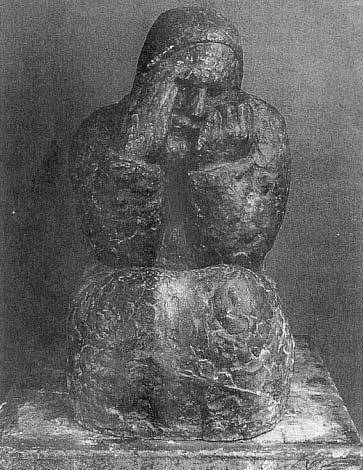
Figure 2.1.
Ivan Mestrovic[*] , An Old Father in Despair at the Death of
His Son, 1961. Snite Museum of Art, University of Notre Dame.
The Culture and Manurance of Minds
When Francis Bacon in 1605 wrote of "the culture and manurance of minds," the literal sense of culture as tending and cultivating nature was still very much in the foreground, although the metaphoric extension of the term to mind was intended. The term culture traces back to the Latin colere, which meant variously to till, cultivate, dwell or inhabit, and which in turn traces back to the Indo-European
root, *Kwel- , which meant to turn round a place, to wheel, to furrow. As Raymond Williams noted:
Some of these meanings eventually separated, though still with occasional over-lapping, in the derived nouns. Thus "inhabit" developed through colonus , Latin to colony . "Honour with worship" developed through cultus , Latin to cult. Cultura took on the main meaning of cultivation or tending, though with subsidiary medieval meanings of honour and worship. . . . Culture in all its early uses was a noun of process: the tending of something, basically crops or animals. . . . At various points in this development two crucial changes occurred: first, a degree of habituation to the metaphor, which made the sense of human tending direct; second, an extension of particular processes to a general process, which the word could abstractly carry (Williams 1976:77).
The term culture , according to Williams, was not significant as an independent noun before the eighteenth century and was not common before the nineteenth century. But even before the nineteenth century the term was already beset by the etherealizing tendencies of ethnocentric universalism, so that Johann Herder could state that "nothing is more indeterminate than this word, and nothing more deceptive than its application to all nations and periods." Colonize and culture are both derived from the same root, and Herder was well aware of how the Enlightenment dream of "universal reason" could also be used as an expression of European power. He complained of the treatment of human histories and diversities as mere manurance for European culture: "Men of all the quarters of the globe, who have perished over the ages, you have not lived solely to manure the earth with your ashes, so that at the end of time your posterity should be made happy by European culture. The very thought of a superior European culture is a blatant insult to the majesty of Nature" (1784–1791, cited in Williams 1976:79).
Cultural anthropology has in many ways taken Herder's words to heart, admitting—to use the title from one of Clifford Geertz's books—"the interpretation of cultures" in the plural as its central task. Yet in the long history and vicissitudes of the term culture , there has remained a broader sense of culture as meaning in general, which remains a central problematic of social theory even if it has lost its earthy origins. Cosmopolitans do not like the smell of Bacon's conception of "the culture and manurance of minds," preferring the intellectualistic "systems of symbols and meanings." Please do not misunderstand me, honored colleagues of the academy. I am not simply calling for an anti-intellectual, nostalgic return to farmer's wisdom, such as expressed in the following
quotient: Die Quantität der Potate ist indirekt proportional zur Intelligenskapazität ihres Kultivators! (Or, as they say in the south, Der Dümmste Bauer hat die grösste' Kartoffel!).[*] I am simply saying that we must revitalize the concept of culture and free it from the abstractionist grip of our time: we must put the cult back in culture .
We have come a long way from the earthy conception of culture as a living process of furrowing and cultivating nature within and without, of the organic admixture of growth and decay that such a conception implies, of the springing forth of tendrils of belief needing active cultivation for survival. One of the glaring holes in most contemporary conceptions of culture is the lack of attention to the birth of meanings, a lack that applies equally to the term conception . In intellectual discourse, conception connotes, almost without exception, rational beliefs and not the gestation of something new, the birth of meaning. Likewise, culture now connotes systematized meaning for most culture theorists and has lost the fertile, seminal, and gestational meanings it once carried: "the culture and manurance of minds." Both the living source and the final aim of culture, I claim, is cultus . Yet it is precisely the cultic that is so frequently occulted by contemporary culture theory.
The word cult , despite its obvious relation to culture, seems worlds apart from its meaning in everyday language. Cults are usually associated with pathologically disturbed or ideologically brainwashed groups—satanists, the suicidal followers of Jim Jones at Jonestown, Moonies, and the lunatic fringe in general—but the term also applies to emerging religious sects, such as the early Christian cults. In the anthropological sense the word cult is strongly associated with ritual, as in the "cargo cults" that appeared in the South Pacific after World War II or the various rituals to Afro-Christian "saints" in the Umbanda cults of Brazil. The ethnographic record, Freud, and Durkheim have sensitized us to how certain objects become endowed with sacred or obsessional significance as fetishes—such as a wooden sculpture of a human form studded with nails by the Bakongo people of West Africa (figure 2.2). We see in these examples how deep human needs and desires seek objectified, and often fantastic or perverse, form.
One of the most insightful accounts of the cultic roots of culture is to be found in the work of Victor Turner. His masterful ethnography reveals the fundamental reality of the subjunctive mood in human affairs: the
[*] The size of the potato is indirectly proportional to the IQ of the farmer; or, the dumbest hick has the biggest spud.
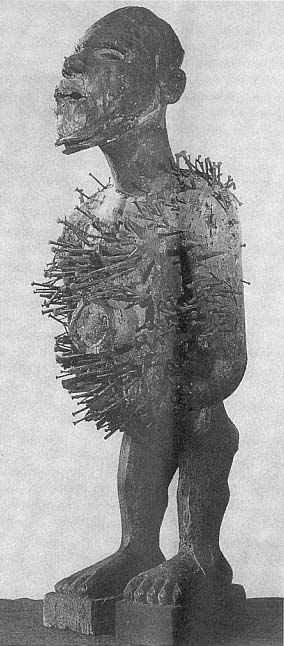
Figure 2.2.
Large wooden figure studded with nails, Bakongo tribe,
Angola, nineteenth century. The University Museum,
University of Pennsylvania.
ritual process. In Turner's analyses of the Isoma and Wubwang'u rituals of the Ndembu of northwestern Zambia, one sees the fantastic interplay between human affliction and symbolic renewal, between human communities and a natural environment teeming with signification. The Ndembu are revealed to be a people with a deep appreciation of the complexity of existence and endowed with a sophisticated technics of meaning, a vast architectonic of felt, expressive forms through which they journey to those borderlands beyond human comprehensibility: death, the dead, the call of the mother-line, fecundity, transformation, the interstices of social structure. Systematizers who seek an airtight scheme with absolute closure will not find it in Turner's work. His theories are open-ended, ever acknowledging the greater richness and potentiality and not-yet-decipherable and perhaps not systematizable richness inherent in experience and culture. He continually directs our gaze instead to those social "openings" through which the ferment of culture erupts. Cultures are not simply inert structures or bloodless "systems," but form a "processual" dialectic between structure and liminality.
In his well-known essay, "Betwixt and Between: The Liminal Period in Rites of Passage" (1967:93–111), Turner attempted to grasp that virtually ungraspable mercurial element in human affairs in which normal social structure and mores of conduct are temporarily eclipsed. Liminality was that which dismembered structure in order to transform, renew, and re-member it. Turner went on to show, in this essay and in other works, how liminality provides a time of visceral or meditative (or both together) reflection, a time of reflective speculation: "Liminality here breaks, as it were, the cake of custom and enfranchises speculation. . . . Liminality is the realm of primitive hypothesis, where there is a certain freedom to juggle with the factors of existence. As in the works of Rabelais, there is a promiscuous intermingling and juxtaposing of the categories of event, experience, and knowledge, with a pedagogic intention" (1967:106). Turner notes, however, that the liberty of liminality is ritually limited in tribal societies and must give way to traditional custom and law.
In Turner's works, one continually confronts the drama and mystery of life itself in its humanly perceivable forms. The live human creture, not the dead abstract system, is the source of what he termed processual anthropology . Throughout The Ritual Process , he engages Claude Lévi-Strauss in a dialectical contrast, posing his processual anthropology against Lévi-Strauss's structuralism, while yet drawing from Lévi-Strauss's analyses that which he finds useful. In Turner, one sees that
meaning is much more than a "logical structure," because it involves powerful emotions not reducible to logic, a purposiveness not reducible to binary oppositions, "a material integument shaped by . . . life experience." In short, a processual approach views structure as a slow process, sometimes very slow indeed. Or as Turner puts it, "Structure is always ancillary to, dependent on, secreted from process" (1985:190).
Turner is very much concerned with systemic or structural questions, but he continually reminds us of the human face behind the social roles, status hierarchies, and social structures. That human face may be painted with the red and white clays of Wubwang'u , or it may be adorned with the phantasms of carnival, or it may be soberly dressed in ritual poverty, but Turner's theories, and the body of his work itself, never let us forget those deep human needs for fantastic symboling to express the fullness of being.
Central to Turner's processual anthropology and comparative symbology is the ritual symbol, which he considered the "core" unit of analysis. The symbol is the "blaze"—the mark or path—that directs us from the unknown to the known, both in the Ndembu sense of kujikijila (to blaze a trail by cutting marks or breaking or bending branches on trees) and in C. G. Jung's sense. Key to the indigenous hermeneutic of the Ndembu is the term ku-solola —"to make visible," or "to reveal"—which is the chief aim of Ndembu ritual, just as its equivalent concept of aletheia is for Hans-Georg Gadamer's hermeneutic. These Ndembu terms derive from the vocabulary of hunting cults and reveal their high ritual value. The idea of making a blaze or path through the forest also draws attention to the significance of trees for the Ndembu, not only as providing the texture of the physical environment, but also as sources of spiritual power. The associations of substances derived from trees with properties of blood and milk, or of toughness with health and fruitfulness with fertility, which Turner discusses in his description of the Isoma ritual, also reveal why he chose Baudelaire's phrase "the forest of symbols," as the title for one of his books. In his ground-breaking discussions of color symbolism in Ndembu ritual, Turner shows how the social system of classification comes into play, but he roots the social meanings of red, white, and black symbols to the experiential level of bodily fluids and substances of blood, milk and sperm, and feces.
At the time of his death Turner was fully engaged in the struggle to achieve a new synthesis—a theoretical rite of passage to a broadened vision of anthropology and social theory. A number of social theorists
have been claiming to be transforming social theory—I am thinking here of Habermas, Luhmann, Giddens, and others—but for the most part they have been replaying tired variations on old themes without ever questioning the premises of modern social theory. But in Turner's synthesis of social dramas, liminality, communitas, Deweyan and Diltheyan understandings of "experience," and neurobiological semiotics, perhaps we see the unexpected outline of a new understanding of the human creature: one which reconnects biological life and meaning, which embraces the "subjunctive" as no less fundamental a reality of human existence than the "indicative," which views the realm of the fantastic as a precious resource for continued human development rather than as a vestige of an archaic and obsolete past.
Turner is regarded as an anthropologist in the Anglo-American sense, but his late work, like that of Lewis Mumford, reveals him to be a philosophical anthropologist in the German sense as well. Turner and Mumford are no throwbacks to biological reductionism. Quite the contrary: both are master interpreters of meaning, both are original contributors to the semiotic turn of the social sciences, both are exponents of a dramaturgical understanding of human action. Yet both felt compelled, in the name of human meaning , to delve into the biological sources of signification. The liminal processes revealed in lucid detail by Turner and the broad historical account of human development and sociocultural transformation given by Mumford complement each other and illustrate how both authors share a deep appreciation of the cultic roots of culture. Their work shows the way toward undoing the etherealizing spectre that haunts the contemporary study of meaning and culture as well as its mechanico-materialist opposite in human ethology and sociobiology. At the heart of Turner's and Mumford's work is ever the incandescent human form.
To those who can no longer live within the frame of mythic rationality and its cultural nominalism, the artificial split between a mechanical nature devoid of generality and a culture reduced to human conventions devoid of tempered experience and organic roots seems a quaint relic from the bifurcated world of cultural nominalism, mythic modernity. This peculiar mindset took the rationalization of culture, the technicalization of society, and the mechanization of the universe to be a troubling, yet logical, development in occidental culture: Disenchantment is the name and cost of freedom.
Is rationalization ultimately the proper term for Weber's project? Or does rational maximization better capture the processes that Weber
thought he saw inherent in religion and in the peculiar developments of the Occident?
Rationalization ought to describe the normal growth and context of rationality in human life, the place of rational capacities as organs of a mind deeper and broader than rationality alone. The human mind, in both its individual and collective manifestations, reveals the extrarational capacities of memory and invention, interpretative "sensing" and organic balancing, rich emotional communication—not at all limited to what words alone can say—and an obsessive need for the semblance of meaning.
The fullness of the human body also reveals dark, destructive impulses potentially active in all of the human capacities, impulses generated no doubt from our own animal depths but by no means excluded from our rational heights: for every Caliban there is also one of Kafka's devitalized rational apes. The rationalist too frequently places the blame for human evil and folly on the irrational, ignoring the great tendencies of decontextualized rationality toward self-destruction. "The devil made me do it" alibi only works when one fully acknowledges the ever-present devil within: criticism must always invoke self-criticism. There is in pure rationality a profound aptitude for cold-blooded murderousness and its seeming opposite: Weltschmaltz, the self-beautifying lie of sentimentalism. Albert Speer said that Hitler in his more manic moods and rages would discuss plans he did not necessarily mean to carry out. But when he was calm, cool, and collected—"rational"—his inner circle knew he fully intended to carry out his calculations, no matter how extreme. In Speer's account one sees what is perhaps the twentieth century's most notable "achievement": rational madness.
Though mythic rationality saw the many distortions that entered into modern life through capitalism, rationalism, technicalism, and individualism, it never questioned whether the mechanization of nature in the seventeenth century might also be part of this distorting process. Because virtually all of social theory has grown out of the same processes of cultural nominalism, theorists tend to accept uncritically the reified split between thought and things, between culture and nature. Culture can then be assumed to be free from nature or to seek as its goal to escape from nature through the perfection of rationality. In both cases the underlying task is to etherealize the human creature, to divest it of its organic, cultic, biosemiotic roots. Yet all the inner autonomous forms of culture, all the outer technical codes and know-how, and all the rational justifications for progressive, modernized, "communicative"
culture remain insufficient for a truly vital culture when disconnected from the tissues of life, from human bodies and their social relations.
The cultic is the springing forth of the impulse to meaning, which culminates in belief. As such the cultic is no throwback to "vitalism" but involves the deepest emotional, preconscious, and even instinctive capacities of the human body for semiosis. Although most theories of culture tend to view meaning as conventional knowledge or system, I am proposing that the essence of meaning resides in bodies sign-practices that circumscribe mere knowledge. Conventions of language, gesture, image, and artifact should be viewed as the means toward incarnate sign-practices, not as the structural or systemic foundations or ends of meaning. The very attempts to ground meaning in a theory of pure conventionalism are signs of the evisceration of meaning, the hollowing out of living human experience to the external technique or the idolatry of the "code."
By "incarnate sign-practices" I mean that culture is a process of semiosis, or sign-action, intrinsically involving the capacities of the human body for memory, communication, and imaginative projection, and is not completely separable from those capacities. Social structure, in this perspective, cannot be severed from the living inferential metaboly of human experience through systematic or structuralist abstraction, but it needs to be conceived in some relation to lived human experience and its requirements, limitations, and possibilities. Human life, in its organic fullness, remains the yardstick for social theory and cultural meaning, and neither the abstractionist distortions and perversions of the life-concept through biological reductionism nor the equally abstractionist repression of the life-concept through cultural reductionism will suffice any longer.
Dreams As Organs of Meaning
Let us turn to the social fact of dreaming, a nightly experience shared by all human beings, as an unexpected way to explore the cultic roots of culture. To most social theorists, dreams emanate from a twilight zone of questionable value: dreams are "imaginary" and therefore unimportant aspects of modern life. The task of modern social theory, after all, is to wake humanity from its dream and bring it to self-consciousness. Yet dreams, I claim, cannot be wished away from our
evolutionary past, from our sociocultural present, or from our potential futures. There is good reason to suspect that dreaming was a significant component of the experiential world of the protohumans: the fantastic image-making process, autonomously produced by the psyche, a private, though social, self-dialogue of the organism, its "language" fashioned from the forms of experience. Dreaming may very well have helped to "image" us into humanity. And we may yet remain creatures of the dream.
Sociologists might take the view that dreaming is nonsocial and therefore unsuitable for sociological analysis, except perhaps as dreams are somehow recorded and become social "texts." This sociological view remains insufficiently social, however, in not acknowledging how actual dreaming itself, like speaking, is both a social trait of all humans and consists of narrativelike structures and a "language" of images incorporated from cultural experience. Whereas speech communicates publicly shared meanings, dreams can incorporate private meanings that transcend local culture. For this reason it is important to view dreams as private, yet thoroughly social, experiences. Dreams are self-communications, feelings that have already been elaborated into communicative, imagistic signs. Dreams may be indicators not only of individual development but also of formative experiences in the inner growth of the person and the origins of human symbolic activity.
In attempting to fathom the vanished past from visible remains, we tend to ignore the most perfect archaeological artifact of human evolution: the living human body. Although archaeologists have become quite sophisticated in using medical and physical evidence from ancient corpses, they have not been as willing to use the living human body today as evidence for prior likely evolutionary developments. Yet archaeoneurology remains an area of potentially great significance, not only for an understanding of how humans became human, but also for understanding contemporary human nature and signification.
Though I am not familiar with earlier uses of the term archaeoneurology, the idea was familiar to Sigmund Freud, the neurologist and archaeologist of the psyche and amateur archaeologist of ancient civilizations. If anti-Semitism had not barred Freud from an academic career, he might have become a noted archaeologist instead of the founder of psychoanalysis. Yet Freud's investigations of the unconscious show that he remained a psychic archaeologist, attempting to show how the dreams of his turn-of-the-century patients revealed both a personal history and a biological drama as old as the human race. In The Interpreta-
tion of Dreams, Freud uses a stratigraphic method of symbol interpretation in which the contents of dreams are shown to reveal underlying sexual and familial themes, such as the Oedipal myth, and these themes are ultimately rooted in Freud's nineteenth-century neurological understanding of the reflex-arc concept. The layers of the unconscious are like the layers of time embedded in an archaeological site: each level a farther step into the past, until one arrives at the mechanical model of the reflex arc as explanation.
Freud's archaeoneurology is a curious blend of literary interpretation and scientistic mechanism. Freud posits a divided psyche, which is a classic example of cultural nominalism: there is the subject whose question is "How do I know?" and the object whose question is "How does it work?" The first Freud called das Ich, the I or ego, the second he called das Es, the it or id. The id is the realm of mechanical force, the ego is the realm of symbolic purpose. One might also read the id as Thomas Hobbes's "state of nature" and the ego as a kind of "social contract." Symbolic representation is achieved through the successful resolution of the Oedipal conflict, in which the metaphoric Oedipus in us all comes to harness the inner "natural" urges to murder and to commit incest by identifying symbolically with the same sex parent and thereby "having" or relating symbolically, rather than genitally, to the opposite sex parent. One establishes an inner triadic, psychic family representation, which serves to mediate the subject to the object, the unconscious.
One of Freud's positive achievements was to show the power of the human family in the psyche. Just as Feuerbach had unmasked the "holy family" as standing for the earthly family and Marx had unmasked the earthly family to reveal the bourgeois family, Freud attempted to show that the earthly family was itself a surface manifestation of deeper and darker forces of the unconscious. Yet his choice of the Oedipus myth and his own myth of a "primal horde," which had collectively killed the primal father and then banded together to form a social contract against further killings, have come to look much more, with the passage of time and the accumulation of archaeological evidence, like the fin-de-siècle fictions they were, when all of Europe, and Vienna in particular, banded together to kill off the past. Freud's "primal horde," perhaps more than his other images, reveals the workings of a mythic nominalism, of a world of convention banded together for its own protection and set utterly apart from its own ground of development: competitive struggle for individual survival is natural, relationship or mutual aid is not and must therefore be invented.
One sees in Freud's psychoanalytic theories the deep imprint of Hobbes and other English thinkers admired by Freud, such as John Stuart Mill, transposed to the "innerness" of German/Austrian thought. Freud helped to open up the floodgates of the unconscious in the face of twentieth-century rationalism, yet his view of the workings of the psyche is itself another manifestation of that rationalism: it is tethered to an outmoded mechanical model of biology and to a conception of human communities and communication as epiphenomenal aspects of consciousness, superimposed on the underlying reality of the id.
Freud's junior colleague, C. G. Jung, broke with him because of Freud's rationalism. Jung increasingly appreciated the purposeful role of nonrational symbols and the limited place of rationality in the purposeful activities of the psyche. One might say that whereas Freud's unconscious becomes darker the farther one penetrates into the unconscious, Jung's unconscious becomes increasingly luminous, perhaps too much so. One moves from the darkness of the personal unconscious to the archetypal figures of the collective unconscious. Jung believed that the deepest processes of the unconscious were collective, purposive symbols: literally personalities. The images of the trickster and the hero were not solely the products of legends and myths, but were realities embodied within the psyche. These personalities were related through narrative inner transformations that could be observed in dreams, in artistic activities, and, Jung believed, in the symbolism of myths and religions.
In many ways Jung comes closer to the idea of archaeoneurology, but he remained, as did Freud, bound by an overly inner view of the human psyche and too ready to deprive experience of its own formative influence in the generation and meaning of symbols. Freud and Jung opened new dimensions for the human sciences, but their theories give short shrift to the thoroughly social nature of dreaming and psychic life in general. Freud's metapsychological foundations are rooted in the nominalistic individualism of Hobbes, with symbolic consciousness the inner psychic equivalent of Hobbes's social contract, erected over the "Warre of Each against all" of the state of nature, or, in Freud's term, the id. Jung's concept of the archetypal unconscious is more social than Freud's, but it still is based on a Kantian-like structuralism that does not explain how archetypal structures came about or how human experience and culture may transcend archetypal imperatives both individually and institutionally. Sociologists may see in Durkheim's theory of conscience collective a more socially based understanding of dreams. In his late work Durkheim
attempted to show how the faculties of knowing are social, as opposed to the individual faculty theory of knowledge deriving from Kant. Yet Durkheim, too, remained tethered to the legacy of Kantian structuralism, in believing that: (1) a fundamental duality between individual consciousness and collective consciousness exists; (2) collective representations ultimately represent one fundamental, underlying, unchanging entity: society; and (3) collective representations are essentially conventional. These beliefs reveal why Durkheim remains inadequate to understand the social reality of dreaming. As opposed to Durkheim's claims: (1) individual consciousness is a social precipitate continuous with the collective biosocial heritage rather than dualistically opposed to it; (2) that which collective representations signify may emerge, grow, die, and undergo genuine transformation in time; and, finally, (3) as dream-symbols make abundantly clear, collective representations are not limited to purely conventional signification, but they draw from other modalities of signification, such as iconic and indexical signs.
The evolution of humans is marked by various anatomical changes, such as the development of the upright stance, the radical enlargement of the cranium and specifically the forebrain, and the creation of a vocal cavity with lowered larynx and subtle tongue and lip movements capable of producing an enormous variety of utterances. Speech is clearly one achievement of this process that uniquely identifies us as humans. But so too, for that matter, is artistic expression. Both are sign-practices dependent on the achievement of symbolic representation, and both reveal how to be human is to be a living, feeling, communicative symbol. Now a symbol, in the Peircean view I have adopted, is a social fact: a triadic relation whose meaning "depends either upon a convention, a habit, or a natural disposition of its interpretant or of the field of its interpretant" (Peirce 1958:8.335). In the case of the symbolic sign, as distinguished from iconic or indexical signs, the process of interpretation comes to the foreground, and, from a cultural perspective, this is to say that to be human is to be an interpreter. The very achievement of symbolic signification stands upon the vast capacities for pre- and protosymbolic communication developed by our forerunners and tempered into our physical organisms. And dreams may very well have provided the inner drama necessary to provoke us into interpretation by presenting images of a phantasmagoric "here and now," which break into the habits of everyday life.
The neurophysiology of dreaming suggests that dreaming is the inner life of humanity in a virtually purified state: the inner conversation
of brain and mind. Brain "speaks" its ancient voices of phylogenetic experience through neurotransmitters that either emanate from the old "reptilian" brain and flow upward to the cortex, where visual, associative, and motor areas are excited (Hobson 1987:338–340), or, in the view of other researchers, through a reciprocal activation of the "old" brain centers with the "new," upper ones. In this process ancient neurophysical impulses become transformed into acts and associated meanings expressed in the images—whether visual or not—themselves. Iconic signification, which is to say the inherent presence or the communicative character of the sign itself, is the predominant language of this inner world, the meeting place of brain and mind. Yet, in contemporary humans, those icons of dreams are themselves frequently shaped from the reservoir of cultural experience and symbolic signification. The resources of mind and memory, incorporating both collective cultural experience, such as language, and personal experience play an active role in either consummating or frustrating the neurochemical dance.
Dreaming is the cultic ground of mind, a communicative activity between the most sensitive archive of the enregistered experience of life on the earth, the brain, and the most plastic medium for the discovery and practice of meaning, the mind or culture. Most explanations of dreaming have tended to view it as ultimately passive, as a compensatory mechanism for daytime existence. In the Freudian view dreaming is the way that repressed wishes of the unconscious can be actively disguised through symbolism, thereby "venting" their energies in a way that will not undo consciousness. In many recent neurophysiological views, dreaming allows the recharging of the brain's neurochemical batteries. If human bodies were simply machines, these theories would perhaps be adequate. But it is important to realize that just as the mind is formative, generating new ideas collectively and individually, the brain, as the chief organ of mind, may also be formative or active.
One wonders what the neurophysiologists' answers to other human activities might be: Why do we make music, images, and dance? Why does belief play such a central role in human affairs? Why can dreams wreak such havoc upon habituated experience and memory through fantastic associations or inversions? Why are all humans compelled to participate in these strange cults of the night? Why are such bizarre antics—the nightly Mad Hatter's party of REM sleep to which all are invited whether we remember it or not—absolutely necessary to our ability to function in the day world? When we begin to ask questions such as these, it becomes possible to turn the dream question around. In
other words, only by exploring that strange culture within us in its own terms, taking the "native's" point of view toward our inner life, can we begin to understand the alien within and our glassy essence.
Perhaps dreaming itself is the purpose of dreaming, the end for which the neurophysiology is the means. As Milan Kundera writes in The Unbearable Lightness of Being, "Dreaming is not merely an act of communication (or coded communication, if you like); it is also an aesthetic activity, a game of the imagination, a game that is a value in itself. Our dreams prove that to imagine—to dream about things that have not happened—is among mankind's deepest needs." This interpretation may strike the reductionists among neurophysiologists and social theorists as too fantastic, but perhaps the fantastic is an inbuilt aspect of evolutionary reality, difficult though it may be to understand in our utilitarian age.
Although it is frequently acknowledged that the unconscious is the source of creativity, it may be that dreaming, the night music of the soul, may also help generate new neural pathways. In other words, dream images may function as prospective symbols for mind, just as REM neural activity may function as neural network-making for brain: perhaps the two work in psychophysical relation, as might be indicated by the large proportion of time devoted to REM sleep in fetuses and infants, when the brain itself is rapidly growing.
Lewis Mumford proposes that man's inner world "must often have been far more threatening and far less comprehensible than his outer world, as indeed it still is; and his first task was not to shape tools for controlling the environment, but to shape instruments even more powerful and compelling in order to control himself, above all, his unconscious. The invention and perfection of these instruments—rituals, symbols, words, images, standard modes of behavior (mores)—was, I hope to establish, the principal occupation of early man, more necessary to survival than tool-making, and far more essential to his later development" (Mumford 1967:51).
Although humanity has become increasingly conscious of itself, it has never stopped dreaming. Nor have its dreams become any less wondrous and terrifying. Communicative signs, not utilitarian tools, were the first human technics, created out of the human body itself, which was then and remains today the most sophisticated human achievement.
If we consider then the influence of dreaming as creating a movement toward interpretative order, we can see how that process could
lead to an excess of order. When stretched beyond organic limits, such as life-purposes, local habitat, and local social organization, the tendency toward interpretation could take on a life of its own. Archaeological evidence suggests that proto- and early humans lived for the most part in environments that could localize and thereby neutralize the tendency to overreach for order or system. If we think of early cities and emergent civilizations as going beyond the earlier environmental resources and limits, we can suggest that the "megamachine"—reified, centralized order—was a product of that time, as Mumford claims, but that it was also a latent possibility already built into the human creature as a negative consequence of the dream-induced body technics.
Biological evolution and cultural development are not simply a progressive casting off of shackles and a movement toward a greater and ultimately unrestrained freedom, but they involve trade-offs of one kind of limitation for another. The achievement of human symbolic consciousness may have cost us a somewhat diminished perceptual or emotional life: who is to say that the forms of feeling produced by Neanderthal burial rituals, and the dawning significance of death and mortality for Homo erectus and even earlier creatures, may not have more to do with the real essence of human symbolic consciousness than a modern rationalist treatise on culture produced by a human product of that consciousness? On the other hand, the Mozart and the Verdi Requiem provide ample evidence that the achievement of symbolic consciousness also enlarges and enhances perceptive and emotional capacities. There may have been a trade-off of emotive brain power in the overall reduction of brain size from earlier humans, such as Neanderthal, to Homo sapiens sapiens, but the subtilizing of brain through the enlargement of the forebrain may have provided compensation. One is reminded of Herman Melville's dictum: "Why then do you try to 'enlarge' your mind? Subtilize it."
Mumford and only a very few other social theorists point to the unusual fact that our big brains seem possessed of excess energies and that this characteristic may explain a number of peculiar features of human existence. But there is an even more fundamental question that seems to me ignored, even though it goes to the crux of the evolutionary debate dating back to Darwin and Wallace: How did our big brains come about? It is not simply that we had big brains which we then had to control, but also that we evolved big brains, presumably through an evolutionary increase of brain use and adaptiveness. What was it that made big brains adaptive? Increasingly complex social organization?
Increasingly complex dreaming? Or both? Did the human brain evolve in the context of an evolving mind? Did mind, and not simply chance variation or adaptiveness, need more brains? Did the emergent symbolic consciousness need more forebrain and therefore "select" for the growth of this region?
Is it possible that the idea of the megamachine goes back much farther again, back to the emergence of Homo sapiens sapiens? If protohumans evolved the tools of ritual, speech, artistic expression, and mores of conduct as means of controlling the inner anxieties, anxieties related to our big brains, perhaps the tendency to automatonlike order was also embedded in the central nervous system. Hence we would be creatures biologically impelled toward autonomy and meaning, as Mumford says, yet also biologically constructed to take the quest for meaning too far, thereby substituting order for meaning. The acquisition of meaning and autonomy may have been achieved at the cost of repetition compulsions or even the removal of biological inhibitions against overcentralization. Though cultural reductionists claim that human culture helped free us entirely from instincts, this view overlooks the possibility that human instincts continue to operate in vague and suggestive, yet vitally important, ways. Largely liberated from the genius of instinctive determination, we may be creatures neurologically constituted to walk the knife-edge between autonomy and the automaton, our task being, not to escape biology, but to make human autonomy instinctive.
Or let me express this view in another way. Perhaps the symbol itself, as the medium of human consciousness, is so constituted, both in its freedom grounded in human conventions and in its mysterious relations to the central nervous system, that it needs to be connected to perceptive and critical—that is, lived—experience. Contrary to celebrated views of the symbol (or sign in Saussure's terminology) as completely "unmotivated" or arbitrary, I claim the symbol is that sign most dependent on vital and critical experience for its continued development.
We live in signs and they live through us, in a reciprocal process of cultivation that I have elsewhere termed critical animism . If most tribal peoples have traditionally lived in a world of personified forces—or animism—and if this general outlook was evicted by the modern "enlightened" view of critical rationality and its "disenchanted" worldview, then I am proposing a new form of re-enchantment, or marriage, of these opposites. Critical animism suggests that rational sign-practices, though necessary to contemporary complex culture and human free-
dom, do not exhaust the "critical" and that the human impulse to meaning springs from extrarational and acritical sources of bodily social intelligence.
The evolution of protohumans, though marked by the greater reliance on symbolic intelligence, did not necessarily mean the complete loss of instinctive intelligence as some theorists, such as Gehlen, have implied. On the contrary, one key aspect of the emerging symbolic intelligence "in the dreamtime long ago" may very well have been an instinctive, yet highly plastic or generalized, ability to listen to and learn from the rich instinctual intelligence of the surrounding environment. The close observation of birds, not only as prey but also as sources of delight, could also help to inform one of an approaching cold spell or severe winter.
A better example might be the empathic relations to animals and natural phenomena shared by many tribal peoples. One frequently sees an identification with an animal or plant related to the practices of a people, such as the cult of the whale for fishing peoples, and a choice of an object that somehow symbolizes a central belief of a people, such as the white mudyi tree as a symbol of the milk of the matrilineally rooted Ndembu of Africa. There exists then a range from a practical, informing relationship to nature, or a fantastic elaboration of that relationship, to a purely symbolic relationship to the environment that either may be unrelated to the surrounding instinctual intelligence or that might even function as a kind of veil to obscure the informing properties of the environment. These relationships were crucial to the emergence of humankind: the deeply felt relationship to the organic, variegated biosphere, which was manifest in those natural signs or instincts of other species, and the corresponding pull away from the certainties of instinctual intelligence toward belief, toward humanly produced symbols that created a new order of reality, and in doing so, both amplified and layered over the voices of nature.
Through mimesis, emerging humankind could become a plant or bird or reindeer, and thereby attune itself to the cycles of nature through the perceptions of these beings. A mimetic understanding also involves the generalizing of nature into symbolic form. A man dressed as a raven or bear at the head of a Kwakiutl fishing boat and the lionheaded human figurine found in Germany that dates back thirty-two thousand years (a very early find possibly suggesting interaction between Neanderthals and anatomically modern humans) signify the sym-
bolic incorporation of animal qualities into human activities and provoke human reflection, through what William James called the "law of dissociation," on the meaning of human activities.
Dreaming is central to mimesis, and dreaming itself may be seen as an in-built form of "recombinant mimetics"—with all the power and danger of recombinant genetics—in which fantastic juxtapositions of neural pathways and cultural images and associations take place. Dreaming is perhaps the primal "rite of passage," through cult, to culture.
In examining the brain-mind dialogue of dreaming we see a domain that bridges nature and culture, which may have been essential to the emergence of human symbolic culture and may remain essential to its continued development. In that sense dreaming opens an unexpected window onto the cultic roots of culture: the spontaneous springing forth of belief. And if Mumford is correct that dreaming may have impelled us toward a technics of symbolism both to control the anxieties produced by the inner world and to be animated by its imagemaking powers, then perhaps we can better understand the cultic origins of culture through examining the ritual symbol itself and the drama of communication that emerged from it. I cannot undertake that analysis here. But in indicating the line we big-brained apes must have followed in entering and establishing the human world, one conceivable consequence has, I hope, become somewhat clearer. The impulse to meaning is both original to our nature and ineradicable.
Modern deratiocination, falsely termed rationalization by Max Weber, is that decontextualized form of rationality whose continued and unlimited growth involves the progressive elimination of the impulse to meaning. Its logical terminus is a closed rational system and stochastic indeterminacy. This is what Jürgen Habermas euphemistically calls "a progressive unfettering of the rationality potential inherent in communicative action" (1987 [1981]: 191). Contrary to Habermas's unshakable Enlightenment optimism, the unfettering of the limits of rationality led to Kundera's "unbearable lightness of being," which no new and improved "communicative" rationality is sufficient to correct. Dressed in our little, brief "rationalization," we become most ignorant of what we are most assured, our extrarational impulse to meaning, and cultural life withers as do rationalistic theories of culture.
We are left, it seems to me, with centering our investigation of the roots of culture in the most sophisticated technics the world has yet known: those of the human body. Through human memory we have a profound connection to the past: to historical, prehistorical, and even
transhuman memory as the incorporation of organic experience. Living human memory, which is something quite different from mere nostalgia, makes it possible for collective and personal past experience to infuse its wisdom into the present and so generate new prospects for future conduct. No computer memory chip can help a computer to feel a novel situation, as human memory can, or to generate a truly novel interpretation. The generalization of human memory in myths, rituals, traditions and writing vastly broadened the spatiotemporal environment and human power. But power is double edged, and as Milan Kundera has said, "The struggle of man against power is the struggle of memory against forgetting."
The origins of culture are to be found in those communicative practices through which emergent humanity literally bodied itself forth, creating a forebrain with language, speech, and personality capacities, creating a tongue, larynx, and throat capable of articulate speech, creating forms of expression, rituals of affliction and celebration, dramas of mythic, social, and personal communication, and stable institutions such as agriculture, villages, and later, cities, which have endured from Neolithic times to the present. The very expression "the culture and manurance of minds" may reflect the invention of manuring and its connection, through agriculture, to the development of permanent villages and protocities in the Neolithic Age. In other words, the very concept of culture may be an achievement and legacy of the Neolithic Age. Contemporary culture and culture theory seem intent on etherealizing these achievements out of existence and may very well succeed.
No age proves more than ours what a dangerous thing a little knowledge can be. Overweening knowledge and technique have characterized the modern age, producing great and terrible ideas and powers. The modern age created new possibilities for autonomy and human freedom, ideals which more often than not turned into their opposites, but which yet might remain compelling. Yet the foundation of this nominalistic epoch has been a ghost in the machine worldview, which has increasingly displaced and devalued organic human purpose and the impulse to meaning.
Modern nominalistic culture may be characterized as seeking to escape its organic roots through spectral theories of mind and mechanistic theories of matter. The chief task of a theory of culture today is to rediscover those extrarational, incarnate sources of meaning that the cult of modernity has now reduced to insignificance and to create a new outlook that can encompass humanity incarnate. This task is not a
retreat into "irrationalism" or biological reductionism but is a frank recognition that the beliefs of modern progress and modern rationality were built on false nominalistic premises: the reified view of nature as a mechanical system and the etherealized view of culture or mind as subjectivistic and set apart from nature. Human reason, in all its fullness, is in living continuity with the cultic roots of culture and is much more than merely rational. The cultic roots of culture, expressed in mother-infant bonding and those playful, dreamlike, inquisitive, and ritualistic forms of conduct, gradually impelled our protohuman ancestors to humanity and, whether we like it or not, remain deeply embedded sources of human cultures and conduct.
References
Becker, H. S. 1982. Art Worlds. Berkeley and Los Angeles: University of California Press.
Bourdieu, P. 1984. Distinction: A Social Critique of the Judgement of Taste. Translated by Richard Nice. Cambridge: Harvard University Press.
Bürger, P. 1984. Theory of the Avant-Garde. Translated from the German by Michael Shaw. Minneapolis: University of Minnesota Press.
Geertz, C. 1973. The Interpretation of Cultures. New York: Basic Books.
———. 1983. Local Knowledge. New York: Basic Books.
Griswold, W. 1987. "The Fabrication of Meaning." American Journal of Sociology 92 (5): 1077-1118.
Habermas, J. 1987 [1981]. The Theory of Communicative Action. Vol. 2, Lifeworld and System: A Critique of Functionalist Reason , translated by Thomas McCarthy. Boston: Beacon Press.
Hobson, J. A. 1987. "Dreaming." In Encyclopedia of Neuroscience. Boston: Birkhäuser.
Kroeber. A. L., and T. Parsons. 1958. "The Concepts of Culture and of Social System." American Sociological Review 23: 582-583.
Lyotard, J. F. 1984 [1979]. The Postmodern Condition. Minneapolis: University of Minnesota Press.
Mumford, L. 1967. The Myth of the Machine. Vol. 1, Technics and Human Development . New York: Harcourt Brace Jovanovich.
———. 1970. The Myth of the Machine. Vol. 2, The Pentagon of Power . New York: Harcourt Brace Jovanovich.
Peirce, C. S. 1958. The Collected Papers of Charles Sanders Peirce. Vol. 8. Cambridge: Harvard University Press.
Rochberg-Halton, E. 1986. Meaning and Modernity. Chicago: University of Chicago Press.
———. 1989a. "On the Life-Concept in Social Theory." Comparative Social Research 11 (1): 319-343.
———. 1989b. "Jürgen Habermas's Theory of Communicative Etherealization." Symbolic Interaction 12 (2): 343-363.
———. 1989c. "Nachwort" (Afterword). In Das Ritual: Struktur und Anti-Struktur , German translation of Victor Turner's The Ritual Process , translated by Sylvia Schomberg-Scherff, 198-213. Frankfurt: Campus Verlag.
———. 1990. "The Transformation of Social Theory." In Lewis Mumford: Public Intellectual , edited by Thomas and Agatha Hughes. New York: Oxford University Press.
———. 1992. "Habermas and Rorty: Between Scylla and Charybdis." Symbolic Interaction. In press.
Sacks, O. 1987. The Man Who Mistook His Wife for a Hat. New York: Harper Perennial.
Swidler, A. 1986. "Culture in Action: Symbols and Strategies." American Sociological Review 51: 273-286.
Turner, V. 1967. The Forest of Symbols. Ithaca, N.Y.: Cornell University Press.
———. 1969. The Ritual Process. Chicago: Aldine.
———. 1985. On the Edge of the Bush: Anthropology as Experience. Edited by Edith Turner. Tucson: University of Arizona Press.
Williams, R. 1976. Keywords. New York: Oxford University Press.
Wolff, J. 1981. The Social Production of Art. New York: St. Martin's Press.
Wuthnow, R. 1987. Meaning and Moral Order. Berkeley and Los Angeles: University of California Press.
3—
The Order-maintaining and Order-transforming Dimensions of Culture
S. N. Eisenstadt
The Problem:
Its Background and Development in Contemporary Sociological Analysis
One of the central problems in the sociological analysis of culture, and especially of the relations between culture and social structure, has been that of the order-maintaining versus the order-transforming functions of culture. One line of analysis, coming from Marx and Durkheim (and, in a modified form, from Parsons), tends to regard culture (especially religion or ideology) mainly as a reflection of society or as its major legitimizing or consensus-creating mechanism. The second line, epitomized in Weber's analysis of the world religions, especially of the Protestant ethic, stressed the order-transforming, innovative dimensions of religion, of culture.
These different visions of the place of culture in the construction of social order are closely related to the problem of the degree to which social structure determines culture or vice-versa. They are closely related to the extent of mutual determination of culture, social structure, and social behavior; or, as Renato Rosaldo has put it, the degree to which culture is a cybernetic feedback-control mechanism controlling behavior and social structure, or whether there exists a possibility of choice and inventiveness by various social actors in the use of cultural resources.
These problems have been at the center of many theoretical discussions and controversies in the social sciences, especially since the mid-
1960s, and have developed in close conjunction with criticism of the structural-functional approach. These discussions have touched on many of the substantive problems of the social sciences: the nature of modern society or societies; the vision of humanity and history; the different modes of analysis and explanation in the social sciences; the place of the social sciences in the modern and postmodern intellectual traditions; and the boundaries of different scholarly disciplines (Eisenstadt and Curelaru 1976, 1977). In conjunction with these controversies, there have been far-reaching shifts in the definition of the major concepts of social science analysis, in the relations between the major explanatory models employed in the social sciences, and in the consequent directions of research.
The major shift in the basic concepts of social science analysis, concepts that include culture as well as religion, knowledge, social structure, and social behavior, was in their conceptualization as distinct and "real" ontological entities and not (as in earlier periods of sociological and anthropological analysis) as analytical constructs referring to different aspects or dimensions of human action and social interaction, that is, as constitutive of each other and of patterns of social interaction. Concomitantly, there developed a shift of emphasis with respect to several dimensions of culture and of social structure, especially away from the structural-functional emphasis on values and norms. One view—explicit among the structuralists and implicit among some of the ethnomethodologists—regarded culture as containing the programatic codes of human behavior and espoused (to use Geertz's felicitous, if ironical, expression) the view of man as cerebral savage (for example, Lévi-Strauss 1983). According to this view, culture is fully structured or programmed according to clear principles and is embedded in the nature of the human mind, which, through a series of codes, regulates human behavior. By contrast, the symbolic anthropologists, such as Clifford Geertz, Victor Turner, and David M. Schneider and to some extent the symbolic interactionists in sociology, shifted from values and norms to a conception of culture as a set of expressive symbols of ethos—a worldview constructed through active human interaction (Geertz 1973, 1983; Turner 1974, 1947, 1968; Schneider 1973, 1980, 1977). As R. Peterson has stated:
The focus on drama, myth, code, and people's plan indicates a shift in the image of culture. . . . It was once seen as a map for behavior. In this view, people use culture the way scientists use paradigms to organize and normalize their activity. Like scientific paradigms, elements of culture are used, modified, or discarded
depending on their usefulness in organizing reality as equivalent to the term ideology, but without the latter's pejorative connotations. Sociologists now recognize that people continuously choose among a wide range of definitions of situations or fabricate new ones to fit their needs (Peterson 1979).
Yet another development involved an individualist (or rational-choice) mode of analysis, which regarded culture as the result of the aggregation of individual preferences, reflecting differences of power or patterns of individual choices (Hirshfeld, Atran, and Yengoyan 1982). Parallel shifts in the concept of social structure have also evolved since the mid-sixties. The concept has become firmer in new definitions that view social structure and institutions—especially the "state"—as "real" and "autonomous" agents or actors (for instance, Skocpol 1979; Wolff 1950, 1957; Blau 1964, 1965; Boudon 1981; Merton 1963).
In another development closely related to the rational-choice approach, social structure was viewed as networks or organizations arising from the aggregation of interactions, with almost no autonomous characteristics except for some emergent qualities often described as "primitive effects." This network approach tended to neglect or downplay the tradition of structural analysis represented in the works of Simmel, Merton, Blau, and Boudon, which have stressed the formal characteristics and emergent properties of social structure (Blau 1964; Boudon 1981; Merton 1963).
Finally, these shifts were accompanied by a preference for exclusive deterministic, reductionist, idealist, or materialist interpretations of social action and culture creativity. They were also connected with a growing dissociation between studies of culture and of social structure.
These shifts and the studies they generated sharpened and diversified the definitions of culture and articulated the problems of positioning it in the construction of social order. At the same time they continuously oscillated in their view of the relationship between culture and social structure in any given society as either static and homogeneous or as entirely open, malleable, and continuously changing.
The first view, typical of some structuralists and extreme Marxists, depicts cultural orientations or rules—whether they are, as among the structuralists, reflections of some basic rules of the human mind or, as among the Marxists, reflections of social forces—as relatively uniform and homogeneous within the society and as relatively static with little change throughout the histories of the societies or civilizations in which
they are institutionalized. Such a picture leaves little room (beyond the initial institutionalization of the different cultural visions) for reconstruction and change in the relations between culture and social structure. Nor does it allow for, or explain, various aspects of praxis and the construction of changing mentalities that have been analyzed in recent anthropological, historical, and sociological literature. Finally, it does not explain the development of strategies of choice, maximization, and possible innovation as depicted in individualistic approaches.
In the second view, culture is regarded as an aggregate result of patterns of behavior, structure, or power or—as Ann Swidler has explained it—as a tool kit of different strategies of action that can be activated in different situations according to the "material" and "ideal" interests of different social actors (Swidler 1986). This view implies that culture is merely a mirror or aggregate of continuously changing rational or expressive choices made by individuals and groups without any autonomy of their own.
Toward the Reintegration of Studies of Culture and Social Structure:
Comparative Analysis of Liminality and Heterodoxies
It is not surprising that many scholars from different schools soon recognized the need to reconnect the many different strains of research and analysis. This chapter attempts to contribute to such a reconstruction and to reintegrate the studies of culture and social structure. In so doing, I hope to shed new light on the place of culture in the construction of social order in general and on the order-maintaining and order-transforming functions of culture in particular. The contribution will be made on the basis of comparative studies of liminal situations and of heterodoxies in different civilizations.[1]
Our analysis begins with the recognition of the ubiquity of liminality in human societies. By this term I mean seemingly unstructured situations, "in between" more structured ones, and symbols of antistructure and communitas. Such situations and symbols can indeed, in different connotations, be found in all human societies, as can the unruly behavior that is often connected with them. The ubiquity of such situations is not given in some "natural," spontaneous tendencies, in an outburst
against the discontents of civilization. Rather, these symbols, situations, and patterns of behavior are culturally and socially constructed, and the behavior that develops within them is also so constructed; even if it often seems spontaneous and "natural," it is a socially and culturally regulated spontaneity and definition of natural behavior. This is similar to the situation with respect to the "biological" crises of life—birth, adolescence, death, and so on—which, while rooted in clearly biological givens of human existence, are at the same time socially and cultur-ally channeled (Homans 1962).
The central focus of the symbols found in such liminal situations is a very strong ambivalence to social and cultural order. This ambivalence and the strong emphasis on antistructure or communitas, which are built into many of these situations, are as much culturally constructed as the social structural and cultural order against which rebel the patterns of behavior that develop in these situations.
Such ambivalence to social order is rooted in several basic characteristics of human existence, indeed in some aspects of human biological nature. Among these are the relatively open biological program that characterizes the human species (Meyer 1984); the consciousness of such openness; a basic existential uncertainty or anxiety, most closely related to the consciousness of death, of human finality, and in attempts to overcome it (Dobzhansky 1973; Bloch and Parry 1982); and the capacity to imagine various possibilities beyond what is given here and there (Sartre 1956).
All societies construct such a social and cultural order, designed in part to overcome the uncertainties and anxieties implied in these existential givens. They do so by constructing symbolic boundaries of personal and collective identity (Durkheim [1912] 1954), by defining membership in different collectivities in terms of universal biological primordial categories such as age, generation, sex, and territorial attachment, by "answering" certain perennial problems of death and immortality in religious belief systems, and by distinguishing between the given, mundane world and another world beyond it and between the profane and the sacred.
Ironically, however, the very construction of such boundaries and of their institutional derivatives adds another element or component of uncertainty to the human situation, which exacerbates the original uncertainties and generates a strong ambivalence to social order. This element is the consciousness of the arbitrariness of any cultural construction: the consciousness that any given order is only one of several,
perhaps many, possible alternatives, including the possibility of living beyond any social order whatsoever. In other words, the very construction of any social order, while a manifestation of human creativity, necessarily imposes severe limitations on such creativity and gives rise to an awareness of such limitations.
The awareness of such arbitrariness and limitation and the attempt to convince members of the society that social order, in general, and the specific social order in which they live, in particular, are the "correct" ones are portrayed in the myths and symbols promulgated in all societies through various ritual and communicative situations. These myths and symbols, the closely related "folktales," depict the combination of the attraction of the world outside the boundaries of social order and of the fear of stepping outside such boundaries. They stress the purity of the world inside, the pollution of the world outside (Douglas 1966), and the need to remain within such boundaries. They are not, however, able to eliminate the awareness of various possibilities that exist beyond these boundaries and hence the certain arbitrariness of any such boundaries, of any instituted social order.
The Roots of the Consciousness of the Arbitrariness of Social and Cultural Order:
The Constructive and Destructive Dimensions of Charismatic Predispositions
The consciousness of the arbitrariness of any social and cultural order is exacerbated by the exigencies of reproducing social order through social institutions. It is important here to recognize the fact that constitutes the cornerstone of modern sociological analysis; namely, the inadequacy of the organization of social division of labor to explain the construction and maintenance of social order. The founding fathers of sociology, while recognizing the importance of the various mechanisms of social division of labor, emphasized that the social division of labor, in general, and the market mechanisms analyzed in great detail by economists, in particular, would not suffice to explain the construction of social order (Eisenstadt 1981).
The conditions necessary for sustaining social order are several: the construction of trust and solidarity, stressed above all by Durkheim and to some degree by Tonnies (Durkheim 1964a, 1964b; Tonnies 1957);
the regulation of power and the overcoming of the feelings of exploitation, stressed above all by Marx and Weber (Marx 1965); and the provision of meaning and of legitimation to the different social activities, emphasized above all by Weber (1952, 1958, 1951).
The founding fathers stressed, moreover, that the very construction of any concrete social division of labor generates uncertainties with respect to each of these conditions. Because of these uncertainties no concrete social division of labor can be maintained without attending to these dimensions. They emphasized accordingly that the construction and maintenance of social order depends upon the development of some patterned combination of the division of labor, the regulation of power, and the construction of trust, meaning, and legitimation.
But the development of such a combination is not given. There are inevitable uncertainties, unanticipated crises, and struggles reflecting the tension between different dimensions of social order. These exacerbate the consciousness of the arbitrariness of any social order and the concomitant ambivalence toward it.
The consciousness of the arbitrariness of any cultural and social order, the fact that such consciousness exacerbates the uncertainties and anxiety rooted in the consciousness of the openness of biological program, of awareness of death and in the capacity of imagination and the concomitant ambivalence to the social order, constitutes one of the most important manifestations of the problems inherent in the process of "routinization" of charisma. Above all, such consciousness constitutes a manifestation of the problem inherent in the limitations on human creativity that any institutionalization of a charismatic vision entails (Weber 1968). The essence of the charismatic dimension in human life is the attempt to contact the very essence of being, to go to the very roots of existence, of the cosmic, cultural, and social order, to what is seen as sacred and fundamental.
This charismatic dimension focuses, in the cultural and social realms, on the construction of cultural and social order in terms of some combination between primordial and transcendental symbols in terms of relation to some conception of the sacred. This charismatic dimension is manifest in the construction of the boundaries of personal and collective identity, of societal centers, and of major symbols of prestige. Such a construction is indeed one of the fullest manifestations of human creativity. At the same time, however, the very institutionalization of such a charismatic dimension generates very severe limitations on such creativ-
ity, and, in connection with the tendencies analyzed above, it also generates consciousness of such limitations.
The basic root of the limitations on human activity lies primarily in the fact that the process of the institutionalization of any concrete social setting entails a certain closure in the selection from a variety of potential or imagined possibilities. Second, the roots of such limitations lie in the routinization of the creative act, which is inherent in any such institutionalization, and in the close relation between such closure and the elements of power and domination that any such institutionalization entails.
Indeed, the restrictions and exclusions entailed by the institutionalization of any charismatic vision become necessarily closely associated with, although not necessarily identical to, the maintenance of the distribution of power and wealth, the control over resources, and the limitation of the scope of participation of various groups in the central arenas of a society and their access to meaningful participation in the social and cultural order. Such limitations on human creativity are also inherent in the ways in which the basic conditions of social order—the construction of trust (solidarity), meaning, power, and social division of labor—are related to one another in the process of concrete institution building. The crucial tension or contradiction is between the conditions that generate the construction of trust between different members of a group or society and those that ensure the availability of resources and institutional entrepreneurs in the formation of broader institutional complexes and their legitimation.
The conditions that make for maintenance of trust are best met in relatively limited ranges of social activities or interaction, such as in family or kinship groups in which social interaction is regulated according to primordial and particularistic criteria. Such limited ranges of interaction seem to constitute the necessary minimal conditions for the initial development of such trust, even if they may not be enough to guarantee its continuity. At the same time, however, these very conditions are inimical to the development of those resources and activities needed for broader institutional creativity and for the construction of broader institutional complexes based on more variegated orientations. The very conditions that generate resources for broader complex institution building also tend to undermine the simple, or "primitive," settings of potential trust as they exist within the family and kinship groups or in small communities.
The possibility of such institutionalization is above all dependent on
the effective extension of the range of symbolism of trust beyond the narrow minimal scope of primordial units. Such extension is found, for example, in the depiction of rulers as "fathers" of their countries or in the infusion and legitimation of economic activities with some transcendental meaning. But any such extension necessarily heightens the combination of such extended trust and the distribution of power. Indeed, any construction of concrete social order necessarily institutionalizes some limitations on potential or imagined activities and exclusions of some sectors from full participation in it.
Such exclusions and limitations are, as we have seen, legitimized in various ritual and communicative situations, but the very attempts at such legitimations tend only to underlie and sharpen the awareness of arbitrariness and ambivalence toward the constructed social order. Accordingly, such situations may bring out strong antinomian orientations and many destructive tendencies. Such tendencies are not primitive, or "animal," reactions to the restriction of social and cultural life, but, paradoxically, they constitute the reverse and complementary side of the creative process of construction of order: the constructive aspect of the charismatic dimension of human activities (Weber 1968). They are as inherent in the very nature of the charismatic predisposition or fervor in the very attempt to come into contact with the essence of being, to go to the roots of existence, of cosmic, social, and cultural order, as are constructive tendencies.
The attempt to reestablish direct contact with these roots of cosmic and sociopolitical order may also contain a strong predisposition to sacrilege and to the denial of the validity of the sacred, and it may breed opposition both to more attenuated and formalized forms of this order and to the sacred itself. Similarly, on the personal level, it is in its charismatic roots that the human personality can attain its fullest creative power and internal responsibility, but these roots may also represent the epitome of the darkest recesses and excesses of the human soul, its utter depravity and irresponsibility, and its more intensive antinomian tendencies.
Thus, the very process of the construction of social and cultural order generates tendencies toward its destruction. The destructive aspects of charisma often involve the denial not only of the concrete restrictions inherent in institutionalization but also of the very fact of institutionalization and the social restrictions it entails. But even the seemingly total negation of the social order, the potentially destructive behavior related
to it, and the attempts to overcome them are elements of the construction of cultural and social order.
Hence, however destructive and seemingly spontaneous are many of the manifestations of such ambivalence to social order, most are structured around several basic orientations and themes, particularly around major themes of protest that develop in all human societies in various culturally and socially structured situations, among them various liminal situations.
Liminal Situations and Orientations of Protest
This ubiquity of both the constructive and destructive aspects of the charismatic dimension of human activity, of the attempt to reestablish contact with the roots of the social and cultural order, and the manifestation of these aspects in liminal situations, indicates that the order-maintaining and order-transforming dimensions of culture are but two sides of the construction of social order.
Orientations and symbols of protest contain two basic components, out of which the more concrete themes of protest develop. The first is the attempt to overcome the predicaments and limitations of human existence in general and of death in particular. The second is the attempt to overcome the tension and predicaments inherent in the institutionalization of the social order: the tension between equality and hierarchy; the tensions among the social division of labor and the regulation of power, construction of trust, and provision of meaning; and the tension between the quest for meaningful participation in central symbolic and institutional arenas by various groups in the society and the limitation on the access to these arenas, which exists in every society. Out of the combination and development of these two basic components there develop four concrete themes of protest found in all societies.
1. The search to overcome the tension between the complexity and fragmentation of human relations inherent in any institutional division of labor and the possibility of some total, unconditional, unmediated participation in social and cultural orders.
2. The search to overcome the tensions inherent in the temporal dimension of the human and social condition, especially the
search for immortality; the tension between the deferment of gratification in the present and the possibility of its attainment in the future; and the tension between an emphasis on productivity and labor and the distribution and the accompanying stress of visions of unlimited goods. These tensions are often played out in various myths of the relations between Time of Origin and Time of End: Uhrzeit and Endzeit (Van der Lieuw 1957).
3. The quest to suspend the tension in the model of the ideal society; the principles of distributive justice upheld within it on the one hand and the reality of institutional life on the other.
4. The quest to suspend the tension between the personal and the autonomous self and the social role, that is, the possibility of finding full expression of the internal self in social and cultural life as opposed to the retreat from it.
These themes focus on specific aspects of the institutional order: on the construction of boundaries between the personality and the collectivity; on symbols of authority; on symbols of stratification that express hierarchy and the structural aspects of division of labor and distribution of resources; and on the family as the primary locus of authority, socialization, and restriction imposed on an individual's impulses and activities and as the locus in which those restrictions are closely related to the basic primordial data of human experience, especially to differences in age and sex. Focusing these themes of protest generates the themes of communitas, of antistructure, which constitute, in every society, part of the map of such antinomian symbols.
These orientations of protest are not marginal to the central symbols of a tradition of a society, erupting only in periods of social disorganization and change. They contain the elements of potential dissent and heterodoxy as inherent and continuous components of every social order.
Such potentialities of dissent and heterodoxy become manifest in a great variety of more fully articulated counter and secondary orientations (see, in greater detail, Eisenstadt 1976). First, they become articulated in the development of some ideals and orientations found in almost any great tradition, and while antithetical to some of the predominant basic premises of the tradition, they are nonetheless derived from its basic respective parameters. Each set of ideals and orientations points in a seemingly opposite direction, although they may reinforce one another. The interrelations between the Brahman ideal and the renouncer in Indian civilization, between the active church engaged in the world and the
monastic ideal in Western Christianity, and between the power orientation and the monastic ideal in the Eastern church illustrate contradictory orientations within a single tradition.
These potentially antinomian tendencies often become connected with the exaltation of those dimensions of human existence that are not institutionalized in the tradition, for example, expressions of subjectivism and privatization and an emphasis on the symbols of primordial attachment. The individuals or group that brings forward such sentiments may claim that it is only within its own confines that the pure, pristine, or primordial qualities emphasized in the ideals of the center can be fully realized. Similarly the ideals of equality and communal solidarity may be emphasized instead of those of hierarchy, power, and unequal distribution of wealth, which are seen as being upheld in the center.
Second, such potentialities of dissent become articulated as the "double," "contradiction," or "other side" of a society's institutional image (Decoufle 1968).
Third, the potentialities produce images of the pristine ideals of the existing society, uncontaminated by its concrete "profane" institutionalization.
Fourth, they project images of a social and cultural order totally different from the existing one or uncontaminated by any institutionalization.
These various orientations and themes of protest, these "heterodox," antinomian, and potentially rebellious orientations, are articulated by different groups or individuals in a great variety of social situations. The various double images of the society are articulated and played out in most of the major ritual and communicative situations in which the models of social order are promulgated (Eisenstadt 1963).
These themes and the consciousness of the arbitrariness of such order are first most fully and paradoxically promulgated in the rituals of the center, such as coronation and national thanksgiving, attesting to the fact that the consciousness of such arbitrariness is never fully obliterated but is transposed to a more sophisticated, reflexive level of symbolism and consciousness. These themes are also played out in fully structural liminal situations—the various collective rites de passage such as firstfruit ceremonies and collective rituals of initiation—in which the space between the strict boundaries of various institutional arenas is symbolically constructed.
Third, these themes are articulated in special rituals of rebellion, in which the existing power, hierarchy, and often sexual relations are mo-
mentarily, symbolically, and ritually reversed, but in which the potential antinomian tendencies are checked or regulated by full legitimation and institutionalization of the rituals.
Fourth, they are played out in a great variety of more loosely structured situations, such as for instance those of pilgrimage and play (Bruner et al. 1976; Turner 1973).
These varied images and themes may also become "stored" as it were in some arenas, institutions, or among social groups such as Buddhist monks. These groups may serve as the carriers of the symbolic attributes of membership in a collectivity and as its primordial, preinstitutional symbols (a good illustration is found in Mus 1967, 1968). These themes and images may also become defined as esoteric in both private and public life and as private and personal and opposed to the public sphere (Eisenstadt 1974; Eisenstadt and Roniger 1984). Alternatively, they may be witnessed in eruptions of chiliastic, millenarian, messianic outbursts or more organized movements of heterodoxy or protest.
In most of these situations some liminal space is created in which different orientations and themes of protest are played out, aiming, in one way or another, at the reconstruction of the relations between trust, power, social division of labor, and broader meaning and at reconstituting, reaffirming, or changing the boundaries of personal and collective identity: the symbols of the center and the delineation of pure, as opposed to dangerous, space. However, the ways in which these different types of liminality develop, and their specific location and impact, vary greatly in differing societies.
Protest and Liminal Situations in Tribal Societies and Axial Civilizations
The structuring of the symbolism of protest and of liminality and liminal situations is influenced by the different configurations of the major components of the construction of social order.
The social division of labor—the division of social roles in society—appears to play a very important role in shaping liminal situations. In less differentiated societies, many liminal situations are more structured and more fully ritualized. Accordingly, different themes of liminality, protest, and antistructure are more fully articulated and, in fact, highly regulated. Max Gluckman's classical analysis of rituals of rebellion
(1963) portrays exactly this type of situation, in which protest, liminality, and antistructure are very closely interrelated, fully structured, and placed in the center of the society. This distinctive feature also seems to minimize the disruptive potentialities of these activities and their potential for "change" and "real rebellion." However, as Beidelman's critique of Gluckman has shown (1966), the conflicts and ambivalences articulated in rituals of rebellion originate not only in tensions inherent in social organization but also in the nature of the symbolic construction of social and cultural life, which shapes and provides an overall meaning to the social order and of symbols of collective identity.
The structure and symbols of collective identity and of the center, their symbols and ideology, as they articulate the relations between trust, power, and social division of labor, and their broader meaning, are of crucial importance in the structuring of different types of liminal situations and their symbolism.
Even within societies with similar levels of social differentiation there develop different types of center and of liminal situations. A great variety of centers and concomitant different types of liminal situations can be identified in various African societies. Thus, the case of the Desanett, analyzed by Uri Almagor, points to contrasts between their situation and that of the Zulu described by Gluckman (Almagor 1985).
Almagor's analysis indicates that, even in such relatively undifferentiated societies, a multiplicity of liminal situations develop, many of which constitute the nuclei of an extension of trust and which may also be starting points for social change. This change may not be at the center of a society; it may occur in the restructuring of the symbolic boundaries of collectivities by creating nuclei of new tribal segments, thus pointing to the importance of such situations in analyzing different modes of change and changes in different components of the social order.
The variability of centers in societies is seen in the great premodern civilizations, especially in the so-called Axial Age civilizations (Eisenstadt 1982), those which crystallized out of the revolutions or transformations connected with what Karl Jaspers designated as the Axial Age in the first millennium before the Christian era—namely ancient Israel, later on Christianity in its great variety, ancient Greece, partially Iran during the development of Zoroastrianism, China during the early Imperial period, Hinduism and Buddhism, and, much later, beyond the Axial Age proper (Jaspers 1949; Voegelin 1954–1974). Common to all was the development of the conception of a basic tension between the transcendental and the mundane orders.
The institutionalization of such a conception of tension was not simply an intellectual exercise. It connoted a far-reaching change in humanity's active orientation to the world—a change with basic institutional implications—and it generated the symbolic, intellectual, and institutional possibilities for the development of sects and heterodoxies as potential agents of civilizational change.
On the symbolic level, the conception of a chasm between the transcendental and the mundane orders created a problem of how to overcome this chasm, how to bridge the transcendental and the mundane orders. This gave rise—to use Weber's terminology—to the problem of salvation, usually phrased in terms of the reconstruction of human behavior and personality given a higher moral or metaphysical order. As a result, as Gananath Obeysekere has explained, rebirth eschatology becomes ethicized (1983). But every attempt at such a reconstruction was torn by internal tensions. These tensions and their institutional repercussions ushered a new social and civilizational dynamic into history.
At the institutional level, the development of the conception of a chasm gave rise, in all these civilizations, to attempts to reconstruct the mundane world according to the transcendental principles. The mundane order was perceived as incomplete, inferior, and often in need of being reconstructed according to the precepts of the higher ethical or metaphysical order. This perception, and the attempts to reconstruct the mundane order, gave rise to far-reaching, concrete institutional implications. Among the most important of these implications was the construction of distinct civilizational frameworks and the development of the concept of the accountability of rulers.
Some collectivities and institutional arenas were singled out as the most appropriate carriers of the attributes required to reconnect the transcendental and the mundane. As a result, new types of collectivities were created or seemingly natural and "primordial" groups were endowed with special meaning couched in terms of the perception of this tension and its resolution. The most important innovation was the appearance of "cultural" and "religious" collectivities as distinct from ethnic or political ones. These collectivities tended to become imbued with a strong ideological dimension and to become a focus of ideological struggle with a strong insistence on their own exclusiveness and closure and on the distinction between inner and outer social and cultural space defined by them. This tendency became connected with attempts to structure the different cultural, political, and ethnic collectivities in some hierarchical order, and the very con-
struction of such an order usually became a focus of ideological and political conflict.
Closely related to this mode of structuring special civilizational frameworks was a restructuring of the relations between the political and the higher, transcendental order. The political order as the central locus of the mundane order has usually been, in these civilizations, conceived as lower than the transcendental. It had to be restructured according to the precepts of the latter; i.e., according to the perception of how best to overcome the tension between the transcendental and the mundane order and how to implement the transcendental vision. The rulers were usually held responsible for organizing the political order according to such transcendental orientations.
At the same time the nature of the rulers was greatly transformed. The king-god, the embodiment of the cosmic and the earthly order alike, disappeared, and in its place appeared a secular ruler—sometimes with sacral attributes—in principle accountable to some higher order. There emerged the concept of the accountability of the rulers and the community to a higher authority, God, divine law, and the like. The possibility emerged of calling a ruler to judgment, presumably before the representatives of such higher authority. The first, most dramatic appearance of this conception appeared in ancient Israel, in the priestly and prophetic pronouncements. A different conception, that of accountability to the community and its laws, appeared in ancient Greece. In varying forms such conceptions of accountability appeared in all Axial civilizations (Eisenstadt 1981). The development of different concepts of accountability of rulers—and the continuous struggle between the rulers and the different groups that espoused such concepts and among the latter—generated a new political and cultural dynamic and intensified awareness of the arbitrariness of social order.
In connection with these specific symbolic and institutional characteristics of the Axial Age civilizations, far-reaching changes in the map of liminal situations and symbols and of movements and symbolism of protest have also taken place. While many of the liminal situations—especially different types of rituals of rebellion—have persisted, many new types, beyond those found in tribal societies, have developed, and at the same time the structure and the symbols of "older" situations have greatly changed.
First, in these civilizations the central, fully structured, and regulated rituals tend to become increasingly limited to fully elaborated rituals of
the center, with the periphery playing a much more passive role, mainly as spectators or, at most, as rather passive recipients of the regnant vision. In these rituals the antistructural and the protest components and the symbols have been on the whole weakened and minimized, although there may develop a strong articulation of the ambivalences toward the arbitrariness of the cultural order combined with a strong, "orthodox" emphasis on the danger of diverting from it.
Second, there tend to develop within these societies and civilizations relatively autonomous spheres of behavior (currently denoted as popular culture ) with different degrees of connection to central rituals. These include local festivals and leisure activities, as well as more elaborate carnivals, in which many of the ambivalences of protest are played out. These situations may become connected in different ways to more official regional rituals linking the center and the periphery, combining different mixtures of antinomianism and an acceptance of the hegemonic order (one classic analysis is Granet 1932, 1950; see also Wolf 1974).
Third, there develop an entirely new type of liminality and protest—fully fledged heterodoxies, sects, and sectarianism, a phenomenon closely related to the basic characteristics of the Axial civilizations (Eisenstadt 1982). Closely connected with the development of heterodoxy and sectarianism is the appearance of carriers of the "pristine" religious vision, the holy men of antiquity, such as Indian or Buddhist renouncers, Christian monks, and religious virtuosi (Silber 1981).
The Variability of Protest and of Liminal Situations in Axial Civilizations
These various types of liminal situations and protest can be found in all the Axial Age civilizations. There exist, however, far-reaching differences in the exact structure and symbolism of these liminal situations, in their organizational and symbolic maps, in their connection to movements of protest, and in their impact on the macrosocial order in general and processess of change in particular (Eisenstadt 1973). These differences are related to the combination of the mode of social division of labor and the structure of power, together with the basic cultural orientations, especially the nature of the concepts of salvation, that are predominant in them.
The greatest differences are those among the monotheistic civiliza-
tions, with their strong orientation to the reconstruction of the mundane order, and the otherworldly Asian civilizations, especially the Hindu and the Buddhist ones with their rejection of the world. There is also a significant difference between all these civilizations and the Chinese Confucian one, with its very strong affirmation of the mundane (especially political) order as the only arena of "salvation,"—the reconstruction of the mundane world according to the transcendental vision.
In the otherworldly civilizations, such as Buddhist (and, in a different mode, also Hindu), the major orientations of protest and the major impact of liminal situations are not, as in the monotheistic civilizations, on the reconstruction of the political centers of the respective societies. These centers are often seen as irrelevant to the major concept of salvation, and hence their reconstruction does not play a major role in these orientations and the movements of protest in these civilizations.
This does not mean that the Buddhist and Hindu sects did not have immense impacts on the dynamics of their respective civilizations. They extended the scope of the different national and political communities and imbued them with new symbolic dimensions (Tambiah 1976; Bechert 1966–1968; Sarkisyanz 1965; Reynolds 1977; Keyes 1977).[2] They also changed some of the bases and criteria of participation in the civilizational communities, as was the case in Jainism, in the Bhakti movement, and, above all, in Buddhism when an entirely new civilizational framework was reconstructed. Buddhism also introduced new elements into the political scene, particularly the unique way in which the Sangha, usually politically a very compliant group, could in some cases, as Paul Mus has shown, become a sort of moral conscience of the community, calling the rulers to some accountability.
This impact is different from that of the struggles between the reigning orthodoxies and heterodoxies in monotheistic civilizations (Eisenstadt 1982), most of which aim at the reconstruction of the mundane world, especially of the political centers.
But even in the monotheistic civilizations such impact may be limited by the strength of the center, by its distance from the centers of Christianity, by the position of the Church vis-à-vis the state, and by the degree of monopolization of sacred symbols by the rulers. In this connection it is fruitful to compare these developments with Eastern Christianity in general and the Byzantine and Russian empires in particular (Kaplan 1985; Eisenstadt 1973, 1982b). All these cases revealed variations in types of liminal situations and movements of protest and in the degree of their impact on the institutional arenas (Smelser 1963).
The full impact of the different symbols and movements of liminality and protest on the symbols of the center, as derived from the combination of this and otherworldly orientations, can be found in western Europe, in the transition of modernity, in the Great Revolutions (Eisenstadt 1978; Heyd 1985), and to some degree in the Jewish case in the Sabbatean movement. (The classical analysis on this movement is found in Scholem 1941, 1973.) In all these cases many of the symbols of protest, which were promulgated by the major movements of protest, such as demands for full participation of all members of the community in the political process and full equality and full accountability of rulers, were incorporated in the new revolutionary and postrevolutionary centers.
At the same time, however, this strong impact of these movements on the center should not obliterate the importance of the other types of liminal situations and of popular culture that tend to develop in such societies and that become even more pronounced—and transformed—with the development of modernity.
From the standpoint of the conceptions of salvation, the accountability of rulers, and the characteristics of liminal and sectarian activities, the legalistic Confucian Empire constitutes an interesting case between this-worldly and otherworldly civilizations. In many ways, this empire came closer to the monotheistic than to the otherworldly Axial Age civilizations, and yet it is also significantly different from the former (Fairbanks 1967; Fingarette 1972; Metzger 1977; Schwartz 1975).
Powerful heterodoxies, utopian visions, movements of protest, and orientations of protest and liminal situations did develop in China, especially among the neo-Confucians from the Sung period onward. These visions were also oriented—as was the case in other Axial civilizations—against specific aspects of the institutionalization of the major metaphysical and ethical messages and visions. And yet in China, unlike in the monotheistic civilizations in which the political arena also constituted an important focus of the soteriological quest, orientations and movements of protest did not lead to far-reaching institutional reconstruction of the political centers of the society.
Confucian thinkers of different generations, and especially neo-Confucians dating back to the Sung period, were concerned with the imperfection of the political system, of the emperor, of the examination system, and of the bureaucracy and attempted to find some fulfillment beyond them. But, given their basic adherence to the identification of the
center, in the broad sense and especially in the political arena as the major arena of implementation of the Confucian vision, they did not go beyond the suggestion of reforms to any concrete reconstruction of the political premises of the center itself. The orientations of protest of the Confucian intellectuals mainly concerned the direction of cultural, and to some extent educational, activities, greater moral sensibility and responsibility, and, to a much lesser extent, the direction of the political arena.
The strong emphasis on individual responsibility and the moral cultivation of the individual, which was highly developed especially among the neo-Confucians and which entailed a strong orientation of protest and liminal connotation, was oriented either toward perfecting the philosophical premises of their respective systems or toward the development of private intellectual or even mystical religious tendencies and reflexivity. These could become connected with otherworldly tendencies but mostly on the private level.
Culture and Social Structure in the Order-maintaining and Order-transforming Dimensions of Culture
The discussion brings us back to the general problem of the relations between culture and social structure, the possible ways of analyzing them as constituents of one another and of social and cultural order, and the order-maintaining versus the order-transforming dimensions of culture.
In principle, the order-maintaining and the order-transforming aspects of culture are but two sides of the same coin. There is no basic contradiction between the two; they are part and parcel of the symbolic dimensions in the construction of social order.
No social order or pattern of social interaction can be constituted without the symbolic dimension of human activity, especially of some basic cultural and ontological visions. It is such visions that constitute the starting point for articulating the premises and institutional contours of any patterns of social interaction and especially of institutional and macrosocietal formations. Such a construction of social order, of the interweaving of social and cultural dimensions, is effected by processes of intensive social interaction and conflict among different elites and influentials and among them and broader groups and strata.
Such processes are effected by coalitions and countercoalitions of different social actors. These actors who promulgate such different ontological visions activate various processes of control—among them the various ritual and communicative structures analyzed above—and these very processes give rise to orientations and movements of protest, to the structuring of liminal situations, some of which may become harbingers of social change.
Such developments are not accidental or external to the realm of culture. They are given in the basic fact of the inherent interweaving of culture and of social structure as two constitutive elements of the construction of social order. It is because the symbolic components are inherent in the construction and maintenance of social order that they also bear the seeds of social transformation.
Such seeds of transformation are indeed common to all societies. Yet the ways in which they grow—the concrete constellations of different liminal situations, of different orientations and movements of protest, and their impact on societies within which they develop—greatly vary among different societies, giving rise to different patterns of social and cultural dynamics.
References
Almagor, U. 1985. "Long Time and Short Time Ritual and Non-Ritual Liminality in an East African Age-System." Religion 15 (July): 219-235.
Bechert, H. 1966-1968. Buddhismus, Staat und Gesellschaft in der Länder des Theravada Buddhismus. 4 Vols. Frankfurt am Main: Alfred Metzner.
Beidelman, O. 1966. "The Swazi Royal Ritual." Africa 36: 373-405.
Blau, Peter M. 1964. Exchange and Power in Social Life. New York: John Wiley.
———. 1965. "Justice and Social Exchange." Social Inquiry 34: 193-206.
Bloch M., and J. Parry, eds. 1982. Death and the Regeneration of Life. Cambridge: Cambridge University Press.
Boudon, Raymond. 1981. The Logic of Social Action. London: Routledge and Kegan Paul.
Bruner, J. S., A. Jolly, and K. Sylva, eds. 1976. Play, Its Role in Development and Evolution, 119-156, 174-222. Harmondsworth: Penguin.
Decoufle, A. 1968. Sociologie des Revolutions. Paris: Presses Universitaires de France.
Dobzhansky, T. 1973. Genetic Diversity and Human Equality, chap. 3. New York: Basic Books.
Douglas, M. 1966. Purity and Danger. London: Routledge and Kegan Paul.
Durkheim, E. [1912] 1954. The Elementary Forms of the Religious Life. New York: Macmillan.
———. 1964a. The Division of Labor in Society. New York: Free Press.
———. 1964b. The Rules of Sociological Method. New York: Free Press.
Eisenstadt, S. N. 1963. "Communication and Reference Group Behavior." In Essays in Comparative Institutions. New York: John Wiley.
———. 1973. "Religious Organizations and Political Process in Centralized Empires." In Tradition, Change and Modernity. [1976]. New York: John Wiley.
———. 1974. "Friendship and the Structure of Trust and Solidarity in Society." In The Compact Selected Dimensions of Friendship , edited by E. Leyton, 138-146. St. John's: Memorial University of New Foundland.
———. 1976. Tradition, Change and Modernity. New York: John Wiley.
———. 1978. Revolutions and the Transformation of Societies. New York: Free Press.
———. 1981a. "The Schools of Sociology." American Behavioral Scientist 24(3): 329-344.
———. 1981b. "Cultural Traditions and Political Dynamics." The British Journal of Sociology 32 (June): 155-181.
———. 1982a. "Heterodoxies, Sectarianism and Dynamics of Civilization." Diogenes 120: 5-26.
———. 1982b. "The Axial Age: The Emergence of Transcendental Visions and the Rise of Clerics." Archives Européennes de Sociologie (European Journal of Sociology) 23: 294-314.
Eisenstadt, S. N., and M. Curelaru. 1976. The Form of Sociology, Paradigms and Crises. New York: John Wiley.
———. 1977. Macro Sociology, Theory Analysis and Comparative Studies. The Hague: Mouton.
Eisenstadt S. N., and L. Roniger. 1984. Patrons and Friends. Cambridge: Cambridge University Press.
Fairbanks, J. K., ed. 1967. Chinese Thought and Institutions. Chicago: University of Chicago Press.
Fingarette, H. 1972. The Secular as the Sared. New York: Harper and Row.
Geertz, C. 1973. The Interpretation of Culture. New York: Basic Books.
———. 1983. Social Knowledge. New York: Basic Books.
Gluckman, M. 1963. Order and Rebellion in African Tribal Society. London: Cohen & West.
Granet, M. 1932. Festivals and Songs in Ancient China. London: Routledge.
———. 1950. La Pensée Chinoise. Paris: Micel.
Heyd, M. 1985. "The Reaction to Enthusiasm in the Seventeenth Century." Religion 15: 279-291.
Hirshfeld, L. A., S. Atran, and A. Yengoyan. 1982. "Theories of Knowledge and Culture." In Social Science Information 21 (1): 161-198.
Homans, G. C. 1962. "Anxiety and Ritual--The Theories of Malinowski and Radcliffe Brown." In Sentiments and Activities , 192-202. New York: Free Press.
Jaspers, K. 1949. Vom Urspruch und Ziel der Geschichte. Zurich: Artemis.
Kaplan, S. 1985. "The Ethiopian Holy Man as Outsider and Angel." Religion 15: 235-251.
Keyes, C. F. 1977. "Millennialism, Theravada Buddhism and Thai Society." Journal of Asian Studies 36(4): 297-327.
Lévi-Strauss, C. 1983. Structural Anthropology. New York: Basic Books.
Marx, K. 1965. Selected Writings in Sociology and Social Philosophy. New York: McGraw-Hill.
Merton, R. K. 1963. Social Theory and Social Structure. New York: Free Press.
Metzger, T. 1977. Escape from Predicament: Neo-Confucianism and China's Evolving Political Culture. New York: Columbia University Press.
Meyer, E. 1984. "Behavior Programs and Evolutionary Strategies." American Scientist 62 (November-December): 651.
Mus, P. 1967. "La Sociologie de George Gurevitch et l'Asie." Cahiers Internationaux de Sociologie 43: 1-21.
———. 1968. "Traditions asiennes et bouddhisme moderne." Eranos Yahrbuch 32: 161-275.
Obeysekere, G. 1983. "The Rebirth Eschatology and Its Transformations: A Contribution to the Sociology of Early Buddhism." In Karma and Rebirth in Classical Indian Tradition , edited by W. D. O'Flaherty, 137-165. Berkeley and Los Angeles: University of California Press.
Peterson, R. 1979. "Revitalizing the Culture Concept." Annual Review of Sociology 5: 137-166.
Reynolds, F. 1977. "Civic Religion and National Community in Thailand." Journal of Asian Studies 36 (4): 267-282.
Sarkisyanz, E. 1965. The Buddhist Background of the Burmese Revolution. The Hague: M. Nijhoff.
Sartre, J. P. 1956. L'Imagination. Paris: Presses universitaires de France.
Schneider, D. M. 1973. Class Differences and Sex Roles in American Kinship and Family Structure. Englewood Cliffs, N.J.: Prentice-Hall.
———, ed. 1977. Symbolic Anthropology. New York: Columbia University Press.
———. 1980. American Kinship. Chicago: University of Chicago Press.
Scholem, G. 1941. Major Trends in Jewish Mysticism. New York: Schocken Books.
———. 1973. Shabetai Zwi, The Mystical Messiah. Princeton: Princeton University Press.
Schwartz, B. 1975. "Transcendence in Ancient China." Daedalus (Spring): 57-63.
Silber, I. F. 1981. "Dissent through Holiness, The Case of the Radical Renouncer, in Theravada Buddhist Countries." Numen 28 (2): 164-193.
Skocpol, T. 1979. States and Social Revolutions. Cambridge: Cambridge University Press.
Smelser, N. 1963. Theory of Collective Behavior. Chaps. 8 and 9. New York: Free Press.
Swidler, A., 1986. "Culture in Action: Symbols and Strategies." American Sociological Review 51 (April): 273-288.
Tambiah, S. J. 1976. World Conqueror and World Renouncer. Cambridge: Cambridge University Press.
Tonnies, F. 1957. Gemeinschaft und Gesellschaft (Community and society). East Lansing: Michigan University Press.
Turner, V. W. 1947. The Forest of Symbols. Ithaca: Cornell University Press.
———. 1968. The Drums of Affliction. Oxford: Clarendon Press.
———. 1973. "The Center Out There, Pilgrim's Goal." History of Religions 12: 191-230.
———. 1974. Dramas, Fields and Metaphores. Ithaca: Cornell University Press.
Van der Lieuw, G. 1957. "Primordial Time and Final Time." In Man and Time, Papers for the Eranos Yearbooks, edited by J. Campbell, 324-353. New York: Bollinger Foundation.
Voegelin, E. 1954-1974. Order and Periphery. Vols. 1-4. Baton Rouge: University of Louisiana Press.
Weber, M. 1951. The Religion of China. Translated and edited by H. H. Gerth. New York: Free Press.
———. 1952. Ancient Judaism. Translated and edited by H. H. Gerth and D. Martindale. New York: Free Press.
———. 1958. The Religion of India. Translated and edited by H. H. Gerth and D. Martindale. New York: Free Press.
———. 1968. On Charisma and Institution Building. Selected pages edited by S. N. Eisenstadt. Introduction by S. N. Eisenstadt, ix-lv. Chicago: University of Chicago Press.
Wolf, A. S., ed. 1974. Religion and Ritual in Chinese Society. Stanford: Stanford University Press.
Wolff, K. H. 1950, 1957. The Sociology of George Simmel. Glencoe, Ill.: Free Press.
4—
The Concept of Culture and Its Place within a Theory of Social Action:
A Critique of Talcott Parsons's Theory of Culture
Michael Schmid
Explaining the concept of culture is usually held to be a difficult task; there is, however, general agreement that a satisfactory definition is likely to be attainable only within the framework of an elaborated theory of social action. In this regard, it may be worth looking at Talcott Parsons's attempt to locate "culture" systematically within his theory of social systems. Closer examination will show that the various proposals he makes reveal not only empirical deficiencies but also a number of faults characteristic of his own theorizing, which can be corrected only by revising his theory's metatheoretical basis. In order to discuss the virtues and limitations of Parsons's concept of culture, I propose first to review his most important thoughts on culture; second, I shall evaluate his conceptualization critically; and third, I shall use my criticism as a starting point for suggesting some ways in which an improved version of a theory of culture might be worked out.
Parsons's Theory of Culture
During the last four decades of his life, Parsons constantly modified his theory of culture. This development cannot be reviewed in all detail here; I shall restrict myself to differentiating between three distinct phases of his conceptualization.
Culture and Symbolism
Within the so-called action frame of reference of Parsons's first and admirable sketch of a theory of the "structure of social action," the concept of culture did not play a central role (Parsons 1968 [1937]). Only later, evidently under the influence of Morris and Mead, did he turn his attention to culture, incorporating it into a theory of symbolization (Parsons 1951, 1953, 1964; Parsons and Shils 1951). This theory served to reconcile his analysis of the equilibrium of social systems with the fact that actors can interconnect their actions only by externalizing their mental states (for instance, their motivation to act in a certain way or their emotionality and need-dispositions) with the help of symbols in order to grant their coactors the opportunity to do the same. Symbols both express and communicate what other actors may expect in a given action situation and encourage or stimulate them to express their own attitudes in a situation (Parsons 1953:36 and elsewhere). Such symbolizations can serve to render less uncertain the inevitable "contingency" of mutual gratification and can increase the possibility that projected actions will be undertaken mutually (Parsons 1951:26–45, 36–43, 1953:42, 44, and elsewhere).
Insofar as symbols allow for such an externalized and interactive coordination of different actions, the single intentional act may be described as "having a meaning" (Parsons 1951:5–6, 10, 1953:31). But in order that such acts may be understood )that is, mutually interpreted by the participants of a social interaction as a relation or interconnection between an actor and his situation) and used to establish a mutually adopted orientation of actions, some necessary conditions must be met. Expressive symbols must "materialize" themselves as external signs; only as signs are the meaningfully intentional acts of an individual actor at the disposal of his fellow actors (Parsons 1951:10, 1953:33–39). But signs are not understood by themselves, even in this externalized form: they can only be interpreted unambiguously through the help of a set of quite conventional rules of appropriateness (Parsons 1951:11, 16, 1953:38, 1972:256; Sheldon 1951:32 and elsewhere). Only under this condition do they have a "common meaning" (Parsons 1953:36); only then do they serve to construct a "shared order of symbolic meaning" (Parsons 1951:11, 1961:980); and only then can they be used as a reliable means of communication (Parsons and Shils 1951:16; Parsons 1951:36–37, 1953:38–39, 1964:21). In this context, "symbolic gener-
alization" seems to be the most important process by which symbols can be generated and transformed transindividually, transsituationally, and transgenerationally; this in turn permits them to be learned and internalized within social interaction (Parsons 1951:11, 15–18, 209–226, 1953:42–44, 1959:617; Parsons and Shils 1951:106, 126, 130, 161, and elsewhere).
On the basis of this symbolic generalization, a kind of common "symbolic significance" (Parsons 1953:31, 38, and elsewhere) is established by which specific "objects" are constituted as a "reality sui generis" (Parsons 1953:44) and to which all the actors in a given action situation can refer. These objects can be connected with an individual's actions if the "common meanings," through which the intended action performances are constructed (Parsons 1953:44–45), form either an "ordered pattern of value orientations" (Parsons 1951:37, 1953:42) or a "normative pattern structure of values" (Parsons 1951:37), which in turn supplies the selective standards for one's cognitive, cathectic, and evaluative decision dilemmata (which are described by the famous "pattern variables"). In other words, these symbolically ordered standards that help to determine individual decisions in the form of cognitive, evaluative, and value related "cultural orientations" are used by the actor to plan all kinds of instrumental, expressive, or moral courses of action. Actors can thus order their cognitions, motivations, and need-dispositions and use this order to adapt to a given situation (Parsons 1951:3–23, 45–51, 58–67, 101–112, 1953:45–53, 58–62; Parsons and Shils 1951:78–79, 183–189, 203–233).
If several actors can perform this process mutually and in a stable (that is, institutionalized) form, they are likely to succeed in coordinating their collective actions. The coordination of mutual action orientations, which is at the basis of any social interaction, is thus the result of an ordered symbolic commonality, which Parsons regularly calls a cultural pattern (Parsons 1951:48) or a common culture (Parsons 1964:22, 1977:168; Parsons and Shils 1951:105). Such a pattern or culture is considered ordered (and thus legitimate) if it reveals "pattern consistency" (Parsons 1951:15) and "symmetry" (Parsons 1951:87) or "meaning congruence" and "logical consistency" (Parsons 1961:963).
If these various definitional elements are taken together, the following concept of culture emerges (Parsons and Shils 1951:160–189): Culture is understood as an ordered symbolic system (Parsons 1977:168), that is, a symbolically mediated pattern of values or standards of appropriateness that permits the construction of a set of action-guiding, normative, con-
ventional rules through which significant cultural objects are generated and used. If a symbolic system has validity for all of the participating actors, it is able "to give order to action" (Sheldon 1951:40). At least for the early Parsons this common order embraces not only the system of standards, regulating the use of symbols, but also the symbolically signified objects themselves, allowing differentiation between the principles of symbolic order and their actional products (Parsons 1951:4, 120–121, 418–429; Kroeber and Parsons 1958:583).
This definition of culture involves a number of explicit or tacit assumptions. First, it becomes clear that "society" exists only in the projections of its members, that is, in their action orientations and expectations (or in those symbolically regulated factors that contribute to forming those orientations and expectations) (Parsons 1953:52–53). Culture thus becomes the "pure and free creation of mind" (Sheldon 1951:39). Parsons's definition also implies that the actors depend on the use of shared symbols in order to coordinate, in an ordered and stable way, their motivations, cognitions, and need-dispositions, and, consequently, their attitudes concerning their social and nonsocial actional situations. Finally, contrary to any theoretical expectation, actors may succeed in stabilizing those "doubly contingent" social relations (Parsons 1951:10, 36; Parsons and Shils 1951:190–230) that they must establish in order to obtain their mutual gratification. Parsons's theory repeatedly shows that the establishment of such stable social relations is the result of individual learning processes, interactive socialization and control, and collective decision making (Parsons 1951:34–36, 52–53, 207, 211, 226–243, 1953:42–44, 1964:4–10, 36–37, 49–50, 75–76, 79–80, 88–89, 105–106, 212–217, 234–235, 263–266, and elsewhere; Parsons and Shils 1951:123–131, 304–318, and elsewhere; Parsons and Bales 1955:353–394).
Culture As a System With Its Own Logic
My reconstruction so far has shown that Parsons evidently succeeded in formulating a viable action-theoretical definition of culture. According to this definition, culture finds its objective reality in the interactively established and coordinated subjective representations of actors and in their action orientations and their ability to deal systematically with those sets of rules that help them construct and use these orientations (Parsons and Shils 1951:159 and else-
where). But as actors mutually constructing a cultural reality have recourse to intersubjective symbols that are incorporated in physical entities and whose function is dependent on an externalization of subjective meaning (Parsons 1953:52; Parsons and Shils 1951:160–162 and elsewhere), a notion of culture is introduced that slightly changes the definitions. In this modified definition of culture, Parsons stresses that the sphere of culture has a logic of its own. Culture as a system possesses its own standards of logical consistency and semantic congruence and is provided with a framework of order that is not immediately connected with the motives and the orientational problems of the culture-using actors. Culture (its constitutive logic and its products) thus cannot be reduced to the motives of actors simply because it is only effective as an internalized outline that helps them choose between different possible orientations and attitudes (Parsons 1951:14–15). Nor can culture, by virtue of its own particular logic, be reduced to those very social relations that actors try to stabilize by symbolically reconciling their individual action orientations (Parsons 1951:51–58 and elsewhere). As a logical consequence of this reasoning, culture cannot and must not be placed on the same conceptual level as those actions and actional relations that are initially constructed by means of these symbolic presuppositions of culture; as an ordered "set of norms for action" and as a "set of symbols of communication" (Parsons and Shils 1951:106), culture has to be kept analytically distinct from the social and the mental realms.
This analytical distinction, which was supported by Kroeber (Kroeber and Parsons 1958) and which even in his later work Parsons believed to be indispensable (Parsons 1972:253), became significant when Parsons began to consider culture as a part of a more comprehensive "action system." This theoretical move had already been prepared for, by the original conceptualization of culture, inasmuch as Parsons had always believed that culture would be unable to fulfill its action-guiding functions unless it could be regarded as a system; culture, that is, should not be conceived of as a random list of principles or as a series of unconnected artifacts (Parsons 1953:38). This central theoretical conviction was now embedded in a more comprehensive thesis: every individual act and set of connected actions should be analyzed as a "system," or an ordered set of differentiated elements. To promote such an analysis, Parsons initially differentiated between three (and later four) subsystems of a "general action system" (Parsons and Shils 1951:3–27; Parsons 1959, 1961a,
1977, 1978; Ackermann and Parsons 1966; and elsewhere). Within the systematics of this general action system, the actor and his mental system (his consciousness and its operation , terms no longer used by Parsons) were dealt with as a "personal system" (Parsons and Shils 1951:110–158; Parsons 1959) with its own dynamic and structure, the main outline of which Parsons borrowed from the theories of Freud and Olds and from culture and personality research (Parsons 1951:14–15, 239n.). Similarly, the "social system," as the second subsystem of the general action system, followed its own logic of normatively regulated self-stabilization on the basis of mutual gratification exchange (Parsons 1951; Parsons and Shils 1951:23–26, 190–233). In a later phase of the development of his theory, Parsons additionally accepted a proposal by the Lidz brothers (Parsons 1977:5, 106, 126) to consider a "behavioral system" that would serve as a specialized subsystem of the general action system. Its function was to contact, or to "intersect," with its (nonsocial) environment; it was designed to replace the original definition of that subsystem as organic .[1] Finally, a cultural subsystem was distinguished as a system of wholly abstract and symbolically mediated entities, for the analysis of which Parsons needed to refine his existing model only slightly (Parsons and Shils 1951:161, 369).
Parsons emphasized the analytical differentiation between the cultural system and its neighboring systems for several reasons. First, he required an independent cultural system as a hierarchically superordinated control system. According to the cybernetic guidelines of that phase of theoretical development, the latter should be able, as a lowenergy system of high (semantic and symbolic) information, to control and regulate the other subsystems of the more comprehensive action system; these in turn were regarded as systems with downgrading information and upgrading energetic levels (Parsons 1977:49–50, 236, 1978:327, 362–367, 374–381, 388). Second, by introducing an analytically independent culture system, it was possible for the L-component, which fulfills the function of pattern maintenance within the AGIL-schematization of the general action system and thus assumes the role of an ultimate guarantor of order, to be given an easy and plausible action-theoretical interpretation (Parsons 1961a:37–41, 1969:439–472). Finally, a cultural system so defined could easily be connected with the theoretical idea, originally developed in collaboration with Smelser, that the sub- or partial systems of any more comprehensive system (including the general action system itself) should be
able to enter into relations of exchange for mutual stabilization or equilibration (Parsons and Smelser 1956; Parsons 1961a:60–66, 1969:352–396).
Culture As Code
All of the preceding definitional elements of culture were retained during the third phase of conceptualization, but they underwent a more comprehensive theoretical interpretation in light of biological genetics and Chomsky's theory of generative grammar. As before, culture is taken to mean "symbolic formulations" of cognitive, cathectic, and expressive orientations and a "system of ordered"—symbolically mediated, as it were—"selective standards," and, as before, the concept of culture is connected with the theoretical idea of a symbolic, hierarchical control of those subsystems that are situated below the L-component of the general action system. But Parsons's concept of culture now additionally contains the thesis that the culture-constitutive set of standards should be understood as a code; such a code has a dispositional character and realizes itself in the construction or generation of concrete symbolic acts. This code is explicitly analogous to the principles of generative grammar, which serve to formulate individual messages or utterances, or to the genetic code, which determines the generation of species and within which variations are established (Parsons 1977:113, 131, 281, 1978:220–221, 1982; Parsons and Platt 1973:220n.40). This is well on the way to being a generative (or structuralist) linguistic model of "culture as language" (Parsons 1977:235), whose most general explanatory principle is located in a "culturally structured 'symbolic code'" (Parsons 1977:330).
The advantages of this further conceptual modification of Parsons's theory are easily summarized. Drawing on the now well-grounded identification of language and medium, Parsons interprets all forms of personal interaction and intersystemic exchange as based on a languagelike code; this interpretation, by implication, enables him to understand the connections and interchanges within and between independently differentiated systems and subsystems as the products of a number of Sondersprachen (Jensen 1980:12) or as forms of "communication" (Parsons 1969:352–396, 405–429, 433–438, 457, 1977:204–228, 1978:394–395). At the same time, Parsons's theory of the mutual interpenetration of divergent systems and subsystems takes on a new shape. The interpenetration of systems[2] is no longer represented by the idea of an overlapping or
intersecting membership of parts or elements of different systems, and thus by implication as a relationship between a system and its parts, but is now conceptualized as a form of symbolic mediation (Parsons 1977:200 and elsewhere). Finally, Parsons has an empirically reliable explanation for the relative longevity of the cultural system compared with the transitory nature of the singular acts that it helps to generate; for it is obvious that the control system of culture, if understood as a code, can change only partially and as the result of an increased input of energy, which, for Parsons, means charismatic energy (Parsons 1961a:78–79), as even the construction of precisely those actions that might eventually change the cultural code necessarily presupposes such a code (Parsons 1961a:61–62, 72, 73–74).
A Critique of Parsons's Theory of Culture
It can hardly be denied that Parsons tried hard to find an appropriate place for the concept of culture within a general theory of individual and social action, and that his ideas were developed in close contact with modern linguistics and semantics. This attempt is in line with his general strategy of integrating diverse and apparently divergent theoretical traditions within a common frame of reference. In light of such attempts at theoretical integration, it is advisable to modify somewhat the symbolic interactionists' widespread objection that Parsons's theory deals exclusively with structural factors and neglects their symbolic mediation (cf. Blumer 1969:15–21, 85–89, 1975:62–65; Parsons 1974; Marrione 1975). But even given this modification, there remains in his integrational theorizing[3] a number of somewhat questionable implications that fail to stand up to closer scrutiny.
Terminology Problems
There are, first, some purely terminological problems. Parsons nowhere accounts for the fact that he introduces his cultural system through terminology and concepts that should under no conditions be persistently equated with one another and thus conflated. For example, Parsons uses the concept of meaning partially in the sense of reference , thus expressing in a usual way that certain signs have the task or function of referring to an extrasymbolic Gegenstand (or object ) (Par-
sons 1953:34); in discussing some basic ideas of Max Weber, he understands the concept of meaning as relevance in the sense that an object might be bedeutsam (meaningful) for an actor and his aims insofar as such an actor has a "problem of meaning" (a Sinnproblem according to Weber) (Parsons 1951:164–167, 1986:93–94), which in turn implies that it might be appropriate to differentiate between empirical and non-empirical meanings or aims (Parsons 1951:328–329, 332–334, 359–379, 1986:87–109). It is obvious that these two "meanings of meaning" should not have been confused and that by implication these Sinnprobleme are elements of the cultural system only as they are symbolically formulated. Thus they have, if one likes, only a kind of derivative cultural status, and we require an additional argument why such Sinnprobleme should be so dominant in the definition of the cultural system. I do not overlook the fact that Parsons is here examining a problem posed by Max Weber, and that Weber might have some quite acceptable reasons for emphasizing the Kulturbedeutung of Sinnfragen or that, as Parsons has expressed it himself, "die affektive Anpassung an eine emotional aufwühlende Situation" (the affective adjustment to an emotionally stirring situation) could be a problem worth avoiding (Parsons 1986:94). But it is puzzling that Parsons, as late as his Human Condition (1978:352–433), should lend such weight to the problem of meaning in his theorizing on actors' orientations and situational definitions. Parsons's assumption is questionable because he clings to the idea that such problems of meaning demand religious (Parsons 1951:163–167, 367–368, 1972:258–259, and elsewhere), or, as he calls it in his later work, telic , answers (Parsons 1978:381–392). He is ultimately adhering to a Durkheimian thesis that cannot be derived without additional qualifications from his conceptual definition of the cultural system and that can be contested empirically.
A similar objection can be raised to Parsons's constant identification of culture with values, values with norms, and meanings with values (1968:75–77, 1951:213–215, 263–264, 1972:236–237, and elsewhere). Without wishing to be pedantic, I feel it necessary to point out that a number of normally discrete ideas have been yoked together in Parsons's definition of the cultural system as a "normative pattern-structure of values" (Parsons 1951:37), or in the statement that "culture provides the standards (value orientations) that are applied in evaluative processes" (1953:16), or in the conceptualization of culture as "the organization of the values, norms, and symbols" (Parsons and Shils 1951:55). The original definition of culture as an exclusively
symbolically organized system of abstract Sinnzusammenhänge (Parsons 1951:11, 237, 1953, 1961:963) quite evidently does not justify limiting the definition of culture to an ordered set of values, even if these values are the ultimate instances that have to be appealed to in order to resolve provisionally those decisional dilemmata that are a logical consequence of the voluntaristic character of human action (cf. Alexander 1978; Procter 1978). Culture actually includes everything that is symbolically accessible to actors, and values quite obviously do not exhaust the set of culturally encoded Sinnzusammenhänge . Parsons, indeed, is well aware that this is the case (1972:258–262); nevertheless, we repeatedly encounter these quite misleading summaries and easy definitions, and even the most benevolent reader can only conclude that Parsons intends to confine culture to standards and values (1951:237; Parsons and Shils 1951:159–160, 170–172). It should be obvious that this limited understanding of culture cannot be accepted on the basis of Parsons's formal definitions.
In addition, the internal differentiation of the cultural system (and, consequently, the development of an acceptable theory of action) is poorly served by the lack of a firm distinction between norms and values.[4] The concept of value denotes a "desired state of affairs" (as Parsons knows [1969:441]), while the concept of norms can indicate "demands" or "expectations"; if conceptualized in this way, value and norm obviously refer to two completely different phenomena that can vary independently of each other. The empirical relation between them cannot be examined scientifically if both concepts are constantly conflated, as occurs, for example, whenever the assumption is made that a certain state is desired if it is normatively expected or that the formulation of a norm is identical with the achieving of a desirable state.[5] Unfortunately, this danger of conflation has not been exposed even by some of the most prominent interpreters of Parsons's work (cf. Alexander 1982:65–69, 73–74, 76–79; Münch 1982:68–69; an exception can be found in Saurwein 1988:21).
Similar objections can be raised to the equating of meaning with values . It may be uncontestable that "questions concerning the meaning" (or relevance) of a phenomenon (in the sense of Sinnfragen ) can sometimes amount to "questions concerning ultimate values" ("Fragen nach den 'letzten Werten,'" as Schluchter [1980:131] formulates it). It is, however, somewhat rash to conclude that such a thesis will hold for all questions of relevance, for it is conceivable that people might wish to solve problems (or to answer questions) of meaning that have nothing
to do with ultimate values (or letzten Stellungnahmen in a Weberian sense) or that they may believe in the validity of these ultimate values without thus invoking problems of meaning or Sinnfragen . Thus, to clarify such impermeable relations between values and meanings, it may be advisable to eschew purely terminological questions when proposing hypotheses about their factual status.
In order to clear away such conceptual discrepancies and inconsistencies, I propose the use of the word cultural (or culture ) solely to denote the fact that a certain object is available in a symbolic form, that is, only when actors necessarily orient themselves toward these objects by means of symbolic operations. This definition implies a twofold conclusion that is crucial to my understanding of the theoretical problem. The existence of nonsymbolic cultural objects[6] need not be postulated; nor does the proposed definition of culture imply any a priori stipulation concerning the specific (empirical) character of those cultural objects. The important thing is for actors only to be able to communicate with each other by having at their disposition an intersubjectively shared and normatively regulated set of symbolic operations that allows the construction of informative propositions, which in turn can be kept open to collective (critical or confirmative) argumentation and use. It is exclusively the dispositional character of symbols that grants them (and the rules of symbolic operations) their "objectivity," which is irreducible to the mental preconditions of their subjective use.[7]
Culture and Social Integration
Parsons is customarily regarded as a theoretician of social integration (see Demerath and Peterson 1967; Gouldner 1971). This is correct insofar as he (like Durkheim) reconstructs the dynamics of all (not just social) system processes by presupposing a state of perfect system integration in order to identify a set of mechanisms that necessarily produce this very state of integration. It is this mode of reasoning that defines his functionalism (Parsons 1951:480–490, 1977:234).
This kind of explanatory logic, the merits of which need not be discussed in the present context (see Schmid 1989:130–164), also determines Parsons's conceptualization of culture. Like all systems, the cultural system is analyzed on the assumption that the conditions of its internal integration are fulfilled, that is, that culture can be regarded as a logically and semantically consistent system. The most important conse-
quence of this functionalistic analysis is clear. For Parsons, every ordered communication between actors depends on a logically consistent use of symbols; this in turn seems to be possible only so long as the actors can refer to a commonly shared system of rules or, in one of Parsons's formulations, to a "shared cultural tradition" (1951:12); as this common culture is in turn an inevitable precondition of any successful mutual adaption of action orientations, social integration will result if and only if the necessary preconditions are realized. Taking these considerations to their logical conclusion, we may infer that social order and solidarity will immediately occur if the rules of symbolic usage are consistently formulated and shared by all actors. Conversely, as Parsons cannot conceive of these rules and standards—the cultural code, in short—functioning without being consistent and mutually shared, we may further conclude that the very existence of a common code is sufficient to evoke such actions that eventually lead to mutually integrated social relations (cf. Parsons 1953). In any case, the commonality of consistent collective symbols suffices to ensure societal solidarity (to put it in Durkheimian terms).
However, this assumption is open to criticism in several ways. Parsons seems to be defending the position that the ordered, integrative functioning of culture can only be assumed if all actors have free and equal access to their cultural tradition. But in a society that exhibits a high degree of division of labor and that secures its continuity by anonymous exchanges of goods and achievements rather than exclusively by a common culture, at least two problems arise that Parsons does not consider. First, he seems unable to imagine a society that is integrated, not on the basis of a common moral or value system, but largely by means of the external control of such externalities as are unacceptable to the controllers. The decisive theoretical point is that we might (under conditions requiring further clarification, of course) expect the perfect integration of a society even if there is no complete consensus on those externalities that have to be controlled and excluded. On the other hand, Parsons's position seems to imply that there will be no integration if the actors, in order to assimilate their actions to their social or nonsocial situations, activate quite divergent parts of their cultural tradition. That is to say, Parsons seems unable to imagine the empirical possibility of conflict-free social relations where actors are orienting themselves, not to a common culture, but to quite different, and possibly contradictory, parts of it (cf. Lechner 1985).
These considerations are closely related to another point. Parsons
obviously presupposes that the commonality of cultural symbols implies that the cultural system contains no contradictory elements, neither in the sense that the rules constituting the cultural code may be formulated inconsistently nor in the other sense that it is possible to construct incompatible, ambivalent, and contradictory cultural objects (or propositions referring to these objects). Parsons seems, that is, to exclude the possibility that divergent cultural interpretations may arise from one and the same set of symbols or codes. It would surely be unfair to imply that Parsons' idea of a unified cultural system entails the conclusion that every empirical (or contingently factual) cultural system must be logically consistent and without incongruencies of meaning. Otherwise his repeated theoretical treatment of control mechanisms (1951:31–32, 207, 234–235) and integrative communication (1961a: 68–69, 74–76) would be quite superfluous. Nevertheless, his functional analysis constantly presupposes that these standards of logical consistency and semantic congruency might serve as a "theoretical point of reference," including the assumption that a system of social relations can indeed be regarded as stable and integrated only if the corresponding actors have recourse to a commonly binding cultural tradition. But, quite contrary to this assumption, it is empirically incontestable that under certain conditions it may well be possible to detect socially stable relations between actors without reference to a unified and commonly accepted cultural system. That is to say, actors may be able to exchange gratifications fairly and to the satisfaction of each without the exchange being mediated and supported by an unambiguous, nondivergent system of symbols (cf. Archer 1988:185–226).[8] This conclusion suggests that Parsons's thesis is definitely in need of serious qualification.
That Parsons's hypothesis of the necessary accord between cultural consistency and social integration might be untenable can also be shown by the aid of an argument found in the writings of Luhmann and Bauman (Luhmann 1971:48–50, 84–86, 100, 1986a:176; Bauman 1973:170–178). These authors assert that it is erroneous to identify the unity of a symbolic code with the factual guarantee of social consensus; the logical consistency of a code does not rule out saying "no," thereby negating the normative demands or value convictions of other actors by proposing a new regulation of social relations or even by initiating conflict. It is even possible to strengthen this argument: without a unified consensual code, actors would be unable to negate at all, and, without recourse to a consensual cultural tradition, they might never have a forum for their
deviant opinions and proposals. But that would mean that actors are never able to circumvent the uncertainty of their social relations, a fact that Parsons quite correctly took as a starting point for his whole theoretical program. Consequently it is difficult to believe that the "double contingency" of these relations can ever be neutralized by the fact that actors speak the same language. Of course actors may minimize that double contingency to a certain degree by finding a common set of normative ideas to define their mutual rights and duties, even if such a means of stabilizing their mutual social relations cannot answer all the questions that may arise, as the "dilemma of altruism" clearly shows (cf. Spencer 1875:234, 1894:253–256, 260–265; Ullmann-Margalit 1977:48). But such a commonality of normative duties does not logically derive from the acceptance of a common symbolic code, which can only serve as a medium of communication, and which, as such, can guide action but not determine it (Luhmann 1986a:176); Parsons seems to be suggesting as much when he calls himself a "cultural determinist" (1977a:234). This argument remains true notwithstanding Kluckhohn's correct observation that actors without a consistent normative orientation "feel uncomfortably adrift in a capricious, chaotic world" (1951:399). In short, the logical consistency of a normative code must not be identified with the existence of a socially integrative consensus; to believe the contrary would be to commit a "fallacy of normative determinism" (Blake and Davis 1968:470–472).
The deficiency of Parsons's argument centers on one misleading deduction: from the fact that a symbolically meaningful code is grounded on a set of normative regulations that actors have to accept to communicate without friction and constant misunderstanding, he draws the logically untenable conclusion that actors cannot accept motivations and interests that are not normatively legitimized and supported (1951:327, 1953:39, 1961:980). "Parsons has turned Hobbes's error on its head, arguing that if actors engage in normative, noninstrumental action their activities must be complementary" (Alexander 1983:222, 1984:291). In Luhmann's words (1988:135), Parsons constantly confuses a symbolic "code" with the "programme," which may or may not be formulated by the help of this code.
Parsons's misleading theory of the allegedly integrative function of cultural codes helps to explain the relative one-sidedness of his theory of understanding. This theory seems to presuppose that it would suffice to interpret the actions and utterances of alter ego if ego recognizes that
alter ego, in order to make his or her own intentions plausible or understandable, uses the same symbols and accepts the same set of rules for their use as ego does (Parsons 1953:61), and that this recognition in turn would be enough to guarantee the appropriateness of the mutual reactions and interactions of ego and alter ego (1953:38). But such a thesis is clearly open to criticism on several points. First, understanding the intentions of another actor can serve at most as one necessary condition for the successful mutual assimilation of interests and gratification exchanges (Luchmann 1986a:176). Second, Parson's theory of intentional understanding, perhaps inspired by Weber's theory of motivational understanding, is much too simple to account for the actual variety of understanding processes. Parsons does not seem to see that intentions constitute only one field of understanding among others, and problems of theory may arise that his somewhat restricted theory is not equipped to handle.[9] Nor has he kept pace with recent hermeneutic theories of understanding, which vigorously question whether a commonality of meaning between actors trying to understand the utterances of their fellow actors can realistically be presupposed at all (see Gadamer 1965). As Parsons constantly ignores such objections and qualifications, for reasons about which I can only speculate, they cannot, of course, persuade him to modify his thesis of the integrative function of a language code; consequently, even in his later work he retains the idea that a mutually understandable language should be regarded as the primary normative and constitutive element of an analytically distinct cultural system (1972:254, 1977:169, and 1961:971–976, where language is believed to be the "groundwork of culture"). We would be well advised to compensate for these deficiencies by seeking a much more elaborated theory of understanding.[10]
There is one very general consequence to be drawn from Parsons's repeated, yet quite misleading, equation of cultural consistency with social integration: we need to take as seriously as possible the analytical autonomy of the cultural system from its neighboring systems (something Parsons frequently emphasized) and to deduce from this autonomous status of culture (as a purely symbolic system) that the cultural and the social systems not only are mutually irreducible systems but also reveal factual relations and connections that are much more complicated and complex than Parsons's theory admits. Parsons's assumption of an integrated synchronization of culture and social systems can thus be reduced to a somewhat improbable limiting case of a much more comprehensive theory.[11]
Culture As an Energetic Subsystem
Although the theory of Talcott Parsons emphatically recommends the analytical separation of the cultural from the other subsystems of the general action system, he seems compelled in certain decisive passages to revoke his own hallowed theoretical standpoint. The reason for this revocation seems to be his belated insight that the cultural system cannot be regarded as a valid subsystem unless it is taken to be an acting system itself—a theoretical position that Parsons originally did not defend at all (1951:66, 1961:964, 1967:194, 1978:367n.).[12] It is certainly true that this revision of his theoretical conception does not mean that Parsons wholly intends to discard the structural component of the cultural system (1961:964), that is, the symbolically codified generative formalism that serves to construct cultural objects. On the other hand, he wants to do justice to his insight that "the important patterns of culture . . . could not be created and/or maintained as available recourses for action unless there were processes of action primarily oriented to their creation and/or maintenance. These processes may be part of a 'society,' just as the life of an individual as personality may be; but analytically, the subsystem of action focused in this way should be distinguished from the social system as focused on interaction relationships" (1961:964). Thus the maintenance of a religious actional orientation by a church may be considered an interpenetration of the cultural and the social system, "but a church as such would be regarded as a collectivity with cultural primacy, i.e., as first a cultural 'system of action,' and second, a social system" (1961:964).
I am inclined to share Larry Brownstein's opinion that this passage is somewhat "obscure" (Brownstein 1982:108). It evidently says that the original distinction between the cultural and the social spheres should be maintained by continuously defining the cultural system through its symbolic and generative formalisms; as such, this cannot be regarded as an acting entity in any technical sense of Parsons's action terminology. But Parsons also tries to convince his readers that the cultural system does act by ensuring that those cultural objects that actors require for their orientation are actually constructed and maintained; he is thus suggesting that the original analytical distinction between culture and the social system can be blurred. But in view of Parsons's statements on cultural institutions (1951:52–53) and his conception of culture as a set of Idealfaktoren (1972:265), such an argument is quite inconclusive and in need of commentary. As I see it, the inconclusiveness of Parsons's theo-
retical position derives from the fact that he is combining two quite divergent lines of argument: on the one hand, Parsons intends to develop a valid analytical instrument that, with the help of the concept of a system, allows for the conceptualization of relations between analytically distinct theoretical elements of a general action scheme. On the other hand, such a system-theoretical explication of the concept of action should also be able to answer the question of how actions are "energized" and by what "forces" they are driven; without a valid answer to this question, there can be no hope of developing a genuinely dynamic theory of individual and collective action. Originally Parsons had found quite an acceptable solution to this problem in his theory of motivation, which was located exclusively within the framework of the personal and the social subsystems of the general action system. But these two lines of theoretical argument are rendered incompatible and even contradictory as soon as Parsons begins to strengthen his thesis that an appropriate conception of action depends on the presupposition that all subsystems of the general system should be able to act in a technical sense of the word (Brownstein 1982:74–114). For under no circumstances is it admissible to conceptualize the cultural system as an "energetic system," one which, in Parsons's theoretical strategy, would be a "motivational system." That is, the thesis that culture as a system of abstract symbolic entities and rules can energetically force actors to act in a certain way can hardly be regarded a fruitful contribution to the development of an acceptable theory of action.[13] As Parsons evidently reserves the status of an energetic system for the personal and the social subsystems (of the general action scheme), I shall not try to defend his tendency to darken this essential theoretical assumption by taking back his analytical distinction between the cultural and the social systems. I would rather concede the irreparable logical deficiency of Parsons's theoretical construction of the general action system than relinquish the analytical gains that result from recognizing the analytical self-sufficiency of the cultural system.[14]
There was a logical outcome to Parsons's tendency (culminating in Parsons and Platt 1973) to act against his original insights by interpreting the cultural system as an energetic, or acting, system. He tends to negate his initial theoretical position that the cultural system as such, that is, as a symbolically ordered system, obviously cannot of itself enter into active communication or exchange relationships with the other subsystems of the general action system. It also makes little sense for Parsons, in the same context, to assume that there might be "interchanges" between the different subsystems of the cultural system itself
(Parsons and Platt 1973:65), a slip that has been openly and rightly criticized by Jeffrey Alexander (1983:170–174, 176–183). Difficulties in understanding such a theoretical position are caused not only by the topology of the AGIL-schema, which does not allow the L-component to make representable connections with its neighboring systems, but also, and even more importantly, with itself;[15] problems also arise when the cultural system, understood as a symbolically structured system, is taken to be an active one capable of entering into real interactions and interchanges with the other subsystems. It is hard to see how these interactions or interchanges can be understood in anything but a metaphorical sense (Alexander 1983:173–177). But Parsons evidently cannot, of course, accept such objections. By dropping the thesis that the cultural system could be regarded as an energetically acting system, his theoretical construction of a cybernetic control hierarchy would break down, along with the associated idea that the cultural system can actively steer the hierarchically subordinated neighboring systems; this would rob Parsons's theory of social order of an essential theoretical support.
Parsons's argument is persuasive only when he deals with cultural symbols and their codificational rules as resources, and thus as restrictions on action orientation that constrain an actor's scope for decision making (1951:33, 35–36, 1961:964, and elsewhere). Such a thesis is not dependent on the dubious idea that the cultural system has an energetic potential of its own. Unfortunately Parsons cannot accept such a restricted understanding of culture.
Thus Parsons's theory of culture can be regarded as a fruitful attempt to support a thesis that he had already formulated decades before, to the effect that "culture . . . is on the one hand the product of, and on the other hand a determinant of, systems of social interaction" (1951:87). As I have attempted to demonstrate, however, Parsons's solution has been reached only at the cost of theoretical and empirical validity.
Heuristic Prospects for the Development of a Valid Theory of Culture
To conclude this chapter, I should like to offer some heuristic reflections on how a convincing theory of culture might be shaped—one that retains the acceptable parts of Parsons's theory yet
avoids its deficiencies. It is most profitable to proceed roughly along the following lines.
Culture and Contradiction
It is crucial that the terminology used to describe culture and locate it within the framework of a general theory of social action neither implies nor excludes specific empirical assumptions about the content of a possible cultural order. At the same time, it would be unwise to speak of a culture only if the cultural "symbolic-meaning complex" (Parsons 1955:396) exclusively comprehends logically consistent and semantically meaningful rules and cultural objects. If we did, we would sacrifice the chance to investigate those cases where the cultural system is clearly not logically and consistently ordered but is still used by the actors as a basis for organizing their mutual actions. That implies that cultural-theoretical analysis should concentrate on investigating quite different internal orders of symbolically formulated propositions and should accept the fact that meaning congruence, symmetries, relations of logical consistency, and unambiguously derivative relations between propositions can only be ideal or limiting cases and empirical exceptions. The individual theoretician should, of course, feel free to examine the presuppositions and consequences of cultural consistencies and logically ordered symbolic systems rather than their inconsistencies and weaknesses; indeed Parsons's continuous interest in the development of "rational" kinds of action orientation has doubtlessly contributed to this "positive" tendency (Parsons 1951:499–503, 1972a, 1977:35–36, 71–74, and elsewhere). But such a one-sided interest cannot serve as the basis of a really comprehensive and integrated theory of cultural systems. It should not (as Parsons's theoretical functionalism inevitably tends to do) regard cultural inconsistencies, incongruencies, contradictions, and imbalances as necessary deficiencies and insufficiencies. Rather, it should analyze the precise content of such propositional incompatibilities with a view to understanding how these incompatibilities are reflected in the situational logic[16] of the actors concerned and as special restrictions and problems that they must confront. Closer examination of these restrictions and problems shows that the formation of a self-sufficient cultural (or, more precisely, social) subsystem dedicated to securing and maintaining the logical consistency of the cultural tradition (including the subsystem's own tradition) constitutes only one of the many ways of dealing with
cultural contradiction. It should be clear that the specific conditions necessary for this or any other process of cultural problem solving to take place cannot in practice be isolated by exclusive reliance on Parsons's AGIL-architecture.
Culture and Social System
The foregoing has, of course, introduced another potentially fruitful heuristic approach that is likely to trouble only those who still find virtue in Parsons's conflation of culture and social system, and that is the strict separation of these two areas. If no analytical distinction between these concepts is made, then there is potential for a number of errors, all of them detrimental to a fruitful analysis of cultural systems. I would therefore maintain, along with Margret Archer, that by refusing to draw a precise line between these two fields, one is obliged either to take a reductionist approach to the analysis of culture or to favor a theory of the mutual constitution of cultural entities and social actions. Neither line of argument is without pitfalls.
If one accepts a reductionist program, there are two directions one can take. One procedure involves showing why and how the cultural system can totally control actions and action relations. Empirically, however, such cultural determination of actions is not universally observable.[17] The other procedure, which may be regarded as a Marxian version of cultural reductionism, has to explain how different forms of social relations between actors can help determine modes of cultural orientation. But even such an inverse reductionist thesis encounters the empirical objection that no cultural system—that is, its content and its operative rules—can be determined by the sociostructural organization of specific action relations.[18] Dogmatic rejection of such empirical observations means failing to explore the much more complicated relations and connections that actually obtain between culture and social systems. The same is true of the assumption that cultural traditions and social actions are mutually constitutive, which would mean that cultural entities are "real" only insofar as they find their expression in the practical actions of actors and, conversely, that these actions cannot be realized without recourse to cultural factors (see Bauman 1973; Giddens 1979; and, with grave qualifications, Tenbruck 1986). This assumption is flawed simply because, expressed more precisely in the form of a biconditional, it comes dangerously close to being an empty tautology (for culture); further-
more, to consider it seriously is to render impossible any independent analysis of cultural propositions and social relations.
One can, however, avoid having to choose between these empirically and theoretically untenable theses by distinguishing between culture and social relations. This distinction is legitimate if one accepts that the cultural system represents exclusively "propositional systems" or (because propositions can be formulated only by means of symbols and corresponding operative rules) wholly "symbolic systems" (Hornung 1988:295); "social systems" instead have to be regarded as "systems of action," which are not based on a kind of propositional order but on Handelnsordnungen in von Hayek's sense (see Hayek 1969: 161–198). Such ordered connections between different actions cannot arise without actors using information that symbolically encodes the preconditions and expected results of their action situation, even if it often contradicts their beliefs and can occur independently of their available knowledge (see Wippler 1978; Boudon 1982). But neither the existence of such actional connections nor the specific forms they take can be identified with the fact that the actors really use certain kinds of codes or with the assumption that these codes are logically consistent.
I would uphold the present thesis against both Luhmann and Parsons. The approach I have outlined clarifies that Luhmann, in defining social relations as communicational processes, thereby seems to defend a kind of questionable reductionism (Luhmann 1984, 1986, 1986a, and elsewhere).[19] At the same time, the argument against the conflation of culture and social structure helps to explain why Parsons's assumption that unified and common symbolic rules are sufficient to guarantee social integration should constitute only one of several theoretical possibilities. This can be simply illustrated by constructing a cross table that, accepting the distinction between cultural and social systems, uses two specific dichotomies, "logical consistency" and "logical inconsistency" (of culture) versus "integration" and "nonintegration" (of social relations), to describe the set of logically possible relations between the two systems (Alexander 1984). The resulting matrix clearly shows not only the case argued by Parsons but also three additional states, the preconditions for which unfortunately cannot be derived from Parsons's general theoretical apparatus. But the ability to perform such derivations should, in my view, be one of the indispensable prerequisites of an integral, sociologically relevant theory of culture formation.
Culture and the Analysis of Culture Change
I attempt to show, in conclusion, that the deficiencies of Parsons's theory of culture are not traceable simply to the particular intransigence of its object. On the contrary, Parsons successfully incorporated the most important and relevant theoretical discussions of his time into his theoretical scheme, thereby promoting profound understanding of the function of cultural systems. Nevertheless, in the course of establishing his theoretical program, he became too frequently involved in hypotheses and assumptions concerning the specific attributes of cultural and social systems and their mutual relations; closer examination has proved many of these assumptions to be empirically and theoretically untenable. The reasons for these deviations are, I believe, found in Parsons's functionalism,[20] that is, his inclination to analyze any kind of system (both its internal structure and its external relations) by hypothesizing a state of (perfect) system integration and asking under what conditions and with what mechanisms certain processes can be detected and described that produce such states of integration. The basic flaw of this analytical technique is not, as has been repeatedly supposed and exposed, that it has set up system integration as a kind of "theoretical fetish" responsible for Parsons's reckless theoretical presuppositions concerning the factual and desirable degree of integration of (empirical) systems (see Lockwood 1976). The opposite seems to be true. A much more serious criticism is that Parsons, because of his unshakable functionalistic approach, did not stop trying to carry out systems analysis as a form of equilibrium analysis; indeed, the state of systems analysis in his time and his own training as an economist prevented him from doing so.[21] One immediate and logical result of this constraint was his entrapment by quite specific methodological consequences and preconditions, which did not allow him to develop his theories beyond a certain point (Schmid 1989:115–197).
Parsons's wholly inadequate theory of cultural change reflects this entrapment only too clearly.[22] To meet the challenge of such a theoretical program, he really elaborated only his theory of internalization (Parsons and Bales 1955), which helped to explain how cultural patterns can be incorporated and fixed within the personal system. His cultural theory has to some extent also been influenced by his theory of social control (1951), which specifies the conditions under which we can expect deviant beliefs and motivations to be invalidated by the help of
accepted cultural standards. In some passages, too, a rough model can be glimpsed of a functionally specialized cultural subsystem that establishes and maintains the use and function of logically consistent cultural patterns (Parsons 1961, 1978:133–153, 154–164; Parsons and Platt 1973). As a logical consequence of this line of reasoning, culture has to be taken as an institutionalized guarantor of a shared tradition. But not very much is actually learned about the nature of the processes that generate this unified cultural tradition or about their chances of success. These lacunae can be filled to some extent by recourse to Parsons's self-regulation hypothesis (1951:350, 482–483, 1953:43, 1959:634, and elsewhere). This hypothesis, which was intended to solve the general theoretical problem of how any system behaves whenever it is under reproductive pressure, implies that a system will constantly strive to restabilize itself by regaining its original state. But this hypothesis is vaguely formulated and largely ignores or leaves quite open the conditions required for the successful re-equilibration of a disturbed system. It also leaves unclear whether anything more than sheer chaos can result from the breakdown of regulative structures, which have to restore system equilibrium. In Parsons's philosophy of science there are also indications that he conceives of the reconstruction of symbolic systems as an "accumulation" and "integration" of divergent themes and theories (1959:703–709, 1961:984–988). But, even in this case, Parsons tends to overlook the fact that the connection between theoretical accumulation and conceptual integration is only one of several strategies of cultural change; he is unable to specify the conditions under which actors are likely to unify divergent theories and propositions instead of modifying or even relinquishing them.[23]
These points of criticism suggest inescapably that Parsons does not have an elaborated theory of cultural change, although his earlier work correctly stated that culture should be understood as both product and determinant of human social interaction (1951:87). But neither his preferred analytical instrument of functional equilibrium analysis nor his conceptualization of culture as an ultimate instance of action control allows him to see that an acceptable theoretical analysis of cultural change and, more generally, of any structural change demands a totally different theoretical starting point (see Schmid 1989:19–81, 115–197).
Parsons saw that, in any of their action situations, actors encounter cultural objects (among other things). However, his Durkheimian perspective led him to forget that such objects involve both restrictions and opportunities and that the two generate quite divergent consequences
depending on whether the cultural system contains contradictions. If Parsons had been able to accept this idea, he might have noticed that the various discrete logical properties of actors' theories or beliefs create entirely different kinds of situational logic (see Archer 1988:145, 154, and elsewhere), thus giving rise to heterogeneous problems that actors try to solve in divergent ways and (a fact critical to the development of a valid theory) with no prospect of lasting integrative success. This situation implies, among other things, that even solutions that are collectively acceptable and are regarded as part of a common tradition will inevitably lead to further problems. These problems, by changing the empirical and logical conditions that the actors have to meet, will destabilize their common action situation anew; and because the actors can never be sure that the new questions can be given traditional answers, the development of their culture will find no natural resting point. It is precisely the constant recursive process of disequilibration that is the most essential condition continuing the cultural process.[24] In consequence of such a manifest insight, Parsons would certainly not have been able to miss the point that this kind of irresistible cultural dynamic involves not only accumulative or integrative changes but also "cultural revolutions" (as Parsons [1977:301] recognizes), abrupt losses of traditions, breakdown of regulative structures, and all other kinds of discontinuous transformation.[25]
I do not wish to adhere dogmatically to the view that these shortcomings are a logical implication of Parsons's conceptual apparatus.[26] However, I do think that the theoretical and empirical deficiencies of Parsons's views discussed so far can be summarized by the fact that the functional logic that he favors—a logic of equilibrium analysis which, contrary to his belief, is not a necessary prerequisite for dealing with his main theoretical problem, the establishment of social order—is fundamentally and logically ill-equipped to deal with the morphogenesis of cultural and other kinds of systems. Functional analysis cannot come to terms with the active and formative meaning of cultural contradictions in explaining the transformation of cultural systems because it allows for no reconstruction of the reproductive and selective system processes as disequilibrium and fundamentally discontinuous phase transition processes (see Freber and Schmid 1986; Tiryakian 1985; Schmid 1989:145–153, among others). Such a mode of theoretical analysis requires the logic of equilibrium analysis to be rejected or at least modified; there is no place for the guiding metatheoretical idea, or Leitmotiv , that systems and their dynamics can be stable or integrated under all possible boundary conditions and parameters; likewise absent is the logical consequence of this: that it is
inadvisable to persist in analyzing cultural (and other) systems by unshakably adhering to contrary metatheoretical presuppositions, no matter what the circumstances.[27]
Conclusion
My reconstruction of Parsons's theory of the cultural system has necessarily involved criticizing it. I conclude that we should not accept all its implications without considerable modifications. Such a conclusion is justified by recent empirical and theoretical findings that show Parsons's theoretical analysis of the cultural system and its constitutive processes is not universally valid. It is important, however, to recall that Parsons once showed—in The Structure of Social Action , which I regard as his classic contribution to the theory of sociology—that even such a highly rated theory as the utilitarian theory of action is merely a specific instance of a much more general and comprehensive theoretical model.[28] Let us hope that Parsons could have reconciled himself to the fact that his own theories would suffer the same fate.
References
Ackermann, C., and T. Parsons. 1966. "The Concept of 'Social System' as Theoretical Instrument." In Concepts, Theory and Explanation in the Behavioral Sciences, edited by C. J. DiRenzo, 24-40. New York: Random House.
Alexander, J. 1978. "Formal and Substantiative Voluntarism in the Work of Talcott Parsons: A Theoretical and Ideological Reinterpretation." American Sociological Review 43 (1):177-198.
———. 1982. Theoretical Logic in Sociology. Vol. 1, Positivism, Presuppositions, and Current Controversies. London: Routledge and Kegan Paul.
———. 1982a. Theoretical Logic in Sociology. Vol. 2, Antinomies of Classical Thought: Marx and Durkheim. London: Routedge and Kegan Paul.
———. 1983. Theoretical Logic in Sociology. Vol. 4, The Modern Reconstruction of Classical Thought: Talcott Parsons. London: Routledge and Kegan Paul.
———. 1984. "Three Models of Culture and Society Relations: Toward an Analysis of Watergate." In Sociological Theory, edited by R. Collins, 290-314. San Francisco: Jossey-Bass.
Archer, M. S. 1988. Culture and Agency. The Place of Culture in Social Theory. Cambridge: Cambridge University Press.
Axelrod, R. 1984. The Evolution of Cooperation. New York: Basic Books.
Bauman, Z. 1973. Culture as Praxis. London: Routledge and Kegan Paul.
Blake, J., and K. Davis. 1968. "On Norms and Values." In Theory in Anthropology, edited by R. A. Manners and D. Kaplan, 464-472. Chicago: Aldine.
Blumer, H. 1969. Symbolic Interactionism: Perspective and Method. Englewood Cliffs, N.J.: Prentice-Hall.
———. 1975. "Comments on Turner's 'Parsons as a Symbolic Interactionist.'" Sociological Inquiry 45 (1):59-62.
Boudon, R. 1982. Unintended Consequences of Social Action. New York: St. Martin's Press.
Boulding, K. 1978. Ecodynamics: A New Theory of Social Evolution. Beverly Hills: Sage Publications.
Brownstein, L. 1982. Talcott Parsons' General Action Scheme: An Investigation of Fundamental Principles. Cambridge, Mass.: Schenkman.
Buckley, W., ed. 1968. Modern Systems Research for the Behavioral Scientist. Chicago: Aldine.
Bühl, W. L. 1988. "Die dunkle Seite der Soziologie. Zum Problem gesellschaftlicher Fluktuationen." Soziale Welt 39 (1):18-46.
Camic, C. 1979. "The Utilitarians Revisited." American Journal of Sociology 85 (3):516-550.
———. 1987. "The Making of a Method: A Historical Reinterpretation of the Early Parsons." American Sociological Review 52 (3):421-439.
Davis, K. 1959. "The Myth of Functional Analysis." American Sociological Review 24 (4):757-772.
D'Avis, W. 1984. Neue Einheit der Wissenschaften. Methodologische Konvergenzen zwischen Natur- und Sozialwissenschaften. Frankfurt: Campus Verlag.
Demerath, N. J., and R. A. Peterson, eds. 1967. System, Change, and Conflict. New York and London: The Free Press and Collier Macmillan.
Douglas, M. 1970. Natural Symbols: Explorations in Cosmology. Harmondsworth: Penguin.
Drechsel, P. 1984. "Vorschläge zur Konstruktion einer 'Kulturtheorie,' und was man unter einer 'Kulturinterpretation' verstehen könnte." In Ethnologie als Sozialwissenschaft, edited by E. W. Müller et al., 44-84. Sonderheft 26 der Kölner Zeitschrift für Soziologie und Sozialpsychologie. Opladen: Westdeutscher Verlag.
Freber, J., and M. Schmid. 1986. Instabilität und Dynamik. Zur Anwendung der Katastrophentheorie in der Soziologie. Forschungsberichte der Universität der Bundeswehr. München/Neubiberg.
Gadamer, H. G. 1965. Wahrheit und Methode. Tübingen: J. C. B. Mohr (Paul Siebeck).
Giddens, A. 1979. Central Problems in Social Theory. Action, Structure and Contradiction in Social Analysis. London: Macmillan.
Giesen, B., and M. Schmid. 1989. "Symbolic, Institutional, and Social-Structural Differentiation. A Selection-Theoretical Perspective." In Social Structure and Culture, edited by H. Haferkamp, 67-85. Berlin: Walter De Gruyter.
Gleick, J. 1988. Chaos. Die Ordnung des Universums. Vorstoß in Grenzbereiche der modernen Physik. München: Droemer Knaur.
Gould, M. 1976. "Systems Analysis, Macrosociology, and the Generalized Media of Social Action." In Explorations in General Theory in Social Science, edited by J. J. Loubser et al., 493-506. New York and London: The Free Press and Collier Macmillan.
Gouldner, A. W. 1971. The Coming Crisis of Western Sociology. London: Heineman.
Hayek, F. V. 1969. Freiburger Studien. Gesammelte Aufsätze. Tübingen: J. C. B. Mohr (Paul Siebeck).
Hornung, B. R. 1988. Grundlagen einer problemfunktionalistischen Systemtheorie gesellschaftlicher Entwicklung. Sozialwissenschaftliche Theorienkonstruktion mit qualitativen, computergestützen Verfahren. Frankfurt: Peter Lang Verlag.
Jantsch, E. 1979. Die Selbstorganisation des Universums. Vom Urknall zum menschlichen Geist. München: Hanser Verlag.
Jensen, S. 1978. "Interpenetration. Zum Verhältnis personaler und sozialer Systeme." Zeitschrift für Soziologie 7 (2):116-129.
———, ed. 1980. "Einleitung." In Zur Theorie der sozialen Interaktionsmedien, by Talcott Parsons, 7-55. Opladen: Westdeutscher Verlag.
Kliemt, H. 1985. Moralische Institutionen. Empirische Theorien ihrer Evolution. Freiburg: Alber Verlag.
———. 1986. Antagonistische Kooperation. Elementare spieltheoretische Modelle spontaner Organisationsentstehung. Freiburg: Alber Verlag.
Kluckhohn, C. 1951. "Values and Value-Orientations in the Theory of Action. An Exploration in Definition and Classification." In Toward a General Theory of Action. Theoretical Foundations in the Social Sciences, edited by T. Parsons and E. Shils, 388-439. New York: Harper & Row.
Kroeber, A. L., and T. Parsons. 1958. "The Concept of Culture and of Social System." American Sociological Review 23 (October):582-583.
Lackey, P. N. 1987. Invitation to Talcott Parsons' Theory. Houston: Cap and Gown Press.
Leach, E. 1978. Kultur und Kommunikation. Zur Logik symbolischer Zusammenhänge. Frankfurt: Suhrkamp Verlag.
Lechner, F. 1985. "Parsons' Action Theory and the Common Culture Thesis." Theory, Culture and Society 2:71-83.
Lockwood, D. 1976. "Social Integration and System Integration." In Social Change: Explorations, Diagnosis and Conjectures, edited by G. K. Zollschan and W. Hirsch, 379-383. New York: Schenkman.
Luhmann, N. 1971. "Sinn als Grundbegriff der Soziologie." In Theorie der Gesellschaft oder Sozialtechnologie. Was leistet die Systemforschung?, by J. Habermas and N. Luhmann, 25-100. Frankfurt: Suhrkamp Verlag.
———. 1977. "Interpenetration. Zum Verhältnis personaler und sozialer Systeme." Zeitschrift für Soziologie 6 (1):62-76.
———. 1978. "Interpenetration bei Parsons." Zeitschrift für Soziologie 7 (3):299-302.
———. 1984. Soziale Systeme. Grundriß einer allgemeinen Theorie. Frankfurt: Suhrkamp Verlag.
———. 1986. Ökologische Kommunikation. Kann die moderne Gesellschaft sich auf ökologische Gefährdungen einstellen? Opladen: Westdeutscher Verlag.
———. 1986a. "The Autopoiesis of Social Systems." In Sociocybernetic Paradoxes: Observation, Control and Evolution of Self-Steering Systems, edited by F. Geyer and J. van der Zouwen, 172-192. Beverly Hills: Sage Publications.
———. 1988. "Warum AGIL?" Kölner Zeitschrift für Soziologie und Sozialpsychologie 40 (2):127-139.
Marrione, T. J. 1975. "Symbolic Interactionism and Social Action Theory." Sociology and Social Research 59 (3):201-218.
Martens, B. 1985. Differentialgleichungen, Katastrophen und dynamische Systeme in den Sozialwissenschaften. München: Profil Verlag.
Mayntz, R., and B. Nedelmann. 1987. "Eigendynamische soziale Prozesse. Anmerkungen zu einem analytischen Paradigma." Kölner Zeitschrift für Soziologie und Sozialpsychologie 39 (4):648-668.
Münch, R. 1982. Theorie des Handelns. Zur Rekonstruktion der Beiträge von
Talcott Parsons, Emile Durkheim und Max Weber. Frankfurt: Suhrkamp Verlag.
Parsons, T. 1951. The Social System. New York and London: The Free Press and Collier Macmillan.
———. 1953. "The Theory of Symbolism in Relation to Action." In Working Papers in the Theory of Action, edited by T. Parsons, R. F. Bales, and E. Shils, 31-62. New York and London: The Free Press and Collier Macmillan.
———. 1955. "A Note on Some Biological Analogies." In T. Parsons and R. F. Bales, Family, Socialization and Interaction, 395-399. New York and London: The Free Press and Collier Macmillan.
———. 1959. "An Approach to Psychological Theory in Terms of the Theory of Action." In Psychology. A Study of Science. Vol. 3, edited by S. Koch, 612-711. New York: McGraw-Hill.
———. 1961. "Introduction to Part IV: Culture and the Social System." In Theories of Society, edited by T. Parsons et al., 963-993. New York and London: The Free Press and Collier Macmillan.
———. 1961a. "An Outline of the Social System." In Theories of Society, edited by T. Parsons et al., 30-79. New York and London: The Free Press and Collier Macmillan.
———. 1964. Social Structure and Personality. New York: The Free Press.
———. 1967. Sociological Theory and Modern Sociology. New York: The Free Press.
———. 1968 [1937]. The Structure of Social Action. Vol. 2. New York and London: The Free Press and Collier Macmillan.
———. 1969. Politics and Social Structure. New York and London: The Free Press and Collier Macmillan.
———. 1972. "Culture and Social System Revisited." Social Science Quarterly 53:253-266.
———. 1972a. Das System moderner Gesellschaften. München: Juventa Verlag.
———. 1975. "Comment on 'Parsons as a Symbolic Interactionist.'" Sociological Inquiry 45 (1):62-65.
———. 1977. Social Systems and the Evolution of Action Theory. New York and London: The Free Press and Collier Macmillan.
———. 1977a. The Evolution of Societies. Englewood Cliffs, N.J.: Prentice-Hall.
———. 1978. Action Theory and the Human Condition. New York and London: The Free Press and Collier Macmillan.
———. 1982. "Action, Symbols and Cybernetic Control." In Structural Sociology, edited by I. Rossi, 49-65. New York: Columbia University Press.
———. 1986. Aktor, Situation und normative Muster. Ein Essay Zur Theorie sozialen Handelns. Herausgegeben und übersetzt von Harald Wenzel. Frankfurt: Suhrkamp Verlag.
Parsons, T., and R. F. Bales. 1955. Family, Socialization and Interaction. New York and London: The Free Press and Collier Macmillan.
Parsons, T., R. F. Bales, and E. A. Shils. 1953. "Phase Movements in Relation to Motivation, Symbolic Formation, and Role Structure." In Working
Papers in the Theory of Action, edited by T. Parsons et al., 163-269. New York and London: The Free Press and Collier Macmillan.
Parsons T., and G. Platt. 1973. The American University. Cambridge: Harvard University Press.
Parsons, T., and E. Shils, eds. 1951. Toward a General Theory of Action: Theoretical Foundations in the Social Sciences. New York: Harper & Row.
Parsons, T., and N. Smelser. 1956. Economy and Society. London: Routledge and Kegan Paul.
Popper, K. R. 1961. The Poverty of Historicism. London: Routledge and Kegan Paul.
———. 1966. Logik der Forschung. Tübingen: J. B. C. Mohr (Paul Siebeck).
———. 1969. "La rationalité et le princip de rationalité." In Les fondements philosophiques des systèmes économiques, edited by E. M. Claassen, 144-147. Paris: Payot.
———. 1972. Objective Knowledge: An Evolutionary Approach. Oxford: Clarendon Press.
———. 1984. Auf der Suche nach einer besseren Welt. Vorträge und Aufsätze aus dreißig Jahren. München: Piper Verlag.
Prigogine, I. 1976. "L'ordre par fluctuation et le système social." Rheinisch-Westfälische Akademie der Wissenschaft. Vorträge Nr. 260. Opladen: Westdeutscher Verlag.
Procter, I. 1978. "Parsons's Early Voluntarism." Sociological Inquiry 48 (1):37-48.
Saurwein, K.-H. 1988. Ökonomie und soziologische Theorienkonstruktion. Zur Bedeutung ökonomischer Theorieelemente in der Sozialtheorie Talcott Parsons. Opladen: Westdeutscher Verlag.
Savage, S. P. 1981. The Theories of Talcott Parsons: The Social Relations of Action. London: Macmillan.
Schluchter, W. 1980. "Gesellschaft und Kultur. Überlegungen zu einer Theorie institutioneller Differenzierung." In Verhalten, Handeln und System. Talcott Parsons' Beitrag zur Entwicklung der Sozialwissenschaften, edited by W. Schluchter, 106-149. Frankfurt: Suhrkamp Verlag.
Schmid, M. 1972. Leerformeln und Ideologiekritik. Tübingen: J. C. B. Mohr (Paul Siebeck).
———. 1985. "Die Idee rationalen Handelns und ihr Verhältnis zur Sozialwissenschaft. Bemerkungen zu Karl Poppers Philosophie der Sozialwissenschaften." In Karl Popper: Philosophie und Wissenschaft, edited by F. Wallner, 88-107. Wien: wilhelm Braunmüller Verlag.
———. 1987. "Georg Simmel. Die Dynamik des Lebens." In Grundprobleme großer Philosophen. Philosophie der Neuzeit 4, edited by J. Speck, 216-264. Göttingen: Vandenhoeck & Ruprecht.
———. 1987a. "Autopoiesis und soziales System. Eine Standortbestimmung." In Sinn, Kommunikation und soziale Differenzierung. Beiträge zu Luhmanns Theorie sozialer System, edited by H. Haferkamp and M. Schmid, 25-50. Frankfurt: Suhrkamp Verlag.
———. 1989. Sozialtheorie und soziales System. Versuche über Talcott Parsons. Forschungsberichte der Universität der Bundeswehr. München/Neubiberg.
Schneider, L. 1973. "The Idea of Culture in the Social Sciences: Critical and Supplementary Observations." In The Idea of Culture in the Social Sciences, edited by L. Schneider and C. M. Bonjean, 118-143. Cambridge: Cambridge University Press.
Sheldon, R. C. 1951. "Some Observations on Theory in the Social Sciences." In Toward A General Theory of Action, edited by T. Parsons and E. A. Shils, 30-44. New York: Harper & Row.
Simmel, G. [1918] 1984. "Vom Wesen des historischen Verstehens." In G. Simmel, Das Individuum und die Freiheit: Essais, 61-83. Berlin: Wagenbach.
Sombart, W. 1929. "Sinnverstehen, Sachverstehen, Seelenverstehen." In Verhandlungen des 6. Deutschen Soziologentags, 208-226. Tübingen: J. C. B. Mohr.
Spencer, H. 1875. Einleitung in das Studium der Soziologie. Stuttgart: F. A. Brockhaus.
———. 1894. Die Principien der Ethik. Bd. 1. Stuttgart: E. Schweiterbart'hsche Verlagshandlung (E. Nägele).
Swanson, G. 1968. The Birth of Gods. The Origin of Primitive Beliefs. East Lansing: Michigan University Press.
Tenbruck, F. H. 1986. Geschichte und Gesellschaft. Berlin: Duncker & Humblot.
Tiryakian, E. 1985. "On the Significance of De-Differentiation." In Macro-Sociological Theory. Perspectives on Sociological Theory, edited by S. N. Eisenstadt and H. J. Helle, 118-134. Beverly Hills: Sage Publications.
Ullmann-Margalit, E. 1977. The Emergence of Norms. Oxford: Clarendon Press.
Valjavec, F. 1985. Identité sociale et évolution. Frankfurt: Peter Lang Verlag.
Voss, T. 1985. Rationale Akteure und soziale Institutionen. Beitrag zu einer endogenen Theorie sozialen Tauschs. München: Oldenbourg Verlag.
Wippler, R. 1978. "Nicht-intendierte soziale Folgen individueller Handlungen." Soziale Welt 29 (2):155-179.
5—
Representative Culture and Cultural Representation
Johannes Weiss
I
The ideas I present here arise from a lengthier investigation into the sociology of representation. For this reason they are somewhat tersely formulated and in any case represent provisional working hypotheses. I have two aims: to take a fresh analytical look at a part of the social landscape that has been undeservedly neglected by sociology, for all its fundamental importance of well-nigh universal presence,[1] and to demonstrate, or at least test, the empirical utility of the concept of representation in several different areas.[2]
In what follows I address the role of representation in the realm of culture. That I have singled out here an important aspect of "culture" is not as obvious as in the case of law or religion, to say nothing of politics. Nonetheless, my investigations to date have only served to convince me that this cluster of concerns is of the greatest sociological relevance. As Abbé Sieyès, the theorist of representative democracy and the father of the representative constitution of 1791, states: "In every walk of social life everything is founded on representation. It is met with everywhere in both the private and the public orders; it is as much the mother of the manufacturing and trading industries as of advances in the liberal arts and in statecraft; it would not be too much to say that it is integrally bound up with the essence of social life."[3]
The concept of representation (at least in the sense I am using it) has
not yet been used systematically in the sociological theory of culture. The reason (apart from the general neglect of this concept in sociology) may be connected with the fact that the notion of cultural representation, even more than the idea of a representative culture, flies in the face of certain fundamental intellectual preconceptions of sociology, for the most part unconsciously held.
I may be treading on thin ice—for my comments may be criticized for taking a point of view supposedly downright unsociological—but at least I shall be doing so with open eyes. To make matters worse, I shall begin with an author, who, for all his distinction in his own subject and fame with the educated public at large, has not exactly set sparks flying or won any disciples in sociology itself. I am referring to Jacob Burckhardt; not so much the Jacob Burckhardt of the investigations into cultural history, but rather the one of the Weltgeschichtliche Betrachtungen. Clearly the only practical justification for proceeding in this fashion must be the extent to which it helps to disengage the sociological imagination from any possible tendencies to parthenogenetic torpor!
Before getting into our subject, though, I must first say a few words on what I mean by representation and representative. The word representative has three principal meanings in the English language:[4]
1. an agent or spokesperson who acts on behalf of somebody else,
2. a person who symbolizes the identity or qualities of a class of persons, and
3. a person who shares some of the characteristics of a class of persons.
I restrict myself to the first two meanings. In German these meanings have come to be denoted by different words: in the first case, when we mean an agent or spokesperson acting on behalf of somebody else, we use the expression Stellvertretung; in the second case, we use the expression Repräsentation. I point this out because I envision a certain relationship between these two distinct things; in particular, there exists a historical sequence between representation in the sense of Stellvertretung and representation in the sense of Repräsentation. For this reason, the title of my paper could doubtless be more adequately rendered in German, "Repräsentative Kultur und kulturelle Stellvertretung" or even "Von der repräsentativen Kultur zur kulturellen Stellvertretung." These titles would hopefully have a certain provocative effect to the extent that they exclude some other title such as "Von der repräsentativen zur authentischen Kultur."
II
One of the chapters of Burckhardt's Weltgeschichtliche Betrachtungen is headed "The Individual and the Universal (Historical Greatness)." It is not necessary here to spend much time on the general intellectual background against which Burckhardt's reflections were elaborated, which would mean, among other things, going into their ambivalent relationship to Hegel's philosophy of history (cf. Löwith 1984: 9) or assigning their place in the development of his thought as a whole.
According to Burckhardt, "uniqueness" and "irreplaceability" are the qualities normally associated with the idea of the "great individual." He writes, "He alone can be considered unique and irreplaceable who possesses an abnormal degree of intellectual and moral force, whose energies are focused on a universal goal, i.e., one that concerns whole peoples or whole cultures, even mankind in its entirety" (1982: 379). Greatness in Burckhardt's sense is also found when modalities of experience, judgment, and action that concern at once the whole of society and society as a whole culminate in certain individuals and indeed only in certain individuals, so that they alone are in a position to transform these modalities (380). The key and, one might say, dialectical point is that those universal goals that are most binding and paradigmatic—the very ones involving the modalities of experience, judgment, and action that are valid for whole societies or even for the whole of humanity—can only be brought into existence, receive fitting embodiment, and be transformed at the hands of outstanding individuals. It is by virtue of this idea that such individuals are designated representatives of the universal, in a double sense.
First, they embody and give expression to the universal in their work and person and do it in a characteristically well-rounded and impressive fashion. By doing so—and here we encounter the second sense of representation—they open for the rest of humanity opportunities to gain experience or to act that otherwise simply would not exist. Burckhardt notes that, particularly because of the great "writers and artists," people are able to "multiply their inmost being and powers" (383). Individuals endowed with exceptional creative gifts engage in activities that the rest of humankind can draw on to achieve a significant extension of their own existential possibilities. By the same token, humankind will not be able to evade the consequences of these widened possibilities. Great individuals are irreplaceable because they alone are able to
discharge certain necessary or, at any rate, important functions for all the others, that is, they act as their representatives.
Depending on just how improbable fundamental innovations are in the different cultural areas, the need for great representatives will vary. In any event, for Burckhardt it is an incontestable fact that "art, poetry and philosophy and indeed all the great achievements of the human spirit are sustained by their great representatives and that if there ever does come about a general raising of standards it is solely due to these few" (380). He points out that among many peoples of the world artists and poets were revered as virtual gods because they "are able to exteriorise what is internal and express it in such a way that as an expression of what is internal it has the force of a revelation" (383). For this reason, past ages have considered their poets to be the "mouthpiece" for their "deepest longings and awareness" (384).
A comparable importance does not attach to those whom he refers to as the "mere inventors and discoverers in professional disciplines." That is because their achievements would usually have been duplicated sooner or later by others and because such achievements do not attain the highest degree of universality, whose goal is the "world in its entirety." The great exception for Burckhardt is Christopher Columbus. Though it is correct to regard Columbus as replaceable, nonetheless his discovery—which was so fraught with consequences—has come to be tied once and for all to his person and to the quite exceptional energy with which he went about his purpose. Burckhardt notes, "The proof of the global nature of the earth is a precondition for all later thought; and to the extent that all later thought has been liberated by this preconception, so it reflects back inevitably upon Columbus" (381).
A similar achievement of momentous importance and universal validity in terms of later consequences is the attachment of the basic laws of nature to the natural sciences. Burckhardt writes, "All subsequent thought owes its liberation to Copernicus' expulsion of the earth from the centre of the world to the minor orbit in one particular solar system" (382). But for Burckhardt the cultural import of the historical sciences (in the widest sense) and their representatives is, by contrast, restricted and likely to remain so for the time being because they have not come up with any comparable discoveries.
One particular group of the great representatives, the actual group of historical individuals in the narrow sense, is made up of the founding figures and renewers in the world religions, the protagonists of religious, political, and social movements and revolutions and then, too,
the founders of state. The fact that some of them assume an ideal or at least idealized form and, indeed, may even be no more than mythical figures is for Burckhardt the strongest proof of the need for great representatives on the part of peoples. Through them the idées directrices of the religious or political spheres and movements, with their claim to universal validity and their ability to confer unity, are defined, actualized, and authenticated in a quite singular way, not in the least bit a symbolical remove but in fact perfectly concrete. "They subsume states, religions, cultures and crisis" (392). Their individual will stands for a volonté générale, which, depending on the exact circumstances, can be interpreted "as the will of God, as the will of a nation or collectivity, or as the will of the age" (401).
This summary should be enough to make Burckhardt's views on great individuals clear. One of the irritating aspects of his thinking on the matter is his almost pedantic insistence on demarcating the "great representatives" of the highest rank from those to whom he is only willing to attribute "relative greatness" (382) or who—especially in art—only count as "masters" of the second or third degree (384). This extreme fixation on "genuine" or "real" greatness may even make us suspect ideological motives behind these reflections as a whole. However, it would be wrong to dismiss even Burckhardt's extremely controversial closing remarks on the impossibility of great individuals emerging from the context of contemporary culture. Burckhardt saw the present as characterized by a "universal guarantee of mediocrity," an "antipathy against achievements of genius," and an all-consuming interest in the "exploitability of the given" (404). Such tendencies and, above all, the "prevailing passion of our day, the desire of the masses for a better life" were incapable of being "concentrated into one genuinely great figure."
III
I would not dare to suggest that the excerpts just presented from Burckhardt's Weltgeschichtliche Betrachtungen constitute a sociological analysis. In fact it would be much more plausible—and certainly more in line with Burckhardt's intentions—to perceive in these reflections not merely a definitely antisocial undercurrent of feeling but also an antisociological one. Nonetheless, these reflections on the role of great representatives point to a problem that sociology, and
particularly the sociological theory of culture, will avoid at its own peril. After all, it often happens that exciting developments in sociology crystallize around problematical phenomena that are allegedly external to, or even set over, society.
Thus it seems both appropriate and necessary that sociology should take Burckhardt's theme and treat it in line with its own specific modalities. Perhaps the following statement will command at least provisional assent: It is not only the production and transformation but also the maintenance and provision of the "objective culture" of a society that is in need of both institutional or material "symbolization" and the concrete representation by individuals of the complex of interpretations and evaluations that lay claim to objective validity and binding force. Of course the representation by individuals also has a symbolic dimension related to the function of giving expression or actualization. Still, the decisive difference is that an individual capable of action (a natural person) stands for and embodies central and fundamental cultural ideas and values, and, what is more, in so doing stands proxy or deputizes for the many others who do not have the necessary abilities but who are still integrally affected by the meaning and the practical consequences of these cultural ideals.
This is all the more true when what is involved is, not the preservation, further development, or paradigmatic depiction of value ascriptions, modes of living, and traditional interpretations of the world, but rather their invention and implementation in novel, possibly even revolutionary, forms—that is, we are dealing with processes in which fundamental cultural innovation takes place. Burckhardt, to be sure, also treats such processes for the most part. Perhaps understandably, sociology has clearly found it difficult to recognize and accept that outstanding individuals can play irreplaceable and decisive roles in such processes. In contrast to such a personalizing standpoint, the explanatory task of sociology—in the commonly expressed opinion, in any event—consists precisely in demonstrating the decisive importance of social structures and structural conflicts—at least in the final analysis—and the essential irrelevance or replaceability of such actors. In this fashion, sociologists hope to discharge the professional mandate of "explaining the social through the social." Yet one of our classical thinkers has not adhered to this opinio communis; instead he has propounded a theory of cultural innovation that assigns to exceptional individuals an integral and quite indispensable function. I am referring to Max Weber and his notion of charisma . Although this notion is so frequently cited in the
literature, it has usually been received with mixed feelings, and on only rare occasions has it been subjected to a systematic analysis. To what extent—even here—Burckhardt's direct influence on Weber may be assumed will be left open.[5] It will suffice to remark that Weber treats the role and function of charismatic personalities only from the standpoint of leadership and rule and not from that of representative action (at least not in the sense used here).[6] Therefore, his analyses are incapable of advancing us further into our particular enquiry and need not detain us.
Only one classical figure, though admittedly not one of the first importance, has turned up ideas that fit well with my theme. I am referring to Theodor Geiger and, in particular, to his book Aufgaben und Stellung der Intelligenz in der Gesellschaft, which was first published in 1949. Geiger begins his investigations by making a number of distinctions about the concept of culture. He takes what he terms the substantial concept of culture (he opposes it to the dynamic concept, which relates to culture in what he terms an intellectual social process ) and differentiates between representative culture and anonymous culture. What entitles both cases to be considered substantial is that culture here is conceived of as the "store of such cultural values as may have been acquired," which approximately corresponds to what Georg Simmel called objective culture . Geiger terms representative that branch of substantial culture in which the identity and the image that whole societies (or at least their ruling classes) and even whole ages form of themselves is expressed, manifested, and kept alive. In traditional societies the representative culture is primarily religious in form. For Geiger a profane representative culture first became a possibility in the Italian Renaissance.
I turn now to the cultural strata that function as the social carriers of representative culture. Geiger singles out two as being of decisive importance. The first is the Intelligenzija, not to be confused with the large and amorphous group of intellectuals, which constitutes the circle of what he calls "creators of resources of representative culture." It is in the nature of things that such individuals comprise only a "vanishingly small part of the population" (1987: 12). The second is the cultural stratum of the "educated"—likewise a small group—whose members possess an "immediate relationship" to the resources of representative culture. They are responsible for conferring a second meaning on this concept of representative culture; their immediate relationship to objective culture imposes on them the task of "representing culture inside society and society itself as a culture unit" (7).
In contemporary Western society, Geiger asserts, as a consequence of
the progressive "democratization of education," on the one hand, and the splitting off of education from utilitarian training, on the other, this stratum has been deprived of its functional justification and raison d'être. He states, "The educated caste of earlier times is losing its representative status" (9). The closely related question, whether this does not mean that the time of "representative culture" itself is also over, is not taken up by Geiger, and he certainly provides no answer to it. Similarly, the present and future situation of the Intelligenzija is left undiscussed. And the same applies to the question of why this cultural stratum does not play a representative role alongside (or as a consequence of) its creative one.
This loss of representative status in turn is intimately connected with the fact that Geiger does not address the double meaning of representation contained in the notion of "representative culture." This double meaning—allegedly contradictory in its very nature—resides in the fact that it is precisely the exceptional and outstanding individuals (or else a relatively small collection of such persons) who are responsible for creating and underwriting cultural contents possessing general validity and binding force. They are able to do so by virtue of the exceptional and nongeneralizable qualifications they bring to bear; so that what we find that is truly representative in a culture—that which concerns everybody as a whole—is in fact only able to be instigated and kept alive by the very few, who nonetheless function as representatives for all.
It may be objected to that for Geiger, the sociologist, the Burckhardtian problem loses much of its force—if indeed it is not revealed as a pseudoproblem—by virtue of the fact that in place of these exceptional, irreplaceable individuals he substituted a whole social group, the Intelligenzija . My impression, though, is that the problem is by no means laid to rest by its socialization here. Indeed other sociological theorists (and their dependents) of the Intelligenzija provenance were well aware that this was so. One very general definition stemming from Leszek Kolakowski (1969: 159) even has it that intellectuals are those "whose profession [it] is to create and to communicate cultural values." This definition, however, requires a coda, which runs as follows: this they do "in such a way as to typically claim that in so doing they are really acting in place of and on behalf of society, the people or at least the underprivileged class[es]." A qualification of this kind is needed to do justice to the intellectuals' own understanding of their social role along with the justifications they usually offer in defense of it, at least in modern Western society. Elsewhere (Weiss 1987) I have characterized the historical breed-
ing ground and the ultimate demise of this self-explanatory syndrome—namely the intellectual as cultural advocate of the oppressed masses—using a particularly important and instructive example, the Communist movement (from Marx to Sartre and Gramsci).
Such a claim to cultural representation on the part of the intellectuals has today lost virtually all of its former plausibility, especially even in the landscape of socialist parties and movements. E. P. Thompson (1987: 8) sharply attacked what he calls the "theory of substitution";[7] similarly—indeed above all—there is Pierre Bourdieu, who has castigated the Marxian "demand for unconditional delegation" as a particularly objectionable form of "expropriation" of the people by those who dispose of the "cultural capital" (cf. Bourdieu 1975).
When intellectuals conceive of and justify themselves as representatives or delegates of the people in cultural matters, they naturally do not mean to imply that they have been formally appointed or elected. Rather, they derive their legitimation directly and expressly from an alleged capability to discern what is true and right (or even good), that is, they base it on cognitive or normative states of affairs in the broadest sense. The decline of the intellectuals (certainly in the West, but presumably in socialist states as well) is therefore closely bound with the declining plausibility of this very claim on their part to possess a universally valid, objectively based fund of knowledge to which the broad masses (so far) have no access. These modern Western intellectuals can only exist in a historical situation where the traditional representative culture is progressively losing its binding force, but the idea of a representative culture as such, that is, the idea of a universally valid cognitive and normative order (or Weltanschauung ), is not itself under attack. In point of fact, the representative role of such intellectuals can only be legitimized by the belief in the attainability of a new cultural order (which can also be the "good old," or natural, order); what is impossible is for legitimation to be purchased solely by an attack on the status quo, no matter how radical or devastating.
IV
Now I wish to define a little more rigorously a distinction already mentioned, the concept of representation by individuals. This concept has two possible meanings:
1. The realization and embodiment of universal ideas and ideals of a religious, aesthetic, and political kind, or even of suitably idealized communities. This actualization and embodiment is achieved by exceptional personalities. Hence, in this case, what is represented is itself an idea of a hypostatization but not a subject capable of acting.
2. The vicarious actions undertaken by individual, exceptional persons either for, on behalf of, or acting as proxy for the other members of the group in question or society (or even the whole human race). In this case, a person stands in for others, and so what is represented certainly is a subject capable of action.
Perhaps it would be more useful and appropriate to speak of symbolic or ritual representation in the first sense and of social representation in the second sense. In the concept of representative culture the different strands of meaning of representation are woven together. In this sense, Burckhardt too is talking about representative culture, although he does not actually use the term. For there can be no doubt that the function of the great representatives lies, not so much in social as in symbolic or ritual representation, that is, in the actualization and embodiment of ideas or ideal communities. To this extent they represent something that in principle also transcends the bounds of their exceptional personality and for this reason can lay claim to universal recognition and binding force.
At the same time, though, what emerges from Burckhardt's strong emphasis on the individuality of his great representatives is that he is really describing a state of incipient dissolution of representative culture (in terms of the transcendental nature of the meanings represented), or at least that these reflections indicate his own experience of a progressive dissolution of representative culture.[8]
In the title of this chapter, I have attempted to express the difference between this situation, which even Burckhardt perceived as belonging to the past, and the present situation. Admittedly with a certain amount of license, even if only to emphasize the contrast more starkly, I draw on the conceptual duality of representative culture and cultural representation . I suspect that by drawing on this duality it is possible to designate the starting and (provisional) finishing point of a multistage development that is in reality very complex. This development consists then in the fact that the representative culture undergoes progressive disintegration and is replaced by a culture of representation. What is mainly
involved is a change in the type of relationship between the objective culture, or society, and its exceptional creators and bearers.
The starting point of this development is defined by the fact that the extraordinary cultural achievements of certain individuals in no sense can be attributed to any individual or subjective factors about them, but rather that they flow exclusively from their specific participation in the objective and universally binding contents of the culture. Their representative function thus consists solely in the actualization, personification, and appropriation of preexistent truths, not in the fulfillment of a mandate conferred on them by "normal" people or society at large.
In contrast to this (admittedly largely hypothetical) starting point, Burckhardt goes on to describe, as has already been remarked, a state of affairs characterized by a peculiar dialectic between universality and individuality, objectivity and subjectivity. "Great individuals" create or transform the culture of whole societies (in fact, even humanity in its entirety) in such a way that they, by virtue of being distinct personages in all their singularity and irreplaceability, indeed cannot withdraw into or vanish behind their tasks. Their insights, discoveries, and inventions, binding and fraught with consequences for all, remain inseparably connected with their persons and names: Columbus, Luther, Galilei, Descartes, Copernicus, Newton, Kant, Marx, to name only some of the more outstanding. However, in our present context of concern this means that the representative function does not merely possess a symbolic or ritual significance; on the contrary, it also (and indeed principally) possesses a social or intersubjective significance. The great individuals can be considered as representative in the sense that in their actions they function as proxies for all humans; that this is so can be recognized by the fact that everybody from now on has to live with the consequences of their world-transforming actions.
At the second stage of the development, Burckhardt clings as a matter of principle to the notion of a universal and (in this sense) representative culture. This notion also applies, at least programmatically, to the phase where the intellectuals as a group advance to become the social carriers of culture (particularly cultural innovation or transformation). The rise of what Karl Mannheim referred to as "free-floating" intellectuals is closely connected to the process of social differentiation, where even culture becomes relegated to a separate, relatively autonomous sphere of society. Their specific importance—and this means too the specific importance of the intellectuals—is seen as residing in their mission to create a new, all-embracing body of meanings and values by
going beyond the "disintegration of society" (Marx 1962: 504) and subsuming it into a higher synthesis or unity. The idea that "the ruling thoughts are always the thoughts of those that rule" could only be formulated precisely because there no longer existed a representative culture in the traditional sense. At the same time, though, this formulation of Marx derives its underlying logic from the intention of taking the old, still class-oriented forms of the "cultural superstructure" and replacing them with a truly universal cultural form owing allegiance only to the (one single ) truth or reason (that is, for Marx and many others, the one single science).
I will not go into the details of this viewpiont and the various modifications it has taken. In any case, the logical consequence of it was that the few who believed themselves in possession of the requisite insights and competence came to regard themselves in a highly novel and quite explicit fashion as representatives and delegates of the people. This self-image as representatives of the people (but not their leaders or their advisors) reflects their vision of themselves as the metteurs en scène and articulators (even if only in a vicarious, anticipatory fashion) of the very same clarificational and revaluational process that by right was, and should be, the people's own affair. Thus, the representative role of the intellectuals should—unlike that of Burckhardt's great individuals—only be temporary. The ideas and evaluations of the new cultural order should differ from all preceding orders because they not only apply for everyone, but they also should—in principle at least—readily command rational assent from everyone, especially through the cogency of their reasons. Corresponding to this notion was the demand that the procedure, with whose help the new ideas and values of the intellectuals were obtained and propagated, had to be egalitarian and nonviolent; that is, the debate carried on by the intellectuals had to be both a paradigm for and a forerunner of the coming cultural democratization en masse.
Now a new cultural order that is in this sense "authentic" and based on universal and egalitarian participation has certainly not emerged in place of the representative culture of earlier times. In recent years demands have been raised, with ever-increasing vehemence, for a radical democratization of culture, for a culture for all, for culture as a basic right, or socioculture, which indicates that so far this anticipation has not been fulfilled. What has happened instead is that cultural life in Western society—to the extent that it displays any innovative and creative tendencies at all, as opposed to being merely conservative and backward-looking (the stuff of museums)—now manifests a new form of cultural represen-
tation. This manifestation cannot be explained by any failure on the part of the intellectuals, for example, or by people showing that they have not yet come of age culturally or proved incapable of full cultural autonomy. Rather the idea of a new and comprehensive cultural synthesis, of a new and unified Weltbild, has turned out to be untenable. Both the removal of the cultural sphere from the other subsystems of the social order, and (more important) the internal differentiation of this sphere have progressed even further and have certainly not been subsumed in some higher-level unity. We have witnessed the formation of that particular kind of pluralism or polytheism in the social "value hierarchies," which find expression in the insight "that something can be holy not only despite not being beautiful, but because and only if it is not beautiful . . . and that something can be beautiful not only despite not being good, but by participating in and being what is not good about it . . . (and) something can be true, despite not being and through not being beautiful and holy and good" (Weber 1968: 603). The intellectuals have certainly played a key role in the emergence of this polytheism, despite their universal, holistically minded intentions. But in so doing, they have unwittingly eroded their own position—whether real or merely claimed—as general representatives. But at the same time, new—though indeed much more modest—functions have also come to devolve on them: because the far-reaching autonomization affecting the cultural order and its individual provinces of meaning, with the progressive detachment of the latter from the lives, experiences, and the working world of most people, has created a great need for specialists and experts to work at defining and solving particular specialized and expert problems in the interests of social progress. Moreover, because the general opinion is that these are important problems and even approach existential significance—key problems of principle affecting our personal lives—they cannot be regarded as simply a further case of the progressive division of labor. Rather they present a form of job division that possesses representative character: for the cultural experts are in the position of deciding and doing things that people actually should decide and do for themselves (if only they could); moreover, these are things that are or claim to be of specific importance for the meaning and future fate of people's lives. I have contrasted representative culture and cultural representation and have attempted to place them within a developmental process. The following remarks, in similar provisional fashion, are addressed to the present situation. I will discuss several ways in which cultural representation is manifested and some problems that arise in connection with this manifestation.
V
Daniel Bell (1976: 16) has pointed out—although he is certainly not the first to do so—that the axial principle of modern culture or modernity is actually the "self": "The fundamental assumption of modernity, the thread that has run through Western civilization since the sixteenth century, is that the social unit of society is not the group, the guild, the tribe, or the city, but the person. The Western ideal was the autonomous man who, in becoming self-determining, would have freedom." Bell's thesis is that a "hypertrophic individualism" has emerged from the universalization and generalization of the search for self-realization and self-fulfillment, and this he sees as the decisive cause of the crisis of modernity he has diagnosed. For Bell, the axial principle of any democratic political order is that those ruled should give their assent to their government. Together with the idea of freedom, this principle is based on the modern axial structure of "representation or participation." Bell does not address the idea that the self is of fundamental significance to the political sphere too. But from the standpoint of this idea it must be said that the two processes he mentions—participation and representation—are by no means equivalent, in neither a substantial nor a functional sense. From this standpoint it would appear that representation can be no more than a perhaps inevitable, but still rather poor, substitute for participation.[9]
In the controversies over democracy, top priority, particularly since the Enlightenment (for example, Rousseau's writings and the Federalist Papers), has been given to clarifying the circumstances under which a representative system founded on the delegation of participatory and decision-making rights is permissible. The issue is particularly clear when political participation is held to be the inalienable right of autonomous individuals. For this same political individualism and liberalism that declares the res publica to be the inalienable affair of each and every subject in practice leads inevitably to the establishment of parliamentary structures. That such an inevitable link existed did not escape the attention of the conservative critics of modern democracy; it led them to reject both individualism and the representative system as the outgrowth of "mechanistic" ways of thinking.[10] On the other hand, the more recent critique of "the politics of representation" emanating from the new social movements of the day is typically modulated by core democratic ideas and action patterns, and it is, at least in part, quite
radical.[11] The ideas and action patterns have clearly not yet passed the empirical litmus test; rather we too often find confirmation of the old insight (Griffith 1968: 463) that the alternative to representation is not active participation, that is, acting oneself, but is nonrepresentation or nonself-action.
Representation in political affairs must appear in a dubious light—or may even appear to be quite inadmissable—to the extent that under the basic pretext of modern individualism it elevates political programs to the rank of moral and/or religious imperatives or even replaces them entirely. What was novel and modern about Protestant theology was mainly its insistence that there was, at least in principle, no barrier between the individual believer and his God that might require intercessional and representative offices to be performed by third parties.[12] Similarly, modern ethical and moral systems, clearly influenced by this theological conviction, are characterized by the basic assumption that any attempt to delegate responsibility and blame would be nonsensical. Moreover, attempts were quite frequently made in the past, and continue to be made, to radically reformulate this basic assumption. At least in the postconventional stage of morality—in the sense distinguished by Kohlberg and Habermas—it now seems that reflection and discourse on moral norms must be also practiced by the individual subject's own person. This would mean that a "proxy" or "advocatory" ethic is acceptable only as an interim solution pending a suitable opportunity or in the case of minors or incompetents who cannot be held to blame.[13]
This conviction inevitably had a strong influence on the practice of law in modern times and particularly on criminal law—at least for as long as it permitted itself to be guided by the regulative ideas of individual responsibility and capacity for remorse (and also, incidentally, the related idea of atonement). On the other hand, in a legal system (in contradistinction to moral and religious systems) it is impossible to do without norms that are positivistic and formalistic in nature and that are established in advance. Thus a postconventional stage of legal development cannot be envisaged without resorting to unrealistic presuppositions. This and the related fact that only those with the appropriate expertise are able to act successfully within the legal system have been jointly responsible for heading off a radical, broadbased critique of legal representation that would certainly have focused on the status and function of trial lawyers.[14]
This is not the place to discuss these important and extremely com-
plex problems or to inquire into the likely long-term consequences of the radical detheologization of morality and demoralization of law. Rather, the question to be raised here is how the tension-laden nexus between individuality, participation, and representation finds present expression in the field of culture (conceived in the narrow sense of the word).
It is only natural that attempts to replace the principle of representation with the principles of autonomy and participation (or, for that matter, authenticity [cf. Ferrara 1985]) should encounter great difficulty when the activities in question depend on a formidable amount of expertise and the knowledge in question—even in its most general premises and implications—is inaccessible to the nonexpert. In the culture of modern societies, though, this point applies above all to the scientific and artistic fields. Still, for all the similarities, there also exist significant differences between the two fields.
The development of modern science was closely bound up with the idea that this type of knowledge would lead not only to general validities but also to insights into nature that were universally accessible and verifiable, meaning that it would put an end to the unequal, hierarchical distribution of culturally prized knowledge and deprive the tutelage of the many by the few of its cognitive underpinnings. This expectation has not been fulfilled. In line with implications of its own logic, this form of knowledge has given rise instead to such a refined level of differentiation, specialization, and abstraction that the obtained scientific findings—though admittedly in principle universal and open to all—are de facto only accessible to a small coterie of experts who draw on them as they see fit. This situation, along with the fact that the technological outlets of such knowledge have increasingly infiltrated the daily lives of people, has been responsible for a progressive loss of cognitive competence and cognitive self-determination in modern society. The sheer scope and complexity of the skills, data, and know-how required in various disciplines go well beyond the cognitive and technological competence of most people.
This inevitable consequence of the domination of modern culture by science, rationalization, and differentiation was already noticed by—to take only two examples—Weber (at the end of his treatise "Über einige Kategorien der verstehenden Soziologie") and Simmel (in his comments on the "Tragedy of Culture"). A contemporary author, Stanley Diamond, has formulated this insight as follows: "In the way he relates to his social environment and the level of scientific and technological
knowledge attained, the average primitive literally possesses a much more comprehensive education than most civilized individuals. He can respond to the cultural opportunities open to him in a much more comprehensive and immediate fashion; and this he does not as a consumer or vicariously, but as an actively engaged, authentic person" (1974: 143).
It follows from this—admittedly only relative—"experiential deprivation" that, in many matters of the gravest importance, members of modern society are in the position of having to depend on "secondhand experience" (cf. Gehlen 1964), that is to say, on "delegating experience" to "experienced functionaries" (Blumenberg 1986: 224). The onward march of specialization in knowledge has, as Arnold Gehlen (1963: 17) saw, made the separation between specialist and layperson irreversible: "The result is that one acquiesces without much ado in relinquishing any claim to competence, responsibility and at all being in the know as soon as one leaves one's own speciality; i.e., the individual learns to delegate his judgement." Hence it is not surprising that this delegation of judgment has been institutionalized in the role of the experts wielding their expertise. This role is defined by the expectation that the expert should, in Friedhelm Neidhardt's (1986: 3) formulation, "be able to express dauntingly matters in the kind of language consumers and normal citizens use when making judgements—and what's more, that he should even make their judgements for them."
All this flies in the face of the idées directrices of modernity, as has already been pointed out. And it is this, rather than simply the operation of certain dysfunctional effects, that explains the principal criticism that is brought again and again against the modern "expertocracy" and its reduction of the average person to a state of tutelary bondage to a combined front of scientifically and technologically versed experts (cf. Illich et al. 1979). Still it is not realistic to solve the problem by simply doing away with the experts, as certain critics have occasionally demanded; however the dubious knowledge is looked at, it clearly is only to be had from experts. Likewise it is clear that any attempt to set up "counterexperts" (Hartmann and Hartmann 1982)—while it might be effective at ending power monopoly abuses sometimes committed by unscrupulous experts—holds little promise of solving the main problem, unless of course the experts and the counterexperts were to neutralize each other so that neither could act effectively.
That it would be unwise to overdramatize the situation at least in the case of science is suggested by a single factor: that the experts
themselves depend on scientific insights whose very validity, scope, and utility depend, at least in the long run, on rational scrutiny and evaluation; nor can they escape this fate. Science cannot renounce the idea of the universality of the truths of nature it reveals and the idea that these must stand up to intersubjective scrutiny. Indeed it is precisely this idea that scientific knowledge is universally binding and fraught with consequences for humankind that makes it necessary to encourage an ethic of responsibility for the whole of humanity and also gives some grounds for optimism. What exactly this encouragement would involve cannot detain us further here. May it suffice to reproduce the words of the astronaut, Russell Schweickhart, "Are you separated out to be touched by God, to have some special experience that others cannot have? And you know the answer to that is no . . . you look down and see the surface of that globe that you've lived on all this time, and you know all those people down there, and they are like you, they are you, and somehow you represent them. You are up here as the sensing element, that point out on the end, and that's a humbling feeling. It's a feeling that says you have a responsibility. It's not for yourself" (Keeley 1989: 144).
The situation in the contemporary arts is far more complicated and difficult. The more recent history of the arts has been accompanied by a vociferous critique of their contents that charges that the authority of the works of art, their ability to communicate, and their dependability as a source of value judgments are all steadily declining. The insight that modern poetry has moved from general intelligibility and general significance to mere mannerist, individual, and interesting effects was charged by such an early figure as Friedrich Schlegel ("Über das Studium der griechischen Poesie"). In regard to music and the fine arts, by the beginning of this century (at the latest) such charges had come to be commonplace in critical and public debate.[15]
The situation in the arts is much more difficult to assess than that in science because in the former it was necessary to go so far to abandon the regulative idea of a common (or, in principle, generalizable) frame of reference of binding force. In contrast, neither religion nor science (nor any other lifesphere or perceptual or experiential tradition laying a claim to self-evident validity and/or exemplary status) can pretend to offer such a frame of reference in the first place. As a result, attempts to delegate judgment in artistic matters are bound to be much more a matter of course than in science but are not the less risky and controversial for all that. To an extent wholly unknown in earlier times, artists
today are called upon to explain, justify, and comment on their works, that is, they are expected not only to produce them but also to play a large role in orchestrating an appropriate reception for them. In addition, a need has developed for a steadily growing number of experts—mainly drawn from media—whose job it is to identify, interpret, and criticize the contemporary arts. These experts are clearly as indispensable as their competence is disputed. It has become difficult to believe that there can exist neither any generally valid, binding knowledge concerning the significance and cultural relevance of the contemporary arts, nor, by implication, is there any need for a corps of experts to interpret it. Paradoxically enough, this is precisely the reason why the widespread doubts about the competence of the art experts have had little overt effect in provoking a resolute attempt at curtailing their interpretive and communicative mandate. This paradox may in turn be connected with the evident fact that, despite all rhetorical assertions to the contrary, the contemporary arts have little to do with truth and reality, at least in the "old European" sense of these concepts, and certainly nothing to do with the "full weight of life" encountered on the personal or social levels (cf. Enzensberger 1988: 95). Indeed many of the leading lights of postmodernism have recently tried to interpret this very fact as one of the great advantages of the contemporary arts, to be welcomed as an expression of final emancipation from all extraneous bonds.[16]
A separate important and complex problem can only be briefly addressed here, and it concerns the role the mass media play in connection with cultural representation in contemporary society. Evidently it was the development of the mass media—first the printed word then, above all, radio and television—that was responsible for the fact that a cultural division of labor could ever be practiced at all as a form of cultural representation, or—which in the end boils down to the same thing—that it could ever be interpreted as such and so have the stamp of social legitimation placed on it. In highly differentiated mass society, the power wielded by the media alone is sufficient to create and maintain the pretense that, between those responsible for the production of cultural objects and/or pronouncing authoritatively on their meaning and merits on the one hand and the great mass of laypeople on the other, there really does exist a social, if not indeed a communicative, tie predicated on the understanding that these selfsame cultural experts represent all the nonexperts (with all that this implies for their public prominence and answerability to criticism). And to the extent that this is true,
the mass media can be said to provide the technological and institutional infrastructure for the phenomenon of cultural representation.
Nonetheless, in recent times we find that the critique of the "expertocracy" has increasingly joined forces with the critique of the "mediocracy" to charge that the sound and the visual media in particular are used to sharply bring out the questionable side of cultural representation—and not merely as its star witness or shining instantiation. The critical voices point particularly to the extremely onesided, barely interactional or communicative character of the cultural representatives. At the same time the media promote (or demand), especially for pluralistic societies, that the cultural experts should suitably orchestrate and dramatize the manner in which they present themselves; even though such theatricalization will, at least in the long run, prove destructive if (and to the extent that) it should ever succeed in undermining trust in the competence of the experts and the necessity for their existence. It does seem that the criticism leveled against the mediocracy is not so much directed against the right to represent as such (or against the failure of those represented to issue an express mandate to that effect); rather criticism focuses on the manner in which the experts hosted by the media play their roles. However, it can hardly escape notice—and to a certain extent is probably also inevitable—that the medium most dependent on theatrical orchestration, namely television, is much more given to encourage narcissism, triviality, and an emphasis on dramatic effects than to treat seriously the materials presented. Nevertheless, just such a tendency would appear to be more inherently likely, for very much the same reasons as already given, in several areas of cultural life (the arts, politics, and religion) than in others (for example, science). To the extent, though, that it succeeds in gaining ground, we will be faced not only with a progressive loss of authentic experience and a confusion of mediated with actual experience but also with the disintegration of our ability to tell the real and the necessary apart from the bogus and the irrelevant. If this ever happens, the dream of cultural representation will have succeeded in destroying its own indispensable presuppositions. One thing is clear: as a staged happening, as a show put on for the entertainment and idle distraction of a society of onlookers, cultural representation can have no long-term future. For in a state of cultural entropy, where both everything and nothing is real and important, it will soon lose all significance, even of the most dubious, far-fetched, or contrived kind.
References
Bell, D. 1976. The Cultural Contradictions of Capitalism. New York: Basic Books.
Bendix, R. 1965. "Max Weber and Jacob Burckhardt." American Sociological Review 30: 176-184.
Benhabib, S. 1986. "The Generalized and the Concrete Other. The Kohlberg-Gilligan Controversy and Feminist Theory." Praxis International 5: 402-424.
Birch, A. H. 1971. Representation. London: Pall Mall Press.
Blumenberg, H. 1986. Die Lesbarkeit der Welt. Frankfurt: Suhrkamp.
Bourdieu, P. 1975. Sozialer Raum und "Klassen." Leçons sur le leçon. Frankfurt: Suhrkamp.
Brumlik, M. 1986. "Über die Ansprüche Ungeborener und Unmündiger. Wie advokatorisch ist die diskursive Ethik?" In Moralität und Sittlichkeit. Das Problem Hegels und die Diskursethik, edited by W. Kuhlmann. Frankfur: Suhrkamp.
Burckhardt, J. 1939. Griechische Kulturgeschichte. Vol. 1. Stuttgart: Kröner.
———. 1974. Vorlesungen über die Geschichte des Revolutionszeitalters. Rekonstruktion des gesprochenen Wortlauts von Ernst Ziegler. Basel/Stuttgart: Schwabe.
———. 1982. Über das Studium der Geschichte. Der Text der "Weltgeschichtlichen Betrachtungen" nach den Handschriften, edited by P. Ganz. München: C. H. Beck.
Dahlhaus, C. 1987. Das "Verstehen" von Musik und die Herrschaft der Experten. In Epochenschwelle und Epochenbewußtsein (Poetik und Hermeneutik 7) , edited by R. Herzog and R. Koselleck. München: Fink.
Diamond, S. 1974. In Search of the Primitive. A Critique of Civilization. New Brunswick, N.J.: Transaction Book.
Eichendorff, J. von. n.d. Werke. Vol. 3. München: Winkler.
Enzensberger, H. M. 1988. Rezensenten-Dämmerung. In Wo wir stehen. Dreißig Beiträge zur Kultur der Moderne, edited by M. Meyer, 89-95. München: Piper.
Ferrara, A. 1985. "Dall' autonomia all' autenticità. Riflessioni sulle origini del mutamento culturale tra modernità classica e modernità contemporanea." La Critica Sociologia 75: 51-93.
Gehlen, A. 1963. Über kulturelle Kristallisation. In Studien zur Anthropologie und Soziologie. Neuwied/Berlin: Luchterhand.
———. 1964. Die Seele im technischen Zeitalter. Sozialpsychologische Probleme der industriellen Gesellschaft. Hamburg: Rowohlt.
———. 1986. Zeit-Bilder. 2d ed. Frankfurt: V. Klostermann.
Geiger, T. [1949] 1987. Aufgaben und Stellung der Intelligenz in der Gesellschaft. Stuttgart: Enke.
Griffith, A. P. 1968. "Auf welche Weise kann eine Person eine andere repräsentieren?" In Zur Theorie und Geschichte der Repräsentation und der Repräsentativverfassung, edited by H. Rausch, 443-469. Darmstadt: Wissenschaftliche Buchgesellschaft.
Hartmann, H., and M. Hartmann. 1982. "Vom Elend der Experten--Zwischen Akademisierung und Professionalisierung." Kölner Zeitschrift für Soziologie und Sozialpsychologie 34: 193-223.
Hegel, G. W. F. 1961. Vorlesungen über Philosophie der Geschichte. Stuttgart: Reclam.
Hofmann, H. 1974. Repräsentation. Studien zur Wort- und Begriffsgeschichte von der Antike bis ins 19. Jahrhundert. Berlin: Duncker und Humblot.
Illich, I. et al. 1979. Entmündigung durch Experten. Reinbek: Rowohlt.
Janssen, H. 1982. Angeber Icks. Hamburg: C. C. Verlag.
Keeley, K. W., and the Association of Space Explorers, eds. 1989. Der Heimatplanet. Frankfurt: Zweitausendeins.
Kolakowski, L. 1969. "Intellectuals and the Communist Movement." In Toward a Marxist Humanism: Essays on the Left Today. New York: Ever Grove.
Löwith, K. 1984. "Burckhardts Stellung zu Hegels Geschichtsphilosophie." In Sämtliche Schriften. Vol. 7. Stuttgart: Metzler.
Luther, M. 1983. "Daß eine christliche Versammlung oder Gemeinde Recht und Macht habe, alle Lehre zu beurteilen und Lehrer zu berufen, ein- und abzusetzen, Grund und Ursache aus der Schrift" (1523). Ausgewählte Schriften. Vol. 5. In Bornkamm, K., and G. Ebeling. Frankfurt: Insel.
Lyotard, I. F. 1979. La Condition Postmoderne. Paris: Ed. de Minuit (Collection Critique).
Marx, K. 1962. Frühe Schriften. Vol. 1. Darmstadt: Cotta.
Neidhardt, F. 1986. "Kollegialität und Kontrolle--am Beispiel der Gutachter der Deutschen Forschungsgemeinschaft (DFG)." Kölner Zeitschrift für Soziologie und Sozialpsychologie 38: 3-12.
Schwarzer, A. 1983. Simone de Beauvoir heute. Gespräche auz zehn Jahren. Reinbek: Rowohlt.
Thompson, E. P. 1972. The Making of the English Working Class. Harmondsworth: Penguin.
Weber, M. 1965. Wirtschaft und Gesellschaft. Studienausgabe, Köln/Berlin: Kiepenheuer und Witsch.
———. 1968. Wissenschaft als Beruf. In Gesammelte Aufsätze zur Wissenschaftslehre. 3d ed. Tübingen: Mohr.
Weiss, J. 1984. "Stellvertretung. Überlegungen zu einer vernachlässigten
soziologischen Kategorie." Kölner Zeitschrift für Soziologie und Sozialpsychologie 36: 43-55.
———. 1987. "Der allgemeine Repräsentant. Zur Selbstdeutung der Intellektuellen in der kommunistischen Bewegung." In Kulturtypen, Kulturcharaktere. Träger, Mittler und Stifter von Kultur, edited by W. Lipp, 205. Berlin: D. Reimer.
6—
Infrastructure and Superstructure:
Revisions in Marxist Sociology of Culture
Robert Wuthnow
Between the general theory of superstructures and their relationship to the base and the concrete study of each specific ideological phenomenon there seems to be a certain gap, a shifting and hazy area that the scholar picks his way through at his own risk, or often simply skips over, shutting his eyes to all difficulties and ambiguities. The result is that either the specificity of the phenomenon suffers . . . or an "immanent" analysis which takes account of specificity but has nothing to do with sociology is artificially fitted to the economic base. And it is precisely a developed sociological doctrine of the distinctive features of the material, forms, and purposes of each area of ideological creation which is lacking.
Mikhail Bakhtin (1928:3)
It is a commonplace that Marx turned Hegel's view of cultural determination on its head. "Life is not determined by consciousness, but consciousness by life," he and Engels asserted in a much-quoted passage (1846:15). Or as one student of Marx explains:
[T]here are only two ways to understand history. Either we start from consciousness; in which case we fail to account for real life. Or we start from real life; then we come up against this ideological consciousness that has no reality, and must
account for it. Historical materialism puts an end to the speculation which starts from consciousness, from representations, and hence from illusions (Lefebvre 1968:65).
In short, the material base of society determines the shape of its culture, not the other way around.
It is equally commonplace, however, to find assertions that hedge Marx's views, rendering them less vulgar, and pointing toward more complex, interactive relations between society's material base and its cultural superstructure. Raymond Williams (1977:79–80), for example, has argued that Marx's own usage of the terms base and superstructure was flexible and relational, and that it is mistaken to think of these concepts as enclosed categories or enclosed areas of activities. He also calls for a more active role for ideology in the shaping of the societal base, citing as evidence a letter to Bloch in September 1890 in which Engels states:
The economic situation is the basis, but the various elements of the superstructure—political forms of the class struggle and its results, to wit: constitutions established by the victorious class after a successful battle, etc., juridical forms, and even the reflexes of all these actual struggles in the brains of the participants, political, juristic, philosophical theories, religious views and their further development into systems of dogma—also exercise their influence upon the course of the historical struggles and in many cases preponderate in determining their form.
Another writer, Martin Seliger (1977:202), concludes from a lengthy survey of the ways in which culture has been discussed in the Marxist tradition that the evidence "calls in question the assumption that the contents and categories of thought can be unequivocally related to a specific class structure and the specific conditions of an epoch." In a similar vein, Göran Therborn (1980:viii) has expressed dissatisfaction with the manner in which Marxists themselves have dealt with the material determination of ideologies, either bypassing it "in embarrassed silence" or repeating it "in an endless series of Marxological exegeses" and has called for a wholly "new formulation of a theory of material determination and of class ideologies." And still another writer, approaching the subject as a Marxist literary critic, has noted that Marxist theory has often been interpreted in ways that have "failed to gain significant purchase on literature as a distinct, semi-autonomous social practice" (Sprinker 1987:238). The relation between culture and material conditions, it appears from these statements, is often more complex than the theoretical literature portrays. But if the complexity of this relation needs to be
recognized, it has been only in relatively recent work that efforts have been made to sort out this complexity.
The problems that appear most in need of further reflection in order to understand cultural criticism within this perspective fall into four broad categories. First, a number of scholars, both those concerned with culture and those oriented toward other aspects of Marxist theory, have suggested that the nature of the material base, and especially the concept of class, should be clarified. Second, recent discussions have challenged subjectivist concepts of culture and ideology and have suggested the value of respecifying these concepts as elements of practice, as varieties of social production, or as social formations. Third, greater attention has been called for in specifying analytic and empirical variations within culture itself. And fourth, a stronger emphasis on the dynamic or interactive relations between infrastructure and superstructure has been suggested.
The first of these issues—the question of class—can largely be dispensed with here because it has received ample treatment in the writings of Seliger, Therborn, and others. The value of moving from subjectivist to more objective concepts of ideology will be accepted as a given: rather than defend it here, we will examine writers who have emphasized an objective concept of ideology in general and of cultural criticism in particular. It is for this reason that we concentrate on writers whose contributions to the general discussion have come from literary criticism: in focusing on literature, they have inevitably stressed the concrete and explicitly produced character of cultural criticism. The main focus of the present discussion is on the remaining two issues: the problems of specifying the internal structure of cultural criticism more carefully and of relating these patterns to social structure more interactively.
These considerations provide a valuable perspective for better understanding cultural criticism. The contributions of Terry Eagleton, Fredric Jameson, and Mikhail Bakhtin provide useful starting points for considering these issues. After reviewing the main lines of development evident in these contributions, some concepts of a more synthetic nature will be presented.
Terry Eagleton
The most relevant aspects of Terry Eagleton's work for rethinking the Marxist sociology of culture are contained in his essays
"Categories for a Materialist Criticism" and "Towards a Science of the Text" (in Eagleton 1976). Eagleton's starting point is the work of Raymond Williams, which he argues is flawed by an overly abstract, subjectivist conception of culture that conflates it with its material base. As a remedy, Eagleton advances a more concrete conception of culture, one that relies on the more categorical way of thinking that Williams criticizes, but seeks to avoid oversimplifying the relation between base and superstructure by specifying several subdivisions of each. Culture—that which is to be explained—is conceived of not as some ephemeral orientation in society but as a specific material practice or object, namely, a text.
At the same time, Eagleton denies the possibility of relating a specific text directly to the social context in which it is produced. Intervening factors that must be considered include some of the more implicit beliefs and assumptions on which subjectivist approaches to culture have focused. Eagleton identifies six "major constituents" that must be related to one another: the general mode of production (GMP), the literary mode of production (LMP), general ideology (GI), authorial ideology (AuI), aesthetic ideology (AI), and text.
The first five of the constituents are the structures, Eagleton says, that produce the text. Their relations with one another and with the text do not, however, form a causal system (a recursive model of the kind sometimes imagined by statistical sociologists). Eagleton (1976:45) suggests instead that the task of criticism is to analyze "the complex historical articulations of these structures." The term articulation is, of course, reminiscent of Louis Althusser and Etienne Balibar (1970), although Eagleton makes no specific mention of them at this point.
For Althusser, the notion of articulation arises specifically in the context of discussing the relations among modes of production that are not entirely integrated with one another but that can be understood by the theorist as part of a single system. Their relations emerge not only in the historical evolution of capitalism itself but also in the theorist's efforts to reconstruct the internal mechanisms of capitalism. Rather than specific binary relations being most at issue, it is the larger system of interrelationships that Althusser claims determines the course of history. It is, of course, this notion of a broader system that distinguishes Althusser's approach from the more limited materialist interpretations of Marxism, and Eagleton follows Althusser in adopting this general perspective in dealing with culture.
More generally, the idea of articulation as a way of thinking about
relations among concepts also appears to underlie Eagleton's discussion. In this sense, articulation connotes dual, opposing tendencies, a fitting together of elements to form an interrelated system and yet a retention of distinct identities that prevent a system from becoming entirely integrated. As Maurice Bloch (1983:153) states, articulation refers to "a type of connection where what is joined does not consequently form a whole. The articulated elements remain fundamentally unchanged as if ready to detach themselves. The notion of articulation therefore stresses the idea of several elements whose different natures will lead to contradiction and therefore revolutionary change." Eagleton (1976:45) echoes this idea, although he places less emphasis on revolutionary change in suggesting that the primary relations of articulation that may occur among literary modes of production are "homology, conflict and contradiction." The idea of elements that remain unchanged, detachable, and contradictory is, as we shall see, evident in Bakhtin's discussion of the features of texts themselves, a theme that will prove helpful for understanding the specific nature of cultural criticism.
Eagleton passes quickly over the general mode of production, pausing only to assert that he considers it dominant, historically specific, and general only in the sense of referring to economic production broadly as opposed to literary production more narrowly. He thus assumes the Marxist position—that mode of production is the most salient feature of the social environment—as a starting point, rather than leaving this assumption open to historical investigation. In doing so, he of course leaves his discussion open to criticism on precisely these grounds. His analysis of the social environment in which cultural production takes place consists of asserting little more than that this environment is capitalist or bourgeois. Therefore, the value of his approach lies more in specifying the relations between cultural production and cultural products than in suggesting innovative conceptions of the relevant features of bourgeois society.
In his discussion of the concept of literary modes of production, Eagleton becomes more specific and of course more relevant to the immediate issue of cultural criticism. It emphasizes the fact, perhaps obvious yet often neglected in sociological theories of culture, that culture does not simply bear a kind of general affinity with its societal environment but is produced in specific contexts. It is to these contexts that closest attention must be paid to understand how social factors shape the form and content of culture. A literary mode of production, moreover, is not, in Eagleton's view, reducible to some mechanical or
technological determinant, such as the printing press and movable type. It is rather constituted by a set of social interactions among the occupants of concrete social roles: the relations among cultural critics, patrons, suppliers of materials, publishers, disseminators, opponents, and consumers. This is one of Eagleton's most useful observations, although it is by no means original to him. Whether one takes a Marxist approach to culture or some other approach, the point is the same: culture originates in specific social settings and is likely to bear the imprint of these settings.
In addition, Eagleton cites and distinguishes among some historical examples of the ways in which literary modes of production may differ.
The tribal bard professionally authorised to produce for his king or chieftain; the "amateur" medieval poet presenting to his patron a personally requested product for private remuneration; the peripatetic minstrel housed and fed by his peasant audience; the ecclesiastically or royally patronised producer, or the author who sells his product to an aristocratic patron for a dedication fee; the "independent" author who sells his commodity to a bookseller-publisher or to a capitalist publishing firm; the state-patronised producer (1976:47).
Clearly these correspond generally to the level of economic development (general mode of production), and they in turn limit the kinds of texts that are likely to be produced. Texts produced under ecclesiastical patronage are likely to be devoutly didactic, to take the most obvious cases, while novels produced for sale to a commercial audience of bourgeois consumers are more likely to cater to the private tastes of these consumers. Authors' conceptions of their audiences and the means of reaching these audiences will, Eagleton suggests, shape both the choice of genre and the actual content of the works produced.
Beyond the effects of the experienced social relations in which culture producers are engaged, texts are also shaped by the three varieties of ideology, which Eagleton identifies as general, authorial, and aesthetic. All three pertain to the specific social relations in which culture producers are embedded and differ primarily in terms of which social relations are at issue. General ideology is defined as "a relatively coherent set of 'discourses' of values, representations and beliefs which, realised in certain material apparatuses and related to the structures of material production, so reflect the experiential relations of individual subjects to their social conditions as to guarantee those misperceptions of the 'real' which contribute to the reproduction of the dominant social relations" (1976:54). Authorial ideology, Eagleton states, is "the effect of the author's specific
mode of biographical insertion into GI, a mode of insertion overdetermined by a series of distinct factors: social class, sex, nationality, religion, geographical region and so on." Aesthetic ideology, by comparison, is not defined formally but is described by typical examples of its content: "theories of literature, critical practices, literary traditions, genres , conventions, devices and discourses" (1976:60).
Each of these definitions, of course, raises a host of conceptual and theoretical questions that could become the focus of extensive discussion. Eagleton himself appears more interested in subsuming virtually everything that might shape the production of cultural texts under these rubrics than in delimiting the range of relevant considerations. Nevertheless, several important points can be extracted that may be useful in redirecting sociological thinking about cultural criticism and its relations to the social environment in which it is produced.
To begin with, Eagleton's conception of ideology differs radically from what might be considered in more standard sociological treatments of literary production to be the worldview, or even the internalized norms and values, of the literary producer. This point is worth underscoring because Eagleton does employ terms, such as beliefs, values, and misperceptions, and emphasizes what might be understood as the author's self-perception. All of this may seem reminiscent of a subjectivist conception of ideology. Nevertheless, Eagleton's emphasis is on a more objectivated form of ideology. In particular, he uses the phrase "discourses about values" rather than simply saying "values"; he asserts that these discourses are "realized in certain material apparatuses"; he discusses authorial ideology not as self-image but as literary expression, that is, as the way in which the author is represented within the text itself; and he again refers to concrete elements of discourse—conventions, genres, practices, and so on—in discussing aesthetic ideology.
Although ideology has an objective existence in the social world, it is analytically distinguishable from the social world, in Eagleton's view. Ideology is a discursive structure, a form of practice characterized by speech and the material artifacts of speech. It is discourse about the experienced world but not that world itself. The experienced world, perhaps ironically, is less observable for Eagleton than is the realm of discourse. Experience has a reality of its own, but it is observable only through the coordinates of the mode of production, on the one hand, and discourse, on the other hand. The mode of production, moreover, is a theoretical inference, an abstraction from the material conditions of the observed world. Thus the relation between base and superstructure
becomes for Eagleton, in effect, a relation between a theoretical construct concerning modes of production and the actual discursive structures observed in the texts produced within that context.
To state it this way, however, creates too sharp a distinction between infrastructure and superstructure. The social world is real, in Eagleton's outline, apart from discourse. But it is also incorporated into the realm of discourse. Or put differently, ideology does not simply reflect the social world; ideology draws the world of experience into itself, turning these experiences into categories that shape the production of specific texts. There is, in short, a social horizon built into the discursive structure of ideology. For Eagleton (1976:54), ideology is "strewn with the relics of imperialist, nationalist, regionalist and class combat." That is, political categories from the experienced world become discursive categories in ideology, both directly in the words that are used and indirectly in language and colloquial expressions. There are also "cultural" elements or, more precisely, antecedents drawn from the social environment about the ways in which knowledge is to be packaged and communicated, styles of discourse, genres, and literary standards. These are, to a certain degree, evident in the concrete texts of culture producers themselves.
The relation between ideology and infrastructure is, most importantly, mediated by the immediate social relations that Eagleton calls the literary mode of production . This is an apparatus that includes, he says,
the specific institutions of literary production and distribution (publishing houses, bookshops, libraries and salons), but it also encompasses a range of "secondary," supportive institutions whose function is more directly ideological, concerned with the definition and dissemination of literary "standards" and assumptions. Among these are literary academies, societies and book-clubs, associations of literary producers, distributors and consumers, censoring bodies, and literary journals and reviews (1976:56).
He also argues that the communications industry and educational apparatus play an important role.
Eagleton's point, however, is not to propose studies, such as those that have become common among both sociologists of culture and cultural historians, that focus primarily on the institutional aspects of printing, publishing, reading clubs, book fairs, literary academies, and the like. The point is rather to emphasize the form and content of the texts produced, to discover the categories that are emphasized and deemphasized, and to determine the ways in which these categories illuminate or obscure features of the world of social experience. For the last of
these especially, comparisons must be made between base and superstructure. Ideology, Eagleton assumes, will partially incorporate the experienced world into itself and will partially transform that world into something else. Ideology is not, therefore, simply a matter of false consciousness. As Eagleton (1976:69) explains, "Ideology is not just the bad dream of the infrastructure: in deformatively 'producing' the real, it nevertheless carries elements of reality within itself."
The elements of the real that are brought into the ideological realm are selectively processed through the institutional relations that comprise the literary mode of production. But again Eagleton stresses the interactive character of this process. He rejects a straightforward positivist view in which the real is seen as something external to ideology, a characteristic of the infrastructure that is merely reflected in ideology. The real is instead constituted by the discursive structure of ideology itself.
The real is by necessity empirically imperceptible, concealing itself in the phenomenal categories (commodity, wage-relation, exchange-value and so on) it offers spontaneously for inspection. Ideology, rather, so produces and constructs the real as to cast the shadow of its absence over the perception of its presence. It is not merely that certain aspects of the real are illuminated and others obscured; it is rather that the presence of the real is a presence constituted by its absences, and vice versa (1976:69).
Ultimately, then, the focus of analysis must be on the interplay of categories within the text itself. For it is here that the social world is reconstructed; here that reality is created—a reality that in some ways may correspond directly with the theorized character of the materialist infrastructure of history, but that also, by virtue of its textuality, escapes this direct form of determination, providing instead a defamiliarization of experience, "a sportive flight from history, a reversal and resistence of history, a momentarily liberated zone in which the exigencies of the real seem to evaporate, an enclave of freedom enclosed within the realm of necessity" (1976:72).
Fredric Jameson
Like Terry Eagleton, Fredric Jameson has emphasized the double determination of ideological texts—their determination through
the internal logic of the text's content and their determination through the broader contexts in which they are produced. For Jameson, the general mode of economic production and the class relations arising within this mode constitute the theoretical environment in which to situate the analysis of ideology. But he too is especially concerned with the ways in which the social environment becomes articulated within the structure of ideology itself.
Because Jameson's oeuvre is broad and has itself become the subject of a number of secondary works, only a sketch of those aspects that bear most directly on the sociology of culture need be considered here. Jameson's work, like Eagleton's, falls squarely within the Marxist tradition of criticism, and he is especially interested in the complex relations between infrastructure and ideology. As a literary critic, his work is perhaps limited to those features of ideology that gain expression in formalized texts. He is, however, sensitive to the importance of treating ideology as a kind of practice—"symbolic art" is a phrase he uses repeatedly—rather than as a vague set of beliefs or a taken for granted worldview. As symbolic acts, texts constitute a special kind of practice. They have an intentional or instrumental aspect; that is, they do things to the world, manipulate it, change it. At the same time, they leave the social world untouched. Their action remains within the realm of discourse. They change the world not directly but by drawing the world into its own texture. To an even greater extent than Eagleton, Jameson is thus interested in how the social comes to be incorporated into ideological practice (an interest he shares, as we shall see, with Bakhtin). Indeed, Jameson takes the work of Northrop Frye as a starting point because he recognizes the value of Frye's emphasis on community. Rather than work within Frye's framework, however, he attempts to subsume Frye into a broader Marxist perspective (Jameson 1981; Dowling 1984).
Jameson's view of ideology resembles Marx's earlier treatment of ideology as a response to the alienated life elements of capitalism more closely than it resembles Marxist theories, such as those of Althusser and Jacques Lacan, that have borrowed insights from Freud to examine the manner in which ideology functions as a form of false consciousness. For Jameson, ideology is not so much a distortion of a perceivable reality as it is an attempt to come to terms with and to transcend the unbearable relationships of social life. In short, ideology is vision, not simply a reflection of reality or a description of it, and as such it acts symbolically upon the world. Ideology is a form of storytelling (Jame-
son 1981:105). It is at least potentially liberating and redemptive. The manner in which ideology articulates with history and the experience of social life is therefore crucial: ideology identifies certain features of experience and yet extricates itself from experience in such a way that experience can be transformed.
Though opting for a Marxist perspective, Jameson immediately declares his dissatisfaction with standard interpretations of the relations between infrastructure and superstructure. The latter does not merely reflect social structures that are somehow more basic, Jameson argues. The two are not levels of empirical reality than can be related causally or historically. Jameson, like Eagleton, is an Althusserian in that he takes Marxism as a theoretical framework that creates a certain view of reality rather than as a scientific description of something external to itself. He is also an Althusserian in stressing that the categories of Marxist thought should be related, not as elements of a causal system, but as components of a totality. Base does not, as it were, determine superstructure. The two, rather, articulate with one another, and the manner of their articulation is consequential for understanding the totality of society and for predicting the direction of its development. Most generally, Marxism is a source of "insight." It provides a conceptual scaffold for reconstructing relevant relationships. The concept of mode of production, for example, does not refer to actual historical development but serves as a model for understanding historical development. And Jameson adds to it a conceptual framework of his own that is aimed at revealing more of the internal structure of texts themselves.
A text can be rendered intelligible—or, we might say, meaningful—by apprehending it within three concentric frameworks, or "horizons." These consist of (1) political history, (2) the relevant social context, and (3) "history now conceived in its vastest sense of the sequence of modes of production and the succession and destiny of the various social formations, from prehistoric life to whatever far future history has in store for us" (1981:75). Each horizon may be understood in two ways: as a framework that the analyst imposes on the text and as a framework built into the text itself or definable as a set of relations among the text's elements. It is the second of these that most concerns us here. Jameson provides not only a general description of each of the three horizons but also a discussion of their relations with one another and with the external social environment.
The first horizon may be likened to the historical setting of the text that would be of interest in ordinary literary criticism. It is constituted
by actors and events with which the text is concerned. These of course may be the same as those composing the author's contemporary experience, or they may be quite different, as in narratives about the past or about some imagined future. In either case, some parallels are likely to exist between the social environment of the author and the social horizon depicted in the narrative. Neither will exactly reflect the other, but certain resemblances, analogies, and dual meanings are likely to be present. Jameson argues especially for careful examination of narrative content as a starting point, but his discussion implicitly acknowledges the importance of knowledge about the context of the narrative's production as clues to this analysis. The conflicts and contradictions that can be observed within the narrative are particularly important according to Jameson.
At the second level, Jameson turns at once to a more general notion of social order within the text and a more specific notion of the salient features of this social order. Social order is essentially a matter of struggle between classes and among various class fractions. At a crude level, the conflicts evident in the text are read through the lens of class antagonism—an exercise that clearly runs into dangers of misinterpretation in dealing with many kinds of texts. The more useful point Jameson makes is that the relations among actors in the text, whether conflictual or harmonious, can be understood as a kind of dialogue. That is, social order at this level can be conceived of as discourse. And this discourse is likely to reveal both the substantive antagonisms or polarities around which discussion takes place and the shared codes that make discussion possible in the first place. The emphasis here on discourse is clearly the key. We can look at the institutional settings in which narrative action takes place and even compare these narrational settings with their historic counterparts. But over and above that, it is necessary to focus on the categories of speech that actors in these settings use and the ways in which these discourses are presented in the text. In addition, discourse always implies counterdiscourse. What is said must be read against what is not said, especially if we are interested in comprehending the hegemonic character of a dominant culture. Just as in Eagleton's discussion, then, Jameson emphasizes the negations and polarities that construct discourse.
Jameson's third framework or horizon is least clearly formulated and perhaps of less immediate programmatic relevance to the sociology of culture. It invokes the broad evolution of history conceived of in Marxist theory itself and asks the interpreter to seek traces of historical evolu-
tion within the various systems of discourse evident in the text. In one sense the specification of this horizon does nothing more than challenge the analyst to see the class antagonisms that have already been posited at the second level as part of a larger evolutionary process. In a different sense the analyst may be encouraged to recognize that historical evolution is no orderly or linear process but is a movement of fits and spurts, of continuous transition involving negotiation among class fractions and competing modes of discourse. From this perspective it appears that Jameson's third horizon, while partially evident in textual content, is primarily a horizon that the analyst must develop for himself or herself from an independent study of history.
Jameson's second horizon, then, offers the greatest degree of innovativeness to the study of ideology. Working within the larger historical-evolutionary framework suggested by the third horizon, and taking into account the standard social elements incorporated into the text itself (the first horizon), the analyst then engages in an act of discourse analysis that identifies basic categories of discourse, conflicts and polarities, and an internal dialogue among these polarities. This task is, of course, not merely an inductive operation, but an interpretation, a search for "an abstraction nowhere completely present in any body of texts or utterances and something that must always be reconstructed from partial evidence" (Dowling 1984:132). It is, nevertheless, an abstraction that organizes—and is organized by—the actions, events, and utterances that comprise the text itself.
The purpose of this reconstructive task is partially, for Jameson, to illuminate the ways in which basic class conflicts gain expression as intratextual dialogue. There is, however, a deeper purpose as well: to understand how it is possible for certain things to be said and others not to be said. In other words, the utterances of which ideology is comprised are shaped, not by the social infrastructure, but by the possibilities and limitations built into the framework of discourse itself. Characters in the text, therefore, do not emerge simply as actors appropriated directly from the experienced world; they are transformed into characters by being placed within a particular framework of discourse, and their speech and actions are oriented primarily to this framework.
This is the point, incidentally, at which Jameson's discussion intersects most directly with Eagleton's. The possibilities for intratextual dialogue between different discourses are, to a degree, contingent on the genre of the text, and the genre employed will invariably reflect the relations between culture producers and consumers that constitute the
prevailing mode of literary production. Jameson points out, for example, that the modern novel is particularly suitable for mixing generic conventions and setting up dialogue that represents alternative points of view. It incorporates older genres as raw materials, combines them with realistic accounts of everyday life, and yet imposes its own ideological form as an organizing device. The general point is that genre becomes relevant to the analysis of ideology, both as a substructure on which surface conflicts are overlaid and as a mode of articulating the relations between texts and historical events (see also Eagleton 1981a).
Mikhail Bakhtin
In Mikhail Bakhtin we confront a theorist not only from a different era but also from a school of criticism to which some Marxists themselves have taken exception (see Carroll 1983; De Man 1983; and Young 1985, for overviews). The difference between these approaches is, however, considerably less severe in the case of Althusserian Marxists such as Eagleton and Jameson than it has been in the past. Indeed, it is Bakhtin to whom Jameson (1981:84) refers in suggesting the importance of examining the internal dialogue between opposing discourses in texts, and Eagleton (1981b, 1982) has also favorably appraised Bakhtin's work. For our present purposes, Bakhtin helps us understand the structure of cultural criticism by providing additional insights about the ways in which social horizons become incorporated into literary texts.
Although his early work stands half a century closer to Marx's than to Eagleton's or Jameson's, Bakhtin stresses the objective, material aspects of ideology and draws on Marx's scattered remarks about the production of culture in much the same way as Eagleton and Jameson, rather than subjectivizing ideology in relation to its infrastructural roots. In fact, Bakhtin argues explicitly for a perspective that emphasizes the materiality of cultural objects. He states, for instance, that "all the products of ideological creation—works of art, scientific works, religious symbols and rites, etc.—are material things, part of the practical reality that surrounds man" (Bakhtin and Medvedev 1928:7). They may have, as he says, "significance, meaning, inner value." But these meanings are "embodied in material things and actions." He also indicates specifically
that his remarks should not be construed to pertain only to the more explicitly produced, tangible artifacts of culture:
Nor do philosophical views, beliefs, or even shifting ideological moods exist within man, in his head or in his "soul." They become ideological reality only by being realized in words, actions, clothing, manners, and organizations of people and things—in a word: in some definite semiotic material. Through this material they become a practical part of the reality surrounding man (7).
It is fallacious, he asserts, to accept the prevalent social psychological approaches that regard ideology as the creation and comprehension of individuals. Terms such as meaning and consciousness should be rejected as elements of bourgeois ideology itself and replaced with a sociological approach that emphasizes the relations between social interaction and ideology as practice. Ideology, he concludes, "is not within us, but between us" (8).
If superstructure cannot be distinguished from infrastructure by its subjectivity, it is nevertheless, for Bakhtin, distinguishable. Ideology should not be approached like any other variety of social production. The danger is to treat it so much as a material object that it stands entirely apart from social interaction. This is the tendency, Bakhtin claims, in utilitarian positivist theories—even in utilitarian positivist interpretations of Marx. Cultural products should not be regarded as objects that have only uses—"external purposes"—that can be understood entirely from the outside and primarily in terms of technical organization. Cultural products are distinguished by their expressive dimension, by the fact that they become important in the relations among people. It is for this reason that terms such as ideological intercourse, dialogue , and especially discourse dominate Bakhtin's work.
What Bakhtin seeks is a richer, more variegated understanding of the "ideological environment," as he calls it. The ideological environment is a layer of reality that should be understood as the critical mediating context between economic modes of production on the one hand and human thought and action on the other.
Social man is surrounded by ideological phenomena, by objects-signs of various types and categories: by words in the multifarious forms of their realization (sounds, writing, and the others), by scientific statements, religious symbols and beliefs, works of art, and so on. All of these things in their totality comprise the ideological environment, which forms a solid ring around man (14).
Our experience, in his view, is shaped, not directly by our existence, but through the medium of this ideological environment.
Bakhtin's perspective is thus similar in one sense to theories of reality construction and symbolic interactionism that emphasize the symbolically mediated realities in which we live. The ideological environment can be understood as the same world of symbols that has been stressed in these approaches. In another sense, however, Bakhtin's emphasis is quite different. His concern is not principally with explaining individual consciousness or even with showing how individual worldviews are constructed from symbolic material. It is with the contours of the ideological environment itself. This environment has a unity of its own, a structure, and it is in constant flux, constant interaction, always influenced by and influencing the economic and political relations with which it is associated.
Bakhtin is particularly helpful in demonstrating how the characters and events that compose literary texts are related to the broader ideological environment and to the economic base. He points out that these characters and events cannot be understood by projecting them directly into life, that is, by imagining they reflect actual characters and events in the real world. Nor can they be understood strictly in terms of some broad philosophical outlook of a certain period. A literary figure is instead an "ideological refraction of a given social type" (Bakhtin and Medvedev 1928:21). We must know something of the actual historical circumstances in which a literary figure is situated, and Marxist theory provides a starting point for ascertaining which of these circumstances to emphasize (for example, feudal relations or bourgeois class fractions). There is also a kind of semantic horizon, identifiable at several levels (the levels Jameson discusses), that can be seen in literary texts associated with these historical circumstances. This ideologeme , as Bakhtin calls it, sets the ideological context in which a literary figure can be expressed. It consists of genre, of certain conceptions of action and agency, of artistic standards, and more substantively, of dominant problems, constraints, and resources that shape the literary figure's actions. Character becomes characteristic within this framework and action becomes representative. Bakhtin insists that characters and events be understood as structural elements of the artistic work itself. The analyst's task, therefore, must always be twofold: to examine the relations between the broad economic modes of production that make up the societal infrastructure and the structure of the ideological system that Bakhtin variously refers to as the ideological horizon, ideologeme, semantic
horizon , or artistic totality (all of which have been specified and drawn systematically into the models proposed by Eagleton and Jameson) and to examine the relations between these broader structures and the specific characters and actions that become defined within these structures. Both are appropriate foci of sociological investigation.
How then does Bakhtin suggest going about these dual analytic tasks? Only the more general guidelines can be mentioned here, but his own substantive discussions are replete with specific insights. As a starting point, we must recognize that the social situations in which ideological products are produced do not remain entirely external to these products themselves. The situation, Bakhtin asserts, "enters into the utterance as a necessary constitutive element of its semantic structure" (in Todorov 1984:41). This does not mean, of course, that the social situation will be reflected accurately in textual utterances; indeed, the text inevitably transforms the materials it draws from the external social world. Nevertheless, the sociologist must be attuned to the existence of a social world within the text as well as to the social world outside the text. Bakhtin suggests several important features of this intratextual world: the spatial and temporal horizons that constitute the situation in which action and dialogue occur, the social relations signaled by words such as I and we , the objects that are known and appropriate for discussion, and the relations between actors and what is happening, especially those that suggest an evaluative stance.
Further, the social relations incorporated into ideological products can be understood as a complex, multilayered series of discourses. At a minimum, primary discourse in the text may take the form of verbal dialogue, written correspondence, or a series of gestures exchanged between two or more of its characters. There may also be secondary levels of discourse: discourse about discourse, such as the direct quotation of other actors' (external or literary) discourse, commentaries on previous discourses, or even discussions about styles and modes of discourse. Then a number of implied discourses may have to be inferred from parallel forms of construction and other literary devices: a discourse between the author and an intended reader, discourse between the author and his or her own representation or voice within the text, discourse between either of these and other textual voices, and discourse between textual voices and the reader. All are forms of social interaction to which sociologists should be especially attentive. They also constitute much of the structure of texts, that is, the essential categories, frames, voices, contrasts, and parallels that impose order on the text (Bakhtin 1981:284). Further-
more, Bakhtin stresses the importance of considering the degree to which these structures envelop themselves to form a tight, monolithic sense of form and content or the degree to which heterology is evident in the variety of social forms, voices, and opinions expressed.
The analysis of discursive patterns is for Bakhtin, therefore, the most fruitful arena in which to explore how social conditions are incorporated into literary products and how these products define representative actions and agents. The dialogue contained in texts is likely to be framed concretely within various authoritative languages: "the language of the lawyer, the doctor, the businessman, the politician, the public education teacher and so forth" (1981:289). These may be elements of the class relations of the broader society that are expressed textually. They may also set up certain oppositions within the text that are artistically resolved, heightened, or objectified in the actions of representative characters. Again, it is essential to recognize that these intratextual relations are objects worthy of investigation in themselves. They do not precede the text but are created by it. Markers must distinguish alternative voices or positions, symbols of authority must be attached concretely to particular characters or opinions, and even categories of thought must be objectively signaled to the reader by parallel constructions, binary oppositions, polemical negations and counternegations, and so on.
Bakhtin, then, does not go so far as to champion a kind of superstructuralism that neglects the importance of infrastructural relations. He remains broadly within the Marxist framework. But he stresses the existence of a social infrastructure within the superstructure itself in addition to the external one. And he points to the importance of a closer reading of texts themselves. Ideology cannot be understood in terms of either its general thematic content or the patterns of beliefs and values that form an individual's consciousness. Ideology has its own internal structure, a structure that is at least as complex as the structures composing the economic base of society and that is as fully relevant and amenable to sociological investigation.
Causal Determination and the Problem of Meaning
Before turning to the task of extracting some common substantive themes from Eagleton, Jameson, and Bakhtin, some note
must be made of the essential theoretical logic that emerges in their work. In Eagleton and Jameson particularly, standard assumptions about causality and the social determination of culture come explicitly into question. Rather than being superstructural elements shaped in some temporal or mechanistically causal way by elements of the infrastructure, the elements at both levels stand in an articulated relation to one another as parts of a larger totality. This manner of speaking may appear to undermine traditional Marxist theory, converting it to a kind of bland Hegelianism, at the same time that it tries to preserve the language of conventional Marxism. The basic challenge, however, should be a critique of empirical positivism rather than an attack on Marxist theory. Even Jameson, who has been accused most strongly of turning Marx upside down, holds firmly to the assumption that the historical movement among capitalist modes of production, as posited in Marxist theory, constitutes the most fundamental starting point for any analysis of cultural production. The materialist infrastructure, however, is no longer conceived of as something merely evident in the empirical world and discoverable through the positive application of scientific methods. It is rather an analytic feature of reality that becomes a reality only in interaction with the application of Marxist theory itself. Only with the benefit of this theoretical framework does the totality of the base and superstructure components become evident. This perspective more nearly represents a post-positivist or hermeneutic understanding of the relations between evidence and interpretation. It in no way rules out the study of empirical relations to determine how they relate to the posited totality and, within this totality, to one another.
The point of examining relations between base and superstructure, therefore, ceases to be one of explanation, in the sense of finding the true causes of ideological expressions, or of reduction, in the sense of showing that these expressions are mere epiphenomena in the larger scheme of objective social structural relations. It is essentially a task of interpretation, a task accomplished by determining whether the various elements of base and superstructure relate to one another to form a single, dominant totality or whether there are internal contradictions and conflicts, or even openings, that provide room for creative, redemptive—dare we say, revolutionary—alternatives. For this purpose, the notion of articulation appears to provide a convenient summary term. It connotes mutual accommodation or adaptation, a fitting together, as it were, of the various puzzle pieces to form a coherent whole. Base and superstructure interact dynamically in this process on many levels. Ideology may not ultimately
transform the prevailing mode of production, but its internal structure shapes the degree of articulation that can develop with elements of the infrastructure, and it acts to control the resources and actions that its adherents can take. At the same time, pressures against articulation must be recognized. Base and superstructure are prevented from forming a wholly integrated system by the various contradictions, the alternative logics, that impinge upon them at any moment in historical development. Indeed, the very notion of totality must, since Althusser, be taken less as an integrated whole than as a conception that emerges from the complex, sedimentary or layered, interactions of what is present and what is absent.
If the fundamental point of studying ideology ceases to be one of causal explanation, then it can no longer be taken simply as a matter of interpreting the meaning of cultural symbols. Jameson, for instance, near the beginning of his discussion of literary texts, argues that a whole new approach to ideology must be found that goes beyond the quest for meaning. He cites a passage from Gilles Deleuze and Félix Guattari (1977), who assert a "general collapse of the question 'What does it mean?'" and argue that studies of linguistic structure have advanced only "to the extent that linguists and logicians have first eliminated meaning." Only in the broadest sense, that in which the interpreter provides an interpretation of base and superstructure by relating them to the theoretical framework provided by a Marxist (or some other) conception of history, can it be said that meaning has been ascribed to the cultural elements under scrutiny. Eagleton, Jameson, and Bakhtin emphasize the internal relations among the elements of texts and broader ideologies and the relations between these internal ones and those that constitute the social contexts in which the cultural products arise. The quest is for patterns of intelligibility rather than meaning.
These theorists do not go so far as to become what E. D. Hirsch (1976) has termed, referring to the deconstructionists, cognitive atheists , that is, interpreters who deny entirely the possibility of knowing what texts mean. Their view of meaning, however, focuses on relations rather than on some substratum of substantive truth. Jameson (1972:215), for example, specifically denies the simple semiotic method of discovering meaning by looking for the deeper "signified" that underlies the "signifier." Instead, he posits an "infinite regress from signifier to signified, from linguistic object to metalanguage." The shift is from meanings to sentences, from the content of substance to the content of relations. Rather than attempt to identify the meaning of a text, he writes about
"meaning-effect" and "meaning-process." He rejects the notion of prediscursive meaning and focuses instead on meaning as the possibility of transcoding from one level of structure to another (Mohanty 1982:35). Meaning from this perspective is thus deprived of any ontological status; it is approached through "a basic reformulation of substance into process and form, into structured movement and production" (Mohanty 1982:36).
Common Directions and Problematic Foci
For a sociology of culture, particularly one claiming ties to the Marxist tradition, the relation between infrastructure and superstructure must remain central. There are, however, several emphases in the approaches, of which Eagleton, Jameson, and Bakhtin have been taken as representatives, in recent Marxist literary analysis that merit greater consideration from a sociological perspective. A useful starting point is to conceive of culture as practice, process, or product rather than as something more general, vague, or even subjective that bears only the broadest analytic correspondence to the social environment. This orientation is evident in Eagleton, Jameson, and Bakhtin and has been prominent in recent thinking about culture among sociologists as well. It is particularly appropriate to conceive of culture in this manner when the focus of inquiry is a particular ideology or ideological movement, the advent of a new idea or mode of discourse, or the social role of genre, discourse, or communities of artistic, literary, or religious expression. Less clear, of course, is whether this perspective can be applied successfully to studies of broad cultural orientations, such as individualism and rationality, or to patterns of generalized value orientations, such as universalism and particularism. At the very least, two considerations may be important when these broader conceptions of culture are at issue. First, the most generalized cultural patterns still become most real when they are manifested in concrete social situations. They are produced and disseminated, gain expression in concrete social processes, and influence behavior insofar as they govern discourse and other social resources in institutional settings. Second, traces of more generalized cultural patterns are likely to be observed both in the intellectual antecedents that shape specific cultural processes and in the theoretical perspectives that shape the interpretation of these processes.
An emphasis on specific cultural practices merely directs attention to the ways in which these patterns actually are manifested as traces.
An explicit feature of this approach is the importance it attaches to specifying the institutional contexts in which culture is produced and has its effects. Eagleton's distinction between general modes of production and literary modes of production is most helpful in this regard. However much the process of cultural production may be shaped by its general location within a social environment that may be termed bourgeois, modern, industrial , or whatever, its character will also be affected by the social relations that arise among producers, patrons, audiences, and wielders of power. These relations connect the social infrastructure, as it were, with the production of superstructural elements. The two are distinguishable, not in the sense of one being somehow real and the other being somehow distorted or epiphenomenal, but as manifestations of the Marxist framework itself. Infrastructure consists of historic behavioral patterns that the observer reconstructs from evidence at least partly, if not primarily, separate from the cultural products that arise from these patterns. At the same time, superstructure consists of the behavioral patterns in discourse, texts, and other symbolic-expressive media, which are also reconstructed by the observer according to certain preconceived theoretical categories of analysis. The analyst, then, also reconstructs a certain kind of articulation between infrastructure and superstructure by identifying homologies and noting patterns of covariation. This reconstruction, however, constitutes only the crudest level of analysis in determining the modes of articulation between base and superstructure. Neither category is hermetically sealed from the other. Superstructure becomes a feature of infrastructural relations, as it is said, when life imitates art, or when genres of discourse become, as it were, genres of social interaction. Similarly, and of greater interest in the present literature, features of the infrastructure become incorporated into the superstructure, comprising elements of its content and form and gaining textual transformation in the process.
As a guide to sociological investigations of these dynamic relations between base and superstructure, we might simplify the more nuanced discussions of Eagleton, Jameson, and Bakhtin by suggesting the term social horizon to encompass those features of the social environment that become incorporated into the cultural products under scrutiny. The social horizon of a text, therefore, encompasses the textual representation, in Eagleton's terms, of the mode of production, class relations, the author, and the author's relations to significant actors and events consti-
tuting the literary mode of production. In Jameson's terms, it encompasses the specific elements of political history and the more general symbolizations of class relations and discourse about class relations. In Bakhtin, the social horizon is expressed mainly in reflective levels of intratextual discourse and discourse about discourse. Different theoretical interpretations clearly will shape the particular ways in which the social horizon is reconstructed. At a minimal level of interpretation, primary emphasis should be given to the ways in which social events, actors, and relations are modeled in the text as settings, plots, characters, poignant examples, and so on.
In contrast with social horizons, the term discursive fields might be used to designate an underlying polarity, framework, or set of categories around which discourse is organized. Discursive fields are objectified in the internal dialogue that Bakhtin identifies and in the opposition of voices to which Jameson refers. If a Lévi-Straussian argument is followed, it may be argued that discursive fields are evident in all texts insofar as thought and speech are inherently dependent on binary oppositions. Discursive fields, however, constitute a more elaborate feature of texts than mere binary oppositions. They cannot be reduced to mutually exclusive conceptual categories or to dialectical moments that are ultimately synthesized and resolved. Discursive fields are instead defined by alterity, by poles that remain apart, and, indeed, by an opposition of words, genres, contexts, and voices that are, as Bakhtin suggests, set against each other dialogically. Especially in ideological discourse of the kind that Marxist theory has generally found interesting, discursive fields appear to represent one of the more fundamental structures that articulates (and disarticulates) the relation between base and superstructure.
A final conceptual component that is worth special attention in this context consists of what might be referred to as figural action . Within the symbolic polarity defined by a discursive field, ideological discourse typically identifies representative, prescriptive behaviors that reflect and resolve the dilemmas inherent in the symbolism of the discursive field itself. These behaviors, however, typically receive objectification over and above mere abstract idealization through an association with characters and characteristic actions that serve as exemplars or models. These figurative constructions, it appears, play an important dual role: on the one hand, they draw ideology into a specific relation of relevance with the social setting in which it is produced; on the other hand, they elevate ideology—emancipate it—by suggesting more complex, textually referential modes of action.
In conclusion, the perspectives on ideology evident in the writings of Eagleton, Jameson, Bakhtin, and other Marxist literary critics differ significantly from the dominant sociological conceptions of the relations between infrastructure and superstructure. At its worst, sociological theory has posited a broad homology or isomorphism between the stages of capitalism and the varieties of ideology alleged to be associated with these stages. At its best, sociology has gone beyond such general assertions mainly by specifying more detailed conceptions of social structure and suggesting relations between these contextual factors and various attitudinal themes or ideological dispositions. The sociological poetics of Bakhtin and the post-Althusserian formulations of Eagleton and Jameson allow for the development of more nuanced theories of the relations between infrastructure and superstructure. The general epistemological perspective of this literature focuses on theoretically constructed categories and the reconstruction of relations—relations of articulation and disarticulation—among these categories, rather than on raw empiricism, induction, or positivist methods. Ideology is conceived of as a form of social practice rather than as a subjective feature of consciousness, and questions of meaning are referred to the reconstructive or interpretive process itself. A more nuanced view of social structure is encouraged, particularly one that privileges the institutional contexts in which tangible ideological practices and objects are produced. The relation between base and ideology becomes more interactive as well, but not simply in terms of mechanical or historical causal influences between the two. Closer attention is paid to the fact that social contexts become incorporated into ideological texts rather than remaining external to these texts. The internal structure of texts, therefore, imposes its own mode of organization on this material and is in turn organized by it. A sociological theory of culture must, for this reason, demonstrate greater awareness of textual construction itself: of genre, methods of objectification, voice, dialogue, interpolation and interpellation, textual authority, redundancy, embedding, parallels, and contrasts. Discursive fields, it has been suggested, may be a particularly important textual pattern to observe. It has also been suggested that many of the specific behavioral prescriptions—models of ethical behavior, representative social actors, characters to emulate—emerge in ideological constructions, less as the direct prototypes of the social world and more as the products of the particular discursive fields that frame their options and provide the problems with which they struggle. In this sense, the focus of ideological analysis shifts from a metaphor of reflection—
superstructure as a reflection of infrastructure—to a metaphor of space. The thematic orientations that constitute the moral discourse of ideology, this perspective would suggest, bear an indirect or mediated relation to their social environment. The critical mediating link is a discursive field that creates the space, as it were, in which figural action can be identified.
References
Althusser, L., and E. Balibar. 1970. Reading Capital. London: Verso.
Bakhtin, M. M. 1981. The Dialogic Imagination: Four Essays. Austin: University of Texas Press.
Bakhtin, M. M., and P. M. Medvedev. 1928 [1985]. The Formal Method in Literary Scholarship: A Critical Introduction to Sociological Poetics. Cambridge: Harvard University Press.
Bloch, M. 1983. Marxism and Anthropology. Oxford: Oxford University Press.
Carroll, D. 1983. "The Alterity of Discourse: Form, History, and the Question of the Political in M. M. Bakhtin." Diacritics 13: 65-83.
Deleuze, G., and F. Guattari. 1977. The Anti-Oedipus. New York: Viking.
De Man, P. 1983. "Dialogue and Dialogism." Poetics Today 4: 99-107.
Dowling, W. C. 1984. Jameson, Althusser, Marx: An Introduction to the Political Unconscious. Ithaca: Cornell University Press.
Eagleton, T. 1976. Criticism and Ideology. London: Verso.
———. 1981a. "The Idealism of American Criticism." New Left Review 127: 60-65.
———. 1981b. Walter Benjamin, or Towards a Revolutionary Criticism. London: New Left Books.
———. 1982. "Wittgenstein's Friends." New Left Review 135: 64-90.
Hirsch, E. D. 1976. The Aims of Interpretation. Chicago: University of Chicago Press.
Jameson, F. 1972. The Prison-House of Language. Princeton: Princeton University Press.
———. 1981. The Political Unconscious: Narrative as a Socially Symbolic Act. Ithaca: Cornell University Press.
Lefebvre, H. 1968. The Sociology of Marx. New York: Vintage.
Marx, K., and F. Engels. 1846 [1947]. The German Ideology. New York: International Publishers.
Mohanty, S. P. 1982. "History at the Edge of Discourse: Marxism, Culture, Interpretation." Diacritics 12: 35-44.
Seliger, M. 1977. The Marxist Conception of Ideology: A Critical Essay. Cambridge: Cambridge University Press.
Sprinker, M. 1987. Imaginary Relations: Aesthetics and Ideology in the Theory of Historical Materialism. London: Verso.
Therborn, G. 1980. The Ideology of Power and the Power of Ideology. London: Verso.
Todorov, T. 1984. Mikbail Bakhtin: The Dialogic Principle. Minneapolis: University of Minnesota Press.
Williams, R. 1977. Marxism and Literature. Oxford: Oxford University Press.
Young, R. 1985. "Back to Bakhtin." Cultural Critique 2: 71-92.