
4
The Third Pattern
Unity
South of Rupert's Land, Ojibwa communities in the Upper Great Lakes area fluctuated more visibly in their stance toward evangelicals than did the Cree and Northern Ojibwa. Throughout the first half of the nineteenth century, Southeastern and Southwestern Ojibwa responded to mission efforts with an inquisitive ambivalence that eventually turned to suspicion and hostility. While they initially received the young Presbyterian and Congregational missionaries with interest, they eventually came to view them as agents of the federal government—forerunners of white settlers determined to deprive Indians of land and living.
American Protestant interest in proselytizing Ojibwa and other native groups in the early 1800s arose in part from the theory of "disinterested benevolence," a concept based on a universal affection (or love) for all intelligent beings demanded by God of humans. Mission work seemed a natural expression of this benevolence: love compelled missionaries to fight for the salvation of the heathen world.[1] By 1820, disinterested benevolence was the slogan of the mission effort, as Rev. Daniel Haskell made clear in his introduction to fur trader Daniel William Harmon's Canadian travel journal:
The time is rapidly coming, when christian benevolence will emulate the activity and perseverance, which have long been displayed in commercial enterprises; when no country will remain unexplored by the heralds of the cross, where immortal souls are shrouded in the darkness of heathenism, and are persisting for lack of vision. The wandering and benighted sons of our own forests shall not be overlooked. . . . The Indian tribes, whose
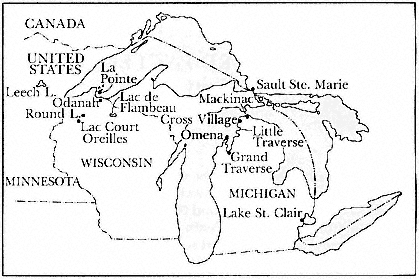
Protestant Missions in the Great Lakes Area
condition is unfolded in this work, have claims upon Christian compassion.[2]
This new advocacy for Native American missions closely paralleled social, economic, and political developments in the early nineteenth century. Growing international commerce broadened the American market, and, in time-honored tradition, traders felicitously cultivated new sources of converts for missionaries. Moreover, the expanding market resulted in an increased prosperity that made it seem not just feasible but desirable to fund missions. Haskell even ventured to propose an organization staffed jointly by missionaries and the North West Company (Daniel Harmon's employer) to bring Christianity and civilization to the Indians. This would, he confidently stated, "with much less trouble and even expense to them, accomplish the object which the Company have in view, than any establishment which they could independently make; and which would, at the same time, have a most auspicious bearing upon the religious interests of the tribes of the N.W. Country."[3] Budding nationalism combined with economic growth to promote rapid geographic expansion as the United States began to
finance expeditions to the western lands in order to eliminate Great Britain and France as territorial rivals. The ultimate goal, of course, was to secure new territory, but in the process the nation engulfed Indians as well, and to many Americans it was evident that the natives would have to be civilized and Christianized.
Henry Schoolcraft, a government Indian agent, is an excellent example of one who operated under this moral obligation. In 1832, Schoolcraft organized an expedition to map the course of the Mississippi River and contact the Ojibwa (Chippewa) of northern Minnesota. As a matter of course, his staffing request to the U.S. Office of Indian Affairs included both a missionary and an engineer for mapmaking. In a letter to the corresponding secretary of the American Board of Commissioners for Foreign Missions (ABCFM), Schoolcraft explained why he believed that a minister should participate in the expedition: "Placed by the government as an Agent to this people, their advancement in the scale of moral & accountable beings, is to me an object of high importance," he pointed out, "and I know not what could have so direct an influence in raising them to the dignity of life, as the introduction of Christianity." Moreover, Schoolcraft was adamant that attempts either to civilize or assimilate Indians would fail if Christianity did not first replace native religion.
I am quite satisfied that their political , may result from their moral motivation. And that all our attempts in the way of agriculture, schooling & the mechanic arts, are liable to miscarry & produce no permanent good, unless their Indian mind can be purified by gospel truth, & cleansed from the besetting sin of a belief in magic, & from idolatry and spirit worship.[4]
Schoolcraft had great hopes for the Ojibwa and believed that natural circumstances made them receptive to Christianity. "No very strong barriers appear to stand in the way of the introduction of Christianity among the northern tribes," he insisted:
Their institutions, moral and political, are so fragile, as to be ready to tumble on the application of the slightest power. . . . Nothing is
more common, however, in conversing with them, [than] to find individuals, who are ready to acknowledge, the insufficiency of those means, and who appear prepared to abandon them, and embrace the doctrine of the Savior, the moment the fear of popular opinions among their own people can be removed.[5]
Yet Schoolcraft's confidence proved far off the mark, as the missionaries whose call to the Upper Great Lakes he engineered quickly discovered. Enthusiasm and hard work notwithstanding, for several decades they made only slight headway. The Christian gospel seemed unable to compete with native religion.
Protestant conversion efforts among the Ojibwa in the United States began with the Moravians, whose history of itinerant evangelism had led them to missionary work earlier than most other churches. Preaching a theology of "blood and wounds" and of the "suffering Savior," their missionaries sought to live humbly among the heathens, to openly exhort the crucified Christ, and to focus on individual conversions.[6] Ojibwa bands first encountered Moravians and converts in chance meetings during the bands' journeys into the Ohio area in the 1770s. What excited Ojibwa interest about Christianity, however, was not the piety of converted Indians, but their prosperity, a fact that subsequently convinced the Moravians that an Ojibwa mission would be inappropriate.[7] Nonetheless, contact increased after 1792, when Rev. David Zeisberger accompanied a group of Christian Delaware Indians to Fairfield, Ontario, in Ojibwa territory. Forced to move several times during the course of the American Revolution, the congregation had petitioned for British asylum and received permission to settle in Fairfield. Once settled, Zeisberger devoted himself exclusively to the Delawares, whom he had shepherded so carefully to safety; his diaries reveal that he made little effort during the first months to bring local Ojibwa into the fold, although he did have occasional meetings and business dealings with them.[8]
It was the Delaware converts themselves who proselytized in the area. "Boaz spoke with a family of Chippewas who came here," Zeisberger recorded in his diary on 10 August 1792, "and extolled to them the salvation which the Savior has won by His blood for all Indians who wish to accept and believe it. He
said they had listened attentively."[9] Throughout the autumn months, both Delaware and white Moravians maintained sporadic contact with the Ojibwa but achieved no tangible results. "We have had no increase by outsiders. In the spring, two families came here to live but then left again, and the old ones among them [left in Zeisberger's care] died soon after."[10] By 1795, the minister felt certain that no Ojibwa would convert, for their attachment to traditional beliefs was too strong. "When we once get acquainted with these Indians, we shall see more superstition and heathenism than we have yet seen," he reflected, as the drums of the medicine dance throbbed outside his window.[11]
Finally in 1801, an Ojibwa chief requested a missionary for his community, and Rev. Christian Frederick Denke set up a satellite mission of the Fairfield station at Lake St. Clair. Despite the chief's enthusiasm, however, most of the villagers were immune to Denke's exhortations and deaf to his message; though they were quite obliging about listening to him, they had no intention of apostatizing their own beliefs. Two years after his arrival, Denke abandoned the mission. His subsequent attempt in 1804 to evangelize along the Jonquakamick River proved even less successful, for the local population snubbed any "Sunday Indian" who demonstrated the least interest in Denke's preaching.[12] Tensions escalated when the reverend unwisely took advantage of ritual gatherings and dances to preach the Gospels. He and his wife soon received several death threats, and in September 1806 the Ojibwa initiated a campaign of open harassment against the couple. One individual, according to Denke, "instigated many wicked Chippewas, men, women and children to camp near the mission premises and to indulge in the most heathenish practices, keeping up their shouting, dancing and drumming for several days and nights."[13] Beleaguered by accusations of murder and hounded by the drums, Denke fled the village for Fairfield. But that mission, by now the Moravians' last stand, had also declined by 1808, as the congregants died or emigrated; it finally folded in 1821.
The ABCFM began a similarly abbreviated first attempt in 1823, when William and Amanda Ferry founded a mission and
school on Mackinac Island at the tip of Lake Huron. Within the year the Ferrys had attracted thirty young pupils, mostly of mixed blood, to the school, but they found the adults' responses disheartening. Amanda reported to her sister that "we have full meetings and attentive hearers, but they go away not deeply impressed, sauntering about, regardless of the Lord's Day, not knowing what to do. Many on the Island go reeling about, in idleness."[14] Although for a short while she thought that prospects for conversions had picked up, by 1828 few Ojibwa, male or female, had experienced rebirth. Those women who expressed an interest in Christianity generally had strong connections to the white community through blood or marriage. Several traders' wives and their sisters requested religious instruction, as did a desperate woman whose English mother-in-law had removed her children to Britain (where they subsequently died) and who pleaded to join the mission family for comfort in her loss.[15] Only rarely did a native woman without European or American ties seek religious or secular education.[16]
The Ferrys labored on Mackinac Island for eleven years, without leave and with minimal success, until Ferry's resignation in 1834, which was officially attributed to a nervous breakdown. Another missionary's insights, however, suggest that Ferry himself had compromised the mission's status. In 1838, Peter Dougherty, of the Presbyterian Board of Foreign Missions, visited Mackinac en route to his new station at Grand Traverse. Dougherty reported that to all appearances the Ojibwa had not benefited from the Ferrys' efforts among them. "Even the Mission of the A.B. (American Board) can hardly be said to have been one for the Indian," he confided to his diary, "as the most done was to collect some few native children and half breeds into a boarding school. So far as the Indian people are concerned it appears to be doubted whether much good has been affected by the Station here."[17]
His curiosity piqued by the mission's rather mysterious closing, Dougherty investigated the situation in Mackinac, which appeared to him as little more than a tiny village of log huts. He visited Jane Johnson Schoolcraft (a métis married to Indian agent Henry Schoolcraft and granddaughter of the Ojibwa war
captain Shin-ga-be-w'ossin), who told a dismal tale of the mission's demise. Ferry had become secularized, she recounted, and business rather than religion became his love. He had other passions as well, which involved young native girls at the mission school. Confronted by the suspicious villagers, Ferry admitted that he had acted imprudently. The Ojibwa parents angrily withdrew their children from the school, and the mission folded with his resignation.[18] If Jane Schoolcraft's account is correct, Ferry's abuse of young girls and his rigid disciplinary code for boys undoubtedly united the entire native community, regardless of gender, against the mission.
In 1829, two traders of the American Fur Company, inspired not by disinterested benevolence but by the hope that Christianity and civilization would make native suppliers more industrious, offered to support ABCFM missionaries at trading posts in the Wisconsin Territory. The board obligingly sent William Boutwell, Sherman Hall, Frederick Ayer, and Edmund Ely to convert the Ojibwa. These four men expeditiously set up operations at La Pointe in 1831 and at Leech Lake, Fond du Lac, and Pokeguma in 1833. With the exception of the La Pointe (Odanah) mission (discussed in chapter 5), the experiences of the ABCFM missionaries followed a pattern similar to those of the Moravians and the Ferrys. Initially, most groups received them with curiosity and some interest. Relations with men were almost uniformly good; those with women varied from amicable to antagonistic. Eventually, however, the missionaries found themselves the objects of escalating hostility, and ultimately they were rejected entirely by the communities they worked among. The cases of William T. Boutwell and Edmund Ely illustrate this pattern well.[19]
When Boutwell opened the Leech Lake station in 1833, a good number of men regularly presented themselves at prayer services. Boutwell's records suggest that virtually all those who attended his services and instruction were men or young men. "Several Indians, among them Old Bizhiki, came to our meeting today," he reported in a typical diary entry. "Three or four of them began to sing. This circumstance encourages me. If they can be enlisted in this way, there is hope, that it will often lead them where they will hear Christian instruction. . . .
Several young men and children came in this evening and joined us in our song, and attended our evening devotions."[20] Sometimes even male shamans attended services, and Sherman Hall reported from La Pointe that one shaman had actually converted.[21]
Like many of his Jesuit predecessors, Boutwell saw native women as drudges, and he generally found their company unpleasant. These prejudices, developed during his travels with Schoolcraft, inevitably carried over into his mission work. In his personal taxonomy, Indians were male: he always distinguished between "Indians and squaws."[22] "Selfishness is a prominent characteristic of the squaws," he sourly observed in one journal entry on the trip out to Wisconsin Territory. "You may give and continue to give, and they are not satisfied. They will eat from morn till night, and still ask for more. An old squaw is one of the most selfish and capricious of beings. . . . The squaws are horribly filthy in their persons, as well as Sluttish in their habits."[23]
Most native ways appalled Boutwell, but women's mannerisms truly repulsed him. During a stopover at Grand Portage in June before arriving at Leech Lake, Boutwell chanced upon a group of women and children casually eating a communal meal in their accustomed fashion. The youngsters, wearing their summer breechclouts, were gathered with the adults, and each plucked morsels from a stew pot, unencumbered by the cutlery that their American counterparts regularly struggled with at meals. The informality of this repast was too much for Boutwell; indeed, his reaction epitomized the cultural gap between his ways and those of the people he intended to save. The ultimate insult to his taste, apparently, was the gusto with which one woman meticulously polished off the remainder of the meal. "There I saw more of the habits of Indian neatness. To see them eat," he declared,
is enough to disgust forever even a hungry man. All get around the kettle, or soup dish, and each uses his fingers or the whole hand, even, to the best advantage. Children, entirely naked, except a strip of cloth two inches in width, tied in a knot before, and which served for a breech-cloth, these I could endure, but to see a squaw lick a kettle cover, both in diamater and circumference, is a little too much.[24]
Without doubt, most of the young ladies of Boutwell's acquaintance, practitioners of the womanly domestic arts of the nineteenth-century middle class, were far daintier in their mannerisms. What Boutwell did not comprehend, however, was that they also were not faced annually with the specter of winter starvation, which had prompted Ojibwa to develop a cultural pattern of eating copiously when food was available.
Boutwell's dreary opinion of women extended beyond the realm of the gastronomical. Like Jesuits and Wesleyans, he also avoided women to protect his reputation: "I am obliged to be very careful, and practice much reserve in visiting the lodges as the men are mostly absent, lest I should give occasion for evil speaking, and lay myself open to slander."[25] But Boutwell's delicacy far exceeded the demands of protocol. His contempt for women was palpable, as his report of New Year festivities made clear:
An old squaw, with clean face, for once, came up and saluted me with "bon jour," giving her hand at the same time, which I recieved, returning her compliment, "bon jour." But this was not all. She had been too long among Canadians not to learn some of their New Year customs. She approached—approached so near, to give and recieve a kiss, that I was obliged to give her a slip, and dodge! This vexed the old lady and provoked her to say, that I thought her too dirty.
The woman's wounded pride, however, did not deter him. "Pleased, or displeased, I was determined to give no countenance to a custom which I hated more than dirt . . . . The young women, seeing the rebuff of the old lady, were not a little ashamed, apparently, and kept their proper and becoming distance."[26]
Obviously, Boutwell's attitude was not going to endear him to women. Unfortunately, the problematic relationship between the minister and the Ojibwa women of Leech Lake went beyond Boutwell's Anglo-American criteria for comeliness and propriety. Not only was he offensive and uncompromising in his rejection of native ways, but his religious message was apparently seen as threatening and prompted women to mistrust his intentions in settling among them. For more than a year most of the women refused to participate in his services; only in January
1834 did Boutwell manage to get some involved at all. "Not until this evening, have I been able to get the females to make an attempt to sing," he confessed in his diary. "As I was alone with the little boys who sing, I determined they should make an effort to conquer their fears, or rather their pride. It was not without a little resolution and perseverance that I prevailed on them."[27] Furthermore, the women's daughters also resolutely avoided the missionary. "A little girl came in [to school], whom I asked the question if she would like to learn to read. No, replied she. Whether it is fear or shame, I cannot tell, that keeps the little girls from wishing to learn," Boutwell mused.[28]
Although it did not occur to Boutwell, unfamiliar as he was with local custom, it may be that women actually discouraged girls from attending classes. School attendance took a girl away from her mother during the crucial time leading up to puberty. In the years before adolescence, from age four or five on, children fasted for visions, seeking spiritual power from supernaturals or animal spirits. Little girls, their faces blackened with charcoal, went into the woods alone for the day without food or drink in hope of talking to the spirits. Older girls stayed four or more days in the bush, fasting, sleeping, and dreaming while seeking the powers of medicine women or the tutelage of animal supernaturals. On her return home, a child received a ritual welcome and feast from her mother or another female relative, after which she recounted the guardian-spirit dreams of her fasting time.[29]
At first menstruation, girls retired in isolation for four to ten days in special small wigwams constructed by the girls or their mothers and grandmothers near the home lodge. During this time a girl was extremely potent spiritually, and it was imperative that she remain apart to avoid overriding men's hunting powers or infants' weak spirits. This was her initiation into womanhood, when her mother instructed her in new responsibilities and how to be a good person. Because idleness was prohibited, she was required to sew or do beadwork throughout the day. After a daughter's seclusion had ended and she was welcomed back into the family with a feast, her grandmother or a female relative supervised her constantly until marriage.[30] Consequently, if a girl attended daily school or lived at a board-
ing school, her mother would be unable to arrange her prepuberty fasting or menstrual seclusion; in any case, missionaries were hardly receptive to a girl following such non-Christian rituals.
Women resisted Boutwell's efforts to incorporate them into mission life and continued on with customary practices. In August 1833, Boutwell made inquiries about a Grand Medicine Dance (Midewiwin) lodge recently constructed near the mission and found that "this dance . . . was made for the purpose of initiating one or two old squaws into some of the higher mysteries of their grand medicine, for which they must pay a handsome fee."[31] The Leech Lake women even absorbed the childbirth of the local post trader's wife, Mrs. Davenport, into their ritual world. Boutwell reported that "the ignorant and superstitious old women" berated the trader for treating her poorly and blamed her long travail on his selfish behavior. They set all hostilities aside following the infant's birth, however, to celebrate. Boutwell recorded the event:
The old squaws this morning collected in the lodge, and made a feast, which I am told is customary after a birth. It consisted of sugar only, I am informed. At its commencement, one of their number made a long harangue, which, from the few words I could understand, seemed a kind of address to the Great and Good, but unknown God, in behalf of the child. The same address concluded the feast, without which they could not put aside their potent medicine sacks.[32]
The women's insistence on observing birthing rituals, even for a white woman, seems a powerful testimony to the continued importance of tradition in their lives. Birth rites, in their very femaleness, reflected women's faith in the vitality of native traditions and the importance of their own roles in sustaining them.
In addition to persisting in their observance of rituals, a few women openly opposed Boutwell. During his first year, Boutwell and Sherman Hall, a fellow ABCFM missionary visiting from Chequamegon, called on a family whose young son had just died of illness. The ministers hoped to perform a Christian burial, but when they asked permission of the group's leader,
the man appeared reluctant to answer. The boy's mother, however, unhesitatingly refused. "After we returned," Boutwell explained,
we learned that the old squaw, the mother of the deceased, said when Mr. H[all] visited them in the morning, that we might assist in burying so far as the grave, coffin & c. were concerned, but that she would have none of our singing or praying. We learned also that this old squaw, a few days before, brought her son from Montreal River, 21 miles from this, that the Indians might make a medicine dance on his account.[33]
Boutwell recorded a similar incident several years later. In March 1836, he administered a cathartic to a sick boy at the grandmother's request; the child died the following day and, upon the father's wishes, received the first Christian burial in the area. Later the child's grandparents argued over Boutwell's responsibility for the death. The grandmother pointedly remarked, "The Indians say that they are sick, because the blackcoat is here, and it was not so before he came." Her husband, one of Boutwell's supporters, scoffed and insisted, "The Indians are fools, and those very persons who say such things are the ones who come to him for medicines."[34] This couple's difference of opinion reflects a general pattern of response among Ojibwa communities: the grandfather, like other men, found Boutwell's program at the mission compelling, while the grandmother remained unconvinced.
On an individual level, the case of Memengua, although admittedly inconclusive, suggests that women's opposition to Boutwell carried weight in the Leech Lake communities. Memengua had asked Boutwell to keep his eldest son for instruction over the winter of 1833–34. Delighted, Boutwell agreed to take the boy until the mother's consent had been obtained. Within two weeks of the father's departure, however, Boutwell received orders from Memengua "not to learn him [the son] prayers, in either English, French, or Indian."[35] Boutwell never explained why the plan failed. It may well be that Memengua's wife objected to the boy's involvement with the missionary.
The gulf between Boutwell and the women of Leech Lake widened as a result of the young minister's callous self-interest
during crisis, with ramifications for the entire community. In early March 1834, the women and children made their yearly trek to the maple groves to tap trees while the men went off to hunt. Boutwell stayed at the mission and planned regular trips to the sugar camps to instruct the children as the women collected, boiled, and evaporated the sap. Sugaring was one of the most enjoyable events of the year; everyone usually relished the fun and good foods retrieved from caches near the sugar camps. But this spring was a fickle one, and a deadly cold settled over the region. "For 10 days the weather has been so cold, as to freeze up everything, and stop all operations in the sugar camps. The Indian women and children are now, and have for several days, been in a starving condition, having spent all their corn, rice and the little sugar they made during the mild weather at the opening of the month."[36] With each day the situation grew more desperate, and even the Boutwells found themselves reduced to eating boiled cornmeal and deer tallow. This must have seemed a feast, however, to the starving Ojibwa mothers, desperate to get any scraps they could for their families. "The meager and haggard physiognomy of the women and children, as well as their scraping our pudding kettle with their fingers when they come in, bespeaks hunger, indeed," Boutwell noted.[37] Several days later the missionary again complained of the tedious diet of mush and salt, but thanked Providence that his family could eat even as Indians starved all around them.[38] To the Ojibwa, Boutwell's uncharitable behavior in hoarding his food rather than sharing must have been incomprehensible. In native society the welfare and survival of the community was paramount; individual greed could not threaten the society as a whole. The missionary's refusal to open his provisions flouted ojibwa morals and betrayed his emotional distance from the people.
After several years, entire communities became suspicious of the missionary and impatient with his attitude. Boutwell's blundering self-centeredness helped solidify the opposition, and by 1836 he had antagonized all the bands around Leech Lake. That October, a throng of men surrounded his home, threatened to kill his cattle, and accused him of revealing Ojibwa war plans to a U.S. government agency. Boutwell only narrowly
avoided a fiasco by plying them with foodstuffs. They minced no words, however, when advising him that he stand with them, and they rebuked him for his parsimony and arrogance. "And now I will give you a few hints how you must do," Black Bird announced, "if you stay here this winter":
You must never say anything to our children or young men if they strike or injure your cattle, not even to the youngest, for they will tell of it—if they dont their companions will. And should you make another garden, and they should steal from it, you must not reprove them or say anything to them. But if you will not go away next summer, we will warn you before-hand that we are stronger than one man, we will all of us come together, and put you in a canoe and shove you off . . . . You dont do us any good, at all, by being here, but the traders bring us goods, and therefore the Indians are determined that you shall not stay another year.[39]
Boutwell remained at the station through the next year but understandably grew increasingly depressed about his situation. Ojibwa hostility (and the tightened purse strings of the ABCFM) finally forced him to close the mission in late 1837.[40] Some years later, upon his final resignation, Boutwell reflected on his reasons for leaving the board:
It is not that I am weary of my work among this benighted & degraded people. No, I am as ready to live & labor for God among them as ever, could I but see the finger of his Providence directing to a spot where in our judgement we could do them good. Indeed I should not dare to leave this field, did I see or feel that God had anything further for me to do for them. They have seen the light but hate & reject it—In the language of a drunken pagan to bro. H. [Hall] when here a few days since—"You have the Book & Know God, you will stand at the right hand, but I am wicked & I shall stand at the left hand."[41]
Clearly Boutwell never was able to comprehend Ojibwa values or the tenacity of their beliefs.
The experiences of Edmund Franklin Ely, a teacher and another of the ABCFM missionaries to the Ojibwa, ran close to Boutwell's. Although exotic native ways immediately impressed Ely, as they had Boutwell, he responded with less hostility and,
indeed, some humility. The rhythm and power of Ojibwa dancing and drumming awed him. "The air was singing with the sound of their drums—their songs and yells," he reported in August 1833, after his arrival at Fond du Lac, an important center of tribal activities and a trading post 120 miles from La Pointe. While not sympathetic to traditional beliefs—he found the Midewiwin induction ceremony observed by Boutwell to be "quite a ridiculous farce"—Ojibwa language and culture nonetheless intrigued him, and he relished his dealings with the young men with whom he had daily instruction.[42]
Initially, Ely found himself and the new mission well received by men and women alike. Within the month, one man, Brusia, had asked Ely to teach his sons to read and write; as for himself, he "wished to learn to sing." People came and went at Ely's lodgings all day, to chat and join in singing or simply to pass the time visiting quietly. By late September he had begun to instruct the children, though their attendance was somewhat irregular.[43] Parents allowed their daughters to attend both day and evening schools. Youngsters frequently appeared at his door after supper eager to sing and listen to scriptural readings.[44] Ely spent long and happy hours with the children, singing, looking at scriptural engravings, discussing hymns, and practicing spelling, until he concluded the evening with a prayer. Moreover, unlike Boutwell, Ely apparently neither frightened nor offended the women. In fact, several attended weekly services, and they particularly enjoyed singing.[45]
Despite this apparent success, Ely wallowed in self-doubt during this time. He felt only "an amazing apathy" toward his Savior, and was convinced that he and the mission were dismal failures.
I never so much saw my deficiencies as at this time. I seem to lack the important requisites of a successful missionary—spirituality—meekness—love—humility—& I know that Christ can alone deliver. I believe, that Satan tried to throw discouragement before my mind yesterday. [Mr. Davenport] began to tell me of the remarks & laughings of the Indians with regard to our coming here—& added that until civilization took place among them, our labours were in vain & offered to lay a bet with me that one convert would not be added to us in ten Years to come.[46]
Ely's spirits plummeted still further when informed by Mr. Cottee (Coté), a post trader who had been instructing Ojibwa in Catholicism, that "some of the Men had cut their Hair—&broken their Drums—thereby renouncing paganism & embracing Catholicism."[47] Although women had attended his Sabbath services regularly, Ely believed that without the men he was making little headway. His problems were exacerbated in early October 1834, he reported, by the arrival of a group of Ojibwa to trade for ammunition. One of the newcomers begged the Fond du Lac people not to become praying Indians and warned them of the dreadful impact conversion would have on them:
He said that, "last fall, the Stars fell—so the Indians would eventually fall before the Americans if they became praying Indians." He added a remarkable vision, wh[ic]h took place this Summer—in the Folle Avoigne. Nine Canoes happened to meet in a River on the same night—flambeauing for deer—(18 men ) Nanibosho appeared to them by a Voice in the heavens—saying— "Kiji-Anomiakegon ."[48]
Ely's outlook improved remarkably, however, after several men began attending classes at the end of the month. One middle-aged man expressed a desire to know the Book—and three or four were real scholars. Ely soon happily observed that requests for instruction were becoming more frequent, that the men enjoyed watching him write, and that they were, in fact, quite kind.[49] From this point, Ely's journal entries often emphasized the number of men attending classes or requesting additional instruction. The men's interest in literacy continued to increase, and they soon asked for evening classes in geography and the "cause of day & night."[50] They generally brought their sons with them for lessons. Ely observed in the early winter of 1835 that the older men strongly favored education and fervently wished that "they could read the Book."[51]
During the same period, though, he also reported that parents complained that their children were "growing ungovernable at home and at school under my government and instruction." One girl even hurled epithets at him in class. Corporal punishment in the classroom had infuriated the children, he discovered, and the parents
felt that my pulling the Hair of the Children was a cruel & degrading punishment—& calculated to make the scholars very angry. . . . [Mr. Cottee] said the children told him that I pulled out much of their hair—so that it lay about the floor. (In one or two instances, when a child shrank from my grasp—& I not willing to release, until they submitted a few Hairs—(& a very few)—have been taken out) I inquired if the Indians felt it peculiarly degrading to be taken by the Hair? He ans[were]d Yes!—I plead ignorance of the fact—& expressed a willingness to dispense with this kind of punishment.[52]
The children may have been more aggrieved by Ely's discipline than were their parents, but his lack of diplomacy undoubtedly undermined his efforts. Corporal punishment, when used at all by Ojibwa parents, was generally limited to light spankings with slender sticks on hand or knees and was reserved for more serious offenses. More often, a mother might scold a recalcitrant child or threaten that an owl would come and take her or him away.[53]
Slowly, Ely's audience became almost exclusively male, though he still made mention in his journals of one or two girls in school and an occasional woman at services. His female pupils and congregants seemed to fade away, a fact that he noticed but did not find disturbing. "Services as usual," he reported in May 1835. "Immediately after Service, my house was thronged with men (Catholics mostly) (Inds). They requested to hear Christs death, & also—where C commands to watch & pray —which I read to them." And the following month he remarked, "My lodge was pretty well filled at the Children's meeting this P.M. Nearly 40, men & children were present."[54]
In late May, Ely and the other ABCFM missionaries gathered at the La Pointe mission for the summer. There he met two recent converts, Henry Blatchford and Catherine Galois Bissell, mixed-bloods educated at the Ferrys' old Mackinac mission and now hired as assistants for La Pointe. Evidently taken with Bissell, Ely married her in late August. In September, the missionaries decided to close the Fond du Lac station and have the Elys remain at La Pointe. While there, the couple did attempt to reach the local women, and felt quite pleased with their small success.[55]
This Evening, by invitation, 5 or 6 Indian women came to my room, expressly to learn to Knit. We sung some Hymns. I read, the story of C. walking on the sea & concluded with prayer. All appeared highly gratified. After they had retired, we united in Thanksgiving to God for inclining The hearts of those women to come among us—&listen to His word. May God bring good out of this.[56]
However, the Elys did not have time to continue their work with the women of La Pointe, as the missionaries rather suddenly reversed their decision about Fond du Lac a few weeks later.[57]
Back at the station at the end of October, Ely resumed his work with the men. Most of the younger males, including sons of the chief Ma-osit, came regularly for scriptural readings and evening worship. They listened attentively, with an easy camaraderie, as Ely earnestly explained to them that there was one God, one Bible, and that Christ came to save them all; "Mamokotakomik [wonderful]," one fellow repeatedly rejoined.[58] Stirred by Ely's prayers and exhortations, men like Kashkibazh, Ininini, and Shinguabe soon reflected on the evils of their lives before they had come to know Christ.[59]
Guakuekegabau stood out among the neophytes for the burning intensity with which he pursued his new religion. Disconcerted by the man's fervor, Ely suspiciously queried him about his true motivation for converting. What could he say when Guakuekegabau responded that "he wanted a new heart. He wanted the spirit of God to sanctify him." Still cautious, the missionary pursued the issue and to his delight found that Guakuekegabau indeed had burned his medicine bundle and his drums and renounced all other gods. Even Ma-osit, "one of the 'Mighty Medicine Men,'" gave up "his Mitiguokik—Medicine Sack & Rattle—to the missionaries."[60] Success seemed at hand.
Like Boutwell, Ely had come to see the men as "the Indians"; native women began to appear in his journal as ancillary figures, adornments to the male. He never referred to women by name, only by their relationship to a man. From their near absence in his later notes, it seems that Ely gave up on the women, or perhaps they simply withdrew from mission activities as
their initial curiosity about Ely diminished and his lack of interest in them became clear. The case of Ma-osit's wife suggests that what interest there was among women came, once again, at their husbands' demand. When the shaman Ma-osit converted, Ely commented that although the wife had also embraced Christianity, he was certain her commitment was only nominal. She confirmed his suspicions when Catherine Ely caught her defiantly and unrepentantly breaking the Sabbath to sew.[61] Likewise, when Baiejik, who by 1840 had been under Ely's tutelage for three years, requested not only his own baptism but that of his entire family as well, Ely interviewed his spouse that February. She informed him that she could not give up her old habits and therefore assumed that she had no real hope of salvation. Two years later, when Ely finally baptized Baiejik and the children, she was noticeably absent.[62]
To be sure, not all men greeted Ely's efforts with enthusiasm, and many who initially did later changed their minds. Edninabondo branded any Ojibwa who sought an education a fool, since "God had made the white men for such knowledge." Ely, apparently unaware of the larger issues at hand, insisted that Indians were as capable as anyone else and pressed the man to explain further. Edninabondo retorted "that since the american teachers had come among them, the Indians had begun to die, &c."[63] Others claimed, with some perspicacity, that Ely was really the forerunner of settlers who wanted to drive Ojibwa off their lands. Some especially suspicious critics fiercely maintained that Ely and all missionaries were in fact agents of the U.S. government sent to enslave them.[64]
Again like Boutwell, Ely eventually found himself the object of mounting hostility. By the summer of 1838 conflict swirled through the community, centered on the issue of some land for which he had contracted to plant crops and graze cattle. Angry and disconcerted, the missionary anxiously observed that "scarce a day passes but the Indians show their hatred or opposition to us,—in words concerning our residence here—the land—wood—grass—fish—that we use—& from all that we can judge, it is evident they intend to take some oppressive course with us." He complained bitterly when the Ojibwa shot one of his cattle in the leg. "O! It is trying—to live &
deal with such a people."[65] They, in return, insisted that Ely's proprietary attitude toward the land was selfish.
The situation exploded in August. While Ely cut hay one afternoon, a crowd killed and skinned his bull, then had the audacity to butcher it in front of him upon his return home. He furiously confronted them, but "they manifested no regret. On the other hand they told me if I felt sad about it, the best way was for me to leave the Country—that I might not be sad again—for perhaps They might do something worse."[66] Ely took the warning to heart: by the following year he had joined William Boutwell and Frederick Ayer at the Pokeguma mission, which itself would be destroyed by Dakota raids within a few years.[67] All in all, the missionaries had found that the natives whom they expected to convert easily had at best a mixed response.
Other factors, of course, influenced the survival of the missions. The evangelists' inadequate preparation, inability to speak the language, personal and family concerns, and ignorance of native social organization contributed to the problems they faced. Interdenominational hostility played a role as well; French Catholics at Mackinac were in an uproar when the Ferrys established their mission. "They soon secured a Priest," Amanda reported to a friend, "erected a church and are unwearied in their efforts to 'root out' the 'heretics' from all their borders."[68] To the Ferrys' indignation, the priest forbade Indians from attending Protestant instruction. It appears to have been a hollow gesture: Dougherty commented cynically in 1838 that the Catholics had done nothing for the Indians either.
German Lutherans at Frankenmuth farther south in Michigan found themselves at odds with itinerant Methodists, who attempted to keep the Ojibwa from sending their children to the Lutheran school by spreading rumors that Lutheran converts would be sent to England as slaves. These efforts backfired, however. The converted chief Bemassikeh scornfully berated the Methodists for both their aggressive approach and their manner of worship. As he described the confrontation,
The German [Lutheran] blackcoat visited me first; we are friends and wish to remain such. But you I do not like. You howl early and
late, and leap and move hands and legs as if you would jump into heaven. When a short time ago my son died, I also lamented, for he was my son. But you howl without cause, until God shall give you a cause; then indeed you may howl.[69]
As in the Hudson Bay Territory, Ojibwa reactions to early-nineteenth-century missions in the United States evinced little of the gender differential so apparent in the Jesuit era. These missionaries did not challenge women's self-interest as females. Whatever initial curiosity women might have had about Christianity withered from lack of attention, a development that defused most situations conducive to gender-based resistance. Unlike most Ojibwa and Cree in Canada, however, in the Great Lakes area whole communities came to perceive missionaries as threats, as agents of change and destruction, and demanded their departure. Only later, when white settlement threatened to overwhelm them and many native men began to view missionaries as useful allies, did women once again openly confront missionaries and defend their interests as females.