
Kinship as Compromise: The Negotiation of Contrary Material and Ecclesiastical Imperatives
The epigraph above suggests the pervasiveness of kin relations in Escobines and the limitations, whether temporal or material, on explicitly recognizing those relationships. This complicates the task for the genealogist, since Escobinos who do not recognize themselves as kin may be consanguinally related.
The very basis of social and economic existence in Escobines is kinship and propinquity. Rural work and leisure are shared by kin and neighbor, categories that here overlap a great deal. Property is inherited equally by members of both sexes in a system known as partible inheritance. This system has been practiced for many generations in central Asturias and has created a problem of recurrent fragmentation of property in an ecology where land is limited.
Facing this problem, those contemplating marriage give serious consideration to the properties they are likely to inherit, especially to fragments that may be rejoined through matrimony, giving a firmer basis to the prospective household economy. Where parti-
ble inheritance is the norm, it is therefore materially advantageous for cousins to marry.
Escobinos ultimately feel themselves constrained, however, by the Catholic church, which they believe prohibits marriage between hijos de hermanos —offspring of siblings, that is, first cousins—who have not paid for "a papal dispensation." Since they understand ecclesiastical rules as requiring them to marry "out," while economic realities urge them to marry "in," they find themselves under contradictory social and economic pressures, which they resolve by sibling exchange. This exchange strategically manipulates the system to satisfy both ecclesiastical and material imperatives.
Figure 3a depicts the essential first elements in that strategy: sets of siblings are "exchanged" in marriage. That is, two brothers marry two sisters (each pair monogamously), or a sister and brother marry another sister and brother, as in figure 3b. The offspring of these unions, because they are primos,[4] first cousins, do not marry (fig. 3c). Primos who are not the offspring of sibling exchange unions do occasionally marry "by the pope,"[5] but offspring of the unions of sibling exchange, sometimes known as primos hermanos, sibling-cousins, have (in the village) neither been known to apply for such dispensation nor form unions. Their offspring, however, are considered ideal partners in marriage (fig. 3d). As offspring of first cousins, they would, by Western reckoning, seem to be second cousins and therefore eligible to marry each other. Yet, on close inspection, comparing figures 3a and 3d, it can be seen that these "second cousins" are in fact as closely related as first cousins, having one set of grandparents in common. This matrimonial exchange of sets of siblings is the first step in the strategic manipulation of contradictory imperatives. Escobinos call this kind of marriage atrueque, exchange of valuables (i.e., partners), implying transfer of neither wealth nor cash.[6]
Escobinos do not recognize atrueque as an ideal or as a recurrent pattern in their kinship system but only as a means to accomplish their ends. It is an "ideal" in the sense of a logical abstraction; it is extrapolated from a thematic interest appearing in the villagers' actual conversations, behaviors, and genealogies. The older women who brought atrueque to my attention usually spoke of such unions with satisfaction, even smugness, as if in the presence
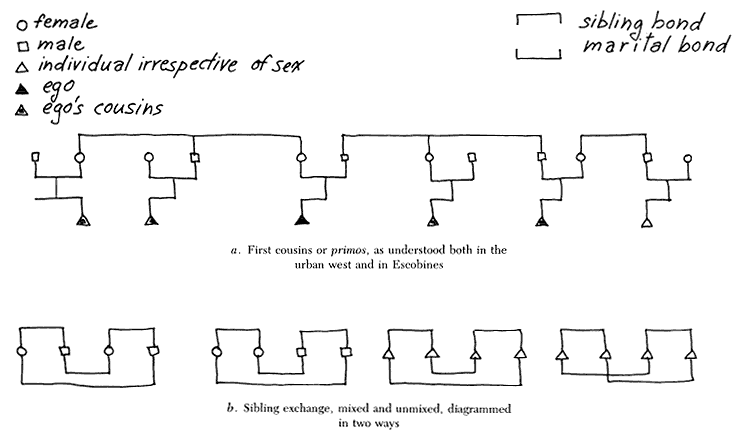
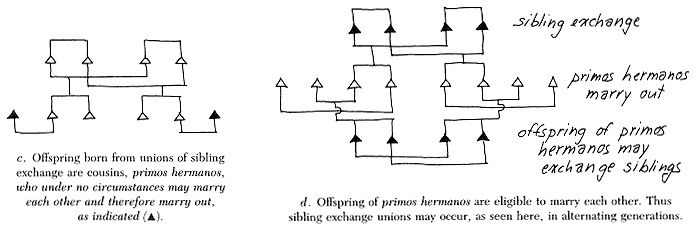
Fig. 3.
Preliminary Elements in Doing Atrueque
of an ideal strategy. Younger Escobinas have learned, however, to feel embarrassed about such unions, as if they were somehow the stuff of very humble folk—not quite sanctioned socially, officially, or ecclesiastically.
Rarely in real life, of course, were the number of siblings, their ages and sexes, not to mention their inclinations, distributed in such a way as to realize atrueque consistently over the generations. But it is important to grasp that ideal as a logical possibility toward which, over many generations, actual behavior tended.
The second step in approaching this ideal is depicted in figure 4. Sibling exchange marriages can logically recur no more frequently than in alternating generations because of the restriction on the joining of primos hermanos in matrimony. In the intervening generation, partners must be drawn from "outside." Marital partners selected to marry these primos hermanos may themselves, in these intervening generations, also be related, as, for example, the "outside" partners who, it can be seen by the bar connecting them, are siblings.
Other ways to marry "in" while appearing to marry "out," as will be seen in the genealogies below, are not hard to find in real life. However, the ideal pattern if worked out most parsimoniously over four generations with only two offspring per union, would be very simple, as in figure 5.
The pattern, one can observe in figure 5a, could go on indefinitely, giving the misleading impression of producing closed lineages, which is not how the problem is solved in practice. What is important to observe in this pattern is how the spouses drawn in as outsiders are drawn from relatives inextricably linked over the generations. The degree of cousinship in such a system—whether worked out as in the model or more variously in real life—is difficult to calculate. In fact, villagers do not calculate it and never speak of "second cousins" or "third cousins once removed" as some people do in the urban West. While the degree of relationship remains unspecified, possibly for reasons of strategy, it will be seen in the genealogies that spouses in all generations except the present one of young adults are almost never unrelated.
Ego is the offspring of the youngest generation, the product of what may be called monogenetic monogamy, in contrast to the presumed heterogenetic monogamy of the West.[7] Ego, as can be seen
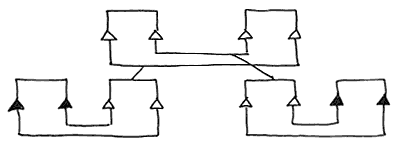
Fig. 4.
Partners drawn from outside may themselves be siblings.
in figure 5a, has only eight great-great-grandparents, while a similar ego in a system of perfect heterogenetic monogamy, as in figure 5b, has sixteen. This reduced number of ancestors in the monogenetic system means that under ideal conditions, an Escobino's ancestors stop doubling after only three generations. Marriage practices in Escobines actually fell short of that ideal. Nevertheless, the practice impeded fragmentation of landed wealth and also—and this is the crucial point—produced an unusual degree of genetic concentration.