
Kings and Philosophers
R. R. R. Smith
This paper looks at the meanings of different styles of portrait statue in the early Hellenistic period—in particular at portraits of kings and philosophers.[1]
By the later fourth century there had evolved a whole range of portrait styles that could be chosen in order to express a person's position and role in life. It is remarkable with what ease we seem to be able to distinguish, often with no documentation, athletes, orators, philosophers, and kings (fig. 1). I want to look quite simply at how and why this should be so and what roughly it means. What was the purpose of the visual stereotypes we are inclined to take for granted?
First, a word on the functions of the statues and on portrait style. Extrinsically, portrait statues were expensive, imposing, lifesize bronzes that functioned as the most highly valued currency in the benefaction-and-honors system of the Hellenistic city, and we hear a lot about them in literature and inscriptions.[2] Honorific statues were the most important concrete symbols of the honor or time with which cities repaid benefactors. Kings were the most powerful benefactors and so received the most statues—being bronze, however, few have survived. Philosophers received few statues. Some of these were public statues, but probably more were quasi-public, set up in their academies and schools, often at their deaths.[3] We have many major examples (partly) preserved in excellent Roman copies.
[1] I am very grateful to the late P. H. yon Blanckenhagen for discussing this paper with me. It grew out of my work on royal portraits and develops an argument sketched in R. R. R. Smith, Hellenistic Royal Portraits (Oxford, 1988), chap. 11 (hereafter cited as HRP ).
[2] Discussed at length in Smith, HRP , chap. 3.
[3] Public statues: (l) Zeno: Diogenes Laertius 7.6; (2) Epikouros: Diog. Laert. 10.9; (3) Chrysippos: Pausanias 1.17.2 and Cicero De finibus 1.39. Statues in schools: (1) Plato: Diog. Laert. 3.25; (2) Aristotle: Diog. Laert. 5.15, 51; (3) Straton?: Diog. Laert. 5.64; (4) Lykon: Diog. Laert. 5.69.
Intrinsically, a portrait statue expressed key defining aspects of its subject: that is, where he or she stood in the broad scheme of things. This was its visual function. I think that we are now beyond worrying about whether these people really looked like this. The point is they wanted to and no doubt tried to. What we call portrait style is made up of both art and real life. Life contributes the externals of real appearance—beards, hairstyles, clothes. We are all familiar with the potency of these aspects of self-presentation in life. Art simply makes the chosen self-image convincing and coherent.
I am concerned here with the late fourth and third centuries, the heyday of the kings and philosophers. Normal practice has been to treat all the portraits as a single phenomenon and to arrange them in one line of chronological development. There was some formal development in third-century portraits, but more significant, I think we will see, are the different portrait modes that correspond to different historical categories of person. What I want to do is to connect the most important changes and differences to broad historical circumstances, in particular the problematic relationship of the kings and the Greek cities.
In the early Hellenistic period, the Macedonian kings were a new form of political power outside and above the city-states, and a major theme of early Hellenistic history was the difficult relationship between city and king. The relationship was negotiated by a variety of means. The kings used diplomacy and benefactions. The cities offered honors and cults to the king, and their philosophers were tireless in offering free advice to kings in kingship treatises that prescribed correct royal behavior. Most of the philosophers we know about had defined their views on kingship in such a Peri basileias treatise. The philosophers were the city's intellectual spokesmen in its ideological confrontation with the kings.
I want to look first at the range of portraits used by leaders inside the cities, then to look outside, at kings and dynasts, to see what factors and ideas molded the various ways they were represented.
Philosophers and City Politicians
The evolution of portraits in the Classical city can be seen as the creation of image styles for the different kinds of public roles emerging in Greek society. In the fifth century there had been just two main categories: youthful athletes and bearded elder citizens, whether writers or states-
men. Writers and generals, for example, were not essentially different kinds of political being. A striking lack of visual differentiation between poets and generals was recently made plain when a fifth-century portrait type, long thought to be of the Spartan general Pausanias, turned out, in an inscribed example, to be in fact the poet Pindar.[4] This shows how far fifth-century writers and politicians used the same visual identity.
In the fourth century there began major separation of public roles in society, for which were created recognizably different modes—general, orator, philosopher. I look first at the philosophers, then come back to the politicians.
The notion of the man of thought, separate from the executive man, goes back to the portrait of Sokrates. The idea appears partly formed in the portrait types of Plato and Aristotle (fig. 2a)[5] and is brilliantly worked up in the retrospective portrait of Euripides, already in the 330s (fig. 2b).[6] This is a dear representation of the idea, current in the fourth century, of Euripides as the philosophical poet.[7]
The great period of the philosopher portrait was the third century, when it reached its widest range of expression. Instead of placing the relevant heads in a chronological line, it is worth asking what connection the considerable variation of philosophic portrait styles has to the orientation of the different schools. We miss a lot of potential subtlety here due to gaps in our secure identifications. But we can distinguish, I think, two major strands: on the one hand, the Cynic-Stoic image, on the other the Epicurean.
The Cynic is the most typically "philosophic" image, well expressed in the Hellenistic Antisthenes portrait (fig. 2c):[8] long, unkempt hair; straggling beard; crumpled, decaying features—expressive of an ostentatious disregard for vain appearances the better to concentrate on inner thought and moral purity. The Stoic founder Zeno was a radical of this kind, and Stoic self-representation came clearly to be modeled on that of the Cynics.
[4] G. M. A. Richter, Portraits of the Greeks , abridged ed., R. R. R. Smith (Ithaca, N.Y., and London, 1984), 176-180. See now R. R. R. Smith, "Late Roman Philosopher Portraits from Aphrodisias," JRS 80 (1990): 132-135, pls. 6-7; J. Bergemann, AM 106 (1991): 157-158.
[5] Aristotle (Vienna): G. M. A. Richter, The Portraits of the Greeks , 3 vols. (London, 1965), 173, no. 7, figs. 976-978 (hereafter cited as POG ). Sokrates and Plato: Richter, POG , 109-119, 164-170.
[6] Euripides (Naples): Richter, POG , 135, no. 13, figs. 717-719.
[7] Euripides unusually sophos : Plato Respublica 568a and Aischines 1.151; the skenikos philosophos : Athenaeus 4.158e, 23.561a. Gf. L. Giuliani, Bildnis und Botschaft (Frankfurt, 1986), 139.
[8] Antisthenes (Vatican): Richter, POG , 180, no. l, figs. 1037-1039.
In the portrait of the Stoic Chrysippos (fig. 2d)[9] we have the most developed or intensified representation of this morally uplifting contrast between outer bodily decay and the vitality of the inner mind. More specifically, we may perhaps interpret this as a representation of Stoic pneuma , "vital breath or energy," and its connection with Stoic logos . We are shown that part of the universal mind that was lodged in the mortal sage Chrysippos.
The Epicureans used a quite distinct philosopher style. Two features stand out: good grooming and sameness. First, sameness. The portraits of the three school leaders, Epikouros, Metrodoros, and Hermarchos, cultivated a clearly related image type—a sort of philosophical dynastic likeness (figs. 3a-c).[10] This portrait homogeneity surely reflected both the close-knit or "family" structure of the school and the fixed nature of Epicurean doctrine. Epicurean thought was codified by the founder and remained unchanged to a quite unusual degree.
Second, grooming—a feature of Epicurean appearance noted in antiquity, explicitly in contrast with Stoics and Cynics.[11] The Epicureans have a well-ordered, harmonious appearance, with artfully arranged beards and hair. This is combined with a certain air of distance or hauteur, very different from the more "humble" Cynic-Stoic image. The Epicureans seem less concerned to take an overtly "ethical" stance. The two "Junior" leaders have regular, rather bland features and a kind of placid impassivity which is intended, I think, as an expression of modestia beside the Master. The Epikouros portrait is more vigorous; its aggressive knitting of the brows is a strong ideal element that represents the Master's superior intellectual deinotes .
Next to the philosophers, on the same wavelength, as it were, but further along the band, come the city politicians: the orators and generals. They have shorter, more well-kempt beards and neater hairstyles, and use a more dynamic, outgoing posture, expressive of executive capability. Good examples are the orator Aischines and the general Olympiodoros (figs. 4a-c).[12] They are presented as mature in years but with-
[9] Chrysippos (British Museum): Richter, POG , 192, no. 9, figs. 1118-1120.
[10] Epikouros and Metrodoros (Capitoline Museum): Richter, POG , 195, no. l, figs. 1149-1150, 1153 = 201, no. l, figs. 1230-1232. Hermarchos (Budapest): Richter, POG , 204, no. 16, figs. 1306-1309. See also V. Kruse-Bertoldt, "Kopienkritische Untersuchungen zu den Porträts des Epikur, Metrodor, und Hermarch" (Diss. Göttingen, 1975); B. Frischer, The Sculpted Word: Epicureanism and Philosophical Recruitment in Ancient Greece (Berkeley, 1982); and esp. H. Wrede, "Bildnisse epikureischer Philosophen," AM 97 (1982): 235-245.
[11] Alciphron Epist . 3.19.3. On this and other contrasts between Stoic and Epicurean self-presentation, see esp. F. Decleva Caizzi's paper in Part Five.
[12] Aischines (d. 314) (Naples): Richter, POG , 213, no. 6, figs. 1369-1371. Olympiodoros (active ca. 300-280; portrait known in single copy in Oslo): Richter, POG , 162, figs. 894-896.
out the insistence on aging and mortality seen in many philosopher portraits.
Between the Aischines and the philosophers—that is, in portrait conception—stands the remarkable Demosthenes (fig. 4d).[13] This was a posthumous statue set up in 280, and, with hindsight and probably as a deliberate reaction to the Aischines, it injects into the orator-politician image a whole layer of philosopher iconography. Demosthenes wears a simple himation with no tunic—a clear borrowing from philosopher images (cf. figs. 1c, d). The statue has a plain, "artless," four-square stance and conveys an internalized air, one of troubled introspection. It is a central monument for understanding the visual self-identity of the early Hellenistic city.
Portraits of early Hellenistic city leaders, then, spread across a spectrum from politicians to different kinds of philosophers. A nameless statue in the Capitoline (fig. 1d)[14] provides a full philosopher figure to set at the other end of this spectrum from the Aischines. It was a flabby, aged body, draped in a himation, with a tousled, aggressive portrait head. The figure has bare feet and so is perhaps a Cynic. Although to be read as opposed in this way—well-dressed orator-about-town (Aischines) versus scruffy thinker (Capitoline statue)—the politician and philosopher have things in common, showing they belonged to the same polis environment. They breathe the same civic air. Most important are simple identifying externals, like beards and himatia—these were basic signs of being a city person rather than a royal or court person. They also share some expressive features, like apparently real age and individualizing physiognomies. They are both essentially "ethical" portraits that emphasize the human and moral worth of their subjects.
Kings
From the same time but quite separate are the portrait images of Alexander and the kings (figs. 5, 6). The kings created a quite new mode of portrait image, one that seems designed to express the essentials of their new style of kingship. We may examine its main components as follows: (l) external attributes, (2) the royal portrait head, (3) the royal body or figure.
A royal statue could wear and hold a variety of royal and divine at-
[13] Demosthenes (Copenhagen): Richter, POG , 219, no. 32, figs. 1398-1402.
[14] Richter, POG , 185, figs. 1071 and 1074 (under "Menippos," but unidentifiable).
tributes, but generally there is a striking lack of emphasis on regalia. This well reflects the minimal character of Hellenistic royal ceremonial. (There seems to have been very little royal ritual associated with Hellenistic kingship.) A regular attribute of the statue was probably a spear that the figure leans on and holds with an arm raised (fig. la).[15] Originally it had simple military meaning but soon, in this pose, it became a symbol of royal power. It may allude directly to, or represent visually, the important justification of the Hellenistic kingdoms as "spear-won land."[16]
The only invariable attribute of the kings was the diadem, a band of flat white cloth worn around the head. This was not a crown, not an Achaemenid insignia, but simply a Greek headband promoted to take particular royal meaning. Someone invented an etiology for it—that it had been borrowed from the conquering Dionysos and that it symbolized victory.[17] This may represent the official view of its origins. (Dionysos was the most important divine model for Hellenistic kingship and victory its single most important legitimating feature.) The diadem soon became the single exclusive symbol of Hellenistic kingship, and, like many good symbols, it was in origin perhaps empty of precise meaning.
Divine attributes (like the aegis or animal horns) could be used to suggest more specifically godlike status. But they were employed only very sparingly; other, less obvious, less overt means were usually preferred. In the major portrait of Demetrios Poliorketes copied in the herm in Naples, the king wears small bull's horns which state an association with the god Dionysos (fig. 5b).[18] Images of Dionysos himself, however, generally did not wear bull's horns. Demetrios and other kings took the well-known association of Dionysos with bulls and gave it a new kind of visual prominence associated primarily with themselves—that is, the horns refer as much to the king as to the god.[19] The kings thus avoid a
[15] Bronze ruler statuette (Baltimore): D. G. Mitten and S. F. Doeringer, Master Bronzes from the Classical World (Mainz, 1967), no. 132; Smith, HRP , 154, no. 13.
[16] For a thorough examination of this concept, see A. Mehl, AncSoc 11/12 (1980/81): 173-212.
[17] This origin is recorded by Diodorus Siculus 4.4.4 and Pliny Naturalis historia 7.191. See more fully, Smith, HRP , 34-38.
[18] Smith, HRP , no. 4.
[19] It has often been thought that Demetrios' horns refer to Poseidon. The bull-horned and bull-formed nature of Dionysos was, however, much stronger in contemporary minds, especially after Euripides' Bacchae , than bull associations of Poseidon. Poseidon appears on the reverse of coins of Demetrios as a protecting deity of the admiral king, but this does not imply that the horns of the royal portrait on the obverse necessarily refer to Poseidon. In the light both of the powerful Dionysian associations of bulls and bull's horn and of the direct association of Demetrios with Dionysos in contemporary sources (for example, ap . Athenaeus 6.253d; Plutarch, Demetrios 2), a reference to Dionysos was surely the preferred meaning. For Dionysos and the bull, see esp. E. R. Dodds, Euripides: Bacchae , 2d ed. (Oxford, 1960), xi-xxv.
direct divine equation. The horns express not that the king is Dionysos but that he is like Dionysos, or has Dionysos-like powers.
The royal head was modeled broadly on a combination of Alexander and young gods and heroes. It was intended to have a Dionysian éclat: smooth, youthful, dynamic, godlike. The early Hellenistic royal portrait refers clearly to Alexander but is careful to define itself as recognizably different (fig. 5b). Alexander portraits have the longer hair of Greek heroes, like Achilles, and the distinctive anastole of hair over the forehead (fig. 5a).[20] The early kings wear a thick wreath of hair, but it is not as long at the sides and back, and they carefully avoid the anastole , which was Alexander's personal sign.
The same can be seen in the physiognomy. The royal face draws on ideal heads of gods and heroes but is careful to avoid confusion with them, by formal adjustment or by introducing a (more or less slight) layer of individuality. The portraits define the king as like the gods but different. They forge a distinctive royal style.
Oriental influence on the Hellenistic royal image has sometimes been posited. The portraits we have, however, provide no real evidence for "interpenetration." There is little that cannot be explained in Greek terms— either in attributes or in style. For example, bulls horns are found on Mesopotamian images; but they are also used on pre-Hellenistic Greek images. Bull's horns played an important part in Greek terminology about Dionysos,[21] and we should prefer this meaning. Greco-Egyptian royal portraits[22] may seem to be good examples of stylistic interpenetration, but these images, as we can tell from their use of native hard stones and Pharaonic format, were for Egyptian consumption. The influence here is all one way: Alexandrian royal portraits may affect the traditional Pharaonic images of the king, but the reverse is hard to detect.[23]
The third-century royal portrait head had a considerable range of variation, but with clearly definable limits. We may take two aspects: (1) apparent age and physiognomy, and (2) hairstyle.
The king usually looks young or ageless—that is, about twenty to
[20] V. Poulsen, Les portraits grecs (Copenhagen, 1954), no. 31—from or reflecting an Alexander statue of the early Hellenistic period. Most recently on Alexander portraits, see the full study by A. F. Stewart, Faces of Power: Alexander's Image and Hellenistic Politics (Berkeley, 1993).
[21] See Dodds, Euripides: Batchae , xviii.
[22] Full collection in H. Kyrieleis, Bildnisse der Ptolemäer (Berlin, 1975).
[23] Kyrieleis, Bildnisse der Ptolemäer , argues this case, but to this writer not convincingly.
thirty-five, not younger, rarely older. Some kings, especially in the first generation, who were in fact in their seventies or eighties, can use a more mature image but never one near their real age. This was the case, for example, with the two great dynasty founders, Ptolemy Soter and Seleukos Nikator (fig. 5c).[24] In the Naples bronze, Seleukos has a wreath of hair and dynamic posture, signifying "king," and strong mature features, signifying "older king," but he is not near his real age (probably about sixty to seventy) at the time of this portrait.
The limiting case in the portrayal of real-looking features is provided by the nonroyal dynast Philetairos of Pergamon (fig. 5d).[25] He has a dynamic posture but short, flat hair (no diadem, of course) and heavily jowled, "unroyal" features.
Hairstyle Was a highly expressive and important variable in royal portraits. This is especially well shown by the two versions of a head from Pergamon (fig. 6).[26] The head was originally made when the sitter was still merely a prince or dynast, because (although this has not been noticed) it clearly wore no diadem in the first version. Later, a diadem and the thick wreath of hair were added separately, no doubt when he took the kingship. The circumstances well suit Attalos I in the 230s and support the traditional identification of the head as this ruler.
The adjustment dramatically alters the portrait's effect. In the second version it becomes a textbook royal portrait: smooth, ageless features; thick hair; dynamic posture. These express the Hellenistic king's unique status: like a god, like Alexander, but subtly different from both.
The same can be seen in the styling of the royal figure. There were no prerogatives in royal statue types. As far as we can tell the king's statue was most commonly naked, with or without a chlamys over the shoulder. Since both gods and athletes had been shown naked for a long time, this carried no special meaning for the kings. We have few examples, but it seems dear that the kings statue was set off subtly by distinctions of style and posture.
If we compare a high-quality ruler statue, like the Terme Ruler (fig. 1b),[27] and an athlete of comparable quality (lake the Getty bronze),[28] it is extraordinary that with no documentation and with so much in com-
[24] Seleukos (Naples): Smith, HRP , no. 21. Ptolemy: ibid., nos. 46-47.
[25] Philetairos (Naples): Smith, HRP , no. 22.
[26] Attalos I (Berlin): Smith, HRP , no. 28.
[27] Smith, HRP , no. 44. It does not really matter for this purpose whether one thinks the statue a Macedonian prince or a Republican dynast looking like one (so, most recently, P. Zanker, Augustus und die Macht der Bilder [Munich, 1987], 15, fig. 1). I am concerned only with the body type. There are other examples (e.g., fig. la, above), but none of such high quality.
[28] J. Frel, The Getty Bronze (Malibu, Cal., 1982).
mon—nudity and youth—it is still so easy to tell the ruler from the athlete. It is not simply due to differences in pose; this is a matter of body language. The ruler statue borrows the basic figural schemes of the athlete, but adjusts or intensifies their effect. It uses an exaggerated, athletic muscle style as a metaphor of power.
We may return and compare the city elders (figs. 2-4). The kings had, of course, to pay respect to the ideology of ethical kingship that was constantly recommended to them by the philosophers; but, for their portrait image, their visual identity, they had their own concerns: to be Alexander-like, charismatic, godlike. Morality made visual was very much secondary. It is still remarkable that there is a complete lack of significant overlap between portraits of kings and of civic leaders. Each uses exclusive defining elements in both external appearance and style. The kings are naked and godlike; they may wear a chlamys but never a himation; and they are clean shaven. The city leaders, on the other hand, are shown as mortal flesh and blood, seem always to wear at least a himation or chlamys, and have beards. Only four kings, out of well over fifty whose portraits we know, wore a beard.[29]
Some cosmopolitan city-men no doubt shaved, and we have one or two examples, most notably Menander (fig. 3d);[30] but there remains no stylistic overlap, no chance of taking Menander for a prince. We may suspect that many of the kings' adherents in the cities, the locally based Friends of the king (philoi ),[31] would have adopted this manner of self-presentation, but we cannot prove it without sure identifications. We may say that in this respect Menander was clearly presenting himself as a man of the new age. Generally, as far as we can see, the external signs of being a court and royal person versus a city and nonroyal person seem to have been used in an exclusive way. This opposition was played out from head to body. The aging, diffident statue of Demosthenes makes a deliberate contrast with the ideal assertion of power in the naked Macedonian ruler figures (figs. la, b).
Conclusion
The evolution of the third-century city portraits on the one hand, and that of the royal portraits on the other, can each be understood in their
[29] Discussed in Smith, HRP , 46 n. 2.
[30] Menander (Venice): Richter, POG , 231, no. 15, figs. 1573-1576—important version, from Athens, preserving tunic and mantle from the statue. For the reconstruction of the statue, see now K. Fittschen, AM 106 (1991): 243ff.
[31] On royal Friends in the cities, see the study by G. Herman, Talanta 12/13 (1980/ 81): 103-149.
own terms. The city portraits carry on from the fourth century; the royal images are something new. But their exclusive differences also surely reflect the need for a sharper self-definition on either side of the ideological gap between the kings and the cities. In the city portraits, there is a dear stepping up of the human and "ethical" components; and this can be read in some respects as the response of the city intellectuals and politicians to the divinizing, eternally youthful images of the kings. As the kings claimed godlike status, so the cities sought to disclaim it in the portrait style of their leading citizens.
On the other side, for the kings, the realistic, "ethical" portraits of the city worthies contained ideas that they wanted expressly to avoid in their images—infirmity, mortality, a sense of moral struggle. The kings and the city thinkers, in spite of all their efforts at mediation—by kingship treatises and diplomacy—were involved in a basic ideological conflict. It is aspects of this conflict that their separate portrait styles were designed to express.
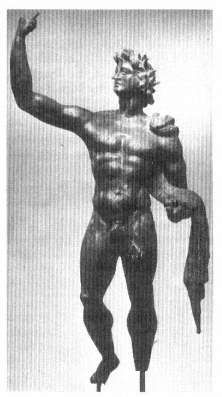
1. a.
Bronze statuette of ruler, 3d-2d cent. BC (Walters Art Gallery,
Baltimore). Photo: Walters Art Gallery.
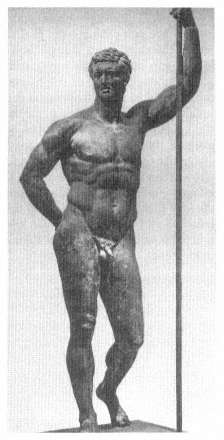
b.
Bronze statue of ruler, 3d-2d cent. BC (Terme Museum,
Rome). Photo: DAI, Rome.
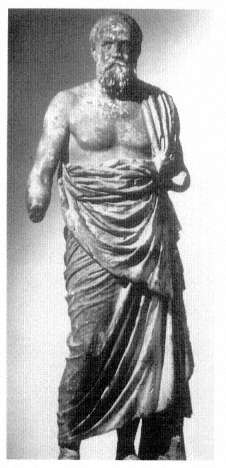
c.
Statue of a philosopher, 3d cent. BC
(Delphi). Photo: Phaidon Press.
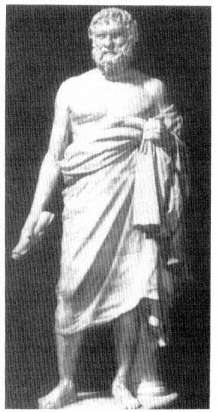
d.
Statue of a philosopher, 3d cent. BC
(copy: Capitoline, Rome). Photo: Phaidon Press.
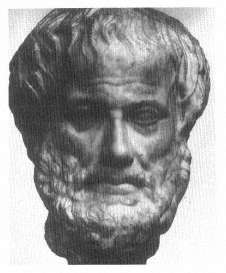
2. a.
Aristotle, later 4th cent. BC (copy: Kunsthistorisches Museum,
Vienna). Photo: Phaidon Press.
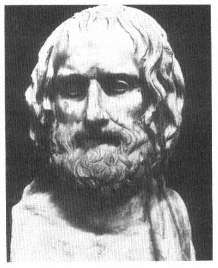
b.
Euripides, 330s BC (inscribed copy: Museo Nazionale,
Naples). Photo: Phaidon Press.
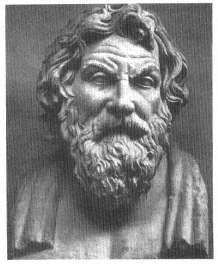
c.
Antisthenes, later 3d cent. BC (inscribed herm copy:
Vatican). Photo: Phaidon Press.
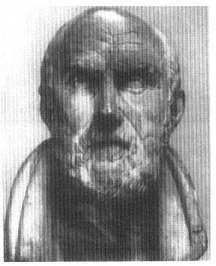
d.
Chrysippos, late 3d cent. BC (copy:
British Museum). Photo: Phaidon Press.
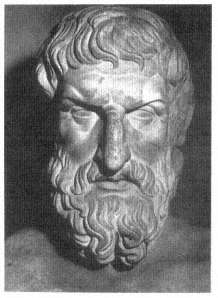
3. a.
Epikouros, 270s BC (inscribed herm copy:
Capitoline, Rome). Photo: Phaidon Press.
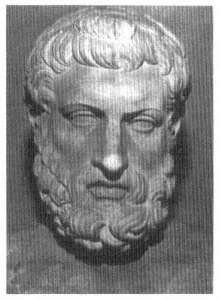
b.
Metrodoros, 270s BC (inscribed herm copy:
Capitoline, Rome). Photo: Phaidon Press.
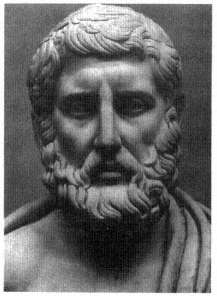
c.
Hermarchos, mid-3d cent. BC (copy:
Museum of Art, Budapest). Photo: Phaidon Press.
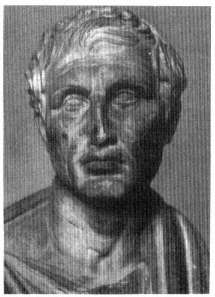
d.
Menander, early 3d cent. BC (copy: Seminario Patriarcale
di S. Maria della Salute, Venice). Photo: Phaidon Press.
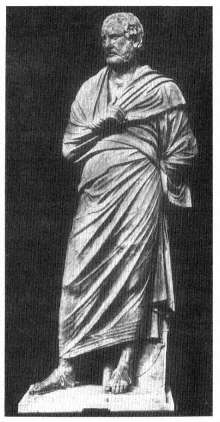
4. a.
Aischines, late 4th cent. BC (copy: Museo
Nazionale, Naples). Photo: Phaidon Press.
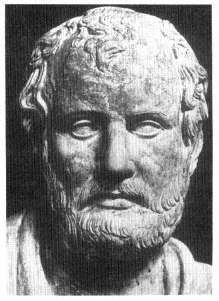
b.
Aischines, head of 4a. Photo: Phaidon Press.
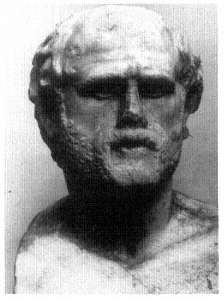
c.
Olympiodoros, early 3d cent. BC (inscribed herm copy:
National Museum, Oslo). Photo: Phaidon Press.
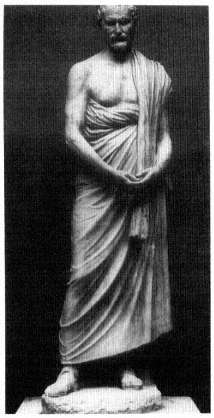
d.
Demosthenes, 280 BC (copy: Glyptothek,
Copenhagen). Photo: Phaidon Press.
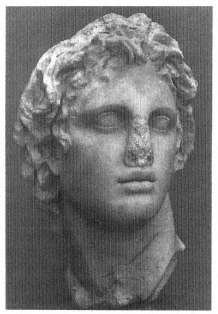
5. a.
Alexander, 3d cent. BC (Glyptothek,
Copenhagen, cat. 441). Photo: author.
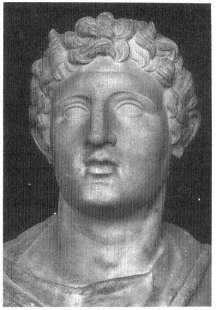
b.
Demetrios Poliorketes, early 3d cent. BC
(herm copy: Naples). Photo: Phaidon Press.
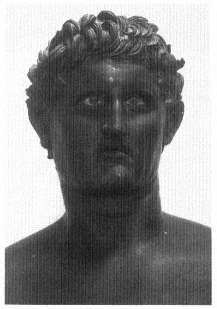
c.
Seleukos Nikator, early 3d cent. BC (bronze copy as bust:
Museo Nazionale, Naples). Photo: Phaidon Press.
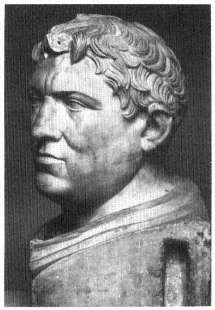
d.
Philetairos, ca. 280-260 BC (herm copy: Museo
Nazionale, Naples). Photo: AvP 7. l, pl. 31.
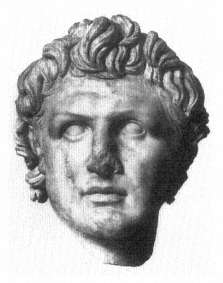
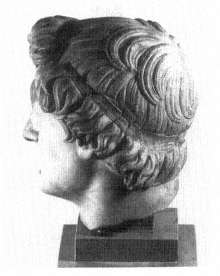
6. a-b.
Attalos I, 230s BC (Pergamon Museum, Berlin).
(a) Photo: AvP 7.1, pl. 31. (b) Photo: DAI, Rome.