
The Visions and the Younger Generation
The apparitions at Ezkioga evoked an enthusiastic response in the rural devout and the urban gentry in July 1931 because everyone recognized immediately, even before there was any explicit idea of their content, the visions' potential for resolving a crisis in competing ideologies.[37]
My thinking here has been helped by Wolf, Europe, and del Valle, "Mujer vasca."
While this crisis came to a head with the proclamation of the Second Republic, the burning of religious houses, the elections of the Cortes, and the Basque autonomy movement, its long-term cause was the change from agriculture to industry and tourism.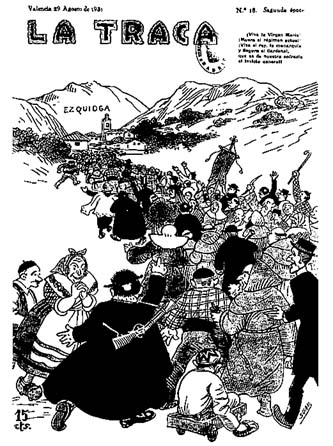
Cover of anticlerical La Traca (Valencia), 29 August 1931: "Long
live the Virgin Mary! Death to the current regime! Long live the king
and the monarchy and Segura the Cardinal, the undefeated general
of our brotherhood!" Courtesy Hemeroteca Municipal de Madrid
The Basque ethnographers of the time, who were rural clergymen dedicated to preserving "traditional Catholic ambience," presented the conflict as a struggle between rural agriculture and urban industry. In truth, small-town factory owners like Patricio Echeverría of Legazpi or Juan José Echezarreta of Legorreta (who owned the Ezkioga apparition field) were themselves of farm origin, shared these values, and counted on them to ensure their company towns a dependable workforce from the younger sons of the farms. Industrialists, it is claimed, subsidized La Constancia and kept up the fight for traditional Basque and Navarrese legal and fiscal privileges. Doubtless they financed much of Nationalist party activity as well. But whether Carlists, Integrists, or Nationalists promoted this patriarchal ideology (against, respectively, Liberals, Freemasons and Jews, and outsiders), all knew Catholic rural culture was threatened, and the diocese of Vitoria had long since geared up to defend it. Devout Basques judged the apparitions in this context.[38]
"Catholic ambience" quote from Guridi, AEF, 1924, p. 101; for La Constancia, Cillán, Sociología electoral, 151.
Most churchmen considered industrial urban society lost to atheism or liberalism. But they hoped they could yet contain the corrosive effects of these new ways of life on rural society. Carlists had been denouncing city life for one hundred years, but the success of Basque coastal resorts at the turn of the century caused additional confusion in rural areas and more defensive measures on the part of rural elites. In 1924, writing about his hometown of Ataun, the Basque ethnographer José Miguel de Barandiarán described the deleterious effects of contact with the cities.
Hence, many of the young people of Ataun spend part of their lives in more or less close contact with the base, tavern-going mobs of the cities and see the ostentation and show of the "fine" and "elegant" public that today makes up a large effeminate caste of little brains, but which is in the forefront of style and is the prime expression of a thoughtless and sensual outlook ever more dominant in the big cities.
In the cities, he wrote with uncharacteristic luridness, "the flower of youth wilts in sumptuous orgies and … lewd old men paint their faces and dye their white hair."[39]
Barandiarán, AEF, 1924, pp. 201-202, 168.
San Sebastián, in particular, with its fashionable beachfront, provoked rural antagonism, which can be seen in the Ormaiztegi vision of "Marichu" from La Concha arm-in-arm with a witch. In San Sebastián at the beginning of the Second Republic there was an upsurge of sexually explicit literature. Even the republican newspaper called for "liberty in laws, but morality in customs." Some saw this immorality as the result of a breakdown of parental authority. Consider one priest's analysis of the reasons for the relatively low church attendance in the factory town of Eibar.
There is a total absence of family life: in Eibar paternal authority barely exists; "democracy and equality" have reached the intimacy of the home where people go their separate ways—more like a boardinghouse than a home. The house serves only to satisfy physical needs; apart from this all go out to the street, the bar, the café, the political club, or the movies, and this every day, in turbid promiscuity of sexes until very late at night, with dire consequences for morality and religiosity.
The clergy saw this kind of city life as a threat to the souls of rural youth.[40]
Liberty quote, VG, 16 June 1931; the priest Iriarte, "Estado religioso," 408.
At first glance the challenges to authority in the countryside seem trivial and incidental. For they had less to do with strikes and revolts than with family and community matters like deference, social control, and gender. Examples include couples' close-dancing (a threat to parental control of courtship); women's wearing more revealing clothes, riding bicycles, or staying out later at night (threats to the authority of husbands or parents); lack of deference to the priest as measured in public reverences or greetings; and lack of deference to God and
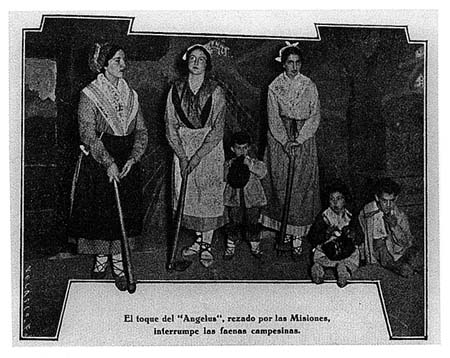
Daughters of Mary in tableau at Vitoria, February 1932: "The
Angelus prayer for the missions interrupts farm work." From
Iluminare, 20 February 1932, p. 57. Courtesy Instituto Labayru, Derio
the Virgin Mary with the abandonment of the family rosary or prayers at daybreak, noon, and nightfall at the ringing of the Angelus. Barandiarán's students and collaborators focused on the erosion of traditional practices in a 1924 survey. His clerical correspondents considered issues like close-dancing as threats to religion and to an entire way of life.
The initial reports about the Ezkioga visions show the children, returning at nightfall with milk from a farm, kneeling to pray at the ringing of the Angelus bells. Validating traditional piety, those children immediately became emblems of the Basque heartland. At this time one could see well-off girls in Vitoria dressed as farmworkers and praying the Angelus in a tableau. The Virgin thus appeared as a reward to those who kept the faith.[41]
PV, 10 July 1931, and ED, 11 July 1931. The connection between the visions and the Angelus was an embellishment. A woman present as a girl at the first vision, while she believes the children saw something, does not remember them kneeling, praying, or initially giving the vision much thought (Felipa Aramburu, Zumarraga, 7 February and 14 May 1986).
By the same token, small matters under local dispute could also be the basis for rejecting the visions in general or particular seers. Should women be out at night? Many men decided the visions were not real because they set an example of immorality. Similarly, an argument against the truth of the visions of Ramona Olazábal was that she liked to dance; indeed, she did so on some of the same days she had visions. We may suppose that this level of discernment often escaped the
urban newspaper reporters and on this basis local people disqualified some visionaries who had passed muster with the local commission and the press. In San Sebastián one might know, at most, if someone went to church or not. Rural folk cut finer distinctions—whether one prayed on one knee or two, confessed weekly, on major feast days, or annually, and touched one's beret or took it all the way off when greeting a priest. Local people soon knew how devout seers had been prior to their visions and whether their behavior had subsequently improved.[42]
On Ramona, PV, 21 October 1931, and L 12; rebuttal in R 15, 63, 87. On local distinctions see AEF, 1924, pp. 80, 90-91, 102-103.
The erosion of devotional practices and respect for authority was taking place above all in the younger generation, particularly among males working in factories or on military service and among females who went to work, at ages fifteen to seventeen, as servants away from home. By 1924 an Oñati member of the youth sodality of San Luis Gonzaga read the republican Voz de Guipúzcoa in his workshop and a girl in Ataun could prefer expulsion from the Daughters of Mary to giving up her strolls with her boyfriend, transgressions unthinkable a few years earlier. A young freethinker who had worked as a waiter in Paris lived three doors from the first seers.[43]
Guridi, 100-101, and Barandiarán, 202-204, in AEF, 1924; see S 120, for waiter.
Girls on bicycles were also breaking the rules. An older lady in Zumarraga told me that when as a girl she rode past on a bicycle, a priest called out that he hoped she would not have the nerve to go to Communion the next day. One of her friends recalled Don Andrés Olaechea, one of the priests who led the rosary at Ezkioga, crossing the town square where a girl was riding a bicycle and muttering "Sinvergüenza, sinvergüenza, sinvergüenza, sinvergüenza [hussy, hussy, hussy, hussy]" until he was out of sight. To such women Dolores Nieto, the first girl to ride a bicycle, was a social hero.[44]Ramona Salamero and José María Busca Isusi, born ca. 1905-1915, interviewed in Zumarraga, 9 May 1984, p. 7.
And of course the dancing issue was generational. In June 1931 in Marikina (Bizkaia), for example, the town authorities fined girls who danced closely in the modern fashion (el valseo or agarrado ). The citations referred the girls as "delinquents" for violating collective community vows. The diocesan bulletin describes how on 29 March 1931 Jesuits giving a mission led one such vow.
To the final service, held in the village square on the afternoon of Palm Sunday, Ceánuri came out en masse, 2,500 persons, with many more from the surrounding villages. It was there that P. Goicoechea, grasping the holy crucifix of the mission prior to the papal blessing, was able to ask that all, with their arms in the form of a cross, give their word to dance the agarrado no more and to preserve in pure form the traditional custom of being indoors when the Angelus is rung, and other customs that had been observed until now, and which are now seen as in danger because of the constant pressure of outsiders.[45]
For Markina, VG, 13 and 16 June 1931; Zeanuri, BOOV, 15 April 1931, p. 321.
One of the major battles fought by Liberals, and later Republicans and Socialists, was to relax attitudes toward sex and the body. Their correspondents chronicled the struggle in villages between the youth in favor of close-dancing and
the clergy and town councils in favor of the traditional (suelto ) varieties. In Ormaiztegi one of the issues in the changeover from an older to a younger town council in 1932 was pressure from the parish priest against close-dancing at town fiestas.[46]
VG, 30 June and 1 July 1932; VG, 10 June 1933.
Rural cinemas posed a particular challenge to the old ways, both in the movies they showed and the opportunities they offered couples for privacy. Around 1930 the diocese of Vitoria had tried and failed to stop Juan José Echezarreta, the owner of the Ezkioga apparition site, from opening a cinema in Ordizia. After the films on Sundays, youths from the surrounding villages stayed on for dances.[47]
Sukia, "El ambiente religioso," 369-370; Ezkioga priest Ibarguren to vicar general (Vitoria) Echeguren, 14 February 1932, ADV. For "pornography" in Urretxu theater, LC, 17 April 1934.
On these issues peer pressure was the first line of defense for the church and the older generation. The main vehicle for this pressure was the Daughters of Mary, a pious association, or sodality, for girls. In some towns the priests who directed the sodality made girls who danced the agarrado wear a purple ribbon when receiving Communion. After the girl's third offense they expelled her and confiscated her medal, as they expelled those who walked alone with boys. Morality was the responsibility of the girls, not the boys. The church had less leverage over the boys; few of them belonged to the male sodality of San Luis Gonzaga.[48]
AEF, 1924, pp. 30, 70-73, 92, 124-125, 203. In Zeanuri, one of the most devout towns in the diocese, there were 430 members of the Hijas de María and only 110 Luises.
Given this generational conflict, the press and the general public quickly accorded adolescent and young adult seers prominence at Ezkioga. These seers were the good examples. Some, like Patxi, who started out mocking or skeptical, were even exemplary converts. By the same token, some of the divine messages most successful with the press and the public were those that spoke to these skirmishes in the war against modern ideas and religious laxity. The first message, "Pray the rosary daily," would have been superfluous in earlier times. But already by 1924 only the more devout households, particularly on the isolated farms, were saying the prayers. Commentators in Argia and the magazine Aránzazu suggested that the Virgin appeared in order to restore the rosary.[49]
AEF, 1924, pp. 10, 57, 92; A, 19 July 1931; E. G., "En torno a los sucesos," Aranzazu, 15 August 1931, p. 239.
And, of course, the physical presence of the Virgin, Saint Michael, and other saints at Ezkioga itself confirmed most overtly heaven's direct links to the Basques and the Spaniards. It was especially for this purpose people wanted a miracle that would demonstrate the truth of the apparitions and, by extension, of the divinity. Eventually the visions persisted in spite of the bishop's denunciation and the result was the undermining of church authority. At that point, the diocese as well as the government (the Republic and later the government of Francisco Franco as well) persecuted the visionaries and believers. But such was not the case in the summer of 1931, when priests stepped right in to lead the rosaries, direct the crowds, examine the visionaries, and even escort them from their home villages. In July, at least, there seemed to be an unbroken line from the divine to the Basque faithful, abetted by enthusiastic clergy, that served to confirm a way of life
seriously in question. To the extent that the visions contradicted this way of life, people did not believe them.
The more political messages from visionaries responded to the most grave and immediate source of the threat to Basque lines of authority, the Madrid government of the Republic. Unlike the monarchy, which even with Liberal governments maintained a certain divine connection and an alliance with local power, the secular Second Republic of 1931 was totally outside the lines of authority that ran from God to bishop to parish priest to male head of household, with ancillary lines for civil and industrial authorities. The standing Sacred Hearts of Jesus in prominent urban locations and the enthroned ones that Spain's Catholics had in the previous decades consecrated in parish churches, town halls, factories, and households served as storage batteries along the way. With the burning of convents and the expulsion of the bishop of Vitoria and the primate of Spain, the Republic seemed bent on disrupting these lines and dismantling these structures.
The Second Republic was not just an external enemy. There was a danger that the youth of the Basque Nationalist movement might pass to the pro-Republican Acción Nacionalista camp. Engracio de Aranzadi feared they would defect in his 8 July 1931 article. A fifth of the voters in Ezkioga had supported the Republican coalition. It was entirely conceivable that Basque youths might see the Republic as a defender of freedom of ideas and of a less restrictive sense of morality and as an ally against excesses of paternal, clerical, municipal, industrial, or male authority. The Republic was thus also an internal enemy that aggravated the division of generations. Even in rural Gipuzkoa Starkie came across heated arguments in taverns between republicans and rightist Catholics. When he played his fiddle in nearby, equally Catholic, Castile in the summer of 1931, both in Burgos and in remote villages young girls shouted out for him to play the Marseillaise, the anthem of liberty.[50]
Pío Montoya asked Antonio Pildain why he got so carried away in a speech at Gernika on 12 July 1931; Pildain answered he was unused to speaking to applause and was especially pleased at getting it from the young Nationalists, who Aranzadi had said were leaning toward the Republic (15 December 1983). S 100-101, 266-267, 308.
The Catholics of the north, and in particular the Basques, perceived that their society and culture, once unified, was divided and under a violent attack from without which accentuated its internal divisions. This perception determined in part the way Basque Catholics tapped, defined, and interpreted the new devotional power generated by the visions of Ezkioga.
Taken as a whole, the many newspaper reports and analyses about the visions are quite revealing. A "fast" medium like daily newspapers, radio, or television (as opposed to the "slow" media of pamphlets, books, and letters of, say, late-fifteenth-century Italian visions) is a forum for the tacit negotiation between what is really on the minds of individuals, what material is all right to distribute, and what people want to hear. Note that from at least the fourteenth century in Europe few socially significant visions have been single events; rather, they have continued and developed over time, sometimes years, allowing for feedback even from slow media. While word of mouth was no doubt the most effective way of
spreading enthusiasm for both ancient and modern visions, the daily articles on the visions ensured for Gipuzkoa a homogeneous core of knowledge.[51]
See Niccoli, Prophecy.
The seers of Ezkioga were well aware of the importance of the press. Many of them made friends with reporters and wanted the press to tell their story. The seers' visions no doubt converged in part because they read about each other's experiences. Moreover, information could be quickly spread by word of mouth throughout the region. In 1931 Gipuzkoa had one of the most extensive telephone systems in all of Spain; indeed, there was a telephone office at the base of the apparition hill. The hope for a miracle created a network of friends and believers who could alert the entire region within hours.[52]
Echaide, Communicaciones, and ED, 14 July 1931, p. 3. Casilda Arcelus (Ormaiztegi, 9 September 1983), the telephone operator in her town in 1931, worked late for months, and the company had to install a bigger switchboard. San Sebastián's two radio stations, founded in 1924 and 1928, may have spread news of the visions, but in 1931 few country folk owned sets; see Garitaonandía, "La radiodifusión."
Most of the repeat seers were children or youths, who had an unparalleled chance for fame in the Basque Country, fame of the kind only the best improvisational poets, dancers, jai alai players, weight lifters, or log-splitters could hope for. And the seers were more than famous—they were important, they were part of a critical historical moment: Mary's direct intervention in their nation.
These visionaries gained power so surprisingly because they could express the diffuse yearning for miraculous change or, if you will, serve as lightning rods for the divine. In such a complex situation it is difficult to speak of individual responsibility. All who were present and hoping for apparitions had a hand in negotiating their content. On 8 July 1931, when by all reports the Virgin was simply appearing as Dolorosa, Engracio de Aranzadi publicly surmised that she was preparing the Basques for an imminent battle. Eventually the visions confirmed his expectations because many others, including some of the seers, shared them.
In part, the onlookers' concerns reached the seers in questions for the Virgin. A reporter stated that Patxi "directed at the apparition interminable questions, which were suggested to him by those around him." A skeptic observed that "many who question [Patxi in vision] themselves provide the answer, and others draw from the seer the desired response." Even believers in the visions would agree that when the Virgin responded to questions put to her, her messages thereby addressed and reflected the preoccupations of the questioners.[53]
Reporter, ED, 16 July 1931; skeptic, Millán, ELB, 9 September 1931.
For students of other places and times, the first summer of the Ezkioga visions may suggest the importance of the context in which "prophets" and charismatic leaders formulate and gradually fix their messages. In the Basque visions and movements, individual seers responded to general anxieties and hopes with what they said were God's instructions, but it seems clear that the messages were as much a consensual product of the desires of followers and the wider society as of the leaders, the prophets, or the saints. We will therefore pay as much attention to the audience—the Greek chorus, the hagiographer, the message takers, and the message transmitters—as to the visionaries themselves.