
PART TWO—
HIV TESTING
4—
Celebrities and AIDS
A 1992 letter to the editor of the New England Journal of Medicine calls attention to the increase in HIV tests at an anonymous test site in Orange County, California, following a celebrity's public disclosure of an HIV-related death, infection, or illness.[1] The authors even graph the occurrence of HIV testing at that site, noting the highest occurrences of HIV testing at the time of Liberace's and Rock Hudson's deaths and after announcements of HIV infection or illness by California property tax opponent Paul Gann, basketball star Earvin "Magic" Johnson, and tennis champion Arthur Ashe. Celebrities with AIDS have formed an integral part of the public history of the HIV epidemic in the United States. The fame some people already knew was given new dimensions by their deaths with AIDS: French philosopher Michel Foucault in 1984, U.S. House Representative Stuart McKinney in 1987,[2] and "Psycho" star Anthony Perkins in 1992[3] among them. AIDS has even conferred on some celebrity they would not otherwise have had: Ryan White, an Indiana boy barred from his local school;[4] Fabian Bridges, a transient hustler who prompted national debate about the responsibility and limits of public health authority;[5] Kimberly Bergalis, a Florida college student who incurred an HIV infection at the hands of her dentist; Ali Gertz, a heterosexual woman who was infected during a single sexual encounter with a bisexual man;[6] and even Belinda Mason, a self-described Tupperware housewife from Kentucky who served for a time until her death on the National Commission on AIDS.[7]
The authors of the New England Journal letter advance the view that celebrities should be enlisted in efforts to control AIDS, at a minimum by going public with their diagnoses. The question of celebrity disclosure and its power to help control the epidemic is worth considering for what it suggests about efforts necessary to control AIDS, especially the role of HIV testing. Despite its association with increased HIV testing at an anonymous test center, there are many reasons to think that celebrity disclosure is an inappropriate cornerstone on which to build an approach to control the HIV epidemic in the United States. Not only does reliance on celebrity disclosure presume certain questionable conclusions about HIV testing and the nature of the patient-physician relationship but advocacy of celebrity disclosure as important to the control of the epidemic reveals that HIV has failed to be understood as the permanently and inexorably important health risk it is. Celebrity disclosures about their diagnoses, moreover, have contained mixed messages about the meaning of AIDS, messages that constrain the ability to confront AIDS openly and effectively.
The Uses of Fame in an Epidemic
The four authors of the New England Journal letter write that "although there can be no question that unauthorized disclosure of HIV infection or the onset of AIDS in well-known figures is an invasion of personal privacy, such disclosures have an impressive effect on public health. In Orange County, California, such disclosures have been followed by sustained increases in the use of anonymous ('alternative test site') HIV-antibody testing." The benefit of voluntary disclosure about an HIV-related condition by famous people is said to serve the instrumental good of unifying an otherwise culturally partitioned society:
In a society as fragmented along lines of race, culture, age, and socioeconomic class as the United States, the recognition and love of pop-culture celebrities are rare unifying features that represent an opportunity to overcome barriers to communication. The more frequently members of America's royal family choose to alarm and motivate the public about AIDS through personal disclosure, the more successful will be our national effort to control this disease. Disclosure by celebrities may also serve to promote nondiscrimination against those with the HIV infection.
While it is important to recognize, as this letter does, the importance of efforts to "control this disease" and to "promote nondiscrimination,"
the way this control is sought suffers from conceptual and moral difficulties that overwhelm the benefit of celebrity involvement with AIDS. First of all, the language used by the letter shows that the authors apparently believe that alarm is the best way to alert the public to the dangers of AIDS and that celebrity disclosure is an unparalleled opportunity for such alarm. But is alarming the public about AIDS the best strategy for the control of the disease? Is alarming people about AIDS the best strategy for educating people about the syndrome, its means of infection, its consequences, or techniques for its avoidance? Alarming people may have entirely the opposite effect, for it may provoke entirely inappropriate individual and social responses to the epidemic, ranging from personal denial of risk to authoritarian civic measures inspired by fear and homophobia. Certain reports have made clear that some Americans are prepared to tolerate discrimination against PWAs[8] and some health professionals recognize no professional obligation to care for patients with AIDS.[9] Moreover, in time an approach that presumes the utility of alarm may soon find an audience deadened to messages about the importance of HIV risk avoidance. A condition of permanent alarm is almost a contradiction in terms. Enough alarms have already been sounded about AIDS in the last decade—from pamphlets addressed to American households by the U.S. Surgeon General to tabloid and news magazine headlines galore—that it is a wonder there are any ways left to vary the message about the evils of AIDS. Thus celebrity-provoked, panicked responses to AIDS do not seem capable of promoting the sustained efforts necessary to reach people with messages and assistance that can translate fear of AIDS into effective ways of avoiding HIV infection across the entirety of one's life. The choice of the word "alarm" may have been unfortunate, but that four individuals authored the letter suggests that the wording was deliberate. No one disagrees that AIDS should be approached as a gravely important personal and social issue, but it remains unproven that alarm of the public by its vaunted public figures is the best way to direct and sustain educational efforts about HIV risk avoidance.
The authors of this New England Journal of Medicine letter assume that greater testing affords more opportunity to control AIDS than does less testing. Nothing in the data offered in their letter, however, supports such a contention. There is nothing in their graphed representation of the use of the alternative HIV test site that shows that increased HIV testing affords more control over the epidemic just because testing is more frequent (see figure 1). For example, in November 1991, following
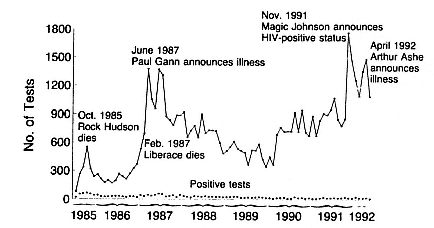
1.
This graph plots the use of an anonymous HIV test site in Orange County, California,
from July 1985 through May 1992.
Reprinted, by permission, from New England Journal of Medicine 327 (1992): 1389.
Magic Johnson's disclosure of his HIV infection, the alternative HIV test site in Orange County reported about 1,800 HIV tests, the highest number of tests ever performed there. And yet the number of HIV infections discovered through such testing was equal to or even sometimes less than the number of infections discovered when testing rates were at their lowest, when there was no correlated HIV disclosure by a celebrity. There is nothing in the data to suggest that more persons discovered an HIV infection at this test site because they were moved to seek testing subsequent to a celebrity disclosure than if they had come at times unconnected with celebrity disclosure, than if they had come for reasons associated with recognition of personal HIV risk behavior or symptomatology.
What is striking about the HIV test rates reported in this letter is not only how much testing increases following a celebrity disclosure but how infrequently such panic-motivated testing leads to increased discovery of HIV infection. Indeed, in the wake of a celebrity disclosure, the percentage of tests that led to an identified infection decreased dramatically. Testing increased between Rock Hudson's death and Magic Johnson's announcement of his HIV infection by about 200 percent, yet there was virtually no increase in the number of HIV infections detected by such testing. We may see such testing therefore not as a triumph of "AIDS awareness" but as a failure of the public to know when HIV testing is appropriate. That failure may be all the more
significant since six years of AIDS educational efforts transpired between Hudson's death and Johnson's announcement. The rush to testing may therefore suggest that the public does not understand how HIV is contracted or what its symptoms are.
An underlying assumption in this letter also bears consideration: that testing is an unqualified good. Testing may be an equivocal good indeed if it is filling public educational and psychological needs that are otherwise inadequately met. That so many people can be panicked into unnecessary tests shows that the rush to testing following a celebrity disclosure has less to do with personal risk of HIV infection than with larger social fears about the incidence and prevalence of AIDS or maybe, more accurately, the media incidence and the media prevalence of AIDS. If people seek an HIV test because they hear reports that a well-known property tax reformer or sports figure has AIDS, we begin to wonder if people believe HIV can be transmitted through the exchange of ink and electricity, through media fluids . News about celebrities with AIDS thus assumes for some the status of risk factor for HIV infection, alongside unsafe sex and dirty needle use.
Identification of HIV infection is unquestionably an important diagnostic event for the management of personal illness. Yet the negative results of the many tests reported in the New England Journal letter indicate that the general public is not necessarily at personal risk of HIV infection but that people are afraid that AIDS may be seeping out of the risk groups in which it was epidemiologically and culturally "contained." Testing is one way to assure members of a nervous public that they are not infected, that there is still distance between them and the epidemic. Media announcements by celebrities seem to prompt these people to suspect that—for reasons utterly beyond their control or knowledge—they too are infected. Thus construed, the increased use of HIV testing reveals a cultural panic at the perceived collapse of the moral and conceptual barriers people have erected between themselves and HIV.
HIV Diagnosis and Patient-Physician Relations
The New England Journal of Medicine authors also emphasize the responsibility of physicians to promote disclosure by celebrities of any HIV-related condition: "In weighing the good of the many against that
of individuals—in this case, patients—physicians should actively but supportively encourage HIV-positive celebrities to publicly disclose their status. And though the individual prerogative to decline disclosure must be respected, the physician's responsibility as protector of the public health should not be easily dismissed." Such counsel is questionable on a number of grounds. The authors stipulate that the good of the many must be weighed against the good of the individual patients. But framing the justification this way is to prove too much: What individual interest is there that could prove inviolable when weighed against the hypothetical good of the many, that is, of all others? The very approach here—that the good of the many is decisive—structures the issue prejudicially against individuals' interests. On such an approach the individual then bears the burden of proof as to why his or her interests should be respected as against the greater—by definition—interests of the general public. Such a view genuinely risks collapsing the private into the public, extinguishing the lines between personal and social interests because an individual could have no responsibilities or rights other than those serving the general good. Such blurring of private and public has occurred before in the epidemic, of course, but the effect is particularly serious here since it challenges a medical tradition that has typically put the patient's interests at the center of all decision-making. If it becomes the physician's responsibility to balance both the interests of the patient and of the many at the same time, the physician will of necessity approach patients with the potential for divided loyalty or with the potential for seeing patients as natural resources to be used in campaigns toward whatever social goals that physician might identify as important.
It is also unclear why the authors deem the physician as primarily responsible for cultivating celebrity support in the fight against AIDS. True, physicians will have knowledge of individual celebrity's diagnoses, but why should they any more than attorneys or ministers have the responsibility for actively recruiting individuals into campaigns against AIDS? In other words, it is unclear why—just because he or she has access to diagnostic information—it falls to the physician as a matter of professional obligation (and the letter uses the obligatory language of "should") to find ways to put celebrities before news conferences. Would a physician be failing in any aspect of his or her individual responsibility to a patient if he or she were never to urge a celebrity patient to go public with a diagnosis? The central question raised by the letter is whether physicians ought to recruit their patients into involvements that the physicians have identified as important, involvements that are extraneous
to the purposes for which a person—celebrity or not—seeks a physician. Even if the discovery of HIV infections had increased after celebrity disclosures, it is hard to see why physicians have any more duty in regard to the social goal of decreasing HIV infection than to decreasing syphilis or other illnesses or disabilities. One might respond that physicians should enlist all patients into efforts in which their celebrity might help a worthwhile social cause, but such a response—while diminishing concerns about selective use of patients—would be even further susceptible to questions about the erosion of distinctions between private and public, between the personal and the social. Such a response would strain mightily the presumption of confidentiality in health-care relations.[10]
Any question of the recruitment of patients for important social goals goes to the heart of the patient-physician relationship. In these days it is naive to suggest that there can be a single generally valid model for all health-care relationships, especially given the way the delivery of health care is fractured by a variety of institutions and health professionals. On the contrary, there are many legitimate forms of interaction shaped by the context in which patients and physicians encounter one another. There are even reasons to see some such relationships as having adversarial components.[11] Nonetheless, recruiting celebrities to disclose HIV-related conditions seems fairly inappropriate on most models of physician-patient encounters, unless it is granted that physicians may recruit patients for whatever other purposes they wish. Of course, patients are in fact frequently recruited into pharmaceutical and surgical trials, for example, in ways that do not necessarily imply the undivided loyalty of physicians. But there is a crucial difference here: most persons in such trials are enrolled because they are the only persons whose condition affords the possibility of testing drugs and surgical techniques. But it has not been demonstrated that widespread efforts to educate against HIV infection could not proceed, with success and without alarm, without the efforts of individual celebrities as urged in the New England Journal letter.
The authors do acknowledge that a patient's decision not to disclose an HIV infection should be respected, but the last sentence of the letter asserts a moral authority that functions by its tone and placement to diminish the standing of the patient in this regard: "And though the individual prerogative to decline disclosure must be respected, the physician's responsibility as protector of the public health should not be easily dismissed." While the authors do use the language of obligation ("must") in limiting the physician's right to seek disclosure, they also impute to physicians a moral grandeur that functionally diminishes the
standing of a patient who would not willingly collaborate with a "protector of the public health." The connotative force of such language conjures the physician as mediating a conflict between an individual and the public health as a whole. (It is interesting that only one of the four authors of the letter has an M.D. degree.) On such a scale a celebrity's unwillingness to disclose an AIDS diagnosis—as in the case of Arthur ashe's initial reluctance—appears if not outright selfishness then at least as a significant waste of significant resources.[12] Certainly, celebrities like Ryan White[13] and Magic Johnson[14] have made it easier for people to talk about and take up AIDS as the important issue that it is, but there is nothing in the relationship of physician to patient that requires efforts to enlist them in the fight against AIDS, especially if those efforts cast celebrity patients into compromises with their own conscience and into morally suspect altruism.
If the control of AIDS depends on alarms sounded by celebrity disclosure and if the patient-physician relationship can be structured by the social needs of the day, then the battle against the epidemic is probably already lost. If people are willing to submit to HIV testing primarily because a celebrity whom they recognize acknowledges an HIV-related diagnosis, then anti-AIDS efforts stand indicted of grave social and educational failings despite half a generation's work. The New England Journal letter authors say that celebrity disclosure has "an impressive effect on the public health." Yet neither the prevention of new HIV infection nor the decrease in discriminatory attitudes toward people with AIDS can be demonstrated as an effect of celebrity disclosure; moreover, if the goal of celebrity disclosure is "alarm," how can we expect more tolerance and humanity? Certainly, no reform of the health-care system can result from such an approach, and such a panicked response cannot advance individual understanding of the risk of HIV infection, promote techniques for avoidance of such risk, or effect the incidence or prevalence of HIV disease. Despite all the various celebrity disclosures that have taken place during the epidemic, still many people fail to take measures to protect themselves from HIV risk.[15]
Celebrity AIDS
Celebrities do have a number of important functions to play in response to the epidemic. Some celebrities have become involved with AIDS
education, Whoopi Goldberg, for example, and many celebrities now wear a looped red ribbon at highly visible events like the Emmy and Oscar presentations as a "symbol of AIDS awareness." Elizabeth Taylor was instrumental in founding the American Foundation for AIDS Research and has inaugurated another AIDS agency.[16] Arthur Ashe also created and sought funding for an organization of his own.[17] Celebrities can help raise money for research and treatment through the organizations they create or support, and they elicit media attention when present at AIDS benefits and governmental hearings. They can also help individuals identify with the epidemic by legitimating the epidemic as an object of concern. The involvement of such individuals as author Larry Kramer[18] in anti-AIDS efforts can also strengthen personal and governmental commitment to the control of the epidemic. Insofar as such activism involves unambiguously straight persons, celebrity presence can help some people put aside the notion that only "homosexuals" and drug-users have a vested interest in AIDS. Celebrities can help people set aside the notion that they will be suspected of immorality or complicity with immorality by evincing any interest whatsoever in AIDS. That public figures have to help counter such attitudes is an indictment of American cultural and social taboos that interfere with thorough and effective anti-HIV education insofar as such efforts reveal the barriers that prejudicially divide this democratic society.
While there are benefits of celebrity involvement in fighting AIDS, it would be a mistake to put celebrities at the cornerstone of that fight and not only because celebrity disclosure does not by itself educate about effective HIV risk avoidance. This "disclosure" may also conceal as much as it reveals. Doctors and family members who announced Foucault's death for example made no mention of AIDS. One French historian has labeled Foucault's silence about his AIDS the silence of shame about his sexuality.[19] Rock Hudson, in the statement publicly acknowledging his AIDS (he did not even make the statement himself, leaving it to another to face the cameras), denied knowledge of how he contracted an HIV infection. In fact, he had initially denied that he had AIDS and had even lied to his lover when that man directly asked whether Hudson had AIDS. (A court subsequently held that Hudson's lies justified awarding a considerable portion of Hudson's estate to his lover, Marc Christian.[20] ) Designer Perry Ellis's death was attributed technically and correctly to encephalitis, leaving it to the public at large to connect that diagnosis to the CDC definition of AIDS. The HIV infection that caused the death of Congressman Stuart McKinney was
attributed by his physicians to transfusions "as the most logical source." Shortly afterward, however, a male lover appeared who declared the congressman had sexual relations with men. Ironically, his physicians had noted that McKinney "wanted the cause of his death known after he passed away, in hopes that this information might help others to deal with what is becoming a national crisis."[21] Similarly, newscaster Max Robinson denied the nature of his illness prior to his 1988 death with AIDS, although according to statements made by friends after his death, he wanted his death to emphasize the need for AIDS awareness among blacks.[22] Actor Robert Reed's 1992 death with HIV-related conditions was initially covered up until his death certificate became public.[23] Tennis champion and author Arthur Ashe did finally disclose his illness but only to preempt a national paper from breaking the story in a sensationalizing way. Randy Shilts, the author of one of the most important volumes about the beginnings of the AIDS epidemic and one of the very few nationally known and openly gay journalists in this country, also disclosed his AIDS diagnosis only in order to stave off an involuntary "outing" in the media.[24] Despite widespread and well-placed rumors, Rudolph Nureyev never openly acknowledged a diagnosis of AIDS; after his 1993 death his physician initially disclosed only that the famous ballet dancer had died of cardiac complications following a grievous disease.[25]
One public disclosure of a celebrity's HIV diagnosis—one not cited in the New England Journal letter—came as a surprise even to him. According to statements by his wife, Anthony Perkins first learned through the tabloids that he had an HIV infection.[26] Having been treated at a hospital for a condition unrelated to AIDS, Perkins's blood was apparently tested for HIV without his knowledge and the report of an infection was sold to a tabloid that put the story on its front page. Perkins subsequently sought confirmation of his diagnosis but spoke publicly about his condition through a letter released only after his death. Even then full disclosure was not forthcoming. When asked if she knew how Perkins had contracted an HIV infection, his wife said, "No. We really don't know. It's not worth it."[27] Before him, actor Brad Davis released information about his disease only after his death, noting that a public disclosure of HIV would have ruined his career.[28] Others have never acknowledged their AIDS. Only an ordered autopsy, for example, confirmed AIDS as the cause of Liberace's death.[29]
Many of these celebrity "disclosures" are evidence of the social stigmatization of gay sex and drug use. They reveal what may and may not
be spoken about openly, what does and does not damage a dead man's reputation. Apparently implications of homosexuality and drug use are greater threats to professional survival than any other allegation. The silence embedded in such "disclosures" may in fact offset any benefits of disclosure, for such silence reinforces cultural barriers to open and frank discussion of HIV risk, homoeroticism, and drug use. Celebrity disclosure by itself clearly does not ensure that the right messages are being delivered simply because the diagnoses of celebrities are involved. Douglas Crimp, for example, has noted that Magic Johnson's appearance on the "Arsenio Hall Show" the day following his public disclosure of HIV infection recapitulated a number of linguistic and conceptual forms of homophobia and misogyny. After Johnson told Arsenio, "I'm far from being homosexual," the audience thundered its approval, suggesting that an HIV infection notwithstanding Johnson had committed only venial sins and not transgressed the standards of public morality by violating heterosexual norms. Crimp also rightly noted the misogyny in Johnson's declarations about the circumstances of his HIV infection in which he portrayed women as sexual predators and himself as their victim.[30] These kinds of disclosures and discussions are ambiguous in their capacity for AIDS education. In Johnson's case his particular disavowal of homosexuality reaffirmed the legitimacy of homophobia and implicitly reaffirmed the assumption that it is gay sex and not AIDS that is the real public enemy. In effect, rather than serving as vehicles of public education, many disclosures and denials about AIDS have functioned instead as alibis against accusations of gay sex and drug use.
The benefits of celebrity disclosure should not be ignored, however. Magic Johnson's efforts subsequent to his disclose of HIV infection—participation in the U.S. Olympic basketball team, public advocacy of AIDS education, and even his resignation in protest from the National Commission on AIDS because its counsel was going unheeded by government—offer some important counterexamples to the public mythology of life devastated by HIV infection. Johnson also prepared a practical guide on how to avoid HIV risk (though the direct anatomical language in that book caused some major book retailers to decline stocking it).[31] Before his death Arthur Ashe also took up AIDS as a cause important to him and the nation. He wrote, lectured, and appeared on behalf of various anti-AIDS causes.[32] But these two individuals are the exceptions rather than the rule when it comes to celebrities with HIV-related conditions who have committed themselves to anti-AIDS efforts.
Arthur Ashe did urge more celebrities and entertainers to enlist in the fight against AIDS because of the impression such persons make on impressionable eighteen-year-olds.[33] He said he thought celebrities could reach eighteen-year-olds in ways that other HIV educators could not. Certainly, one clear benefit of celebrity involvement is that people may begin to talk more openly about AIDS and display more compassion for PWAs; disclosures make it harder for the public to maintain the kind of malice and prejudice possible when AIDS "victims" remain an unidentified, invisible population rather than public figures for whom one has admiration.
HIV Testing and Celebrity Disclosure
Celebrities can indeed draw attention to AIDS, but insofar as their declarations are framed by homophobic and other prejudicial attitudes, they also divert attention as well. Given that celebrity disclosures can only be random and occasional, public health efforts should not rely on them to carry an important part of HIV educational efforts. Indeed, reliance on celebrities might work against AIDS education in an ironic way. To the extent that the "general public" does not see itself involved in gay sex or needle-sharing, it sees AIDS as a distant risk significant only to "others." In the same way, if people do not perceive themselves living the opulent life of celebrities, they can merely understand celebrities as yet another risk group without educational significance for their own sex and drug-using lives.
If all this seems like so much sniping in response to one letter to a medical journal, let me say on the contrary that the letter captures certain cultural assumptions that affirm an uncritical blessing of widespread HIV testing and that situate control of the epidemic in ad hoc reactions to public events. The letter's appearance as the lead feature of the correspondence section in one of the world's foremost medical journals situates it as an important cultural artifact. It would have been a more telling letter, however, had it reported conclusions contrary to those it offered. Had the letter reported that celebrities' disclosures had no effect on use of anonymous HIV test sites, we might have evidence that people better understand the nature of HIV risk and symptoms and seek testing only as individually appropriate. As it is, testing centers draw people in merely because of celebrity disclosures.
Should celebrities wish to come forward for reasons of their own—and Arthur Ashe was right that more celebrity involvement is welcome—one hopes that their disclosures will neither panic the public nor be framed in ways that implicitly incriminate gay men and drug-users as responsible for the epidemic. Celebrity efforts—indeed all educational efforts—should avoid denials that AIDS is a gay disease if such denials imply that AIDS would be a less pressing health concern if it affected only gay men or that AIDS is important only to the extent that it spreads beyond gay men. One hopes too that such disclosures may join but not displace the many and on-going community efforts that are already underway. To pretend that the fight against AIDS must begin ab initio at each celebrity diagnosis would wrongly obscure the heroic efforts already initiated and maintained without the luster of celebrity support. In the final analysis it is not the celebrity but the obscure person who ought to be the focus of efforts against AIDS, and it is with every such person that a physician might properly begin efforts to protect the "public health," not by urging disclosure of HIV infections but by counseling the uninfected and the unfamous on how to stay that way.
5—
The Angry Death of Kimberly Bergalis
Among celebrities with AIDS, Kimberly Bergalis has received a great deal of attention from the United States media. She thus belongs alongside filmstar Rock Hudson,[1] Ryan White, basketball player Magic Johnson,[2] and tennis player Arthur Ashe, whose life stories have constituted a significant part of the public narrative of AIDS in the United States. Bergalis was the Florida college student whose AIDS was traced by the CDC to HIV infection from her dentist in 1987.[3] The CDC subsequently identified other persons whose AIDS was also traceable to infection in the course of treatment by that same dentist. Other cases of AIDS in patients had, of course, already been linked to health-care settings, most notably through blood transfusions but also through artificial inseminations and organ transplantation. Certain accidental HIV exposures of health-care workers, primarily through needle-stick injuries, have also led to their infection and subsequent sickness and death.[4] Bergalis, however, was the first person whose AIDS was linked to HIV infection in the course of treatment that did not involve those other means of infection. That her infection came at the hands of her dentist made Bergalis's infection one of the most prominent occurrences of AIDS in the United States. That the specific means of her infection was never identified made her infection a focus of public alarm and policy analysis. Bergalis was also by all accounts among the publicly angriest persons to have AIDS. After her diagnosis, Bergalis did not privately rail against the dying of the light, she railed against those she thought
responsible for her illness and eventual death, and she called on government officials and the health professions to test health-care workers for HIV. Joining a host of voices raised about the importance of responding to the epidemic, Bergalis and her family championed the cause of HIV testing. Are there lessons from her anger that ought to be heeded in formulating AIDS public policy, especially in regard to testing health-care workers for HIV?
Testing Health-Care Workers for HIV
Bergalis's ordeal began in 1989 when her mother noticed her declining health and she was subsequently diagnosed with AIDS. Because Bergalis appeared to have none of the usual risk factors for HIV infection, her illness was of some epidemiological interest. DNA tests by the CDC linked her HIV infection to her dentist, though the CDC failed to identify any specific incident or mechanism that permitted this kind of dentist-to-patient infection.[5] Bergalis's dentist, David Acer, had apparently known for a number of years that he had an HIV infection, but he had evidently not told any clients about his condition. He thereby preempted any choice on their part whether to continue receiving dental care from him.[6] Bergalis and others saw such silence as an arrogation of their privilege to choose the risks to which they would voluntarily submit. Apart from the issue of disclosure to patients, Bergalis and her family also frequently expressed anger that there was no policy barrier to practice by dentists and other health-care workers with HIV-related conditions. In a letter to Florida health officials Bergalis once wrote: "I blame Dr. Acer and every single one of you bastards. Anyone who knew Dr. Acer was infected and had full-blown AIDS and stood by not doing a damn thing about it. You are all just as guilty as he was. You've ruined my life and my family's. If laws are not formed to provide protection, then my suffering and death was in vain."[7]
Bergalis's public ordeal culminated in October 1991 when in a highly debilitated condition she made a trip by train from her home in Florida to the nation's capital to offer personal testimony before a congressional committee. That hearing was convened to gather information about proposed federal legislation that would require HIV testing of all health-care workers, legislation that was in fact named in honor of Bergalis. Her
trip was attended by news media all along the way, and there was considerable speculation about the impact her appearance itself would have since it was already known that she was in favor of such mandatory HIV testing. Dying with AIDS, the frail Bergalis was expected to make a commanding witness, testifying with all the authority of her ill health against the complacency of the federal government that endangered patients nationwide. In the end, however, she offered only a few, short sentences of testimony and did not specify what form she would like HIV protection in health-care relations to take. Instead she reasserted her innocence and without identifying exactly what should be done called on Congress to do something : "I did not do anything wrong, yet I am being made to suffer like this. My life has been taken away. Please enact legislation so that no other patient or health-care provider will have to go through the hell that I have."[8]
In one sense Bergalis helped advance the cause of AIDS education in the way the Indiana teenager Ryan White did before her as he and his mother fought AIDS discrimination. Because she represented a kind of person who, according to a certain moral view, should by all rights be worriless about the epidemic,[9] her illness made it possible and easier for others to talk about AIDS without having to worry about the homoerotic and narcotic associations that have shrouded the epidemic in this country. By discussing AIDS through the "normalizing" filter of Kimberly Bergalis, people outside the putative risk groups of gay men, drug-using men and women, and their children could raise for themselves the question of possible HIV infection. Here, after all, was a young woman who got an HIV infection for no obvious morally punitive reason: perhaps such a person with AIDS could make clear for many people that the opposite of high risk is low risk, not no risk. And certainly her illness and death showed that HIV infection is possible in the health-care setting for other reasons than blood transfusions, needle-stick injuries, and artificial insemination. Not a "threatening" person either in appearance or behavior, Bergalis offered many people a way to identify with the harms of the epidemic and to appreciate its evils.
The interest of the American public in Bergalis's illness and death has a precedent in the media treatment of a small group of persons earlier featured on the cover of a national magazine. In 1985 Life proclaimed on its July cover: "NOW NO ONE IS SAFE FROM AIDS." The novelty that apparently justified that headline and its three-inch all capital red letters was that the persons featured in the accompanying article were outside the apparent risk groups for AIDS.[10] One subject was a het-
erosexual woman, one a heterosexual man, and the others all members of a Pennsylvania family, three of whom had AIDS.[11] There were allegedly no gay men in the article, no drug-users, no prostitutes. The text of "The New Victims"—which carried no byline—said that "the AIDS minorities are beginning to infect the heterosexual, drug-free majority."[12] The attraction of these people, like that of Bergalis, for the media was that they were stricken with AIDS even though they were ostensibly "outside" the groups mythically taken to define HIV risk. Moreover, someone infected them in ways unrelated to their personal failings.
In many ways the media narratives about Bergalis replayed the themes of this Life photoarticle. One way to gauge that the attention given to Bergalis belonged to her circumstances as a person outside a conventional risk group is to ask this question: Would there have been equivalent media attention had it been a gay man who contracted an HIV infection from this same dentist? Or would his AIDS have been invisible against the background of so many other tens of thousands of instances of "gay AIDS"? Would the story be something other than backpage newspaper filler even if he were believed in his claim that it was his dentist and not his sexual partners who was the occasion of infection? The kind of public attention given to Bergalis, for instance, was not—not even a fraction of it—directed to a gay police officer in California who acquired an HIV infection occupationally. In that case police officer Thomas Cady spent three years trying to convince his employers that his HIV infection was acquired as the result of blood splashes during the arrest of an HIV-infected suspect. It took the declaration of an administrative law judge to establish that his infection was occupationally acquired and that he was therefore eligible for health-care costs, disability pay, and possible retirement benefits.[13] Although Cady was infected for no immoral reasons (on the contrary, as a policeman on duty he was in fact supporting society's official moral order), his infection did not provoke the attention or worry that followed that of Kimberly Bergalis. One wonders therefore if the real issue driving media attention to Kimberly Bergalis wasn't the desire to reassure an anxious heterosexual public of its relative safety inasmuch as her kind of infection was rare and that AIDS was still not "leaking" out of its original risk groups.[14] As a gay man, Cady, by contrast, still belonged to a "risk group" and thus his unusual infection was subsumed into a cultural conflation of homoeroticism and AIDS and was therefore less worrisome by comparison.
It is worth noting too that Bergalis appeared before the nation as one of the relatively few publicly "respectable" females with AIDS at a time
when most made the association of AIDS in women with prostitution, drug use, and other social disadvantages. Before her infection, Bergalis was a genial, unremarkable college student from a middle-class background and could be taken to represent certain idealized notions of womanly propriety and identity. She was therefore in a position to be easily portrayed as a "victim" of AIDS rather than, as many other less socially advantaged women with AIDS have been portrayed, its harbinger.[15]
Certainly Bergalis did draw national attention, and her misfortune set in motion much discussion about HIV and hepatitis safety in health-care settings. In response to her case, the U.S. Congress considered various legislative proposals regarding standards of health care and the CDC set about devising advisory recommendations for the practice of health-care professionals with HIV-related conditions.[16] But in another sense Bergalis and the train of events her illness set in motion may work against some AIDS educational and prevention efforts because of the moral assumptions underlying the blame she and her family assigned for her condition and because of her insistence on mandatory HIV testing. This is not to say that Bergalis did not suffer from her illness or to say that any health professional or legislator can be cavalier about the protection of patients in health care settings, but it is to say that Bergalis's views about the meaning of her infection and the remedy offered against such infection in fact depend on views that can work against effective protection from HIV infection.
Bergalis, for example, often angrily expressed the view that her illness could have been avoided had health professionals and government not been guilty of inaction, had they worked together to put in place a policy of mandatory HIV testing. Even if it was too late to save her , she argued, such a policy would be desirable for the future.[17] At the 1991 congressional hearing Bergalis's father, George, went further and plainly said of health-care workers with HIV: "Someone who has AIDS and continues to practice is nothing better than a murderer."[18] In his view, therefore, his daughter was murdered, and the failure by government and health organizations to act against health-care workers with HIV amounted to nothing less than complicity in murder.
Like many other PWAs before her, Bergalis and her family accused health professionals and government of deadly inaction. But the issue of inaction was understood differently by Bergalis: the message was not "Silence = Death" but "No Testing = Death." But is testing of health-care workers the answer to the problem posed by her infection? The
advocacy of mandatory HIV testing suggests that an absolute barrier to accidental HIV infection in health-care relations is, first of all, possible. While HIV testing can be quite accurate, there will still be a range of false reports either wrongly identifying people as having HIV or failing to find them altogether. Moreover, such testing has no power to predict future infection in persons. To be effective, then, any policy of routine HIV testing would not only have to be universal and mandatory in order to assure that all workers were tested but it would also have to be continuous and carried on permanently in the future. Even thus implemented, given the fallibility and limitations of any testing technique and policy, it is unclear that all cases of HIV in health-care workers or patients would be "caught" by such a net. At present, for example, many teachers across the country go untested for tuberculosis even though such testing is required by states in which they work.
Other considerations also question the advisability of universal, mandatory, continuous HIV testing. For example, what should happen to those health-care workers discovered to have an HIV infection? Obviously, health-care workers would be immediately jeopardized in employment and possibly other important social and personal benefits. A durable minority of Americans is prepared to tolerate discrimination against people with AIDS.[19] To advocate a policy of HIV testing without also at the same time offering health-care workers protection from indefensible discrimination on the basis of their HIV infection is objectionably insensitive to the moral and civic interests of people with HIV. And it is worth mentioning again that the view that testing can protect the "general population" as noncombatants in the epidemic shares conceptual homologies of authority and control with views that HIV can and should be kept where it "belongs."[20] Richard D. Mohr, for example, has pointed out how such testing functions symbolically as a purification ritual to the detriment of gay men in service of the values of "heterosexual supremacy."[21]
Bergalis's characterization of her own blamelessness for AIDS recapitulates much of the moral phylogeny of AIDS in the United States. From the very beginning she claimed to have done nothing wrong. She asserted this view, for example, in a 1990 letter to Florida health officials: "Do I blame myself? I sure don't . . . I never used I.V. drugs, never slept with anyone, and never had a blood transfusion." Her father too thought of "morality" as a safeguard against AIDS: "Her sickness would have been easier to accept if she'd been a slut or a drug-user. But she had everything right."[22] From such a perspective Bergalis is thus defined
as innocent in contrast with other people with AIDS whose "not-innocent actions" are thought to end almost inevitably in their infection. This dichotomy between innocent and culpable "victims" of AIDS has been a standard feature of public discourse since the onset of public moralizing about the epidemic.[23] If Bergalis's behavior was not immoral, so the argument would go, then it follows that someone else's immorality led to her condition. The passive language she chose to characterize her condition suggests that she saw herself as suffering at the hands of some malevolent agent: "and yet I am being made to suffer." The use of the present progressive tense also seems to suggest that the ongoing suffering could be lifted if only someone would help her. Other PWAs have rejected this posture of helplessness and taken it upon themselves to lift their burdens to the extent possible.
The dentist, David Acer, figures almost as a stock villain in this account: he was a bisexual with HIV, the kind of figure who by his hidden life forms the endangering bridge between gay men with HIV and otherwise "safe" heterosexual women. Acer even initially denied all possibility of infecting his clients.[24] The case thus reinforces the stereotypical villainy of the bisexual man who is also the predator of women, bringing to them the diseases exiled to homosexuality both by the rules of morality and epidemiology. Virtually assumed throughout this entire narrative is that the burdens of AIDS are malevolently imposed on "innocents" and that the control of AIDS will be found in a kind of moral quarantine enforced at the doors of doctors' offices.
After Bergalis's death certain reports began to surface that Acer had intentionally infected her and other patients.[25] An acquaintance of Acer's raised the possibility that the dentist had deliberately infected these patients in order to draw government attention to an epidemic that had not been taken seriously enough because the disease was killing only marginalized, socially rebuked men, women, and their children. The infection of people like Bergalis might thus hasten government action by involving sympathetic "victims." George Bergalis dismissed this possibility, however, believing the ill-substantiated reports to be part of a political campaign to diminish the merits of health-care worker testing. If Acer had intentionally rather than accidentally infected his patients, it would be unwarranted to institute a nationally coordinated plan against what was merely the work of a single malicious and now dead practitioner. The malevolent conspiracy implied in such speculations, however, reinforces the view of Acer as villain and his patients as victims, even if it does not support the necessity of government monitoring.
Representing Acer's patients as innocents falling prey to a predatory bisexual in the context of indifferent professional politics and slothful government policing suggests Bergalis's was a case of "immaculate infection," that is, one produced without sin. One of the remarkable features of her pathography is that her virginity ensured that her illness could only be interpreted as sexless. All the cultural connotations of children and sexlessness as innocent then come into play, and these connotations have the effect of reviving that unfortunate redundancy, the "innocent victim." Despite long-standing efforts on the part of PWAs to repudiate the confining connotations of the expression "AIDS victim,"[26] Bergalis played out her story of AIDS as exactly that, as a helpless and passive person. The word victim comes from the Latin victima, meaning a sacrificial animal, and this unfortunately seems to be how Bergalis represented herself, as dying for a cause: "If laws are not formed to provide protection, then my suffering and death was in vain."[27] She did not choose to call for health care for the socially disadvantaged with AIDS, and she did not call for more government funding for and scientific attention to AIDS.[28] Hers were angry calls for blanket protection that is in any case impossible to provide. And the anger did not end at her death. Immediately after Kimberly Bergalis's funeral, her mother stated that she would continue the fight for mandatory testing of all health-care workers,[29] and her family has continued to lobby on behalf of that testing.
Bergalis declined to join other PWAs who do not find in their experience of AIDS reasons for personal bitterness. By choosing bitterness, Bergalis rejected the view adopted by many PWAs that AIDS offers a chance to live fully on a daily basis.[30] Rather than undermining or sabotaging their lives, some PWAs have said that AIDS has transfigured and enriched their lives in ways that could not have otherwise happened. The view that a diagnosis of an HIV infection can transform a person's life for the better was expressed, for example, in a letter written to Ann Landers: "I now look at life in a totally different way. I no longer take for granted a sunny day, a beautiful flower or the small kindnesses of friends, I go out of my way to do favors for people. I am much more forthcoming with compliments and much less prone to make hurtful remarks. To put it bluntly, the virus has opened my eyes and made me a better person."[31] Thomas B. Stoddard, former director of the Lambda Legal Defense and Education Fund, put the matter this way: "I wouldn't wish this experience on anyone, but I find it absolutely fascinating. . . . It's rich, it's complex. It's filled with paradoxes. I'm very glad to be living
this."[32] Clearly the notion of victim does not adequately describe the status of all PWAs, and bitterness need not be the only response to the disease.
Reliance on the notion of innocent victims of AIDS continues to perpetuate the view that except for knowing and culpable actions of certain persons there would be no HIV infection in persons beyond the "risk groups." Identifying herself by all the things she had not done, Bergalis suggested that HIV infection is permanently confined to gay men, drug-users, and their children, except for lapses of governmental quarantine in keeping those groups—whether they are health-care workers or not—away from all others. Her own analysis of her illness suggests that because she did not fall into those unhealthy groups, she should have remained permanently free of any risk. But these kinds of suggestions will not work as assumptions by which to approach HIV education and prevention. It is not clear that there is such a thing as a life free of HIV risk. It is not even clear that "risk groups" per se exist: only a minority of gay men, for example, have HIV-related conditions. It belongs to prejudice to believe that all gay men are and will remain at equivalent and inevitable risk of HIV infection and that all "others" are not at risk or at risk only through moral depredations inflicted on the unwilling. HIV risk belongs, in varying degrees, to all persons even if that risk is remote and unforeseeable. Such a recognition can begin to dismantle the belief that monitoring risk groups is what is essential for protection from HIV-related disease and to recast the matter as one of helping people protect themselves from HIV risks. It can also frame the agenda for the health professions as they try to image aggressive prophylactic measures that will protect patients and providers from one another.
The concepts of innocence and blame do not go very far in "explaining" the illnesses of people with AIDS. The lures of sex and drugs being what they are, it would be a harsh judgment to claim that people are not innocent because they are weak. Innocence and blamelessness come in forms other than virginity. It would be a harsh judgment to claim that people are not innocent because they are not sexual or narcotic virgins. Some teenagers, for example, contract an HIV infection despite all they know in general about the dangers of AIDS. Are they then responsible for their illness even though inexperienced in sexual and drug matters, inexperienced in gauging the long-term consequences of hasty choices? HIV infection still occurs in people who are fully aware of the risks of HIV infection, even in those who may themselves have lost friends and family members to AIDS. Perhaps the concept of innocence
has no place in categorizing the classes of people with AIDS.[33] Instead of debating the merits of Bergalis's claim to innocence and her dentist's culpability, perhaps we would be better off if we instead evaluated the capacity of the health-care system to help PWAs. It proves a distraction from this latter task if we evaluate instead the moral fitness of people to benefit from the health-care system or their fitness for public sympathy.
If the life of Kimberly Bergalis had been a work of fiction, it is hard to see how it could have ended other than it did by reason of the characters at work there: a virgin girl, a protective family, a bisexual man, a disease "belonging" to homosexuality, an indolent legislature, and complacent health professions. What other story line could have drawn them together except some kind of conspiracy to effect her undoing and death? But her life was not a work of fiction; instead hers was a real life lost to AIDS, and that is lamentable enough in itself as the real and abiding misfortune that it is. There is no reason, though, to compound that sadness with bitterness, with angry recrimination when it is unclear that there is any policy that could have saved the first such "victim" as Bergalis. Debating the innocence of various people with AIDS will not help frame educational policies that will protect as many people as possible from AIDS, and mandatory HIV testing cannot deliver all the benefits attributed to it. It would bring dilemmas of its own.[34] To be sure, health-care institutions must find imaginative and aggressive ways to protect people in health-care services, but the question is whether imaginative and aggressive policies of prophylaxis might not achieve the same ends as a more stringent policy of HIV testing both of patients and workers. Measured against all treatments that might have caused HIV infection in a patient, the few cases caused by Dr. Acer appear vanishingly small not in individual importance but in their importance as an indictment of the safety of health-care practices in the age of AIDS.
Patient Protection and AIDS Activism
In the end Kimberly Bergalis's activism does not belong to that kind of constructive AIDS activism that calls for a rethinking of the categories through which we see and understand the epidemic. Neither was she an activist in the sense that she envisioned a redesign of the health-care system in order to make it more accessible and responsive to the care of all kinds of unhealthy and dying people. From the beginning to the end
the impetus and moral of her story was fear. Her understanding of her illness and her projected institutional reforms suggested that there were hidden health-care workers whose reckless performance would infect persons entirely outside the risk groups to which HIV-related conditions have been morally and culturally confined. Save for those moral wretches and professional laggards, moral and "innocent" people would be free of HIV risk.
It is in fact important to find ways to free health-care relations from the fear of HIV infection—for both patient and provider—but routine, even mandatory HIV testing clearly cannot deliver what is being demanded in this regard. Bergalis's role as virgin and martyr dedicated to the cause of testing mystifies its limitations and creates an impossible standard of safety. Her dedication also mystifies a route of HIV infection that in absolute numbers and percentages is the least representative means of infection in the entire epidemic. Unwitting infection of patients is the most insignificant means of HIV infection in the history of the epidemic, and the total number of persons thus infected, five, pales by comparison with the over three hundred and thirty thousand cases of AIDS reported at this time from all other means of infection.[35] It would be wise if the kind of sustained attention given to Bergalis's life could be extended to those many, many more persons whose sexual and drug lives still put them in the way of HIV infection and whose human fallibility makes the development of effective therapies all the more pressing. In more than a coincidental way, sustained focus on the exceptional infection of Bergalis reinforces the very categories that have to be broken down before society recognizes that HIV disease belongs to humanity as its problem, not only to gay men and drug-users.
6—
Health-Care Workers with HIV
Do patients have the right to know whether their health-care providers have an HIV infection or have been diagnosed as having AIDS? The American Medical Association (AMA) asserted a limited right of exactly this kind in 1991, saying "The health of patients must always be the paramount concern of physicians." Until the uncertainty about transmission is resolved, the AMA held that HIV infected physicians should either abstain from performing invasive procedures which pose an identifiable risk of transmission or disclose their sero-positive status prior to performing a procedure and proceed only if there is informed consent.[1] While the AMA has subsequently retracted this standard of disclosure,[2] the desirability of such a broad requirement of disclosure given continued public concern about its safety is worth considering. I argue that patients do not have a generalized right to disclosure, not because patients do not have the right to protect themselves from unwanted risks but because HIV infection in health care does not ordinarily belong to the domain of disclosable risks because of its remote risk. Moreover, patients do not ordinarily have the duty to discern all risks to which they might be subjected in receiving health care. Even if patients are worried about HIV infection at the hands of their health-care practitioners, other measures than disclosure by those practitioners permit avoidance of the risk of HIV infection. Additionally, a patient's interest in knowing about an HIV/AIDS diagnosis in a health worker does not ordinarily have sufficient moral force by itself to justify involuntary disclosure when
weighed against the interests a health worker may have in keeping such information private. In the course of this discussion I will not be considering all forms of HIV infection which may occur in health-care settings but only those involving infection by a health worker through such treatment as dental work or surgery. Though other means of HIV infection are important in their own right, I will not here take up the issue of HIV infection through the use of, for example, infected medical products, artificial insemination, or transplanted tissues.
HIV Infection and Health-Care Workers
As of October 1993 eleven health-care workers have been identified by the CDC as having been accidentally infected with HIV in the course of providing health care.[3] This reported number reflects only persons whose clinical condition meets the defining criteria of AIDS. There are other health workers, as many as eighty-two in the fall of 1992, whose asymptomatic HIV infection may have been occupationally, accidentally acquired.[4] The possibility of such infection led in the first instance to widespread discussion about the desirability and even perhaps the moral obligation to test all patients as they entered health-care settings, in order to allow health workers to exercise exposure-avoidance measures in the care of infected patients.[5] A parallel concern for patient protection raises the question of testing health workers. The concern I wish to address here is the patient's moral entitlement to knowledge of a health worker's HIV status. Does a patient have the right to seek and expect disclosure from any or all of his or her health workers about a diagnosis of HIV/AIDS? What is the exact extent of a patient's right to know?
On the one hand, one could argue that a patient has exactly such a right-to-know on the general grounds of informed consent; that is, the patient is entitled to information not only about the risks of specific tests or treatments but about other dimensions of health care that might also pose risks.[6] Given the unavoidable cultural equation between HIV and death, we are not surprised that some persons who do not believe themselves to be otherwise at risk of HIV infection want to ensure that they avoid all possibility of infection at the hands of known or anonymous health-care providers. Other psychological motives might also prompt individuals to try to avoid health workers with HIV, including
beliefs, for example, that such workers could be diminished in mental and physical skills or that they might also be compromised by drug use. Patients might also have moral and psychological preferences to avoid relationships with gay and bisexual men in whom HIV/AIDS is disproportionately prevalent. Seen as a matter of informed consent relevant to risk avoidance, HIV infection in a health worker should be disclosed as a matter of patient right. Some health-care workers encounter exactly such inquiries from patients.[7]
On the other hand, health workers have no obvious obligation to disclose all information a patient might seek. In order to feel comfortable with their physicians, patients might seek, for example, personal information about race, marriage, children, religion, or political beliefs. Such information is excludable from the standards of informed consent because it has no bearing on the capacity of the physician to carry out a particular procedure. By itself such information is extraneous to matters of diagnosis and treatment. Even if one limits inquiries to matters of risk attendant to medical treatment, it would be impossible to disclose all the relevant information that might affect the care of a particular individual, his or her treatment outcome, or the decision whether to accept care from a particular provider. Some commentators have, of course, noted that it is even laughable to expect full disclosure regarding all conceivable risks possible in the course of health care, else health practitioners would even have obligations to disclose risks of falls in the hospital or automobile accidents on the way to the hospital.[8] Certainly there are risks that ought to be disclosed, but ethics does not require endless, full disclosure regarding all risks possible in health care, even if some particular disclosure would in fact change a patient's decision. It is a matter of debate, of course, exactly what information ought to be disclosed as a matter of informed consent. But by itself an HIV/AIDS diagnosis is not a risk per se because the condition is not necessarily communicable; an HIV/AIDS diagnosis is thus just a piece of information about an individual. So the question about disclosure of HIV/AIDS diagnoses cannot be justified merely by a patient's wish to know or by an expectation of infection. The morally relevant question is whether HIV infection in a health-care provider belongs to the domain of risks that must ordinarily be disclosed or to the domain of risks whose remoteness does not oblige their disclosure, especially when expected treatment does not involve procedures—for example, those exposure-prone procedures as defined by the CDC[9] —in which accidents could end in exposure of a patient to a health-care worker's body fluids.
I am convinced that HIV infection in a health worker belongs to the domain of risks that do not ordinarily have to be disclosed to patients. First, accidental infection of patients is rare in the extreme . As mentioned in chapter 5, only five cases of infection of this kind have been reported and those were limited to the practice of a single dentist. There may have, of course, been other cases impossible to detect, for example, in persons whose infection in the course of health care was masked by the existence of another risk factor. A gay man, for example, may have become infected through a health-care provider's actions but he may also have practiced anal intercourse; confirming infection by a health worker could thus be confounded by the existence of multiple, possible means of infection. But the number of known cases of infection attributable to health workers is small—even minute—relative to the occurrence of HIV infection through other known means of infection: sex, needle-use, and blood transfusion. Given the extent of the HIV epidemic between 1980 and 1994, infection via an HIV-infected health worker represents the least significant means of HIV infection both in terms of total prevalence and incidence, and such a means of infection has not been identified as a risk linked either to specific patient populations, to specific treatment practices, or to specific classes of health workers. As a tiny and evidently late-occurring—and it appears at this point isolated—percentage of the total number of cases of HIV infection, especially when measured against the total number of health-care interventions in which such infection might have occurred during the period 1980–1994, accidental infection by a health worker represents a negligible risk to any given patient currently receiving health care.
Second, there is no evidence that health workers carry HIV infection at any disproportionately high rate compared to one's possible sexual partners or needle-sharing partners considered as a class. Certainly there are health workers with HIV infection,[10] but nothing in the reports of HIV infection or in prevalence studies suggests that as a class health workers pose a significantly higher rate of HIV infection than one might encounter in one's sexual partners or needle-sharing habits. For these reasons, we may conclude that health workers do not represent an "infected pool" whose communicable disease can be expected to cross inevitably or even commonly to patients in their care. Given increasing attention to safety precautions in medical care, HIV infection by a health worker has been and may be expected to remain—a rare occurrence in the United States. Setting aside as impossible a doctrine of full disclosure—whatever that might mean—a limited standard of disclosure
would not therefore seem to require that health workers disclose any HIV/AIDS diagnosis as a matter of risk any more than they would be required to report other highly unusual, unexpected risks that could conceivably occur in the course of health care.
Even if the risk of infection by health-care workers is ordinarily negligible, one might argue that the serious consequences of infection alone justify disclosure. Even if the risk is statistically slight, AIDS is a syndrome of grave magnitude, and HIV infection by a health worker has already taken its first death.[11] The severity of AIDS may be granted, but it still does not follow logically that the only way to avoid HIV risk in health-care relations is through disclosure by workers of their own diagnoses. In response to patients' worries about HIV infection, health-care workers should indeed offer information about risks in the course of medical care, but that information need not include disclosure of their own HIV-related conditions. It is this distinction between risk disclosure and disclosure of individual diagnoses that I think should determine informed consent procedures in the area of HIV/AIDS, a point to which I will return after considering other aspects of the argument for the patient's generalized right-to-know.
Acknowledging a patient's right-to-know affects not only the patient's interests, for the interests of health workers are at stake as well. A patient's right-to-know might well jeopardize the interests of a health worker in a job and social setting. For example, health care in a contemporary hospital is typically provided by a range of persons from a variety of medical specialties. In surgical settings patients may not even be aware of all the persons on whom treatment depends, especially if a patient is unconscious during surgery. Patients are therefore often not able to identify all the persons involved in their health care. They might directly confront persons whom they can identify as their caregivers about personal HIV/AIDS diagnoses, but they will not be able to identify them all. Acknowledging a right to ascertain HIV infection then would have the effect of subjecting some health workers to constant inquiry about their health even as other health workers escaped this interrogation altogether. And it is worth wondering what form this kind of patient inquiry would take. Under what circumstances would a patient ask health workers about a possible HIV infection? At bedside examinations surrounded by medical students, interns, pharmacists, and hospital ethicists? In the hall surrounded by passersby, employers, and gossips? Recognizing the right of patients to ascertain HIV infection would not by itself mean that a patient had the right in any circumstances to inquire
about and obtain that information. But without a policy of routine testing of all health workers and without formal assurance by health administrators (or private health workers) at one discrete, discreet point in a patient's health care about all the persons who will be involved in that care, exercising a putative right to such information can only be random and, moreover, potentially damaging in its consequences, not only to individual health workers but also to institutions whose reputations might suffer inappropriately from unintentional consequences of free-ranging inquiries about HIV/AIDS in their personnel.[12]
It is also worth looking at one other issue in the disclosure debate: the meaning of test results. A diagnosis of HIV represents a permanent condition since there is no cure for such an infection. Yet there is no symmetrical meaning for a health care worker found by testing to be uninfected. An HIV test has no predictive power; it reports—with a certain degree of accuracy—the infections it does or does not find in blood samples at a given time. Even if an individual tested him- or herself at regular intervals, still he or she might be unaware of an infection subsequently acquired. A patient's right-to-know could not therefore, even if acknowledged, guarantee patients freedom from care at the hands of people with HIV. This limitation of testing is not by itself any definitive argument that health-care workers ought not disclose their diagnoses, but it does show that any systematic attempt to undertake full disclosure would not be able to deliver what patients might expect. Such limitations do raise the interesting question of whether it is moral to assert a claim to disclosure when the nature of that disclosure cannot identify all health workers with HIV. Thus considered, the nonpredictive nature of HIV testing represents a buttressing consideration why a claimed right-to-know should be resisted, especially when protection from unwanted risk can be reasonably achieved in other ways.
What May a Patient Ask?
Physicians and other health workers may for reasons of their own choosing offer information to patients about a personal HIV/AIDS diagnosis. Some health workers may want to and have in fact disclosed such information if they believe that confirmation of their HIV/AIDS diagnosis would improve the quality of their relation with patients. A physician
with a large clientele of people with AIDS, for example, might want to disclose an HIV diagnosis in order to reassure patients about his or her own understanding of their circumstances or commitment to their care. On the other hand, given the way in which certain physicians have lost their jobs[13] and their practices following such disclosures—whether such disclosures were voluntary or not—it is entirely understandable that only health workers who feel their interests adequately protected in regard to employment, insurability, and social circumstance would be inclined to confirm freely an HIV/AIDS diagnosis to patients.
Perhaps rejecting a patient's right-to-know on the grounds that it is prejudicial to workers leaves behind the sense that only their confidentiality matters. Perhaps there is the sentiment that rejecting a right to demand disclosure is insensitive to the needs of patient protection. It does not follow, though, from these arguments that patients must enter blind into risks in their treatment. On the contrary, there are adequate moral foundations for standards of patient protection already recognized even if specific practices in regard to HIV risks are not widely followed. The same moral (and legal) incentives that guide risk disclosure in regard to medical therapies and experiments extend—though not without limit—to risk disclosure about possible HIV infection in the course of health care. These standards of informed consent offer patients acceptable protection against risks of HIV infection. In addition, adequate information can be provided to a patient without disclosure of the HIV/AIDS status of any single health worker. For example, a person anticipating hernia surgery may appropriately ask his health-care providers what treatments he will undergo that might expose him to accidental HIV transmission from any of the health workers involved in his care. A physician's response to such an inquiry would presumably involve details about the known occurrence of HIV infection in health-care settings, the extent to which the proposed surgery is susceptible to accidental infection, the number of health workers involved in his care and their experience, the precautions that will be taken to prevent accidental exposure, and even possible options for treatment or experimental therapy should there be an accidental "bleed" of a health worker during surgery. This kind of detail is already long familiar in informed consent protocols in medicine. Thus informed, the patient can decide whether to accept the surgery without having to identify an HIV/AIDS diagnosis in each and every individual involved in his care and without having to ascertain that information in a haphazard and potentially prejudicial way. Some individuals might find the risks unacceptable; if a
physician stumbles in explaining the degree of risk, standards of protection, or options following accidental exposure, a patient may decide that he is unwilling to submit to HIV risk in this health-care setting and take his hernia needs elsewhere. Because of personal experience and institutional support some physicians have already instituted high standards of care to avoid accidental exposure. They may additionally be involved in experimental protocols of drug therapy designed specifically to prevent HIV infection from taking hold in patients accidentally exposed. This kind of planned effort would undoubtedly prove attractive to persons concerned about accidental HIV infection.
Health care obviously cannot always be provided under conditions that permit exquisitely detailed conversations about risks and precautions, and much medical care is provided to patients whose conditions do not permit medical window shopping. For example, a patient entering an emergency room unconscious, bleeding, and without friends or relatives at hand is not in a position to conduct informed consent interviews let alone worry about protection from iatrogenic HIV infection. And persons who receive health care at public institutions for the reason alone that they have no other means of health care are typically not able to walk away from risks they perceive in those institutions. Moreover, psychological or cultural reasons having to do with intimidation by doctors or language barriers might impede aggressive inquiry about HIV risks. In view of these kinds of circumstances, a general policy of informed consent alone would still not permit people to avoid unwanted associations with HIV/AIDS risk. Such limitations on informed consent, however, do not amount to convincing reasons for asserting an unconditional right-to-know. The inability of specific individuals to take advantage of the benefits of informed consent does not diminish informed consent as an ideal. And in any case these same limitations in the practice of informed consent would also function as limitations on any legislated right to ascertain information about HIV/AIDS in one's health-care providers.
Another issue involved in the disclosure/consent debate is the role of concealment in jeopardizing the health-care relationship. Suspicion of one's health-care providers might prove a powerful corrosive in these delicate relations, and certainly the argument for disclosure raises the specter of patients and health workers circling one another with mutual suspicion, thereby undermining the desired atmosphere of trust and the assumption of mutual benefit. Such a development could easily take place anyway, given the unequal relations that obtain between the sick
and the well, between the medically uninformed and the medically educated, especially when these divisions are deepened by stratifications of class, race, gender, and sexual orientation. Yet because of the design and delivery of health care in the United States today and because of a moral presumption of patient and physician autonomy, a certain adversarial component to health-care relations may be inevitable and even beneficial. Physician and philosopher H. Tristam Engelhardt, Jr., has described many of the reasons why patients find themselves "strangers in a strange land," and he explains the burden health-care providers face in regard to disclosure of an expected course of medical experience.[14] Unfortunate as it may sound, some consumer awareness must come from the person seeking health care. Health care is typically provided by a wide variety of persons and institutions in a wide spectrum of specialties, responsibilities, economic loyalties, and even geographies. If only by default, in order to sort out the landscape of health-care systems, patients must assume certain responsibilities in seeking health care consonant with their needs, interests, and economics. We cannot assume automatically that all health workers or institutions have only the best interests of every individual patient at the center of decision-making. Patients, therefore, must be understood as having a certain responsibility toward their own lives and health interests. Such a presumption of autonomy also highlights the risk of patient infantilizing which could occur were health workers alone to bear the responsibility for a patient's health. While informed consent may be difficult to achieve, its focus on the risks of treatments and on remedies for such risks remains a worthy regulatory ideal to be observed in health relations.
One related reason for rejecting a patient's right-to-know comes from the nature of the obligation a person has to protect himself or herself. I assume that people ordinarily have a general obligation to protect themselves from harm, certainly from the kind of harm HIV infection brings. Such an obligation may be intensified if the individual is committed to the care and protection of others in, say, assuming responsibilities for family members. This general obligation, however, may also be suspended for adequate reason; we do not consider it immoral that people commit themselves to military service in time of just war, for example, or otherwise jeopardize their lives for altruistic motives. This general obligation to protect oneself is therefore not the only obligation a person has. Nor does this general obligation require that a person protect against all possible risk. Life in contemporary society virtually requires accepting some risks that jeopardize life and health, for example,
driving in Boston or crossing a Chicago street. Given the known, low occurrence of accidental HIV infection it is not obvious that anyone could claim a right to be protected from that risk by means of compelling disclosure of HIV infection in any and all health care personnel. No one has the obligation to protect himself or herself to that degree.
Philosopher John Rawls, in his A Theory of Justice , presents a heuristic device for imagining how fairness of access and opportunity in social policy and social goods might be achieved.[15] This device of the "original position," in which principles of social governance are formulated without specific knowledge of the role one would actually have in society, may be used as one last way to think about the social entitlements of health-care workers with HIV infections. If persons charged with formulating policy regarding patient access to HIV/AIDS diagnosis in health workers did not themselves know their HIV status, it would be in their interests to create policy that protected both patients and health workers from HIV risk as well as from capricious disclosure of medical diagnoses. A policy of informed consent as to risks and barriers to risk seems likely to emerge as the consensus from such a policy-making group. Patients would gain thereby the right to identify all the risks of their particular treatment and decide for themselves whether there would be adequate protection from those risks, and health workers would gain thereby protection from involuntary disclosure of medical diagnoses and be able to remain to exercise their skills in their chosen occupations.
One last consideration worth mentioning in regard to an HIV right-to-know is that this right may assume a prejudicial entitlement when not equivalently sought or recognized in regard to other health-worker characteristics, such as alcohol and drug use, surgery success rates, history of epilepsy, civil and criminal prosecutions, and so on down the list of human frailties and venalities that might affect the outcome of a particular medical intervention. To the extent other features of healthcare workers are not sought out as a matter of informed consent, does not inquiry in regard to HIV assume that HIV infection is a greater risk than any other kind of risk involved in medical care? Does not the right-to-know argument carry with it the implication that except for health-care risks patients would not otherwise be at risk of HIV? The conceptual framework behind an insistence on a right-to-know implies that HIV is confined to a certain class of individuals and that the so-called general population is otherwise free of risk. This expectation is not only untrue to the facts of HIV infection but carries with it the morally
questionable conceptual tools by which to distinguish "innocent" HIV/AIDS from culpable HIV/AIDS.
The Accidental Exposure
Suppose, for reasons unforeseen by anyone, a surgeon with an HIV infection—he is without clinical symptoms though he does take anti-HIV drugs—by accident cuts through his gloves and bleeds into a patient's abdominal cavity during surgery. Suppose, moreover, that the bleeding is quickly controlled and the blood suctioned off as thoroughly as possible. What obligation does the surgeon have to disclose this information to the patient? As mentioned earlier, there is always the voluntary option of a health worker to disclose infection to a patient, and some physicians in this circumstance might wish to disclose the event to the patient. But does the physician have any moral obligation to disclose under such circumstances?
An obligation to disclose a "mistake" that may end in a patient's infection depends on several arguments, most of which arise from a general presumption of beneficence toward the patient and monitoring a patient's health. First of all, the physician's obligation to guide a patient through the postoperative period and monitor any pathological developments is understood as morally unproblematic. To the extent that an HIV-related condition might be a postoperative development in a patient following a bleeding accident, a surgeon then has the duty to warn the patient that such conditions may occur and the patient ought to be instructed about what to look for in this regard. Second, some patients might wish to enroll in an experimental program of drug treatment in the hope of preventing an inoculum of HIV from effecting a true infection. Such programs have now been carried out after occupational needle-stick injuries, for example, although their efficacy is far from certain.[16] Insofar as a patient's participation in such a program depends on timely notification of exposure, disclosure becomes paramount. This rationale would be diminished to the extent to which no experimental drug protocol is available or intended. Time and research may prove such experimental interventions are beneficial; to the extent they are not , this latter arm of the argument for disclosure would dissolve.
To argue from the heuristic of Rawls's original position, perhaps such a duty is owed the patient, not on consequentialist grounds necessarily,
but as a matter of respect to the patient and as disclosure that all similarly situated persons would reasonably expect and want to know. This understanding might well be the consensus of a group in the original position. But there is nothing in the nature of these disclosures that requires the person with HIV to be named. To be sure, sometimes the circumstances of the medical treatment will make it obvious who the infected party is, but in a multiperson surgical team the infected team member is not always obvious. Knowing the specific identity of the member of the health-care team with HIV/AIDS would be of no benefit in terms of monitoring oneself for the development of an HIV-related condition or enrollment in experimental drugs trials. Only a claim that HIV infection resulted from wrongful behavior on the part of a health worker would justify disclosure of the identity of the health worker with HIV/AIDS insofar as an injured patient wished to charge negligence as the cause of the accidental exposure.
Accidental HIV infection does, of course, raise important questions regarding the uses of the law. In matters of tort, the law is certainly interested in at least two areas relevant to accidental HIV infection: HIV risks that belong to negligent medical care and HIV risks that follow failure to inform. These concerns may be pursued in litigation either jointly or separately. In the first instance the law upholds sanctions with respect to medical care that was not competently provided and that resulted in personal injury. In the second instance the law also countenances sanctions against health workers not specifically because injury occurs—some iatrogenic injury, after all, is unpreventable even when treatment is entirely competent—but because information about that possible injury was not disclosed and thus an individual's right to avoid treatment was usurped.[17] The law may thus concern itself with patient HIV infection in at least these ways: first, it may impose sanctions against negligent medical care that ended in HIV infection of a patient. Because such legal action asserts negligent behavior, not failure to disclose per se, it might succeed even though a health worker did not disclose his or her own HIV-related condition prior to the negligent treatment. The success of cases of negligence therefore do not appear to depend on prior disclosure and for purposes of this essay the case for the right-to-know is not bolstered by an appeal to the workings of tort law.
Second, a case that proceeds on the grounds that patient choice was controlled—to his or her detriment—by a health worker's failure to disclose a personal HIV-related condition might succeed at trial. If the patient in the surgery scenario discussed above did develop an HIV
infection and then claimed that he or she could have—or would have—chosen another surgeon given notice of the surgeon's HIV infection, then the court might wish to sanction such a health worker or hospital in some way. In fact, some courts have held that physicians and their employing institutions ought to have disclosed HIV infections to patients prior to any medical treatment. The nature of damages appropriate to such "lapses" has been contested, but some courts have recognized damages even where the patients involved did not themselves incur an HIV infection.[18] Yet for all the reasons I have offered here, such a conclusion should be generally resisted; that is, the remote possibility of exposure and infection should not open the door to an unlimited obligation to disclose HIV/AIDS diagnoses. Additionally, a legally recognized subjective standard requiring health workers to disclose all information that could cause a patient to seek treatment elsewhere would "constitute a severe burden for physicians who would need to show that they had satisfied the worries of particular patients. There would always be the temptation for a patient to consider after the fact that the physician had not dealt with one of the patient's special concerns,"[19] as Tristam Engelhardt has observed.
The possibility of resort to law may in itself produce significant incentives for physicians and hospitals to define and adhere to effective prophylactic techniques.[20] This would certainly be desirable, but of course we cannot know to what extent the expectation of lawsuits will limit accidental HIV exposure in health care. Nor is it certain that disclosure of HIV/AIDS status by a health worker prior to treatment would shield that worker from all tort liability in the event of a subsequent negligent or accidental infection. Given then the difficulty in establishing that in fact a patient would have sought out another surgeon, given that informed consent procedures afford the opportunity of identifying and accepting HIV risks, given that iatrogenic HIV infection is a remote risk, given that tort remedies may apply, the patient ought not to expect disclosure about HIV infection in health workers as a matter of course.
This conclusion does not suggest lack of concern about accidental HIV infection of a patient. Rather, it says that both informed consent relative to the risks of HIV infection and professional and institutional efforts to identify effective HIV barriers throughout the entire domain of health care will do more to prevent accidental HIV infection than occasional legal sanctions—with unknown deterrent effect—against a few health workers whose negligence or accidents end in HIV infections
in their patients. Nevertheless, because of uncertainty about how courts will respond to claims about the failure of health workers to inform patients of personal HIV/AIDS diagnoses, affected health workers may find it prudent to voluntarily withdraw from exposure-prone procedures whose safety cannot be assured.[21] It may even be that health workers who perform exposure-prone treatments have a moral obligation to monitor themselves voluntarily for HIV infection[22] and impairment of professional skill. But it is worth noting here again that this kind of monitoring and withdrawal can take place without disclosure of personal HIV/AIDS diagnoses.
My arguments thus far apply as well to so-called "look back" notification, that is, retrospective notification of patients that one of their health workers has been identified with HIV/AIDS. The state of Illinois, for example, authorized in 1991 (1) notification of those patients who had undergone invasive treatment procedures by a health worker subsequently diagnosed with HIV/AIDS and (2) notification of health workers when patients were similarly identified. I do not agree that patients have a general right to such notification unless some specific negligent behavior is known to have occurred or unless some nonnegligent means of accidental infection has been identified that either led to infection or was likely to do so. In any case, disclosure of this kind need not disclose which health worker has HIV/AIDS, though in some cases it will be impossible to protect personal identity.
The question of rights in regard to information about individual health workers is, of course, one that recapitulates many of the central questions about the HIV epidemic at this time. Certainly, the epidemic has blurred distinctions between private and public.[23] But dissolving the private into the public will not by itself halt the epidemic. On the contrary, the protection of the private can permit health workers with HIV/AIDS to retain control of their life interests amid a swirl of interpretations and judgments made about their lives as a "threat" to public health. The need to protect the realm of the private can also spur inventiveness in health-care settings if what is necessary to protect patients is not disclosure but prophylaxis. One way to read the appeal of a right-to-know for patients is to understand it as expressing fear of health-care institutions and workers. Thus construed, assuring safe health care, regardless of the type of institution or the medical conditions of individual health workers, ought to be the primary moral concern in adopting standards and policies that make people unafraid to seek health care. Such a concern would emerge as the chief consideration too from any Rawlsian original position
group assembled to identify the relative priorities of means of controlling HIV infection in health-care settings. Certainly, professional agencies and health institution administrations should protect patients from substandard or negligent care related to HIV-related disability. Some patients, in fact, might not necessarily fear infection from their health-care providers but might fear impaired treatment from infected health-care workers as the result of the mental and physical disabilities associated with HIV pathogenesis and HIV drug treatment. Such a concern is, of course, fair to address in all health workers, not only those with HIV-related conditions. And because such a concern is universal, special precautions should be taken to insure patients that care will not be substandard by reason of any health worker impairment. Nonetheless, fairness demands that no special tests should be required for such workers which are not equally imposed on health workers for possible impairment by reason of alcohol use, drug use, senescence, emotional disability, and similar problems. There is nothing about the nature of impairments associated with HIV that requires special tests whose goal is more to "purify" health care than to protect actual patients from real situations of risk. Whatever standards an institution might have for identifying impairment in health-care workers could also be disclosed, when requested, in informed consent processes. The possibility of this disclosure—and the protection it makes possible in patient choice—serves therefore as a final reason why no patient right-to-know about individual health worker's diagnoses with HIV/AIDS should be recognized even as it highlights the importance of both individual and institutional vigilance necessary for patient protection.
7—
Teaching AIDS in China
The significance of cultural mores for AIDS prevention in the medical setting was underlined for me by a visit to the People's Republic of China. In January 1992 for a month, I taught in a master's program the University of Illinois was offering at Beijing Medical University. With Illinois faculty traveling to Beijing for a number of three- and four-week sessions, the university offered its Master's of Health Professions Education degree during a period from 1991 to 1992. This degree is designed for health professionals who find themselves unprepared for educational and leadership responsibilities they assume or seek in the course of their professional careers. This program offers instruction in research design, testing and evaluation methods, curriculum development, topics in contemporary medical education, educational leadership, and medical humanities, with various options in electives and thesis requirements. It is the only such degree program in the United States.
In that master's program I have offered instruction and discussion in ethics, focusing on ethical concerns faced by individual health professionals and by society at large in its health-care policies. Because the students in the China program were mostly physicians who held educational and administrative responsibilities, I found it especially interesting to look at the question of HIV/AIDS against the backdrop of the political, ethical, and health-care standards of that country. This opportunity also offered me another perspective on formulating health-care policy, for I had just served at the University of Illinois Hospital as
a member of a committee charged with determining policy for university health-care workers with HIV.
Professor Zero
Because I had never been to China and did not know how discussion of AIDS, sexuality, drug use, and similar topics would be received there, I had a certain uneasiness about exporting components of my own "AIDS and Ethics" course to China. I was also not sure that the students would already have or develop an interest in the epidemic that has so entangled the United States and many other regions of the world. In this regard I felt like "Professor Zero,"[1] the teacher who was bringing AIDS to Chinese classrooms whether it was wanted there or not. I expected the experience to be unlike my teaching at the University of Illinois, where I can presume that students expect discussions of HIV/AIDS in ethical issues facing health care. I also planned to address ethical dilemmas familiar to the Chinese in their own health-care system: resource allocation, euthanasia, maldistribution of physicians, and other problems similar to those encountered in the United States. I used a number of essays written by Chinese scholars on exactly those topics. I wanted, however, with my instruction about HIV/AIDS to offer certain American perspectives and to set these Chinese physicians thinking about what their own society's response could and should be.
My first encounter with Chinese attitudes toward AIDS occurred on the plane. En route from Narita airport near Tokyo to China, passengers were given forms to fill out, including the "Passenger's Health Declaration." On that form passengers were asked to indicate any current illness, including the following conditions: "Psychosis, Leprosy, AIDS (inc. AIDS virus carrier), Venereal Diseases, Active Pulmonary Diseases." Passengers were also queried about bleeding, vomiting, diarrhea, jaundice, or lymph-gland swelling. The same form inquired whether passengers were carrying old clothes, which, I presumed, were suspected of possible infestation.
Whether an inquiry like this—one form among others handed to weary travelers distracted by their own concerns—could achieve the goal of preventing the unauthorized entry into China of anyone with HIV/AIDS is questionable. Anyone with the savvy required to book a
flight to China from the United States, obtain a visa, and negotiate the sprawl of international airports would ordinarily have the sophistication required to lie about his or her condition. Unless the reason for the Chinese question about AIDS is to gather evidence of fraud to use in subsequent deportation of persons later discovered to have HIV/AIDS, the questionnaire—negligently and mechanically collected at Beijing customs by a bored young man in drab military dress—seems to be but a gesture, something to be held out that the government is in fact doing something to protect its nation from threats it holds to be exogenous. In this regard, we may wonder to what extent nationalism impedes an appreciation of the global character of the HIV epidemic.
China's social and political history give a special resonance to the question of excluding foreign nationals with HIV. The formidable Great Wall of China, dating from the third century B.C.E., and the historical preoccupation of China with controlling the movements of people within and across its borders is a dramatic background against which to consider that country's efforts in regard to HIV control, especially as HIV is viewed as a problem of foreigners. While once visiting the Great Wall, Jonathan Mann, now director of the International AIDS Center at Harvard, asked his Chinese hosts, "Did it work—that Wall?" The answer he got from members of the Chinese Ministry of Health acknowledged that AIDS cannot be stopped by exclusionary walls. As Mann notes, "Walls represent a danger of isolation, not a source of protection."[2] Lessons elsewhere around the globe show that HIV/AIDS is too important a problem to relegate to the margins for very long, whether those margins are social or geographical.
AIDS in China
China first reported a case of AIDS in 1985, at a time when the United States already had more than twelve thousand reported cases.[3] One measure of the current interpretation of AIDS in China at the time of my visit may be taken from its official English-language newspaper, China Daily . This government-controlled paper is filled with headlines and articles about improvements of all kinds across China. Its reports tout control of crime, improvement of factory production, expansion of
international academic ties, and the newest movies about the successful "re-education" of Chiang Kai-shek soldiers who failed to escape the mainland. The paper also typically features a story or two about disasters and/or political turbulence around the world; stories on American crime and scandal loom large here. Its message is otherwise doggedly upbeat.
On December 2, 1991, that newspaper ran a story, "China Seen Alert and Active on World Aids Day," which reported that "China is keeping a close eye on the spread of AIDS in the country and is taking stringent measures to control it, according to a senior health official." Reporting on activities surrounding World AIDS day, the article revealed that since 1985
China has found 8 sufferers and 607 infected by the Aids virus in 15 provinces, cities, and autonomous regions. Among them are three mainland Aids sufferers, one of whom had just returned from abroad. He was found to have been infected by the AIDS virus in 1989 and died in July this year. The Aids-infected are mainly drug addicts in the southwestern border regions, people in inland provinces who have returned from abroad where they have been working as part of an exported workforce, people in coastal areas who have returned from visits abroad, and prostitutes in the big cities.[4]
The use of "sufferers" here indicates that at least someone associated with the paper is aware of the controversy about labels applied to people with AIDS and has forsworn in this instance the prejudicial and self-fulfilling aspects of the term "AIDS victim," even if using a euphemism does its own damage.[5] Yet, the same article did use the term "AIDS victim" elsewhere and in doing so joined the ranks of papers worldwide which continue to use this term not to underline the accidental nature of HIV infection but to emphasize the medical and social plight of PWAs[6] if not also to position them as responsible for that plight.
Whatever the occurrence of HIV/AIDS may be in China[7] and whatever the Chinese choose to call people with AIDS, the representation in this press account parallels accounts of the beginning of AIDS in other places.[8] HIV/AIDS has generally been characterized as a condition whose origins are located in drug use and sexual immorality and, in the case of Chinese accounts, in regions outside China itself. HIV/AIDS is therefore representable as a condition whose origins belong, at best, to personal weakness or, at worst, to antisocial immorality. It is interesting that this report makes no explicit mention of homosexuality, a highly
significant omission, given the association of AIDS with homosexuality in the Americas and Europe, a point to which I will return later.
AIDS in the Classroom
The twenty-nine Chinese students in the Illinois program were almost all physicians, ranging in age from twenty-four to forty-one. They typically had some form of administrative responsibility in their institutions throughout China for health professions education, whether in medicine, nursing, or pharmacy. The few students who were not physicians were all employed by medical universities in one capacity or another; one student, for example, was a pharmacist charged with redesigning his school's graduate curriculum in pharmacy. Only a few students had been abroad; only one had ever been to the United States. Their skill in understanding and speaking English was typically quite good; some had attended the English-speaking medical universities in China. Facility in English had, in any case, been a condition of admission to the program. None of the instructors spoke more than a few words of Chinese.
Partly as an introduction to ethics in the United States and partly as an example of how courses in medical humanities are conducted at the University of Illinois, I showed my students a slide collection that I use for discussion in my own "AIDS and Ethics" class. All the students had heard of AIDS and shared the view that the problem of AIDS in China was small and confined mainly to provinces in the south of the country associated with drug trade. After offering a few introductory remarks about the nature of AIDS, its prevalence in the United States according to CDC figures, and the principal mechanisms of HIV infection, I presented slides of medical, educational, and activist images of the epidemic.
The slides were taken from various sources. I used a few slides from biomedical journals: electron microscopy photographs, molecular drawings, a green monkey, and even a beautifully colored crystal of Retrovir, a drug used to treat people with AIDS. I also presented a number of slides of posters from around the world which presented AIDS in fearful if not also moralistic ways. I used, for example, the cover of an issue of the Medical Journal of Australia which carried an x-ray of lungs affected by Pneumocystis carinii pneumonia, a skull and shroud, and the enquiry: "Perhaps we've needed a situation like this to confirm what we've known
all along—depravity kills."[9] I also used reproductions from AIDS: Images for Survival , a collection of AIDS poster art that abounds in skulls and flaming heads and bloody pistols and other images of fear and death, among them, for example, a flaming red head bearing the caption "Mr. Aids would love to meet you"[10] (see figure 2).
Against the backdrop of such fear-evoking images I also presented a number of slides of AIDS activist origin. I used reproductions of images in Douglas Crimp's anthology AIDS: Cultural Analysis/Cultural Activism and Crimp and Adam Rolston's AIDS Demo Graphics .[11] Using images of their own making, AIDS activists have challenged the automatic equation of AIDS and death and have substituted other equations altogether, as in the case of the widely known black poster SILENCE = DEATH, which recalls with its pink triangle the Nazi internment and extermination of gay men.[12] I also showed slides of activists being arrested and posters protesting social inaction and discrimination. "THE GOVERNMENT HAS BLOOD ON ITS HANDS" reads the legend for one widely circulated image of a bloody handprint (see figure 3). Some of the poster art I showed affirmed gay and lesbian sexuality against social interpretations that have equated such sexuality identity with death.[13] I also presented a number of slides of black-and-white photographs of people with HIV/AIDS from the collection Epitaphs for the Living[14] as well as photographs of textile memorials from The Quilt: Stories from the Names Project .
I took to China one poster—not just a slide—that has had a stormy history here in the United States. The poster depicts three couples kissing or on the verge of kissing. The three couples consist of a man and woman, two men, and two women (see figure 4). This poster was produced by Gran Fury, a New York activist art collective that grew out of the activist group ACT UP. The original legend for this poster read only: "Kissing doesn't kill. Greed and indifference do." But because the poster was misinterpreted in the United States to suggest that people's unwillingness to constrain their sexual desires led to AIDS, another line of text was added at the bottom of the poster to include a more specific indictment of the inaction attributed to government and the machinations of capitalist society: "Corporate Greed, Government, Inaction, and Public Indifference Make AIDS a Political Crisis."[15] When this poster was put up at various points in Chicago in 1990, it was sometimes ripped down or blackened over with paint by persons who opposed it. The mayor of the city called for "less offensive" ads,[16] and some Chicago aldermen even called a special meeting of the city

2.
This fiery-headed anthropomorphization of AIDS suggests the immolating
dangers of AIDS and evokes images of PWAs as hellish figures, even burning
in hell. The smile, formal dress, and formal nomenclature bespeak the decorous
images behind which AIDS may lurk. Though it incites a fearful response to AIDS,
the poster does not offer any advice on how to protect oneself from AIDS.
Poster originally appeared in Charles Helmken's AIDS: Images for Survival
(Washington, D.C.: Shosin Society, 1989). Courtesy of the artist, Seymour Chwast.
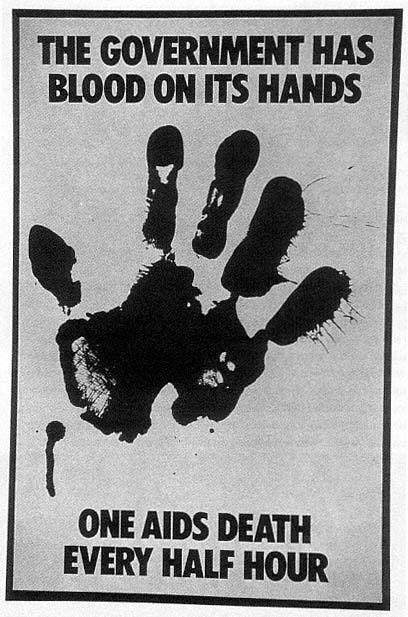
3.
This simple, self-consciously provocative graphic rejects the view that PWAs
have brought death on themselves. On the contrary, it declares that government—
by unspecified means—is responsible for the mounting AIDS death toll.
Courtesy of ACT UP.
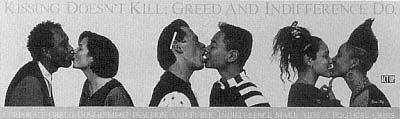
4.
This poster of couples mixed by race and gender drew fire in
Chicago for "promoting" homosexuality.
Courtesy of Gran Fury.
council in an unsuccessful effort to "tear down these morally offensive posters."[17] The "promotion" of homosexuality was the chief complaint lodged against the posters and the endangerment of children was cited as its chief mischief.
A poster by "Gang," a New York art collective, varied the familiar Marlboro cigarette advertisements. One familiar American icon known throughout the world is the American cowboy, and the students laughed to see President George Bush represented as a cowboy, over a cigarette package-style warning that his administration could be hazardous to one's health because of its inaction on AIDS (see figure 5). The students laughed even more when I asked if they would be able to get away with producing a similar poster featuring their own prime minister, Li Peng. The students easily understood the message of these posters: that business and government were failing to do their parts against the epidemic. Perhaps this recognition should not be surprising in a country where health care is provided as a matter of political doctrine by government. Unfortunately, the message about safety in the "Kissing Doesn't Kill" poster was, as in the U.S., misconstrued.
I lingered on each of these slides as long as class attention seemed to warrant, but there was not as much discussion by the students as I would have liked. Part of the reason for this lack of participation stems from the Chinese educational system, which does not promote classroom discussion between students and teachers, even in higher education. My colleagues and I found this reluctance to participate in discussion a frequent frustration, yet as far as I could tell from the students who did speak, the slides were well received. The students were interested in the images—and the social climate that allowed such sharp criticism of government—and they were quick to understand some of
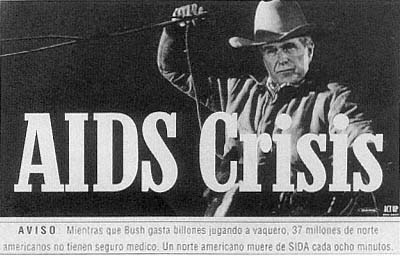
5.
This satire of a widely recognized cigarette advertisement depicts President
George Bush in the macho pose of the cowboy of American folklore. The
caption reads: "Warning: While Bush wastes billions playing cowboy, 37
million North Americans have no medical insurance. A North American dies
of AIDS every eight minutes." The billions of dollars refers to the money
used to finance the military in general and the Persian Gulf war in particular.
Reprinted by permission of Gang.
the issues that have engaged AIDS education here in the United States. They noted, for example, that many AIDS posters did equate HIV with death and that while some posters warn against the grave nature of AIDS they do not equivalently educate people about what measures they should take to protect themselves. For example, one poster showed a male hand poised to masturbate accompanied by the legend: "This Might Be Your Best Friend."[18] Some people might be scared into a life of masturbation by AIDS, but most will not and for those persons the poster has no educational message at all about safety in sex. Though I had less feedback than I would have liked about the slides, the students appeared to understand not only the overt messages of the images but also their political implications. Interpreting implicit messages of poster art is not an unfamiliar task for the Chinese. Abundant political posters and slogans are a way of life in their country. Around the city of Beijing, for example, numerous political messages appear on
large billboards with the message in both Chinese and English: "Practice Family Planning. Implement the National Priority."
AIDS Assignment
Apart from discussion of these visual representations of AIDS, I assigned students to determine a policy for the Murphy General Hospital for health-care workers diagnosed with HIV/AIDS. "Specifically," the assignment read, "you are asked to determine (a ) whether health-care workers should be tested for HIV as a matter of employment or review and (b ) whether any restrictions on patient care should be adopted for health-care workers with HIV infections or disease, and if so, how such restrictions should be adopted and enforced." The problem offered a number of points of convergence in a curriculum devoted to ethical as well as to theoretical and practical aspects of leadership and management. To prepare their recommendations the students divided into four groups. Other faculty members and I circulated among the groups as resource personnel, often role-playing parts as hospital administrators, deans of medical schools, ministers of public health, and so on.
After a number of meetings, the groups reported back to the whole class. The reports shared a number of conclusions. Every group pointed out the importance of protecting the hospital's reputation in order to make it attractive to people and to assure patients of their safety. Too, the groups all suggested that some form of HIV testing take place, whether at initial employment or some point annually thereafter. One group thought that only persons involved in invasive procedures should be tested; testing others would be irrelevant. Only one person in all the groups thought that persons with HIV should be fired because of an HIV/AIDS diagnosis; despite the singularity of this view it was nonetheless expressed adamantly. All the groups also thought that a health worker discovered through testing to have an HIV infection should be transferred away from patient care or simply not hired. Two groups mentioned as a rationale for this policy the protection of the workers with HIV, that is, protecting them from illnesses borne by patients. Nevertheless, arguments focusing on protection of patients and reputation seemed to be the prevailing rationale for keeping health-care workers with HIV/AIDS separate from patients. Recalling the message of the
slide they had seen earlier in the week which blamed inaction and failure to plan proactively for the epidemic, two groups ended their presentation by recalling that "Silence = Death" and urged the administrators of Murphy General Hospital to take swift action in implementing their recommendations.
These discussions and recommendations might have come from equivalent groups in the United States. The CDC, for example, has wrangled with the question of testing health workers whose work involves "invasive" or "exposure-prone" treatment measures.[19] And this is no idle question, especially in light of the HIV infections caused by the dentist David Acer. Questions of transfers—if not loss of employment—have also been discussed as matters relevant to patient protection from health workers with HIV/AIDS. So there was nothing extraordinary about the recommendations these Chinese health professionals made. The reasons for their recommendations may have varied slightly from those that might be offered in the United States, of course, but the students did not elaborate much—and neither was there much time for such elaboration—on their group rationales. One might imagine, though, that certain background issues, such as the social policy of full employment in the country, might have influenced their preferences for transferring rather than firing workers with HIV/AIDS.
But not only in recommendations did the Chinese discussion parallel the debate in the United States; the ensuing criticism of the Chinese proposals also sounded familiar themes. Not all the groups shared the same recommendations, and not every member in a group shared its majority consensus. Some individuals rejected policies of testing and transferring altogether. One physician in the class, for example, insistently pointed out that he would not want to accept a transfer merely for the sake of protecting a hospital's reputation if he had an HIV infection but was still able to perform his job. He would especially not want a transfer if his job did not entail risks to patients. As discussions with health workers with HIV/AIDS in the United States have shown, this reluctance is no personal quirk or selfish disregard of patient safety; on the contrary, the issue raises profound questions about standards of employment and limitations on interventions against people with HIV.
One other student also persistently challenged the merit of HIV testing of health workers, either at the time of initial employment or on an annual basis thereafter. Not a physician herself, she pointed out that
such testing could not ensure that an individual would not develop an HIV infection after employment and that continuous testing—at intervals of once or even twice a year—would not ensure (a ) accurate identification of health workers with HIV or for that reason (b ) patient safety. She pointed out that testing would also increase costs to a health-care system burdened with other costs it could not now meet.
In the fall of 1991 I had served on the University of Illinois Hospital and Clinics Ad Hoc Committee for the formulation of policy regarding health workers with either HIV or hepatitis B virus (HBV) infection. (Like many other institutions at the time, the university formed this committee in reaction to widespread publicity about HIV infection by a health-care worker and in reaction to CDC recommendations about formulating guidelines on practice limitations for the HIV-infected health-care workers; the university was not reacting to any specific incident in its hospital or clinics or to the presence of HIV infection in a specific employee.) As I listened to the Chinese students, I was struck time and again by their raising of many of the issues that surfaced as concerns during the Illinois committee meetings; many of the same recommendations were advanced and many of the same criticisms of those proposals emerged. The university committee finally adopted a majority recommendation against instituting any kind of routine HIV/HBV screening for its health workers (or even for employees not directly involved in patient care; this latter was a response to university attorney's concern for receptionist-patient interactions). The committee did recommend a policy that would make voluntary screening available to health workers. Furthermore, the committee adopted a policy that health workers who know themselves to have an HIV/HBV infection must report their diagnosis to their department head. The head of the department would then in turn convene a special University Hospital and Clinics advisory committee to review the worker's responsibilities and recommend any work limitations on a case-by-case basis, with every effort being made to protect the confidentiality and employability of the worker. Such a policy, of course, is open to criticism because it creates policy for HIV and HBV when it does not do so for other conditions that might jeopardize a patient's care, conditions like alcoholism, epilepsy, or depression. Such selective policy is morally problematic, certainly, because it not only singles out one condition but also because it leaves great latitude to the advisory committee regarding decisions about a worker's job responsibilities.[20] In their recommendations the Chinese students did not directly propose standards that obligated health workers
to report HIV-related conditions to a supervisor, and neither did they raise the possibility of oversight committees that would make recommendations about the employment responsibilities of a health worker. But certainly incisive remarks they made about the limitations of testing and the problem of transferring health workers echo the issues raised by the Illinois hospital committee. Given more time for the assignment and more firsthand experience in dealing with the problem of HIV in health workers and patients, I do not doubt that the Chinese group of health professionals would eventually have raised issues of reporting and work assignments even if they came to different conclusions than did the committee in Chicago. That they did not raise such issues may be a result of the common perception that health workers with HIV is a remote concern in China at present. Many of the health professionals who come from the more remote provinces of China may in fact never see a person with AIDS let alone have to grapple with questions of the employability of an infected health-worker.
AIDS and Morality
Because my stay in China was limited and because my sampling of the views of the Chinese was anecdotal, I cannot claim to be presenting universal perceptions of the importance of the problem of preventing HIV infection in that country. It was nevertheless instructive to find that many of the issues raised by the Chinese had immediate parallels in my experience of the epidemic in the United States. Some of these issues belong to the nature of communicable disease. Some of them, however, belong to the cultural context of the disease, and I found in this regard less comforting parallels.
Most of the students knew that Magic Johnson—"a very famous American basketball player"—had announced his HIV diagnosis less than two months before my arrival. They also knew that infection and protection from infection did not depend on fame, class, or sexual orientation. But I sometimes wondered in speaking with these health professionals whether they recognized their own society's vulnerabilities to the epidemic. One physician who had spent a certain amount of time studying in California told me she did not think AIDS would be very much of a problem in China because, as she said, "The family situation
is so strong in China." By this remark I understood her to mean that monogamous heterosexual marriage is a formidable bulwark against HIV infection. Certainly, that has been the message here in the United States from those who think that not only are moral ideals the pathway out of the epidemic but that the epidemic is the consequence of betrayal of those ideals. This same woman also noted that most Chinese do not have the money to bring them into contact with foreigners who would carry HIV infection, either by way of travel abroad or interaction with tourists traveling in China. "They do not have the money to go to the hotels here," she said.
Yet experience in the United States has shown that a social ideal of monogamous marriage has not proved a barrier to HIV infection in husband, wife, or children. And our experience here has shown too that lack of money—poverty especially—can prove a fertile ground for HIV infection rather than a barrier to it. While widespread HIV disease does not appear to be immediately likely in China, the American experience has shown that the belief in social immunity to HIV/AIDS may be in some respects an invitation to it. The history of the epidemic in the United States and around the world gives us reason enough to believe that any occurrence of AIDS is a disaster and not a problem to be ignored merely because it has not yet affected sufficient numbers of people or because the people it affects are not worthy of widespread social interest and concern. The course of the epidemic in the United States has shown the problems that ensue in attending to HIV/AIDS only when it appears to "seep out" of the marginalized classes in which it first appears.[21]
Given the example of the China Daily account that represented HIV/AIDS as a condition coming from abroad, from drug-users and prostitutes, the stage in China may be set to battle the epidemic on moral grounds; some of the attitudes I encountered suggest that some Chinese consider a certain set of moral ideals capable of preventing infection. The matter of homosexuality can be mentioned as an example. Certain features of China's accommodation of people's homoerotic interests may also prove an impediment—as happened elsewhere—to the identification and control of HIV/AIDS. For most of its long history same-sex relations in China never became morally problematic as in Western European culture. On the contrary, there have been celebrated same-sex relations throughout Chinese history. Certain elements of the country's historical and political development, however, have led contemporary
China to a position officially critical of homoeroticism. In his Passions of the Cut Sleeve historian Bret Hinsch observes:
Many Chinese now regard the West as a cesspool of sexual and moral decadence. Outstripped by the West in material terms, they take consolation in their own ethical superiority. Chinese moralists often single out the recently imported "fad" of homosexuality as evidence of the spiritual pollution that now infects its place of origin—the United States and Europe. The Western vision of the decadent Orient is not matched with a parallel Chinese view of the exotic and depraved Occident. Yet ironically, the intolerance of homosexuality of which the Chinese are so proud actually originated in the West, while the acceptance of homosexuality that they abhor is more typical of native sexual ideals.[22]
I am not suggesting that HIV risk belongs even primarily to homosexuality in China, but moral and medical misunderstandings and intolerance of homosexuality make it more difficult to identify, address, and overcome any HIV infection that occurs through homosexual relations. A heterosexist culture can, as the Western experience shows, slow attention to the emergence of an epidemic and stall adequate educational efforts even when the epidemic is recognized and acknowledged. As in many aspects of China's culture, there are official and unofficial policies. While there may officially be no recognition of same-sex relations in that country, there are nevertheless persons who lead homoerotic lives, though success in such a life is often dependent on social privilege.[23] The challenge of meeting the future of homosexual HIV infection may therefore be impeded by "official" moral policies.
Even given an understanding of the epidemic, personal and cultural expectations can skew perceptions of educational messages. Talking with students on the last day of class, I found that a number of them had read the Gran Fury poster described above to mean that kissing could cause infection, even though these same students also fully understood that the activist goal of the poster was to challenge social inaction. Two physicians expressed concern about what a serious problem this form of transmission posed. (Such a construal may have also played a role in their thinking about what recommendations would be appropriate for health care workers with HIV.) My effort to correct the impression that kissing could cause HIV infection was met with skepticism. I even told one physician from a rural province that I myself had kissed people with HIV. "Why would you kiss someone with AIDS?" he asked, shocked, shaking his head as much in warning as disbelief. I responded that by every account with which I was familiar, kissing had not been demonstrated
as a means of HIV infection. Against his exposure to ideas about the transmission of HIV, its links with immorality, and its lethal nature, I don't know that he was convinced. The expectation that HIV is highly communicable may be a cultural perception difficult to extinguish as people think about appropriate educational, policy, and punitive measures necessary to control the epidemic.
The important questions of AIDS education and prevention in China really are not different from the relevant questions elsewhere. Perhaps one of the most important is whether conceptual obstacles exist to prevent people from appreciating the significance of HIV and educating themselves against it. It may be that in China the perception that HIV is an exotic epidemic—in distant places, in homosexuals who have no place in China, in prostitutes who are morally avoidable persons, and in drug-users—may have the effect of impeding educational efforts, as such perceptions have elsewhere. Certainly China has advantages in a fight against HIV that the United States, for example, does not have. The government provision of health care means that the Chinese will not face certain of the difficulties often faced by PWAs in the United States. But it is worth wondering whether and to what extent those advantages may not be offset by other disadvantages in that culture's approaches to the epidemic.
These cultural concerns are not limited to China; they apply even to the United States today as it wrestles with sex surveys and condom advertisements. I wonder then whether each nation must find its own way in imagining and carrying forward an anti-AIDS program, whether in fact each country must stumble along on its own, unable to borrow clear lessons from other countries. To what extent will other countries—those at present largely unaffected by HIV—be able to avoid replicating certain of the problems like inattention, avoidance, marginalization, and substandard care faced in the United States. At a 1991 Beijing forum recognizing World AIDS Day, one far-sighted health official was quoted as saying that because the epidemic is still in its infancy there, China has an almost unique opportunity to prevent the spread of AIDS. He expressed hope that China would succeed in its fight against AIDS.[24]
There are many reasons to share such a hope, but some factors temper that hope as well. As the most populous nation on the planet, China occupies an unparalleled position in the world. It is true that the occurrence of HIV/AIDS in China has been so far slight, but given the way that USA Today , Cable Network News, and even robbery of taxi drivers at gunpoint have come to China, it is hard to imagine that HIV
can be anything but a growing problem in that country. Perhaps if there is one lesson to be learned from experience around the globe, it is that to wait for large numbers of persons affected by HIV/AIDS before addressing the problem of the epidemic is to wait too long. From my experience I can say that Chinese people with fine minds are already capable of good dialogue about what policies ought to be adopted in order to prevent HIV infection. But in some respects Chinese society will have to be rethought—as U.S. society has had to be rethought—in order to find generally effective ways to help people protect themselves from infection. This rethinking would be a serious challenge for any country, but it may prove especially challenging for a country already struggling toward social development on so many fronts. I do hope that what efforts are adopted in China can avoid the fear-mongering, homophobia, and moral condemnation that to this day mar progress against AIDS in the United States, that the Chinese can avoid mistakes that even to this day take their toll in human disease and social opprobrium. In this regard maybe a good place to start AIDS education in China as elsewhere would be with explanations that kissing doesn't kill.