
5—
Gestural Soliloquies
In the gestural soliloquy, the quality of the gesture remains the same as with heightened emotions, but the quantity increases. In the previous category, no single performer enacts an elaborate series of gestures because the other actors collaborate in creating an emotional effect or in telling the story. Gestural soliloquies often occur at emotional high points
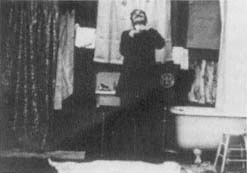
The Hindoo Dagger: The gestural soliloquy.
in which the characters undergo emotional catharsis. The characters in this situation often have only one point to make: "I am angry," "I am grief-stricken," or "I am desperate," and employ a series of gestures (sometimes repeating the same gesture), all of which express the same state of mind. While narratively redundant, the cumulative effect of the gestures is to increase the emotional impact, in keeping with the heightened emotional states characteristic of the melodramatic form. Though this repetition runs counter to injunctions against "the useless multiplication of gesture," each gesture remains distinctly separate, preserving the digital nature of the histrionic code.
In The Hindoo Dagger (1909), a woman's lover (Harry Solter) discovers her body and, thinking he will be accused of murder, enacts his distress. Kneeling at her side, he puts both hands on top of his head, then holds the backs of his clenched fists to his forehead, then puts his hands to his throat. He raises his arms in appeal to heaven, then waves clenched fists in the air, and finishes by crossing his arms over his chest. The Tavern Keeper's Daughter (1908), like The Call of the Wild , relates a tale of lust, villainy, and redemption. This time the pursued virgin takes refuge in a cabin occupied only by a crib and a baby. The villain (George Gebhardt) charges in, overlooks the woman, but spies the baby. In best melodramatic tradition, the child precipitates a reformation, and the villain enacts a gestural soliloquy. He sinks to his knees by the crib, beats his breast, raises clenched fists in the air, puts bowed head in hands, spreads arms wide, looks up to heaven, crosses himself, and slumps forward, head in hands. Then he rises, puts one forearm to his eyes and his other hand to his chest. All these gestures could be translated into one or two verbal phrases: "I am sorry," or "Forgive me."
The gestural soliloquy was also used to trace a character's thought processes, though the verisimilar code would better suit this function. In this case, rather than simply heightening emotional effect, the soliloquies serve to ad-
vance the narrative. In A Burglar's Mistake (1909), a husband (Harry Solter) contemplates suicide. As he holds the gun, he sees a toy that his young child has left in his office. He gestures to the door with his free hand, his arm extended behind him. Then he makes a fist in the air and brings his arm sharply down and up in a semi-circle as he decides on a course of action. Note, however, that the performer's gestures might be incomprehensible without the presence of the toy, showing precisely how difficult it is to discuss performance in isolation from other signifying practices.