
Rural Change and Royal Finances in Spain: At the End of the Old Regime
Richard Herr
For Charles, Jane, Sarah, Winship
who were there too
Table of Contents
- LIST OF ABBREVIATIONS
- ACKNOWLEDGMENTS
- PART I— THE MONARCHY
- Chapter I— Agrarian Conditions and Agrarian Reform in Eighteenth-Century Spain
- Chapter II— The Philosophy of Agrarian Reform
- Chapter III— The Decision to Disentail
- Chapter IV— The Struggle to Save the Royal Credit
- Chapter V— The Extent of Disentail
- Chapter VI— The Collapse of the Monarchy
- PART II— SEVEN TOWNS
- Chapter VII— La Mata
- Chapter VIII— Villaverde
- Chapter IX— Pedrollén
- Chapter X— El Mirón
- Chapter XI— Baños
- Chapter XII— Lopera
- Chapter XIII— Las Navas De Santisteban Del Puerto
- Chapter XIV— Ricardo, Malthus, and the Market
- PART III— TWO PROVINCES
- Chapter XV— The Social and Economic Spectrum of Jaén and Salamanca
- Chapter XVI— Jaén Province: The Determinants of Growth
- Chapter XVII— Salamanca Province: Hardening the Patterns
- Chapter XVIII— Salamanca Province: The Despoblados and Alquerías
- Chapter XIX— The Big Buyers
- Chapter XX— Between Two Ages
- APPENDIX A— THE POPULATION OF SPAIN IN THE EIGHTEENTH CENTURY
- APPENDIX B— THE EXTENT OF DIFFERENT TYPES OF PROPERTY
- APPENDIX C— ISSUES AND REDEMPTIONS OF VALES REALES
- APPENDIX D— MONTHLY QUOTATIONS OF THE VALES REALES AGAINST HARD CURRENCY
- APPENDIX E— RATIO OF THE SALE PRICE OF DISENTAILED PROPERTIES TO CADASTRAL VALUE
- APPENDIX F— ANNUAL TOTALS OF DEEDS OF DEPOSIT
- APPENDIX G— THE CASA EXCUSADA
- APPENDIX H— RELATIVE PRICES OF CROPS, 1753–99
- APPENDIX I— THE DISTRIBUTION OF INCOME FROM AGRICULTURE AMONG INDIVIDUAL FARMERS OF LA MATA
- APPENDIX J— MODIFICATIONS IN PARTIBLE TITHES AFTER 1796
- APPENDIX K— INCOME FROM RAISING LIVESTOCK
- APPENDIX L— RELATIVE LABOR NEEDS FOR GRAIN FIELDS AND OLIVE GROVES
- APPENDIX M— THE ECONOMIC SIGNIFICANCE OF CENSOS IN LAS NAVAS
- APPENDIX N— COMPARATIVE STATISTICS OF SEVEN TOWNS
- APPENDIX O— USE OF THE APPELLATION DON IN THE DEEDS OF DEPOSIT
- APPENDIX P— THE ZONES OF JAÉN PROVINCE
- APPENDIX Q— THE ZONES OF SALAMANCA PROVINCE
- APPENDIX R— TYPES OF SEÑORÍO LEGO
- APPENDIX S— INDEX OF LANDOWNING CONCENTRATION IN SALAMANCA
- APPENDIX T— POPULATION OF SMALL AND MEDIUM PLACES, SALAMANCA PLAIN, 1786
- APPENDIX U— POPULATION, SALAMANCA ZONES, 1534–1857
- APPENDIX V— IDENTIFIED LEVEL 4 BUYERS IN SALAMANCA PROVINCE[SUP(1)]APPENDIX V— IDENTIFIED LEVEL 4 BUYERS IN SALAMANCA PROVINCE1
- APPENDIX W— IDENTIFIED LEVEL 4 BUYERS IN JAÉN CITY[SUP(1)]APPENDIX W— IDENTIFIED LEVEL 4 BUYERS IN JAÉN CITY1
- GLOSSARY
- BIBLIOGRAPHY
- PHOTO SECTION
- INDEX
LIST OF ABBREVIATIONS
|
|
ACKNOWLEDGMENTS
Like many of life's undertakings, this study began almost inadvertently. During the academic year 1959–60, I was in Madrid with a fellowship from the John Simon Guggenheim Memorial Foundation and a grant-in-aid of the Social Science Research Council, working on the history of Spain during the war against Napoleon. I became aware that the disentail and sale of church property was a critical issue and that it had begun already under Carlos IV, although none of the histories of the time had given it much, if any, mention. Searching for original documentation on this desamortización, as it is properly called, I drew a blank in the obvious places, the Archivo Histórico Nacional, the Archivo del Ministerio de Hacienda, and the Archivo de la Dirección General de la Deuda y Clases Pasivas. (The last place evidently had the kind of documents I sought, but they were not catalogued yet.) I then tried the records of the notaries in the Archivo Histórico de Protocolos de Madrid to see if they contained any local examples of the sale of church properties. My search shortly revealed that the largest collection of a single notary, the documentation of Juan López Fando, consisted of the acknowledgments given to the ecclesiastical institutions by Carlos IV of the debt he assumed toward them in return for their properties that he had sold. Sensing the possibility of an interesting study in social and economic history, I selected two provinces to concentrate on, Salamanca and Jaén, and devoted much of my remaining time in Madrid to this documentation. When it became clear that I could not get through all the records in the three hours that the archive was open each day, the director, don Fran-
cisco Lupiani, generously arranged for me to stay on regularly several hours after closing. In addition, don Tomás Magallón, head of the microfilm service of the Biblioteca Nacional, moved his equipment to the notarial archive for several lengthy sessions in which he microfilmed the indexes to all the relevant volumes of López Fando so that I might have a summary record of the disentail throughout the monarchy.
On leaving Madrid, I expected to complete the study in a couple of years, but Topsy's fate intervened, or perhaps it was Parkinson's law, and the project took on ever-wider and deeper dimensions, as the length of this volume and date of its publication attest. Another grant from the Social Science Research Council and a half year's sabbatical from the University of California allowed me to spend the year 1963–64 in Spain. There I pushed the date of the study back half a century to include the information on the provinces of Salamanca and Jaén from the immense register of Castilian property and incomes created in the mid-eighteenth century by the Marqués de la Ensenada, which is housed in the Archivo Histórico Nacional, the archive of Simancas, and the historical archives of the two provinces. During this year I also traveled through all the corners of these provinces to observe their geography and to search for parish records.
A senior fellowship from the National Endowment for the Humanities took me back to Spain in 1968–69 with the intention of winding up the project. Fortune decreed otherwise, however, for in my first hour in Madrid, a large suitcase containing many of my notes from the previous visit was one of two stolen from my car, and most of the year was spent in the task of reassembling my materials from the archives (fortunately the records of López Fando were safely on computer). Every disaster has its silver lining, and in going through the records for the second time I discovered much relevant information, the significance of which had escaped me before. But the frustrating loss of time did mean that the project was to continue for more years and that I would need more financial help.
This help came from many sources. Through the years, the Institute of Social Science, the Institute of International Studies, and the Committee on Research of the Berkeley Campus of the University of California have given me continued support for research assistance, computer programming, and the like. In addition I received further sabbatical leave from the university in 1971 and 1979–80, supplemented by grants from the Council for the Humanities of the Berkeley Campus. An invitation
from the Sixième Section of the École Pratique des Hautes Études in Paris allowed me to work there in the spring of 1973, while the directorship of the Madrid center of the Education Abroad Program of the University of California from 1975 to 1977 gave me the opportunity to pursue my writing, with the archives accessible to solve immediate questions. And finally, this preface is being written at the beginning of another year abroad made possible by the Guggenheim Foundation, whose mark of confidence thus punctuates the alpha and omega of the undertaking.
In a quarter of a century, one accumulates a welter of debts to individuals as well as institutions, embodied in a web of recollections of the years of work and pleasure in which these friends played central roles. Since most of their help came in the 1960s, when I was gathering and organizing the material for this study, some persons who were central to the discovery and recording of the sources are no longer around to read this expression of my thanks, while others, then graduate students, have become senior scholars or turned to different pursuits than those of the academic world. The experience must be for them but an exotic memory; for me, however, the debt remains vivid and worthy of record.
Two painstaking tasks were essential to the preparation of the data for analysis: punching into IBM cards the records of the deeds of deposit and the catastro of la Ensenada for the provinces of Jaén and Salamanca, the basis for much of Part 3 of this book; and totaling the sales province by province for the entire monarchy from the microfilmed indexes of the notary's volumes (the subject of Chapter 5). As research assistants, Neal Galpern, Erna Olafson, and David Fogarty carried out the first task; Betsey Scheiner, Edward Segal, and John W. Levenson the second. (Visitors to my office have for years been struck by the large map of Spain, covered with colored pins, the careful creation of Betsey Scheiner—the pins representing not secret agents but the location of prosaic properties disentailed in 1800. Now, as editor of the manuscript, she has contributed substantially to the appearance and accuracy of this book.)
A third task involving dedication and patience was the tabulation of the property and income of each household recorded in the catastros of the towns studied in Part 2. Lawrence Carlson and David Fogarty carried this out. Other jobs involved the analysis of census and price data and miscellaneous information provided by the catastro; all the above assistants participated in such work, and others have contributed through the years: Ian Dengler, Roberta Pollack Seid, Linda Abramson
Heilman, Joaquín Arango, Ralph Duncan, Elizabeth Green, Jacqueline Urla, Alan Sherman, and Lisa Cody. Where their help has been exceptional, footnotes to the text make mention of it.
Equally critical to the success of the research was the cooperation of the persons in Spain responsible for the documents I have used. Their enthusiasm, patience, and generosity with their knowledge have always made research trips a delightful experience. In Madrid, without question, the most important person has been don Antonio Matilla Tascón, then director of the Biblioteca del Ministerio de Hacienda, which housed the provincial summaries of the catastro of la Ensenada and all the legislative and administrative records dealing with the royal finances (for which he had prepared invaluable catalogues with summaries). His associate, don José Montenegro González, and doña María del Carmén Toledo of the library also gave me help. At the Archivo Histórico Nacional, don José Antonio Martínez Bara, director of the Sección de Consejos, doña Pilar Loscertales of the Sección de Clero, and doña María Teresa de la Peña of the Sección de Hacienda (after the archives of the Ministerio de Hacienda were moved there) gave me personal advice and allowed me to use the unpublished card catalogues in their offices. Don Alberto García-Gill and doña Carmen Crespo Nogueira of the archive administration were also especially helpful. In the Archivo Histórico de Protocolos of Madrid, don Francisco Lupiani, don Miguel Bordonau, the next director of the archive, doña María Teresa Baratech, and don José Luis de la Peña of the staff of the archive contributed their support. In fact, everyone in the archives in Madrid, Simancas, and Paris whom I consulted or who had charge of the records collaborated fully with me, and I thank them collectively when not individually.
It required more ingenuity and direct personal knowledge to find the necessary materials in Jaén and Salamanca, for the provincial historical archives were still being organized in the 1960s. The directors of the provincial archives have always been exemplary collaborators in my search for documentation: in Ávila, doña Carmén Pedrosa; in Salamanca, doña Petra Calzada; and in Jaén, don Melchor Lamana Navascues and, after his retirement, don Miguel Martínez Masegosa and don Juan José Fuentes Romero. Don Melchor Lamana, archivist of the recently established provincial historical archive of Jaén, located in an ancient building with a fountain in the small patio, was then leafing through the sixteenth-century volumes to catalogue their contents, despite a painful allergy to their dust, which regularly gave him asthma and fits of coughing. He did not long survive his retirement, but the ar-
chive, now in a handsome new Casa de la Cultura, is in many respects his creation.
In this phase, two people stand out as pillars of support. In Salamanca, don Antonio Moreno Moreno of the Delegación de Hacienda, a devoted student of the past of his province, gave me unstinting advice and information. He was a patron of the Provincial Historical Archive, which was in the care of his wife. Together, they had organized the archive in the beautiful but ill-lit Renaissance building of the Escuelas Menores, and his knowledge of the collection and of legal terminology was vital to my progress. It is my sorrow that he is not alive to read my thanks, which I extend also to doña Petra.
In Jaén, the person who became my local cicerone and adviser is don Juan José Barragán Pérez, now of the Archivo Hístorico Provincial, but in the 1960s of the Delegación de Hacienda, which still housed the catastro de la Ensenada of the province. Learning of my project, he uncovered for me volumes that were housed in a dark cellar. I worked there as many hours as the building was open, while Gypsies loitered and joked outside the window. Assistance in the use of these volumes was given by don Manuel Escribano Jiménez, director of the archive of the Delegación de Hacienda. (I cannot overlook the Civil Guard, don Lucas Joyanes González, who was required to sit with me while I worked. During our breaks he gave me information on farming practices in the province—he owned some small olive groves in a sierra town.) Ever since 1964, when I carried out the first research, don Juan José Barragán has responded whenever I have appealed to him in person or by mail to provide me with more information and xerox copies. Through him too, I met don Rafael Ortega Sagrista of the Delegación de Hacienda, amateur historian of Jaén and collector of works on olive culture, on which he is an expert. Because of him, the cultivation of the olive lost for me some of its mystery.
Once out of the organized historical archives, my search for documentation was much less successful, although it led to parish churches in many corners of the provinces and introduced me to many people out of the ordinary circles of a historian. Through don Angel Cabo Alonso, professor of geography of the University of Salamanca, I learned of the tithe records of La Mata, and the venerable priest of this small community, don Gerónimo Pablos, allowed me to copy them. Although don Gerónimo could not understand the interest that this account of payments made by eighteenth-century farmers held for me, the reader will appreciate its importance for Chapter 7. In my search through the south-
ern sierras of the old-regime province of Salamanca, I had the good fortune to knock on the door of the elderly priest of Gallegos de Solmirón, don Antonio Hernández Sánchez, who knew the surrounding communities well and located for me the various parish records used in Chapter 10. The most important was the tithe record of El Mirón, and the alcalde and schoolmaster of the town, don Juan Victor García Gómez, and his wife offered me their parlor to work in. My debt to these people is more fully expressed in notes to the individual chapters. With them I should include don Onesimo Avezuela de la Fuente of the Registro de Propiedad of Piedrahita, who uncovered for me in his office the records of the Contaduría de Hipotecas of the partido of El Mirón for the period of Carlos IV, and the young and enthusiastic resident of Piedrahita don José Luis García, who acted as my guide in the district and introduced me to local dignitaries of church and state. Only a few of the many priests, alcaldes, and others whom I called on could furnish me with the records I needed, but all those who searched patiently through their shelves equally deserve appreciation. So do the keepers of the hotels, village inns, and private houses who furnished me what comfort they had and provided local fare and drink not described in published guidebooks.
Over the years I have of course discussed my work with colleagues, and I have surely received ideas from them that I now think were my own. Several stand out for their continual interest and help. In Spain, these are don Gonzalo Anes and don Antonio Domínguez Ortiz; in the United States, Helen Nader, Jan de Vries, and David Ringrose. Finally, in the dark winter weeks of 1969, when it became apparent that neither the police nor the thieves' market nor offers of reward in the newspapers would produce my stolen notes, Valerie, my colleague and wife, revived my spirits and shared in copying out old and new information in the archives. Her competence in statistics and demography has been a constant resource and her patience with this project unbounded.
To these individuals and institutions and all others who have given me help, some of whose names appear in the notes, I extend my profound thanks. May this book justify their contributions.
PART I—
THE MONARCHY
On a mid-December morning in 1800, don Martín Sánchez Tomé, a notary of his majesty in the city of Salamanca, rode north out the Zamora gate, bearing a written order issued by don Manuel Ortiz Pinedo, alcalde mayor of the city. With him was a constable (alguacil ordinario ), to provide him aid if needed. The road toward Zamora took them over a slight rise, from which they could observe a gently rolling countryside dotted with small villages but otherwise virtually unobstructed as far as the eye could see. The plain of La Armuña was one of the richest grain regions of the Castilian meseta, and in spring half the land would be tilled and the wheat would grow up lush and green. But now in the wintery light the scene was not encouraging to the two men, for all the fields were lying fallow and the rich, red earth was showing through its covering of stubble and weeds. Oxen, mules, donkeys, and sheep pastured here and there, kept from wandering by their herdsmen.
After the pair had traveled some two leagues along the road, they turned off toward one of the smaller villages. It sat atop a low rise, a covey of mean houses huddled under the protective presence of their firm granite church. La Mata de Armuña, despite its small size, was a lugar, with its own officials; two of them, the "petty mayor" (alcalde pedáneo ) and the keeper of the records (fiel de fechos ), were expecting the visitors. With them was one of the leading figures of the community, a forceful man along in years named Francisco González.
Once the order of the alcalde mayor had been presented and read, the men set off into the fields, followed by a group of curious villagers of all
ages, eager to witness a scene that had been enacted several times since the previous summer but that still broke their monotony with the mystique of royal agents from the provincial capital. The group stopped beside one of the hundreds of small plots into which the open fields around the village were divided. The notary read from the order a description of the plot, two acres (huebras ) more or less, bordered on the east by the road from Salamanca to the village of Narros, on the north and west by lands of the hospital of Salamanca, and on the south by a field of the village church. The plot in question was now to change hands, and the order instructed the notary to deliver it to its new owners. The tenants, the document stated, would have to vacate it in three days or, if allowed to remain, must pay their rent to the new owners from the date of transfer.
The order was the result of an event that had taken place in Salamanca on the previous Sunday. At eleven o'clock that morning in the hall of the royal jail of Salamanca, "the usual place for such acts," the alcalde mayor don Manuel Ortiz had met with the notary don Martín Sánchez Tomé and an alguacil to complete the auction of seven plots of arable land in the towns of La Mata and Narros belonging to a confraternity in Salamanca, pursuant to recent royal orders to sell the properties of such religious foundations to the highest bidder and deposit the resulting capital in the Royal Amortization Fund. Don Manuel ordered the public crier, who acted as auctioneer, to announce the last written offer for the plots and open the final bidding. The crier did as told, in a voice that rang through the hall, saying, "The bid has been raised to eleven thousand eight hundred eight reales. Match this last bid! . . . I perceive the closing, soon! . . . Soon!" He waited a few minutes, then intoned his cry again, and once more. No one in the audience responded to his encouragement. One final time the alcalde mayor ordered the crier to announce the auction, to no avail. After a suitable delay, he instructed the crier to award the sale to the authors of the previous bid, wishing them "Good fortune!" (

Sánchez Tomé took Francisco González by the hand, "in his name and that of his partner Marcos González," and led him into the plot. Francisco walked around its boundaries, kicked a few clods, ordered everyone out of it, "and took several other actions as evidence of the ownership that he assumed . . . quietly and peacefully without opposi-
tion from anyone." The traditional Castilian rite for the transfer of real property had now been performed. The notary said that it applied "in voice and name" to the other six plots included in the sale; even had the purchasers wished, the midwinter light would not have lasted for a visit to all of them. Before leaving, Sánchez Tomé recorded the names of various witnesses, including the keeper of the village records, a local linen weaver, "and many other persons who attended this ceremony."1
This scene is representative of thousands of others enacted throughout Spain in the last decade of the old regime. The government of Carlos IV, crushed by the expenses of war and fearful of a catastrophic bankruptcy, in 1798 ordered the sale of the property held in entail by charitable institutions and other religious endowments in order to appropriate the proceeds for its own needs. It thereby introduced one of the most significant developments in modern Spanish history, the abolition of entail and the forced sale at auction of church properties and many public properties as well. In 1800 most Spanish real estate could not be freely transferred on the market; a hundred years later the opposite was the case. In the intervening century, thousands upon thousands of buildings and hundreds of thousands of fields changed hands. The process, known in Spanish as desamortización, affected the way in which Spanish cities developed and the structure of rural society evolved. It involved the basic relationships between church and state and became central to the conflicts between Spanish liberals and conservatives in the nineteenth century, and it has been blamed for many of the country's contemporary social and economic ills.
The first of the great waves of disentail swept over Spain between 1798 and 1808. This was the ominous final decade of the old regime, which led up to the Napoleonic invasion, and the introduction of desamortización belongs to the agony of the absolute monarchy. Its authors, however, were responding not only to the tensions that emanated from the French Revolution but to the optimistic enlightened rationalism of the reign of Carlos III in which they had been reared. They believed that freeing rural property would improve agriculture and reform society.
In this book, the disentail will appear as the culminating act of the absolute monarchy, not the introduction of an age to come. This is a study of royal domestic policy and rural society in the second half of the eighteenth century, how they evolved and how they interacted. The bu-
reaucracy of enlightened Spain, inspired by a dedication to improvement, left to posterity impressive sets of records that make it possible to look in depth at the rural world at the end of the old regime. They include the first full population censuses of Spain, the famous survey of real property and economic activities in Castile at midcentury known as the catastro (cadaster) of the Marqués de la Ensenada, and memoirs on conditions in the countryside and proposals for agrarian reform authored or inspired by Carlos III's ministers.
The first part of the study looks at the country as a whole, focusing on the impact of demographic expansion and the response of the royal government. Spurred on by urban riots in 1766, the king's counselors sought ways to provide more food for the cities. The information they had and their own reason told them that the solution was to multiply the small farmers and restrict the power and privileges of the large landowners. Even during the wars of the French Revolution, the royal government strove to fulfill this program. Disentail was the most dramatic measure, seeking now fiscal salvation as well as rural reform. We shall look at how it was carried out and how much property changed ownership throughout the country. We shall see, too, how all the royal efforts were no match for the forces of nature and war that beset the state. When Napoleon's armies occupied Spain in 1808, neither horses nor men could have put the absolute monarchy together again.
The second part of the book turns to the rural scene and looks in detail at the structure of seven towns in the mid-eighteenth century and their evolution up to the Napoleonic invasion. (La Mata will be one of them.) We shall observe who owned the land, who worked it and how the town income was distributed locally and to the outside world, who lived well and who scraped by and how many there were of each kind. Rural population was growing, and the towns had to cope with the threat of declining per capita income. In one way or another all seven were responding to the rising demand for agricultural products quite independently of any royal planning. Pressures for change were wearing away the prevailing structures, and Carlos IV's orders to sell ecclesiastical property opened the gates to accelerated change. The results would be molded by local conditions and forces in ways that the planners did not fully anticipate. Francisco González, who took over ownership of the plot in La Mata, was new to farming. The disentail permitted him to use his savings gained elsewhere, as a muleteer perhaps, to become one of the leading farmers in the village.
The third part looks at the provinces in which the seven towns were located, Salamanca in the northwest of the Castilian meseta and Jaén in Andalusia. By enlarging the field of vision, we can identify other features of the rural world. A comparison of geographic regions within each province gives an idea of the extent to which economic development depended on topography, communications, and royal or seigneurial jurisdiction. An analysis of the people who bought property in the disentail and the kinds of land they preferred tells much about provincial society and the changes taking place in it. We shall form an image of the provincial elites, those men and women who provided the hinge between the rural people who drew their sustenance directly from the soil and the outside world of royal government and national markets, what their objectives were and how their pursuit of them influenced the general development.
When the picture is complete, it will embrace the motives and actions of government and individuals at the national, regional, and local levels—a broad but concrete study of state, economy, and society that observes the complex ways in which royal policies were decided and carried out and how their effects were felt throughout the rural world as well as the role of impersonal forces like demographic growth and the market for agricultural products. A final chapter will attempt to interpret the findings and set them against contemporary developments abroad and the later stages of desamortización in Spain. Thus a study of court and country in the enlightened reign of Carlos III and the troubled one of his son should enlarge our understanding of what was involved in the passage from the old regime to contemporary times in Spain, and not only in Spain.
Chapter I—
Agrarian Conditions and Agrarian Reform in Eighteenth-Century Spain
Until recently agriculture has been Spain's main domestic economic activity, and agrarian policy has always been an issue of major concern to its governments. Nevertheless, they did not take up the idea of a planned redistribution of land until the second half of the eighteenth century, when changing conditions forced the royal advisers to envisage the relationship between the countryside and the country as a whole in a new way.
During the seventeenth and much of the eighteenth century, their main domestic concern was to increase the king's revenue. Their attention focused on the unequal weight of taxation borne by the different regions and social classes. At the beginning of the seventeenth century, the people of Castile contributed far more heavily to the revenue of the monarchy than those of Aragon or Portugal. The Conde-Duque de Olivares under Felipe IV and Josef Patiño under Felipe V sought to equalize taxes and military service among the various realms that formed peninsular Spain. Olivares's attempts led to a revolt of Catalonia and the secession of Portugal from the Spanish crown, but Felipe V succeeded after the War of the Spanish Succession in imposing direct taxes on the realms of the crown of Aragon in place of the niggardly subsidies formerly voted by their cortes. The new taxes, called equivalente in Valencia, catastro in Catalonia, and real contribución in Aragon, represented a fixed percentage of the income from land and occupations.
Land belonging to nobles as well as commoners and land acquired in the future by the church was subject to the new impositions.1
The new taxes on the eastern kingdoms embodied the principle that everyone should contribute equitably to the needs of the state. For half a century after the reforms in Aragon, the search for a further redistribution of levies held the attention of royal policy makers. Felipe V and Fernando VI struggled with the church to establish their right to tax ecclesiastical properties, finally obtaining papal recognition of it in the Concordat of 1753.2 The kingdom of Castile posed a different kind of problem. Here the major royal taxes, the rentas provinciales, weighed heavily on the poor, and their complexity meant that the expenses of collection absorbed an inordinate part of the proceeds.3 The new system in the eastern realms proved so successful, especially in Catalonia, that Felipe V's advisers recommended that Castile's system be replaced by a similar one based on a single tax. The única contribución would be divided between a "real" sector that taxed income from property and a "personal" sector that taxed income from labor, professions, and commerce. The real property tax would be proportional to the income from land and buildings and be paid equally by nobles and commoners. As in Catalonia, a prior survey, or catastro, of property and personal income would be needed.4 The aim was to establish a less regressive tax structure as well as a more efficient one.
In 1746 Fernando VI, on the urging of his secretary of hacienda (finance), the Marqués de la Ensenada, ordered an experimental survey in the province of Guadalajara, using the Catalan catastro as a model. It showed that a 7- or 8-percent tax on income from land of commoners and nobles and on commoners' personal income would produce the same amount as current taxes at less cost to the state. If the real property of the church were included, the tax could be reduced to 5 percent.5
In 1749 Ensenada obtained a royal order to extend the catastral survey to the other twenty-one provinces of Castile. To carry it out, the king established the office of provincial intendant. Intendants had been created in 1718 on the model of the French officials of this name, but they had soon been discontinued. The order of 1749 was the origin of a
new, permanent set of royal servants who were to become the key figures in the provincial administration of the kingdom.6 The intendants began the survey in 1750, setting about obtaining a full list of the properties and sources of personal income in all the cities, towns, and villages of Castile. By 1756 they had completed all twenty-two provinces.7 The result is commonly known as the catastro of the Marqués de la Ensenada.
The returns revealed how unfair the existing tax system was. The income from the property of the church represented 19 percent of the total income from real property in Castile, but the subsidio it paid annually to the crown was equal to only 3.6 percent of the rentas provinciales collected from the rest of the population.8 According to the information collected, an equitable single tax of 4 percent on income from all sources would produce as much as all existing taxes. Such a reform would obviously benefit the poor, while the religious orders, secular clergy enjoying benefices, and wealthy nobles would lose some of their privileged status.
Although Fernando VI approved the single tax in 1757, it never went into effect. Ensenada had been dismissed in 1754, and Fernando became despondent and nearly insane after the death of his queen in 1758, succumbing himself a year later. His successor, Carlos III, and the new minister of hacienda, the Marqués de Esquilache, took up the matter, but they lost time by ordering the towns to review their original surveys and bring them up to date. Now fully aware of the significance of their returns, the petty municipal oligarchies dragged their feet, raising malicious questions and delaying their responses.9 The reassessment took four years, and when it was done, the towns had discovered that their incomes were far lower than those stated in the original surveys. Two years later riots in Madrid and many other places drove Esquilache from power and marked a major turning point in plans for reform. Pedro Rodríguez de Campomanes, a fiscal, or advisory attorney, of the Council of Castile, became the most influential adviser in economic matters, and he had serious doubts about the practicality of the única contribución in regions whose agricultural economy was not mone-
tized.10 Still, a royal junta continued to discuss the single tax for another decade. In 1770 Carlos III ordered it put into effect as soon as provincial quotas could be assigned. Six years later this had still not been done, and the matter was dropped.11
All the work was not in vain, however. The idea of replacing the rentas provinciales by a single tax on income remained to inspire later ministers12 and became the basis for a sweeping revision in 1845.13 Meanwhile, the thousands of volumes of the catastro of Ensenada containing detailed information on the ownership of property throughout Castile were stored in the offices of the intendants, ready at a moment's notice to reveal the entailed estates of the church and the nobility. They are today one of the most remarkable sources anywhere of information on the society and economy of a preindustrial state.
2
In the 1760s a new worry drew attention away from the need for tax reform: the apparent disparity between the increasing food requirements of the country and the harvests from its soil. In recent decades historical scholarship has devoted much attention to the relation between the supply of food and population levels in early modern European countries. As a general rule, the prices of basic foodstuffs like wheat or other grains were far more elastic than those of nonagricultural goods. Europe as a whole in the early modern period followed a short fallow system, the two- or three-field rotation of grains, pulses, and fallow familiar to historians. Ester Boserup has shown that this system of cultivation is particularly susceptible to bad harvests.14 The resulting impact of famines on real incomes directly affected demographic trends. In the extreme situation a bad harvest would cause the price of bread to rise precipitously, and many people would be unable to buy the food they needed to survive.
Two common demographic responses to declining per capita food supplies can be related to Malthus's identification of "preventive" and "positive" checks to the growth of population. In the "preventive" case, a rise in food prices resulting in lower real incomes discourages mar-
riage and thus induces a decline in fertility. Although the resulting demographic response is sluggish, it nevertheless preserves a relatively high standard of living for a preindustrial society. A "positive" check, on the other hand, exists among populations that live close to the margin of subsistence, whose lower classes suffer a constant condition of malnutrition. Here a disastrous grain harvest or, worse, a series of bad harvests will cause the weakest members of the society to die off, victims of starvation or diseases that attack the debilitated society. In their impressive history of English population, E. A. Wrigley and Roger Schofield have labeled these two demographic responses respectively a "low-pressure system" and a "high-pressure system." As per capita food supplies decline in a high-pressure system, increased mortality lowers the level of population, while in a low-pressure system reduced fertility keeps the population from straining the subsistence resources except in unusual circumstances.15
According to these two authors, England enjoyed a low-pressure system from the early seventeenth century to the industrial revolution, with the consequence that it was socially and economically better prepared than continental Europe to take advantage of technological innovations. From the evidence that has been produced by historical demographers who have looked at France, Wrigley and Schofield conclude that during most of the old regime this country approached a high-pressure system. Present information indicates that France suffered severe crises of mortality in the seventeenth and early eighteenth centuries, usually associated with poor harvests, although a recurrence of the plague and the ravages of war also played important parts in these catastrophes.16 We still do not know if the severity of these crises reflected a society that was less prudent than England's in making decisions to marry, or if the famines were extraordinary events that resulted from a monoculture of wheat, more susceptible to meteorological vagaries than the English mix of winter and spring grains, or from a poorer communications network that caused French regions with harvest failures to suffer with little outside help.17 Recent work has brought into question whether France or any other early modern European society let its population
rise to levels that would entail near starvation when crops were normal.18 Nevertheless, France was more liable than England to suffer from bad harvests, and this may be our best definition of the difference between a high- and a low-pressure demographic system. Historical demography is in a period of rapid advance, and future research should clarify our understanding of the situation in early modern countries.
Less historical work has been done on the demography of Spain than on that of England or France, but the knowledge we have at present indicates that in the seventeenth century the interior of Spain, like France, labored under a high-pressure system. It suffered three major crises of mortality in 1630–32, 1647–52, and 1684, all three following immediately upon famines. The "little ice age" of the seventeenth century, known to have affected agriculture adversely in northern Europe, appears also to have reached Spain, accentuating the irregularity of harvests.19 Outbreaks of the plague affected the Mediterranean coast, but no evidence has been uncovered that it ever became virulent in the interior, where the major killer has been identified as typhus. In central Castile high grain prices and increased mortality went hand in hand, although the population decline experienced by various regions of the interior may also have been the result of a flight of people from a countryside overburdened by royal taxes.20 During the War of the Spanish Succession, a series of bad harvests between 1704 and 1709 led to famine prices for grain, which reached their apex in 1710. Death rates were also high during these years, especially near the Portuguese frontier where the demands of rival armies intensified the suffering of the countryside.21 It is worth noting that the four major Spanish demographic crises of the seventeenth and early eighteenth centuries were experienced in France as well, evidence that we are observing a condition that was common to western continental Europe.
With the end of the War of the Spanish Succession, the close association between harvests and mortality disappeared in Spain, as it did in France. No serious famines occurred between 1711 and midcentury, and local mortality crises appear to have been caused by influenza or typhus, not associated with food supplies.22 No simple explanation has been found for this change, but it is one feature of a general European eco-
nomic growth that began about the turn of the eighteenth century. In France more effective royal authority put an end to much of the civil turmoil that marked the seventeenth century. Production of grain for export increased in England, Prussia, and other regions, and European cities that could be fed by sea trade grew in size. Inland regions were more susceptible to shortages, but central and local governments improved roads and built canals and thereby facilitated the shipment of food into areas whose normal supplies had failed. Even a high-pressure demographic system like the French became insulated from the worst effects of crop failures. Agricultural catastrophes recurred in the eighteenth century without the earlier, devastating mortality. Poor harvests in 1788 and 1789 were instrumental in inducing popular violence in the early French Revolution, but they did not produce excessive deaths.23
Spain was a somewhat different case. The periphery of the peninsula—the provinces of the northern coast, Catalonia, and Valencia—followed the developments of the European maritime community. The economies of these regions began to recover from the national crisis of the seventeenth century around 1680, and after 1700 they experienced a fairly steady growth.24 The periphery imported grain by sea from France, Sicily, North Africa, and other sources of supply. Animals for slaughter crossed the Pyrenees to Catalonia and the Basque provinces, while north European maritime nations provided salt cod.25 The prices of wheat and other basic foodstuffs followed the same curve in these areas as in the rest of maritime Europe, convincing evidence of their integration into the Atlantic economic world.26
Because of the rugged geography of Spain, communications remained difficult and expensive in the central meseta and Andalusia, and these regions did not experience a comparable increase in traffic or a similar economic takeoff until the second half of the eighteenth century, and then only in some areas. After 1750 grain prices in Old Castile rose more rapidly than those in Galicia and Catalonia, evidence of the isolation of the meseta from the Atlantic economy.27 The failure of central Spain to share in the general western economic growth meant that the country now belonged to two different economic worlds. The northern and eastern periphery formed part of the Atlantic maritime community,
while the meseta and, to a lesser extent, Andalusia preserved an older, more isolated, and locally oriented economy, which received effective outside stimuli only toward the end of the eighteenth century.28 Not that central Spain lacked internal trade or consisted only of subsistence economies. The presence of cities, especially Madrid, with their needs for foodstuffs and fuel from their hinterlands, the dedication of some rural areas to products intended for distant consumers—olive oil, wines, wool—and the manufacture of certain—Castilian specialties—woolens, linens, knives, and others—meant that goods moved around and agricultural products reached urban markets, sent there directly by peasants or by people who received the rent, tithes, and other payments of peasants. These were, however, economic patterns that came down from the past and owed little to contemporary outside developments, although demographic growth in the interior did stimulate their expansion.
While the entire peninsula did not participate in the Atlantic economic expansion, it shared in the general western population growth. Spain was blessed with rulers who counted their subjects on a national scale earlier than those of most other European countries did. In 1712 Felipe V ordered a count of all households, which was made everywhere but the Basque provinces, and formal censuses of all individuals were taken in 1768–69, 1786–87, and 1797. A careful analysis of these documents reveals that on average over most of the century, the population of Spain was increasing at the rate of 0.46 percent per year. This is very close to the best estimate of the rate of growth for England (0.44 percent), slightly above that attributed to Italy (0.38 percent), and well above the accepted figure for France (0.27 percent).29
A comparison of the population figures for the different regions of the peninsula reveals that the periphery of the north and east was growing at a somewhat faster rate than the center.30 This is the situation that one would expect if one believes that economic prosperity is a cause for demographic expansion. The detailed study of Catalonia made by Pierre Vilar supports this explanation, for its coastal areas, open to commerce with the Atlantic world, were growing much more rapidly than most parts of the interior. Part of the reason was a difference in birth rates, but migration also played a major role in the population shifts.31 Valencia also grew rapidly in the century, at a rate that can only be explained
by massive immigration. Galicia probably had the fastest demographic expansion of the peninsula, but at the same time, as the region of densest population, it sent forth a large number of emigrants, especially single men, to the rest of Spain and America.32 The proximity of the sea, both for the export of local products and for the import of food, is a critical factor in explaining the greater rate of growth of the coastal over the interior population.
Nevertheless, the interior was also growing, some regions faster than others. In the crises of the seventeenth century, the Castilian meseta had experienced an absolute population decline, and its growth in the eighteenth century could represent a recovery toward some kind of Malthusian limit (as indeed the growth of Catalonia did at first), according to the familiar demographic pattern described above. One can well suppose that this is what occurred during the first half of the century, but the evidence suggests that by 1750 the meseta was again approaching this limit, for food prices were becoming unstable.
After the end of the War of the Spanish Succession, central Spain produced enough grain to feed itself except for years of bad harvests. This is the conclusion to be drawn from the figures collected painstakingly by Earl Hamilton, which show that the level of agricultural prices was relatively low at this time. About 1734 Spanish prices, like those in France and England, began a long-term rise that was to continue until the Restoration in 1814, slow at first but accelerating in the fourth quarter of the century. Agricultural products led other goods, with wheat going up the fastest.33 Within these long-term trends, brief oscillations appeared as responses to the quality of the harvests. Poor harvests in 1721 and the late 1730s pushed up agricultural prices temporarily, oscillating, as one would expect, more sharply in the meseta and Andalusia than in Valencia and Catalonia.34 These data indicate furthermore that after midcentury central Spain experienced a growing shortage of foodstuffs. A crop failure made prices soar in 1750, and a further bad harvest in 1753 pushed them even higher. By 1754 the agricultural price level in New Castile, according to Hamilton, was 68 percent above that of 1746; the rise in the level for nonagricultural goods was only 24 percent.35 Although harvests improved in the next years, the crown had to
send grain to Andalusia in 1757–58 to meet a shortage there.36 The royal ministers were beginning to find the threat of famine a matter of concern. The evolving relation between food production and population growth in the interior must be considered a major factor in understanding the history of Spain at this time.
The demographic expansion of Spain does not suffice to explain the increasing sensitivity of the agricultural price level. The Polish historian Witold Kula has argued that in a mixed subsistence and market economy based on peasant farming, the amount of the grain harvest that reaches the market fluctuates more sharply than the total harvest. Peasants try to keep a constant amount of grain for themselves before selling any, while landowners (which in Spain included religious institutions) take care of their needs before disposing of their surplus.37 This would explain sharp price fluctuations, which primarily affected urban dwellers because the peasantry as a whole relied only marginally on the market for their food.
The long-term imbalance came about because of rural and urban demographic expansion that caused suffering to both sectors. As the number of peasants grew, so did their propensity to consume the food they produced, but they were not in a position to withdraw much grain or other staples from the market. Landowners, seigneurial lords, the church, and the king drew payments from the farmers for rent, feudal dues, tithes, and taxes, and peasants made most of these payments in kind. Such obligations remained in force, whatever the size and number of peasant families. The grain and other products collected in this way provided most of the foodstuffs that reached the urban markets.38 Peasants sold their surplus in the market, and they could reduce this amount as their needs rose, but they could not suppress the trade entirely. They had to obtain some cash to pay rents due in coin and to buy the limited outside products that they needed. Part 2 of this study will uncover some of the ways in which peasants of Castile and Andalusia struggled to maintain their real income. Their plight had little effect, however, on the long-term trend of prices.
Urban dwellers would also suffer if they had to rely on domestic food supplies. Most of the large cities in Spain, as elsewhere, were near the sea and could be fed from abroad: Barcelona, Valencia, Málaga, and Cádiz. In the heart of the meseta, however, lay Madrid, the largest city
in the country. No other European metropolis of its size was like it, for it relied exclusively on land transport for its supplies. Since its establishment as the capital of Spain in the sixteenth century, its demands had strained the transportation capacity of the meseta, forced provincial capitals to compete with it for supplies, and caused the royal government continual concern. Between 1685 and 1800, it expanded from about 125,000 to nearly 200,000 people, a rate of approximately 0.41 percent per year, faster than the rest of central Spain, evidence that it was the recipient of considerable inmigration. After midcentury the city imported annually more than half a million fanegas of grain and legumes, half a million arrobas of wine, one hundred thousand arrobas of olive oil, three hundred thousand of meat, fifteen thousand hogs, and proportional quantities of fuel and other rural products. In the 1780s an average of seven hundred carts and five thousand pack animals arrived every day in good weather with cargoes to supply the city.39 The market for farm products in Castile meant primarily the demand of Madrid, which dominated the entire region and provided incentives to expand commercial agriculture. By comparison, Valladolid, with 20,000 people, and Salamanca, with 16,000, were small provincial centers, but they too drew on the agricultural market. Zaragoza, whose population rose from some 30,000 in midcentury to 45,000 in 1800, dominated the region of Aragon much as Madrid did that of Castile.40 Andalusia was more highly urbanized. The largest cities, Seville and Granada, had populations of 85,000 and 50,000, although Seville could also receive supplies by sea up the Gaudalquivir River. The relative prosperity of the region attracted immigrants from northern Spain, strengthening its urban centers.41 Except for Madrid, the cities of Castile and Andalusia may not have been growing at a faster rate than the country as a whole, but any growth resulted in increased demand, to which agricultural price curves responded.42
3
With an increasing rural population and a growing demand for food, the value of land could be expected to rise vis-à-vis labor, the other major factor of agricultural production. There is in fact evidence that rents were going up while wages remained stagnant.43 These circumstances produced a strong incentive to change land uses from extensive to more profitable intensive types of agriculture, and land was becoming an attractive investment opportunity. In a region like Catalonia, which had water available and could sell on the international market, capital was put into new irrigation works and market-oriented plantings like nut trees, olive groves, and vineyards.44 Similarly, Andalusia, able to import grain by sea as far as Seville and to ship out more specialized produce, exploited the comparative advantage of its climate and soil to extend olive groves and vineyards, in some places at the expense of land sown in wheat.45 Part 2 of this book will observe this development in detail in the towns of Jaén province. Farther in the interior, the obvious response was to bring pastures and wastelands under the plow, and this study will show that such a response was indeed occurring.46 Parts of the meseta had long produced wine and some olive oil for local consumption, and some of this production also expanded, especially in the second half of the century.47 Throughout the peninsula, economic incentives were bringing about changes in the uses of the land.48
There were, however, obstacles to the transfer of land to more profitable uses, particularly in Castile. The most important were legal restrictions on the exchange of ownership or use of land. They applied to church and public properties and to lay estates that had been established as entails, while the crown had guaranteed the Mesta, the guild of sheep owners, and the Real Cabaña de Carreteros, the teamsters' guild, the continued enjoyment at fixed rents of the pastures grazed on by their animals. The public properties went back farthest in time. During the early reconquest of Castile and León from the ninth to the eleventh centuries, when the Christians were moving into the northern meseta, they
took over many territories that were empty of people or thinly occupied. The written sources that have been preserved permit only a shaky reconstruction of the process of settlement, but it would appear that as a general rule, all the land was assumed to belong to the crown or, by tacit or express cession of the crown, to the military leaders who recaptured it or in common to the settlers who came in and established new villages and towns. Private property developed through occupation and cultivation by the settlers, a process known in Castile as presura and escalio, which resembled squatting on the American frontier. As the Reconquista advanced beyond the central sierras after the eleventh century, the Christians captured regions already well populated, where most residents remained under the new rulers. Here too there was much vacant land, and it too belonged now to the crown, unless a king granted it to another person or body.
Lands that were not established as private property or ceded expressly to a town or an individual and remained as wastes and common pastures were known as tierras baldías or simply baldíos. They included the mountains, barren wastes, woods, and rough hills of scrub growth, to which the term monte applied, all of them uncultivated and many of them of no use. Those parts of the baldíos on which local livestock grazed or which provided firewood—known in Spanish as tierras de aprovechamiento común (lands of common use)—were vital to the economy of the peasant villages. By early modern times it would appear that all the surface of the peninsula, except possibly some remote mountain wildernesses, had been allocated to one town or another or to several towns jointly.49 It was a moot point, however, whether the unused land within the limits of a town, the baldíos, belonged to the crown or the municipality. In practice it made little difference, because the kings protected the use in common of these lands, but it did mean that once the Mesta had acquired their use as pasture, it could henceforth insist on the right to their use.50
During the population expansion of the sixteenth century, new squatters settled in the baldíos, and Felipe II, in need of money, sold private title to these lands to the squatters or to their towns. The king also sold off other baldíos that were still unbroken. Sales of baldíos became one
of his largest sources of royal income. Faced with strong protests of the towns and cities of Castile that the loss of these pastures was harmful to their agriculture, in 1586 the king ordered a halt to sales of baldíos that were being used by local farmers and demanded in return the approval of a new tax known as the millones .51 A century and a half later, in 1737, when the demand for land was again rising, Felipe V, in need of funds to construct the royal palace of Madrid, reopened the sale of baldíos, only to face the strong protest of city and town governments. Fernando VI in 1747 halted the sale of lands that were being used by local residents and the restoration of those that had been sold, but he maintained the right to sell baldíos that were not being used. The legislation of Felipe II and Fernando VI implies that the king had the ultimate title to the baldíos, while recognizing the claim of the towns to lands of aprovechamiento común.52 Nevertheless, the catastro of the Marqués de la Ensenada attributed the title of land not held by specific owners to the municipal councils, so that the question of ownership of the baldíos remained open.53
Except in the north and on the Mediterranean coast, most settlements were closely nucleated. Cultivated lands and improved pastures and meadows surrounded the village or town, and the baldíos lay beyond this ring. In central and northern Castile, where most towns were small and close together, baldíos might hardly exist, but in Andalusia, La Mancha, and Extremadura, where settlements were larger and frequently far apart, the wastelands were very extensive. Spurred on by the profit in land, private individuals, noble lords (señores ), and religious orders were surreptitiously taking over large tracts of the baldíos for plowing or private pasture, while city councils appropriated them to rent for municipal income, allowing the tenants to cultivate them.54 What to do about the baldíos was a question that would concern royal advisers for the rest of the century, for in them they saw an immense resource and, whoever had rightful title, they believed the king had full authority to dispose of them.
Not all public lands belonged to the crown. The municipalities had open pastures and monte, lands of common usage that had been specifi-
cally deeded to them, and they also had fields, meadows, and buildings that they rented to their residents or even to outsiders. These properties were known as the bienes de propios or simply as the propios, and their rent was one of the main sources for municipal budgets.
Properties that belonged to churches and cathedrals, religious orders, charitable institutions, and ecclesiastical funds were said to belong to manos muertas, mortmain in English, and were also normally barred from sale. They included the places of worship and monastic houses, the rural and urban properties that churches and religious orders had at some time purchased, and the properties that pious individuals, out of generosity or seeking to offset their sins in the eyes of the Lord, had bequeathed to ecclesiastical institutions and foundations to provide income for their activities. The building and maintenance funds of churches (fábricas ); the emoluments (capellanías ) of certain priests; the funds for the upkeep of chapels and shrines and the performance of services at them, for the recital of masses in memory of deceased persons (memorias ), and for charitable activities such as providing dowries for orphaned girls; the income of confraternities and the funds to run hospitals, orphanages, old-age asylums, and like institutions; as well as much of the regular income of parish churches, cathedrals, and religious orders came largely from property owned in mortmain. Because the purpose of these properties was to provide income, they tended to be of above-average quality and could easily become the object of desire of individuals looking for ways to profit from the rising demand for agricultural products. They will play a central role in this story.
The third kind of entail applied to the estates of individual families. By legally enforceable acts, the owners of these estates at some time in the past had established them as inalienable and indivisible units that were passed on from generation to generation by primogeniture. They were known as vínculos legos or, more commonly, mayorazgos. 55 Not only real estate but all forms of property could be included, such as royal bonds or juros, the ownership of local public offices, seigneurial jurisdictions, and other privileges. The usual justification for the mayorazgo was that it protected the nobility as a class necessary to the monarchy by preserving its patrimony from being squandered by prodigal heirs, although the law of 1505 that governed the creation of mayorazgos did not restrict them to members of the nobility.56 Some mayorazgos
were vast estates belonging to titled aristocrats, but others were modest holdings of provincial hidalgos and commoners.
As direct lines died out or as mayorazgos went to female heirs for want of males, two or more mayorazgos could become the property of the same family. Although they legally remained distinct entities, in effect they became a single entailed estate, for they would normally follow the same line of inheritance. This was one way in which an estate could assemble widely scattered properties, as many great artistocratic holdings did.
Vinculación operated in various ways to check the economic forces that pushed for changes in agriculture. Most obviously it prevented the sale of land by inefficient, bankrupt owners to persons with capital who could farm it better. There was no reason why the legally prescribed heir should be the best administrator among the siblings, but even if he was, he could run into difficulty in seeking to make improvements. He could not assume a mortgage for this purpose, because at his death all liens would be nullified so that his heir would receive an unencumbered estate. With royal authorization the rule on borrowing could be relaxed, and in the sixteenth and seventeenth centuries a number of aristocrats had received permission to borrow against their mayorazgos, but the purpose had seldom been agricultural improvement. Paying off debts incurred in the service of the king or the maintenance of conspicuous consumption were more common purposes.57 Legally an owner could mortgage or sell parts of his estate that were not entailed or use other unrestricted funds to improve a mayorazgo, but the interests of his family would discourage him from doing so. Improvements in the mayorazgo would be transferred with it, and his other heirs would lose part of their anticipated inheritance. Finally, by prohibiting long-term leases, vinculación also discouraged enterprising tenants from improving the properties.
Despite all of these forms of entail, much property, both in land and buildings, was owned outright by laymen and could be freely exchanged. It is tempting to contrast favorably these properties with those that were inalienable, but in practice the difference was only relative. The laws of inheritance provided strict limitations on the disposition of estates. Most was destined to the direct heirs (the portion known as la legítima de los descendientes ), with each entitled to a specified minimum share; and no more than a fifth could be given outside the family to, for ex-
ample, a religious fund. Because of these rules, an estate was seen more as a family holding than as the individual property of the current owner, and there was reluctance to sell any part of it. Thus law and custom worked to keep off the market even land that was legally free to be exchanged.58
Except for an estimate of the extent of ecclesiastical property, based on the catastro of the Marqués de la Ensenada, it is impossible to state what proportion of Spanish soil fell into each of these different types of ownership. There seems no question that the Baldíos were very extensive, possibly covering more territory than all the other lands together. An eighteenth-century writer estimated that of 136 million fanegas (a measure roughly equal to an acre) in Spain, 89 million were Baldíos,59 while Olavide, intendant of Seville under Carlos III, asserted that two-thirds of Andalusia was uncultivated and deserted.60 Although hardly exact, these estimates are a good expression of the magnitude of the wastelands. Of the remaining land in Castile, which includes all entailed and free private holdings, ecclesiastical estates, and municipal property, both of aprovechamiento común and propios, the catastro indicates that about 15 percent of the land belonged to the church if the area is taken as the basis and 20 percent if the annual return is the basis. The provincial summaries of the catastro listed ecclesiastical property under a separate heading, making possible this calculation, but the different types of secular property were recorded only in the individual town surveys and the enormous task of assembling this information for the entire kingdom probably never will be undertaken. Although statements have been made about the extent of mayorazgos, no reliable figure can be advanced.61
Beyond the various forms of legal ownership, a different kind of institution prevented the free employment of the land. This was the Mesta, the guild of owners of migrant sheep, which dated from the thirteenth century. Because of the climate and geography of the country, the flocks of merino sheep, noted for the fineness of their wool, spent the summer in pastures in the central and northern sierras and were driven south before the snowfall to distant fields in Valencia, Murcia, Extremadura, La Mancha, and Andalusia, to return north in the following spring before the summer heat burned up the southern grasslands. In their semi-
annual migrations, tens of thousands of sheep followed long-established walks, or cañadas.
For centuries merino wool had been one of Spain's leading exports. The crown, eager to encourage a trade that brought it much revenue, had granted the Mesta extensive privileges and its own courts to ensure their observance. Among these privileges, the right of posesión ensured the members of the Mesta the continued use of any pastures they had ever occupied without an increase in rent. Extensive baldíos in Extremadura, La Mancha, and Andalusia as well as communal lands and baldíos in the northern and central sierras and private pastures were used by the Mesta, while pastures near the cañadas were also subject to the periodic invasion of the flocks. The right of posesión was a disguised form of entail, which restricted the land to its present use. By midcentury, farmers had begun to invade and plow up pastures reserved to the transhumant sheep, leading to lengthy lawsuits brought by the Mesta to preserve its rights.62 Before towns could break new ground in the baldíos used by the migrant sheep or owners of rented pastures could recover them for their own use, they had to overcome the opposition of the Mesta. As the century progressed, the royal government received many complaints and petitions over this issue.63
4
Spanish agriculture followed myriad practices in the eighteenth century, only a few of which have been studied. No generalized pattern can reflect them all faithfully, yet some broad strokes are needed for orientation before proceeding with the account of individual and official responses to the new demand for foodstuffs after midcentury. One may turn first to the division between center and periphery that marked economic and demographic developments.64 Although proximity to the sea seemed to offer all the coastal areas the possibility of participating in the maritime economy, the agriculture of only certain districts was able to take advantage of it. The Mediterranean lands of Catalonia and Valen-
cia flourished under the impact of domestic population growth and foreign trade.65 Catalan farmers were especially prosperous. Few owned the land outright, but the tenants enjoyed long-term leases, censos emfiteúticos, which ran indefinitely or, in the case of vineyards, for the life of the vines. They guaranteed the lessee the use of the land, the dominio útil, leaving to the owner only the dominio directo. As a rule, farms were consolidated single-family holdings called masías, and Catalan customary law provided that the farm be inherited as a unit so that subdivision did not occur. This typical property was thus bound by a form of entail, but it did not produce pernicious economic effects because there was no restriction on the use of the land. Pierre Vilar has shown how Catalan agriculture progressed under these conditions. Landowners and tenants cooperated to extend irrigation and introduce new crops that could be sold on the international market, such as wine, nuts, and dried fruits. The profit from these products provided the capital for agricultural improvement and foreign exchange to pay for imported grain and meat. Indirectly, the savings accumulated from farming contributed to the remarkable expansion of Catalan trade and manufacture in the second half of the century.
Along the coast south of Catalonia, the terrain was divided between rough, arid uplands, about which we know little other than the fact that much was devoted to the pasturage of sheep, and the coastal plains, which included rich irrigated valleys known as huertas or vegas. These latter enjoyed a great expansion of agriculture and an accompanying growth of population. In Valencia the cultivation of rice spread rapidly in newly developed fields along the coast, providing food for a growing population, while plantations of mulberry trees supported the worms that spun the raw material for Valencia's fast-growing silk industry. Local lords received heavy seigneurial dues, up to a quarter or a third of the harvest of certain crops, but the fact that farmers were guaranteed the dominio útil encouraged them to break new ground and invest capital in their exploitations. Here too agriculture provided the basis for a flourishing economy. The huerta of Alicante and the southern coast of Granada enjoyed similar prosperity. Products included dried fruits, nuts, and select wines, such as that of Málaga, much in demand in foreign and domestic markets.66 The agricultural products of the Mediter-
ranean coast, along with the fine sherry shipped out of Cádiz, went to the American colonies and penetrated the markets of the advancing countries of northern Europe.
The northern Atlantic coastal fringe from Galicia in the west to the Basque provinces by the Pyrenees told a different story. Mountainous terrain and difficult communications combined with the unrestricted subdivision of properties to discourage the development of commercial agriculture. Here the most notable development was the introduction of maize in place of grains from Galicia to the Basque provinces. A study of Guipúzcoa at the eastern end of the coast indicates that the switch began there in the seventeenth century and was accompanied by marling the soil with lime, which permitted the elimination of most fallow. In addition, much pasture and wasteland was broken to provide harvests for an expanding human and animal population.67 Basque law maintained the farms as single, hereditary units called caseríos, exploited individually to the benefit of the farmer, but local custom did not prevent them from being subdivided among tenants. A recent study of Vizcaya indicates that during the course of the century as the population grew, the number of tenant farmers rose sharply, while that of farmer owners declined slightly. By 1800 there were almost twice as many tenant farmers as owners in the region studied.68
In the western half of the northern fringe, the unitary family farm gave way to nucleated towns and exploitations that grouped a number of parcels. With demographic expansion, this pattern encouraged the multiplication of tiny units. Western Asturias and Galicia became plagued by the problem of minifundia, small uneconomical exploitations worked by poor tenants. In Galicia most of the land belonged to religious institutions. At some time in the past, the owners had accepted permanent leases called foros with rents that by the eighteenth century represented a very low return on the value of the land. The tenant holders of the foros took advantage of the situation to sublease their lands in smaller units to men who actually worked the soil, while they, now middlemen called señores medianeros, came to enjoy the status and leisure of hidalgos. Because the foros usually stipulated what crops were to
be raised, they hindered agricultural changes in response to market demands.69
Except for concern about the plague of Galician minifundia, developments in the periphery gave the royal policymakers little cause to worry. On the contrary, they found in the family farms, long-term leases, and emphyteusis of these regions models to be recommended elsewhere. The problem lay in the interior. The predominant pattern of landholding divided the central Castilian meseta into two distinct parts, one with small farms and villages, the other dominated by large properties and large towns. The obvious division of the meseta into Old and New Castile by the rugged central mountain range offers the temptation to draw the border between these two parts along this range, but this would be a mistake. Rather, the frontier is an irregular line running from northwest to southeast, approximately from Salamanca to Albacete, passing west of Madrid (Map 1.1). Western Salamanca province lies in the territory of large farms, while the hilly region of New Castile known as the Alcarria, comprising the provinces of Guadalajara and Cuenca as well as Madrid province, is characterized by small towns and properties. One could extend the small-farm region north and east of Castile to include southern Navarre and Aragon, although less than half of Aragon was cultivated. The rest, dry and of poor soil, was given over to sheep.70
While it is dangerous to generalize on the basis of current knowledge, it does appear that the region of small villages and small farms was dedicated to arable and livestock, the balance between the two and the nature of the harvests or livestock depending largely on the terrain and climate. Many residents (vecinos ) of the villages and towns owned some property. According to the census of 1797, the percentage of men engaged in agriculture who were landowners in this region went from a low of 11 percent in Ávila and 13 percent in Valladolid and Guadalajara to 46 percent in Navarre and 48 percent in Aragon. Except in Palencia, less than half the men engaged in agriculture were hired laborers, a strong sign that most of the exploitations were small, family-run affairs.71 The distribution of individual exploitations into parcels of arable scattered within the limits of a village and sometimes beyond it permit-
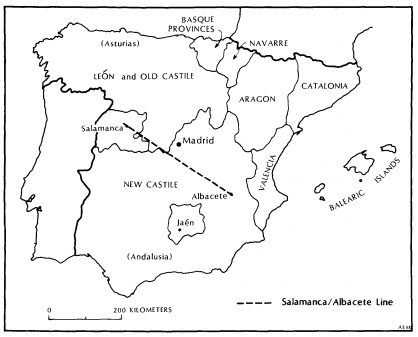
Map 1.1.
Old Regime Spain, Provinces of Salamanca and Jaén
ted each farmer to harvest crops during all the years of the local rotation and to share in the other agricultural activities of the village. The farmers had the use of the common pastures and the fields in fallow for the support of their animals, and certain individuals could rent grain fields and meadows owned by the village councils, the propios described earlier. A number of districts in the northern part of this region were noted for their highly developed patterns of periodic redistribution among the vecinos of the communal pastures and grain fields.72 Nevertheless, the migrant sheep of the Mesta spent the summer in many uplands of this region, and the right of the Mesta to preserve its pastures could pose an obstacle to their exploitation by the villagers.
The number of landowning farmers should not, however, be confused with the distribution of the ownership of the land. To judge from the reports of royal intendants and the results of Part 2 of the present study, few peasants owned enough land to satisfy their needs. In most cases those classified as landowners must have possessed one or a few
small parcels and had to rent the rest of their exploitation on short-term leases, three to nine years being their common duration. Those who farmed for their own account were known as labradores, but their characteristic feature was to own a plow team, not an exploitation. In most areas the bulk of the land belonged to the village councils or the local parish church and religious funds, a situation that favored the vecinos, or to nobles and other laymen and religious institutions and foundations residing or located elsewhere, such as the provincial capital or district seat (cabeza de partido ), in which case the vecinos were at a disadvantage. We shall see in Part 2 that the share belonging to these various categories of owners varied widely, depending in part on the nature of the local terrain and the distance from active urban centers. As noted earlier, the major share of the products of this region to reach the market left the villages in the form of rents, tithes, and similar obligations. Where land was owned locally, markets were usually distant; and elsewhere the conditions of farming were largely determined by short leases, which called for payment in specified quantities of certain crops. Here the peasant was not in a good position to respond to market forces; yet when his interest and that of the absentee owner coincided, there could be an effective response, as we shall see.73
South and west of the Salamanca-Albacete line, the average size of towns and agricultural exploitations was considerably larger. Towns here too were nucleated, surrounded by intensively cultivated land known as the ruedo and beyond it the more open, cultivated region called the campiña. The land would be divided into plots, some for grain, many for olives or vines, and there would also be irrigated huertas for vegetables or fruit trees, broken up into small, individual exploitations. Some of these units were owned by local small farmers, but many formed part of larger estates, including those of religious bodies. The percentage of men engaged in agriculture who were listed as landowners in 1797 was between 13 and 20 in the provinces of Toledo, La Mancha, and Extremadura, but 5 or less in the Guadalquivir valley: Jaén, Córdoba, Seville. Granada was 16 percent.74
The valley of the Guadalquivir was the archetypical region of large farms and towns. Although most of its farming was undoubtedly done on parcels in the ruedo and campiña, its characteristic exploitation was
not the collection of parcels but the cortijo, a large, compact property devoted primarily to raising wheat. Cortijos tended to be distant from the town centers, in the campiña or beyond it, perhaps carved out of the baldíos. According to contemporary accounts, cortijos ran from a few hundred to two or three thousand fanegas.75 Besides a house for the administrator or tenant, cortijos had buildings for the livestock, granaries, offices, and perhaps a bakery. They could be farmed by the owner or, as was frequent, leased to a tenant who had the necessary capital, draft animals, and implements. In Andalusia these large tenant farmers were called labradores, and their working capital might include a hundred or more yokes of oxen with their plows and other equipment, enough to take on more than one cortijo.76
Cortijos depended on a plentiful supply of cheap labor to be called on during certain brief periods of the year for planting and harvesting. One of the striking features of this region was the large number of day laborers. It ran from 54 to 76 percent of the men engaged in agriculture in New Castile but was 80 percent or more in the Guadalquivir valley. The laborers, jornaleros or braceros, lived in the large towns with their families, in a state of poverty that with luck was alleviated by the help of religious charities. The extensive baldíos, which theoretically should have provided a resource for the landless jornaleros, were in fact of little use to them. Without tools, animals, or capital, they could not have exploited more than a small plot, even if they had been given a chance. Every indication is that the men who controlled the town councils made no effort to give them a chance or even resisted such an eventuality, preferring to appropriate the municipal properties for their own use or that of other influential persons, and of course the baldíos were distant from the town nucleus and much of them was occupied by the sheep of the Mesta during the growing season.77
If social divisions were greater, absentee ownership was apparently less prevalent here than in the region of small farms. To judge from the examples studied in Part 2, the larger towns of the south tended to maintain local ownership because strong ecclesiastical institutions and funds existed within the towns and most of the important lay owners
were members of the local elite. The major exception to this generalization were towns under the jurisdiction (señorío ) of a noble in which an absentee señor had acquired extensive properties. We shall see one such case in the town of Navas in the province of Jaén.78
The cortijos, olive groves, and vineyards of Andalusia specialized in production for sale. Part of the market was located in nearby cities, part in Madrid, the American colonies, and northern Europe. The owners and tenants of these properties, exploiting labor that the population expansion was making relatively cheap, were in a good position to take advantage of changing market conditions. They faced the obstacles described above to borrowing money to finance improvements, but the improvements they were likely to undertake required little capital. They might involve replanting grain fields with olive groves or vineyards or breaking new land for this purpose. Olive trees and vines required a number of years before they produced fruit—around ten for olives and four for vines as a minimum—but with a sufficiently large estate the owner could make the transition in gradual stages.
The agricultural pattern of the south and west created a highly stratified society. The large towns and cities of Andalusia and La Mancha, dominated by aristocratic residences and teeming with landless workers and their families, approached an ideal type of early modern hierarchical society. In the north and east of the interior, the region of small exploitations, village society was more egalitarian. The difference was only relative, however. A landowning class also existed here, whose holdings consisted of numerous small fields, and it was less visible because it resided away from the villages in the district and provincial capitals. A word frequently on the tongue of contemporaries revealed the oligarchic nature of rural society throughout the interior of Spain: poderosos, the powerful ones. In Andalusia the poderosos were the men whose control of the land permitted them to exploit the braceros, appropriate the common lands for their own use, and tyrannize their districts. They included the señores and other major landowners, but the term was applied with even greater opprobrium to the large tenant labradores.79 Poderosos also existed in the region of small farms. In Soria the name applied to large owners living in the provincial capital who
rented fields to the peasants or offered loans to peasants with land and foreclosed when harvests were bad.80 In Salamanca it was used to describe the large sheep owners who controlled the Mesta and through it obtained the best pastures for their immense herds.81 One would certainly include in their number the wealthy churches and religious orders and the clergymen who enjoyed opulent benefices. The meaning of poderosos varied according to the local economy, but all parts of the interior had oligarchs that the term fitted. Their interest lay in marketing agricultural products, and it was largely through them that the impact of rising demand would be transmitted to the men who worked the soil.
The rising population and the increasing value of land provided the conditions for a clash of interests between the crown and the poderosos. Economic self-interest would encourage the powerful owners to circumvent any restrictions that hindered them from exploiting the rising agricultural prices and the increasing supply of labor. They could be expected to seek to control as much land as possible, whether their own or the public's, and use it as they wanted, renting it at high rates or producing directly for the market with hired hands. The crown, for its part, wanted to ensure a supply of food for the cities at reasonable prices while keeping imports at a minimum. Both the crown and poderosos sought to increase production, but beyond this common aim, their objectives were bound to conflict.
5
The first response of the crown to the growing threat of grain shortages was to expand an institution long familiar in Spain. Beginning in the Middle Ages, Spanish authorities had established public granaries (pósitos ) as a defense against bad harvests. Some pósitos were creations of the crown, others were founded privately as acts of charity. According to an eighteenth-century writer, every farmer within the district of a pósito was required to deposit with it each year a portion of his harvest; he received back his deposit or its value in money after the following harvest, when he brought in his next quota.82 Besides keeping on hand a supply of grain to feed the people in time of scarcity, the pósitos lent
grain to hard-pressed farmers for seed in return for a slightly larger repayment and used their profits to finance local public works.83
In 1751 there were 3,371 public and 2,865 charitable pósitos, most of them located in the two Castiles, León, and Andalusia. Coastal regions, able to import grain in bad years, had few. After the famine of 1750, the crown had sought to render them more effective by centralizing their administration and establishing new ones. By 1773, when their condition was reviewed, 1,854 had been added, over half of these in Aragon, Catalonia, and Valencia, where there had been relatively few before. In that year the pósitos had on hand a supply of wheat and flour sufficient to feed at a normal level the whole population of Spain for over two months.84
After Carlos III succeeded to the throne in 1759, the question of subsistence rapidly became his leading domestic concern. A prolonged drought affected Spain in the 1760s. The entire meseta and Andalusia had a poor wheat crop in 1763. The next year was no better in parts of Andalusia and Extremadura, and the entire region again suffered in 1765. Aragon's harvests also declined from the levels of the 1750s. None of these years was as bad as some in the early 1750s, but the accumulated effect produced growing shortages and rising prices.85
Carlos III, for twenty-five years king of Naples before moving to Spain, was familiar with the art of governing. He introduced a new generation of ministers, who were ready to try radical measures. Among them were his Italian adviser the Marqués de Esquilache and the young Asturian lawyer Pedro Rodríguez de Campomanes. Esquilache became secretary of state for war and finance, while Campomanes, who had entered the government in 1755 in the postal service, was promoted in 1762 to be a fiscal, or advisory attorney, of the Council of Castile.86 One of the tasks of a fiscal was to draft recommendations (consultas ) of the council on issues referred to it by the king. Since the consultas of the Council of Castile frequently became the texts of royal decrees, its fiscales were central to the legislative process of the monarchy. Campomanes became the council's specialist on economic questions. He followed the
price of grain carefully, studying its fluctuations since the beginning of the century and noting the years of scarcity.87
The traditional Spanish practice was for towns and cities to fix the price of bread and take charge of supplying grain to the bakers, calling on the pósitos in time of need. Since 1699 the crown had controlled the price of wheat, and it regulated shipment of cereals both internally and abroad. As prices rose in the eighteenth century, these restrictions on trade could not be enforced. Dealers ignored the price ceilings and the regulations on the movement of grain. In 1756–57, Fernando VI removed the restrictions on the shipment of grain and wine within the country.88 In 1764 France established a free market in grain.89 Esquilache and Campomanes, encouraged by the French measure and aware of recent theories voiced abroad that recommended economic freedom, urged the abolition of price controls on grain. Their hope was that such freedom would lead to the expansion of the domestic commerce in cereals and that, as markets opened up, farmers would respond with greater production, removing the threat of famine. On 11 July 1765 they obtained a royal pragmática that abolished controls on grain prices and confirmed the freedom to ship grain within the country.90
For centuries the Spanish people had been accustomed to seeing the public authorities respond to the threat of famine with decisive acts, fixing prices and allocating resources. The new approach clashed with their accepted beliefs. It seemed an invitation for persons and bodies who had amassed grain for sale—especially large landowners and religious institutions—to force up prices by hoarding their grain and then to sell it at the peak of the curve. Intendants and other local officials began at once to decry the pragmática.91 When the harvest then in progress proved bad and prices continued to spiral, popular fears appeared confirmed.
Throughout the cities of central Spain, resentment smoldered among the poor. Esquilache, an Italian and a reformer, was an easy target to blame. Trouble began in Madrid on Palm Sunday, 23 March 1766, when the common people rioted, ostensibly protesting a decree that Esquilache had authored banning the popular broad-brimmed hat and
long cape. The demands of the spokesmen of the people soon extended to the provision of cheaper bread. Carlos III fled the city, dismissed Esquilache, and ordered a lower price for bread. The populace of numerous other towns and cities of central Spain soon joined the rioting, demanding that authorities enforce a reasonable price for bread. In most places officials restored peace by heeding this demand, and in some towns they forestalled trouble by bringing the price down before they were forced to.92 In the midst of the commotion, Carlos III turned the government over to a prominent grande and experienced military leader, the Conde de Aranda, making him president of the Council of Castile. Aranda and the king acted decisively to restore royal authority. After quelling the riots, they punished ringleaders with imprisonment or death and rescinded all concessions made to the rioters. The freedom of the grain trade remained in effect. They did not want Spaniards to think that a recourse to violence could change royal policy.93
The Motín (riot) de Esquilache, as the event became known, caused a profound impression on the king and his counselors. Although bread riots were relatively common in France and England—in the same year an exceptional number occurred in England because the grain harvest in that country too had been disastrous94 —they were little known in Spain. Royal authority had not been so threatened in Castile since the revolt of the Comuneros in 1520. Publicly the king's counselors blamed the rising on provocation by aristocrats and clergymen, and they justified the expulsion of the Jesuits from all Spanish dominions in 1767 in part by accusing them of complicity in the motín. But the royal counselors were well aware that high food prices had been instrumental in causing the discontent. For the next years the problem of increasing the food supply became the overriding concern of the government, pushing into the background the long-standing search for a less regressive and fairer tax structure.
Since the days when royal agents were compiling the catastro, local officials in various quarters had directed petitions to the Council of Castile asking it to correct abuses that they said hurt farming. They complained especially of the excessive privileges of the Mesta and the rising
rent for land.95 While the rioting was still in progress, the secretary of hacienda (finance) ordered the intendants of Old Castile and León to give their views on the best means to improve farming, stock raising, and industry.96 As complaints from southern Spain continued to pour in, at the behest of Campomanes the survey was extended to Andalusia, La Mancha, and Extremadura. It asked for opinions on the advisability of restricting the subleasing of farm lands, placing a ceiling on agricultural rents, limiting the extent of land a single individual could exploit, and establishing villages on the cortijos.97 The whole survey had as its objective the formulation of a legal code for agriculture or, in the words of the inquiry, an "agrarian law."
The crown also took a more direct step to improve conditions. Suspecting the complicity of local elites in the riots, Campomanes spurred on the Council of Castile to establish "representatives of the people" whose purpose would be "to stop the wrongdoing of municipal officials, who usually hold hereditary offices."98 On 5 May 1766, a bare month after the riots, the king created two new officials to represent the public interest in the municipal councils. In all towns of two thousand or more vecinos, the taxpayers would elect by two-stage voting four "deputies of the commons" (diputados del común ) to sit with the permanent city councilors (regidores ). Smaller towns would elect two such deputies. In addition, towns large enough to have a procurador síndico, who was in theory a spokesman for the public interest but had in practice in most places become an hereditary officer allied with the ruling group, would add another new official, a procurador síndico personero del público, similarly elected, to be a kind of public tribune. Relatives of regidores were declared ineligible for the new positions. These elected officials were to take charge of feeding the cities, and they were to enforce the freedom of the grain trade.99
Another, more delicate task fell into the lap of the diputados del común. The Council of Castile had directed some towns of Extremadura to distribute common lands as farms to their vecinos, beginning
with the day laborers (jornaleros ) and marginal farmers (senareros ). In the month of the motín, the local intendant informed the council that its orders were being subverted, for the "vecinos poderosos," working through the town councils, were allocating the best part of the commons to themselves and their friends. At his suggestion, the provisions of the reform were extended to all Extremadura to obtain better enforcement.100 Both municipal lands normally rented (propios) and common pastures suitable for cultivation were to be divided into lots and distributed among the vecinos for a reasonable rent, to be held as long as they were properly cultivated and the rent paid, and not to be subleased. Jornaleros and senareros would have priority, and after them farmers with one yoke of draft animals, then those with two, and so on. In 1767 the king extended the provision to La Mancha and Andalusia, and in 1768 to the rest of the kingdom. He assigned the distribution of the lands to the Juntas de Propios y Arbitrios, municipal finance committees made up of the regidores and new diputados del común.101
Again the council received complaints, this time from Andalusia, that the municipalities were not carrying out the order, or that where they were, the choice lots were going to the poderosos, with little or none left for the poor.102 The council struggled to find a way to enforce the royal will against the local oligarchs. In 1770 the government decided to modify its approach by giving priority not to jornaleros but to farmers who possessed draft animals and tools but no land. The municipal electors chosen to select the diputados del común were to name arbiters and assessors (repartidores y tasadores ) to oversee the process.103
A study of the documents that have survived indicates that the Council of Castile was frustrated in its good intentions. Most municipal governments chose to ignore the orders, and those that responded twisted the instructions to give the vacant lands to the poderosos and their clients, ignoring the just claims of the lower classes. An occasional town did distribute plots to small farmers and day laborers, but few beneficiaries succeeded against the odds posed by lack of capital and the denial of a moratorium on rent while they got the unbroken land under production.104 The story of the vecino of Talavera de la Reina, whom the
poderosos ordered beaten and arrested for claiming his proper share, reflects the prevailing response.105 In local affairs, the municipal elites proved themselves stronger than the crown.
6
Like social planners before and after them, the royal reformers found it more attractive to create a new society than to remake the existing one. In 1761 the crown had decided to improve the artery that connected the capital with Andalusia and the American colonies. To make the highway from Madrid to Seville and Cádiz safe, settlements were needed in the lonely stretches frequented by bandits. The long road through the Sierra Morena, broken only by a few solitary inns, especially worried the planners. Inspired by the desire to reform the countryside, in 1766 Campomanes took charge of creating new model colonies in the region and selected Pablo de Olavide as local administrator. Olavide was a native of Peru who had become known for his enlightened ideas, gained in part from a number of visits to Paris. In the 1760s his home in Madrid, which boasted an excellent library of French works, became a meeting place for social leaders of advanced ideas and royal servants of the highest level, including Campomanes. When Carlos III called on the Conde de Aranda to resolve the crisis of 1766, the latter obtained the election of Olavide as the new procurador síndico personero del público of Madrid. Here Olavide had to defend the freedom of the grain trade against the stubborn resistance of the city council. In 1767 the Council of Castile nominated Olavide to be "assistant" of Seville, that is, intendant of western Andalusia, and gave him authority over the proposed colonies.106
Together Campomanes and Olavide drew up the plans. They were free to embody their ideal of the rural society, since the regions selected had virtually no inhabitants. They chose to bring in foreigners, who would be innocent of the customs and prejudices of Spaniards, and the Council of Castile accepted a proposal of a former agent of the king of Prussia to provide German immigrants. Each colonist would receive a fifty-fanega lot on a permanent (emphyteutic) lease from the crown and after ten years would pay rent in kind. He would be given a house, an irrigated huerta, space for an orchard, tools, two cows, five sheep, five
kids, five chickens and a rooster, a sow, and enough supplies for two years. The lots were to be hereditary, and they could not be divided or accumulated. Each town would have its parish church, but houses of religious orders were not allowed in the colonies, and the flocks of the Mesta were banned from the territory. Public officials were to be elective and could never become hereditary. Plans called for compulsory elementary education, but no institutions of secondary or higher education were permitted in the vicinity. The reformers were taking all possible precautions to create an egalitarian society of farmers and prevent the rise of poderosos of any kind.107
They selected two areas. The more challenging was in the rolling hills of Sierra Morena, between Las Navas de Tolosa, scene of the great Christian victory of 1212, and Bailén, where in 1808 the Spanish armies would capture the troops of Napoleon advancing on Seville. The second, known as the colonies of Andalusia, was in the middle of the broad Guadalquivir valley between Córdoba and Seville.
Drawing up plans was one thing, putting them into practice proved less easy. The first German colonists, attracted by exorbitant descriptions of the fertility of the Spanish soil and gentleness of its climate, arrived before the year 1767 was out. They were soon dismayed by the harsh realities of the sites and the lack of preparations, and many succumbed to epidemics in the next summer. Yet by the end of 1768 five new towns existed in Sierra Morena, and the colonies of Andalusia had received their first settlers. Nevertheless, the German clergymen who accompanied the immigrants, angered by the anticlerical tone of the arrangements, complained repeatedly to Madrid of the sad state of their charges, accusing Olavide of cruelty and mismanagement. Harkening to them, Aranda in 1769 deprived Campomanes and Olavide of authority over the project, to their anger and dismay. Within three months Aranda returned them to power, but Campomanes never forgot the affront.108
Olavide took up residence in the capital of the settlements of Sierra Morena, which received the royal name of La Carolina—that of the Andalusian settlements was La Carlota—and remained there for four years.109 With his presence, the colonies grew and flourished. Gradually, their composition changed. Foreigners had caused many problems, and after 1770 Spaniards were brought in, especially Catalans, considered the most advanced farmers of the realm. By 1776 two-thirds of the colo-
nists were Spaniards, and their proportion continued to increase. Campomanes and Olavide guided their charges toward the agrarian economy they believed best for Spain. It consisted, as Campomanes wrote in 1774, of a combination of farming, livestock raising, and small industry.110 With the riots of 1766 fresh in their memory, the planners emphasized the cultivation of grains, especially wheat. Olavide regularly vaunted the abundance of the harvests of the Sierra Morena colonies. By 1775 he claimed an average of five hundred thousand fanegas of grains and legumes per year, almost enough to feed Madrid.111 Every colonist had cattle, and Olavide struggled to introduce artificial meadows and sainfoin for fodder. He also encouraged the planting of crops that could be the basis for local industries: flax, hemp, and silk. In 1775 the colonies had one hundred looms for wool in private homes and a linen factory with ninety-one looms. The Sierra Morena project now had nine towns and thirteen thousand people. Spanish and foreign travelers did not tire of extolling their beauty, cleanliness, and prosperity. The Englishman Henry Swinburne summed up their reaction: "I never saw a scene more pleasing to the eye, or more satisfactory to the mind of every person that feels himself interested in the welfare of his fellow creatures."112
Olavide never bestowed on the colonies near Córdoba the same devotion as on those of Sierra Morena. Yet in a different way they too embodied the ideals of the reformers, for they incorporated the concept of the best kind of settlement for a region dominated by cortijos. The population was not gathered in towns—there were only four of these—but scattered in homesteads located on individual farms. Clusters of live oaks were left standing in the fields of grain, giving the region a natural beauty and sense of prosperity out of tune with the rest of Andalusia, as Swinburne remarked.113
Despite its inauspicious start, the great experiment succeeded, and it made the name of Olavide known throughout Europe. Although the local industries founded by Olavide did not survive the Napoleonic war, the towns of Sierra Morena and Córdoba remain today, with their regular streets and modest churches, a tribute to Carlos III and his servants. The scattered farms of the colonies of Andalusia lasted until
recently, but the small, egalitarian exploitations of Sierra Morena disappeared after the restrictions on their sale or accumulation were abolished in 1835, and gradually olives and cattle replaced wheat as the major products.114
7
The rural revolution from above lasted seven years. In 1773 Olavide left La Carolina for Seville, and more significantly, Carlos III named Aranda ambassador to Versailles, removing him from authority over the Spanish government. According to contemporaries, Campomanes contributed to his dismissal; how is not clear.115 Campomanes, the self-made son of a modest Asturian hidalgo, compulsive, self-confident, increasingly domineering, and Aranda, a grande, vain in his social superiority, convinced of his leadership in Spain's Enlightenment, jealous perhaps of the other's intellectual superiority, were not made to work well together. Loyalty to the king and common hatred of the Jesuits had united them, but Aranda's brief removal of Campomanes from the colonial project produced lasting bitterness.
The departure of Aranda provided the occasion for a counterattack by those who resented the reforms. Landowners were only one group; more active were conservative clergymen who chafed at recent reforms in the universities, the religious orders, and the Inquisition and feared further changes. Their triumph came when the Inquisition arrested Olavide in 1776, charging him with unorthodox statements and correspondence with known heretics like Voltaire and Rousseau. He was convicted in 1778, deprived of his property, and sentenced to eight years' confinement. Although he escaped to France two years later, his fate was a warning to all who wanted to move rapidly against existing institutions.116
Campomanes remained alone to continue the struggle for agrarian reform. Fortunately for his efforts, in 1776 Carlos III appointed as first secretary of state Campomanes's partner in reform and colleague as fiscal of the Council of Castile, Joseph Moñino, recently named Conde de Floridablanca. In 1780 the king rewarded Campomanes with the title of Conde de Campomanes and in 1783 made him interim governor of the Council of Castile. Carlos IV raised him to permanent governor in
1789. Although he lacked the title of president of Castile that Aranda had enjoyed, he now occupied the latter's onetime position. Under Floridablanca and Campomanes, the government moved at a more moderate pace, but its direction remained unchanged.
The idea of settling Spain's open stretches persisted. Various señores and landowners of Andalusia had proposed to Olavide the colonization of their lands, but after his arrest nothing was done.117 In 1769 the royal governor (corregidor ) of Salamanca recommended the settlement of its depopulated places (despoblados ), which he said could become prosperous villages if properly colonized. These were private or ecclesiastical estates, and peopling them entailed different issues from the colonizing of unclaimed baldíos. Later on, in Chapter 19, we shall observe the modest but positive results of this proposal. The idea of establishing small farmers on the vacant pastures of Extremadura did not perish either. In 1783 Carlos III created a committee of members of the Council of Castile to review the situation. Ten years later Carlos IV, following its advice, revived the plan of 1770 and ordered the baldíos of Extremadura distributed to vecinos, this time with the size of the farms to be proportional to the number of yokes of oxen owned by the settler.118 I have seen no evidence that this edict was any more successful than earlier ones.
The attack on the poderosos wavered, but the last decade of Carlos III saw a victory for reform over the Mesta. The Council of Castile had received many complaints about it, especially from the cities of Extremadura.119 In 1779 the king named Campomanes its president, and the latter used his position to enforce his views. He ordered the judges of the Mesta to favor local interests over the sheep owners. In 1786 he obtained the abolition of the privilege of posesión, the right to the permanent enjoyment of their pastures. Two years later landowners were authorized to enclose their properties and plant them as they wished.120
We lack studies of the results of these decrees, but they were a departure in the policies of Carlos III's government. Instead of attempting to reform by edict, Campomanes had adopted the smoother path of eliminating outmoded controls over the use of the land. This policy meant that economic forces were allowed to determine the outcome; it stood to benefit the large owners of southern Spain as much as the villages of
Castile and León that recovered rights over their common lands. In 1791, during the height of the reaction inspired by the French Revolution, Carlos IV dismissed Campomanes from the governorship of the Council of Castile. In the following years the owners of migrant sheep recovered major features of the right of posesión. Nevertheless, the wheel of history could not be turned back. The Cortes of Cádiz legislated against the Mesta, and after a long agony, it was finally abolished in 1836.121
On a different level, the attack on the Mesta was consistent with the agrarian policy of Carlos III. After the revolts of 1766, the royal counselors were concerned with feeding the growing population of Madrid and other Castilian cities. Although the reforms of the countryside were worded to apply to all Spain, they were conceived to improve conditions in the center and south, the breadbasket of these cities. This was the area where the poderosos were most influential, and royal interference led to battle lines being drawn between opposing camps. The reforms dealt with three types of holding: the pastures of the Mesta, the common lands of the municipalities, and baldíos currently not exploited. Except for the decision to repopulate despoblados of Salamanca province that were in private hands, the crown did not interfere with private or church properties. Yet it had unequal success in the three main areas of its activity because the reforms affected the local elites in different ways.
In two areas the crown was relatively successful: in colonizing the wastes of Sierra Morena and Andalusia and in restricting the privileges of the Mesta. The former did not conflict with the interests of local landowners, for virtually all the land employed was outside their field of operation and the settlers came from other parts of Spain and Europe, causing few ripples in local society. In the case of the Mesta, the large owners of the south and southwest stood to gain from authorization to plow up private and common pastures.
The third area of reform, however, the attempt to turn municipal common lands into small farms, brought the king into direct conflict with the poderosos of the region of large towns and large properties. Through the municipal councils they controlled these lands, and rising agricultural prices meant that they had here a potential source of personal gain. They had no interest in cooperating with the king to create a class of small farmers that would both deprive them of control of the municipal lands and threaten their cheap supply of labor.
The history of Carlos III's rural reforms reveals the Achilles' heel of
Spanish enlightened despotism, the lack of effective linkage between the royal government in Madrid and its subjects throughout the country. By appointing enlightened reformers to the critical spots in the highest advisory body of the kingdom, the Council of Castile—Aranda as its president and Campomanes and Moñino as its fiscales—the king could legislate a comprehensive reform program, but he lacked an effective local administration to carry it out. The creation of intendants at midcentury was a first step in providing the missing linkage, and the rapid completion under their direction of the vast task of drawing up the catastro of the Marqués de la Ensenada shows that there were plenty of competent hands available in the provinces to serve the royal administration. But when it came to introducing new policies, the king had few means to force compliance on municipal governments. For all the centuries of expanding royal authority, Spain remained in many ways a federation of self-governing municipalities, at least in those areas where the municipalities were large towns. Self-governing in a relative sense only, of course, for those who governed were the oligarchs, the poderosos, not the vecinos as a whole. Their resistance was central to the failure to introduce the single tax of the Marqués de la Ensenada, as it was to the failure to distribute baldíos to peasants. The royal counselors sought to overcome the lack of effective linkage by placing elected defenders of the public interest in the municipal councils, who, they took for granted, would see the wisdom of the reforms and defend them. The creation of the diputados del común and the procuradores síndicos personeros del público was conceived with the region of large towns in mind—the decree divided places into those with more or less than two thousand vecinos—that is, southwest of the Salamanca-Albacete line. As a measure to wrest control from local elites, it was a failure, and with it went any hope of legislating against their pleasure.
Besides these three areas of reform, the aftermath of the revolts of 1766 involved Campomanes and Moñino in a different undertaking with implications more pregnant for the future than they could have imagined. The expulsion of the Jesuits raised the issue of what to do with their properties, which included not only the buildings occupied by their schools, hospitals, and other activities—these went to bodies that would continue their functions—but numerous urban and rural properties that had produced income for the order. The two fiscales did not hesitate to argue that these estates reverted to "the Nation," from whose members they had originally come, and specifically to the king, as "Head,
Administrator, and Sovereign of the Society."122 The king approved the recommendation in August 1768 and a subsequent one in March 1769 that put up for sale at auction properties in a state of deterioration or neglect or whose condition was harmful to society. Again it became apparent that when a royal order met with the support of the influential public, it could be carried out expeditiously. Even more than the legislation on the Mesta, the disentail of ecclesiastical properties brought the king into direct cooperation with the landowning classes, who stood to gain through the purchase of the lands. Half the Jesuit estates that were judged fit for sale—and this seems to have meant everything not used in their religious, charitable, and educational activities—were disposed of before the end of 1771. To judge from the example of the province of Valladolid, which has been studied, rural properties were most in demand, being gobbled up by persons of local social and economic prominence.123
These sales involved the transfer of property from ecclesiastical mortmain to free hands—only laymen were allowed to buy—but they were not conceived as an attack on entail as such. A major Jesuit cortijo in the province of Córdoba was turned into one of the towns of the new colonies of Andalusia.124 Another indication of official intentions involved the fate of extensive pastures of the military Order of Calatrava in the valley of Alcudia (La Mancha), which the king had put up for sale in 1766. Troubled by second thoughts on the wisdom of this decision, in 1770 Campomanes and Moñino used the first returns of the sales of Jesuit properties to buy up for the crown those pastures that had not yet been alienated (and thus placed in royal hands the estate that would provide the title and wealth of the favorite of the next king).125 Other proceeds of the sale of Jesuit holdings went to the support of hospitals, the city of Madrid, and various aristocratic houses in the form of loans at low rates of interest. None of these uses of the fortune that had befallen the king from the departure of the Jesuits reveal an ideological commitment to the superiority of free property over entail.
The sale of Jesuit properties appeared almost as a side effect of the
decision to expel the order. It was not presented as setting a precedent, although some individuals might have had their own thoughts on such a matter. Nevertheless, it foreshadowed the decision of Carlos IV in 1798 to begin a general disentail of properties under ecclesiastical control. Before ecclesiastical disentail could become a consciously announced policy, two developments occurred. One was in the realm of ideas, the other in the realm of royal finances. On the whole they ran their course independently of each other, and they can be observed separately.
Chapter II—
The Philosophy of Agrarian Reform
In 1777, at Campomanes's instigation, the Council of Castile sent the files it had collected on agricultural conditions in Spain to the Royal Economic Society of Madrid, with a request to study them and propose a plan for agrarian reform.1 Campomanes had been the person most responsible for the founding of the Economic Society two years previously, a semiofficial body of leading citizens dedicated to the improvement of the national economy, and he was now its director.2 He had been inspired by the example of the successful Royal Basque Society of Friends of the Country (Amigos del País), established in 1765, and the Economic Society of Madrid in turn became a model for over fifty societies founded in other Spanish cities in the next decade. Campomanes's initiative in referring the question of agrarian reform to it appears to have been aimed at gaining support from a prestigious and progressive group of Spaniards in the dark years after the fall of Aranda and the arrest of Olavide.
The council had to wait almost twenty years to receive the study it requested. In August 1777 the Economic Society instructed its Agricultural Section to review the materials and render a report. Despite many meetings over the next six years, the section did not produce a recommendation, and in 1783 the society established a smaller Junta Particular de Ley Agraria, an ad hoc committee of twelve members, to take
over the task.3 Its most prominent member was Gaspar Melchor de Jovellanos, who had recently become known as one of the king's most promising servants. The following year Campomanes resigned as director of the society in order to devote himself fully to his new position as acting governor of the Council of Castile, and Jovellanos was elected to succeed him.4 Campomanes and Olavide had been the driving force behind the agrarian program in the 1760s and 1770s. Now Jovellanos, twenty-five years their junior, was to assume that role.
Like Campomanes, Jovellanos was a native of Asturias. After studying for the priesthood at the Universities of Ávila and Alcalá de Henares, he changed his career and entered public service as a magistrate in Seville in 1768. He frequented the salon (tertulia ) of Olavide at the height of the reform period and gained a reputation as a gifted young poet and playwright. In this company he read French and English works on political philosophy and economy. He was transferred to Madrid in 1778, where he became a protégé of Campomanes and a well-known figure in official circles. Thirty-four years old at his arrival in Madrid, he was still single, a condition he never abandoned. He already revealed the serious, generous, incorruptible character that was to mark him the rest of his life, very different from the garrulous self-assertion of Campomanes or the erratic enthusiasm of Olavide. As he grew older, he gave up writing poetry and became dedicated to two causes, the return of the Spanish church to the simple practices of the early fathers and the welfare of his countrymen. In these causes he was a priest in secular garb and would eventually become their martyr.5
Although Jovellanos was president of the Economic Society for only one year, he remained a member of its Junta on the Agrarian Law and from this vantage point gradually assumed responsibility for the report to the Council of Castile. The junta promptly discovered that it could not deal effectively with the mass of manuscript documents provided by the council, and it requested the council to publish the full record. This appeared in 1784 in a large folio volume with the title Memorial ajustado hecho de órden del Consejo, del expediente consultivo que pende en él, . . . sobre los daños y decadencia que padece la agricultura, sus motivos, y medios para su restablecimiento y fomento. 6 It contained the complaints of local officials against existing practices, the reports of in-
tendants, and the opinions of royal servants and councils. Its most impressive section was the lengthy report, actually an essay, by Olavide in his position as intendant of Seville.7 To read the volume is to get a sense of the tensions in the countryside among the different groups that drew their income from the land, for the aim of most of the documents was to urge change, not to defend the status quo. It did not circulate in large numbers, but it helped to arouse interest in an "agrarian law" among policymakers and other educated persons who could influence wider sectors of public opinion.
Although the junta now had its main source of information readily available, it did not begin deliberations in earnest until 1787. After the first discussion led to a unanimous agreement that Spanish agriculture was decadent, the members decided to prepare individual written opinions on the causes of this decadence. Gathered together to listen to several responses, they heard Jovellanos deliver a brilliant discourse. His ideas represented an evolution in his own mind that reflected changes occurring in the thought of his listeners. He had once joined Campomanes and Olavide in admiring earlier Spanish proponents of reform, the arbitristas of the seventeenth century, and the eighteenth-century European mercantilists and Physiocrats. About 1784 he had read Adam Smith and was thrilled by his power of reasoning and analysis. He had lost his faith in earlier writers, Spanish and foreign, and become an enthusiastic advocate of economic liberalism.8 This was the ideology that he now propounded to the junta, as he argued that all the causes for Spanish decadence could be traced back to the effects of bad laws. Convinced by his presentation, the members charged him with the task of drafting their report.9
Whatever ideas Jovellanos may have expressed to the junta, he was not ready to present a text at this stage. For several years his duties as a royal servant gave him little leisure for the monumental task involved. An indirect consequence of the French Revolution was to provide him with the time he needed. The Conde de Floridablanca, whom Carlos IV kept on as first secretary, frightened by the events north of the Pyrenees, in 1790 acted to separate the most prominent reformers from sensitive positions. Campomanes was dropped as governor of the Council of Castile, and Jovellanos received the charge to investigate the coal mines of Asturias, a task that exiled him to his native province.10
In his home in Gijón, Jovellanos was free to take up the materials on agrarian reform. He corresponded with the itinerant cleric and art critic Antonio Ponz, author of a series of volumes that in part described the landscape and towns of Spain. He reread Adam Smith. Much of his spare time for three years went into preparing his recommendations for the improvement of agriculture.11 Finally in 1794 he sent the completed text to the Economic Society. The members of the Junta on the Agrarian Law met in a number of sessions to hear it read—it is a lengthy document—and they listened "electrified," as one member related. The society then adopted it as its official report to the Council of Castile. Floridablanca had fallen in 1792, and the leading figure in the government was the young royal favorite Manuel Godoy, recently made Duque de la Alcudia, who was more friendly to reform than the aged statesman. With his support the society published the report as the Informe de la Sociedad Economica . . . en el expediente de ley agraria. 12
The Informe de ley agraria was to have a profound effect on Spanish policy. Some readers believed that it threatened the religious and social structure of Spain and attempted, without success, to have the Inquisition ban it.13 Instead it became widely known and was reprinted a number of times in the next half century. Written in a facile yet elegant style, clear in its argument, graphic in its illustrations, and biting in its conclusions, the Informe is the culmination of Spain's intellectual flowering in the second half of the eighteenth century and ranks among the great works of the Enlightenment in any language. It is the product of deep immersion in Spanish history and law and in contemporary European thought and also of Jovellanos's sensitive observations during his wide travels in the service of his king.
2
A century after the Informe appeared, Joaquín Costa, outspoken critic of the political and social structure of the Spain of his day and one of the fathers of the Generation of 1898, published a book entitled Colectivismo agrario en España. It described at length the practices of communal farming found in many towns of Spain, such as the sharing of pastures, the sowing and harvesting of crops collectively, and the peri-
odic redistribution of common lands by lot. Costa lamented the disappearance of these practices because he found in them the best guarantee of the welfare of the peasantry. Looking for the origin of the decadence of agrarian collectivism, he focused on the change in doctrines between those of the reformers of the 1760s and those found in Jovellanos's Informe de ley agraria. The proposals of Campomanes for the distribution of public lands to small farmers in Extremadura, he declared, contained "the fundamentals of a manifestly collective system." He judged Aranda, Olavide, and the other advisers of Carlos III equally favorably. "[Their] official proposals establish a complete system of agrarian socialism of inestimable value, . . . which could have been the point of departure for a vast and productive system of social legislation," he wrote. In contrast, he considered Jovellanos the founder of the "individualist school," which he blamed for the destruction wrought in the Spanish countryside by the nineteenth-century policy of desamortización.14
Costa's judgment on the men of the eighteenth century is still widely accepted. Had the plans of the earlier reformers been carried out, we are told, they would have produced social justice and well-being instead of the poverty and tensions that have characterized large parts of the Spanish countryside in the last century and a half.15 A careful review of the writings of Jovellanos and his predecessors leads to the conclusion, however, that the change in ideas was not so simple or so abrupt as Costa held. The objectives of all the reformers were strikingly similar; what varied was their view of how to achieve these objectives. Indeed, they all worked within a conceptual framework that formed part of the general climate of opinion of the West in the eighteenth century. Two preconceptions were fundamental to this thinking, one a central belief of mercantilist thought of recent centuries, the other a social ideal that went back to the ancients.
The only productive discussion of the Economic Society's Junta on the Agrarian Law, in 1787, led to the unanimous adoption of the following statement: "In Spain not all the land that can be farmed is farmed, the types of cultivation are not suited to the terrain, and the methods of farming are not the best."16 The statement spelled out the conviction underlying the reports in the recently published Memorial ajustado:
Spanish agriculture was in decline, and the course of its evolution must be reversed. When one seeks the reason why the reformers were convinced of this decline, however, one does not find it in a review of farming practices or of the harvests produced and the livestock being raised. The reason they cited was much more simple: Spain's agriculture was obviously decadent because Spain was depopulated.
Campomanes summed up the mercantilist assumption underlying this thinking: "The greatest civil happiness of a republic consists in its being heavily populated, for a large population is the greatest wealth that a kingdom can have."17 Eighteenth-century Spaniards generally attributed their seventeenth-century military defeats to a demographic decline.18 Convinced of the need to repopulate the country, in 1768 Carlos III's government took the first census of Spain. It showed that the country had 9.3 million people. Thirty years earlier Gerónimo de Uztáriz had estimated the population in the second decade of the century at 7.5 million.19
The best information available thus showed that there had been a demographic growth of almost 25 percent in the last fifty years. Yet the reformers were certain that the country's major problem was a lack of people. "Many persons have recognized that the decadence of the kingdom is the result of its depopulation," wrote the intendant of Córdoba.20 The reformers did not need statistics, for they had only to look around them. "[Spain's depopulation] is manifest when one observes the ruins of deserted villages [lugares despoblados ], which one finds at every step, and those that have declined visibly or entirely vanished in our time," explained the intendant.21 Vast stretches of the south and west were empty. Olavide wrote, "Those four realms [of Andalusia] are largely untilled and deserted, for according to the reports [I] have received, one can calculate that barely a third is cultivated."22 His contemporaries were convinced that this had not always been the case: "If once 1,600,000 fanegas of the archbishopric of Seville were farmed, now scarcely 800,000 are," said the síndico personero of that city.23 Nor was this true only of the south. The representatives (sexmeros ) of the partido
of Salamanca city complained, "In the [partido] there are 170 despoblados. . . . Many of them show that they once had a church, and in some of them it still stands, and all once had inhabitants, even if only a few, as have most villages of that region." Large estates had replaced the lost villages.24
The solution for the depopulation was to revive agriculture. The intendant of Córdoba replied to the royal inquiry, "The main objective of this undertaking is to improve farming and stimulate the population of the kingdom."25 "In the measure that farming is expanded, the population of Spain will increase, and with it her power and true interests," the síndico personero of Seville added.26 Jovellanos agreed: a nation is richer that is abundant in men and crops than one that is abundant in livestock.27 These Spaniards did not invent the idea that if a country lacked people its agriculture was at fault. To back up their statements, they frequently cited "el amigo de los hombres." By this they meant L'ami des hommes, a work published anonymously by the founder of the French physiocratic school of economics, the Marquis de Mirabeau. He began his analysis of agricultural policy with the statement, "The greatest good is to have men, and the second is to have land. The multiplication of men is called population. The increase in the product of the land is called agriculture. The two principles of wealth are intimately tied to each other."28
The reformers had an image of an ideal countryside that contrasted sharply with the reality they found in Spain. It was a classical image, popular in Greece and Rome, which the thinkers of the Enlightenment had adopted as a fundamental feature of their social philosophy. It held that the most productive farmer, as well as the most virtuous husband and father and the most patriotic citizen, was the small private freeholder. In romanticized verses, Horace had compared the early republic to the Augustinian society of his day:
Thus ere the seeds of vice were sown
Liv'd men in better ages born
Who plow'd, with oxen of their own
Their small paternal field of corn.29
The Renaissance revived this mythical view of the good farmer, and in the sixteenth century it became again almost a convention. Machiavelli recalled nostalgically how Cincinnatus, after saving his country as Roman dictator, returned to his plow and four-acre farm, his hands empty of any spoils of war.30 The Spanish theater of the Siglo de Oro held up the image of the virtuous labrador to its urban audiences.31 In the seventeenth century, the mercantilists' interests in trade and manufacture cast the good husbandman into the background, but the eighteenth century brought a reawakening of the belief in the importance of agriculture. The new enthusiasm spread from England to France, and the patriotic yeoman farmer became a stock figure of the philosophes.32 Under the heading "Patrie" in his Philosophical Dictionary, Voltaire denied that financiers or rich Parisians could honestly love their country. "What then is a patrie? Is it not really a good field, whose owner, comfortably lodged in a well-kept house, can say: 'This field that I till, this house that I have built, are mine. I live here protected by laws that no tyrant can infringe. When those who, like myself, own fields and houses assemble in their common interest, I have my voice in the meeting; I am a part of the whole, a part of the community, a part of the sovereign—there is my patrie .' "33 For economic progress too, the independent owner was best, Adam Smith asserted across the Channel: "A small proprietor, however, who knows every part of his little territory, who views it with all the affection which property, especially small property, naturally inspires, and who upon that account takes pleasure not only in cultivating but in adorning it, is generally of all improvers, the most industrious, the most intelligent, and the most successful."34 Beneath this chorus, the voices of Mirabeau and the Physiocrats, who discovered advantages in large exploitations, did not carry across the Pyrenees.
Spanish planners accepted the classical ideal of rural society. The aim of reform, Olavide said, should be to create "useful small landowners" (útiles pequeños propietarios ). 35 "If the farmer [labrador] is restricted to a small lot and sure of his permanence, he will till the land better and improve it and gather larger harvests."36 The síndico personero of Seville recalled that the Roman Republic had limited the size of individual
properties,37 and Jovellanos quoted approvingly the verdict of Pliny: "Latifudia perdidere Italiam, jam vero et provincias."38 The prize-winning memoir in response to the question "What is the best means to encourage agriculture?" in a contest sponsored by the Economic Society of Madrid in 1776 explained, "When the farmer is assured of the possession of a small portion of land or of an extended lease to it, he will double the harvest";39 and Campomanes argued similarly that it was impossible for a province to flourish and support a large population if every family did not have a share of the land that permitted it to live adequately, be useful to society, and contribute to the public treasury.40 For not only agriculture benefited from direct ownership but the entire commonwealth. El censor, the trenchant periodical of the 1780s, created the character of an English traveler in Spain. This man noted that where the land was divided in small lots it produced more, even if it was of poorer quality than that of large properties. "You know that the prosperity of the state is based on the rights that the farmers have in the property and that this prosperity rises or declines in proportion to how close to, or how far from, full ownership the tenant is."41
No one voiced the agrarian ideal more eloquently than Jovellanos:
Yes, sire, an immense rustic population spread over the countryside promises the state a people not only industrious and rich but also simple and virtuous. The farmer, dwelling on his plot and free of the passions that agitate men who are gathered into towns, will be spared the festering corruption that luxury spawns. Living with his family at the site of his labor, he can devote himself without distraction to his livelihood, inspired by the feelings of love and tenderness which naturally imbue a man in domestic society. Then husbandmen [labradores] may exhibit dedication and thrift and produce the abundance that these qualities generate; then conjugal, paternal, filial, and fraternal love will reign in their families; peace, charity, and hospitality will prevail; and our farmers [colonos] will possess the social and domestic virtues that constitute the happiness of families and the true glory of states.42
Because these men wanted a countryside of small farms with homes that breathed comfort and well-being, they found in the broad stretches of the arid Spanish landscape convincing proof that their country lacked
people. They judged Galicia with its dense population and tiny farms superior to the vast empty valleys of Andalusia.43 The explanation lay not in the terrain, for they accepted that Andalusia was far richer.
Besides the ancient yeoman ideal, the reformers also preserved the old belief in the fertility of southern Spain. In Augustus's day Strabo had sung the glories of the Beatis valley, but he found the rest of Iberia either poor in soil and water or too cold to be fertile.44 The reformers now repeated his judgment: Andalusia, the ancient Baetica, was favored by nature over all provinces. Richer than Galicia or Catalonia, Campomanes called it;45 the most fertile region of the peninsula, the dean of the Audiencia (high court) of Seville opined, "doubtless one of the most abundant in Europe."46 The iconoclastic Censor quoted its imaginary Englishmen on the superiority of Mediterranean lands in general: "It suffices to compare Andalusia and Galicia. What rich plains the former has! How fertile in past times! While the latter is generally hilly and used to be considered sterile. We should hardly err if we were to say that there is as much difference between these provinces as between Italy and England."47
Why then was Andalusia so empty? Why was it that, in Olavide's words, "one does not see more land tilled than one or two leagues around the towns, and all the rest is barren, and one goes for six or seven leagues at a stretch without a sign of human industry"?48 "If [Andalusia] cannot free itself from want," the dean of the Audiencia of Seville responded, "it can only be because of the bad use that is made of its gifts."49 The fault was not of nature but of man. Campomanes put the matter succinctly: "The pitiful scarcity [of Andalusia] is not compatible with the fecundity of its soil and surely is not the effect of the laziness of its people, but of the political constitution." By "political constitution" he meant the structure of landowning. Property was in the hands of a few people, while the bulk of the inhabitants were "mere day laborers."50 Jovellanos was to turn this observation into a fixed law of history—the structure of agriculture was the product of the political structure. "All studies conclude that the nature of farming [in Spain] has
always reflected the existing political situation in the nation. This influence has been so strong that neither its temperate and benign climate nor its ability to produce the most varied and rich harvests nor its ideal location for maritime trade nor all the other many gifts that nature has lavished upon it could outweigh the obstacles that the political situation has placed in the way of its progress."51 We recall that in 1787 Jovellanos had convinced the Economic Society's Junta on the Agrarian Law that bad laws were the cause of the decadence of Spanish agriculture. Doubtless the junta was easy to convince, for the reformers as a body were prepared to blame their institutions for the nation's plight. In this they again were children of the Enlightenment, ever ready to attribute human ills to irrational practices inherited from past ages, when force and craft had ruled rather than reason and natural law. To the Spanish reformers, the inherited obstacles were those institutions that obstructed the classic ideal of the independent farmer.
They pointed accusingly at two bodies of laws: the privileges of the Mesta and the various forms of entail. The corregidor of Cáceres (Extremadura) pointed out that a thousand fanegas of pasture were needed for a thousand sheep, which occupied 4 shepherds. The same land, put to the plow, would support 150 people.52 Two-thirds of Andalusia was barren, Olavide explained, only because it was used for pasture. "If our legislation had done half as much for farming as it has conceded to the raising [of sheep], Spain would be today one of the most powerful empires on earth."53 Jovellanos cried, "Can anyone defend the monstrous privileges of transhumant livestock?"54
Similarly they blamed the practice of entail for preserving vast estates, barren of people. In their eyes lay mayorazgos and ecclesiastical manos muertas were but two varieties of the same phenomenon, a practice that accumulated land in a few hands. "Our temper seems to have been constantly to tie property to families and religious communities. We have been the destroyers of the realm," Olavide said.55 In Spain, El censor' s English traveler observed, "I have gone into towns with six hundred, a thousand, or more households . . . and in each place there were only two or three owners; all the rest lived without land or any skill or craft. . . . If in other countries the farmer works with zeal to make the land produce, here the only concern of the day laborer is how
to earn his wage with little effort."56 This was true not only in the south. The intendant of Burgos expressed pity for the farmers of his province "because they do not have lands of their own and are tenants and miserable slaves of the churches and mayorazgos."57
Entail was even harmful to the owners. The sixteenth-century law on mayorazgos permitted the establishment of small entailed estates, adequate to support an hidalgo at a modest level. One could conceive the result to be a class of small gentry that would be a pillar of the monarchy. Not so, according to the royal agents. "The small vínculos, of which there are an infinite number in Andalusia, with from two hundred to five hundred ducats of annual income, are prejudicial to the state, because these mayorazgos are the ruin of the head of a family and even his entire household. From the time he has the use of his reason he knows that he is the owner of an entailed property, he receives a bad education, he applies himself to no career, and in time he turns into one of the worst citizens of the republic, with no more estate than his vanity. Every day such men are seen begging for charity with their patents of nobility in their pockets," the dean of the Audiencia of Seville complained.58
He was obviously exaggerating. As we shall see when we look at the economies of individual towns, an income of two hundred ducats, although modest, permitted a comfortable life. The real objection to small entails was that they tied up the land just as much as the big ones, and these writers were convinced that a man who could not lose his land would not care for it. Olavide put the matter neatly: "The name of the owner is a matter of indifference to the state, but it is very harmful that properties remain always in one family. What is needed is that many people sell their possessions and many buy them. The reason is as simple as it is obvious. Everyone who buys improves. Everyone who sells his land does not have the means to work it or does not want to."59 Campomanes added criticism of ecclesiastical manos muertas: "It is a timeless maxim that population is greater and more permanent where real property circulates with more ease among the secular subjects, without being withdrawn from them, because it is the indispensable basis for their general prosperity."60 Jovellanos foretold the consequences in his usual pithy phrases: "[The laws of entail] chain landed property in the perpetual possession of certain institutions and families,
deny forever all other individuals the right of aspiring to it, and combine the unlimited right to add to one's property with the absolute prohibition of disposing of it. They make possible endless accumulation and open up a terrifying abyss that can with time swallow up the entire landed wealth of the state."61
3
Thus in many ways entail and the Mesta worked inexorably to eliminate the virtuous farmer. There was virtual unanimity among the reformers, both those of the 1760s and Jovellanos, about the causes of Spain's ills and about the ideal society. Although they spoke of Spain, they had in mind Castile and Andalusia, not the periphery of the north and east. Disagreement arose, however, when they proposed solutions. It is the differences in their practical recommendations that provide the basis for the interpretations of Costa and later critics. Here again, however, the conflict between Campomanes, Olavide, and their colleagues on the one hand and Jovellanos on the other is more subtle that Costa would have us believe. Jovellanos's Informe de ley agraria was, in fact, the logical outcome of the discussions of Carlos III's servants.
Three lines of thought emerged in response to the royal inquiries of the 1760s. One frankly called for state regulation based on replacing existing restrictive laws with others equally restrictive that would respond to the new situation. This line represented the persistence of an older mentality. A second urged freedom from restrictive laws but nevertheless conceived of state intervention to ensure that freedom would produce the desired effect. This was the position of the leaders of the reform movement. In part they were influenced by the French Physiocrats, especially by Mirabeau's L'ami des hommes. Finally a third approach was a fully fledged advocacy of economic freedom. Although not widely held, it was found in Spain before Adam Smith published The Wealth of Nations. Even though Smith made the classical doctrine of economic freedom popular, he did not invent it; in fact the doctrine already had wide support in England in the seventeenth century, and one should not be surprised at finding it voiced in Spain a century later.62
To see how these lines of thought differed, one can look at the opinions on what to do about cortijos, those large properties devoted primarily to raising grain that characterized the Andalusian scene. Two
questions in the inquest ordered by the Council of Castile in 1768 were directed at learning what bad effects, if any, the cortijos had and how they could be remedied. One asked if a formula could be found for rents paid in kind that would be fair to both the owner and the tenant. The other asked whether a limit should be placed on the extent of land farmed by a single individual or on the number of teams of oxen that he could employ. It raised the issue of whether cortijos should be broken up into smaller exploitations.63
The interest of the council in these issues had been inspired by a petition from the city council of Seville asking it to find ways to reduce the price of grain.64 The petition blamed the situation on a recent rise in the rent of land and proposed that the king impose a new set of regulations. "To reduce the high price of grain the rent for farms should be rolled back to the level of 1750. . . . No farmer should be allowed to farm more than one thousand fanegas of land, including fallow and pasture, so that in this way all may benefit and more land may be put under the plow, . . . because this [abuse] is the origin of the high price of land and indirectly of grain and meat. . . . Tenants of cortijos of over one thousand fanegas should be required to release the excess so that the owners may dispose of it as they wish, at the same price as the rest, and the part released is not to be of the best or worst quality, but average."65 The officials of the city of Jerez also denounced the exorbitant rise in rents. According to their reasoning, the rent for land could be expected to rise, but only in proportion to the increase in the amount of money in circulation and the corresponding rise in the price of agricultural products. But rents had gone up faster, and the farmer, to avoid ruin, had to raise the price of grain an excessive amount. The high price of food then increased the cost of labor, with the result that industry also suffered. "And thus it is indispensable that the government take measures to subject rents to just limits."66 The two city councils thus voiced explicitly the first line of thought, a traditional demand for active state regulation of the economy to solve a problem of subsistence.
In their responses most administrators of southern Spain tended to agree with the city officials. They believed that the lack of regulation was leading to a dangerous situation where the rich and powerful, the poderosos, were taking over all the land. "The poor man is deprived of
his natural patrimony, and farming is restricted to the poderosos and men of money," the intendant of Córdoba said, and that of Granada, "In small towns one can easily see the harm done when most or all the best lands are taken up by the poderosos."67 The síndico personero of Seville painted a graphic picture of the evil as he saw it:
The excessive wealth of individuals is opposed to the happiness of the state for the reason that, as the poderosos amass for themselves the sustenance of their fellow townsmen, they turn the latter into day laborers and reduce them to begging and other extremities. These then do not marry, and the state suffers as a result. A town that falls under the grip of a rich religious community or one of these caciques is in a few short years reduced to the greatest distress. His power is greater than that of all the other townsmen and today he buys up their lands, tomorrow their vineyards, another day their houses, and finally all their properties, until he reduces once useful and industrious subjects to the miserable condition of beggars.
The síndico personero went on to describe how the economic power of the strong man bent the local council, notaries, and judges to his will, so that he could exploit all the municipal lands and pastures and even invade private properties without anyone daring to stop him.68 The intendant of Ciudad Real described a similar process at work in La Mancha, with the refinement that here large farmers stored up grain for sale in bad years, when they were able to buy up cheaply the lands of their less affluent neighbors. They thereby "gather in one hand land that is sufficient to support many families, so that to produce one large holding forty to fifty townsmen are impoverished and reduced to misery. No town exists that does not reveal such cases."69 The result was the opposite of the small-farmer ideal. But they saw it as a problem with a different cause from what the reformers pointed to, not ancient legislation and outdated privileges but current economic forces. It posed a challenge to their conceptual powers.
Their answer, like that of the city councils, was to ask for government regulation. They agreed that a limit should be established to the amount of land that a single man could farm,70 and they recommended that cortijos be broken up and settled with independent farmers. The intendant of Córdoba urged that owners be required to rent lots of six to eight fanegas to any poor man who promised to build a house on the
lot; the intendant of Jaén would require the owners to put up houses at their expense.71 In sum, these royal agents believed that the solution to the problem of the cortijos was to legislate in opposition to economic forces, for doing nothing meant that the mass of the population and the state would continue to suffer.
These officials showed a limited perception of the working of the economy, as can be seen in their responses to the council's question whether the subleasing of farm land (subarriendo ) should be prohibited.72 It referred to a practice followed widely in New Castile and Andalusia whereby an individual rented the lands of a large owner and sublet them in small lots to many farmers. The intendants opposed the practice wholeheartedly because it permitted the powerful to exploit the poor mercilessly, and they called for its legal prohibition.73 Their responses showed no sense of the economic utility of middlemen or the existence of transaction costs. "It seems to this intendant [Córdoba] that the subleasing should be universally prohibited because the sublease is normally for a higher price than the original lease. One cannot conceive by what right the lessee can profit from something that is not his and which he only has the right to use."74 The intendant of Jaén pointed out a disguised form of subleasing that he asked also be prohibited. This was the case of an agent who took over the administration of a property for a fixed sum and then leased out the lands for as much as he could get. "These leases are in effect subleases. . . . He seeks to satiate his ambition . . . by raising the rents to the highest possible price."75 In the minds of these men, the cause of economic problems was at bottom unbounded human greed, and the solution was government intervention to frustrate it. This was exactly the attitude of the city councillors of Seville and Jerez, who believed that the avarice of landowners lay behind the rise of rents and indirectly of foodstuffs.
It was in opposition to this spirit that the advisers of Carlos III introduced the freedom of grain trade. They took the advanced position that freedom would provide incentives to increase production and thus reduce prices in the long run. Olavide was a supporter of the new policy. One of his first official tasks was to defend it before the hostile city council of Madrid. Against the argument of the councillors that grain merchants were avaricious exploiters of the public need, Olavide justi-
fied their economic usefulness. When freed from price restrictions, their activities would help the growth of agriculture, he maintained. In plentiful years they would cushion prices against collapse by putting aside stocks to sell in years of poor harvests.76 As intendant of Seville, he applied the same reasoning to the question of fixing rents. The cities call for rent control, he said, as they call for fixing the price of grain. But a legal limit on rents "opens the door to fraud" and would only favor the poderosos, who have the power to corrupt inspectors and judges. The poor farmer would be the victim.77 Olavide sensed that the forces of the market determined the price of land. "Rentable lands are few, compared with the population, and the number of renters is large." This scarcity permitted the owners to raise the rents to an exorbitant level and also gave an advantage to the large tenants who rented entire cortijos and sublet the worst parts at excessive prices.78 But land was not really scarce; it was made so by the privileges of the Mesta and the accumulation of it in entails. The solution was to increase its availability.79
For Olavide the answer was the same as in the matter of the grain trade: harmful restrictions must be removed. Specifically, one must eliminate controls on rents and grant freedom for farmers to enclose their properties against sheep and other animals. He quoted El amigo de los hombres at length in favor of the right to enclosure: enclosed fields are notoriously better tended than open ones because this protection doubles the love of the owner for his property.80
Olavide could not, however, follow the doctrine of economic freedom to its logical conclusion. He wanted the cortijos to be rented perpetually in small lots at reasonable prices. To achieve this end he recommended that the government give the owners a limited number of alternatives formulated in such a way that their self-interest would lead them to select the one most beneficial to the common good. He believed that the way to assure a just share of the product to both owner and tenant was to require that all rents be paid in kind as a fixed proportion of the harvest.81 He calculated from available information that the owner's just share was about one-ninth of the gross harvest. Given this fact, the government should establish three forms of lease and require all owners to choose one. If land were leased for less than one hundred
years, the owner's share would be one-tenth of the crops. On land leased for over one hundred years, it would be one-ninth. But on land subdivided and leased in lots of less than one hundred fanegas for over one hundred years with the requirement that the tenant build a house and live on the land, the owner's share would be one-eighth of the harvest. "These laws alone, gentle as they are, for they do violence to no one, will produce the desired effect, whether the property be in vínculos or manos muertas, or free of entail."82
Thus Olavide's concept of economic freedom. And not his alone. The síndico personero of Seville (a position created, one recalls, to see that the freedom of the grain trade was enforced) attacked strongly the city's call for rent control on farm land. He explained that the working of the market forces, that is, the level of demand and the amount of money in circulation, determine the price. The solution he proposed was not to roll rents back to the level of an earlier date, as the city wanted, but, like Olavide, for the crown to establish a fair share of the harvest for the owner. He further urged a legal limit to the amount of land farmed by a single individual.83 Campomanes also stated: "An agrarian law should place a limit on the number of fanegas of land that can be rented to each farmer, because in this way farming will be divided among a larger number of households"; and he favored calculating rents as a proportion of the harvest.84 The line of thought represented by these men arose from a certain awareness of the working of economic forces and involved a conditional acceptance of economic freedom. Deep inside them, however, they did not really trust the effects of the market and wanted government intervention to assure that freedom produced the right results. They could not yet shake off the belief that it was the responsibility of public officials from the king on down to protect society from the working of human depravity.
In contrast, the third line of thought put its faith fully in economic freedom. It was voiced in the opinion submitted to the crown by Francisco Bruna, dean of the Audiencia of Seville. The Council of Castile asked him to review and comment on the original petitions from Seville and Jerez and the responses of the intendants of southern Spain to the questionnaire of the council.85 Bruna revealed a keen sense of the role of the market. The price of wheat determines the state of agriculture, he
said. When wheat was worth twelve to fifteen reales a fanega (as it was at the time of the catastro), rents were low, cortijos were empty, and the farmers sold off their equipment at the fairs. Others kept their oxen only to be able to till the olive orchards. But recently conditions had changed. "Agriculture is so prosperous that land is lacking and there is an excess of farmers [labradores]. One needs no more proof of this truth than to hear the high rents of cortijos. Some have gone up by half and others even more." Bruna called it an error to blame this rise on the large tenants, for the same men were around when rents were low. He credited the improvement partly on the recently introduced freedom of grain trade and partly on a depression in colonial trade. "Everyone has come to realize that the true gold of the earth is the grain in the fields. So we see the greatest merchants of Seville engaged in this trade. The only business they think about is farming and producing olive oil." All classes benefited, he said, as one could see in any town in Andalusia. "One finds whole streets of new houses where there used to be hovels of straw. Even the unhappy braceros have shared the new wealth, for their wages have gone up more than a third, and they see their children clothed who used to pester them naked in the fields." Bruna was convinced that economic freedom inspired men to take advantage of their possibilities. Few Andalusians had the drive to save, he admitted—"what the majority earn in a week, they spend on the day of rest"—but those few who did "begin with a small plot [as peujaleros ], with good luck they set up a farm with a house on it [become rancheros ], and soon achieve the position of large farmers [buenos labradores ]." If a man were denied the prospect of enlarging his farm, he would work only enough to fill his daily needs.86
Opposing the recommendations of the intendants, Bruna favored allowing economic forces to determine the size of exploitations. To break up cortijos and limit the amount one person could till was to court disaster, in his view. Cortijos were the result of the geography of Andalusia, marked by large towns distant from each other. Unlike the peasants of the small villages of the meseta, farmers could not go out daily with oxen to till these distant fields, and only occasionally were workers needed in large numbers. Not enough men owned yokes of oxen to make it practical to divide cortijos into small farms, nor could one imagine that large farmers would turn over their oxen and seed to landless laborers. "No one will abandon the administration of his farm and
his resources to unfortunate and unreliable men so that they may waste them. If he were forced to do so, with one blow the sinews of the main form of agriculture of these provinces would be destroyed." Large owners were best for Andalusia; they produced the best grain, raised the best horses, and could store up harvests for bad years, which were frequent.87
Bruna was equally adamant in opposing rent control. "Nothing is more important to all business, whose leading branch is agriculture, than the freedom to make contracts." To prohibit money rents and specify the share of the harvest that owners were to receive, as Olavide urged, would not be appropriate to all cortijos. Some required more input of labor by the tenant than others because of the nature of the land, some had pastures that could be paid for only in money, and some contracts called for the tenant to clear new land. "Even the tenants would object to such a regulation, because they do not want others informed of the extent of their wealth or checking on their harvests. Everyone wants to be free to strike a bargain and get the benefit he can from his industry and diligence." If owners and tenants were allowed to reach their own terms, they would cooperate to extend the amount of land farmed, and rents would eventually go down on their own.88
The dean had read Mirabeau, and he reflected the physiocratic doctrine that agriculture should be freed from legal controls and that large properties were the most progressive. Yet his conclusions were based firmly on a close observation of conditions in Andalusia. Olavide, who also referred to Mirabeau, could not bring himself to let individuals make their own decisions, because he sensed, although less clearly than Bruna, that the result would be the preservation of the cortijos. The myth of the good farmer had him in its spell. The dean, like the Physiocrats, did not hold the myth, and he let freedom lead to its logical conclusion.
The difference between their mentalities is brought out by a revolutionary proposal of Olavide's. He recommended that the king settle small owners on the lands that he had authority over. These included municipal lands, those of charitable foundations, of the military orders, and of the Jesuits.89 Most especially, however, he had in mind the baldíos, the public wastelands. Sell them off, he advised, or lease them. Let every man with two pairs of oxen who does not own twenty fanegas get a lot of fifty fanegas in return for one-eighth of the harvest and the obligation to erect a house and farm buildings. Let every man with money
buy outright a lot of fifty to two hundred fanegas to farm himself or have someone farm for him. He pointed out that there was much loose capital in Andalusia, some of it in the hands of foreign merchants, who would repatriate it if not offered an investment in Spain. Tap this capital, he urged, and at the same time turn laborers into useful farmers by letting men of wealth buy sections of baldíos of up to two thousand fanegas each, provided they lease it to poor braceros in fifty-fanega lots with a house and a yoke of oxen.90 By such a variety of measures he saw the baldíos transformed into small fertile farms. To keep them such he proposed laws as strict as the ones of entail that he condemned. No one was to be allowed to subdivide his fifty-fanega lot or accumulate more than one or sell it for profit or mortgage it or transfer it to manos muertas.91 Although he did not say so, what he was proposing was an amalgamation of the instructions of the Council of Castile to Extremadura to divide common lands among their peasants and the regulations for the colonies of Sierra Morena, whose founding he was supervising.
If there seemed a contradiction between the ideal society of farmers and his proposal that men with money could buy public properties four or even forty times as big as those given to the owner of two yokes of oxen, Olavide was prepared to justify it by borrowing from the doctrine popularized by Montesquieu that monarchies rest not on egalitarian societies but on ones with legal ranks. "The inequality of fortunes is necessary and proper in monarchic states," he explained. But there must be a gradual scale, and Spain needed to create intermediary ranks between "today's owners and those whom we are going to make with fifty-fanega lots."92
His mind swam with the giddy image of his new society:
How many useful small owners can be produced by this means? I dare to predict that soon the population will grow so much that a man will call himself lucky to acquire a lot in the baldíos. Today these are despised as useless, but they will flourish with an infusion of manure and sweat. And this is not all. These lands are worth a vast treasure. Those that are sold will produce liquid cash, those that are leased, an annual sum so immense that it will provide a monstrous income. . . .
What shall we do with these immense funds? What? Why the general good of Spain, the improvement of agriculture itself. . . . Let them be applied to building roads, to irrigating the land that can be irrigated, to making rivers navigable, to digging the canals that are feasible, to establishing acade-
mies of practical agriculture and endowing them suitably, to carrying out experiments that will introduce in each province the new and profitable methods that the agricultural nations have discovered. And if some money remains, after these immense tasks, let it be used for the relief and succor of those in want. . . .
Where will the money be found for such vast and important expenditures? In the baldíos. Providence has set them aside for these magnificent endeavors, for the resurrection of Spain, for our century, in which a wise government will use them with insight and fairness. This fund suffices for everything.93
In other words, people the barren wastes of Spain with homesteaders by a wave of the royal scepter, and their industry will produce the wherewithal to modernize the nation. Never did Spain's enlightened reformers voice their dream more graphically and eloquently. This was the dream that Joaquín Costa later described as a "collective system . . . of agrarian socialism of inestimable value." Costa's emotional commitment to the "agrarian collectivism" that he saw under attack in his own day must explain his strange enthusiasm for Olavide, Campomanes, and Aranda and his condemnation of Jovellanos. For the reformers of the 1760s were as individualistic as Jovellanos was to be. Their ideal was the small property owner, able to enclose his lands against the herds of his neighbors and the Mesta, living with his family in his house on the homestead. More individualistic a picture one can hardly imagine. In practice they even hesitated to invade the rights of large landlords. Olavide urged the king to sell off lands under his authority or to lease them permanently, but in the case of private properties, he and Campomanes were prepared only to regulate the terms of the leases in the public interest. Costa's perception of these reformers as collectivists was inspired not by their view of the ideal society but by the fact that they fell back on government regulation to achieve their ends.
They were not even in agreement on this point, however. Those who truly favored government regulation adhered to the first line of thought described above and called for legal limits on rents and the size of exploitations. Campomanes and Olavide were advanced mercantilists who believed that free enterprise, properly regulated, would create a more productive economy than strict controls. Theirs was a position with which one can sympathize today, but logically it had less to recommend it than either the fully interventionist doctrine of the city councils and intendants or the laissez-faire argument of Francisco Bruna.
From this review of the Memorial ajustado, one must conclude that it offered no clear answer to the problem of how to establish an "agrarian law," but a motley of conflicting philosophies. When the Council of Castile gave the Economic Society of Madrid the task of drawing up such a law, it gave them the challenge of formulating a single rational and acceptable policy.
4
It was a remarkable accomplishment that the society met the challenge, although it took eighteen years. The final result was Jovellanos's convincing defense of economic freedom as the answer to the agrarian law. His posthumous reward, since Costa, has been to carry the blame for turning Spanish planning away from its proper course by popularizing laissez-faire doctrines in Spain. The records of the Economic Society show, however, that his work cannot claim this honor. Jovellanos was but the most brilliant of his colleagues in the society, who as a group were already becoming converts to economic liberalism in the 1780s.94
In the late 1770s the society, headed by Campomanes, accepted the views of the reformers of the 1760s. A case in point is the award it made in its essay contest on the question "What are the best means to encourage agriculture?" First prize went to José Cicilia Coello, former síndico personero of Ecija, a town near Seville. He had evidently seen Olavide's memoir to the Council of Castile, for many passages drew directly from it. In selecting it, the Economic Society both honored Olavide, who was hidden away in the prison of the Inquisition, and indicated its approval of the recent reforms.95
By the 1780s interested Spaniards were becoming familiar with contemporary European economic thought. They read not only Mirabeau but other French, Italian, and English writers who favored economic freedom. Some Spaniards began to call for absolute economic liberty and "the sacred right of property."96 These men saw in political economy the new science of man, which could find solutions to society's ills. "The science of the citizen and the patriot," Jovellanos called it.97 A few read Adam Smith, probably in French translation, and appreciated his
logical arguments opposed to state intervention in the economy. Smith maintained that the wealth of nations depended on specialization, the division of labor among men and nations, and the pursuit by each individual of his own interests as he saw best.98 Most members of the Junta on the Agrarian Law of the Economic Society had learned of the new ideology and were prepared in advance to applaud Jovellanos's discourse of 1787, in which he argued that the decadence of Spanish agriculture could be traced back to the working of bad laws.99
The persuasive language of Jovellanos, himself a recent convert, helped win the day for laissez-faire, but the trend of thought was moving in this direction in any case, in Spain and elsewhere. The new economic philosophy offered a simple and clear road out of the confusion of the Memorial ajustado. The junta gladly charged Jovellanos with drafting its report and listened "electrified" when it finally reached them.
The Informe de ley agraria spelled out immediately the principles on which its author based his recommendations. The "eternal laws of nature" imposed on man by the Creator when He gave him dominion over the soil established self-interest as the guiding light of each individual, ran the argument, a familiar one for men of the Enlightenment. Following their interest, men created property in land and property in the product of their labor. As a result, both owner and tenant should share the product of the soil. The sole purpose of legislation should be to protect property in land and labor and to enable each individual to pursue his self-interest, so long as it were maintained "within the bounds set by justice."100 The sight of men bent on irrational courses had misled legislators into believing that laws conceived by persons devoted to the public interest would guide men better than their own selfish ends, he said. "Everyone asks you [the Council of Castile] to provide new laws to improve agriculture, without reflecting that the causes for its backwardness are primarily the laws themselves. Consequently one should not seek to multiply laws but to reduce their number, not so much to establish new ones as to abolish old ones."101 Jovellanos was following the path marked out by John Locke a century earlier. It had led the more advanced eighteenth-century economists to the conclusion that the best government was the one that governed least. The reformers of the 1760s had advanced the same doctrine, but they had shied away from its consequences. Jovellanos had no such qualms.
He specified three classes of obstacles to the free working of individual self-interest: physical, political, and moral. The physical obstacles, what we would call today the influence of the environment, had been passed over by the earlier reformers. Olavide argued that if England, France, and the Basque provinces did not have commons or wastelands—hardly an accurate statement but one inspired by Mirabeau's reference to the English enclosure movement—then they were inappropriate in Andalusia.102 Jovellanos had traveled around Spain with a sensitive eye and appreciated the problems posed by its geography. He condemned the abuses of the Mesta, but he would not prohibit transhumance of sheep because Spain's climate required it. "Make a single one of these flocks spend an entire summer in Extremadura or an entire winter in the mountains of Babia [León], and it would inevitably perish."103 Physical necessities are not privileges, he implied. Jovellanos realized that different climates and soils favored different types of exploitation, and he counted on the self-interest of farmers to discover what the best type was for each region. The intensity of cultivation permitted by local soil and climate also determined the size of farms: small in irrigated regions like Murcia and Valencia or rainy ones like Asturias and Galicia; large in the arid south, where fields could be sown only every other year and pastures must be extensive.104
For this reason any attempt to legislate the size of exploitations was senseless. The role of the state should be to overcome the physical obstacles. The country needed irrigation canals and roads, not just highways to the capital but byways to open up the hinterland and ports to market the products of the soil.105 To pay for these works, Jovellanos revived the plans of the earlier reformers. Set up a "public improvement fund" based on a tax on all persons without exception, proportional to their means (one recalls Ensenada's single tax) and on the sale or rent of the baldíos and municipal common lands (the dream of Olavide).106
He devoted more attention to the second type of obstacle to progress, the political, for it was the laws whose effects he condemned. "If private interest is the main lever to achieve prosperity in agriculture, without question there are no laws more in conflict with the principles held by the [Economic] Society than those that, instead of exciting this interest, discourage it by reducing the quantity of private property and the num-
ber of individual owners." Such were the laws of entail. Religious endowments were but "the deathbed consolations of the wealthy" and served only to corrupt the clergy, while the mayorazgo deprived virtuous second sons of their just reward and cheapened nobility by making it commonplace. The privileges of the Mesta, which were not to be confused with the requirements of transhumance, were equally "monstrous." "A barbarous custom, born in barbarous times and worthy only of them, has introduced the barbarous and shameful prohibition to enclose lands."107
The evils were the same as before, what was new was the spirit in which Jovellanos attacked them. He applied a far keener appreciation of the working of the marketplace than his predecessors. Campomanes and Olavide had championed freedom of trade in grain, because they believed that the open market would induce farmers to increase production, but when they turned from the commodity market in grain to the factor market in land, they found the cause of existing evils in human depravity, and they looked to the wisdom of legislators to guide economic growth. Jovellanos had full confidence in economic freedom in both markets. He did not claim that men were all good; on the contrary, he found them acting selfishly and harmfully, as when the clergy sought to increase their holdings or when men of wealth created mayorazgos or sheep owners monopolized pastures. The evils arose from the lack of insight of past governments, which catered to these men's avarice by granting it legal sanction. In the process they prevented the free play of the avarice of other men, by denying the majority access to private ownership.
He scathingly referred to the reports in the Memorial ajustado as "so many aberrations of reason and zeal."108 "They pretend that the rise in price of land is caused by the greed of the owners, but is it not also caused by the greed of the tenants?" No price can be unjust that is the result of a free agreement between the parties. "It is natural, where rural population is excessive and there are more renters than rentable lands, that the owner lay down the law to the tenant, as it is that he must accept it where there is an excess of rentable land and few farmers for many fields." Rents have gone up in southern Spain, where they are paid in money, but not in the north, where they are paid in kind. "What better evidence that the cause is in the rise in the price of foodstuffs or in an increase of population or both?" No rule for fair rent can apply to all Spain. To attempt to enforce one would require "constant vigilance,
many agents, long and complicated investigations and accounts. . . . It is therefore proper to allow the parties freedom in the choice of rents. Only thus can the interest of owners and tenants be reconciled."109
When Jovellanos argued that geography determined the size of exploitations, he had in mind only those worked by their owners or tenants. He condemned the latifundia of Andalusia that were tilled by jornaleros because they were never tilled well.110 How to get rid of them? Free them from entail, and the laws of the market would soon reduce them to the most efficient size. The right to acquire property would produce holdings of unequal size, but large properties would not be tied to specific families. "The natural vicissitudes of fortune will make them pass rapidly from one owner to another."111
He kept hammering home that the backwardness of the Spanish countryside was principally the effect of bad and ancient laws. Like Olavide, he believed the baldíos represented a waste of natural resources. He said that they appeared under the Visigoths as a response to the depopulation of those troubled times.112 They survived the Reconquista because the insecurity of those centuries gave an advantage to mobile wealth in livestock. But when the last Muslims were subdued, the baldíos should have been put under the plow. They were not, because "public policy, finding the legislation on grazing disastrously entrenched, continued to lavish favors on livestock until the baldíos became its exclusive property." Thus, under the pretense of furthering the common good, the land that could provide the well-being of many families fell under the control of the rich.113
In this and other ways, past history, strong interests, and misguided governments had brought Spain to its present pass. Human intelligence could open the way to progress, once it was freed from "barbarous" customs born in "barbarous" times. (The adjective used by classical authors to indicate the absence of reason was Jovellanos's favorite term of abuse. Adam Smith had applied the very same word to the practice of entailing vast estates.)114 Indeed the "enlightened legislation" of Carlos III had already raised Spanish farming to the most flourishing state it had ever known, Jovellanos insisted.115
His reasoning led him to dismiss as relatively unimportant how the state put wasteland into private hands. An equal distribution, as called for by Olavide, would favor the common people; sales would put land in the hands of the rich. But if land could henceforth be bought and sold—a condition Olavide precluded—how it was now disposed of was immaterial. "The self-interest of the new owners in the long run will determine the size of the exploitation and fix on the crops that are most suitable to their resources and abilities and to the conditions of the soil and climate. If the laws but leave the owners alone, do not be concerned that the owners may follow the less profitable course."116
His solution then was this: regardless of how it was done, turn public property into private property and allow full freedom in its sale and rental. Sell the baldíos, sell the municipal lands (propios), sell the national forests, or at least lease them permanently. The grazing interests claimed a threat to the meat supply if public pastures were not protected. No worry. If the price of meat were to rise, stockmen would find pastures for their herds, "in grassy meadows where the climate permits and in prairies where it does not."117 The crown had long regulated the use of forests (montes), fearful of a shortage of wood. "Allow the owners free and absolute exploitation of their timber and the nation will acquire many fine forests. The natural effect of this freedom will be to awaken the interest of the owners and inspire their devotion and activity, which regulations have dulled."118
Similarly, free the land in entail, and it will begin to circulate and its price will drop. High costs had driven capital out of agriculture into livestock, industry, or other more gainful fields,119 while owners had become neglectful absentees and tenants penniless rustics. Look at Andalusia, for two centuries the center of commerce with America. "Can it show a single rural enterprise that gives evidence of the transfer of wealth into agriculture? Has it seen a single clearing or an irrigation canal, a drainage ditch, a machine, an improvement, any sign at all of efforts to apply its resources to the improvement of cultivation? Such works are carried out only where properties circulate, where they provide profit, where they pass continuously from poor and idle hands to rich and enterprising ones."120 Jovellanos had the innate sense of a development economist, anxious to attract capital where it would be invested most
gainfully. He saw that the way to do so was to free the factors of production from legal restrictions on their transfer and employment. He was further convinced that, far from hurting the little man, this freedom would so increase the total output that everyone would benefit, except those whom the laws now protected from the consequences of their own inefficiency.
Finally, beyond geographic difficulties and irrational laws, Jovellanos saw a third set of obstacles, which he called moral and today one might call cultural. Spain's prejudices blinded its leaders to its real needs. Statesmen had for centuries held to the belief that industry and commerce should be defended and encouraged, while agriculture could be sacrificed. Yet, said Jovellanos, showing again how much he was a man of his age, agriculture is the fountain of a nation's wealth, the source of population growth, "the mother of innocence and honest labor and, as Columella said, the ally and kin of wisdom."121 Spain's schools and universities "produce a surplus of priests, friars, doctors, lawyers, notaries, and sacristans, while we lack muleteers, sailors, artisans, and husbandmen [labradores]." Farmers need primary education and landowners training in agronorny.122
Like Olavide, Jovellanos dreamed of a new Spain, with waving fields of grain, traveled highways, and busy ports. Beyond the prosperity of his countrymen, however, he also wanted their happiness. He denounced the practice in small towns of mimicking the severe policing found in cities.
Not an alcalde exists who does not establish a curfew, does not ban singing and charivaris [cencerradas ], does not patrol and spy, and, besides pursuing those who rob and swear, is not constantly after those who merely sing and play. The poor lad who has sweated all week and comes home exhausted on Saturday night to change his shirt, cannot join his friends to shout freely and sing a ballad. . . . The forces of law and order confront him in his festivals and dances, in his gatherings and feasts. No matter where he goes he sighs in vain for that honest liberty that is the soul of innocent pleasure. What other cause can there be for the despondency, the slovenliness, the fierce and unsociable character that mark the rustics of some of our provinces?123
Within the mature statesman and enlightened reformer, busy writing his prescriptions in his paternal home in Gijón, burned still the poetic passion of his youth. His agrarian law would fill the countryside not only with roads, canals, and fruited plains but with joyful families.
Who does not see the tenants coming to settle in the fields, drawn by their own interest? Who does not see the small owners following behind them, inspired to till and improve their lands? And who does not see that when the fields are peopled and plowed and made beautiful, then the great and rich will arrive too, at least in those seasons when nature calls aloud to them, offering its many attractions and its many consolations?124
5
The argument of Jovellanos's Informe de ley agraria was as clear and simple as it was moving. Free the economy, and the agrarian reform would take care of itself! The Memorial ajustado had provided only confusion and lack of direction, out of which Jovellanos had selected the one message that foreshadowed the evolution of European economic thought. This was the memoir of Francisco Bruna, dean of the Audiencia of Seville. But whereas Bruna could prescribe economic freedom because he accepted large estates, Jovellanos urged it because he believed it would produce a society of virtuous farmers everywhere that Spain's geography would permit. He held to the same enlightened ideal as the reformers of the 1760s, and his faith in it helped sell his argument to his contemporaries.
The reason for his success has been frequently attributed to his conscious defense of the interests of the rising new class of the bourgeoisie.125 Freedom to invest capital in land, freedom to create large exploitations where these were most productive, and freedom to contract between owner and tenant are seen as so many measures to assure the bourgeois takeover of the face of Spain. If Jovellanos did not directly attack the noble mayorazgos, this interpretation holds, he was bowing to his awareness of how far the Economic Society was prepared to go. Not the literary or philosophical qualities of the Ley agraria but its usefulness to a social class explains its success.
The course of Spanish ideas on agrarian reform traced here provides a different explanation. That something needed to be done about agricultural production became evident when rising population began to press against the available sources of food, especially in the interior, a development that was common to most of western Europe in the eighteenth century. Responsible Spaniards struggled to find solutions. Those they came up with owed much to their preconceived views of the ideal
society, most notably their concept of the virtues, both economic and moral, of the independent farmer. They could not agree on how to achieve this ideal because they were thinking in a period of transition between the mercantilist doctrines that relied on public intervention to correct social evils—doctrines that reflected the Christian view of human nature—and the emerging faith in freedom to follow individual self-interest.
In an age when people sought clearly logical solutions to human problems, economic freedom made more sense than a modified program of state intervention. On reading Adam Smith, Jovellanos noted approvingly in his diary, "How admirable when he analyzes!"126 The example of Francisco Bruna shows that reason and logic were directing other men independently to the same conclusions as Smith.
The rise of new ideas in the Enlightenment has no measurable relationship to the rise of a new class. In France the call for limits on the role of the state was largely an act of the nobility; indeed Montesquieu, who spoke consciously for this class, was one of the most famous champions of the doctrine. In Spain the men who debated the issue were first and foremost royal servants, devoted to the cause of the monarchy and the commonwealth. Many of them, like Jovellanos, were hidalgos by origin. He did not speak for a new class any more than his predecessors did. Political writers are, of course, influenced by the world in which they live and respond to the problems presented by it, but beyond this obvious fact, for the purposes of analyzing history, ideas can be ascribed as much an existence and evolution of their own as the other major forces that we perceive to affect human evolution.
Like his predecessors, Jovellanos denounced civil and ecclesiastical entail, but like Olavide he recommended the outright alienation only of public lands and those under royal authority. Both men urged the sale of the baldíos and the use of the income for public works. Four years after Jovellanos finished his report, Carlos IV began to put his ideas into practice. He began, however, not with the baldíos but with the properties of religious foundations. He sold them at auction and he used the income not for public works but to shore up the royal credit. His act responded not only to the rise of economic liberalism traced here but to the effect of foreign wars and revolution.
Chapter III—
The Decision to Disentail
Within a few months of the death of Carlos III in 1788, a tempest arose in France whose blasts would convulse the reign of his successor. In 1793 the government of the new French Republic declared war on Spain, and except for two brief respites, Spain would be at war for the next two decades. One of the grave decisions that hostilities forced on Carlos IV was to raise money by the sale of religious properties.
Wars have always placed a strain on the credit of European states, but throughout most of the eighteenth century Spain faced the strain with remarkable success. In part it benefited from dropping its commitments to defend an empire in central Europe after the War of the Spanish Succession, and in part from the growing economy of its empire in America. After 1770 its domestic economy was also growing rapidly, expanding the tax base of the crown, one of whose major sources of revenue was duties on exported and imported goods.1
The Spanish treasury suffered from the cost of Spain's participation in the War of American Independence on the side of France and the new American nation. Because of the effectiveness of the British navy, trade between Spain and its American colonies declined, entailing a sharp loss
of royal revenues that domestic sources could not make up. To meet the deficit, the government of Carlos III created a form of paper money known as vales reales. They were interest-bearing bonds that were declared to be legal tender for private and public debts. The first issue in 1780 was for 16,500 vales, each of 600 pesos face value, equivalent to approximately 9,000 reales de vellón, the standard unit of currency in late eighteenth-century Spain, for a total issue of about 149 million reales. Each vale earned interest of 1 real per day for the first 361 days each year, almost exactly 4 percent per year. The government paid the interest only once a year, but when the vales were used as currency, it was easy to calculate the total value including interest to date. Legal penalties were prescribed for refusal to honor them, but since the unit value was large, they did not serve for retail purchases, salaries, or similar payments.2
During the war the government made two more issues of vales, for a total of approximately 303 million reales. To put these sums in perspective, one may consider that the annual royal income from ordinary taxes in Spain and America in the five years 1784–88, years of peace, was around 500 million reales.3 For these issues, the unit value was 300 pesos each, to make their circulation easier. The effect of creating so much paper money was to depreciate its value vis-à-vis hard currency. At the end of the war the vales circulated at a loss of 13 percent, and at one point they were traded at 22 percent below face value. But the peace of 1783 restored confidence in them, and by 1784 they suffered a loss of only 1 percent. Despite further issues in 1785 and 1788 for approximately 99 million reales to subsidize the building of the canals of Aragon and Tauste, near the Rio Ebro, vales were quoted in these years at face value or even 1 to 2 percent higher. In 1785 and 1791 the crown redeemed 36 million reales' worth of vales.4 Between 1789 and 1792 it
also paid off a loan of 3 million florins (or guilders) contracted in 1782 with the Amsterdam bankers Hope and Company and Fizeaux Grand and Company, and early in 1793 it successfully negotiated a new loan with Hope for 6 million florins.5 Spain was in a strong financial position at the opening of the last decade of the century and appeared to have inaugurated successfully the use of paper money, a transition that proved long and difficult for other countries, especially France.
Spain's entry into the war against the French Republic, following the execution of Louis XVI in 1793, initiated a new period of trial for its fiscal strength. The war was fought primarily on land, at the eastern and western ends of the Pyrenees. Very rapidly the Spanish royal finances suffered from the effects of the conflict. Although historians are developing a picture of the royal income for these years, the exact royal fiscal situation remains unclear.6 Until full accounts are developed, the most reliable information is still found in reports left by contemporary officials of the ministry of hacienda, which if not exact, tell us the conditions as they understood them and provide the information on which they relied in making their decisions.
Two reports of 1798 and 1799 by Miguel Cayetano Soler, secretary of hacienda after August 1798, have been preserved in the Real Academia de la Historia.7 In addition, José Canga Argüelles published in his Diccionario de hacienda a memoria he directed to the king on the state of royal finances in 1802, when he was an official of hacienda.8 Finally, when Napoleon took over the crown of Spain in 1808, he ordered a series of reports prepared on the Spanish royal finances, which have been preserved in the French archives.9 These provide additional details to fill in the picture of the rapidly developing crisis.
The crown found itself faced with a ballooning annual deficit. In 1793 its expenses (exclusive of the colonies) were 709 million reales, its
income 584 million.10 In the next three years expenses were 946, 1,029, and 1,070 million reales, while in 1796, a year of peace, income including that received from America rose to only 730 million reales.11 The total deficit for these four years was 1,269 million reales,12 equal to about two years' income.
The first response of the government to the urgent need for money was to revive the creation of vales reales. On 1 February 1794 it issued 16,200,000 pesos' worth of vales in units of 300 pesos. Concerned, however, that the vales would lose their gilt-edged reputation, the king signed along with this decree another, which proclaimed these and earlier vales to be a "national debt contracted in the public interest" and created an amortization fund (fondo de amortización ) to take charge of extinguishing this debt. The fund was provided with two sources of income. All municipalities were ordered to pay the fund 10 percent of their incomes from local taxes and the rent of municipal properties, the propios y arbitrios, as they were called. In addition, the national Bank of San Carlos, chartered in 1782 partly to help float the early vales, was to contribute the fees it received for the export of specie from Spain, which it alone was permitted to do. The royal advisers estimated that the combined income from these two sources would be 1 million pesos per year. Since there were now vales worth 50 million pesos in circulation, exclusive of those of the canals of Aragon, the provision was intended to maintain confidence in the vales rather than liquidate them rapidly. With this purpose in mind, the king proclaimed: "In no situation or urgency, whatever it may be, can these [funds] be seized for other purposes; concerning this I issue the strictest orders." The amortization fund was to be placed in a deposit "under three keys" to be held by the secretary of hacienda, the governor of the Council of Castile, and the Tesorero Mayor. It could not be touched without the orders of all three officials.13
The war with France forced the government to make two more issues of vales reales, one on 15 September 1794 for 18 million pesos and an-
other on 15 March 1795 for 30 million pesos. These issues included vales of 150 pesos, half the smaller previous denomination. The king was seeking to increase their usefulness and circulation, but since the smallest denomination was over 2,000 reales, they were still far from modern paper money destined for everyday transactions.14
Each of these issues was accompanied by the provision of new sources of income for the amortization fund. The first established a tax of 6 percent on income from the rent of agricultural land and 4 percent on rents of buildings. The 6 percent also applied to income from seigneurial jurisdictions and other royal rights that had been alienated to individuals. These taxes affected all laymen (including nobles). In addition, having obtained the approval of the pope, the king ordered the clergy to provide an annual subsidy of 7 million reales out of its income from properties.15 For the 1795 issue the king established another levy on the church, again with papal approval, which required that income from vacant church offices and benefices be paid into the fund.16 The royal counselors soon found it advisable to strengthen further the backing of the vales. On 21 August 1795 the king decreed a capital levy of 15 percent on all property acquired in the future by secular vínculos and mayorazgos and ecclesiastical manos muertas, to go to the fund.17
The decree that established the tax on income from rented property and the ecclesiastical subsidy stated that the king chose these sources of income in order to spare "the poorest classes of the nation," who already "contribute with their persons and property," and to burden instead "the property-owning subjects who live off unearned income [vasallos hacendados que viven de sus rentas ]." Earned income was exempted: "If [the owners] cultivate [the lands] themselves or for their account, they will pay nothing for the moment." The king justified the 15 percent capital levy on property transferred to ecclesiastical or lay entail as "a small compensation for the prejudices that the public suffers from the removal of these properties from the market." These statements echo the reform policies of the previous reign. The first recalled the ill-fated single tax envisaged by the Marqués de la Ensenada, while the levy on entailed properties was inspired by the repeated denunciations of en-
tail by the reformers. The royal counselors had found a pretext to introduce more just and beneficial tax policies—a figurative as well as literal silver lining to the clouds of war. On 20 November 1795 the hard-pressed king went even further, abolishing the servicio ordinario y extraordinario y su quince al millar, a property tax on commoners collected in Castile. He could ill afford to spare it, but the decree stated that he adopted the measure in order to encourage agriculture and reward his poorest and most numerous subjects for their loyal service in the present war.18
The three wartime issues of vales amounted to 964 million reales, three-quarters of the total deficit for the four years 1793–96. To make up the remainder of the deficit, the crown resorted to direct taxes and loans, but its policy remained the same—where possible spare the king's productive subjects. New regressive taxes on salt and tobacco were matched by a rise in the price of stamped paper, used for notarized documents, and the extension of its use to ecclesiastical courts, a 4-percent deduction from salaries of royal officials earning annually 8,000 or more reales, and a one-time levy of 30 million reales on the income of the church.19
Despite these efforts, tax revenues remained very sticky.20 At some time in the past in many parts of Castile the rentas provinciales had been converted into fixed annual payments levied on town and city councils, and their amount, known as the encabezamiento, could not be raised easily to reflect inflation or increased economic activity.21 Under the circumstances, the vales suffered a loss of confidence. After July 1794 they were quoted at a discount, and by the last month of the war they were 21 percent below par. Shaken, the government was forced to issue bonds for 240 million reales, similar in unit value to the largest vales but with 5-percent interest, higher than the vales. To make the offer more attractive, numbers would be drawn by lot, and the owners of the bonds bearing them would receive cash prizes totaling over 3 million reales.22
France and Spain signed a peace treaty at Basel in July 1795. The
effect on the royal credit was immediate. The discount of the vales declined from 22 percent in August to 10 percent or less in September, although it rose slightly in succeeding months. The royal counselors could congratulate themselves that they had survived the fiscal crisis, but their satisfaction rapidly vanished. The British government, still at war with France and convinced that Spain was now helping its enemy, ordered its navy to attack Spanish shipping. Faced with this threat, Carlos IV swallowed his regal pride and family loyalty and signed an alliance with the French Republic on 18 August 1796, and on 7 October 1796 he declared war on Great Britain. This proved to be the most momentous decision of the reign.
The first secretary of state, Manuel Godoy, who had flaunted the title of Prince of the Peace since the end of hostilities with France, has usually been denounced for the error of this decision. It is difficult to see, however, what other course the Spanish government could have taken, since it lacked a navy strong enough to protect its neutrality between the two powerful antagonists, France and Great Britain. The United States was to find itself caught in a similar predicament a few years later and eventually forced also to declare war on Britain. Spain, with more at stake and a tradition of alliance with France against England, opted for war with less hesitation, but the result, which its leaders could not foresee, was disaster.
On 14 February 1797 British ships under Horatio Nelson attacked a larger Spanish fleet off Cape Saint Vincent, the southwest promontory of the Iberian Peninsula, and won a major victory. Nelson then placed Cádiz under tight blockade, and the British navy intercepted shipping into other Spanish ports. The blockade at times became almost complete. Shipments of specie from America could not reach Spain, and the income from customs duties declined sharply, affecting a major source of royal income.23 The crown's income in 1797 was 487 million reales (it had been 584 in 1793), while its expenses rose to the unheard-of figure of 1,423 million, leaving a deficit of 945 million, a sum far in excess of the total expenditures in a year of peace.24 A sign of the seriousness of
the situation was the decline in value of the vales. From 1796 to 1798 they were discounted between 15 and 20 percent. Besides being a threat to the public credit, this discount produced an added expense for the royal treasury. It was obligated to accept vales at face value, but when it placed them again in circulation, no doubt to avoid public anger, it did so at the current market value, despite the decree of their legal tender. Thus in 1797 it paid out 1,080 million in vales to meet expenses of 900 million.25
It was impossible to resort to new taxes to cover this deficit. Additional levies on the lower classes conflicted with accepted policy, and they would have been ill advised in any case. The royal counselors no doubt recalled that a new levy had brought a rising of the countryside in Galicia in 1790–91.26 Now more troubles occurred, riots in Guadalajara and Seville in January 1797,27 and others in Asturias and Seville in the spring of 1798.28 Among the higher sectors of society, merchants and manufacturers, especially those of Catalonia and the Basque provinces, who depended on the colonial market, were in a state of depression that ruled out additional taxes on them. The privileged classes, clergy and property owners, had been angered by the taxes instituted during the French war and still in effect. A royal cédula of 8 June 1796 had added to the discontent of the clergy. Hitherto many ecclesiastical properties had been exempt from tithes. The cédula, for which the pope had given his approval, now required payment of tithes from harvests on all properties owned by religious orders, bishops, and archbishops. The resulting income was to go to the local priests, but the king insisted on receiving his usual two-ninths share of all tithes (the tercias reales ). 29 Godoy recalled later, "Few acts as fair as this one met greater opposition and aroused more displeasure among the upper privileged classes."30 The measure could not solve the crisis, however, and the royal advisers found themselves forced to choose between more loans and more issues of vales.
Since no one wanted more vales—on the contrary it was urgent to shore up the credit of those in existence—they decided on new loans. On 1 July 1797 the king offered for sale 100 million reales' worth of
5-percent bonds with a face value each of 4,000 reales. The previous loan of 1795 had been in units of 10,000 reales, but now, the decree said, the king wanted to offer "the less well-off class of the nation" the "advantages" of subscribing. The bonds could be bought for vales or specie, and they would be paid off in twelve yearly batches in the currency in which they were purchased. The practice used in 1795 of offering prizes as an inducement to prospective purchasers would be continued: a lottery to be held in March 1798 would pay out 3 million reales to the two thousand owners of the bonds with the lucky numbers, first prize being 100,000 reales.31 The loan was rapidly subscribed, and on 29 November 1797 the king offered another 60 million to the public.32 The second offering was less successful, and the government closed it out in April 1799 without all the bonds having been sold.33
At this critical moment, the ministry underwent a major transformation. Since 1792 Manuel Godoy had been its leading figure. From the start he had been unpopular. Of obscure Extremaduran origin and only twenty-five at the time of his appointment, he appeared to owe his rise to his intimate relations with the queen. Few contemporaries recognized that he was trying to revive the enlightened policies of Carlos III, after the reactionary interlude introduced by the Conde de Floridablanca in the early years of the French Revolution. Instead they blamed him for the military and naval defeats and the unpopular new taxes. The anti-revolutionary clergy found him especially dangerous, and the privileged sectors adversely affected by his fiscal policies were also ill disposed toward him. At the end of 1797, Godoy obtained from the king the appointment of a new group of ministers who enjoyed high repute and could be counted on to support reform. Jovellanos, still in banishment in Asturias, with some misgivings accepted the post of secretary of grace and justice, with responsibility for religious affairs. The secretaryship of hacienda went to Francisco de Saavedra, an equally upright royal servant with a good reputation in financial matters. A few months later, on 30 March 1798, Godoy resigned as first secretary of state. His unpopularity was certainly one reason, and the French Republican government also worked for his overthrow, probably because it believed he did not support the alliance between the two countries enthusiastically.34 Saave-
dra was given his position as first secretary of state with responsibility for foreign affairs, in addition to his direction of hacienda.
Hopes now centered on Saavedra to perform the miracle that would save the public credit and raise the income needed to pursue the war. On his recommendation, Carlos IV on 9 March 1798 formally established an Amortization Fund (Caja de Amortización) as a separate institution with its own director. To emphasize its separation from the royal treasury, its offices were located in the Bank of San Carlos, and it was to use the bank's agents in the provinces to collect its moneys. The king charged it with redeeming arid paying the interest on three types of government debt: the vales reales, the loans of 1795 and 1797, and the debts contracted outside the monarchy. It was assigned the sources of income previously established to redeem the vales as well as those that guaranteed the other types of debt. These included the income from the customs house at Cádiz and part of the income from the sale of stamped paper. The king's cédula expressed the hope that the Amortization Fund would end current speculation in vales and would find ways to lower the interest rate, "in order to encourage the industry and commerce of the nation." 35
The creation of the new fund had only a passing effect on the royal credit. The discount on the vales declined from 19 to 16 percent, but by May it was back to the earlier figure. Abroad it failed to raise confidence in the credit of the Spanish crown. When the government sought to float a loan in Holland for 3 million florins to repay a Dutch loan of 1778 for the Canal of Aragon that now fell due, its bankers in Amsterdam, the Widow E. Croese and Company, could not raise half that amount.36
By May the treasury had outstanding bills of 26 million reales against 10 million on hand, of which only 71,000 were in specie and the rest in vales.37 The predicted deficit for the year was now 800 million reales. In the emergency the king appointed a special committee, or junta, of ministers and leading merchants to provide a solution to the fiscal dilemma. The Conde de Cabarrús headed it. He had been a leading financial adviser of Carlos III, but Floridablanca had obtained his imprisonment in 1790 as a dangerous subject, and he had since been out of favor.38 The
junta studied various options but its only immediate achievement was an appeal to the patriotism of the king's subjects in Spain and America. A decree of Carlos IV of 27 May 1798 admitted "an enormous gap" in available funds and urged his subjects to contribute to a voluntary public donation or else to a patriotic loan without interest, to be repaid after the war was over.39 As one might expect during a war that failed to arouse enthusiasm and that many blamed on Godoy, the results were disappointing. Where the junta hoped for a public donation of 200 million, it received only 23 million, and the patriotic loan produced only 1.5 million.40 The government also pressed for a loan from the church, to be paid off by one of the royal incomes from tithes (the excusado ) and got 36 million this way, a mere drop in the "enormous gap."41
Saavedra did not survive the crisis in office. On 18 May Carlos IV placed the ministry of hacienda in the hands of Miguel Cayetano Soler. Formally Soler was still under the orders of Saavedra, who remained first secretary of state, but two months later the latter fell seriously ill and had to retire from the ministry. Soler became secretary of hacienda in his own right.42 Mariano Luis de Urquijo, known as an enemy of the conservative clergy, became acting first secretary. Jovellanos also retired at this time for reasons of health.43 It was Urquijo and above all Soler who had to face the crisis and save the nation. Urquijo was in office only until December 1800, when Godoy returned to favor, but Soler remained secretary of hacienda until the end of the reign.
2
At the end of August 1798, Soler prepared a report for the king that summed up the gravity of the situation: "Everything therefore calls inexorably for extraordinary measures to produce massive funds, without which the public credit will be ruined. If Your Majesty should fail to pay punctually the royal servants and the creditors of the state, the stability and very existence of the government will be jeopardized."44 Soler indeed had in mind "extraordinary measures" to save the crown, but he
dressed them up in attractive colors. He had discussed his proposal fully with Saavedra, he said. "The best statesmen have much desired it and public opinion has accepted it." It was "to sell the real property of brotherhoods, charitable foundations, hospitals, and ecclesiastical benefices (patronatos y capellanías ), and also the estates belonging to the encomiendas of the military orders, and deposit the product in the Amortization Fund at 3-percent interest, to be used to extinguish the vales reales and royal bonds."
The idea of a direct attack on the wealth of the church was nothing new, he added.
I have read a memoir written in August 1794 and another in October 1796 when the present war was declared, which show with perfect clarity not only the great public benefits that would accrue to the state, as anyone can perceive, from the sale and subsequent circulation of those properties and the increase they would bring to the income of the crown, but also the private gains that those foundations would obtain by receiving punctually the interest on their capital. . . . The bad administration of those properties is so notorious that no one fails to lament the harm that their neglect and decay cause the public. Their yields, which could be a great source of national wealth, are reduced, and the pious intentions of the founders are betrayed. For these reasons alone, therefore, the transfer of these properties into active and taxpaying hands would be seen as very important and much applauded.45
Soler knew well how to sweeten the pill!
He was correct in saying that statesmen had long discussed the problem of the extensive properties that belonged to ecclesiastical manos muertas, but on the whole they had muted any suggestions for their alienation. As we have seen, they fixed their eyes rather on the baldíos. Yet they never forgot that the manos muertas were a major form of entailed property and stood in the way of economic freedom. Campomanes first became famous as author of the Tratado de la regalía de amortización, which appeared in 1765. It was intended as a defense of a proposal under review by the Council of Castile that would require royal approval before a religious institution could acquire further property. Campomanes argued, as others had before him, that since canon law prevented the clergy from selling properties of religious bodies, eventually all property would belong to the church unless a restraint
were placed on its acquisition. He went on to say, "If already at the beginning of the last century it was believed advisable (conveniente ), as we have seen, to dismember the superfluous property that the church already then had in excess, . . . how much more true this is today, given the unchecked expansion of acquisitions in the century and a half that has elapsed since then."46
The Council of Castile failed to recommend the law, convinced by opposing arguments that the manos muertas were not yet so vast as to pose a serious threat.47 The reformers turned their attention elsewhere, as the need for food became the most urgent item on their agenda. When they looked again at land belonging to the church, it was with the idea of settling farmers on it. Then they discovered that there were two types of religious properties, those that belonged to recognized ecclesiastical entities like parish churches, cathedral chapters, and religious orders, and those that could be considered part of the public domain. The latter were properties that had been donated as endowments to pay for the performance of religious services and processions in memory of defunct donors (aniversarios and memorias ), to maintain shrines and altars devoted to the worship of saints, to contribute toward the activities of religious confraternities, and to support charitable establishments such as orphanages, asylums, and hospitals.48 These endowments were all known familiarly as obras pías. Another type of fund, more ambiguous in its nature, were the patronatos and capellanías, funds to provide income for members of the clergy. Many were sinecures, in the proper sense of the term, posts without souls to care for, and can be loosely translated as benefices. Nomination to patronatos de legos were made by laymen, presumably descendants of the founder, and thus were a kind of family property; nomination to capellanías came from ecclesiastical authorities such as bishops.49
As a rule the properties of all these foundations and funds belonged to manos muertas. The catastro of the Marqués de la Ensenada listed them under "ecclesiastical property," and they were administered by the secular or regular clergy or by organizations like confraternities that were tied to the churches. Royal officials nevertheless distinguished be-
tween their properties and those belonging outright to churches and religious orders, as is evident in the recommendation of Olavide that "the government make many small owners with the lands that it has in its possession, such as those belonging to the towns [los propios y arbitrios], those of the military orders, those that belonged to the Company [of Jesus] and those belonging to capellanías and obras pías."50
The reformers were very critical of the state of the lands belonging to obras pías and capellanías. Francisco Bruna observed, "There is nothing more common in Andalusia than the untilled scrubby lands and unkept vineyards of abandoned capellanías. When one sees a field in this condition in the countryside, one naturally remarks that it must belong to a capellanía."51 Jovellanos was even more severe. Medieval monarchs, he said, quite properly granted lands and other sources of income to the clergy to reward them for their services in war. Later, however, unrestricted gifts inspired by the piety of the faithful turned this practice into an abuse. "How many capellanías, patronatos, aniversarios, memorias, and obras pías have been established since the laws of Toro [of 1505] . . . allowed the makers of wills to give property to the church as a sacrifice of atonement!" The result, he complained, was a large number of clergymen with no useful function and great harm to agriculture. The church should be endowed with royal bonds and similar holdings rather than land.52 His reasoning seemed to rest on the difference between land, a limited good, and credit, of which there could be no finite amount.
Both Jovellanos and Olavide looked rather to the baldíos to solve the agrarian problem. Just as the Ley agraria was published, however, the troubles of the royal exchequer became acute, inclining the royal advisers to rethink the needs of the nation. In 1794 they received a memoria (the author is not identified) that echoed the ideas of the reformers—Spain is by nature a rich country made poor by its institutions, which prevent the multiplication of small farms—but stressed the possibilities inherent in a sale of religious properties. The estates of capellanías, hermandades, and obras pías, it said, must be worth 200 million pesos, and those of the churches and religious orders another 300. If this enormous sum were to be deposited in the royal treasury at 3-percent interest, "with the proper solemnities of papal bulls and the rest that is called for," the government would be able to attack Spain's enemies with such vigor that they would be "confounded and filled with terror by the mere
news of such a measure."53 The crown would gain funds, the nation farmers, the church a steady income, and the poor clergymen an honest salary. "The obras pías, freed from the corruption of their administrators, will produce more income and it will be spent for the holy ends intended by their founders."54
Set aside in 1794, this proposal received new attention after the outbreak of the war with Britain. The Dirección de Fomento General (Office of Development) brought the idea to the attention of Godoy in September 1797. "There are," it said, "according to the census of 1787, 773 hospitals, 88 hospices, 26 houses for retirement, 51 foundling homes, a total of 938 establishments. . . . The obras pías are much more numerous, and all together account for an extraordinary mass of properties withdrawn from circulation, whose administration and cultivation are generally in the worst neglect . . . producing only 1- or 2-percent income for their owners."55 Their sale by the crown in return for a fixed interest on the capital would benefit their owners, provide the crown with "great assistance . . . in the present circumstances," and, if the measure were extended to other similar properties, "the national debt would be extinguished in a brief time."56 Juan Sempere y Guarinos, a former member of the Junta on the Agrarian Law of the Economic Society of Madrid, sent Godoy a similar memoir two months later. In May 1798 Saavedra, the secretary of hacienda, now fully convinced of the urgency of the matter, wrote the king a report on the critical financial situation that said, "What is most important is to decide once and for all on the sale of the properties of hospitals, brotherhoods, benefices, and obras pías." The extraordinary ministerial junta of May 1798 reviewed the proposals and gave them its blessing.57
In February 1798, after Saavedra became secretary of hacienda and before Godoy's resignation, the king decreed a measure that offered the junta a precedent. Using the arguments of a generation of reformers in favor of the disentail of municipal properties, the king, on the advice of his ministers, ordered the sale at auction of buildings belonging to municipal propios that were rented out as private residences. The resulting
capital was to be deposited with the royal tobacco administration, which would pay the municipal governments 3 percent on their deposits. The explanation offered for the measure was that private owners would take better care of the houses, the towns would receive a surer form of income, and the nation would gain from the free circulation of property, arguments drawn straight out of Jovellanos and his predecessors.
The act seems almost a trial balloon for ecclesiastical desamortización, and Godoy presents it in his memoirs as the first step in this direction, for which he takes credit.58 We now have a study of the effects of this decree in the city of Salamanca. While local officials began within a month of the order to prepare for its execution, the first sales were not completed until November 1799. By 1804 eighty-two separate sales had disposed of 90 percent of the houses belonging to the city.59 In advising the king to sell off religious properties in August 1798, however, Soler could have been encouraged by the reception given to this order, but he could not yet know how it would work out. A more positive precedent was the rapid disposal of Jesuit properties after 1769.60
One can appreciate the dilemma faced by the king and his counselors. On the one hand, the accursed French revolutionaries had confiscated the properties of the church to pay off their national debt. On the other, the Spanish crown faced a bankruptcy like the one that forced Louis XVI to call the Estates General and thus begin the process that ended with the fall of the monarchy and his own execution. Soler's warning that "the stability and very existence of the government" were in danger voiced the crown's fear of fiscal insolvency inspired by the Gallic experience. But could Spain not avoid the catastrophe by adopting the French policy as a preventive measure? It would save the crown while doing no harm to the church, because the king would acknowledge the full value of its confiscated properties. How could the measure be criticized if the institutions affected were guaranteed a larger income than they now received in rents? Such was Soler's word to the king at the end of August. Carlos IV, sadly missing the moral support of Godoy and doubtless tormented by the perils of bankruptcy, approved Soler's proposal almost at once.
On 19 September 1798 Carlos signed four decrees that incorporated the recommendation of his secretary of hacienda. The most important read in part as follows:
In order to continue procuring the welfare of my beloved subjects by all possible means amid the present urgent needs of the crown, I have believed it necessary to dispose of a massive fund that can serve two objectives. One is to substitute for the vales reales another debt with lower interest and fewer problems. The other is to give relief to industry and commerce by extinguishing the vales reales through more effective measures than those already adopted. Since my sovereign authority to make use of public establishments for these and other ends of the state is undisputed, I have resolved after mature consideration to alienate all the real property belonging to hospitals, hospices, houses of charity, homes for the aged, foundling homes, confraternities, memorias, obras pías, and lay patronatos. The product of these sales will be deposited in my Royal Amortization Fund at 3-percent interest per annum, as will the capital of any censos [obligations] owed to these establishments and foundations that are redeemed.61
The decree furthermore "invited" the archbishops, bishops, and other prelates to alienate "properties belonging to capellanías colativas [benefices whose holders were appointed by prelates of the church] or other ecclesiastical foundations, depositing the product in the Amortization Fund at 3-percent annual interest." The logic of the decree is evident. It interpreted the possessions of charitable institutions and other obras pías and endowments for religious services to be public property, under the sovereign authority of the crown, and so too benefices whose holders were nominated by laymen (patronatos de legos). The king could dispose of such properties at will. Endowments for benefices under the full control of ecclesiastical prelates escaped the king's authority, but he could appeal to the prelates to help meet the national crisis.
Two other decrees ordered the sale of two other types of real property and the use of the product to redeem the vales. One were the possessions of the Company of Jesus that had not yet been sold.62 The other affected the properties of the Colegios Mayores, six residential colleges located at the Universities of Salamanca, Valladolid, and Alcalá de Henares. Carlos III had tried to reform them to eliminate the influence of the partisans of the Jesuits, but instead they had fallen into decline. The king now ordered their income from rents and tithes paid into the Amortization Fund and their properties sold, except those used for educational purposes, which went to the universities.63 The income from specific Jesuit properties had been assigned to certain obras pías; the decrees left in the air who, if anyone, was to receive the 3-percent interest
payable on the capital realized by the sales of the remaining properties of these two sets of institutions.
The fourth decree was distinct in nature. It gave permission to owners of mayorazgos and vínculos and other titles "that are inherited according to the rules observed in the mayorazgos of Spain" to sell their real properties at public auction provided they deposited the net proceeds in the Amortization Fund, "not withstanding whatever clauses [in their acts of foundation] may prohibit [their] alienation." 64 The king explained ingenuously that the purpose of the decree was to allow holders of entailed estates to contribute to the patriotic loan without interest that he had opened the previous May, but he guaranteed 3-percent interest to future owners of the mayorazgo, so that the heirs of the contributor should not be defrauded. The entailed estates would still exist, but in the form of royal obligations. Indeed, the king offered to pay the present owner the interest at once if his needs prevented him from subscribing to the patriotic loan. Royal permission to sell entailed family estates was nothing new, but before it had usually been given to individuals in financial need.65 The decree extended the authorization to all owners of entailed estates, thereby establishing a pregnant precedent that national urgencies could override private articles of vinculación.
3
The four royal decrees of 19 September 1798 initiated the long process of desamortización in nineteenth-century Spain. A number of developments contributed to the final decision. Most obvious was the urgency of the fiscal crisis. The decrees promised a sure way to shore up the faltering credit of the monarchy and solve the current fiscal dilemma. The owners of vales reales could use them at full face value to buy properties put up for sale, and the crown would be able to retire the vales from circulation as it received them in payment for properties. Henceforth the creditors of the crown would be the privileged, unproductive sectors whose properties were sold, the religious foundations and the individual clergymen who profited from them, and the landed owners of vinculos, to the extent that they chose to collaborate, rather than the merchants and other members of the productive classes who had been saddled with the burden of the vales that circulated at ever-declining market value.
Although the measures avoided new taxes on all levels of society, they fitted in with the policy of tapping the resources of the idle rich rather than the industrious poor to pay the expenses of the state. The royal debt would remain, but consolidated at an interest of 3 percent rather than the 4 percent paid on vales or the 5-percent interest on the recent loans. At one blow the annual cost of servicing the debt would be reduced by at least a quarter. At the same time, the income of the crown would increase because the properties of the obras pías would lose their tax-exempt status as they came into the hands of laymen. Their harvests would be subject to alcabalas and similar imposts. Such was Soler's plan. It had one weakness: its success depended on the crown's not putting back into circulation the vales received—that is, on the product of the sales actually going to the Amortization Fund. This in turn depended on balancing the budget, an achievement hardly possible as long as the war with Britain continued. For the moment, however, the properties allocated for sale seemed so vast that even the expenses of the war were not a cause for worry.
Even though the decision to disentail was directed primarily at finding fiscal resources that would solve the current crisis, it was also inspired by the long consideration of the need for agrarian reform. The demands of war had, however, produced a major change in the plans of the agrarian reformers. The king would not, as they had urged, distribute the baldíos to impoverished farmers and laborers at modest cost in a kind of Old World Homestead Act or sell them to men of wealth to raise money for an economic infrastructure. The urgent need for liquid funds meant that the king must put properties up for sale at a good price, and this meant offering buyers not barren wastes but lands and buildings that would provide an immediate income. Those belonging to or controlled by the church fitted the need. For centuries ecclesiastical institutions had been buying up valuable estates or receiving them from the faithful as endowments for their many activities. For centuries, too, the crown had turned to the wealth of the church in its time of need. In the thirteenth century, Fernando III had obtained two-ninths of the tithes of Castile to support his war of reconquest,66 a tribute the kings still collected, now from all Spain. Fernando and Isabel had obtained the sale of indulgences, known as the bula de la cruzada, to support the conquest of Granada, a practice also still being followed. Felipe II had established the excusado, the right to the tithes of the most productive
household in each parish, to support his war against the Turks.67 In Part 2 of this study, we shall run into it still in operation at the end of the eighteenth century. Carlos IV was following an old-regime tradition when he selected the estates of obras pías to help him now. But to take over property rather than income was new, a product of changed circumstances and philosophies.
The beginning of desamortización reflected the evolution of eighteenth-century society. The expanding population inside and outside Spain increased the demand for food in the markets and transformed the relations among the factors of production. Labor became cheaper and land dearer. Those who controlled or used land were encouraged to apply more capital and labor to its exploitation. It was no accident that the king's counselors selected land as the resource that would attract available private capital and strengthen the royal credit. The reformers, from those of the 1760s through Jovellanos, had remarked on the high price of land—"scandalous," Jovellanos called it—and the exorbitant rents that owners were asking. Land was a factor of production in high demand. The fiscal exigencies of the war simply decided the crown to free some of it from artificial restrictions on its transfer. In this way desamortización was a belated response to the demographic revolution of the century, as the reforms of Carlos III had been an earlier one.
The invitations extended by the king to church prelates and owners of mayorazgos to sell estates under their control and place the proceeds in the Amortization Fund at 3 percent were thus more than desperate and artless appeals to their patriotism. Quite conceivably, their properties could command a high enough price on the market for the interest on the capital received to produce more income than the properties did. This was especially so if the properties were inefficiently tilled or managed by corrupt administrators, as the reformers kept repeating.
The king ordered the sale of properties of obras pías and similar ecclesiastical foundations, but he left the decision on the alienation of properties of capellanías up to the bishops and of mayorazgos up to their owners. One might conclude that the king was merely recognizing the difference between public property, which was under his authority, and private property, which was protected from expropriation. That something else was involved, however, is suggested by the king's response to Soler's recommendation to include the estates of the encomiendas of the military orders among those to be forcibly sold. The
military orders of Santiago, Calatrava, and Alcantara had been founded in the Middle Ages as brotherhoods of knights who took religious vows and fought against the Muslims. Since 1523 the king of Spain was their hereditary grand master, and their properties, which were extensive in Extremadura and Andalusia, could be considered part of the royal domain. Nevertheless the income from their encomiendas, or fiefs, went to their caballeros (knights), who since the end of the reconquest were honorary appointees, most of them titled aristocrats or wealthy hidalgos. Despite Soler's urging, the royal decrees did not provide for the sale of these properties. Although one suspects that at a practical level the royal counselors did not believe it advisable to stir up this influential group, the decision fits a more general pattern. The king could order the sale of the estates of obras pías because, as his decree said, "my sovereign authority to make use of public establishments . . . is undisputed." The throne might tremble beneath him but the king did not hesitate to proclaim an unabashed assertion of his absolute authority. Yet royal absolutism had its limits, and the rights of the church and the nobility presented one such limit. Desamortización as conceived by Carlos IV and his advisers had as its objective to shore up the monarchy, and for this purpose the privileges of the legal orders (estamentos ) were an integral part of the monarchy. The French revolutionary government confiscated all the estates of the church and those of émigré nobles. No such act emanated from the king of Spain, however dire the situation, for he was holding the dike against revolution, social and political.
Desamortización offered a way to cut the Gordian knot of reform, creating new landowners without destroying the economic basis of a society divided into legal orders. By transforming the capital of mayorazgos and manos muertas from real property to royal obligations that were expected to produce their owners a greater net income, the king would actually benefit the aristocracy and clergy. Thus in the decree on the sale of mayorazgo properties, the king congratulated himself for achieving simultaneously "the two important objectives of preserving intact the entailed estates, and with them the splendor of the families to which they belong, and of restoring the lands to the husbandry of active and industrious owners, with transcendental influence on the progress of the wealth and happiness of the nation."68
Agrarian reform was still definitely part of the agenda. To assure that active owners acquire the land, the decrees specified that the sales should
be by public auction, "with prior assessment of the properties and the posting of thirty days' notice in the district capitals (cabezas de partido ) and the towns in the vicinity of the one in which the properties are located," "dividing the estates as much as possible in order to attract many buyers and multiply the number of owners."69 The decrees ignored the question of where industrious farmers were to find the capital to bid for the properties, but Jovellanos's Ley agraria offered reassurance: in the long run it made no difference how lands were transferred from entail to the free market. The working of economic laws would inexorably lead to their being farmed in the most efficient way, which in his mind meant in most places by small private owners. The long-term effect would be the highest possible output and hence the greatest welfare for the nation as a whole.
Nevertheless the war with Britain marked a major turning point in Spanish domestic policy. The food riots of 1766 brought to an end a long period during which the crown had sought to impose a less regressive and more efficient tax structure. For the next thirty years the government struggled to find an "agrarian law" that would produce more food. After 1796 the search for money to pay for wars and keep the monarchy afloat took over first priority. Except during the war against Napoleon, when the fight for survival as an independent people dwarfed all other considerations, the fiscal problem imposed by wars was to remain for half a century the primary consideration in the formation of royal economic policies. Agrarian reform remained on the agenda, but plans for it had to respond to the more imperative need for money. The critics of desamortización since Joaquín Costa have credited the generosity of the reforms planned by Carlos III to the capacity of his counselors—Aranda, Campomanes, and Olavide—to perceive the true needs of the rural society. One might better explain them as the product of a brief, fortunate period in Spanish history when royal deficits were not the dominant concern of the rulers.
Chapter IV—
The Struggle to Save the Royal Credit
Unfortunately for the crown the announcement of the sale of entailed properties did not restore its credit. The war with Britain continued to hurt Spain's economy and kept the royal budget out of balance. British squadrons effectively blockaded Cádiz and Barcelona, and another fleet cruised along the northern coast, preventing all trade except risky blockade running.1 Carlos IV was forced to resort to borrowing to meet the crown's obligations. On 15 October 1798, one month after the decrees on desamortización, the government floated a new domestic loan of 400 million reales,2 and on 8 April 1799 it announced a new issue of vales for almost 800 million reales, the largest ever.3 After this, it was able to avoid further borrowing in Spain, but it had to pay off loans in Holland that it had taken out in 1778 and subsequent years. In October 1799 it negotiated a new loan of 3 million florins (24 million reales) with the house of the Widow E. Croese, half to cover matured obligations of 1778–80 and 1792 and the other half for current needs.4 This contract was extended in September 1800 to increase the amount by another 2.5 million florins (20 million reales).5 In June 1801 the Spanish government resorted once more to this tactic, again in part to cover former obligations to Dutch banks, and took out a loan of 4.5 million florins (36 mil-
lion reales) with the house of Croese.6 These were not large sums, but they represented hard foreign exchange. In order to cover them, the king delivered drafts on the royal funds in Mexico, which the Dutch bankers no doubt hoped to collect through neutral countries if the war still continued when they matured.
For larger sums that could be used within the monarchy, the king resorted to tapping the income of the Amortization Fund, which he had created in March 1798 on the recommendation of Saavedra. According to the decree establishing it, the fund was an independent entity whose purpose was to pay interest on and eventually redeem the royal debts, for which purpose the king assigned it income from various taxes and other sources, including the proceeds of the disentail.7 To keep it above the fiscal demands of the moment proved to be a vain hope, however. Between February 1798 and June 1799 it gave the royal treasury for current expenses 271 million reales, while it retired only 40 million reales of vales. In June 1799 it lost even its pretense of independence and was placed under the treasury. In the next fourteen months, until it was abolished in August 1800, it provided another 298 million for expenses while extinguishing only 217,000 reales of vales.8 A major part of these funds came from the payments it received in these years from the purchasers of disentailed properties. The declared purpose of the disentail, one recalls, was to pay off the vales and replace them with a debt at lower interest. From the start, the high hopes of Soler to restore the royal credit with disentail were being frustrated.
The shakiness of the crown's fiscal position inevitably undermined the market value of the vales. They had been quoted between 15 and 20 percent below par in 1798, but they fell to between 30 and 45 percent below par in the first half of 1799.9 In 1800 the crown suspended the scheduled annual repayment of the 100-million-real domestic loan that it had floated with such fanfare in 1797,10 and when the Amortization Fund was closed in August 1800, the crown owed 62 million reales interest on the vales reales.11 In that year the discount on the vales ranged between 62 and 72 percent.
In 1801 Spain waged a brief and victorious war on land against Britain's ally Portugal. The vales began a slow recovery, and by September of that year they were being discounted only between 59 and 61 percent. In October the Spanish public learned that preliminaries to a peace treaty had been signed in London between Spain, France, and Britain. By November the vales were quoted at only 30 percent below par. On 27 March 1802 the three countries signed the Treaty of Amiens, restoring peace to Europe for the first time since 1792. The promise of better times led to the vales being exchanged at less than 10 percent off par value in May and June 1802. The euphoria did not last, however, and by the end of the year they were again off more than 20 percent. Nevertheless, during the reign of Carlos IV, the royal credit never again was so shaken as it was between 1799 and 1801, the most frightening years for the monarchy in living memory.
2
Soler fought desperately to avoid a fiscal collapse, and the disentail rapidly became his major resource. The royal decrees of 19 September 1798 ordering the desamortización of vast quantities of property were not precise as to how such an undertaking was to be carried out. The decree covering the properties of obras pías said simply that the matter should be referred to the ministry of hacienda, "so that it may make the arrangements that are simplest, least expensive, and most conducive to the execution of what has been ordered."12 Thus the king left it up to Soler to figure out how to execute the measures he had conceived.
Sales began before the end of the year under the authority of the provincial intendants and their subdelegates. In January 1799 the king issued detailed instructions for the auction of the properties.13 The administrators of ecclesiastic holdings and the town justicias (justices) were ordered to collaborate in determining what properties were covered by the decree of 1798. Two assessors (peritos ), one named by the ecclesiastical owner and the other by the Amortization Fund, would assess the properties, and then agents of the fund would post announce-
ments of the auctions. The town justicias were to carry out the auctions, under the review of the intendants. "The justicias will take care that each property is auctioned off separately so that there may be as many buyers as possible, thus increasing the number of owners in the kingdom, subdividing the large properties where possible without prejudicing their present owners."14 At the same time the king established an order of priorities. As a general rule, he said, the first properties to be put on sale were to be those belonging to confraternities, memorias, obras pías, and lay patronatos. Only when these were liquidated were those of hospitals, asylums, and other charitable institutions to be touched. The final words of these instructions reiterated the now-familiar phrases about "the common benefit that will accrue to the kingdom from placing these entailed properties in circulation" and the foreseeable advantages to the pious establishments through saving the salaries of administrators and avoiding their "collusion with the tenants and subordinates."15 Funny that the counselors chose to save the charitable institutions until last if they had such confidence in the benefits to the bodies whose properties were sold!
These instructions gave evidence of a certain impatience, inspired by the need for money. They established, for instance, that bids would be accepted for two-thirds of the assessed value, payable either in vales or hard currency, and buyers would be allowed up to two years to pay if they put down a quarter of the price on signing the contract. And to attract the loose capital in the country, besides the sales being announced where the properties were located, they were to be advertised in surrounding towns, "especially where there are believed to be wealthy persons."16
In the next years the king signed additional decrees specifying in minute detail the procedures to be followed and modifying them as the circumstances changed. They reveal the effects of fiscal pressure. Thus an "addition" of December 1799 to the original instructions virtually abandoned the rule of selling the properties one at a time. "The judges will take care to sell the properties precisely as required by the Instruction [of 29 January 1799] unless the representative of the obra pía accepts or requests that they be alienated as a unit because they are more attractive in this form or because it is evident that this procedure will lead to the more rapid sale of all of them, without foreseeable harm to
the foundations [the present owners]."17 The foreseeable decline in the number of possible buyers seemed to be forgotten. Three months later the royal agents received a circular charging them "to activate and promote the alienation of the properties of obras pías. The serious public emergency demands these sales and can no longer brook procrastination, delays, or pretexts that obstruct them."18
The most significant instruction came in 1803. The Memorial ajustado published in 1784 had recorded complaints from various parts of the monarchy that rents for land were being raised to the detriment of the tenants and the public. In November 1785 Carlos III, concerned lest landowners attempt to pass on to their tenants a recent tax on income from their properties, had frozen rents for land unless the local justicias and intendants approved the increase. He also prohibited owners from evicting tenants in order to cultivate land themselves unless the owners were resident farmers in the towns where the lands were located.19 As with so many of Carlos III's praiseworthy orders, not all poderosos chose to obey;20 nevertheless it remained on the books, and in 1794 Carlos IV reaffirmed it.21 In September 1803, however, the king decided to exempt from its application the lands being disentailed:
Having learned from experience that these regulations, which were intended to prevent owners from evading, by indirect means, moderation and just measure in the use of their fortunes . . . , hinder the alienation of properties belonging to pious foundations, because they discourage many [potential] buyers, who judge that they will not be able to employ the properties as they wish or that they will have to undergo costly lawsuits with the tenants, . . . I have ordered that the buyers of properties of the pious foundations be perfectly free to do with them as they see fit, whether by cultivating the properties and lands that they have bought or by concluding new and more advantageous leases, so long as they execute evictions with sufficient time for the former tenants to find other leases or make other suitable arrangements.22
With this cédula royal policy turned its back on the reforms of Carlos III that were aimed at protecting the small farmers and laborers from the poderosos. Henceforth tenants would see their farms pass from an owner who was subject, in theory at least, to rent control to another who was free to squeeze as much as he could out of his new properties.
The financial plight of the crown was shattering the dream of a land of independent small farmers. Even Jovellanos's prophecy that disentail would work toward a redistribution of land in small units was belied by the tone of this order. Its effect would be to place the burden of guaranteeing the vales reales on the small tenant farmer, who was threatened with a rent increase, along with the former ecclesiastical owner, who was forced to accept royal obligations in place of real property.
Besides affecting the properties of religious foundations, the decrees of September 1798 gave permission to owners of mayorazgos and lay vínculos to sell their estates and deposit the proceeds in the Amortization Fund. Inducing lay owners to part with their holdings was a different kettle of fish from executing the forced sale of church properties, and the royal counselors groped for means to this end. The original decree indicated that the properties were to be assessed and auctioned in the same manner as the church properties. In January 1799 the king published another cédula aimed at encouraging owners of mayorazgos to sell their real estate. Noting that some individuals had offered to dispose of their entails and deposit the capital received in the Amortization Fund but were unable to do so because of their debts,23 the king allowed them to keep an eighth of the proceeds from their sales "as a reward." Although the fund would receive only seven-eighths of the total sale price, it would recognize the entire amount as a debt of the crown to the mayorazgo and would pay 3-percent interest on it.24 By this measure, the owners were allowed to spend part of their inheritance as they wished, not just to pay off debts, and still keep the full amount in royal obligations. The net effect for the moment was to increase the interest on the money received by the Amortization Fund from 3 to 3.4 percent. According to the memoirs of Godoy, who was out of favor at this time, "this concession was considered on all sides an unbecoming measure, as much to the government that proposed it as to those persons who were moved by it to sell their properties."25
Less unbecoming was the next measure, which revealed a perception of the issues of economic development. In February 1803, acting on the advice of the Council of Castile, the king gave permission to the owners of entailed estates to sell properties of their entails that were located far from their homes and use the proceeds to buy others of obras pías.
Thereby the owners could consolidate their estates, reduce the cost of administration, and dedicate themselves to improving their properties, to "the progress and general development of agriculture." For sales of this kind, the king withdrew the "reward" of one-eighth of the sale price.26
Another cédula of 1805 exuded further economic philosophy. It enabled owners of mayorazgos and vínculos to free portions of their estates from entail. They would "buy" the properties from the mayorazgo at a price established by an independent assessor by depositing the price in cash in the royal fund, to be credited to the mayorazgo. Because the one-eighth "reward" was maintained, owners could free properties from entail for seven-eighths of the assessed value. The mayorazgo would possess royal obligations paying 3 percent instead of the real property, which the owner would now be free to bequeath to the heirs he chose instead of the liquid capital used for its purchase.27
The text of the decree suggests that the initiative came from Soler, whom, it said, the king had charged to advise the Council of Castile on the merits of the proposal. It thus represents official thought on private property. Land, the cédula said, was preferable to liquid capital as a family holding not because it produced a higher return but because it was safer. Dishonest guardians could not squander a ward's inheritance or husbands dissipate their wives' dowries if these consisted of real property. What father who lacks sons would want his entailed lands to go to a distant and perhaps unknown relative while being forced to leave his daughters only cash? Why should he improve his lands if his widow and daughters could not benefit from his efforts?
This measure can even be of fundamental importance in improving private and public customs. Firstborn sons, who today have nothing to fear from the owners of the mayorazgos that they will receive, and secondborn sons, who expect nothing from them, will now vie for the affection of their father by their deference and good behavior. Now the father who has accumulated savings will have the power to settle on his more virtuous children the very estates whose value they have all come to appreciate because they have had their fruits before their eyes since childhood.28
The decree contains a curious mixture of the new faith in competition and the virtues of the nuclear family with a traditional acceptance of the superiority of land over other forms of capital. Gone is the older belief in the need for the monarchy to guarantee a noble class by entail-
ing its estates. The decree would preserve landholdings in the immediate family while freeing them from entail. Except for the stimulus to a father to increase his savings, all these advantages could have been achieved more directly by abolishing the mayorazgo outright. The king and his advisers were not ready, however, to attack private entail. Fifteen years later, after the turmoil of the Napoleonic invasion, the revolutionary leaders of 1820 did abolish the mayorazgo. Rescinded in the restoration of 1823, the abolition was reenacted permanently in 1836. By then the owners of entailed properties had had time to discover the advantages to them of disentailing their own estates, a lesson that Carlos IV first taught them.
In other ways the royal ministers struggled to turn adversity to profit. Censos, or permanent liens on real property, had plagued the owners of estates, both entailed and free, since the sixteenth century, but the terms of many of them, those called censos perpetuos, made their redemption virtually impossible. Most commonly, censos were established on the estate of a debtor in favor of the estate of the creditor in return for a monetary loan, but also frequent was the establishment of a censo perpetuo on a specific property in favor of a religious foundation or obra pía as a permanent endowment for a specific purpose without any loan being involved. The persons who founded such a censo did not deprive his heirs of part of the family estate, but he did alienate a portion of the income from it permanently in favor of a religious fund. The decree of 1798 ordering the sale of properties of obras pías permitted persons whose properties were encumbered by censos in favor of these institutions to redeem them by depositing their capital value in the Amortization Fund in the name of the institution.29 A year later, when the market value of the vales was falling rapidly and disentail was barely getting under way, the king authorized every person who was subject to perpetual or redeemable censos in favor of anyone or any institution to pay them off with vales. Perpetual leases or quitrents (cánones emfiteúticos ) could also be redeemed with vales. The vales would be marked out of circulation and be kept by the former owner of the censo or canon, who would receive the 4-percent interest they bore, more, the cédula pointed out, than the 3 percent the law allowed on censos. Redemption payments of censos belonging to obras pías would, as before, be deposited with the Amortization Fund and bear 3-percent interest. The act was a boon to debtors, for they could pay off their obligations with depreci-
ated vales, while creditors, who had lost the power to foreclose on the real property of their debtors, in the future had to rely on the crown for interest on their capital.30
In April 1801 the king extended his authorization to redeem fixed charges with vales to include all forms of permanent payments to ecclesiastical institutions for festivals, masses, dowries, and the like and such payments to the crown as the ones made annually by property owners in Madrid for street cleaning and street lighting. Even more significant, owners of mayorazgos were allowed to sell part of their entails in order to pay off liens on the remainder. Where the principal was not specified in the original contracts, the cédula assigned to it an amount 33 1/3 times the annual payment due if it was a redeemable censo and 66 2/3 times if it was a permanent obligation. That is, the obligations were capitalized at 3.0 and 1.5 percent, respectively. This time the king decided that capital of censos perpetuos would be deposited with the royal fund at 3 percent, while owners of redeemable censos could do what they wanted with the vales they received in payment for them.31
Specifically under attack was the concept of permanent unredeemable obligations. A cédula of 1804 clarified that recent legislation did not preclude the establishment of new censos, provided they were redeemable and were not to be owed to ecclesiastical funds whose properties were being disentailed. The cédula recognized that borrowing played a legitimate role in the expansion of industry and agriculture. It maintained, however, the legal limit on interest of censos at 3 percent.32
The royal counselors were using the crisis of the monarchy to end all permanent, quasi-feudal obligations. The consequences could be profound. No doubt the prospect was threatening, especially to landowners long separated from the direct use of their lands by emphyteutic contract, of whom there were many in Catalonia. They could now lose any rights to the land and be henceforth at the mercy of the state for their income. There was evidently strong resistance to the measure. In a cédula of 1805, the king spelled out again the rules for redemption. The detail was greater, but the tenor was the same as in 1801. The new cédula described legal procedures for forcing a reluctant owner to accept repayment of the obligations due him. However, the king excluded specifically from redemption the foros of Galicia and Asturias and annual payments in kind of part of the harvests, such as many lay and ec-
clesiastical señores collected in their señoríos. Despite the king's need for money, he thought it the better part of valor, or even wise policy, not to attack foristas and señores.
Measures that brought in vales could not serve the crown for all its needs, however. The government was committed to paying in hard currency the interest on the vales and on the obligations to pious foundations for the properties that had been sold.33 Despite repeated assurances that vales were as good as bullion, the crown had to distinguish between the two in practice. The instructions of January 1799 gave preference to bidders for disentailed lands who made offers in hard currency. If a sale was concluded in vales, another bidder could obtain the property at the same price by paying half in hard currency and half in vales.34 The additional instruction of December 1799 modified the original rule that permitted bids for two-thirds of the assessed value. Henceforth bids made in vales had to be for the full value.35 The administrators of the obras pías then pointed out that sales concluded in hard currency for less than the assessed value defrauded them of part of their capital and the interest due on it. For this reason on 16 August 1801 the king declared that on sales made for less than the assessed value payable in hard currency the fund would recognize a debt to the former owners for the entire assessed value and pay the interest on it. The obvious effect of this decision was to raise the interest rate on the sums actually received by the crown. If the Amortization Fund received two-thirds of the value in hard currency and paid 3 percent on the full value, it paid 4.5 percent on the amount received, higher than the interest rate on the vales. The king further announced that for sales for more than the assessed value that were paid in hard currency, the fund would recognize a debt to the former owner 25 percent above the sale price. In this case the effective interest was 3.75 percent.36 In November 1802 it suspended the 25-percent premium on sales for more than the assessed value in hard currency, but it continued to accept bids in hard currency for two-thirds of the value and recognize its debt to the former owner for the full amount.37 The desperate need for bullion had forced the government to abandon part of the advantage of consolidating the national debt at a lower rate of interest.
How much the crown lost in this way is difficult to estimate. On the basis of the analysis of sales in the provinces of Salamanca and Jaén that forms Part 3 of this work, one can suggest that the fund may have received 10 percent less in currency and vales than it recognized as debt to former owners; in other words, it was committed to pay 3.3-percent interest on the total amount received rather than the 3 percent stated.38 On the other hand, so long as the vales were depreciated by more than one-third their face value, it was in the crown's interest to receive two-thirds of the assessed value in hard currency rather than the full value in vales. This was the case from March 1799 to November 1801 and again after May 1803.
3
While Soler and the fiscales of the Council of Castile worked out ways to accelerate the disentail, the royal advisers also struggled to create an effective administration for the undertaking. In January 1799 the king established a Junta Suprema independent of all royal councils, audiencias, and other tribunals to expedite the sales and resolve any difficulties. To head it, he appointed the archbishop of Seville, Antonio Despuig, and among its members was Manuel Sixto Espinosa, director of the Amortization Fund.39 The junta did not produce the desired results, however, and in June 1799 the king abolished it and placed the Amortization Fund under the authority of the royal treasury, as it had been from 1794 to February 1798.40
With the vales being discounted between 30 and 40 percent, the specter of a royal bankruptcy again haunted Soler. Publicly, at least, he blamed the trouble on a few avaricious speculators, men "without honor or virtue," who were giving less than face value in hard currency for vales, destroying confidence in them.41 When a cédula of April 1799 failed to put a stop to their activities,42 he conceived a plan to combat their machinations, which the king published in July. It reminded the public that vales were legal tender while admitting that up to now the crown had not enforced this rule, even in its own dealings. Henceforth
the vales were to be treated strictly as legal tender, but the king would permit them to be discounted 6 percent in settling contracts calling for payment in silver or gold. The king threatened prosecution of anyone who refused to accept them at this rate. Since the smallest vale was too large for most everyday transactions, he established Cajas de Reducción (change offices) in the thirteen leading commercial centers of Spain to exchange vales for hard currency (efectivo ) for those who needed it for small transactions or payments abroad. The offices were to be provided with 165 million reales in hard currency and twice that amount in "cédulas de caja," circulating paper notes in denominations ranging from 100 to 1,500 reales, to be issued in exchange for vales. To obtain the necessary hard currency, the king offered the public stock certificates (acciones ) in the Cajas de Reducción, on which dividends would be paid out of the interest on the vales acquired by the cajas. If an appeal to the clergy did not produce this amount, the king would resort to a forced distribution of stock among the "personas pudientes" (wealthy persons) in the region of each office. The king himself would purchase 10 percent of the stock.43 Soler sent the intendants instructions to use "all the energy of their zeal and the force of their persuasion and lights" to convince the "pudientes" to "contribute voluntarily" to the subscription.44
The measure did not succeed. The personas pudientes evaded both voluntary and forced contributions, and the vales remained unredeemable except for paper cédulas de caja. Threats of prosecution could not revoke Gresham's Law,45 but Soler did not easily admit defeat. In November 1799 the king signed three decrees that struck at the privileged and wealthy. The first required all holders of royal offices that the crown had sold some time in the past (oficios enajenados ), to contribute one-third of their value to the Cajas de Reducción.46 The second decree ordered all sources of income previously committed to the redemption of vales transferred to the cajas and established three new taxes to support them. These were a tax on domestic servants that rose progressively with the number of servants (for the first male servant the employer was to pay 40 reales per year, for the twentieth and all additional servants, 303 reales each; female servants cost half as much), a similar progressive tax on horses, mules, and carriages used for pleasure, and a
tax on retail stores, inns, and taverns, which varied with the type of business (but not with profit or turnover).47 The third cédula was much more direct. The king informed his subjects that the deficit for the following year would be only 300 million reales, far less than in recent years, despite the massive expenses of the war and the loss of income that it occasioned. To cover the deficit, he ordered a subsidy for this amount to be allocated among all cities and towns in proportion to their wealth and instructed each municipality to collect its share as it best saw fit, hitting all classes, "as should be when the public good is involved," but without being burdensome on the poor.48 The measure revived an old practice: in 1590 when Felipe II inaugurated the millones tax in Castile, also calculated in round numbers, he had assigned a specific amount to each municipality and let it decide how to raise the sum. Times had changed, though, for Felipe II had been forced to obtain approval of the Cortes of Castile.49
Soler was trying desperately to shift the royal finances from dependence on devalued vales to metal currency, but the objective proved ever more elusive. In March 1800 he informed the farmers of royal revenues that henceforth they could not use vales to pay their contracts with the crown.50 This order was followed in the next months by others specifying various royal taxes that could be paid only in coin. The most important were import and export duties, including those on trade with the American colonies.51 When these measures also failed to provide the needed cash, the king ordered specie belonging to the crown to be shipped from America, but as he soon admitted publicly, "although one or another of [the shipments] reached our ports successfully, the remainder fell into the hands of the enemy despite the precautions taken."52
By now the government no longer tried to blame speculators for the decline of the vales but realized that it was a question of public confidence, shaken by the effects of the war. In 1800 vales were being exchanged for little more than one-quarter of their face value, and in
making its payments, the royal treasury itself could receive only this much for them.53 Upon the recommendation of Soler, in March 1800 Carlos IV established a committee of four ministers and a fiscal of the Council of Castile to find a remedy. They studied various suggestions but finally accepted a proposal of Soler based on the belief that confidence in the vales could be restored by convincing the public that they had the most solid backing of any paper money in existence. After the council reviewed his proposal, Carlos IV published it on 30 August 1800. His decree declared that all seven issues of vales made since 1780 were a legitimate debt of the monarchy and listed the royal revenues assigned to back them. The decree directed more revenues to guarantee the vales, some of them already in existence, some new. The principal ones were a tax on the pósitos (public granaries); a larger share of certain minor tithes; the first year's income from each appointee to many ecclesiastical and royal offices; taxes on brandy and liqueurs; export duties on wool, silk, and olive oil; and heavier import duties on many luxury products, including those from the colonies. One of the new taxes was a revised tariff on patents issued by the Council of Castile known as gracias al sacar —these included the recording of new incumbents to noble titles, of university and lower degrees, professional licenses, hunting licenses, and many other authorizations.54
The major innovation of the decree, however, was to create a new institution to collect and manage all the income assigned for the guarantee and amortization of the vales, entirely separate from the royal treasury. It was given the title Comisión Gubernativa de Consolidación de Vales and was placed directly under the Council of Castile, with its president being the governor of the council. The hope was to restore the credit of the vales by establishing an independent authority to pay interest on them and redeem them that was not subject to the daily demands of the monarchy. To emphasize the importance of the measure it was published as a pragmatic sanction, equal in force to a law approved by the Cortes. The public crier of Madrid proclaimed it before the royal palace and at the Gate of Alcalá to the sound of trumpets and drums.55 Indeed the measure was to have lasting effect, for the commission, soon
known as the Caja de Consolidación (Consolidation Fund), became a separate state treasury with its own income and capital and played a major role in the remainder of Carlos IV's reign.56 Among its tasks was to administer the desamortización of ecclesiastical and mayorazgo properties and collect the resulting capital.
Despite the public solemnities, the discount on the vales did not budge. In desperation the king once again victimized the church. On 3 October 1800 Pius VII granted Carlos IV one-ninth of all the tithes collected in Spain, over and above the tercias reales (two-ninths of the tithes) that the king had received since the thirteenth century. In return Carlos IV graciously agreed to give up the 7-million-real annual subsidy that he had collected from the church since 1794.57 And still the royal maw pursued the clergy. On 10 February 1801 the pope signed another breve approving more impositions on the church of Spain to apply to the redemption of the vales. Giving his approval, in effect, to measures already outlined in the pragmatic sanction of 1800, the pope ceded to the king the first year's income from all benefices, except those that involved the cure of souls, and from episcopal pensions. In return, the king gave up income from vacant benefices that Pius VI had authorized for the amortization of vales in 1795. 58 The arrangement, which ended the temptation to keep benefices vacant, may have been a fair quid pro quo, but the pope also gave the king for ten years the excess income from tithes not payable to parish priests and churches or needed to support the other clergy at a decent level, although the breve did not specify how this amount was to be determined. Finally, the breve also applied to the first year's income from encomiendas of the military orders, whose beneficiaries were not the clergy but the nobility.59
4
The fiscal history of these years shows that Soler's campaign to disentail ecclesiastical and family properties was only part of a broadly conceived program to save the royal credit. Threatened with bankruptcy, the gov-
ernment gave the appearance of grabbing at straws. Yet even in the midst of the worst crisis in a century, it sought to maintain the spirit of tax reform followed since the days of the Marqués de la Ensenada, placing the new burdens not on the poor, who bore the brunt of the rentas provinciales, but on the wealthy and the clergy. The instructions on how to impose the forced subsidy of 300 million reales for 1800 ordered the towns to avoid burdening the poor; the levy on carriages and servants introduced the concept of a tax rising progressively with the wealth of the subject. Similarly, the instructions to disentail obras pías spared until further notice the properties belonging to hospitals, asylums, and other institutions dedicated to the care of the poor. No doubt, the motives were practical as well as altruistic, for the rich had more wealth to tap, but the aim of a more just society was as present in the tax measures as in the decrees on disentail. And the better society that the royal advisers conceived needed an end to restrictions on the free use of the means of production—land and capital—with rewards for the enterprising person, whether he was a farmer with savings or a second son who was kind to his parents. Permanent debts, including emphyteutic quitrents, would vanish, along with selected permanent entails, but fixed-term borrowing for economic development would not be affected.
Many of the clergy resented being the prime targets of the king's decrees. Although the king maintained that the endowments of obras pías and other ecclesiastical foundations covered by the disentail were public property and thus subject to his sovereign authority, the common opinion of both clergy and laity, revealed for example in the catastro of mid-century, held that they belonged to the church. For all the king's confident assertion, the royal act flew in the face of clerical privilege, and many clerics responded with stubborn resistance. The royal cédulas and instructions referred frequently to inexcusable delays of ecclesiastical administrators.60 In October 1800 a cédula repeated to the ecclesiastical authorities that they were obligated to report all properties subject to sale and gave them a limit of thirty days, after which the royal judges were to intercede. The cédula reminded the ecclesiastics that exact information on the properties was available in the massive surveys carried out for the tax reforms in the realms of Aragon early in the century and for the catastro of the Marqués de la Ensenada in Castile.61 It warned
against "confabulations" between owners or administrators of pious foundations and the justicias of the pueblos to delay the sales. To show his good faith, the king ordered the alienation at auction of all property of the crown, except the buildings used by the royal family and two monuments of Muslim architecture, the Alhambra of Granada and the Alcazar of Seville. Two years later, in April 1802, a circular responded to complaints registered by some buyers that those responsible for obras pías were failing to cooperate in registering the deeds of sale. The circular threatened the institutions with loss of interest on their capital until they delivered the titles to the property.62
Behind these warnings one senses the sullen foot-dragging of bitter clergymen. They did not stop at noncompliance. In April 1801 the king directed a circular to the church prelates describing the case of "a certain parish priest" who had denounced the sales as a spoliation of the church that violated papal encyclicals. The king explained the error of the priest's argument, and he urged the bishops to silence such rumors, whose purpose was to deter prospective buyers.63 The priest in question had directed a letter to the governing commission of the Consolidation Fund justifying his resistance to the sale of the properties of an obra pía under his administration. The commission could have chosen to deal with him quietly—in fact it did order his bishop to discipline him—but it preferred to make an example of him because he was obviously not one of a kind.64
Warnings did not stop those clerics who felt right was on their side, but they turned to subtler stratagems. By 1805 the royal agents had discovered that some religious institutions had resorted to selling the properties of obras pías that they controlled and had astutely contravened the royal orders by using the proceeds to buy other properties, not liable to disentail, under their own name.65 Other administrators of obras pías mortgaged their properties before sale, knowing that the debts would be paid off out of the sale price, leaving them free to enjoy the money they had borrowed. The king declared all such contracts null and void.66
The wealthy were equally reticent in their response to the demands of the crown. It proved impossible to collect all the subsidy of 300 million reales that was assigned to the municipalities in 1800. Many sectors of
the economy were deeply depressed because of the British blockade. The quota assigned to Barcelona was 15 million reales, but despite threats of a royal embargo on their goods, the merchants produced only 3.5 million by 1801.67 The government had difficulty with other new taxes. A cédula of December 1802 detailed how to collect the tax on servants, horses, mules, carriages, and commercial establishments enacted in November 1799. The preamble admitted that most towns had not yet instituted the tax, and the cédula abandoned the idea of a progressive levy. Henceforth all servants and specified luxury items were to be taxed at the same rate.68
Carlos IV was suffering from the same structural weakness of the monarchy that had foiled the reforms of Carlos III, the lack of effective linkage between the king and his subjects. The execution of royal decrees affecting the wealthy was in the hands of the justicias of the pueblos, as those affecting the clergy were in the hands of ecclesiastical justices. In both cases the officials' primary loyalty lay elsewhere, with their señor or the local elites, and the king did not have an independent bureaucracy at this level to carry out his orders.
Desamortización was a unique project, however, for it split the opposition. Although it aroused many clergymen, it tempted laymen with accumulated capital, whatever the size of their peculium. Even wealthy clerics could be susceptible to its lures. To win over the justicias, the king instructed the intendants to give them 0.5 percent of the value of the sales they concluded for payment in hard currency, and 0.25 percent of sales paid for in vales. The intendants were to distribute a similar amount to those persons who most helped in achieving each sale.69 A few months later bishops received instructions to give similar rewards to those who helped sell properties that required the bishops' approval, such as those of capellanías.70
The appeal to greed succeeded where the imposition of new levies failed. Following the pragmatic sanction of August 1800, the Consolidation Fund began slowly to redeem the vales reales. According to Godoy's memoirs, which appear to be based on accurate information, between November 1800 and December 1801 the fund made thirty-one redemptions totaling over 136 million reales.71 In 1802, the year of peace, seventeen more redemptions raised the total to over 200 million. At the same
time, the crown closed the Cajas de Reducción, which had been opened with much fanfare in 1799 and had proved a disaster. The fund redeemed stock certificates from the wealthy persons who had been forced or cajoled into buying them.72 By the end of 1803, the fund had made a total of sixty-one redemptions and eliminated 253 million reales' worth of vales.73 According to figures provided Napoleon in 1808, the Consolidation Fund eventually redeemed vales totaling 300 million.74 This was almost 14 percent of the 2,193,423,811 reales of vales in existence at the time of the pragmatic sanction. Royal officials burned in public the vales taken out of circulation, and the press gave publicity to these occasions.75 Since the crown made no further issues of vales, Spaniards were provided with reasons to mitigate their suspicions of these pieces of paper. In mid-1801 the discount on the vales was over 50 percent; in May 1802, it was below 10 percent. If the peace of 27 March 1802 had not been accompanied by this evidence of fiscal responsibility, it is unlikely that the vales would have recovered their credit so rapidly.
Disentail was the one feature of Soler's campaign that made possible this accomplishment. Once the machinery had been set up to carry out the sales at public auction, the marketing of church properties justified the hopes that Soler had placed in it when he proposed the measure to Carlos IV in August 1798.
Chapter V—
The Extent of Disentail
It is relatively easy to follow the legislation on disentail in these years. The decrees, cédulas, and circulars can be found in various collections in the Archivo Histórico Nacional in Madrid. It proved much more difficult to study the sales themselves and the other transactions that resulted from the legislation. I was unable to locate the records of the Amortization Fund and Consolidation Fund (Caja de Amortización and Caja de Consolidación).1 At the local level, the provincial historical archives are assembling the past records of the notaries. The volumes from these years contain copies of the original notarized deeds of sale of the disentailed properties. Here one can find samples of the sales, like the one described in the first pages of this book, but it is impossible to study the process throughout the monarchy, because many volumes of notarial records have been lost. Even if they had not been, the task would be forbidding. The deeds of sale are bound along with the other notarized documents of the time and can be located only by a search through the entire notarial collections for these years. Each deed of sale is lengthy, at times having as many as fifty folios. Anyone who has worked with notarial archives is aware of how long it takes to review them for one province, let alone fifty. Another possible source is the records of the former
contadurías de hipotecas (property record offices), which are also being collected in the provincial historical archives. Carlos III founded these offices in 1768 in the cabezas de partido to record liens and exchanges of property.2 The instructions on desamortización of January 1799 ordered the contadurías de hipotecas to record the sales.3 It is easier to follow the transactions here than in the notarial documents, because the offices recorded the essential details in brief, and they contain very few other entries in these years. They are, in fact, one of the basic sources for the study of disentail in individual towns in Part 2 of this book. Nevertheless, in the provincial historical archives of Jaén and Salamanca, which I used, a number of registers of the contadurías de hipotecas are missing, and one suspects that the same is the case in other provinces.
Fortunately, I located a source that is relatively complete for the entire monarchy. From the outset the Amortization Fund and later the Consolidation Fund issued notarized acknowledgments or deeds of deposit (escrituras de imposición ) that recognized the royal debt to the former owners of the properties or redeemed censos (the obras pías and other ecclesiastical institutions and the entailed family estates). These deeds of deposit tell us the amount of the royal debt resulting from each transaction as well as other pertinent information and calculate how much the fund would pay the former owner annually in interest. According to the accepted practice, the notary kept a copy of each deed. At first, the deeds of deposit were delivered by provincial notaries, but the funds rapidly centralized the activity in Madrid, using the notary Juan Manuel López Fando and after 1807 Feliciano del Corral. Their records (protocolos ) are now in the Archivo Histórico de Protocolos of Madrid, a total of 147 bound volumes and 17 unbound bundles with 78,428 deeds of deposit dated from 1798 to 1808.4
The number of deeds is enough in itself to suggest that Soler's appeal to the avarice of the king's subjects was indeed successful. The deeds consist of printed forms of three pages, recognizing the royal debt to the former owner, with blanks in which to record by hand the details of each deposit. With time, in order to reduce the paper work, the notary's office adopted the practice of including in one deed the proceeds of the sales of various properties when they had belonged to the same institution or estate. Thus there were more sales made than the number of deeds.
|
||||||||||||||
The amount of the royal debt is recorded prominently at the head of each deed and listed in the index of the volume. It is not usually the same as the sale price. After 16 August 1801, we may recall, when a purchase was paid for in hard currency at less than the assessed value, the crown recognized a debt equal to the assessed value, and for fifteen months it recognized a debt 25 percent above the price received for sales made above the assessed value in hard currency.5 On the other hand, the legislation required that all censos and other liens on the properties be paid off out of the sale price before the proceeds were deposited in the funds. In these cases, the deeds of deposit represent lower amounts than the sale price. (In this way, we saw, the disentail served to liquidate a larger number of ancient forms of indebtedness and leave the new owners with properties free of encumbrances.) Since some deeds were for more than was paid and others for less, on balance they furnish a first approximation of the value of disentail under Carlos IV. It would require a careful reading of all the deeds to determine the sale price and type of currency used in each case.
Several collaborators carefully totaled the amounts of royal debt listed in the indexes to the volumes, with the results shown in Table 5.1. The difficulty of the task and the state of some of the records means that these totals are not absolutely accurate.6 Fortunately, there is available a global statement of the deposits in the two funds. When Napoleon forced Fernando VII to renounce the crown of Spain in his favor at Bayonne in May 1808, he commissioned Spanish officials to furnish him
|
||||||||||||||||||||||||||
with detailed information on the finances of Spain. These reports, made from the best information available in Madrid, are now in the Archives Nationales in Paris. Among them are reports on the receipts of the Amortization and Consolidation Funds. They record total deposits, shown in Table 5.2, but do not specify the sources of the deposits.
The total reported to Napoleon for the two funds is 1,653 million, well above the 1,238 million covered by the Madrid deeds studied. To proceed with an analysis of the extent of the disentail of Carlos IV, it is important to know if the difference between the two figures represents missing deeds of deposit or if other moneys are also involved in the figures given Napoleon, such as proceeds from the different taxes assigned to the funds. A detailed analysis of the question, which I have described elsewhere, concludes that the deposits at 3 percent in the Amortization Fund and all those in the Consolidation Fund reported to Napoleon were obligations incurred for sales of disentailed properties and redemptions of censos carried out under various decrees of Carlos IV.7
The total of the two is 1,632.8 million reales. The difference between this figure and the total of the Madrid deeds studied is made up by deeds issued in the early years by provincial notaries and late sales for which the Madrid notaries, who fell months behind in their task, had not issued deeds before the end of 1807, the cutoff date of my investigation.
2
Knowing the correct amount collected from the sales tells us nothing about their location. To determine this essential piece of information, we resorted to the deeds of deposit recorded by López Fando and Corral that we have studied. In most instances my collaborators and I were able to establish the location of the properties covered by them. They represent about 80 percent of all the sales, and the total deposits for each province can be projected from them. These provincial totals can then be broken down into the part owed to ecclesiastical foundations and the part owed to lay entails. Table 5.3, Columns A and C, shows the results.8
These sums include both money received by the crown for the sale of real properties and money received as redemption of censos. The indexes of the notarial volumes of López Fando and Corral do not distinguish between the two, and it was impractical to review all the deeds to identify the redeemed censos. From a detailed review of the deeds of Salamanca and Jaén provinces, which forms the basis of Part 3 of this study, I estimate that 4.5 percent of the total ecclesiastical deposits came from redeemed censos. By deducting this proportion from the total of each province, Column B of the table gives the estimated provincial totals of deposits resulting from the sale of ecclesiastical properties.
This correction is not applied to Catalonia, however, because a tally of more than half the deeds of this province showed that 61.5 percent of them represented redeemed censos. One can suggest that the reason why there were more redeemed censos in Catalonia than sales of ecclesiastical property is that the redeemed censos included emphyteutic quitrents (cánones emnfitéuticos), which existed widely in that province.9 If this is the case, the disentail of Carlos IV enabled a number of permanent tenants in Catalonia to establish full ownership of their properties by paying off the capitalized value of their emphyteutic leases with de-
|
||||||||||||||||||||||||||||||||||||||||||||||||||||||||||||||||||||||||||||||||||||||||||||||||||||||||||||||||||||||||||||||||||||||||||||||||||||||||||||||||||||||||||||||||||||||||||||||||||||||||||||||||||||||||||||||||||||||||||||||||
preciated vales reales. More research is needed, however, to clarify the effect of this disentail on Catalonia.
A review of the deposits credited to family entails showed that they too include a large number of redeemed censos. The owners of mayorazgos and other secular entails were not required to sell their lands, but they did have to accept the capital of a censo in vales and, after April 1801, to deposit the capital received in the redemption of censos with the Consolidation Fund.10 This rule may explain the high proportion of redeemed censos among the deeds of deposit in favor of secular entails. A sample of the deeds, drawn from all years and all provinces except Zamora, shows that roughly one-third of the amount deposited in favor of secular entails came from redeemed censos. After making this deduction from the total deposits, Column D of the table gives the estimated provincial totals for deposits from disentailed secular properties.
3
The estimated provincial totals for deposits resulting from the disentail of real property shown in Table 5.3, Columns B and D, have little significance as they stand. They must be transformed into some economically meaningful statistic before one can assess the extent of Carlos IV's desamortización. One would like to know what portion of the property of the church was sold and what portion of all the cultivated land in Spain changed hands. One might base such a proportion on various measures: the area the assessed value, or the value of the annual production. Given the information available, the only practical proportion is the last, because this corresponds to the information provided by the catastro of the Marqués de la Ensenada. The makers of the catastro calculated the value of rural properties according to the average annual sale price of their harvests or their product as pastures. Thanks to the work of Antonio Matilla Tascón, we have available the totals of the catastro for property in the twenty-two provinces of Castile.11 We lack such information for other parts of the monarchy, which are not covered by the catastro.
Even with the information on Castile it is not possible to compare directly the provincial totals of the catastro with the provincial totals of the deeds of deposit. One must first know the relation between the cadastral value of an average property and the amount of the deed of de-
posit given for it. Such a relationship can be calculated in some cases. Using the notarized deeds of sale, the registers of the property record offices (contadurías de hipotecas), and the individual town surveys of the catastro (libros maestros de eclesiásticos ) for the seven towns studied for Part 2, I found 139 sales in which I could match the properties sold with properties described in the catastro. I could then calculate the relation between the sale price and the cadastral value of these properties.
It became apparent that different types of property (arable, pastures, olive groves, etc.) produced different ratios of sale price to cadastral value. Arable showed the least markup, with olive groves, urban properties, and meadows each higher in that order. The markup also varied with the different ways in which payment was made. Sales paid for in hard currency had a lower ratio of sale price to cadastral value than those paid for in depreciated vales reales. Similarly, there was a different ratio in cases where a purchase was paid for in hard currency but the royal fund raised the amount of the deed of deposit, according to the cédula of 16 August 1801, to compensate the former owner for not receiving as many reales as he would have if the buyer had bid in vales.12
The detailed procedure for these calculations is described in Appendix E. The results show that the real estate of the church brought a good price. Buyers were prepared to pay in hard currency 19 times the cadastral value for arable fields and 34 times for olive groves (for payments in vales reales the ratios were 24 : 1 and 44 : 1). According to the tables of Earl Hamilton, the grain prices in Old and New Castile and Andalusia for 1791–95 averaged 1.78 times those for 1746–55, and for 1796–1800 2.05 times the price of the earlier period, during which the catastro was drawn up. Olive oil prices in New Castile (the only region for which he provides these data) were up 2.06 times by 1791–95 and 2.53 times by 1796–1800.13 On the assumption that grain and olive production had not risen on individual properties, we can conclude that buyers were willing to pay for grain fields roughly 9.3 times the value of their annual harvests after the beginning of the war with Britain in 1796, and for olive groves 13.4 times, all calculated in hard currency. One can imagine that contemporaries considered the wartime inflation a temporary phenomenon and, if so, based their bids on their recollection of prewar prices in the years 1791–95. In this case they were paying 10.7 times the value of harvests for grain fields and 16.5 times for olive groves. (When bidding in vales, they of course paid more on average.)
In other words, the buyers were expecting arable fields to produce annual grain harvests worth about 9 to 11 percent of their purchase price, and olive harvests about 6 to 7.5 percent. When we study various towns in Part 2, we shall see that rents for grain fields in Salamanca were between 20 and 31 percent of the harvest, in Jaén about 25 percent on both grain fields and olive groves. Buyers of arable fields who planned to rent them to peasants thus expected a net return of about 2.5 percent on their capital, those of olive groves about 1.5 to 2 percent. These rates were well below what they could get for royal notes, which were shaky, and also below the standard 3 percent for censos, which were guaranteed by the possibility of foreclosure. Since the expectation of continued inflation with which we live in the second half of the twentieth century was not yet present in 1800, the buyers did not discount it. The properties of obras pías clearly brought good prices, despite the haste with which the crown placed them on the market. Jovellanos and the other royal advisers had been correct in assessing a great thirst for land among the holders of free capital in Spain.
4
It is now possible to estimate the extent of the disentail in the provinces of Castile. We know from the catastro of la Ensenada the value of properties belonging to ecclesiastical institutions in each province of Castile. This figure appears in Table 5.4, Column A. Table 5.3, Column B, gives us an approximate total amount of the deeds of deposit for ecclesiastical disentail in each province, but for our purpose it must be converted to an equivalent figure in cadastral value. From Appendix E, we have an estimate of the ratio of the face value of the deeds of deposit to cadastral value for the different forms of payment and the different types of property. We must first establish the proportion of the sales paid for under each form of payment (hard currency, vales reales, etc.). For this purpose, the data on the provinces of Jaén and Salamanca is used as representative of all Spain, admittedly a limited and selective sample but the only one available to me.
Next, we must establish the proportion of the sales made up by each of the different types of property, since the ratio of sale price to cadastral value differed among them. Again we start with the information from Salamanca and Jaén, but it would be unreasonable to expect these two provinces to be representative of the distribution of different cultivations throughout Spain. If we assume that the disentailed properties were a cross section of all agricultural property in each province, we can make
|
||||||||||||||||||||||||||||||||||||||||||||||||||||||||||||||||||||||||||||||||||||||||||||||||||||||||||||||||||||||||||||||||||||||||||||||||||||||||||||||||||||||||||||||||||||||||||||||||||||||
the necessary adjustment for each province by using a contemporary source, the Censo de frutos y manufacturas de España é Islas Adyacentes, prepared in 1799 by the royal government.14 Its information has been shown to be wrong in specific respects,15 but it can serve to establish a rough concept of the provincial structures of agrarian property, for it gives the value of the different agricultural products in each province.
From Appendix E we learn that in most provinces one can estimate that the mean face value of a deed of deposit was approximately thirty times the cadastral value of the same piece of property (a ratio of 30 : 1). In provinces where the proportion of improved land was high, the ratio would have been higher than 30 : 1 because we found that buyers in the disentail offered a higher markup over the cadastral value for improved land than for arable. These provinces, according to the Censo de frutos, were Córdoba, Galicia, Granada, Murcia, and Seville. The proper ratio appears to be 36 : 1 for Granada and 34 : 1 for the other four. Madrid also needs a special ratio because a large amount of urban property was sold here, at a high markup. A ratio of 43 : 1 is applied. We can now divide the total amount of the deeds of deposit for ecclesiastical disentail in each province (Table 5.3, Column B) by 30 (or the larger number for the six provinces noted) to obtain the approximate cadastral value of the property disentailed (Table 5.4, Column B). With this information, we can calculate a preliminary estimate of the percentage disentailed in each province (Table 5.4, Column C).
Except for Madrid, the percentages in Column C vary between 5 and 28. The figure 50 percent for Madrid is not correct. If the buyer of a property did not live in the province where it was located, he could opt to make his payment to the commissioner in his province. The records show that many residents of Madrid adopted this option, buying properties of considerable value in other provinces and having the sales recorded in Madrid. As a result the Madrid total represents more than the amount sold in its province. Let us suppose that 25 percent of the ecclesiastical properties of Madrid were sold, a credible figure since there were many sales. We must distribute the remainder of the amount deposited in Madrid among the other provinces.16 The distribution can be made proportional to the amount sold in each province, but the three bordering provinces, Guadalajara, Toledo, and Segovia, deserve more. I
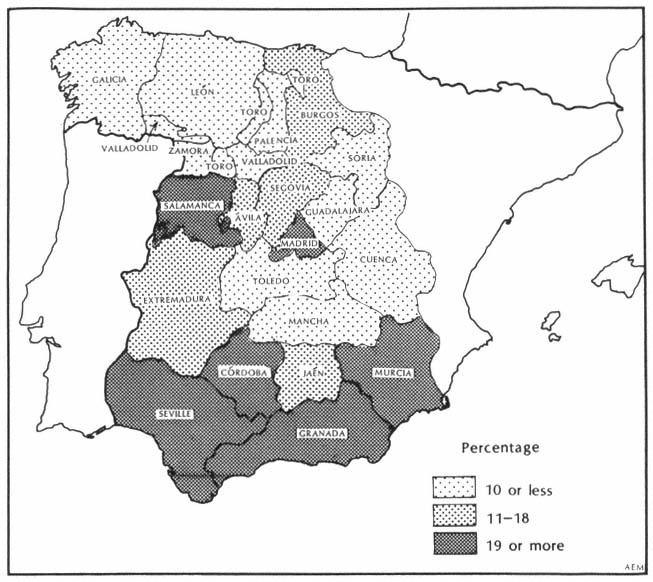
Map 5.1.
Castile, Proportion of Ecclesiastical Property Disentailed, 1798–1808
have assigned them a proportion double that of the other provinces. The result is that one must increase the amount of sales in provinces outside Madrid by 8.06 percent and in Guadalajara, Toledo, and Segovia by 16.12 percent. Raising Table 5.4, Column B, by these percentages, one obtains the results in Column D. The corrected percentages of ecclesiastical property disentailed are in Column E. They run from 6 to 30 percent.17
The significance of this table can be better understood by looking at the results in Map 5.1. It becomes clear that the disentail had more effect in the south than elsewhere. There is an impressive block of provinces from Seville to Murcia where 19 percent or more of the properties owned or controlled by the church were sold, and in Jaén the propor-
tion was 16 percent. Other areas of high sales were Salamanca (20 percent) and Madrid (25 percent, although the figure for Madrid is arbitrary, as we saw). At the other extreme are two blocks of provinces where 10 percent or less was sold: the northwest sector of the kingdoms of León and Old Castile, including Galicia, and all New Castile except Madrid and Extremadura, together with Soria, which borders on this block to the north. Between these two blocks runs a belt of provinces from Burgos to Extremadura, including Segovia and Ávila, where between 14 and 17 percent was sold. Because of the number of unknowns in our calculations, one cannot expect the percentages to be exact, but the pattern revealed by the map is hardly likely to be the result of a coincidence of errors.
Probably the most important factor in accounting for the pattern is the proportion of ecclesiastical property that belonged to obras pías, memorias, and other foundations subject to the decree of 1798. It was very likely greater in the areas of higher disentail, but there is no easy way to check this assumption. Human factors also played a part, for much depended on the dedication and efficiency of the royal commissioners in charge of the operation. On the other hand, factors such as regional types of agriculture or local weather did not have much effect. An analysis of the total value of sales in each province in each year produces no regional patterns, as one would expect if the kind or size of harvests had played a role. A large proportion of sales in one province might occur in a year during which there was little activity in neighboring provinces. (There was, however, a decline in sales in most provinces in 1803, 1804, and 1805, years of bad harvests and rural crisis.)18
The dedication of the local commissioners was critical, as the royal advisers were aware. Repeatedly in the early years, the king issued circulars to the intendants urging them to put pressure on their subordinates and local justicias to hasten the sales.19 The archives of the ministry of hacienda include a copy of an order dated November 1799 from the intendant of Seville to the justicias of the province to push the disentail, threatening, if they did not, to send a royal agent at their expense to act for them.20 In 1804, when sales were notably slow, the king through the president of the Consolidation Fund once more pressed the intendants to use all their energies to hasten the affair. Again the intendant of Seville passed the word on to the justicias of his province, with the warn-
ing, "If as a result of your inactive disposition I do not see all the good effects that ought to be forthcoming, I shall take against you the most serious measure that corresponds to your indolence in a matter so stringently urged by higher authority."21 Seville was one of the regions where a high percentage of ecclesiastical property was sold, but it is impossible to tell from the evidence here if the intendant's threats overcame the perennial problem of administrative linkage with local officials whose loyalties lay elsewhere or if the province had a greater than average number of eager potential buyers with disposable capital.
A judge of the Cancillería of Granada, who bitterly opposed the disentail, later described in scathing terms the attempts of the government to force its officials to carry out its instructions. All to little avail, the judge recalled: "But despite such efforts the truth triumphed, de jure and de facto, and in accord with it they [the agents of the crown and the prelates of the church] remained remiss in the consummation of the sales, presenting a tacit resistance in this prudent way, in default of open resistance, which they could not and should not oppose to an irresistible force."22
As the judge pointed out, the attitude of the church authorities was also a factor. Capellanías and charitable foundations whose properties had been donated by religious institutions could not be sold without their permission.23 It is easy to imagine that few prelates accepted with alacrity the royal invitation of 1798 to proceed with disentail. One who did was the Jansenist bishop of Salamanca, Antonio Tavira y Almanzán, a friend of Jovellanos,24 who favored the undertaking. Many properties of capellanías were sold in Salamanca, but few in Jaén.25 Besides Madrid, Salamanca was the only province outside Andalusia that had more than 19 percent of its church properties sold, Jaén the only province in Andalusia below that figure. The attitude of servants of church and state may explain these peculiarities in provincial responses; nevertheless, the overall pattern observed in Map 5.1 must reflect major regional differences in the nature of ecclesiastical property, that is, conditions produced by previous history.
According to these calculations, 15 percent of all ecclesiastical property in Castile was disentailed. It is true that this proportion is based on
the only total figure available for ecclesiastical property derived from the catastro made under Fernando VI, but the holdings of the church would not have increased much by the reign of Carlos IV. This was no longer a time of large grants for religious ends, and the government frowned on any increase in manos muertas. In making these calculations I have been careful not to overestimate the proportion sold, leaning rather in the other direction. Fortunately, there is independent confirmation of its extent. Among the questions that Napoleon posed the Spanish bureaucrats in 1808 were the following: "What is the amount of capital that is the product of the sales of the properties of charitable foundations [obras pías]? Of the clergy? What is the estimate of how much remains to be sold of the properties of charitable foundations and of the clergy, in comparison with the quantity of both kinds of property whose sale has already been ordered?" The Spanish officials did not give an exact answer to the first question because no one had kept a separate tally of disentail of "obras pías" and "clergy." They replied that the sales of obras pías might be 950 million and of the clergy (that is, capellanías) 237 million, a total of 1,187 million. (We know that this figure is low.) To the second question they replied that there remained to be sold 250 million worth of obras pías and 650 million of capellanías. Furthermore, a papal breve of 1806 had approved the sale of one-seventh of all other ecclesiastical property.26 The officials calculated this seventh to be worth 500 million; that is, they believed the total to be 3,500 million.27 These figures produce an estimate of the total value of all ecclesiastical property in Spain before the disentail of 1798 of 5,587 million reales. What the Spanish officials estimated had been sold, 1,187 million, was 21 percent of the total.
Thus the financial advisers of Fernando VII believed that a greater proportion of property of the church had been sold than we estimate. They were referring to all Spain, not just Castile; nevertheless, I believe our figure to be closer to the truth, although 15 percent may be too low. One can be reasonably sure that a sixth of all ecclesiastical property was disentailed. In most provinces of Andalusia it was a fifth or more, and, if the figures of the catastro are correct, it was almost a third in Murcia. One must conclude that the disentail of Carlos IV was an event of major significance in the history of the Spanish church and church-state relations.
|
|||||||||||||||||||||||||||||||||||||||||||||||||||||||||||||||||||||||||||||||||||||||||||||||||||||||||||||||||||||||||||||||||||||||||||||||||||||||||||||||||||||
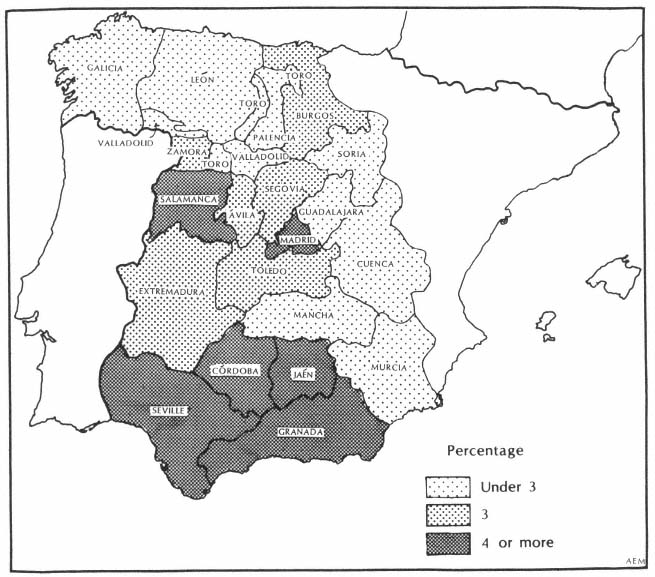
Map 5.2.
Castile, Proportion of All Property Disentailed, 1798–1808
5
Thanks to the catastro it is also possible to calculate the approximate proportion of all the properties in Castile that changed owners in these years as a result of desamortización. The procedure is identical: obtain the total value of the property in each province according to the catastro and compare it with the total of the deeds of deposits (in this case using both ecclesiastical and family entails). To make the comparison, we use the same ratios of deeds of deposit to cadastral value as in Table 5.4. The results are given in Table 5.5 and Map 5.2.
The proportion of all real property that was disentailed in Castile then is estimated to be 3 percent. The highest percentage of land that changed hands was in Andalusia, Salamanca, and Madrid, 4 percent or more. In second rank were Zamora and the belt from Burgos to Extremadura, including this time Toledo, where 3 percent was sold. In other
regions, the northwest of Old Castile and León and the south and east of New Castile, with Soria and Murcia, the figure was below 3 percent.28 But in Salamanca it reached 7 percent, and in Seville, 6 percent. In the first, approximately one property out of every fourteen—in the towns and the countryside—changed hands, and in the second one out of seventeen, and in the rest of Andalusia one out of twenty or twenty-five. Since these are only provincial averages, there were towns and cities where the transfer was greater, as appears to have been the case in Madrid.
Andalusia and most of the province of Salamanca lay southwest of the Salamanca-Albacete line. The disentail of Carlos IV hit hardest in the region of large properties, the areas that the counselors of Carlos III had singled out as in most need of agricultural reform and that have been marked by great estates to the present day. In due course we shall have to consider whether the desamortización served to improve conditions, as its proponents hoped, or exacerbated an already bad situation, as the critics of desamortización hold.
Chapter VI—
The Collapse of the Monarchy
To contemporaries this massive transfer of land and buildings appeared to be only a beginning. Even before the properties of obras pías were all disposed of, the government of Carlos IV undertook a further disentail of church properties, as great as the first. The monarchy found itself ever more deeply embroiled in a quagmire from which the only hope of escape seemed to lie in the disposal of the wealth of the church.
The clear skies that blessed Spain after the Peace of Amiens in 1802 soon clouded over. In May 1803 Britain and France renewed their war. Spain's rulers sought to remain neutral, but Bonaparte would not allow his ally such a luxury. Under pressure from him, in October 1803 Carlos IV agreed to pay France a "neutrality subsidy," 6 million francs (24 million reales) a month, retroactive to the outbreak of the new war.1 The British government, not unreasonably, refused to consider Spain henceforth neutral, and its navy began to attack Spanish convoys returning from the Indies. Carlos IV responded to these hostilities by declaring war on the king of Great Britain on 12 December 1804.2
The new war proved to be as disastrous as the last for Spain's economy. Traffic with the Indies, which flourished for three years after the peace of March 1802, collapsed after December 1804. Figures collected by officials in Barcelona reveal the effect. Almost complete for all ports of Catalonia, they show a precipitous drop in ships leaving for America.
There had been 68 in 1803 and 105 in 1804, but in 1805 there were 20, in 1806, 6, and in 1807, only one.3 The story was the same elsewhere. At Cádiz the total value of exports to the Indies, which has been estimated to average 204 million reales in the three years of peace (1802–4), averaged only 23 million in the next three years; imports from the Indies fell from 183 to 6 million for the same periods, all figures calculated in constant prices of 1778. For the peninsula as a whole the drop was equally spectacular, from an estimated 312 million to 45 million for exports and from 293 to 38 million for imports.4 Royal income from the Indies suffered the obvious consequences: it fell from a mean of 193 million reales for 1802–4 to 28 million for 1805–7.5 Trade with other countries, which could be carried in neutral bottoms or go overland to France, was less affected, but the blow was still serious. Mean income from customs, including but not limited to trade with the Indies, was halved, from 187 to 85 million.6 The records of the Consolidation Fund, which drew part of its income from customs duties assigned to it, show the same trend (Table 6.1). The American colonies, moreover, provided the largest market for Spanish manufactures and the main source of cotton. For Catalan industry, the new war meant loss of profits, high unemployment, and burdens on the public and private charities.7
To add to the concerns of the royal ministers, these years brought the worst series of natural disasters in over a century. From 1800 to 1803 Andalusia, along with other warm or tropical regions on both sides of the Atlantic Ocean, suffered serious epidemics of yellow fever. The royal government attempted to isolate Andalusia, reducing to a minimum movement of people and goods between it and the rest of the country, while France and other nations banned trade with southern Spanish ports as a safety measure. Normal relations with affected areas were not renewed until 1805.8 On 30 April 1802 an irrigation dam built by Carlos III in the Segura River above Lorca burst, drowning a large number of people and destroying houses, crops, and orchards. The crown sent
|
||||||||||||||||||||||||||||||||||||||||||||||||
emergency relief to the disaster area and opened a national subscription to aid the victims.9 In January and February 1804 a series of earthquakes desolated many cities and towns of Andalusia and also struck an extensive region from New Castile to Navarre. Again the crown was called on to feed and shelter the homeless.10
Worst of all in terms of economic loss was the failure of grain harvests throughout much of the country in 1803 and 1804, caused by excessive rainfall.11 A famine followed in the interior of Spain, much worse than the one that preceded the urban riots of 1766. In the meseta the price of grain doubled from 1801–2, a fairly normal year, to 1804–5, and in Extremadura and Andalusia it rose to two and a half times its former level.12 The royal government was faced with demands from
town officials throughout the country for price fixing and was forced to give up temporarily the freedom of grain trade. In September 1803 in Madrid province and in May 1804 elsewhere, it fixed maximum prices for grains.13 In July 1803 it forbade exports of pulses to Portugal, and in August it suspended import duties on foreign grain, flour, and vegetables until 30 June 1804.14 When crops also failed in 1804, this exemption was extended through June 1805.15 Carlos IV appealed to Bonaparte for help and received permission to import grain from western France;16 as his contribution Carlos suspended the collection of the alcabalas and other taxes on the sale of this grain.17 Special transport had to be arranged to bring these supplies to Madrid and other cities and defend them from marauding bands of peasants.18 In rural areas, abandoned by the government, undernourishment brought disease and death.19
The war, the crop failures, and the other disasters meant that the crown received less as its share of the tithes and tariffs while it had to pay for supplies at famine prices to alleviate hunger in the cities, feed its armed forces, and give relief to afflicted regions. According to accounts prepared for Napoleon in 1808, the royal treasury received from 1803 through 1807 the following amounts (in millions of reales de vellón), exclusive of the income due from the American colonies:20
|
I have not found comparable records of the crown's income for the years 1798–1802.
In 1796, which like 1803 was a year of peace, the income of the crown was 730 million reales, including the funds from America.21 Out of its reduced income after 1803, the treasury had to pay the ordinary state budget and the interest on the debts that had not been assigned to the Consolidation Fund. In 1807, the only year for which I have found an account of expenditures, it paid out 637 million, leaving a deficit for that year of 132 million.22 It was not possible for the treasury to take charge of the extraordinary expenditures as well, and the king found himself forced to appeal more and more to the Consolidation Fund, although the pragmatic sanction that established it specified that its income was to be used only to amortize the vales reales and pay interest on the royal debt.23 During the famine of 1803–4, he instructed the fund to support the pósito (public granary) of Madrid, which had exhausted its funds and its credit, and to pay for the purchases of food both in Spain and abroad.24 When Bonaparte forced Carlos IV to contribute a neutrality subsidy of 24 million reales per month, it fell to the Consolidation Fund to pay the bill,25 and after Spain entered the war, it had to bear other burdens as well. In August 1805 it was assigned the cost of provisions for the army and navy, 9.25 million per month, and in October of that year, the month in which Admiral Nelson destroyed the French and Spanish navies off Cape Trafalgar, it was ordered to provide 10 million more per month to the navy.26
When Carlos IV established the Consolidation Fund, he assigned it revenues to cover the interest on the vales, but these provided little excess for additional expenses. According to the accounts furnished Napoleon, in the five years 1801–5 these revenues averaged 89.5 million per year. The Spanish informants said that the fund could count on 95 million in time of peace and 75 million in time of war.27 Since, how-
ever, the interest on the vales was 75 million per year and the fund had to pay also the interest on the loans negotiated with Dutch banks28 and on the capital from disentailed properties, which increased regularly as the sales proceeded, it had no income to cover new obligations.
The credit of the vales reales inevitably reflected the condition of the economy and the strength of the Consolidation Fund. Their value had risen with the announcement of peace in 1802, but it declined again when France and England renewed hostilities and fell sharply after Spain entered the conflict at end of 1804. In 1802 they oscillated between 9 and 26 percent below face value. They were off 47 percent in 1803 and 57 percent in December 1804. After this date they never rose above a loss of 40 percent; they were down 64 percent in July 1806 and 63 percent in March 1808.29 It is true that they never dropped over 70 percent as they had in 1800 during the disastrous experiment with the Cajas de Reducción. Nevertheless, the credit of the crown once again was a constant worry of the royal ministers.
2
Since 1801 the crown had not resorted to new taxes or loans. After the declaration of war on Britain in December 1804, it had no choice but to find additional resources. In the middle of 1805 the king announced five new taxes. Three followed the pattern of earlier impositions assigned to the fund by affecting income of the church and raising tariffs on foreign trade: (1) An increase of 10 percent on import duties and 15 percent on export duties and an additional 1/2 percent on bullion coming from America (of which very little could arrive); (2) A 3 1/3-percent tax on income from royal donations to ecclesiastical foundations (Godoy says it was later reduced to 2 percent); (3) A half year's income from every new appointee to "lay benefices" (capellanías laicales, loss of a year's income had been imposed on ecclesiastical benefices in 1800).30
Two of the new taxes, however, represented a distinct break with the policies followed by Carlos IV and Godoy, for they fell on the agricultural producing class. In June 1805 the king decreed a 3 1/3-percent direct tax payable to the Consolidation Fund on all agricultural products and newborn domestic animals on which tithes were not collected. These
were mainly fruits and vegetables, honey, and pastures, plus some animals. The tax could be paid in kind or in cash. Since it would be difficult to calculate, experts (peritos) were to determine the amount each producer should pay.31 The tax was obviously cumbersome and could not fail to be unpopular. Its collection was beyond the capacities of the fund's personnel, already burdened with the administration of the disentail, and in March 1806 its directors ordered its commissioners to farm out the new tax at auction to private individuals.32 The tax, not surprisingly, was very slow in producing new income.33
The other new levy was little more successful. A royal cédula of July 1805 established a tax on all wine produced and sold in Spain, with the exception of wine produced by religious institutions for their own consumption. It would be collected by the Consolidation Fund specifically to support the expenses of war, and the king declared that it would end six months after the publication of peace in Madrid. The amount was not great, four maravedís per quartillo of wine, and to make the tax more palatable, the Council of Castile was instructed to suppress municipal taxes on wine.34
In announcing these two taxes, Carlos IV appealed to his subjects' patriotism to bear the new burden. In his memoirs Godoy states that the wine tax was adopted despite his opposition. He disliked it because it would hit the small producer, not the consumer. "This tax, furthermore, had something niggardly about it, its collection was difficult, subject to fraud on one hand and to vexations and abuses on the other."35 Whether or not Godoy actually took the position his memoirs claim, his desire to dissociate himself from the tax when writing the story of his life in the 1830s is evidence of its widespread unpopularity.
Both of theses taxes probably did more harm than good. They produced little income,36 and instead they helped discredit the government of Carlos IV, and Godoy in particular. Godoy tells his readers that the government had under study a new general tax plan, evidently similar to the single tax of la Ensenada, which would have benefited the productive classes at the expense of the passive ones. The war and the resistance of the privileged groups, especially the clergy, prevented its enact-
ment, he claims.37 The earlier tax policies of Carlos IV, which had been maintained through the first war with Britain, indicate that his government did indeed have some such underlying philosophy, shared no doubt by Godoy and Soler. The second war, coming on the heels of the first and accompanied by natural disasters, drove the royal advisers from this path.
Godoy's successors learned the lesson. When Napoleon placed his brother Joseph on the Spanish throne in 1808, one of Joseph's first acts on reaching Madrid was to abolish both taxes, "so as to give agriculture the development it needs for the prosperity of the kingdom and so that my beloved subjects will begin to feel the effects of my desires for their happiness."38 A few months later the Supreme Central Junta, which had been established to head the forces in revolt against the Bonapartes, although desperately in need of money, also abolished both taxes.39
3
The second war with Britain also forced Carlos IV to resort to new loans. To get more money out of the Spanish public, now thoroughly suspicious of the crown's solvency, the government sought backing from the most respected commercial bodies of the country. In June 1805 the king floated a domestic loan of 100 million reales at 5.5 percent, to be paid off in eight years. To encourage purchase of the bonds, these were issued in relatively small units of 2,000 reales, and, as in earlier domestic issues, prizes were to be awarded to the holders of lucky numbers among the bonds selected by lot to be paid off each year. The Consulado (chamber of commerce) of Cádiz was assigned to administer the loan, which was to be guaranteed by the increase in import and export duties described above.40 In 1805 and 1806 the Consolidation Fund requested a voluntary loan (so it was called, at least) at 6 percent from the merchants of Madrid and the provinces. It produced 64 million reales.41 At the same time, to be able to meet its domestic bills, the government marked 197 million reales' worth of vales reales with a special stamp that converted them into vales dinero, that is, true paper money exchangeable for specie upon presentation to the Consolidation Fund.42
Despite this guarantee, the vales dinero rapidly were discounted. In 1806, to save them, the government convened with the merchants of Madrid to accept vales dinero from the public in exchange for promissory notes of the merchants payable over the next two years. In return the fund agreed to pay the merchants a quarter of all capital received from the sale of ecclesiastical properties. By 1808 the amount of vales dinero still in circulation had been reduced to 22 million reales.43
In April 1806 the king issued two urgent orders aimed at raising further cash for the Consolidation Fund. One instructed the pósitos of the kingdom to lend the fund 36 million reales in hard currency. The accountant general (contador general) of the pósitos was to assign quotas to the individual granaries, for prompt delivery.44 The other order instructed all municipal councils to provide the fund with 24 million reales out of their normal sources of income, the propios y arbitrios (hard currency was not specified). "Each town will contribute immediately with the first moneys on which it can lay hands, without waiting for an impracticable assignment of proper quotas."45 Both loans were to receive 4-percent interest, and the royal government promised to pay them back within three years of the signing of peace. Like so many of the king's appeals, these produced less than called for, but they came closer than most, 34 and 19 million respectively.46
Carlos IV was forced to seek new loans abroad as well, in order to meet his obligations to France. The Consolidation Fund never managed to keep abreast of the monthly neutrality subsidy of 24 million. In March 1804 it had delivered only 74 million of the 240 million owed by then, and Bonaparte accepted an arrangement whereby a French banker, Gabriel Julien Ouvrard, paid the French government what Spain owed and took over the notes of the king of Spain.47 When Spain entered the war in December 1804, Ouvrard, a skillful but reckless man of affairs, obtained the contract to provide the supplies of the Spanish army and navy. He did so during the first months of 1805, but Spain did not pay him for this service, or the outstanding balance on the neutrality subsidy. He did, however, recover an advance of 60 million reales made to the Spanish government in December 1804, and toward the remainder he was given drafts on Spanish America for 9.8 million pesos (196 mil-
lion reales), which he could collect only with much difficulty. To meet the rest of his obligations to Ouvrard, Carlos IV signed a contract in September 1805 with the house of Hope and Company of Amsterdam for 10 million florins (80 million reales) at 5.5-percent interest. The amount of the loan was to be delivered by Hope to Ouvrard and was to be repaid in the capitals of the colonies in America in ten annual installments of 1 million each, plus a 5-percent premium, beginning the following year.48
At the beginning of 1806, the French government calculated that Spain still owed Ouvrard 60.5 million francs (242 million reales). Napoleon exploded in anger: "It is we who have paid Spain a subsidy, rather than getting from her what she owes us!"49 Finally, by a settlement of 10 May 1806, the Consolidation Fund agreed to liquidate the account with France for 24 million francs, to be paid by the fund, plus the outstanding drafts on America, which totaled 9.6 million pesos. Altogether this was almost 300 million reales. Desperate for money, the French government managed through Dutch and English bankers (despite the war!) to collect the drafts on Spain's treasuries in its American colonies, at a considerable discount.50
It was at this point that the king called on the pósitos and municipal budgets for support.51 This was not the end of the story, however, for the Spanish government continued to negotiate loans with Dutch banks, in part because it had to cover repayments of the loans taken out earlier in the reign. In April 1806 Carlos IV signed a contract with the house of De Smeth for 30 million florins (the enormous sum for a foreign loan of 240 million reales),52 but the archives of the Dutch banks indicate that the arrangement never became final.53 In October of that year Spanish agents finally succeeded in obtaining a loan for this amount from Hope and Company. Dutch lenders were more sanguine about the credit of the king of Spain than his own subjects, but their confidence rested on the expectation of getting at the Spanish silver bottled up in the ports of the Indies through neutral intermediaries. With 5.5-percent interest and other premiums to pay (including an ample fee to the French for-
eign minister, Prince Talleyrand), Carlos IV agreed to repay Hope 28 million pesos in Mexico between 1807 and 1820, that is to say, 70 million florins.54 Even so, the Consolidation Fund received only 23 million of the 30 million florins, and these went to repay former loans and to fulfill its obligations to France.55 To pay for the supplies of the armed forces, Spanish officials informed Napoleon, the fund had been giving "drafts on the royal treasuries in America with a discount of 16 percent to cover costs, commission, freight, and other expenses that may arise in collecting them."56 With deals like this, it is not surprising that the Consolidation Fund was behind in its obligations. In 1808 it still owed the French treasury 7.9 million francs (31.6 million reales) of the 24 million francs it had promised in May 1806,57 and it had a debt of 318 million reales to the Dutch bankers.58 On the other hand, the fund claimed Ouvrard still owed it 26.5 million francs plus other lesser sums.59
4
In this way the Spanish rulers were able to turn aside the thunderbolts of the French emperor, but these loans did not satisfy domestic needs. Disentail was the only sure resource. Since it had proved so successful in Spain, the king and his counselors decided to extend it to the Indies. In November 1804 Carlos IV issued a decree that expressed his satisfaction at the advantages that desamortización had brought to the obras pías of Spain. "I have decided for all these reasons and because of the special care and esteem that my [subjects] of America deserve, to allow them to partake of equal benefits." He ordered the sale of the properties of their obras pías "and that the product and [the capital] of the censos and existing funds that belong to them be placed in my Royal Amortization Fund" (so it said, but it meant the Consolidation Fund). The decree, very lengthy, provided necessary details on the manner to vend the prop-
erties.60 In Spain the desamortización declared the redemption of censos to be voluntary on the part of the debtor. In America the redemption of censos and deposit of the capital in the Consolidation Fund was to be obligatory. For debtors, the difference was profound. The decree caused considerable alarm in the Indies, especially among the clergy and upper classes of Mexico, and produced some income, but the money could not be shipped to Spain and served only to meet the notes that the king gave to his foreign bankers drawn on his treasuries in the Indies.61 In the end it was highly counterproductive, because it added to the growing estrangement of the king's American subjects without bringing the king much financial return.
The possibilities were more favorable at home. The instruction of January 1799 on disentail had ordered the king's officials not to proceed with the sale of the properties of hospitals, poorhouses, old-age asylums, orphanages, and similar charitable institutions, until those of obras pías, memorias, confraternities, lay patronatos, and others of this type were liquidated. A circular of September 1805 now explained that the sale of the latter properties had produced "its effect" and that "the urgent needs of the kingdom, arising as an inevitable consequence of the unfortunate events that have afflicted it in recent years and of the present war" required the disposal of all the properties included in the decree of September 1798.62
The disentail had slowed down since the bad harvest of 1803 and 1804 and the accompanying famine, and this decision gave it new impetus. In 1803, 1804, and 1805 López Fando recorded deeds amounting to 84, 123, and 106 million, respectively. In 1806 the figure rose to 136 million, and in 1807, 208 million.63 The last figure represented sales concluded approximately through May 1807, because of López Fando's slowness in delivering the deeds of deposit. We have estimated that another 169 million's worth was sold in the remainder of 1807, and 80 million in the first months of 1808.64 In other words almost 600 million's worth was auctioned off after the order of September 1805, 36 percent of all the sales. Much of this represented properties of hospitals and other charitable foundations.65
Even this did not satisfy the desperate rulers. They began to cast their eyes on the other wealth of the church, hitherto not affected by the disentail.66 This time they decided to take more precautions. Carlos IV had issued the decrees of 1798 motu propio, without admitting any other competence, and as has been seen, his act aroused resentment and opposition among many clergymen. With the conscious intent of avoiding a similar backlash, while recognizing the accepted privileges of the church, this time he appealed to the pope.67 Pius VII responded sympathetically to the misfortunes of the Spanish monarchy with a breve of June 1805 that proclaimed, "With the fullness of apostolic authority we grant the Catholic king the faculty to alienate in his dominions as much ecclesiastical property as produces an annual net income of two hundred thousand gold ducats, and no more." The resulting capital would be used to retire the vales but also, this time, more realistically, "to alleviate the most serious and urgent needs of the kingdom itself." The pope declared such sales licit and ordered the clergy not to molest the buyers.68 The arrangements were not so advantageous to the crown as the disentail of 1798, because they did not specify which properties were to be sold to make up the stipulated amount and because the king had to take possession of them and begin paying interest to their former owners before announcing them for auction.
The king published this breve in October 1805, together with instructions on its execution. Experience soon showed that the procedure was not efficient, and the king obtained a second breve in December 1806 replacing the previous one. This time the pope gave the king the right to sell one-seventh of all the real properties belonging to the church, including the religious and military orders, with the single exception of the endowments of parish churches destined for the maintenance of the curates (the congrua ). Following the procedure agreed on in the breve of 1805, the Consolidation Fund would assume ownership of all these properties prior to disposing of them and would pay the former owners the equivalent of the income from them, averaged over the previous five-year period. The proceeds of their eventual sale were earmarked for ex-
tinguishing the vales and for the other needs of the crown, with special mention made of supplies for the navy.69
The procedure remained cumbersome, for the seventh part of the properties of an ecclesiastical institution could obviously not be sold until there had been a review of its property and an agreement reached on what represented the seventh to be sold. However, the breve also conceded the king a measure of immediate importance. It authorized the sale of all real properties of capellanías colativas, that is, benefices whose holders were appointed by prelates of the church. These were juicy plums, which the decree of 1798 had invited the bishops to put up for sale, without great success. Henceforth no episcopal approval was needed, and as in the decree of 1798, sales could proceed at once, with the deed of deposit that assigned 3-percent return on the sale price to the benefice coming only later, vastly hastening the process. In February 1807 the king published the breve with accompanying instructions.70 A circular letter to the commissioners of the Consolidation Fund in March 1807 ordered them to proceed at once to the sale of the properties of benefices, while awaiting determination of the seventh of the properties of the various ecclesiastical units.71
On the whole, the government was unable to profit from the apostolic breves. Among the deeds of deposit through 1807, there are only sixty-two in 1806 and thirty-five in 1807 resulting from the breve of 1805. Their total amount was 476,983 reales and produced an annual interest of 14,309 reales, less than 1 percent of the amount authorized by the breve.72 Since the deeds of deposit had to be granted before the properties were sold, we do not know how many of these properties were disposed of at this time. The deeds of deposit made as a result of the breve of 1806 are all in one volume of the records of Feliciano del Corral.73 It has 291 documents, dated from 30 June 1807 to 7 November 1808. Only the first 12 are dated 1807, and they were written out in longhand until number 21, of 11 March 1808. These 291 deeds of deposit refer to sales concluded before the end of November 1807 and all involve the properties of capellanías colativas, although the printed form was worded to cover also the seventh part of other ecclesiastical properties. They represent approximately 6.5 million reales. I estimate that an
equal amount was sold between November 1807 and April 1808, whose deeds of deposit were never recorded. This would be a total of 13 million, an insignificant sum in comparison with the 1,650 million deposited under the decrees of 1798.74
5
This ends the story of disentail under Carlos IV. It was undertaken to save the credit of the monarchy and pay off the royal debts. The most tragic aspect of the undertaking, from the point of view of the king and his advisers at least, is that it did not achieve either aim. The vales, as was seen, dropped again on the market after the renewal of the war between Britain and France in 1803 and oscillated below one-half their face value most of the time after 1804. The king was powerless to infuse faith in them by cédulas, decrees, and pragmatic sanctions, for the public discounted official measures to guarantee them. The record of their exchange rate (Figure 6.1) shows that these measures hardly affected their discount. What did affect it was the international situation. Declarations of war and naval defeats produced serious declines; with rumors and treaties of peace their quotation rose sharply. The public reacted as if it trusted the good faith of the king's government but believed it powerless to resist international developments.
More serious for the future was the fact that the government was unable to take advantage of the massive sale of ecclesiastical properties to replace the debt in vales reales with one paying lower interest, as it had intended. Of the 2,315 million vales placed in circulation after 1780, 121 million were redeemed before 1800 and 300 million from 1800 to 1804.75 Of these redemptions, 340 million were all that came from the proceeds of the disentail. The remainder of the 1,653 million deposited in the Amortization and Consolidation Funds from sales and redeemed censos constituted a new debt. In the words of the Spanish officials who replied to Napoleon's questions: "This [Consolidation] Fund has come to the aid of the state in its difficulties with the capital produced by the various
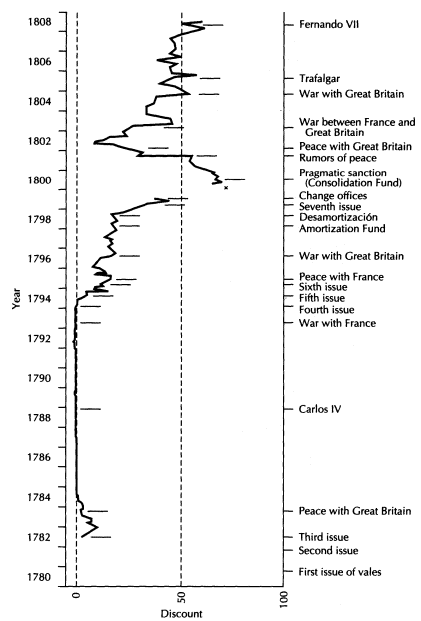
Figure 6.1
Exchange Rate of Vales Reales Against Hard Currency
SOURCE : Appendix D.
NOTE : From July 1799 until April 1800, the discount of
vales reales was illegal. The loss of nearly three-fourths
of face value during this period ( x on the graph) is reported
in Pragmática sanción, 30 Aug. 1800, AHN, CCR, no. 1322.
sales of properties that have been carried out, and for this reason it has not been able to redeem the corresponding number of vales."76
This was not all the fiscal tragedy. When the books were closed on the reign of Carlos IV, there was another debt that was not formally recognized, the arrears in the current accounts. After 1806 the interest on the vales was not paid on time. In 1808 the crown owed 60 million, almost a whole year's interest.77 The fund had also fallen behind on the interest of the deeds of deposit in favor of the obras pías and other religious institutions. The king had sold their properties, and now he was not paying the corresponding subsidy, despite his solemn pledges and his words about "the advantages . . . for the obras pías themselves, which, freed from the uncertainty, delays, and risks in the administration [of their properties] have obtained a more expedient fulfillment of their objectives."78
No one should have been surprised. The crown was in arrears in all its accounts. The amount varied from one to another, but in all it approached a year. Perhaps the most bitter was the situation of the royal officials, who received their salaries months behind schedule. The servants of the royal household earned 15 million a year, in April 1808 they were owed almost 7 million; the employees of hacienda earned 47 million and were owed 22 million, and so on for the other branches. The treasury paid 5.9 million a year in retirement income and widows' pensions; the arrears were 5.8 million.79 The archives have by chance preserved an anguished note that reflects the personal suffering of the public servants. It was written by a secretary of the royal palace, José Pizarro, to the first secretary of state on 3 July 1808, when Spain was already torn by the rising against Napoleon. The author points out that the treasury owes him sums going back five or six years, that his salary is more in arrears than that of the other functionaries, and that the accounts of the office of the secretary of the Council of State for the last six months of 1807 are still not liquidated. To pay the bills of the office, he has had to borrow from the doorman, although the latter has "only a pittance of a salary"!80
The financial plight of the crown reflected all the myriad disasters of the reign of Carlos IV: the wars with France and Britain, the earth-
quakes, epidemics, and famines. These dire events had worked steadily to awaken the political awareness of Spaniards. Many aristocrats had been upset by the favors and titles bestowed on the royal protégé, Manuel Godoy, who since 1795 was known grandiloquently as the Prince of the Peace. They had encouraged rumors that Godoy owed his place to an adulterous relationship with the queen, María Luisa. As years went by, more and more people were prepared to blame Godoy for the disasters of the country and to believe that he was plotting with the queen to place himself on the throne with her at his side. Carlos IV was in poor health, demoralized by the constant blows to his monarchy, and people feared that Godoy and María Luisa would connive to set aside Fernando, heir to the throne, after his father's death. Godoy, to his misfortune, encouraged resentment by his displays of wealth and grants of favors to his friends and relatives. The public, powerless to understand why the Spanish state was beset by continual and frightening torments, came to see in him not just a vain and avaricious man but almost a hellish monster, prime cause of their miseries.81
The disentail had angered many clerics, and they had worked on the religious feelings of their flocks. Godoy offered them a convincing villain to blame for it. Not the disasters of the state but his insatiable greed explained the desire to despoil the church.82 Godoy attributed his own unpopularity largely to the machinations of the mass of clerics, who proclaimed that Fernando, upon his accession, would put an immediate end to the sale of ecclesiastical properties. "What could be my fate, when I had against me, with very few exceptions, the majority, the vast numbers of priests and monks, in so many ways lords of consciences and of opinion, so powerful among the common people, where so many lived happily on their meager crumbs."83
The arrival of French troops in the winter of 1807–8 further increased tensions and suspicion. Officially they came as friends to help defend Spain in its war against Britain and to support a Spanish army drawn up to attack Portugal. The French and Spanish forces invaded Portugal, whose rulers hastily fled to Brazil, ending the war. During the winter the forces of France and Spain occupied that country without op-
position, yet French armies inexplicably continued to cross the Pyrenees and took possession of various cities in northern Spain. When French units advanced on Madrid in March, Godoy, increasingly suspicious of Napoleon's real objectives, urged King Carlos to withdraw to a safe distance in Andalusia. The king ordered the Spanish garrison out of Madrid to his residence in Aranjuez, where the court was wintering as usual. Many people of Madrid suspected a trap and feared for the safety of Fernando. Some followed the garrison out of the city, and in the early hours of 18 March 1808 a crowd demonstrated outside the royal palace of Aranjuez and attacked the nearby residence of Godoy. After more than a day, it discovered the hapless Prince of the Peace hiding in his garret, beat him brutally, and put him under arrest. Terrified and demoralized, Carlos IV abdicated in favor of Fernando, who alone had the charisma to disband the mobs and restore royal authority.84
The tumultuous accession of Fernando VII and the threatened descent of Spain into anarchy inspired Napoleon to substitute his brother Joseph on its throne. He feared the complete fiscal collapse of an ally that, he firmly believed, had vast wealth that its incompetent rulers lacked the ability to tap.85 It was no whim that led him at this moment to demand the detailed reports on the Spanish finances that are now housed in the National Archives in Paris and have made possible our reconstruction of the fiscal picture of the reign of Carlos IV. Napoleon's aggression began five years of violent conflict, known to Spaniards as the War of Independence. Accompanied by the meeting of the Cortes at Cádiz in 1810, which restructured Spain into a parliamentary monarchy with a written constitution, the war marked the end of the old regime in Spain.
The sale of church properties was, next to the conflicts with Great Britain, the most momentous development of the reign of Carlos IV. It was both a symptom and a cause of the decay of the absolute monarchy. The royal counselors conceived it as a way to save the credit of the crown. This it could not do, for in the era of Napoleon's wars Spain's rulers had to grasp desperately at every available resource to try to preserve its status as a great power, and with it the empire and the well-being of its people. The capital raised from church properties flowed down the maelstrom. Disentail maintained Spain's freedom of action for a while, but it served also to discredit Spain's rulers, both Godoy, abomi-
nated as the scheming tyrant, and Carlos IV, contemned as his ineffectual dupe.
Perhaps more permanent in its effects was the blow desamortización dealt to the right of the entail of property, the traditional defense of the privileged orders on which the monarchy rested, the nobility and the clergy. Of course, in his decrees the king never questioned the right of entail, just as he sought to recognize the proper legal rights of the privileged orders; he proposed only to change the nature of the entailed property from real estate to interest-bearing royal obligations. But, as a violent critic of the desamortización wrote after the accession of Fernando VII, "the least cautious man would not place the capital of a thousand reales in them [royal notes] with the confident hope of recovering it, or even of collecting the interest for the first year."86 Religious and charitable institutions suffered the most from the failure of the crown to live up to its obligations, but so did the owners of family estates who sold their entailed properties. The precedent of the liquidation of the real property of manos muertas and mayorazgos now existed to guide future Spanish legislators, who were to be faced continuously with an unmanageable national debt.
Yet the idea of disentail anteceded the fiscal crisis imposed by the revolutionary and Napoleonic wars. The reformers of Carlos III had conceived it as a way to regenerate the Spanish countryside, to create a flourishing class of farmers and strengthen the national economy. The sale of church properties to the highest bidder was a far cry from Olavide's call for the free distribution of vacant lands to indigent peasants and laborers, but its authors also counted on it to improve the common welfare. They were guided by the new political economy that, in the elegant language of Jovellanos, argued that free property would sooner or later end up in the form and hands that would produce the most, that is, they thought, in the hands of independent small farmers.
Despite the demands of war, reform remained an objective of the advisers of Carlos IV almost to the end. The measures adopted to raise money and to guarantee new loans and issues of vales reales regularly involved levies on the privileged orders. An obvious reason, of course, was that here was where the money was, and expediency alone can explain the resort to increased duties on imports and exports. But the royal ministers were guided by more than mere expediency. Not until 1805, after two years of disastrous harvests and famine, with America
once again cut off by British fleets and Napoleon importuning their treasure, did they abandon the policy of moving from regressive to progressive taxes with the imposts on wine and untithed harvests. Disentail was not a tax, yet it offered a way to tap the savings of all classes without hurting their income. At the same time, as its advocates regularly pointed out, alienation of ecclesiastical property would put it in the hands of taxpayers and thus immediately increase royal revenues. The disentail of Carlos IV must be understood not only as a wartime measure but as part of a broad plan for economic reform.
Whatever the ideology of the royal counselors, it was utopian to think that the national calamities would not affect peasants as well as lords. In 1803 the king permitted buyers of disentailed land to raise the rent or evict the tenants, contrary to existing laws.87 The measure came right out of Jovellanos, who denounced rent control as an "aberration of reason and zeal," but peasants did not read Jovellanos, and coming on top of the first disastrous harvest, the measure could deal many of them a cruel blow.
Other blows were more direct. Ever since the Middle Ages, the crown and the church had worked out a system to exploit the harvests for their own support. Unlike many of the royal taxes, which had long ago been compounded (encabezado) with the municipal governments at fixed rates that no longer reflected the current inflated price level, the tithes, first fruits, and similar charges on the agricultural producers were effectively geared to take immediate advantage of any change in output or prices. In this they partook of a major characteristic of tariffs on external trade, which made new duties such a tempting expedient to relieve fiscal needs, but an increase in tithes posed no threat to economic activity as higher duties might well do. The tercias reales and excusado had long provided the king with his share of the tithes, the machinery for collection was maintained well oiled, and his subjects were indoctrinated with the belief that the Lord above had ordained these levies.
But the system had its loopholes, and the exigencies of the treasury inspired the royal advisers to plug them. In 1796 the collection of tithes was instituted on harvests previously exempt because grown on lands belonging to privileged religious bodies, and the decree gave the king his customary two-ninths of the proceeds.88 The owners, presumably, would
be the ones to suffer, since they had been taking advantage of the exemption in the level of the rent they collected, but peasants too would inevitably be hurt. The tax of 1805 on untithed harvests struck at another loophole, this time as an undisguised levy on the producers, for no new tithe was involved. The clergy could use both innovations to rouse the resentment of the peasants against Madrid, and Godoy obviously thought that many did.
The unsuccessful reforms of Louis XVI in the 1780s, Alexis de Tocqueville pointed out long ago, showed the common people of France how much the privileges of the nobility were costing them and undermined the stability of the regime, preparing the way for the French holocaust.89 Reform in Spain at the end of the old regime had much the same effect. How revolutionary Carlos IV's counselors were can be appreciated by comparing their achievements with the failure of Louis XVI to persuade the privileged orders of France to relieve the desperate straits of his treasury. The untoward sequel to the righteous obstinacy of the French aristocrats was not lost on the king, lords, and prelates south of the border. The affected sectors grumbled at Carlos IV's impositions and dragged their feet, but they did not resist openly. They did, however, unburden their anger in a campaign to discredit the Prince of the Peace with Spaniards of all ranks. Disaffection had become so universal that the privileged classes, "lords of consciences and opinion," as Godoy termed them, had the common people in their hands. The result was the rising at Aranjuez and the unbounded celebration that swept Spain at the news of the fall of Godoy and advent of Fernando VII, only to turn to unrestrained anger when Napoleon hoodwinked the innocent young king and foisted his own brother on Spain. Desamortización thus played a key role in the fall of the absolute monarchy.
Perhaps, however, as its authors expected, desamortización prepared a better future for the people. To begin to assess whether this was in fact the case, we must turn from the thoughts and acts of counselors and kings to the lives of the ordinary men who worked the land in the towns and villages or exploited it by the sweat of others, from Olavide and Jovellanos, Soler and Carlos IV, to the labrador Francisco González and the rentero Francisco García Serrano, the capellán don Alonso Molina de la Zerda and the three distinguished spinsters doña Margarita, doña Inés, and doña María Josefa Montilla y Zevallos.
PART II—
SEVEN TOWNS
The first part of this book has studied the course of royal policy toward agriculture in the second half of the eighteenth century. It observed the failure of Carlos III's attempts to increase the number of small farmers and the modifications in the philosophy of agricultural reform and the demands of the royal fisc that culminated in the disentail of ecclesiastical properties under Carlos IV. The second part aims to be a parallel study of the evolution of rural society and agriculture at the local level. Its subject is seven communities in the provinces of Salamanca and Jaén, two provinces in distinct parts of Castile that experienced high levels of disentail. In each community it will analyze the farming patterns, the social structure, the level of income of the communities as a whole and of the occupational sectors within them, the economic relations with the outside world and their effect on local conditions, and the power structures. When possible, it will indicate the direction of evolution, especially of the population, the agricultural patterns, and income. For each community it will then observe the process of desamortización and relate it to prior conditions and current developments. This part thus proposes to describe, in these individual cases, the local reality that royal policy sought to improve and the effect on the local reality of the execution of the royal decrees. One may then form some judgment of the accuracy of the perceptions of the king's counselors and of the wisdom of their policies. The developments in seven towns can also suggest conclusions on the wider evolution of Spanish agriculture and rural society at the end of the old regime. These conclusions can be put to more general
tests in Part 3, which deals with the provinces of Salamanca and Jaén as a whole.
Within these provinces, I selected for detailed study rural communities in which the Madrid records show that there were numerous sales and for which the provincial archives have full or nearly full records. The two major sources at this level are the catastro, or survey of individual and institutional property and personal income, executed in the provinces of Castile in the 1750s under the direction of the Marqués de la Ensenada and the archives of the contadurías de hipotecas founded by Carlos III in 1768.
Undertaken to make possible the substitution of a single tax on income to replace the complex tax structure of Castile inherited from the Middle Ages and the Habsburg era, the catastro is one of the most extensive sources in existence for social history in the early modern period. Its basic feature is a series of town-by-town surveys conducted under the guidance of royal agents. Where preserved these town surveys are bound in volumes, with several volumes for each place unless it was tiny.1 The first part, known as the respuestas generales or autos generales, consists of answers to forty questions covering the geographic limits of the town; the number and kinds of buildings; the crops raised and their average price; the different qualities of land in the town and their average yield; the income from livestock, forests, and other natural resources; the amount of tithes, seigneurial dues, royal taxes, and other impositions on the town; and the number of people engaged in each kind of occupation, with their daily wage or annual income. This part is followed by the libro personal de legos and the libro personal de eclesiásticos. These are lists of all the individuals in each household, the first of laymen and the second of households headed by an ecclesiastic. They provide the name and occupation of the heads of household (male or female) and a list of all others in the household with their relationship to the head of household. Frequently all personal names are given and the ages of all males. Much miscellaneous information is also preserved in these volumes, but it varies from town to town. They are invaluable sources for studying family size and structure and its relation to social class and occupation. The third main part of each town's catastro, the most extensive, is formed by the libro maestro seglar and the libro maestro eclesiástico. These give household-by-household and institu-
tion-by-institution surveys of all the property, real and animal, in the town. They give the name and occupation of the owner, followed by his livestock (pigs, sheep, goats, and larger animals, not dogs, chickens, and small animals), his houses, and his fields. Individual income from official positions, professions, and commerce is also listed, but not from daily wages and sale of the products of handicrafts (the latter information appears in the respuestas generales). Real properties are identified by their location within the town limits (property that the vecinos owned in other towns would be listed in their catastros) with the names of owners of adjoining properties, number of rooms and size of buildings, extent and quality of fields, number of trees in orchards, and so forth. Municipal and ecclesiastical properties are surveyed in equal detail (the latter in separate volumes), and the volumes can be hundreds of folios long.
The planners of the catastro took pains to keep the records of lay property (including municipal property) separate from those of ecclesiastical property. The latter records served the crown well when Carlos IV began the disentail of the endowments of obras pías. They are also useful to the historian, for they make possible the identification of the properties sold and their place in the economy of the town. Furthermore, they can be presumed to be fairly accurate, because the volumes were read aloud at town meetings that often lasted more than a full day and were then certified as correct by the leading vecinos. It would have been difficult for any privileged person to falsify his record unless he had the town completely under his thumb. In only a few cases have I found properties sold that do not appear in the catastro.
The other main source at the provincial level is the records of the contadurías de hipotecas. By a pragmatic sanction of 1768, Carlos III ordered each cabeza de partido to establish an oficio de hipotecas under the charge of the notary of the municipal council. It was to keep a record of transfers of real property and liens on property. These offices later became known as contadurías de hipotecas. In the nineteenth century their name changed to registros de propiedad, as they are known today. From my experience, as late as 1969 the registry of sales or transfers of property with these offices was voluntary, and the archives indicate that the contadurías were not very active until the beginning of disentail, when they were ordered to record the sales. Most of their records from 1799 to 1808 concern the disentail. The registros de propiedad took over their records, and recently care of them has been assigned to the provincial historical archives.
Not all their records have been preserved in either Jaén or Salamanca
province, but those that do exist give vital information for the study of the process of disentail under Carlos IV at the local level. They furnish synopses of the notaries' records of sales, providing the name and domicile of the former owner and the buyer and a description of the property that usually makes possible its identification in the catastro. Information that is vague or incomplete in the Madrid records is here specific. Furthermore, the records are kept by town; thus they make relatively rapid a process that would be almost interminable if one had to search for the original deeds of sale of a certain town in the records of all the notaries who might have executed them, even if none of them had been lost. Unfortunately, some buyers were lax about registering their titles, so that there is no assurance that the contadurías provide a complete record of sales of any one town. Sales turn up in the Madrid archive that they do not list; nevertheless, without them it would be very difficult to recreate the process of disentail at the town level.
Finally, when they are available, one of the most valuable sources for information on local economic activity is the parish tithe rolls. In the second half of the eighteenth century, the prelates of Salamanca began to require the parish tithe collectors (cilleros ) to keep accounts of the payments made by each farmer, instead of noting only the total of the various crops collected in the parish each year, as had been the prevailing practice. This reform lets us see not only how many people were farming in a town but how much each one harvested. We can draw an economic pyramid of the farmers and locate in it those persons who bought property in the disentail. Unfortunately few parish tithe rolls (tazmías ) seem to have been preserved, and those that have been are hard to locate since they are uncatalogued in the shelves of the village churches or the homes of the incumbent priests. Two were already known in Salamanca province, those of La Mata and Villaverde, both close to the capital, and an extensive search on my part through the south of the province unearthed a third, in El Mirón (today in Ávila province). I chose these three towns to study because of the completeness of the information on them. I selected a fourth, the rural estate of Pedrollén, as an example of a different kind of region and community.
In Jaén province, as probably in most of Andalusia, where parishes were large, the ecclesiastical authorities farmed out the collection of tithes to private individuals. These tithe farmers (administradores ) contracted to pay fixed amounts of money or crops to the religious institutions entitled to receive the tithes and collected the payments due from the farmers, keeping as their profit the difference between what they col-
lected and what they paid. In bad years their profit could turn to loss, and they had to demonstrate in bidding for the contract that they had the financial resources to be able to absorb losses. What accounts may have been kept of payments by individual farmers were in the hands of the administradores and have most likely been lost or destroyed. I found no trace of any and therefore I selected three towns in different parts of the province for which we have catastro and contaduría records, where a considerable amount of land was disentailed and which were not too large to be manageable. They are Baños, Lopera, and Navas de San Esteban del Puerto.
These seven rural communities run the gamut from a large estate through small villages to a town of nearly two thousand people. For simplicity I refer to them all as towns, begging the indulgence of sticklers for definitional accuracy. Let us turn first to the towns of Salamanca, which are smaller than those of Jaén and for which I have fuller information.
Chapter VII—
La Mata
The city of Salamanca is built on a group of low hills on the northern bank of the Rio Tormes some distance upstream from its confluence with the Rio Duero. The Duero is the major river of the northern meseta, and the Tormes is its main tributary from the south, bringing waters from the northern slope of the massive Sierra de Gredos. An impressive Roman bridge of twenty-six stone arches crosses the Tormes at Salamanca, a witness both to the volume of the river at its height and the secular importance of the city as the center of a rich agricultural region.
The urban skyline stands out above the valley, marked by the two cathedrals, the new one of the sixteenth century with the older Romanesque one tucked in its shadow, and the numerous convents and parish churches, so many that Salamanca has been known familiarly as Little Rome. Lying lower and less visible are the buildings of the university and associated colleges, mainly of the Renaissance. Under Felipe V, a more worldly age, the heart of the city was torn out to create the Plaza Mayor, a large open square surrounded by a four-storied building with arcades and shops on the street level and apartments above. The city hall dominates its northern side. The Plaza Mayor is a beautiful example of early modern city planning and a reflection of the wealth pouring into the metropolis in the eighteenth century, for it rivals the older Plaza Mayor of Madrid in size and surpasses it in elegance.
Behind the eighteenth-century limits of the city is a rise; over the top of it stretches to the north a broad, gently rolling plain marked by the beds of a few streams and an occasional low hill. The plain of La Ar-
muña is one of the richest grain regions in dry Spain, characterized by thick, red soil that can be plowed deeply and holds its moisture when regions of thinner cover have dried up. In the eighteenth century many nucleated villages dotted the plain, as they still do today. They lie only three or four kilometers from each other, so that the view from any of the low rises includes a number of distinct settlements, each surrounded by wheat fields, green and lush in the spring, brown and dry after the summer harvest. Communication by cart was easy from town to town and into the city.1
Near the center of the plain, at an altitude of 818 meters, lies the village of La Mata, about twelve kilometers due north of Salamanca. Like most of the villages of the region, in the eighteenth century it was classed as a lugar, the lowest administrative entity with its own government. Approaching La Mata one saw first a stocky granite church sitting on a slight knoll in the middle of undulating fields. The church was squat and simple, lacking the square stone tower that decorated those in neighboring villages and suggesting that this community might be less wealthy than its neighbors. Around the church and running down the gentle gradient to the southwest were the public buildings and the low stone houses of the townsmen. The casa consistorial, or town hall, faced a small square below the church and held also the town jail. In addition the town council possessed a butcher shop and a smithy, which it rented out, and a storehouse that was used as the town granary (pósito). La Mata had sixty inhabited houses and two others that were empty, thirteen barns (pajares ), eight corrals, and two more granaries (paneras ), which belonged to the church and stored the product of the tithes. In one of the houses a vecino ran a tavern, where he sold wine and a few groceries.2
La Mata had a population of somewhat more than two hundred. According to the catastro, fifty-nine of these, including ten widows, were vecinos or heads of household. Twenty-two vecinos, including two widows, one-third of the total, made their living from farming. Twenty-three were arrieros, muleteers who transported goods for hire. A linen weaver, a shoemaker, the tavernkeeper, a schoolmaster, a surgeon-bloodletter, and the parish priest were the remaining male vecinos,
|
|||||||||||||||||||||||||||||||||||||||||||||||||||||||||||||||||||||||||||||||||||||||
while the other eight widows had no specified means of support (Table 7.1 and Figure 7.1).
The término, or area of the town, was small; only half a league from east to west and three-eighths from north to south was what the vecinos reported to the makers of the catastro.3 From the top of the knoll they could see similar towns in all directions. To the east La Mata bordered
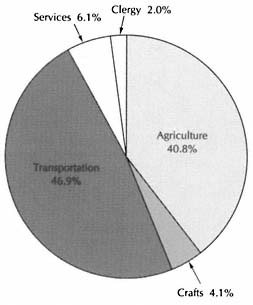
Figure 7.1.
La Mata, Employment Structure, 1753
on Carbajosa de Armuña and to the west on Castellanos de Villiguera. Slightly further to the south was Monterrubio, at the foot of the small reddish hill that gave it its name, and to the northeast the twin towns of Palencia de Negrilla and Negrilla de Palencia, hardly a stone's throw apart. In addition, La Mata bordered on three despoblados or alquerías (the terms meaning literally "depopulated place" and "grange" were used almost interchangeably and indicated that a caretaker, a herder, and a few others might live there, but probably not the owner): Narros de Valdunciel on the northwest and Aldealama and Mozodiel del Camino on the south.4 These occupied poorer land, some of it good only for grazing. So flat is the terrain, despite its gentle roll, that, even today, on clear days the vecinos of La Mata see La Peña de Francia, a sharp mountain on the southern border of the province, seventy-five kilometers away (see Map 7.1).
The catastro, dated 1753, and the register of tithe payments at the end of the century permit the reconstruction of the economic and social
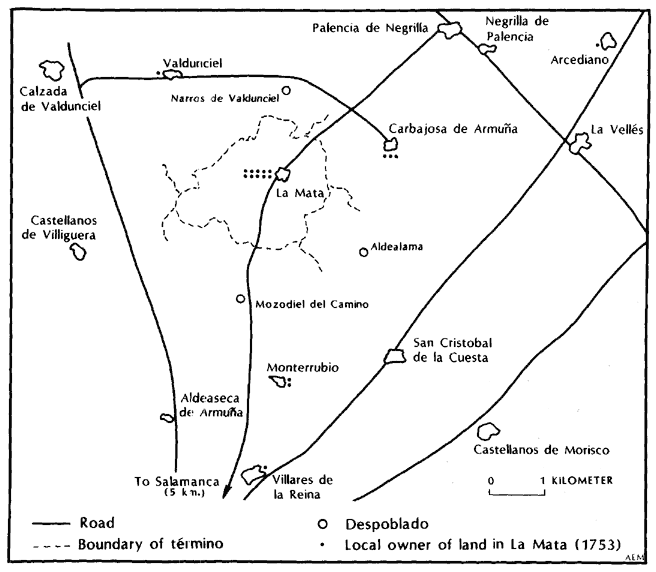
Map 7.1.
La Mata and Its Environs
structure of this small rural community.5 It is convenient to determine first insofar as possible the income of the different households and the total income of the village. With this economic profile before us, we can then observe how this society was evolving in the second half of the eighteenth century and what impact the disentail of Carlos IV had on the course of its development.
The makers of the catastro recorded the area of La Mata outside the town nucleus as 1,073 fanegas (480 hectares).6 This is about 18 fanegas
for each of its vecinos, far below the Armuña regional average of 48 fanegas per vecino.7 The fertility of La Mata's land, however, compensated partially for what it lacked in extent. The catastro's estimate of the productivity of the land in La Mata averages out at an annual return of forty reales per fanega. This is well above the regional average of twenty-seven; only five towns in La Armuña had more valuable land, and La Armuña was the richest district in the province. The value of La Mata's soil lay in its ability to produce first-class wheat, trigo candeal. Ninety-one percent of the término was wheat land (sembradura de secano que produce trigo ), 3 percent was devoted to rye (centeno ), and the rest was meadow (prados de secano para pasto ). None of the land in the town was barren or waste. Furthermore, both wheat and rye fields were sown every other year, whereas in most parts of arid Spain the land could produce a crop only once every three years or less often. The meadows were mowed for hay every year. Few towns in arid Spain could match the fertility of La Mata's soil.
The término was divided into many plots, very irregular in shape, scattered higgledy-piggledy across the rolling fields. The biggest plots were one of nine fanegas (four hectares) belonging to the town council and one of eight fanegas of the parish church. Altogether the catastro listed 551 arable plots and 33 meadows, which means that the average size of the first was under two fanegas and of the second hardly one. The larger holdings did not consist of larger plots but only of a greater number of them. As was common practice under such a system, the término was divided into several large fields (hojas ), and all the plots in each field were sown and harvested in the same year. In the late spring, the landscape of La Mata and its region would alternate between large patches of rippling green and others of fallow red and brown earth.
The scene had not always been so neat. Records preserved from earlier times suggest that prior to the population expansion of the late fifteenth and sixteenth centuries, when much of the region was still waste and available for pasture, farmers planted and harvested their individual plots as they wished. As more of the land of a community was put under the plow, an arrangement had to be made to feed the livestock: draft animals and sheep, both essential to the local economy. The solu-
|
||||||||||||||||||||||||||||||||||||||||||||||||||||||||||||||||||
tion in the fertile grain regions of Castile, which could produce wheat regularly, was to establish large fields within each término, alternating between a year of grain and another of fallow, half the fields in one cycle and half in the other. After the summer wheat harvest, the fields would lie untilled through the winter, and the animals would pasture on the stubble (rastrojo ) and weeds. Fallow plowing followed in the spring, to renew the soil and retard evaporation, until time for the autumn sowing of the next wheat crop. Henceforth all farmers of a village had to follow the same pattern, called familiarly año y vez, but each farmer needed to have plots scattered through all the hojas in order to equalize his harvest.8
The information in the catastro provides an easy estimate of the annual harvest of La Mata, since it includes the number of fanegas there were of each quality of land and the size of crop each quality produced annually per fanega. The latter figure was obtained by halving the expected harvest because each plot was sown only every other year (Table 7.2). These figures can hardly be expected to be exact. The makers of the catastro did not survey the plots but had to accept the best estimate of their size, and it was a matter of judgment into what class of land they
assigned each plot, since there was a continuum in the quality of the soil from the poorest to the best.
A more reliable measure of the harvests is provided by the tithes (diezmos ) reported in the catastro for the five-year period ending in 1752. In describing the different plots, the catastro defined them as being planted in either wheat or rye, but in fact the tithe returns show that the farmers also planted other crops, barley, oats, algarrobas (carob beans), and garbanzos (chick-peas). The farmers paid one-tenth of their harvest of all these crops as tithes.9
The tithes fell into three categories. The larger part were lumped together for distribution to those institutions that were entitled to a share of the town tithe fund, the cilla . These were known as the divisible tithes, or partible . The property of certain religious institutions was exempt from tithes, and the owners required the tenants who farmed these lands to pay them a substitute for the tithes. These payments were called the diezmos privativos, or more commonly the horros, from the expression horro de diezmos, exempt from tithes. Rather than a stated proportion of the harvest, the horros were a fixed payment, such as some proportion of the rent, and were usually less than a full tithe.10 The property of the benefice of the parish church (emolument of the priest), of the fabric (building and maintenance fund) of the church, and of a monastery and two convents in Salamanca enjoyed this privilege.11 Finally, by a special concession, the cathedral of Salamanca received for its fabric the tithes of the fourth largest tithe payer of each parish in this region, the cuarto dezmero .12 The horros were paid into the tithe fund, which then distributed them to the owners of the land; the tithes of the cuarto dezmero, however, never entered the tithe fund but went directly to the cathedral.13
The catastro recorded the average amounts collected in tithes from 1748 to 1752 shown in Table 7.3. The total harvest indicated by the reported tithes has about 17 percent more wheat and 41 percent more ryethan estimated in Table 7.2 from the size and quality of the fields and
|
|||||||||||||||||||||||||||||||||||||||||||||||||||||||||||||||||||||||||||||||||||||||||||||||||||||||||||||||||||||||||||||||||||||
|
||||||||||||||||||||||||||||||||||||||||||||||||
includes other crops as well. I shall consider the figures in Table 7.3 more reliable and proceed on this basis.
To analyze the economy of the town, one must know the combined value of the harvest of all crops. It is possible to state this in reales because the catastro gives the current local prices of each crop, but I shall convert all the crops into their equivalent value in fanegas of wheat on the basis of their prices. The fanega of wheat was the unit in which most rents were paid and a unit that remained constant, whereas prices rose and fell. To make this conversion, one calculates the total value of each crop in reales and divides the result by the price of one fanega of wheat, which at the time of the catastro was fourteen reales in La Mata. Table 7.4 shows that the average total harvest of the town was equivalent in value to approximately 4,186 fanegas of wheat (hereafter the abbreviation "n EFW" will be used for "equivalent in value to n fanegas of wheat").14
Information provided by the records of the nearby village of Villaverde, which will be studied next, shows that it was the custom in this region for a farmer who tilled lands outside the limits of his town to
divide the tithes on the crops from these lands evenly between his parish's fund and that of the parish in which the harvest was grown. If the harvest of vecinos of neighboring villages on fields inside La Mata was the same as that of vecinos of La Mata from land they farmed outside the town limits, then the two balanced out, and the harvest indicated by the total tithes represents the gross harvest of La Mata farmers; but if one harvest were greater than the other, then the difference between them should enter into the calculation of the total income of the vecinos of La Mata. The catastro gives no information on this question, since it does not say who farmed the plots, only who owned them. One can obtain an answer from the tithe roll (tazmía), which has been preserved for the years 1762–1823.15 Only after 1791 does this book list the names of the individual tithers and their payments of each kind of crop. For the three years 1800–1802, the average tithes given to other towns by La Mata farmers was 2.7 percent of the total tithes collected; while the average tithes paid to La Mata by outsiders for harvests collected within its limits were 2.0 percent of the total. At that time the balance was slightly in favor of La Mata, but so little that we can omit it from our calculations, especially since the situation might have been different in midcentury.
In order to estimate how much of the total harvest represented net income for the town, one must deduct the various charges against it. First among these was the seed for next year's planting. The makers of the catastro asked how much seed each quality of land needed. From the answers one can calculate the total seed requirements, keeping in mind that each field was sown only every other year. One recalls that the tithe returns showed the wheat crop to be 17 percent more than the catastro figures predicted and the rye crop 41 percent more (Tables 7.2 and 7.3). I shall assume that the seed was equally underestimated and that the requirements should be corrected upward by these proportions, as shown in Table 7.5. The requirements were then 482 fanegas of wheat and 9 EFW of rye. These data can be converted to predicted yield-seed ratios (compare Tables 7.2 and 7.5): 8 : 1 for first-quality wheat land, 7.2 : 1 for second quality, and 6 : 1 for third quality, or 7.2 : 1 overall. For rye it was 9 : 1.
The farmers also had to provide seed for minor crops. The catastro does not say how much, but the approximation will be not far off if we use the same ratio as for wheat, one-seventh of the crop. The minor
|
||||||||||||||||||||||||||||||||||||||||||||||||||||||||||||||||||||||||||||||||||
crops were 623 EFW (Table 7.4), so that their seed was approximately 89 EFW. This brings the total seed requirement to 580 EFW, leaving a net harvest of 3,606 EFW.
2
After paying their tithes and deducting their seed, the vecinos had to meet their obligations to their landlords. Although they were blessed by living in the midst of fertile fields, it was their misfortune that very little of the land belonged to them, a condition made dramatically clear by the information in the catastro. By totaling its records of the different properties of each individual and institution, one can determine the amount in the hands of the different categories of owners, in number of plots, in area, and in value. The catastro measured the value of land by the sale price of the average annual crop and the value of houses and
other buildings by their fair annual rent. In analyzing the structure of land ownership, I have used the value assigned by the catastro rather than the area of the holdings as the basis for comparison because it has more economic significance (Table 7.6 and Figure 7.2).
In all, the vecinos, including the priest, owned only 3.2 percent of the land in the town. The vecinos also profited from the propios, council lands that were rented to them to provide town income and were worth more than all the local private property. Adding the property of vecinos of nearby villages who lived near enough to farm themselves, one finds that about 10 percent of La Mata's land was in the hands of local residents. A larger proportion belonged to the benefice and the fabric of the parish, and the four confraternities (cofradías ) of La Mata, while a
|
||||||||||||||||||||||||||||||||||||||||||||||||||||||||||||||||||||||||||||||||||||||||||||
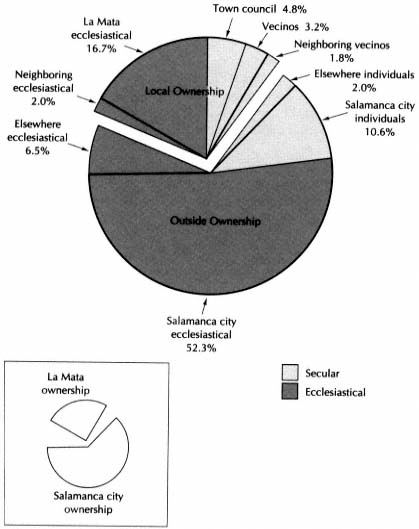
Figure 7.2.
La Mata, Ownership of Land, 1753
small amount belonged to similar church institutions in neighboring villages. Among vecinos, town council, and ecclesiastical funds, about 29 percent of the land by value (it was 31 percent by area) was owned locally, but two-thirds of this belonged to religious institutions.
The situation of the buildings in the town was strikingly different. Of the sixty-two houses, lay vecinos owned fifty-three, the priest, the town
council, and the parish church one each. There were thirteen barns (pajares); lay vecinos owned ten and the priest one. Of the nine corrals, vecinos owned seven and the town council one. Based on value, altogether 91 percent of the buildings was owned locally, but because the total value of the buildings was only 7 percent of that of the land, the property in local hands still represented less than one-third of the total value of all property.
By far the largest part of the land belonging to nonresidents was in the hands of persons and institutions located in Salamanca city, and again the church held the lion's share. Ecclesiastical funds of Salamanca owned 52 percent of the agricultural land in the town. This was divided among the benefices (beneficios ) of two parish priests and four other benefices (capellanías ) attached to parish churches, the fabric of another church, five secondary schools (colegios ) of religious orders, six convents (male and female), two hospitals, and five endowments (memorias ), three in the cathedral and two in convents. An additional 11 percent belonged to individuals, lay and clerical, living in the city. Two percent belonged to individuals located elsewhere, including the Vizconde de Villagonzalo of Valencia. A capellanía of Madrid owned 5 percent of La Mata's land, and a convent in another town in Salamanca province owned 1 percent.
In sum, nonresidents owned 71 percent of the land. Or looking at the situation through the eyes of the statesmen who planned the catastro, religious institutions, both local and outside, owned 78 percent of the land. These were the hard economic facts facing the peasants who plowed and reaped the fields.
How the nonresident owners exploited their land is shown by account books of monasteries and convents in Salamanca that were confiscated when the state dissolved the religious orders in 1837.16 These provide examples of the agreements between the ecclesiastical owners of land and those who did the actual farming. I have not seen rental agreements of lay owners, but their practices must have been similar if not identical. Contracts were usually signed formally before a notary for six- or nine-year periods, "de tres en tres," meaning that they could be renegotiated at the end of each three-year period. The tenant (rentero ) had to have a third party sign as guarantor of his payments, the fiador, usually another farmer in the town. The tenant agreed to deliver to the owner's granary in Salamanca (or elsewhere) a specified number of fan-
egas of first-class wheat (trigo candeal) on 15 August of each year, to care for the land, to maintain the drainage ditches, and not to sublet. Sometimes other payments were stipulated in addition to wheat: rye, barley, garbanzos, straw, firewood, and, for Christmas, chickens.17 Monetary rents were collected for pastures and houses but not normally for arable land. The tenant was also to pay the tithes on the harvest, or the horros in lieu of tithes to those owners whose property was exempt from tithes.
The tenant kept for himself all the harvest over and above the rent and tithes. These were not sharecropping agreements, for the rent was fixed. In a good year the tenant would get a larger share of the total crop than in a bad year. The account books show that tenants sometimes fell behind in their payments, usually as the result of a poor harvest. On such occasions the religious institution usually e xacted no penalty but kept a record of the amount of grain due, which the tenant paid along with the following year's rent or at the next possible opportunity.18 Sometimes a tenant fell so far behind that his lease was not renewed, "por haberse perdido este rentero";19 but the standard practice was to renew the lease, usually on the same terms, time after time. When a tenant died, his widow or sons would take over the contract. If the property was more than one peasant could handle, two or more joined to sign the lease, with each specifying the amount he was to pay. This was often the case when the religious institution owned lands in several towns and leased them as a single block.
The account books do not say what share of the average crop was represented by the rent. The catastro states, however, that the usual practice of ecclesiastical owners was to charge as rent a flat rate of 1 fanega of grain for each fanega of land, whatever the quality.20 This must have been the local rule of thumb in renting land; in the twentieth century absentee owners still calculated the rent of their fields in La Armuña according to their extent, regardless of the quality.21 A comparison of the property recorded in the catastro and the accounts of three
institutions owning land in La Mata indicates, however, that the owners in practice received somewhat less than this rule would provide. The monastery Nuestra Señora del Jesús of nuns of the Order of Saint Bernard owned twenty-four plots in La Mata with a total area of 38.25 fanegas, but the account book shows that the nuns rented the holding in 1751 for 35 fanegas of wheat delivered to their door. In 1777 they raised the rent to 38 fanegas but dropped it to 30 in 1789, where it remained until 1809, when the book says the holding was sold.22 The convent of La Concepción of sisters of the Order of Saint Francis owned twenty-five arable plots totaling 53.5 fanegas, and one meadow of little value. The rent was 37 fanegas in 1756, raised to 39 in 1781. In 1804, at the height of the great famine, the nuns renewed the agreement for only 33 fanegas, and they were still collecting this amount in 1810.23 Finally, the convent of Corpus Christi of sisters of Saint Francis owned thirteen plots measuring 16.5 fanegas. Account books for the years 1800 through 1805 show that the rent was 14 fanegas of wheat. The sisters, however, were having difficulty collecting even this much. The tenant was behind almost a half year's rent in 1799. By 1802 the arrears were over three-fourths of a year's rent, they tripled as a result of the disastrous harvests in 1803 and 1804, and at the end of 1805 were still over two years' rent.24 This was not the only tenant of the convent in such straits. At the end of 1802 it had thirty-one tenants in different towns, of whom nineteen were in arrears. Either the nuns were complacent landladies or they were asking more than their tenants could provide.
In all three cases the owner received less than 1 fanega of wheat per fanega of land. From 1751 to 1776 the monastery Nuestra Señora del Jesús got 92 percent of this figure; from 1756 to 1780 the convent of La Concepción got 69 percent; and from 1800 to 1805 the convent of Corpus Christi asked 85 percent but failed to get this amount. These three cases cover about one-seventh of the land owned by outsiders. Lacking other information, I shall take them as a representative sample of both secular and ecclesiastical owners and use the figure 0.8 fanega of wheat as the best estimate of the rent for each fanega of arable land, whether used for wheat or rye. The fields owned by outsiders totaled 718 fanegas, according to the catastro. The annual rent for these would then
have been roughly 575 fanegas of wheat. One can calculate that the expected harvest on these fields would be 2,547 EFW, so that the rent amounted to 23 percent of the harvest.
In addition, the vecinos would have rented the fields in the town belonging to the churches of La Mata and neighboring parishes. These totaled 172 and 25 fanegas respectively, and the rent on all of them would have been about 158 fanegas of wheat.
Two minor payments to the church completed the charges on the farmers. In addition to the tithes, people who grew more than meager harvests had to contribute first fruits (primicias ). These consisted of 0.5 fanega of each crop from every farmer who harvested at least 6 fanegas of that crop, and the annual average of first fruits was 27 EFW. Farmers in Castile paid also the Voto de Santiago to the cathedral of Santiago de Compostela in fulfillment of a legendary vow to the saint made by the ninth-century King Ramiro of León at the battle of Clavijo. Every farmer liable for first fruits contributed to the voto 0.5 fanega of his best grain ("de la mejor semilla que coge media fanega"). In La Mata twenty-eight persons together paid 12.5 fanegas of wheat, 1 of algarrobas and 0.5 of garbanzos, or 14 EFW.25
3
Besides their harvest, the farmers drew income from raising various kinds of livestock. The number of animals and the selling price of their young are given in the catastro. Those born each year would represent income for their owners and for the town, whether they were slaughtered for food or sold at outside markets, except for those animals, particularly draft animals, that replaced ones that died. One can estimate the number born annually as somewhat less than would be expected today and the life span also less because of poorer nutrition and medication. The process is described in detail in Appendix K, and the calculation for La Mata is worked out in Table 7.7. It shows that the income to the vecinos from livestock was approximately 4,946 reales, or 353 EFW. The vecinos also raised an unstated number of chickens, but since they sold for 1 real each, their total value could not have been much.
From the total income from their animals the vecinos had to pay the cost of pastures. Outsiders owned meadows that according to the catas-
|
|||||||||||||||||||||||||||||||||||||||||||||||||||||||||||||||||||
tro produced 40 reales per year; one can consider this their rent. Local churches owned others that brought in 8 reales. Half the year the vecinos pastured their animals in the town and half outside, probably in adjoining despoblados.26 Within the town the vecinos had the right to graze their livestock on the meadows of the town council and after the day of San Juan, 24 June, on all private meadows, but the town council charged them 500 reales per year for the use of these meadows even though it was considered a common right.27 One may assume that for the half year that the herds were pastured outside the town the vecinos paid more, perhaps 750 reales. Pastures thus cost the vecinos 1,300 reales per year, 93 EFW, but the town economy lost only the amount paid to outsiders, 800 reales or 57 EFW.
By assembling all this information, one obtains an estimate of the net income of the vecinos from agriculture. One must keep in mind that its reliability depends on the accuracy of the data provided by the catastro. Table 7.8 summarizes the information. The total net income of the vecinos from agriculture is 2,682 EFW.
|
||||||||||||||||||||||||||||||||||||||||||||||||||
4
To give meaning to this figure and to clarify the agricultural economy of this small community, one must attempt to determine how this total net income was distributed among the population. Of the sixty vecinos, twenty-two, including two widows, were engaged in agriculture. Except for a mule herd (guarda de ganado mular ) and a warden of the fields (guarda de campos ), whose task would have been to keep the livestock off the crops and watch them when they were pasturing outside the town, all the others of this group were described as husbandmen (labradores) or day laborers (jornaleros), eleven of the former plus two
viudas labradoras, and seven of the latter (Table 7.1). The difference between a labrador and a jornalero was not whether he owned land or not, for only six labradores owned land and one jornalero did, but whether or not he owned a team of animals for plowing. All but one of the labradores owned one or more yokes of oxen (the other owned a pair of horses), while jornaleros had none. Since the word labrador comes from the verb labrar, to plow, possession of a yoke of draft animals was evidently the requirement for belonging to this category. The jornaleros probably worked on the land for a daily wage, as their name implies. In addition, some vecinos who were not labradores raised crops as a marginal source of income. These were called senareros, and the catastro says there were thirteen of them, including, presumably, the jornaleros and guardas.28
Of all these people only one could be considered an independent landowner. This was the richest layman in town, Juan Rincón, who had ten oxen and twenty-two other large animals, five arable plots, one meadow, and five houses. He owned half the land belonging to the lay vecinos.29 He also had the largest household in the village: a wife, a twenty-year-old son, two daughters, and five children not his own called enternados, three boys and two girls, whether children of relatives or charity cases we have no way of knowing. Seven other vecinos and two children owned land, but each had only one or two arable plots or a small meadow. Except for Juan Rincón, all labradores had to rely on lands they rented to provide their livelihood, and even Rincón's fields produced too small a harvest for his family. Like the other labradores, he got most of his crops from rented plots.
The catastro does not say who rented the fields of La Mata, so that one cannot calculate directly the harvest of each farmer. One can approach the problem indirectly, however, from two sets of data, the number of draft animals each farmer had and the individual payments recorded in the tithe records of the end of the century.
According to the catastro, the eleven labradores and two viudas labradoras owned forty-eight oxen and two horses. At the other extreme from Rincón, with his ten oxen, were three labradores and one labradora with two oxen each and the labrador with two horses. Contempo-
raries calculated that a yoke of oxen could plow 22.5 fanegas per season.30 Since La Mata sowed its fields every other year, the twenty-four yokes of oxen were theoretically sufficient for 1,080 fanegas, a figure very close to the 1,017 fanegas of arable land reported in the catastro. One can thus hypothesize that the individual harvests of the labradores were roughly proportional to the number of oxen they owned. It is possible that they rented teams to each other or to the senareros in return for goods or services, and this would alter our results some, but the general pattern of land tilled was probably closely related to the number of yokes owned. If one assumes that two horses were equivalent to one and a half oxen, and that the senareros each averaged the share of one-half ox, the total net harvest (2,422 EFW, Table 7.8) can be divided into fifty-seven shares, each representing the output of one ox (about 42.5 EFW per ox). These shares can then be distributed among the farmers as shown in Table 7.9.
Labradores with more than one yoke of oxen had to have help to use all their teams regularly. Juan Rincón needed four men besides himself, and the others with more than two oxen needed another eight men (assuming the labradores with five and three oxen combined their odd oxen into one yoke and shared it). Only four, including Rincón, had sons in the household fifteen years of age or over. The two widow labradoras had sons above fifteen who could do their farming. The eight remaining hands would have been those of the seven jornaleros and a resident servant (criado ). The wages of these hired hands would have to come out of the net harvests of the labradores. The catastro credits the jornaleros with income of two and a half reales per day for 120 days,31 17 EFW. If the wages of eight men are prorated among the labradores with more than one yoke according to the number of their oxen, their net income from farming is shown in the last column of Table 7.9.
These results can be checked by using the tithe register of the end of the century. After 1791 it lists each tither by name and states how much he paid of each crop. It thus permits one to determine with considerable accuracy the relative size of the individual harvests at that time. One should use reports of two consecutive years, when all the fields would have been harvested once, averaging over the two years the percent of
|
||||||||||||||||||||||||||||||||||||||||||||||||||||||||||||||||||||||||||||||||||||||||||||||||||||||||||||||||||
the total harvest of each year accruing to each farmer.32 I shall use 1801–2, when crops were plentiful. The first year sixty-seven people paid tithes and sixty-six in the second, but twenty-four of these, many of them women, contributed only small amounts and clearly were not fulltime farmers. On the other hand, two of the richest vecinos did not appear on the tithe roll. One was the fourth tither, the cuarto dezmero, whose tithes went directly to the cathedral. The other was the largest tither, the casa excusada or casa mayor dezmera. In 1571 the pope conceded to the king of Spain the tithes of the most wealthy farmer in each parish. Known as the gracia del excusado, the grant was renewed regu-
larly until the middle of the eighteenth century. During this period the crown gave the administration of the excusado to the church, and it appears to have collected these tithes along with the others. The excusado is not recorded as a separate payment in the catastro returns of the towns I have studied, whereas the cuarto dezmero is identified in that of La Mata. In 1760, however, on obtaining a renewal of the gracia del excusado, Carlos III took over its administration, and the tithes of the casa excusada would no longer have been collected with the rest of the town tithes.33 Therefore, in establishing the relative standing of the farmers from the tithe rolls in 1801–2, one should posit a tither whose harvest is larger than any listed on the rolls, the casa excusada, and another after the next two, the cuarto dezmero.
The largest three tithers on record for 1801–2 averaged respectively 7.13, 7.09, and 6.88 percent of the total tithes recorded for the two years.34 I shall project that the casa excusada paid about 7.20 percent and the cuarto dezmero 7.00 percent. (The casa excusada may have had a larger harvest, but I can only estimate a figure from the pattern of those below.) The total harvest was therefore 14.2 percent greater than that represented by the recorded tithes, and each individual's share was correspondingly a smaller percentage than the figures just given. Table 7.10 gives the approximate percentage of the various farmers' shares in La Mata at the turn of the century.
In 1801–2 the number of men engaged in agriculture was twice that of 1753, the date of the catastro.35 If one assumes that one man harvested in 1753 the share of two men in 1801, one obtains the distribution of the harvest in 1753 shown in Table 7.11, and this may be compared with the distribution calculated from the number of plow teams, as shown in the table.
Despite the differences in detail, there is considerable agreement between the two estimates of the distribution of net income from harvests. Both show three labradores with harvests larger than those of the main body of farmers, and both show about half the farmers cultivating their plots as a marginal occupation. Both agree that the minimum net har-
|
||||||||||||||||||||||
vest of a labrador (first through thirteenth farmers) was about seventy fanegas of wheat. Unless the estimate for the casa excusada in 1801–2 is in great error, no single individual stood out then as the rich farmer of the town, and this fact is reflected in the projected table for 1753. It seems more likely that in fact Juan Rincón had a considerably larger harvest than the others in the way that the distribution based on draft animals indicates, although perhaps not this much larger. On the other hand, the projection is surely more accurate in dividing the lower half of the farmers into two distinct groups and is probably more accurate in showing more inequality among the lower labradores (fourth through thirteenth farmers). Despite Rincón's prominence, both tables lead to the conclusion that no individual or small group dominated the village economy. One had to go down more than half the labradores to get to those who harvested less than a third what Rincón did, even if one adopts the higher estimate of his yields.36
In addition to their grain harvests, the farmers profited from raising livestock. They had almost all the oxen, cows, horses, and sheep, about half the pigs, and one-quarter of the donkeys. The estimated income from these was 3,364 reales or 240 EFW (Table 7.7). Against this one should set about two-thirds of the rent of meadows, 62 EFW. The net income, 178 EFW, was 7.4 percent of the total net income from har-
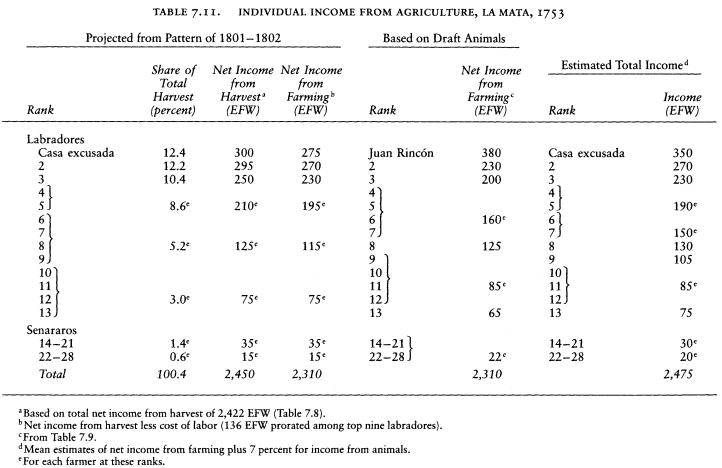
vests. If the size of the farmers' herds was proportional to their harvests, then we can predict that the total income of each farmer was about 7 percent more than what he received from farming. The mean of the two estimates of the income from farming plus the estimated income from raising livestock is given in the last column of Table 7.11, which represents the best available estimate of the income of individual farmers.
To translate these incomes into some concept of a standard of living, one must determine the needs of an individual measured in fanegas of wheat. Lacking direct figures, one can approach the answer indirectly from available information on grain consumption in early modern Spanish and other societies. David Ringrose provides information on the grain consumed in Madrid at the end of the eighteenth century. In 1784 a population of about 180,000 needed between 2,000 and 2,250 fanegas of wheat per day, or 4.0 to 4.5 fanegas per person per year. In 1797, a year of high consumption, 200,000 people used 2,570 fanegas a day, 4.7 fanegas per person per year.37 Bartolomé Bennassar gives figures for Valladolid in the sixteenth century that work out to 4.2 fanegas per person per year.38 Similar estimates for other parts of western Europe vary widely, from 5.0 fanegas of wheat per person in rural England (a contemporary estimate that a modern historian believes should be lowered to 3.7 fanegas)39 to as low as 2.3 fanegas in the Netherlands in the seventeenth century.40 A comparable figure to the Madrid one comes from information on Paris in the 1780s provided by the contemporary scientist A.-L. Lavoisier, which gives 3.8 fanegas.41
Although bread was the staff of life everywhere, local agricultural production and eating habits would vary the proportion of bread in the diet, and the Spanish rural pattern was probably more like that known
for Madrid and Valladolid, that is, 4.5 fanegas of wheat per capita per year, than the lower consumption reported for northern Europe. This is also the per capita minimum need of a rural family of four in the eighteenth century, according to the geographer Angel Cabo Alonso.42 One might imagine, however, that a rural community, doing harder work than an urban population and with food normally more available, would consume more per capita than people in the city. An allowance established by the Mesta for rations for able-bodied rural laborers was 1 fanega of wheat per month.43 In southern France a similar allowance for rural labor was about 10 fanegas per year.44 Adult males consumed more per head than a population that included women and children; nevertheless the 12 fanegas per year of the Mesta would have been generous. Let us propose that 6 fanegas of grain (3.3 hectoliters or 270 kilograms) per year, mostly wheat, was an adequate per capita allowance of grain for a population of all ages and both sexes for rural Spain in the eighteenth century.
Grain or bread, while the largest item in the individual budget, would be only part. Other items of food that the vecinos of La Mata produced—pulses and meat—have been counted in calculating their net income. Part of their harvests went to feed their livestock. In addition, however self-sufficient the village was, the peasants needed wine, oil, salt, wood for fuel, probably some additional preserved meat and maybe salt fish, items of clothing, occasionally tools and building supplies; some farmers needed to pay for the transport of their harvest to market or to their landlord's granary. There also had to be what the social anthropologists call a family ceremonial fund, savings to pay the expenses of the formalities and celebrations that marked rites of passage as well as the regular expenditures for religious ceremonies and festivals. One can estimate that the grain consumption for food represented about half the needs of a family. For a normal subsistence, then, a rural community required roughly the equivalent in income of 12 fanegas of wheat per person per year. Although only an estimate, the figure of 12 EFW can serve as a standard measure of adequate individual income, a benchmark against which to compare the conditions in our towns as we proceed. Individual families could, however, do with less, perhaps little
more than half as much, if they went without sufficient bread, meat, clothing, fuel, and the amenities of life. And if the proportion of infants to adults in a family was high, its per capita need was also less.
From the lists of families in the catastro, one can know the average size of households in La Mata. Of labradores' households where both parents were alive, this was 5.1, of jornaleros', 3.6. The labradores not only had more children (2.6 per family compared to 1.6) but Juan Rincón's five enternados added to their average. At 12 EFW per capita, household needs averaged about 60 EFW for labradores and 43 EFW for jornaleros. The two viudas labradoras had an average household size of 4 and needed 48 EFW each. According to Table 7.11 the top thirteen farmers whose net annual income ranged down to 75 EFW had more than enough for their family needs. These would have been all eleven labradores and the two viudas labradoras. The five labradores whose net income was 190 EFW or more were prosperous, able to hire help, live at ease, and save as well—buying bedclothes, copper and brass cooking utensils, embroidered woolen garments, and amassing coins and jewelry. The large filigreed gold and silver buttons and necklaces of the Salamanca charro are famous and in a pinch would be readily exchanged for money by a cambiador at a rural fair.45 The next four labradores, with net incomes of 105 to 140 EFW, if not wealthy, were comfortably off, and the remaining four, at 75 to 85 EFW, easily had enough for their needs. The remaining fifteen farmers were in the 20 to 30 EFW range, not enough by itself for the average family; they either were engaged in other activities as well—as senareros whose main activity was not agriculture or as jornaleros who also had wages—or were incomplete families. If the jornaleros did earn the 17 EFW with which the catastro credits them, they had enough for their households, between 3 and 4 in size., to live adequately. On the whole Ceres was kind, even generous, to the vecinos of La Mata who tilled the fields.
5
Many vecinos were not farmers, however. The district of La Armuña was one of the few in Castile that had a sizable number of muleteers, or arrieros, and La Mata, with twenty-three, had the highest proportion of arrieros among its vecinos of any town in La Armuña. Some specialized
in the transport of local grain to nearby markets, Salamanca, Zamora, and other provincial centers,46 while others traveled regularly on a northern route to Vitoria and Bilbao, taking wheat and bringing salt and salt cod on the return journey.47 Among them they owned 18 mules and 152 donkeys, most of which they used in their trade.48 The makers of the catastro estimated that each arriero worked two hundred days per year and earned 1 real per day with each donkey and 2 with each mule.49 At this rate their total gross annual income would have been 37,600 reales, but the figure arrived at by the makers of the catastro was 33,200 reales (2,370 EFW), after allowing for animals declared not in service.50
Against this income, the arrieros had to charge the expenses of feeding their animals and replacing those that died. They probably occupied the pastures available to the vecinos not being used by the farmers. This represented a cost of 31 EFW. Since the animals were on the road over half the year, they also had to pay for pastures where they went.51 These may have cost them another 75 EFW. In addition, they had to supply fodder, which they would buy since they had few crops of their own. They may have consumed a quarter of the fodder grown locally and bought an equal amount on their journeys. Barley and algarrobas were the local crops for feeding livestock; a quarter of the local production was 121 EFW (Table 7.4), so that the arrieros spent about 240 EFW for fodder. The total cost of feeding their animals was then some 345 EFW.
Owning three-quarters of the donkeys in the town, the arrieros raised those they needed to replace the ones that died, but they would have to buy a couple of mules a year from the farmers for about 550 reales.52 Their net gain on breeding donkeys was about twelve animals (because they used their animals for traffic, they would not have bred as many young as was possible), or 240 reales.53 Some arrieros, the catastro tells us, also traded in mules, and together they had about 800 reales a year income from this activity. Their net balance from raising and dealing in livestock was about 500 reales, or about 35 EFW.
|
||||||||||||||||||||||||||||||||||||
Adding income from traffic and livestock and subtracting the cost of feed, the balance of the arrieros was 2,060 EFW. They had their costs of doing business, but these can be considered part of their cost of living, like tools in the case of the farmers.
The number of animals each arriero owned was a measure of his relative income, with one mule bringing in the equivalent of two donkeys. The arriero with the most animals owned two mules and eleven donkeys (but he declared only ten donkeys in use), the man with the fewest had four donkeys (but said he worked with only three). Calculating an annual income equivalent to 12.5 EFW for each donkey and 25 EFW for each mule declared in service, one obtains the net income of the individual arrieros shown in Table 7.12, between 37.5 and 175 EFW per household.
The average size of the families of the arrieros was 3.5 virtually the same as those of the jornaleros. Forty-two EFW would supply each family adequately. All but one of the arrieros earned at least this much, and this man did not declare one of his donkeys in service and thus may have understated his income. Although as a group they were not so well-off as the labradores, the top third could live comfortably and have money to save.
Fewer men were engaged in services and crafts. The most respectable was the "surgeon-bloodletter," whose annual income was seven hun-
dred reales (50 EFW).54 Less distinguished but better off was the tavernkeeper, who also acted as farrier. In the role of tavernero he made three hundred reales from the sale of wine and one hundred reales from groceries, while as herrador he was judged to earn three reales a day, say six hundred a year.55 His income was 65 EFW. There was also a schoolmaster, but the catastro fails to record his income. The two artisans were a linen weaver, assigned three reales a day for 100 days work per year, and a shoemaker, at two reales a day for 120 days.56 These convert to only 21 and 17 EFW, not enough to live on (they had three and four members in their families, respectively), so that these two men must have been among the senareros, who farmed part-time. The linen weaver acted as town record keeper (fiel de fechos) and received eighty reales for the job.57 Crafts were obviously a marginal occupation in La Mata. Indeed one labrador was also a tailor, but no income is recorded from this activity;58 while one man, evidently the son of an arriero, acted as a blacksmith (herrero ). He was paid in wheat for shoeing the oxen—twenty-two celemines (1 5/6 fanegas) for each ox—and earned 45 EFW this way. The cost of renting the smithy from the town council, 6 EFW, and of buying coal, 19 fanegas paid in kind, rendered his net income 20 EFW, a marginal sum.59
Farming and transport were the major activities of the town, and those engaged in them were the better-off members of the community. Except for one person, that is. Among the wealthiest men in the town was the priest, don Juan Matute. Part of his wealth was personal, patrimonial as it was called; for he owned six arable plots and a house and barn, more than Juan Rincón, the richest layman. In addition he received the income from his benefice. Fifty-five plots that measured 117 fanegas belonged to it. Most probably don Juan did not farm himself but collected the rent from both his own fields and those of the benefice, at an average rent of 0.8 fanega of wheat per fanega of land a total of 102 fanegas of wheat.60 The property of the benefice was exempt from tithes, so that the horros went to him, 36 fanegas (Table 7.3). Finally, as beneficiado he received one-third of the partible tithes and two-thirds of
the first fruits,61 and these amounted to 131 and 18 EFW (Table 7.3). His gross income was then 287 EFW. Out of this he had to pay one-third of the expenses of collecting and storing the tithes, including the salary of the cillero (tithe collector)—in 1800 these were 300 reales—rent of the granary, and incidental expenses including refreshments (refrescos ) distributed on the day the tithes were paid. The benefice's share of these expenses in 1800 was 142 reales.62 At current prices this was about 3.3 EFW,63 but probably salaries and rents had risen more slowly than prices, so that the cost was perhaps 6 EFW in 1753. Don Juan's net income was then about 280 EFW, at the level of the top labradores, but he most likely had additional undeclared income in the form of compensation for conducting individual services—baptisms, weddings, burials—that one cannot calculate. He lived with a boy servant aged sixteen and a girl servant and a nine-year-old nephew, whom he was probably rearing to become a priest, as was a common obligation of Spanish rural curates in the eighteenth century.64 No doubt he was expected to perform acts of charity, but the regular expenses of the church were cared for by the fabric and. various endowments. His economic standing supplemented his religious curacy to make him the leading figure in the town, a position symbolized by the appellation "don," to which he alone of the villagers was entitled.
This occupation-by-occupation survey shows the relative position of the different vecinos and points up those who were most wealthy. It can be tabulated in schematic form in a "socioeconomic pyramid" (Table 7.13 and Figure 7.3). Its calculation is based, however, only on income that can be identified in the catastro and tithe rolls. Within the town many payments were made and goods exchanged of which there is no record. Someone, the catastro does not say who, earned three fanegas of wheat and forty-four reales as sacristan;65 someone else was cillero (keeper of the tithes) and earned perhaps 15 EFW for his services. Poorer vecinos performed services for the richer ones, children did tasks for their neighbors, the town council paid men to perform the public work of the community, and gifts changed hands. The church gave charity and spent money that ended in the pockets of vecinos. Widows were not
|
||||||||||||||||||||||||||||||||||||||||||||||||||||||||||||||||||||||||||||||||||||||||||||||||||||||||||||||||||||||||||||||||||||||||||||||||||||||||||||||||||||||||||||||||||||||||||||||||||||||||||||||||||||||||||||||||||||
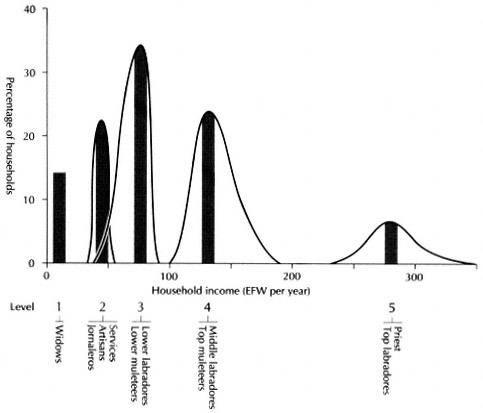
Figure 7.3.
La Mata, Socioeconomic Pyramid, 1753
Note: This is a bar graph based on Table 7.13, with an indication
of dispersion. It is not a set of frequency distributions.
destitute, although no income can be assigned them. To complete the economic picture of the town and judge its overall well-being, one may look at it as a single unit rather than as a collection of discrete households and consider it in relation to the outside world.
6
The income of the town as a separate economic unit came from its agricultural production and the value added to goods and services it sold
outside. The net harvest after deduction for seed was 3,606 EFW, the gross income from livestock 353 EFW (Table 7.8). The arrieros brought in most of the income from outside. While they transported some of the local harvests and brought in goods, most of their services were rendered to others. It seems reasonable to attribute 75 percent of their gross income from haulage (2,370 EFW) to outside sources: 1,780 EFW. If three-quarters of their income from trading mules also came from outside, this was another 43 EFW. It is possible that the linen weaver and the shoemaker sold some goods outside the town, but their incomes were so small that they hardly added to the total.
Against these incomes one must charge the payments made outside the town. These included rent on the fields owned by nonresidents, on pastures in adjoining despoblados, and on pastures used by the arrieros while on the road, as well as the cost of the fodder they bought while traveling, all of which have already been calculated. It was likely that vecinos of La Mata and its church owned as much land in neighboring towns as vecinos and churches of those villages owned in La Mata, so that rent received from nearby farmers would offset the rent paid for land in neighboring towns (about 23 EFW). This amount can be subtracted from the rent paid outsiders (575 EFW; Table 7.8), while none of the rent paid to local churches will be charged against the town.
A good proportion of the payments to the church also left the town. Two-ninths of the partible tithes of Castile had been granted to the king by the pope in the thirteenth century. Known as the tercias reales, the grant was extended to all Spain and made permanent in 1487.66 In La Mata and other places around Salamanca, these now went to the University of Salamanca by royal cession (87 EFW, Table 7.3). In addition another third of the partible tithes (131 EFW) belonged to the prestamo, a form of ecclesiastical perpetual right, whose current holder was a member of the faculty (maestre de escuela ) of the university.67 These beneficiaries had to pay their share of the cost of collection and storage of the tithes, and this expense remained in the town economy. The holder of the prestamo was also entitled to one-third of the first fruits (9 EFW), while, as described earlier, various institutions received horros in lieu of tithes on the crops of their fields, the tithes of the cuarto dezmero went directly to the cathedral, and the Voto de Santiago to the archbishop of Santiago de Compostela through his local agent. After the local benefice took its third of the partible tithes, the local fabric received the remain-
ing ninth.68 Besides the tithes of the villagers of La Mata, its church also received those of the neighboring despoblado of Narros, which was an anexo of the parish. These totaled 97 EFW69 and had the same destination as the partible of La Mata: five-ninths left the town. A good part of the ninth paid the fabric as well as the rent of the fields belonging to the parish church (exclusive of those of the benefice) must have been spent outside the community for supplies for the church and religious services, perhaps 25 percent (28 EFW).
Finally the village as a civil unit met specific annual impositions. Fifteen fanegas of wheat went to the city of Salamanca as La Mata's obligation under a foro perpetuo, a form of feudal dues.70 The village also paid one fanega of wheat to the convent of Calced Trinitarians of Salamanca, "they do not know for what reason."71 Then there were royal taxes, thirty reales (2 EFW) for the servicio ordinario y extraordinario y su quince al millar (a direct levy consented to by the Cortes of Castile under the Habsburg kings, for which most towns had since compounded at a fixed annual payment [encabezamiento]) and five hundred reales (36 EFW) for sisas, an excise tax on certain consumer goods that had also been compounded for and that the tavernkeeper now paid for the town.72 The payments made by the town council could be met by the rent on its buildings and fields.
From this information one can strike a balance for the net annual income of the community of La Mata, as done in Table 7.14. The figure is 4,683 EFW.
To convert the net town income into a per capita income, one must determine the population of La Mata at the time of the catastro. The libros personales list the members of each family, with the ages of the males. One can estimate the ages of the females by their marital status and the age of their fathers, brothers, husbands, or sons. In this fashion one finds a total population of 225 divided into age groups as shown in Table 7.15 and Figure 7.4.
To check the accuracy of this table, one can compare it to the census of 1786, using both the return of La Mata and of the medium sized towns of the Armuña region, shown in Table 7.16. The demographic structures in 1786 suggest that the catastro failed to record a number of young females and perhaps also some males under seven. To correct
|
||||||||||||||||||||||||||||||||||||||||||||||||||||||||||||||||||||||||||||||||
|
||||||||||||||||||||||||||||||||||||||||||||||||||||||||||||||||||||||||||||||||||||||


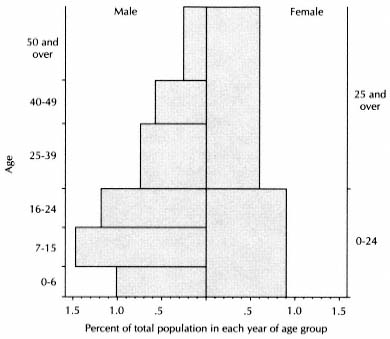
Figure 7.4.
La Mata, Population Structure, 1753
Note: Since there is no limit to the top age groups, a span
of seventeen years for males is used for convenience only.
|
|||||||||||||||||||||||||||||||||||||||||||||||||||||||||||||||||||||||||||||||||||||||||||||||||||||||||
these omissions, I shall consider the catastro complete for males over sixteen and females over twenty-five. In the table for Armuña in 1786, these groups represent 53.1 percent of the population. In the catastro of La Mata, these groups total 129 persons; and if these are 53.1 percent of the total, the total is 243, or 18 more than the catastro recorded. The same operation using the 1786 structure of La Mata yields a figure of 260 for the 1753 population. It appears probable that the catastro did underenumerate young people, and we can use 243 as a minimum population in 1753 and 260 as a maximum.
Dividing the net town income from Table 7.14 (4,683 EFW) by these estimates, one obtains a per capita income of between 18.0 and 19.3 EFW per year. This was half again more than the 12 EFW per capita that I have estimated provided an adequate subsistence for the rural Spanish population.
In addition, the censuses reveal an indirect source of income that the catastro could not record. A population beehive of the town in 1786 shows a remarkable shortage of females between seven and fifteen (Fig-
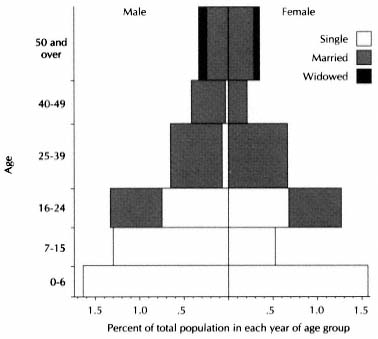
Figure 7.5.
La Mata, Population Structure, 1786
NOTE : Since there is no limit to the top age group, a
span of seventeen years is used for convenience only.
ure 7.5).73 There were forty boys and only sixteen girls in this age group. Even allowing for underenumeration, one can be reasonably sure that there was a shortage of unmarried girls in 1786, and this phenomenon was probably already present in 1753. In all likelihood their absence is evidence of a practice of sending girls to serve in the city, with the intention of returning to marry when they reached the proper age.74 Meanwhile they represented fewer mouths to feed, and their labor, unlike that of their brothers, was not needed in the fields or on the road.
In the middle of the eighteenth century, La Mata was a prosperous town of some sixty families. All thirteen labradores, all but one of the twenty-four arrieros, and the priest, altogether two-thirds of the households, had incomes that allowed them to live with ease. Of these at least
nine labradores, eight arrieros, and the priest earned twice or more what their families needed for an adequate standard of living. The tavernkeeper and surgeon-bloodletter turned a fair penny, and only the large size of their households kept their per capita income from being among the higher levels. Most of the other families, headed by artisans, jornaleros, herders, and widows, no doubt supplemented their direct income by tilling a small plot as a senarero or doing odd jobs for others or for the church or the town council. The town profited from a dual economy based on agriculture and muleteering. The income of the arrieros represented about 6.5 EFW per capita. Had these men been engaged in agriculture, even if in so doing they had increased the harvests through more intensive cultivation, the per capita income would have declined to close to the adequate mean. Their activity made possible the flourishing economy of the town in the face of the small extent of land per vecino.
This little community would have warmed the hearts of the Madrid reformers. It is true that its vecinos did not live on separate, enclosed homesteads or own their own land as the reformers propounded, but they had fairly stable, assured leases, which allowed them to make a comfortable living and produce a healthy excess for the market. They could keep six fanegas of wheat for each person in the community and all the other grains and pulses from the harvest and still leave two thousand fanegas of wheat to export, as rent, as tithes, or for their own account. Fewer than four hundred such communities, one hundred thousand people in all, could supply all the wheat Madrid needed. Campomanes recommended that rural communities introduce domestic manufactures that would use local raw materials and give remunerative occupations to the women and children.75 Although we do not know what the women and children did in their homes, La Mata had no active artisan sector, but the arrieros did provide a mixed economy and were responsible for the substantial margin of well-being of the community as a whole. If all arid Spain had been like La Mata, agricultural reform would never have become the dominant domestic issue of the last decades of its old regime.
For their well-being, the people of La Mata paid with the timeless labor of rural folk. The labradores, their jornaleros, and their sons hitched their oxen to their plows and worked their tiny scattered plots in the cold winds of the winter and early spring; later they bowed under the parching July sun to harvest the ripe wheat with their sickles and
rode their heavy threshing boards behind their oxen round and round the town threshing floor, the eras, to separate the grain from the chaff—a task in which wives and children could join—loaded their carts or animals in August with the wheat they owed their landlords in Salamanca and in the fall cared for their newborn lambs and slaughtered their pigs. The arrieros heaved the bags of grain on their mules and donkeys after the harvest, heading for the main regional markets or setting out on the long journey north to Burgos and Bilbao, walking beside their beasts in all kinds of weather, unloading in the evening and loading again in the morning the goods that provided their livelihood. They returned in time for Christmas but set out again as soon as the roads were passable, getting home once more for the June fairs. Following the local custom, the arrieros of La Mata traveled together for security and company. They helped each other and needed few additional hands, and their sons stayed to work for other vecinos until they were ready to set up in their fathers' trade. Then they would join the group to learn the routes and the best pastures and watering holes.76 Meanwhile the wives kept the hearths alive, prepared the thick bread soup of breakfast and supper, washed and mended the clothes, and in the fall made the farinato sausages of pork and crumbs.77 The daughters of the poorer families spent their adolescence serving in the city, and the widowed grandmothers took care of the children too young to work.
Religious holidays solemnized the revolution of the seasons that marked the life of La Mata. The town council's budget provided 110 reales for a preacher in Lent, possibly a friar from Salamanca, and another 60 reales for the parish curate to say extraordinary masses on other occasions.78 The parish had four confraternities that supported special services out of the income provided by the lands they owned. They were dedicated to Corpus Christi (ten weeks after Easter), Saint Michael (29 September), Our Lady of the Rosary (7 October), and All Souls (2 November).79 These were all occasions for pageantry, but they could not compare with the town fair of 26 June, the feast of San Pelayo, patron of the parish.80 Then the grain fields were almost ripe, and
the farmers knew if the harvest would be plentiful. The muleteers had returned from their spring trip with wares to hawk—iron tools and copper and brass pots and pans from Basque forges, perhaps woolens from northern Europe. Vecinos of nearby towns brought livestock to trade. Solemn mass and the inevitable procession sanctified the occasion, a symbiosis of religion, business, and festivity.81 Different but equally central to the year's course was the day in August when the vecinos who harvested grain paid their tithes "to God our Lord," as the catastro says, and the earthly vicars who received them for Him provided refreshments for the parishioners.82 To judge from the tithe rolls of the end of the century, the farmers followed an accepted custom in delivering their holy dues. The larger tithers held back, letting those with smaller harvests settle their accounts with the cillero. As the day advanced one or two labradores would come forward among the senareros. Then as the procedure neared the end, the wealthy farmers produced their large contributions, until all had paid except a few who farmed on the side and now closed the accounts with their pittances. On these occasions Francisco Rodríguez, the tavernkeeper, must have dispersed a good share of the 800 reales' worth of wine he imported each year.83 Religion dominated the public life of the community, and the figure who embodied religion for the people was don Juan Matute, the priest. More than anyone else, he was the hinge figure of the community, their procurator before the outside world, earthly as well as heavenly. The vecinos were conscious of course of the economic differences arising from their varied occupations and incomes—the labradores and arrieros must have had their little rivalries, and they preferred to marry their children to children of their fellows—but except for don Juan, they were socially homogeneous, a close community ruled by tradition and the demands of the seasons.
7
Perhaps the condition of La Mata was too favorable to endure. Within a generation its well-being was shaken, victim of the fecundity of its vecinos and its attraction for outsiders. The evidence for its demographic development comes from the five known censuses of La Mata made be-
fore the nineteenth century. All but the last one, of 1786, count only the vecinos, but we can also use our estimate of the total population in 1753. Since the census of 1786 includes the population of the neighboring despoblado of Narros de Valdunciel with that of La Mata, one does well to look at the two places together.
The censuses tell a tale of demographic decline and recovery (Table 7.17). In the sixteenth century Narros was a going village of perhaps fifty people. It virtually disappeared in the next century. The vecindario of 1712 records only one vecino, and there was still only one at the time of the catastro, the warden of the fields (guarda de panes ), who lived with his wife and one son.84 La Mata was a bigger community and declined as well in size, although the figure of fifteen vecinos in 1712 is assuredly too low. An analysis of that vecindario indicates that it underenumerated the population throughout the province. In 1729 twenty-two farmers paid tithes, and the number of vecinos would have been greater.85 The catastro count of vecinòs in 1753 and the census of total population in 1786 are reasonably trustworthy. The town grew throughout the century. In the thirty-three years between 1753 and 1786, the total population and the number of vecinos of the two towns grew about 39 percent.
The marriage pattern reveals the main cause for this growth. In 1753 only one man over twenty-four besides the priest was single, a criado (servant) aged thirty. Yet only one of the twenty males between sixteen and twenty-four was married, an arriero aged twenty. In 1786 two men over twenty-four besides the priest were single, but twenty-one of the forty-four males between sixteen and twenty-four were married.86 The average age at marriage for men had declined from about twenty-five to between twenty and twenty-one. One suspects that the decision to marry younger was an effect of the favorable economic situation at midcentury, and it meant that the town in 1786 could be expected to have a higher birthrate than a generation earlier. Because no one owned all the plots he tilled and the calling of muleteer was not closed, there were no economic "niches" that had to become empty before one could marry.
But the prosperity of the town did more than encourage early marriage; it drew outsiders to the town like a magnet. Migration is hard to document historically, but here we are helped by the various listings of the inhabitants. The tithe rolls of the end of the century record the
|
||||||||||||||||||||||||||||||||||||||||||||||||||||||||||||||||||||||||||||||||||||||||||||||||||||||||||||||||||||||||||||||||||||||||||||||||||||||||||||||||||||||||||||||||||||||||||||||||||||||
names of all vecinos who raised crops. Of fifty-two tithers in 1799, seventeen (one-third) had surnames (apellidos ) that did not figure among those of the vecinos of 1753. Nine of them paid small amounts and were senareros, perhaps farm laborers recently come in search of work and settled in the community. But six were substantial labradores, in the top quarter of the tithe roll. These figures do not mean that a third of the population had come in from elsewhere. Antonio, Bernardo, and Joseph Prior, respectively the sixth, tenth, and eleventh labradores, could all be sons of a worker who arrived in the 1760s and married well. Yet the appearance of eleven different surnames in a couple of generations is clear evidence of a generous infusion of new blood into the community.
The number of men engaged in the major economic sectors, agriculture and transportation, rose faster than the population as a whole, by 120 and 70 percent respectively (Table 7.18). On the other hand, the census of 1786 lists no artisans, where there had been two in 1753. Both of them, as we saw, had miserable incomes and had to farm part-time. Was someone keeping the crafts alive in 1786, but listed as a jornalero because he worked in the fields too? Or were the crafts abandoned as unproductive? The answer is probably yes to both questions. The scene
|
||||||||||||||||||||||||||||||||||||||||||||||||||||
with which this book begins shows a linen weaver present in 1800. On the other hand, when we study the next town, Villaverde, we shall see that there, too, the number of artisans was declining. At the end of the century La Mata was becoming divided more than ever into two distinct economies.
With so many more people farming, one would expect their more labor-intensive economy to result in greater income from the land, even if the marginal product of labor declined. Yet they do not appear to have achieved this growth. One can follow the evolution of the harvests in the tithe records. Table 7.19 compares the tithes collected over three periods centering on 1750, 1772, and 1798. It reveals a clear trend toward a smaller proportion of the harvest in grains and a greater one in pulses. Rye, barley, and oats, never very important, virtually disappeared, and wheat, the crop for which La Armuña is famous, declined from 81 to 72 percent of the value of the harvest. Garbanzos rose from 4 to 21 percent of the harvest, and the farmers experimented with vetch (arvejas; the vecinos called them both hervejas and alberjas ), a fodder crop, and peas. They were evidently trying to rotate their crops, using fast-growing pulses like garbanzos, peas, and vetch, which could be planted in January, permitting a half year of fallow after the previous wheat harvest.87 The makers of the catastro complained bitterly over the practice of planting garbanzos, algarrobas, and barley in what should have been the year of rest, accusing the practice of reducing the wheat harvest.88 The farmers, on the other hand, with increasing labor available, may have been responding rationally to the market. If one evaluates the harvest at the end of the century in EFW using the prices of midcentury, the total value of the yield did not rise. On the other hand, if garbanzos were a superior good and rising faster in price than wheat, as some evidence suggests, then the switch to them brought a net gain (Appendix H). Also, with agricultural prices rising somewhat more than nonagricultural prices after 1760 (Table 7.20), the terms of trade were moving in favor of the rural sector, making the harvest more valuable against outside purchases. The gain would not have been great, however, and it will not vitiate my analysis to assume a harvest of constant value.
The peasants did not try a rotation different from the año y vez, although it has been argued that a triennial rotation was possible in this region, with a year of spring grains or legumes, part of which would
|
||||||||||||||||||||||||||||||||||||||||||||||||||||||||||||||||||||||||||||||||||||||||||||||||||||||||||||||||||||||||||||||
|
||||||||||||||||||||||||
serve as fodder, inserted between the winter wheat and the fallow year. The rotation was not unknown, but the peasants were under pressure to produce wheat, both to meet the terms of their leases and because it was more marketable than barley or rye. Although a three-year rotation was more productive, it would reduce wheat production by 33 percent, a choice they could not afford.89
By 1800 the number of farmers had doubled since midcentury. They had to compete for leases, and the effect was that the number of plots per farmer was halved, with a corresponding decline of income per head. Moreover, the farmers had to struggle to keep the rents down. The 1770s saw a series of good harvests (see Table 7.19), and landlords used the occasion to increase the rents, which remained at the new level until the end of the century.90
The proceeds from farming could not keep abreast of the growth in population. Other solutions had to be found, and they involved a search for income from outside the town. In the 1780s opportunity came from the despoblado of Narros de Valdunciel, bordering on La Mata to the northwest. Eighty-five percent of its area belonged to the monastery Nuestra Señora del Jesús of the Sisters of Saint Bernard, whom we have already met as one of the owners of land in La Mata.91 The rest belonged in small lots to other institutions in Salamanca and to vecinos and churches of nearby towns. Although its area was one and a half times that of La Mata, we have seen that in 1753 its sole permanent inhabitants were the warden of the fields and his small family. The monastery rented its entire share of Narros to eight vecinos of Carbajosa de Armuña, which bordered it on the opposite side from La Mata. The lease called for 300 fanegas of wheat, 75 of barley, 2 7/12 of garbanzos, and a cart of straw annually for the arable, and 825 reales for the grazing rights.92 By 1769 the town council of La Mata was subleasing onequarter of Narros from its tenants, paying 100 fanegas of wheat.93 In 1777 the town council of Carbajosa took over the lease, but in 1780 La Mata joined it in the contract. By now the rent had risen to 450 fanegas of wheat, 100 of barley, 3 of garbanzos, eleven chickens, a cart of straw, and 2,000 reales, an increase of about 50 percent since the catastro, no doubt
reflecting an increase in harvests and herds. Two keepers and their families now lived on the estate. How the town councils exploited their lease is not known; they probably sublet the contract to several of their labradores. Here was one way for La Mata's farmers to fight their declining income: by breaking new ground in the despoblados around them.
The joint lease lasted nine years. In the 1780s the royal government pushed the colonization of the despoblados of Salamanca province, following its settlement policy in Andalusia and Extremadura.94 With royal urging, the nuns agreed to repopulate Narros, and they turned to La Mata and Carbajosa for colonists. In 1789 twelve vecinos of La Mata and three of Carbajosa moved with their families, animals, and tools to the depopulated village. In a low hollow, hardly more than a kilometer from La Mata but hidden by a slight knoll, where only the houses of the wardens had stood, nineteen more were being built for the "new settlers of Narros." An agreement had been reached the previous fall in time for the settlers to benefit from the winter pasture, and a notarized contract confirmed it in April 1789. The fifteen farmers leased the lugar of Narros on the same terms as the contract of 1780, with the substitution of a 90-to-100-pound heifer for the eleven chickens, and two reales for each house as a permanent quitrent (foro perpetuo).95
To undertake such a venture, the settlers had to be enterprising, respectable men. Among them was Antonio González, alcalde of La Mata in 1786.96 Most of them were heads of families in the prime of life: in 1798 nine of the twelve emigrants from La Mata still appeared on the tithe rolls, but by 1808 only four were alive.97 Under their care, the community took root and prospered. They raised sheep as well as grain and cattle; in 1802 they paid the nuns forty sheep in lieu of the two thousand reales for the pastures. By 1826 Narros had sixteen vecinos and a population of sixty,98 and it is still there today.
In this way La Mata disposed of one-seventh of its vecinos and over a quarter of the men engaged in agriculture, easing the economic threat to its farming population. Muleteering offered another source of additional outside income. The number of arrieros rose 70 percent between 1753 and 1786 (Table 7.18). Available evidence indicates that in the second half of the century the price of muleteers' haulage rose at about the
same rate as the general price level.99 If each of the arrieros of La Mata continued to operate with as many animals as before—animals, unlike fields, could be multiplied—their average real per capita income remained the same, with a resulting gain for the community as a whole. I assumed that 75 percent of their gross income in 1753 came from outside the town. Since local harvests had not increased, almost all their new business would have been external. In 1753 their net income from haulage was 2,070 EFW. Now, the additional arrieros would have increased this amount about 70 percent, or 1,450 EFW, of which perhaps 1,300 EFW (90 percent) was additional income for the town from outside. This amount was 28 percent of the net town income of midcentury (Table 7.14), and it went far toward balancing the population growth of 39 percent over this period. The per capita income was still 17.5 EFW in 1786, and the emigration of twelve vecinos or about forty-five people three years later meant that it rose to almost 20 EFW.
Thus La Mata solved the demographic threat to its economic standing. In 1790 the vecinos felt wealthy enough to construct the handsome espadaña that decorates the parish church, a sculptured prolongation upward of the facade that serves as a belfry, rivaling in elegance the square church towers of their neighbors. But a change had taken place in the social structure. Whereas before the labradores had been the dominant class in the town economically, now the arrieros were their match, if not their superiors.
8
Such was the situation in La Mata when the king decreed the disentail of the properties of charitable and other religious endowments in September 1798. Since religious institutions owned 78 percent of the land in the town, a good half of this subject to sale, his decree opened the possibility for a radical change in the structure of local property and indirectly of the society.
Sales began in La Mata at the end of 1799. The first consisted of seven arable plots in the town and three in neighboring San Cristobal de la Cuesta that belonged to a memoria in a parish church of Salamanca.100 The second was of six plots in La Mata and two in Narros, property of a memoria in the cathedral of Salamanca.101 Both lots were bought by don
Joseph María Cano Mucientes, military commander of the province of Burgos102 and a knight (caballero ) of the Order of Carlos III, a resident of Madrid. He also made the third purchase, first of 1800, larger than the others, seventeen arable plots and three meadows in La Mata plus assorted lands in Valdunciel and Narros, property of another memoria in the cathedral.103 The fourth sale went to a member of the faculty of the University of Salamanca, don Antonio Reyrruard, four plots in La Mata and two in Narros that belonged to a third memoria of the cathedral;104 and the fifth, a plot in La Mata sold along with others in Narros and other nearby towns that belonged to a capellanía in the town of Negrilla, went to a priest whose parish was in Aldeadávila de la Rivera, on the Portuguese frontier.105 After the first six months of disentail, La Mata faced the prospect of exchanging one set of outside landlords for another.
By the summer of 1800, the vecinos became aware that they must compete with the wealthy men of the cities if they were not to lose the opportunity the king had given them. Several took up the challenge. In July Pedro González of La Mata obtained a large arable field belonging to a capellania of Salamanca, paying 2,330 reales.106 A month later Antonio Alonso López, one of the wealthier labradores, bought a block of lands in La Mata, Narros, Valdunciel, and Carbajosa de Armuña for 12,200 reales.107 Thereafter other vecinos entered the bidding and frequently won the auction. Of thirteen sales of land in La Mata in 1800, five went to its vecinos and two to those of nearby towns.108
To see how the vecinos defended themselves we can follow one of their purchases in the notarial records.109 In October 1800 the commissioner of the Amortization Fund selected for sale the properties located in the towns of La Mata, Narros, and Negrilla de Palencia belonging to the Cofraía de Animas of the parish church of San Juan de Jerusalén of Salamanca. Two assessors were chosen, a labrador of Monterrubio and another of the Puerta de Zamora, a suburb of Salamanca, who spent three days evaluating the lands. Three plots totaling 4.25 fanegas in
Negrilla they agreed were worth 2,925 reales, and seven plots in La Mata and Narros measuring 9 fanegas, 6,305 reales. Four days after they submitted their report, on 16 October 1800, a notary of Salamanca, don Carlos María Pérez Albarez de Rueda, made a bid on all the lands, offering 9,400 reales payable in vales reales, only a few reales above the total assessment. The alcalde mayor of Salamanca city, the competent royal authority, declared his bid in order and set the date for the auction as 19 November, allowing thirty days for public announcements. Notices were posted in Salamanca, Palencia de Negrilla, and La Mata, the last on the main church door, beneath the espadaña. Every day for thirty days the public crier of Salamanca proclaimed the description of the lands, the amount bid, and the date of the auction. Within ten days, two vecinos of La Mata, Santiago Cabo and Juan Hernández, appeared at the office of the notary in charge of the sale and made a second bid: 9,233 reales in vales reales for the 9 fanegas in La Mata and Narros. In effect they requested that the properties be divided in two lots, and to obtain their request they offered almost as much for those in their vicinity as Pérez Albarez had for all the lands. Cabo signed the document, Hernández merely scribbled some swirls, "since he does not know how to sign," as the notary delicately put it. Their bid was declared satisfactory, and the public crier henceforth proclaimed it in his announcement.
On 19 November the public auction, in the entrance hall of the royal jail of Salamanca, opened at eleven o'clock in the morning. The crier announced the pending bid and invited whoever wished to raise it. Many people attended, including Juan Hernández acting for himself and his partner, but try as he might, the crier could raise no response. When he paused, the alcalde mayor ordered him to keep on, and unexpectedly Hernández, who was illiterate and perhaps confused by the strange event and the imposing setting, broke the silence to raise his own bid by two hundred reales. His was the only voice from the public. Finally the alcalde mayor closed the session and awarded the fields to Hernández and Cabo.
According to practice at public auctions, however, this was not the end. The closing bid was published in Salamanca and La Mata, and prospective buyers were given forty days to raise it by 25 percent (la mejora de la cuarta parte ) and thereby reopen the bidding. Again the announcement on the church door in La Mata had the desired effect, for on 26 November two different vecinos, Francisco and Marcos González, went to the notary's office in Salamanca and offered 11,808 reales for the
9 fanegas, also in vales, barely more than the required raise. A new date for the auction, 7 December (a Sunday), and new announcements. The act took place in the accustomed manner, and again, despite the coaxing of the public crier, no one raised the bid. This time the decision was final, and the two Gonzálezes received the lands. On the next day they paid the money to the commissioner of the royal fund, and the alcalde mayor signed the necessary papers.
On 11 December the notary went in person to La Mata to deliver the lands. The symbolic act of transfer to the new owners before the assembled residents of the village is the opening scene of this book. The final act took place two weeks later. The two Gonzálezes and Juan Hernández, the active partner in the earlier bid, journeyed to the notary's office to have the deed drawn up. The two buyers ceded three of the fields to Hernández and divided the other four between them. Santiago Cabo, the other early bidder from La Mata, had lost out, but the vecinos had defeated the notary of Salamanca who first bid on the land and had raised the price even further in their competition with each other. The confraternity received from the king an obligation for almost double the assessed value of its fields.
After 1800 the amount of land put up to auction declined. In 1801 there were six sales, in 1802 three, in 1803 two, and in 1804 one. Vecinos of La Mata made eight of these twelve purchases and vecinos of neighboring towns two others. Outsiders seemed to lose interest when faced with a serious local challenge. Residents of Salamanca made only two purchases involving five plots.110
These sales exhausted the lands specified in the instructions of January 1799, which stated that properties of hospitals, asylums, and similar institutions not be touched until all others had been sold. On 30 September 1805 a circular ordered the disposal of the properties of these institutions.111 Amorg them was the largest landowner in La Mata, the General Hospital of Salamanca, which held sixty-eight arable plots and one meadow, evaluated by the catastro at 15 percent of all the property in the town. They went on sale early in 1806 in twenty different sets. This time the vecinos were prepared. Sixteen of them, including a man called don Josef de la Iglesia, and his wife, doña María Antonia de Rivas, banded together to bid for the lands. They obtained nineteen of the sets, the twentieth going to a member of the university, don Josef
Pando.112 Two other sales, lands of the orphanage of Salamanca, closed out the year and the disentail in La Mata under Carlos IV. They went to a vecino.113
Most of the properties that changed hands already belonged to religious endowments in 1753 and can be identified in the catastro: 204 arable plots, eight meadows, and a house. Others not identified in the catastro as religious holdings were presumably acquired by the church between 1753 and 1798. Altogether 222 plots were sold, 40 percent of the 551 plots listed in the catastro; of the total property value, 42 percent was sold. Taking place in eight years in a town where virtually no land had been put on the market in centuries, the disentail constituted a massive revolution in the ownership of property.
After a bad start, the people of La Mata had rallied to exploit the opportunity. They obtained 116 of the 222 grain plots, and in addition vecinos of nearby towns obtained 24 plots. Most of the rest went to residents of Salamanca. Table 7.21 and Figure 7.6 reveal what these exchanges did to the property structure of the town. There are two major features to the changes. On the one hand, local ownership rose sharply, from about 10 percent to 35 percent, mostly in gains by the vecinos, who had eight times as much property as at midcentury; ownership located in Salamanca declined from 63 to 41 percent. On the other hand, ecclesiastical institutions lost half their holdings; their share fell from 78 to 39 percent. Where previously ecclesiastical landlords dominated the town, there were now three fairly equal forces present, religious institutions, nonresident individuals (some of them clergymen), and the vecinos of La Mata and neighboring towns. La Mata ceased to be in the absolute grip of the nearby city.
If La Mata was a typical example of the effects of the disentail of Carlos IV, the royal ministers had every reason to congratulate themselves on their achievement. They had provided property to industrious farmers while raising money for the urgencies of the crown. Their success depended, however, on local conditions. Although in recent decades the economic status of La Mata's farmers had been under threat, they had maintained a level of income that permitted them to live adequately and save. Some muleteers also had earnings beyond their needs. Until 1798 the vecinos had little opportunity to invest their savings in ways that would increase their income. The purchase of land had been virtually
|
||||||||||||||||||||||||||||||||||||||||||||||||||||||||||||||||||||||||||||||||||||||||||||||||||||||||||||||||||||||||||||||||||||||||||||||||||||||||||||||||||||||||||||||||||||||
out of the question, since four-fifths of the land in La Mata was in religious entail. Not entirely fortuitously, the royal decree came when farmers were able to take advantage of it.
For the town as a whole, the greatest benefit was to be freed from part of the rent it paid to outside owners. Vecinos bought 220 fanegas of arable land; 196 of this had belonged to outside religious institutions.
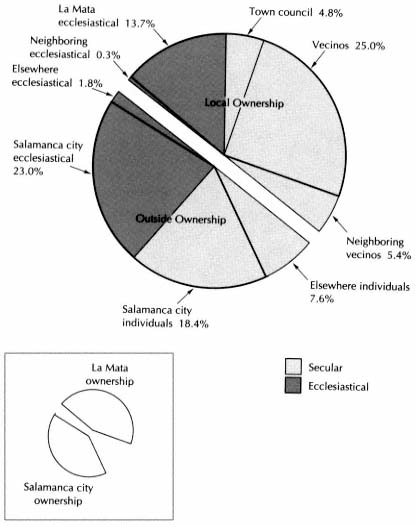
They also bought at least thirteen plots measuring 26 fanegas in Narros and other nearby villages, all of which had belonged to institutions in Salamanca.114 Meanwhile residents of Salamanca had bought 14 fanegas of land in La Mata belonging to churches of La Mata and nearby towns. The net gain for the town economy was rent from 208 fanegas of land.
Under the decree of 15 September 1803, the new outside owners were free to raise the rent, but we have seen that the monasteries were unable to do so without the tenants falling behind, so that it is doubtful that the new owners could squeeze much more out of the tenants. At the rate of 0.8 fanega of wheat per fanega of land that was the usual rent, the land transfers netted the town economy about 167 EFW more per year. In 1753 vecinos paid outside owners 575 EFW; this would now be about 410 EFW, and the net income from agriculture would rise from 3,132 to 3,299 EFW (Table 7.14). The overall benefit was to raise the town income from agriculture about 5 percent. The farmers as a group benefited more because they were also freed from the rent paid to local churches on 25 fanegas of land, about 22 fanegas of wheat. Their net income rose from about 2,682 (Table 7.8) to about 2,871 EFW, an increase of 7 percent.
9
Had other conditions remained stable, this increase would have meant a distinct improvement in the position of the farmers. But their number did not stop growing. From Table 7.17 we know that the population of La Mata was about 333 in 1786, with about 80 vecinos (allowing for 2 vecinos and 8 people in Narros). The next date for which we have population figures is 1826. La Mata then reported 107 vecinos and 482 people. The growth between these dates was not consistent, however. The 12 families that emigrated to Narros in 1789 took perhaps 48 people. In 1803 and 1804 the harvests were very poor in Salamanca province, as in most of Spain, and the ensuing famine brought on an epidemic that carried away a large number of people.115 One would have to study the parish registers of baptisms and burials to get a full sense of the demographic impact on La Mata, but the tithe records provide convincing evidence (Table 7.22). The number of people on the rolls fell about 20 percent from 1802 to 1805. This loss did not represent an elimination of marginal farmers, for the number who paid first fruits declined more, about 23 percent. La Mata must have lost a fifth of its adults in the epidemic and at least as many children.
|
|||||||||||||||||||||||||||||||||||||||||||||||||||||||||||||||||||||||||||||||||||||||||||||||||||||||||||||||||||||||||||||||||||||||
|
||||||||||||||||||||||||||||||||||||||||||||||||||||||||||||||||||||||||||||||||||||||||||
If one assumes that the growth rate was constant for the rest of the period (there was another famine during the Napoleonic war, but its effect can be discounted here), then we can approximate the population and the number of men in agriculture at different dates as in Table 7.23.
We have seen that the total net income from agriculture did not rise much, if at all, after the middle of the eighteenth century, and that the income of the farmers increased about 7 percent as a result of the disen-
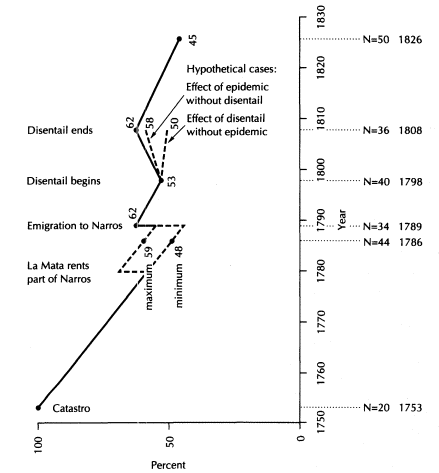
Figure 7.7.
La Mata, Index of Per Capita Income of Men in Agriculture ( base = 1753 )
Note: N = number of men engaged in agriculture (from Tables 7.1 and 7.23).
tail. This information makes it possible to plot the evolution of the average per capita income in EFW of the men in agriculture (not to be confused with the per capita income of the town as a whole). Figure 7.7 shows that the major factor affecting the income of the farmers was their number. The rush into agriculture after 1753 rapidly brought down the individual income until the vecinos turned to farming land outside the town, first by renting part of Narros in 1780 and then by sending emigrants to it in 1789. Even so, the index of per capita income
of men in agriculture, with the base 100 in 1753, stood at only 62 by 1789. The decline continued until two factors combined between 1798 and 1808 to bring the level of income back to that of 1789: the disentail and the epidemic. Of the two, the epidemic had the greater effect. Without disentail, it would have raised the index from 53 in 1798 to 58 in 1808. Without the epidemic, disentail would not have prevented the income of farmers from continuing to decline. The income of the town as a unit held up much better, because the large sector engaged in haulage would continue to increase its contribution. One can suppose that some of this income filtered over to the families of farmers through services rendered, so that they were not so badly off as the graph suggests.
What the graph does reveal, however, is the weakness of property redistribution as a means of social reform in a period of demographic expansion. One could hardly find a place where the effects could have been more favorable to local residents, both because of the large amount of property sold and because they managed to acquire over half of it. Even if all the land disentailed had gone to the vecinos, 366 fanegas, their rent would have been reduced 293 fanegas of wheat, and their income would have risen 11 percent. Indeed, if all the land and pastures except the land of the town council had been turned over to the vecinos, representing rent of 733 EFW (Table 7.8), their total net income would have risen about 27 percent, bringing the index for 1808 up to 74, still well below the level of 1753.
Ending rent payments was not, however, the only benefit conceived by the planners in Madrid. They counted on private ownership to increase the harvests, but given contemporary technology this was unlikely. The labradores continued to experiment modestly with crop variations. Garbanzos, which had risen to 21 percent of the value of the harvest in 1797–99, fell back to 7 percent in 1805–9, only to rise again to 17 percent in 1815–19. At the latter date peas had appeared, after being sown in small amounts at the turn of the century, and were now 6 percent of the crop. But the value of the harvests in EFW changed little. In 1807–8, both good years, the average of the tithes recorded by the cillero was almost exactly the same as in 1801–2, also good years. In 1815–19 tithes averaged 91 percent of this amount, and all of these figures indicate harvests below the record years of 1770–74. Until farming technology changed, which hardly occurred before the twentieth century, only extensive breaking of new ground in nearby despoblados (so long as they were available), massive emigration, or turning to other oc-
cupations like muleteering could maintain the standard of living of the farming sector.116
10
If disentail brought only marginal benefit to those in agriculture as a group, perhaps it changed more radically the condition of the persons who actually acquired land. Thirty-five people bought property in La Mata, twenty-two of them vecinos. Table 7.24 shows the residence of each buyer and what percentage of the total value of the town's land (as assessed at the time of the catastro) each bought. They are listed in descending order of the value of their purchases.
The table reveals a fairly clear pattern. Of the top four, each of whom bought considerably more than the others in the list, only one was a vecino, the others being urban residents, from Salamanca and Madrid. The middle ranks, from fifth through twenty-sixth, were made up almost entirely of vecinos of La Mata, with a scattering from bordering towns. The first of the latter, Blas Rodríguez, was one of the original emigrants to Narros in 1789. Of the remaining nine buyers, seven lived outside La Mata (although three in neighboring towns). The very narrow range of the purchases made by vecinos is striking; nineteen of the twenty-three each bought between two and seven plots, the largest purchaser of these acquiring less than double the land value of the smallest. It is true that this similarity is exaggerated by assigning equal shares to the sixteen who banded together in 1806 to get the lands of the General Hospital, but I do not know how they divided these lands among themselves. Outside this range are only Francisco González, who bought twenty-three plots, valued at more than twice the amount of any other vecino's purchases; two men, who bought very little; and Joseph Prior, who bought no lands in the término but together with Ignacio Alonso bought two plots in Castellanos de Villiguera to the west. Who were these vecinos?
The records of the sales do not tell their occupations. We can, however, learn much from the tithe register. It reveals how large their harvests were and how these compared to those of other vecinos, both before and after their purchases. Table 7.25 shows the average harvest of each individual who bought land and the rank of his harvest among the
|
|||||||||||||||||||||||||||||||||||||||||||||||||||||||||||||||
|
|||||||||||||||||||||||||||||||||||||||||||||||||||||||||||||||||||||||||||||||
|
||||||||||||||||||||||||||||||||||||||||||||||||||||||||||||||||||||||||||||||||||||||||||||||||||||||||||||||||||||||||||||||||||||||||||||||||||||||||||||||||||||||||||
|
||||||||||||||||||||||||||||||||||||||||||||||||||||||||||||||||||||||||||||||||||||||||||||||||||||||||||||||||||||||||||||||||||||||||||||||||||||||||||||||||||||||||||||||||||||||||||||||||||||||||||||||||||||||||||||
tithers, for four separate two-year periods (since a two-year cycle was needed to till all the fields of each individual) from 1799 to 1808, omitting 1803–4, the years of famine. Not all buyers paid tithes, and others paid only in some years. Those who disappeared from the rolls probably died, and those who were added probably appeared when they set up separate households or began farming. Finally, the table indicates the years in which the buyer made his purchases, in order that one may observe any immediate effect of his purchases on his harvests or rank among tithers.
The census of 1786 reported twenty-seven labradores. Considering the emigration to Narros in 1789 and the intervening growth, there must have been between twenty-five and thirty labradores in 1799. If this is the case, then all but two of the nine top vecino buyers, those ranked third through fifteenth, were labradores, for they were among the top twenty-six tithers in 1799–1800. All of these men made purchases in the first years of the disentail, and five of them also participated in the joint purchase of the properties of the General Hospital in 1806. The economic potential of the seven who were labradores can be judged from their harvests. Net income from harvests after deduction of seed, tithes, and rent was about 58 percent of gross harvests (see Table 7.8). Four of these men had gross annual harvests in 1799–1800 of between 129 and 180 EFW, net between 75 and 105 (Table 7.25). In the two excellent years following, their net harvests were about two-thirds greater. Their position in the socioeconomic pyramid would correspond to the top levels (4 and 5) (compare Tables 7.10 and 7.13). If they had families of five and their needs were covered by 60 EFW, as I have proposed, they had available to save the equivalent of between 40 to 90 EFW per year. If they saved half this amount, one can calculate how many years it would have taken them to accumulate the amount of their purchases,117 and in most cases the calculation shows that a few years would suffice. Pedro González, who spent 2,330 reales in 1800 and 11,410 reales in 1806, could save about 1,700 reales per year and needed only two years' savings on hand before the sales started. Ignacio Alonso, who spent 10,030 reales in 1802, could have covered this amount with ten years' savings; but in fact if he had put all his surplus of 1801 and 1802 aside in the hope of buying land, this would have covered his purchase. Of the four, only Antonio Alonso López would have had difficulty in financing his successful bids out of savings. It would have taken
him twenty years to accumulate the 15,450 reales he spent inside and outside La Mata. But if, as was likely, he paid in vales reales (the record does not say), which were being discounted over 50 percent, he could have saved the necessary money much faster. It is less easy to understand how the other three labradores in this top group made their purchases, since all sales were paid for on the spot and there is no record of any loan or mortgage taken out by the buyers. Nevertheless, it is clear that agriculture was the main source of livelihood of the larger local buyers and very likely also the main source of their capital.
Below these nine local buyers are eleven people who had shares in the properties of the General Hospital but otherwise bought nothing. Six of these eleven also drew their income from agriculture. The next three were marginal farmers, who did not farm every year or harvested only small amounts. Their main occupation lay elsewhere, most likely in haulage. Finally, there are two people in this group who never appeared on the tithe rolls, don Josef de la Iglesia and doña María Antonia de Arrivas, "his wife." The records of the sales of the properties of the General Hospital always name them first among the sixteen buyers. Who were they? The title don indicates an hidalgo, or at least a recognized notable.118 The catastro and the census of 1786 show no hidalgo in the town. The priest of La Mata, who signed the tithe rolls during the decade of the sales, was don Francisco Ignacio Arribas. Were doña María Antonio and don Josef his sister and brother-in-law, who decided to move to the town, buy land, and live off their income? This seems a likely explanation, and it suggests that their shares of the General Hospital's lands were larger than the others. Their case and those of the other nonfarmers among the buyers indicates that even if the economic position of labradores had declined, land was an attractive investment for people who did not regularly farm. Husbandry still had more prestige in La Mata than muleteering.
The cases of Francisco González and Francisco de la Cruz, first and fourth among La Mata buyers, support this conclusion. De la Cruz was not a farmer in 1799–1800 and only a marginal one thereafter, despite buying three plots in 1802 and sharing in the properties of the General Hospital. Very likely he was an arriero who invested in land but did not make agriculture his main occupation. The case of Francisco González sets him apart from the other vecinos, for he was the only one to rank among the top buyers. He bought nine plots in 1800, eleven plots and a
meadow in 1801, and three plots in 1802, yet he was not farming in 1799–1800. We saw him take possession of his first fields, which he obtained by outbidding local and Salamanca residents. In 1801 he was twentieth on the tithe roll; in 1802, after three years of buying land, he was fifth.119 He disappeared from the tithe list after 1803. Did he replace the former first tither (casa excusada) or fourth tither (cuarto dezmero), neither of whose tithes are recorded in the rolls, or did he die? I believe the latter. The name Ana Hernández appeared for the first time in 1804 near the top of the list. She may have been the former first or fourth tither, but more likely she was González's widow. In 1805–6 she was sixth, in 1807–8 third. This appears to have been a household that rose from nothing to obtain the third largest harvest in town. One can guess that González was a wealthy arriero who was inspired by the sales to engage in agriculture.
His case illustrates the importance of the arrieros to the well-being of La Mata. The town defended itself successfully against outside buyers because of its dual economy. The leading labradores had the savings that they and their forebears had set aside for half a century or more. But the agricultural sector did not account for all the town's gains. The muleteers also were amassing capital, and some put it into land when they had the opportunity.
Their judgment was sound, for on the whole those who bought land rose economically. We can follow the development in the second part of Table 7.25. Francisco González is only the most obvious case. Vicente Alonso had the sixth largest harvests in 1799–1800; he was just below the first tither in 1807–8. Antonio Alonso López was tenth at the beginning, fifth at the end; Marcos González rose from twenty-fourth to seventh. Not all were so successful; Pedro González fell from second to sixth; Ignacio Alonso from fifth to eighth. But compare the fate of Agustín de Dios, who was number three in 1799–1800. Since 1787 he and Juan López had rented jointly the lands of the Discalced Franciscan Nuns.120 Agustín did not buy lands; in 1807–8 he had fallen to number eleven. Bernardo Prior, who was number six in 1799–1800, bought no lands and dropped to number 19 in 1807–8.
It would be wrong to conclude that the increase in a buyer's harvests came just from the lands he bought. In most cases the buyers tilled more fields than those they acquired, as one can tell by comparing their har-
vests with the areas they purchased. The account book of the monastery Nuestra Señora del Jesús shows that one of them, Pedro González, second among the buyers, and another man rented its fields in La Mata from 1789 to 1808. González's half share of the crop would have been about 60 fanegas of wheat per year.121 The plots he bought would have produced only about 46. After 1800 his total harvest averaged over 250. Francisco González, who had never farmed before, bought 30 fanegas of land, which would have produced about 105 fanegas of wheat per year.122 In 1802 he paid tithes on 262 fanegas of wheat, plus other crops. The plots he bought accounted for less than half of his harvest. The next three buyers who were labradores could produce only between one sixth and one-quarter of their harvests on the lands they purchased.
One can conceive of an explanation for the changing relative size of the vecinos' harvests that has little to do with the disentail. A. V. Chayanov, in his classic studies of the economy of rural Russia before the Revolution, described how the peasant exploitation expanded and contracted as the family proceeded through its life cycle. For a newly married couple the farm was limited to what the peasant could till himself, but as his sons reached an age where they could work, he extended his farm by renting new fields. The exploitation would increase in size until all children reached adulthood, then decrease as the sons left to form their own families.123 One should consider whether the rise and decline in the harvests of the individual vecinos of La Mata responded to some similar life cycle.
Such an explanation has a certain appealing simplicity, but the knowledge we have developed leads one to reject it as the primary cause. First of all, the monastic account books of the eighteenth century cited at the beginning of this chapter124 show very little change in renters. Leases were inherited by widows and children, and only tenants who fell seriously in arrears appeared in danger of losing their leases. The free market in rented farms that Chayanov observed in Russia was not present in La Mata. Besides, an increase in the harvests of an individual regularly followed his purchase of disentailed land. In other words, purchases of land were being made when the life-cycle model predicts that sons had not yet reached working age. Yet this is precisely when the peasant, a
struggling young father of hungry children, would be least likely to have savings. According to the life-cycle model one would expect purchases to occur when the family work force was largest and the per capita income therefore greatest, or shortly afterwards. Purchases would be followed by a decline in harvests as adult children left. The relationship between purchases and harvests observed in La Mata thus flies in the face of the life-cycle explanation.
By 1808 all the first nine tithers except the casa excusada and the cuarto dezmero were labradores who had bought land, and perhaps one could identify these as buyers too if one had their names. Furthermore, the share of those at the top was greater than before the disentail. In 1799–1800 the largest tither on the rolls (number two after the casa excusada) paid 7.0 percent of the tithes collected; in 1807–8 the person in this position paid 9.2 percent. The top seven tithers listed in 1799–1800 had 42 percent of the total; in 1807–8, when all of them were people who had bought land, their share was 48 percent. This fact adds further support to the belief that the purchase of properties was a direct cause for an increase in harvests, even one that was greater than the additional return provided by the lands bought.
Disentail benefited ambitious men in more ways than offering land to buy. Every time a vecino purchased a plot to farm himself, he took it out of the supply available to rent and forcibly depressed the remainder of the local farmers. Furthermore, the royal legislation permitted outside buyers to change the conditions of tenure or to rent to new tenants. Although leases had been traditionally renewed rather automatically, new absentee owners would be looking for the best lessee, and a successful farmer would be their first choice. Buying land gave a farmer a reputation that helped him acquire leases held by other vecinos. One cannot explain the meteoric rise of Francisco González in any other way, or the more modest gains of others who also rose in rank. Whereas disentail could only mitigate the decline in per capita income of the farming sector caused by demographic growth, it permitted the more enterprising men to rise within the economic hierarchy of the town. Population growth in the second half of the eighteenth century had reduced the disparities in farmers' income. Disentail reversed this trend and produced a somewhat more stratified society.
11
The war against Napoleon put an end to this period of disentail and struck the town harshly. French armies engaged in Portugal passed
through the province of Salamanca and lived off it, and the campaign of 1812 brought heavy fighting to the region. In November 1812 French troops sacked La Mata.125 Between 1810 and 1813, the tithe records show harvests scarcely half the size of ordinary years, and monasteries settled for much less rent than their leases called for.
Peace brought back normal conditions and harvests recovered. For the rest of the century the history of La Mata revolved around the forces we have observed. The number of men engaged in transportation increased until midcentury. In 1850 there were fifty-one muleteers and five carters (carromateros ), and ten years later sixty-two muleteers and thirty-eight carters. Thereafter, the appearance of the railroad led to a steady decline of haulage as an economic resource; in 1900 only two arrieros were left in La Mata. Meanwhile the vecinos benefited from the successive waves of disentail. By the turn of the twentieth century, they owned 71 percent of the land in the town, and the renting of fields from nonresidents had almost disappeared as a practice, as outside owners sold off their plots in search of investments with more growth potential. Harvests per hectare rose slowly, but not enough to offset the disappearance of transportation as a source of income. In 1863 the number of vecinos reached 165, its highest point ever.
After 1900 the discovery of a simple chemical process to keep lentils from spoiling before reaching market brought a revolution in crops, and the introduction of artificial fertilizers reduced the need for fallow.126 Thereafter, the end of haulage and the new farming technology gave the town a very different economy from the one studied here. The half century between the catastro of la Ensenada and the end of desamortización of Carlos IV thus appears as the early stage of a cycle that lasted through the nineteenth century, during which this rural community remained dependent on early modern technology in both agriculture and transportation. Disentail operated as one factor in economic change, along with population pressure and evolution in the means of transportation.
Chapter VIII—
Villaverde
Twelve kilometers due east of La Mata, about eighteen kilometers northeast of Salamanca, is the lugar of Villaverde. It lies just off the main highway from Salamanca to Valladolid, at 831 meters altitude, near the source of the small Rio Guareña. Here the land is flatter than at La Mata, and the town nucleus can be seen from all directions, dominated by its square church tower rising like the prow of a ship at its western end.
Although not large, the town had features in the eighteenth century that gave it a modest urban flavor. At its center was an irregular unpaved plaza, on which faced a public building that served both as council house and prison. The town council also owned a tavern, a blacksmith shop, and a butcher shop, which it rented to the vecinos who operated them. In addition, 116 houses faced on the streets that led off in various directions from the plaza. Of these 2 were in ruin and 10 others were empty—the town had had more inhabitants in the sixteenth century. Three granaries (paneras), one belonging to the town council and two to the receiver of the tithes, eleven barns (pajares), four corrals (two of them belonging to the town council), and some baking ovens completed its structures.1
Villaverde is on the eastern edge of the rich Armuña district, where the land gets poorer. In the eighteenth century it was surrounded by two despoblados and two alquerías. Only to the west did it border on a popu-
lated town, Pedrosillo el Ralo, slightly larger than Villaverde.2 Yet Villaverde itself was in a fertile spot; the catastro returns indicate that on the average its soil produced thirty-eight reales per fanega per year, close to La Mata's forty and well above the regional average of twenty-seven. The total area was 1,650 fanegas, or huebras as they were called locally3 (740 hectares), and there were 97 lay vecinos and 1 ecclesiastic, for a total population of 357.4 Both in area and in population Villaverde was half again as large as La Mata.
Its employment structure was also more complex, as Table 8.1 and Figure 8.1 show. The proportion of men engaged in agriculture was higher, and next after them came the craftsmen, whereas in La Mata there were only two craftsmen. The muleteers of Villaverde, on the other hand, were only a ninth of the vecinos.
The farmers of Villaverde devoted themselves primarily to the raising of wheat, as could be expected in the Armuña district. According to the catastro, the town had 1,354 plots devoted to wheat, 88 meadows, and 13 enclosed plots (cortinas ) for growing fodder (herren ). 5 Despite this description, however, wheat was not the only crop sown in the open fields; the tithe records show that there was a sizable harvest of algarrobas, used for fodder, and lesser ones of barley, rye, and garbanzos.
A first approximation of the annual harvest comes from the recorded area and quality of the arable plots, and the average yield and seed requirements stated in the catastro (Table 8.2). The seed requirement, 858 fanegas of wheat, is 19 percent of the gross harvest. The predicted yield: seed ratios for the three classes of land are 5.3 : 1, 6 : 1, and 3.6 : 1, with the overall average 5.2 : 1. It is hardly possible for middle-quality land to have a higher ratio than first quality, but there is no way of checking the data provided by the catastro. In any case, the land was substantially less productive than in La Mata, where the overall ratio was 7.2.
The figures for the gross harvest can be checked by the tithes (Table 8.3). Not all the partible tithes in Table 8.3 represent harvests grown within the limits of the town, for its tithe collector also kept half of the tithes paid by the vecinos on the crops they harvested outside the town, sending the other half to the parish where the harvest was grown.6
|
||||||||||||||||||||||||||||||||||||||||||||||||||||||||||||||||||||||||||||||||||||||||||||||||||||||||||||
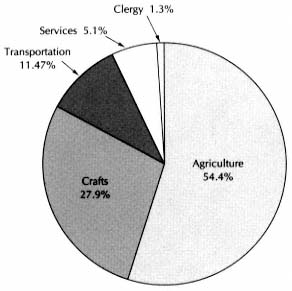
Figure 8.1.
Villaverde, Employment Structure, 1752
|
|||||||||||||||||||||||||||||||||||||||||||||||||||||||||||||||||||||||||||||
|
||||||||||||||||||||||||||||||||||||||||||||||||||||||||||||||||||||||||||||||||||||||||||||||||||||||||||||||||||||||||||||||||||||||||||||||||||||||||
|
||||||||||||||||||||||||||||||
Similarly, other parishes sent to the cilla of Villaverde half the tithes on the crops their farmers harvested within its limits. The catastro does not say how much these portions amounted to, but one can obtain a reliable approximation from the tithe book for the years 1773–1811, now in the provincial archive of Salamanca.7 It breaks down the payments between towns for the years 1776–80 and 1805–7. Table 8.4 shows the different shares for the first period. It separates the payments to the two adjoining despoblados of La Cañada and La Cañadilla, both anexos of the parish of Villaverde, from those to other towns; the former were increasing during the period covered by the tithe book, an indication that the vecinos of Villaverde were extending the land that they farmed in the despoblados. By projecting back from 1776–80, one can estimate the payments to these two places at midcentury. There is no sign of change in payments to or from other towns, and I shall use the same proportions for midcentury as in the table.
We are now in a position to calculate the total harvest from the tithes reported in the catastro. To do so I shall apply the percentages of 1776–
|
||||||||||||||||||||||
1800 to the total tithes of 1747–51, with the difference indicated for the two despoblados, and include an estimated payment of the first tither at the earlier period, which no longer went into the partible after 1761.8 Table 8.5 provides the data and indicates that the total crop, which was ten times the tithes, was 4,688 EFW. This figure is 5.6 percent higher than the 4,441 EFW predicted from the extent and different qualities of land (see Table 8.2), evidence of remarkable accuracy in the catastro's survey. Since the tithe returns are a more exact measure of the harvests, I shall use them and increase the estimate of the net harvest by the same proportion to 3,783 EFW.
How much of the net harvest remained within the town economy depended in large measure on the ownership of the land, shown in Table 8.6 and Figure 8.2. At first sight the distribution recalls that of La Mata, for most of the land belonged to nonresidents and outside institutions, but closer observation reveals significant differences. Outside owners held almost as much as in La Mata, 69.3 percent of the land, compared to 71.4 percent, and similarly, of this share the larger part belonged to owners located in Salamanca city. On the other hand, although ecclesiastical ownership was high in Villaverde, 47.5 percent, it was far less than the 77.5 percent of La Mata. Moreover, vecinos were
|
||||||||||||||||||||||||||||||||||||||||||||||||||||||||||||||||||||||||||||||||||||||||||||||||
in a better position, with 19.6 percent compared to 9.8 in La Mata. The vecinos also owned most of the houses, 79 of 116, with another 20 belonging to the parish church and nearby vecinos.9
Following instructions, the makers of the catastro reported the rate of rent collected by ecclesiastical owners, which Table 8.7 lists.10 With a different rate for each quality of land, it is a subtler calculation than the
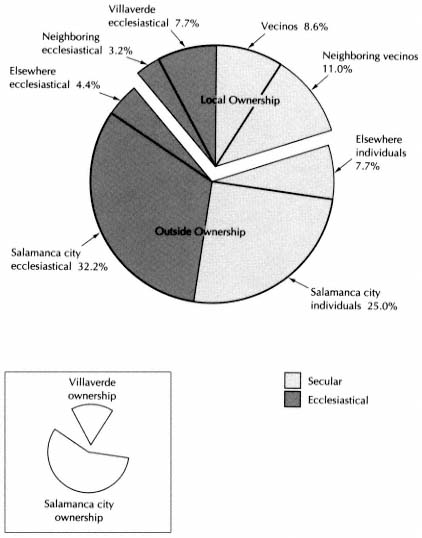
Figure 8.2.
Villaverde, Ownership of Land, 1752
rule of thumb in La Mata of 1 fanega of wheat for each fanega of land, regardless of quality. Unfortunately, I have little data to check its accuracy. Although the records of several monasteries that rented fields in Villaverde are preserved, their leases usually lumped plots outside Villaverde with those in its limits. Only two of those available cover property entirely within the town. The convent of Corpus Christi of Franciscan
|
||||||||||||||||||||||||
nuns owned in Villaverde 1.5 fanegas of first-quality land, 9.5 of second, and 3 of third.11 The catastro's rule would indicate a rent of 10.125 fanegas of wheat. The convent's accounts for the years 1800–1805 show that the rent was 12.5 fanegas. The tenant fell behind in the bad year, 1803, but made up his arrears with the harvest of 1805.12 Evidently the convent was not charging too much, although 20 percent more than the reported rule calls for. It also got the horros on its land. The second case involves seven plots bought in 1794 by the nuns of the monastery of Nuestra Señora del Jesús of the Order of Saint Bernard. They had the plots surveyed accurately; there were 3.92 fanegas of first-class land, 3.08 of second, and 0.45 of third. The rule indicates a rent of 8.30 fanegas of wheat; the actual rent from 1795 to 1798 was 10 fanegas, and in 1799 the nuns raised it to 11.5 fanegas. In addition they received the horros.13 Here the rent was 20 to 40 percent above the rule. Had the rents been raised since the catastro? We do not know, but the next case suggests that this is not the explanation for the disparity.
The nuns of Jesús also owned a group of fields in Villaverde and Pajares, the next town to the north. The holdings in Villaverde consisted of thirty-three arable plots, a meadow, a cortina, and a house. The predicted rent for the plots in Villaverde is 21.125 fanegas of wheat.14 The predicted rent for its holdings in Pajares is 13.05 fanegas of wheat, for a total in both towns of about 34 fanegas.15 In 1758 these lands were
|
||||||||||||||||||||||||||||||||||||||||||||||||||||||||||||||||||||||||||||||
rented to a vecino of Villaverde for 46 fanegas of wheat plus the horros. In 1775 the nuns raised the rent to 50 fanegas but dropped it in 1788 to 26, presumably because the lease no longer included all the above property.16 In 1758 the rent was about 35 percent above that predicted from the information in the catastro.
This limited evidence indicates that the tenants paid more rent than the rule stated in the catastro. In La Mata the rule proved too high; the more complex calculation reported for Villaverde gives results that are probably too low. Under the circumstances, I shall use an estimate for rent 20 percent above that predicted by the rule in the catastro. Table 8.8 lists the property of outside owners and the estimate of the rent they would have collected, 1,050 fanegas of wheat. The total harvest on this property, using the yields shown in Table 8.2, would be 3,225 EFW. Increasing this amount by 5.6 percent, according to the correction derived from the tithe returns, one can predict a total harvest of 3,406 EFW. The rent would then be about 31 percent of the total harvest.
This rate is a surprising amount higher than the 23 percent calculated for La Mata.17 In both towns the estimated rent is based on evidence from actual rental agreements. If the rule given in the catastro for Villaverde is applied, the rent would be 26 percent of the harvest, and in La Mata it would be 27 percent, almost the same, although the rules were
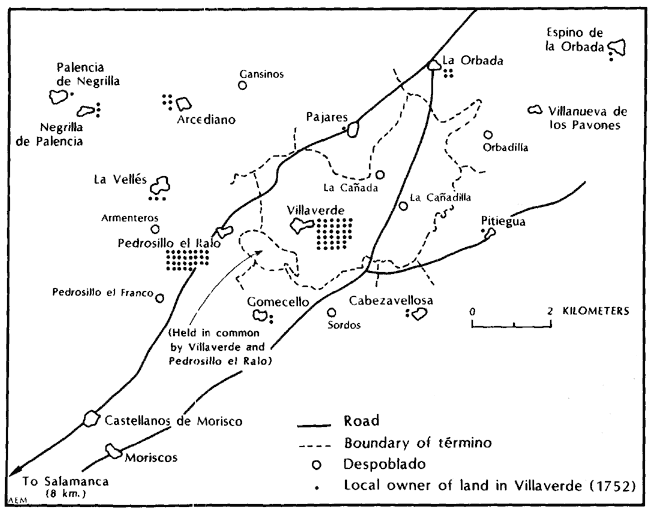
Map 8.1.
Villaverde and Its Environs
NOTE : In the nineteenth century despoblados were incorporated in adjoining
towns. La Cañada and La Cañadilla went to Villaverde. I am indebted to
Angel Cabo Alonso of the University of Salamanca for identification of
the eighteenth-century roads that served Villaverde.
different. Is this pure coincidence, or is it possible that the accepted rates were established some time in the past to produce similar rents but had since been altered by economic forces to the benefit of the farmers of La Mata and the disadvantage of those of Villaverde? Let us keep in mind the possibility of such a development.
At 31 percent of the predicted harvest, the rent paid by the vecinos for the grain fields of the town church and endowments it controlled would be 113 EFW, and for fields belonging to nearby churches, 48 EFW.
An important share of the town land belonged to vecinos of nearby towns, more in fact than to vecinos of Villaverde itself (Table 8.6). As Map 8.1 shows, most of the nearby owners lived in the larger town of Pedrosillo el Ralo, four kilometers to the west. The question arises whether Villaverde was exploited by nearby vecinos or there was a pattern in this area of ownership across town boundaries. Without a full study of the catastros of towns within walking distance, no firm answer
is possible, but a review of the catastros of the three nearest towns reveals that in them the vecinos of Villaverde owned less than half the property that their vecinos owned in Villaverde.18 I shall therefore estimate that Villaverde's vecinos owned about half as much outside its término as nearby vecinos did in it.
In assigning the income from these lands, one must know who farmed them as well as who owned them. Even though vecinos of Villaverde owned less land outside the town than nearby vecinos did in it, the tithe records indicate that they harvested about four times as much outside as others did in their town (Table 8.5). Obviously even locally owned fields were not always farmed by their owners, and the vecinos of Villaverde had to pay rent to nearby owners as well as to more distant landlords. The lands of nearby vecinos would produce an estimated harvest of 396 EFW, with a potential rent of 123 EFW, at 31 percent of the harvest. From the tithes we know that nearby vecinos harvested about 140 EFW in Villaverde (twenty times the tithes they paid to the parish of Villaverde, Table 8.5), which is 35 percent of the total crop in the fields belonging to them. Villaverde vecinos must have farmed the rest, paying some 80 EFW in rent.
If vecinos of Villaverde owned half as much land outside the town as nearby vecinos in their término, the harvests on these lands would have been about 198 EFW. But the tithe records indicate that Villaverde vecinos actually brought in 556 EFW from outside (twenty times what they paid the parish of Villaverde on outside harvests, Table 8.5). They therefore rented lands outside the término that produced 358 EFW. At the ratio for seed and rent found in Villaverde, their net harvest from outside, after deduction for seed, would be 450 EFW and the rent for these lands would be 111 EFW.
From the tithe records, we have also estimated that the farmers of Villaverde harvested 630 EFW in the despoblados of La Cañada and La Cañadilla. Their net crop after seed would have been about 510 EFW, and their rent, 195. One must remember that on all harvests grown outside the término, half the tithes remained in the town where they were grown.
Besides the tithes, the farmers paid also the first fruits and Voto de
Santiago, following the same rules as in La Mata. The first fruits averaged over the previous five years at 66 EFW and the Voto at 23 EFW.19
Raising animals was an integral part of local agriculture. The catastro lists oxen and cows, horses and pigs. Among the tithes paid were thirty chickens per year, which meant that at least three hundred were born.20 The catastro does not mention sheep, but there was a shepherd, seventy years old, helped by his sixteen-year-old son.21 The tithe book occasionally lists the receipt of wool, 90 pounds in 1777, 51 pounds in 1779, 81 in 1781. This represents a shearing of about 750 pounds per year, so that there would have been some 500 sheep, and they were probably there already in 1752.22
Following the method described in Appendix K, one can draw up Table 8.9 for the income from raising livestock in Villaverde. It shows a gross income from livestock of 758 EFW. From this one must deduct the cost of pastures. Most of the animals were pastured in the despoblados of La Cañada and La Cañadilla,23 where there were 186 fanegas of pasture valued by the catastro at 920 reales per year. If this was indeed the amount of the rent, the vecinos paid 66 EFW to feed their animals outside the town.24
Breeding livestock was such a central activity of the town that twenty vecinos reported income as dealers in livestock (tratantes y cambistas de ganado ) ranging from 150 to 1,200 reales per year.25 They included fifteen labradores (who earned 8,800 reales), four craftsmen (2,550 reales), and one man classed only as a tratante (but who declared only 150 reales income from this occupation). The total income from these activities was 11,500 reales per year, 820 EFW. Seven dealt only in mules and four in cattle and mules, while three dealt in pigs, cattle, and mules. Since the town did not produce many mules, the tratantes were dealing to considerable extent in animals raised elsewhere. And since the town was self-sufficient in animals, the dealers sold as well as bought outside. The total local production of oxen, horses (including mules), and pigs was
|
||||||||||||||||||||||||||||||||||||||||||||||||||||||||||||||||||||||||
worth 420 EFW. Half of this may have been sold outside by the tratantes (and the rest consumed or used locally) and should not be counted again as town income, so that dealing in livestock brought in a net return to the town of some 610 EFW.
We now have the information needed to calculate the net income from agriculture of the vecinos of Villaverde (Table 8.10). It produces a total of 3,077 EFW.
2
To see how this income was divided among the inhabitants, the best source is the book of tithe rolls, which begins in 1773, twenty-one years after the catastro was completed. The book identifies the tithers as either labradores or senareros, those for whom farming was the main occupation and those who used it to supplement other income. Thirty-two labradores were listed in each of the first two years (thirty-one of them the same individuals), and fifteen senareros (but only eight individuals
|
||||||||||||||||||||||||||||||||||||||||||||||||||||||||||||||||||||||||||
|
||||||||||||||||||||||||||||||
appeared both years). (We recall that because of the two-year farming cycle, one must average each farmer's share of the harvest over a two year period to determine his economic position.) As before, the harvests of the casa excusada and cuarto dezmero are not listed.26 The fourth tither's harvest can be interpolated between those of the third and fifth, and I project that of the first above that of the second with a difference slightly larger than between those of the second and third tithers. These are only rough approximations, for the evidence from La Mata indicates that once named to one of these positions, a person was usually kept there, although his harvests might no longer entitle him to it.27
On this basis Table 8.11 calculates the distribution of harvests of the first two years of the tithe rolls. To project this pattern back to the time of the catastro, one must adjust for the fewer number of men in agriculture at that time. The catastro lists twenty-eight labradores, four less than in 1773–74. It does not say how many senareros there were, but eighteen is a good guess, four fewer than in 1773–74. Table 8.12 readjusts the individual shares of the harvest in Table 8.11 to these lower
|
|||||||||||||||||||||||||||||||||||||||||||||||||||||||||||||||||||||||||||||||||||||||||||||||||||||||||||||||||||||||||||||||||||||||||||||||||||
numbers and then applies the information on income from agriculture to estimate the individual incomes in 1752.
As was done for La Mata (see Table 7.10), one can check the distribution of the individual harvests in Table 8.12 by a distribution based on the number of oxen owned by each labrador, as recorded in the catastro (Table 8.13). The check proves to be rough because the range in number of oxen is not great, but there is consistency between the two calculations. The labradores owned seventy-seven oxen and one draft horse (which may have been hitched with a mule). According to the rule
|
||||||||||||||||||||||||||||||||||||||||||||||||||||||||||||||||||||||||
that one yoke of oxen could plow 22.5 fanegas per year, forty yokes sufficed for 1,800 fanegas of land in a two-year cycle. Villaverde's catastro recorded 1,650 fanegas of arable, but the oxen were also used outside the town.
One can also check the table by the tithes of the fourth tither. These indicate a gross harvest of 252 EFW, which means a net income from harvest of 105 EFW (see Table 8.10). This is below the 130 EFW predicted in Table 8.12 and, if correct, would mean larger harvests for the first three tithers than predicted in the table. We recall that the tithes of the fourth tither of La Mata were also less than predicted (Appendix I). Perhaps fourth tithers fudged on their tithes because the cathedral of Salamanca, to which these tithes went, could not keep a strict control throughout the many towns of the partido or perhaps, as suggested, the "fourth tither" had fallen from fourth place but had not been replaced. In any case, his tithes do not seem adequate evidence to discredit Table 8.12.
In addition, most of the income from raising livestock went to the labradores, who owned the largest number of each kind of animal ex-
cept donkeys; and fifteen of the labradores also dealt in livestock as tratantes. Table 8.12 indicates the estimated income from these activities for the individual labradores.
Out of their gross income, the wealthier labradores had to pay the cost of hired labor. Thirteen labradores had more than one yoke of oxen, ranging from one and a half to three. There were ten jornaleros in the town, to each of whom the catastro assigned wages of two reales per day for 180 days per year, or 26 EFW.28 One can divide the total wages of the ten jornaleros among the top labradores according to the number of extra yokes of oxen they owned. The approximate results are given in Table 8.12, together with the net income of the labradores from all sources after deducting the cost of labor, and the net income of the senareros from agriculture.
The range of the net income of the labradores is great. The casa excusada, with 315 EFW per year, received ten times the amount of the most modest labradores. How well-off they were depended on the size of their households. The fifteen labradores who were also tratantes had larger households than the others; they averaged 5.2 people as opposed to 3.4. Ten of the fifteen labradores-tratantes had a male servant in the household eighteen years or more of age, and four of them had servant girls. The other labradores had only two male servants and one female servant among them. Neither group had many children, and the two largest households had only 7 members including servants. If, as established earlier, an adequate household income consisted of 12 EFW per person, the average requirements of the labradores-tratantes was 62 EFW and of the others 41. All the labradores-tratantes had more than required, and the first six, with net incomes of 165 EFW or more, could be considered wealthy. At the other extreme, however, at least five of the bottom six families, who had incomes estimated at 31 EFW and 3 or more members (one family consisted of a childless couple), were below the line of comfort.
A comparison with the income of the labradores of La Mata is revealing (see Table 7.11). All these had an income of at least 75 EFW, whereas 40 percent of those of Villaverde were below this level. At the other extreme, 40 percent of the labradores of La Mata can be considered wealthy (over 100 EFW annual surplus above the 12 EFW per person require-
ment), but only 20 percent of the labradores of Villaverde. While the wealthiest labradores in Villaverde were as well-off as their counterparts in La Mata, as a group the labradores of Villaverde did not have the economic strength of those in the nearby town. The most obvious reasons for the difference that have come to light are that the land in Villaverde was less fertile and the proportion of the harvest taken as rent was higher. Although there may have been errors in drawing up the catastros of the two towns, it is hardly likely that all the differences are merely the fault of bad data. In both cases, the rate of rent is based on actual contracts. One can assert with confidence that the labradores of Villaverde were poorer than those of La Mata.
The other people in agriculture skirted the threshold of poverty. These were mostly older villagers, some possibly retired from more active occupations, with smaller families and fewer needs. The shepherd was seventy and had a daughter and a sixteen-year-old son. The four guardas de campo averaged forty-seven years of age, the ten jornaleros forty-two. The youngest were three jornaleros of thirty-two. Most of the jornaleros probably leased a few plots and were senareros as well and had incomes of 6 to 11 EFW from this activity plus their animals (Table 8.12). Almost all these people had families of three; even so, as Table 8.14 shows, they barely eked out an adequate income, and the elderly widowed shepherd did not.
3
La Mata owed much of its well-being to its flourishing sector of muleteers (arrieros). In Villaverde the sector devoted to haulage was much less important. Nine vecinos were arrieros, and so were two adult sons of widows. The individual income of these men depended on the number of animals each had. As in La Mata, the catastro calculated income at two reales per day for each mule and one for each donkey, but whereas the arrieros of La Mata were reported to work 200 days per year, those of Villaverde were credited with only 150 working days.29 Evidence of lack of reliability in the rough estimates of income in the catastro? Perhaps, but more likely a reflection of a real difference in the two towns. The arrieros of each town, we are told, usually went out as a group and had their established routes. Those of La Mata went to Burgos and Bilbao, carrying the wheat of La Armuña and bringing back fish
|
||||||||||||||||||||||||||||||||||||||||||||||||||||||||||||||||||||||||
|
||||||||||||||||||||||||||||||||
and other products.30 Those of Villaverde went to Salamanca and Zamora,31 or south across the sierra to Plasencia and from there east to Madrid and other points in Castile.32 They had virtually no return freight.33 The makers of the catastro evidently knew what they were doing in showing less income for arrieros in Villaverde.
In La Mata, we estimated an annual net income from mules of 25 EFW and from donkeys of 12.5, after taking account of the cost of feeding and income from breeding. In Villaverde, if gross income per animal was 75 percent of that in La Mata, the proportion of net income was lower, because the cost of feeding an animal would be more than 75 percent of that for La Mata. The relevant calculations indicate 18.6 and 9.3 EFW as reasonable estimates of annual income from each mule and donkey. These produce Table 8.15, giving the net income of the arrieros from haulage. It is unlikely that many arrieros were also senareros. Juan Mellado, a senarero in 1773, the first year of the tithe rolls, was probably the same person as the richest arriero in 1752, for this was the only person with this surname in the catastro. My estimate of eighteen senareros allows for ten jornaleros and eight artisans, but no arrieros, however, so I shall attribute them no income from this source.
In any case, the available evidence indicates that arrieros' income was marginal. The average family size was 4.5 for complete households, 2.5
for those of widows. Unless they had substantial income that I have not been able to trace, all but the top four arrieros were below the 12 EFW line. There were none who could live comfortably and have money to save, as the top third of La Mata's arrieros did. Their total gross income from haulage was about 720 EFW;34 and if, as in La Mata, 75 percent of this represented income from outside the town (a generous assumption since there was a larger harvest in Villaverde and fewer arrieros to take it to market), their contribution to the net income of the community was 540 EFW, about 50 per capita, compared with 75 per capita by the arrieros of La Mata.
Artisans were a more important group in Villaverde, over a quarter of the vecinos. Their income, however, was not impressive. The catastro lists their earnings from their crafts and from other sources: dealing in livestock (as tratantes) or acting as town drummers (tamborileros ) to provide music for local festivals. Four of their names appear as senareros in the tithe rolls of 1773–74. They were probably the same persons, for in 1752 their ages were between twenty-six and forty-two. No doubt these four and other craftsmen farmed on the side in 1752. All these sources of income are included in Table 8.16.
The incomes of the artisans were low, about the same level as those of the arrieros and the bottom half of the labradores. It is true that the catastro's figures are only rough estimates, reported as a daily income and a specified number of days worked per year, but they were an attempt to represent reality and so are very unlikely to have indicated poverty where there was comfort. The blacksmith was "igualado" (that is, he was paid a fixed salary, or iguala, by the town) and had the largest income in the town from dealing in livestock, placing him economically with the first quarter of the labradores. Otherwise, the artisans lived a marginal existence.
The artisans could compensate for their income by having small households, and this they did. The blacksmith, who could afford it, had the only large family, with 2 sons and 5 daughters. Without him, the craftsmen averaged 3.7 persons per household. None but the blacksmith earned enough to think of saving, and the known income of several placed them below the 12 EFW line. Yet they were a large group, obviously producing for a market outside the town itself, although not for an urban market. (The tailors "make clothes for the use of the labrador.")35 If two-thirds of their income as craftsmen came from outside
|
||||||||||||||||||||||||||||||||||||||||||||||||||||||||||||||||||||||||||||||||||||||||||||||||||||||||||||||||||||||||||||||||||||||||||||||||||||||||||||||||||||||||||||||||||||||||||||||||||||||||
|
||||||||||||||||||||||
the town for goods sold or labor done elsewhere, they brought in about 720 EFW to the economy of the community.
Finally, Villaverde had a small service sector. The net income of the butcher (oficial de carnes mayores ), after paying the town 18 reales rent per year for his shop, was a bare 25 EFW, but he must have eaten meat and offal without cost. He lived alone with a daughter. The farrier made "between one activity and another" about 43 EFW. He was thirty-eight, and his wife was the only other member of his household. In contrast, the surgeon-barber received an annual income (iguala) from the vecinos of eighty fanegas of wheat. Only twenty-four, he supported a wife and a brother-in-law. Someone in the town earned additional income as sacristan, 331 reales from first fruits and 150 reales for ringing the church bell. He thus added 34 EFW to his income, but we do not know who he was.36 The service sector did not bring in income from outside the town.
In economic terms, the priest also belonged to this sector, but don Francisco Repila's income set him apart from the others. It came entirely from his benefice, for his only possession was a donkey (Table 8.17). Don Francisco's household consisted of his mother, a sister, and a maid. His income of 210 EFW was below that of the top labradores. Nevertheless, the considerable material rewards of his office, of which the catastro does not tell the full story for it includes nothing for services
|
|||||||||||||||||||||||||||||||||||||||||||||||||||||||||||||||||||||||||||||||||||||||||||||||||||||||||||||||||||||||||||||||||||||||||||||||||||||||||||||||||||||
|
|||||||||||||||||||||||||||||||||||||||||||||||||||||||||||||||||||||||||||||||||||||||||||||||||||||||||||||||||||||||||||
conducted for private individuals, combined with his sacramental role to endow him with unique local prestige, similar to that of his colleague, don Juan Matute, in La Mata.
To conclude our survey of the income of the different households of Villaverde, Table 8.18 and Figure 8.3 plot their relative position in a socioeconomic pyramid. In studying it, one must always keep in mind that it is created out of the income distribution that can be identified in the catastro and tithe records and that in any small rural community, much real income would have changed hands without being covered by any formal acknowledgment or occupational label that an official survey could categorize.
4
Because of all these hidden internal transfers of income, a final assessment of the well-being of Villaverde needs, besides the income of the
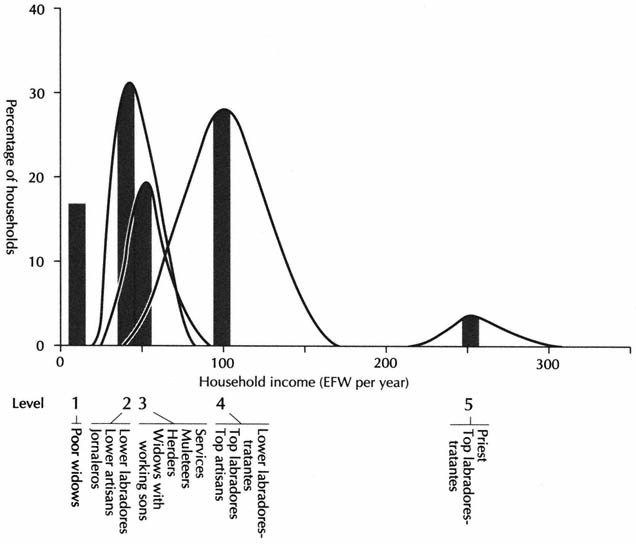
Figure 8.3.
Villaverde, Socioeconomic Pyramid, 1752
NOTE : This is a bar graph based on Table 8.18, with an indication
of dispersion. It is not a set of frequency distributions.
various sectors and individuals, an estimate of the condition of the economy as a whole. The sources of income have been seen, but of the payments made to the outside world only the rents have been established. Most of the others were religious in nature, and of these the most substantial came out of the tithes (Table 8.3). Two-ninths of the partible tithes, the tercias reales, went to the University of Salamanca. Three-ninths went to the owner of the prestamo of the town, the Colegio de San Gregorio of Valladolid, but the colegio was required to give one-twentieth of this payment to the cathedral of Salamanca. These two shares of the partible were 104 and 156 EFW. (Of the remaining four-ninths, three went to the parish benefice and one to the fabric.) The tithes of the fourth tither (cuarto dezmero) went to the cathedral of Salamanca, and the outside owners of lands free from tithes took the horros on the lands. The minor tithes (diezmos menudos ) on animals and wool were divided in the same way as the partible; of a total of 8 EFW, 4 left the town. The first fruits, 66 EFW, were all taken away, two-thirds to the holder of the "beneficio simple servidero," the second priest of the parish, who had chosen not to reside in the town, and one-third to the aforementioned Colegio de San Gregorio. The Voto de Santiago, 23 EFW, went to the cathedral of Santiago de Compostela.37 Finally, as in the case of La Mata, one can estimate that about one-quarter of the income of the parish church was spent outside the town. Taking into account its share of the tithes, the horros, and the rent on the plots that belonged to the church and the endowments attached to it, the amount leaving would be 26 EFW.
The final deductions are obligations that the town council met for the vecinos as a whole. It paid a hospital in Salamanca 2.5 fanegas of wheat and 1 fanega of garbanzos (5 EFW), presumably for the right to send its sick to the hospital, and 206 reales (15 EFW) variously to a preacher for Lent, the insane asylum of Valladolid, and the bula de la cruzada. The administrators (sexmeros) of the partido of Salamanca received 380 reales (27 EFW).38 (La Mata must also have paid them its dues, but its catastro overlooks the item.) The town council also paid royal taxes, established as an annual fixed sum through encabezamiento (Table 8.19). These taxes were almost nine times as high as those reported by La Mata, which in fact did not mention alcabalas y cientos (a sales tax originating in the Middle Ages). As with its high rents, Villaverde appears to have been burdened with charges that dated from an earlier, more prosperous time.
|
||||||||||||||||
The information is now at hand to establish the best estimate of the net annual income of the town, and it is 4,919 EFW (Table 8.20).
The family lists of the catastro, which appear reasonably complete for Villaverde, give a total population of 35739 and a per capita income of 13.8 EFW. Although this is above the 12 EFW line, it is only about 70 percent of La Mata's per capita income. Most families lived frugally, while the poorer labradores, the jornaleros, and most artisans (Level 2 in the socioeconomic pyramid) were on the borderline of an adequate income. Only three labradores-tratantes and the priest (Level 5) were wealthy, while the remaining twelve labradores-tratantes and the blacksmith (Levels 4A, 4B) were well-off. A poorer economy than La Mata's, Villaverde's was also less egalitarian, for the wealthy labradores stood out above the body of the community. These men almost had to save or use their surplus to perform pious works. As husbandmen, they would be eager to buy land if it came on the market.
5
Such an economy did not offer encouragement for demographic expansion. The majority of the families were small; only the upper labradores, the muleteers, and the linen weavers averaged more than four in a household. Yet the population was not particularly old, as the age structure in 1752 reveals when compared to that of La Mata (Table 8.21 and Figure 8.4). Nevertheless, even though the population of La Mata was expanding rapidly, the available census information indicates that that
|
||||||||||||||||||||||||||||||||||||||||||||||||||||||||||||||||||||||||
|
|||||||||||||||||||||||||||||||||||||||||||||||||||||||||||||||||||||||||||||||||||||||||||


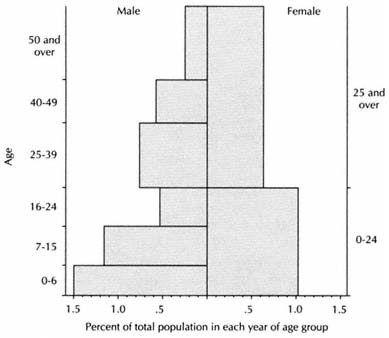
Figure 8.4.
Villaverde, Population Structure, 1752
NOTE : Since there is no limit to the top age groups, a span of
seventeen years for males is used for convenience only.
|
|||||||||||||||||||||||||||||||||||||||||||||||||||||||||||||||||||||||||||||||||||||||||||||||||||||||||||||||||||||||||||||||||||||||||||||||||||||||||
of Villaverde was almost stagnant (Table 8.22). These counts indicate that Villaverde was slightly more populated in the sixteenth century (its impressive church looks as though it were built about 1600), declined slightly in the seventeenth century (the vecinos of 1712 are probably underreported), and recovered little in the eighteenth century. The catastro and census of 1786 are the most reliable counts and give full population. Over this thirty-four-year period, while La Mata grew 39 percent, Villaverde declined 3 percent. But demographic stability was not new to Villaverde in the second half of the eighteenth century.
One of the methods employed to keep the population down was late age at marriage. In La Mata 46 percent of the women and 44 percent of the men aged sixteen to twenty-four were married in 1786, in Villaverde only 10 and 12.5 percent respectively (Figure 8.5).40 Six laymen over twenty-five were bachelors, 7 percent; in La Mata 3 percent. While Villaverde's population was slightly younger in 1786 than in 1752, it was
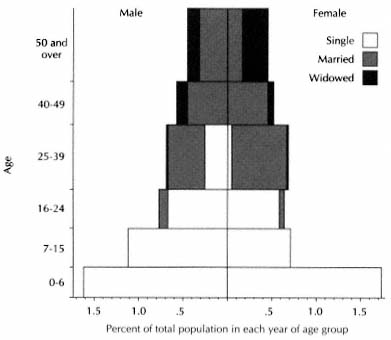
Figure 8.5.
Villaverde, Population Structure, 1786
NOTE : Since there is no limit to the top age group, a span
of seventeen years is used for convenience only.
now old by comparison with La Mata's (see Table 7.17). Twenty-seven percent were forty and over, in La Mata 18 percent. New people arrived in Villaverde as in La Mata, but not so many. Of forty-one regular tithers in 1798, ten had last names not present in 1752; in La Mata one-third were new. These features reveal why Villaverde was demographically stationary while its prosperous neighbor multiplied.
Villaverde also followed the practice of sending young girls away to serve—there were only twenty-two girls present in 1786 in the 7–15 age group compared to thirty-five boys. In La Mata they returned at about the age of sixteen and married soon, but in Villaverde they came back older—there were twenty females and twenty-four males in the 16–24 age group. There is a strong indication, moreover, that young men were also absent in the 16–24 age group both in 1752 and 1786 (see the age pyramids, Figures 8.4 and 8.5). It will become evident later that many unmarried young men served in the despoblados and alquerías of Salamanca, and very likely this is where some of those of Villaverde went to
|
||||||||||||||||||||||||||||||||||||||||||||
work.41 The small size of households was the result not only of births averted but of an absence of part of the families.
The vecinos were also seeking other ways to improve their lot. One way was to move into more rewarding forms of work. The list of occupations in the census of 1786, although not so detailed as the catastro, gives evidence of this change (Table 8.23). Along with the jornaleros, the artisans had made up the poorest sector in 1752, and the next generation responded by leaving the trades. In La Mata artisans were also poor, and they disappeared by 1786. The depressed state of the crafts was apparently a general phenomenon in central Spain in the eighteenth century. Pierre Vilar has concluded from a study of the provincial returns of the catastro that throughout the Castilian meseta the crafts were in the last stages of a long decline.42 The very increase in transportation that benefited the muleteers of La Armuña destroyed the monopoly of its artisans over local markets and hastened their disappearance.
Muleteering had absorbed much of the decline in craftsmen in Villaverde. There were five more arrieros in 1786 than in 1752. Their mean income had been slightly higher than that of artisans in midcentury, and it was a calling whose income did not decline in the next decades. Farming too was drawing more people. The census lists five more labradores, and the tithe records give independent confirmation that their number
|
||||||||||||||||||||||||||||||||||||||||||||||||||||||||||||||||||||||||||||||||||||||||||||||||||||||
was increasing. By the mid-1790s there were sixteen more labradores than at the time of the catastro, an increase of 32 percent.43 By giving up crafts in favor of muleteering and husbandry, the community was specializing in areas of local comparative advantage.
In La Mata the increase in the number of farmers led to the sowing of more labor-intensive crops of the pulse family. In Villaverde, too, the vecinos experimented with various crops (Table 8.24). Between the catastro and the five-year period 1778–82, they reduced the amount of algarrobas, a fodder, and planted more wheat, with a resulting 17-
percent growth in the value of the harvest (at 1752 prices). In the next five years they tried a much larger garbanzo crop (in 1785 it was 28 percent of the harvest), the same years when La Mata increased its output of garbanzos. The total yield within the término was disappointing, only 11 percent above 1752 figures, and they abandoned the experiment. Between 1788 and 1797, they emphasized wheat again and planted pulses in more modest quantities. This proved to be the most profitable mixture, for the value of harvests was higher than ever.
Nevertheless the value of harvests grown within the town limits increased less rapidly than the number of labradores, but the tithe records indicate that the vecinos had another card up their sleeves. At the time of the catastro, the estimate of the vecinos' crops from neighboring towns was 556 EFW and from the despoblados of La Cañada and La Cañadilla 630 EFW, for a total of 1,186 EFW (Table 8.10). The tithe returns show that the outside harvests increased as follows (in EFW value and indexed against 1747–51):
|
By the end of the century, Villaverde farmers were harvesting over three times as much in neighboring towns and despoblados as at midcentury.
Most of the increase came from La Cañada and La Cañadilla. In two separate periods, 1776–80 and 1805–7, the cillero of Villaverde kept a detailed record of the tithes paid to outside towns for crops harvested in them instead of giving only a total figure for these payments. In the three intervening decades, the crops harvested by Villaverde farmers in nearby towns rose from about 625 EFW to about 900 EFW, but at the same time the harvests in La Cañada and La Cañadilla went from about 865 to about 3,900 EFW (Table 8.25). The Marquesa de Castelar, who lived in Madrid, owned 80 percent of the 974 fanegas of La Cañada, while the Encomienda of San Juan de Barbalos of Salamanca owned about 75 percent of the 367 fanegas of La Cañadilla.44 Absentees, they would be glad to have the land of the despoblados broken to bring in more rent.
|
||||||||||||||||||||||||||||||||||||
If one considers the net income from harvests rather than the gross harvests, the growth in the two despoblados is even more impressive. The tithe book occasionally mentions the rent paid by the vecinos. In 1789 the rent for La Cañada was 520 fanegas of wheat and 180 of barley (total 610 EFW). In 1803 it was raised to 640 fanegas of wheat but was lowered to 600 after the bad harvests of 1803–4. For La Cañadilla the rent was 180 fanegas of wheat in 1801.45 Subtracting rent, tithes, and seed (19 percent of gross harvest), the net return from harvests of the Villaverde farmers in the two despoblados was 1,990 EFW in 1805–7. The estimate for 1752 was 252 EFW;46 it was now eight times as much.
The harvests of 1805–7 were unusually good and do not provide a representative picture of the situation at the turn of the century, for in good years the tenants profited more. Nevertheless, the farmers of Villaverde obtained a major increase in their harvests by exploiting the two despoblados. They were breaking ground where previously there had been pastures. The development was similar to that of La Mata and its anexo Narros, but with an important difference. The labradores of La
Mata extended their farming into the despoblado of Narros until, in 1789, twelve vecinos moved to Narros and formed the core of a new town. Thereafter La Mata lost this resource. The farmers of Villaverde also turned to despoblados anexos for new land, but they did not move out of their town, so that the new fields added to the local income. These are two specific examples of how new land was assarted in Spain in the second half of the eighteenth century and how the economic condition of the local population changed as a result.
The evolution of the farmers' income can be followed by considering their total harvests inside and outside the town limits (Table 8.26). The harvests grown within the término by nearby vecinos almost disap-
|
||||||||||||||||||||||||||||||||||||||||||||||||||||||||||||||||||||||||||||||||||||||||||||||||
peared by the 1790s. The residents of neighboring towns who owned plots in Villaverde must have given up farming most of them and rented them to vecinos of Villaverde. With this additional harvest and those they brought in from outside, the farmers of Villaverde had between 50- and 60-percent larger harvests than at the time of the catastro. Meanwhile the number of labradores increased by a third, from twenty-eight in 1752 to thirty-seven in the mid-1790s.47 Since the relation between the gross income and the net income from harvest probably changed little, the labradores had managed to raise their per capita income, not because of their experiments with different rotations but because of the new leases they had obtained within the término and outside it.
At the same time, the tithe rolls show that the disparity in income among labradores had declined since midcentury. In 1773–74 the first three of thirty labradores gathered 23.9 percent of the harvest. In 1798–99, the first four of forty-two gathered only 17.6 percent of the harvest.48 A comparison of the net income from harvest of the top half of the labradores in 1752 (estimated from the harvest distribution of 1773–74) and 1795 gives the results in Table 8.27. The income curve had flattened out. The top labradores had noticeably less income than in 1752, but the income of those in the middle had risen. There are no figures for the end of the century on income from livestock, dealing in cattle, or cost of labor. In 1752 the total income of the first tither was 25 percent above his net income from harvest. This proportion increased as one went down the rank order until in the middle range it was 50 percent, because the share of work done by hired labor was progressively less. (Below these ranks, the labradores did not deal in livestock, and the proportion fell again, Table 8.12.) If this pattern still held true at the end of the century, then the income curve for the top half of the labradores was even flatter than Table 8.27 indicates.
The overall effect of the changes in occupational structure and farming activity can be observed by summing up the individual changes in the town income (Table 8.28). The net town income had risen about 30 percent. In 1786 the population was 346; in 1826 it would be reported as 394 (Table 8.22). One can interpolate for 1795 a population of 357, the same as in 1752, so that per capita income also rose 30 percent, from 13.8 to 17.9 EFW. These figures are only approximations, of course, for there are many unknowns. Income from livestock breeding and trading and the rate of rents inside Villaverde have been held con-
|
||||||||||||||||||||||||||||||||||||||||||||||||||
stant for lack of information. Additional information would undoubtedly change the estimate of per capita income at the end of the century, but not necessarily down, and if down, not enough to wipe out known gains.
Although part of La Armuña, Villaverde had had a relatively depressed economy at midcentury. Now it was flourishing. The vecinos had used with success the various means at their disposal to improve their economic position: sending their sons and daughters away to work, marrying late, moving into more profitable occupations, experimenting with different mixtures of crops, taking over leases of arable plots from outsiders, and above all breaking new ground in the neighboring despoblados. It was their good fortune to live next to vacant places with fertile land that needed only cultivation to make it produce, and to obtain their use for a modest rent. Those who benefited were the middle and lower-level farmers, for the most prosperous labradores lost some in the changes. About twenty labradores, perhaps an artisan and an arriero or two, and the priest would find it natural to put some of their income into savings, but there would be few strong fortunes when disentail began.
|
||||||||||||||||||||||||||||||||||||||||||||||||||||||||||||||||||||||||||||
6
The first sales in Villaverde were concluded in September 1799,49 and the last of which I have a record took place in May 1806.50 Within this period 221 of the 1,354 arable plots were sold and 9 out of 101 meadows: 19 percent of the land according to its value. Two houses were also sold.51 Between the making of the catastro and the disentail the proper-
ties of four laymen (31 plots, 1 meadow, and 1 house) had been transferred to religious endowments and were among those disentailed.52 In two cases these properties were purchased by vecinos of the same town as the 1752 owner, so that there was no net change of type of owner.
The situation after the disentail in 1808 is compared to that of 1752 in Table 8.29 and Figures 8.2 and 8.6. The change in ownership of land was not so extensive as in La Mata, where 42 percent of all land changed hands. The main cause of the difference was that ecclesiastical endowments owned less land in Villaverde, for they also lost massively here, 38 percent of their land being sold. The parish church and its funds were most affected, losing 53 percent of their property. In absolute terms, however, the religious institutions of Salamanca suffered most: their share of the town property fell from 33 to 22 percent.
A more significant difference between the two towns was in the buyers. La Mata's vecinos bought 55 percent of the property sold, Villaverde's only 16 percent. Vecinos of towns near La Mata bought 8.5 percent, vecinos of towns near Villaverde only 2.3. Nearby vecinos had made two bequests of land in Villaverde to religious foundations since 1752, and this land was now bought by residents of Salamanca, with the result that the share belonging to nearby vecinos declined by a fifth. Disentail did help the vecinos of Villaverde redress their position vis-à-vis their neighbors, extending to ownership a process that had been going on in rentals for several decades. In the sales Villaverde farmers acquired twenty-two plots and a meadow outside the término, while nearby vecinos bought only seven plots in Villaverde. The gain was modest, and on the whole the disentail hurt the town economy slightly. By contrast in La Mata the value of land in local hands almost doubled.
The massive buyers in Villaverde were residents of Salamanca, who
|
||||||||||||||||||||||||||||||||||||||||||||||||||||||||||||||||||||||||||||||||||||||||||||||||||||||||||||||||||||||||||||||||||||||||||||||||||||||||||
bought 64 percent of the property sold and raised their share of the village's land from 25 to 37 percent. Residents of other distant places also increased their share. Among these individuals was don Francisco Alonso y Moral of Salamanca, one of the largest buyers in the province. He made five purchases totaling sixty-three plots and four meadows, 4.7 percent of the property in the town, as well as a house. Don Lorenzo Piñuela, a priest and prebendary of the Salamanca cathedral, in two purchases acquired forty-two plots, while don Cosme de Trespalacios, an advocate of Madrid, bought thirty-six plots and a meadow. Together these three gentlemen acquired two-thirds of the land sold in the town. We shall meet them again in Chapter 20, when we consider the persons who obtained most from the disentail.
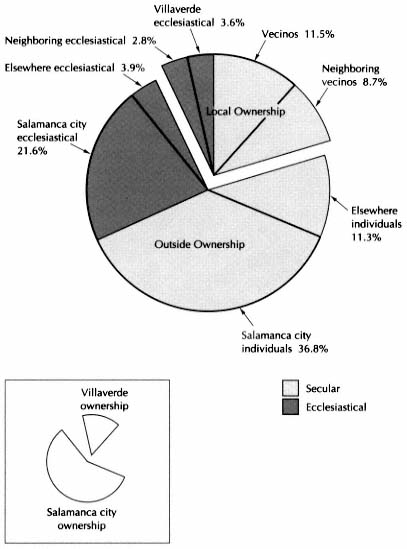
Thirty-two people bought land in Villaverde. Table 8.30 gives their identity and the percent of the land in the town that each bought. The list shows a clear pattern. Residents of Salamanca and Madrid dominate the top quarter; they are seven of the top eight buyers. Vecinos of Villaverde make up most of the next quarter. Those in the bottom half of the
|
||||||||||||||||||||||||||||||||||||||||||||||||||||||||||||||||||||||||
|
||||||||||||||||||||||||||||||||||||||||||||||||||||||||||||||||||||||||||||||||
list, people who mostly bought only one or two plots, had scattered residences, two certainly and two probably in Salamanca, one in Valladolid, and eight in nearby towns.
Chance did not dictate this pattern. On the whole, lands were purchased by residents of the place in which the religious institution that owned them was located. Twenty-seven of the 28 plots and all 3 meadows that the vecinos of Villaverde bought belonged to the funds of their church. Residents of Salamanca bought most of the holdings of Salamanca institutions, all but 34 of their 148 plots (29 of the other 34 went to Trespalacios, a vecino of Madrid who soon was to move to Salamanca). Vecinos of Villaverde would have found it difficult to bid for most of these properties, for they formed parts of endowments that consisted of plots scattered over various towns and, sold in blocks, were beyond the means of any local farmer. One may recall, however, that two buyers of La Mata were able in at least one case to bid on and buy those plots that lay within their town and neighboring Narros of a large endowment that spanned other towns. Vecinos of Villaverde did not achieve any such success. And when the large property of a confraternity of Villaverde, 25 plots and 2 meadows, went on sale, Alonso y Moral stepped in to acquire it.53 He had to pay more than the assessed value in hard currency to get it, seventeen thousand reales, which he would not have done unless forced to by competing bidders. One suspects that the vecinos made a concerted effort to get these lands but failed before his wealth. In comparable circumstances, the vecinos of La Mata obtained the vast property in their término of the General Hospital of Salamanca.
Nine vecinos bought land in the town, two of them and five others bought land outside. Among these fourteen were four women. What can we tell about them? Our main source of information is the tithe book; except for two of the women, all their names appear in it at sometime or other. They were seven labradores, two labradoras, two senareros, and a priest. That is, nine of the fourteen were already full-time farmers.
The largest purchaser was the priest, don Alonso González. The parish supported two clergymen, the curate and the beneficio simple servidero, holder of a capellanía without specific duties. The census of 1786 identifies don Alonso as the latter person. In 1752 the holder of this capellanía had not been resident, but don Alonso's name appears on the tithe register as a senarero from 1774 to 1797. He bought one plot in
1800 for 7,700 reales, which had belonged to the benefice he held;54 the same year he headed a group of six buyers who purchased two plots in Villaverde and ten plots, one meadow, and two vineyards in nearby towns.55 These properties had formed the endowment of another capellanía of Villaverde, which don Alonso may also have held. The purchase seems to have been a family affair: besides don Alonso there were three other Gonzálezes, Antonio and Manuel, labradores of Villaverde, and Josepha. The two other buyers were María and Isabel Albarez, sisters perhaps, the last a vecina of Negrilla. They paid 30,620 reales, a respectable sum. We do not know the source of this capital or how much each person's share was. Don Alonso had the income of his benefice; Antonio and Manuel were small labradores. Antonio disappeared after 1802, and Manuel died after the harvest of 1804. The priest was evidently the driving force of the group. He was no longer farming, probably because of his age, and so he rented his newly purchased fields.
Several of the other labradores who bought lands were among the upper third of the farmers, and it is easy to explain their resources. Manuel Romo Borrego, who spent about 3,900 reales for three plots and a meadow as his share of a purchase made in 1801 by three vecinos (one of whom, Manuel González, has already been mentioned), was an elderly and distinguished member of the community.56 We first find his name simply as Manuel Romo in 1766, when he shared a lease for the lands of the monastery of Discalced Franciscan Nuns of Salamanca in Villaverde and six surrounding towns.57 His name is regularly in the tithe book from its inception in 1773, and in 1786 he signed the census return as one of the two alcaldes of the town. He was second tither in 1798–99, with an annual net income from harvest in excess of 150 EFW. At 1800 prices (43 reales for a fanega of wheat in Salamanca) he could have had much more money put away than he spent on his purchase. Manuel Romo Martín, a tither since 1786 (his appearance was the cause of the other Manuel Romo adding his matronymic surname Borrego), was the third of the men making the joint purchase in 1801. He bought four plots for about 2,800 reales. In addition he and Gerónimo Romo together purchased two plots in Pajares, the next town to the north, paying 5,170 reales.58 Manuel Romo's net income from harvest of 135 EFW would have permitted him to save the total of these
purchases by himself in five years. Since Gerónimo Romo appears to have been the heir of Manuel Romo Borrego (on the latter's death, he took over his lease to the lands of the Franciscan nuns), he could easily have paid whatever his share was. The labradora Juana Encinas was the widow of Juan Rodrigo, who died in 1798.59 Rodrigo had been on the tithe register since its inception, and in 1786 he signed the census as the second alcalde. Before his death he had risen to be third tither, just below the other alcalde. When his widow first appeared on the tithe lists in 1798–99, she was sixth, having given up some of his leases. Her net income from harvest averaged about 135 EFW. In 1803 she bought four plots for 5,409 reales;60 she would not have had trouble financing the purchase.
Where the others got their money is less clear. Josef Carvayo, fourth largest buyer among those of Villaverde, was thirteenth in the ranking of harvests for the years 1798–99 with an annual net income from harvest of about 120 EFW. In 1801 he bought six plots in Villaverde for 12,100 reales.61 Perhaps he saved forty fanegas of wheat a year, at current prices over an eighth of his purchase, but since prices had risen recently, his purchase represented a minimum of nine or ten years' savings, or less if he paid in vales reales (the contaduría records do not specify the form of currency). He had been on the tithe rolls since 1791, but one suspects that he had an inheritance or other income. Mariana Martín, the other labradora, bought five plots in Pajares in 1806, paying 5,000 reales.62 She first appeared in the tithe rolls in 1804; in 1807–8 she was sixteenth tither, putting her at the top of the group that netted about 100 EFW in 1795. It would have been hard for her to save the price of her fields; she was probably a widow with inherited wealth. The origin of the capital of Francisco Laso, the last of the labradores who bought land, is the most difficult to understand if it came only from farming. He appeared on the tithe rolls in 1798 almost at the bottom of the labradores. In 1803 he bought six fields lying outside the town, four of them in La Cañada and La Cañadilla, paying the relatively modest sum of 2,620 reales.63 Farming could hardly have provided his savings; did he engage in other activities? We do not know.
I have classed the other two local purchasers as senareros, although
the identity of one is in doubt. This is Manuel Martín, who paid 6,250 reales in hard currency for a large plot in 1803.64 His name appears only once in the tithe book. in 1801 as a senarero. Was this unlikely person the buyer, or did the notary in Madrid corrupt the name of Manuel Romo Martín the labrador, who could easily have added this to his other acquisitions? There is no doubt about the identity of the second senarero, Cayetano Prieto. He first paid tithes in 1800. In 1802 he bought five plots and two meadows in two separate purchases, paying altogether 3,500 reales. Furthermore he paid this in hard currency at more than the minimum price; he had beaten out other bidders.65 His case is particularly interesting. Listed as a senarero until 1806, he appeared as a labrador in 1807 and 1808. In 1798–99 his harvest was about 38 EFW; in 1807 it was 145 and in 1808, 117. Yet the plots he bought produced only 10.5 fanegas per year in 1752, so that most of his harvests in 1807–8 came from rented lands. Whatever his profession before the disentail, he seized the opportunity to buy land and went on to become a labrador.
Prieto's case reveals the economic mobility induced by the sales, not as striking in Villaverde as in La Mata but clear in some cases. Manuel Romo Martín had the ninth harvest in 1798–99; by 1807–8 he was sixth. Josef Carvayo was even more successful: number thirteen in 1798–99, he rose to number two in 1801–2 and was still there in 1807–8. One recalls that his resources are not clear; it is clear that he had great individual drive. At a lower level, Francisco Laso, among the poorest labradores in 1798–99, after his purchase in 1803 rose to be tenth by 1807–8. Two purchasers did not advance, but in both cases their age can account for their declining harvests. The widow Juana Encinas, number six in 1798–99, fell to number twelve in 1807–8. Since her late husband was already farming in 1773, she was probably getting too old to administer all her leases and passed on some to others. The alcalde Manuel Romo Borrego was number two in 1798–99, dropped to number seven in 1801–2, and died after the harvest of 1803. He had been farming since at least 1766; age and infirmity may have forced him to restrict his activities.
In none of these cases do the lands purchased alone account for the change in status. Josef Carvayo's six plots produced 13.5 fanegas of wheat in 1752, his gross harvests went from about 245 EFW in 1798 to almost 700 in 1807–8. His is only the most striking case. As in La Mata, the purchase of lands evidently made a farmer a more attractive
tenant, and he could extend his leases at the expense of his more passive neighbors. Here, as in La Mata, disentail reversed the trend toward flattening out the income curve of labradores. In 1798–99 the top tither on the rolls (second after the casa excusada) paid 4.3 percent of the tithes collected; in 1807–8, 6.0 percent. The top five tithers listed in 1798–99 paid 20 percent of the tithes; in 1807–8, 26 percent.
Most of the purchasers were in the top half of the labradores, those with excess income, but they were scattered through this group. Only three of the top ten in 1798–99 bought land. They included number two and the widow of number three but not the head of the casa excusada nor the cuarto dezmero.66 The well-to-do of the town benefited as a group but not all the richest individuals, only those who leavened their resources with personal ambition.
Religious institutions and endowments had owned 48 percent of the land; their share was reduced to 32 percent. In La Mata the transformation favored the town. In Villaverde this was not the case; after disentail the land controlled by the town, its church and residents, including land outside the término, had declined slightly. The formula established earlier indicates that the rent paid by the vecinos to nonresident owners increased about twenty fanegas of wheat per year as a result of the sales. The amount is small, hardly affecting the town economy, but it is symptomatic of the fact that desamortización did not help Villaverde. The wealthy citizens of Salamanca, by acquiring more than the churches of the city lost, raised the city's share of Villaverde slightly. Villaverde remained as much an economic dependency of Salamanca as before, despite the gains it had made in the second half of the eighteenth century.
At first sight, the failure of Villaverde to do better comes as a surprise when one considers the success of La Mata. At this time their populations were about the same, but the vecinos of Villaverde spent only about 74,000 reales on disentailed land, those of La Mata 251,000. La Mata's major success, the purchase by sixteen vecinos of the properties of the General Hospital of Salamanca, for which they paid 174,000 reales, was led by a man addressed as don who was a newcomer to the town. This man may have brought a major share of this capital with him. Nevertheless, one would have to credit the other vecinos with providing at least 150,000 of the 251,000 spent, twice the amount of those of Villaverde.
The vecinos of Villaverde could not compete with the buyers of Sala-
manca for large blocks of properties scattered across a number of towns, but they let escape lands in their own town that were easily within their reach: eleven plots and four meadows bought in 1800 by a resident of Salamanca for only 9,285 reales, two small plots of first quality land that went to another buyer in Salamanca in 1801 for 800 reales, and the only properties of the General Hospital in Villaverde, seven plots, bought by a vecino of Salamanca in 1806 for only 8,150 reales.67
Since the middle of the century, the vecinos had improved their economy substantially. When disentail began, their estimated per capita income of 17.5 EFW was not far below that of La Mata, 20 EFW. Yet they did not take advantage of the royal decree as the vecinos of La Mata did. A number of reasons have come to light for their differing responses. Villaverde had only recently recovered from what appears to have been a long, drawn-out depressed economy. According to the data, at midcentury it had a lower yield-seed ratio, higher rents, and heavier royal taxes than La Mata; a large sector of its population engaged in declining crafts; and its arrieros followed less remunerative routes. Its physical aspect as well, with abandoned houses and an elegant old church, indicates a more prosperous past when artisans were thriving, more productive land justified higher rents, and the crown compounded its taxes at a corresponding level. Times had gotten worse, but the burdens of rents and taxes were fixed by tradition. La Mata had a more modest past, witness its taxes and its church, not completed until 1791. Since before the catastro it had experienced a heady growth, which led to its seizure of the opportunity of disentail.
The story of the two towns since the catastro was almost reversed, with Villaverde improving its economy and La Mata struggling to stay where it was, and this may be the major factor in the difference in their responses. With rapid population growth induced by the town's prosperity, La Mata's farmers had declined relative to the population of the town as a whole. For a while in the 1780s the despoblado of Narros offered them a way to keep their marginal productivity from falling, but when it became a separate town in 1789, they lost this resource. The town was still prosperous; the families had savings accumulated over recent generations; and the labradores with large harvests had immediate means to pay for purchases, as did the arrieros, whose position had not declined. Disentail offered them a possible way out of their straits, and one that looked especially attractive at a time of high grain prices. The pressure of circumstances encouraged them to unite against the
world represented by their landlords in Salamanca, as they did in buying the lands of the General Hospital.
It would be hard to argue that the labradores of Villaverde were less enterprising than those of La Mata, for the remarkable expansion of their harvests, in part at the expense of neighboring towns, shows that as a group they had plenty of drive. Rather, one can say that for Villaverde the disentail came at a less opportune moment. Prosperity had come more recently, and the cause of it, the expansion of farming into the two despoblados anexos of the town, was still working. Families probably had fewer savings, and labradores could see less advantage in buying land when they could rent virgin soil relatively cheaply next door. In economic terms, the opportunity costs of investing in disentailed land were higher for the farmers of Villaverde, and so they let slip out of their grasp some easy acquisitions.
Chapter IX—
Pedrollén
If instead of going north from the city of Salamanca the Cuarto de Armuña, one goes south and southwest toward the mountains that separate the province from Extremadura, one crosses a very different countryside. The rise out of the valley of the Rio Tormes is more gentle, and, going southwest, one passes through a region in which the land rolls in long waves, with outcroppings of shale like whitecaps on the waves. The rich, deep earth of Armuña rapidly gives way to brownish gray soil, often too thin to plow. Today grass pastures studded with live oaks (dehesas is the term for such lands) alternate with regions of grain fields. Towns are few and small, and cultivation is carried on in large estates, many of them devoted to raising cattle, for which the acorns of the live oaks (encinas ) are one of the main sources of food. This is the Charro district of Salamanca, as famous in its own way as La Armuña is in its.
Almost thirty kilometers southwest of Salamanca, in a saddle between two hills of encinas, is Las Veguillas, the only sizable town for about ten kilometers in any direction. Just before one reaches it, one passes a well-cared-for estate called Pedrollén. It occupies a broad hollow, 940 meters above sea level, surrounded by a rise of low hills. The hollow has carefully tilled grain fields, flat enough to serve as an airfield in the Spanish Civil War. Some of the hillsides are farmed; the rest are dehesas supporting. handsome black cattle. At the center, by the road, is a cluster of houses surrounded by trees and flowers, the living quarters and farm buildings of this prosperous finca.
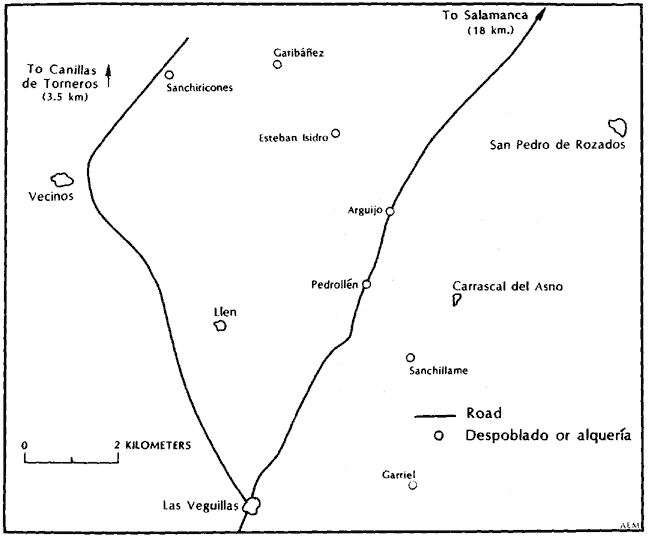
Map 9.1.—
Pedrollén and Its Environs
At the time of the catastro, Pedrollén was within the Cuarto de Peña de Rey of the partido of Salamanca. The catastro describes it as one-fourth league from east to west and three-fourths from north to south.1 An alquería, it lacked a government of its own and came under the jurisdiction of the alcalde of San Pedro de Rozados, seven kilometers to the northeast.2 It was what was known as a término redondo or coto redondo, that is to say, the entire unit was a single property, although in this case various individuals owned shares in it and divided the income from it.3 Bordering on it were the despoblado of Sanchillame, the alquerías Arguijo and Garriel, and the lugar Llen (Map 9.1). In 1786 Pedrollén, Arguijo, Garriel, and Llen had only six households among
them, forty people. Sanchillame, a despoblado, did not have a separate census return; one guesses another family lived there.
The region had not always been so thinly populated. In 1534 Llen (then called Layn) had twenty-three vecinos, over eighty people. At that date Pedrollén and Carrascal del Asno were counted together and had sixteen vecinos, about sixty-five people; in 1786 they had populations of ten and seventeen respectively. The decline appears to have been continual since the sixteenth century. The census of 1712, which was usually underenumerated, shows seventeen vecinos for Pedrollén, Arguijo, Garriel, and Llen; at the time of the catastro there were twelve; in 1786, I estimate nine and a half (the half a widow) (Table 9.1).
The catastro records the area of Pedrollén as 1,009 fanegas, but how this compared with La Mata's 1,073 fanegas is hard to say, because Pedrollén followed an old practice of defining a fanega of land as the area sown with a fanega of grain (with the result that a fanega of good soil was smaller than a fanega of poor soil).4 There was little further resemblance between the two places. In Pedrollén only 220 fanegas (22 percent) was used as arable, and this was divided in three fields, or hojas, each of which was sown only once in three years. One hundred forty-five fanegas was classed as pasture (prados de secano), and the rest, 64 percent, was uncultivated monte alto covered with encinas, used for the harvest of acorns and for wood to make charcoal. The average annual product of a fanega of land was five reales; in La Mata it was forty.5 Four houses marked its center, along with two granaries (paneras), two haylofts (pajares), and three smaller buildings used for a forge and shelter for the animals.6
The income, or aprovechamiento, from Pedrollén was legally divided into eighteen shares (partes ), which belonged to two artistocrats and two religious foundations (Table 9.2 and Figure 9.1). The catastro does not say when or how this unusual division took place, but it went back a long time, for we know from another source that don Andrés Villalón and his wife doña María Villafaña established a patronato in the church of San Julián of Salamanca in 1501, endowing it with nine of the eighteen shares in Pedrollén.7 The four current owners did not manage the
|
||||||||||||||||||||||||||||||||||||||||||||||||||||||||||||||||||||||||||||||||||||||||||||||||||

|
||||||||||||||||||||||||||||||||||||||||||
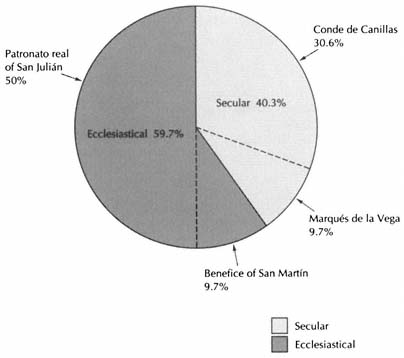
Figure 9.1.
Pedrollén, Ownership of Shares, 1752
estate themselves but rented it to a single individual (colono ), who became responsible for its administration. The catastro has no information on how the contract between them was made, whether the tenant negotiated with them individually or, what was more likely, the four employed a common agent to deal with him.
The makers of the catastro were required to specify the rent and income of tenants on ecclesiastical lands. We have seen before how their replies make possible an estimate of the total rent paid by the vecinos of a locality. I have assumed that secular landowners charged the same rent as ecclesiastical; in the case of Pedrollén this is certain since it was all leased under one contract. The makers of the catastro calculated that the tenant paid one-sixth of the grain harvests as rent, and they assigned the entire income from the meadows and monte to the owners (meadows and monte were never attributed a large annual product; in Pedrollén it ran from 2 to 6 reales per fanega). According to the extent and quality of land and the expected harvest from it, the total rent comes to about 41.5 fanegas of wheat, 11.0 fanegas of rye, and 2,700 reales per year. At prevailing local prices, these payments convert to 242 EFW.8 As will be explained soon, the catastro may have overestimated the productivity of Pedrollén's arable by about a third, and if so, the rent is also overestimated by 17 EFW. In the absence of the lease, we can posit that the tenant paid 225 EFW, although one must be suspicious of the figure because it rests so heavily on the amount paid for pasturage, calculated on a very rough measure.
The farmer who could undertake such a contract was a man of considerable substance. His name was Francisco García Serrano, a widower forty-eight years old, whose only family living with him was a son of nineteen. Besides the furnishings of his house, his farm utensils, tools, carts, and other equipment, he owned an extensive assortment of livestock (Table 9.3). From its listing one can see that in addition to his crops, García Serrano produced for the market wool, cheese, cattle, lambs, pigs, goats, chickens, and turkeys. In fact he had so many animals that Pedrollén could not support all of them, and all except the oxen pastured elsewhere part of the year, "where there is best accommodation" ("donde mas comodidad halla").9
His was a diversified establishment, geared to extract all possible profit from the estate, and it required a number of hands to run. Living
|
||||||||||||||||||||||||||||||||||||||||||||||||||||||||||||||||||||
with him, García Serrano had eleven men servants, ranging in ages from twelve to thirty-eight, and three women servants. Three men were vecinos of nearby towns; they must have left their families behind to come to work in Pedrollén. Three others had the same last name as the tenant, García (Gerónimo, aged twenty-four, Lorenzo, aged eighteen, and Marta, age not given); it is a common name but perhaps they were relatives taken in partly as a family obligation. In addition there were two shepherds, one sixty and the other forty-two, both married, with four sons and five daughters between them, the youngest a baby boy of two months at the time of the count. García Serrano and the two shepherds were the three vecinos of the alquería. Altogether twenty-nine people were living in its four houses, with only the four or five youngest children not contributing labor to its economy.10
As for La Mata and Villaverde, the catastro provides sufficient information to formulate an approximation of the income of this small group, both collectively and individually. Multiplying the number of fanegas of each class of arable land by the stated annual harvest, one obtains a total annual harvest of 248 fanegas of wheat and 66 of rye, that is, 288
|
||||||||||||||||||||||||||||||||||||||||||||||||||||||||||||||||||||||||||||||||||||||||
|
||||||||||||||||||||||||||||||||||||||||||||||||||||||
EFW (Table 9.4). More of the harvest here was in rye than in La Armuña, because it was needed to supplement pastures for the large number of livestock.11 One can expect a more reliable figure, however, from the record of the tithes for the previous five years (1747–51), which indicates a mean harvest of 215 EFW (Table 9.5). This is only 75 percent
of what the catastro evaluated that the land produced. There is, of course, the possibility that the tenant of Pedrollén succeeded in hiding some of his crops from the tithe collector, perhaps not very difficult since the latter had to come from the town of Canillas de Torneros, twelve kilometers away, to whose parish Pedrollén was attached. I shall proceed, however, on the assumption that the tithes were an honest tenth of the crops.
Since a fanega of arable was the area sown by a fanega of grain and there was a three-year rotation, the annual seed requirement must have been one-third of the total area of each kind of arable land (Table 9.4), 57 fanegas of wheat and 16.5 of rye (a total of 67 EFW). The yield-seed ratio varied from 3.5 to 6 for wheat (overall 4.4) and 3.5 to 4.5 for rye (overall 4.0). These are low returns, emphasizing the marginal quality of the soil in this region.
The vecinos also paid tithes on their animal products, partly in kind and partly in money, so that one can again estimate their income from this source (Table 9.6). Lambs, wool, and cheese were said to be contributed at the rate of one in ten. It is less easy to know how many other animals were produced because the tithes on them were paid in money. On cattle, horses, mules, and donkeys, the rate was eight maravedís per head (thirty-four maravedís is one real). The average annual payment over five years was thirty-four reales and nine maravedís, equivalent to 146 animals. Since there were only 136 of these kinds of animals in the estate, the figure is too high. On the other hand, a mean of 16.4 lambs per year in tithes (only 10 for the latest year reported, 1751) did not
|
||||||||||||||||||||||||||||||||
|
||||||||||||||||||||||||||||||||||||||||||||
cover all the lambs born, for García Serrano and the shepherd Juan Benito between them had 332 lambs under one year at the end of 1752.12 They must have paid some of the tithes on lambs in coin, and the tithes in coin may also have included payments for goats, chickens, and other minor animals. We can estimate the annual income from the larger animals (including sheep and goats) by using the method in Appendix K (Table 9.7). This method covers cheese and wool as well, so that Table 9.6 will not figure in the calculation of the gross and net income of Pedrollén. The method does not cover fowl. Chickens were worth twenty-four maravedís, and turkeys, two reales. Let us guess another seventy-five reales from them.
The total income from livestock comes to 596 EFW. From farming the gross harvest is 215 EFW. If the rent was 225 EFW, as estimated, it represented 28 percent of the product of the exploitation. The share taken by the rent was really higher, however, for part of the livestock was pastured elsewhere.
The other regular charges and expenses of the establishment must be deducted to obtain the net income. The tenant and one shepherd paid for pastures part of the year outside the alquería. No figure is specified, we can only guess 500 reales of 33 EFW. The tithes and other charges all left the community, since it had no church. Four-ninths went to the par-
ish of Canillas de Torneros, three-ninths to the owner of the prestamo (a convent in Segovia), and two-ninths (the tercias reales) to the University of Salamanca. The first fruits were 2 EFW, and the Voto de Santiago, 1 EFW.13 The catastro specifies only one payment to the crown, the servicio ordinario y su quince al millar, 9 reales and 3 maravedís. It says the place also paid rentas provinciales and millones, but does not state the amounts.14 However, from a summary of the royal taxes of the province in 1795, we learn that the "old encabezamiento" of Pedrollén, presumably the one in effect in 1752, still valid in 1795, was 147 reales and 24 maravedís for alcabalas, 118 reales and 6 maravedís for cientos, and 29 reales and 2 maravedís for millones, a total of 19.7 EFW.15
Striking a balance of expenses against gross income produces a net income for the estate of 424 EFW (Table 9.8). Divided among the twenty-nine people living on the estate, this gives a per capita income of 14.6 EFW. Yet a close look at the resources of the community uncovers an additional source of income. García Serrano owned fifteen yokes of oxen and employed eleven hired hands. With his son and himself, he could keep thirteen plow teams at work. They planted only about seventy-five fanegas of land a year in Pedrollén, roughly enough to use the time of three and a half plow teams and drivers.16 The time of the other workers and yokes must have been applied outside in the neighboring alquerías and despoblados. Within Pedrollén three and a half yokes would each account for a net harvest of 25 EFW, after deduction is made for seed, rent (one-sixth of the grain harvest), tithes, and other charges. If each yoke returned the same net harvest outside, then García Serrano received about another 240 EFW from this source, raising the net product to 664 EFW and the per capita income to 22.9 EFW (Table 9.8).
This is the highest per capita return that we have encountered so far, but it should not mislead us into thinking that all the inhabitants were wealthy. Virtually all the gross income went initially to García Serrano, except for what the shepherd Juan Benito obtained from his animals. According to Appendix K a fair estimate is that Benito's eighty female sheep and fifteen female goats produced 43 EFW, but probably 5 EFW went for rent on pastures and tithes. Out of the balance left to him, García Serrano would have to pay wages and keep for his servants. The
|
||||||||||||||||||||||||||||||||||||||||||||||||||||||||||||
catastro says that he, his son, servants, and one jornalero earned 2.5 reales a day but does not say for how many days a year. In La Mata the figure was 120 days per year, in Villaverde 180. The latter figure, more suitable to a place with multiple activities, gives them an annual income of 30 EFW. The three vecinos of nearby towns would have had to take this much back to their families to make their stay worthwhile. The eight male servants (four were under eighteen) and three female servants probably earned little more than their keep, the adult males perhaps 12
|
||||||||||||||||||||||||||||
EFW, the others 10 EFW.17 The two other vecinos of Pedrollén, both shepherds (also called jornaleros, the catastro erred in speaking of only one jornalero in specifying incomes) had families. Benito had a wife, a son of twelve, and three daughters; Manuel Martín a wife, three sons (aged fourteen years, ten years, and three months) and two daughters. If they had incomes of 12 EFW per capita, Benito would have taken an additional 32 EFW from the net income of Pedrollén and Martín 72 EFW (not counting the baby). Wages and subsistence of the twenty-nine persons in the community then come out as in Table 9.9, a total of 330 EFW. The balance remaining to García Serrano would be 300 EFW. There are many unknowns in calculating both his gross income and his expenses, so that this is a very rough figure, but one can say that his economic status resembled that of the top labradores of La Mata, whose net income was between 230 and 350 EFW, possibly equal to that of Juan Rincón, the richest of them all. In Pedrollén, however, he stood alone above his servants and employees as a man of wealth and power. With only one son, he could well save, probably investing in extending his establishment, if land were available in the vicinity for arable and pastures.
Yet his position as tenant of a coto redondo left him vulnerable to the demands of the owners. The dangers he faced are evident in cases that came to the attention of the Council of Castile. In the decade of the 1760s, when the advisers of Carlos III undertook to reform the conditions of landholding, they had before them, among complaints from various parts of the country, two from tenants of the cotos redondos of the Charro district. The tenant of Sanchiricones, about ten kilometers northwest of Pedrollén, protested that the cathedral chapter of Salamanca, owner of six of eight shares in the place, had raised his annual lease from 6,406 to 16,112 reales in 1763. Similarly the tenant of Terrones, about the same distance from Pedrollén to the southwest, reported in the same year that the cathedral chapter, full owner of this coto redondo, was demanding 20,000 reales rent, whereas at present it was 12,500 and only six or eight years previously it had been 9,400. The tenants affirmed that they could not pay such rents and, if dispossessed, would be ruined for lack of pasture to support their livestock. Nevertheless, the cathedral chapter was relentless and threatened to move its own herds into the places. At the petition of the two tenants and the sexmeros procuradores generales (deputies) of the cuartos (or sexmos ) of the partido of Salamanca, who defended the interests of the vecinos, the Council of Castile stepped in to protect the tenants, forcing arbitration in the first case and encouraging a settlement out of court in the other but in neither case stating that the rent should be held at its current level.18 The experience of these two tenants shows that such men, including García Serrano of Pedrollén, were under pressure to pay to the limit of their abilities. Their potential for saving was under the keen observation of the owners of the alquerías or their agents, who were intent on squeezing as much as they could out of their colonos. Whether García Serrano was able to maintain the income of 1752 is thus open to question. If he and his successors could continue on similar terms, they should have been in a good position to respond to the disentail of Carlos IV, perhaps not to buy a share in Pedrollén but at least to invest in land elsewhere.
2
Something happened to the establishment, however, about which I have no information. Thirty years later, at the time of the census of 1786,
only ten persons remained in Pedrollén. There was a girl under seven, two boys and two girls between seven and fifteen, and five adults, all between twenty-five and thirty-nine. The adults consisted of a married couple, two single males, and a widow. We do not know their names or the relationship among them. García Serrano would have died, but his son would now be fifty-three. The census lists no such person. Perhaps he and other residents of Pedrollén had succumbed to an epidemic of malaria that struck much of central Spain including this region in 1785 and 1786.19 If so, the widow may have been his, raising several of their children and keeping the establishment going with the aid of a married couple. The rest would have been shepherds and servants. Still, three adult men would have had difficulty maintaining the entire establishment that had existed in 1752. They must have given up leases to neighboring places. One senses that the estate had been through a crisis and a new start was being made, but control over its fate lay elsewhere, with the owners or their agent.
When the intendant of Salamanca received the royal orders calling for disentail of ecclesiastical properties, Pedrollén was just the kind of place that would first attract his attention. Its shares belonging to religious institutions fell under the terms of the decree of September 1798; they could be readily transferred by a simple deed; and they would command a high price. He put them up for auction in 1799, and the final deeds were both signed in November of that year. The same person bought both, doña María del Rosario Vélez y España, widow of a regidor of the ayuntamiento (city councillor) of Salamanca.
The 1 3/4 shares belonging to the benefice of the parish of San Martín fetched 26,320 reales. The 9 shares (half the entire property) of the patronato founded by don Andrés Villalón and his wife in 1501 in the parish church of San Julián cost her 135,350 reales. She paid for both with vales reales.20 The rent for Pedrollén in 1752 was 225 EFW, and if it had kept pace with the rise in price of wheat, doña María del Rosario's 10 3/4 shares would give her 5,375 reales (at the current wheat price of about 40 reales). She was expecting a return of 3.3 percent on her capital, but since she paid in vales reales, which at the end of 1799 were worth only about one-third their face value in hard currency,21 her real expected re-
turn was about 10 percent. This is a far higher rate of return than the annual 2.5 percent on arable fields that buyers were prepared to get22 and provides evidence that large properties went relatively cheaply.
Within a year of the royal order, 60-percent interest in Pedrollén had changed hands. Whereas laymen held 40 percent of it before, they now held 100 percent. Since the new owner resided in Salamanca city, the city did not lose any interest in the alquería, but the transfer represented a serious blow to its religious institutions. Furthermore 60 percent of it was now in the hands of one person; previously the largest share had been 50 percent. And this 60 percent was not entailed, as all the shares had previously been. A major step had been taken in the process that made the Pedrollén of today the property of a single individual.
In this process the tenant never had a chance of participating. The smaller share was sold for about 660 EFW, the larger for 3,400 EFW. Even the smaller share cost one and a half times the net annual production of the estate. García Serrano might have achieved savings to acquire the smaller share, but only because he owned the means to farm in more than one alquería. The current tenant probably had no such economic potential. He could only watch his landlords change and hope that the new one would be no more exacting than the old. A quarter of a century later, in 1826, the population of Pedrollén was twelve, with three vecinos (Table 9.1). There were only two more people than in 1786, and their future was no brighter than it had been then. Disentail did not reverse the demographic decline that began in the sixteenth century or improve the condition of the men and women who worked the land and tended the livestock.
Chapter X—
El Mirón
Today the southern border of the province of Salamanca is formed by the Sierra de Candelario and the Sierra de Gata, which are western extremities of the mountain range that cuts across central Spain and separates Old Castile and León from New Castile and Extremadura. In the eighteenth century the southern part of the province extended farther east than it does today to include two valleys lying in the shadow of the more imposing Sierra de Gredos, which boasts the highest mountains in central Spain. One of these runs along the northern flank of the range and contains the headwaters of the Rio Tormes, flowing here from east to west before turning north at Barco de Ávila eventually to pass the city of Salamanca and join the Rio Duero at the Portuguese frontier. The other is the broader and gentler valley of the Rio Corneja, separated from the valley of the Tormes by the low Sierra de Villafranca. In the nineteenth-century reorganization of provinces both of these valleys were transferred to the province of Ávila.
The dominant town of the valley of the Corneja is Piedrahita. The cabeza of the partido that contains most of the fertile valley, it has long been a center of some prominence. In the early sixteenth century it gained notoriety as the home of a mystic nun of the suspect sect of Alumbrados, the Beata de Piedrahita.1 In the eighteenth century the Duques de Alba, who were señores of both these valleys together with much of the rest of the southeast of the province, built an austere granite
palace just above the town. Local tradition, hardly reliable, holds that Goya painted the Maja Désnuda in one of its rooms.
Piedrahita lies at the foot of the Sierra de Villafranca, and from its vantage point one can see the valley of the Corneja stretching out to the north, almost circular and surrounded by hills in all directions. Straight across the valley, about twelve kilometers away, a rocky outcropping juts up sharply from the valley floor. At its western end is an impressive rounded peak of barren rock. Still today it is surmounted by the ruins of an ancient fortification known simply as the castillo. Just behind and beneath the castillo lies a town known as El Mirón, "the lookout," whose name testifies to its strategic value. The site is so distinctive that legends surround it—one is that an old escape tunnel runs all the way from the garden of the palace of the Albas in Piedrahita under the valley to come out at the castillo. In the Civil War, fires were lit beside this fortification to guide Nationalist airplanes returning to Salamanca from bombing Madrid.
The town of El Mirón is built against the northern shoulder of this rock, out of sight of the Corneja valley. Its fields fall away gradually to the northwest, north, and northeast, on a harsh plateau. In the eighteenth century, El Mirón was legally a villa and cabeza de partido. Five towns (lugares) were under its jurisdiction; together they constituted the smallest partido of the province. (Piedrahita had twenty-three towns under it.)2 The mountainous southern part of the province was characterized by larger towns than the plains around Salamanca, but four of the towns of the partido of El Mirón were small by any standard. Valdemolinos, Navahermosa, El Collado, and Villar de Corneja had populations of 46, 71, 116, and 124 respectively in 1786. Three of them bordered on El Mirón and were closely tied to it: Valdemolinos, in a rocky valley to the west, El Collado on a pass in the hills to the east, and Navahermosa on the edge of the broad valley beneath the rock (Map 10.1). El Collado and Navahermosa were anexos of El Mirón and paid tithes to its parish.3 Villar de Corneja lies off to the southwest, outside the immediate orbit of El Mirón. The fifth lugar, however, was a different case. Santa Maria del Berrocal, located on the northern edge of the valley, below the rocky hill of El Mirón, had a population of 517, two-thirds again as large as El Mirón's 311, making it the demographic center of gravity of the partido. Finally, in constructing a picture of this eco-
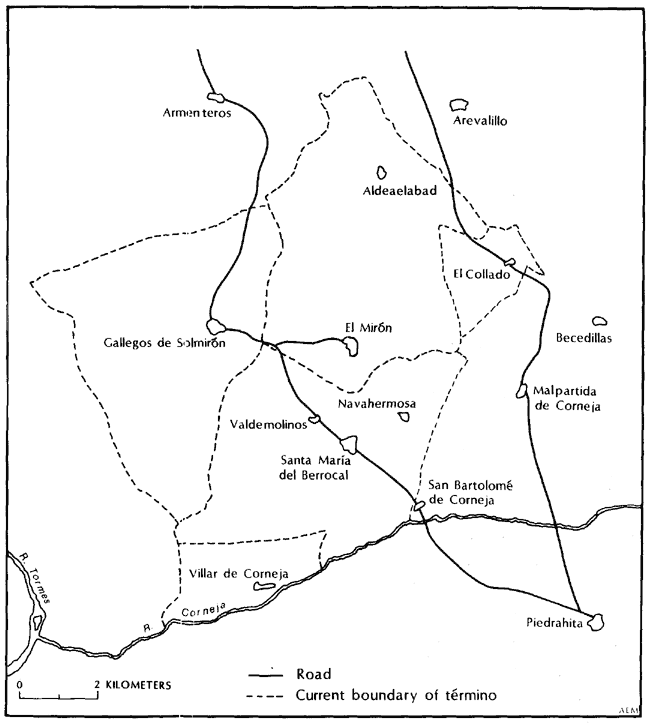
Map 10.1.
The Partido of El Mirón and Nearby Towns
NOTE : Since the eighteenth century El Mirón has
incorporated Aldeaelabad, and Santa Maria del Berrocal
has incorporated Navahermosa and Valdemolinos.
nomic region, one must also take into account Gallegos de So el Mirón (Gallegos under El Mirón, today Gallegos de Solmirón). By road it is the closest town to El Mirón, lying below it a few kilometers to the northwest and visible from the castillo. In the eighteenth century it was a villa eximida, which meant that it lay outside the jurisdiction of any partido, and in 1786 it had 682 inhabitants, more than twice the population of El Mirón.
El Mirón was the most isolated of all the places in the partido. Two
roads lead north from Piedrahita to Salamanca. One runs west of the rock of El Mirón, through Santa María del Berrocal, Valdemolinos, and Gallegos de Solmirón, and its traffic helps explain the greater size of the first and last of these. The other runs east of El Mirón, crossing the rocky outcropping at El Collado. El Mirón itself can be reached only by spurs off these roads and requires a person coming from Piedrahita to make a wide circle around its rock. It owed its prominence to its selection, centuries earlier, to be the legal head of this tiny partido, very likely because of its castle and strong defensive position.4
The available evidence indicates that since the sixteenth century El Mirón, despite its administrative primacy, had been losing out economically to Santa María del Berrocal, beneath it in the valley. The census of 1534 shows a total of 131 vecinos for El Mirón and its two anexos and 63 vecinos for Santa María.5 But by 1752 El Mirón and its anexos had declined to 106 vecinos, while Santa María had risen to 90. In the next thirty-five years El Mirón's relative decline continued, both with respect to Santa María and to the partido as a whole. In 1752 it had 32 percent of the vecinos in the partido; in 1786 it had 26 percent of the total population. Conversely Santa María rose from 39 percent of the vecinos in 1752 to 44 percent of the total population in 1786 (Table 10.1). Although the census figures are not fully reliable, the trend is so clear that it can hardly be the effect of census errors.
The structure of the partido fostered a struggle between El Mirón and Santa María del Berrocal. El Mirón, high on its rocky hill with its harsh plateau and numerous flocks, clung to its privileged position as cabeza de partido. Santa María, blessed by land in the valley and a highway, found its strength in farming and transit. One can almost imagine the forces pitted against each other as a microcosm of the tensions in Spain as a whole: the eighteenth-century economic conflict between a politically dominant meseta and a fertile trading periphery.
In 1752, at the time of its catastro, the nucleus of El Mirón consisted of 81 houses, of which 6 were empty and another in ruins; there was no population pressure on this resource.6 It was thus larger than La Mata (62 houses) but smaller than Villaverde (116 houses). Its public buildings included the town hall (casas consistoriales ), a smithy ( fragua ), a
|
||||||||||||||||||||||||||||||||||||||||||||||||||||||||||||||||||||||||||||||||||||||||||||||||||||||||||||||||||||||||||||||||||||||||||||||||||||||||||||||||||||||||
|
||||||||||||||||||||||||||||||||||||||||||||||||||||||||||||||||||||||||||||||||||||||||||||||||||||||||||||||||||
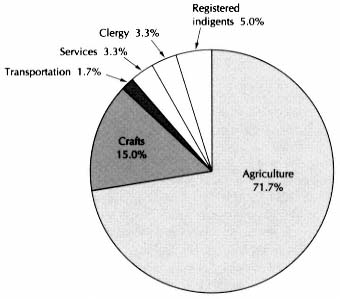
Figure 10.1.
El Mirón, Employment Structure, 1752
butcher shop (carnicería ), a granary (alfondiga, that is, the town pósito),7 and an early sixteenth-century church with a square stone tower and late medieval arches over the altar but only a wooden roof over the nave. Even in the eighteenth-century El Mirón had a very modest appearance, much more like an ordinary lugar than a villa and cabeza de partido.
The catastro records sixty-seven lay families and two priests, each with his household. Table 10.2 and Figure 10.1 give the occupational distribution. Although El Mirón had nine artisans, all associated with the making and tailoring of cloth, it was more completely an agricultural community than either La Mata or Villaverde. Farming and pasturage occupied almost three-quarters of the male heads of household.
Its land was its major source of income, stretching out on the rolling plateau beyond the rocky ridge on which the town is located. The catastro indicates that it had an area of 2,841 fanegas outside the town nucleus.8 One cannot, however, compare this figure with the 1,073 fanegas of La Mata or 1,650 fanegas of Villaverde, because the fanega of El Mirón, or fanegada as they preferred to call it, was not a fixed area. In
the custom of this region, as in Pedrollén, a fanega or fanegada was the area of arable that took a fanega of seed, a fanegada of good land being smaller than one of poor land. The informants did not say how much these might measure in area. The fanegada of woodland (monte) was defined as an area that contained fifty live oak trees (pies de encina ), again not a fixed measurement. A unit of pasture was called a peonada and described simply as equivalent to a fanegada.9 Despite these uncertainties, it becomes clear that the término of El Mirón was far greater than that of either La Mata or Villaverde.
On the other hand, the information provided by the makers of the catastro reveals a mediocre soil. Almost a third, 931 fanegadas, was pasture and wooded hills of live oak, to which no value could be assigned "because of its bad quality and location and also because the oaks are usually eaten by worms so that in most years they do not bear acorns, and when they do the crop is so small that it does not provide enough fodder for the few animals of the vecinos, nor do they provide more wood than is needed for their houses and farm implements."10 The vecinos did not intend to hide their hardships from the king. Of the remaining 1,910 fanegadas, only 18 percent was good enough to plant wheat. Sixty percent produced rye. The plowed land consisted of small plots distributed through three great fields (hojas), each sown only once every three years. A small number of fields enclosed by stone walls (cortinas), totaling 4 percent, produced rye for green forage (herren) every year; the rest was meadows from which hay was cut: 12 percent produced hay every year, 7 percent only once every three years. The average annual income from a fanegada of productive land in El Mirón averages out to be twelve reales, far below La Mata's forty reales or Villaverde's thirty-six reales per fanega.
Following the method with which we are now familiar, from the stated amount of each quality of land and the predicted harvest on it, one can obtain a predicted total annual harvest of 457 fanegas of wheat and 1,180 fanegas of rye, at fifteen reales per fanega of wheat and ten reales for rye,11 1,244 EFW. According to the makers of the catastro the yield-seed ratios for both kinds of grain were 5 : 1 on first-quality land, 4 : 1 on second, and 2 : 1 on third; overall 4.0 : 1 for wheat and 3.1 : 1 for rye. These ratios are so low as to be suspicious.
When one attempts to compare the predicted harvest with the tithes, one runs into difficulties. The parish collected the tithes of El Mirón along with those of its two anexos, and the catastro reports only the total figures for all three. One can, of course, calculate the predicted harvests of the anexos from their catastros and determine El Mirón's share of the total of all three. For Navahermosa the prediction is 444 EFW, for El Collado 250 EFW.12 According to these predictions, El Mirón's harvest represented 64 percent of the total of all three. A more reliable source is the tithe register of the parish of El Mirón, available for 1788–1815 in the town church archives.13 For the six-year period 1796–1801, the mean annual share produced by El Mirón of the total partible tithes of these three towns was 53.1 percent. In these two three-year cycles, the harvest of El Mirón and the corresponding percentage was lower in the middle year. If the cycles had been repeated regularly since midcentury, in the five-year period 1747–51 for which the catastro gives the average tithes, the hoja of El Mirón with the low return would have been farmed only once, and El Mirón's share of the partible would have been about 54.2 percent. I trust this figure more than the 64 percent derived above from the evaluation of the land in the three towns.14
A second difficulty arises in predicting the harvest from the reported tithes because the catastro gives two sets of figures for the tithes. One appears to be a preliminary working sheet, the other is the information reported in the respuestas generales. When the reports are converted to EFW, the total of the first is 2.05 times the second. One might suspect that the larger quantities are correct, the smaller ones doctored to avoid reporting the town's full wealth. When one compares the two returns with the predicted harvests, however, one discovers that the working sheet indicates harvests far in excess of what the land could produce, whereas the smaller return, adjusted to cover lands exempt from tithes, matches the predicted harvest from the three towns within 1.5 percent. Such astounding accuracy impresses one with the capacities of the makers of the catastro and gives confidence in the reliability of the predicted harvest. It gives such confidence, that is, until on using it to calculate the
|
||||||||||||||||||||||||||||||||||||||||||||||||||||||||
|
||||||||||||||||||||||||||||||||||||||||||||||||||||||||||||
town income one obtains a net total from both farming and animal husbandry of under 1,000 EFW, about 3 EFW per capita, far below any rational subsistence level!
Only the larger figures in the working sheet could reflect a viable economy. Further inspection reveals that the makers of the catastro indeed consciously falsified the tithes reported in the respuestas generales, for they left the original figures elsewhere to betray them. The tithes once collected were divided among various authorities, 2-ninths to the señor, 1.5-ninths to the bishop of Ávila, and so forth. In the libros maestros, these shares are included among the property of these individuals, and they turn out to be the proper fraction of the larger figures. If one attempts to reconstruct the reasoning that led the town authorities to falsify the tithe figures, the obvious answer—that they hoped to defraud the state—may not be the correct one. It is at least as possible that after they had totaled the measures of arable land and the harvest each measure produced, a simple multiplication led them to discover that their information could not account for the size of the harvest revealed in the tithes. Rather than revising upward the harvest on a measure of land (which would have entailed a revision of the estimated income of each individual), they simply reduced the amount they reported for their tithes. Unexplained except by oversight is the fact that they left the preliminary work sheet in the bound volume. Be that as it may, for the first time we have proof of conscious misstatement, if not cheating, in the catastro. Nothing in the provincial summaries of the catastro in the archives of Simancas and Madrid would reveal the error, only a detailed analysis of the town volumes.
The preliminary working sheet on tithes is thus the best available evidence for the harvests of El Mirón and its anexos. Table 10.3 indicates that they convert to 337.9 EFW, and if, as calculated above, 54.2 percent of these tithes represent the payments from El Mirón, its annual gross harvest covered by the partible tithes was about 1,831 EFW. To get the entire harvest, one must add the harvest on lands exempt from tithes (payments called locally diezmos privativos) and also the one on the adjoining despoblado of Naharra. The latter had been taken over by the vecinos of El Mirón, who farmed it once every three years as part of one of the hojas. Table 10.3 calculates the payments on these lands from the available information, and one can conclude that they cover a harvest of about 356 EFW, giving a total for the town of 2,187 EFW.
We may return now to the yield-seed ratio. One recalls that the fanegada was defined as the area that required a fanega of grain for sowing.
Since the townspeople reported 345 fanegadas of wheat land and 1,138 of rye land, each piece sown once every three years, their mean annual requirement should have been 368 EFW. On the basis of the reported area of arable land, we calculated an annual harvest of 1,244 EFW. The more reliable estimate obtained from the tithes, however, is 2,187 EFW, 1.76 times as great. Does that mean that the seed requirement should also be multiplied by 1.76, or that the yield-seed ratios that the information in the catastro indicates are lower than the reality, as one suspected? A requirement of 368 EFW set against the better harvest estimate of 2,187 EFW gives an overall yield-seed ratio of 5.9 : 1. La Mata had 7.2 : 1 for wheat and 9.1 : 1 for rye, Villaverde 5.2 : 1 for wheat. El Mirón had poorer land, but it was sown every third year instead of every second and most of it was rye, so that a corrected ratio of 5.9 : 1 is reasonable. It gives a net harvest after seed of 1,819 EFW.
2
Although the vecinos of El Mirón had poor land, they owned a much greater share of it than did those of La Mata and Villaverde. Table 10.4 and Figure 10.2 show that local secular ownership accounted for over half the land, with 35 percent in the hands of vecinos. Since local ecclesiastical ownership was 28 percent, only 21 percent was in the hands of outside owners, a far cry from the 72 percent of La Mata and 69 percent of Villaverde.
In response to the question on the amount of rent paid for ecclesiastical lands, the vecinos said it was one fanega of grain for each fanegada of first-class land, three-fourths fanega for second-class land, and one-half fanega for third-class land, whether wheat or rye, in the year the land was sown.15 Unfortunately, I have no records of the rents actually charged for specific pieces of property, such as those of the monasteries in Salamanca that permitted a check on the rents reported for La Mata and Villaverde. One can, however, work out how much rent would have been paid and what percentage it represented of the total harvest, both as predicted by the catastro measurements and as corrected according to the tithe returns (Table 10.5). If the vecinos paid the rent indicated in the catastro, it would be only about 10 percent of the corrected harvest, far below the 23 percent paid in La Mata and 31 percent in Villaverde. On the other hand, the stated rate of rent would be
|
|||||||||||||||||||||||||||||||||||||||||||||||||||||||||||||||||||||||||||||||||||||||||||||||
about 20 percent of the uncorrected predicted harvest, a credible figure. It seems likely that the makers of the catastro indicated rents that would be a reasonable share of the harvests they reported. I shall assume that the vecinos paid about one-fifth of their actual gross harvests, for which the best estimate is the corrected figure in Table 10.5. This would mean that 121 EFW left the town economy as rent (20 of this to nearby churches; rent on the land of nearby vecinos will be treated next), and another 107 EFW went to the funds of the parish church.
One must also take into account the harvests on the lands owned by vecinos in nearby towns. The example of Villaverde shows that local men who owned land in a neighboring town sometimes farmed it themselves and sometimes rented it to vecinos of the town in which it was located. The opportunity costs probably determined their decision. We
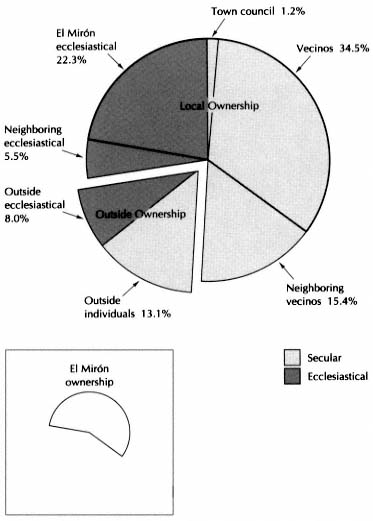
Figure 10.2.
El Mirón, Ownership of Land, 1752
know how much land nearby vecinos owned in El Mirón, but to obtain a full picture, one would need the catastros of the surrounding towns to determine the holdings of El Mirón's vecinos in them. Unfortunately not all the catastros have survived. A review of the three others that are extant from the partido gives the picture of ownership across town borders shown in Table 10.6. Vecinos of towns in the valley owned very
|
||||||||||||||||||||||||||||||||||||||||||||||||||||||||||||||||||||||||||||||||||||||||||||||||||
|
||||||||||||||||||||||||||||||||||||||||||||||||||||||
little property in El Mirón, and vice versa. They probably found it economically uninteresting to travel the required distance to farm what they did have. Vecinos of neighboring towns on the plateau, however, did own a number of fields in El Mirón. Whether the converse is true, I cannot say. The only such town whose catastro has been saved is El Collado, whose vecinos owned more property in El Mirón than all other nearby vecinos together. Vecinos of El Mirón owned virtually no land in El Collado. If the imbalance were the same for the other términos of the plateau, the vecinos of El Mirón would have owned property in them producing harvests of only about 5 EFW. If, however, the balance were equal across these town lines, the outside harvests would rise to 97 EFW. Our estimate for outside harvests will be 51 ± 46 EFW.
Unable to obtain a firm figure, one can propose reasonable upper and lower bounds to the income of El Mirón from these sources. If all the
properties owned by nearby vecinos were farmed by their owners, then the owners would have taken 420 EFW from the total town harvest.16 The parish of El Mirón would receive half the tithes on these harvests.17 Not counting those of vecinos of its anexos, El Collado and Navahermosa, whose tithes it received anyway, these would amount to 10 EFW. If all the lands in question had been rented to farmers of El Mirón, the harvest would stay in the town, except for the amount paid in rent, 20 percent or 84 EFW. To judge from the pattern at the end of the century revealed in the tithe register, which shows about fifty outside farmers per year paying tithes to the parish, the real situation was probably closer to the first than the second scenario.
Income from lands that the vecinos owned in neighboring towns is even less clear, but the amounts involved are small. If they rented out all their lands, their rent would be 10 ± 9 EFW. If they farmed it all themselves, their harvest (less tithes and seed) would come to them. Now, other factors being equal, one would expect farmers in different towns to follow similar practices in the matter of farming or renting out their outside lands, so that what each town economy lost in harvests to nearby vecinos, it gained in harvests from outside. Table 10.8 calculates the income to the vecinos under these two limiting patterns.
If it is difficult to approximate with accuracy the income of El Mirón from farming, one enters even more insecure terrain in calculating how much the vecinos received from raising livestock. This was one of the few sources of income that the catastro did not seek to estimate. The value of real property was given in terms of the income it produced; and wages, salaries, and commercial income were reported, as was income from tithes and seigneurial dues. But chattel were simply enumerated, along with their value per head. No information was provided on how many animals were born and sold each year, how much cheese, milk, or wool was produced or sold, how many animals were slaughtered. One is forced to rely on what the tithe returns say and on what can be deduced from the head count of animals. For towns such as La Mata and Villaverde, a relatively small part of whose income came from livestock, the issue is secondary; but in Pedrollén our assessment of the profitability of the enterprise depended heavily on the estimate of income from
|
||||||||||||||||||||||||||||||||||||||||||||||||||||||||||||||||||||||
animals. In El Mirón also animal husbandry was of major importance, and uncertainty about income from this source weakens the assessment of town income.
Appendix K describes the method I have settled on to estimate income from animals. There is the additional difficulty that here, as in the harvests, the vecinos understated their wealth. The authorities who compiled the provincial summary appear to have uncovered their deceit, for the provincial summary attributes El Mirón more animals than the town catastro. Table 10.7 uses the numbers in the summary to calculate the town income from livestock, 1,771 EFW.
It is proper to note that the information provided by the reported tithes (in the working sheet, not the reduced figures in the respuestas generales), does not indicate such large reproduction for sheep and goats, as Appendix K, Table K.2 establishes. It says the parishioners paid ninety-nine lambs and nine kids per year, at the rate of one for every ten born. Since the farmers of El Mirón owned about one-half of the sheep and four-fifths of the goats in the parish, this would mean they had about five hundred lambs and eighty kids born per year; whereas
the ratios adopted in Appendix K result in about fifteen hundred lambs and five hundred kids per year. If the reported tithes were an honest reflection of the animal births, the birth rate was far lower than the estimate in Appendix K and the resulting income lower than in Table 10.7. The estimated income, of course, includes the production of wool and cheese, and the tithes report on this, too. For the entire parish they were 711 pounds of wool and 55 pounds of goat cheese. With wool valued at 1.0 real per pound and cheese at 0.6 real per pound, the share of El Mirón represented a gross production from these two sources of about 3,800 reales, or 255 EFW. The number of births indicated by the tithes multiplied by the stated value of lambs and kids (5 reales each) results in an income of about 210 EFW, for a total income of 465 EFW from these two breeds, barely 40 percent of the estimate in Table 10.7. This result seems unreasonably low, but the contrast between it and my figure means that one cannot dispel the uncertainty about the income from animals. The queston must remain open.
Most if not all the pastures must have been within the town limits, but the owners of livestock had to pay rent on meadows and cortinas belonging to the parish and outsiders. If the rent were the annual income attributed by the catastro to these properties, the vecinos paid for them 108 and 131 EFW respectively.
One can now tabulate the income from agriculture of the farmers. Table 10.8 provides two figures for net income from agriculture, which represent the maximum and minimum estimates from harvests and animals. The larger estimate, 2,710 EFW, is almost 50 percent greater than the minimum figure, 1,836 EFW, yet the two estimates do provide limits within which we can proceed.
Because so much income came from livestock (44 percent of the minimum estimate; 55 percent of the maximum estimate), the methods used previously to determine the distribution of this income among the labradores and others engaged in farming are of limited value. Nevertheless the available information must be milked for all that it can produce. The catastro states that twenty-seven "labradores and senareros" had large enough harvests to pay first fruits, one less than the number of men identified as labradores in the list of vecinos.18 (Here a farmer had to pay first fruits if he harvested ten fanegas of any single grain; in La Armuña the amount was six fanegas.) In the three years 1799–1801,
covered by the tithe register, an average of forty-four farmers harvested enough to pay first fruits. (Three years are needed because of the local three-year rotation.) Table 10.9 shows the distribution of the gross and net harvests among them, and it projects this distribution onto the twenty-seven harvesters in 1752.
The striking feature of the table is the low income of the labradores. At the end of the century, the first tither had a net income from harvests that I estimate at only 100 EFW.19 Only five farmers out of forty-four who paid first fruits had net incomes from harvests over 50 EFW. At midcentury, the harvests had been as large and the number of labradores smaller, yet my maximum estimate of the net income from harvest of the most wealthy labrador is only 150 EFW, and only six out of the twenty-seven who paid first fruits received more than 60 EFW. This is a far cry from La Mata, whose thirteen labradores had net income from harvests ranging from 75 to 300 EFW (see Table 7.11), or Villaverde, where seventeen out of twenty-eight labradores had net incomes from harvest of 60 to 260 EFW (see Table 8.12). In fact, farming was done on a different scale in El Mirón than in the Armuña district, carried on with yokes of cows instead of oxen. The twenty-eight vecinos of El Mirón who called themselves labradores in 1752 had only eight oxen among them, and only two had pairs. The others teamed their oxen with cows or had only cows. Five had only one cow and had to borrow to form a yoke.20
At first sight the explanation appears simple. Since about half of the income from agriculture came from livestock, one need only double the net return from harvests to determine the total income of the farmers, which would then be comparable to that of the other towns. The catastro and tithe register reveal, however, that the situation was far less simple than this. All the labradores had some pigs and cows and many had horses and donkeys, but less than half also owned flocks of sheep. The labradores owned virtually all the cows in the town, half the sows, two-thirds of the mares, and 60 percent of the female donkeys. (Only one owned any goats.) We can thus attribute to them these proportions
|
|||||||||||||||||||||||||||||||||||||||||||||||||||||||||||||||||||||||||||||||||||||||
|
||||||||||||||||||||||||||||||||||||
of the income from these animals, for a total of 454 EFW. The eleven who owned sheep had 92 percent of the ewes of the town, adding 813 EFW to their income. From the catastro one cannot rank the sheep owners among the harvesters, but the tithe register shows which labradores had sheep and goats at the end of the century, for they paid tithes on lambs and wool or kids and cheese. Eighteen of the forty-four labradores were in this group. We do not know about the first tither, but the next four owned sheep, including the first, third, and fifth flocks in size. The next seven tithers had no such income, the rest of the owners of sheep and goats being scattered among the bottom 70 percent of the harvesters, with some who owned the largest flocks among the middle range of harvesters. (Five vecinos paid tithes on animals but had no harvests. They would have been the goatherds and shepherds, who at the time of the catastro all owned goats.) Thus at the end of the century there appears to have been a small elite among the farmers that garnered the largest harvests and owned flocks of sheep as well, a second group with medium harvests, a third group that supplemented small harvests (net under 50 EFW) with sheep and goats, and a bottom group, almost half the farmers, that survived on small harvests and what they got from cows and pigs.
The catastro bears out this picture and complements it, for it provides information on the ownership of land and livestock and the size of households. The twenty-eight men called labradores at midcentury can
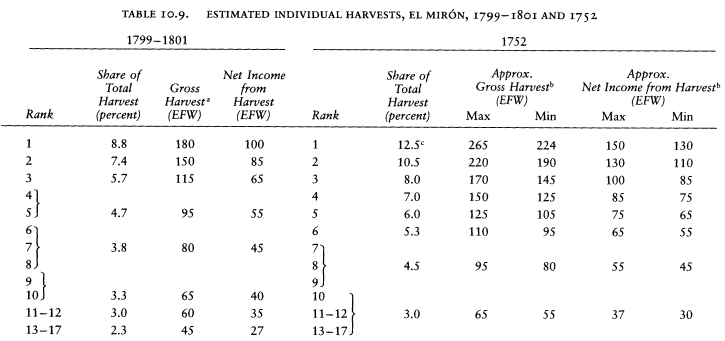
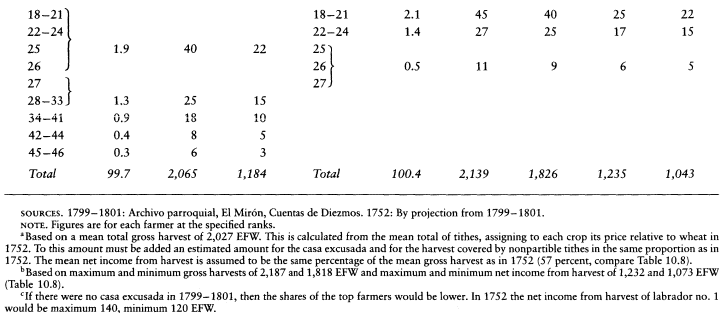
|
|||||||||||||||||||||||||||||||||||||||||||||
be classified as shown in Table 10.10, broken down into four groups according to their ownership of land and animals. Although there is no information on the size of their individual harvests, the four groups follow a pattern that can be associated with the one derived from the tithe register half a century later, which I have inserted in the last column of the table. The economy was divided between arable farming and sheep raising, as it was in the medieval community of the French Pyrenees, Montaillou, studied by Emmanuel Le Roy Ladurie.21 In both places, wealth and social standing were determined by the ownership of land and the ownership of sheep, neither form of property apparently out-ranking the other.
This information can now be used to complete the table of the income of the labradores. Their return from cows, pigs, horses, and donkeys can be divided evenly among them, for most of it came from pigs, and these were distributed fairly much at random among the farmers. This source gave each labrador 16 EFW. Eleven labradores divided the income from sheep, but the top group on average had larger shares, to judge from the tithe register. To the top seven I assign 80 EFW each, to the other four 60 EFW each, using the estimate of income from sheep in
Table 10.7. The smaller estimate, drawn from the reported tithes, would reduce the amounts to 32 and 24 EFW, but I discount these figures.
Those who owned fields collected harvests on them totaling between 18 and 193 EFW annually,22 from which they would not have to deduct rent. The largest owner was Juan González de la Vega maior, who also had the largest flocks. If one sets him aside, the size of the harvest from the land the other labradores owned was not related to whether they had sheep. It ranged from 18 to 82 EFW, with a mean of 45. To simplify calculations, I shall assume that all landowners except the first received 45 EFW of their gross harvest without paying rent from it. Other farmers, and these farmers on any harvests above this amount, paid 20 percent of the gross harvest in rent, the standard rate for the town.
Finally, one must deduct the cost of pastures and labor. The meadows and the forage grown in cortinas were intended for the cows, horses, mules, and donkeys. The farmers used most of them and their share of the rent would be about 200 EFW (Table 10.8), or 7 EFW per labrador. Sheep would have grazed freely, but the owners of the flocks had to pay the six shepherds, and all shared the cost of the three cow and pig herders. All herders were said to earn two reales per day for 180 days: 24 EFW each. That is about a 2 EFW charge on each labrador and an additional 15 EFW on owners of large flocks and 10 on owners of small flocks. The top group of seven labradores also had labor costs for plowing. All owned four cows or more. Two of these, with six and four yokes, had five resident adult male hands between them, who would cost perhaps 12 EFW each to maintain. With the other five, they probably supported the three jornaleros and three serviciales, for a total wage bill of 144 EFW, to be prorated among the labradores.
All this information has been combined to produce Table 10.11. When income from livestock is included, the position of the farmers appears more favorable; nevertheless their livelihoods are very modest. Only those who owned both fields and sheep lived comfortably at or above the 12 EFW per capita level, and of these the top three or four would have been in a position to save with ease. The labradores who owned sheep but not fields had incomes somewhat above the 12 EFW level, but the owners of fields and no sheep were somewhat below it, and the households of those who owned neither fields nor sheep were well below this threshold, half of them, in fact, receiving less than 6 EFW per
|
|||||||||||||||||||||||||||||||||||||||||||||||||||||||||||||||||||||||||||||||||||||||||||||||||||||||||||||||||||||||||||||||||||||||||||||||
|
|||||||||||||||||||||||||||||||||||||||||||||||||||||||||||||||||||||||||||||||||||||||||||||||||||||||||||||||||||||||||||||||||||||||||||||||||||||||||||||||||||||
capita, so far as one can determine from the sources. In sum, only one-quarter of the men called labradores had incomes above the 12 EFW level. These conclusions are based on the higher estimate of income from animals and the mean of the two estimates for income from arable; they are more likely to overestimate than underestimate the household incomes. The data are more shaky than for the other towns we have looked at, but they are not so poor that they hide a thriving agrarian economy. El Mirón was much closer to a subsistence economy than towns in the plains around Salamanca. There was little if any excess grain to export, but the townsmen may have sold some pork in the form of jamón serrano (smoked ham) or chorizo (spiced sausages), specialties of the region even today. Wool was also a commercial product, turned into cloth perhaps by the local artisans, who bought it from the labradores. But there was no need for a large transportation sector, and to point this up, the town had only one muleteer.
3
The other fifteen heads of families in agriculture garnered an even more modest livelihood: jornaleros, serviciales, shepherds, and other herdsmen. All were credited with working 180 days for a daily wage of two reales, 24 EFW per year. All, however, had other recorded income. Each had one or two sows, for a net income from this source of 2 to 3 EFW. Eight owned one or more grain plots, which they probably tilled and obtained net income from harvests of from 0.5 to 7 EFW. (The others, of course, may have cultivated plots they rented, we do not know.) Five of the six shepherds owned goats, all together three-quarters of those in the town, and on average each received 38 EFW from the kids and cheese they produced.23 Domingo Sánchez de la Calle, a shepherd with ninety-six goats, a sow, and six arable plots, was the most prosperous of these men, with an estimated income of 64 EFW. The other four had known incomes of between 39 and 51 EFW. The remaining ten men in agriculture had a few animals, mostly sows, and a few plots among them, but their known income was hardly more than what their labor brought in. One servicial had a household of 10 (including seven children), but the average household size of the others was a modest 3.8. The shepherds with their own flocks enjoyed incomes at the 12 EFW
|
||||||||||||||||||||||||||||||||||||||||||||||||||||||||||||||||||||||||||||||||||||||||||||||||||||||||||||||||
threshold. The others were well below it, but no worse off than the lower range of labradores, thanks to keeping their households small.
Beside the agricultural sector, the nine artisans of El Mirón were a small group. The catastro reported the income from their crafts as between 24 and 40 EFW (Table 10.12). Except for a linen weaver who was one of the town's two sacristans and received half the first fruits, they had very little additional known income. All kept one or two sows, and four had donkeys. Three owned plots of land, which they probably farmed, for 2 to 4 EFW. Although the fact cannot be discovered from the documents, all probably farmed on the side, adding slightly to their income. If so, with families of four to five members, they lived on per capita incomes of some 8 to 12 EFW, about the same as the majority of people in agriculture (the family of the sacristan-weaver received 15 EFW each). While they made less than artisans in Villaverde, the difference was not so much as between the labradores of the two regions.
El Mirón had the only tailor in the partido, and Santa María was the only other town with weavers, so that the craftsmen had an outside
market available for their goods.24 If half their products were destined for other towns, they brought 130 EFW into the town economy.
The small tertiary sector was better off and also provided some income for the community. El Mirón's single arriero worked with five donkeys and earned five reales a day for two hundred days (67 EFW). Applying the cost of feeding a beast of burden established for La Mata, 2 EFW, gives him a net income from his trade of 57 EFW. He also owned seven plots from which he could harvest 19 EFW, and a sow. His total income then was about 80 EFW, ranking with the middle range of arrieros of La Mata (Table 7.13). With a family of seven, he was at the 12 EFW level. The catastro tells us, "His regular traffic is to carry wine for this town and nearby places,"25 a description that underlines the subsistence economy of El Mirón, for he did not transport its agricultural products as part of his normal activities. If half his income from muleteering came from outside, and he bought half his fodder while away, he brought into the town economy 28 EFW.
The barber and surgeon-bloodletter was maintained by the community. Each vecino and each widow with children over fourteen gave him a fanega of wheat per year, and the vecinos of El Collado gave him half a fanega each,26 a total of sixty-eight. With two sows and two donkeys, which he must have used for travel, his total income was in the range of 73 EFW. Only twenty-three and married with no children, he was well-off and could easily support the twelve-year-old boy servant who helped him in his activities until a son could replace the servant. His maintenance from El Collado brought 10 EFW into the town economy.
The allotment of the blacksmith was more modest, an iguala of fifteen fanegas of wheat and fifteen of rye paid by the town.27 But the town furnished the smithy, and the vecinos bought him the coal and iron he used, so that he had few expenses. In addition, he farmed and was called also a labrador, although I have not counted him among them. His four plots produced 24 EFW, and an ox, a cow, seven goats, and two sows probably brought in another 7 EFW. He was sixty and married but with no children at home, so that his known income of 56 EFW left him comfortably established. One of the shepherds, thirty-year-old Miguel Martín de Castilla (married, one child), had the same last name and was probably his son, due to inherit the living.
|
||||||||||||||||||||||||||||||
By now it should come as no surprise that among the most prosperous men in the town were its two priests: the curate and the holder of the sinecure, "beneficio del simple servidero." Don Juan Alvarez, the curate, received two-ninths of the partible tithes of the parish (including the anexos). He had to furnish one-thirteenth of this to the fabric of the church, but he also received income from the rent and diezmos privativos (horros) of the properties of his benefice, thirty-two grain plots and nine meadows in El Mirón, for 27 EFW, and other lands in nearby towns for at least another 9 EFW, and he had four sows, two mares, and other animals of his own.28 The benefice also had a few censos in its favor, from which he got the interest, and it provided him with one of the best houses in the town. His income thus comes out as shown in Table 10.13, some 176 EFW. Don Juan's household included his sister and four servants, two boys and two girls, all of whom he could easily support while living in relative style and putting some coins aside for himself or his heirs.
The sinecure of don Joseph Fernando Pérez was less munificent, for it gave him only a share of the tithes half that of Don Juan, but his personal wealth and industry made up the difference. He owned the most commodious house in the town, seventeen grain plots, three cortinas,
|
||||||||||||||||||||||||||||||
and four meadows, and a number of animals, including two oxen and four cows. With three yokes and two adult male servants, he evidently tilled his own fields and those of the benefice (and perhaps others that he rented but we have no way to identify). His income was about 180 EFW (Table 10.14). In his household he had a niece and a serving girl as well as his two farmhands.
In this town near the sierra, as in those of the plains around Salamanca, the clergymen's income put them at the top of the economic pyramid (only one labrador had revenues equal to theirs), and their estate placed them socially apart. Their position was even more imposing because there were two of them, supported by the tithes and rents of the parishioners. Only one other person might have been their equal, the town escribano (notary), who, like them, would have been entitled to the appellation don. The post was worth two thousand reales a year (133 EFW) and probably produced considerably more in fees and perquisites, but it was currently vacant.29 It could not remain so for long, because the partido needed someone to witness contracts and act in official capacities. By the time of the census of 1786, El Mirón had two escribanos.
Table 10.15 and Figure 10.3 summarize the information developed so far in a socioeconomic pyramid of the town. It reveals a very marginal economy. Almost two-thirds of the households headed by males had per capita incomes below 12 EFW. Even the occupation of labrador, as it was practiced here, did not guarantee an adequate living, for labradores were scattered from top to bottom of the pyramid and 60 percent of them did not reach this threshold. The artisans were low on the scale here as in La Armuña, at least according to the income attributed to them, which, unfortunately, there is no way to check. Perhaps, however, the calculations of individual income have been skewed, and substantial revenues have escaped our household-by-household survey. If so, their existence should become apparent in an analysis of the town economy as a unit.
4
The most obvious impersonal income went to the ecclesiastical funds. The parish church had various sources of outside revenue, the most important one being the tithes and first fruits of its anexos, El Collado and Navahermosa. The rent on the parish lands owned outside the town also went to the church and its two clergymen. Thirteen EFW in rent came from three nearby towns, and one can guess an additional 5 EFW in rents from other towns.
Five-ninths of the partible left the local economy. El Mirón lay in the bishopric of Ávila, and its bishop and cathedral chapter (cabildo ) divided equally three-ninths. The royal two-ninths (tercias reales), which in La Armuña had been ceded to the university, here went to the seigneurial lord, who was then the Duquesa de Alba. In addition, these three authorities received special tithes, small but symbolic amounts. As a form of homage (razón de reconocimiento ), El Mirón and El Collado each gave the duchess 2.5 celemines of wheat, rye, and barley, and the despoblado of Naharra this amount of wheat and rye every third year when its fields were tilled. The bishop received a mejora (enhancement) consisting of one fanega each of wheat, rye, and barley, one lamb, one fleece (interpreted to mean four pounds of wool), and one cheese (two pounds); the cathedral chapter had a fanega each of wheat and rye from Naharra every third year.30 The Voto de Santiago and the diezmos
|
|||||||||||||||||||||||||||||||||||||||||||||||||||||||||||||||||||||||||||||||||||||||||||||||||||||||||||||||||||||||||||||||||||||||||||||
|
||||||||||||||||||||||||||||||||||||||||||||||||||||||||||||||||||||||||||||||||||||||||||||||||||||||||||||||||||||||||||||||||||||||||||||||||||||||||||||||||||||||||||||||||||||||||||
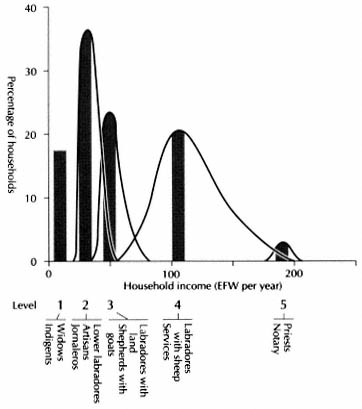
Figure 10.3.
El Mirón, Socioeconomic Pyramid, 1752
NOTE : This is a bar graph based on Table 10.15, with an
indication of dispersion. It is not a set of frequency distributions.
privativos also were paid out. The tithes received from the anexos did not cover all the outside payments, but they meant that the demands of the church bore less heavily on the economy of El Mirón than on the normal parish (Table 10.16).
As before, one should also consider that the parish church spent part of its income outside the town for supplies and expenses. This income was the ninth of the partible and some minor payments assigned to the fabric, the rent on the lands of the fabric and the other endowments. The total is 239 EFW, and one-quarter of this, I have guessed, left the town.
The weight of the payments of El Mirón to its sovereign and its señor was greater than we have previously encountered. The Duquesa de Alba received from the whole partido 7,195 reales for "alcabalas, mostrenco,
señorío, and other rights," the first two being royal taxes that had been alienated to the dukes at some time in the past. Part of this money represented a commutation of twenty partridges, twenty hens, twenty rabbits, and four rams. The towns could not explain what was the share of each, perhaps because an administrator collected it for the duchess for a 6-percent fee.31 If the share of El Mirón was proportional to its population (in 1752 or 1534), it was some 2,300 reales or 153 EFW. The duchess also received a subsidio y excusado of 191 reales, and El Mirón's share would be about 7 EFW. The king's levies were also considerable. The partido owed 3,931 reales annually for servicio ordinario y extraordinario, but the duchess paid 417 of this as "assistance," for reasons not stated.32 El Mirón's share of the balance by our calculations was 1,110 reales, or 74 EFW. The crown and the lord between them made off with some 10 percent of the net income from agriculture.33
The necessary information to draw up the table of the approximate income of El Mirón as an economic unit is now available, and the result is given in Table 10.16, between a maximum of 2,900 EFW and a minimum of 2,000 EFW, depending on the calculations adopted for the harvest and the income from livestock.
The list of households in the catastro indicates a total population of 312 in 1752. When broken down by age and sex, the population pyramid appears complete, at least for males (Table 10.17 and Figure 10.4). There were nine fewer females than males under twenty-five (10 percent), a difference that can be explained by the departure of girls to work elsewhere, perhaps in nearby Piedrahita, where females aged seven to twenty-four outnumbered males by thirty-five in 1786 (14 percent). A likely maximum figure for the population of El Mirón would be 320. The per capita income, assuming the maximum estimate of town income and the smaller population, is 9.3 EFW. At the other extreme, with the minimum town income and the larger population, it is 6.3 EFW.
Even if one recognizes the poor quality of the physical endowments of El Mirón, the lower estimate is unduly pessimistic. Livestock must have brought a return closer to the figure produced by the general method described in Appendix K than the one indicated by the tithe
|
|||||||||||||||||||||||||||||||||||||||||||||||||||||||||||||||||||||||||||||||||||||||||||||||||||||||||||||||||||||||||||||||||||||||
|
||||||||||||||||||||||||||||||||||||||||||||||||||||||||||||||


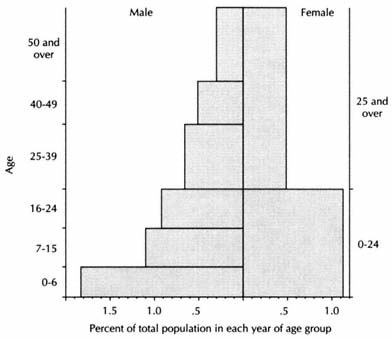
Figure 10.4.
El Mirón, Population Structure, 1752
NOTE : Since there is no limit to the top age groups, a span
of seventeen years for males is used for convenience only.
return. Even the higher estimate, which I judge to be close to reality, leaves the town with less than any place encountered hitherto and corroborates the low household incomes developed above. Perhaps even it is too low. The vecinos may have developed a habit of hiding their real wealth from official scrutiny. Perhaps they did so beyond my ability to detect, but surely they could not do so to the extent of covering up a prosperous economy. There may have been some activities that the census did not record. Some women, for instance, may have spun wool thread for sale on the market, as we shall see below. But this would represent only a minor adjustment in the figures. All the vecinos except a few of the labradores and the two priests lived in or near poverty, victims of the poor, rocky terrain that had centuries earlier made their community the defensive and administrative center of this small corner of Castile and now condemned it to stagnation.
For not all their region was so poor. The three other extant catastros of the partido permit a comparison of their economic condition. The populations, reported tithes, number of animals, and income of the artisans provide rough estimates of gross per capita incomes (far in excess of the net incomes that only detailed analysis can establish; Table 10.18). El Mirón was far poorer than its neighbors, with a per capita income
|
||||||||||||||||||||||||||||||||||||||||||||||||||||||||||||||||||||||||||||||||||||
less than two-thirds of its anexos (but their true incomes would be comparatively lower than the table shows because it does not take into account that all their tithes left their town economies) and four-fifths that of its large neighbor in the valley, Santa María del Berrocal. The comparison goes far toward explaining the long-term demographic decline of El Mirón vis-à-vis Santa María and the partido as a whole, which was observed at the outset. Its economy could not match its position as cabeza de partido.
5
A depressed town in a growing region, El Mirón responded defensively in the next decades. The total population reported in the census of 1786 was 311, almost the same as the number of individuals listed in the catastro. Meanwhile El Collado rose 38 percent, Navahermosa 13 percent, Santa María 65 percent.34 There are errors in the age grouping reported in the census for El Mirón. All unmarried young people of both sexes except three males were put into the 7–15 age group, which is excessively large, while many married people over twenty-four were put in the 16–24 group (Figure 10.5).35 It is therefore useless to speculate on the evolution of marriage patterns, but a constant population is not surprising; by 1826 the population had dropped 13 percent (Table 10.1).
The evolution of occupations is also hard to assess. By 1786 the number of men calling themselves labradores had declined, but in 1752 several labradores were marginal farmers so that the difference may not have been real (Table 10.19). On the other hand, the increase in the number of people in agriculture that can be inferred from the large number of jornaleros reported in 1786 reflects a real change, for the tithe register at the end of the century shows about forty-six people harvesting crops, an increase of 60 percent over 1752. Marginal labradores as well as herdsmen and farm laborers were evidently called jornaleros by the census takers.
According to the census, El Mirón had no artisans in 1786. In view of the large number of sheep in the town, however, it is hard to believe that the carders and weavers present a generation earlier had left no successors at all. In 1826, when Sebastián Miñano, the royal geographer, requested information for his dictionary of Spanish towns, El Mirón re-
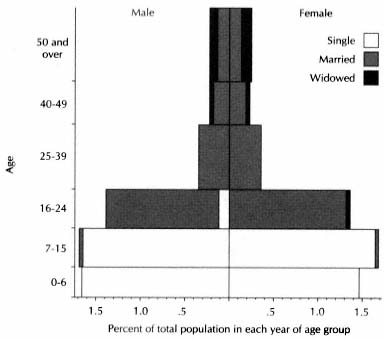
Figure 10.5.
El Mirón, Population Structure, 1786
NOTE : Since there is no limit to the top age group, a
span of seventeen years is used for convenience only.
|
||||||||||||||||||||||||||||||||||||||||||||||||||||||||
sponded that it produced coarse woolens and specialized in the spinning of wool on the wheel, selling black, blue, red, brown, and white thread to other towns and cities.36 The census of 1786 shows no artisans in any town of the partido, yet Miñano also lists the production of woolen cloth in El Collado, Navahermosa, and Santa María del Berrocal and says a large part of the population of Gallegos de Solmirón was engaged in linen weaving. Since the takers of the census of 1786 did not believe that anyone in the partido fitted the category "artesano," it appears likely that weaving was a part-time occupation and the census classed the weavers as jornaleros. On the other hand, El Mirón's specialty of fine spinning could have been limited to the distaff side, which did not show up with the male occupations in the catastro or the census. Spinning and weaving continued to provide a modest income to the town and the region.
The economy depended as much as ever on agriculture, but there was no growth in output. The average gross harvest projected from the partible tithes of El Mirón in 1799–1801 was 2,027 EFW (Table 10.9n); in 1747–51 it was 2,187 EFW. In fact, the harvest may have been lower than this at the end of the century, for I have assumed a casa excusada (first tither) that did not pay tithes to the parish. The catastro shows a payment to the señor of subsidio y excusado. If the crown had granted the tithes of the first tither (the excusado) to the Duque de Alba at some time in the past, they would not have been collected by the crown after 1760, as happened in the towns studied earlier. My estimate of the harvest in 1800 would then be only 1,869 EFW, 86 percent of that at midcentury.
The farmers had altered their crop mix to no avail. They had reduced their wheat planting, not so much in favor of garbanzos, as in La Mata, but of rye (Table 10.20). The total volume of grain declined only slightly, but rye was worth less than wheat.37 Had the farmers discovered that wheat was exhausting the soil? Had the climate worsened? I do not know. No growth in income from livestock offset the loss of harvests. The estimated yield of wool in 1752 was 3,342 pounds, of goat cheese 225 pounds. In 1798–1801, the tithes indicate yields of 2,518 and 298 pounds respectively. Ell Mirón was a community in crisis at the end of the eighteenth century. The royal decree placing its ecclesiastical properties up for sale did not catch it at a propitious moment.
|
||||||||||||||||||||||||||||||||||||||||||||||||
6
The first sale in El Mirón was concluded in October 1800, two years after the decree. The last recorded in this period were made in 1805.38 Altogether thirty-eight sales disposed of fourteen grain plots, thirty-five meadows (prados), and eight enclosed fields (cortinas) (Table 10.21).39 According to the catastro evaluation, these properties amounted to only 7.2 percent of the value of the land in the town, far below the 42 percent sold in La Mata or the 19 percent in Villaverde. Ecclesiastical property had amounted to 36 percent of the total in 1752, so that about one-fifth of it was sold. These figures are misleading, however, because most of the lands disentailed were meadows. The prices paid for them, more than one hundred times the catastro value in hard currency, a markup that was six times the average markup for arable and three times that for olive groves (Table E.1), show that they were more highly prized than the catastro evaluation indicated. The commissioner of the Consolidation Fund probably put them up for sale in preference to open
|
||||||||||||||||||||||||||||||||||||||||||||||||||||||||||||||||||||||||||||||||||||||||||||||||||||||||||||||||||||||||||||||||||||||||||||||||||||||||||||||||||||||||||||||||||||
|
||||||||||||||||||||||||||||||||||||||||||||||||||||||||||||||||||||||||||||||||||||||||||||||||||||||||||||||||||||||||||||||||||||||||||||||||||||||||||||||||||||||||||
fields because of the high price they could fetch, and the effect of the disentail on the town economy would have been greater than Table 10.21 indicates.
Twenty-eight individuals bought land (Table 10.22). Their places of residence reveal that the transfer of property was a local affair in this upland country, far from provincial capitals and major cities. Only one sale went to persons who were clearly outsiders, the sisters doña Ramona and doña Francisca Martín y Thobar of Piedrahita, who bought three properties owned by a memoria in Santa María del Berrocal, two of them meadows in El Mirón.40 In La Mata, three of the top four buyers were outsiders (who together obtained 30 percent of the land sold); in Villaverde all the top four were outsiders (who together obtained 71 percent of the land sold). In El Mirón three of the top four (who bought 30 percent of the land sold) were vecinos of El Mirón and the other one lived next door in Santa María del Berrocal.
Thirteen of the twenty-eight buyers were vecinos of El Mirón, and the various sources provide information about a number of them. Three of the top six buyers of the town were among the leading tithers, respectable labradores. María Antonia González de Antonia, the largest buyer in the town, was the biggest tither in the book (and thus the second farmer of the town, if there was a casa excusada). Juan González Verguío y Vega, fourth buyer in the town, was just below her, and Juan González de la Vega, sixth buyer, was the next tither. These farmers had net income from harvests of between 55 and 85 EFW (see Table 10.9). By themselves these were hardly adequate resources to explain where they obtained the money for purchases that cost from 6,500 to 11,200 reales (about 160 to 280 EFW), but all three were also owners of livestock, paying wool tithes that indicated that they had flocks of one hundred to two hundred sheep. One can visualize them as members of the top of the four categories of farmers in the town, those who owned both land and sheep, two of them descendants of Juan González de la Vega and Domingo González Verguío, farmers in this category at the time of the catastro. They could well afford their purchases.
It is less easy to explain the source of the money of the other four buyers who appear on the tithe list. Francisco Hernández Vaquero was eleventh tither (net income from harvest about 35 EFW) and had no sheep, yet he was third buyer in the town, spending the equivalent of about 250 EFW. He could not save this out of his harvests, nor would
his farming allow him extensive time for another occupation. Did he have some other income, as sacristan, for instance? Gertrudis Cabello, one of the smallest buyers, who joined three others in a purchase of meadows and grain plots, was a widow who farmed and owned about fifty sheep.41 Although only twenty-fourth among tithers, she may have inherited the 50 EFW of her purchase, or she could have saved it out of current income in less than a decade. Miguel Sánchez Mayoral paid tithes only on chickens in 1800 and on a fanega of oats in 1804.42 He was clearly not a farmer. Jacinto Martínez de la O had some sheep and raised garbanzos occasionally, but he was not a regular farmer. Yet he bought two meadows for which he paid 2,000 reales in hard currency (50 EFW).43 Perhaps he was a shepherd. Other members of the de la O family were farmers and may have helped him.
What is more surprising is that a number of buyers do not appear among the tithers, either for crops or animal products. This is the case of Gabriel González Verguío (second buyer in the town), Antonio González Verguío, and Clemente González Verguío, who may have been brothers. Perhaps they were sons of Juan González Verguío y Vega, third tither and one of the main buyers noted above, who gave them money to establish properties of their own. Miguel González Reveriego was one of the smallest buyers; I have no information on him, but Reveriego was a common name among the labradores. Simón Reveriego was fifth tither in 1799–1801. Of Josef Ximénez, who shared two purchases, I know only that he was one of several alcaldes mayores ordinarios of El Mirón in this period.44 Was he a craftsman? Or retired from active work and the father of Narciso Ximénez, who was fourteenth tither and owned seventy-five to one hundred sheep? Family connections and inheritance must go far toward explaining where those buyers not listed in the tithe register got their funds.
This is not the case for the one remaining buyer of the town. Don Juan Barjacoba y Berguío (or Verguío, like the others) was town notary, the only one at the time of the sales.45 One recalls that the catastro showed the notary's office to be officially worth 133 EFW per year. Don Juan owned a few animals but did not farm; he bought two meadows.
|
|||||||||||||||||||||||||||||||||||||||||||||||||||||||||||||||||||||||||||||||||||||||||||||||
|
||||||||||||||||||||||||||||||||||||||||||||||||||||||||||||||||||||||||||||||||||||||||||||||||||||||||||||||||||||||||||||||||||||||||||||||||||||||||||||||||||||||||||||||||||||||||||||||||||||||||||||||||||||||||||||||||||||||||||||
|
|||||||||||||||||||||||||||||||||||||||||||||||||||||||||||||||||||||||||||||||||||||||||||||||||||||||||||||||||||||||||||||||||||||||||||||||||||||||||||||||||||||||||||||||||||||||||||||||||||||||||||||||||||||||||||||||||||||||||||||||||||||||||||||||||||||||||||||||||||||||||||||||||||||||||
Curiously, we can know more about the buyers who did not live in the town. Two men from each of the anexos, El Collado and Navahermosa, were among them, and all four turn up in the tithe register. Three were substantial labradores. Although their crops were not large (gross harvests of 70 to 95 EFW), all owned good herds of sheep, from 130 to 400 head. The fourth was more modest, harvesting 20 EFW and owning some 70 sheep. He bought two meadows in El Mirón but nothing in Navahermosa, his home.46 One of two buyers living in Gallegos de Solmirón farmed grain plots in one of El Mirón's three fields and also paid interest on a fair-sized censo to the parish of Gallegos, indicating that he owned land in his town.47 The other buyer of Gallegos does not show up in the available records. Five buyers lived in Santa María del Berrocal. The earliest tithe register of this parish to list individual names begins in 1819. In that year four of these men were prosperous farmers with gross harvests between 150 and 330 EFW (assuming that the names still belonged to the same individuals).48 One of them, Julián Sánchez, bought more property than anyone else in El Mirón; he also owned a flock of 300 sheep. The fifth, don Francisco Hernández Casado, was a priest and holder of a capellanía in Santa María.49 All of these outside purchasers except the small farmer of Navahermosa also acquired properties in their own towns, and Julián Sánchez, the largest buyer, bought a meadow in Valdemolinos as well. Except for the two sisters of Piedrahita and the priest of Santa María del Berrocal, all outside buyers whom one can identify were farmers in neighboring towns who were adding to their holdings. In El Mirón they sought primarily meadows and enclosed fields on which they could support their animals (Table 10.21). In this region prosperous labradores readily crossed town lines in their activities, especially to sustain their livestock.
The purchases across town lines provide another, more revealing lesson. Table 10.23 and Figure 10.6 give the relevant information, based on all the sales recorded for El Mirón and five surrounding towns.50 In El Mirón, where sales involved more money than in any of the other towns, 60 percent of the disentailed property belonged to endowments and funds located in its parish church, but its vecinos bought only 48
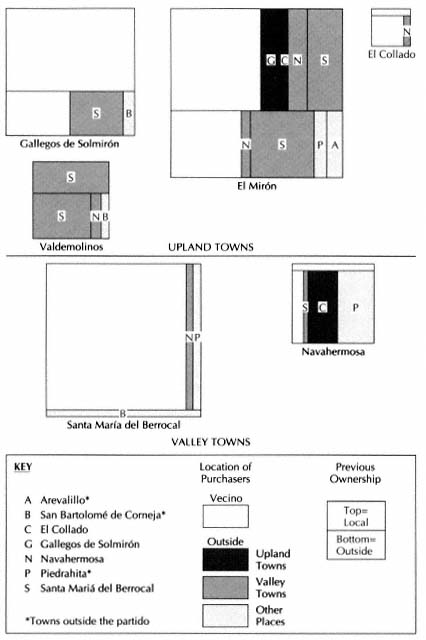
Figure 10.6.
Partido of El Mirón, Purchases of Disentailed Properties, 1800–1805
NOTE : Areas are proportional to the amount of the sales in the town (see Table 10.23).
percent of the property sold.51 The town economy was a net loser. (Of the properties that were sold, they got slightly more than half those that belonged to their church, but less than half those of outside parish funds.) Vecinos of all nearby towns except Valdemolinos, a tiny place of forty-six people in 1786, shared in the purchases of its lands.
By comparison, in Gallegos de Solmirón 67 percent of the property sold belonged to local church funds, but the vecinos bought 84 percent of the property: all the properties of their church and half the rest. They also bought some property in El Mirón, coming out well ahead on the disentail.
The picture in Santa María del Berrocal, the expanding town in the valley, was more complex. Its economy lost out in the sales in El Mirón, its church owning 36 percent of the property sold in El Mirón and its vecinos buying only 26 percent, and also in Gallegos, where its church was the only outside owner to have properties sold, half of them, as was said, going to vecinos of Gallegos. To judge from the pattern of sales in the five towns, religious funds in Santa María had gained considerable hold over the economies of nearby towns before the disentail began. Since these funds had been formed by bequests from the faithful, in the past either its vecinos had bought outside lands that they then donated to their own religious funds, or landowners in nearby towns had preferred to invest in their celestial future by giving to the parish of this prospering town rather than to their own. Probably the former was the case, but either way, Santa María had been economically expansive. Only 4 percent of the lands sold within its limits belonged to an outside fund, located in Piedrahita, the largest town in the region.
Well placed before the sales, the economy of Santa María lost some through the disentail within the region studied. Properties that its church owned in other towns were sold for 97,644 reales, its vecinos bought lands in these towns that went for 73,433 reales. I do not know about sales in other valley towns, including Piedrahita. In Santa María itself there was a slight loss of about 8,000 reales, most of the outside purchases being made from Piedrahita. By comparison, even though outsiders bought much property in El Mirón, its vecinos bought absolutely nothing in the five towns nearby.
Figure 10.6 shows graphically the meaning of these exchanges. Vecinos of upland towns, except El Mirón and Valdemolinos, made purchases in other upland towns, but they made only one purchase in the
|
||||||||||||||||||||||||
valley (by a vecino of El Collado in Navahermosa).52 Vecinos of valley towns bought lands in other valley towns, but they also bought lands in upland towns. Perhaps residents of the upland towns made purchases in other valley towns that I have not studied, but it is highly improbable that any such purchases would have negated the pattern observed here.
In the eighteenth century the changing demand for agricultural products and the growth of rural population gave comparative economic advantage to towns with good farmland. Rough as they are, the figures in the catastro for the value of agricultural land show this. The mean annual product of a measure of land (a fanega or its local equivalent) in upland towns was lower than in valley towns (Table 10.24). The towns of the region that were engaged primarily in farming had the economic strength to profit from the disentail at the expense of those dedicated to pasturage.
To judge from the tithe register of El Mirón, the disentail confirmed and solidified a development already taking place. During the three-year cycle 1799–1801, fifty farmers from seven outside towns paid tithes to the parish for harvests within its limits (not including farmers of Navahermosa and El Collado, which were part of the parish). Sixteen of them
had harvests in more than one year of the cycle. Their payments indicated a total average annual harvest of some 330 EFW. At the time of the catastro individuals living in nearby towns did not own nearly enough land to produce such harvests (Table 10.6). Unless vecinos of El Mirón had sold much land to outsiders in the intervening fifty years—hardly likely—outsiders were renting plots within the town, probably from church funds. Was this a recent development? I have no information, but I suggest that it was a practice that had been growing as El Mirón got relatively poorer. The sales continued the outside takeover. The partido of El Mirón is the clearest case we have seen of disentail accelerating a regional redistribution of economic resources that had already been going on despite restrictions on the free exchange of property.
After the desamortización of Carlos IV, the decline of El Mirón continued. By 1826 its population was down to 270 from 311 in 1786, and it had less than 18 percent of the population of the partido, compared to 26 percent in 1786 (Table 10.1). Santa María increased from 517 in 1786 to 780 in 1826 and now had nearly 52 percent of the people in the partido (against 44 percent in 1786). Administrative reorganization added to El Mirón's woes. By 1826 its two anexos, Navahermosa and El Collado, had parishes of their own.53 In 1833 its towns were incorporated in the partido of Piedrahita and El Mirón ceased to be a cabeza de partido. Santa María, with its rich fields and major road, on the other hand, had its municipal boundaries extended to include Navahermosa and, by the twentieth century, Valdemolinos as well. If, as was suggested earlier, one can see here in microcosm the national conflict between the harsh Castilian meseta and the lower, more commercial periphery, an oversimplified comparison but one of some validity, the history of this small partido suggests that after the eighteenth century only the persistence of government institutions and patterns of authority inherited from earlier times made possible the continued dominance of upland Spain over lowland Spain.
Chapter XI—
Baños
The rugged surface of the Iberian Peninsula affords only two easy routes between Andalusia and Castile. One, in the west, runs north from Seville to Mérida in Extremadura. It was the route preferred by the Romans, who from Mérida continued it over the central sierras to Salamanca and León. After the Visigoths made Toledo the capital of Iberia, this route lost its primacy in favor of one to the east. Leaving Seville, it follows the valley of the Guadalquivir to the town of Bailén in the province of Jaén and then turns north to pass through the Sierra Morena where it is relatively easily crossed into La Mancha, and thence it has an almost flat course to Toledo and Madrid. Between these two roads, the low, broad, labyrinthine ranges of the Sierra Morena separate Castile from Andalusia.
Today the main railroad and highway from Madrid to Andalusia follow the eastern route and traverse the sierra through the pass of Despeñaperros, a spectacular, narrow, rocky gorge beneath overhanging peaks, on which, its name suggests, even dogs lose their footing. Great human effort was needed to make it passable for anything but pack animals. This effort was undertaken in 1779 at the initiative of the Conde de Floridablanca, who engaged a French engineer to blast a road beneath the precipices, to the awe of contemporary travelers. Before then the main road crossed higher but easier terrain by way of El Viso del Marqués, the last town in La Mancha, which lies five kilometers to the west of the present road.
Since the Middle Ages this line of communication has been of great
commercial and military value, used by travelers, merchants, and armies descending from Toledo and Madrid to Seville, Cádiz, and beyond to America, or heading north toward the capital. After passing south through the Sierra Morena the old and new roads join at Las Navas de Tolosa, scene of the critical Christian victory of 1212, which opened Andalusia to reconquest. Six centuries later, in 1808, Napoleon's troops under General Dupont, marching to subdue southern Spain, succumbed to a superior Spanish army near Bailén. To make this highway safe from bandits and to bring a desolate region into cultivation, Carlos III founded the colonies of Sierra Morena, one of his most successful undertakings, which provided fame and ultimate tragedy to their director, Pablo de Olavide, as we observed in Chapter 1.1
At the time of the catastro these colonies were not yet there, and the road between Las Navas de Tolosa and Bailén ran most of the way through the término of Baños. The first two inns south of the pass of Despeñaperros were located here, the large Venta de Miranda that travelers stopped at just beyond the pass, and the smaller venta at Guadarromán, halfway down the slopes. From there, the road skirts a little to the east of Baños itself, for its nucleus, like many in Andalusia, is located on the top of a hill, easily accessible from only one side.
The nucleus is built on a low spur of the Sierra Morena. At the southern tip of the spur, about 425 meters above sea level, rises a castle of Muslim origin, reputed to date from the tenth century. With its thick walls and high square keep, this imposing bastion guarded the Andalusian valley from marauders of the north. The low, white houses of the town cluster on the crest of the hill behind it, like chicks snuggled to their mother. Close beside the castle is the main square, a small affair dominated on its opposite side by a Renaissance church with an octagonal bell tower crowned by a curious tapered dome, like the pointed end of an egg. Farther along the crest, the hermita, or sanctuary, of El Cristo de los Llanos stands at a distance from the eighteenth-century town.
From the top of the castle keep, a lookout can dominate the region in all directions. To the west, the promontory it sits on falls rapidly off toward the rugged valley of the Rio Rumblar, and beyond are barren, steep hills, good only for meager grazing. To the north rises the rolling, wooded Sierra Morena, and in the opposite direction, between two hills, a sharp valley leads off to the southwest and the Guadalquivir.
Only to the east does the view suggest the wealth that supports Baños, for eighty meters below the castle and town, a broad, flat valley known as lo llano stretches four kilometers to the east and twelve kilometers north and south between the town and the Madrid highway. Beyond the road the land to the east rolls gently, and the mining city of Linares is visible from the castle, fifteen kilometers away. The plain is of deep red earth, typical of the Sierra Morena, and today it is covered with a patchwork of grain fields and olive groves.
Although lo llano formed the heart of Baños's agriculture, it was but a fraction of the término, which stretched six and four-fifths leagues north and south according to contemporaries and six and one-quarter east and west. Translated into thirty-eight and thirty-five kilometers respectively, these estimates were slightly high, but not far off (Map 11.1). The northern limit was the province of La Mancha, twenty-eight kilometers from the town nucleus. Most of this territory was in the Sierra Morena and barren or used only for pasture and occasional crops.2
In Andalusia in the eighteenth century, as today, towns were bigger than in Old Castile in population as well as in extent. In 1752, according to the catastro, the villa of Baños had 306 houses, plus 14 others uninhabitable or in ruins. The town hall (casa de ayuntamiento ) faced on the square and housed the jail and town granary (pósito). The town also owned on the square a public butcher shop and a slaughterhouse.3 The populace provided enough business to support two taverns, one of which sold olive oil, vinegar, and spirits (aguardiente ), three grocery stores (especerías ), nine bakers, and two dealers in soap.4 At a distance from the nucleus and nearby plain but within the término, fourteen cortijos or rural estates housed a few permanent residents.
The books of households list 1,779 people in Baños in 1752 (Table 11.1). The numbers suggest a marked underreporting of females, especially single women. (The books show 407 sons of all ages living with their parents and only 341 daughters.) Some young women may have gone away to work (but where?); still, one can safely add 50 women to the population without exaggerating its true size. This gives a total of about 1,830. Baños had 437 lay vecinos: 281 married men, 39 widowers, 85 widows, and 32 single men; 12 clergymen were heads of household, and three clergymen lived alone.
The occupations of the vecinos reveal a more complicated social
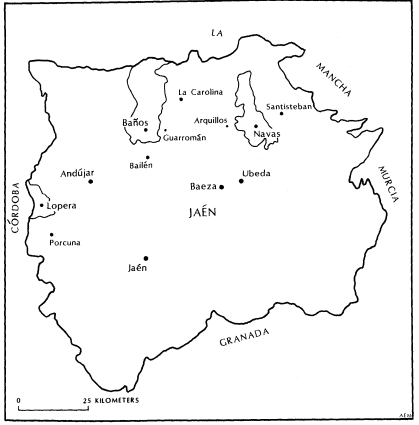
Map 11.1.
Province of Jaén Under the Old Regime, Town
Limits of Baños, Lopera, and Navas de Santisteban
structure than that found in the small towns of Salamanca (Table 11.2 and Figure 11.1). For the first time we find a group of hidalgos, and the clergy were numerous. Nevertheless, more than two-thirds of all the adult men were engaged in agriculture, while only 8 percent were artisans, a smaller proportion than in either Villaverde or El Mirón. The list of occupations indicates that the income of the community came almost entirely from the land.
As might be expected in a territory as large and varied as that of Baños, the land was put to many uses. The total recorded size of the término was 156,797 fanegas (75,500 hectares).5 However rough this
|
||||||||||||||||||||||||||||||||||||||||||||||||||||||||||||||||||||||||||||||||||||
figure may be, it reveals the enormity of the area of Baños, for it is almost 60 times El Mirón, the largest town in Salamanca we have studied, and over 150 times La Mata or Pedrollén. Because Baños ran back into the Sierra Morena, much of its territory was barren and unused—40 percent, the catastro calculated—while ten pastures (dehesas) belonging to the town council made up another 37 percent. The three largest pastures stretched across the northern edge of the sierra, 47,000 fanegas, almost half of them judged quite barren. The other seven were small, between 300 and 600 fanegas, but of better quality, with part planted in live oaks.6 The use of two of these pastures belonged to the cities of Baeza and Bailén by ancient agreement.7
Although only one-quarter of the término was cultivated, this was still forty times the area of La Mata. Again, however, this figure is deceptive. Seven-eighths of the cultivated land was located in the término privativo, a type of property we have not previously encountered. According to a privilege granted the town shortly after the reconquest of Andalusia by King Sancho IV (1284–95) and confirmed regularly by
|
|||||||||||||||||||||||||||||||||||||||||||||||||||||||||||||||||||||||||||||||||||||||||||||||||||||||||||||||||||||||||||||||||||||||||||||
|
||||||||||||||||||||||||||||||||||||||||||||||||||||||||||||||||||||||||||||||||||||||||||||||||||||||||||||||||||||||||||||||
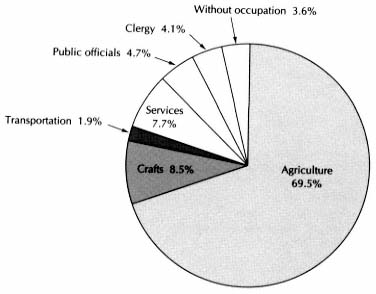
Figure 11.1.
Baños, Employment Structure, 1752
kings up to Felipe V, about one-third of the town limits, a block of marginal land stretching across it from west to east south of the mountain pastures and running down the eastern edge was set aside to be distributed to the vecinos individually to till free of charge. They received only the use of the land (dominio útil) and lost it if they did not cultivate it within certain stated intervals. After deducting a fifth of the término privativo that was barren and another fifth good only for pasture, about 30,000 fanegas remained that could be planted about once every twenty years, fertilized by the ashes left from cutting down and burning off the undergrowth (monte bajo ) that had grown up in the intervening period. This form of primitive slash-and-burn agriculture was known as roza de cama. 8 Only a small part of the término privativo was planted regularly, however. The catastro indicates that in the current year individuals had sown about 160 fanegas of it.9 If this was representative, over a twenty-
year cycle barely one-tenth of all the land available would have been planted. Yet roza de cama was reputed to produce a harvest of 8 fanegas of wheat for each fanega of area, higher than any other land in the town. The término privativo also contained 2,000 fanegas of better quality soil, which could be planted once every five years with wheat, barley, or rye after burning the small growth of underbrush, in a rotation known as roza de barbecho. About a fifth of this section of it was cultivated in the current year, indicating that most of it was in use. Finally, 957 fanegas of the término privativo were good enough to have encouraged those who exploited them to build cortijos in their lands, permanent buildings to shelter animals and seasonal workers. For example, one cortijo of 120 fanegas, which belonged to a priest of Baños, consisted of two sheds to protect workers, donkeys, and cattle "at the time of planting and harvesting," a hay rick, two corrals, and a paved threshing floor.10 Despite the terms of the royal grant, there were fourteen "cortijos de sierra" in the término privativo, so well established in the hands of the current holders that the catastro treated them as private property. Here harvests ranged from two crops of wheat every three years to one crop of rye every four years.
The catastro indicates that only about 3,000 fanegas of the término privativo were planted at all regularly. Together with the 4,244 fanegas that were cultivated under private ownership, about 7,250 fanegas produced crops. This is 4.6 percent of the entire término, but still seven times the area of La Mata. Since the population was slightly more than seven times that of La Mata, the cultivated land per head was about even. As will become apparent, however, the similarity did not extend to the per capita income. La Mata at midcentury was a flourishing, little-stratified community despite the outside ownership of most of its land. Baños, Andalusian to the core, had a vastly different economic and social structure.
The private property was located relatively close to the town nucleus, mostly in lo llano. Twelve hundred fifty fanegas of private property were planted in grains. The best quality fields were in the ruedo, 266 fanegas of cultivated land lying in the immediate vicinity of the town nucleus. First-class ruedo land was sown in a three-year cycle, 1 fanega of land producing six fanegas of wheat, eight of barley, and six of habas (broad beans) in successive years. Second-class land gave only two crops in three years: five fanegas of wheat and seven of barley; while third-class
land could be sown only once every three years with wheat, giving a harvest of six fanegas. Beyond the ruedo, in the campiñuela, 987 fanegas in extent, private lands varied greatly in quality, from the best that produced three harvests in three years—five fanegas of wheat and two harvests of six fanegas of barley—to fourth-class land that yielded only two crops in eight years, six fanegas of barley and five of rye. Over half the ruedo was first class, but only one-fortieth of the campiñuela. The extent of property tells little about its worth, since "quality" as defined by the catastro was crucial.
Of the private land 2,760 fanegas, or 65 percent, was planted in olives, about 119,000 trees, which produced the most valuable harvest in the town. The catastro does not state how the olive groves were located spatially with reference to the arable. Close by the nucleus, in the ruedo, were a number of orchards and huertas. They were irrigated by streams or norias (wells with waterwheels worked by donkeys or mules).11 Their figs, pears, cherries, chestnuts, pomegranates, peaches, lemons, oranges, mulberries, and as many other fruits again, and their vegetables—turnips, cabbages, eggplants, tomatoes, cucumbers, peppers, garlic, onions, and lettuce are listed—were of high value, but the extent of their cultivation was limited. Verdes de cebada and verdes de centeno (barley and rye planted yearly and harvested green for fodder) were also grown in small parts of the ruedo.
The use of the land in Baños conformed closely to the pattern conceived in the early nineteenth century by the German geographer Johann Heinrich von Thünen. Based on the experience of his own estate near the Baltic Sea, he demonstrated that if a nucleated settlement or farmstead was surrounded by land of even quality, its use would be distributed in a series of concentric rings around the nucleus. Economic efficiency would dictate that the crops requiring the greatest amount of labor, fertilizer, and other inputs, including transport, would be located closest to the nucleus. The total expense in inputs compared with its price in the market would determine how far from the center each crop or form of exploitation would be. Thus intensive cultivation like horticulture would be closest to the nucleus, intensive arable rotation would be farther out, followed by arable of less frequent rotation, with grazing and ranching at the greatest distance. Of course, in a real situation the quality of the land, physical impediments to cultivation and communication, the availability of roads, and other local features would modify
|
|||||||||||||||||||||||||||||||||||||||||||||||||||||||||||||||||||||||||||||
the rings into zones of irregular shape.12 Much of current location analysis originated in von Thünen's insight. Recent studies have shown that in fact the large agro towns of Sicily and southern Spain offer excellent examples of his rings.13
Baños in the eighteenth century was precisely such a case, although its location in the foothills of the Sierra Morena obscured the character of the "rings." The ruedo land immediately beneath the hill on which the town was clustered and the streams in its vicinity held the irrigated huertas for vegetables, which demanded nearly constant attention, and the orchards, which had to be watered regularly and whose fruit had to be watched and picked as it ripened. The most intensive grain cultivation also took place in the ruedo, over half of it sown every year. Only a tiny portion of the campiñuela, located beyond the ruedo, was sown every year, and much of it only once every four years. Table 11.3 shows effectively the difference in the crops harvested in the ruedo and campi-
ñuela, with habas only in the former and rye only in the latter. Beyond these zones stretched the término privativo, cultivated even less intensively, the roza de barbecho once every five years, the roza de cama reputedly only once in twenty. But within the término privativo, no doubt influenced by the availability of water, cortijos had been carved out, each an independent nucleus with its surrounding rings of cultivated land and pasture. Finally, the most distant land, along the northern limits of the town in the depths of the Sierra Morena, was devoted to pasture. But again, the better pastures, where the inhabitants had planted live oaks for additional fodder, were closer to the town nucleus. The makers of the catastro defined the use of the land by its "quality," but in fact, the primary determinant of its use, after the most obvious natural qualities, was the ease with which it was exploited and the relation between the cost of exploitation and the market for agricultural products. Today much of the término privativo, considered of marginal value in the eighteenth century, is covered by some of the richest olive groves in Jaén. Of course, the same consideration applied to land use in all the towns studied here, but the von Thünen effect becomes more obvious when the area of the town is vaster.
The economy of Baños rested on two major crops, grains and olives, while grapes, fruits, and vegetables offered a secondary source of income. The total recorded product of the various olive groves was 14,600 arrobas of oil per year.14 In addition, the catastro specifies 155 fanegas of vines, reported to produce 682 arrobas of wine per year.15 As usual, we can check these estimates against the tithes; they turn out to be too high. The catastro says that the tithes were about 900 arrobas of olive oil (worth 14 reales each) and 40 of wine (at 6 reales),16 but evidently no accurate record of the tithes was available, for they were collected not by agents of the church but by private individuals who farmed this source of revenue. They paid 13,000 reales per year for this right.17 Since the listed tithes add up to only 12,840 reales, the tithe farmers must have collected more than the catastro says. If we assume that they calculated a 10-percent margin for expenses and profit, they must have counted a total receipt at least 11 percent more than the stated tithes. We can therefore estimate that the true tithes were collected on an annual harvest of 10,000 arrobas of oil and 450 of wine. To these must be added
|
|||||||||||||||||||||||||||||||||||||||||||||||||||||||
324 arrobas of oil from groves of ecclesiastical ownership that were exempt from tithes. Since the fanega of wheat, like the arroba of oil, was worth 14 reales,18 the oil harvest estimated from the tithes is 10,324 EFW and the wine harvest 193 EFW.
Table 11.3 shows the annual grain harvest that can be predicted from the information on the extent of the different qualities of land and their stated annual harvests. The total harvest represented by the tithes is 89 percent of this amount, as shown by Table 11.4. The two tables agree exactly on the wheat harvest, but the tithes indicate harvests of barley and rye that are only 72 and 45 percent of those predicted. I shall, as usual, take the reported tithes as a safer indicator, although we have seen that this source may not be reliable.
The yield-seed ratio for wheat in the ruedos and campiñuela, according to the catastro, varied between 4.8 : 1 and 7.2 : 1, and in the cortijos de la sierra and the roza de barbecho between 5 : 1 and 9 : 1. For the roza de cama, planted once every twenty years, the information supplied results in an incredible 24 : 1 ratio (8 fanegas of wheat from .33 fanega of seed). Since this is in the realm of the impossible, even with the ashes of undergrowth as fertilizer, I shall assume a ratio of 12 : 1. The mean yield seed ratio for wheat is 7.5 : 1 (but only 5.1 in the ruedo and campiñuela alone). Barley ratios were between 5.1 : 1 and 8.0 : 1 (mean 5.9 : 1), habas
|
||||||||||||||||||||||||||||||||||||
|
|||||||||||||||||||||||||||||||||||||||||||||||||||||||
5.1 : 1, and rye between 6.0 : 1 and 7.7 : 1, except in the roza de barbecho, where the catastro reported 15 : 1 (mean 7.7 : 1).19 Table 11.5 indicates the total seed needed. The gross harvest less seed results in a net harvest of 5,370 EFW, hardly more than half the income from the olive groves.
Table 11.6 lists the value of the minor crops harvested from the orchards, huertas, and planting of green forage. How accurate are these figures? Apparently fairly close. The collection of the tithes on vegetables (hortalizas ) was rented for 500 reales, indicating, when account is taken of expenses and profit of the tithe farmer, a harvest worth 5,500
reales, very close to the 5,608 shown in the table. Since vegetables and fruit could be consumed and the seeds saved as well, there is no seed requirement, while the seed for green barley and rye would come out of the regular harvest at roughly 7 : 1. The net return for all these crops was 1,126 EFW.
2
The total net return from agriculture came to about 17,000 EFW, according to these calculations (Table 11.17). How much of this went into the town economy depended to a great extent on how much belonged to outsiders and how they administered their share. The ownership of land was distributed as shown in Table 11.7 and Figure 11.2.
A revealing feature of the catastro of Baños is that it names the tenants of ecclesiastical lands and gives their reputed income (that is, total income less rent). Unlike the returns we have looked at from Salamanca province, which specify rent as so much grain per measure of arable, that of Baños assigns 75 percent of the annual product to the tenant and 25 percent to the owner, regardless of the crop. Unfortunately, I have found no account books giving actual rents in Baños, so that I have no independent check on this rule of thumb. It is, however, confirmed by the report of the intendant of Jaén published in the Memorial ajustado of 1784, which states that it was standard practice in the province for the owner to get one-quarter of the harvest. In Córdoba the landowner's share was said to be slightly less, two-ninths of the harvest.20 The intendant of Jaén said that the owner got one-fourth of the grain harvest up to eight fanegas of grain per cuerda (fanega) of land. If the tenant managed a higher return, the excess was his. Out of his share, he had to pay the expenses of tithes, seed, tools, and human and animal labor.
Although I have found no account books for Baños, the Archivo Histórico does have a book for the convent of nuns of the Holy Trinity of Alcalá la Real from 1799 to 1807, with a few entries as late as 1819.21 Alcalá la Real is across the province of Jaén, located in a fertile valley on the border of Granada, a larger and richer place than Baños. Nevertheless, the methods of administration followed by the Trinitarian nuns were probably close to those used in Baños. They differed in a number of respects from the practices of Salamanca province.
The book was kept by an administrator or steward, to whom the
|
||||||||||||||||||||||||||||||||||||||||||||||||||||||||||||||||||||||||||||||||||||||||||||||||||||||||||||||||||||||||||||||||||||||||||||
nuns had entrusted the management of their estates, don Domingo Antonio Saenz de Texada. The book does not specify his commission, but he must have served much as the administrators we shall observe later in Baños. He was probably not a priest, for he is not given the title Pbro. Under his care, the lands were let out by contract. When the length of the lease is mentioned, it is four years, that is, two two-year rotations. As in Salamanca, rents were to be paid on 15 August, feast of the Assumption of the Virgin.
Almost all the contracts fitted one of three patterns (Table 11.8). The
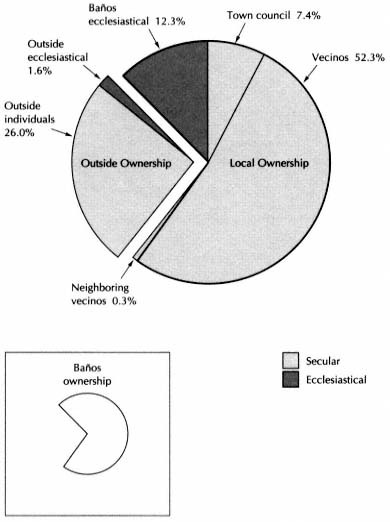
Figure 11.2.
Baños, Ownership of Land, 1752
first applied primarily to cortijos, of which the convent owned nine. The extent of six is specified: from 94 to 267 fanegas, with a mean of 164, good-sized properties that needed a labrador of substance to take them on. From them the convent received two parts of seven of the harvests of wheat and barley, and one-fourth of the other crops.22 The tenant also
|
|||||||||||||||||||||||||||||||||||||||||||||
paid a fixed monetary rent and two turkeys at Christmas for the use of the cortijo buildings and a sum to be assessed (by an independent agent?) for the pastures.23 Only two cortijos had a different rental rate—for wheat, one of two parts in six, and for barley, one of two parts in seven and a half.
These shares also applied to five contracts covering individual fields (hazas ), but most fields were rented under two other standard contracts. In nine cases, the rule was one-quarter of all crops to the owner, in other words the contract that was considered standard in Baños and in the province as a whole according to the intendant. Even more common for hazas, however—thirteen contracts—was a fixed annual rent ("renta fixa anual") payable almost always in wheat (once only in coin), the kind of arrangement we have become familiar with in Salamanca. What was the basis for the difference? Evidently much depended on the quality of the land. The five fields whose rent was a share greater than one-fourth of the harvest were small plots of high quality. The rental payments recorded on these indicate harvests every other year of almost ten fanegas of wheat per fanega of land. The highest harvest we have observed previously was in La Mata, eight fanegas of wheat per fanega of first-class land every other year.24 The rate of one-fourth of all crops was used for fields of poor quality and large size, where other cereals besides wheat had to be planted and the yields were comparatively low. Finally, the fixed rate, payable in wheat, which was most common, applied to
the fields of middling size and quality, which regularly produced wheat out of which the rent could be paid.
Not only the quality of the land was involved in the choice of terms, however; the tenants of the hazas leased for a share of the crops tended to stay on longer than those who paid fixed rents. In the period covered by the account book (which varies from two years to twenty, depending on the property), the names of the sharecropping tenants can be followed in twelve cases. In six, the same man was tenant throughout, in four the tenant changed once and in two, twice. In the last cases, the second tenants (the only ones whose length of occupancy is known) farmed the plots five and six years. But of nine cases of lots with fixed rent, never was the same man tenant throughout; in one instance the tenant changed three times (in four years), and in another four times (in eleven years). These tenants must have been looked on as unreliable or impoverished, men who could not be depended on to keep an exploitation going and had to be held to specific terms. It comes as something of a surprise to discover that sharecropping was considered a preferable arrangement to leasing for a fixed rent, but this conclusion is supported by the terms afforded to lessees of cortijos, who also leased for a share of the harvests and stayed on a long time, men who approached the big "labrador" of whom Carlos III's reformers complained. Of six cortijos, in two the same man was tenant throughout the period covered by the book (nine and twelve years); in two the tenant changed once (the first tenant of one had occupied it for at least nine years); and in two a relative of the tenant took up the lease—a son-in-law and the widow's next husband.
The convent evidently divided its tenants in two classes, those who were steady, loyal, and able to finance their exploitations and those who could not be counted on. To the former it offered more desirable properties with arrangements to share the harvest, and they stayed on and even passed their leases to their heirs. From the latter it demanded a fixed rent and dismissed them promptly if they failed to pay. The former would be reliable labradores, the latter jornaleros and pegujaleros (small farmers). In Córdoba, where the cathedral chapter collected two-ninths of the harvest on its cortijos in bad years (with a fixed specified payment in oth er years), it sent to each cortijo in the bad years two trusty men (fieles) with instructions that they should not both sleep at the same time.25 Perhaps the convent of Alcalá la Real adopted similar precau-
tions to ensure that the tenants paid them their full due, but they had already made a selection before entrusting a farmer with a cortijo. No doubt the convent preferred to state a specific fraction of the harvest as a guarantee of obtaining all it could and the tenant to protect himself against poor yields. In Salamanca province the owners wrote contracts for fixed payments with tenants who stayed on for years and whose heirs inherited the leases, the kind of person who sharecropped in Jaén; clear evidence here that one cannot project the practices of one region of Spain to others.
One does not know on what basis the nuns calculated their fixed rents, but most sharecropping contracts called for either 25 or 28.6 percent of the harvest. Whatever the actual arrangements were in Baños, it seems safe to proceed on the assumption that the owner who leased his lands got one-fourth of the harvest, as the catastro says, even if the actual payments varied somewhat from this norm.
Nevertheless, his net benefit appears to have varied according to the different crops. This is the conclusion that can be drawn from the different proportions of each kind of land that the ecclesiastical institutions of Baños chose to lease or to cultivate themselves. Lands not leased would have been farmed with hired labor and either administered directly if they belonged to local institutions or by a paid administrator if the institution was located elsewhere. Table 11.9 shows that religious institutions were much more likely to lease their grain fields and huertas than their olive groves and vineyards. One may assume that the institutions preferred the method of exploitation that they had found economically
|
||||||||||||||||||||||||||||||||||||||||||||||||||||||||||||
most advantageous, other things being equal. If this is so, owners of olive groves and vineyards could usually make more than the lessor's standard 25 percent if they were in a position to oversee the exploitation directly. Conversely, 25 percent in rent was a bigger share than the owner of a huerta could get by using hired labor.
Much more land was owned by outside laymen than by outside churches, and, for lack of other information, one can project onto them the practices of the outside churches. In this way Table 11.9 estimates the amount of their property leased and exploited directly by outside lay owners. The catastro does, however, identify the administrators used by outside owners, both secular and ecclesiastical. That an administrator was used does not necessarily mean that the land was exploited directly, for in several instances both an administrator and a tenant were named for ecclesiastical properties.26 Indeed, according to the report of the intendant of Jaén in the Memorial ajustado, so-called administrators were often lessees who rented large estates only to sublet them in small parcels to the actual farmers.27 Most of the administrators of the outside owners did not live in Baños (Table 11.10), a fact that indicates that these administrators did not oversee direct exploitation but acted as intermediaries between owner and tenant. Outside owners administered four-fifths of their olive groves from outside, either themselves or through a nonresident administrator. This means that they administered from outside not only the third of their olive groves that I assume they leased to local tenants but also most of the rest that they exploited themselves. With arable land, the prevailing practice differed. Nonresident owners preferred to lease them than to exploit them directly and used local administrators more often than for olive groves (but still only one-third of the time, see Table 11.10.)
By now it has become clear that the economic relations involved in the agriculture of Baños were considerably more complex than those of the towns of Salamanca studied previously. In the latter the outside owners regularly rented their properties directly to vecinos, unless the owners happened to be farmers living in neighboring towns, in which case they probably farmed the lands themselves. Variable costs of administration did not enter into their calculations, nor did cultivation with wage labor. In the few cases where vecinos needed additional hands, they kept male servants in their households or hired their neighbors
|
||||||||||||||||||||||||||||||||||||||||||
part-time, and the cost of hired labor can be calculated for individual cases. But Baños represents a very different situation, for all these costs were involved in a large scale. In order to calculate the income of the town as a whole and the different sectors within it, one must establish, even if only roughly, the share of the harvest that accrued to the different expenses that entered into the production of the crops. The practices of the ecclesiastical and nonresident secular owners and the proportion of the harvest taken by tithes and seed provide the needed information.
Table 11.11 is the result. On the basis of information already developed, it assigns percentages of the harvest to the different participants whose share has not yet been specified, notably labor, tenant, and administrator. At first sight these shares may seem arbitrary; but in fact they are determined within fairly narrow limits by the shares that are already fixed: the tithes, the proportion of the grain harvest needed for seed, and the standard 25 percent of the lessor. Within each type of harvest, the shares specified for the different methods of exploitation are allocated in such a way that the method of exploitation favored by ecclesiastical owners provides them with the largest share of the harvest. Thus, in the case of olive groves, which outside owners preferred to farm directly, the table shows a higher return to the owner from direct exploitation (Methods F and G) than from leasing (Method H). In the case of plowed lands, which outside owners preferred to lease than to exploit directly, one can suppose that there was little to be gained by direct exploitation, while this was more likely to entail higher administrative costs, and higher cost of labor because it would require a local
foreman, who is covered under the cost of labor. The share of the administrator comes out of the 25 percent of the owner.
One must emphasize that the consistency of the table is within each crop, not between crops. Yet the possibility remains of a cross check. The major unknown is the distribution of the unspecified portion between owner or tenant and hired labor. Some information is available on how much labor has been needed in the twentieth century for the cultivation of different crops without machinery. It indicates that a given area of olive grove requires about 1.1 to 1.3 times as many man days per year as the same area of arable in the year of harvest. Table 11.11 and the available data from the catastro predict that Baños required between 1.19 and 1.33. The similarity of these figures to those of the twentieth century adds confidence to Table 11.11.28
It is now possible to calculate how much of the agricultural product left the town economy to outside owners and their nonresident administrators. One applies the different shares shown in Table 11.11 according to the methods of exploitation and administration shown in Tables 11.9 and 11.10. The results are the subject of Table 11.12, which shows that outside owners received 351 EFW from the leasing of lands to tenants and 783 EFW from direct exploitation. Most income from both sources came from olive groves. In addition outside administrators received their fees. Where no administrator is named, I assume that this share went to the owner and also left Baños. Table 11.13 shows that the cost of outside administration was 240 EFW.
Outsiders also owned buildings in the town and received rent or other income from them. The catastro shows them in possession of houses worth 2,343 reales per year and other buildings (mostly oil mills) worth 4,883. Subtracting 10 percent for upkeep and 10 percent for administration29 leaves a total of 5,780 reales or 413 EFW per year. The share of administration was 52 EFW, and of this the catastro shows that 35 EFW went to outsiders.
The total income to nonresident owners and administrators adds up to 1,374 EFW from lands and 448 from buildings, 1,822 in all, most of which came directly or indirectly from the agriculture of Baños. Since the total return from the agriculture of the town was about 17,000 EFW, the share going to outsiders because of the 28 percent of the land they owned was slightly under 11 percent.
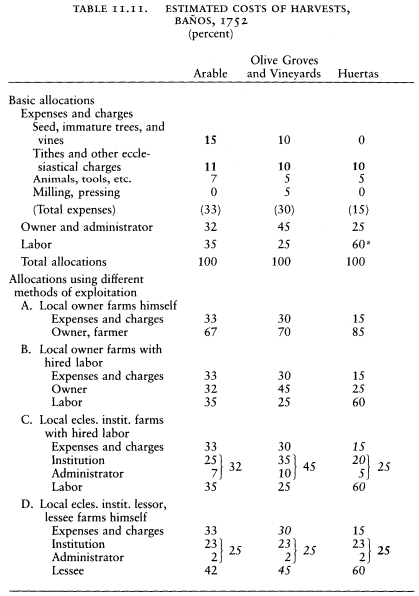
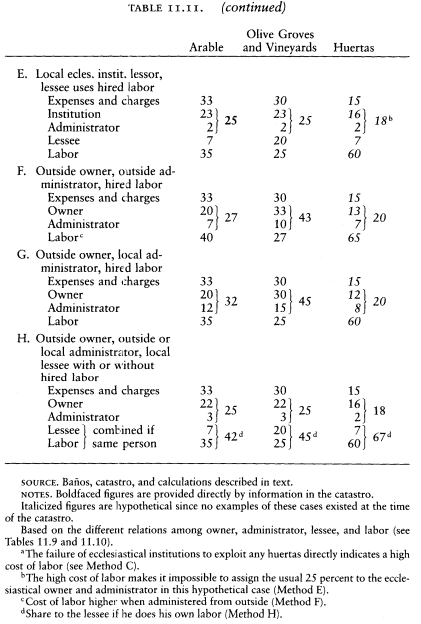
|
|||||||||||||||||||||||||||||||||||||||||||||||||||||||||||||||||||||||||||||||||||||
3
Besides their crops, the vecinos raised a large number of animals in the extensive pastures of the Sierra Morena. Herds of sheep and goats roamed the hills, and the vecinos also kept many pigs, which they destined for sale or slaughter. The main source of meat for the town was its goats, of
|
||||||||||||||||||||||||||||||||||||
|
|||||||||||||||||||||||||||||||||||||||||||||||||||||||||||||||||
which the butcher sold seven hundred per year.30 Table 11.14 calculates the income from raising animals, following the method established previously.31 It indicates an annual return of 3,840 EFW
Another product of the sierra was honey. The catastro records 4,371 beehives, 3,900 owned by vecinos, 471 by outsiders.32 At 6 reales per
year each, the locally owned hives provided the town with 23,400 reales, 1,670 EFW.
Finally, the catastro mentions a number of minor animal and vegetable products for which no specific amounts can be derived. They include flax, hemp, and silk. A tithe known as minucias was levied on these products as well as newborn animals, wool, cheese, honey, fruits, and "other seeds." The collection of the minucias was farmed for 9,000 reales, indicating an annual product of some 100,000 reales on all the items it covered.33 Our total for fruits, vegetables, verdes (Table 11.4), 17,195 reales; animals (including wool and cheese, Table 11.14), 53,759 reales; and honey, 23,400 reales, is 94,354 reales. This would leave about 5,600 reales for flax, hemp, and silk, 400 EFW. The calculation is very uncertain, but the result is worth including in our accounting.
Beyond its agriculture and livestock, the activities of Baños could add very little to the town income. The number of artisans was small, and most must have lived off the trade of the town. There were three blacksmiths, with four journeymen (oficiales ); possibly they also served the town of Bailén to the south, which had only one blacksmith.34 Their total income was about forty-five hundred reales; let us assume that fifteen hundred came from Bailén, approximately 110 EFW. The town had seven shoemakers, but only three shops. Yet they probably had all their business in the town, for surrounding towns also had numerous shoemakers.
The only other clear source of income was the two inns located on the main Madrid-Andalusia highway. The smaller one belonged to the Duque de Arcos, a nonresident; the larger one was the property of the town council, which rented it for 14,300 reales per year. The men who rented and ran the two inns had a net income of 12,100 reales between them.35 This gives a total gross income of 26,400 reales for the town and its vecinos, but some of the supplies—wine, bread, meat, some condiments—were town products and represent a form of export that should not be counted twice. Most eighteenth-century travelers in Spain carried their own food and supplies, however, so that the major charges of the inns were for services. Let us estimate a net income of 20,000 reales, approximately 1,430 EFW. It is true that vecinos would have accounted for some income of the inns, but their expenditures can be offset against
the net gain of a third inn, located in the town itself, where outsiders would have spent sums not included in our figures.
In order to draw up the balance sheet of the town economy, we now need only the charges levied on it, primarily the tithes and royal taxes. The catastro is anything but clear on the disposition of the tithes and other religious levies.36 The tithes were divided between two funds called barraño and pila, but the catastro does not define them. The collection of the barraño was farmed for seven thousand reales, that on olive oil and wine for thirteen thousand reales, suggesting that barraño was the tithe on grains and minor products, the pila on oil and wine. The barraño went to the bishop and cathedral chapter of Baeza, 500 EFW leaving the town. The pila was divided among the Congregation of San Felipe Neri of Baeza (owner of the préstamo canongible ), various benefices in Baeza, the king (tercias reales), the local fabric, the local clergy, and "one-eighth for the expenses of works" (gastos de obras ). The catastro does not state the share of each. Lacking better information, we can break the pila down as in Table 11.15, indicating that of it 587 EFW left the town. The Voto de Santiago amounted to 30 EFW, also destined elsewhere. Two minor ecclesiastical levies, the pie de altar on hortalizas (products of the huertas), rented for five hundred reales, and the first fruits (thirty fanegas of wheat and fifteen of barley) were kept by the local church and clergy. The destiny of the tithes on minucias is not stated; it rented for nine thousand reales. Between préstamo and tercias reales, probably five-ninths of it went to outside destinations: 357 EFW. The best estimate of the total ecclesiastical levies leaving the town is therefore 1,474 EFW. In addition, part of the income of the parish church would be spent outside the community; as for earlier towns this share is estimated at one-fourth.37
Royal taxes are more clearly expressed, for they were paid directly by the town council. Table 11.16 shows they were 1,626 EFW. The town owed two censos, one for seven thousand ducats to a vecino of Anduj ar, and another for forty-five hundred ducats to a vecino of Jaén. At 3-percent interest, the town paid annually 2,310 and 1,485 reales, or 271 EFW.38
We can now total the annual production, the income from outside,
|
||||||||||||||||||||||||||||||||||||||||||
|
||||||||||||||||||||||
and the outside payments of Baños (Table 11.17). The net town income is 19,020 EFW. When divided by the best estimate of the total population, 1,830 people, this sum gives a per capita income of 10.4 EFW. This figure is of course an approximation. I have based the harvests on the reported tithes, with a result well below the prediction from the extent
|
||||||||||||||||||||||||||||||||||||||||||||||||||||||||||||||||||||
of the different qualities of land recorded in the catastro, especially in the case of olive oil. The catastro indicates 40 percent more olive oil than the tithes, a difference of 4,300 EFW, and also 700 EFW more in grain. These additions would give a town income of close to 24,000 EFW, enough for each inhabitant to have 13.1 EFW. But this is an outside figure, and the truth probably lies closer to the original estimate. A town of this size probably could cheat on the tithe collectors (who were not clergymen but tithe farmers), but it is hardly likely that close to a third of the olive oil could escape their noses. If one-tenth of the oil and grains were hidden, the total would be 20,700 EFW, and the per capita income 11.3. Let us accept momentarily a figure between 10.4 and 11.3, under the 12 EFW threshold of well-being, but leave the question open for reconsideration. This figure is below that of La Mata and Villaverde on the plains of La Armuña but above the level of the sierra town of El Mirón.
4
How this income was spread among the vecinos determined the economic position of the different sectors. Unfortunately we lack the tithe payments of individual heads of household, which were the basis for much of our knowledge of the social structure of the towns of Salamanca. Since the collection of tithes was farmed out to private individuals, it is unlikely that the religious authorities ever received a report on each vecino's payments or that they have been preserved elsewhere. One must proceed solely on the information furnished by the catastro. Except for the few properties that the religious institutions rented, it tells us nothing about who actually farmed the land, only who owned it. But we can assume that local owners who used hired labor nevertheless administered their own properties, and from the social structure one can guess with fair assurance who actually labored in the fields and who paid others to do so. All we lack is the names of the lessees of properties of nonresident laymen, and in the total picture this information is not of major significance.
Table 11.11 on the division of the harvests and the information in the catastro on other activities make possible an approximation of the total income of the various heads of household. For each owner of land, buildings, and animals, one must decide whether he worked his land and tended his flocks himself or used hired labor (either mozos who lived in his house or jornaleros). Those whom I assume to use hired
labor and receive the corresponding share of the harvest (Method B) are labradores titled don, clergymen, boys under tutelage, widows titled doña, and other ferrale heads of household except widows with one or more sons over eighteen living at home. All others are considered to work their properties themselves or with the mozos listed in their households.
Since local administrators are identified, their income is calculated according to the proper category (Method C, D, E, G, or H). We do not know which lands of outside owners under the care of any specific administra tor were farmed directly and which were leased, but we have estimated how much of each kind of land owned by outsiders was leased and can thus calculate the total amount of administrative costs and prorate it among the individuals according to the income from the lands they oversaw.39 Neither do we know the names of the individual lessees of properties of outtsiders, but their total share, 232 EFW, is divided among the larger labradores, as the most likely group among whom to find the lessees.
The income of agricultural laborers must also be determined. The provincial summary of the catastro attributes to Baños 126 labradores and their sons and hired hands ("labradores inclusos hijos y mozos") and 336 jornaleros.40 This is a total of 462 adult males employed in agriculture, but it is not clear how the drafters of the catastro assigned specific individuals to each group or got these totals, for the household lists of the town do not obviously produce these figures.41 Table 11.18 indicates one possible reconciliation of the two sources. To arrive even near the total number of males working in agriculture recorded in the provincial summary, all sons of shopkeepers, muleteers, and artisans (except two sons of farriers said to work with their fathers) have to be considered to earn their livelihood in the fields or as herders.
To all men engaged in agriculture, the catastro assigns indiscriminately an income from their labor of three reales per day. It does not say how many days per year they worked, nor does any catastro from a town in Jaén province give this information. In La Mata, the figure was 120 days; in Villaverde and El Mirón, 180. Applying these two numbers to Baños would give the individuals 25.7 or 38.6 EFW return for their labor. The information in Table 11.11 permits a rough check on these
|
||||||||||||||||||||||||||||||||||||||||||||||||||||||||||||||||||||||||||||||||||||||||||||||||||||||||||||
|
||||||||||||||||||||||||||||||||||||||||||||||||||||
estimates, for it tells us what proportion of each harvest went for the cost of labor. Table 11.19 spells out this return, a total of 5,761 EFW. Divided among the men engaged in agriculture (omitting the animal herders, the total is 414), this amount indicates a per capita share of 13.9 EFW, hardly half of the minimum estimate above.
It is virtually impossible that each member of this group could have earned even the minimum estima te, 26 EFW, from laboring in the fields, for in order to reach this figure over 50 percent of the product of the soil and beehives would have had to go to labor. Yet we are told that 25 percent was the share of the owner, and we have calculated that the charges for seed, tools, animals, and tithes range from 15 to 33 percent, and one must allow a proper share to the lessees.
The average family of a jornalero had between three and four members (Table 11.20). Even though all reports were that Andalusian laborers lived on pitifully little, 14 EFW, derived from the share of the harvests attributed to labor, equal to a return on sixty days' work, cannot be considered adequate for these families. The women and children worked, especially at the harvest of grain and olives, but their wages would have to come out of the share marked for labor, reducing that here assigned to the men, not increasing the total family income.
Where else could they turn? The most obvious answer is the extensive término privativo, whose use according to the royal grant was open
|
|||||||||||||||||||||||||||||||||||||||||||||||||||||||||||||||||||||||||||||||||||||||||||||||||||||||||||||||||||||||||||||||||||||||||||||||||||||||||||||||||||||||||||||||||||||||||||||||||||||||||||||
|
|||||||||||||||||||||||||||||||||||||||||||||||||||||||||||||||||||||||||||||||||||||||||||||||||||||||||||||||||||||||||||||||||||||||||||||||||||||||||||||||||||||||||||||||||||||||||||||||||||||||||||||||||||||||||||||||||||
|
|||||||||||||||||||||||||||||||||||||||||||||||||||||||||||||||||||||||||||||||||||||||||||||||||||||||||||||||||||||||||||||||||||||||||||||||||||||||||||||||||
to every vecino. Strangely, only one-tenth of the area available for slash-and-burn (roza de cama) was cultivated, yet only fifty-three of the jornaleros, one-quarter of the total, tilled even modest plots here, and of these all but four owned some land or animals. Of eighty-three labradores with no property, only these four made use of the término privativo. By comparison, eleven of the fifteen labradores and labradores pegujaleros exploited it, and three of the six labradores titled don had large tracts in it. Were the poorest jornaleros systematically discouraged from taking their share? Could they not afford the seed or necessary tools and use of animals?
The answer to both questions might be yes, and still another reason be more important. The jornaleros might find work outside the town limits. Migrant labor is a well-known phenomenon in twentieth-century Andalusia, and it has existed for centuries. Several towns in Jaén province enacted rules in the sixteenth century to control the temporary exodus of their harvest workers.42 By chance, evidence for it in our period appears in the catastro of the small town of Tobaruela, a bare fifteen kilometers southeast of Baños. To the question "How many jornaleros are there in the town, and how much is their daily wage?" the reply was "There are no jornaleros, and those who come from outside to work for short periods are usually paid three reales daily."43 In addition, indirect evidence of the use of migrant labor will appear in Lopera, the next town to be observed. Both Tobaruela and Lopera were near the Guadalquivir River. Baños, a sierra town, could well have been one of their suppliers. For the jornaleros of Baños, walking to places a few hours, or at most a day, away could be more attractive than struggling with virgin soil in the hills and the possible displeasure of their betters, the dispensers of local employment.
How much did they make this way? At this stage of our information, we do not know the pool of migrant laborers or the extent of the demand. But jornaleros could not labor in two places at once, so that the question is partly how much earlier the various agricultural tasks, especially the harvest, were performed in the valley than in the sierra. If the seasons overlapped by half, the workers might have gotten another thirty days' labor, and this can be used as an approximation. If each brought home 80 percent of his earnings, this would mean about 5 EFW more per year, giving each a total of about 20 EFW. This, rather than 14
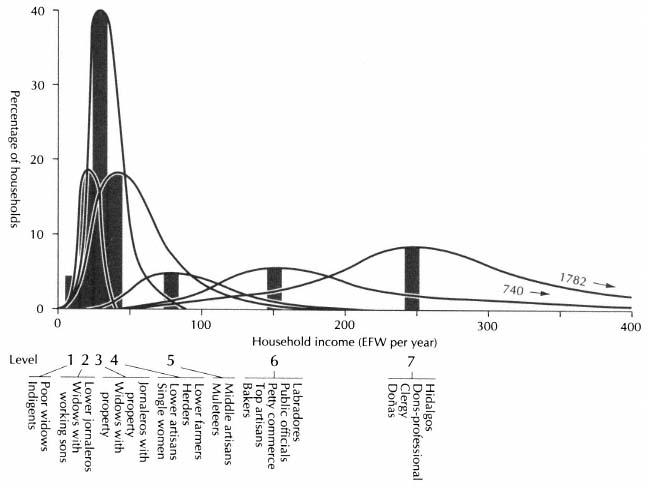
Figure 11.3.
Baños, Socioeconomic Pyramid, 1752
NOTE : In Baños and Lopera the complexity of the structure calls for more
levels than elsewhere. Note that the top level was substantial and had very
wide economic limits. This is a bar graph based on Table 11.20, with an
indication of dispersion. It is not a set of frequency distributions.
EFW, will be considered the individual income from agricultural labor, whether migrant or not. The outside income of the migrants, of course, is an addition to the total town income not previously noted and should be included in Table 11.17. Two hundred thirty-seven jornaleros and working dependents (Table 11.18) would bring in another 1,200 EFW and raise the per capita town income to between 11 and 12 EFW.
For the rest of the households, the calculations are more complex than for the smaller towns of Salamanca, but the results can be tabulated in a similar socioeconomic pyramid, although with more occupations and levels (Table 11.20 and Figure 11.3). The groups are arranged according to income and, secondarily, ascribed criteria like the appellations don and doña and callings that would attribute respect like labrador and municipal officials. The result is a pyramid of seven strata, ranging from hidalgos, priests, and professionals entitled to the don or doña, at the top, to propertyless widows and indigents at the bottom.
The stratified social structure of the town jumps at one from the table
and figure. Forty families formed the top level. Above all the others was the widow doña Francisca Luisa de Molina de la Zerda y Soriano, who lived in her house facing on the town square with her three maidservants and the twenty-five men servants she employed to till her extensive fields, olive groves, and huertas (most of them tied up in six vínculos that had fallen to her lot), tend her fourteen hundred goats and one thousand sheep, and run her cortijo and oil mill. Her net income was some 1,800 EFW, six times that of the wealthiest labrador we found in Salamanca. Next to her came the hidalgo labrador don Francisco Manuel Zambrana y Rivera, with 950 EFW, and the prior of the parish church, the licenciado don Francisco Charidad Villalobos, with 940 EFW, 400 from his ecclesiastical emoluments and the rest from his private estate. Two priests with net gross incomes of 60 EFW and two dons (hidalgos I would guess), whose only recorded receipts were 9 and 28 EFW, made up the bottom of these forty households.
They fell into two distinct groups, those that belonged to the landowning class and those that owed their position to their professional or clerical status. All were called don or doña. Although this attribute is no guarantee that they were hidalgos,44 it is more than likely that the landowners had their patents of nobility. If they did not, they might as well have; no one was likely to pry into the question. The landowners included seven men, two widows, and a single woman; each possessed lands producing over 100 EFW for their owners. Four of the men were regidores perpetuos (surely hidalgos), the others were an "official" of the town council, the town recorder (fiel ejecutor ), and the alguacil mayor of the Inquisition. These positions paid no money, but they formed the major portion of the municipal government or represented the disciplinary role of the church. With them can be grouped four members of the clergy who owned private lands worth 100 EFW or more: the prior, two other priests, and a man in minor orders, while the other in minor orders had land worth 60 EFW. Their family names show that many of these individuals belonged to small dynasties. Don Francisco Charidad Villalobos was the prior; don Diego Charidad Villalobos was a regidor. Molina de la Zerda was the family name not only of the wealthy widow but of the alguacil of the Inquisition, of one of the clerics in minor orders, and of the two single women called doña. Don Josef Galindo y Soriano was fiel ejecutor and don Francisco Galindo y Soriano the other cleric in minor orders (he also had a house on the town square).
These three families formed the aristocracy of the town. Close beneath them were three others. The del Marmols were less wealthy but very much part of the upper crust. Don Francisco del Marmol Navarro (with an income over 100 EFW) was a regidor and an alcalde ordinario as well, while don Pedro Andrés del Marmol was a priest. The bachelor don Juan Benito del Marmol Galindo (recorded income only 41 EFW) was the fifth regidor and related through his mother to the Galindo family. The Navarro clan belonged here too; besides being related to the del Marmols through marriage, they had a priest, a widow, and a nonresident owner, native of Baños, now living in Baeza, episcopal see of this region.45 The third family was the Zambrana. Doña Leonor de Bargas y Zambrana, with 400 EFW rolling in annually, was the richest single doña; don Francisco Manuel Zambrana y Rivera was a labrador, second in the town in income, town official, and administrator of the properties of doña Cathalina Thomasa de Zambrana, who lived nearby in Linares. Don Francisco de Zambrana, another of the family, was temporarily classed among the nonresidents; he was in prison in Granada, for reasons not elucidated. Only three persons among the wealthy hidalgos and clergymen had family names not shared with others: Pérez de Bargas and Pérez Carrasco were regidores (and perhaps related, as the first was probably to doña Leonor de Bargas), and an Espinosa was an independently wealthy priest.
Forming a second level were the less wealthy clergy and those professionals honored with the attribute don. The latter included the notary, the surgeon, the doctor, the apothecaries, and the administrator of the royal tobacco monopoly. Perhaps the don was in some cases evidence of hidalguía, but most likely it was an attribute accorded their profession, as it was for members of the clergy. Among them, only the notary owned land, and his returned a mere 32 EFW per year, but their professional incomes ranged from 80 to 315 EFW. The less wealthy clerics owned more private property than these men; all but one had land in Baños producing for him over 20 EFW. Among these men one found another distinguished local family, the de Lechuga, which included the notary don Thomás and the curate don Antonio Joséph. Don Thomás, in addition to 30 ducats' income from his notarial office (330 reales, 24 EFW), received 100 ducats from the cabildo and 150 ducats from the crown for handling the alcabalas and millones taxes. His total income was 316 EFW. The priests' benefice was worth 76 EFW, and he had property that
produced 66 more for him. The de Lechuga family might well be hidalgo, part of the local oligarchy. Indeed, the notary's matronymic surname was Galindo, indicating ties with one of the wealthiest landed clans.
To them who have shall be given. The persons chosen by nonresident owners to administer their properties in Baños were mostly of this top level. Priests, already stewards of the ecclesiastical properties in the town as well as their own, were preferred. Nine of them received 270 EFW in fees from outsiders (according to the rates calculated in Table 11.11). Of the remaining 84 EFW paid for administration, 48 went to two hidalgo labradores. One can expect that among these people were to be found most of the lessees of land of absentee owners, whose identity the catastro does not provide. To their income one should then add one attributed to lessees. No doubt some of them also had properties beyond the town limits, but unless these lands surpassed those owned by nearby vecinos in Baños, they supplemented only marginally the income of this level.
This top level, despite the wide range and different sources of their individual incomes, formed a unified group that dominated the town economically, politically, and through the church, culturally. The priests clearly belonged to this elite, both by economic status and by family ties. Priesthood in Baños was not a calling for sons of modest families. José María Blanco, a contemporary native of Seville, who later as a priest became notorious by fleeing to England during the Napoleonic conquest of Spain and abandoning his Catholic faith, complained that Spaniards who entered the clergy were divided by social class. The poor usually entered the regular orders, while the sons of the gentry became secular clergymen.46 His observation could not be generalized to include northern Spain, where many priests were of very humble origins,47 but Baños demonstrates its cogency for Andalusia. None of its priests came from the lower sectors of society, although their benefices were ample to support an individual without income of his own. The smallest provided 16 EFW; it was held by a man independently wealthy. The benefices could have been used to enable sons of modest families to become priests, but the elite of Baños had managed to fill them with their own kind and kin, using the church to harden social distinctions. Even if a man of modest means had broken through the barrier erected by the elite, he would have run into trouble. Before he could take over his bene-
fice, he might have to guarantee his administration of its properties with a lien on estates of his own.48
The town square, lying in the shadow of the old Moorish castle, made the power of the elite apparent to the world. Facing the castle was the parish church, and along one side the house of the town council, both safely in its control. Opposite these edifices were the houses of three of the wealthiest of the town notables, two priests and the widow doña Francisca, representing the three dominant families. The square could not accommodate the residences of all members of the elite, nor could such people all afford to vie with the Molina de la Zerda, the Charidad Villalobos, and the Galindo y Soriano families. But even the modest hidalgos and priests were members of the notability, set off by the distinction of the don, above the commoners of the community.
The pecheros, the commoners, fell into six strata beneath them. The highest stratum was one of almost thirty households, devoted to occupations whose members averaged over 100 EFW income. They were the storekeepers, the innkeepers, the labradores, the leading public officials, and the most highly rewarded artisans: the farriers and the bakers. The innkeeper of the Venta de Miranda had a net income of 740, placing him third in the town, although his business, way off in the sierra, would not have permitted him to parade frequently in the main square. In this level belonged the three men with official positions who were not of the notability: the inspector of butchershops (fiel de carnicerías ), who was also the schoolmaster; the inspector of oil measures and the tax on outside tradesmen (fiel medidor de aceite y alcavala del viento ); and the second alcalde ordinario. In this level without question the most prestigious, although not the most wealthy, were the five labradores. They belonged to only three families; for two were named Muñoz Galindo and two Barrionuebo. A third Muñoz Galindo, the widower Pedro, was the second alcalde ordinario, chosen no doubt as a representative of this select group of commoners. (The catastro even calls him don when listing him with the other public officials.)49
The matronymic surname of this family suggests relationship with the powerful Galindos. They were unique; none of the others of this level shared a surname with the hidalgos and other notables (except for the frequent one Ruiz). Intermarriage between hidalgos and pecheros, even wealthy ones, was virtually unknown. One begins to see why there
were six wealthy spinsters of hidalgo status. Yet even if the commoners were kept at a distance by their social betters, many of them could rival the notability in income. They had the means, like the ruling sector, to amass a peculium for a favorable opportunity.
Below the top commoners came two strata whose incomes were moderate but adequate. The first included most of the master artisans, the muleteers, the servants of the parish church (sacristan, organist, and subchanter), all with mean incomes between 50 and 100 EFW. Here too I place those men who for one reason or another could not work but did not need to because of their private incomes, no doubt a condition that gave them a certain prestige among the commoners. Members of this stratum could live comfortably, but except for a couple of muleteers, they could not match the wealthy commoners and notables. The position of the master artisans was considerably better, both in absolute terms and relative to their fellow vecinos, than that of the artisans of the towns of Salamanca. Pierre Vilar has shown that the catastro reveals this contrast to be general between northern and southern Spain. In the north artisans worked alone; in the south they were heads of small shops, and Vilar found that the income of the latter was higher as a result. In the south the artisans, as a general rule, were better off than the agricultural classes (except the landowning elite); in the north the opposite was true.50 Baños supports this generalization. Although farriers, carpenters, and a wineskin maker worked alone, the shoemakers, tailor, saddlemaker, blacksmiths, and masons each had one or more journeymen helpers (oficiales).51 Theirs were establishments open to the public, perhaps with shops on the street, different from the cottage work found in our Salamanca towns. Just as the whole social structure was more complex in Baños, so was that of its crafts.
The second of these two strata, third of the commoners, was headed by the farmers who could not qualify as true labradores, known familiarly as peujareros, or pegujaleros in correct spelling, and the garden farmers, the hortelanos. Here too were the animal herders (who had their own flocks to supplement their wages), the miller (did he get unlisted gratuities from his clients?), the barbers, and the lesser artisans, such as the pitchfork maker and soapmakers. Their incomes were marginal, between 30 and 60 EFW, but most managed to live adequately by restricting the size of their families. Here too I place the twenty-five single women of common status. Although their incomes were low (mean 21), they had few dependents and as a group enjoyed adequate
income for their needs. If a spinster maintained her own household, it was because she had the wherewithal to do so, and almost half of them even had the service of a maid.
We come now to the levels of people who failed to earn enough to support their families adequately, and the lowest of whom lived in poverty. Altogether they were 301 households, three-fifths of those in Baños. The largest stratum, 183 families, was made up of jornaleros who had some animals or property (perhaps just the house they lived in), and the families headed by widows with property. If the latter included males old enough to earn the wages of a jornalero, they could be well-off: as a group (and there were 25 of them), their per capita income approached the 12 EFW threshold. For the other widows with property and the jornaleros with property, the per capita income averaged around 9 EFW, which is what we found among the poorer families in the sierra town of El Mirón. Finally, I place here a few men who served the public in semi-official ways. The three "ministros ordinarios" were presumably servants of the city council; the hermitaños took care of the chapels outside the town limits. Even attributing to them the income of a day laborer, their income was inadequate; but it is not hard to imagine, given their function and the society in which they lived, that gratuities frequently greased their palms. They would not have been at the bottom of the pile.
Those that were at the bottom were propertyless widows and jornaleros. The day laborers and the widows with working sons had income we can detect (we saw that the average able-bodied male earned some 20 EFW per year, including his labor outside the town limits). Their families were small, but probably larger than the catastro and Table 11.20 say, because one recalls that the libro personal de legos appears to omit some fifty females, most of whom would have been in households in the bottom strata. These families could have obtained hardly half the 12 EFW per capita that I have judged adequate. And even this still left almost 5 percent of the households with no recorded income at all, the widows without adult sons, the old, the halt. Odd jobs and charity must have maintained them, but here were the miserable creatures that impressed the contemporaries who visited Andalusia. These lower levels were almost a quarter of the families in the town. And here too I place the three families of Gypsies, living by their labor and their wits but ostracized by those who were economically their peers.52
The picture that emerges is of an economy and society strikingly different from the towns of Salamanca. The peasants of La Mata, Villaverde, and El Mirón lived together in nucleated villages with less social ranking than economic differentiation. The priests stood out, as did the notary of El Mirón, but the class of large landowners who controlled the arable fields of La Armuña and the cotos redondos like Pedrollén—the beneficed priests of the cathedral and parishes of Salamanca, the city officials, and the titled nobles who lived as far away as Madrid—although of the same ilk as the priests, hidalgos, and other notables of Baños, lived far away and were invisible. The peasants of La Armuña were exploited from outside; they did not face an omnipresent class of poderosos to inculcate them with a sense of ignorance, poverty, and inferiority. In a sierra town like El Mirón, most of the outside owners were nearby labradores like themselves. Of course, no one who lived in Spain then or is familiar with its history would find anything new in this contrast between north and south, but generalizations gain from direct illustration.
Baños was the image of the social order of the old regime, based on caste and the exploitation of human labor in traditional ways. Its elite belonged to the familiar privileged orders, hidalguía and priesthood, united by family ties and closed against intermarriage with the pecheros. Members of the elite dominated the land, the church, and the local government. Not all may have been legal hidalgos, but all shared the traditional distinction of that order, the title don. Notables is a suitable term for them. More or less on a par with them economically but separated by a social chasm were the most select commoners, mainly labradores and merchants, middle classes if one wishes but of a very traditional kind, no different from those present two or three hundred years before. Far below were the day laborers and widows living in poverty. In between was the middle range of pecheros, most artisans, the muleteers, the small farmers and market gardeners. Basically this was an agrarian economy, with those who controlled the land at the top, those who labored on it at the bottom, and in between the secondary and tertiary sectors.
5
In 1767 Carlos III created the colonies of Sierra Morena along the Madrid-Andalusia highway.53 In so doing he took a large section of the ter-
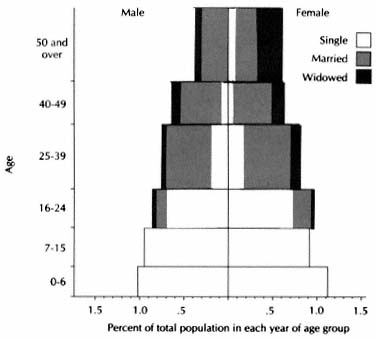
Figure 11.4.
Baños, Population Structure, 1786
NOTE : Since there is no limit to the top age group, a span
of seventeen years is used for convenience only.
ritory of Baños and assigned it to the new towns. Baños lost some pastures, part of the término privativo with several cortijos; the inn of Miranda, deep in the sierra; and the smaller one at Guadarromán, which became the center of the new town Guarromán. The inns were a blow; they represented 7 percent of the total town income. But the heart of its término was not affected, and the residents of the nucleus would have suffered little.
There is no other direct information on the evolution of Baños between the catastro and the beginning of desamortización. The census of 1786 is of little use, for it appears inaccurate. It shows a population of 1,754, hardly more than in 1752. But these are 924 females and only 830 males, whereas the catastro specified 836 females and 943 males (see Figure 11.4). Any attempt to reconcile these two counts and establish an upward or downward population trend becomes too conjectural to have any significance.54 Even Miñano's return for 1826 is of little
help, for he gives two counts of total inhabitants: 1,898 and a revised one on the basis of a letter from a vecino of the town, 2,638. The first would indicate almost no growth since 1752, the second 44 percent, hardly likely.
The census of 1786 records 50 labradores and 228 jornaleros; the figures in 1752 were 15 and 199. Without knowing how the census taker defined his terms, we cannot establish any change in status. The number of hidalgos in 1786 is 3; there were 6 labradores called don in 1752, which I take to be the minimum number of hidalgos at that time. One is left with nothing solid to go on to establish the evolution of the community.
Some reasonable conjectures can nevertheless be ventured. As throughout Spain, the price of agricultural products rose. Whereas wheat was selling for fourteen reales a fanega in 1752 and olive oil for fourteen or fifteen the arroba, by the 1790s the average prices in Jaén had risen to about forty-seven and fifty-two respectively.55 Price inflation would have meant downward pressure on real agricultural wages, bringing additional hardship to jornaleros and benefit to those who exploited the land.
Within the limits imposed by the inflexible social barriers, inflation favored social and economic mobility, for the land was relatively free from entail. Besides the 7.4 percent belonging to the municipal council and 13.9 to ecclesiastical institutions (Table 11.7), 10.3 percent was incorporated in local vínculos and 3.8 percent in outside vínculos.56 This gives a total of 35.4 percent in entail, and means that almost two-thirds of the land could be bought and sold without legal impediment. A major pressure for change appears to have been the attraction for outsiders of the rich and easily exploited olive groves, which produced the most important harvest of the town. At midcentury 86 percent of the property of outsiders was in olive groves, and they controlled one-third of them. But as yet no forastero dominated the economy. The most important, doña Isabel Mária Ponce de León of Granada and don Antonio Balenzuela, a minor residing in Andujar, had properties in Baños that brought them 316 and 213 EFW respectively, well below the largest local holdings.57 The contaduría de hipotecas shows active buying and
selling of property going on among the vecinos, but even an exhaustive study of extant notarial records would probably not tell us how much land changed hands. Much less land would have changed stratum; the overall property structure could hardly have been altered significantly by the end of the century.
Sales of ecclesiastical property under the royal decrees of September 1798 began in Baños at the end of 1799.58 Records exist of 105 sales and the redemption of two censos.59 Much of the activity took place early on; 36 sales were recorded in 1800 alone. The commissioners appear to have followed the official instructions, at least at first. Separate appraisers assessed the property for the crown and the owner; posters and the public crier announced the auctions. The authorities observed the prescribed delay after the auction to permit someone to raise the closing bid by 25 percent, then the provincial commissioner of the Amortization or Consolidation Fund and the intendant approved the sale.60 As time progressed, the process was shortened. Thus in 1806 the crown announced the sale of the properties of the hospital of Baños, but they were not appraised nor an auction scheduled until someone made a firm offer on one item. It was then assessed, and an opening bid accepted for the lowest figure allowed. Thereafter the sale proceeded as before.61 Most sales went for the first offer; only occasionally was there active bidding. All but two purchases were paid for at once. One buyer spread his payments over two years, another over three, putting up other property to guarantee fulfillment.62
In two-thirds of the cases I have identified the disentailed properties from their description in the catastro. The unidentified sales could be lands that the church had acquired since 1752 or they could have had their use changed—arable fields that had since been planted in olives, for example—or they could have belonged to the church in 1752 and not been recorded in the catastro. One suspects that all three explanations are involved. Some new endowments had been founded, and property added to others. The New Hospital for the Poor of Baños was not
|
||||||||||||||||||||||||||||||||||||||||||||||||||||||||||||||||||||||||||||||||||||||||||||||||||||||||||||||||
in existence in 1752. One of the priests then alive appears to have founded it and endowed it, but others added to it, in the spirit of useful charity of the century, for the crown sold off three times as much property belonging to it as the founding priest had owned.
The continual buying and selling among private individuals and the unidentified lands that were disentailed make it impossible to establish the property structure in 1808 from the one revealed by the catastro, but one can say how much of the land in Baños changed hands through disentail, for we have the catastral value of identified lands and can project values to the others.63 Only arable land and olive groves were disentailed (Table 11.21). Altogether 9.2 percent of the land, by value, changed hands; if the municipal pastures and término privativo are not included
|
||||||||||||||||||||||||||||||||||||||||||||||||||||||||||||||||||
in the base (many of them had been lost to the new colonies of Sierra Morena), the proportion becomes 9.9 percent—one-tenth of the cultivated land.
The effect on the church can be surmised by a comparison of the lands sold that can be identified with the amount owned at the time of the catastro. This comparison assumes that all the unidentified properties, a third of the sales, had been acquired by ecclesiastical institutions since 1752. This is an unrealistic assumption, but on the other hand the church would have acquired new properties that were not sold, so that Table 11.22 gives a likely approximation of the difference in its position in 1752 and 1808. The local institutions lost over half their property, and of the highly prized olive groves they lost almost 60 percent. Outside institutions suffered less, for the only one that had property sold was the hospital of Baeza.
Not all local religious funds lost at the same rate, however, for the members of the clergy managed to avoid harm to themselves. Of all the benefices (capellanías) that provided their clerical emoluments, only one had property sold, a house.64 The clerics evidently had a bastion of defense in their metropolitan see. The order of the crown encouraged the bishops to approve the sale of capellanía properties but gave them the final say. Unlike the Jansenist Bishop Tavira of Salamanca, his peer in Baeza declined the royal invitation. By contrast, the properties of the parish fabric (the building fund) were virtually all sold between 1804 and 1806, although fabric properties were clearly exempted from the
royal decree. Evidently the priests of Baños did not object. On the contrary, they personally bought much of the land put on sale (none of the fabric's), which they could exploit and then leave to their worldly heirs. In the matter of temporal goods, blood was thicker than souls.
The total impact of disentail on the town economy was negative, for outsiders bought more than outside churches lost. Since nonresidents were not likely to have added to local foundations since 1752, their acquisitions represented a net loss to the town from the time of the catastro, whether identified in that survey or not. Some of these buyers lived in the colonies of Sierra Morena and their purchases can be treated as local. The others were a resident of Madrid and one of Granada. They went after olive groves, now well established as the predilection of nonresidents. Outsiders had owned 34.7 percent of the olive groves in 1752 (Table 11.7); they purchased 4.4 percent of those in the town but only 0.2 percent of the arable. The town suffered, but not severely: some 150 EFW per year, 0.8 percent of the town income. The loss of the inns on the highway to the new colonies in 1767 had hurt the town almost ten times as much.
Nevertheless the loss was indicative of the evolution of the local economy. A look at the forty-five individual buyers shows why (Table 11.23). The four people at the top of the list bought two-thirds of the land sold and almost three-quarters of the olive groves. Clearly they deserve individual analysis.
The biggest buyer was the señor don Josef Pérez Caballero, a resident of Madrid and member of the royal Council of Hacienda. In his position he may have had inside information on what properties were coming up for sale, but he did not take advantage of the desamortización in Baños until late in 1801, when much had already been sold.65 For the next four years he dominated the auctions, making bids through his local agent, Juan Josef Villar, and acquiring thirteen lots. He did not only exploit the royal disentail, for during these years he also bought eight lots of olive trees from private individuals, several of whom were forced to sell because of an adverse court decision resulting from the "treacherous death of one of the town's alcaldes."66 Altogether Pérez Caballero spent 430,000 reales for forty-eight olive groves with 4,799 trees from the church and twenty-one groves with 2,247 trees from private individuals, becoming one of the largest landowners in Baños.67 He
|
|||||||||||||||||||||||||||||||||||||||||||||||||||||||||||||||||||||||||||||||||||||||||||||||||||||||||||||||||||||||||||
|
||||||||||||||||||||||||||||||||||||||||||||||||||||||||||||||||||||||||||||||||||||||||||||||||||||||||||||||||||||||||||||||||||||||||||||||||||||||||||||||||||
|
||||||||||||||||||||||||||||||||||||||||||||||||||||||||||||||||||||||||||||||||||||||||||||||||||||||||||||||||||||||||||||||||||||||||||||||||||||||||||||||||||||||||||||||||||||||||||||||||||||||||||||||||||||||||||||||||||||||||||
|
||||||||||||||||||||||||||||||||||||||||||||||||||||||||||||||||||||||||||||||||||||||||||||||||||||||||||||||||||||||||||||||||||||||||||||||||||||||||||||||||||||||||||||||||||||||||||||||||||||||||||||||||||||||||||||||||||||||||||||||||||||||||||||||||||||||||||||||||||||||||||||||||||||||||||||||||||||||||
also bought eight grain fields, two houses, and an oil mill. He leased his grain fields to two vecinos (whom he had beaten out of six olive groves at auction),68 but he evidently exploited his olive groves directly, as most outside owners did. Villar may have been his administrator as well as his agent at the auctions.
Why Pérez Caballero chose Baños for the site of his investment is not clear. One don Gerímo Ruiz Caballero, a vecino of Jaén, had a modest vínculo and various other properties in Baños in 1752.69 Were the two related? The dossier of Pérez Caballero's appointment to the Council of Hacienda that would reveal his family connections does not appear in the archives of the council. What the extant records show is that Carlos III gave him a half-time appointment to the council in 1781 in recognition of his accomplishment as intendant of the royal botanical garden in moving it to its present location next to the Prado Museum. In 1788 he received a full position on the council, and in 1792 he retired from the botanical garden.70 His half salary as a councillor of hacienda was twenty-two thousand reales in 1782, and in addition he had his income from the botanical garden. By the 1790s his salary was close to fifty thousand reales, then equivalent to about one thousand fanegas of wheat, far above the income of almost all residents of Baños. And he may have had other revenues of a private nature. Even after the expense of a presentable home in Madrid, he would have been able to save (although not enough to pay outright for all his purchases; he resorted to loans or had other means).
Baños was not his only choice for investment. In November 1800 his nephew, acting as his agent, bought thirty fanegas of disentailed arable land near Llerena (Extremadura) for seven thousand reales. Pérez Caballero promptly traded this field for one of twice the size but poorer quality belonging to a convent in Llerena, which had the advantage of adjoining an enclosed dehesa that was already his. He then petitioned the royal council to authorize the enclosure of his new field and won approval (in November 1808, in full wartime) despite the protests of the vecinos, who argued that the field had always been leased to them to farm.71 He was an aggressive agricultural entrepreneur with broad interests across the country, ready to use his official influence to improve his personal fortune. His case shows how money collected by the state and
redistributed to its agents could become the means for individuals located in the cities, and especially Madrid, to extend economic control over the countryside. Olive groves, an easily exploited investment producing a superior commodity in a time of rising prices, were a logical placement for capital. Baños was heavily oriented toward olives, a likely spot for such attention. The church disentail facilitated and accelerated the process, but it would have proceeded without the disentail, for one-third of Pérez Caballero's purchases in Baños were of private properties.
The fourth buyer provides a variation on the theme. Don Fernando Moreno Simón Pontero first appears as a vecino of Madrid. In 1800 he bought eight olive groves in Baños, paying for them with vales reales. Only in the last purchase did he have to overcome the bidding of others.72 By then he had moved to Real Carolina, capital of the Sierra Morena colonies and next door to Baños. In 1801 and 1802 he bought two houses in Baños, one of them on the town square, spreading his payments over two years.73 One would like to know if he moved to Baños to care for his olive groves, but we lose track of him after 1802, still in La Carolina. Here was a resident of Madrid who followed his money to the provinces, but we do not know why or where his capital came from.74
Acquiring slightly more land than Simón Pontero were two vecinos. Both of them were priests and members of leading families, thus representing a combination of the two strongest groups we found at mid-century. Already in minor orders at the time of the catastro, don Alonso Molina de la Zerda was a scion of the richest family in town. By 1800 he may have enjoyed some of the estates of the opulent widow of 1752, and by then he held one of the best capellanías in the parish, for we have a record of it going to someone else in 1805 after his death.75 All his purchases came in 1799 and 1800; very possibly his death kept his share from becoming greater. Don Manuel Thomás Orbaneja, the other priest, also made his purchases at the outset, before February 1800. Did he too die? There is no information. The Orbanejas were a lesser family of notables in 1752; don Juan Miguel, a widower, had almost no property, but he was an "official del cabildo [city council]." Don Juan Pedro Alvarez de Orbaneja was then a priest with a modest private fortune. The origin of our Orbaneja is not evident; possibly he was a son of don Juan Miguel and a student in 1752 outside the town. He paid for all his pur-
chases in hard currency, 93,560 reales.76 Inherited from his mother, perhaps, and accumulated from his benefice.
By comparison with these four, the other buyers were all modest. Yet there is a big difference between the acquisitions of don Blas Josef Muñoz y Galindo—five olive groves with 392 trees and half a fanega of first-class ruedo land77 —and the five fanegas of don Mariano Eduardo Escalante, part of it fourth class and part monte, good only for grazing.78 Both buyers came from distinguished local families. Pedro Muñoz Galindo was the commoner alcalde of 1752; Escalante's father was still single at that time and farmed the royal tobacco monopoly.79 The difference in their purchases shows that even though membership in the notability gave one economic advantages, individual character and conditions determined how much one profited from them. In Escalante's case, he was unfortunate in having two ne'er-do-well brothers who got into legal troubles. To pay their debts the three brothers had to sell their father's estate: ten olive groves, nine fields (one of twenty-six fanegas), and the family house.80 The buyers of this estate included Muñoz y Galindo and the royal councillor Pérez Caballero. Yet Escalante shook off his brothers and made two purchases of olive groves from private owners as well as buying his five-fanega field of disentailed land.81 Besides these two, other buyers had names that suggest notability and wealth—del Marmol, Zambrana, the regidor don Pedro Manuel Caridad—and they are scattered from top to bottom of the list.
What is more clear statistically is that one was more likely to be a buyer if one had a claim to the title don, by hidalguía, profession, or clerical position—that is, if one were at the top level of the socioeconomic pyramid. Persons with the attribute don or doña headed 8 percent of the households in 1752 but made up 61 percent of the vecinos who bought disentailed properties. Within the list of buyers, moreover, the dons and doñas monopolize the top; commoners become a majority only in the bottom half. Notability connoted wealth in 1800, as it had in 1752.
The list of buyers reveals other aspects of the local economy. The four large buyers put their money by preference into olive groves, as one would anticipate, because of their ease of exploitation on a large scale
and from a distance. The next ten buyers were more balanced in their choices and in fact showed some preference for arable. Both the parish curate and don Alonso José de Zambrana (a good local name) bought fields but no groves. This level probably consisted of landowners who tilled or administered their own properties and did not want all their eggs in one basket. Such a person was Antonio Peña, the first commoner on the list, very likely a labrador. Beneath this level came the small buyers, who could afford one or, at most, two purchases and usually chose an olive grove.
Except for family names we have little evidence of the wealth of the buyers. However, the contaduría registers from which most of the above information is drawn also tell us something about other sources of income. They record those notarial documents that involve the pledging or transfer of real property, and from them one learns of three activities that many buyers were engaged in: farming church revenues and administering church properties; buying and selling private property; and acting as agents or guarantors (fiadores) for third parties (Table 11.23).
What is striking about the vecinos on the list is the large number, 42 percent, who already exploited ecclesiastical revenues. Some administered church properties (one can assume that the two priests at the top did, although no record of this activity would appear in the contaduría), but many more farmed the collection of tithes, not only in Baños but in nearby towns. This could be a significant source of income. Take the case of Bartolomé Montesinos. In 1800 he and three others obtained the farm for one year of the excusado de la pila of Baños for 30 fanegas of wheat and 262 reales.82 As part of the joint bond, he pledged his house. Next year he and six others began to farm the excusado de la pila of Baños, Bailén, and Javalquinto (nearby towns) and the minucias de la pila of Baños for a total of 116 fanegas of wheat and 17,750 reales. Montesinos did not put up any collateral.83 In 1803 he and two others got the farm of the Voto de Santiago for the partido of Arjona (at some distance across the Guadalquivir River) for 510 fanegas of wheat. He put up two houses as guarantee.84 In 1804 he won for himself the excusado of Jabalquinto, a modest affair, with a house of his wife for bond.85 Finally he and his wife took on the Voto de Santiago of Arjona and Villacarrillo for 612 fanegas of wheat, pledging his house, 7 fanegas
of arable and 6 of monte, and a baker's oven.86 He had acquired the oven in 1805 at auction from the parish fabric, his only purchase of church property.87 Here was a man with drive—a baker, perhaps, for in 1752 the bakers were among the top of the commoners—who exploited the church revenues to get wealthy. Yet he did not buy land, for his activities were elsewhere. The fabric sold another baker's oven; it went after heavy bidding to Juan Josef Villar and his daughter.88 Villar was another commoner on the make, the agent who handled Pérez Caballero's purchases. He dabbled in church revenues (putting up as collateral four olive groves and three houses)89 and bought olive groves from the church and private individuals.90 Was he too a baker with a small family estate? Quite likely, for he was determined to get his oven.
These cases show directly what the catastro has indicated only indirectly, that church revenues offered possibilities to enterprising individuals. But they were not always a sure thing, nor were they the only such possibility. Don Mariano Escalante, whose father held the tobacco monopoly in 1752, participated with his father, a brother, and seven others in the farm of the oil tithes of Baños, its largest church revenue. At 90,213 reales, they had bid more than it produced and still owed over 3,000 reales in 1800.91 In 1802 don Mariano was back in tithes, along with Villar, and he also won the bidding for the fiel medidor and correduría of the town.92 Another loss on tithe farming occurred in 1807, when the parish curate don Thomás Ruiz bought two olive groves from people forced to sell for inability to fulfill their contracts. One of the orchards belonged to Escalante's two brothers, again unsuccessful in their ventures.93
On the other hand, commerce was not a major source of wealth behind the purchases. Only one buyer was clearly a merchant, Pedro García, who bought a small olive grove. We do not know whence came the wealth of Simón Pontero, fourth of the top buyers. Otherwise the capital came from landowning and services to church and government, economic and bureaucratic activities of the absolute monarchies of the old regime. The great demand for olive groves of Baños and the eagerness to farm ecclesiastical revenues give evidence of a growing national market
for agricultural goods, but the market was not new. Jaén province produced large amounts of olive oil in the sixteenth century.94 Indeed Andalusia had exported olive oil since classical times. In this sense the economy of Baños was capitalistic and had long been so. It was not now the scene of an incipient bourgeois revolution. Neither was it a feudal society. The villa of Baños was under royal jurisdiction, and no vecino or buyer was a señor entitled to seigneurial rights or income.
When desamortización came along, the stratified society of Baños gave advantages to its traditional elite of hidalgos, priests, and other notables. Their purchases increased the agricultural basis of their strength. For the present this group also preserved the endowments of their ecclesiastical benefices from the attack being levied against the real property of the church. At the same time, desamortización permitted the ambitious to better their positions within their social strata, whether they were a royal councillor, local priests and scions of leading houses, or labradores and bakers. They advanced, and the less aggressive and less fortunate declined relatively. The economy of the town lost a little of its autonomy, for outsiders increased their landholdings in the town. Since much of the land was free to buy and sell, these changes were going on in any case. More clearly than in the towns of Salamanca, disentail served to hasten existing economic developments. The only ones to whom the situation gave no option were the 65 percent who lived by their labor alone. And ecclesiastical institutions, which were still adding property in the second half of the eighteenth century, had entered a decline that was to accelerate as the new century progressed.
Chapter XII—
Lopera
Once past Baños and Bailén, the Andalusian highway descends to the Guadalquivir at the large town of Andújar. Crossing the river, the road rises again over low rolling hills and soon enters the province of Córdoba. The last town in Jaén through whose territory it passes is Lopera. The nucleus lies off to the south, out of sight of the road, surrounded on all sides by low rolling hills. Its position in the center of a valley makes it almost unique in the province, but its low position is only relative, for at 275 meters it is 60 meters above Andújar. Still, it is the lowest town of our seven. South and southeast of Lopera runs a ridge of gentle hills, the highest elevations in the region. Sitting astride this ridge is the larger town of Porcuna, from whose church one can look down at Lopera and its saucerlike término. Important pre-Roman remains have recently been unearthed near Porcuna; we are talking about a region of advanced settlement already centuries before Christ.
Following the reconquest of Andalusia, the king of Castile placed the villa of Lopera and the surrounding towns of western Jaén province under the jurisdiction of the military Order of Calatrava. They were towns of señorío, but in the eighteenth century the señor was the king, who since 1523 had been ex officio grand master of the Spanish military orders.1
Although Lopera did not dominate a hilltop, it had not been defenseless. A medieval castle still stands with the walls enclosing it, next to the
town square. In the mid-eighteenth century the castle formed part of the Encomienda de Cañaveral held by the Conde de Dietristan.2 Close by on the town square is a church whose style betokens the turn of the sixteenth century: a flamboyant Gothic facade with plateresque decorations, surmounted by a Renaissance tower with a sharp point striped in dark and white tiles. Across the square a single building held, at the time of the catastro, the ayuntamiento (town hall), jail, and pósito (public granary). The town council also owned and rented out a butcher shop. Streets ran off irregularly from the square, lined with low, two-story houses set directly on them, over some of whose doorways one can still see the escutcheons of the noble vecinos. With their heavy paneled doors, iron grills on the windows, and whitewashed walls, the domiciles told the visitor at once that he was in Andalusia. The town had in 1751, the date of the catastro, 298 inhabited houses, including 11 belonging to the clergy and 7 others in ruins or otherwise uninhabitable. This was not far off the 306 habitable houses of Baños. Unlike any other town we have observed, Lopera also boasted a convent of monks, of the charitable Order of San Juan de Dios.3
The houses held a population smaller than that of Baños. The libro personal de eclesiásticos is lost, so that we lack a count of the households of the clergy. The number of clergymen is given in the respuestas generales, however, and one can estimate how many people lived with them. The libro personal de legos lists 307 vecinos and a total of 1,181 individuals. The balance between the sexes is close enough to suggest that the count is fairly accurate. In addition there were 7 priests, 9 clergymen in minor orders, and 31 inmates of the convent, including 14 more priests and 4 monks (Table 12.1). In Baños the average household size of the secular clergy was 5.5, but the priests were much richer than those of Lopera. Only 6 of the clergy in Lopera had personal property that produced between 50 and 200 EFW. The priests of Baños whose income was in this range averaged 3.3 people per household (including themselves). If one assigns an additional 2.3 to each of these households and 1.8 to those clerical households with less income, one gets 32 additional people, most of them undoubtedly female. This gives a total population of 1,260, or 70 percent of that of Baños. People in Lopera were more amply housed, only 1.08 households per habitable house by com-
|
||||||||||||||||||||||||||||||||||||||||||||||||||||||||||||||||||||||||||||||||||||
parison with 1.48 in Baños. At once, one gets a sense that the lay denizens of Lopera lived better than those of the town in the Sierra Morena.
With one exception, the distribution of the occupations of the vecinos is similar to that of Baños (Table 12.2 and Figure 12.1, compare Table 11.2). The difference is in the number of men engaged in transportation. Baños had seven muleteers; Lopera, in spite of being smaller, twenty-one, who represent a source of income for the community that Baños lacked.
Located in the middle of the fertile valley of upper Andalusia, the término of Lopera was only about one-ninth the extent of that of Baños (reported as 11,800 local fanegas,4 about 6,725 hectares), but this still made it five times as large as El Mirón, fourteen times La Mata. The cultivated area matched that of Baños, however; 10 fanegas of huertas, some with fruit trees, 500 fanegas of ruedo planted in grains and broad beans (habas), another 4,070 fanegas of campiña (as it was called here) in grain, 2,225 in olives, and 51 in vines. This was a total of about 6,850 fanegas, 58 percent of the total area. (Baños had only 6,000 smaller fanegas of cultivated land.) Scattered in the campiña were eleven cortijos.
|
||||||||||||||||||||||||||||||||||||||||||||||||||||||||||||||||||||||||||||||||||||||||||||||||||||||||||||||||||||||||
|
|||||||||||||||||||||||||||||||||||||||||||||||||||||||||||||||||||||||||||||||||||||||||||||||||||||||||||||||||||||||||||
|
|||||||||||||||||||||||||||||||||||||||||||||||||||||||||||||||||||||
Another 4,390 fanegas was in pastures (dehesas). Less than 5 percent of the término was judged useless or taken up by the town nucleus, roads, and river beds.
Here von Thünen's rings are very clear. The huertas and orchards, requiring the daily supervision of their irrigation, were located close to the town. They drew their water from springs and wells (norias).5 The rest of the ruedo was planted in intensive rotation. First- and second-quality land, which formed more than nine-tenths of the ruedo, had a three-year rotation of wheat, barley, and habas, without fallow. Third-quality land had a three-year rotation of wheat, escaña ("Saint Peter's corn," a semisweet inferior grain), and a year of fallow. The campiña,
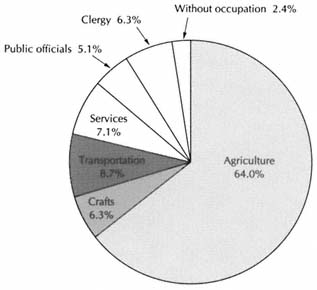
Figure 12.1.
Lopera, Employment Structure, 1751
beyond the ruedo and far larger, was devoted to less intensive cultivation, first-class land being planted in a five-year rotation: wheat, barley, escaña in that order, followed by two years of fallow. Second- and third-class land (62 percent of the arable of the campiña) had a four-year cycle: wheat, escaña, and two consecutive years of fallow. The difference between ruedo and campiña is manifest in the mean value of their harvests: in ruedo 164 reales per fanega per year, in campiña 53. The olive groves were also located in the campiña, as were the small plantings of vines. Pastures were located where the land was poorer, hilly, and doubtless at a greater distance from the nucleus. Even today, as one looks down on Lopera from the hill of Porcuna, the configuration strikes one sharply. The town is located in the center of a ring of grain fields, while olives occupy the rolling hillsides farther from the nucleus. Hills hide from view the farthest reaches, beyond the Guadalquivir River. In two centuries, olives have taken over the campiña, but the ruedo remains in grain fields.
Tables 12.3 and 12.4 show the results of the two ways of estimating the harvest: from the measures and qualities of land and the reported harvest on each quality as given in the catastro, and from the reported tithes. The estimate from the tithes is only 82 percent of the other, a greater discrepancy than usual. It indicates more wheat and less barley and habas than the reported rotations provide for. The tithes are said to
|
|||||||||||||||||||||||||||||||||||||||||||||||||||||||
|
||||||||||||||||||||||||||||||||||||||||||||||||||||||||||||||||||||||||||||||
be approximations ("lo que pueden montar"), for the books of the tithe farmers were not at hand. Nor does the catastro state what was paid for the right to collect the tithes. In Baños this last information indicated that an upward revision should be made in the reported tithes of olive oil and wine. Is a similar revision in order here? The only evidence is
from the lands exempt from tithes. The owners of these properties, who collected an amount equivalent to the tithes for themselves, rented out this task at times, and the catastro states the amounts paid for the right to undertake it. The total received for all such contracts was 1,920 reales.6 On the assumption that the tithe farmer kept 10 percent for himself, the harvests would have been worth 21,330 reales. The predicted value of harvests from these properties (including olive oil and vegetables) is 25,416 reales, making the harvest calculated from payments in lieu of tithes 84 percent of the predicted harvest, very close to the ratio obtained for the total harvest. In other words, the reported tithes, although showing a harvest far smaller than that predicted from the descriptions of the land, appear to be an accurate basis for calculating the income from agriculture.
The yield-seed ratios that can be derived from the catastro are as follows. For wheat, from 2.7 : 1 on the poorest campiña land7 to 7.5 : 1 on first-class ruedo land. The mean for campiña was 4.5 : 1, for ruedo 6.7 : 1, with 5.0 : 1 overall. For barley, from 3.0 : 1 to 8.0 : 1; mean 5.5 : 1 in campiña, 7.3 : 1 in ruedo, 5.8 : 1 overall. Habas, grown only in ruedo, low 3.2 : 1, high 4.8 : 1; mean 4.5 : 1. Escaña, grown in campiña, 9.3 : 1. The predicted need for seed is 3,055 EFW. Since the total harvest calculated from the tithes is 16,339 EFW, the net harvest after seed is 13,284 EFW (Table 12.4).
The olive oil and wine harvests are simpler to calculate. There were 50 olive trees per fanega of land, and according to the catastro, the fanega produced between 4 and 10 arrobas of oil per year, depending on its quality. The overall predicted harvest was 18,110 arrobas of oil from 110,000 trees. Calculated from the reported tithes, however, it was only 12,765 arrobas (at fourteen reales per arroba, 11,920 EFW).8 Since this figure means that the harvest per tree was 32 percent greater than my estimate for Baños,9 it is unlikely to be low, and I shall use it. The predicted wine harvest was 837 arrobas (at eight reales equal to 447 EFW). The catastro fails to state the tithes on wine, so that one must use this figure.
The town's informants did not give a detailed list of the fruits and
vegetables that their orchards and huertas produced. The orchards covered only three fanegas, one of them with about 120 mulberry trees, the other two also with about 120 trees each, but the only kinds mentioned by name were figs and pomegranates.10 To the mulberry trees they assigned little value, 2 reales each per year, because, they said, the trees were not irrigated and their leaves were only occasionally sold out of town, there being no silkworms in Lopera.11 The total income from orchards was 970 reales (65 EFW). The huertas were said to produce tomatoes, peppers, eggplants, cabbages, artichokes (cardos ), and melons. The total annual product was calculated at 4,566 reales (304 EFW). Lopera is the only place studied that listed the amount of seed needed for vegetables: one-half celemín (1/24 fanega) each of peppers, tomatoes, eggplants, and melons, "assuming that all the land is sown with these" ("respeto de sembrarse de ellas toda la tierra"). Did they mean one-half celemín of each kind of seed for one fanega of land, or of only one kind? Probably the latter, but so far as the net harvest is concerned, the matter is irrelevant, since vegetables could be eaten and the seed planted as well.
2
The best estimate of the total return from agriculture, derived from the calculations made so far, is about 26,000 EFW (Table 12.12). Rent paid out of this sum to nonresident property owners can be arrived at in the same way as for Baños. To start, Table 12.5 and Figure 12.2 establish the distribution of land among the different types of owners. What strikes one is the large amount in the hands of outsiders, especially laymen, even after the residents of the nearest towns are included under local owners. Rental payments will have a greater effect in this valley town than in Baños.
The stated rule for the division of harvests is the same as in Baños, three parts for the tenant and one for the owner.12 The catastro says how much of the property of ecclesiastical institutions was rented, the balance presumably being cultivated with hired labor. Table 12.6 gives the proportions. Comparing it with Table 11.9 for Baños shows that in the two towns owners had similar preferences. Given the 25 percent of the harvest that they could obtain as rent by local custom, in both places they found it advantageous to care for olive groves themselves
|
||||||||||||||||||||||||||||||||||||||||||||||||||||||||||||||||||||||||||||||||||||||||||||||||||||||||||||||||||||||||||||||||||||||||||||||||||||||||||||||||||||||||||||||||
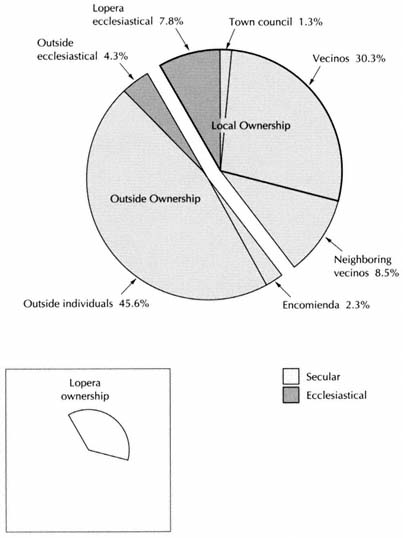
Figure 12.2.
Lopera, Ownership of Land, 1751
but to rent much of the plowed land. Outside owners naturally rented a greater proportion of their property because of the higher cost of administering from a distance.
The determining factor in their decisions appears to have been the proportion of the gross harvest that went to labor. The greater it was, the greater the tendency to lease the land. The difference in leasing pat-
|
||||||||||||||||||||||||||||||||||||||||||
terns between ruedo and campiña fields supports this explanation, for local institutions leased 52 percent of their ruedo lands (intensive rotations) but only 11 percent of their campiña lands. (No significant difference shows up for outside institutions.)
In this scheme, vineyards and huertas in Lopera appear out of line. Local institutions in Baños exploited vineyards directly; those of Lopera leased most of theirs. The reason is not apparent, but in both towns there were few vineyards, small samples to try to reason from. The huerta of Lopera is more easily explained. It belonged to the convent-hospital of the Order of San Juan de Dios, which had members—its eleven lay brothers—and perhaps convalescent inmates as well, who could labor in the vegetable plots. Like a Chayanovian peasant household, the convent could conceive of labor more as a fixed overhead cost than a variable input.
From the practices of the church, one can project the proportion of their property that outside lay owners leased and exploited directly (Table 12.6).
In calculating the division of harvests of Lopera among the different costs, one cannot apply the proportions determined for Baños (Table 11.11) without some modification. For one reason, the proportion of the harvest needed for seed was higher in Lopera, 19 percent compared to 15; for another, the product of the soil and olive trees was greater, resulting in a reduction in the amount of labor needed per unit of harvest.13 Finally, owners in Lopera preferred to lease their vineyards. Table
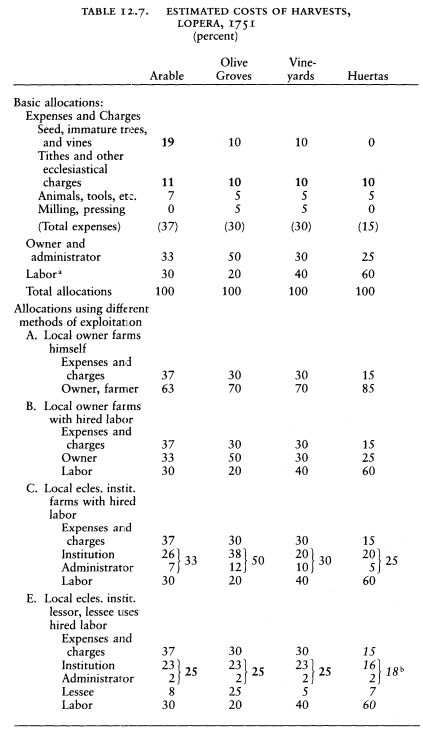
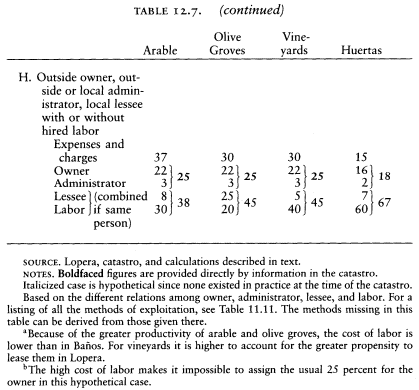
12.7 shows the results, in abbreviated form. The full table can be projected by following the pattern in Table 11.11.
Tables 12.6 and 12.7 permit one to derive the income of outside owners from lands they leased and from those they cultivated with hired labor (Table 12.8). How much of the harvests also left the town to pay outside administrators cannot be calculated as in Baños, for the catastro of Lopera does not identify administrators. The best I can do is apply the same proportions as in Baños, since we have found the leasing practices of outsiders to be similar.14 The results are shown in Table 12.9.
Summing the results of Tables 12.8 and 12.9, one sees that a total of 4,498 EFW left the economy of Lopera in rent, harvests, and costs of administration of lands owned by outsiders. This is about 21 percent
|
||||||||||||||||||||||||||||||||||||||||||||||||||||||||||||||||||||||||||||||||||||||||||||||||||||||||||||
|
||||||||||||||||||||||||||||||||||||||||||
of the total income from agriculture, which went to nonresidents as a result of their ownership of 52 percent of the land.
A number of houses in the town nucleus and other buildings also belonged to outsiders. Six of the eleven cortijos in Lopera (whose buildings were accorded a revenue independent of the fields) and thirteen of the twenty-two oil mills belonged to outsiders. The total income from their buildings was 16,140 reales, but allowing 10 percent for administration and 10 percent for upkeep, the net income was 12,912 reales (861 EFW). Part of the cost of administration would also have left the town; calculated according to the proportions known for Baños (see Table 11.10), this share would be 72 EFW.
3
Lacking extensive pastures, the vecinos of Lopera raised relatively few animals. Except for donkeys, which formed the working capital of the important group of muleteers, they had less than half the animals of each kind that Baños had and hardly more than a twentieth of the goats. The estimated annual product from animal husbandry is 1,243 EFW (Table 12.10).
Agriculture and livestock were the main bases of the economy of Lopera, but two activities provided income from outside. The more important was the business of transportation. As already noted, Lopera had twenty-one arrieros. They evidently had regular routes, for they are described as carrying goods (trajinando ) "on the highway of Madrid
|
||||||||||||||||||||||||||||||||||||||||||||||||||||||||||||
and other parts."15 I assume that two-thirds of their income came from freight charges collected outside the town. At 200 reales per year per animal, their total income was reported to be 24,800 reales. Two-thirds of this represents about 1,100 EFW. The inns were the other source of revenue flowing into the local economy. Both run by the same mesonero, they gave him an income of 1,100 reales, and in addition he paid 840 rent to their owners, both vecinos. If, as assumed in Baños, about two-thirds of the total income came from charges levied on travelers, the inns brought 1,300 reales into the town, 86 EFW. This was a tiny sum beside the 1,430 EFW that Baños's inns produced, but travelers on the Andalusian highway had little reason to stop in the término of Lopera.16
Besides the share of the harvests taken by outside owners and administrators, the main payments leaving the economy were the tithes and other religious charges and the royal taxes. Because Lopera belonged to the jurisdiction of the Order of Calatrava, all the regular tithes on grain and olive oil belonged to the king as grand master. The crown had rented them out, however, in a contract (asiento ) covering the district of Porcuna, currently held by a banking house in Madrid.17 The tithes on
|
||||||||||||||||||||||||
grains and olive oil amounted to 2,740 EFW, but a local priest administered their collection, receiving a fee of one thousand reales (67 EFW), which stayed in the town.18 The tithes on animals and vegetables, known as minucias, belonged to the comendador in Madrid, 97 EFW, but one may subtract 10 EFW for administration, which would stay in Lopera.19 One outside landowner received payment in lieu of tithes, 13 EFW. The first fruits, paid in wheat and barley (63 EFW), belonged to local funds, one-third to the prior and two-thirds to the fabric, and so did most payments in lieu of tithes; but the Voto de Santiago left the town, 40 EFW. The total income of the Lopera church was 710 EFW, of which 564 came from its properties and the rest from tithes and payments in lieu of tithes. A quarter of this, my standard estimate of the amount spent for goods and services purchased elsewhere, was 178 EFW.
Secular imposts collected by the royal government added up to 340 EFW, as shown in Table 12.11.
We are now in a position to draw up the balance sheet for the income of the town (Table 12.12). The net total is approximately 19,700 EFW. Divided among a population of 1,260, this provided 15.6 EFW per capita, well over the 12 EFW threshold. If properly distributed among the vecinos, the income would give them all a comfortable living. But how well was it divided?
|
||||||||||||||||||||||||||||||||||||||||||||||||||||||||||||||||||||||||||||
4
The vast majority of the men labored in the fields. The provincial summary of the catastro states that there were 195 jornaleros and 50 labradores, their sons, and their servants ("labradores inclusos hijos y mozos").20 The local list of households identifies only 135 jornaleros, but by counting all the males eighteen and over who were likely to be engaged in agricultural labor, one arrives at a total of between 241 and 257, roughly equal to the total of labradores and jornaleros recorded in the provincial summary.
These men would have divided among them the share of the various harvests destined for labor. According to the figures posited in Table 12.7, this share would have been about 7,670 EFW (Table 12.13). Divided among the men working in the fields, this sum provided a per capita income of between 30 and 32 EFW. The catastro reports a daily wage of 2.5 reales for jornaleros and a similar income from their labor for the others who worked the land.21 To reach the calculated per capita income, they would have had to work from 180 to 192 days annually, more than we found possible in Baños, and as many days as self employed farmers in Villaverde and El Mirón. In Baños the recorded daily wage was 0.5 real greater than in Lopera, and this difference helps explain why the calculations show such a large number of days of labor in Lopera. Since labor was evidently abundant in Baños and scarce in Lopera, this differential is suspicious. In fact, however, daily wages of 2.5 reales were reported for a number of towns in the valley of the Guadalquivir, while those in the foothills were 3 and in some cases 4 reales.22 One seems well advised to believe the catastro and to propose a different explanation, namely that wages were low in Lopera because migrant labor was readily available.
If one ascribes to agricultural labor in Lopera 120 days of work per year (certainly not too low, since by my calculations the men of Baños had only 60 days of work in the fields of their town), each man would earn 20 EFW. I reason that whatever local women and children earned during harvests would come out of this amount. The portion of the total share of the harvests destined for labor that is left unaccounted for is 2,660 EFW, and this could be the amount paid to jornaleros from outside. If they took home with them 80 percent of their earnings, the net
|
||||||||||||||||||||||||||||||||||||
town income is reduced by 2,128 EFW (Table 12.12), and the per capita income of the town to 13.9 EFW, still 20 percent higher than that of Baños.
In Andalusia, the migration of labor adds an unknown factor to the calculation of town and individual incomes. Nevertheless, although the yearly income of agricultural laborers was arrived at independently for Lopera and Baños, the result, 20 EFW, is the same, and this provides a measure of confirmation for the estimates. Rather than being isolated units, the towns in this region were like connecting vessels, with labor flowing among them to establish a roughly unified labor market. The catastro provides no direct information on this phenomenon, but its data suffice to detect its existence.
At a higher level, much of the income of the vecinos came from lands they leased from outside owners. Who rented church properties is stated, but not the names of lessees of secular properties. From Tables 12.5, 12.6, and 12.7 (Method H), one can calculate that the total income of the lessees from the latter properties was 1,270 EFW. Since owners were more likely to rent to persons who could guarantee their contracts with their own property, as is evident in Baños, I prorate this income among the hidalgos, labradores, and clergymen of Lopera according to their known income from property, whether owned or rented from the church, and, in the case of clergy, their benefices. This additional source adds 26 percent to their income.
The income of the individual households can now be established, the
|
||||||||||||||||||||||||||||||||||||||||||||||||||||||||||||||||||||||||||||||||||||||||||||||||||||||||||||||||||||||||||||||||||||||||||||||||||||||||||||||||||||||||||||||||||||||||||||||||||
|
||||||||||||||||||||||||||||||||||||||||||||||||||||||||||||||||||||||||||||||||||||||||||||||||||||||||||||||||||||||||||||||||||||||||||||||||||||||||||||||||||||||||||||||||||||||||||||||||||||||||||||||||||||||||||||||||||||||||||||||
|
||||||||||||||||||||||||||||||||||||||||||||||||||||||||||||||||||||||||||||||||||||||||||||||||||||||||||||||||||||||||||||||||||||||||||||||||||||||||||||||||||||||||||||
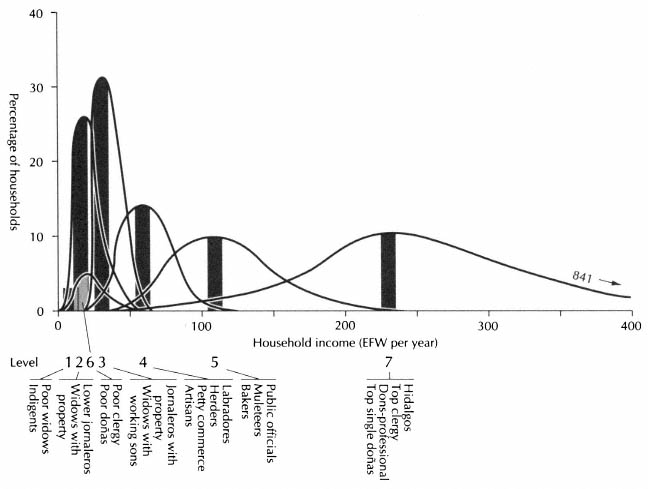
Figure 12.3.
Lopera, Socioeconomic Pyramid, 1751
NOTE : In Baños and Lopera the complexity of the structure calls for more
levels than elsewhere. Note that the top level was substantial and had very
wide economic limits. In Lopera the social elite was bimodal economically;
Level 6 is part of it and is just above the bottom. This is a bar graph based on
Table 12.14, with an indication of dispersion. It is not a set of frequency distributions.
total from land, animals, and a craft, business, or profession, and these results provide the socioeconomic pyramid for Lopera (Table 12.14 and Figure 12.3). The figures for the landed sector are on the low side, because these people would have owned some properties in adjoining towns, and I have not attempted to estimate this income.23 The table is surprisingly similar to that of Baños (see Table 11.20). As there, a division into seven levels appears appropriate, and the income range in each level is roughly the same, indicating a similar social structure and economic condition. Yet there are peculiarities that distinguish the two towns and show that no one place should be considered typically Andalusian.
5
The most striking differences are in the top category (Level 7), occupied by noble and clerical households. No household in Lopera had the wealth of the three richest people in Baños, a widow, an hidalgo landowner, and the parish prior. The top level had a lesser range of income, and that of the clergy was comparatively low. The highest stratum consisted of ten men labeled caballeros hijosdalgo and six single women evidently belonging to hidalgo families. On a per capita basis the latter were the most wealthy; their mean 235 EFW per household provided them with the wherewithal to maintain an ostentatious position and still amass an ever-growing fortune. For the men, the title of caballero hijodalgo was a mark of exclusive status, hidalguía, but it did not imply membership in the military order. The only person said to wear the habit of Calatrava was the prior; whatever perquisites he might draw out of his parishioners, his only recorded income came from his office and was under 100 EFW, a far cry from the wealthy priests of Baños. The others in the community called don—the doctor, the administrator of the royal tobacco monopoly, a labrador, and one whose occupation is not stated—were economically and socially lower but still part of the town notability. With them one can place clergymen with personal property, although some of their incomes were very modest. One commoner also belongs in this level, Francisco Díaz Serrano, the notary of the town council. His income places him very high, but he was not called don, although this appellation has been applied to the other notaries (escribanos) we have encountered. His income and activity make him a notable, and he may have belonged to a leading family. Díaz and Serrano were names of caballeros hijosdalgo, and a Díaz Serrano was a cleric in minor orders.
As can be expected, the notables belonged to family groups, but no families were as prominent as the best in Baños. The wealthiest member of the elite, don Ignacio Montilla, with 840 EFW income, could not compare with the widow Molina de la Zerda y Soriano of Baños. Although he had a household of fifteen, including five minor sons, three daughters, three maids, and a manservant who worked in the fields, he did not head a powerful family. No other hidalgo and no priest shared his surname, and he held no official position. The most important family was the Laras. At its head was don Pedro Josef de Lara, eighty-one years old, a widower, the holder of the royal jurisdiction in the town. Don Francisco de Lara, probably his son, the poorest of the hidalgos,
was also a widower, with two minor sons and two daughters, the future hope of the family. Don Juan de Lara was a priest, but his personal property and benefice gave him only 31 EFW per year.
The Lara family had three heads of household. None of the elite families had more, and among them a surprising number were spinsters ("de estado honesto"), six of whom were wealthy enough to belong in the highest level. Doña Balthasara Jil had an income of 615 EFW and a household that included a maid, five male servants for field work, and six shepherds. Her sister (or close relative), doña María Josefa Jil supported a nephew, a maid, and two male servants on her 354 EFW. Doña Josefa de Andújar belonged with them. Besides olive groves and grain fields, she owned three notarial offices (escribanías ) in the town, two of the council and one of royal taxes (millones), all of which gave her 205 EFW. The notary Matheo Díaz performed the official duties for her. Theirs were imposing houses, but no direct heirs would come out of them. The nephew of doña María Josefa Jil would probably inherit her wealth and that of her sister (if indeed she was her sister), but we do not know if he was a Jil. In the mid-eighteenth century a sense of family honor condemned the daughters of hidalgo families in Lopera to a solitary existence, as it did in Baños, and as it would in the house of Bernarda Alba two centuries later. In the process some lineages died out.
As in Baños, the elite families controlled the political structure of the town, although their authority was more veiled. The crown had preserved a voice for the representatives of the commoners in the municipal government, the Consejo de Capitulares. At its head was the aged don Pedro Josef de Lara, alcalde by virtue of his office as royal justice.24 The council had five offices of regidor, two hereditary ("perpetuos") and three elected. One of the former belonged to a caballero of the Order of Calatrava who lived elsewhere and was represented by don Fernando Gutiérrez de Arce, hidalgo and military officer (teniente alférez mayor ), vecino of Lopera. Another belonged to a minor girl, and her proxy was another hidalgo in Lopera, who was himself alguacil mayor for the Inquisition of Córdoba and the owner of a regidor's office in Torredonjimeno, a town twice the size of Lopera forty kilometers away.25 The noble estate of Lopera elected one of their number to be a regidor, and the commoners ("estado general") elected two of theirs. One of the
latter was the procurador síndico (public attorney) and the other the padre de menores (guardian of public wards). The formal income of the regidores came from market fees and amounted to only 16 EFW each per year.26 The commoner regidores were modest men; one of them had hardly any personal property and must have worked in the fields. Although modest, they appear to have had family ties with the elite. One was a Chiquero and the other a Bueno on his mother's side. A well to-do cleric in minor orders was named Bueno Chiquero, and two single doñas were Chiqueros, although too poor to be placed in the elite level. It is hard to avoid the suspicion that the devotion of these regidores to the public interest was tempered by other considerations.
Perhaps because it belonged to a military order, Lopera had a less exclusive society than Baños. As an example, the witnesses asked to swear to the exactness of the catastro came from all social levels. Among them, the royal judge, eighty-one-year-old don Pedro Josef de Lara, whose hand trembled as he signed, three regidores, the prior, and two other priests belonged to the elite. (The wealthy don Ignacio Montilla is conspicuously absent.) All the rest were commoners: the two regidores, the notary, the police officer (alcalde ordinario de la Santa Hermandad ), who owned no property, a labrador, a baker, a muleteer, a carpenter, and two jornaleros. Not social status but age gave them distinction. Except for the aged judge and the noble regidor, who was twenty-six, the others were between forty-five and sixty-three.
Other evidence of some social flexibility appears at the lower level of the elite, where the distinction between the dons and the commoners becomes slightly blurred. We have seen the connections of the notary and the commoner regidores with noble families. The Morales family provides another case. Three labradores had Morales as one of their surnames. So did a cleric in minor orders and a widow called doña. One of these labradores, Pedro Morales de Aguilera, may have been related to two hidalgos named Aguilera. The sense of honor did not prevent family ties from developing across social estates at the boundary where they met economically.
One must visualize the elite of Lopera differently from that of Baños. Rather than a collection of families of which a few were dominant (and richer than the richest in Lopera), the leaders of Lopera seem a corporate body of people who distinguished themselves by the label caballero hijodalgo. Perhaps this phrase appeared only in official documents, but
it was reserved for certain people and gave expression to their superior status. The wealthiest women, whose position did not allow them to marry beneath their station, belonged with them. This corporate body dominated the economy by extensive holdings in land, and the greater wealth of Lopera redounded to the benefit of its members—ten of the eleven caballeros hijosdalgo and three of the six single women in this group had incomes over 100 EFW; only seven of a larger group of landowning notables in Baños reached this level. They controlled the municipal administration, formally by their official positions and informally by patronage. Family ties and the ownership of office connected them with their counterparts in other towns of the region, a relationship critical to their position, for a large proportion of the town's land was in the hands of outsiders.
6
In the pyramid just below the privileged elite I have placed two groups on the basis of their claims to social status, for their wealth or income would locate them in the lower levels. One of these is clergymen with only their benefice to live on. The rule of José María Blanco that one needed personal wealth to become a priest did not apply here, for over half the clerics in town had no property of their own. In Baños the smallest capellanía was worth 16 EFW; in Lopera seventeen of thirty capellanias produced less than this, a corollary to the small amount of land in ecclesiastical hands. Single ladies called doña with pittances to their name and all the widows called doña are the second group in this level. The clergy must have benefited from fees for masses and other services and from the administration of properties, activities that cannot be traced in the catastro. The women could hardly have flourished, however, since they had no servants and some not even a relative to live with them. They could cling to the status of their wealthier relations and scorn the commoners who had more than they did, but even if genteel, theirs was a hard-pressed life of counting cuartos and ochavos, whose need offered commoners the possibility of entry into the privileged ranks through marriage.
Below the privileged elite, in the top level of the commoners—those with household incomes over 100 EFW—the most prosperous group was the twenty-one muleteers. We recall that muleteering gave La Mata its remarkable well-being. Here too transportation was an organized undertaking, and its practitioners prospered. The catastro credits them
with a mean income from their calling of 84 EFW. This figure could be suspect, based on a round sum of two hundred reales per pack animal (and it probably ignores the amount spent outside the town for feed), but their prosperity is evident, for their activities spilled over into the local economy. Several farmed land that they owned or rented, raising their income by another 50 percent. Entrepreneurial spirit guided them, not a desire to switch activities, for those who had the largest pack trains also did the most farming. At their head Benito Merino, with seven animals (93 EFW), had 79 EFW from land. Two arrieros joined muleteering with baking and made almost 100 EFW from each. Their choice was hardly a coincidence, for bakers were the other group that belonged in the top level of commoners, as they did in Baños. The bakers too were entrepreneurs; three of the five panaderos rented olive groves and grain fields although they owned no land of their own.
At this level let us also place the public officials—regidores of the common estate, tax collector, grain steward of the military order, and schoolmaster. Their household income did not reach 100 EFW, but they had small households (the regidores were bachelors) so their per capita income was substantial. In any case, their official positions would add to their status and place them with the top commoners.
The storekeepers, master craftsmen, and labradores, who attained the top income of commoners in Baños, here fall into the middle range (Levels 4A, 4C, 4D). Indeed the labradores of Lopera were modest farmers, whose known income, even when credited with a share of the return on lands leased from outside owners, gave their families less than 12 EFW per person per year. Nevertheless, their social status was greater than their income would warrant. As we saw, they shared family names and probably family ties with the hidalgos.
Below the middle range but above poverty, as in Baños, come the widows with working sons at home, who could support them. Here too are the lesser public and church servants, and the jornaleros with property of their own. Out of the 135 jornaleros, 85 are in this group, a larger percentage than in Baños. Sixty-three owned their house, 15 owned or rented some land, 21 had donkeys, and 11 had pigs, goats, or other animals. The household incomes of these jornaleros place them in this level, but their family per capita income was below 12 EFW because their families were numerous.
Finally one reaches the poor, the propertyless day laborers, the single women, the widows without the help of able-bodied sons, the mendicants, and the blind. Almost all the women who headed households
owned the house they lived in, but only four at this level had any animals. They worked, of course, as did their minor children, and the widows must have received charity, as did the blind and mendicants, so that more came into their homes than the catastro reveals. But most of the members of the families in these levels (2 and 1) surely dressed in rags and gave reality to the contemporary picture of Andalusian poverty. In this level were 30 percent of the households, 6 percent more than in Baños, proof that the greater per capita income of the town did not mean a better distribution of wealth. The structure of the elite might differ, and the relative economic position of the upper occupations of the commoners, but for the majority of the vecinos and vecinas it made little difference whether they lived in Baños or Lopera, except that the jornaleros of Baños left their town periodically to seek work.
7
The only information I have on the evolution of Lopera in the eighteenth century comes from the available censuses. These are of varying reliability, but they all concur in showing that the population grew steadily after the end of the War of the Spanish Succession. Furthermore, the rate of growth was increasing (Table 12.15). In 1786 the reported population was 1,407,27 by 1826 it was 2,016.
The list of occupations in the 1786 census does not shed light on the evolution of the economy. It shows a small but reasonable growth in the number of labradores, artisans, and male servants.28 A figure of 83 jornaleros where there had been 135 in 1751 is clearly a miscount: the total number listed for all occupations is 95 less than the male population over twenty-four. On the other hand, only 10 hidalgos are reported (there had been 12 "caballeros hijosdalgo" in the catastro), 4 priests (there had been 7), and 1 cleric in minor orders (there had been 9). If accurate, the figures show that notables and clergy were declining in numbers, especially the latter. The falling off of clerical vocations, so marked in Spain after 1800, may already have begun, spurred on here by the insignificance of the capellanías combined with economic well-being. Another suggestive item is that the Inquisition no longer had an agent in Lopera in 1786.
The officials of Lopera did not respond rapidly to the royal orders of
|
|||||||||||||||||||||||||||||||||||||||||||||||||||||||||||||||||||||||||||||||||||||||||||||||||||||||||||||||||||||||||||||||||||||||||||||||||||||||||||||||||||||||||||
1798 to disentail the property of ecclesiastical endowments. Not until September 1800 were the first sales concluded. They began with the property of the wealthiest local confraternity, the Cofradía de San Bartolomé. Sales continued into 1801, then slowed down. There were fifteen sales in all, and they disposed of land belonging only to local confraternities and obras pías. Every one of them lost some property, although far from all they had. As in Baños, the clergy avoided the sale of any of the endowments of the capellanías, and neither of the two outside ecclesiastical institutions that came under the royal orders was touched.29 By comparison with the other towns studied, Lopera had little property disentailed. The sales covered only 1.2 percent of the arable and 1.5 percent of the olive groves. Since the church owned rela-
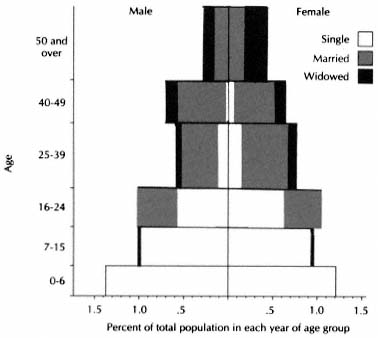
Figure 12.4.
Lopera, Population Structure, 1786
NOTE : Since there is no limit to the top age group, a
span of seventeen years is used for convenience only.
tively little here, however, its loss was not inconsequential: about 10 percent of all ecclesiastical property in town, 16 percent of the holdings of the local church.30
When church properties first went on sale the demand was lively, but it rapidly weakened. In mid-1800 a vecino chose to bid on an olive grove, thus forcing the authorities to offer it at auction. The assessors measured it and declared its value to be 13,000 reales. Bidding forced the price up to 13,899 reales, at which the original bidder got it.31 An-
other vecino, wanting to make sure that he got a grain field of five fanegas, assessed at 315 reales per celemín, offered 400 reales per celemín, which took it. He paid in specie (en metálico ), giving two-thirds the agreed price, as permitted. (Vales were then worth barely one-third their face value in hard currency.)32 At the end of the year, however, an olive grove went at its assessed value in vales reales, "there having been no other bidder," the notary observed, perhaps in surprise.33 From then on almost all sales were paid for either in vales reales (meaning that no one had raised the bid by offering specie) or at two-thirds the assessed value in specie, the lowest the law allowed. Only two small sales in 1801 and 1804 give evidence of competition among buyers.34 In Lopera land could always be found on the open market, and at the prices set by the assessors church properties were not bargains. One purchaser, for instance, who paid 5,010 reales for a grove of seventy-four olive trees in 1800 got another with sixty-eight trees for 2,256 reales by private sale in 1803.35 Unlike the villages of Salamanca, where land seldom changed hands, in these towns of Jaén there was an active real estate market, and the hunger for church properties was less acute.
Because Lopera had such a market, one cannot assume that the distribution of property was the same when disentail began as at the time of the catastro, and therefore one cannot know the distribution after disentail. As in the case of Baños, one can only show how the sales compared with known holdings in 1751 (Table 12.16). Outside lay owners gained slightly, adding less than 1 percent of their holdings in 1751, an olive grove and a grain field bought by a resident of Córdoba. Vecinos gained more, both relatively and absolutely, 3.5 percent of their holdings in 1751. These changes would hardly be perceived in the town economy. The processions and other activities of the confraternities might be somewhat curtailed when the crown stopped paying interest on the resulting debt to these funds, but in no way could the disentail be seen as a shock to the social or economic order.
Yet the disentail has much to tell us about that order. Twelve persons made purchases, and almost all of them turn up in the records of the
|
|||||||||||||||||||||||||||||||||||||||||||||||||||||||||||||||||||||||||||||||||||||||||||
notaries and the property register in other transactions during these years (Table 12.17). What kind of person decided to buy church lands?
Don Juan Nepomuceno Morales, a lieutenant colonel in the royal army, resident in Córdoba, was the individual who spent the most money. He bought one of the finest properties in Lopera, an olive grove of 462 trees on first-quality land and also eight fanegas of grainland, both acquired in 1803.36 Why did he choose Lopera for his investment? He made his purchases through an agent, Antonio de Balenzuela, vecino of Lopera. In 1802 Balenzuela rented a mill and other property in Córdoba belonging to the alcalde of Lopera and his wife, doña María Antonia Morales (sister perhaps of don Juan Nepomuceno Morales). Doña María Antonia guaranteed her part of the contract with an olive grove of 516 trees in Porcuna (adjoining Lopera).37 One can conceive of don Juan Nepomuceno as coming out of a modest notable local family (in 1751 the last name Morales belonged to the poorest widow addressed as doña and to a cleric in minor orders with no land of his own).
|
||||||||||||||||||||||||||||||||||||||||||||||||||||||||||||||||||||||||||||||||||||||
|
|||||||||||||||||||||||||||||||||||||||||||||||||||||||||||||||||||||||||||||||||||||||||||||||||||||||||||||||||||||||||||||||||||||||||||||||||||||||||||||||||||||
He may have met Balenzuela through his sister and brother-in-law, hearing about property coming on the market in Lopera, close upon his sister's olive grove, and engaged Balenzuela to get him a share of the bonanza. The disentail introduced a new landowner made wealthy by military service in recent wars against France and Portugal.
Balenzuela is an interesting figure in his own right. A commoner, he made his way by serving the town's elite. Dealings with the outside world were his specialty. In 1802 the alcalde of Lopera commissioned him to go to Córdoba to arrange for the rental of the olive groves and mill owned in Lopera by the convent of Santa Clara in Córdoba. The convent's holdings recorded in the catastro were impressive; this was a major lease.38 When a resident of Jaén wanted to take out a censo (lien) on some houses he owned in Lopera, Balenzuela was the lender. At the same time Balenzuela bought from this man an olive grove in Lopera with twenty-two trees.39 Although he never purchased any disentailed property, he also acquired a corral from a private owner during these years.40 Clearly an upwardly mobile spirit.
The largest purchaser was the army officer Morales. The largest single sale, however, an olive grove of 773 trees, went jointly to three sisters, doña Margarita, doña Inés, and doña María Josefa Montilla y Zevallos, vecinas of Lopera, all "de estado honesto over twenty-five years of age, who rule and govern their personal property without care of any tutor or guardian whatsoever."41 But they did use an agent for their purchase, our friend Antonio de Balenzuela. One may recall that don Ignacio Montilla was the wealthiest hidalgo in 1751. He had three minor daughters. Are these the same three sisters, now in their sixties and seventies, or are they daughters of one of his five sons? Since the catastro does not give their names or the surname of their mother, one cannot know. In either case, they were condemned to spinsterhood, like so many women of hidalgo families, but they had money and knew how to use it. No sooner had they bought the olive grove than they put it up as collateral to rent a holding of 205 fanegas from the Condesa de Isla Fernández, an outsider. The contract ran for six years, and the rent was 3,250 reales per year.42 Whatever their age, these ladies were aggressively engaged in agricultural business.
Who should appear as the next purchaser but one don Miguel de Montilla y Padilla, undoubtedly another descendant of don Ignacio Montilla, a cousin or nephew of the three sisters. He bought two grain fields of high quality, 7 fanegas in all, almost a third of the arable to be disentailed.43 His interests were broad and varied. To start with, he owned one of the hereditary offices of regidor in Lopera. Not content with this office, he was trying to establish a claim to an option (tanteo ) on the other one. He had taken the case to the Council of Castile, offering to pay the owner 6,000 reales or whatever the council decided was a just price, and he had hired a lawyer in Madrid to represent him.44 He had extensive properties. In Lopera he enjoyed a mayorazgo described by one notary as "a vast entailed fortune" ("grueso caudal vinculado").45 In addition he owned several houses and lots in town,46 and in Martos, the cabeza de partido, a cortijo with a house with tile roof and 221 fanegas of land, which he rented for 3,300 reales per year.47 Dealing in property came naturally to him. One finds him, besides making purchases from the disentail, buying an olive grove in 1799 with 136 trees for 12,132 reales and two large olive groves and a major house in Lopera in 1800 for 71,168 reales (three times what he paid for his church lands) and selling a building lot in 1801 and several houses in 1804.48 He lends money against a censo in 1802 and owes the local encomienda a censo that he backs with his mayorazgo; he hires a fellow vecino with connections in Madrid to collect debts due him.49
The most interesting information that one acquires about Montilla, however, is that his brother-in-law is don Manuel Francisco de Zevallos Guerra, Conde de Villafuertes, a caballero of the Order of Calatrava, gentleman of the royal chamber and colonel in the royal armies, a vecino of the north coast port of Santander. It is he who sells Montilla the handsome olive groves in 1800. He had inherited them from don Francisco Xavier de Zevallos, the absentee regidor of 1751, also of the
Order of Calatrava.50 Surely he had also inherited the regidor's office, and Montilla had bought it from him, as he is now trying to buy that of the other hereditary regidor. The family connections do not stop there, for the three enterprising sisters, besides being Montillas on their father's side, are Zevallos on their mother's. A small world, but it reaches to Córdoba, Madrid, and Santander and embraces a count with access to the royal court.
In the mid-eighteenth century don Ignacio Montilla had wealth and hidalguía, but public office had escaped him. At that time no other head of household in Lopera shared his name. Half a century later his descendants have enhanced the family fortune and social standing and have penetrated the town council. The alcalde's office still escapes them—don Antonio de Berdejo y Piedrola occupies it, a descendant of don Bernardo Berdejo, caballero hijodalgo and "young bachelor" ("mozo soltero") in 1751. Since the death of don Pedro Josef de Lara, the eighty-one-year-old alcalde of the catastro, the Lara family, then predominant in the town, has disappeared from the official scene, and the Montillas are rapidly taking their place, the new and expansive poderosos of Lopera.
To collect his debts, Montilla hired don Alonso de Rus y García. The next one down the list of buyers, Rus y García is almost as fascinating as Montilla. One of the earliest buyers, between September 1800 and November 1801 he acquired a medium-sized olive grove (148 trees) and two small but excellent plots of land.51 A native of Lopera, he had made a career in the army, rising to be a mariscal mayor in the Reales Guardias de Corps and a vecino of Madrid.52 There was no family named Rus in Lopera in 1751, but the Ruiz were prominent: the labrador called don, two widows called doña, and the priest with the largest personal estate. Rus's name was a corruption of Ruiz; in fact the notarized documents call him variously de Rus, de Ruz, and de Ruiz. With him this family too had prospered.
We can picture don Alonso de Rus returning to his native town with his wife about the time the disentail was proclaimed (in 1799 he is called a resident, by 1801 a vecino).53 One of his first acts is to donate a new altar in the parish church dedicated to the image of Holy Mary of Tribu-
lations, endowing it with a censo for eleven hundred reales against houses that he owns in the town.54 Having made this display of his religious and civic spirit, he enters forcefully into the local economic life. In 1800 Montilla hires him to collect his debts. By 1801 he is the administrator of the properties of the Conde de Lainez of Madrid. Among these are two notarial offices (escribanías públicas ) in Porcuna, Lopera's larger neighbor to the south, which Rus rents to the notary of Lopera (notaries too could be active in more than one town).55 The notary's surname is García; so is Rus's wife's and Rus's mother's. In the same year he and his wife act as guarantors (fiadores), pledging his purchases from the disentail, for the contract of his brother to farm the royal revenues of Marmolejo (the next town to the north) and for that of his brother-in-law to farm the royal revenues and tobacco monopoly of Lopera.56 (Tax farming can become a family affair that embraces more than one community.) Finally in 1805 Rus himself gets the administration of the revenues of a capellanía in Lopera.57 We lose sight of him here, army officer wise to the world of Madrid returned in glory to his modest Andalusian town, where he can exploit his family connections and discover a gift for business and public relations.
For the town doctor, the royal decree came at an inconvenient time. Don Juan Alejo Pérez was engaged in a legal tangle in Jaén in 1799—he had to hire two advocates attached to the episcopal court to handle his problems, both civil and ecclesiastical.58 This litigation left him short of cash, for the next year, when he bought a handsome mule for 1,500 reales, he had to give a note to guarantee future payment.59 But he was not destitute, since he owned a fine house on the corner of the town square. In 1801 he could not resist acquiring a one-fanega plot of church land that no one was bidding for, but his funds were still scarce. He paid one-quarter of the price down (a mere 1,001 reales) and the rest in two annual installments, plus 3 percent interest, putting up his house as security, one of the few buyers who took advantage of this method of payment.60 By 1806 his finances had recovered enough to permit him a second purchase of church land, a small olive grove.61 A doctor was a
respected figure in society with an emolument from the town council, but his profession did not place him economically in the top level of the notables any more than it had in 1751.
Two other vecinos whom the notaries called don made relatively small purchases. Don Juan Luis Rivilla turns up nowhere else in the notarial records of this period.62 Don Cristóbal de Ventas was the buyer of an olive grove of seventy-four trees at the outset of the sales and another of sixty-eight trees by private purchase in 1803.63 The enterprising veteran don Alonso de Rus gave him power of attorney in 1802.64 He was a part of the elite, even if a small part, both by title and by connections.
Only three men who bought ecclesiastical properties were not entitled to the appellation don. All appear elsewhere in the notarial records of these years, although one, Miguel de Alcalá, only fleetingly. His was the smallest purchase, a small field of medium quality. He paid 2,340 reales in specie for it in 1804, over 300 reales above the minimum, having fought off other interested parties.65 Two years later he bought a mule from a dealer in Granada for 2,100 reales (almost as much as his field). Lacking cash, he gave the dealer a note with his house as collateral.66 A labrador?
Francisco de Paula Peralta y Gutiérrez may have been another labrador; he was much more enterprising. From the disentail he acquired a field of almost four fanegas of low quality, which he got for the minimum price, 5,303 reales in specie.67 Earlier he had bought an olive grove of fifty-three trees from the second hereditary regidor for 3,700 reales.68 In 1799 he lent another vecino 3,000 reales in specie for six weeks, and in 1806 he obtained the administration of the properties of a capellanía, putting up several houses as collateral.69
The third commoner was more active, Pedro Moreno the younger ("el menor"), identified in a contract as master farrier and veterinarian.70 At the outset of the sales he bought five fanegas of top-quality
ruedo land, which he obtained by bidding 27 percent above the assessed value.71 A year later he bought twenty-nine fanegas of arable from the Marquesa de Monte Olivar, a nonresident, a purchase that made him one of the largest owners in Lopera.72 He did not let these lands lie idle; by 1807, when he used them to back a contract, they were already planted with young olive trees.73 He was equally into other businesses. He bought three mules from dealers in Granada, every time giving notes specifying future payment.74 He probably was reselling them and others for which he paid cash and of which we have no evidence. He also was available as a fiador, for a price, of course. In 1800 he put up bond for a prisoner in the town jail and in 1803 acted as guarantor for an hidalgo who farmed the income of a religious endowment. As his guarantee, he put up several houses and an olive grove.75 Finally, in October 1807, just before we lose sight of the town, he obtained the administration of the tavern belonging to the municipal council.76 Unlike the wealthy hidalgos, who had connections outside Lopera to enhance their position, these three commoners operated within the confines of the town. Moreno, the most active, used his position as veterinarian to rise to the status of landowner and tavernkeeper. The purchase of church properties represented one rung in his career.
Although the acquisition of church land did not alter profoundly the position of anyone in Lopera, in almost every case it marked the purchaser, whether commoner or noble, as a driving, ambitious member of the community. Nine of the twelve belong in the top socioeconomic category (Level 7 in Table 12.14), the other three in the middle range (Level 4). The bottom three levels, 60 percent of the households in 1751, did not have a look in. It is striking how many business and family connections related this small group of buyers to each other. Of course, they worked with other people as well, but these men and women formed the core of the active sector of the community.
No doubt such people had always been present, yet the last half century seems to have encouraged them. The catastro gives evidence of an elite that resembles a corporate body with connections reaching outside
the town. The activities of the buyers of church property add new dimensions to this picture. Here, in a relatively insignificant town in the upper Andalusian valley, the driving figures of the community had interests that spread to the neighboring towns, where they had land and offices and relatives in leading places. Family and business tied them to Córdoba, much more their metropolis than Jaén, and to Madrid, where one buyer had made his career as an officer in the royal guards and another was a plaintiff before the Council of Castile and could boast of a titled brother-in-law who knew the king.
The regional network of hidalgo families linked the town notables into a greater society than that bounded by their geographic término. They could count on support from outside, as guarantors and as marriage partners. When a local family disappeared for lack of heirs, others in the region were ready to step in and take over their interests, either by a direct move or through their proxies. A poor member of the notability might consider a wedding with a commoner, but at the socioeconomic summit, any vacuum was filled with peers from elsewhere. The agricultural laborers flowed from town to town like water between connecting vessels; far above them so did the members of the hidalgo society, maintaining intact the film that they spread atop the rural world. Even more clearly than at the time of the catastro, they formed an integrated regional elite, one with national connections. The foundation of nineteenth-century oligarchic constitutional politics was emerging.
Chapter XIII—
Las Navas De Santisteban Del Puerto
To reach the last of our seven towns, the traveler had to leave the highway of Andalusia and the famed valley of the Guadalquivir and go to what in the eighteenth century was the northeastern corner of the province of Jaén. (Today the province extends further to the northeast, having incorporated portions of the old-regime provinces of La Mancha and Murcia.) Here one finds the largest stretch of truly flat land in the province—for all its fame, the valley of the upper Guadalquivir is a rolling countryside, not a plain—the valley of the small Rio de Montizón, a tributary of the Guadalén, itself a tributary of the Guadalimar, which flows into the Guadalquivir east of Bailén (how persistently the Arab word for "river" lived on in the Iberian countryside!). The valley lies between the Sierra Morena to the north and a ridge to the south that separates the Montizón from the Guadalimar. This ridge, though low, is impressive enough that the town at the northern end of the best road through it is called San Esteban (or Santisteban) del Puerto (Saint Stephen of the Pass) and is watched over by an impressive ancient castle. The other towns controlling the valley, Las Navas to the west of Santisteban and Castellar to the east, also lie on passes through the ridge, with the broad valley at their feet.
The valley is of rich, red soil, still today devoted mainly to grain, although there are a few olive groves and live oaks. The ridge on which the towns sit is also of red earth, sandstone in origin, as is the Sierra Morena north of the valley, quite distinct in this respect from the yel-
lowish white sedimented marl of the Guadalquivir, once under sea level. The Montizón valley is geologically part of the Sierra Morena.1
In the eighteenth century these three towns had a common término, Las Navas and Castellar being aldeas (villages) of Santisteban. Together they formed the señorío of the Duque de Santisteban del Puerto.2 We shall look at the smallest of the three, Las Navas, located above the western limit of the valley, where the hills close in on the Montizón, prior to its confluence with the Guadalén. Its término has little flat land, but it stretches south over the ridge and down to the Rio Guadalimar, which divides it from the término of Ubeda, the largest city in the region. Mostly upland monte, it did not offer a very promising site for an agricultural economy. Of the 23,400 fanegas listed in the catastro (11,200 hectares),3 14,000 were called useless, another 4,000 were dehesas, and only 3,130 plowed land. One recalls that Baños, whose término was nearly seven times the size of Navas's, also was largely monte, the Sierra Morena above the town, but Baños had its llano, with a clearly defined ruedo and campiñuela. Living on the margin of the fertile valley of the Montizón, under the jurisdiction of Santisteban del Puerto, the vecinos of Las Navas were as if expelled from the garden of paradise, condemned to look over the wall at those within. One is reminded of El Mirón on its hill above the valley of the Corneja, but El Mirón was the cabeza of its partido.
The town itself is located in a saddle at the top of the ridge (at 653 meters), where it can dominate the lands on either side. At its center are two small squares. The parish church watches over the Plaza del Molino. Nearby the smaller Plaza del Pozo was in those days the site of the ayuntamiento, which housed also the town prison.4 Facing on this square were the butcher shop, the barber shop, and the houses of two "labradores peujaleros," as they were called here (a pegujalero is a small independent farmer), one of them an alcalde ordinario, the other an alcalde de la hermandad (police officer). Most other vecinos lived in 166 habitable houses that lined the town's twelve streets. (Thirteen other houses were in ruins or uninhabitable, a higher proportion than in Baños or Lopera.) On the edge of the town and slightly above it, the ruins of a small castle bore witness to the strategic value of the location. Outside the nucleus there were nineteen cortijos and casas de campo
|
||||||||||||||||||||||||||||||||||||||||||||||||||||||||||||||||||||||||||||||||||||||||
(the latter located in olive groves, as the cortijos were in grain fields), but some of these were not inhabited the year round, since only fourteen families lived in them.5
Navas was smaller than either Lopera or Baños. The libros personales de legos and de eclesiásticos list 264 vecinos and a population of 988 (Table 13.1). The sex ratios suggest an underregistration of females, especially those under eighteen (forty to fifty are missing), indicating a correct total of approximately 1,030. As will become evident, however, there are reasons to believe that the catastro did report all those living in the pueblo. The population was smaller than the 1,830 calculated for Baños and 1,260 for Lopera. In Baños there were 1.48 households per habitable house, in Lopera 1.08. The figure for Navas was 1.59. From the outset one senses less affluence (or greater poverty) in Navas than the other two Andalusian towns.
Table 13.2 and Figure 13.1 show the heads of household and their occupations. Its most striking feature is the high proportion of people engaged in agriculture: 81 percent, highest of all the towns studied except the farmstead Pedrollén. The closest, the sierra town of El Mirón, had 72 percent. Navas is also unique in that none of its vecinos considered transportation his major occupation. Only two laymen, the doctor and the notary, bore the title don, which they evidently enjoyed because
|
||||||||||||||||||||||||||||||||||||||||||||||||||||||||||||||||||||||||||||||||||||||||||||||||||||||||||||||||||||||||||||||
|
|||||||||||||||||||||||||||||||||||||||||||||||||||||||||||||||
of their professions, for the census of 1786 lists no hidalgos in the town. The occupational structure adds an image of isolation, both social and geographic, to this community.
The patterns of crop rotation confirm the first impression of an unpromising site. On the best arable land, the vecinos alternated crops of wheat and barley, with a year of rest after each. On second-quality land, the same pattern applied, except that there were two years of fallow after each planting. Third-quality land did not bear wheat at all but was used for barley, rye, or escaña (Saint Peter's corn) in no particular rotation, but with three years' fallow between plantings. Of the 3,100 fanegas of arable, under 7 percent was in the top category, able to bear a crop in alternate years; at the other extreme, 57 percent could be farmed only once every four years and never with wheat. Relative isolation and the small harvest of wheat go far to explain its price: eighteen reales per fanega, the highest we have seen, whereas the price of barley and rye was close to that elsewhere, though on the high side. Table 13.3 gives
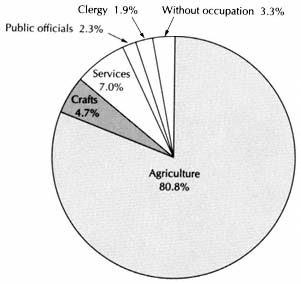
Figure 13.1.
Las Navas, Employment Structure, 1752
the usual two estimates of the annual harvests, and the seed requirement.
The estimate of the harvests can be only approximate. The two methods of calculating it—prediction from the stated harvest on a fanega of each quality of arable and the number of fanegas of each quality in the town, and projection from the reported tithes—are far from agreeing. Elsewhere I have used the tithes as more reliable, although, where they were farmed, as here, no accurate records may have been available to the makers of the catastro. In Navas the catastro reports tithes in kind for wheat and barley only. By assuming that the tithe farmers kept 10 percent for themselves and reported only the rest, I get a "best estimate" of these crops. Tithes on the other crops were included by the catastro in a lump sum in money that covered also vegetables and animals. One can only accept the predicted figures. The best estimate for the total gross harvest is 5,098 EFW.
There is also uncertainty about the proportion of the harvest that was retained for seed. According to the figures provided by the catastro, the yield-seed ratio for wheat was 8 : 1 on first-quality land, 9 : 1 on second, with an overall average of 8.7 : 1.6 For poorer land to give a better ratio
|
|||||||||||||||||||||||||||||||||||||||||||||||||||||||||||||||||||||||||||||||||||||||||||||||||||||||||
than good land goes contrary to practice, even with longer fallow, and in any case the ratios are probably not accurate because they are higher than reported elsewhere. I shall estimate the mean ratio as 7 : 1. The ratio reported for barley is within the expected range: 7.5 : 1 to 9 : 1, with a mean of 8.3 : 1, which I shall use (but again the ratio is better for second- than first-quality land). The ratio for rye is an unreasonable 20 : 1, for escaña, 10 : 1. I use 10 : 1 for both. The results are included in Table 13.3. My best estimate for the net harvest after seed is 4,432 EFW, but there is a strong possibility that the seed ratios are still high and that this is an overestimate.
About half as much land was devoted to olives as to grains: 1,622 fanegas. The olive oil production is also difficult to estimate. From the quality and extent of the groves one predicts 8,354 arrobas of oil. The tithes were reported in money, and at the current price, fifteen reales per
arroba, the harvest works out to be only 4,815 arrobas.7 A way out of the dilemma is to consider the product of each tree. From the number of trees reported and the tithes collected, the mean return per tree in Baños is 0.087 arroba of oil, for Lopera 0.116, and for Navas 0.078. The figure for Navas is suspiciously low, and I shall use the slightly higher one of Baños as the best estimate, since its terrain is similar. It gives a harvest in Navas of 5,400 arrobas, or 4,500 EFW. Although the land in olives was little more than half that in grain, its product was greater.
The town also had its orchards and irrigated huertas, but as elsewhere, these contributed little to the town income, although they added greatly to the amenity and salubrity of life. The vecinos distinguished between fig trees (about five fanegas, with thirty trees per fanega), which produced a harvest of 4 to 6 reales per tree, and other fruit trees (about fourteen fanegas with ninety-three trees each)—pomegranates, quinces, and peaches are mentioned—whose crop was worth only .75 real per tree. The total fruit harvest came to about 100 EFW. The irrigated huertas were divided between hemp (cañamo ) and vegetables (hortalizas ). Twenty-five fanegas (more irrigated area than either Baños or Lopera had) produced about 380 EFW. The total net return from agriculture was approximately 9,412 EFW (Table 13.10).
2
Table 13.4 and Figure 13.2 show the distribution of property ownership. Navas differs from the other two Andalusian towns in the proportion of property owned locally: 36 percent compared to 72 percent for Baños and 48 for Lopera. In this respect, Navas resembles the towns within the economic orbit of Salamanca city (La Mata, 29 percent; Villaverde, 31 percent). It cannot be classed with them, however, because half or more of the land held by absentees in the Salamanca towns was ecclesiastical and rented to vecinos who farmed it for their own account. Here the bulk of the land held by absentees belonged to only two people, both titled nobles in Madrid, the Duque de Santisteban del Puerto, señor of the town, and the Conde-Duque de Benavente.
Although the catastro does not say so, it is likely that both properties formed part of their family entails. Santisteban owned the town castle and, more significantly, four cortijos and extensive olive groves with an oil mill and a casa de campo; Benavente two inns, one a mesón in the town nucleus, the other a venta a quarter of a league from it, plus two
|
|||||||||||||||||||||||||||||||||||||||||||||||||||||||||||||||||||||||||||||||||||||||||||||||||||||||||||||||||||||||||||||||||||||||||||||||||||
cortijos and the largest olive groves of the town, with their casa de campo and oil mill.8 Eighty-five percent of the olive groves belonged to these two men, and olive oil represented 57 percent of the town income from agriculture.
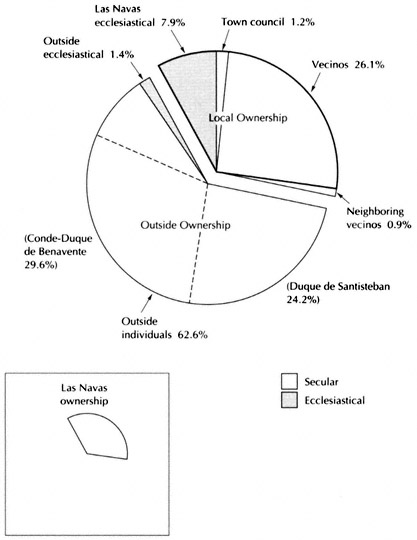
Figure 13.2.
Las Navas, Ownership of Land, 1752
A look at these men's property reveals much about the town structure.9 Santisteban's olive groves were 939 fanegas in extent (about 450 hectares), located in the hills and surrounded on all sides by uncultivated monte. The oil mill was located here. It was built around a patio
where the olives were piled after being harvested. Three naves housed four millstones, eight "beams" or presses (vigas ), four cauldrons, twenty-four large earthenware amphoras (tinajones ) for distilling and separating the oil that drained from the presses, and a storage room (bodega ) with ninety-nine containers (vasos ). Adjoining was an office, a shed for horses, and a hayloft (pajar). The whole complex measured forty-three by thirteen meters. The casa de campo and another smaller permanent house were nearby, and nine tiny dwellings linked to the former, where "the families [of the workers] live during the olive harvest."
One can visualize the activity in his olive groves during the winter harvest season. The jornaleros of Navas, with their women and older children, would walk in the morning to the duke's estate, half a league away, where they would shake down the trees with long sticks and gather up the olives off blankets spread on the ground. They would then load the fruit on donkeys to take to the patio of the mill. From there specialized workmen would place the olives on the millstones to be lightly crushed by a conical stone rolled around on top of them (being careful not to spoil the flavor by breaking the pits). The workers then loaded the mash in the presses, first placing a round esparto mat on the floor in the middle of the press, then a layer of mash, another esparto mat, another layer of mash, and so on until a pile sufficiently high had been achieved for the pressing to be effective. The beams were then lowered on top of the pile to squeeze out the oil. The liquid would run into the first large tinajón, where gravity separated oil from water, and then, as the oil was decanted from one tinajón to the next—a process requiring days—the purer oil would rise to the top and be drawn off to sell at a higher price than the rest. At day's end, most jornaleros would return to the town, but some, including those who worked in the mill, would bed themselves down in the nine small houses. The harvest would go on for days, and the mill would operate for some time more, until all the olives piled in the patio had been ground and pressed and their oil distilled.
The duke's four cortijos were more extensive than his olive groves, 1,257 fanegas, but only 24 percent of them were cultivated, the rest being monte bajo. Benavente had 940 fanegas of olive groves and 3,300 more in two cortijos, but only 8 percent of the latter were cultivated and 15 percent more were recently planted with live oak (chaparro ), presumably to be used for pasture. These two aristocrats were after olive oil, not grain, as were the majority of outside owners in all three of our Andalusian towns.
|
||||||||||||||||||||||||||||||||||||||||||||||||
The leases described in the catastro indicate that the practice here was to rent land for one-fifth of the harvest.10 In the other two towns of Jaén province, the owners received a quarter of the harvest. In Navas, the practice appears to have compensated the tenant for the poverty of the land.
Because the volume describing ecclesiastical properties is lost, one can achieve only an approximation of the proportions of each kind of land that church officials chose to rent and to farm themselves (Table 13.5). Outside secular owners are assumed to follow the same preferences as outside religious institutions. Besides the two aristocrats, twelve outsiders owned land in the termino. One had extensive holdings, an hidalgo of Arjona, seventy-five kilometers away, near Lopera, who owned three cortijos (16 percent of the arable in the town). The others owned arable and a few huertas, for the only outsiders to have olive groves besides the aristocrats were three nearby vecinos, who I assume cultivated their properties themselves and are not included in this table. (As in other towns, I count their properties as locally owned to
balance out properties assumed to be owned in nearby towns by vecinos of Navas.)
Tables 13.4 and 13.5 reveal a form of dual economy in the town. Olive groves, whose product was destined for an outside market, belonged almost exclusively to the aristocrats in Madrid. Grain fields and huertas, most of whose harvest was consumed in the community, were in the care of vecinos. Vecinos and the local church owned two-thirds of them, and vecinos tilled most of the rest through leases. Cortijos also produced grain, but these belonged to outsiders. Of eleven held by laymen, only one belonged to a vecino, the notary (escribano, one of the two laymen in town favored with the title don ), and another, tiny, to a nearby vecina. How many of those owned by outsiders were farmed directly rather than leased cannot be determined with assurance. Two vecinos received salary in kind from the Duque de Santisteban as managers (caseros ) of two of his cortijos, and another as manager of a cortijo of the Conde-Duque de Benavente. The registrar (notario público ) was also a casero of Benavente. These four cortijos were clearly exploited directly, with local stewards. The notario also administered the three cortijos of the hidalgo of Arjona, but for these he received only 1.2 percent of the harvest in cash, indicating that he was only the agent for leasing them to other vecinos who exploited them for their own account.11 This leaves only two cortijos belonging to laymen whose disposition is unknown. One cortijo belonging to the parish church was leased, but we do not know how many ecclesiastical cortijos were farmed directly.12 As a reasonable approximation, I assume that half of the value of cortijos owned by outsiders was leased to vecinos (Table 13.5).
My estimate of the division of harvests among the different costs of production follows the method used in the last two chapters (Table 13.6). Using these percentages, Table 13.7 calculates the income to outside owners from their properties in Navas. Table 13.8 gives an estimate of the income of their administrators who do not reside in Navas. Since the catastro provides no information on this topic, I assume the same pattern as found in Baños. The result may be too favorable to Navas, that is, I may have allocated too much property of outsiders to local agents, because Navas lacked a class of wealthy landowners and beneficed clergy such as those in Baños who administered properties for outsiders.
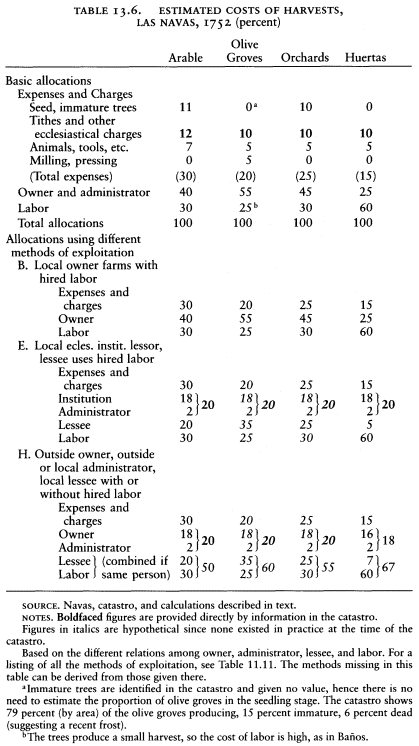
|
||||||||||||||||||||||||||||||||||||||||||||||||||||||||||||||||||||||||||||||||||||||||||
|
||||||||||||||||||||||||||||||||||||
Outsiders also monopolized the nonresidential buildings in town. The casas de cortijo are a case in point. In addition, the aristocrats owned both casas de campo, two of the three oil mills, and the two inns. As elsewhere, though, most houses in the nucleus belonged to vecinos. They had five-sixths of the houses that belonged to laymen. The total value of buildings belonging to outsiders (expressed in annual income) was 643 EFW. Administration and costs took about 20 percent (129 EFW), but of this, 39 EFW is the estimated share of outside administrators.13
Summing the results of Tables 13.7 and 13.8 and the income of outsiders from buildings gives a total of 3,099 EFW. This is 33 percent of the total net return from agriculture, derived from the ownership of 64 percent of the land, plus attached buildings (and two small inns). In Lopera the outsiders' share was 21 percent, in Baños only 11 percent. The vecinos of Navas not only had poorer land, they received a smaller share of the product, despite the more generous leasing arrangements. They owned the small plots, but nonresidents held the big ones, the cortijos, and the olive groves. Most of these belonged to their señor and another titled noble. If this is what señorío meant, it was not favorable to the vassals.
3
As a community with extensive pastures and vacant monte, Navas might be expected to have large herds of animals. Surprisingly, this was not the case. It had fewer sheep than Lopera, although Lopera lacked monte, and relatively few pigs, but the vecinos did own more cattle per head than those of the other two towns of Jaén. Table 13.9 gives the number of animals and estimated annual income from raising livestock, a total of 784 EFW. In addition the vecinos owned 346 beehives producing 114 EFW.
Income also accrued to the town from outside. In Baños we found that the jornaleros left during part of the year to work elsewhere. The same phenomenon becomes apparent in Navas. The reported daily wage of jornaleros was three reales; labradores and their sons made four reales per day.14 The total of one day's wages of the jornaleros and labradores noted in Table 13.2, plus twenty-four sons of jornaleros and labradores and twenty-one male servants, would come to 36 EFW. The share accruing to labor from arable and olive groves, 2,654 EFW, would
|
||||||||||||||||||||||||||||||||||||||||||||||||||||||||||||
thus account for only 74 days' labor. In this length of time, a jornalero would earn only 12.3 EFW. If, as in Baños, jornaleros could work another 30 days elsewhere, bringing home 80 percent of their earnings, the town income would rise by some 870 EFW. A jornalero would still be making only 17.3 EFW, about 3 EFW less than what we found in the other two towns.
Crafts and the inns also offered the possibility of income from outside. Among the craftsmen, the four sandalmakers (alpargateros ) stand out. Making the alpargatas worn throughout southern Spain by the modest levels of society was a regional specialty. Most of the towns in eastern Jaén had a number of alpargateros, but those of the west of the province had few.15 Hemp was the most valuable crop of the huertas of Navas, and it was the main material for the sandals. The alpargateros may have sold three-fourths of their production outside the town. Their income, a rough equivalent of the value added, three reales per day for 180 days, would bring 90 EFW into the town annually.
The other source of funds from outside was the two inns. The gross return stated for the venta on the road beneath the town was fifteen hundred reales, that of the mesón in the town thirty-three hundred rea-
les. According to our formula, about two-thirds of this income came from nonresidents. However, the Conde-Duque de Benavente, the inns' owner, received in rent fifteen hundred reales, leaving a net income for the town of seventeen hundred reales, or 95 EFW.
Besides rent payments, the charges against Navas included seigneurial dues as well as the customary ones to king and church. Payments to the señor were surprisingly light: two charges to cover his justice: the penas de cámara of 50 reales per year and the penas de ordenanza of 30 reales (a total of 4 EFW).16 The king had once granted the duke the tercias reales, the royal two-ninths of the tithes, and the alcabalas, or sales tax, but the town council had bought from the duke the right to collect both these imposts.17 To do so it had borrowed heavily in the form of censos from a capellanía and a mayorazgo located in nearby towns. The capital of these censos was 89,100 reales, and the 3-percent interest amounted to 149 EFW.18
Far heavier were the charges levied by the crown. The town council paid the royal treasury 5,891 reales (327 EFW) per year—the name of the tax is never stated. Of this, 5,000 came from the alcabalas and tercias it collected; the rest it apportioned among the vecinos and outside property owners. The council also paid the king 1,187 reales (66 EFW) for servicio ordinario y extraordinario, apportioned in the same way.19 If the assessments on owners were proportional to property owned (and assuming that nobles were exempt), outsiders paid 11 EFW and the remaining 382 EFW left the town economy. More modest was the council's contribution to royal troops in transit, put at 200 reales (11 EFW) per year.
The catastro of Navas is less specific about ecclesiastical charges than those of other towns. How much of the town's income they withdrew from the economy is therefore uncertain, but one can obtain a reasonable approximation. Partible tithes were divided among the tercias reales (kept by the municipal council), the local fabric and prior, and a number of outside authorities: the bishop and cathedral of Jaén, an archpriest, a vicar. The shares of each are not stated, and the libro maestro de eclesiásticos, which would clear up the issue, is lost. If the prior got a third and the fabric its usual ninth, one-third left the town. This would be 328 EFW. The first fruits went to the local clergy, but the
Voto de Santiago (15 EFW) was exported, less 10 percent to the person who farmed it. The bula de la cruzada cost the town 80 reales (4 EFW), and the town council contributed 29 reales (2 EFW) to "the holy places of Jerusalem." Payment in lieu of tithes on exempt lands owned by outsiders amounted to 6 EFW.20 Finally, insofar as they can be determined, the expenditures of the parish church outside the community, estimated as before at one-quarter of the income of its funds, were 192 EFW. On these assumptions the church withdrew from the town economy 546 EFW, more than the crown and señor together.
Information is now available to draw up the balance sheet of the town (Table 13.10). The estimated town income, with all the uncertainties that have become evident, is 7,174 EFW.21 Divided among a likely population of 1,030, this gives a per capita annual income of 7.0 EFW, far below that of any other town studied and little more than half of the 12 EFW assumed to provide an adequate rural income.
There has been uncertainty at many points, the average size of the harvest, the yield-seed ratio, the number of cortijos exploited directly by outsiders, the expenses for outside administration. My estimates, although conscientious, may be low (although in the case of seed, outside administration, and cortijo exploitation, higher figures would mean less rather than more town income). Olive oil production may have been greater (but if so, most of the increased figure would accrue to the outside owners). The population was also in doubt. The low number of women reported in the catastro22 may not be the effect of underregistration but of temporary out-migration into service in urban centers: Ubeda and Baeza were flourishing minor cities nearby, and the census of 1786 shows that both had more females than males aged sixteen to twenty-four.23 The recorded population of 988, if correct, would mean a per capita income of 7.3 EFW, not much of an improvement.
The figure may still be too low, but all the obvious corrections have now been applied. Equivalent fanegas of wheat (EFW) may be a misleading unit here, because wheat was expensive compared to other grains,24 but, since wheat was the major grain, any correction would not
|
||||||||||||||||||||||||||||||||||||||||||||||||||||||||||||||||||||||||||
|
||||||||||||||||||
be over 10 percent. One cannot escape the conclusion that Navas was a poor community. All the information in the catastro strengthens it: the poor soil with long periods of fallow, the near monopoly of outside owners over cortijos and olive groves, the greater number of families per house. These features make it unique among our seven towns. It will add to our understanding of Spanish rural life to see what effect they had on the social pyramid and the relative position of the different sectors of society.
4
The socioeconomic pyramid of Navas provides a very interesting comparison with those of Baños and Lopera (Table 13.11 and Figure 13.3). In the other towns an important sector of wealthy landowners and professionals, many of them hidalgos, dominated the pyramid and the community. In Baños forty households made up this top level, in Lopera thirty-three, respectively 8 and 10 percent of all households. In Navas only six households, those of the doctor and notary, both called don, and of the clergy are comparable (2 percent of all households). Only three of them had incomes over 100 EFW and could live like gentlemen.
Their households embodied their status. Don Francisco Martínez, the prior, drawing on his more than 300 EFW per year, "maintains at his expense," as the catastro put it, a widowed brother-in-law, a niece, two serving women, and an adult (over eighteen) male servant, the latter presumably to work in the fields of the priory. The notary, don Francisco Lorenzo Salcedo y Navarrete, forty-nine years old, had a more
|
||||||||||||||||||||||||||||||||||||||||||||||||||||||||||||||||||||||||||||||||||||||||||||||||||||||||||||||||||||||||||||||||||||||||||||||||||||||||||||||||||||||||||||||||||||||||||||||||||
|
||||||||||||||||||||||||||||||||||||||||||||||||||||||||||||||||||||||||||||||||||||||||||||||||||||||||||||||||||||||||||||||||||||||||||||||||||||||||||||||||||||||||||||||||||||||||||||||||||||||||||||||||||||||||
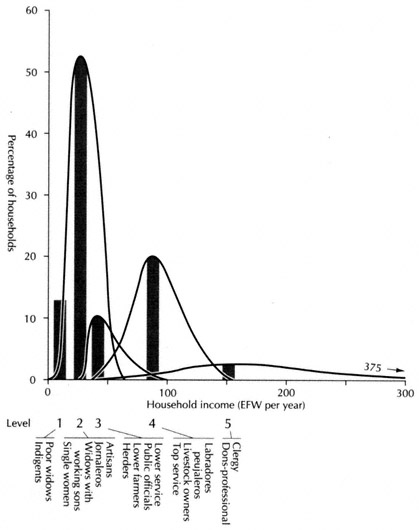
Figure 13.3.
Las Navas, Socioeconomic Pyramid, 1752
NOTE : This is a bar graph based on Table 13.11, with an
indication of dispersion. It is not a set of frequency distributions.
extensive family: wife, four sons (one over eighteen), two daughters, a maid, and two male servants (one over eighteen). Besides being escribano, he is also listed as a labrador peujalero. In his case peujalero is hardly appropriate, for he had more land than anyone else in the town. The only vínculo belonged to him and included the only cortijo owned
by a vecino. His other lands were arable and a sizable olive grove with the only oil mill of a vecino. His total income was over 280 EFW. Since he had only one adult manservant, he was a big employer of jornaleros, one of the few local people that had the wherewithal, both economic and political, to attract a network of clients.
The town doctor, don Joseph Antonio Tortosa, belongs with these two because of his income and his appellation, but he was not of their stature. Twenty-three and still a bachelor, he had living with him only a maid, and he had no property in town. Perhaps he was a newcomer. But his utilidad as doctor was judged to be 2,260 reales per year (126 EFW), the highest professional income in the community. His position had great potential, and it is a pity one cannot observe his household and position twenty or thirty years later.
These three men, although impressive in the community, could not compare in wealth and way of life with the leading figures of Lopera and Baños, whose incomes were over 500 or even 1,000 EFW. They also lacked other essential characteristics of the elites of Lopera and Baños. They were not heads of powerful families, nor did they form a corporate oligarchy united by marriage ties. The family names of the notary, Salcedo and Navarrete, and of the doctor, Tortosa, belonged to no one else in the community. Although several members of the lower groups were Martínezes, like the prior, the name is common and may not connote any blood relationship. Even among themselves, these three leading men do not appear to have been related.
Like the prior, the other three priests also had maids and belonged socially to the top group. Economically it is hard to place them, however, because the relevant book has been lost. The parish curate (cura ) received some of the first fruits (perhaps 18 EFW), but the only local capellanía of which record remains, because it leased some lands, brought in only 3 EFW in known income. Even if all the unidentified local church properties belonged to capellanías, the most they would have brought in to these three priests was about 130 EFW altogether. They also had income from saying masses and administering some church funds (but not all, since the notario, a sandalmaker, and the carpenter each administered a fund). Whatever their income, these priests could not match the display of the prior.
The leaders of the community were not these few individuals but the labradores peujaleros, the thirty-six male heads of household and the seven widows. They were a relatively large group, 16 percent of all households. Although their highest incomes surpassed all but those of
the notary and the prior, their average income and their style of life consign them to a second level. Of all the groups we have observed in the various towns, they were the closest to the concept of the villano honrado of the seventeenth century or the Anglo-Saxon yeoman farmer. Unlike the wealthy labradores of La Mata, who leased their fields, they had lands of their own, 42 percent of the arable not in cortijos, 8 percent of the olive groves, and about 10 percent of the other kinds of property, plus a large number of cattle. Many of their households were self-contained units. Together they had eleven sons and twenty-one adult male servants. The labor of these labradores and their sons and mozos in many cases was enough to till their holdings, so that they did not have to resort to hired hands. They rented most of the grain fields that were leased by ecclesiastical institutions and without doubt most of the fields of outside lay owners. Francisca Alonso de Gámez, a widow labradora peujalera, rented the one cortijo whose lease we have a record of, belonging to a local obra pía. Others probably leased the other available cortijos.
A spirit of enterprise imbued the labradores peujaleros. Recently a fever for olive groves had gripped the town; more and more land was being taken from the monte or out of grain production to plant trees with the intention of selling olive oil on the national market. The expected returns made this investment attractive, although it meant that the land would produce no income for ten to fifteen years. One can surmise that throughout the province of Jaén the transfer of lands from arable and pasture to olive groves was in progress, and it continued for another two centuries, turning it into one of the major centers of olive oil production in the world. The catastro of Navas provides specific evidence of the extent of this development, since it lists as a separate item the olive groves recently planted and still not producing, reporting their acreage but attributing them no income. Besides 1,722 fanegas of mature trees and 136 of dead trees, the town had 331 fanegas of new groves, a recent addition of 18 percent. The labradores peujaleros were much more aggressive than this. To 60 fanegas of mature groves belonging to them, they were adding 33 and had 9 more uncultivated, ready for planting, a total addition of 70 percent. They conceived their exploitations as commercial ventures and were responding to the incentives of the market. (By comparison, the two dukes, long aware of the commercial possibilities of olives, were adding another 14 percent to their groves, less in proportion than the labradores but much more in area, 205 fanegas.)
A look at several labradores gives meaning to this description. Juan de Siles was thirty-four years old, married with a son and daughter, and owned a comfortable but not luxurious house on the main street, the Calle Real. His wife took care of the house since there was no maid (no labrador had a maid), but three adult menservants lived with them and worked on his fields. His property included five grain fields totaling thirty fanegas, and two olive groves. One of these had about 150 mature trees, half the other was newly planted and the rest still vacant. He was extending his olive production. These properties brought him net (before labor) some 56 EFW. In addition he had numerous livestock: eight cows and twelve young, three goats with four young, and two horses, all of which provided him with perhaps another 15 EFW. Also living in Siles's home was a twenty-year-old jornalero named Antonio Pérez (physically or mentally disabled, perhaps), whose guardian Siles was, administering his property. This brought in 20 EFW, and Siles may have kept half for his efforts. Siles did not rent any ecclesiastical lands, but he must have rented secular lands, since with three male servants and Pérez, he could have tilled twice as much land as he owned and administered. After rent, wages, and keep of his servants, his net annual income was in the range of 105 EFW, not the highest of his group but near the top.25
Although Cristóbal de Mercado lived in a bigger house on the same street, his establishment was less imposing, with only two grain fields and a small olive grove of his own (they hardly brought in 6 EFW). From a local obra pía he rented a large field that produced for him another 13 EFW, and he probably rented secular lands as well, for he had an adult son living at home (but no farm hands). His other wealth was a flock of twenty sheep and, at the moment, thirty lambs, and he owned his own yoke of mules. Forty years old, with a wife, two minor children, and a total income of perhaps 45 EFW, he was one of the more modest labradores peujaleros.26
What was special about these two men was that they were the two regidores of the town. The town council consisted of two other men as well, the alcaldes ordinarios. These were also labradores peujaleros, Pedro Calvo, aged fifty, living with his wife on a net income of some 52 EFW, including 7 as alcalde; and Balthasar Rodríguez, forty-eight, with wife, three young sons, an adult manservant, fields, olive groves, huerta,
and more rentals from the church than anyone else. He was the wealthiest labrador of all, 155 EFW income. On his death he would endow a capellanía in his name with an olive grove and huerta to support the local clergy.27 The other town officials were two guardians of the peace, the alcaldes de la hermandad, one a labrador peujalero and the other a jornalero (aged twenty-nine and twenty-five).28 Except for the last person, the town government was firmly in the hands of the labradores peujaleros, most of them young and vigorous. Their authority was limited by the imposing figure of the notary; by the public attorney, the síndico procurador general of Santisteban del Puerto, whose responsibility included the affairs of Navas; and finally by the power of the duke their señor, who appointed them, choosing in each case from two names presented by the town council.29 But the labradores peujaleros formed the backbone of the local economy and society and ran its government. It was their ancestors who had led the town in buying out the duke's interest in the tithes and alcabalas.
The local elite here was not the pinnacle of society but the more numerous second level of farmers, men who worked with their hands and whose wives kept their houses, cared for their children, fed them and their hired hands, with occasional paid help, no doubt, from the daughters of the jornaleros, and took over the agricultural exploitation if an untimely death should carry off their men. Unlike the notabilities of Lopera and Baños, they were not an exclusive group nor a collection of ruling families. The forty-three labradores and viudas labradoras had thirty different surnames. Only nine of these were repeated among them, but all but six belonged also to vecinos with other occupations. Cristóbal de Mercado, the regidor, was undoubtedly related to Juan Ruiz de Mercado, his more wealthy next-door neighbor, another labrador, but also to Juan de Mercado el menor, a jornalero. Antonio Megino, aged sixty, a labrador with three sons at home, lived next to Diego Megino, aged twenty-nine, a jornalero with two sons and already a widower, surely Antonio's son or nephew. A few proto-dynasties appear, notably the Torres family. Its households included three labradores, an unmarried doncella, and a widow, both women with lands of their own. They resembled an hidalgo family, but there were also two propertyless Torres widows, one with an adult son who was a jornalero. Distant
relatives or a coincidence of names? In any case the wealthy Torreses were almost unique.
Had the olive groves and cortijos of the two dukes been in the hands of a local hidalgo class, this class would have run the town, as it did in Lopera and Baños. But the dukes were in Madrid, and vecinos, including two labradores peujaleros, ran their estates for them. The prior and the notary could not by themselves form an elite, and so leadership of the community fell to their social inferiors. One comprehends why the notary wanted to be recorded in the catastro as a labrador peujalero although his income, education, and style of life placed him in a different world. The strength of his patronage could not match the social leadership of the labradores.
The rest of the social structure conforms more closely to that of the other two places. The innkeepers, the holder of the tobacco monopoly, and the notario rank just beneath the top level along with the labradores. The owners of livestock earned a little less. They concentrated their attention on their flocks of goats, which ran from 30 to 264. This activity did not provide the prestige of farming, for they had neither public office nor family relations with the labradores.
Public officials fall, as expected, in the middle level, but bakers and artisans, who are in this level also, are further down the pyramid than in the other two towns. The difference, which is probably real and not the effect of the makers of the catastro, can be explained by the absence of a substantial upper sector. Crafts flourished on the clientage of the conspicuously wealthy, and the labradores peujaleros were not of this kind. The same must have been the case of the four bakers.
They did not feel inferior, however. The olive fever had bitten them, as it had the labradores. To their 2.5 fanegas of olive groves, the owners of livestock and the market gardeners were adding 4.5 more; to 13 fanegas, the butchers, bakers, and storekeepers were adding 5; the notario, who owned only 6 fanegas of land, had 3 in new trees; while three craftsmen (the shoemaker, the blacksmith, and a sandalmaker), with 1.5 fanegas of mature trees among them, had 10 fanegas more growing, leaving them only 5.5 in grain! These men found olives, with their better market and lower proportional cost of labor, a capital gain worth waiting for.
When we descend to the jornaleros, family size and per capita incomes do not differ greatly from the previous towns. The slightly lower earnings attributed to them in EFW represent almost the same in reales, because of the higher price of wheat here. Were they better or worse off? Since the households of the labradores provided most of their own labor
and the dukes' olive groves gave no steady employment, were they not more squeezed? The majority here, as in Lopera and Baños, had some property, a field or two, a donkey, some goats or a pig, even a cow. Four had small olive groves and three others had seedlings sprouting. But odd jobs were scarcer than elsewhere. There was less money floating around the top that could filter down to their family members. They probably ate less than the jornaleros of Baños and Lopera, and we know they were crowded into fewer houses.
Were they better off psychologically? The answer depends on the social integration of the community, and specifically on the relations between the labradores and their inferiors. Were the labradores "villanos honrados," yeoman farmers, or were they incipient kulaks, "rural bourgeois"? Their olive planting showed them to be enterprising, and they preferred not to rely on day laborers. Does this mean that they were standoffish, a ruling class?
The catastro of Navas provides a side of town life that we have observed nowhere else. It says who lives on each street. If one maps them out, one obtains an interesting pattern (Figure 13.4). Town life had two foci, the Plaza del Pozo and the Calle Real, a block to the west. Of the thirty-six labradores and widow labradoras who lived in the town itself, all but nine had their house on one of these foci or within a block of the plaza. The notary lived on the Calle Real, the doctor and tobacco dealer on the nearby Plaza del Molino, on which the parish church faced, the notario on the street between the two plazas. (We do not know where the priests lived.) This was the area of the storekeepers and the inn. There were a few artisans here too, but they were more widely scattered. Plenty of jornaleros and others in the bottom levels lived on these streets, mixed in with the better-off vecinos, but when one moved farther away from the foci, the streets were lined almost entirely with the houses of the poor. It is as if the town nucleus had its own von Thünen's rings: the elite, the storekeepers, and labradores at the center, mixed with households of all social levels, a second ring that lacked the top levels but had still its artisans, market gardeners, and livestock owners, and an outer ring almost exclusively poor, except for an occasional labrador.
The congregation of the better off in the center of the town, typical of early modern urban geography, meant that the vecinos would be aware of economic differentiation, but it did not mean rigid social stratification, at least not of the kind of Lopera and Baños. Nor should one exaggerate the spatial differentiation, for no place was more than three streets away from one of the town foci. It was a small community, and everybody rubbed elbows with everybody else frequently. The labrado-
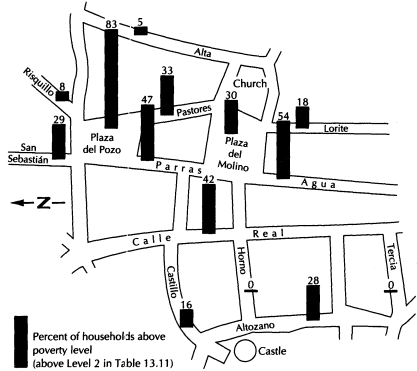
Figure 13.4.
Las Navas, Social Composition, 1752
NOTE : I am indebted to don Ramón Rojas Rodríguez of Las Navas
for the map and to him and doña María Dolores Puya of the AHPJ
for the identification of the eighteenth-century names of the streets.
res peujaleros were no more enterprising than many other vecinos who owned even a wedge of land. They and their wives worked as everyone else, and the young men living with them as hired hands would have come from local families. The distribution of family names indicates that they were the most prosperous members of the community rather than an exclusive group. Navas was more egalitarian than Baños or Lopera, closer to the towns of Salamanca, and this must have made life more pleasant for the jornaleros.
5
The evolution of Navas in the next half century is hard to follow in the available document's, but a general image does emerge. The censuses are less consistent than those of Lopera (Table 13.12). Towns of señorío
|
|||||||||||||||||||||||||||||||||||||||||||||||||||||||||||||||||||||||||||||||||||||||||||||||||||||||||||||||||||||||||||||||||||||||
tended to underreport their population in the census of 1712–17, and Navas gives an example of this practice. The figure forty-one vecinos must be discarded. The census of 1786 appears suspect too, as it does for Baños.30 The pyramid of ages (Figure 13.5) is highly irregular, and the population-vecino ratio is suspiciously low. Children under seven appear undercounted, or they had died off heavily in a recent epidemic. An epidemic does not seem likely, since the censuses of other towns in the Montizón valley show no shortage of this age group. If one applies to Navas the proportion of males and females under seven in this zone recorded in 1786, one adds twenty-three males and sixteen females, the total population rises to 945, and the population-vecino ratio to 3.80, as in 1752. This appears to be the best estimate; further corrections would lead only to less secure results. One seems safe in saying that Navas stagnated demographically for several decades after midcentury, hardly a surprising development in view of the low per capita income.
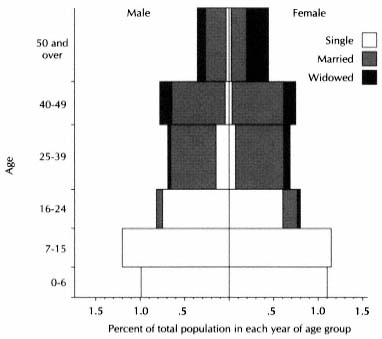
Figure 13.5.
Las Navas, Population Structure, 1786
NOTE : Since there is no limit to the top age groups, a
span of seventeen years is used for convenience only.
By 1826 the population and the size of families had jumped considerably, although the figures provided by Miñano may be exaggerated. Improving conditions were certainly one factor in this growth. The transfer of land from grain to olives continued (we shall see evidence of this at the time of the disentail). Since olives brought in more per fanega and the price of olive oil was rising slightly faster than that of wheat in the province of Jaén, per capita income increased in the second half of the century.31 Scattered evidence reflects the improvement in the economy. In 1752 the tithes on minucias (vegetables and animals) produced 2,000 reales a year. In 1800 the contract went for 13,398 reales, in 1802 for 10,703.32 The price of grain was about three times as high as in the 1750s, the minucias tithes about five times as high. Or, another ex-
ample: in 1752 the Conde-Duque de Benavente received 400 reales in rent for the inn outside the town; in 1803 the innkeeper signed a lease for 2,100 reales. Four years later the duke put the rent up again, to 2,600 reales, six and one-half times the figure at midcentury.33 He could do so because the region was flourishing.
The census of 1786 suggests the effect that economic expansion was having on the social structure. It lists 86 labradores, up from 36 in 1752; 95 jornaleros, down from 119; and 91 menservants (criados), up from 49 criados of all ages. Despite the ever-present doubt that the definitions applied at the two times were consistent, the indication is clear that the commercialization of agriculture was producing a relative prosperity that permitted some second sons of labradores or even some jornaleros to rent or acquire land and establish themselves as labradores peujaleros, taking criados into their households in the process. This development gives further evidence of the lack of social barriers in the community. The next step would have been to raise larger families and to attract immigrants, leading to the population spurt recorded in 1826 (although not a housing spurt—by the last date there were 1.78 households per house, up from 1.59 at the time of the catastro).34 When the disentail began in 1798, the vecinos would have been experiencing the first stage of this spurt. Families would still have been small, or at least the children still young, and the better-off labradores would be feeling especially prosperous.
6
Early in 1800 the desamortización began with a rush. Before the end of the year twenty-eight sales were concluded, all involving lands belonging to local church funds. Another flurry occurred in 1802, eighteen sales, then the disentail slowed down to between one and five properties per year until 1808, when, quite unusually, activity revived. There were seven sales concluded that year, the last two in October, six months into the war with Napoleon.35 Altogether sixty-eight sales took place, involving a considerable proportion of the ecclesiastical properties.
Since the register of ecclesiastical property of the catastro is lost, one cannot attempt the usual matching of sales against known properties. A
|
||||||||||||||||||||||||||||||||||||||||||||||||
rough idea of the extent of the disentail can be obtained by comparing the area held by the church in 1752 and that disentailed between 1800 and 1808 (Table 13.13). About half of the area of cultivated land belonging to the local church was sold, almost a fifth of the lands of outside churches. Ecclesiastical holdings of arable and huertas were most depleted, but slightly more money went to buy olive groves than arable because, fanega for fanega, olive groves fetched over ten times the price of grain fields. The olive fever was as strong as ever. Five percent of the area cultivated changed hands (in Baños 6.8 percent of the value; in Lopera only 1.5 percent of the value). In one way, the event was unique among the three towns; for it included the property of five capellanías, two in the parish and three in outside churches. According to the royal decrees, these properties could not be sold without the approval of the bishop. Here is further evidence that the cleric-hidalgo group did not run the town.
As has been the case in every town studied, the largest buyer was an outsider. Don Joaquín de Salas y Bustillo, a vecino of Santisteban del Puerto, bought an olive grove with 286 trees for 18,000 reales, slightly more than a fifth of the total proceeds of the disentail in Navas.36 Of the thirty-three buyers of land (Table 13.14), only one other was not a
|
|||||||||||||||||||||||||||||||||||||||||||||||||||||||||||||||||||||||||||||||||||||||||||||||||||||||||||||||||||||||||||||||||||||||||||||||||||||||||||||||||
|
||||||||||||||||||||||||||||||||||||||||||||||||||||||||||||||||||||||||||||||||||||||||||||||||||||||||||||||||||||||||||||||||||||||||||||||||||||||||||||||||||||||||||||||||||||||||||||||||||||||||||||||||||||||||||||||||||
|
||||||||||||||||||||||||||||||||||||||||||||||||||||||||||||||||||||||||||||||||||||||||||||||||||||||||||||||||||||||||||||||||||||||||||||||||||||||||||||||||||||||||||||||||||||||||||||||||||||||||||
resident, don Francisco García Pretel of Arquillos, a small town bordering Navas on the west, who, of course, also bought an olive grove, his with 110 trees.37 Despite these purchases, the vecinos more than held their own. They got six other olive groves, four of them important, with between 82 and 194 trees each. Their purchases amounted to slightly less than half the total spent on olive groves, but they got many more trees, 548 to the outsiders' 396. Maybe their trees were of poorer quality, or maybe, on the spot, they could bargain better. On the average a tree cost them 35 reales, the outsiders paid 56. (By comparison, in Lopera the average price for a mature olive tree in the disentail was 129 reales.) Moreover, both the outside buyers lived in adjacent towns and fall in the category of nearby vecinos, whose purchases may well have been compensated, at least in part, by those of vecinos of Navas who bought across town lines.
The largest sale of the period was not part of the desamortización. The collegial church of Ubeda, quite of its own accord, disposed of a cortijo in Navas with almost 300 fanegas of land. A titled aristocrat of Granada bought it for 33,000 reales, by far the major transfer of land at this time.38 (The total of all the disentail was 88,000 reales.) Neither of the dukes resident in Madrid made a purchase. They had plenty of land in Navas, and a small olive grove or a grain plot on mediocre land did not interest them or any other outsider. As a result the vecinos could pick up property for a pittance. In Lopera arable land was auctioned off for a mean price of 2,350 reales per fanega, in Navas for a mere 125 reales! The vecinos had a picnic. They bought all the grain fields sold from local funds—fifty-nine—and also four from outside institutions. They were not small plots either, averaging 5.4 fanegas. One fruit orchard and all the huertas put up for sale also went to them.
Thirty-one vecinos bought land. Who were they? The notarial records, so useful for Baños and Lopera, identify few of them and tell us nothing about most. Yet, with our knowledge of the social structure, one can draw a convincing profile of them. Two buyers were accorded the title don, and one woman is a doña. Don Alfonso Díaz Montero is identified as the parish curate (more modest of income, we remember, than the prior), who bought a tiny plot from the church and, privately, a huerta for hemp.39 Don Joaquín Bonet is not identified. His is not a local name, and he may have been of French origin. (In 1752 two Frenchmen
ran local stores.) He may have been a priest, even the prior, or a doctor, but he was not the notary (escribano), because that man's name was don Feliz de Córdoba y Lara, who at one point used a grove of six hundred olive trees to guarantee a contract.40 Of doña Francisca Rodríguez we know only that she owned an olive grove of four hundred trees and had a common local name. She bought ten fanegas of farm land.41 Thus two people of the top socioeconomic level and perhaps the widow or daughter of a third bought land in the disentail.
The occupation of one other buyer is definitely known. Lucas Martínez Linares was the keeper of the inn (venta) on the road outside the town belonging to the Conde-Duque de Benavente. In April 1800 Mártinez Linares bought two huertas, one with 40 fruit trees and the other with 7, and a small olive grove of 29 trees.42 These cost him altogether 3,600 reales. Three years later he signed a contract for the inn (whether his first is not clear). As collateral he put up a grove of 115 trees.43 The next contract, in 1807, was backed by a grove of 200 mature trees and another of 400 seedlings.44 He was gambling on the combination of hostlery and farming (the huertas could furnish his tables, while the groves could be handled by jornaleros), and at least until the war of 1808 his gamble was paying off. He belonged to level 4 (second from the top) in the socioeconomic pyramid (Table 13.11).
Although the records do not identify the occupations of anyone else, they do reveal significant activities of a number of them. Five were engaged in administering the income of the church. Josef Lorenzo Molina and a partner farmed the tithes of olive oil of the local ecclesiastical district (arziprestazgo ), contracting to pay 17,400 reales, a handsome sum. Molina put up as collateral thirty-six fanegas of land and a huerta.45 Sebastian Martínez undertook to collect the tithes on minucias of Navas.46 Pedro Navarro in 1799 acted as guarantor to a neighbor who farmed the Voto de Santiago for the district of Torreperogil (a larger town fifteen kilometers to the south). He pledged his house and one hundred olive trees. Five years later he himself got the contract for the tithes of the casa excusada.47 In 1752 the notario (not the escribano) and two ar-
tisans had administered church funds, enterprising members of the fourth and second levels. Molina and Navarro both had enough land to be labradores. They probably belonged to the fourth level. Martínez may have been an artisan; he bought twenty-two olive trees.48
Only six local buyers had surnames that do not appear in the catastro, one of them the priest, another an alcalde. Prosperity had brought some immigration. In addition seven buyers had local names that did not belong to labradores in 1752, including two of the alcaldes. There had been some social mobility. Even though some craftsmen or jornaleros may have acquired a plot or two, most of the people who bought land belonged to the fourth level, that of the labradores and the upper service sector. Not all in that level, of course, could be buyers despite the wide distribution of the sales, for in 1786 eighty-six men had called themselves labradores. As elsewhere, disentail helped the most enterprising people, but the social group in control of the town benefited most.
Two vignettes can show these men in action. In 1800, after several competing bids, Juan Valentín González won a plot of eleven fanegas of valley land and monte, for which he paid the modest price of 410 reales. This was his only purchase, and he was one of the smaller buyers. Two years later he bid for and got the collection of the minucias tithes and the casa excusada, promising to pay respectively 10,076 and 1,583 reales to those entitled to receive the tithes. Luis Rodríguez acted as his fiador. In 1803 González shared the casa excusada tithes with Luis Jurado for only 1,262 reales (1803 was a bad harvest everywhere). In 1804 he won the contract to administer a cortijo of the Duque de Medinaceli (who was also Duque de Santisteban, the town's señor) for sixteen fanegas of wheat and sixteen of barley, putting up as collateral eighteen fanegas of land.49 Meanwhile his associate of 1802, Luis Rodríguez, was engaged in similar activities. He was a leading buyer, acquiring three fields and a huerta with 39 fruit trees in 1800, a field of six fanegas in 1802, and two others measuring seventeen fanegas in 1804. The total cost was 4,460 reales.50 In a private purchase he and his brother bought a major house in Navas, taking out a censo on it in favor of the former owner, at 110 reales annual interest.51 Before the disentail
he already possessed considerable land and activity. In 1799, when he went partners to farm the Voto de Santiago of Lopera (no less!) with a man from Santisteban del Puerto, he put up a grove with 100 olive trees. In 1803 he took on the administration of the properties of the fabric of the local parish. His wealth now included his huerta with 100 fruit trees and an olive grove with 200 trees. Later in the year he and Jurado took on the olive tithes of Navas, Rodríguez putting up 150 olive trees (a different grove?).52 Rodríguez and González bought church land, but Jurado, who worked with both men, did not. The first two were aggressive farmers, both of land and of church revenues. Buying disentailed properties was just part of a strategy for improving their position. Planting fruit and olive trees, leasing a duke's cortijo, and administering tithes also figured among their many enterprises. Disentail came to Navas on a wave of prosperity, and these yeoman knew a good thing when they saw it.
Desamortización did not basically modify the dual economy of Navas. Outsiders remained in control of cortijos and large olive groves, while vecinos farmed the fields, little groves, and huertas. But the sales transferred a large number of small properties from the church to the vecinos. They made 75 percent of all the purchases. Henceforth they owned a greater proportion of the land they tilled, and they were building up their holdings of olive groves. In part because this rugged community had little attraction for outsiders and in part because the economic conditions were momentarily propitious, its labradores peujaleros as a group came out stronger than ever. Those who bought land of course benefited most, since their fields were no longer available to be rented by their fellow labradores or to give employment to the jornaleros who had worked them for the church. Disentail brought more wealth to the lay side of the economy, but as elsewhere, it tended to weaken social unity.
Chapter XIV—
Ricardo, Malthus, and the Market
Our seven towns were located in two eighteenth-century provinces, Salamanca and Jaén. These provinces formed part of the kingdom of Castile and are located in the interior of the Iberian peninsula, so that the towns provide a window into the economy and society of arid, landlocked Spain. This study does not touch the Atlantic and Mediterranean peripheries, which were more integrated into the western economy; but for the interior, the towns provide a wide spectrum of old-regime rural communities.
As explained earlier, the main economic distinction in the interior is not between the northern and southern mesetas or Old Castile and New Castile but the one indicated by what I have called the Salamanca-Albacete line (see Map 1.1). This line divides the interior between the region of small towns and villages and minifundia and that of large exploitations and large towns. Three towns, La Mata, Villaverde, and El Mirón, lie northeast of the line, and four are on the other side. Pedrollén in the plains of Salamanca and the three towns of Jaén. (That El Mirón is geographically southwest of a straight line between the two cities shows that any such line is merely an approximation. This one should jog far to the southwest at the c entral sierras.)
Our look at the towns brings out the real meaning of the generalization implied in the choice of this line. One is made aware that large properties were found on both sides of it, for the ecclesiastical institutions of Salamanca had extensive holdings in the towns of La Armuña. Small properties were also common on both sides of the line; the strik-
ing difference is that large exploitations were more typical of the southwest. The large properties of the north were not single exploitations but many small parcels. In La Armuña there were also large exploitations at midcentury—despoblados and alquerías—but these had extensive pastures, and they were giving way to smaller grain fields. By comparison, the cortijos and olive groves of Jaén were not under attack, nor was the coto redondo that formed Pedrollén.
As a general rule, town size also differed. The mean population of the three towns north of the line was 310, of those in Jaén about 1,360, and the términos of the latter were far larger. Social structure also was more complex in the towns of Jaén, with distinct elites and an abundance of nearly propertyless day laborers (except that the elite of Navas was emasculated), and more egalitarian in the communities of the north. Even though the towns are not a random sample, they reflect a clear contrast between the two halves of dry Spain. Pedrollén is a deviant case; south of the line by the nature of its exploitation, it had only 29 inhabitants in 1752 and no social elite. One might argue that it was not a town at all but a farmstead; yet it had its own catastro and census return. The royal administration considered it a separate unit even though it had no recognized government of its own. These observations suggest a refinement in our concept of the two regions of dry Spain: the size of the largest active exploitations (not pastures) appears to be the most critical difference, with the stratification of society in second place.
The eighteenth-century reformers who prepared the ideological way for the disentail of Carlos IV did not like large exploitations. They judged them inefficient and socially harmful—as a rule they did not conceive of economies of scale—because large exploitations stood in the way of the desired regime of independent small farmers. They explained their existence not by the nature of the soil or the use to which they were put but by the laws governing property relations, and specifically by legal entail. The practices they found objectionable—the leasing of entire cortijos to powerful labradores, subleasing at extortionary rents, leaving baldíos unexploited while jornaleros starved—they traced back to the working of laws that kept land off the market and prevented its acquisition by productive small farmers. The more traditionally minded critics would not attack entail directly but recommended that the crown step in to force owners to let their holdings out in small allotments on long-term leases. The more venturesome reformers, with Jovellanos at their head, believed that the abolition of entail and the introduction of freedom to buy and sell land would take care of the evils on
its own, without need for further state action. But entail was the main scourge—civil mayorazgos, ecclesiastical manos muertas, and the baldíos of the crown—and by the 1780s a free economy was widely held to be the cure.
Because large exploitations were the clearest symptom of the evil, the reformers directed their attention southwest of the Salamanca-Albacete line, and especially to western Andalusia and Extremadura. Our seven towns, close on either side of the line, offer no archetypes of the reformers' nightmare, yet examples of most of the evils they saw are present—the cortijos, the jornaleros, the baldíos—in the towns of Jaén. Contemporaries spoke of the poderosos, the powerful ones, and we can now embody the concept with real people, the prior of Baños, the aged royal justice of Lopera, the two dukes in Madrid who exploited the olive groves and cortijos of Navas, the marquis and count who owned 40-percent interest in Pedrollén, the Bernardine sisters of Salamanca with twenty-nine grain plots in La Mata and most of the neighboring despoblado of Narros. In one form or another, they seem omnipresent, except in the mountain community of El Mirón, where the weight of the señora, the Duquesa de Alba, was light.
The independent, self-made poderoso such as the large tenant farmer described by Carlos III's intendants, who leased a thousand fanegas or more and had a hundred teams of oxen, has not turned up, although one who complained of them was the intendant of Jaén. Our closest figure is the tenant of Pedrollén, Francisco García Serrano, with his sixteen hundred animals, eleven male servants, and two shepherds, but his income resembled that of a prosperous labrador of La Armuña, he lived and ate with his farm hands, and he faced the power of the absentee owners.
Lessees are the most dimly perceived figures in the landscape because of the nature of my sources, and I have documented no case of extortionate subleasing at all. Perhaps it did not take the form of written contracts, but it is hard to see how the subdivision of properties by the lessees in order to sublease to small tenants would fit into the patterns of landholding observed in these towns, for most exploitations were clearly defined and not easily divided. The intendant of Jaén complained to the crown that administrators were frequently disguised lessees who sublet at handsome profits. The nonresident administrators who handled the properties in Baños belonging to outside owners (see Table 11.10) may have been of this type, but the tables calculating the share of the harvest accruing to the different inputs indicate that they worked within defined
limits of appropriation of the income from the land. They could force the owner to give them a larger part of his share, but they were limited in how much they could extort from sublessees and labor.
Entail was the great concern of the reformers, and of this there have been many examples. Most of the income of the poderosos came from lands that were legally bound to families or to religious institutions. Yet there was a surprising amount of buying and selling of real property going on everywhere except in the villages around the city of Salamanca, where the church held imposing shares of the total property. We have even seen religious institutions selling land; their entail was not absolute.1 Leases, not ownership, mattered to the vecinos, and these, although fairly stable, did move around. The villagers of La Armuña who bought disentailed properties, for example, were able to augment their harvests by acquiring new leases as well as lands of their own.
2
In the minds of the reformers, the nature of property rights and legal restrictions on the use of the land were the independent variables in the equation. Changing the laws—for some by making them stricter, for others by abolishing them—could produce the proper rural economy. The reformers were also aware of two other forces at work, the residence of the owner and the influence of the market. Nonresident owners, secular or ecclesiastical, were bad because they neglected their land, but the cause again was entail. The market, too, they believed could stimulate production and wealth—hence the abolition of restrictions on the grain trade in 1756 and 1765. Jovellanos argued strongly for free trade in commodities of the land.
This study of seven towns provides other ways of analyzing the interaction between ownership, residence, and market that sheds a different light on the working of the agricultural economy of the old regime. Every community was to a greater or lesser extent engaged in an outside market economy. Whether the wheat of the arable plots of La Armuña and the cortijos of Jaén or the animal products of Pedrollén, El Mirón, and Baños or the olive oil of Navas, Baños, and Lopera, some product was leaving the community for a regional or national market, reaching a Spanish city or even, in the case of oil, an American colony. Most of the marketed commodities passed through the hands of people who did not
till the soil, precisely the poderosos seen above. Although some labradores of Salamanca and Jaén sold the products of their own fields, most of their commodities that reached the market left the community as rent, tithes and other religious exactions, seigneurial dues, and royal imposts (see the tables providing the estimated annual income of the towns). Tithes and rent also went to the parish church and local landlords, and from them to the market. The majority of these payments was still made in kind, but in some cases they were monetized: rents for pastures, tithes on vegetables and most animals, and royal taxes. To cover these, the vecinos had to exchange some of their produce for money.
By tradition most of these payments were fixed. Tithes and other ecclesiastical exactions—first fruits, Voto de Santiago—represented precise fractions of the harvest, and their collection was carefully watched to ensure that the farmer paid his full due, even when the event was clothed in ceremonial trappings such as we found in La Mata. Rents were also customary: the makers of the catastro could ask every town what share the church got of the harvest on the lands it rented and receive explicit answers. One can understand why the royal intendants believed that varying the fixed rate for rent was an effective means of agricultural reform. Sometimes the local rate was a percentage of the harvest—20 to 25 percent in the towns of Jaén—sometimes so much per fanega of land, as in La Armuña. According to my calculations, the proportion of the harvest levied for rent varied from 20 to 31 percent:2
|
Seigneurial dues (where applicable) and royal taxes were also specified amounts, the latter in most places having been compounded (encabezado ) for a permanent fixed payment at some time in the past.
Custom and law had therefore worked to stabilize the payments made by the producers, those people whom we loosely call peasants, protecting them in the same way that the control of food prices in the cities protected the modest urban classes. An increase in production, whether from a successful innovation in rotations or a new use of the land, should have increased the net income of the peasant community. Where its payments were fixed, all increase should go to it; where its payments were a specified fraction, its share should increase absolutely. A widely held model of early modern rural economies holds, however, that when a surplus appeared above the basic necessities of the peasant communities, meaning not only their nourishment but the expenses of depreciation and replacement of animals and tools and the cost of socially mandatory ceremonial activities, this surplus would sooner or later be absorbed by demographic growth or by greater exactions of the nonproducers. The peasants' per capita share would return to the level of the basic necessities.
How the demographic response affected the monarchy as a whole in the eighteenth century has been discussed in Chapter 1. It can also be observed at the level of small communities. According to the model, which in essence goes back to Thomas Malthus, an increase in output should stimulate a growth in population, either by increasing the margin of the birth rate over the death rate or by attracting immigration, until a new Malthusian limit is reached. Population would thus rise and stagnate or fall in waves for each town, as it did for entire regions or countries. The comparative histories of La Mata and Villaverde, nearby towns in La Armuña, suggest that such a model applies here. La Mata, with a higher per capita income in the middle of the eighteenth century, based in part on lower rents and royal taxes, grew rapidly in the next fifty years, both through earlier marriages and through immigration, while Villaverde had a stationary population. Comparing per capita income of the seven towns in 1751–53 with their population change in the next three and a half decades supports the belief that the two variables were related (Table 14.1). (Baños cannot be considered because its census for 1786 is not reliable. Pedrollén is obviously a deviant case; it was an estate rather than a town, much of its estimated income at midcentury came from leases to adjoining despoblados, and its population, being small and not permanent, was liable to wild swings.)
Another accepted view of peasant societies is that the demands of the individuals and institutions with power over them, whether for rent or
|
|||||||||||||||||||||||||||||||||||||||||||
taxes, would increase to absorb any surpluses that appeared.3 In the Spanish case the "powerholders" would be the king, the clergy, and the landowners who did not till their properties themselves. In other words, customary or legal limitations on payments might restrain the demands of landlords, church, and crown, but in the long run these bodies would get around such rigidities and skim off any increase in agricultural output not needed to maintain the peasant community at subsistence level. Peasants thus faced a second obstacle, which one may call the Ricardian trap. The early nineteenth-century economist David Ricardo argued, one may recall, that as new land is pressed into service, the marginal output of land decreases, creating a difference between the product of the new, marginal land and the better land previously under cultivation. Because of competition among those who do the actual tilling, the difference between the product of old land and the marginal product, which Ricardo called the rent, would soon be drained off by the owners as rental payments or in other ways, so long as the economy is free. One may apply the same reasoning, whether new land is put under the plow or new crops are sown on old land. Despite the improvements they may introduce, competition for leases among the farmers will leave them only what they need to survive.
Contemporary observers reported that landlords were raising rents faster than existing norms called for. Rent control was one of the demands of the officials of Andalusia in the 1760s, and the protests by large tenants of Salamanca province subjected to exorbitant exactions by their landlords were one of the sparks that set off the investigation of the conditions of Spanish agriculture under Carlos III. The sources for this study provide little information on rents except at the time of the catastro, but scattered evidence supports the contention that landowners were raising the terms of their leases to take advantage of increasing outputs. Villaverde appears to have been suffering from high rents and high taxes established in a period of greater prosperity, which persisted and weighed excessively on the current economy of the community. The Bernardine sisters of Nuestra Señora del Jesús of Salamanca increased the rent steadily on the alquería of Narros as the neighboring vecinos of La Mata and Carbajosa exploited it more fully. In response to the better harvests in La Mata in the 1770s, the same nuns and the Franciscan sisters of Salamanca got more fanegas of wheat for their grain plots. In Navas the owners, both local and outside, restrained by custom from raising rents, were replacing arable with olive groves because the latter permitted them to switch from leasing to direct exploitation and thus to export a larger share of the product. In one way or another owners sought to maximize their shares, getting around the customary limits on rents in order to obtain for themselves the increase in output. In response to such developments, in 1785 a royal decree froze rents on land and prohibited the eviction of tenants without official permission.4 One may well question how successful the measure was.
The evidence developed in this study indicates that peasant communities were caught in a scissors. As soon as any surplus appeared, on the one hand population growth multiplied the mouths to feed. On the other, their landlords sought ways to appropriate the surplus, and the presence of more households meant that the competition for leases played into their hands. Unless a peasant owned enough land to provide for his family's needs—and virtually none of the men who worked in the fields in our seven towns did, whether labradores or jornaleros, except in the sierra community of El Mirón—they were pressed by their landlords, and all were potential victims of their fertility. The rural economy was subject not only to demographic waves but to waves of rental exac-
tion. If the two peaked simultaneously, they could create a crisis leading to population decline and emigration.5
One way to visualize the surplus, the Ricardian "rent," is to see it as the produce that reached the market. This is not entirely correct, since peasants had to exchange part of their products in order to obtain other necessities, tools, cooking utensils, and clothing and foods not produced locally. If the analysis presented in these chapters is correct, the households with per capita incomes from agriculture above 12 EFW, and certainly those with per capita incomes above 20 EFW, would have had produce to sell outside the town for their own account. If the total income produced by their own properties reached a certain level—100 EFW net is a likely figure, or 200 EFW without question—they were no longer economically part of the peasant community but formed a separate ruling elite assimilated to the outside landowners, behaving like them and applying pressure on the agricultural producing classes, the peasant community. Their high incomes raised the per capita income of the towns without making the jornaleros any better off, at least insofar as the catastro permits one to detect.
The powerholders, both local and outside, wanted their income in hard currency or in marketable kind. Rents were collected in money and in grain, not in perishable goods, except such token payments as chickens at Christmas and wood for monastic fireplaces. The tenants, to pay the rents and obtain the leases, had no alternative but to plant the crops the landlords called for. In Jaén, where the owners had a choice between leasing and direct exploitation—especially where exploitations were large enough to be efficiently administered by a third party—they sought to put their properties into easily marketable harvests that they could produce with hired labor. Such harvests minimized labor costs and thus the share remaining to the peasant community. Olive groves offered the best combination, but large-scale grain farming—the cortijo—was also satisfactory.
3
If the peasant community were to achieve a surplus that remained in its hands, this surplus had to be in marketable form to be of use. The large
wheat harvests of the labradores of La Mata at mid-century were of this nature. In La Mata, however, the Malthusian and Ricardian traps soon began to threaten this surplus. The great dilemma of the peasant community was to find a way into the market that could expand without limit, or at least whose limit was enough higher than present production for it to offer temporarily the possibility of unchecked growth. The various communities we have observed were all searching for this bonanza.
Agriculture offered restricted possibilities to most communities. With current technology, food output was almost as limited a good as land itself. The farmers of the towns in La Armuña varied their plantings in the second half of the century, but the tithe records show that the net EFW harvest increased little, unless the relative prices of the crops varied much more than the evidence suggests (see Tables 7.19 and 8.24). The tithe register of La Mata shows that the marginal output of additional labor in the fields was virtually zero. Their failure was not due to ignorance. Experiments in royal fields in the fertile valley of Aranjuez in the 1770s indicated that the kind of cultivation recommended by agronomists in England and France would not raise output significantly in the vastly different Spanish countryside. The dry climate in Spain does not permit as rapid a reconstitution of the soil after a harvest as occurs in northwest Europe.6
Production might be increased more successfully by breaking new ground. La Mata and Villaverde bordered on untilled alquerías and despoblados, and after 1750 their labradores began to farm them. Some of La Mata's vecinos moved to Narros, personally escaping the dual trap for at least a generation or more, but those left behind remained ensnared. Villaverde's farmers obtained leases to plant fields in the despoblados of La Cañada and La Cañadilla, successfully raising the town's per capita income because its population remained stable. A different and more promising venture was the olive fever of Navas, which inspired even small owners to plant their grain fields with seedlings. The market for olive oil seemed to have no limit.
When the royal government took much of Baños's término to found
the colonies of Sierra Morena, it was seeking to establish production for the market where previously there was none and give the profits to the peasants, by eliminating all powerholders except itself. Elsewhere peasants had to find the solution by themselves. Our towns show that farmers needed information on the evolution of the outside market—in Madrid, in Bilbao, in Mexico—and those who had access to this information were the large owners and other beneficiaries of the rural economy who were already into the market. The labradores peujaleros of Navas copied their señor, who lived in Madrid; the labradores of La Mata knew from their arrieros where their landlords were selling their wheat. When Jovellanos argued that small farmers would get more out of the land, he did not envisage their need for information to be able to hook onto one of the growing sectors of the economy.
Most agricultural solutions held out little promise for them. Peasants owned little land, so that the Ricardian trap was ever threatening. The rural community needed a nonagricultural way to expand its income. Crafts were a familiar and traditional alternative, but the demand was problematic. Every town had a few craftsmen, part of whose customers lived elsewhere: linen and woolen weavers, shoemakers, sandalmakers, blacksmiths; but the second half of the eighteenth century was not kind to them. Transportation and communications were improving, bringing in goods from more industrial regions rather than broadening the market of local craftsmen. Villaverde, whose shoemakers, carders, and weavers were disappearing without replacement, exemplified the tragedy of rural industry. If the landowners lived in the town, as they did in the larger nuclei of the south, they practiced conspicuous consumption and furnished a limited but secure clientele. The landowning elites of Baños and Lopera were a major factor in providing the local bakers and master craftsmen with household incomes of 50 to 100 EFW. The artisans lived well, but their market was strictly limited and offered no solution to hungry jornaleros.
One may well ask why the putting-out system did not move into these towns, providing their artisans the needed relationship with the national economy. They appeared to offer ideal settings for cottage industry. The skills were there, and the craftsmen lacked full employment. Many other vecinos and vecinas had time on their hands, especially in a community such as El Mirón, dedicated largely to animal husbandry, and the towns of Jaén, with extensive olive and grain cultures, that had peak labor demands only twice a year. In the seventeenth and eighteenth centuries, many rural regions of Europe witnessed the development of
proto-industry to supplement their incomes.7 It has been argued that cottage industry needed "aloofness from urbanism" to be free to develop.8 El Mirón certainly fits these requirements, yet cottage industry did not appear, although domestic spinning and weaving of wool continued on a modest scale.
If marginal agricultural areas, such as the mountain valleys of northern Switzerland studied by Rudolf Braun or the plains of Picardy described by Franklin Mendels, produced a flourishing proto-industry,9 why not those of Spain? The answer is not in the nature of the peasantry but would appear to be in the absence of merchants to organize the activity. Putting out depended on the presence of mercantile centers with a manufacturing tradition and the necessary linkages to raw materials and markets.10 It existed in the silk industry of Valencia and the iron industry of the Basque provinces, both regions tied into the international economy.11 Cloth manufacture was carried on widely throughout Castile by weavers living in villages like Villaverde and El Mirón, but historians have found very few examples of Castilian weavers and spinners tied directly to urban entrepreneurs. The Toledo region is one, and the uplands of Cameros between Old Castile and Aragon another.12 The infrastructure was missing in Castile and upper Andalusia for this solution to the peasants' dilemma, a reflection of their continuing isolation from the Atlantic commercial world. In any case, because proto-industry was based on relatively static technologies and because the merchants were in a position to drain off the profits, it would have offered the rural communities little possibility of independent growth.
Transportation, on the other hand, provided the needed activity. As the economy of Spain developed, and especially as cities grew, the foreseeable future offered an almost limitless demand for haulage. David
Ringrose has shown that the expansion of Madrid in the eighteenth century spurred on the transport sector. Agricultural specialization called for additional transportation to carry the new goods to market. The olive oil fever of the towns of Jaén is not the only example at this time; vineyards were being extended at the expense of arable in western Andalusia, causing not only the export of wine from the region but the importation of grain by pack animals from Extremadura and central Andalusia.13 The needs of carters for passable roads and adequate pastures placed a ceiling on the amount that could be carried by wagon,14 but the muleteers of La Mata, Villaverde, and Lopera faced no such severe restrictions, because they could vary their routes to find pastures. The number of muleteers of La Mata increased steadily from 1750 to 1860, when the railroad began to replace them. The twenty-one muleteers of Lopera at the time of the catastro, despite prolonged absences from the community, were one of the most active groups in the local economy, engaged in farming and baking. The catastro shows 48 percent of La Mata's vecinos dedicated to transportation, 11 percent of Villaverde's, and 9 percent of Lopera's (see Tables 7.1, 8.1, and 12.2). They produced respectively 34, 11, and 6 percent of the net town incomes (see Tables 7.14, 8.20, and 12.12), and these were the towns with the highest per capita incomes (Table 14.1).
These examples indicate that studies of early modern rural economies have not given due attention to professional transportation as a way to escape the Malthusian and Ricardian traps. Chapters 17 and 18, which look at Jaén and Salamanca provinces as a whole, will provide further evidence of the economic stimulus of muleteering. It was an essential feature of the market economy, growing as the economy grew, and was free from the exactions of landlords and powerholders, who could not drain off its profits, except indirectly and to a limited extent by charges for pasturage. In the long run, of course, the railroads and internal combustion vehicles would eliminate the arrieros, just as improved technology would kill off cottage industry, but until such time, long-distance haulage remained a major resource for rural communities.
4
In order to classify the social as well as the economic structure of the seven towns, one may introduce as another variable the residence of the
major landowners. One can fit them into two definite groups: the absentees (aristocrats and religious foundations) and the local residents (both members of leading families and peasant landowners). Used jointly with the nature of the economy, this distinction produces four groups among the towns.
First are those whose agriculture was close to subsistence and was therefore little involved in the market. Its major landowners were vecinos (what nonresident would want property in towns that produced so little to sell?). El Mirón fits the definition. Its per capita income was low, but it had a basically egalitarian society, in which only the priests stood out from the community.
A second category includes the towns with low outside ownership but whose economies were distinctly market oriented. In this case the major landlords lived in the town and stood out as a separate elite, socially divorced from the community, living on rents and harvests produced by others, much of which they sold outside the town in order to maintain their way of life. This definition applies to Baños and Lopera, with their ruling class of notables based on the sale of olive oil and wheat. It is true that half the land in Lopera belonged to outsiders, but its hidalgos were integrated by marriage and public office into a regional elite and drew strength from this relationship, with property outside Lopera as well as in it. Such towns had great social differentiation, accentuated by the clear line between notables and commoners, which denied marriage to many upper-class women. These communities epitomized the society of legal orders and ascribed status of the old regime.
The other two categories were towns whose major owners, through whose hands the produce passed to market, resided elsewhere. In the first case, vecinos were unable to develop autonomous commercial outlets; hence they were potential or actual victims of the Ricardian squeeze and very likely poor. Villaverde was the best example of such a town. Seventy percent of its land was in outside hands, and its rents and taxes were heavy. Its artisans were in decline and its muleteers engaged in less remunerative routes than La Mata's (they went to Madrid and lacked return freight, whereas La Mata's, traveling to the north coast, carried loads both ways). Its economy was growing temporarily in the second half of the century through the expansion of farming into the neighboring despoblados, but its farmers owned none of the land they were breaking and were potential victims of a rental squeeze. Villaverde could be falling into a depressed third category. It was, however, socially egalitarian, for the exploiting elite lived elsewhere, out of sight.
Finally, in other towns the majority of the land belonged to nonresidents, but the community was mounting a local response that gave it independent entry to the national economy. La Mata was the obvious case. It was caught in the Ricardian trap but surviving on the expansion of its muleteering. Though divided between labradores and arrieros, with the richer labradores conscious of their place, its society was at the egalitarian end of the spectrum (except, of course, for the priest).
Two of our places are hard to classify. Pedrollén was not properly a town. It had an economy of arable farming and animal husbandry geared to commercial production, but almost half the net return was paid in rent, either directly in kind or indirectly as currency, after its sale. Francisco García had considerable capital in tools and chattel, with which he exploited not only this coto redondo but surrounding despoblados as well, giving him a net income of some 300 EFW, a good five-sixths of which must have been exported for sale for his own account. Economically he was far above his farm hands, and he may have been an arrogant master to them, but they slept in his house and ate at his table, and they would have called him tu. Navas is the other doubtful case. It was also subject to outside powerholders who owned its cortijos and olive groves, primarily the two dukes resident in Madrid, one of them its señor. Its labradores peujaleros and artisans who owned land had discovered the value of olive oil, and this gave them their own marketable surplus. At the current stage of their rhythms, these two places seem best attributed to the prosperous fourth category, along with La Mata.
Three of the four categories had relatively egalitarian social structures. The only category that did not was the one whose landowners lived in town: Lopera and Baños. Socially absenteeism was not an evil, for it muted social tensions. Economically absenteeism was not an unmixed evil either, for communities like La Mata, whose common people had found an entry into the market economy, had absentee landlords who left them alone, so far as these activities were concerned.
The cases of Villaverde and Navas remind us that rural conditions were not permanent even in the old regime. The demographic and rental pressures came in waves, but the phases of different places and different levels of the economy were not synchronized. At the national level, the population in the periphery began to expand and the economy to participate in a broad Western prosperity about the turn of the eighteenth century, while central Spain maintained a more isolated economy until late in the century. Demographic growth in Castile and Andalusia also
began during the century, but Navarre, Aragon, and Extremadura lagged behind.15 Superimposed on this national pattern, local economies alternated in different rhythms. Pedrollén and Villaverde, in the economic orbit of the city of Salamanca, suffered proportionately heavy rents in the middle of the eighteenth century, and their population stagnated or declined, while their neighbor La Mata had lower rents and experienced rapid population growth (Table 14.1).
The welfare of a community depended on the current phase of its demographic and rent rhythms, on their conjoncture, as the French call it, within the limits set by the rhythm of the economy at the broader national or regional level. The position of a community could change within a generation. Unless it broke out of the Malthusian and Ricardian traps by discovering some sustained entry into a larger economy that was currently in a growth phase, it could advance only so far before demographic expansion or rental increase or both brought it to a halt or even forced it into a decline.
5
The decision of the king to disentail church properties added a new element to the equation. Our seven towns provide specific examples of its effects. We must keep in mind, however, that they are located in provinces where there was more than average transfer of property under the desamortización of Carlos IV, and within these provinces the seven towns were relatively active. On the other hand, they are not the most active towns in either province, and the difference between the effects of their disentail and that of most other places should be more one of degree than of kind.
The reformers saw in the freeing of property a solution to the evils of the countryside, believing that the peasantry would be more productive, more prosperous, and happier if it owned the land it worked. They were aware of the Ricardian trap and wanted the producers to be guaranteed a proper share of their produce. They tended to overlook the Malthusian trap, however, because they were populationists. They believed that if the land were properly distributed, there was plenty to support many more people than then lived in Spain. In some abstract sense they may have been right. The colonies of Sierra Morena, carved out of the barren hills of Baños, proved that there was fertile land not in use. But for com-
munities in well-populated regions, property redistribution would not balance demographic pressure. Disentail in La Mata showed that even a very favorable redistribution could not compensate for the large number of people entering agriculture. Its muleteers offered a better promise for the future than its new small owners.
The reformers also wanted more foodstuffs to enter the market so as to feed the cities. Disentail was for them not only a way to increase the welfare of the peasants but to expand the economy. Here, however, there was a failing in their logic, for the produce that was assured to the national market was that taken by the large landowners, the church, the crown, and those who farmed their revenues for them. Local vecinos had to allocate their net product after seed, tithes, rent, and taxes between their own uses and what they sold. It was likely that some of the additional share accruing to them from newly purchased properties would be consumed at home, and so at first the marketable surplus would decline. We shall see later when we look at the despoblados of Salamanca that turning land over to peasants would in fact reduce rather than increase the share they exported. When the reformers argued that independent small farmers would both live better and feed the cities better, they were engaged more in wishful thinking than rational analysis.
When it came, desamortización was carried out by auctions, in order to solve the royal fiscal crisis. Jovellanos's reasoning established that free ownership of property would eventually place land in the productive hands of small farmers, but even he would have recognized that auctions gave an immediate advantage to the wealthy. As an added guarantee of acquisition by small farmers, the royal decrees called for large exploitations to be subdivided. Subdivision proved impossible at short notice, however, except for properties that consisted of a number of independent plots, and even these were usually sold in large batches, so that the size of exploitations changed little. The experience of the different towns indicates that disentail through auction usually accelerated economic processes already under way or reinforced existing patterns. It seldom produced radical changes.
The biggest buyers were attracted by properties oriented to commercial production, which they could tap either through rents, like the collections of arable plots of La Armuña, the coto redondo of Pedrollén, or the cortijos of Jaén, or by direct exploitation with cheap labor, like the olive groves that in Jaén were most desired of all. One could have predicted closely their pattern of purchases from the leasing practices of the
outside owners in the middle of the century. These patterns appear to have applied equally to the purchases of local elites and outsiders; the economic interests of landlords was much the same whether they lived in the town or not.
Among church properties there were many small parcels dedicated to relatively labor-intensive cultivation, which provided little to sell. These were more suitable for cultivation by peasant households, whose labor input could be increased with little additional expenditure, being more of the category of a fixed overhead cost than a variable labor cost, as the Russian economist A. V. Chayanov has shown.16 Such were the cortinas enclosed by stone walls in the north, and the irrigated huertas, tiny orchards, and small fields in the ruedos of Jaén. For big buyers they offered much bother and little profit, and the peasants got them, often after bidding against each other. Disentail through auction did not change the nature of the dual economy—subsistence and market. The market economy was primarily the realm of the powerholders, the subsistence economy of the peasants; when peasants bought grain fields, as they did in La Armuña, they most likely reduced the share of the harvest entering the market.
That the larger buyers sought commercial properties does not mean that they were bourgeois capitalists, as this term is commonly understood. Table 14.2 lists the occupation and residence of the largest buyer in each town. None was a vecino, and five resided at a distance. Only one was a merchant, don Francisco Alonso y Moral, grain dealer of Salamanca. One was the widow of a regidor of Salamanca city, and one a member of a royal council. Army officers had a prominent place, a caballero of the order of Carlos III resident in Madrid and a lieutenant colonel resident in Córdoba. Their example reveals that the army was already a powerful force in Spanish society under the old regime. Thus in three cases the economic basis for the purchase was evidently service to the crown, in the fourth to a royal city. (Some of the capital may have come from elsewhere, of course, such as an inheritance; one cannot tell from the sources for this study.) If these towns were typical, the power of the crown and the cities to redistribute wealth through taxation provided much more of the capital invested in disentail than commerce did. This money did not come out of value added, out of productive labor, except insofar as the government and armed forces offer a necessary ser-
|
|||||||||||||||||||||||||||||||||||||||
vice for any society. The process of disentail in these towns reflects a redistributive rather than a productive economy above the level of primary production. Seven people, however important locally, are too small a sample to be more than suggestive. Chapter 20 will examine how well the patterns they reveal hold up on a broader scale.
Comprehension of the process is advanced further by a comparison of the percentage of property owned by outsiders at the time of the catastro with that purchased by outsiders in the disentail (Table 14.3). In three cases (Villaverde, Pedrollén, and Baños) there is a rough congruence between the two figures. As one might expect if current ownership reflected current economic strength, where there was already much outside ownership, outsiders made most or all of the purchases (Villaverde, Pedrollén), and where they owned little, they bought little (Baños). The other four cases call for explanation.
The share of purchases made by outsiders in El Mirón was more than double their prior share of its property. (Here, nearby vecinos are considered outsiders because the transactions were all local.) El Mirón, we recall, was an isolated hilltop town, surrounded by more prosperous neighbors in the valley and on the through roads. Its position as cabeza de partido no longer served to protect it from the exploitation of its
|
|||||||||||||||||||||||||||||||||
lands by neighboring vecinos. Disentail hastened an economic and demographic decline long under way.
Vecinos of La Mata, Lopera, and Navas, on the other hand, acquired a much larger proportion of the disentailed property than the share they had previously owned in their towns. The pattern of disentail, in other words, implies that the economic forces of the vecinos were no longer limited by the pattern of landholding. In fact, as we have seen, La Mata had a growth sector in transportation, Navas in olive oil, Lopera in both. In La Mata and Navas, though not in Lopera, the peasant communities benefited from desamortización. These towns had broken the Ricardian trap, and this cushioned them, at least temporarily, against the Malthusian trap. The economic and demographic phase was right for them. The benefit of disentail to peasant communities depended on their having discovered a way of their own into the market.
Villaverde seems a deviant case, for its vecinos too had been expanding their harvests, yet they acquired only a small share. Part of the reason was the failure of the commissioners of the Consolidation Fund to break up large properties as instructed. The vecinos bought most of the lands of their parish church, but those belonging to outside foundations were put on sale in large blocks located in a number of towns, which were beyond their means. Furthermore, because their energies were engaged in a rapid expansion of farming in two neighboring despoblados,
they had correspondingly less incentive to reduce their rent at home by buying land.
The history of the seven towns shows that demographic pressure and rental pressure tended to equalize peasant communities, pushing everyone down toward the limit of subsistence, except for the local elites, who were alien to the peasant societies. Freeing a major factor of production through disentail had the opposite effect on the societies. It improved the lot of the higher socioeconomic levels, and within those the levels of the most venturesome individuals. By putting property in the hands of enterprising men and women, disentail fostered economic growth.
Socially, however, by increasing the holdings of some of the more affluent vecinos, desamortización tended to weaken community ties. Moreover, the royal order of 1803 removing the rent freeze on disentailed properties hurt the legal and customary defenses of the peasant producer. The historian can perhaps perceive these developments better than contemporaries did, although the labradores of La Mata who did not buy land and then discovered that their landlords preferred to switch their leases to the persons who did, must have resented their neighbors' success. Later critics would denounce desamortización and the reformers who conceived it, in large measure because of its effects on rural social structure, overlooking the economic growth it inspired at the national level and frequently at the community level as well. Like the reformers, they believed that disentail could produce an effect autonomously, whereas the examples studied here show that its effect on a given community was molded by existing conditions.
This chapter has tried to develop a coherent model of the forces at work in rural Castile and the directions in which they could lead rural communities both before and during the disentail. It finds that peasant communities were subject to the dual pressure of demographic growth and the exactions of large owners, the church, and the crown. The challenge facing them was to find a way to get into the market economy that would provide an escape from the dual trap of Malthus and Ricardo. Cottage industry, the solution turned to by many agricultural regions of Europe at this time, was not available to them because the merchants that could direct it were not present in Castile. Breaking new ground and planting olive trees offered temporary solutions; providing longdistance transportation was more promising. When disentail came, the extent to which the individual rural communities took advantage of it
showed how well they had responded to the challenge and thus inadvertently prepared themselves to meet the conditions of economic freedom. Seven scattered towns of secondary importance are, however, a small sample on which to base a general interpretation. Part 3, by observing two entire provinces, will provide added insight into the forces at work in rural Castile.17
PART III—
TWO PROVINCES
Up to here at both the national and the local level, the account of royal policy and agrarian change has been essentially episodic: of evolving theories of agrarian reform, of the struggles of ministers to solve social ills and fiscal crises, and of the evolution of different towns. The last chapter drew some general lessons from the histories of seven towns, but their validity is limited by the very uniqueness of these towns.
In an attempt to establish some historical regularities at a more macro level, the last part of this study deals with two provinces: Salamanca and Jaén. Rather than be fully descriptive, it looks at the structure and development of the rural society and economy in the form of variables that can be quantified and compared. Thus we may attempt to establish correlations between structures existing at the time of the catastro, the evolution of the next half century, and the changes that disentail produced.
The choice of these provinces results from the structure of the administration of the desamortización at the local level. Permanent commissioners of the Amortization and Consolidation Funds were established in every provincial capital and in the major cabezas de partido, while a number of lesser cabezas de partido had commissioners temporarily located in them. At least 137 localities appear as seats of commissioners at one time or another. For ease of collecting data, it made sense to choose the sales handled by certain commissioners, because they can be easily identified in the Madrid notarial archives. After some trial and error, I selected the documentation of two permanent commissioners, those in
the cities of Salamanca and Jaén. The commissioner at Jaén had charge of the entire province, but in Salamanca province the extensive partido of Ciudad Rodrigo in the southwest was administered by a commissioner in that city, and I did not record his sales. My study of Salamanca province therefore lacks this territory.
They proved fortunate choices. The provinces are located in different regions of central Spain, providing examples of both sides of the Salamanca-Albacete line, and each province has considerable variety of landscape and social structure, facilitating comparative analysis. Both provinces were also areas that preoccupied the royal reformers, and they had a high percentage of church property sold.
Chapter XV—
The Social and Economic Spectrum of Jaén and Salamanca
The province of Salamanca is the southernmost of the kingdom of León. It is located south of the Rio Duero, which drains the northern meseta of Castile, a frontier region that was captured from the Muslims and settled during the eleventh and twelfth centuries in the second major push of the Reconquest. To the west it borders on Portugal and to the south is separated from Extremadura by the central mountain range. To the north and east it has no clear boundary, for the flat, rich grain-bearing tableland of the northern meseta extends south into Salamanca and forms the core of the province.
The capital city, Salamanca, sits on high ground above the Rio Tormes, and the tableland stretches out in all directions around it. Under the old regime most of this plain belonged to the partido of Salamanca, the portion of the province directly under the jurisdiction of the provincial capital and thus of the crown. To the southeast, the plains bordering on Ávila province formed the partido of Alba de. Tormes, which belonged to the señorío of the Duque de Alba; and to the west, beyond the partido of Salamanca, was that of Ledesma, most of which was part of the señorío of the Duque de Alburquerque.
Farther to the southwest, the plain spreads on into the partido of Ciudad Rodrigo, second only to that of Salamanca in extent. It accounts for most of the frontier of the province with Portugal and Extremadura. As explained before, because the royal commissioner for the disentail of Carlos IV located in Salamanca city did not deal with the partido of Ciudad Rodrigo, it is not included in this study.
The sierras in the south of the province contained in the eighteenth century a number of partidos, all under seigneurial jurisdiction. These included those of Miranda del Castañar, Montemayor, and Béjar, lying in the valleys of the sierras of Peña de Francia and Béjar, most of which are still part of the province of Salamanca. The province also embraced the partidos of Barco de Ávila, Piedrahita, and El Mirón, in the valleys to the north of the massive Sierra de Gredos, which were transferred in the nineteenth century to the province of Ávila. When we observed the town of El Mirón, we formed a sense of what these sierra regions were like.
Leaving Salamanca and crossing the central sierras and the meseta of New Castile one reaches the kingdom (reyno ) of Jaén, as it was still known in the eighteenth century. It forms the northeastern corner of Andalusia. The Guadalquivir River, whose basin forms the heart of Andalusia, rises in the imposing Sierra de Cazorla, which separates Jaén from the kingdom of Murcia to the east. To the north, the Sierra Morena lies between Jaén and La Mancha, while to the south a series of sharp ranges divide it from the kingdom of Granada. Only to the west does Jaén lack a clear geographic frontier; the province of Córdoba occupies the next portion of the Guadalquivir valley. The eighteenth-century kingdom was somewhat smaller than the present province, for the partido of Orcera now belonging to it was added from La Mancha and Murcia in the nineteenth century.
When we looked at the town of Baños, we saw that the main route from Castile entered Andalusia through Jaén after crossing the Sierra Morena by the passes of El Viso or Despeñaperros. Jaén was the first Muslim kingdom conquered by the Christians after the decisive victory of Las Navas de Tolosa—northernmost town of the kingdom—in 1212. The twin cities of Baeza and Úbeda fell rapidly, and then the Christian forces gathered their strength for a generation before pushing on to Jaén, Córdoba, and Seville in the middle of the century. Granada, to the south, held out until after 1480.
For two and a half centuries the southern mountain ranges of Jaén province were the frontier between the Christians and the Muslims, as they had been earlier between rival Muslim kingdoms. Today the fortresses that dominate the towns of Jaén and the numerous towers scattered along these mountains bear witness to this history. Even the names of many towns recall the military past: Alcalá la Real, La Guardia, Torre del Campo, Torreperogil (Torre Pedro Gil), Torredonjimeno, and the simple Torres. Other names are evidence of later resettlement: Villa-
nueva del Arzobispo, Villanueva de la Reina, Mancha Real, La Carolina (in the eighteenth century), and more recently Puente del Obispo.
In order to grasp the structure of rural society and economy of these two provinces and how it was evolving at the end of the old regime, one may start by observing how individuals behaved in the disentail. The data come from the deeds of deposit (escrituras de imposición) recorded in Madrid by the two notaries Juan Manuel López Fando and Feliciano del Corral. We met these documents in Chapter 5, where they formed the basis for calculating the extent of disentail throughout the monarchy. They are copies of the acknowledgments that the crown gave to the former owners of disentailed properties and redeemed censos specifying the amount of royal indebtedness to the former owner and the annual interest payment due on it. Between 1 January 1800 and 30 January 1801, deeds of deposit were also issued by provincial notaries. My best estimate is that the deeds of the two Madrid notaries cover about 75 percent of the sales outside Madrid province. A search through the historical archives of the provinces of Jaén and Salamanca unearthed only a few examples of deeds of deposit registered at the provincial level. Since they are not complete, I judged that their inclusion would distort more than strengthen the results, and I have based the study of the provinces and their zones on the Madrid records alone.
The deeds of deposit are printed on standard forms of three pages, which quote in extenso the royal decrees and specify the nature of the royal obligation. They provide blank spaces in which the notaries recorded the location of the commissioner, the name and location of the former owner, the date of payment for the purchase, the name(s) of the buyer(s) or the redeemer(s) of censos, the amount paid and the form in which paid (hard currency, vales reales, etc.), the number of installments for payment, and usually the type and location of the property. Each document contains up to fourteen items of usable data. I found and recorded 4,642 deeds for Jaén province and 3,314 for Salamanca.
The first step in preparing the data for analysis was to group together all the purchases made by each individual. One here faced the problem familiar to demographic historians who have reconstituted families: the name of an individual often appears with more than one spelling. Spanish orthography had not yet been standardized, and notaries sometimes recorded one and sometimes two surnames (apellidos). There are also many common Christian names and surnames in Spanish, so that identical names do not necessarily refer to the same person. I used my best judgment. If similar names appeared in the same town, I usually as-
sumed that they belonged to the same individual; if in distant towns, I did not. On the whole, the likely error is of treating the purchases of one individual as if they were made by two or more, rather than vice versa.
I concluded that 2,552 individuals made purchases in Jaén (1.8 purchases per buyer) and 2,148 individuals in Salamanca (1.5 purchases per buyer). These include 67 "unnamed" individuals in Jaén and 233 in Salamanca, my solution for dealing with deeds which read "so-and-so and two others," "so-and-so and his companions," and "various persons." In the case of unspecified plurals, I assumed three buyers. In all cases of more than one buyer, I divided the amount spent equally among them, for lack of information on each buyer's share. One must remember that the identity of the buyers and the amount they spent individually were of marginal interest in the deeds, which were contracts between the king and former owners. The information essential to this study was frequently omitted or entered hastily, for the copyists of the Madrid notaries produced fifty deeds per working day on the average, and in years of intense activity many times more.
In order to proceed, I ranked the buyers in each province in ascending order according to the amount they spent. This procedure produced Lorenz curves, with the cumulative percent of buyers plotted against the cumulative percent of the amount they spent. By their nature, the curves rise slowly at first and sharply at the end. I then divided the purchasers ranked on the curves into four levels as shown in Figure 15.1. In both provinces the small buyers in Level 1 are more numerous than the large buyers in Level 4, although the amount spent by the latter totaled ten times that of the former, a clear indication of the disparity among the buyers.
2
Once one has accomplished this step, it becomes possible to compare the characteristics of the different levels of buyers and the patterns they followed in making their purchases. Three features prove revealing: the type of property the buyers acquired, the terms of payment, and the legal estate of the buyers. The months, years, and seasons in which the buyers made their payments were also compared, but with no meaningful results. The decisive factor in determining when a buyer could make a purchase was the date that the royal commissioner put the property up for sale. The data indicate that this decision was not related in
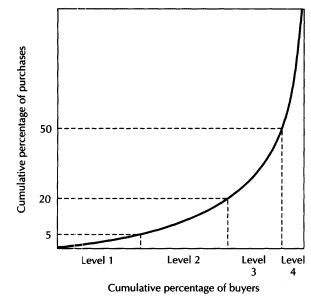
Figure 15.1.
Allocation of Buyers to Four Different Levels
NOTE: Buyers are ranked in ascending order of
the amount of each individual's total purchases:
Level 1 —buyers of the bottom 5 percent of total purchases (0–5.0 percent)
Level 2—buyers of the next 15 percent of total purchases (5.1–20.0 percent)
Level 3—buyers of the next 30 percent of total purchases (20.1–50.0 percent)
Level 4—buyers of the top 50 percent of total purchases (50.1–100 percent)
any regular pattern to the level of buyer to which the property would appeal.
Table 15.1 shows how each level of buyers of Jaén province divided the amount it spent among the different types of property and the redemption of censos. By showing the share of their money that each level of buyers devoted to each type of property, this table reveals their preferences, with arrows to identify the trends. The lower was the level of buyers, the more their money went into arable, vineyards, orchards, and redemption of censos, and there was a strong but not complete trend in this direction for urban properties (Level 2 devoted a larger share than Level 1 to this type). On the other hand, the higher the level of buyers, the more they spent on olive groves and rural estates.
|
|||||||||||||||||||||||||||||||||||||||||||||||||||||||||||||||||||||||||||||||||||||||||||||||||||||||||||||||||||||||||||||||||||||||||||||||||||||||










The table demonstrates a feature of the disentail that we already encountered in the individual towns of the province. One may recall that the catastro revealed that nonresident owners preferred to lease properties whose cultivation required large labor inputs (intensive agriculture) while tilling directly with hired labor and the administration of stewards the properties that called for less labor or whose production was oriented toward the outside market. Large resident landowners and local religious institutions had similar preferences, although they followed them in a smaller proportion of the cases. The economic rationality became evident when one considered the costs of the various inputs for the different types of property and the net income resulting from leasing compared with direct administration. Table 15.1 shows that when it came time to buy disentailed properties, the large buyers preferred the kinds of property that large and nonresident owners had learned was most profitable to exploit directly: olive groves and rural estates (that is, cortijos). These properties produced for the market and relied primarily on seasonal hired labor. Large buyers were not eager, however, to outbid smaller buyers for labor-intensive lands and those whose produce went mostly to feed the town, with the result that the lower levels of buyers spent a larger proportion of their money on these categories. This is notably the case for arable not located in cortijos and therefore probably distributed in small plots. Although they account for only a small part of the disentail, vineyards and orchards also went proportionately more to the lower levels.
The lower levels also demonstrated a stronger preference than the upper for urban properties and the redemption of censos. In both instances the upper levels were following a comprehensible investment policy. For them, in most cases, the purchase of buildings in the town nuclei would mean buying rental properties, from which they could expect a limited income. Leasing buildings to others attracted them no more than leasing agricultural lands. For small buyers, however, the prospect of owning a house rather than renting one had enough appeal to persuade them to spend money here rather than compete for farm land. The reasoning with censos was similar. Whether large buyers were proportionately more or less encumbered with censos than small buyers one cannot know, nor does it matter, since the amounts redeemed were not enough to have represented major shares of local indebtedness. For large buyers, the prospects of investing in market agriculture was on the whole more attractive than paying off obligations bearing 3-percent in-
terest. Smaller buyers, with fewer prospects of production for the market, showed a greater preference to redeem their debts.
All in all, the evidence reveals that as a group the people of Jaén with disposable wealth at the time of the disentail had acquired a fund of comprehensible economic reasoning. The disentail of Carlos IV placed a sufficient number of properties of various types on the market for this reasoning to produce regular patterns in the purchases of them. The trends in Table 15.1 are too clear to be the product of pure chance. Only one form of property shows no trend: improved and irrigated lands. This exception is puzzling, because most of these would be labor-
|
|||||||||||||||||||||||||||||||||||||||||||||||||||||||||||||||||||||||||||||||||||||||||||||||||||||||||||||










intensive properties and in the towns we looked at large private owners preferred to lease them to others.
At first sight, the pattern of property acquired by the different levels of buyers in Salamanca province appears unlike that of Jaén (Table 15.2). Whereas in Jaén there was a clear trend for the smaller buyers to acquire proportionately more arable, Salamanca shows no such trend although there is an indication that larger buyers directed their purchases toward arable more than the smaller ones. The difference, however, is more apparent than real. Large buyers in Jaén interested in the grain market bought cortijos, classed as "rural estates." In Salamanca, as we saw in the two towns of La Armuña, large buyers acquired the collections of numerous small grain plots that the ecclesiastical institutions had built up and whose purchase the peasants could not afford. Unimproved arable was the predominant type of property in Salamanca, accounting for 59 percent of all the money spent; even though arable was also highest in Jaén, it represented only 32 percent. The difference between the provinces lay in the willingness of large buyers in Salamanca to acquire arable to lease to peasants, as the church had done. In Jaén much commercial production was conducted with administrators and hired labor, in Salamanca with tenant farmers. Rural estates in Salamanca meant primarily alquerías and despoblados, which produced both grain and livestock. As in Jaén and for the same reason, the trend in purchasing rural estates was strongly toward the top buyers.
In Salamanca the sales included a number of pastures. The table shows that they were of two kinds, large pastures that could carry extensive herds and appealed to the wealthy, and smaller ones primarily for household animals. Commercially oriented pastures went to the top level, but below Level 4, the trend was toward the smallest buyers, who were prepared to pay extravagant prices, as was the case in El Mirón.
In other respects, the two provinces were similar. More obviously than in Jaén, large buyers shied away from labor-intensive properties, especially the improved or irrigated plots, most of them walled cortinas so typical of this part of Spain. They also spent a smaller share of their money to redeem censos, and they avoided urban properties (even though the inclusion of Salamanca city in the provincial analysis means that substantial urban properties, out of reach of small buyers, figure in the table). Curiously, in both provinces, the level that showed the greatest propensity for buying urban properties was the second, not the bottom, so that this preference was not a straight linear function of wealth.
One is led to conclude that wealthy buyers had a different mentality
than more modest ones, more open to the possibilities of the market. Before accepting this conclusion, however, there is an alternative explanation that should be considered. Perhaps the difference was simply one of opportunity. In the most obvious case, wealthy buyers spent more of their money on rural estates than small buyers. The fact is that most rural estates went for high prices because of their size, and the simple act of buying one automatically placed the buyer into one of our top levels because its cost was greater than the total amount spent by a single buyer in the lower levels.
There is one way to test whether opportunity or a different economic outlook was the primary motivating factor in the different choices of the various levels. If one tabulates only those individual purchases made by all buyers that cost less than the "breaking point" between Levels 1 and 2, that is, those purchases that a person in the lowest level could have made, one can observe whether the preferences observed for all purchases are repeated here (Table 15.3). The test is not conclusive because the upper levels spent only a small percentage of their money on purchases in this price range, and the trends turn out to be fewer and weaker than when all purchases are considered. Nevertheless, those that do appear run in the direction one would expect if the big buyers had different goals than the small buyers. In Jaén the big buyers put a greater share of their money into olive groves than the small ones, and in Salamanca the small buyers preferred vineyards and orchards, in all three cases trends that were found when all purchases were tabulated. It would appear that there was indeed a difference in mentality among the levels, large buyers as a whole showing more interest in properties that were directed to the market and could be profitably cultivated with hired labor, whether they were making large or small purchases.
3
Wealth not only gave access to properties oriented toward the market but reduced the ratio of price to expected return, making expensive properties attractive in more ways than one. The royal decrees organizing the disentail, one recalls, offered the buyers a choice of ways in which to pay for their purchases, the basic choice being between payment in hard currency or in vales reales. From the beginning, preference was given to bids in hard currency (metálico or efectivo), and within a year bids for less than the assessed value (the minimum bid was two-thirds of it) could be made only in hard currency. Moreover, the smallest
|
||||||||||||||||||||||||||||||||||||||||||||||||||||||||||||||||||||||||||||||||||||||||||||||||||||||||||||





vale real was worth 150 pesos face value, or some 2,260 reales. Sales concluded for less than this amount should have been paid in efectivo. Since the vales were depreciated, however, one finds properties going for around 2,000 reales being paid for with a vale real, but below this price, payment was almost exclusively in hard currency.1 For sales concluded after 16 August 1801, the deeds of deposit provide an additional item of
information, the relation between the price paid in hard currency and the assessed value, because the king now recognized his debt to the former owner for the full assessed value even if the buyer had paid less in hard currency. Until November 1802 the king also gave the former owner a 25-percent bonus if the sale netted more in hard currency than the assessment. Because bidding in hard currency could begin at two-thirds of the assessed value, sales for the assessed value ("en su tasa") or more in hard currency could result only from competing bids and show us that in these cases demand was high. Conversely, payment in vales reales suggests that there was little bidding and relatively cheap acquisitions, for a bidder could forestall further bids in vales by offering hard currency. While payment in vales had to be at least for the full assessment, vales were usually depreciated by over one-third, making the "minimum"
|
||||||||||||||||||||||||||||||||||||||||||||||||||||||||||||||||||||||||||||||||||||||||||







bid actually lower than the minimum bid in efectivo (see Figure 6.1). What terms the different levels of buyers used in making payment thus tell us something about the conditions under which they acquired their properties.
Tables 15.4 and 15.5 show the results. The trends are strong in almost all categories. The higher the level, the greater the proportion of its purchases paid for with vales reales. To a certain extent, the trend is inevitable, since all purchases below about 2,000 reales had to be paid for in efectivo. However, the lowest level included all buyers whose total purchases reached 4,000 reales in Salamanca and 3,390 reales in Jaén. Even the first level thus was not ruled out from the use of vales. Sales recorded as paid in hard currency at or above the assessed value after August 1801 were concluded after active bidding, and so were a large proportion of those paid for in hard currency at a price below the assessed value. The lower levels made more of their purchases in this way. The wealthier bidders, in other words, faced competition less fre-
|
||||||||||||||||||||||||||||||||||||||||||||||||||||||||||||||||||||||||||||||







|
|||||||||||||||||||||||||||||||||||||||||||||||||||||||





quently, and they paid for their purchases more often in depreciated vales. Smaller buyers competed more actively against each other and got less favorable terms as a result. This is the case even when one considers only those purchases below the "Level 1–2 breaking point," although the larger buyers had to use hard currency more often for these small purchases than for their others (Table 15.6).
The difference between upper and lower levels is more marked in Salamanca than Jáen. In Salamanca the bigger and smaller buyers seem almost to have lived in distinct economic worlds. Level 4 buyers made four-fifths of their purchases for vales, Level 1 only one-fifth (Table 15.5). Conversely, Level 1 paid hard currency proportionately more than four times what Level 4 did. Big buyers here were into an economy based on paper money, received, most likely, for commodities sold on the national market or furnished to the crown for its armed forces. Smaller buyers lived in a world of cash on the line. They could not bid for the large properties, but the rules of the game meant that they could keep each other from using vales to buy church lands. They fought each other at the auctions, not their economic superiors.
In Jaén the trends were the same, but the differences were less marked.
Vales reales dominated the economy here less, only 45 percent of payments were made in this medium, compared to 70 percent in Salamanca (Table 15.4). The biggest buyers used vales six times more than the smallest, but the small buyers used hard currency proportionately only one and a half times as much as the large buyers.
When one considers entire provinces, as here, the range of economic means of the buyers in Salamanca appears much greater than that in Jaén. We saw earlier, however, that the distinction in types of property acquired by the different levels was more marked in Jaén. Putting both sets of evidence together, one can conclude that in both provinces there were two types of economy present, one involved in production for a nonlocal market (olives and wheat being most important harvests) and the other of a variety of products—fruits, vegetables, lesser grains, flax in Salamanca, grapes in Jaén, as well as wheat—for local consumption (self-sufficiency would be a misleading term). The market economy dealt primarily in vales reales, the local economy in hard currency. Production for the former minimized the input of labor, intensive farming was directed to the latter. In actual practice, almost every locality and most individuals participated in both economies, but each was located at a different point on a continuum that ran from the limiting case of all production for the nonlocal market to the other extreme of all for local consumption. At this time, no individual would have reached the first limit, but many small farmers (although probably not many buyers) may have been at the second limit, except that their payments for rent and tithes would enter the larger market. Disentail reinforced this spectrum.
The information on terms of payment permits one to distinguish also between purchases paid for at once and those paid for over several years. Time payments were not very advantageous; they had to be made in three installments: at the time of purchase and on the next two anniversaries, with interest on the last two. As a result this method was little used: 1.5 percent of the total payments in Jaén, 0.4 percent in Salamanca. Jaén shows a slight trend for smaller buyers to use this arrangement more,2 Salamanca no trend. If conceived to help the less affluent to compete for the properties, the measure had a negligible effect. Again one perceives that so far as the local rural world was concerned, Spain's was still primarily a cash economy.
4
Finally, the data in the deeds of deposit enable one to establish a limited social profile of the people involved in the two economic worlds. First they tell us the appellation of the buyers. Some were called don or doña, but the majority not. Since these were notarized documents, it is more than likely that the use of the title depended on a legal privilege or, if not a specific document, on a well-recognized public reputation. Of the persons who made more than one purchase, a few appear at times with the don and at others without it, but they are a minority. The consistency of usage for each individual is remarkable, especially when one recalls that these were résumés of the original documents and that the name of the buyer was of marginal interest.3 To call oneself don was not a matter of caprice but a recognition of a legal or at least semiofficial status. Among those who regularly appear with the title don are priests, who can be identified by the abbreviation pbro. (presbítero ) after their name. I have kept them as a separate category.
Table 15.7 indicates the proportion of dons and doñas and priests among the different levels of buyers in the two provinces. There are virtually no titled aristocrats (condes, duques, and marqueses) among the buyers (most aristocrats probably hid behind the name of an agent), but those that appear are grouped with the dons. (The previous tables have been based on the amount spent by the buyers; this one counts individuals, not the amounts they spent.) The table reveals very clear trends. In both provinces 70 percent of the buyers in Level 4 (highest) were entitled don or doña. With Level 1 buyers the trends run the other way: almost 90 percent without any qualification in Salamanca province, 70 percent in Jaén.
It is not easy to know who had the privilege of displaying the title don at the end of the old regime. Hidalgos (nobles) were distinguished in this fashion, and they were undoubtedly the most important part of the group. But it is certain that not all who enjoyed the appellation were legal nobles. The census of 1797 shows 785 nobles in the province of Jaén, 7 percent fewer than the buyers identified as don; and in the portion of Salamanca under study, some 441, 8 percent fewer than the buyers.4 Since it is inconceivable that all hidalgos bought properties,
|
||||||||||||||||||||||||||||||||||||||||||||||||||||||||||||||||||||||||||||||||||||||||||||||||||||||||||||||||||||||||||||||||||||||||||||||||












there must have been many buyers called don who were not included as nobles in the census. Who were they?
It is very likely that the census takers underreported the number of hidalgos. The preface to the census of 1787 says that pressure was applied to eliminate from the number of hidalgos the persons who were not entitled to the privilege, and the number in the census of 1797 is
even less. This last gives 14 percent fewer hidalgos for the province of Jaén than the census of 1768 does for the bishopric of Jaén, and for the province of Salamanca 12 percent fewer than the bishoprics of Salamanca and Ciudad Rodrigo in 1768. Since three partidos of the province—Barco de Ávila, Piedrahita, and El Mirón—were in the bishopric of Ávila, the decline in Salamanca between 1768 and 1797 was even greater.5 It is probable that the censuses of 1787 and 1797 counted fewer hidalgos than the persons who were reputed to be hidalgos and that if these persons bought disentailed properties, they had themselves listed as don in the deeds.
This could account in part for the number of buyers called don, but more can be explained by other categories of men addressed as don because of their vocation, whether or not they were hidalgos. Such were the priests, as already noted. The deeds reveal that high servants of the crown, officers of the armed forces, and notaries appear as don (they could, of course, also be hidalgos, as were Campomanes and Jovellanos). In the various town catastros, men with official and semiofficial positions enjoyed the title: doctors, surgeons, apothecaries, and administrators of the tobacco monopoly. The census of 1797 lists 404 notaries, doctors, surgeons, and apothecaries in Jaén (against some 785 nobles) and some 450 in our portion of Salamanca (against 441 nobles). Nevertheless, the royal government strove to limit the use of the appellation. A decree of 1775 allowed notaries (escribanos) the right to sign with the title don only if they were hidalgos.6 Our evidence suggests that the practice was more liberal than the letter of the law, but the consistency in the use of the appellation don in the deeds of deposit indicates that it was applied only to persons with a recognized right to it.
We can conclude that the buyers who disported the don or doña had a proper claim to the title. They formed an elite of "notables," of which the true hidalgos were the most important (and probably the most numerous) part, the top stratum of the society of the old regime, not counting the exiguous high aristocracy. Table 15.7 shows that these notables dominated the top level of buyers in both provinces, the people who could spend fortunes for church properties.
This conclusion ill fits the stock hidalgo of literature and history, the threadbare and deluded Quijote. The Cervantine image was alive and
well in the mentality of the eighteenth-century reformers, recognizable in the scornful portrait of the rural noble painted by José Cadalso: "He takes the air majestically in the sad square of his impoverished village, wrapped in his poor cape, admiring the coat of arms above the door of his half-ruined house, giving thanks to God for having created him don Fulano de Tal."7 A picture that twentieth-century historians have not abandoned,8 but our provincewide analysis of the disentail brings its accuracy into question. It is not the first such piece of evidence; the reconstruction of the society of Lopera and Baños in Part 2 already revealed the economic and political power of the local hidalguía. We shall return to the issue when we look at the big buyers in Chapter 19.
Priests followed the same trend as the dons, toward the higher levels of buyers. Not all priests can be identified, because the qualification pbro. was not always added in the deeds,9 so that the trend toward the larger buyers may be exaggerated, but it is not spurious. Part 2 has shown that in the towns of Salamanca the income of the priests was among the highest in the parishes, that in those of Jaén the priests belonged to the best families. In Chapter 19 we shall see another, higher clerical world represented among the buyers, that of cathedral canons, capellanes, and university professors. Their means permitted a significant number of them to make purchases that placed them among the upper levels of buyers.
One can also identify the gender of the buyers from the deeds, in this case relying on their first names and the title doña (Table 15.8). If one considers all women as a group, one finds no trend in the proportion of buyers who were women from level to level in either province, but when the women are divided between those who were called doña and the others, the same trends become apparent as among the men, doñas being more common in the top levels and commoners at the bottom. That is, family and social level, not gender, determined the economic behavior of women. (Because some of the "unnamed" buyers in Table 15.7 would have been women, the correct trend for commoner women would be toward an even stronger presence in the lower levels that Table 15.8 shows, especially in Salamanca.)
With this added information one can give a social definition to the economic spectrum observed earlier. The persons who engaged in the commercial agricultural economy, those who had developed a capitalist
|
||||||||||||||||||||||||||||||||||||||||||||||||||||||||||||||||||||||||||||||||||||||||






mentality, were typically (but not exclusively) hidalgos and priests and other notables with official positions. The other economy, of production for local consumption, belonged primarily to commoners. The deeds of deposit tell one nothing about their occupation, but the largest number would have been peasants, like the vecinos of La Mata and El Mirón or the labradores peujaleros of Las Navas. Others may have been muleteers or bakers or craftsmen. When we come to study the big buyers, we shall find persons who may be properly classified as bourgeois—administrators of estates and merchants—in the upper levels. One may suppose that others of this kind are unidentified in the lower levels; after all, even the lowest buyers would have had some kind of standing in their towns. But the bourgeois would have been a minority in all levels.
The cases of Jaén and Salamanca indicate that Andalusia and Castile at the end of the old regime had a dual agricultural economy and a corresponding dual society. At one extreme was a peasant society producing primarily for local consumption; marked by high labor inputs; relying on hard currency (when not on barter), which the peasants saved carefully and brought forth to bid against their neighbors when given the chance to buy plots of land of their own. For such buyers, the disentail offered the opportunity to acquire the lands they farmed. At the
other extreme, the notables and a lesser number of wealthy commoners controlled the market economy; sought to minimize the costs of labor on their lands; and accumulated depreciated vales reales, which they could use to buy those disentailed properties that could expand their commercial output. Though functionally and socially different, the two economies were not physically separate. Most individuals connected with agriculture engaged in both, to a greater or lesser extent. In the towns of Jaén those who concentrated on the market lived cheek by jowl with the others; in Salamanca, the commercially oriented were more likely absentees residing in the provincial capital or the cabezas de partido. Such is the general picture that emerges from the provincewide analysis of the deeds of deposit. To refine it, we can turn to the variations among the geographic zones within the provinces.
Chapter XVI—
Jaén Province:
The Determinants of Growth
In order to proceed, I have divided the two provinces into a number of zones that I have sought to make geographically and economically homogeneous. They have been drawn on the basis of maps and studies of the physical landscape and geology and extensive personal travels throughout the two provinces by automobile. The purpose is to establish units with different social and agrarian patterns that can be used for a comparative analysis of their evolution.
The division of the province of Jaén into zones is not obvious. Except in the mountains, the region has a low rainfall, weather stations reporting a mean annual precipitation ranging from 487 millimeters at Cazalilla near the Guadalquivir River to 601 millimeters at Jaén. Conversely, evaporation is high everywhere. There is not much difference in annual mean temperature either, ranging from 16° to 18° centigrade. Climate, in other words, is relatively similar throughout the study region, with a cool, moist winter and spring, and a hot, dry summer.1
In the eighteenth century and still today, agriculture predominated over grazing, even in the mountain valleys; and agriculture was, and is, marked everywhere by a division between wheat fields and olive groves. The marls that predominate are excellent for olives but less favorable to
the cultivation of wheat, and over the centuries olives have been gradually replacing wheat. Today there are districts where the rolling hillsides of red or brown earth are dotted as far as one can see with silvery green olive trees set out in precise geometric patterns, columns of plumed soldiers marching up hill and down. In few places of the world has reason tamed nature so successfully. Yet, lest we forget that this is Andalusia, the two or three trunks that make each tree, taunting imposed discipline, become circling dancers with arms flung back in their own flamenco ritual. But go on a few kilometers and the unbroken rows of trees give way to rectangles of alternating olive grove and grain fields, the latter verdant and waving in the spring, sprinkled with brilliant flowers, then brown and parched after the June harvest.
There are few level plains, for the basin of the Guadalquivir undulates in waves of different lengths, heights, and directions. On reaching the southern ranges, the land rises sharply, and a short way up the olive trees give way before thin soil or barren limestone rock, the stark mountains wrapped in flowing green polka-dotted skirts, Gypsy maidens decked out for a perpetual fiesta of the local Virgin. The richness of Jaén's rolling basin, with its broken pattern of olive groves, wheat fields, and stark white towns, the towering ranges on the south and east, the wild, wooded Sierra Morena on the north, make the province a constantly varied vision of beauty.
As is common in southern Spain, the inhabitants of Jaén are gathered into large settlements. In the census of 1786, Jaén had seventy-four cities and towns, with an average population of 2,380. Both for military defense and to escape the heat of summer and the danger of epidemics, most towns of Jaén stand white and nucleated at high points in their territories. Baños is a good example. In the Guadalquivir basin many sit on hilltops, and at the southern and eastern edges of the basin they are located up the base of the mountains, with their fields stretching out beneath them and the barren slopes above serving as protection from attack. The capital city, Jaén, at the foot of the Sierra de Jabalcuz, is a perfect example, dominated by the Castillo de Santa Catalina, which commands the two approaches from Granada, the older western road that circles the higher ranges and the newer road south through the sierra. On the northern limits of the province, the ranges are lower and several towns nestle in saddles where roads pass through the hills, as does Navas.
Close by the towns, where water flows either from streams or wells, lie the irrigated huertas with their vegetable plots and fruit trees. In the
eighteenth century, and still today, the closest land to the nucleus was called the ruedo, the most intensively cultivated zone that is not irrigated. Beyond is the campiña of the town, not to be confused with the term campiña applied generally to the basin of the Guadalquivir as opposed to the sierra. In the empty spaces between the towns of the basin there were, and are, scattered residences and farm buildings of the large estates, the cortijos that roused the ire of Carlos III's reformers and of those of the Second Republic and the casas de campo in the major olive groves. In the case of Baños, we saw that this land use reflects the pattern known as von Thünen's rings, with the intensity of cultivation depending not only on quality of soil and availability of water but on the distance from the town nuclei.
I divided the province into nineteen zones (Map 16.1). Five are located fully in the valley of the Guadalquivir, in the western part of the province. Three have rich soil, centering on the cities of Andújar (Zone JA); Arjona (JB), which includes the town of Lopera, studied in Part 2; and Linares (JE). In the ensuing analysis, they are referred to as rich basin zones. The two other zones in this region are further south, in a rolling plain where salt deposits have reduced the fertility of the soil. Santiago de Calatrava zone (JC), made up of three distinct blocks because of the way the municipal boundaries run, is near the Córdoba frontier, while Mengíbar zone (JD) is in the center of the province. They are called poor basin zones. South and east of this region are four zones whose towns have their lands in the valley of the Guadalquivir and their town nuclei against the foothills of the southern and eastern ranges. Identified here as south basin zones, they are Martos (JF), Jaén (JG), Mancha Real (JH), and Cazorla (JI). The Sierra Morena zone, JJ (Baños), is in the foothills of this range and is made up of the town we studied and a similar one called Vilches. Two rolling ridges or hog's backs (lomas ) rising between rivers in the northeastern part of the province are the location of four zones, the two to the west rich loma zones: Baeza (JK) and Ubeda (JL); and the other two poor loma zones: Santisteban (JN), which includes the town of Las Navas of Part 2, and Villanueva (JM). Finally five zones are located south of the basin of the Guadalquivir. Three of them are sierra zones, Bédmar (JO), Pegalajar (JP), and Cambil (JQ); and two lie in broad valleys in the south, isolated from the rest of the province, Alcalá la Real (JR) and Huelma (JS), the southern valley zones. Appendix P provides a detailed description of the geography, population structure, and political status of these zones.
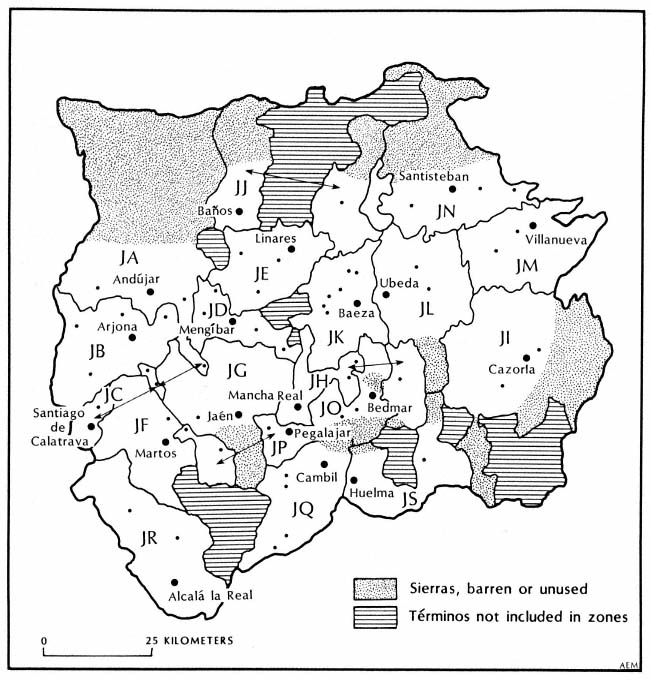
Map 16.1.
Zones of Jaén Province
2
Few readers will have been surprised to learn from the previous chapter that two types of economy existed in the provinces—market and local—and that they can be associated with different social groups, although the prominent role of nobles and clergy in commercial agriculture may seem paradoxical at first. If we turn to the data for the individual zones within the provinces, we can refine this simple observation, for the zones show that the different factors associated with the two types of economy come together in a variety of ways to produce distinct
subpatterns, which in turn help us to understand the economic forces at work in rural Spain at the end of the old regime.
When added to the deeds of deposit, the midcentury catastro and various censuses provide a diachronic perspective. The detailed information of the catastro on individual property holding in each town, which made possible the studies in Part 2, is unmanageable at the provincial level, at least for this study. The royal bureaucracy in the eighteenth century, however, extracted much of the information from the reports and their results have fortunately been preserved in most cases. The Archivo General de Simancas has a precise listing of the property of the largest owner in each town, the hacendado mayor, including his, her, or its (if it was an institution) name and residence. Simancas also has a copy of the responses to the forty questions that formed the first part of each town survey, with data on the number of vecinos, houses, people in various occupations, wages, prices, types of harvest, tithes, taxes, and similar matters ("Respuestas generales" or "Interrogatorio general"). Even these questionnaires are not readily usable in extenso—they may run to fifty folio sheets for one town—but their contents were extracted and tabulated in large volumes now in the Archivo Histórico Nacional. This series normally has three volumes for each province, the first ("Estado seglar") devoted to the property and other income of laymen and secular institutions (including the town council, that is, town property); the second ("Estado eclesiástico") for that of ecclesiastical institutions, foundations, and funds; and the third ("Eclesiástico patrimonial") for that of individual clergymen. For purposes of the present study, I have assembled these data, already quantified town by town, into totals for the zones within the province. Unfortunately, for Jaén only the volume summarizing the information of the secular estate has survived.2
A number of eighteenth-century censuses have been preserved that give the population (vecinos or total inhabitants) of individual towns. The "Vecindario general de España," located in the Biblioteca Nacional and already described in Chapter 1, gives the vecinos around 1712. The number of vecinos at the time of the catastro (ca. 1752) can be obtained from the respuestas generales, question 21, but it has also been tabu-
lated from the towns of Salamanca province in a document in the Real Academia de la Historia.3 The same place houses the original individual town returns of the census taken in 1786 and published the next year. These record the number of each sex, single, married, and widowed, in each of six age groups, as well as the number of individuals in various legal estates and occupations.4 Finally, I have made use of the number of vecinos and inhabitants recorded for each town in 1826 by the royal geographer Sebastían de Miñano.
The information on the sales has been described in the last chapter. It is now, however, broken down by zone, and within each zone by level of buyers.5 The level of each buyer is determined by his location on the Lorenz curve of the zone.6 Thus in a zone where purchases were priced low, a buyer who appeared in Level 3 or even 2 in the province may be placed in Level 4, and vice versa. Buyers in Level 4, or any other level, do not spend equal amounts of money from zone to zone and are not equally wealthy. Table 16.1 gives a sense of the difference among the zones in Jaén province in this respect. It shows the mean purchases of Level 1 and Level 4 buyers and of all buyers in each zone. If one compares the mean amount spent by all buyers in each zone, as shown in this table, with the mean town population in each zone (Table 16.2), one finds a rough, direct relationship (r = .52). One can deduce that, as a general rule, in larger towns, the upper levels of society, those that furnished the buyers of disentailed properties, had more money than the corresponding levels in smaller towns. The correspondence is far from exact, however, r 2 = .275, meaning that only about one-fourth of the variation in the amount spent can be attributed to the size of the towns in the zones.
By using the commercial market–local consumption spectrum that emerged from the global look at the two provinces, one may distinguish the zones in Jaén province by the strength of the orientation of their agriculture toward a wider market, as revealed by the nature of the prop-
|
||||||||||||||||||||||||||||||||||||||||||||||||||||||||||||||||||||||||||||||||||||||||||||||||||||||||||||||||||||||||||||||||||||||||
erties disentailed. For instance, although some olive oil was consumed locally, one can posit that most owners and buyers of olive groves were conscious of a national and even an international market and involved in it. Unfortunately, arable land, the largest type of purchase, involving 32 percent of the money spent, could produce wheat and other grains either for local consumption or for the broader market, so that the amount of it disentailed in each zone does not help one distinguish the economy of the zone. On the other hand, cortijos and other rural estates, which can be identified, did produce primarily for the broader market. Table 16.3 and Map 16.2 distinguish the zones by the percent of the total purchases devoted to olive groves and to rural estates. The higher the readings, the more the zone can be assumed to produce for the market economy.
Olive groves are strong in the north and west of the province, cortijos in the south and east. The only zones with strength in both types of cultivation are Andújar (JA), bordering Córdoba province on the Guadalquivir River, and Mancha Real (JH), between the Guadalquivir and the southern ranges. The two zones in the northeast (JM, JN) and a belt of
|
||||||||||||||||||||||||||||||||||||||||||||||||||||||||||||||||||||||||||||||||||||||||||||||||||||||||||||||||||||||||
zones in the center and south (including the zone of Jaén city) do not show up as high in either type of clearly commercial property (JD, JF, JG, JK, JP, JQ, JR).
To understand better the economy of the various zones, one can distinguish them according to the orientation toward the market of the different levels of buyers. The purchases of each level show if it was primarily interested in buying properties directed toward market production and was able to acquire them. I shall divide the zones into three
|
||||||||||||||||||||||||||||||||||||||||||||||||||||||||||||||||||||||||||||||||||||||||||||||||||||||||||||||||||||||||||||||||||||||||||||||||
categories according to these criteria, using the premise that olive groves and cortijos were engaged more in market production than other types of property. Some grain grown in small plots was also destined for the outside market, of course, but since much of it would be for local consumption, the marketed proportion of the grain not grown in cortijos would be less than that of the cortijos. Vines would also be directed toward an outside market, but most fruits and vegetables would be too perishable.
The three categories of zones are as follows:
Type A. All levels of buyers into the market. Those zones where both Level 4 and Level 1 buyers directed their purchases toward market-oriented properties. To qualify for this type, Level 4 buyers (highest) must devote the largest share of their purchases to olive groves or rural estates or both together, and Level 1 buyers (lowest) must either devote a larger share of their purchases to olive groves than to arable or must
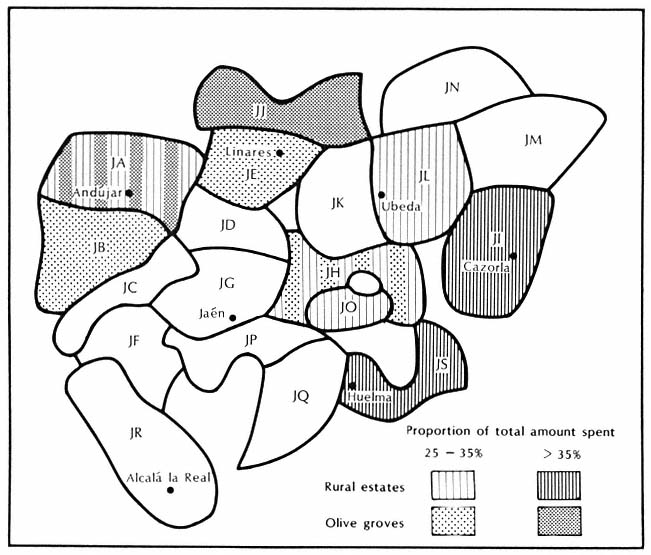
Map 16.2.
Jaén Province, Rural Estates and Olive Groves in Disentail, 1799–1807
have olive groves as their next choice after arable. The second alternative for Level 1 buyers is necessitated by the fact that in most zones sales of arable outweighed considerably sales of olive groves, so that Level 1 buyers, even if they preferred olive groves, had more arable available to purchase. Zones where Level 1 buyers preferred urban properties, improved or irrigated plots, or the redemption of censos to olive groves do not qualify for this type.7
Type B. Top levels of buyers into the market. Those zones where Level 4 is into the market but Level 1 is not, under the terms defined above. These are primarily zones strong in cortijos, where Level 1
|
||||||||||||||||||||||||||||||||||||||||||||||||||||||||||||||||||||||||||||||||||||||||||||||||||||||||||||||||||||||||||||||||||||||||||||||||||||||||||||||||||||||||||||||||||||||||||||||||||||||||||||||||||||||||||||||||||||||||||||||||||||||||||||||||||||||||||||||||||||||||||||||||||||||||||||||||||||||||||||||||||||||||||||||||||||||||||||||||
buyers did not have available olive groves that would put them into the market.8
Type C. No levels of buyers into the market. Those zones where neither Level 4 nor Level 1 is into the market as defined above. Although these zones obviously sold some produce on the outside market, the nature of the properties that were disentailed indicates that this commerce was not conducted on a major scale and was not the primary objective of local agriculture.9
Table 16.4 shows the distribution of the zones into these three types.
3
One may now proceed to compare these different types of zones on the basis of other known characteristics. For instance, the mean amount spent by the buyers in each zone proves to be related to the extent that the buyers were into the market. If one ranks the zones according to the mean amount spent and draws a line between numbers 11 and 12, as is done in Table 16.5, one finds that seven of the nine zones in Type A (all levels into the market) and four of five zones in Type B (top levels into the market) are above this line. All the zones in Type C (no levels into the market) are below the line. Zones JH and JO, belonging to Type A, fall below the line. The considerably smaller mean amount spent by their buyers than those of other zones in Type A indicates that these two zones had a distinct economic level and deserve to be grouped separately. I have therefore divided Type A into Types A1 and A2 . The same is true for Zone JQ in Type B, which becomes the only zone in Type B2 . These subcategories are already incorporated in Table 16.4. Henceforth most of the discussion will exclude Type A2 and Type B2 zones, which are too few in number to draw conclusions about the significance of their characteristics. With these exceptions, being into the wider market, whether by all levels of buyers or by the top levels, meant that the properties sold in the zone were more expensive and the average buyer spent more than in the zones that were not into the market.
|
||||||||||||||||||||||||||||||||||||||||||||||||||||||||||||||||||||||||||||||||||||||||||||||||||||||||||||||||||
Map 16.3 shows that these types reflect geographic affinities. Except for the two unclassified poor zones, JC and JD, marked by infertile soil, small towns, and few purchases, most of the central and west of the Guadalquivir valley consists of Type A zones (all levels into market). Type B zones (top levels into market) form a ring around this block on the east and south, while Type C (no levels into market) are peripheral in the northeast and southwest. Only one Type A zone is not contiguous to the others, JR (Alcalá la Real), made up by the three rich valleys in the southwest. Type A2 zones (all levels into the market, small purchases) lie next to each other on the eastern edge of the A zones, and the B2 zone (top levels into the market, small purchases) is nearby, in the long valleys above Jaén city.
Because of the way in which being into the market is determined, with the bottom levels depending on the purchases of olive groves and the top levels on either olive groves or rural estates, one would expect Map 16.3 to reflect closely Map 16.2, which shows the zones of heavy purchases of olive groves and rural estates. There is a similarity but by no means an identity. All the zones that had a large proportion of their
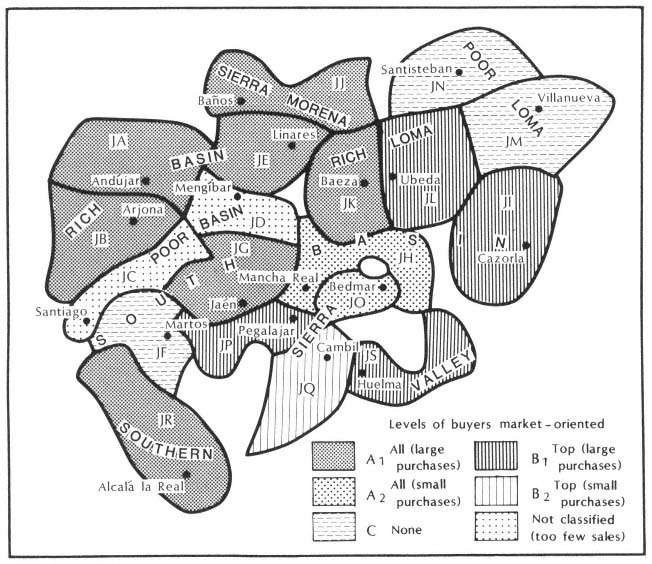
Map 16.3.
Jaén Province, Types of Zones
sales in olive groves do, in fact, fall into Type A (except Zone JC, not classified for lack of sufficient sales), but so do four other zones that were not strong in olives. In three of these, the small buyers sought the available olive groves within their means, while the upper levels went for rural estates. In the fourth, JO (a Type A2 zone), Level 1 got into the market by buying vineyards as well as olive groves. Three of the six zones strong in rural estates thus fall into Type A, leaving only three others for Type B, along with two others not strong in rural estates. Those zones that had a large share of their sales in either rural estates or olive groves belong to one of the types that were into the market—and quite properly so—but by concentrating their purchases on the available rural estates (JP) or olive groves (JQ), the upper level of buyers placed two other zones among those where the upper levels were into the market.
One may question whether the division of the zones into these three types in reality represents different orientations toward the wider mar-
ket. It could, for instance, be simply a reflection of the size of their towns, with Type A zones containing the largest towns and Type C the smallest. (One recalls that we have found a rough correlation between the mean size of the towns and the mean amount spent by the purchasers.) If one treats these three types of zones as random samples drawn from an imaginary larger population of zones with similar characteristics and applies a test of significance to the differences in the size of their towns in 1786, one finds no significant relation between town size and the three types. The mean town size has the expected trend, but the difference in town size varies so widely within each type of zone that the difference is not significant.10 The three types of zones thus reflect something other than town size.
Another possibility would be that the types offer a measure of general economic activity and not simply the market orientation of agriculture. To explore this possibility, one must go back fifty years to the information in the catastro. Table 16.6 shows the proportion of artisans and craftsmen among the vecinos in each zone in the early 1750s. On the surface, the three types of zones do seem related to artisan production. The mean number of all craftsmen per thousand vecinos declines from Type A1 , to B1 , to C and, disaggregating the crafts, so do the numbers of carders and weavers and of tailors. On the other hand, the number of sandalmakers (alpargateros) per thousand vecinos is highest in Type C zones and lowest in Type A1 , responding perhaps to the greater isolation of Type C towns. Tests show that these trends are not significant, however, because of the wide variation among the readings within each type of zone (again treating the three types of zones as if they were random samples drawn from a larger population). The same is true of the income of the retail food stores per vecino, although here there is a hint of a possible relationship.11
In fact, other factors can be more readily associated with at least two types of crafts. The concentrations of carders and weavers, for instance, are found in the zones with the largest mean town population, and indeed, they are located in the large towns. Jaén, Ubeda, Baeza, Alcalá la Real, and Andújar, the only municipalities in the province with over two thousand vecinos, had 109 of the 115 carders in the province and 148 of the 156 weavers. Alpargateros also have a different association.
|
|||||||||||||||||||||||||||||||||||||||||||||||||||||||||||||||||||||||||||||||||||||||||||||||||||||||||||||||||||||||||||||||||||||||||||||||||||||||||||||||||||||||||||||||||||||||||||||||||||||||||||||||||||||||||||
The high concentrations (over ten per thousand vecinos) all occur in the four loma zones and Cazorla, contiguous in the east. Theirs was a regional specialty.
On the other hand, one kind of activity recorded in the catastro correlates well with the three types of zones. This is the income of muleteers (arrieros). Table 16.7 shows the income per vecino from muleteering in the zones, and Map 16.4 locates the towns that reported income from
|
|||||||||||||||||||||||||||||||||||||||||||||||||||||||||||||||||||||||||||||||||||||||||||||||||||||||||||||||||||||||||||||||||||||||
muleteering. Type A1 zones have a mean per vecino income from arrieros of 19.5 reales; Type B1 , 5.8; Type C, 0.9. An analysis of variation shows that there is less than a 5-percent probability that these differences occurred by chance. Even more conclusive is a comparison of the number of towns in each type of zone that had a major sector of muleteering (here defined as having a minimum of one thousand reales total annual income for all the arrieros in the town). Eighteen of twenty-seven towns in Type A1 , zones reach this figure, three of twelve in Type
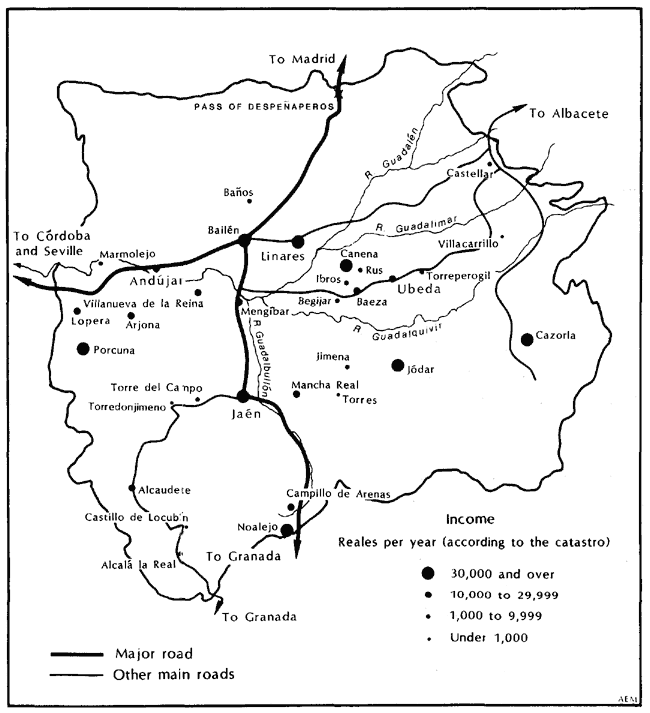
Map 16.4.
Jaén Province, Income from Muleteering, ca. 1750
B1 , and only one of eleven in Type C. The difference in proportions is significant at the 1-percent level.
Of course, active muleteering could be independent of the nature of local agricultural production, as is shown by zone JQ, the deviant case labeled Type B2 . It had the largest arriero income per vecino of all the zones. It lay on the new road from Madrid to Granada through the sharp valleys south of Jaén city, and all its arriero income came from the two towns nearest the border with Granada, Campillo de Arenas and Noalejo. Relatively small mountain towns, they specialized in transport independently of their agricultural activity. Zone JD was a similar
case, second in income per vecino from arrieros only to JQ. All of its arrieros were located in one town, Mengíbar, site of the main ford across the Guadalquivir River on the way south to Jaén and Granada. A small town, it was nevertheless the largest of five in this poor valley zone and prospered from its location. Surrounded by zones actively into the market (Type A1 ), it stood in a natural spot to develop muleteering.12 Elsewhere the variation in the amount of muleteering income among the three types of zones lends support to the proposition that the types do in fact represent different orientations toward commercial agriculture. Although positive proof is lacking, all the information adduced leads to the conclusion that the three types of zones differed in the market orientation of their agriculture but not significantly in other forms of economic activity except muleteering, which can be seen as a forward linkage of commercial agriculture.
4
Having determined the extent of the involvement in the market of the agriculture of the different zones, we may proceed by observing how this factor is related to their social structure. To begin with, I shall use the information provided by the sales during the disentail. One statistic is especially revealing: the proportion of the buyers who were notables (as defined in Chapter 15). Table 16.8 gives these figures for Levels 1 and 4 and all buyers, broken down by type of zone. Among the three types of zones, there is a significant difference in the proportion of buyers who were notables. Zones with all levels of buyers into the market (Type A1 ) had the highest proportion (46 percent), zones not into the market (Type C) the lowest proportion (30 percent), while those where only the top levels of buyers were into the market were in between (35 percent). This trend appears also among Level 1 (small) buyers, but not to a statistically significant extent among Level 4 (large) buyers. The previous chapter showed that there were many more notables among the top buyers in the province as a whole, and the table shows that to be the case in the individual zones (except the zones not included in the three types because they had few buyers). Not here, however, but in the lower levels does a clear pattern emerge of the proportion of buyers who were notables directly correlated to the extent of involvement in the wider market.
|
||||||||||||||||||||||||||||||||||||||||||||||||||||||||||||||||||||||||||||||||||||||||||||||||||||||||||||||||||||||||||||||||||
The census of 1786 reveals that the pattern was not peculiar to buyers alone but characterized the population as a whole. The zones where all levels of buyers were into the market (A1 ) were those with the largest proportion of nobles among the residents. The census called for an enumeration of the hidalgos in each town, a piece of information not included in the questionnaire or provincial summaries of the catastro. Table 16.9 shows the number of hidalgos per thousand adult males in each zone. In many respects the accuracy of the census for Jaén is suspect, as already noted in the case of Baños, so that the number of hidalgos reported may not be correct. The trend is clear, however. The ratio of nobles to adult males is distinctly higher in all but two Type A1 zones than in Type B1 , zones (the two deviant A1 , zones are contiguous in
|
||||||||||||||||||||||||||||||||||||||||||||||||||||||||||||||||||||||||||||||||||||||||||||||||
the north center). Two of the Type C zones show a lower proportion of hidalgos than the large majority of Types A1 and B1 zones, but the third, JM in the northeast, has the highest ratio of all zones. (The high count is in the two newer towns Villacarrillo and Villanueva del Arzobispo, the other older, pre-conquest town Iznatoraf reported only one noble. One cannot tell from the data whether the deviance of JM is real or the result of an enthusiastic census taker.) Except for these three cases the pattern reflects the picture drawn from the sales: the more fully a zone was involved in the outside market for agricultural products, the larger was its class of hidalgos.
This information permits us to look again at the conclusion reached in the last chapter about the relation between social class and commercial agriculture. The data in Tables 16.8 and 16.9 indicate an apparent paradox. The zones of local economy (Type C), where the average amount spent by the buyers was low, mostly located on the periphery of the province, had the fewest nobles and the most distinctly stratified group of buyers (small buyers having a far smaller proportion of nobles than large buyers). By contrast, the wealthy zones, where all levels of buyers were into the market and the average amount spent by buyers was high, had the most nobles and reveal the least stratification among
the buyers. The percentage of nobles is higher and more evenly distributed among the levels. Zones in which only the top levels of buyers were into the market lie in between.
If one recalls from Part 2 the contrast between Baños and Lopera on one hand (both located in zones where all levels of buyers were into the market, JJ and JB), and Navas on the other (zone JN, no levels into the market), one can posit a conclusion. The first two had a wealthy resident elite headed by a number of hidalgo families. Their elite formed a distinct layer at the top of the social pyramid (8 percent of the vecinos in Baños, 10 percent in Lopera, see Tables 11.20 and 12.14), which ran their towns and extracted wealth from the land without getting their hands dirty. But in Navas there was only one landowning don out of 214 male vecinos, the notary. The information provided by the present chapter indicates that this contrast can be generalized to the entire province. One can conclude that there were two distinct typologies of social structure in Jaén province. Towns in zones actively engaged in commercial agriculture attracted more wealth and developed a strong resident economic, social, and political elite of which hidalgos formed a major part. Nonnobles were a vast majority of the vecinos, but among the buyers they were a bare majority (a minority in two zones), and even at the lowest level of buyers they were not an overwhelming majority. The conclusion of the last chapter is reinforced: the presence of commercial agriculture and a strong resident hidalgo class went hand in hand.
At the other extreme, areas involved primarily in a local economy did not produce or attract a resident elite of this nature. A few hidalgos were present and formed the apex of the social pyramid. When they bought disentailed lands, they sought the best properties, having the most money to spend, and dominated the top level of buyers, where they might be joined by outsiders. But they left to local commoners the largest amount of land put on sale. Although there was greater disparity in the composition of the buyers, this reflected a smaller and weaker, not a stronger, local elite.
Type B zones, where the top levels of buyers were into the market, are a halfway stage between the two extremes. Disentailed property here was split more evenly between what was commercially oriented and what was produced for local consumption. The elite of notables, smaller than in Type A zones, stressed the purchase of market-oriented properties, leaving the less expensive properties to the noncommercialized, nonnotable sector of the towns.
5
This analysis of the relationship between the different types of agricultural activity and social structure offers a static picture of the rural world of Jaén at the end of the old regime. Our next task will be to make the picture move, to demonstrate evolution during the half century under study and discover the forces at work. The data will not always permit the sequence to be fully in focus, but the picture will be instructive, nonetheless.
One may start by determining in which zones the market economy was expanding. For this purpose, one would like to compare the proportion of land devoted to harvests for the market at the time of the catastro with that shown by the sales, but the data available do not permit so precise a comparison. The catastro of each town states the area devoted to each type of cultivation and the value of the annual harvest,13 while the records of the sales give the price but not always the size of the ecclesiastical properties that were sold. The extent of land devoted to the various harvests at the time of the sales is unknown, but from the available data one can compare the value of land devoted to cereals and olive groves at the time of the catastro with that shown by the sales. If the ratio of olive groves to arable shows an increase between the two dates, one can assume increasing production of olive oil for the market. There is unfortunately no way of determining an absolute increase in grain production for the market, but because the demand for olive oil was outdistancing that for grain, as will be explained below, greater participation in the market was likely to show up as an increasing ratio of olive groves to arable.
Even here there are difficulties. One saw in Chapter 5 that the ratio of catastro value to sales price varied widely among the properties devoted to different cultivations. One must adjust for the different markup of the two types of property when comparing figures from the two sources. Table 16.10 shows the results.
My comparison of the figures (Column D of Table 16.10, which measures the change in olive tree cultivation vis-à-vis arable in each zone) is based on three assumptions, all of them open to some error: (1) that the sales represent a true cross section of the cultivated land in each zone between 1799 and 1807; (2) that the ratio of the markup of olive groves
|
||||||||||||||||||||||||||||||||||||||||||||||||||||||||||||||||||||||||||||||||||||||||||||||||||||||||||||||||||||||||||||||||||||||||||||||||||||||||||||
to arable between the catastro and the sales is everywhere similar (that is, 43 : 24); and (3) that the lands sold whose use is not specified are on the whole arable. How open to error this procedure can be is seen in the figures for zones JK and JN, both of which show a considerably smaller ratio of olive groves to arable in the sales than in the catastro. If one assumes that olive cultivation was expanding at least as fast as grain production, the readings for these zones suggest that one should allow a margin of error of at least 50 percent in comparing the two ratios. Greater growth than 50 percent in Column D provides a strong presumption of expansion of olive groves in the second half of the century. Zones JR, JL, JP, JS, JH, JO, JQ, and JC show such expansion.
Map 16.5 makes the result visual. Assured growth occurred primarily in the south of the province: the three southern sierra and the two southern valley zones. Two other zones were contiguous to older olive regions, JC in the west and JL on the Loma de Ubeda, next to Baeza zone. The other zone to show growth, JH (Mancha Real), was the only Guadalquivir basin zone with an established olive production at mid-
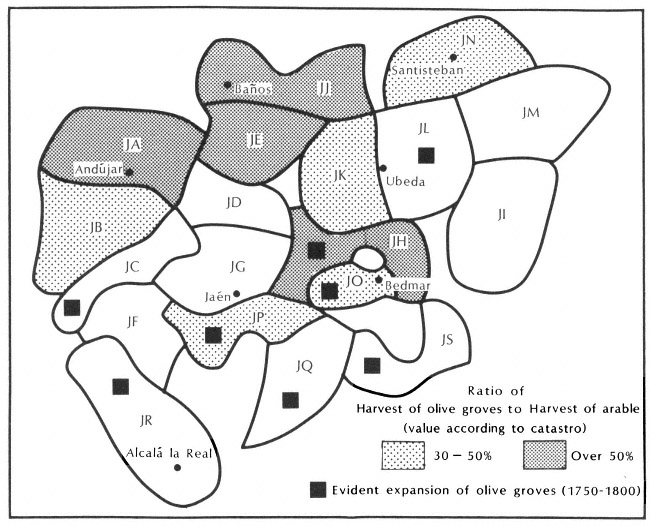
Map 16.5.
Jaén Province, Concentration of Olive Groves, ca. 1750,
and Expansion of Olive Groves, 1750–1800
century that definitely revealed expansion. The traditional olive areas in the north and west, Andújar, Arjona, Linares, Baños, and Baeza, either did not expand olive groves or expanded so little as not to show up in this analysis. (Zone JN, also an olive zone in 1751–53, showed an apparent decline in olives and in the sales appeared as a region not into the market. It was a marginal zone as far as commercial agriculture was concerned. Las Navas was located here.) On the other hand, five of the eight zones of confirmed growth had few olive trees in 1750.
This apparent paradox may be partially the effect of the statistical procedure: it is easier to achieve a high proportional increase when starting from a low base. The range of the estimates in Column D is so wide, however, as to indicate that the difference in rate of growth was real. For all the shakiness of the table, it suggests that the expansion of olive production in Jaén province took place in waves. A first wave, antedating 1750 and not observed in this study, had affected the rich basin zones JA (Andújar), JB (Arjona), JE (Linares) as well as the two loma zones JK (Baeza) and JN (Santisteban) and the Sierra Morena zone JJ (Baños). In the half century of this study growth here either slowed or came to a halt. Other zones that had turned toward olives before 1750 continued to expand, JH, JO, and JP. JH (Mancha Real) was in the basin south of the river, JO (Bedmar) and JP (Pegalajar) in the sierras nearby. Finally, a new wave of expansion after 1750 hit many of the zones not previously affected, leaving only two in the east and a belt of three in the center still strongly committed to grain as the cash crop in 1800. These last, oddly, include Martos (JF) and Cazorla (JI), today among the areas in the province most intensively dedicated to olive cultivation. Apparently their specialization did not begin until after the fall of the old regime.
That most zones strongly devoted to olive cultivation in 1750 give little evidence of growth in production over the next half century presents a puzzle. During this period the price of olive oil rose somewhat faster than that of wheat. According to the price tables published by Earl Hamilton for New Castile, if the mean of annual prices for the decade 1751–60 is assigned the index number 100, during the decade 1791—1800 the mean price of wheat was 196, of olive oil 230.14 At the end of the century olive oil had a wider market than wheat. It was being exported from Spain to northern Europe, whereas the market for wheat was limited to central Spain, since the periphery imported grain from
abroad.15 Why should landowners already engaged in producing olive oil not continue to push into an expanding market? The answer may be economically rational if one considers that the expansion of olive groves could entail taking over arable land. The use of labor for the cultivation of olives and grain is complementary. The harvests are about six months apart, with olives in winter and grains in the summer, and the plowing of olive groves and the pruning and care of the trees can be done during the slack seasons for grain growing (Figure 16.1). So long as the local labor did the cultivation of olives, the opportunity costs of expanding olive production were low. Although the chapters on Baños and Lopera show that migratory labor was used for grain harvests and thus presumably was available for olive harvests as well, the marginal cost of migratory labor would be higher. The differential rise in the price of olive oil was not great enough to encourage unbalancing the established economy by turning grain fields to olive groves. Pastures and wastes would be sacrificed, but most of these were public lands and could be turned to private use only by corrupt means. Expansion into pastures and wastes was probably going on, but if a balance of wheat and olives was being maintained, it would not show up in Table 16.10. In other words, under prevailing circumstances, there was a limit to the proportion of land that could be economically devoted to olives, and the older olive regions of the Guadalquivir basin appear to have approached this limit by 1750. Only a sharp drop in the price of wheat vis-à-vis olive oil, such as occurred at the end of the nineteenth century when American wheat invaded the world market and the international demand for olive oil rose sharply, would create conditions that would encourage the expansion of olive groves beyond this limit.16
If this were the full explanation, the proportion of land devoted to olive production would have stopped in all zones at about the same level. This was not the case, however. In the zones that showed no clear growth between 1750 and 1800 (JA, JB, JE, JJ, JK), the ratio of the value of olive harvest to arable harvest ranged from 34 to 225 percent in the 1750s. The ratio was highest in Andújar (JA), a zone that in many ways was unique. The mean amount spent here by buyers was twice as high
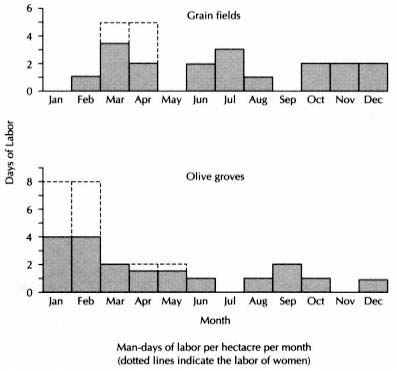
Figure 16.1.
Seasonal Demand for Labor in Grain Fields and Olive Groves
SOURCE . Martínez Alier, La estabilidad del latifundismo. Appendix 1,
no. 3, pp. 350–51 (based on Consejo Económico Sindical de Córdoba,
"Bases para un plan de desarrollo económico de la provincia," June 1962).
NOTE : The greatest demand for labor comes in February and March. In
February the end of the olive harvest overlaps with fertilizing the arable
(a task perhaps not performed in the eighteenth century). In March, pruning
and cultivating the olive trees overlaps with weeding the grain fields. Much
of the harvesting of olives and weeding of grain fields is done by women.
as in any other zone (Table 16.1), and the total land disentailed that was olive groves and cortijos was higher than in any other zone (76 percent, Table 16.3). One can see some reasons for its peculiarities. Within it lay the wide alluvial basin of the Guadalquivir River, the most fertile soil in the province. The English traveler Joseph Townsend commented on its location "in a rich and highly cultivated plain," and the Frenchman Alexandre de Laborde noted that "the land about is very fertile and produces a great deal of corn, oil, wine, honey, fruit and game."17 Equally important, no doubt, was its location on the highway from Ma-
drid to Seville and Cádiz. The continual traffic on this road, making it easy to import grain and migrant labor, combined with its fertility, could encourage its landowners to develop olive production beyond the level of the balance with arable that would be favored elsewhere. Evidence for the importance of the Andalusian highway is also provided by Baños (JJ) zone. Also on the highway, it was the other zone that had stabilized at a high ratio of olives to arable (107 percent).
6
If we return now to the categorization of the zones into three types of orientation toward the outside market at the end of the century, we find a clear and suggestive relationship between these categories and the evidence of increase in olive cultivation (Table 16.11). Type A1 zones, where all levels of buyers were into the market, show little expansion (only one zone of seven). These are the zones of relatively large, established hidalgo elites. At the other extreme, all three Type C zones, not into the market, also show no evidence of significant expansion of olive production. Expansion occurred in Type B1 zones (three of four), those with only the top levels of buyers into the market and thus with a narrower elite than A1 zones. Four other zones also gave evidence of expansion. Three were the deviant cases of types A and B, those that were into the market but with average purchases much lower than the majority of the zones of their types, and the fourth was zone JC, not included in any type because of its few sales. The B2 zone was acting like B1 zones, expanding its olives. The difference that calls for explanation is between A1 and A2 zones, since the former were not expanding their production. Table 16.8 shows that the A2 zones (the two contiguous zones east of the zone of Jaén city, JH, Mancha Real and JO, Bedmar) had a similar percentage of their buyers who were noble as the A1 zones. There was also much income from arrieros in this region, concentrated in JH zone (see Table 16.7 and Map 16.4), another characteristic of A1 zones. Although similar in these respects to A1 zones, the A2 zones had not seen their wave of expansion recede by 1750 and were still in full growth. Perhaps their distance from the major arteries of traffic explains their late blooming and the modest fortunes of their elites. If so, they provide another example of the influence of communications on economic growth.
The main conclusion to draw from Table 16.11, however, is that the zones where the top buyers were devoting the largest proportions of their capital to acquiring cortijos were those where the expansion of
|
||||||||||||||||||||||||||||||||||||
olive production was most pronounced. (Compare Table 16.4, Types A2 and B1 .) Commercial agriculture was old here, but it had been directed to grain production, hence the cortijos; now the rural entrepreneurs were discovering the advantages of olives, for they were nowhere near the limit of efficient use of labor in the olive groves.
An apparently extraneous factor may clarify the forces at work, the jurisdiction over the towns. Spanish municipalities could be under any of four types of jurisdiction: (1) directly under the crown (royal or realengo ); (2) under lay señores, that is held by a hereditary grant to a noble family (señorío lego ); (3) under ecclesiastical señores, such as episcopal sees and monasteries (señorío eclesíastico ); and (4) under the military orders founded in the Middle Ages (señorío de orden militar ). The last were effectively under the crown since the king of Castile became the permanent grand master of the orders in 1523. Table 16.12 shows the percentage of each type of zone under each jurisdiction. It is based on the population rather than the number of towns, so as to avoid giving undue weight to small places, of which many were under señorío lego. Towns in A1 zones, which experienced the wave of growth in olive production prior to 1750, were overwhelmingly under royal jurisdiction (89 percent of the population), either in royal municipalities or in the territory of the Order of Calatrava. In Type C zones, not into the market and not expanding, only 46 percent of the population lived under royal jurisdiction. Except for Type B2 (zone JQ), those zones experiencing the current wave of expansion (Types A2 , B1 ) were closer to Type C than to Type A1 , zones, with respect to the jurisdiction under which they lived.
|
|||||||||||||||||||||||||||||||||||||||||||||||||||||||||||||||||||||||||||||||||||||||||||||||||||||||||||||||||||||||||||||||||||||||||||||||
Why was this so? Did señorío retard economic growth, or did the kings of Castile, when they gave towns to new lords, consciously retain for themselves the ones that were most economically evolved? The rulers had granted seigneurial jurisdiction over the towns of Jaén at various times (Map 16.6). Since the province formed a part of the frontier of Granada until the conquest of this kingdom, strategic considerations were central to the early decisions on jurisdiction. In 1231, before the conquest of the kingdom of Jaén was complete, Fernando III assigned the strategic fortress of Quesada, on the southeastern frontier, to the archbishop of Toledo to capture and defend. Quesada soon fell, and in the next twenty years Cazorla and Iznatoraf and the villages in their region were added to what became known as the Adelantamiento de Cazorla, under the jurisdiction of that prelate, who ruled through a local official called the adelantado until the seventeenth century. The Muslims captured Quesada in 1303, and after it was recovered, Alfonso XI kept it under the crown, subject to the city of Ubeda. The rest of the adelantamiento remained with the archbishop through the eighteenth century. Cazorla was the main center south of the Guadalquivir, but to the north Iznatoraf was superseded by two villas created by the archbishop in the late fourteenth and fifteenth centuries out of villages within this town's limits: Villanueva del Arzobispo and Villacarrillo.18 Elsewhere in Jaén, the usual royal policy was to keep the main towns and those along the frontier under the king's jurisdiction. Of the latter, only Bedmar received a señor before 1400. Various places in the north of the province were given out before 1410, notably the jurisdiction of Santisteban del Puerto and some towns between Bailén and Baeza, but not these two important centers. As the war against Granada proceeded in the fifteenth century, the two frontier fortresses of Alcaudete and Huelma received señores, as well as Bailén. The remaining seigneurial jurisdictions were granted by the Habsburgs, except for the small town of Los Villares in the southern sierra apparently not given out until Felipe V.19
In the eighteenth century the king still had the towns along the main highways to Seville and Granada except Bailén on the Andalusian highway, Alcaudete on the old road to Granada, and Noalejo on the new
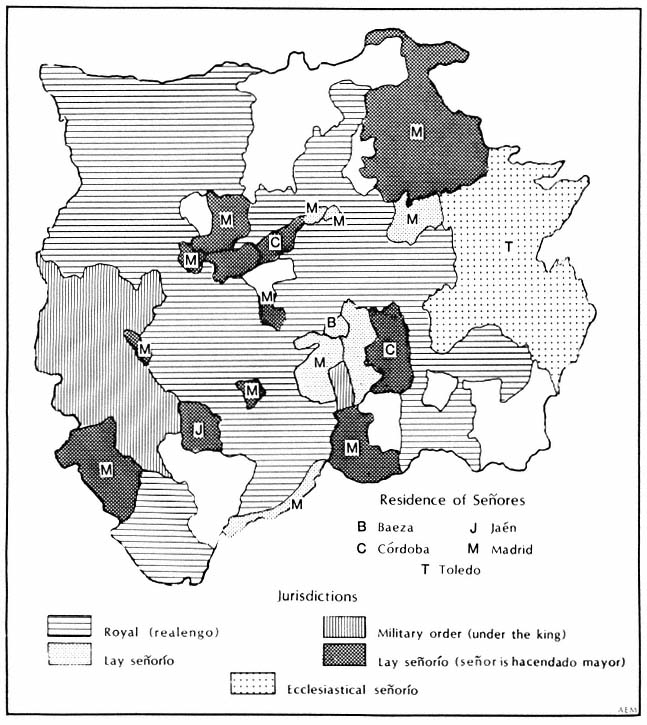
Map 16.6.
Jaén Province, Jurisdictions and Residences of Señores
one. Through the Order of Calatrava he also held the west. Although strategic considerations entered into the alienation of jurisdiction, conscious economic planning does not seem to have been involved. The economic evolution of the towns under lay señorío thus appears to have been more an effect than a cause of the type of jurisdiction.
Señores received tribute from their towns, but the case of Navas, one of the first given out, unless widely atypical, indicates that this tribute was not heavy. One has to look for indirect rather than direct effects of seigneurial domination to account for the relative backwardness of their towns. Evidence for such effects is not hard to find. One feature is the residence of the señores. Of twenty-five towns in all zones under señorío
lego, seventeen had señores who resided in Madrid at the end of the eighteenth century and three others lived elsewhere outside the province (Córdoba, Granada).20 Only three resided in the province, but none of them in the town of which he was señor. (The residence of the señores of two towns is unknown.) Lay señores were thus by the middle of the eighteenth century overwhelmingly absentees (if they had ever been residents), most of them living in Madrid. The lord of the towns of ecclesiastical señorío was the archbishop of Toledo, also nonresident.
Benign neglect by an absentee señor or señora might not have been prejudicial, were it not for the fact that in most cases he was also the owner of extensive properties in the towns under his jurisdiction, indeed he was frequently the largest property holder (hacendado mayor). This was so in seventeen of the twenty-five towns of señorío lego, in fifteen of the twenty towns whose lay señor lived outside the province (Map 16.6).21 In two other towns under señorío lego the largest property owner, who was not the señor, also lived outside the province. The hacendado mayor was much more likely to be an absentee in towns under señorío lego than under other forms of jurisdiction (Table 16.13). Eighty-two percent of the population under royal jurisdiction lived in towns where the largest property owner was either a vecino or the municipal council, and an additional 13 percent where he lived somewhere else in the province. For the population under lay señorío the situation was almost the reverse: only 18 percent lived in towns where a vecino was the hacendado mayor; 72 percent were in towns where he lived outside the province (for 57 percent, in Madrid). Towns of the military Order of Calatrava had a pattern close to that of realengo towns, except that more hacendados mayores lived elsewhere in the province (in Baeza, Jaén, Martos, and Huelma) than in the town itself. The six towns in the eastern part of the province under the archbishop of Toledo were very similar to royal towns. Lay señorío stands out as the only jurisdiction where the largest owners were heavily absentees. In conceiving the effect of this fact on economic development, it seems proper to assume that absenteeism among other large owners was more likely where the largest owner was an absentee.
A second potential disadvantage of lay señorío appears in the relation between the property in the hands of the hacendado mayor and the total property in the town (Table 16.14). In towns of this jurisdiction the
|
|||||||||||||||||||||||||||||||||||||||||||||||||||||||||||||||||||||||||||||||||||||||||||||||||||||||||||||||||||||||||||||||||||||||||||||||||||||||||
|
||||||||||||||||||||||||||||||||||||||||||||||||||||||||||||||||
largest owner had a far greater proportion of all the property (a mean of 35 percent) than elsewhere. The mean for realengo is 10 percent, and for the other two types even lower. Nor is this the result simply of the smaller size of towns under señorío lego;22 the hacendados mayores had on the average much larger properties than elsewhere. The mean income from their properties was over seventy thousand reales, in other jurisdictions forty thousand or less (see the table). Thus towns under señorío lego had a much higher concentration of property than other
towns, with the largest property frequently in the hands of the señor himself. Furthermore these large owners were far more likely to be absentees than those elsewhere. In the distribution of property and nonresidence of the largest owners, towns of lay señorío formed a class by themselves.
If these characteristics explain why towns under lay señorío had responded less than others to the lures of the market, they should correlate with the extent that the zones were into the agricultural market, but in fact they do not. If concentration of property in the hands of hacendados mayores were a cause of economic backwardness, one would expect a trend of less to greater concentration from Type A1 to Type C zones, but no such trend shows up. Nor should this be surprising. Large properties were more rather than less commercially oriented than others. Absenteeism of the hacendado mayor does not provide such a trend either.
The towns of señoro lego had a different characteristic that more likely accounts for their slower economic growth. They did not attract a strong hidalgo elite. The census of 1786 indicates that towns under lay señorío averaged 3.5 hidalgos per thousand adult males, while those under other forms of jurisdiction averaged between 17.6 and 25.0 (Table 16.15). In almost three-fourths of the towns under lay señorío there were no hidalgos present; the proportion of towns without hidal-
|
||||||||||||||||||||||||||||||||||||||||||||||||||||||||||||||
gos was between one-fifth and one-third for other jurisdictions. Small towns as a rule had a smaller proportion of hidalgos than big ones, but the difference between towns under lay señorío and others cannot be accounted for only by their smaller size.23 When all towns under lay señorío with populations over one thousand are compared with royal towns in the same population range, the former still have a strikingly smaller proportion of nobles, as the table shows. In the six towns under the archbishop of Toledo in the eastern part of the province, hidalgos were as dense as in towns under the crown. The incompatibility between señorío and hidalgo residents applied only to señores who were laymen.
One of the characteristics of Type A1 zones was a prosperous hidalgo elite, as shown by the census of 1786 and the characteristics of the purchasers (Tables 16.8 and 16.9). We see now that even though royal towns had such an elite, those under lay señorío did not, or did to a much lesser extent. For reasons that may have been largely social, hidalgos preferred to live in towns where they were directly under the king rather than under another noble.24 In royal towns they had the government effectively in their hands and the church as well, to judge from Baños and Lopera. Their relative absence surely was related to the undeveloped state of the economies of towns of señorío lego.
Although lay señorío appears to have been a major factor contributing to economic backwardness in Jaén province, ecclesiastical señorío was not, according to the evidence developed here. Only one of the six towns under the archbishop of Toledo had an absentee hacendado mayor, they did not have a high concentration of land ownership (the proportion owned by hacendados mayores was even lower than in royal towns), and three had a large contingent of hidalgos. In all these characteristics they resembled royal towns. Yet they were all located in zones that showed no commercial expansion in our period.25 The only appar-
ent reason for the backwardness of these regions was their geographic isolation in the northeast and east of the province, away from any major transportation artery. The 1787 map of Tomás López shows no direct road from either Cazorla or Villanueva del Arzobispo west to Jaén, Ubeda, or the main Andalusian highway, or east to Murcia. The only connection was a local north-south road. Even today it takes a considerable detour from any regularly traveled route to reach these towns.
7
One might anticipate a relationship between the different types of zones and their demographic structure. Certain connections have already appeared involving the size of towns. Town size was related to jurisdiction and to the proportion of hidalgos in the population, but it was not significantly related to the type of zone. Population changes between the four main census dates, 1712, 1751–53, 1786, and 1826, would give an indication of the different demographic development of the various zones, provided of course that the data are sufficiently reliable. Unfortunately, we have plenty of evidence that the data are not very good. The towns were big, census takers hardly went from door to door, and they had to accept the information available from the municipal officials and the clergy. The information in the catastro is probably the best, but this gives only the vecino count. The 1712 census of vecinos is everywhere notoriously low, for the respondents feared that it would be used to impose taxes or military conscription. Rather than attempt to establish real growth rates, I have compared the figures in the consecutive censuses, looking for different patterns of growth among the types of zones and hoping that errors in reporting would balance out (Table 16.16). While the different types of zones show markedly different growth rates, the variation among the zones within each type is so great that these differences are not statistically significant. One does find a meaningful pattern, however, for the middle time period, from the catastro to the census of 1786, if one takes not the types of zones but the individual zones. Comparing the population change of those zones that showed an expansion of olive cultivation against those that did not, one finds a more rapid population growth among the former, statistically significant at the 1-percent level.26
|
|||||||||||||||||||||||||||||||||||||||||||||||||||||||||||||||||||||||||||||||||||||||||||
This information provides convincing evidence that the zones that we have determined were expanding their commercial agriculture were also undergoing a more rapid population growth than either those zones already heavily commercialized by 1750 or those not yet significantly commercialized in 1800. Before 1751–53 and after 1786, the population was also increasing, but no distinct patterns emerge among the types of zones or between those zones expanding commercially and those not doing so between 1750 and 1800. If population growth was related to the expansion of commercial agriculture, as the data strongly indicate, then the distinct wave of growth that we have identified in certain parts of the province did not begin much before 1750 or extend much after 1800. Commercial growth would certainly have been present in the province, especially after 1800, but following a different pattern. Indeed, I propose that the disentail changed the pattern by giving an opportunity for commercially oriented elites of all zones to expand their activities.
The demographic mechanisms whereby the expanding zones grew faster than the others between 1751–53 and 1786 cannot be satisfac-
torily determined by the available data. The information provided in Table 16.16 reveals no statistically significant difference in family size in 1751–53 among Types A1 , B1 , and C, nor does any turn up between the zones growing commercially and those that were not. Likewise, the census of 1786 shows no significant correlations for the proportion of the population under sixteen (that is, for a younger and presumably more rapidly expanding population) or for the proportion of males in the labor force (over sixteen). One may assume that part of the differential growth was due to migration and part to natural increase, but the available data do not enable us to sort out the factors.
8
The analysis of the nature and evolution of the different zones of Jaén province has been complex, but when all the features are assembled a clear pattern emerges. The transition from agricultural production for local consumption to that for a wide market proceeded in various stages. Sometime before 1750 the richer sectors of the Guadalquivir basin and some adjacent loma and foothill regions had developed a strong commercial agriculture based on the balanced cultivation of wheat and olive groves. Other regions to the east of these, the zones of Ubeda, Cazorla, and Huelma, had numerous cortijos devoted to commercial grain production but few olives. Some of the province was only weakly oriented toward the market at this time: a belt of the Guadalquivir basin marked by saline soils unpropitious for grain, running from Menjíbar to Martos and including at this time the zone around Jaén city, and certain outlying regions: the southern valleys of Alcaudete and Alcalá la Real, the sierra valleys south of Jaén, and the loma around Villanueva del Arzobispo in the northeast.
How long this pattern had been in existence this study cannot say. The flimsy demographic data covering the first half of the century do not reveal any pattern of evolution in this period. The province had been known for its olives since at least the sixteenth century, but we do not know the area and extent of olive production at that time or the changes that had occurred since.
The towns of advanced commercial agriculture in 1750, those with a balance of grain and olives, had as a rule strong sociopolitical elites, of which hidalgos were the outstanding sector, including clergy of hidalgo background. Hidalgo families, in fact, stood out as the commercial agricultural class par excellence in Jaén. These towns had other distinctive
characteristics. Many had a prosperous sector of muleteers, and their largest landowners, the hacendados mayores, were more likely to be local residents than in other regions. They were also more likely to be under royal jurisdiction. Towns under lay seigneurial jurisdiction, in contrast, on the whole lacked both a strong hidalgo elite and advanced commercial agriculture at the beginning of our period.
A wave of expansion of olive cultivation swept over portions of the province in the second half of the century—the only stage of economic growth that this study can identify and describe. In these regions a demographic spurt responded to the improving economic conditions. The regions of the north and west that had already achieved a balance of arable and olive groves did not experience this wave, but the region east and south of the city of Jaén, although already actively involved in the cultivation of olives in 1750, did expand this crop. In addition most of the zones that had specialized in grain production for the market in 1750—the regions of cortijos and few olive groves—participated in this wave. Together they formed a semicircle around the east and south of the older olive area. These were less wealthy zones, with a weaker hidalgo elite and extensive lay señorío. The general expansion of economic activity in Spain in the second half of the century drew these sectors into olive production, overcoming their less propitious social structure and relative geographic isolation.
By 1800 only three zones in the east and northeast—Cazorla (JI), Villanueva del Arzobispo (JM), and Santisteban (JN)—and Martos zone (JF) in the west lacked evidence of active commercial production. (All regions, of course, shipped some products out for sale, the question is one of degree.) The first three contained the six towns of ecclesiastical señorío, but this does not appear to be the cause of their backwardness, which our information can assign only to their geographic isolation. Martos, in contrast, was on the old road to Granada and belonged to the Order of Calatrava. The explanation for its failure to take off before 1800 would appear to be its soil. A saline marl, it is not conducive to good arable, with the result that the zone had not developed the export of grain. Although its soil is ideal for olives—as one can see today from its virtually seamless blanket of silver-green trees—it had only a weak hidalgo elite in the eighteenth century (Table 16.9) and little commercial orientation. Its case indicates that entry into commercial agriculture in the old regime came first via the sale of grain and not directly with olives. Oil production required a significant capital investment: ten to fifteen years' wait after planting for the production of the first harvests,
and the building of olive mills. The commercial growth of grain could provide the needed savings. A later wave of olive expansion would turn Martos into one of the richest olive zones in Spain, as it would Cazorla in the east, but not until after the old regime.
Wide commercialization of agriculture thus begins in most parts of Jaén well before the end of the old regime. Four factors interacted to determine the rhythm of the different regions: the quality of the land, the accessibility of major highways, the nature of jurisdiction, and the presence of a prosperous, largely hidalgo elite, which ideally included the hacendado mayor. Originally, the development of this elite depended greatly on the other three factors, most notably the type of jurisdiction.
The example of Jaén province indicates that lay señorío—feudalism, if one wishes—retarded the transformation of agriculture into commercial production by removing the largest owners from the towns and discouraging the presence of hidalgos and no doubt by other subtler means not detected through our data. The economic takeoff of the late eighteenth century, however, affected towns of señorío lego as well as others, moving them into olive oil, where they were not inhibited by factors such as poor soil or poor communications.
Although señorío was an obstacle, hidalguía was not. Hidalgo families formed the core of the sector that developed the local agricultural potential. Hidalgos too might be considered feudal, especially because a good part of their property was tied up in vínculos and mayorazgos, but they were far from being anticapitalist as a group. The reformers of Carlos III's reign, one recalls, roundly condemned entail as harmful to the economy and hidalgos as an idle, parasitic class. Jovellanos claimed that no one in Andalusia was investing in the improvement of agriculture because entail made owners neglectful absentees. Cortijos too they found evil; they wanted these estates divided into prosperous homesteads. In their eyes, the laws of property in Andalusia had created a class of poderosos who were taking over whole towns and impoverishing the laboring poor.
The present study indicates that the reformers misread the situation. Vinculos in some instances were surely neglected, as were other types of property, but as a group the notables were interested in agricultural development. Cortijos offered them the wherewithal to pursue further commercialization through olive groves. They included many poderosos, for we have seen them in control of municipal governments and they exploited the large and powerless class of jornaleros. But what eco-
nomic initiative existed was largely in their hands. More like members of the English gentry than the royal reformers appreciated, very different from the popular perception of the lazy impoverished hidalgo stereotyped by the authors of the Golden Age and accepted uncritically by later historians, they seized a good possibility when it arose.
Such a possibility came with the desamortización of Carlos IV. These hidalgos and other notables associated with them were eager to break entail—the entail of the church—if they could get more land for themselves, and this meant members of the hidalgo families who had entered the clergy as well as the heads of families. Notables were of course not the only buyers, but they dominated the top levels and were proportionately much more numerous among all buyers than in the population as a whole. Disentail strengthened their class and pushed it toward greater commercial orientation.
Everywhere commoners also bought lands, in most zones in larger numbers than the notables. Properties that were not market oriented were more likely to go to them, and those that needed intensive labor input. Commoners with available capital also bought commercial properties, especially olive groves, and thus established a common interest with the notables. This was especially the case in those zones of grain culture, where the hidalgo elite was exiguous. Desamortización did not mean the displacement of an older landed class by a new class of capitalists but rather the invigoration of the older class by adding new recruits and by giving its more driving individuals a chance to excel. In the process, it accelerated the commercialization of agriculture.
Chapter XVII—
Salamanca Province:
Hardening the Patterns
The patterns discovered in Jaén most likely existed elsewhere in the Guadalquivir valley, but they were not representative of Castile as a whole. This truth is proclaimed when one turns to Salamanca province, for almost none of the characteristics of Jaén are found here. Most of the people who lived in the countryside of the portion of the province covered by this study inhabited small towns and villages that were set relatively close together and enjoyed more egalitarian societies than the large agrarian towns of Jaén.
Geographically and socioeconomically there is much greater contrast among the regions of Salamanca than of Jaén. The portion of the Old Castilian plain that surrounds the city of Salamanca is another world from the hill towns and upland valleys of the southern sierras. The sharp contrasts facilitate comparison, with the result that I have divided the province into only nine zones, while Jaén has seventeen (Map 17.1).
Four zones make up the plain. Its communities are larger and more prosperous to the north and east, where the earth is rich and deep, than to the south and west, a land of thin, sandy soil, better suited to pastures than to fields of grain. In our time, interspersed among the villages like La Mata and Villaverde were many despoblados like Narros and Pedrollén. Armuña zone (SA) north of Salamanca city and Alba de Tormes zone (SB) in the northeastern corner of the province can be classed as rich plains zones. The other two zones, south and west of the city, will be identified as poor plains zones. Charro zone (SC), which includes Pedrollén, lies on either side of the road to Ciudad Rodrigo and Por-
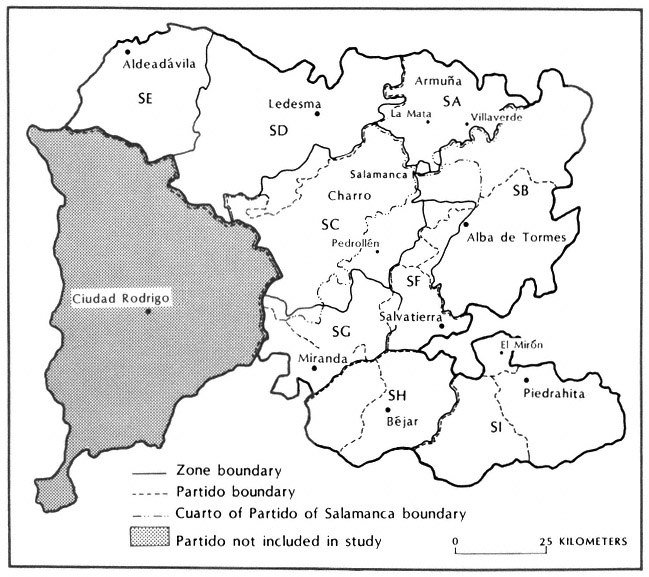
Map 17.1.
Zones of Salamanca Province
tugal, and Ledesma zone (SD) to the north of it borders on the province of Zamora.
There are three sierra zones. On the east (and now in Ávila province) is Piedrahita zone (SI), occupying the valleys north of the Sierra de Gredos. El Mirón is on its northern edge. Just west of it, Béjar zone (SH) is dominated by the sierra of that name and lies astride the main pass between Old Castile and Extremadura. The large town of Béjar was already an important woolen center in the eighteenth century. Finally the zone of Miranda (SG) lies beneath the Sierra de la Peña de Francia. The towns through here are large by comparison with those of the plain. Steep, narrow, cobbled streets lined with two- and three-story granite houses, many still boasting coats of arms from past ages, provide human features that combine with the majesty of the sierras to make this one of the most picturesque corners of Spain.
The two remaining divisions do not fit either of these types. Aldeadávila zone (SE) is the northwestern corner of the province, bordering on
Portugal, where the Salamanca plain gives way to rolling hills and glaciated outcroppings that furnish the material for abundant stone walls. Reminiscent of the sierras, its towns spread out around granite churches with imposing square towers. Salvatierra zone (SF) lies in the center of the province, a relatively poor upland region that juts out into the plain from the ranges to the south. Its thin soil barely covers a shale base, and the small villages, abundant in slate, resemble those of the Charro plain to the west. Although these two zones are very different from each other, they have the common label of hilly zones. Appendix Q gives a detailed description of the geography, population, and political status of the zones.
How unlike Jaén Salamanca province is, one can judge from a simple comparison. In Jaén the mean amount spent by the buyers in each zone was directly proportional to the mean size of the towns in the zone: the bigger the towns, the more each buyer spent. In Salamanca precisely the opposite correlation appears. If one compares Table 17.1 with Table 17.2, which gives the mean town size, one sees that the larger the size of the towns, the smaller amount each buyer was likely to spend (r = –.58). The correspondence again is loose, only about one-third of the variation in the amount spent can be attributed to the size of the towns,
|
||||||||||||||||||||||||||||||||||||||||||||||||||||||||||||||||||||||||||||||||||||||||||
|
||||||||||||||||||||||||||||||||||||||||||||||||||||||||||||||||
and the correlation is significant only at the 10-percent level. As the present chapter proceeds, however, it will become apparent that the relationship is not fortuitous. The challenge is to produce a different concept of both structure and change to apply to this province.
The analysis of Jaén province was based on a distinction among the zones according to the extent of the orientation toward the outside market of the lands purchased by the different levels of buyers. At first sight the information provided by the sales in Salamanca province does not allow one to draw a similar distinction here.1 Table 17.3 gives the basic information on the purchases made by Level 1 and Level 4 buyers. We can assume that the purchasers of rural estates were investing in com-
|
|||||||||||||||||||||||||||||||||||||||||||||||||||||||||||||||||||||||||||||||||||||||||||||||||||||||||||||||||||||||||||||||||||||||||||||||||||||||||||||||||||||||||||||||||||||||||||||||||||||||||||||||||||||||||||||||||||||||||||||||||||||||||||||||||||||||||||||||||||||||||||||||||||||||||||||||||||||||||||||||||||||||||||||||||||||||||||||||||||||||||||||||||||||||||||||||||||||||||||||||||||||||||||||||||||||||||||||||||||||||||||||||||||||||||||||||||||||||||||||||||||||||||||||||||||||||||||||||||
mercial property, but only in the plains zones did estates form a sizable part of the disentail. These were alquerías and despoblados similar to Pedrollén or to Narros before it was colonized from La Mata in the 1780s, large properties dedicated to both arable and grazing usually leased for payment in money and kind to the farmers who exploited them.2 Level 4 purchasers here, who bought most of the estates, were into the outside market. So, of course, were the buyers of large collections of arable plots that would be rented to small farmers for specified payments in wheat and other products. The large outside buyers of the arable plots whom we observed in La Mata and Villaverde were among these people. The plots they purchased, however, were identical to those bought by local farmers found in Level 1, who would be more oriented to domestic consumption than the market so that purchases of arable land in Salamanca are not useful as an indication of the extent of the buyers' involvement in the market.
In contrast, big buyers in the mountain zone of Béjar (SH) devoted the largest share of their purchases to pastures. Here Level 4 buyers were very different from their counterparts in the plains: they spent on the average thirty-three thousand reales; those of the plains four to ten times as much. Béjar zone had many sheep, twenty-two per vecino engaged in agriculture, but five others had more sheep per vecino (Table 17.4). The zone had few cows, yet the disentail indicates that more of its land was devoted to pastures than anywhere else. To what purpose? One may guess that they were leased to the owners of transhumant sheep. The main north-south sheepwalk (cañada) of the Mesta crossed the central sierras by the pass of Béjar, and the largest and best share of the wool shorn in Salamanca province still came from transhumant sheep.3 One may logically conclude that many of the pastures acquired by the top buyers of Béjar zone were rental properties to be leased to sheep owners, most of whom resided in other parts of Castile. These were capitalist investments. The buyers were indirectly involved in the market for wool, and they probably had some sheep of their own.
The sales reveal little about the commercial orientation or lack of it of the smallest buyers. Everywhere except in Béjar zone they spent the largest share of their money on arable, whose orientation is indeterminate. This was true, of course, in Jaén too; but unlike Jaén, the second choice of the Level 1 buyers also offers few clues to the extent of their commercial orientation, except in the sierra zones.
|
||||||||||||||||||||||||||||||||||||||||||||||||||||||||||||||||||||||
In Béjar zone (SH), while the largest buyers were looking for pastures to rent, the smallest buyers had their eyes turned to the outside agricultural market. Although they spent more in paying off censos than on any other item, they devoted almost a third of their capital to their second choice, improved and irrigated plots. All of the plots that Level 1 buyers acquired were linares, enclosed plots planted with flax and usually irrigated. Flax, like grain, could be grown either for domestic use or for sale to centers of linen weaving. According to the contemporary author of a survey of economic activity in Spain, Eugenio Larruga, the cultivation of flax was widespread in Salamanca province, but only certain areas harvested it commercially. He lists 131 towns in our zones where it was cultivated (Table 17.5), but only 16 grew more than a small amount for local use. According to Larruga's list, which of course may not be complete, a larger proportion of the towns in Béjar zone grew flax than in any other zone, and they sold much of it to Extremadura or traded it to outsiders for soap and olive oil.4
|
||||||||||||||||||||||||||||||||||||||||||||||||||||||||||||||||||||||||||||||||||||||||||||||||||||
The raising and preparation of flax for linen was highly labor intensive. Farmers selected the most fertile fields in their towns, plowed them five or six times, fertilized them heavily and scattered seed liberally, using three times as much seed as they would for grain. Once the flax was up they weeded by hand, and they devoted great care to the harvest. The process of turning the harvested flax stalks into linen was further time-consuming. The linseed for next year's planting must be beaten out, the stalks soaked for a week or ten days in a stream, dried, and gently pounded to remove the skin. The women then took over, beating the flax with a wooden swingle, combing and cleaning it, making it ready for spinning.5
The purchase of linen fields agrees precisely with the pattern described in Chapter 15. Highly labor intensive, the cultivation of flax interested the smaller buyers, those prepared to exploit the land person-
ally. Thirty-nine percent of the "improved" fields disentailed in Béjar zone were flax fields (linares). Level 4 buyers devoted only 5 percent of the money spent for improved fields to flax fields, Level 1 buyers 100 percent.6 A significant proportion of the small buyers in Béjar zone were commercially oriented, one is led to conclude, but at the cost of great personal input.
The lowest level of buyers in the other two sierra zones also revealed distinctive preferences related to the nature of local agriculture, but it is less clear that they were oriented toward an outside market. In Miranda del Castañar zone (SG), only 29 percent of Level 1 purchases were arable, while 23 percent were orchards. All of these were chestnut groves, a regional specialty,7 but most chestnuts were probably consumed locally, since grain was scarce. Level 1 buyers did make 13 percent of their purchases in vineyards and 8 percent in olive groves, no doubt with an outside market in mind, but as a group these buyers cannot be classified as commercially oriented.
Much the same can be said of the smallest buyers in Piedrahita zone (SI). Although half their purchases were arable fields, 22 percent were pastures. At midcentury this zone had the largest number of sheep and cattle per vecino in agriculture of all the zones in the province. Our study of El Mirón showed that pastures were the most sought-after purchase in the region, but they were much more likely to be used for cattle than for sheep, which could graze on the hills and stubble. Some cows and steers were produced for the market, but again, the smallest buyers in this zone did not belong structurally to commercial agriculture.
These inferences exhaust the information presented by the type of property purchased by different levels. The examples of La Mata and Villaverde in Armuña indicate that the nucleated towns of the rich plains zones (but not their despoblados) had a virtual grain monoculture, a conclusion reinforced by the high percentage of arable land in the disentail in these zones (Table 17.3).8 Here every farmer, and thus every level of buyers, had to be involved to a greater or lesser extent in the sale of grain.
One is left with a sense that the picture is incomplete and selective. Reviewing the conclusions developed in Chapter 15, one discovers another approach. A much greater proportion of the purchases were paid
for in paper currency—vales reales—in Salamanca than in Jaén (70 percent compared to 45). Large buyers everywhere used vales reales more than small buyers and were more oriented toward the national market. Furthermore, a separate analysis of Salamanca province shows that properties oriented toward commercial agriculture were paid for in vales much more than those for home production. This at least is the logical conclusion from a comparison of the sales of rural estates and improved or irrigated fields. Eighty-six percent of the payments for rural estates—most of which would be oriented toward market production—were made in vales reales. The latter account for only 35 percent of payments for improved or irrigated fields—labor-intensive huertas, enclosed fields for herren (fodder harvested green), flax fields, and the like, not all directed to domestic consumption, of course, but of all the categories the one most fully of this kind.
Basically the argument being developed is that, although arable formed the largest proportion of the sales in most zones, and one cannot distinguish between arable bought for commercial purposes and arable bought for subsistence agriculture from the deeds' descriptions of the properties, one can predict reasonably well the orientation of the purchases by the currency used in payment. Table 17.6 provides this information for Level 1 and Level 4 buyers. In all the plains zones and both hilly zones Level 4 buyers paid for more than 70 percent of their pur-
|
||||||||||||||||||||||||||||||||||||||||||||||||||||||||||||||||
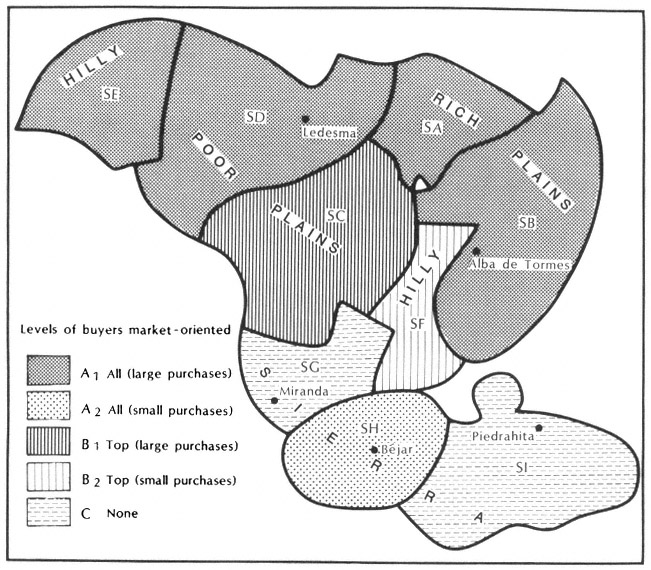
Map 17.2.
Salamanca Province, Types of Zones
chases with vales. This includes the four zones where Level 4 buyers put a quarter or more of their money into rural estates. In the three sierra zones Level 4 buyers paid for about half their purchases in vales, and were probably much less market oriented than their counterparts elsewhere. While Level 1 buyers used vales much less, those of SA, SB (rich plains), SD (poor plains), and SE (hilly) paid for 18 percent or more of their purchases in vales and were probably involved in the market to a significant extent.
On the basis of this analysis, which is less conclusive than one might wish, one can now assign the Salamanca zones to the categories developed for Jaén (see Table 17.1 and Map 17.2).
Type A. All levels of buyers involved in the outside market
A1 . Large purchases
Rich plains zones: SA (Armuña), SB (Alba de Tormes)
Poor plains zone: SD (Ledesma)
Hilly zone: SE (Aldeadávila)
A2 . Small purchases
Sierra zone: SH (Béjar)
Type B. Top levels of buyers involved in the outside market
B1 . Large purchases
Poor plains zone: SC (Charro)
B2 . Small purchases
Hilly zone: SF (Salvatierra)
Type C. No levels of buyers involved in the outside market
Sierra zones: SG (Miranda), SI (Piedrahita)
2
With no more than four zones in any one type, statistical correlations become almost impossible to establish, yet one can seek apparent relationships between the types and the social and economic characteristics of the zones. Certain obvious features show no correlation. This is true of mean town size (Table 17.2). Type A1 zones span the whole range from the next to the lowest (Ledesma) to the next to the highest (Aldeadávila). Industrial activity is also not related to the extent into the agricultural market (Table 17.7). There is less cloth making (fewer carders and weavers) in the commercially oriented Types A1 , B1 , and B2 zones than in Types A2 and C.
The table is drawn up so that geographic comparisons can also be observed, and it shows that the pattern of crafts can be explained much better by geographic affinities than by the extent of commercial agriculture. Cloth making was concentrated in the sierra zones, with SH (Béjar) far ahead of any other, obviously because the city of Béjar was a major woolen center of Castile. This region, one recalls, grew much flax, while SI (Piedrahita) had more sheep per peasant family than any other zone. Much of the wool and linen was woven locally, a task performed by professional carders and weavers, such as those we met in El Mirón.9
Table 17.7 shows that the total proportion of craftsmen in the popu-
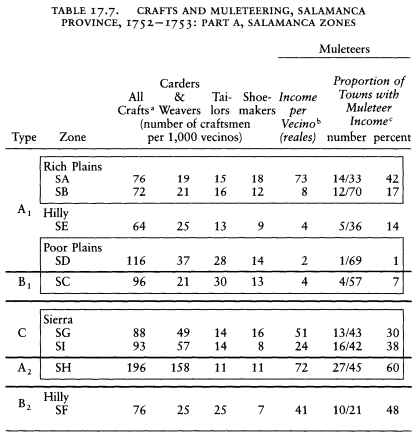
lation reflects closely the number of carders and weavers. SD (Ledesma) is a deviant case, however; with few involved in cloth making it still has one of the highest proportions of craftsmen. This deviance is misleading, for it reflects a problem inherent in the study of the zones of Salamanca. The plains zones were dominated by three cities: Salamanca (population 16,438 in 1786), Ledesma (1,844), and Alba de Tormes (2,293). Salamanca city lies at the junction of three zones, and I excluded it from them. Alba de Tormes is in zone SB and Ledesma in SD. All these cities had a concentration of crafts serving their residents and the richer members of their hinterlands. If Ledesma is excluded from zone SD, the proportion of craftsmen becomes similar to that of the other plains zones. Alba de Tormes had less impact.
In sum, craftsmen tended to concentrate in the cities, but only Béjar had a specialized industry. Elsewhere, the sierra zones had more crafts-
|
|||||||||||||||||||||||||||||||||||||||||||||||||||||||||||||||||||||||||||||||||||||||||
men than the plains zones, in part no doubt because the town size was larger in the sierras. But in part one can also observe that the proportion of craftsmen was negatively correlated to the commercialization of agriculture. We can recall that the craftsmen in La Mata and Villaverde, both in the rich plain of Armuña, were hard pressed and declining, faced by the competition of outside products brought in along the lines of communication that served to export their harvests. Artisans in the larger and more isolated sierra towns fared better, and their zones had more craftsmen than the plains, with the hilly zones in between. One may conclude that the concentration of crafts responded to two factors: positively to the production of local wool and flax and negatively to the commercialization of agriculture.
Because the greater concentration of cloth making in the sierra zones does appear in a region of noncommercial agriculture, it exhibits one of
the characteristic features of the putting-out system.10 The appearance is misleading, however. Domestic weaving does not give evidence of being a new development in the sierras in the eighteenth century or of being organized as proto-industry. Nor did it offer an opportunity for economic growth. Béjar continues until now to be a center for woolen manufacture, but in the transition to modern factories, it destroyed the artisan production of the towns around it.11 The case of the sierras thus does not invalidate my earlier conclusion that the lack of the necessary commercial infrastructure precluded the emergence of a proto-industry in central Spain similar to that in northwest Europe or the Spanish periphery. One cannot extrapolate directly from Salamanca to all Castile, of course, but historians who have been looking at early modern Spanish industry tend to support this conclusion.12
In Jaén muleteering was associated with market-oriented agriculture. Table 17.7 reveals no similar association in Salamanca. It is true that the two zones with the most transport activity, Armuña (SA) and Béjar (SH) have all levels of buyers involved in market-oriented agriculture (Types A1 and A2 ), but the concentration of arrieros in other Type A zones was among the lowest in the province. Again, geographic location, not commercialized agriculture, was the dominant factor. It worked in two ways. First, the sierra zones engaged in muleteering as they did in crafts, as compensation for poor agricultural potential. Second, towns that sent out arrieros were located on or near the main north-south highway from Andalusia and Extremadura through Béjar and Salamanca to León, Burgos, and the north (Map 17.3). It passed through Zones SH (Béjar), SF (Salvatierra), and SA (Armuña). A number of towns with arrieros were clustered in the vicinity of Salamanca. The city drew heavily on the food production of the surrounding plain, but our study of La Mata and Villaverde showed that their muleteering activity did not depend on transporting grain to the city, done rather by the farmers themselves. Muleteers served the city in other ways, in long-range operations to the north coast, Extremadura, and Madrid, that is, along the old Roman road. Although the arrieros in the region may have got their start from furnishing Salamanca city, their clientele was now located throughout the northern half of Castile.
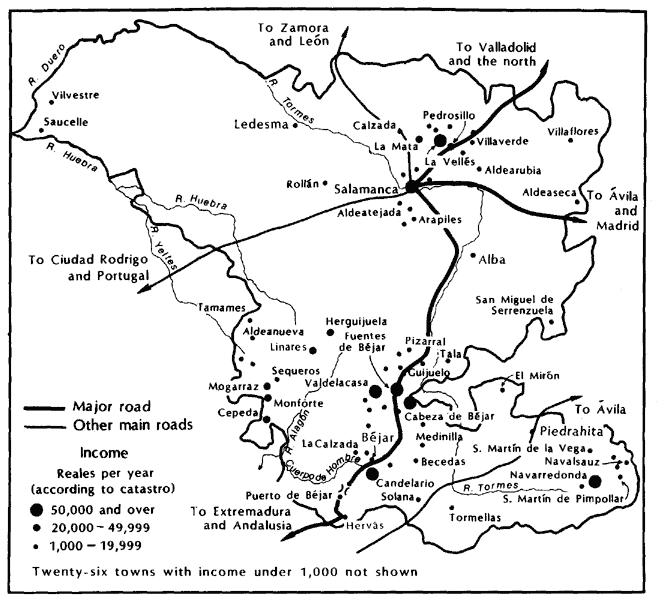
Map 17.3.
Salamanca Province, Income from Muleteering, ca. 1750
In Jaén too, muleteering was a function of highways, those between Castile and Seville or Granada. Zones JD in the poor basin and JQ in the southern sierras owed their income from transportation to their location on the Madrid-Jaén-Granada road, for they, like Salvatierra and Béjar zones in Salamanca, were in poor agricultural districts. In Jaén we found that the presence of a major road also fostered commercial agriculture, especially specialization in olives. The main road of Salamanca had no such effect. Comparative advantages of location and type of soil determined the production of grain and livestock for the market, factors stronger than a secondary road system.
Despite such marked differences, at least one attribute of commercial agriculture was common to both provinces. The Madrid records of the sales show only about two-thirds as many men and women entitled to call themselves don and doña among the buyers in Salamanca as in Jaén, but here too they were associated with commercialized agriculture. In all zones, as we have come to expect, a far higher percentage of
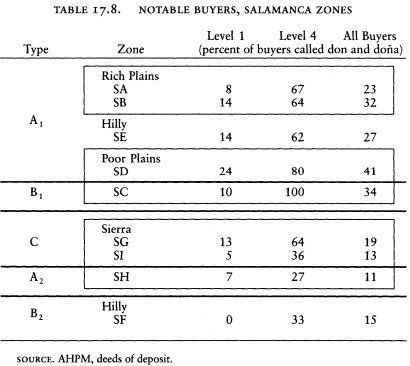
big buyers were notables than small buyers (Table 17.8). Furthermore a greater proportion of buyers was notable in Type A1 and B1 zones than in the others, that is, zones where the top levels or all levels of buyers were into the market and spent a large amount per capita. A2 and B2 zones, where the amounts spent were small, had considerably fewer buyers called don or doña, similar in this respect to Type C zones, which were not into the market.
The census of 1786 supports this association. The zones where all levels of buyers were into the market (Types A1 and A2 ) had more hidalgos per thousand adult males than other zones (Table 17.9), with one apparent exception: SA (Armuña) had slightly fewer than SG (Miranda). The reason is easy to perceive. Salamanca city was the cabeza de partido for SA, as it was for zones SC and part of SB. The hidalgos associated with partido administration or who lived off the income of its lands were to be found in the city. In the sierra zones, including SG, the hidalgos lived in the zones; and they did also in SD (Ledesma), the zone with the highest proportion of hidalgos. The town and village structure was much
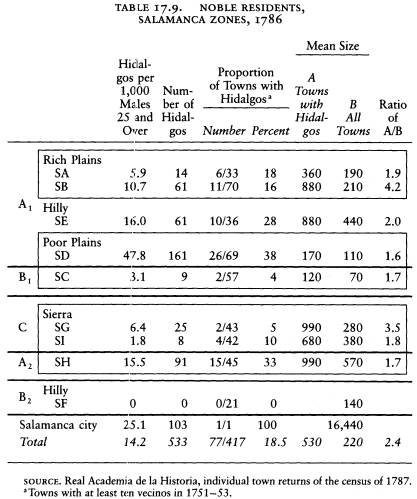
different from that of Jaén, but the association of hidalgos with commercial agriculture appeared here too.
Yet there was a difference even in this respect. The hidalgos of Jaén lived by and large in the towns where they owned and exploited their properties, forming the dominant portion of the local political and economic elites. In Salamanca province, with its myriad small towns and hamlets, this was not the case. Hidalgos clustered in the larger places: the mean population of towns with hidalgos was between 1.6 and 4.2 times as great as the mean population of all towns in the zones. Even if
one considers only towns that reported at least ten vecinos in the catastro, no zone had hidalgos in more than 40 percent of the towns. The zones identified as having all levels of buyers into the market (Types A1 and A2 ) had their hidalgos more widely scattered, that is, present in a larger percentage of their towns, than other zones. Nevertheless, one cannot escape the fact that most towns in all parts of the province, especially the smaller places, had no resident hidalgos. If nobles had a morethan-proportionate role in commercial agriculture and in making purchases during disentail, it had to be as absentees.
In Jaén we found that the presence of hidalgo residents was negatively correlated with lay señorío. In Salamanca lay señorío differed in important ways from that in Jaén, and its impact on the economy is far
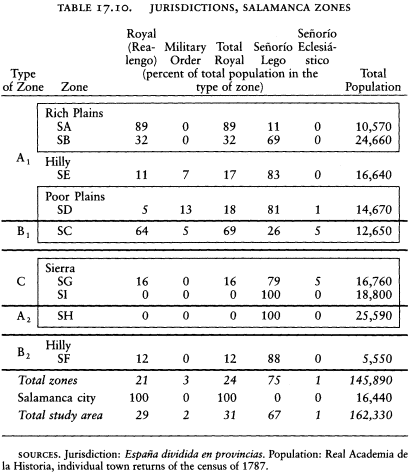
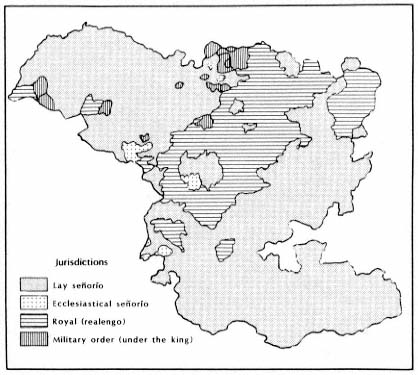
Map 17.4.
Salamanca Province, Seigneurial Jurisdictions
NOTE : Based on Mateos, Salamanca, Map 9.
less obvious. Much more of the province was under this type of jurisdiction, as one can observe from Table 17.10 and Map 17.4. Three-quarters of the population in the study area lived under lay señorío (two-thirds if one includes Salamanca city, which was royal).13 The only administrative division primarily under royal jurisdiction was the large partido of Salamanca city, while nine smaller partidos were entirely under lay seigneurial control.14 The situation was not so clear cut as this, however, because throughout the province there were "exempt towns" (villas eximidas), outside the jurisdiction of the partido within which they lay geographically.15 The only zones with a majority of the population
under royal jurisdiction were those lying mainly in the partido of Salamanca: SA and SC.
The striking difference between señorío in Jaén and Salamanca was that the former was accompanied in two-thirds of the towns by the ownership of the largest properties in the town. This was not the case in Salamanca; of 419 places with separate catastro returns that were under señorío lego, the señor held the greatest share of real property in only 29 places (7 percent).16 All señores hacendados mayores were absentee owners; most of them resided in Madrid.17
The three largest señoríos in the province reveal the nature of señorío here. The señores had the rights of jurisdiction, with the corresponding income from fines and appointments to municipal offices, and the crown at some time in the past had given them the alcabalas, or sales tax, and the tercias reales, the royal two-ninths of the tithes. These sources could produce considerable income, but they were called alienated rights (derechos enajenados ) because the loss was to the crown, not the subjects, since the latter would have had to make the payments in any case.18 In fact the crown got very little from these territories, as we saw in the case of El Mirón.
The Duquesa de Alba, who lived in Madrid, was señora of five partidos covering the eastern sector of the province, all zone SI and most of SB and SF, 129 places of the catastro. In only 12 was she the largest owner of real property, including five cotos redondos, in which she was virtually the sole owner. In 11 other places she was hacendada mayor by virtue of the payments she received, and the catastro record of hacendados mayores permits us to appreciate how much of the local economy was absorbed by these payments. In 8 towns it ranged from 7 to 22 percent of the annual income from the land; in 3 cabezas de partido from 29 to 46 percent. These figures are misleading, however, because agriculture provided only part of the income of the towns. Cabezas de partido had many craftsmen and paid more alcabalas as a consequence, while towns in the sierra drew much income from livestock, yet neither of these types of income can be readily calculated from the catastro. The share of the gross town product going to the Duquesa de Alba was therefore less than these percentages, perhaps between 5 and 15 percent.
The economic impact of the señorío of the Duque de Béjar was about the same. Lord of the partido of Béjar (the major portion of zone SH), he was hacendado mayor in 25 of the 32 towns of the partido, but in 20 of them because of his seigneurial rights. His income ranged from 3 to 76 percent of the income from agriculture in the town. These figures are even less indicative of the duke's true share, because income from livestock and from cloth making was high here. In 3 towns where the duke's income was over 60 percent of the harvests, it came mostly on alcabalas levied on local manufactures.19
The position of the Duque de Alburquerque was very different. Señor of the partido of Ledesma in the northwest (most of zone SD and part of SE), he had jurisdiction over 186 places but was hacendado mayor only in Ledesma, cabeza de partido, because of payments received as señor. Since Ledesma was a town of craftsmen, the weight of his señorío was comparable here to that of Alba and Béjar in their partido capitals. Outside Ledesma his presence was nowhere as onerous as that of the hacendados mayores.
Since seigneurial jurisdiction in Salamanca seldom entailed extensive ownership of real property and it absorbed most of the income that would have gone to the crown otherwise, it could have had little adverse economic effect. It may even have been helpful. Lay señorío in Jaén discouraged the presence of hidalgos. Not so in Salamanca, to judge from Table 17.11. Hidalgos were concentrated in the provincial capital and the cabezas de partido, but outside these places, regions of seigneurial jurisdiction had almost twice as many hidalgos proportionately as regions under the crown. Towns under lay señores were more than twice as likely to have a noble in their midst as royal towns. Since the presence of hidalgos is a good indication of commercialized agriculture, señorío in Salamanca does not appear to have discouraged it. Among the Type A1 zones, those most commercialized, Zone SD had the highest proportion of nobles and of noble buyers; it also was the zone with the greatest percentage of purchases made with vales reales, our best evidence of market-oriented farming (Tables 17.6, 17.8, and 17.9). It was dominated by the señorío of Alburquerque.
Why were the effects of lay señorío so different in the two provinces? One might expect that, being an older region of Christian Spain, Salamanca received an earlier form of señorío, less burdensome to its subjects. The major jurisdictions, however—Valdecorneja (the partidos of
|
|||||||||||||||||||||||||||||||||||||||||||||||||||||||||||||||||||||||||||||
Piedrahita, El Mirón, and Barco de Avila), Alba de Tormes, Béjar, Miranda del Castañar, and Ledesma, were given to señores in the fourteenth and fifteenth centuries, no earlier than major portions of Jaén.20 Although one cannot rule out the influence of earlier practices in the two regions, physical and human geography appear to account for the different nature of señorío. In Salamanca the towns were small, close together, peopled by self-employed peasant farmers. They gave little scope for building up large seigneurial properties in the fashion of the cortijos that could be carved out of the wastes that surrounded the large Andalusian towns. The lords chose to be satisfied with little real property and pushed instead to take over the royal income, the alcabalas and royal share of the tithes. As we shall see in the next chapter, large exploitations did exist in Salamanca, the cotos redondos comprising entire census units. They too were the product of geographic forces: many were in royal lands, and few of those lying in seigneurial regions belonged to their señor. The example of Salamanca suggests that seigneurial assumption of jurisdiction and royal revenues did not drive
away hidalgos and affect economic development adversely, as did the connection of señorío with large absentee ownership, found in Jaén.21
3
Except for the relationship between hidalguía and commercial agriculture, this static picture of the province has developed few leads toward explaining the extent of involvement of the zones in production for outside markets. Geographic characteristics keep coming up as the most important, indeed the decisive, variable. More enlightening could be the evolution of the zones between the time of the catastro and the first disentail. One cannot, however, proceed to compare the cultivation in the 1750s with that around 1800, as we did in Jaén. Even though the sales permit one to infer the different land uses at the turn of the century, the catastro is unmanageable for this purpose. With over eight hundred towns and villages, each with its individual survey in various volumes, an analysis of the catastro to determine land use was beyond my resources. In addition, Salamanca had no obviously expanding crop, such as olives were in Jaén, that could serve to distinguish areas moving into the national market from those that were not.
I am thus not able to observe changes taking place in the second half of the century. However, because of the large number of towns involved, it proved possible to compare the process of disentail with the conditions prior to its inception or, more correctly, with the conditions revealed by the catastro. This is a relationship that we could infer only indirectly in Jaén.22
In following the process of disentail in the various towns in Part 2, we repeatedly found that the groups that benefited most from the desamortización were those that already had a strong position within the agricultural economy. The process itself seemed to favor such an outcome. Because the sales were at auction, they tended to put the land into the economically strongest hands. In a rural economy one could expect that the groups with the most disposable capital would be those that owned or controlled the land. It can thus be expected that the sales would strengthen existing patterns of control of the land—except, of course, that ecclesiastical owners would lose out. The Salamanca data allow one to test this hypothesis in two different ways.
The first involves the concentration of landowning. If the sales re-
inforced existing patterns, the acquisition of land should be concentrated among the buyers in proportion to the concentration already existing. The most obvious test of this proposition would be a comparison of two sets of Gini concentration coefficients (drawn from Lorenz curves) for each of the zones, one for landowning as shown by the catastro and one for the purchases. Neither is available, however, the first because of the prohibitive time that would be needed in the archives, the second because the Gini coefficients of the zones vary substantially according to the way the researcher decides to divide purchases made by more than one buyer among the different buyers (information on how they were in fact divided not being given in the Madrid records).23
Using the kinds of data with which we are familiar, however, one can develop surrogate indexes of concentration that permit a satisfactory test of the proposition. For the index of concentration of ownership at the time of the catastro, I used the product of two statistics. One was the percent of the total property in the zone that was owned at midcentury by the hacendados mayores (the largest property owner in each town). The catastro records in Simancas give the income of the hacendados mayores, and the provincial summaries of the catastro in Madrid provide data for obtaining the total income from land in each zone.24
Although this statistic alone is a simple index of concentration, I decided to multiply it by a second statistic: the ratio between the mean income of the properties of the hacendados mayores and the mean income of all properties. The reason for this step is that the size of not only the largest properties but the others as well determines the extent of concentration. There is more concentration (as measured by a Lorenz curve) where there are one or a few large properties in the midst of many small ones than where all properties are relatively large. The mean income of the properties of the hacendados mayores could be obtained directly, but that of other properties could only be approximated. For this purpose, the income of the properties of the hacendados mayores was subtracted from the total income in the zone, and the remainder was divided among the estimated number of other properties in the zone.25
The index of prior concentration is the product of these two statis-
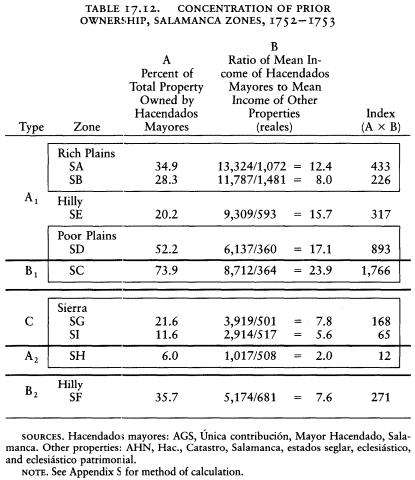
tics. It can be looked on as the area of a rectangle. The vertical side is the percentage of property in the zone owned by the hacendados mayores, and the base is the ratio of the mean income of the properties of the hacendados mayores to the mean income of the other properties (Table 17.12).
The index of the effect of sales on concentration of landholding is a similar rectangle derived from the sales records. The base of the rectangle also represents a comparison of large to small properties, in this case the ratio of the mean amount spent by the buyers in Level 4 (the largest buyers) to that of the buyers in Level 1 (the smallest buyers). Rather than use the simple ratios, which run from 23 : 1 to 210 : 1, I sub-
stituted their logarithms. The reason is that the range is very high, the largest reading being over nine times the smallest. The other statistic in this index, to be described next, has a range of only 2.6. Multiplying them together would give an excessive weight to the first. The logarithm reduces the range to 1.7, less than that of the other statistic but not so dissimilar.
The vertical side of the rectangle is the percentage of buyers in Level 4 who bought more than one property. At first sight this figure may not seem directly comparable to the percentage of land owned by hacendados mayores used for the earlier index. It was chosen because this index was intended as a measure of change due to the sales, not of the already existing concentration of the lands being sold. Properties being farmed as single units were not ordinarily divided before their sale. Therefore the lowest concentration effect (the greatest increase in the number of landowners through the sales) would result if each property went to a different buyer. The percentage of buyers who bought more than one property is thus a measure of how much concentration was effected above this minimum. It is proper to use only Level 4 buyers in each zone because, smallest in number (they ranged from 3 to 12 percent of all buyers), they had the greatest effect on the pattern of landholding: by definition they accounted for 50 percent of the purchases. The index and its components are given in Table 17.13. (One should stress that even though this index measures the extent to which the sales created new large holdings in the hands of laymen, it is not a measure of the absolute change in concentration. Some religious endowments consisted of various properties that were sold off separately, thus tending to decrease the existing concentration of ownership. The absolute change was the difference between these two contrary effects, which I have not attempted to calculate.)
When the two indexes or sets of rectangles, one of the prior concentration of landowning and the other of the effect of sales on concentration, are compared, they give a high coefficient of correlation, r = .89. Statistically this means that the correlation could have occurred by chance less than once in a hundred cases (it is significant at the 1-percent level). Although the indexes are the products of circuitous calculations, they offer strong support for the validity of the proposition.
Figure 17.1 graphs the result, the regression line of the effect of the sales on the prior concentration. The resulting pattern supports both the division of the zones into types of participation in the market and into geographic regions. Type A1 zones (SA, SB, SD, SE) fall in the middle of
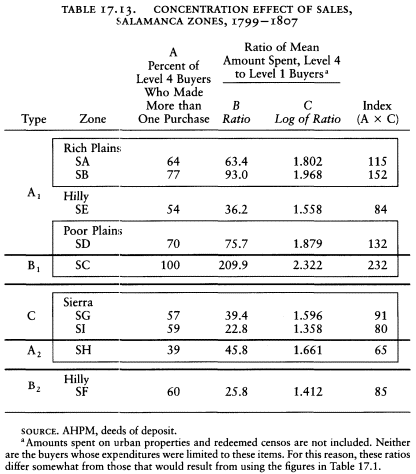
the pattern, with Type B1 (SC) far out on its own and Type C (SG, SI) together at the other extreme. Zones in the different geographic regions are even more closely associated, poor plains zones (SC, SD) with high concentration, sierra zones (SG, SH, SI) with low concentration, and zones in the other two geographic regions are also proximate to each other.26
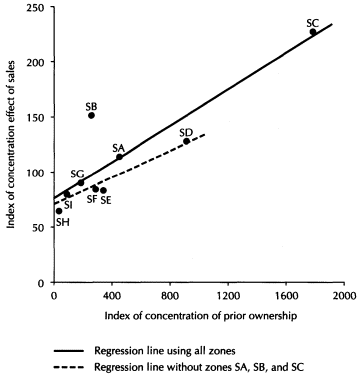
Figure 17.1.
Salamanca Province, Regression of Concentration
Effect of Sales on Concentration of Prior Ownership
4
The nature of the data makes possible another test of the proposition that the sales at auction strengthened existing patterns of landholding, by comparing the amount of absentee ownership in each zone before the sales with the amount of property bought by nonresidents. We know already that absentee ownership was a strong characteristic of the province.27 In the studies of individual towns we observed that around Salamanca city the large blocks of property were in the hands of outsiders and that nonresidents were the biggest buyers, a fact confirmed above for the province as a whole, since we saw that notables were the major buyers and they were largely absentees. Most hacendados mayores at
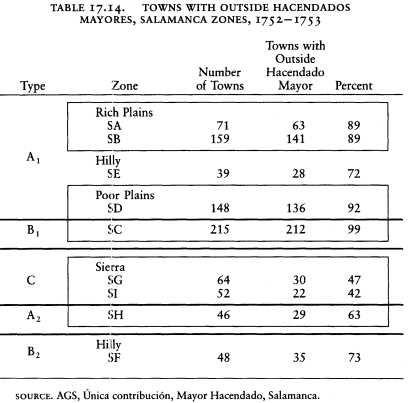
midcentury were also outsiders (Table 17.14). Some relationship between prior absentee ownership and absentee buying is apparent; the data permit us to test statistically the strength of the correlation.
To obtain an index of prior outside ownership (Table 17.15), I used three figures. The first (Column A) was the proportion of the land in each zone owned by absentee hacendados mayores. It is an accurate statistic of how large a share was owned by certain absentees, namely those who were the largest owner in the town. To get an approximation of absentees among other landowners, I used the ratio of the total value of the land in towns with absentee hacendado mayores to the total value of all the land in the zone (Column B), on the assumption that towns with absentee hacendados mayores would also have a larger share of smaller absentee owners. The third statistic (Column C) is drawn from information on ecclesiastical ownership, since much land belonged to religious institutions and foundations located outside the small places.
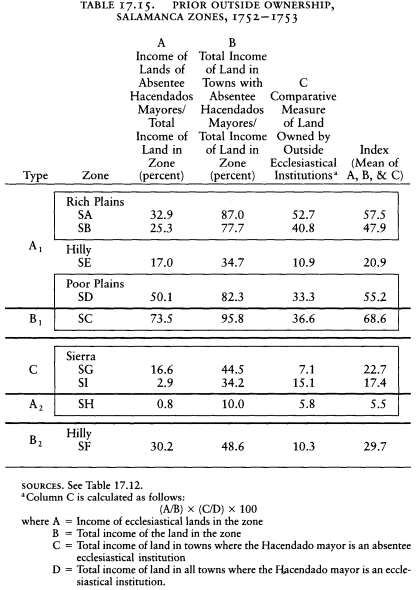
It represents an attempt to calculate the percentage of land in the hands of outside ecclesiastical owners. To obtain it, the share of land owned in each zone by ecclesiastical institutions is multiplied by the share of all the land in the zone that was located in towns where the hacendado mayor was an ecclesiastical institution. The final index is a simple mean of these three statistics. One should stress that the index does not represent an estimate of the proportion of land owned by outsiders; its purpose is to permit a comparison among the zones.
The index of sales made to outside buyers also had to be derived indirectly, for the Madrid notaries' deeds of deposit did not usually state the residence of the buyers, although where it was given I noted it. A search of local notarial records unearthed the residence of many of the largest buyers. In addition, unlocated persons who bought property in more than one town were considered residents of the town where they made the most purchases and nonresidents elsewhere. Those persons with names preceded by don not identified as priests, who bought in towns where the census of 1786 showed no hidalgos, were also considered nonresidents. (Not all laymen called don were hidalgos, but hidalgos were probably the most numerous group among them.)28 The purchases thus identified as made by outsiders were totaled and divided by the total amount spent in the zone. The result, in Table 17.16, shows that the share of the sales in each zone that appears to have gone to outsiders ranges from 9 to 82 percent.
When the index of prior absentee ownership is compared to that of nonresident buyers, the two give a surprisingly high coefficient of correlation, r = .97. Figure 17.2 illustrates the close relationship between the two, r 2 = .94, implying that the amount of land that was bought by outsiders was 94 percent determined by the amount owned by outsiders before the sales.29
Where the land was in nonresident hands (much of it ecclesiastical), potential outside buyers would know about the possibilities, the channels of information were good. They could take over existing leases and tenants from the present ecclesiastical owner; the transactions costs of the purchase were low. Furthermore, where local farmers owned little, they also were likely to have little capital. As in La Mata and Villaverde, they might bid for small collections of arable plots but not for holdings
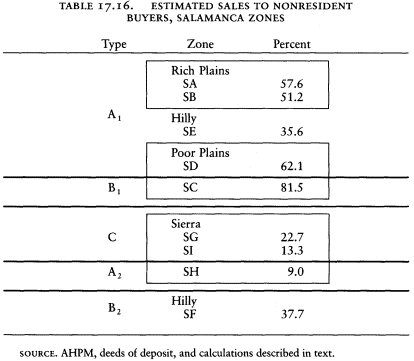
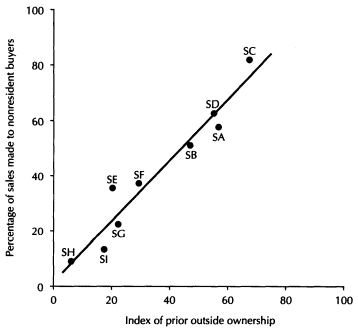
Figure 17.2.
Salamanca Province, Regression of Sales to
Nonresident Buyers on Prior Outside Ownership
of many plots spread over various villages, and certainly not for a coto redondo like Pedrollén. But where the land was in local hands—in the sierras and to a lesser extent in the hilly zones—outsiders knew less about it and the residents had proportionately more wherewithal. Wealthy investors had less information and less interest in these regions, and vecinos were the main buyers.
As one can expect, outside owners and buyers were present in greater numbers where agriculture was oriented toward the national market (Type A1 and B1 zones). They used more vales reales than elsewhere to make their purchases. The zones with fewer outside owners and buyers not only paid much more in hard currency, but buyers also bid more against each other—there were more payments in specie above the minimum bid (Table 17.17). Chapter 15 distinguished in both provinces two types of agriculture: market oriented and local. The former was charac-
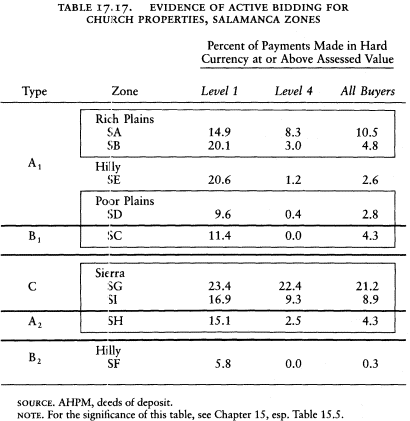
terized by greater use of vales reales, extensive cultivation, larger participation of hidalgos, and, we can now add in the case of Salamanca province, greater absenteeism. Regions of local agriculture relied more on hard currency, had more intensive farming and less land in the hands of outsiders, and were more socially egalitarian.
Chapter 15 concluded that all areas had some of both kinds of agriculture, indeed that most individuals were involved in both kinds. The more wealthy the individual, the greater his participation in the market was likely to be. What we find in Salamanca is that the distinction is not only social but regional, much more so than in Jaén. The plains around Salamanca City, including the partidos of Ledesma and Alba de Tormes, were strongly marked by commercial agriculture. The sierra zones were much less defined by external contacts. This was true even of Béjar zone (SH), which, because of its livestock and flax, was oriented toward the wider market. Its buyers had comparatively little money and were local people, like those of the sierra zones on either side. In the plain, the poor zones had more outside buyers and less active bidding at all levels than the rich zones. The latter had a more prosperous peasantry that offered an impediment to complete domination from without, peasants who were themselves participants in the greater economy.
The close relationship between prior outside ownership and the extent of purchases by nonresidents, together with the high correlation between prior concentration of ownership and concentration in buying, offers convincing evidence in support of the proposition that in an area where the economy was basically rural, sales of entailed land at auction, as provided by the desamortización of Carlos IV, perpetuated and accentuated existing patterns of landholding; they did not create new ones.
The two provinces do not offer evidence on how the result might differ in an area that was industrializing or whose economy was changing in other ways, but one can predict that the correlation between prior conditions and the redistribution of land would be weaker. Buyers with capital from sources other than agriculture could be expected to accentuate concentration and absentee ownership. The regions around Salamanca city offer some support for this view. The three zones surrounding it were SA, SB, and SC. Figure 17.1 shows that zones SB and SC are above the regression line, indicating that the effect of the sales was greater than the regression predicted. The deviance is especially notable in SB. If the correlation is recalculated without these three zones, the coefficient of correlation, r, rises from .89 to .95 (significant at the 1-percent level). Figure 17.1 shows the new regression line. Salamanca
city had no modern industry, and most of its income came ultimately from the plains around it. The university, the cathedral, and its many parishes and religious orders owned land and received tithes from farmers in this region. The city's merchants dealt in grain. Its craftsmen furnished their products to clerics, señores, hacendados mayores, and merchants who resided in the city and to the vecinos of the surrounding towns, drawing indirectly on the agriculture of the region. But Salamanca was also the capital of the province, receiving some of royal revenues that came from beyond the partido, and its artisans no doubt sold their wares throughout the province, the silver jewelry of the charro costume, for instance. Local grain was shipped to Madrid and the north, and the city's merchants received a share of the profits. The university drew students from throughout Castile.30 Its leading citizens thus had available more capital than that produced by local agriculture, and this can explain the greater concentration of purchasing than that predicted by a regression line based on the structure of prior landholding. Its example offers support for the proposition that nonagricultural sources of income could hasten the concentration of landowning in a period of desamortización, provided, of course, that the recipients of such income chose to invest it in agriculture, and especially in commercially oriented farming.
Disentail encouraged the commercialization of agriculture by offering lands to men and women interested in a profitable investment, whatever the source of their capital. In this respect it carried out the wishes of Jovellanos and the royal reformers. Nevertheless, its impact in a country like Spain, where agriculture was by far the major occupation, was determined primarily by existing conditions, which it served to accentuate rather than mitigate. And this, of course, is not what Jovellanos had predicted, at least in the long run.
Chapter XVIII—
Salamanca Province:
The Despoblados and Alquerías
Because eighteenth-century reformers believed that the Spanish countryside suffered from a lack of population, they found the cause of the agricultural backwardness of the province of Salamanca in its large number of despoblados, a verdict that recent historians have echoed.1 Several despoblados have played a role in our story. Royal plans to repopulate them led to the migration of settlers from La Mata to the despoblado of Narros de Valdunciel. The vecinos of Villaverde did not move their residence, but they broke grazing land in the neighboring despoblados of La Cañada and La Cañadilla, increasing their harvests in this way. Sixty percent of Pedrollén was sold in the disentail, but it had been and remained a single exploitation, rented by one tenant, so far as one can tell from the census returns.2
Despoblados resembled the cortijos of Andalusia, another abomination of the reformers, but they differed in essential ways. Pedrollén, although a single exploitation, had several owners and the shares could be sold separately. Many despoblados, legally single properties called cotos redondos or términos redondos, were owned in shares by various people, but I have found no such case of a cortijo. The latter were carved out of vacant municipal land and may have had their origin before the Reconquista. The despoblados were the result of a historical process since the
Reconquista that removed the inhabitants from an established village, or so at least the name implied. The Christian resettlement of Salamanca took place after the middle of the eleventh century, apparently in the form of many small villages and hamlets placed in close proximity. A despoblado arose when the population of a village was reduced to one or two families or disappeared altogether, but even when all fixed population vanished, the name and administrative unit persisted. Cortijos were not separate political or census units.
Why despoblados had declined is not clear. The times of greatest loss of population would appear to be the hundred years following the Black Death and the seventeenth century, periods of plague and demographic crisis throughout western Europe. Two authors who have studied similar deserted villages in France argue, however, that plagues alone cannot account for the complete disappearance of villages. The destruction and military levies of wartime played their part in driving away the inhabitants. Permanent depopulation did not result, however, unless other causes prevented resettlement once the hardships had passed. One might be adverse physical conditions, another the desire of a landowner to build up his estate. The smaller the hamlet, the more likely it was to disappear, but it was rare for a place to be abandoned completely. Some farmstead, some group of people remained to keep alive its name.3
The story in Salamanca is similar, suggesting that the causes were not unique to this region or to Castile. Antonio Domínguez Ortiz believes that small settlements disappeared in the centuries after the reconquest because the insecurity of the open countryside drove the peasants to seek safer and more healthy locations. After 1250 there was a great demand for settlers in Andalusia, and many may have been attracted by this opportunity.4 Eugenio García Zarza, who has studied the despoblados of Salamanca most closely, points to the action of noble lords, desirous of creating large estates as a basis for political power during the struggles of aristocratic bands in the fifteenth century. They forcibly moved peasants to larger towns, a procedure renewed in the seventeenth and early eighteenth centuries, when the crown was again weak. Seventeenth-century wars with Portugal, destructive and demanding in money,
and the increasing tax burdens, which hit the remaining peasants ever more heavily as the others fled or died, completed the desertion of the villages.5 Curiously, these historians make no mention of the Black Death as a contributing cause to the depopulation, although students of medieval France and England have stressed its central role in the redistribution of population. Plagues of the fourteenth and fifteenth centuries are known to have laid waste Catalonia, Aragon, and Navarre.6 In 1350 the Black Death had spread so widely in Castile that Alfonso XI wrote to Pedro IV of Aragon, expressing his concern about the loss of population and the number of his subjects going to Rome to obtain a papal indulgence.7 The following year, the Cortes of Castile heard complaints that the great mortality had raised the price of agricultural labor to such heights that owners were being forced to abandon cultivation.8 The plague may well have been the event that triggered the early desertion of the smaller places in Salamanca.
What is unique about Salamanca is the large number of despoblados that appeared, far above anything found in France or the rest of Spain. The catastro identified 113 in the study area, while the nomenclátor of 1789 raised the number to 197, plus another 93 in the partido of Ciudad Rodrigo.9 Most lay in the poor plains southwest and west of Salamanca city, that is, on the large property side of the Salamanca-Albacete line, but a number were also in the rich plains north and east of the city. Almost indistinguishable from the despoblados were places called alquerías, large properties tended by one or several families. Although this name, derived from the Arabic word for a small settlement, does not imply that they were ever larger, the available censuses show that many had had more people in the past.10 The catastro does not identify alquerías as such, but the nomenclátor names 151 of them in the study area, located in the same regions as the despoblados, and 30 more in the partido of Ciudad Rodrigo.
Why this concentration of deserted villages in Salamanca? The activities of noble estate builders and the destruction of war and taxes were not peculiar to this region. One must look for a scenario that fits the local situation. From the ninth to the eleventh century, the region was a no-man's-land between the Christian monarch of León and the Muslim states south of the central sierras and was virtually without permanent residents. After the reconquest of Toledo in 1085, the future province of Salamanca came permanently under Leonese rule. Salamanca city was fortified and given a cathedral, and the smaller places, Alba de Tormes and Ledesma, also became strongholds. Rural settlement was done in small nuclei, villages and hamlets of only a few families. Some settlers came as organized groups originating in a town in the north, others had been collected under the leadership of some enterprising individual of higher social status. Frequently the name of the new village reflected the origin of the settlers or the person who founded it. Such toponymic evidence indicates that the new inhabitants came from all over: Galicia, León, the Basque lands, and Navarre to the north as well as a large number of Mozarabes (Christians who had been living in Muslim territories) and Moriscos (converted Muslims) from the south.11
Settlement tended to follow the old Roman road from León to Salamanca and south through Béjar to Mérida, spreading out to the east and west from it. The rich Armuña plain north of Salamanca city was repopulated before the mid-twelfth century; by 1200 its towns were substantial nuclei. The poorer zone south of the city filled up a generation or two later, and the southern sierras between about 1190 and 1230. One can picture these early hamlets as a half-dozen or so houses and a few sheds around a small unpretentious church. The nearby arable had been distributed in fields to the settlers in a reparto, while the common pastures and woodland lay beyond. It is possible that some places were private estates with only a few permanent hands, protoalquerías, especially those in the poor plains bearing the name of the founder. Many villages were required to make payments to the cathe-
dral of Salamanca, but jurisdiction lay with the council of one of the fortified centers, Salamanca, Alba de Tormes, or Ledesma; the basis was already established for the later partidos. Except for a few places under ecclesiastical jurisdiction, señorío did not come until later; the cities and villages were royal.
When hardship came in the form of plague and civil strife in the fourteenth century and later, those settlements located where the natural conditions were least favorable, notably in the thin topsoils south and west of Salamanca city, suffered most. The villagers still alive in the smallest villages, places with less than ten families, some as few as two, chose to go to bigger towns or were forced to do so by local magnates who desired unobstructed use of the fields. But the places did not disappear from official records. The owners chose to preserve their names and identity so that they would not be taken over by neighboring towns as common wastes and pasture.12 These places had never flourished under farming, and the rise of migratory and sedentary sheep raising after the fourteenth century made them profitable as pastures, turning them into permanent despoblados.
Angel Cabo Alonso, the leading historical geographer of the province, emphasizes the importance of geographic conditions in explaining the appearance of despoblados. They were found, he says, in the plains where the underlying rock formation lay closest to the surface of the sedimentary deposits, leaving little soil cover for crops. He theorizes that after the reconquest the larger settlements were along the rivers and streams, while the future despoblados were smaller hamlets that appeared in the hilly interfluvial spaces and never became populous villages.13 One needs a case-by-case study to test this hypothesis. It undoubtedly applies to many places, but not all, because there are authenticated accounts of forcible removal of villagers in the fifteenth century,14 while the first census available, from 1534, still shows numerous vecinos in many places that would be despoblados in the eighteenth century.15 What seems indisputable is the importance of the physical characteristics of the plains, first in attracting early settlers into numerous small hamlets and then in proving unsuited to the permanent arable culture needed to support so many nuclei. The settlers had set up life in the
way familiar to them, only to discover too late that the physical reality would not accept it here. Theirs was not the last such experience, witness the American Dust Bowl of the 1930s.
2
The data collected for this study permit one to look at the despoblados in several new ways. Most of the following discussion is limited to the despoblados for which there are individual surveys of the catastro, but, unlike previous studies, it also considers the alquerías. Table 18.1 shows what percentage of the catastro units in each zone fell into these two categories. Those with the greatest concentration of despoblados and alquerías were the four plains zones, SA to SD, and the hilly zone SF that juts between zones SB and SC. The following analysis is limited to these five zones.
Most of the despoblados were smaller in area than the units that had survived as towns; in three of the five zones they had a mean size less than half that of the regular places. According to the returns of the catastro, their mean size ranged from 490 fanegas (about 220 hectares) in
|
|||||||||||||||||||||||||||||||||||||||||||||||||||||||||||||||||||||||||||||||||||||
|
||||||||||||||||||||||||||||||||||||||||||||||||||||
zone SD (Ledesma) to 1,150 fanegas (about 510 hectares) in zone SB (Alba de Tormes; Table 18.2). In fact 43 percent of them contained less than 250 hectares, a figure that has been considered the minimum size of a large property or latifundio in twentieth-century Spain.16 Alquerías tended to be somewhat larger, although still smaller than settled towns. A community located in such a place, especially where the land was poor, was at a decided disadvantage when faced with climatic catastrophes or human violence.
The evidence from censuses permits one to assign the decline in population of most despoblados and alquerías to one of three periods: prior to the census of vecinos of 1534, between 1534 and the census of vecinos of 1712, and the period between 1712 and 1826, for which we have the catastro (ca. 1751–53), the census of 1786, and Miñano's dictionary with figures for 1826. Table 18.3 shows the distribution among these three periods of those places for which some census data are available. Since the first census is for 1534, we can know only whether a place was at its demographic low point by that date. We do not know that it had ever been larger, and in view of the doubts of Cabo Alonso on this question, one should leave it open. Some certainly had been larger at some previous time.
|
|||||||||||||||||||||||||||||||||||||||||||||||||||||||||||||||||||||||||||||||||||||||||||||||||||||||||||||||||||||||||||||||||||||||||||||||||||||||||||||||||||||||||||||||||||||||||||||||||||||

Fifty percent of the despoblados and alquerías for which there are census data had become depopulated by 1534 or had never been large. Ledesma (SD) zone had the most marked early decline, with 65 percent of its small places in this category. The other half of the places, those that lost their population after the sixteenth century, are of greater interest to us. Without zone SD for which we lack 1712 figures, seventy-nine places lost their settlers before 1712 and forty-nine after that date. Most of the first group had between five and twenty-four vecinos in 1534 and had dropped to two vecinos or less by 1712. They had gone from small towns of twenty to a hundred people to a family or two tending an estate, or even to no one at all. A few continued their decline into the eighteenth century. Riolobos (SB) had thirty-six vecinos in 1534 and was down to six in 1712. By 1751 it had only one household and in 1786 only a man and a woman, not married. Arauzo, nearby, had thirty vecinos in 1534, ten in 1712, and only two in 1751; there were at least seven other similar places.
From official reports and literary sources, it is evident that the big decline came in the seventeenth century, a time of epidemics, war, and heavy taxes.17 Marginal arable fields, some of them probably first broken in the sixteenth century, returned to pasture, the number of sedentary sheep increased, and peasants collected into the larger villages.18 A document dated 1661 protesting the dire effects of the war with Portugal claimed that the partido of Salamanca city had seen the number of towns (lugares) decline from 270 to 100 in eight years and the number of vecinos from four thousand to two thousand, an exaggeration, of course, but evidence that contemporaries were aware of the impact of these difficult times.19 A study of the villages northwest of Paris found that those with five to twenty households were especially susceptible to disappearance in the late medieval and early modern periods.20 The fate of the towns of Salamanca seems to demonstrate a similar critical mass, under twenty-five households they were likely to become despoblados, an outcome to which they were also inclined by their smaller extent and poor soil.
The places that lost their population after 1712 were mostly of a different kind. Of the forty-nine places in the four zones in this category,
only five had more than 4 vecinos in 1712, none more than 7.5 (widows heading households counted as half vecinos). By the time of the catastro, twenty-eight reported no vecinos at all. Most of these appear never to have been even hamlets—only ten show up in 1534, all with 7 vecinos or less—just estates whose owners decided to reduce the number of people living on them in the eighteenth century or whose inhabitants chose to move to nearby villages and walk to their work. These are places that fitted the definition of alquerías, yet they were called despoblados.
Historians have repeatedly blamed the señores for the despoblados, echoing the accusations of eighteenth-century reformers.21 Their lords are accused of driving off the peasants to extend their señorío. The case of Arauzo, already mentioned above, became notorious for its continual decline since the sixteenth century. Its location on the road to Madrid from Salamanca and its great size, 2,350 hectares, largest despoblado of all, made it conspicuous. The alcalde of the adjoining town in 1768 reported that its señores, the Marqueses de Almarza, resident in Salamanca city, "kept buying the houses, lands, and chattel of the vecinos and inhabitants, until they became the largest owner. Afterwards they realized that they had more to gain by letting it become deserted and turning it into a coto redondo. And for its exploitation they did not want to rent small pieces to the vecinos, who ended by leaving, and thus little by little the houses and buildings fell into ruin as the farmers left."22 It is tempting to see the success of the Marqueses de Almarza as a function of their señorío and to attribute the actions of other nobles as well to its evils. In the last chapter we saw, however, that señorío in Salamanca had little adverse effect on the rural economy because it was seldom associated with extensive ownership of the land. Similarly, the facts indicate that the despoblados cannot be blamed on it, for in few places were the large owners also the señor. Most of the despoblados and alquerías were either in royal territory (almost all zone SC was royal and it had the most despoblados) or in the señoríos of the Duques de Alba and Alburquerque. Out of thirty-four despoblados and five alquerías in her señoríos, the Duquesa de Alba was hacendado mayor in only four despoblados and two alquerías, the Duque de Alburquerque in none of those under his jurisdiction, forty-three despoblados and ten alquerías.
The Marquesa de Almarza was also hacendada mayor in Arauzo, and this role is the proper clue to her behavior. From the point of view of the owner, the ideal despoblado or alquería was obviously a coto or término redondo, a single property. Although there is no official list of términos redondos, the catastro supplies information on ownership that permits one to identify many of them.23 In zone SA 33 percent of the despoblados and alquerías can be identified in this way as términos redondos; in zone SB, 34 percent; SC, 59 percent; SD, 58 percent; SF, 58 percent; with a total of 49 percent for the five zones. The records of the disentail of Carlos IV, however, indicate that these were not all. Both noble and ecclesiastical owners had developed términos redondos, but nobles had been much more active since the sixteenth century, and among the nobles, titled aristocrats had been most successful.24
There was no reason, of course, that large owners should acquire all the available property only in despoblados and alquerías. Forty-two towns in these five zones not classified officially in this manner also had but one owner; thirty-nine of them in the poor plains zones.25 One might suspect that these were also tiny villages that the bureaucracy had not yet got around to labeling despoblados or alquerías, but in fact only five had fewer than forty people, and nineteen had over one hundred. The population of two was greater than five hundred, Matilla and San Muñoz, both in Charro zone (SC).26 In both the only landowner was also the señora, the Duquesa de Uceda, who resided in Madrid. She was lord and owner of all the land in two other towns as well, in the same zone, Vecinos and Olmedilla. Altogether in these four places she owned 2,650 hectares of arable and 3,700 hectares of pasture, which she must have rented out to the inhabitants, since she had no animals of her own. In these four towns lived 246 families, their houses being their only real property. Cases like this gave a bad reputation to señorío, but they were the exception, not the rule. Titled aristocrats were sole owners of eighteen other towns, hidalgos of seven, and ecclesiastical institutions of twelve, but only in two belonging to aristocrats was the owner also
señor.27 It was and is a popular misconception that señorío had any significant economic impact in Salamanca province. To be the hacendado mayor gave one much more leverage than to be the señor; for centuries the region had been more capitalist than feudal.
3
That large landowners as a group followed a policy of creating despoblados must indicate an economic motive behind their behavior, for a desire to strengthen their señoríos has not proved to be the correct cause. Another widely accepted explanation is that they wanted to turn arable land into pasture, responding to the returns offered by the rise of transhumant sheep raising since the Middle Ages. Antonio Ponz, an eighteenth-century cleric who journeyed through Spain gathering information on art works and in the process recorded many acute observations about the state of the society and economy, blamed sheep raising for the appearance of the despoblados in Extremadura and Salamanca. In Spain as in England, sheep were eating men, and recent historians repeat this judgment.28 The scarcity of labor that resulted from the demographic decline of the seventeenth century would have encouraged owners in this course, especially where the fertility was marginal.
Eighteenth-century data, however, do not show that despoblados specialized in grazing livestock at that time. The geographer Cabo Alonso has found from a survey of the catastros of a number of despoblados that some of them were indeed dedicated to pastures, but in others well over half the land was arable.29 An analysis of the catastros of all despoblados was beyond my resources, but the provincial summary provides a reasonably reliable alternate approach. Its report of the income from the land in each place furnishes the data to obtain the mean income from each measure of land. Experience with the catastro reveals that a place with a mean return of under five reales per year per measure was largely pasture; between five and nine, pasture and poor quality arable; between ten and nineteen, mostly poor arable; and twenty
|
|||||||||||||||||||||||||||||||||||||||||||||||||||||||||||||||||||||||||||||||||||||||||||||||||||||||||||||||||||||||||||||||||||||||||||||||||||||||||||||||
and over, medium to good arable.30 Table 18.4 shows how the alquerías and despoblados in the various zones fall into these categories. Very few places were used purely for pasture, less than a fifth in every zone except SF. In the two rich plains zones, more than two-thirds were primarily oriented toward grain harvests, in the poor plains zones about half.
The catastro's census of livestock confirms the finding that despoblados were not especially dedicated to grazing. Table 17.4 shows that the zones with despoblados had many animals per vecino, although not as many as the mountain valleys of Piedrahita (SI) zone. The concentration of sheep and cattle was a feature of the zones, however, and not specific to the despoblados and alquerías. Table 18.5 shows that measure for measure of land, as a general rule despoblados and alquerías had fewer rather than more cattle and sheep than the more populated places. The only categories in the table where the depopulated places showed a concentration of livestock were not primarily devoted to pasturage but were involved in arable farming: in zones SB and SC such despoblados had proportionately more cattle than larger places and such alquerías had more sheep. It is significant that animal husbandry was found where there was active farming. In Salamanca at this time, specialization in breeding livestock separately from growing grain had not yet developed.31
We are left with a paradox. Here are tiny places, housing only one, two, or three families, existing next to towns with five, ten, or more times as many people, yet engaged in virtually identical forms of agriculture. How can one explain this? Again the catastro comes to our aid. It tells us nothing, we know, about who rented the fields and pastures or who exploited them with hired labor, only who owned them. One can, however, use indirect evidence to create a reasonably reliable picture of
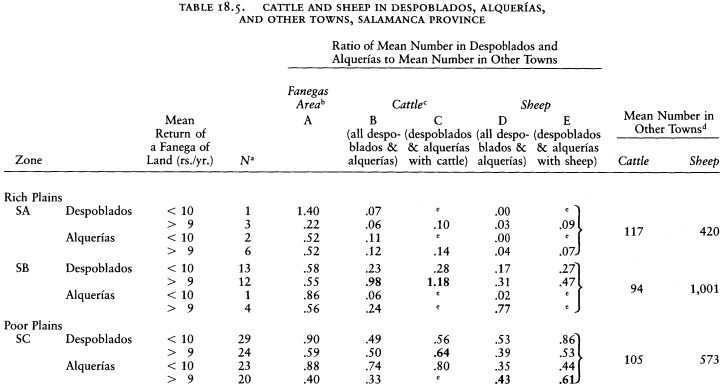
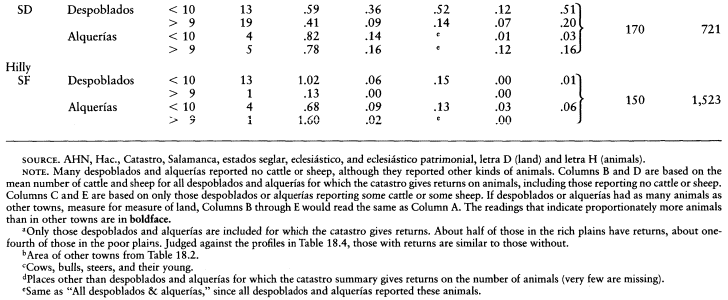
what was going on in the despoblados. The first step is to estimate whether the residents listed in the small places were numerous enough to produce the return reported from these places.
According to my calculations, Pedrollén produced a gross income from agriculture and livestock of some 800 EFW (see Table 9.8), although some of this income was the result of pasturing animals outside its limits. The provincial summary of the catastro, however, reported its land to produce 5,685 reales, that is 380 EFW, about half what I calculated. Most of the disparity is the result of the low income that the catastro assigned to pastures. In La Mata and Villaverde, towns of the rich Armuña district, my calculations of gross income from the land are also higher than the return reported in the provincial catastro summary (1.5 and 1.2 times as great), although the difference is less than for Pedrollén, partly because there was less animal husbandry.
The wealthiest labrador in La Mata (the casa excusada) had a gross income of some 600 EFW, but at the above rate, he would have farmed land evaluated in the catastro at 400 EFW. He used five yokes of oxen, thus needing four additional hands (including any grown sons), at least during plowing. In Villaverde, where per capita income was lower, the richest labrador had a gross income of 400 EFW, and the reported return on his share of the land would be 333 EFW. These figures give us an idea of how much land, in terms of its reported harvest, a fully employed farmer could handle.
Since the alquerías and despoblados had more pasture than the towns of La Armuña and pastures were undervalued in the catastro, the gross return on the amount of land that one vecino could work would be less than that produced by the wealthiest labradores in Villaverde and La Mata. Land reported to return about 300 EFW (4,200 reales) would be the maximum for one man in the rich plains zones; in the poor plains zones, with more pastures, the limit would be lower, say 200 EFW. In despoblados and alquerías that had a higher return per vecino than these limits, one can be reasonably certain that part of the land was being worked by men from nearby towns. Of course, if despoblados and alquerías showed no vecinos at all, all the labor was being done by outsiders. For example, the despoblado of Riolobos in the rich plains (zone SB) had land producing 4,530 EFW (63,390 reales) according to the catastro summary and only one vecino. At one full-time farmer for each 300 EFW, it needed fourteen additional farmers. Cente Rubio (zone SB) had no vecinos, but with land producing 1,603 EFW, we can posit that it employed five or six full-time farmers from outside. San
Pedro de Azerón in the poor plains (zone SC) produced 620 EFW and had one vecino. It needed at least two more farmers. These calculations furnish only the roughest sort of estimate, intended to show the nature of the situation. In all likelihood outsiders who worked in the depopulated places did so only part-time, after caring for their fields in their home towns. The number of individuals involved was therefore probably much higher than the estimated full-time outsiders.
Table 18.6 indicates the situation in the five zones. One sees from the last column that the small places required more than twice as much labor as their vecinos could produce. Rather than as self-contained units, one can think of them as low-pressure areas, inadequately tended, with few or no permanent workers, which drew in peasants from surrounding high-pressure zones, towns with more than a full complement of workers. But these peasants moved in and out when the seasonal needs required their presence, returning home in the evening, leaving the despoblados again empty. These were not the cortijos of Jaén, for the workers from outside lived close enough to make the daily journey except perhaps in the rush of the harvest season. And they were not cortijos for another reason: the people who farmed them in this way were not day laborers but tenant farmers, most probably labradores with their own draft animals. They worked for their own account and paid rent at a predetermined rate. We saw some of them in both La Mata and Villaverde. There was even a local term for their plots; they were called tierras entradizas. 32 Not all depopulated places were farmed in this way, of course. Pedrollén, which does not figure as needing additional workers, was rented to a single tenant as one exploitation. Three vecinos of nearby towns, nevertheless, labored on it as hired help.
The permanent personnel in the small places did not have a normal demographic structure, as one can observe by comparing the population pyramids of places with less than twenty people in 1786 to those of the towns surrounding them (Figure 18.1 and Appendix T). In the four plains zones, medium-sized towns have fairly regular pyramids, although one can see a shortage of young unmarried females, gone probably to be domestic help in bigger places. The small places show a disproportionate number of unmarried males under twenty-five and few old people. Most of the people considered resident by the census takers do not appear attached to the places, many young hired hands and a
|
|||||||||||||||||||||||||||||||||||||||||||||||||||||||||||||||||||||||||||||||||||||||||||||||||||||||||||||||||||||||||||||||||||||||||||||||||||||||||||||||||||||||||||||||||||||||||||||||||||||||||||||||||||||||||||||||||
few married couples, who would include the current large tenants like the one at Pedrollén and their wives.
Beyond these general characteristics, however, Table 18.6 reveals that not all small places were alike. For the first time alquerías and despoblados appear with different features. Over a third of the despoblados had no vecinos at all; this was true of only four alquerías. The latter, in other words, had permnanent personnel, at least a guard, the montarraz. Permanent residents also furnished a larger portion of their labor needs. With 217 vecinos for 78 alquerías, almost 3 per place, they needed only 137 additional full-time hands from outside. Despoblados barely averaged 1 vecino and needed over one and a half times as many farmers from outside. The owners of alquerías seem to have supervised their exploitation much more than those of despoblados.
There was a difference among regions too. In the rich plains north and east of Salamanca city (zones SA and SB), the despoblados needed 5 times as many outside farmers as they had vecinos, whereas in the poor plains (SC, SD) and in the adjacent hilly zone, SF, they were more nearly self-sufficient. The despoblados of the rich plains zones were scattered among relatively large towns.33 Demographic pressure, we saw, drove the peasants of La Mata and Villaverde to break soil in neighboring despoblados. There was evidently less pressure in the poor plains.
In the 1750s, the time of our data, neither La Mata nor Villaverde had overflowed much into the despoblados; the flood would come later in the century. Asked to report on the possibility for resettling the despoblados, the corregidor of Salamanca in 1769 replied that they could support six times as many vecinos as they then had.34 Table 18.6 estimates that in the 1750s the despoblados were employing between two and three times as many farmers as there were vecinos. The examples of La Mata and Villaverde indicate that as the century wore on, the depopulated places were accommodating more and more nearby farmers. No doubt their soil was less productive than that of neighboring villages or they would not have become abandoned, but as population grew they were being reincorporated into the overall pattern of agriculture.
In most cases, however, they were not being repopulated, only recultivated. Events of earlier centuries had concentrated the population in fewer units. The units were now growing and expanding their radius
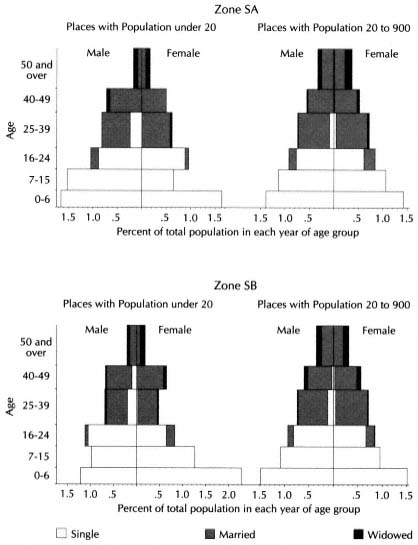
Figure 18.1.
Salamanca Plain, Population Structures of Small
Places and Medium-Sized Towns (see Appendix T)
of cultivation rather than undergoing fission. The regions of deserted villages in France experienced the same phenomenon.35 It would be tempting to ascribe the choice to the peasants themselves, kept in their
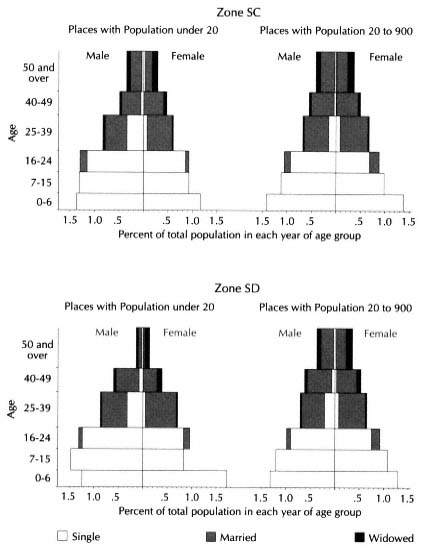
NOTE : Since there is no limot to the top age group, a
span of seventeen years is used for convenience only.
native villages by the charms of social intercourse, but the economics of the situation suggest another explanation.
The mean productivity of labor was far higher in the despoblados than in the villages. The estimate used above for production on the despoblados and alquerías was an average return to labor of 300 EFW per man in the rich plains and 200 EFW in the poor plains. The overall
gross return from land per vecino engaged in agriculture in the rich zones was 110 EFW and in the poor zones 60 EFW (including residents of populated and depopulated places). The difference is impressive. One might object that the estimate for return per farmer in the depopulated places is excessive (although, if it is, they needed even more outside labor than deduced above). An easy calculation will respond to this objection. One can compare the mean return per measure of land and the mean income per vecino engaged in agriculture in the nine zones of the province (Table 18.7). The results reveal a striking fact. The mean return of a measure of productive land is related to the geographic characteristics of the zones, as one might expect. The rich plains zones had land of high return per measure, the poor plains zones a low return. The sierra zones were also high, in part because of the high value of crops like flax, and the hilly zones were intermediate. But the income per vecino engaged in agriculture does not correlate with the productivity of the land. The five zones with a large number of despoblados and alque-
|
||||||||||||||||||||||||||||||||||||||||||||||||||||||||||||||||||||||||||
rías have the highest readings in per capita income, although they include the three zones with the poorest soil. It seems correct to conclude that despoblados and alquerías raised the mean productivity of agricultural labor in these zones because the productivity of farmers was greater here than in the neighboring towns, thus reinforcing the assumption made above. One can recall that Pedrollén had the highest per capita income of all our towns, though little went to the laborers.
One might be led to conclude that alquerías and, especially, despoblados were a boon to the vecinos of nearby towns, who could expand their income on land where the marginal productivity of their labor was higher than that in their towns. On the other hand, the Ricardian model we found applicable to individual towns in Part 2 would postulate that the excess return from the depopulated places would go to the owners, who could benefit in high rents from the competition among prospective tenants. As population increased in the towns and exploitations became subdivided by inheritance or new leases, young farmers would be looking for any solution to the economic squeeze. They would pay high rents for entradizas, even though these required a greater input of their own and their draft animals' time in travel. In Part 2 we concluded that the rent for Narros jumped 50 percent in three decades as the town councils of La Mata and Carbajosa de Armuña competed for its use.36 Nearby, the vecinos of Villaverde paid about 38 percent of the harvest as rent in the despoblados of La Cañada and La Cañadilla at midcentury, whereas the rent for land in Villaverde was about 31 percent of the harvest, itself a high rate.37 Rents kept going up, but harvests did too. Our information on harvests is sporadic, and the ratio of rent to harvest in any specific year depended greatly on the size of the harvest. In 1789 the ratio for these despoblados was 34 percent; the rent established for La Cañada in 1803 was 37 percent of the good harvest in 1801 (1803 was a famine year). In 1805 rents were lowered, harvests were good, and the ratio for La Cañada and La Cañadilla together was 22 percent.38 One gets the impression that owners and tenants were agreed on a rent equal to 35 to 40 percent of the harvest, higher than any recorded in the towns. Owners clearly gained, but peasants in the rich zones might get more return for their labor too, since per capita harvests were two to three times as high in the despoblados, if my earlier reasoning is valid.
In the poor zones some labradores faced rack rent, to judge from complaints to the crown.
These examples on the whole support the Ricardian model. Although peasants who succeeded in getting leases to despoblados received a greater marginal return for their labor than they did in their villages, especially at the end of the century when inflation raised the price of their harvests, most owners exerted themselves to siphon off any excess per capita income, once the rigidities of the situation were overcome. This fact explains why peasants did not move into the despoblados: the owners did not let them because they sensed that a permanent settlement would soon reduce the marginal productivity of labor and the share the owner could extract.
We can now understand the economic motivation behind the creation of despoblados. A corollary of this conclusion is that a larger share of the production in the despoblados and alquerías reached the national market than in the adjoining towns. Whether the tenants paid in grain or sold grain and animals to pay in currency, more of their harvests and livestock were diverted from local consumption. Despoblados monetized and commercialized agriculture. No doubt they had been doing so since they first appeared at the end of the Middle Ages.
4
The complaints of extortionary rents in Salamanca and other provinces that reached the crown in the 1760s roused the interest of the royal counselors. In 1769 the corregidor of Salamanca surveyed the situation under his jurisdiction. From the replies to his questions, he drew up a list of 202 "despoblados," among which he included alquerías and even a number of lugares and several villas, all of which he judged to fit within the meaning of the term. He reported 302 vecinos living in them but said that they could support 1,692 vecinos, if properly resettled. His estimate was surely optimistic; in some places he proposed settling 30 to 70 families, and he apparently did not make clear that much of the land was being tilled by residents of neighboring towns who would have to be among the settlers or lose their leases. He responded, no doubt, with what he believed his superiors in Madrid wanted to hear.39
Carlos III at once appointed a superintendent for the resettlement of
despoblados in Salamanca province,40 but before any concrete steps were taken the Conde de Aranda was sent to Paris as ambassador, Olavide fell, and the project languished. A royal cédula of 1781 revived it, establishing juntas de repoblación (resettlement boards) in Salamanca and Ciudad Rodrigo. The first consisted of the royal corregidor, the alcalde, and other representatives of the city. A further order of 1784 spelled out the procedure the juntas were to follow.41 One can see the hand of Campomanes behind the project. He had recently become president of the Mesta, and he was using his position to weaken the restrictions that sheep, raisers enforced on the use of the land. The cédula stated that resettlement would eventually return to farming all land that had once been arable. To prevent a future reversion to pasture, the cédula put strict limits on the use of the land.
According to the regulations, settlers (colonos) would get enough arable to plant 22.5 fanegas a year, this being considered what a yoke of oxen could plow. The actual extent would depend on the number of years in the local crop rotation. The plots would be designed as large as possible, while giving each settler equivalent amounts of different qualities of land (what is now called parcellary concentration was already in the minds of the royal planners). The new colonists would also get the use of pastures and waste, but pastures not required by the colonists would be left to the graziers. In keeping with all Carlos III's projects for internal colonizing, strict rules prevented the union of different holdings or their exploitation by outsiders. Impartial experts would determine how much rent each settler or grazier would pay to the owner, but the total rent currently being received for a despoblado could not be increased. Each settler was required to build a house within two years and pay the owner a small permanent quitrent (canón ) for it in addition to the rent of his land. Although the owners kept title to the despoblados, control over the renting and use of the land was taken out of their hands. Most large owners, either noble or clerical, would have their property in entail. The reform did not break the entail of despoblados, but it created an overriding entail of a different kind.
The royal reformers aimed to avoid the Ricardian trap by fixing the rent and the Malthusian trap by keeping the lots at family size, but in doing so they created a rigid system that was bound to hinder economic
development. If the harvest on a fanega of land averaged about 4.5 fanegas of wheat, as in Pedrollén, a labrador would collect about 100 fanegas of wheat a year, gross. Seed, tithes, and rent would bring this down to between 50 and 65 EFW, a bare minimum for a family of five. On better land, the return would be higher, but the project, even under favorable conditions, would severely limit the contribution of the colonos to the national market. The owner's share would still be commercialized, but it would not increase as new land was put under the plow. The ideal of the reformers was to turn despoblados into ordinary villages; we have just seen that this meant reducing per capita production and the proportion going to the owner and to the market. In the long run there was little in it even for the peasants. The reformers might try to exorcise Ricardo; they had no way to expel Malthus.42
A number of candidates applied for settlement in various despoblados, but few achieved their wish. Those who benefited from existing conditions maneuvered to gut the program. Owners labeled the process confiscation (despojo ), appealed to the courts, and directed threats at prospective colonists. Towns whose vecinos already farmed the despoblados joined in the complaints, while the large graziers worked behind the scenes to dissuade the juntas from taking action. In 1787, after years of petitioning, the sexmeros of the partido of Salamanca were given a vote in the junta. One from each of the four cuartos of the partido, they were elected biennially by the alcalde and one regidor of each town together with the large tenants of the alquerías and despoblados. They represented the existing exploiters of the land rather than the owners, but they too spoke in opposition to resettlement, arguing that the proposal had been conceived without attention to local conditions. Many despoblados did not have sufficient arable land to support a new town, they insisted correctly.43
The extant records of the operation indicate that the junta de repoblación in Salamanca sent the Council of Castile proposals for resettlement of forty-eight despoblados and alquerías. At least twenty of them in our study area were selected for colonizing along with five other small places not officially despoblados or alquerías.44 Miñano shows that twelve of these actually registered some growth in population by
1826, but four other despoblados and alquerías also grew without royal resettlement. In all, though, only six of these places added more than thirty people by 1826; Narros de Valdunciel, bordering on La Mata, was one of the largest. Three in the rich plains zones, including Narros, had high incomes at the time of the catastro, indicating that they were being farmed by vecinos of nearby towns, who may have moved into them as those of La Mata did into Narros. The other three, in poor plains zones, appear to have been underexploited at midcentury, and the growth represented inmigration of families not previously associated with them. None of these three was officially a despoblado or an alquería.45 Most of the other places targeted for resettlement had lost their population in the eighteenth century. The conditions that had recently turned them into despoblados—either the nature of their economy or the pressure of their owners—could not be easily reversed.
Although the creation of six viable towns (and a seventh in the partido of Ciudad Rodrigo)46 was not a negligible accomplishment, both contemporaries and later writers have looked on the effort as a failure. The information developed above indicates that the objective of turning despoblados into prosperous villages was unrealistic. Most of them lacked an adequate base for an independent community—one of the main reasons the population had declined in the first place—and to a greater or lesser extent they had become integrated into the economies of neighboring villages, which needed their resources. As we saw, most despoblados and alquerías were no more devoted to pasture than the villages around them. Whatever they might have been in the seventeenth century, they were not now grazing reserves kept from more productive use by the Mesta or other livestock interests.
Few despoblados and alquerías became new villages, but the population of the others was not stationary. The censuses indicate that the number of people living in them was on the rise, although a clear distinction appears among the zones (Table 18.8). In the rich plains (SA, SB) and Ledesma zone (SD), the number of vecinos in the depopulated places grew markedly—between 50 and 100 percent—in the threequarters century after the catastro, far outstripping the overall growth of these zones. In Charro zone (SC) and the adjoining hilly Salvatierra zone (SF) the small places hardly grew at all, yet the zones experienced a
|
|||||||||||||||||||||||||||||||||||||||||||||||||||||||||||||||||||
relatively rapid growth. (After 1826, one no longer has separate population figures for despoblados and alquerías because they were incorporated into adjoining towns.)
A comparison of this pattern with Table 18.4 reveals that the two zones whose despoblados and alquerías showed little population growth were those where these places had the poorest land, primarily pasture and poor arable. The plains of Salamanca and the adjoining hills of Salvatierra were splitting into two different lines of evolution. In the rich grain land north and east of Salamanca city, people were moving into the despoblados, creating a more equal spread of population across the countryside, although the numbers were too small to establish new nuclear villages. In the poor zones, population growth, which was proportionately faster at this time than in the rich zones, took place in the existing towns, increasing the contrast between town and despoblados. The experience of Ledesma zone (SD) lay between these two patterns. Despoblados and alquerías had been a feature of all the plains; developments in our period were making them typical only of the poorer plains and adjoining hills of shale. Since the nineteenth century, the additional contrast has developed that these former despoblados have become pri-
marily devoted to livestock, vast expanses featuring live oak groves and known familiarly as dehesas. This was not the situation in the eighteenth century; it appears to have developed in conjunction with a sharper distinction between private estates and land-hungry villages.47
5
The juntas de repoblación limped on into the 1790s, without effecting new settlements. Several times their members, many of whom were sympathetic to the groups currently exploiting the despoblados, expressed the wish to be disbanded, adducing that the regular provincial officials could carry on their task adequately. Finally in July 1801 the king dismissed the junta of Salamanca. That of Ciudad Rodrigo lived on, inactive, until 1816.48 By 1801 the disentail of Carlos IV was in full swing, pointing the future of the despoblados in a radically new direction. Campomanes and his collaborators wished to keep the entails that bound the despoblados but break their effect by forced colonization. The juntas found such strict regulation unattractive and unworkable; their response promised a warm welcome to a policy that would let the land market determine their future. Under the decrees of September 1798 those portions of despoblados and alquerías that belonged to obras pías and related ecclesiastical foundations became liable to sale at auction.
Within a scant decade, the disentail affected many more despoblados than the juntas had modified in twice that time, for the groups that had opposed resettlement were eager to take advantage of the sales. The records preserved in Madrid show disentail involving forty-six despoblados and alquerías. Thirteen were sold in their entirety, and shares of twenty-five others, ranging from 4/43 to 6/7 (the median is 1/3). In eight more places the disentail involved individual fields and a house. About one-seventh of the despoblados and alquerías shown in Table 18.1 were affected, with the highest proportions in the rich plains zones, SA (17 percent) and SB (15 percent). One full término redondo and shares of three others, all still officially classified as lugares, also went on the
block.49 Since many of the early sales were not recorded in Madrid, the disentail undoubtedly touched more places than these. Even in the Madrid records, a disproportionate number of the sales of entire despoblados occurred in the first years: half in 1799 and 1800. Both the crown and the buyers found them tempting, the crown because their disposal provided a rapid influx of currency for a minimum of paper work, the buyers because their administrative costs were low and the owner's share of the return high.
The affected despoblados fall into two distinct groups, and so do the people who bought them. The most common sale was of an entire despoblado or alquería, or of a share in one of them. In either case, the description of the property indicates that it was exploited as a unit, that is, that it was a término redondo. Thirty-five of them were far smaller and poorer than the average. At midcentury their mean annual return was under 500 EFW, with only six producing over 600 EFW. Those that were sold as a single unit, that is, those that had previously belonged to only one owner rather than a consortium, were especially small.50 Nor did they have much potential for growth. I estimate that at midcentury the thirty-five places needed only forty-seven outside farmers. Further breaking of ground would occupy more men, but the small size and inferior quality of the land set limits that would be quickly reached.
The data from the catastro do not show términos redondos to be smaller than other depopulated places. Why then were those sold off so little? The answer is that obras pías and related ecclesiastical institutions were part or full owners of places that were below average in size.51 One can only guess that in making bequests to charitable and religious funds, property owners over the previous centuries had contributed their less valuable holdings. For our purpose the discovery means that the sales of Carlos IV touched the small end of the distribution of términos redondos, not a random sample of the phenomenon.
In eight despoblados and alquerías individual plots were sold, implying that they were not términos redondos. They were not typical either, for they were at the other end of the spectrum. Zaratán (zone SC), in which a huerta was sold, although classed as an alquería, had twenty-eight people in the census of 1786. With 950 hectares and an annual product of 1,200 EFW at midcentury, it was far more populous, extensive, and productive than the ordinary alquería. Narros was even bigger, richer, and after the resettlement of 1789, more populous. As a group these eight places had active economies in 1750. Their mean annual return was 1,700 EFW, and only one produced less than 600 EFW. Only this last needed no outside labor; the other seven had twelve vecinos and, by my estimate, required the labor of forty nearby farmers.52
Disentail provided the opportunity for individuals to establish themselves as farmer-owners in them, something the royal colonization had failed to do. The kind of person who rented tierras entradizas now took the opportunity to buy them. Two vecinos of La Mata fit this description, Josef Rodríguez and Julián Gómez, who joined forces to buy some fields in Narros.53 It is hard to identify such people in the Madrid records because the deeds seldom give their residence. Gabriel Gómez, who purchased eight fields in the despoblado of Malpartida (SC), could have been a nearby labrador, for he was not called don. Antonio Angozo was a vecino of Zaratán, where he bought the huerta mentioned above and a house.54
The people who bought entire términos redondos or shares in them were quite different. The majority belonged to the top level of buyers and had no intention of farming themselves. They were addressed as don and lived at a distance, half of them in the city of Salamanca, three in Ledesma, cabeza de partido, a few in other big towns, three outside the province. They bought not to farm but to invest, letting others do the dirty work. Most of these individuals will appear again in the next chapter on big buyers, so we need pursue them no further here. With them were some lower-ranked buyers, about whom we can tell very little. Nine made only one purchase, acquiring shares in various términos redondos, all located in the poor zones, SC, SD, and SF. Two men and a woman lacked the don or doña. Not large investors in disentail, they chose to become partners in ownership of a despoblado, where,
since they were minor shareholders, the burden of administration would lie in other hands.55 Others in this range, five men and one woman, made more than one purchase, usually acquiring arable plots as well as shares in despoblados. Buyers interested in términos redondos came from all kinds of social and economic categories. They resembled each other only in that all had money to spend and chose a despoblado as a sound investment.
6
Today as one travels southwest from Salamanca through the Charro district or west past Ledesma toward Vitigudino, one is struck by the welltended dehesas with their neatly trimmed live oaks, their stone walls, and their herds of black cattle. Most of these, as the students of Salamanca point out, were despoblados in the eighteenth century.56 There is a tendency to read back the present situation and think of the despoblados as estates devoted to livestock throughout modern times, providing riches for idle absentee owners. The protests directed to Carlos III by owners of large herds who rented despoblados reinforce this image. They show, however, that in the eighteenth century, the ownership of land and livestock was in separate hands; today the landowner is also proprietor of the cattle. Cabo Alonso has proposed that disentail permitted tenants to acquire the property and thus unite land and livestock in the same hands.57 The information developed here suggests a different course of events. In the eighteenth century there was little specialization in most despoblados. They produced grain and raised cattle and sheep as a secondary activity, differing little from the towns around them. No perceptible change had occurred by the end of Carlos IV's reign or, according to information developed by Cabo Alonso, even by the time Mendizábal revived disentail in the 1830s. In our deeds of disentail the term término redondo is applied to sixteen places, dehesa to only three, all of them in the rich plains zones, not the primary area of today's dehesas.
Specialization in livestock and the development of the live oak dehesa would appear to be a development of the nineteenth century, an economic response to urban growth and the railroads.58 It corresponded to
the extension of olive groves in Jaén. Both involved production for the market based on the exploitation of comparative factor advantages, which deemphasized arable farming. Olive groves in Jaén and pasturage in the poor plains of Salamanca had long traditions; the change represented a new emphasis, not a new departure. The evidence available for this study indicates that the extension of olive cultivation began in parts of Jaén before the catastro and spread to other zones in the second half of the century. In Salamanca it would appear that the turn to pasturage took place during the demographic lows of the late Middle Ages and the seventeenth century, with an emphasis on sheep. In the eighteenth century there was a recovery of arable farming, only to be followed in the nineteenth by a return to livestock, this time directed not at the market for wool but for meat, and secondarily for fighting bulls.59 Owners took over the management of the operation, expelled the tenants, and acquired livestock.
Economic forces, not the disentail, were primarily responsible for the change. Did the disentail of Carlos IV play any role? In the long run, no doubt it did. It took property away from religious foundations and put it into private hands, which were looking for income and would perceive the advantages of change when the time came. More important, it broke the entail on these properties. When the process was completed by the abolition of vínculos and mayorazgos in 1836, the division of términos redondos into fixed shares would be unfrozen. One active owner could now buy out his partners and exploit the property aggressively. We know very little of the details of the process, however.
The reform of Carlos III did not work because it conflicted with established interests and current practice at all levels. Disentail did work because it joined crown and active economic forces in common objectives. Has the result been bad? Certainly there would appear to be more social justice in a prosperous peasantry than in well-kept estates enriching absentee owners. Carlos III's advisers considered the despoblados a social and economic evil, and they sought to fulfill their own ideal of independent farmers. Historians too have judged the persistence of the despoblados and their evolution into the modern dehesa a cause of social and economic injustice.60 One of the major reasons for Spain's failure to industrialize in the nineteenth century has been found in the lack
of an adequate market among the rural population, in turn blamed on the unequal distribution of land.61 We have seen that the income from the land per vecino in agriculture was highest in the zones that had despoblados. If this income had not gone to absentee owners, logically it would have raised the purchasing power of the peasants. According to the accepted line of reasoning, the wealth that flowed to the absentee owners might have been economically justified if it had been invested in productive enterprises, but most of it was wasted, economically speaking, in conspicuous living, at best supporting specialized crafts and importers of foreign luxuries. When the landowners invested, they put their money into the purchase of more land, attracted by the desamortización, rather than into improvements in land already owned. This capital ended up in the hands of the state, which paid off its creditors rather than using it to create a suitable infrastructure for economic growth.
One can question this interpretation, however, on the basis of developments in Salamanca, because the province had regions both of large properties and of a prosperous peasantry. Nowhere, of course, have we found in the eighteenth century the private farmer owning his fields or enjoying a guaranteed exploitation of the land, as desired by the reformers, but the peasants of the rich plains zones received more than the minimum needed for subsistence, in some cases a good deal more, to judge from our studies of La Mata and Villaverde. Return from the land was high (Table 18.7), and custom limited the rents. Many vecinos took advantage of the disentail to buy land. If any peasants were to provide a market for industry, these should be they. In contrast, large properties predominated in the poor plains zones and hilly Salvatierra zone. Although the output per vecino in agriculture was not so high as in the rich zones, it was higher than in the sierra zones. Here, however, the Ricardian trap on lands that had no customary rent drove down the income of the peasants, as evidenced in Pedrollén, where only the tenant had a respectable income. These peasants were a less promising market for industry. A comparison of the two examples should bear on the case at issue.
The only statistics readily available for comparison are population figures, and they tell us little (Table 18.9). All regions grew in population between the censuses of 1786 and 1857 and between 1826 and 1857. The rates of growth reveal no patterns that can be clearly associated with either geography or agricultural economy. The rich plains
|
||||||||||||||||||||||||||||||||||||||||||||||||||||||||||||||||||||||||||||||||||||||||||||||||||||||||
would appear to have been growing faster than the poor plains between 1786 and 1826, but the pattern is reversed between 1826 and 1857. One might argue for some exogenous explanation—the Napoleonic war, for example—or one may simply suspect the accuracy of Miñano's figures for 1826. Even if a consistent pattern were to appear, however, one cannot know whether population growth was a sign of prosperity or was producing a Malthusian squeeze on resources, as it did in La Mata in the late eighteenth century.
A greater indication of the economic effect of the nature and size of exploitations may be deduced from the demographic behavior of the local urban centers. If the countryside were furnishing a market, it should
have spurred the growth of the centers of distribution. The main ones were the cabezas de partido. Salamanca city was the economic focus for most of the plain. Its population declined in the quarter century after the disentail of Carlos IV and still had not recovered its 1786 level by 1857 (Table 18.9). The first census that shows a larger population is 1877. Alba de Tormes, which shared the leadership of the rich plains with Salamanca, grew much more slowly than its zone. On the other hand, Ledesma, capital of a poor plains zone with despoblados that evolved into dehesas, grew more rapidly than its zone. Obviously the rate of population increase depended on many variables, but there is no indication that the rich plains of Salamanca offered a rural market that might have decisively supported an industrial revolution.
The sierra zones provide another check. The return from the land per vecino in agriculture was low, but the land was mostly in local hands, and disentail increased the peasants' share of it. Patterns of land purchase showed a more egalitarian society and less involvement in the market, despite the production of wool and flax. Even a casual visit to the area reveals houses in the towns and villages that betoken former prosperity, and dates on lintels indicate the period of the construction of many to be the eighteenth and early nineteenth centuries. In the nineteenth century, these areas appear to have planted their linen fields with potatoes, increasing food production but not marketable income.62 Despite this apparent well-being, the peasants provided little market for outside goods, to judge from available indications. With the exception of Béjar, which enjoyed a manufacturing boom, the cabezas de partido did not keep up with local population growth.
This line of reasoning, admittedly inconclusive, does not support the theory that Spain had the potential for an industrial revolution based on a peasant prosperity that could come from a wide distribution of land. A more tenable argument can be made that the términos redondos and the dehesas they evolved into, by specializing in animal husbandry, offered an economic stimulus. Even if the owners invested none of their income in productive enterprises (a fact that is assumed rather than known, some may have bought railroad stock, while the mere fact of creating dehesas involves some investment in the land), their role may have been beneficial. By drawing income from the countryside to the city, they encouraged urban growth. Economic historians have distinguished between cities as engines of growth and parasitic cities that suck
the surplus from their hinterlands through tithes, rents, and feudal levies. Madrid has been identified as the prime example of such a parasite.63 Although most of our big buyers, the purchasers of despoblados, lived in Salamanca city and other places nearer than Madrid, their role fits that of an elite fueling parasite cities.
Recently, E. A. Wrigley has questioned whether any city could play the role of parasite. Even though the per capita income of peasants might increase momentarily if the exactions of cities were suppressed, he argues cogently, the real issue is not the immediate result but the potential for growth in the future. "To consume the surplus in the countryside, rather than surrender it for consumption in cities to meet the needs of a ruling urban elite, is no doubt gratifying to those whose bellies are filled as a result, but it is reasonable to view it as a small matter where the surplus is consumed, and a much more serious matter that it is disposed of, whether in town or country, in a way which makes it improbable that the next generation will be any better clad, housed or fed than the present."64 In preindustrial economies, specialization of function was the primary means of increasing total production; it was replaced later by technological advance. For specialization there must be transport. The cities offered the needed market to stimulate improvements in transportation and agricultural specialization and thus lay the basis for industrial growth. To pursue Wrigley's argument further, "As Adam Smith emphasized . . . the ultimate source of most wealth remained the land and the most effective way of ensuring that the investment of capital added to productivity was to invest it in agriculture. It was because the growth of towns helped to liberate more fully the productive capacity of the countryside that their growth was important. The existence of towns made it both feasible and sensible for agricultural producers to specialize."65
The argument can readily be extended to the case at hand. In the despoblados and the dehesas that replaced them, the owners cut as big a share as they could from the pie, and most of this entered the market. To increase the number of tenants would have reduced the owners' slice and retarded specialization, and a reparto would have gone even further in this direction. The owners must have sensed as much when they fought Carlos III's attempt to settle farmers on despoblados. By con-
trast, in their own way, the peasants of La Armuña obtained their reparto. By the twentieth century the arable plots had passed into their hands, and even several alquerías had been sold to groups of peasants. Absentees had found more profitable uses for their capital.66 But these peasants, who looked so promising, did not produce a market for industrial goods. Rather, their wheat monoculture, cultivated with increasingly outmoded technology, depressed them into economic dependency on the advanced regions of Spain.67 They suffered also from the grip of Malthus, as had the medieval settlers of the future despoblados and as any new settlers would have done, whom a reparto of despoblados in the nineteenth century might have produced. Desamortización of the despoblados proved to be a more effective engine of economic progress than the luckless reforms of Carlos III. The Ricardian trap can appear more unjust than the Malthusian trap because it is inflicted on the peasantry by identifiable individuals whose power and style of life arouse our sensibilities, but considered dispassionately it is more favorable to the ultimate improvement of society and no more painful. The way to exorcise Malthus was through Ricardo, and then both could disappear.
Chapter XIX—
The Big Buyers
One subject remains before this study is complete. Part 3 has sought to analyze the evolving agrarian structures of Jaén and Salamanca provinces, stressing the patterns that can be discerned from a quantitative analysis of the catastro, censuses, and sales by disentail. It has shown the critical importance of the largest buyers for understanding the forces behind the economic changes. Chapter 15 concluded, one recalls, that the Level 4 buyers in both provinces, that is, those few large buyers who spent half the total amount, were engaged as a group in commercial activities before the disentail and showed a preference for acquiring disentailed properties that were oriented toward production for the market. In other words, they represented the capitalistic sector of the two provinces. We saw also that they had a high proportion of men addressed as don, members of the social and professional elite. What remains is to look more closely at these individuals, almost all of whom escaped us in Part 2 because they resided in larger places than its seven towns.
The deeds of deposit recorded in Madrid tell us whether a buyer was addressed as don, doña, or by a more selective title. Sometimes the deeds add the residence, and if a buyer had a high position in government or armed forces, it may appear. Beyond this, however, the deeds of deposit, our primary source for the study of disentail at the provincial level, tell us nothing about these individuals.
To learn more about them, one must turn elsewhere. Most promising and accessible are the notarial records of the two provinces. (Spanish notaries kept copies of all the documents they witnessed, and those that
have withstood the erosion of time are now assembled in the provincial historical archives.) These records are far too extensive to be searched in full for this study, but the archives of the contadurías de hipotecas, provide a way into them. The contadurías, those offices established by Carlos III in the partidos to record in abbreviated form all exchanges and liens of real property, noted the residence of the buyers of disentailed properties, indicating the date and the notary of the original deed of sale. A review of them shows if the buyers engaged in other transactions involving real property in the area. Since an individual tended to rely on one notary to handle all his affairs, one can discover other activities of a buyer by looking through the records of the notary who recorded his purchase of disentailed property. At best, this approach is hit-or-miss and time-consuming, but it does permit one to draw conclusions about this important group of people.1
2
In Salamanca province there were eighty-five buyers in Level 4, divided by sex and title as in Table 19.1. I have been able to identify the residence (vecindad ) of fifty-six of them.2 Thirty-seven lived in Salamanca city, thirteen in other towns of the province, and six outside the province. The capital of the province had 66 percent of those whose residence is known. Although that of twenty-nine buyers is unidentified, it is likely that many of them also lived in Salamanca city, in view of the nature and location of their purchases. Only one other place in the province, Ledesma (zone SD), cabeza of the largest partido after that of Salamanca city, had two big buyers. Alba de Tormes (SB), Béjar (SH), and Barco de Ávila (SI), also cabezas de partido, had one each, and the other eight were found in secondary towns. To judge from the disentail, Salamanca city, with its cathedral, university, provincial administration, and regional market, dominated the province not only in comparison with other towns in the province but with the rest of Spain.
The big buyers known to be living in Salamanca city were a distinguished group. Only one lacked the appellation don or doña. I have
|
||||||||||||||||||||||||||||||||||||||||||||||||||||||||||||||||||||||||||||||||
gleaned additional information about all but seven and have grouped them as shown in Table 19.2. Four were clergymen, two of them prebendaries of the cathedral. (The latter included don Lorenzo Piñuela, the second buyer in both La Mata and Villaverde.) At least four and maybe a fifth belonged to the faculty of the university. Six were involved in various levels of government, including two notaries (escribanos). Of these, two served the crown as administrators of the Consolidation Fund (the concept of conflict of interest had not yet developed), and two others were associated with the municipal government: one was the widow of a former regidor whom we have met as the buyer of half the término redondo of Pedrollén and the other was don Antonio Rascón, Vizconde de Revilla y Barajas, a hereditary regidor. Another six were in the legal profession. Seven were engaged in business, as merchants, stewards (administradores) of landed estates, and a farmer of church revenues. (Among the merchants was don Josef Puyol, fourth buyer in La Mata, and don Francisco Alonso y Moral, biggest buyer in Villaverde.)3 Agriculture was represented by a landowner and a livestock owner. The only person not styled don or doña was one of the stewards.
The church, the university, the state, and the municipal council, the
|
|||||||||||||||||||||||||||||||||||||||||||||||||||||||||||||||||||||||||||||||||||||||
law courts, commerce, and estate management—all traditional institutions of the old regime—provided the bulk of the large investors in disentailed land who lived in Salamanca city. If we look among the buyers below Level 4, we find others of the same callings. Three more members of the university faculty turn up, two more priests attached to the cathedral, and five other notaries. Others involved in business are identified also, although fewer than one might expect: a woolen manufacturer and two estate stewards for ecclesiastical institutions. One can also add
a second titled aristocrat who was a vecino of Salamanca, the Conde de Villagonzalo.4
Of the thirteen Level 4 buyers who lived in other towns in the province, I have information on only five. Three were involved in large scale agriculture. Antonio Toribio y Galán lived in Villares de la Reina, just north of Salamanca city. He was evidently a labrador, and had been chosen a procurador general of the cuarto of Armuña.5 Manuel García Serrano was a labrador and ganadero (livestock owner) in Rodas Viejas (zone SC), a town of fifty-four inhabitants and two labradores in 1786. Manuel Moro was a rentero (tenant) in Otero de María Asensio, an alquería twelve kilometers southeast of Salamanca city in the bend of the Rio Tormes (zone SB). It had only nine inhabitants in 1786: a labrador and his wife, two farm hands under twenty-five, three servant girls, and two small children. This sounds very similar to the establishment at Pedrollén, yet here the tenant was able to buy over one hundred thousand reales' worth of properties in six nearby towns: arable plots, pastures, and a storehouse. Unlike the tenants of Pedrollén, Moro had amassed capital out of his undertaking and now set himself up as a major landowner, the person we have met who most resembles an eighteenth-century English farmer or a French fermier général. None of these men was accorded the title don; money did not at once procure such status. They were rural bourgeois in the classic sense of the term, and their money came out of the land. The royal councillors never heard complaints from such men, and they have been lost to historians as a result.
One of the other two identified residents of provincial towns was don Eugenio Alonso y Pizarro, a vecino of Ledesma, who farmed the royal monopoly in salt, tobacco, and playing cards. Doña Manuela de Onís, wife of the "excelentísimo señor don Josef de Onís," a member of the Consejo de Estado, was the other. She lived in Cantalapiedra (SB) and purchased three widely scattered major properties: a despoblado término redondo in zone SC and another despoblado and half a dehesa, both in zone SB. The total population of the three places in 1786 was four people. Wife of a prominent government official, she reminds us of doña María Vélez y España, the widow of a Salamanca regidor who bought the major share of Pedrollén, and not at all of the tenant farmer Manuel Moro just observed above. In sum, the identified large buyers
outside the provincial capital appear to have drawn their wealth from the land or from the state.
Seven Level 4 buyers lived outside the province, of whom six can be identified. Most important without question was don José Antonio Caballero. A reactionary statesman who ingratiated himself with Carlos IV, he was influential in bringing about the fall of Jovellanos in 1798 and succeeded him as secretary of grace and justice. For the next decade he was the leading opponent of Godoy, a champion of ecclesiastical reaction.6 His politics did not prevent him from profiting from the disentail. In 1806 together with his father, the Marqués de Caballero, he bought thirty-five plots of arable land and part of a término redondo in Salamanca province.7 After the death of his father the following year, he inherited the title of marqués and set these properties up as a mayorazgo.8
Other distinguished Madrileños who bought in Salamanca province include the Duque de la Roca, and the Duque de Alba, both grandes. Alba did not spend enough to raise him to the top level of buyers; he acquired part of the despoblado of Martín Vicente, located in his señorío of Alba de Tormes. Also from Madrid was a military figure, don Josef María Cano Mucientes, sargento maior of the Provincial Regiment of Burgos and a member of the Órden de Carlos III,9 whom we met earlier as the biggest buyer in La Mata. His choice of Salamanca for his purchases is understandable, for his father, don Pedro Cano Mucientes, was a vecino of Salamanca city, the Level 4 buyer whom we know to be a landowner. The military career had favored his son; he invested almost three times as much as his father in the disentail, becoming fourteenth buyer in the province.
A more interesting case is that of don Cosme de Trespalacios, a lawyer in Madrid whom we came to know as a major buyer in Villaverde. A native of Asturias, he married a woman from Santander. Why he chose to invest in Salamanca is a mystery, but in 1800 alone he made at least nine purchases there totaling 438,000 reales, mostly in the rich Armuña district, using local agents.10 He continued to acquire properties, in-
cluding a término redondo south of the city in 1803.11 In 1804 he moved to Tejares, a town across the river from Salamanca,12 and by 1806 he was a vecino of Salamanca itself. When the sales ended, he had spent at least 1,200,000 reales for properties, making him almost the largest purchaser in the province. He died in 1812, leaving a fortune worth 7,760,000 reales plus 2,900 fanegas of wheat and 2,700 fanegas of barley, a hoard of grain worth another fortune in this year of famine.13 Disentail gave this court lawyer an opportunity to become a powerful landowner and speculator in grain.
Three other Level 4 buyers resided outside the province. The señor don Manuel Cambronero lived in Valladolid, where he was an oidor (judge) in the Chancillería, and he was also a ministro honorario of the Consejo de Hacienda.14 Don Martín de Ganá was a vecino and merchant of Bilbao. Finally, Josef Mateos Delgado is identified as a vecino of the lugar of San García. The nomenclátor of 1789 lists two San Garcías, one in Segovia, the other in Ávila near the Salamanca border. The obvious supposition is that Mateos Delgado was a vecino of the latter, probably a labrador, for he lacked the don. Still, it is odd that a labrador of Ávila would buy a whole despoblado named Agustínez, in full Charro country, ninety kilometers to the west of his home. The San García of Segovia was a major center for grain trade, with some twenty merchants in the 1780s who bought wheat in local markets throughout Old Castile and resold it in Madrid, making a profit that outraged the Council of Castile.15 Mateos Delgado could well be such a figure, seeking the respectability and the assured returns of landowning. Agustínez was small, with only seven residents in 1786, but it had good arable land and a mill, a choice morsel. The buyer paid 450,000 reales for it in 1800, in vales reales, it is true, but this was the largest purchase in the entire disentail in the province.16 Surely our man is the grain speculator, not the labrador.
One cannot leave this list of outside buyers without mentioning other royal officials whose recorded purchases did not raise them to Level 4.
The Marqués de la Granja was intendant of Burgos: he bought two-thirds of a término redondo.17 Don Joseph Joaquín Fernández de Ocampo was corregidor of Santo Domingo de la Calzada (Logroño), his purchase an entire término redondo and numerous arable fields.18 Finally one finds among the buyers don Juan Meléndez Valdés, the famous poet. In 1781 he had obtained a chair in humanities in the University of Salamanca. From here he moved to Valladolid as a judge and to Madrid as fiscal in the crown court of the capital. In 1798, after the fall of Jovellanos, he was banished to Medina del Campo and soon to Zamora (just north of Salamanca). From here he and his wife, a native of Salamanca, made at least two purchases of arable fields in the northwest corner of the province (zone SB), spending some 64,000 reales, of which he borrowed 58,000. He set himself up as an absentee landlord, complete with administrative steward, whom he instructed to establish new leases and take delinquent tenants to court.19
3
About the Level 4 buyers in Jaén province I have much less specific information, partly because the notes I originally collected from the notarial records were stolen and partly because of the structure of the province. Jaén city did not dominate its province in the way that Salamanca did. Landed wealth was held by families and churches in each town, not as in Salamanca, concentrated to a high degree in ecclesiastical and university foundations of the capital. One result is that the disentail was carried out in a less concentrated fashion. In Jaén, Level 4 buyers were 6 percent of all buyers (151 of 2,550); in Salamanca, only 4 percent (85 of 2,147). Of the 151 Level 4 buyers, a place of residence is known for 80, and a probable residence can be assigned to 45 others. Of these 125, Jaén city had 28, or 22 percent of those known, in comparison with 66 percent for Salamanca city. Fifteen other towns had more than one; the most important were Baeza with 18, Ubeda with 11, Andújar and
|
||||||||||||||||||||||||||||||||||||||||||||||||||||||||||||||||||||||||
Martos with 8, and Bailén with 7. Because the buyers were so dispersed, it is difficult to find them in the notarial records.20
I have information on fifteen of the twenty-eight buyers known to live in Jaén city and have assigned them to the categories shown in Table 19.3. Nine, 60 percent of those known, were associated with the church, the state, or the municipality. They included a prebendary of the cathedral, a member of the Royal Council of the Indies who lived in Jaén (the biggest buyer in the province), a retired surgeon of the royal navy, and the commissioner in charge of selling disentailed properties, who, like
his counterparts in Salamanca, used his position for his personal advantage. Two got their income from the land, so far as the available data indicate. Another was an important cloth merchant with dealings as far away as Murcia, still another apparently a silk merchant. Two buyers belonged to the tertiary sector: a steward of estates and a purveyor of building stone, the latter the only member of the group not to be titled don.21 My research also produced information on four buyers in Level 3 in the city, not much of a sample but one that reinforces the picture. Two were municipal officers, one a canon of the cathedral and one a noble of caballero rank. Church, state, and city dominate the known big buyers, but with hardly half the Level 4 buyers of the city identified, conclusions must be cautious.
Twenty-nine Level 4 buyers in the province lacked the distinction don, a smaller percentage than in Salamanca. The residence or probable residence of twenty-seven is known. Only five lived in Jaén city. One finds them in second-rank places: four of eleven buyers in Ubeda, three of seven in Bailén, all four of Cazorla, the only buyers in four smaller places.22 The Madrid records can be deceiving. Antonio Balenzuela, Level 4 buyer in Lopera, was buying for don Juan Nepomuceno Morales, a lieutenant colonel in Córdoba, as we saw in Chapter 12. But these commoners were in any case a minority. In twenty-one towns (out of thirty-two towns with Level 4 buyers) all the buyers were either priests or titled don. Although I have no further information on them, they recall the hidalgo and clerical notables of Baños and Lopera. Since the wealth of the province was in land, one can be reasonably certain that most of these buyers, scattered through the large agricultural towns of Jaén, were members of the local landowning oligarchy, who took advantage of disentail to strengthen their position.
Only three Level 4 buyers from outside the province have fallen into my net. One was don Josef Pérez Caballero, member of the Royal Council of Hacienda resident in Madrid, the biggest buyer in Baños. Another was the just-mentioned army officer of Córdoba. The third was don Francisco de Paula San Martín y Coello, a prebendary of the cathedral of Seville.23 Only the last turns up in the Madrid records; the others became known through the town studies in Part 2. This means that other large outside buyers may lie hidden behind local agents. Yet their number is unlikely to be great. Jaén was not subject to extensive outside ex-
ploitation, but it is significant that the three who have become known point again to the church and state as sources for investment capital.
4
It is impressive how traditional these groups of large buyers appear. In Jaén city the church, the crown, the municipality, the navy, land, cloth trade. When one adds the hidalgo elite of the other towns, one has a good sample of the upper crust of Andalusian society of the old regime. So too in Salamanca, priests with fat benefices, university professors, city councillors, servants of the crown, grain merchants. Buyers from outside were high officers in the royal government and armed forces, clergymen, a court lawyer, a Bilbao merchant, a grande. Government, church, land, and commerce were the major sources of capital for these big investors, although one must assume that some wealth also was inherited.
Merchants were an important minority, but one should not think of them as a rival group to the established elite. Almost all were dons, and indeed merchants were fully entitled to the honor. Since the seventeenth century the kings had authorized hidalgos to be members of the mercantile consulados of the major commercial cities, and the Bourbon kings rewarded successful merchants and manufacturers with hidalguía.24 Nobility could be purchased by wealthy commoners. The famous expatriate and renegade priest, José María Blanco, tells us that his father, a rich merchant of Seville, in midcentury bought a privilege of nobility for himself and his heirs.25 The Bank of Spain preserves a list of large merchants of the monarchy in 1806 and 1807, where the majority, but not all, appear as dons.26 We may assume that the merchant-dons among our buyers were either legally hidalgos or considered themselves to be their equals.
Conversely the established elite was not divorced from business. The doctor don Josef Pando, professor of civil law at the university, had a second vocation (or was it his first?) in administering the property of others. In 1799 he obtained, or renewed, the contract to be steward (administrador) of the Marqués de Almarza, owner, we saw, of Arauzo, the largest despoblado of the province. He had two guarantors (fiadores), a
municipal regidor and don Anselmo Prieto Hermosino, a merchant of the city and also a Level 4 buyer.27 He renewed the contract in 1803, this time using as backers another faculty member and don Josef Iglesias de la Casa, about whom we know only that he was a Level 3 buyer.28 Pando also administered the property of a priest, precentor of the cathedral, and at one point acted as fiador, placing a lien on his properties, for the steward of the Royal Asylum of Salamanca.29
There was a network of wealthy vecinos of Salamanca who guaranteed fulfillment of one another's contracts, always, no doubt, for a consideration that does not appear in the contracts. Another member of it was doctor don Antonio Reyrruard, also of the university. He stood guarantor for a patrono (trustee?) of a religious endowment,30 and in 1789 he had been involved in founding the Compañía de Comercio of Salamanca, an association of clothiers and jewelers, although in what capacity is not clear.31 Don Pablo Reyrruard—from the unusual name probably an immediate relative of don Antonio—was fiador for the farmer of royal taxes in the large town of Cantalapiedra and also administered the property of a large landowner.32
The desamortización gave many of the big buyers an opportunity to line their nests. Doctor don Francisco de Candamo, a member of the university community, not only bought for himself but acted on occasion as agent for Trespalacios before the latter moved from Madrid to Salamanca.33 Notaries also got into the act. Don Carlos María Pérez Albarez de Rueda, a notary distinguished by the ownership of a vínculo, acted as an agent,34 while don Juan de Andraca, a notario mayor of the ecclesiastical court of Salamanca, lent money to buyers of disentailed properties in the form of mortgages. The latter also had business relations in Segovia, but the nature is not stated.35 These men all belonged to
privileged orders, but they acted just like the men of affairs. Don Francisco Alonso y Moral, grain merchant and one of the biggest buyers, also was an estate steward.36
A fuller search through the notarial records would undoubtedly turn up more examples of big buyers who served the state, church, and university yet were making money on the side in dealings in property and commerce. Their cases add support to the indication derived in Chapter 15 from the fact that Level 4 buyers paid for their purchases with a greater percentage of vales reales than other buyers, to wit, that many already participated in the world of commerce before the disentail began, whatever their official vocation might be.
Let us look with greater care at the activities of a couple of these men. Pando, the professor of civil law, came directly in touch with peasants through his role as estate steward. Some of them turned to him when they found themselves in need of money. In October 1799 vecinos of Cabrerizos (Armuña), evidently tenants of his principal, promised to repay Pando 15 fanegas of wheat after the next harvest.37 Again in 1803 he came to the aid of peasants: three hundred reales to one group in January, 120 fanegas of rye to the town council of Cubo de Don Sancho in May to be repaid in cash on 15 August at forty-two reales each.38 Prospects of a crop failure had raised prices, and Pando insisted on full value and perhaps a little more, and in money, in case the price fell after the harvest.39 The contracts mention no gain for Pando, but everyone knew the realities of life. With emoluments and other perquisites from his chair, his income as estate administrator (in Jaén administrators got 10 percent of the income of the owner), the hidden interest on loans to hard-pressed farmers, and other sources we may not have uncovered, Pando was able to become one of the largest buyers in the province: one purchase of arable fields in 1802, four in 1803, six in 1806, six in 1807, plus a quarter of a término redondo and an elegant house in Salamanca city.40 His purchases totaled almost one million reales. He certainly did not give his students his undivided attention.
An even more striking case is that of don Francisco Alonso y Moral.
Although identified as a merchant ("del comercio") of Salamanca, his extracurricular activities were very similar to those of Pando. He administered the mayorazgo of at least one wealthy owner and was judicially appointed administrator for the embargoed properties within the province of Salamanca of a grande living in Venice, to insure payments of his debts in Spain, including those to the crown.41 He was one of the many persons Trespalacios engaged to handle his affairs, and was twice guarantor for don Pablo Reyrruard, once for him to take over the administration of an embargoed estate and once to obtain the lifting of an embargo on an estate under litigation that Reyrruard had inherited.42 The estate was important: Alonso y Moral guaranteed Reyrruard to a limit of one million reales. Although they acted together on occasion in their affairs, Reyrruard owed Alonso significant compensation for this service.
Alonso y Moral's commercial activities involved agricultural products, primarily grain and also hides.43 He would contract during the winter for wheat to be delivered after the following harvest.44 During the crisis years of 1803–4, this activity took on a new form, as he lent wheat to peasants desperate for seed or food. Between 23 March and 26 April 1803 he made nineteen loans of grain "for our urgent needs" to farmers in fourteen towns, mostly of La Armuña, averaging a mere seventeen fanegas each, all repayable on 15 August.45 But 15 August came and the harvest had been disastrous. The farmers turned to Alonso for further credit, but now they found his terms had changed. On 16 September he advanced farmers living in the city the money to buy sixty-nine fanegas of wheat at seventy-eight reales; in reality, he must have sold them the wheat at this price against future payment, since this was some five reales below the going price.46 In October peasants began to besiege him for help. He gave it in grain, but he demanded repayment in cash on 15 August 1804, quoting a price somewhat below the market and insisting on an acknowledgment of his generosity in the contracts.47
In some cases no grain may have changed hands. Alonso, now a powerful landowner, was converting the rent in kind that had been due on 15 August into cash at what had been the August price and taking credit for his kindness.48 By the end of the year, Alonso had made fifty such loans to farmers of villages near Salamanca.49 In these same years we discovered that religious institutions simply carried forward in kind the arrears of their tenants.50 Alonso converted arrears to money at famine prices and paraded his few farthings of charity. His tenants' true opinion of him does not come through in the contracts; they could now feel the sting of the disentail. These were men and women such as we came to know in La Mata and Villaverde, some of whom had bought fields themselves with their savings. Crisis years and a creditor like Alonso could wipe out their gains. Alonso's books, were they ever to turn up, could tell a fuller story.
5
For his part, Alonso responded to the desamortización with acumen. The registers of Salamanca record forty-four purchases totaling 1,369,000 reales, spread over all the years from 1799 to 1807 except 1804.51 The vast majority consisted of collections of arable plots in the rich Cuarto de Armuña (zone SA), although some spilled over into the adjoining Cuarto de Valdevilloria (SB) (Map 19.1). Thrown in were some meadows and a few houses. In 1804, when he acted as fiador for Reyrruard to the tune of one million reales, he placed a lien on 539 arable plots, seven meadows, and eight houses, located in twelve towns and Salamanca city. They were not his entire holdings, for his purchases included some 210 plots and ten meadows in twenty-four other places. Between 1805 and 1807 he bought 208 more arable plots and seven meadows. Altogether he acquired almost a thousand plots and twenty-five meadows. When we recall that La Mata had 551 plots and thirty-three meadows for twenty vecinos in agriculture and Villaverde 1,354 plots and eighty-eight meadows for forty-three vecinos in agriculture, we can appreciate
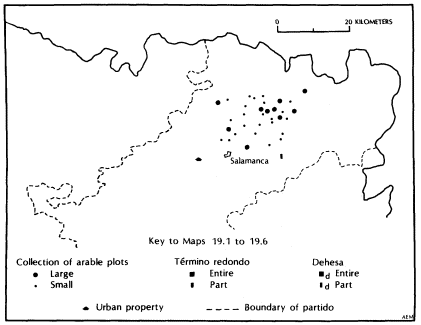
Map 19.1.
Purchases of Alonso y Moral, Merchant of Salamanca
the extent of his acquisitions: enough arable land to support a fair-sized town with thirty vecinos devoted to agriculture, perhaps six hundred to seven hundred hectares of prime wheat land and corresponding pastures for the plow teams.
He could not buy large blocks of land in the villages of Armuña, for land was owned in collections of small scattered plots, but he specialized in arable and made his purchases in a limited region. A circle twenty kilometers in diameter would include almost all of them, and within it, he concentrated on certain towns. Villaverde was one of these. In La Mata, on the other hand, he bought nothing, even though it was within the circle.
Only two purchases did not fit this pattern. In 1800 he bought a granary with an attached house and offices eight kilometers west of the city, outside the cirlce.52 It would be used in his business independently of his new holdings. The other exception was a portion of the despoblado of Chinín, southeast of Salamanca, purchased late in 1807.53 It came as
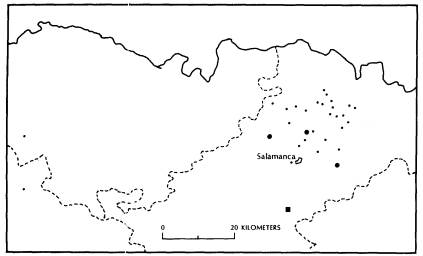
Map 19.2.
Purchases of Trespalacios, Advocate of Madrid and Salamanca
part of a sale that included land in two of his towns of Armuña and was his only purchase of an alquería or despoblado. He did not want to deal with large tenant farmers, preferring to concentrate on his established business as a grain merchant and on leasing to peasants in return for prime candeal wheat, where he could turn a pretty penny on their arrears, should the occasion arise. He was a man of affairs who knew the advantage of specialization.
He had his ear closer to the ground than the advocate, don Cosme Trespalacios. Living in Madrid, the latter made twelve purchases in Salamanca province between 1800 and 1803, and after he moved to Salamanca, another seven (Map 19.2). In all he spent 728,000 reales, about half what Alonso y Moral spent. Like Alonso, he preferred sets of arable plots that he could rent, especially in La Armuña, and he picked up some six hundred plots and nineteen meadows, two cortinas, and four houses. But he did not concentrate his purchases as much as Alonso; the towns in which he bought most heavily were not close to each other. His acquisitions also included a término redondo in the middle of the Charro district, about ninety hectares with a pasture of 250 live oak trees.54 He apparently did not have quite Alonso y Moral's sense of purpose.
Trespalacios's purchase of a término redondo follows, in fact, a dif-
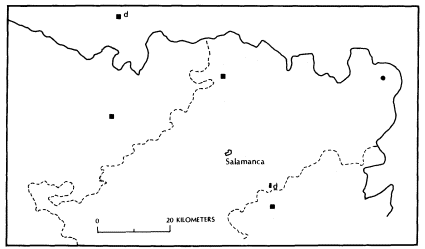
Map 19.3.
Purchases of Sánchez de Onís, Priest
ferent strategy evident among those purchasers who invested in these large properties. They chose to buy in widely different locations. Take the priest don Segundo Sánchez de Onís, who spent 1,408,000 reales, the largest sum in the province (Map 19.3). He bought three términos redondos in their entirety, one in the Cuarto de Armuña (SA), one in the partido of Alba de Tormes (SB), and one in the partido of Ledesma (SD); in addition he bought part of a dehesa in the cuarto of Peña de Rey (SB) and another in the province of Zamora.55 He also bought five sets of arable fields in Cantalapiedra, on the border of Valladolid province (SB).56 His holdings now stretched seventy kilometers east and west and perhaps fifty north and south, if indeed he made no other purchases outside Salamanca province. Unfortunately, none of the documents tell us where he lived.
Quite different people followed this pattern. The university professor don Antonio Reyrruard bought a término redondo in the partido of Ledesma (SD), arable fields in four towns of Armuña (including La Mata and Narros, SA), and a fourth interest in a dehesa in the partido of Alba de Tormes (SB), all forming a triangle about forty by thirty by
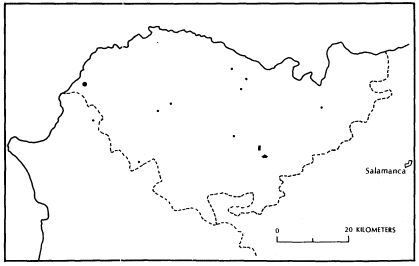
Map 19.4.
Purchases of Sánchez García
thirty kilometers, with Salamanca at the center.57 Don Francisco Sánchez García may have lived in the western part of the province, since he spread his purchases around the partido of Ledesma (SD and SE, Map 19.4). He bought a house in Santa María de Sando and a fifth interest in a nearby término redondo58 and added arable and enclosed cortinas in ten towns located sixty-three kilometers east and west and thirty-four north and south. A similar case, the Bilbao merchant don Martín de Ganá: in one purchase he acquired a number of grain fields in seven towns north, east, and south of Salamanca; in another a término redondo—a whole town with nearly three hundred inhabitants seventy-five kilometers to the west near Portugal; and finally in a third purchase more fields and a house in Salamanca.59 Was he planning to move to Salamanca? Perhaps, but for all we know, he was buying in other provinces too.
Unlike Alonso y Moral, these men were spreading their properties widely and buying both arable plots and great estates devoted in large
part to livestock. Twenty-three Level 4 buyers acquired despoblados, and twenty of them made more than one purchase. But of those twenty, only two bought nothing but despoblados, both of them women. One was the now-familiar widow Vélez y España. Besides her share of Pedrollén, she bought three other towns in their entirety. Although all in the Charro district, they formed a diamond twenty by thirty kilometers.60 The second was Doña Manuela de Onís, wife of the royal councillor, who bought two despoblados in the partido of Alba de Tormes. Other buyers of despoblados sought in addition all kinds of holdings, preferring arable fields, with houses, pastures, and irrigated plots coming only in package deals. We have seen that large buyers were not generally attracted by labor-intensive land or urban properties. Most wealthy investors sought diversity, especially geographic diversity, not homogeneity.
We may recall that peasants living in the towns of the partido of El Mirón, far enough away from Salamanca city to be beyond its economic control, also crossed their village boundaries in their purchases of land. Those in the valley of the Corneja river, where they could farm profitably, acquired pastures in the barren hills of El Mirón, not just for the oxen of their plow teams but for dozens and hundreds of sheep as well.
The strategy of these buyers, both big and modest, was not new. Religious institutions had scattered their holdings widely, as we can tell from a number of account books of convents and monasteries that have been preserved. The Salamanca convent of Santa Isabel of Observant Minorite nuns as of 1807 received in annual rent 817 fanegas of wheat and 34 fanegas of barley for fields in twenty-three towns spread over a region fifty kilometers from east to west and twenty-five north to south (zones SA, SB, and one town in SC).61 In 1800 the rents of the convent of Corpus Christi in Salamanca of the same order totaled 702 fanegas of wheat and 7 of minor crops. They came from twenty-nine places (two outside the province) stretching sixty-five kilometers in one direction and forty-five in the other (Map 19.5).62 The convent of La Concepción of the same order had concentrated its property more: in 1800 752 fanegas of wheat from twenty-one towns in a region thirty-five by twenty-five kilometers.63 In 1805–6 the Augustinian monks who ran the Colegio de Nuestra Señora de la Vega drew 1,367 fanegas of wheat and 162 of barley from twenty-three towns spread out fifty-five kilometers by
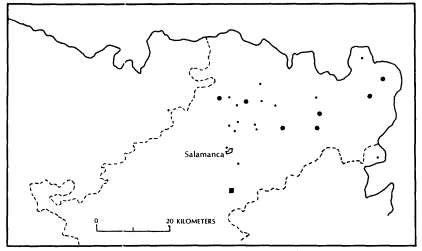
Map 19.5.
Properties of the Convent of Corpus Christi, Franciscan Nuns of Salamanca
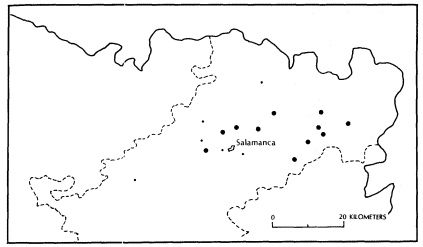
Map 19.6.
Properties of the Colegio de Nuestra Señora de la Vega,
Augustinian Monks of Salamanca
thirty (Map 19.6).64 The nuns of Saint Bernard, monastery of Nuestra Señora del Jesús, richer than any of the above, owned a number of despoblados as well as many arable fields. Their income in 1800 was 1,467 fanegas of wheat and 19,358 reales in cash (at 50 reales per fanega another 387 EFW), plus minor payments in chickens and straw, delivered from twenty-four places, eighty kilometers east to west and ninety north to south. Their property reached into Zamora, Toro, and Ávila provinces.65
It is true that religious foundations obtained much of their property through bequests, and the luck of the draw could determine where they would receive gifts. Yet the account books show that they occasionally bought and sold properties, so that their holdings were not absolutely frozen. Also they could encourage contributions that would fit their plans. They had a clear preference for properties that they could rent for a return in grain, a commodity that could be consumed or easily marketed. Of this sample, only the monastery of Nuestra Señora del Jesús had wide holdings in pastures and despoblados that brought in cash. Religious institutions were not, of course, averse to owning despoblados and términos redondos. In the previous chapter we saw how many they had and how many were disentailed. But even though most of them liked to receive good, white candeal wheat, they liked to see it come in from a wide circle around Salamanca city. The new secular owners seem to have inherited their concept of estate building from the religious orders.
The great noble houses of Spain had also traditionally spread their holdings, sometimes across different regions of the peninsula. We saw that the Duque de Alba, or, in our time, the Duquesa de Alba, was señor of five partidos of Salamanca and had estates there. The duque also was largest landowner in five places in Andalusia and señor in nine others.66 The Duque de Medinaceli was the largest landowner in twenty-four towns located in three of the four provinces of Andalusia and had other estates hardly less notable in Catalonia and other parts of Spain. Just running this vast establishment kept thirty accountants busy in Madrid.67 The Duque de Medina Sidonia, the Duque del Infantado, the Du-
que de Osuna, and numerous more modest grandes and other titled aristocrats followed the same pattern to a greater or lesser extent.68
This study does not provide us with a map of a grande's estates, but we can observe some of the activities of a minor local titled aristocrat, don Antonio Rascón, Vizconde de Revilla y Barajas, vecino of Salamanca with a hereditary office of regidor. I do not have a list of his property prior to disentail, but it included at least one despoblado in the Charro district (SC), which he rented out.69 He exploited the disentail to acquire a portion of a término redondo in zone SD, arable fields in four towns north, south, and west of Salamanca city, a pasture in the foothills of the Sierra de la Peña de Francia in the south of the province, plus a number of properties unlocated in the deeds of deposit.70 Meanwhile he used his influence to obtain a lease—in perpetuity—for a vast pasture called Sierra Menor owned by the city and located on the northern slopes of the Sierra de la Peña de Francia. It contained 1,140 huebras (over 500 hectares), and the vizconde got it for only 1,140 reales a year.71 He would appear to have owned large herds in at least two parts of the province, for which he was acquiring extensive pastures through purchase and lease, while at the same time receiving rent in kind from arable plots located in many different places.
Whatever their status—clergymen, laymen, aristocrats, peasants, or religious institutions, local residents or absentees, old or new owners—they all followed a similar approach to landowning: spread your properties widely and hold various types of land. The pattern had its roots deep in the old regime and was still very much in force. According to the generally accepted explanation, no rational, or even irrational, economic planning lay behind the aristocratic practice of scattered estates. Critics have explained it by pointing to the institution of the mayorazgo, which was developed with the primary purpose of protecting future generations of a titled family from the ravages of a spendthrift heir and thus maintaining Spain's nobility from economic decline.72 When two heirs to mayorazgos married, their estates would be brought together in
the hands of succeeding generations, much as Charles V brought together his vast empire across the face of Europe. If royal marriage alliances produced dynastic monarchies, aristocratic marriages produced what might be called dynastic landholdings.
These vast estates have been roundly denounced. To read the economic history of Spain is to hear repeatedly the dirge that its grandes, who enjoyed their princely incomes without caring a fig for the condition of their estates or the suffering of their peasants, were over the centuries responsible for the low productivity of Spanish agriculture and the poverty of the countryside. Unable to live on more than a small portion of their estates, they gave up any attempt to be resident owners and escaped to Madrid, center of the royal court and of social intercourse with their peers, leaving their estates and their peasants to the mercies, neither tender nor enlightened, of their stewards.
Structurally one may well compare the aristocratic penchant for broadcasting their estates to the well-known feature of north European open-field farming, the scattered collections of strips worked by individual peasant households. Its inefficiency has also been frequently censured, both by eighteenth-century agricultural reformers like Arthur Young and by later economic historians. Scattered strips wasted the time of the peasants and their draft animals in unnecessary trips back and forth across their village fields and raised the cost of fencing to prohibitive levels even where local law and custom might have permitted enclosure. Recently, the economic historian Jan de Vries has compared the economic advantages of integrated peasant family farms to the disadvantages of exploitations consisting of scattered strips. In contrast to aristocratic entails, which are blamed for assembling excessively large holdings, the strip system, according to de Vries, led to unchecked distribution of the parcels among heirs and resulted in individual exploitations that could not engage the full labor of the owners or support their families.73 The arguments hold equally well for the irregular scattered plots of Castile.
Some people in Spain were aware of the arguments in favor of concentrated ownership. In 1803, one may recall, the king authorized owners of mayorazgos and other lay entails to sell their outlying holdings in order to purchase disentailed properties nearer their main estates, "to facilitate . . . the gathering of the scattered estates that belong to them, in which [possibility] they have so much interest because of the savings
in cost of administration and because of the advantage of being able to attend themselves to achieving the improvement of which the estates are capable, with great potential benefit to the public welfare from the advance and general development of agriculture."74 How many noble owners took advantage of this offer is not known. The example of the large Salamanca buyers suggests that very few were, like Alonso y Moral, convinced of the benefits of concentration.
Opportunity, of course, controlled to a certain extent what they could buy, but so many properties were going on sale that they could pick and choose, as Alonso y Moral did. The explanation lies not in constraint or even accident, but in conscious motivation. Their strategy implied little direct involvement with the farming of their lands. They did not intend to inspect their holdings in person or through their stewards, certainly not regularly. Instead they were happy to sign leases with tenants who took full charge of what went on in the fields and fulfilled the wishes of their landlords by presenting their rent in kind or in coin each year on the appointed day. Miguel Artola argues correctly that the policy of great owners of leasing their lands to others who carried out the direct exploitation was a rational economic decision when their properties were so dispersed that they were perforce absentee owners in most places.75 His implication is that the dispersal forced the policy on the owners. The example of the buyers in Salamanca indicates that the policy was accepted wisdom and governed the creation of estates, both great and small, rather than vice versa.
In an attempt to explain the enigma of why the system of scattered strips common to English villages was established in the Middle Ages and preserved long after the development of markets for agricultural products had shown the advantages of consolidation, Donald McCloskey has argued that farmers practiced it because it diminished the risk from natural disasters and consequent poor harvests. Scattered strips were an economically rational arrangement in an age that did not yet know crop insurance.76 Fifty years ago Marc Bloch reached much the same conclusion with reference to the pattern of scattered strips in France: "If the plots were dispersed . . . everyone had some hope of avoiding the full impact of the natural or human disasters—hailstorms, plant diseases, devastation—that might descend upon a place without
destroying it completely."77 In his study of the agrarian economy of early modern Poland, Witold Kula applies a similar explanation to the vast dispersed estates of the Polish nobility. While they created difficulties and expenses of administration, they provided a form of insurance from natural calamities and the destruction of war. Since most disasters would affect only part of the country at one time, the nobleman could use the product of his unscathed properties to rebuild those that had been devastated.78 A letter of Pliny the Younger written at the end of the first century after Christ reveals that the policy of distributing one's landholdings may be of very ancient origin. Debating whether to buy a fine rural estate contiguous to one he owned, and intermixed with it, which would provide the advantage of using the same agent for both, he reasoned, "I don't know whether it is prudent to venture so much of one's property under the same climate, and to the same casualties; it seems a more sure method of guarding against the caprices of fortune, to distribute one's possessions into different situations."79
Spanish society of the old regime was permeated with a timeless folk wisdom that admonished anyone who looked to the land for his income not to put all his eggs in one basket. Scattered aristocratic estates dominated Spain at the national level, and scattered plots dominated the grain districts of Castile at the village level. In between, ecclesiastical owners and big buyers dispersed their holdings throughout their regions. Glorified peasants, they turned the plains around Salamanca into a vast three-field system. The mentality that preferred dispersal ran the social gamut from top to bottom. Scattered plots were not the creation of peasants alone. Indeed, in most instances, the peasant rented his plots in a set from a larger owner, very likely a religious institution before disentail and an individual afterwards. In turn the predecessors of the current owners may have received them as a series of bequests or purchased them from peasants, with the actual origin of the dispersal being lost in time, in Spain as in northern Europe.
In a classic passage, Marc Bloch described how the medieval French lord in the process of substituting rent for labor dues from his serfs transformed himself from the manager of a business—an entrepreneur, if you will—into a stockholder in the land.80 Our wealthy Castilian buyers acted like the later medieval lords, but it would be a mistake to
see only the past in their behavior. Quite the contrary, they can be likened also to modern investors who spread their portfolios to hedge their bets. The rent these men received in fanegas of wheat or reales de vellón hardly differed from dividends on blue-chip stocks. While the harvest of the farmer rose and fell, the yield to the owner remained relatively fixed, depending only on the stability of the markets for grain and currency. The farmers had to come to Salamanca to sign the lease and to deliver the rent; transactions costs were minimal for the owner. Theirs was a strategy of investors, not managers.
6
Dispersal had its limits, however, as our maps indicate. The religious institutions had established the economic control of Salamanca city over the surrounding plains, and the new buyers, with rare exceptions, stayed within this orbit. Political administration appears to have reinforced transportation networks and the markets in determining the shape of different ecconomic regions. Don Francisco Sánchez García (Map 19.4) bought widely but kept within the partido of Ledesma. The peasants around El Mirón bought within their much smaller partido. An observation of Jaén province is eloquent in this respect, for here the acquisitions of the large buyers did not range as broadly as those of their Salamanca counterparts.
In Jaén province 744 people made more than one purchase in the disentail. Of these, the Madrid records give evidence of only 37 (5 percent) buying in more than one town. They included only 19 (13 percent) of the Level 4 buyers. These documents state the location of properties for only half the sales;81 nevertheless, it is clear that buying across town lines was the exception, not the rule. Furthermore, almost all those who bought in more than one place acquired property in adjacent towns, usually centering on a cabeza de partido. Ten bought in Jaén city and adjoining towns such as La Guardia and Los Villares, 6 in Baeza and its neighboring towns, 3 in Andújar and places adjacent. Cazorla was another such regional center although not a cabeza de partido. It dominated the southeastern corner of the province and had 4 such buyers. When the residence of the buyer is known, in all but one case it is the leading town. Jaén province, in other words, appears to have been made up of a collection of small local economies through which some buyers,
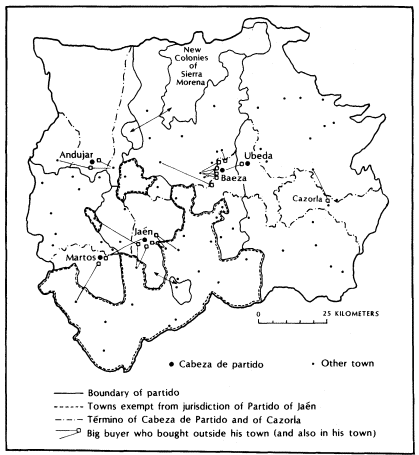
Map 19.7.
Jaén Province, Purchases Across Town Lines
but a definite minority, spread their purchases (Map 19.7). Or rather, in view of what we learned in Part 2, each municipality that produced olive oil was an economic unit tied directly into the national market rather than dependent on a regional intermediary. This economic decentralization can explain why Jaén city had a much smaller proportion of the province's big buyers than Salamanca city did. Indeed, the buyers were more locally oriented than the religious institutions, for the lands bought by an individual in a single town often belonged to institutions located in various towns. The institutions, in accepting bequests, had taken them from farther and wider than the new buyers cared to.
Only eight individuals bought in markedly different parts of the province, and then only one or two purchases would be separated from their main concentration. Don Joaquín Muñoz, a Level 4 buyer from Martos, made eight purchases in his own town, arable fields, two olive groves, and a house, and he also bought two olive groves in Jaén.82 Don Juan Torralba, a Level 3 buyer of Ubeda, bought four sizable fields, several houses, and a baker's oven in his city and one large field in Jaén.83 But compare these rare cases to don Juan Pablo Casanova, a Level 4 buyer of Jaén, with twenty-seven purchases for 357,000 reales. Eighteen are located in the adjoining town of La Guardia, an olive grove in Pegalajar, also adjoining, and three in Jaén itself (the rest are unlocated). A similar figure was don Ignacio Pérez de Vargas, vecino of Andújar, one of the leading buyers in the province, who made thirty purchases and spent 830,000 reales. Eleven of his purchases are stated to be in Andújar, three in Villanueva de la Reyna, and four in Marmolejo, adjoining towns in the rich basin of the Guadalquivir. His purchases in Andújar were mostly arable, with some olive groves; those in the other towns were only olive groves and one vineyard. We saw in Part 2 that nonresidents preferred olive groves to arable because of the ease of administration. Pérez de Vargas followed this path. Even these men were rare. A more common figure was don Cristóbal Jurado y Vargas of Ubeda. A Level 4 buyer, he made fourteen purchases, all apparently in Ubeda.84 Juan Francisco Nebrera, vecino of Baeza and Level 4, made twenty-three purchases, all apparently in Baeza.85 And many others like them.
The records used for this study do not identify the locations of the properties within the boundaries of the towns, and a search through the original deeds of sale, which could produce such information, was beyond the resources of this study. The términos of the towns of Andalusia are much more extensive than those of Salamanca. That of Jaén was the largest in Andalusia,86 about twenty-five by twenty kilometers at its widest points (leaving out the mountains behind it). Adding La Guardia and Pegalajar, where Casanova bought, one obtains a region some
twenty-five by twenty-seven kilometers. The fertile part of Ubeda is about twenty-five by eighteen kilometers (it has a tail of virtual desert stretching south fifteen kilometers more). The group of towns centering on Baeza measures twenty-three by twenty-eight kilometers, those of Cazorla, twenty-four by eighteen (omitting the Sierra de Cazorla to the east). These are all, however, extreme limits of the términos, and in the eighteenth century the cultivated areas were much smaller. The large buyers no doubt scattered their purchases within the cultivated zones of their towns, but almost all kept them within clearly defined geographic and economic units that centered on nucleated settlements. In Salamanca purchases were spread over regions stretching two or three times more each way, and many villages could lie between the properties of a single buyer.
The villages of the wide plains of Salamanca were economically dependent on the provincial capital, whereas Jaén city had much less impact on the units politically under it. Although this difference can be associated with the distinct buying patterns, one has the impression that the Jaén buyers, many of them already local landowners, saw themselves as managers rather than investors. They may well have intended to oversee the actual farming more than the religious institutions whose place they took. Chapter 16 showed us that Jaén province had been expanding its olive groves and commercializing its agriculture for many decades, and its landowning class was aware of the potential for further growth. Purchasers, especially large purchasers, would have a more-than-average share of this awareness. Desamortización provided an opportunity to accelerate the development of Jaén agriculture.
The last chapter showed that it hastened commercialization in Salamanca, but here it was through buyers who were not prone to management, and almost in spite of them. The commercialization of the countryside progressed in the nineteenth century in the términos redondos, despoblados that became cattle ranches devoted to the production of meat. Their owners planted them with live oaks, surrounded them with stone walls, and produced the magnificent estates visible today. Arable farming on small plots became a less attractive investment, as the growing population of the villages pressed more and more against the limits of production. By the end of the century, the absentee owners had sold off the plots to the peasants, no doubt seeking to transfer their capital to more obvious growth sectors. Thus, ironically, Alonso y Moral, the one buyer with a clear sense of commercial purpose, was setting out on a dead-end road in acquiring his thousand arable plots. The buyers with
the investor's mentality, who hedged their bets by purchasing both despoblados and scattered plots, found themselves on one main road even as the other led them nowhere. Commercial expansion would not hit the open-field villages until the parcellary concentration of the Franco era produced larger, economically viable holdings and state credit permitted a technological transformation: modern agricultural machinery, deep-well irrigation, and a smaller, more efficient labor force. Then sugar beets, soy beans, and sunflowers, modern commercial crops, would replace wheat, with its large component of subsistence consumption.
At the top level of buyers the disentail attracted the established elite of the old regime. Where these were men who already were experiencing the opportunities of a wider market, as in Jaén, disentail would be an impetus toward more rapid development. Where, as in Salamanca, the elite that produced the buyers looked on the land as an investment in a sure but stable source of income, the effect of disentail would be much less radical. New land was being put under the plow, as we have seen, but in the despoblados and términos redondos, not in the nucleated villages, which already cultivated all their land. Here was the growth sector, and here, later, would be the sector of development toward livestock, but the buying patterns of the purchasers of términos redondos show that they were not aware of the difference. The lesson came to later generations. Once again we see that disentail could act as a catalyst for change, but the changes it led to—agricultural as well as social— depended on existing conditions, one of which was the mentality of the people with money to invest in land.
Chapter XX—
Between Two Ages
On Friday evening, 18 March 1808, reports reached Madrid of rioting in Aranjuez and, on Saturday afternoon, of the discovery and arrest of Manuel Godoy, believed by large numbers of Spaniards to be the cause of their country's ills. The populace was already alarmed by news that French troops were approaching the capital after occupying various cities in the north of the country, reputedly on a mission to protect Spain from a possible British invasion. The news from Aranjuez drew a crowd to the palace of Godoy—today the ministry of war on the Plaza de Cibeles—which it entered and sacked, tossing into a huge bonfire his papers, paintings, and precious furniture. That evening, while Carlos IV was signing his abdication in Aranjuez, the crowd spread through Madrid, laying waste the houses of Godoy's relatives and supporters and those of royal officials to whom the public allocated a share of the blame for its suffering. These included the residences of Manuel Sixto Espinosa, director of the Consolidation Fund, and Miguel Cayetano Soler, secretary of hacienda.
No one was more responsible than Soler for the desamortización carried out by Carlos IV. He had been named secretary of hacienda in the dark spring of 1798, replacing the much-heralded Francisco de Saavedra, who in his few months in office had failed to restore the royal credit. Soler it was who convinced the king to sign the decrees of 19 September 1798 that set disentail in motion, arguing that only this measure could save "the stability and very existence of the government." Soler then drew up the detailed instructions to carry out the sales, and during
the last ominous decade of the old regime, he held responsibility for royal finances, drawing upon himself opprobrium for the fiscal catastrophes and the attack on church property. The mob that sacked his house set out to find him. According to Godoy's memoirs, they encountered him leaving church after hearing mass, accompanied by a monk, and assassinated him. Such was the recompense of the angry citizens of Madrid for his struggle to save the king's credit and reform the property structure of Spain, the only mortal atonement they exacted in these days of rioting.1
Next to their desire to obtain recognition of the accession of Fernando VII at home and abroad and their concern over the presence in Spain of Napoleon's forces, the fiscal crisis was the most immediate worry of the young king's advisers. They sought to cast the blame for it on the administration of the Consolidation Fund. On 22 March a royal order closed the fund and placed its affairs in the hands of the Council of Castile.2 At this news, the opponents of desamortización spread the report that Fernando VII had stopped the sale of ecclesiastical properties. This was but wishful thinking, for the new king needed this source of funds as desperately as his father had. On 12 April the Council of Castile published a letter discrediting the rumor and informing the public that "the sale of secularized ecclesiastical properties and the other affairs and taxes of Consolidation will continue as heretofore."3
The state of Spain's finances goes far to explain the decision of Napoleon to intervene directly in the struggle to determine who would rule the country. He induced Fernando VII to come to him at Bayonne, in southwest France, and there on 6 May forced him to return the crown of Spain to his father:, who ceded it to the French emperor. Napoleon in turn bestowed it on his brother Joseph and sent him off to Madrid to occupy his new throne.
In the face of the popular revolt that greeted his accession, Joseph Bonaparte sought to institute policies that would save his crown. Among
these, he proposed to continue disentail under the laws promulgated by Carlos IV. He also extended the process to the properties of other owners, notably the religious orders, the military orders, and the Inquisition, all of which were abolished, and the properties of the Spanish grandes who were supporting the popular rising against him. He converted these forms of wealth into "national properties," copying a French term that Carlos IV had not used. Compared to the tremendous mass now available for disentail, Joseph's government was able to sell little, even in the provinces that it controlled, and what it did sell went at low prices for vales reales or equally discredited cédulas hipotecarias, which Joseph issued. The properties were disposed of without auction, largely to members of his government, French army officers, and some individuals who sought to curry favor with his regime. This was one desamortización that had little permanent effect. On his return in 1814 after the defeat of Napoleon, Fernando VII annulled Joseph's sales, while most buyers fled the country to escape reprisals.4
In contrast to Joseph, the supporters of Fernando at the outset of the war made the end of disentail one of their priorities. The rising in La Coruña on 30 May 1808 led to the creation of a provincial junta of Galicia, which met for the first time on 5 June. The next day its first act was to ask for contributions from the clergy and wealthy laymen and to stop the sale of ecclesiastical properties, "in view of the generosity of their owners."5 We do not know if juntas that headed the uprising in other provinces also suspended the disentail. On 25 September the Supreme Central Junta, composed of deputies of the provincial juntas, came together in Aranjuez. One of its most anguishing problems was to find money to supply the Spanish armies and maintain the state apparatus. Yet its early decrees included one, of 16 November 1808, that suspended the sale of all ecclesiastical properties covered by the decrees of 1798 and the papal bull of 1806.6 Thus the lines were drawn. Joseph Bonaparte would use the wealth of the church to save the credit of the state; the Central Junta, in the name of Fernando VII, would protect the church against further plunder.
Some Spaniards were not satisfied with the end of disentail and wanted to recover what had been sold under Carlos IV. Their efforts lasted almost ten years but proved futile. The decree of the Central
Junta of 16 November 1808 nullified the sales paid for in vales reales for which a notary had not yet issued the deed of sale. Two months later, however, the junta had to revoke this very modest concession because experience had revealed that the vales reales in question had already been spent for the needs of the state and "ultimately because it would compromise the public faith and the reputation of the sovereign, who has declared these sales inviolable."7
Facing continued defeats by French troops, the Central Junta in January 1810 convoked a meeting of the Cortes of the nation and then disbanded. The Cortes met at Cádiz in September. The opponents of disentail now turned to them for help. A small book addressed to the Cortes by Juan de la Reguera Valdelomar, a judge of the Chancery of Granada, voiced their sense of outrage at the measures of Carlos IV. He titled it Petitions for the Redress of Grievances Inflicted in the Fatal Reign of Carlos IV Directed to the Spanish Nation Assembled in General Cortes. Reguera asked the Cortes to annul the sales of properties of obras pías, hospitals, the Jesuits, other ecclesiastical bodies, and the Colegios Mayores, as well as family entails. Such an act would mark "the happy beginning of the nation restored through its meeting in general cortes" and would undo the ravages emanating from the decrees of 19 September 1798, "fateful day, harbinger of the ruin of Spain, which disguised tyranny under the mask of sovereign authority and hid the face of greed behind the cape of the general good. . . . Cruel day on which the pitiful poor, healthy and ill, were despoiled of all the comforts ministered by the charity of their brothers. . . . Sacrilegious day, on which the largest part of the property and the income of the churches was usurped."8
The Cortes of Cádiz, dominated by the spiritual heirs of the reformers of Carlos III's day, turned a deaf ear to such petitions. On the contrary, the Liberals of Cádiz talked of renewing the disentail, despite its association in the public mind with Godoy and Joseph Bonaparte. They voted to guarantee the national debt, both the part inherited from the old regime and the part occasioned by the war against Napoleon, with the sale of the "national properties" (copying Joseph Bonaparte's term). They did not carry over the legislation of Carlos IV but limited the backing for the debt to estates of partisans of Joseph, of the military orders, of the crown not used as residences by the royal family, and of any monasteries and convents that the war would leave permanently closed.9 The
Cortes took a markedly different position on a problem involving municipal lands, the bienes de propios, which were rented out as a source of municipal income. From the beginning of the war, a number of villages and towns had sold propios to cover the exactions that French and Spanish armies had levied on them or for other urgent expenses.10 In an attempt to bring order to this process, the Cortes decreed that all propios should become private property, half being sold to pay public debts occasioned by the war, the other half being given in small lots to persons who had contributed to the war effort, whether as soldiers or otherwise, and to other landless vecinos.11
The Cortes had not time to put its disentail into effect, and on his return at the end of the war Fernando VII declared all its legislation null and void. Under his restoration, the enemies of desamortización renewed their efforts to get the sales of Carlos IV annulled. Some former owners asked to have returned the estates that had been sold on time payments, whose payment had not been concluded before the French invasion. After careful consideration of the entire question, however, the Council of Castile advised the king to approve these sales if the purchasers would make full payment promptly. The council held as a general rule that "the maintenance of the sales of ecclesiastical estates and those of obras pías carried out according to the relevant royal cédulas was a matter of strict justice, and many would be the difficulties and evils that must follow from adopting any other measure." The king proclaimed the opinion as royal policy in a cédula of 10 March 1817.12 The decision of Fernando VII to uphold the disentail carried out under his father closed the question.
The story of desamortización had only begun, however. Fernando himself ordered the sale of baldíos to pay the royal debt.13 The brief Liberal regime established by the Revolution of 1820 put on the block the property of monasteries and the military orders, but Fernando once again canceled the sales that it effected, when the army of the king of France restored him to full authority, although purchasers succeeded in recovering their acquisitions after his death.14 The first Carlist War that
followed the accession of his daughter Isabel II in 1833 brought a renewal of disentail on a large scale. Many conservative clergymen supported Fernando's brother don Carlos in his claim to the crown, and partly in retaliation for their position, the Liberals who controlled Isabel's government decreed on 8 March 1836 that the properties of all religious orders, male and female, would be sold at auction and the proceeds applied to paying the national debt. (Male orders were closed at this time and female orders a year later.) On 29 July 1837 the desamortización was extended to the properties of parishes and bishoprics except for buildings used for religious services, although the execution of this decree did not begin until 1841.15 In 1836 the Liberals also abolished the entail of noble and other private estates. Henceforth all family properties could be divided up among the heirs or sold if the owner desired.16 The author of the laws of 1836 and 1837 was Juan Álvarez Mendizábal, a banker from Cádiz who had long been resident in England. Credit for initiating the process of ecclesiastical disentail has traditionally been assigned to him—erroneously since the ill-fated Soler deserves it—and his name has since been infamous among Spaniards devoted to the church.
In 1839 the Carlist War ended, and the more conservative Moderado party that captured the government in 1844 revoked the laws of Mendizábal, although it permitted sales to continue at a slower pace. The last and most decisive stage of desamortización began after the Revolution of 1854. The law of 1 May 1855, named after Pascual Madoz, the deputy who proposed it, provided again for the sale of church properties and introduced the sale of municipal properties on a national scale, except those that were actually used by the vecinos in common, and of certain other public properties.17 Under the Madoz law, disentail continued until the twentieth century. Local studies indicate that in some places more property was sold during the peaceful and conservative regime that followed the Restoration of 1876 than during all the preceding period.18
It is not possible at present to say how much land was sold and it
probably never will be, but one can hazard a rough approximation. In the middle of the eighteenth century, the church owned land in the kingdom of Castile that produced about 20 percent of the total income from farming and pasturage.19 The ecclesiastical properties were almost all sold, and their total sale price was about two-thirds of the total price of all properties disposed of by desamortización in the nineteenth century.20 Thus one can estimate that roughly 30 percent of all the land of Castile (measured by the value of its annual product at the time of sale, not its area or economic potential) changed hands as a result of the process of disentail. One can only guess that a similar proportion of the land in the rest of Spain was also involved.
By the end of the century many Spaniards considered what had occurred a national disaster. Especially those who were critical of the social and political structure of the country blamed desamortización for much of what had gone wrong. One such person was Joaquín Costa, the prominent enemy of the oligarchic government that ruled Spain after 1876 and critic of the agrarian philosophy of Jovellanos whom we met in Chapter 2. Strongly influenced by the American reformer Henry George, he believed that the only basis for a successful democratic revolution in the nineteenth century would have been an egalitarian distribution of the land, achieved by a division of the properties in entail among farmers under permanent leases. The only good measure he could identify in the whole process was the law of 1813 of the Cortes of Cádiz, "which called all citizens to the enjoyment of the land." Its failure "involved the failure of the entire revolution."21
From the other end of the political spectrum, Marcelino Menéndez Pelayo, eloquent defender of the role of Catholicism in the history of the country, denounced the motives behind desamortización and its effects:
The church lost, but the state gained nothing. In the last analysis the only ones who have benefited are not the Spanish farmers and landowners but a profiteering horde of speculators and gamblers on the market. Lacking the generous feeling of the former owners and interested only in despoiling the land they have seized, they have done nothing to ameliorate the decline, the backwardness, and the poverty of the tenants. Instead, with the passage of time, they have called into being in the pastures of Extremadura and the
fields of Andalusia the terrible specter of what is known as "the social question," never before visible in Spain even in the distance.22
The judgment that disentail was nothing but a vast political maneuver that crushed the peasantry so that an unprincipled mob of speculators might wax rich became a commonplace among succeeding generations of Spaniards. According to the accepted view, Spain lost its chance for a true agrarian reform and instead was saddled with the later problems of the countryside. Despite the intentions of Spanish liberals, desamortización accentuated social inequality, making large properties larger and reducing the peasants to hungry laborers.23 The English historian Gerald Brenan further darkened the picture. In his classic work, The Spanish Labyrinth, he observed another consequence: by taking away the property of the church the liberals deprived it of economic independence. The clergy found itself forced to turn for support to the powerful sectors of society, thereby abandoning the lower classes to the prophets of anarchism and violent revolution.24
With the progress of historical writing, Menéndez Pelayo's profiteering horde of speculators, founders of the new Spain, was baptized with the more familiar name of bourgeoisie. The father of the contemporary Spanish historical school, Jaime Vicens Vives, described desamortización as "the political measure imposed by the bourgeois revolution."25 More recently, Francisco Tomás y Valiente, in his history of the legislation affecting disentail, concludes: "All of them [the projects to divide land among the poor] failed, and the only one that prospered was the one that most suited the interests of the bourgeoisie, which in this way consumed its revolution by means of the desamortización."26 This widely accepted interpretation of Spain's nineteenth-century disentail thus not only preserves the vision of it as a national disaster—the failure of a democratic revolution—but incorporates it into a general pattern of modern history: Spain, like other Western countries in modern times, passed from a feudal-agrarian stage to a bourgeois-capitalist one. The bourgeois revolution in Spain took place in the nineteenth century. Because the triumph of capitalism is based on the freedom of exchange of
the factors of production and the rights of private property, its achievement in Spain involved the liquidation of communal farming practices and the entail of landed estates. The bourgeoisie effected the desamortización and profited from it at the expense of both the old landowning class and the peasantry. Such is this account.
2
For over two decades, historians of modern Europe have been challenging the simple interpretation of the nineteenth century as the age of bourgeois triumph. Antonio Gramsci perhaps deserves credit for discovering, in his meditations in a prison of Mussolini, that the bourgeoisie, rather than draw the other sectors of society into a conflict with the traditional landowning estate, joined with the older ruling class to dominate the new parliamentary political structure; but he believed that this was a peculiar Italian phenomenon, a betrayal of the bourgeois role exemplified in the French Revolution.27 It fell to the English historian Alfred Cobban to deny that the French Revolution itself, that archetype of modern upheavals, resulted from the ascent of a specific bourgeois class based on a new form of economic activity and that it brought such a class to power.28 Nor, his colleague F. M. L. Thompson has argued, did the industrial revolution produce the political and social triumph of the bourgeoisie even in England, that most advanced of countries, at least not before the end of the century.29 Since the 1960s, many historians have further discredited the accepted view of a nineteenth-century bourgeois revolution, substituting a picture of the continuing empire of an older aristocratic class both socially and politically, even where industry was replacing agriculture as the leading economic sector. Still in awe of courts and titles, new industrialists and moneyed merchants deferred to the dominant social stratum, mimicked its attachment to the land, welcomed the brides it proffered, and ultimately rejoiced in the legitimation of titles of their own. Rather than a victorious struggle of capitalist class against feudal, the nineteenth century witnessed the embrace of the new bourgeois by the old aristocrats.30
The present study indicates that a similar critical rethinking of the Spanish case is in order, for it does not support the contention that desamortización was the idea and the instrument of a new bourgeoisie. The spirit that conceived the measure, which inspired Jovellanos and Soler and before them Campomanes and Olavide, was a desire to serve their monarch and people. Some historians have seen in Jovellanos an agent of the rising bourgeoisie, but the process by which he reached his famous Informe de ley agraria, which popularized the idea of economic freedom in property relations, involved a logical development of ideas on political economy. Class interests did not motivate the reformers, except insofar as their conception of the evils of entail led them to criticize a legal institution that, while available to all classes, was manifested most prominently by titled aristocrats and ecclesiastical bodies.
The characteristics of the buyers do not support the accepted interpretation either. The buyers appear to fall into three distinct categories, distinguished by the source of their wealth and their position within the economic structure. Among the biggest purchasers in the regions studied, those who held positions within church and state are conspicuous. The two largest buyers in La Mata, that prosperous village in the Armuña district of Salamanca, were a military officer resident in Madrid and a prebendary of the cathedral of Salamanca. In the neighboring Villaverde, the same prebendary and an advocate living in Madrid until he moved to Salamanca in 1803 were the second and third buyers. The person who acquired the 60-percent interest in the despoblado of Pedrollén was the widow of a regidor of Salamanca city. The story in the towns of Jaén is much the same. In Baños the largest purchaser (he bought over a quarter of the properties sold) was a member of the royal Council of Hacienda, resident in Madrid; in Lopera it was a lieutenant colonel in the army, who lived in Córdoba. Analysis of the big buyers in the two provinces validates the finding.31 One of the top purchasers in Salamanca was the enemy of Godoy and Jovellanos, the man who displaced the latter as secretary of grace and justice, José Antonio Caballero. Of the vecinos of Salamainca city who were among this group in their province, over one-third were members of the clergy or the university faculty or held state or municipal offices (Table 19.2). The information on Jaén
is less complete, but we found that of the big buyers who resided in the provincial capital whose position is identified, 60 percent were associated with the church, the state, or the municipality (they were a third of all the big buyers living in that city, including those whose occupation is unknown [Table 19.3]). There is no assurance, of course, that the funds these individuals used to make their purchases came primarily from their positions; they may have been independently wealthy. No doubt some of them were, especially among the clergy, as we found in our Andalusian towns, but enough such persons appear among the leading purchasers to conclude that for many of them their incorporation into church or state provided the wherewithal for their acquisitions.
They reveal an important feature of the economy of old-regime Spain. A major portion of the gross national product flowed into the coffers of the monarchy and the church, from taxes, tariffs, and tithes (of the tithes, the tercias reales went to the king, where he had not given them away) and in the case of the church also from rents and seigneurial dues. The transference of this flow to the royal bureaucracy and armed forces and to the members of the clergy and other ecclesiastical employees was a major factor in the national economy. Madrid flourished out of this redistribution of income, while the city produced few tangible products in return, as David Ringrose has demonstrated.32 The impact of this administered economic flow accounted also for the prominence of state and church officials among our buyers. To judge from our cases, state and church were more powerful forces than commerce or industry in allocating the national product to individuals, for the only merchant we have found purchasing on a national scale was don Martín de Ganá of Bilbao, who was a major buyer in Salamanca, with purchases spread seventy-five kilometers across the province.33 The monarchy, the church, and to a lesser extent, local government gave the economy of old-regime Spain the peculiar characteristic of redistributing wealth to persons who were not engaged in production or distribution of either agricultural or manufactured goods. This redistribution was justified mainly by services of an administrative, military, or religious nature. It did not take the form of social services, as in a modern welfare state, although the church and its foundations imparted charity and the crown gave some aid to the victims of natural disasters. Redistribution benefited not the needy but those who were—or whose official position
made them—a wealthy sector. The first category of buyers is thus the beneficiaries of the old-regime redistributive economy.
The other two major categories of buyers represent the two poles of the dual agricultural economy that existed in the two provinces under study. At one extreme were the local and regional notables, who drew income out of the marketing of products of the soil and livestock and took the opportunity of disentail to extend their estates or move directly into ownership. At the other extreme were those who labored in the fields and directed their harvests primarily to local consumption, although their tithes and rents reached the wider market, usually through the hands of the notables. The wealth of both these groups came from agriculture, which was the most productive economic activity in Spain. Agricultural prosperity strengthened the ability of both groups to respond to the opportunity of disentail. The second group, those who labored in the fields, however, faced the combined Malthusian and Ricardian trap, the fact that more mouths or higher rents were always a potential, if not an actual, threat to consume any addition to their output. The success of their response to disentail depended in large part on their particular stage of the Malthusian and Ricardian cycles.34
Although they did not produce the goods with their own hands, the notables acted as a hinge between the people who did the work of farming and the outside world. They included the leading landowners and their administrators and those men who otherwise dealt in the products of the soil. It would require a tedious investigation into notarial records, of which this study has only scratched the surface, to come close to identifying all the buyers who were landowners, but we have seen good evidence that landowners were a major portion of the more important buyers. In Salamanca province there was a strong positive correlation between outside ownership and the proportion of disentailed properties bought by outsiders (Figure 17.2), and outsiders on the whole were far bigger buyers than local ones. This is not proof that the outside buyers were already owners, but it does suggest that their wealth came out of agriculture, and undoubtedly many of them were already owners. In Jaén the records of notaries and registers of real estate show that a number of purchasers served as administrators of estates or were engaged in the farming of royal taxes and ecclesiastical revenues.35 Many of them were landowners too, for they guaranteed the fulfillment of their contracts with their own real property as collateral. And where the notables
were not owners, agriculture formed the ultimate source of their income. This was true also of merchants, like don Francisco Alonso y Moral of Salamanca, whose wealth came from dealing in grain and hides.
The notables included the local oligarchies or elites. Many, if not most, of them were entitled to the honorific don before their given names. Heading them were the hidalgos of Old and New Castile and Andalusia (where hidalgos were fewer than in the north), like the petty oligarchs of Baños and Lopera. Among them would be the poderosos, those villains who peopled the complaints directed to the Council of Castile in the days of Carlos III,36 but they were a more numerous group than the poderosos. Surprisingly few titled aristocrats have appeared among the buyers. It is likely that some used agents, whose names appear on the deeds of deposit recorded in Madrid in place of the true buyer, but this cannot be the full explanation. Titled aristocrats do not appear to have shared the land hunger of the layers just beneath them, perhaps because of their already extensive holdings.
The local clergy also belong among the notables, in terms of social status and economic position, even though they owed most of their wealth to the redistributive economy of the church. The income from tithes and from the properties belonging to the capellanías and benefices placed even the curates of villages like La Mata, Villaverde, and El Mirón on a higher plane than the body of their parishioners; and in Jaén many priests belonged by blood to the notability. In fact, members of the secular clergy were expected to have property of their own, for the catastro of midcentury divided real property into three categories: secular, ecclesiastical, and eclesiástico patrimonial, the private possessions of individual clergymen. We found one priest of Baños who had to produce real property as collateral before he was entrusted with the administration of the estates of his capellanía.37 Our towns in Jaén do not confirm Gerald Brenan's belief that the clergy of Spain was close to the common people until desamortización deprived its members of independent income and forced them into an alliance with the upper class. Desamortización, if anything, by depriving clergymen of the source of their fat emoluments, discouraged the scions of wealthy families from entering the church and brought the priests closer to the common people.
Some of the lay notables had found their way to the trough of the church or monarchy in the contracts they obtained to farm tithes and
taxes; but the wealth of this group came primarily from the market of agricultural products. A market economy had existed for centuries in foodstuffs—no urban community is possible without it—and it was expanding in the eighteenth century because of demographic and urban growth. As Marx recognized long ago, the first large English capitalists, those who made profits from their capital investments and the labor of others, were landowners.38 Across the Channel, in Marc Bloch's forceful words, "In France, as in England, it was agriculture rather than industry that first provided a platform on which capitalism (for want of a better word) could display the disingenuous illusions and cruelty of its admirable and creative genius, decked out in the naivete of youth."39 The analysis applies at least as well to Spain and certainly to Castile, because of the central role of agriculture in its economy.
Even though the notables whom we have encountered were capitalists, most of them were not entrepreneurs. They followed the practice of aristocratic houses and large religious establishments of not concentrating their holdings. This was especially true of the large buyers in Salamanca, who spread their purchases so widely that there was no way they could manage them directly or ask an administrator to visit them regularly. The Salamanca merchant Alonso y Moral was an exception, for he demonstrated an appreciation of the benefits of specialization, limiting his purchases to arable fields in specific towns of La Armuña. This does not mean that the other large buyers did not respond to demands of the market or to changing relative costs of the factors of production. Owners of despoblados at the end of the century leased part of their pastures to nearby labradores to be broken for grain harvests. In Jaén, unlike Salamanca, many large buyers took a direct role in managing their holdings. Their society had long been familiar with cortijos and olive groves, estates whose production was oriented to the market and required a relatively low labor input, and they preferred to acquire these properties. Aware of the commercial potential in olive oil, landowners were busy turning grain fields into olive groves, even though this meant they sacrificed ten or more years' income from the land. But where there was no demonstrated gain to be achieved from new uses of the land, the notables let the peasants follow accepted practices and took their profits in the form of rent.
The third category of buyers was found mainly among those who spent small amounts of money. They came out of the sector that was
personally engaged in tilling the land and raising the livestock and providing the products consumed locally. Most of them were called, and have been called here, labradores. The category also included some market gardeners (hortelanos), who, like the labradores, were independent farmers, and a few hired hands and animal herders, who worked for wages and their keep. We can think of them collectively as the peasantry, although this study has used the term sparingly. They also produced for the market, either because they paid tithes and rent in kind, which was later marketed, or because they had to sell their own products in order to make these payments in money. Some were engaged in commercial agriculture for their own account, such as the wealthy labradores of the Armuña villages, the tenant farmer of Pedrollén, and the owners of large flocks of sheep in the sierra town of El Mirón. The socioeconomic pyramids of the various towns reveal that the more successful of these men had net incomes not far off those of the rank-and-file notables of Jaén. Their share of the purchases of disentailed properties increased directly as the distance of their towns from urban centers. They dominated the process in the partido of El Mirón and in the out-of-the-way Andalusian town of Navas.
Because they counted on their own labor to produce their harvests, they acted differently when they bought. Naturally they could not buy Andalusian cortijos, despoblados of Salamanca, or large collections of arable plots in La Armuña, but they welcomed announcements of small sets of arable plots and labor-intensive exploitations like irrigated huertas and cortinas. For these they were prepared to bid against each other until they paid in hard currency more than the assessed value, and this meant half as much again as the minimum bid allowed. They acted, in fact, in the classical way that the Russian economist A. V. Chayanov would predict, thinking of the product they would obtain and not the labor needed, for the labor of the family was not a variable input cost but an overhead. The food and clothing of the family members was roughly the same however much they worked. Not that the peasants were devoid of entrepreneurial spirit. In Navas, the small labradores were turning some of their grain fields into olive groves. In La Armuña they experimented regularly with different rotations, seeking what would return the most, and they were eager to take up new leases in nearby despoblados. Those who bought fields also managed to acquire leases to plots that their neighbors had been farming, thus doubly improving their station within the village economy.
These three categories do not exhaust the buyers. Some in La Ar-
muña were muleteers, toilers in the rural growth industry that has played a large role in our story, some in Jaén were bakers, others perhaps craftsmen. But the three categories identified above constitute the major sectors that responded to the offer of ecclesiastical lands. It is no coincidence that they also resemble the three groups that were distinguished by the different geographic extent over which they scattered their purchases.40 First are the buyers whom we found acquiring lands at considerable distance from their places of residence, such as the residents of Madrid who bought in Salamanca or Jaén. In spreading their purchases over a wide area, they mimicked on a modest scale the aristocratic houses, whose scions also resided in the royal capital. The demands of Madrid were creating an integrated market for agricultural products in Castile and Andalusia, and these buyers had learned how to exploit it. Most of the men whom we have met who fitted this description belong to the category of buyers who drew their wealth from the redistributive activity of the royal government as members of the royal bureaucracy or armed forces. Of course some men who bought on a national scale got their capital from elsewhere. Don Martín de Ganá, the Bilbao merchant was associated with the productive economy, although the documents do not say what he bought and sold.
Below the men with a national vision were the buyers who scattered their acquisitions within the limits of regional economies. They belong mostly to the second category of buyers identified above, the landowners and others engaged in the marketing of agricultural products. Here, we found, they had a precedent for their pattern of purchase in the distribution of properties of the large ecclesiastical institutions located in the provinces, widely scattered but limited to local economic regions. They were presumably responding to previously acquired familiarity with their province or partido.
Finally, the peasants limited their purchases to their own village and those around it, not only because they had less to spend, but because they had walked and worked here since childhood and could not now travel further afield to till the land. They replicated in their own hands the allotments of scattered plots they had previously rented, which had long formed the characteristic of arable agriculture in northern Castile, as in most of Spain and western Europe. They had little choice in the matter, of course, since this is how the exploitations existed and were put on the market. Most buyers at all three levels, I have argued, were
responding to an accepted wisdom that held that however rich one might be, one should spread one's possessions widely to minimize the risks from natural and other disasters.41
All three categories went back far in time, and none could be readily called a bourgeoisie, except for some of the merchants and administrators. The top two levels were clearly engaged in a market economy, and in this respect were capitalists. One may well ask, is this absence of a bourgeoisie from among the buyers not the effect of a specific situation of Spain during the last decades of the old regime? When the absolute monarchy had been destroyed by the War of Independence and the Liberal revolutions that followed, was not the later desamortización of Mendizábal and Madoz the means whereby the bourgeoisie came to power? After all, the historians and polemicists who have denounced desamortización for this achievement hardly knew about its beginning under Carlos IV, on which the above conclusions are based.
3
The vision of desamortización as the fulfillment of the bourgeois revolution was formulated before much active research on desamortización had been carried out. In recent decades it has become the favorite topic for investigation in the history of nineteenth-century Spain, itself an area of study that has opened up only in the last generation. A careful bibliography on desamortización made in 1981 found 12 titles between 1900 and 1959, 21 in the 1960s, and 135 in the 1970s, plus another 21 theses in progress.42 The influential Instituto de Estudios Fiscales of the ministry of hacienda supported conferences on the theme in 1977 and in 1982; in the latter seventy-nine papers were presented.43
This fascination with the subject has led to questioning of the role of the bourgeoisie as the prime mover of desamortización, although the interpretation still has its defenders.44 I have explored the issue before, proposing that, far from succumbing to a new bourgeois class, the Spanish landed elite in the nineteenth century maintained its economic
control over the countryside and political control over the central government.45 A summary of the arguments will place the present conclusions in better perspective.
The position in favor of desamortización as the instrument for a bourgeois revolution relies on two major arguments. The first amounts to a matter of definition. According to it, the bourgeoisie may be the same segment of society as the former "feudal" class; not its social origins or the origins of its wealth determine its identity but the way in which it exploits the economy. Antonio Miguel Bernal, who has worked extensively on conditions in the nineteenth-century Spanish countryside, explains the position in this way:
I really believe that this type of owners [the new and old Andalusian landowners of the nineteenth century who exploited the land to supply the domestic and foreign market] can be considered a "bourgeoisie" because their economic power is tied not so much to the direct ownership of the land as to the system of exploitation of the land. . . . The system of property does not matter as much as the fact that they hold economic decisions in their hands. . . . The control of production, the control of labor, political control are all in the hands of this group of exploiters of agriculture. I believe that these are three essential requirements for any bourgeois group.46
Effectively, this line of reasoning maintains that the dominant class in a capitalist economic system is a bourgeoisie, whatever its other characteristics may be. If the capitalist class and the bourgeoisie are defined as synonymous,47 then of course one need not raise the question whether capitalism was introduced by the rise of the bourgeoisie or vice versa. It does not help our understanding of what happened in history, and yet it is amazing how commonly the argument in favor of a nineteenth-century bourgeois revolution is reduced to this tautology. In the present case it is not even correct in its premises, because nobles under the old regime, both the hidalgos of Lopera and the titled aristocrats who owned cortijos in Navas, one of whom was its señor, controlled production, labor, and the local political power. The Spanish case supports those like Marx who find the origins of capitalism in the large landowners of the old regime.
The second basis for holding that desamortización formed part of a
bourgeois revolution is substantive, namely that research into specific regions has regularly found that a major portion of the rural properties were bought by residents of cities, such as provincial capitals and, above all, Madrid. Since these purchasers obviously did not till the soil themselves and furthermore did not have aristocratic titles (although many had the honorific don ), the authors class them as bourgeois. This conclusion begs the question of the provenance of the capital they used for their purchases, for if it came out of land they already owned, desamortización was not producing a new class but simply reinforcing an old one. This study has revealed how the increasing commercialization of agriculture under the old regime could produce the necessary savings.
In fact, on closer scrutiny, the mid-nineteenth-century process appears very similar to the one that had already taken place under Carlos IV. There continued to be three main types of buyers, those who bought on a national scale, among whom residents of Madrid predominated; those who lived in provincial cities and spread their purchases around local economic regions, centering on their cities; and the small rural owners and tenants, who bought in their towns and those adjoining, more numerous than the first two types although the total quantity of their purchases was less. The last group was more common in the north, where villages were small, and the share of the total sales that went to them increased in direct relation to the distance of their villages from urban centers. In general, the wider the area in which a buyer operated, the larger the properties he acquired. Although none of the studies explicitly develop this pattern, one can deduce from them that it approximates what happened at different times in Ciudad Real (New Castile),48 Alava (Basque Provinces),49 Navarre,50 Gerona and Barcelona (Catalonia),51 and Valencia.52
The studies just mentioned all deal with a limited period. For the par-
tido of Olmedo of Valladolid province, located to the northeast of Salamanca, Germán Rueda Hernanz has investigated the identity of the buyers of properties disentailed from 1821 to 1891, using not only the records of desamortización but lists of voters, taxpayers, and property owners.53 Almost all the local buyers he finds to be labradores, but they range from "potentates," relatively wealthy landowners living in the partido capital who bought hundreds of arable plots, down to tenant farmers who seized the opportunity to buy the plots they had been renting. The local buyers obtained 51 percent of the land sold (by area, not purchase price), and those of bordering rural areas another 10 percent. As one would predict from my findings for Salamanca, they bid very high for their purchases (two and three times the assessed value), especially the smaller buyers, and they took over 80 percent of the vineyards and irrigated horticultural plots, whereas they got less than their share of pastures and pine groves (a local specialty).
The rest of the buyers lived in the city of Valladolid or in Madrid. Buyers in the provincial capital were professional people, involved in law or politics, while of those in Madrid, we know only that some had moved there from Valladolid. A study of the province as a whole in the years 1836–53 shows that the more distant a region was from the city of Valladolid, the lower the share of land purchased by residents of the city. It would appear that, as in Salamanca, the urban residents, middle-range buyers, extended their purchases within an economic region that the city dominated, but little beyond it.54 Most of the buyers in Valladolid had disposed of their properties by 1879, and so had the buyers resident in Madrid. Rueda calls these people speculators and bourgeois, but he points out that they accounted for only 40 percent of the land and that the rest cf the beneficiaries were people directly engaged in agriculture.55
The nature of the persons who bought on a national scale, that is, outside their economic region, is of interest because it reveals whether they continued to rely on wealth redistributed by the church and state, as
at the end of the old regime. Some of the Madrid residents who bought in Navarre in the desamortización of Mendizábal were local people who had moved to the national capital as public servants or deputies, and others were high army officers, who may have become familiar with the region during the Carlist War. Their occupations suggest that their capital came from redistributed wealth or was of Navarrese origin.56 The role of Madrid residents increased as time went on and changed in nature.57 They were major purchasers in Ciudad Real after 1855, not only for resale but to keep and exploit, using local administrators.58 The most famous buyers were the Safont brothers, José and Manuel, members of a wealthy Catalan family now resident in Madrid, who acquired properties in the four Catalan provinces plus Madrid, Toledo, Segovia, Salamanca, Seville, and Mallorca.59 Evidently merchants, their activity shows that commerce and perhaps industry were beginning to challenge the state as sources of large wealth. But their brother Jaime, who bought land in various towns of Catalonia and houses in Madrid and Seville, was an administrator of ecclesiastical properties in Barcelona.60 Acting as agents and brokers in the purchase of disentailed properties became a recognized occupation, and speculation, that is, buying with the intention of reselling, took an increasing share of the sales. These activities centered in Madrid, in part because bidding on all major properties could be made there as well as in the provincial capitals.61
In the middle of the century enterprising Spaniards were exploiting a number of opportunities presented by the activities of the government: railroad shares, elegant suburbs called ensanches, mines, banks, and, no doubt, although we know little about it, military contracts. To make a business of buying and selling national properties, whether for oneself or for others, fitted naturally into the ethos of the period. Desamortización at its height was a different kettle of fish from what it had been at the end of the old regime, but then the Spain of Isabel II and the Moderado order, which brought together the old aristocratic landowning sector with newly enriched urban groups, was not the Spain of the en-
lightened Bourbons, who had tried, however unsuccessfully, to control the oligarchies in defense of the producing sectors and thus of the monarchy as a whole. And yet the original patterns of disentail held firm, with the mass of rural properties going to regional elites and village labradores, who got their wealth out of the land, directly or indirectly. If a glittering bourgeoisie was attracting the limelight at center stage, it was, at least in part, as a product of desamortización, rather than desamortización being its creation.
4
If desamortización was not brought on by a bourgeois revolution in Spain, how does one analyze its causation? The evolution of rural society in two provinces at the end of the old regime, which is the core of this book, provides some evidence on this score. The story told here began with the growth of population. Demographic expansion was common to eighteenth-century Europe. It probably resulted from the disappearance of the plague, increased agricultural output, more effective central governments, better communications, changes in the nature of warfare, and other developments that helped induce an economic revival of the Atlantic world. Higher birth rates and lower death rates were a natural response. Some of the demographic growth nevertheless remains unexplained by the obvious economic forces, for in Spain it took place not only in the periphery of the peninsula, already well integrated by maritime communications with the rest of the Atlantic world, but also in the central meseta, a region little affected by the developments just noted until the nineteenth century. Although historians will continue to seek explanations for the eighteenth-century beginning of the modern population explosion, for the purpose of analyzing the process that led to desamortización, demographic growth, whatever the reasons behind it, can be posited as an independent and underlying cause. This proposition should come as no surprise, for a number of historians in the past generation have singled out population as an independent or quasi-independent force in European history. The names of Walter Abel, Emmanuel Le Roy Ladurie, and Douglass North come to mind, among other.62
In the present Spanish case, demographic growth can be seen to cause at least two other kinds of developments. A first effect was to change the factor relations in agriculture, depressing the price of labor relative to land, while inducing a rise in the market prices for agricultural products. The result was to make land an attractive investment and encourage the expansion of commercially oriented agricultural production, which involved new uses of land: pasture to arable, arable to olive groves, and so on. Complaints had reached the Council of Castile from various parts of the peninsula about high rents, with accusations about the exorbitant demands of the poderosos who dominated the local economies, and we have found some support for the complaints in the accounts of religious institutions that owned land in the towns of Salamanca.
The desire for land led persons at all levels associated with agriculture to respond eagerly to disentail. The massive sale of ecclesiastical properties under Carlos IV's decrees of 1798 is proof of the widespread desire for land. By 1805 the Consolidation Fund, in charge of the sales, was running out of the properties first designated for disposal and had to turn to those of hospitals, asylums, and similar charitable foundations, originally exempted from the process. Another example of the land hunger is the success of the buyers of the lands in defending their purchases against attempts to annul the sales, finally winning their case in 1817. During the war against Napoleon, as mentioned earlier, local governments met their urgent needs by selling land of the town council, often in a shady fashion, to village potentates. Although these sales were strictly illegal, the buyers managed to resist all later attempts to return the land to the villages.63 After 1823 the government of Fernando VII tried to annul the desamortización of the revolution of 1820, yet the buyers established their titles under Isabel II.64 These are but explicit evidence of the powerful demand for land present in all levels of Spanish society.
Events in Spain were part of a general Western development at this time. Everywhere a basic change was taking place in the relation of individuals to agricultural production and the land. One feature was the abolition of serfdom and the "feudal" obligations of peasants to their lords where they still existed, notably in central and eastern Europe, although the most famous example was the night of 4 August 1789 in the
French National Assembly.65 Another feature of the development was to put land into private hands, and among the private hands into those that would produce more for the market. The case of English parliamentary enclosures is best known and has long been understood as a measure to make agriculture more productive and hence more commercial. Spaniards like Jovellanos, who argued for the benefits of private property and the right to enclose plowed fields, knew something of the English case. In the 1790s a development much closer to them was the decision of the French revolutionaries to sell ecclesiastical estates to pay the royal debt. The motivation for this legislation has been usually described as anticlericalism developed during the Enlightenment, together with a belief in the advantages of private property. Historians have tended to overlook the fact that the Revolution began because of the need to bolster the royal credit. The members of the National Assembly would hardly have made the decision to sell the estates of the French church if they had not believed that there was a strong demand for land, which would produce much income for the state from this step. In France as in Spain, a pull was present to make the auctioning of church properties a promising way to resolve the royal debt, and the pull in both countries went back to a rise in population.66
It has been shown that the curve of the volume of English enclosures coincided closely with the price curve for wheat,67 convincing evidence that the desire to profit from high agricultural prices induced English landowners to modify local property arrangements and in the process pick up a share of the village commons. In Spain, disentail also coincided with high grain prices. Earl Hamilton's figures show that in the five years 1796–1800 grain prices were the highest they had ever been, following an upward trend that went back to midcentury.68 This was not the first coincidence between prices and desamortización. The properties that had belonged to the Jesuits went on sale in 1769, and sales
reached their peak in 1770–71. Agricultural prices had declined slightly since the famous peak of the mid-1760s but were still above those in any earlier period.69 The same epochs, 1760s–1770s and the years after 1795, were when the parliamentary enclosure movement was most active in England.70
Prices fell during the Restoration—thus the decision to disentail in 1820 took place in a deflationary period and cannot be accounted for by a sudden desire for land—but it is revealing that the two major dates in the history of desamortización, 1836–37 (Mendizábal's legislation) and 1855 (the Madoz law), both followed close on high agricultural prices. The years 1830–36 were years of low grain production in Andalusia and soaring prices, with famine in 1834, which became known as "the bad year."71 The price level remained high until the end of the Carlist War in 1839. Similarly the period 1853–55 witnessed high grain prices in western Europe because the Crimean War cut off shipments from Russia.72
Supporting evidence for the direct effect of the international grain market on land redistribution comes from across the Atlantic. In the United States the federal government was busy selling public land in the Midwest between the end of the Napoleonic Wars and the Civil War. Here too the curve of sales followed closely that of wheat prices. Both peaked in 1836 and 1854–55, with wheat prices almost double their usual level and land sales five to ten times as high as average.73 Historical writing has explained the Spanish legislation of 1836 and 1855 as the product of the current political situation, which on both occasions temporarily put the Progresista party, committed to desamortización, into power. It is hard to escape the conclusion, however, that the international grain market was partly responsible for the attractiveness
of these laws at these dates. In the United States the distribution of public lands and in Spain the legislation creating them and putting them up for auction were both responding to developments affecting all the Western world.
It was not only that the desire for land was more acute when agricultural prices were high but also that potential buyers had the means. Our study of the villages of Salamanca showed that many peasants could pay for their purchases out of savings generated in a few years' time. Similarly it is probable that a large proportion of the cost of enclosures in England came out of current income.74 Legislators who were pressed for money to finance wars and other emergencies, like those in France after 1789 and those in Spain constantly after 1794, could appreciate this potential source of funds, and they came up with land to put on the market. This was not their only possible solution. One could issue paper money or attempt new taxes or levy forced impositions or borrow or repudiate national debts. Carlos IV tried all these expedients except the last, which his advisers feared would destroy the monarchy. The only one that succeeded was desamortización, because it was the only one that offered the holders of savings something desirable in return. Men and women eager and able to buy land in response to the expanding agricultural markets were a pull factor in the process of disentail, and moments of high agricultural prices inspired legislators to respond to the pull.
If the attraction of land because its products were in ever-increasing demand was the first way in which demographic growth sparked the process leading to desamortización, the second involved the policies of the royal government. Rising population put pressure on food supplies, especially in those areas of Spain that communicated poorly with the sea and the broader Atlantic community. The share of the harvests that peasants kept for themselves probably declined per capita and the real wages of rural workers were threatened, but the most obvious result was shortages and high prices in the commercial sector of agriculture, on which the cities relied for their supplies. In the heart of Castile, Madrid was growing, and its demands dominated the agricultural market of the meseta. Campomanes, impressed by physiocratic authors who proposed economic freedom in agriculture, convinced Carlos III to free the domestic grain trade in 1765, in the hope that the measure would induce greater production. It effected no immediate decline in prices,
and riots broke out in Madrid and many other places in the spring of 1766, the famous Motín de Esquilache.
Although many blamed the popular risings on the new policy, the king and his ministers maintained it. In addition, the royal counselors sought more direct ways to increase food production. The king ordered municipalities to distribute commons and wasteland to active farmers in the south and west of the country, but without much success because the local notables, who sensed a threat to their hold on their inferiors, circumvented the royal orders. The king also undertook the colonizing of vacant regions in the Sierra Morena and Andalusia. The colonies took root, and their organizers claimed vast harvests of grain, yet the problem of supply continued. An attempt of the 1780s to repopulate despoblados in Salamanca province had very limited results, again because of the resistance of the large owners.
These experiences convinced the advisers of Carlos III, of whom the most important was Campomanes, to explore conditions in the countryside in the hope of discovering a new agrarian law, which would end the legal barriers to agricultural efficiency and in the process organize rural society on a more just foundation. On their advice, Carlos III issued instructions to the intendants to survey the situation in their districts and propose reforms and then requested opinions on their reports from local authorities and royal judges. The resulting opinions and recommendations were frequently at cross-purposes with each other. Various municipal authorities defended the traditional municipal and royal controls of grain markets and bread prices, and some of them urged an additional control over rents. Other informants, more modern in their outlook, like Olavide, intendant of Seville and director of the recently established colonies, recommended a measure of economic freedom for landowners but hung tenaciously to ultimate royal control of the economy through guidance of the ways that freedom would be implemented; at least one person, the dean of the Audiencia of Seville, Francisco Bruna, writing before Adam Smith had published his Wealth of Nations, proposed absolute freedom to owners in the use or renting of their lands.
The incompatibility of the various kinds of advice given to the crown goes far to explain the failure of the royal government to devise a policy out of these recommendations and its decision to turn to the Royal Economic Society of Madrid for a solution. During the decade that this body struggled with the problem, Adam Smith became known to interested Spaniards, and many of the confused minds inside the Economic
Society welcomed the logical simplicity of the tenets of laissez-faire. When Jovellanos recommended a solution to the agrarian law that rested on economic freedom, drawing on Smith but echoing the judge Bruna, his proposal won majority support of the society not only in 1787, when he first voiced it, but in 1794 when he presented it at length in his momentous Informe de ley agraria. Given wide publicity, Jovellanos's work convinced the royal advisers that the end of legal restrictions on the transfer and use of land was the most pressing need for the improvement of agriculture.
Many thinking Spaniards, like many thinkers elsewhere in the West at the time, believed that the most productive farmer as well as the most reliable citizen was the small landowner. Inspired by this belief, the Informe de ley agraria foresaw that, everywhere physical conditions permitted, the abolition of entail and the freedom to exchange private property would in the course of time produce a country of prosperous owners of family farms, since, as the most productive users of the land, they would be able to pay most for it on the open market. The redistribution of the countryside into small farms might take time, but the working of economic laws would make it inevitable. Although Jovellanos was not directly involved in the decrees of disentail of 1798, his line of thinking was instrumental in the decision of Soler and Carlos IV.
The conviction that legal restrictions on the ownership and inheritance of real property were economically deleterious molded more than the decision to disentail ecclesiastical property. The decrees also empowered owners of secular mayorazgos and vínculos to sell their lands and deposit the proceeds in the Amortization Fund. At the same time, they facilitated the liquidation of permanent and temporary liens on property (censos or cánones), by payments made in vales reales. Other legislation authorized owners of mayorazgos to sell entailed estates far from the main body of their holdings in order to buy land nearby, to simplify management and improve agriculture. Owners of mayorazgos were also permitted to "buy" properties out of entail by depositing their assessed value in the Amortization Fund. The mayorazgo, destined by its terms for the oldest son or in default of a son for a collateral heir, would henceforth take the form of deposits in the royal fund, while the current holder of the mayorazgo could leave the real property that he had bought out to one or more of his other children. Siblings would vie for parental love, customs would improve, and property would circulate. Carlos IV and Soler did not venture to attack religious or lay entails in the form of royal obligations, but their acts pointed logically in
the direction of abolition, and within three decades legislation would catch up with logic. By then, landowners had discovered the benefits of free property.
Although the train of events that led to the Informe de ley agraria and the decrees of Carlos IV began with concern over the need for more food supplies, this causative force is quite different in nature from the demand for land that motivated the purchasers. Here we have a clear example of the role of ideas in history. Nothing in the agricultural or land market or in demographic growth determined that the classical economic doctrine of laissez-faire would become popular at this time. The success of the new doctrine lay in the contemporary infatuation with rational solutions to human problems and the belief that the evils of society were mostly the effect of laws and institutions inherited from times when rulers did not listen to reason. The other solutions for an agrarian law proposed in response to the royal inquest were all more involved, less purely logical, and therefore less convincing to contemporaries who believed themselves enlightened.
Nor, as already noted, can one attribute the popularity of the new economic doctrine to the appearance of a new social class. The men who made or applauded these decisions were not typically bourgeois; most belonged to the well-established sectors of society. They were servants of the crown, joined by some aristocrats, landowners, and prelates of the church, such as the members of the Economic Society of Madrid who applauded Jovellanos's proposals. If anything marked them, it was a desire to serve their country and make the interest of the public their guiding star.
History seeks to recount and explain the sum of the activities of the individuals alive in the place and time it is dealing with, but the historian is obviously unable to discover the relations among all their experiences, their thoughts, and their actions. What the historian can hope to do is to identify the main forces affecting the lives and behavior of the people in question, analyze the apparent relationships among the forces, and assign to each its role in the events of the time. Such a historical analysis is not an abstract exercise, however, but should reflect the reality of the past age, because the evidence that the historian uses comes from the people of the time, as is the case here. On these terms, the conclusion to this story is that ideas had a life of their own, independent, at least analytically, of changes going on in society. The demographic evolution and the shortage of food decided the government to take action in the agrarian sphere, and the new economic doctrine determined the
form of the legislation. In the terms of Aristotelian philosophy, population changes were an efficient cause, and new economic theory provided the formal cause for desamortización and the other acts freeing property.
If, in time-honored historical terminology, these were underlying causes, the immediate cause for the initiation of ecclesiastical disentail in September 1798 was the crisis in royal finances brought on by the wars of the French Revolution. Following the declaration of hostilities with Britain in October 1796, traffic with the empire in America fell victim to the British navy, royal revenues declined, military expenses skyrocketed, and the resulting deficits threatened public faith in the royal credit. Offerings of loans were not fully subscribed; exactions on the clergy and wealthy landowners produced more resentment than return; and the vales reales, circulating royal bonds that served as paper money for large payments, were exchanged far below par. Soler, won over by the arguments put forward by Jovellanos, convinced the monarch that the disentail of church properties was the last resort to avoid possible threats to his throne and assured him that the measure would benefit both the state and the people.
Since the 1760s the reformers had been calling for the redistribution of the baldíos, which by common accord belonged to the king, not ecclesiastical properties, whatever their harmful effects might be. The immediate cause for the switch to the latter as the object of the first major desamortización was the imperative need for money and the fact that ecclesiastical estates, actively used and providing income to their owners, could bring in a good price, far more than baldíos, which would require inputs of labor and capital before they could be fully exploited. At first sight the crown intended no harm to the church. The measure promised the institutions that they would not lose income, since 3-percent interest on the sale price might well be more than their current net return. Until around 1806, when the Consolidation Fund fell behind in its payments, the institutions had little cause for complaint.
But many persons were aware that royal paper was more shaky than solid land and buildings. The king had to take measures against members of the clergy who denounced the disentail as an attack on the church or found more subtle ways to sabotage the process. Why was the Spanish church the first major owner to suffer from desamortización? It is not usual to think of it as weak. An obvious reason is the ideology of the Spanish enlightenment. Enlightened ministers like Campomanes and Jovellanos and publicists like Luis Cañuelo, editor of El censor,
criticized the idle and perhaps debauched life of the religious orders and the neglect of their lands, harmful to the economic welfare of the country.75 Jovellanos complained bitterly, "What is left of [Spain's] former glory except the skeletons of its cities, once populous and full of factories and workshops, of stores and shops, and now only peopled by churches, convents, and hospitals, which survive amid the poverty that they have caused?"76 Goya mocked the gluttony and hypocrisy of monks and priests in his Caprichos.
Anticlerical criticism was directed in part at the charitable institutions, precisely those that the decree of 1798 earmarked for despoiling. Beginning with Campomanes and his associate Bernardo Ward in the middle of the century, various reformers called for the care of indigents, orphans, cripples, and the aged to be transferred to the state. In their eyes, the methods of the religious asylums and hospitals only served to prolong and worsen the condition of these persons.77
With this spirit present in the government, the decision to turn to the property of the church to guarantee the safety of the crown came easily. On its side, the church did not present a united front. Priests were conscious of the interests of their families as well as of their institutions. Those like the Andalusian clerics whom we found in the towns of Jaén were members of local elites, owed their positions to their social connections, and were motivated by family interests. The priests with more modest origins, common in the north, thought in terms of their heirs, nephews being the most likely, whose place in society many of them were already furthering by supporting their education.78 Many of the sales went to priests. In addition, a number of clergy, those labeled Jansenists, were convinced that the wealth of the church was harmful to its mission and thus could approve of desamortización on religious grounds. In these ways, the divided loyalties of members of the clergy meant that the church was not an independent force; it was more vulnerable to arguments in favor of despoiling it than its imposing position suggested.
Just as in 1798, the later applications of desamortización were all expressly directed at reducing the national debt. As a result, historians have frequently seen the guarantee of the public credit (and, not inciden-
tally, the repayment of loans owed to the bourgeoisie) as the primary motivation for it. The debt was, however, as this study should make clear, only the immediate inducement, the push that made the king jump in the river. The river was there because land was in high demand, and the road that led the king to it was the evolution of thought in the Enlightenment. Desamortización came out of a push and a pull. The immediate push was the need of the king for money, the long-term push, the belief among his leading advisers and the influential sectors of society that economic freedom and private property were the panaceas for the problems of both the state and society. The pull was the demand for land among those Spaniards who had money, because the rising price of foodstuffs made land a productive investment. We saw above that these people owed their available capital primarily either to the economic flows redistributed by the state and the church or to income from the commercialization of agriculture.
5
Jovellanos believed that freeing property relations and the land market would make properties pass rapidly from one owner to another and bring into existence a society of small landowners. With this expectation, desamortización fits into the fiscal and economic policies pursued by Soler and Godoy. Wherever possible, the counselors of Carlos IV sought to find a solution for the state's need for money that would lay the burden on the large landowners and the church, leaving the more productive sectors of society unscathed.
Critics of desamortización like Costa have blamed it for the failure to achieve the yeoman society of the dreams of the advisers of Carlos III and Carlos IV, which remained the ideal of agrarian reformers down through the Second Republic. By the time the liberal economist Alvaro Flórez Estrada was criticizing developments in the 1830s, he saw the only solution in a redistribution of land by the state to small farmers, a reparto, as it was called. The critics of desamortización have held up the concept of reparto as the opposite side of the coin, the proper solution to the evils of the Spanish countryside, which desamortización only magnified. Since Jovellanos and his audience were so convinced that desamortización would effect a reparto of its own, one may well ask where they went wrong.
Drawing on the findings of this study, one can propose a number of answers. At the simplest level, one can with hindsight say that Jovellanos,
giving expression to the thought of the men of the Enlightenment and the classical economists, had too uncomplicated an understanding of the workings of human society. He argued persistently that bad laws were responsible for the social evils he observed, most specifically the laws of entail, and that the proper modification of the laws would produce the desired change in society. Furthermore, the most important laws needing change were those involving the use of the factors of production. He was convinced that economic freedom would introduce the most productive form of economy by the simple working of the marketplace. His Ley agraria was somewhat more complex than this, for he argued that one should abandon the corrupt society of the city for the purifying air of the country, but he believed that economic freedom, by bringing prosperity to agriculture, would draw people back to the bosom of Mother Earth.
Things were far from this simple. The decrees of 1798 worked to introduce economic freedom into Spanish rural society, but they produced little change in the society itself. Our study of seven towns demonstrates that, even when property was made free, social structures were "sticky," difficult to change. Customs and attitudes were too ingrained to be altered by legislative fiat. The more prosperous labradores of the Salamanca plains acquired plots of their own, but in Jaén the social layer that labored and the one that owned would remain the same, and property would move very little vertically between layers. What disentail produced was an acceleration of change, not a new direction.
The experience of Carlos III's efforts at agrarian reform should have warned Jovellanos, for the king could not obtain significant compliance with any decree that threatened the position of the rural oligarchies. Soler and Godoy had the same trouble with new taxes that affected these groups adversely. The taxes were not paid, except perhaps in token fashion. Desamortización succeeded because it found a welcome among the sectors that Jovellanos and Soler wished to weaken. One can say that it succeeded because the push and pull factors coincided. When they were working at cross-purposes, that is, most of the time, the pull factor, the forces coming out of society, proved stronger than the push factor, the theories and objectives of the government. Social structures were closer to an immovable mass than royal decrees were to an irresistible force. The weakness of the crown's side was in a lack of linkage between the central government and local society. The king's authority might be absolute, insofar as no one could challenge it legally or effec-
tively at the center, but the king lacked the machinery to enforce his wishes, for power at the local level rested with those who controlled municipal institutions, and these were the local notabilities.
After the mid-nineteenth century, with popular sovereignty and parliamentary democracy, the potential was present to overcome the resistance of the wealthy rural sectors. The latter then discovered how to keep their property even without entail. They developed the phenomenon of the cacique, the agent and defender of the interests of the local established groups. By political control, the wealthy sectors or the caciques acting for them could hound critics and troublemakers and remove judges and officials who looked too closely into how owners handled workers or paid their taxes. Caciquismo made sure that the deputies chosen to parliament would not enact unwanted laws and that the reform measures that did get written or that came down from the past would not be carried out if they hurt the dominant sectors.79 By insuring that the legislature and the ministry were bound to the established sectors, these sectors became even more invulnerable than in the old regime. Caciquismo represented a more effective linkage of central government to local society than the bureaucracy of the absolute monarchy, because it replaced conflict between the two. Through political control, the wealthy owners forestalled the working of a free economy and kept their properties in the family without entail. The first reason that Jovellanos's optimistic prediction that by abolishing entail "the natural vicissitudes of fortune will make [properties] pass rapidly from one owner to another"80 was not fulfilled was that it placed too much confidence in the word of the written law, overlooking the power of the accepted political culture, which condoned a phenomenon like caciquismo.
The second reason Jovellanos's vision did not materialize is that he misconstrued the economic realities of rural Spain. Economic freedom did indeed bring change. But change was already going on, for, as noted above, both owners and tenants were responding to market incentives. Jovellanos did not perceive the changes in progress. Throughout this study we have found that disentail accelerated economic developments, because it gave those who were getting the most out of agriculture the opportunity to control more land directly. If Jovellanos had not been so convinced that entail prevented rational change, he might have realized
that the high price of food was inducing the commercialization of agriculture and that economic freedom would accelerate the trend, to the benefit of the dominant groups.
Indeed, there is good reason to believe that the family farms he longed for would not have increased the food reaching the cities, the need that inspired the reforms in the first place. Despite the prevalent tendency in the world toward larger exploitations, there are those who contend that even today small farms can be more productive than large ones.81 Their arguments echo the conclusions put forward in the 1920s by Chayanov, but in these terms the question at hand is badly phrased. At the stage of economic development in which Spain found itself in the nineteenth century, it required that a large share of agricultural output reach the market. A small farm tended by a dedicated family might produce more per hectare than a large one, but freed from the Ricardian trap, the farmer and his household would consume much of the additional product, with the result that the surplus available to feed other sectors might decline. A strong case has been made for English farming being more economically productive than French in the nineteenth century, not because English farmers got more per acre out of the land but because they did so in larger exploitations with fewer men. It was not the productivity of land that counted but the productivity of labor. The French peasant farm might be the ideal of agrarian reformers, but it kept too many men on the land, depressed investment, and created an inadequately capitalized agriculture. Indirectly it put a damper on French industrialization.82
This study has been able to test whether large or small exploitations produced a greater surplus in one instance, a comparison of the despoblados of Salamanca with the neighboring villages of small peasant farmers.83 It found that the mean product per man engaged in agriculture was higher in plains zones with many despoblados than in the plains zones where villages predominated, even though the value of the harvest, hectare for hectare, was considerably higher in the village zones. Most of the excess product of the labor of the peasants who worked the despoblados was not going to them but to the owners, a result of the Ricardian squeeze we identified throughout our towns. The
larger exploitations monetized and commercialized agriculture. A reparto would not have solved the problem of high prices in the cities, for it would have reduced the share of the harvests reaching the market. It might temporarily have given the peasants a larger income, but the case of La Mata indicates that no redistribution could keep up with population growth and raise the standard of living of peasants permanently. Jovellanos showed the mind of a development economist in his reasoning, but our evidence indicates that his desire to create small family farms did not respond to the needs he wished to meet. He was not conscious of the Malthusian trap.
6
Since disentail did not produce the results Jovellanos anticipated, the question remains, what were its effects. The beneficiaries of the sales, we have seen, were primarily people who drew their resources either from the redistributive economic force of the state and the church or from the productive force of agriculture. The latter could be the notables of the towns of Jaén or the absentee exploiters of the Salamanca plains or the more successful labradores. In the process, the relative position of the strata was not transformed, but it was modified. As a group, the labradores of Armuña who bought lands increased their total harvests by more than the produce of their newly owned fields, evidence that they were also being awarded more leases. They were distancing themselves from their fellow vecinos. By taking over ecclesiastical properties, the successful members of the Jaén elites increased the power of the elites as a whole within their municipios but did not alter the nature of society. In Navas, a town without a strong hidalgo sector, the labradores peujaleros were among the gainers, creating a stronger local group vis-à-vis the absentee aristocratic owners. One result of desamortización under Carlos IV was to strengthen the upper sectors of local rural society, who held a middle position beneath the truly powerful sectors of the country, the aristocrats and other owners of latifundia and the top echelons of church and state. The term rural bourgeoisie suggests itself, but because it implies a specific conceptualization of the process of social and economic transformation, I prefer not to use it.
Large buyers of lands that the ecclesiastical owners had leased would continue to lease these lands to labradores and others. But whenever a buyer acquired lands that had been leased to farm as his own property,
the proportion of the property available to rent declined. Thus desamortización had the added effect of reducing the class of renters, increasing the division between the local upper group and the wage earners. The changes may have been hard to detect at first, but over the long run, desamortización would have the effect of increasing local social and economic distinctions.
The statement has become commonplace that the entire process of desamortización reduced the lower agricultural classes to the level of penurious day laborers, because it deprived them of the use of the common lands, a resource that provided them some independence from the control of the landowners. The rise of rural anarchism has been seen as a direct response to the loss of this resource.84 This interpretation rests largely on the assumption that the smaller labradores and the jornaleros benefited from the common lands before desamortización. The information provided in this study, coming primarily from the catastro, tells us little on this score, but it does offer some insights. There are two issues involved. The legislation of Carlos III was motivated by the desire to create more independent small farms out of the common lands and baldíos, which were expected to provide needed food for the cities. The failure of his reforms resulted in large part from the opposition of local oligarchies to giving an independent source of income to the men who worked for them.85 The example of the término privativo of Baños indicates that even where a specific royal grant had long entitled every vecino to plant a crop on municipal land, in practice very few jornaleros did so, whereas a number of wealthy vecinos had carved out of the término privativo cortijos that had become effectively their private property. For whatever reason—whether because the jornaleros lacked the tools and capital to farm or because they wished to avoid conflict with their superiors or because the alternative of temporary employment elsewhere presented less challenge—they preferred to work in nearby towns during their harvest season.86 If Baños is typical, the indication is that since few Andalusian jornaleros cultivated crops on municipal lands before desamortización, they did not lose any effective right to farm as a result of it.
The use of public lands for farming was only one issue, however, though the most discussed under Carlos III. Tierras de aprovechamiento
común were counted on also to furnish pasture for the animals of all vecinos. In addition, poor vecinos by tradition had the right of derrota, pasturage for their animals on privately owned fields after the harvest.87 In the small towns above the Salamanca-Albacete line, vecinos appear to have maintained the right of pasturage on municipal lands down to the present century. Where the issue was more relevant is on the other side of the line. My sources have nothing to say about the use of pastures by individual vecinos, but they do suggest that the loss of grazing rights did work some economic hardship on the lower classes of Andalusia. In the three towns of Jaén at the time of the catastro, the number of jornaleros who owned animals exceeded those without, and locally owned animals were pastured within the town limits,88 so the question of pasture was a real one. Demographic growth, the extension of commercial farming, and desamortización would all affect the situation. One can anticipate that as population increased, most new members of the towns would belong to the class of jornaleros, and their very numerical growth would weaken their economic position and ability to resist the demands of landowners. Very likely the proportion of jornaleros who owned animals declined, but those who did would suffer from a law of 1853 that abolished the right of derrota89 and from the disentail of municipal lands carried out according to the Madoz law of 1855. They did not necessarily have to give up their animals, but they would henceforth have to compensate the owners for the right to pasture. The declining position of the jornaleros resulted much more from demographic growth, which made labor cheaper and more vulnerable. Because desamortización could be associated with specific acts of legislation, however, the popular mind attributed to it the effects of more general developments that were increasing social distinctions, and anarchist activists could exploit this belief.
The desamortización of Carlos IV, we have seen, accelerated the commercialization of agriculture and the process continued in later periods.90 One is left with the paradox that most observers of Spanish agriculture judged it backward for the next century or more. In part, of
course, backwardness exists in the eyes of the beholder. Compared to the situation in 1800, the one in 1900 was certainly more specialized and commercial, and Spain, if behind northwest Europe, was more advanced than vast parts of the world. Yet the accusation has some validity. Although desamortización did increase the land market, other conditions remained that hampered progress. Change in farming methods in central Spain could not begin in earnest until the advent of the railroads after midcentury made it easier to compete with world areas linked to the sea.91 Even greater change would be introduced in the twentieth century with the appearance of automotive transportation, artificial fertilizers, and irrigation, both artesian and canalized. We saw how these developments affected La Mata, replacing the traditional grain monoculture.92
The brakes were institutional as well as technological. The most obvious was the pattern of tiny scattered plots found throughout Castile. Large holdings in the plains around Salamanca city involved not single exploitations but the assemblage of collections of numerous arable plots, to be rented out to local farmers. One of the aspects of eighteenth-century enclosure in England was the redistribution of properties into larger units that could be fenced economically. The process was expensive, requiring special teams of experts and often entailing tension and conflict among the local owners. In the desamortización of Spain there was neither time nor money for surveys, which indeed would not have been useful since the plots for sale were surrounded by others that were not. All the evidence uncovered here indicates that under Carlos IV properties were sold as they were already defined, except that some large sets of plots were subdivided. After 1855 commons and wastes were divided before they were sold; otherwise the practice was undoubtedly to sell properties "as is." Since, worker for worker, large exploitations were already more productive than small plots, the continued existence of the plots kept the marginal productivity of labor low.93 It was no accident that the collections of plots assembled by the big buyers of Salamanca in 1800 were disposed of to the local peasants by 1900. After 1950 a concerted state program of parcellary concentration reassembled tiny scattered holdings into tracts on which modern
agricultural machinery could be used efficiently. Until then, however much the land market was freed, the creation of large contiguous blocks was virtually impossible.
Later observers of the Spanish rural scene, however, pointed their fingers most accusingly at the attitude of the large owners, who, they protested, preferred to sit back and enjoy an adequate income from their estates rather than pitch in to find more productive methods of exploitation that would benefit everyone. Again, our findings lend some support to this charge, although not in the censuring form of this criticism. When large buyers spread their purchases around a broad area, with the outlook of investors rather than entrepreneurs, they were following accepted wisdom, which is understandable as a method of avoiding risk from natural or human disasters. Unable to supervise directly the exploitation of their properties, they were content to rent them to local farmers, as the religious institutions had done before. At the end of the old regime, the practice did little economic harm because, given the technology of the time, direct supervision by the owners could produce little if any improvement. Even the reformers who wished to see the Spanish countryside peopled with small farmer-owners did not foresee them introducing better methods, only being more diligent in the use of those that were practiced. Nevertheless, as I argued earlier, this investor mentality could persist when technological improvements, notably the railroad, became available, slowing response to new possibilities. It helps account for the accusations leveled later at Spanish landowners, but it is a condition whose cause cannot be laid at the doorstep of desamortización, which, if anything, favored the more venturesome of the people associated with the agricultural market economy. It thus even helped to destroy the older mentality.
This conclusion has a bearing on another common criticism of the process of desamortización, that it diverted private savings from more economically productive investments. In particular, it has been suggested that it contributed to slowing industrialization in Spain in the nineteenth century, by comparison with its northern neighbors.94 This argument loses much of its force for two reasons. First, buyers who were searching for a safe investment and finding it in the traditional form of land were not likely to put their savings into undertakings with which they were unfamiliar and trust the management of strangers.
Railroads, perhaps, might attract them, with a proper royal guarantee (although the continual discount in the market value of royal bonds revealed how shaky even such a guarantee could be), but not new industries.
Second, much of the "investment" in disentailed properties involved the exchange of depreciated royal notes for solid buildings and grounds. Between 1800 and 1808 the Consolidation Fund received about twice as much in vales reales at full face value as in hard currency (Table 5.2). To judge from the example of a district of the province of Valladolid, the proportion paid in depreciated royal obligations remained at this high level through the desamortización of Mendizábal (in 1821–23 only royal notes were accepted), but it declined after 1855, when government paper was accepted for only its market value.95 Whether at market value or at full face value, however, this paper had little use as a resource for industrialization, especially for the purchase of capital goods abroad. Furthermore, the most likely sources for productive investment were the large buyers, notably those whom historians like to label speculators. Yet, as we have seen, under Carlos IV these persons were making most of their payments in depreciated paper, and this evidently remained the case up to midcentury.96 Small buyers, who struggled with each other for arable plots, huertas, and cortinas, paying in solid coin, were not a potential source of funds for industrial development.
Royal governments used land to compensate the public for the resources that had been expended in wars against the French revolutionaries, Great Britain, Napoleon, the rebels in Spain's colonies, and the Carlist opponents of Isabel II. In each case the decision to go to war was taken (or had been forced on the government) before the desamortización took place; the choice of war or development was never presented, at least not before 1850. Given the realities of the situation, one cannot logically make the charge that desamortización drew large amounts of capital out of private hands, where it was a potential source of productive investment, and placed it in public hands, where it was put to the noneconomic uses of war.97
Desamortización did not fulfill the high hopes of Jovellanos for rural reform or produce all the economic growth that was possible. Neverthe-
less, if one looks at the reality of the situation, one cannot not label it a failure. A distribution of the Spanish countryside into small farms was impractical, and, to judge from the evidence uncovered here, it would have led to less rather than more production for the market, thus delaying urbanization and industrialization. In fact, by freeing a large proportion of the land of Spain and redirecting much of it into the hands of men who oriented it toward current market demands, desamortización did encourage economic growth. One can hardly believe that the religious institutions whose lands were sold would have been more innovative than most new owners. As for the common lands, whose loss Joaquín Costa lamented and indirectly attributed to Jovellanos, the redirection of their use would certainly have been slower if they were left untouched. Desamortización was more a catalyst for processes already under way than an independent agent of change, but when the good and the harm it accomplished are balanced on a scale, the good comes out on top.
7
One can perceive a broad lesson for the modern history of the West in this story of court and country Spain. In other Mediterranean countries and in Latin America, as in Spain, the forced sale of ecclesiastical and public properties was one of the most important aspects of the introduction of modern economic freedom. To learn how it began in Spain, who was behind it, and who benefited from it thus expands our understanding of the triumph of economic liberalism. The example of Britain, leader of the industrial revolution, has caused historians to conclude that laissez-faire was a product of the rise of commerce and industry and the appearance of a bourgeoisie based on them. Spain, however, was very different from Britain, and yet it accepted a version of economic freedom at the same time as Britain. The British case thus does not provide the full explanation for the rise of laissez-faire economics.
In Spain the process leading to the freedom of exchange in real property can be traced back to demographic expansion beginning in the mid-eighteenth century, especially urban growth, which increased the demand for marketable agricultural products. The relative value of land rose, attracting a potential public for disentail. At the same time, high food prices, by creating a threat to public order, forced the royal government to consider how to increase agricultural output.
Here the role of ideas came into play. The enlightened sectors of so-
ciety, including the royal advisers, accepted the doctrine that laissez-faire was the only rational rule for economic activity. Without the new economic thinking one cannot explain the attack on entailed property. However much the groups actually or potentially engaged in the agricultural market were hungry for land, they could not introduce legislation, nor were they likely to propose the new doctrine on their own. The pattern of their purchases shows that their mentality was far more traditional than that of Jovellanos and Soler, who carried the day with the enlightened elite and the king. Once the established groups saw economic freedom in action, however, they fell under its spell. They became aware that laws of entail, which had been established to protect their interests, were in fact working against them. Their pull joined the push from the royal government to carry forward the undertaking with remarkable speed.
The resemblance of the Spanish experience to major aspects of the introduction of freedom of property in England and France—enclosure in the one and the confiscation and sale of ecclesiastical properties by revolutionaries in the other—leads to the proposition that, just as in Spain, the explanation for the rise of economic liberalism elsewhere lay not simply in the beginnings of the industrial revolution and the rise of a commercial and financial bourgeoisie but at a deeper level in the interaction of demographic expansion and enlightened rationalism. The effects of demographic expansion made people aware of the disadvantages of restraints on factor and commodity markets, while enlightened rationalism gave economic freedom the aura of natural law. And economic liberalism, in thought and in action, was instrumental in the triumph of modern capitalism and the transformation of the old regime into the contemporary world.
APPENDIX A—
THE POPULATION OF SPAIN IN THE EIGHTEENTH CENTURY
Three censuses were taken in the second half of the eighteenth century of all the individuals living in peninsular Spain, the Balearic and Canary Islands, and the African presidios. The first dated 1768 and 1769, known familiarly as the census of Aranda, and the second, dated 1787, the census of Floridablanca, were published together in Censo español executado de órden del rey comunicada por el excelentísimo señor Conde de Floridablanca, primer secretario de estado y del despacho en el año de 1787, the first in summary form at the beginning of the book. They give total populations of 9,309,804 and 10,409,879, but they do not refer to precisely the same populations.1 The second includes the island of Menorca, which did not belong to Spain in 1768. The population recorded for Menorca in 1787 is 28,177. The census of 1768–69 was taken by dioceses, and it did not include the towns that belonged to nullius jurisdictions, primarily those under the military orders.2 The census of 1768–69 recorded 16,427 pueblos and 18,106 parishes, that of 1787 records 18,716 pueblos and 18,972 parishes, but the differences were not all due to the omission of nullius jurisdictions in 1768–69.3 The advertencia of 1787 implies that its authors believed the additional units represented new towns.
The date 1787 has always been attributed to the second census, but the date should be either 1786 or 1786–87. The original sheets on which the populations of individual towns were recorded are in the library of the Real Academia de la Historia, Madrid. On copying those from the province of Salamanca for this study, I noted the dates on which 175 of them from different regions were signed. The forms were evidently sent out in early October 1786 to the villages.
Fifty-three percent of the sample signed their returns before the end of October, 88 percent before the end of 1786, all by the end of March 1787. On the basis of this information, I shall use the date 1786 for this census.
The third census was published as Censo de la poblacion de España de el año de 1797 executado de órden del Rey en el año de 1801, called the census of Godoy. It gives a total population of 10,541,221, living in 21,210 pueblos and 19,186 parishes.4
The advertencias of the 1797 census say, "Although the present census includes many more items than the previous one, it nevertheless does not give a complete return of the population of the kingdom, because the pueblos have not given their reports with the accuracy that one would wish, for they believe the purpose to be an increase in their taxes." Historians have tended to accept this criticism of early censuses and to assume they underrepresent the true populations. Francisco Bustelo García del Real takes this position and proposes an underregistration of between 5 and 10 percent for the census of 1786.5 My impression is that it was more accurate than this, probably as good as most present-day censuses.
Prior to these three published censuses the only nearly complete survey of the population of the country was a count of vecinos or lay heads of household, known familiarly as the census of Campoflorido, collected from the different provinces when Felipe V was struggling to readjust the tax burdens at the end of the War of the Spanish Succession. A manuscript record of this census, which gives the number of vecinos in each town in peninsular Spain except for the Basque provinces, has been preserved in a bound volume in the Biblioteca Nacional, Madrid.6 The provincial returns are dated between 1710 and 1717, except for those from Navarre, which go back to 1677–79, and the city of Madrid, dated 1723. Historians have usually applied the date 1717 to this census, but a more accurate one is 1712, the date of the royal order for its confection. I shall use this date, as does Francisco Bustelo.7 Adding the vecinos reported by the different units gives a total of 1,024,089.
As a source for the demographic history of Spain, the document has obvious weaknesses, which attend any census of this kind from early modern times. Since it is a count of only the heads of household (including widows), to obtain an estimate of the total population one must multiply the count by a coefficient that represents the mean number of persons in each household. Any such number is of necessity arbitrary, for the average household size would have varied from region to region and occupation to occupation, as Part 2 of this book shows. The royal instruction said that nobles, clergy, and legally recognized poor ("pobres de solemnidad") were to be omitted, and widows to be counted
as one-half vecinos.8 Not all officials followed this order to the letter. Some provinces counted a widow head of household as one vecino, others as a half, and Salamanca evidently as a quarter. Furthermore only Catalonia, Extremadura, and five provinces of Old Castile reported the number of hidalgos (nobles). Some provinces specifically included legally recognized poor, others specifically excluded them, and most did not say which course they took. Members of the clergy and armed forces were systematically excluded, for they did not live in lay households.9 A systematic comparison of this census with the later ones indicates that here indeed local authorities reported lower figures than the real ones, probably out of suspicion of the royal intentions. Of course, not all authorities would have cheated at the same rate. In Salamanca province, for instance, underreporting appears to have been much greater in towns under seigneurial jurisdiction than in those under royal jurisdiction. Like the vecino-population coefficient, no correction for underreporting can be more than an educated guess or represent all regions equally well. Finally the manuscript census has errors of addition, although it would take a detailed addition of the individual town returns to determine how many.
Historians have made little use of this document.10 Instead they have relied on a publication of the returns in this census by the eighteenth-century economist Gerónimo de Uztáriz in his work Theorica y practica de comercio y de marina (1724). Uztáriz published the vecino count province by province, with a total of 1,140,103 for the entire country. This total does not match the manuscript total for various reasons. The most obvious is that Uztáriz added his estimates for the Basque provinces (he gave them the same figure as that of Navarre in 1677–79!) and Mallorca, Ibiza, and the presidios of Africa. In addition, without informing his readers, he increased certain provincial returns before he published his table. One might suppose that he had a census at hand that was different from the known manuscripts, were it not that his figures represent additions in round numbers, usually thousands, to the manuscript figures, even when the manuscript figures are erroneous totals of the individual town returns. Thus the manuscript gives totals of 14,974 vecinos for Guadalajara province and 25,556 for León. Uztáriz's figures are 16,974 and 28,556 respectively, and the manuscript total for León is incorrect in the first place.11 The reasoning behind his corrections defies analysis. There is no obvious geographic pattern. In one-third of the provinces, all in the northern half of the country, he preserved the original census count. In the rest, his additions ranged from 5 to 13 percent, except for Asturias (49 percent), Jaén (36 percent), Madrid city (23 percent), and Valencia (whose total he reduced inexplicably by 6 percent).
Although Uztáriz did not inform his readers of these changes, he described attempts he had made to check the accuracy of the returns in Madrid province and in Andalusia. They led him to conclude that a fair approximation was that
the census overall represented only 80 percent of the real count. His corrected figure is 1,425,000 households. He made further additions to take into account the military forces and their dependents (whom he calculated to be 180,000 persons), clergy and their households (250,000), foreigners resident in Spain (40,000), and 30,000 shepherds who he believed never got reported. His corrections conveniently total 500,000 persons. Uztáriz estimated 5 persons per vecino, and on this basis reached a grand total of 7,625,000 people in Spain, which he rounded off to 7.5 million to cover any "involuntary excess" in his calculations.12
Most historians have concluded that Uztáriz's figure is too high, either because underreporting would not have been as great as he assumed or, what is more likely, given current knowledge of early modern households, because his coefficient for converting vecinos to population was too large. José Canga Argüelles, an early nineteenth-century official of the ministry of hacienda, accepted his total number of vecinos before any augmentation and multiplied it by 5 to get a figure of 5,700,515.13 Canga Argüelles's figure gives a growth of 83 percent between 1717 and 1786, Uztáriz's, 39 percent. Recently Gonzalo Anes, after careful consideration, has considered a 50-percent increase in the population reasonable.14
To avoid reliance on Uztáriz, Massimo Livi Bacci, an expert historian of Mediterranean populations, uses a different approach. He calculates a probable life expectation in Spain in the eighteenth century of twenty-seven years by projecting backward the known trend in life expectation of Spaniards for the late nineteenth and early twentieth centuries. On the basis of this figure and the age structure shown in the census of 1768–69 (very similar to those of the censuses of 1786 and 1797), Livi Bacci calculates from model life tables that the rate of growth would have been about 0.40 percent per year.15 Using this rate and projecting backward from 1768–69, one obtains a population in 1712 of 7.43 million, close to the estimate of Uztáriz. This figure gives a 40-percent increase in population between 1712 and 1786 for a mean rate of growth between these dates of 0.46 percent per year. This is very close to the rate of growth for England and Wales between 1711 and 1786, 0.44 percent, based on the estimates of Wrigley and Schofield for these two dates,16 much higher than the best estimate for that of France, 0.27 percent,17 and above that attributed to Italy, 0.38 percent.18
To compare the rate of growth in the periphery and the interior, one must
disaggregate the national figures. Livi Bacci does so for the totals of Uztáriz and the census of 1786, but no clear pattern emerges.19 Since, as we have seen, there is no apparent justification for Uztáriz's haphazard changes in the manuscript totals, we may more properly take the original figures for calculating the population distribution about 1712. Furthermore, instead of using the total population in 1787 for purposes of comparison, one can from the census data estimate the number of vecinos in that year.20 Table A.1 compares the proportions of total vecinos in each district at the two dates (less the Basque provinces, for which the vecindario gives no figures). It shows that in the periphery Galicia, Asturias, Valencia, and Murcia grew faster than the national rate, while Catalonia grew more slowly. In the interior, Navarre, Aragon, and Extremadura were falling behind (contemporaries believed that Extremadura was actually losing population),21 while most of the meseta was growing about as fast as the country as a whole. Andalusia was growing more slowly, except for Seville province. Because the vecindario of 1712 is unreliable, these comparisons cannot be precise, but the trends are probably meaningful. Only a detailed study of all regions can reveal the full extent of the errors.
Catalonia and the villa of Madrid appear anomalous, because the table shows them to be falling behind the country as a whole, whereas the studies of Pierre Vilar and David Ringrose indicate that they were growing rapidly. The fault appears to lie in the data in Table A.1. After a detailed study of the eighteenth-century censuses of Catalonia, Vilar has established that the 1712 vecindario did not underreport its households, as it evidently did elsewhere, and may have augmented them slightly as a punitive tax measure for its opposition to Felipe V in the War of the Spanish Succession.22 If this is the case, the 1712 vecindario would give Catalonia a higher proportion of the total population of the peninsula than it actually had. The case of Madrid is similar. The vecindario of 1723 (the date of its survey) was fairly accurate, although excluding clergy, garrisons, and transients, as does the census figure shown for 1786 in the table.23 Because of the underregistration of 1712, the figure of vecinos for all Spain in 1786 is 139 percent above that of 1712. Places such as Catalonia and Madrid, where the early figure is nearer the truth, thus show a relative decline where there was none. Their cases indicate the dangers of any attempt to determine relative growth from the sources available. Nevertheless, with all due caution, one may conclude that the periphery of the north and east was growing slightly faster than the interior.
|
||||||||||||||||||||||||||||||||||||||||||||||||||||||||||||||||||||||||||||||||||||||||||||||||||||||||||||||||||||||||||||||||||||||||||||||||||||||||||||||||||||||||||||||||
|
||||||||||||||||||||||||||||||||||||||||||||||||||||||||||||||||||||||||||||||||||||||||||||||||||||||||||||||||||||||||||||||||||||||||||||||||||||||||||||||||||||||||||||||||||||||||||||||||||||||||||||||||||||||||||||||||||||||||||||||||
|
||||||||||||||||||||||||||||||||||||||||||||||||||||||||||||||||||||||||||||||||||||||||||||||||||||||||||||||||||||||||||||||||||||||||||||||||||||||||||||||||||||||||
APPENDIX B—
THE EXTENT OF DIFFERENT TYPES OF PROPERTY
Various figures on the extent of land in different legal categories have come down from the end of the old regime. Those for baldíos are given in Chapter 1. The estimates for the proportion of the land in Castile belonging to ecclesiastical institutions also given there, 15.2 percent of the area of the land in use for cultivation or pasture and 19.5 percent of the value (annual income) of the land, is based on the provincial summaries of the catastro of the Marqués de la Ensenada, as published in 1947 by Antonio Matilla Tascón, then director of the library of the ministry of hacienda (Table B.1).
Other figures, also based on the catastro, are given in a report to the Council of Castile quoted in a volume published at the turn of the century. In the 1760s the council considered the advisability of restricting further acquisition of property by ecclesiastical manos muertas. Its fiscal, or reporter, extracted the information on ownership from the provincial summaries of the catastro and provided the totals for the twenty-two provinces of Castile show in Table B.2. These figures appear to have been based on the reassessment of the catastro ordered by Carlos III, because those for the ecclesiastical lands are lower than the figures in the original survey. I believe the data provided by Matilla Tascón to be more reliable.
Two other sets of figures on the distribution of land are available, but their original sources are not known. The French statistician Alexandre Moreau de Jonnès in 1834 quoted Carlos III's adviser Francisco de Cabarrús as providing the information in Table B.3. This table clearly is not reliable. The income stated for ecclesiastical properties for all Spain is far below that reported by the catastro for Castile alone. Furthermore, the same value per unit of land (fifty-two reales per hectare) was applied to all three types of owners, evidence that either the area or the income was not calculated independently, but which one we do not know.
|
|||||||||||||||||||||||||||||||||||||||||||||||||||||||
|
|||||||||||||||||||||||||
|
||||||||||||||||||||||||||||||||||||||||||||||||||||||
|
||||||||||||||||||||||||
The other set of figures was presented to the Cortes of Cádiz in 1811 by a deputy who favored the abolition of seigneurial jurisdictions (señoríos). He stated that the cultivated lands of Spain used for grain and vegetables but excluding waste and open pastures (baldíos y montes) were divided among the different types of jurisdictions as shown in Table B.4. The deputy gave no source, but he clearly referred to jurisdictions, not ownership. José Canga Argüelles picked up this table in his Diccionario de hacienda, but he changed its meaning. He entitled it "The cultivated lands that exist in Spain, according to the owners to whom they belong." Lands under royal jurisdiction he called manos vivas (not in entail), and the others he classified as belonging to señores and manos muertas, that is, secular and ecclesiastical entail.1 Because of Canga Argüelles, these figures have been used erroneously for the distribution of landed property in the old regime.2 Even if they were originally based on reliable information, which is doubtful indeed, they were never intended to indicate the extent of property under entail, only the extent of seigneurial jurisdiction. Canga Argüelles was additionally misleading in equating royal jurisdiction with land not in entail, for there was no relationship between the two.
Except for the information in the catastro on the distribution of ecclesiastical and secular property in Castile, we can only guess at the extent of the different categories of land in Spain at the end of the old regime.
APPENDIX C—
ISSUES AND REDEMPTIONS OF VALES REALES
|
||||||||||||||||||||||||||||||||||||||||||||||||||||||||||||||||||||||||||||||||||||||||||||||||||||||||||||||||||||||||||||||||||
|
APPENDIX D—
MONTHLY QUOTATIONS OF THE VALES REALES AGAINST HARD CURRENCY
|
||||||||||||||||||||||||||||||||||||||||||||||||||||||||||||||||||||||||||||||||||||||||||||||||||||||||||||||||||||||||||||||||||||||||||||
|
||||||||||||||||||||||||||||||||||||||||||||||||||||||||||||||||||||||||||||||||||||||||||||||||||||||||||||||||||||||||||||||||||||||||||||||||||||||||||||||||||||||||||||||||||||||||||||||||||||||||||||||||||||||||||||||||||||||||||||||||
|
|||||||||||||||||||||||||||||||||||||||||||||||||||||||||||||||||||||||||||||||||||||||||||||||||||||||||||||||||||||||||||||||||||||||||||||||||||||||||||||||||||||||||||||||||||||||||||||||||||||||||||||||||||||||||||||||||||||||||||
|
||||||||||||||||||||||||||||||||||||||||||||||||||||||||||||||||||||||||||||||||||||||||||||||||||||||||||||||||||||||||||||||||||||||||||||||||||||||||||||||||||||||||||||||||||||||||||||||||||||||||||||||||||||||||||||||||||||||||||||||||
|
|||||||||||||||||||||||||||||||||||||||||||||||||||||||||||||||||||||||||||||||||||||||||||||||||||||||||||||||||||||||||||||||||||||||||||||||||||||||||||||||||||||||||||||||||||||||||||||||||||||||||||||||||||||||||||||||||||||||||||
|
APPENDIX E—
RATIO OF THE SALE PRICE OF DISENTAILED PROPERTIES TO CADASTRAL VALUE
I was able to match 139 ecclesiastical properties sold in the disentail of Carlos IV in the towns studied in Part 2 against their entries in the catastro of La Ensenada.1 Not all could be used to establish a ratio of selling price to cadastral value. A number of sales involved more than one type of property, and they had to be discarded. Similarly, a sale for which the corresponding deed of deposit could not be located in the volumes of López Fando and Corral in Madrid could not be used, because one cannot know how the price paid related to the amount eventually deposited in the royal fund. One hundred nine sales remained for study. They had to be divided according to the type of land use and the form in which payment was made: whether in vales reales, in hard currency, or in hard currency with the amount of the deed increased according to the cédula of 16 August 1801 to compensate the former owner for not receiving interest on as much capital as he would have if the buyer had bid in vales.
The results are shown in Table E.1. To give a sense of how widely dispersed the ratios for the individual sales are, a "standard error" is calculated. (The term should not confuse the reader into thinking that these sales represent a random sample of the country. They come from only a few towns in two provinces.)
The reliability of these ratios can be checked to a certain extent by comparing for each type of property the ratios for the different types of payment shown in Table E.1, as follows:
|
|
||||||||||||||||||||||||||||||||||||||||||||||||||||||||||||||||||||||||
The two readings below 1.00 are obviously the effect of inadequate data (an augmentation over the base price in hard currency would by definition be larger than no augmentation, and buyers would not pay more in hard currency than in vales). The reading 1.62 for E+/E for arable is, on the other hand, too high. The greatest possible augmentation according to the law was 50 percent (where the crown recognized a debt for the full assessment for a property that had been sold for two-thirds of the assessed value in efectivo). If one averages the readings for E+/E and VR/E weighted by the number of sales on which each reading is based, one obtains the following figures:2
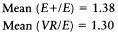
Using these readings as the best possible approximations, one can calculate the ratios of selling price to cadastral value for sales made for E, E+, and VR for each type of property that will match these readings and result in the smallest net change in the three ratios provided by Table E.1. These are:
|
All the corrected ratios are within one "standard error" of the original reading except one, E+ for meadows, and this fact gives us confidence in our procedure.
We need next to know what proportion of the total value of the deeds of deposit were recorded under the different terms of payment. For this purpose we have available again only the data on the provinces of Jaén and Salamanca (in percentages):
|
For lack of better information, we can use the mean proportions of the two provinces as representative of sales in the rest of Spain. These proportions and the readings E+/E = 1.38 and VR/E = 1.30 established earlier tell us that the weighted mean ratio for all forms of payments for each type of property will be 1.27E. On this basis one can calculate the ratio of the mean price paid, for sales in all forms of payment, to the cadastral value, for each kind of property as follows:
|
In the provinces of Jaén and Salamanca, urban properties represent about 10 percent of the value of the deeds of deposit. Of the remainder (rural properties), plowed fields form about 90 percent in Salamanca and 77 percent in Jaén. We cannot know directly if these percentages correspond to those of other provinces. The Censo de frutos y manufacturas of 1799 gives the value of the different agricultural products in each province. The products of arable fields (grains and pulses) represent between 74 and 98 percent of the value of the products of the "vegetable kingdom" (that is, roughly the proportions that we have found for the value of arable sold in our two provinces) in all the provinces of Castile except five. These five provinces and the percentage of the agricultural production from arable are Córdoba (68), Galicia (66), Murcia (63), Seville (60), and Granada (48).
We can conclude that in all the provinces of Castile except the above five, arable fields represent about 85 percent of the disentailed rural properties. Since we calculate 10 percent of the sales were urban properties, arable fields were about 76.5 percent of the total and 13.5 percent were rural properties sold for a greater number of times their cadastral value than arable. To arable fields we
shall assign the ratio 24 : 1, that is, mean deed of deposit equals twenty-four times the cadastral value. To agricultural properties that were bid higher, we shall assign the ratio 43 : 1, which we found applied to olive groves, on the assumption that they are representative of this type of property. Using these different values, one obtains a mean ratio for all types of property of 30.2 : 1, or to round off, 30 : 1. The five provinces identified above had a lower proportion of arable and deserve a higher mean ratio. We calculate an approximate ratio of 34 : 1 for Córdoba, Galicia, Murcia, and Seville, and 36 : 1 for Granada. For Madrid, which has a high proportion of urban properties, the mean ratio should be about 43 : 1.
APPENDIX F—
ANNUAL TOTALS OF DEEDS OF DEPOSIT
The deeds of deposit issued to former owners of disentailed properties that have been used for this study are found in AHPM. They comprise
1. Records of the Real Caja (or Fondo) de Amortización (in Protocolos of Juan López Fando). The deeds are dated from 22 November 1798 to 31 December 1803 and their numbering reaches 11993, but through an error of the amanuenses nos. 5769–5868 were skipped.
2. Records of the Real Caja (or Fondo) de Consolidación, which was created by the pragmatic sanction of 30 August 1800 to replace the Amortization Fund (in Protocolos of Juan López Fando). The deeds are dated 28 October 1800 to 21 November 1807, nos. 1 to 58500. The deeds of the last volume are signed not by López Fando but by Feliciano del Corral, who had been his assistant. In addition, the unbound protocolos of Feliciano del Corral contain deeds dated 21 November 1807 to 12 November 1808, nos. 58501 to 66535.
Table F.1 gives approximate annual totals for the deeds of deposit recorded in these volumes. There was no practical way in the archive to add up and analyze the amount of royal indebtedness represented by 78,000 deeds. Having the indexes microfilmed made the task possible—if time-consuming—for most deeds. Several of the volumes of López Fando are deteriorated, with their indexes and some of the deeds destroyed by dampness (protocolos 22060, 22138, 22159, 22170, and 22173). I copied by hand the amounts of the remaining deeds in these volumes together with the location of the institutions in whose favor they were made. Most of the unbound deeds of Corral lack indexes, and I copied the information on those dated up to 31 December 1807, through Consolidación deed no. 59473. There remain unused for the present study 7,062 deeds of Corral for 1808.
The provincial and national totals of the deeds are primarily the work of
|
||||||||||||||||||||||||||||||||||||||||||||||||||||||||||||||||||||||||||||||||||||||||||||||||||||||||||||||||||||||||||||


John W. Levenson, who had the patience to add them up not once, but twice, for the first results were lost in a stolen suitcase. Although we exercised considerable care in transcribing and adding, we make no pretense that the figures in Table F.1 are entirely accurate. Absolute accuracy is not needed, however, because these totals cover only the deeds recorded in Madrid through 1807 that still survive.
APPENDIX G—
THE CASA EXCUSADA
In 1761 the crown issued instructions on the administration of the casa excusada. The administrators were to select the largest tither in each parish (including parishes annexed to other churches), whether owner or tenant, layman or religious institution, except the Order of San Juan. The casa excusada had to pay its tithes to the administrator and no one else, but at the time and according to the custom of local tithes. The administrator farmed the collection from the crown, putting up a fianza, or bond, to insure a proper rendering of accounts.1 The instruction makes clear that prior to this date "primeras casas dezmeras" were not separated from the common body of tithers. Protests raised by parish priests in 1761 and 1762 that the reform would hurt their income are further evidence that before this date the tithes of the first tither had gone into the general fund, the partible.2 In 1764 the crown farmed the collection of the excusado to the Five Great Guilds of Madrid, but after 1778 bishops began to take over the contracts for their dioceses, until by 1789 very little was left to the Five Guilds.3 After 1793 the Five Great Guilds again administered it.4 The excusado was still being collected separately from the other tithes in 1800 and 1801.5
APPENDIX H—
RELATIVE PRICES OF CROPS, 1753–99
In Table 7.19 the percent of the total value of the harvest in La Mata of each crop at different dates is based on a constant price ratio of the crops. The only ratio whose change would significantly modify Table 7.19 is that of garbanzos to wheat. I have no information on this ratio in Salamanca after 1753 until the mid-nineteenth century. Figures given by Hamilton for New Castile show the following evolution of prices:1
|
(The period 1792–1800 refers to the years 1792, 1793, 1795, 1798, and 1800, five years for which data for both crops are given.)
These data indicate a decline in the ratio garbanzos:wheat. Yet by the mid-nineteenth century the reverse was true. In Toledo in 1845–54, the price ratio garbanzos:wheat (by volume) was 2.45 : 1.2 In Salamanca in 1753 it was 1.79 : 1 (Table 7.4). According to Cabo Alonso, the quintal of wheat in the mid-nineteenth century in La Armuña was worth about 74 reales, the quintal of garbanzos about 288;3 this is a ratio of 3.9 : 1 by weight or about 3.5 : 1 by volume.4 These figures suggest that the price of garbanzos may have been rising faster than the price of wheat in Salamanca in the second half of the eighteenth century (despite Hamilton's data). If so, the strategy of the farmers of La Mata of switching to garbanzos would have increased the value of their harvest. But this hypothesis remains in the realm of conjecture.
APPENDIX I—
THE DISTRIBUTION OF INCOME FROM AGRICULTURE AMONG INDIVIDUAL FARMERS OF LA MATA
In addition to the data that are incorporated into Table 7.11, other information is available that should be noted. Cabo Alonso has published the individual tithe payments for 1729 taken from the parish records of La Mata (apparently the only year before 1791 for which individual shares were recorded).1 Calculating each individual's share of the total harvest by using the prices of the crops given in the catastro,2 and assuming a cuarto dezmero (fourth tither) not shown in the records, one obtains the approximate individual shares, for this single year, as follows:
|
The top third of the tithers (1 through 8) garnered 84.5 percent of the harvest and would have been the labradores. (By 1753 there were thirteen labradores, and twenty-eight people paid first fruits; all twenty-three of the farmers in 1729 harvested enough to pay first fruits.) This table shows the difference between labradores' harvests and those of other farmers to be greater in 1729 than in 1753, but otherwise it lends support to the structure shown in Table 7.11. This evidence and that for 1753 and 1801–2 indicate that inequality among the farmers declined as population increased.
Another piece of evidence, however, does not agree with the income structure for 1753 in Table 7.11. This is the tithes of the cuarto dezmero (fourth
tither) reported in the catastro (Table 7.3). His tithes convert to 18.25 EFW, indicating a gross harvest of 182.5 EFW and a corresponding net income from harvest of 106.5 EFW. It is difficult to reconcile this information with the net income from harvest of the fourth tither projected back from the pattern of 1801–2 (210 EFW, Table 7.11) or from the number of draft animals (170 EFW, Table 7.9). If the net income from harvest of the fourth tither were indeed as low as 106.5 EFW and the lesser tithers had harvests below this figure in a descending pattern, then the first three tithers would have divided among them over half the total harvest. This would make Juan Rincón's net share about 650 and the next two 370 and 320, or Rincón's even higher and the other two closer to the fourth tither. The two methods used to calculate Table 7.11 do not indicate such a concentration of income among the top three farmers. It is true that for the pattern of 1801–2 I posited a first tither (casa excusada) slightly above the next one on the basis of the known pattern beneath the first tither. There might have been a labrador in 1801 with far greater harvests than the others. If so, however, one could have expected him to be among the most active of local buyers. In fact the major buyers all appear on the tithe rolls and hence were not the casa excusada. For such a concentration of income to have existed in 1753, it would have had to grow rapidly after 1729 and decline rapidly after 1753. Since there is no reason to believe there was such an alternating trend, I conclude that the pattern implied by the stated tithes of the fourth tither in 1753 is wrong, because they are understated or because he paid less than he should or because the "fourth tither" was a specific individual selected at some time in the past whose harvest had dropped relative to the other labradores since then, putting him now somewhere between sixth and ninth.
APPENDIX J—
MODIFICATIONS IN PARTIBLE TITHES AFTER 1796
In 1796 a papal breve and royal cédula revised the regulations on lands exempt from tithes (tierras horras ), requiring them henceforth to contribute to the partible tithes.1 The breve states that in order better to support parish priests, church fabrics, and the poor, all privileges of exemption from payment of tithes are abolished, whatever endowment or religious institution may possess them. How it applied in a particular case is not clear. A royal resolution of 5 December 1796 appears to say that it did not abolish the right of religious communities and other endowments to collect tithes on their lands; it only abolished exemptions from paying any tithes.2 (If the king were only interested in obtaining his tercias reales, then he did not care who received the rest of the tithes, but this instruction violates the purpose of helping priests and poor.) Understood this way, it would appear not to apply to La Mata, since the renteros of exempt lands did pay tithes (or a fixed payment in lieu of tithes) to their owners. Yet in 1799 (for the first time) the tithe register has a separate list of payments of "new tithes as ordered by the breve of His Holiness" ("nuevos diezmos como está mandando por el breve de su Santidad"). The two individuals who we know from monastic account books rented tierras horras, however, do not figure among those who paid nuevos diezmos.3 Furthermore the monastery Nuestra Señora del Jesús negotiated a new lease in 1803 that still specified payment of "los horros correspondientes."
More information but little clarification is provided by the tithe records of
the nearby town of Villaverde.4 In 1796 the new tithes are specified, with the name of the tither and the owner of the lands in question. They include those of the local benefice and fabric and those of the fabric of the church of San Justo y Pastor in Salamanca, all described in the catastro as horras de diezmos.5 But it does not include the lands of two encomiendas also described as horras and does include lands of a church and capellanía not described as horras. Was the catastro so inaccurate in listing tithe exemptions? Had the situation changed markedly since the catastro? Was the cédula of 1796 so confusing to contemporaries that each locality chose to enforce it as it saw fit, bowing to pressures? I incline to believe the explanation is a combination of errors in the catastro and local ad hoc decisions on how to enforce the cédula.
Unable to form a clear picture of which lands were exempt from tithes, what date the abolition of exemptions went into effect, and what owners managed to escape from the abolition, for La Mata I have fallen back on its tithe return for 1799. Here the new tithes were 20 percent of the total partible tithes and in addition to them. In calculating the size of harvests for La Mata from tithe returns after 1799 (when the quantity of new tithes was no longer specified), I assume that the partible tithes are one-fifth more than would have been the case under the old system. Farmers still paid one-tenth of their crops; the increase comes from levies on lands previously exempt. This case and the example of the payments of the first tither, which were included in the partible until 1760 (Appendix G), should serve as a reminder to those historians who make long-term calculations of harvests from tithe records that they must follow legislation and practices carefully, or they will record as changes in harvest levels what were merely changes in the lands subject to tithes and the institutions receiving them.
APPENDIX K—
INCOME FROM RAISING LIVESTOCK
Since the catastro states the number of larger animals of each vecino and of towns as a whole but does not give figures for the annual births or slaughter of animals, to calculate the income from breeding animals has been one of the most perplexing problems of this study. The catastro respuestas generales of some of the towns studied state the value of animals, others do not, and one, of Navas, states not the value but the annual product (esquilmo ) of the animals. Table K.1 gives the values reported in the catastro.
After much trial and error I have adopted the following method, which I have applied to all the towns studied.1 First one obtains the number of adult females of each kind in the town. Where the catastro does not provide this number, I have posited a percentage of the adult animals that are female, based on the evidence from the towns where this information is recorded. Next I have estimated the number of surviving young per adult female of each kind per year. To take into account the poorer breeding and hygienic conditions in the eighteenth century, the method assumes that the annual birth and survival rate of animals was then approximately half the early twentieth-century rate, using for the latter statistic that provided by the major Spanish encyclopedia.2 For pur-
|
||||||||||||||||||||||||||||||||||||||||||||||||||||||||||||||||||||||||||||||||||||||||||||||||||||||||||||||||||||||||||||||||||||||||||||||||||||||
|
|||||||||||||||||||||||||||||||||||||||||||||||||||||||||||||||||

poses of determining individual or town income, it does not matter if the young are consumed or sold, but one must deduct from gross births those that serve to replace work animals that die of old age (using life expectations predicted for the eighteenth century). No income, or hardly any, would accrue to owners from the carcasses of aged adults. For sheep and goats one must add to total income that from wool and cheese. Using the prices given in the catastro for the young of the different species, and that of wool and cheese (the amount of wool per sheep and cheese per goat or sheep appears in some of the tithe registers), I have established an expected annual income per adult female of each species. From the animal population recorded for each town one can then estimate the annual income derived from livestock. Table K.2 gives the rates on which I have based my calculations.
The figures for income per female from breeding given in Column D are well below the esquilmo reported in Navas, except in the case of sows. The esquilmo may include sources of income I have missed, such as milk, and possibly labor. Since milk is a legitimate part of town income, and Table K.2 is based on many unknowns, I have revised the estimated income of each female animal to take account of the information in Navas, as shown in Column E.
Obviously the figures in the table represent only an approximation. The true figures varied in any case from region to region and year to year. They do, how-
ever, permit a calculation of the income from animal husbandry. The results, while inexact, are probably in the right order of magnitude. In most towns the income from animals was considerably less than that from harvests, so that errors in the calculation of the former do not affect seriously the estimates of per capita incomes of towns or the different sectors within them. Animal income formed a large share of the total in Pedrollén, El Mirón, and Baños. As a result, the estimates of town and per capita income in these three places are liable to greater error than elsewhere.
APPENDIX L—
RELATIVE LABOR NEEDS FOR GRAIN FIELDS AND OLIVE GROVES
Information on the labor requirements for various crops in Spain is available in two published works: Juan Martínez Alier, La estabilidad del latifundismo, 345–51, Appendix 1, and José Manuel Naredo, La evolución de la agricultura en España, 33–37, Cuadros 4, 5. They provide estimates for man-days per year for each harvest or the absolute cost of labor per year in pesetas. From this information, one can calculate the relative cost of labor for grain fields and olive groves (Table L.1).
From these estimates, the mean ratio of the cost of labor on olive groves to grain fields is 1.12 : 1. However, the first estimate obtained by Martínez Alier for labor in groves appears well out of line. Discounting it, the ratio of labor requirements is 1.26 : 1.
These ratios are based on the labor on grain fields in the year they are planted. The table gives two estimates for labor (mainly plowing) of the fields in fallow years. They indicate a mean ratio of labor during fallow year to labor in harvest year of 0.34 : 1. Thus, if there are two harvests in three years, the average annual labor is 0.78 of the harvest year labor; if one harvest in three years, it is 0.45 (assuming one year without plowing).
Table L.2 gives the annual income for different quality grain and olive land in Baños in 1752, the cost of labor based on the percentages shown in Table 11.11 and the above information, and the resulting ratio of cost of labor on olive groves and grain fields for each quality land. The general consistency of the ratios in the last columns of the two tables gives confidence in Table 11.11.
|
|||||||||||||||||||||||||||||||||||||||||||||||||||||||||||||||||||||||||||||||||||||||||||||||||||||||||||||||||||||||||||||||||||||||||||||||||
|
||||||||||||||||||||||||||||||||||||||||||||||||||||||||||
APPENDIX M—
THE ECONOMIC SIGNIFICANCE OF CENSOS IN LAS NAVAS
The analysis of the economy of the seven towns in the middle of the eighteenth century has been made without the use of one kind of information provided by the catastro. This is the annual payments due by owners of property for the censos imposed on their property. Censos were a form of lien common in early modern Spain. They could have been originally imposed in recognition of capital received as a loan, in which case the annual payment represented the interest on the loan (usually 3 percent) and the instrument represented a kind of mortgage. They could also represent pledges of an annual payment to a charitable or other religious fund (such as a memoria to insure the performance of masses for the soul of a departed person) guaranteed by specified pieces of property, without any capital having originally changed hands.1 The libros maestros of the catastro record the annual payments charged against each piece of property for each censo imposed on it.
I chose not to record these payments in taking notes from the town catastros because the payments appeared in most cases relatively insignificant, believing my time better spent gathering other types of information. It seemed proper, however, to check their importance in at least one case, so that I noted the censos for Navas. A review of this information indicates that in this town, in effect, they were a matter of minor economic importance.
The total amount owed by vecinos on censos was 1,005 reales per year, or 56 EFW. This is less than 1 percent of the net town income of 7,170 EFW. I did not attempt to trace the location of the owners of the censos, so that I cannot tell how much of this 56 EFW was paid outside the town. Even if it all went to outsiders, however, it would reduce the estimated per capita income by only 0.06 EFW, with no effect on the picture of the town economy. The margin of error on some sources of income, notably livestock and labor performed else-
|
||||||||||||||||||||||||||||||||||||||||||||||||||||||||||||||||||||||||||||||||||||||||||||||||||||||||||||||||||||||||||||||
where, is much greater than this amount. One is therefore justified in leaving censo payments out of consideration.
Seventy-one heads of household (male and female) had censos against their property (44 percent of those with real property). Table M.1 breaks these down by major occupational groups. For the vast majority of the population, censos were no major burden, whatever their nuisance value. Among male heads of household, the highest percentage of net income paid for interest on censos was 4.2, by one of the jornaleros. Among those who owed censos, the average amount of net income paid as interest varied, according to occupation, between 1.0 and 2.1 percent. When set against the total income of the group, those owing and those not owing censos, the percentage of net income going to interest on censos drops to between 0.2 and 0.6 percent, except for the two men titled don, for
whom it is 1.4 percent. (One of the two, the doctor, had no property and so owed no censos. The other, the notary, wealthiest layman in town, owed the largest censo payment, 101 reales per year, 2.1 percent of his net income.)
Those for whom censos represented a serious drain were some of the female heads of household. Widow labradoras as a group paid 1.6 percent of their income as interest on censos (three times the rate for male labradores), and the most indebted owed 8.3 percent of her income, twice as high as any male. For single women and widows without adult sons, the rate of indebtedness was even higher. Individual women had censos that took 63 and 40 percent of their recorded income. These figures are misleading, however, because the catastro recorded no income from the labor of women or males under eighteen, and the catastro data are the only ones I have. The payments of these women were small (the largest of a widow was 27.3 reales [1.5 EFW], of a single woman 20.3 reales [1.1 EFW]), but for a person subsisting in poverty on odd occupations, they could be serious. Those owing censos owned real property, of course, in many cases the house they lived in, and so were not the poorest members of their group.
The catastro records few censos on the property of outside owners. Five of the eighteen nonresidents together owed 142 reales. In one case the payment represented 19 percent of the net income from his property in Navas; for most the proportion was much smaller. Neither of the dukes resident in Madrid had a censo on his property in Navas, at least so far as the catastro records.
Debts owed for business transactions, as for the purchase of animals or real property to be paid off in a few installments or for the right to farm ecclesiastical revenues or royal taxes, do not show up as censos and are not included in the catastro, even when real property was pledged as collateral. Nevertheless, the conclusion is evident that in Navas and probably in a vast majority of Castilian towns, the servicing of debts was not a major concern. In the old regime, private exchange still operated pretty much on a cash basis in rural communities, far removed from the extensive indebtedness now incurred by individuals in advanced countries for mortgages, the purchase of automobiles and household appliances, charge accounts, credit cards, and the like. The crown, of course, operated very differently. For centuries its income was pledged in advance, and it was heavily indebted to its vassals and foreign houses. The desamortización was undertaken to prevent its debts from threatening the stability of the monarchy.
APPENDIX N—
COMPARATIVE STATISTICS OF SEVEN TOWNS
Certain statistics developed for each of the seven towns merit being tabulated together for purposes of comparison and because of their usefulness to scholars.
The yield-seed ratios for grains and some pulses (Table N.1) have been derived from the information in the catastro. This source states the harvest in grain for one unit (usually a fanega) of each different quality of land (resp. gen. Q 9 and the introduction to maest. segl.) and the amount of seed needed to sow one unit of each quality of land (resp. gen. Q 12). Table N.1 also states the rotation for each quality of land, since this has an influence on the yield.1
Another way in which yields are frequently measured, especially today, is in hectoliters of grain per hectare of land. Table N.2 gives the expected yield in the year of harvest, using the conversion 55.2 liters = 1 fanega of volume and the metric equivalent of the local fanega of area shown in Table N.5. For some towns the reported tithes have shown the predicted yield to be inaccurate. Estimates based on the reported tithes are shown in the last column of the table, but they are also approximations, because the extent of each quality of land sown with each crop can only be based on the use described in the catastro, which the tithes show is not always accurate.
2
In calculating the income of vecinos of the seven towns, I have used as a measure the equivalent value in fanegas of wheat (EFW), converting harvests of other crops and income from other sources into this unit, using the local prices reported for the crops in the catastro. The measure could be misleading if the prices were indeed very local, varying widely from one place to another. Table
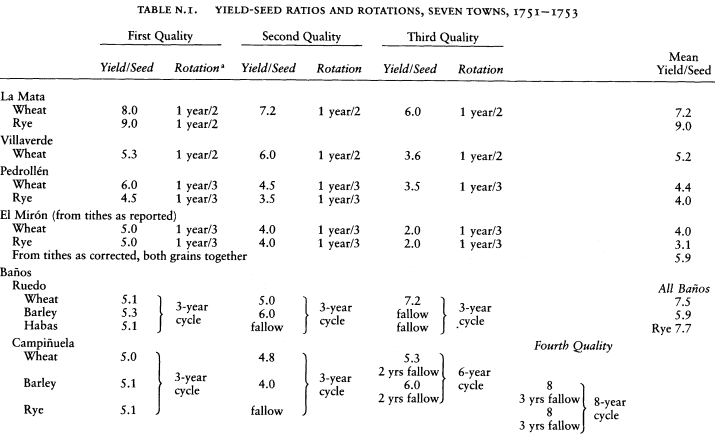
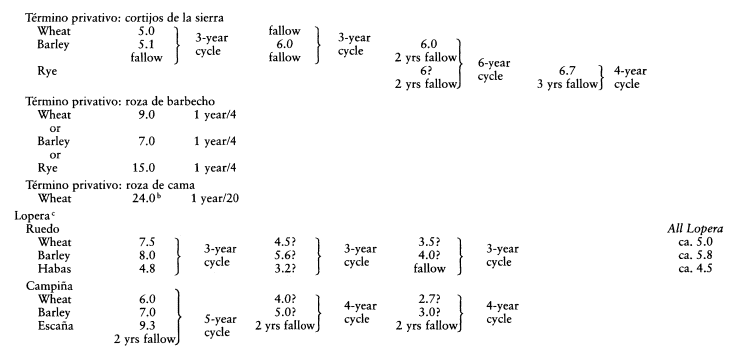
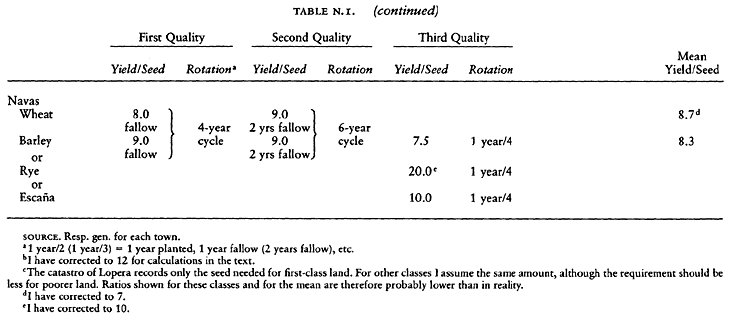
N.3 summarizes the prices of the major grains in the seven towns and also of olive oil in those of Jaén province.
The price reported for wheat is remarkably constant, either fourteen or fifteen reales per fanega except in Las Navas, where the price of eighteen reales is 20 percent above the higher of these two. The use of EFW as a measure thus appears warranted, and it is a measure that avoids the swings in grain prices that were typical of the old regime. The effect of the difference of price in Las Navas on my analysis was considered in its place.
It is worth noting that the prices recorded by Earl Hamilton for New Castile in these years are considerably higher. For wheat they run from 50 percent to nearly 300 percent more than the fourteen to fifteen reales range reported by most towns. His information comes from the account books of a hospital and two convents in Toledo,2 but he does not state if the institutions were buying from peasants or selling on the market at this price.
This difference means that one cannot translate EFW income in rural communities into monetary terms and compare directly the result with urban incomes. For instance, I have calculated the mean income of the top labradores of La Mata as 280 EFW, which converts to 3,920 reales. In Madrid at this time, according to David Ringrose, one needed 3,000 to 4,000 reales to enjoy more than minimal food, housing, and clothes. It is clear that the labradores lived far above such a level, better comparatively than those in Madrid with the 5,000 reales needed "to achieve a measure of 'bourgeois' comfort." (A surgeon-barber in Madrid averaged 4,800 reales per year; a lawyer, 5,900.) In Baños and Lopera, the wealthiest notables averaged 350 to 400 EFW, 5,000 to 6,000 reales. These were the incomes of Madrid guild masters with shops of their own, below that of the average doctor (13,500 reales). The highest income we have come across was that of the widow doña Francisca Luisa de Molina de la Zerda y Soriano of Baños, 1,800 EFW, 25,000 reales, placing her in what Ringrose calls the middling class of Madrid (10,000 to 40,000 reales). Obviously in social status wealthy local notables were far above middling. Hamilton's figures suggest that in economic terms too, local incomes should be raised considerably to determine comparable buying power in Madrid.3
3
Table N.4 compares the proportion of male heads of household (vecinos) whose income comes primarily from agriculture with the per capita income of each town (see Table 14.1). It reveals a clear inverse relationship between the two statistics, except in the case of Pedrollén, which is not properly a town, and to a lesser extent Villaverde. The relationship is somewhat tautological because the lowest income for each town is usually that of agricultural labor. A high percentage of households drawing their income from agriculture usually means that there is a high percentage of jornaleros. Even so, the relationship deserves to be pointed out, because this information is readily available: the respuestas
|
||||||||||||||||||||||||||||||||||||||||||||||||||||||||||||||||||||||||||||||||||||||||||||||||||||||||||||||||||||||||||||||||||||||||||||||||||||||||||||||||||||||||||||||||||||||||||||||||||||||||||||
|
|
|||||||||||||||||||||||||||||||||||||||||||||||||||||||||||||||||||||||||||||||||
generales give the number of vecinos in Q 21 and the number of men engaged in agriculture in QQ 33, 34, or 35. For comparative purposes, the percentage of vecinos engaged in agriculture can be used as a surrogate measure of per capita income of the town, a statistic that can be determined only with considerable effort.4
4
The makers of the catastro asked each town, "What measure of land is used in that town, and how many paces or square Castilian varas does it consist of?"
|
||||||||||||||||||||||||||||||
|
|||||||||||||||||||||||||||||||||||||||
|
||||||||||||||||||||||||||||||||||||||||||||||||||||||||||||||||||||||||||||||||||||||||||||||||||||||||||||||||||||||||||||||||||||||||||||||||||||||||||||||||||||||||||||||||||||||||||||||||||||||||||||||||||||||||||||||||||||||||||||||||||||||||||||||||||||||||||||||||||||||||||||||||||||||||||||||||||||||||||||||||||||||||||||||||||||||||
|
||||||||||||||||||||||||||||||||||||||||||||||||||||||||||||||||||||||||||||||||||||||||||||||||||||||||||||||||||||||||
The answers showed that this enlightened concern for a standard measure was indeed justified, for the basic measure varied widely, as our seven towns reveal (Table N.5).
The basic measure was similar to an English acre and was known variously as a fanega, fanegada, huebra, or cuerda. When it was defined mathematically, it consisted of a number of estadales (similar to square rods in English), each consisting of a specified length in varas squared. (The vara castellana was 0.8359 meters.) The responses of the towns of Jaén show the complexity of the matter. The province had two different estadales. The estadal of the military order of Calatrava was 4 1/8 varas squared. The rest of the province used an estadal of 3 2/3 varas squared. (In La Armuña it was 4 varas squared.) The fanega of Calatrava had 480 estadales. The rest of the province was divided among zones with 480 estadales (a small area in the southwest), 500 estadales, and 666 2/3 estadales. A number of towns in the middle group reported a second measure ("cuerda" in this region) of 435 estadales for the ruedo and irrigated lands. Scattered through the province were towns that had no numerical measure but continued to define the fanega as the area sown with a fanega of grain.
APPENDIX O—
USE OF THE APPELLATION DON IN THE DEEDS OF DEPOSIT
Individuals who made more than one purchase were identified and the deeds attributed to them by the method described in Chapter 15. When there was no uniformity in the use of don with a person's name, I gave preference to the form which appears in the majority of cases; if a tie, I placed the buyer in the category "don."
An analysis of the Madrid deeds of buyers who made three or more purchases shows great uniformity in the attribution of the appellation. Multiple purchasers with an evident right to the don were divided as follows:
|
Multiple purchasers without an evident right to the don were divided as follows:
|
The Madrid deed was more likely to omit the don of a man who rightfully sported it than to give it to one who was not entitled to it. Except in the following cases, the don was attributed only once to each of the men who were not entitled to it. Blas Gallego of Ubeda (Jaén), who made fifteen purchases between 1801 and 1807, appears with don the last four times, all 1806–7. Perhaps he
had bought a title. Without him, the proportion of errors in Jaén is 3 percent. One other person in Jaén is in this category: five purchases, two with don; only one person in Salamanca: eight purchases, three with don.
The following table gives the data for those men who made only two purchases:
|
Again one observes consistency in the use of the term, especially when one considers that some of the names that appear once with and once without don may not belong to the same individual.
Men addressed as don with the addition of pbro. (presbítero) after their names are classified as priests and do not figure in the above tables. Here, however, the documents show little consistency. The term pbro. appears less than half the time in the deeds naming priests who made more than one purchase, but even if it appeared only once, I classed the individual as a priest. A tabulation of the deeds of persons known to be priests who made two or more purchases gives an indication of how consistently the identification "pbro." was added to the names of priests:
|
D shows how many unidentified priests there were if the deeds gave the title pbro. to the same proportion of priests who made one purchase as they did to those who made more than one purchase. The percentage of priests would rise from 1.9 percent to 3.2 percent of all purchasers in Jaén and from 2.5 percent to 3.5 percent in Salamanca in Table 15.7. That is, I may have identified only 60 percent of the priests who bought properties in Jaén and 70 percent in Salamanca. Proportionately more of the missing priests would belong in the lower levels, since they would have made fewer purchases.
Since all unidentified priests would be called don, I would have placed them in this category of buyers. Elimination of the priests wrongly placed in this category would bring it down little, however, about 4 percent in each province (F).
APPENDIX P—
THE ZONES OF JAÉN PROVINCE
I have divided Jaén and Salamanca provinces into zones on the basis of present-day information. Some of these consider permanent conditions, such as the topography; some, conditions that have varied little since the eighteenth century, such as the structure and relative size of the towns; some, conditions that may be the result of recent developments, such as land use and crops observed in the 1960s and early 1970s. Nevertheless, one can be confident that the zones differed among each other in social, demographic, and economic structures in the eighteenth century. In Jaén the differences in crops were more marked two hundred years ago, because nowadays olives and grain are found almost everywhere. Map 16.1 shows the zones.
Rich Basin Zones
Zone JA (Andújar)
About thirty kilometers as the crow flies before reaching the Córdoba border, the Guadalquivir, which has run down to here between narrow banks, enters a broad, flat vega with alluvial soils. Three towns are located close by the river: Andújar, the largest and central one, Villanueva de la Reina twelve kilometers upstream from it, and Marmolejo ten kilometers downstream. They are large towns; in 1786 they averaged 3,960 people (see Table 16.2), and all were under royal jurisdiction. They enjoy the varied agriculture of an irrigated valley, but it is narrow and most of their términos are rolling hills of the basin, with the rich, red soil typical of the Sierra Morena region, for the ranges lie close to the north. Their landscape is lower and gentler than the términos of most other towns in the province. This is Andújar (JA) zone.
Zone JB (Arjona)
The towns of the western portion of the province south of the river belonged in the eighteenth century to the military Order of Calatrava. Five of these formed Arjona (JB) zone. We have studied one of them, Lopera. The most impressive towns are Porcuna, on the Córdoba border, and Arjona, due south of Andújar. They sit in twin hills that are the major elevations of a low ridge running from southwest to northeast. Beyond Arjona to the east, the ridge descends slightly to Higuera de Arjona. These were military towns, and signals could be sent from hill to hill. North of the ridge, the contour drops down to the broad valley occupied by Lopera and to Arjonilla, not far away on a gentle slope facing north. Although below the ridge, both towns are well above the river towns of Andújar zone. These five places make up Arjona (JB) zone. The soil is mostly a grey-brown marl, typical of the basin, turning red as it descends to the river, well drained, and very rich. Today legumes and grain are planted close to the towns, but elsewhere olives dominate. Arjona is reputed to be one of the two richest olive towns in the province (the other is Martos).
Zone JE (Linares)
On the other side of the river and further upstream is Linares zone (JE). Although not properly in the basin of the Guadalquivir, lying rather on a tableland between the foothills of the Sierra Morena and the Guadalquivir and Guadalimar rivers, it can be grouped with the rich zones of the basin because of its soil of fertile marls. Between Linares and Bailén is a rough, hard limestone wedge, difficult to cultivate, which gives the zone a deceptive appearance of infertility. This sector is used mainly for grazing, but wheat fields and olive groves divide between them the rich, rolling hills around it. Of its four towns, Jabalquinto is at the top of an elongated hill, or loma; the others are on the rolling tableland. Bailén is where the Andalusian highway forks, one prong heading west to Córdoba and Seville, the other south to Jaén and Granada. Linares, an important place for centuries because of its lead mines, and Bailén, famous for its pottery, are the dominant places. They averaged 4,200 people in 1786. The other two towns, lacking industry, averaged only 380. Linares was royal. The Duque de Arcos had jurisdiction over Bailén, the Marqués de Fuente del Sahuco over Tobaruela, and the Marqués de Jabalquinto over that town.
Poor Basin Zones
Zone JC (Santiago De Calatrava)
South of the Porcuna-Arjona ridge, the land drops off slightly and then rises in a gentle slope toward the southern sierras. This is the flattest region of the Guadalquivir basin in Jaén. Santiago de Calatrava zone (JC) consists of five towns scattered across this plain, not all contiguous, for administratively part of the plain belongs to bigger places located at the edge of the sierra. Two towns be-
longed to the military order: Higuera de Calatrava and Santiago de Calatrava. Farther east two others, Escañuela and Villardompardo, were in the señorío of the Conde de Villar don Pardo. Finally the tiny place of Fuente del Rey, almost in a no-man's-land, was under royal jurisdiction.
Here the soil is also gray-brown marl, but great stretches are saline in character—its major stream is the Arroyo Salado—less favorable to agriculture than the soils of Arjona zone. Today grain is more common than olives. In the eighteenth century its towns were comparatively small. The mean size in 1786 was 370, while that of Arjona zone just north was 2,180.
Zone JD (Mengíbar)
Bordering these zones to the east is Mengíbar zone (JD), made up of five towns running northwest to southeast along a low, gently rolling plateau that slopes north toward the Guadalquivir. Four towns sit back from the river about one to four kilometers, while the fifth, Cazalilla, is at a greater distance. Mengíbar, Cazalilla, and Villargordo were royal; Torrequebradilla belonged to the señorío of the Conde de Torralba y de Talara, and the fifth, Espelúy, to the Duque de Santisteban del Puerto.
This zone represents a prolongation eastward of the flat Santiago de Calatrava zone and like it is marked by salinity and a relative lack of fertility. The Guadalquivir here cuts into the surrounding terrain and offers little usable riverbank. A narrow fringe of alluvial soil borders the Guadalbullón river, which rises in the southern sierra and enters the Guadalquivir near Mengíbar, but it is insufficient to overcome the general infertility of the zone. In 1970 much of this zone was still used for grazing sheep and goats, and the rest was planted in grains and legumes. This is one of the poorest regions in the province; in 1786 the towns averaged only 510 people.
South Basin Zones
Zone JF (Martos)
Lying between these basin zones and the southern sierras are a fringe of rich olive lands. At the west are the two impressive towns of Torredonjimeno and Martos, both under the Order of Calatrava in the eighteenth century, large municipalities with a mean population in 1786 of 5,570. Martos zone (JF) is dominated by the imposing Peñon de Martos, a sheer peak rising alone behind the city. The rich lands of the two towns circle this peak and go back to the Sierra de Jabalcuz to the east. Except near the towns, the zone is today virtually monopolized by olives, stretching in awe-inspiring patterns across the rolling landscape and back as far as possible into the sierra. With Andújar, Martos is judged today one of the two richest olive towns of Jaén. The soil of this zone is largely a saline marl, being an extension of the plain of the poor basin zones. Although excellent for olive culture, it is not very good for grains, and, as Chapter 16 shows, its soil appears to have had a direct effect on the evolution of its agriculture.
Zone JG (Jaén)
The next major place east of this zone is Jaén, capital of the province. With a population of 15,380 in 1786, it was the largest city of the province, but it did not dwarf the other towns in the way that Salamanca, almost identical in size (16,440), did the myriad tiny villages under its jurisdiction. Jaén sits against the Sierra de Jabalcuz facing north on the basin and dominates the center of the province. Its término stretches toward the river until it reaches the smaller towns of Mengíbar zone. Here the predominant marl of the basin gives way to extensive terraces of alluvial soil, now filled with grain. Elsewhere the land is better for olives than grain, and the silver-gray trees take over as one approaches the sierra and climb up into it behind the city. Torre del Campo, 2,210 people in 1786, ten kilometers west of Jaén, is very similar in its setting on the edge of the sierra, and I have placed it in Jaén zone (JG). Both were under royal jurisdiction.
Zone JH (Mancha Real)
Proceeding east along the northern slopes of the sierras, one comes next to Mancha Real zone (JH). Mancha Real is an early modern new town, with streets set out in rectangular pattern. Less rich than Martos, with towns averaging only 1,800 inhabitants in 1786, this is still an impressive zone. It lies beneath the Sierra Mágina, the highest of the province. Jimena, Garcíez, and Jódar sit in the foothills, and their términos stretch north in gentle rolls sprinkled with casas de campo. Olives give way to grain as one approaches the river. Near Mancha Real there are extensive patches of rough salty land, which reminds us of Mengíbar zone, to the west. The four towns, Mancha Real, Garcíez, Jimena, and Jódar, had four different lords: the king, the Conde de Garcíez, the Marquesa de Camarasa, and the Marqués de Jódar.
Zone JI (Cazorla)
Except along the river, a salty stretch of near desert, through which the railroad from Madrid to Granada was driven in the nineteenth century, separates Mancha Real zone from the towns at the eastern end of the province. Yet once past this barren land, one enters a flat, rich plain of marl that lies beneath the Sierra de Cazorla, source of the Guadalquivir River and one of the wildest ranges in Spain. Cazorla sits at the base of its sierra, an elegant town watched over by towers and castles of former ages, and the smaller La Iruela nestles just above it on the road into the mountains. In the eighteenth century they belonged to the jurisdiction of the archbishop of Toledo. Between them they divide the plain, rich in olives and grain, so extensive that it includes two large permanent villages, Peal de Becerro and Santo Tomé, both of them in the eighteenth century subject to Cazorla. Slightly to the south, in a valley of its own at the foot of the sierra, is Quesada, an elegant town under royal jurisdiction, with a laid-out central square, surrounded by rolling upland countryside, devoted today also to olives and grain. The three towns of Cazorla zone (JI) averaged 3,520 people in 1786, not as big as the towns on the western slopes of the sierras but bigger than those of Mancha Real zone.
Sierra Morena Zone
Zone JJ (Baños)
Except around Bailén and Linares, the basin of the Guadalquivir does not extend north of the river. At the west, near Andújar, the Sierra Morena almost reaches the river. North of Bailén and Linares, the sierra is gentler, crossed by the main road to Madrid, and the rolling hills can be cultivated. Until Carlos III created the colonies of Sierra Morena in the 1770s, the upper reaches of this tongue had only small settlements. Two towns, located above Bailén and Linares, occupied the base of the tongue and form Baños zone (JJ). We have studied Baños, sitting on the southern tip of a long hill that juts out from the sierra. Vilches is located to the east, on a saddle between two hills rather like humps of a camel, with the inevitable medieval castle, dominating a plain on either side. The two towns were almost identical in size and averaged 1,690 people in 1786. Both were realengo. Their soil is the rich, red, sandy soil typical of the foothills of the Sierra Morena, although portions of Baños have light tan marl of the Guadalquivir basin. The plains beneath the towns are partly in olives, partly arable, but the campiña of both towns is limited and rapidly gives way to monte, scrub growth and the wilderness of the Sierra Morena. The Sierra Morena zone is unlike any other in Jaén.
Rich Loma Zones
Zone JK (Baeza)
East of Linares, a set of rivers flows out of the Sierra Morena, southwest to the Guadalquivir. Two of these, the Guadalimar and the Montizón run almost parallel to the Guadalquivir, looking on the map like fingers of a withered hand, for forty or fifty kilometers. Between these three rivers the land rises in two rounded, elongated hills, or lomas, rising out of the flat banks of the rivers, their cross-sections resembling normal curves. Gentle valleys cut the sides of the lomas, and spaced out along their summit are most of the towns that own this territory.
The southern of the two hills, the Loma de Ubeda, between the Guadalquivir and the Guadalimar, is tlhe more impressive. The twin cities of Baeza and Ubeda dominate it, only nine killometers apart, but in the eighteenth century each was the capital of a partido extending far beyond the loma. The first important places of Andalusia to fall to the Christians, they are elegant centers with impressive public buildings and seigneurial residences of the Habsburg age.
Scattered around the western slopes of the loma beneath Baeza, their ruined towers rising like a brood of young chicks under the maternal city, were six smaller places, Begijar, Lupión, Ibros (legally divided in two: Ibros del Rey and Ibros de Señorío), Canena, Mármol, and Rus. They form Baeza zone (JK). Baeza had 8,880 people in 1786, the other six fewer all together, averaging 1,080. The territory of Baeza extends south across the river to meet that of Mancha Real. Although some parts of the loma are too steep and rough to cultivate,
most of it is rich marl, grey to light tan in color, good for olives, wheat, and legumes. Today wheat is common at the top of the loma, olives in the middle slopes where the plow moves with greater difficulty, and wheat again by the river; but the pattern is more irregular than this generalization suggests. The jurisdiction was also varied. Baeza and four towns were royal; the Marquesa de Camarasa had Canena; the Duque de Santisteban del Puerto, Ibros de Señorío; and Marmol belonged to a religious endowment (patronato de legos).
Zone JL (Ubeda)
Ubeda zone (JL) makes up the central and highest section of this loaf. The distance between the Guadalquivir and Guadalimar rivers is greatest here, about twenty kilometers, and there is more flat land between the loma and the rivers. The settlement pattern differs from Baeza zone, for it consists of three large fortified towns, Ubeda, Torreperogil, and Sabiote, clustered near each other on individual crests at the top of the loma. Ubeda had 10,720 people in 1786, the others averaged 2,080. The término of Ubeda extends north and south down both slopes; Torreperogil faces south, reaching down to the river across from Cazorla, and Sabiote has the corresponding northern face. The soil is light tan, probably the richest of the loma, with olives, grains, legumes, and today in Torreperogil some vines. Sabiote was of the señorío of the Marquesa de Camarasa; the others were royal.
Poor Loma Zones
Zone JM (Villanueva)
Another cluster of three towns, over twenty kilometers away, occupies the northeastern end of the loma, which from here trails off into the sierras and low passes to Albacete. The loma falls off more sharply to the rivers, so that the flat riverbanks all but disappear, leaving a narrower zone, about fifteen kilometers in breadth. The town of Iznatoraf is a spectacular sight, sitting high on an isolated peak, its location and its Moorish name testifying to its ancient origin. Below it, on the highway along the ridge of the loma, are two newer and larger towns: Villacarrillo and Villanueva del Arzobispo. The archbishop in question is Toledo's; like Cazorla across the river, these three towns belonged to his señorío. Villanueva is the largest of the three (mean population of the three in 1786 was 3,000), and the zone (JM) is named after it. It is in a valley, the only town of the loma with such a location, perhaps because it was founded when the danger of war had vanished. The soil here is poorer than in Ubeda zone, a grey and tan marl like that of the rest of the loma, except that there is some red earth of the Sierra Morena on the northern slopes below Villanueva. It is today devoted to grains and legumes, with comparatively few olive groves. Here and also in the other zones of the loma cortijos and smaller houses are scattered on the slopes below the ridge.
Zone JN (Santisteban)
The second loma, parallel to and north of the Loma de Ubeda, between the Guadalimar and Montizón rivers, is lower and shorter and of different geological character, predominantly limestone, hard and difficult to cultivate. Its four towns sit in saddles near the crest of the hill, once protected by fortifications that are now in ruins. The southern hillside rises up fairly sharply, and untilled monte of live oaks successfully fends off the advancing armies of olive trees, but north of the loma the Montizón valley, the flattest stretch in the entire province, is made up of the reddish sandstone soil typical of the Sierra Morena. Today the valley of the Montizón is still mostly plowed for grain, while olives occupy the summit and slopes of the loma, where the terrain permits. The Sierra Morena rises just beyod the Montizón River, still wild and empty. Running west to east are the four towns, Las Navas de Santisteban del Puerto (the subject of Chapter 13, now called Las Navas de San Juan), Santisteban del Puerto, Castellar de Santisteban, and Sorihuela. Their mean population was 1,000. The first three were in the señorío of the Duque de Santisteban, Sorihuela of the archbishop of Toledo. Since they are very similar, I have grouped them in one zone, Santisteban del Puerto (JN), although it is almost as long as Ubeda and Villanueva zones together. Going west from it one comes to Vilches and Baños, and the zone, despite its form as a loma, has much in common with these two towns in the foothills of the Sierra Morena. It seems proper to think of Baeza and Ubeda zones (JK and JL) as rich loma zones and Villanueva and Santisteban zones (JM, JN) as poor loma zones (although one might also group Baños and Santisteban zones [JJ and JN] as foothills of the Sierra Morena).
Sierra Zones
Zone JO (Bedmar)
The sharp mountains of the south of the province produce a different type of region. The mountains themselves are barren, and the zones consist of valleys and hillsides of different extent and asperity. The next two zones are little more than extensions into the hills of the southern edge of the Guadalquivir basin. One of these is the result of a short, sharp, isolated range, the Sierra de Monteagudo, that rises at the southern edge of Mancha Real zone. The valley behind the range flows into the basin near Jimena. Sitting in it is Bedmar, and on the southern edge of this valley, up the slope of the Sierra Mágina almost as far as one can cultivate, are Torres and Albanchez. Their mean size in 1786 was 1,260. All three towns of Bedmar (JO) zone have the characteristic lack of level land of the sierra. The rocks and soil are reddish, or yellow marl, and today the valley, beneath the towns, where not too rough, is dominated by olives. Albanchez belonged to the Order of Santiago (its only place in Jaén) the others to two señoríos, of the Marqués de Bedmar and the Marquesa de Camarasa.
Zone JP (Pegalajar)
The city of Jaén is at the northern base of the impressive Sierra Jabalcuz. From it three roads lead south to Granada. The old main road circled around the sierra to the west, passing through Torredonjimeno and Martos. The present one, the main road from Madrid to Granada, veers east on leaving Jaén but soon turns south up a narrow valley between the Sierra de Jabalcuz and the even more impressive Sierra Mágina. Finally, there is a secondary road that heads due south from the city, fighting its way through sierras and rough terrain until it joins the old main road just before it enters Granada province.
Los Villares is the first town on this last road, thirteen kilometers from Jaén. It sits in a rough valley just over the first rise. The new main road skirts under another town, built long ago to protect Jaén from attack from the rear and named aptly La Guardia. Just beyond it, up a hill across the road is Pegalajar, the largest of these towns, whose name the zone bears (JP). Finally, before reaching Torredonjimeno, the old main road passed beneath Jamilena. All four are sierra towns with little flat land, on valleys that open into the Guadalquivir basin, independent of each other yet close enough to Jaén to be under its economic influence. They were fair-sized towns; in 1786 their populations averaged 1,290. Today their hillsides are devoted to olives of varieties suited to the sierra, although Los Villares has also a rich huerta with fruit trees and Jamilena grows some wheat. Marls give way to limestone as one moves into the hills behind these towns and around Los Villares. Jamilena, like the other towns in this part of the province, was of the Order of Calatrava. Pegalajar was royal, the other two had as lords the Marqués de Ariza and the Vizconde de Villares.
Zone JQ (Cambil)
Passing La Guardia, the present main road to Granada turns abruptly south along the edges of the Guadalbullón river for thirty kilometers to the border of the province of Granada, part of the time squeezed between threatening cliffs of granite. The soil is thin and patchy alternating marls and limestone, and the few towns in the district have taken advantage of what little terrain can be tilled. Carchel and Carchelejo are in valleys above the road, where there is water and room for some olives and wheat. Cambil, the largest town, is in a verdant valley off to the east of the road, with good irrigation but hardly any flat land. Finally, just before the road enters Granada it passes Campillo de Arenas and Noalejo. The valley is broader here, but even today the land is used largely for grazing, although there are a few olives and some grain. The towns of Cambil zone (JQ) belong most distinctly to the sierra of those in the province, with a small average population in 1786: 1,080. All the towns belonged to the king except Noalejo (señorío of Marqués de Castel Moncayo).
Southern Valley Zones
Zone JR (Alcalá La Real)
The old road to Granada is very different indeed, for it skirts the high sierras to the west. After passing the Peñon de Martos, it turns south, rises over a pass, and enters the first of a series of rounded valleys with rough, broken basins and hillsides often good only for grazing that form Alcalá la Real zone (JR). The soil is reddish in these valleys, the marls tainted with lime and limestone outcroppings in the upper hillsides. The land is much better adapted to olives than to grain. Cultivation today is much more mixed than in other zones: legumes, grain, olives, poplars, and fruit trees giving way to scrub growth that serves to feed goats in the rougher parts. The passes between the valleys are high, and cultivation stops beneath the summits. Alcaudete occupies the first valley; Castillo de Locubín sits on a small rise in the basin of the second; and Alcalá la Real is high on a hill between the third and fourth valleys, with its impressive Castillo de la Mota protecting the southern entrance to the province. A ciudad belonging to the king (along with Jaén, Baeza, and Ubeda), it was a major city in the eighteenth century, second in the province after Jaén, with 11,280 people in 1786 (the three towns averaged an impressive 6,340). Locubín was also royal, but Alcaudete was under the jurisdiction of the Condesa de Oropesa y Alcaudete.
Zone JS (Huelma)
Two towns even more isolated than these three form the last zone. Huelma and Cabra del Santo Cristo lie behind the Sierra Mágina near the border of Granada province. In size they were smaller than the towns of the previous zone (2,420 average population). Huelma is in a broad irrigated valley, almost a vega, the only one outside Andújar zone (JA). Most of its territory, however, is hillside that is used today for olives and wheat. Cabra del Santo Cristo turns its back to the Sierra Mágina and faces east on the dry plain that cuts through the southeast of the province, isolating Cazorla zone from those to the west. It has much the same cultivation as Huelma but lacks its irrigated valley. As in the previous zone, the soil consists largely of marls with a lime content. The soil is very light in color above Huelma but is reddish brown around Cabra. Cabra was royal; Huelma belonged to the Duque de Alburquerque.
APPENDIX Q—
THE ZONES OF SALAMANCA PROVINCE
The plain around Salamanca city is a relatively arid tableland—the average annual rainfall near the city is about four hundred millimeters; it has a continental climate of extreme variations—the mean maximum daily temperature in January is 7.4° centigrade and in July is 30.6°. I have divided the plain into four zones, lying almost at the cardinal points of the compass from the city, except that one, instead of lying south, is southwest (see Map 17.1).
Rich Plains Zones
Zone SA (Armuña)
The zone to the north is the richest of the four and includes the towns of La Mata and Villaverde, with which we have become familiar. It coincides closely with the former division of the partido of Salamanca called the Cuarto de Armuña, and this region is still known as La Armuña.1 The core of it is a gently rolling plain about twenty kilometers north to south and thirty kilometers east to west, with deep red or red and brown soil, consisting of Terciary and Quaternary sediments low in acidity. It is one of the most fertile districts in Castile.2 The soil is heavy and clayey, with a layer of loam on top. When wet, it becomes a sticky mass that is hard to plow, and when dry, it breaks into hard, unwieldy lumps. Until the advent of tractors in the 1960s, yokes of slow and powerful
oxen had to be used for plowing. The deep soil, however, resists long dry spells well and requires little fallow (one recalls that in La Mata and Villaverde the fields were sown every other year). For centuries La Armuña has been devoted to grains and legumes.
Near the northern boundary of the province, the land becomes rough and broken and the soil loses its water more rapidly. It is suitable for dry growth of trees and brush, the typical Spanish monte, so that pasturage replaces farming. This part of Armuña zone (SA) was of little demographic or economic importance in the eighteenth century and has little role in our study.
Nucleated towns dot its plain (in the eighteenth century thirty-three of these, called villas and lugares), the distance between them averaging perhaps only two or three kilometers. Their houses cluster low on the landscape, and many are dominated by granite churches with heavy square towers. Between these nuclei lie nothing but open fields and, nowadays, occasional clumps of trees. There are no stone walls, no fences, no obvious markers to divide one field from another or one town from another. In the eighteenth century not all the territory belonged to the towns. There were also twenty-nine large estates (alquerías and despoblados), such as Narros, which the townsmen of La Mata settled in 1789.
Zone SB (Alba De Tormes)
The zone occupying the portion of the tableland to the east of Salamanca city is far more extensive, about thirty kilometers east to west and sixty north to south. It includes the eastern cuarto of the partido of Salamanca, called Valdevilloria, that portion of the partido of Alba de Tormes lying between the Rio Tormes and the border of Ávila province, and also a strip of land south of the river across from the city of Salamanca. Since Alba de Tormes zone (SB) is larger than Armuña zone, it is not surprisingly somewhat more varied in geographic structure. The larger part of it has deep sandy, clayey soil, able to store water, well suited to grains and legumes, a feature that justifies grouping it all in one zone. The soil is easier to till than that of La Armuña, but less rich, with a three-year rotation still common in 1960.
The northern part of the zone, in the northeast of the province, drains northward into the Rio Duero. It is the flattest and richest portion, marked by deep, red earth. Here the towns are relatively large and far apart, and several boast impressive brick churches of the early modern period. Farther south, in the partido of Alba de Tormes, the plain is less flat and the soil cover thinner, brown to light tan in color, and is broken by patches of rough, gravelly earth that even today are used for meadows of live oaks (dehesas). The towns are smaller and closer together, and there are fields enclosed by stone walls (cortinas) around the town nuclei. Finally the strip across the river from Salamanca city is an ancient alluvial plain inside a major bend in the Rio Tormes. In the eighteenth century, the demographic structure of the zone was similar to that of La Armuña, with seventy-five villas and lugares and fifty-nine despoblados and alquerías. Although its soil was not as consistently rich as that of La Armuña, the two zones can be characterized as "rich plains zones."
Poor Plains Zones
Zone SC (Charro)
The region southwest of Salamanca city is known as the Charro district. It stretches out on either side of the road to Ciudad Rodrigo and reaches south as far as the first mountain ranges. In the eighteenth century it included most of the Cuarto de Peña Rey and Cuarto de Baños, the largest cuartos of the partido. The region forms Charro zone (SC). Most of the zone consists of thin, brownish gray soil over a shale base. After leaving the provincial capital toward the southwest, one finds the land undulating in long, low waves, about five kilometers from crest to crest, with occasional outcroppings of shale. Farther along, the land becomes flatter and the soil redder and richer, on a sandy base, reminiscent of Alba zone. In the vicinity of the city of Salamanca, the plain is devoted to grain. The soil cover over most of the zone, however, is too thin to hold water well, and although easy to till, is of a high acid content, unsuitable for wheat and better devoted to live oaks and pastures. In the eighteenth century the farmers planted in a three-year rotation called cultivo al tercio. Despite the soil, they grew wheat as the most marketable harvest, and also rye to feed their livestock.3
The region today has many latifundia devoted to cattle raising, with dehesas enclosed by stone walls built out of shale. In the eighteenth century the zone was filled with tiny settlements and had few towns of any size. Of its 189 census units, only 35 had a population over one hundred. One hundred twenty-seven were classified officially as alquerías and despoblados, plus another twenty despoblados without population at all and hence not in the census. One of these we have seen before: Pedrollén, a despoblado with ten people in 1786.
Zone SD (Ledesma)
Due west of Salamanca city and north of Charro zone is Ledesma zone, bordering on the province of Zamora in the north and stretching south to the Rio Huebra. Its main axis is the road from Salamanca to Vitigudino, but the zone stops just short of Vitigudino because the plain breaks off at this point into rolling, hilly land. In the eighteenth century the heart of the zone was the eastern half of the partido of Ledesma. This is flat, open country, characterized by thin, sandy soil over a granite base, rocky outcroppings, and occasional stone walls. These are the poorest soils in the province; they hold water badly, erode easily, and contain little organic matter. They are, however, easy to till, and as a result, much used for grain, primarily rye, although only a small portion can be planted each year. There are also broad expanses of dehesas, for which the region is more properly suited.
The small size of the settlements reflects the poverty of the land. In the eighteenth century there were fifty-five despoblados and alquerías and only eighty-two villas and lugares. The villa of Ledesma, capital of the partido, lying on the Rio Tormes not far downstream from Salamanca, dominated the zone politi-
cally and socially, as Salamanca city dominated the plains around it. Ledesma had 1,850 people, three times the population of the next town in the zone. As a whole, Ledesma zone had many similarities with Charro zone, and the two can be grouped together as poor plains zones.
Hilly Zones
Zone SE (Aldeadávila)
Once one leaves the plains, the zones become strikingly different. Lying between Ledesma zone and the Portuguese border was the western half of the partido of Ledesma, a region of rolling hills and glaciated granite outcroppings. The soil is predominantly light tan with occasional red earth, an extension of the flatter plains to the east. Separating it from Portugal, the Rio Duero flows at the bottom of a sharp canyon several hundred meters deep, and bordering on the river are a number of large towns, the most prominent of which in the eighteenth century was Aldeadávila, whose name I apply to the zone (SE). Vitigudino lies just inside the eastern limit of the zone, and the road north from Vitigudino to the Zamora border marks its eastern boundary. On the north the Rio Tormes separates it from the province of Zamora, on the south the Rio Yeltes from the partido of Ciudad Rodrigo.
Besides the difference in terrain, the region is also wetter than the tableland, since the moist winds from the west reach it first. The rainfall on the edge of the Rio Duero is about 575 millimeters per year, 50 percent greater than at Salamanca city. Furthermore, the temperatures are less extreme and permit the growth of olive, almond, and fruit trees near the Portuguese frontier. Unlike the plains to the east, this zone has large nucleated towns. Most are surrounded by small plots (cortinas) fenced in by stone walls, for garden crops and hay. Grain is grown beyond the cortinas. Where the terrain is less favorable, there are today dehesas, and the river canyons, which cut deep into the landscape, such as that of the Rio de las Uces near its confluence with the Duero and that of the Duero itself, can be used for little but grazing. Today many sheep are raised in the zone. Overall, however, its aspect reflects greater prosperity than the region between it and Salamanca, a condition that has been true for centuries. In 1786, the mean town population was 440, second highest of the zones in the province (see Table 17.2), but no town was large enough to dominate the zone, while Ledesma and Salamanca were too far away to do so. Most of it was part of the señorío of the Duque de Alburquerque, but two towns in the west belonged to the military Order of Santiago.
Zone SF (Salvatierra)
About ten kilometers due south of Salamanca begins a rough upland region that stretches south to the sierras and cuts a gash into the plain between the zones of Charro and Alba de Tormes. On the east it drops down toward the Rio Tormes, but the valley of the Tormes itself lies in Alba zone. In the eighteenth century the southern portion of this zone formed the tiny partido of Salvatierra, belonging
to the señorío of the Duque de Alba. Much of the rest of the zone lay in the partido of Alba de Tormes, also under his jurisdiction. Only a small part of Salvatierra zone (SF), in the northwest, was in the partido de Salamanca and so owed allegiance directly to the king.
The soil is thin and marked by outcroppings of shale, and over the centuries the inhabitants have used its flat stones to build houses and stone walls. Today the impression is of dedication to grazing and the cultivation of cortinas, although in the south the land is good enough to farm profitably. It is a poor region, twenty-six of its forty-eight catastro units were despoblados and alquerías so that the average population of its towns was small, only 140 in 1786.
Sierra Zones
Zone SG (Miranda)
The shale of Salvatierra and Charro zones belongs geologically to a massive wedge of sedimentary rock that extends northward into the province from Extremadura, splitting the granite zones of the northwest of Salamanca province from the granite mountains of the Sierra de Gredos in the southeast. The first ranges south of Salamanca city rise in this sedimentary wedge and mark the southern edge of Charro zone. These are a part of the Sierra de la Peña de Francia, which runs on a northeast-southwest axis. Beyond this sierra, the rivers flow south into the Rio Tajo, the major one being the Rio Alagón. The upper basin of the Alagón is in Salamanca province, and the western portion of this basin, drained by the Rio Francia, contains the eighteenth century partido of Miranda del Castañar, the señorío of the Conde de Miranda, the core of Miranda zone (SG). This zone also includes the towns on both slopes of the Sierra de la Peña de Francia, north of Miranda, which were located in the Cuarto de Peña Rey of the partido of Salamanca. The border between Salamanca and Extremadura here ran farther north than today, so that the picturesque town of La Alberca, now preserved as a national monument, was not then part of the province of Salamanca. Most of the towns around it are in Miranda zone, however.
The zone consists of a series of fairly steep hillsides and sharp valleys, with little useful flat land. Although a shale base predominates, there is an island of granite around Miranda. Soil cover is thin and easily eroded, while rainfall is heavy, typical of the central sierras, about fifteen hundred millimeters per year, over three times that of the tableland around Salamanca. Summers are hot and dry, however, and vegetation must be capable of resisting drought. Climate and terrain are propitious for forests, and originally the cover was mostly oak (roble), in contrast to the live oak (encina) of the drier plains. People have altered the forest, introducing first chestnut trees (as reflected in the name Miranda del Castañar, "of the chestnut woods") and recently pines and eucalyptus. Beneath the trees ferns and other undergrowth abound.
At the same time, the villagers have introduced extensive grazing, especially of goats, which have destroyed much of the forest and brought on erosion of the thin top soil. By the mid-twentieth century many slopes were barren or covered
with scrub growth of herbs and flowers. On the other hand, with the bottoms of the valleys too sharp to cultivate, the inhabitants have devoted great effort to terracing the hillsides. As a result the Sierra, as it is known in the province, consists of islands of human activity set in the eroded or forested hills. Each island has a nucleated town, sitting on the top of a hill or well up a slope, surrounded by terraces and hillside fields. The terraces are devoted to such valuable plantings as vines, olives, and fruit trees, including figs and other Mediterranean fruits, or to irrigated vegetable plots (huertas). The hillside fields, many of them surrounded by stone walls, can grow the same products or serve for irrigated meadows, while those towns lucky enough to have rounded hill tops plant them in grains.
The towns themselves are relatively large (in 1786 they averaged 280 people) and have their typical serrano style: strong stone houses with protruding wooden balconies that almost meet over the narrow streets. Dates carved over the doors show that many of the houses were built under the old regime, and not a few have coats of arms cut in the stone, indicating that they belonged to hidalgos. Miranda del Castañar is noteworthy in this respect. Despite the rugged terrain, the urban features suggest that this was a prosperous region with a more complicated social structure than that found in the plains zones.
Zone SH (Béjar)
To the east of Miranda zone is a gap between the Sierra de la Peña de Francia and the more imposing Sierra de Béjar, which is the westernmost mass of the Sierra de Gredos, the highest of the central ranges. Through this gap passes the highway from Salamanca to Extremadura and Andalusia, a route that has been important since the Romans. Where the road crosses the saddle between the ranges is Béjar, in the eighteenth century a villa and cabeza de partido. The region around it I have labeled Béjar zone (SH). It coincides almost exactly with the old-regime partidos of Béjar and Montemayor, señoríos respectively of the Duque de Béjar and the Marqués de Castromonte.
The zone has a granite base, is humid, and has temperature extremes similar to those of Miranda zone. Originally it too had an oak cover, some of which still remains along with many chestnut trees. In contrast with the sharp hillsides and valleys of Miranda zone, however, its principal feature is a number of broad valleys suitable for cultivation or meadows. Except for one in the northeast, which feeds into the Tormes, they drain into the Rio Alagón, so that most of the zone is in the Tajo watershed. The broadest valley is of the Rio Sangusín, northwest of Béjar. It is several kilometers wide and flat, lying between hillsides with glaciated granite outcroppings. Southwest of Béjar are two other broad valleys, belonging to the Rio Cuerpo de Hombre and the Rio Baños. The Cuerpo de Hombre flows past the town of Montemayor, and its valley was the core of the eighteenth-century partido of this name. Finally, northeast of Béjar there is the valley of the Rio Becedillas, tributary of the Tormes. Today the provincial boundary is at the watershed between the Tormes and the Alagón, and this valley is in the province of Ávila. Béjar itself sits on a ridge at the top of the Cuerpo de Hombre valley, where the roads from the four valleys meet.
Despite the fact that these are broad, open valleys between spurs of the Sierra de Béjar, they are little used for plowing. The predominant crop is hay to feed cattle, grown in wide meadows or, near the towns, in cortinas. Fruit is a rival harvest, however, except in the Sangusín valley. The Becedillas valley is the most balanced in crops, yet even here today apples and cattle are its major products. The southern valleys, which are warmer, have more Mediterranean fruits and olive trees. The large town of Hervás, second in size to Béjar in the zone, today in Cáceres province, lies at the top of the southernmost of the valleys and is surrounded by orchards. Its streets of whitewashed houses look Andalusian rather than Serrano. In 1786 this zone had the largest mean town population of all, 570. Even without Béjar, an industrial town of woolen mills and 4,230 people, the mean suggests a prosperous agrarian economy.
Zone SI (Piedrahita)
Before the reorganization of provincial boundaries in 1833, the province of Salamanca extended eastward into what is now Ávila province to include two important valleys. The most extensive is the upper valley of the Rio Tormes, which has its source near the eastern end of the Sierra de Gredos and flows westward beneath the northern slope of the sierra for about forty kilometers before turning north toward the tableland of Salamanca. The other is the valley of the Rio Corneja, which is north of the Tormes valley and separated from it by the Sierra de Villafranca, considerably lower than the mighty Sierra de Gredos. The Corneja, about thirty kilometers long as the crow flies, is a tributary of the Tormes. The entire region rests on a granite base associated with the central sierras.
These two valleys form Piedrahita zone (SI). In the eighteenth century the zone consisted of three partidos. The lower part of the Tormes valley formed the partido of Barco de Avila; the valley of the Corneja and the upper reaches of the Tormes valley and nearby towns of the sierra were the partido of Piedrahita, and on the northern edge of the valley of the Corneja was the partido of El Mirón, which is studied in Part 2. All three partidos belonged to the señorío of the Duque de Alba.
The two valleys differ in their aspect. The Tormes valley has gentle slopes but no useful river basin until it broadens out shortly before the river turns north. Along the narrow upper valley, towns are located on the northern, sunny side, well up from the river, the houses snuggled together as if for warmth; around them cluster cortinas, and beyond these are open pastures. Many cortinas are irrigated meadows, a few have fruit trees today, while others are plowed for grain or potatoes. Between the towns there is open country, used for grazing sheep and brilliant with wild flowers in springtime. In contrast, close to its source the Rio Corneja flows into a broad, flat, oval basin about fifteen kilometers long and almost ten kilometers wide at its broadest point. This basin is dominated by the cabeza de partido, Piedrahita, on the southern rim. Other towns lie around the edge of the valley or along the river in the center of it. Except on its margins, the basin lacks the stone walls common in the rest of the zone. This broad expanse makes farming easier than in the Tormes valley, and much of it is plowed for grains, as are the uplands of the partido de Mirón lying
above it to the north. Nevertheless, the soil is relatively thin, and some of the basin is devoted to meadows and pasture for cows.
Although the two valleys differ, they have some common characteristics. Heavy precipitation in the form of rain or snow in winter is followed by summer drought. The soil is thin and, as in Béjar zone, conducive to pasturage and irrigated meadows. Many cattle are raised and until recently yokes of oxen were used for plowing. There is, however, far less forest cover than in Béjar. The broader parts of the Tormes valley near Barco have oaks, and here and in the Corneja depression men have planted encinas to create dehesas, but most of the uncultivated hillsides are expanses of underbrush. The high sierras, which occupy much of the area, are of little economic value, except that their melting snows feed the streams throughout much of the summer. The towns are nucleated, typically dominated by churches with square granite towers. The older houses are mostly of cut stone, with red-tiled roofs, but lack the attractive wooden balconies of Miranda zone.
The three sierra zones share sharp, irregular terrain, thin soil, heavy winter precipitation, and relatively large nucleated towns, but they have also characteristics that set them apart. The valleys in Miranda zone are narrow, forcing the use of terracing and permitting very little open plowing. The valleys of Béjar are broad like those of Piedrahita, but they are devoted primarily to pasturage and where possible to fruit and olive trees. Piedrahita zone has the best balance between animal husbandry and farming.
APPENDIX R—
TYPES OF SEÑORÍO LEGO
Chapters 16 and 17 make the distinction between two different patterns of señorío (seigneurial jurisdiction). One kind produced income for the señor primarily from jurisdictional rights and alienated royal income such as taxes and the royal share of the tithes, and the other produced little such income but was accompanied by extensive real properties from which the señor received income from rent paid by tenants or the sale of the harvests. The former was prevalent in the province of Salamanca, the latter in Jaén.
This is not the distinction found most commonly in the writing on señorío, which is based on the legislation of the nineteenth century that abolished señoríos. When the Cortes of Cádiz decreed the abolition of señoríos on 6 August 1811, they distinguished between "señoríos jurisdiccionales," which were abolished, and "señoríos territoriales," which were converted into the private property of the señor. The former were judged to represent an alienation of royal rights and authority, which were now to be recovered by the nation. The latter were considered private property to be guaranteed henceforth like that of any other citizen, and the dues paid previously by the subjects became ordinary rents. This distinction remained the basis of the definitive abolition of señorío on 26 August 1837. Unfortunately, the distinction was not so clear in the terms of the original grants as the lawmakers assumed, and it led to many cases at court between former señores and their towns.1 It would be convenient to think that the difference noted in this study between señorío accompanied by large real property and that whose income came primarily from jurisdictional rights and the collection of alienated royal imposts was the same as the distinction between territorial and jurisdictional señoríos adopted in the laws abolishing señoríos. Unfortunately, this does not appear to be the case. The large properties of señores in Jaén were not part of their rights of señorío, to judge from the
case of Navas (see Chapter 13), a town of the Duque de Santisteban del Puerto. This duke was señor of more towns in the province than any other lord. The catastro attributed to him as señor of Navas only fifty reales per year from fines (penas de cámara) and thirty reales for the right of ordenanza.2 The rest of his income in the town came from his cortijos and other properties, treated the same as those in Navas of the Conde-Duque de Benavente. The catastro specifically attributes the pastures and wastes to the municipal council, not to the duke, as one would expect if his were a señorío territorial. The very troublesome nineteenth-century distinction was not the basis for the different economic effects of señorío found here for the eighteenth century.
APPENDIX S—
INDEX OF LANDOWNING CONCENTRATION IN SALAMANCA
The Gini coefficient of concentration is frequently used as a basis for comparing concentration of landholding, but it is a very unreliable measure, as becomes evident from the following example drawn from the data on sales under desamortización in the different zones into which the provinces were divided.
If all the purchasers in a zone spent equal amounts, the line in Figure 15.1 would be a straight diagonal from 0–0 to 100–100. As the inequality between the smallest and largest purchasers increases, the curve falls further away from this diagonal. The Gini index of concentration measures the distance of the curve from the diagonal, on a scale of 0 to 100. I attempted to use Gini indexes of concentration of the sales in each zone of Salamanca province as a way to compare the zones. Although it became clear that there was greater concentration among the purchasers in some zones than others, the data were not reliable enough to rank the zones. A number of sales involved more than one purchaser (as was the case in the sale described in the introduction to Part 1). The Madrid notarial records on which my analysis is based do not say how much each purchaser paid. For lack of this information, I have divided the price paid for sales involving more than one purchaser equally among them. If the shares are made substantially unequal, as was no doubt frequently the case, the Gini concentration indexes change so much as to alter the rankings of the zones, thus demonstrating the futility of this analysis. This was also the case for the Jaén zones.
As a different index of concentration of landowning in the zones of Salamanca province, I fell back on a comparison of the income of the largest property owner (hacendado mayor) and the mean income of other property owners. From the catastro, the income of the hacendado mayor and the total income from agriculture in the zone are known, but not the number of individual owners.
For an approximation of the number of owners, I substituted the number of properties. This statistic is not available either, but it can be estimated from the number of men engaged in agriculture recorded in the catastro summary, using
the categories "labradores, hijos y mozos," "jornaleros," and "hortelanos" (market gardeners).1 I added the number of labradores with their "sons and servants" and one-half of each of the other categories. In Part 2 we saw that many men called jornaleros in Salamanca were independent peasants who differed from labradores only in not owning a yoke of oxen. The proportion of jornaleros who farmed land on their own would differ from zone to zone, as would the number of sons and servants per labrador, but I found no way of making distinctions among the zones. The totals that resulted provide an estimate of the number of different exploitations in each zone.
While many owners owned more than one exploitation (some religious endowments, for instance), this is my best estimate of the number of properties in each zone. A ratio of the mean income of these owners and that of the largest owner can then be calculated. Since the purpose is to obtain a comparison of the zones, the correct ratio is not essential so long as the bias is similar everywhere.
APPENDIX T—
POPULATION OF SMALL AND MEDIUM PLACES, SALAMANCA PLAIN, 1786
|
||||||||||||||||||||||||||||||||||||||||||||||||||||||||||||||||||||||||||||||||||||||||||||||||||||||||||||||||||||||||||||||||||||||||||||||||||||||||||||||||||||||||||||||||||||||||||||||||||||||||||||||||
|
||||||||||||||||||||||||||||||||||||||||||||||||||||||||||||||||||||||||||||||||||||||||||||||||||||||||||||||||||||||||||||||||||||||||||||||||||||||||||||||||||||||||||||||||||||||||||||||||||||||||||||||||||||||||||||||||||||||||||||||||||||||||||||||||||||||||||||||||||||||||||||||||||||||||||||||||||||||||||||||||||||||||||||||||||||||||
APPENDIX U—
POPULATION, SALAMANCA ZONES, 1534–1857
|
|||||||||||||||||||||||||||||||||||||||||||||||||||||||||||||||||||||||||||||||||||||||||||||||||||||||||||||||||||||||||||||||||||||||||||||||||||||||||||||||||||||||||||
|
|||||||||||||||||||||||||||||||||||||||||||||||||||||||||||||||||||||||||||||||||||||||||||||||||||||||||||||||||||||||||||||||||||||
APPENDIX V—
IDENTIFIED LEVEL 4 BUYERS IN SALAMANCA PROVINCE[SUP(1)]APPENDIX V—
IDENTIFIED LEVEL 4 BUYERS IN SALAMANCA PROVINCE1
Vecinos of Salamanca City
Church: Cathedral
Don Francisco Xavier Francos, licenciado, presbítero, prebendado en la . . . Catedral de Salamanca (856, f. 111r–v)
Don Lorenzo Pinuela, pbro., prebendado en la . . . catedral de Salamanca (851, ff. 49v–50r), also racionero in same (851, f. 114v)
Church: Other (The title doctor don suggests that these clerics were associated with the university.)
Dr Dn Juan Fran.co Gorordogoicoa, pbro. (854, f. 48v)
Dr Dn Tomas Marcos, pbro. (850, f. 455v)
University
Dr Dn Isidoro Alonso Campal, del gremio y claustro de la Universidad de Salamanca (851, f. 44v–45r)
Dr Dn Fran.co de Paula Gonzalez de Candamo, del gremio y claustro de la Univ.d (852, f. 188r–v)
Dor Dn Josef de Pando, Catedratico de Instituciones civiles de [la] R1 Universidad (854 ff. 5v–6r)
Dr Dn Antonio Reirruard de Medín, del Gremio y Claustro de esta real Universidad (851 ff. 2r–3r)
Government: Royal

Government: Municipality
Don Antonio Rascón, Vizconde de Revilla de Baraxas, regidor perpetuo (855, f. 84r–v)
Da Maria del Rosario Velez y España, viuda de Dn Joseph Velez Cosio Rexidor que fue de este ayuntamiento (850, ff. 410v–411r)
Government: Escribanos
Don Jose Gómez de Cifuentes Ygual (3463, Gómez de Cifuentes, 1800)
Lic.° [licenciado] Dn Carlos Maria Perez Albarez de Rueda, ess.° de num.° (851, f. 68r–v)
Legal: Procuradores
Don Josef García de la Cruz, Procurador de Causas del Número de esta ciudad (856, ff. 442v–443v)
Don Josef Martín, Procurador de Causas del Numero de esta ciudad (856, ff. 329v–330r).
Don Andres Pérez, Pror de Causas del Num.° (851, f. 78r–v)
Legal: Notarios eclesiásticos
Dn Juan de Andraca Larragoiti, one of the six notarios mayores . . . de Tral [tribunal] y Audiencia Episcopal de [Salamanca] (3464, Gómez de Cifuentes, 21 Mar. 1801).
Dn Isidro López de Hoyo y Larrea, one of the six notarios mayores del tribunal eclesiastico de [Salamanca] (851, f. lv–2r).
Legal: Abogado
Dn Favian Sánchez de la Fuente, Abogado de los Rs Consejos (854, f. 35r)
Agriculture
Dn Pedro Cano Mucientes, landowner, contract with tenants (5912, f. 170, Bellido, 1803)
Dn Manuel Salgado, ganadero, adm.or gral [general] del Exmo Sor Marq.s de Castelar (854 f. 19v)
Business: Commerce
Don Francisco Alonso y Moral, del comercio (851, f. 3–v).
Don Josef de Cafranga, Secretario de actas de la Compañía del Gremio de Paños (Larruga, Memorias 30:45)
Don Pedro Esquain, named in the "Lista de las casas de Comercio de esta Ciudad [Salamanca]" (Archivo del Banco de España, legajo 708).
Dn Anselmo Prieto Hermosino, de su comercio (850, f. 475r)
Dn Josef Puyol y herm.°, del comercio (851, f. 322). The brother is Dn Man.1 (5637, f. 651, Montero y Torrente, 1800)
Business: Administradores
Dn Sebastián Martín, administrador of las rentas del Colegio de San Mateo de la Villa de Valderas (852, ff. 142v–143v)
Don Miguel Pérez, holder of the contract to farm the "voto del S.to Apostol Santiago" for partido of Salamanca and Villas Eximidas (855, ff. 154r–v)
Vecinos of Other Places in Salamanca Province
State
Don Eugenio Alonso Pizarro and Da Isabel de Barrio, marido y mujer, vecs. Ledesma, holders of the contract to handle "todos los tabacos de las clases de que se haga entrega en los almazenes de la administracion de dha villa y de las de sal y siete rentillas" (852, ff. 90v–91v).2
Exma Señora Doña Manuela de Onís, consorte del Exmo S.or Dn Josef de Onís del Consejo de Estado, vec. Cantalapiedra (850, ff. 404r–405v)
Agriculture
Antonio Toribio y Galán, vec. Villares de la Reyna (851, f. 121r), procurador del cuarto de Armuña (Cabo Alonso, "Antecedentes históricos," 87–88)
Manuel García Serrano, vec. Rodas Viejas, labrador y ganadero (856, ff. 225r–227v)
Manuel Moro, vec. Utero de María Asensio, rentero (851, ff. 387v–388r)
APPENDIX W—
IDENTIFIED LEVEL 4 BUYERS IN JAÉN CITY[SUP(1)]APPENDIX W—
IDENTIFIED LEVEL 4 BUYERS IN JAÉN CITY1
Church: Cathedral
Dn Joaquín de Vargas, presv.° prevendado de la . . . Catedral (2183, Barrera, ff. 159r, 29 Apr. 1801)
Church: Other
Don Francisco Gregorio Montero de las Espinosas, pbro. (Madrid, C30893 [1804])
Dn Christobal Carrillo, prior de la [iglesia] parroquial de la Villa de Mengíbar (2255, Bonilla, ff. 134r–135r, 12 May 1801); he lives in Jaén (ibid., ff. 169r–170r, 27 June 1801)
Government: Royal
Don Juan de Esponera, comisionado de la Real Caja de Amortización (4426, Contaduría, Linares, f. 2v, 1800)
Dn Gonzalo López Villalta, adm.or gral de la Real Gracia del Excusado . . . en este obispado (2183, Barrera, f. 159r, 29 Apr. 1801)
Sor Dn Pedro Jacinto de Valenzuela, consejero en el Supremo de las Indias (Madrid A3717 [1800])
Government: Municipality
Don Francisco Moreno, one of four diputados del común [of Jaén] (2183, Barrera, ff. 306r–309r, 7 Sept. 1801)
Dn Francisco de Paula Quesada, veintiquatro de esta ciudad (ibid.)
Military Forces:
Dn Pedro Tirado, zirujano medico primero jubilado de la Real Armada (ibid., ff. 62r–78v, 1800)
Agriculture
Dn Antonio Torres y Torres, owner of an olive grove in Villardompardo (ibid., ff. 147r–148r, 21 May 1802)
Dn Pedro de Vera, renter of a cortijo belonging to a vecino of Jaén (ibid., ff. 173r–174v, 8 July 1800)
Business: Commerce
Dn Juan Pablo Casanoba, del comercio (2255, Bonilla, ff. 187r– 188v, 3 Aug. 1801, sale of a stock of cloth on credit to Murcia)
Don Luis Pérez, (2183, Barrera, ff. 326r–328r, 8 Nov. 1800, power of attorney to an agent in Malaga); he also owns land (ibid., ff. 108r–116v, 4 June 1800)
Business: Administrador
Dn Manuel de Robles, holder of a contract to administer and collect rent on houses, olive groves, huertas, and fields of another person (ibid., ff. 125r–126r, 21 Apr. 1802)
Business: Contractor
Fran.co de Cardenas, joint signer with a vec. of Navas of a contract to furnish stone for the dam of a flour mill (4412, Contaduría, Navas de San Juan, f. 264v, 14 July 1803)
GLOSSARY
A
Alcalde— Leading official (mayor) of a community (municipio ) with its own council.
Algarrobas— Carob beans
Alqueria— A large property of arable and pasture with a small number of permanent residents who tend it (Salamanca).
Aranzada— A measure of land, an alternative to the fanega.
Arriero— Muleteer.
Arroba— Measure of liquid volume, 12.56 liters.
Arroba— A measure of weight, 11.5 kilograms.
B
Baldío— Barren land, waste.
C
Cabeza De Partido— The capital town of a partido.
Campiña— The cultivated land of a town located beyond the ruedo; also the valley of the Guadalquivir, in contrast to the sierra (Jaén).
Campiñuela— Same as campiña, first meaning.
Capellanía— An endowed ecclesiastical preferment requiring the performance of specified masses or other religious acts; or the endowment (such as real property) whose income goes to the holder of the preferment.
Casa De Campo— A residence located in an olive grove (Jaén).
Cebada— Barley.
Censo— An obligation entailing payment of interest and guaranteed by a lien on a piece of real property. See Appendix M.
Censo Perpetuo— A permanent censo, whose contract does not allow for its being paid off.
Censo Redimible— A censo that the debtor may redeem by paying off the capital value.
Centeno —Rye.
Cillero —Recipient and distributor of the town tithes (Salamanca).
Cortijo— A large estate dedicated to the cultivation of grain, which has only a few permanent residents (Andalusia).
Cortina— A small field on the outskirts of a town enclosed by a stone wall (Salamanca).
Coto Redondo— An administrative unit that is owned as a single property (although the ownership may be divided into shares).
Cuarto Dezmero— Fourth tither, whose tithes have a different recipient than the rest (Salamanca). Compare partible.
Cuerda— A measure of land, used as a variant of fanega (Jaén).
D
Dehesa— A pasture planted with live oaks.
Desamortización— Disentail, freeing of real property from legal entail, and in the case of ecclesiastical or public property in the nineteenth century, its appropriation and sale by the state.
Despoblado— A "depopulated place"; a separate administrative unit with few or no permanent residents.
Diezmos— Tithes.
Diezmos Privativos— Tithes that are paid fully to the owner of the land.
F
Fanega— Measure of volume, 55.20 liters.
Fanega— In most regions, the basic measure of land, about one-half hectare, but varying from region to region. See Appendix N.
Fiador— Guarantor of a contract, surety.
G
Garbanzos— Chick peas.
H
Habas— Fava beans, broad beans.
Hacendado Mayor— In a municipality (town), the owner who receives the largest income from his real property or rights of señorío or both.
Herren— A grain crop, usually barley or rye, harvested while still green and used for fodder.
Hoja— A "field" in a two- or three-field system, a large section of the término consisting of many individual plots all cultivated in the same rotation.
Horros— A payment made by the tenant to the owner of an agricultural exploitation in lieu of tithes, from which this property is exempt.
Hortelano— Owner or tenant of a huerta, a vegetable and fruit farmer.
Huerta— An irrigated plot used for vegetables; at times an orchard.
L
Labrador— A husbandman, a farmer with a plow team. In Andalusia also a large tenant farmer.
Linar— Enclosed field used for growing flax.
Lugar— A town or village; the lowest administrative unit with its own government.
M
Mayorazgo— A legally entailed estate belonging to a lay family.
Monte— Uncultivated land, woodland, usually used for pasture.
Mozo— A hired farm laborer living in the household of his employer, a farm servant, farm hand.
O
Obra Pía— An endowment to support religious services, a shrine, a charitable institution, a confraternity, or the like.
Oficial— Journeyman, assistant craftsman.
P
Partible— The common tithe fund, destined for the different individuals and institutions that receive a regular share of the parish tithes (in opposition to the horros or diezmos privativos ). See Appendix J.
Partido— The administrative region beneath the level of a province.
Patronato De Legos— An endowment to provide income for a clergyman, whose nomination was in the hands of a layman (frequently the heir of the founder). Compare capellanía.
Pegujalero or Labrador Pegujalero (also Peujalero)— A small farmer, a step below a labrador.
Pobre De Solemnidad— An officially recognized indigent.
Presbítero— Priest.
R
Realengo— Term applied to a territory or municipality directly under the jurisdiction of the king. Compare señorío.
Regidor— A member of the municipal or town council.
Regidor Perpetuo— Holder of a hereditary office of regidor.
Rentero— Tenant farmer.
Respuestas Generales— The answers to the forty questions posed at the beginning of the catastro of each municipality.
Ruedo— The cultivated land lying immediately around a town nucleus.
S
Senarero— A marginal farmer, for whom farming is a secondary occupation.
Señor— Lord; a person to whom, or to whose ancestor, the king has granted hereditary rights of jurisdiction over a certain territory and who is entitled to specified payments from the residents of the territory.
Señorío— The territory under the jurisdiction of a señor.
Senorío Eclesiastico— A señorío whose lord is a religious prelate or official.
T
Término— Town limits; the area covered by the smallest recognized administrative unit.
Término Redondo— A término held as a single property; see coto redondo.
Tierra— Arable plot.
Tierra Entradiza— An arable plot in a despoblado cultivated separately from the main body of the property, as by a tenant farmer resident outside the despoblado (Salamanca).
Trigo— Wheat.
Trigo Candeal— First-class wheat.
V
Vales Reales— Interest-bearing government bonds circulating as legal tender. See Appendixes C and D.
Vecino— Head of household; permanent legal resident of a municipality (town).
Verdes De Centeno (orde cebada)— Rye (or barley) harvested green for fodder. See herren.
Villa— A municipality of intermediate administrative status between a lugar and a city (ciudad ).
Villa Eximida— A town which is administratively independent of the partido within which it lies geographically.
Vínculo— A legally entailed property.
Viuda— Widow.
Viuda Labradora— The widow of a labrador, still running an independent agricultural exploitation.
BIBLIOGRAPHY
Primary Sources
Archival and Unpublished Sources
Archivo del Banco de España.
Legajo 708. List of Spanish merchants (1806–7).
Archivo General de Simancas (AGS).
Dirección General de Rentas, Primera Remesa, Única Contribución.
Respuestas Generales.
Libros 323–27. Provincia de Jaén.
Libros 502, 518, 530. Provincia de Salamanca.
Mayor Hacendado.
Libro 328. Provincia de Jaén.
Libro 536. Provincia de Salamanca.
Comprobaciones.
Legajos 1399–1411. Provincia de Jaén.
Legajo 1980. Relaciones del vecindario, casas, comunidades, iglesias y pueblos de las 22 provincias, y la orden circular.
Legajo 1982. Noticias del número de puramente labradores . . . exclusos sus hijos y mozos.
Legajo 2039. Resumenes de los repartimientos hechos en 1770 por única contribución. . . .
Legajo 2046. Vecindarios originales de las 22 provincias de Castilla y León. . . . Jaén is missing.
Dirección General de Rentas, Hacienda.
Legajo 2664. Cuentas sobre rentas provinciales.
Salamanca (1795). Relación de los pueblos encabezados por reales contribuciones.
Salamanca (1795). Relación del valor de el servicio ordinario y extraordinario.
Archivo Histórico Nacional, Madrid (AHN).
Sección de Clero.
Libro 4670. Libro en que se hallan todas las posesiones y arrendam.tos de los cortixos, y azas que tiene el Combento y Religiosas de la Ssma. Trinidad de . . . Alcalá la R[ea]l . . . 1799.
Libro 10653. Receta de las rentas de granos, marabedis y gallinas del Colegio de Na Sra de la Vega . . . 1805 . . . 1806. Agustinos canónigos regulares, Salamanca.
Libro 10668. Libro de arriendos de las propiedad.s de el Monasterio del Jhs. Nuestra Señora del Jesús, Bernardas, Salamanca.
Libro 10854. [Account book] Franciscas descalzas . . . 1756 [to 1835]. Franciscas menores observantes de la Concepión, Salamanca.
Libro 10869. Libro de granos de este Comvento de Corpus [Christi] . . . 1803, 1804 y 1805. Franciscas menores observantes, Corpus Christi, Salamanca.
Libro 10880. Libro de granos de este Comv.to de Corpus . . . 1800, 1801 y 1802. Franciscas menores observantes, Corpus Christi, Salamanca.
Libro 10888. Libro de rentas de S.ta Isavel (1807–15). Franciscas menores observantes de Santa Isabel, Salamanca.
Colección de Cédulas Reales (CCR).
Printed cédulas nos. 740, 1086, 1216, 1217, 1221, 1222, 1237, 1238, 1240, 1322, 1334, 1624.
Contracts for Dutch loans, nos. 1280, 1323, 1373, 1641, 1661, 1688, 1689. All but 1280 are manuscript.
Sección de Consejos Suprimidos.
Libros 739,740. Records of personnel (1780s, 1790s, Josef Pérez Caballero).
Legajo 5311. Procesos pendientes, expediente no. 1 (1806–8, Josef Pérez Caballero).
Sección de Estado.
Legajo 882.
Legajo 5212. Relations with France (1804–5).
Legao 5537. Relations with the United States (1801–3).
Sección de Hacienda (Hac.).
Libros 6012, 6013. Reales cédulas, reales ordenes y otros papeles (1749–1804 and 1805–12).
Colección de Ordenes Generales de Rentas.
Libro 8022 (1761–63).
Libro 8025 (1768).
Libros 8046–59 (1794–1810).
Libro 8101, suplemento (1792–1820).
Catastro de la Ensenada.
Jaén. Libros 7452 (Estado seglar), 7453 (Rentas, jurisdicciones, . . . enagenadas de la Real Corona).
Salamanca. Libros 7476 (Estado seglar), 7477 (Estado eclesiástico patrimonial), 7478 (Estado eclesiástico), 7479 (Rentas, jurisdicciones . . . enagenadas de la Real Corona).
Legajo 2587B. Contains pamphlet Colección de los Reales Decretos de S . M. [José Bonaparte] para el pago de toda la deuda nacional por la Caxa de Consolidación (Vitoria, 1808).
Legajo 4095. Deuda pública, empréstito de 12 millones de reales de vellón, 1810 [sic ] (May 1808 and earlier loans).
Archivo Histórico de Protocolos de Madrid (AHPM). [Note: Deeds of deposit are cited as "A(number)" (Amortización) or "C(number)" (Consolidación), referring to the number of the deed, not the volume containing it.]
Protocolos (volumes) of Juan López Fando.
Escrituras de imposición (deeds of deposit) of the Real Caja de Amortización. Protocolos 22018 (1798–99), 22020–25 (1799), 22028–36 (1800), 22046–53 (1801), 22072–74 (1802), 22098 (1803).
Escrituras de imposición of the Real Caja de Consolidación. Protocolos 22037–40 (1800), 22054–70 (1801), 22075–96 (1802), 22099–22114 (1803), 22116–31 (1804), 22133–45 (1805), 22147–60 (1806), 22163–79 (1807).
Protocolos of Feliciano del Corral.
Escrituras de imposición of the Real Caja de Consolidación. Protocolos 23677–78 (1807), 23681–95 (1808).
Archivo Histórico Provincial de Ávila (AHPA).
Catastro de la Ensenada.
El Collado. Libros 259 (maest. ecles.), 260 (resp. gen. and personal de legos), 261 (maest. segl.).
El Mirón. Libros 544 (maest. ecles.), 547 (maest. segl.), 548 (resp. gen., personal de legos, and personal de eclesiásticos), 549 (relación de propios).
Navahermosa. Libros 1150 (maest. segl.), 1151 (resp. gen.), 1153 (maest. ecles.).
Santa María del Berrocal. Libros 940 (maest. ecles.), 942 (maest. segl.), 944 (resp. gen.).
Archivo Histórico Provincial de Jaén (AHPJ).
Catastro de la Ensenada.
Baños de la Encina. Libros 7634 (personal de eclesiásticos), 7635 (maest. ecles.), 7636 (personal de legos), 7637 (resp. gen.), 7638 (maest. segl.).
Lopera. Libros 7821 (maest. ecles.), 7822 (resp. gen. and maest. segl.), 7824 (personal de legos). The libro personal de eclesiásticos is lost.
Las Navas de Santisteban del Puerto (now Las Navas de San Juan). Libros 7859 (personal de eclesiásticos), 7860 (personal de legos), 7862 (resp. gen. and maest. segl.). The libro maest. ecles. is lost, both in AHPJ and in the municipal archives of Las Navas.
Respuestas generales in the following libros: 7588 (Alcaudete), 7600 (Andújar), 7608 (Arjona), 7615 (Arjonilla), 7627 (Baeza), 7633 (Bailén), 7642 (Bedmar), 7649 (Begíjar), 7651 (Cambil), 7666 (Campillo de Arenas), 7672 (Canena), 7679 (Carchelejo), 7684 (Castellar), 7699 (Cazalilla), 7705 (Cazorla), 7711 (Escañuela), 7716 (Espelúy), 7724 (Garcíez), 7735 (Higuera de Arjona), 7754 (Huelma), 7764 (Ibros del Rey), 7765 (Ibros de Señorío), 7769 (Iruela), 7775 (Iznatoraf), 7796 (Jaén), 7806 (Jamilena), 7811 (Jimena), 7815 (Jódar), 7834 (Mancha Real), 7839 (Mármol), 7852 (Martos), 7858 (Mengíbar), 7869 (Noalejo), 7872 (Pegalajar), 7878 (Porcuna), 7892 (Quesada), 7898 (Rus), 7904 (Sabiote), 7908 (Santiago de Calatrava), 7913 (Santisteban del Puerto), 7917 (Sorihuela), 7924 (Torredonjimeno), 7931 (Torreperogil), 7938 (Torres), 7952 (Ubeda), 7962 (Vilches), 7970 (Villacarrillo), 7976 (Villanueva del Arzobispo), 7983 Villanueva de Andújar), 7990 (Villardompardo), 7997 (Villargordo).
Contaduría de Hipotecas
La Carolina (for Las Navas de San Juan [de Santisteban]). Libro 4412 (1768–1845).
La Carolina (recorded in Linares for Baños). Libros 4425 (1776–99), 4426 (1800–1819).
Andújar (recorded in Martos for Lopera). Libro 4465 (1769–1848).
Protocolos Notariales.
2183. Jaén (1800–1802, José de la Barrera).
2254–55. Jaén (1799–1802, Juan Gabriel de Bonilla).
3979–83. Lopera (1798–1808, Josef García Madueño).
Archivo Histórico Provincial de Salamanca (AHPS).
Catastro de la Ensenada.
La Cañada. Libro 2819.
La Cañadilla. Libro 2820.
Gomecello. Libro 1186 (maest. segl.).
La Mata de Armuña. Libros 1419 (maest. ecles.), 1421 (resp. gen. and libros personales), 1422 (maest. segl.).
Narros de Valdunciel. Libro 2559.
Pajares. Libros 1695 (maest. segl.), 1697 (maest. ecles.).
Pedrollén. Libro 2627.
Pedrosillo el Ralo. Libro 1783 (maest. segl.).
Villaverde. Libros 2813 (resp. gen.), 2814 (libros personales), 2816 (maest. segl.), 2818 (maest. ecles.).
Hacienda.
Libro 167. Tazmía (tithe record) of Villaverde (1773–1811).
Sección Notarial (Salamanca city).
Legajos 3463–64 (1800–1801), 3470 (1806, José Gómez de Cifuentes).
Legajos 3626 (1800), 3639 (1813, Manuel López Villanueva).
Legajo 3844 (1801, Martín Sánchez Tomé).
Legajo 5637 (1800, José Montero Torrente).
Legajos 5908–9 (1798–1800), 5912–13 (1803, Francisco Bellido).
Contaduría de Hipotecas.
Partido of Salamanca. Libros 850 (1791–99), 851–56 (1800–1807).
Archivo del Registro de la Propiedad, Piedrahita (Ávila) (ARPP).
Libros de Contaduría de Hipotecas de Piedrahita y Bonilla (1791–1806 and 1806–26). These are now in AHPA.
Archivos Parroquiales.
Gallegos de Solmirón (Ávila).
Libro de Granos (1799?–1846).
La Mata de Armuña (Salamanca).
Tazmía de Granos (1762–1823).
El Mirón (Ávila).
Cuentas de Diezmos (1788–1815).
Santa María del Berrocal (Ávila).
Tazmía (1818–37).
Real Academia de la Historia, Madrid.
Censos de España (1759–73). Legajo 9-30-3, 6258.
No. 13. Provincia de Salamanca. Vecindario (1760). Based on catastro; also in AGS, legajo 2046.
No. 14. Provincia de Salamanca. Vecindario (1772).
Censo de España (1787).
Provincia de Jaén. Legajo 9-30-2, 6228.
Provincia de Salamanca. Legajos 9-30-2, 6240–42.
Resúmenes por ciudades o provincias. Legajo 9-30-3, 6259. Includes Ciudad de Salamanca.
Colección Sempere y Guarinos (Col. SG).
Memorias de Miguel Cayetano Soler (1798 and 1799). Tomo 10 (9-27-3 y 4, 5212), ff. 201–10, 211–41.
Biblioteca Nacional, Madrid, Sección de Manuscritos.
MS. 2274. Vecindario general de España (1712–23).
López de Vargas y Machuca, Tomás. "Atlas particular de los Reynos de España, Portugal, é Islas adyacentes . . ." Madrid, 1790. Also in Real Academia de la Historia.
———. "Diccionario geográfico."
MS. 7301. Huelva y Jaén. Salamanca is missing.
Archives Nationales, Paris (ANP).
AF IV, 1608B , plaques 2I to 2V . Fonds de la Secrétairie d'État, Consulat et Empire, Affaires d'Espagne, Finances espagnoles (May–Aug. 1808). Pieces cited are plaque 2I : 10, 11, 14, 20, 25, 26, 28, 29, 30, 41; plaque 2III : 55–65 (one document), 66; plaque 2IV : 90, 96; plaque 2V : 119.
Published Sources
Official and Semiofficial Publications
Censo de frutos y manufacturas de España é Islas Adyacentes, ordenado sobre los datos dirigidos por los intendentes, y aumentado con las principales reflexîones sobre la estadistica de cada una de las provincias, en la seccion primera del departamento del fomento general del reyno y de la balanza de comercio, baxo la direccion de su xefe D. Marcos Marin . Madrid: Imprenta Real, 1803. Republished with cover title Censo de la riqueza territorial é industrial de España en el año de 1799: formado de orden superior. Ed. Antonio Matilla Tascón. Madrid: no pub., 1960.
Censo de la población de Espana en el año de 1797executado de órden del rey en el año de 1801 . Madrid: Vega y Companía, [1801?].
Censo de la población de España, según el recuento verificado en 21de mayo de 1857por la Comision Estadística. Madrid: Imprenta Nacional, 1858.
Censo español executado de órden del rey comunicada por el excelentísimo senor Conde de Floridablanca, primer secretario de estado y del despacho en el año 1787. [Madrid]: Imprenta Real, [1787].
Coleccion de los Reales Decretos de S. M. [José Bonaparte] para el pago de toda la deuda nacional por la Caxa de Consolidacion. Vitoria, 1808. See AHN, Hac., legajo 2587B above.)
Dirección General de la Deuda Pública. Colección legislativa de la deuda pública. 11 vols. Madrid: Imprenta Nacional, 1859–64.
España dividida en provincias é intendencias, y subdividida en partidos, corregimientos, alcaldías mayores, gobiernos políticos y militares, asi realengos como de órdenes, abadengo y señorío. Obra formada por las relaciones originales de los respectivos intendentes . . . de orden de S. M. por el . . . Conde de Floridablanca . . . en 22 de marzo de 1785. [Madrid]: Imprenta Real, 1789.
González, Tomás. Censo de la población de las provincias y partidos de la Corona de Castilla en el siglo XVI. Madrid: Imprenta Real, 1829.
Guia oficial de España, 1902. Madrid: Sucesora de M. Minuesa de los Ríos, 1902.
Instituto Geográfico y Estadistico. Nomenclátor de las ciudades, villas, lugares, aldeas, . . . de España . . . al 31 de diciembre de 1900. 2 vols. Madrid: Instituto Geográfico y Estadístico, 1904.
López Fando, Juan. Demostracion practica del modo de hacer las liquidaciones, para redimir censos perpetuos enfiteuticos, con arreglo á la Real Cedula de 17 de enero de 1805, y deducir lo correspondiente á ellos en las ventas de fincas que los tengan. Madrid: Cano, 1805.
Matilla Tascón, Antonio, and María Martínez Aparicio. Guia de los fondos históricos del Archivo Central del Ministerio de Hacienda , vol. 1. N.p., n.d. This collection is now in AHN.
———. Catálogo de la Colección de Ordenes Generales de Rentas, vol. 1, Siglo XVIII. Madrid: Servicio de Estudios de la Inspección General del Ministerio de Hacienda, 1950. Vol. 2, "Siglo XIX." Unpublished MS consulted through the kindness of the author.
Memorial ajustado hecho de órden del Consejo, del expediente consultivo que pende en él, en virtud de reales órdenes comunicadas por la Secretaría de Estado, y del Despacho de la Real Hacienda, en los años 1766, y 1767, sobre los daños y decadencia que padece la agricultura, sus motivos, y medios para su restablecimiento y fomento . . . . Madrid: no pub., [1784]. Most of this work was reprinted in Revista de trabajo 17 (1967): 133–409. References are cited as Mem . ajust . (1784) with the original paragraph numbers (§) and the pages of the 1967 edition.
Memorial ajustado, hecho en virtud de decreto del Consejo, del expediente consultivo que pende en él . . . entre . . . las ciudades de voto en Cortes, Badajoz, etc., por sí y toda la provincia de Extremadura, y el Honrado Consejo de la Mesta General de estos Reinos . . . . Madrid: Ibarra, 1771.
Miñano y Bedoya, Sebastián de. Diccionario geográfico-estadístico de España y Portugal, dedicado al rey. . . . 11 vols. Madrid: Pierart-Peralta, 1826–29.
Nomenclator ó diccionario de las ciudades, villas, lugares, aldeas, granjas, cotos redondos, cortijos, y despoblados de España, y sus islas adyacentes: con expresion de la provincia, partido y termino á que pertenecen . . . en 22 de marzo de 1785 . [Madrid]: Imprenta Real, 1789. This is a companion volume (and index) to España dividida en provincias .
Novísima recopilación de las leyes de España. 6 vols. Madrid: no pub., 1805. Repub. Madrid: Boletín Oficial del Estado, 1976. Cited as Nov. rec.
Recopilacion de todas la providencias respectivas á vales reales despedidas desde M.DCCLXXX. 2 vols. Madrid: Viuda e Hijo de Marin, 1802.
Periodicals
El censor, discurso 22. Repub. in Revista de trabajo 17 (1967): 363–67.
Correo mercantil de España sus Indias (1798–1807).
Diario de las Cortes 7 (27 June 1811).
Diario de Madrid (1800).
Gazeta de Madrid (1800, 1804).
Moniteur (Paris) (1798).
Other Published Primary Sources
Blanco y Crespo [Blanco White], José María [pseud. Leucadio Doblado]. Letters from Spain. London: H. Colburn, 1822.
Bourgoing, Jean François. Travels in Spain. Trans. from the French. 3 vols. London: G. G. J. and J. Robinson, 1789.
Cabarrús, Francisco, Conde de. Cartas sobre los obstáculos que la naturaleza, la opinión y las leyes oponenen a la felicidad pública. Madrid: Imprenta de Collado, 1813.
Canga Argüelles, José. Diccionario de hacienda, con aplicación a España. 2d ed. 2 vols. Madrid: Marcelino Calero y Portocarrero, 1833.
Cicilia Coello, José. "Medios para que florezca la agricultura, sin perjuicio de la cria de ganados" (1776). Memorias de la Sociedad Económica [de Madrid] 1 (1780). Repub. in Revista de trabajo 17 (1967): 311–48.
Godoy, Manuel, Príncipe de la Paz. Memorias. Ed. Carlos Seco Serrano. Biblioteca de Autores Españoles, vols. 88, 89. Madrid: Ediciones Atlas, 1965.
Jovellanos, Gaspar Melchor de. Diarios (memorias íntimas ) 1790–1801 . Ed. Instituto de Jovellanos de Gijón. Madrid: Sucesores de Hernando, 1915.
———. Informe de la Sociedad Economica de esta Corte al Consejo de Castilla en el expediente de ley agraria. Madrid: Sancha, 1795. Repub. in G. M. de Jovellanos, Obras, ed. Candido Nocedal, 79–138. Biblioteca de Autores Españoles, vol. 50. Madrid: Rivadeneyra, 1859.
———. "Memoir on the Advancement of Agriculture and Agrarian Laws." In Alexandre de Laborde, A View of Spain; Comprising a Descriptive Itinerary of Each Province 4:111–315. Trans. from the French. London: Longman et al., 1809. A translation of his Informe.
Laborde, Alexandre de, A View of Spain: Comprising a Descriptive Itinerary of Each Province. Trans. from the French. 5 vols. London: Longman et al., 1809.
Larruga, Eugenio. Memorias políticas y económicas sobre los frutos, comercio, fabricas y minas de España, con inclusion de los reales decretos, órdenes, cédulas, . . . expedidas para su gobierno y fomento . 45 vols. Madrid: Benito Cano, 1787–1800.
Machiavelli, Niccolo. The Prince and the Discourses. New York: Modern Library, 1940.
[Mirabeau, Victor de Riquetti, Marquis de]. L'Ami des hommes, ou traité de la population. 5th ed. 4 vols. Hamburg: C. Hérold, 1760.
Olavide, Pablo de. "Informe de Olavide sobre la ley agraria." Ed. R. Carande. Boletín de la Real Academia de la Historia 139 (1956): 357–462. Originally in Memorial ajustado [1784].
Pliny the Younger. Letters, book 3, letter 19. Trans. W. Melmoth. Revised by W. M. L. Hutchinson. 2 vols. Loeb Classical Library. Cambridge, Mass.: Harvard University Press, 1952.
Ponz, Antonio. Viajes de España (1778–83). Ed. Casto María del Rivero. Madrid: Aguilar, 1947.
Reguera Valdelomar, Juan de la. Peticiones sobre reparo de agravios causados en el fatal reinado de Carlos IV, dirigidas a la Nacion Española en Cortes generales. Madrid: Oficina de Collado, 1810.
[Rodríguez de Campomanes, Pedro]. "Discurso preliminar." In Memorias de la Sociedad Economica [de Madrid], vol. 1. Madrid: Antonio de Sancha, 1780.
[———]. Discurso sobre el fomento de la industria popular (1774). Repub. Madrid: Instituto de Estudios Fiscales, 1975.
[———]. Tratado de la regalía de amortización. Madrid: Imprenta de la Gazeta, 1765.
Sempere y Guarinos, Juan. Ensayo de una biblioteca española de los mejores escritores del reinado de Carlos III. 6 vols. Madrid: Imprenta Real, 1785–89.
[———]. Historia de los vinculos y mayorazgos. Madrid: Imprenta de Sancha, 1805.
Smith, Adam. An Inquiry into the Nature and Causes of the Wealth of Nations. 2 vols. Glasgow Edition of the Works and Correspondence of Adam Smith. Oxford: Clarendon Press, 1976.
Strabo. The Geography. Trans. H. L. Jones. 8 vols. Loeb Classical Library. Cambridge, Mass.: Harvard University Press, 1954–61.
Swinburne, Henry. Travels Through Spain, in the Years 1775 and 1776. 2d ed. 2 vols. London: P. Elmsly, 1787.
Townsend, Joseph. A Journey Through Spain in the Years 1786 and 1787 . 3 vols. London: C. Dilly, 1791.
Uztáriz, Gerónimo de. Theorica y practica de comercio, y de la marina, en diferentes discursos (1724). 2d ed. Madrid: A. Sanz, 1757.
Voltaire. Dictionnaire philosophique. Ed. Julien Benda. Paris: Garnier, 1961.
Secondary Works Cited
Works Dealing with Spain
Alonso Romero, María Paz. "Ventas de bienes municipales en la provincia de Salamanca durante la Guerra de la Independencia." In Ministerio de Agricultura, Pesca y Alimentacion, Secretaría General Técnica and Ministerio de Economía y Hacienda, Instituto de Estudios Fiscales, Desamortización y hacienda pública 1 : 369–84. 2 vols. Madrid: V. A. Impresores, 1986.
Anes Álvarez, Gonzalo. "La agricultura española desde comienzos del siglo XIX hasta 1868: algunos problemas." In Pedro Schwartz Girón, ed., Ensayo sobre la economía española a mediados del siglo XIX, 235–63. Madrid: Servicio de Estudios del Banco de España, 1970.
———. El Antiguo Régimen: los Borbones. Historia de España Alfaguara, vol. 4. Madrid: Alianza Editorial Alfaguara, 1975.
———. Las crisis agrarias en la España moderna. Madrid: Taurus, 1970.
———. "La 'depresión' agraria durante el siglo XVII en Castilla." In Antonio Carreira et al., eds., Homenaje a Julio Caro Baroja, 83–100. Madrid: Centro de Investigaciones Sociólogicas, 1978.
———. "El Informe sobre la ley agraria y la Real Sociedad Económica Matritense de Amigos del País." In Gonzalo Anes, Economía e "Ilustración" en la España del siglo XVIII, 95–138. Barcelona: Ariel, 1969.
———. "Los pósitos en la España del siglo XVIII." Moneda y crédito 105 (June 1968): 39–69.
Artola Gallego, Miguel. La España de Fernando VII. In Ramón Menéndez Pidal, ed., Historia de España, vol. 26. Madrid: Espasa Calpe, 1968.
Artola Gallego, Miguel, Jaime Contreras, and Antonio Miguel Bernal. El latifundio: propiedad y explotacion, ss. XVIII–XX. Madrid: Ministerio de Agricultura, Servicio de Publicaciones Agrarias, 1978.
Barbier, Jacques A., and Herbert S. Klein. "Revolutionary Wars and Public Finances: The Madrid Treasury." Journal of Economic History 41 (1981): 315–39.
Bataillon, Marcel. Erasme et l'Espagne: recherches sur l'histoire spirituelle du XVIe siècle. Paris: Droz, 1937.
Bennassar, Bartolomé. Valladolid au siècle d'or. Paris: Mouton, 1967.
Bernal, Antonio Miguel, and Michel Drain. Les campagnes sevillanes aux XIXe–XXe siècles. Publications de la Casa de Velázquez: Recherches en sciences sociales. Paris: Boccard, 1975.
Bernal, Antonio Miguel, and José Francisco de la Peña. "Formación de una gran propiedad agraria: análisis de una contabilidad agrícola del siglo XIX." In Jordi Nadal and Gabriel Tortella, eds., Agricultura, comercio colonial y crecimiento económico en la España contemporanea, 129–57. Actas del Primer Coloquio de Historia Económica de España. Barcelona: Ariel, 1974.
Brenan, Gerald. The Spanish Labyrinth. Cambridge: University Press, 1943.
Buist, Marten G. At Spes non Fracta: Hope and Co., 1770–1815, Merchant Bankers and Diplomats at Work. The Hague: Martinus Nijhoff, 1974.
Bustelo García del Real, Francisco. "Algunas reflexiones sobre la población española de principios del siglo XVIII." Anales de economía, 3a época, 15 (July–Sept. 1972): 89–106.
———. "La población española en la segunda mitad del siglo XVIII." Moneda y crédito 151 (July–Sept. 1972): 53–104.
Cabo Alonso, Angel. "Antecedentes históricos de las dehesas salmantinas." In Consejo Superior de Investigaciones Científicas, Estudio integrado y multidisciplinario de la dehesa salmantina, vol. 1, Estudio fisiográfico-descriptivo, fasc. 2 : 63–98. Salamanca and Jaca: Centro de Edafología y Biología Aplicada de Salamanca and Centro Pirenaico de Biología Experimental, 1978.
———. "La Armuña y su evolución económica." Estudios geografícos, nos. 58, 59 (1955): 73–136, 367–427.
Cabrillana, Nicolás. "Villages désertés en Espagne." In [Anon.], Villages désertés et histoire économique, XIe–XVIIIe siècle, 461–512. École Pratique des Hautes Études, VIe Section, Centre de Recherches Historiques: Les hommes et la terre, vol. 15. Paris: S.E.P.V.E.N., 1965.
Callahan, William J., Church, Politics, and Society in Spain, 1750–1874. Cambridge, Mass.: Harvard University Press, 1984.
———. Honor, Commerce, and Industry in Eighteenth-Century Spain. Boston: Harvard Graduate School of Business Administration, 1972.
———. La Santa y Real Hermandad del Refugio y Piedad de Madrid, 1618–1832. Madrid: Instituto de Estudios Madrileños, 1980.
Cámara Urraca, Vicente, and Domingo Sánchez Zurro. "El impacto de los capi-
tales urbanos en la explotación rural: las grandes fincas de los alrededores de Valladolid." Estudios geográficos 25 (1964): 535–61.
Campoy, Emilio. Política fiscal y desamortizaciones de Carlos IV en Toledo, 1793–1808. Toledo: Caja de Ahorro Provincial de Toledo, 1980.
Capella, Miguel, and Antonio Matilla Tascón. Los Cinco Gremios Mayores de Madrid, estudio crítico-histórico. Madrid: Imprenta Sáez, 1957.
Cárdenas, Francisco de. Ensayo sobre la historia de la propiedad territorial en España. 2 vols. Madrid: Imprenta de J. Noguera, 1873–75.
Carr, Raymond. "Spain." In A. Goodwin, ed., The European Nobility in the Eighteenth Century, 43–59. London: Adam and Charles Black, 1953.
———. Spain, 1808–1939. Oxford: Clarendon Press, 1966.
Clavero, Bartolomé. Mayorazgo: propiedad feudal en Castilla (1369–1836). Madrid: Siglo XXI, 1974.
Corchado Soriano, Manuel. "Desamortización frustrada en el siglo XVIII." Cuadernos de estudios manchegos. 2a época, 3 (Mar. 1973): 87–107.
Costa, Joaquín. Colectivismo agrario en España. 1898. Reprint. Buenos Aires: Editorial Americalee, 1944.
Cuartas Rivero, Margarita. "Documentos sobre la desamortización del siglo XIX en los fondos antiguos del archivo de la Dirección General del Tesoro, Deuda Pública y Clases Pasivas." In Ministerio de Agricultura, Desamortización y hacienda pública 1 : 33–43. See Alonso Romero.
Cuenca Esteban, Javier. "Comercio y hacienda en la caida del imperio español, 1776–1826." In Josep Fontana Lázaro, ed., La economía española al final del Antiguo Régimen, vol. 3, Comercio y colonias, 389–453. Madrid: Alianza Editorial and Banco de España, 1982.
——— . "Ingresos netos del estado español, 1788–1820." Hacienda pública española 69 (Mar.–Apr. 1981): 183–208.
——— . "Statistics of Spain's Colonial Trade, 1792–1820: Consular Duties, Cargo Inventories, and Balances of Trade." Hispanic American Historical Review 61 (1981): 381–428.
Defourneaux, Marcelin. Pablo de Olavide ou l'Afrancesado (1725–1803) Paris: Presses Universitaires de France, 1959.
——— . "Le problème de la terre en Andalousie au XVIIIe siècle et les projets de réforme agraire." Revue historique 217 (1957): 42–57.
Demerson, Georges. Don Juan Meléndez Valdés et son temps (1754–1817). Paris: Librairie Klincksieck, 1961.
Desdevises du Dézert, Georges-Nicholas. L'Espagne de l'ancien régime, vol. 2, Les institutions. Paris: Société Française d'Imprimerie et de Librairie, 1899.
Diputación Provincial de Salamanca, Instituto de Orientación y Asistencia Técnica del Oeste. Los suelos de la provincia de Salamanca. Salamanca: Publicaciones del I.O.A.T.O., 1964.
Domergue, Lucienne. "La Real Sociedad Matritense de Amigos del País y la prensa económica." Moneda y crédito 109 (June 1969): 25–58.
Domínguez Ortiz, Antonio. El régimen señorial y el reformismo borbónico. Madrid: Real Academia de la Historia, 1974.
——— . "La ruina de la aldea castellana." Revista internacional de sociología 6, no. 24 (1948): 99–124.
———. La sociedad española en el siglo XVIII. Madrid: CSIC, 1955.
———. Sociedad y estado en el siglo XVIII español. Barcelona: Ariel, 1976.
Donézar, Javier María. La desamortización de Mendizábal en Navarra. Madrid: CSIC, 1975.
Elorza, Antonio. La ideología liberal en la ilustración española. Madrid: Tecnos, 1970.
Escudero, José Antonio. Los cambios ministeriales a fines del Antiguo Régimen. Seville: Publicaciones de la Universidad de Sevilla, 1975.
Estapé y Rodríguez, Fabián. La reforma tributaria de 1845. Madrid: Instituto de Estudios Fiscales, 1971.
Extramiana, José. "Quelques aspects du désamortissement de biens de l'église dans la province d'Alava." In Actes du VIe Congrès National des Hispanistes Français de l'Enseignement Supérieur, 129–67. Besançon: Actes littéraires de l'Université de Besançon, 1970.
Fernández, Justo. "El 'Tratado de la regalía de amortización' de Campomanes y el primer proyecto de ley general de amortización a través de los despachos de la nunciatura." Hispania sacra 11 (1958): 65–81.
Fernández Albaladejo, Pablo. La Crisis del Antiguo Régimen en Guipúzcoa, 1766–1833: cambio económico e historia. Madrid: Akal, 1975.
Fernández Marugán, Francisco, and Pedro Schwartz. "El Ensayo de José Alonso Ortiz: monetarismo smithiano en la España de los vales reales." In Alfonso Otazu, ed., Dinero y crédito (siglos XVI a XIX), 393–435. Actas del Primer Coloquio Internacional de Historia Económica de España. Madrid: Banco Urquijo, 1978.
Fernández de Pinedo, Emiliano. "Actitudes del campesino parcelario propietario ante la usura y el crédito rural (siglos XVI a XVIII)." In Alfonso Otazu, ed., Dinero y crédito, 371–79. See Fernández Marugán.
———. "La entrada de la tierra en el circuito comercial: la desamortización en Vascongadas." In Jordi Nadal and Gabriel Tortella, Agricultura, comercio colonial . . . , 100–28. See Bernal and La Peña.
Fontana Lázaro, Josep. " 'Censo de frutos y manufacturas' de 1799: un análisis crítico." Moneda y crédito 101 (June 1967): 54–68.
———. "Formación del mercado nacional y toma de conciencia de la burguesía." In Josep Fontana Lázaro, Cambio económico y actitudes políticas en la España del siglo XIX, 11–53. Barcelona: Ariel, 1973.
Fugier, André. Napoléon et l'Espagne. 2 vols. Paris: F. Alcan, 1930.
García Fernández, Jesús. "Champs ouverts et champs clôturés en Vieille-Castille." Annales, E.S.C. 20 (1965): 692–718.
García-Lombardero, Jaime. La Agricultura y el estancamiento económico de Galicia en la España del Antiguo Régimen. Madrid: Siglo XXI, 1973.
———. "Aportación al estudio del sector agrario en la Galicia del siglo XVIII: un contraste con Cataluña." In Jordi Nadal and Gabriel Tortella, Agricultura, comercio colonial . . . , 44–66. See Bernal and La Peña.
García Rámila, Ismael. "España ante la invasión francesa, las juntas provinciales." Boletín de la Real Academia de la Historia 94 (1929): 498–616.
García Sanz, Angel. "Agronomía y experiencias agronómicas en España durante la segunda mitad del siglo XVIII." Moneda y crédito 131 (Dec. 1974): 29–54.
———. Desarrollo y crisis del Antiguo Régimen en Castilla la Vieja: economía y sociedad en tierras de Segovia, 1500–1814. Madrid: Akal, 1977.
García Zarza, Eugenio. Los despoblados—dehesas—salmantinas en el siglo XVIII. Salamanca: Centro de Estudios Salmantinos, 1978.
Gil Crespo, Angela. "Estructura agraria de la actual provincia de Ávila a mediados del siglo XVIII." In Homenaje a Antonio Domínguez Ortiz, 345–76. Madrid: Ministerio de Educación y Ciencia, 1981.
Gilmore, David. "The Class Consciousness of the Andalusian Rural Proletarians in Historical Perspective." Ethnohistory 24 (1977): 149–61.
———. "Land Reform and Rural Revolt in Nineteenth Century Andalusia (Spain)." Peasant Studies 6 (1977): 142–46.
Giralt y Raventós, E. "Problemas históricos de la industrialización valenciana. Estudios geográficos 29 (1968): 369–95.
———. "Técnicas, rendimientos y mutaciones agrícolas en una finca catalana del siglo XVIII." In Première Conférence Internationale d'Histoire Économique: contributions . . . communications (Stockholm, Aug. 1960), 569–76. Paris: Mouton, 1960.
González, Julio. "Reconquista y repoblación de Castilla, León, Extremadura y Andalucia (siglos Xl a XIII)." In Consejo Superior de Investigaciones Científicas, La reconquista española y la repoblación del país, 163–206. Conferencias del curso celebrado en Jaca en agosto de 1949. Zaragoza: Cursos del Instituto de Estudios Pirenaicos, 1951.
———. "Repoblación de la 'Extremadura' leonesa." Hispania, revista española de historia 9 (1943): 195–273.
González Enciso, Agustín. "La protoindustrialización en España." Revista de historia económica 2 (1984): 11–44.
Hamilton, Earl J. "Guerra e inflación en España (1700–1800)." In Earl J. Hamilton, El florecimiento del capitalismo y otros ensayos de historia económica. Madrid: Revista de Occidente, 1948. Original article in Quarterly Journal of Economics 59 (1948): 36–77.
———. War and Prices in Spain, 1651–1800. 2d ed. New York: Russell and Russell, 1969.
Helman, Edith F. "Some Consequences of the Publication of the Informe de ley agraria by Jovellanos." In Estudios hispánicos: homenaje a Archer M. Huntington, 253–73. Wellesley: Spanish Department of Wellesley College, 1952.
Herr, Richard. "Comentario." In Juan Antonio Posse, Memorias del cura liberal don Juan Antonio Posse con su discurso sobre la Constitución de 1812, 274–93. Madrid: (Centro de Investigaciones Sociológicas, 1984.
———. The Eighteenth-Century Revolution in Spain. Princeton: Princeton University Press, 1958.
———. "La Élite terrateniente española en el siglo XIX." Cuadernos de investigación histórica 2 (1978): 591–615.
———. "Good, Evil, and Spain's Rising Against Napoleon." In Richard Herr and Harold T. Parker, eds., Ideas in History, 157–81. Durham: Duke University Press, 1965.
———. "Hacia el derrumbe del Antiguo Régimen: crisis fiscal y desamortización bajo Carlos IV."' Moneda y crédito 118 (Sept. 1971): 37–100.
———. "El significado de la desamortización en España." Moneda y crédito 131 (Dec. 1974): 55–94.
———. "Spain." In David Spring, ed., European Landed Elites in the Nineteenth Century, 98–126. Baltimore: Johns Hopkins University Press, 1977.
———. "La vente des propriétés de mainmorte en Espagne, 1798–1808." Annales: E.S.C. 29 (1974): 215–28.
Higueras Arnal, Antonio. El alto Guadalquivir: estudio geográfico. Zaragoza: CSIC, Instituto de Estudios Gienenses, 1961.
Hobsbawm, E. J. Primitive Rebels: Studies in Archaic Forms of Social Movement in the Nineteenth and Twentieth Centuries. New York: Praeger, 1963.
Huetz de Lemps, Alain. Vignobles et vins du nord-ouest de l'Espagne. 2 vols. Bordeaux: Institut de Géographie, Faculté des Lettres, 1967.
Infante Miguel-Motta, Javier. "La desamortización de las casas de propios a finales del siglo XVIII en la ciudad de Salamanca." In Ministerio de Agricultura, Desamortización y hacienda pública, 317–37. See Alonso Romero.
Jago, Charles. "Habsburg Absolutism and the Cortes of Castile." American Historical Review 86 (1981): 307–26.
———. "The Influence of Debt on the Relations Between Crown and Aristocracy in Seventeenth-Century Castile." Economic History Review, 2d ser., 26 (1973): 218–36.
Kagan, Richard L. Students and Society in Early Modern Spain. Baltimore: Johns Hopkins University Press, 1974.
Kamen, Henry. The War of Succession in Spain, 1700–15. London: Weidenfield and Nicolson, 1969.
Klein, Julius. The Mesta: A Study in Spanish Economic History, 1273–1836. Cambridge, Mass.: Harvard University Press, 1920.
Ladero Quesada, Miguel Angel. Andalucía en el siglo XV: estudios de historia política. Madrid: CISC, 1973.
Lafuente, Modesto. Historia general de España, vol. 16. Barcelona: Montaner y Simón, 1889.
Lázaro, F., F. Elias, and M. Nieves, eds., for Servicio Metereológico Nacional. Regímenes de humedades de los suelos de la España peninsular. [Madrid]: Ministerio de Agricultura, Servicio Nacional de Investigaciones Agrarias, 1978.
Le Flem, Jean-Paul. "Las cuentas de la Mesta (1510–1709)." Moneda y crédito 121 (June 1972): 23–104.
Livi Bacci, Massimo. "Fertility and Nuptiality Changes in Spain from the Late Eighteenth to the Early Twentieth Century." Population Studies 22 (1968): 83–102, 211–34.
Llombart, Vicente. "A propósito de los intentos de reforma de la hacienda castellana en el siglo XVIII: Campomanes frente al proyecto de única contribución." Hacienda pública española 38 (1976): 123–32.
López de Meneses, Amado, ed. Documentos acerca de la peste negra en los dominios de la Corona de Aragón. In Estudios de Edad Media de la Corona de Aragón, sección de Zaragoza 4 : 291–447. Also published separately. Zaragoza: Escuela de Estudios Medievales, CSIC, 1956.
Lucena Conde, Felipe, et al. Fertilidad de los suelos de la Provincia de Salamanca. Publicaciones de la Diputación Provincial, vol. 17. [Salamanca]: Centro de Edafología y Biologia Aplicada, 1958.
Lunas Almeida, Jesús. Historia del señorío de Valdecorneja en su parte referente a Piedrahita. Ávila: S. Martín, 1930.
MacKay, Angus. Spain in the Middle Ages: From Frontier to Empire, 1000–1500. London: Macmillan, 1979.
Malefakis, Edward E. Agrarian Reform and Peasant Revolution in Spain. New Haven: Yale University Press, 1970.
Maluquer i Sostres, Joaquín. Población i societat a l'área catalana. Barcelona: Editorial A.C., 1965.
Marcos Martín, Alberto. "La desamortización de Godoy en la ciudad de Palencia, 1798–1808." In Ministerio de Agricultura, Desamortización y hacienda pública 1 : 339–54,. See Alonso Romero.
Martí Gilabert, Francisco. El motín de Aranjuez. Pamplona: Ediciones Universidad de Navarra, 1972.
Martínez Alier, Juan. La estabilidad del latifundismo: análisis de la interdependencia entre relaciones de producción y conciencia social en la agricultura latifundista de la campiña de Córdoba. Paris: Ediciones Ruedo Ibérico, 1968.
Mateos, María Dolores. Salamanca. In Miguel Artola, ed., La España del Antiguo Régimen, fasc. 0. Salamanca: Universidad de Salamanca, 1966.
Mateos Rodríguez, Migel Angel. "La desamortización en la comarca de Sanabria durante el trienio constitucional (1820–1823)." In Ministerio de Agricultura, Desamortización y hacienda pública 1 : 427–54. See Alonso Romero.
Matilla Tascón. La única contribución y el catastro de la Ensenada. Madrid: Servicio de Estudios de la Inspección General del Ministerio de Hacienda, 1947.
Menéndez Pelayo, Marcelino. Historia de los heterodoxos espanoles. 8 vols. Santander: Edición nacional de las obras completas de Menéndez Pelayo, 1948.
Mercader Riba, Juan. "La desamortización en la España de José Bonaparte." Hispania 32 (1977): 587–616.
Merino, José P. "Hacienda, deuda pública y desamortización con Carlos IV." In Ministerio de Agricultura, Desamortización y hacienda pública 2 : 725–37. See Alonso Romero.
Mickun, Nina. La Mesta au XVIIIe siècle. Budapest: Akadémiai Kiadó, 1983.
Molinié-Bertrand, Annie. "Les 'hidalgos' dans le royaume de Castille à la fin du XVIe siècle, approche cartographique." Revue d'histoire économique et sociale 52 (1974): 51–82.
Moreau de Jonnès, Alexandre. Statistique de l'Espagne: territoire, population, agriculture, industrie, commerce. . . . Paris: Impr. de Cosson, 1834.
Moxó, Salvador de. La disolución del régimen señorial en España. Madrid: CSIC, 1965.
———. "La fin du régime seigneurial en Espagne." In L'abolition de la féodalité dans le monde occidental, 315–21. Colloques internationaux du Centre de la Recherche Scientifique, Toulouse, 12–16 Nov. 1968. Paris: Éditions du CNRS, 1971.
Nadal, Jordi. "The Failure of the Industrial Revolution in Spain, 1830–1914." In Carlo M. Cipolla, ed., The Fontana Economic History of Europe, vol. 4, The Emergence of Industrial Societies, part 2 : 532–626. London: Collins Fontana Books, 1973.
———. El fracaso de la revolución industrial en España, 1814–1913. Barcelona: Ariel, 1975.
Naredo, José Manuel. La evolución de la agricultura en España. Barcelona: Editorial Estela, 1971.
Nader, Helen. "Noble Income in Sixteenth-Century Castile: The Case of the Marquises of Mendéjar, 1480–1580." Economic History Review, 2d ser., 30 (1977): 411–28.
Nieto, Alejandro. Bienes comunales. Madrid: Revista de Derecho Privado, 1964.
Ortiz de Orruño Legarda, José María. "La desamortización civil durante la ocupación francesa, 1807–1813, en el término municipal de Vitoria." Paper presented to the Jornadas de Desamortización y Hacienda Pública, Universidad Internacional Menéndez Pelayo, Santander, Aug. 1982.
Otazu, Alfonso. La reforma fiscal de 1749–1779 en Extremadura. Madrid: Instituto de Estudios Fiscales, 1978.
Ozanam, Didier. "Notas para un estudio de los presupuestos de la monarquía española a mediados del siglo XVIII." In Alfonso Otazu, ed., Dinero y crédito, 49–62. See Fernández Marugán.
Pardo Tomás, José. "La desamortización de Carlos IV en el país valenciano. In Ministerio de Agricultura, Desamortización y hacienda pública 1 : 355–68. See Alonso Romero.
Pérez Moreda, Vicente. Las crisis de mortalidad en la España interior, siglos XVI–XIX. Madrid: Siglo XXI, 1980.
Peset, José Luis, and José Adriano de Carvalho. "Hambre y enfermedad en Salamanca: estudio de la repercusión de la 'crisis de subsistencias' de 1803–1805 en Salamanca." Asclepio: Archivo Iberoamericano de Historia de la Medicina y Antropología Médica 24 (1972): 225–66.
Peset, Mariano, and José Luis Peset. Muerte en España (política y sociedad entre la peste y el cólra) . Madrid: Seminarios y Ediciones, 1972.
Pike, Ruth. Aristocrats and Traders: Sevillian Society in the Sixteenth Century. Ithaca: Cornell University Press, 1972.
Polt, John H. R. Gaspar Melchor de Jovellanos. Twaine's World Authors Series. New York: Twaine, 1971.
———. "Jovellanos and his English Sources, Economic, Philosophical, and Political Writings." Transactions of the American Philosophical Society, new ser., vol. 54, no. 7 (1964): 1–74.
Ponsot, Pierre. "En Andalousie occidentale: les fluctuations de la production du blé sous l'ancien régime." Études rurales 34 (Apr.–June 1969): 97–112.
———. "Rendement des céréales et rente foncière dans la campiña de Cordou au début du XVIIe et au début du XIXe." Cuadernos de historia 7 (1977): 475–90.
Porres Martín-Cleto, Julio. "Aproximación a la desamortización de José Bonaparte en Toledo." In Ministerio de Agricultura, Desamortización y hacienda pública 1 : 385–402. See Alonso Romero.
———. La desamortización del siglo XIX en Toledo. Toledo: Diputación Provincial, 1965.
La question de la "bourgeoisie" dans le monde hispanique au XIXe siècle. Bordeaux: Bibliothèque de l'Ecole des Hautes Études Hispaniques, fasc. 45, 1973.
Quirós Linares, Francisco. "La desamortización de 1855 en la provincia de Ciudad Real." Hacienda pública española 27 (1974): 87–114.
Ramos Oliveira, Antonio. Politics, Economics, and Men of Modern Spain, 1808–1946. London: Victor Gallancz, 1946.
Riley, James C. International Government Finance and the Amsterdam Capital Market, 1740–1815. Cambridge: University Press, 1980.
Ringrose, David R. Madrid and the Spanish Economy (1560–1850). Berkeley and Los Angeles: University of California Press, 1983.
———. "Madrid y Castilla, 1560–1850: una capital nacional en una economía regional." Moneda y crédito 111 (Dec. 1969): 65–122.
———. "Perspectives on the Economy of Eighteenth-Century Spain." In Historia Ibérica , vol. 1, Economía y sociedad en los siglos XVIII y XIX, 59–101. New York: Anaya-Las Américas, 1973.
———. Transportation and Economic Stagnation in Spain, 1750–1850. Durham: Duke University Press, 1970.
Rivero Recio, Juan Francisco. El adelantamiento de Cazorla. Toledo: Editorial Católica Toledana, 1948.
Rodríguez, Laura. Reforma e ilustración en la España del XVIII: Pedro Rodríguez de Campomanes. Madrid: Fundación Universitaria Española, 1975.
———. "The Spanish Riots of 1766." Past and Present 59 (May 1973): 117–46.
Rodríguez Silva, Antonio. "Venta de baldíos en el siglo XVIII, una aproximación a su estudio: la Comisión de Baldíos de las cuatro villas de la costa del mar de Cantabria." In Ministerio de Agricultura, Desamortización y hacienda pública 1 : 137–53. See Alonso Romero.
Rueda Hernanz, Germán. "Los beneficiarios del proceso desamortizador en una zona de Castilla la Vieja (1821–1891)." Moneda y crédito 137 (June 1976): 45–101.
———. "Bibliografía sobre el proceso desamortizador en España." Agricultura y sociedad 19 (Apr.–June 1981): 215–47.
———. La desamortización de Mendizábal en Valladolid (1836–1853): transformaciones y constantes en el mundo rural y urbano de Castilla la Vieja. Valladolid: Institución Cultural Simancas, 1980.
Salomon, Noël. Recherches sur le thème paysan dans la "comedia" au temps de Lope de Vega. Bibliothèque des Hautes Études Hispaniques, fasc. 31. Bordeaux: Féret et Fils, 1965.
Sánchez-Albornoz, Nicolás. "Castilla en el siglo XIX: una involución económica." Revista de Occidente 17 (1982): 35–49.
———. Las crisis de subsistencias de España en el siglo XIX. Rosario: Facultad de Filosofía y Letras, Instituto de Investigaciones Históricas, 1963.
——— "La integración del mercado nacional, España e Italia." In Jordi Nadal and Gabriel Tortella, Agricultura, comercio colonial . . . , 158–87. See Bernal and La Peña.
Sánchez Ortega, María Helena. Documentación selecta sobre la situación de los gitanos españoles en el siglo XVIII. Madrid: Editora Nacional, 1976.
———. Los gitanos españoles, el periodo borbónico. Madrid: Castellote Editor, 1977.
Sánchez Salazar, Felipa. "Los repartos de tierras concejiles en la España del
Antiguo Régimen." In Gonzalo Anes, ed., La economía española al final del Antiguo Régimen, vol. 1, Agricultura, 189–258. Madrid: Alianza Editorial Banco de Espafia, 1982.
Sardá, Juan. La política monetaria y las fluctuaciones de la economía española en el siglo XIX. Madrid: CSIC, 1948.
Sarrailh, Jean. L'Espagne éclairée de la seconde moitié du XVIIIe siècle. Paris: Imprimerie Nationale, 1954.
Saugnieux, Joël. Un prélat éclairé: don Antonio Tavira y Almazán (1737–1807). Collection Theses, no. 1. Toulouse: France-Ibérie Recherche, 1970.
Simón Segura, Francisco. Contribución al estudio de la desamortización en España: la desamortización de Mendizábal en la provincia de Gerona. Madrid: Instituto de Estudios Fiscales, 1969.
———. Contribución al estudio de la desamortización en España: la desamortización de Mendizábal en la provincia de Madrid. Madrid: Instituto de Estudios Fiscales, 1969.
———. "La desamortización de Mendizábal en la provincia de Barcelona." Moneda y crédito 98 (Sept. 1966): 121–41.
———. "La desamortización de 1855 en la provincia de Ciudad Real." Hacienda pública española 27 (1974): 87–114.
———. La desamortización española del siglo XIX. Madrid: Instituto de Estudios Fiscales, 1973.
Smith, Robert S. "English Economic Thought in Spain, 1776–1848." South Atlantic Quarterly 67 (1968): 306–37.
Stein, Stanley H. and Barbara J. Stein. "Concepts and Realities of Spanish Economic Growth, 1769–1789." Historia Ibérica, vol. 1, Economía y sociedad en los siglos XVIII y XIX, 103–19. New York: Anaya-Las Américas, 1973.
Tomás y Valiente, Francisco. El marco político de la desamortización en España. Barcelona: Ariel, 1971.
———. "Recientes investigaciones sobre la desamortización: intento de síntesis." Moneda y crédito 131 (Dec. 1974): 95–160.
———. "Reflexiones finales: entre el balance, la crítica y las sugerencias." In Ministerio de Agricultura, Desamortización y hacienda pública 2 : 779–98. See Alonso Romero.
Vassberg, David E. Land and Society in Golden Age Castile. Cambridge: Cambridge University Press, 1984.
———. "The Sale of Tierras Baldías in Sixteenth-Century Castile." Journal of Modern History 47 (1975): 629–54.
Vázquez Lesmes, Juan Rafael. La ilustración y el proceso colonizador en la campiña cordobesa. Córdoba: Monte de Piedad y Caja de Ahorro, 1979.
Vergnes, Robert. "Dirigisme et libéralisme économique à la Sociedad Económica de Madrid (de l'influence de Jovellanos)." Bulletin hispanique 70 (1968): 300–341.
Vicens Vives, Jaime. Historia de España y América . 5 vols. Barcelona: Editorial Vicens-Vives, 1961.
———. Manual de historia económica de España. 3d ed. Barcelona: Editorial Vicens-Vives, 1964.
Vilar, Pierre. La Catalogne dans l'Espagne moderne: recherches sur les fondements économiques des structures nationales. 3 vols. Paris: S.E.V.P.E.N., 1962.
———. "El motín de Esquilache y las 'crisis del Antiguo Régimen.' " Revista de Occidente 107 (Feb. 1972): 199–249.
———. "Structures de la sociéte espagnole vers 1750: quelques leçons du cadastre de la Ensenada." In Mélanges à la mémoire de Jean Sarrailh 2 : 425–47. Paris: Centre de Recherches de l'Institut d'Études Hispaniques, 1966.
Yun Casalilla, Bartolomé. "La venta de los bienes de temporalidades de la Compañía de Jesús, una visión general y el caso de Valladolid (1767–1808)." In Ministerio de Agricultura, Desamortización y hacienda pública 1 : 293–316. See Alonso Romero.
Other Works
Abel, Wilhelm. Agrarkrisen und Agrarkonjunktur: eine Geschichte des Landund Ernährungswirtschaft Mitteleuropas seit dem hohen Mittelalter. 2d ed. Hamburg: P. Parey, 1966.
Appleby, Andrew B. "Grain Prices and Subsistence Crises in England and France, 1590–1740." Journal of Economic History 39 (1979): 865–87.
Appleby, Joyce Oldham. Economic Thought and Ideology in Seventeenth Century England. Princeton: Princeton University Press, 1978.
Ashton, T. S. An Economic History of England: The Eighteenth Century. London: Methuen, 1955.
Bauer, Arnold J. "The Church in the Economy of Spanish America: Censos and Depósitos in the Eighteenth and Nineteenth Centuries." Hispanic American Historical Review 63 (1983): 707–733.
Bloch, Marc. Les caractères originaux de l'histoire rurale française. 2 vols. Paris: Armand Colin, 1964.
Blum, Jerome. The End of the Old Order in Rural Europe. Princeton: Princeton University Press, 1978.
Boserup, Ester. The Conditions of Agricultural Growth: The Economics of Agrarian Change Under Population Pressure. Chicago: Aldine, 1965.
Braun, Rudolf. "The Impact of Cottage Industry on an Agricultural Population." In David S. Landes, ed., The Rise of Capitalism, 53–64. New York: Macmillan, 1966.
Cardoso, Fernando Henrique, and Enzo Faletto. Dependency and Development in Latin America. Berkeley and Los Angeles: University of California Press, 1971.
Chambers, J. D. "Enclosure and Labor Supply in the Industrial Revolution." Economic History Review 5 (1952–53): 319–43.
Chambers, J. D., and G. E. Mingay. The Agricultural Revolution, 1750–1880. London: B. T. Batsford, 1966.
Chayanov ["Tschaianoff"], A. V. "The Nature of Peasant Economy and the Agricultural Régime." 1918. Reprinted in Pitrim A. Sorokin et al., A Systematic Source Book in Rural Sociology 2 : 144–47. New York: Russell and Russell, 1965.
———. "On the Theory of Non-Capitalist Economic Systems." 1926. In A. V. Chayanov, The Theory of Peasant Economy, ed. Daniel Thorner et al., 1–17. Homewood, Ill.: R. D. Irwin for American Economic Association, 1966.
Chisholm, Michael. Rural Settlement and Land Use. London: Hutchison and Co., 1962.
Cobban, Alfred. The Myth of the French Revolution: An Inaugural Lecture . . . Delivered at University College, London. London: H. K. Lewis, 1955.
———. The Social Interpretation of the French Revolution. Cambridge: University Press, 1964.
Cole, Arthur H. "Cyclical and Sectional Variations in the Sale of Public Lands, 1816–1860." Review of Economic Statistics 9 (1927): 41–53.
Dakin, Douglas. Turgot and the Ancien Régime in France. London: Methuen, 1939.
Deane, Phyllis, and W. A. Cole. British Economic Growth, 1688–1959: Trends and Structure. Cambridge: University Press, 1962.
de Vries, Jan. The Dutch Rural Economy in the Golden Age, 1500–1700. New Haven: Yale University Press, 1974.
Dodgshon, Robert A. "A Spatial Perspective." In "Review Symposium: The Modern World System by Immanuel Wallerstein." Peasant Studies 6 (1977): 8–19.
Flores Caballero, La contrarevolución en la independencia. Mexico: Centro de Estudios Históricos, Colegio de México, 1969.
Forster, Cornelius P. The Uncontrolled Chancellor: Charles Townshend and His American Policy. Providence: Rhode Island Bicentennial Foundation, 1978.
Forster, Robert. "Obstacles to Agricultural Growth in Eighteenth-Century France." American Historical Review 76 (1970): 1600–1615.
Goubert, Pierre. "The French Peasantry in the Seventeenth Century: A Regional Example." Past and Present 10 (Nov. 1956): 55–77.
Gramsci, Antonio. "Notes on Italian History." In Antonio Gramsci, Prison Notebooks: Selections, 52–120. New York: International Publishers, 1971.
Gullickson, Gay L. "Agriculture and Cottage Industry: Redefining the Causes of Proto-Industrialization." Journal of Economic History 43 (1983): 831–50.
Hammond, J. L. and Barbara Hammond. The Village Labourer, 1760–1832. 1911. Reprint. New York: Harper Torchbooks, 1970.
Hamnett, Brian. "The Appropriation of Mexican Church Wealth by the Spanish Bourbon Government: The 'Consolidación de Vales Reales,' 1805–1809." Journal of Latin American Studies 1 (1969–70): 85–113.
Heckscher, Eli. Mercantilism. 2 vols. Rev. ed. London: Allen and Unwin, 1955.
Johnstone, Paul H. "In Praise of Husbandry." Agricultural History 11 (1937): 80–95.
Jones, E. L. "Agricultural Origins of Industry." Past and Present 40 (July 1968): 58–71. Also in E. L. Jones, Agriculture and the Industrial Revolution , 128–42. New York: Wiley, 1974.
———. The European Miracle: Environments, Economies, and Geopolitics in the History of Europe and Asia. Cambridge: Cambridge University Press, 1981.
Kaplan, Steven L. Bread, Politics, and Political Economy in the Reign of Louis XV. 2 vols. The Hague: Martinus Nijhoff, 1976.
Kula, Witold. An Economic Theory of the Feudal System: Towards a Model of the Polish Economy, 1500–1800. London: Humanities Press, 1976.
Le Roy Ladurie, Emmanuel. Montaillou: The Promised Land of Error. Trans. Barbara Bray. New York: Vintage, 1979.
———. "Motionless History." Social Science History 1 (1976–77): 115–36.
———. Les paysans de Languedoc. Paris: S.E.V.P.E.N., 1966. Abridged ed. Paris: Flammarion, 1969. The abridged edition has been published in English under the title of The Peasants of Languedoc. Urbana: University of Illinois Press, 1974.
———. "A Reply to Professor Brenner." In "Symposium: Agrarian Class Structure and Economic Development in Pre-Industrial Europe." Past and Present 79 (May 1978) : 55–59.
Marx, Karl. Capital. New York: International Publishers, 1967.
Mayer, Arno. The Persistence of the Old Regime: Europe to the Great War. New York: Pantheon Books, 1981.
McCloskey, Donald N. "The Persistence of the English Common Fields." In William N. Parker and Eric L. Jones, eds., European Peasants and Their Markets, 73–119. Princeton: Princeton University Press, 1975.
McPhee, Peter. "A Reconsideration of the 'Peasantry' in Nineteenth-Century France." Peasant Studies 9 (1981–82): 5–25.
Mendels, Franklin F. "Agriculture and Peasant Industry in Eighteenth-Century Flanders." In William N. Parker and Eric L. Jones, eds., European Peasants and Their Markets, 179–204. Princeton: Princeton University Press, 1975.
———. "Proto-Industrialization: The First Phase of the Industrialization Process." Journal of Economic History 32 (1972): 241–61.
———. "Proto-Industrialization: Theory and Reality." In Eighth International Economic History Congress: Budapest 1982, 69–107. Budapest: Akadèmiai Kiadò, 1982.
Mendras, Henri. The Vanishing Peasant: Innovation and Change in French Agriculture. Cambridge, Mass.: M.I.T. Press, 1970.
Meuvret, J. "Demographic Crises in France from the Sixteenth to the Eighteenth Century." In D. V. Glass and D. E. C. Eversley, eds., Population in History: Essays in Historical Demography, 507–22. London: Edward Arnold, 1965.
Morineau, Michel. Les faux-semblants d'un démarrage économique: agriculture et démographie en France au XVIIIe siècle. Paris: Armand Colin, 1971.
North, Douglass C. The Economic Growth of the United States, 1790–1860. Englewood Cliffs: Prentice-Hall, 1961.
North, Douglass C., and Robert Paul Thomas. The Rise of the Western World: A New Economic History. Cambridge: University Press, 1973.
O'Brien, P. K., and D. Heath, with C. Keyder. "Agricultural Efficiency in Britain and France, 1815–1914." Journal of European Economic History 6 (1977): 339–91.
Pesez, Jean-Marie, and Emmanuel Le Roy Ladurie. "Le cas français, vue d'ensemble." In [Anon.], Villages désertés et histoire économique, XIe–XVIIIe siècle, 127–252. École Pratique des Hautes Études, VIe section, Centre de Recherches Historiques: Les hommes et la terre, vol. 15. Paris: S.E.P.V.E.N., 1965.
———. "The Deserted Villages of France: An Overview." In Robert Forster and Orest Ranum, eds., Rural Society in France, 72–106. Baltimore: Johns Hopkins University Press, 1977. Originally in Annales, E.S.C . 20 (1965): 257–90.
Philippe, Robert. "Une opération pilote: l'étude du ravitaillement de Paris au temps de Lavoisier." In J.-J. Hémardinquer, ed., Pour une histoire de l'alimentation, 60–67. Cahiers des Annales 28. Paris: Armand Colin, 1970.
Rosa, Luigi de. "Property Rights, Institutional Change, and Economic Growth in Southern Italy in the Eighteenth and Nineteenth Centuries." Journal of European Economic History 8 (1979): 531–51.
Scott, Joan W., and Louise Tilly. "Women's Work and Family in Nineteenth-Century Europe." Comparative Studies in Society and History 17 (1975): 36–64.
Slicher van Bath, B. H. The Agrarian History of Western Europe, A.D. 500–1850. London: Edward Arnold, 1963.
Spring, David, ed. European Landed Elites in the Nineteenth Century. Baltimore: Johns Hopkins University Press, 1977.
Thirsk, Joan. "Industries in the Countryside." In F. J. Fisher, ed., Essays in the Economic and Social History of Tudor and Stuart England, 70–88. Cambridge: University Press, 1961.
Thompson, F. M. L. English Landed Society in the Nineteenth Century. London: Routledge and Kegan Paul, 1963.
Thomas, Brinley. "Feeding England During the Industrial Revolution: A View from the Celtic Fringe." Agricultural History 56 (1982): 328–42.
Tilly, Charles. "Proletarianization and Rural Collective Action in East Anglia and Elsewhere." Peasant Studies 10 (1982–83): 5–34.
Tocqueville, Alexis de. The Old Regime and the French Revolution. Trans. Stuart Gilbert. New York: Doubleday, 1955.
Trow-Smith, Robert. A History of British Livestock Husbandry to 1700. London: Routledge and Kegan Paul, 1957.
Wallerstein, Immanuel. The Modern World System: Capitalist Agriculture and the Origins of the European World Economy in the Sixteenth Century. New York: Academic Press, 1974.
Weir, David R. "Life Under Pressure: France and England, 1670–1870." Journal of Economic History 44 (1984): 27–47.
Wolf, Eric R. Peasants. Englewood Cliffs: Prentice-Hall, 1966.
Wrigley, E. A. "Parasite or Stimulus: The Town in a Pre-Industrial Economy." In Philip Abrams and E. A. Wrigley, eds., Towns in Societies: Essays in Economic History and Historical Sociology, 295–309. Cambridge: University Press, 1978.
Wrigley, E. A., and R. S. Schofield. The Population History of England, 1541–1871. Cambridge, Mass.: Harvard University Press, 1981.
PHOTO SECTION
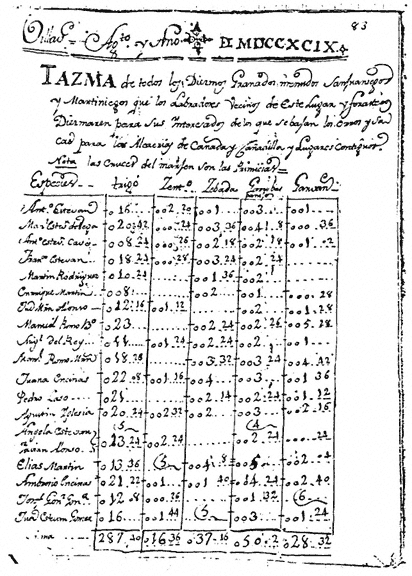
1.
The Tithe Book for Villaverde. First page for August 1799.
Under the heading for each crop, the amount paid by the farmers
is given in fanegas and cuartillors (1 fanega = 48 cuartillos).
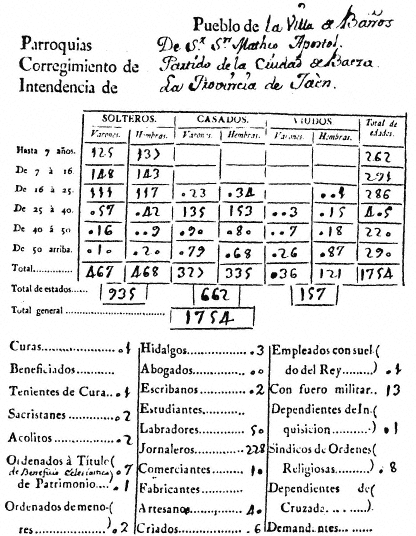
2.
The Census of 1786–87 ("Censo de Floridablanca"). The individual
return for the villa of Baños, province of Jaén. The individuals are
broken down by sex, marital status, and seven age groups.
Underneath, the numbers of males engaged in different occupations
are given, but there is no indication of the number of vecinos.
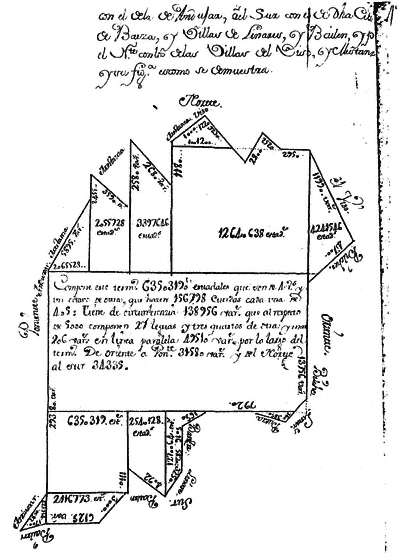
3.
The Catastro of the Marqués de la Ensenada. A page from the
respuestas generales for Baños, responding to Question 3, which
asks for the dimensions of the término, or town limits (1752).
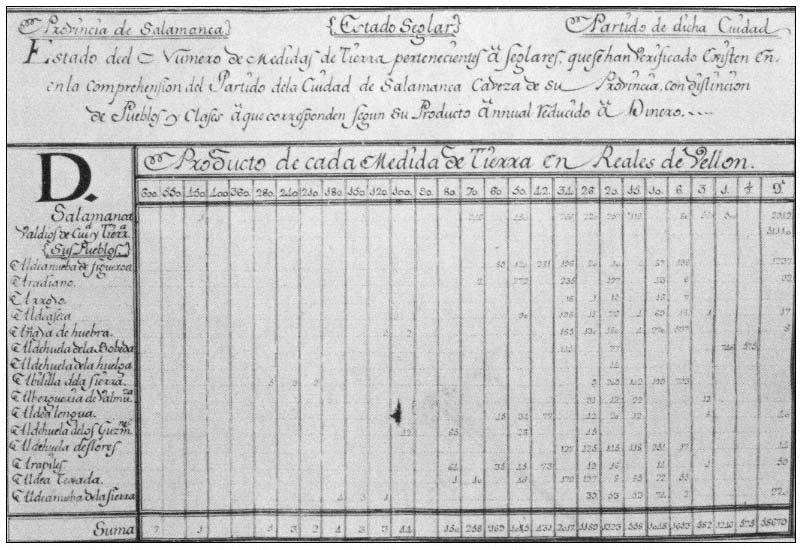
4.
The Catastro of the Marqués de la Ensenada. A page (letra D, page 1) from the provincial summary
for the province of Salamanca. For the capital and first fifteen towns of its partido, it gives the number
of measures of land, broken down according to the annual return per measure, in reales de vellón. The
information was derived by the servants of the Council of Hacienda from the individual catastros of the towns.
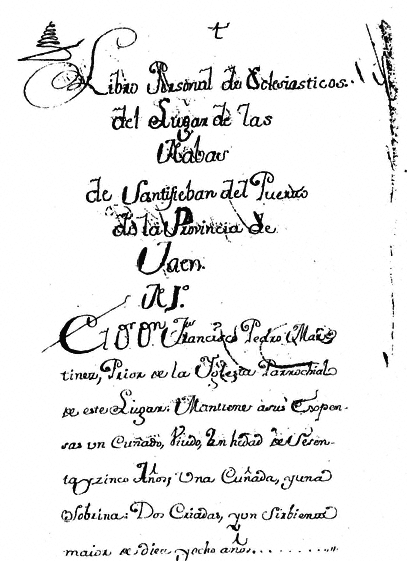
5.
The Catastro of the Marqués de la Ensenada. The first page of the libro
personal de eclesiásticos of Las Navas, which describes the household
of don Francisco Pedro Martínez, prior of the parish church (1752).
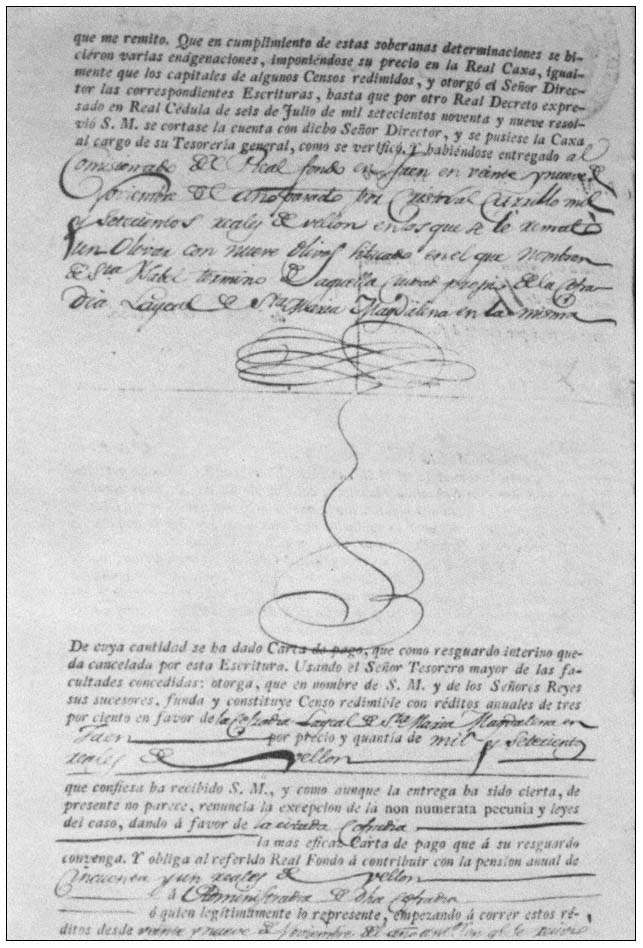
6.
The Desamortización of Carlos IV. Page 2 of a deed of deposit issued by
the notary López Fando of Madrid. It represents the royal obligation to the
Cofradía Laical de Santa María Magdalena of the city of Jaén to cover the
sale of an olive grove of nine trees to Cristoval Carrillo for seventeen hundred
reales, as can be seen by the manuscript writing in the blank space provided for
that purpose. The king promises to pay the Cofradía fifty-seven reales per year.
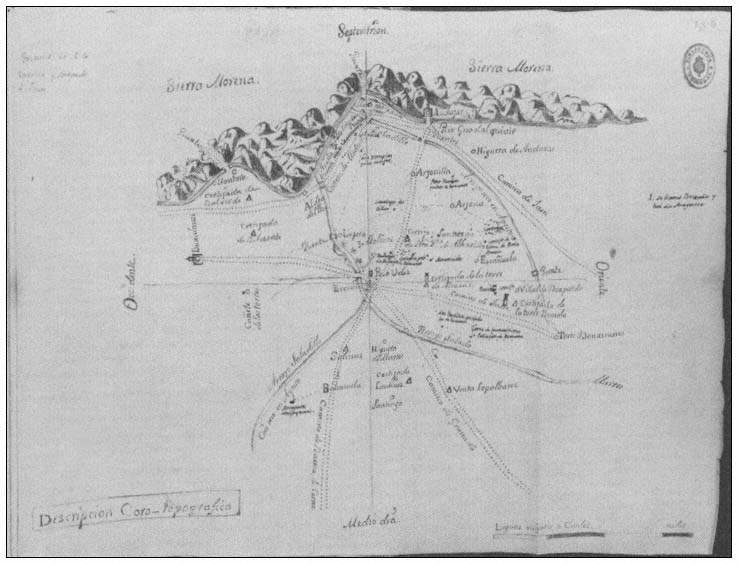
7.
The Preparation of the Map of Tomás López. About 1766 the royal geographer
Tomás López sent a form letter to the parish priests throughout Spain requesting
information on the roads passing through their towns, the rivers or bridges the roads
crossed, the other places to which the roads led, and the direction and distance of these
places from their own town. (A copy of his letter can be found in Biblioteca Nacional,
Sección de Manuscritos, MS. 7307, f. 279.) A number of the responses to his request included
rough maps. This is the map sent in from the town of Porcuna in Jaén. It shows the town's
relationship to surrounding towns, and the roads and rivers of the region. Lopera is located
north of Porcuna, and the Guadalquivir River appears just below the Sierra Morena
at the top, including the important bridge at Andújar. (Ibid., MS. 7301, f. 350)
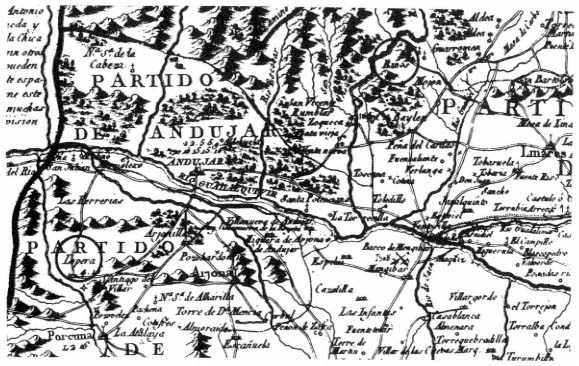
8.
The Map of Jaén of Tomás López, 1787. On the basis of the information Tomás López received,
he created the first complete set of maps of the provinces of Spain, produced in large, hand-drawn
volumes, copies of which are now in the Biblioteca Nacional and the Real Academia de la Historia.
This illustration is part of his map of the province of Jaén, which includes Baños and Lopera.
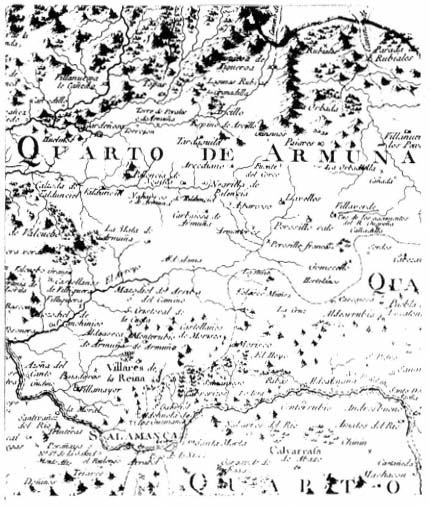
9.
The Map of Salamanca of Tomás López, 1783. A copy of a
portion of the province of Salamanca, which includes the capital and
most of the Cuarto de Armuña. La Mata and Villaverde are located in it.
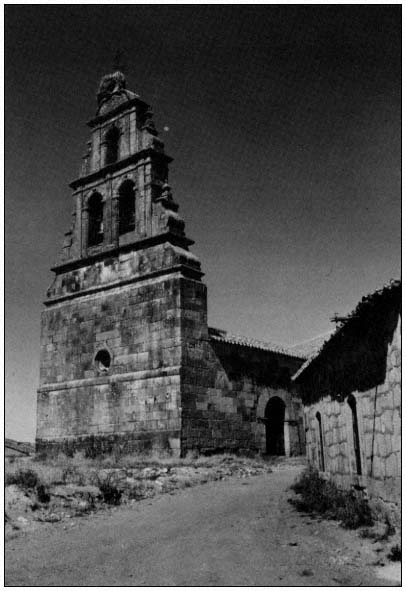
10.
The Parish Church of La Mata. One product of the prosperity of this village
in the second half of the eighteenth century was the decision of the vecinos in
1791 to beautify their modest church with an impressive belfry, or espadaña,
a major accomplishment for this community of some 350 people. It stands out in
contrast to the square towers of an earlier age found in the surrounding villages,
but like all such towers, the espadaña is crowned by a storks' nest, to which
a pair of birds return annually in the spring to produce their young. (Photo RH, 1980)
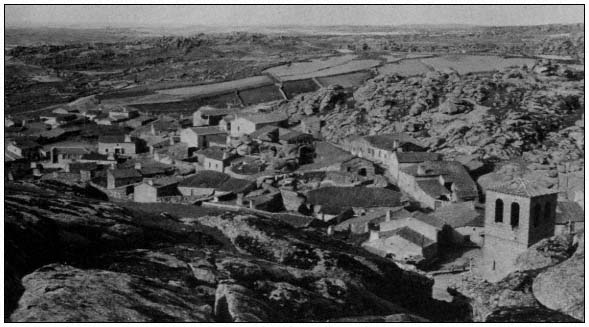
11.
El Mirón. In the eighteenth century this small community was a cabeza de partido. The picture is taken
from beneath the ruined tower, or castillo, which dominates the town, looking north across its rocky upland
arable land. Note the cortinas enclosed by stone walls on the edge of the town nucleus. (Photo RH, 1964)
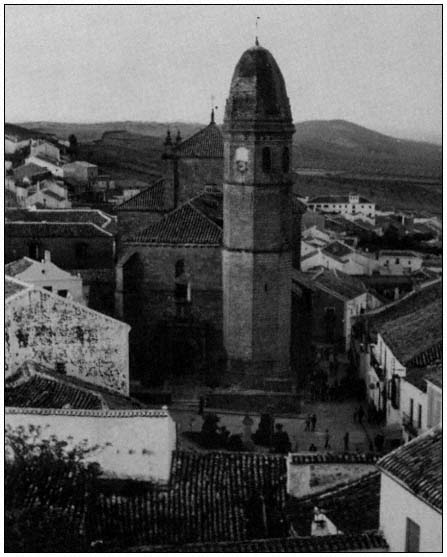
12.
Baños. A perspective from the Moorish castle of the main plaza of this Andalusian
town, with its parish church, town hall (on the right), and in the eighteenth century the
houses of the heads of the top families, the center of municipal life and focus of the
power of its elite. In the upper right one can observe a small portion of the plain beneath
the town, lo llano, whose rich soil produced most of the grain and olive harvest on which the
town economy was based. At the top are the foothills of the Sierra Morena. (Photo RH, 1969)
INDEX
A
Abel, Walter, 733
Administration. See Local administration
Agrarian reform:
theories, 51 –77, 518 –19, 520 , 532 –33;
turning points, 96 , 99 , 156 .
See also Campomanes; Council of Castile; Jovellanos; Land; Olavide
Agricultural labor. See Jornaleros
Agricultural practices:
breaking new ground, La Armuña, 214 –15, 275 –77, 526 ;
labor needs, 791 –93;
rotations, seven towns, 170 –71, Table N.1;
area plowed by a yoke, 667 .
S ee also Crops; Harvests
Agricultural prices:
animals, Table K.1;
eighteenth-century trends in, 13 , 15 , 782 ;
in famine 1803–4, 693 n, 694 ;
grain, 126 , 415 , 587 , 735 , 782 , 801 ;
seven towns, tables 7.4, 8.3, 9.5, 9.6, 10.3, 11.3, 12.3, 13.3, K.1, N.3
Agricultural rents:
Charro district, 306 ;
Córdoba, 381 ;
customary, 521 ;
frozen 1785–1803, 104 ;
increases in, 181 , 214 –15, 276 , 524 , 665 ;
Jaén province, 381 –87;
See also Baños (town); El Mirón (town); La Mata; Las Navas; Lopera; Pedrollén; Villaverde
Agriculture. See also Agrarian reform; Market economy
— commercial:
of despoblados, 666 ;
expansion of, 725 , 737 , 745 –47;
and local consumption, 555 , 559 –60, 567 –68;
in nineteenth century, 710 –11;
and per capita income, 525 ;
and population growth, 15 –18;
Salamanca province, 639 –40;
and transportation, 528 –29
— for local consumption:
Jaén province, 583 ;
Salamanca province, 639 –40
— mean income from a measure of land, 655 n
— regional types, 24 –32
Alava, disentail, 730
Alba, Duque de:
buyer, 686 ;
gets excusado of El Mirón, 353 ;
señorío, 309 –10, 626 , 651 , 702 , 822 , 824
Alba, Duquesa de. See Alba, Duque de
Alba de Tormes (partido), 541 , 628 , 640 , 646
Alba de Tormes (town):
buyers reside in, 682 ;
in middle ages, 645 –46;
Alba de Tormes zone (Salamanca), 608 , 819
Alburquerque, Duque de, señorío, 627 , 651 , 817 , 821
Alcalá la Real, 576
Alcalá la Real zone (Jaén), 564 , 817
Alcaudete, 593
Aldeadávila zone (Salamanca), 607 –8, 821
Alfonso XI, of Castile, 644
Alicante, agriculture, 25
Almarza, Marqués de:
señorío, 651 ;
Alonso y Moral, Francisco:
business activities, 693 –95;
purchases, 282 , 683 , 693 , 695 –96
Alonso y Pizarro, Eugenio (buyer), 685
Alquerías:
decline in population, 648 –49;
land uses, 653 ;
origin, 644 ;
size of, 648
Amiens, Treaty of, 102
Amigo de los hombres,63 . See also Mirabeau, Marquis de
Amortization fund (Caja de Amortización):
commissioners, 539 ;
established, 87 ;
receives capital of disentail, 94 , 97 , 107 ;
used for government needs, 101
Amortization fund (fondo de amortización), 1794, 81 –82
Andalusia:
colonies of, 39 –41;
considered fertile, 56 ;
economy, 14 , 18 , 31 , 74 –75;
population, 17 ;
social structure, 31
See also Baños; Jaén; Las Navas; Lopera
Andraca, Juan de (buyer), 692
Andújar:
artisans, 576 ;
Andújar zone (Jaén), 564 , 568 , 809
Aragon:
landowning, 27 ;
tax system, 7 –8
Aranda, Conde de:
and agricultural reform, 38 ;
president of Council of Castile, 35 ;
sent to Versailles, 41
Aranjuez riots, March 1808, 155 , 158 , 712
Arauzo (despoblado), 650 –52, 691
Arcos, Duque de:
property, 394 ;
señorío, 810
Aristocrats, as buyers, 556 , 724
Ariza, Marqués de:
señorío, 816
Armuña (plain of). See La Armuña (plain of)
Armuña zone (Salamanca), 606 , 622 , 818 –19
Arrieros, See Muleteers
Artisans:
in Jaén zones, 576 –77;
in Salamanca zones, 617 –19.
See also Crafts
Artola, Miguel, 705
Asturias:
landowning, 26 ;
riots 1798, 85
Avila, landowning, 27
B
Baeza:
artisans in, 576 ;
Baeza zone (Jaén), 564 , 813 –14
Bailén:
battle of, 368 ;
jurisdiction over, 593
Baldíos:
Carlos III attempts to distribute, 42 , 44 ;
Jovellanos's plan for, 73 –75;
Olavide's plan for, 66 ;
prior history of, 19 –20, 24 , 30 ;
sale of, 716
Balenzuela, Antonio de (agent in Lopera), 465 –68, 690
Banks:
Dutch, 142 ;
Madrid, 447 .
See also Croese; De Smeth; Fizeaux Grand and Company; Hope and Company
Baños (town):
— administrators of property, 387 , 391
— agricultural rents, 381 , 386
— church revenues, exploitation of, 427 –28
— disentail:
local buyers, 425 –28;
outside buyers, 419 –25;
buyer preferences, 426 –27;
and pattern of prior ownership, 535 ;
sales, 416 –19;
social class of buyers, 428 –29
— economy, evolution of, 414 –15
— employment structure, 369 –70, 415
— harvests:
costs of, 387 –91;
kinds of, 375 –76;
minor, 393 –94;
size of, 378 –81;
yield-seed ratios, 379 –80
— hidalgos, 407 –9
— income:
from agriculture, 381 ;
of hidalgos, 407 ;
of individuals, 398 –413;
of jornaleros, 399 –406, 412 ;
of labradores, 410 –11;
from livestock, 392 –93;
of outside owners, 391 ;
per capita, 396 –98;
of priests, 409 –10;
of service sector, 410 –12;
of town, 396 –98;
of women, 411 –12
— landowners' residence, effect of, 530
— leasing practices, 386 –87
— loses land to Sierra Morena colonies, 414
— migrant labor, 405 –6
— physical features, 368 –69, 370 –76, 410
— property distribution:
buildings, 391 ;
in entail, 415 ;
— royal taxes, 395
— ruling families, 407 –10
— social structure, 413
— socioeconomic pyramid, 406
— término privativo:
described, 371 –75;
— tithes:
distribution of, 395 ;
minucias, 394 ;
renting of, 427 ;
Voto de Santiago, 395
Baños River, 823
Barcelona:
disentail, 730 ;
response to subsidy of 1800, 117
Barco de Avila (partido), 542 , 628 , 824
Barco de Avila (town), buyer resides in, 682
Basel, Treaty of, 83
Basque provinces:
agriculture, 26 ;
food supply, 12 –15;
proto-industry, 528
Basque Society of Friends of the Country, 47
Becedillas River, 823
Bedmar, jurisdiction over, 593
Bedmar, Marqués de, señorío, 815
Béjar (partido), 542 , 627 –28
Béjar (town):
buyer resides in, 682 ;
population, 678 ;
wool industry, 607 , 617 , 620
Béjar, Duque de, señorío, 627
Béjar zone (Salamanca):
disentail in, 611 ;
jurisdiction over, 627 ;
physical characteristics of, 607 , 823 –24
Benavente, Conde-Duque de:
and income from inns, 492 , 508 ;
property in Las Navas, 482 –83, 487
Bennassar, Bartolomé, 191
Bernal, Antonio Miguel, 729
Bilbao, buyer resides int, 687
Black Death, 643 –44
Blanco, José María:
father of, 691 ;
Blockade, British, of Spanish ports, 84 , 100
Bonaparte, Joseph:
abolishes taxes on agriculture, 144 ;
continues disentail, 713 –14;
Boserup, Ester, 10
Bourgeoisie:
and disentail, 560 , 719 –21, 728 –33;
rural, 747
Braun, Rudolf, 528
Bruna (dean of Audiencia of Seville):
on agricultural conditions, 56 , 58 ;
on capellanías, 91 ;
defends economic freedom, 64 –66, 77 , 738 ;
memoir of, 76
Bula de la cruzada, 96
Burgos, intendant of, criticizes entail, 58
Buyers (of disentailed properties):
characteristics and preferences of, 544 –61, 721 –28;
division into four levels, 544 , 567 ;
Jaén province, 545 –49, 573 , 688 –91;
large, Jaén city, 837 –38;
large, Salamanca province, 834 –36;
mentality, 751 ;
mid-nineteenth century, 730 –33;
preferences, 533 –35, 549 –50, 570 –72;
Salamanca province, 549 , 682 –87;
and social class, 534 –35, 556 ;
and terms of purchase, 550 –55;
women, 559 .
See also Baños (town); Clergy; Don; Doña; El Mirón (town); Hidalgos; Las Navas; Lopera; Merchants; Pedrollén; Villaverde
C
Caballero, José Antonio, (secretary of grace and justice; buyer), 686 , 721
Caballero, Marqués de (buyer), 686
Cabarrús, Francisco de, 87 , 763
Cabo Alonso, Angel:
on agricultural prices, 782 ;
on despoblados, 646 , 648 , 653 ;
on effects of disentail, 674 ;
on food requirements, 192 ;
on La Mata, 783
Cáceres, corregidor of, on agrarian reform, 57
Caciquismo, 745
Cadalso José, 559
Cajas de Reducción:
closed, 118 ;
to exchange vales reales, 111 , 142
Calatrava, military order of:
in Lopera, 430 , 456 , 457 , 469 –70;
royal jurisdiction over, 591 , 594 ;
sale of pastures, 45 ;
towns under, 591 , 603 , 810 –11, 816
Camarasa, Marquesa de señorio, 812 , 814 , 815
Cambronero, Manuel (buyer), 687
Campillo de Arenas, 579
Campomanes, Pedro Rodríguez de:
on Andalusia, 56 ;
on agrarian reform, 36 , 55 –56, 671 , 738 ;
career in Council of Castile, 33 , 41 , 43 , 49 ;
on charities, 742 ;
and despoblados, 667 ;
favors economic freedom, 58 ;
founds Economic Society of Madrid, 47 –48;
and free grain trade, 34 –35, 72 , 737 ;
president of Mesta, 42 ;
criticizes religious orders, 741 –42;
favors mixed rural economy, 206 ;
and Sierra Morena colonies, 36 , 38 , 40 ;
on single tax, 9 ;
Tratado de la regalía de amortización,89 –90
Candamo, Francisco de (buyer), 692
Canga Arguelles, José:
memoria of 1802, 80 ;
on population of Spain, 758 ;
on types of property, 765
Cano Mucientes, Josef María (buyer), 217 , 686
Cano Mucientes, Pedro (buyer), 686
Cánones emfiteúticos, redemption of, 107 . See also Censos emfiteúticos
Cantalapiedra, buyer resides in, 685
Cañuelo, Luis, 741
Capellanías:
disentail opposed, 132 ;
nature of property, 91
Cape Saint Vincent, naval battle, 84
Carbajosa de Armuña (town), 214 –15
Carders, Jaén province, 576
Carlos III:
accession, 33 ;
death of, 78 ;
flees rioters, 35 ;
reform of propios, 37 ;
and single tax, 9 –10
Carlos IV:
abdicates, 155 ;
approves disentail 1798, 77 , 93 , 98 ;
compared to Louis XVI, 158 ;
demoralized, 154 ;
issues pragmatic sanction 1800, 113 ;
defends privileged orders, 98
Carreteros, Real Cabaña de, 18
Casa excusada (first tither):
administration of, 187 –88, 781 ;
El Mirón, 353 ;
La Mata, 188 ;
See also Excusado
Casas de campo, defined, 564
Castel Moncayo, Marqués de, señorío, 816
Castellar (town), 475 –76
Castile:
mortality in, 12 ;
types of property in, 23
Catalonia:
depression after 1802, 137 –38;
food supply, 12 –15;
redeemed censos, 123 –24;
tax system, 7 –8.
See also Censos emfiteúticos
Catastro (tax of Catalonia), 7
Catastro (cadaster) of the Marqués de la Ensenada:
on baldíos, 20 ;
calculation of property values, 125 ;
on ecclesiastical property, 23 , 763 , 765 ;
on value of livestock, 326 , 787 –90; types of libros, 160 ;
Catholic Church:
influence on economy, 722 ;
loan to crown, 88 ;
new payments to crown, 1795, 82 , 85 , 114 , 142 ;
See also Disentail; Entail of land
Cattle. See Livestock
Cazorla:
buyers reside in, 690 ;
jurisdiction over, 593 ;
lack of roads in, 600
Cazorla zone (Jaén):
lack of olives in, 603 –4;
Celemín, defined, Table 7.5
Censo de frutos y manufacturas de España,129
Censos:
economic effect of, 794 –96;
provincial totals of redemptions, 123 –25;
redemption of, 94 , 107 –9, 125 , 547 –48
Censos emfiteúticos, Catalonia, 25 . See also Cánones emfiteúticos
Censos perpetuos, elimination of, 107 –8, 115
Censuses:
1712, 14 ;
1768, 52 ;
of eighteenth century, 566 –67, 755 –57.
See also Population
Cente Rubio (despoblado), 658
Central Junta, Supreme (1808–9):
abolishes agricultural taxes, 144 ;
stops disentail, 714
Change offices. See Cajas de Reducción
Charidad Villalobos, Baños leading family, 407 , 410
Charro district:
described, 293 ;
rent increases, 306
Charro zone (Salamanca):
despoblados, 669 ;
Chayanov, A. V.:
life cycle theory, 235 –36;
theory of peasant economy, 534 , 726 , 746
Chinín (despoblado), 696
Chiquero, Lopera leading family, 458
Church. See Catholic Church
Cicilia Coello, José, 69
Ciudad Real (province):
disentail, 730 ;
intendant of, dislikes large farmers, 61
Ciudad Rodrigo (partido), 541 , 644
Clergy, as buyers, 559 , 724 , 742 , 808
Climate:
Jaén province, 562 ;
Salamanca province, 818
Cobban, Alfred, 720
Colegio de Nuestra Señora de la Vega (Salamanca), properties, 700
Columella, 75
Common lands:
Commons. See Diputados del común
Compañía de Comercio (Salamanca), 692
Concentration of landowning, Salamanca zones, 629 –33
Concordat of 1753, 8
"Consolidation," in America, 147 –48
Consolidation Fund:
closed, 713 ;
commissioners, 539 ;
created, 113 –14;
meets fiscal emergencies 1803–6, 141 , 145 –47, 151 –53;
redeems vales reales, 117 –18;
sources of income, 113 , 138 , 142 –45
Consulado of Cádiz, administers royal loan, 144
Contadurías de hipotecas, 161 –62, 682
Convent. See Corpus Christi; Holy Trinity; La Concepción; Lopera; Nuestra Señora del Jesús monastery
Córdoba:
agricultural rents, 381 ;
Inquisition of, 457 ;
intendant of, on agrarian
landowning, 29 ;
relations with Lopera, 465 –68
Corneja River and Valley, 309 –10, 824
Corpus Christi, convent of (Salamanca):
leases in La Mata, 181 –82;
leases in Villaverde, 246 –47;
properties, 700
Corral, Feliciano del (Madrid notary), records of disentail, 120 , 123 , 150 , 543
Cortes of Cádiz:
write constitution, 155 ;
abolish señorío, 826
Cortijos:
influence on economy, 604 ;
in Las Navas, 487 ;
produce for market, 568 ;
plans for reform of, 59 –66
Costa, Joaquín:
criticizes disentail, 718 ;
views on eighteenth-century reformers, 50 –51, 59 , 68
Cotos redondos, 294 , 628 –29, 641 . See also Términos redondos
Council of Castile:
and agrarian reform, 36 , 38 , 42 , 43 –44, 47 , 60 ;
on disentail of mayorazgos, 105 –6;
rejects disentail 1765, 90 ;
appoints Olavide, 38 ;
arbitrates rents in Salamanca province, 306 ;
role in government, 33
Crafts:
decline of, in La Armuña, 211 –12, 273 .
See also Artisans; Baños; Carders; El Mirón (town); La Mata; Las Navas; Lopera; Sandalmakers; Villaverde; Weavers
Croese, Widow E., and Company (Amsterdam), loans to Spain, 87 , 100 –101
Crops, failure of experiments, 527 . See also Harvests
Cuarto dezmero (fourth tither):
La Mata, 172 , 187 –88, 783 –84;
Villaverde, 254
Cuenca, landowning, 27
Cuerda, metric equivalent, 806
Cuerpo de Hombre River, 823
D
Deeds of deposit (escrituras de imposición ):
give information on buyers, 681 ;
record receipts from disentail, 123
Dehesas, Salamanca province, 293 , 674
Demography, historical, theories of, 10 –12. See also Population
Derrota, right of, 749
Desamortización:
in American colonies, 147 –48;
effects of, 3 ;
interpretations of, 718 –20;
objectives of, in 1798, 98 ;
response of wealthy sectors, 117 .
See also Disentail
Deserted villages. See Despoblados
De Smeth (Dutch banker), loan to Spain, 146
Despoblados:
disentail, 671 –74;
in nineteenth century, 674 –75, 710 –11;
labor needs, 655 –59;
labor productivity, 663 –66, 746 ;
land uses, 653 –55;
origin, 642 –49;
population structure, 659 –61;
resettlement of, 42 , 666 –71;
size of, 647 –48
Despuig, Antonio, 110
De Vries, Jan, 704
Dirección de Fomento General, 92
Disentail. See also Amortization Fund; Baños; Buyers; Censos; Consolidation Fund; Desamortización; El Mirón (town); La Mata; Las Navas; Lopera; Pedrollén; Villaverde
— amount of:
ecclesiastical property sold, 132 –33;
real property sold, 135 –36; provincial totals, 123 –33
— background, 46 , 88 –93, 95 –97
— and bourgeois revolution, 728 –33
— of capellanías, 94 , 132 , 150 –51
— causes:
general analysis, 733 –43;
influence of economic growth, 536 ;
and patterns of prior ownership, 535 –37, 637 –41
— of charitable institutions, 94 , 148
— of crown property, 116
— decrees of 1798, 93 –95, 97 –98, 739 –40
— ecclesiastical, decreed, 94 ;
pressure to expedite, 131 –32;
— effects:
on despoblados, 674 –76, 679 –80;
on economy, 641 , 675 –80, 711 , 752 –53;
in Jaén province, 605 ;
on reign of Carlos IV, 155 –58;
in Salamanca province, 630 –36, 641 ;
in seven towns, 532 –34, 537 ;
on society, 537 , 605 , 747 –49
— in Jaén province, 567 –605 passim, 707 –10
— of mayorazgos, 105 –7
— in nineteenth century:
1808–23, 713 –16;
1836–1900, 717 –18, 730 –33, 736 , 752
— papal authorizations, 149 –50, 785
— patterns of purchases:
Jaén province, 707 –10;
Salamanca province, 695 –700
— ratio of sale price to cadastral value, 125 –27, 774 –77
— expected return on purchases, 127
— Salamanca province, 629 –41 passim, 695 –700, 834 –36
Disentail
— terms of purchase, 109 –10, 550 –55, 614 –16, 752
Domínguez Ortiz, Antonio, 643
Don (title):
in Baños, 406 , 408 –9, 413 , 426 ;
in Las Navas, 487 ;
Level 4 buyers, 682 , 685 , 690 ;
proportion of buyers, 556 –58;
in Salamanca province, 621 –22, 685 ;
See also Hidalgos; Notables
Doña (title):
in Baños, 406 –7;
among buyers, 556 –59;
Level 4 buyers, 682 ;
in Lopera, 468 .
See also Hidalgo spinsters
Dutch banks. See Banks
E
Earthquakes, 1804, 139
Economic liberalism:
accepted in Spain, 49 , 740 , 743 –44;
causes of, 753 .
See also Smith, Adam
Economic Society of Madrid:
consulted on agricultural reform, 47 –50, 738 ;
contest on agrarian reform, 55 , 69 ;
Junta on Agrarian Law, 47 –52, 70
Economy, Spanish redistributive, 534 –35, 722
EFW:
in calculation of standard of living, 191 –93;
as unit of income, 174 , 797 –801
El censor, on agrarian reform, 55 , 57 –58
El Collado:
gross income per capita, 350 ;
population, 310 ;
El Mirón (partido):
disentail, 362 –65;
physical features, 310 , 824 ;
evolution of population, 312 , 366 ;
señorío, 628 ;
transferred to Avila, 542
El Mirón (town). See also El Mirón (partido)
— agricultural rents, 321 –22
— church outside payments, 346
— decline in nineteenth century, 366
— disentail:
local buyers, 357 –58;
outside buyers, 362 ; effects of, 365 –66;
and pattern of prior ownership, 535 –36;
sales, 354 –57
— economy:
compared to La Mata and Villaverde, 330 ;
evolution of, 365
— employment structure, 315 , 351
— export products, 338 –40
— harvests:
evolution of, 353 ;
of outsiders, 365 –66;
size of, 316 –21;
yield-seed ratios, 316 , 320 –21
— income:
of agricultural workers, 338 –39;
from agriculture, 321 –26;
of crafts, 339 –40;
from livestock, 326 –28; of notary, 342 ;
per capita, 347 –51;
of priests, 341 –42;
of service sector, 340 ;
of town, 347 –50
— labradores, stratification of, 331 –34
— landowners' residence, effects of, 530
— livestock, ownership of, 331 –34
— physical features, 310 –16
— property distribution, 321 –26
— royal taxes, 347
— señorío payments, 346 –47
— social structure, 413
— socioeconomic pyramid, 343
— tithes:
amount of, in catastro, 317 –20;
casa excusada, 353 ;
first fruits, 328 ;
on livestock, 327 –28;
Voto de Santiago, 343 –46
Encabezamiento, defined, 83
Enclosures, in England, 735 –36, 750
England, historical demography, 11 , 13 , 14 . See also Enclosures
Enlightenment, relation to social class, 77
Ensenada, Marqués de la:
organizes catastro, 8 ;
dismissed, 9 .
See also Catastro of the Marqués de la Ensenada
Entail of land:
abolished, 717 ;
Carlos IV undermines, 156 ;
historical development, 18 –24.
See also Manos muertas; Mayorazgos; Vínculos
Equivalente (tax of Valencia), 7
Escalante, Mariano (buyer in Baños), 428
Escrituras de imposición. See Deeds of deposit
Esquilache, Marqués de, 9 , 33 –35
Esquilache, Motín de (riot 1766), 34 –35, 738
Estadal, metric equivalent, 806
Excusado, gracia del:
administration of, 187 –88;
established, 96 .
See also Casa excusada
Extremadura:
baldíos, 20 ;
landowning, 29
F
Fábricas, defined, 21
Fanega (area):
metric equivalents, Table N.5;
variable measure, 295 , 315 –16
Fanega (volume):
conversion to weight, 782 n;
metric equivalent, Table 7.2;
of wheat, used in this study as standard measure, 174 .
See also EFW
Felipe II:
sells baldíos, 19 –20;
creates excusado, 96 ;
establishes millones, 112
Felipe IV, 7
Felipe V:
sells baldíos, 20 ;
orders census, 14 ;
Fernández de Ocampo, Joseph Joaquín (buyer), 688
Fernando III, obtains tercias reales, 96
Fernando VI:
and baldíos, 20 ;
and free grain trade, 34 ;
tax policies, 8 –9
Fernando VII:
and disentail, 1814–17, 714 , 716
Finances, royal:
1793–93, 78 –88;
tithes as a source of royal income, 157 .
See also Loans; Subsidy of 1800; Taxes; Vales dinero; Vales reales
First fruits, La Mata, 182 . See also Tithes
First tither. See Casa excusada
Fizeaux Grand and Company (Amsterdam), loans to Spain, 80
Flax, Salamanca province, 612 –14
Flórez Estrada, Alvaro, 743
Floridablanca, Joseph Moñino, Conde de:
named first secretary, 41 ;
and sale of Jesuit properties, 45 ;
turns against reform, 49
Foros:
in Galicia, 26 ;
not redeemable, 108
Fourth tither. See Cuarto dezmero
France:
deserted villages, 643 –47, 650 , 662 ;
historical demography, 11 , 13 , 14 ;
National Assembly, sellls church property, 735 ;
Republic, Spanish alliance with, 84
Francia River, 822
French Revolution, influence in Spain, 49 , 158
Fuente del Sahuco, Marqués de, señorío, 810
G
Galicia:
grain prices, 13 ;
held up as a model, 56 ;
junta of, stops disentail, 714 ;
landowning, 26 ;
population, 15
Galindo y Soriano, Baños leading family, 407 , 410
Gallegos de Solmirón:
description, 311 ;
disentail, 364
Gana, Martín de (buyer), 687 , 699
García Serrano, Francisco (tenant of Pedrollén), 298 –99, 303 –6, 519 , 531
García Serrano, Manuel (buyer), 685
García Zarza, Eugenio, 643
Garcíez, Conde de, señorío, 812
George, Henry, 718
Gerona, disentail, 730
Godoy, Manuel:
criticizes disentail procedure, 105 ;
engages Spain in war with Britain, 84 ;
tax policy of, 143 –44
Gómez, Julián (buyer), 673
González, Francisco (buyer in La Mata), 1 –2, 4 , 218 –19, 227 , 233 –35
González, Marcos (buyer in La Mata), 218 , 234
González, Pedro (buyer in La Mata), 217 , 234
González y Castañeda, Lucia (Madrid banker), 447 n
Grain consumption, early modern Europe, 191 –92
Grain trade:
freed 1765, 34 , 62 , 737 –38;
freedom of, defended, 72 ;
freedom suspended 1803, 140
Gramsci, Antonio, 720
Granada:
food supply, 17 ;
intendant of, on agrarian reform, 61 ;
landowning, 29
Granaries. See Pósitos
Granja, Marqués de la (buyer), 688
Guadalajara:
landowning, 27 ;
riots 1797, 85
Guadalén River, 476
Guadalimar River, 475 –76, 816
Guadalquivir:
Guadarromán inn (Baños), 368 , 414
Guarromán (town), 414
Guipúzcoa, agriculture, 26
Gypsies, Baños, 412
H
Hacendados mayores:
archival information on, 566 ;
Jaén province, 595 –99;
Hamilton, Earl, price indexes, 15 , 126 , 587 , 735 , 782 , 801
Harvests, effect of drought, 33 . See also El Mirón (town); Flax; La Mata: Las Navas; Villaverde; Yield-seed ratio
Hidalgos:
in Baños, 407 –9;
census returns on, 556 –58, 598 –99;
criticized, 58 ;
influence on economy, 602 –4, 621 –23;
part of elites, 558 –59;
in Jaén province, 581 –83, 590 , 598 –99, 602 –4, 623 –24;
merchants, 691 ;
residence patterns, 623 –24, 627 ;
in Salamanca province, 621 –23, 627 , 637 .
See also Don; Doña; Notables
Hidalgo spinsters:
Baños, 410 –11;
Highways. See Roads
Historical analysis, the nature of, 740
Holy Trinity, convent of (Alcalá la Real), agricultural leases, 381 –86
Hope and Company (Amsterdam), loans to Spain, 80 , 146 –147
Horace, 53
Horros:
attempt to abolish, 785 –86;
La Mata, 172 ;
Villaverde, Table 8.4
Huebra, metric equivalent, 806
Huelma, jurisdiction over, 593
I
Income, royal. See Finances
Income per capita:
and commerical agriculture, 525 ;
and population change, seven towns, 522 ;
relation to percent of households in agriculture, 801 –3.
See also Agriculture, commercial; Baños; El Collado; El Mirón (town); La Mata; Las Navas; Lopera; Navahermosa; Pedrollén; Santa María del Berrocal; Villaverde
Infantado, Duque del, properties, 702
Informe de ley agraria:
criticism of, 51 ;
publication of, 50 ;
Instituto de Estudios Fiscales, 728
Isla Fernández, Condesa de (Lopera landowner), 468
Italy, historical demography, 14
Iznatoraf, jurisdiction over, 593
J
Jabalquinto, Marqués de, señorío, 810
Jaén (city):
artisans in, 576 ;
buyers reside in, 688 –91, 708 ;
landowning, 29 ;
Jaén (province):
climate, 562 ;
intendant of, on agrarian reform, 62 ;
outside administrators, 519 –20;
physical features, 542 –43, 562 –64;
social structure, 583 ;
terms of purchase, 553 –55
Jaén zones:
market orientation, 569 –83, 590 ;
physical features, 562 –64, 809 –17;
population, 600 –601;
ratios of olive groves to arable, 584 –91;
town size, 575 –76
Jesuits:
expulsion of, 35 ;
properties sold, 44 , 46 , 93 –94, 735
Jódar, Marqués de, señorío, 812
Jornaleros:
days worked per year, 186 , 257 , 304 , 401 –5, 450 ;
Jaén province, 587 –88;
number of, 30 ;
number as measure of per capita income, 801 –2.
See also Baños; El Mirón (town); La Mata; Las Navas; Lopera; Migrant labor; Pedrollén; Villaverde
Jovellanos, Gaspar Melchor de:
condemns bad laws, 56– 57 , 73 , 744 ;
criticizes church institutions, 91 , 741 –42;
criticizes entail, 58 , 73 , 518 , 604 ;
criticizes Mesta, 71 ;
and Economic Society of Madrid, 48 –50, 70 ;
erroneous reasoning of, 743 –46, 747 ;
favors economic freedom, 69 , 73 –74, 157 , 744 ;
favors farming over herding, 53 ;
favors free land market, 71 , 99 , 533 , 743 ;
favors small farmers, 55 , 527 ;
opposes rent control, 157
Juntas de repoblación (Salamanca province), 667 –68, 671
Junta Suprema for disentail (1799), 110
Jurisdiction. See Realengo; Señorío
Juros, 21
L
La Armuña (plain of):
in middle ages, 645 ;
population structure, 204 .
See also Armuña zone
Laborde, Alexandre de, 589
Labradores:
as buyers, 726 .
See also Baños; El Mirón (town); La Mata; Lopera; Villaverde
Labradores peujaleros. See Las Navas
La Cañada and La Cañadilla (despoblados):
agricultural rent, 665 ;
Villaverde farmers expand into, 275 –77, 526
La Concepción, convent of (Salamanca):
leases in La Mata, 181 –82;
properties, 700
Lainez, Conde de, property in Lopera, 471
La Mancha:
baldíos, 20 ;
landowning, 29 ;
towns, 31
La Mata (town):
— agricultural practices, 170 –71
— agricultural rents, 179 –82, 214 , 248 –49
— church outside payments, 200 –201
— demography:
household size, 193 , 195 –96;
marriage patterns, 209 , 271 –72;
population 1753 and 1786, 201 –5;
population evolution, 209 –12, 223 , 522
— disentail:
local buyers, 217 –20, 227 –36;
outside buyers, 216 –17, 227 , 236 ;
and pattern of prior ownership, 536 ;
— economy:
compared to El Mirón, 330 ;
compared to Villaverde, 291 ;
dual, benefits from, 206 , 527 , 536 ;
and population growth, 532
— employment structure, 166 –67, 211
— evolution after 1808, 236 –37
— famine 1803–5, 223 –24
— girls in service, 204 –5
— harvests:
produce outside income, 526 –27;
size of, 171 –76;
value of, 782 ;
— holidays, 207 –8
— income:
from agriculture, 183 ;
of men in agriculture, 224 –26;
gross individual, from land, 658 ;
of labradores, 184 –91, 193 , 783 –84;
from livestock, 182 –83, 189 –91;
of muleteers, 194 –95;
per capita, 204 ;
of priest, 196 –97;
of service sector, 195 –96;
— labradores, 184 –86, 232 –33
— landowners' residence, effects of, 530
— muleteers (arrieros), 193 –95, 215 –16, 529
— physical features, 166 –71
— property distribution, 176 –79
— royal taxes, 201
— social structure, 413
— socioeconomic pyramid, 197 –99
— tithes:
amount of, 172 –75;
distribution of, 200 ;
first fruits, 182 ;
individual payments, 186 –88, 783 –84;
kinds, 172 ;
from Narros, 201 ;
modifications in partible, 785 –86;
Land, free market in, 464 , 520 . See also Agrarian reform; Jovellanos
Land hunger, and disentail, 97 , 734 –37
Landowning:
ideal of small landowners, 53 –59, 68 ;
index of concentration, 828 –29;
regional patterns, 26 –31;
residence of landowners as analytic variable, 529 ;
scattered holdings, 700 –707; 750 –51
Lara, Lopera leading family, 456 –58, 470
Larruga, Eugenio, 612
Las Navas (town):
— agricultural rents, 486
— censos, 794 –96
— church revenues, exploitation of, 514 –15
— disentail:
local buyers, 513 –16;
outside buyers, 509 –13;
of capellanías, 509 ;
effect of economic growth on, 536 ;
and pattern of prior ownership, 536 ;
sales, 508 –9
— economy:
dual nature of, 487 ;
expansion of, 507 ;
pressures on, 531
— employment structure, 477 –78, 508
— farming practices, 479
— harvests:
costs of, 487 ;
minor, 482 ;
olive oil, 481 –82;
size of, 480 ;
yield-seed ratios, 480 –81
— income:
from agriculture, 482 ;
of labradores peujaleros, 501 –2;
from livestock, 490 ;
of no-tables, 495 –99;
of outside administrators and owners, 487 , 490 ;
per capita, 493 ;
of town, 493 –94
— labradores peujaleros, 499 –503, 516
— landowners' residence, effects of, 531
— leasing practices, 486 –87
— oil mill, 483 –85
— olive groves, expansion of, 500 , 503 , 507 , 509
— physical features, 476 –77
— population, 477 , 493 , 505 –6
— prices of grains, 479
— priests:
as buyers, 513 –14;
sources of income, 495 –99
— property distribution:
buildings, 490
— residential pattern, 504 –5
— royal taxes, 492
— señorío payments, 492
— social structure, 504 –5
— socioeconomic pyramid, 495
— tithes:
administration of, 480 , 515 ;
bula de la cruzada, 493 ;
distribution of, 492 –93;
Voto de Santiago, 493
— town officials, 501 –3
Las Navas de Tolosa, battle of, 368
Lavoisier, A. -L., 191
Lechuga, Baños leading family, 408
Ledesma (partido):
economy, 640 ;
Ledesma (town):
in middle ages, 645 –46;
Ledesma zone (Salamanca):
despoblados, 669 –70;
physical features, 607 , 820 –21
Legítima de los descendientes, 22
Legua, defined, 167 n
Le Roy Ladurie, Emmanuel, 733
Liberalism. See Economic liberalism
Libro (of Catastro):
Maestro eclesiástico,
Libro (of Catastro)
160 ;
maestro seglar, 160 ;
personal de eclesiásticos, 160 ;
personal de legos, 160
Linares zone (Jaén), 564 , 810
Livestock:
Calculate income from, 326 –27, 787 –90;
raising in Salamanca province, 655 .
See also Baños; El Mirón (town); La Mata; Las Navas; Lopera; Pedrollén; Sheep raising; Villaverde
Livi Bacci, Massimo, 758
Llerena (Extremadura), disentail in, 424
Loans:
royal, 85 –88, 100 –101, 144 –47;
Consolidation fund pays interest on, 142 .
See also Finances
Local administration, weakness of royal, 44 , 117 , 744 –45
Lopera (town):
— agricultural rents, 439
— convent of San Juan de Dios, 431 , 442
— Córdoba, relations with, 474
— crafts, 527
— disentail:
local buyers, 468 –73;
outside buyers, 465 –68;
effect of economic growth on, 536 ;
effects of, 464 ;
and pattern of prior ownership, 536 ;
sales, 463 –64
— employment structure, 432 , 461
— farming practices, 435 –36
— harvests:
costs of, 441 ;
minor, 438 –39; olive oil, 438 ;
size of, 436 –38;
yield-seed ratios, 438
— hidalgos, 461
— income:
from agriculture, 439 ;
from inns, 447 ;
of labradores, 460 ;
from livestock, 446 ;
of muleteers, 446 –47, 459 –60;
of notables, 456 –57;
of other sectors, 459 –61;
of outside administrators and owners, 444 ;
per capita, 448 ;
from property of outsiders, 451 ;
of town, 448 ;
— landowners' residence, effect of, 530
— leasing practices, 439 –42
— muleteers, contribution to town economy, 529
— notables, 473 –74
— physical features, 430 –36
— property distribution:
land, 439 ;
buildings, 446
— royal taxes, 448
— socioeconomic pyramid, 455 , 473
— tithes:
administration of, 438 ;
amount of, 436 –38;
distribution of, 447 –48;
López, Tomás, map of, 600
López Fando, Juan Manuel (Madrid notary), records disentail, 120 , 123 , 148 , 543
Los Villares, jurisdiction over, 593
M
McCloskey, Donald, 705
Machiavelli, 54
Madoz, Pascual, law on disentail, 717 , 736
Madrid (city):
buyers reside in, 217 , 282 , 727 , 730 –32;
food supply, 14 , 17 , 191 –92;
individual incomes, 801 ;
population, 759 ;
role in Spanish economy, 679 , 722
Madrid (province), disentail in, 129 –30
Madrid, Economic Society of. See Economic Society of Madrid
Malthus, Thomas, 10 , 15 , 522
Malthusian trap:
Jovellanos ignores, 747 ;
in La Mata, 526 ;
search for an escape from, 532 , 536 –37, 680 ;
threatens rural society, 522 , 723
Mancha Real zone (Jaén), 564 , 568 , 812
Manos muertas, defined, 21 . See also Entail of land
María Luisa, Queen, 154
Market economy, entry into:
of seven towns, 520 –21, 526 –27, 530 –31;
of Salamanca zones, 609 –17, 627 , 639 –40.
See also Agriculture, commercial
Marmol, del, Baños leading family, 408 , 426
Martínez Alier, Juan, 791
Martín Vicente (despoblado), 686
Martos, buyers reside in, 689 , 709
Martos zone (Jaén), 564 , 603 –4, 811
Mata, See La Mata
Mateos Delgado, Josef (buyer), 687
Matilla (town), 652
Matilla Tascón, Antonio, 125 , 763
Mayorazgos:
defined, 21 –22;
decree authorizes sale of properties of, 95 , 105 ;
abolished, 107 .
See also Disentail; Entail of land
Medinaceli, Duque de, properties, 702
Medina Sidonia, Duque de, properties, 702
Meléndez Valdés, Juan (poet, buyer), 688
Memorial ajustado . . . sobre . . . la agricultura (1784), 48 –49, 72 , 76
Memorias, defined, 21
Mendels, Franklin, 528
Mendizábal, Juan Alvarez, laws on disentail, 717 , 732 , 736
Menéndez Pelayo, Marcelino, 718
Mengíbar (town), 580
Mengíbar zone (Jaén), 564 , 811
Merchants, as buyers, 687 , 691 , 693 –95, 699
Mesta:
development, 23 –24;
occupies baldíos, 30 ;
and poderosos, 32 ;
posesión (entail of pastures), 18 –19, 24 , 28 ;
posesión weakened, 42 , 43 , 667 ;
privileges criticized, 35 , 57 , 63 , 71 ;
Béjar sheepwalk, 611 ;
wheat allowance for laborers, 192
Migrant labor:
Baños, 405 –6;
Lopera, 450 –51
Military orders:
income ceded to king, 114 ;
proposals for properties of, 91 , 97 .
See also Calatrava; Santiago
Millones (tax), created, 20 , 112
Miñano, Sebastián, Diccionario geográfico:
cited, 351 –53, 507 , 648 , 668 , 677 ;
source for population data, 567
Mirabeau, Marquis de, L'ami des hommes (El amigo de los hombres) , influence in Spain, 53 , 54 , 59 , 63 , 66 , 69 , 71
Miranda, Conde de, señorío, 822
Miranda del Castañar (partido), 542 , 628
Miranda inn (Baños), 368 , 414
Miranda zone (Salamanca), 607 , 614 , 622 , 822 –23
Mirón. See El Mirón
Molina de la Zerda, Baños leading family, 407 , 410 , 425
Molina de la Zerda y Soriano, Francisca Luisa de (Baños landowner), 407 , 410 , 419 n, 801
Monastery. See Nuestra Señora del Jesús monastery
Moñino, Joseph. See Floridablanca
Monks, Lopera, 431
Montemayor (partido), 542 , 823
Montilla, Ignacio (Lopera landowner), 456 –58, 468
Montilla y Padilla, Miguel (buyer in Lopera), 469 –70
Montilla y Zevallos, Margarita, Inés, María Josefa (buyers in Lopera), 468
Morales, Lopera leading family, 458
Morales, Juan Nepomuceno (buyer in Lopera), 465 –68, 690
Moreau de Jonnès, Alexandre, 763
Moreno Simón Pontero, Fernando (buyer in Baños), 425 , 428
Moro, Manuel (buyer), 685
Muleteers:
Lopera, 459 –60;
provide economic stimulus, 528 –29, 536 ;
Salamanca province, 620 ;
Villaverde, 258 –61
Municipal buildings, disentail of, 92 –93
Muñoz Galindo, Baños leading family, 410 , 426
Murcia, disentail, 136 n
N
Napoleon:
gets information on Spanish finances, 80 , 121 –23, 133 ;
intervenes in Spain, 155 , 713
Naredo, José Manuel, 791
Narros de Valdunciel (despoblado):
agricultural rents, 214 –15, 665 ;
disentail purchases in, 218 –19, 222 , 673 ;
population, 209 ;
resettled, 215 , 276 –77, 526 , 669
Navahermosa:
disentail, 362 –64;
gross per capita income, 350 ;
population evolution, 351 ;
tithes, 343
Navarre:
disentail, 730 ;
landowning, 27
Navarro, Baños leading family, 408
Navas. See Las Navas
Neutrality subsidy, of France by Spain, 137 , 141
Nobles. See Hidalgos
North, Douglass, 733
Notables:
as buyers, 558 , 560 –61, 621 –22, 723 ;
composition of, 413 , 456 , 723 –25.
See also Don; Hidalgos
Nuestra Señora del Jesús monastery (Salamanca):
leases, 181 –82, 247 –48, 524 , 785 ;
properties, 702
O
Obras pías:
defined, 90 ;
order for disentail of 1798, 94 ;
proposals for disentail of, 91
Olavide, Pablo de:
believes Andalusia is deserted, 23 , 52 , 56 ;
proposal to distribute baldíos, 66 –68, 77 ;
opposes common lands, 71 ;
and Sierra Morena colonies, 38 , 40 ;
views on economic freedom, 58 , 62 –64, 68 , 72 , 738
Olivares, Conde-Duque de, 7
Olive groves:
disentail of, 417 –18, 464 , 545 –47;
expansion of, Jaén province,
Olive groves
expansion of, Las Navas, 500 , 503 , 507 , 509 , 531 ;
labor needs of, 791 –93;
and market economy, 531 , 567 –71;
Olmedilla (town), 652
Onís, Manuela de (buyer), 685 , 700
Oropesa y Alcaudete, Condesa de, señorío, 817
Ortiz Pinedo, Manuel (alcalde mayor of Salamanca), 1 –2
Osuna, Duque de, properties, 702 –3
Otero de María Asensio, buyer resides in, 685
Ouvrard, Gabriel Julien, 145 –47
P
Pando, Josef (buyer), 691 , 693
Parcelary concentration, 750 –51
Patiño, Josef, 7
Patronatos de legos, defined, 90
Peasants:
Malthusian and Ricardian pressures on, 522 –25.
See also Jornaleros; Labradores
Pedrollén (alquería):
— agricultural rents, 298 , 302 , 532
— disentail:
buyer, 307 ;
and pattern of prior ownership, 535 ;
sales, 307 –8
— economy, 531
— harvests:
kinds of, 298 ;
size of, 299 –301;
yield-seed ratios, 301
— income:
gross, 658 ;
of laborers, 304 –5;
from livestock, 301 –3;
net, 303 ;
per capita, 303 ;
of shepherds, 305 ;
of tenant, 305
— laborers, 298 –99, 659 , 665
— outside payments, 302 –3
— owners, 295 –96
— physical features, 293 –95
— population, 295 , 307 , 308 , 532
— social structure, 518 –19
Pedrosillo el Ralo, 249
Pegalajar zone (Jaén), 564 , 816
Pérez Albarez de Rueda, Carlos María (buyer), 692
Pérez Caballero, Joseph (buyer in Baños), 419 , 690
Piedrahita (partido), 542 , 628
Piedrahita (town), 309 –10
Piedrahita zone (Salamanca), 607 , 614 , 824 –25
Piñuela, Lorenzo (buyer in Villaverde), 282 , 683
Pliny the Younger, 706
Ponderosos:
economic role, 520 , 521 , 604 ;
as no-tables, 724 ;
oppose agricultural reform, 43 –44
Ponz, Antonio, 653
Pope, concessions to king:
on disentail, 149 –50
Population:
changes in, as causal factor in history, 733 –34, 753 –54;
changes in, and the rural economy, 531 –32;
influence of growth of, on royal policies, 737 –38, 740 –41;
of Jaén zones, 600 –601;
of Salamanca plain, 661 n, 830 –31;
of Salamanca zones, 608 –9, 617 , 833 ;
of Spain, 12 , 14 –15, 756 –62.
See also Baños; El Mirón (town); Jaén zones; La Mata; Las Navas; Lopera; Malthusian trap; Pedrollén; Salamanca (partido); Salamanca zones; Villaverde
Posesión. See Mesta
Priests. See Baños; Clergy; El Mirón (town); La Mata; Las Navas; Lopera; Villaverde
Prieto Hermosino, Anselmo (buyer), 692
Prince of the Peace. See Godoy, Manuel
Procurador general. See Salamanca (partido)
Procurador síndico personero del público, 36 , 44
Property distribution. See Baños; El Mirón (town); La Mata; Las Navas; Lopera; Villaverde
plans for reform of, 37
Propios y arbitrios (municipal tax fund):
financial support for royal funds, 81 , 145 ;
Juntas de, 37 .
See also Subsidy of 1800
Proto-industry, lack of in rural Castile, 527 –29, 620
Putting-out system. See Proto-industry
Puyol, Josef (buyer), 683
R
Rascón, Antonio, Vizconde de Revilla y Barajas (buyer), 683
Real contribución (tax of Aragon), 7
Realengo (jurisdiction):
defined, 591 ;
extent of, 765
Redistributive economy. See Economy
Reforms. See Agrarian reform; Tax structure
Reguera Valdelomar, Juan de la (critic of disentail), 132 , 156 , 715
Rentas provinciales, taxes of Castile, 8
Rent of land. See Agricultural rents
Respuestas generales, 160 , 566 –67
Revilla y Barajas, Vizconde de. See Rascón
Reyrruard, Antonio (buyer), 217 , 692 , 694 , 698
Ricardian trap:
appears unjust, 680 ;
produces marketable surplus, 746 –47;
reformers respond to, 667 –68;
restricts peasant income, 526 , 532 , 723 ;
towns search for an escape, 536 –37
Ricardo, David, applicability of rent theory in Spain, 523 –25, 665 –66
Rincón, Juan (landowner in La Mata), 185 –86
Ringrose, David, 191 , 722 , 801
Riolobos (despoblado), 650 , 658
Roads:
to Andalusia, 367 –68;
to Granada, 579 , 593 , 621 , 816 –17;
to Salamanca from Béjar, 620 ;
to Salamanca from León, 645 ;
Roca, Duque de la (buyer), 686
Rodas Viejas, buyer resides in, 685
Rodríguez, Josef (buyer in La Mata), 673
Rotations. See Agricultural practices
Royal finances. See Finances
Royal taxes. See Taxes
Rueda Hernanz, Germán, 731
Rus y García, Alonso de (buyer in Lopera), 470 –71
S
Saavedra, Francisco de (secretary of hacienda), 86 –87, 92
Safont brothers (buyers), 732
Salamanca (city):
buyers reside in, 227 , 281 –82, 308 , 679 , 682 –85, 687 , 708 , 834 –36;
economic strength in nearby towns, 179 , 220 , 244 , 281 –82, 295 , 308 , 618 ;
economy of, 640 –1;
food supply, 17 ;
in middle ages, 645 –46;
in nineteenth century, 678 ;
physical features, 165 ;
population, 834
Salamanca (partido):
despoblados, 650 ;
physical features, 541 ;
procurador general, 685 n;
royal jurisdiction, 625 –26;
Salamanca-Albacete line:
and disentail, 136 ; location, Map 1.1;
divides property size, 517 –19
Salamanca cathedral, payments to, 645 –46. See also Cuarto dezmero
Salamanca zones:
absentee ownership, 634 –41;
concentration of landowning, 629 –33;
market orientation, 609 –17, 627 , 639 –40;
physical features, 606 –7, 818 –25;
population, 833 ;
terms of purchase, 614 –15;
Salvatierra zone (Salamanca):
despoblados, 670 ;
physical features, 608 , 821 –22
Sánchez de Onís, Segundo (buyer), 698
Sánchez García, Francisco (buyer), 699 , 707
Sánchez Tomé, Martín (notary of Salamanca), 1 –3
Sanchiricones (town), 306
Sandalmakers, Jaén province, 576 –77
San Esteban del Puerto. See Santisteban del Puerto
San García, buyer resides in, 687
Sangusín River, 823
San Martín y Coello, Francisco de Paula (buyer), 690
San Muñoz (town), 652
San Pedro de Azerón (despoblado), 658 –59
Santa Isabel, convent of (Salamanca), properties, 700
Santa María del Berrocal:
disentail, 364 ;
gross per capita income, 350 –51;
weavers, 339
Santiago, military order of, towns under, 815 , 821
Santiago de Calatrava zone (Jaén), 564 , 810 –11
Santisteban del Puerto:
jurisdiction over, 593 ;
physical features, 475 –76
Santisteban del Puerto, Duque de:
property in Las Navas, 482 –87;
señorío of, 476 , 811 , 814 , 815
Santisteban zone (Jaén), 564 , 815
Schofield, Roger, 11
Segura River, irrigation dam breaks, 138
Sempere y Guarinos, Juan, Historia de los vinculos, 92
Señores, residences of, Jaén province, 594 –95
Señorío:
— as cause of despoblados, 651 –53
— effect on landowning, 31
— extent of, 765
— influence on the economy:
Jaén province, 591 –605;
Las Navas, 490 ;
Salamanca province, 624 –29
— lands of, defined, 591
— origin:
Jaén province, 593 ;
Salamanca province, 627 –28, 646
— payments under:
as fixed amounts, 521 ;
El Mirón, 346 –47;
Las Navas, 492 ;
Valencia, 25
Señorío
— types of señorío lego, 826 –27
Servicio ordinario y extraordinario y su quince al millar, 83
Seville:
buyer resides in, 690 ;
city council of, protests high grain price, 60 ;
food supply, 17 ;
intendent of, pushes disentail, 131 –32;
landowning, 29 ;
riots 1797–98, 85 ;
síndico personero of, favors agrarian reform, 52 , 53 , 61 , 64
Sexmeros. See Salamanca (partido)
Sheep raising:
El Mirón, 331 –34;
Salamanca province, 611 , 653 –55;
wool production per sheep, 251 n.22
Sierra Morena (colonies of), 38 –41, 368 , 413 –14
Sierra Morena zone. See Baños zone
Single tax, plans for in Castile, 8 –10, 44 , 82
Single women. See Hidalgo spinsters
Sixto Espinosa, Manuel, 110 , 712
Smith, Adam:
doctrine not original, 59 ;
economic theory, 54 , 73 , 679 ;
Jovellanos reads, 49 –50, 77 , 739 ;
becomes known in Spain, 69 , 738 –39
Soler, Miguel Cayetano:
organizes Cajas de Reducción, 111 ;
death of, 712 ;
organizes disentail, 102 ;
recommends ecclesiastical disentail, 88 –89;
on disentail of mayorazgos, 106 –7;
urges disentail of military orders, 89 , 98 ;
reports of 1798 and 1799, 80 ;
secretary of hacienda, 88 ;
tax policy, 144
Soria, landowning, 31
Standard of living, calculation in EFW of, 191 –93
Subleasing (subarriendo), 62 , 519
Subsidy of 1800, for municipalities, 112 , 115 , 116 –17. See also Propios y arbitrios
Supreme Central Junta. See Central Junta, Supreme
Swinburne, Henry, 40
T
Talleyrand, Prince, 147
Tauste, canal of, 79
Tavira y Almanzán, Antonio (bishop of Salamanca), 132
Taxes, royal:
to support Consolidation Fund 1800 and 1805, 113 , 142 ;
on servants 1799, 111 , 115 , 117 ;
on untithed harvests 1805, 142 –43;
on wine 1805, 143 .
See also Baños (town);
El Mirón (town); Finances; La Mata: Las Navas; Lopera: Villaverde
Tax structure:
under Felipe V and Fernando VI, 7 –9;
in Castile, 83 ;
See also Single Tax
Términos redondos:
disentail, 672 –74;
in nineteenth century, 678 , 710 –11
Terms of purchase. See Disentail
Terrones (town), 306
Thompson, F. M. L., 720
Tierras de aprovechamiento común. See Common lands
Tither, first. See Casa excusada
Tither, fourth. See Cuarto dezmero
Tithe rolls:
La Mata, 186 –88;
Salamanca province, 162 –63;
Villaverde, 252 –54
Tithes:
fixed share of harvest, 521 ;
modifications in 1796, 785 –86.
See also Baños (town); Casa excusada; El Mirón (town); first fruits; Horros; La Mata; Las Navas; Lopera; Villaverde; Voto de Santiago
Tocqueville, Alexis de, 158
Toledo (archbishop of), señorío in Jaén, 593 , 599 , 812 , 814 , 815
Toledo (province):
landowning, 29 ;
proto-industry, 528
Tomás y Valiente, Francisco, 719
Toribio y Galán, Antonio (buyer), 685
Tormes River, 165 , 309 , 819 , 821 , 823 –24
Toro, laws of, 91
Torralba y de Talara, Conde de, señorío, 811
Torre, Antonio de la (Madrid banker), 447 n
Townsend, Joseph, 589
Trafalgar, battle of, 141
Transportation sector, in peasant economy, 528 –29, 536 . See also Muleteers
U
Ubeda:
artisans in, 576 ;
buyers reside in, 688 , 690 , 709
Uceda, Duquesa de, señorío, 652
Unica contribución. See Single tax
United States, sale of public lands, 736 –37
Urquijo, Mariano Luis de, 88
V
Valencia (province):
agriculture, 25 ;
disentail, 730 ;
food supply, 13 –15;
protoindustry, 528
Vales dinero, 144 –45
Vales reales:
discount 1795–98, 84 ;
discount 1798–1802, 101 –2, 110 , 112 –13, 118 ;
rules for use in disentail, 95 , 109 –10;
payments for disentailed properties in, 550 –55, 614 –16, 752 ;
interest unpaid, 153 ;
issues, 79 , 81 –83, 100 , 766 –67;
monthly quotations, 768 –73;
Valladolid (city):
food supply, 17 ;
grain consumption, 191 –92
Valladolid (province):
disentail, 731 ;
landowning, 27 ;
sale of Jesuit properties, 45
Vara castellana, metric equivalent, 806
Vecinos (town), 652
"Vecindario general de España" (ca. 1712), 566
Vélez y España, María del Rosario (buyer of Pedrollén), 307 , 683 , 700
Vicens Vives, Jaime, 719
Villacarillo (town), 582 , 593
Villafranca, Sierra de, 310
Villafuertes, Manuel Francisco de Zevallos Guerra, Conde de, 469
Villagonzalo, Conde de (buyer), 685
Villanueva del Arzobispo (town), 582 , 593 , 600
Villanueva zone (Jaén), 564 , 814
Villar, Juan Josef (buyer in Baños), 419 , 428
Villar de Corneja, 310
Villar don Pardo, Conde de, señorío, 811
Villares, Vizconde de, señorío, 816
Villares de la Reina, buyer resides in, 685
Villas eximidas, 625
Villaverde (town):
— agricultural rents, 245 –49, 665
— church outside payments, 267
— demography:
marriage patterns, 271 –72;
population evolution, 268 –71, 522
— disentail:
local buyers, 283 –90;
outside buyers, 281 –83;
effect of economic growth on, 536 ;
effects of, 290 –91;
and pattern of prior ownership, 535
— economy:
compared to El Mirón, 330 ;
compared to La Mata, 291 –92;
and stagnant population, 532
— employment structure, 239 , 273 –74
— girls in service, 272 –73
— harvests:
evolution of, 274 –78;
outside town limits, 275 –76, 526 ;
size of, 239 –44;
— income:
from agriculture, 252 ;
gross individual, from land, 658 ;
of jornaleros, 258 ;
of labradores, 254 –58, 278 –79;
from livestock, 251 –52;
of muleteers, 258 –61;
per capita, 268 ; of priest, 263 –66;
of service sector, 263 ;
— landowners' residence, effect of, 530
— muleteers (arrieros), 273 –74, 529
— physical features, 238 –39
— property distribution:
in town, 244 –45;
across town lines, 249 –50
— royal taxes, 267
— social structure, 413
— socioeconomic pyramid, 266
— tithes:
amount of, 239 –44;
first fruits, 251 ;
individual payments, 252 –56;
modifications in partible, 785 –86;
Voto de Santiago, 250 –51
Vínculos, 21 –22. See also Mayorazgos
Vizcaya, agriculture, 26
Voltaire, Philosophical Dictionary , 54
von Thünen, Johann Heinrich, rings, 376 –78, 435 –36, 564
Voto de Santiago, 521 . See also Baños (town); El Mirón (town); La Mata; Las Navas; Lopera; Villaverde
W
Ward, Bernardo, 742
Wars:
with Britain 1796, 84 ;
with Britain 1804, 137 ;
influence on disentail, 741 ;
economic effects of, 80 –82, 84 –85, 137 –38, 144 ;
between France and Britain 1803, 137 ;
with French Republic 1793, 80 ;
with Portugal 1801, 102 ;
with Portugal 1807, 154 ;
of Spanish Succession, 7 , 12 , 78 ;
of U.S. Independence, 78
Weavers:
Jaén province, 576 ;
Santa María del Berrocal, 339 .
See also Crafts