
3
The University Press in the 1940s
Recto and Verso
When you walked into the Press building—then home of the combined Press and printing department, now housing only the latter—to the left of the high lobby were the administrative offices, where Hazel Niehaus presided over several people in the large outer room. In 1944 she had worked for the printing plant and Press for twenty-four years, and she had another twenty-five to go, the last few for the Press alone. Past her desk and straight ahead was Farquhar's corner office and to the right that of V. J. McHenry, whose title was superintendent of the plant but whose work was more limited. With an assistant, Ross Cushing, he took in all printing jobs and did the estimating. Later, when I would bring in a book manuscript, he would weigh it solemnly in one hand, up and down, look out the window, look back at me, and say, "About x thousand dollars, don't you think?" And it really didn't matter much because we were expected to pay the actual cost as accumulated on the time sheets. And there was no real way to control that.
The front of the building along Oxford Street was three stories high, with the third floor given over to a library bindery and the second to editorial and sales offices. The much larger plant behind this front was all on one level. From the lobby leading up to the second floor was a handsome spiral staircase, whose exact curvature was often drawn and studied by students of architecture. Halfway up, the climber could pause and look through a wide window opening
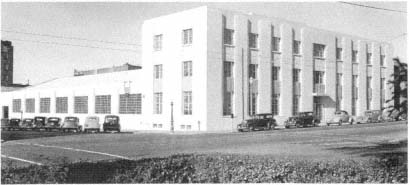
U.C. Press Building on Oxford Street, 1940.
over the composing room, where men were busy at work. The more distant press room and pamphlet bindery could be seen through tall glass partitions. It was all quite impressive, and a closer look showed that the entire area was skillfully planned for flow of work from one function to another. Diffused light was provided by high saw-tooth skylights over the plant area and a south wall of glass bricks. The plant floor was made of upturned redwood blocks that cushioned the feet. Farquhar and his architects, Masten and Hurd of San Francisco, had known precisely what they were doing.
Farquhar himself must have taken an active part in the planning. That his older half-brother, Robert, was architect of the elegant Clark Library in Los Angeles suggests a family interest in such matters. The style of the Press building has been described as conservatively modern. A surviving unsigned memo of 1940 says "Simplicity in design and dignity without pretentiousness were sought by the use of lightly marked vertical accents" on the rather low main facade. Compared to other University buildings in Berkeley, it is small, harmonious, perfectly balanced—just the qualities that Farquhar sought in book design. I have sometimes thought that only one University building is more handsome—South Hall, the sole survivor of the 1873 campus.
The entire building was beautifully planned for the Press as it was then—for a good-sized printing plant and a small, attached, and sub-
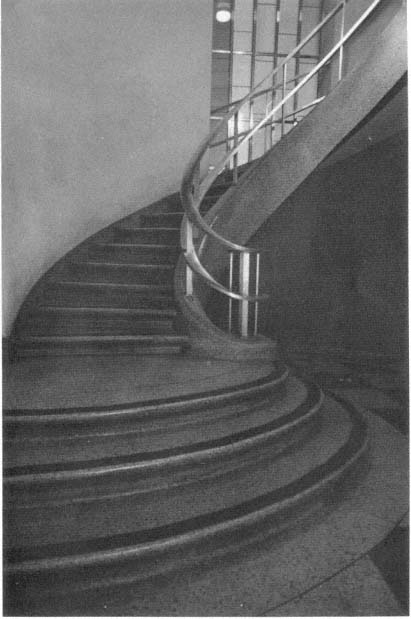
Spiral staircase to the second floor of the
Press building. Photo by David Renick.
sidiary editorial operation, with easy communication between editors and compositors. The second floor was all publishing. At one end was the oak-paneled library, with a complete collection of Press books and series volumes, a collection of works on printing, and a long table for meetings. At the other end was the sales department, more billing office than selling office, where I was about to install myself. And in between were half a dozen editorial rooms. That was it for publishing, and it was most of what we had for the next eighteen years. Publishing, unlike printing, can be done from almost any kind of office. When we finally moved in 1962 the chief gain, along with more space, was to distance ourselves from the printers—a gain that would have been incomprehensible to the editorial staff of 1944.
The chief editor, Harold Small, and his assistants were in almost daily touch with the print shop, and particularly with Amadeo Tommasini, foreman of the composing room. Given the conditions of the day and the conception of publishing then, it was an effective symbiosis. In a long job description written a few years later, Small described three essential skills of the "present editor." The first was the ability to revise manuscripts in many fields, the third an understanding of the "genus professor." Of the second skill, called equally important, he wrote, "The Editor must understand the mechanics of printing, and must have a discriminating knowledge of the design and manufacture of books, so that he can . . . collaborate fully with the supervisors of work in the mechanical plant at all stages of book production." Small was "the" editor, and one might describe his job in present terms as chief copyeditor and production editor; he did almost no procurement. In a letterpress plant all illustrations were printed from metal engravings, which Small, in close collaboration with Tommasini, scaled and ordered from an Oakland firm. Only later, when we came into conflict, did I realize how the two of them controlled between them almost the whole process of manufacture. It was Farquhar, of course, who had invented and still dominated the style of book design—as I will describe later—but with a looser control than in earlier years. Decisions were made one at a time, as the
job moved along, and not all in advance as must be done when dealing with outside printers.
In our informal newsletter called The Pierian Spring, I once wrote a little piece that began, "Ever since we first wandered into the publishing business, we have been trying to determine precisely what an editor is. . . . The man eludes classification; the word evades definition. An editor doesn't fit a filing cabinet, can't be mounted on a slide, was never weighed in a scale or added up on an adding machine, moves too variously for an electric eye, and never stands still long enough to be measured by triangulation. Our friends the technicians, who think they can measure the goodness of an angel or weigh the thoughts of a lady while she pulls up her sox, have never been able to pin him down or fasten him up. Nor have we."
The overblown language was mine, of course, but the picture behind the prose was Small's own image of himself, as set down at length in the job description mentioned above. How serious was I at the time of writing? Perhaps as serious as was Small when he used to introduce me—in my first sales manager days—as the man who was going to "make us all rich." But there was truth in the self-appraisal. Largely self-educated after his degree from Colby College in Maine, he had picked up an enormous store of erudition and could hold his own in conversation with almost any humanistic scholar, as I saw when we went together for lunch at the Faculty Club. He himself wrote that "his qualifications and his successes" came from being brought up in a home where "good table talk was enjoyed and valued," from omnivorous reading, and from schooling in the old New England liberal arts tradition. True enough, I still think.
To this education was added miscellaneous information from some fifteen years of newspaper experience in Hartford and San Francisco. Among his stories was one about the New England lady proofreader who was too embarrassed to ask correction of a misspelled ad for fancy ducks, forty cents a pound, and the hilarity that broke out when the paper hit the street. Rival journalists at a Boston paper telegraphed to reserve several tons and claimed to be chartering a
special train. This brand of masculine humor must have flourished in newsrooms of the 1920s. Similar goings-on made a highly successful Broadway play, The Front Page (1928) by Ben Hecht and Charles MacArthur.
Now as the erudite and unhurried editor of a scholarly press Small had found the right niche for himself. From there he could announce that all manuscripts must be written in some language. And that no book is ever finished but is only abandoned. And could classify the several kinds of academic prose. One, I remember, was the shingle style: each sentence overlaps the one before. In another the sentences follow each other in single file, like elephants in line, each trunk holding the tail of the beast ahead.
It was strange, I used to think, that an old newspaperman had no respect for deadlines; perhaps he had had a nose full of them and would no longer admit their existence. So the bad news, the verso of the good, was that authors could grow impatient; the Editorial Committee had, from time to time, risen up in anger over delays. The history of this I did not know at the time, but a new episode was soon to burst upon us. And I was to know the similar frustration of the would-be publisher with ideas about scheduling new books and planning their distribution. "The Editor," wrote Small, "must be able to give some assistance to the best manuscripts, to rewrite the worst, and to meet all degrees of demand between the extremes. . . . The editorial services given by the University of California Press are not duplicated by any other university press or by any commercial publishing house." That is the way it was, and I learned that no one could change Small's habits. Not even Farquhar, who in times of trouble might hire additional editors but could never get Small or his assistants to work in any other way. In my time he never tried.
When I first arrived Farquhar was still in vigorous good health and good spirits. His pronounced limp, from polio as a child, had little effect on his mobility. He was about to marry for the second time. At the Press, even if he could not control everything, as no one could, he was clearly in charge, ruling with vigor and good sense. Things had been going well. The Press had its own handsome type-
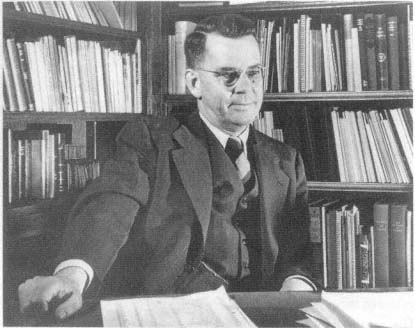
Sam Farquhar at his desk.
face, specially designed by Frederic W. Goudy, the foremost type designer of the day; in book design Farquhar had devised a splendid house style and, with the help first of Fred Ross and then of Amadeo Tommasini, had won many national prizes; the printing department was soon to take on the design and printing of the United Nations Charter.
Publishing income had almost doubled, largely from the sale of Japanese-language textbooks and dictionaries, undertaken at the request of the U.S. Navy, which had licensed the reprinting of books first published in Japan, a kind of authorized piracy. The books would die quickly later on, but the wartime demand was great. Every morning, when the mail had been opened, Farquhar rang, and I would go down to his office; together we turned over and discussed the day's orders, not a very long task. The Japanese texts sold in quantity. There were a few general books on the backlist but not many. Our one "best-seller" among these, Cézanne's Composition by Erle Loran,
was out of stock. Paper was then rationed; we had no allotment for a reprint.
Like Small, Farquhar was a New Englander, coming from one of the Newtons, near Boston, and educated at Harvard. Although temperamentally quite different, the two men must have discovered something in common when they met in San Francisco. For more than a year, in 1927–28, while Small was book review editor of the Chronicle and Farquhar a member of the printing firm of Johnck & Seeger, the latter wrote a regular column on fine bookmaking, with emphasis on the notable printers of San Francisco. And in 1928 the two men were among the founding members of the Roxburghe Club of San Francisco. It is not surprising that one brought the other to Berkeley.
Also active in book circles was Sam's older brother, Francis—accountant, mountaineer, bibliographer, connoisseur of fine printing, historian of the Sierra Nevada,[1] and notable book collector. His great mountaineering collection is now at UCLA.[2] It seems likely, although I cannot document this, that Francis, with his many connections in San Francisco, may have had some influence on Sam's appointment as printer in 1932. For many years Francis edited the Sierra Club Bulletin , where David Brower got his first editorial experience before coming to the Press.
Sam Farquhar was less bookish, I think, than Small and much more of an organizer and manager, but he had a good humanistic education and was proud of his Harvard degree. Latin he remembered well, and he had recently audited a university class in ancient Greek—a step that I took after him a few years later. On one of our trips, eating in a Greek restaurant, he showed that he could make a stab at reading a modern newspaper in that language. And I should mention his irreverent sense of humor and quick wit. The Press had published a small collection of letters by Anthony Trollope, entitled
[1] His History of the Sierra Nevada was published by the Press in 1966.
[2] See James R. Cox, Classics in the Literature of Mountaineering and Mountain Travel from the Francis P. Farquhar Collection . . . (Los Angeles, 1980).
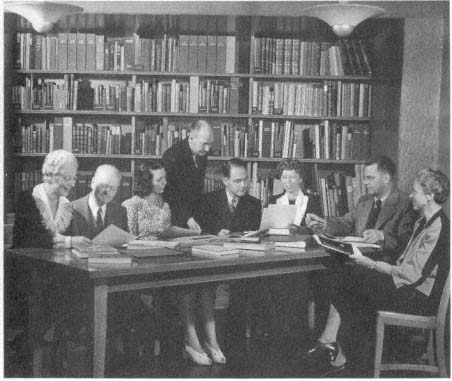
Sam Farquhar (second from right) presides over a staff meeting in 1942.
The others are (left to right) Martha Willard, V.J. McHenry, Hazel Niehaus,
Harold A. Small, Duane Muncy, Leura Dorothy Bevis, and Katherine Towle.
McHenry was superintendent of the printing plant, Muncy assistant
superintendent. Photo by John Brenneis.
The Tireless Traveler. Sam said it should have been called The Tireless Trollope . He had in his head a large collection of limericks, the erotic kind with a sting in the tail. I still remember how he recited these.
I could have no complaints about our new working relationship. Farquhar was a firm but generous mentor. He advised me on the University, saying that the faculty would accept me in about five years—an accurate appraisal of Berkeley reserve, at that time noticeably different from the more open style at UCLA. He told me also that in any dispute between the academic and the business sides of the University we must stand with the faculty, even though we were
part of the administration. This recollection, I am aware, fits uneasily with Albert Muto's account of Farquhar's disputes with the Editorial Committee. Perhaps he had learned or had changed. I had good reason to remember the advice a few years later.
Farquhar saw the importance of the other campuses and branches of the University, especially those in the south, and he liked to travel by car, two interests that went well together. He no longer drove, but I did, and every few months we would head south in a University car, often on back roads, crossing the main highway now and then. Our first stop might be Riverside, where we had authors at the Citrus Experiment Station. The Citrus Industry (volume 1, 1943) and the Color Handbook of Citrus Diseases (1941), both with multiple authors, were important books in those days before the great southern groves were bulldozed into housing tracts. From there we went to La Julla, like Riverside not yet a general campus, for a visit to the Scripps Institution of Oceanography, which then produced series papers if not books.
And then to Los Angeles, where the Press had a small office in the back of Royce Hall, and where the sole employee, the secretary, had little to do between managerial visits. Farquhar got along well with the southern members of the Editorial Committee (at that time three out of eleven), having worked with them to get Sproul's permission for the local office. Much of our business there had to do with journals: Pacific Historical Review, edited in the UCLA history department, at that time by Louis Knott Koontz and later by John Walton Caughey, and the new Hollywood Quarterly, an exciting but doomed venture that led, after political and other troubles, to the film publishing of today. In Los Angeles I was introduced to the two book clubs, Zamorano and Rounce & Coffin, and to the fine printers, librarians, and booksellers who made up the membership. Many became friends. One of them, the printer Ward Ritchie, became our first, and most prolific, free-lance book designer in the 1950s.
Sometime after my arrival Sam proposed that we revive the Book Arts Club, an informal student group that he had sponsored before
the war. Members, changing annually, were the students in that year's library school class in Berkeley, especially those with an interest in the book arts. In 1937 I had been a rather inactive member. The students, in collaboration with Farquhar and the appropriate faculty member, chose each year a manuscript about fine printing or the history of bookmaking, and worked with Farquhar or Tommasini in putting together a design. The book was then printed in the plant in an edition of two or three hundred copies. The sales income was small, of course, and the printing bill had to be reduced, but Sam had been careful early on to obtain the approval of President Sproul for a project that was designed to benefit students. In spite of this care, he and I were later accused—he posthumously, I more vulnerably—of doing free printing for a club to which we belonged.
Six books had been produced before the war. The students, with our help, now brought out Fifty Printers' Marks, by Edwin Elliot Willoughby of the Folger Shakespeare Library, in 1947, and Kamisuki Chohoki (Handy Guide to Papermaking) in 1948. Farquhar's death, of course, put an end to the club and, indeed, to that kind of printing and publishing.
In her brief tenure in Berkeley, Dorothy Bevis had begun writing an informal newsletter about Press books entitled—by Sam, with his literary tastes—The Pierian Spring . It was similar in purpose, if not in style, to The Pleasures of Publishing put out by Columbia University Press about that time or later. Neither Dorothy at first nor I, when I took it up in 1945, pretended to drink deep at the spring of learning. The newsletter was intended, I once wrote, for those who "appreciate the sidelong rather than the headlong approach to book advertising." It was issued "at intervals." In it I wrote what I thought were lighthearted pieces about Press books, new and old, even some that were out of print, about the book trade as I was coming to know it, about editing, as quoted above, about anything that might interest librarians, booksellers, and even, possibly, book buyers. There was a spoofing piece about some of the titles of our monographs, such as Is the Boulder "Batholith" a Lacolith? (Geological Sciences, 1:16), The Free-
Living, Unarmored Dinoflagelata, one of the semicentennial publications, and a paper that I do not now identify on the three-toed tree toad.
I have never been sure that this sort of thing sells many books, although when we found a small cache of something old and desirable, such as Grinnell and Storer's Animal Life in the Yosemite, they went fast enough. But it was a pleasure. Every publisher is a writer manqué or a scholar manqué—except a happy few, the real McCoys. But over the next few years we accumulated an appreciative audience; there were letters from all sorts of people in the book and library business and even from university presidents. If it had not been so easy to make errors, we should have had to invent some; they provoked correspondence.
For the first two or three years the intervals were short enough, two or three months between issues, but in time the spring began to run dry, and after the death of Farquhar—even before that, perhaps—there were more serious things to think about. He who struggles to keep his head above water is little concerned with drinking deep or tasting lightly. Years later, when one of our editors suggested that I revive The Pierian Spring, the idea was real enough to him, no doubt, but to me it suggested a gone world—not just the great, changed, outside world itself but also the smaller world in which we worked. And I could not help thinking that it was I, more than anyone else, who had done away with the old world of the Press.
There were three parts to that small ancien régime—three estates, we might call them in pre-revolutionary terminology—the printing department, the Press as Editorial Committee, and the Press as book publisher. And the third was least of the three. While the most visible to librarians and booksellers, and destined to outstrip the others, it was then smallest in size and perhaps in importance, overshadowed by the others in two quite different ways.
Although the Committee's Press and Farquhar's Press used the same imprint and financed some books jointly, they were really two different endeavors. To the Committee the Scientific Publications (se-
ries and a few books of similar nature) were of first importance and were sometimes seen as competing for editorial and printing time with Farquhar's books (called General Publications). There had been hot arguments about delays, presumably caused by General Publications, and we were soon to see an attempt by the Committee to take them over.
The Editorial Committee spent nearly all its time on the monographs, which greatly outnumbered the books. In the 1893–1943 catalogue there are listed about fifty different subject series, of which perhaps forty were then alive and active. Of these, in the decade before the war, an average of more than sixty papers, large and small, were examined and approved each year. Even in the war years, when budgets were greatly reduced, the number of monographs was more than twice that of books, perhaps three times greater without the Japanese texts. It was not until the late fifties or early sixties that scholarly books began to exceed in number the great monograph series, and by then the two programs were no longer thought to be in competition. In 1944 it was possible to think of them as two programs with different purposes, almost as two presses.
When Sam Farquhar, with the blessing of President Sproul, put Press and printing office together in 1933 he had reason to believe he was forming a modern press, as well as one in a great and old tradition. For a long time after the invention of movable type in the fifteenth century the functions of printing, publishing, and bookselling were not clearly distinguished and were often combined. Even today the word press means a machine for printing and also means a publishing house. The invention of printing was, in a narrow sense, only a technological innovation, although writers on the history of the book sometimes seem to imply that the craft itself was a great cultural force. It was the combination of craft, choice of texts, and wide dissemination that brought on change. Each of the three was dependent on the others, incomplete without the others. Thus, the royal Letters Patent, the charter granted by Henry VIII to Cambridge University in 1534 not only gave the "power to print there all manner of books" but "also to exhibit for sale, as well in the same University as else-
where in our realm, wherever they please, all such books and all other books wherever printed."
At the time of which I write the two great English exemplars, Oxford and Cambridge, had long operated combined printing and publishing organizations and were renowned for both. And on this continent, in the forties, more than a dozen university presses operated printing plants or had some kind of relation to their university plants. A few, such as Princeton and Oklahoma, were highly successful joint operations.
But printing and publishing, once so close together that the first term implied the second, have in today's world become incompatible. This is not the place to analyze the social and technological changes that have driven the two apart, but today I know of only two North American presses, Toronto and Princeton, that still do some of their own printing, and even the great Oxford University plant has been shut down—as a money loser and incompatible with publishing—and its remarkable collection of types put into a museum.
While printing can be thought of as an art or a craft, it can also be seen as a mechanism, a means to an end. While the publisher (or bookseller) may be a mere entrepreneur who buys cheap and sells dear (or tries to) he may also be judge and organizer of an intellectual endeavor. Printing as a craft and without sufficient concern for what is printed becomes precious. Publishing with too little thought for what is made public is mere commerce. The content of the work is of first importance. Or so reasons a publisher.
There is no mystique about publishing as there is about printing. Publishers are not craftsmen, as I learned and wrote many years ago, and they can seldom afford to have craftsmen on the staff, brutal as that may sound. Books should be eminently legible, as Farquhar proclaimed long ago, and it is a great gain if they are also handsome, as long as we don't let ourselves become more concerned with package than with contents. A publisher can be more than entrepreneur only by looking hard at the two chief functions, choosing and disseminating, especially the first of these. If he chooses well the fields of specialization, and in seeking books selects the excellent from among the
good (instead of merely weeding out the bad), and distributes them well enough to attract the best authors, then the publishing house can develop a character of its own, and may come to have an intellectual value comparable, in its own way, to that of a first-rate academic department.[3]
But the Press did not publish in that way in 1944, and probably could not have, given its relation to the printing plant. One strategy for joint operation is for the plant to take outside work (as in Toronto now, I think). Another is to avoid the problem of balance by keeping one side of the union much larger than the other. Thus some small plants have been managed, not without difficulty, for the benefit of large publishing houses. In Berkeley in the forties it was the other way around, although I cannot be sure that anyone, except perhaps Farquhar himself, thought of it that way. The Press was grafted on to the printing office and provided only a fraction of the plant's business. As long as that ratio was kept, with not too much publishing activity, things went well enough, although there had been complaints since the last century whenever monographs were put aside for the more urgent announcements and catalogues. When a book program was added, books and monographs could compete for second and third places in line.
It was certainly not clear to me then—and probably not to others—that a successful symbiosis depended on keeping the number of books few. Few they were; neither Farquhar nor Small had strong publishing ambitions. From the beginning Farquhar's chief goal was to produce a few finely printed books that would win design awards, a goal triumphantly reached. The tastes of both men ran to the kind of book collected by bibliophiles. Of course they appreciated and worked competently on the scholarly books that came along, but they made no great effort to go after more of them.
In the nine years of 1933–41 the Press brought out a little more than one hundred books or about a dozen a year. Of these a number
[3] I wrote something like this in "The Service Agency and the Publishing House," Scholarly Publishing (Toronto), January 1976.
were chiefly of book-collecting interest, and some were obligation books such as festschriften and the several series of lectures sponsored by the Committee on International Relations and pushed on the Press by President Sproul. There were also several unsalable foreign-language works, such as Les sonnets de Shakespeare traduits en vers français, and some volumes rescued from the monograph series. Substantial scholarly works and books of general intellectual interest—basic university press fare—were no more than two or three a year.
Nevertheless, during the war years these few included a number of important works, such as Cézanne's Composition and the two citrus books mentioned above. There were also the early titles in the United Nations Series, edited by Robert J. Kerner, large multi-author volumes about the Allied countries, beginning with Czechoslovakia and going on, after the war, to China, Brazil, Australia, Canada, and others. But the chief publishing venture, in a practical sense, was the large group of Japanese-language dictionaries and textbooks, all printed by offset outside the University plant, which could do only letterpress—hence no internal scheduling problems. It may be that the considerable success with these, the increased sales and income, together with the promise of the United Nations books, led Farquhar to anticipate an expansion of publishing in the postwar years. But he could not have foreseen—no one foresaw—what the growth of publishing, together with more active selling and the steep rise in printing costs, would do to his two-part organization.