
Designing the Purpose-Built Asylum
Many aspects of the asylum's physical structure and siting contributed to its value as a therapeutic tool. In the first place, Tuke and his followers placed a wholly new emphasis on the importance of classification as a means of control and resocialization.[36] Segregation of inmates by other than social class was largely ignored in the eighteenth century. When John Howard visited Bethlem in 1788, for example, he discovered that "the patients communicate with one another from the top to the bottom of the house, so that there is no separation of the calm and the quiet from the noisy and turbulent, except those who are chained in their cells."[37]
By contrast, in the reform institutions, separation was a key management device, the technique that made possible the discarding of cruder, more obvious ways of inducing a measure of conformity from the asylum's inmates. Once "the patients are arranged into classes, as much as may be, according to the degree in which they approach to rational or orderly conduct,"[38] the asylum authorities had a powerful weapon at their disposal with which to prevail upon the patients to exercise self-
[33] R. G. Hill, A Lecture on the Management of Lunatic Asylums (London: Simpkin, Marshall, 1839), 4–6.
[34] Cited in J. Mortimer Granville. The Care and Cure of the Insane, 2 vols. (London: Hardwicke and Bogue, 1877), 1:15.
[35] Cited in D. Dix, Memorial Soliciting Adequate Appropriations for the Construction of a State Hospital for the Insane in the State of Mississippi (Jackson: Fall and Marshall, 1850), 20.
[36] Wholly new as applied to lunatics, that is: for criminals, classification was the key disciplinary tool to be used in the new penitentiaries from the time of John Howard onwards. Here too, therefore, "the programme of reformatory discipline outlined by the philanthropists . . . could only be implemented in a building designed for the purpose. Because reformation relied so much on demarcation and division, to isolate prisoner from prisoner, architecture was acknowledged to be the crucial factor in setting the whole process in motion" (Evans, "Rational Plan," 179).
[37] Cited in Thompson and Goldin, Hospital, 69.
[38] Tuke, Description of the Retreat, 141.
restraint: "[The insane] quickly perceive, or if not, they are informed on the first occasion, that their treatment depends in great measure on their conduct."[39] If a patient misbehaved, he was simply demoted to a level where "this conduct is routinely dealt with and to a degree allowed," but where the available social amenities were sharply curtailed. Only by exhibiting a suitable willingness to control his disagreeable propensities was he allowed to obtain his former privileges, always with the implied threat that their grant was purely conditional and subject to revocation. As Goffman has pointed out, "What we find here (and do not on the outside) is a very model of what psychologists might call a learning situation—all hinged on the process of an admitted giving in."[40] The importance of this approach as a mechanism for controlling the uncontrollable is perhaps indicated by the persistent employment of architecture to permit classification, long after its use for the other purposes the reformers had in mind had been abandoned. (See Figure 9.)
For beyond the utility of physical barriers to enforce moral divisions in the patient population, the building's design was important for the reformers in countless other ways. Their ideal institution was to be a home, where the patients were known and treated as individuals, where the mind was constantly stimulated and encouraged to return to its "natural" state. Such a nicely calibrated treatment could be administered only in an institution of manageable size. The Retreat itself had begun with only thirty patients, though later expansion almost doubled that number. For the new pauper asylums to be built at public expense, it was felt that these standards could be relaxed, though not by much. "It is evident," said Sir William Ellis,
that for the patients to have all the care they require, there should never be more than can, with comfort, be attended to: from 100 to 120, are as many as ought to be in any one house; where they are beyond that the individual cases cease to excite the attention they ought; and if once that is the case, not one half the good can be expected to result.[41]
Others thought that the number might be raised to 200, or even 250, but all the major authorities agreed that it should not rise beyond this point.[42]
[39] Ibid. For further discussions of the importance of classification, see, for instance, Maximilian Jacobi, On the Construction and Management of Hospitals for the Insane (London: Churchill, 184l); and W. A. F. Browne, What Asylums Were, Are, and Ought to Be (Edinburgh, Black, 1837).
[40] Erving Goffman, Asylums: Essays on the Social Situation of Mental Patients and Other Inmates (Garden City, New York: Doubleday, 1961), 361–62.
[41] W.C. Ellis, A Treatise on the Nature, Symptoms, Causes, and Treatment of Insanity . . . (London: Holdsworth, 1838), 17.
[42] See, for example, Jacobi, Construction and Management, 23; "Report of the Metropolitan Commissioners in Lunacy, 1844," Sessional Papers of the House of Lords, vol. 26 (1844), 23.
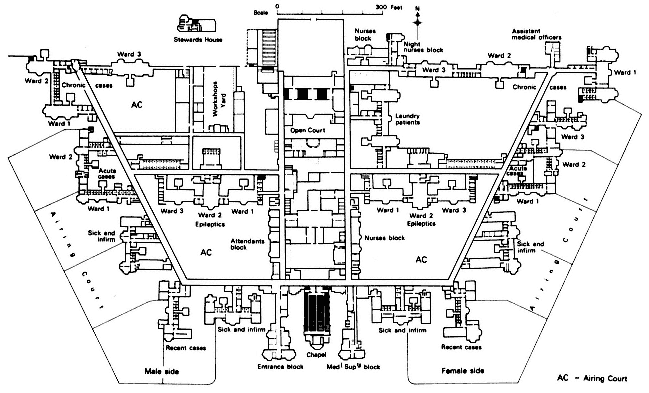
Figure 9.
Ground floor plan of the Claybury County Asylum at Woodford, Essex, begun in 1887. The asylum was designed for 2,000
patients. In addition to its four "curative" asylums (of which this was one), Middlesex also made use of two asylums for
incurables at Caterham and Leavesden (see Figures 13 and 14), each taking approximately 2,500 patients. As with the
hospital and prison, the architecture of the asylum developed in association with the system of classifying and
organizing the inmates. Based on drawings from The Builder , 23 November 1889, and from H. C. Burdett,
Hospitals and Asylums of the World (London: Churchill, 1893), 158.
The building itself should emphasize as little as possible the idea of imprisonment or confinement. It should be sited where the patients could enjoy the benefits of fresh, bracing country air, and where there was an extensive and pleasing view of the surrounding countryside to divert the mind from its morbid fantasies. The insane were very sensitive to their surroundings, and though "some have been disposed to contemn as superfluous the attention paid to the lesser feelings of the patients, there is great reason to believe it has been of considerable advantage."[43] It was thus not an extravagance to design and build institutions that emphasized cheerfulness by being aesthetically pleasing. The architect could help secure these ends even through small and apparently insignificant details: for example, by substituting iron for wooden frames in the sash windows, security could be maintained without the need for iron bars.[44] Similarly, patients ought to be able to change rooms in the course of the day to get a change of scenery, and provision ought always to be made for extensive grounds to be attached to an asylum. These features would allow scope for recreation and harmless diversions, the kinds of mental and physical stimulation that would counteract the tendency of insanity to degenerate into outright fatuity.