
The Nanjing Tomb
The tomb excavated in 1960 in the vicinity of the Xishan Bridge, south of present-day Nanjing, seemed at first little different in either construction or contents from other Six Dynasty tombs previously unearthed in the area.[21] It had been broken into at an early date, but damage was confined largely to the corridor. Constructed of gray brick, the oblong tomb's interior, measuring 6.85 by 3.1 meters, comprised a narrow corridor and a single burial chamber. Its wall construction of three rows laid horizontally to every vertical row of bricks was characteristic of fourth- and fifth-century tombs, as were the herringbone-patterned brick floor, tunnel-vaulted roof, and stone doors topped by a stone lintel embossed with a design shaped like the letter A. The report refers to a neighboring tomb, dated A.D. 369, with similar characteristics, while a tomb dating from 384, excavated east of the city, featured a similar drainage system of sump pits connected to drainage lines under the floor.[22] A few bricks utilized in construction and distributed randomly throughout the tomb were inscribed with floral designs.[23]
Mortuary objects scattered in the burial chamber were the usual array of metal coins, clay utensils and vessels, glazed stoneware. The pottery horse and rhinoceros were common, and the small stone pigs were ubiquitous in known tombs of the period. The three clay effigies, of which a male and a female remained intact, resembled others found in the region.[24] The low brick platform filling the latter two-thirds of the room (exclusive of the apse at the rear) was another characteristic feature. On this platform sat four stone slabs intended to be the base for two wood coffins, their only remaining traces being the iron nails scattered on the floor.
In sum, only one feature of this tomb was unique, the two relief murals on the long walls of the burial chamber (figs. 2 and 3). Beginning approximately halfway into the room, and one-half meter above the floor, each mural measured 2.4 by 0.8 meters. Each was composed of many dozens of gray bricks set in the same pattern as the rest of the
wall, namely, three horizontal rows of bricks to every vertical row. The sides or ends of the bricks bore inscriptions that were obviously guides to their positioning.[25]
The very intricacy of the composition was without parallel in previous tomb finds. The technique of stamping a design in clay could, after all, be traced back to late Neolithic times and was commonly used for tomb walls of Western Han.[26] Multiple-brick designs datable to the Six Dynasties had been found earlier in the Nanjing area.[27] One of these was a small stag in fine-line relief and composed of two bricks; the other composition required three bricks to depict a tiger, again in fine-line relief.[28] Many of these bricks, including the multiple-tile compositions, have floral or animal designs—sometimes complete, sometimes partial—on other facets of the bricks, including the narrow sides and short ends. Each brick design, in short, is a mass-produced module.[29]
No one had anticipated the technical complexity of the new finds. The excavators posited a complicated process of manufacture: The mural designs were first drawn on wood boards, which were then carved and pressed into wet-clay bricks. After firing, the bricks were assembled as integral parts of the tomb walls.[30] The method, as Akiyama Terukazu has remarked, is sophisticated, and the Xishanqiao murals are surely not the first to have been constructed in this manner.[31]
Complexity of construction, however, was not the only surprise for the excavators. Both the subject of the murals—for the pair constitute one subject—and its treatment were to astonish. Quite simply, nothing like them had been previously excavated.
Each mural is composed of four male figures and five trees. The variegated trees, which stretch the full height of the panel, separate and frame each figure. Like their Han predecessors, these images are accompanied by inscriptions. Beside each figure a brick supplies a name in relief. The murals, therefore, are portraits. The subjects, however, are new. Seven of the eight men in the composition are historical personages who lived in the third century. The eighth figure, also a man, is known from at least one story circulating in their time. Let us see how they were depicted approximately a century later, in a region of China far from their homes.
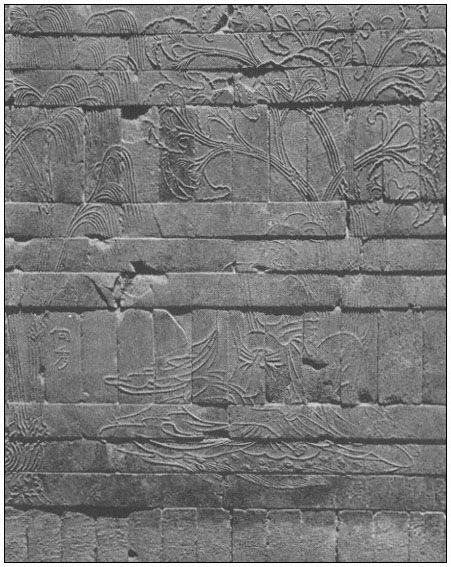
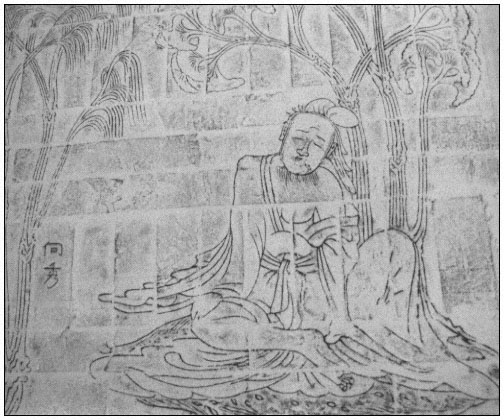
On the south wall, as one enters the burial chamber, a tree with broad, scallop-edged leaves rises behind a frontally seated figure whose head turns slightly, in three-quarter view, to the west (the rear of the room).[32] His moustache and whiskers are visible; his hair is tied
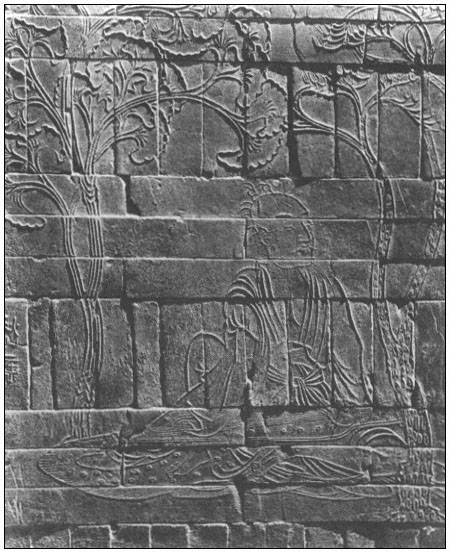
15.
Xi Kang.
Relief detail, tomb at Xishanqiao, Nanjing.
(From Yao and Gu, Liuchao yishu. )
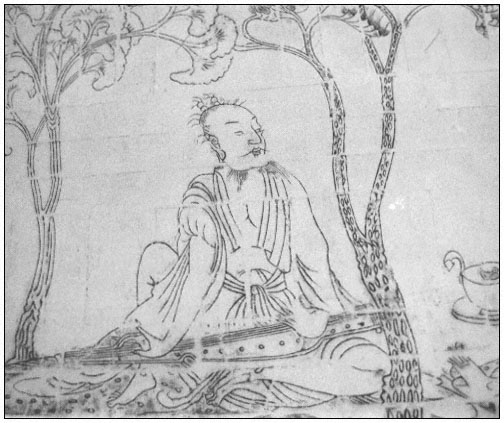
16.
Xi Kang.
Detail of figure 2.
in tufts at the top of the head. He wears no cap or hat. The back is rigidly erect, and the arms extend down, with both hands resting on a long, stringed musical instrument, the qin. The fingers are poised, as if ready to pluck the strings. The upper portion of the robe reveals the chest; the bunched right sleeve bares the arm. The left leg, resting on the fur mat that separates the figure from the ground, bends at the knee, where the robe folds back, to uncover the calf and foot. The right knee, covered by his robe, is raised, while the foot lies flat on the mat. His garments drape in folds and flutter behind his bared arm and at his feet (figs. 15 and 16).
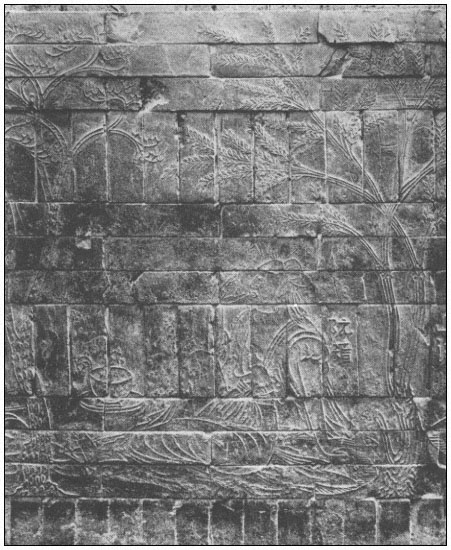
17.
Ruan Ji.
Relief detail, tomb at Xishanqiao, Nanjing. (From Yao and Gu, Liuchao yishu. )
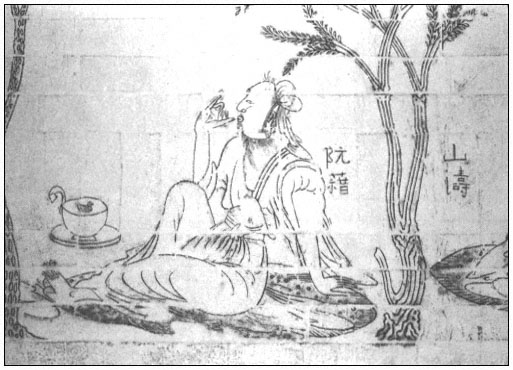
18.
Ruan Ji.
Detail of figure 2. (Photograph courtesy of Amy and Martin J. Powers.)
The inscribed brick tells us that he is Xi Kang (A.D. 223–262), poet, musician, and seeker after immortality. Related by marriage to the royal family of Wei, he was executed for political intrigue.[33]
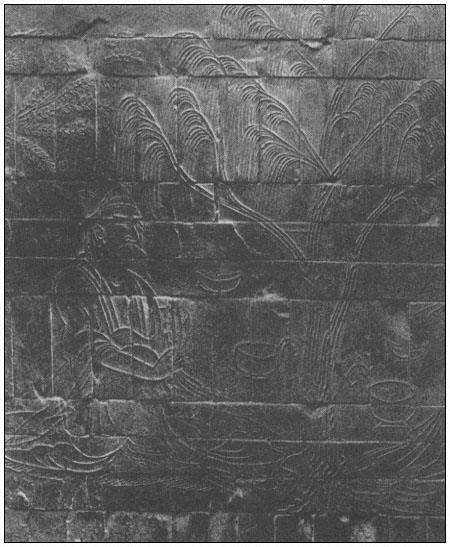
To the west of Xi Kang, separated from him by a tree, a figure drawn partly in profile, partly in three-quarter view, faces him (figs. 17 and 18). A soft, puffed cloth covers part of his head. The palm of his left hand rests behind him on the mat, as if to support the leaning torso. The right elbow perches on the right, raised knee; the arched fingers are close to the puckered lips and suggest that the man is about to whistle. The left leg extends out on the mat, the foot is relaxed. Here, too, the robe bunches, drapes, or flutters to reveal the chest, arms, and bare foot. To the left of the figure appears a large-handled, footed bowl and saucer. It is a wine bowl, typical of many found in
19.
Shan Tao.
Relief detail, tomb at Xishanqiao, Nanjing. (From Yao and Gu, Liuchao yishu. )
20.
Shan Tao.
Detail of figure 2. (Photograph courtesy of Amy and Martin J. Powers.)
tombs of the period. I interpret the small object discernible inside the bowl to be a dipper.[34]
We learn from the inscription that the figure is Ruan Ji (A.D. 210–263). Like his friend Xi Kang, he was a poet and a musician.[35]
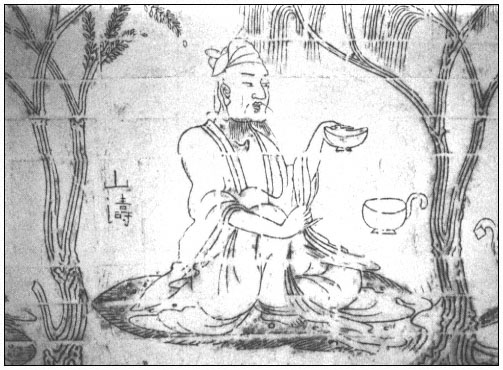
The next figure, depicted in three-quarter view, faces the west wall and gazes in the direction of the figure who follows after him (figs. 19 and 20). His head is covered by a cloth wrapped loosely as a turban. He sits erectly; his left arm is raised from the elbow, his hand holds a wine cup. Both sleeves are pushed back to reveal the lower arms, while the right hand reaches around the raised right knee to clutch the gathered sleeve of the other arm. The left leg is bent at the knee, its calf and foot tucked behind the right leg. The chest and feet are bare. A wine bowl, similar to Ruan Ji's, appears at the right of the figure.
21.
Wang Rong.
Relief detail, tomb at Xishanqiao, Nanjing.
(From Yao and Gu, Liuchao yishu. )
22.
Wang Rong.
Detail of figure 2. (Photograph courtesy of James and Nicholas Cahill.)
Shan Tao (A.D. 205–283) is the name on the accompanying brick. He occupied a high position under the Sima clan, founders of the Western Jin dynasty (A.D. 265–316).[36]
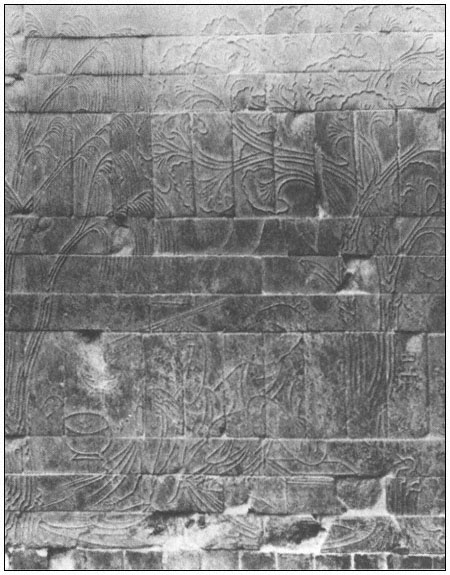
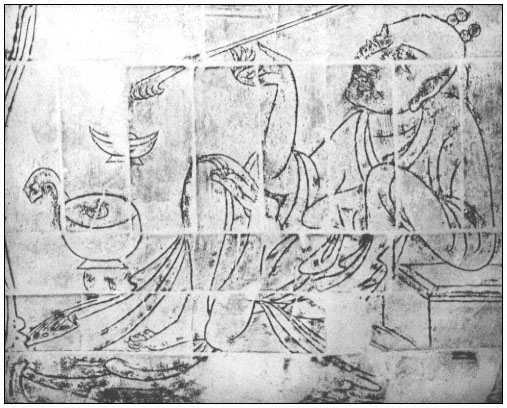
The mural on the south wall terminates in a figure, again in three-quarter view, who faces Shan Tao (figs. 21 and 22). His hair, like Xi Kang's, is tufted, and a slender ribbon or lock of hair hangs down his back. He slouches in a curious posture that few, if any, can imitate: the front of his left thigh lies flat on the mat, the leg rotates up at the knee, rotates again at the ankle. The sole of the foot thus faces up, while the toes rest lightly on the raised right knee, whose foot rests on the mat. The elbow of the left arm, muffled in cloth, rests on a rectangular box.
23.
Xiang Xiu.
Relief detail, tomb at Xishanqiao, Nanjing.
(From Yao and Gu, Liuchao yishu. )
24.
Xiang Xiu.
Detail of figure 3.
The lower arm extends up, the palm opens, and the fingers curve sinuously. A long wand, a ruyi, perches on the very tips of the fingers.[37] A wine bowl, similar to the others, appears to the figure's left. The duck swimming inside is actually, I believe, a tiny dipper with a bird-shaped handle. A crescent-shaped, footed wine cup sits above (behind?) the bowl.
By now the insouciant figure's bare limbs should not surprise us. It is, rather, a surprise to learn that it is Wang Rong (A.D. 234–305), who held the highest office in the land.[38] It is unlikely that he is performing his official duties in this scene. The mural on this wall terminates in a gingko tree fanning out above Wang Rong's head.
25.
Liu Ling.
Relief detail, tomb at Xishanqiao, Nanjing.
(From Yao and Gu, Liuchao yishu. )
26.
Liu Ling.
Detail of figure 3.
On the north wall, as one enters the room, the first, frontally depicted figure slumps against a tree, identical to the gingko that accompanies Wang Rong on the opposite wall (figs. 23 and 24). He wears a cloth cap; his eyes are closed; and one short, downward-curving line hints at a wrinkled forehead. His inclined head and left shoulder suggest utter relaxation, as the left sleeve of his robe falls and crumples from his shoulder to bare his chest and upper arm. His right hand rests on his naked thigh; the bent knee and calf weight the swirls and scallops of his tumbled robe—an interesting contrast to the scallops of cloth that float out and up from behind his right arm. His left leg, fully covered, is raised at the thigh and bends at the knee.
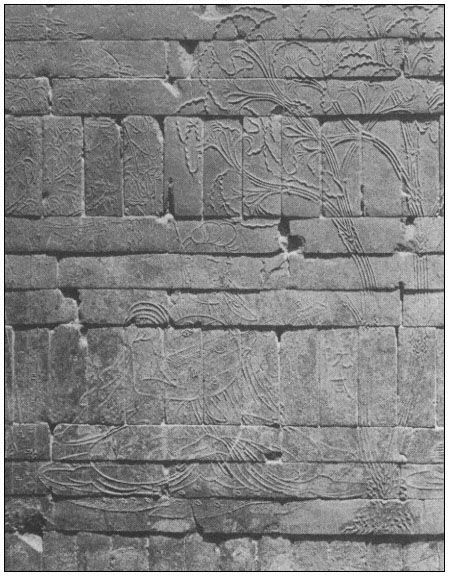
27.
Ruan Xian.
Relief detail, tomb at Xishanqiao, Nanjing.
(From Yao and Gu, Liuchao yishu. )
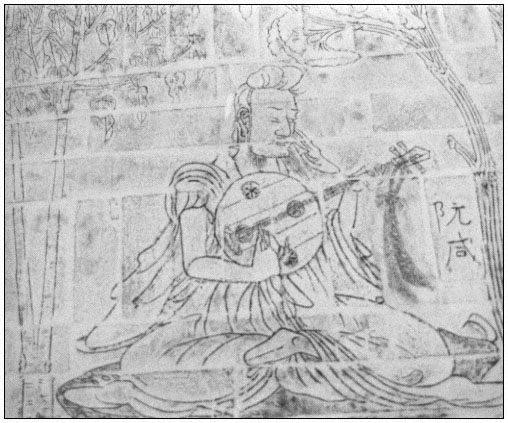
28.
Ruan Xian.
Detail of figure 3.
The inscription informs us that he is Xiang Xiu (A.D. 228–281), the author of a now-lost commentary on the Zhuangzi.[39]
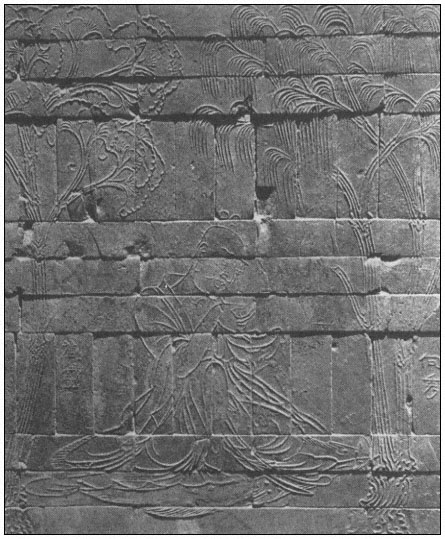
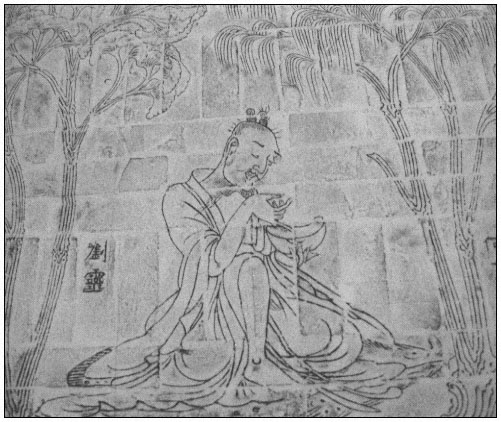
The figure to the right of Xiang Xiu faces in his direction (figs. 25 and 26). His left hand, held close to his waist, holds a wine cup. His bare head is inclined in the direction of his right hand, which he holds up, fingers curled, in front of his chest. One finger extends down and into the wine bowl. His right leg is raised, his bared knee bends so that the foot rests on the mat. The left leg lies flat on the mat and curls behind the other. His loose garment gathers and folds to reveal his bare chest, lower right arm, and leg.
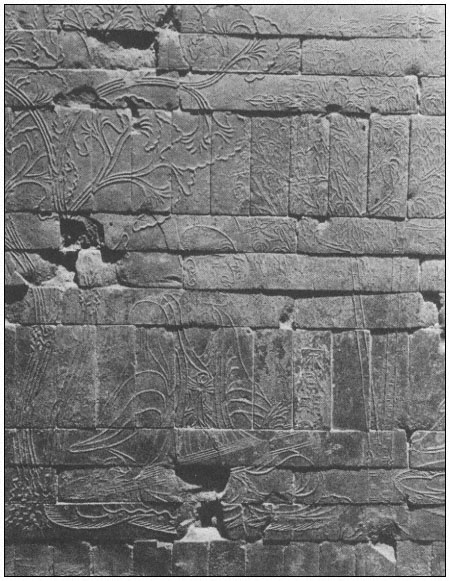
29.
Rong Qiqi.
Relief detail, tomb at Xishanqiao, Nanjing.
(From Yao and Gu, Liuchao yishu. )
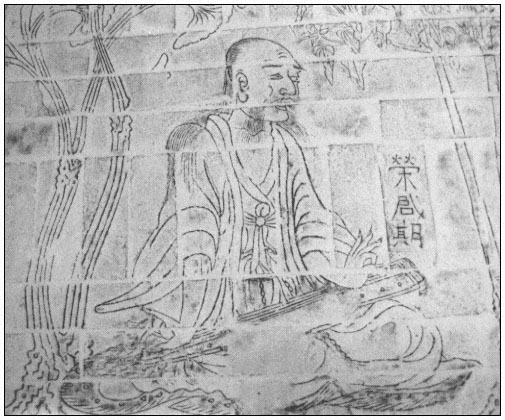
30.
Rong Qiqi.
Detail of figure 3.
This is Liu Ling (third century), lover of wine and known primarily as the author of a hymn to its virtues.[40]
The third figure in the row turns his face to the entrance (figs. 27 and 28). Wearing a billowing, kerchief-like cap, he directs his gaze to the frets of the stringed musical instrument he holds in front of his chest. His left hand cups around the fingerboard and, with the pluck in his right hand, he touches the strings of the sounding-board. He sits cross-legged on the mat.
The inscription names the figure as Ruan Xian (A.D. 230–281), musician and tippler.[41] He was the nephew of Ruan Ji, who appears on the opposite wall.
According to tradition, the seven figures named and depicted in the murals formed a group known as the Seven Worthies of the Bamboo Grove. The eighth figure, however, is an outsider.
This final personage also faces the entrance to the room (figs. 29 and 30). Capless, his long hair falls over his shoulders. Three short arcs furrow his brow. He sits with his knees together, his feet tucked under his robe. The hands rest on either end of a stringed musical instrument in his lap, his fingers arch. He is garbed like the other figures, save for a twisted belt, the ends of which depend from his waist. The mural, like its counterpart on the south wall, terminates in a gingko tree.
The inscribed brick names this last figure as Rong Qiqi, a legendary creature. Huainanzi tells us that when Rong Qiqi plucked one chord of his lute, "Confucius, moved by its harmony, rejoiced for three days."[42]
Eight images, with no background or spatial setting, divided between two walls, are nevertheless united into one composition. They are united by repetition of depiction—one figure, one tree; by repetition of attributes—wine bowls, musical instruments, fur mats; by repetition of forms that are variations on a theme—lounging en déshabille. They are united, finally, by one fact: seven of the eight figures in the composition were known, at the time this Nanjing tomb was constructed, to at least some people in the Nanjing region, as the Seven Worthies of the Bamboo Grove.[43] The mural is, as I shall argue, a collective portrait, in which all eight men personify—and celebrate—the same values. Its significance was to endure for centuries—indeed, to the present day.
What astonished the excavators was its difference, as we have observed, from Han-period and even later portrayals. Alternating trees and human figures were not an innovation; they appear on countless Western Han stamped tiles. Here, however, the human figures do not stand, like their predecessors; they sit. They do not sit, however, on elevated platforms in the formal, motionless pose of the Dong Shou portrait. They lounge, they loll, on fur mats on the ground. They are not decorously bundled in official robes like the seated, gesturing figures painted on the Lelang basket. Rather, their garments fall around them to expose bare chests, bare feet. There are no robe lapels, no braids dangling from belts to signify a person's station in life. No headgear or attribute supplies clues to rank or status. No two images are exactly alike, and the stock figures of Han are replaced by individualized figures.
Like those of the earlier, painted basket, the Nanjing figures are all
the same size and are seated at the same level, with no hint of hierarchy. All the basket figures, however, are depicted, by their postures and gestures, in relationship to at least one other figure. In contrast, each relief figure is isolated from his compeers by a tree. Although some of the eight men face each other, no gesture of any one can be interpreted as specifically directed to another figure in the mural. Each of them, limbs close to the body, seems self-contained.
The stretching and turning, the reaching and gesticulating of the Lelang figures create a sense of lively animation. Muscles are not apparent, but we know, from posture and gesture, that they are tense. One may point also to the violent and agitated postures of many relief figures at Yinan, which contrast so strongly with the still poses of Confucius and Laozi in the same tomb.[44] The lounging limbs and self-contained gestures of the Seven Worthies and Rong Qiqi, however, are relaxed. Even Xi Kang, his back and head erect, his fingers positioned as if to play (like the other musicians), manages to convey a relaxed feeling, by virtue, perhaps, of his bared limbs. About this lolling and self-containment there is a curious air of calm, of quiet. Yet, as I shall discuss below, the forms are not static like Dong Shou's, nor are they stately and measured like Confucius's and Laozi's.
The subjects could not, of course, have been depicted before the third century. If we knew nothing about them, we would know from their postures, garb, and attributes that no pious Confucius confronts us; no filial Ding Lan reminds us of our obligations; no servant of the empire trumpets, like Dong Shou, service, duty, or rank.
No inscription, save those naming the figures in the murals, was found in the tomb.[45] Comparing the Xishanqiao find with dated tombs in the area, the authors of the original excavation report proposed a date of either late Eastern Jin or early Liu-Song. Although its characteristics have been repeatedly discussed and evaluated in the ensuing years, no firmer dating has been agreed upon.[46] The occupants of the tomb, presumably husband and wife, remain unknown to us. In the years following the discovery of the Nanjing tomb and its Seven Worthies portraits, three more tombs were unearthed with evidence for the portrayal of the same individuals. The sites of all three are in present-day Danyang, not far from Nanjing. The remains of large stone animal sculptures at each of the sites confirm that all were royal burials.[47] During the Six Dynasties period, Danyang, known then as Southern Lanling, was the home of a branch of the Xiao family, which ruled in the south from 479 to 502 as the Southern Qi dynasty. Thus, although no inscriptions with dates or names were found
at these Danyang sites, it is clear that all three tombs were made for members of the Qi imperial family and that all were constructed during or immediately following the reigning years of the dynasty.
There is nothing to suggest that the earlier Nanjing tomb housed royalty, whether a Sima of Jin or a Liu of Song, and no scholar believes that it did. If the earlier portrait began as nonimperial art (perhaps even as an idiosyncratic choice), as the earliest of the four tombs known to us suggests, what about it was so compelling that some fifty to one hundred years later it was adopted by men who ranked highest in the land? Why were a few playful poets and tippling officials so important to anyone, let alone to members of the imperium? Whatever happened to filial piety, to uprightness, to incorruptibility, to rank and wealth? Where was Virtue?
I shall first attempt to ascertain the meaning the Seven Worthies portraits may have had for the earliest tomb incumbent known to us, someone in the late fourth or the early fifth century, who lived in what is now Nanjing. Establishing that, I shall then compare them with the later portraits to demonstrate that they have risen in the world.