
II—
Mysteries of Breathing:
1909–1912
VALERII BRIUSOV (1908)

On a Lone Winter Evening
If you can puzzle that out, you shall be your own master, and I'll give you
the whole world and a new pair of skates.
HANS CHRISTIAN ANDERSEN, The Snow Queen
FEDOR SOLOGUB (1906)
MIKHAIL KUZMIN (1908)
"Did you know that great Plotinus is said to have made the remark that he
was ashamed to have a body?" asked Settembrini.
THOMAS MANN, Magic Mountain
The first readers of the first Stone (1913) must have been surprised when they opened the book to discover on page one a poem with a pointedly ephemeral title, "Breathing" (1909). It read:
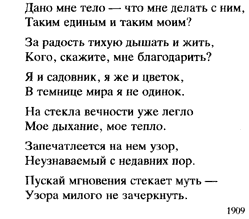
A body is given me—what shall I do with it,
So whole and so mine?
For the quiet joy of breathing and living,
Whom, tell me, should I thank?
I am both a gardener and a flower I am, too;
In the prison of the world, I am not alone.
On the window panes of eternity, settled
My breathing, my warmth.
A design shall be imprinted on them,
Unrecognizable since not long ago.
Let the dregs of the moment drip down—
The sweet design cannot be crossed out.[1]
To begin with, the metrical arrangement was somewhat unusual. For in the Russian tradition, one does not often encounter a poem consisting of six couplets of iambic pentameter, each having a contiguous masculine rhyme (a a, b b, c c, etc.). The syntax, especially in line five, was also bound to raise eyebrows. It lay somewhere between the correct literary language and a slightly precious colloquial, unconstrained speech, a feature that made it very difficult to put one's finger on the intention of the poem.[2] Was Mandelstam completely serious or only half-serious? Was he parodying? And if he was, then whom—himself? Fedor Sologub?[3] Mikhail Kuzmin?[4] Konstantin Bal'mont?[5] Some obscure poet? Or was it, perhaps, the result of a premature entry into the world of letters by an incautious Jew who did not feel quite at home with all the intricacies of the Russian language?[6] Maybe one should avert one's eyes to spare the poor soul further embarrassment.
And yet the poem, published in 1910 in the fashionable Apollon, possessed enough charm, enough touching innocence to have earned the poet a modicum of enviable notoriety. He would not have placed it at the beginning of his first and second book (1913, 1916) had it been otherwise. In a way, "Breathing," with all of its engaging, unthreatening incongruities and childish innocence, projected a character that could easily become emblematic of the "young poet" Mandelstam[7] —a man whom his friend Georgii Ivanov remembered as taking offense at the smallest, often imaginary slights while inviting his companions to join in the laughter over his own eccentricities or clumsiness.[8] Thus it is possible to treat "Breathing" as a sort of a snapshot (the more artless, the more telling) of the poet in his late teens and very early twenties—a collector's item with which the reader begins the work of tracing the outlines of the poet's public face.
I am not sure what these six couplets, especially in a translation, convey to a non-Russian reader, but one who grew up in Petersburg Leningrad or even Moscow might imagine a city apartment in winter, frozen window panes with intricate patterns of hoarfrost, and, seeping through, the sickly and eerie winter light. One might imagine a child sitting by the window, trying to melt with his breath a circle in the ice through which to peek outside. I say a child not merely because of the third couplet, but because of the whole infantile tone of the poem—its spareness and naiveté, its almost primitive rhyming pattern, its wobbly syntax ("I am both a gardener and a flower I am, too"), and its unself-conscious bragging in the conclusion.[9] What we have here, then, is a mental picture of a child daydreaming by a frozen window in the middle of winter, say, around Christmas time. He is daydreaming because of inactivity enforced by the weather, because of the utopian season, and because, very likely, he has just read Hans Christian Andersen's "The Snow Queen,"[10] which may help explain why this seemingly "soft" poem opened Stone, a collection with such a hard and laconic name.
Andersen's boy Kay, who would later follow the Snow Queen to the North Pole, caught his first glimpse of her in a similar setting through a peephole thawed out in the frozen pane of glass. A year later, she kindled in him a desire to compose the word ETERNITY out of crystals of ice. Had Kay's heart not been melted by Gerda's kiss, he would have finished the assignment successfully and, as promised, would have inherited the world. But he was saved by Gerda. The moral: give up ambitions and dreams and instead of chasing after snow queens who promise the world, stick with Grandma and the trusty, if a bit simple, Gerda. However sensible, this was no way to be a poet. The poet—more precisely, the poet of Mandelstam's generation—must do
both: breathe a naively warm, ice-melting breath while composing ETERNITY out of the delicate cold crystals. For Mandelstam, who, incidentally, suffered from asthma,[11] breathing often stood for poetry, and it makes sense—if we wish to understand what it meant for him to be a poet—to take a closer look at what it meant in those days for a poet to "breathe."
Conjugal Conjugations
Vowels are women, consonants are men.
KONSTANTIN BAL'MONT,
Poetry as Magic (1916)
In 1909, commenting on one of the more risqué poems by Briusov, Innokentii Annenskii made an enigmatic statement concerning the significance of the theme of eros in poetry. [12] Characteristic of the contemporary regard for positive science, his remark began with an invocation of physiology, yet it brings to mind not the work of, say, Sechenov but rather the post-Freudian writings of a Lacan, a Barthes, or a Derrida.[13] According to Annenskii, the uses of eroticism in Briusov's poetry, "thanks to the poet's intuition, endow with a new and profound meaning" what, for a physiologist, "constitutes an established fact," namely, that there exists "a kinship between the centers of speech and sexual feeling." Omitting Annenskii's detour into the Greek conception of the ineffable (an appeal to the authority of antiquity no less characteristic of the times),[14] we find "profound meaning" in the suggestion that the eroticism of Briusov's poetry "illuminates not so much sexual love as the process of [artistic] creativity, that is, the sacred play with words. "[15] For Annenskii believed that the erotic thematism of verbal art went beyond any specific thematic pattern—a love poem is about a poet in love—but, more important, constituted a discourse on, and an imitation of, the very essence of poetry.[16]
Mandelstam echoed Annenskii's suggestion in one of his earliest poems, "The heart is clothed as though in a cloud" (1909–10?).[17] And although the poem was never published, for it apparently did not satisfy the standard that the poet set for himself, its message, delivered with all the artlessness of a novice, discloses with uncharacteristic directness some of Mandelstam's early but lasting thoughts on the subject of a poet's calling and the nature of verbal art. Equally significant, it demonstrates, as perhaps no other poem composed before 1915, that the Acmeist[18] pathos of his first two collections—their classical decorum and architectural precision—served as a facade or, better, as a
dialectical opposite concealing great emotional intensity and the ardent mind of a "Southerner." This dialectic did not escape some of the astute readers of Mandelstam's first two Stones. Early in 1914, Nikolai Gumilev took note of it when he welcomed Mandelstam's first Kamen' (1913),[19] as did Vladislav Khodasevich two years later in a review of recent poetry. Khodasevich wrote:
O. Mandelstam apparently favors a cold and measured minting of lines. The movement of his verse is slow and calm. However, from time to time in his poetry, there bursts through the emphatic reserve a pathos which one would like to trust as genuine just because the poet has tried (or knew how to pretend that he has tried) to conceal it.[20]
In Khodasevich's sense, the poem I will discuss here conceals nothing. On the contrary, it is precisely the unabashed display of central Symbolist notions concerning poetry, some echoing Lermontov's "Molitva," some literally transposed from Briusov's "Poetu,"[21] that recommends it to our consideration. The following is a literal translation.
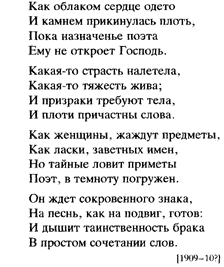
The heart is clothed, as though in a cloud,
And the flesh pretends to be stone
Until the vocation of a poet
Is revealed to him by the Lord.
Some kind of passion has seized [him],
Some kind of heaviness is alive;
And specters demand a body,
And words are in communion with flesh.
Like women yearning for a caress, objects
Yearn for cherished names,
But grasping the long-cherished omens,
The poet is in darkness submerged.
He is awaiting the secret sign,
Ready for the song as for an ordeal:
And the conjugal mystery is breathing
In a plain conjugation of words.[22]
Lest it escape the reader, the last two lines of the poem constitute a pun on the rather elevated Russian term for marriage, brakosochetanie. Hence Mandelstam's tainstvoBRAKa and SOCHETANIEslov (literally, "the mystery of marriage" and "conjugation of words"), which I tried to render into English on the basis of a similar etymological wordplay (conjugal conjugations).
Whatever the merits of "The Heart" (as I shall refer to the poem), and it rather fails the test of present-day, if not contemporary, tastes, one cannot help being astonished at how programmatic this tonguetied declaration turned out to be for Mandelstam's subsequent development. An apparent example of poetic anticipation, it need not be taken as a proof of the poet's clairvoyance or extraordinary grip on fate. Rather, "The Heart" testifies to the essential fidelity of the more mature Mandelstam to a set of ideas that he had selected from the available "ideology" of poetry and made his own at the very outset of his career. This is what makes it methodologically permissible to use the language of this poem as a descriptive and analytical tool to discuss the evolution and the repertoire of Mandelstam's "mythologies" of self-presentation. The petrified flesh of the poem's speaker ("And the flesh is masquerading as stone") is an obvious starting point for a discussion of Mandelstam's poetry, in which the word "stone" was to play such a prominent role.
Mandelstam's choice of Stone for the title of his three major collections (1913, 1916, 1923) contrasts sharply with the negative, and quite common, connotation that this word carried in "The Heart." After all, for the flesh to pretend to be stone constitutes an affliction, one that Mandelstam obviously considered bad enough to merit divine intervention. Three years after the composition of the poem, after he had become the author of Stone, the terms were to be, quite literally, reversed. A switch as emphatic as this one could not help having a programmatic significance. For the earlier Mandelstam, the word "flesh"
with its capacity for erotic connotation was obviously preferable to "stone," coming closer to the ultimate value and essence of poetry; for the Mandelstam of the Acmeist period, the opposite was obviously the case. To recall Dante, Mandelstam's poetry during the period of the Acmeist tour de force might be seen as a latter-day "Rime petrose," in which the old Symbolist workhorse "music" was retired in favor of the Acmeist[23] "architecture" as poetry's controlling metaphor.[24]
Yet one need not be carried away with this dualism, whatever its merit as a category of classification. Even if we accept Gumilev's by now traditional periodization, according to which in the year of nineteen hundred and twelve the Symbolist Mandelstam died to be reborn as an Acmeist,[25] his pointed inclusion of his "Symbolist" verse into the three Stones should indicate that the matter was not that simple. Even the 1912 sonnet "Casino," exemplary of the new movement according to Gumilev, began with a barely concealed jibe against a somewhat embarrassing Acmeist insistence onjoie de vivre: "I am not an admirer of preconceived joy."[26] Granted, the Symbolists, too, were mocked ("The soul is hanging over the damned abyss"), but their long and illustrious history of bitter romantic irony (Blok's Puppet Theater ) could assimilate such irreverence as a matter of course. While hesitant and uncertain about the direction his poetry was to take in 1912, Mandelstam was a solid presence on the literary scene in 1916 and much more so in 1923 when his collections, in fact, included a larger pool of his "soft" pre-Acmeist poems. What other reasons might he have had in mind for representing both the "soft" and the "hard" poems in all of his three Stones?
I suggest that, at least in part, Mandelstam's persistent desire to start ab ovo[27] may be traced to the epic framing of the lyric made so effective by the "trilogy" of Aleksandr Blok. This new generic convention placed a great value on the notion of "origins"[28] —as an instance prefiguring the poet's eventual fate—and demanded that earlier poetry be included in later collections where it would play the role of an epic reference point, at the same time providing a vocabulary and a grammar for the entire lyric narrative.[29] Mandelstam was fully conscious of this principle as well as of its association with Aleksandr Blok. In 1922, marking the first anniversary of the poet's death, he declared with authority (italics are mine):
To establish a poet's literary genealogy, his literary sources, his kinship group and origins means to find right away a firm ground under our feet. It is not necessary for a critic to reply to the question
"what did the poet want to say?" but it is his duty to answer the question "where did he come from?"[30]
For Mandelstam circa 1913—who only at the last moment decided to switch the title of his first collection from the receptive "seashell" to the active and aggressive "stone"[31] —it must have been important for the poet to create a sharply ambivalent connotation for one of the central symbols of his poetry. With that accomplished, "stone" could become a major item in his lexicon, an emblem of the poet's identity, and establish a relation of antithetical tension, explicit or implied, among the images—one of the most important rules in Mandelstam's poetic grammar. Thus, when it appeared in his later poetry, "stone" was capable of generating a specifically Mandelstamian ambivalence[32] on its own, conveying the connotations of the ordinary usage as well as those of its opposite, "flesh"—something that had hitherto required the presence of both words in close proximity to each other. The reader of Stone (1913) would be led by the title to expect something less than ephemeral, but encountering "Breathing," he was confronted with a double oxymoron even before he had the time to turn to the second page of the collection. Nor was this oxymoronic tension relieved in the concluding poem of the book ("Notre Dame," 1912), where the "firmament Notre Dame" was presented as an extended simile of Adam's body both "visually" and by means of the obvious paronornastic wordplay (Dame—A-dam). In short, "stone," whatever its other connotations, became a compact, one-word invocation of the poet's "grammar"—a set of rules, characterized by the meeting of extremes, according to which Mandelstam's poetry was to make sense.[33] I can think of no better formulation of this principle than the lines from the 1923 "Ode on Slate":
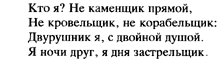
Who am I? Not an upright stone mason,
Not one who raises roof beams, not a mariner:
A double dealer am I, with a double soul.
I am night's friend, I am day's vanguard soldier.[34]
In order to read this equivocally unequivocal declaration with profit, the reader should keep in mind that it was issued by the author of three Stones, a poet who had "raised the roof beams" in his version of Sappho's epithalamia,[35] and one who had navigated a series of poetic ships,
including the ship of the new state in "The Twilight of Freedom" (1918) and one that creaked and swayed in the "Pindaric Fragment" ("He Who Found a Horseshoe," 1923), composed shortly before the "Slate Ode."
But to return now to the discussion of "The Heart," this pattern of tension, although still in embryonic form, is already discernible in the first two lines of the second stanza. After the poet has received from God the sign of his vocation, the "body" ("flesh") begins to exchange its attributes with "heaviness" ("stone"), its antithetical counterpart.[36] The world has become sexually polarized, charged with erotic tension, and, to follow Annenskii, with the tension of verbal creativity as well: "objects" are "yearning for" special names in the same way as "women yearn for caresses," ready to receive the imprint of the poet's personal myth-making vocabulary.[37]
To follow Mandelstam's reasoning here, limiting oneself to satisfying their desire (indulging in erotic or love poetry) would be both too easy and too incautious—it would mean forfeiting a much dearer reward awaiting the poet who has been able to pass through and beyond this ordeal by temptation. The "long-cherished omens" that he is trying to grasp in the "dark" of solitude (unmoved as he is by the things "yearning" without) are signs of the reward accorded to those who are "ready for a song as for an ordeal." For these poets, their vocation is inseparable from a calling to prophecy or martyrdom. At the very least, it signifies an acceptance of an ascetic vow in the service of some supreme mystery, say, Beauty or Truth.[38] When the "secret sign" the poet has been awaiting finally arrives, he will experience an epiphany and fuse with the ultimate, or whoever represents that category in the latest Symbolist charts ("the mystery of marriage breathing in a plain conjunction of words"). Perhaps it was Viacheslav Ivanov's interpretation of Pushkin's "The Poet and the Crowd" that Mandelstam had in mind as he was composing "The Heart." Adding to Pushkin's Romantic dialogue a pinch of religious syncretism, a dash of mysticism, a sprinkling of Hegelian dialectics, and a good dose of the venerable Russian populism, Ivanov was able to transform Pushkin's eternal rift between the autonomous poet and the slavish "crowd" thirsting for instruction into a stage preceding the eventual fusion of the two parties in a transcendent absolute. One relevant passage, taken from a collection of essays, Across the Stars (1909), runs as follows:
Tragic is a genius who has not understood himself [his destiny?], who has nothing to offer the Crowd, because for the sake of new revelations (and he is to say only the new), his spirit draws him, first,
to a solitary communion with his god. In the calm of the wilderness, in the secret change of visions and sounds, for the Crowd redundant and incomprehensible, he must await "the wafting of the subtle cool" [breeze] and the "epiphany" of the god. . . . The poet departs—for the sake of the "sweet sounds and prayers." The Schism [between the poet and the people] has taken place. . . . Hence an artist's withdrawal as the fundamental phenomenon of the modern history of spirit. . . .
His focusing on himself constituted a passive self-affirmation of the active element in response to the active self-affirmation, on the part of the Crowd, of the rigid and passive element. This pride of the poet shall be redeemed by [his] suffering of solitude; but his loyalty to the spirit will manifeist itself in the fortifying ordeal [podvig ] of his secret, "thoughtful" action.[39]
A scenario of this sort was itself a product of a marriage of two prominent offspring of romantic idealism—aesthetic mysticism and nationalism, or populism—a marriage that a Russian intellectual of the period did not need to be asked to celebrate.
To continue with the poem, one may have prudishly expected that when the final stage preceding the supreme prize is reached—"the borderline of conception," as Blok called it[40] —it would be quite unlike the siren call of "things" that Mandelstam so admirably left behind. Alas, this ultimate stage, too, is presented with the aid of erotic vocabulary.[41] What has changed, however, is that the analogous images of the coda evince an aura of the sacred,[42] encapsulating in an aphoristic closure, first, Annenskii's remark discussed above (Mandelstam's "breathing"); second, Ivanov's poetics of Dionysian afflatus and self-sacrifice ("the song as an ordeal");[43] and third, Blok's thematics of a redemptive mystical marriage of the poet and his mystical bride[44] (the latter two in opposition to Briusov's "aestheticism").
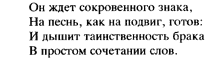
He is awaiting the secret sign,
Ready for the song as for an ordeal:
And the conjugal mystery is breathing
In a plain conjunction of words.
The word "plain" in this concluding stanza—here an unexpected attribute of the mystical revelation of poetry—also carries an additional meaning, one similar to what Blok had in mind when he spoke
with reverence about the magical power of popular imagination in his "Poetry of Spells and Incantations" and "The Elemental Force and Culture."[45] In fact, juxtaposing one of the incantations cited by Blok with Mandelstam's description of a poet's state before the "call" (the "heart clothed in a cloud" and the "flesh pretending to be stone") allows one to read the poem as a clash of two opposing forces—the "black magic" of uninspired everyday life and the "white," extraordinary "magic" of a poet's calling:
"I shall clothe myself in a cloud, stud myself with many stars," says the exorcist; and behold, he is already a magus, sailing inside a cloud, girded with the Milky Way.[46]
Expressed with a naive openness in "The Heart," these categories of the contemporary ontological grammar of poetry—the identification of verbal art with eros, ecstatic states, ascesis, magic, and the sacred—may not catch the eye of today's reader, but both a closer reading and their apparent reemergence in his later poetry strongly suggest that they continued to maintain their hold on the poet's thinking even in the period of the Acmeist Sturm und Drang.[47] In retrospect, judging by the development of Mandelstam's thematics, it appears that attempts to suppress their presence in Stone I and II were dictated not so much by the "anxiety of influence"—they were, after all, identified with Mandelstam's Symbolist mentors—as by the lack of an appropriately defined "identity," a persona that the ideological climate of the time made necessary even in a lyric unfolding of this ontological formula. To put it less abstractly, during the years when one could buy a postcard with Blok's portrait (beginning in 1909, at least),[48] the contemporary scenario for success called for the presence of a distinct protagonist in one's lyric poetry. In 1909—1910, when "The Heart" was most likely composed, that protagonist still remained to be shaped. But as Mandelstam's output in the prewar years testifies, he kept busy at the task, accomplishing it in an original manner and in a very short time.
One indication that Mandelstam was casting about for ways to adapt to the contemporary conventions for poetry may be found in his essay on François Villon (1910), where the French poet, apparently an ideal type for Mandelstam, is presented as an androgyne, his feminine hypostasis identical in gender with the "real woman," France:
France, captured by foreigners, has shown herself to be a real woman. Like a woman in captivity, she paid attention mostly to the toiletry trifles of her daily life and culture, while keeping a curious eye on the victors. . . .
The feminine passivity of the epoch left an indelible imprint on Villon's fate and his character. . . .
A lyric poet is, by his very nature, a bisexual creature capable of countless divisions for the sake of the inner dialogue. . . . There is no one [besides Villon] in whom this "lyric hermaphroditism" has manifested itself with such sharpness. What an assortment of charming duos: a distressed man and a comforter, a mother and a child, a judge and an accused, a proprietor and a pauper.[49]
Whether it is immediately obvious or not, this description of Villon is compatible with, and serves as a counterpart to, the "mystical marriage" with which Mandelstam concluded his poem. Although the "relationship" between Villon and the France of his time does not fit snugly enough into the Blokian mystical pattern, the choice of erotic metaphor together with emphasis on the identity between the poet on the one hand and his country and the age on the other indicates a certain kinship with Bloks myth or Ivanov's "Eros of the whole and the universal."[50] From here it was only a short step to some version of the charismatic invocation "O my Russia, o my wife," an appeal from Blok's famous 1908 cycle.[51] Mandelstam, in his own way, would take this step later, but not before he had the time to "fashion" his self,[52] that is, become ready for the "ordeal" of a Russian poet's charismatic mission.
A Most Ineligible Bachelor
A Yid is being married to a frog.
ALEKSANDR PUSHKIN (1833)
Why do we need a second-class Rubanovich when we have a first-class Rubanovich (Osip Mandelstam)?
ALEKSANDR BLOK, Letter to Andrei Belyi (1911)
Mandelstam's meditative poetry, interspersed throughout the first two collections (Stone I and II), speaks of the poet's sense of loneliness and rejection that are relieved only when he turns to larger cultural systems: Byzantium, Rome, the Catholic Middle Ages, Gothic and other epochal architectural monuments, the tradition of European literature, and, of course, ancient Greece. I shall refrain from speculating why this should have been so, turning instead to what the poems looked like then as well as to Mandelstam's intrinsic rationalizations of his preference for this Acmeist "anchorite" diet. In the eyes of contemporaries, these themes, although related to the "other" Mandelstam, as Khodasevich had suggested,[53] became the hallmark of the Acmeist poet. A typical example of such a reading may be found in a 1917 sur-
vey of modern poetry written by an important and far-sighted critic, D. Vygotskii, who could appreciate Mandelstam's poetry despite his Futurist sympathies:
From the aesthetic point of view, a book of poetry, Kamen', by O. Mandelstam, the most talented poet among the "Hyperboreans," [Acmeists] is the most significant. Even more static and cold than Gumilev, marching solemnly in a luxuriant mantle of words, he nevertheless is capable of making his solemnity more attractive. Never abandoning his pathos, never even trying to speak in everyday simple words, he remains wholesome in his stiffness. A skillful painter, he at the same time invests some of his poems with a philosophical element, and his attempts to create the philosophy of music, the philosophy of architecture, and even the philosophy of sport cannot be considered uninteresting. And still, how cold and dispassionate all of this is, how far it is from life, how ineradicable in all of this is the smell of an ancient book with pages grown yellow from use. How characteristic it is for Mandelstam (and the entire school that he represents) that he knows nothing, not only about nature, but about love. Even for love he is too good, I would say, too lazy.[54]
One may assume that many shared Vygotskii's reservations, since Viktor Zhirmunskii, a critic close to the Acmeists, especially Akhmatova and the author of Kamen', used virtually the same terms and insisted on the lack of the personal element in the lyric poetry Mandelstam composed between 1912 and 1915. Drawing a sharp line between the earlier Symbolist poet and his later Acmeist reincarnation, Zhirmunskii wrote in 1916:
In Mandelstam's mature verse, we no longer find his soul, his personal human moods; in general, the element of an emotional, lyric content, in its immediate poetic expression [pesennoe vyrazhenie ], moves into the background, as in the work of the other "Acmeists." But Mandelstam is unaware not only of the lyric of love or the lyric of nature (common themes of emotional, personal poetry), but, generally, he never speaks about himself, his soul, about his immediate perception of life, either external or inner.[55]
Criticism of this sort should not be taken at face value, for the poet that Vygotskii and Zhirmunskii had in mind was the same man who wrote in 1912, "I tremble from the cold—I want to die," "There—I could not love, / Here—I fear to love," and, in 1913, "Joseph sold into Egypt could not have grieved more."[56]
Taking a close look at the passage from Zhirmunskii, one begins to discern what might have obscured the critic's view and, more important, what had prevented Mandelstam from indulging the taste of some
of his most respected readers. Zhirmunskii's insistence on the "immediacy" of expression, the "immediacy" of perception, on the "human" and "personal" thematics as the sui generis attributes of the lyric, which in his opinion were lacking in Mandelstam, indicates that he took one set of conventions—no doubt characteristic of the still dominant Symbolism and very much alive in a Futurist like Maiakovskiias a given of lyric poetry, as something that was not conventional at all. Even more surprising, since it came from a scholar, Zhirmunskii's statement implied the possibility, indeed the existence, of lyric poetry that eschewed mediation in favor of immediacy—a contradiction in terms when one deals with representation of re-presentation, that is, with verbal art. In fact, these aspects of the lyric that Zhirmunskii took for granted constituted a specific "confessional" mode, a matter of tradition and choice, which put a high premium on a poet's "sincerity" of expression[57] —a mode that Blok practiced with consummate skill.[58]
In a different ideological climate, say, in Pushkin's time, with a better awareness of the conventional nature of art and, more important, without the emphatically charismatic view of poetry, one could fake sincerity and do this as often as the need arose, assuming it with as much difficulty or ease as any other mask.[59] Not so in Mandelstam's time, when poets cultivated both in their work and in the minds of their readers the notion of poetry as a source of ultimate truth, which, needless to say, made the requirement for sincerity central to contemporary poetic practice.[60] "I know that deception is unthinkable in [a poet's] vision."[61] These words, affirming a common Symbolist belief in the truthfulness of a poet's inner experience, were spoken by Mandelstam in 1911, the year of his poetic debut in Apollon, and they may indicate that he took this ideological desideratum to heart. Or, since he never published the poem in question, that he knew better. In either case (and the two interpretations are not incompatible), the convention could not be ignored.
But it was not simple for Mandelstam to disclose in his poetry important elements of his "vision" with the "immediacy" demanded by the poetic convention he had apparently internalized. He was, after all, a Jew, and although he could find a sympathetic ear for a disclosure of his predicament, his milieu, on the whole, was either hostile or indifferent to "confessions" of this sort, incapable, in any case, of recognizing in them any charismatic value. Consequently, the thematics of the "mystical marriage" that he attempted to develop early on and that an ethnic Russian could exploit naturally would have looked rather ridiculous coming from the pen of one Osip Mandelstam, a young poet
whom some of the Petersburg literati used to call "Zinaida's [Gippius] little Yid" (Zinaidin zhidenok. )[62] The remark made by Aleksandr Blok, the chief authority on mystical marriages with Russia, had a similar, if more charitable, ring to it.[63] In short, the "mystical marriage," while desired, appeared unthinkable, and the rich thematics that might have been developed on the basis of this frustration could not be "confessed."
Between Law and Grace
Let us try to develop Philosophical Letters like a photographic negative. Perhaps those areas that become bright will turn out to be about Russia, after all.
OSIP MANDELSTAM, "Petr Chaadaev" (1914)
Two strategies, traceable in Mandelstam's early poetry, seem to be defined by this antithesis between the contemporary assumptions concerning poetry and poets and the personal problems that Mandelstam had to face as a Russian Jew growing up and living in St. Petersburg in the final decades of the old regime. One strategy belonged to the "Symbolist" period and found expression in an involved development of the confessional theme, so involved, in fact, that it took modern readers a while to figure out what this "confession" was about.[64] The other strategy, which has established Mandelstam's public persona as a decorous, philosophical, and formidably cultivated poet, bore the imprint of Acmeist thematics and style and took the form of large-scale cultural and historiosophic edifices in which the poet, in part an outcast, could find well-defined and honorable points of self-reference. In this section I shall concentrate on the first of these strategies.
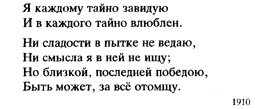
Composed in 1910, neither of the two "encoded" poems below happened to be included in Stone I, II, or III, although they appeared as part of a selection of Mandelstam's poems in Apollon in 1911. I shall cite them here in my own, emphatically literal translation.
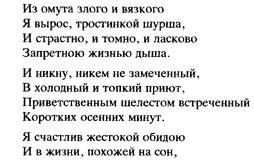
Out of an evil and miry pool,
I have grown—a rustling little reed—
And, with passion and longing and tenderness,
Breathing the forbidden life.
And I droop, noticed by no one,
Into the cold and boggy asylum,
Hailed by the greeting lisp
Of short autumnal moments.
I am happy with the cruel offense,
And in the life resembling a dream,
I envy everyone secretly,
And with everyone I am secretly in love.
I neither know sweetness in torment,
Nor do I search for meaning in it;
But, perhaps, with the imminent ultimate victory
I shall avenge it all.
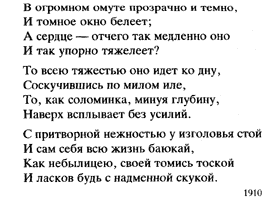
The enormous pool is limpid and dark,
And a longing window is gleaming.
But the heart—why is it so slowly
And so stubbornly growing heavy?
Now, with all its heaviness, it sinks to the bottom,
Homesick for the dear silt,
Now, like a little straw, bypassing the deep,
It floats up on the top without effort.
Stand, feigning tenderness, at the head of your bed,
Lull yourself the entire life,
Languish in your sorrow as if it were a made-up tale,
And be gentle with the haughty boredom.[65]
In retrospect, one can hardly question the legitimacy of interpreting these poems as meditations of an "assimilated" (and therefore not entirely assimilated) Jew on the conflict of his cultural loyalties. The first indicates an awareness of one's otherness and a sharply felt desire to participate in the "forbidden life," even at the price of pain and humiliation. The second, in which the "pool" figures as a metaphor of a mirror,[66] outlines a strategy for distancing the poetic self from the "actual" ego by transforming it into aesthetic material ("a made-up tale").
What gives such an interpretation added credibility is yet another poem, which, although composed at the same time as the other two, was not published until 1915, and then only in a newspaper.[67] All three poems share a set of images—the pool, the slender stem (the reed and the straw), the deep, the sinking, the heaviness—but it is the particular subject matter of the last poem that serves as a clue to the thematics developed in this cycle. The poem, also a meditation, focuses on Christ's last moments on the cross:
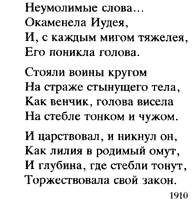
The implacable words . . .
Judea became petrified,
And, heavier with every moment,
His head drooped.
Warriors stood guard
Around the cooling body.
His head, like a corolla, hung
On a slender and alien stem.
And He reigned, and He drooped,
Like a lily into its native pool,
And the deep where stems sink
Was celebrating its law.[68]
One way of grasping the meaning of this "triptych" is to relate it to two poems by Fedor Tiutchev on which Mandelstam drew both for the vocabulary (the "reed") and for the conceptual framework, that is, the insoluble contradiction of belonging to two conflicting worlds. One of these allusions, as Kiril Taranovsky has pointed out, goes back to Tiutchev's reversal of Pascal's definition of man as a "thinking reed."[69] For Pascal, the ability of the human "reed" to think was the highest asset; for Tiutchev, it represented the fatal liability, the cause of human alienation from the harmony of nature: "Why does the soul sing not what the sea sings and why does the thinking reed grumble?" It is this latter "reed" that serves as a metaphor for the protagonist of Mandelstam's poem. Tiutchev's second poem, too, contains a paraphrase from Pascal, this time a definition of man as a "citizen of two worlds" (Tiutchev's "The soul is an inhabitant of two worlds"). One is the daylight of reason; the other is the deep night of irrational desire that threatens to tear the soul apart unless it, "like Mary [Magdalene], presses forever against the feet of Christ."[70] In both cases, the Tiutchevian subtext reinforces Mandelstam's theme of the rift between the "native pool" and the "forbidden life," and, as in Mandelstam's cycle, attempts to bring about a resolution of the eternal conflict by reiterating the ultimate resolution that took place at Calvary. This similarity between the two poets brings into sharper focus the central difference in their use of the name of Christ. Whereas for Tiutchev, Christ alone can give peace to the unsettled soul, for Mandelstam, he is subject to the same, if more intense, divisions that afflict the poet's own self.
Another approach to the triptych is to examine how each of its members realizes the plot that they all share—a protagonist caught between two conflicting value systems in a way similar to the protagonist caught between two equidistant bales of hay in Buridan's paradox. The first poem, "Out of an evil and miry pool," is so rife with tension between the "pool" and the "forbidden life" that it hardly makes logical sense. How, for example, can one be at the same time "happy with the cruel offense" and "neither know sweetness in torment nor . . . search
for meaning in it" while planning imminently to "avenge it all" with the "ultimate victory"? Removing the last stanza, as Mandelstam (or his editors) did in the 1928 edition, helps matters considerably, though at the expense of the original intensity of this cultural double bind.
The second poem, "The enormous pool is limpid and dark," may at first appear to be a picture of tranquility and reconciliation, but the bitterness of the last quatrain makes this initial impression misleading. Mandelstam's "confession" here seems to run as follows: the choice of lyric poetry as one's vocation involves a particular concentration on one's self, which is what occupies the poet as he is examining the split in his "heart" before the "enormous pool" of the mirror. So far so good, but the poem concludes on a sinister note. The poet qua poet does not like the reflection he sees ("feigning tenderness"); he commands himself to deny or conceal his anguish ("as if it were a made-up tale") and to be "gentle with the haughty boredom," a personification, I believe, of an affected Petersburg snob.
The third poem presents the most telling account of frustration stemming from a divided loyalty. Here is a poet's essay in measuring his self against the figure of Christ. As with any consistent comparison, this one focuses on a set of shared features that establishes a relationship of similitude and contrast between the two terms. Taken in random order, these features are the experience of ordeal; affinities to two contradictory orders, one of origins and the Law (Judaism), the other of the new faith and Grace (Christianity);[71] the simile of the "stem" (the "reed," the "straw"); and, finally, the "pool" which, because it is "native," has the irresistible power to draw back into itself what has once issued from it.
The last poem provides a decisive clue for the elucidation of the cycle precisely in the unexpected metaphoric shift from the "petrified Judea" to the deep "pool" of the Law. As far as the poet is concerned, this pool is associated not only with the painful ordeal of seeing one's face in the mirror of the "host culture" but also, and here the similarity ends, with the comfort of return to the native realm. In Russian, the "silt" for which the poet feels nostalgic (the second poem) is emphatically "dear" thanks to the paranomastic play on the two words: mILyi IL . The Judaic, therefore, can manifest itself both as something "petrified," hard, emotionally unresponsive, "implacable" (its association with God the Father and the Law) and as something receptive and "dear," a home that can be "missed." This duality lends an air of legitimacy to the otherwise surprising choice of attribute, "native and dear" (rodimyi ), qualifying the "pool" in the poem about Christ. After all, Mandelstam wrote these lines with the full awareness of the "sa-
tanic" connotation that the word "pool," omut, has in Russian usage: "In a quiet pool—that's where devils live."[72]
Another near contrast between the two subjects rests on a shared vegetative metaphor: whereas Christ is likened to a complete and specific flower, the poet appears as a generic "reed" and "straw"—lifeless, infertile stems devoid of corolla—which sink into the deep as quickly as they float up to the surface. The name "lily," given to Christ, signifies a completeness on yet another level—the plenitude of the divine androgyne[73] —similar to the one attributed to Christ in Blok's The Twelve.[74] As Vladimir Solov'ev once asserted, "One way or another, all true poets knew and sensed this 'feminine shadow' [of God]."[75] To develop the parallelism further, the transcendent plenitude of Christ, which allowed him to "reign" and to return to his origin in Judaism, has its mortal analogue in the poet's anguish, his doubts whether he would be able to reconcile his desire to breathe the air of the "forbidden life" with the clinging "silt" of his inherited identity. Recalling Annenskii's remark and Mandelstam's choice of metaphor for poetry, "the breathing of the mystery of marriage,"[76] this analogy may be safely extended into the realm of eros, not the physical variety, but the displaced, mystical, Platonic and Manichean eros that Russian Symbolists had preached, beginning with Vladimir Solov'ev.[77] The frequency with which the common lexical attributes of the erotic appear in the cycle offers an additional justification for a reading of this sort. Consider: "with passion and longing and tenderness," "in love," and "sweetness," or even "voluptuousness" [sladost' ] in the first poem; the "heart," "heaviness," "tenderness," in the second; and "heavier," the "lily," and "native," or "dear,"[78] in the third. A curious mythic narrative begins to emerge from the "pool" of these early poems—a specific mythology of the poet's self, his poetry, and his milieu.
Existing in a state of tension, these three elements are integrated into a pattern where attraction and repulsion define their place in the world. In the first poem, the "pool" that gave birth to the poet is "evil and miry," a "cold and boggy asylum," while the "forbidden life" outside elicits feelings of "passion and longing and tenderness." The "cruel offense" that the poet hopes to "avenge" is ambiguously defined—as either an offense to a victim of anti-Semitism, or of a man despairing of having been born to Jewish parents—and the ambiguity suggests the not uncommon coexistence of these sentiments, something that one encounters often enough. Yet the coexistence, too, is antagonistic and conflict-ridden. A similar relationship of attraction and repulsion determines the poem's coda, where the disclaimer of the first two lines is negated in the conclusion.
As if such a piling up of negatives were not enough, the second poem offers an opposite view of the predicament. Here, Mandelstam is wearied by the necessity of "feigning tenderness" when what he feels is self-hate or of being "gentle" when confronted with the "haughty boredom." Furthermore, what prompted a bitter outburst in the preceding poem is given a tender treatment in this one: the "silt" is "dear," and there is nothing to prevent the poet from either going down to the bottom or floating up to the surface of the "pool." It would appear that Mandelstam was at least of two minds on the subject of his identity, and with the last poem this ambivalence acquired an even greater intensity as the theme took the form of a meditation on the "historical" origins of his confused state.
As often happens with meditations of this sort, which create a god in one's own image, Mandelstam imputed to the Event and to Christ the features of his own predicament. But where the reflection of the self came out different from the image of God, Mandelstam was able, albeit indirectly, to formulate his fundamental notions of the mythic narrative centered around himself as a poet. It should not appear surprising, although one need not take it for granted, that Mandelstam chose to present himself in terms of the Christian doctrine according to which the New Testament superseded the old faith based on Mosaic Law. After all, he might as well have chosen the teachings of Marx or Nietzsche. These two popular and powerful ideological constructs of the time could have provided him with an equally intricate grammar and a capacious vocabulary. Yet he did not choose them even though he was adequately familiar with both.[79]
Among the many reasons for choosing as he did, two stand out as important: his sensitivity to his "otherness" and his commitment to the art of poetry. They were by no means unrelated, if only because being a Russian poet made Mandelstam feel alien all the more. The Symbolist vocabulary, its set of values and its myths, although not properly Christian in any orthodox sense, were permeated with conceptualizations and imagery for which Christianity served as the ultimate source and reference point. No doubt experienced as a necessary condition, this aspect of contemporary poetic culture could not be ignored unless Mandelstam was willing—and he was not—to remain on the margins of Russian letters. What is more, Russian Christian culture had to be accepted and internalized, and, for obvious reasons in Mandelstam's case, reformulated so that it might suit the poet's particular and still unusual situation. This reformulation took the form of a more archaic integrative myth that was capable of organizing into a
distinct and highly evocative narrative pattern the disparate elements of the poet's view of the world and of the self.
What I have in mind is the myth of incest. This myth offers an economical model for the analysis of Mandelstam's poetry, as it helps to keep track of the twists and turns in his own life story without obscuring the persistent patterns holding together the complete narrative of this "poète et martyr de son temps."[80] Since his career as a poet has been perceived as a charismatic performance (a characteristic to which much of Mandelstam scholarship testifies),[81] this myth, one of transcendence, may also help to account for the effectiveness with which Mandelstam relied on patterns of verbal magic and, consequently, for the intensity of his charismatic appeal.[82] But most important, the myth of incest apparently provided Mandelstam with an archetypal framework capable of supporting the symbolic vocabulary of his native Russian culture while giving him an opportunity to exploit his problematic relation to it. One is indeed hard put to come up with another universal myth, popular in Mandelstam's milieu, that could have accommodated a conflict of this nature and magnitude.