
Marrying
In the counseling idiom then current, one married a mate who supplied those particular kinds of supports one felt one required and who needed of one just what one could, in turn, give; that is, there was "need complementarity." Robert F. Winch's classic formulation of this notion tells us much about the ideology of marriage in the 1950s. His 1958 treatise seeks to express "in concise, naturalistic terms what is meant by love," for in America "we marry for love," drawing attention to the sometimes mysterious attraction of opposites remarked at length by Plato.[99] The centrality of this contemporary formulation can be gauged from the breadth of its popularization. Personal Romances thus advised its readers that "in the perfect marriage one mate supplies the talents or virtues the other lacks, and vice versa. . . . There is no greater declaration of enduring love than the three simple words, 'I need you.' "[100]
The essence of Winch's work is the psychological rating of
| |||||||||||||||||||||||||||||||||||||||||||||||||||||||||||||||||||||||||||||||||||||||||||||||||||
both partners on such qualities as assertiveness, receptivity, and self-deprecation and an empirical inquiry into what kind of a person, thus defined, marries what kind of person. There was a right mate to be found but not a universal best mate. One finds one's best mate by being oneself, and thereby one discovers "the personality contours of a prospective mate . . . not in general but rather with specific reference to" one's own traits. Submissive people made dominant ones feel good and, in turn, were gratified by the opportunity to submit. "We love those persons . . . who provide gratification of our needs and thereby bring us pleasure."[101] Life course decisions in the 1950s were psychologically relativistic, even when not following Winch's formula. "Maturity," psychologically defined, was a common criterion. "If you're crazy in love with a man, you may not stop to consider if he's emotionally mature enough to make a good husband and father. After all, isn't love all that really matters?"[102]True Love Stories' hortation follows up with a list of ten practical indicators of maturity, which amount to moderation, considerateness, and commitment to the marriage, qualities that, like those supplying complementary needs, could be found—indeed were found—among relatively young people.
Figures 18 and 19 show actual first-marriage rates for the period 1945 to 1959 for white and nonwhite single women for small age groups. These rates were paralleled by men's rates, except where draft age influenced men's marriage probabilities. We may take 1949, a relatively low point following the accomplishment of most of the marriages "postponed" by World War II, yet before the impact of Korea, as our starting point. The very youngest group shown—14 to 17—and the oldest—30 to 34—both had markedly parallel histories of marriage rates during this period, each tending on the whole downward. Those 18 to 19 and 22 to 24 also show quite parallel trends, but these two age groups both show a gradual increase after the midpoint of the Korean War until 1955 and a marked increase for the next two years, followed by a slight decline. The most popular ages for young women to marry were 20 and 21, and these ages, increasingly popular during the period, peaked at 1957. Whites and nonwhites basically shared the same temporal patterns, although the two had different age schedules of mar-

Figure 18.
Annual First-Marriage Rates for White Single Women, 1945–1959
riage, with nonwhites' timing throughout the era less uniform than whites'.[103] Black age patterns shifted slightly during the decade, perhaps as the result of rural-to-urban migrations. A smaller proportion of black women came to marry very young, while, contrariwise, the likelihood of marriage by relatively old single black women grew.
Korea seems to have marked a decisive change in the relationship between the way men as compared with women experienced the age structure of the marriage market. Prior to Korea, men's and women's marriages for a given "pair" of ages pretty much paralleled each other, year by year. But in the 1950s, what amounted to devaluation of older women in the marriage market came to operate more effectively, year after year. Women, thus, experienced the 1950s shift in the marriage-timing schedule more abruptly than did men. The pres-
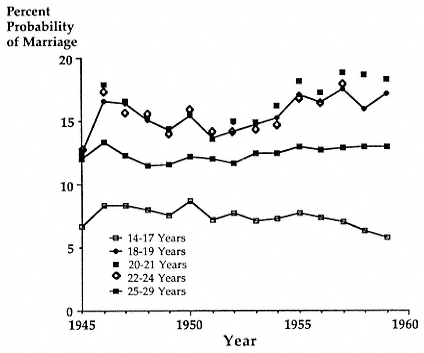
Figure 19.
Annual First-Marriage Rates for Nonwhite Single Women, 1945–1959
sure to marry felt by young unmarried women was to play a part in subsequent developments.
A particularly acute form of sanctioning occurred in a common phrase, "old maid." Old maids were not figures of abhorrence so much as they were objects of condescending pity.[104] The pity depended on the secure, unquestioned knowledge that such a position was not seen by any but deviants as a valid alternative to marriage and motherhood. An even more central belief was that the satisfactions of the" home" would be denied old maids, who would be lonely, bored, unloved, joyless. "Well, you want to marry like other girls do. You can't look forward to being an old maid. It's a woman's place to marry and have a family."[105]
Over the 1950s, average income levels increased, permitting a higher proportion of young people to marry and then to have children. Income levels grew over this decade at a pace that
kept the standard of living of newly formed families in a very steady relationship to that of older families at the same time, and also to people of the same age who had not yet married or not yet had children.[106] Subjective material minimal requirements for becoming parents enlarged along with incomes. A repeated question on Gallup polls indicates a basically constant ratio of "the smallest amount of money a family of four (husband, wife, and two children) needs each week to get along on in this community" to actual average income. Prosperity was shared by the young couples contemplating marriage or parenthood, but they took out only a portion of their "dividend" directly in family formation, the balance going to increased home ownership and a variety of related appurtenances. Thus, in this era of devotion to the family, family life became, in a material sense, richer.[107]
Tastes for marriage , however, moved with income in a somewhat different way in the decades after World War II. We have, first, a comparison of prewar and postwar poll data on economic sufficiency targets for marriage. In 1938, women's median targets of adequate incomes on which to marry—no doubt these included cushions against future unemployment not considered so necessary after the war—were about 2.6 times median current disposable income per capita. By 1946, however, the ratio had fallen to 1.8 times: immediate marriage was, on the average, much more feasible.[108] Peter Lindert's elaborate state-level regression analysis of American age at marriage shows that in 1930 and 1940, aspects of population composition—percentage foreign born and sex ratio in particular—were the major variables that statistically explained why women married younger in some states than in others. Insofar as average current income from employment played a role (as it did in 1930 and 1940), it was a negative role: states with higher average incomes were states where women married older. In 1950 and even more so in 1960, however, the positive relationship of income and marriage timing was strong enough to suggest that sufficiency targets were regularly exceeded by burgeoning current income. Young people now responded positively to high local average income.[109] As has been argued elsewhere, after World War II "the basis for 'decision' about marriage timing
has changed, then, from involuntary to preferential, from a structurally constrained to an individually determined basis."[110]
Overall, then, the 1950s not only saw earlier marriage but a falling off of marriage probabilities for those who did not marry as promptly as current standards proposed they should. In a behavioral sense, marriage between about 18 and 24 became highly normative during the baby boom, aided by a widespread diffusion after World War II of parentally subsidized marriage and even subsidized parenthood.[111] Women had to get on the with the task of getting married at a rather brisk pace or see their chances to marry at all actually decline—in a period of heightened nuptiality and marriage-consciousness. The tensions built into this new scheduling eventually came to affect the way that women, traditionally younger at marriage than men, understood their ability to achieve emotionally satisfying marriages, even to contract the marriage with the feeling of certainty called for by the folk knowledge that governed behavior.
Out of it all I faced the fact that I didn't love George at all. I didn't love George any more than Gracie loved her husband or Penny loved Bill. . . . How would I end up? Loving a split level and a car, or simply loving the idea of marriage? How? Not happy certainly? . . . What was I settling for? Marriage before I was nineteen, with my picture in the paper[?] . . .[112]
She splits with George. "For the first time since I'd known George, I felt like me—Florence Mackenzie. . . . Now I will wait for a man to love who will love me—until I am twenty-seven if necessary—until I am forty, if it has to be." But, statistically, Florence was making a mistake, if she was really determined to marry. Florence's divorce occurred in the year that Betty Friedan published The Feminine Mystique .
There is evidence that initial postwar ideals of marriage timing more or less resembled those that preceded it.[113] But they did not survive long thereafter, as the prosperity and evolving courtship mechanisms of the baby boom era made early marriage more attainable. As more individuals were enabled to marry according to or ahead of their schedules, normative age schedules shifted toward younger marriage. Ideal marriage age closely paralleled behavioral trends. Table 34 documents this,
| ||||||||||||||||||||||||||||||||||||||||||||||||||||||||||||||||||||||
comparing ideals derived from representative national polls taken in 1946 and 1957 with actual marriage timing for those same dates.
At both dates and for both sexes, the median of the ideal marriage age was somewhat above that for contemporaneous behavior.[114] At the same time, the means of marriage behavior generally were above the means of ideal age at marriage. The distribution of ideal ages of marriage at any given time has consistently been more uniform than that of actual marriage. Unintended pregnancy, of course, explains many younger-than-ideal marriages, and lack of timely opportunity many that were older than ideal. Ideals of marriage age were subject to periodic revision and the 1950s were a period of noteworthy downward revision. This was no less true for older married people than for young people still contemplating their own transitions to the married state. Baby boom youth were eager to get on with "family-building" and drew from their elders a set of values that situated this earnest desire squarely within their common notion of the good life. Ideals and behavior had different distributions, but they also changed together , moving up to the peak of the baby boom. They shortly were to reverse together.
Hogan shows that median age at leaving school increased by over a year among young men from the 1937 birth cohort as compared with those born a decade earlier. In the 1927 birth cohort, the average young man completed his education at age 17.8 and married at age 23.3—five and a half years later. The cohort born in 1937, on average, married at 23.0, after having finished school at 19.0, their wait having shrunk on average a year and a half in a decade. Among those who did not serve in the military, the decline was especially sharp, but even among those who served, the average hiatus between leaving school and marrying was reduced. The transition time to adulthood was thus compressed sharply in the baby boom decade. Yet despite the difficulties inevitably posed often by the exacting new scheduling, Hogan is able to show that atypically sequenced transitions occurred only somewhat more often in the baby boom, rising from about 20 percent for the 1927 birth cohort to a peak of about 25 percent for the 1932 cohort (marrying, on average, about 1955) and settling back to a level of 23 percent for the 1937 cohort. This increase is distinctly less than one would expect if—in view of the way average school-leaving and marriage ages were moving toward one another—young men and women were not making an increasingly strenuous effort to keep their life courses "normative."[115]
An important component in the new nuptiality regime was the large peacetime army to which the nation was committed. Even though young men who served married a little later, in those years when the military made particularly severe demands on the manpower pool, overall age at marriage declined . In Hogan's calculations, based on single-year time-series analysis, variations in military demand had about as much effect on nuptiality as did variations in unemployment rates but, of course, in the opposite direction. In the aggregate, military demand encouraged single men, especially those relatively older, to take the plunge. The effect of military demand was in fact strikingly direct and prompt. Stanley Lebergott puts it nicely: "The brassy brilliant call of country leads young people to marry not only until—but before death do them part. Perhaps in more halcyon times, or climes, the rate of time discount might not be so formidable." Rate of first inductions explained
about half the quarter-year-to-quarter-year variation in marriage rates.[116]
Proximate reminders of the possibility of the interruption of one's course to adulthood by a stint in the army, for the most part, seems to have occasioned the wish to be on with it, to hasten marriage.
We were sophomores in high school when we started to go steady, and by the time we were seniors, we knew we wanted to get married. . . . Ted's draft notice came in May and instead of giving me my engagement ring for Christmas like he'd planned, I got it that July before he left.[117]
Fathers were not drafted at this time, and husbands were drafted only rarely. Student deferments declined fairly steadily after 1952, and from this same date, Type IIIA deferrals (registrant with a child or children and registrant deferred by reason of dependents) increased regularly as a ratio to inductees and enlistees.[118] For young men, the existence of conscription nevertheless legitimated youthful marriage—old enough to fight, old enough to be responsible for a wife—and also provided a practical reason for quickly achieving it as well as a potential backup job in case of unemployment. As "juvenile delinquency" stereotyped the younger part of male youth as threatening and disorganized, the army stereotyped the older part as manly and responsible.
For those who served in peacetime, the military offered a sharply age-graded experience, of limited duration, during which both emotional and human capital were accumulated, and sometimes tangible capital. In the baby boom period, one anticipating being drafted did not necessarily do himself a disservice by marrying and indeed may have thereby mitigated some of the rigors of army life. Many postings during this period were domestic; other men, stationed in Europe, could with the aid of the PX provide a level of family living not inimical to most wives. For the men, marriage posed a way of escaping group quarters and the constant military superintendence that implied. As peacetime military service became more institutionalized during the decade, the proportions of those in service
who were married increased, despite increasing dependency deferral. Indeed, the shift to young marriage during the decade was sharper among those in the military than among civilians. By 1960, more of those age 18 or 19 in service were actually married than were civilians at the same ages; and only a ten-percentage-point difference (it had been nineteen points in 1950) separated civilians from soldiers in proportions married at ages 20 to 24. Much as was college and even high school education, so also army life was accommodated to the enhanced drive toward youthful marriage so apparent during the decade.[119]