
Depression
The manic projections of bipolar patients, however enlightening, are eventually undermined by mood swings in the other direction. Depressive
symptoms range from sadness to despair, from an uncontrollable tearfulness to a despondency beyond tears. The word depression cannot convey the nightmarish pain involved. It is, as William Styron has recently put it, "a true wimp of a word for such a major illness," with its "bland tonality." Styron prefers brainstorm to denote the "veritable howling tempest in the brain" impossible for those who have not experienced depression to imagine.[62]
In contrast to manics' exuberance and inflated self-esteem, depressives can feel hopeless, lethargic, or suicidal. Self-deprecatory comments reflect the low self-esteem that accompanies the general loss of energy, and no outside stimuli are capable of ameliorating the helpless sadness: neither the family nor the patient has any control over the depression, and this lowers spirits further on both sides. The depressed patient feels chronically miserable, worried, discouraged, irritable, and fearful.[63] Many experience great fatigue, insomnia, or repeated early morning waking (described by Woolf as "starts of terrified about nothing waking" [Letters 6: 376]), slowness in thinking or in motor skills,[64] loss of interest or pleasure in usual activities, and, in three-quarters of these patients, decreased sex drive—symptoms which usually strike the patient as evidence not of depression but of something else. One patient, a prominent lawyer, shared Woolf's private conviction of damnation. He
denied being depressed. Rather, he complained of having "no feelings of any sort. . . . I have no soul, I am dead inside." When pressed, he confided that he believed he suffered from a case of "moral decay of the soul—sin sickness," as he termed it during a flash of his old courtroom eloquence. "The sentence should be electrocution rather than shock treatments." However, after receiving the latter, he no longer believed he deserved to be electrocuted; indeed, in six weeks, he was able to return to the practice of law.[65]
Just as the elated manic may be either sociable or assaultive, so too the depressive may be either passive or aggressive, sad or angry. Some lie in bed, immobile, despondent, completely helpless in the face of despair and guilt. Others become extremely agitated by their black thoughts, fidgeting restlessly, wringing their hands, feeling shaky inside, experiencing heart palpitations but denying despair. These contradictory syndromes led clinicians to define two autonomous states of depression, a retarded anhedonic type (with a pathologically decreased capacity to anticipate and enjoy experience, especially on a sensory level) and an agitated delusional type (with increased anxiety and hostility).[66] The two states can both be
seen in the same patient.[67] K. R. Jamison notes that the cyclothymia suffered by Hector Berlioz combined agitated and retarded depressions: "an active, painful, tumultuous, and cauldronous one (almost certainly a mixed state), and another type, characterized by ennui, isolation, lethargy, and a dearth of feeling."[68] The agitated depressive is so upset that he looks as if he is fighting back against total despair, and he may resemble irritable manics in nervous energy and paranoia. Quentin Bell records that Woolf suffered one such episode of agitated delusional depression in an 1896 breakdown:
[Virginia] became painfully excitable and nervous and then intolerably depressed. . . . She went through a period of morbid self-criticism, blamed herself for being vain and egotistical, compared herself unfavourably to Vanessa and was at the same time intensely irritable.[69]
Anhedonia, by contrast, overwhelms patients with what appears to be "pure" depression, a debilitating sorrow which includes "vegetative" symptoms characterized by a general psychomotor retardation: they have little to say, interact poorly with others, and tire easily, complaining of exhaustion, "tight" headaches, or muscle aches. Constipation is very common and sometimes severe; even nail growth may stop.[70] William Styron remembers that his voice seemed to "disappear" as his depression deepened: "It underwent a strange transformation, becoming at times quite faint, wheezy, and spasmodic—a friend observed later that it was the voice of a ninety-year-old."[71] Sleep is disturbed. Most depressives experience insomnia and early morning waking, but some become hypersomnolent, sleeping longer at night, sleeping during the day, or taking excessive naps.[72] Loss of appetite is typical of a general slowdown in bodily processes. Some patients complain of a bad taste, a dryness of the mouth, heart palpitations, or "the feeling of a [tight] band round the forehead,"[73] as did Woolf:
I was walking down the path with Lydia. If this dont stop, I said, referring to the bitter taste in my mouth & the pressure like a wire cage of sound over my head, then I am ill: yes, very likely I am destroyed, diseased, dead. Damn it! Here I fell down. (Diary 3: 315)
The galloping horses got wild in my head last Thursday night. . . . Then my heart leapt; & stopped; & leapt again; & I tasted that queer bitterness at the back of my throat; & the pulse leapt into my head & beat & beat, more savagely, more quickly. (Diary 4: 121)
Sensory perceptions also change. Where mania exaggerates, depression dulls, leaving physical and mental worlds monochromatic.[74] As John
Custance noted, any object—food, clothes, one's own body—inspired "repulsion," "intense disgust," and "unpleasure" in depression, whereas in mania these same objects elicited "intense joy," "attraction," and "pleasure."[75] Because metabolic changes in manic-depression can be so profound, physiological symptoms often coincide with psychological ones, and so many patients' reports will associate the two, using one to bring significance to the other. In other words, patients usually seek to explain their loss of desire by associating it with some other depressive symptom, such as lowered self-esteem—reasoning, to cite only one example, that they no longer want to eat because they are unworthy of taking food from others. Self and world both appear manifestly degraded, evil, repulsive, and to perpetuate such a dismal situation by incorporating even more of the world into oneself would be unendurable.[76] As a psychological theory, the depressive's explanation fulfills the Freudian paradigm: it produces meaning by filling the gap that occurs between two symptoms ("I have no appetite" and "I feel so bad"), and it assumes that the physical symptom expresses a psychological state, which is its cause.
To us, anorectic conscience appears delusional, or at best a rationalization, and we may dismiss it as absurd—but delusions, like scientific theories, have an explanatory power that seems as compelling to the psychotic as objective physical evidence does to the individual whose pain results from visibly lacerated skin or a broken bone. We all need to provide a continuous narrative for our experiences; this is the basis of consciousness, and anomalous or bizarre experiences call for unusual explanations to connect the dots, to account for fragmented or incomplete events.
The symptomatic form manic-depressive illness takes, however, usually reflects the individual's experience.[77] Here biology and psychology combine. In depression there is often some reference to the patient's life (for example, a normally confident pharmacist may worry obsessively about accidentally poisoning her customers), but in severe mania the individual may lose all contact with his euthymic state (a loving husband may be unfaithful to his wife and unconcerned about his children). Like anyone else, the individual tries to formulate an explanation for his experiences; the more anomalous the experiences, the more bizarre may be the explanation, especially since a mood disorder fulfills its own prophecies by affecting what evidence the subject attends to and how he interprets it. Environmental and social factors often combine with biochemically induced delusional beliefs when the patient attempts to account for himself:
For example, suppose you are having mood swings that seem unconnected with events in your life. If you have read something suggesting that hormones (or blood sugar, or magnesium) affect mood, and you have social support for this idea, you may be less likely to conclude that some abstract force is controlling you. Similarly, if you are skeptical of miracles (or magic) to begin with, you should be less likely to conclude that a visual experience is the blood of Christ, and more inclined to look for other possibilities. Delusions should be affected by patients' cultural and social experience, particularly when the delusions are not sufficiently driven by perceptual experience to determine their character and are not constrained by alternative possibilities that are salient because of prior experience. Especially important may be the availability of alternative explanations for people's own feelings .[78]
In worldwide surveys of delusional themes, researchers have found that Kuwaiti patients have significantly more delusions centered around supernatural phenomena such as sorcery or the devil; lower-class Egyptians are more apt to have religious delusions such as a conviction of being Mohammed or a great prophet; upper-class Egyptians display more secularized delusions such as being affected by computers, X-rays, electricity, or government spies; and Irish-Americans develop sex, sin, and guilt preoccupations.[79]
Delusional patients not only produce odd accounts for themselves; they also try to read them to discover what they might mean. Clifford Beers, for instance, combined paranoid and anorectic ideas in his refusal to eat. He theorized that the mental hospital in which he had been placed had been secretly infiltrated by ingenious, Kafkaesque police detectives who were seeking a confession from him for an unspecified crime (though he remained ignorant of the accusation, Beers nevertheless felt it was deserved):
They now intended by each article of food to suggest a certain idea, and I was expected to recognize the idea thus suggested. Conviction or acquittal depended upon my correct interpretation of their symbols, and my interpretation was to be signified by my eating, or not eating, the several kinds of food placed before me. To have eaten a burnt crust of bread would have been a confession of arson. Why? Simply because the charred crust suggested fire; and, as bread is the staff of life, would it not be an inevitable deduction that life had been destroyed—destroyed by fire—and that I was the destroyer?[80]
Such deductive ingenuity would be worthy of a Freudian, but for all this theorizing, Beers could not discover why he felt so despondent and
guilty in the first place. Nothing he had done had caused him to be manic-depressive. For all its plausibility, food proved to be neither the answer nor the significant, therapeutic symbol. Virginia Woolf also had problems with the association of food and guilt, as Quentin Bell notes:
she thought people were laughing at her; she was the cause of everyone's troubles; she felt overwhelmed with a sense of guilt for which she should be punished. She became convinced that her body was in some way monstrous, the sordid mouth and sordid belly demanding food—repulsive matter which must then be excreted in a disgusting fashion; the only course was to refuse to eat. Material things assumed sinister and unpredictable aspects, beastly and terrifying or—sometimes—of fearful beauty.[81]
Virginia makes the same connection when describing a passing depression but notes that it does not hold up once she is euthymic:
I think the blood has really been getting into my brain at last. It is the oddest feeling, as though a dead part of me were coming to life. I cant tell you how delightful it is—and I dont mind how much I eat to keep it going. All the voices I used to hear telling me to do all kinds of wild things have gone—and Nessa says they were always only my imagination. They used to drive me nearly mad at Welwyn, and I thought they came from overeating—but they cant, as I still stuff and they are gone. (Letters 1: 142)
Attitude toward eating clearly differentiates Freudian and psychobiological approaches to manic-depressive illness. Critic Louise DeSalvo takes the purely psychological view when she decodes Woolf's loss of appetite:
As [psychotherapist] Alice Miller has learned, symptoms are a form of communication. To starve yourself means that someone has starved you. Virginia's feelings were also frozen—she knew that if she showed rage, anger, nervousness, she would be medicated into submission. Moreover, cutting off feeling is one way of handling sexual abuse; the results, however, are deadening.[82]
Ironically, DeSalvo engages in the same kind of speculation that expresses Beers's paranoia, for she assumes that meaning underlies symptoms in a more or less direct line of logic. Because she assumes that Woolf's depression is a coping mechanism chosen, consciously or unconsciously, by a victim of incest, DeSalvo feels she has arrived at the symptom's origin and
meaning simultaneously, by merely reversing the definition of who is starving whom. Such a scenario might be true of a non-manic-depressive: childhood deprivation and sexual abuse may be the "message" of purely psychological symptoms created by an ego unable to cope with hurtful feelings in any other way. But how, then, do we distinguish this form of communication from a symptom the ego has not invented, the deadening of appetite and feelings and love of life produced by abnormal brain chemistry? The "message" of anorectic conscience in this case would not be "I was sexually abused" but "I feel as bad as if I had been sexually abused," or, in Woolf's case (as I will argue in Chapter 6), "I feel bad when depressed, just as I did when I was sexually abused: depression is like that, a victimization, an inescapable emptiness and hunger where even food is tasteless, repulsive, poison." Psychoanalytic critics need to familiarize themselves with modern neuropsychiatry in order to be aware that our subjective lives are complicated mixtures of mind and brain, the freely chosen and the brutally imposed, the meaningful and the unintelligible.
Hypochondriacal preoccupation with bodily functions and the belief in some physical cause for their psychological pain occur in a third of depressed patients—not surprisingly, since mood disorders are so closely linked to metabolism. Styron sensed a direct connection between brain and mind: "What I had begun to discover is that, mysteriously and in ways that are totally remote from normal experience, the gray drizzle of horror induced by depression takes on the quality of physical pain."[83] Many patients particularize vague depressive fears by worrying about disease, commonly focusing on heart disease, cancer, and, most recently, AIDS, because in Western culture these most forcefully symbolize a personal doom. The general loss of physical energy can also affect their judgment: they consider their work and activities as trivial and their past life as a failure. Any evidence to the contrary is dismissed or misinterpreted to fit their despondent mood. Since depression interferes with memory and the brain's ability to concentrate and evaluate (Clifford Beers remembers being unable to read a newspaper, for it "appeared an unintelligible jumble of type"), the patient's work usually does suffer, adding to his conviction of inadequacy.[84] Studies show that when depressives are exposed to new material, they are less likely than controls to link novel information to preexisting knowledge, a result that indicates some hindrance to the fundamental human capacity for recognizing significance consistently over time.[85] Depressives' memory of events becomes jumbled, and unintegrative habit begins to dominate thought. They fall back on uncreative and inflexible
routines, which feeds their developing nihilism and pessimism; life indeed becomes empty and fragmented.[86] While hypomanic, an employee may outperform every competitor, creatively solving problems by discovering hidden connections or correlations and by energetically exploiting opportunities. But the same individual will lose all that talent and stamina when depressed, as both John Custance and Virginia Woolf noted:
Instead of the light of ineffable revelation I seem to be in perpetual fog and darkness. I cannot get my mind to work; instead of associations "clicking into place" everything is an inextricable jumble; instead of seeming to grasp a whole, it seems to remain tied to the actual consciousness of the moment. The whole world of my thought is hopelessly divided into incomprehensible watertight compartments. I could not feel more ignorant, undecided, or inefficient. It is appallingly difficult to concentrate, and writing is pain and grief to me.[87]
This is the worst time of all. It makes me suicidal. Nothing seems left to do. All seems insipid & worthless. (Diary 3: 186)
Depressives habitually look on the gloomy side of any question. They come to believe that their very existence bodes ill for themselves and their families. The future is perceived as grim, empty, hellish, and death seems the only escape. Deeply depressed patients are unable to feel emotions at all; the brain is unable to process even pain. Often, as if to explain to themselves why they feel so low, they accuse themselves of terrible sins, or of being responsible for family tragedies. Sometimes they hear voices which make these accusations for them, and experiencing these hallucinations further convinces them that they are deservedly losing their minds.[88] The messages of these voices are usually related to the content of their particular delusion concerning (or explanation of) their experiences. If a patient explains his depressive fears as feelings of persecution ("I feel so scared, someone must want to kill me"), the voices are usually berating or derogatory. If he finds thematic unity in a general nihilism ("Life is terrible, worthless; total nuclear annihilation is unavoidable"), the voices may threaten doom and destruction.
Because any theory used to explain our personal experience affects how we make decisions, the decision to die is thus a frequent feature of the depressive state. At least 15 percent of manic-depressives, if left untreated, commit suicide; this is thirty times the rate found in the general population and is higher than for any other psychiatric or medical risk group.[89] But Winokur found that an overwhelming 82 percent of his depressed
bipolar patients had suicidal ruminations.[90] Thus, it is difficult to tell who will attempt suicide and who will not: even seemingly strong people with a wide range of personal assets may, when depressed, reinterpret those assets as liabilities (e.g., ambition is no longer seen as a positive sign of success but as an empty gesture or rude pushiness or an unforgivable crime at the expense of others). Suicide itself is not a reliable indicator of strength of character or neuroticism, or the quality of the suicide's previous life, or the amount of support and love given by family and friends.[91] For some patients, it is the memory of happiness once known, or even the potential for future happiness that now seems beyond reach, that makes their despair seem unendurable.[92] Pointing out a depressive's available resources or opportunities for satisfaction (the love of his family, his potential for success, etc.) may only exacerbate his sense of the internal abyss that separates him from what he feels he needs most. Some suicidal patients are very adept at disguising their hopelessness, especially if a resolution to end their misery offers them their only hope, in which case they can appear calm and in better spirits shortly before they kill themselves.[93] Moreover, suicidal tendencies are often masked; they can occur in the absence of delusions, hallucinations, or psychomotor retardation, and the patient may not voice self-destructive wishes.[94] Clinicians and family members must look for other, subtler symptoms: alcoholism, insomnia, loss of weight and appetite, irregular heart rhythm, recklessness, social withdrawal.
Why did Woolf kill herself? Psychoanalyst Alma Bond devotes an entire book to the question of Who Killed Virginia Woolf? and finds, predictably enough, too many readily available answers: the threat of a German invasion, Virginia's fear of becoming an inescapable burden to her Jewish husband, her belief that her sister, Vanessa, was withholding her love, her knowledge that her lesbian lover was unfaithful, her anger that Leonard was domineering, her despair at the thought that she might lose the power to write. With so many reasons for suicide, wouldn't an emotionally weak woman be overwhelmed and offer us a compelling, dramatic climax to a life of neurotic conflict? Bond's speculation begins well enough: she wonders why Woolf killed herself when so many other people at the time endured similar trials. Because she is a Freudian, Bond explains Woolf's vulnerabilities by privileging (first hypothesizing the existence of) unconscious conflicts. Invasion, infidelity, loss, self-devaluation—all become more than Virginia can bear, not because they are in themselves unbearable but because they replicated her untimely weaning as a six-week-old baby, her mother's emotional distance, the infant Virginia's masochistic wish to
surrender to a defensively idealized mother, the daughter Virginia's envy of her father's penis, and the sister Virginia's sexual abuse at the hands of her half-brothers. As usual in a Freudian landscape, family life is hell; why else would anyone fall ill? Bond still relies on Freud's sixty-five-year-old description of psychosis as an unreconciled conflict between the ego and an intolerable reality and on Jacobson's thirty-three-year-old idea that manic-depressives experience pronounced shifts in mood and self-esteem because an immature superego has failed to modulate psychic energy (primarily anger toward parents, in mania, and anger toward self, in depression).[95] Asserting, with confidence, that "all delusions reflect the central conflict of a tormented psyche," Bond works backward to reconcile what would appear to her (indeed, to anybody who enjoys a reasonable sense of reality granted by sanity and stable brain chemistry) to be the only "meaningful" conflict.[96]
"Nobody has explained to my satisfaction what brought on that last attack" of 1941, Bond states. If personal satisfaction is the prime requisite, the closure of death requires an artful, even melodramatic explanation:
Virginia Woolf was not an integrated individual. She labored all her life to consolidate her personality, with only temporary success. . .
In my opinion, there was one means left to Virginia to unite her discordant selves: In her death she discovered the way to integrate the "orts, scraps, and fragments" (Woolf, 1941, p. 215) of her splintered soul. Then at last the important strains of her life—including the untimely disruption of the symbiosis with her mother and her early loss again through death, the highly ambivalent relationship with her father, the sadomasochistic interaction with her sister Vanessa, the loss of Vita as her lover, Virginia's disillusionment with Leonard and the "puncturing" of the family myth, the frightful experience of the war in the light of her inability to deal with aggression, and the death of Thoby and many of her friends, which reenacted the early traumatic deaths of her adolescence—all intermingled to culminate in her final act at the river Ouse.[97]
Like the conclusion of a melodramatic Victorian novel, Bond's version of Woolf's death threads disparate strands together in an aesthetically satisfying ending. Do manic-depressives think about suicide in such pathetic terms? Sometimes, but only when depressed. Elaborated reasons for a tragically appropriate end fill in the blank nothingness of depression, expressing its corrosive power of shaping perception and cognition so that past events seem ominously prophetic. When the patient is euthymic or manic, these same memories take on entirely different connotations: "My
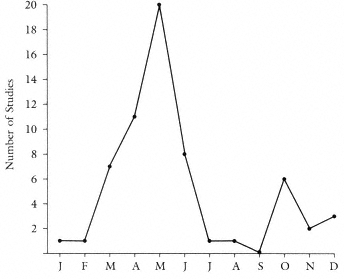
Figure 1.
Peak Occurrence of Suicide by Month
(Based on review of 61 studies.
Jamison [MDI 243])
mother's death blighted my life forever" then becomes "My mother's death hurt, but it taught me to appreciate life more." Unfortunately, psychoanalysts are compelled by Freudian theory to view a patient's euthymic disavowal of unhappiness or despondency as a manic defense, or at least a neurotic repression. This theoretical position assumes, arbitrarily and destructively (for the patient), that the depressed view is the "true" expression of the patient's deepest, most authentic feelings. By focusing on depression, Freudians reduce the three states of bipolar disorder (manic, euthymic, depressive) to one state and inadvertently encourage the patient to think of his depressed self and its sad history/fiction of fated disappointments as most central to his identity. This clinical exaggeration of the significance of the patient's ill thoughts over his well thoughts can lead, tragically, to even more suicides.
Why did Woolf die? We must relinquish the demand for an answer that satisfies our need for narrative unity. Studies suggest that the frequency of manic-depressive relapses increases with age,[98] so perhaps Woolf died for nothing more meaningful than the fact that the biochemistry of aging bodies changes and intensifies depression. Or perhaps it was the season. There is a striking peak incidence of suicide in May, a rise that begins in March (see Figure 1), as do the rates of hospital admissions for depression;
affective disorders are intimately connected to the body's circadian and seasonal rhythms. So perhaps Woolf died because age and winter combined to exacerbate depression. A third possibility exists: Woolf's last physician, Octavia Wilberforce, suspected in 1940 that her patient might be an alcoholic. If Woolf, like 35 percent of other manic-depressives, medicated herself with alcohol in the last year of her life, the resulting neurochemical changes could have contributed to the severity of her last depression and increased the risk of suicide.[99]
In the end, we cannot hope fully to explain Woolf's suicide by means of traumatic events in her life. Depression alters the patient's perception of the story line of those events, and it would be a matter of blind luck (or an expression of mood disorder in ourselves) if we could empathize so completely as to see her death with her eyes. It is tempting to approach psychotic thinking as if it were just a matter of conflicted thinking resolvable by therapeutic insight, to assume that delusions reliably provide the curative clue. But such a perspective obliterates the troubling différance of insanity (the depressive lives in the same world of blue skies, comfortable houses, clean parks, bountiful malls, and loving families that you and I do but, perversely, feels tortured and damned by it all). Our superior attitude toward people who resort to suicide tells more of our needs and wishes than of those of the deceased. Ironically, although suicide can seem the most personal of all our life decisions, it can also be the most impersonal, for the biology of our brains operates in ways that may seem most inhuman. To explain why Woolf died we must explain why anyone dies—of disease, of injury, of birth defects. . . . Our free will is only one element in a complex configuration of forces interacting in ways that are often beyond our understanding. To dramatize this violation of ego's need for continuity in psychobiography, my discussion of Woolf's death appears here, rather than in the last chapter of this book. It ends without conclusion, as so much in life does.
Biology has profound personal consequences that invade the most private realms of our souls, our character, our self-insight. Perhaps this is nowhere more floridly depicted than in depression's power to induce a false sense of guilt. Ruminations on guilt are seen in one-third of depressed patients.[100] First, they feel ashamed of losing control, of behaving bizarrely, of indulging in violent outbursts against those they love the most. If they do permanently alienate their loved ones, desertion and chronic loneliness may be taken as proving depression's insidious whisper that they are unlovable and unforgivable. If the loved one does not understand the impersonal origins of these eruptions of rage or distortions of personality
and desire, he or she may, implicitly or explicitly, reinforce the depressive's nearly unbearable self-condemnation. We read of the suicides of estranged spouses and rejected lovers in the newspapers every day, but we usually do not think beyond a tepid condemnation of their weakness of character or lack of foresight. We forget Satan's admonition in Paradise Lost that "the mind is its own place, and in itself, / Can make a heav'n of hell, a hell of heav'n."[101]
Second, depressives feel guilt for which they cannot find a valid cause. They tend to think back over the years and center obsessively on some past event—an unpardonable sin (to explain their hopelessness and guilt), or a traumatic experience (to explain their helplessness and life's emptiness), or the loss of a significant person (to explain their extraordinary sense of abandonment and loneliness). Here emotion often serves as an informational cue: bipolars tend to remember positive experiences when in a positive mood, negative experiences in negative moods.[102] An emotional state may influence memory storage and access.[103] Studies have found that depressed patients are better able to recall words with negative content or negative experiences than positive words or experiences.[104] The tragedy that seemed to Woolf to explain her emptiness, despair, and lack of a stable self-structure was the loss of her mother in 1895. Julia's sudden death apparently triggered Virginia's first manic-depressive breakdown, but, more important—for Woolf and for us—it became Woolf's metaphor for the birth of a bipolar identity, the stream in which she pictured herself as a fish, fixed, "held in place" by "invisible presences" (Moments of Being 80). It offered a coherent story line for experiences that would otherwise seem senseless and impersonal.
If personal history provides no such emblematic event, some depressives will castigate themselves for sins that are entirely imaginary or that they themselves cannot remember. After an unsuccessful attempt at suicide (like Woolf, he jumped out of a window), Clifford Beers interpreted everything that happened to him in terms of his despondency and guilt. When doctors applied hot poultices to his broken feet, his "very active association of mad ideas convinced me that I was being 'sweated'"—given the "third degree" by police intent upon gaining a confession from him for an unknown crime; "with an insane ingenuity I managed to connect myself with almost every crime of importance of which I had ever read."[105] It is not the sin itself that is important, not even as a hypothetical, unconscious wish. The patient seizes upon sin as the only cause to be found for an indefinable despair. One patient
admitted to having committed the unforgivable sin but when [the psychiatrist], very interestedly, tried to find out the awful details, he replied "That's just it, I don't know what it is". The content of these ideas and delusions is consonant with the patients' personalities and activities. Thus a television newscaster felt that he was involved in a recent murder that had evoked much publicity. A conscientious doctor was convinced that he had poisoned a patient (actually alive and well) with an overdose of a drug in his prescription.[106]
Leonard had suspicions that Virginia's depressed guilt had no simple origin:
Pervading her insanity generally there was always a sense of some guilt, the origin and exact nature of which I could never discover. . . . In the early acute, suicidal stage of the depression, she would sit for hours overwhelmed with hopeless melancholia, silent, making no response to anything said to her. (Beginning Again 163)
Other depressives fill the void by developing fixed false beliefs that symbolize their present mental states: they are guilty of having wished their parents dead, God has refused to forgive them for alienating the affections of a past lover, they are being spied on and persecuted, they have no intestines, their brains are rotting, the furniture in a room has been altered simply to irritate them, they have become the focus of universal abhorrence, or the world itself is disintegrating or plunging toward Armageddon because of their personal inadequacies and failures.[107] In such a moral nightmare, suicide would seem a welcome release or at least an appropriate conclusion to a narrative of utter hopelessness. No wonder, then, that Freudians described such negativity as a self-induced attack on the ego. Since, as they saw it, all matters of punitive conscience arose from the superego, depression served to convince them that the superego could be vicious, even homicidal. But since neuroscience shows us that a depressive symptom can be elicited by the administration of certain drugs, by illness, or by brain injury, we must wonder if the attack is always "motivated":can the superego be turned on and off by physical changes? A specific depressive symptom may be the result of an unconscious conflict and be a good candidate for psychoanalysis, but global despair more likely has its source in a neuronal system that mediates all perceptions, feelings, and beliefs.
Because depressives are convinced they have been singled out for their personal shortcomings, they feel doomed, disconnected from the world, yet vulnerable to attack.[108] Depressives' striking passivity led Willard Gaylin
to describe the symptoms of depression as "non-symptoms." Normally, in neurosis, symptoms are attempts to compromise one's way out of a conflict situation; they are reparative maneuvers executed by the threatened ego. But in endogenous depression, Gaylin observed, reparative mechanisms are at a minimum. Depressives are not victims of illusions: they have no illusions—and no protection against a dark world that is empty of meaning because the self has no power to create a satisfactory meaning.[109] This produces a problem for the analyst, who must rely in part on the patient for his diagnosis. Depressed patients cannot always give true accounts of themselves, for mood is difficult to gauge; it undermines the brain's capacity to achieve self-insight, interpret experience, and make judgments about whether a present mental state conflicts with past states.[110]
In the manic state the omnipotent subjective world dominates the objective, but the depressive state reverses these positions, rendering self powerless, hopeless, worthless, and uncreative, without even the desire to defend itself against its own perceptions. When biochemistry falters, the brain's ability to distinguish incoming from self-generated stimuli is undercut; interpretations become either predominantly positive or predominantly negative, depending on mood. If they are negative, the self feels impotent and the world seems hideously empty and malevolent. Although the patient may seem the picture of uncontrollable tearfulness and bitter sorrow, to him his emotions may seem "blocked" or "frozen," and so he may experience his self as unreal or as an open wound that will never heal.[111] He feels truly depersonalized, self-less. Suicide looks attractive because the mind is already experiencing a death of the soul.
Woolf's depressions exhibited most of these symptoms, and she distinctly perceived their physical dimension:
I know the feeling now, when I can't spin a sentence, & sit mumbling & turning; & nothing flits by my brain which is as a blank window. So I shut my studio door, & go to bed, stuffing my ears with rubber; & there I lie a day or two. And what leagues I travel in the time! Such "sensations" spread over my spine & head directly I give them the chance; such an exaggerated tiredness; such anguishes & despairs; & heavenly relief & rest; & then misery again. Never was anyone so tossed up & down by the body as I am, I think. (Diary 3: 174)
In fact, many of her descriptions of symptoms that precede breakdowns emphasized physical changes: headaches or numbness in the head, insomnia, nervous irritation, a strong impulse to reject food.[112] More important, she recognized that such physical changes had psychological consequences:
This is the worst time of all. It makes me suicidal. Nothing seems left to do. All seems insipid & worthless. . . . Mercifully, Nessa is back. My earth is watered again. I go back to words of one syllable: feel come over me the feathery change: rather true that: as if my physical body put on some soft comfortable, skin. (Diary 3: 186)
The physicality of manic-depressive illness can help us differentiate it diagnostically, in four ways, from the Freudian notion of neurotic depression. First, Woolf usually connected her depressions to physical changes or ailments that accompanied or preceded mood swings, an association research has shown does exist in mood disorders with strong biochemical components, though seldom in psychological mood disorders. Second, she was often able to state the time of onset of illness: whereas neurotic-reactives find it difficult to determine when they shift moods, manic-depressives can sometimes date onset to within the hour:
I woke to a sense of failure & hard treatment. This persisted, one wave breaking after another, all day long. We walked on the river bank in a cold wind, under a grey sky. Both agreed that life seen without illusion is a ghastly affair. Illusions wouldn't come back. However they returned about 8.30, in front of the fire, & were going merrily till bedtime, when some antics ended the day. (Diary 1: 73)
Third, neurosis rarely interferes with reality testing (that is, it is not accompanied by visual hallucinations), and it is often seen by the patient himself to occur as a response to a traumatic life event. Manic-depressive illness, in contrast, often inhibits reality testing and frequently occurs without any discernible exterior "psychological" cause unless physical stress accompanies it. And, fourth, in endogenous mood swings, symptoms tend to be more severe and more frequent than in neurosis. The patient perceives his illness more clearly as a distinct change from his usual self and complains more often of a loss of pleasure in activity and a loss of reactivity to usually pleasurable stimuli,[113] as in these descriptions by Woolf of two depressions and their effect on her sense of self:
Here is a whole nervous breakdown in miniature. We came on Tuesday. Sank into a chair, could scarcely rise; everything insipid; tasteless, colourless. Enormous desire for rest. . . . [A]voided speech; could not read. Thought of my own power of writing with veneration, as of something incredible, belonging to someone else; never again to be enjoyed by me. Mind a blank. Slept in my chair. Thursday. No pleasure in life whatsoever. . . . Character & idiosyncracy as Virginia
Woolf completely sunk out. Humble & modest. Difficulty in thinking what to say. (Diary 3: 103)
[It's] a physical feeling as if I were drumming slightly in the veins: very cold: impotent: & terrified. As if I were exposed on a high ledge in full light. Very lonely. L[eonard]. out to lunch. Nessa has Quentin & don't want me. Very useless. No atmosphere around me. No words. Very apprehensive. As if something cold & horrible—a roar of laughter at my expense were about to happen. And I am powerless to ward it off: I have no protection. And this anxiety & nothingness surround me with a vacuum. (Diary 5: 63)
Like Rhoda in The Waves, the depressed Woolf feels naked and vulnerable, stripped of all illusions, as empty on the inside as the world seems to be on the outside. It has long been noted that depressed patients often identify the self with the external world,[114] and this confusion between inner and outer destroys the perceiver's sense of an autonomous identity. All of Woolf's worst fears seem validated by what she perceives. In both of the episodes quoted above, self is blank, with no capacity to generate meaning or fiction, which would at least provide evidence that self existed. The situation is doubly difficult for a female depressive, since society tends to deny value and power to women's selves. Fiction, however, could, like a mother, like the mother Virginia had lost, validate and nurture. Thus Julia became a crucial emblematic part of Woolf's fictional world, which she consciously and repeatedly used to explore both her illness and her wellness.
Woolf needed to rework her experiences in fiction because in depression perceptions defy synthesis: the brain is incapable of integrating the full spectrum of the individual's feelings and desires, past or present. A wall of overly negative perceptions is raised that frustrates attempts by the therapist to cheer the patient. Helpless and overwhelmed by despair, Woolf felt as if the "veils of illusion" had been drawn, leaving her "to face a world from which all heart, charity, kindness and worth had vanished" (Letters 3: 50), feeling a "horror—physically like a painful wave swelling about the heart—tossing me up . . . spreading out over me. . . . One goes down into the well & nothing protects one from the assault of truth" (Diary 3: 110–12). Yet, even in the depths of despair Woolf found something of value to work with in her novels, a "truth" not glamorized or distorted by human illusions and human vanity. This truth was thus potentially inhuman, perhaps even inexpressible but certainly felt, and it contained the essence of reality that the "egotistical" manic Woolf overlooked. Just as the manic's "truth" reveals rampant subjectivity, with wishes and illusory
theories leveling out ambiguities and distinctions, the depressive's vision seems to him to unveil a severely objective truth, the world of stark objects unmolested by wishful thinking or vanity, as Woolf reports:
The depression however now takes the wholesome form of feeling perfectly certain that nothing I can do matters, so that one is both content & irresponsible—I'm not sure that this isn't a happier state than the exalted state of the newly praised. At least one has nothing to fear. (Diary 1: 214)