
Eight
The Marquis de Sade and the Discourses of Pain:
Literature and Medicine at the Revolution
David B. Morris
MADAME DE MISTIVAL, opening her eyes—Oh Heavens! Why do you recall me from the grave's darkness? Why do you plunge me again into life's horrors?
DOLMANCÉ, whipping her steadily —Indeed, mother dear, it is because much conversation remains to be held.
—SADE, Philosophy in the Bedroom[1]
Pain is among the knottiest problems in the long, tangled history of relations between body and mind; moreover, the Marquis de Sade so thoroughly offends or resists the mentality of Anglo-American literary criticism that his works—when acknowledged at all—meet with a silence deeper and more ominous than censorship. It is therefore self-evidently quixotic to propose discussing Sade and pain together, as if to a study of the Atlantic Ocean one gratuitously added the Pacific. Nonetheless, despite its unwieldy expansiveness as a subject for inquiry, pain, like love, constitutes one of the apparently permanent experiences (chang-
This essay was supported by a grant from the Division of Research Programs of the National Endowment for the Humanities. I should especially like to thank G. S. Rousseau and James Grantham Turner for their generous assistance in its preparation and composition.
[1] In The Complete Justine, Philosophy in the Bedroom, and Other Writings, trans. Richard Seaver and Austryn Wainhouse (New York: Grove Press, 1965), 362. When citing the Grove Press translations of Sade, I will also provide (following the page number) reference to the volume and page number of the French text, as published in the definitive edition Œ uvres complè du Marquis de Sade, ed. Gilbert L ély et al., 16 vols. (Paris: Cercle du Livre Prècieux, 1966-1967). The French text of Dolmancè's words is revealing: "Eh! vraiment, ma petite mçre, c'est que tout n'est pas dit" (3:544-545). Juliette, in the novel that bears her name, argues in favor of a philosophy that seeks to "say everything" ("tout dire" [9:586]).
ing with different cultures and times) that help to define an unwritten history of Western man, and we cannot hope to understand pain—in its fullest perplexities—without confronting the obsessive, almost unreadable pages in which Sade meditated, endlessly, on the bond uniting pain with desire. Although a complete history of pain would be fruitless and impossible, we need to consider those moments when pain emerges as something that requires an explanation, something that thrusts above the plane of merely blind or unquestioned sensation. Sade's work, however resistant or offensive, confronts us with such a moment when pain enters the zone of interpretation.
My purpose in this essay is to explore Sade's literary treatment of pain, especially as his works consume and transform the conventional vocabularies in which pain was discussed. Foremost among these vocabularies—which included theology and libertinism as well as law—was medicine. Thus my specific focus will concern Sade's transvaluations of medical knowledge. Sade did not simply appropriate a scientific vocabulary borrowed from eighteenth-century medicine and (to varying degrees) evident in the work of contemporary British and Continental writers, for whom the "life" or "nature" imitated in the novel now proved inextricable from the language of Enlightenment science.[2] Sade's transvaluations alter what they appropriate. His borrowings from scientific sources are not the most characteristic feature of his style, but they have not passed unnoticed. (In 1968 Jean Deprun published an important essay entitled "Sade et la philosophie biologique de son temps.")[3] It nevertheless needs to be emphasized that Sadean transvaluations employ biomedical language and concepts in ways that ultimately estrange them from the scientific and humanitarian labor of eighteenth-century medicine. Medicine in Sade is so thoroughly transvalued that it comes to constitute the appropriately unstable foundation for an otherwise foundationless libertine world, where reason always leads back toward the irrational, where clear and graspable truths grow indistinct and unsteady as they encounter the dark, corrosive, liberating power of desire.
[2] See James Rodgers, "'Life' in the Novel: Tristram Shandy and Some Aspects of Eighteenth-Century Physiology," Eighteenth-Century Life 1 (1980): 1-20. Particularly relevant to the admixture of "medical language" in erotic or pornographic texts is G. S. Rousseau, "Nymphomania, Bienville and the Rise of Erotic Sensibility," in Sexuality in Eighteenth-Century Britain, ed. Paul-Gabriel Bouc é (Manchester: Manchester University Press, 1982), 95-119.
[3] In Le Marquis de Sade (Paris: Armand Colin, 1968), 189-203. This useful volume (with no editor named) collects papers from the 1966 symposium on Sade at the Centre aixois d'études et de recherches sur le dix-huitième siècle.
Pain for Sade is far more than (as we tend to consider it) a medical subject, and after Sade pain would never be quite the same.
There is a fundamental level of organic life at which pain belongs to an unthinking biochemistry of nerves and neurotransmitters that connects King Lear with Skinner's rats. Unlike pleasure, which spreads far beyond specific erogenous or tactile regions in diffuse currents of well-being, pain typically takes up residence in specific bodily parts.[4] Thus we complain of a headache or toothache or bad back, but no one announces experiencing a sudden pleasure in the thumb or foot. Our ability to locate pain in specific parts of the body is what allows pain to serve effectively as a biological defense, and we automatically pull our hand back from the fire in a reflex that occurs faster than thought. Consciousness seems necessary for us to register pain, in the sense that someone who is drugged or unconscious will not feel the fire's heat or the surgeon's knife. Still, few people would survive childhood if pain required accurate reasoning before we ran away or cried for help. Should we adopt a Cartesian vocabulary to describe this secret (unthinking) life of pain, we might say that it belongs to the mindless realm of res extensa, where whatever takes up space owes allegiance to the mechanical laws of matter. It was Descartes, in fact, who provided in his treatise on human physiology—De l'homme, published posthumously in 1662—an illuminating diagram for what we would now call an involuntary response to pain.
[4] The localized nature of pain—as opposed to the nonlocal nature of pleasure—is discussed by Gilbert Ryle, "Pleasure," in Dilemmas (Cambridge: Cambridge University Press, 1054), 54-67. The best introduction to modern medical research on pain is by Ronald Melzack and Patrick D. Wall, The Challenge of Pain (New York: Basic Books, 1983). Several books written for general readers seek to place medical knowledge of pain in wider social and historical contexts. See, for example, Peter Fairley, The Conquest of Pain (1978; reprint, New York: Charles Scribner's Sons, 1980) and H. B. Gibson, Pain and Its Conquest (London: Peter Owen, 1982). For more philosophical and more satisfying discussions of pain and its relations to pleasure, see J. L. Cowan, Pleasure and Pain: A Study in Philosophical Psychology (London: Macmillan, 1968); Rem B. Edwards, Pleasures and Pains: A Theory of Qualitative Hedonism (Ithaca, N.Y.: Cornell University Press, 1979); and Thomas S. Szasz, M.D., Pain and Pleasure: A Study of Bodily Feelings, 2d ed. (New York: Basic Books, 1975). A fuller bibliographical introduction to differing modern approaches to pain is available in my essay "The Languages of Pain," in Ex ploring the Concept of Mind, ed. Richard M. Caplan (Iowa City: University of Iowa Press, 1986), 89-99. Undoubtedly the finest recent study of pain in its cultural significance—ranging from torture and nuclear war to the Old Testament, Marx, and human creativity—is Elaine Scarry's The Body in Pain: The Making and Unmaking of the World (New York: Oxford University Press, 1985). Scarry makes very little mention of Sade.
Descartes's diagram (see plate 16) provides an indirect but helpful introduction to the Marquis de Sade because its mechanistic assumptions provided a basis for Sade's work and have long continued to dominate Western thought. In Descartes's sketch, the nerve CC runs directly from the foot to the brain. When the fire scorches the foot, the internal response goes something like this. The "thin and mobile" filaments within the nerve cord are tugged, unequally, and thus become strained, separated, or broken. The resulting motion passes instantaneously to the brain—just as (in Descartes's mechanical analogy) by "pulling at one end of a cord, one simultaneously rings a bell which hangs at the other end."[5] All nerves for Descartes originate within the brain, and thus the tugging on nerve cord CC opens the valve or pore "d/e"—in turn releasing the so-called "animal spirits" produced and stored in the brain. These animal spirits—which Descartes described conventionally as minute, rarefied particles—descend through hollow spaces within the nerve cord and cause the muscular response that removes, say, foot from flame. At least as important as Descartes's simplified diagram is the analogy he chooses to describe the process of pain. With the delight of his age in complex machines, he compares the network of nerves, muscles, and animal spirits to an elaborate mechanical fountain, like the intricate waterworks popular in gardens and grottoes throughout the century.
What I wish to emphasize in Descartes is not the quaintness of his vocabulary—which we meet more than a century later in the novels of Sade—but the modernness of his view that pain must be understood as an event of the central nervous system, including of course the brain. In this light, Descartes's diagram might be interpreted as an episode in the larger seventeenth-century encounter with antiquity sometimes known as the battle of the ancients and the moderns. The Cartesian model of pain—although far from original—implies innovations as far-reaching as the changes that champions of the moderns attributed to the invention of gunpowder, printing, and the compass. Plato and Aristotle, for example, simply have no knowledge of the central nervous system.
[5] Treatise of Man, translation and commentary by Thomas Steele Hall (Cambridge, Mass.: Harvard University Press, 1972), 34 ("ainsi que tirant l'un des bouts d'une corde, on fait sonner en même temps la cloche qui pend à l'autre bout"). Descartes repeats this same image in his treatise The Passions of the Soul (1649), where the physiology of nerves, fibers, and animal spirits is also described in detail (The Philosophical Writings of Descartes, trans. John Cottingham et al., 2 vols. [Cambridge: Cambridge University Press, 1985], 1:333). On the origin and development of the term "animal spirits," see Walther Riese, A History of Neurology (New York: MD Publications, 1959), 50-52.
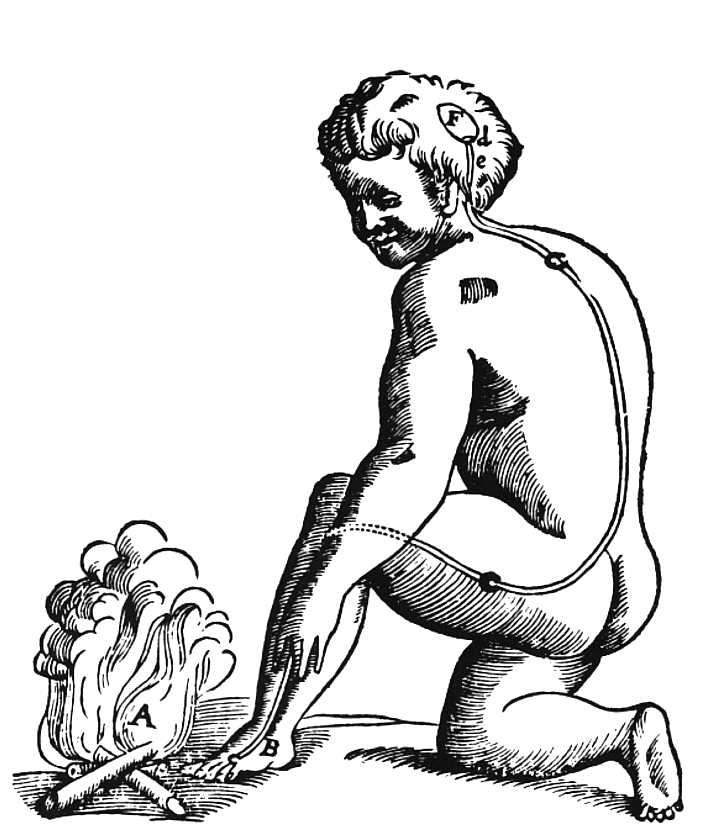
Pl. 16. From René Descartes, De l'homme (1662).
Indeed, Aristotle, like the biblical writers, locates thought and feeling in the heart.[6] Galen, writing in the second century A.D., established with the help of anatomical dissections a much more accurate picture of the nervous system, and in many respects Descartes's diagram is deeply indebted to Galenic physiology, which remained influential throughout the eighteenth century. Pain for Galen had a two-part explanation: in reference to nerves and in reference to organs. Nevertheless, despite its discussion of nerves, Galenic medicine mainly came to be associated with the doctrine that pain results from an imbalance of the four bodily humors. It is this Galenic physiology of organs and humoral fluids that Alexander Pope evokes in The Rape of the Lock when he assigns the allegorical figure of Pain its appropriate residence in the Cave of Spleen. It is significant that later in the eighteenth century "nerves" comes to replace "spleen" as the fashionable, one-word explanation of undiagnosable illness.[7] What matters most is that the Cartesian model of pain—in shifting discussion from organs and humors to the mechanics of the central nervous system—underwrites or permits a new way of thinking about man, a mode of thought that finds its most radical expression in the novels of Sade.
Sade, imprisoned for some twenty-seven years under five governments, might seem entirely isolated, remote from Cartesian physiology
[6] K. D. Keele, Anatomies of Pain (Oxford: Blackwell Scientific Publications, 1957), 16-39. For a more detailed study concerning early theories of nerves, see Friedrich Solmsen, "Greek Philosophy and the Discovery of the Nerves," Museum Helveticum 18 (1961): 150-167. The best introduction to later Galenic theories of nerves and organs is two books by Rudolph E. Siegel, Galen's System of Physiology and Medicine (New York: S. Karger, 1968) and Galen on Sense Perception (New York: S. Karger, 1970). For contexts closer to Sade, see Edwin Clarke, "The Doctrine of the Hollow Nerve in the Seventeenth and Eighteenth Centuries," in Medicine, Science, and Culture: Historical Essays in Honor of Owsei Temkin, ed. Lloyd G. Stevenson and Robert P. Multhauf (Baltimore, Md.: Johns Hopkins University Press, 1968), 123-141; and Eric T. Carlson and Meribeth M. Simpson, "Models of the Nervous System in Eighteenth-Century Psychiatry," Bulletin of the History of Medicine 43 (1969): 101-115.
[7] In 1786, James Adair described the popular influence of De Morbis Nervorum (1762), written by Robert Whytt (Professor of the Theory of Medicine at the Edinburgh Medical School, First Physician to the King of Scotland, and President of the Royal College of Physicians, Edinburgh): "Before the publication of this book, people of fashion had not the least idea that they had nerves; but a fashionable apothecary of my acquaintance, having cast his eye over the book, and having often been puzzled by the enquiries of his patients concerning the nature and causes of their complaints, derived from thence a hint, by which he cut the gordian knot—'Madam, you are nervous '; the solution was quite satisfactory, the term became fashionable, and spleen, vapours and hyp, were forgotten" (in R. K. French, Robert Whytt, the Soul, and Medicine [London: The Wellcome Institute of the History of Medicine, 1969], 166).
and from Enlightenment medicine, but medicine in fact provides one of the major discourses he puts to use in his copiously heterogeneous texts. Never has obscenity engaged such powers of erudition. Sade lost some six hundred books when the citizens of Paris liberated his recently vacated cell in the Bastille, and his reading ranged widely through the iconoclastic philosophes of his day, from Rousseau and Voltaire to Buffon, d'Holbach, and La Mettrie. But we need not invoke Sade's prodigious learning—or the legend of the philosopher in chains—in order to explain his knowledge of medicine. No doubt one explanation for the general commerce between fiction and physiology in Enlightenment thought involves the changed status of medicine. Like theology in the Middle Ages, medicine in the Enlightenment approached the condition of a master discourse. It is worth pausing, before we examine Sade's writing, to consider some of the ways in which medicine had changed.
In Sade's time the spectacular advances in medical knowledge—which accelerated with special vigor in late-eighteenth-century France—lent to medicine the authority of an official language and point of view that extended its influence to numerous other disciplines. French physicians ranked among the most active reformers and philosophers, whose thought penetrated far beyond medicine to questions of education, government, and law, as in the writings of Idéologue polymath Pierre-Jean-Georges Cabanis. (Sade particularly admired the work of Julien Offroy de La Mettrie, a physician-philosopher publishing in the mid-eighteenth century, whose radical views—after forcing him from France and Holland—at last found shelter at the court of Frederick the Great.) Conversely, Diderot's Éléments de physiologie (1774-1780) suggests how far nonphysicians felt themselves drawn to medical studies, like Samuel Johnson devouring the vast literature on diseases of the imagination. Reformers argued forcefully for a medicine that renounced "hypothetical explanations" and "imaginary systems"—associated with traditional medical teaching—in favor of scientific experiments and clinical observations.[8] Especially in pre-Revolutionary France, physicians and non-
[8] Phrases in quotation cite remarks by Philippe Pinel and Pierre-François Percy in 1812 (in John E. Lesch, Science and Medicine in France: The Emergence of Experimental Physiology, 1790-1855 [Cambridge, Mass.: Harvard University Press, 1984], 12). In addition to Lesch's lurid study of changes in French medicine about the time Sade was writing, see Erwin H. Ackerknecht, M.D., Medicine at the Paris Hospital, 1794-1848 (Baltimore, Md.: Johns Hopkins University Press, 1967); David M. Vess, Medical Revolution in France, 1789-1796 (Gainesville: University Presses of Florida, 1975); and Medicine and Society in France (selections from the Annales, vol. 6), ed. Robert Forster and Orest Ranum, trans. Elborg Forster and Patricia M. Ranum (Baltimore, Md.: Johns Hopkins University Press, 1980). For two essays—relevant to Sade—on medical views of erotic passion, see Christine Birnbaum, "La vision médicale de l'amour dans L'Encyclop é die," in Aimer en France 1760-1860, ed. Paul Viallaneix and Jean Ehrard, 2 vols. (Clermont-Ferrand: Association des publications de la Faculté des lettres et sciences humaines de Clermont-Ferrand, 1980), 2:307-313; and Paul Hoffmann, "Le discours médical sur les passions de l'amour, de Boissier de Sauvages à Pinel," in Aimer en France, ed. Vaillaneix and Ehrard, 2:345-356.
physicians sometimes wrote of medicine as supplying the cornerstone for an entire philosophy of man, in which improved public health would be indivisible from enlightened morality and from political reform. Medicine, in short, stands near the center of the revolution in eighteenth-century thought we call the Enlightenment (or, recently, Enlightenments). The intersection of medicine and literature in Sade's work does not simply infuse the novel with technical data or miscellaneous insights. Medicine, I claim, is foundational for Sade. It provides him with a basis for utterly reorganizing our views of man.
Sade's connection with French medicine is necessarily indirect, subordinated to his obsession with human sexual behavior, but indirect alliances sometimes prove more fruitful than direct borrowings. The indirect relation that links Sade to French medicine is at one level a powerful kinship of spirit. His entire enterprise in probing human sexuality bears resemblance to the series of events and discoveries in French medicine that Michel Foucault has termed "the birth of the clinic." This profound revision of medical thought did more than vastly extend and institutionalize the practice of clinical teaching, which in effect displaced the moribund traditions of academic medicine centered in the Paris Faculty. It signified a new emphasis on the previously subordinate arts (or, rather, trades) of pharmacy and of surgery, which were now elevated as indispensable techniques for penetrating the opaque surface of the body. (By contrast, in 1751 the Paris Faculty had required an oath from all bachelors of medicine renouncing the practice of surgery and pharmacy.) Further, it implied a new way of thinking about disease—based upon research that emphasized interior processes and conditions. "As autopsies became routine," one historian tells us, "the causes of illness came to be seen concretely in the tumors, abscesses, ulcers, inflammations, and hemorrhages located inside the body."[9] Monuments to this new clinical "gaze" (as Foucault calls it) are familiar to students of French medicine. They include the free instruction in clinical surgery provided by Desault in the large amphitheater he obtained at the Hôtel-Dieu; Pinel's studies of mental illness, designed to reveal correlations
[9] Vess, Medical Revolution in France, 189, italics added.
between human passions and physiology; Bichat's systematic study of tissue, which altered medical thinking about internal organs and helped to found the science of histology. Even—however utopian it sounds—the closing of all French medical schools between 1792 and 1794, as well as the practical demands of wartime medicine in the years following the Revolution, contributed to a major change in French medicine. Paris, during Sade's long imprisonment, surpassed both Leiden and Edinburgh as the international center of new medical knowledge.
The penetrating gaze of the clinic offers more than a complex metaphor for the demystifying, unmasking tendencies of Enlightenment thought, in which Sade participated so fiercely. Clinical medicine not only brought new facts to light but also undertook a complete reorganization of the system linking the visible body to its invisible sources of illness. With the new system of relations between body and disease, between the seen and the unseen, comes as well a new system of language. As Foucault puts it: "The new medical spirit to which Bichat is no doubt the first to bear witness in an absolutely coherent way cannot be ascribed to an act of psychological and epistemological purification"—as if simply better facts or improved modes of observation were sufficient. "It is," Foucault continues, "nothing [less] than a syntactical reorganization of disease in which the limits of the visible and invisible follow a new pattern; the abyss beneath illness, which was the illness itself, has emerged into the light of language—the same light, no doubt, that illuminates the 120 Journées de Sodome [and] Juliette. "[10] Sade in effect renders what was previously unseen, hidden, or suppressed suddenly—if grotesquely—visible.
Foucauh's emphasis on a new visibility—characterized by the emblematic "gaze" of clinical medicine—sometimes obscures his equally important discussion of nonvisual (linguistic or auditory) changes. While Sade certainly exposes to view sexual practices traditionally unseen and unrepresented, he also shares the spirit animating contemporary French medicine in his passion for organized, analytical speech. As Roland
[10] The Birth oft he Clinic: An Archaeology of Medical Perception (1963), trans. A. M. Sheridan Smith (New York: Pantheon Books, 1973), 195. Various historians of medicine and historians of science, in reviews and in footnotes, point out inaccuracies in Foucault's facts or interpretations and criticize his method of writing history, but his book remains a powerful account of well-documented changes in Enlightenment medical theory and practice. For an explanation of Foucault's approach, see Hubert L Dreyfus and Paul Rabinow, Michel Foucault: Beyond Structuralism and Hermeneutics (Chicago: University of Chicago Press, 1982), 3-15.
Barthes has shown, Sadean novels employ language as a means for dividing characters, practices, even space itself into previously unsuspected categories. Sexuality finds simultaneously both a new speech and a new system, much as Sade's 120 Days of Sodom proposes to take its structure from a sweeping fourfold reclassification of sexual passions into the simple, the complex, the criminal, and the murderous, while at the same time imparting to a generally chaotic and mute region of human experience almost a reinvented language: an organized, computational, repetitive, exhaustive speech that in some sense constitutes a wholly revised rhetoric and grammar of sexuality. (Homosexual passion instantly loses in Sade its traditional linguistic status as "that which cannot be named.") It seems incorrect to interpret Sade's unending discursiveness as merely pathological (logorrhea), the sign of obsession, imprisonment, and illness. In a spirit suggesting that literature, like science, must find a speech equivalent to its newly magnified powers of vision, Juliette explains at the end of the enormous novel that bears her name: "It is necessary for philosophy to say everything."[11]
Sade (as his critics too often forget) is not a philosopher but a novelist. That is, despite the evident philosophical ambitions of his characters, we go wrong in seeking to extract from their speech a consistent, monological doctrine we can name "Sade's philosophy." A philosophy that seeks to say everything is, in the first place, impossible. Further, in favoring the inclusiveness of rhetoric as opposed to the exclusions of traditional philosophy, Sade's novels surround his monomaniacal reasoners with a verbal context in which no one ever has the last word. (Victims must be replaced immediately—or revived—so that the discourse may go on.) Finally, in the attempt to say everything, in transgressing every bound of bourgeois decency, Sade extends language into realms where the suppressed and the unspoken border on the unspeakable. The issue is no
[11] "La philosophie doit tout dire" (L'histoire de Juliette [1797], in Œ uvres completes 9:586). Austryn Wainhouse, in his Grove Press translation, renders Juliette's words as follows: "Philosophy must never shrink from speaking out." In one sense, to say "everything" implies a refusal to suppress unwelcome facts or to shrink from speaking. I suspect, however, a more radical sense appropriate to Sade's conclusion in which by saying everything philosophy approaches the scandalous possibilities of rhetoric—a rhetoric that abandons its traditional link with ethics in favor of exploring the limits of whatever can be said on any topic, such as sexuality. This "rhetorical" philosophy—in saying everything—would coincide with Sade's relentless attack on the foundations of traditional metaphysics, as well as expressing what he called "a mobility [mobilité ] in my opinions which reflects my innermost manner of thought" (Correspondance, in Œ uvres completes 12:505). On Sadean extravagance, both verbal and nonverbal, see Marcel Hénaff, "Tout dire ou l'encyclopédie de l'excès," Obliques 12-13 (1977): 29-37.
longer whether obscenity will be allowed the freedom to speak its (partial) truths. Such truths remain speakable and thinkable. Sade also employs the obscene as a means for exploring man's participation in an irrationality that goes beyond speech and thought, revealing its traces in the horror that ordinarily deprives us of language. Sade, who confessed to an extreme "mobility" or irresolution in his opinions and innermost thoughts, cannot offer a coherent philosophy of the unspeakable. Rather, engaging the resources of widely different systems and modes of speech, he employs language in such a way as to emphasize the conflict and opacity that occur when normally separate discourses intersect. In place of a philosophical language for penetrating the unspeakable, he provides instead a laminated style that refuses to let us ignore and deny what we do not understand. His words force us to confront a darkness more impenetrable than the inside of the human body.
The broad parallels linking Sadean novels with a new medical speech and gaze—however seductive to students of literature and medicine—cannot of course establish patterns of direct influence. Instead, they do something equally valuable in providing a context within which more specific studies of medical and of literary relations may assume a larger significance. Historically, the understanding of pain has often fallen to the two widely diverse social practices we call literature and medicine. Nonetheless, quite often and for long periods medical and literary discourses on pain seem to occupy divided and mutually indifferent territories. In Sade's work, we encounter a moment when literature and medicine converge—under the pressure of late-eighteenth-century culture—and then, explosively, fly apart. The explosion (as Sade transvalues medical knowledge for his own purposes) is no less illuminating than the convergence. What Sade makes of pain—the meanings he both discovers and ascribes—might be said to invert or turn inside out every humanitarian impulse of Enlightenment thought, impulses especially pertinent to the progress in medical knowledge and treatment, as if Sade rigorously pursued a denial of human norms so complete that it amounts to what Georges Bataille rightly calls a quest for "the impossible and the reverse of life."[12]
Pain in Sade's writing is notoriously associated with its traditional opposite, pleasure. As important and far less obvious, however, is the Sa-dean bond that unites pain with truth. Sade is never more at home in
[12] Literature and Evil (1957), trans. Alastair Hamilton (London: Calder and Boyars, 1973), 98.
the Enlightenment than when he joins the unmasking philosophers who sought to demystify every form of intellectual humbug, but he immediately resumes his isolated stance in equating truth (a specifically masculine version of truth) with physical pain. The libertine monk Clement argues in Justine : "There is no more lively sensation than that of pain; its impressions are certain and dependable, they never deceive as may those of the pleasure women perpetually feign and almost never experience."[13] An almost identical argument, with its implicit phallocentric anxieties, appears in Sade's companion novel, Juliette, where the arch libertine Saint-Fond declares: "I've never cared much about seeing pleasure's lineaments writ over a woman's countenance. They're too equivocal, too unsure; I prefer the signs of pain, which are more dependable by far."[14] These passages suggest that there is more to the libertine obsession with pain than an exotic, eccentric, sexual taste. Pain not only affirms (a clearly uncertain) male superiority and mastery. It also assumes the character of a sign-system that—in contrast with the slipperiness attributed to language and to appearances (no doubt to women as well)—establishes a direct, if limited, correspondence with truth. It communicates an authenticity that Sade's libertine heroes and heroines see everywhere eluding them in a world dominated by deceit, custom, equivocation, timidity, and ignorance. Here, pain for Sade has already absorbed a range of meaning that distinguishes it from merely random agonies or from meaningless sensation. Already we have entered the unstable realm of Sadean transvaluations, where familiar words and actions take on unfamiliar significance, even as libertine sexual pleasure adopts the unexpected vocabulary of screams and rage. It is a realm where medicine too cannot remain unchanged.
Medicine in fact assumes in Sade's work an appearance and function very different from what ancient or modern psychiatry might lead us to expect. Although sadism now belongs securely to the lexicon of sexual pathology, explained through theories of childhood trauma, passive-aggressive behavior, fears of impotence, repression, or a reversal of the death wish, sexuality in Sade's work is never annexed to illness, whether
[13] Justine, trans. Seaver and Wainhouse, 606/3:206. There are three separate versions of Justine, which was first published in 1791. (The earliest version, entitled Les infortunes de la vertu, Sade composed in 1787; the vastly expanded final version, entitled La nouvelle Justine, was published in 1797.) Except once where indicated, I have employed the 1791 version, because it is most accessible—in several translations—to Anglo-American readers.
[14] Trans. Austryn Wainhouse (New York: Grove Press, 1968), 362/8:350. The libertine hero Dolmancé asserts in Philosophy in the Bedroom: "pain must be preferred, for pain's telling effects cannot deceive" (252/3:436).
organic or psychological. Indeed, Sade's refusal to regard even the most abnormal or self-destructive sexual behavior as illness directly opposes the medical and political wisdom of his own day, which diagnosed his condition as "sexual dementia" and decreed that his final years be spent with the mad patients incarcerated at the Asylum of Charenton. But if Sade obstinately refuses to follow medicine in linking sexual aberration with illness, he also practices the independence of Enlightenment thought in rejecting the immemorial, church-authorized bond yoking sexuality to childbirth. As Angela Carter has observed, Sade anticipates our own era of unprecedented sexual revolution, when pleasure has abandoned its former (imperfect but inescapable) unity with biological reproduction.[15] To the libertine mind, pregnancy is intolerable, except as infants or pregnant women excite new breakthroughs in cruelty. It is common for Sade's most discriminating male libertines to renounce all contact—even visual contact—with the vagina. ("Your authentic sodomist," explains Juliette, "will always come unerect at the sight of a cunt.")[16] Male libertines not only prefer male partners. Their preference expresses a desire to affirm that sexuality must be not merely infertile but consciously sterile. Thus, in affirming a sexuality that is overwhelmingly anal, excremental, and bloody, the Sadean libertine follows a logic that leads from the denial of procreation to an embracement of death. Sexuality finds its temporary fulfillment for Sade not in childbirth but in repeated acts of destruction, with murder redefined as an unjustly suppressed form of eroticism.
The absence of expected biomedical contexts in Sade's work—the void where illness and childbirth might normally appear—provides a useful background against which his transvaluations of medical knowledge stand out as visible, crucial components of the libertine system.
[15] The Sadeian Woman and the Ideology of Pornography (New York: Pantheon Books, 1978), introductory note. Carter takes the position that Sadean pornography serves women indirectly by its exposure of a phallocentric social structure, by its stripping away the mask of romance to reveal the sexual politics implicit in male-female relations. In her feminist reading of Sade as a critique of bourgeois, male-centered ideology, Carter shares Susan Sontag's conviction that "the pornographic imagination says something worth listening to, albeit in a degraded and often unrecognizable form" ("The Pornographic Imagination," in styles of Radical Will [New York: Farrar, Straus and Giroux, 1966], 70). Other feminist critics deny pornography what Sontag calls "its peculiar access to some truth" (70-7l) and regard it mainly as reflecting and promoting the oppression of women. See, for example, Laura Lederer, ed., Take Back the Night: Women on Pornography (New York: William Morrow, 1980), and Susan Griffin, Pornography and Silence: Culture 's Revenge against Nature (New York: Harper and Row, 1981).
[16] Juliette, trans. Wainhouse, 681/9:87.
"System," as a term applied to the views of Sadean libertines, does not refer to a tight, interlocking grid of clear and distinct ideas, held together by logic and constituting a coherent whole. The unsystematic libertine system depends on each individual's rigorous and total commitment to self-interest, so that reason serves a purely instrumental function in promoting the arguments of desire. Once, when fearing prosecution, Sade argued with startling lucidity—pursuing a stylistic analysis any literary critic may envy for its precision—that he could not possibly be the author of Justine.[17] Desire in effect performs a faultless impersonation of reason. In similarly advancing their own interests, Sade's libertines assert a wide variety of dubious (if apparently reasonable) claims, some false, self-contradictory, or in conflict with the views of other libertines. Such disparate views do not add up to a homogeneous system of logic but rather reflect a heterogeneous system of discourse, in which the need to "say everything" (which Juliette attributes to this new "philosophy") in practice authorizes saying almost anything—violating the prohibitions that bind us not only to decorum but also to reason and consistency. The force that briefly holds Sade's anarchistic libertines together is not genuine friendship or the fraternity of criminals; nor can they depend on tacit or formal codes of mutual nonaggression, which fail to survive occasions when desire, whim, or self-interest turns one libertine against another. What truly binds them together, fleetingly but repeatedly, is their need to speak endlessly about deeds and desires that would mean nothing if forbidden such verbal disclosure. (If other libertines are not present, the victim must serve the role of listener/respondent, rescuing speech from pointless monologue.) The libertine system is finally a system of speech, to which medicine makes an indispensable contribution.
The most important contribution that medicine makes to Sade's novels is in supplying what the characters invoke as a scientific physiology of pleasure and pain. Sade's physiological accounts of pain do more (as we will soon see) than merely provide an instrument for silencing or for refuting traditional moral and religious explanations. Sade initiates his transformations of medical knowledge by reversing the durable custom in medicine—evident as far back as in the ancient Hippocratic writings—that assigns pain the secondary status of a symptom. In enlarging or aggrandizing the status of pain, Sade follows the same narrative logic that permits him—while banishing midwives from a world of
[17] "Note concerning My Detention," in Justine... and Other Writings, trans. Seaver and Wainhouse, 152-154/15:26-29.
marathon copulations—to sacrifice literary realism to the demands of libertine desire. Like the parricidal giant Minski in Juliette, whose penis (measuring eighteen inches long by sixteen in circumference) stays permanently erect, Sade's exaggerations refuse to obey the laws of normal science whenever science threatens to obscure the overriding laws of the erotic life.
Sade, quite clearly, rejects or ignores the medical tradition that regards pain as a symptom. Although its status as a symptom assures pain an important place within medicine, its importance is mainly instrumental, like the informer who tips off the police. Pain as a symptom may be forgotten or dismissed by the physician as soon as its instrumental service is over, and until very recently the history of medical interest in pain centers on the search for effective anesthetic and analgesic agents, where understanding pain is less urgent than annihilating or suspending it. Sade not only shows no interest in pain as a symptom; on the contrary, like Albrecht von Hailer, whose studies of "irritability" (which he demonstrated experimentally to be a specific property of muscles causing them to contract) soon encouraged expansive ontological and theological speculations, Sade elevates pain from its secondary, instrumental status within medicine to the central position accorded basic laws of nature.
The centrality that Sade assigns to pain finds an illuminating parallel in the work of another influential late-eighteenth-century thinker, who otherwise might seem Sade's opposite. Jeremy Bentham—like Sade, born in the 1740s—brought an almost Sadean passion for reason and for enumeration to the un-Sadean goal of eradicating the irrational, both in man and in social structures. His Principles of Morals and Legislation (1789), while it seeks to construct a social theory rendering impossible or obsolete the abuses celebrated in Sade's dark libertine utopias, nonetheless begins from a premise that Sade would wholly accept. As Bentham declares in his first sentence: "Nature has placed mankind under the governance of two sovereign masters, pain and pleasure. It is for them alone to point out what we ought to do, as well as to determine what we shall do." This rigorous dualism of pleasure and pain, which Bentham treats as secure and indisputable, comes in Sade's work to lose its distinctness, but both Bentham and Sade start from the same point in developing their very different visions of the consequences that follow from our commitment to pleasure and pain. Pain is no longer (as in classical philosophy) subordinated to pleasure, reduced to the pedagogic office of enforcing virtuous conduct. In its centrality, pain determines what shall be called virtue or vice, an insight that leads Sade's libertine
heroes to reject such conventional moral categories as simply a manner of speech.
Ignored as the symptom of temporary dysfunction and dismissed as the chastising pedagogue of traditional ethics, pain for Sade emerges in a new and primary role as coextensive with the truth of the body. Pain, that is, informs us truly about the state of the body. Further, this information gains immeasurable importance because the body's truth comes to define the limits of whatever Sade holds as true. It is, in effect, the sole truth in a world where every other foundation of knowledge ultimately dissolves into falsehood or uncertainty. Thus, even though Sade thoroughly alters the status of pain within medicine, medicine provides him with the knowledge indispensable for understanding the truth of the body. Sometimes this truth reflects little more than the general Enlightenment fascination with the discovery of natural facts, disentangled from theological corruptions or learned error. Medicine, for example, holds a purely positive, demystifying function in Philosophy in the Bedroom, where the willing ingenue Eugénie—as an introduction to her ensuing libertine education—receives a lecture in male and female anatomy, which might have come directly from a medical textbook (or indirectly from a medical textbook, through the libertine tradition in which such anatomy lectures were a recurrent narrative device). Here again Sade typically converts medicine from a healing and instructive art to an erotic practice. He seems to have understood a sense in which the penetrating gaze holds sexual as well as medical implications. As in the modern soap opera, sexuality and medicine prove inextricably entangled.
The Enlightenment emphasis upon medicine as a science—a practice grounded in experiment and in observable fact—proves fundamentally equivocal in Sade's work. Science matters to the libertine mind mainly as it permits or advances sexual practices that depend on cruelty. Thus the vivisection common to French medical experiments on animals reappears in Sade's work as a technique for generating pleasure. In Justine the libertine surgeon Rodin, an eminent technologist who extols "the progress of science," discovers in the probing, cutting, agonizing penetrations of (pre-anesthetic) surgery a lure that proves wholly erotic. When Rodin asserts that the science of anatomy will never reach its "ultimate state of perfection" until he has examined a child of fourteen or fifteen who has died a cruel death, experienced readers of Sade know instantly that this high-minded passion for scientific progress conceals a sexual aim and that the victim of Rodin's excited, protracted vivisection
will be his own beautiful daughter.[18] Reduced to a mechanical technology for penetrating the body, medicine serves the libertine world less for relieving pain than for inflicting it. Like the ghoulish aristocrat in Justine who manages to achieve orgasm only by repeatedly bleeding his young wife in a vampirish simulation of phlebotomy, Sade's libertines find their ultimate erotic stimulation in blood, which is transformed from medical fact to sexual marker. The balms that miraculously restore Justine and other long-suffering victims of libertinage belong not to Enlightenment pharmacology but to primitive traditions of magic, where drugs are among the standard accoutrement of eroticism. Their Sadean purpose is simply to prepare the victim for new episodes of sexual pain.
The same process of transvaluation in Sade's work that renders medicine erotic also helps to eroticize and to medicalize pain. The most significant result of this process is not the pornographic description that it makes possible. (Sade, of course, did not invent erotic cruelty but rather refined and elaborated it within the contours of his libertine system.)[19] Placing pain within a medical context offers Sade the insuperable advantage of thereby silencing and effectively refuting other discourses traditionally concerned with human suffering. In Sade, as in American courtrooms and hospitals, medicine has a tendency to overrule or to dominate alternative systems of thought, so that priest and judge defer to the wisdom of medical testimony. Because medicine in Sade carries the authority of Enlightenment science, it breaks free from the
[18] Justine, trans. Seaver and Wainhouse, 551-552/3:150-151. Rodin's libertine accomplice remarks concerning the human victims required by medical science: "in those hospitals where I worked as a young man I saw similar experiments by the thousand" (552/ 3:151).
[19] On cultural and literary contexts relevant to Sadean eroticism, see Robert P. Maccubbin, ed., Unauthorized Sexual Behavior during the Enlightenment (Williamsburg, Va.: College of William and Mary, 1985), a special issue of the journal Eighteenth-Century Life (9, n.s. 3), reissued under the title ‘Tis Nature's Fault: Unauthorized Sexuality during the Enlightenment (Cambridge: Cambridge University Press, 1987); Bouc é, Sexuality in Eighteenth-Century Britain; Ann Thomson, "L'art de jouir de La Mettrie ô Sade," in Aimer en France, ed. Viallaneix and Ehrard, 2:315-322; and Aram Vartanian, "La Mettrie, Diderot, and Sexology in the Enlightenment," in Essays on the Age of Enlightenment in Honor of Ira O. Wade, ed. Jean Macary (Geneva: Librairie Droz, 1977), 547-367. (Two studies forthcoming are Sexual Underworlds of the Enlightenment, ed. G. S. Rousseau and Roy Porter [Manchester: Manchester University Press] and Peter Wagner's Eros Revived: Erotica in the Age of Enlightenment [London: Secker and Warburg].) Although now outdated, The Romantic Agony by Mario Praz (trans. Angus Davidson, 2d ed. [New York: Oxford University Press, 1951]) was revolutionary and influential when it first appeared. Praz, of course, has much to say about Sade.
literary heritage that portrays the doctor as a greedy quack. Indeed, Sade's libertine surgeon Rodin is an anti-quack: a wealthy man-of-science whose reasoning is formidable. In its relentless appeal to the facts of human anatomy and physiology, medicine as Sade employs it thoroughly displaces the more speculative discussions of pain that had been a traditional employment of philosophers and theologians. The Sadean libertine ultimately empties virtue and vice (or sin and innocence) of their familiar content in classical and Christian writing, where our attraction to pleasure and aversion from pain seem changeless, natural, God-given responses that provide a foundation for the ethical life. In one sense, Sade exposes the unforeseen conclusions that follow from a Benthamite reliance upon pleasure and pain as a philosophical bedrock for ethics. In another sense, all traditional foundations crumble in Sade when virtue and vice are redefined as cultural artifacts characterized by their greater or lesser powers to stimulate the nervous system. Medicine, as various Enlightenment philosophes had predicted, now gives direction to philosophical thought.
Theology fares even worse than philosophy at the hands of Sade's libertine medicine. The voluminous Christian meditations on human suffering might be said to take their origin from the iconography of the cross and from the prophetic words of Isaiah: "With his pain we are healed" (54:4). Pain in Augustinian theology enters the world with original sin, but Christian pain is ultimately redemptive. Christ suffers so that man might find eternal life. The body suffers in order that the soul might be saved. Sade's contemptuous and relentless assault on Christianity as "incompatible with the libertarian system" includes his parodic transvaluation of Christian attitudes toward redemptive suffering.[20] In fact, his fullest response to this pervasive Christian reading of pain is simply the plot of Justine. The innocent Justine's faith in God and her love of virtue are the qualities that generate each new episode of outrage and violence, as if the novel—far from reflecting picaresque random-ness—were a demonstration in logic. Sade contrives Justine's imitation of Christ to establish the absence of redemptive suffering. The world that she encounters inside the church mirrors exactly the libertine cruelties that she meets everywhere else. There is no inside, no outside. Even
[20] Philosophy in the Bedroom, trans. Seaver and Wainhouse, 301/3:483. Among numerous studies of the relation between pain and theology, see especially C. S. Lewis, The Problem of Pain (1940: reprint, New York: Macmillan, 1944); John Bowker, Problems of Suffering in Religions of the World (Cambridge: Cambridge University Press, 1970); and David Bakan, Disease, Pain, and Sacrifice: Toward a Psychology of Suffering (Chicago: University of Chicago Press, 1968).
when she escapes from the debauched monks at St. Mary-in-the-Wood, Justine simply encounters their doubles wherever she turns.
Sade's equivocal representation of Enlightenment medicine mirrors an ambivalence in his treatment of Christianity. It is possible that Sa-dean atheism—so vocal and jubilant as to undermine its own claims—expresses (as Pierre Klossowski has argued) his unacknowledged need for God.[21] It is certain that Christianity contains for Sade, as if despite itself, a hidden ground for affirmation. What Sade affirms in Christianity is not its doctrines but its historical concern with pain, from original sin, martyrdom, and self-flagellation to inquisitorial torture and the torment of the damned. The final episode of 120 Days of Sodom thus provides a culminating image of Sade's secular transvaluation of Christianity in the horrifying erotic carnage of a pastime called "The Hell Game"—complete with impersonated demons and agonized sinners. By comparison, the parody of Christian pain in Justine seems oblique and almost subtle. In Sade's work, theology—like philosophy—provides only a mocking, empty, archaic language for interpreting pain, no match for the up-to-date physiology of nerve impulses and electrical fluids. As Justine suffers each new excruciating episode of sexual abuse, her suffering leads nowhere, illuminates nothing, redeems no one.
Sade's transvaluations of medical knowledge will grow clearer if we focus upon two specific passages from Juliette and Justine. The first brings us openly to a question at the heart of Sade's work. How is it, asks the libertine statesman Saint-Fond, that we arrive at pleasure through the sight of others undergoing pain and, stranger still, through suffering pain ourselves? To this central problem in Sade's fiction—which might seem so complex as to evoke cloudbanks of obscure evasions—Saint-Fond's fellow libertine Noirceuil delivers an absolutely explicit reply. Like similar demystifying exercises of Enlightenment reason, it begins by citing the error it proposes to unmask, quoted in the exact words of the Port-Royal Jansenist theologian Pierre Nicole:
"Pain, logically defined, is nothing other than a sentiment of hostility in the soul toward the body it animates, the which it signifies through certain movements that conflict with the body's physical organization." So says Nicole, who perceived in man an ethereal substance, which he called soul, and which he differentiated from the material substance we call body. I, however, who will have none of this frivolous stuff and who consider man as something on the order of an absolutely material plant, I shall simply
[21] Pierre Klossowski, Sade mon prochain (Paris: Seuil, 1947).
say that pain is the consequence of a defective relationship between objects foreign to us and the organic molecules composing us; in such wise that instead of composing harmoniously with those that make up our neural fluids, as they do in the commotion of pleasure, the atoms emanating from these foreign objects strike them aslant, crookedly, sting them, repulse them, and never fuse with them. Still, though the effects are negative, they are effects nonetheless, and whether it be pleasure or pain brewing in us, you will always have a certain impact upon the neural fluids.[22]
Although Noirceuil and Nicole are both French, they speak in effect two different languages. Noirceuil's confident talk of atoms, organic molecules, and neural fluids—however garbled by the standards of twentieth-century science—represents an effort to silence theology by invoking as a superior or superseding discourse the empirical language of Enlightenment medicine. Behind their use of these two distinct languages or systems of discourse stand two utterly opposed visions of man. Nicole's theological paradigm of pain requires the concept of an eternal, immaterial soul at odds with a material, ephemeral body. By contrast, for Noirceuil pain becomes the occasion for asserting a materialism so comprehensive that it denies substantial differences separating bodies from minds or souls. As another libertine philosopher explains: "All we attribute to the soul is all simply the effect of matter."[23]
The word "soul" sounds particularly strange on the lips of Sade's atheistical libertines because they have redefined it in ways that drain off its traditional attributes. Descartes, for example, despite his innovations, essentially followed religious tradition in preserving an absolute difference between bodies (res extensa ) and souls (res cogitans ). For Descartes, body is material, ephemeral, mechanical, and unthinking, while soul is immaterial, immortal, conscious, and defined by its power of thought. For Sade's libertines there is no gap between body and soul. Sometimes, in fact, the soul itself simply disappears, swallowed up in matter. As Juliette's libertine instructor Delbène reports: "I am not aware of having any soul.... It is the body which feels, which thinks, which judges, which suffers, which enjoys." Here is a peculiarly modern solution to the mind/body problem. The problem simply dissolves into a comfortable monism. "Body and soul," Delbène continues, "they are one."[24] As in La Mettrie, the monism of body and soul in Sade's work is
[22] Trans. Wainhouse, 267/8:255-256.
[23] Juliette, trans. Wainhouse, 386/8:372.
[24] Juliette, trans. Wainhouse, 44, 50/8:52, 59. Thinking (cogitans ) is of course the defining function of the soul for Descartes. Delbène's assertion reflects the process by which soul came to be supplanted in eighteenth-century discussions by the mind. This transition from soul to mind is part of John O. Lyons's subject in The Invention of the Self: The Hinge of Consciousness in the Eighteenth Century (Carbondale: Southern Illinois University Press, 1978).
dynamic—not fixed or static—in the sense that different temperaments and different activities call forth a changing ratio in the relations between spirit and flesh. Still, Sade's libertines move in a world where everything—including minds or souls—is material. All belong to the same continuous moil and turmoil of molecular change.
Descartes's views on pain offer a particularly good contrast in helping to clarify the absolute materialism of Sade's libertines. For Descartes, soul alone is what gives us the ability to feel pain. Although the mechanical network of nerves (transporting the equally material animal spirits) allows the body to relay information automatically to and from the brain, Descartes emphasized that we do not feel pain—that is, we do not experience pain consciously —until the mechanical, neural impulse is communicated to the pineal gland, which he notoriously designated as the point where the material body intersects with the immaterial soul. Only when the thinking soul perceives what the mechanical responses of the nervous system tell it do we experience the feeling of pain. The evidence for this view Descartes drew in part from the puzzling phenomenon of phantom limb pain, in which amputees report painful cramps in a missing hand or arm or leg. This pain, Descartes reasoned, could not reside in the missing limb and must therefore exist in the mind or soul alone. Buttressed by traditional Christian doctrine, Descartes's argument led him to the extreme conclusion that animals feel no pain. He recognized, of course, that animals exhibit all the normal behavior associated with pain, for such signs belong simply to the mechanism of the body. Animals, however, because (by definition) they do not possess minds or souls, cannot in Descartes's view feel or experience pain. Pain for Descartes thus offers a privileged example for confirming the absolute dualism of soul and body. Sade in effect captures pain as his privileged counterexample for implicitly disputing Cartesian dualism and for discarding the immaterial soul as a Scholastic illusion.
Pain as it concerns nerve fibers and neural fluids—not the welfare of an immaterial soul or the effects of original sin—is the explicit subject of a second passage I wish to examine, from the novel Justine . Here again we can observe how medicine functions for Sade in providing a language opposed to the discourse of theology, but it is the erotic implications of his dryly technical language that deserve special attention. The passage, which appears as a note attached to a speech by Justine's libertine tempt-
ress Dubois, sounds less like novelistic talk than like textbook physiology and opens with a hyperbole typical of Sade, which perhaps only an anatomist could take seriously:
There is no part of the human body more interesting than the nerve.... Life and indeed the entire harmony of the body as a machine depend on the nerves. From them come sensations and pleasures, thoughts and ideas; they constitute, briefly, the center of the whole human structure. The soul is located there, that is to say the principle of life, which dies out among animals, which grows and declines in them, and is by consequence wholly material.
The nerves are imagined to be tubes destined to carry the animal spirits into the organs to which they are distributed and to report back to the brain the impressions of external objects on these organs.
Let me interrupt the passage to make two brief comments. First, the word translated here (and generally in Sade) as "pain" is "la douleur. " "Douleur " retains its traditional contrast with "peine " (also translated as "pain"), which implies physical injury or indefinite harm with no accompanying mental or emotional anguish. It is precisely the mental and emotional suffering of their victims—which includes the victims' awareness of their victimization—that makes Sade's libertines vastly prefer douleur to peine. Second, in defining the soul as the "principle of life" Sade remains securely within the boundaries of libertine materialism. There is no real difference—merely a change in vocabulary—between Noirceuil's vision of man as an "absolutely material plant" and the view, expressed in Sade's note, that the body is a "machine" animated by a life force. (Again, La Mettrie could provide Sade with a source for both metaphors: each pointing toward the same restrictive range of meaning.) In other writers, the metaphorical shift from machine to plant might well reflect conceptual changes important to medical and scientific controversies of the time, measuring the distance separating an older, strictly mechanistic physiology from the newer, vitalist physiology centered in Montpellier; in Sade's hands, however, both metaphors—plant and machine—equally serve to exclude the possibility of an immaterial spirit that survives independent of the body.[25]
[25] The movement from a mechanistic to a vitalist-dynamic physiology—in which the nervous system is understood not as a lifeless machine but as a point of contact (controversial, it goes without saying) between body and soul/mind—is discussed by Robert E. Schofield, Mechanism and Materialism: British Natural Philosophy in an Age of Reason (Princeton: Princeton University Press, 1970). On this change, see also two studies by Theodore M. Brown: "From Mechanism to Vitalism in Eighteenth-Century English Physiology," Journal of the History of Biology 7 (1974): 179-216, and The Mechanical Philosophy and the "Animal Economy" (New York: Arno Press, 1981). For France and Europe, see Jacques Roger, Les sciences de la vie dans la pensée française du XVIIIe siècle: La génération des animaux de Descartes à l'Encyclopédie (Paris: Armand Colin, 1963); Thomas S. Hall, Ideas of Life and Matter: Studies in the History of General Physiology, 600 B.C.-1900 A.D., 2 vols. (Chicago: University of Chicago Press, 1969); Elizabeth L. Haigh, "Vitalism, the Soul, and Sensibility: The Physiology of Théophile Bordeu," Journal of the History of Medicine and Allied Sciences 31 (1976): 30-41; and Sergio Moravia, "From Homme Machine to Homme Sensible: Changing Eighteenth-Century Models of Man's Image," Journal o f the History of Ideas 39 (1978): 45-60.
Sade's abandonment of the Christian and Cartesian immaterial soul is unmistakable as the note continues. Whether we attribute the note to author, character, or impersonated editor, its physiological language explains that the nervous system alone provides everything necessary to account for the experience of pleasure and pain:
An intense inflammation excites to an extraordinary degree the animal spirits that flow into the nerve tubes which, in turn, induce pleasure. If the inflammation occurs on the genitals or nearby parts, this explains the pleasures imparted by blows, stabbings, pinches or floggings. From the extreme influence of the mental on the physical comes likewise the painful or agreeable shock of the animal spirits, by reason of the mental sensation one receives. From all this it follows that with such principles and philosophy—with the total annihilation of prejudice—one can extend unbelievably (as we have said elsewhere) the sphere of one's sensations.[26]
This passage does not contain the sort of writing that immediately springs to mind when someone mentions Sade, yet it is almost as typical of Sadean narrative as scenes of sexual cruelty. Sadean eroticism establishes its difference from unreflective violence—violence unconscious of its own nature—by insisting upon the replacement of antiquated theological doctrine with up-to-date, physiological fact.
Fact, we should recognize, plays a different role in Sadean narrative from that which it plays in scientific and medical writing. Thus the reader who seeks to extract a single, self-consistent Sadean physiology will go wrong exactly in the manner of readers seeking a unified, self-consistent Sadean philosophy. Sade's characters employ—and frequently mix—elements drawn from quite different systems of physiology. Pain may be explained with reference to stinging atoms, to excited animal spirits, to stretched nerve fibers, to irritated tissue. There is some reason for feeling that Sade has brewed up a gigantic, simmering soup
[26] La nouvelle Justine; ou, Les malheurs de la vertu, in Œ uvres complètes 7:108-109, translation mine. G. S. Rousseau cites this passage and notes the provenance in d'Holbach (see "Nymphomania, Bienville and the Rise of Erotic Sensibility," 111-112).
of fact in which pieces borrowed from widely disparate sources—early and late—float around together in suspension. What matters to Sade is not whether his characters have access to a final truth of science (too many questions are still in doubt) but whether their facts support a demystified vision of man. The passage we have just encountered, for example, might have come nearly verbatim from the celebrated encyclopedist, philosopher, atheist, and materialist d'Holbach. The exact source of Sade's facts, however, is far less important than their implications within his vastly heterogeneous narrative texture. When we examine what "follows" from the often mixed-up facts of Sadean physiology, it will soon be clear that the now antiquated vocabulary of hollow nerve tubes and of racing animal spirits entailed serious—even deadly—consequences.
Pain belongs at the center of Sadean eroticism because, as I have suggested, it serves as a comprehensive metaphor for truth. The truth that it affirms, however, appears from the perspective of theology or of ordinary life to be simply outrage, perversion, and scandalous error. As Georges Bataille writes of Sade: "He went as far as the imagination allows: there was nothing respectable which he did not mock, nothing pure which he did not soil, nothing joyful which he did not frighten."[27] Sade's truth is in effect the negation of beliefs so basic to normal human life that we regard them as self-evidently true. The only self-evident truth in Sade's world, however, is the truth of the body, and it is pain that serves as spokesman for the body's truth. Pain for Sade is what we cannot deny, cannot evade, cannot forswear, while pleasure inevitably deceives, rhetoric beguiles, and logic unweaves its own constructions with the cunning of a false Penelope.
The truth of the body is, of course, exactly what Enlightenment medicine undertook to disclose, finding its most potent instrument and symbol in the newly routine practice of autopsy. Yet, Sade did not stop with the eroticized versions of anatomy and surgery we have seen him employ. Biomedical learning also provided crucial support for his explorations into previously unexplored areas of human sexual behavior, where the truth of the body makes itself known as desire. Pornography, of course, is an ancient and mostly superficial art dedicated to the description of sexual acts. Before Sade, however, never in the history of the novel had a writer employed the license of pornography to create such a blinding, exhaustive vision of desire freed from its normal social
[27] Literature and Evil, trans. Hamilton, 99.
constraints. The truth of desire for Sade leads both through and beyond the description of sexual acts to a comprehensive yet flexible system in which bodies, minds, and politics are complexly interlocked. If we follow the sequence leading from body to mind to politics, we will be better prepared to understand how Sade employs pain as the ultimate figure of desire.
The body constitutes for Sade not just the indispensable locus of sexual behavior but, far more important, the force that defines and determines our sexuality. Thus Sade's work posits as a central dogma that we live out a sexual destiny imposed not by God, not by gender, not by culture, but solely by the nerves and tissues of our individual bodies. He once wrote to his wife that his outrageous manner of thought "holds with my existence" (as he put it): "with the way I am made."[28] Perhaps the best gloss on this slightly enigmatic statement is the explanation that the Count du Bressac offers Justine in discussing the libertine preference for anal sex. Here too we find physiology providing a discourse opposed to a more traditional language. The Count begins:
Do not suppose, Thérèse [as everyone calls Justine], we are made like other men; 'tis an entirely different structure we have; and, in creating us, Heaven has ornamented the altars at which our Celadons sacrifice with that very same sensitive membrane which lines your temple of Venus; we are, in that sector, as certainly women as you are in your generative sanctuary; not one of your pleasures is unknown to us, there is not one we do not know how to enjoy, but we have in addition to them our own, and it is this delicious combination which makes us of all men on earth the most sensitive to pleasure, the best created to experience it; it is this enchanting combination which renders our tastes incorrigible, which would turn us into enthusiasts and frenetics were one to have the stupidity to punish us.[29]
The Count's delicacy as he encodes blunt sexual description in a mythological language of love perhaps explains why he is the single tormenter for whom Justine feels desire. Beneath his flowery rhetoric, however, lies the bedrock physiology to which Sade continually returns.
In Sade, physiology is destiny. What mankind calls virtue and vice (so runs the libertine argument) reflects merely the facts of biochemical fate.
[28] "Ma façon de penser est le fruit de mes réflexions; elle tient à mon existence, mon organisation. Je ne suis pas le maitre de la changer" (in Œ uvres complèes 12:409). A portion of Sade's correspondence is available in Selected Letters, ed. Margaret Crosland, trans. W. J. Strachan (London: Peter Owen, 1963).
[29] Justine, trans. Seaver and Wainhouse, 512/3: 111-112.
"Our constitution, our scheme, our organs, the flow of liquids, the animal spirits' energy," declares a typical Sadean libertine, "such are the physical causes which in the same hour make for the Tituses and the Neros."[30] Sodomy and pyromania in effect are hardwired in the body. This conviction, which implicitly absolves Sade's libertines from the moral censure that only adds zest to their crimes, appeals for its support to the same progressive spirit of inquiry underlying Enlightenment medicine. As the dissolute monk Clément concludes, after laborious reference to the language of fluids, fibers, blood, and animal spirits: "When the study of anatomy reaches perfection they will without any trouble be able to demonstrate the relationship of the human constitution to the [sexual] tastes which it affects."[31] Anyone foolish enough to punish a libertine will discover that it cannot be done. A taste for pain—like the monks' delight in blaspheming a God whom they believe not to exist—stands fully comprehensible for Sade as a proven truth of the libertine body, inscribed in a personal biology of nerves, tissues, and membranes.
The body in Sade's work sometimes seems entirely detached from mind, like the adjacent blocks of pornographic description and of argumentative reasoning that provide the alternating structure of his books. But the apparent separation of mind and body is always a temporary state or narrative illusion that conceals their fundamental unity. Mind, as we have seen, is not for Sade alien to the body, opposed in an irreconcilable division. In fact, we should recall Delbène's assertion to Juliette that it is the body which feels, suffers, enjoys, judges, and thinks. The concept of a thinking body is Sade's response to the Cartesian dualism that rigorously opposes material bodies and immaterial thoughts. Sade's libertine system, on the contrary, considers body and mind equally material, although they differ in the same degree as steam might differ from ice. Mind and body are for Sade not just equally material but also (as they were, surprisingly, for Descartes) mutually interactive. The mind relies wholly for its contents—"all sensations, knowledge and ideas" (as Sade noted in Justine )—upon the impulses that it receives through the nervous system. What complicates this far from original psychology—which Sade might have borrowed from various
[30] Philosophy in the Bedroom, trans. Seaver and Wainhouse, 254/3:438.
[31] Justine, trans. Seaver and Wainhouse, 603/3:203. On the eccentricity of libertine sexual tastes, the same speaker says: "sa singularité est le résultat de ses organes" (3:202). The studies most helpful to me in exploring the relations between Sadean eroticism and physiology are Jean Deprun's "Sade et la philosophic biologique de son temps" (see n. 3 above) and Marcel Hénaff's " Sade: L'invention du corps libertin (Paris: Presses universitaires de France, 1978).
empiricist philosophers, including his near contemporary Condillac—is his insistence that the sensations communicated through our nerves and fibers may in turn be altered radically by our thoughts, as if mind triumphed over matter.
The triumph of mind over matter in Sade is figurative ("as if")—not literal or actual—because, as we have seen, the libertine system regards mind as material: mind cannot literally triumph over itself. In this uncompromising materialism, Sade resembles such modern thinkers as John Searle, who in Minds, Brains and Science (1984) dismisses the traditional mind/body problem as a false dilemma or nonproblem. (For Searle, thinking is caused by and realized in functions of the brain, much as digestion is caused by and realized in functions of the stomach. He compares the mind/body problem to a digestion/stomach problem, finding them both equally comical and futile enterprises for philosophy.) What sets Sade apart from many materialists and monists, both ancient and modern, is the enormous power that he grants to consciousness or thought in reshaping the ways in which we normally experience our bodies. Mind, that is, possesses for Sade sufficient force to overrule or to alter organic responses (such as the response to pain) usually considered natural. The experience of pain, despite its organic basis in the functioning of the nervous system, may be changed, radically, by the intervention of mind, thus altering the almost physical revulsion normal in contemplating such typical Sadean practices as incest, torture, and the consumption of excrement. In imparting to the libertine body a dynamic (almost unlimited) power of change, mind thoroughly complicates Sade's description of physiology as destiny. Our physiology—through its union with mind—includes the potential for remaking our destinies.
Pain, like pleasure, in effect expands or contracts according to the play of the libertine mind. This play of mind is especially remarkable in Sade for harmonizing or reconciling the two normally antithetical powers of reason and imagination. Reason makes its most notorious appearance in the endless Sadean dissertations justifying libertine erotic tastes. Reason indeed proves a formal requirement of libertine sexuality in Sade, regularly preceding and following each episode of debauchery with an erudite harangue, and for dedicated libertines such as Juliette this Sadean dissertation serves less as an excuse or rationale than as an aphrodisiac. Her sodomite activities with the pope on the high altar of St. Peter's do not inflame her more than the thought of hearing his private lecture on the propriety of murder. Sade is among the few major writers to explore an eroticism of reason. It is not simply that his libertines reason about sexual topics or acts. Reasoning itself—as a mode of
personal power—holds erotic attractions. (Juliette: "I loved Noirceuil for his libertinage, for his mental qualities: I was not by any means captivated by his person.")[32] Reason confers attractions as palpable as any of Sade's impossibly rounded buttocks or sensual perfections. In this office reason complements rather than opposes the work of imagination. It is important to recognize that imagination, like reason, has been assigned specific responsibilities or labor in Sade's erotic economy, which depends on mind for its more obvious fleshy exchanges. In Saint-Fond's aphorism: "The imagination's fire must set the furnace of the senses alight."[33]
The power of the imagination to inflame the senses depends on the unity of mind and body basic to Sade's outlook, wherein sensuality is never merely an affair of the senses. This reciprocal interpenetration of mental and of physical states had preoccupied several innovative physicians among Sade's contemporaries, especially Cabanis and Alibert, who sought to understand the mind's power over specific bodily conditions.[34] For Sade, the reciprocity linking the realms of the "physique " and "moral " (to cite the French terms commonly employed to indicate differences between bodily and mental states) extended even to the relationship be-
[32] Juliette, trans. Wainhouse, 159/8:157. On the aesthetics and semiotics of Sadean eroticism, see Roland Barthes, Sade/Fourier/Loyola (1971), trans. Richard Miller (New York: Farrar, Straus and Giroux, 1976).
[33] Juliette, trans. Wainhouse, 341/8:329. On this subject, see Pierre Fedida, "Les exercices de l'imagination et la commotion sur la masse des nerfs: Un érotisme de tête," in Sade's Œ uvres complètes 16:613-625. The effect of the imagination upon the body—and vice versa—was a subject of continuing medical controversy during the eighteenth century, as in discussions of how the mother's imagination might affect the fetus (see Lester S. King, M.D., The Philosophy of Medicine: The Early Eighteenth Century [Cambridge, Mass.: Harvard University Press, 1978], 152-181). The physiological basis of the imagination is discussed by G. S. Rousseau, "Science and the Discovery of the Imagination in Enlightened England," Eighteenth-Century Studies 3 (1969-1970): 108-135.
[34] Cabanis develops the connections linking medicine and physiology with mind and culture in his Rapports du physique et du moral de l'homme (1802). For a fine discussion of Cabanis and of his ideas, see Martin S. Staum, Cabanis: Enlightenment and Medical Philosophy in the French Revolution (Princeton: Princeton University Press, 1980) (The Rapports is available in English translation, with helpful introductions by Sergio Moravia and George Mora, under the title On the Relations between the Physical and Moral Aspects of Man, ed. George Mora, trans. Margaret Duggan Saidi, 2 vols. [Baltimore, Md.: Johns Hopkins University Press, 1981].) A similar emphasis underlies the treatise entitled Discours sur les rapports de la médecinc avec les sciences physiques et morales (1798) by Jean-Louis Alibert—a young colleague of Cabanis associated with the Hôpital Saint-Louis. I have been unable to determine whether Sade knew the work of Alibert or of Cabanis (whose ideas circulated via lectures in the decade preceding publication), but in any case I am not concerned here with questions of direct influence.
tween text and reader. He anticipates that the imaginative, mental stimulation of reading will excite measurable, physiological changes in the reader. (In 120 Days of Sodom the narrator explains: "Many of the extravagances you are about to see illustrated will doubtless displease you, yes, I am well aware of it, but there are amongst them a few which will warm you to the point of costing you some fuck, and that, reader, is all we ask of you.")[35] In addition to authorizing this pornographic variant of reader-response criticism, the regulating power of imagination makes itself felt in the aesthetic arrangements inseparable from Sadean eroticism. Rarely are passions satisfied in a chaotic haste and tangle. Sexual partners and groups observe a carefully discussed choreography. Setting—like the elaborate theatrical scene specially constructed at the chateau Silling—often requires costly and ingenious preparations. Crimes are seldom merely, perpetrated but rather lovingly premeditated with an artistic attention to minor details, and libertines who survive long enough frequently develop a brilliant flair for spontaneous dramatic gestures, as when Juliette (after climbing to the summit of a volcano) decides to cast a tiresome companion into the bowels of the earth and then follows this gothic performance with impromptu copulations staged imaginatively on the very brink of the gaping crater.
It is the imagination that permits Sade to approach the perfect freedom represented by libertinage: a freedom whereby nature as well as society may be overcome. Sade once defended himself by explaining that while he had imagined every possible form of sexual crime, he had not performed everything he imagined. He was a libertine but not a criminal.[36] Yet, he also composed the speech in which a libertine—distressed at the idea of crimes limited to a single lifetime—is urged to consider the "moral crime" of writing, whereby the imagination permits a writer to extend corrupting fantasies far into the future. For Sade, our imagination—both in its intensity and in its tastes—depends on our physiology (on "the peculiar organization a particular individual is endowed with"), but our physiology thereby contains the power to remake both ourselves and the world. As the dissolute monk Clément expresses Sade's dark version of Romantic idealism: "Objects have no value for us save that which our imagination imparts to them."[37] Pain, when objectified in a suffering victim, proves to be a supreme example of the imagination's power to transform anything into pleasure.
[35] The 120 Days of Sodom and Other Writings, trans. Austryn Wainhouse and Richard Seaver (New York: Grove Press, 1966), 254/13:61.
[36] Correspondance, in Œ uvres complètes 12:276.
[37] Justine, trans. Seaver and Wainhouse, 599/3:200.
The imagination's power to transvalue (or to drain of value) the conventional world of objects and of bodies holds implications that extend beyond individual bodies or minds to politics. Political power is implicit in the imaginative capacity to reshape the world according to our own desires, at least when Sade's libertines possess the wealth, guile, and social standing that permit them to impose their desires upon other persons. The political implications of Sadean eroticism are not farfetched or oblique, as the recent history of feminist readings of Sade makes unmistakably clear.[38] My choice here is not to focus on what might be called—somewhat metaphorically—Sade's sexual politics. The representation of women in Sade's novels, with its sources in social and economic structures as oppressive as any libertine desire, is a subject that leads far beyond the scope of this essay and that Angela Carter has discussed brilliantly at book length. Consistent with a study centering on transvaluations of medical knowledge, my focus concerns the less apparent moments when Sade takes as his subject, directly or indirectly, politics construed in its literal sense as the art or condition of government.
Sade's sexual themes are so prominent, so overwhelming, that they tend to obscure his representations of political power. Yet, he recognized a close link between sexuality and government. For example, he insisted upon a social and political significance in fiction where critics for generations have reported finding only sensationalism and debauchery. In his Reflections on the Novel (1800), Sade had high praise for Matthew Lewis’s gothic extravaganza The Monk, observing that it was "the inevitable result of the revolutionary shocks which all of Europe has suffered."[39]Philosophy in the Bedroom places Saudi’s secluded libertines within a historical setting where incendiary pamphlets are distributed openly outside the palace of Equality. One such pamphlet Sad actually incorporates in his text—the famous libertine manifesto Yet Another Effort, Frenchmen, If You Would Become Republicans, with its guidelines for a uto-
[38] For a helpful discussion of feminist approaches to Sade, see Donna Landry, "Beat Me! Beat Me! Feminist Appropriations of Sade," Enclitic (forthcoming). In addition to discussing the work of Simone de Beauvoir and Angela Carter, Landry rightly devotes major attention to the feminist-Lacanian studies by Jane Gallop, Intersections: A Reading of Sade with Bataille, Blanchot, and Klossowski (Lincoln: University of Nebraska Press, 1981) and The Daughter's Seduction: Feminism and Psychoanalysis (Ithaca, N.Y.: Cornell University Press, 1982).
[39] Reflections on the Novel (1800), in The 120 Days of Sodom and Other Writings, trans. Wainhouse and Seaver, 109/10: 15. It is in this essay that Sade defines the novel as "le tableau des moeurs séculaires" (15) and locates the novelist's subject in those revelations that occur when mankind drops the "masque " of public dissembling. Clearly, the "revolutionary shocks" to which Sad refers cannot be restricted to political thought and action.
pian state in which legitimate forms of personal freedom now include prostitution, incest, rape, sodomy, and murder. From his cell in the Bastille Sad was a firsthand spectator of the gathering Revolutionary shock (the authorities removed him for inciting passers-by); during his less than four years of freedom after the fall of the Bastille, he held for a time the improbable office of assessor or judge on one of the innumerable Revolutionary committees; and upon his rearrest in 1793, the house in which he was temporarily imprisoned became the location for a guillotine, where some eighteen hundred victims of the Terror were executed. For Sad, who defined the novel as "the representation of secular customs" and who spent most of his adult life imprisoned because of his unorthodox tastes and writings, it would be hard indeed to avoid observing the link between sexual practice and political power.
Politics for Sad is closely and inseparably related to what he regards as the truth of the body. "The Body Politic," as one of his libertine heroes asserts, "should be governed by the same rules that apply to the Body Physical."[40] More is at work here than the spell of analogy. Sadean politics is not just indirectly linked to the body through a physiology that includes the imagination. The body for Sad—through its nerves, fibers, and animal spirits—directly authorizes a larger, encompassing distribution of social power. "Stripping people of their liberty amuses me," explains one libertine, "I like holding captives." "Man likes to command," reports another, "to be obeyed, to surround himself with slaves compelled to satisfy him."[41] Although Sad professed to distinguish between what he called "absurd political despotism" and the "delightful despotism" of the libertine, French political life under the ancien régime finds its perfect miniaturization (as Roland Barthes has observed) in the despotic power which Sade's libertines exercise over their powerless victims. Thus in a note to Juliette Sad writes that one of his grasping libertine statesmen resembles "those monsters that abounded under the ancien
[40] Justine, trans. Seaver and Wainhouse, 690/3:291 ("Le corps politique doit avoir sur cela les mêmes règles que le corps physique").
[41] Juliette, trans. Wainhouse, 712/9: 116; Philosophy in the Bedroom, trans. Seaver and Wainhouse, 317/3:500. Noirceuil instructs Juliette, in a language that reveals the connections among religious, political, and sexual despotism: "this tool is my god, let it be one unto thee, Juliette: extol it, worship it, this despotic engine, show it every reverence, it is a thing proud of its glory, insatiate, a tyrant; I'd fain make the earth bend its knee in universal homage to this prick, I'd like to see it guised in the shape of a terrific personage who would put to a death of awful torments every last living soul that thought to deny it the least of a thousand services" (185/8:180). On the development of Sade's political thought, see Jean-Pierre Faye, "Changer la mort (Sad et la politique)," Obliques 12-13 (1977): 47-57.
régime and personified it."[42] This sexualized, social, and absolute power authorized by the body amounts to what we might call a politics of sensibility.
Sensibility, of course, is a crucial concept in late-eighteenth-century medicine and literature, where it permitted the development of a tightly woven argument about that favorite Enlightenment object of study, human nature. This argument, so pervasive that it operated usually in abbreviated versions accepted or offered as an unspoken assumption, rested on the belief shared by Sadean libertines that our sensibility or power of feeling depends ultimately upon the refinement of our individual nervous system. The stages of this argument have been reconstructed by G. S. Rousseau in the following series: "(A) the soul is limited to the brain, (B) the brain performs the entirety of its work through the nerves, (C) the more 'exquisite' and 'delicate' one's nerves are, morphologically speaking, the greater the ensuing degree of sensibility and imagination, (D) refined people and other persons of fashion are born with more 'exquisite' anatomies, the tone and texture of their nervous systems more 'delicate' than those of the lower classes."[43] All we need in order to transform this physiological argument into a politics of sensibility is the conclusion supplied in a fascinating essay by Christopher Lawrence. Lawrence shows in a detailed study of Scottish Enlightenment thought how the argument based on physiology was employed to advance the political and social interests of an autocratic, landed minority, whose heightened capacity for exquisite feeling supposedly earned them a natural right as governors and custodians of power in a backward land.[44]
Sad—in the transvaluations he so often performed upon Enlightenment thought—effectively converted the politics of sensibility into a sexual despotism based on pain. Understood solely as a phenomenon of nerves and tissues, pain supplies the foundation for a Sadean politics in
[42] Philosophy in the Bedroom, trans. Seaver and Wainhouse, 344/3:529; Juliette, trans. Wainhouse, 234/8:225. On the political and specifically antiroyalist bias of pornography written under the ancien régime, see Robert Darnton, The Literary Underground of the Old Regime (Cambridge, Mass.: Harvard University Press, 1982), 199-208.
[43] "Nerves, Spirits, and Fibres: Towards Defining the Origins of Sensibility," The Blue Guitar 2 (1976): 143.
[44] "The Nervous System and Society in the Scottish Enlightenment," in Natural Order: Historical Studies of Scientific Culture, ed. Barry Barnes and Steven Shapin (Beverly Hills, Calif.: Sage Publications, 1979), 19-40. Lawrence cites David Hume's view as representative: "The skin, pores, muscles, and nerves of a day-labourer are different from those of a man of quality: So are his sentiments, actions and manners" (A Treatise of Human Nature, ed. L. A. Selby-Bigge, 2d ed., rev. P. H. Nidditch [Oxford: Clarendon Press, 1978], 402).
which mastery requires that other people suffer. If the Enlightenment man of feeling—whose acute sensitivity to pain was legendary—implicitly lent support to the political suppression of persons whose sensibility was deemed less delicate, Sade's libertines argue openly that their individual powers of feeling give them an absolute right over other people. "I affirm," declares the libertine statesman Saint-Fond, "that the fundamental, profoundest, and keenest penchant in man is incontestably to enchain his fellow creatures and to tyrannize them with all his might."[45] Pain, however, plays a curious double role in this Sadean tyranny. Sad emphasizes that a taste for cruelty depends on a particularly sensitive nervous system, so that women—according to the libertine argument—are especially cruel. ("The extreme delicacy of their fibers, the prodigious sensitivity of their organs," explains a Sadean annotation, "cause them to go a great deal farther than men in this direction.")[46] At the same time, the disposition for inflicting pain also requires a paradoxical deadening of the emotions in order that cruelty might be enjoyed to the utmost. It is said of Madame Ciairwil—"the most exceptional libertine of her century"—that for lack of sensibility she had no equal: "she indeed prided herself on never having shed a tear."[47]
The paradox of libertine sensibility—simultaneously hypersensitive and numb—may be traced ultimately to the Sadean monism of body and mind. It is the body's "organization"—to use Sade's favorite biological term—that ensures our leaning toward what the world calls virtue or vice. Thus, in comparing women with men, Sad repeats the familiar argument that physiology is destiny. ("Their organs are more finely constructed, their sensitivity profounder, their nerves more irascible: barbarity is not a trait of the individual of inferior sensibility.")[48] The libertine's superior sensibility, nonetheless, requires for the perfection of barbarism a complementary mental development. Sade's libertines therefore take particular care to harden their sensibilities against the normal pity or distress we are disposed to feel at the sight of human suffering. They cultivate the apathy —a rational indifference to feeling—
[45] Juliette, trans. Wainhouse, 317/8:305
[46] Ibid., 797/9:201.
[47] Ibid., 1042/9:440 and 274/8:262. As Clairwil explains to Juliette: "La sensibilité, ma chère, est le foyer de tous les vices, comme elle est celui de routes les vertus" (8:266). She goes on to describe the source of individual sensibility as physiological: "Cette sensibilité, purement physique, dépend de la conformité de nos organes, de la délicatesse de nos sens, et, plus que tout, de la nature du fluide nerveux."
[48] Juliette, trans. Wainhouse, 1058/9:456. Juliette summarizes the Sadean link between sensibility and pain in an aphorism: "la cruauté n'est elle-même qu'une des branches de la sensibilité" (9:456).
which Max Horkheimer and Theodore W. Adorno identify as a basic strain of Enlightenment thought: what Kant called "a necessary presupposition of virtue."[49]
Sadean apathy is a necessary deadening of the emotions and elevation of reason that finds its significance not as a goal or end of conduct—and certainly not as a presupposition of virtue—but as one stage in a dialectic of pain. Because Sadean libertines must deaden their feelings in order to feel more intensely, their condition bears less resemblance to a generalized, Stoic apathy (in which reason everywhere dominates passion) than to a highly selective, local anesthesia (which eliminates only a specific band or zone of feeling, while thereby heightening the sensation that remains). Specific emotions such as pity are eradicated to assure a cold detachment; reason is magnified; imagination inflames the senses. Thus Sadean libertines encourage the tendency they discover within themselves for enjoying the intensest shocks to the nervous system that accompany both their own pain and the spectacle of pain in others. A body politic governed by the same rules that apply to the libertine body will find apathy a necessary precondition of social life. Selective anesthesia is perhaps what permits every ruling elite to transform its own principles and sensibility into a license for oppression. Sade's libertine societies are unique not in their brutality but in their undeceived awareness and open enjoyment of the suffering they inflict.
The twofold libertine education of the feelings—simultaneously hardening the sensibility to pity and enlarging its relish for pain—issues finally in the murderous supremacy which Saint-Fond and his fellow libertines accept as their natural right. In the sexualized torture they inflict upon their victims, Sade's libertines reveal how pain serves so often to reify or give visible shape to the political power that, as Elaine Scarry has argued, is always implicitly or explicitly claimed by the torturer.[50] Unquestionably, the pain that Sade's work emphasizes is closely linked to social conventions of gender, so that women (represented by the pious, submissive, piteous Justine) are its normal site. Even Sade's emancipated libertine woman—as we see in Juliette—depends, like his male libertines, on a supply of victims who are usually powerless and mostly female. In Sade's work, however, the politics of sensibility does not co-
[49] Dialectic of Enlightenment (1944), trans. John Cumming (New York: Herder and Herder, 1972), 96. Horkheimer and Adorno cite Kant's view.
[50] The Body in Pain, 27-59. Two excellent studies that recognize the political uses and implications of pain are Helen Neal's The Politics of Pain (New York: McGraw-Hill, 1978) and Martin S. Pernick's A Calculus of Suffering: Pain, Professionalism, and Anesthesia in Nineteenth-Century America (New York: Columbia University Press, 1985).
incide exactly with a conventional sexual politics, in which males are invariably oppressors and women victims. Power in Sad is ultimately genderless, and gender sometimes grows as shifty as pain. The ultimate libertine erotic adventure—death—seems finally beyond gender, a mode of autoeroticism in which pleasure transcends distinctions of female and male. Like the brigand chief Roland, who trusts Justine to cut the rope, submissively, just when he hangs himself, the libertine mind makes use of gender in order to seek a state more archaic and indistinct, where social and biological differences between male and female dissolve in an erotic embrace of death. The victims of Sade's libertines—often mutilated past all recognition—divide simply into the dead and the about-to-die. In Sade's transvaluation of Enlightenment norms, the politics of sensibility leads logically to the androgynous or bisexual libertine witch Durand and to the final extension of undifferentiated, tyrannous power that she contemplates: genocide.
It was not tyranny, however, but revolution that provided for Sad the political metaphor best summarizing the meanings he discovered in pain. Sad settles for tyranny, we might say, because it represents a durable substitute for the transient purity of revolution. Revolution for Sad is the anarchic dream of absolute freedom realized in the moment when an established government falls and its successor has not yet come into being. In the temporary release from all law and all authority, it confronts us with a condition of utter ambiguity as the state dissolves into an elemental, inchoate, and primal disorder. "Lawful rule," as a Sadean libertine explains, "is inferior to anarchy: the greatest proof whereof is the government's obligation to plunge the State into anarchy whenever it wishes to frame a new constitution. To abrogate its former laws it is driven to establish a revolutionary regime in which there are no laws at all."[51] The revolutionary regime is by definition unstable and transitional. It soon calls forth a new state with new laws and new authority, where absolute freedom is once again merely a dream. Indeed, politics as a social practice—as the day-to-day art of government—held almost no interest for Sad compared to the intoxicating and almost purely theoretical moment of revolution when all government dissolves. It is this moment of complete freedom and utter ambiguity when ordinary structures fly apart that fascinated Sad. Like the tumultuous moment of orgasm for Sadean libertines, it provides an image of the terrifying, exhilarating vertigo that ensues when human beings live fully the consequences of their own desire. Pain, I suggest, comes to signify for Sade
[51] Juliette, trans. Wainhouse, 733/9:137.
the vast and never wholly communicable ambiguity that he understands as implicit in the truth of desire.
Desire is an overworked topic in literary criticism of the novel, but it is also the central point to which Sade's treatment of body, mind, and politics continually returns. Within the almost limitless perimeters set by desire, what concerns me here is a quite limited, concluding issue: the relation of desire to pain. Indeed, Sadean desire seems nearly unique in selecting pain as its favored object. Sade's paradoxical argument—making pain a source of pleasure—in effect profoundly revises several powerful traditions that precede, but by no means predict, his work. In Sad, the ancient erotic topos of the lover's pain—a pain the lover half-enjoys because its poignancy and its intensity seem inseparable from love—reappears completely altered: love simply vanishes (along with religion) as a source of libertine feeling. Eros for Sad has little or nothing to do with Cupid. Similarly, Sad turns on its head the Socratic theory that desire always presupposes a painful lack or absence. (For Socrates, at least in the earlier dialogues, pain activates and accompanies desire, disappearing when desire attains its object, much as the pangs of hunger disappear after one eats.) Sadean pain not only arouses and accompanies desire but also satisfies it—or, more accurately, promises to satisfy it. Pain thus achieves a special value for Sad exactly in proportion to its capacity for resisting disappearance. It is something to be cherished and enjoyed and protracted: an additive that both prolongs and even replaces lesser modes of pleasure. Indeed, in its quest for permanence, Sadean desire no longer flees from absence and pain but actively courts them. It recognizes in pain the promise of an ultimate and unending and undeceiving satisfaction.
The Sadean embrace of pain is not merely a search for intense sensation. Desire, in seeking pain, seeks more than the satisfaction of carnal appetite, which is why bodies alone (gluttonously consumed) are never enough for Sade's libertines: they demand reasons and meanings as well. The two main clusters of meaning enfolded within the experience of Sa-dean pain should be now quite familiar. First, there is pain defined (against powerful religious and ethical traditions) strictly as an event of the central nervous system, measured through the shock that it delivers to the body and described in a biomedical language of neural fluids, animal spirits, and hollow nerve tubes. The social and sexual implications of this Sadean perspective on pain are, as I have tried to indicate, far-reaching. Second, there is the libertine insistence that pain somehow
unites us with truth. Pleasure deceives, pain informs. Pleasure is always doubtful, pain provides certainty. Pain, as I have argued, is regarded as expressing the truth of the body, and the truth of the body proves coextensive with the normally suppressed, repressed, and openly denied truth of desire. It is now necessary to complicate this picture, briefly but unmercifully.
Sadean desire, which we might define as a normally unheard and unheeded voice prior to all laws and all authority, always returns to pain—as if to its source or origin. Explanations for this recurrent pattern no doubt require an awareness that pain and desire share exactly the same structure within the libertine system. Pain, as we have seen, promises absolute certainty, a bedrock for belief that cannot be questioned because it is self-evidently true, an unfeigned and unambiguous speech uttered as if involuntarily by the body, a forced confession. At the same time, this bedrock truth proves far less firm than it appears. Within the libertine body, pain swiftly and imperceptibly passes into its opposite, pleasure, in a process that is never simply or solely a reversal, as if pleasure now meant pain, and pain pleasure. Their relation is more unstable, fluid, and shifting. For Descartes, the physiological differences between pleasure and pain involve potentially measurable changes in nerve fibers. In the sensation of pleasure, the fibers are merely stretched, while pain finds them strained and torn. (Quite different organs are also involved in exciting the joy of pleasure and despondency of pain.) For Sad, the physiological differences between pleasure and pain involve potentially measurable changes in "the neural fluid particles which circulate in the hollow of our nerves." Yet the differences that for Descartes seemed absolute and binding now for Sad appear relatively ambiguous. Inscribed on the victims of libertine cruelties, the signs of pain may still look certain. Within the libertine body, however, pleasure and pain no longer hold their normative role of opposites but commingle in uncertain and changing patterns. Like desire, pain for Sad leads away from clarities.
Pain in Sad is not just the object of desire but in some sense its double. Sadean desire is thus drawn to pain as to its own mirror image. What they share fundamentally is a negative power to block satisfaction, to prevent any firm or final accommodation with meaning. Sade's libertines obsessively follow the instructions of desire but discover (in or through satiety) a perpetual dissatisfaction, lack of fulfillment, the void from which desire springs anew. "Nothing measures up to the stature of my desires," explains a voracious female libertine, whose usual debaucheries
continue for twenty-four hours and reduce her genitals to what she calls "an open wound": "a hash."[52] Desire—in seeking satisfaction through pain—remains unappeasable. The monk Clément, after putting Justine through a terrifying sexual ordeal indistinguishable from torture, regrets that her vividly physical sufferings are inevitably "a very pale image of what one should really like to do."[53] Behind the breathtaking atrocities Sade's libertines perform there lies an unattainable—perhaps even unknowable—level of cruelty that always defeats them. Like pain, desire reserves to itself something that finally remains always unspoken, beyond or against language. In this sense Sade's work is a sea of horrors in which pain continually seeks and perpetually fails to drain dry the unspeakable.
Anyone who wishes to explore the assumptions underlying four decades of quite extraordinary French writing on Sad should begin with the belief that Sadean horrors represent an assault on the unspeakable. Simone de Beauvoir puts it this way: "He is trying to communicate an experience whose distinguishing characteristic is, nevertheless, a tendency to be incommunicable." Maurice Blanchot writes of Sad: "Everything which is said is clear, but seems to be at the mercy of something left unsaid"; "everything is expressed, is revealed, but also everything is plunged back again into the obscurity of unformulated and inexpressible thoughts." Georges Bataille comments: "The evident monotony of Sade's books is due to the decision to subordinate literature to the expression of an inexpressible event."[54] This consensus does not guarantee
[52] Ibid., 709/9:114.
[53] Justine, trans. Seaver and Wainhouse, 598/3:198.
[54] Simone de Beauvoir, "Must We Burn Sad?" (1951-1952), in The 120 Days of Sodom and Other Writings, trans. Wainhouse and Seaver, 4; Maurice Blanchot, "Sad" [from Lautréamont et Sad (1949)], in Justine, trans. Seaver and Wainhouse, 39; Georges Bataille, Literature and Evil, trans. Hamilton, 94. In comparison with the brilliant French writing on Sad since the Second World War—by writers (in addition to Beauvoir, Blanchot, and Bataille) including Pierre Klossowski, Jean Paulhan, Albert Camus, Jacques Lacan, Roland Barthes, and Philippe Sollers—Anglo-American criticism of Sad seems less passionate and less adventurous, when it appears at all. When I mentioned the "silence" that has greeted Sad, I did not mean to ignore or to disparage the strong work on Sad by Lester G. Crocker, Ihab Hassan, Nancy K. Miller, R. F. Brissenden, and Joan De Jean. Still, any standard bibliography will indicate how far scholarly studies on Pope, Defoe, Molière, or Goethe (for example) vastly outnumber—almost bury—the few straggling Anglo-American entries on Sad.
Why has Sad received so much attention in France (and neglect abroad)? Most important, French intellectuals must come to terms with Sad (and with Racine) almost as a rite of passage into their national life. But Sade's work also provides unusually fertile ground for exploring connections—especially well recognized in France—among politics, sexuality, and psychoanalysis. The meditations on criminality and on self-punishment so prominent in postwar French thought find a cornucopia of illustrative material in Sad, where images of "mutilation" similarly serve to suggest a radical decentering of the stable ego inherited from classical psychology (see Carolyn Dean, "Law and Sacrifice: Bataille, Lacan, and the Critique of the Subject," Representations 13 [1986]: 42-62). Further, recent French history has exposed the fragility of assumptions underlying Western liberal democracies, and Sad offers a full-scale assault on such assumptions. In celebrating cruelty, he in effect reverses the gesture basic to all Western liberal democracies, which put cruelty first in the rank of moral, social, and political offenses (see Judith Shklar, Ordinary Vices [Cambridge, Mass.: Harvard University Press, 1984], 7-44). Finally, in France the presence of Sad has made it easier to accept and to develop Freud's insight that "the history of human civilization shows beyond any doubt... an intimate connection between cruelty and the sexual instinct" (Three Essays on the Theory of Sexuality [1905], in The Standard Edition of the Complete Psychological Works of Sigmund Freud, trans, and ed. James Strachey et al., 24 vols. [London: Hogarth Press, 1953-1974], 7:159). Anglo-American resistance to Freud on this point naturally coincides with a repugnance to Sad. It also does not help Sade's reputation in England and America—where literary analysis is closely tied to academic institutions—that Sad seems almost unteachable.
that its claim is correct, but it both defines a basis for the modern revaluation of Sad and helps to suggest why Sadean desire—in its endless torrent of repetitive images and words—finds in pain an appropriate vehicle for a quest characteristic of Romantic writing: the pursuit of the inexpressible. Pain in Sad draws to itself the speechless, erotic mysteries culminating and cohering in the embrace of death.
In its intrinsic contact with the inexpressible and the unspeakable, pain takes Sad far beyond the medicine of his day, when madness and unreason were still locked within the secure (if no longer absolute) classical confinement that Michel Foucault describes in Madness and Civilization. Foucault reads Sad as a figure of the late Enlightenment who exposes a truth that Enlightenment medicine mostly resisted. "Sadism," he writes, "is not a name finally given to a practice as old as Eros; it is a massive cultural fact which appeared precisely at the end of the eighteenth century, and which constitutes one of the greatest conversions of Western imagination: unreason transformed into delirium of the heart, madness of desire, the insane dialogue of love and death in the limitless presumption of appetite."[55] Sad, I would guess, is among the crucial, ambiguous monuments that Foucault's unfinished history of sexuality would unavoidably reconsider. In such a reconsideration, Sad should appear not as the author of a few vast, unreadable pornographic novels but as an almost impersonal force giving voice to a newly transformed discourse on the erotic life. It is not only as a sign of mastery or as a well-recognized surrogate for death—with its speechless myster-
[55] Madness and Civilization: A History of Insanity in the Age of Reason (1961), trans. Richard Howard (New York: New American Library, 1965), 210.
ies and sensual affiliations—that pain served Sad. Modern clinical treatment now frequently begins with the Sadean assumption that pain is always solitary and private, full of sound but essentially inarticulate, a measure of the immense distance that separates individuals. Against cultural pieties proclaiming a human community, an almost infinite space opens between the person in pain and the comforters or tormenters who stand close by. Not even the physician or research scientist who seeks to relieve pain, tracing its shared vocabulary and redefining the biochemistry of the brain, can as yet successfully collapse the distance. Words and knowledge carry poorly across this abyss. Pain, as one modern treatment center advises its staff, is "anything that the patient says it is."[56] "Pain," wrote Emily Dickinson, "has an Element of Blank."[57] The blankness, the anythingness of pain, especially its power to summon up experience ultimately inaccessible to language, its power to engage ambiguities too slippery for even the slickest libertine reasoners: these are among the meanings with which Sad endowed the mechanical rush of animal spirits through hollow, fibrous nerves.
[56] B. L. Crue et al., "Observations on the Taxonomy Problem in Pain," in Chronic Pain: Further Observations from City of Hope National Medical Center, ed. Benjamin L. Crue, Jr., M.D. (New York: SP Medical and Scientific Books, 1978), 20. Dr. Crue and his colleagues are writing specifically about chronic (as distinguished from acute ) pain. In Sade's work, this distinction is often difficult to apply, because all pain inflicted in libertine sexuality tends toward the repetition and totalization characteristic of chronic pain. For an authoritative discussion, see John J. Bonica and C. Richard Chapman, "Biology, Pathophysiology, and Therapy of Chronic Pain," in American Handbook of Psychiatry, ed. Silvano Arieti, 2d ed., 8 vols. (New York: Basic Books, 1974-1986), 8:711-761. Volume 8 is edited by Philip A. Berger et al.
[57] In The Complete Poems of Emily Dickinson, ed. Thomas H. Johnson (Boston: Little, Brown and Co., 1960), 323 (no. 650).