
The High Performance Computing Initiative:
A Way to Meet NASA's Supercomputing Requirements for Aerospace
Vic Peterson
Victor L. Peterson is Deputy Director of the National Aeronautics and Space Administration (NASA) Ames Research Center. He has a bachelor's degree in aeronautical engineering from Oregon State University, a master's degree in aeronautic and astronautic sciences from Stanford University, and a master's degree in management from the Alfred P. Sloan Fellow's Program at MIT. For over 15 years, he has directed programs to advance the use of supercomputers in various fields of science and engineering. He was one of the founders of NASA's Numerical Aerodynamic Simulation System Program.
Supercomputers are being used to solve a wide range of aerospace problems and to provide new scientific insights and physical understanding. They are, in fact, becoming indispensable in providing solutions to a variety of problems. In the engineering field, such problems include aerodynamics, aerothermodynamics, structures, propulsion systems, and controls. In the scientific field, supercomputers are tackling problems in turbulence physics, chemistry, atmospheric sciences, astrophysics, and human modeling. Examples of applications in the engineering field relate to the design of the next-generation high-speed civil transports, high-performance military aircraft, the National
Aerospace Plane, Aeroassisted Orbital Transfer vehicles, and a variety of problems related to enhancing the performance of the Space Shuttle. Example applications involving scientific inquiry include providing new insights into the physics and control of turbulence, determination of physical properties of gases, solids, and gas-solid interactions, evolution of planetary atmospheres—both with and without human intervention—evolution of the universe, and modeling of human functions such as vision.
Future computer requirements in terms of speed and memory have been estimated for most of the aerospace engineering and scientific fields in which supercomputers are widely used (Peterson 1989). For example, requirements for aircraft design studies in which the disciplines of aerodynamics, structures, propulsion, and controls are treated simultaneously for purposes of vehicle optimization can exceed 1015 floating-point operations per second and 1011 words of memory if computer runs are not to exceed about two hours (Figure 1). Of course, these requirements can be reduced if the complexity of the problem geometry and/or the level of physical modeling are reduced. These speed and memory requirements are not atypical of those needed in the other engineering and scientific fields (Peterson 1989).
Advancements in the computational sciences require more than more powerful computers (Figure 2). As the power of the supercomputer grows, so must the speed and capacity of scientific workstations and both fast-access online storage and slower-access archive storage. Network bandwidths must increase. Methods for numerically representing problem geometries and generating computational grids, as well as solution algorithms, must be improved. Finally, more scientists and engineers must be trained to meet the growing need stimulated by more capable computer systems.
The need for advancements in the computational sciences is not limited to the field of aerospace. Therefore, both the executive and legislative branches of the federal government have been promoting programs to accelerate the development and application of high-performance computing technologies to meet science and engineering requirements for continued U.S. leadership. The thrust in the executive branch is an outgrowth of studies leading to the federal High Performance Computing Initiative (HPCI) described in the September 8, 1989, report of the Office of Science and Technology Policy. The thrust in the legislative branch is summarized in draft legislation in both houses of Congress (S. 1067, S. 1976, and H. R. 3131, considered during the second session of
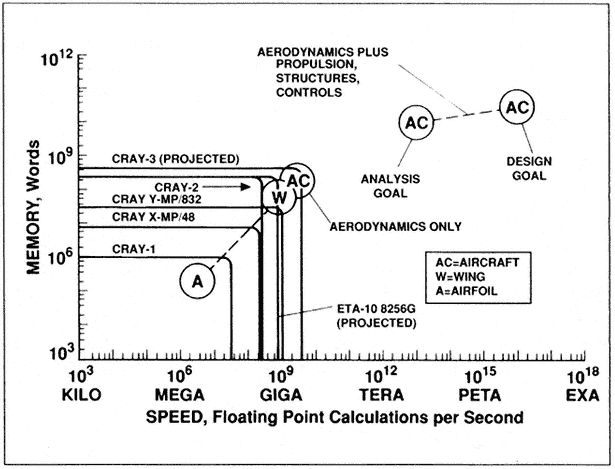
Figure 1.
Computer speed versus memory requirements (two-hour runs with 1988 methods; aerodynamics from Reynolds-averaged
Navier-Stokes equations).
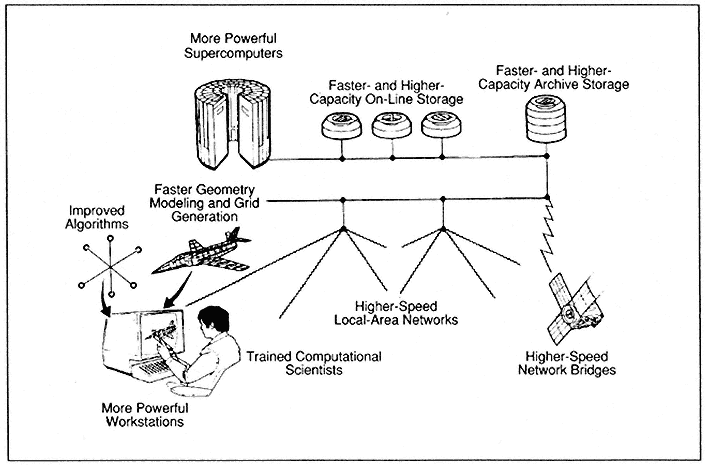
Figure 2.
Advancements in computational sciences require more powerful supercomputers.
the 101st Congress). Some differences between the executive and legislative programs currently exist, but both programs have similar goals, and they both identify the Defense Advanced Research Projects Agency (DARPA), the Department of Energy (DOE), NASA, and NSF as principal implementing agencies. Participating organizations include the Environmental Protection Agency, the National Institutes of Health (NIH), the National Institute of Standards and Technology, and the National Oceanic and Atmospheric Agency.
Roles of the four principal agencies, together with lead-agency designations, have been assigned in the executive-branch version of HPCI (Table 1). Four areas of activity have been defined as (1) high-performance computing systems (with DARPA as the lead agency); (2) advanced software technology and algorithms (NASA to lead); (3) the National Research and Education Network (DARPA to lead for network research, and NSF to lead for network deployment); and (4) basic
| |||||||||||||||||||||||||||||||||||
research and human resources (no lead agency). The participating organizations will undertake efforts to solve grand-challenge computational problems appropriate to their missions.
Objectives of NASA involvement in HPCI are threefold: (1) develop algorithm and architecture testbeds capable of fully utilizing massively parallel concepts and increasing end-to-end performance, (2) develop massively parallel architectures scalable to 1012 floating-point operations per second, and (3) demonstrate technologies on NASA research challenges.
NASA applications or grand-challenge problems will be undertaken in three distinct areas: (1) computational aerosciences, (2) earth and space sciences, and (3) remote exploration and experimentation. The Ames Research Center will lead in the computational-aerosciences area, and the problems will relate to integrated multidisciplinary simulations of aerospace vehicles throughout their mission profiles. The Goddard Spaceflight Center will lead in the earth-and space-sciences area, and the problems will relate to multidisciplinary modeling and monitoring of the earth and its global changes and assessments of their impact on the future environment. Finally, the Jet Propulsion Laboratory will lead in the remote-exploration and experimentation area, and the problems will relate to extended-duration human exploration missions and remote exploration and experimentation.
In summary, supercomputing has become integral with and necessary to advancements in many fields of science and engineering. Approaches to making further advancements are known, so the performance of supercomputing systems is pacing the rate of progress. Supercomputer performance requirements for making specific advancements have been estimated, and they range over seven or eight orders of magnitude in speed and two orders of magnitude in main-memory capacity beyond current capabilities. A major new thrust in high-performance computing is being planned to help meet these requirements and assure continued U.S. leadership in the computational sciences into the 21st century.
Reference
Victor L. Peterson, "Computational Challenges in Aerospace," Future Generation Computer Systems5 (2-3), 243-258 (1989).