
Chapter Two—
Russian Architectural Criticism and the Propagation of the "New Style"
The "New Style" in Russian architecture is a thoroughly documented development in an architectural tradition that has often lacked the most basic information about its major buildings. By the beginning of the twentieth century the architectural press had expanded far beyond Zodchii and its supplement Nedelia stroitelia (Builders' weekly), which began to appear in 1881 under the auspices of the Petersburg Society of Architects. To be sure, Zodchii remained the single most important source of information for the profession, despite its often derivative reports culled from foreign publications as well as from established Russian periodicals such as Birzhevye vedomosti (Stock exchange news). Zodchii encompassed North America, Japan, and Europe in addition to publishing detailed articles on construction technology and the minutiae of professional meetings in Petersburg. In 1902 Nedelia stroitelia merged with Zodchii , which thereafter appeared weeky until 1917.[1]
Although no journal rivaled Zodchii in either frequency of publication or comprehensiveness, other, new, periodicals began to offer less conservative forums for the discussion of developments in contemporary European architecture. One of the first of these new journals, Nashe zhilishche (Our housing), demonstrates both the demand for a specialized architectural publication and the importance of an editorial policy that fostered practical, innovative solutions to contemporary problems in urban architecture. Established in Petersburg in December 1894, Nashe zhilishche was edited by Gavriil Baranovskii, a civil engineer whose designs for the Eliseev Store on Nevskii Prospekt and Petersburg's Buddhist temple are among the landmarks of twentieth-century Russian architecture (see chapter 5). Although the journal changed its title to Stroitel (Builder) in 1895, it continued to emphasize the development of an improved living environment in Russia's major cities. To the extent that the new style achieved some of its most impressive results in the design of housing, Stroitel , published until the end of 1905, is a prime source of information on architectural innovation.[2]
Whereas Stroitel was characterized by editorial stability and purpose, other, short-lived, turn-of-the-century publications recorded scattered examples of the new architectural sensibility from Russia, Europe, and America. Arkhitekturnye motivy (Architectural motifs; 1899–1902), founded by Vladimir Berner and printed with illustrations of high quality at the A. I. Mamontov Printing House in Moscow, provided a more accessible view of the new architectural "motifs"—particularly in its photographs—than could be found in either Zodchii or Stroitel . Arkhitekturnye motivy also has the distinction of containing one of the earliest uses of the term "style moderne" to refer to the protean architectural style that appeared in Russia at the beginning of the
century. The reference, however, occurs in an undistinguished setting: at the bottom of a 1900 furniture advertisement for the Muir and Mirrielees department store in Moscow.[3] The term, derived equally from French and from the title of Otto Wagner's book Die moderne Architektur , surfaced thereafter in other Russian publications, although novyi stil (the new style) was used more frequently—and ambiguously.[4]
Arkhitekturnye motivy had a fleeting afterlife as the journal Postroika (Construction) in 1903; but by then it had been supplanted by two other publications espousing the new architecture: Iskusstvo stroitelnoe i dekorativnoe (Building and decorative art; 1903), published in Moscow, and Arkhitekturnyi muzei (Architectural museum; 1902–1903), edited by Vladislav Karpovich and sponsored by the Academy of Arts in Petersburg. Arkhitekturnyi muzei presented important critical analyses of the new style in Russia and reported on contemporary developments in both architecture and the applied arts abroad, particularly Scottish and English work from the Arts and Crafts movement. In the pages of this journal William Morris achieved a position close to sainthood.
It remains only to mention the interest in architecture and contemporary design exhibited by Sergei Diagilev's Mir iskusstva (1898–1904), published in Petersburg.[5] One of the most important manifestations of Russian culture at the turn of the century, this journal and the aesthetic revival it inspired have already received much attention. Among the journal's heroes were the Scottish architect Charles Rennie Mackintosh, the Russian designer-architect Ivan Fomin, and Joseph Olbrich—all of whom had an impact on the new style.
A second wave of journals began to appear after 1905; they provide a record of the maturity, permutations, and architectural reactions against the style moderne near the end of the first decade. Between 1905 and 1908, Konstantin Bykovskii served as editor of Zapiski (Notes), published by the Moscow Architectural Society; and the year following the demise of Zapiski , the same society sponsored the profusely illustrated Ezhegodnik Moskovskogo arkhitekturnogo obshchestva (Annual of the Moscow Architectural Society), which in fact appeared biennially between 1909 and 1916. Its four issues provide the best photographic record of the work of Moscow architects, though it had such competitors as Moskovskii arkhitekturnyi mir (Moscow architectural world; 1912–1915), published annually and edited by E. Levi. (In 1911 Levi had initiated a newspaper-format periodical entitled Arkhitekturnaia Moskva , but it quickly collapsed for lack of support among the profession.)
In Petersburg the most important new architectural publication after 1905 was the Ezhegodnik obshchestva arkhitektorov-khudozhnikov , published between 1906 and 1916. Like the Moscow annuals, it was primarily an illustrated publication printed on high-quality paper and supported with extensive advertising supplements related to the building and decorating trades. The sponsoring Society of Architect-Artists, which represented graduates of the architectural course at the Academy of Arts, held its first meeting in January 1904, but the annual devoted its pages to the work of prominent architects rather than to accounts of meetings and organizational details.[6] The Institute of Civil Engineering, whose graduates also founded a society in 1904, had been publishing a periodical entitled Izvestiia (News) since 1882, with emphasis on technical matters.
In addition to the professional periodicals based in Petersburg, architectural commentary also appeared in city newspapers, such as Peterburgskaia gazeta , and in the cultural journal Apollon (1909–1917), whose editorial sympathies for classical principles in the arts furthered the revival of neoclassicism in architecture.
With these forums the new architecture had ample means to announce itself to both the profession and the general public. The photographs of buildings and modish interiors in the journals sound a clear note of self-promotion, along with advertising supplements that in some issues comprised almost one hundred pages. Furthermore, the reports of elegant contemporary design from Western and Central Europe made the new aesthetic seem fashionable. The ramifications of the style moderne in Russia, however, involved more than changing tastes and fashionable design. In the frequent exchanges between the proponents and detractors of the style, some interpreted the new style as nothing less than a harbinger of change in society as a whole.
One of the earliest and most detailed reports on the new European architecture appeared at the end of 1899 in Stroitel under the heading "Conversations of a Builder."[7] Written by G. Ravich, the report surveyed developments in Belgium, Germany, Austria, and France and included illustrations of interiors and exteriors by Otto Wagner, Victor Horta, Joseph Olbrich, Rudolf Tropsch, and Hector Guimard. Ravich enthusiastically
portrayed the new style as a welcome development that would allow architects "to express the inner content of our life" and permit architecture to join her "sisters," poetry and painting, in the quest for new forms.
Ravich's analysis is hardly profound, but his praise of Otto Wagner's work and his mention of events connected with the Vienna Secession suggest that he knew about contemporary European art and design. Such knowledge was in fact unexceptional, for architects in the major Russian cities had ready access to European journals, including the three important ones Ravich cited as his sources: L'Art décoratif, Der Architekt , and Berliner Architekturwelt . Ravich analyzed Guimard's Castel Béranger (Paris, 1894–1898), which he presented both as a major work of architecture and as an example of comprehensive aesthetic design, from wallpaper to paneling and interior furnishings.[8] The integrated design environment was central to the work of the best Russian architects of the style moderne, many of them familiar with a similar approach at the Abramtsevo workshops.
In one of the October 1899 issues of Nedelia stroitelia a brief unsigned article described two Petersburg apartment buildings with traits of art nouveau design. The commentary is typical of early Russian perceptions of the style as largely decorative: "Decadence in architecture is beginning to appear also among us. . . . The striving for new forms, for a rejection of the cliché, should of course yield quite varied results, some more or less successful. Having created an entire range of new architectural goals, life persistently demands new forms for their expression."[9]
Public response to this small item—and the two apartment buildings—was so spirited that a letter condemning the new style was read at the next meeting of the Petersburg Society of Architects. This episode elicited a sympathetic, if facetious, defense of innovation in Nedelia stroitelia the following month:
The attempt to enrich the decorative aspect of a building with new motifs, instead of those everyone is fed up with—the inevitable acanthus leaves on consoles (which very often fall on the heads of passersby), the false cornices, and the wretchedly sculpted, half-naked caryatids, born in the south and freezing to death without mercy under our sky—these new attempts one can only welcome.[10]
More seriously challenging the new style, "In the Struggle for Art" by V. Shmor in the March 1900 issue of Zodchii raised the question "style or fashion?" The question itself implied the latter; Shmor noted that the new style in Russia was limited largely to the design of furniture and wallpaper. (The Muir and Mirrielees advertisement for style moderne furniture supports his contention that the style was primarily decorative.) The article criticized the eager imitation of foreign design in the name of progress and questioned the durability of the new style, "which seems . . . at present . . . only the unsubstantial blending of various fashions."[11]
After Shmor's article, commentary on the nascent style moderne subsided for several months, but reports describing the new architecture and design elsewhere in Europe appeared regularly in Zodchii and in its supplement Nedelia stroitelia . The April 1900 issue of Zodchii reported on the competition to design the new campus at the University of California, Berkeley—a project endowed by Phoebe Hearst and the subject of much interest in the Russian architectural press.[12] Shortly thereafter, Aleksandr Uspenskii, a graduate of the Institute of Civil Engineering and the son of the prominent populist writer Gleb Uspenskii, surveyed the revival of English vernacular architecture, with references to Charles Voysey and M. H. Baillie Scott.[13]
These early reports demonstrated the Russian architectural journals' receptivity to innovation and their acceptance of European standards as a measure of progress. In 1901 Arkhitekturnye motivy reproduced photographs of two landmarks of the new European architecture: Paul Hankar's building at 46, rue Defacqs in Brussels (1897) and Joseph Olbrich's Secession House in Vienna (1897–1898). In the same year Zodchii gave detailed reports on the applied arts at the Paris Exhibition of 1900.[14]
The first critical assessment of the new style appeared in the February 1902 issues of Zodchii , where Pavel Makarov (1872-?) disputed those who had linked the new architecture to the questionable term dekadenstvo (decadence), which more properly belonged to literature. Makarov, who had graduated from the Institute of Civil Engineering in 1898, rapidly became one of the most vocal supporters of the style moderne. He defined, somewhat hyperbolically, the qualities expected from a revived architectural aesthetic: "Freshness, simplicity, lack of pretension, and a complete rejection of old forms, together with a striving to change the basic principles of the former style and move architecture along the path to
rationality, which so clearly appears in the Gothic and was so completely forgotten during the Renaissance."[15]
Although Makarov classified Viollet-le-Duc as a gifted architect incapable of breaking with the outmoded styles of the nineteenth century, his debt to the French architect is obvious, and he acknowledged Viollet-le-Duc's role in reinterpreting the Gothic. But Makarov gave precedence to England as the source of the new style, especially the work of John Ruskin, who rejected the worn ideas of the Renaissance and offered a renewed, rational, interpretation of the Gothic. Among the British architects and designers inspired by the Arts and Crafts movement, the article mentioned William Morris, Edward Burne-Jones, Ford Madox Brown, and several others. More effective than the names, however, are the illustrations of houses by Charles Voysey (already familiar to readers of Zodchii ), Ernest Newton, James Salmon, and George Walton. The article emphasized that Britain had made an important contribution to the new style by relating the applied arts, interior design, and architecture; Makarov cited in particular the work of William Morris.
Makarov devoted the second article of his survey to the architecture of Belgium, which he saw as more receptive to innovation than tradition-bound France.[16] Ravich had already discussed some of the architects in his 1899 article in Stroitel , but Makarov was the first to examine their work in Zodchii . In his view the new movement's main propagandist was Henry van de Velde, presented as a pupil of Ruskin and Morris who diverged from them in his indifference to the Gothic and his determined embrace of a contemporary idiom in architecture. Although the text focused largely on van de Velde, the accompanying illustrations included Horta's house on rue de Turin in Brussels and Hankar's house at 383, avenue Louise (1898–1899) as well as van de Velde's vestibule for the firm of Keller and Reiner in Berlin and the study he included in an exhibit sponsored by the Munich Secession.
The third, concluding, part of Makarov's survey began by discussing the current situation in France, with emphasis on the designs of Louis Bonnier and Charles Plumet as well as on Guimard's Castel Béranger.[17] Anatole de Baudot was included as a transitional figure between Viollet-le-Duc and the new style. After France, Makarov turned to Germany, which he perceived as a potential leader in the new art by virtue of its diverse cultural centers (Düsseldorf, Munich, Berlin, Darmstadt, etc.). But he discussed only the work of such secondary designers as Bruno Schmitz, Otto Riet, and Ritz Schumacher in addition to the writings of Hermann Muthesius. He seemed unaware of Jugendstil , although he correctly noted van de Velde's great popularity among younger German designers. Nor did he mention Peter Behrens, whose firmer independent modern style later drew much attention in Russia.
Makarov labeled contemporary German and Austrian architecture moderne (another early use of the term in Russia), a word he seems to have taken from Otto Wagner. He concluded his survey of Europe with a commentary on Austria and the Vienna Secession, giving Wagner pride of place for his buildings as well as his project drawings, which were published in German periodicals. He discussed the work of the Secession, particularly that of Olbrich, though no German or Austrian buildings were included in the illustrations. There were, however, photographs of work by Hendrik Berlage and by the Dutch artist Johan Thorn-Prikker. Makarov dismissed Italy and Spain, unjustifiably, as having nothing of interest; this curious ignorance of modern architecture in southern Europe persisted among Russian critics even after Antonio Gaudí and the Italian d'Aronco designed some of their notable buildings.
Indeed, Makarov seemed ignorant of much that was occurring in Russia, although it is only fair to assume that his survey was written in 1901, when a number of significant Russian projects were still under construction or on the drawing boards. Or perhaps, as a resident of Petersburg, he was more familiar with developments elsewhere in Europe than with those in Moscow, where the style moderne achieved its most distinctive forms. In the final paragraphs of his article he dismissed Russian examples of the new style as "blind imitation," an attempt to reproduce Olbrich's and van de Velde's forms without understanding of their "new and fresh thoughts."[18] In this conclusion Makarov appears to have been writing not merely of architectural logic but of the broader democratic implications of the new style.
Although Makarov's interpretation of the style moderne now seems idiosyncratic and inflated, it is significant. It was published in Russia's most prestigious architectural journal and written by an intellectual and architect who, at least implicitly, commented on the relation between art and society at the beginning of this century. For Makarov those who rejected the new style were attempting to contain Russia within a "Chinese Wall"; their efforts were doomed to failure. Therefore, the creative person should not be afraid "to rush to the
principle that nature and the history of civilization demonstrate almost every day, namely, the eternal change of one order for another, that is, evolution."[19] Such is the aesopian language of Makarov's concluding sentences. If these opinions have a political subtext (as his subsequent writings would suggest), then the final words acquire an almost (r)evolutionary tone.
Makarov's other articles for Zodchii in 1902 were similarly democratic and idealistic, as in an article, with drawings from The Studio , praising Charles Harrison Townsend's Horniman Free Museum (1896–1901) and Whitechapel Art Gallery (1899–1901), both in London.[20] Makarov praised these splendid buildings in the Arts and Crafts freestyle for both their design and their purpose: to bring art exhibits to the general public with the support of public and private donations. In contrast to this English sense of civic responsibility, he saw only apathy and indifference in Russia, and one wonders whether he even knew of the Tretiakov bequest in Moscow.
On occasion Makarov's dedication to the new style, which he so insistently linked to social transformation, went beyond the limits of good sense. In his essay "Architectural Musings" he focused on Aleksandr Benois's "Picturesque Petersburg" in the January 1902 issue of Mir iskusstva , which resolutely defended Petersburg's architectural heritage at the expense of its new architecture.[21] Makarov's polemic derived not from his disavowal of the city's baroque and neoclassical monuments but from what he saw as Benois's "aristocratic aestheticism," his disdain for all modern architecture, and his refusal to comprehend the demands contemporary development placed on architecture. Makarov, believing in art—and architecture—for the people, issued the challenge of social responsibility: "If people, by the will of fate, must now clamber up five or six stories, then art should hurry up after them, if only so that they do not die there from vulgarity. This should be the goal of a true and free art, to ennoble and beautify life everywhere—for the poor as well as the rich."[22] Benois and the Mir iskusstva group were "mandarins," who would fetter Russian art anew after proclaiming its freedom from nineteenth-century tendentiousness.
As a revival of classical forms in architecture developed in Petersburg, some critics interpreted it as a rejection of the moderne. This view, however, did not characterize Mir iskusstva , which featured a Moscow exhibit in December 1902 devoted to new design and architecture. Makarov's truculence in "Architectural Musings," then, was a response not only to Benois's praise of classical principles but also to a wider opposition to the new style. Indeed, an expression of this opposition appeared shortly thereafter in "The New in Art," the lead article (unsigned) of the May 5 issue of Zodchii . The piece was directed against Makarov's "New Style and Decadence" and leveled the predictable charges against the moderne as trivial, concerned with superficial fashion, and addicted to decorative clichés.[23] The author gave no credence to Makarov's support of the new style as a rational, democratic artistic expression.
As the verbal sparring continued in Zodchii , so did the reports on style and technology abroad—reports frequently taken from German publications.[24] In 1902 an illustrated commentary appeared on Harvey Ellis's design for the Security Bank in Minneapolis (1891), an important project that affected Louis Sullivan's later work. Although the architect's name was not mentioned, the bank sketch undoubtedly came from American Architect and Building News , a frequent source for Zodchii 's reports on American architecture. Other items included an essay, "The Aesthetics of Iron Construction" by Evgenii Baumgarten; a description of new workers' homes on Bethnal Green in Greater London (the report pointedly noted the official support for the project: King Edward was on hand to open it); and a report on station designs for the Berlin railway. In the June 9 issue, Makarov published an adaptation of an article by F. Knopf entitled "The Architect and Designer Josef Hoffmann" (originally published in 1901 in Makarov's favorite journal, The Studio ). Although only two pages long, Makarov's adaptation—photographs and text—was highly flattering to Hoffmann's designs for commercial and domestic interiors.[25]
More significant than the article on Hoffman was Makarov's report in the August 1902 issues of Zodchii on the Darmstadt Exhibition, from May through October 1901—a report that helped to atone for his omission of the Darmstadt colony from his survey of modern architecture the preceding year.[26] The two articles focused on Olbrich, who was responsible for the general design of the colony and in 1899–1901 built houses for himself and most of the other residents, including Hans Christiansen, Julius Glückert, and Ludwig Habich. Makarov described the work of resident artists such as the sculptor Habich as well as the design of the houses. (Peter Behrens built his own house at the colony; although Makarov did not discuss this structure, he commented on Behrens's activity as a designer.) He also gave an account of the Darmstadt studio—Ernst Ludwig
Haus—built by Olbrich and named in honor of the grand duke of Hesse, the colony's patron and, coincidentally, the brother of Empress Alexandra of Russia.
The first analysis of theoretical writings on the modern style appeared in the December 1902 issues of Zodchii , which contained a three-part essay by Evgenii Baumgarten on the recently published third edition of Otto Wagner's Moderne Architektur . Baumgarten, a graduate, in 1891, of the Academy of Arts, was both attracted to and alarmed by Wagner's insistence that the new architecture was essential to the formation of a modern environment. After summarizing the prefaces to the three editions of the work—in which Wagner states his intentions, attacks those who oppose them, and proclaims his opponents' defeat—Baumgarten discussed the book's contents, occasionally expressing his dismay—for example, at the elevated role Wagner envisioned for the modern architect, which he rejected as a "dithyramb" that posed "a danger for young minds already disposed to delusions of grandeur."[27]
Although Baumgarten did not dismiss Wagner's architectural work, he objected strenuously to his famous dictum "Nothing impractical can be beautiful." Refusing to allow for rhetorical exaggeration, Baumgarten interpreted the statement literally:
Although Professor Wagner's instructions are practical, we are compelled to take a negative view of this theoretical argument. In leaning toward the utilitarian, he falls into an obvious absurdity. Proposing that the contemporary architect "come to terms" with the statement nothing that is not practical can be beautiful , he lowers the architectural art, praised with such feeling, to the level of an applied craft. With such criteria for appraising the beautiful, there is nothing left to say about original artistic creativity.[28]
Wagner attempted to reconcile opposites: elitism and democracy, the supremacy of art and practicality, the utilitarian and the ideal. And the critic's outrage at what he construed as an assault on aesthetics was perhaps greater because he himself tentatively advocated a union of technology and style in the new architecture (as in his article "The Aesthetics of Iron Construction").
Baumgarten felt architects yielded all too readily to the practical and relied on derivative, hackneyed solutions—views in fact irrelevant to Wagner's book:
Under the guise of responsiveness to contemporary needs, the theory of Professor Wagner proposes aesthetic suicide. Of course it is necessary to build houses solidly, cheaply, quickly, and conveniently, but the beauty of a house has no relation to the technique of construction. The human soul requires architectonic beauty just as human vision requires good illumination. And artistic beauty is the higher, the more infectious, when it wholeheartedly reflects the eternal content of the soul, and not the . . . fleeting views of bourgeois contemporaneity. You cannot hide behind this contemporary manner; it is hopelessly dying in each expiring moment. For that reason any inspired artist values the legacy of past geniuses. By a successive link with them he finds the firm ground for independent activity that Professor Wagner vainly seeks in bourgeois contemporaneity, floating "without rudder or sails" along the troubled waters of everyday practical life.[29]
Baumgarten's obsessive use of the term bourgeois indicates certain ingrained cultural attitudes of Russian intellectuals, but his remarks miss the purpose of Wagner's writings. In fact, no Russian architect of the prerevolutionary period reached the radical break with tradition that Wagner advocated and Adolf Loos achieved. The concern with beauty, as defined by Baumgarten, continued to occupy Petersburg and Moscow architects in both commercial structures and apartment houses, virtually all of which were intended for the "bourgeoisie," or Russia's closest equivalent. Baumgarten's unwitting expression of two major directions in twentieth-century Russian architectural criticism—his rejection of both bourgeois values and soulless functionalism—endows his essay with a curious relevance. His views, though undistinguished even by the standards of Russian criticism at the beginning of the century, nonetheless enlarged the Russian perception of contemporary European theory.
As Russian architectural critics introduced the ideas and motifs of the new European architecture and debated its possibilities in Russia, Zodchii was supplemented briefly by a journal significant for propagating the style moderne. Sponsored by the Academy of Arts in Petersburg, Arkhitekturnyi muzei (Architectural museum) unhesitatingly supported new architecture and design. From the first issue in 1902, its illustrated articles described contemporary design in Russia and abroad. In its inaugural article, "The Tasks of Architec-
tural Aesthetics," Ivan Volodikhin interpreted the new architecture in terms that parallel Pavel Makarov's in "The New Style and Decadence," appearing at the same time in Zodchii . Both critics saw the new style as inevitable, and both used political rhetoric: "The stormy bursts of innovation in architecture, unfortunately manifesting their activities in often rude and thoughtless forms, represent as it were the beginnings of an uprising, the toppling of power based on an outlived system, which could not revive itself in time."[30] The subtext is inescapable, and Volodikhin applied the metaphor of revolution through the concluding passage, rife with words like struggle, reaction , and revolution . Arrogant though the old order was toward the young pretenders, its fatal decline had already begun: lest his readers miss the message, Volodikhin noted: "As in the living world, so in architecture there is a struggle between the old and the new."[31]
Volodikhin's and Makarov's righteous fervor was opposed to the "tyranny of the Renaissance" rather than supportive of any particular component of the new style. As in other contemporary manifestos of new art movements, such polemics depended on questionable analogies between art and socio-political phenomena; but no architectural faction went to the extremes of certain Russian futurists, who saw themselves as allies of the revolution. Most commentary in both Zodchii and Arkhitekturnyi muzei displayed little concern for politics beyond espousing the overthrow of old forms ("in architecture as well as real life"). In 1902, for example, Arkhitekturnyi muzei serialized Evgenii Baumgarten's essay "Society and Artistic Architecture," which exhorted Russian architects to assimilate the best of European design and declared that good taste is a moral quality. The article quoted liberally from John Ruskin.[32]
Anglophile sentiments informed several contributions to Arkhitekturnyi muzei , but the most thoughtful assessment of England's role in the revival of the decorative arts and architectural design came from Mikhail Syrkin, the author of The Plastic Arts (1900), on the perception of ornament and architecture. For Syrkin in his essay "The New Style," the rapid evolution of art forms was inevitable as functional buildings were created on an unprecedented scale. "From now on, neither temples nor palaces can serve as instructive and guiding objects, but rather the shipbuilding works, railroad stations, factories, multistoried apartment 'giants,' and other edifices required by contemporary life."[33]
Syrkin, like other Petersburg critics, believed that the new art had been largely content to fill these requirements superficially (he found the pre-Werkbund German decorative trends particularly distasteful). The aesthetic revival in Britain seemed more promising, however, by virtue of its solid crafts design, which the critic linked to the country's political stability. Britain, having avoided the revolutionary upheavals of the Continent, had created a social order that encouraged the development of the private house, which in turn served as a basis for the crafts tradition and its revival.[34] Although Syrkin's praise of the English house seems remote from his discussion of modern life earlier in the article, it is linked to his interest in a new form of Russian domestic architecture, oriented toward British and American models and unrelated to traditional forms of the Russian estate or town house.
By 1903 the new style had achieved precedence in the Russian architectural press (though buildings designed in the academic, eclectic manner still appeared in Zodchii ). It received further support from Russia's first major contemporary design exhibit in Moscow, from December 1902 through January 1903. The show included rooms and furnishings by Mackintosh, Olbrich, William Walcot, Fedor Shekhtel, Konstantin Korovin, Aleksandr Golovin, and Ivan Fomin (Fig. 48). Fomin, who would soon move into the forefront of the neoclassical revival, here demonstrated his thorough mastery of contemporary European design, with a debt to the arts and crafts school.
Though critical responses were not uniformly favorable, no other event associated with the new style received so much attention in the press. The extensive coverage in such journals as Diagilev's Mir iskusstva revealed that the style moderne had established itself in the most influential cultural circles. In particular Diagilev noted that Fomin in his modern furniture designs had assimilated the new international style while remaining a Russian artist (Fig. 49).[35] In a subsequent issue of Mir iskusstva Diagilev published a photographic essay on the show, prominently featuring Fomin's work in addition to a room by Mackintosh, whose work appeared again in the final issue of Mir iskusstva for 1903.[36]
A more skeptical response to the Moscow exhibit appeared under the title "Ist zu wienerisch" in Iskusstvo stroitelnoe i dekorativnoe , a newly formed Moscow journal whose first issues were attacked scathingly in
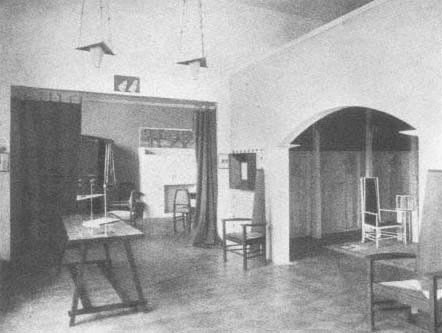
Fig. 48.
The 1902 Moscow Exhibit of Architecture and Artistic Crafts in the New Style. Table,
by Konstantin Korovin; armchairs, by Charles Rennie Mackintosh. At right : a partial
view of the sitting room designed by Mackintosh. Mir iskusstva , 1903.
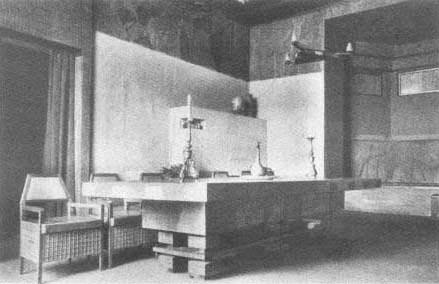
Fig. 49.
Dining room of gray maple, by Ivan Fomin. 1902 Moscow exhibit. Mir iskusstva ,
1903.
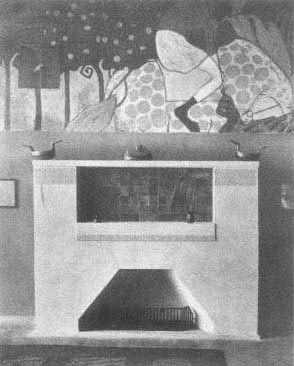
Fig. 50.
Sandstone fireplace with tiles, by Ivan Fomin; frieze, by
Vladimir Egorov. 1902 Moscow exhibit. Mir iskusstva ,
1903.
Arkhitekturnyi muzei .[37] (It is symptomatic of the chaos in Russian art publications that neither journal lasted beyond mid-1903.) Arkhitekturnyi muzei published a generally favorable review of the exhibit by Vladislav Karpovich, who also paid special tribute to the work of Ivan Fomin, though in curious terms (Fig. 50). Fomin's elegantly restrained furniture and interior designs conveyed, according to the critic, an almost overwhelming sense of ennui peculiar to the times: "The pessimism reigning in our time, both in life and in literature, has been expressed quite strikingly in the architectural [i.e., interior] work of I. A. Fomin."[38] Karpovich did not explain how Fomin's work expressed such pessimism, but the somber appraisal seems to link the architect to an illdefined longing associated with Chekhov's plays.
Zodchii published two appraisals of the show, both generally positive. The first, by Aleksandr Dmitriev, summarized the exhibits in detail but offered little critical insight. The second, by N. Filianskii, is interesting for its introductory remarks, which related the Abramtsevo community to the new design on display in Moscow. Filianskii was one of the first critics to comment on this relation; and if, in his opinion, the Abramtsevo workshops had entered an irreversible decline, they had nonetheless planted the "seed" of the modern movement that was now flowering in the work of architect designers such as Fomin and Shekhtel.[39]
The Moscow exhibit was followed almost immediately by one in Petersburg arranged by a group of artists and designers (no professional architects) under the auspices of Mir iskusstva . The show, "Contemporary Art," which opened on 16 January 1903, was the debut of a design atelier of the same name. After a few months of indecisive results, the financial backers abruptly withdrew and the enterprise folded in the fall of 1903. The show itself was a qualified success. Golovin designed a garishly colored teremok , or "residence" (the only room in the neo-Russian style), Korovin an understated tearoom (Fig. 51), and Aleksandr Benois and his nephew Evgenii Lanceray a dining room with wall paintings of idyllic classical scenes, rococo furnishings, and a table set resembling the work of Mackintosh (Fig. 52).[40] Diagilev, in a sympathetic but critical commentary, noted an air of unreality about the designs (with the exception of Korovin's) and suggested that the show needed a practical, knowledgeable architect who could "transform a fairy-tale castle into a livable home and a stage set into [a place for] ordinary life." In contrast to Diagilev's as-
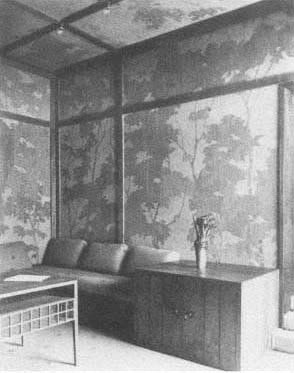
Fig. 51.
Tearoom, by Konstantin Korovin. 1903 Petersburg
exhibit "Contemporary Art." Mir iskusstva , 1903.
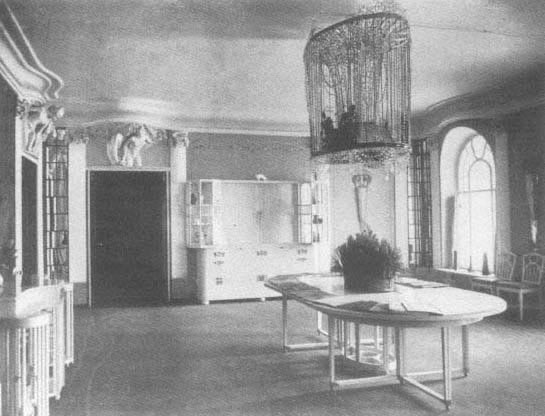
Fig. 52.
Dining room, by Aleksandr Benois and Evgenii Lanceray. 1903 Petersburg exhibit, Mir iskusstva , 1903.
tute criticisms, Evgenii Baumgarten's report on the exhibit in Zodchii complimented the artists and noted Otto Wagner's influence on the furniture design.[41]
Other exhibits in Moscow related to the new style included the Architecture and Art show, in April 1904, which included decorative art from the Stroganov School of Technical Design and the Abramtsevo workshops.[42] A similar exhibit took place in Petersburg in March 1905, with new designs by Fomin and Aleksei Shchusev—including a striking freestyle design by Shchusev for a church-monument at the Kulikovo Pole (Snipe Field) battleground.[43] Although these exhibits had a more limited range than the journal articles, they nonetheless provided exposure and the opportunity for a more direct exchange between the artist and the viewing public. As such they served admirably to further the careers of Fomin and Shchusev, whose considerable talent and professionalism were widely commented on in the journals.
At a time when the Moscow and Petersburg exhibits were demonstrating the variants, both Russian and European, of the new style, critics began to take note of another center of innovative design within the Russian empire. The extraordinary resurgence of architecture, design, and the applied arts in Finland has been studied extensively, and it need only be noted that Russian critics were among its greatest supporters. The ubiquitous Pavel Makarov surveyed current Finnish architecture and design in the same issue of Zodchii (6 April 1903) where he discussed the work of Aksel Gallén-Kallela, known as the illustrator of the Kalevala but mentioned by Makarov for his contributions to the design and crafts revival. Makarov also mentioned Louis Sparre and expressed admiration for the work of Eliel Saarinen.[44] The article included photographs of the landmark Finnish Pavilion for the 1900 Paris Universal Exhibition and the building for the Pohjola Insurance Company (1901), both designed by Saarinen with Herman Gesellius and Armas Lindgren. The similarity of the Pohjola building to Petersburg's commercial buildings suggests a shared "northern moderne" in the architecture of Helsinki and Petersburg.
Russian critical commentary, however, continued to focus on the Vienna Secession and its factions. In the September and October 1903 issues of Zodchii , Aleksandr Dmitriev surveyed recent Secession exhibits at Darmstadt, Düsseldorf, Turin, and Paris. He also commented on the prominence in applied arts of such American firms as Rockwood Porcelain and Tiffany glass.[45] The penultimate December issue of the journal reported on the building of skyscrapers in America—a topic that interested Russian observers, although skyscraper design had little effect on Russian architecture before the 1930s.[46]
In addition to the essays and reports on contemporary architecture, Zodchii continued to provide its readers with references to foreign books both on technical topics and on the work of specific architects such as Wagner, Mackintosh, and Baillie Scott. Among its frequent summaries of items from journals such as Der Architekt and The Studio, Zodchii featured a photograph of Otto Wagner's entrance portal for the telegraph offices of Die Zeit (1902), with a commentary by Aleksandr Dmitriev. Reacting against the curvilinear excesses of the new style, Dmitriev praised the "classical resolution" with which Wagner defined the rectangle of glass and aluminum over an iron framework.[47] Such comments suggest a turn to classical values (as distinct from a neoclassical revival) in Petersburg architecture at the end of the decade (see chapter 5).
By 1904 most of the new architectural journals had passed from the scene, leaving Zodchii and Stroitel as the profession's two major publications—until 1906. Indeed, 1904 was the last year in which the style moderne received extensive coverage in the architectural press. The most entertaining and perceptive critical summary of the new style appeared in Zodchii in 1904 as a four-part article entitled "Contemporary Moscow." The pseudonymous author, an enigmatic "Ivonne d'Axe," presents her impressions through the literary ruse of a foreign observer commenting on native life in a humorous yet sympathetic tone. In the foreword, the editor, "B," carries the mystification further by claiming that the article first appeared as "Moscow moderne" in the dubious French journal La Grille .[48] This mild deception permitted a serious critical view, in both text and sketches, of contemporary architecture in Moscow.
The author comments generally in the first part of the series on the derivative nature of the Russian moderne in its early phases:
Thanks to thousands of illustrated editions and easier travel abroad, the revival of the "end of the century," which gave rise to a tide of new artistic ideas in Europe, found its reflection here [in Moscow] and took a most original form. Especially in the mansions. I was in ecstasy over the
directness, the naïveté, with which an artist here creates and applies a form without the least concern for its content.[49]
The critic pursues this point in remarks on the modern style as a decorative system indifferent to structural problems.
The two following installments of "Contemporary Moscow" concentrated on the work of Viktor Vasnetsov (including the Tretiakov Gallery), Lev Kekushev, and William Walcot, all represented primarily by the private houses that so moved Ivonne d'Axe.[50] The final segment examined work by two of the most important architects of the new style, Fedor Shekhtel and Ivan Fomin, identifying the style moderne as the guiding trend in Russian architecture at the beginning of the century. Yet the critic shrewdly observed that the style, for all its novelty in Moscow, was at one with the city's traditional architecture:
Representatives of past trends sometimes try to resurrect the severe classical style; but now, like it or not, they must come to terms with the contemporary, liberal demands of society. And like it or not, the columns that formerly enclosed half of the visible horizon now cling timidly to the wall. The general direction of Moscow architecture now, however, differs little from that of four centuries ago: the spirit of the people has remained the same. . . . The motifs are just as naive, just as unexpected now and still amaze us with their contrasts, combining prayers to heaven with bows to mammon.[51]
No other critic of the time expressed so clearly the underlying continuity between the traditional architecture of Moscow and the local interpretation of the style moderne—for all its debt to the contemporary architecture of Europe.
"Contemporary Moscow" did not, however, analyze the principles that defined the best of the new architecture. For that one must turn to a small book, The Rational in the Latest Architecture , published in 1905 by Vladimir Apyshkov, who graduated from the Institute of Civil Engineering in 1901 and subsequently taught there while continuing to study at the Academy of Arts. That he wrote the book as a text for architectural courses may explain its concise, lucid presentation. (The text, without the photographs, is sixty-five pages long, with seven chapters and a conclusion.) The chapters—some as brief as five pages—examine contemporary architecture in England, Belgium, France, Germany, Austria, Finland, and Russia.[52]
Apyshkov's information could be found in any number of articles appearing during the preceding four years in such journals as Stroitel and Zodchii . But Apyshkov synthesized the national styles into a coherent movement of architecture from eclecticism to modernism. Although he recognized the shortcomings of much of modern architecture, particularly in Russia, he believed that inevitably architecture would be based on a rational union of structure and form. To this end he brought his readers back to the source of so much common sense in Russian architectural thought—Apollonarii Krasovskii and his book Civil Architecture .
Like many Russian observers of the new style, Apyshkov acknowledged England's importance in healing the nineteenth-century rift between structure and appearance, architecture and decoration. The role of England was "comparable to [that of] Italy during the Renaissance."[53] For Apyshkov, however, John Ruskin, whose works he carefully cited (they had by then been translated into Russian), was less important to modern architecture than Otto Wagner. Apyshkov not only interpreted Wagner's work succinctly—including the dictum on beauty and practicality that so alarmed Baumgarten—but also linked Wagner's work with the rationalism of Krasovskii.[54]
In assessing Russian efforts in the new style, Apyshkov, like several critics who had preceded him, maintained that Russia had accomplished little more than a "blind imitation" of various European trends. His knowledgeable summary included examples from Petersburg (where he saw little of value) as well as Moscow, where the style had achieved an original expression in the work of Walcot, Shekhtel, and Kekushev. Like Ivonne d'Axe he noted the Russian propensity to strive for new forms and decorative effects applied "with no organic link to construction."[55]
No critic of the period was better qualified by training and talent to evaluate this link—or lack of it (unlike Makarov and Baumgarten, Apyshkov was himself a distinguished architect; see chapter 5). As both architect and teacher, Apyshkov no doubt understood the practical and theoretical value of Krasovskii's rational architecture. In the conclusion to his book he offered his greatest insights into the relation between form and structure. The conclusion begins, appropriately, with an epigraph from Krasovskii's Civil Architecture on the
danger of divorcing decoration from structure. Architecture at its best has always arisen from a balanced system that relates function, form, climate, and material—a system epitomized by the architecture of ancient Greece. The ultimate goal of architecture is still to transform "the useful into the beautiful"; to this end Apyshkov rejected what he interpreted, exaggeratedly as the radical functionalism of Leopold Bauer.[56]
Apyshkov's defense of aesthetics is distinguished from Baumgarten's diatribe against Die moderne Architektur by its assured recognition of Otto Wagner's leadership in the aesthetics of modern design. Wagner's bridge at Nussdorf, its massive abutments decorated with two figures of standing lions, exemplified for Apyshkov the union of technology, function, and aesthetics; and his comments on this structure conclude with a passage that echoes Wagner: "A work of architecture that lays claim to artistic significance should not contain lies and deception. . . . The true task of an artist in a given situation is to introduce the decorative element without contradicting utilitarian demands."[57] (In this spirit Apyshkov persistently attacked the use of stucco as both deceptive and unhygienic.) Only when the form of a building fits its purpose can the building's appearance undergo refinement.
In advocating an architecture appropriate to the contemporary urban environment, Apyshkov rejected the "Don Quixotes tilting at windmills" who would deny that commerce influenced architecture: "The disparity between the forms of our architecture and the demands of life . . . becomes still clearer when we see how life, unable to deal with the abstract constraints of academic traditions, pitilessly destroys the old forms and advances its own—perhaps not aesthetic, but nonetheless significant." Apyshkov's approach, like Makarov's, was democratic and antiacademic: "The task of a true artist is . . . not to struggle with the practical and expedient but rather to transform them into the aesthetic."[58]
However diverse its manifestations, the modern movement often united the practical and the aesthetic by drawing on the aesthetic sensibility of artists (Apyshkov mentions the English in this regard but might have said the same of the Russians) and by using innovatively such materials as ceramic facing and iron. The falsity of the stuccoed facade had been exposed, and with it the impracticality and illogic of decorative motifs and details from the academic Renaissance repertory. Without succumbing to a strict functionalism, modern architecture, in Apyshkov's view, had demonstrated a new understanding of structure and ornament, applicable on a broad, socially unrestricted, scale:
A particular feature of the latest architecture is its return to the enlivening effects of color and light that were completely forgotten during the epoch of enthusiasm for "Renaissance" forms.
Here we must also note joyfully another trait of the latest art, based on the deeply held democratic views of contemporary society: its aspiration to serve not only a limited circle of rich people . . . but also the poor folk by carrying light, joy, and warmth into their domiciles.[59]
It must be admitted that the style moderne in Russia did little to exploit the potential of a new architecture for the masses, despite the noble expressions of Makarov and Apyshkov. It continued to depend primarily on the creative relation between bourgeois entrepreneurs and a group of talented architects. Nonetheless, for supporters of an innovative art like Apyshkov, the moderne promised liberation:
Modernism . . . in its best works represents a great liberation from the worn and confining traditions in art.
No one who holds art dear can oppose this movement, whose force is not in the subjective views of individuals but in a deep and solid bond with our culture, our technology, the best democratic aspirations of our century, and the nascent demands of the truly beautiful.[60]
These concluding words of The Rational in the Latest Architecture are the clearest expression of an idealism that guided many proponents of the new style. Although Apyshkov cannot be compared with Otto Wagner as a theoretician, both men believed profoundly in the social mission of architecture and in the need to transmit the values of rationality in architecture to a new generation of builders.
Apyshkov's synthesis of modernist trends and his definition of Russian rationalism from Krasovskii to the latest architecture implied a hope that building design in Russia, firmly grounded in the native social and cultural environment, would soon equal that of the rest of Europe. Even he, however, acknowledged that the beginnings of the new style were tentative, concerned with
form rather than substance. Other critics sympathetic to the new style made this point still more forcefully. Mikhail Syrkian, in his 1903 essay "The New Style," suggested that the proponents of innovation were in danger of missing the essentials, of substituting decorative trends for structural logic:
Contemporary art has continued to devote its attention to the forms themselves rather than to their technical basis in construction. . . . The principle of correspondence between decoration and construction has long been known, but obeisance to it has been rendered only in theory: the organic harmony between these elements in architecture has not been achieved, mainly because no one has seriously looked for it.
In sum, we have created a new art from the wrong end. The artistic in architecture is based on constructive truth, manifested in two ways: in composition that flows from the function of the building and the mechanical properties of the material; and in forms defined by their role as symbolic expressions . . . linking the building and its purpose. Neglect of this truth has cost the past century dearly and is also the basic failing of contemporary architecture: it lacks logic .[61]
Syrkin proclaimed that aesthetic pleasure occurs when architectural form characterizes structure, when all the architectural elements are "tightly interconnected"; to the extent that the new design has overlooked this connection, it is in danger of becoming another discarded stylistic phase.
The trend to a rational interpretation of the style moderne toward the end of the decade is exemplified in the persistent charge of "form without content" leveled against the style by critics sympathetic to the modern movement. The new emphasis on rationalism received its most rigorous theoretical statement in Boris Nikolaev's The Physical Principles of Architectural Form . This book, which appeared in 1905, the same year as Apyshkov's, took a complementary approach:while Apyshkov, having observed the contemporary scene, prescribed an innovative and rational architecture, Nikolaev proceeded directly to a theory of structure based on innate "physical" principles in nature.
Like Apyshkov, Nikolaev advocated a clear statement of architecture's proper values, to be inculcated by architectural schools. As a professor at the Institute of Civil Engineering, he objected strenuously to the routine teaching of an architectural "canon" inherited from the Renaissance. He attacked what he saw as outmoded values—derived from the imitation of architectural systems in their decline—not only in his book but also in Zodchii , where in 1905 and 1906 he wrote extensively on the role of theory in architectural instruction.
For Nikolaev architecture could be reinvigorated only if academic instruction changed: "Everywhere architecture is taught, the clumsy and lifeless canons created four hundred years ago are considered infallible to this day. It is quite natural that youth, whose best years have been lost studying these lifeless objects, creates rough and unfinished things when faced with the demands of life."[62] An insidious pattern of thought based on the imitation of unquestioned values extended even to the reproduction of modern clichés, with equally lifeless results. Nonetheless, Nikolaev found value in the new style (tellingly, in its Moscow variant):
In favor of the latest works of Vasnetsov, Korovin, and others—despite their often childish naïveté, despite their "illiteracy," and even despite the lack of external, formal logic—there is nonetheless something that surpasses both the school and the polish of the academic trend. That something is sincerity as well as the desire to express one's own idea and not repeat for the hundredth time someone else's.
One senses that these naive works reveal thought of great social significance, insofar as it can be expressed in architecture: in them one senses "man" with all his soul and not the decorative material for grand occasions.[63]
Nikolaev openly disdained the pomposity of much "official" Russian architecture at the turn of the century, which continued to flourish in architectural schools. "Life and its demands and logic seem not to exist in the teaching of artistic architecture."[64]
Nikolaev's theory on the decline of architectural systems in The Physical Principles of Architectural Forms is at once eccentric and cogently argued, but his most innovative thought is expressed in the concluding passages on a new approach to design:
Besides logic and judgment, architects can draw ideas from nature itself. . . . The trunks of trees, the bones of animals—the parts that demand solidity and economy of material—in no way remind us in their frame and form of the out-
moded . . . "classical" columns. . . . The main idea that nature follows in her works—usefulness, the shortest path to the achievement of a goal—should also lie at the basis of architectural creativity and academic instruction.
It is time to discard the dead idea that form can have a canon. Form should be as infinitely varied as the conditions creating it; and the only "style" that an artist should strive for in his work is the style of nature, the style where nothing is superfluous, where everything makes sense and serves the basic idea.[65]
To answer Syrkin's call for "constructive truth," Nikolaev derived a concept of structure from the logic of nature itself; in so doing, he proceeded beyond Krasovskii's and Apyshkov's functionalism, with its concern for the aesthetic refinement of structure. Nikolaev's book is the most radical prerevolutionary statement of a new architectural system, one that originated from a reformed approach to architectural education based on logic, reason, and unfettered thought: "Only a firm and precise awareness of the principles of mechanics, only constant attention to the pure source of eternal logic can provide a firm ground for free creativity—unbounded by routine—in life and particularly in architecture."[66] Any other approach inevitably meant that "yesterday's revolutionaries have become conservatives, creating new canons to consolidate their position." Nikolaev's rigor anticipated a pattern in postrevolutionary architectural thought in the 1920s; but the response to his writings on architectural education was generally unsupportive, and apparently the architectural curriculum based on a study of the "Renaissance canon" underwent no significant change.[67]
Although no architectural treatise published before the revolution matched the spirited freedom and innovation of Nikolaev's Physical Principles , essays and other books on architectural questions demonstrated the continuing vitality of professional discourse. The revolutionary events of 1905 had only a peripheral effect on architectural thought, and they were largely ignored by the journals; yet afterward there appears to have been a greater awareness of social responsibility in architecture and, above all, in the related topic of urban planning.
It is clear, however, that the style moderne offered few theoretical underpinnings for a fundamentally new architectural system. As a symbol of the overthrow of old forms, it served for some critics as an intermediate stage—imperfectly realized—in the movement toward a more thoroughgoing innovation in design. And the use of new materials and technology in certain "rationalist" commercial structures of the moderne opened the way for a discussion of the aesthetic possibilities—and challenges—of technology.
Indeed, there were those like Pavel Strakhov, the author of The Aesthetic Goals of Technology (1906), who argued for technology as the basis for a new aesthetic in architecture. Strakhov pointedly criticized John Ruskin for an excessive distrust of technology. According to Strakhov, technology could liberate architecture for new aesthetic standards, particularly if such materials as iron and steel were used to combine beauty, functionalism, and structural integrity on a large scale.[68] Strakhov and other proponents of a new style equated innovations in architecture and technology with a new social order, more just and less exploitative—an approach that led in its extreme meliorist form to a book on city planning with the intriguing title Socialism without Politics , by V. Dadonov (1912).[69]
The notion of an "iron style," proposed by Strakhov and implicitly supported by Nikolaev, probably derived from sources in continental Europe, where ferroconcrete was widely used. In August 1903 the prominent engineer-architect Nikolai Dmitriev published the lead article in Zodchii , illustrating the possibilities of ferroconcrete, with references to German sources.[70] Other articles of the period that advocated a closer link between technology and architectural design in Russia had limited results, especially in comparison with those achieved in the United States.[71] Indeed, Russian architectural critics at the beginning of the century did not accept the technological, functionalist orientation as ineluctable: in 1905 Aleksei Shchusev argued eloquently in Zodchii that great architecture frequently violates strict considerations of structural logic to create new architectural forms.[72]
Critical writing during the decade of the style moderne endorsed a multitude of competing, often contradictory, approaches to architecture. Despite the persistent note of cultural pessimism and frustration, all but the most reactionary critics hoped that a revitalized architecture would bring about a social and aesthetic liberation that in turn would take Russia into the modern. age. At the same time, neither the supporters nor the
architects of the new style could claim the sense of mission evident in the work of Otto Wagner or Frank Lloyd Wright—who was of the same generation as Shchusev and Apyshkov.
With the partial exception of Apyshkov, no important Russian architect of the period articulated a program for the new style, a statement of relevance to the modern age from which it drew its name. For all the idealistic hopes of Makarov, Apyshkov, and others, whose discourse anticipated the critical brilliance of the 1920s, the architectural profession remained beholden to many masters and uncertain of its social or aesthetic accomplishments. Yet despite the banality of designs that repeated the worst excesses of eclecticism, the new architecture flourished with an exuberant variety that was particularly evident in Moscow.