
Pyroclastic Flows
Pyroclastic flows (ignimbrites) comprise some of the most voluminous explosive products in the geologic record, and one possible emplacement model is that for the gravitational collapse of an eruptive column (Sparks and Wilson, 1976; Wright, 1979). Based upon Prandtl's (1949) theory of turbulent fluid jets, in which ambient air is incorporated into the jet—thus changing its bulk density, the equation of motion for an eruptive column (Wilson, 1976) is written:

where q = a ratio of the average column velocity to its centerline velocity, rb = the bulk density of the column, rv = the vent radius, and ra = the density of the ambient air. Numerical solutions to this equation, summarized by Sparks et al . (1978), relate column height to gas velocity, vent radius, and water content (Fig. 1.15). Column collapse is predicted for columns that do not continue their upward motion because buoyancy forces can no longer offset drag forces on the margins of the column.
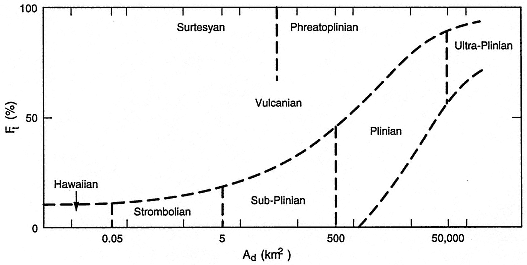
Fig. 1.11
Classification (Walker, 1973) of eruptive mechanism by grain size and dispersal characteristics of
fallout deposits. Ft is the weight percent of tephra finer than 1 mm found along the dispersal axis
where the deposit thickness is 10% of its maximum. Ad is the area of the deposit where its
thickness is at least 1% of its maximum.
(Adapted from Wright et al ., 1981.)
Figure 1.16 depicts the onset of gravitational collapse predicted by solutions to Eq. (1-16). Plinian eruptive column collapse can be precipitated by increases in vent radius or decreases in the water content of erupting materials; either condition decreases the initial velocities of the column and leads to its collapse.
Sheridan (1979) and Malin and Sheridan (1982) modeled the runout of pyroclastic flows and surges by employing an "energy line" concept (Fig. 1.17) derived by analogy to rock-fall debris streams (Hsu, 1975), which are dominantly gravity-driven flows. The maximum distance of runout is computed as the loci of points at which the potential energy surface of the flow intersects the topographic surface. The velocity of the flow at any increment (i) along its flow path [v(i)] is simply modeled as its gravitational potential velocity path: v(i) = [2gD h(i)]1/2 , where D h(i) = height of the energy surface above the local topography; in general, this value is initially determined by height above the vent from which the pyroclastic flow collapses. For directed blasts (for example, Hoblitt et al ., 1981), the initial velocity [v(0)] can be taken as a calculated gas-dynamic velocity such as the blast's sound speed. The flow accelerates with incremental runout distance:

for which q (i) = the local slope and µh = the tangent of the energy surface slope (qe ), called the Heim coefficient (Heim, 1932). This number can vary from 0.06, for highly mobile, large pyroclastic flows, to 0.74, for small pyroclastic flows with low mobility (Sheridan, 1979). The flow accelerates and decelerates depending upon the local slope, in such a way that it flows over a total runout distance (Lf ) to where its velocity v(i) = 0; v(i) = [vo + 2a(i)Le (i)]1/2 , where Le (i) is measured from topographic maps and t(i) = 2Le (i)/v(i)].
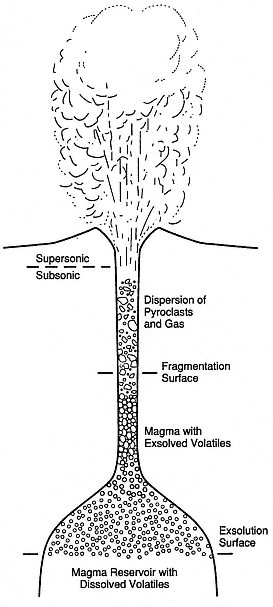
Fig. 1.12
Schematic of an idealized volcanic eruptive system.
Although analytical solutions for subsurface
flow of magma and volatiles can be made,
the exact physical conditions of this flow are
unknown, and this lack of information limits
the calculation of mass and energy transport
within the erupted jet and plume.
(Adapted from Wilson et al ., 1980.)
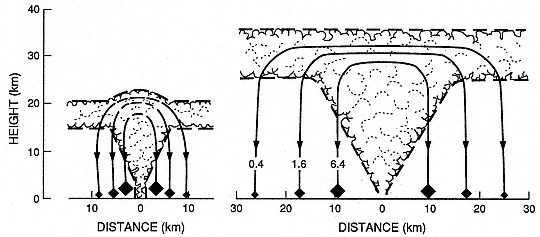
Fig. 1.13
Clast trajectories from the umbrella region of a Plinian eruption column; clast sizes
are given in centimeters. Note that the dispersal is greater for the 35-km-high
column than for the 21-km-high column.
(Adapted from Carey and Sparks, 1986.)