
A Case Study: Pinkenhof, 1833-1850
Our dissatisfaction with existing work stems from our continuing investigation of an eastern European serf estate, Pinkenhof, in the Russian Baltic province of Livland, now Latvia, between 1790 and 1850 (Plakans and Wetherell 1988a , 1988b , 1988c , 1990, 1992). Until 1819, the peasants of Pinkenhof were serfs, and their movements across estate boundaries were severely restricted. The Peasant Emancipation Law of 1819 (Schwabe 1928; Tobien 1899) introduced personal freedom and expanded the right of movement, both of which the Livlandic nobility viewed as necessary prerequisites to a free labor market. Yet the new law did not permit absolute freedom of movement (that right was introduced gradually to different segments of the peasant population) and formally deprived the peasantry of even those usufruct rights to land they had enjoyed under the old estate regime of serfdom. In principle, peasants were free to sell their labor to the highest bidder. In reality, now landless, peasants did not move away but continued to occupy their old farmsteads in exchange for money rents. Although the population possessed both traditional and modern demographic attributes that indicate it was moving swiftly into the demographic transition (Plakans and Wetherell 1988a ), the decades immediately following emancipation in Pinkenhof were ones of gradual adjustment and not rapid change.
The Russian Imperial head tax censuses, or "revisions of souls," for Pinkenhof, which provide detailed enumerations of the human groupings at the farmstead level from 1782 onward, reveal no massive in- or out-migration in either the pre- or the postemancipation periods, although both kinds of movement existed to varying degrees. The 1850 revision, however, was more than a simple nominal listing of 1,569 residents living on 123 farmsteads, the main estate farm, or Hof , and several smaller, functionally specialized places; it indicated where each of the 1850 residents had lived in 1833. Moreover, if an 1833 inhabitant had left the estate before 1850, his or her departure was noted, together with a date and a destination; if he or she had arrived since 1833, that was noted also, together with the place of origin although not always with the year of arrival. The 1850 revision, therefore, allows us to explore external migration and, to a lesser extent, internal mobility.
As in most Baltic landed estates, everyday rural life in Pinkenhof transpired on spatially separated farmsteads, not nucleated villages. Each of the 123 fixed residential farms in 1850 bore a name that recurs in estate documents as far back as the latter part of the seventeenth century. New entrants
TABLE 5.1 | ||||
Age Cohort | Midperiod Population | Number of Migrants | External Migration Rate (CMRe ) | |
0-14 | 490 | 7 | 0.8 | |
15-19 | 162 | 17 | 5.8 | |
20-24 | 140 | 50 | 19.8 | |
25-29 | 145 | 84 | 32.2 | |
30-34 | 129 | 21 | 9.0 | |
35-39 | 104 | 7 | 3.7 | |
40-44 | 85 | 3 | 2.0 | |
45-49 | 63 | 2 | 1.8 | |
50-54 | 61 | 1 | 0.9 | |
55+ | 93 | 2 | 1.2 | |
Total | 1,472 | 194 | 7.3 | |
SOURCE: The Ninth Imperial Revision for Livland, Central National Historical Archive, Riga, Latvia (Baltic Microfilms, D112, Oekonomie Expedition d. Stadtkassakollegiums IV E. 4, Revisionsliste Gut Pinkenhof, J. G. Herder Institut, Marburg a.d. Lahn, Germany). | ||||
into the estate, therefore, augmented the labor force of particular farmsteads, and those who left diminished it. Correspondingly, internal mobility, including that of the elderly, took place between farmsteads, rather than between farmsteads and institutions reserved for the aging, or between a farm's main residential quarters and outbuildings set apart for the aged as was frequently the practice in central Europe (Mitterauer and Sieder 1977: 162-163). The main building of a farmstead was therefore the residential site of all members, including the aging and aged; and judging by the architecture of these buildings, the living space within could be readily adjusted to accommodate any increase or decrease in residents (Kundzins 1974; Veveris and Kuplais n.d.). As such, housing the marginally productive elderly—if indeed the elderly can be thought of in this way at all—was not a serious problem, and we have to seek the reasons for their movement elsewhere.
But Pinkenhofers did move. Between 1833 and 1850, 192 men and women left and entered Pinkenhof, for a net migration rate of -17.7. For females, the rate was 4.1 and for males, -21.7, a discrepancy attributable to a high level of conscription among males (Plakans and Wetherell 1988a ). Table 5.1 displays age-specific migration rates for both males and females; figure 5.1 gives a stylized age profile.
Overall, the crude external migration rate, CMPe , was 7.3, but the incidence of migration was greatest for those in their 20s (30.3) who were moving in and out of the estate to marry.[1] At the same time, the neighboring estate of Bebberbeck and others in the adjoining province of Kurland, which
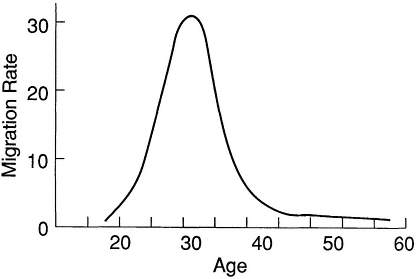
Fig. 5.1.
Stylized age profile of external migrants, Pinkenhof, 1833-1850.
Data from the Ninth Imperial Revision for Livland, Central
National Historical Archive, Riga, Latvia (Baltic Microfilms,
D112, Oekonomie Expedition d. Stadtkassakollegiums IV E. 4,
Revisionsliste Gut Pinkenhof, J. G. Herder Institut, Marburg
a.d. Lahn, Germany).
were the sources of half (44 of 84) of all immigrants and half (38 of 74) of all emigrants (excluding 36 conscripted males), were so geographically close to Pinkenhof that any hard and fast distinction between migration and mobility may blur the historical reality. Nonetheless, the record indicates that external migration, defined as movement across the estate's boundaries, was limited almost exclusively to young adults; for those over 40, it was virtually nonexistent.
Internal mobility is more difficult to evaluate for two reasons. First, the revision only documents the presence of a person in one farmstead in 1833 and in another in 1850; it does not record any intervening moves that might have occurred between those two years. Second, the source does not allow us to say at what ages internal migrants moved. All we know are the ages of 459 people who were at least 18 years old in 1850 and who had changed their farmsteads of residence at least once between 1833 and 1850. At the same time, it seems safe to conclude that movement within the estate —mobility —was much greater than movement across estate boundaries —migration . For one thing, the ratio of recorded internal to external moves was more than 2:1. For another, the record keepers were especially careful to document movement into and out of the estate. Indeed, 2 of the 192 migrants both entered and left Pinkenhof between 1833 and 1850. Finally, we also know that
TABLE 5.2 | |||||
Age Cohort | 1850 Population | Number of Migrants | Internal Migration Rate (CMR1 ) | Percentage of Population Mobile | |
18-19 | 76 | 30 | 21.9 | 35.9 | |
20-24 | 139 | 79 | 31.6 | 56.8 | |
25-29 | 136 | 75 | 30.6 | 55.1 | |
30-34 | 125 | 72 | 32.0 | 57.6 | |
45-39 | 106 | 53 | 27.8 | 50.0 | |
40-44 | 104 | 43 | 23.0 | 41.3 | |
45-49 | 85 | 39 | 25.5 | 45.9 | |
50-54 | 72 | 31 | 23.9 | 43.1 | |
55+ | 126 | 37 | 16.3 | 29.4 | |
Total | 969 | 459 | 26.3 | 47.4 | |
SOURCE: The Ninth Imperial Revision for Livland, Central National Historical Archive, Riga, Latvia (Baltic Microfilms, D112, Oekonomie Expedition d. Stadtkassakollegiums IV E. 4, Revisionsliste Gut Pinkenhof, J. G. Herder Institut, Marburg a.d. Lahn, Germany). | |||||
the labor force in Pinkenhof was far from stationary and that adult farmhands and their children, who accounted for 43 percent of the population in 1850, traditionally moved about the estate on a regular basis (Plakans and Wetherell 1988b , 1992; Svarane 1971). Accordingly, we take the incidence of external migration in the 1850 revision to be a good reflection of the historical reality and the corresponding level of internal mobility as an absolute minimum.
Table 5.2 displays hypothetical age-specific internal migration rates for those 18 years of age and older in 1850 and figure 5.2, a stylized age profile. The age-specific rates are hypothetical and cannot be taken at face value because they reflect only movement sometime between 1833 and 1850 and do not represent standardized rates of mobility for persons in each age cohort. Only if the 63 peasants who were between 45 and 49 years old in 1850, for example, had actually moved while they were 45 to 49 would the reported age-specific rate be valid. Yet a crude internal migration rate, CMR1 , of 26.3 suggests that spatial mobility was a common experience in Pinkenhof. Indeed, table 5.2 also reveals that nearly half (47.4 percent) of the 1850 population at risk had moved at least once within the estate since 1833. We also know that internal migrants did not move very far, on the average only 2.5 kilometers. Thus local flows, although common, were short (Plakans and Wetherell 1988a ; Wetherell, Plakans, and Wellman 1994).
The views of external and internal movement that the 1850 revision provides suggest two scenarios that define the probable extremes of the migratory experience of the elderly in Pinkenhof. Both, however, indicate low levels of movement. On the one hand, if the age profile of internal migrants
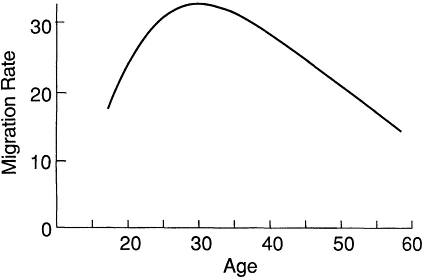
Fig. 5.2.
Stylized age profile of internal migrants, Pinkenhof, 1833-1850.
Data from the Ninth Imperial Revision for Livland, Central
National Historical Archive, Riga, Latvia (Baltic Microfilms,
D112, Oekonomie Expedition d. Stadtkassakollegiums IV E. 4,
Revisionsliste Gut Pinkenhof, J. G. Herder Institut, Marburg a.d.
Lahn, Germany).
that table 5.2 reveals is grossly wrong and the real pattern of internal mobility actually resembles that of external migration presented in table 5.1, then the spatial mobility of the elderly (those 55 and over) was extremely limited. Although many may have moved during their lives (and a CMR1 > 25 attests to this), those moves would have taken place twenty to thirty years before they reached old age.[2] So in one scenario, the elderly rarely, if ever, moved. On the other hand, if a substantial minority of Pinkenhofers moved regularly from farm to farm in the course of their lives as nonquantitative research on these peasants maintains (Strods 1972; Svarane 1971), then the pattern of mobility that table 5.2 presents may well reflect the collective migratory experience of this particular peasant community. In this scenario, the elderly moved (CMR1 << 20) but still not as often as young adults (CMRi > 30).
Despite the weaknesses in the record, several things seem clear about mobility and migration in Pinkenhof in the decades immediately following emancipation:
1. Most spatial movement consisted of local, short-distance moves within the estate or to neighboring estates.
2. Internal mobility was common. Perhaps half of all peasants changed their residence at least once in their adult years.
3. External migration was confined to young adults who moved largely to and from neighboring estates in order to marry.
4. Movement of those over 30 was virtually always within the estate.
5. The elderly either (a ) moved frequently within the estate but less often than those in their 20s, 30s, and 40s or (b ) moved very infrequently, if at all, after reaching their 30s.
6. By virtue of their number, internal migrants, far more than external migrants, created the need for any social and psychological adjustments that may have accompanied movement.
In light of these findings, it is unsurprising that mid-nineteenth-century social commentary has little to say on the subject of migration among those in the later years of life.