
Chapter Two
Archaeology and History
Between the first edition, in 1949, of the Oxford Classical Dictionary and the second in 1970, it was evidently thought desirable completely to rewrite the entry for "Archaeology (Classical)." One of the changes John Cook, in the later version, made from Stanley Casson's earlier entry was to omit, without replacing it by any obvious substitute, a statement about classical archaeology that read as follows: "Its contributions to the study of ancient history are direct and obvious." Deliberate or otherwise, the omission of this sentence is so precisely in harmony with my argument that I should like to take it as a text, or rather non-text, for this chapter.
If it is generally agreed that the main strand of activity in traditional classical archaeology has been, as stated at the outset, the study of ancient works of art, then it will probably also be accepted that the next most prominent strand has been its interaction with ancient history. It is the former field that has provided the greatest names in the history of the subject, and in which its prestige accordingly stands highest not only with other classicists, who can find in this activity qualities that they appreciate—some utility, a kind of analogy for their own work, and (always important for them) criteria by which to judge excel-
lence—but also perhaps with the public at large, which, insofar as it is aware of classical archaeology at all, probably sees this as its main function. Nevertheless, I wish to postpone consideration of this aspect until a later chapter. I do so, not because I think that classical archaeology is invulnerable to criticism on this front; nor yet for a second reason, that this whole field of activity is anathema to the school of thought represented by the new archaeology, though that is beyond all question the case. Rather, it is because I feel that the most urgent need for change may lie in the second sphere, and more specifically in the interrelation of Greek archaeology with Greek history.
The rapprochement between these two subjects is time-honored and used to be accepted with little question—as is implied by the earlier version of the Oxford Classical Dictionary entry—by both sides. As a result, it has become close: closer, perhaps, than in any other field of ancient studies where a parallel partnership of archaeology and history is possible, with the single exception of the much more stormy marriage between Old Testament history and archaeology in modern Israel. But like other outwardly harmonious relationships, it may owe some of its peacefulness to the tacit, but firm, assumption that one of the two parties is subordinate. This is suggested by the description of archaeology, evidently current in classical circles a couple of generations ago, as "the handmaid of history."[1] I shall not waste time in protest at this image, but instead argue that Greek archaeology, at any rate, has been married to, or waiting on, the wrong kind of history.
This needs first elucidation and then exemplification. My thesis here is part of a wider claim already made elsewhere: that classical archaeology, a subject dominated for some time past by various kinds of positivism, has in the process succumbed to a form
[1] This perhaps now obsolete dictum is cited by T.J. Dunbabin, The Greeks and Their Eastern Neighbours (London, 1957), 14.
of "positivist fallacy."[2] The fallacy consists in making archaeological prominence and historical importance into almost interchangeable terms: in equating what is observable with what is significant. It can be exemplified in many an interpretation of an excavated settlement site. The line of argument is apt to run along some such lines as the following: "In the sequence of deposits on our site, this, this, and this are the most prominent features" (referring often to architectural changes, including the destruction of buildings, but also to such features as a change in the incidence of high-quality or imported goods). "Therefore, the episodes these features represent were the most important episodes in the history of the site. Therefore it is right to consult the documentary records for the classical world at this time, to see which recorded events could be represented, or exemplified, by these features on our site." I believe that each of the steps in such an argument is most likely to be mistaken.
But first, let us try to approach the issue from the historical side. The subject matter of Greek history used traditionally to consist of the study of the great political, constitutional, and military episodes that seem to have had a decisive effect on the development of Greek civilization. In recent years, activity has been extended to cover the great "constants"—slavery, demography, popular morality, relations between the sexes, agriculture, animal husbandry, and death and burial—just as has happened in medieval and modern history. But the formative years of classical archaeology as a discipline coincided with the "old order" of history (as, indeed, of art history), and it has been slower than they in responding to changes of course. In part, this may be because it was receiving the signals at second hand; but in part, also, because it appeared to be doing rather a useful job as things were.
Many important politico-military episodes of the sixth, fifth, fourth, third, and second centuries B.C. in Greece can be dated to
[2] In M.H. Crawford, ed., Sources for Ancient History (Cambridge, 1983), 137–84, especially 142–43, 145–46, 163.
the year, and some to the month or day. Since many kinds of Greek material artifact (it should be noted that I am excluding coins and inscriptions from the definition of archaeology) are held to be dateable to within twenty-five years or less, it would seem a reasonable inference that the results of a carefully observed excavation can be brought to bear on traditional history. This process can be expected to take one of three main forms: that of confirming or accentuating existing historical knowledge; that of supplementing it; and that of contradicting and potentially negating it. In the central epochs of Greek history—central, that is, both chronologically and geographically—the confirming function is expected to be the norm. The further one moves away from the geographical center of the central and southern Greek mainland or from the chronological center of the fifth and fourth centuries B.C. (and in the case of Greece this means primarily moving to earlier periods), the scantier and less reliable the historical documentation is likely to be, and the greater the scope for the supplementary or the contradictory roles for the archaeological evidence. A comparable process applies in Roman history as one moves away from Italy to the provinces and from the central epoch of the late Republic and early Empire—in this case especially when moving to later periods. In the earlier history of Greece, several episodes spring to mind as involving at least as much archaeological as historical evidence in any modern discussion of them: colonization, the rise of the polis , the "Lelantine War," the adoption of the armor and tactics of the hoplite, the beginning of the building of oared warships, not to mention more obviously archaeological topics such as the appearance of monumental architecture. I wish to take a closer look presently at the first subject on this list; but first we need to consider again the alleged "positivist fallacy," and one specific kind of proposition to which it gives rise.
Starting from the hypothetical line of reasoning sketched above, many excavators of classical sites set out to express their
results in essentially the form of traditional historical narrative: to conclude, that is, that given events involving their sites took place at given approximate dates. The practice is equally accepted, if only as a kind of convenient shorthand, by both archaeologists and historians. But it is open to two lines of critical examination. One is narrow, technical, and of only "particularistic" interest—the chronological one. How has the dating of the archaeological material been established within the desired margin of precision? Is it entirely free of dependence on the date of the presumed historical event with which it is here being associated, or is there any taint of circularity about the argument? And in any case, are we sure that it is sound? The other line of enquiry is more abstract and far-reaching: it refers not to the accuracy of the given approximate dates, but to the reality of the given events.
Let us return to reexamine the exact nature of the hypothetical excavator's argument, summarized above. If he is really identifying features or episodes on his site with known historical events, then he must be stating (or assuming) the following steps of argument: first, the conclusion that a given episode took place; then, an inference as to approximately when it took place; finally, an inference as to roughly how it took place—that is, in what circumstances, not necessarily yet from what causes. The next phase in the argument, identification with a known historical event, will in most cases provide the causation. Thus an equation is made between a direct and recent observation in the soil and a preexisting historical datum, usually in the form of an assertion by an ancient writer that may be in some degree an abstraction or interpretation of events, rather than a plain factual statement.
Everyone will probably agree that, in relative terms, the successive steps in this argument—the "that," the "when," the "how," and the equation with the historical event—represent a sequence of ascending controversiality. What I shall be arguing is that from the very first step, the assertion that the archaeological episode is "present," the whole sequence is enveloped in
greater doubt than anyone seems ready to admit, in public at least. Here I can draw on a not unexpected ally from within the new archaeology. I understand from his former pupils that David Clarke used to enlarge on this very point in his teaching; and he published at least one statement of warning: "The danger of historical narrative as a vehicle for archaeological results is that it pleases by virtue of its smooth coverage and apparent finality, whilst the data on which it is based are never comprehensive, never capable of supporting but one interpretation and rest upon complex probabilities. Archaeological data are not historical data and consequently archaeology is not history."[3] The incompleteness, ambiguity, and complexity of archaeological findings are the very qualities that I have in mind here.
First, the incompleteness. If an archaeologist reports that a settlement site that he is excavating was burned and then abandoned, the historian and the layman in general will understand him to mean the settlement as a whole, or at least very substantial parts of it. In fact, of course, such an inference is only secure when the settlement has been entirely, or very largely, excavated. Even in Greece, where some settlements have been under intermittent excavation for over a hundred years, this condition is very seldom satisfied. Even when it is, and a horizon of destruction is found everywhere, the conclusion that this destruction was synchronous, that it was all a single episode, is likely to be based on common sense inference rather than on demonstration: the degree of precision, in even the best-dated pottery series, is unlikely to justify a distinction between one day and, say, ten years. It may be unnecessary to remind ourselves that documented history offers cases of a settlement being destroyed twice within a very short time. Furthermore, destruction deposits frequently (and predictably) contain material that was far from brand-new at the time of the disaster. We see, therefore, that the
[3] D.L. Clarke, Analytical Archaeology (London, 1968; 2nd ed. 1978, ed. R. Chapman), 12.
factor of incompleteness affects the application of both the "that" and the "when" to such episodes as the destruction of a settlement.
Ambiguity and complexity likewise affect both these matters and, more especially, the question "how?" The distinction between natural disasters, such as earthquake and accidental fire, and the results of military action becomes a crucial one in the context of historical reconstruction. Yet for the archaeologist excavating a site, it is often very obscure, even imperceptible. There is an area of especial doubt centered round the question of how far the military resources of the ancient world were capable of visiting total destruction on the whole surface area of a settlement. Even the slaughter of an entire population, followed by permanent abandonment of the site, could easily be encompassed without leaving archaeologically traceable evidence. Let us consider a (to date) unfulfilled hypothesis. We read in the ancient sources (Thucydides 7.29; Pausanias 1.23.3 and 9.19.4) that the Boeotian town of Mykalessos was sacked by rampaging Thracian mercenary troops on the Athenian side in the Peloponnesian War in 413 B.C. They are said to have killed every living thing that they met, and to have pillaged temples and houses. Now the site of Mykalessos has been identified with great probability (see p. 82 below), but the settlement, as opposed to the cemeteries, has yet to be excavated. If and when it is, how apparent will the material traces of the episode of 413 B.C. be? The pottery styles of that date are at a relatively closely dated phase in their sequence. Pausanias, who was writing nearly six hundred years later, implies in the first passage cited above that the disaster was so horrific that Mykalessos was never resettled; and evidently it was indeed abandoned by his day. Yet there is already evidence that, irrespective of the correctness of the modern identification of the site, Pausanias was mistaken; for there are coins of Mykalessos of the fourth century B.C. (and one might add that the
burials associated with the presumed site of Mykalessos run from the eighth to the third centuries B.C.). It is not fair to censure future excavators for what they may or may not do; but on the showing of past practice, I am tempted to say that traces of destruction on the site, whether securely dated or not, will all be presumptively associated with the sack of 413 B.C.; and that, if they should not materialize at all, the identification of the site will be called into question (failing conclusive epigraphic evidence), possibly by scholars other than the excavators themselves. Different problems will arise if the sequence of occupation does not match the evidence of the coinage, and of the nearby graves. And so on.
But a clearer illustration of the areas of incompleteness, ambiguity, and complexity in archaeological evidence is offered, not once but many times over, by the experience of Aegean Late Bronze Age archaeology—perhaps the first field that springs to mind when the interpretation of settlement destructions is mentioned. It would not be fair to dwell on the chronological aspect too much, since everyone would agree that the dating of the sequences of pottery and other artifacts is less precise than in fully historical periods. But there have been some striking examples of uncertainty as to whether major Bronze Age sites have suffered military destruction, and, if so, when and how. It will suffice to mention three instances, and dwell at slightly greater length on a fourth.
First, the now long-standing debate about the destruction of palatial Knossos. The past twenty-five years have witnessed a movement, of gradually accumulating force, towards lowering Sir Arthur Evans's original date of about 1400 B.C. for this episode, not to mention a number of variant surmises about its cause. Many now favor a destruction date as late as c. 1200 B.C.; intermediate positions are, however, also held, including the one that there were two levels of destruction, one not very long after
1400 and one close to 1200 B.C.[4] Next, the somewhat younger, but in some ways similar, debate about the destruction of the Mycenaean palace at Thebes: here again, there has been strong recent pressure for lowering the date advanced by the original excavator, A. D. Keramopoullos; and here again it is a reputable view that there were two destructions rather than one.[5] One of the common features underlying these two cases is also present in a third, involving not the destruction but the mere abandonment of a site, Tell-el-Amarna in Egypt.[6] All these instances exemplify an archaeological technicality that is seldom communicated to the layman. The repeated tendency towards the lowering of an archaeological date for the end of a period of occupation is not entirely a matter of coincidence. It usually arises from the later extension of knowledge. The resumption of excavation within a site often reveals fresh pottery deposits in a destruction context: when these deposits are earlier than those previously known, the find may attract little attention, since a deposit must be dated by the latest material in it; but when the new finds are later —and, by the law of averages, this can be predicted to happen sometimes—then this must result in adjustment. Alternatively, it is not further excavation, but further study of the material already known, or of its precise excavation context, that leads to the same result. Roughly speaking, the former process is what has taken place with Thebes, and the latter with Knossos and Tell-el-Amarna. The adjustment may be made in "historical" terms ("Palatial Knossos and Thebes were destroyed close to 1200, rather than close to 1400 B.C.") or, if the historical chro-
[4] For a full and recent summary of this debate, see W.-D. Niemeier, "Mycenaean Knossos and the Age of Linear B," SMEA 23 (1982): 219–87.
[5] H. W. Catling, J. F. Cherry, R. E. Jones, and J. T. Killen survey the Thebes debate in "The Linear B Inscribed Stirrup Jars and West Crete," BSA 75 (1980): 49–113, especially 94–98.
[6] See V. Hankey, "The Aegean Deposit at El Amarna," in Acts of the International Archaeological Symposium "The Mycenaeans in the Eastern Mediterranean" (Nicosia, 1973), 126–36.
nology is too well established to be moved, then it is the purely archaeological time-scale that has to be shifted ("When Tell-el-Amarna was abandoned rather before 1350 B.C., the pottery style called Late Helladic III A, rather than being in mid career, was already over"). All these three instances are important enough to have an effect on the "historical" reconstruction of the Aegean Late Bronze Age, and to have already led to the embarrassed rewriting of narrative accounts. All should serve as dire warnings to the historian of later periods who seeks to derive historical narrative from archaeological observation.
Even more critical, however, is the case of Mycenae, involving as it does the fate of many of the other major sites that shared in the same culture. It is widely held that three successive horizons of destruction are detectable at Mycenae itself, and that the second of these is of the greatest historical moment, since it can be equated with the main episode of destruction at Tiryns, Pylos, and other sites. The first destruction at Mycenae is largely or entirely confined to buildings outside the citadel itself, and belongs to a late, perhaps very late, stage in the lifetime of the "Late Helladic IIIB" phase of Mycenaean pottery. The second destruction belongs at the end of this same phase, and affects most structures within the citadel. We shall turn in a moment to the third destruction.
The line that divides the first two destructions is, in strict ceramic terms, a fine one: it is reasonable to ask whether knowledge of the Mycenaean pottery sequence has yet reached the point where a clear and incontrovertible distinction can be maintained between stages "towards the end of" and "at the end of" a given phase. The same doubts reassert themselves when the equation is made with the sequence on other sites at some distance from Mycenae. There may have been a further element, hidden though perfectly respectable, in the reasoning in respect of Mycenae itself: that common sense would lead us to expect outlying and undefended buildings to "fall" earlier than strongly
fortified ones. But what gives the matter added interest is the view, convincingly advanced by one of the most recent excavators of Mycenae in 1975, that the first horizon of destruction at Mycenae was, in any case, partly or entirely brought about by earthquake, and not by the military action that was tacitly assumed in most earlier reconstructions.[7] Not only that, but a resumption of the German excavations at Tiryns, only a few miles away to the south, has now yielded equally convincing evidence of destruction by earthquake there; but in this case, the disaster is that of the final , or "great" destruction, affecting the palace and citadel. The director of these excavations, K. Kilian, has drawn the natural conclusion that what holds for Tiryns must also hold for Mycenae: at both sites, the second and decisive horizon of disaster was also brought about by earthquake.[8] Thus two successive "military episodes" at Mycenae have to be reinterpreted as natural disasters (if indeed they do not prove to be aspects of one and the same catastrophe), and a whole series of attempts to account for the fall of Mycenaean civilization are thereby largely vitiated.
There remains, however, the third and final "destruction" at Mycenae. In 1924 A.J.B. Wace published the results of his excavation of a building lying just inside the citadel walls that he identified as a granary.[9] He found it to have been burned at a date considerably later than that of the main catastrophe in the citadel—that is, some way into the ensuing Late Helladic IIIC period—though he did not claim that this episode was part of a wide horizon of destruction at Mycenae. But this single datum of archaeological observation, a fire that could not be shown to have affected more than one modest-sized building, became a
[7] G. E. Mylonas, most recently in Mycenae Rich in Gold (Athens, 1983), 145–48, 161.
[8] See K. Kilian, "Zum Ende der Mykenischen Epoche in der Argolis," Jahrb. RGZM 27 (1980): 166–95, especially 182, 185 with fig. 7.
[9] "Excavations at Mycenae: The Granary," BSA 25 (1921–23): 38–61.
kind of symbol: the "granary destruction" at Mycenae was for a long time the most positive material trace that approximately corresponded in time to the indications, given by several ancient writers, of the date of the onslaught of the Dorians in the Peloponnese (that is, the later part of the twelfth century B.C. in our terms). Few heeded the sensible opinion, advanced in 1962 by the Swedish scholar Per Ålin, that the destruction of the granary at Mycenae was most probably the result of an accidental fire. Here again, later work at Tiryns has produced a corresponding level of destruction in at least one house within the citadel; but this observation loses any dramatic quality that it may possess once one learns that the selfsame house suffered no less than three destructions by fire within a single subphase of the Late Helladic IIIC period.[10] One can appreciate the natural yearning on the part of layman and scholar alike for a historical reconstruction of some kind, but it can be a disillusioning experience to scrutinize the foundations of those that are offered.
It may be felt, however, that the subject of the Aegean Bronze Age is not "fair game": that its archaeological record is universally recognized to be problematic, and that narrative accounts of it do not seriously claim to be "history." So let us turn, somewhat abruptly, to what might be called the opposite extreme—that is, to a relatively well documented period over a millennium later. I hope to show that here, too, very similar conditions prevail and almost equally intractable problems present themselves. The place and time that I have in mind are the confines of the Roman Empire in the second century A.D. In the prolonged attempts of the Roman armies to establish a firm northern frontier for the province of Britannia, a striking, though relatively brief,
[10] P. Ålin, Das Ende der Mykenischen Fundstätten auf dem griechischen Festland , Studies in Mediterranean Archaeology, no. 1 (Lund, 1962), 150; cf. 12–13, 15, 24. For contemporary destruction at Tiryns, see Kilian (cited above, n. 8), 183–86, fig. 7, supplemented by later reports in AA (1981), 159; (1982), 395–96; (1983), 280–81.
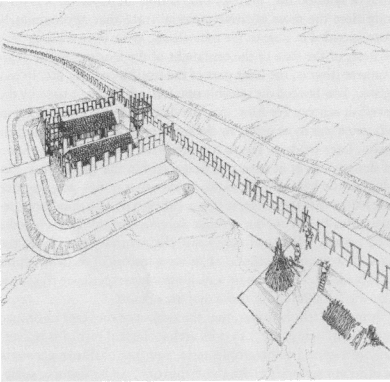
Figure 10.
Reconstructed view of the Antonine Wall, Scotland, from the east (after D.J. Breeze).
episode was the building of the Antonine Wall in lowland Scotland (Figure 10). Here it is agreed by all parties, including such ancient historical sources as there are, that in or about A.D. 142 the emperor Antoninus Pius commissioned the building of a barrier across the isthmus between the estuaries of the Forth and the Clyde, the narrowest point on the whole mainland of Great Britain. It is further agreed—though this time no ancient source directly attests the point—that excavation shows this Antonine Wall to have been occupied by the Romans for a period, briefly abandoned with some evidence of local destruction, then once
more occupied after a certain amount of necessary rebuilding. At this point in the story, archaeological opinion in general agrees that we are still within the principate of Antoninus: that is, that the reoccupation began before his death in A.D. 161. But the story is not yet complete: we have yet to see when the Antonine Wall was finally abandoned by the Romans.
On this question, I cannot do better than quote the words of one of the most recent authorities: "Over the last 100 years the suggested dates have ranged from the 160's through the 180's to 197 and 207 and finally back to the 160's. There is no guarantee that the date of about 163, which is the one now accepted by most scholars, is correct; it is merely the most probable in the light of the evidence available at the present time."[11] Let us first note the combination, in this history of variant dates, of a search for precision on the one hand and subsequent vacillation on the other: the former feature, exemplified by proposals such as "197" and "207," is a sure sign of the attempt to equate archaeological observation with historical event. But what accounts for the relatively wide time-span bracketed by the rival suggestions? This is after all an epoch that, if not the most fully documented in classical history, is very clear in its general outlines: on the historical side, we know many of the regnal dates of the emperors to the month, if not the day, a fact that has immediate repercussions for such finds as coins and inscriptions, which often bear an emperor's name; on the purely archaeological side, too, the primary chronological basis, the pottery series of the workshops of eastern and central Gaul, is relatively accurate. Yet, as we have seen, estimates as to the length of the period of reoccupation have ranged from two years to forty-six years after the death of Antoninus, which forms the latest generally accepted historical terminus.
[11] D.J. Breeze, The Northern Frontiers of Roman Britain (London, 1982), 118.
Just as much as in the instances from the Aegean Bronze Age, the true explanation, I believe, emerges from the inherent and unchanging features of archaeological excavation, and of the observations derivable from it. We should remind ourselves yet again of the provisional and ambiguous nature of every interpretation of such evidence. For one thing, revisions and refinements can take place in the dating of the most copious class of material, the pottery, even though it be within narrower limits than in a prehistoric era.[12] More important, however, are the difficulties in interpreting a stratified sequence of occupations. D.J. Breeze, whose summary of the question I quoted above (n. 11), refers in passing to some of these complexities. There is a recurrent one that derives from the practices of Roman armies: at Birrens (a fort lying behind the Antonine Wall), Breeze notes, "The Roman army may have destroyed the fort itself, preparatory to a change in garrison: such a practice was quite usual"; and at least one fort on the Wall, at New Kilpatrick (Bearsden), seems to have been subjected to this treatment. He also affirms a general point discussed earlier: "While archaeology can prove that a fort was rebuilt, abandoned for a time or even destroyed, it can rarely prove the reason for such an event."[13]
We must note, too, that the acceptance of the "early" date (c. A.D. 163) for the Roman withdrawal depends on overcoming some awkward pieces of counterevidence: for instance, at one of the Wall forts, Castlecary, a Roman temple was constructed apparently well after that date, probably in the 170s or 180s, which must suggest at least a local reoccupation of outposts. One begins to see why Sheppard Frere, as recently as 1967, maintained a date in the 180s in his standard textbook on Roman Britain.[14] The issue is further complicated by yet another question: was there or was there not a third brief Roman occupation of the
[12] On the pottery, see B.R. Hartley, "The Roman Occupations of Scotland: The Evidence of the Samian Ware," Britannia 3 (1972): 1–55.
[13] Breeze, Northern Frontiers (cited above, n. 11), 120.
[14] S. S. Frere, Britannia (London, 1967), 155–65.
Wall, after the abandonment that we have been discussing? Sir George Macdonald had in 1934 proposed that there was, but Frere had already found this view "very doubtful,"[15] and Breeze seems now to reject it. These uncertainties have arisen notwithstanding the generally high standard of fieldwork on the Antonine Wall, as in Romano-British archaeology in general in recent decades; and despite another important advantage, the relatively small size of the sites, which reduces the risk of misleading results arising from incomplete excavation.
The leap in time and space has not, then, delivered us from the problems and uncertainties that attend archaeological interpretation. On the contrary, this example from a much-studied field of Roman archaeology has proved to exemplify the difficulties involved in each stage of our hypothetical excavator's argument (see p. 38 above). Indeed, the last and most vulnerable step, the equation with historical events, has not been reached, so problematic were the antecedent stages. The possibility of Roman, as well as of enemy, agency in destroying a Roman fort exemplifies the difficulty involved in the question "how?"; evidence like that of the Castlecary temple has obvious bearing on the question "when?"; and even the most elementary step, the inference that an episode took place, appears problematic in the case of the "third occupation period."
The main concern of this book is, however, with classical archaeology, and I return to it from these two chastening experiences in adjacent fields. Greek colonization is a topic, and its epoch in general is a period, for which the contribution of archaeology is now recognized as pretty well indispensable. Even as long ago as 1925, when volume 3 of the first edition of the Cambridge Ancient History appeared, dealing with the centuries between c. 1000 and 600 B.C., two of the six authors who contributed on early Greece were archaeologists, and a third was J.L. Myres, who, as erstwhile Sather audiences found, had a lot
[15] Ibid., 163 and n. 4.
of the archaeologist in him as well. Thus today, when the evidence of dozens of excavated early colonial sites in at least ten modern countries is available, it would be impossible to carry very far a discussion of the nature, dating, and causation of the first Greek colonies without including this material (Figure 11).
It could be maintained that over the past two generations or so, the experience of combining the historical and archaeological evidence in this field has been a reassuring one. The information given by our ancient sources has been at times satisfactorily reinforced, at times usefully supplemented, by the results of excavation. Yet the mere existence of such a consensus is potentially a warning sign that circular arguments have been employed. The vigilant historian, in particular, will want to ask how far the testimony of the excavation finds can stand independently of the historical framework into which they are being fitted. In the case of early Greek colonization in Sicily, the doubts prove to center on the aspect of chronology. Thucydides, in a few precious sentences at the beginning of his sixth book (6.3.1–5.3) offers very specific foundation dates, to the exact year, for a number of the Greek cities in Sicily. At this early period such categorical evidence, even from a source two to three hundred years later in time, is in very short supply; and the early excavators of Syracuse, Gela, and other colonies naturally had Thucydides' dates very much in mind as they searched for the oldest deposits at their sites. More important, the scholars who worked somewhat later to establish an accurate chronology for early Greek pottery styles in general for the first time made more use of these Thucydidean dates than of all other evidence combined.
Let us take the case of the foundation of Gela as an example. Thucydides gives a date, corresponding to the year 689/8 B.C. in our terms, for this event. Fairly extensive early exploration of the site and its cemeteries produced a volume of pottery (much of it, in the opening phases, of Corinthian make), and encouraged the belief that the beginning of this pottery series belonged to the
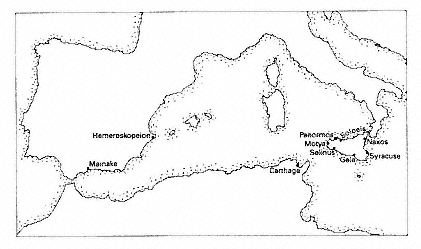
Figure 11.
Map showing sites of selected western Greek colonies.
opening years of the colony's life. None of it was earlier than the beginning of the phase called Middle Protocorinthian: it was to be inferred, therefore, that the Middle Protocorinthian style began to be produced around 690 B.C.[16] This line of argument was sound enough, although a little thought will show that it depended on certain "hidden" hypotheses, besides the obvious one of a belief in the correctness of Thucydides' date: for example, the assumption that the presence of a large quantity of Greek pottery implies the presence of Greek settlers, and vice versa.
But how can we set about testing the validity of the argument? Clearly, only evidence discovered since the chronological scheme for Corinthian pottery was broadly agreed upon—and that means since Payne published his Necrocorinthia[17] —is admissible. The obvious field for further accumulation of evidence lies in continued excavation at Gela. But a little forethought shows
[16] This presents the argument in its original form. Later finds have modified the Minor Premiss in much the same way as with Selinus (see below); cf. J.N. Coldstream, Greek Geometric Pottery (London, 1968), 326–27.
[17] H.G.G. Payne, Necrocorinthia (London, 1931), 21–27, an account that built on earlier work by K. Friis Johansen and others.
that such further evidence, while it can only proceed very slowly and laboriously towards the strengthening of the original argument, can very easily and rapidly undermine it. Even the discovery of thousands of further pieces of Middle Protocorinthian at Gela will merely serve to confirm the existing assumption that the lifetime of this style fell within the lifetime of the colony. But by contrast, a single substantial find of earlier pottery at Gela will upset the whole argument. We have here roughly the converse of the position with the destruction dates in the Aegean Late Bronze Age: there, the extension of knowledge tended to result in the lowering of dates, but at least the imprecision of the historical data in most cases allowed some space for adjustment. Here, further knowledge can bring about change only in the opposite direction; yet at the same time the presence of a precise historical tradition, in the shape of Thucydides' dates, allows of little or no room for maneuver, and will almost inevitably produce severe tension. At Gela, this process has in fact already begun (see n. 16 above), and in general the difficulty is clearly more serious than in the earlier prehistoric instances. Yet the archaeological realities in the two periods are, I would argue, essentially the same: incompleteness, ambiguity, and complexity are taking their accustomed toll.
A later foundation, Selinus, provides a more substantial illustration. This time, we may try expressing in syllogistic form the argument used in establishing the chronological scheme for the pottery (for Selinus, too, provided crucial evidence in this context):
Major Premiss : We believe that Selinus was founded in 629/8 B.C., which is the date that emerges from Thucydides, our best source;
Minor Premiss : The earliest (Corinthian) pottery at Selinus is of the beginning of the Early Ripe Corinthian phase;
Conclusion : Ergo, Early Ripe Corinthian must have begun to be produced about 630/625 B.C.
As at Gela, only in a more emphatic way, later evidence was to place this argument under severe strain. A body of material not known to the pioneers who had employed the argument came to light in the storerooms of Palermo Museum twenty-five years after the publication of Necrocorinthia . It apparently came from graves at Selinus, and the series began appreciably earlier than the beginning of Early Ripe Corinthian;[18] it suggested, in other words, that the Minor Premiss in the above syllogism was wrong.
What is interesting is the reaction on the part of some archaeologists to this discovery. When a logician discovers that the Minor Premiss in a given syllogism is mistaken, I imagine that he will instantly suspend belief in his conclusion pending reexamination of the argument. This is not what the archaeologists did.[19] They liked their conclusion, and they could claim the justification that one or two discoveries from other parts of the Greek world during the intervening twenty-five years had produced results that harmonized with a belief in a date of c. 625 B.C. for the beginning of Early Ripe Corinthian. Rather than give the conclusion up, and assume that the change in style came, after all, a little later (so as to account for the presence of the preceding phase at Selinus), they had recourse to other measures. The case of Selinus differs from those of some other Sicilian colonies in that an alternative date to that of Thucydides, which is arguably as credible, exists in other ancient sources for the foundation of the city: about 650 B.C. Therefore, by jettisoning the Major Premiss (Thucydides' date) as well as the Minor, the conclusion could be kept intact, however precariously. Thucydides could not, after all, be relied on: Selinus was founded around 650 B.C., not in 629/8: and in accordance with the new evidence, Early
[18] See G. Vallet and F. Villard, "La Date de fondation de Sélinonte: Les Données Archéologiques," BCH 82 (1958): 16–26.
[19] An exception is J.-P. Descoeudres, "Die vorklassische Keramik aus dem Gebiet des Westtors," in A. Hurst et al., Eretria , vol. 5 (Bern, 1976), 13–58, especially 50–54.
Ripe Corinthian pottery began to be made a generation or so later than the foundation.[20]
The striking thing about this revised version of the argument is not that it is necessarily erroneous, but that it so conspicuously lacks both logical rigor and even the simple instinct for self-preservation. For if we abandon the ship of Thucydides in order to grasp the life belt of Diodorus Siculus, Eusebius, or other later authorities, normally not thought to be of the same reliability in matters of chronology, then we deprive ourselves of the right to use Thucydides' dates in the whole range of western colonial foundations, for some of which we badly need them. In so doing, we inevitably destroy confidence in the chronological structure for Greek pottery, and thus for Greek archaeology as a whole, for the period between about 735 and 580 B.C. These are not perhaps irremediable losses, but it is fair to look around for other possible explanations of the phenomena before we accept them. In fact, to anticipate for a moment, the story turns out to have a conventional happy ending. Further excavations at Selinus have shown that the group of early pots found in the museum at Palermo were an aberrant phenomenon, if indeed their provenience can be relied on at all: the evidence of the settlement and sanctuaries at Selinus, which can be argued to have a more direct bearing on the presence of Greek colonists than that of Greek pottery in the graves, in every ascertainable case begins with the Early Ripe Corinthian phase: thus not only Thucydides' date but also Payne's use of it for chronological purposes seems vindicated.[21]
It is best to let negative criticism rest here, and look instead for such positive lessons as can be learned from the story, bearing in
[20] Vallet and Villard (cited above, n. 18). It is significant that they had anticipated the same conclusion, on independent grounds, in their earlier paper, "Les Dates de fondations de Megara Hyblaea et de Syracuse," BCH 76 (1952): 318–21.
[21] R. Martin, "Histoire de Sélinonte d'après les fouilles récentes," CRAI 1977, 46–63, especially 50–51.
mind that the latest episode in it is highly unlikely to be the last. A recurrent message that it conveys to me is the danger of expecting the evidence of excavation to speak to us in the same clear language as that of the historical event. With the case of Selinus, the archaeological evidence has displayed its inherent qualities—particularly incompleteness—in exemplary form, but this has perhaps already been sufficiently illustrated in other instances. More instructive, perhaps, are the examples of ambiguity that have arisen. For, even if we assume that we can satisfy ourselves that a site has yielded some of its very earliest material without having been excavated in its entirety, by what criteria are we going to decide the point at which that site becomes recognizable as a Greek colony? Clearly the occurrence of a single Greek pot in a grave is too little, since that grave may belong to a native non-Greek who acquired the object in the era before colonization; equally clearly, the construction of a monumental Greek temple is too much, in that such an undertaking was only likely once the colony had become firmly established. We may, as we have seen, be led to give differential emphasis to evidence from the settlement and sanctuaries, and evidence from cemeteries. We may let speculation run further, and ask whether we can necessarily assume that the word "colony" (apoikia ) in our sources has a constant meaning in the material terms with which archaeology must deal. These same questions arise again when we consider other, broader aspects of Greek colonies than their foundation dates.
One such broader question—indeed, perhaps the most fundamental of all—is that of the very existence of a Greek colony. One of the episodes of Greek colonization recorded in our sources (though not this time including Thucydides) is the settlement by the Phokaians of places on the Mediterranean coast of Spain. Two colonies in particular, Mainake and Hemeroskopeion, have proved problematic. If they were really founded from Ionian Phokaia, then general historical considerations make it
very unlikely that they date from after the sixth century B.C; and in fact the earliest report of their existence, though preserved for us in a much later work, the Ora maritima of Avienus, in most opinions goes back to a source before 600 B.C. But neither here nor in later authorities do we find sufficiently precise topographical information to give their exact location: we can hardly go beyond saying that Mainake lay on the coast east of Malaga, while Hemeroskopeion lay further round to the northeast, in the vicinity of Cabo de la Nao, south of Valencia. The trouble is that extensive exploration of the Spanish coast in both these areas has failed to reveal any site that looks like an Ionian Greek colony of Archaic date.
This is clearly a problem for the archaeologists to solve, and it is archaeologists who have come forward with proposals, some of them quite drastic, for a solution. In respect of Mainake, already nearly twenty years ago J.-P. Morel asked whether this had ever, in reality, been a Phokaian colony;[22] in 1971 M. Tarradell went further and described both colonies as "phantoms".[23] Now in a case like this, where the written tradition about the foundations is so much less full and explicit than Thucydides' account of the Sicilian colonies, we must be careful not to ask too much of the archaeological evidence: the minimal requirement of a site with a reasonable quantity of Greek material, going back to the sixth and preferably to the seventh century B.C., may prove to be enough. If we adopt such a line of reasoning, then we may look favorably on the recent proposal of H.-G. Niemeyer, who suggests that Mainake was none other than the Phoenician site that he himself has been excavating for some twenty years past: it was never, in the strict sense, a Greek colony, but Phokaian settlers were perhaps tolerated within a much older Phoenician com-
[22] See PdP 21 (1966): 391, and, more fully, "L'Expansion phocéenne en occident," BCH 99 (1975): 853–96, especially 886–92.
[23] Cited by J.-P. Morel, "Colonisations d'occident," MEFR 84 (1972): 731.
munity, thus giving rise (in Greek eyes) to the notion that this was a Greek city.[24] Niemeyer's view satisfies the minimum requirements stated above, for there is seventh-century Greek pottery on his site. It also underlines one of the points made earlier: the difficulty of distinguishing, in material terms, what exactly was a Greek colony. It is possible, though surely now unlikely, that future exploration will produce an alternative "Mainake" that corresponds more closely to the expectations of the Hellenist; but pending such a find, it seems to me wise to adopt, for the best existing solution of the identification of Mainake and as a principle for approaching the still unsolved problem of Hemeroskopeion, an attitude of liberality towards the archaeological evidence, neither requiring nor expecting too much of it.
Our experience so far may make us hesitant about accepting claims either that the evidence of excavation has substantiated the historical sources or that it has discredited or undermined them. My final example from the field of colonization takes us back to Sicily and to Thucydides, indeed to the passage (6.2.6) that immediately precedes his account of the Greek settlement of the island; but this time it concerns Phoenician, not Greek, colonies.[25] A single sentence conveys the essential information:
There were Phoenicians living all round Sicily, who had settled on promontories and offshore islands, the better to trade with the Sikels; but when the Greeks arrived in large numbers by sea, they withdrew from most of these places and concentrated in Motya, Soloeis, and Panormos, near to the Elymians, both because they trusted in the Elymian alliance, and because from there the sea passage to Carthage is shortest.
It should first be explained that the Sikels and the Elymians
[24] H. G. Niemeyer, "Auf der Suche nach Mainake: Der Konflikt zwischen literarischer und archäologischer Überlieferung," Historia 29 (1980): 165–89.
[25] For a notably balanced discussion of this question, see E. Frézouls, "Une Nouvelle Hypothèse sur la fondation de Carthage," BCH 79 (1955): 153–76.
were both peoples already settled in Sicily (according to Thucydides) before the arrival of either Phoenicians or Greeks; and that the arrival of the first Greeks is specified by him in the ensuing passage as having occurred in 735/4 B.C. Given this information, the sentence can be seen to state or imply four relevant propositions:
1. the Phoenicians were settled in Sicily before 735/4 B.C., and were to be found especially on promontory and offshoreisland sites;
2. they were engaged in trade with the Sikels;
3. their settlements already included Motya, Soloeis, and Panormos (as implied by the word "most," halfway through the sentence);
4. their settlements also included Carthage (implied by the final phrase).
All four propositions have in common the feature that, on the conventional view at least, they appear eminently testable by archaeology; and all four have indeed been so tested. The results have been strikingly negative. A number of appropriate sites on promontories, and on such offshore islands as exist, have been examined without a single Phoenician object earlier than c. 735 B.C. coming to light. The surprising nature of this result is not, I think, affected by the intriguing observation that, if applied to Sardinia instead of Sicily, Thucydides' generalization would fit the archaeological findings beautifully.[26] Likewise, the location of the main Sikel settlement areas is well established, and numerous cemeteries of the right period have been excavated, without their producing a single Phoenician artifact such as we should expect to result from frequent trade exchanges. Again, of the three specific colonies mentioned by Thucydides, Motya has been excavated intermittently for more than two generations, yet
[26] H. G. Niemeyer, "Die Phönizier und die Mittelmeerwelt im Zeitalter Homers," Jahrb. RGZM 31 (1984): 50.
none of the copious material found can be dated as early as, let alone earlier than, c. 735; and the same is more emphatically true of the less thoroughly explored Soloeis and Panormos. Finally, and in many ways most surprising of all, Carthage has been the scene of excavations by many expeditions of different nationalities, both early and recent, and although one deposit in particular ("Cintas's Chapel") showed every sign of dating from the very earliest days of the settlement, neither here nor elsewhere was there anything that could be shown conclusively to antedate c. 735 B.C.
At first glance (and indeed not only at first glance) it would appear that a positive and circumstantial statement by a major ancient authority has been discredited by the results of excavation. Over the past generation, a variety of expedients have been proposed to accommodate these embarrassing circumstances. But if we recall the lessons of other cases, we shall be inclined to proceed more cautiously, and perhaps even to entertain the notion that the two classes of evidence may, quite simply, not bear closely on each other at all. If, for example, it is difficult for us to identify the material traces of a Greek colony positively, how much more strongly does this apply in the case of a Phoenician trading post? Again, the relative success of archaeology in substantiating the record of Greek colonization in Sicily may actually have obstructed the recovery of the Phoenician record: this would explain the fact, brought out in the article by Niemeyer cited in note 26 above, that in other areas of Phoenician settlement where the Greek material offered no comparable distraction—Sardinia, Malta, Spain, and Morocco, for instance—the archaeological recovery of Phoenician traces has matched or gone beyond the historical tradition, in direct contrast to the Sicilian experience. As for the Phoenician trade with the Sikels, it would not necessarily have been conducted in commodities appropriate for inclusion in Sikel graves; while even Carthage and Motya, of the colonial sites, may have secrets yet undisclosed. In
short, there are explanations that would still allow of a conciliation between the historical and archaeological data; and they may even outnumber those that set up the two classes of evidence in mutual contradiction.
Insofar as the observations in this chapter have a chronological import, it may be that an opportunity has been missed here: a concerted attempt could perhaps have been made to advance a revised chronological scheme for the archaeology of Greece in the era of colonization. Such an attempt would certainly have been more positive in effect than much of what I have said. But it could only be advanced, I think, at the cost of succumbing once again to the "positivist fallacy": that is, of requiring the evidence of excavation to express itself in the language of historical narrative. This is the main reason why I have not made common cause with the two scholars, E. D. Francis and Michael Vickers, who have recently launched just such a radical project for a new archaeological chronology for Archaic Greece.[27] In their case, the proposal is to lower, by a margin of anything from one to three generations, many of the most important dates in Greek archaeology between about 700 and 450 B.C. Much as one may admire the ingenuity of their arguments (and there are further applications of them promised for the future), these do seem to me to rest, as completely as do those of the orthodox view they criticize, on the expectation that major episodes of documented Greek history are going to be reflected in the material record. It is this assumption that I have sought to question: in their different ways, the destruction levels at Eretria, the career of the general Leagros, and the reflections in art of the manipulation of the Theseus legend in Athenian politics—three examples with which
[27] The statements of their arguments so far published are "Leagros kalos," PCPS 207 (1981): 97–136; "Kaloi, Ostraka and the Wells of Athens," AJA 86 (1982): 264; "Signa priscae artis : Eretria and Siphnos," JHS 103 (1983): 49–67; and "Greek Geometric Pottery at Hama and Its Implications for Near Eastern Chronology," Levant 17 (1985): 131–38.
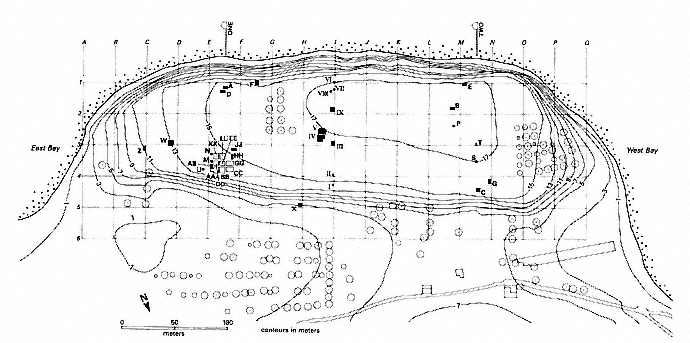
Figure 12.
Lefkandi in Euboea: plan showing the excavated areas of the settlement (after M. R. Popham and others).
Francis and Vickers have dealt in print—are all instances of the kind of episode that, in my view, is unlikely to bridge the gulf between historical and archaeological documentation.
Short of exhaustive discussion, however, this issue remains partly a subjective one. For a final instance from early Greece, therefore, I turn to a case that has some claims to being objectively quantifiable. It concerns the site of Lefkandi in Euboea, which, though not itself a colony, has been repeatedly brought into the discussion of Greek colonization since excavation began there in 1964.[28] The joint Anglo-Greek excavations have not been continuous since that date, however, and circumstances have combined to direct their focus much more on the cemeteries than on the settlement. But the graves found so far have little direct bearing on the colonial period, since they break off well before its beginning, and inferences for eighth-century Lefkandi have to be based on the excavated area of the settlement. The map in Figure 12, published in 1979, shows the extent of the excavated area, which within the main settlement has not since been extended. As will be seen, it is very small in relative terms: on the assumption that the settlement covered the whole of the flat-topped Xeropolis hill, shown by the concentric contours, then something in the region of 2 percent of its extent has been excavated. It is on this basis that all statements of a narrative kind about the involvement of this site in the history (including the colonial history) of eighth-century Greece have been based; and on this basis, too, that the provisional picture of fairly intensive settlement between about 750 and 700 B.C., followed by burning and apparent abandonment, must also rest. It is salutary to remember this map when one reads the often confident statements in the secondary literature (I am not referring to the claims of the excavators themselves, which have been more guarded) about the role of Lefkandi in the events of this critical period, and
[28] M. R. Popham, L. H. Sackett, and P. G. Themelis, Lefkandi , vol. 1, The Iron Age (text: London, 1980; plates: London, 1979), especially pl. 4.
especially about its ultimate fate. In this last connection, it is well to remember also that one or two of the test trenches at Lefkandi did produce a little pottery of much later date, belonging to the sixth century B.C., though its function and context remain unclear.[29] The possibility that further excavation of this site will radically change our interpretation of it is obviously more than a remote speculation. Lefkandi has been perhaps the most important excavation of an Early Iron Age site in Greece since World War II, but this does not yet justify us in referring to it, without qualification, as an excavated site.
If there is any substance in the long series of mostly negative criticisms that I have advanced in this chapter, then it follows that some of the objectives traditionally pursued in classical archaeology, or at least in the archaeology of the early historical era in Greece, have been unattainable ones. I would even be so subversive as to suggest that many excavators, in their heart of hearts, are aware of this: but the external pressures on them, and particularly the pressure to impose the character of definite historical statements on their findings, which "are never comprehensive, never capable of supporting but one interpretation and rest upon complex probabilities,"[30] are too strong to be resisted. After all, even a consideration of the buildings in which we live and work today, and an imagined picture of the archaeological traces that they will leave in a few thousand years' time, can bring home to us how poorly the great historical events of the twentieth century will be reflected in them. Pierre Ducrey of the University of Lausanne has provided an actual example: imagine the reaction of the future excavator of Geneva in, say, 3,000 years' time. He uncovers the ruins of the Grand-Théatre de Genève, which was in point of fact destroyed by fire on May 1st, 1951. He forms tentative hypotheses, which he tests by excavating some 250 meters away. Here he strikes the ruins of the Bâtiment Electoral,
[29] Ibid., 78.
[30] Clarke, Analytical Archaeology (cited above, n. 3), 12.
burned by another fire on August 4th, 1964. His hypotheses harden; it would be perverse to deny that both destructions were caused by the same historical event; he has the chronological evidence to show that they occurred close together in time; he knows, too, the dates of World War II. We can safely predict the conclusions to which (at least if he follows the practices of twentieth-century classical archaeology) he will come, and it is not without relevance that this will also probably involve him in a clash with the evidence of the contemporary documentary sources.[31] We may laugh at him, but we would do better—at least if we work in classical archaeology—to learn from him. We should remind ourselves that although classical archaeology can excel (as the examples in chapter 1 showed) in revealing man the maker with startling clarity, man the doer is a different and much more elusive quarry.
[31] P. Ducrey, "Menaces sur le passé," Etudes de Lettres (1977), pt. 2, 13.