
Spatial and Social Aspects of Epidemics
Smallpox maintained a relatively direct and straightforward relationship with its human hosts, one factor that aided its containment and eventual eradication in the 1970s. But other disease had a more complex relationship, closely linked to environmental and sanitary conditions or mediated through insect and animal vectors. Plague offers one example of this. The spread of plague across northern India in 1899–1901 has been identified with the distribution of the rat flea Xenopsylla cheopis , thought to have originated in Egypt's Nile valley and to have been introduced into India through the expanding traffic between the two countries which followed the opening of the Suez Canal in 1869. Plague tended to be most intense in areas like eastern U.P.—Banaras
and Gorakhpur divisions were among the worst affected localities in rural India (Rogers 1928:45)—where X. cheopis had become naturalized: it was less prevalent in much of eastern and southern India where X. astia remained more common (Hirst 1953:348–71). Reaching eastern U.P. in 1901–2, plague at first caused heavy mortality in urban areas. There were two thousand plague deaths in Banaras city alone in the years 1901, 1903, 1905 and 1911. Thereafter, however, urban mortality from the disease fell, rising above a hundred deaths only in 1912, 1917–18 and 1947, while in the countryside it became firmly entrenched. This can be read as evidence of the greater effectiveness of antiplague measures in urban Banaras, but X. cheopis also found a securer ecological niche among the rodent population of the densely inhabited, grain-rich countryside. Like smallpox, plague had an annual as well as an epidemic cycle, though one more regionally variable. In U.P. as a whole, about 60 percent of plague deaths occurred between April and June: in eastern U.P. and Banaras, January to April was the main period (table 9.1). The reasons for this variation were linked to climatic factors and to the breeding cycles of the rats and their fleas (Rogers 1928:42–43, 58–60; Hirst 1953:260–80). The timing of the year's grain harvest had a bearing, too, providing food for rats as well as humans and, through the transportation of grain, contributing to the fleas' mobility. One factor behind the resurgence of plague in eastern U.P. between 1942 and 1947 (apart from the breakdown of control measures during wartime) may have been the massive grain movements caused by the 1943 famine in Bengal.
But plague also illustrates the importance of human vectors. The epidemic arrived in eastern U.P. in November 1899 with the return of three Muslim Julaha[*] weavers whose employment in the cotton mills of Bombay had ceased with the closure of the factories in that plague-stricken city. From the weavers' homes in the small town of Mau-Aima in Allahabad district, plague spread to Banaras and from there to other towns and villages in the area. Plague had also established itself in rural Bihar and was encroaching on Banaras and Gorakhpur divisions from the east. Market towns were among the first to be affected, with grain traders and handlers among the earliest victims. Subsequently, as plague moved into the villages a disproportionate number of deaths occurred among women, whose housebound lives made them more vulnerable than adult males to a disease borne by domestic rats' fleas (ARSC 1900:6a;ARSC 1901:16; Blunt 1912:43–44).
Migration from eastern U.P. to Bombay, Calcutta, Assam, and Bihar,[5] and the counter flow of pilgrims, traders, and professional men
[5] "It is said . . . that there is not a single family in the Benares division which has not at least one member in the provinces of Bengal, Assam, Bihar and Orissa" (Blunt 1912:49).
from Bengal were also human factors of great epidemiological consequence. The advent and progress of the plague epidemic was but one illustration of this. The severe epidemic of dengue ("breakbone") fever that struck eastern U.P. in the early months of 1872 was traced to importation from Calcutta where it was already rampant. The first recorded cases, were among passengers on a Ganges River steamer which arrived at Mirzapur on March 14, 1872; they infected coolies unloading the vessel and the disease spread rapidly. The first case in Banaras was reported on April 27, 1872—a Bengali who had come by rail from Calcutta two days earlier. From these two points of entry, dengue fever raced through the eastern districts, advancing mainly along the lines of rail and river traffic. An estimated 75 percent of the inhabitants of Banaras city were affected, though only two deaths resulted (ARSC 1872:15–16). By contrast, the influenza epidemic of 1918 reached Banaras from the west, causing rather less mortality than at Agra or Allahabad, but still raising the city's death rate to the highest annual figure (81.31 per thousand) on record (ARSC 1918:18a). Another disease, the protozoan infection known as kala-azar, spread by sand fleas, was becoming increasingly common in the Banaras area in the 1930s and 1940s, partly as a result of inroads from Bihar, but also through the return of migrant laborers from Assam where the disease was endemic (Joshi 1965:348). Cholera epidemics, too, were often attributed to seasonal labor movements between Nepal and the adjacent districts of eastern U.P. This was one explanation of the perennially high levels of mortality from cholera along U.P.'s northeastern border (ARDPH1926:41; Banerjea 1951: 25).
Cholera offers striking evidence of the close connection between human mobility and epidemic disease. Unlike smallpox, cholera has no uniform season. In Bengal it was most widespread between October and January and again in March and April. In Bihar, Orissa, and eastern U.P. the main season fell between April and August; in Punjab it was June to August (Pollitzer 1959:55). The disease thus appeared to move westward each year along what Bryden (1869) described as the "northern epidemic highway." Banaras lay in the path of the advancing epidemics; the first cases appeared early in the year, and mortality rose steadily between April and June, before waning in September and October. Although temperature and relative humidity were important factors (Rastogi, Prasad, and Bhatnagar 1967:844–50), the curious character of cholera epidemicity also bore some relation to human mobility and especially to Hindu pilgrimage routes and seasons.
Banaras stood at a critical juncture between the pilgrimage places of eastern India—Puri, Baidyanath, and Gaya especially—and the sacred sites of the upper Ganges valley and was one of the key centers in the all-India network of temples, shrines, and religious festivals. Few pil-
grims from the east or northwest failed to pass through Banaras, to visit its temples and bathe from its celebrated ghats. One party of pilgrims from Naini Tal journeyed in 1899 to Allahabad, Banaras, Gaya, Baidyanath, Calcutta, and Puri before some of their number fell victim to cholera (ARSC 1889:21). Bimla Devi, who died from the disease at Hardwar in March 1927, came from Burdwan in Bengal, visiting Gaya, Banaras, Ayodhya, and Nimsar en route to the Hardwar mela (ARDPH 1927:27A). The direction and duration of the pilgrims' journey was contingent upon many factors, including their means and devotional objectives. But the pilgrimages bore the imprint, too, of the agricultural cycle: the dry months were the period when agricultural work was slackest and thus pilgrimage most opportune. The timing of the major fairs and festivals (itself perhaps showing the influence of the agrarian calendar) was a further factor. Many pilgrims from Bengal and Bihar passed through Banaras at the start of the year to reach Allahabad in time for the Magh Mela in January–February and to arrive at Hardwar for the main bathing festival in March or early April. Many continued from there to Badrinath and Kedarnath, returning home for the monsoon and the resumption of agricultural activity (Bhardwaj 1973:219). There was a second period of festivals later in the year, during the month of Karttike (October–November), with meals at Garmuktesar near Meerut and, closer to Banaras, at Ballia, where the Dadri fair drew many hundreds of thousands of worshippers (ARSC 1901:16). But these later festivals attracted local rather than long-distance pilgrims.
From the 1860s the colonial authorities began to collect evidence linking cholera epidemics in northern India to the timing and direction of the main pilgrim flows. Banaras appeared doubly affected. Although it did not have such popular bathing festivals as those at Allahabad and Hardwar, its smaller fairs still acted as major epidemic foci, with infected pilgrims returning, as in 1924 following the lunar-eclipse fair, to such places as Deoria, Gorakhpur, and Azamgarh (ARDPH 1924:29; see also ARDPH 1927:46). Banaras was subject, too, to wider patterns of pilgrim mobility and disease dissemination. Cholera was unwittingly brought by pilgrims from Bengal to Banaras and to other religious centers in eastern U.P., such as Allahabad, and from there spread by dispersing pilgrims throughout the region. (See fig. 16 for one illustration of this.) Railroad junction as well as pilgrim town, Banaras could also be hit by cholera epidemics emanating from more distant sites, such as Puri and Hardwar. The Kumbh Melas, held at Allahabad and Hardwar at twelve-year intervals, and the intervening Ardh Kumbh Melas, by bringing together as many as a million pilgrims at a single time and place, created conditions peculiarly conducive to cholera outbreaks. The Kumbh Melas at Hardwar in 1867 and 1891 and those at Allaha-
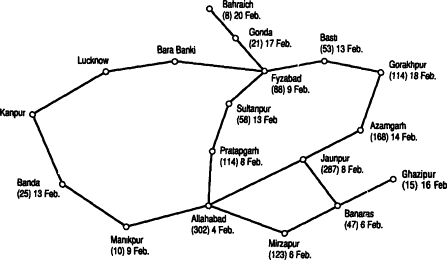
Fig. 16
Cholera deaths among pilgrims dispersing from Allahabad Kumbh Mela February 1894.
Numbers after town names indicate fatalities; the date is of the first reported cholera death.
Source: Annual Report of the Sanitary Commissioner of the North-Western Provinces and
Oudh, 1894:30.
bad in 1894 and 1906 were seen as clear examples of the epidemic hazards of these periodic mass gatherings (Pollitzer 1959:882–85; Banerjea 1951; 28–31). As figure 17 indicates, cholera mortality in Banaras district reflected the incidence of these fairs, though it should be borne in mind that in some cases the correlation was fortuitous and the melas were not directly responsible.
As Banaras came to be recognized as a major turnpike along the "northern epidemic highway" special measures were introduced to prevent pilgrims from introducing cholera into eastern U.P. From 1927, health officials were posted at Mughal Serai (as well as at Ballia and Gorakhpur) to intercept and detain pilgrims suspected of suffering from cholera and other serious diseases. In this way fifty-seven cholera cases were detected in 1929 and sixty-one in 1930, the year of the Allahabad Kumbh Mela (ARDPH 1929:12; ARDPH 1930:21A).
Examples could be multiplied, but I hope that enough evidence has been given to suggest some of the ways in which the city of Banaras was subject to wider patterns of human mobility and mortality, or seasonal and cyclical change, and of epidemiological incidence and variation. In these respects one is struck not by the uniqueness of Banaras or by the significance of a rural-urban divide, but by the extent to which the city reflected or accentuated the characteristics of the regional society and the environment as a whole.
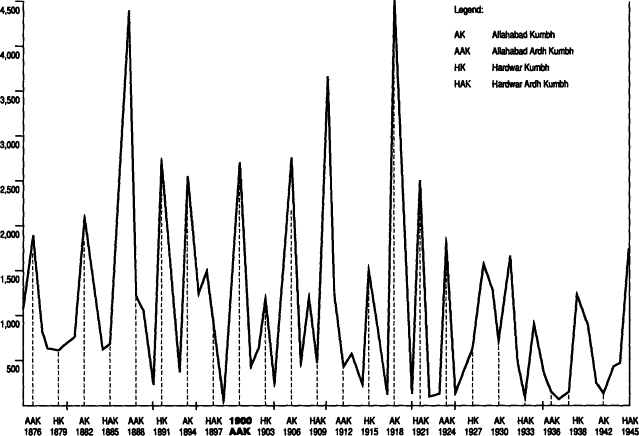
Fig. 17
Cholera mortality in Banaras district, 1875–1945. Source: Annual Reports of the Sanitary Commissioner and Director of Public
Health, 1875–1945.