
Five
Migration in the Later Years of Life in Traditional Europe
Andrejs Plakans and Charles Wetherell
The spatial mobility of persons in the later years of life in traditional Europe remains virtually unexplored. Although the subject should be part of research on migration and old age, the current agendas in both fields do not lend themselves to merging for several reasons. For one, historians of migration and old age focus primarily on demographically and economically "modern," "modernizing," "industrial," or "industrializing" societies, a tendency attributable to the prominence of modernization theory in early debates on aging as well as to the indisputably profound level of migration in the Western world during the last three centuries (Moch 1992). Thus historians have ignored the migration of the elderly in the distant past, where discussions of "traditional Europe" should properly be lodged, in part because they perceive the action to have been in the recent past.
For another, in mapping the demographic landscape of both traditional and modern Europe, demographers have devoted more attention to mortality and fertility than to migration generally and far more to the movements of those who were actively involved in productive labor and the search for it than of those who were withdrawing from it or had completed the process altogether (Knodel 1988; Smith 1981; Wall 1984). We also know more about the western and central parts of Europe than about southern and eastern areas, although recent changes in archival access in eastern Europe promise to rectify some of the geographic imbalance. Moreover, demographers of modern Europe have focused on older segments of populations because these became proportionately larger after the demographic transition and now generate immense concern as the population of the Western world "ages" in the twentieth century.
Although historians have found the analytical imperatives of modernization theory and the demographic realities of the modern world less corn-
pelling in recent years (Hareven 1976; Jackson and Moch 1989; Moch 1983, 1992), simply shifting attention from the recent to the distant past cannot instantly fill the void in our historical understanding of migration among the elderly in traditional European societies. A disaffection with the explanatory power of structural differences between the traditional and modern worlds (as yet temporally undefined in any meaningful way) and a preference for attitudinal change that characterizes much current research handicap historians of inarticulate, traditional European populations. Yet major structural differences, such as those embodied in the institution of serfdom, do separate the distant and more recent European past. Whether they are important to the history of the mobility of the elderly remains to be seen. At the very least, the meager knowledge historians possess about the old in traditional Europe, particularly the migrating old, suggests the need to avoid simplistic or anachronistic conceptualizations. Moch's (1992) recent survey of migration in western Europe since 1650 goes a long way to correct earlier notions, but historians of the elderly still face a formidable task.
Historians dealing with the migration of older Europeans in the twentieth century, for example, draw heavily on labor economics and view movement among the elderly principally as retirement migration (Cribier 1974, 1982; Law and Warnes 1982). While a useful perspective for societies in which age grading is prominent, the notion seems decidedly unhelpful for traditional Europe, where withdrawal from the world of work was piecemeal and the elderly worked until infirmity or death (Plakans 1989). Any sharp contrast between the independence of the traditional and modern European aged may also need to be rethought, as has proved to be the case for the United States (Achenbaum 1978; Fischer 1977; Gratton 1986). In a study of retirement migration in contemporary France, Françoise Cribier (1974: 361) argued that "the proportion of the elderly in the population of a region, which used to be a function only of the birth rate and the exodus or in-migration of young people, today depends also on the actual behavior of the elderly" (emphasis added). Cribier never says why the elderly in societies that used to be did not exercise as much choice, but her premise seems to be that decision-making talent marked only the better-endowed modern old.
Finally, the notion of migration itself poses analytical difficulties for any analysis of the traditional past. Geographers and demographers routinely distinguish between migration and mobility . Conceptually, they base that distinction on the distance people move and on the social impact of that movement. Changing residence constitutes mobility if work, for example, remains close enough not to disrupt other social activities; it constitutes migration if work is not close enough to avoid disruption. Practically, however, the distinction often translates into movement across adminis-
trative boundaries, which can pose enormous strategic problems for historians forced to deal with records from separate secular or ecclesiastical divisions.
Beyond the seemingly simple yet often intractable distinction between migration and mobility, researchers also commonly differentiate among types of movement. In addition to local migration in which the distance moved is generally short and the accompanying level of social dislocation is low, Charles Tilly (1978: 51-57; see also Moch 1992: 16-17) distinguished among circular (distance unimportant, but return involved), chain (persisters following movers), and career (long-distance, no return) migration. Despite their considerable heuristic value, the underlying context of each type of migration is economic (specifically, labor markets) and so primarily useful for evaluating migration in the recent past. David I. Kertzer and Dennis P. Hogan's (1989) and Leslie Page Moch's (1992) studies of the nature and context of local, regional, and continental patterns of migration in western and southern Europe have greatly advanced our understanding of the phenomenon by showing how larger, often state induced, changes in the "fundamental structures of European economic life: landholding, employment, demographic patterns, and the development of capital" (Moch 1992: 6) affected migration. Yet if movement was always a central feature of European life, what Tilly and others term "local flows" (Tilly 1978: 63) remain the least investigated—and perhaps most common—in traditional European societies where the spatial worlds of work and community life were constrained by law and habit.
The major obstacle to a sharper image of migration in the traditional European past lies, of course, in the nature and extent of available historical sources. Few communities exist with records as extensive as Casalecchio in Italy (Hogan and Kertzer 1985; Kertzer and Hogan 1985, 1989, 1990), and therefore analysis almost always has to be data rather than problem driven. As existing studies of the more distant past make abundantly clear, refining the question to ask who moved at certain ages compounds the difficulties because of the nearly complete absence of age-specific migration information in standard historical sources such as parish registers and census enumerations. And if we pose the question in an even more specialized form to deal only with people in the later years of life, comparative opportunities narrow even further. We find, for example, that R. S. Schofield's analysis (1987) of the unique population listing for Cardington parish in eighteenth-century England deals only with the mobility of persons to about age 30 because the list permits no more; that Peter Clark's (1987) study of migration in England in the late seventeenth and early eighteenth century groups the elderly with everyone over 40; and that Jan Lucassen's study (1987) of European migrant labor in the period 1600-1900 contains no age-specific in-
formation. If the elderly appear at all in work on historical migration, it is most often as an afterthought.
A Case Study: Pinkenhof, 1833-1850
Our dissatisfaction with existing work stems from our continuing investigation of an eastern European serf estate, Pinkenhof, in the Russian Baltic province of Livland, now Latvia, between 1790 and 1850 (Plakans and Wetherell 1988a , 1988b , 1988c , 1990, 1992). Until 1819, the peasants of Pinkenhof were serfs, and their movements across estate boundaries were severely restricted. The Peasant Emancipation Law of 1819 (Schwabe 1928; Tobien 1899) introduced personal freedom and expanded the right of movement, both of which the Livlandic nobility viewed as necessary prerequisites to a free labor market. Yet the new law did not permit absolute freedom of movement (that right was introduced gradually to different segments of the peasant population) and formally deprived the peasantry of even those usufruct rights to land they had enjoyed under the old estate regime of serfdom. In principle, peasants were free to sell their labor to the highest bidder. In reality, now landless, peasants did not move away but continued to occupy their old farmsteads in exchange for money rents. Although the population possessed both traditional and modern demographic attributes that indicate it was moving swiftly into the demographic transition (Plakans and Wetherell 1988a ), the decades immediately following emancipation in Pinkenhof were ones of gradual adjustment and not rapid change.
The Russian Imperial head tax censuses, or "revisions of souls," for Pinkenhof, which provide detailed enumerations of the human groupings at the farmstead level from 1782 onward, reveal no massive in- or out-migration in either the pre- or the postemancipation periods, although both kinds of movement existed to varying degrees. The 1850 revision, however, was more than a simple nominal listing of 1,569 residents living on 123 farmsteads, the main estate farm, or Hof , and several smaller, functionally specialized places; it indicated where each of the 1850 residents had lived in 1833. Moreover, if an 1833 inhabitant had left the estate before 1850, his or her departure was noted, together with a date and a destination; if he or she had arrived since 1833, that was noted also, together with the place of origin although not always with the year of arrival. The 1850 revision, therefore, allows us to explore external migration and, to a lesser extent, internal mobility.
As in most Baltic landed estates, everyday rural life in Pinkenhof transpired on spatially separated farmsteads, not nucleated villages. Each of the 123 fixed residential farms in 1850 bore a name that recurs in estate documents as far back as the latter part of the seventeenth century. New entrants
TABLE 5.1 | ||||
Age Cohort | Midperiod Population | Number of Migrants | External Migration Rate (CMRe ) | |
0-14 | 490 | 7 | 0.8 | |
15-19 | 162 | 17 | 5.8 | |
20-24 | 140 | 50 | 19.8 | |
25-29 | 145 | 84 | 32.2 | |
30-34 | 129 | 21 | 9.0 | |
35-39 | 104 | 7 | 3.7 | |
40-44 | 85 | 3 | 2.0 | |
45-49 | 63 | 2 | 1.8 | |
50-54 | 61 | 1 | 0.9 | |
55+ | 93 | 2 | 1.2 | |
Total | 1,472 | 194 | 7.3 | |
SOURCE: The Ninth Imperial Revision for Livland, Central National Historical Archive, Riga, Latvia (Baltic Microfilms, D112, Oekonomie Expedition d. Stadtkassakollegiums IV E. 4, Revisionsliste Gut Pinkenhof, J. G. Herder Institut, Marburg a.d. Lahn, Germany). | ||||
into the estate, therefore, augmented the labor force of particular farmsteads, and those who left diminished it. Correspondingly, internal mobility, including that of the elderly, took place between farmsteads, rather than between farmsteads and institutions reserved for the aging, or between a farm's main residential quarters and outbuildings set apart for the aged as was frequently the practice in central Europe (Mitterauer and Sieder 1977: 162-163). The main building of a farmstead was therefore the residential site of all members, including the aging and aged; and judging by the architecture of these buildings, the living space within could be readily adjusted to accommodate any increase or decrease in residents (Kundzins 1974; Veveris and Kuplais n.d.). As such, housing the marginally productive elderly—if indeed the elderly can be thought of in this way at all—was not a serious problem, and we have to seek the reasons for their movement elsewhere.
But Pinkenhofers did move. Between 1833 and 1850, 192 men and women left and entered Pinkenhof, for a net migration rate of -17.7. For females, the rate was 4.1 and for males, -21.7, a discrepancy attributable to a high level of conscription among males (Plakans and Wetherell 1988a ). Table 5.1 displays age-specific migration rates for both males and females; figure 5.1 gives a stylized age profile.
Overall, the crude external migration rate, CMPe , was 7.3, but the incidence of migration was greatest for those in their 20s (30.3) who were moving in and out of the estate to marry.[1] At the same time, the neighboring estate of Bebberbeck and others in the adjoining province of Kurland, which
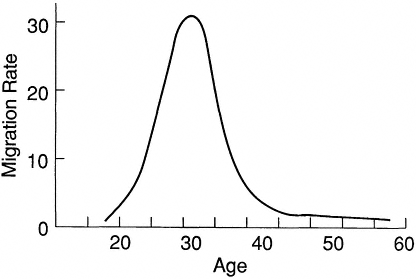
Fig. 5.1.
Stylized age profile of external migrants, Pinkenhof, 1833-1850.
Data from the Ninth Imperial Revision for Livland, Central
National Historical Archive, Riga, Latvia (Baltic Microfilms,
D112, Oekonomie Expedition d. Stadtkassakollegiums IV E. 4,
Revisionsliste Gut Pinkenhof, J. G. Herder Institut, Marburg
a.d. Lahn, Germany).
were the sources of half (44 of 84) of all immigrants and half (38 of 74) of all emigrants (excluding 36 conscripted males), were so geographically close to Pinkenhof that any hard and fast distinction between migration and mobility may blur the historical reality. Nonetheless, the record indicates that external migration, defined as movement across the estate's boundaries, was limited almost exclusively to young adults; for those over 40, it was virtually nonexistent.
Internal mobility is more difficult to evaluate for two reasons. First, the revision only documents the presence of a person in one farmstead in 1833 and in another in 1850; it does not record any intervening moves that might have occurred between those two years. Second, the source does not allow us to say at what ages internal migrants moved. All we know are the ages of 459 people who were at least 18 years old in 1850 and who had changed their farmsteads of residence at least once between 1833 and 1850. At the same time, it seems safe to conclude that movement within the estate —mobility —was much greater than movement across estate boundaries —migration . For one thing, the ratio of recorded internal to external moves was more than 2:1. For another, the record keepers were especially careful to document movement into and out of the estate. Indeed, 2 of the 192 migrants both entered and left Pinkenhof between 1833 and 1850. Finally, we also know that
TABLE 5.2 | |||||
Age Cohort | 1850 Population | Number of Migrants | Internal Migration Rate (CMR1 ) | Percentage of Population Mobile | |
18-19 | 76 | 30 | 21.9 | 35.9 | |
20-24 | 139 | 79 | 31.6 | 56.8 | |
25-29 | 136 | 75 | 30.6 | 55.1 | |
30-34 | 125 | 72 | 32.0 | 57.6 | |
45-39 | 106 | 53 | 27.8 | 50.0 | |
40-44 | 104 | 43 | 23.0 | 41.3 | |
45-49 | 85 | 39 | 25.5 | 45.9 | |
50-54 | 72 | 31 | 23.9 | 43.1 | |
55+ | 126 | 37 | 16.3 | 29.4 | |
Total | 969 | 459 | 26.3 | 47.4 | |
SOURCE: The Ninth Imperial Revision for Livland, Central National Historical Archive, Riga, Latvia (Baltic Microfilms, D112, Oekonomie Expedition d. Stadtkassakollegiums IV E. 4, Revisionsliste Gut Pinkenhof, J. G. Herder Institut, Marburg a.d. Lahn, Germany). | |||||
the labor force in Pinkenhof was far from stationary and that adult farmhands and their children, who accounted for 43 percent of the population in 1850, traditionally moved about the estate on a regular basis (Plakans and Wetherell 1988b , 1992; Svarane 1971). Accordingly, we take the incidence of external migration in the 1850 revision to be a good reflection of the historical reality and the corresponding level of internal mobility as an absolute minimum.
Table 5.2 displays hypothetical age-specific internal migration rates for those 18 years of age and older in 1850 and figure 5.2, a stylized age profile. The age-specific rates are hypothetical and cannot be taken at face value because they reflect only movement sometime between 1833 and 1850 and do not represent standardized rates of mobility for persons in each age cohort. Only if the 63 peasants who were between 45 and 49 years old in 1850, for example, had actually moved while they were 45 to 49 would the reported age-specific rate be valid. Yet a crude internal migration rate, CMR1 , of 26.3 suggests that spatial mobility was a common experience in Pinkenhof. Indeed, table 5.2 also reveals that nearly half (47.4 percent) of the 1850 population at risk had moved at least once within the estate since 1833. We also know that internal migrants did not move very far, on the average only 2.5 kilometers. Thus local flows, although common, were short (Plakans and Wetherell 1988a ; Wetherell, Plakans, and Wellman 1994).
The views of external and internal movement that the 1850 revision provides suggest two scenarios that define the probable extremes of the migratory experience of the elderly in Pinkenhof. Both, however, indicate low levels of movement. On the one hand, if the age profile of internal migrants
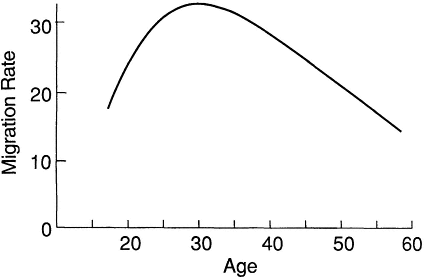
Fig. 5.2.
Stylized age profile of internal migrants, Pinkenhof, 1833-1850.
Data from the Ninth Imperial Revision for Livland, Central
National Historical Archive, Riga, Latvia (Baltic Microfilms,
D112, Oekonomie Expedition d. Stadtkassakollegiums IV E. 4,
Revisionsliste Gut Pinkenhof, J. G. Herder Institut, Marburg a.d.
Lahn, Germany).
that table 5.2 reveals is grossly wrong and the real pattern of internal mobility actually resembles that of external migration presented in table 5.1, then the spatial mobility of the elderly (those 55 and over) was extremely limited. Although many may have moved during their lives (and a CMR1 > 25 attests to this), those moves would have taken place twenty to thirty years before they reached old age.[2] So in one scenario, the elderly rarely, if ever, moved. On the other hand, if a substantial minority of Pinkenhofers moved regularly from farm to farm in the course of their lives as nonquantitative research on these peasants maintains (Strods 1972; Svarane 1971), then the pattern of mobility that table 5.2 presents may well reflect the collective migratory experience of this particular peasant community. In this scenario, the elderly moved (CMR1 << 20) but still not as often as young adults (CMRi > 30).
Despite the weaknesses in the record, several things seem clear about mobility and migration in Pinkenhof in the decades immediately following emancipation:
1. Most spatial movement consisted of local, short-distance moves within the estate or to neighboring estates.
2. Internal mobility was common. Perhaps half of all peasants changed their residence at least once in their adult years.
3. External migration was confined to young adults who moved largely to and from neighboring estates in order to marry.
4. Movement of those over 30 was virtually always within the estate.
5. The elderly either (a ) moved frequently within the estate but less often than those in their 20s, 30s, and 40s or (b ) moved very infrequently, if at all, after reaching their 30s.
6. By virtue of their number, internal migrants, far more than external migrants, created the need for any social and psychological adjustments that may have accompanied movement.
In light of these findings, it is unsurprising that mid-nineteenth-century social commentary has little to say on the subject of migration among those in the later years of life.
Pinkenhof Patterns in Comparative Perspective
Placing the migratory experience of the Pinkenhof elderly in comparative perspective poses two basic problems: one involves evidence, the other actual behavior. A logical case could be made against finding much usable information of any kind about the old in the historical sources common to traditional European societies.[3] When they did so at all, record keepers enumerated populations for specific purposes, such as assessment of taxes and labor obligations, and had little incentive to make a careful record of those persons who had withdrawn from roles that entailed such involvements. Although we have no evidence of such carelessness in Pinkenhof, age heaping of the elderly is a well-documented attribute of historical European sources.[4] Moreover, we can easily imagine that, by virtue of a growing dependency on the young, older people were increasingly less likely to cross boundaries of administrative units such as parishes, departments, estates, or provinces. Thus the likelihood of the elderly showing up in those few sources that were primarily concerned with boundary crossers diminishes even further.
At the same time, the record of external migration in Pinkenhof between 1833 and 1850 suggests a fundamental immobility among those over 55 that is not without modern parallels. In 1968 in France, for example, 86.5 percent of persons 55 and older still resided in the same commune as they had in 1962 (Cribier 1974: 362). The 13.5 percent who had moved to another commune during that period, moreover, represented a 35 percent increase over the years from 1956 to 1962. Although external migration (55+ CMRe = 144.7) among the elderly in contemporary France was much greater than in Pinkenhof (55+ CMRe = 1.2), it still suggests a basic propensity among those in the later years of life not to migrate. If less than one-fifth of the elderly in a population with access to modern transportation, communica-
tion, and information systems chose to migrate, it seems likely that in traditional societies without such systems, where mental maps extended only to the edges of landed estates, older people chose to stay close to or at the sites of their past productive labor or to the residences of their family and kin. They may still have moved, but their movements could be measured only with household-level sources that serially enumerated (at a minimum by name, age, sex, and residence) the same local population. Accordingly, the "inattention" to the elderly that Gerald N. Grob (1986: 33) argues has characterized historical migration research may in fact be a matter of definition. By focusing exclusively on migration across administrative boundaries, historians may have overlooked that domain in which most elderly in the traditional European past moved, if they moved at all. In Pinkenhof at least, mobility was limited almost entirely to the bounded community. The elderly may have been mobile , but they did not migrate .
Studies of larger patterns of migration in the twentieth-century Western world provide another point of comparison that suggests a fundamental structural difference between the recent and the distant European past. Figure 5.3A presents a stylized, three-part migration schedule for post-World War II Europe and the United States (Rogers and Castro 1986). The underlying model predicts that the rate of migration will start high but decrease rapidly in the first fifteen years of life as children (the prelabor force) move with young adult parents (the labor force). Migration will then increase sharply to its maximum levels among young adults in their 20s, peak at about age 30, and decline quickly thereafter. Rates will continue to drop until just after retirement and then will show a slight, short-lived upward turn corresponding to retirement migration (the postlabor force). Moreover, figure 5.3B reveals not only that the basic migration schedule applies to both migration and mobility but also that the incidence of local moves exceeds that of long-distance moves. In the modern world, then, (1) the level of local, intracommunity mobility is higher than the corresponding level of external, intercommunity migration, and (2) the age profile of both kinds of movers is the same. Both points allow us to place migration among the elderly in Pinkenhof in a long-term context.
First, the record of residential movement in both the modern and the traditional European past indicates that mobility invariably exceeded migration. Second, the age profile of external migration in Pinkenhof (fig. 5.2) resembles the modern European schedule (fig. 5.3A). Although Pinkenhof's external migration did not possess a prelabor force component of children, the nature of the peasant marriage market, in which brides and grooms moved at the time of marriage, would logically work to minimize the number of children involved. Consequently, we might speculate that in traditional peasant societies when young adults migrated across community boundaries, they did so without spouses or children. Third, the similar age
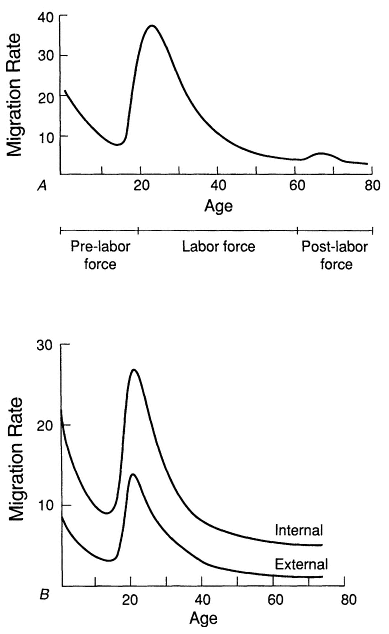
Fig. 5.3.
Stylized migration schedules: A, generalized; B, external
and internal. Adapted from Rogers and Castro 1986,
pp. 172 and 162, respectively.
profiles of both the modern mobile and the modern migrant suggest that we have to choose between two basic interpretations of the incomplete record of internal mobility in Pinkenhof. In essence, the question is whether the migration schedule in figure 5.3A reflects the historical reality of mobility in Pinkenhof or whether the hypothetical migration schedule in figure 5.2 is a better guess. Clearly the evidence at hand does not allow us to say with any certainty. A look at the motives behind both modern and traditional European moves provides help.
The 31 percent of the population over 55 in Pinkenhof in 1850 who had moved at least once since 1833 no doubt had good reason for doing so, although their motives remain hidden from us. At the same time, we have no reason to believe that decision making by the old—and by those family members and friends whose actions would affect the old—was significantly less patterned than in contemporary populations. Cribier found that no single reason predominated among the economic, familial, and personal factors that elderly couples considered before deciding to leave Paris in the early 1970s.
The nine most commonly stated reasons given by either partner for leaving Paris were (1) nothing to do in Paris after retirement . . .; (2) Paris had become unbearable . . .; (3) Paris is unhealthy . . .; (4) did not want to go on living in a flat . . .; (5) wanted a change of climate . . .; (6) wanted to go back home . . .; (7) for family reasons other than reason 6 . . .; (8) cost of living too high in Paris . . .; (9) eviction. (Cribier 1982: 117)
Although impossible to weigh with much precision, Cribier's respondents seemed to be concerned with family, health, housing, and leisure time. Yet they lived in a period of European history when retirement from remunerative employment had become a well-marked life course transition. They also lived in a modern, industrial society where the choices available to them were more numerous than in the traditional European past. Indeed, Imhof (1981) has argued that all life patterns involving the elderly changed entirely with the arrival of the contemporary world.
The older inhabitants of Pinkenhof, more than a century earlier, may well have shared the same concerns of housing, health, and family that Cribier's respondents voiced, but they certainly had fewer options. Their reasons for moving at all probably involved a mixture of both push and pull factors. Existing studies of estate policy toward peasant farmsteads suggest that push may have dominated. If an energetic estate owner added a particular farmstead's land to the demesne, the peasant holding would be broken up (spridzinasana , lit. "blowing up the farmstead") and its residents relocated. The elderly in these instances would most likely become farmhands elsewhere in the estate. Alternately, elderly persons might move to another peasant farmstead, which would receive some remuneration for serving as
a kind of private retirement home, or to the Hof . Similar social welfare functions are well documented for other traditional European communities and certainly existed in Pinkenhof in both the pre- and postemancipation periods. On the basis of our evidence, we cannot say who actually decided that the elderly would move. Assuming a general proclivity among the elderly not to move, however, would suggest that other, younger people probably initiated discussions that led to any movement. Yet hovering over most peasant decisions, particularly those affecting the operation of the estate's farmsteads, was the estate owner, whose own concerns were not likely to have been much influenced by discomfort and anguish among elderly peasants.
What we know about eastern European peasant estates in general and Pinkenhof in particular also suggests that the different life experiences of farmstead heads and their families, on the one hand, and of farmhands, on the other, affected the mobility of the elderly. Of the 817 adults over age 20 in Pinkenhof who lived on the 119 farmsteads with identifiable heads in 1850, half (416) were heads themselves or co-resident kin. Of this privileged group, nearly two-thirds (268) resided on the same farmstead they had in 1833. Conversely, of those 401 adults who were not related to the head of the farmstead on which they lived in 1850, three-fourths (304) had moved at least once since 1833. Among the 121 peasants over age 55 in 1850 on these 119 farmsteads, two-thirds (86) had not moved since 1833. And for those 76 elderly peasants who were fortunate enough to be related to the head of one of Pinkenhof's farmsteads in 1850, 8 of 10 had not moved in the previous eighteen years. If elderly Pinkenhofers valued residential stability, and the emotional and physical support it undoubtedly brought, a kinship tie with a farmstead head clearly helped them achieve the goal (Plakans and Wetherell 1992; Wetherell, Plakans, and Wellman 1994).
For the half of the population who were farmhands, the pressure to move was far more pronounced and regular, for they faced an annual search for new employment. If a farmstead head decided his current farmhands were a drain on resources or were poor workers, he could always let them go and bargain with others to take their places (Plakans and Wetherell 1988b , 1992). In these situations, any change of residence by the elderly would have been involuntary if they were being dismissed and voluntary if they were being recruited from another farmstead. In either event, the elderly would move. Family-linked moves by the elderly could also be the result of married sons improving their lot by assuming headships on better farmsteads. Whether farmhands moved every year or every five or ten years, we can well imagine a cycle of movement that created enough turnover to give rise to the traditional folk view that the population of peasant estates was constantly churning.
The experiences of Pinkenhof's peasants, particularly those of farmhands and their families, suggest that the age profile of internal mobility in traditional eastern European peasant communities was fundamentally different
from what it is in the modern world. Enough movement can be either documented or inferred to support the contention that the hypothetical internal migration schedule in figure 5.2 better captures the historical reality in Pinkenhof than the modern schedule in figure 5.3A. Although adults in their 20s and early 30s still moved more frequently than those in their late 30s and 40s, the incidence of mobility among middle-aged peasants was probably greater in the distant past than in the recent past. At the same time, mobility among the elderly was arguably less pronounced in traditional European societies for both structural and attitudinal reasons.
We cannot say with certainty why elderly Pinkenhofers moved, if they did at all, and their reasons may have been more numerous than we have inferred. Certainly Cribier's and other studies of contemporary populations suggest as much. Stanley H. Brandes, for example, found that in the twentieth-century Spanish village of Becedas, "as long as both elderly parents are still alive, it is considered heartless to break the continuity of their lives by asking them to leave their home. After one parent dies, however, the disintegrated nuclear unit no longer justifies the maintenance of a separate household, and the widowed individual must accommodate himself to the homes of his or her children" (1975: 110). Social customs of this kind, easily discovered by questioning living populations but impossible to glean from most traditional European historical sources, warn against oversimplifying behavior in the distant past.
It is no oversimplification, however, to note that more than two-thirds of peasants 55 and older in 1850 had not moved in the preceding eighteen years. Staying in place among the old was consistent with two general structural features of peasant communities: first, neither men nor women ever completely withdrew from farmstead labor (Plakans 1989); second, peasants had probably moved several times before the), reached old age. Describing Russian peasant villages at the end of the nineteenth century, Adele Lindenmeyr (1982: 232-234) observed that old men and old women "performed essential tasks even if they could no longer work in the fields: fetching water, chopping wood, preparing food, cultivating kitchen gardens, rocking cradles, and minding children, chickens and geese." Similarly in Pinkenhof, the elderly would not have remained taskless in view of the dozens of light but important chores farmstead life entailed; and performing them maintained a link with the world of work that was rarely, if ever, severed. Because elderly Pinkenhofers were not strangers to movement, we do not have to idealize their lives to conclude that a fixed abode, more than likely with married children in the vicinity, if not on the same farmstead, was a desirable goal.
Residential stability—retirement immobility—was well within the realm of ways European peasants dealt with the elderly and something the elderly could realistically expect as a form of support. Peter Laslett's (1988) survey
of this diversity—cast as an exploration of the different ways family and community acted as a support system for those who required it—need not be repeated here, but one of his observations helps to place the Pinkenhof experience in space and time.
Old people were sustained by a whole range of expedients in which family and collectivity collaborated within the customary framework as the situation required. An important reason for this was that there was no standard situation in which the necessity of support arose, but a whole array of differing situations, differing from time to time, circumstance to circumstance, individual to individual. (Laslett 1988: 168)[5]
Pinkenhofers formed families and lived in them. Yet those families, by virtue of the traditional residential system that prevailed in the Baltic, were situated on farmsteads that often contained two or more conjugal family units with children and other relatives. Pinkenhof's "family system" could not possibly have allowed peasants to realize all their values independently, for they always had to reckon with the economic imperatives of the "farmstead system." The latter tended to feel the managerial hand of the estate owner (in the case of Pinkenhof, the city of Riga), and therefore we find it impossible to believe that mobility of the elderly was in any sense a pure expression of the values that drove either the family system, the estate owner, or the elderly themselves. Indeed, the world of Pinkenhof's peasants was less one of "perennial households" (Laslett 1988: 158ff., after Czap 1982) than one of "perennial farmsteads," which, together with the families in them, were the two "collectivities" that cooperated to provide sustenance and support to the elderly and reduce both their migration and their mobility.
Until we know more about the rural populations of eastern Europe after emancipation, we hesitate to generalize from Pinkenhof to any other part of the traditional European east, let alone all of Europe in the distant past. We would contend, however, that the record of migration and mobility in Pinkenhof provides an initial point of reference, certainly for the Baltic area and possibly for much of the European east. Indeed, movement in nineteenth-century Pinkenhof arguably reflects long-standing behavior because the structural constraints of law and imperatives of the farmstead-based agricultural regime operated well past emancipation. Pinkenhof's population was subject to restrictions typical of postemancipation eastern European societies. Peasants were no longer serfs, but, notwithstanding the free labor market philosophy behind emancipation, they were not absolutely free to move either.
The great increase of rural-to-urban and rural-to-rural migration in the Baltic did not begin until the 1870s, when it increased the region's cities and towns at an unprecedented pace (Anderson 1980; Leasure and
Lewis 1968; Winner and Winner 1984). How the elderly participated in that migration transition remains to be seen, but in the decades immediately following emancipation, elderly peasants in the main stayed put. Permanence of place was the hallmark of the traditional elderly that distinguished them from their modern twentieth-century counterparts. The phenomenon of retirement migration did not appear in all European societies with the advent of the modern world, but where it did, it clearly announced the arrival of a new feature in the history of the elderly. In Pinkenhof as in most traditional European communities, there was no retirement migration because retirement in the modern sense simply did not occur.
References
Achenbaum, Andrew W. 1978. Old age in the new land: The American experience since 1970 . Baltimore: Johns Hopkins University Press.
Anderson, Barbara A. 1980. Internal migration during modernization in late nineteenth-century Russia Princeton: Princeton University Press.
Brandes, Stanley H. 1975. Migration, kinship, and community: Tradition and transition in a Spanish village . New York: Academic Press.
Clark, Peter. 1987. "Migration in England during the late seventeenth and early nineteenth centuries." In Migration and society in early modern England , ed. Peter Clark and David Souden, 213-252. London: Hutchinson.
Cribier, Françoise. 1974. "Retirement migration in France." In People on the move: Studies on internal migration , ed. Leszek A. Kosinski and R. Mansell Prothero, 361-373. London: Methuen.
———. 1982. "Aspects of retirement migration from Paris: An essay in social and cultural geography." In Geographic perspectives on the elderly , ed. A.M. Warnes, 111-137. London: John Wiley and Sons.
Czap, Peter. 1982. "The perennial multiple family household, Mishino, Russia, 1782-1858." Journal of Family History 7: 5-26.
Fischer, David Hackett. 1977. Growing old in America . New York: Oxford University Press.
Gratton, Brian. 1986. "The new history of the aged: A critique." In Old age in a bureaucratic society , ed. David Van Tassel and Peter Stearns, 1-29. New York: Greenwood Press
Grob, Gerald N. 1986. "Explaining old age history: The need for empiricism." In Old age in a bureaucratic society , ed. David Van Tassel and Peter Stearns, 30-45. New York: Greenwood Press.
Hareven, Tamara. 1976. "Modernization and family history: Perspectives on social change." Signs 2: 190-206.
Hogan, Dennis P., and David I. Kertzer. 1985. "Migratory patterns during Italian urbanization, 1865-1921." Demography 22: 309-325.
Imhof, Arthur E. 1981. Die gewonnenen Jahre [The gained years]. München: C. H. Beck.
Jackson, James H., Jr., and Leslie Page Moch. 1989. "Migration and the social history of modern Europe." Historical Methods 22: 27-36.
Kahk, Juhan. 1982. Peasant and lord in the process of transition from feudalism to capitalism in the Baltics . Tallinn: Eesti Raamat Publishers.
Kertzer, David I., and Dennis P. Hogan. 1985. "On the move: Migration in an Italian community, 1865-1921." Social Science History 9: 1-23.
———. 1989. Family, political economy, and demographic change: The transformation of life in Casalecchio, Italy, 1816-1921 . Madison: University of Wisconsin Press.
———. 1990. "Household organization and migration in nineteenth-century Italy." Social Science History 14: 483-505.
Knodel, John E. 1988. Demographic behavior in the past: A study of fourteen German village populations in the eighteenth and nineteenth centuries . Cambridge: Cambridge University Press.
Kundzins, Pauls. 1974. Latvju seta [The Latvian farmstead]. Stockholm: Daugava.
Laslett, Peter. 1988. "Family, kinship and collectivity as systems of support in pre-industrial Europe: A consideration of the 'nuclear-hardship' hypothesis." Continuity and Change 3: 153-175.
Law, Christopher, and Anthony M. Warnes. 1982. "The destination decision in retirement migration." In Geographic perspectives on the elderly , ed. A. M. Warnes, 53-81. London: John Wiley and Sons.
Leasure, J. William, and Robert A. Lewis. 1968. "Internal migration in Russia in the late nineteenth century." Slavic Review 27: 376-394.
Lindenmeyr, Adele. 1982. "Work, charity, and the elderly in late nineteenth-century Russia." In Old age in preindustrial society , ed. Peter Stearns, 232-247. New York: Holmes and Meier.
Lucassen, Jan. 1987. Migrant labor in Europe 1600-1900: The drift to the North Sea . Trans. Donald A. Bloch. London: Croom Helm.
Mitterauer, Michael, and Reinhard Sieder. 1977. The European family: Patriarchy to partnership from the Middle Ages to the present . Trans. Karla Osterveen and Manfred Horzinger. Chicago: University of Chicago Press.
Moch, Leslie Page. 1983. Paths to the city: Regional migration in nineteenth-century France . Beverly Hills, Calif.: Sage.
———. 1992. Moving Europeans: Migration in Western Europe since 1650 . Bloomington: Indiana University Press.
Plakans, Andrejs. 1989. "Stepping down in former times: A comparative assessment of 'retirement' in traditional Europe." In Age structuring in comparative perspective , ed. David I. Kertzer and K. Warner Schaie, 175-195. Hillsdale, N.J.: Lawrence Erlbaum.
Plakans, Andrejs, and Charles Wetherell. 1988a . "The kinship domain in an East European peasant community: Pinkenhof, 1833-1850." American Historical Review 93: 359-386.
———. 1988b . "Unfree labor and family life in a Baltic serf estate, 1808-1816." Paper presented at the annual meeting of the Social Science History Association, Chicago, November 3-6.
———. 1988c . "Land and labor in a Baltic serf estate, 1809-1850." Paper presented at the annual meeting of the American Association for the Advancement of Slavic Studies, Honolulu, November 18-21.
———. 1990. "Transfer of headships in nineteenth-century eastern European serf estates." Paper presented at the annual meeting of the Social Science History Association, Minneapolis, October 18-21.
———. 1992. "Family and economy in a Baltic serf estate in the early nineteenth century." Continuity and Change 7: 199-223.
Rogers, Andrei, and Luis J. Castro. 1986. "Migration." In Migration and settlement: A multiregional comparative study , ed. Andrei Rogers and Frans J. Willekens, 157-208. Dordrecht: D. Reidel.
Schofield, R. S. 1987. "Age-specific mobility in an eighteenth-century rural English parish." In Migration and society in early modern England , ed. Peter Clark and David Souden, 253-266. London: Hutchinson.
Schwabe, A. 1928. Grundriss der Agrargeschichte Lettlands [The basic agrarian history of Latvia]. Riga: Bernhard Lamey.
Shyrock, Henry J., and Jacob S. Siegel et al. 1973. The methods and materials of demography . 2 vols. Washington, D.C.: Government Printing Office.
Smith, Daniel Scott. 1981. "Historical change in the household structure of the elderly in economically developed societies." In Aging: Stability and change in the fam-
ily , ed. Robert W. Fogel, Elaine Hatfield, Sara B. Kiesler, and Ethel Shanas, 91-114. New York: Academic Press.
Strods, Heinrihs. 1972. Lauksaimnieciba Latvija parejas perioda no feodalisma uz kapitalismu [Agriculture in Latvia in the transition period from feudalism to capitalism]. Riga: Zinatne.
Svarane, Melita. 1971. Saimnieks un kalps Kurzeme un Vidzeme XIX gadsimta vidu [Farmstead heads and farmhands in Kurland and Livland in the mid-nineteenth century]. Riga: Zinatne.
Tilly, Charles. 1978. "Migration in modern European history." In Human migration: Patterns and policies , ed. William H. McNeill and Ruth S. Adams, 48-72. Bloomington: Indiana University, Press.
Tobien, A. von. 1899. Die Agrargesetzgebung Livlands im 19 Jahrhundert [The agrarian laws of Livland in the nineteenth century]. Vol. 1. Berlin: Puttkamer and Mühlbrecht.
Veveris, Ervins, and Martins Kuplais. n.d. Latvijas Etnografiskaja brivdabas muzeja [In the Latvian ethnographic open-air museum]. Riga.
Wall, Richard. 1984. "Residential isolation of the elderly: A comparison over time." Ageing and Society 4: 483-503.
Wetherell, Charles, Andrejs Plakans, and Barry Wellman. 1994. "Social networks, kinship, and community in Eastern Europe." Journal of Interdisciplinary History 24: 639-663.
Winner, Irene P., and Thomas G. Winner, eds. 1984. The peasant and the city in Eastern Europe: Interpreting structure . Cambridge: Schenkman.