


Chapter One—
The Quest for a National Style
From the 1860s to 1917 the major cities in European Russia were substantially rebuilt. The central areas even of Moscow, which has since permitted extensive new construction in its center, and Leningrad, whose ensembles from the baroque and neoclassical periods overshadow less distinguished structures of later times, are largely the product of the five decades preceding the revolution. In the eighteenth and early nineteenth centuries, state and imperial patronage of architecture had achieved brilliant results in court palaces, buildings for the bureaucracy, and city plans that exemplified neoclassical order. As the role of private capital expanded, however, and as buildings were needed for an increasingly populous and economically complex urban setting, the Russian state and the imperial court lost their preeminence as the source of major architectural commissions. Concomitantly, critics began to condemn as alien and monotonous the great neoclassical harmony that represented the best of the imperial design of Petersburg.[1]
Although this transformation did not begin with the resign of Alexander II, his social policies of the 1860s and the era of the Great Reforms provided the underpinnings for both an enlarged, economically rational use of architectural resources and the development of professional organizations—from training institutes to architectural societies—to define and regulate the practice of architecture in a period of unprecedented growth.[2] These changes in the architectural profession did not ensure the construction of historically and aesthetically significant monuments, nor did they produce architects more proficient than their predecessors. Even the training of architects in the nineteenth century was not absolutely superior to that of the eighteenth, although advances in engineering introduced new possibilities in structural design for architects trained to make use of them.
Rather, the professionalization of architecture accompanied an increased demand for architects competent to construct various buildings (primarily in cities) for a diverse clientele in a cost-effective, reliable way that also, when necessary, met certain aesthetic expectations. In this respect Russian architects followed a path familiar to their counterparts in Britain, France, and Germany.[3] If the members of the Moscow and Petersburg architectural societies did not establish reputations as architects of genius, they nonetheless presided over profound changes that opened Russian architecture to the modern age.
These changes, however tardy in comparison with those in the more advanced countries in Europe, stimulated an increase in the number of architects, although building activity remained subject to the cyclical depressions that affected the Russian economy. Expanded opportunity, however, failed to foster the climate of excellence associated with earlier imperial architecture, in part because of a more "democratic" environment in
which the buildings commissioned were very different from those lavishly subsidized by the court. Here again, Russia reflected the broader stylistic confusion in European architecture during the nineteenth century.[4] In addition, Russian architecture continued to function amid the glaring economic and social contradictions that followed in the wake of the Great Reforms.[5]
However rapidly Russian architects assimilated new building methods after the 1860s (at least in the major cities), they applied advanced technologies and new materials on a smaller scale and less effectively in the 1870s and 1880s than did architects designing for comparable purposes in the major industrial powers.[6] Factory and commercial structure designs of the 1830s that had evolved elsewhere in Europe were re-created in Moscow and Petersburg four decades later. The transition from architecture for the court and the state bureaucracy to architecture for public and private structures built in a competitive environment demanded innovations of a system ill prepared to support them.
Although a number of Russian architects had, for example, used iron for structural purposes as early as the 1830s and 1840s, European advances in technology and structural design were generally of limited use in Russia, where local industry could not produce enough of the necessary materials. Nonetheless, Western and Central Europe continued as a model for those in Russia who recognized the need for a modern architecture.[7] Many Russian architects maintained the tradition, begun in the eighteenth century, of touring and studying abroad after formal studies in their homeland; and it is significant that one of the initiators of the Petersburg Society of Architects, Viktor Shreter, organized informal meetings of architects in 1862, after his return from three years of study at the Berlin Academy of Arts and an extensive tour of Europe.[8] Furthermore, Russian architectural schools, like those in the West, underwent reforms intended to improve the technical aspects of architectural training (cf Eugène Viollet-le-Duc's 1863 program for curricular reform at the Ecole des Beaux-Arts in Paris). The advances in architectural education at schools such as the Academy of Arts and the Institute of Civil Engineering in Petersburg and the Moscow School of Painting, Sculpture, and Architecture owed much to comparable institutions in Berlin and Paris.[9]
Whatever the limitations of tradition and technological backwardness, Russian architecture made impressive progress in meeting postreform social and economic needs, with the results still in evidence today (Fig. 1). Among the innovative structures were shopping arcades (or passages ), large enclosed markets, educational institutions, banks and other financial institutions, hospitals, public theaters, exhibit halls, hotels, and city administrative buildings (the result of a limited extension of local governmental authority in the later part of the century). The intensive construction of railway stations during the 1840s and 1850s continued in Moscow and Petersburg throughout the following decades as new lines opened and some of the early stations were demolished to make way for grander structures.
Although little work on Russian industrial architecture has been published, it is clear that the increasing needs of industry—notably, the metalworking factories—encouraged the development of engineering techniques for the construction of large interiors.[10] Similar techniques were applied to railway platform sheds. In addition to iron columns, long in use, iron and eventually steel beams and girders became essential in building large truss-supported roofs over unobstructed work space (Fig. 2). Considered more the province of engineering than of architecture, these advances, as well as the use of reinforced-concrete and skeletal-frame construction, proved aesthetically significant at the turn of the century, when the functionalism of industrial architecture began to appear in nonindustrial structures.
During the postreform decades, when the population of both Moscow and Petersburg grew rapidly, the greatest need was for housing. Petersburg, with not quite 500,000 inhabitants in 1858, increased to 667,000 in 1869, 861,000 in 1881, and 954,000 in 1890.[11] The rate of growth rose even more rapidly thereafter. Because most of the new inhabitants were peasants seeking work (many of them seasonally), the demand for solid, comfortable housing grew more slowly than the population. The lower classes of both cities lived in overcrowded and poorly designed buildings that rarely figure in histories of architecture.[12]
Nonetheless, the increase in the number and size of apartment buildings was impressive, particularly in Petersburg, which had less usable land than Moscow. According to the census of 1881, 19 percent of Petersburg's houses had one story, 42 percent two stories, 21 percent three stories, and 18 percent four stories.[13] An 1844 law prohibited any structure more than eleven sazhens (20 meters) high—the height of the Winter Palace. By the turn of the century apartment houses in
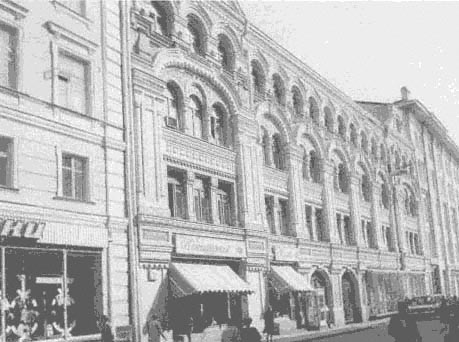
Fig. 1.
Karzinkin Building, Moscow. 1883. Ivan Bogomolov (Brumfield M133-70).
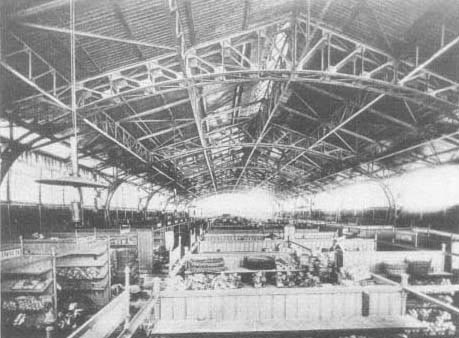
Fig. 2.
Covered market, Haymarket Square. Petersburg. 1883–1885. Ieronim Kitner, G. E. Pauker,
Otto Krel. Zodchii , 1888.
new districts of Petersburg moved toward the limits of this restriction, often in buildings of six stories, but there were no egregious violations of the standard.
Although advances in the design and construction of apartment buildings occurred in both cities, Petersburg's construction boom began earlier, in the 1860s; its disorienting effects, vividly described in Dostoevskii's Crime and Punishment , are still visible in central Leningrad. The rows of apartment blocks dating from the 1860s to the beginning of the century give an impression of stylistic chaos, mitigated by a more or less uniform building height. The facades are invariably flush against the sidewalk; an entryway leads to a small courtyard, or well, that provides light and ventilation for the less desirable interior apartments as well as entry to the various stairwells. The more prosperous the area, the more saturated with decoration the building facades.
Every major architecture style was imitated or paraphrased on the facades of commercial and housing structures in Petersburg during the late nineteenth century: neo-Renaissance, neobaroque, neo-Greek, Louis XVI, Russian Revival, and Moorish. Mixed or unrecognizable styles, however, may in fact have predominated. Most buildings were brick, covered with stucco, which could be adapted readily and cheaply to florid architectural ornamentation; but even so, only the better class of apartment building would have made any pretense to "style."
The Palace of Grand Prince Vladimir Aleksandrovich (Fig 3) represents the extreme of this penchant for stylized or eclectic design. It was constructed in 1867–1872 by Aleksandr Rezanov (appointed the first president of the Petersburg Society of Architects), along with Andrei Huhn, Ieronim Kitner, and Vladimir Shreter, all of whom were to play major roles in late nineteenth-century architecture. The exterior of the palace was rigorously formulated in the style of the early Florentine Renaissance, but the grand rooms ranged from Louis XVI to Gothic to Moorish and at least four other period styles.[14] As one observer has noted, the palace resembles the more luxurious apartment buildings along the quay where it is situated, and it was built with much the same attention to cost and materials: the rustication was stucco and many details were cast in portland cement.[15] Thus Russian imperial taste followed bourgeois taste during the final period when large palaces were still being built for the tsar's family in Petersburg.
The city's wealthiest citizens, however, themselves imitated the opulence of imperial palaces in the eclectic designs of their mansions. The Ratkov-Rozhnov house, a few steps up Palace Quay from the Palace of Vladimir Aleksandrovich, is one such imitation, though it is much smaller than the imperial dwelling (Fig. 4). The project originated in 1875 when the architect Karl Rachau was hired to rebuild the original early eighteenth-century structure on the site. But by the time construction was completed, in 1877, the building had become the property of V. A. Ratkov-Rozhnov, the mayor of Petersburg and owner of seventeen buildings in the city, many of them as eclectic as the house on Palace Quay, with its classical and baroque elements combined with "Egyptian" caryatids.[16] The major rooms of the Ratkov-Rozhnov house, like those in the Palace of Vladimir Aleksandrovich, were designed in a variety of period styles.
Because of a mania for redesigning facades in the latest style, historically significant buildings in Petersburg were defaced, prompting Dostoevskii to note sarcastically in his feuilleton Diary of a Writer for 1873: "More and more people are redoing their facades from old to new, for chic, for 'character.'"[17] In an excursus on Petersburg architecture—which he found lacking in character and susceptible to every imported fashion—he described the postreform building frenzy:
And here, at last, is the architecture of the modern, enormous hotel—efficiency, Americanism, hundreds of rooms, an enormous industrial enterprise: right away you see that we too have got railways and have suddenly discovered that we ourselves are efficient people. And now, and now . . . you really don't know how to define our current architecture. It's a sort of disorderly mess, entirely, by the way, appropriate to the disorder of the present moment. It's a multitude of extremely tall (the main thing is tall) apartment houses, extremely thin walled and cheaply built (they say), with amazing architecture on the facades: here we have Rastrelli, there the late baroque, over here the balconies and windows of some doge, always oeil de boeuf [windows], and always five stories, and all this in the same facade.[18]
The passage concludes with a half-educated property owner's demand that his architect design windows to make his cut-rate building resemble the mansion of a Venetian doge.
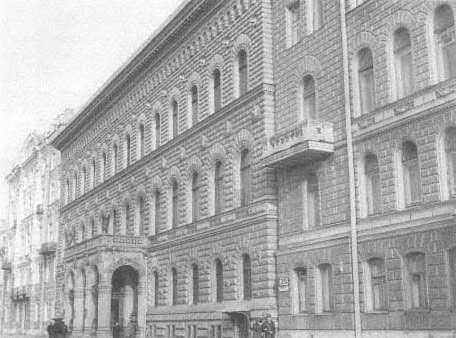
Fig. 3.
Palace of Grand Prince Vladimir Aleksandrovich, Petersburg. 1867–1872. Aleksandr
Rezanov (Brumfield L34-8).
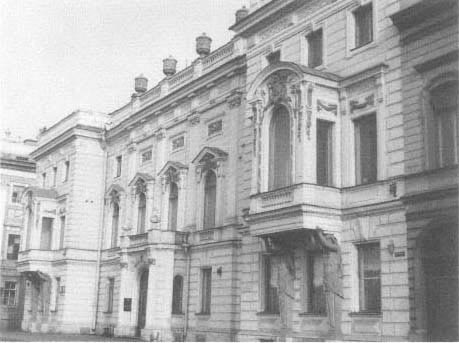
Fig. 4.
Ratkov-Rozhnov house, Palace Quay, Petersburg. 1875–1877. Karl Rachau (Brumfield
L34-11).
Dostoevskii caught the "disorder of the present moment" more acutely than any professional critic. Although the eclecticism he described had begun in Russia before the 1860s, the economic factors he alluded to played an ever greater role during the postreform expansion. To construct more buildings required more professionals who could re-create period styles—if only superficially, on a stuccoed facade. The press—both architectural and lay—noted the saturated facade decoration, initially more pronounced in Petersburg than in Moscow. Architecture increasingly became a matter of public taste and discussion.[19]
Nowhere was this discussion more faithfully recorded than in Zodchii (Architect).[20] Although this journal during the mid-1870s reveals a considerable difference of opinion about the aesthetics of the eclectic facade (again, primarily in Petersburg), it also suggests an awareness of how financial considerations determined the form of housing, which was in effect a commercial product, directed toward pleasing a "public" rather than a patron of art (the usual Russian term for "apartment house"— applied to the prerevolutionary period—translates literally as "profitable or profit-making house" [dokhodnyi dom ]). In an 1875 issue of Zodchii , the architect 1. Merts discussed the work of Petersburg's most prolific designer of eclectic apartment houses, Mikhail Makarov (1829—1873), whose extensive work during the decade preceding his death provided a standard by which the apartment house could be measured. Merts noted in particular his late colleague's success with the public:
Our public liked Makarov. He was one of the first to begin building really original, unique apartment houses that, strictly speaking, could not be related to any one architectural style; but he apparently brought a new element into the creation of houses, and everyone liked him. With his buildings he achieved an obvious superiority over those who affirmed: "We don't need facades; we need a profitable house."[21]
As in Dostoevskii's comments two years earlier, in Merts's account the crude financial speculator spoke, here denying the value of architecture altogether. But Makarov's work, much of which still exists, was no less calculated to produce financial rewards; it simply produced them more stylishly.
An architecture unrelated to any particular style (a pastiche, in other words) seemed desirable to an unidentified critic writing later that year in Zodchii : "The worship of one or another style at the expense of all other directions is harmful to the development of art, because it does not give space to the artist's creativity and usually forces him into trivial borrowing from ready-made motifs and forms." This critic used the term unique , as Merts had used it, praising the free choice of eclecticism[22] and, in effect, linking creativity to the design of commercially successful decorative styles.
But for another of Zodchii's critics in 1875, eclectic decoration had gone too far. Again, Makarov's work offered an illustration: "Everything should have reasonable limits, beyond which one must not go unpunished; for all their effectiveness and beauty, the late Makarov's facades for the most part suffer from a confusion redeemed only by the daring and originality of design provided by a talented hand."[23] The saturated facade, "without a single breathing space," had far exceeded those reasonable limits (Fig. 5); yet it remained "unpunished," apart from an ineffectual rebuke by one of Russia's most prominent cultural critics, Vladimir Stasov:
[Eclecticism] is architecture copied from old models, from books and albums, from photographs and drawings, the architecture of clever people who get smart in class and then with great indifference turn out goods by the yard and by the pound. . . . If it suits you, here are five yards of Greek "classicism"; if not, here are three and a quarter of Italian "Renaissance." Don't like that? Well then, here, if you please, is a little piece of the highest sort of "rococo Louis XV," and if that's not it, here is a nice bit of "Romanesque," six ounces of "Gothic," or a whole gross of "Russian."[24]
For Stasov the architect purveying such architecture-from-the-shelf was like an unscrupulous shopkeeper selling goods to a fickle client. Much of the architectural commentary of the period, from Dostoevskii to Stasov, implicitly questioned the extent to which professional architects had become calculating merchants, with little purpose in the design of buildings beyond pleasing their clients and the public with decorative effects (Fig. 6).
The public had become architectural arbiter to a degree unthinkable before the 1860s, when the periodical press began to enjoy both rapid growth and a measure of official tolerance. From the first, short-lived, architectural publication Arkhitekturnyi vestnik (Architectural
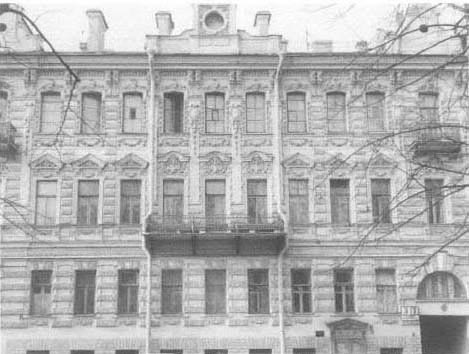
Fig. 5.
Apartment house, Konnogvardeiskii Street, Petersburg. Ca. 1870. Mikhail Makarov
(Brumfield L35-1).
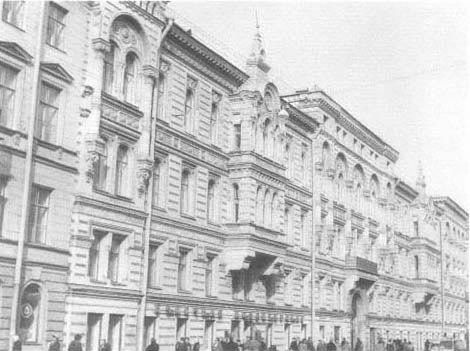
Fig. 6.
Tupikov apartment house, Petersburg. 1876–1877. Iurii Diutell (Brumfield L42-8).
messenger, 1859–1861) to the various journals for both professional and general readers at the turn of the century, public commentary on the art of building had become a substantial enterprise. Moreover, architectural critiques appeared in journals ranging from Grazhdanin (The citizen, Dostoevskii's forum in 1873) to Mir iskusstva (The world of art) and Apollon at the beginning of this century.
The role of public opinion was welcomed by some, including the critic who insisted that excess—everything beyond "reasonable limits"—be punished. In his view the public should be given even more information. Architectural drawings, for example, should be published before construction begins so that the public can discuss the merits of a building:
We are, as it were, afraid to heed the strict but fair judgment of our work or to accept good advice. Is it not understandable then that we [architects] meet everywhere with indifference when we let masons and plasterers participate in creating architectural works but present our creations to the public at a point when it can only look at them or turn away.[25]
This remarkable advocacy of public involvement in architectural planning had little effect on the design of buildings, but the critic's belief that architects need the advice of the public to decorate a facade demonstrates his lack of confidence in the architectural profession. The implicit corollary of an appeal to the public's "strict but fair" judgment was that architects themselves would educate the public taste. Nevertheless public opinion— as projected by the press—played a role not only in developing the architect's professional image but also in the consequent confusion of purpose and aesthetic direction so frequently noted by critics throughout this period.
The mood of frustration and confusion, if not selfpity, is expressed by another architect-critic, V. Kuroedov, who wrote in Zodchii in 1876 on his impressions of architecture in Berlin. The Russian architect was in a poor position vis-à-vis the German:
With us an architect is a hireling, obligated for his remuneration to fulfill someone else's will without thinking; with us, in short, architecture and its practitioners enjoy no respect, rights, or support on a par with those of other specialists; and finally, with us, anyone who has read some architectural notes—or even not read them—boldly announces himself a specialist.[26]
Kuroedov, intolerant of "strict but fair" public involvement in architecture, related the development of professional identity to a rigorous defense of professional prerogatives. His commentary is particularly interesting for its reference to "other specialists," unidentified, whose professional rights and artistic integrity were undisputed. The speculative capitalism that had fostered professionalism in architecture had also become, in the view of many, its bane.
The preceding analysis has focused on Petersburg because of the active role played by the Petersburg Society of Architects and its journal, Zodchii , in defining architects' professional responsibilities. In addition, the concentration of building activity in Petersburg placed greater demands on the profession from the 1860s to the 1880s, revealing the contradictions between the aesthetic ideals of architecture and the economic conditions in which architects worked. As Petersburg continued to grow in the twentieth century, the contradictions remained unresolved. By contrast, in Moscow the effects of architectural innovations during the postreform era were less pronounced. Although Moscow grew as rapidly as Petersburg—the population of the city proper more than doubled between the early 1860s and 1897, from approximately 400,000 to almost 980,000—and its economic growth continued during these decades,[27] the effects were less noticeable there. Because Moscow covered a greater area and had both fewer government institutions and a smaller population (Petersburg in 1881 had 861,000 inhabitants; Moscow in 1882 had 753,000), construction itself was less dense than in Petersburg.
As a result, Moscow's architects did not confront the intensely commercial demands made on those in Petersburg, who designed blocks of speculative buildings, densely constructed and saturated with facade ornamentation. To be sure, eclecticism and historicism also pervaded Moscow, but historicist designs there focused on medieval, pre-Petrine architectural monuments in the city, from the Kremlin and Red Square to the churches in every neighborhood. The ready adaptation of the idioms of medieval Muscovy to the city's architecture during the 1870s and 1880s—stimulated by the historical displays at the 1872 Polytechnic Exhibition and the 1880 All-Russian Arts and Industry Exhibition
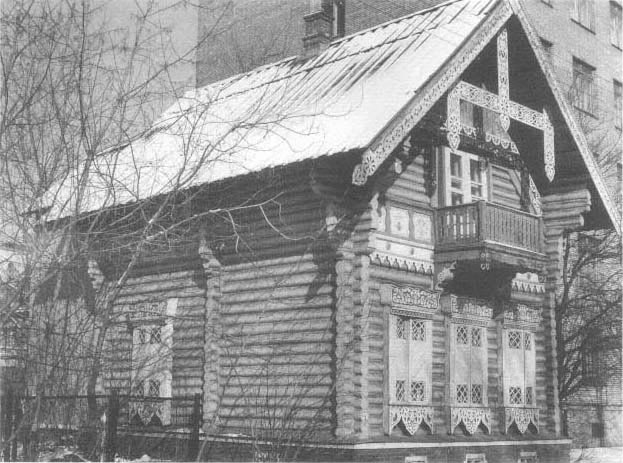
Fig. 7.
Pogodin Izba, Moscow. 1850s. Nikolai Nikitin (Brumfield M74-4).
(both held in Moscow)—frequently led to the saturated application of decorative motifs from the sixteenth and seventeenth centuries. Yet the pre-Petrine revival had its more profoundly creative effects as well, particularly in the architectural experiments at Abramtsevo; but these went largely unnoticed by the profession during the 1880s.
One of the earliest examples of the revival of a Russian vernacular style is Nikolai Nikitin's design of the Pogodin Izba (or hut) for the estate of the prominent historian and writer Mikhail Pogodin. Nikitin (1828–1913), who would later serve as first secretary of the Moscow Architectural Society, created a charming but highly abstracted interpretation of a square log cottage, decorated with elaborately carved bargeboards and window surrounds (Fig. 7). Though artificial, this design for a specialist in Russian history—whose work had a significant impact on nineteenth-century Russian intellectual life—showed that architecture could revive the past and could link traditional Russian culture to the new urban environment.
Among the examples of the wooden vernacular style revived in Moscow during the 1870s, Andrei Huhn's house for the Moscow merchant Aleksandr Porokhovshchikov (1872) is notable for re-creating the decorative and structural elements of traditional wooden architecture, albeit with inside plumbing (Fig. 8).[28] The style here, as in the Pogodin Hut, had an underlying logic. Porokhovshchikov was a leading member of the Slavic Committee, formed to support the liberation of the Balkan Slavs from Turkish rule and, coincidentally, to extend Russian influence into the area under the guise of
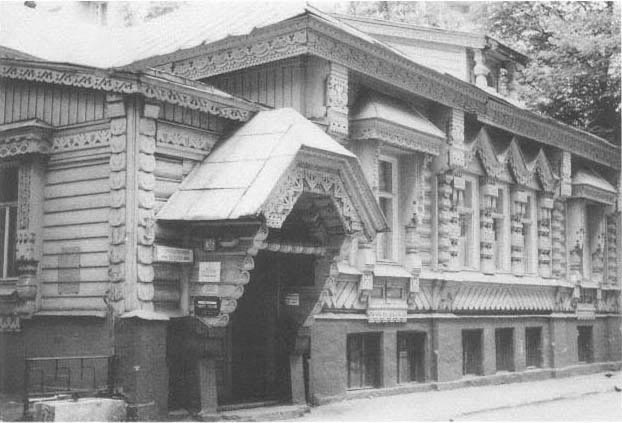
Fig. 8.
Porokhovshchikov house, Moscow. 1872. Andrei Huhn (Brumfield M150-34).
Pan-Slavism.[29] As a major contributor to the nationalist cause, Porokhovshchikov presumably chose the traditional Russian style as a programmatic statement with ramifications beyond the vagaries of eclectic fashion. Concurrently, Huhn had been working with Rezanov in Petersburg on the Palace of Vladimir Aleksandrovich, with its assortment of borrowed styles (including pseudo-Russian). The interpretation of style as part of a broader cultural pattern during the 1870s and 1880s gave the architecture of Moscow, however, more aesthetic coherence and direction than that of Petersburg, where the bureaucracy distrusted the Pan-Slavic movement and where there were few examples of either traditional or pre-Petrine Russian architecture.
Besides merging ideology and culture, the Porokhovshchikov house occupied a plot of land large enough so that the structure, in the very center of Moscow, could be seen in three dimensions. With more land available, architects in Moscow could design structures in the round as well as facades; and although the situation would change toward the end of the century in the city center, architecture in Moscow continued to achieve a depth and plasticity suggestive of medieval architecture. These two qualities, combined with the cultural mission expressed in Russian nationalism, helped to shape Moscow's major architectural monuments during the final decades of the century.
Among these projects, the Historical Museum (1874–1883) is the most imposing and one of the earliest. Both the collection and the impetus to house it derived from the Polytechnical Exhibition of 1872, many of whose display pavilions were located near the eventual site of the museum. The museum was to express Russian historical consciousness on a site in the shadow of the Kremlin walls—an intention clearly conveyed in the announcement of the project competition and the descriptions of the proposals submitted. One account, in the newspaper Golos (Voice) in 1875, noted: "The mu-
seum will tell us loud and clear exactly who we were, who we are, what our worth is as a people, and consequently what place belongs to us in the family of nations of the civilized world. Here is the political meaning of the museum."[30] The same account stated that the winning design had been inspired by the monuments on Red Square (The Kremlin towers and the Cathedral of the Intercession, popularly known as St. Basil's), as well as various sixteenth- and seventeenth-century monuments in Muscovy.
Although the Historical Museum itself may not reflect faithfully the spirit of its medieval antecedents, the competition proposals demonstrate that architects had assimilated motifs from the history of Russian architecture.[31] With the founding of the Moscow Architectural Society by Mikhail Bykovskii, architectural historians—an increasingly vocal group—began to interact with professional architects. Indeed, one of the finalists in the museum competition was both a historian and an architect—Lev Dahl, whose father was the famous ethnographer and lexicographer Vladimir Dahl.[32]
The winner of the competition to design the Historical Museum was, in an irony occasionally visited upon nationalist undertakings, of foreign descent: Vladimir Shervud (Sherwood; 1832–1897), a graduate, in 1857, of the Moscow School of Painting and Sculpture. During his early years as an art student he became acquainted with a group of Moscow intellectuals and artists sympathetic to the Slavophile movement, among them Iurii Samarin, Mikhail Pogodin, Nikolai Gogol, and Ivan Shevyrev. Shervud's account of his meetings with this group reveals that he too came to advocate a renewed Russian sense of identity that could be interpreted in the arts.[33] He thus understood the significance of the Historical Museum and the need for a historical interpretation of the building.
To be sure, the symmetry of his sixteenth- and seventeenth-century decorative motifs had little of the sculpted plasticity of medieval architecture, whose visual impact and structural logic is based on design "in the round" (Fig. 9). Because the museum was located on an elongated site at the northwest entrance to Red Square, with relatively narrow passages on both sides, it has one main facade facing Red Square and another facing Okhotnyi Riad at the exit from Red Square (see Plate 1). In Shervud's design, each facade is a balanced, two-dimensional surface, with projecting porches and towers and medieval decorative elements in bold relief (Figs. 10, 11).
Under pressure to create an emblem of national identity, Shervud designed these facades as an architectural "text" with as many historical (archaeological) references as possible. The result, fragmented and busy with detail, contrasts with the Kremlin towers, austerely monumental, and Saint Basil's, which has a complex centralized plan. Even by the standards of Shervud's contemporaries, the strictly symmetrical adaptation of Russian motifs is cautious—particularly when compared with interpretations of the revived Russian style by Ivan Ropet (Petrov) and Viktor Hartmann (Fig. 12). Many of their most interesting designs were large temporary wooden structures for fairs and exhibitions, such as the People's Theater by Hartmann at the 1872 exhibition. Although few of the structures remain, the architects' drawings and sketches reveal the freedom with which they incorporated traditional Russian decorative elements into asymmetrical plans often echoing the forms of pre-Petrine architecture.[34]
For all the rigidity of Shervud's interpretation of architecture as national identity, the Historical Museum succeeds as an imposing counterweight to the other monuments on Red Square and thus achieves an accord with history. The interior halls were designed and decorated by a collective of artists (including Viktor Vasnetsov) and historians, who chose decorative materials appropriate to the periods of Russian history and prehistory.[35] The structural work and the complex interior plan were supervised by the engineer Anatolii Semenov, who had served as secretary of the Moscow Architectural Society in 1871–1872.
Apart from its stylistic legacy, the Historical Museum demonstrated the aesthetic properties of unsurfaced brick. Earlier exposed-brick structures of the nineteenth century in Petersburg and Moscow were usually utilitarian (for example, Petr Tamanskii's Kronwerk for the Peter-Paul Fortress, 1850–1860). Virtually all other important brick buildings were stuccoed, as they had been since the beginning of the eighteenth century, with Moscow following the example of Petersburg. Moscow's brick churches and secular structures were often painted or whitewashed before the time of Peter the Great, but the texture of the brick remained visible. With the founding of Petersburg, stucco became widely used for both aesthetic and protective purposes. (The Cathedral of SS. Peter and Paul and Peter's Summer Palace, both designed by Domenico Trezzini during the second decade of the eighteenth century, are among the first examples of stuccoed brick.)
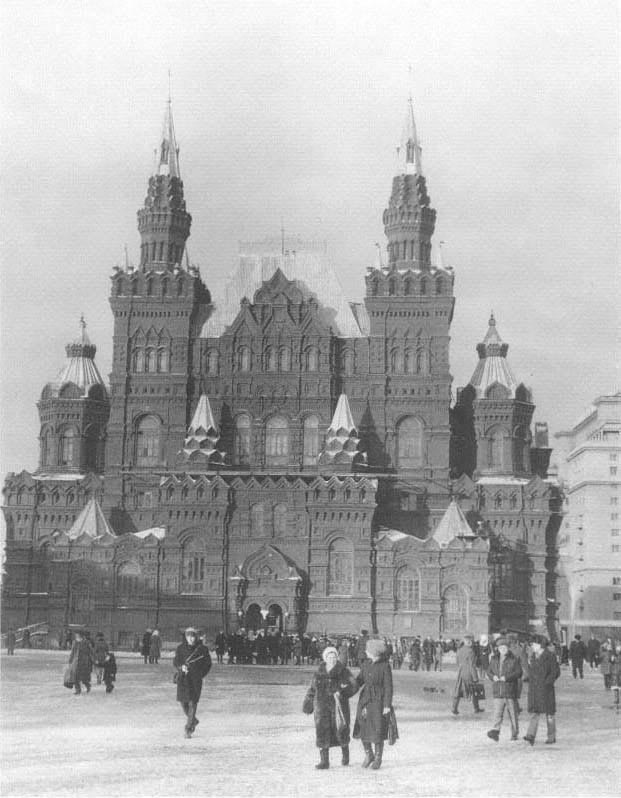
Fig. 9.
Historical Museum, Moscow. 1874–1883. Vladimir Shervud. South facade (Brumfield M104-2).
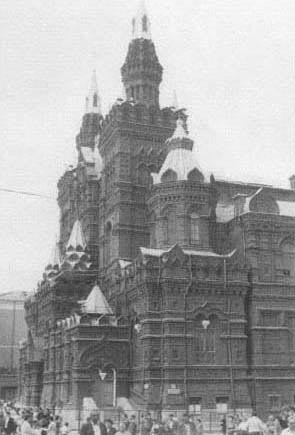
Fig. 10.
Historical Museum, southeast corner (Brumfield M159-30).
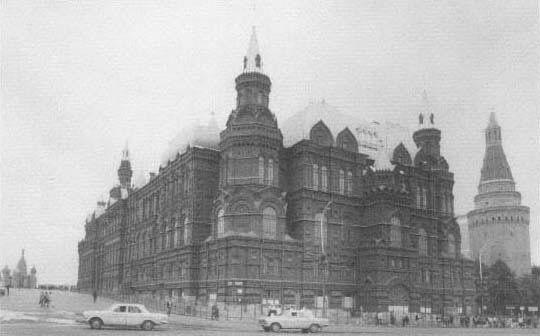
Fig. 11.
Historical Museum, north and east facades (Brumfield M158-3).
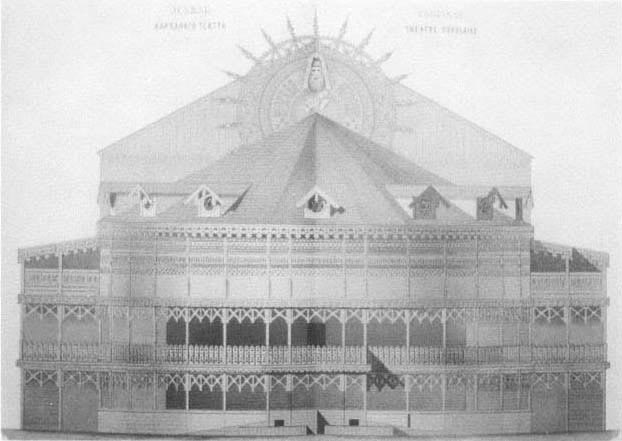
Fig. 12.
People's Theater for 1872 Polytechnic Exhibition, Moscow. Viktor Hartmann. Motivy russkoi arkhitektury , 1875.
Courtesy of the Library of Congress.
In creating the massive brick facades of the Historical Museum, Shervud contributed to the revival of unstuccoed brick as an aesthetic material, cost-effective yet rich in associations with medieval Russian architecture. During the 1880s a number of buildings with brick facades arose in Moscow, the most successful among them Mikhail Chichagov's design for the Korsh Theater (1884–1885). Chichagov made sensible use of Russian decorative and structural elements (such as the pointed decorative gable, or kokoshnik ) but also exploited the plasticity of brick to emphasize the depth of his building and its mildly asymmetrical distribution of shapes (Fig. 13).
On other buildings in the Russian Revival style, however, decorative motifs were applied on a smooth facade of stuccoed brick. The design work for the Polytechnic Museum (1873–1877)—another institution whose origins were linked to the 1872 exhibition—like that for the Historical Museum, was divided between the architect of the facade, Ippolit Monighetti, and the structural engineer, Nikolai Shokhin (Fig. 14). Shokhin, incidentally, presided over the Moscow Architectural Society from 1872 to 1875 and supervised the architectural section of the 1872 Polytechnical Exhibition—an indication of the increasing role of engineers in architecture.[36]
The historical associations that justified the extensive use of plain red brick in Moscow also made possible a more rational and less ornamental use. By the turn of the century, Moscow architects such as Lev Kekushev and Fedor Shekhtel would use brick as a primary aesthetic medium of the style moderne. In the 1870s, however, Petersburg provided the strongest advocates of a "brick style" that related structural function to aesthetics. Although most of the city's nonindustrial buildings
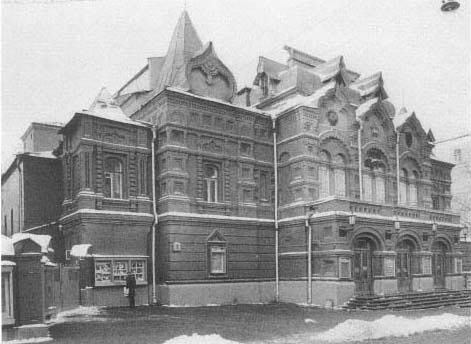
Fig. 13.
Korsh Theater, Moscow. 1884–1885. Mikhail Chichagov (Brumfield M133-33).
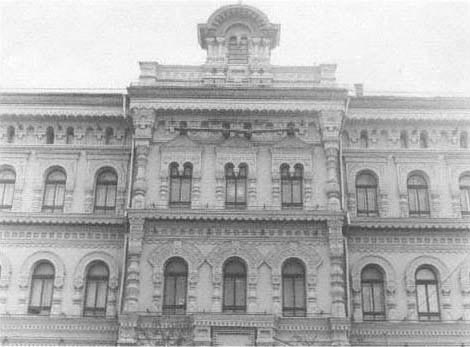
Fig. 14.
Polytechnic Museum, Moscow. 1873–1877. Ippolit Monighetti, Nikolai Shokhin
(Brumfield M54-9).
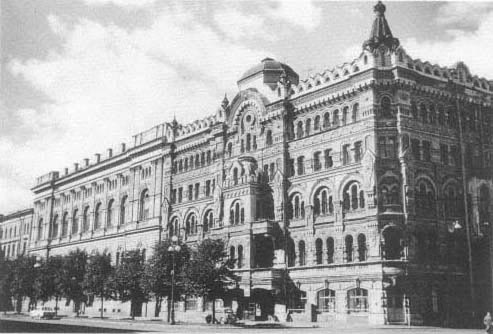
Fig. 15.
Petersburg Credit Society apartment house ( left ). Ca. 1875. Viktor Shreter, E. Kruger. N. P.
Basin apartment house (right ). 1878–1881. Nikolai Basin, Nikolai Nikonov (Brumfield M157-0).
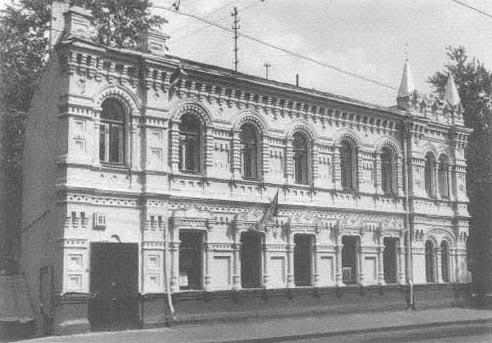
Fig. 16.
House, No. 61 Bolshaia Ordynka, Moscow. Ca. 1880 (Brumfield M70-7).
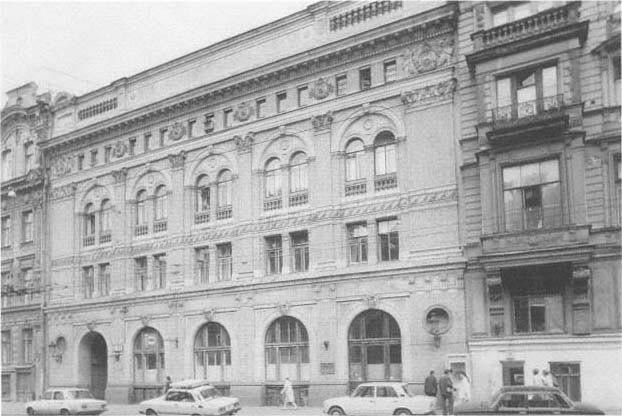
Fig. 17.
Stohl and Schmidt Building, Petersburg. 1880–1881. Viktor Shreter (Brumfield L86-29).
maintained the local tradition of applying stucco over brick (Fig. 15), in Petersburg the very lack of brick medieval monuments freed architects to use brick without the colorful pseudo-historical ornament characteristic of Moscow architecture (Fig. 16).
One of the best examples of the nonhistoricist use of brick is Viktor Shreter's apartment house for V. F. Strauss on Vasilevskii Island (1872).[37] Shreter advocated brick without stucco for its "durability, originality, and rationality [ratsionalnost ]"; it was also economical and relatively easy to maintain.[38] In addition, Shreter demonstrated by using different colors of brick in abstract decorative patterns that the material need not be monotonous or oppressive (Fig. 17). In "Brick Architecture," published in Zodchii in 1872, Ieronim Kitner joined Shreter in advocating a brick style. Like Shreter, Kitner fastened on the word rational to connote qualities opposed to eclecticism, whose florid decoration was particularly well suited to stucco. "A facade of brick facing is incomparably more rational than one of stucco. In our climate a structure with brick facing has greater durability and can be erected in a much shorter period."[39] The architect-critic V. Kuroedov also predicted a great future for brick because of its structural qualities rather than its decorative uses.[40]
Although for Kitner and Shreter the meaning of the terms rational and rationality cannot be equated with the rationalism of the 1920s (in the work of Nikolai Ladovskii and others), they and other proponents of the brick style in the late 1870s nonetheless understood the relation between the functional and aesthetic qualities of such materials as brick, iron, and glass. Both Kuroedov and Kitner were disciples of Apollinarii Krasovskii (1816–1875), the leader in Russian architectural education during the nineteenth century. Krasovskii's textbook Civil Architecture , first published in 1851 and reissued in a second edition in 1886, served as a bible for generations of Russian civil engineers and architects, many of whom studied under him during his thirtyseven-year tenure at Petersburg's Construction School.
(In 1882 the school became the Institute of Civil Engineers as part of an upgrading that Krasovskii had long supported.)
Most of the professionals influenced by Krasovskii built to meet the demands of their clients or the market; they had little reason to pursue the theoretical implications of functionalism Krasovskii presented in the first pages of his book. Indeed, many of the book's illustrations of decorative details seem well suited to the eclectic fashion. Nonetheless, architects and theoreticians who wished to integrate material, structure, and design found support in Krasovskii's views:
Architecture should not tend exclusively toward either the useful or the beautiful; its basic rule is the transformation of the one into the other. . . . Tectonics or construction is the main source of architectural forms. The role of art in the composition consists only in conveying artistic finish to the crude forms of tectonics. . . . The property of a material and the best possible means of applying it determine the means of construction, and construction itself determines the external form of both parts and buildings.[41]
After defining his own approach, Krasovskii categorized architects by their ideas of style: the classicists, the romantics (inclined to the Gothic or the neo-Byzantine), and the rationalists (subdivided into the aesthetes and the technologists), with whom his sympathies lay, although he wished to steer a course between the aesthetes, who placed form above structure, and the technologists, who emphasized the role of function and structural logic over form.[42] Krasovskii's theoretical emphasis on the rational and functional countered what some architects and critics saw as a chaos of borrowed styles.
Krasovskii was equally significant for creating and guiding the new professionalism in Russian architecture, both by teaching and by providing reinforcement for those who wished to reassert the values underlying the practice of architecture. Although interpretations of Krasovskii's terms differed—especially his concept of rationalism, which proved capable of sheltering diverse points of view—the very framing of these issues and their debate in a professional context were tributes to his pervasive influence.
The disparate views of rationalism are particularly evident in the career of one of Krasovskii's most accomplished students, Nikolai Sultanov (1850–1908), who graduated from the Construction School (Stroitelnoe uchilishche) in 1873 and subsequently taught architectural history and theory in Petersburg's institutions of higher learning. Despite Sultanov's allegiance to Krasovskii's concept of the rational in architecture, like many Russian intellectuals of his time he related his professional practice to broader social and cultural questions. In a speech delivered in 1882 at the opening of a new building for the Construction School (now the Institute of Civil Engineering), Sultanov seemed to draw verbatim from Krasovskii's Civil Architecture , emphasizing function and the careful realization of structure. He then called, unexpectedly, for spiritual values transcending the material, and praised the "Russian style" (with its practical reliance on brick): "The new national movement does not contradict our banner—that of the rational movement—but actually coincides with it."[43]
This was not the first time that Sultanov had publicized such views; and Krasovskii's writings even supported his suggestion that architectural decoration could be based on archaeological and historical criteria.[44] Sultanov was a serious student of medieval Russian architecture and felt that it best represented the national genius (see Plate 2). Nonetheless, for those who interpreted rationalism more strictly, Sultanov's speech was an apostasy, announced at an institute established to provide the highest technological training. When the speech was published in Zodchii in May 1882, S. Zosimovskii, a civil engineer, quickly responded, writing in the following number of the journal that artistic concerns are "an abnormal phenomenon for civil engineers," and irrelevant to technology.[45]
Although Sultanov's and Zosimovskii's interpretations of the rational in architecture were incompatible, architects and engineers did not rigidly differentiate their work, nor were engineers inevitably "anti-aesthetic." Krasovskii's career had shown the possibility of common interests, and Sultanov himself would serve as director of the Institute of Civil Engineers from 1895 to 1903. Furthermore, the brick and Russian revival styles in the 1880s and 1890s combined with a vitality and originality that would not have displeased Krasovskii—particularly in buildings such as private houses, which had no complex technical requirements. Nonetheless, building large commercial and industrial structures in Russia's major cities required an ever greater reliance on technology—whatever the facade—and on architects and engineers who understood functional design. If architecture was to become professionalized, institutions
were needed to train architects. It is appropriate at this point to survey the progress of these institutions during the late nineteenth century.
Formal architectural training in Russia began in schools with limited autonomy and resources; only when these schools were transformed into fully accredited centers of higher technical and artistic education would a modern architectural profession develop. Although attempts to instill rigor into the training of architects date from the time of Peter the Great, an extensive, if still far from perfect, system of professional education did not develop until the end of the century.
In Petersburg the oldest center of architectural education was the Imperial Academy of Arts, founded in 1757 as an appendage of Moscow University and granted institutional autonomy by Catherine the Great in 1763. In 1859 the academy established one curriculum for painters and sculptors and another for architects, who were required to study mathematics, physics, and chemistry. This introduction of a technical approach to architecture did not, however, change the primary emphasis of the academy's architectural program on style and design.[46]
Because of its long traditions and imperial support, the academy remained the capital's most prestigious institution for architectural study; a large number of its graduates were among the architects practicing at the beginning of this century. Depending on the extent of their studies, graduates were designated either unclassed artists or classed artists of architecture of the third, second, or first degree (the last awarded to the academy's Gold Medal recipient). After 1893, the classifications were architect-artist or artist-architect, with the former the more qualified in architecture.[47]
The other major institution for architectural education in Petersburg was the Institute of Civil Engineering, which emphasized the technical elements of construction. The institute derived from two schools founded during the reign of Nicholas I: the Architects' School (1830), emphasizing the arts, and the School of Civil Engineers (1832), concentrating on mathematics and engineering. The schools merged in 1842 to form the Construction School, organized on a military basis. After various reforms in the 1850s, the school was transferred to the Ministry of Internal Affairs in 1865 and relieved of its quasi-military status. In 1877 it obtained official ranking with the country's other institutions of higher technical education, as well as a new charter designed to ensure that its five-year course of study would produce competent engineers. (Those entering the school were expected to have completed studies at a gymnasium or realschule.) In 1882, with newly expanded facilities, the school was designated the Institute of Civil Engineering. Between 1842 and 1892 only 1,020 students graduated from the school; in 1892 alone, however, 222 students were enrolled.[48]
Graduates of the institute were given the title civil engineer (changed at the beginning of the century to civil engineer-architect, in the constant wordplay of professional identity and prestige). A number of them were to help shape Petersburg's environment in the two decades before 1917. A recently published list of 390 architects active in Petersburg at the beginning of this century indicates that 168 studied at the Institute of Civil Engineering, with almost all of them graduating, and an equal number graduated from the Academy of Arts. (Eight of those listed attended both institutions.) Of the remaining 62 architects (and engineers) some attended other schools, such as the Riga Polytechnic Institute and the Moscow School of Painting, Sculpture, and Architecture, or were certified by boards of examiners by virtue of their professional qualifications.[49]
Other technical institutions in Petersburg included architecture in their curricula: the Institute of Transportation Engineers, the Mining Institute, the Technological Institute, and Petersburg University. Their teaching staffs occasionally included faculty from one of the major architectural institutions. Apollonarii Krasovskii, for example, taught at the Institute for Transportation Engineers, the Mining Institute, and Petersburg University in addition to his permanent duties at the Construction School. Ieronim Kitner divided his teaching between the Construction School and the Institute of Transportation Engineers. Perhaps no one showed a greater diversity of pedagogical interests than Nikolai Sultanov, who began his career at the Construction School, taught architecture at the Technological Institute (1877–1884), lectured on medieval Russian architecture at the Archeological Institute (1882–1885), and served as director of the Institute of Civil Engineering.[50]
In Moscow the primary center for architectural training during the nineteenth century was the School of Painting, Sculpture, and Architecture, which dates from a series of art classes begun in 1832 and formally organized into the School of Painting and Sculpture in 1843. The architectural component was added in 1865,
when the Architectural School of the Moscow Court Office joined with the School of Painting and Sculpture.[51] Here, as in Petersburg, the curricula for architects and civil engineers emphasized the study of classical architecture and the architectural orders, particularly as interpreted by Vignola and revived by the Renaissance. This emphasis provoked a pedagogical debate in 1905, with opponents claiming its irrelevance to technological innovation; but the grounding in classical architecture undoubtedly refined the style of some of Russia's most distinguished architects at the beginning of the twentieth century.
Another Moscow institution destined to play an increasingly important role in the development of Russian architectural design was the Stroganov Arts and Crafts School. Founded in 1825 by Count Sergei Stroganov as a drawing school for children ten years and older, the school received official recognition in 1843 and in 1869 became the Stroganov School of Technical Design. Although it emphasized the applied arts, its students were frequently involved in architectural projects. Ippolit Monighetti was one of the first to complete the school's six-year course, in 1835.
In Moscow, as in Petersburg, architects frequently trained as apprentices and were subsequently accredited by examination boards. Recent graduates could make the transition from architectural school to professional practice by affiliating with senior architects and by participating in open architectural competitions. The juries in these competitions analyzed the technological and design specifications in projects by both experienced architects and novices; and since a jury's response to major project competitions frequently appeared in journals such as Zodchii , the critique and discussion served an educational purpose.[52]
Although the educational system had little effect on the professional training of exceptionally gifted architects like Fedor Shekhtel, it provided most architects with the essential means of entry into the profession. Of particular value was the opportunity to participate in workshops directed by such distinguished architects and teachers as Leontii Benois, who played a guiding role in the Higher Arts School established as part of the 1893 reform of the Academy of Arts.[53] Indeed, Shekhtel himself taught at the Stroganov School in Moscow; and it is some measure of the regard accorded to teaching that the profession's highest honorific rank was Professor of Architecture. Despite the frequent criticism of their methods as outmoded or uninspired, the architectural institutes prepared their students for the challenge of an increasingly complex environment that demanded teamwork between architect and engineer as well as the ability to compete for major commissions. The schools' success can be measured in one of the most significant projects of late nineteenth-century Russian architecture—the construction of a new building for the Upper Trading Rows on Red Square between 1889 and 1893.
This rebuilding of the Upper Trading Rows was a turning point in Russian architectural history, not only because it represented the apogee of the search for a national style but also because it demanded advanced functional technology applied on a scale unprecedented in Russian civil architecture. The site, facing the Kremlin, at the center of Moscow's wholesale and retail trading district, had been occupied by a neoclassical trading arcade constructed by Osip Bove after the 1812 fire; by the 1860s it had fallen into disrepair and was becoming unmanageable for modern commerce.[54] In November 1888, the Society of City Trading Rows, a private company formed to rebuild the rows, announced a design competition; the winning proposal—one of twenty-three received the following February—was by Aleksandr Pomerantsev (1848–1918), an academician at the Academy of Arts.
Pomerantsev derived his plan from the galleria, or passage , which had been used elsewhere in Europe—most notably in Milan—as well as in Russia for fashionable retail trade throughout the nineteenth century.[55] But nothing equaled the size of the new Upper Trading Rows, with 1,000 to 1,200 shops for retail and wholesale trade (Fig. 18). While the design of this many units with proper access, illumination, and ventilation required a commitment to new technological methods, the location of the Trading Rows demanded a structure whose style would harmonize with the monuments on Red Square.
In reconciling the requirements, Pomerantsev demonstrated the high degree of professionalism Russian architecture and civil engineering had achieved in the preceding decades. After graduating from the Moscow School of Painting, Sculpture, and Architecture in 1874, he compiled a distinguished record at the Academy of Arts in Petersburg, where he was awarded the Gold Medal in 1877 and the academy's scholarship for study abroad. After travels in Italy and France from 1879 to 1887, he returned to Russia, where he was named aca-
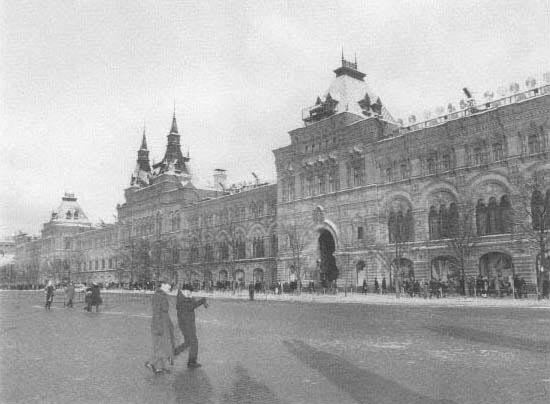
Fig. 18.
Upper Trading Rows, Moscow. 1889–1893. Aleksandr Pomerantsev (Brumfield M166-30).
demician for his drawings of Palermo and joined the faculty of the Academy of Arts. The following year he submitted his project for the competition in Moscow.[56]
In his design for the facades of the Upper Trading Rows, Pomerantsev called on his considerable drafting ability: each facade of the trapezoidal structure shows a different articulation, saturated in motifs borrowed from sixteenth- and seventeenth-century Muscovite architecture (Fig. 19). These motifs, as in Shervud's Historical Museum, had little relation to the structure behind the facade. And Pomerantsev, like Shervud, organized decorative details in a balanced scheme dominated at the main entrance by two symmetrical towers in the style of the Kremlin walls (Fig. 20). The Historical Museum had the compositional advantage of a relatively narrow main facade, in contrast to that of the Trading Rows, which extends for 242 meters; yet Pomerantsev used a sharply molded string course between the floors to emphasize horizontality and to separate the layers of decorated window surrounds and arches. On the main facade each level is a different type of stone: red Finnish granite, Tarussa marble, and limestone—all capped with a massive cornice.[57]
The ostentatious style of the building represented a gesture of historical consciousness on the part of the merchants who paid for it. Considerable ingenuity was required, however, to reconcile the iconography of the heavily encrusted facade with the commercial function of the interior. Inside are three parallel arcades connected by passageways (Fig. 21). Each arcade has three levels, with rows of shops on the first and second and offices on the third. Walkways of reinforced concrete (possibly the first use of this technique in Russia) span each gallery on the second and third levels; iron and glass arched skylights provide illumination (Figs. 22, 23). Among the remarkable achievements of civil engineering in Russia during the nineteenth century, none is more dramatically placed than these iron and glass canopies (see Plate 3). Each weighs some 50,000 puds (819 metric tons) and has over 20,000 panes of glass.
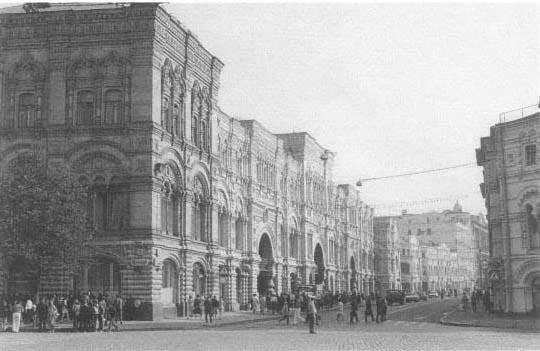
Fig. 19.
Upper Trading Rows, side facade (Brumfield M159-16).
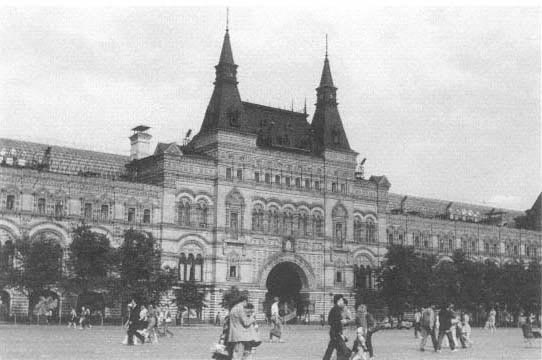
Fig. 20.
Upper Trading Rows, main entrance, with a view of the arched skylights (Brumfield M172-21).
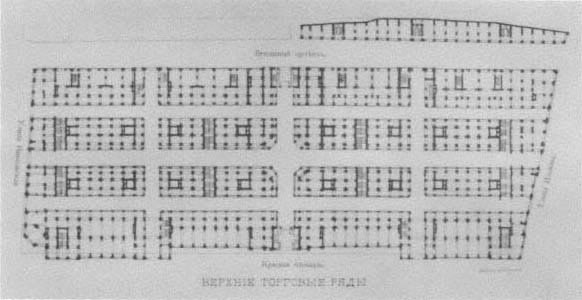
Fig. 21.
Upper Trading Rows, plan.
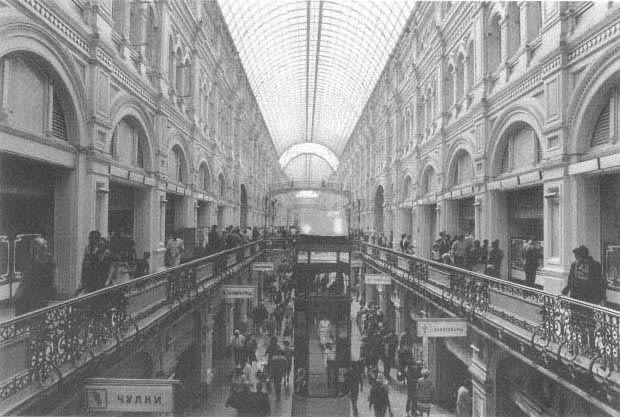
Fig. 22.
Upper Trading Rows, central passage (Brumfield M160-6).
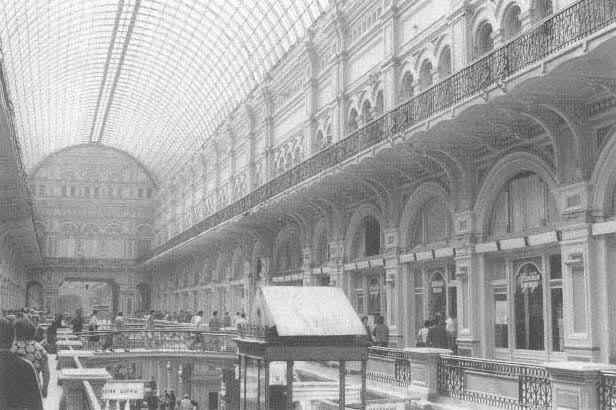
Fig. 23.
Upper Trading Rows, west gallery (Brumfield M160-20).
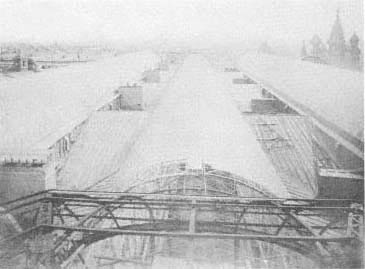
Fig. 24.
Upper Trading Rows. View of iron and glass sky-lights under
construction. Torgovye riady na Krasnoi ploshchadi v Moskve .
Courtesy of the Slavic and Baltic Division, New York Public Library.
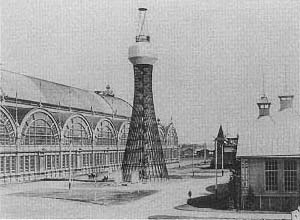
Fig. 25.
Metal "webbed" water tower, 1896 Nizhni Novgorod
Exhibition. Vladimir Shukhov. Vidy Vserossiiskoi
khudozhestvennoi promyshlennoi vystavki 1896 g. v
Nizhnem Novgorode .
Courtesy of the Slavic and Baltic Division, New York
Public Library.
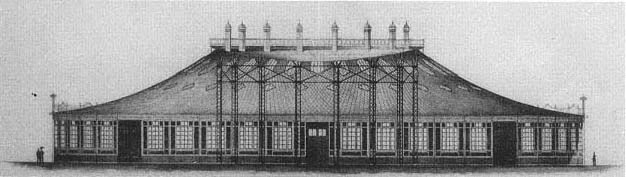
Fig. 26.
Round pavilion, Construction and Engineering Section, 1896 Nizhni Novgorod Exhibition. Engineer: Vladimir
Shukhov. Architect: V. A. Nossov. Section. Vidy rabot proizvedennykh stroitelnoi firmy Bari na Vserossiiskoi
vystavke 1896 v N. Novgorode .
The components were made by Otto Krel, the director of the Petersburg Metal Factory, who had built a number of metal-framed public markets in Petersburg, and were assembled under the supervision of the engineer Ivan Rylskii (Fig. 24).[58]
But the genius behind this union of the aesthetic and the functional was Vladimir Shukhov (1853–1939), one of the most distinguished and versatile of Russia's civil engineers. After graduating from Moscow's Imperial Technical School in 1876, Shukhov spent several months in the United States. Although little is known about his itinerary, it no doubt gave him the opportunity to study examples of American construction technology.[59] After working for two years in the Petersburg office of the Warsaw Railroad, he moved in 1878 to Moscow, where he specialized in designing metal constructions. By the time of the Trading Rows competition, he had acquired a reputation for technical expertise in fields as diverse as bridge construction, petroleum engineering, and the design of large metal-frame arched roofs.
Shukhov's later fame rests primarily on his metal "webbed" towers, including the water tower from the 1896 Nizhni Novgorod Exhibition (Fig. 25) and, in 1922, a 160-meter radio tower in the Shabolovka district of Moscow. At the 1896 exhibition he also built for the Construction and Engineering Section two large pavilions that represented the most advanced use of metal-frame construction for their time and possibly the first use of a metal membrane roof (Figs. 26–29). Although not as daring in concept as Shukhov's pavilions, Pomerantsev's building for the Machinery Hall at the same exhibition (Fig. 30) represents a streamlined version of the design of the Upper Trading Rows.
That the enormous Upper Trading Rows functioned, if imperfectly, is a tribute both to Shukhov's design and to the technical proficiency of Russian architecture toward the end of the century. The use of reinforced concrete for the interior walls and vaulting eliminated the need for thick masonry support walls and provided the space for circulation and light. For maintenance, there
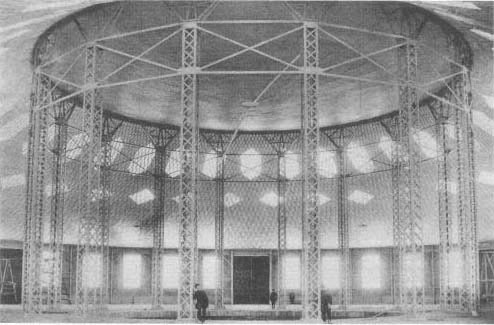
Fig. 27.
Round pavilion, interior. Vidy rabot proizvedennykh stroitelnoi firmy Bari na vserossiiskoi
vystavke 1896 v N. Novgorode .
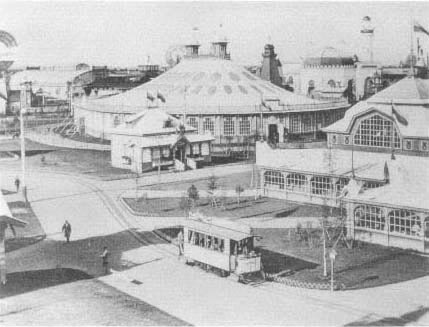
Fig. 28.
Elliptical pavilion, 1896 Nizhni Novgorod Exhibition ( center ). Engineer: Vladimir
Shukhov. Architect: V. A. Nossov. Vidy Vserossiiskoi khudozhestvennoi
promyshlennoi vystavki 1896 g. v. Nizhnem Novgorode .
Courtesy of the Slavic and Baltic Division, New York Public Library.
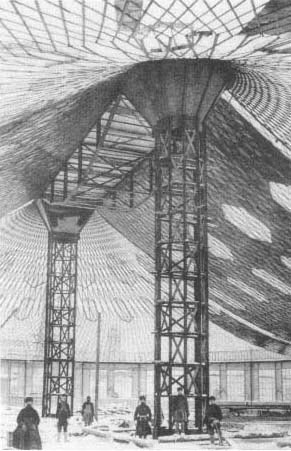
Fig. 29.
Elliptical pavilion, interior. Vidy rabot proizvedennykh
stroitelnoi firmy Bari na vserossiiskoi vystavke 1896 v
N. Novgorode .
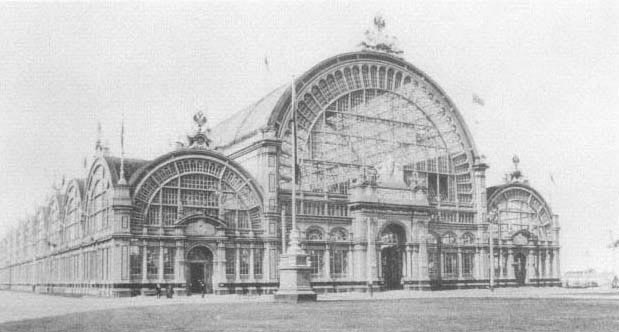
Fig. 30.
Machinery Hall, 1896 Nizhni Novgorod Exhibition. Aleksandr Pomerantsev. Vidy Vserossiiskoi khudozhestvennoi
promyshlennoi vystavki 1896 g. v Nizhnem Novgorode .
Courtesy of the Slavic and Baltic Division, New York Public Library.
was a network of basement corridors, beneath which was a subbasement with heating boilers and an electrical generating station. Every element of professional architecture, from educational institutions to the open competition system, contributed to the project.[60]
Despite these impressive resources, the Upper Trading Rows revealed a fundamental disjunction between the national style and the rational, functional demands of modern urban architecture. It could be argued that Pomerantsev's facades complemented the other structures on Red Square without sacrificing the functional arrangement of the interior. But to apply the motifs of historical reminiscence to a large commercial edifice showed little promise, aesthetic or economic, for other locations. Although reinforced concrete was used extensively in the interior, the stone facades conceal some 40 million bricks (many laboriously salvaged from previous buildings on the site) for the foundation walls and the exterior shell.
As a result of this divergence of style and function, only the upper galleries benefited fully from Shukhov's design in glass and iron. The lower level of shops (more commercially desirable) lacked proper light and ventilation, while the brighter and more spacious upper level was less convenient. Many shopkeepers saw little advantage in moving to the new building, which yielded only a modest return to the investors who had bought 5 million rubles worth of stock in the Society of Trading Rows.
The failings of the Upper Trading Rows did not, however, discourage another major commercial project in the pseudo-Russian style: the Middle Trading Rows (1890–1891), next to the Upper Rows on land that slopes down from Red Square to the Moscow River (Fig. 31). The architect was Roman Klein (1858–1924), who had placed second in the competition for the Upper Rows and became one of the most productive architects in Moscow at the turn of the century. After studying for two years at the Moscow School of Painting, Sculpture, and Architecture, he did drafting for Shervud for the Historical Museum and then proceeded to Petersburg, where he studied at the Academy of Arts from 1877 to 1882. On graduating, he traveled to Italy and France, where he worked for a time in the studio of Charles Garnier, who designed the Paris Opéra. When he returned to Russia in the mid-1880s, he worked in Petersburg before resettling in Moscow, the center of his activity for the next three decades.[61]
Klein's Middle Trading Rows, under construction at the same time as Pomerantsev's building, follows the decorative patterns of the other buildings on Red Square, but with less ornamental saturation. More space separates the window surrounds and arches, and the three-storied structure has a more pronounced segmentation than the Upper Rows. With the larger wall surface, however, little light can enter the structure, which has no skylight design comparable to Shukhov's. In 1909 the society of merchants that owned the building petitioned, unsuccessfully, to enlarge the windows. In 1914, a second petition to rebuild the Middle Rows in the French Renaissance style was granted but not implemented. Klein himself was responsible for the merchants' dissatisfaction with the original style; his own design for the Muir and Mirrielees firm (1906–1908), discussed in chapter 3, demonstrated the superiority of a trading center arranged in an open, unified space. (The merchants submitted their petition for larger windows the year after the completion of the Muir and Mirrielees store.)
In addition to the Upper and Middle Trading Rows, both much larger than any commercial gallery in Petersburg, other trading passages were constructed in Moscow during the 1890s, including the Zaikonospasskii Trading Rows (ca. 1893) by S. T. Preobrazhenskii. Located on Nikolskii Street (now October 25 Street) and perpendicular to the Upper Rows, this smaller structure displayed Russian motifs on long rows of windows whose design was in harmony with Moscow's oldest district (Fig. 32). But by the end of the century such uses of a national style in commercial buildings were outmoded; and wealthy merchants like Vikula Morozov built large emporiums in a more rational style—the Beaux-Arts style, still heavily decorated—with large windows to illuminate display space.[62]
In the same, central, area of the city, the Moscow city government undertook what was to be the city's last major exercise in the Russian style, the city hall. As with other large projects around Red Square, a building for the duma, or city council, had long been under discussion—since the early 1870s, when Aleksandr Rezanov and Andrei Huhn,[63] then completing work on the Palace of Vladimir Aleksandrovich in Petersburg, presented the first design proposals, for a fanciful recreation of the pseudo-Russian style in the manner of Hartman and Ropet. This design was not built, and the site was given over to the construction of the Historical Museum.
The revival of plans for the duma building in 1886 initiated a series of design competitions that demon-
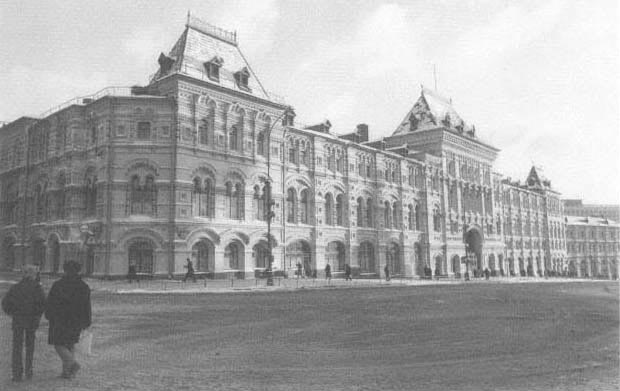
Fig. 31.
Middle Trading Rows, Moscow. 1890–1891. Roman Klein (Brumfield M166-33).
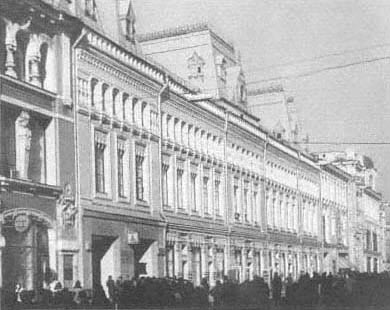
Fig. 32.
Zaikonospasskii Trading Rows, Moscow. Ca. 1893. S. T. Preobrazhenskii
(Brumfield M6-25).
strated the difficulty of reconciling pressures for an "archaeological" Russian style with architects' concepts of structure and purpose. Dmitrii Chichagov (the brother of Mikhail Chichagov, who designed the Korsh Theater in the national style) was one of three architects asked to submit facade designs, but the influential Archaeological Society declared them incompatible with a genuine Russian style.[64] A new proposal by Chichagov, acceptable to the society, did not please the duma. Subsequently, in an open competition Chichagov's entry placed first among the thirty-eight submitted, but he had to resubmit the plan for a final competition among the three prize winners. Again Chichagov's plan placed first, and he was authorized to begin construction (1890–1892).
Dmitrii Chichagov used Russian decorative elements mechanically on the large Duma, in contrast to his brother's skillful distribution on the much smaller Korsh Theater. Medieval decoration lies ponderously along the flat, symmetrical surface of the Duma (Fig. 33) in a scheme more rigid than that of the neighboring Russian Revival structures by Shervud and Pomerantsev. Although the buildings seem related, the Duma is not effectively part of Red Square: its red brick main facade looks toward the great portico of the Bolshoi Theater, thus further violating the stylistic unity of one of Moscow's few remaining neoclassical ensembles. Inside, the Duma demonstrates the technical proficiency of the architects working in the Russian style, which is, however, awkward for any modern structure larger than a house. Indeed, the style was used most successfully in mansions like one designed by Nikolai Pozdeev for N. Igumnov and another by Boris Freudenberg for Petr Shchukin (Fig. 34).
The impact of the Russian Revival style was considerably muted in Petersburg, where other, eclectic, styles dominated—even to the point of obscuring the city's most cherished neoclassical monuments. (The development of Admiralty Quay for private apartment buildings during the 1880s is the most blatant example of this disregard for the city's architectural heritage—in this case Adrian Zakharov's Admiralty, 1806–1823.) Yet even in Petersburg the ideology and aesthetics of the Russian style found expression in one major architectural project of the end of the century: the Church of the Resurrection of the Savior on the Blood (1883–1907), built on the site where in 1881 Alexander II was assassinated by terrorists of the People's Will political movement. After an extensive review of the first designs submitted, all, as frequently happened in such competitions, were judged insufficiently Russian. In the subsequent competition, Alfred Parland received first prize for a design (Fig. 35) based on the sixteenth-century Cathedral of the Intercession on Red Square (to which, in fact, it bears only superficial resemblance).[65]
The exterior of Parland's church, which suggests medieval Moscow, is strikingly disharmonious with the Petersburg ensemble. Even so, however, the church succeeds as a monument to a tsar who had tolerated Pan-Slavism and had involved Russia in a war with Turkey in the Balkans (during his reign many Russians awaited the imminent fall of Constantinople to Russia as part of the Orthodox patrimony). No other structure of the period reveals so clearly the link between architecture and political purpose, and the relation is stated all the more forcefully because the building is so incongruous with its setting.
Alfred Parland (1845–1892) graduated from the Academy of Arts in 1874 and traveled in Europe on a scholarship until 1878, when he returned to the academy as a member of the faculty. Although he specialized in building churches, for this major ecclesiastical project of the late nineteenth century he drew not on the neo-Byzantine (the usual official preference, which characterized many of the projects submitted to the competition jury), but on the more "democratic" Russian Revival style.[66] Although both styles enjoyed official favor, the Church of the Resurrection is distinct from the Russian Orthodox cathedrals constructed in the Byzantine manner not only in Russia proper but also in other parts of the empire, such as Warsaw, and even beyond (in Sofia, Bulgaria).
Considerable technological ingenuity was required to ensure the stability of the massive structure, built on the edge of the Catherine (now Griboedov) Canal. Neither the engineering nor the architecture of the church, however, was as challenging as the mosaic panels on both the interior and exterior of the building (see Plates 4, 5). These increased the time of construction to more than twenty years from the first groundwork in 1886. The exterior panels, designed by Viktor Vasnetsov, Mikhail Nesterov, and other artists for placement in a facade of specially manufactured yellow brick, were made by the firm of A. A. Frolov.[67]
Vasnetsov designed four mosaic scenes of the Crucifixion for the pediments of the church's west entrance porches. Although the scenes reveal his mastery of a demanding medium, their setting is uncongenial to the artist's free interpretation of the Russian style. Parland
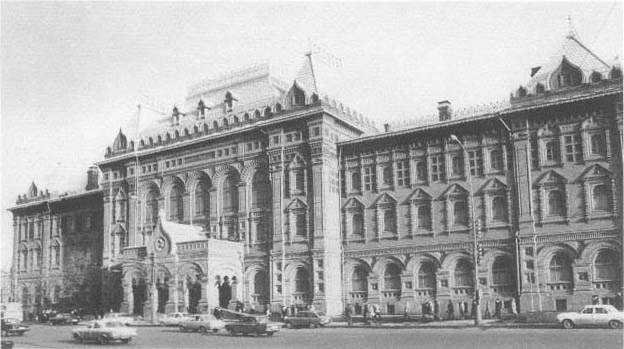
Fig. 33.
Moscow City Duma. 1890–1892. Dmitrii Chichagov (Brumfield M133-36a).
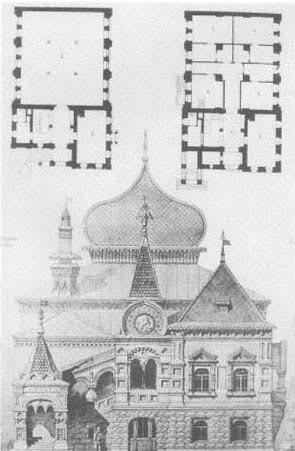
Fig. 34.
Shchukin house, Moscow. 1894. Project sketch by
Boris Freudenberg. Zodchii , 1893.
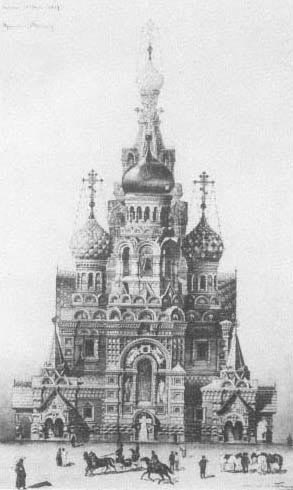
Fig. 35.
Church of the Resurrection of the Savior on the Blood,
Petersburg. 1883–1907. Final project sketch by Alfred
Parland. Zodchii , 1907.
was technically proficient in arranging the decorative elements and stylized towers of the church, but here, as in Moscow, the result of re-creating an architectural style based on archaeological fragments was a building whose scale and exterior decoration had little relation to medieval Russian architecture. However, Vasnetsov's involvement in the mosaic work for the church represents a revival of interest in medieval art forms that would ramify both in his own work as a painter, designer, and architect and in that of other artists, such as Mikhail Vrubel.
Among other major churches of the period that similarly reinterpreted the national past, the most notable is the Cathedral of Saint Vladimir in Kiev, whose construction, from 1862 to 1896, was overseen by a succession of architects, including Ivan Shtrom, Pavel Sparro, Vikentii Beretti, and Rudolf Bernhardt. The artists responsible for the interior wall decoration included Viktor Vasnetsov, Mikhail Nesterov, and Mikhail Vrubel, who was allotted only a secondary role despite his great hopes for this project. In general the new architectural style at the turn of the century developed only in the construction of smaller churches with little relation to official church architecture.
One church that returned to medieval antecedents for its design did so not simply for a decorative or iconographic purpose but for a structural one: to relate the interior and exterior. Because the church was small and its detail demonstrated none of the archaeological fidelity expected of the Russian style (particularly in a church), it elicited little positive response from the architectural profession. Indeed, the church was an amateur produc-
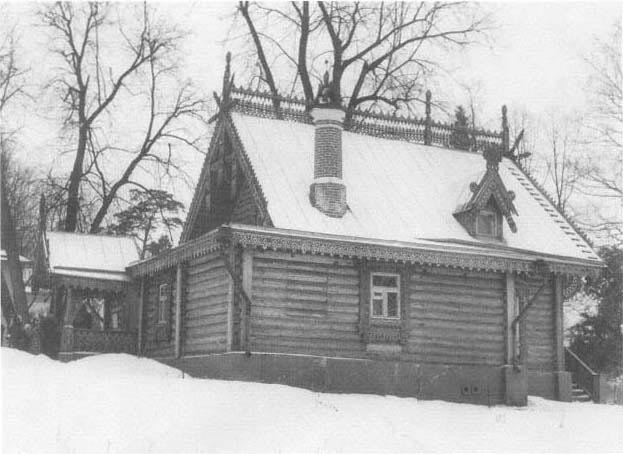
Fig. 36.
Studio, Abramtsevo. 1872. Viktor Hartmann (Brumfield MR11-8a).
tion, unconstrained by committees, academic rules, or complex engineering methods—in short, by those factors that had helped to stabilize the architectural profession during the latter half of the nineteenth century.
The church, at Abramtsevo, the estate of Savva Mamontov, can be seen as an experiment by artists of common purpose, if diverse interests. Mamontov had created the controlled environment for such an experiment after purchasing the estate in 1870 from a daughter of Sergei Aksakov, a prominent Slavophile whose hospitality had made Abramtsevo a haven for noted writers and intellectuals.[68] Although interested primarily in the visual and performing arts, Mamontov also joined artists and friends in a group dedicated to an arts and crafts revival in Russia.
Mamontov purchased Abramtsevo the year after the death of his father, whose considerable fortune he inherited and enlarged as one of Russia's most energetic railway developers. Mamontov's "colony" at Abramtsevo provides a quintessential example of the productive relation between entrepreneur and artist in the postreform period. Although Abramtsevo would be rivaled by another center at Talashkino (Smolensk Province), the estate of Princess Maria Tenisheva, Mamontov's group was unique in its breadth of artistic interests and its influence on architecture and design at the turn of the century.
Both Viktor Hartmann and Ivan Ropet worked at the estate in the early 1870s. Hartmann, shortly before his death in 1873, built a studio at Abramtsevo, with richly carved wooden decorations typical of the crafts revival (Figs. 36, 37). Ropet's teremok bathhouse there, more interesting structurally than Hartmann's work, united asymmetrical shapes under a steep trapezoidal roof that
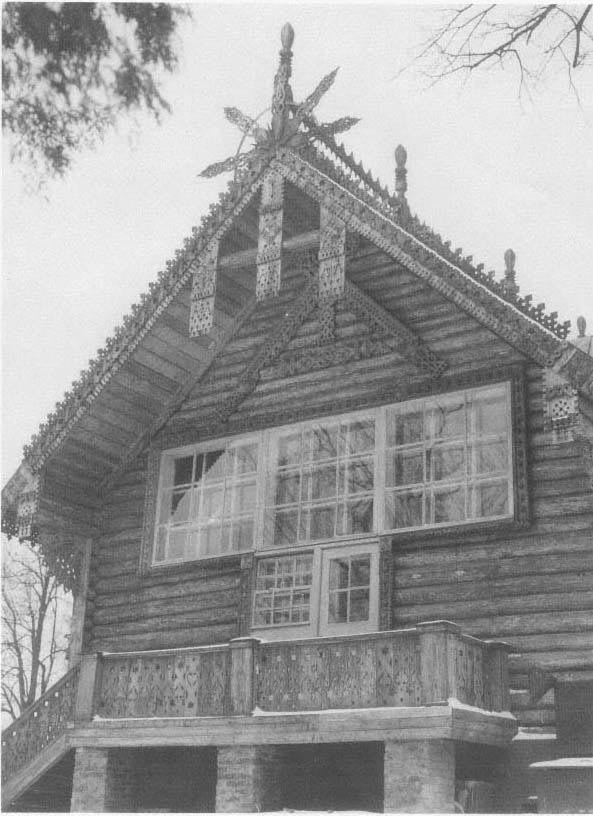
Fig. 37.
Abramtsevo studio, detail (Brumfield MR11-3a).
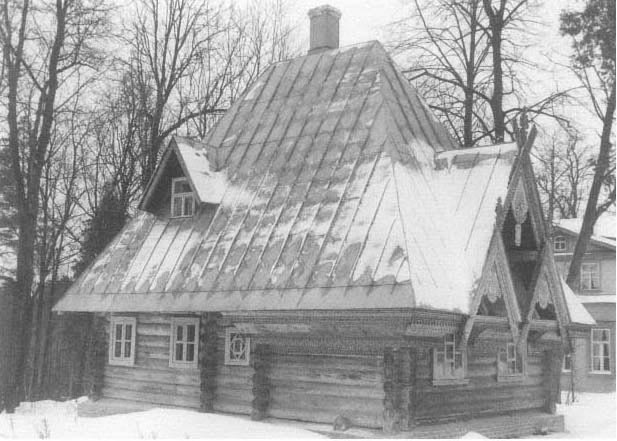
Fig.38.
Teremok bathhouse, Abramtsevo. 1873. Ivan Ropet. (Brumfield MR8-8).
serves as a backdrop for the window and porch gables (Figs. 38, 39). The fanciful manner of the teremok gave a foretaste of freestyle, sculpted architecture at the turn of the century. These modest buildings by leading proponents of the Russian Revival style provided invaluable design precedents for the Abramtsevo church.
The communal effort in building the church, dedicated to the Icon of the Savior "not created by hand" (nerukotvornyi ), has become legendary in Russian art history—the realization of an artistic synthesis by a group dedicated to preserving art in the spiritual life of the people. In her memoirs of Abramtsevo, Natalia Polenova, whose father was the painter Vasilii Polenov, notes that the church was built to embody not only aesthetic but also spiritual ideals. Although the Khotkov Monastery was only three versts away (about three kilometers), frequent floods around Easter convinced Mamontov to build a church on the estate grounds. The religious piety and aesthetic ambience that in Polenova's account characterize Easter services held at the estate house also informed the artists' creation of the church.[69]
The design of the Abramtsevo church (Fig.40) derived not from the Byzantine or seventeenth-century Muscovite styles prevalent in Russian church architecture of the time but from the less grandiose traditions of medieval Novgorod and Pskov. Early sketches for the project by Vasilii Polenov (Fig.41) were based on the Church of the Transfiguration of the Savior on the Nereditsa (1198) near Novgorod. The style of churches near Rostov influenced the painter Viktor Vasnetsov's subsequent refashioning of the design into an architectural project.[70] In recurring to this more intimate style—long appreciated by art historians but little noticed by architects—the Abramtsevo group reclaimed a
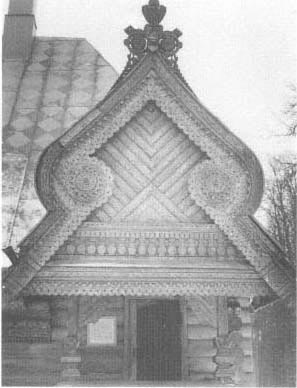
Fig. 39.
Teremok bathhouse, detail (Brumfield MR9-10).
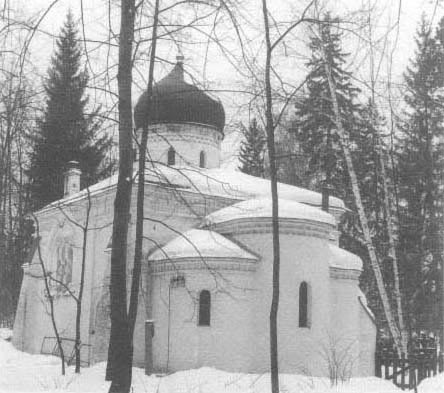
Fig. 40.
Church of the Icon of the Savior Abramtsevo, from the southeast. 1881–1882.
Viktor Vasnetsov (Brumfield MR9-4).
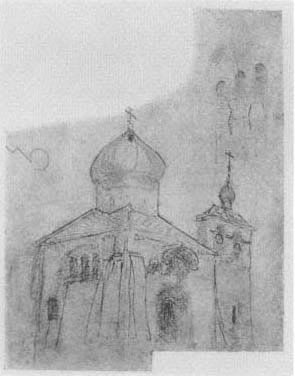
Fig. 41.
Church of the Icon of the Savior, Abramtsevo. Project
sketch by Vasilii Polenov.
part of Russian architecture that emphasized structural clarity and the relation between material and form. Vasnetsov, a painter of historical and semimythical subjects from the Russian past, refashioned the sketches into an architectural project, constructed in 1881–1882.[71] There are few "quotations" in this building: the exaggerated contours, the large curved segmented window on the south wall, and the carved limestone details do not reproduce with archaeological precision the small churches of Novgorod or Pskov—which in any event had been rebuilt extensively over the centuries. Yet the deeper structural similarity is recognizable (Fig. 42), presented without the decorative detail that cluttered most examples of the Russian revival style.
The decoration of the interior and the design of the furnishings involved not only Polenov and Vasnetsov but also the painters Ilia Repin and Apollonarii Vasnetsov (Viktor's brother), the sculptor Mark Antokolskii, and Savva Mamontov's wife, Elizaveta Mamontova, of the Sapozhnikov silk-manufacturing dynasty. Mamontova participated actively in the Abramtsevo crafts circle, whose cause she promoted tirelessly along with Elena Polenova, Vasilii's sister, who founded the Abramtsevo ceramics workshop. The artists' group at Abramtsevo continued to center on the church and its design: ten years after the church was completed Vasnetsov added a chapel on the north facade, where in 1892 Mamontov's invalid son Andrei was buried (see Plate 6). In 1918 Savva Mamontov was buried in the same chapel.
The expressiveness of the church at Abramtsevo can be interpreted as part of a broader Russian cultural pattern at the end of the century that emphasized both aestheticism and higher, spiritual, realms. Natalia Polenova, perhaps idealizing, describes a communal spirit at Abramtsevo that transcended professional divisions in the search for aesthetic harmony. Even the workshops were part of a unity, with each craft contributing to the decoration of the church. The furniture and woodworking shop, established by Elena Polenova in 1882, provided the interior furnishings in an arts and crafts style continued in Vasnetsov's designs at the turn of the century (Figs. 43, 44). The church was also decorated with ceramic tiles: inside, on the traditional Russian stove, and outside, in ornamental strips around the cupola drum and burial chapel. In 1889 Polenova organized the ceramics workshop into a full-fledged enterprise, draw-
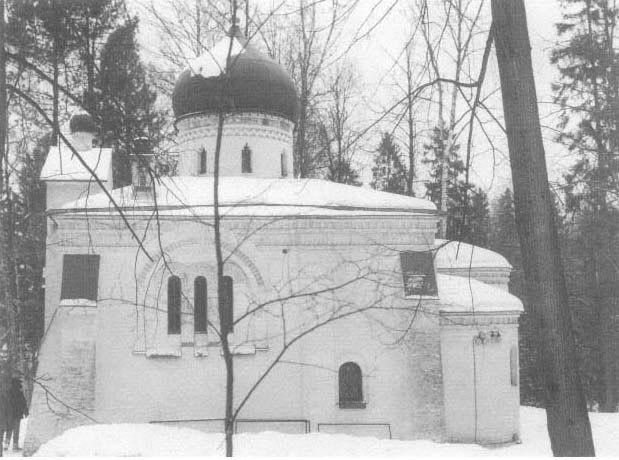
Fig. 42.
Church of the Icon of the Savior, south facade (Brumfield MR9-1a).
ing on the talent of Mikhail Vrubel, whose ceramic designs are preserved in tile stoves in the estate house at Abramtsevo (see Plate 7)[72]
The view that Abramtsevo was the precursor of a general cultural revival at the turn of the century is further supported by the interrelation between the arts that characterized many of the community's activities—not simply the crafts, the visual arts, and architecture but also drama, music, and set design. Participants in the estate's "amateur" productions included Fedor Chaliapin and Konstantin Stanislavskii-Alekseev (another product of the Moscow merchant elite). One of the most notable cultural events at Abramtsevo occurred in 1886, when Rimskii-Korsakov's opera The Snow Maiden was produced. The sets, designed by Vasnetsov, prefigure the neo-Russian element in style moderne architecture fifteen years later.
But the Abramtsevo church itself, in which structure, function, and material are related, links tradition and modernity in Russian architecture, embodying solutions to problems of style and form noted so pointedly at architectural meetings toward the end of the century. Vasnetsov's work at Abramtsevo remained generally unappreciated by architects and critics; in the 1890s Vladimir Stasov dismissed it uncomprehendingly as "without creativity."[73] Not until 1906 did the church receive its due in the architectural press, when photographs of both the interior and exterior appeared in Ezhegodnik Obshchestva arkhitektorov-khudozhnikov (Annual of the Society of Architect-Artists), a lavishly illustrated publication usually devoted to buildings constructed within two years of the issue.[74]
The architectural collaboration at Abramtsevo was not the last occasion when a painter there made an
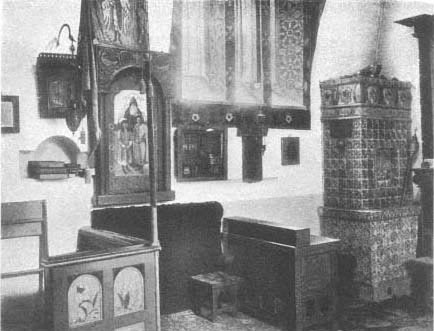
Fig. 43.
Church of the Icon of the Savior, interior. Ezhegodnik Obshchestva
arkhitektorov-khudozhnikov , 1906.
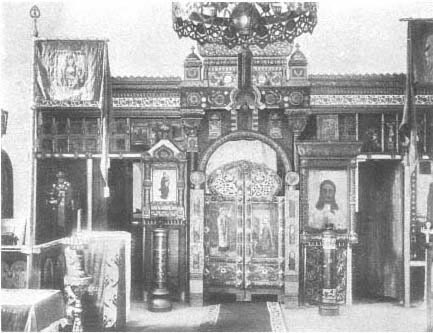
Fig. 44.
Church of the Icon of the Savior, iconostasis, Ezhegodnik Obshchestva
arkhitektorov-khudozhnikov , 1906.
original contribution to Russian architecture. In 1896 Konstantin Korovin, who had painted stage settings for Mamontov's opera productions, designed the Pavilion of the Far North at the All-Russian Arts and Industry Exhibition in Nizhni Novgorod. Though more modest than the large pavilions by Pomerantsev for the same exhibition, Korovin's innovative pavilion exemplified his understanding of structure derived from traditional (in this case wooden) forms. The pavilion has no trace of the ornate "folk" decoration usually associated with Russian wooden architecture in the nineteenth century, instead, Korovin used his materials to create a simply defined sculpted mass (Fig. 45).
Although neither Korovin nor Vasnetsov used technologically advanced materials or construction methods, their approach to architectural form suggested a means to lessen the opposition between technology and historicism. Elena Borisova notes that in architecture the Abramtsevo painters "could satisfy that tendency to the plastic that professional architects felt somewhat later, for which painters still had not found a place on their canvases."[75] Precisely at this juncture, ahead of the new styles in both painting and architecture, the Abramtsevo artists—Polenov, Viktor Vasnetsov, Korovin, and to some extent Aleksandr Golovin—introduced their painterly conception of mass and space into architectonic form.
Members of the architectural profession in the 1890s might well have felt both a sense of accomplishment and some doubt about the future of a practice based on seemingly endless variations of Russian revival or French Renaissance styles. These mixed feelings surfaced in discussions of rationalism in architecture during the Congresses of Russian Architects arranged by the Petersburg and Moscow architectural societies. At the first congress, held in 1892 at the Academy of Arts in Petersburg, the theme of rationalism surfaced early, in Pavel Siuzor's keynote address. In outlining the four sections of the congress he commented on the first (artistic) section:
In the artistic, architectural section there are generally three characteristic directions to be noted: the classical, the national, and the rational or the real, that is, the practical and functional. The first is sufficiently well known, and therefore I will not dwell on it. In the national one speaks of the working out of Russian nationality, of Russian artistic motifs. The architect taking the rational direction ignores the framework presented to him and attempts to satisfy the necessary demands in general terms before turning his attention to an artistic treatment of the required forms.[76]
Because Siuzor's linking of the rational with the real, or the practical, does not preclude the use of eclectic motifs in structural decoration (Fig. 46), his statement represents a retreat from the strict rationalist principle developed by leronim Kitner and others in the 1870s.
Kitner was, in fact, a forceful presence at this congress; but Robert Gedike, whose speech followed Siuzor's, voiced the uncertainty of many architects about the relation of architectural aesthetics to contemporary structures. Gedike had recently become rector at the Academy of Arts; during his thirty years of practice he had established a reputation as a competent architect of no pronounced theoretical position. His sense of crisis was stimulated by the architectural displays at the 1889 Paris Exposition:
The reasons for the obvious decline of taste in the civil architecture of our time lie, one must assume, in the numerous changes that have touched our lives in recent times but are not yet established and therefore prevent our artists from choosing one general and stable direction in all branches of the arts. Every style in architecture expresses the tastes and social currents of a particular time. In our time no close tie exists between accepted concepts about art and their artistic expression in architectural compositions: devices once in use have grown old, and the new have not yet had time to work themselves out in clearly defined forms. At present we are experiencing a struggle in architecture between old and new points of view.[77]
Although unable to predict where new forms of inspiration would arise, Gedike concluded optimistically: "Even now works of architecture sometimes appear in which one senses the creators intent to deny the old traditions and create a new style, using contemporary discoveries and refinements in science and technology." He did not elaborate; his speech is significant not for analysis but for the unambiguous reference to a decline in architectural taste and for the use of the term "new style," which evolved during the 1890s from a catchphrase to the name of Russia's modern architectural movement.
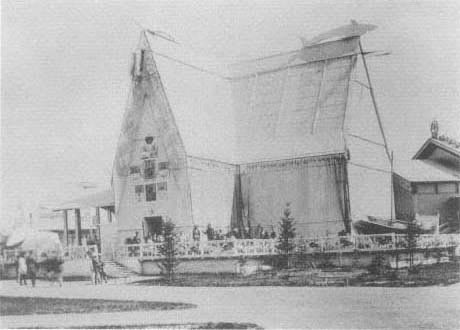
Fig. 45.
Pavilion of the Far North, 1896 Nizhni Novgorod Exhibition. Konstantin Korovin. Vidy
Vserossiiskoi khudozhestvennoi promyshlennoi vystavki 1896 g. v Nizhnem Novgorode .
Courtesy of the Slavic and Baltic Division, New York Public Library.
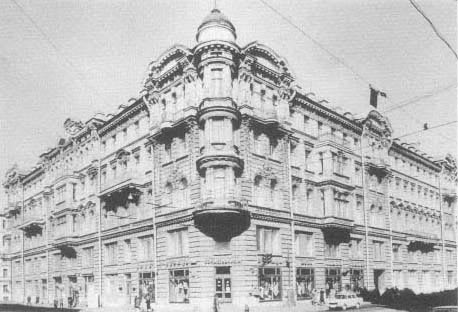
Fig. 46.
Efimov apartment house, Petersburg. 1883–1885. Pavel Siuzor (Brumfield L85-34).
The further discussions of aesthetic issues at the 1892 congress reveal that every professional position on rationalism had become compromised. In a lecture entitled "The Significance of the Study of Ancient Monuments for Contemporary Architecture," Konstantin Bykovskii defended old Russian architecture, which "never had a decorative, applied character or that mannered design that so often distinguishes contemporary buildings."[78] For him pre-Petrine architecture demonstrated an organic link between style and structure. Although certain architects of the "new style" would revive this interpretation, nothing in Bykovskii's remarks—or in current architectural practice—indicated just how the organic link might be re-created. Certainly no one mentioned the dilettantes at Abramtsevo.
In the debate that followed Bykovskii's lecture, Kitner criticized the national, historicist school—but said only that architectural competitions specifying a style were needlessly restrictive and the resulting designs possibly incompatible with function.[79] Bykovskii replied that he would not adopt the Russian style if it contradicted the purpose of a building. The debate never rose above this level, perhaps because neither side was yet prepared to develop new ideas in architecture. Although both Bykovskii and Kitner were to practice for many years after this congress (Bykovskii died in 1906, Kitner in 1929), each had formed his views on style during the preceding three decades. Bykovskii's two major projects during the 1890s—the State Bank in Moscow and the Zoological Museum of Moscow University—are eclectic designs with careful detailing and, in the merging of architectural and zoological form on the facade of the museum, a fine sense of wit; but neither is innovative (Fig. 47).
As for Kitner, although he produced technologically advanced work with metal construction (such as Petersburg's Haymarket), that work seems forgotten in his lecture. "Concerning the Reduction of Tariffs on the Transportation of Natural Stone on All Russian Railroads." Echoing the view that the architecture of the past decade had taken a "false path," Kitner urged that natural materials like stone be used instead of stucco and other "surrogates". Natural stone would impose discipline on architects, who would consequently rid their buildings of superfluous decorative motifs.
For whatever reason, the beginning of the twentieth century indeed witnessed an increasing use of natural stone on building facades and a greater concern with the texture (faktura ) of natural materials. But in Kitner's speech the future of architecture was in the past. "To create any new style characterizing our age seems difficult and fruitless, . . . like flailing at water. " Genuine architectural style had been based on the properties of hewn stone, and only a return to this material would relieve architecture of its self-deception.[80]
In the technical sections at this and subsequent architectural congresses in the 1890s, architects maintained the retrospective view. During the year of the second congress (1895), Vladimir Shervud published his Essay on the Investigation of the Laws of Art: Painting, Sculpture, Architecture, and Ornament , which defined both the general and the specific in national architecture. Like many Russian intellectuals of the 1870s and 1880s, Shervud believed Russia could fulfill its special role in civilization only by returning to certain Russian values. His detailed analysis of pre-Petrine Russian architecture focused on churches, whose dominance in medieval Russian life demonstrated that religion was "virtually the only guide to the intellectual life of man. Therefore, the church style, which expressed the inspiring idea of the people, also made its way into civil architecture."[81]
Shervud drew conclusions in the essay that are evident in the facade of the Historical Museum, completed twelve years earlier but clearly an expression of the same ideas. His analysis is more than an eccentric relic of nineteenth-century cultural nationalism because he imposed an ideational content on architectural form. He proclaimed that "the restoration of all the fullness and multifaceted display of the spiritual idea in architecture is granted to the bearer of the pure Christian faith—to the Russian people."[82] Architecture thus assumed a literary, programmatic aspect transcending aesthetics of the classical system. For Shervud the Renaissance (and, by implication, post-Petrine Russian architecture) had no "clearly defined idea"; but the idea he himself sought had less to do with principles of form and structure than with the expression of the national culture.
To a certain extent Shervud' s ideas grew out of Eugène Viollet-le-Duc's interpretation of architecture and his L'Art russe , published in 1877 and translated by Sultanov in 1879. Viollet-le-Duc believed that Russia had synthesized art forms derived from both East and West; the resulting works were not imitative but bore the stamp of national genius:
Russian architecture at that stage of development which it reached in the seventeenth century is a superb instrument whose broad basic principles
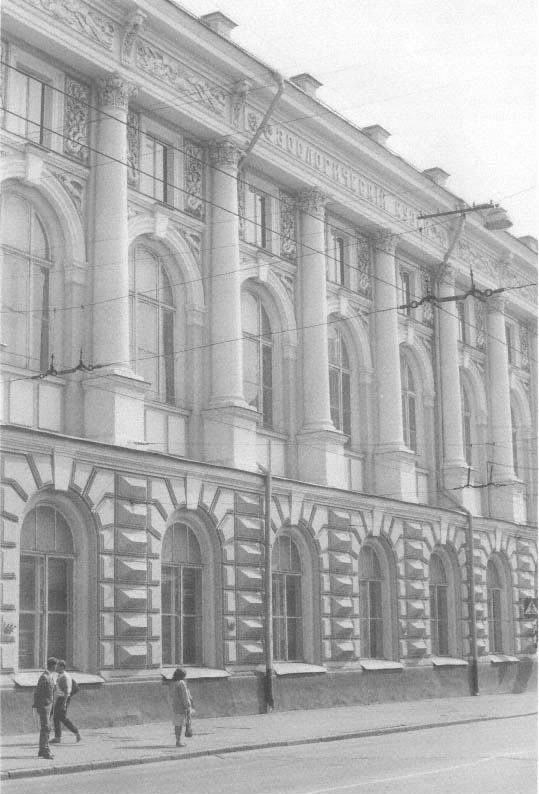
Fig. 47.
Zoological Museum, Moscow University. 1902. Konstantin Bykovskii (Brumfield M162-4).
do not restrict the artist's freedom. It is possible to think up the boldest combinations while remaining faithful to these principles. It remains to the nineteenth century to resume this interrupted work [the Russian architectural synthesis interrupted by Peter the Great]. But a successful conclusion requires the assimilation of the spirit guiding artists in the sixteenth and seventeenth centuries and the abandonment of classical instruction that in Russia and on the European continent has forced art to abandon its logical course in harmony with the spirit of tribes and nationalities.[83]
In discussing Russian architecture, however, Viollet-le-Duc introduced interpretations of artistic detail so capricious that a number of Russians—including his translator, Sultanov—challenged his views.[84] But aside from questions of detail, Viollet-le-Duc's emphasis on national character in architecture must have been welcome to Russians already primed to think in similar terms.
Whatever the similarities between the views of Shervud and Viollet-le-Duc (who would not have shared the Russian's fervent Christianity), the interpretation of Viollet-le-Duc in Russia had less to do with his architectural rationalism—he claimed that the principles of sixteenth-century Russian architecture could be adapted to modern use and technology—than with his belief that architecture expresses a social and cultural purpose. For Bykovskii, Kitner, Shervud, and many of their contemporaries who spoke or wrote about the destiny (or crisis) of Russian architecture, Russia was a unique cultural entity whose architecture must be guided by—and must itself express—a unifying idea.
Paradoxically, the question of national identity in Russian architecture reflected not only the thinking of Russian intellectuals but also that of nineteenth-century British and French theoreticians who had discussed the significance of medieval architecture in the revival of indigenous styles in their own nations.[85] Although once again Russia followed the general European pattern, the Russian architectural profession, in its publications and at its meetings, pursued the issue of national identity with unusual intensity. That the Russian architects linked questions about national purpose and cultural identity to the development of architecture suggests an awareness of social and economic inferiority vis-à-vis more advanced European countries.
Konstantin Bykovskii's address in 1895 to the Second Congress of Russian Architects serves as a central document of the attempt to reconcile the national past with modernity. Although Bykovskii lacked Shervud's ideological certitude, he was unusually well placed to survey the accomplishments of the architectural profession during the past three decades. Two years after debating with Kitner the essence of Russian architecture and its historical roots at the first congress, Bykovskii was chosen president of the Moscow Architectural Society—a post he would occupy until 1903. As the host to the second congress in Moscow, Bykovskii had the responsibility not only of commenting on the activities of the society, founded by his father, Mikhail Bykovskii, in 1867 but also of confronting yet again the unresolved issue of direction in Russian architecture. Bykovskii's lecture was entitled. "The Tasks of Architecture in the Nineteenth Century":
What other century has created so much for the comfort of human life? When have humane considerations led to the housing of workers in colonies according to a strictly conceived plan? When have such hospitals been erected for the good of mankind? When have such palaces of iron and glass been created for international exchange in industry, art, and science? Indeed, can our century, in which exhausted mankind seeks rest primarily in musical harmony, afford to neglect the musical element in architecture, in which a harmonious combination of forms, lines, and colors acts upon us and the sincere feelings infused in them refreshes us? Contemporary humanity seeks an architectural style that would satisfy it but has not yet found it. Despite the great beginnings of the century, an architectural masquerade continues, with buildings decked out in the raiment of various styles. Where did such a phenomenon come from—a symptom in architecture of the general spiritual mood of the age? We inherited it from a long period of the imitative worship of architectural styles. By imitating with no understanding of the organic life of forms, we became infected with the idea that beauty of form is something absolute, unconnected with the conditions that created the form itself. The thought that a building can be beautiful mainly from its decoration became entrenched, and an artificial division appeared between artistic and technical architecture.
The romanticism that embraced Europe in the first half of our century counterposed to clas-
sicism a fascination with the Middle Ages. . . . Instead of imitating classical styles, [architects] attempted to reproduce other styles previously rejected. The material suitable for architectural reworking is overwhelmingly varied, creating an especially difficult position for the architecture of our time. We must orient ourselves in all this material to find a guiding thread that will finally bring us out of empty eclecticism. We must work to assimilate the material from the past so firmly that we can deal with it independently and say in architecture a new original word.[86]
In Bykovskii's statement one sees traces of ideas from many sources, including Ruskin and Viollet-le-Duc. But Bykovskii gives a curiously Russian twist to familiar pronouncements about the need to revive and re-create architecture when he speaks tautologically of "a new original word" in architecture. Dostoevskii frequently expressed the notion that a culture can say a "new word"; Bykovskii's echo of this idea provides further evidence of a literary approach to defining the function of architecture in the culture as a whole.
The insistence by architectural critics, from Stasov to Bykovskii, that architecture express the national character reflects the enormous influence of literature in nineteenth century Russian society. Borisova uses the term literaturo-centrism to refer to this phenomenon in Russia from the 1830s to the the late nineteenth century; the term, however awkward, conveys the expectation that artistic culture, including architecture, should exist as a text correlated to a system of ideas.[87]
The inability of Russian architecture to achieve its expressive potential, according to Bykovskii, was related to the lack of cohesion in Russian society:
They are right who lament the lack of originality in contemporary Russian architecture; but they are wrong in considering none of the complexity of this phenomenon and in paying no attention to the role of social developments, of architects, and of contemporary life, in which one senses the lack of a unifying idea.[88]
Bykovskii concluded by advocating both the assimilation of modern technology and the use of the past as a source of creative inspiration for the architecture of the present.
There is little original thought in this speech, for Bykovskii's ideas of architecture were firmly grounded in the nineteenth century even as he addressed his remarks to the twentieth. Nonetheless, it deserves attention, for it reflects the disputes, ideals, and compromises of the Russian architectural profession during the late nineteenth century. The idea that architecture in an increasingly diverse technological and economic setting might need something other than a "unifying idea" (particularly one derived from a literary or historicist perspective) eluded him. He implied that independent expression in Russian architecture could not go beyond competent, professional work on the one hand and the imposition of ideological imperatives on the other.
Other European countries faced similar difficulties in developing new architectural forms. In Austria, for example, Otto Wagner and his students Joseph Olbrich and Josef Hoffman confronted established critical opinion based on "the fruits of archaeological studies" (to use a phrase from Wagner) in their quest for a modern architectural aesthetics. Coincidentally, the year of Bykovskii's speech (and Shervud's essay) was also the year Wagner completed his theurgic book Die moderne Architektur , which proclaimed a new rationalist aesthetic derived from structure and function; its rallying cry was "Nothing impractical can be beautiful." Wagner's definition of the new architecture recognized the broader meaning of architecture in modern times: "To represent us and our time this new style, the modern, must clearly express a significant change in the former sensibility, the almost total decline of romanticism and the emergence in our works of a purposefulness that usurps virtually everything else."[89] This contrast between the old and the new is all the more striking since Wagner had also worked in the Renaissance manner in the early 1890s.[90]
The work of Wagner, Olbrich, and Hoffmann was well known in Russian architectural circles by the beginning of the twentieth century; and although some Russian architects disparaged Wagner's modernism, Wagner himself was made an honorary member of the Petersburg Society of Architects. What stands clear in his work as a writer and an architect is his rejection of architectural symbolism linked to a historical or literary program: "It should always be seen as a gross error to accommodate inner structure to a favored external motif or even sacrifice it to that motif. Such an accommodation leads to an unavoidable lie and the resulting form is repulsive."[91]
Although in Russian architecture the call to the modern was never expressed so radically before the revolution, the relation between function and structure assumed particular importance in defining new forms.
At the same time, traditional Russian motifs were used flamboyantly in architecture—often with symbolic purpose—in certain works of the "new style." Many Russian architects openly borrowed innovative styles from Vienna, Darmstadt, and Paris but maintained the idiosyncrasy that characterizes Russia's adaptations from the West. In a single decade the greatest architect of the period, Fedor Shekhtel, moved through the entire spectrum—from eclecticism, the Secession, romantic nationalism, and severe functionalism—before returning to retrospective styles after 1909. However eclectic it may appear, Russian architecture during these extraordinary years succeeded in changing its traditional, academic perspective on form and design to one concerned with the "new style, the modern."