
The Vision of Public Realm
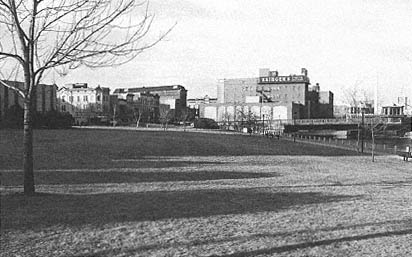
The shared, public, realm of a city often takes the shape of public squares or patches of nature in the city. Neither archetype seems to have inspired design decisions in Milwaukee when in recent years a new riverside park was created downtown. At best Pere Marquette Park is an amenity offering places to sit and stroll, but it is a compromise. It is neither an urban square nor an area given over to another, un-urban, world of nature. It does not pull parts of the city together; instead it does little more than occupy a landscaped area between other, unrelated, areas. Suburban lawns seem to have inspired it. Like so many other efforts to do something in downtown Milwaukee, this one lacked both conviction and a vivid guiding vision.
Elsewhere downtown the redevelopment of formal green squares, like Cathedral Square and Zeidler Park, has accentuated neither their urban nor their natural character. They have none of the suggestiveness of an eighteenth-century London square, for example, or a lush Victorian urban garden. These efforts failed not for having roots in European theory but for having no roots at all.
27.
Pere Marquette Park, situated downtown on the Milwaukee River, which was
once used for commerce, commemorates the landing of the missionary-explorer
Father Marquette. The site is prime in every way. It marks the important historical
process of exploration. It faces the Performing Arts Center across the river and
has frontage along the Kilbourn Avenue civic axis. It offers diagonal views of
downtown and of Milwaukee's striking City Hall. It is a crossroads for civic,
commercial, industrial, and sporting Milwaukee as well as a gateway to North
Third Street, with its Victorian buildings. The rich, strategic, and meaningful nature
of the site was ignored or suppressed, however, in a design that features a
suburban lawn, a curving walk, and some standard benches.
28.
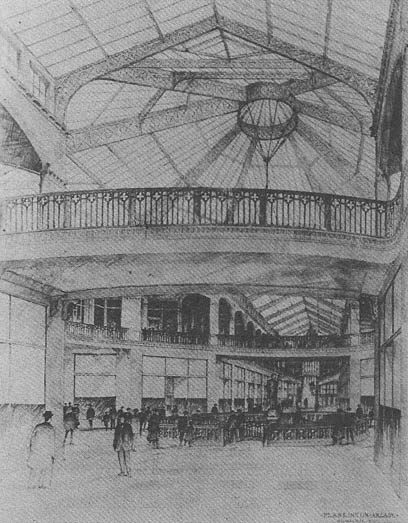
Interior, Plankinton Arcade. Holabird and Roche, architects, Chicago, 1916.
Bridges and dome highlight the intersection of the building's axes.
The longer one parallels Wisconsin Avenue.