
The King Creole Riot
A second incident involving Elvis Presley, this time a riot at the screening of his film King Creole, occurred in May 1959 at the Américas Cinema in Mexico City. Newspaper announcements for the film, whose title was translated as Melodía siniestra (Sinister Melody), had appeared only the day before. Moreover, these were sparse and lacked the graphics that usually accompanied films of the rock 'n' roll genre. One, for example, simply proclaimed: "Elvis Presley. The idol of the young in his first great dramatic performance." This was not to be a family affair: "Adults Only," the advertisement intoned.[122] According to newspaper accounts, the unrest began when more than 600 "rebels without a cause" entered the theater without paying. Taking to the balcony section, they "dedicated themselves to destroying the seats, which they threw onto the floor below them, along with bottles, lit papers and all class of projectiles." But the real raucousness erupted when a group of females tried to leave the theater and "were stripped of their clothing by the savages, whose pawing left them naked." The newspaper went on to describe the rioters as "in the majority, university students." However, this claim was contested by the student leader "Palillo," an organizer of the anti-Presley protest more than a year earlier, who responded that "hundreds of [nonuniversity] youth" were also involved, a point which, even if exaggerated, suggested a certain class diversity on the part of the audience.[123]
The sensationalist tone of the article was not entirely off base, though there were clear biases. The account, for example, fails to mention the fact that riot police (the feared granaderos ) arrived on the scene and brutally accosted exiting youth at random, noting only that "there were no arrests."[124] The Mexican novelist Parménides García Saldaña, a cult figure of the later counterculture generation, afterward wrote a short story titled "El rey criollo," based on this event. The story gives us a feeling for the charged atmosphere of the theater, no doubt a reflection, in part, of youth efforts to "reclaim" Presley as a virile hero of the young, after the attacks he had faced a short time earlier. The cinema became an anarchic, masculine-defined public space that united teenagers from different neighborhoods and classes beyond the realm of parental or state authority. As opposed to the university, here was a setting policed solely by youth (an ironic mock-
ery of the announcement's warning, "Adults Only"). Given the opportunity, the crowd unleashed its rebellious defiance, drunken with the pleasures of self-authority. As the lights went down, García Saldaña relates, a national news-service clip was shown, and "everyone [started] telling the asshole narrator to shut-the-fuck-up." The buenas costumbres that dictated proper language and etiquette (especially toward elders in authority) was gleefully put aside. The audience then burst into song: "Me voy pa' el pueblo, hoy es mi día, chingue su madre la policía," which roughly translates as, "I'm with the people, today's my day, screw the police."[125] The theater pulsated with the desmadre of rock 'n' roll.
Yet this disorder, which cast aside the buenas costumbres inculcated by one's parents and elders, reinscribed the commanding gaze of male over female. The nominal independence that some women experienced in relationship to traditional gender roles (that is, attending the theater without a male chaperone) was swept away by the male-controlled space of the movie house. As García Saldaña relates:
[W]e entered the theater and went up to the balcony. Up there it was just for the guys, raucous and not a single gal. It was as if at the entrance they had put a sign saying that the men go up and the women down, or something to that effect.... Before the film began, it was pure chaos, a fuckin' riot as they say more vulgarly. The different gangs shouted: Here the Guerrero [neighborhood]! Here the Roma! ... And then some chicks come in with leather jackets with swastikas painted on them, pony tails and bobby socks real rock and roller like, with their books and notebooks. And a group of guys gang up around them [and shout], "Dance!"[126]
In commanding the women to dance, the men here made explicit their control over women's bodies while emphasizing their own role as narrators of youth rebellion. According to García Saldaña, partway through the movie another group of girls entered the theater, looking for seats:
And out of the silence game the shout, "Meat! Meat! Meeaat!" And a group of guys went flying at them. And they started to scream and the guys began to make fun of them, grabbing their asses, their breasts, everything.... Some guys tried to stand up for them, they began throwing fists and the girls managed to get out, half-dressed. It seemed that everything had calmed down, but then they started to tear up the seats and throw them and everyone ran like crazy in all directions, as if the theater were on fire.[127]
Unfortunately, we do not know more about the specifics of what actually happened in that theater: how class tensions may have played a part, to what
extent the insults and grabbing were limited to one group of boys, rather than a cross-section of the audience, and so on. In any event, the scene quickly turned into a riot once the police arrived. Federico Arana recalls that as he was running out of the theater and into the street he was cornered by a group of granaderos. Without provocation, they "kicked us in the stomachs and beat us with their rifle butts, meanwhile making fun of our situation, in a perverted and cowardly way, until they managed to capture a few scapegoats."[128] In the public's mind the riot clearly signaled nothing less than the breakdown of social order under the degenerate influence of rock 'n' roll. That several women were practically raped in public only reinforced the belief that a loosening of feminine virtue was directly connected to youth's confrontational posture and thus the collapse of patriarchal authority.
Editorialists were quick to seize the opportunity to once more link an evident crisis in values with the influence of rock 'n' roll. In one example, the social caricaturist Abel Quezada used the occasion of "Teachers' Day" (15 May) to make a commentary on the idea that youth paid more respect to Elvis Presley than to their elders (see Figure 2). Titled "Maestro de la juventud," the cartoon played on the double meaning of maestro as denoting both teacher and, literally, master . The cartoon shows a humble-looking student, bowing slightly and offering a bouquet of flowers to a towering giant; only his legs and part of an arm fit into the frame. Labels indicate to us that the giant is none other than "Elvis Presley" and the humble student, "El rebelde sin causa."[129] In another cartoon, also by Quezada, rock 'n' roll is represented as a fascistic device manipulating the masses. Under the title, "Al son que le toquen" (To Whichever Tune They Play), a jukebox blaring the words "rock and roll" is directly compared with Hitler's and Mussolini's entertainment" of the masses in their own times.[130]
Responding to what it described as "a rising and threatening sickness which is manifest in the so-called 'rebels without a cause'," Excélsior editorialized that the "primary cause is found in the breakdown and disunion of the Mexican family over the last years."[131] A rising consumer culture, coupled with a liberalization of attitudes toward divorce, directly contributed to the undermining of parental authority and thus the loss of respect of child toward adult, according to Excélsior . "This is beginning to be not a plague, but a luxury of modernity," the newspaper lamented shortly thereafter. "The young want to be free and sovereign men [sic ], rich and adventuresome, owners of cars and participants in worldly pleasures, when they hardly have reached the age of fifteen."[132] For middle-class teenagers, however, as Federico Arana recalls, the reality was more that "we lived narrow,
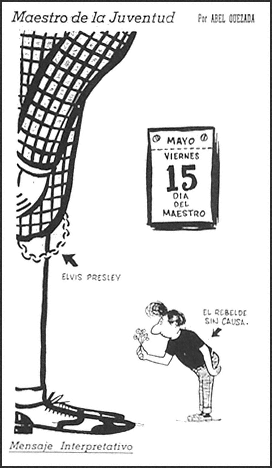
Figure 2.
Cartoonist Abel Quezada's critique of Elvis
Presley came on Teacher's Day 1959, Source: Excélsior,
15 May 1959, A7. Used by permission.
boring, almost provincial routines." He continued, "In general, the 'rebels' weren't much besides shy and ordinary kids who put on red nylon jackets like that of James Dean or leather ones like Marlon Brando...and annoyed their family with their baneful mania of seizing the bathroom with the object of practicing the Elvis style raised-lip, popping a zit here or there and maintaining the hair mop and ducktail in good form."[133] But for the authorities, highlighting the connection between delinquent youth and privilege served to distract from the larger question of mounting poverty in the
urban slums and the dictatorial nature of political society. Later the attorney general, Fernando Román Lugo, in seeking an explanation for delinquency by youth "who are not in poverty, who live in well-formed homes, who are not lacking in entertainment or stimulation," ascribed the problem to "the lack of a Mexican feeling in our homes" brought about by an absence of discipline.[134]