

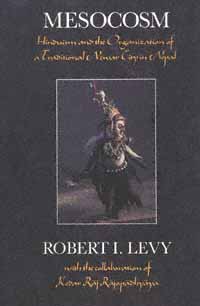
Mesocosm: Hinduism and the Organization of a Traditional Newar City in Nepal
Robert I. Levy
with the collaboration of Kedar Raj Rajopadhyaya
For Upendra Raj Radjopadhyaya and Nerys
Table of Contents
- PREFACE AND ACKNOWLEDGEMENTS
- Chapter One Introduction
- PART ONE ORIENTATIONS AND CONTEXTS
- Chapter Two Orientations
- Chapter Three Nepal, the Kathmandu Valley, and Some History
- Chapter Four Bhaktapur's Other Order
- Chapter Five The Distribution of Roles: The Macrostatus System
- Chapter Six Inside the Thars
- PART TWO THE CONSTRUCTION OF THE MESOCOSM
- Chapter Seven The Symbolic Organization of Space
- Chapter Eight Bhaktapur's Pantheon
- Chapter Nine Tantrism and the Worship of the Dangerous Deities
- Chapter Ten Priests
- Chapter Eleven Purity and Impurity: On the Borders of the Sacred
- PART THREE THE DANCE OF SYMBOLS
- Chapter Twelve The Civic Ballet: Annual Time and the Festival Cycles
- Chapter Thirteen The Events of the Lunar Year
- Chapter Fourteen The Events of the Solar Cycle
- Chapter Fifteen The Devi Cycle
- Chapter Sixteen The Patterns and Meanings of the Festival Year
- Chapter Seventeen What Is Bhaktapur that a Newar May Know It?1
- Appendix One Transliterations Used in the Text
- Appendix Two Bhaktapur's Newar Hindu Thars Ranked By Macrosocial Status
- Appendix Three Kinship Terminology
- Appendix Four Types of Worship and Materials Used in Worship
- Appendix Five A Catalogue of Annual Events and Their Distribution Throughout the Lunar Year
- Appendix Six Rites of Passage and Death Ceremonies
- Notes
- GLOSSARY
- REFERENCES
- GENERAL INDEX
- NAMES INDEX
PREFACE AND ACKNOWLEDGEMENTS
The many years of research and writing that resulted in this book required the support of many people and institutions. I am grateful and relieved to be able, at long last, to acknowledge them.
The years of research in Nepal were supported by grants from the University of California and the National Science Foundation. There were two one-year periods when I was providentially freed from other responsibilities and able to write at leisure. The first was made possible by a John Simon Guggenheim Fellowship, supplemented by a grant from the Social Science Research Council, and the second by a Fellowship at the Center for Advanced Study in the Behavioral Sciences at Palo Alto, once again with supplementary support from the Social Science Research Council. The Center for Advanced Study provides an incomparable setting for intellectual stimulation and for getting work done. Its Fellows are usually burdened for life with affectionate nostalgia and gratitude, as am I.
Leslie Lindzey at the Center, and Marian Payne at the University of California, San Diego, helped enormously in various stages of preparing the manuscript. Cathy Hertz of the University of California Press meticulously saved me from a multitude of errors. The ones that remain are mostly a matter of my own stubbornness. Susan Coerr carved an orderly index out of the tangled materials of the book.
I had invaluable aid in getting started on the study from Christoph von Fürer-Haimendorf, Leo Rose, the late Bhuwan Lal Joshi, and Jaya Pratap Malla. In Nepal I received much information and support from
Abner and Sylvia Hurwitz, Jacob and Patricia Crane, Gabriel Campbell, Lynn Bennett, and the staff of the United States Educational Foundation. Many departments of His Majesty's Government generously helped me with maps, statistical information, and support of various kinds. In Bhaktapur the great scholar Ramapati Raj Sarma gave me patient and invaluable help with my many linguistic, historical, and interpretive problems. The very many others in Bhaktapur who wish to remain anonymous helped as informants, teachers, and scribes. In the United States Devi and Gautam Vajracharya helped in the translation of masses of interview materials and acted as living reference works during the years in which the book was being written. Steven Parish had many useful comments to make on the manuscript based on his own research in Bhaktapur. Roy D'Andrade helped me through some of the more tangled patches of the material on kinship terminology.
My indebtedness to the works of contemporaries and predecessors in the study of the Kathmandu Valley is, as the following chapters will show, enormous. Among these, I am especially indebted to Niels Gutschow, whose many years of work in Bhaktapur, whose maps— including the ones he has prepared for use in this book, and whose frequent "personal communications" stimulated by his careful reading of the manuscript inform and embellish the book.
The introductory chapter tells something of what I owe to my collaborator, Kedar Raj Rajopadhyaya. This book would have been something entirely different and very much less without him.
And, finally, to the one without whom there would have been no book, and not much of anything else, my beloved wife, Nerys.
The maps in the book were prepared by Niels Gutschow. He is also responsible for the photograph used on the jacket and as a frontispiece. Roy Porello prepared the color plates of the Nine Durga masks. The other photographs are by Robert Levy.
In the quotations used in the book we have generally altered the transliteration of Nepali, Newari and Sanskrit terms to follow the usages of the text.
Chapter One
Introduction
The Background of This Study
This book is based on a study of Bhaktapur, a Newar city in Nepal, during the years 1973 to 1976, and it is the first of two projected volumes. My central interest has been in the reciprocal relations of the public life of communities and the private worlds of their members. I began working in Bhaktapur after studies in two small Tahitian-speaking communities in the Society Islands of French Polynesia ("Piri" and "Roto") in the hope that the enormous contrasts between the ways of life of that Himalayan Hindu city and of the tiny Polynesian communities might be illuminating in some unforeseen way.
My intention at first was to report on Bhaktapur in much the same way that I had on the Society Islands communities. I would write a short section on the social and cultural context of people's lives and follow it with an extended description and discussion of some individuals' private experience and of their "mental worlds" as those small worlds were related to their larger contexts. I collected, as I had in Piri and Roto, information on the social and cultural context and, with the help of lengthy tape-recorded sets of interviews, information on private worlds. Instead of the forty pages that were required to introduce the relevant aspects of the Tahitian context, however, it has taken me this large volume to present the relevant Bhaktapurian context. That, in a way, is the central point of this study. For it is the weight and complexity of its culture and society that most evidently distinguishes public life
in Bhaktapur from public life in Piri and which, in turn, powerfully affects many aspects of private experience and personal mental organization of people in Bhaktapur in comparison with people in the Tahitian communities.
But what is the relevant context? Bhaktapur is a repository of much of the cultural and social history of South Asia. What was to be studied there, and what included in this volume?1 The decision, as always in ethnographic reports, has been somewhat uncertain and a compromise. Thus some of this book is devoted to the commonplaces of the tradition of ethnographic description—sketches of history, economy, and, more elaborately, social structure. Most of it is concerned with the elaborate "religious" life of the city, the system of symbols that helps organize the integrated life of the city so that it becomes a mesocosm , an organized meaningful world intermediate to the microcosmic worlds of individuals and the culturally conceived macrocosm, the universe, at whose center the city lies.
The religious organization of Bhaktapur is of central interest for the theoretical ambitions of this study. One of the most striking differences between Bhaktapur and Piri is the enormous comparative elaboration of a particular kind of symbolism (which we will call "marked symbolism") in Bhaktapur and its miniscule importance, even its suppression, in Piri. As I will propose in chapter 2, this elaboration is a crucial resource for organizing a certain type of community and society, a certain type of city—an "archaic city." Bhaktapur represents a Hindu community in its full development, a "climax community" of Hinduism, and Hinduism so viewed is a symbolic resource that once served, and still anachronistically serves in Bhaktapur, to organize many such cities.
A final reason for emphasizing Bhaktapur's symbolic organization is that the striking contrast between Piri's emphasis on what it takes to be the mundane and Bhaktapur's emphasis on the dramatic theatrics of marked symbolism is intimately and centrally connected with differences not only, as one might expect, in the intimate experience of people in the two places but also in aspects of their "mental organization." It was as an essay in comparative "mental organization" that I undertook the study, and it is here that this volume has a problem. The understanding that I began to have during the course of this study of various people's private lives, of their ways of thinking and feeling, of their consciences and their motives, often motivates and shapes the sociocultural description presented in this volume. The neurophysiologist and cybernetician Warren McCulloch once entitled a paper "What is a
Number, That a Man May Know It, and a Man, That He May Know a Number?" (1965). These intimately interdependent questions, transformed to "what is Bhaktapur that a Newar may know it, and a Newar that he or she may know Bhaktapur" serve admirably to indicate what I am mostly after, with the qualification that "know" is too limited, and would need to be expanded to "act in, be secure in, be sane in, be human in," as well as "resist, struggle against, reinterpret" or whatever words we may find for those aspects of Man (who is, of course, generic Man) that turn out to be dependent on the forms of the community in which an individual lives. However, the materials on the mind and experience of "the Newar," or, more modestly and accurately, of sample Newars, must be presented in detail elsewhere. In this volume I have had to introduce as assertions with no supporting data ideas about some of the most relevant psychological and personal "resonances" (a useful word for deferring considerations of cause and effect, of direction of the flow between individuals and community) of the symbolic order, ideas, for example, about "sophistication," symbol hunger, special qualities of "self" and "person," the implications and resonances of the "purity complex," and of the special personal force of blood sacrifice. The apologetic and hopeful phrase "We will treat this at length elsewhere" is often used in admission that the reader might be uncomfortable with one or another obiter dictum .
I approached Bhaktapur from Tahiti with a different set of questions and with a different kind of competence and ignorance from those of an Indologist or Himalayan expert. I must ask the Indologist's indulgence for my errors and amateurism and the use of secondary sources and translations for South Asian history and for Hindu texts. The Indologist and the anthropologist working in South Asia need much mutual forbearance on the one hand and dialogue on the other.
My choice of Nepal, the Newars, and Bhaktapur for study was originally motivated by a growing conviction that the kinds of psychological forms that I had seen and reported on in Piri and Roto (Levy, Tahitians , 1973) were something more than the simple consequence of an historically derived "cultural tradition." The personal experience and psychological characteristics of individuals in Piri and Roto turned out to be in many ways similar to those reported elsewhere throughout Polynesia and Micronesia. This raised questions (Levy 1969, 48):
To what degree are the similarities artifacts of shared emphases of the common intellectual subculture of Micronesian and Polynesian specialists? To what degree are they simply a negative category, a lack of some peculiarly
modern urban trait, turned into a pseudopositive form? To what degree are these necessary structural psychological responses of all people who live on islands, or who have semisubsistence economies based on horticulture and fishing, or who live in traditional "simple" societies of any kind? To what degree are they universal responses to encounter with vastly more powerful societies, or to prolonged colonial experience? And finally, to what degree are the reported areal psychological sumlarities part of a shared and historically transmitted cultural tradition, in which personality can be viewed as an historical product?
With such questions in mind and with considerable curiosity about experience in different kinds of places that were exotic to me, I looked for a community that was as different from a Tahitian village as I could find, while still being "non-Western." I chose, finally, the Newar city of Bhaktapur in the Kathmandu Valley. Piri, the Tahitian village that was the principal site of my previous study, was small (some 284 people living in fifty-four households), on a small island, with comparatively little differentiation of social and sexual roles, based on a fishing and horticulture economy, traditionally nonliterate, a variant of Polynesian culture and society, and, since the late eighteenth century, under increasing Western colonial influence. Bhaktapur was a very large community by anthropological standards, some 40,000 people living in extraordinary density in an area of less than one-half square mile; situated in a high mountain valley in the interior of a large continental area; socially highly differentiated into a hierarchical caste structure, with markedly differentiated gender roles; with an economy based on farming, crafts, and trading; traditionally highly literate, in fact, a traditional center of Himalayan and South Asian High Culture; and although under the political control of the Gorkhalisnce the late eighteenth century, almost untouched by Western influences until the early 1950s. It would be difficult to find two non-Western communities that were more different from each other. The usual strategy in comparative studies is to compare two communities that differ from each other in as few dimensions as possible and to try to trace the influence of those few dimensions. A strategy of maximal contrast is a different matter. One learns something from comparing a mouse and an elephant, something about mammalian universals and about the possibilities and limits of variation, and, concurrently, about gross differences in adaptation.
In this book the comparison between Bhaktapur and Piri (and of both with "the West") is sometimes overt, but for long stretches it becomes covert, informing the point of view and the emphasis given to the possible significance of certain phenomena.
In the description of the relatively simple life of an isolated village it is possible to achieve a considerable degree of accuracy. Whenever possible, many variants of an event can be observed, many informants can be queried, small but possibly significant details can be explored, contradictions can be exploited. Bhaktapur, in contrast to such villages, is not only large in size and population—full of events, crammed with symbolic forms, and highly socially differentiated—but also has a literate tradition that many of its inhabitants know, and that in itself complexities reports and interpretations as to what goes on. But what its inhabitants think Bhaktapur is and what this study claims it, in fact, to be in large part is a unified sociocultural system. If one is concerned with the organization of this system and its implications for those who live in it, it has to be approached in long focus, trying to keep in view the multitude of forms and events that are visible to all in the city's public urban space and time. This requires the gathering of masses of material—often necessarily based on one viewing or sometimes one glimpse, and/or on the reports of limited numbers of informants, all under pressures that often make it impossible to adequately check reliability, details, and mistakes. In short, there are undoubtedly more errors of detail in this book than would be seemly in the study of a small community.
How The Study Was Done
I worked in Bhaktapur from April 1973 to April 1976, except for a six-month period starting in September 1974, during which I returned to the United States. During the first year and a-half I lived in Bhaktapur and studied primarily the public culture and social system and the Bhaktapur dialect of the Newari language. Although I had learned a little Nepali, the linqua franca of Nepal, before going to Nepal, I was not able to begin studying the Bhaktapur dialect of Newari2 until I began work in that city. During the first several months I was dependent on English-speaking Newars for explanations, translations, and language instructions.
During the first year and a-half I lived in Bhaktapur. Because I would have been unable to live with any except a very-low-caste Hindu family because of my "ritual uncleanliness," and because living with a low-caste family would have made it very difficult for me to interview higher-status people, I had to establish my own household with Newar servants from Kathmandu. With the help of English-speaking assistants
in the first stages I began the survey of the aspects of city life described in the report. A variety of approaches and materials—mapping of local spatial features (e.g., shrines, festival routes and locations, the residential areas of different status groups) on aerial maps, study of city documents and records, and interviews and surveys of various kinds were used to work out the skeleton of city organization. The work of other people on Nepal, the Newars, and Bhaktapur3 provided me with essential information for orientation as well as with proposals to be checked, confirmed, or corrected. In the years during which this manuscript has slowly grown other works have appeared that have been of great use to me, particulary the recent extensive volumes of Mary Slusser (1982) and Gérard Toffin (1984).
After this first period in Bhaktapur I spent six months back at the University of California working with Kedar Rajjopadhyaya the development of interview schedules. On returning to Nepal I began interviewing in Newari. In an approach to private lives I picked eight people—six men and two women—in various positions throughout the caste system for extensive series of tape-recorded interviews. These interviews became the bases for further interviews and observations m pursuit of the differentiated experience of the life of the city to be presented, it is intended, in a second volume. With the help of two scribes (who wish to remain anonymous) all the interviews were transcribed from tapes as Devanagari text. The scribes were Bhaktapur Brahmans, one an expert on traditional religion, the other on history and linguistics. They were non-English-speakers, and starting at this time most of my work was conducted in Newari. The scribes soon became associates in the study, and many of the descriptions of religious procedures and of various aspects of the city's culture, often stimulated by issues or obscurities (for me) in the recorded interviews, started with their descriptions and explanations. Because of the major emphasis on secrecy and privacy in Bhaktapur the scribes and a few of the people being interviewed traveled to Kathmandu, some eight miles from Bhaktapur, to work with me. During this last year I lived in Kathmandu and traveled to Bhaktapur, where I had an office on the ground floor of an unoccupied house, to do several sets of interviews, observe festivals and various special events, and do some surveys.
Newari is a complex language of Sino-Tibetan provenance, with an enormous vocabulary derived from its complex history as the language of an ancient and complex society.4 It has many sociolinguistic and stylistic variations, many of Bhaktapur's major social units as well as
many geographic divisions of the city having distinctive pronunciations, vocabulary, and usages. Although I conducted interviews in Newari, and understood to a considerable degree what people were trying to tell me, I missed some of the sense and many of the nuances at the time of the interviews. The study of the Newari written transcripts after the interviews and again on return from Nepal helped clarify much of this. As a further and important step in clarification, however, I had all the interviews (including my own parts of the dialogue) translated into English on return to the United States. This was done mostly by two Newar scholars, Gautam, and Devi Vajracharya.
The penultimate stage in this long process, prior to the preparation of the final manuscript of this volume, was the joint reading over some months during 1979 of a draft manuscript of the sociocultural materials with Kedar Raj Rajopadhyaya. Many corrections and amplification were made during this reading. The final manuscript is the result of the slow reworking of the corrected draft manuscript to bring our descriptions and interpretations into relation with the South Asian and wider scholarly literature relevant to the study, and to which, we hope, the study is relevant.
Kedar Raj Rajopadhyaya is the chief Brahman priest of Bhaktapur's Taleju temple, once the temple of its Newar kings and still at the center of the city's civic religion. He is a member of a family that has held that post for many generations. The position passed to him in 1973 when his father, Upendra Raj, died. Upendra Raj had been chief Taleju priest for several decades and had known Bhaktapur in its time of Himalayan isolation, when upper-status people were still carried on the roads in palanquins and the forms of "medieval" Bhaktapur still flourished. Kedar participated in the work of his father and uncles and was taught by them and studied the Hindu religious tradition in a Sanskrit school in Bhaktapur. He works not only in Taleju with its Royal and Tantric activities and its various relations to wider civic religion and as a purohita , a family priest, with his family's traditional clients but also in the city's nascent modern sector as a member of the city's administrative council and of other urban organizations. He is fluent not only in Sanskrit, and like most upper-status people of Bhaktapur, Nepali and Newari (both Kathmandu and Bhaktapur dialects), but also English. Kedar, as he is known throughout Bhaktapur, came to believe that Bhaktapur would soon change into something else, and that an attempt had to be made to tell something about its old religious life to a wider
world. He was first an informant for me, but soon came to be much more, my collaborator in this book. From here on "I" becomes "we" for this book is a product of our continuing dialogue.
This volume is concerned with the symbolic ordering of Bhaktapur, and thus of only some of the many dimensions that make Bhaktapur an interesting place. This choice was made in consonance with the theoretical concerns introduced in the next chapter, above all because of an interest in Bhaktapur itself as the locus of the experience of its citizens. We have for the most part neglected economy, social dynamics, ecological relations, material culture, and so on. One neglected topic requires comment, however. We have had to neglect Bhaktapur's relations to its traditional hinterland. This would have been a major project in itself, and it is to be hoped that others will undertake it. Much of this would have to be an historical study, as the events of the last 200 years have caused Bhaktapur to draw into itself and at the same time—especially in recent decades—to be related to a wider Nepal in the external relations it did have. However, the neglect of the hinterland leaves out what would be the essential necessary next step in the analysis of the "kind" of city Bhaktapur once was. As polis meant, depending on its context, sometimes the Greek city within its boundaries, sometimes that city and its hinterland, so "Bhaktapur" once meant sometimes the city, sometimes the city-state or "little kingdom" of which the city and its privileged inhabitants were the royal center. There are a few remaining ceremonial relations with the Newar villages and towns of the hinterland recalling the old relations, and a few continuing economic relations with some of those towns and more especially with the surrounding non-Newar hill peoples. Now, and in a lengthening post, however, the hinterland of the city means for the most part only the rich farm-lands that immediately surround it, farmed by people who live within Bhaktapur. We cannot be sure how in the past integration into the city-state altered the indentity and experience of the Bhaktapurians of the little kingdom. We would guess that the change now is mostly for the dwellers of the peripheral towns and villages in their new self-sufficiency. But whatever the previous economic, political, and symbolic integrations of city and hinterland may have been it seems plausible—from what history and chronicles and tradition we have to guide us.-that the dwellers within the main royal cities always thought that the universe was most clearly and safely represented within their city boundaries. The dangerous deities who stand at the boundaries and
protect those boundaries against the dangerous and difficult world beyond the city have stood there since time immemorial.
One other problem requires comment—and a justifying argument. Our emphasis on the order of Bhaktapur is very liable to appear regressive, ideological, Orientalist, and various other unpleasant things in the contemporary climate of criticism of essays presenting "other" times and "other" peoples. We are, in this volume, describing a normative order, an ideal order. We have many questions to address to it—what kind of an ideal order is it in comparative perspective, what does it do, and what are its parts and relations and dynamics. As those questions show, we accept its "reality" as an essential focus of concern and analysis for understanding Bhaktapur. It is only against this ideal system, that our ultimate inquiry, the dilemmas, conflicts, understandings, and points of view of individuals in Bhaktapur—all of whom find themselves in vital interaction with the concrete realizations of the ideal system—can be understood. We have constructed our representations of the urban symbolic order from many sources. Much of it is from the material realizations of the ideal order in city space, the precipitate of the conceptual and building programs of past elites. Much of it is from obervations of aspects of action expressing that order, or the interface between that order and contrary problematic ones. And many parts of this book are based on the conceptions and descriptions of elite informants, specialists of various kinds, but above all Rajopadhyaya Brahmans.
The conception of a civic order is thus not just that of a sentimental Westerner, it is that of local specialists in symbolic order. The book is, in part, a presentation of their , their own, imagery. For Bhaktapur, that conception is not just the wishful ideological thinking and propaganda of precarious elites but a powerful force that in itself helps to create order. Whatever the untouchable, for example, thinks about it all, it is these conceptions which form the matrix of his life. Against the ordering interpretations of the elite, popular interpretations where they differ are either simply "wrong" when they are alternatives within the same sort of ideological domain, or else, when they are explanations of some radically different sort (as when a farmer, say, represents untouchability as a guarantee of social order), represent attempts at critical "demystifications" of the system, both alternatives illuminating the tensions, tasks, and dynamics of the dominating system of symbols and interpretations. How the ideal system is experienced, represented, and known by others in the city and its ontological status when "the peo-
ple" are the center of our concern are the intended subject of another work.
This coherent symbolic order is a peculiar attempt to order a community. It is not in itself adequate to represent "the life of the community." That life has many aspects, levels, and kinds of order and disorder. To try to make one aspect the "real" one is to engage in ideological polemics or, worse, tendentious and covert use of the exotic. However, to neglect order where it does exist is another and peculiarly postmodern ideological move in itself.
PART ONE
ORIENTATIONS AND CONTEXTS
Chapter Two
Orientations
In the following chapters we will discuss those aspects of the past and present of the Newars and of Bhaktapur that will serve as context and background to our principal concerns. We must first introduce the Newars briefly and then, at rather greater length, present a collage of theoretical "conceits" that will suggest the field of discourse in which this book and its selections, arguments, and assertions is located.
Bhaktapur and the Newars
Traditional Nepal, an ancient Asian society with a literate high culture, was confined largely to the Kathmandu Valley. The people of this valley came in time to call their territory Nepal, themselves Newars, and their language Newari. Archaeology has not yet fully clarified their prehistory, but it seems that at an early period (perhaps the eighth or seventh century B.C. ) a predominantly Mongoloid, Tibeto-Burman speaking people settled in the valley where they may have encountered an aboriginal population speaking an Austro-Asiatic language. From perhaps the first or second century A.D. a political organization emerged that was to characterize the Kathmandu Valley until the late eighteenth century. A ruling class, a king and his court of North Indian origin, speaking and writing Sanskrit for sacramental and literary purposes and a Sanskritic North Indian language (a Prakrit) for everyday purposes, was progressively woven into an underlying society and culture with Hima-
layan and Central Asian features. Gradually a language (Newari) and culture (Newar) arose that synthesized these elements. Although the Sanskrit culture of the priests and court persisted, it became more narrowly traditional and ceremonial. Progressively more of the larger religious, political, and literary life was expressed in Newari and Newar forms.
There were dynastic disputes and confusion, but the Newars flourished. The valley soil is exceedingly rich, the bed of an ancient lake. A complex system of irrigation works for the collection and distribution of rainwater from the slopes of the surrounding hills was inaugurated sometime prior to the establishment of the first North Indian dynasty, and the rich soil and irrigation permitted highly productive farming. The Valley in time found itself on the major trade routes between India and Lhasa, in Tibet, and trade, tolls, and services became the basis, along with the rich agriculture, for considerable wealth. This made possible (and was, in turn, developed through) a great sociocultural efflorescence.
Stimulated by Indian ideas and images throughout a very long period of time, the Newars began, perhaps from the fourth century onward, the progressive elaboration and centralization of their society and culture in urban centers. Of these, three—Bhaktapur, Patan, and Kathmandu—became variously principal or secondary royal centers. They became concentrated, bounded (walled during certain times), highly organized units, surrounded by a hinterland of farmland and villages. Finally the three cities became politically divided. The hinterlands became territories, and three small states developed, each with its own central royal city, its king, its particular customs, its dialect.
During these centuries the Newars created architecture; sculpture in wood, stone, and metal; music; drama; a multitude of beautiful crafts; and domestic goods—and above all they created a complex public religious and social drama, for which the cities became the great stages. In these Kathmandu Valley cities there was an elaboration of a particular kind of society, culture, and person. This had much to do with Hinduism (in its widest sense as a set of peculiarly South Asian understandings, images, and actions) and much to do with the structural necessities and implications of a certain kind of organized life, which I shall call here the "archaic city."
In the late eighteenth century the Newar kingdoms, divided and inward-looking, fell to the attacks of the armies of the chief of the small Indianized mountain state of Gorkha in the western Himalayas. The Gorkhali alliances and conquests defined the greatly enlarged territory
and state of modern Nepal. The Newars were no longer the people of Nepal. They were only one of some seventy linguistic and "ethnic groups," and a conquered one at that. The Gorkha alliance put its capital at Kathmandu, and the long autonomous political history of the Newars was over.
Yet, Bhaktapur, only eight often muddy miles away from Kathmandu (a long enough distance for those who walked or were carried in palanquins) was left more or less alone. It lost its Newar king (although he continued and continues to be powerfully present symbolically) but it remained relatively isolated by Gorkhali political policy for dealing with what was in effect a conquered state. That policy, variously motivated, was to isolate Nepal from the "outside," and to isolate Newars from power within the new state. The Gorkhalis encouraged Newar traditional life, as had the previous North Indian founders of Newar dynasties. However, these latter-day rulers did not become integrated as their predecessors had into a Newar state. The conquerors' language, Gorkhali, became "Nepali," the official language of the newly expanded country, and the Newars found themselves no longer a small nation, but in the eyes of other Nepalis (although not in their own) just one "ethnic group" among others.
Bhaktapur ran on in very much the old way, like a clockwork mechanism assembled long ago that no one had bothered to disassemble. The first serious shocks of modernity began only in the early 1950s, when, following a political revolution, Nepal opened itself to the West. Development—education; agriculture; health programs; increasing travel in and out of the country; burgeoning communications of all kinds, books, movies, radio; and internal transportation—began to alter this conservative, isolated Himalayan country.
Altered in what way? Bhaktapur had always been m history, but it had tried for hundreds of years to turn the flow of history into what might seem a timeless eternal civic order. In 1973, when this study began, the city, or most of it, was still trying. The signs of a deep transformation to another way of being in time and in history were evident and were illuminating for both what had been and what might be about to happen. This book is concerned with the struggle to order Bhaktapur, its particular way of carving out a space and time and common reality in the face of history. It describes at length things that are important in that they are aspects of that order. As the order changes, as it "modernizes," such things will be of interest for other reasons—as problems for modernization and as potsherds left over from old broken pots, clues for antiquarian enterprises.
Ways of Looking at the Organization of Bhaktapur
Ballet
We will make use of some interrelated ways of looking at and talking about Bhaktapur. The book will illustrate the value these "fanciful and ingenious conceptions" or "conceits," as they once could have aptly been called, may or may not have. Our collage of conceits is more fanciful, literary, and metaphorical than precise, but "marked symbolism," "ancient" and "archaic" types of cities, "axial transformations," "epistemological crises," and the like are ways of adumbrating what seem to us the important tendencies and relations that may well be lost in the mass of details that are to follow.
We may start with an assertion that in comparison with certain kinds of simple traditional communities such as Tahitian villages1 on the one hand, and with complex modern urban communities on the other, Bhaktapur is to a very large degree characterized by the presence of a great deal of a certain kind of symbolism. We may defer for a while the questions as to what kind of symbolism and what that symbolism might do, what purposes it may serve. For now we may characterize it as "extraordinary," and of compelling local intellectual and emotional interest. That symbolism is, in large part, derived from the vast resources of South Asian "religious"2 ideas and images, locally transformed, ordered, and put to use for Bhaktapur's civic purposes.
In the following chapters after first considering the contexts of Bhaktapur's "symbolic world," we will distinguish and discuss various aspects and elements of that world. For those who live in or are familiar with other kinds of cities, whose experience of urban symbols is of a different kind, it may be useful to think, at the start, of the civic life of Bhaktapur as something like a choreographed ballet. The city space is the carefully marked stage. Beyond the city is another sort of space, another kind of world, the wings of the civic stage. Both the civic stage and its wings are symbolically represented, the dance moves off center stage at times, but the symbols, conceptions, and emotions proper to the city stage and to its wings are quite different, although interdependent. The civic stage is separated from the "outside" by clear boundaries and is elaborately differentiated and marked out through the symbolic divisions imposed on the physical space of the city, which we will present in chapter 7. These spaces contribute their own meanings to the
performances that take place on them and, in turn, take further meaning from these performances.
Distributed through this differentiated space are images of deities, shrines, and temples, many of which are semantically appropriate to the spaces they characterize. Like all our analytically separated out aspects and elements, specific deities give meaning to and take meaning from the other aspects—space, actors, time, form of enactments, and so on. We can think of the gods and shrines as the distributed, differentiated, and, above all, meaningful decor of the ballet, setting the mood and context against which the human actors dance. "Decor" is too weak for the deities' roles, however; they strain our metaphor, and their contribution is more like that of the Commandatore in Mozart's Don Giovanni , part decor, part singer. We introduce them in chapter 8.
Largely through descent, roles in this ballet are assigned to the city's inhabitants. There are more than 300 clan-like units (thars ) that in large part determine what ritual and occupational roles their members will play in the city. These are ranked in some twenty or so "macrostatus levels," in a hierarchy of statuses from king and Brahman to untouchable. Civic roles, the civic social structure, is the subject of chapters 5 and 6.
Actors, decor, and space are set into motion by the city's conventional arrangements of time, the music of the ballet, signaling various beginnings and endings, rhythms and tempos, entrances and exits, movements, and phases of performances. There are some eighty annual events3 determined by the lunar and solar calendars. There are other times and tempos in the city. The time of the life cycle—birth, maturation, menstruation, and so on—brings on stage a dozen events during life, and a large number on dying and after death (app. 6). Another kind of time, making use of the planets and, for some purposes, the moment of birth, is associated with its own deities, the astral deities (chap. 8) and is used in attempts to bring the city dance into relation with what seems from the perspective of the order of the dance to be choice, accident, chance, and luck.
If one knows what a person's surname is (the designator of his or her thar ), his or her age and sex, what day of the lunar (for some purposes the solar) year it is, and where the person lives in Bhaktapur, one can make a plausible guess at where he or she is, what he or she is doing, and even something of what he or she is experiencing. One has come to understand "the work." This is, in part, simply to claim that there is considerable social and cultural order in Bhaktapur. This in itself is
banal, but when that order is placed in comparative perspective, when the details of the ballet are worked out, when the relations between actor and role, between person and symbol are considered—then the question shifts from order to a special order, and, in part, a particular kind of order. Our approaches to "kind," our typological conceits include "the archaic city" and "climax Hinduism."
Typological Conceits: The Archaic City
Bhaktapur, as we will see in chapter 4, is an exceedingly densely populated community containing a very large number of people (in the comparative scale of premodern communities), whose life in relation to that community is highly and complexly integrated. Their community life is such—to paraphrase a synthesizing definition of the "city" in archaelogical perspective (Redman 1978, 216)—that their identity derives from their aggregation, an aggregation that is formally and impersonally organized, that the economy of the community comprises many nonagricultural activities and provides "a diversity of central services both for its inhabitants and for the smaller communities in the surrounding area."4 This makes Bhaktapur a "city" by such criteria, but what kind of city?
In a fundamental paper on "the part played by cities in the development, decline, or transformation of culture," Robert Redfield and Milton Singer (1954) attempted a classification of types of city in historical perspective. For our purposes their types can be divided into two different sets. The first is a group of types in which cultural heterogeneity and secularity are of central importance. These are cities, in their words, where (Redfield and Singer 1954, 57):
one or both of the following things are true: (1) the prevailing relationships of people and the prevailing common understandings have to do with the technical not the moral order, with administrative regulation, business and technical convenience; (2) these cities are populated by people of diverse cultural origins removed from the indigenous seats of their cultures. They are cities in which new states of mind, following from these characteristics, are developed and become prominent. The new states of mind are indifferent to or inconsistent with, or supersede or overcome, states of mind associated with local cultures and ancient civilization. The intellectuals of these . . . cities, if any, are intelligentsia rather than literati.5
In contrast, there are kinds of cities that they term "administrative-cultural" "which carry forward, develop, elaborate a long-established
local culture or civilization. These are cities that convert the folk culture into its civilized dimension" (ibid., 57). These are the cities of the literati. They also call this kind of city "the city of orthogenetic transformation," and "the city of the moral order," in contrast to the "city of heterogenetic transformation and technical order." They claim that the first cities in early civilizations were cities of orthogenetic transformation where local culture was carried forward rather than broken down to be replaced by new means of relation and integration, familiar to us in Western urban history.
In an analysis of such early cities, Paul Wheatley (1971, 225f.) argued for the centrality of "symbolism" in their structure and function:
Whenever, in any of the seven regions of primary urban generation, we trace back the characteristic urban form m its beginnings we arrive not at a settlement that is dominated by commercial relations, a primordial market, or at one that is focused on a citadel, an archetypical fortress, but rather at a ceremonial complex. . . . The predominantly religious focus to the schedule of social activities associated with them leaves no room to doubt that we are dealing primarily with centers of ritual and ceremonial. Naturally this does not imply that the ceremonial centers did not exercise secular functions as well, but rather that these were subsumed into an all-pervading religious context. . . . Operationally [these centers] were instruments for the creation of political, social, economic, and sacred space, at the same time as they were symbols of cosmic, social, and moral order. Under the religious authority of organized priesthoods and divine monarchs, they elaborated the redistributive aspects of the economy to a position of institutionalized regional dominance, functioned as nodes m a web of administered . . . trade, served as foci of craft specialization, and promoted the development of the exact and predictive sciences.
Bhaktapur is not an ancient city in terms of historical continuity, but its organization reflects many of the same principles that have been ascribed to otherwise differing ancient cities as members of a certain type of urban community. As a member in some respects of such a class it may well suggest, mutatis mutandis , something of what they might have been, and may be thought of as an archaic city.
Historical Conceits: The Ancient Indo-European City and the Axial Age
In his classic, once influential, and recently much criticized6 1864 study La Cité Antique , Fustel de Coulanges was (of interest for our present
purposes) concerned with a transformation from one state of affairs to another, the transition to the classic cities of Greece and Rome. This work, and its echo in the idea of a transformative "axial age," give us another set of metaphors to suggest Bhaktapur's peculiarities. Fustel tried to look back through the texts of "the Greeks of the age of Pericles and the Romans of Cicero's time" for clues to an earlier urban organization of society and religion that was already ancient to Classic Greece and Rome, clues preserved in vestiges of language and ritual and legend. He added, because of his "addiction to the newfangled Aryan doctrine" (as Finley [1977] puts it) comments on what he took to be early Indian social forms based on his reading of available translations of some Sanskrit texts. He felt that the first Mediterranean European cities arose on the basis of a shared peculiarly Indo-European family organization. "If we compare," he wrote, "the political institutions of Aryas of the East with those of the Aryas of the West, we find hardly any analogy between them. If, on the contrary, we compare the domestic institutions of these various nations, we perceive that the family was constituted upon the same principles in Greece and in India" (Fustel de Coulanges 1956, 113).
According to Fustel's idealized schema the preclassical ancient city was built out of successively inclusive cellular (bounded and internally autonomous) units (ibid., 127f.).
When the different groups became thus associated, none of them lost its individuality, or its indpendence. Although several families were knitted in a phratry, each one of them remained constituted just as it had been when separate. Nothing was changed in it, neither worship nor priesthood, nor property nor internal justice. The city was a confederation. . . . It had nothing to do m the interior of a family; it was not the judge of what passed there; it left to the father the right and duty of judging his wife, his son and his client.
There was a nesting of these cellular units—"family, phratry, tribe, city"—each level marked by its relevant gods and rituals, and in contrast to, say, a Frenchman, "who at the moment of his birth belongs at once to a family, a commune, a department and a country," (ibid., 128) the citizen of the ancient city moved via a series of rites de passage over many years into membership in successively more inclusive units.
Each increasingly inclusive level of structure (as expressed in Fustel's historical and temporal language) had its proper gods and cult. "In the beginning the family lived isolated, and man knew only the domestic gods. . . . Above the family was formed the phratry with its god. . . .
Then came the tribe, and the god of the tribe. . . . Finally came the city, and men conceived a god whose providence embraced this entire city . . . a hierarchy of creeds and a hierarchy of association. The religious idea was, among the ancients, the inspiring breath and organizer of society" (ibid., 132).
Each unit had its interior and its exterior, and the interior was protected by secrecy. Above all, this was true of the household. "The sacred fire . . . had nothing in common with the fire of a neighoring family, which was another providence. Every fire protected its own and repulsed the stranger. . . . The worship was not public. All the ceremonies, on the contrary, were kept strictly secret. Performed in the midst of the family alone, they were concealed from every stranger. . . . All these gods, the sacred fire, the Lares, and the Manes, were called the consecrated gods, or gods of the interior. To all the acts of this religion secrecy was necessary" (ibid., 37).
The ultimate unit to which people were related at this "stage" was the ancient city itself. There was "a profound gulf which always separated two cities. However near they might be to each other, they always formed two completely separate societies. Between them there was much more than the distance which separates two cities today, much more than the frontier which separates two states; their gods were not the same, or their ceremonies, or their prayers. The worship of one city was forbidden to men of a neighboring city. The belief was, that the gods of one city rejected the homage and prayers of any one who was not their own citizen" (ibid., 201).
What anchored and tied together this structure of cells was its rootedness in a fixed and local space. "When they establish the hearth, it is with the thought and hope that it will always remain in the same spot. The god is installed there not for a day, not for the life of one man merely, but for as long a time as this family shall endure, and there remains any one to support the fire by sacrifices" (ibid., 61). The city came to define in itself its own proper social unit and was sacred for that group within the city boundaries. Just outside the city boundary lived a special class of people, a special class of outsiders, who were placed in an essential contrast with the insiders. Those people who were "excluded from family and from the [family] worship fell into the class of men without a sacred fire—that is to say, became plebeians" (ibid., 231).
Fustel's portrait contained a deeply felt myth, that of an earthly paradise of orderly, family-based unities prior to a transformation into a
larger, impersonal, and conflict-ridden state organization. This was one of a set of such myths putting a lost or distant world into contrast with the modern. It was compelling to his contemporaries and annoying to those of ours who are engaged in countermyths. The problem for a summary rejection of Fustel's vision is that the particular formal features of his "Ancient City," that we have chosen to review here are characteristic of Bhaktapur.
Let us now consider another conceit that, in fact, supplementary to Fustel's has more respectability, or at least currency. For Fustel the features he imagined to characterize the primitive stages of the Indo-European "ancient city," disappeared in the Mediterranean West in those transformations of the ancient city that had made the Athens and Rome of Fustel's classic sources into new kinds of places. That sense of an historical transformation of High Cultures, somehow fundamental for what we are now, has been characterized in various ways. It has been seen as a watershed separating us from an alien, archaic civilized world, stranger to us in many ways than the world of primitive peoples. For Robert Redfield the transformation represented the breakdown of the moral order that had arisen through the "orthogenetic transformation" of a still prior cultural order, the "primitive world" (Redfield 1953). A new kind of basis for urban order was required, and the city and its inhabitants begin to be transformed into their modern forms.
It has been argued (for example, Benjamin Schwartz [1975, 1], in a volume reporting a symposium on "wisdom, revelation, and doubt: perspectives on the First Millennium B.C. ") that the European urban and cultural transformations were part of a worldwide wave of "breakthroughs" within the orbit of the "higher civilizations," during the first 700 or 800 years before the Christian Era in an "axial age" (the term and idea were suggested by Karl Jaspers) consisting in the "transcendence" of the limiting definitions and controls of these ancient forms. In Greece this was manifest in "the evolution from Homer and Hesiod to pre-Socratic and classical philosophy" (and, Fustel would have argued, in the changes in urban organization he discerned). For India, the "transcendence" might be seen in "the transition from the Vedas to the Upanishads, Buddhism, Jainism and other heterodox sects" (Schwartz 1975, 1).
When this argument is pushed beyond its heuristic uses toward more specific historical analysis and toward such questions—of interest to us here—as "did India undergo an axial transition" it becomes diffusely
problematic. In the same symposium Eric Weil notes that those who did not participate in this transformation have simply been rejected as ancestors of the modern world. In a consideration of the political and sociological conditions necessary for the nascent "transcendent" ideas to succeed , he notes in passing that the lack of a politically unifying force might explain "why historical and anthropological differences were never overcome in India. There is a tendency to forget these differences in order to bring India into our own scheme of historic progress toward universality; we wish to look only at those phenomena which fit" (Weil 1975, 27). The heterodoxies that followed the preaxial Vedas—particularly the one that proved elsewhere most powerful, Buddhism, with its powerfully transcending attack on the symbolically constituted social order that were concomitant with its ontological challenges—did not prevail7 in India. What did prevail was ultimately the static social order of Hinduism, which, whatever its peripheral inclusion in their proper place of the socially transcendent gestures of renunciation and mysticism, was hardly any kind of "breakthrough" into whatever the idea of an axial "transformation" was meant to honor.
All of which is to suggest that traditional India and Bhaktapur, in so far as it may be characteristic of traditional India, are very old-fashioned places, indeed.
Typological Conceits: Kinds Of Minds—A Continent in the Great Divide
The quest for the defining "other" led in the nineteenth century to conceptions of powerful oppositions in contrast to European urban society. These oppositions, which left little place for "preaxial" civilizations, were dichotomies of two variously characterized extreme terms: simple, complex; primitive, modern; prerational, scientific; and Eden, Exile. The oppositions implied not only types of community organization but also aspects of the experience and thought of members of such communities, the "states of mind" of Redfield and Singer. "Gesellschaft ," for example, required of its members (in presumed contrast with "Gemeinschaft ")—as a consequence of its emphasis on contract and rationality in regard to an individual's "interests"—that "beliefs must submit to such critical, objective, and universalistic standards as [those] employed in logic, mathematics and science in general" (Loomis 1964, 286).
These dichotomies, like our various historical conceits, although they never fully characterized actual communities, have continued to haunt scholarly imagination as "ideal types" as possible tools in the quest for a clarification of aspects of social order. Paul Wheatley, in his discussion of the beginning of urban forms, uses the classical terms of contrasts. "We are seeking to identify those core elements in society which were concerned in the transformation variously categorized as from Status to Contract, from Societas to Civitas , from Gemeinschaft to Gesellschaft , from mechanical to organic solidarity, or from Concordia to Justitia " (1971, 167). In a footnote bearing directly on our view of Bhaktapur he added an amplification, the suggestion that the early city was of neither one nor the other type. "It should be noted that this transformation was only initiated by the rise of the ceremonial center and that . . . the society of the temple-city was neither fully contractus, civitatis, Gesellschaft nor organic" (ibid., 349 [emphasis added]).
The social philosopher Ernest Gellner is one of those who makes use of the dichotomy in a very strong form. Modern industrial civilization is unique and stands historically across a great frontier or divide from what went before. It is in "a totally new situation." The clarifying task is to characterize "primitive thought" in its oppositional contrast to the most powerful form of modern cognition, science. This contrast will help clarify how we are unique.
If this contrast is used as a method, then (Gellner 1974, 149f. [emphasis added]):
One is naturally left with a large residual region between them, covering the extensive areas of thought and civilization which are neither tribal-primitive nor scientific-industrial. Hence there is a certain tendency for evolutionary schemata of the development of human society or thinking to end up with a three-stage pattern. This tendency is a consequence of the fact that the very distinctively scientific and the very distinctively primitive are relatively narrow areas, and three is a very big region in between.
Nevertheless, it is my impression that the problem of the delimitation of science, and the problem of the characterization of primitive mentality, are one and the same problem. To say this is not to deny that the area between them is enormous, and comprises the larger part of human life and experience. But this middle area perhaps does not exemplify any distinctive and important principle . With regard to the basic strategic alternatives available to human thought, there is only one question and one big divide. . . . The central question of anthropology (the characterization of the savage mind) and the central question of modern philosophy (the characterization or delimitation of science) are in this sense but the obverse of each other.
It is the burden of this book that within this heterogeneous range of thinkers and thought between "primitive" and "scientific," and in the wide range of communities between the "simple" face-to-face community and whatever it is we have (or had) become, there is a kind of continent in the Great Divide, which has its own distinctive typological features, exemplifies its own distinctive and important principles in relation to both sociocultural organization and to thought, distinctive features that are blurred and lost in these classical oppositions. Bhaktapur and places that might have been analogous to it in the ancient world are illuminating for this middle terrain. Neither primitive nor modern, Bhaktapur has its own exemplary features of organization and of mind.
Organizational Conceits: The Civic Function of Symbolism in Bhaktapur and, Presumably, in Other Such Archaic Cities
Shortly after arriving in Bhaktapur, I (the senior author) was standing with a Newar inhabitant of that city in a public square when a nearby man began to shout angrily at a boy. "Who are those people," I asked, "and why is the man shouting?" My friend was unable to answer either question. In Piri, the Tahitian village, the understanding of, response to, and staging of such episodes was the predominant way in which village order was known, taught, learned, rehearsed, experimentally violated, and repeatedly brought under control. Conversely, worry that one's behavior would inevitably be seen and known to others—who would always know exactly who you were and what you were doing—underlay the moral anxieties central to villagers' discourse about and attempts at self-control. In its intimacy, in the constant interplay of being watched by the whole village and watching it, through its close agreement on moral definitions and proper responses, and above all in its construction of people's sense of a "normal" reality, the village of Piri operated as what Erving Goffman (1956) once called a "total institution" with consequent implications for the "mind and experience" of its inhabitants (Levy 1973). In Bhaktapur the kind of communally shared learning from patterned, contextualized, "ordinary" events which was pervasive in Piri was limited to only certain sectors of people's experience of the community—to the bounded and isolated household unit and, sometimes, to the larger kin group or the household's immediate neighborhood. Thus, how did the inhabitants of Bhaktapur understand, learn from, and adjust themselves to the larger city, most of which was out of sight and hearing, and whose complexity, whose quantities and
varieties of people and events seemed beyond any direct and intimate grasp? How did citizens understand and how were they affected by a city that, like Redfield's "cities of orthogenetic transformation," seemed to embody a cultural tradition in urban rather than village form? In large part, we propose, by making use of a resource for communication, instruction, understanding, and control that is not much used in Polynesian communities where culturally shaped common sense used to interpret culturally shaped face-to-face interactions and observations provides the core of community integration. Bhaktapur, in contrast, makes elaborate use of particular sorts of symbols—"marked symbols"—to solve the problems of communication induced by magnification of scale. How it does it, the extent and limits of the resource, is one of the concerns of this book.
Organizational Conceits: Embedded And Marked Symbolism
The idea of "symbolism" in anthropological studies has become so extended that it is little more than an invitation to view anything in the life of a community in a certain way. A symbol in this view is "any structure of signification in which a direct, primary meaning designates, in addition, another meaning which is indirect, secondary and figurative, and which can be apprehended only through the first" (Ricoeur 1980, 245), in short, in one or another context, potentially everything.
It is useful for comparative purposes—and particularly for emphasizing an important difference between places such as Piri and places such as Bhaktapur—to distinguish two different kinds or aspects of symbol or symbolism, "embedded" and "marked." The term "embedded" implies "indirect, secondary, and figurative meanings" that are condensed and dissolved in any culturally perceived object or event so that they seem to belong to the object or event as aspects or dimensions of its "natural" meaning. Examples of such culturally shaped embedded and naturalized symbolic forms are the Hindu and Bhaktapurian complex of purity, impurity, contamination, purification, and the like, which are the subject of chapter 11. "Embedded symbolism" is associated with the cultural structuring of "common sense," the structuring of the assumptions, categorizations, and phrasings through which processes of cognition themselves are structured and through which meaning is created and selected out of the flow of stimuli generated and experienced within a community. Such culturally constructed perceptions and understanding have the experiential characteristics of "ordinary
reality." They are no more (or less) questionable than any other sensations or perceptions, and the knowledge associated with them is felt to be directly derived from sensations and perceptions. Beliefs derived from or composing such knowledge are generally directly held with no epistemological problems. Faith is not at issue.
The "symbolism" of concern to recent "symbolic anthropology" has been, to considerable degree, such "embedded" symbolism.8 However, the kind of symbolism that is strikingly elaborated in Bhaktapur is of the sort to which statements about "symbols" in ordinary discourse refer—something whose meaning must evidently be sought elsewhere than in what the object or event seems to mean "in itself." "Marked" symbols, in contrast to "embedded" symbols, are objects or events that use some device to call attention to themselves and to set themselves off as being extraordinary, as not belonging to—or as being something more than—the ordinary banal world. This is the symbolism of various attention-attracting, emotionally compelling kinds of human communication, whether it be art, drama, religion, magic, myth, legend, recounted dream, and so forth, which are marked in some way to call attention to themeselves as being special, as being other than ordinary reality. Most of this volume, beginning with chapter 7, is concerned with such marked symbolism and its special spaces, practitioners, messages, resources, and functions in the life of the city.
Typological Conceits: Hinduism As An Archaic Kind of Symbol System And Bhaktapur As A Hindu Climax Community
Bhaktapur, the argument goes, can be considered to have interesting typological analogies with archaic cities insofar as it represents a community elaborately organized on a spatial base through a system of marked symbolism. The particular symbolic system made use of is a variant of Hinduism. When contrasted with Judaism, Christianity, Islam, and Buddhism (other than its Vajrayana and Tantric varieties),9 Hinduism is a peculiar contemporary religion. Ahistorical (without a heroic, that is, transcending, founder, and without a future to be obtained through some progressive struggle of faith, wisdom, or rectitude); rooted in local space, a local population, and a local inheritance; distributive of its godhead into a pantheon of meaningful and immanent gods—essential resources for the organization of space, time, and community; insisting on the inclusion of social order and social behavior within the sacred realm; insisting on the presence of the sacred in
the here and now, and not restricted and banished to eschatological beginnings and endings and distant heavens—Hinduism is in many of its features, which contrast with the "world historical religions," a system for and of what we have called "archaic urban order."
Louis Dumont remarks, in a section of his study of Hindu caste treating "the territorial framework: the little kingdom," that "contemporary anthropological literature frequently stresses the fact that actual caste systems are—or rather, were—contained within a territorial setting of rather small scale. Here social anthropologists found what they were at the same time mistakenly seeking at the level of the village a social whole of limited extent, established within a definite territory, and self-sufficient" (Dumont 1980, 154). Dumont noted the periodic absorption of these "little kingdoms" into larger political states and argued that "the compartmentalization of the little kingdom must have been at its height at periods of instability and political disintegration" (ibid., 156). That instability and disintegration characterized the larger territory, but it was a stimulus to and opportunity for the ordering of the Hindu city-states—a royal city and its hinterland—within that territory.
Whatever the shifting historical relation between caste and territorial units might have been, the conditions that allowed for the formation and development of little kingdoms allowed for the fulfillment of Hinduism's potentials for ordering a community. Such little kingdoms seem to have represented, to borrow a term from ecology, "climax communities" of Hinduism, where it reached the full development of its potentials for systematic complexity, and with it a temporary stability, an illusion of being a middle world, a mesocosm , mediating between its citizens and the cosmos, a mesocosm out of time.
Psychological Conceits: What Is A Newar That He or She May Know Bhaktapur
Yeats put it exactly right in "Among School Children": O body swayed to music, O brightening glance, How can we know the dancer from the dance?10
Piri's dance and Bhaktapur's dance are greatly different. What about the dancers? The private lives of some of Bhaktapur's people, people whom we believe to be representative in some ways, will be the subject of another volume. There we will consider aspects of the city's traditional life, such as family religion and rites of passage, which are rel-
atively neglected here, as well as what some different sorts of people experience and how they interpret and are affected by the aspects of the civic life presented here. In this volume, as we remarked in the last chapter, we will deal with such personal dimensions at only a very few points where it seems necessary for suggesting the psychological impacts and functions of some of the city's most important symbolic patterns—this is the case, for example, with the discussion of purity and of aspects of the significance to the civic audience of the Nine Durgas troupe of god-possessed performers.
The differences in scale, complexity, and kinds of resources used for community organization have, we believe, direct implications for differences not only, obviously, in people's private experience but also (pace Gellner) for the "mentality" of people in the two communities. These private contrasts are both dependent on differences in community organization and help maintain and motivate them. For our final orienting conceit we will sketch some of these implications, asserting in a condensed, simplified, and idealized form what will be illustrated, argued, and qualified at length elsewhere. We must now look at our contrasting communities' organization once more, but this time not in itself but as it affects and is experienced by the communities' members.
As we have asserted above, much of the psychologically significant order of a traditional Tahitian village lies in its complex construction of what was locally taken to be literal reality, resulting in what William Blake, speaking of another world, called "mind-forged manacles." The heterogeneity of the village is contained within a narrow and relatively consistent set of assumptions, values, and definitions; this, as well as the structure and limits of vocabulary in certain domains, makes critical and philosophical thought and discourse difficult. This shaped experience, reinforced by hierarchies of coherent redundant controls (Levy 1977), results in convictions of the solidity and rightness of local common sense. Incompatible understandings, motives, and feelings are relegated to an unconscious realm, which is in large part derived from dense social agreement on the unthinkable. With the conscious aspects of their understanding constructed in a comparatively simple and direct manner out of the forms of the "total institution" in which they live, Tahitians act in its terms because it is the natural thing to do. An outsider sees the powerful influence of the village-based construction of local reality, but villagers acting from their certainties about the nature of their world, from their solidly constructed selves, feel themselves to
be very autonomous individuals for whom external controls or even advice on correct behavior from others in the village would be both unnecessary and oppressive.
What people know in what they take to be a trustworthy manner seems to them to be based largely on their sensory experience of their concrete world. They believe, for the most part, in what they think they see; in Tahiti, as is general in Polynesia, the word for knowing and seeing is significantly the same. The conditions of their life generate a corresponding epistemology. In contrast, if something with a claim to truth is presented to them through verbal reports or other obviously "symbolic" forms that seem disconnected or disconnectable from direct experience, they are suspicious, it is "only something that they have heard about." Even those claims of religion that are neither directly experienced nor intuitively "natural" are subjects for skepticism. Faith, a category that is essential for the Newars, is problematic for them. They are only dimly aware of differences in different people's subjective realities and have minimal interest in psychological or sociological speculation, the revolutionary viewpoints that enable a transcending insight into aspects of one's own possibly arbitrary reality and that make the very idea of "mind-forged manacles" possible. Living in their taken-for-granted common-sense reality, they are familiar to us as the kinds of people whom reflective intellectuals and sophisticated city dwellers see pejoratively as rural, provincial, naive, and unsophisticated people, rigid and unimaginative in their convictions and certainties and their dismissive encounters with other worlds.
Tahitian villagers live in a resolutely ordinary, daylight, sunny world. It is surrounded by a shadowy, poorly discriminated, and thus uncanny world, which they refer to metaphorically as the "night." They depart from the literalness of their daylight world into imaginative marked symbolic enactments, ceremonies, and rituals only on restricted occasions. Now and (as suggested in reports of the time of first Western contacts) in the past, symbolic enactments are and were used, as they are everywhere, mainly for signaling radical and usually irreversible changes of status, as digital markers of socially significant change of state—for the individual during rites of passage, and for the community for a transition from peace to war or the submission to a new chief. In these cases, where one socially defined object or person or situation is suddenly transformed into another, Tom suddenly becoming Harry, the pattern of the ordinary is not sufficient and something more than common sense is required.
The experience—and the personal consequences of that experience—of citizens of Bhaktapur is different. Like Tahitian villages, Bhaktapur is a bounded, largely self-sufficient, and highly integrated sociocultural system. But in Bhaktapur's complex organization every mature individual is involved in a great number of different culturally defined and validated realities and experiences calling upon and evoking quite different aspects of or even kinds of "self" as he or she moves from one to another.11 Experience in Bhaktapur is greatly more complex; multiple points of view are not only possible but forced on people. Living systematically in shifting and contrasting worlds, many citizens of Bhaktapur are forced into an epistemological crisis, forced to the understanding that external reality, as well as self, is constructed, and in some sense illusory, or in the Hindu philosophical expression, maya .12 They are now, like Princess Myagky in our introductory epigraph, in position for a kind of skeptical and critical analysis that transcends the ideology of their culture, and they become the anthropologist's potential collaborators in the analysis of their own culture and situation, rather than, as in the case of rural village Tahitians, the passive subjects of analysis.
Able in certain special contexts and conditions to say and know such things as "gods are representations of human feelings and activities," or "we must have untouchables because without them we would lose the caste system and there would be chaos," or "it is not the behavior of others so much as people's images of themselves that makes them accept their positions [in the caste system]," or "there must be shame and embarrassment everywhere in the world, but of course, what people are ashamed and embarrassed about must vary," people, quite ordinary people, in Bhaktapur's society are "sophisticated," in its dictionary sense of "altered by education, worldly experience, etc. . . . from the natural character or simplicity." If sophistication, taken as the index and result of a profound difference from the conditions that nurtured Tahitian life and mind, characterizes the majority (as we have reason to believe)13 of the people of Bhaktapur, there is a still further move, a characteristic response to the epistemological shift that makes knowledge problematic that, in turn, distinguishes the citizens of Bhaktapur from representative (or ideal) moderns. For Bhaktapur is precisely as Redfield and Singer characterized the genre, a city of literati (that is, enthusiasts and technicians of marked symbolism) and not of intelligentsia. The insights that the preceding quotations illustrate are generated by minds working over contradictions and contrasts in the cul-
turally proffered certitudes of various sectors and phases of a complex culture, contradictions and contrasts that are potentially subversive to the society and in many ways problematic to the integration of the self. Rather than making the analytic pursuit of these intellectual problems an end in itself, a move that would encourage the formation of a social class of critical intellectuals, of socially destabilizing philosophers and scientists, people seek their most satisfying answers to intellectual paradoxes, mysteries, and threats to solid constructions of "self" and "other" and "reality" in the complexly ordering devices of marked symbolism, and develop, in fact, a craving for such devices, a symbol hunger . The crisis of complexity is met through a kind of enchantment that people accept in spite of or in tension with their common sense through a leap of faith into a commitment to the extraordinary and fascinating forms of the community's coherent and fascinating array of marked symbols. In chapter 9 and elsewhere we will present interview materials illustrating this movement in some individuals' recollections of childhood, adolescence, and maturity, a movement from simple certainties, to intellectual doubts about the family's and city's religious doctrines, to a conversion into "understanding," acceptance, and social solidarity—a conversion arguably associated with some of the personal implications of Bhaktapur's ubiquitous blood sacrifice.
For people living in Bhaktapur, the city and its symbolic organization act as an essential middle world, a mesocosm , situated between the individual microcosm and the wider universe as they understand it. This large aggregate of people, this rich archaic city, uses marked symbolism to create an order that requires resources—material, social, and cultural—beyond the possibilities and beyond the needs of a small traditional community. The elaborate construction of an urban mesocosm is a resource not only for ordering the city but also for the personal uses of the kinds of people whom Bhaktapur produces. Or at any rate has produced. Some of our acceptable cultural ancestors tried to make doubt a method, and finally succeeded in freeing us, as they believed, from marked symbolism, succeeded in making the symbolic "only" symbolic. The people of Bhaktapur are beginning to desert their continent in the great divide for familiar shores.
Chapter Three
Nepal, the Kathmandu Valley, and Some History
Introduction
Bhaktapur's mesocosm was built out of the materials available to it. In this chapter we will review something of the long history that helped form the present city, and out of whose debris it tried to build a seemingly timeless structure. That history, in turn, was much affected by the setting of the Kathmandu Valley—temperate, relatively disease-free compared to the southern jungles between Nepal and India, isolated and closed in by southern hills and those jungles to the south and by the Himalayas to the north, and with an enormously fertile soil, the essential support for the civilization that came to flourish there.
Nepal
Modern Nepal is a country of extreme geographic and ethnic diversity. At the time of our study (according to the 1971 census) 11.5 million people lived in a rectangular land some 500 miles long on its northeast-southwest axis and averaging some 100 miles in breadth. Totally landlocked, it is wedged in between India and Chinese Tibet "like a gourd between two rocks" as Prthvinarayana Saha, the Gorkhali founder of modern Nepal, put it in a phrase that all Nepalese leaders have always in mind. Nepal rises progressively in height from south to north from the low-lying jungles and plains of the Terai borderlands with India to the giant Himalayan ranges of the northern borders. In its jungles and
valleys and on the mountain slopes live a genetically, ethnically, and linguistically diverse set of peoples. There are by some accounts some seventy mutually unintelligible languages spoken, suggesting the corresponding cultural diversity of the country.1
Among these diverse peoples the Newars are peculiar. For they are themselves the remnants of a sort of nation, an older Nepal whose boundaries were usually the slopes of the hills surrounding the Kathmandu Valley. Hill people in the far reaches of the territory of modern Nepal still speak of the Kathmandu Valley as "Nepal." The Newars were the citizens of this now submerged polity whose arts and traditions still constitute most of "Nepalese Culture" when "Nepal" is represented in museums and in art and religious history as a South Asian High Culture. Modern Nepal began with the submerging of the Kathmandu Valley nation and the amalgamation of "over 50 principalities and tribal organizations" (Gewali 1973) into a much larger unity through the conquests of the western Nepalese Gorkhali hill tribes and their allies under the chief, Prthvinarayana Saha, who after a number of campaigns against the Valley profited from the internal disarray and jealousies of its Newar kingdoms to conquer them in 1768 and 1769.2
Because we are concerned with the Newars, not with "greater Nepal," our focus is on the Kathmandu Valley, which remained even after Newar incorporation into greater Nepal and some Newar dispersal (mostly as traders and businessmen to the developing cities of the new state) the main center of Newar life.
The Kathmandu Valley
The Kathmandu Valley is a rough ellipse measuring about 151/2 miles along its east-west axis and 12 miles at its greatest width, with a base area of some 218 square miles. The Valley is about 4,400 feet above sea level and ringed by hills that rise from 1,000 to 4,000 feet above the level of the Valley. Visible on the horizon to the north of the Valley in clear weather are the ranges of the high Himalayas. The Valley is the bed of an ancient lake. Its alluvial soil contains deposits of peat and of clays with high phosphate content which were traditionally dug and used as fertilizer. Now it is drained by a network of rivers that, almost dry during the dry months, swell during the rains and join in the main course of the Bagmati river, which drains the Valley at its southwestern boundary. Recorded mean monthly temperatures are reported as varying between maximums of 24°C (73.2°F) in June and a minimum of 7°C (44.6°F) in January. The climate is usually temperate, and it is rare
that temperatures dip a degree or two below freezing. The summers are first warm and dry, then more and more humid until the onset of the monsoon rains.
In the years 1967-1969 the Kathmandu Valley had between forty-four and sixty inches of annual rain (Central Bureau of Statistics 1974). Nearly half of the annual rainfall occurs during the monsoons of July and August, while the lowest rainfall, usually less than an inch in all, falls during November, December, and January, when the ground and air become progressively drier and dustier.
Valley farmlands, such as those around Bhaktapur, are in the flat-lands at the base of the hills and on terraces on the hill flanks. The fields are irrigated after the rainy season through a system of connecting ditches that are periodically unblocked to allow water to flow from collection basins in the hills. Various crops—rice, wheat, and a variety of vegetables (see chap. 4)—are successively raised in these fields during the course of the year.
The Kathmandu Valley, particularly the city of Kathmandu, is now the center for national government and administration. Light industry, tourism, and a multitude of commercial activities are centered there. It is estimated that about 5 percent of Nepal's people live in the Kathmandu Valley, some 600,000 people according to the 1971 census. They live3 in the three major Valley cities of Kathmandu (150,402), Patan (59,049), and Bhaktapur (40,112),4 a large number of secondary towns and villages, and in scattered hamlets and farms. Most of the country's ethnic groups are represented in the Valley. Census data in 1961 suggested that about half the Valley population were Newars.5 ,6
Notes On Early Newar History
According to D. R. Regmi (1969, 14), the first written examples of the term "Newar" to denote the people and society of the Kathmandu Valley date from the seventeenth century, but, as he remarks, the term may well have had a long usage before then. Although, as we shall see, contemporary Newars in some contexts limit the "Newars" to the "climax" society that began to form in the time of the "medieval" Malla kings, as the society and culture seems to have developed more or less continuously from its most ancient roots, we can follow Regmi in referring to the Kathmandu Valley society, culture, and language from the earliest days until its capture by the Gorkhalis in the late eighteenth century as Newar.
Local inscriptions and foreign accounts, mainly Chinese, on which a
history of early Valley Nepal can be based date only from the fourth century A.D. In the absence of adequate archaeological studies, which may some day clarify and alter our conceptions of the early history, inferences about early periods are based on Nepalese chronicles and legends and on problematic allusions in Hindu epic literature.7 There is still much debate on the interpretation of these sources for histories of political dynasties and events, and even for a correct chronology. But for the purposes of locating Bhaktapur, a provisional history can be sketched out.
The earliest written inscriptions (from the period of the Sanskrit-speaking court of the Licchavi dynasty) show that more than 80 percent of the place names in the Valley were non-Sanskritic. This supports a tradition that non-Sanskritic dynasties ruled early Nepal, perhaps from (at least) as early as the seventh century B.C. This society, referred to as "Kirata," was apparently of Mongoloid origin, speakers of a Tibeto-Burman language.8 According to P. R. Sharma (1973, 67f. [spelling standardized]):
Despite the lack of proof, the Kirata tradition in Nepalese history is too deeply rooted to be dismissed easily. The Kiratas are a widely mentioned tribe in ancient Sanskrit literature, especially the Epics. Many references point to the northeastern Himalayan foothills as the home of these people. The Himalayas were still an area outside the sphere of Aryan domination, and the Kiratas therefore seem to differ from them racially. The Rais and Limbus [of contemporary Eastern Nepal] claim to be the Kiratas. The features of these people distinctly betray their Mongoloid origin. The use of the term Kirata in ancient literature seems to have been wide enough to encompass all groups [in Nepal] of Mongoloid stock. . . . The matrix of Nepalese culture in the valley must have been laid by these Kiratas. The modern inhabitants of the valley, the Newars, are believed to be an intermixture of Aryan and Mongoloid strains resulting from the unions between the Kiratas and the Aryans migrating from the plains of India. The early prototype of the Newari language might have struck its first roots also during this time, as the language is considered to be basically of the Tibeto-Burmese group. The liberal assimilation of the Indo-Aryan Sanskrit into the language proceeds only from the time of the Licchavis, who were responsible for introducing Sanskrit into the land.
By the first or second century A.D. , a Sanskrit-using and Prakrit-speaking court, the Licchavis,9 had replaced the Kirata court. They were presumably related to the Licchavi rulers of Vaisali in Bihar in North India. This was the beginning of a continuing pattern of Sanskritic courts derived from North India ruling over a Tibeto-Burman-
speaking people.10 Gradually the language and customs of the courts and the people were to blend in a Newar synthesis. Always within this synthesis, however, there were certain segments of religion and court life that followed Sanskrit models and some aspects of the life of the people that maintained residues of ancient Himalayan and Northern modes.
Irrigation of the Kathmandu Valley was developed under the Licchavis as many inscriptions attest,11 with the construction of tanks and canals enabling farmers to husband and distribute the monsoon rains In concord with the rich soil of the Valley, irrigation led to the kind of agricultural surplus that eventually made extensive urbanization possible.
In the later days of Licchavi rule (from the late sixth century A.D. ) Tibet was developing a unified state, which was eventually to center at Lhasa. Now "Himalayan passes to the north of the Valley were opened. Extensive cultural, trade, and political relations developed across the Himalayas, transforming the Valley from a relatively remote backwater into the major intellectual and commercial center between South and Central Asia" (Rose 1974, 956). Much of the art and religion of the Newars and the Tibetans grew out of shared Indian sources, but also in mutual interchange and stimulation, and thus had many common features.
According to Prayag Raj Sharma (1973, 71):
In the early Licchavi period, Nepal, together with India undertook the cultural colonization of Tibet. Buddhism and its concomitant art spread from Nepal to Tibet in the 7th Century A.D. According to Tibetan tradition the famous Nepali King Amshuvarman12 married his daughter to the first historical King of Tibet, Srongtsan-Sgam-po. Brikuti is said to have carried an image of Buddha among other things as her nuptial present to her husband, and during her lifetime in Tibet knowledge of Buddhism spread far and wide. . . . From the Seventh Century to the present days, Nepal's relationship with Tibet has been continuously reaffirmed. Nepalese [that is Newar] artists, especially bronze makers, painters, and architects went to work in Tibetan monasteries and seminaries. Buddhist scriptures were taken to Tibet to be copied or translated. Ranjana, an ornately elaborate Newari script became the divine script in Tibet. . . . The different Tantric schools which overwhelmed Tibet, also found their way from Nepal as well as India.
Nepal and her princess were, of course, only one component of the influences forming seventh-century Tibet, but one of considerable importance.
Nepal during the Licchavi period reflected most of the Indian reli-
gious developments of the times. Early inscriptions and art indicate that there were sects devoted to Visnu* , Siva, and the Buddha and their associated deities. Visnu* and his cult may have been more associated with the courts, and Siva, in this early period, perhaps somewhat more with the non-Ksatriya* classes.13
Some writers, notably the Sanskritist Sylvain Lévi (1905), believed that the major popular Indian religion of Nepal during this early period, the religion of the Tibeto-Burman segment of the people, was Buddhism superimposed on old Himalayan forms, while the religion of the court aristocracy was one or another sect of Hinduism. During this period both Theravada and Mahayana Buddhist monasteries were founded.
Lévi (1905, 255 [our translation]) proposed further that the first form of high Indian religion introduced into Nepal had, in fact, been Buddhism:
Buddhism, malleable and accommodating, was able to introduce itself into the organized life of the Newars, without greatly disturbing it; it discretely sowed Indian ideas and doctrines, and let the harvest ripen slowly. But from the moment it was ripe, a brutal adversary came to dispute it. Sacerdotal Brahmanism menaced with death by the triumph of heresies had skillfully searched for refuge in popular cults; it had adopted them, consecrated them, and took up the struggle with rejuvenated gods and a renewed pantheon.
The rejuvenated Hinduism that contested Buddhism was Saivism.
David Snellgrove noted that the earliest Kathmandu Valley monuments are "definitely" Buddhist. "It is likely therefore that Buddhist communities established themselves in this valley well before the beginning of the Christian era" (1957, 93f.), which would mean that the Licchavi dynasty found themselves from the beginning in contact with a Buddhist community, adhering also presumably to local Himalayan religious forms. Whether or not Buddhism preceded "Brahmanical religion," all early evidence shows them operating side by side, Brahmanical religion presumably being that of the "foreign" court and its "foreign" Brahmans and, Buddhism, being that of the "people." These speculations, like those regarding an early courtly Vaisnavism versus a popular Saivism, reflect a scholarly conviction that the Brahmanical ideal of an intimate organic interrelation of Brahman, king, and people was still on a far horizon.
There is also evidence for the Licchavi period of Sakti worship, of the worship of the sun and other astral deities, and some indication of early Tantric forms14 that were to become of major importance for the Kathmandu Valley, and for Lhasa beyond it. These latter were the precur-
sors of the massive invasion of Tantrism which was to come later as a result of the dislocations produced by the Islamic invasions of India.
Bhaktapur's Beginnings
By the end of the Licchavi period most of the ingredients were present that were eventually to lead to the climax community of the royal Malla city-states, a community in which various preexisting elements developed fully, flourished, and became, for a time, related to each other in a closely interdependent and stable system.
The Licchavi dynasty fell in the ninth century, and there followed a period of historic and historiographic confusion out of which emerged the Malla dynasty. In this period Newar society and culture were to develop and flourish in its urban centers—Kathmandu, Patan, and Bhaktapur—and their dependent hinterlands. The Malla dynasty lasted in one form or another until the late eighteenth-century conquest by the Gorkhalis, which tranformed Nepal and the Newars into something different.
We must now begin to bring Bhaktapur toward the center of the scene, and consider the Malla period from its perspective. From the beginning of the thirteenth century there were a number of contesting ruling families bearing the name "Malla," interspersed with rulers who did not use this name. Eventually one man, Jayasthiti Malla, who married into the royal family of Bhaktapur and who began his reign in 1382, established an order and a dynasty that was to be remembered by the Newars as the Mallas, the Newar kings, their kings. His direct descendants ruled as Malla kings for more than four hundred years until the Gorkhali conquest of the Valley.
Bhaktapur seems to have been founded as a royal city by Ananda Deva,15 who is believed to have reigned from 1147 to 1156 A.D. According to two early chronicles (D. R. Regmi 1965-1966, part 1, p. 180), Ananda Deva built a temple and royal palace in Bhaktapur.
According to the Padmagiri Chronicle, which substitutes Ananda Malla for Ananda Deva (Hasrat 1970, 49):16
Having left his throne in charge of his elder brother he [Ananda Malla] went to the western direction where he founded a new city which he called Bhaktapur, in which he erected 12,000 houses of all descriptions. When the city was built, Ananda Malla sent for [the goddess] Annapurna* Devi from Benares and had the goddess settled there in an auspicious hour. . . . Afterward he built a palace in Bhaktapur . . . where he beheld the Nine Durgas whose images he placed in a temple.
The chronicle published by Daniel Wright, known as "Wright's Chronicle,"17 adds some details. Ananda Malla "founded a city of 12,000 houses, which he named Bhaktapur and included sixty small villages and seven towns in his territory. He established his court at Bhaktapur, where he built a Durbar; and having one night seen and received instructions from the Navadurga [Nine Durgas],18 he set up their images in proper places, to ensure the security and protection of the town both internally and externally" (Wright [1877] 1972, 163).
The chronicles assert that the city was founded and developed as a royal center. There was something there before, however, and the attempts to construct a symbolically rationalized space that were to follow had to account for and work with preexisting structures. The most extensive work on the incorporation of previous structures into the "ordered space" of Bhaktapur is that of Niels Gutschow and his associates (Auer and Gutschow 1974; Gutschow and Kölver 1975; Gutschow 1975, Kö1ver 1980). They believe that the founding of Royal Bhaktapur involved a unification of a number of small villages that had developed in the area from perhaps the third century, following the development of irrigation in the Kathmandu Valley.19
Bhaktapur and the settlement that preceded its official Royal founding, has been referred to by a variety of names. Its early names were all Tibeto-Burman. According to the linguist Kamal Malla, its modern Newari name Khopa is derived from the earlier form khoprn , derived in turn from the Tibeto-Burman terms kho (river) and prn (field). The chronicles and inscriptions also refer to Bhaktapur as Khrpun, Makhoprn, and Khuprimbruma. The first usage of an Indic name, Bhaktagrama, dates from A.D. 1134 (Malla, personal communication). Its modern Nepali names are Bhaktapur, Bhadgaon, or Bhatgaon. Bhaktapur is taken to mean "city of devotees," the other names are said to mean "city of rice."
Bhaktapur, situated on the Hanumante river and bordered by rich farmland, was surrounded by a hinterland traversed by routes to the mountain passes to Tibet. Trade with Tibet became important for the Bhaktapur economy, and was to be of particular advantage during the periods when the Valley was divided into three semiindependent states.20
Bhaktapur eventually became the "metropolis of the Malla dynasty and the nerve-center of its culture and civilization" (Hasrat 1970, xxxix). The steps by which this happened can be only dimly glimpsed in records and monuments. Some historians believed that there was an early period of joint rule by the three Valley cities21 which was some-
times peaceful, sometimes contested. But although earlier historians (e.g., D. R. Regmi 1965-1966, part I, p. 256) believed that the eventual hegemony of Bhaktapur in the Valley was not established until the later fourteenth century, later studies suggest that "since [its establishment in] the mid-twelfth century, Bhaktapur had been the capital city, de facto and de jure, and the Kings who titled themselves Malla continued to rule from it" (Slusser 1982, 54).
The fourteenth century marked the expansion of the empire of the Turkish Tughluq dynasty in northern India to and beyond the borders of Nepal. For the Newars the most important consequence was the dispersal of threatened Indian Buddhists and Hindus in the path of the Turks. Many of them came to the Nepal Valley where they greatly reinforced the Tantrism that was beginning to dominate and transform the earlier introduced forms of South Asian religion. The chronicles personify this movement in Harisimhadeva* , a king of Mithila, who was said to have been driven into exile in the Valley, where he became king of Bhaktapur, installing his kul deveta , or lineage goddess, Taleju, in the royal palace (Hasrat 1970, 52f.; Wright 1972, 175-177). Harisimhadeva's* conquest of Bhaktapur is legendary, although it is generally believed in by Bhaktapur literati, and we will hear much of him, but the introduction of the Maithili deity Taleju as the Newar king's royal lineage goddess (chap. 8) along with her associated Tantric cult seems to have clearly been due to the effects of Turkish movements in northern India during this general period.22
Another chronicle, the Gopalarajavamsavali, only recently made generally available, is a unique witness to what seems to have been the actual relation of Harisimhadeva* to Bhaktapur. As its editors note (Vajracharya and Malla 1985, xvi):
Unlike the later chronicles which almost unrecognizably distort the truth by presenting Harisimha* as a conqueror of Nepal and his descendants as legitimate rulers, the Gopalarajavamsavali notes that he was a political fugitive who died on his way to the valley, and his wife and son sought political asylum in Bhaktapur. Although they ultimately managed to rise to power by manipulating the local politics, the Queen and the Prince of Mithila had entered Bhaktapur as refugees.
The Maitili queen and her son, the prince, became involved, apparently, in struggles for power. Eventually a protege of hers, Jayasthiti Malla, whose marriage had been arranged to the queen's granddaughter, was to become ruler of Bhaktapur and the remembered architect of its present order.
Nepal itself suffered an invasion in the mid-fourteenth century when
Shams ud-Din Ilyas raided the Valley from Bengal in 1349.23 "The Muslim invasion shook the foundations of the kingdom, the invader having destroyed the city of Patan, laid waste the whole Valley of Nepal. He indulged in an orgy of mass destruction and incendiarism, plundered the towns and sacrileged the temples of Pasupati and Svayambhunath" (Hasrat 1970, p. xli). According to another chronicle, the Gopala Vamsavli (folio 52 [a ], pp. 4-5), in Nepal Samvat 470 on the ninth day of the dark half of the month of Marga (January 1349), Sultan Shams ud-Din burned the city of Bhaktapur during seven continuous days. Petech (1958, 118-119) believed that this invasion was responsible for the disappearance of "all the monuments of ancient Nepalese architecture."24
Bhaktapur was now on the eve of its experiment in the construction of an ideal urban order. The partial destruction of the haphazard forms of a more ancient Nepal must have greatly facilitated and stimulated the undertaking.
Jayasthiti Malla and the Ordering of Bhaktapur
In 1355 A.D. , shortly after the Muslim invasion of Nepal, Jayasthiti Malla, "a figure of obscure lineage and controversy with regard to his status as a sovereign ruler" (Hasrat 1970, xli), married the granddaughter of Rudramalla, a powerful Bhaktapur noble. After a period of shifting rulers and alliances he eventually emerged as the paramount ruler of Nepal, beginning his de jure reign in 1382.25 "To Jayasthiti Malla goes the credit of saving the kingdom from the throes of disintegration and confusion. He curbed the activities of the feudal lords, brought the component units of the kingdom into submission, and with a strong hand, restored order" (Hasrat 1970, xlii).
Jayasthiti Malla was credited by some of the later chronicles—and by the present people of Bhaktapur—with the establishment of many of the laws and customs of Bhaktapur, particularly those involving caste regulations, with standardizing weights and measures, with establishing an order. Let us review some of the achievements traditionally ascribed to him. "Each caste [in Bhaktapur now] followed its own customs. To the low castes dwellings, dress and ornaments were assigned, according to certain rules. No sleeves were allowed to the coats of Kasais [butchers].26 No caps, coats, shoes, nor gold ornaments were permitted to Podhyas [untouchables]. Kasais, Podhyas, and Kulus were not
allowed to have houses roofed with tiles, and they were obliged to show proper respect to the people of castes higher than their own" ("Wright's chronicle," Wright 1972, 182f.). The chronicles credit Jayasthiti Malla with dividing the people into a large number of "castes" (sixty-four in some accounts, thirty-six in others). "The four highest castes [here varna* is meant; see chap. 5] were prohibited from drinking water from the hands of low caste people, such as Podhyas or Charmakaras. If a woman of a high caste had intercourse with a man of a lower caste, she was degraded to the caste of her seducer" (Wright 1972, 186f.). According to the Padmagiri chronicle, "He constituted a fine for all such persons as follow the profession of others, as if a blacksmith follow the profession of goldsmith, he shall be fined" (Hasrat 1970, 56).
"He ordered that all the four castes of his subjects should attend the dead bodies of the Kings to the burning-ghats, and that the instrumental music of the Dipaka Raga should be performed while the dead bodies were being burned. . . . He constituted for each of the 36 tribes a separate masan or place for burning their dead and the corpses were decreed to be conveyed by four men proceeded by musicians" (Wright 1972, 182). Jyasthithi Malla classified houses and lands and standardized a system of measurement. "To the four principal castes, viz., the Brahman, Kshatri, Vaisya, and Sudra, were given the rules of Bastuprakaran and Asta-barga for building houses" (Wright 1972, 184). He changed the criminal laws. Previously criminals had been punished "with blows and reprimands, but this Raja imposed fines, according to the degree of the crimes" (Wright 1972, 182).
Jayasthiti Malla "made poor wretched people happy by conferring on them lands and houses, according to caste" (Wright 1972, 187). This particular aspect of reordering may explain, in part, reports of one set of laws that seem to run counter to the rigid codifying of social hierarchy and custom generally attributed to him. That is, Jayasthiti Malla "made many laws regarding the rights of property in houses, lands, and birtas 27 that hereafter became saleable" (Wright 1972, 182). Or as Padmagiri's chronicle has it, "He allowed his subjects to sell or mortgage their hereditary landed property whenever occasion required it." One may assume that this increased negotiability of property rights had something to do with the reforming of the status system and facilitated the economic base of the new regulations.28
A manuscript in the Hodgson Collection (vol. 11, n.d.) collected between 1820 and 1844 entitled "Institutes of Nepal Proper under
the Newars or the Jayasthiti Paddhati" includes detailed regulations for the "four varna* s and thirty-six jat s" on rites of passage, and detailed regulations on such matters as payments to various specialists. It includes fines and punishments of various kinds, including those for illicit sexual intercourse. It prescribes the functions and some of the internal regulations (particularly the periods of pollution for birth and death, and whether they must purify themselves or be purified by a 'barber") of various groups, beginning with the lowest and ascending through the hierarchy.
Moreover, along with all this, it is said of Jayasthiti Malla in the chronicles that he built and repaired, established and consecrated temples and images of the gods. As the Wright Chronicle sums it up, "Thus Raja Jayasthiti Malla divided the people into castes and made regulations for them. He also made laws about houses and lands, and fostered the Hindu religion in Nepal, thereby making himself famous" (Wright 1972, 187).
Jayasthiti Malla came to represent to Newars the Hindu ordering of Bhaktapur, an order built on an ancient plan. "In making laws about houses, lands, castes, and dead bodies, he was assisted by his five pandits. . . . Such laws were formerly in existence, but having fallen into disuse through lapse of time, they were again compiled from Shastras and brought into use" (Wright 1972, 183f.). Certainly, as D. R. Regmi argues (1965-1966, part I, p. 367), he built on preexisting hierarchical structures of some kind and on preexisting principles and forms of Hindu and Newar order. As Slusser notes, already during the Licchavi period "society [had been] hierarchically stratified by caste, and occupations were not only caste-determined but enforced through a special office." (1982, 38). During Jayasthiti Malla's reign (Slusser 1982, 59):
New concepts of administration, nascent in the early Malla years, became clearly established. . . . But he cannot be credited with introducing the caste system into Nepal, nor with single-handedly infusing hierarchy into Nepalese society, two deeds on which his fame popularly rests. The Indian caste system was in effect in the Nepal Valley from at least the beginning of the Licchavi Period, as inscriptions attest. Similarly, the complex system of subcastes that ordain Valley social behavior must be viewed as the product of centuries, of gradual accretion, not a sudden imposition by law. Significantly, Sthitimalla's own annals make no mention of these undertakings. . . . Nonetheless, Sthitimalla may well have codified the particular social patterns that had developed by his time, and thus given established local custom the force of law.
Jayasthiti Malla revivified, extended, and codified an order that built on preexisting forms and forced them into Hindu ideals of the proper form for a little kingdom, a city-state. Subsequent developments of this order must have been retrospectively credited to him, validated by his name. This order was the mesocosmic order of the Newar cities, which was to last in Bhaktapur for some 600 years.
From Jayasthiti Malla to the Fall of the Newar Polity
Jayasthiti Malla died in 1395. There followed almost 400 years of complex and shifting relations between the three major Valley cities and their hinterland "states." "His weak and inefficient successors discovered the formulae of collegial rule and remained joint sovereigns without the division of the kingdom until 1428 A.D. But the adoption of this extraordinary mode of rule by common consent proved a dismal failure; it tended to create administrative chaos, irresponsibility and encouraged intrigue and partisanship in the councils of the government" (Hasrat 1970, xliii). The period of joint rule and, apparently, decentralization and the beginning of fragmentation, lasted some twenty years, until the rule of Yaksa Malla, the grandson of Jayasthiti Malla. Reigning from Bhaktapur he reunified the Valley and continued the special development of Bhaktapur. It was he, according to the Wright Chronicle, who began to build a moated wall around the city.29 The inscription placed on one of its gates was said to have asserted "Yaksa Malla . . . made this fortification and ditch and a high citadel, in which to keep troops and ammunition. In building this fortification the people of the four castes willingly bore loads of bricks and earth." In part, this was for defense, but it also effected a further bounding and containment of the city at whose boundaries Ananda Malla had long before placed protective goddesses.
At this stage Bhaktapur was the central seat of a larger Valley government; Yaksa Malla was also paramount ruler of the other major Valley cities. But when in the time of his sons the three city-states became divided, Bhaktapur, like the other Newar cities, would become in the face of growing Valley conflict even more concentrated and isolated within its boundaries.
Yaksa Malla ruled for fifty-three years. His reign, as D. R. Regmi (1965-1966, vol. 1, p. 446f.) has it, constituted a glorious chapter in the history of Nepal:
[He was] a builder, a devotee leading a pious life, a patron of art and learning and a ruler who had given peace and stability to the hitherto strife ridden country. In his time the Rama Vardhana feudatories were liquidated, and though certain others within the confines of the Valley were yet m a position to challenge the authority of the kingdom, he was able to curb them by persuading them to accept his plan of peace. Yaksa Malla built by himself many temples and shrines. His records are the most numerous for any monarch of Nepal for the age. These extend over the entire Valley of Nepal, and commemorating as they do inauguration of the completion of many water conduits, tanks and canals they bear testimony to his efforts to make Nepal happy and prosperous. During Yaksa Malla's time Nepal witnessed [the] flourishing of art and literature. In the list of original works written in Sanskrit and Newari we find that a majority of them belong to this period.
On Yaksa Malla's death the kingdom, after a period of joint rule among his sons, eventually became divided into three small kingdoms, Bhaktapur, Kathmandu, and Patan, each comprising a royal city and its hinterland. Around them in the Valley were other vaguely bounded tiny ministates which were variously related to and incorporated into the three larger units.
Now, as Gewali sums it up, these three "kingdoms of the valley were well-developed city-civilizations. The countryside surrounding them was fertile and large and they had a lucrative trade with Tibet, inherited from the ancient Licchavi rulers of Nepal. The division of the valley into three kingdoms was, therefore, the division of wealth, or [of] the potentiality of earning wealth by trade. This led to mutual jealousies and hostilities among these kingdoms and rendered them an easy prey to the lean and hungry invaders from the western hills" (Gewali 1973, 52). This denoument, looming large in the minds of modern Nepalese historians was not to occur for some 300 years, and Bhaktapur entered on its long period of relative isolation.
The chronicles and inscriptions of those next three centuries give some dim glimpse for Bhaktapur of successions, conflicts, the introduction of new festivals, and the completion of new buildings (D. R. Regmi, 1965-1966, part II, chap. III). We hear of the introduction of a dance cycle, the Nine Durgas (which will later concern us) at the beginning of the sixteenth century, of the introduction of aspects of the festival of the solar New Year in the mid-sixteenth century, of the development of temples, including in the seventeenth century, the building of a large new royal palace and an associated temple of the royal goddess Taleju as well as of a major temple of the Tantric god Bhairava and a complementary one, Natapwa(n)la, to his consort in an adjoining
square. The urban religious geography of Bhaktapur continued to be developed throughout the Malla period.
The additions were variously motivated. "Bhupatindra Malla built a three-storied temple, the length of which ran north and south, and placed in it, facing west,30 a Bhairava for the protection of the country, and the removal of sin and distress from the people" (Wright 1972, 194). Omens, dreams, desires for emulation, and desires for personal merit of the rulers, seemed to have played their part. But the additions were woven in one way or another into the ongoing present of the city.
We have one, at least, European view of Bhaktapur under the Mallas, contrasting it to the two other Valley cities in terms that would be reflected by later observers after the Gorkhali conquest. Father Ippolitio Desideri wrote in 1722 "Badgao [Bhatgaon, Bhaktapur] stands on a hill some six or seven miles from Kathmandu. The air is much better, and with its fine houses and well laid out streets it is a much gayer and more beautiful city than the other two; it has several hundred thousand inhabitants who are engaged in trade" (as quoted in D. R. Regmi [1965-1966, part II, p. 1013]).
The Gorkhali State, And the Submerging of the Newars in Greater Nepal
In the latter part of the eighteenth century Prthvinarayana Saha, the ruler of a tiny principality, Gorkha, in the western part of present-day Nepal, began a series of campaigns that were to lead to the fall of the ancient Valley dynasties and a transformation of the situation of the Newars. The conquest of the Valley was a result of twenty-five years of coordinated effort. Ludwig Stiller (1973, 104f.) has delineated the "phases" of the conquest:
Phase one, 1744-54 aimed at sealing off the northern and western passes, therby cutting off the flow of money into the Valley from Tibet. . . . Phase two, 1754-64, aimed at cutting the Valley off from the states to the south, and preventing any flow of help or supplies into the Valley. [This phase] was chiefly characterized by a stringent blockade that seriously weakened the Malla Kings and reduced the people of the Valley to a total dependence on the produce of the Valley itself. . . . Phase three, 1764-69 provided the coup de grace to the Malla Kings. With their isolation complete, the Malla Kings were forced to watch in morbid fascination as the Gorkhali troops pushed their outposts right up to the walls of their capitals and finally to see them break through [to] the final victory.
The combination of careful strategy, the determination of the tough invaders, and the internal division of the comfortable, long-settled Valley kingdoms led to the fall of Kathmandu on September 25, 1768 and of Patan on October 6, 1768.
Bhaktapur held out for more than a year, and was the last of the Valley kingdoms to succumb. "On the night of 10 November 1769 the Gorkhalis burst through the eastern gate [of Bhaktapur] and poured into the city. . . . The battle for the city lasted until 12 November, with the defenders gradually withdrawing to the more protected places in the palace and the Gorkhalis edging nearer and nearer. . . . Jaya Prakash [the king of Kathmandu, who had taken refuge in Bhaktapur] had taken virtual command of the defenses and it was only after he had been wounded by a musket ball in the leg that the defense collapsed" (Stiller [1973, 129f.], taken from the Bhasha Vamsavali, 887-892).
The old Nepal, the Nepal of the Newars was now to be radically transformed. This was not, as it had been from Licchavi times, to be a new dynasty fitting into and ruling from inside an established community, eventually to be integrated into it. For now the Newars—Malla kings, Brahmans and all—were considered to be just another of the many ethnic groups that were to be brought together in a greatly expanded territory and ruled over by the Gorkhalis and their allies from the western hills.
The historiography of Nepal now turns to the new, larger Nepal and to Kathmandu, its national capital. It becomes even more difficult to find in the available written sources the specific history of the now submerged Newars, deprived of their kings but to a considerable degree otherwise left to get on with their affairs in the traditional manner, with the new kings of the Saha line established (in Gorkhali perspective, at least) as the legitimate political and ceremonial heirs of the old dynasty. The situation in Kathmandu was special, for Prthvinarayana Saha chose it as the capital of his new kingdom, and it became his royal city. The other cities, Patan, and even more so the more distant Bhaktapur, were peripheral to the events at the center.
The general policy of the Gorkhali rulers toward the multiple ethnic and political units that made up their new state was, as Stiller (1973, 225f.) remarks, to rely on the existing structures in the annexed kingdoms:
It has been said by historians of Nepal, and very wisely too, that the Gorkhali conqueror did not introduce large-scale change because to do so would unnecessarily disturb the people of the conquered territories and lead to un-
rest and possibly m uprisings. This is basically true. But the failure of the Gorkhalis to introduce such changes goes much deeper than that. For the typical Gorkhali administrator of the time, limited as he was by his own experiences in his own tiny state, merely to grasp what was being done m other localities was an accomplishment. . . . He did not introduce changes, largely because he did not know how things could be done better, and this was true because he did not understand, at least initially, how things were done at all. The Gorkhali was thus forced by the very magnitude of the problem to rely at the outset on local administrative structures in the areas conquered.
Those traditional forms that assured some stability were useful to the Gorkhalis. As long as they maintained order and were able to collect revenues the internal structure of the various units, even in nearby Bhaktapur, seems to have been of little concern to them. They were, however, in closer contact with the Valley Newars than with the outlying tribal and hill people. A kind of division of function took place. The Newars were the farmers, the craftsmen, and the merchants. The Gorkhalis and their old allies were the rulers, administrators, and soldiers. In time, Newars were used as advisors and in lower-level government positions. Yet, Bhaktapur, although some few of its people had some business or position in Kathmandu, remained albeit without its king, a Newar city.
We now begin to have descriptions of Bhaktapur by foreign observers during the period of the Grokhali kings and their Rana prime ministers (who during a period of 100 years became de facto rulers of Greater Nepal). Colonel Kirkpatrick, on a mission to the Kathmandu Valley in 1793, noted that Bhaktapur (which he called "Bhatgaong") was the smallest of the three Valley cities31 but "its palace and buildings, in general, are of more striking appearance, and its streets, if not much wider, are at all events much cleaner than those of the metropolis" (Kirkpatrick [1811] 1969, 163). This was faint praise for he had remarked that the streets of the "metropolis," Kathmandu, were "excessively narrow and nearly as filthy as those of Benares" (ibid., 160).
Of the Newars, after noting that they differ from the other Hindu inhabitants of Nepal in character, customs, manners, features, religious rites, and language, he writes that they were "a peaceable, industrious and even ingenious people, very much attached to the superstition they profess, and tolerably reconciled to the chains imposed on them by their Gorkhali conquerors, although these have not hitherto condescended to conciliate them by the means which their former sovereigns . . . adopted" (Kirkpatrick 1969, 186). He also notes the stigmatization
that was beginning to be applied to the Newars by their conquerors, "their courage is at present spoken of very slightingly by the Purbutties [Parbatiyas, or "mountain people"]" and, he notes, "Instances of their being employed in the armies of the state are exceedingly rare. Their occupations are chiefly those of agriculture, besides which they almost exclusively execute all the arts and manufactures known in this country" (ibid., 186).
Ambrose Oldfield, writing of Nepal in 1880, has some notes on Bhaktapur. He echoes Kirkpatrick's favorable comparison of Bhaktapur's condition with Kathmandu and Patan, which he attributed to a relative leniency of the Gorkhalis toward Bhaktapur (Oldfield [1880] 1974, vol. I., p. 132f.):
The great majority of its inhabitants being Hindus, the Gorkha King—himself a bigoted Hindu—appears to have respected their temples, and to have restrained his followers from committing any flagrant or open violence against the public buildings with which the city abounded. Prithi Narayan may also have felt some sympathy for the fallen fortunes of his former ally, Ranjit Mall, whose applications for assistance against the Kings of Kathmandu and Patan had been the immediate cause of bringing Gorkha into the territories of Nipal. From these various causes the aged King of Bhatgaon was treated by Prithi Narayan with considerable leniency; his capital was respected, and though the Gorkhas . . . appropriated the entire revenues of the state, and the greater portion of those of the church, yet they fortunately spared enough of the latter to enable the Niwars to keep the majority of their temples in a state of very good repair. It is in consequence of this unusual moderation on the part of the Gorkhas that, in comparison with Patan or Kirtipur, Bhatgaon still presents a flourishing appearance; its streets and inhabitants have a cheerful aspect, and its religious edifices generally are, even at the present day, in fairly good preservation.
Nevertheless, he notes, "the ancient walls and gateways of Bhatgaon, like those of the other capital cities, are fast crumbling into ruin" (ibid., 133).
Forty years later, in the 1920s, Perceval Landon ([1928] 1976, vol. 1, p. 219f.) wrote:
A little apart from the main traffic ways of the Valley, and busy with its own concerns, Bhatgaon has retained an individuality and an aloofness that other towns in the Valley have to some extent lost in the ever-growing influence of Kathmandu—and naturally none has lost it more than Kathmandu herself. it is commonly said that m her daily life Bhatgaon resembles the outlying and, to Europeans, unknown parts of Nepal more than does any other town in the Valley. She rests upon the fold above her curving river cliff, adjusting herself to its couch-like shape, and cultivates her well-watered fields below,
remote—willingly remote—from her neighbors, and one of the most picturesque towns in the East.
The 1950 Revolution Against The Rana Regime
Soon after the death of Prthvinarayana Saha the Saha family, although continuing to be the nominal and legitimate dynastic rulers of Nepal, lost control of the governance of the new nation. A long turbulent period followed in which various families of the western mountain conquerors strove for control. In the mid-nineteenth century a family that was to take the name of "Rana" rose to power following the violent seizure of power by one of their members, Jang Bahadur Rana. The family provided the successive "prime ministers," the de facto rulers of Nepal for the next century. The Rana regime continued their predecessor's policy of isolation from potentially disturbing forces elsewhere in the world and of a quasifeudal rule of a decentralized nation. As the Nepali political scientist Rishikesh Saha (1975a , 164-166) characterized the Rana period:
The basic objective of the Ranas was to keep the power within the family by maintaining the status quo in every field. Even m the sphere of internal affairs, every effort was made to insulate Nepal from the impact of Western influence and ideas, which was being felt in Asia during the latter part of the 19th and the beginning of the 20th century. In accomplishing this policy of isolation the Ranas were aided by the geographical location and topography of Nepal. Nepali people were not merely deprived of the influence of Western ideas but were also discouraged from any contact with the neighboring people of India. . . . Change of any kind was suspected of weakening the foundations of Rana rule. Educational development was very slow, and the number of high schools and colleges could be counted on one's fingers. Public works programs during the Rana period were almost non-existent and were particularly deficient with respect to transportation and communication.
In the late 1950s a complex and complexly motivated series of events led to the loss of the Rana monopoly of power and the restoration of power to the Saha king, Tribhuvan. This "revolution" initiated experiments in modernization of the government and of the country, a series of tentative efforts at liberalization, followed by retreats, and yet again by new efforts. Old structures of political order, needs for modernization, new ideas introduced through travel and education, the need to survive the dangers and to try to make use of the rivalries of the border-
ing giants, India and China, all have made this period of modernization difficult and uncertain.32
Although during the period following the Gorkha conquest the politics of national Nepal were Gorkhali, as was the language, the Gorkhalis in the Kathmandu Valley began to become influenced by Newar religion and culture, which they came to think of as being to a large degree the distinctive Nepalese religion and culture. Kamal Malla quotes the Nepalese historian Karidar Baburam Acharya, "Prthvinarayana Saha founded a new nation by defeating Jaya Prakash Malla and other kings. But he was unable to conquer Nepali [i.e., Newar] culture. The Gorkhalis had nothing except a common language in the name of cultural heritage. . . . So being completely overwhelmed by Nepali [Newar] culture, although Prthvinarayana Saha was able to defeat an individual called Jaya Prakash, he was defeated by Nepali culture."
Both Gorkhali and Newar began to be affected together—and to grow more like each other—in consequence of the tentative modernization of Nepal. Yet, as a major governmental development plan for the Kathmandu Valley of the Nepal government put it, Bhaktapur "has shown very little change throughout the last several decades and thus remains the purist existing documentation of historic Newar towns in the Valley" (His Majesty's Government, Nepal 1969, 76).
Which brings us to the time of our present study.
Chapter Four
Bhaktapur's Other Order
Introduction
In the later chapters of this book our central concern will be with Bhaktapur's marked symbolism. The city has, of course, another sort of life that must be described and analyzed in its own terms and whose relations to the particular sort of symbolic order we are concerned with are various. This other order is often dealt with as more real in some sense than the "merely" symbolic order—as one or another kind of "infrastructure." It includes spatial and ecological constraints, aspects of production and distribution, demography, and the like. In still other scholarly traditions "social structure" is given the privilege of a more fundamental reality. These privileged realities are set against what we call "marked symbolism," which is often degraded to epiphenomenal or "expressive" or at best to some modestly supplementary status. We will claim more for Bhaktapur's marked symbolism, but we are not reversing the ideology to argue that the other orders are unimportant or secondary. The interrelations of the realm of marked symbolism and other kinds of order (suffused with their own embedded symbolisms) are diverse. We will touch on some of this in the course of this book. For the reasons urged in chapter 2, however, marked symbolism is our centerpiece.
Bhaktapur's other orders thus become peripheral, but hardly trivial. Their presentation, the subject of this and the following two chapters, is relatively summary, and for this chapter heavily indebted to the work of others.
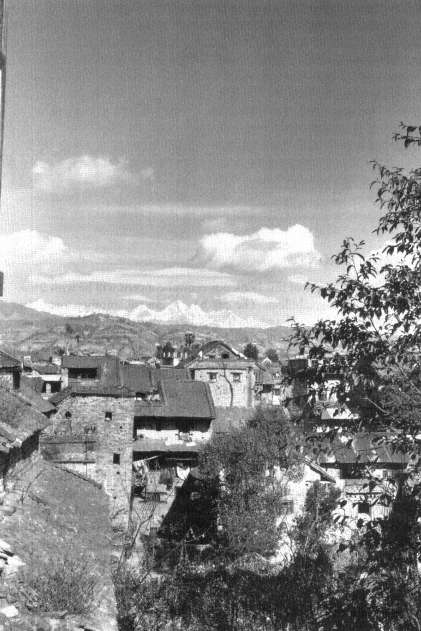
Figure 1.
Bhaktapur, looking north to the Himalayas.
The Physical City
Bhaktapur (see fig. 1) at the time of this study had not, at first sight, changed very much in appearance from nineteenth-century descriptions and aside from a general weathering and decay, probably not much from its appearance at the end of the reign of the Malla kings. Built on the sides and summit of a broad hill rising from the valley floor, the city suddenly appears, clearly demarcated from the extensive farmlands around it. The city is roughly elliptical, about one mile in length and about one-half mile in breadth, with its long axis running from west to east with a slight southwest-northeast rotation. A main road enters the city from the west and meanders along the central axis running parallel to the Hanumante River, which borders Bhaktapur to the south. This road soon becomes the bazaar, a dense conglomeration of small shops that line the street for much of its extent. At intervals the road widens out into various public squares full of temples and shrines as is the case in many Newar settlements. Its inhabitants think of Bhaktapur as consisting of a lower city to the southwest and an upper city to the northeast. The bazaar street has two prominent large squares, Ta:marhi Square in the lower city and Dattatreya in the upper. The main axis is intersected by a number of routes that have bridged the Hanumante and entered the city from the south. It leads finally to a road leaving Bhaktapur to the east, once an important route to Tibet.
To the north of the central axis in the western part of the city is the former Malla Royal center, the Durbar square or Laeku. At its northern side is a prominent gateway covered with golden images of gods, the entrance to a complex of courtyards, shrines, and sanctums—the temple of Taleju, the tutelary goddess of the Malla kings. Adjoining the Taleju temple is the large palace, formerly the seat of the Malla kings of Bhaktapur, now administrative offices for a new polity. Around the Durbar square are the tall, tile roofed houses of many of the Rajopadhyaya Brahmans, once closely associated with the court, as well as houses of descendants of the old court aristocracy.
In various parts of the city there are clearly differentiated neighborhoods. There is the potters' quarter with its potting wheels, its kilns and open spaces for the firing and sun-drying of pots; the dyers' quarters with various brightly colored woolen yarns hanging to dry near the dying vats; farmers' quarters with—depending on the season—rice, wheat, corn, peppers, and other crops being threshed, winnowed, dried. There are neighborhoods of Buddhists, mostly in the northern parts of the
city, surrounding their old monasteries, now centers of Tantric, non-monastic Buddhism. There are other neighborhoods not so clearly marked by external contrasts, but clustered around a central square with its temples or shrines. Toward the borders of the town are generally poorer areas with lower, simpler houses. But among them there are groups of taller, more elaborate houses, those of the butchers whose low status places them toward the periphery of the city, but whose comparatively high earnings have allowed them to build larger houses than their neighbors. To the south of the city, in an area that is said to be outside its boundaries, in squalid small houses, tightly grouped together, live the untouchables.
Along the Hanumante River at a number of places are clusters of shrines and ghats or steps leading down to the river. Here clothes are washed, and here and there are ramps for dipping the feet of a dying man into the river at his last breath. Along the Hanumante River, mostly on the far side, are cremation grounds. There is another river, the Kasan, to the north of Bhaktapur, which joins the Hanumante to the west of the city. This northern river has little to do with the life of the town.1
Everywhere there is a bustle of activity, of people coming and going, of processions, of music, of business, of craftsmen working. Scattered here and there are new buildings in modern styles, offices and houses for officials, modern houses for some rich merchants, schools, a hospital, a cinema.
And everywhere are dirt and foul smells, the dust and wear of centuries, the feces of animals and children in the streets, of adults in the fields and at the riverside. There are houses cracked and fallen during the last of the series of earthquakes that regularly trouble the Kathmandu Valley. The fields and streets are full of scavenging emaciated dogs and of large carrion crows. Huge fruit bats hang in some seasons in the trees, and on clear nights jackals howl in the fields outside of the city and occasionally a predatory, hungry leopard snatches off the infant of an unwary farmer in a field bordering on the forest. All this is a reminder that Bhaktapur was and is still a clearing in h yet more ancient world.
Some Demographic Notes
According to the 1971 census report (published by the National Planning Commission of Nepal's Central Bureau of Statistics), Nepal then had a total population of 11,555,983. Of these, 618,911 lived in the
Kathmandu Valley, which was divided into three districts—Lalitpur (Patan), Kathmandu, and Bhaktapur. These districts comprised roughly the three old Newar kingdoms, each with its central city and surrounding secondary towns, villages, and scattered hamlets. Of the three districts, the Bhaktapur district had the smallest population, 110,157, in comparison with Patan's 154,998 and Kathmandu's 353,756.
Within these districts the city of Bhaktapur had a total population of 40,112 people, in comparison with urban Patan's 59,049 and urban Kathmandu's 249,563. The census for Bhaktapur conveniently distinguishes categories of prisoners incarcerated there and of military and police stationed at Bhaktapur, people who represent for the most part an "external" population. Without these two categories (133 prisoners and 918 police and military) Bhaktapur's population consisted of some 39,061 people, living in 6,484 households.
Between 1961 and 1971 the population of Bhaktapur had reportedly grown by 17 percent, somewhat less than the 22.8 percent reported for Nepal as a whole, and the 25 percent reported for Kathmandu. (Kathmandu's population increase is augmented by internal migration within Nepal.) These increases were probably due to recent improvements in public health and nutrition and, perhaps, changes in census techniques. Overall, however, there is no indication that Bhaktapur has increased in population very much since the eighteenth century; that increase is just beginning now.2 We have noted Kirkpatrick's report for 1793, that he was told that Bhaktapur and its dependencies (approximately equivalent to the present Bhaktapur district) had some 12,000 homes. If we guess that houses had something like the present number of inhabitants, such a figure would not indicate a great increase in the population of Bhaktapur district over the past 200 years. Similarly, Oldfield writes that in the 1850s there were supposed to be about 50,000 inhabitants in Bhaktapur city itself ([1880] 1974, vol. 1, p. 131).
The age structure of the population of Bhaktapur in 1971 was that of a young population—15.3 percent of the population of the city being under five years, and some 47.7 percent of the population under the age of twenty. The figures for sex (for the nonmilitary and prisoner populations) show a slight excess of males over females of 2.5 excess males per hundred males. This sex ratio, when compared to the much larger predominance of males over females in other Nepalese cities, is an index of Bhaktapur's lack of in-migration, which for other cities was mostly male.3 This lack of in-migration was confirmed by a sample survey by the United Nations Fund for Population Activities done in 1976, which
during a period when there was an immigration into the Kathmandu Valley of about 2,000 people a year, showed a "negative migration" for Bhaktapur where there was no appreciable immigration and a small annual out-migration of some 100 to 150 persons a year, mostly "to seek jobs in Kathmandu" (Acharya and Ansari 1980, 106).
All available indexes suggested that at the time of this study Bhaktapur's population was, and had been for a very long time, quite stable.
Population Density
The most significant demographic aspect of Bhaktapur for the purposes of this study besides its stability is its population density. In a pioneering study of the physical and cultural geography of Nepal, Pradyumna Karan (1960, 51) remarked that:
Few parts of the world are more empty than the snow-covered ranges of northern Nepal; few parts are more crowded than the Kathmandu Valley. . . . In the major areas of concentration the average population densities range from 500 to 700 per square mile, and there are rural densities in a few small areas of more than 800 per square mile. Such density of rural population is hardly approached in Western Europe or North America; it is equaled only in monsoon Asia and in a few small areas of Africa and the Caribbean. Despite the many empty areas, virtually all of Nepal's space is fully used in terms of the number of people it can support with its present technology. . . . The population of Kathmandu's urban area attains a density of 47,783 per square mile, almost twice that of New York City.
Bhaktapur's density is still higher. A survey cited in Acharya and Ansari (1980, 105f.) estimates that when the open spaces are removed the concentration of people in the built-up residential areas of Bhaktapur is 110,334 people per square mile. Most of those open spaces are at the outskirts of the city, and our own estimates of the settled area give a density of some 117,000 people per square mile for the remainder of the city, including its inner open spaces. Such population density is even more striking in that the city has a considerable number of such open spaces and public squares and that, in contrast to modern inner cities, most of its houses consist of five stories or less.
Such figures are astonishing not only in themselves but also because for those familiar with "downtown" areas of New York, London, or Calcutta, Bhaktapur in no way seems crowded . Throughout the entire city space there is an orderly and widely distributed placement of people and of their movements. it is only during certain of the city's annual
festivals when much of the population gathers together at one or another focal point or area that the great mass of population becomes apparent in an unusual concentration that in itself generates some of the meaning of the festival.
Bhaktapur's Demography: Newars And Hindu Newars
We shall present in later chapters other demographic characteristics of the population of Bhaktapur—its ethnic, religious, and social composition and aspects of household size and composition. It is essential to emphasize, however, that less than sixty households among Bhaktapur's more than 6,000 households are, by criteria that we will discuss in the next chapter, not Newars. That is, the city is almost entirely a Newar city. It is, in addition, almost entirely a Hindu Newar city. In the 1971 census 92 percent of the Newar population called themselves "Hindus"; the rest, the remaining 8 percent, identified themselves as "Buddhists." It is this great preponderance of Hindu Newars who are at the center of our treatment of Bhaktapur's symbolic organization. Some individuals in the other groups are, in fact, involved in that organization—in sometimes illuminating ways—but their involvement is peripheral, and they themselves are most centrally related to other centers of community and of identity.
The Hinterland
Bhaktapur district, the area containing the city of Bhaktapur and its surrounding towns, villages, and open lands, with its 110,157 people in 1971, is the most densely populated of the three valley districts. There are some seven settlements (other than Bhaktapur) in the district with more than a thousand population. Six of these ranged between 1,200 and 3,000 people in 1968. One of them, Thimi, had more than ten thousand people (His Majesty's Government, Nepal 1969, 81). The other district settlements are hamlets and small villages. Some of the Newar towns in the various Valley districts have been studied (Barré, Berger, Feveile, and Toffin 1981; Toffin 1977; Müller 1981). What remains still to be done is a study of their past and present relations with the main cities, and the systematic transformations of Newar social and cultural life illuminated by the contrast in size of the central and peripheral communities. The relation of the city of Bhaktapur to
the rest of the district is for reasons given in chapter 2 only minimally considered in this present study.
Relation To The Central Government
In the early 1970s Bhaktapur, like all settlements of more than 10,000 people in Nepal, was treated as a "Nagar (town) Panchayat ." It was administered as part of a complex four-tiered system of representative councils called panchayat s, which was an attempt to form a connection between the strong, relatively autocratic central government at Kathmandu, centered on the king and his immediate advisors and peripheral political or potentially political structures. The system starts with village or town panchayat s, which, in turn, send representatives to a district panchayat , which is supposed to be more important for administrative purposes than the village and town panchayat s below it or the zonal assembly above it made up of representatives of the various districts amalgamated into larger zones. In the early 1970s Nepal had 3,860 village panchayat s, 16 town panchayat s, 75 district panchayat s, and 14 zonal assemblies. The zonal assemblies, in turn, elected some of the members of a national unicameral legislature, the Rastriya* (National) Panchayat . Of the Rastriya* Panchayat 's 125 members, 90 were elected by the zonal assemblies, 15 by seven "Class Organizations" (e.g., Farmers, Youth, Labor, Ex-Servicemen, and Women), and four from the "Graduate Constituency" made up of college graduates. The king nominates an additional 16 members. (For the panchayat system and its development, see Prachanda Pradhan [1973], Sinha [1972], K. P. Pradhan [1968], Rose and Fisher [1970], and Joshi and Rose [1966].)
Following the restoration of the Shah dynasty in 1950 there were a series of tentative oscillating experiments in the extension and retraction of decentralization and of participatory democracy. In the early 1970s the central government was strong. As Rishikesh Shaha (1975b , 73) wrote:
The new Panchayat system does not reflect any real decentralization or de-concentration of political and administrative power. . . . The Village Panchayats, the Town Panchayats and the District Panchayats have been given limited taxation and administrative powers. Their administrative functions include assisting development programs, supervising and managing the village, the district or the municipality owned or controlled property, and maintaining certain records and statistics. The Village Panchayats are
granted judicial jurisdiction in minor civil and criminal cases. The claim that the new Panchayat system represents decentralization of political power and functions is completely invalid in as much as the central government's ultimate authority is maintained intact by granting the Panchayat Ministry discretionary power to suspend or dissolve a Panchayat and replace it with a provisional Panchayat authorized to exercise the same powers.
Even within the terms of this sytem the town panchayat is comparatively insignificant. The village panchayat includes a Village Assembly, "a legislative body charged with the power to ventilate grievance; to question the . . . members of the executive body; . . . to move a resolution of . . . no confidence [against] the executive. . .; to make decisions regarding taxes" (K. P. Pradhan 1968, 107). However (Pradhan 1973, 151):
In the case of Town Panchayats no direct relation between the elected members and the town people are established. In the case of Village Panchayats, there is a Village Assembly which at least twice a year makes the Panchayat members answerable and responsible for the projects initiated by the assembly. In many ways, Town Panchayats are weak bodies. In the deliberations of the District Assembly, Town Panchayats are particularly weak and become a target of attack for the village people who have an overwhelming majority of representation m the District Assembly.
The town panchayat helps to identify problems of certain kinds and helps implement centrally originated decisions. Greatly limited by the funds made available to it, and by the requirements and decisions of the district and central administrations, the town panchayat is responsible for maintaining and developing local facilities and services.4
The city of Bhaktapur was divided into seventeen "wards," as they are called in official English translations, for the purposes of panchayat organization.5 The wards elect the town council, the Nagar Panchayat, which, in turn, selects two of its members as executive administrators. In the early 1970s the activities initiated by Bhaktapur's Nagar Panchayat were limited, concerned mostly with repair and maintenance. The Town (Nagar) Panchayat was intended as a device for encouraging participation in centrally directed modernization, and was, as Joshi and Rose have put it for the panchayat system in general, "an attempt to rationalize administrative process by creating viable institutions in areas where a serious lacuna had previously existed, thus providing the basis both for a modernized administrative system and for agencies through which economic development programs could be implemented" (1966, 400).
Decisions were usually made for town projects by the Home and Panchayat Ministries of the central government, often in consultation with Bhaktapur leaders. After the decisions were made it was the responsibility of the Town Panchayat to help carry them out. The formal local political leadership of Bhaktapur could not be said to involve much power. It was minimally significant for the organization and movement of the daily life in Bhaktapur. This may well change in the future as the traditional sources of order in Bhaktapur break down and as the city becomes more "modern." For the time being, however, at the city level Bhaktapur has little effective local political control. There is plenty of politics within some of the component units of the traditional city organization, but that is another matter.
The Agricultural Economy
The economy of Bhaktapur, like that of Nepal as a whole, is fundamentally agricultural.6 The city is ringed with farmlands. Bhaktapur's farmers, typically of Newar farmers (and in contrast to Indo-Nepalese farmers who live in isolated farmhouses on their farmlands) live within the city—where they are integral members of its urban life—and walk to their farms to work them as necessary. Some 66 percent of the "economically active" population of urban Bhaktapur worked in farming according to the 1971 census. For the rural communities, the smaller towns and villages of Bhaktapur district, the figure was 76 percent. This relatively small difference illustrates the fact that Bhaktapur and its hinterland do not represent the familiar urban-peasant polarization, which is, and has long been, prevalent elsewhere. Bhaktapur is an agricultural city surrounded by smaller agricultural towns and villages. Most of its crops are grown for local consumption, mostly for the consumption of the farming families themselves.
The main crops grown in Bhaktapur (listed in order of the amount of land devoted to their cultivation) are rice, wheat, and maize (used for animal feed), followed by crops grown in much smaller quantities—millet, potatoes, oil seed, barley, sugarcane, and a large variety of vegetable crops, such as pulses, peppers, onions, soya beans, tomatoes, and ginger.7 The fields are irrigated, and those on the hillsides are terraced. Land use is very intense.8 Crops are rotated between a rice crop, and, depending on the nature of the field, a wheat or vegetable crop. The fields are cultivated by means of small hand tools.9
Farms are worked by most able bodied members of a farming family,
male and female.10 In a study of the total income (that is, both cash and kind) of a sample of farming families in Bhaktapur Wachi (1980) reports that for 70 percent of her sample farming accounted for more than 70 percent of their household cash income, while for 11.5 percent of the households it accounted for 50 to 70 percent of their income, and for 11.5 percent it accounted for 30 to 50 percent of their income. All of the households in her survey supplemented their crop income in various ways—by some limited sale of animal products (meat, eggs, milk), by income from various trades and crafts (such as weaving, cap-making, yogurt-making), by wage labor (construction, working for other farmers, as assistants in city offices or as laborers on city projects), and from the rental of land or, rarely, through local commerce in something other than farm products. Time devoted to other sources of income is flexible, allowing people to work on the farms at the times when most labor is needed.
Farming households were able to barter grain for some supplies and services, but they needed cash to pay land taxes, to buy goods at bazaar shops, for trips to Kathmandu, and so on.11 That cash came from the nonfarming activities noted, and from the sale of some farm products, particularly grain, some of which is sold to intermediate merchants for the Kathmandu market.
Wachi (1980; also personal communication) reports that about 60 percent of the farming households owned some of the lands that they farmed. Only 2.3 percent of the households owned all the land that they cultivated, but another 58 percent owned some of the land they worked and supplemented it with additional rented lands. The remainder were non-land-owning tenant farmers,12 and a very few itinerant farm laborers, working only for others. According to Wachi's study, the land rents amounted to about 25 to 28 percent of the value of their produce. The high ownership of land and the relatively low rents for tenancy are the results of a series of land reforms, or Land Acts dating from 1957, which attempted to limit and distribute the amount of agricultural land in individual possession, and to limit the rent that could be charged to tenants.13 Furthermore, attempts were made to protect tenants against manipulation and eviction by landowners.
M. C. Regmi (1976, 208) summed up the effect of the series of Land Acts for Nepal:
With the imposition of ceilings on landholding, the existing concentration of landownership has been broken, both through the redistribution of lands in
excess of the ceilings and through voluntary transfers m anticipation of land reform. Big landowners no longer constitute a dominant economic class in the agricultural community. . . . The land-reform program has also conferred greater security of tenure on tenants and made it possible for them to appropriate the major portion of the produce. . . . Their rights are clearly defined by law and are actually being enforced by courts in their favour. Nevertheless, the land reform program has had little impact on the [traditional] agrarian structure.
The land reforms with their resulting marked improvement in the economic and social position of the farmers in Bhaktapur has had an unintended effect. To the degree that the traditional landowning classes, the Brahmans and merchants, lost their lands and land revenues and the farmers gained them, the newly wealthy farmers have come to be the supporters and clients of much of the traditional religious system as well as important employers of Brahmans. Less educated and less open to modernization than the higher classes, this transition has helped to slow down change and to support and conserve the old system.
As we have noted, the agricultural fields are in active use during most of the year. However, one (and only one) part of the year's agricultural activity is fundamental for Bhaktapur's symbolic life. This is the rice growing cycle (see fig. 2), which is what we will mean in our references to the "agricultural cycle" in this volume. It is the reference and source of much of the meaning of the segment of the annual festival cycle that we treat as the "Devi cycle," and for much of the meaning of the "dangerous goddesses." Ulrike Müller (1981, 57f.) summarized the sequence briefly for the town of Thimi in Bhaktapur's hinterland in a description that will serve exactly for Bhaktapur itself:
According to the variety of rice and the locality, the farmers begin with the digging of the fields at the start of the rainy season (June). This work is done by the men with a short-handled hoe (kodali [Nepali], or ku [Newari]). . . . Whilst the fields are still being dug and whilst the women are breaking up the clods with a long-handled, wooden hammer and carefully leveling the ground, rice is already being raised in seedbeds. Two or three weeks after being sown, the rice plants are [re]planted [from the seed bed] out in the main field. . . . By the fifteenth day of the Month Sravan (the end of July) all the rice plants would be replanted. [The rains are now expected and the fields will be watered directly by the rains and by means of controlled irrigation from water catchments on the hillsides.] After the water has been drained from the fields at the end of September (or even earlier in the case of some varieties), the main harvest takes place m October and November. The rice is cut with a sickle and threshed directly in the fields. . . . The grains of
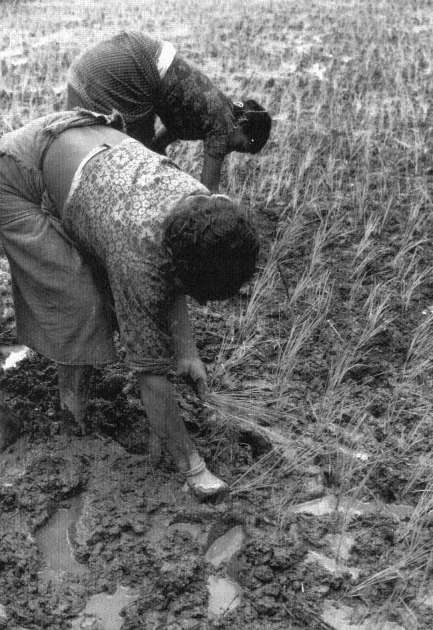
Figure 2.
Jyapu women planting rice paddy plants.
rice are brought home, whilst the straw remains in the fields to dry. . . . After the winnowing [which takes place m the farmers' quarters within the city] the grains of rice are dried for a few days in the sun if the weather is good. During this time, streets and squares, yards and roof-terraces are full of rice, which is spread out on straw mats and turned over several times. . . . After drying, part of the rice is taken to one of the [town's water-driven] rice mills and there the husk is removed. The largest part of the harvest however, is stored with the husk still on [in special granaries in the farmer's houses].
The Nonagricultural Economy
An inventory of the small stalls and shops that crowd the bazaar street gives some idea of the variety of the supplies and of the specialists who provide them, which are necessary for the material and symbolic life of Bhaktapur. There are (in no particular order) specialized shops or market areas selling: cloth for saris and clothes; ready-made clothes; Ayurvedic medicines; modern medicines; cigarettes, tobacco, and smoking supplies; rice and other grains; mustard oil, kerosene, and other fuel oils; metal cooking pots; curds; water buffalo meat; curios for the tourist trade; books; gold and silver ornaments and small religious figures in gold and silver; wood for construction; tools and nails; house paint; hair decorations and arm bangles; caps; sweetcakes; red peppers; electric goods; fruit; betel nuts; sewing thread; fertilizer; vegetables; salt; metal sheetings for roofing; woolen blankets; religious drawings and pigments for use in rituals; brass and copper pots of various kinds; brass religious images; animal feed; goats; chickens; locally made furniture; clay pots. And there are also stalls for serving tea and soft drinks, stalls for serving alcoholic beverages, stalls for serving cooked food. The shops and stalls are owned and run by members of a socioeconomic class, the sahu or shopkeepers.14 Most of these are from the high-ranking Chathar and Pa(n)cthar groups of thar s (see chap. 5)—collectively referred to as "Shresthas* " or "Sresthas* " in some writings on the Newars—but some come from lower ranks of the traditional status system.
Besides the craftsmen, bakers, butchers, collectors and grinders of herbal medicines, spinners and weavers, blacksmiths, metal image casters, and the like who provide the goods for the shops, there are the city craftsmen—masons, carpenters, wood carvers, stone carvers, and so forth who are involved in construction and repair in the city. Finally, there are all kinds of specialized performers and providers of services—musicians of various types, ritual "dancers," barbers, medical special-
ists of various types, various kinds of priests and ritual specialists, midwives, cutters of umbilical cords, astrologers, tailors, fishermen, sweepers, and many more.
In contrast to the limited sample of specialists found in South Asian villages, Bhaktapur has a full panoply. They are, for the most part—as we shall see in following chapters—organized in the city's hierarchical system, and made use of for the symbolic life of the city.15
The 1971 census reported for Bhaktapur that 65.8 percent of the workforce was engaged in agriculture, 8.5 percent in commerce (shops and trade), and 8.2 percent in manufacturing, primarily crafts. The census also listed a small number of people engaged in electrical, gas, and water services (0.1 percent, some 20 people), in construction (0.8 percent, some 115 people, mostly house builders and masons), in transport and communication (1.1 percent, 153 people, including the mail service, an elementary telephone service, and truck drivers), and in finance and business (0.4 percent, some 53 people working mostly at a local branch of the Nepalese bank). The census also enumerated some 2,197 people, 15.1 percent of the economically active population, engaged in "personal and community services."16 Many of these are the barbers, washermen, healers of various sorts, and so forth, who provide traditional services, often for patron families. Some of these providers of personal and community services work for the City Panchayat as sweepers and in repair and maintenance. Some work in the Bhaktapur administrative offices, some are teachers in Bhaktapur schools, and some, finally, of this group commute on buses, the electrified trolley (which was inaugurated in the early 1970s to connect Bhaktapur and Kathmandu), or occasionally by automobile or motorcycle to Kathmandu to work in one of the many offices of the Central Government's bureaucracy.
In short, the economy of Bhaktapur was at the time of this study concerned mostly with the production and distribution of goods and services for itself, most goods were produced and distributed within the city or its near environs,17 few people were involved in administrative or bureaucratic jobs within the city itself, and much of the household income was "in kind" rather than in cash.18
Bhaktapur also had in comparison with many other modernized cities and towns in Nepal less differentiation of income. Compared to Kathmandu and Patan there is a "low level of income even for the rich people in Bhaktapur" (Acharya and Ansari 1980, 113). This is in part
because of the importance of agricultural wealth in Bhaktapur, and the extensive ownership of land by the farmers themselves.
A Summary Note
We have described a city that at the time of our study still retained many of the features which had long charcterized it. It had an enormously dense but stable population. It was a city that, in comparison with communities elsewhere m the world—and in much of Nepal—was relatively little related to larger economic and political networks. Its economy, which had a large nonmonetary component, was still heavily based on internal (including its bordering farms) production and exchange. For the city as a whole it was more of an administered than a political unit, the sources of power and decision were elsewhere, in the non-Newar national government at Kathmandu. That external administration was minimally disruptive, and it was certainly not innovative. It provided what support it could to the ongoing life of the city. Bhaktapur was then in both fact and ideology "self-sufficient" and turned in on itself. But this was nothing new. In its Malla days its political adventures were the affairs of kings and their armies and were to a very large degree—once a dynasty had established itself—external to the life of the city. The city was used to being a world in itself. Royal power, and in recent centuries Gorkhali power, had taken advantage of this as a basis for stability. The proper policy, the successful policy, was to support and encourage the city's, in our case Bhaktapur's, isolated, and self-sufficient order. Bhaktapur's dense and isolated population was almost entirely Newar and almost entirely Hindu Newar. These Newars share a tradition, an identity and a culture—in both the popular and anthropological senses of the word. Bhaktapur is in contrast to Kathmandu, to European medieval and modern cities, a unicultural city.
In the presence of such conditions, what kind of internal order did the city construct? We may, or more accurately must, begin with its system of defining, organizing, and assigning social and economic and "ritual" roles. It is a system tailor-made, as it were, for the conditions of Bhaktapur's life.
Chapter Five
The Distribution of Roles: The Macrostatus System
When every one is somebodee, Then no one's anybody!
—W. S. Gilbert, The Gondoliers
Introduction: Thar And Macrostatus Levels
Bhaktapur, like Fustel de Coulange's Ancient City, has a social organization largely constructed out of bounded, relatively autonomous units, or "cells" that are combined in successively more inclusive ones. Households with their own deities and religious practices are joined in patrilineal extended families with their own deities and practices. Patrilineal groups are in turn joined in wider inclusive units called thar s whose members have a common surname. The thar s are in turn organized into what we will call "macrostatus levels."
There is an essential difference between thar and macrostatus levels and the smaller units. The latter, household and extended families—as well as some smaller units within the family and some groupings of extended families—are all more or less alike throughout the city and provide vital nested "structural units" for the city. There is an essential difference between a certain man's role as, say, father, husband, leader of an extended patrilineal family group, that is his role within one of the constituent cells of the city, and his urban role as a Brahman, farmer, or untouchable, a role that is of direct importance to the city as a whole. Such urban roles are ascribed through membership in—that is, through being born into—a thar .
In contrast to smaller constituent units thar s and macrostatus levels are differentiated so that their outputs are elements in the pattern of the
city. For the city organization it is the public functions of thar s—their outputs into the public city life and their external relations with and hierarchical position in relation to other thar s and groups of thar s—that is important, not their internal organization. From the point of view of the city as a whole, what goes on within the thar s is of no importance as long as their essential outputs of goods, services, and differentiated kinds of social persons are maintained. Internal practices and organization vary considerably from thar to thar , but as long as they produce their necessary public effects, internal matters are not only immaterial to outsiders, but unknown and in fact hidden from them. In the same way the still smaller nested units that compose the thar s must have their proper outputs into larger units, but their inner affairs are no business of others. In fact, hidden and secret knowledge, procedures, spells, and protective deities are often thought to be essential to the unit's effective output into larger units, and eventually into the life of the city.
Thus for the kind of city organization we are concerned with—the city at its own level as an organized and organizing mesocosm—the outputs and groupings and hierarchical organization of thar s are the relevant elements. The internal organization of the thar s, and particularly of their component kin-based units are the city forms that most closely affect the "private" experience and early education of the city's people. "Private" in Bhaktapur begins with the internal affairs of a thar , and takes a deeper meaning as action jumps from each unit to the next smaller—that is extended family, household, one or another internal household grouping, and finally to an individual's "self" and "inner thoughts." We will in the next chapter discuss some of the "sub-thar " organization. This will be necessary for discussions elsewhere of "private lives," but for the purposes of this book it will be an excursus.
We will be writing about a variant of a kind of South Asian social organization that is usually, of course, called a "caste system," a system that is said to have elements called "castes" and "subcastes" and various clusters of such units. It has seemed proper (for reasons that will follow) for our discussion of Bhaktapur's social categories to avoid such terminology and some of the assumptions that it entails and to use either local terminology, or neologistic terms. Thus we will call that aspect of the city's hierarchical organization that provides a pattern to the city as a whole the macrostatus system , and distinguish it from the systems of status and social organization within the smaller cellular units, the city's collection of microstatus systems. We have called the gross hierarchical
arrangements of thar s that make a difference to the city as a whole macrostatus levels . In contrast to these there are, for example, hierarchical arrangements of the thar s within a macrostatus level , which are of no concern to people outside of that level, as there are also status rankings within the groups that constitute thar s.
To return to our conceit of the city as a ballet, it is thar membership that assigns the roles of the dancers. There are other miniballets within the thar s and within their component units, but they are not our present concern, although we will say something about them in chapter 6.
The Thar
Newars in Bhaktapur have, in addition to their given names (usually two), a surname that is their thar name.1 That name allows Bhaktapurians to place each individual exactly in the macrostatus system. In order to try to obscure their "caste" membership some Newars in the relatively anonymous, socially heterogeneous, and mobile society of Kathmandu and other Nepalese cities often change their surnames to such ambiguous and mildly honorable sounding names as Srestha* ,2 Singh, and the like in order to try to obscure low traditional status. But the use of such names in Bhaktapur would be obvious and futile attempts to escape traditional categorizations.
The Bhaktapur Town Panchayat's registry of the city's population has about 350 thar -designating last names for the city's Newar population. This list is not exactly equivalent to the actual number of thar s because in some cases thar members have the option of using one of a limited number of equivalent alternate thar names. Furthermore, in a very few cases the same name appears at two status levels and represents two different thar s. This is either because some function designated by the thar name (e.g., Tantric priest or physician) is performed by practitioners at different status levels, or because a family segment that was outcast for some transgression (usually an improper marriage) might have kept its original thar name when it was reduced to a lower status level. Thus the list of thar names actually represents about 340 different thar groups (see app. 2).
"Thar " is a term widely used in Nepal, deriving from a Prakrit term for "collection," and is usually translated in Nepali-English dictionaries as "clan" or "tribe." The significance of "thar " among the Newars differs from that of other groups of Indian origin in Nepal, the "Indo-Nepalese," as we will refer to them m contrast to the Newars through-
out this book. Thus Khem Bahadur Bista writes of the Indo-Nepalese Chetri that the thar name is no more than a family name, "equivalent to an Anglo-Saxon family name such as Brown" (1972, 31). Lynn Bennett (1977, 41), also writing of the Chetri, supports this usage:
Although villagers sometimes refer to thar as if it were a clan or even lineage unit, strictly speaking, thar is really nothing more than a last name shared by many different descent groups. Individuals with the same thar may or may not be patrilineally related. Yet, because of the vague sense of the thar as an extended patrilineage, there is a preference to marry outside one's thar .
She also notes and accepts an observation of Fürer-Haimendorf's (1966, 30) that Chetri thar s are not ranked, that "no thar is inherently superior or inferior to any other Chetri clan."3 The Newar usage of "thar " is different from this.
It is possible to find some groupings of thar s in Bhaktapur that in their internal organization resemble the Chetri thar s. In comparsion with Newar thar s, however, Chetri thar s are a special case, representing one kind of internal organization found among some Newar thar s, and lacking the external hierarchical ordering that defines much of the meaning of thar s (or, sometimes, of sets of equivalently ranked thar s) in Bhaktapur. Newar thar s in Bhaktapur are heterogeneous units and have (or are thought by members to have) quite different kinds of corporate origins—common descent, or some shared trade in the past, or some common historical origin prior to settlement in Nepal or Bhaktapur, or some mixture of these.4 Some are endogamous, some few are exogamous, while in others it is optional whether one marries within or outside the thar . In all cases marriages out of a thar must be made with only a limited number of other thar s at the same macro-status level.
The thar s are arranged in twenty distinct levels in Bhaktapur's urban macrostatus system. Those levels , while absolutely distinct in the minds of virtually all Bhaktapurians (although they may occasionally disagree on the membership of one or another thar in a particular level), do not have any local name (which is why we use a neologism "macrostatus level"). In some cases, however, a particular level or groups of contiguous levels may have a name (e.g., Brahman, Chathar, or Jyapu), and if not, there are various local ways of indicating which level is being referred to if that is necessary.
When people in Bhaktapur talk about someone's significant position and function in the macrostatus system, they will sometimes use a thar
name, sometimes a status-level term, and sometimes a "class designation" (see below). This depends in part on the context of the discussion, and is a matter of which social function or aspect is being emphasized and discriminated. In these discussions what the individual in question is said to "belong to" is not a thar or a status level but to a jat (a Nepalese variant of the South Asian term jati ), which simply means a kind or category. Italian, bird, and crow are all a creature's jat in one or another context and abstraction.
Our question in this chapter is what kinds of jat s, that is, what kinds of kinds are Bhaktapur's thar s? What are they made to do? The same question must be asked about the macrostatus levels. There are some twenty of these levels, ranked from Brahman to untouchable, and the 340 or so thar s are sorted among them. Sometimes a macrostatus level contains only one that (Brahmans, butchers, etc.), sometimes a group of thar s. These levels determine or are expressed by patterns of marriage, eating, and association and, for many groups, places of residence. In the traditional system they were—and for some groups still are—determinant of differential access to wealth and, in some cases, details of clothing, decoration, and house types. They are ranked from up (cwe ) to down (kwe ), and are associated, in classic South Asian ways, with theories and symbols of purity and pollution, which we will examine in chapter 11.
An Excursion. Caste, Class, And Varna*
If we take any summary definition of a "caste system," such as Bouglé's (as given in Dumont [1980, 21]), that a caste system is one that, "divides [a] whole society into a large number of hereditary groups, distinguished from one another and connected together by three characteristics: separation in matters of marriage and contact . . . ; division of labor, each group having, in theory or by tradition, a profession from which their members can depart only within certain limits; and finally hierarchy , which ranks the groups as relatively superior or inferior to one another,"—does Bhaktapur have a caste system? It has a hierarchical system of separated units (separated by marriage and aspects of contact), and the system ensures and controls most of the city's division of labor. It thus has a caste system by these criteria.5 The problem with such a definition is that real local groupings, that is, thar s and status levels, are not necessarily characterized by all three of Bouglé's condi-
tions and the idea of "a caste" as a particular group in which all of Bouglé's criteria coexist is not generally useful, although it works for some groups, such as Brahmans and untouchables.
Some thar s resemble the units that are called jati in some other South Asian settings, while the macrostatus levels resemble more closely what David Mandlebaum has called "jati clusters."6 Thar s are not always jatis in Mandlebaum's sense, however. In some clusters of thar s constituting a status level, the thar s may consider themselves equal and intermarry, and the cluster of thar s becomes in itself something like a jati , although the cluster itself is not, usually, named. In other clusters there is a disputed or agreed-upon internal hierarchy within the same macro-status level, and thar members do not marry other thar s within the level but only within the thar . It is in this situation where the thar s are like jati , and the thar cluster like a "jati cluster."
By avoiding terms such as "caste," "subcaste," and "jati " and rather discussing the variety of relations of thar s with occupation, marriage arrangements and macrosocial rankings, however, one can present Bhaktapur's status system without forcing it into a procrustean bed of generalizing analytic terms.
There is another kind of status designation superimposed on the system of macrostatus levels. Although many professions are thar -specific, there are some professions as there are elsewhere in South Asia that involve people from many thar s and more than one status level. The main ones in traditional Bhaktapur are farmers (jyapu ) and shopkeepers (sahu ).7 There are other groupings that have some unity of definition, characteristics, or interests. There are craftsmen, priests, "unclean" thar s, and in earlier times (but still vividly represented in various symbolic enactments) the city's own royalty, court, and military.8 Such groups are associated directly with differentiations in power, kinds of production, and differential control of resources and represent something like a "class" stratification superimposed on "caste." In recent years shifts in the economic and political system have caused the beginning of a dissociation of the relative unifications of the traditional system in which prestige, wealth, power, and purity were all controlled and ranked to reflect a common order. There has been a disruption of this unity for Bhaktapur, and a further disequilibrium produced by people's awareness of their relative poverty and low living standards in comparison to Newars and non-Newars elsewhere in Nepal—particularly Kathmandu and the towns in the relatively wealthy agri-
cultural and industrial area along the southern border of Nepal, the Terai. Some people in Bhaktapur speak of "class," barga (from Nepali). Thus Brahmans and members of other upper status levels talk of themselves as "middle class," madhyambarga , when thinking of larger, modern Nepal and its modern upper class, the pujipatti , people of a wealth and power that has nothing to do with their traditional thar heritage.
The classical concept of varna* , the ideal ancient Vedic four-level hierarchy of Brahman, Ksatriya* , Vaisya* , and Sudra, has as elsewhere in South Asia, a vague residual existence in Bhaktapur. People occasionally speculate on the relation of the macrostatus groups to these ancient classifications and occasionally make use of them to add further metaphorical point to some status distinction,9 but the use of varna* is mostly an intellectual game, with no implications for Bhaktapur's society.
Who In Bhaktapur Is A Newar?
We will be concerned in this volume with the social and symbolic organization of the 99 percent of the city's population who are called by others and by themselves Newars, and, for the most part, with the 92 percent of the city's population who call themselves not only Newars but also Hindus.
The term "Newar" is used by those people whom other groups in Nepal refer to as Newars in a complex way. It is used in a general way by the "Newars" themselves to differentiate themselves from various kinds of outsiders, usually lumped as "Khae (n)," the western Indo-Nepalese "invaders" on the one hand and the "Sae(n) ," or Mongoloid hill peoples of northern origin, the Sherpas, Tibetans, Tamang, and so on, on the other. In Bhaktapur in reference to people living in the city, the maximal use of "Newar" distinguishes those groups who "follow Newar customs," from others living in the city, whom we will introduce later in this chapter as "non-Newars." Some of those non-Newar groups have lived in Bhaktapur since the time of the Newar Kings (for example, the Jha and Bhatta* Brahmans, and the Lingayat temple priests). These groups (and other "outsider" groups) are not Newars because although they have various functions in the city, they are not members of the central hierarchical and symbolically integrated system. They have not, in contrast to so many other groups over the centuries,
become incorporated into the "Newar" sociocultural synthesis. Such people are simply omitted from the listings "Newars" make for themselves and for inquiring outsiders of the members of Bhaktapur's "caste system." No one including members of those outsider groups seems to have any hesitation in saying that they are not Newars, in much the same way as tourists and visiting anthropologists are not Newars.
The usage of "Newar" is further differentiated internally within the "Newar community" in certain contexts. Middle-status and upper-status people will often use the term "Newar" to refer to the upper-status "ksatriya* " and merchant thar s, those that were traditionally attached to the courts, in distinction to the Brahmans above them and the Jyapu farmers and others below them. The "Newar Brahmans," the Rajopadhyaya Brahmans (below), although, in most contexts they consider themselves Newars, conform to this usage in certain contexts, and refer to those upper-status groups who were their traditional patrons in the Malla days as "Newars" in distinction to themselves on the one hand and to the remaining mass of people—that is, the farmers and all middle and lower groups—on the other. The very lowest thar s, for example, the Po(n) and Jugi, will also in some contexts refer to all the Bhaktapur's "core" thar s—including Rajopadhyaya Brahmans—above them as "Newars," and say that they themselves are not Newars. This may be considered perhaps as a rejection of the system in which they are disadvantaged and stigmatized, but it also reflects a hesitation by others above them as to whether they are in or out of the Newar society. They are, in fact, uniquely both. The same low-status people will refer to themselves as "Newars" in other contexts, where they are emphasizing their membership in the town system. For those groups that have been integrated into the core systems as "Newars" in the largest sense there seems to have been an historical process, where a group coming from elsewhere slowly finds a position in the system, perhaps functionally replacing or displacing another group, and slowly becomes defined as Newar, with some hesitation for decades or centuries among those people with long historical memories. These usages and equivocations should not obscure the point that there is a major difference between those who are essential role players and carriers of symbolic meaning within Bhaktapur's mesocosmic system—whatever play on the term "Newar" may be involved—and those, whatever their economic and occasional ritual contributions to the city may be, who are "non-Newars" because they are ignored by that system, not defined in or
given precise symbolic value by it except in perfunctory ways as one or another kind of foreigner.
The vast majority of the Newars of Bhaktapur think of themselves—and define themselves to the census takers—as Hindu, or more precisely as Siva margi (followers of the path of Siva) Newars, in contrast to Buddha margi Newars. We will return later in this chapter to the fairly complex question of what it means for a Newar to be a "Buddhist" rather than a "Hindu," and the various ways that such Buddhists are related to Bhaktapur's core macrostatus system.
The Macrostatus Levels: Newar Hindus, The Core System
In this and the following sections we will introduce all the thar s in the core system that have in themselves a differentiated macrosocial significance and the macrosocial levels into which these thar s are sorted. (In appendix 2 we list all of Bhaktapur's thar s, placed in their respective status levels.) We will also introduce m the following sections the Newar Buddhist groups and those non-Newar groups that are stable components of the city's population and who live within the city. We will return in much more detail to many of these thar s and other social units in later chapters. They are brought together here for a necessary overview of the city's social structure before we lose ourselves in the details and special issues of later discussions.
As we have noted, the list of thar names comes from Bhaktapur civic population records and is presumably complete. Their ranking in status levels is something else. Ranking is in the conception of individual rankers, among whom Brahmans—who represent and legislate the order that the "caste system" represents—have a privileged position. As seems to be true everywhere in complex South Asian social hierarchies, the Brahmans (and other upper-status people) are certain about the upper and lower ordering, but not sure of the details of the position of every one of the great number of middle—that is, for the most part farming—thar s, which are arranged in several middle-level strata. There are two bases for disagreements. One is the relative ranking of status levels—for example, are butchers higher or lower than some neighboring level? The other is the membership of a particular thar at one or another level. Ordering of status levels may be argued about by people in adjacent levels, but in these cases we accept the certainties of
upper-status people. We have rechecked membership in the middle-ranking levels with people of similar status, however, and accepted their disagreements as more "correct" than the Brahmans' disinterested guesses about such cases. There is still some uncertainty in our lists about the membership of some thar s in the farming ranks.
The view of the upper reaches of the system by low-status people is significant in ways that we will discuss later. Thus members of lower-level thar s consistently give certain of the upper-status thar s with priestly functions, such as astrologers and Tantric priests, higher status than they are given by their near peers. Members of lower-level thar s also tended to simplify and collapse some of the status levels.
Middle-level and upper-level thar s appear to agree exactly on the number and ranking of levels, however, and to a very large degree on the membership of each level. In Malla days the thar s were assigned to their proper levels in written documents setting out privileges, restrictions, and sanctions, as we have noted in our discussion of Jayasthiti Malla in chapter 3. The many legalistic written orderings of the status system in Bhaktapur helped stabilize and force agreement on status ordering,10 more so than in other South Asian communities where the order is not so anchored.11
We will list the macrostatus levels (numbered by roman numerals) from the top down. In later sections we will discuss the "entailments and markers," that is, the significance of the levels. We will note some of the internal differentiations within the levels when they have some general significance elsewhere in the city organization.
I. Brahmans. These are all members of one endogamous thar ,12 the Rajopadhyaya thar . They are sometimes referred to as "Dya: ("God") Brahmans" or "Newar Brahmans" in those contexts where it is necessary to distinguish them from other, "non-Newar," Brahmans in Bhaktapur itself, or from the Indo-Nepalese Brahmans of elsewhere in Nepal. There is also a lower, separate, nonintermarrying section consisting of three or four families, the "Lakhe Brahmans,"13 with their own traditional low-status clients. We will discuss the Brahmans, along with Bhaktapur's other priestly practitioners, in chapter 10.
"Brahman"—or one of the Newari variants of the word—refers in Bhaktapur's usage to both the status level and the thar , which is (ignoring the Lakhe, as is usually done) its only member. This is characteristic of all levels with only one member thar . A problem in naming arises for
levels that contain more than one thar . Most of these levels are, in fact, not named, although they are clearly understood. They may be referred to, if necessary, sometimes by the name of one of their leading thar s, sometimes by some characteristic of the level that is relevant to the context of the discussion. The next two status levels (II and III) contain groups of thar s and do have names; these are the Chathar and Pa(n)cthar levels.
In the literature on the Newar social and economic system these two groups are collectively referred to as srestha* or sesya :.14 These two terms are not used in Bhaktapur, where they are thought of as Kathmandu usages. The two groups of thar s are sometimes referred to as "Newars" (by themselves, by Brahmans, and by Jyapu s), and sometimes, particularly by the lower levels emphasizing their most visible economic function, as sahu or shopkeepers. Occasionally the lower thar s (who tend to separate out the two thar s with religious vocations in these two levels and to ascribe higher status to them) refer to the remaining secular thar s as girastha . That term, used in both Nepali and Newari, is derived from the Sanskrit term "grhastha* ," "householder," one of the traditional stages of life of classical Hinduism, upper-status people who had not yet renounced the life of the household.15
These two groups of thar s were traditionally the patron thar s who employed the Rajopadhyaya Brahmans as purohit s or family priests. They include the descendants of the Malla kings and the families of their advisors and administrators and also of the suppliers of various commodities required by the old court. All these families were traditionally landowners (with Jyapus as tenants before the land reforms), and many had members who worked as government functionaries, sometimes at high Royal Palace levels in Kathmandu during the Saha and Rana periods. These families now include most of Bhaktapur's shop owners and shopkeepers and people in various trading and business enterprises and provide many of the present-day members of the government bureaucracy in Kathmandu (to which they commute each day) as well as schoolteachers and other learned professionals. The two groups also include within them two thars with religious functions, astrologers, Josi (found at each of the two levels) and Tantric priests, Acaju, at the Pa(n)cthar level.
There are important contrasts between the two groups. Upper-level informants say that the term "Srestha* " used elsewhere would properly apply only to the Chathariya.16 The Chathariya are thought to be "Ksatriya* " in origin; the Pa[n]cthariya are thought to be "Vaisya* "17
and to have close connections in religious practices and origins with the farming thar s.
II. Chathar. The general term "chathar " for the group that now includes thirty-one thar s means the "six thar s," and is of unknown origin to present informants. The group includes, as has been noted, descendants of the Malla kings and families closely involved with the Malla court as officials and to some limited extent as Royal provisioners and is said to be of Ksatriya* origin. One segment of the Josi or astrologers, are also included.18 There are also several thar s who are said originally to have belonged to level III—Pa(n)cthar—but who rose into the Chathar category at various times after the fall of the Mallas.
III. Pa(n)cthar. This is a group of thirty-five thar s that seems to have had as a core group a set of thar s that provided services and provisions to the Malla courts. They include one important group of auxiliary priests, the Acajus, who specialize in Tantric procedures (chaps. 10 and 11). They also include a thar , Josi, whose specialty was astrology, which is also (and mostly) represented in the Chathar, and a thar whose name (Baidhya) indicates that its members were, traditionally, Ayurvedic physicians. Within the Pa(n)cthar level there are thirteen thar s (called the "Carthar," the "four thar s") who claim to be at a higher level within the Pa(n)cthar group, and there is some restriction of marriage between these two internal levels. As we have noted, upper-status informants say that the Pa(n)cthar is of Vaisya* origin, and that their religious customs are closer to those of the Jyapus than to those of the Chathar. This suggests a different origin for levels II and III. The Pa(n)cthar may have been derived in part from some earlier upper stratum of Newar society, while the Chathar may have shared with the Malla kings a more recent North Indian origin.
Brahmans, Chathariya, and Pa[n]cthariya are considered together, in some contexts, as the dominant high "castes" or levels of Bhaktapur society. The next large status-level cluster below them are the Jyapus or farmers. Between the high-status groups and the groups of farmers is another level, the Tini. This is one of several groups of priestly specialists scattered throughout the status hierarchy (chap. 11).
IV. Tini. This level consists of one thar , with the thar name Sivacarya, whose members have special priestly functions during the ritual
sequence following death for middle-level and higher-level groups. They are also auxiliary priests in an important rite of passage for girls, the mock-marriage or Ihi (app. 6). The Tini also serve as family priests, purohita , for one of the marginally clean thar s at level XIII, the Bha.
Male members of groups I to IV and of one anomalous thar of priests, the Jyapu Acaju, situated in the highest segment of farmers, have the exclusive right to wear the sacred thread upon initiation into their thar s, and, of very much greater importance in Bhaktapur's religious life, exclusive rights to Tantric initiation. Their families have special lineage gods, Aga(n) Gods. These rights place them in a special aristocratic sector of the city's Hindu religious life (chap. 9).
The next seven sections (levels V to XI) include the four separate levels of Jyapu or farming thar s (levels V, VIII, IX, and XI).19 Mixed with the farming thar s, sometimes at the same status level, sometimes at separate levels, are a number of "clean" craft thar s. These Jyapu and craft levels constitute the middle range of the ranked macrostatus system. The group as a whole are often referred to collectively as "Jyapu," although the term may be used in more restricted ways.20
V. Jyapu (level 1) . A group of seventy-four farming thar s.
VI. Tama . This level has only one thar , with the thar name "Tamrakar." These are metalworkers in brass and bronze, makers of metal dishes, pots, small bells, and cast-metal god images and other equipment for rituals. As is the case with all thar s in the levels V to XII, some individuals also farm.
VII. Kumha: and Awa :. This section contains two thar s who are considered at the same level and who intermarry. They are the Kumha: or hereditary potters (whose thar name is Prajapati), and the Awa: or Awal, whose hereditary profession is masonry and tile roofing.
VIII. Jyapu (level 2) . This is a group of about 146 mostly farming thar s, but includes two thar s with occupational specialties who intermarry with other thar s at this level. One of the occupational groups is Kami (thar name Silpakar) who were traditionally wood carvers, one of the Newar high arts and now make furniture and do woodwork in the construction and repair of houses. The other is Loha(n)kami, or stone carvers.
IX. Jyapu (level 3) . This is a group of fourteen intermarrying farming thar s.
X. Chipi . This is a group of about six thar s, one of which uses the high-status name "Srestha* ." They are shopkeepers, in government service, and farmers.21 There are two other thar s considered to be at the same level that are not usually included with the Chipi, and who form a separate section at this level.
XI. Cyo (or Cya) . A farming thar , with the thar name Phusikawa[n], which has some ritual functions during the death ceremonies of upper-level thar s.
XII. Dwi(n) . This level has one thar , Dwi(n). They farm and operate small shops and foodstalls. Their low status is now manifested in a thar duty to clean the courtyard of the Taleju temple.22
Levels I to XII are those levels that are, in ways that will be specified later, "clean" levels. Although all the hierarchical differences between status levels are associated with relative differences in purity, manifested focally in regulations regarding the consumption of boiled rice, starting with level XIII, which we call the "borderline clean thar s," another issue, that of classes and degrees of "absolute impurity," associated with increasingly extensive avoidances and prohibitions, becomes salient. These groups can be designated not only as "less clean" than some other but also, in one or another degree and sense, as "unclean." Starting with this level whose "uncleanliness" is the concern of only Brahmans and the most orthodox individuals—that is, those who attempt to mimic Brahmans' ways of life—in the upper-status thar s, each successively lower level is progressively more contaminating, in relation to the extent of the upper levels who are vulnerable to them, to the conditions under which they become polluting, and to the "quantities" of pollution that they can transmit.
XIII. The borderline-clean thar s. This group contains ten (or in some listings eleven) thar s who perform personal services or who engage in crafts or in "ritual"23 activities that render them contaminating to high-status people. The thar s at this level do not intermarry or interdine together. Each group tends to marry members of the same thar in
other Valley towns. Each thar within the level tends to consider itself higher than the other thar s in the group. For Brahmans and for many or most individuals in the upper three or four levels, water touched by members at this level (and below) was considered polluting. in the last twenty or so years for less strict individuals in these upper levels, water-unacceptability has begun at level XV, the Jugi.
Many of the families and individuals in these thar s now make their living primarily from farming, small shops and business enterprises, and government jobs, but we will list the traditionally thar -ascribed occupations still practiced by some or many individuals in each group. Gatha are performers of the major ritual dance cycle, the Nine Durgas cycle, during which they incarnate a particular set of deities (see chap. 15). They are also growers of flowers for religious use. Bha perform actions in the course of upper-status death ceremonies to help assure a human form for the spirit of the dead person (chap. 10, app. 6). Kata: women cut umbilical cords and dispose of placentas following birth. Cala(n) lead funeral processions to clear the route and prevent inauspicious cross traffic at crossroads. Kusa: are litter or palanquin bearers. Nau are barbers, who do both cosmetic shaving and haircuts and are essential for major "ritual" purification (chaps. 10 and 11). Kau are ironworkers and blacksmiths. Pu(n) are painters of religious objects and makers of masks used in religious ceremonies. Sa:mi are pressers of mustard seed for the production of a commonly used kind of oil.24 Chipa are dyers of cloth. A few remaining families m a thar called "Pasi" are now considered to be at this level. Some members of the Pasi thar traditionally had the duty on the tenth day following a death to wash contaminated clothes worn during the ten-day mourning period by the chief mourner in upper-status thar s (app. 6). This thar probably once had a considerably lower status.25
We call this group (level XIII) "borderline unclean" in that there is now an optional response to them by higher-status people as water-unacceptable and they are not considered by middle-ranked groups to be unclean. Their marginality is reflected in their treatment in previous descriptions and records of Newar status levels.26 In contrast to the groups still lower than they are, they participate along with the clean thar s in one of the most significantly Newar rites of passage, the mock-marriage, or Ihi (app. 6).
Starting with the next group, the Nae, we enter the clearly contaminating segments of the status system.
XIV. Nae . There is one thar at this level, the Nae, who use various thar names. These are hereditary butchers who slaughter water buffaloes and sell their meat.27
Below this level there are some five or six (depending on whether the Halahulu are to be considered as a "macrostatus level") of the city's lowest ranks. Only two of these, Jugi and Po(n), now have more than a very few members, but those two are of major significance in the status system in both the services they perform and their use in giving intellectual representation and emotional significance to the low end of the status system (chaps. 10 and 11).
XV. Jugi . Members of this group use three thar names, Darsandhari* , Kapali, and Kusle. There is another thar , Danya, which is ranked with the Jugis by others, but that the Jugis and the Danyas themselves consider an inferior thar , performing pollution-accumulating services for the Jugis in the Jugis' death ceremonies. The Jugis are musicians, hereditary performers on the mwali , a double-reed instrument, and also on certain kinds of drums (Hoerburger 1975, 71-74). They have important functions during the course of death ceremonies (chap. 10, app. 6).
XVI. Do(n) . Members of this thar play a kind of trumpet, used during funeral processions of high-status people.28
XVII. Kulu . The members of this thar were traditionally drummakers, whose use of animal skins for drum heads accounted for their low status.
The next levels are the true "untouchables," whose functions and prescribed way of life follows traditional South Asian patterns. For Bhaktapur the focal and most clearly defined untouchables are the Po(n)s. The other two categories are ambiguous.
XVIII. Po(n) or Pore .29 The members of this level are one thar , whose thar name is Matangi* . These are sweepers, cleaners of latrines, fishermen, and makers of certain kinds of baskets. They have important "ritual" functions as accumulators of pollution (in relation to death and more generally) and of "bad luck" (chaps. 10, 11). They must live just
outside the city boundaries, and thus help define those boundaries and the meaning of city space (chap. 7).
XIX. Cyamakhala :. The Po(n)'s function as transporters of fecal material may have been one of the occupations ascribed in earlier periods to a still lower thar , the Cyamakhala:. Nineteenth-century accounts give the traditional occupations of the Po(n)s such as fishermen, executioners, dog killers, and basket-makers (Oldfield [1880] 1974; Hamilton [1819] 1971; Earle 1901 [cited in Chattopadhyay 1923]; Hodgson n.d.), but specify that they will not remove "night soil" which is said to be the function of the still lower Cyamakhala: (Chattopadhyay 1923, 546, 558). One account (Hamilton) described the Cyamakhala: as "dressers of leather" and "shoemakers," which is what the Sanskrit origin of the name (Manandhar 1975, 123) means. There is one household in Bhaktapur that is still designated as Cyamakhala:. Some of its members have subordinate "ritual" relations to the Po(n)s, accepting polluting offerings during death rituals.
XXI. Halahulu . This is a miscellaneous category of true outcastes—drifters and beggars, Newars, and others, who have been excluded from the status system for one reason or another, but are sometimes listed as a lowest social category. There were none in Bhaktapur at the time of this study, but they were said to exist in Kathmandu.30 They are inferior to the Po(n)s (as well as the Cyamakhalas:) and, it is said, sometimes perform polluting ritual functions for them.
The Macrostatus System: Buddhist Thars and Some Notes on Newar Buddhism
Buddhism may well have existed in the Kathmandu Valley from the time of the Buddha's own teachings. During the Licchavi period there is evidence for both Theravada and Mahayana versions. By the seventh century A.D. Vajrayana forms are attested (Slusser 1982, vol. 1, p. 39) that reached their "full flowering" 200 or 300 years later (ibid., 48) to become the dominant form of valley Buddhism. All three forms had been monastic, centering around monks and monasteries, vihara s. Starting at the end of the twelfth century, monastic life began the transformation that characterizes contemporary Newar Buddhism; the
monks began to marry (various reasons for the transition have been offered) and, following the Brahmanic pattern, established hereditary lineages of priests.31 As many observers have noted, the priestly Buddhism that developed among the Newars is much closer to Newar Hinduism in its social, philosophical, and ritual forms than it is to classical Indian Buddhism. As Oldfield wrote in his nineteenth-century report on Nepal, "Buddhism ought to be considered as it is in Nepal as a branch of Hinduism and not as a distinct faith" ([1802] 1974, vol. II, p. 286).32
The descendants of the married monks are called "Bare" in Bhaktapur (in Kathmandu Newari, "Bare"), and are divided into two segments, a higher group who continued to act as temple and family priests, the Gubaju or Vajracarya, and a lower segment that does not take the special initiation required to become a priest, the Sakyas. While only the Vajracarya work as priests, both groups now work as gold and silversmiths, which previously, reportedly, was the thar profession only of the Sakyas (Locke 1976, 12). The two sections intermarry.
Traditionally associated with the Bare, whose priests they were, were various thar s of traders and craftsmen, collectively known elsewhere in the Kathmandu Valley as "Urae," a term not used for a social category in Bhaktapur.33 It is difficult to know exactly which of the present thar s in Bhaktapur might have been designated as Urae. Different authors (e.g., Lévi 1905; Rosser 1966, 86, Chattopadhyay 1923, 521) have given different lists of associated thar s.34 Their residue is found in some groups of merchants and craftsmen situated at the Jyapu level, who use Vajracarya either exclusively, or in conjunction with Brahmans as family priests.
Fürer-Haimendorf, in an influential article on Newar social structure (1956), suggested that those "castes" whose members employed Brahmans as hereditary family priests for domestic rituals be considered Hindus, while those who employed Newar Buddhist priests be considered Buddhist. But, as Colin Rosser subsequently pointed out "on grounds of religious belief and practice . . . it is incredibly difficult if not impossible to identify the vast bulk of the Newar population as being either Hindu or Buddhist" (1966, 78). Once we go beyond the Bare themselves and the one Urae thar —the Tuladhar—which persists in Bhaktapur as an exclusive patron of the Bare, the basis for any distinction becomes problematic. The Vajracarya priests also perform priestly services in different ways for various thar s, who are not, therefore, necessarily to be considered "Buddhists." There are some thar s who use
both Vajracaryas and Brahmans as priests, usually with the Vajracarya officiating at rites of passage and the Brahman at household puja s (worship) (app. 4). There are some thar s of marginally clean status—Sa:mi, Chipa, and some sections of Pu(n)—who exclusively use Vajracaryas. For such marginally unclean thar s the Buddhist priests compete with other non-Brahman priests in an "opportunistic" offering of priestly services to groups that the Brahmans will not serve (chap. 10).
The 1971 census asked people in Bhaktapur to identify themselves and their family members as "Buddhist" or "Hindu." As we have noted, about 3,000 of Bhaktapur's total population were so identified as Buddhist. As the average household size in Bhaktapur is six members, this would represent approximately 500 households. There are about 260 households of Bare (see table 1 [below, next section]). This would suggest that there are approximately 240 additional households among Bhaktapur's total of 6,484 households in 1971 that both use Vajracarya for some or all of their rituals and that identified themselves as Buddhists on the census. Which particular households these are within those various thar s which do use Vajracaryas in one way or another would require further studies.
The Newar "Buddhists," whatever the nature of their Buddhism might be, as Sylvain Lévi put it "extend Hindu society beyond the 'Brahmanic church'" (1905, vol. I, p. 244f.). For Bhaktapur they are, with the exception of the Bare (and perhaps the Tuladhars), an integral part of Bhaktapur's Hindu core system.
Non-Newars: Brahmans
There are two groups of Brahmans who have been in the Kathmandu Valley since Malla times, and who will be discussed in chapter 10. These are the Bhatta* Brahmans and the Misra or Jha Brahmans. They say they are not Newars, and they are not considered Newars by others. They serve in Bhaktapur as temple priests and as family priests within their own groups. The Bhattas* serve some families in one upper-status Newar thar as receivers of gifts in illness, and thus as surrogates for Newar Brahmans in a pollution-transferring service (chap. 10).
Non-Newars: Matha* Priests
There are three groups whose principal hereditary function in Bhaktapur is as priests of the imposing matha* s, centers for the reception of
Shaivite ascetics, usually wandering Indian renouncers, which were built by the Malla kings as acts of piety. They are still pilgrimage centers and hostels for renouncers and Shaivite pilgrims, still mostly from India. They have no connection with the internal symbolic ritual organization of Bhaktapur.
There are thirteen matha* s in Bhaktapur (Korn 1976). Their priests belong to three groups of families, settled in Bhaktapur since the Malla period, which are derived from medieval Indian sects traditionally associated with such matha* s. These are the Ja(n)gam of the Lingayat sect, and the Giri and Puri of the Gosain sect.
Non-Newars: Others
There is, in addition to these long-established groups, a miscellaneous residual of non-Newar Nepalis living and working in Bhaktapur:
1. Some families of officials and functionaries of the national government temporarily assigned to Bhaktapur.
2. A few Muslim households. These families have lived in Bhaktapur for generations and have a small mosque and burying ground within the city. They are shopkeepers specializing in bracelets, ornamental cords used for decorating women's hair, and plastic shoes. They also are knife sharpeners.35
3. Gaine. A few members of a non-Mongoloid "tribal" group who are traditionally performing musicians.36 They perform for tourists in Bhaktapur.
4. Sarki. A low-status Indo-Nepalese "caste" of shoemakers. (There is no traditional Newar shoemaker thar .)
5. Dhobi, washers of clothes. For most (but not all) present informants they are non-Newars. They were included among Newar "castes" by the Muluki Ain of 1854 (Höfer 1979, 45) and by Lévi (1905, 235). They are not included among Newar "castes" by Rosser (1966, 86).
6. Tamang. These are members of a Tibeto-Burman-speaking hill tribe from the hills surrounding Bhaktapur. The few Tamang living in Bhaktapur are mostly painters of Tibetan-type Thang-ka s for the curio trade for tourists.
Thar, Macrostatus, and the Organization of Occupational and Ritual Roles
The organization of thar s into macrolevels sorts out their members into the hierarchical system, and in so doing organizes by level (and by larger groupings of macrolevels) much of their members' economic activity and standard of living. The levels they belong to determine whether they can be served by Brahmans, or by other priests, or—if they are sufficiently low—only by ad hoc priests in their own thar s. It is the levels that entail the organizing implications of the Hindu hierarchical system—purity; patterns of association, commensality, and marriage; and relative public esteem—to which we will return later in this chapter and in chapter 11. The relationship between status level and occupation is obscured by those status levels that include only one thar . When there is more than one thar in a status level, it is evident that levels join together occupational type s, not specific occupations. They sort such categories as court officials, shopkeepers, farmers, craftsmen, and providers of essential symbolic-ritual services that are demeaning to those who do them. Individual thar s may specify narrowly defined professions within these larger groupings. In those cases where there is only one thar at a particular level, this is simply a special case where occupation and status level coalesce so that the classical definition of a "caste" is approximated, but it is a special case of considerable interest. In some cases such as Tini and Tama: this exclusive convergence seems to be an historical residue of some problem in categorization. However, most of the examples of such "castes" are thar s that are essential not only for their specific vocation but also for the very definition, constitution, and maintenance of the symbolic component of the hierarchical system; Brahman, Nae, Jugi, and Po(n) are evident examples. It is also of interest that the isolation of thar s into discrete status levels as "castes" is represented at the top of the system with the Brahmans only (the king is traditionally included with various Ksatriya* thar s) but pervasively throughout the "unclean" thar s from level XIV down, each of whom is ranked at its own discrete level. This is one of many suggestions that Brahmans and the unclean thar s are joined closely in the same enterprise.
In contrast to the effects of all thar s on occupation because of their placement in a particular status level, and the resulting assignment of its
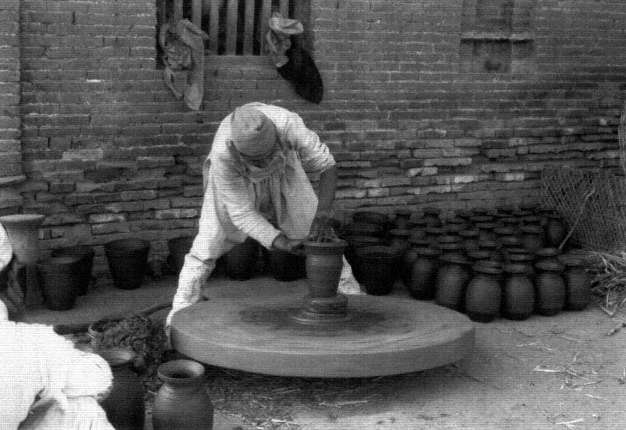
Figure 3.
A member of the Kumha: (potter) thar making pots on his wheel.
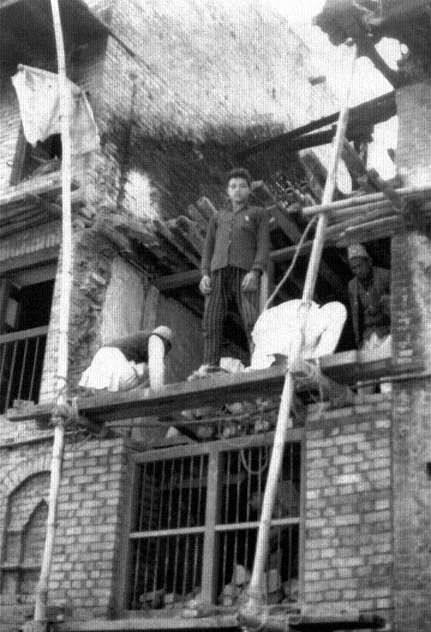
Figure 4.
Awa:s (masons) and Ka:mis (carpenters) building a house.
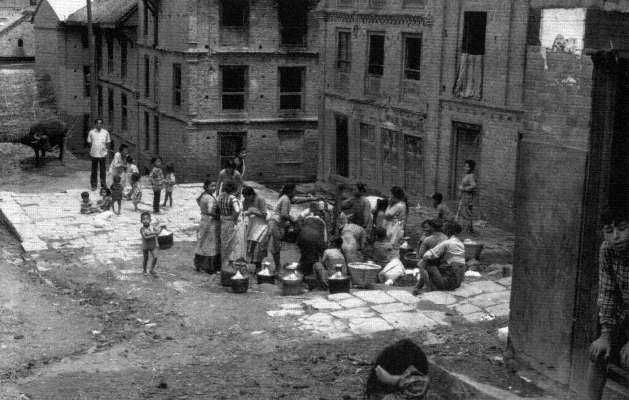
Figure 5.
Young wives chatting while collecting water at a communal tap.
members to some general class of activities (e.g., farming or shopkeeping), there are about forty-five thar s whose membership at present specifies for its members either a particular and exclusive hereditary trade and/or some hereditary "ritual" function, that is, a function in the marked symbolic realm of the city. There are various combinations of occupational and ritual functions. Some thar s have ritual functions that reflect their occupational functions (e.g., potters and carpenters). There are some groups whose hereditary occupational functions have disappeared but who may still have ritual responsibilities deriving from and faintly echoing those functions. There are groups with occupational specialties (e.g., Ayurvedic physicians) and no ritual functions. There are groups whose occupation is a ritual occupation, that is, entirely within the realm of marked symbolism (e.g., priests). Among these various groups there are some thar s whose ritual or occupational function accounts for most of the livelihood of most of the adult male members of the group (e.g., Brahmans, sweepers). In contrast, there are other thar s for whom the ascribed occupational or ritual function, while it is limited to the thar and tends to explain or justify its status in the overall system, may actually be performed by only a few of its members, selected in some way by the thar , and sometimes involving only a small segment of the selected member's time and economic activity. Such variety, which, furthermore, has shifted during the course of Bhaktapur's history, makes the question as to how thar membership determines differentiated ritual and occupational behaviors of its members very complex.
For the purposes of the city's organization, we may emphasize again that it is the output of the thar that is essential, not its internal affairs and organization—as long as those internal features guarantee that output. The important thing for the city as a whole is that sufficient numbers of the members perform their essential functions within the traditional system, and that their other economic functions and social behaviors do not appear dissonant with the status of the thar . The city is, in fact, differentially exigent and severe in its pressures on different thar s to maintain their traditional functions. This is for both material and "symbolic" motives. The city can now do without local drum makers if necessary, but for many reasons it cannot do without the economic and/or symbolic functions of, say, Brahmans, potters, and sweepers. The symbolic practitioners, in fact, must be locally in place. One can import pots from another town, but such actors as Brahmans and sweepers are essential constituting components of
the city system, and must be in place for the traditional system of city action to work at all.
In order to sketch the relation of thar s to differentiated urban roles, we will use an ad hoc sorting that, however, reflects some important contrasts in the implications of thar -assigned roles. In listing these specialized thar s we will briefly gloss their special functions that have been given already above, many of which will be discussed elsewhere in the book. The roman numerals following the thar names indicate the status level. Recall that occasionally the same thar name may occur at more than one status level.
1. Priests, auxiliary priests and "para-priests" (see chap. 10). Rajopadhyaya Brahmans (level I), Lakhe Brahmans (level I, lower section) (priests), Josi (level II) (astrologers), Acaju (level III) (auxiliary priests, with Tantric specialties), Josi (level III) (astrologers), Tini (level IV) (priests), and Acaju (level IV) (auxiliary priests, with Tantric specialties).
2. Thar s who are allied to group 1, the priests, in that their traditional roles, services, products, and behaviors are expressive of and constituent of a special component of the city's symbolic order, which is associated with purity and impurity, "ordinary" deities, and "priestly morality." We will delineate this component in later chapters, and contrast it with other aspects of symbolic order and of power. In contrast to the priests, the functions of these thar s are overtly stigmatizing or at least associated with a depressed status:37 Cyo (level XI) (purifying services during the cremation phase of the death ritual cycle of upper-level thar s), Gatha (level XIII) (flower growers, deity-possessed performers as the "Nine Durgas"), Kata (level XIII) (cut umbilical cords and remove and dispose of placentas), Nau (level XIII) (barbers, purifyers), Pu(n) (level XIII) (painters of religious images and mask makers), Bha (level XIII) (death ritual services for upper-status thar s); Cala(n) (level XIII) (services in funeral processions of upper-status people), Khusa (level XIII) (esoteric services for one of the Tantric deities during the Mohani festival cycle), Sa:mi (level XIII) (oil pressers, special functions in the Biska: festival cycle), Nae (level XIV) (butchers, kill animals in some sacrifices in major temples), Jugi (level XVI) (tailors; performers on drums, trumpets, and shawms; important roles in the cycle of death ceremonies and other pollution-accumulating tasks), and Po(n)
(level XVIII) (sweepers, fishermen, basket makers; various important pollution representing and pollution accumulating functions).
3. Stigmatizing, occupational specialties with no marked symbolic functions. These are craftsmen whose craft has a traditional status-depressing implication, but who, in contrast to the other thar s listed in group 2, do not have (in the present at least) corresponding additional symbolic functions: Kau (level XIII) (blacksmiths, workers in iron), Chipa (level XIII) (dyers of cloth), and Do(n) (level XVI) (players of trumpets).
4. Nonstigmatizing occupational specialties: Baidhya (level II) (Ayurvedic physicians), Baidhya (level III) (Ayurvedic physicians), Tama: (level VI) (caster of metal pots, plates, and icons), Kumha: (level VII) (potters), Awa: (level VII) (house builders), Kami (level VIII) (wood carvers, carpenters), and Loha(n) kami (level VIII) (stone carvers). (In this group some families of Tama: and Kumha: have some ritual functions in some rites of passage.)
5. Thar s including members who have ritual or ceremonial functions in Bhaktapur's focal festivals (chaps. 12 to 16) and/or in association with the Taleju temple. This represents the "symbolic reconstruction" of the old society centering on the Malla court and the temple of its tutelary deity Taleju: from level II (above), Malla, Pradhana(n)ga, Hada, Bhau, Tacabhari, Muna(n)karmi, Bhari, and Go(n)ga; from level III, Madikami and Bhari; from level V, Suwal; from level VIII, Kalu, Caguthi, Muguthi, Haleyojosi, and Jatadhari; and from level XII, Dwi(n). (Among thar s included in other lists, those with additional special Taleju ritual and/or ceremonial functions include Josi [II], Acaju [III], Tama:, Kumha:, Gatha, Khusa, Pu(n), Jugi, Nae, and Po[n].)
6. We can add to this list those groups outside the Newar Hindu core group who have essential occupational or ritual functions. We noted previously some of the occupational specialities of these groups (shoemakers, knife sharpeners, washermen, etc.). Only two groups outside of the core group have ritual-symbolic functions for the core system. The Bhatta* Brahmans have a very limited (but theoretically interesting) function for one upper-status thar (chap. 10). The Bare Buddhist thar provides the children who become the "living goddess" Kumari and her attendant gods and goddesses during the major ceremonial cycle, Mohani (chap. 1.5).
There are, thus, some forty-five thar s in the core system, about 13
percent of the city's approximately 340 thar s, whose membership in itself (rather than through its status level) entails ritual and/or occupational specialties. For the city as a whole, seventeen of these thar s, particularly the upper-status ones, whose ritual activities are confined to the Taleju temple, are of minor differentiated importance. So it is, finally, some twenty-eight thar s, about 8 percent of the whole, whose members have major specializations—against the more diffuse background of farmers and merchants and craftsmen and specialists in being impure, which is organized by the larger macrostatus system. In addition to the total number of specialized thar s we need to consider their relative size and the number of households and individuals that they contain. Their combined size is, as we shall see, a larger percentage of the city's population than their numbers alone would indicate.
Thar And Macrostatus Demography
In an attempt to get some rough idea of the numbers of families and individuals in the various thar s and status units, we asked various informants for estimations of numbers of households in various thar s. Subsequently Gutschow and Kölver (1975), using an early version of our macrostatus and thar lists, gathered survey data on the numbers of households in many of the units.38 The total number of households located by Gutschow and Kölver was 5,216. Assuming that the 1971 census report of 6,484 households is accurate, this sample is incomplete, but not biased in any evident way. Certain thar s are clumped in their report—for instance, some groups of Chathariya and the large groups of Jyapus. Their materials (with four additions from our informants' estimations), however, give a basis for estimating rather closely the number of households incorporated in various segments of the system. The previous section listed the number of thar s that had various kinds of differential significance. As some thar s contain only two or three households while others may contain hundreds, however, a composite listing of thar s and the number of thar s at each level gives us limited demographic information. The number of discrete specialized thar s is of a different kind of significance for the structure and organization of the city than the quantitative extent of their various memberships.39
Table 1, modified from Gutschow and Kölver (1975), gives what is probably a close approximation of thar and status level demography.
Table 1 shows that out of a total of 6,45040 households all but some
|
Table 1. |
||
|
Level |
Household |
Number |
|
I |
Brahman |
32 |
|
II |
Chathar |
677 |
|
III |
Pa(n)cthar |
247 |
|
IV |
Tini |
2 |
|
V |
Jyapu |
1,867 |
|
VI |
Tama: |
19 |
|
VII |
Kumha: |
419 |
|
Awa: |
99 |
|
|
VIII, IX |
Combined, Jyapu thar s |
1,420 (total) |
|
X |
Chipi |
466 |
|
XI |
Cya |
5 |
|
XII |
Dwi(n) |
1 |
|
XIII |
"Borderline clean thar s" |
437 (total) |
|
Gatha |
56 |
|
|
Bha |
19 |
|
|
Kata: |
2 |
|
|
Cala(n) |
16 |
|
|
Khusa |
1 |
|
|
Nau |
46 |
|
|
Kau |
27 |
|
|
Pu(n) |
25 |
|
|
Sa:mi |
160 |
|
|
Chipa |
82 |
|
|
Pasi |
3 |
|
|
XIV |
Nae |
177 |
|
XV |
Jugi |
57 |
|
XVI |
Do(n) |
4 |
|
XVII |
Kulu |
1 |
|
XVIII |
Po(n) |
90 |
|
XIX |
Halahulu |
1 |
|
Non-Newar Hindu households |
||
|
1 |
Sakya Buddhists |
260 |
|
2 |
Misra and Bhatta* Brahmans |
26 |
|
3 |
Matha* priests |
6 |
|
4 |
Gaine |
7 |
|
5 |
Sarki |
6 |
|
7 |
Mushm |
3 |
|
8 |
Dhobi |
2 |
|
9 |
Other ethnic groups (Tamang and Indo-Nepalese) |
129 |
eighty are "Newar." Of the Newars, approximately 6,110 households are in the Hindu core system, while 260 households are Buddhist Bare households, which are not directly involved in the core system. For the broader hierarchical and functional divisions of the core system, 32 households are Brahman; 924 households are at the "sahu" levels; 4,389 households are in the several Jyapu farming groups; and 765 households are engaged in services, crafts, and professions that are considered in some way to be polluting. Of these polluting households 435 have a borderline status, and 330 are unequivocally polluting.
By adding other available information on the number of households in particular thar s within the status levels amalgamated in Table 1, we can suggest the number of households within those thar s that have differentiated functions. Arranged in the grouping we used in the previous section, the number of households are as follows:
1. Priests, auxiliary priests, and para-priests. Total of 333 households: Rajopadhyaya Brahmans (32), Josi level II (44), Acaju level Ill (85), Josi level III (120), Tini (2), Acaju level IV (50).
2. Thar s engaging in stigmatized ritual-symbolic activities. Total of 649 households: Gatha (56), Katha (2), Nau (46), Pu(n) (25), Bha (19), Cala(n) (16), Khusa (1), Sa:mi (160), Nae (177), Jugi (57), Po(n) (90).
3. Stigmatizing, nonritual occupational specialties. Total of 113 households: Kau (27), Chipa (82), Do(n) (4).
4. Nonstigmatizing occupational specialities. Total of 844 households: Baidya level II (3), Baidya level III (8), Tama: (18), Kumha: (508), Awa: (99), Kami (194), Loha(n)kami (14).
5. Thar s, some of whose members have ritual or ceremonial functions in Bhaktapur's focal festivals and/or in association with the Taleju temple. The total number of households in the seventeen thar s with such functions is about 650.
The number of households in the forty-five specialized thar s, is on the average far more than those in the nonspecialized thar s. When we listed all the thar s in the city with a specialized function, they represented about 13 percent of all the city's thar s, among which twenty-eight, or 8 percent of all the city's thar s, had major differentiating importance. In terms of the number of households, however, there are some 2,589, or 40 percent of the city's households that are in thar s having some differentiated importance to the city, and about 29.5 percent of the households in thar s having major specializations.41
The numbers of households in a thar that follow its traditional speciality,42 and the number of individuals in a household who do, vary greatly from thar to thar . Sometimes women are involved in the thar specialization (e.g., farmers, barbers, as purifiers); sometimes they are concerned with subsidiary aspects of the speciality (Brahman's wives for some rituals), or perhaps exclusively with the general running of the household and with other nonspecialized or subsidiary economic activities. Moreover, we do not know from such enumerations how those who do not participate in a thar's traditional activities, activities that define the thar , are affected by their membership.
These internal questions are not our present concern, however. It is the Kumha: as potter, not as farmer or bank clerk, who concerns us here, that is his defining and constituting role in the hierarchical urban system that becomes interwoven with deities, symbolic space, and symbolic performances in the mesocosmic segment of the city's order. For such purposes these demographic notes give a rough idea of the available numbers of role players in that mesocosmic system, numbers distorted by social change and by the loss of some of the controls that may once have more closely regulated the supply of labor in such immobile societies.
Entailments and Markers of the Macrostatus Levels
Membership in a thar in itself may determine many features of an individual's life—occupation, aspects of marriage, residence, details of religious practices, and the various effects of the thar 's special culture and internal organization. Much of this may derive from the special history and distant origins of the thar itself and much from the effects of the thar 's incorporation, its way of being fitted into the macrostatus system. The thars are, in a way, the given raw materials thrown up by history on which the city-wide hierarchical system, the system of macrostatus levels, opportunistically builds. The macrostatus system is a means of ordering and making sense of its multitude of component units by ordering them into much simpler systematized groupings. That system is a typical Hindu "caste system," sharing the ideologies, the central metaphors of purity and impurity, the entailments of rank, and the rules for interactions among ranks that are found throughout South Asia. Such systems have been described frequently and at length, and we will simply sketch some of the entailments of Bhaktapur's twenty macro-
status levels here to indicate what Bhaktapur has maintained and emphasized in its Hindu orthodoxy.
Our sketch is concerned with the central rules of status ordering and their insisted-upon, publicly controlled, and sanctioned expressions. Deviations are internally controlled by family and thar councils, motivated by fear of loss of public respect and of economic and physical sanctions, and externally by people at superior levels who, if necessary, apply such sanctions. The rules concern—characteristically of Hindu status systems—mostly physical contact in relation to eating, drinking, and touching, and regulation of proper marriage. They also include for the lowest thar s rules regarding place of residence, and, until recently, clothing, decoration, and house type. In addition to these centrally important and carefully regulated behaviors there are many other important signs of status level—such as proper language and other behaviors indicating deference, respect, and adherence—and a host of more or less secondary or covert implications of status level, such as economic and educational opportunities, nutrition, differential vulnerability to disease, and many aspects of standards of living.
The centrally controlled behaviors are questions of traditional proper behavior, aspects of the dharma . The implications are often otherwise explained—as misfortune or the results of bad karma . The central system of regulations is highly conscious, involves clear rules and regulations, is based on pervasive and deeply felt ways of viewing the world, and is continuously symbolized and reinforced in ritual and symbolic forms. To anticipate later discussions, we may note here that the separation and ranking of the macrostatus system is considered a positive, dynamic, and activity-requiring process, the result of constant effort. People talk of "sending people to, and keeping them at" their particular level. Separation and ranking is in tension with other ideologies and experiences of blending and equality, and is not based on any theory of fixed, essential, "biological" differences justifying the hierarchy. It must be actively and constantly maintained.
The violation of central regulations is sanctioned, ultimately by the threat of expulsion of an individual, a family, or an entire thar from its status level. These regulations are central in that they constitute the hierarchical system, as the rules for the moves of chess pieces constitute the game of chess. The primary formula, which in itself implies all the separations and hierarchical rankings that make up the hierarchy is, as everywhere in South Asia, that boiled rice and certain boiled legumes (or "pulses") can be eaten only if prepared by a member of one's own
level or of a higher level. This rule is associated with ideas of impurity, which we will consider in chapter 11, and blends with other ideas about the status-derived purity of the provider of food, who must also be pure in other regards, not contaminated, for example, by contact with death or menstruation. From the point of view of any individual in the system there are two groups. There is an upper group including one's own level, from which one will accept boiled rice.43 Below any individual and distinct from and in opposition to the upper segment in which he or she and his or her peers are included are those groups who will accept boiled rice from the members of that segment, but from whom they will not accept boiled rice. Boiled rice is the basic domestic staple grain of the Newars, and the regulation involves an unavoidable, salient issue. In relation to the acceptance of food, of "being fed," the group to which an individual belongs, except for Brahmans, is always at the bottom of an upper segment.
The process of being excluded by those above and excluding those below effectively slices the hierarchy into its levels.44 The asymmetry has other implications, however. In the acceptance of rice, one is open to all above and to those at one's own level, and closed to all below. Thus, in terms of the acceptance of rice (which in the ideology of purity [chap. 11], implies the sharing of bodily substance), every individual is in the same "body" as all above (but always significantly at the lowest, most dependent position) and in opposition to all those below in rank. The refusal to take rice from those lower in status is one's own active (and conflicted) responsibility, supported by powerful ideas and feelings, many of which are related to dirt and disgust. But it is, in contrast, by the stigmatizing decision and action of others at superior levels, that our rice is rejected. Any given level gets carved out between its own strongly motivated restrictions toward those below it, on the bottom side, and something quite different, the rejecting behavior of other higher levels toward it on the top side. The solidarity of belonging to "one body" signaled to any individual by the downward flow of boiled rice is countered by an opposition, a radical breach in solidarity signaled by rejection of its upward flow. Looking down the system, one sees people who belong to, derive from, and depend on one, but whom one places on the other side of a barrier of disgust and pollution. Such complex asymmetries encourage in those given to reflection the kinds of intellectual complexity, the "sophistication," which, we have suggested in chapter 2, is an important distinguishing feature of Bhaktapur's people and the uses they make of its marked symbols.
While the differential acceptances and rejection of boiled rice carves out each successive step in the macrostatus system (as do the marriage regulations to which we will return), there are various other designations of differential purity that are arranged hierarchically and refer to particular status levels or groups of status levels, but which are not a regularly increasing and differentiating quality of each successive level. These mark hierarchy in a grosser way, and we may for convenience call them "classes of purity."
While (again typical of Hindu communities) a given group will not accept boiled rice from people in the levels below it, it will accept most other foods until a certain level is reached; at that level its members are considered so impure that no food, not even water, may be accepted from them. This group of people are called "Na* calae ma ju phu(n), " people from whom water may not be "moved," or "Tiye nae ma tya phu(n), " people who should not be touched while you or they are eating. In the first phrasing, it is understood that as water is not acceptable, then no other food and drink is acceptable.45
The first division, "water-unacceptability," produces a first large distinction among the levels in classes of purity. In the class of levels below the "water line" a second division is made to create a distinct lowest category, the "Tiye ma tya phu(n), " people who must not be touched—whether one is eating or not.46
In previous sections we noted which levels are considered in each of these categories. There is some variation in the placement of the level of water-unacceptability, depending on the status of the higher, "purer" person. This is reflected in our "borderline" level, level XIII. Middle and lower levels differ in their conceptions of water-unacceptability even in relation to thar s below level XIII, but every thar agrees on the position of at least two thar s—the Jugi as water-unacceptable and the Po(n) as untouchable, and these two thar s are the present-day inheritors and foci of these positions.
The Brahmans and the upper-status Chathar families who model themselves on them add another distinction. They further divide the group from which they will accept food and drink. Within this group there is an upper strata, those groups from which they will accept all foods except boiled rice and pulses, the groups—as they are sometimes categorized—from which they will accept "salt." These are the Pa(n)cthar and above. Below this group is a second strata, people from whom they will accept all foods that are neither boiled (and therefore, of course, not boiled rice or pulses) nor salted. This group, named by con-
trast with the segment below it, is often called the "people from whom one accepts water." These are for the most part the farmers and "clean" craftsmen.
There were in the past many associated markers of sequential status relationships and classes of purity. One of the most enduring of these has been respect levels in language. In ordinary usage, there are three respect levels indicated in pronouns and in a very few nonpronominal lexical items (most saliently verbs for coming and going and for eating and drinking). People use a formal language in addressing or referring to others who are of higher status than themselves or in addressing or talking about equals in formal situations and a familiar language for people of lower status or for equals with whom they have intimate relations. The third level is a high-respect language used for addressing royalty, Brahmans (and, usually, Buddhist priests), and deities. There are also customs for proper greeting, for respect gestures, terms of respectful address, and more subtle behaviors of deference and authority, which respond to and mark relative hierarchy.
In the past a variety of associated regulations brought some, at least, other aspects of life into accord with purity rankings. Much of this was directed to the lowest most impure classes and facilitated their identification and separation. Thus, according to some of the chronicles, in Malla times members of the butcher thar had to wear sleeveless jackets; sweepers, butchers, and drum makers were not allowed to wear caps, shoes, or gold ornaments; and the sweepers had to live out of the city, and were not allowed to have the roofs of their houses tiled (D. R. Regmi, 1965, part I, p. 647). Many of these restrictions lasted through the Rana period and are remembered by older people but are not enforced now. But some such regulations, although not supported (and, in fact, illegal) under modern Nepalese law, persist. Thus Po(n) untouchables must, in fact, still live beyond the city's boundaries and in simple houses. Another very salient spatial marking of the major polluting thar s also has persisted. This is how far into the space of a house a person of a given polluting class can penetrate. Untouchables can enter only the cheli , the ground floor, which is conceptually considered outside of the house (chap. 7). Higher levels of unclean thar s can go further into the house, at least as far as the first floor above the ground level, the degree depending on the claims to purity of the individual household or its thar .
Foods eaten at different levels are frequently used to indicate status differences. Among the most salient are the foods that the Brahmans
refrain from eating—certain vegetables and the meat of certain animals (water buffalo and [previously] fowl),47 which are for others common Newar foods. At the other end of the scale is pork, which is eaten only by the lower segments of the unclean thar s, Po(n), Nae, Jugi, and the unclean Indo-Nepalese groups. It may be noted that pigs, like dogs, which are not eaten, are scavenging animals in Bhaktapur, eating, among other things, refuse of all kinds, including remnants of food in human feces. The low Newar groups further distinguish themselves from the Indo-Nepalese shoemaker and leatherworker group (Sarki), whom they claim eat the carcasses of animals that have died of natural causes, which the low Newar groups consider to be much more polluting than eating butchered pigs.
The separation and hierarchy organized by the macrostatus system entail rules about marriage, which make up part of the regulations for proper marriage (see chap. 6). Macrostatus regulations for a proper marriage depend on whether the marriage is a "primary" marriage—one contracted for perpetuation of the lineage.48 Primary marriages should be within the same status level.49 In those secondary unions in which the wife may be of a lower level, she cannot legitimately prepare boiled rice for her hushand, and their children will belong to neither the husband's thar nor to his level. They will either take the wife's thar name and level, or in rare cases be given a new thar name and placed at some intermediate level within the system. In these cases the man still is a member in good standing of his thar and can involve himself in its ritual, associational, and economic life—but his descendants no longer belong to it. If he were to marry or form a liaison with someone of an impure thar , however, he would be ostracized from his own thar and level.50 All primary marriages and the majority of secondary marriages are endogamous within any given status level. The controls here, somewhat like the controls on boiled rice-taking, are asymmetrical. People at any given level are concerned only that their women should not be given as wives to men at lower levels. Their active control is directed to the lower boundary. They have no ritual or social objection to taking wives from levels above them (and when such marriages do occur, they are vaunted), but those upper levels will not, if they can possibly prevent doing so, provide wives for them. It is through each level's concern with maintenance of its lower boundaries that a segmented system of status-level endogamy is created.
We should note that the actual regulations for accepting wives do not
correspond exactly to the regulation for accepting boiled rice, and does not "map" the macrostatus levels as exactly. In Bhaktapur there are subgroups within some macrostatus levels who consider themselves as a higher subsection, and will accept wives only from the same subsection, even though they will accept boiled rice from all thar s at the same general macrostatus level. Other considerations affecting exogamy may also limit marriage to only one section of the general commensal group, or may force people to seek wives outside the city. Thus, while rice acceptance is always directly related to hierarchical relations of macrostatus units in the city, marriage choice is not. Food and contact regulations are constantly at issue and are enforced and reenacted in every act of eating and food preparation; arranging a proper marriage, in contrast, is hardly a daily issue for any given individual.
Status Ranking of and by Outsiders
People in Bhaktapur's core system rank all outsiders—both in and beyond Bhaktapur—into a hierarchical system of relative purity and impurity and, in turn, are ranked by at least some of those outsiders, most importantly by Nepal's dominant Indo-Nepalese. While the ranking of the internal components of the Bhaktapur core system is repeatedly represented and reinforced in symbols and concepts and in action and is very generally agreed upon, these external rankings are a different matter. The objects of Newar or Newar Hindu ranking may well be ranking the Newars in their turn by a different calculus, and do not accept (or sometimes care or know about) Newar decisions about their position. Some of the northern Mongoloid groups do not even accept the underlying assumptions which support the general notion of Hindu hierarchy.
We will list these external rankings in a summary fashion:
1. Groups within Bhaktapur: Buddhist Bare.
For Rajopadhyaya Brahmans, the Buddhist Bare (including both sections—priests and precious metal craftsmen) were considered water-unacceptable. The justifications given by Brahmans for their low rank are miscellaneous, but not necessarily more post hoc than other such justifications for status. These include their metalworking, their traditional performances on "contaminating" musical instruments, and their short seven-day period of contamination after death—such short periods being characteristic of low-level groups. Furthermore, the Bare do not, in con-
trast to Hindus, maintain a residual queue of hair in the course of the shaving of their heads at the time of (and in purification rituals subsequent to) boys' ritual initiation into their thar . This last, a reminder of their original status as monks (Buddhist monks' shaving of the entire head being a sign of renunciation of ordinary lineage and social ties), probably reflects one of the historical reasons for their ambiguous rank—recalling the ambiguous social ranking of all Hindu renouncers. For other members of upper-level thar s, Chathariya and Pa[n]cthariya, the Bare were considered on the levels of the Jyapus, and thus "water-acceptable."51
2. Groups within Bhaktapur: non-Newar Brahmans and Matha* priests.
Rajopadhyaya Brahmans traditionally considered the Jha and Bhatta* Brahmans and the Matha* priests to be water-acceptable. The Newar Chathariya, and Pa(n)cthariya treated them as they did the highest segments just below themselves; that is, they accepted all food except boiled rice and pulses from them. Middle-level and lower-level Newar groups accept rice from these priests. Conversely, the Jha and Bhatta* Brahmans accepted rice from neither Rajopadhyaya Brahmans nor the levels below them.
3. Relations to other non-Newar Nepalis, both in and out of Bhaktapur.
Newars in general divide non-Newar Nepalis into two groups. Mongoloid peoples, thought generally to have Tibetan connections, are called "Sae(n)." This term is said to derive from an old Newari term for a Tibetan52 or, according to some, for Lhasa.
For the non-Mongoloid hill peoples, who are in large part the groups from western Nepal associated with the Gorkhali invaders, the term "partya ," or "hill-dweller" is used in polite reference.53 The ordinary term, considered pejorative, is "khae(n), " derived, apparently, from the tribal designation "khas ."54 This general term refers in some contexts to the upper-status divisions of the western Khas group, the Brahmans ("Khae[n] Brahmans") and the upper "Ksatriya* " divisions (the latter also referred to distinctively as "Chetri") but in other contexts also may include the very low status (generally untouchable) occupational Khas groups such as blacksmiths, tailors, shoemakers, and leatherworkers.55 Furthermore, other non-Mongoloid hill groups who may be of dubious historical Khas connections, such as the Gaine, are included as Khae(n).
For Newar Brahmans, Partya Brahmans and Chetris are only water-acceptable. The Chathariya and Pa(n)cthariya, in general, accept all
foods and drink except boiled rice and pulses from the Partya Brahmans and Chetri. Those Khas groups untouchable to the Partya Brahmans and Chetri themselves are also untouchable for the Newars.
The Sae(n) were generally treated as water-unacceptable by Brahmans. The Chathariya and strict Pa(n)cthariya accepted water (but not boiled and salted foods) from them. Most, but not all, Jyapu accepted all food except boiled rice and pulses from them.
The residual group, neither Khae(n) nor Sae(n), are Muslims, and these are generally treated as untouchable by the highest levels, and water-unacceptable by those below them.
4. Partyas' conceptions of Newars.
As Lynn Bennett (1977, p. 30f.) puts it, for the Khas Brahmans and the Chetris,
The higher twice-born Newari castes . . . exist in a kind of "separate but parallel" status with respect to the high caste Parbatiya. The remaining castes. . .all fall under the rubric of matwat or "liquor-drinking." From the Brahman-Chetri point of view this large middle-ranking group includes most Newar and other Tibeto-Burman speaking peoples. . . . Members of this group . . . are touchable and water as well as . . . uncooked food or food cooked with ghee can be accepted by high caste individuals from them.
Newar untouchables and the clearly water-unacceptable groups (such as Nae and Jugi) are also untouchable or water-unacceptable to the upper-ranking Chetris and to Partya Brahmans. These rankings reflect the rankings and ambiguities of the Muluki Ain , the attempt to legislate a Nepalese national status system. Its attempts to integrate the entire Newar status system into a national system was very awkward for all parties, and "often deficient or ambiguous and at variance with the self-assessment of the Newar castes" (Höfer 1979, 140).
Envoi
The order generated and represented by thar and macrostatus level relates to hierarchy and specialization, separation and interrelation, although it hardly sorts matters in the simple manner of Bouglé's definition of a "caste" that we quoted at the start of this chapter. In one way or another, however, thar and status level in various combinations assign and control most of the differentiated production of goods and services necessary for Bhaktapur's traditional and early modern urban life.
This order ensures that the many specialists such as masons and
metalworkers—and above all, masses of farmers, will be replaced and maintained from generation to generation. It guarantees that "Ksatriyas* " will hold on to the places they have been able to capture, at least for the length of a dynasty. It also provides the priests and untouchables the exemplars and technicians of the system of marked symbolism which presently will concern us. The way that the precise roles and the more diffuse qualities that thar and level attribute and assign to the people who are born into them are—or are not—made use of by the symbolic order, and the ways that the symbolic order expresses and reinforces the status system will concern us in the following chapters.
Chapter Six
Inside the Thars
Introduction: The Internal Structure of the Thar
In chapter 5 we considered the thar s and their arrangement into larger levels and groupings as the building blocks of Bhaktapur's urban society. We remarked that as long as they continued to produce the goods, services, and relational behaviors that were essential to urban organization, the internal organization of the thar , like that of many corporate units in Bhaktapur, was carefully and properly hidden from the scrutiny of outside observers. We have said that the internal forms were of no concern to the city. That must be qualified, for the internal forms generate many of the shared and contrasting experiences and meanings that the public urban system must express or work with or counter. These internal arrangements provide a background of private meanings and private problems which the integrative forms of the city must take account of.
We will sketch something of the internal structure of the thar s here. This is not our main concern in this study, and we must be superficial and general, collapsing differences among the thars insofar as they may exist and concerning which we have only limited information. Much is similar throughout the hundreds of units of the macrosystem; other aspects vary according to the local histories and traditions of the thar s, or in accordance with larger social and economic forces that variously affect them. Within the thar s we will consider aspects of the house-
hold, kinship structure, extended-family organization, and aspects of marriage. As we are here for the space of a chapter approaching the intimate lives of individuals we will, in contrast to our general procedure in this volume, make some limited use of transcribed accounts of interviews.
In passing from aspects of the macrosystem and its component units to the internal institutions of the thar s, we are crossing a threshold. On one side are the processes that belong directly to the organization of the city in itself; on the other are the sustaining smaller processes more systematically related to the person and the household, the extended family, and the neighborhood. The content and forms of organization of these two worlds are different.
Household and Household Size
For most economic, organizational, moral, and ritual purposes, the smallest social unit of the that is the household. It is an important economic unit, coordinated usually by the male head of the household, who decides, within the limits imposed by the macrostructure, what activities will be undertaken, and who collects and distributes the family income. The household is the setting for intimacy, for the education of the young, for preliminary (and usually effective) attempts at controlling deviant behavior, and for much family religion. Like the that itself, the family has a clearly bounded corporate and spatial (chap. 7) inside and outside, and tries to protect the inside through privacy and secrecy. There is no specific name for the household in Newari, but its members sometimes refer to each other with the Nepali (and Hindi) term jahan , in this sense "household family," which is distinguished from other, larger family units. Sometimes the group is referred to by terms that refer to the sharing of boiled food, particularly rice, such as chaga jasi , "one rice pot." If a household separates into separate units, it is conventionally phrased as "having stopped sharing a kitchen area," or "having stopped eating boiled rice together." The main metaphor for the household, as is generally true of household units in other parts of the world, is that its members share a common cooking and eating place.
When families separate, usually at a time when there are two or more sons with their own wives and children, they may, if the house is large enough, divide up the space in the house in which they were living, or add to it so that uncles, brothers, cousins, and so on, live in more or less
close contact, but have separate cooking areas or cooking times, separate household heads, and separate household shrines. According to a survey by the Nepal Rastra* Bank (1974a ), a majority of all Bhaktapur households shared larger housing structures with (at least) one other household.1
This same survey showed for Bhaktapur an average figure of six persons per household, the same figure as that given in the National Census of 1973. The survey also has figures on the distribution of size of households for the entire city population: 5.2 percent of the households included only one person; 33.2 percent, two to four persons; 37.2 percent, five to seven persons; 13.4 percent, eight to ten persons; and 10.9 percent, eleven or more persons.2 The available surveys do not consider the distribution of household size in relation to the variables of macro-status and thar . Tables on average monthly expenditure in relation to household size, however, show that the larger households are not only correlated, as one would expect, with larger total monthly expenditures but also in a direct and regular correlation with increasingly higher per capita monthly expenditures. For example, households averaging 4.2 members spend fifty-three rupees (Rs. 53) per member per month, households with 7.7 members spend Rs. 67 per member per month, while the largest households averaging 17.5 members spend Rs. 84 per member per month. These larger households are the wealthier households, the houses at the upper levels of the status system. These are also the people with the largest houses, which are more likely to contain two or more closely related households. People living in the upper, say, 25 percent of the Bhaktapur macrostatus and economic system, from well-to-do farmers and up, may sometimes live in large family units of twenty or more people in a house, because of the larger households and the multiple households in a house.
The Nepal Rastra* Bank Survey also gives a rough overall idea of the average number of component "families" or "subfamilies" in a household. They define additional family units as those consisting of a married couple (with or without children) other than the identified head of the household and his spouse, or of a widowed man or woman with children. They found that 30 percent of households had a least one such additional unit, almost 30 percent of the multiunit households having two additional units, and 9 percent having three or four. The sample survey suggests that there are about 2,920 such subfamily units, living in the 6,494 households of Bhaktapur, dependent on or subordinate in
some way to the household head. In accordance with the distribution of numbers of people in households, we may also assume that the larger and more prosperous and generally the higher the household is in the macrostatus system, the more likely it is to have a membership made up of such separate nuclei.
Thus from the upper strata of farmers and above, people are more liable to live in larger houses, in larger households, with more complexly nucleated household structures, and in close contact with closely related households. Most middle farming families and the levels below them tend to separate quickly into smaller and physically separated units as brothers marry. It would seem this has various consequences for other aspects of social organization, and for the differential developmental and family experience of people of both high and low status.
Household Roles
Roles of the family members within households ideally—and under the constraints of the ideal, as far as we can tell, to a considerable degree in fact—exemplify very general South Asian Hindu patterns.3 In the Newars' own perspective there is, however, one major difference: the status of Newar wives compared to that of wives in the non-Newar Indo-Nepalese Hindu society, the Brahmans and Chetris, the Newar's most salient comparative model of Hindu family and social structure.
A summary report on family ideals resembles, not surprisingly, the domestic pole of fairy tales, the state that other forces threaten to derange, or that, if already deranged, is the yearned-for absent safe harbor. We can summarize briefly the norms that are shared with other Hindus. The father, most particularly when he is head of the household, is to be offered maximum respect and deference. As household head (a position that he will keep until he reaches old age and is moved off in a series of rites of passage [app. 6] into a semidivine role where he prepares for death and heaven or a good rebirth), he settles internal family problems and ultimately makes decisions for the household that affect the relations between the household and the outside world, particularly economic relations. There is a certain restraint between him and his children (in an emphasized contrast with the mother's brother) because, it is said, he has the difficult responsibility for making sure that his children behave properly in relation to the larger society, and any sentimental affection might weaken his authority and resolve.
Often the father is even cooler toward his daughters than toward his
sons, and often withdraws still further from his daughters after they marry and leave the house. His sons, or some of them—the elder or eldest, at least—tend to stay with the household to help "support the lineage" through their work and their progeny. The respect due to the father is also due from younger sons and daughters to older sons, particularly the first-born, and very often that oldest son acts as the surrogate father, particularly as the father ages and the oldest son may begin to "act in the father's name."
In comparison with an interrelated variety of ways in which the Newar woman is less disadvantaged than the "northern Hindu" and Indo-Nepalese woman (below) a daughter's situation in the household is "high." Michael Allen (1982, 200) has summed this up in an essay on Newar girls' prepuberty rites:
The high status of Newar women, at least as compared with that found in more orthodox Hindu communities elsewhere ,n the Himalayas and north India, is evident not only in the context of marriage and divorce, but in a wide range of other areas of social and religious life. Sons, though perhaps slightly preferred to daughters, especially in the case of the first born child, are not accorded the exaggerated importance found in most Hindu communities. There is no evidence of female infanticide,4 either now or ,n the past, and the birth of a daughter is not in any way regretted.
The senior women in the household, particularly the naki (n ) or female leader of the household, has the responsibility of supervising the general housekeeping and, especially in lower-level families, for a great deal of important economic activities—farming, weaving, basket making, and many specialized thar occupations. She is assisted by her daughters, and in particular by the wives of her sons. The naki (n ) of the household has many ritual responsibilities in household worship and in rites of passage for family members. As wife, she is supposed to defer to her husband, treating him with public respect, particularly in upper status families, where she may bow to his feet at the start of the day. As a mother she is ideally, and to a large extent it would seem in actuality, indulgent and affectionate to her children.
The relationship between brothers and sisters is supposed to be intimate and warm.5 After the sister marries, her brothers, usually represented by the eldest, will represent her natal household to her new family. The brother becomes her children's maternal uncle, their paju , and his warm relationship with them will complement their own father's relative austerity.
Wives and Households
As the story unfolds, the true drama of the household tale begins with the arrival of a bride. Who is the Witch and who the Princess depends on whether the bride or the groom's parents, particularly his mother, is put at the center of the story.
While elder sons remain in their parental household, and younger sons may remain (and ideally should remain, permanently if possible) at least for a while after marriage as long as circumstances of economy, space, and temperament permit, daughters must marry out into other households. They enter these households as young wives. This sharp transition from daughter in one's "own home" (tha chen [n ]) to wife has both general South Asian features and some special Newar emphases. For it is in relation to a daughter's marriage that traditional Newar culture resisted, as it were, the imposition of Indian forms and conserved some Himalayan patterns. This is most evident in certain of the rites of passage of girls, particularly the Ihi or mock-marriage ceremony and in related modifications of menarche ceremonies (app. 6), in the nature of the close continuing relationship between a wife and her natal home, and in the lack of the hypergamous implications of marriage characteristic of Indo-Nepalese groups, which we will discuss in a later section of this chapter. These differences are significant in the contrast of the Newars to neighboring groups, but from a non-Hindu perspective the married woman's situation is quite characteristically Hindu.
When a young woman becomes a wife, one of the more dramatic discontinuities of situation and role that are so characteristic of Bhaktapur is produced. A Pa(n)cthariya man describes in an interview how his seventeen-year-old bride changed in the early days of their marriage.
Before marriage she was like a bird, natural, but once she got married her behavior changed, because the environment changed. She didn't talk freely any more, she couldn't talk freely and frankly with everyone [in the household] and her face seemed very serious and complicated. And she was shy. Before that she was never shy. But after marriage she became shy with everybody. And her work was difficult. During her girlhood she didn't have to work. Now she has to work. She didn't have any practice before but she has to practice [i.e., learn how to do things] in my house. It was always like an experiment for her, and she was always distressed when she was working. If her cooking [for example] was not good, there would be trouble. She always has doubt in her mind, her life was complicated. And she became nervous.
An unmarried young woman from the Kumha:, potter, thar describes the duties of a young wife in the household:
She gets up early in the morning, sweeps everywhere throughout the house. Then she goes to bring water [from the well or public tap]. After that she bows down to her father-in-law and her mother-in-law, and then she bows m her husband. Then she prepares the meal, whatever it is that is going to be served, and serves the meal to her father-in-law, mother-in-law and husband. Only after that can she eat herself. Then she does whatever work is necessary, like the sewing of clothes, or whatever her mother-in-law gives for her to do. Later in the day she again has to fix the noonday meal and serve it to her father-in-law, husband, and mother-in-law. Then she cuts up the vegetables, cleans them and cooks them. Then she has to get water again for dinner. Then she cleans the kitchen and prepares the rice [the supper meal]. She feeds her mother-in-law, father-in-law and husband and only after that is finished can she eat. Then she cleans the dishes and the cooking pots. After she has finished the kitchen work, she massages her father-in-law, mother-in-law, and husband with oil. Then she goes to sleep.
This is, at least, what a "good" wife does. If she is lazy or ill and doesn't do her work it is hard, the informant says, for the mother-in-law.
As elsewhere in India in such households the young husband and wife are not supposed to show any special interest, let alone affection, for each other. They rarely have a conversation in front of other members of the household. Often, however, in the secrecy of their room the husband may give the bride a small secret present, often some sweets or rich foods that he bought in the bazaar. Some women recall this as their first stirring of love for their husbands, and of the knowledge that he cared about her. This must be hidden from the household. The new wife "belongs to the household"; she is a threat to its closed, self-protective secrecy, and she is potentially divisive. If her husband cares for her more than for the household, she can, through him, stir up trouble between brothers or between parents and the son, and lead to a division of the household. Any obvious affection or concern shown to her in public by her husband would be a sign that he is vulnerable to this threat of a shifting loyalty. And any material present that he gives her privately is a diversion of household income.
The young bride is expected to relate herself primarily to her mother-in-law, whose "support" she is. She acts toward her husband with the same respectful gestures she uses to other senior members of the household. In strict and upper-status houses she will walk behind him, some ten feet or more, on the town streets, when they are going somewhere together. She and her husband call each other by neither their given names nor relational terms of address; circumlocutions must be used. A husband, for example, may be reduced to such devices as calling to his
wife on the floor above, "The person who is upstairs, come down." Jyapus sometimes refer to their wives by the name of the neighborhood they came from. The young wife finds herself treated as a low-status, potentially polluting, and potentially trouble-causing outsider. She is, as we will see, at the bottom of the family's hierarchical food-giving system as the symbolically salient low thar s—Jugi and Po(n)—are in the macrostatus system. Like them, she is polluting.
If there are family disputes, and particularly if there are schisms within the household ending up with one or more of the brothers establishing their own homes, one or more of the new brides is often blamed. People say such things as the separation is caused by a phunga ki , a pillow insect, the wife's talking in bed at night, and that if a man listens to his bride's opinions, "everything will be over." This is often scapegoating; it is easier for the household to put blame on the outsider, but in fact a tactful and skillful young wife can be very helpful in helping the household deal with the problems stirred up by her addition to the family, and some husbands are grateful about this when they later think about the early stages of their marriage.
As elsewhere in South Asia, the shift comes with the birth of the new wife's first child, particularly her first son. Now she becomes, in a phrase that is used repeatedly, the "supporter of the lineage (kul )." She has now a new relationship to the household through the child. She may refer to her conjugal family now as "my child's father's house." She begins to develop, often, and especially in households where the daughters have already married out of the household, warm relationships with her mother-in-law and father-in-law. Now that her relationship to the household is fully legitimate, her sexual and personal relationship to her husband is much less suspect. The father-in-law's relationship to his daughter-in-law is often warmer than that to his own daughter, and apparently in the majority of households warm working and personal relationships develop between the mother-in-law and the daughter-in-law after the birth of children. Often the birth of a second child augments this relationship, for the mother-in-law would take over much of the care of the first child at this point. The birth of a child binds the young wife to the household in another way. The child "belongs to the household" and for the wife to break up the marriage entails the risk of losing her children. The young wife becomes related to the inner life of the household, that which goes on within the walls of the house. In farming families she helps out with the farmwork and with supplementary crafts such as weaving, and in lower thar s women may be involved with the specialized activities of the thar (although mostly with
supplementary activities). In upper-status families she would not (this is changing in recent years) be involved in the family trade or shop. She does not shop in the bazaar; this is a male activity. Her main duties are the care of the household and its internal maintenance and economy.
For the young wife the main time out of the household in the course of a day is when she goes to the river, well, or public tap to gather water, a time when she can chat with other young wives (fig. 5). She (and the older women) will also leave the household in connection with religious activities—visits to temples, community festivals, and to the households of kin for feasts associated with calendrical festivals, special household events, and rites of passage of the extended patrilineal family. During such events she will meet with the wider circle of her husband's kin.
She will also go to feasts involving the kin of her natal home, and as frequently is the case in South Asia, she often returns to her natal home after the birth of a child, usually one month after, and she and the child may remain there one, two, or even more months.6 A wife is also expected to return to her parental house for special feasts, nakhatya , which are associated with many festivals7 and all rites of passage, including, importantly, the end of mourning sequences immediately following deaths in her natal household.
And, finally, as her children grow and as her mother-in-law and father-in-law age, the wife's security, prestige, and authority in her husband's household gradually increase and now either in her husband's natal household, or if there has been fission, in her own new household, she becomes in her turn another daughter-in law's mother-in-law.
Much of this is the usual Hindu family pattern. The Newars share it. What is diffierent is the contrast in a wife's relations to her own home, as well as in aspects of the meaning of marriage in general, which contrast with the Hindu social patterns of the Newar's neighbors. Also peculiar to the Newars in this contrast is the nature of the way the family is related to the larger kin group. We will return to this after first saying something about the household hierarchy, in which, in fact, the young wife has a peculiar position.
Household Hierarchy, Authority, and Purity and the Cipa System
We have discussed the city-wide assignment of roles and their arrangements into hierarchical levels in chapter 5, and we will discuss the com-
plex of ideas and actions concerned with purity, impurity, and purification in chapter 11. Hierarchy and purity are also used within the household—and as in the larger system primarily in relation to eating and drinking—to define and order household status. The hierarchy, and some assent to it, is also indicated by the use of respect gestures and language.
The male head of the household is called the "leader," the naya :. On his death, or absence from the household, the succession for the new naya : proceeds among males by age within ranked generations. That is, the title and role would pass from the head of the household through his progressively younger brother living in the household even if that younger brothers in the father's generation were younger than one of the previous naya :'s sons in the succeeding generation. Generation here takes precedence over relative age.8 The actual leadership of the household is informally taken by someone else when old age, youth, or incompetence make the nominal leader unable to lead the household. The nominal leader would, if possible, however, maintain the ritual roles of the naya :. The female religious leader of the house, the naki (n ), will ordinarily be the wife of the naya :. She will retain this title and its ritual functions even after the death of her husband, however, so that the wife of the new naya : will not necessarily become the naki (n ) if a senior wife (as ranked by the order of the husbands) is still alive, active, and competent.
Hierarchy in the daily life of the household is indicated in the way orders are given and accepted, and in a rough way in usages of respect language and gestures. Hierarchically arranged relative purity, the central idiom of the macrostatus system, is constantly signaled and enacted in the family in regulations regarding cipa (chap. 11). The term "cipa " designates food or drink that has become polluted because it or the utensil in which it is prepared or served has come in contact directly or more likely through the medium of fingers with a bodily pollutant, particularly saliva. That is, while a woman of the proper status level (and who is not temporarily "ritually" impure) will not pollute food while she is cooking it (as would a man or woman of lower level simply through touch), she would pollute it if she touched it after tasting it or if she put it in a utensil from which she had previously eaten and that had not been properly and traditionally cleaned. Most generally in practice this becomes a question of the sequence in which people are served and eat at each freshly prepared meal.
If someone of higher status in regard to cipa takes cipa from someone of lower status he or she is polluted and must purify himself or herself, albeit in a perfunctory way (chap. 11). In parallel to the pollution ideology of the macrostatus system, it is not polluting for a lower-status household member to eat a higher person's cipa , but on the contrary it is desirable and proper, particularly in the case of wives who should eat some of their husbands' cipa . Less prescriptively, more "naturally" the junior members of the household eat and are fed the cipa of their superiors. This, as such intake generally does (chaps. 5 and 11) indicates the sharing by the inferior person of the superior person's substance and his or her dependence and incorporation in a larger and superior "body."
The family cipa customs have a strong form among the more "orthodox" families (that is, "strict" Brahman families, and families in other thar s who emulate them), primarily among the upper two status levels, and a weaker form among less orthodox families in those levels and among all families at lower levels. The key restraint that persists through the very lowest levels is that a husband will not eat his wife's cipa , but she will eat his. In the more orthodox families the constraints are more extensive. We may summarize the stronger regulations as follows: (1) each "ritually adult" male of the family will accept the cipa of all those of either sex older than he is, but not that of any younger member of either sex; (2) women (and girls) generally in the family will eat anyone's cipa , except (a), some very strict upper-status women will try to avoid eating their sons' or daughters' cipa (but this is rare) and (b) very generally at all levels, all women in the household will not eat the cipa of the wives of their sons or younger brothers; and (3) boys, before receiving their initiation into their thar s, can eat the cipa of still youner boys and girls, and thus such boys—like girls whose younger brothers are unmarried—in fact have no cipa restraints.
In the weaker form of the system the father still will not accept his wife's cipa , but he will accept his children's cipa ,9 and all other members of the family will accept cipa among themselves. As noted, however, even in such households when the sons begin to marry and bring brides into the family, now at all levels, older siblings of both sexes as well as members of the older generation will not accept the cipa of the brother's or son's wife.
It is clear that the cipa system insists throughout on marking women who are brought into the patrilineal family from "outside." They become insiders to the system only to their own children, and to their husband's younger siblings to whom they have a quasi-maternal role, as
he has a paternal role. In upper-level families a further hierarchical ordering of family members is added.
When we go beyond the case of the introduced wife, in the weak form there is no further family cipa discrimination. In the strong form, and if we exclude the case of the introduced wives—except for the most strictly "Brahmanical"—there is an internal gender asymmetry. Men and women accept the cipa of elder women who, in turn, accept theirs. Men and women accept the cipa of elder men , who do not accept theirs. There is probably a different significance in these two cases. The acceptance of superior women's cipa in the family reflects the position and meaning of the mother—in part shared by all elder household women—who is due honor, respect, and deference, which takes some of its sentimental meaning from its contrast with paternal, patrilineal, and macrostatus systems of order and deference. It is only the men who do not take inferiors' cipa , and thus follow the conditions that carves out status in the larger urban social system. In this sense it is really only the men, and among them those who have been initiated into thar , whose status is differentially defined by the system in the course of their accepting cipa from both men and women above them and rejecting it from those below. While everyone, like lower thar s in the macrostatus system, must be careful to avoid the moral error of contaminating those above them and compromising their superiors statuses, for the women this is within the family (introduced wives aside) their only status concern. Thus the familial cipa system can now be said to (1) mark outside wives during the long period of slow integration during which they maintain their alien aspects, (2) honor mothers and maternal roles, (3) teach everyone how to conform to status generating behaviors, and (4) teach men how to assume differential status.
The Comparative Freedom of the Newar Woman in the Northern Hindu Context
The Chetri anthropologist Dor Bahadur Bista wrote that "the Newar woman in her husband's house has much more authority and freedom than her [Indo-Nepalese] Brahman or Chetri counterpart. She is readily accepted into the extended family group and adapts quickly to her new role in relation to the family and in particular to her husband" (1972, 24). This relative freedom within the Nepalese Hindu context is obscured in the first descriptions of a wife's role, with its implicit comparison to modern Western ideal forms.
The Newar family is in most respects what Karve (1968) has called a North Indian type, and which she takes to be a continuation of ancient Hindu patterns. "The present northern family is a continuation of the family of the ancient times with slight modifications. It is patrilineal, patrilocal and patriarchal. The marriage is generally outside of the kin-group and the local group. It is a joint family in which the brides are all brought from the outside and the girls are all given away. The behavior is strictly regulated according to generations, according to whether one is born in the family or married into the family and finally according to whether one is a man or a woman" (1968, 136). All this holds for the Newars, with the important exception of marriage outside the "local group."
The Newar kinship system, like the Newar family, is essentially, as we shall see (app. 3), a "Northern system." Karve (1968, 251) sets this Northern system in contrast with a Southern "Dravidian" system, in which a man can marry his younger female cross-cousins or a daughter of one of his elder sisters, producing—among other consequences—a freer, more comfortable position for women in their husbands' households:
A man does not bring a stranger as a bride to his home, a woman is not thrown among complete strangers on her marriage. Marriage strengthens existing bonds. The emphasis is on knitting families closer together and narrowing the circle of the kin-group, a policy exactly the opposite of the one followed in the north. The whole tone of the southern society is different. The distinction between the father's house and the father-in-law's house is not as sharp as in the north. The distinction between "daughters" and "brides or wives" is not as deep as in the north. A girl's behavior in her husband's family is much freer. After all, her husband is either her uncle or her cross-cousin and his mother is either her own grandmother or her aunt. Neither is she separated for long periods from her parents' house.
The Newars have within a northern marriage and kinship system, partially subverted it, as it were, with the result of modifying the condition of women into a somewhat less patriarchal and patrilineal Hindu form. The "Northern" characteristics of a wife's separation from her natal home, physically through separation in space,10 and socially through the loss of status of the wife's family in relation to the husband's family through "metaphorical hypergamy" (discussed below), are not present. The Newar wife's relationship to her natal home is strong in comparison with the North Indian and the Indo-Nepalese situations.
The continuing strong relation to the wife's natal home is inversely
related to aspects of Newar marriage that weaken (again when compared with the North Indian pattern) the dominance of the husband's household. This, in turn, derives its ritual justification ultimately from a peculiar Newar rite of passage, the Ihi or mock-marriage to the god Visnu/Narayana* (app. 6) and to associated modifications in menarche rites. The legends associated with these rites and the rites themselves reveal certain anti-Brahmanical and antipatrilineal biases. Their legendary origin was in an innovation introduced into the Kathmandu Valley by the goddess Parvati, whose natal home it was, in order to prevent the disabilites of widows, a severe problem in the traditional Hindu social system, through the device of a first ritual marriage to a god. A woman's subsequent marriage to a mortal becomes a secondary marriage, and as her primary, true husband cannot die, she will never become a widow. The mock-marriage also weakens the ideological support for child marriages, that is, that a girl should be married and living in her husband's household prior to the onset of menstruation. Now it is necessary only to marry her to the god Narayana* before menarche.
With its ritual expression in the Ihi rite, the modified Newar marriage contrasts in fact with Chetri and other northern Hindu marriages in relatively easy separation and remarriage under certain circumstances, relatively little stigmatization and disadvantaging of widows, a lack of hypergamic stigma for the wife's family, and a wife's close continuing relations with her natal household.
Newar Menstrual Disabilities in Comparison with the Indo-Nepalese
Differences in comparative disabilities during their monthly menstruation is another way in which the Newar women feel themselves to have a better situation than Indo-Nepalese Chetri and Brahman women. A discussion of menstruation belongs most centrally to an examination of the "private lives" of Newars, but it may be useful to say something about it here in relation to the question of the comparative position of Newar women in relation to other Nepalese Hindus. Lynn Bennett's report on a Kathmandu Valley community of Indo-Nepalese women based on a study made at the same time as this present one suggested the extent of their stigmatization (Bennett 1983, 215):
In Brahman-Chetri culture menstrual blood is a strong source of pollution—particularly to initiated males. During the first three days of every menses, women become polluted and untouchable. As one woman explained, "We
become like female Damai. . . . We become like female dogs." For these three days a woman must not enter the kitchen, touch food or water that others will eat or drink, or even worship the gods or the ancestor spirits. She may not comb her hair or oil it, and she sleeps separately in a downstairs room. Also she may not touch an adult man. . . The segregation of women during their menstrual periods is strictly observed. . . Older informants told me that in the time of their mothers-in-law . . . women were hidden in a dark room away from the sun11 . . . and out of the sight of all males for the first three days of their periods.
Bennett also notes that Brahman-Chetri women of Jumla in western Nepal "may not enter the house at all for three days and so they must sleep in a cattle shed or outside with a fire. Linda Stone reports that this rule holds also for the Brahman-Chetri women of Nuwakot" (Bennett 1983, 215).
According to both male and female informants, Newar women's restrictions in Bhaktapur are, in comparison to these examples (insofar as they may be representative of Indo-Nepalese practices now or in the past), considerably less. Menstruating Newar women in Bhaktapur do comb their own hair, and may continue to sleep in their usual place, although they sometimes go to another household woman's sleeping area to sleep. Most upper-status families reportedly do not let women cook during menstruation, although according to Jyapu informants, in most Jyapu and middle-level (and probably lower-level) families, menstruating women can cook everything except rice to be used for ceremonial purposes. In many thar s, including Pa(n)cthariya and Chathariya (but not Newar Brahmans), menstruating women attend ceremonial family feasts. At all levels menstruating women are not supposed to carry water or touch god images, sacred utensils, or priests. They are not supposed to pluck flowers used for religious offerings. In the farming thar s, menstruating women work on the farms, but are not supposed to touch certain plants (e.g., ginger, chili peppers, turmeric), which would be harmed by their touch.
During menstruation Newar women may worship deities in the same way that a polluted man (say, during the course of death pollution) would. If initiated, she will perform the necessary worship of the Tantric lineage god (in upper-status families), but away from the actual shrine, using a dish and uncooked rice (app. 4), and worshiping a mental image of the god. She may also perform daily worship in the same way, imagining the steps of the puja (app. 4). She may also perform what would ordinarily be household shrine worship at the side of the
river. Women are supposed to eat rich foods during menstruation to prevent ill effects (including dizziness) from loss of blood. Cloths are used to absorb the menstrual blood, which are washed by the menstruating woman and kept for repeated use.
The period of contamination is supposed to last four days, following which the woman must purify herself and her sleeping area by bathing and cleansing with specially pure water—(Ga [n ]ga jal [app. 4]). For upper-status women, they may have a more formal purification with services of a woman of the barber thar (chap. 11). After purification women have no further menstruation-related disabilities, with the exception that they are not supposed, at least in upper level thar s, to participate in commemorative worship to deceased ancestors during the six days following purification.
Intercourse is supposed to be discontinued from the onset of menstruation until the fourth day after onset, that is, after the purification. Men believe that if they have intercourse during the wife's menstruation they will become seriously and perhaps chronically ill. They fear contact with the menstrual blood. (Menstrual blood is regarded, apparently, more as a dangerous12 and powerful rather than a disgusting substance.13 As we will see in chapter 9, chapter 11, and elsewhere, "disgusting" versus "dangerous" is a significant distinction in Bhaktapur's symbolic world.)
All this echoes G. S. Nepali's (1965, 115) earlier report on other Newar communities:
Menstrual impurity other than the first one [i.e., menarche rites] is not observed by the Newars as strictly as by the Gorkhas [the Indo-Nepalese]. During menses, a Gorkha woman byes practically in isolation. On the fourth day after her bath she is considered clean. But still she is not allowed to much water and attend to religious duties until the fifth day. Among the Newars, on the other hand, a woman during her menses can even attend to the domestic duties including kitchen. The only restriction imposed on her is that she should have her bath before attending m her normal duties. At the most she is forbidden to come in physical contact with objects of religious worship.
The details of menstrual practices vary among thar s within this general characterization. It is of great interest that one extreme exception was among the untouchable Po(n)s, among whom women must leave the inside of the house and go to the cheli (the porch or lowest story of the house which is considered outside the house) during their period of contamination, which lasts for six days, two days longer than for most Newar women.
We hope to deal elsewhere with the local doctrines explaining the origins of menstruation. It is not associated by our informants with bad karma or with a woman's own "sin." The widespread Hindu legend that it is one result of a great sin by Indra, his killing of a Brahman, is known but told in a considerably less misogynistic form than the version given by Bennett (1982, 216). It is said that menstruation represents the periodic draining of impurities from a woman's body. The male anxieties represented in interpretations of menstruation are, in short, more subtly and much more mildly expressed in the Newar response than in those of their Hindu neighbors.
A Wife's Natal Household's Relation to Her Children: The Mother's Brother
Not only does a woman frequently return to her natal home, which is most often within Bhaktapur (and if not, often in a relatively nearby Valley community) and thus maintain close ties with it, but some members of her natal family will, after she has children, have important ceremonial, and very often, emotional and educational responsibilities to those children.
The central representative of the mother's natal household is her brother, whose relationship to his sister's conjugal family comes into being when she gives birth to her first child14 and he becomes, for that child and for subsequent children, "the mother's brother," the child's paju . All of the mother's biological and classificatory brothers are nominally paju s (app. 3). They decide informally among them who will participate in particular ceremonies for their sister, and often several of them will go as household representatives to those feasts at their brother-in-law's house which include affinal kin. The lack of insistence on a hierarchy based on age among the paju s is, perhaps, a significant exception to the usual emphasis on hierarchy by age within a generation in aspects of family organization involving the male lineage, and is congruent with a cluster of "maternal" meaning and emotion associated with the paju .
The wife's natal house is for her always her "own house," her tha che (n ), but for her children and for her, by extension, when she is talking to or thinking about those children it is "mother's brother's house," paju che (n ).15 The birth of the first sister's first child produces a generational change in her natal household. Her brothers now become pajus and representatives of their household in its relations with allied households. For a paju his sister's children whether male or female are his
bhe (n )ca s (bhi [n ]ca in Kathmandu and Patan Newari). As elsewhere in South Asia, a paju has important functions in the rites of passage of his bhe (n )ca (app. 6).
The paju-bhe (n )ca relationship, symbolized and strengthened in formal ceremonial actions, is of great importance for Newars. While the father, as we have noted, often acts toward a child relatively sternly because of his responsibility to assure his children's proper social behavior in the face of the extended family and the larger city, and in his representation of the restrictions of economic and social constraints, the paju is usually warm and relaxed and, perhaps, a bit subversive with them. People tend to talk about their relation to their paju in terms of love, rather than the respect and fear they felt for their father. Many children, particularly boys, spend parts of their childhood in their paju 's household. Boys and girls (the latter probably less commonly) go to their paju s for advice, comfort, and sometimes for financial support.16 The paju may act as an intermediary for his sister or her children with the father (and the patrilineal kin) if there is a problem about, for example, marriage, a career choice, or some serious household conflict. The paju represents the moral authority of the wife's household in the protection of her interests. He functions to weaken the patriarchal authority of the patriline over the household and its children and represents "maternal" support for his sister's children in contrast to the strict demands of the patriarchy. He has a comparatively greater force than Hindu mother's brothers elsewhere because of the whole pattern of rituals and marriage forms giving some comparative independence and high status to Newar women, the lack of a hypergamic stigmatization of the wife's family, and again from the fact that spatial patterns of marriage ensure that they are not, usually, too far away. Men are, of course, fathers to their own children and at the same time paju s to their sisters' children, in one of the many complex multiple positions characteristic of the city.
Marriage
Dumont has remarked on the importance for South Asia of separating a "true and complete marriage" from other kinds of "marriage." He makes some terminological distinctions that are useful for a discussion of marriage in Bhaktapur (1980, 114 [original italics]):
The only true and complete marriage whereby one moves from the category of an unmarried person to that of a married person is the first. But the cere-
mony which effects this transition is especially important for the woman, and one must distinguish the case of a male from that of a female. In the case of a woman we shall call the first marriage the primary marriage. Once this marriage has been contracted, either it is indissoluble even by the death of the spouse (superior castes) or else the woman may, after her husband's death or even after divorce, contract another union, legitimate, but infinitely less prestigious, involving much less ritual and expense, which we shall call secondary marriage. Secondary marriage, being of lower status, is freer, sometimes much freer, than primary marriage. In the case of a man his first marriage becomes the principal marriage only if it bears him children, preferably sons. But a man has the option, either in the case of the barrenness of the first marriage, or freely in other castes (royal, etc.) of taking other wives, either with full rite (necessary for the wife if she has not been married before) or with secondary rite (if the wife has already been married). Thus for a man there are supplementary or subsidiary marriages, with a corresponding hierarchy of wives.
Dumont further notes that, "in various groups, in order to secure for women great freedom of [secondary] marriage or of sexual unions in general, primary marriage is, or rather was, reduced to a mere ritual formality. Sometimes women are married in this way to a god, an object, a fruit, or a man who immediately disappears from their lives" (1980, 118). Dumont, in fact, cites the Newar Ihi as one of his examples, although he erroneously believes that the consequences of the mock-marriage is to allow Newar girls "probably to have unions with men of inferior status" (ibid., 119).
The Newar mock-marriage is not, in fact, fully equivalent to a "primary" marriage, for the first "real" or "social" marriage still retains in its ceremonial and social implications most of the implications of primary marriage in contrast to any possible further, fully, and "really" "secondary" marriages. The mock-marriage has at least some of the force of a primary marriage, however, in that it allows the "real" marriage to be a postmenarche one, and in that it is associated with a somewhat greater liberality of divorce and with a considerably less disadvantaged position for women.17
Until the late 1950s the Newar Brahmans followed orthodox Hindu marriage practices rather than the Newar modification. They did not have mock-marriages, and were married to premenarche child brides.18 In the later 1950s the Rajopadhyaya Brahmans decided to follow Nepalese law banning child marriage and to ease their restrictions on divorce and remarriage.
For non-Brahman Newars in the past (and for Newar Brahmans now) the great majority of social marriages take place when the girl is
postmenarche. Some few premenarche marriages exist among farmers, where the motivation is said to be economic, for in a small and often poor family the bride will help with the work of her conjugal home. Such marriages are illegal under Nepalese law and are frowned upon even among other Jyapus. It is said by Jyapu informants that the ideal age for a woman's marriage among them should be between sixteen and eighteen. Before sixteen she is too young to work and to be of much help in her husband's house,19 and if she marries too much later than eighteen, it is said that her children will be still too young to help their father at the time in his life when he ages and will need help in his farming. The Jyapu husband should be somewhat older, between the ages of, say, twenty and twenty-three, among other reasons because "it will be easier for them to manage a younger wife, who will fear them." The daughters of sahu —Chathariya, Pa(n)cthariya, and those lower thar s who are in business and shopkeeping—are said to marry later, often at twenty-two or twenty-three.20
For his "principal" (to use Dumont's terminology) marriage, that is, for the vast majority of marriages, a man will marry a woman who has not been married before (with the exception of the Ihi ), who is within the proper intermarrying macrostatus level, and who is at the proper exogamous distance. The marriage ceremony will be a "major marriage ceremony," modified somewhat from the orthodox Indian marriage ceremony to take the Ihi into account (app. 6).
People are forbidden to marry within an extended and active patrilineal group, the phuki (below), and more vaguely within larger groups thought to have a significant and close patrilineal connection, to be the same patrilineage or kul . Such larger exogamous units are distinguished within different thar s in different ways. Tracing degree of relationship and permissible and impermissible unions through female lines is more difficult, as it is not revealed in present organization, and has to be based on genealogical information. Ideally, any relationship derived from the out-marriage of any woman of the kul within less than six generations (the seventh generation being permitted) is forbidden. In practice, no objection is made after five generations if there is some "good reason" for that particular marriage.21
Almost all the thar s marry within Bhaktapur by preference, and often within the same part of the city.22 Almost all marriages are still arranged. The availability and qualities of potential spouses are first discussed among informal networks of friends and relatives. Ideally, as elsewhere in South Asia, a wife should be modest and shy, respectful to
elders, in good health, and willing and able to work as necessary in the particular thar . She should not have any disfigurements, particularly skin diseases, the facial scars of smallpox having been considered particularly disadvantageous. A prospective son-in-law should be able to support his wife through his own efforts or his household situation. He should be of good moral character, a support to his own family, and not a gambler or a heavy drinker. He should be good-natured, and not irritable and potentially abusive to his wife. The reputation and behavior of the other household members, and the extended-family group, the phuki , are also of great importance. Immorality, crime, insanity, scandal anywhere in this group will affect the desirability of all its members.
After an informal decision has been made, a representative of the man's household, a lami , is chosen from among family or friends, and begins a more formal investigation of the potential bride's nature and situation. Eventually, if she seems acceptable, the lami approaches her family to discuss the prospects, and later the arrangements, for the marriage. A symbolic sequence begins at this point which in a number of phases gives the marriage increasing social reality; we will discuss the sequence in relation to rites of passage (app. 6).
In the past the perspective spouses did not see each other before the marriage ceremony, although they usually had some idea about each other from networks of friends or relatives. They could refuse when the marriage was proposed, but this was reportedly quite rare. Now it is customary for the couple to see each other, often at a mutual friend's house, before the arrangement reaches a formal phase, a meeting that may provoke objections to the marriage.23
There were always "love marriages" in the past, as there are now. These are marriages that were in violation of the parents', or phuki members' wishes, and were motivated by romantic love or, sometimes, by pregnancy. As long as these were within the acceptable macrostatus marrying sections, they usually became acceptable to the couple's families. Only marriages violating these regulations caused a rupture of family and thar relationships. Incestuous marriages within the bounds of kin exogamy would be "a great sin" or crime, maha aparadha , and would result in outcasting and banishment.
The bride's family will provide a dowry and will also bear the expenses of the first portion of the sequence of marriage ceremonies, which take place at her house. The groom's family will have the expenses of the subsequent major marriage ceremonies and feasts. They
also provide presents to the bride, which include (particularly among farmers) substantial quantities of gold jewelry. If a husband divorces a young wife, or forces her to leave him, and if this is not considered to be through her fault, she has the right to take back her dowry and keep the jewelry she has been given. If she leaves the household because of her own dissatisfaction (an attribution that the wife's family may dispute, and that may require arbitration), she forfeits these. Among some Jyapu groups some of the wife's dowry is withheld by her family until after she has borne a child, a guarantee that the marriage will probably be permanent. It is estimated that the total expenses of the bride's side and the groom's side at the time of marriage are about equal, or, in the case of Jyapus, somewhat higher for the groom's family.
While the contribution from the bride's side is overtly said to be a dowry, a payment for taking the daughter, the expenses of the groom's side are interpreted as indicating the ability and commitment of the groom's family to the continuing support of the bride. The groom's side also gives gifts to the bride's family in the course of the ceremonial sequence preceding the marriage. Among some thar s these involve substantial cash gifts. G. S. Nepali, in a discussion of such gifts among the Newars, notes that when cash offerings are given in lieu of "symbolic" offerings of sweets by the groom's family, "though the payment of cash is looked down upon by the society, since it amounts to paying for a wife, it has not diminished at any rate; and it is a favoured practice among the poor. There is no social sanction against it, except the moral disapproval" (1965, 215). The moral disapproval comes from Brahmanical ideology of the wife as a free gift or offering, a kanya dana . In actual practice for all except the most Brahmanical families, there seems to be a balancing of both symbolic and material calculations of the value of the marriage transaction to both the giving and the receiving families. Among the middle and lower levels, where the economic value of the wife is most clear, there is an additional emphasis on the tentativeness of the contribution from the bride's side, as it protects her and will be returned if she is rejected by the groom's family. Dumont (in a comment on a claim of L. S. S. O'Malley for Bengal that "bridegroom price" characterized high hypergamous castes; and "bride price," low castes) remarks that it may be supposed for Bengal, as elsewhere, that "there is an exchange of prestations, in which the tangible prestations dominate in one or the other direction (Dumont 1980, 379). In the Newar case the general emphasis on equality of prestations corresponds to an emphasis on isogamy.
There exists, relatively rarely among upper levels and somewhat more frequently among farming thar s, "barter" marriages, hilabula , between two households, in which a son and daughter from one household respectively marry a daughter and son from another.24 Much less wealth needs to be amassed by the participating families in these cases (cf. G. S. Nepali 1963, 215).
A couple will be married in an elaborate set of ceremonies for a principal marriage (app. 6) and a simpler set for subsidiary ones. The vast majority of marriages are monogamous and endure until one of the partners dies, the survivor living on as a widow or widower. However, the marriage may break up in one way or another for other reasons than death or may be altered by the husband taking a second, additional wife.
Hindu societies, while making it relatively easy for the husband or his family to dissolve a marriage, have severely limited or prohibited a wife's right to divorce. The Newar woman's relative freedom to dissolve her marriage compared to other, including neighboring Nepalese, Hindu groups have led, among those accustomed to standard Hindu practices, to exaggerated statements regarding her freedom and her "licentiousness." Kirkpatrick wrote in 1793 (comparing the Newars and the matrilineal Nayars of Kerala, as is still frequently done), that "It is remarkable enough that the Newar women, like those among the Nairs [Nayars], may, in fact, have as many husbands as they please, being at liberty to divorce them continually on the slightest pretenses" ([1811] 1969, 187). Francis Hamilton visited the Kathmandu Valley a few years later during a fourteen-month period in 1802/03. His remarks on the Newar women are also a mixture of realities, misunderstandings, and prejudice. We can identify the probable source of the prejudice in one Ramajai Batacharji, who accompanied Hamilton on his visit. Batacharji was "an intelligent Brahman from Calcutta, whom I employed to obtain information, so far as I prudently could, without alarming a jealous government, or giving offense to the Resident, under whose authority I was acting" (Hamilton [1819] 1971, 1). Newar manners, Hamilton/Batacharji remarks, are "chiefly remarkable for a most extraordinary carelessness about the conduct of their women" (ibid., 29); to wit:
The Newar women are never confined. At eight years of age, they are carried to a temple and married with the ceremonies usual among Hindus to a fruit called Bel.25 When a girl arrives at the age of puberty, her parents, with her consent, betroth her to some man of the same caste and give her a dower,
which becomes the property of the husband, or rather paramour. After this, the nuptials are celebrated with feasting and some religious ceremonies. Among the higher casts [castes] it is required that girls should be chaste till they have been thus betrothed; but in the lower casts, a girl, without scandal, may previously indulge any Hindu with her favours, and this licentiousness is considered a thing of no consequence. Whenever a woman pleases, she may leave her husband; and if, during her absence she cohabits only with men of her own cast or of a higher one she may at any time return to her husband's house, and resume the command of the family. The only ceremony or intimation that is necessary before she goes away is her placing two betel nuts on her bed.26
Hamilton ([1819] 1971, 42f.) further writes:
So long as a woman chooses to live with her husband he cannot take another wife until she becomes past child bearing; but a man may take a second wife when his first chooses to leave him or when she grows old, and at all times he may keep as many concubines as he pleases. A widow cannot marry again, but she is not expected to burn herself, and may cohabit with any Hindu as a concubine. The children, by the betrothed wife, have a preference in succession to those by concubines. The latter, however, are entitled to some share. A man can be betrothed to no woman except one of his own cast, but he may keep a concubine of any cast whose water he can drink.
This kind of view of Newar practices, which starts with a perception of relative differences, and then salaciously exaggerates them, still is held by some non-Newar Nepalis about the Newars, and, indeed, mutatis mutandis , suggests the way upper-status Newars regard the morals and nature of women in the lower Newar thar s—and the way all Newars seem to think about what they take to be the free behavior of women among northern hill peoples. We can find some basis for such reports in some persisting present practices. Other aspects may have referred to practices of particular thar s at the time, or may have been based on misunderstandings. What was fundamentally distorted, however, was the romantic picture of liberty or anarchy.
G. S. Nepali (1965, 247ff.) provides some indication of the amount of separation and remarriage among 734 Newar men and women in 1957/58. Among his 353 male informants, 13.3 percent of their marriages had ended in separation. Some 40 percent of those separations were by formal divorce and the remaining 60 percent, by informal separation. Among his women informants 14.4 percent of their marriages were reported as ending in separation. Of these, about 15 percent were reported as ending in formal divorce and 85 percent in informal separation. Among the men some 72 percent of the men whose marriages had ended in separation remarried, as did about 41 percent of the
women.27 Nepali's tables do not indicate to what degree divorce or separation was initiated by the husband or the wife, but his discussion implies that many of the nondivorce separations, at least, involve desertion by the wife. Nepali's survey of divorce and separation suggests, in fact, that marriage among the Newars, if not as fluid as reported by Hamilton, is relatively fragile. We do not have statistics on separation and divorce for contemporary Bhaktapur; it is very possibly similar to Nepali's rates, and almost certainly significantly higher than for non-Newar Hindu Nepal.
"Divorce" is usually referred to in phrases using the word "par " or "pa ," which in other phrases signifies the conclusion of a transaction by making a final payment. Simple separation is phrased in various ways, often simply as tota beigu , "to let go of." Until recently neither marriage nor divorce had a clear legal status under Nepalese national law, which followed the varieties of local customary law. Bennett, in a study of the relations of both traditional and national law to the situations of Nepalese women, writes "Under the present [National Civil] Code, the performance of any form of wedding ceremony or simply evidence of sexual relations (even as a single event) can amount to marriage" (1979, 46). A "divorce" implies the consent of both parties and their kin to the separation, initiated by some kind of formal discussion. The one who wishes to dissolve the marriage obtains permission, often in writtern form, from the spouse or the head of the spouse's household or patrilineal extended-family group, the phuki The wife must agree to leave the household; if she objects to this and resists a separation, the husband may use various means to force her out. Previously, and still in some thar s, the simplest way for a man to separate from his wife was to leave her at her natal home when she returned there for a visit; she was not supposed to return to her conjugal home from these visits unless a member of the husband's household came to fetch her. Another device the husband or other members of his household can use to force a separation is to begin to mistreat the wife and provoke quarrels with her, thus attempting to make her decide to return to her natal home. If the wife wishes to initiate the separation, it is simpler: all she has to do is to leave her husband's house.
Separation is complicated for both husband and wife if there are children. They belong to the father's household, and will be raised by the women there. This is general in Hindu Nepal. "Nepalese law considers the right of child custody as well as the duty to maintenance of the child as the right and liability of the father. A mother has no right upon the issue she has given birth to. The law is based on the Hindu
concept of woman as jaya or one who bears children for her husband. The mother simply gives birth to children for her husband" (Shilu Singh, quoted in Bennett [1979, 64]). The comparative special rights of Newar women do not include rights over the possession of their children.
There is less social stigma attached to an agreed-upon separation, a divorce, than to a unilateral separation. A "divorced" woman is free of the insults and interference that might come from her husband's home if she were only separated, and still in some sense belonged to the household. Divorced or separated, all parties can remarry, however, with a simplified ceremony of remarriage, which as the figures cited from G. S. Nepali (above) indicate, is frequently done.
The most frequent reasons given for breakdown of marriages in Bhaktapur are, as everywhere in Hindu families, one or another of the difficulties of fitting a new wife into the husband's household, that is, her relations with various family members other than her husband, particularly her mother-in-law.28 Such problems may arise and cause the marriage to break up even if (and sometimes to some degree because) the husband and wife may like each other and are close to each other. Modernization has produced a different kind of marital problem. In the course of higher education or professional careers young Bhaktapur men and (more rarely) women of the upper levels often meet potential lovers or spouses—sometimes from other communities and ethnic groups—who are attractive to them often because they share more modern values and interests. These men and women have often been previously married in an arranged marriage with a spouse who (again, this is the case particularly for the men) has a more limited, traditional, and conservative upbringing and experience. Although the families have approved and arranged such marriages, the spouse becomes a target of the husband's (or wife's) resentment. The wife and her children have close relations with others in the household, but the husband (who may have a "girlfriend" outside the household) will be cooly proper and more than conventionally distant from her. Occasionally such marriages also end in separation.
Remarriage And Multiple Marriage
Following separation, divorce, or the death of his wife, a man may, usually in the case where there are no children (or no surviving children), enter a new principal marriage, that is, a marriage for producing children for the support of the lineage and the household. In this
case there would usually be, as in a first marriage, a major marriage ceremony. It would be a primary marriage for his new wife and the marriage would be as carefully arranged as was the first marriage.
A woman, following separation, divorce, or widowhood, can marry again, but this would be, for her, a (truly) secondary marriage, and she would have a minor marriage ceremony. In this respect it does not matter whether her previous marriage had been terminated formally, in divorce or death, or simply through an informal separation.29 We may note again here that widows can remarry, and the younger ones, at least, often do. This is in the context of the relative lack of social or ritual stigma attached to Newar widowhood. It was, as we have noted, specifically to prevent the problems and stigmatization of widowhood characteristic of other Hindu communities that, in local legand, the Ihi ceremony was founded by Parvati, whose natal home was the Himalayan area, and who had been given the Kathmandu Valley by her father for her dowry.
Whatever the form of marriage or of marriage ceremony the woman becomes a misa 30 or "wife." In the case where there are (at once or in sequence) more than one they are often designated as first wife, ha:thu , and later wife (or wives) lithu . One common explanation for a multiple marriage, that is, where the first wife is kept in the household and a lithu added, is a failure to have children, which is almost always ascribed to barrenness of the first wife and not the sterility of the husband. In most cases when a second wife is taken for this purpose, the first wife (who is otherwise likely to be a satisfactory wife and daughter-in-law) remains in the household.31 Multiple marriage for this reason is relatively common in Chathariya and Pa(n)cthariya households where the household can afford the expense of marrying and maintaining another wife. Farming households sometimes take second wives even if there are children by the first marriage, if the first wife is, for example, chronically ill and unable to help sufficiently with the household and farmwork. They may also do so sometimes even if the first wife is healthy if there are large farm holdings and a second wife could profitably help in the farmwork. Other additional marriages, which are considered permissible but by many as not really "decent," are those initiated by (and "for the sake of") the husband, not the household, and explained variously as owing to the first wife's lack of sexual attractiveness or the man's excessive sexual lust, or because of some dislike for his first wife in a situation where separation for one reason or another is difficult.
Polygamous marriages are generally considered to be stressful for
everyone concerned, particularly if there are children from both wives. They are confined to wealthier households and compared to non-Newar Hindu Nepalis seem to be relatively rare. Lynn Bennett, in her study of an Indo-Nepalese Hindu community, reports that among eighty-eight married men, seventeen had more than one wife, several had three wives, and one man had five (1977, 327). In contrast, G. S. Nepali (1965, 237) found among 256 married Newar men only eight who had more than one wife.32 The relative lack of polygamy among Newars in spite of their comparative wealth is another aspect of the Newar wife's relatively superior status in Hindu context.
The Lack of Hypergamic Implications of Marriage
In marriages that are not "principal marriages" undertaken for purposes of having children "to support the household and lineage," a man may take a wife from a somewhat lower macrostatus level. Newar marriage is for the principal marriage rigidly (and for subsidiary marriages more often than not) isogamous. Lynn Bennett, in her study of Nepali Indo-Nepalese Brahmans and Chetris, notes that although they do not have formal hypergamy (and, in fact, cannot, in that neither the Brahmans nor the Chetri have ranked "clans"), they have a marked informal—what Bennett calls an "ad hoc "—hypergamy. She relates this to Dumont's statement about India that the "hypergamous stylization of wife-takers as superior and wife-givers as inferior pervades the whole culture" (Dumont 1964, 101).33 Among the Indo-Nepalese Brahmans and Chetri "marriage itself creates a ritual superiority of the groom's people—and hence a hypergamous situation—where there was formerly equality" (1977, 264). Bennett discusses various ritual and social interactions that indicate the inferiority of a male "vis-à-vis groups to which his father had given a sister or to whom he has given a sister or a daughter. . . . On the other hand, he is superior to the groups from which his mother and his wife and his son's wife have come and they must respect him" (1977, 264).34
This status difference between giving and receiving families is denied in discussion and in action in the Newar system. Among any two fathers-in-law, for example, the eldest is the one given the highest status. There are ways of denying and reducing any possible covert implication of the superiority of the groom's family m the relation of a wife's father to his son-in-law. He may, for example, use his son-in-law
for menial tasks. For example, if the father-in-law is involved in some important family ceremony, he will often ask a son-in-law to supervise the family shop. Among the farmers, when the father-in-law is planning a large family feast, it may be his son-in-law who is expected to travel throughout Bhaktapur giving oral invitations to the prospective guests. In middle-level thar s, after certain of the initiation ceremonies for boys, during which they are purified by having their heads shaved, it is often one of the husbands of a "daughter of the house" who is expected to take the hair cuttings to the river and dispose of them. Such use of a woman's father's sons-in-law and, in contrast to the Indo-Nepalese, the lack of any ritual or social indication of "ad hoc " hypergamy, indicate the absence among Newars of even informal overt hypergamic patterns.
Adoption and Marriage
The major cause for a multiple marriage, and one of the major reasons contributing to divorce or separation, is the wife's failure to produce children for the household and the lineage. When a childless marriage is otherwise satisfactory, the household sometimes considers adopting a son. The adopted son, called a dharma putra or dharma kae , would most likely be taken from the patrilineal extended family, the phuki , but people can also, but less desirably, take a boy related through the out-marrying women of the patriline, a sister's son, or (in the case where a man has daughters, but no surviving son) a married daughter's son. The dharma kae would often but not necessarily, live with and have his economic support from the adopting family. As a phuki member, he would not change his ritual relation to the lineage and lineage gods by being moved to another household—except that he would have a son's special ritual responsibilities in the case of death of his adopting parents. If the son is adopted from a daughter or sister, he will most frequently remain in his natal family, or if he does live in his adoptive home, will return there for important family ceremonies and for his own rites of passage. He belongs to his genitor's, his biological father's lineage, and is involved in the worship of his biological father's (and not his adoptive father's) lineage gods. However, he has the additional ritual function of being centrally involved in the death ceremonies for his adoptive parents. Adoptive sons are taken when very young, perhaps one to three years of age. They are always middle sons, as the eldest son is supposed to do death ceremonies for his father and (among some thar s) the youngest for his mother in their natal families.
Adoption is, in fact, extremely rare, and I could find no cases in the families of my informants. G. S. Nepali did not find any cases among 224 families he studied, nor was he able to identify any cases in a study of the village of Panga (1965, 97). Direct ties of biological descent are strongly emphasized,35 and childlessness is dealt with whenever possible by remarriage.
Major Kin Groupings: (I) Kul, Phuki and Their Women
Terminology as well as ritual and social relations distinguish two large groups of kin for each individual. First are those most closely associated with the phuki , a group of men agnatically related through the paternal lineage plus those of their women who are married to them, or fathered by them and (for most purposes) still unmarried. The other group of kin are those who have become related through marriage of women into and out of the patrilineal group, the tha:thiti , discussed in the next section.
The household is embedded in these two groups. Individuals include as their intimate kin not only their nuclear segment of the household and the larger household itself but also another group that has members from both larger kin groupings. These are the "syaphu (n )" or "syasyaphu (n )," the people "one cares most about, to whom one is closest." The word "sya " (phu [n ] means "people") is given various local etymologies and thought to be derived from sya gu , to hurt ("thus people whose pain one feels also") or from sya : (bone marrow, "as close to one as marrow to bone"). People, when asked to list syaphu (n ), characteristically begin with nuclear family members, then add others in the household, and then mother's brother (paju ) and his household, father's sister (nini ) and her household, their own married sisters and their children, and last (and in the case of men not always included) their own spouses. Special ties of affection or circumstance may enlarge, this list in various ways.
The largest patrilineal unit36 is all those people who are thought to descend from a common male ancestor, whose men (and unmarried women) share the same surname, and who are forbidden to marry each other.37 Such a unit has been called a patrilineal exogamous "clan" (e.g., Fürer-Haimendorf 1956). As we have remarked, this unit is not equivalent to a thar . A thar may be a "clan," in that its members believe they have the same name and constitute a social and occupational unit because they have descended from one man (this is most often the case
among the Chathariya and Pa(n)cthariya), but in many thar s the shared name and group membership is believed by thar members to derive from a common origin in some profession or historical group. These latter thar s will often have within them intermarrying sections. There is no unambiguous local term for a "clan," but it is often referred to as a kul (from the Sanskrit kula , meaning group, family, lineage).38 "Kul " refers to either a patrilineage throughout time, or in other contexts, to the living members of that lineage, usually to the male members of that lineage, although, as is the usage with "phuki " (see below), it may include certain female members. Usually "kul " is used in a limited sense to refer to one segment of patrilineally related kin, the phuki , but in certain contexts refers to the maximal unit, a cluster of phuki s that had split into separate phuki units in the past, but whose historical connections are remembered and given some ritual representation in the worship of common lineage gods. The kul as a "clan" has the characteristics that have been noted for such units elsewhere in Hindu South Asia. "It is a grouping rather than a group, a taxonomic category rather than the basis for joint action. . . . [It] is mainly used to classify jati fellows into eligible and ineligible spouses" (Mandlebaum 1970, 135).
G. S. Nepali (1965, 253) wrote that:
The Newar joint family [the household unit] has specific characteristics which make it distinct from the normal Hindu joint family. Despite residential and property separation, several joint families act as a single unit among them for purposes of social and ceremonial functions, be it domestic or communal.
This unit is the phuki , for almost all purposes except exogamy the broadest patrilineal unit of social importance.39 Each phuki is made up of groups of households, often living in close proximity, who are brothers and/or the male descendants of brothers who had split off from a single ancestral paternal household in a relatively recent period. Although, like all members of the same kul , they share kul marriage prohibitions, what characterizes them as a group is that they, or rather the leaders representing each household, meet to consider the affairs of their constituent households, particularly marriage, divorce, and economic or legal difficulties. They act together as a major moral and ritual unit. They worship the same lineage gods on the same day of the year in the same place (chaps. 8 and 9). They unite for the performance of major rites of passage for phuki members (and for the feasts associated with them) and share major pollution entailed by the death (and to a more limited degree by birth) of any of their members. The sharing of
ritual duties, particularly the prolonged death pollution, is one of the limits to the number of households that can conveniently constitute a phuki If it were too large, everyone would be continuously occupied in the rites of passage of members, and often in major, socially disabling pollutions. When a phuki is sensed to be too large, members begin to look for a confirming sign from the lineage gods or from the deified ancestors of the kul that it is a proper time to split the phuki .
In the upper level thar s, at least, phuki s seem to split when they have more than twenty member families. People estimate the typical upper-level phuki group to consist of fifteen to twenty families. Lower level thars may have many less families in a phuki .40 The split segments are called baphukis , or "split phuki s." They will use the same shrine for their annual lineage god worship, but will worship on different days now, and they will no longer be affected by pollution caused by birth and death in the other baphuki . And now each will confine itself to discussion and regulation of the affairs only of its own member families.
The term "phuki " is used in some contexts to mean only the men (and in its most limited usage only those men who have had their initiation into their thar or lineage), and in this usage people speak of the women associated with the phuki as the (1) "daughters of the phuki " (the still unmarried women) and (2) the "women who have come into the phuki " (the wives of members). Sometimes, however, the word "phuki " is used to include these women. Daughters and sisters who marry "out" into other phuki s are no longer members of the phuki in strict definition, and as they are also not members of the other large category "feminal kin" are in an in-between category.
There is a decision-making phuki council made up of the male heads of the component households. Its members are ranked by the same principle that ranks male members of a household by age within successive generations. The senior member of the phuki council, the phuki thakali or naya :, and his wife, the phuki naki (n ),41 have ceremonial roles in all rites of passage, and other ceremonies involving phuki members. The organization and functions of the phuki council vary by thar , as does its integration into still larger organizations representing the thar .42
Major Kin Groupings: (II) Feminal Kin, Tha:Thiti
Those people who are related to an individual through all links of marriage with that person's phuki members form a large group with
amorphous outer limits called the tha:thiti .43 This is a heterogeneous group. At the center of it are the members of the mother's natal household and the husbands and children of one's own household's out-marrying daughters.44 For a man, all tha:thiti are related through a woman at the proximal link, and this is also the case for a woman, with the important exception that she becomes related to her husband's tha:thiti through her marriage to him. In this case, however, it is a woman's movement out of her natal home that creates the link. All these links involve the medium of a woman who has married either into or out of the patrilineage. Mandlebaum (1970, 148) suggests the useful term "feminal kin" for this kind of cluster.
Each married individual has a unique constellation of tha:thiti , and the potential ramifications are enormous but are, in fact, generally limited to at least moderately close connections whose extent varies with the particular reason for using or gathering these kin. Newars say that the close contact with a large circle of tha:thiti for whom they feel familial "love " (maya ) is an important way in which they differ from the Chetris.
"Tba:thiti " is sometimes used as the only available term of reference for an affinal relative who has no other specific kin term of reference, or whose "proper" classificatory name is unclear to a particular individual. The central core members of the tha:thiti have ritual functions in rites of passage of household members; some segment of the wider group is invited to certain of the household feasts, nakhatya , those that are centrally characterized by the return of married-out daughters to their natal homes.
Phuki and Thar
The phuki is for almost all purposes the largest kin organization significant for the ceremonial and social organization of individual households. On some occasions, as we have noted, representatives of two or more phuki s will join to discuss some problem affecting a kul as a whole. For those thar s that consist of groups of kuls , it would be only an extremely unusual circumstance relating to some problem for the entire thar that would bring all phuki (or kul ) leaders together. Most of those affairs within a thar that traditionally do require the cooperation of groups larger than phuki are the business of cooperative organizations called guthi , discussed later.
Each that differs in size, internal composition, and organization. The
study of the political organization and function of phuki s in relation to thar organization remains to be done.
Ritual Friendship and Fictive Kinship
As elsewhere in South Asia, the patrilineal kin group can be extended through a ritual in which a man's close male friend becomes his "ritual brother," and, in a special Newar emphasis, a girl's female friend may become her "ritual sister." In becoming ritual siblings, they become subject to the same marriage restrictions, at least in relation to close kin, as a biological or classificatory "brother" or "sister." This ritual friend or fictive sibling is called a twae . A man refers to or respectfully calls his twae "twae ju " (ju is a term of respect), while a woman calls hers "twae bhata ."45 Women conventionally and usually form these relationships at the time of their mock-marriages, whereas men form them at any time during their lives. The formation of ritual friendship was very common for both sexes in the past, but it is now less common for men. It allowed men to further cement a friendship (friendships, in their contrast to the heavy moral pressures and emphases on correct behavior in kin relations, are of particular importance for people in Bhaktapur), or, for men in business, to put a business relationship on a kin-like basis.46 Twae ju and twae bhata are invited to major phuki feasts, and may optionally be included in smaller phuki feasts or non-Tantric ceremonies.
Twae relations have one interesting peculiarity. They do not have to be at the same macrostatus level and are often, in fact, outside of the level within which one can marry or share boiled rice and pulses—although they would not be made between clean and unclean levels. This means that like friendship itself and like the mock-marriage, they are part of a larger segment of Bhaktapur life and symbolism that is organized in contrast and sometimes in opposition to its otherwise orthodox Brahmanical hierarchical structure.
Kinship Terminology
We have placed an extended presentation of Bhaktapur's kinship terminology and a discussion of its relation to other North Indian kinship terminologies in appendix 3, where it may be used for reference. We will restrict ourselves here to some remarks on the relation of that terminology to the categories of kin we have taken note of in the preceding sections.
Many of the terms in the Newar kinship system designate very large classes of kin; a whole generation of consanguineous and affinal male kin may be designated as "brothers," "grandfathers," "grandchildren," and so on. However, much smaller segments of these classes are usually at issue in the discussions and actions of ordinary life. The segment involved is, as always in such classificatory systems, indicated by the context in which the term is used, and/or by various verbal devices. Thus, by adding terms designating "one's own," (tha: ) or "true/real" (khas or sakhai , terms derived from Nepali or Sanskrit), one can designate a "biological" nuclear mother, father, or sibling within the larger class and can designate a biological mother's biological brother or biological father's biological sister in the same way. For siblings these terms specify that the siblings share the same father. If it is necessary to distinguish a common mother of two siblings, terms indicating birth from the same maternal "abdomen," such as chaga pwa , are used. Such terms and various contexts of use discriminates "ego's" (the person in relation to whom a set of kinship terms have their meanings) core family.
The next larger grouping that is commonly distinguished is that segment of the various generations of kin who belong to ego's patriline, his kul and phuki . If the context leaves any room for ambiguity, the term "phuki " can be added. Thus those males of the same generation as "ego" (daju-kija ) who belong to the patriline can be designated as phuki daju-kija . In most speech it is clear whether the kin reference is to (1) the core family group, (2) members of the phuki (including one of the women attached to it), or (3) the residual of classificatory kin related through affinal and feminal links. Members of this residual group can be further distinguished and grouped by additional terms if necessary. For descending generations beyond the first it is possible through the addition of mhyae (daughter) as a preface to the generational term for a descendant of a given generation, to indicate that the descendant is being traced through a daughter at some point and does not, therefore, belong to the phuki , as would be implied by the use of the term in most contexts. As appendix 3 indicates, kin acquired through ego's own marriage are clearly discriminated as a group, although in a different fashion for men and for women.
The subclasses of the larger classificatory kinship terminological system, which are significant and must be understood and signaled in one way or another are, of course, the important social structural components of the kin-group. These are, in sum, the nuclear family, phuki , mother's brothers and their families and extensions, the group of
tha:thiti , and ego's affines. The very large terminological classes of "brothers" and "sisters," "mothers" and "fathers," "grandchildren," and so forth are easily placed in the proper smaller category
Guthis, Organizations for Special Purposes
Newar society has from very early times included miscellaneous associations of people formed for various special purposes called guthi s. The word is derived from the Sanskrit term gosthi* , "assembly, company, fellowship." D. R. Regmi cites inscriptions from Licchavi times suggesting some of the early functions of these gosthi* , as the inscriptions then still called them. Some were for the purpose of providing drinking water to travelers, some for the maintenance of water conduits, and others were concerned with various aspects of the maintenance of temples and palaces. The early inscriptions also refer to donation of agricultural land by the state for material support through a portion of the land's yield for the purposes of the guthi (D. R. Regmi 1969, 299). Such land is called "guthi land," and is one of the fundamental kinds of land tenure in Nepal.47
A large variety of guthi groups persisted into the recent past. Older informants at the time of this study could list twenty or thirty named guthi s, but the list seems to be quickly diminishing as the central government takes over some of their functions, and others disappear with modernization. In addition to guthi s using the income from specially designated lands for the maintenance and repair of temples, shrines, mathas* (chap. 8), and palaces and for the support of public ceremonies of various types,48 there were (and are) groups dedicated to one or another god, or who came together for some special purpose during one or another calendrical festival, or who worshiped in some particular way (with torchlight processions or with one or another of the traditional forms of music, or who sacrificed unusual forms of sacrificial animals such as sheep, etc.). There were some groups representing a particular thar or profession,49 such as palanquin carriers or Ayurvedic physicians, and others whose members included different thar s. Guthi s choose one of their members as a leader, have a tutelary god, meet for periodic feasts, and raise money in various ways, often from a tax on members—and by fines for violation of guthi rules.
In recent years various new kinds of organizations—scouts, women's organizations, and literary societies—which represent larger social
units than Bhaktapur society (or, indeed, Newar society) are arising and are locally understood to be replacing or competing for people's commitment to some of the traditional guthi s. The most numerous enduring guthi s are "death guthi s" (those assisting with funerals; see app. 6) and those dealing with phuki and thar affairs.50
The Inside of the Thars in Relation to the City's Mesocosm
This chapter has been a miscellaneous tour of some of the forms that are located within the thar s and their component units. Much of it is not directly relevant to our main questions in this volume, and the chapter is a sort of an appendix that has broken loose and drifted forward into the book. As we have remarked, however, these smaller structures are those that most intimately affect the learning and experience of individuals. These are the successively smaller and successively more private cells in which people have their intimate relations, and where they are most closely observed, punished, and rewarded. They provide forms that the public symbolic order expresses or uses or must struggle with. They are in the background for the concerns of the rest of this book, but will be of greater importance, along with those aspects of family and private religion and of rites of passage and the like which we have managed to keep in the appendixes at the back of the book when we elsewhere bring individual experience to the center of our concerns.
PART TWO
THE CONSTRUCTION OF THE MESOCOSM
Chapter Seven
The Symbolic Organization of Space
There is no world without Verona walls, But purgatory, torture, bell itself. Hence "banished" is banish'd from the world, And world's exile is death.
—Shakespeare, Romeo and Juliet
Introduction
Frank Kermode wrote of the London portrayed by Joseph Conrad in the Secret Agent that it "is the raw, dark, dirty middle of the world, where there is not structure in space or m time that enables men to know one another, or even to familiarize themselves with inanimate objects" (1983, 48). Bhaktapur is also at the middle of the world, but a polar world to Conrad's structureless turn-of-the-century London. In Bhaktapur space is created and made use of to enable the city's inhabitants to know one another and to know—in fact, to animate—objects.
In the 1850s Ambrose Oldfield ([1880] 1974, vol. I, p. 98) found some confusion in the spatial arrangements of Newar cities:
The streets through the different cities are mostly narrow, crooked and dirty. . .. The streets do not appear to have been laid out on any particular system. Two or three of the principal streets radiate from some of the gateways on the circumference of the city towards the darbar [the royal palace], which is usually situated near its center, and m their course they pass through some of the small squares (or toles ) with which each capital abounds. Other smaller streets connect the different squares and leading thoroughfares together, and these again are intersected by numerous narrow lanes, which ramify about the city in all directions.
But there was also order, (ibid., vol. l, p. 95f. [original parentheses]):
During the time of the Niwar [sic] Rajas each city was surrounded by a high wall, in different parts of which were large gateways, which gener-
ally remained open, but in times of danger or disturbance could be closed and defended. Since the Gorkha conquest of the valley the walls have been allowed to decay. . .. The limits of each city are, however, still strictly marked along the line where the ancient walls stood, and no Hindu but those of good caste are allowed to dwell within its precincts. . .. The number of gateways corresponded exactly with the number of squares (toles ) within the city, each gateway being associated with a particular square, and placed under the municipal control of the same local authorities, who were as much responsible for the repairs and defense of the gateway as they were for the general management of the square. In each city the largest and most important building is the royal palace. . .. It is situated in a central part of the city, and opposite to its principal front there is an open irregular square . . . round which temples of various kinds are clustered together
Oldfield was glimpsing something of the spatial order of the later Malla cities after seventy years of decay. The construction of villages, towns, and cities as symbolic structures is ancient and ubiquitous in South Asia, and Bhaktapur, like the other Malla centers, had borrowed and developed for purposes of such an order a widespread and ancient areal vocabulary of significant spatial forms.
In this chapter we will present what we consider to be the most significant aspects of the organization of space for the organization of the life of Bhaktapur—"significant," that is, for the creation of order through the organization of symbolic form. Obviously, much of the city's urban order is significant in other ways, but such matters as the urban location of various kinds of craftsmen, the channels of transportation and communication in the city, and the spatial residues of (and potential clues for) earlier urban arrangements are of secondary interest for this study.1
One of our first approaches to the study of Bhaktapur was a mapping of various aspects of city life—residence areas of thar s, location of temples and shrines, and festival routes—onto maps derived from aerial photographs of the city. During the course of the field research we learned that the urbanologist Niels Gutschow had been doing similar mapping. Gutschow has freely shared with us his maps of Bhaktapur's "ordered space" as he has called it (Gutschow and Kölver 1975), and we have made use of his maps and published writings as a major supplement and extension to our own mappings.
We start, then, with those spatial divisions—areas, lines, and points, that are sources and receptacles for meaning in themselves, that provide meaningful locations for the placement of other symbolic forms and
that set out the stage for what once seemed to be the city's endlessly repeated civic dance.
The City As An Icon of A God
Bhaktapur, as we have noted in our discussion of its history, grew through time in conformance with the limits of early settlements and of topographic constraints. As attempts were made to organize its space as a symbolic resource, it was necessary to deal with hard and resistant forms and forces. The forms that resulted from the interactions of planning and what was—from the viewpoint of an ideal symbolic order—accident or constraint could be coerced into that order in various ways. An existent form might be discovered to have a direct, iconic resemblance to something of transcendent significance; approximate relationships could be abstracted and transformed imaginatively into ideal geometric forms or iconic representations.
The inhabitants of Bhaktapur were thus able to imagine its irregularly ovoid shape as a direct representation of something significant, while at the same time, as we shall see, for other and more important purposes they conceived that shape as a perfect circle. In the eighteenth century Kirkpatrick wrote that Newars described Bhaktapur as resembling "the Dumbroo, or guitar, of Mahadeo" ([1811] 1969, 163). The "dumbroo" was undoubtedly the damaru* , the hourglass-shaped drum of Siva. Oldfield, writing of the Nepal Valley m the 1850s, said that Kathmandu, according to Buddhist Newars, was built to resemble the sword of its founder in Buddhist legend, Manjusri, while according to Hindus it resembled the sword of Devi ([1880] 1974, vol. 1, p. 101). Patan, a largely Buddhist city, was said to resemble the wheel of Buddha (vol. I, p. 117), while Bhaktapur (vol. I, p. 131) was said now to represent the conch of Visnu* , which is what many present inhabitants still say.
In the case of Bhaktapur (and as far as we know the same is true for the other Newar cities), such iconic images that connect the cities to gods have no ritual or doctrinal significance at all. In contrast to the geometrically regular idealized spaces of the city, they are not used in any way in the actions and elaborations of meanings that constitute the symbolic order of the city. The identification of Bhaktapur's shape with Visnu* has no present significance. The city is sometimes thought of as Siva's, sometimes Parvati's, sometimes the Tantric Goddess's, but never Visnu's* city.
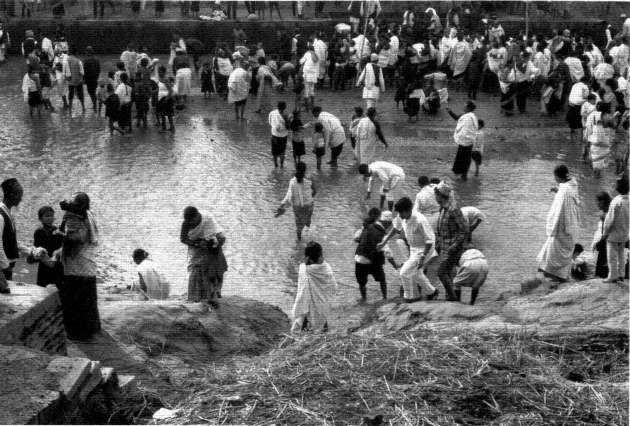
Figure 6.
Ceremonial bathing m the Hanumante River.
A Note on Hill and River
Bhaktapur, like very many cities, makes use of a hill—on which it is built—and a bordering river (see fig. 6), but characteristically elaborates and adds to their elementary "practical" significance—the hill as potential citadel, or as a residential center for the exploitation of the surrounding arable farmland, the river as a source of water (but not, in the Kathmandu Valley, for navigation). The hill, with its higher-status temples, palaces, and residential areas located toward its crest, adds to the more significant orientation of central-peripheral (discussed below) an additional dimension of higher-lower. Bhaktapur is situated in accordance with the traditional ideals of South Asian town planning on the right bank of its river (Dut [1925] 1977, 24), the Hanumante. As is the case for all Newar royal cities and for those secondary Newar towns situated on rivers, the direction of the flow of the river is one basis for the discrimination of an important division of the city or town into two halves, an upper half (upstream), and a lower half (downstream). The river, a locus for dying, cremation, and purification, is outside the traditional boundaries of the city and takes much of its meaning (which it shares with the ideal symbolic Indian river, the Ganges) from its transitional position at a boundary to another world and its flow toward still another, whose orders are other than that of the city.
The Idealization of Space: Bhaktapur As A Yantra
In map 1, a schematic illustration of the location of the shrines of the nine guardian goddesses of Bhaktapur (those who protect its boundaries and what we shall refer to as its "mandalic* sections"), one of the city's Rajopadhyaya Brahmans represented the goddesses' locations as points in a symmetrical diagrammatic city. The drawing is labeled "Yantrakara khwapa dey'"—"Khwapa dey'," "the city of Bhaktapur," portrayed as a "yantra ." The diagram shows Bhaktapur's boundary as a circle, a mandala* , a pervasive South Asian representation of a boundary and its contained area within which "ritual" power and order is held and concentrated.2 The circumference of the mandala* separates two very different worlds, an inside order and an outside order, and suggests the possibility of various kinds of relations and transactions between them. Within the mandala* in the drawing is the yantra , "a mystical diagram believed to possess magical or occult powers" (Stutley
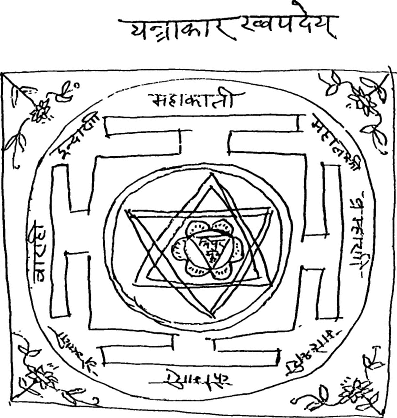
Map 1.
Idealized symbolic form. A drawing by a Bhaktapur Brahman of Bhak-
tapur as a yantra with the nine Mandalic*
Goddesses represented at the eight
compass points and at the center. The actual spatial location of the nine god-
desses is given in map 2.
and Stutley 1977, 347), typical of Bhaktapur's imagery (chap. 9), here made up of two overlapping triangles, representing the relation of opposites, of male and female principles, unified in a point at the center of the diagram. At that central point is written the name of one of Bhaktapur's nine protective goddesses, Tripurasundari. Toward the periphery, at the circular boundary are the names of the eight other protective goddesses. They are exactly arranged at the eight points of the compass, with the top of the diagram conceived as representing the north.
These goddesses exist in the actual space of Bhaktapur (map 2), but
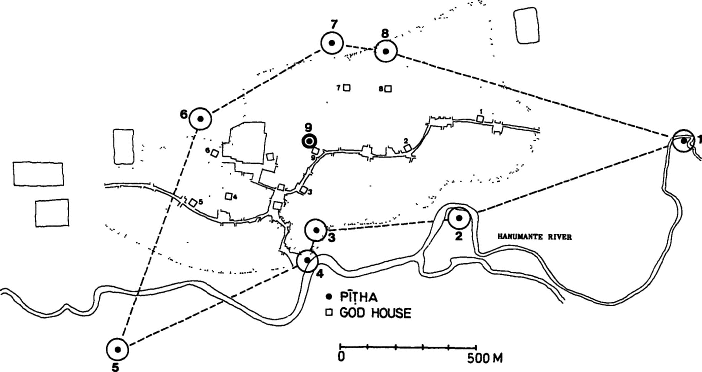
Map 2.
The spatial positions of the pithas of the nine Mandalic*
Goddesses. These are the actual spatial locations of the idealized
points of the symbolic yantra and mandala*
in map 1. The numbers designate the deities in the sequence in which they are worshiped
when treated as a united collection of deities: (1) Brahmani, (2) Mahesvari, (3) Kumari, (4)Vaisnavi*
, (5) Varahi, (6) Indrani*
, (7)
Mahakaili, (8) Mahalaksmi*
, and (9) Tripurasundari. The dense band of dots in this map and the following maps indicating the extent
of the city represents the edge of the presently built-up area of the city, the "physical city," and does not necessarily correspond to the
city's symbolic boundaries. Map courtesy of Niels Gutschow.
the central shrine and the ones at the boundaries are only approximately at the eight points of the compass and at the city center (cf. Auer and Gutschow n.d., 22). One of them is even further displaced from where it is "supposed" to be, being physically within the symbolic boundary of the city instead of at or beyond its outer border as are the other boundary protecting shrines. As Mary Slusser speculates of that shrine, that of Mahalaksmi* , in the course of the construction of a boundary-marking city wall "the sanctity of the [preexisting] old shrine forbade moving it to an optimal location outside the wall; engineering or other considerations dictated the latter's course, thus enclosing the . . . [shrine] within the city walls" (1982, vol. I, p. 346). In accordance with the struggle and the dialogue between the given on the one hand and the ideal symbolic form on the other, Bhaktapur had to construct and imagine a yantra and its encompassing mandala* as best it could.
This imaginative process takes features of real space, many of them constructed under the impetus of that imagination, and perfects them—the city becomes a bounded circle instead of a flattened irregular oval. Simultaneously in a dialogue of imaginative and actual space city halves, "mandalic sections"—various axes and centers—have been constructed. Those imaginatively perfected forms exist in real space like a geometric image reflected in a distorting mirror. But people have no trouble finding their ways about in one or the other kind of space or, for that matter, in both at the same time.
The City Boundaries and the Bordering Outside
Bhaktapur, like the other Newar royal cities, was, as we have noted in chapter 3, once more or less surrounded by a wall that was pierced by gates. The wall had a defensive use, as descriptions of Bhaktapur's resistance to the siege of the Gorkhalis in 1769 vividly attested. However, the defensive uses of city walls, Paul Wheatley has argued, "in both Nuclear America and Asia [he is writing of early traditional cities] . . . were often much less important than in the West European city. In fact, not infrequently those constructions which the modern mind is predisposed to interpret as fortifications, and which may indeed have been pressed into service as such during emergencies, were in reality symbolic representations of the bounds of the cosmos" (1971, 372). Bhaktapur's wall (whatever other functions it had) and the boundaries it once marked were of enormous "symbolic" importance, as those
boundaries still are. Those boundaries may not represent the boundaries of the cosmos, for there is some sort of world beyond them, but they represent the boundaries of its central order, the order that is congenial to human beings and to what we will call (chap. 8) the "ordinary deities."
The various spatial features of importance of the city's symbolic organization, which we will be concerned with in the remainder of this chapter, are anchored in real city space by physical features—particular stones, shrines, temples, roads, and pathways. In the course of the "symbolic enactments" that take place in relation to these markers, significant points, boundaries, axes, and areas are clearly designated. In most cases these significant spatial features can be precisely mapped. When the city walls and their gates were still intact, the boundary of the city as a whole was, of course, clear. At that time it was, in fact, the only one of the spatial boundaries we are concerned with that was entirely represented in a physical, material form. Now in Bhaktapur the wall has disappeared except for a few gateways placed at the old ceremonial entrances into the city, and the problem for the people of Bhaktapur in knowing exactly where the city's boundaries are at all points is greater, often considerably greater, than it is for locating the boundaries of smaller units. Kathmandu still has a processional route annually followed by members of families bereaved during the previous year that follows and thus traces and retains in civic memory the ancient and now leveled walls of that city (Slusser 1982, vol. 1, 93). Bhaktapur does not have any such ceremonial tracing of its boundaries (although there is something like it in orderly sequential visits to the shrines of the boundary-making goddesses during the autumnal harvest festival, Mohani; see chap. 15), but rather marks and infers the boundary by the contrast of certain events and conditions held to take place properly outside of it but not inside. The city boundary is a dimensionless line producing an instant transformation between the inside of the city and the outside. The symbolic emphasis is on the outside of this line, what happens to citizens at home in Bhaktapur when they cross this line, and what kind of a contrasting world they find there. The inside and the outside help define each other. Not only is the emphasis on the outside of the line in its contrasts to the inside (and not on the line itself), but the emphasis is for the most part on a special aspect of the outside, the immediate outside, the bordering outside. The distant outside—where in Malla days one would eventually reach the other Newar cities, and beyond them Lhasa and India—is something else.
We will note some of the things and events that exist or take place just beyond the boundaries. This, like much of this chapter, will serve to introduce subjects dealt with in more detail and in different contexts later in the book.
City Boundaries: The Boundary-Protecting Goddesses
As we noted in the discussion of the drawing (map 1) of Bhaktapur as an ideal mandala* or yantra , there are the shrines of eight goddesses placed at the eight points of the compass at the boundary, and a ninth at the center.3 The nine goddesses as a set are related to the internal division of the city's space into nine "mandalic* areas," and we will discuss this division below. The eight external goddesses preside each over her own area of the city, but together they protect the boundary itself. As a group of eight, they are the Astamatrkas* , the "Eight Mothers," whose positions, marked by open, aniconic shrines called pitha s, are conceived to be (although as we have noted, one of them is, "in fact," not) not only exactly at the eight points of the compass (which again they are not "in fact") but just outside the boundary of the city (see map 2). The Astamatrkas* are important members of a special class of deities, the "dangerous" deities, and represent a major component of that class, the manifestations of the "dangerous goddess," "the Goddess," Devi. We will return to Devi as a deity in chapter 8, in relation to the specific worship of the dangerous deities and Tantra (chap. 9), and again in that portion of the annual calendrical cycle devoted to her (chap. 15). The group of dangerous deities (who are ritually specified in that they—in contrast to the "benign deities"—receive blood sacrifices and offerings of alcoholic spirits) represent dangerous and at the same time vital forces that lie beyond the city's inner moral organization and also represent the defenses against those dangerous forces through a transformation in which those forces have been tenuously captured and controlled and placed at the service of the city. These particular goddesses ring the entire city and protect it from specific kinds of danger, such as earthquake, disease, and invasion. It is proper for them to be placed to the exterior of a boundary because they are the kinds of deities who are, as we will see, "semantically" proper for their particular job. Their position at the city's boundaries is not only a defense but a reminder of the kind of a world to be encountered there and of the contrast of that world with the interior where—within small protective perimeters of
various kinds also defended by the dangerous deities—a quieter moral order can proceed under the tutelage of other kinds of deities.
As is the case with most of the significant symbolic markers of Bhaktapur's mesocosm, an encounter with the Eight Mothers and the boundary they represent, protect, and characterize is ineluctably brought about in the course of certain necessary symbolic enactments. The protective goddess of a person's particular residential area of the city must be worshiped during the course of certain major rites of passage by the male members of the extended patrilineal family unit, the phuki . Almost all of Bhaktapur's people also visit the boundary shrines (and their central focus), over the course of nine days of the major autumnal harvest festival, Mohani (chap. 15). People visit each one on its particular designated day, proceeding in the course of the nine days in the auspicious clockwise direction from one shrine to the next, finally, in effect, circumambulating the city's borders.4
City Boundaries: The External Seat of the Lineage God, The Digu God
The people of Bhaktapur must cross to the outside of the city's boundaries (see map 3) to worship their phuki 's lineage deity, represented usually by a "natural" stone and worshiped through the rituals proper to dangerous deities (chaps. 8 and 9). This god is the Digu God (or sometimes and popularly, the Dugu God), the lineage deity of a phuki . The Digu God worship is for the highest thar s, (Pa[n]cthariya and above)—that is, those who have upper-class Tantric practices—only one of two major components of lineage god worship (chap. 9), but for the middle-level and lower-level thar s it is the only form. The location of shrines for the worship of lineage gods on the outside of a settlement or village is also the practice of Nepalese Chetri communities (K. B. Bista 1972, 66) and has been described in other Newar communities (e.g., Toffin 1977, 31). Informants in Bhaktapur cannot explain why the shrines of the Digu God are outside of the city; explanatory stories are vague, and it is unclear to what possible historical reality they might refer. One story is that in the days of the Malla kings all families of Newars went to the same town (Hadigaon)5 for their lineage god worship, with each lineage presumably having its own shrine there. But, the story goes, as this was too far away the shrines were moved to the outskirts of each of the Valley cities. Some others say that the place
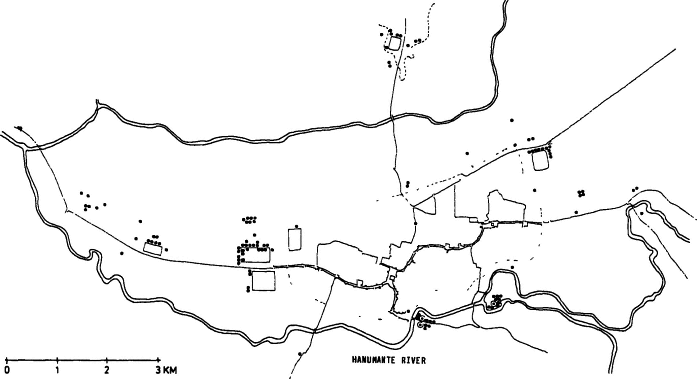
Map 3.
The symbolic boundaries of the city. The external placement of the Digu lineage gods. The physical city is represented as a
bounded shaded area. Each peripheral dot represents the placement of the external lineage deity of a particular phuki or of a group of
split phukis. Map courtesy of Niels Gutschow.
where the shrines are located is the place where the original founders of each family lineage entered the city. This comment on the exterior position of the Digu God shrines suggests an actual or fantasized connection of their locations in the past to the historical origins of the city's ancient patrilineages.6 If this connection (if it ever really existed) is now mostly lost, the Digu Gods must nevertheless be worshiped just to the outside of the city's boundaries, and it is the kind of worship and they are the kinds of gods that point outward beyond the organized interior life of the city.
City Boundaries: Cremation, Dying, And Purification
The river is considered to he outside of the city's boundaries to the south, as are the ghat* s (Bhaktapur Newari, ga :) or steps leading down to the river on its city side. At the river clothes are washed and people bathe as a phase of major purification procedures (chap. 11). People approaching death are sometimes brought to the river ghat* s so that their feet and legs may be immersed in the river at the actual moment of death (app. 6). The city's three cremation grounds (Newari dip , from Sanskrit dipa , burning, blazing) are also outside the city, as they are in all South Asian Hindu communities. Two of the major cremation grounds are beyond the river and, as they should be ideally, to the south of the city. These two cremation grounds (Khware Dip and Mu ["main"] Dip) are each associated with one of the ghat* s on the city side of the river, and are connected to them by bridges spanning the river. There is a third major dip , Bramhayani (Sanskrit Brahmani),7 to the east of the city, named after the protective boundary goddess of the eastern pole of the city.
Although we are concerned here with city boundaries and inside/ outside contrasts and relations, it is convenient at this point to introduce some other aspects of the cremation grounds in their relation to city space and to its status system. The three dip s are for the "clean" thar s, the "unclean" ones use various fields outside the city (although on the city side of the river) away from the three main dip s. Various Newar chronicles suggest that the cremation areas of most of the significant macrostatus groups were, or at least were held ideally to be, separated. Thus, according to Hasrat's chronicle, Jayasthiti Malla "distinguished and classified thirty-six tribes according to their trades and professions . . . [and] constituted for each of the thirty-six a separate masan [cremation ground] or place for burning their dead" (Hasrat
1970, 55ff.). There are now traditional places within the grounds for some thar s, but as a whole the cremation grounds are related to areas of the city, rather than to social status. People who have been brought to die at Hanuman ga : are cremated at the Khware Dip. Those who had been brought to die at Cupi(n) ga : are cremated at the Mu Dip. It is a matter of family custom and choice which ga : they are brought to. Most people die at home, within the city, and these people are usually cremated at Brahmani Dip if they live in the upper half of the city, and Mu Dip if they live in the lower hall
Gutschow and Kölver (1975) called attention to the fact that funeral processions to the dip s were determined by residence in a particular twa: (a village-like division of the city; see below). "Now there are exact prescriptions regulating not only who has to use which [cremation ground], but also the way a corpse has to be borne to his proper place of burning. The decisive feature in this is geographical. The body of a man who belonged to a particular ward [twa: ] has to be carried along the way prescribed to all the members of his ward" (Gutschow and Kölver 1975, 27). These differentiated routes, based on twa: residency, recall Oldfieid's statement, previously quoted, that the number of gateways in the old city walls exactly corresponded to the number of toles (twa: s) in the city, and that the maintenance of the gates was the responsibility of the local twa: authorities (Oldfield [1880] 1974, vol. I, p. 95f.). Because of the mixed collection of thar s in many twa: s, this arrangement, as Gutschow and Kölver point out, tends to neutralize the distinctions of caste (1975, 27).
This "communitas, " represented by a collapse of status distinctions in funeral procession and place of cremation, is typical of many activities that are outside and beyond the ordinary civic structuring of Bhaktapur; for example carnival and Tantric rituals. In all of these, however, there is always a residue that is excluded from the egalitarian community, in this case the lowest thar s, who are refused even the common cremation grounds.8
City Boundaries: The Untouchables' Proper Place
In all traditional South Asian cities the lowest segment of the social hierarchy had to live outside the city, and was thus designated as being in opposition to the pure inhabitants of the inside of the city.9 The ancient classical Indian treatise on applied politics, the Arthasastra of Kautila* , states that "heretics and candalas shall live beyond the burial
grounds" (quoted in Dutt [1925, p. 151]), which themselves were to be outside the city.
Various chronicles or vamsavali presenting Jayasthiti Malla's formalization of Bhaktapur's religious, social, and economic organization, note that Poriya (Bh. Po[n] or Pore), had to live outside the city (see map 4), and could not enter the city after sundown (Hodgson manuscripts, n.d, vol. 11, p. 114; Basnet [1878] 1981). Oldfield, in the sequel to some remarks that we have already quoted, wrote of the Newar old "capital cities" (in which he included the large secondary town of Kirtipur) that, "The limits of each city are . . . still strictly marked along the line where the ancient walls stood, and no Hindus but those of good caste are allowed to dwell within its precincts. This rule does not apply to Mussalmen, several of whom reside within the city of Kathmandu, but it is strictly enforced against Hindu outcasts, such as sweepers, butchers, executioners, etc., all of whom are obliged to live in the suburbs of the city" ([1880] 1974, vol. I, p. 95).
The sweepers and executioners are the Po(n)s, whose symbolic functions are, as we will see, of great persisting importance in Bhaktapur. The inclusion in this quotation of "butchers," the Nae, introduces a problem, and almost surely an error into the literature on thar residence patterns.10 Nae at present live within the boundaries of the city, although they are located at its periphery, at the farthest from its high-status center (map 9, below). There are other low thar s, some of which are even lower and more impure than the Nae who live within the city, and to all evidence always have, for example, the Jugi (map 10, below).
The question of the position of the Nae in relation to Bhaktapur's boundaries is connected with another question, one concerning the position of the city's main city-wide processional route, the pradaksinapatha* . In ideal ancient Indian tradition the pradaksinapatha* surrounded the village or city (Dutt 1925, 33), and Mary Slusser has argued that this was the case in Kathmandu (1982, vol. 1, p. 93). The Bhaktapur pradaksinapatha* (map 12, below) moves within the city as a flattened meandering oval, roughly paralleling the city's boundary, running through and thus tying together all except one outlying twa: (below) as well as the upper and lower cities. Bhaktapur's internal pradaksinapatha* position within the city also is found in the Newar town of Panauti. Barré et al. argue that in the town of Panauti the processional route acts as a "boundary of purity," as the butchers and sweepers live in its exterior (1981, 40f.). Such a tempting distinction does not work for the distribution of thar s in Bhaktapur (and even in
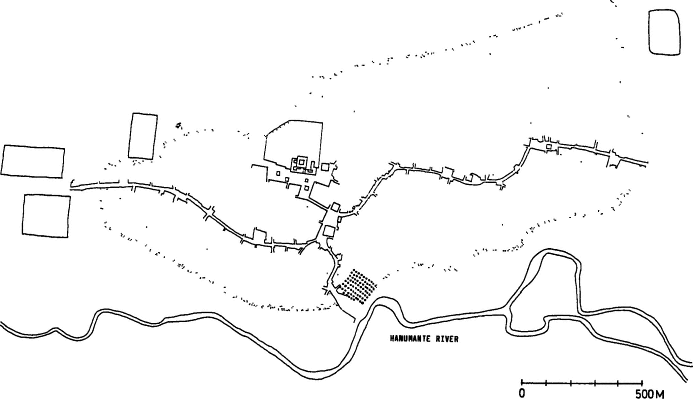
Map 4.
Space, status, and the symbolic boundaries of the city. The settlement of the Po(n) untouchables at the southern edge of the
city. The settlement is considered to be lust beyond the symbolic boundaries of the city. Map courtesy of Niels Gutschow.
the cited account of Panauti there are admitted exceptions, like the dwellings of the very low Jugis within the central area). As we have noted, the interior position of the pradaksinapatha* in Bhaktapur, and the fact that both the sweepers and the butchers live peripheral to it, led Gutschow and Kö1ver (1975, p. 21) to speculate that it follows the external boundary of some earlier city of Bhaktapur, but there is no apparent collaboration for this in other historical, archaeological, or persisting social forms.
It is unequivocally the Po(n)s, the sweepers, however, who have the special symbolic function of being intimately joined to the city to represent its most salient and necessary outsiders—they are the ones who must live just beyond the boundaries, and who in their conditions of life and in their powerful embedded meanings represent the transforming significance of that boundary to those privileged to live within it.
On Boundaries
The city walls and most of its gateways are long gone, but everyone in Bhaktapur knows that they exist, that the city is a clearly bounded entity, surrounded by an outside of contrasting nature, and they know approximately where the boundaries must be. They cannot ignore the boundary as they must cross it to the outside for worship of lineage gods, for worship of the "Eight Mothers," often to die and always to cremate others and be cremated themselves, and they must be sure that the untouchables, with whom they are deeply concerned, are fixed in their right place. The outside with which they are necessarily engaged is not everything outside of Bhaktapur, but a highly symbolized zone of encirclement. The far outside, which may be contrasted with this encircling, bordering near outside, includes areas of very mixed meaning—other Newar cities, pilgrimage sites, non-Hindu countries, and so on. But the near outside represents the anticity. The relation of bordering outside to inside characterizes not only the city as a whole but also the relations of many of its nested units to their particular outsides, and is reflected in many ways, in kinds of gods, kinds of worship, and the interplay between power and morality, kings and Brahmans. We will be concerned with these relations throughout the following chapters.
The relations of outside and inside are not a simple opposition. The outside has its special values—it has something to do with fertility and useful power as well as danger. As the kinds of deities who character the two realms suggest (chap. 8), outside and inside have different logics,
different relations to moral order. But all this is complementary. The major supernatural creatures at the outside are gods themselves, not antigods like Satan. The ordinary deities, like the ordinary people, need those outside gods, even if they are not comfortable with them.
In the symbolic representation and symbolic enactments concerning the city boundaries, it is the bordering outside and its nature that is emphasized. That outside is of such a nature that after a brief, lively, and instructive encounter with it, people are moved to reenter ordinary civic space with some relief. From the point of view of its impact on citizens for the purposes of social order the smbolization of the outside tends to push people back within the civic boundary.11
When the public space of the city as a whole is the focus of attention, as it is generally in this book, the external outside beyond the encircling borders is only one way out of the public city. Insofar as the behavior of an individual, a family, or whatever unit is out of the general public sight and of the direct influence of the city system, they are, from the point of view of that system also "outside," and thus households, thar s, guthi s, and so on, as well as the private "inside" part of a person's thoughts are outside the public moral world of the urban mesocosm. The inside of the city as a public moral civic space can be escaped in various directions, and the outside beyond the civic boundaries often joins in meaning with the small private realms hidden within the city.
Bhaktapur As A Mandala* : The Nine Mandalic* Section
When Bhaktapur is conceived of as a yantra placed within a bounding mandala* , the segmentation of its interior space is now at issue. Now the Eight Mothers, the Astamatrkas* , not only protect the external boundaries of the city at the eight points of the compass but also individually protect the particular octant of the city lying in their general direction and, thus, under their influence. The protective goddesses for the octants are Brahmani to the east; Mahesvari to the southeast, Kumari to the south; Bhadrakali* (sometimes represented as another goddess, Vaisnavi* ) to the southwest; Varahi to the west; Indrani* to the northwest, Mahakali to the north, and Mahalaksmi* to the northeast (map 2).12
Each goddess has a "god-house" in her city segment, where her portable images is kept (map 2). During one of the year's major festiv-
als, Biska: (chap. 14), the images are brought from the interior of the city each to its boundary shrine, and the internal image and the external aniconic shrine are united. The emphasis has shifted from the protection of the boundary to an internal radiation of the power of the goddesses. That power not only plays over the eight peripheral octants into which the city is divided but is also focused and concentrated at the center of the mandala* , in the shrine or pitha of still another, a ninth goddess, Tripurasundari. This Goddess protects the city's central area in a circle around her. The city is thus divided into nine areas—a circular center and eight peripheral sectors. We may call these nine segments "mandalic* sections." These nine divisions are also conceived by Bhaktapur theorists as a lotus, with a center and eight petals, a very common Hindu form, corresponding to one classical Indian ideal village form (Dutt 1925, 29).
Each mandalic* segment is designated by its protective goddess plus any term for area or place, for example, Mahakali ya ilaka , signifying the territory under Mahakali's protection. People are thought to belong to the mandalic* section in which their father's patriline had been "established." That is, if they move to another part of the city, their protective goddess and that of their descendants born in the new section is the goddess of the mandalic* section where they had previously, and presumably "always," lived. After marriage, a wife is considered to belong to her husband's mandalic* section and ordinarily prays to that section's goddess, although she is still related to her natal goddess in those rituals of her natal family in which she continues to be involved.
The mandalic* segment that one belongs to determines which specific Astamatrka* shrine or pitha one must visit during certain important rituals, particularly during those associated with the samskara s, or rites of passage. During the annual harvest festival, Mohani, in which the whole city is supposed to visit each of the nine pitha s in daily turn over nine days, the people in each goddess's section are responsible for decorating her pitha and god-house on her particular day. In some Tantric initiations for higher-level thar s, the particular mantra used and the tutelary god assigned to the person being initiated is based on his particular mandalic* segment (chap. 9).
The central goddess Tripurasundari is, as we will discuss in the next chapter, the proper kind of dangerous goddess to be at the center of the mandala* 's power. She is a "full" goddess, and the peripheral forms are partial and more specialized. She is represented at the center of the lotus or mandala* where power is concentrated and at its maximum, and
sometimes to similar effect as a point sending out rays of power in each of the eight directions of the compass to each of the eight pitha s at the boundaries. In contradistinction to the way the city uses other "full," maximally powerful forms of the Goddess (such as Taleju and Bhagavati), however, and in spite of this schematic superiority to the eight peripheral goddesses, there is no special emphasis of any kind now on Tripurasundari's central shrine, nor on the central mandalic* section that she protects. In action and interpretation, Tripurasundari (in her function as a central pitha goddess) is the exact equal of the other Mandalic* Goddesses. Some local diagrams of Bhaktapur as a mandala* have the Newari word for king, juju , written next to Tripurasundari. Some Bhaktapur informants speculate that the shrine's centrality may have reflected a possible ancient relationship to the twelfth-century royal palace, Tripura, which they believe to have been near the present pitha , and they assume that the Tripurasundari pitha may have then been the special shrine for the king and his court (cf. Slusser, 1982, vol. I, p. 345ff.). In the seventeenth century the court and its associated temple of Taleju was moved to its present western site.13 Tripurasundari lost her central political importance. This suggests that she remains as a striking example of a once powerful symbolic statement that later lost much of its social, ritual, and personal meaning in a transformed Bhaktapur, where now the curious thing about her is the absence of what she once was.
City Halves: Ritually Organized Antagonism
The bounded units we are considering are in part defined by their contrasts with their adjoining units, in a contrast where that adjoining unit is often an encompassing one (the city and its environment, the house in its twa: or neighborhood), although it may be, as in the case of adjoining mandalic* sements, a contrast of units at the same level. For the most part any antagonistic implications of these contrasts are mitigated by a pervasive Hindu metaphorical move, an emphasis on the organic unity and interdependence of the contrasting units to form some higher vital synthesis, the various units being metaphorically related (like the ancient four Varnas* ) as being like the parts or organs of the body. Neither the high head nor the lowly feet, although different and of different status, can live without the other; they are joined into something superior on which they are dependent, on which their very lives depend.
However, there is one symbolically marked division of the city, its halves, where the major emphasis is precisely on conflict, albeit a conflict periodically and tenuously resolved in symbolic acts. This emphasis on the antagonism of the halves seems to deflect other more dangerous antagonisms within and among smaller city units.
Bhaktapur is divided into halves, an upper half (cwe , or up, or tha:ne , above, upward) and a lower half (kwe , down, or kwane , below, downward) (map 5). As D. R. Regmi wrote, the division may have been a general feature of all Newar settlements and "obtained in every case whether it was a town or townlet" (1965-1966, part I, p. 554). The division has been described for Kathmandu (Regmi 1965-1966, part I, p. 554; Slusser 1982, 90-91), for the Newar village of Theco (Toffin 1984, 186ff.), and for the large Newar town of Panauti (Barré et al. 1981, 46). As Barré writes, the division into upper and lower city is "a characteristic common to Newar settlements whether urban or rural."
It is often stated that the upper and lower segments are designated in relation to the flow of neighboring rivers (e.g., Toffin 1984, 200) with upstream locating the direction of cwe , downstream of kwe . Inhabitants of Bhaktapur attempt various explanations of the designations "up" and "down." Bhaktapur's "upper half" for some is upper because it is more northerly, for others because it is in the direction of the high Himalayas, in contrast to the progressively lower, that is, less elevated southern regions. This north-south interpretation of "upper" and "lower" is reflected in a use of "kwane " among Valley Newars, at least until the last generation, to indicate India. Other speculations are that the upper half, cwe , was the earliest part of the city settled (as was, in fact, true for Bhaktapur), followed by a later settlement, kwe . (Here the usage corresponds to the temporal terminology for ancestors [cwe , up] and descendants [kwe , down].) Still other people give the upstream/ downstream, explanation. It is possible, at least, that the upper/lower contrast is basic to the social organization of all Newar settlements, and that a variety of relations to physical space and settlement history can be used to choose between the terms of the distinction or to justify them. Bhaktapur's upper and lower cities are divided by a line perpendicular to the long (the southwest-northeast) axis of the city, and thus consist of a somewhat northerly eastern portion, and a somewhat southerly western portion, which are respectively upstream and downstream in respect to the Hanumante River (see maps S and 11 [below]).14 As D. R. Regmi writes, in contrast to Kathmandu, where the royal palace was at the central position in the city and provided a locus
for the division of the city into upper and lower halves, "the [Bhaktapur] Royal palace was situated at the western extremity of the town and the center dividing the city was the courtyard surrounded by the Nyatapola [Natapwa(n)la] and Bhairava temples" (1965-1966, part II, p. 554). This square, Ta:marhi (also pronounced or written Tamari, Taumadhi* , Taumarhi, etc.), is conceived as at the center of the city division in one of its most important ritual expressions, the struggle between members of the two halves of the city to pull a huge chariot positioned there into their respective halves of the city during the Biska: festival at the time of the solar New Year, a struggle sometimes marked with considerable violence (chap. 14). At that time the square is considered the neutral center between the halves, but ordinarily it is considered as belonging to the lower city and the people living around it consider themselves at all times to be members of the lower city. Guts-chow and Kö1ver note that the Ta:marhi Square has a "profuse endowment" of religious buildings and is the site of the highest temple (and building) in Bhaktapur, the Natapwa(n)la temple (fig. 10). They argue that this profusion of monuments may be understood as a device for unifying the town by installing a mediating center and affirming the unity of the city (1975, 50). Although the old Malla Royal Palace, the square in front of it, and the adjacent residential area of the Rajopadhyaya Brahmans (maps 5 and 6) is, like Ta:marhi, in the lower half of the city, during the struggles of the city halves in the course of the Biska: festival that area is also said to belong to neither the upper nor lower city. It is often said that the Malla kings encouraged the division and conflict between the two city halves, which they transcended, to strengthen their power and divide any potential opposition. Thus, if Ta:marhi Square acts as a neutral ritual center between the upper and lower cities, the royal central area, in spite of its peripheral western positions, is in its own way also a neutral point.
In recent years conflict between members of city halves has also sometimes broken out at certain other festivals, but these rare and recent struggles are considered to be accidental and unintended disorder and breakdown. The peculiarity of the Biska: festival is that it includes as one element in its complex dramatic structure a prolonged struggle between the two city halves, a struggle that eventually comes to a resolution.
Ritualized struggles (that is, struggles induced and regulated by traditional forms and conventions—which does not prevent them from having, sometimes, serious consequences) between socially organized
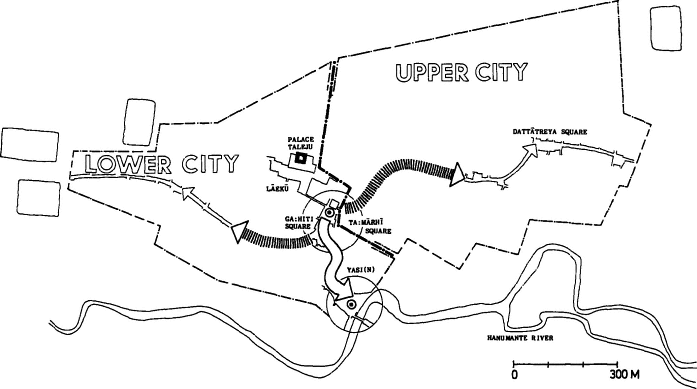
Map 5.
The struggle of the upper and lower halves of the city and its resolution. The routes into the upper and lower halves of the city
contested in the struggle to pull the Bhairava chariot during the Biska: festival (chap. 14). The arrows in the upper and lower segment
of the city show the ideal termini of the chariot and the acceptable shorter termini if there is not time to reach the ideal ones. The
southerly arrow shows the chariot's ultimate "central" route into Yasi(n) Field, where it must witness the raising of the Yasi(n) God to
mark the solar New Year. Map courtesy of Niels Gutschow.
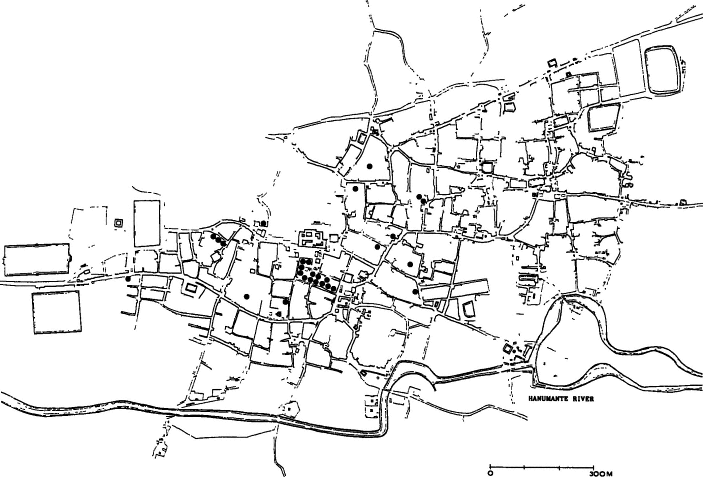
Map 6.
Space and status. Households of Rajopadhyaya Brahmans. The greatest concentration is just south of the Taleju temple and
the Royal Palace and represents a center of the city. Map courtesy of Niels Gutschow.
halves or moieties of a community—are reported for traditional South Asian communities as they are elsewhere in the world. Dubois, for example, remarked on the struggles between the "left-handed" and the "right-handed" factions in the Deccan and Madras areas in the early nineteenth century, factions to which "most castes" belong, which "proved a perpetual source of riots, and the cause of endless animosity amongst the natives" (1968, 24f.). He also remarks on something that has a bearing on the conflict in Bhaktapur, that "in the disputes and conflicts which so often take place between the two factions it is always the Pariahs [the untouchables] who make the most disturbance and do the most damage" (ibid., 25). And, he states, also in an echo of Malla Bhaktapur, "the Brahmans, [and] Rajahs. . .are content to remain neutral, and take no part in these quarrels. They are often chosen as arbiters in the differences which the two factions have to settle between themselves" (ibid., 25).
Hamilton cites a report for the turn of the nineteenth century by a Colonel Crawford, which describes a "vile custom" of the Newars of Kathmandu, who had previously been described by Hamilton as being an otherwise peaceable people ([1819] 1971, 43f.):
About the end of May, and beginning of June, for fifteen days, a skirmish takes place between the young men and boys of the north and south ends of the city. During the first fourteen days it is chiefly confined to the boys or lads; but on the evening of the fifteenth day it becomes more serious. . . . [A fight then takes place which] begins about an hour before sunset, and continues until darkness separates the combatants. In the one which we saw, four people were carried off much wounded, and almost every other year one or two men are killed: yet the combat is not instigated by hatred, nor do the accidents that happen occasion any rancor. Formerly, however, a most cruel practice existed. If any unfortunate fellow was taken prisoner, he was immediately dragged to the top of a particular eminence in the rear of his conquerors, who put him to death with buffalo bones. . . . The prisoners are now kept until the end of the combat, are carried home in triumph by the victors, and confined until morning, when they are liberated.
There has been speculation, deriving from a further remark of Hamilton's (1971, 44) that some people alleged that the Kathmandu battle reflected some old division of the city into two towns under two Rajas and first arose as skirmishing among their respective followers, and that the division in Kathmandu, at least, and perhaps in other Newar towns may have reflected some earlier antagonistic political segments later merged into the towns (Slusser 1982, vol. 1, p. 91; Toffin
1984, 201f.). Yet, the ubiquitousness, persistence, and evident usefulness of the division in Newar communities would suggest that such historical explanations would only apply to some towns, and would only help explain the location of the halves, not their existence and persistence.
In some ways the upper and lower cities in Bhaktapur are two different cities. it is said that people usually marry within their own half of the city. In many contexts, they identify themselves as belonging to one or another hall Significantly, when there are crimes or disturbances in the city whose perpetrators are unknown, it is common to hear remarks by people from the lower city that it must have been someone from the upper city, and vice versa. Although the lower city has the main concentration of Brahmans and high-status Chathariya, and the upper city the main concentration of upper-status Buddhists, for the most part each city half has a full representation of important social and occupational units.
For ordinary considerations of residence (where we can ignore the mandalic* sections), the city halves are the next largest segment after the village-like twa: s (see discussion below). It is our impression that the antagonism directed toward the relatively distant other city half, out of and away from one's own closely interdependent area, deflects intra-twa: resentments that would affect relations between families, phuki s, thar s, and macrostatus levels—relations whose disturbance would be disruptive to the basic integration of the social system—to the other city within the city where they can be expressed in comparatively very much less disruptive and dangerous ways. Members of lower thar s who are annoyed and resentful of their treatment by higher groups find it easier, like the pariahs in the quotation from Dubois, to help precipitate a fight against members of a disliked group in the other half of the city, where it would be interpreted as a spatial struggle rather than one within the social system.
Status and Space: Concentric Circles
It is convenient to introduce in this chapter aspects of the urban spatial distribution of some of the thar s and status levels (see fig. 7). Only a portion of this distribution is directly related to the urban symbolic order in our present sense, the greatest part being closely related to aspects of economic function, to communication and transportation, to
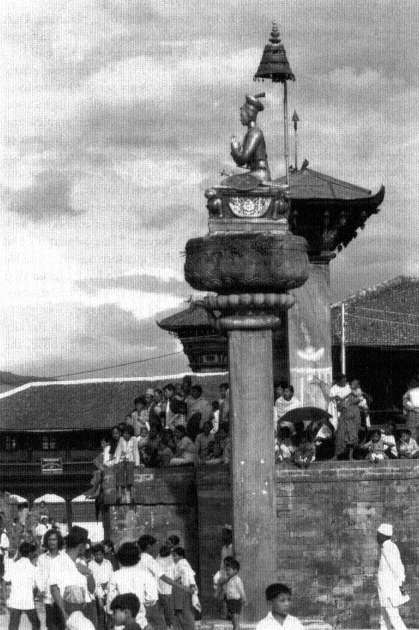
Figure 7.
The Royal center. Statue of King Bhupatindra*
Malla in Laeku Square.
relations of power, to the special needs of the old court, and to historical "accident," thus reflecting other kinds of meaning.
In his study of the classic Indian treatises on town planning, Dutt (1925) notes the planned "segregation of the classes following different pursuits. . . . Every ward was set apart for a caste or trade guild . . . which enjoyed an autonomy of its own" (1923, 147). In some classic texts, such as Kautilya's* , detailed prescriptions are set out for the location of many occupational specialites and castes, as well as the location of royal kitchens, elephant stables, water reservoirs, camel stables, and so on (Dutt 1925, 149f.).15 But, as Dutt points out, in cities, because of the larger scale and because "corporate life connotes manifold needs and responsibilities and consequently necessitates interdependence and inter-communication," various areas or sites were subdivided to have a representation of occupations, and became "a prototype of the whole city on a smaller scale." And, he adds, in a suggestion connected with our interpretation (above) of the city's halves, "This admixture and congregation of classes came as a remedial measure against possible accentuation of class differences" (1925, 148). We have argued that the city halves are such city prototypes in Bhaktapur, as are, to some degree, the twa: s, which we will discuss in the next section.
Although many of the thars are widely distributed through the city according to the kinds of functional principles suggested above, the arrangement of certain symbolically important groups has the kind of idealized mythic arrangement characteristic of marked symbolic space. When these thars are considered—the king and his associates, Brahmans, farmers as a group, butchers, and untouchables—a geometrically idealized Bhaktapur is organized in a series of concentric circles from a center out, and at the same time, as it is built on a hill, from top down. At the center of high status is the palace of the Malla kings, and the temple of the Malla kings' lineage deity, the supreme political goddess of Bhaktapur, Taleju. Just to the south of the palace, but also centrally located is a major concentration of Rajopadhyaya Brahmans (map 6), including those families who were the king's and his goddess' special priests. Intermingled in central residence with the Brahmans, but filling a still larger segment of the city are the Chathar and Pa(n)cthar groups of thar s (map 7), formerly royal officials and suppliers. Still more peripheral from the center are the various farming thar s, the Jyapus (map 8), who fill most of the city's area except for the Brahmans' area and those portions of the Chathariya and Pa(n)cthariya area adjoining the east-west road, the city's bazaar, where the Chathariya and Pa(n)c-
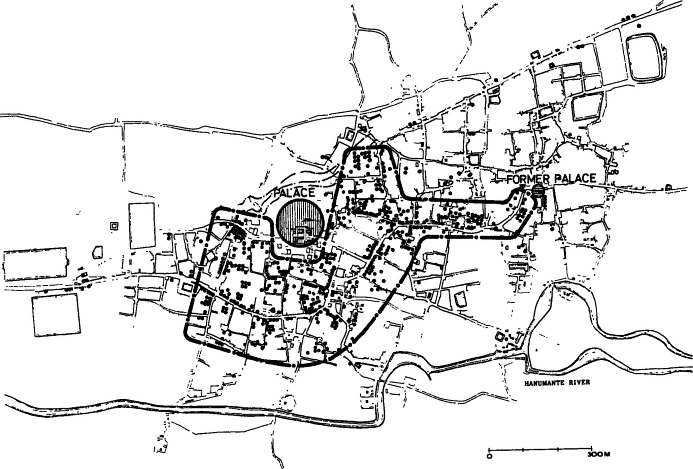
Map 7.
Space and status. The area of settlement of Chathar and Pa(n)cthar households. They occupy the city's central sector. Com-
pare the distribution of Jyapus in map 8. Map courtesy of Niels Gutschow.
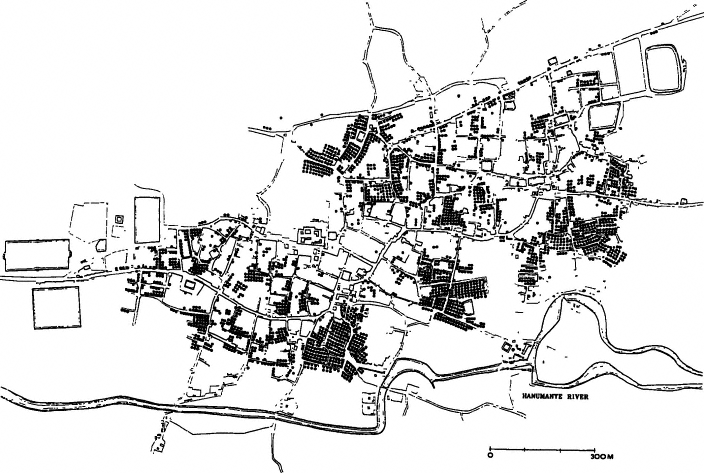
Map 8.
Space and status. Jyapu household. These households overlap the Chathar and Pa(n)cthar areas to some degree but are most
densely situated in the areas of the city peripheral to those settlements. Map courtesy of Niels Gutschow.
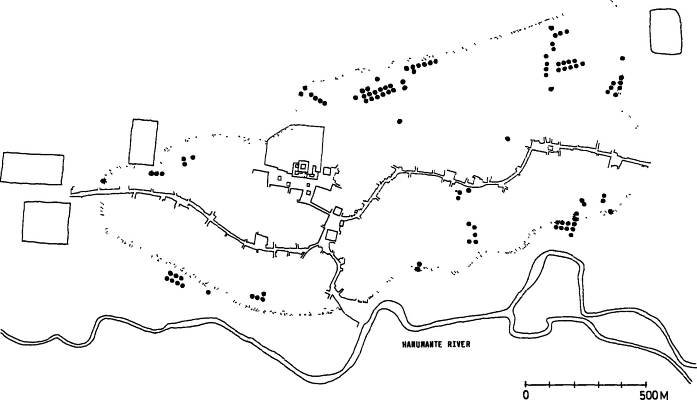
Map 9.
Space and status. Butcher households. The households of the Naes (butchers) are located along the edges of the built-up area
of the city. They are conceived to be within the symbolic boundaries of the city. Map courtesy of Niels Gutschow.
thariya have their shops and, often, adjoining houses. At the very periphery of the farmers' area, and forming a ring around the outer extremes of the city, are the houses of the butchers (map 9). Finally, outside the city to the inauspicious south, live the untouchable sweepers, the Po(n)s (map 4, above).
The hill on which Bhaktapur is built has a broad plateau at its summit with no visible distinctly highest spot. The Malla palace and Taleju temple are situated on a plateau that is bordered by slopes that gradually descend some twenty meters to meet the fields outside the boundaries. This slope adds a dimension of top-down to the imagery of central to peripheral. The highest spot of the plateau at 1,339.8 meters (slightly higher than the site of the palace at 1,335 meters) lies just to the west of the Tripurasundari pitha , the central mandalic* shrine, and during the twelfth to sixteenth centuries was apparently part of the site of the large Newar Royal Palace compound of the day, Tripura (Slusser 1982, vol. I, p. 204). At that time the highest point in the city was, in fact, within the royal precincts.16
Detailed maps of the location of the various craft thar s, which are ranked in the lower segments of the Jyapu and below, made by Guts-chow and his associates (Gutschow 1975; Gutschow and Kölver 1975), show the occupational castes distributed in various ways, generally throughout the city, except for the central area, the area of the palace, the main Brahman cluster, and the central portion of the Chathariya and Pa(n)cthariya settlements. The craftsman areas are in the outer portions of the Chathariya and Pa(n)cthariya areas and throughout the area of Jyapu settlement. The number of settlements of any one thar vary. The Chipas or dyers, for example, have only one settlement, but other professional thar groups have several. The Kumha:s, potters, for example, have one large settlement in the south, and two in the northeast of the city. The oil pressers, or Sa:mis, have four dusters, two toward the east, and two toward the west. The barbers, or Naus, live in six clusters throughout the city. The house masons, the Awa:s, have three settlements, one to the west, and two to the northeast. The Jugis live (map 10) in an irregular pattern with some central clustering within the city, cutting into and intermingling with the Chathariya, Pa(n)cthariya, and farmers' areas. This inner location of the Jugis is in striking contrast with what might have been expected in the status gradient from center to periphery signaled and created by the arrangement of the most centrally important thar s in the city hierarchy, and in marked contrast to the external position of the Po(n)s, who along with the Jugis are
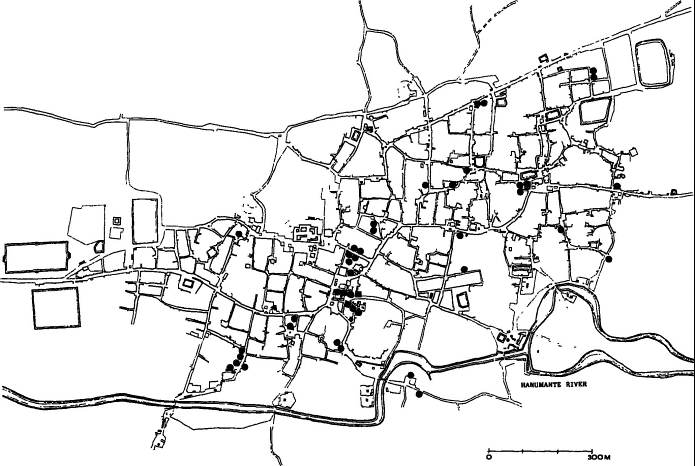
Map 10.
Space and status. Jugi households. In marked contrast to the Naes and the Po(n)s, the Jugis are distributed throughout the
city. They are the city's internal absorbers of pollution (chap. 10). Map courtesy of Niels Gutschow.
the central foci of ideas regarding pollution (chaps. 5 and 11). The position of the Jugis, as we will see, seems closely related to aspects of their significance in the city order.
In contrast with the other spatial features discussed in this chapter, the center-to-periphery, top-to-bottom, arrangements of status are not used or emphasized in the course of the city's symbolic enactments. The royal center is a focus in the city's two major festival sequences (Mohani and Biska:) and the untouchables' quarter has occasional symbolic representations, but the overall spatial status arrangements, insofar as they do reflect a symbolic order, are not given further representation.
The Village in the City, The Twa:
Binode Dutt ([1925] 1977, 147) wrote that in traditional Hindu city planning the main streets or Rajapathas of the city divided it into a set of "wards," called grama s. In some traditional towns "the same caste or people of the same profession were congregated in the same ward. . . . Every ward was set apart for a caste or trade guild of note which enjoyed an autonomy of its own" (ibid., 147). In other (according to Dutt, larger) towns or cities, as we have noted, these "wards" were the sites that contained a mixed, and, in part, functionally integrated, selection of "castes" and occupational groups, and which were "prototype[s] of the whole city on a smaller scale." "Grama " is a common Sanskrit term for village17 and is the term for village in Nepali. In some traditional town plans the grama s were assigned to, and named after, different presiding deities (ibid., 143). These urban grama units are called twa: in Bhaktapur Newari (twa: in Kathmandu Newari and tol* in Nepali).18
Gutschow and Kölver (1975), like Dutt, call these units "wards." As they note, this is a somewhat ambiguous terminology as Bhaktapur has recently been divided into seventeen "wards" for modern administrative purposes by the central government. These wards do not correspond to the twa: divisions. The problem of English nomenclature comes in part from a problem in using the tempting gloss "neighborhood," in that some of the major twa:s are further subdivided into smaller areas, also called "twa:s " (when the context is clear) which are clearly neighborhoods. When a contrast with these smaller units is needed in Newari discourse the term matwa: is used for the large and major twa: s, the
prefix ma deriving from the trunk of a tree of which the smaller neighborhood twa: s are branches.
Bhaktapur is always said to have twenty-four major twa: s,19 and these have various ritual representations. These have probably shifted somewhat over time through splitting and coalescing, but our map (map 11) is a close approximation to the traditional matwa: s. Accepting the traditional number of twenty-four matwa: s, an average twa: would consist of about 270 households and about 1,600 people. It is perhaps significant that these numbers are equal to the median population of Kathmandu Valley Newar towns or "compact settlements" (His Majesty's Government, Nepal 1969, 81). The average number of houses in a twa: also happens to fall within the range given in classical definitions of a grama . Kautilya* gave a range of between 100 and 500 houses as defining a grama (Slusser 1982, vol. 1, p. 84). However, in comparison with classical grama s, which were distributed over a large area, the Mauryan grama , having an area of from two to four square miles,20 the otherwise analogous twa: s of the Newar cities are compressed into densities more than ten times more compact.
As Auer and Gutschow have pointed out, if one asks a Bhaktapur Newar where he lives he often answers with the name of his twa: . This is one of the important loci of his identification. There is a well-known Newar saying: "If the household is in proper order, the twa: can be 'frightened off' (khyaegu ); if the city is in proper order, the country can be 'frightened off.'" "Khyaegu ," "frighten off," has the sense of chasing away a cow that enters a field, or an intruder into a courtyard. In these successively inclusive units, whose boundaries must be protected at each level, the twa: takes its important place between the household and the city.
Gutschow and Kölver (1975, 26) described some of the general characteristics of Bhaktapur's twa: s:
As a rule, a . . . [twa: ] will be centered around a spacious square. This is usually paved and serves various agricultural and commercial purposes: during and after harvest, it is a threshing floor, a space for winnowing grain, for drying rice and certain other vegetables. . . . In potters' wards, unbaked jars or pots are placed there for drying. Women will here prepare the warp before weaving. Almost all squares are hemmed in by arcades, where people will congregate in the evening for various social purposes. . . . In most wards, the central square has a well. A temple or shrine to Ganesa* [is] found in every ward.
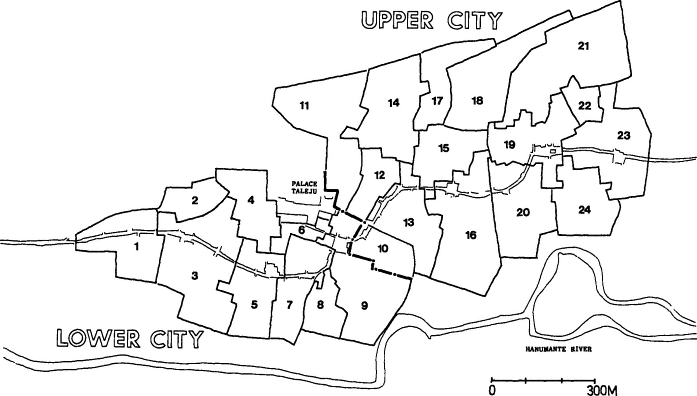
Map 11.
The village in the city. The major twa:s. Note that the boundary between the upper and lower cities follows twa: boundaries.
The main east-west thoroughfare and bazaar street bisects the city. The city's festival route (see map 12) runs through all of these twa:s
except the most westerly one, Bharbaco. The numbers on the maps refer to the following twa:s: (1) Bharbaco, (2) Itache(n), (3)
Tekhaco, (4) Khauma, (5) Ma(n)galache(n), (6) Laskudoka*
, (7) Bolache(n), (8) Lakulache(n), (9) Ta:marhi , (10) Kwache(n), (11)
Yalache(n), (12) Tulache(n), (13) Tibukche(n), (14) Coche(n), (15) Yache(n), (16) Gwa:mharhi, (17) Bholache(n), (18) Thalache(n),
(19) Tachapal, (20) Inaco, (21) Kwathandu*
, (22) Gache(n), (23) Taulache(n), and (24) Je(n)la. Map courtesy of Niels Gutschow.
They note that the "wards" usually have their own shrine of the deity Nasadya: (chap. 8) and often one of Visnu* , but these are secondary in their specific importance to the twa: to its Ganesa* shrine. Gutschow and Kölver's mention of the "potter's ward" reflects the fact that although all twa: s have at least some mixed occupational and status membership, one group may dominate the twa: numerically, and may sometimes give it a local flavor and identity.
Twa: s vary not only in the details of their membership, but sometimes in identifiable aspects of their spoken language, and, in popular conception at least, in the behavioral style of their members, their "manners" (cf. D. R. Regmi, 1965, part II, p. 554). Twa: s, or their major segments, are the face-to-face communities beyond the extended family where people know each other personally and where mutual observation and gossip are important sanctions. It is here that children's play with nonfamily children and adult associations with non-phuki members provide the ground for the considerations of mutuality and equality and for judgments on personal qualities that compete with or influence hierarchical orientations. The reason that the household must be organized to chase off the twa: , as the saying puts it, is that the twa: , or one of its neighborhood subdivisions, is the place where individual or family misbehaviors are likely to be first known and of considerable interest and where family reputation, or "face," ijjat , is at risk.
The twa: is continuously represented for its inhabitants in symbolic actions. Like most units in the city (as we will discuss in the chapters on calendrical events), the twa: is sometimes represented as a significant locus for action, as a maximal unit in itself, and sometimes in a kind of "parallel" representation as one of a set of similar units that are all doing the same thing at the same time or in sequence, and thus indicate their equivalence as categories and, at the same time, their significance as units constituting the city. The most salient inner representation is the twa: 's central shrine of Ganesa* . Ganesa* must be worshiped as a preliminary to all important household ceremonies and all rites of passage. Some twa: s also have a special protective deity in addition to their central Ganesa* . This may be Bhairava or a form of the Dangerous Goddess. In some twa: s the protective goddess is worshiped once a year, and carried on the processional route of the twa: (chap. 13).
Twa: s have some ordered relationships to the larger city. We may recall Oldfield's report that the number of gates in the old Newar city walls "corresponded exactly with the number of squares (toles) within
the city, . . . each gateway being associated with a particular square, and placed under the municipal control of the same local authorities, who were as much responsible for the repairs and defense of the gateway as they were for the general management of the square" (Oldfield [1880] 1974, vol. 1, p. 95f., original parenthesis). We have also noted Guts-chow and Kölver's observation that each twa: has its prescribed route for carrying corpses to the cremation ground (1975, p. 27).
The twenty-four twa: s are represented together as constituative elements of the city in one of the climactic events of the annual festival cycle—the sacrifice of twenty-four male buffaloes to the Goddess at the Taleju temple during the autumn harvest festival of Mohani. Most of the central twa: squares are also in their proper annual turn the site for the ritual dance-drama of the Nine Durgas, the possessed dancers, whose movements during nine months through Bhaktapur each year are considered by many to be Bhaktapur's most important symbolic performances (chap. 15). These twa: -based dramas deliver, as we will argue, some of the city's most powerful messages about the proper moral integration of individuals into the ordered life of the city.
Some Notes on the Symbolic Construction of the House
We have so far been moving into successively smaller spatial units. When we reach the house, we are at the boundary of one of the city's (here, literally) walled-off units, whose internal organization is hidden as far as possible from larger units, whose integrations and controls are largely internal, and whose concern to the larger city is in their public outputs. Although the symbolic organization of the house, like the life of the households within it, is, of course, elaborately influenced by Newar culture and tradition, it is for our purposes here, "below" or "outside" the level of public city life, and is part of the host of smaller private forms that are sometimes consonant with, sometimes antagonistic, sometimes irrelevant to the integrating forms of the public city. The interiors of these units—and above all the life within the house—reflect larger public institutions and arrangements, stand against them, prepare members for them, defend members and console them against them, and punish and reward members in their own ways and for their internal needs as well as the needs of the larger system.
This chapter is a convenient place for a summary description, making much use of others' studies,21 of some spatial characteristics of the
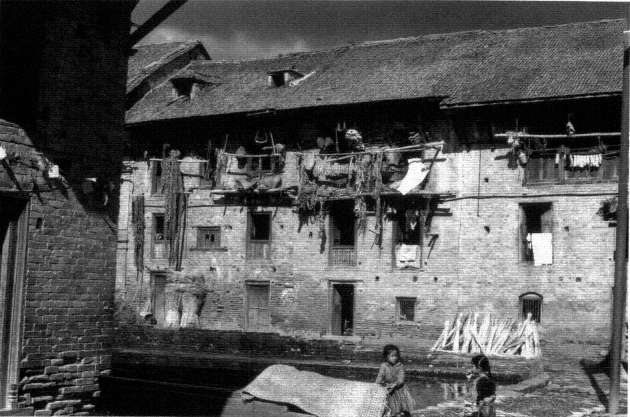
Figure 8.
Farmers' houses. Adjoining houses of families of one Jyapu phuki.
Bhaktapur Newar house (see fig. 8), sharply bounded from outer city space by a precisely marked symbolic boundary. The ideal Newar urban house is built, repaired, and lived in by the middle and upper thar s, and those members of the lower thar s who can now find the money for it. The poor, notably the Po(n), live in much simpler ones, often single-story thatched houses. The ideal traditional Newar house consists of four, and occasionally five, stories. It is constructed by means of a wood frame and beams and thick supporting walls of fire baked bricks made of valley clay held together by a mud-based mortar.22 The roofs, traditionally of tile and now sometimes of metal sheets or wheat straw thatching, slope from a peak towards the front and back, the peak, being at the long axis of the rectangular (as viewed from above) houses. The eves are supported by external struts that buttress the roof against the walls of the house; on a few houses these struts are elaborately carved. The upper story opens out into a porch, the ka:si , of occasional important ritual use, including the worship of the sun (chap. 8).
The house is internally divided longitudinally into two equal halves, front and back, by a division that runs parallel to the front of the house and consists of a wall in the lower stories and columns in the upper ones. The sections formed by this middle division are called dya , and are designed as "outer" (pine ) or "inner" (dune ), with "outer" being the half on the street side. The inner half often faces on a central courtyard, which is ideally surrounded on all sides by houses of members of the phuki , or at least of the thar , although this pattern is often disrupted in recent building.
The house is symbolically set off at its boundary with the outer city, and its vertical space and horizontal space are used as resources for symbolic meanings. In its vertical dimension the house becomes progressively more sacred, differentiated, and vulnerable to pollution at progressively higher levels. The lowest floor of the house, the cheli , is, in fact, in some contexts "outside" of the house, a kind of bordering outside, like the zone just outside of the city's boundaries. The origin of the word "cheli " is uncertain. Manandhar (1976) proposes that it may come from "che (n )," "house," plus "di ," support. Some Bhaktapur scholars surmise, in what is perhaps a folk etymology but is suggestive of their sense of the connotations of the term, that it may be derived from "che (n )," "house," plus "li ," an "old term" said to mean the lower and impure part of the body below the umbilicus. Middle-status and lower-status families sometimes keep livestock on the cheli , but even
upper-status families often keep animals such as goats who are being kept for sacrifice, and sometimes pet animals, such as rabbits and turtles in this out-of-the-house space. It is sometimes said that animals kept on the cheli will absorb diseases and the malevolent influence of dangerous spirits trying to enter the house and will thus protect people in the upper part of the house.23
The "outside" status of the cheli is further shown in that people from polluting thar s were—and for the Po(n) this is still true—allowed to enter the cheli , but were forbidden to go any higher into the house, which would have been polluted by them. Work areas for occupational castes and shops are often located on the cheli level of houses and are adapted in various ways. The cheli is also often used for the storage of materials that are said to be "not worth stealing," such as firewood, straw, hay, bricks, and old furniture.
The next floor (the second floor in the American system of designation, which will be used here), is the "floor of the mata (n ) (or mata [n ])," the mata (n ) tala . This second story is the entrance to the first of the house's internal and progressively more inward areas. It is reached from the cheli by an interior stairway, which must be placed so that persons using it do not face the inauspicious direction south. On the mata (n ) ordinary visitors (those who are not family members or of higher status than the family) and friends of junior members of the household are received. The mata (n ) story is divided by a longitudinal partitioning wall, producing a large front room running the length of the house and facing on the street. This is the mata (n ) proper, although in other contexts the entire floor may be referred to as the mata (n ). The back half is divided by perpendicular secondary walls or partitions into small rooms that serve as sleeping quarters and storerooms for valuable goods.
The next higher story is the "floor of the cwata ." The longitudinal dividing wall is represented here by columns, so that the entire floor is open, and constitutes a large "hall," the cwata . Traditionally in high-status houses, and still remaining in many old houses, large carved ornate trellis windows (one of the representative forms of Newar art [S. P. Deo 1968-1969]) were located here, allowing people to look out on the streets without being seen. It is on this floor that the formal feasts associated with many family ceremonies, particularly for auspicious rites of passage, are held and high-status guests are received. In Brahman, Chathariya, and some Pa(n)cthariya houses this floor (or sometimes the floor above it) is the site of a shrine of the Tantric lineage goddess, the Aga(n) God (hidden in a room of its own), in accordance
with the ideal that that shrine should be located toward the physical center of the house. The cwata is also the place where important Brahman-assisted family worship is usually held. Such worship is associated with rites of passage, and with some major festivals and other ad hoc special occasions (app. 4). Some members of the household, often the older ones, sleep here and there on bedding on the unpartitioned cwata .
The household shrine and images of household gods, in contrast to the Aga(n) God, are placed at one of the highest levels in the house. This is usually on the next highest floor, which is often the top floor, the "floor of the baiga ." This is usully under the overhanging eaves of the house and is the location of the cooking and family eating area as well as the household shrine and its associated equipment. Daily household worship is held here and, occasionally, Brahman-assisted rituals if the group involved is small and does not include people from outside of the household or phuki group. Many houses have a fifth story. In this case the floor above the cwata is called a "fourth floor," and the top floor is still called the baiga (Korn 1976, 23).
Korn (1976, 3) provides a useful sketch of the typical furnishing of a Newar house:
The interior furnishings and decorations are very simple in contrast to the often extravagant facades. After the clay and tile oven, the most important is the all-purpose straw-mat which serves as a carpet during the day and for sleeping on during night. Other carpets and blankets may decorate the floor, but these are reserved only for eating on special occasions. In the morning the bedding of blankets and cotton rugs is rolled up and stored away. Clothing and valuables are kept in wall recesses and wooden chests. A stove as a heating apparatus is unknown, and in its place portable clay bowls of various size are filled with burning charcoal. The kitchen is seldom used as a meeting place. Clay or metal oil lamps, available in many different shapes and sizes, stand in wall recesses to give light during the dark hours. Stocks of rice and other grain are stored in wooden chests or clay pots, while potatoes and vegetables are kept in bamboo baskets hanging below the overhanging roof. Clay and brass pitchers are used as water utensils. Wood, carried into the town from hills by porters, is the usual heating fuel although the poorer people burn dried cow dung. Foreign influences, however, have recently introduced Western-style furnishings. Electricity and kerosene have simplified the tasks of cooking and lighting.
In horizontal space the house's boundary with an exterior encircling space is indicated by a stone placed about two to three feet before the front door, under the forward edge of the front overhanging eaves. The
stone, the pikha lakhu (which is also the term for the area it covers), is considered to be the seat of a protective divinity (chap. 8). The pikha lakhu is used in many rites of passage as the division between the inner world of the household and the outer world. It is here that a bride is greeted by the chief woman of the household to be purified of spirits and malevolent influences before being conducted into the house. It is at the pikha lakhu that the corpse of a household member is left for a moment and then is picked up by the members of a funeral guthi to be carried to the cremation grounds. The pikha lakhu is cleansed and purified each morning, as other god images in the house are, and it is also purified before major household worship.
Houses are ideally supposed to be oriented to one of the cardinal points of the compass other than the inauspicious south, with the most auspicious direction being east. In fact, the available spaces for city building, the meandering direction of many of the roads and alleys, the attempt by middle-level and upper-level families to build adjacent family houses in a rectangle around a central courtyard, all require violations of these orientations, which are largely ignored.24 Within the horizontal space of the house, however, there are some arrangements following compass orientations. Thus the cooking area is generally toward the east, as is the household shrine.25 As we have noted, stairways must be placed so that people using them do not face the inauspicious south. Similarly people avoid sleeping with their body in a north-south axis. They do not want to have their heads facing south. But if they were facing north, then their faces would face south when they sat up. Therefore, the entire north-south axis is inauspicious.
Because the front of the house faces on the street, and the back faces on the inner courtyard, the front/back contrast is equivalent to outer/ inner. What are considered the private parts of the house—the bedrooms, the treasury, and the position of the Tantric shrine are at the back or inner section of the house.
At the time of the construction of a house, there are very elaborate additional symbolic spatial characterizations. The detailed symbolism of the construction of a Newar house would require a full study in itself. A significant beginning has been made by Vogt (1977) on which the following description is based. The choosing of the site for a new house, the setting of the proper date to commence construction, the construction itself (by masons and carpenters), the completion of the building of the house, and the purification of it after its physical completion, all entail a vast collection of symbolic references and practices. The new
house and its foundations are being carved out of a "natural" area, disturbing the deified earth, Prthivi* , and the supernatural serpents, naga s, beneath its surface, as well as the spirits who may have clustered there. The disturbance of the natural space is dangerous, and powerful Tantric rites, including blood sacrifice, must be performed at key points. Sacrifices are made to the dangerous gods who protect civic space against external chaos and who—along with the dangerous god Bhairava who inhabits the wood block forming the base of the threshold of the main door of houses—exist protectively at the boundaries of these spaces. The house is considered, by the ritual experts responsible for its proper symbolic construction as a body and some of the successive rituals performed during its construction, as something like human rites of passage. The house, if improperly sited (in space and time), improperly constructed, or improperly purified, is dangerous. Without the proper ceremonies people may die, not only the construction workers (who have their own protective rituals, and rituals for effectiveness) but also members of the immediate or even the extended family. But, as we emphasize in many analogous situations (e.g., the symbolic procedures during the construction of masks or icons), most of this symbolism concerns the activities and special understandings of the experts involved in the physical and symbolic construction of the house—the carpenters, masons, astrologer, and Tantric priest. Most people live in houses that were constructed before their birth. They have to think about its setting or construction only if some family illness or disaster is attributed by some diagnostican of the supernatural to a disturbance in the house's relation to its environment, whereupon they must attempt the proper ritual readjustment or placation. Those who have a new house built or live in an old one need only to know that it is, or has been, properly done.
Collapsed Structure Inside the City: Crossroads
The space beyond Bhaktapur's boundaries with its associated deities and symbolic enactments takes much of its meaning from its contrast with the moral and logical orders that are represented in the differentiated internal space of the public city. The outside represents a radically different kind of order. Some of this inside/outside contrast is, as we have noted, also found as part of the representation of the cellular com-
ponents of city life in their contrast with their immediate outside environments, which are in weaker form something like the relation of the city as a whole to its outside. There are other kinds of locations where differentiated order is collapsed and transformed and that are loci for symbolic representations and actions with connection to the symbolic aspects of the encircling outside of the city. The city's central points—the royal center and the Taleju temple, the Tripurasundari pitha , the central point between the two city halves, the point at which a pole, the Yasi(n), is erected to signify the start of the solar New Year (chap. 14)—all take some of their meanings from the transcendence of ordinary differentiated order. Another important example is the major crossroads in each twa: . At such crossings paths and roads radiate off to distant parts of the city. Each twa: has at least one of these crossings and more than one if it is a large twa: and divided into major neighborhoods. The major crossroads are the loci for uncarved stones (usually buried partly in the ground). The stone and the crossing point and the divinity thought to be located there are called the chwasa .26 (The general term for crossroad is dwaka .) The chwasa is sometimes considered as a divinity in itself, sometimes among the more erudite as the seat of the Tantric goddess, Matangi* .
The chwasa is one of the places where polluting materials are deposited so that they will no longer be dangerous or problematic. It is there that the clothes a person has been wearing at the time of death are brought to be gathered up by a Jugi as part of his thar duty. Certain remains of formal feasts—particularly the portions of the head of a sacrificial animal that are distributed in a particular order to reflect the hierarchy of the leading men at the feast (chap. 9)—must be discarded there. The chwasa not only can absorb the polluted materials placed on it, materials that would be strongly contaminating if placed in any ordinary space within the city,27 but is also said to protect the area around it. The main chwasa s are said to protect the entire twa: . This combination of the power to absorb problematic ("polluting") material and to "protect" through power is generally characteristic of a class of deities, the "dangerous" deities, of which the chwasa (and Matangi* ) is a member (chap. 8).
In his study of a Newar village, Pyangaon, Toffin notes that it has only one chwasa , which is at the northwest entrance to the village rather than inside it (1977, 33). That chwasa lies at a crossroad (personal communication)28 and is thought to be a gathering place for potentially
harmful spirits. It is also the place where people discard cloths soiled by menstruation, the umbilical cords of newborn infants, clothes of the dead, and food as offerings to potentially harmful spirits.
The association of crossroads with the unpropitious, the uncanny, and the "liminal" is widespread in South Asia and elsewhere in the world.29 Elsewhere in South Asia the inauspicious crossroads are sometimes associated with some form of the Tantric goddess. According to D. D. Kosambi, crossroads were "from the stone age, places where the Mothers were normally worshiped by savages whose nomad tracks met there" (1960, 144). He also quotes the classical writer Varahamihira that crossroads bring evil repute upon any house near their junction, and are to be included among inauspicious places (1960, 18).
Asked why the seat of the chwasa within the city is always a crossroads, a Newar Brahman said that perhaps it was because these crossroads are places where all sorts of people meet—clean and unclean, kings and humble people. The chwasa reminds people, he continued, that they are approaching a crossroad and they should proceed carefully. His speculation suggests the significance of these crossroads as deriving from the collapse of ordinary spatial order.
Not all crossroads are chwasa nor have uncanny significance. It is not clear which factors determine that a crossroads should become the seat of a chwasa . They must represent the tying together of important out-reaching routes for one thing. In an interesting variation of this theme, royal palaces are often in close approximation to major crossroads. In the town of Panauti, "The palace is placed so that all the routes coming from the exterior and all the main arteries of the city converge on it" (Barré, Berger, Feveile, and Toffin 1981, 43 [our translation]). Similarly, in both Kathmandu and Patan the Malla Palace was placed at major crossroads defining the axes of the old city. Mary Slusser, commenting on those cities, remarks that "given the traditional attitude in Hindu culture toward the inauspiciousness of crossroads, it seems surprising that such a site would have been conceived proper for the palace" (1982, 200). But the chwasa has the power to protect the twa: , and the dangerous goddess it represents has the power to protect the city, and, indeed, the cosmos. The alliance of royalty and Tantric deities and ideas in a common concern with power and with the transcendence of the ordinary civic categories and restraints—here suggested by this double use of crossroads—is, as we will see, widely represented in Bhaktapur's symbolism and symbolic action.
The Undercity
The chwasa is a stone embedded in the ground. In some places it is below the surface. It belongs to a class of "stone gods" to be considered in the next chapter which share among themselves a number of features. They require blood sacrifice, and many of them in one sense or another absorb polluting materials, often by "eating" them. In some cases the deity whose position is indicated by such stones is conceived as being beneath the surface of the ground. This subterranean realm is also the territory of the naga s, the supernatural serpents that may be disturbed as we have noted, by excavations for buildings. We note these fragments here as a reminder that one of the boundaries of the city in its relation to what is outside itself is the boundary with the underneath, the earth. This realm for Bhaktapur does not have developed and clearly characterized chthonic gods (with the possible exception of Yama, the king of the realm where the dead are judged, who is of negligible cultic significance for the city in itself), and is thus in strong contrast to the developed representations of other aspects of the "outside" and "beyond" of the city. It is outside of the city's circumferential boundaries—where the city's farmlands are—that the earth as a basis for fertility is assimilated to the symbolism of the Tantric goddess and to that sustaining and problematic outside beyond ordinary civic controls.
Symbolized Space Beyond the City
The symbolically marked spaces we have been considering have as their maximal area the bounded city, placed in contrast and relationship to a "dangerous" outside. The great majority of symbolic enactments during the course of the year concern the city and its bordering outside and its subunits. But the hinterland of Bhaktapur (once part of the kingdom of Bhaktapur), the Kathmandu Valley itself as the ancient seat of the Newars, the larger modern Nepal, and the Hindu homeland of India, are all full of significant shrines and sacred spots and mark out significant space beyong the boundaries of the city. Many of these have little contemporary use, but some of them still concern the people of Bhaktapur in visits, pilgrimages (see fig. 9), and attendance at great religious fairs or mela s. In these encounters the Newars of Bhaktapur join with Newars of other cities, with non-Newar Nepalis, or with Indian Hindus
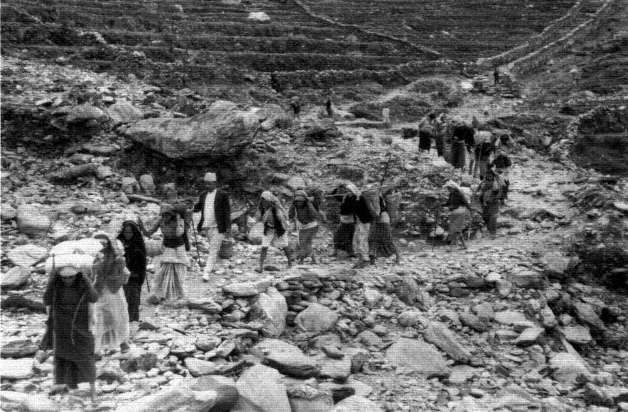
Figure 9.
Outside the city. A group of Nepalis on a pilgrimage to a mountain shrine.
to celebrate solidarities beyond that of the city. We will return to these in our discussion of symbolic enactments in later chapters.
Gutschow (1979a , 27-65 passim), Slusser (1982), and others have argued that some of the shrines and temples in the Kathmandu Valley trace mandalic* patterns characterizing the larger Valley. Gutschow and his associates have also found what they believe to be evidence for a mandalic* structure extending beyond its boundaries within which Bhaktapur is centered, as suggested by certain schematic paintings of the city as a manda* (Kölver 1976; Auer and Gutschow n.d., 38; Slusser 1982, 346). These structures may possibly have had general or much more likely esoteric speculative meaning in the past but have now lost contemporary popular or esoteric significance.
Integration of Spaces
We have begun our survey of Bhaktapur's symbolic civic organization with a discussion of its space. The meaningful spaces we have been considering in this chapter are related to many ideas and actions in Bhaktapur's civic life that will be elaborated on in later chapters.
We have presented nested, bounded spaces, each representing some kind of "solidarity" in contrast to an outside. In all societies individuals find themselves belonging to different groups depending on the context, and thus in opposition to some contrasting group. Bhaktapur, however, not only organizes these oppositions, most generally, by successively inclusive levels—nuclear family, household, phuki , people of the twa: as neighborhood or village, people of the mandalic* section, people of the antagonistic mirror cities of the city halves, the citizens of the total city, and finally the people, creatures, and forces of the city plus its environment—but also gives most of these a spatial definition and anchoring. It is this anchoring that is one of Bhaktapur's significant "typological" characteristics.
There are two general ways that Bhaktapur's spatial units and levels are realized in symbolic action. First, they are the places where certain kinds of actions are typically and repeatedly performed during the course of the year (chap. 16), or of a lifetime (app. 6). The house, twa: , crossroads, and so on, emerge as meaningful areas in the course of these repeated actions. However, people are also aware that all or most other houses, or twa: s, or mandalic* sections, or whatever unit, are doing the same thing at the same time or in some fixed sequence. The spatial unit becomes significant in its identity and contrast with similar units; it
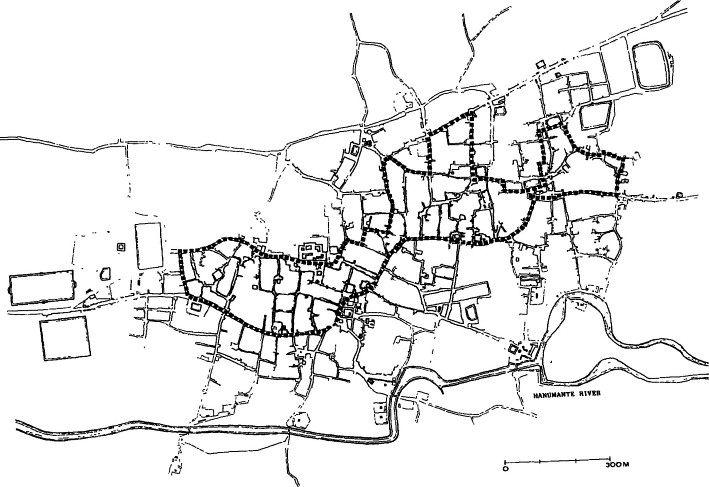
Map 12.
The integration of space. The pradaksinapatha*
, the city's festival route, is marked by a dotted line.
It ties together the upper "Bad Text" the extreme western one). Map courtesy of Niels Gutschow.
becomes a member of a class of like spaces. In the first kind of representation, the same person is, in various contexts, a member of different kinds of spaces, and there are systematic ways in which he or she moves or is moved from one kind to another. That movement tells some kind of a story. The second kind of representation, a static one, is that of different persons doing the same thing . These are two different ways of using and marking space. We will consider them again in the chapters on annual events.
One way of tieing together different units in space is through traditional processional routes. These exist in each twa: , each mandalic* section, and for the city as a whole. We have discussed the major city-wide processional route, the pradaksinapatha* , in connection with the relation of low-status groups and the boundary of the city, and noted that in contrast to the situation in some other Hindu communities it is within the city (map 12) where it binds all but the most westerly and probably most recently settled of the city's twenty-four major twa: s together.30
Bhaktapur's spatial divisions both give meaning to and take meaning from their special divinities, symbolic enactments and their associated legends and myths. Some of the meaning they contribute to this dialogue of forms derives from some of the universal potentials of spatial meaning, widely exploited throughout the world. The meanings of the face-to-face neighborhood, the uncanny nature of thresholds, borders and crossroads, the danger of the beyond-the-borders, the antagonisms of balanced and opposing civic units, and the primacy of the center and the hilltop are all very general semantic possibilities for space, aspects that can be understood in a fairly direct way. Yet others of the meanings contributed by the spatial units are, of course, local matters, local histories, legends, and forms and require special knowledge to be grasped.
We will trace these dialogues of meaning throughout the following chapters.31
Chapter Eight
Bhaktapur's Pantheon
Introduction
The city of Bhaktapur contains many material representations of gods, a witness to its long history and to close contacts since its earliest days with India, that great incubator of forms of divinity. The multitude of gods whose representations have persisted in Bhaktapur and the Kathmandu Valley are of great importance to the historian of South Asian religion and of art,1 but only some of them are alive at present, foci of action, meaning, and emotion. The others are dormant, perhaps to be revived for some future fashion or need.2
It is precisely because Hindu deities can be induced into material objects, the "idols" of the Judeo-Christian-Islamic iconoclasts, that they are able to serve the purposes they do in the construction of Bhaktapur's mesocosm. Those objects can be anchored in space or moved through it. They are constructed of meaningful elements and emerge as units of meaning in themselves. They have their own semantic import, their direct implications for meaning, but they are so constructed that their various similarities and contrasts can be used to build a structure of meaning within an overall civic pantheon, the coherent total domain of the gods. That structure helps map the city's symbolic space and its conceptual universe. The crafted gods, the "idols," are joined by more shadowy supernatural figures, some vaguely represented in astral bodies, some in natural stones, and some m the shifting and vague form of ghosts and spirits. These latter figures have their own uses—the
various kinds of embodiment that the members of the large realm of divine and spooky beings have, considerably influencing their meanings and uses.
As usual, we are primarily interested in the level of civic order; hence we are concerned here in the way the deities are used by the public city. Many of Bhaktapur's component units have their own internal deities; most, but not all, of them (an exception, for example, is the deified figure Gorakhnath, the tutelary deity of the Jugis) are versions of the same deities used as the city's public deities. We will comment on some of these component units, on the interior deities of the household and the phuki , and have included some remarks on the special deities of the Brahmans and of the "royal center" and on the ghosts and spirits of importance to individuals.
We will begin by presenting the city's urban divinities in considerable detail. This will give us a basis for considering exactly what it is they contribute to Bhaktapur's mesocosmic organization and how they are able to do it.
Approaches
In the course of the field study we began our investigation of Bhaktapur's divinities with attempts to locate and list as many of the city's active shrines and temples as we could. By "active" we mean those locations that are regularly used by some group of people in Bhaktapur, and that may have some attendant priest. (Some shrines with a priestly attendant have no significant public use or meaning.) Any of the many "inactive" shrines and temples, relics of some past period, may be loci of casual or private devotion by passersby, but they are not important to the city in the same way as the active ones that concern us. The active shrines and temples were mapped on detailed aerial maps of Bhaktapur, which gave us a first basis for approaching the spatial location and implications of groups or categories of divinities. Subsequently, Niels Gutschow put at our disposal maps that he and his associates prepared of temples and shrines, and we have used them, when noted, to amplify, supplement, and correct our own materials. These surveys were supplemented by discussions with religious experts on various aspects of the divinities and by materials on their use (presented in later chapters and appendixes) and on their personal meanings to various individuals.
In this chapter, and throughout the book, we have chosen to give divinities their Sanskrit names, rather than either the Newari approximation of that name or the popular Western equivalents. We use the Newari form in a few special cases where it has only an attenuated connection or no connection with a Sanskrit form.
Divinities: Housing and Setting
We have used "temples and shrines" as a covering phrase for the various settings in which the divinities are found, but that setting is more complex. Local usage differentiates "temples" (dega :, from Sanskrit, devagrha* ); "god-houses" (dya: che[n] ); pith (Sanskrit, pitha ) "hypaethral shrines"; and an otherwise nonspecified residual of "gods' places"—stones, fountains, trees, and so on. There is also a class of supernatural beings, ghosts, and spirits who have no anchored setting, airy nothings lacking a local habitation, if not a name. This lack of a home, like the vagueness of their form, is an essential aspect of this latter group's meaning and use.
1. Temples, dega:s.
These are buildings of various degrees of elaborateness (see fig. 10), acting as foci for the worship and the spatial influence of the particular god (or gods) they contain. They add to the meaning of their contained god their own symbolic meanings (Kramrish 1946). The historical connections and stylistic and structural features of Newar (and Nepalese) temples have been treated in monographs by Weisner (1978) and Bernier (1970) and as part of larger studies by Korn (1976) and Slusser (1982). Bhaktapur has two kinds of temple buildings with very different external appearances: the traditional Indian form and the tiered-roof "Nepalese" temple, which somewhat resembles the "pagoda" temples of China and Japan. These two local styles are not differentially named, and they do not differ in function.3
Mary Slusser (1982, 128) writes of the Newar temple (her remarks applying to Hindu temples in general):
The dwellings of the gods of Nepal are quite unlike those in many other parts of the world that are designed to house both the divinity and a congregation assembled to worship. Despite many collective sacred rituals, Nepali worship is fundamentally an individual matter. The temple, therefore needs to make no provision for a congregation. With notable exceptions, the worshiper ordinarily does not penetrate the temple at all. He tenders his offerings
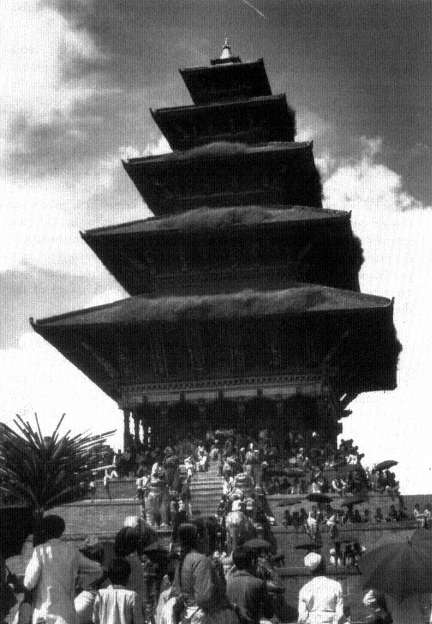
Figure 10.
A Newar-style temple. The Natapwa(n)la temple m Ta:marhi
Square.
through a priestly intermediary from whom, in return, he receives the physical sign of the god's blessings (prasada ). Further, not only is the god within the temple an object of worship so is the temple itself.
The "notable exception" for Bhaktapur includes some of the events at the royal temple complex, Taleju, where large numbers of people are involved as actors and congregation. But Slusser's remarks generally characterize Bhaktapur's other dega: s. In Bhaktapur, as we shall see, the proper loci for "congregations" are in other spaces.
2. God-houses, dya: che(n)s.
Although dega: , "temple," is ultimately also derived from a Sanskrit phrase for "god's house," the dya: che(n) (literally in Newari "God's house," dya: , god, plus che[n] , house) is where portable images of divinities are kept. These images are carried outside for various rituals, processions, or festivals, and then returned to the house. Some of these buildings are quite elaborate in themselves. Although many important portable gods have their own god-house, many portable images are kept within a temple, where they are separate and distinguished from the fixed temple image of the divinity.
3. Shrines.
There are many figures representing divinities in Bhaktapur that are not enclosed by buildings. These may be free standing statues or simply carved or natural stones. The latter shrines are "aniconic." Often arches or canopies are placed behind or over these representations. Included here are the "hypaethral" or open-to-the-skies shrines of the nine Mandalic* Goddesses. These shrines are pith (Sanskrit pitha ), a class of shrines of certain Tantric goddesses in the classic Hindu tradition marking places where pieces of the goddess Sati's dismembered body fell from the sky (see below). Slusser (1982, 325) claims that some temples of the Newar Tantric goddesses reflect such hypaethral origins:
Many [goddesses] have only hypaethral shrines. Still others have had temples built over what were obviously once typical hypaethral shrines. Characteristically, the sanctums of such later-day enclosures are very open, the temple's multiple doorways or colonnades permitting an unobstructed view, and the sanctum itself often sunken well below the present ground level. These sunken and airy sanctums have much to say about the antiquity of many of these goddesses and their ultimate chthonic origins. Symbols of such divinities should be open to the skies and woe to the misguided votary who closes them in.
4. Non-Newar Hindu structures.
Bhaktapur has many Buddhist religious structures—stupas, vihara s (religious centers derived from monastic precursors), and god-houses, as well as non-Newar Hindu centers (matha* s) for holy men, which are peripheral to our present concerns.
Gods With Temples and Shrines—Some Numbers
Shrines and temples are the seats of one segment of Bhaktapur's super-naturals, the "Puranic* deities" of classical, post-Vedic Hinduism. By our count and criteria there are about 120 active shrines and temples within or just outside the boundaries of Bhaktapur. They are one of the two sets of spatially fixed representations in the public city; the other is a numerous and heterogenous class of "deified stones." The shrines and temples are distributed among these deities as follows, with the number of shrines and temples given in parentheses: Visnu* (29), Siva (28), Ganesa* (24), Sarasvati (3), Bhimasena (3), Nataraja (2), Hanuman (2), Krsna* (2), Rama with his consort Sita (3), Bhairava (1), Jagannatha (2), Dattatreya (now regarded primarily as a combination of Siva and Visnu* ) (1), and the group of dangerous or Tantric goddesses that includes some fourteen major named forms (26). We thus have some twenty-six classical Hindu divinities represented in public urban space. Eighty-two of these shrines and temples have various kinds of temple priests, pujari (see chap. 10). The other structures do not have pujari. s We will discuss the spatial locations and the uses of the various temples and shrines later in this chapter and elsewhere in this book, but we may note here that about one-quarter of the temples and shrines are primarily related to the city as a whole, while the rest are related to one or another of the city's major constitutive spatial divisions.
Sorting Supernaturals—Some Preliminary Remarks
To consider a particular divinity as a member of a pantheon or of some larger domain of supernaturals in a certain community during a certain segment of that community's history is radically different from considering that divinity throughout its long history and its South Asian (and beyond) areal variations. Siva as a member of Bhaktapur's pantheon is not the same as the Siva considered in a general and unrooted
sense, through, say, a compendium of his various mythological accounts and his historical usages and forms throughout South Asia.
When Hindu divinities are considered from an historical or South Asian areal viewpoint, they have a very great number of accumulated forms, names, meanings, myths, aspects, philosophical implications, and contradictions. Several attempts have been made at encyclopedic approaches to the whole Hindu pantheon (e.g., Banerjea 19.56; Mani 1975; Rao 1971; Daniélou 1964) and to individual divinities or to some of their aspects (such as O'Flaherty's exhaustive survey of materials on asceticism and eroticism in the mythology of Siva [1973]). Bhaktapur has selected only certain deities from the Hindu tradition for emphasis. For the particular deities it has selected, it further selects and emphasizes only certain aspects of their potential—variously realized elsewhere—for meaning, form, and use. For some of them Bhaktapur sometimes even adds its own attributes, perhaps borrowed from other deities, sometimes ancient local ones.
It is possible for some purposes to consider Bhaktapur's pantheon as a sort of museum, a collection of divine South Asian flotsam that has drifted into the Valley. We cannot avoid our general knowledge of important aspects of the meaning of the divinities in space and time beyond the city, a knowledge shared by the people in Bhaktapur who introduced these figures and who continue to use them, but what is important for us is what is done with the deities in Bhaktapur, their local uses and relations.
The sorting of Bhaktapur's divinities and other assorted "supernatural" figures that follow in this chapter is a sorting, then, for that purpose. We will sort the supernatural beings into several large groups that have morphological and functional contrasts. The groups are:
1. "Major city gods."
These are familiar major gods of Puranic* , post-Vedic, Hinduism. They have, at least in some of their important city forms, anthropomorphic or creatural forms, and are located in named temples and shrines known to the city as a whole. These "major city gods" are divided into two contrasting groups, "ordinary gods" and "dangerous gods." The latter require blood sacrifice, are attended by a special class of priests, and are the loci of a special set of ideas and procedures (chap. 9).
2. "Stone gods."
This is a group of deities represented by natural stones. They are related to other natural objects (as opposed to objects created through human craft, like statues) that have divine properties
(springs, lakes, ponds, trees, etc.) but, in contrast to such other natural divinities, have systematic placements and usages.
3. "Astral divinities."
These are associated with the sun, moon, and various heavenly objects and events; are associated mostly with astrological ideas and practices; and have their own special priests.
4. "Ghosts and spirits."
These are a miscellaneous group of vague entities that may be usefully introduced here, and that have some significant contrasts with the other supernaturals.
Major Gods: The "Ordinary" Deities
We have characterized the "major gods" of Bhaktapur as being derived from the most salient and important gods of the early Hindu Puranic* tradition, of being situated in temples and shrines of city-wide importance, and of having anthropomorphic forms (some having a mixture of anthropomorphic and animal features). These gods are foci of ideas and symbolic enactments concerning the representation and integration of the city as a whole and of its larger constituent units.
Within this group of "major gods" there is an essential and sharp contrast of two subgroups. One of these is a group of gods who are (when necessary) attended by Brahmans or "Brahman-like" priests (chap. 10). These gods are never offered blood sacrifice or alcoholic spirits. Their icons are in the form of idealized human types, or humanized animal forms. The central divinities in this group are male. The other group of major gods are (when necessary) publicly attended by a special class of priests, the Acariya. These gods are offered blood sacrifice, meat, and alcoholic offerings. Their icons are often in the form of demonic, bestialized human forms, marked by bulging eyes, fangs, and sometimes extreme emaciation. They are sometimes represented gar-landed with necklaces of human heads or skulls, and carrying a human skull cup for drinking blood in one of their many hands. Sometimes these gods are represented as exaggeratedly erotic forms with the faces of beautiful young women and with full breasts. These kinds of gods are predominantly female. When it is necessary to distinguish these two groups in speech, the first are sometimes called "ordinary" gods, and by some Brahmans (mistakenly in historical perspective) "Vedic" gods. The second group are sometimes called "dangerous" gods (in contrast to "ordinary") or "Tantric" gods (in contrast to "Vedic"). There are other significant contrasts in the nature, internal relations, uses, and
significance of these two groups of major divinities, but these remarks will serve to introduce them.
Within the two groups of major gods (as within the other groups of divinities) each particular divinity has his (or her) own personality and significance derived in part from his history, from his present relations with others of Bhaktapur's divinities, and from the uses to which Bhaktapur puts them.
Siva
When people in Bhaktapur are asked which of the Newars' two "religions" they adhere to, a question that is usually phrased as which path, or marga they follow, those whom we have been designating as "Hindus" in contrast to Newar "Buddhists," answer by saying they are Sivamargi, followers of the path of Siva ("Siba" in local pronunciation). Siva (see fig. 11) is most commonly referred to in Bhaktapur as Mahadya :, the Newari version of the Sanskrit Mahadeva , the great god. He is represented in a variety of anthropomorphic images, and as the abstract phallic linga* . Siva's status in Bhaktapur is considerably more complex than that of the other benign gods in that he has several levels of meaning. His most striking aspect is that while he is pervasively present as an "idea," as one of the central references helping to locate and explain in various ways the other city gods, he is in comparison to them distant, relatively absent from the concrete arrangements and actions of city religion. Siva's meanings may be distinguished approximately as follows.
1. Siva as the creative principle.
For some more theoretically inclined people in Bhaktapur Siva is the creator god, out of which all the forms of gods (including a particular concrete divinity also called "Siva") are generated. This is a theoretical and philosophical position. In other contexts, as we will see, Devi, the "Goddess," is thought of and praised (by the same people) as the supreme creative force. For the most part the basic, divine, creative principle, called the brahman or paramatman in sophisticated theological discussion, is amalgamated to a general featureless deity, neither male nor female, neither Siva nor Goddess, vaguely conceived as a combination of all gods. This condensed divinity is what some, at least, people have in mind when they think of "god" in some general way, often in such thoughts or phrases as "god help me," in the face of some problem. This generalized deity is called
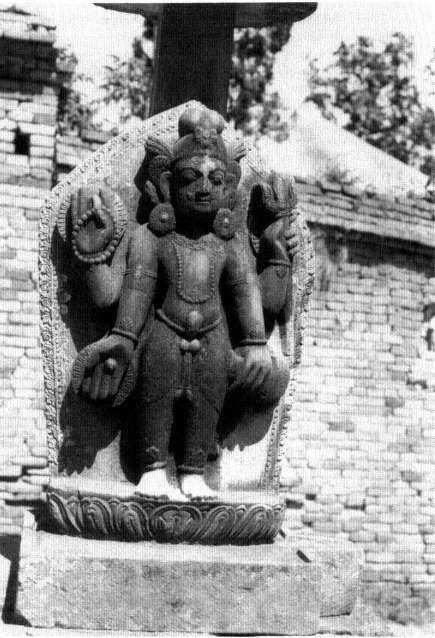
Figure 11.
Siva as a fertility god.
simply dya:: , or sometimes addressed with some honorific Sanskrit appellation, as Paramesvara, Isvara, Bhagavan, and the like. This generalized deity—unlike the traditional idea of the brahman —is aware of the individuals who call on it, and may help. It is not represented in civic symbols or ritual enactments, and represents a "monotheistic" potentiality that must in all likelihood wait for the breakdown of Bhaktapur's present religious system and its eventual "modernization" to realize its social potential.
2. Siva, first among the gods.
A more common phrasing of Siva's greatness is that he is the most important of the gods, the one whom the others respect. This importance is not based on his power, however, nor on his concrete uses in Bhaktapur. He is not like Indra had been in an earlier stage of Hindu belief, the "king" of the gods. His importance, like that of the central, "full" form of the Tantric goddess seems to have something to do with his centrality as a generator of or container of the contrasting meanings of the lesser divinities.
3. Siva as the generator of the dangerous gods.
Siva is, in ways that we will note below, one of the "ordinary" gods. However, he is the agent by which in one context and conception the "dangerous" gods are generated. Many prominent symbolic forms in Bhaktapur concern this generation. They include the idea of Siva's emanation Sakti (below) as well as other types of transformation. Much, but not all, of the symbolism of the linga* is related to this transformation, as is much of the symbolism of Tantra. We will return to this in our consideration of Sakti, the dangerous divinities and Tantra (chap. 9). In other contexts, as we shall see, the "dangerous gods," particularly the central, generating forms of the goddess, are conceived as existing independently of Siva. In such contexts Siva becomes quite peripheral, the goddess becomes the central creative force, and Siva's importance or presence becomes greatly attenuated.
4. Siva as one of the group of ordinary gods.
At this level Siva is one of a community of divinities related by the ordinary social ties of family and friendship. The central group of ordinary gods are Parvati, Ganesa* , Visnu* , Laksmi, Sarasvati, and some secondary divinities associated with Visnu* . Parvati is Siva's wife or consort, Ganesa* is his son, Visnu* is Siva's essential friend, and Laksmi is Visnu's* wife. Sarasvati
stands outside these relations. Siva is sometimes represented as a young man with a moustache (see color illustrations). In this form he is thought of as an unattached and dreamy young bachelor. Sometimes he is shown with his consort Parvati to his left, his arm tenderly around her shoulder. He is absent-minded, a dreamer, stumbling in his abstraction into socially dangerous errors from which his friend Visnu* must extricate him. He dresses improperly, like a jungle dweller, and sometimes goes naked. He moves at whim from place to place. He is usually gentle and benign in his abstracted way unless roused to fury, and that fury is elemental and potentially randomly destructive. Sometimes he incarnates his vehicle, the bull Nandi. Sometimes he is found in deep meditation on Mount Kailash in the mountains to the north of Bhaktapur. Sometimes he is found in the cremation grounds, or even in the refuse dump in the inner courtyard of the house. His destructive power can be focused and put to use against impersonal and external dangers to the city, but in this transformation we are soon no longer dealing with Siva, something new arises.
Siva represents the human tension between self-absorption and asocial sexuality on the one hand and social involvement taming such problematic states and passions on the other. As Parvati's consort and Visnu's* friend, he is under the socializing restraint of those social relations, he needs them. Siva alone—adolescent, yogi-like, alternating between sexual passion and ascetic self absorption—is recognizable both as forest dweller who has escaped from the city and as one important aspect of the man of the city. As the Mahabharata says of this Siva (quoted in Atkinson 1974, 721) [from the Mahabharata , Anusasana Parva, chap. 14]; cf. Mani 1974, 808).
He assumes many forms of gods, men, goblins, demons, barbarians, tame and wild beasts, birds, reptiles, and fishes. He carries a discus, trident, club, sword and axe. He has a girdle of serpents, earrings of serpents, a sacrificial cord of serpents and an outer garment of serpents' skins. He laughs, stags, dances and plays various musical instruments. He leaps, gapes, weeps, causes others to weep, speaks like a madman or a drunkard as well as in sweet tones. With an erect penis he dallies with the wives and daughters of the Rishis.
Siva's essence is in his transformations, which make him both elusively shifting and generative. As O'Flaherty (1973, 36) notes, he is both a yogi and its antithesis, the lover of Parvati. She adds, however, in regard to this and other apparent oppositions in his mythology:
The mediating principle that tends to resolve the oppositions is in most cases Siva himself. Among ascetics he is a libertine and among libertines an ascetic; conflicts which they cannot resolve, or can attempt to resolve only by compromise, he simply absorbs into himself and expresses in terms of other conflicts. . . . He emphasizes that aspect of himself which is unexpected, inappropriate, shattering any attempt to achieve a superficial reconciliation of the conflict through mere logical compromise. . . . Siva is particularly able to mediate in this way because of his protean character; he is all things to all men.
But this protean character in itself limits the semantic possibilities of Siva in Bhaktapur. There is one thing he cannot be to all men, that is a fixed character, and that provides his major contrast to Visnu* , who is fixed in his purposes and his conventional forms.
Yogi , bachelor, friend, and husband are all Siva, but Siva disappears in his supernatural transformations. When he has been transformed into his dangerous form, Bhairava, when he emits his sakti ("power"; see chap. 9) or the goddess Devi, these dangerous forms are immediately thought of as independent actors. They have their own myths, legends, and histories. In thought and action they are for the most part disconnected from Siva, except for vestigial traces and markings—a Siva mask carried but not worn, Siva's vertically rotated third eye sometimes, but not always, placed on their foreheads (see color illustrations). And in a further limiting and bounding of the protean Siva to his proper human-like area, it is the "goddess" herself—although in some contexts thought of as generated by Siva—who becomes the shifting, generative force. While Siva's generative activities, the center from which he moves are in the social world, and are related to recognizably human activities and modes of a certain sort—the lover, the adolescent, and ascetic, intoxicated or ecstatic states—it is another figure, the "goddess," who is the center of generation in a much more radically extrasocial world, the world outside the city and its order. Thus, although Siva represents a bridge to the world beyond the city, and beyond all cities, those bridges become burnt for the most part once crossed, and as his transformations come to life, Siva, overtly in Tantric imagery, becomes a corpse. His ongoing and continuing life in Bhaktapur is as a representative of that dimension of the social person which is valued, although in tension with social and moral order. In his transformations to representations of the extrasocial world, Siva becomes almost forgotten. Similarly, when thought of as a creator God, this cosmic Siva is also lost from view when his creation is being considered. In his own anthropomor-
phic right, however, he represents a complex of traits which are unified in being thoroughly human, but in one way or another problematic for social order. This Siva provides problems which must be dealt with by his friend Visnu* at the service of the moral community. It is important to emphasize that from the point of view of the corpus of South Asian myths about the relations of Siva and Visnu* this is a local choice of emphasis. There are, for example, South Asian stories where it is Siva who must free Visnu* from some passionate bondage (e.g., O'Flaherty 1973, 41). Bhaktapur, in fact, develops selected meanings suggested by the major persisting myths and representations of the two gods. Their relation is epitomized in one of the local interpretations of the complex symbol of Siva's power, the linga* , whose more central meanings are related to the idea of Sakti (below here, and chap. 9). The linga* consists of a column at whose base is an encircling band. In this interpretation of Siva as a component of civic order (rather than as the generator of cosmic forces), the upright column represents Siva and his explosive and expanding energies and the encircling band at the base represents a restraint placed by Visnu* around that column of energy to protect, control, and channel it.
There are about thirty active Siva shrines and temples in Bhaktapur. Of these, fourteen are found m four clusters outside the traditional boundaries of the city to the south near each of the bridges to which the city's southern and southeastern roads and paths lead. Another nine are grouped in the two central squares of the town, the Laeku Square in front of the palace and the Ta:marhi Square, both of which, it may be recalled, are (in different contexts) centers of the city. These central shrines and temples were built by the Malla kings and by wealthy families and thar s (such as one group of shrines built by the Kumha:, the potters) as variously motivated acts of private devotion to Siva. Many of the structures outside of the city are of relatively recent post-Malla origin, and it is said they were built there because there was more available space on which to build. Some of these shrines and temples have attendant priests whose stipend is funded by grants of land that were set aside for this purpose at the time of the building of the structure, but may have no other worshipers. Others are the object of worship of descendants of the founding group, or sometimes by people who have made a pledge to worship Siva, perhaps at that particular shrine, in exchange for the fulfillment of some wish. One of the largest and most visually impressive temples in the northern half of the city is devoted to the divinity Dattatreya (Newari, Dattatri), who is thought of as a corn-
bined incarnation of Visnu* , Brahma,4 and Siva. In the Dattatreya temple Visnu* is iconographically dominant, but Siva is thought of as the main power embodied in the temple. The temple priests are non-Newars (Jha Brahmans), and the inner sanctum is closed to Newar Brahmans. The temple's main function is as a pilgrimage center for non-Newar Shaivite devotees from India and other parts of Nepal.
For the Newars of Bhaktapur, the Siva shrines and temples, in marked contrast to those of certain other major divinities, are not used to designate any of the internal structural features of city organization. Correlated with this is that there is only one minor annual festival (Madya: Jatra; see chap. 13), specifically devoted to Siva. The great Siva festival for the Newars of Bhaktapur and elsewhere, as well as for Nepalis and for many Indians, has its center out of Bhaktapur (and of the other major Newar cities) at the great Valley shrine complex of Pasupatinatha devoted to Siva as the "Lord of the Beasts," during the major South Asian Shaivite festival, Sivaratri, in the late winter. Bhaktapur itself on that day is a secondary focus for some Shaivite pilgrims, and some of the city's men perform an unusual—in contrast to other forms of local worship—type of devotion to Siva spending the night by fires along the city's public streets, sometimes smoking cannabis, in an enactment that, with its associated legends (see chap. 13, "Sila Ca:re" and our discussion there) illuminate Siva's meaning as a bridge to a transcendent realm.
In Bhaktapur there are several divinities with limited functions, and with names and attributes of their own sometimes said to be "forms" of Siva. There are some statues in stone of a figure with an erect penis locally identified as Siva which are worshiped by families who wish children or specifically a son (fig. 11). Siva is worshiped in the rite of passage of people in their seventy-seventh year as Mrtyum* Jaya, the god who conquers time and prolongs life. He is sometimes said to be Nataraja, the god of the dance, who is worshiped by musicians and actors. (Nataraja as the Newar god Nasa Dya: has accumulated, as we will note, other meanings and uses.) Siva is the god buried in the inner courtyard of houses who destroys the wastes thrown there. He is Visvakarma (Newari, Biswarkarma), the god of crafts and trades, who gives power to the tools and implements of the various traditional and modern crafts: the barber's razor, the driver's truck, the farmer's tools.
Siva's meaning in Bhaktapur's supernatural domain is deeply affected by his position in the larger system. We have introduced some
of this, but we must turn to the other members of the domain, each of whom provides context for the others.
Visnu-Narayana* And His Avatars
Visnu* is usually referred to in Bhaktapur by one of the names historically associated with Visnu* , Narayana* (Newari, Narayan). Visnu* (as we will here refer to this divinity for comparative convenience) belongs centrally to what we will call the "moral interior" of Bhaktapur. Although other gods may be addressed on their special days or for particular unusual problems, Visnu* and Laksmi, his consort, are at the loci of ordinary household prayer. Visnu* is that fragment of divinity that dwells in individuals as their soul or atma , in the Newar version of the ancient South Asian correspondence of soul and cosmic divinity.
Although there are several and conflicting ideas about the possible fates of the soul after death and about various heavens, and a number of theories as to what determines a person's postdeath state, the focus of most belief and action in regard to personal fate after death centers on Visnu* . In the ceremonies devoted to dying, attention is focused on Visnu* , and the dying person must pray to Visnu* , meditate on him, and address his or her last words to him. In the kingdom of the Lord of the Dead, Yama Raj, it is Visnu's* representative who argues the case for the deceased in front of King Yama. This case is based on the individual's merits and sins, virtues and vices, in relation to his following or violating the moral law, the Dharma. Those who follow the Dharma can expect to go to Visnu's* heaven. To get to Siva's heaven one must make Siva a focus of meditation, another and radically different path to salvation from the moral path of following the social Dharma. In Visnu's* heaven one keeps one's social identity and is joined with one's family in reward for one's social virtue. The salvation associated with Siva and the Tantric gods, moksa* , has, in contrast, a problematic and uncanny relation to the social self.
Visnu* is represented in Bhaktapur by idealized, princely human forms. Occasionally he is represented in the forms of one of his incarnations, or avatars . He is also represented occasionally by small, rounded stones, locally called salagrams. 5 In contrast to other places in South Asia, Visnu's* avatars (Sanskrit, avatara ) in Bhaktapur have minimal cultic significance in themselves and are of major importance only as aspects of Visnu* .6 In contrast to Visnu's* twenty-nine active temples and shrines in Bhaktapur, only two temples are actively devoted to Krsna*
and three to Rama and his consort Sita (see fig. 12). One of the two Krsna* temples is in Laeku Square, and was one of the temples built by the Malla kings for their personal merit. It is attended by a Rajopadhyaya Brahman and contains a portable god image, which is carried around the city once a year. The other temple, in the northern part of the city, has no priest and is used in a casual way by some local people or passersby. Both of the active Rama temples are outside the city boundaries at places where roads meet the river. One of them is part of a complex of temples built by the potter thar , the Kumha:s, living in the southern half of the city, and is attended by Kumha:s and people living in nearby areas. The other, to the southwest, is of some general importance once a year, in connection with the worship of one of the Eight Astamatrkas* , Varahi.7 There are two Hanuman temples associated with the southwestern Rama temple that are visited by many people on the same day of the annual festival calendar as that temple. Hanuman, a divinity in monkey form associated with Rama in the Hindu epics, is also represented in other Visnu* temples. Newari art represents still other of Visnu's* avatars (particularly Vamana, and Narasimha* ), as it also represents Visnu* in relation to his cosmogenic aspect,8 but these representations have no contemporary uses.
The conception of Visnu's* avatars is closely related to the idea of Visnu* as the divine portion, the atma , of each individual. The avatars represent the incarnation of a portion of Visnu* into the ordinary world, as part of a mixture that is in part human (or animal) and part divine.9 Visnu's* avatars are not only incarnated in human or animal forms, but by and large they lead recognizable social lives, albeit with legendary heroic powers.10 The lives of the incarnations were furthermore located in real space and historical time. These lives were lived for the purpose of reestablishing some desirable social order for humans or for the gods after that order's derangement through some antisocial force usually personified as a "demon" or antigod, an Asura . This is in marked contrast to the case of Siva, whose transformations, such as Bhairava and the Goddess, are emanations in which Siva's identity is transformed and lost, and which are themselves "demonic" forms of the same sort as Asuras . Rather than exist through a unique lifetime, as Visnu's* avatars do, Siva's transformations appear and are "reabsorbed" in some contexts or, in others, are as eternal as Siva himself. Although they can defeat the Asuras and other forces of disorder, they are, in themselves, dangerous and problematic to the orderly social world, and must be controlled in turn. In another significant contrast, while Siva's emana-
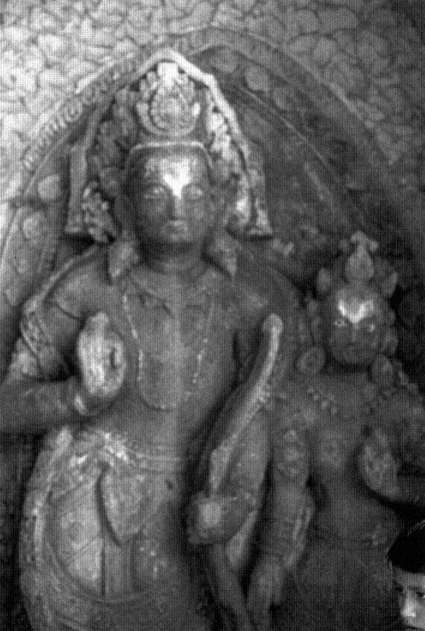
Figure 12.
Rama and his consort Sita. Note the difference in size.
tions (or in some versions the emanations of Parvati herself) defeat other demons through brute magical force, Visnu's* avatars characteristically restore order through cunning and other social skills allied to their divine power.
In Bhaktapur's stories it is Siva in his wanderings and absent-mindedness who is either sometimes dangerous himself, or who allows some devotee to accumulate through meditation and austerities some god-like power, which he then uses in defiance of the gods' order for his own selfish purposes. Visnu* must undo the damage, calm Siva, overcome the magic power of Siva's devotee, and restore order. In this contrast Siva is the passionate, romantic dreamer for whom social propriety is a burden. Visnu* represents sobriety, decency, and order. The pair represent a familiar universal tension within societies and within individuals.
The twenty-nine Visnu* temples and shrines are distributed around the city in close proximity, for the most part, to the city's main processional route. Of these, two are large temple complexes—one immediately south of the upper-lower city axis, and the other in the eastern part of the upper city. Although these two largest temples are located in the lower city and upper city, respectively, they are not considered representative of these city halves in the way that other space-marking deities represent spatial units, and there is no special religious activities that tie them to the halves as such. All these temples are attended optionally by people in their vicinities, sometimes for casual prayer, sometimes in quest of support in some undertaking. Usually Visnu* is worshiped not in a temple or shrine but at home. Visnu* , along with his consort Laksmi, is, as we have noted, the usual focal god of the household, the focus of most of the ordinary household puja s. They represent the ordinary relations, the moral life of the household, in its inner life. As we will see, for the family Visnu* contrasts with another quite different kind of deity, the lineage deity, most often a form of the Dangerous Goddess, which binds the households of the phuki group into a unity and protects them against the dangers of the outside (chap. 9).
Visnu* resembles Siva in not being used, in contrast to certain other gods, to mark off the city's important spatial units. He is, as we shall argue, not the proper kind of a divinity for this for Bhaktapur's purposes. Visnu* has no major festival in the public city space. He is a major focus of household worship throughout the year, and of special household and temple worship and of out-of-the-city pilgrimages on some
annual occasions, particularly during the lunar month of Kartika (Newari, Kachala, October/November) as he is elsewhere in South Asia at this time.
In recent decades the worship of Visnu-Narayana* at the two major temples with music and dancing and without the mediation of a priest in expression of an individual direct devotion to the god free from the spatial, temporal, and social orderings of Bhaktapur as a city, has been growing. Visnu* and his avatars have become the object of bhakti , loving devotion, a focus for private salvation and private emotion. Here he is not functioning as a component in a complex system of urban order, but as the kind of personal god who arises when such a city-based system begins to break down. This is no longer the Visnu* who is Siva's complement. This is, to recall our conceits of chapter 2, a transcendent "postaxial" Visnu* .
Ganesa*
Siva in Bhaktapur is a bridge joining different forms of divinity. Ganesa* (Newari, Gandya:), an elephant-headed god, is a bridging and transitional figure of a different kind; he provides in several ways for human entrance into the area of the divine. As such, we may contrast him with other divinities, dangerous and uncanny, who are at the threshold of the human moral world and the orderly divine world into areas of chaos and danger. Properly for such uses, he is as attractive in his person as they are horrifying.
Let us consider some aspects of Ganesa* as an entrance. As is generally the case in South Asia, one prays first to Ganesa* before praying to any other god or before undertaking any important religious activity. The worship of Ganesa* is necessary for effectiveness, siddhi , in the worship and manipulation of other divinities. This is an aspect of a more general attribute of Ganesa* as "the overcomer of obstacles" (Mani 1975, 273):
Ganapati* [Ganesa* ] has the power to get anything done without any obstructions [and has] also the power to put obstacles in the path of anything being done. Therefore, the custom came into vogue of worshiping Ganapati* at the very commencement of any action for its completion . . . without any hindrance. Actions begun with such worship would be duly completed.
It is necessary to worship Ganesa* before both ordinary and Tantric puja s. This is connected with one of his unique features in Bhaktapur,
specifically, that he can be either a dangerous or an ordinary god.11 Any image of Ganesa* 12 may receive either the worship and offerings that are proper for the ordinary divinities (e.g., grain, yogurt, cakes) or the blood sacrifices and alcoholic offerings that are proper for the dangerous divinities. (He has, however, a particular animal that is uniquely proper for sacrifice to him: the khasi , or castrated male goat, another image, perhaps, of his marginality.) He is the entrance to these two different realms, otherwise often placed in opposition.
In some settings his image13 may indicate, represent, or suggest a Tantric emphasis. It may show Ganesa* with many arms, and he may be seated next to his Sakti, variously identified as Siddhi (the personification of his power for effectiveness) or Rddhi* , "prosperity, wealth, good fortune." In his dangerous form he is sometimes called "Heramba," and thought of as a guru who instructs and therefore introduces students in Tantric knowledge.
There is still another sense in which Ganesa* is the entrance into the religious realm. As a benign, humanized animal, a sweets-loving child, the child of Siva and Parvati in their domestic imagery, he is a favorite of children, and in the memory of some respondents was the first god form to whom they became attached—in contrast to others whom they feared as children—and it is Ganesa* who (at certain specific temples) is prayed to for help to children who are slow in learning to walk or talk.
As he is elsewhere in South Asia,14 Ganesa* is the divinity of entrances in space as well as in temporal sequences. He is conceived to reside on one side of gates and arches (usually on the right side) while his "brother," Kumara (who has little other significance in Bhaktapur, except in connection with the Ihi , the mock-marriage ceremony) is imagined to be on the other.
Ganesa's* shrines and temples are the main fixed divine markers of the twa:s , the village-like units in the city and of some of their component neighborboods (map 13). This local areal Ganesa* , or sthan Ganesa* (from sanskrit sthana , place, locality), is considered common to the twa: . Although, as we have noted, a particular twa: may have one or more other divinities that in some sense "belong" to it and are its particular responsibility and that may be celebrated in some annual twa: festival, every twa: has its sthan Ganesa* . Everyone in the twa: worships here before important out-of-the-house ceremonies and during all rites of passage for members of the household. Thus Ganesa* is one of those divinities who have an important relationship to a significant component of urban space, as Visnu* and Siva do not. The great majority of
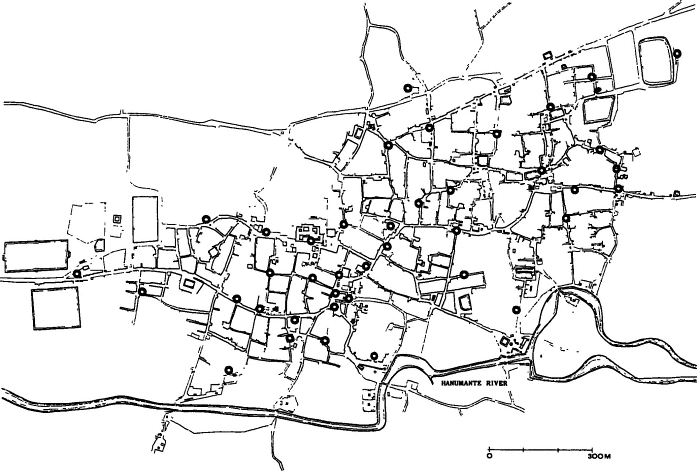
Map 13.
The distribution of Ganesa*
shrines in the city. The shrines are distributed throughout the city, with most of them on or near
the pradaksinapatha*
. Map courtesy of Niels Gutschow.
these twa: shrines are located on the city processional route (see map 12) which connects the twa: s, and thus these individual centers are tied into the larger city.
There are a number of Ganesa* temples and shrines, some within the city boundaries and some without, which have specific purposes that can be accomplished only at that particular location with its particular Ganesa* . People go to Balakhu Ganesa* if they have lost something and wish help in finding it. Children who are slow in learning to talk are taken to a temple just outside of the city to the northeast, Yatu (Nepali, Kamala) Ganesa* . One shrine, that of Chuma(n) Ganadya:, is worshiped by the entire city during the solar New Year festival, Biska: (chap 14). All these shrines are also worshiped by local neighborhood people.
The most important Ganesa* shrine outside of the city for the people of Bhaktapur is Inara Dya: (Inara God),15 known in Nepali as "Surya Vinayaka." This shrine, set on a forested hillside south of Bhaktapur, is visited regularly once a week by many people on one of Ganesa's* special days of the week, Tuesdays or Saturdays. These trips are considered as both a religious undertaking and an outing. Family members or a group of young friends will go to the shrine taking food with them. In addition to his general function as an overcomer of obstacles ("Vinayaka"), and a first object of worship before approaches to other gods, Inar Dya: can also help children who are slow in learning to walk. According to Slusser, Surya Vinayaka is also "widely consulted as a curing god by the deaf and dumb" (1982, 263). This shrine is not only attended by people of Bhaktapur but also is an important shrine for the Kathmandu Valley both for Newars of other places and for non-Newar Hindus. It is sometimes considered one of four Ganesa* temples forming a kind of mandala* in the Kathmandu Valley, and which are sometimes visited in sequence (Auer and Gutschow n.d., 17; Slusser 1982, 263).16
A Note on Yama
Yama Raja, the ruler of the "kingdom" where in some versions of the adventures of people after death they go to await the fate that the results of their moral behavior, their karma , and/or the proper performance of death rituals secures for them, and who presides over the hell where the perpetrators of some enormous sin must remain for some equitable period, is not properly a member of the urban pantheon in the same way as the other figures we are considering here. He is the personification of death, but a certain kind of death or of death viewed
in a certain way. As such, he belongs among the "ordinary" deities, is in contrast to the dangerous deities, and should be noted here. The dangerous deities can kill, but that is not associated with the sort of dying that Yama is concerned with. Yama, or his messengers, come to collect people in "ordinary" dying. He is a moral agent, part of the ordinary religion of Bhaktapur and is related to the worship and meanings of the ordinary deities (some of whom preside over the heavens where Yama will most likely send the dead individual if he or she is not to be reincarnated back into this world). In either one of the various heavens or the usually foreseen rebirth, the individual will live a pleasant social life, in consort with his or her loved ones (if in heaven) or perhaps with their transformations (in a rebirth). There are other "religious" representations of death—or, more precisely, of being killed—in Bhaktapur that are not within the moral realm. These are within the realm of the dangerous deities or the malignant spirits, within realms where accident and power, not moral behavior, prevail. Against them only avoidance or powerful "magical" devices (chap. 9) might prevail. Yama's judgment and the timing of his visit can, however, be affected not only by good behavior, but also by affection and solidarity in the family, and various kinds of distractions and social deceits can be used to confuse or distract him or his messengers and deflect him.
Yama is variously represented in the annual calendrical sequence, most centrally in the course of the lunar New Year's sequence (chap. 13). He is there representative of what we will call the "moral beyond" of the household, not the "amoral outside," which is vividly represented in other annual symbolic enactments in relation to other deities.
The Ordinary Female Divinities: Laksmi, Sarasvati, And Parvati
In a later section we will be concerned with a cluster of ideas about "the goddess," a form sometimes conceived of as an emanation of Siva, as his "Sakti," and sometimes as an independent divinity having many names and forms. The word "Sakti" is often also used in Bhaktapur to refer to the consort, the female companion, of a male god. In this sense it means little more than wife, constant companion, or lover. There is a sharp distinction in cultural definition, personal meaning, and associated religious action between those ordinary goddesses who are the consorts of ordinary gods and important foci of ordinary religion, and those other goddesses, emanations of Siva or aspects of some form of
the Tantric goddess, the Saktis par excellence , the objects of Tantric worship.
The three ordinary goddesses are Laksmi, Sarasvati, and Parvati. Of these, only Sarasvati has her own temples. Laksmi and Parvati are respectively represented m the temples of Visnu* and his avatar s (with the consort of the particular avatar being sometimes considered an incarnation of Laksmi) and of Siva in his anthropomorphic forms. In contradistinction to Sarasvati and to the Tantric goddesses, they are secondary figures in the external city religion. Their abode and realm is in the household.
Sarasvati (Sasu Dya: Sasu God, in Newari) has four major shrines in Bhaktapur. These shrines may be worshiped as a personal act of devotion by local people and passersby, but her main special meaning is as the goddess of learning, to whom all people who are engaged in studies of one kind or another (in recent times particularly modern school studies) come to pray. Sarasvati can grant them effectiveness or siddhi in learning, as Ganesa* does to children for walking or talking. Her main temple is just to the south of the city across the river. All school children go to this shrine, the Nila (Blue) Sarasvati on the same day, or Sri Pa(n)cami, once a year (chap. 14). Sarasvati is usually represented in an ordinary, if idealized, human form, like the other ordinary goddesses (identifiable by her swan vehicle and her "lute," the vina* ). She was formerly embodied in all books, and now still in those that are not specifically modern and secular. In a major Puranic* tradition Sarasvati is considered as the daughter and sometimes the consort of the god Brahma. In Bhaktapur she is conceived of as an independent goddess.17
Laksmi (Newari, Lachimi) is a major household divinity, but she has no public shrine or temple, although she is understood to be present in Visnu's* temples as his consort, or as incarnated as Radha or Sita, the consorts of his major avatar s. She is understood to be nevertheless a goddess in herself, although she has in Tantrism some theoretical and cultic connections with goddesses such as Vaisnavi* and Varahi through shared associations with Visnu* . As everywhere in South Asia, as a household goddess, Laksmi is the promoter of the proper ends of the household—fertility, success in the household's economic activities, accumulation of food and wealth. She is the object of daily prayer and must never be neglected. She, like Visnu* , is a protector of ordinary life. She has one annual festival in Bhaktapur, which is during one day in the course of the five-day lunar New Year festival (chap. 13).
With Parvati (Newari, Parvati or Parbati) we approach the complex
web of ideas joining Siva, Sakti, and Newar Tantrism. Although Parvati is, as we shall see, one bridge to these ideas, she is for the most part an independent Goddess in her own right, one who belongs firmly to the ordinary realm. Parvati as a household figure is Siva's loving bride—the ideal wife—and the daughter of Himalaya, the personified mountain range. As Himalaya's daughter, the Kathmandu Valley, that is, the traditional Nepal of the Newars, is her paternal homeland, and she has special concerns with it, particularly with its Newar women. Like Laksmi, Parvati has no independent external representation in her own shrine, nor any external ritual significance for the public city.18 She is a focus of some romantic fantasy (as is Krsna's* consort Radha in other parts of South Asia), represents married romantic love for the household, and is prayed to by women for the welfare of the household (with perhaps a less material emphasis than Laksmi) and for the birth of sons. Although she may change into dangerous forms in the legends of the Goddess she, like Siva when he emits his Sakti, is lost in the form, and (as we shall see below, as the Devi Mahatmya , one of the main sources of Bhaktapur's ideas and imagery about the Goddess suggests) is unaware that she has an alternate wild and demonic state.
The Transition to the Dangerous Divinities
The dangerous deities, which we are now ready to discuss, are in many contexts and for many purposes considered as independent deities. The "Goddess" who in some contexts is thought to derive from Siva, in others is not only independent and self-created but also usurps his role as the creator deity. For certain purposes in Shaivite and Tantric Bhaktapur, however, Siva is considered as their source. One aspect of this idea is related to the conception of Siva/Sakti, which is of basic importance in Tantric theory (chap. 9). Sometimes Siva is thought to transform himself into another god, such as Bhimasena. Sometimes Siva is thought to be first transformed into his dangerous form Bhairava, who may then, in turn, generate other dangerous gods. Siva's transformation into Bhairava is described as not a transformation of himself, but rather as a sending out of a force or power from within himself, an emanation, a ni:saran . Emanation is also the way in which the dangerous goddesses are said to be generated, as Siva is conceived as generating a powerful form of the goddess, who then, in turn, generates or is transformed into subsidiary forms.
We are now concerned with relations of a different kind than those that obtain between the "ordinary" gods. Those were familiar and relatively fixed social relations: spouse, child, friend. These relations are relations of metamorphosis and emanation and are often shadowy and uncanny. Their proper worship, uses, and meanings differ from those of the ordinary deities. They belong to a different realm of the world and of the mind.
Major Gods: The "Dangerous" Deities
The major divinities that we are categorizing as "dangerous" have many features of representation, conception, and usage, that separate them from the residue of "ordinary" gods. We have borrowed a salient Newari verbal distinction where when it is necessary to refer to the set as a whole they are refered to as gya(n)pugu , "dangerous." When such distinctions are necessary, the "nondangerous" divinities are often distinguished from the gya(n)pugu ones by one or another term for "ordinary," such as the Sanskritic term sadharan .19 The contrast between the two sets, "ordinary" and "dangerous," responds to, reflects, and helps create important distinctions and complementarities. As we will see throughout this study, the two sets of deities are related to distinctions of inside and outside, of morality and power, of Brahmans and kings, of civil logic and dream logic, and of realms in which purity and pollution create distinctions and those within which they are irrelevant—in short, to some of the fundamental distinctions in Bhaktapur's conceptual world. The two sets not only represent these tensions and contrasts, they can be used to show relations of various sorts among them.
There are many more or less concrete markers of the contrast between the two sets of deities, their appearance, positions in the city, associated myths and legends. Some of these markers might (extremely rarely) be ambiguous; a benign deity may, for example, have a horrible form (such as Visnu's* avatar Narasimha* ). But there is one differentiating sign that people are forced to pay attention to, and that ensures the proper classification of any of these deities that they may have to encounter. This is what they are to be offered in proper worship. The dangerous gods should be given animal flesh and alcoholic spirits,20 the ordinary gods, (including Ganesa* in his non-Tantric aspect) must never be given such foods. In ordinary speech the emphasis is on the "deities who drink alcoholic spirits," rather than on their acceptance of meat.
Alcoholic spirits in this context are specially named, nya (n ) rather than the usual term aela .
We will begin our discussion with the dangerous female divinities. Among the ordinary gods, the male gods are central and predominant and the female goddesses are peripheral to them; among the dangerous gods, the female divinities are predominant in quantity, complexity, and centrality in symbolic action.
The Dangerous Goddess and Her Transformations
Among the community of ordinary divinities are female divinities, various "ordinary goddesses" including Siva's consort Parvati. However, South Asia has had goddesses of a different sort who separate and coalesce in the course of history, in the course of individual mythic accounts, and in the conception and action of Bhaktapur. The coalesced figure is the Goddess, whose names, aspects, forms, and allies in Bhaktapur we will sketch in the following sections. In her most powerful and dangerous form as depicted in the Markandeya Purana* , a scripture that contains one of the major sources of Bhaktapur's imagery of the Goddess (P. K. Sharma 1974, 46 [emphasis added]):
She is a goddess warrior, incarnating herself on earth by using various devices at various crucial moments m order to destory the demons who were formidable challenges to the denizens of heaven. Indeed, in her perfect nature, she has been described as the most beneficent; but her fierceness as a martial goddess, equipped with the sharpest weapons and reveling in her terror-striking war-cries, is definitely a different tradition from that of Parvati-Uma, whom we always find fir an altogether different setting .
The goddesses whom this goddess spawns or is ready to absorb are often represented as similar to the "formidable" demonic forms that they oppose, a similarity that helps explain their effectiveness in combating them. In some conceptions, such as the legends associated with the Nine Durgas (chap. 15), it is clear that the dangerous deities are sometimes, in fact, demonic entities that have been captured by "magical" power, often by some expert in Tantric spells, and then eventually forced into the service of the human community. As such, they may have fangs, cadaverous sunken cheeks and bodies, garlands of skulls or decapitated human heads around their necks, or cloaks of flayed animal or human skins over their shoulders. They have multiple arms, bearing weapons and carrying a human calvarium as a drinking cup, understood to be full of blood. Sometimes they are represented as beautiful, full-
breasted figures of an almost hallucinatory sexual desirability, but the many arms of these representations bear the same murderous weapons as the frankly horrible forms, and like those forms, they, too, demand blood sacrifice. The beautiful forms are simply another manifestation of the same dangerous kind of goddess.
There are at least twenty-five major temples and shrines devoted to these goddesses, who have eleven major forms and a number of minor ones, all systematically related in a number of conceptual schemes activated in various contexts. Classification is complicated in that the same manifest goddess may have different names (as do most important Hindu gods), and conversely by the fact that the same name (Mahakali, for example) may represent different aspects of the Goddess in different contexts. The goddesses' main usages in Bhaktapur's civic religion may be divided into four interrelated emphases, each with its centers, members, and ritual forms and each with its particular major implications for Bhaktapur's civic organization. We will designate them as (1) the goddesses of the mandalic* system, (2) the goddesses of the Nine Durgas' annual dance cycle, (3) the generalized protective goddess usually referred to as Bhagavati, and (4) the political goddess Taleju and her related goddesses. Some individual goddesses, or at least some individual names of goddesses, may belong to more than one set, but much of their significance is largely determined by their membership in the particular set under consideration.
Each group of goddesses has a central member who represents a maximum concentration of what we may term "potential power." This goddess form is most general, full, and abstract. When there are other goddesses around her, they are more limited. Their manifestations, functions, and power are more shaped to the concrete needs of a particular event, a subsection of space, a particular set of ritual and symbolic functions. They are less omnipotential; they do some specific work in the world.
The Mandalic* Goddesses
In the previous chapter we introduced the eight goddesses who protect the boundaries of Bhaktapur while also each one having a special segment of the city under her protection—the city being divided for this purpose into eight peripheral octants and a central circle with its own, a ninth, protective goddess (see maps 1 and 2 above). These goddesses protect the city, in the words of one humble citizen, from "ghosts, evil
spirits and diseases like cholera." Others add earthquakes, invasions, destructive weather, and other disasters. As do all the dangerous gods, these goddesses protect the city against those external disorders that threaten the ongoing life of the city. That ongoing life has within itself its own protective resources, resources that may most generally be thought of as "moral." We have discussed these goddesses in relation to space, here we will, with some overlap, consider them as members of the pantheon.
The eight peripheral goddesses are often referred to in Bhaktapur as the Astamatrkas* , the "Eight Mothers."21 In less elegant Newari they are sometimes called the pigandya: ,22 the group (gana* ) of gods (dya: ) living in the pitha , a special sort of open shrine. The ninth goddess at the center of the city when it is conceived as a mandala* , is included or not in the set, depending on whether the emphais is on the outer protective boundary or on the internal space that is being protected.
The eight goddesses at the periphery have each the same basic function in her proper space, although some have additional specialized functions. They are, to introduce an important classificatory principle for the dangerous gods, all at the same level. The goddess at the center has the same protective function as the peripheral goddesses for her central mandalic* section, but in addition, as we have noted in chapter 7, she concentrates their individual powers in an eightfold increase at the center of the mandala* . She is thus, in this way, something more than any of them separately, she is at a higher level. This contrast is reflected in the traditional characteristics of the particular goddesses chosen for placement at the center and at the periphery. The central goddess, Tripurasundari, is (in contrast to the peripheral goddesses) not one of those goddesses designated as "mothers," matrka* s, in the Hindu Puranic* tradition. As we will see (below here and chap. 15), the legends and scriptural accounts of the Matrkas that are significant in Bhaktapur (and elsewhere in South Asia) treat the Matrkas as components or limited or lesser aspects of some complete, full, maximal form of the goddess, often called "Devi." Tripurasundari is a version of that complete, omnipotential goddess, characterized in some of the Upanisads* (the Tripura Upanisad* and the Tripura Tapini Upanisad* ) as the "primeval embodiment of Sakti that gives birth to the world" (P. K. Sharma 1974, 21).
We will introduce the Mandalic* Goddesses in the order in which they are worshiped during the succeeding days of the autumn harvest festival of the Goddess, Mohani, an order that begins with the eastern goddess
(map 2), follows the boundary of the city in the auspicious clockwise processional direction, and proceeds on the ninth day to the central summating central shrine of Tripurasundari.23 The goddess to the east, the first in the sequence, is Brahmani (Newari, Brahmayani); to the southeast, Mahesvari (Newari, Mahesvari); to the south, Kumari;24 and to the southwest, Vaisnavi* (Newari Vaisnavi* , often written and pronounced "Baisnabi"). The goddess of this particular location is on one occasion during the year—the complex spring solar New Year festival, Biska:—taken to be a quite different goddess, Bhadrakali* . To the west is Varahi (Newari, Barahi:), to the northwest is Indrani* (Newari Indrayani:), to the north is Mahakali, and to the northeast is Mahalaksmi* (Newari Mahalachimi).
These peripheral goddesses are, with one only apparent substitution, familiar representatives of the various Puranic* sets of "mothers" (P. K. Sharma 1974, 234), but are for the most part connected in their membership and in the exact order in which they are arranged to a particular traditional Hindu text, which is the basis for much of Bhaktapur's imagery of the Goddess, the Devi Mahatmya . In the account of the Devi Mahatmya the Saktis, goddesses emitted from the various gods of the pantheon, either fight as assistants to the goddess Candika* , considered a transformation of Parvati, or become absorbed into her to augment her power.
In one passage of the Devi Mahatmya (VIII, 12-20), which we will discuss at some length below, the Saktis of various gods who come to join the full goddess, Devi, are listed in sequence. The first five goddesses in the protective ring formed by Bhaktapur's Astamatrkas* (starting with Brahmani to the east and proceeding in a clockwise direction), are arranged in the same sequence: Brahmani, Mahesvari, Kumari, Vaisnavi* , and Varahi. Bhaktapur leaves out the Devi Mahatmya 's sixth goddess (Narasimhi* ) and proceeds to its seventh, Indrani* . The Devi Mahatmya , like many of the Hindu sources, lists only seven mothers. Bhaktapur uses six of them and adds at the end two more, Mahakali and Mahalaksmi* , commonly listed members of the Matrkas as given in other Puranas* . Mahakali is also known in Bhaktapur as Camunda* , a form of the goddess in her most terrifying aspect who also appears in the Devi Mahatmya as an honorific title given to the goddess form Kali as the slayer of two powerful Asuras Chanda* and Munda* (Devi Mahatmya , VII, 25; Agrawala 1963, 101). Mahakali and Mahalaksmi* , among the Mandalic* Goddesses, are just two ordinary Matrka* , although in other uses of the Goddesses in Bhaktapur, Mahakali's asso-
ciation with Kali-Camunda* and some of the legendary attributes of Mahalaksmi* are given some special significance.25
Like several other divinities in Bhaktapur, the nine Mandalic* Goddesses have "houses," literally, dya che(n) or "god-houses" situated within the city (map 2). Portable images of the goddess are kept at these buildings, and daily puja s are held there, conducted by a Tantric temple priest, an acaju . These dya che(n) images are carried in various processions during the year, particularly during the course of the solar New Year festival, Biska: (see chap. 14). Sometimes there is worship by a group of worshipers in the god-house rather than the pitha shrine, if the participants wish to keep the ceremonies secret, as is often the case in Tantric worship.
However, the proper and usual seats of the worship of the Mandalic* Goddesses are their pitha s, open, roofless, imageless shrines, which are the mandalic* markers. The nine mandalic* pitha s are very vaguely associated with the idea of the Devi pitha s, the 108 places in South Asia where pieces of Siva's wife Sati fell to earth (cf. Banerjea 1956, 495n.; Mani 1975, 219). These places became sacred to the Goddess. While the mandalic* pitha s are associated only by some metaphorical extension with the Devi pitha s, for the Newars the important "true" Devi pitha is that of Guhyesvari26 in the major Valley cult center Pasupatinatha, where in esoteric doctrine Sati's vagina fell to earth.27 There is no esoteric connection between the Guhyesvsari Devi pitha and the mandalic* pitha s.
The mandalic* pitha , as we have noted, are the required foci of attention and worship for families during important rites of passage, and for the city as a whole during the course of the Mohani festival sequence.
The Nine Durgas
Historically in South Asia, various groups of dangerous goddesses have been grouped together as the Navadurga, the Nine Durgas (Banerjea 1974, 500n.; P. K. Sharma 1974, 231-233). Slusser has written that, "in practice . . . the Nepalese Naudurga [Navadurga] are synonymous with the Astamatrkas* , to which a variable ninth manifestation is joined to complete the set. Thus, when the Nepalese speak of the Naudurga, they in fact refer to the Astamatrkas* " (Slusser 1982, vol. 1, p. 322). This is not true for Bhaktapur, where the distinction is essential. There the Nine Durgas refer to a group of divinities, represented primarily as masks (see color illustrations) who possess the bodies of a group of
dancers during an annual sequence that each year begins at the harvest festival of Mohani and lasts for the following nine months. We will be concerned with this sequence at length in chapter 15. The Nine Durgas have close relations with the Mandalic* Goddesses, as they do with the other major forms of the goddess in Bhaktapur, but they have, as we will see, their own legends, meanings, membership, and iconography. Although they share some of the same names with the Astamatrkas* and some of their reference to the Devi Mahatmya they differ in the meanings of the deities common to both sets, in other of their members, in their legends, and in their uses.
The Nine Durgas group share seven members with the Astamatrkas* : Mahakali, Kumari, Varahi, Brahmani, Vaisnavi* , Indrani* , and Mahesvari.28 Of these the last five have very subsidiary roles, and are peripheral to the main actions of the cycle. The group also includes the male divinities Ganesa* , Bhairava, and Seto Bhairava and the goddesses (often thought of, however, as a male and a female) Sima and Duma.29
These twelve deities are represented as masks, and are worn by the dancers who through possession become the gods they represent. There are also two other gods associated with the group of the Nine Durgas. One is Siva, who is represented as a small mask without eyeholes that is carried by one of the dancers. He is not present as a possessed dancer nor as a performing god. Finally the entire group of gods have their own god, whose portable image they worship. She is generally known as the Sipha goddess, after the red leaves of oleander (sipha ) placed as a garland around her metal image. She is known to religious specialists as Mahalaksmi* . Mahalaksmi* is one of the equally ranked peripheral goddesses of the Asttamatrkas* —although, as we have noted, she is not one of the Devi Mahatmya s "seven mothers"—and is placed in the eighth and last peripheral position. As the Nine Durgas' own goddess she is in a superior position to them, as Tripurasundari is to the Astamatrkas* represents the "full goddess"; the other performing members of the group are special manifestations. There is another important hierarchical distinction within the Nine Durgas. As we will see when we discuss them in detail, the predominant form In the group of mask-gods is Mahakali, the "Goddess" in her most frightening form. We will return to these hierarchical relations later.
The Nine Durgas, in contrast to the Mandalic* Goddesses, are characterized by movement (map 14 [below, chap. 15]). Their original home (chap. 15) was, in legend, a forest outside Bhaktapur. They have now, however, an elaborate temple-like god-house in the city. During
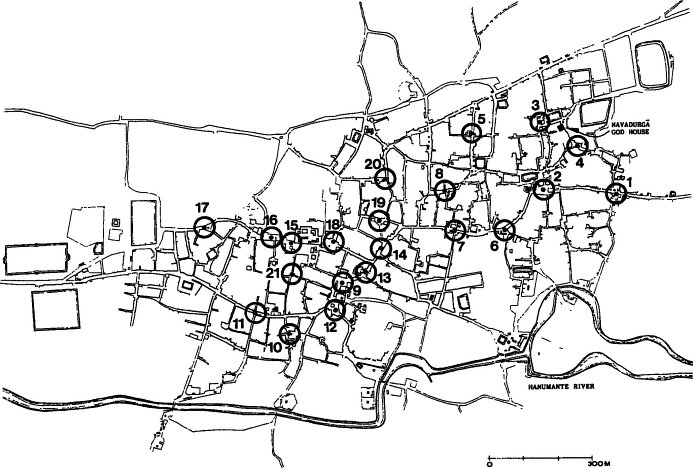
Map 14.
The sites for the sequential Nine Durgas dances dramas or pyakha(n)s within Bhaktapur throughout the year. The numbers
show the sequence in which the dances take place. Map courtesy of Niels Gutschow.
the nine months of their annual existence, the masks of the dancers and other ritual equipment are kept there when not in use in their sequential visits to the city's neighborhoods.
Taleju, Bhaktapur's Political Goddess
An integral part of Bhaktapur's Malla palace complex of buildings and courtyards30 is the temple of the goddess Taleju. The temple is approached through an elaborately decorated outer "golden gate" leading from Laeku Square, and is built around a set of inner courtyards which are closed to non-Hindus.31 Taleju was the lineage goddess of the Malla kings. As such, she was one of the many tutelary divinities of the bounded and nested units of which Bhaktapur is constructed, divinities chosen by individuals or "given them" by their guru s, lineage divinities, divinities of guthi and associations of various sorts, special thar deities, and so forth.
As the Malla king's lineage deity and located in his palace compound, Taleju became a dominant city deity as manifest in the various symbolic enactments centering on her temple, reaching a dramatic climax during the festival that most clearly and dramatically portrays the various aspects of the Goddess and their relations, the harvest festival Mohani. Taleju is the dominant goddess and, in fact, deity, of Bhaktapur in those contexts where the centrality of royal power is being emphasized. She has survived the replacement of the Malla dynasty by the Gorkhali Saha dynasty as, for Bhaktapur, a powerful symbolic representation of traditional Newar political forms and forces, one that persists alongside of the new symbols and realities of modern politics.
There are extensive legends about the introduction of Taleju into Bhaktapur combining aspects of history, myth, and explanatory speculation about local topography and about aspects of the symbolic enactments that are associated with Taleju. The sketch of a version of the story that follows is derived from a lengthy written version provided by a Bhaktapur Brahman who works as a public storyteller, and is based on his public stories. His account begins with a short summary statement situated within the secular realm, and having to do with power and politics. "The Sultan Gayasudin Tugalak," the account begins, "having gained power in Bengal, attacked the town of Simraun Gadh* . The king of Karnataka* , Harisimhadeva* , having been defeated by Gayasudin, ran away to Nepal with his soldiers and captured Bhaktapur from King Ananda Malla, who had been its ruler. Then Hari-
simhadeva* established the goddess Taleju in her [supernaturally determined] proper place in Bhaktapur. The place where the Goddess was ritually established is called the Mu Cuka [the main courtyard of the Taleju temple]. The goddess Taleju was brought by King Harisimhadeva* from Simraun Gadh* ."
Now the account abruptly shifts from legendary history to the mythic and epic realm of Hindu tradition. "Once the Yantra of Taleju had been kept in Indra's heaven. [The Yantra is the powerful mystic diagram that embodies the goddess in this account, and is the only way she is represented in this account aside from her appearance as an anthropomorphic form in dreams]. There the god Indra worshiped her properly [her proper worship is an issue in the account]." Now (to continue in a paraphrase of the account) Taleju was stolen from Indra by Meghanada, the son of Ravana* , the demon king of Lanka, in the course of Ravana's* attack on heaven. Taleju was taken to Lanka and worshiped there. When Ravana* was defeated in Lanka by Rama, the hero of the Ramayana , Rama took Taleju, in the form of her yantra , to Ayodhya, his capital in India. In time the goddess Taleju appeared to Rama in a dream and told him that be must throw the yantra in the river Sarayu, which flowed past Ayodhya because no one would worship and sacrifice properly to her after his approaching death. After five or six generations a descendant of Rama, King Nala, found Taleju's yantra in the water, and brought it to his palace, but he did not worship her properly (which would have been with blood sacrifice), and had to return her to the river. Subsequent kings of Ayodhya, Nala, Pururava, and Alarka, had the same experience, each finally returning her to the river. The kings of this dynasty, the Solar Dynasty, were finally defeated by the Mlechhas (non-Indo-Aryan barbarians).
Now the story's mode shifts into a sort of fairy tale, as it is recounted how through wondrous signs the goddess comes into Harisimhadeva's* possession, in a turn of events that will lead to Bhaktapur. Now, according to the story, King Nanyadeva, a king of the Solar Dynasty, had "lost his country" and become a servant of the Mlechhas. One day wandering restlessly here and there he happened to stop to rest at the bank of the Sarayu river. He dreamt there of a beautiful girl who said to him, "Oh, King Nanyadeva, your lineage god is in the Sarayu river. You must find her in order to worship her. I am she, your lineage goddess. Black insects will be flying around the surface of the river where I am hidden." The king awoke immediately and went to search for the goddess in the early morning. He found her by means of the black insects.
He found a copper casket. Inside it was a smaller box of gold. On the golden box was an inscription saying that it contained a hidden treasure that had been Rama's and Nala's and was to be Nanyadeva's. The treasure, contained m the box, was Taleju's yantra , that is, Taleju herself. The story then continues in its wondrous mode to recount how with Taleju's council given in a dream, Nanyadeva has encounters with wondrous serpents, hidden treasure, twelve architects, a host of workers, and a female demon (raksasi* ), resulting in the magical construction in one night of a city that came to be called "Simraun Gadh* ". The legend begins to correspond to history here.32
The story goes on to recount that Nanyadeva worshiped Taleju properly, that is, with Tantric worship and with flesh-and-blood offerings, and that after his death she was so worshiped for another five or six generations. During the time of Nanyadeva's descendant Harisimhadeva* , however, the Muslims were expanding their territories and thus came to Simraun Gadh* . Then, following the orders of the goddess Taleju, King Harisimhadeva* , having fled Simraun Gadh* , entered Nepal through the forest carrying Taleju.
Now the story begins an attempt to explain certain aspects of Taleju's cult in Bhaktapur and to record and to account for her historical displacements within and near Bhaktapur. On their trip through the forest, Taleju informs Harisimhadeva* that if no proper sacrificial animal can be found, such as a goat, then it would be permissible to sacrifice a water buffalo, an animal that had previously not been acceptable to her—and that is now the main sacrifice, along with goats, offered to her during Mohani.33 The king, having found a buffalo, then noticed a man defecating facing east (a sign that he was not of twice-born status) and selected him to kill the buffalo.34
Then, the story continues, Harisimhadeva* came to Bhaktapur and became king. He established the goddess Taleju in the "Agnihotra Brahman's" house in Bhaktapur. (This is her present site. "Agnihotra Brahman" refers to a particular Rajopadhyaya Brahman; see below here and chap. 9.) The story now moves backward a little in time to tell of the prior search for the proper location. Taleju has told the king that the proper place for the installation will be known when a hole is dug and the soil removed from it will, upon being returned to the hole, fill it exactly to the surface. The story tells of the various places where Harisimhadeva* tested the ground unsuccessfully. First he tried in the village of Panauti (just outside the Kathmandu Valley, to the southwest of Bhaktapur). "He dug there in the Dumangala Twa:." The soil did not
fill the hole. Nevertheless he established a temple to her there (from the point of view of Bhaktapur and this story, a secondary temple). "The people of Panauti still say that the goddess Taleju came to Dumangala from Simangala, which is Simraun Gadh* ." Next he began to dig in Bhaktapur, first at the Dattatreya temple area in northeastern Bhaktapur. This time the soil overflowed the hole. He then went to dig in a "garden," called "Megejin," but the replaced soil overflowed the hole. He went on to the Kwache(n) Twa: in eastern Bhaktapur (where there is now an important Bhagavati temple associated with Taleju), but this also proved not to be the proper place. Finally he went on to the home of the Agnihotra Brahman, in the area of the present Laeku Square. Here he dug, and the soil exactly refilled the hole. "Therefore the king established the goddess Taleju in that place."
The story now introduces another theme, which seems to echo some now obscure past events, perhaps the establishment of a new group of Royal Brahmans (see chap. 10). The Rajopadhyaya Brahmans who had lived in the place did not want to leave their homes. King Harisimhadeva* gave them money and a substitute house. This substitute house still exists; it is still called the palisa che(n) or palsa che(n) , literally "substitute house." The Agnihotra Brahman (whose name in the story is "Agnihotra") was a Tantric practitioner. He did not want to leave his family land, even if he were given money and a substitute home, he was not a greedy man. He always sat on Chetrapal Bhairava's stone (an area-protecting "stone god" in the Taleju main courtyard) which was then bordered by four stone pillars, each with an image of Ganesa* and Durga. The Brahman wanted to kill himself rather than leave his own ancestral home. King Harisimhadeva* finally chased Agnihotra away from his ancestral home by force. Agnihotra committed suicide in his temple there, a temple of Siva (Mahadeva), because he had lost his public prestige. Agnihotra became a ghost (preta ) because he had killed himself. The ghost gave Harisimhadeva* trouble every day. Thus, Harisimhadeva* had the Siva temple entirely destroyed. He then did the necessary pacifying rituals.
Then, the story concludes, the four pillars with the Ganesa* images were sent to various places. One, a dangerous form of Ganesa* , was placed at the left side of the Golden Gate (the entrance to the Taleju temple complex). Another is at Bidya pitha (Tripurasundari's pitha ). Another was brought to the Indrani* pitha .35 (Our story doesn't mention the fourth pillar.) Then, the story concludes, "In the Beko courtyard (the courtyard just outside the inner gate and compound of the Taleju
complex) the Bhairava Chetrapal stone where that Brahman used to sit exists, still, until now."
It seems likely that Taleju had, in fact, been introduced to the Kathmandu Valley from Mithila, although not by Harisimhadeva* , who never reached it (chap. 3), and that the pressures of the Turkish Muslims on Mithila with the consequent movement of Maithili Tantric Hindus into Nepal contributed to the subsequent importance of the goddess and of Tantrism to the valley. Slusser summarizes the historical evidence as follows (Slusser 1982, vol. 1, p. 318):
That Taleju's cult in the Kathmandu Valley antedated Harisimhadeva* is documented history . . . but Taleju appears to have been held in high regard in that country [Mithila], and it is not improbable that she was the tutelary of Nanyadeva's dynasty. She was almost certainly well-known to Harishimha's* queen, the omnipotent Bhaktapur refugee, Devaladevi. It is abundantly clear that Taleju was favored by Sthitirajamalla [Jayasthiti Malla] and with his subsequent eruption into the affairs of Nepal Mandala* , the goddess was apparently raised to an eminence she had previously not enjoyed in Nepal. As we know, on Sthitimalla's visit to Patan, the fractious nobles made haste to please the new Valley strong man by restoring the run-down temple of Taleju. . . . That many of the Newars associated with Taleju's cult claim Maithili descent [as do the Rajopadhyaya Brahmans of Bhaktapur] is also suggestive of the deity's ties with Mithila.
Whatever its historical relevance, the story as it is still told in Bhaktapur also suggests some special aspects and qualities of this particular goddess in the domain of Bhaktapur's goddesses. She is located first in a traditional Hindu heaven, in contrast, say, to the members of the Nine Durgas troupe whose legends identify them first as forest-dwelling demonic figures (chap. 15). She is the favorite goddess of a particular god; as a divinity's divinity, this places her in a hierarchy—her devotee is a figure remembered as the "king" of the gods. Her subsequent history is associated with invasions, thefts, and dynasties, and with politics and power struggles. From the start she is embedded, available for use by humans and quasi-humans, in a concrete form, a diagrammatic representation on a piece of metal. The form when properly worshiped is protective. The proper worship is Tantric with blood sacrifice. This captured divinity, with its history and functions relating it to power, belongs to a political dynasty, a legitimate form of power. The legend associates it not only with Indra, but with Rama, an avatara of Visnu* , a divinity closely associated with Newar (and Hindu) royalty and with
civic moral order. When Taleju was established in Bhaktapur, she necessarily took precedence over other deities with similar political claims, which may perhaps be part of the significance of the displacement of the Agnihotra Brahman, the destruction of his Siva temple, and his suicide.36 We may note that in contrast to other forms of the Goddess, Taleju is not conceptually related to and in a sense dependent on Siva, but is the Tantric goddess as independent and self existing and fully powerful.
Taleju is kept in a secret inner part of the Taleju temple. The nature of her image is also secret. Only a very few Rajopadhyaya Brahman priests from households traditionally providing Taleju Brahmans, and who have special initiation are allowed to see the image. Outsiders generally follow the description in the legend and assume that it is a yantra . Hamilton was also told at the beginning of the nineteenth century that "there is no image of this deity which is represented by a yantra " ([1819] 1971, 210f.).37 In worship in the Taleju temple, Taleju is represented by various forms—yantra , the metal vase-like container called the Thapi(n)ca (or alternatively Ku(n)bha, a vessel that also represents the true Devi pitha goddess, Guhyesvari), sometimes by a metal vessel with a pouring spout (a Kalas), and sometimes by an anthropoid image.
Like most of Bhaktapur's component organizations the Taleju temple has its esoteric internal ceremonies and public external ones related to the larger city organization. The internal functions center around the worship of Taleju by her attendant priests38 during the course of the year. Many of these take place during city-wide calendrical festivals, but there are some thirty-five important annual internal worship ceremonies unconnected to external urban events. Many of these commemorate Taleju's functions as the Malla kings' lineage goddess. These acts of worship or puja s are called tha (Kathmandu Newari tha ) puja , or tha taegu , "elevation worship," or "elevation producing and maintaining" acts. Tha taegu is thought of as a kind of initiation, dekha (chap. 9). It lacks some features of a full Tantric initiation, and is sometimes thought of by those who have such full initiation as a baga dekha , a "half-full" initiation. Those tha puja s that commemorate the Malla king and, in fact, treat him as if he were still present, take the Malla king (represented by a priest) through three successive levels of initiation, during each of which he is presented new mantra s, new secrets, and new instruction on ritual procedures. There are other tha puja s as well as full initiations given at Taleju, all necessary for Taleju temple's internal functions. These are necessary not only for the staff and for the
"king" but also for all those for whom Taleju is in one way or another a special deity. Descendants of the Malla kings, that is, members of the present Malla and Pradhananga* thar s, have Taleju as their lineage goddess, and male thar members have some of their initiations at the Taleju temple, although they do not receive the highest levels of initiation in Taleju's mysteries. Those are reserved to the chief Taleju Brahman. He is considered to be the surrogate for the Malla king in many rituals, and the king was entitled to higher levels of initiation than his male kin and descendants (who are furthermore now considered by the priests to be no longer "pure Mallas"). The Taleju principal priests who were the king's guru s, had even higher levels of initiation than the king himself, a fourth level, one beyond the Malla king's three. Taleju is also the object of special devotional rituals of the other temple priests. She is considered a sort of lineage goddess for them, in the limited sense that the temple priesthood is inherited in their families' lineage. All these priests also have in all other contexts another Tantric lineage divinity, for ordinary family rituals and rites of passage (see below and chap. 9).
In addition to the two thars of Malla descendants and three priestly thar s attendant at the temple, there are about twenty thar s throughout the macrostatus system, some of whose members (as we have noted in chap. 5) have some special assigned ritual function at some time or other during the year at the Taleju temple. Many of these people must be given tha taegu initiations, in which they must swear secrecy about their duties and about what they see in the temple.39
Taleju's external function is uniquely important to the Tantric component of Bhaktapur's symbolic system. Through her priests and by means of her mantras , she is understood by initiated practitioners to empower all city-level legitimate Tantric procedures in Bhaktapur.40 The Brahman Taleju priest is in this context considered the ultimate guru of all who have Tantric power. Some of this power must be transmitted annually. For the rest, the great majority, such as the special knowledge and efficacy of various Tantric priests (chap. 9), or the effective ritual knowledge of the people who make religious paraphernalia, it is said that the special knowledge, initiation, and mantras were originally given to ancestors by a Taleju priest, but then passed down within the family or the thar from father to son or guru to student in repeated internal initiations.
Taleju's external relation to the city is manifested and enacted at length in the course of the harvest festival, Mohani. In the course of this festival Taleju, as we shall see (chap. 15), is brought into relation with
several forms of the Goddess—with all the Mandalic* Goddesses, with Kumari (as another deity than the similarly named Kumari of the Mandalic* group of goddesses), with the Nine Durgas group of deities, and with the Goddess Devi herself in her form as Bhagavati. In this festival Taleju is seen as participating in the basic myth of the Dangerous Goddess and, in fact, temporarily becoming Mahisasuramardini herself (chap. 15). During Mohani, Bhagavati/Taleju represents the maximally powerful and full form of the Goddess. This maximal Taleju then becomes manifest in certain ways, controlled and mediated by her temple priests. She possesses a maiden to become manifest in the form of Kumari, in which form she can give oracular advice to kings. She provides the mantra that empowers the partial forms of the Nine Durgas troupe to begin their annual nine-month cycle of manifestations of the Goddess throughout the city. Taleju is a central focus in the interrelated set of symbols and symbolic enactments associated with the dangerous deities of Bhaktapur.41
Bhagavati
In her anthropomorphic representations Taleju is usually represented as a form of the goddess that people in Bhaktapur in other contexts identify as "Bhagavati." This is a female form with many arms, clearly a dangerous goddess, but lacking any further identification (through location or specific iconographic features) as one of the "partial" goddesses.42 The representation identified as Bhagavati is also very often (in both temple and household images) that of the Devi of the Devi Mahatmya account in the form of the slayer of the buffalo Asura, that is, as Mahisasuramardini.
Bhagavati is a traditional title for what we have been calling the full goddess. She is equivalent to "Devi," to "Sakti," to "Prakrti* " (Mani 1974, 113). For people in Bhaktapur, however, Bhagavati is a separate goddess, a divinity in her own right. She has three temples. All of them have Taleju staff priests as temple priests, and are closely connected with Taleju's internal rituals. One of these is housed at the Natapwa(n)la ("Nyatapola") Temple (fig. 10), a large five-tiered temple, one of the most striking traditional buildings in Nepal. The Natapwa(n)la goddess is in the same square as the main temple of the city's major male dangerous divinity, Bhairava, with whom she has an esoteric connection for the purpose of "controlling him." The story of the temple is presented in one of the chronicles (Wright [1877] 1972, 194f.):
Bhupatindra* Malla built [in Bhaktapur] a three-storied temple, the length of which ran north and south, and placed in it, facing west, a Bhairava for the protection of the country, and the removal of sin and distress from the people. This Bhairava gave much trouble, and the Raja ,n consequence consulted many clever men, who told him that if the Iswari [goddess] of the Tantra Shastra [texts], whom the Bhairava respected, were placed near him, he would be appeased. He therefore, at an auspicious moment, laid the foundation of a five-stoned temple. . . . The pillars were of carved agras wood, and there were five stones of roofs. This temple is the most beautiful, as well as the highest in the whole city. In building it the Raja set an example to his subjects by himself carrying three bricks, and the people brought together the whole of the materials in five days. When the temple was finished he secretly placed in it a deity of the Tantra Shastra, who rides on Yama-raj whom no one is permitted to see, and who is therefore kept concealed.
This goddess has a secret name and form, and is supposed by some experts to be "Siddhi Laksmi" However, she is known publicly as "Bhagavati." The two other Bhagavati shrines in addition to their use by Taleju Brahmans have some local worshipers.
Bhagavati has only one minor processional festival, which had been inaugurated in Bhaktapur only some ten or fifteen years before this study. In spite of this sparse representation in public space, however, Bhagavati is one of the principle divinities of Bhaktapur. She is the most common local name for the goddess in her full power, in the form where she has incorporated the power of all lesser forms of the goddess. She is thought of as a warrior goddess, as most clearly portrayed in her Mahisasuramardini representation and legend (see section on principles of classification of dangerous goddesses, below). Her main concrete presence is in the household. Bhagavati is the name and form of the household image in which the Dangerous Goddess is worshiped in home puja s as one of the group of household gods. She is at the focus of home worship during the important household ritual components of the Mohani festival. Bhagavati is also the main deity worshiped in many Tantric puja s. She is also the secret Tantric family goddess, aga(n) dya: , of the majority of upper-status households (chap. 9). For Bhaktapur's people Bhagavati is the city's main protective goddess when they are thinking of the city as a whole, rather than the protection of its boundaries. For the Taleju priests she is sometimes conceived of as "Taleju's older sister," because they believe she long preceded Taleju in Bhaktapur's history and in legendary status. But she is also alternatively conceived of by them as Taleju's "assistant," for she protects the city at Taleju's wish and direction.
Miscellaneous Dangerous Goddesses
There are some dangerous goddesses in Bhaktapur of circumscribed present importance. Some of these are auxiliary forms associated with Taleju in the Taleju temple, and others are goddesses located elsewhere in the city, where they have some specific and limited functions.
Taleju temple contains a number of Tantric images of various degrees of secrecy. These include Mahesvari (whom we have mentioned above) represented by a stone, Guhesvari considered as secondary to the major Guhyesvari Devi pitha goddess at the Pasupatinatha shrine, and Dui Maj.. Dui Maju is said to be the goddess of an internal pitha in Taleju temple, and to be "Taleju's own pitha goddess." In the Padmagiri chronicle Dui Maju is said to be the lineage deity of a "caste" of Maithili invaders, and to have helped King Nanyadeva take possession of Bhaktapur. In time, the account says, when Harisimhadeva* in turn captured Bhaktapur as "he had received immense wealth from Dwimaju Deva whom he regarded as his Penate [lineage god] [he] established a Devali Puja [lineage puja ] to her" (Hasrat 1970, 50, 52). The dim reflection of some historical reality distorted in the chronicle, and the special esoteric position of Dui Maj. now in Taleju temple suggest something of her possible historical identity.43
Another important esoteric form associated with the Taleju temple is Ugracandi, who is represented in some of the events there during Mohani, and who is thought by some to have an esoteric relation to the Nine Durgas.
There are some goddesses represented in the collection of shrines and temples built by the Malla kings in proximity to their palace, which we will discuss below as "gods of the Royal Center." The two goddesses in this group, who have no relevance to the rest of the city, are Baccala44 and Annapurna* .
Of the few miscellaneous goddesses scattered throughout the wider city, some have special functions, and others had some past function and meaning and are now dimly remembered as a shrine or image that has some residual power. Kulachimi (or Ku Laksmi) (located in the Tulá che(n) twa: ), identified as Laksmi's* "older sister," is considered to be a "bad god."45 She is worshiped daily by an assigned temple priest, probably, in a pervasive idea about such deities, to keep her from doing harm.
The Palu(n)palu(n) goddess, identified with Kumari and represented by a stone, is located in the Inaco Twa:. It was popularly used in the past as part of a curing ritual for children—rice held first to a sick
child's head, was then brought to this shrine and offered to the goddess.
Sitala (Newari Si:tala), a goddess of frightening mien whose vehicle is a donkey, is found at the river at Hanman Ghat* . She is the goddess thought to have been efficacious for curing or preventing smallpox. On the twelfth day46 after the first signs of infection people went there to pray for cure and for protection from disfigurement. She is a well-known goddess in South Asia and can produce smallpox as well as cure it (Stutley and Stutley, 1977, 278; Slusser 1982, vol. 1, p. 328). Bhaktapur's Sitala has a broken nose, reportedly broken by a father whose son died in spite of his prayers.
Another goddess with curative functions is represented by a hole with a stone at its bottom in the Inaco Twa:, which is identified as Balkumari. People go here to pray for the cure of someone with a bleeding nose or who is coughing up blood.
In the Sukhu Dhwakha neighborhood there is a goddess called the "Durupo" or "Durupwa:" goddess, literally the "breast" goddess. She is also considered to represent Draupadi, the wife of the five Pandava brothers of the Mahabharata epic, and to be at the same time one of the ten Tantric goddesses of the Mahavidya. These varied attributions attest to her historical interest, but she now has no function or worship. Another such historical remnant is the Tantric goddess, Chinnamasta, also one of the Mahavidya, but of no present significance.
Dangerous Goddesses: Some Principles of Classification
After we have introduced the remaining classes of divinities, we will attempt to distinguish some of the important contrasts among the classes that are made use of in Bhaktapur to build a symbolic order. In this section we will introduce some of the "ordering potentialities" of the dangerous goddesses. They share most of these with the dangerous male divinities, but as the goddesses are a much more numerous and salient set and as they have some distinctive features of their own, they warrant discussion at this point.
Although Bhaktapur selects aspects of the goddesses as they are portrayed in South Asian tradition for its special purposes, it follows closely the ideas and specific forms (as we have seen in the placement of the Astamatrkas* , for example) presented in the Devi Mahatmya .47 We can therefore begin with some passage from that text that convey these ideas. The Devi Mahatmya describes in various ways what we may call a maximal or full form of the goddess (see fig. 13) whose power is in the
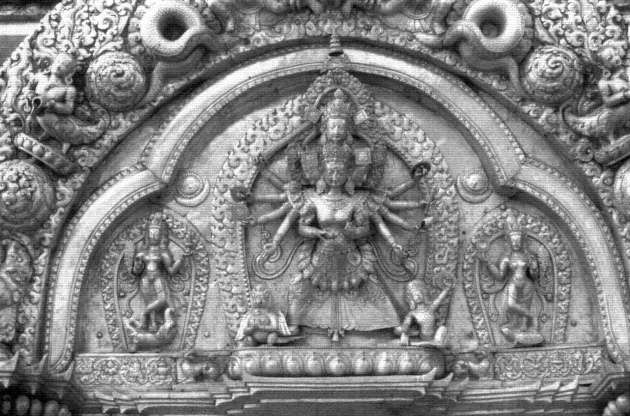
Figure 13.
The Goddess in her supreme manifest aspect.
concentration of other divine principles, principles that are partial in relation to the full form. (Devi Mahatmya , II, 9-17; Agrawala 1963, 45f.):48
From the face of Visnu* filled with intense indignation as well as from that of Brahma and Siva sprang forth fierce heat. From the bodies of other Devas also headed by Indra issued forth a resplendent luster. All this light became unified into one. The Devas saw in front of them a Pile of Light blazing like a mountain whose flames filled the whole space. Then that matchless light born from the bodies of all gods gathered into a single corpus and turned into a Woman enveloping the three worlds by her luster. Her face was produced from the light of Siva, her hair from that of Yama, her arms from the luster of Visnu* , her breasts from that of the Moon; her bust from that of Indra; her thighs and legs from that of Varuna.
The Devi Mahatmya goes on to list the derivation of other parts of her cosmically inclusive body. In this particular description she is being generated to fight a demon who has also, significantly, concentrated power of other more limited divinities into himself, and is thus beyond the control of any of the ordinary gods. Mahisha, the king of the Asuras, had "taken over the authority of Surya, Indra, Agni, Vayu, Chandra, Yama, and Varuna* as well as other gods. The wicked Mahisha has turned out all the gods from heaven who are now stalking their life like mortals" (Devi Mahatmya , II, 5, 6; Agrawala 1963, 45).
For another battle against the Asuras, the Goddess absorbs into herself the other dangerous goddesses, themselves the emanations or Saktis of gods, who had fought together in an earlier battle. The Asura Sumbha taunts the Goddess for winning a battle with the help of these other goddesses (Devi Mahatmya , X, 2-5; Agrawala 1963, 123):
O Durga, you are puffed up with the pride of strength. Do not be haughty, you are exceedingly proud but fighting with the strength of others. The Devi said: "I am all alone in the world here. What other is there besides me, O you wild one. See that these goddesses are my own powers entering into myself." The Rishi said: "Then all those Matrka* , Brahmani and others, became absorbed in the body of the Goddess. Thereupon Ambika alone remained." The Devi said: "Through my power I stood here in many forms; all that has been withdrawn by me [into myself] and now I stand alone."
In still another passage the full Goddess is represented as springing directly from the body of Siva's consort, the benign goddess Parvati (Devi Mahatmya , V, 38-40; Agrawala 1963, 85):
O Prince, while the gods were thus engaged in invoking the Goddess through praises and m other ways, Parvati came there to bathe in the waters of the
Ganga* . She of the lovely brows said to the gods, "Who is being praised by you here?" Then sprang forth from her physical sheath Siva Kausiki [an appellation of the goddess] who replied, "This hymn is being addressed m me by the assembled gods vanquished by the Asura Sumbha and routed m battle by Nisumbha." Because that Goddess came out of Parvati's bodily sheath, she is sung as Kausiki amongst all men.
It is important to note here that the benign goddess Parvati seems, as Lynn Bennett puts it in a comment on this passage, "unaware of her powerful war-like ego"—and that after the Dangerous Goddess appears "Parvati withdraws and has no part in the ensuing battle scenes" (1983, 268). The Dangerous Goddess seems, however, to be aware of Parvati. The Goddess as portrayed here can absorb other subsidiary goddesses into herself, can emit subsidiary goddess forms, and is capable of taking different forms at her own full level.
The Devi Mahatmya also deals with the Goddess in another and very different way as the ultimate creative force. Here she is no longer produced by Siva or the other gods, or through a transformation of Siva's consort. The Goddess as creative force is the subject of some of the stotras , the hymns of praise, to the Goddess, which introduce and intersperse the accounts of the heroic cosmic battles of the Devi Mahatmya . Here she is called simply Devi, Goddess, or sometimes Mahamaya, the generator of the concrete and illusionary forms of what is taken to be reality, who "forcibly seizes the minds of even those who have knowledge and leads them to delusion. . . . This animate and inanimate world is created by her. . . . She is supreme eternal knowledge being the cause of moksa* [escape from delusion]. . . . She is eternal having the universe as her form . . . the supreme knowledge, the supreme power, the supreme mind, the supreme memory and the great delusion . . . the giver of manifest form to the gods Brahma, Visnu* and Siva . . . the supporter of the world, the cause of its maintenance and dissolution" (Devi Mahatmya , I passim; Agarawala 1963, 37-43). Devi in this aspect has various titles or equivalences besides Mahamaya, such as Sri, Isvari, and Prakrti* . These titles and names are different than those given to the "manifest" goddesses, either full or partial. This cosmic creator Goddess is referred to in Bhaktapur; for example, she is represented in the central point of the city as a mandala* under her name of Tripurasundari. But much more salient to Bhaktapur is what we have called the "full goddess," the manifest form of Goddess, who is different from the creator Devi of the stotras .
This form, the central protagonist in the drama of the Devi Mahat-
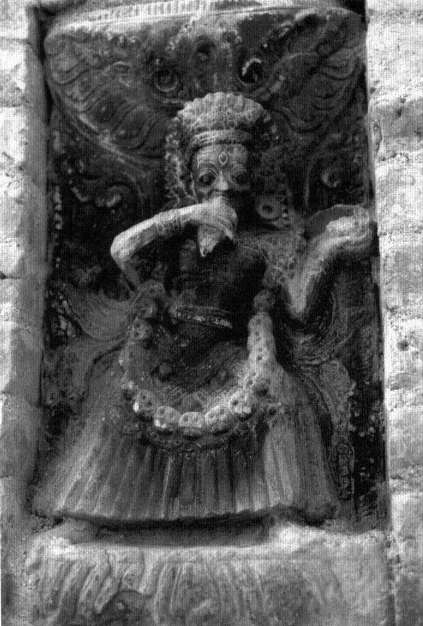
Figure 14.
The Dangerous Goddess in her horrible form.
mya , is manifest at a position in space and a moment in time, albeit mythic space and time. This is the goddess who combines the forces of all the other and separate divinities, who freely yield them to her for their defense. As she fights for the defense of the divine order, she is described as a warrior, "filling the three worlds with her splendor, bending low the earth with the force of her strides, scratching the sky with her pointed diadem, shaking the nether worlds with the twang of her bowstring and standing there filling the ten directions of space with her thousand arms" (Devi Mahatmya , II, 37-38; Agrawala 1963, 51). In the Devi Mahatmya this full form of Devi is most commonly called "Chandika." However, she is given various other names and titles, such as Ambika, Bhadrakali* , Mahadevi, and Durga. She also shares some appellations with the creator Goddess such as Sri and Prakrti* . The full form has as her vehicle a lion. In some battles Chandika fights as herself, but in others she emits another form, Kali, who has a terrifying aspect and who does the fighting. This special terrifying form has a description which is repeatedly represented in Bhaktapur's art, icons and masks, and which is of great ritual importance (Devi Mahatmya , VIII, 5-8; Agrawala 1963, 98):
Kali of terrible countenance [see fig. 14], armed with a sword and a noose, carrying a . . . skull-topped staff decorated with a garland of human heads, clad in a tiger's skin, looking terrible . . . [with] emaciated flesh, with a widely gaping mouth, . . . with lolling tongue, . . . deep sunk reddish eyes, and filling the quarters of space with roaring voice, she impetuously fell upon the great Asuras, killing them and devoured the army of those enemies of Devas.
In some passages Chandika fights alongside of Kali (e.g., VIII, 52-62). Yet, repeatedly in the Devi Mahatmya Chandika gives orders to Kali, and confers praise and titles on her. Kali in this account is not just an aspect of Chandika; she is a subordinate, a more limited, more specialized being.
A rank still lower than Kali, still more limited and discrete in their forms are the Matrkas, the gods' Saktis, who fight in one episode alongside the Goddess as Chandika. Kumari fights with her spear, Brahmani by throwing water that is given power through her mantras , Mahesvari with a trident, the boar-goddess Varahi with her tusks, and so on (Devi Mahatmya , IX). However, as the stotra that follows this account (which we have quoted above) insists, these various Matrkas are all aspects of the one Goddess, Devi.
These relations of whole to part allow for the two dimensions of
classification that we have suggested in relation to spatial units, and, following the approaches of others, in relation to social hierarchy. The whole includes the part, but may emit it in some way so that the part can be considered as a unit in itself. In this case the part and the whole are in a vertical relationship, share some of the same qualities, and are hierarchically arranged, with the whole superior to the part. Furthermore, the whole tends to be more abstract and less specified, whereas the parts is more concrete and more specialized in its function and meaning. This arrangement also allows for horizontal relations because entities at the same level of inclusiveness are equal to each other. We have noted a distinction in the Devi Mahatmya of the full goddess Chandika from a cosmic creative Goddess of a still higher order, the absolute divinity prior to all manifestation. The manifest form of the Goddess in her full power was differentiated from the cosmic form in name, and sometimes was described as a form created by the male gods in concert. Bhaktapur's city religion puts four goddesses in different contexts at the same highest level (and makes no use of a distinction between the rank of a cosmic and a full manifest goddess). Two are related in tradition to names of the creator Goddess, Tripurasundari and Mahalaksmi* (who is a supreme goddess in her context as the Nine Durgas' own deity). One refers to the full manifest form of the Goddess—Bhagavati in Bhaktapur's usage. The fourth, Taleju, is both in her legend a god's god (and thus in a rank above "ordinary" gods) and also, through her participation in the symbolic dramas of the harvest festival, a version of the fully manifest warrior goddess.
Three of these goddesses, Tripurasundari, Mahalaksmi* , and Bhagavati, show their equivalence by having as their identifying Vahana or "vehicle" the lion, as does the manifest Devi in the Devi Mahatmya . So do, significantly, the two goddesses within the Taleju temple who are thought to be royal or warrior deities absorbed by Taleju, namely, Dui Maju and Manesvari. Taleju is, however, popularly said to have a horse vehicle. This probably refers to the white stallion that is used during the procession of Taleju during the Mohani festival. Slusser suggests plausibly that this white horse derives from the "sanctified horse required in ancient Indian coronation ritual, as it was in ancient Nepal, and is in the coronation of the kings of Nepal today" (1982, vol. I, p. 317). Whether the horse is considered the vehicle of the goddess in her Yantra representation is dubious, but that vehicle is an esoteric secret.49 The other dangerous goddesses, like the other ordinary goddesses, have each their own particular vehicle. Vaisnavi* has (like Visnu* ) the half-bird Garuda* ,
Varahi, a water buffalo; Indrani* , an elephant; Brahmani, a goose; and Mahesvari, a tiger. The ordinary goddess Sarasvati, like Brahmani (because of her traditional associations with the god Brahma, whose vehicle it also is) has a goose vehicle.
There is one figure whom we encountered in the Devi Mahatmya as the special agent of the full manifest goddess Chandika. This goddess, Kali in the Devi Mahatmya , is in Bhaktapur called "Mahakali." She represents the most frightening form of the Goddess and is used as such in the powerful symbolic enactments of the Nine Durgas group. Here she is below the full Goddess (as the Nine Durgas' supreme goddess Mahalaksmi* ), but in a superior position to the remainder of the goddesses in the group. This Mahakali is a flesh-devouring, blood-drinking, intoxicated, cadaverous form. She has a male equivalent, whose consort she is, the god Bhairava, whom we shall discuss below. Mahakali does not have the full goddess' lion vehicle. Her vehicle is an anthropomorphic male form, supine at or under her foot, which is locally identified as a Kali preta , a kind of dangerous spirit.
The lesser goddesses are thus distinguished from the full manifest form, the Devi, in several ways. They are sometimes literally described as a(n)sa (Sanskrit, a[n]sa ) Devi, as "partial Devis." "Partial," we must emphasize, has a particular meaning here. It does not mean imperfect, but more concrete and more specialized, and in being more specialized, therefore limited. The lesser goddesses as a group are generally of equal status, although in some domains, such as the Nine Durgas, some of them may have special salience. In a few contexts a form that is a full goddess in another context may be conceived of as a partial goddess. This is the case of Mahalaksmi* as one of the peripheral Mandalic* Goddesses, and of Tripurasundari when she is thought of as only the central mandalic* area's protective local goddess, and not the concentrating center of the mandala* . However, in these two particular contexts, while goddesses may be treated in more limited ways, the reverse, the treatment of a limited goddess as a full goddess, does not occur. Each of the full goddesses is located in a different context, within which are clustered her own dependant partial goddesses, in the cases where these exist. Relations and equivalences among the full goddesses in the various sets, horizontal relations, are signaled in various ritual actions. All of the relations between the full goddesses are enacted during Mohani, which is one of the reasons that the festival will be of special interest to us (chap. 15). Finally we have noted the barrier between Parvati and the forms of the Goddess we have been considering here. The same barrier
separates the other "ordinary" goddesses from the Goddess. They belong to a civic, although heroic, sunlit world, she to a peripheral world of shadows.
The dangerous goddesses are used in differentiated ways to create a structure to represent and create order in Bhaktapur. This must be emphasized in the face of a tendency within the Tantric segment of Newar religion to absorb and blend all divinities, particularly the goddesses, and such resulting claims as David Snellgrove's that "there is no need for us to follow the development of these different goddesses, for they all tended eventually to accord with one basic form, that of the Great Mother Goddess, in whom they all more or less lost their separate identities" (1957, 81).
Dangerous Male Gods
There are a few male divinities in Bhaktapur who must be offered meat and alcoholic spirits, and who have frightening representations. Compared to the female dangerous divinities, they are fewer in kind, much less systematically related, and of more limited civic function. In another contrast with both the dangerous female divinities and with the ordinary gods, the male dangerous divinities seem to be further from the classical traditions of South Asia, comparatively more locally adapted and transformed. For that reason we prefer to use their local names, rather than the names of their distant classical ancestors. We have already mentioned that Ganesa* may be a dangerous divinity when he is used to "enter" and give siddhi to the worship of a dangerous divinity, usually in Tantric ritual. In addition there are three exclusively dangerous male divinities who are prominent in Bhaktapur's urban religion—Bhisi(n), Nasa Dya: and a somewhat complex category, Bhaila Dya:.
Bhisi(n) (Bhima)
Bhisi(n), or Bhisi(n) Dya:, "Bhisi(n) God (see fig. 15)," as he is usually referred to, is related tenuously to the Mahabharata's epic hero, Bhima or Bhimasena, one of the five Pandava brothers. He is included in most households' sets of gods (discussed below), but he is in Bhaktapur the special divinity of shopkeepers.50 He has three major city shrines, two of which are significantly located along that portion of the city festival route that follows the bazaar. The third one is just to the south of the
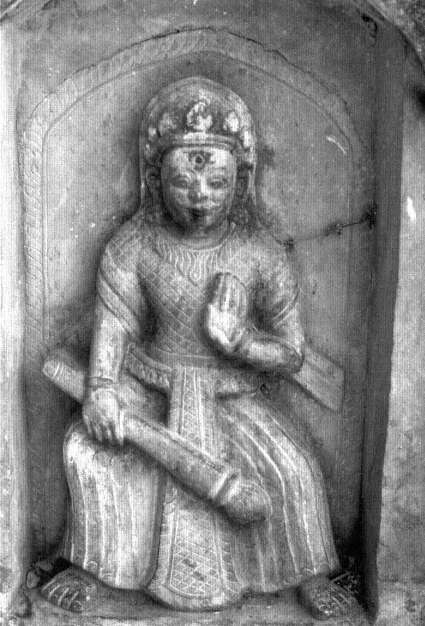
Figure 15.
The merchants' special deity, the Bhisi(n) God.
city. Shopkeepers worship him at home and in his temples for good fortune in their commercial affairs. He is also the focus of one annual festival, centering on the temple of Suku Bhisi(n) Dya: in Dattatreya Square in the northeastern part of the city. Representations of Bhisi(n) show him as a powerful man with a full moustache, usually subduing a kneeling vanquished figure, said to be the epic's Kaurava King, Dussasana.
Slusser notes D. R. Regmi's claim (1965-1966, part II, p. 612) that the earliest reference to Bhisi(n) in the Kathmandu Valley is 1540 A.D. , and remarks that all of his images are works of the late Malla period, suggesting a relatively recent (in terms of Newar history), introduction of the figure as a separate god, independent of his position as one of the five Pandava brothers. How he became a god of commerce is unclear. Slusser surmises that he may have been "first associated with the fields as a heroic guardian figure, and later, by extension, guardian of the granary and of trade" (1982, 258f.). It is not clear whether any of the special characteristics of Bhima as portrayed in the Mahabharata, where he is a kind of marginally socialized figure of great strength, facilitate his semantic appropriateness for the merchants. One may, perhaps not entirely frivolously, note the following. When Bhima fought and killed the Kaurava King Duryodhana "the two were well matched, but when Bhima was losing he struck an unfair blow with his mace, thus disregarding an ancient rule that a blow should never be dealt below the navel. This blow broke his adversary's thigh, and hence his epithet Jihmayodhin, the 'unfair fighter'" (Stutley and Stutley 1977, 45). Whatever his specific appropriateness to commerce may be, there are considerations that make a dangerous god more appropriate to the sphere of commerce than an ordinary god, as we shall argue in the summary section of this chapter.
Nasa Dya: (Nrtya* Natha)
Throughout Bhaktapur are a large number of shrines associated with a divinity locally called Nasa God, Nasa Dya:. Niels Gutschow mapped twenty-one of these shrines in a 1975/76 survey (personal communication). Of these, one in the southwestern part of the main festival route is considered the main one, and is a center for sacrifice and worship to him. Nasa Dya: gives skill and effectiveness to public performers; thus people who are to take part in dance or drama or musical performances pray and offer flesh and alcoholic offerings to Nasa Dya: before the
performance. Similarly people who are learning one of the performing arts, including those whose traditional thar profession is music of one kind or another, worship Nasa Dya: in the course of their training. Jugis, for example, on the completion of their formal study of their special musical instrument, a double-reed woodwind, make a flesh and alcohol sacrifice to Nasa Dya:" Nasa " means grace and skill in social as well as "artistic" performances. Someone who has nasa is "cultivated, delightful in social intercourse, . . . entertaining, the life of the party" (Manandhar 1976, 253). Thus people also worship Nasa Dya: for such social skill. Nasa Dya: is represented by holes in the wall of a shrine (or often in private homes). These may be single or in sets of three, and of various shapes, sometimes as triangles with the apices pointing downward. Brahmans identify Nasa Dya: with the South Asian Siva in his aspect as Nrtya* Natha Raja, the "Lord of the Dance," but there are probably no shrine images of him in this form in Bhaktapur. Mary Slusser had identified one such image, of "exceptional interest" precisely because of its unusualness, in the Pasupatinatha shrine complex (1982, vol. 1, p. 233, n.76; vol. 2, pl. 356). She notes that most Nasa Dya:s "are inconsequential images . . . or they decorate the toranas* [decorated arches placed above major shrine icons] of Siva temples" (1982, vol. 1, p. 233, n.76). Like Bhisi(n) Dya:'s relation to Bhima, Nasa Dya:'s to Nata Raja is very distant.51
Bhaila Dya: (Bhairava)
Bhaila Dya:, "Bhaila God," the Newar version of the Hindu deity Bhairava (see fig. 16), is a divinity, or group of divinities, whose images, supremely dramatic in some of their anthropomorphic representations, are widely represented in Newar communities. In the Puranas* Bhairava is sometimes a son of Siva and Parvati, sometimes an emanation emitted by Siva when infuriated. The Newar's Bhairava is associated with this emanation. In his anthropomorphic form he is represented with fangs, bulging eyes, dark blue or black coloring, carrying destructive weapons in his many arms, and wearing garlands of shrunken decapitated heads or skulls. He is thus an iconographic male equivalent of the Kali or, for Bhaktapur, Mahakali aspect of Devi. Bhaila Dya: is also present in a vague nonanthropomorphic form. Here he is a spirit-like creature who is located at or below the surface of the ground—in the cremation grounds or within the city in association with certain powerful natural stones. Finally he is theoretically related to the genesis and classification
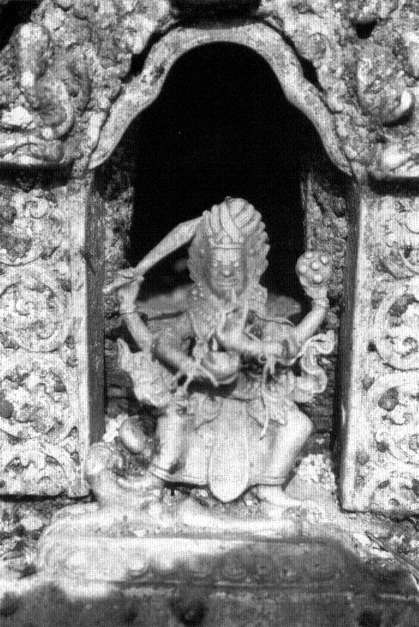
Figure 16.
An image of the dangerous deity Bhairava in front of the city's main
Bhairava temple.
of the other dangerous male deities who are in certain contexts considered as "kinds" of Bhaila Dya:s.
The anthropomorphic Bhairava has two main presences in Bhaktapur, Akasa (Sanskrit akasa ) "Sky," Bhaila Dya: and as the Bhairava of the Nine Durgas cycle. The Akasa Bhaila Dya: is housed in one of Bhaktapur's major temple structures located in Ta:marhi Square, a square located on the axis that divides the upper half of the city from the lower half, and which is one of the ritual centers of the city. This is the center that becomes the pivot of the drama of the division and reunification of the city during the spring solar New Year festival, Biska: (chap. 14). Akasa Bhairava and his consort, the dangerous goddess Bhadrakali* , are one of the symbolic foci of the dramatic sequence of the festival that dramatizes in their separation and coupling—in concert with a variety of other vivid symbolic enactments—the conflict and unification of the divisions of the city. The Akasa Bhaila Dya: temple has several representations of Bhairava. In front of the temple, in a recess on its front wall, is a small frightening figure (see fig. 16), sometimes given the name of Kala Bhairava or Kala Bhaila Dya: (because, in one explanation, "even Kala, the Lord of Death trembles before him" [Sahai 1975, 119]). Within the temple are images used in the festival procession, and the major fixed temple image, which is a head without a body. This image is related through various legends (chap. 14) to a headless image of the god in Benares (Varanasi) in India.52
Akasa Bhaila Dya:'s vehicle is Beta Dya: (from the Sanskrit Vetala). In those Puranic* accounts where Bhairava is the son of Siva and Parvati, Vetala is Bhairava's brother (O'Flaherty 1973, 69, 106), but in Bhaktapur he approximates more the South Asian idea of Vetala as "a class of demons, ghouls or vampires who frequent burial grounds, and are said to re-animate the dead" (Stutley and Stutley 1977, 331), a conception that is related to Bhairava's attributes as a stone god (below). Beta Dya: himself is conceived as a sort of agent for Bhaila Dya: in the exercise of his powers. Like many other deities in Bhaktapur, Akasa Bhairava is balanced by another deity. In this case it is the goddess "Bhagavati" in the nearby Nyatapwa(n)la* temple as we have discussed above. In the account of the building of the temple and the installation of "a Bhairava for the protection of the country, and the removal of sin and distress from the people" it was the Bhairava itself that gave people trouble (which is a general potential of the dangerous gods), and it was necessary to balance him with a complementary dangerous goddess. This conception of the goddess of the Nyatapwa(n)la* temple as calming the
dangerous Bhairava is still the popular explanation in Bhaktapur for the juxtaposition of the two temples.
The anthropomorphic Bhaila Dya: has a second dramatic presence in Bhaktapur's civic symbolism and ritual in the Nine Durgas sequence (chap. 15). Here he is represented in his fully powerful and frightening form, as a mask that is the symmetrical complement of the mask of the sequence's most frightening goddess, Mahakali (see color illustrations). Among the group of divinities who make up the Nine Durgas group, Bhairava and Mahakali have the predominant roles. In some of their performances he is the most prominent character, particularly in his presiding over certain animal sacrifices. In the most important of their performances, however, the calendrically determined sequential twa : performances, Bhairava is peripheral to Mahakali. There is also in the Nine Durgas troupe of divinities a god form called "Seto Bhaila Dya:," the white Bhairava, who is in his relation to the female deities of the group a clown-like, ineffectual figure. In his iconographic representation the mask of this Seto Bhaila Dya: is a transformation of Siva, who is also represented as a mask in the performance (see color illustrations). He reflects Siva's ineffectiveness in relation to the Saktis, who have become independent dangerous goddesses.
Bhairava as a vague demonic spirit inhabits the cremation grounds. He is found sometimes located in buried stones under the cremation pyres and is the focus of some Tantric pujas , and in popular assumption, at least, of pujas by spirit doctors, Tantric magicians, and witches. This sort of Bhairava is also thought to be the power in certain stones that "protect" the areas in which they are located. He is related both to ghosts and spirits and to the divinities of such stones, and we will return to him and some of the details of his cremation ground and stone habitations in a later section. Gutschow and his associates have reported eight Bhairava shrines in the city that appear on some paintings as part of a set of mandalic* circles in Bhaktapur's city space (Kö1ver 1976, 69-71; Gutshow and Kö1ver 1975, 21f.; Auer and Gutschow n.d., 38). These are all natural stones. The same set is represented by anthropomorphic statues within the Taleju temple complex. These Bhairavas are considered as consorts of a corresponding set of goddesses.53 They have no meaning for public urban symbolic enactment, and little for contemporary Tantric esoteric religion.
The other dangerous male gods of Bhaktapur are vaguely related to Bhaila Dya:. Nasa Dya: is said by some to be an emanation of Bhaila Dya:, and Bhisi(n) Dya:, with his human attributes, to be a sort of ava-
tar of Bhaila Dya:. In spite of such ideas, however, they are treated for the most part as independent divinities.54
Bhairava/Bhaila Dya: encompasses a fairly diffuse class of beings in comparison with the elaborately formulated relations among the dangerous goddesses. There are fewer forms, and many of them are quite vague, which, as we will argue, give those aspects of Bhairava some of their semantic force. While the frightening form of the Goddess, most clearly exemplified by Mahakali, is only one of the forms of the Dangerous Goddess, Bhairava exists only in his frightening form and is in many ways a lesser figure than the Dangerous Goddess. She may be the supreme deity, whereas he never is. Furthermore, his theoretical relation to Siva is even more vague than the relation of the Dangerous Goddess to Siva, for even if in many contexts she has separated herself from Siva, in Tantric theory and practice the relation of Siva and the Goddess as Sakti are obsessively investigated and enacted. And, finally, while the Goddess as Bhagavati is a usual member of collections of household gods, Bhairava is only very rarely included, and that only by upper-status households who have special Tantric initiations and, therefore, powers. These asymmetries are significant.
Natural Stones As Divinities
The figures that we have been calling "major gods" in the previous sections are so referred to because of the overlapping of two qualities: (1) they are major and widely shared figures in South Asian Hindu oral and scriptural traditions, particularly that of the Puranas* , and (2) they are made use of in the integrations of the city as a whole. In addition to such "major gods," however, there are other classes of supernatural figures, with special characteristics and special urban uses. We will discuss them here and in the following sections.
In the previous sections we have been concerned with divinities whose anthropomorphic (or on occasion diagrammatic) forms can be indifferently represented in "man-made" forms in carved wood, cast metal, painting on cloth, paper or wood, masks, or possessed human bodies, or in the case of some Tantric worship (chap. 9), clear mental images. We have noted in this and previous chapters that some divinities were represented and embodied by unworked "natural" stones. Some of these stones may be marked with some kind of symbol carved on them, but it is their "naturalness" that mostly seems to characterize them and give them some special possibilities of use and meaning.
Pithas
In his book on Hindu iconography, J. N. Banerjea notes that from very early periods in India "aniconism" existed along with iconic forms, anthropomorphic and, more rarely, theriomorphic images. Among these aniconic objects were, and are, sacred stones "scattered over different parts of India, which are taken to stand for one or [an]other of the cult divinities. . . . The well-known Sakta tradition about the severed limbs of Sati falling in different parts of India and about the latter being regarded as so many pithasthanas* , particularly sacred to the Saktiworshipers* , should be noted in this connection. In modern times, the most important objects of worship in many of these shrines are usually stone blocks covered over with red cloth" (1956, 83). At the core of Bhaktapur's pithas are such unworked stones, and the pitha goddesses we have discussed are located in them. Almost all pithas are marked by stones, but an apparent exception is Guyesvari, the true Devi pitha located in the Pasupatinatha shrine complex, which is "a water-filled pothole surrounded with the carved stone petals of a lotus" (Slusser 1982, vol. 1, p. 327). In such apparent exceptions there is often a popular or an esoteric understanding that somewhere beneath the surface there is, in fact, a stone that is the seat of the divinity. There are various groups of deities associated with pithas . These are manifestations of the Tantric Goddess and groups of gods associated with her in Tantric theory and imagery among the Newars. Several of these are present as esoteric or lost historical residues in Bhaktapur (Slusser 1982, vol. 1, p. 326; Kölver 1976), but the important persisting ones in Bhaktapur are the pithas of the Mandalic* Goddesses, and, for the internal religion of Taleju, those of superseded royal lineage goddesses, as we have discussed above.
The Digu God, Lineage Gods
Outside the city boundaries in several directions (chap. 7) are natural stones,55 which are the divinities that various extended family groups (phuki ) worship once a year as their lineage god. These stones are called "Digu Gods," or, popularly, "Dugu Gods," after the goats, dugu , which are often sacrificed there. Phukis also have shrines and icons of their lineage gods within the city. In those groups in the upper levels of the macrostatus system, those that are entitled to Tantric initiation, the images, called the "Aga(n) God," are elaborately housed and wor-
shiped. The Aga(n) Gods are usually anthropomorphic forms of the Tantric Goddess. The pairing of an external open shrine with its aniconic stone divinity and an internal anthropomorphic or sometimes yantra god-form housed within the city, is parallel in both structure and certain aspects of worship to that of an Astamatrka's* external pitha Goddess and her iconic image in her god-house within the city. The Digu God's shrine is sometimes referred to as a "kind of pitha ." The Digu Dya: stone is usually backed by a carved arch or torana* .56 Rarely there is no stone visible in front of the torana* , and the ground is considered the sacred spot, with the stone often assumed to be beneath it. The Digu God is sometimes considered as the lineage god in itself, but for upper-status families it is generally considered as the seat of the particular form of Devi which is their lineage divinity. Whatever the conception of the Digu divinity, it is necessary to offer it blood offerings and alcoholic spirits. We will return to the uses and worship of the Digu God and the Aga(n) God in chapter 9.
Protectors of Local Space, Chetrapal and Pikha Lakhu
Everywhere in Bhaktapur are natural stones, some lying flat, some protruding from the ground, which are identified as "area protectors," chetrapals , from the Sanskrit ksetra* pala , a guardian of a field or place, or, within the realm of divinities, a "tutelary deity of the fields" (Macdonnell 1974, 79). These are popularly called chelpa gods. They are found near all dya: che(n) (god-houses), all Aga(n) che(n) (the special houses for upper-status thar s' Tantric lineage deities), near many private houses, and near or within the grounds of many temples. Each twa: or important sub-twa: has its own central twa: chetrapal . The various chetrapals are regarded as distinct individual divinities, and may have local names. Some of the chetrapals in public city spaces are identified with Bhairava or Kumari. In theoretical discussion all chetrapals are said to be a "kind of Bhairava," following a general South Asian association of such area protectors with Bhairava, or with a "portion of Siva" (cf. Stutley and Stutley 1977, 153; Mani 1974, 434). Some chetrapals have a yantra , or "mystic diagram" engraved on them—a lotus, a triangle, a six-pointed double triangle, or a more elaborate Sri yantra —but others are left uncarved. Chetrapals protect the nearby structure or the area around themselves from thieves, from illness, and from misfortune caused by evil spirits. They are the kind of divinity (typical of the dangerous divinities) that can cause trouble if inadvertently neglected or
mistreated, and can thus in themselves cause illness or misfortune. Tantric physicians will sometimes ascribe illness to the inadvertent stepping on, spitting on, or otherwise offending some chetrapal . The major chetrapals in each twa: must be given offerings of food by each household at the finish of major household feasts. Some households make an optional additional offering before the beginning of the feast. Chetrapals protecting god-houses and Aga(n) houses may also be offered food offerings in conjunction with feasts in honor of the particular deity whose house they protect. Sometimes people worship local chetrapals in hopes of propitiating an offended chetrapal or curing or preventing some misfortune. The major areal and neighborhood chetrapals are sometimes covered with a decorative honorific canopy and smeared with colored pigments.
Several of the chetrapal have particular legends associated with them. Two are of general city importance. One is associated with the Bhairava who inhabits the cremation grounds. Another, called "Swatuña Bhairava," is of importance as the spot where the power of the goddess Taleju is transferred to the Nine Durgas performers at the beginning of their annual cycle (chap. 15). We will discuss these two figures further in the next section.
There is a kind of aniconic stone divinity that is sometimes regarded as a kind of chetrapal and sometimes as an independent and different form that is of considerable importance for symbolic action. This is a stone placed in front of the main door of every house, between that door and the road (chap. 7). This is called the pikha lakhu ("pikha " has the sense of moving or depositing something "outside"; "lakhu " [lakhu in Kathmandu Newari] is an old Newari word for path or road). This stone, embedded in the ground, may have been found there, but usually is brought from somewhere else during the construction of the house. It is usually engraved with the same kinds of figures sometimes carved on chetrapals . It is sometimes theoretically identified as Kumara, thought of as Ganesa's* brother, a god who has little significance in Bhaktapur. In its use, the pikha lakhu , popularly called the pila laki god, is in each of its locations an individual god in itself. This stone marks the point in front of the main entrance, which locates an imaginary line at some distance from its actual external walls, separating its symbolic interior from the exterior public space. We have noted in chapter 7 something of the uses of that boundary.
Finally, the chwasas , the stones marking major crossroads whose principal functions ally them to the group of pollution-disposing stone
divinities that we shall consider in the next section, are also sometimes secondarily considered as area protectors, and thus as chetrapals .
Mediators to the Underground—Disposers of Pollution
An important use of stones as deities is in the marking and protection of boundaries. The forces of the boundary protectors are directed to the outside of the boundary. They keep things out, rather than in. As we have noted in the last chapter, Bhaktapur has another boundary, that with whatever it is that lies beneath the city. While the space above the city is open to the sphere of the astrologically important "astral deities" and to the vaguely conceived heavens of the various gods, it is not conceived as separated from the city by a boundary. What is below is somewhat more problematic. It joins with the outside of the city beyond its encircling boundaries as a realm of somewhat nebulous forces, such as the nagas , which may be dangerous if disturbed or inadvertently encountered.57 The underground, like the area outside the city is a realm into which waste and pollution can pass. Stones that are the loci for the passage act as a kind of valve, which consume the dangerous pollution and/or prevent its return. Like all deities of similar function, the stone deities involved are dangerous in themselves. In the last chapter we discussed the chwasa , stones placed at the major crossroads in each neighborhood. Portions of the head of a sacrificial animal which were used ceremonially at feasts must be brought there by the senior woman of the house. Clothes worn by a person at the time of or just before death are also brought to the chwasa . It is the traditional responsibility of designated members of the Jugi thar to remove these clothes from the chwasa . We have noted in the last chapter other polluting materials deposited at the chwasa in Bhaktapur and other Newar communities. For some religious theorists the god of the chwasa is the dangerous goddess, Matangi* . Matangi* (or more popularly the "Chwasa god," or the "Kala god") consumes the dangerous pollution of the materials left on it.58
Food left over from a feast and thus polluted may be given to a Po(n), as a human pollution remover, or it may be thrown into a garbage pit in the courtyard at the rear of the house. The courtyard is the seat of a form of Siva,59 Luku Mahadya:, the "hiding Siva." This is a stone buried in the courtyard and worshiped once a year on Sithi Nakha, the day that ceremonially marks the end of the dry season and the anticipation of the annual rainy season (chap. 15). According to Vogt, Siva as
Luku Mahadya: "feeds upon the waste of the houses and transmutes it into creative power. To do this he takes the form of a ghoul. Otherwise the pisaca [a dangerous spirit, see below] . . . would come and feast on it. They [pisacas ] are evil ghouls with only skeleton frames who are associated with decay and madness" (1977, 103).
A third set of disposers of symbolic waste or pollution are found outside the city in the cremation grounds, and are also natural stones. These are the Masan (cremation ground) Bhairavas. In the main dipa or masan (Nepali, from Sanskit smasana* ), the Cupi(n)ga:, the Masan Bhairava or Masan Bhaila Dya: is represented and focused in a stone believed to be under the ground at the place where the cremations are done. In the other two dipas there are visible stones at the surface of the earth, representing and embodying the divinity. During cremations Masan Bhairava is conceived as being below the burning body. The body must be consumed before the spirit is free to leave the locality. The fire does this, but Masan Bhairava also is associated with the destruction of the body and the liberation of the spirit. In his main location at the Cupi(n)ga: dip , Masan Bhairava is worshiped or at least thought to be worshiped by various peoples whose powers are independent of the ordinary priestly system of the city. These include non-Newar Shaivite pilgrims and sadhus, shaman-like spirit doctors, members of the Jugi thar , and witches. Some Tantric pujas are rumored to be offered to him there. These are all quests for religious/magical power or siddhi beyond the ordinary interior moral controls and institutional arrangements of the city.
The taming of Masan Bhairava is reflected in a legend. The Bhairava of Cupi(n)ga:, whose stone is supposed to have a yantra engraved on it, is associated with an anthropomorphic form of the deity that roamed the city in the past and was the cause of much trouble, including the death of many young people in Bhaktapur. A Tantric priest of great power, understanding the cause of Bhaktapur's troubles, seized Masan Bhairava and pulled out his tongue and cut it into three parts. The three pieces of the tongue are now three contiguous stones, named "Swatuna Bhairava," which function as a chetrapal in the Inaco Twa: in the eastern part of the city, and as important markers for certain important festival actions during the Mohani and Biska: festival sequences.60 The remainder of the Bhairava remains now usefully fixed in the cremation ground.
Masan Bhairava is a clear example of the theme common to many stories and ideas about the dangerous deities—that they are destructive
forces captured (more or less tentatively) through power for some special purpose, and put to the use of the city as a city divinity (compare the Nine Durgas legend, chap. 15).
Astral Deities
Bhaktapur, like all South Asia, has a body of astrological theory centered on the Navagraha, nine heavenly bodies and events,61 which are also thought of as divinities of benign or malignant influence. In the course of Hindu and Newar iconography these Navagraha have been given iconic representations, sometimes, particularly for Surya the sun god, elegant ones (Pal and Bhattacharyya 1969). The Navagraha are studied by astrologers (chap. 10)—with the help of detailed printed annual astrological charts and calendars—in their relation to the time of an individual's birth for the purpose of guiding decisions about important undertakings of many kinds and to diagnose and recommend treatment for certain illnesses and misfortunes.62 Astral considerations are also used in some pujas and festivals to determine their exact proper timing. In general, astrological procedures are used, particularly in the anticipation of risky undertakings or in problems arising out of errors in previous undertakings, to adjust individual action to impersonal cosmic order. The action at issue must be, of course, one where choices are free in some sense—aspects of a journey, a marriage, a business undertaking, or the timing of a ceremony, which are not specified by some other aspect of urban order. Astrology fills a gap, where the more common kinds of ordering of action, that determined by role, city area, annual calendar, or phase of the life cycle, do not operate.
Astrological considerations are important throughout the life cycle starting with the astrologically orienting time of birth. Worship of the sun, sometimes taken as the representative of all the Navagraha, is part of each of the life-cycle ceremonies. In one set of ceremonies, those associated with a girl's first menses (app. 6), the sun has particular importance, as the girl is "presented" to it and worships it after a prolonged period of seclusion in darkness.
The sun, and to a much lesser extent the moon, have other symbolic usages drawn from other aspects of the Hindu tradition, particularly those remnants of early Vedic religion that are parts of Brahmans' internal thar religion, and the Vedic component of their service to high-status clients such as the Homa ceremony. Ordinary people pray to the sun in a perfunctory manner on Sundays from the open roof porches of
their houses. Finally, many collections of household gods also include an image representing the sun.
The Navagrapha have no special shrines and are not used to mark city space. As we have noted above in the discussion of the peripheral Mandalic* Goddesses, the Pujavidhi section of the Agni Purana* contains a diagram associating the Navagraha each with a specific Matrka* (Pal and Bhattacharyya 1969, 39f.) in a sequence that has some correspondence to the sequence of those goddesses at Bhaktapur's perimeter. The circle of peripheral Mandalic* Goddesses in Bhaktapur, which are thought of and dealt with as arranged starting at the east and moving clockwise in almost exactly the same order as the listing of the Saktis of the gods in the Devi Mahatmya , corresponds at the same time—with one problematic position interposed—to the order of the planets as days of the week when the Matrka-planetary* correspondence noted in the Pujavidhi is taken account of. This dim possible echo of astrological associations has no contemporary meaning.
The Brahmans' Vedic Gods
The term "Vedic" is sometimes used in Bhaktapur to separate the "ordinary" gods and religious practices from the dangerous gods and their associated worship, which are then sometimes called "Tantric." In this usage "Vedic gods" are for the most part the Puranic* gods of later Hinduism. However, there are many ancient truly Vedic gods, who are invoked in the litanies, mantras, and practices of some ceremonies of the Rajopadhyaya Brahmans for their own internal thar and family uses, and for aspects of ceremonies performed for their clients. As Michael Witzel writes in an article entitled "On the History and the Present State of Vedic Tradition in Nepal," "the Vedic religion, which preceded both Buddhism and medieval Hinduism, had already in Licchavi time largely been superseded by Puranic* and Tantric elements, yet this oldest form of Aryan worship and learning has come down to the present age" (1976, 17). Witzel traces the history of Vedic practices and texts in Nepal, and (for our present purposes) notes the continuing performance of some ancient rituals such as the Agnihotra through the centuries. He also reports the persistence into the present of an annual Vedic Soma sacrifice. Bhaktapur Brahmans still learn and chant the Yajurveda , although (as Witzel notes) the knowledge of the other Vedas is dying out and there has been a diminution in Vedic studies among the Brahmans in recent generations.
The persistence of these rituals and their associated gods is of considerable historical interest, but from the point of view of Bhaktapur's city religion, these Vedic gods are the internal gods of the Brahmans and a canonical reference in some phases of Brahman conducted worship for others. These Vedic gods are the gods that add special supernatural effectiveness to the Brahmans' practices. Many other thars also have special, internal divinities of diverse origin, who are of importance to the life of the city insofar as they guarantee the effectiveness of the thar 's output into the city system, although for these other thars they have later historical origins. Thus, for city religion the true Vedic gods have become the internally validating thar deities of the Brahmans as one cell in Bhaktapur's complex religious system.
Pilgrimage Gods of the Royal Center
There are a number of shrines and temples that are found for the most part in the large square in front of the Malla palace and within the Taleju temple complex which represent gods that are not important to the public ritual or symbolic life of the city. These include such forms and appellations as Pasupatinatha, Guhyesvari, Annapuna* , Jagannatha, Ramasvara, Kedarnatha, and Badrinatha. These shrines were erected by the Malla kings to represent gods found at famous pilgrimage centers in India63 and in other parts of Nepal, particularly the Valley shrine complex, Pasupatinatha. These shrines are now maintained and worshiped in a perfunctory way by Rajopadhyaya Brahmans in their continuing function as the Malla kings' priests. They were conceived of as places where worship could be a substitute for pilgrimages for the convenience of the court. The Malla kings, local Brahmans say now, could get as much merit from erecting them and in subsequent generations praying at them as by going on a pilgrimage. It is also said that such shrines were especially important when war or other external conditions made such pilgrimages impossible. These sites are now sometimes worshiped by passersby or local residents, and sometimes the local Pasupatinatha and Guhyesvari may still be worshiped as a substitute for a visit to their main shrines at the Pasupatinatha temple complex.
The structures are of interest to our present study in that in contrast to most of the temples and shrines and associated gods of Bhaktapur, they have a reference to real space and location elsewhere than Bhaktapur and its immediate environment. The placement of these sites at
Bhaktapur's Royal center, their Royal use, and their identification with "foreign" shrines, echoes, perhaps, a symbolic device for relating a city as a "cosmo-magical" symbol, as Paul Wheatley phrases it, to an "empire." Wheatley illustrates this with a summary of Paul Mus's (1936, 1937) study of twelfth-century Bayon in Cambodia, a city that contained statues of provincial gods, "so that Bayon as a whole constituted a pantheon of the personal and regional cults practiced in the various parts of the kingdom. By thus assembling them at the sacred axis of Kambujadesa, the point where it was possible to effect an onto-logical passage between the worlds so that the royal power was continually replenished by divine grace from on high, Jayarvarmin, the King, brought these potentially competitive forces under his own control" (Wheatley 1971, 432).
Traditional Bhaktapur's "imperial" impulses began to fade rapidly beyond the boundaries of the Valley, but they were, in however attenuated form, an aspect of royalty and its symbolism, as we will see in other contexts. The loss of Bhaktapur's Malla kings, that is, of its "own kings," exaggerated and distorted the balance toward Bhaktapur's inner orientations. The "Gods of the Royal Center" are, perhaps, a wistful sign of past Royal conceits.
Household Gods
One of the cellular units in Bhaktapur is the household. Like other such units, households have their own internal gods. Daily household worship, puja , in households are offered to "all the gods" (usually, as we have noted, with Visnu* as the central figure), but these gods are really a limited group, as represented by the images that may be present in households. On special occasions, however, one or another of these household gods is the focus of worship. Upper-status households (in the past only the groups higher than the farming thars , but now including also most of the economically comfortable farming families) have in the puja kuthi , or puja collection, not only a variety of equipment for pujas but also collections of images of gods usually as bronze or brass statues. There are, according to Brahman family priests, some god images that are virtually always included in these collections, and others that are only occasionally found there, at the whim of the household.
All puja collections in households able to afford a collection of metal god images will include images of Ganesa* , Visnu-Narayana* , Siva, Bhagavati, and among shopkeepers and those engaged in commercial enter-
prises, Bhisi(n) Dya:. Visnu* may be represented by an anthropomorphic image either alone or with his consort Laksmi, or by a stone or fossil salagrama . Siva is represented by an anthropomorphic figure, by himself or with his consort. In these combined figures of Siva and his consort as household deities, Siva is generally called "Mahesvara" and his consort, "Uma." Siva is also represented commonly by some form of the linga* . Other deities commonly represented are Sarasvati, the Sun and Moon (usually in a combined image), and certain of Visnu's* more popular avatars and their associates—Rama and Krsna* , with or without consorts, and Hanuman. Upper-status families with Tantric initiation may also have a metal plate with an engraved yantra representing Siva and Sakti and an image of Bhairava in their ordinary household collection. (They will also have special Tantric lineage images kept in a separate room with restricted access.)
Among the less common images found in some collections are images of the gods' consorts by themselves—Laksmi, Parvati (often in this form called "Annapurna* "),64 and Rama's consort Sita. Among the rare images are vehicles associated with gods, such as Siva's bull and Indra's elephant. These latter seem to be of aesthetic or novelty interest as much as for their connection with a god. There are also rare images of major gods in unusual forms such as the cosmic Visnu* reclining on a serpent, and images of the minor avatars of Visnu* , such as the dwarf, turtle, fish, or boar avatars . There may be images of Rsis* , Vedic "seers," and of the minor god (for Bhaktapur) Kumara. The collection may also include other kinds of divinized objects—images of nagas , river stones representing various gods, books divinized as Saravati, and so forth.
The common household pantheons consist for the most part of the major ordinary gods, the gods that represent, as we will argue, ideal and representative images of civic persons. To this group an image of the goddess in her protective warrior form is added. Then there are the various idiosyncratic household choices, which are generally representatives of the benign, ordinary deities. In these collections some images can represent any subsidiary gods that they "contain"—Visnu's* image can represent his consort and his avatars and their consorts; Bhagavati can represent all the forms of the Tantric Goddess.
Ghosts and Spirits
The various supernatural beings we have been discussing are all called "dya: " in Newari, a term that we have variously glossed by the histor-
ically cognate terms "divinity" and "deity," as well as by "gods." In addition, Bhaktapur also has a diverse assortment of beings that are not dya: , nor in Western conception "gods." These beings are heterogeneous nebulous forms having wills, understanding, motivations, and some sort of corporal identity. They are usually, but not always, malignant, and of various degrees of potency. All of them are uncanny, the subjects of thrilling accounts and horror tales. In comparison to the divinities with their canonical representation and traditions, these forms, "ghosts" and "spirits," are more vaguely defined and there is much less agreement on their nature and proper names. The social and psychological implications and uses of these creatures differ in important ways from those of the dya:s . Our purpose for introducing them in this chapter is a limited one—to see what light they may throw on the nature of Bhaktapur's aggregate of supernatural actors. These beings may be roughly sorted into those that are somehow derived from some spiritual substance left by humans after their deaths, and those that are independent beings in their own right—as are other living creatures in general, including gods. There is not always agreement if a particular kind of uncanny creature belongs in one or the other category. Most of these beings are familiar South Asian forms, some few are perhaps of Northern origin.
The ghost-like creatures, associated with spirits of the dead, are often called preta or bhut-pret (from the Sanskrit preta , locally pronounced "pret "). "Preta " refers to the particular spiritual principle or entity that represents the continuation of a person after death, and that undergoes various transformations. For the first twelve days after death the spirit is conceived to be in a preta form, after which it is variously conceived as becoming an ancestor spirit or pitr* , or of being safely on its way to some place of judgment, or state of reincarnation (app. 6). The corpse itself is also referred to as a preta . There are various mishaps that can prevent the proper passage through and beyond the preta stage, and the preta then will become a troublesome earth-bound ghost. A person who was not "ready" to die or did not want to may become a permanent preta . Someone who dies in such a way that the proper rituals cannot be done—such as in an accident away from home or whose death is considered "unnatural"—can also become such a preta (cf. G. S. Nepali 1965, 124f.). The presence of these ghosts is often harmlessly manifested in such events as a window or door moving by itself or a chair shifting position. They stay around their former homes usually, and will not harm family members if as many as possible of the proper postdeath
rituals have been performed. There are, however, more malevolent varieties that may enter a person and consume them from the inside,65 causing them to lose weight and become ill, and which require the services of a special spirit exorcist.
Bhutas (from the Sanskrit bhuta , in Bhaktapur pronounced "bhut ") are differentiated from pretas (by more theoretically inclined Newars at least) as being uncanny forms that are not derived from human spirits and that are independent beings.66 They are responsible for the same kinds of phenomena as pretas —unexplained movements of inanimate objects, illness, apparitions, and sleep disturbances. There are still other beings that for some people are kinds of bhutas , for others kinds of pretas , and for still others neither pretas nor bhutas but independent beings. Among these is the Khya,67 which exists in two forms, white and black. The white is benign and guards the house from other spirits. It sometimes may snuggle up to a person, and produces a tickling feeling. Black ones may produce frightening nightmares. They may press on people's chests during sleep, making it difficult to breath or to move. While for some people Khyas are independent spirits, but not bhutas , for others they are a kind of bhuta ; for still others they arise from a body that has not been thoroughly cremated so that some flesh. remains. Another group of spirits are Twa(n)s, which shriek at the moment of the death of someone in the area, and whose shriek may cause the death of people who hear it. Another is the Kini or Kikini, which has the form of a beautiful woman who tries to seduce young men. If they yield they will sicken and die. The only clue to her spirit nature is that her feet are placed backwards on her legs. There is also the Kawa(n), a particularly dangerous spirit, which looks like a skeleton and makes a rattling sound when it moves. If you run into one, it will kill you. Kawa(n)s help guard the goddess Mahakali, and are represented by boys in the Nine Durgas dance dramas. People talk of actual encounters, their own and others, with such spirits. Legends and "literary" tales told in the city tell of still other demonic forms—such as the giant Raksasas* and goulish Pisacas who are not, however, thought to be encountered in the ordinary life of Bhaktapur as the other spirits and ghosts may be.
The ghosts and spirits cluster at crossroads, inhabit the woods and fields outside of the city, lurk in the dark, and are driven away by bright lights. Sometimes they may invade a home but usually lurk in outside shadowy areas. An encounter with them is usually a matter of some accident or inadvertent mistake. There is a period lasting about one month in the spring of every year when rice planting is under way in the
fields around Bhaktapur when the "bhut-prets " are free to enter the city (chap. 15). This freedom is explained in that the protective Nine Durgas have completed their annual cycle, and have left the city. The spirits must be chased out of the city during the subsequent Gatha Muga: Ca:re festival. Usually, however, ghosts and spirits are the private concerns of individuals or families. This, we shall argue in the context of the other supernatural beings in this chapter, is reflected in the attributes that are ascribed to them.
Nagas
There is one creature that is difficult to classify. It is spirit-like but also is like a powerful "natural" serpent. It usually dwells beneath the earth, but may shake the foundations of people's houses, or leave its underground domain and enter them. These are the nagas , "supernatural snakes." They are most important in considerations of new building on previously undisturbed ground, and astrologers must determine how to avoid disturbing them and how to placate them chap. 7). The shaking or collapse of houses may be ascribed to them, as are some episodes of disease among household members. Sometimes people glimpse a naga moving in snake-like form within the house. When the naga of the foundations is in harmony with the house, it serves to protect it from harmful influences. As we have noted, holes are placed in the walls of houses so that the nagas can easily get out.
Bhaktapur's Pantheon As A System of Signs
Underlying our presentation of Bhaktapur's deities and supernatural figures is the assumption that the many individual deities, objects, and creatures we have discussed are imagined, created, and arraged in such a way that they can be comprehended by people in Bhaktapur and that they are able to make, each in its own way, their special contribution to the representation, creation, and maintenance of the city's mesocosm. We have noted that the active members of the pantheon are, for the most part, selected from the great South Asian historical and areal lending library of god forms. There are both economic and semantic reasons for the selection.
In a study of the meaningful (as opposed to "known about") deities in the "personal pantheons" of a Chinese and a Hindu informant,
Roberts, Chiao, and Pandey (1975) found that although the Chinese informant knew in some detail about some sixty deities and the Hindu informant about more than one hundred, their "meaningful god sets"—the ones that had "personal significance and salience" for them—was, for each, fifteen deities. After examining some of the aspects of meaning by which each informant compared, contrasted, and sorted the members of his pantheon, they concluded that "Meaningful god sets appear to be symbolic small-group networks, with believers ordering their thoughts about their gods in terms of a relatively small number of major dimensions. Since they seem to have few members, it is probably the case that every god within this limited number must carry his full religious and psycho-cultural weight" (Roberts, Chiao, and Pandey 1975, 145f.). The number of active gods in Bhaktapur's urban pantheon that are of general urban importance are also limited in number, although there are more of them than the fifteen in those two sample private meaningful pantheons.68 There are somewhat more than forty if the ghosts and spirits are included, and less than forty without them. That quantity is probably small enough so that each deity may carry a "full religious and cultural weight" for city dwellers. This is to argue, following Roberts et al., that the civic pantheon is a "meaningful god set" to the city's individuals , for the numerical constraint has something to do with individual cognitive capacities. However, the gods' identification, meaning, and use are made easier by their location in a few more general meaningful classes . Those classes, in fact, contribute importantly to the deities' differential "religious and psycho-cultural weight" in the public urban order.
In his summary work on ancient Greek polytheistic religion, Walter Burkert writes of Greek ritual that "the same repertoire of signs is employed by various groups in various situations" (1985, 55). The Greek pantheon, in contrast to, say, the vast Hittite and Babylonian pantheons, is distinguished by its "compactness and clarity of organization . . . the Greek gods make up a highly differentiated and richly contrasted group." And, he adds, "The primary differentiations are taken from the elementary family groupings: parents and children, male and female, indoors and outdoors" (1985, 218).69 If a common "repertoire of signs" is to be put to concrete uses in a community and thus to be understandable and learnable, it must, as the paper of Roberts and colleagues suggests, be sufficiently compact and differentiated for such uses.
There have been some anthropological approaches to Hindu pantheons as "repertoires of signs" (Babb 1975; Wadley 1975; Harper 1959) in comparatively simpler Hindu communities which will later provide some useful comparisons with Bhaktapur. As Babb put it for the area of Madhya Pradesh that he studied, "The pantheon is not a haphazard congeries of gods and goddesses but a system of symbols that formulate a view of reality. The pantheon symbolizes a world, the world in which ritual action takes place" (1975, 215). When we consider a deity (or any other type of cultural object or event) as a "sign" and as a member of a domain of signs, we are interested in its meanings and uses to a particular community of sign interpreters and its meaning for certain purposes—here, as throughout this book, for the most part for the purposes of urban integration. The deity's history is of interest in such an analysis only as it is "living" and informs present meaning and use. In a sense "extra" history clings to it, however, and makes it something more than present systematic community usage may require70 and gives it a creative potential for some emerging future conditions.
But to what do those meanings cling?
Bhaktapur's Pantheon As A System of Signs: Some Notes on Idols
At the turn of the nineteenth century, the Abbé Jean-Antoine Dubois, carefully considering the question of "idolatry," wrote that Hindu idolatry was "grosser" than pagan idolatry, in that while the pagans worshiped fauns and naiads, the beings who presided over the forests and the rivers, Hindus worshiped the "material substance itself, . . . water, fire, the most common household implements" (1968, 548). "Idolatry" here means the violation of the Judeo-Christian-Islamic profoundly transforming program and dictate to pagan and "primitive" religions to worship the distant creator rather than the environing creation.71 But, Dubois continues, "It is true that they admit another kind of idolatry which is a little more refined. There are images of deities of the first rank which are exposed to public veneration only after a Brahman has invoked and incorporated in them these actual divinities. In these cases, it is really the divinity that resides in the idol, and not the idol itself, that is worshiped" (1968, 548). This is what sophisticated—and probably most—people in Bhaktapur still hold. This does not allow us to dismiss the "idols" themselves, however, the "idols" that, as Dubois reminds us, embody specifically "deities of the first rank."
The "idols" are, that is, only one of several kinds or classes of forms of deities. Those classes of forms are centrally important for carrying, each in its way, an important category of significance. Within the class of "idols" their members' differentiated identities are constituted by their own iconographic components—the gestures, postures, paraphernalia, associated "vehicles," crowns, arrangement of hair, and so on, which are the subject of iconography, and which serve to identify the particular divinity. These components, which turn, for example, a carved piece of stone into an adequate representation of Siva, are for the most part neither our concern nor the concern of the people of Bhaktapur once the minimal adequacy of the image to represent what it is supposed to represent has been assured. The central problem in the urban uses of the pantheon is to know that an image is or is not Siva. The constituting parts of the image are of concern only where they may have some direct semantic import and thus contribute to the meaning as well as the identification of the image, and in the rare cases where the iconographic details of a particular version of a divinity may give the image one rather than another of its possible significances and uses.
Bhaktapur's Pantheon As A System of Signs: Classes of Meaningful Forms
Each of Bhaktapur's urban supernaturals is from one point of view a somewhat fuzzy clump of ideas and feelings and urges to action in peoples' minds. These are usually manifest in or focused on concrete material objects or, in the case of spirits and ghosts, an imagined object. Whatever the ideas, emotions, and calls to action understood to be associated with these objects, it is the concrete objects that exist in some sort of external space, make an impact on the senses, and have perceivable boundaries. Many of these objects can be manipulated, placed and fixed in space or moved through it and used as central references for action. The object is a part of the meaningful deity considered as a "sign," but it is important for our purposes to distinguish it from other meaningful aspects. It is something like what Charles Morris (1938) called a "sign vehicle." The sign vehicle, in concert with the other sorts of meanings that it focuses makes up a sort of "god sign," which, following the semiotic analogy somewhat further, can be combined and contrasted with other such signs in various ways making possible an infinite variety of symbolic statements.
The meaning of a city god, like all "natural" sign systems (in contrast
to logically constructed ones) is a multilayered, context-dependent, and sometimes ambiguous fabric. The god-bearing objects and man-made images not only carry great quantities of history, myth, and legend but also absorb the implications of their uses, their relation to status, space, time, and specific symbolic enactments, and that absorbed meaning, in turn, makes them fit for new relations from which they again absorb meaning in a continuing process. However, the objects and images are not just sponge-like units absorbing any meaning of placement and use, Humpty Dumptyish terms that can mean anything one chooses to make them mean. Certain aspects of their meaning are more central, less fluid than others, and give to the gods as signs their adequacy to be used or located in certain ways. This can be called, for want of a better term, their "primary contribution" to the field of meaning. These "primary" aspects include the major legendary characteristics ascribed to the god in Hindu tradition. Much of their "primary contribution" comes from very general aspects of their form, however, and that form is at the same time—and in specific relation to its context-resistant contribution to their meaning—an important aspect of their classification.
The formal aspects that may be used to sort the pantheon into classes of deities are different from those that differentiate the members of the various typological groups. The members are usually differentiated by conventional iconographic features. Hierarchical relations among members, where they obtain, may be indicated by relative features—comparative size or position (right vs. left, center vs. periphery). The classes of gods are distingusihed by neither conventional iconographic signs nor relation, but by discontinuous and "directly meaningful" (rather than "conventional") contrasts.
The classes of deity differentiated by "directly meaningful," easily understandable, contrasts of form are those fundamental contrasting sets we have discussed throughout the chapter, the sets that are put to extensive symbolic use in the city. Let us recall those classes, rearranged for present purposes in an order different from that in which we presented them above. These classes are: astral deities, ghosts and spirits, stone deities, and major civic deities (of which there were two sub-classes, benign and dangerous). The other deities we discussed (e.g., royal pilgrimage gods, household gods) belong in their form to one or another of these groups.
The contrasts that serve to sort the types of supernaturals and bear on their meaning and use are in the following dimensions:
1. Proximity.
Proximate forms are present in city space (including its bordering outside where they may be directly encountered, and are in contrast to the distant impersonal forces represented by the astral deities, who are for the most part, the distant heavenly bodies.
2. Materiality.
Among the proximate beings are those having a fixed material form, which may be contrasted with those whose forms are immaterial , the ghosts and spirits.
3. Artifice.
Among the beings with material forms, there are those whose forms are humanly worked in contrast to those whose forms are aniconic "natural " forms.
4. Ordinary versus uncanny humanly worked forms.
Among forms that are humanly worked there are the ordinary forms , whose imagery is closely derived from the forms, logic, and relations of the social world of objects and persons, in contrast to the dangerous forms , whose imagery is derived from dream-like or hallucinatory forms, logic, and relations. A diagram of these contrasts indicates certain aspects of this branching typological schema:
The main movement of this classification as the contrasts at each level are isolated—the right-hand terms above—is a progressive movement toward the everyday moral life of the city, ending with the ordinary deities, those deities that are thought of and dealt with as "persons," and who represent community ideals and norms. They are proximate, material, shaped through culture, and not demonic. Let us recall some of the aspects of the formal sets distinguished by these contrasts to suggest their contributions to meaning.
1. Proximate versus distant.
This first distinction separates the astral deities from all the rest. The astral group are essentially impersonal cosmic forces. Their movements are regular and they provide the external rhythm and tempo that must be understood and adjusted to, as opposed to the manipulations and avoidances possible within other realms. This is true of both the calendar-determining phases of the moon and movements of the sun and the influences on "luck" of the whole astral set. The function of the astrological expert, the Josi, is to map the exact state of the astral realm and help individuals and priests adjust to it. Most ritual activities addressed to other kinds of deities are fitted in various ways to one or another indication of cosmic rhythms given by the astral bodies. Although they may have some iconic representations, the astral deities are embodied in their existent forms as distant astronomical forms and events in the skies. In contrast to the astral deities, all the other divinities and ghosts and spirits are immediately present and closely encountered in and around the city, and in contrast to the regular clockwork movements of the distant deities, the proximate beings have minds and passions and whims and thus have some freedom of action, make decisions, and can be influenced by individuals in one way or another.
2. Material versus immaterial.
The proximate beings can be divided into those that are embodied in some concrete form for most city purposes, and those that are not so embodied, which remain "immaterial." The nonembodied forms are the spirits and ghosts. The identification and classification of the nonembodied forms are, as we have noted, comparatively vague. These beings have relatively little cultural construction, local tradition providing only vague identifying sketches. They are not objects of any cult or community religion, and are the only beings we have listed here who are not in one or another context referred to as dya : or "gods." They are of personal and immediate local concern only. They are only rarely, fleetingly, and haphazardly encountered, although they provide the basis for many exciting accounts. The work they do for the community is to give some shared name and vague form to a range of vague private encounters, perceptions, and psychological states. The embodied beings, in contrast, constitute the working civic gods. Because of their embodiment in material objects they can be perceived in common, and can be related to significant space, either as fixed in a particular spot or carried through some particular area. The embodied deities are public objects, and as they are objects that affect
the senses in a discrete and controllable way, they serve perfectly as civic "sign vehicles."
3. Worked versus natural.
The embodied material beings can, in their turn, be sorted into two groups, "worked"—those that are given some conventional form through the efforts of artists and craftsmen following the traditional canon for the production of valid images—and "unworked"—naturally occurring objects that are credited with embodying a divinity. The unworked objects of importance in the public city religion are, for the most part, stones, almost always embedded in the ground. These unworked stones represent in local conception as they do in their form something intermediate between the formless spirits and the crafted deities, having both spirit-like features and god-like features. The gods they represent are vague in their conception and classification when compared to the gods of the worked images. The stone gods are never portable, and thus never used to mark out an area through their movements; they mark or protect fixed boundaries between some socially differentiated interior unit and its less social or nonsocial outside. They belong mostly to that vague outside, and mark the outer, the relatively nonsocial face of the boundaries at which they are fixed. They share some features with one division of the worked divinities to form a crosscutting group of "dangerous" divinities.
4. Benign versus dangerous.
When we turn to the divinities who are represented by humanly worked and formed images, icons, we enter the realm of the major gods of Hinduism, those that are usually considered as constituting a pantheon. These gods all have anthropomorphic images, although some part of the image, usually the head, may have an animal form. We are now encountering figures that not only are sentient beings but also have at least external human characteristics. They represent a movement away from uncanny beings, toward something more understandable—understandable, that is, in a particular way, the way we understand humans as "persons." It is this group that is the focus of most calendrical festivals, whose myths, legends, and relationships order most ritual action. These divinities have houses and temples, and may be fixed in a position in space or be carried in festival processions or embodied in human agents. They are present in the city at rest or in movement as anthropomorphic, embodied beings, very much as the citizens of Bhaktapur are so present.
This final division of classes of divinity is within the set of culturally
worked anthropomorphic gods. Here the distinguishing formal contrast is the appearance of the images themselves. One set has various features that suggest emotionally driven dream-like images, features that escape from the constraints of ordinary everyday reality. They include fangs, cadaverous bodies, bulging eyes, garlands of decapitated heads or skulls, mantles of flayed human skin, and multiple arms. The arms carry human calvarias (understood to be drinking cups full of human blood) and various destructive weapons. The female forms of this type (and not the male ones, which, when shown as being sexually aroused, maintain their demonic forms [fig. 17, chap. 9]) included images of exaggerated seductive sexuality, with exaggeratedly rounded, youthful faces, hips, and breasts. Their hands, however, bear the same objects as those of the frightening figures. Both versions—beautiful and horrible—may be conceived of as dream-like and hallucinatory images. This group represents the "dangerous anthropomorphic gods"—"dangerous anthropomorphic gods" because the group of "dangerous gods" also includes the stone gods, with whom these deities share some characteristics. These anthropomorphic dangerous gods are the foci of many city festivals. They and the associated stone gods are the major symbolic resources for the marking of significant city space. The anthropomorphic dangerous gods have potentialities beyond the stone gods. They, like the benign set, may be arranged in differentiated sets; they can move through space, and they thus allow for differentiated and specialized statements in their use in the various symbolic enactments that mark, relate, and protect various units of the city.
With the group of culturally crafted anthropomorphic gods, we begin to have identified individuals who are embedded in characterizing relations with similar beings. We have something like a socially created, morally controlled person . The dangerous deities, however, as we have noted in earlier sections, are uncanny persons; they are too dream-like, shifting and flowing in their forms and in their logical relations with each other. When we have followed our main axis from distant to proximate, to materiality, to anthropomorphic form, and finally to ordinariness , however, we are at the end very close to full "persons," as defined by the roles, needs, and possibilities of a social community. These residual "ordinary" anthropomorphic gods are heroic persons, with extraordinary—albeit not unlimited—powers and with graspable minds. This is manifest in their prevalent imagery as idealized human types. Even if they are partially animal in form, such as Ganesa* , Hanuman, or Visnu's* vehicle Garuda* , they are humanized animals, in con-
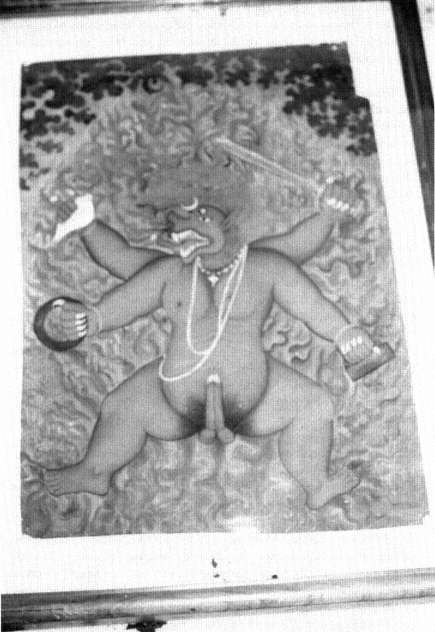
Figure 17.
An esoteric image of a Bhairava.
trast to the frequently bestialized humanoid forms of the dangerous anthropomorphic gods. They represent the moral interior of the city and both represent and are models for the moral dimensions of human relations (above all, those of the household and other intimate relations) and of the self.
Walter Burkert argues that the Greek Homeric gods move beyond the anthropomorphic gods of the Near Eastern and Agean neighborhoods of Greece. Those gods "speak and interact with one another in a human way, . . . love, feel anger, and suffer, and . . . are mutually related as husbands and wives, parents and children." But the Greeks, he says, add something to this. "The Greek gods are persons , not abstractions, ideas or concepts. . . . The modern historian of religion may speak of 'archetypical figures of reality,' but in the Greek, locution and ideation is structured in such a way that an individual personality appears that has its own plastic being. This cannot be defined, but it can be known, and such knowledge can bring joy, help, and salvation. These persons as the poets introduce them are human almost to the last detail" (1985, 182-183 [emphasis added]). Jean-Pierre Vernant, on the contrary, asserts that "the Greek gods are powers, not persons" (1983, 328). He argues this on the basis of their difference from what he takes to be the essence of social persons—namely their being as "autonomous focuses of existence and action, ontological units." Claiming that "a single person cannot be several," he calls attention to the various states and conditions referable by term such as "Zeus." However, this does not affect the argument that in particular temporal and spatial contexts and uses these gods are "persons" in a way that the members of some other pantheons are not, and that this quality as manifest in these contexts is of considerable importance for understanding the ancient Greeks and their religion. It is their person-like aspects that most clearly locate the forms, meanings, and uses of the ordinary gods as members of a particular class in Bhaktapur's civic pantheon. When, in contrast, a member of this set is considered in historical perspective, and its uses in other settings and conditions and in differently arranged pantheons are all added to the identity of the divinity, another type of figure, of great mythic complexity, emerges. As we have noted, such histories surround all the gods of the pantheon but are distant background to the choices and simplifications that must be made for the god's synchronic civic uses.
"Person" refers to a universal social invention, "someone" as the
legal definition has it, "who is capable of having rights, and being subject to duties and responsibilities," that is, a relatively fixed actor in the give and take of a moral system. Not all individuals in a community are "persons" in this sense; infants and often the mentally ill and defective are not. The benign gods have many of the characteristics of persons in this sense. They look like humans, and their special differentiating aspects are all social. They are embedded in and defined by social relations, out of which a larger community of related divine individuals is built. Their relations to each other are in part moral, matters of understood obligations and limits, and in part passionate. But their passions and motives—annoyance, rage, lust, compassion, respect, and fear—are ordinary social ones. The benign gods are in large part fixed in their forms and in their relations, and usually work things out within the constraints of logic and ordinary reality to which is added a superhuman (but limited) power that they use in times of special need. Like ordinary persons, they are subject to pollution (compare the discussion of the Nine Durgas in chap. 15), which indicates that they must, like all mature citizens of Bhaktapur, take care in order to maintain their social definition as persons (chap. 11). The dangerous gods have no such concern.
The benign gods as persons represent, as Babb has proposed, "certain key values of Indian civilization" (1975, 224). But they represent not only ideal values but also aspects of "normal" behavior, that which is tolerable for humans. What they do not represent (except transiently in the history of that generative and bridging form, Siva) is "insanity" and other modes of operation and understanding of the mind peripheral to the "person." This is done by the dangerous deities in various ways. As representations of the ideal and "the human," the benign deities become foci of identification and guides for proper behavior and moral standards, and also for tolerant understanding. Their soteriological functions have to do with reward or punishment of the atma , the particular spiritual entity that is for most people closely connected with the idea of the self and its persistence after death. This reward or punishment is based on moral performance within everyday life and with the proper devotion or "service" to the god and, in marked contrast to the effects of encounters with the dangerous gods, with inner intentions as well as external behavior. The benign gods, like all the gods, are subject to ritual manipulation. But their proper devotion and ritual manipulation consists primarily of a mimesis of honorific and respectful behavior, in the course of which they are offered the same honor, hospi-
tality, gifts, and services that would please any honored guest or person of high status. Such rituals reinforce and reaffirm the worshiper's social relation to the benign deity. All this does and can go on only within a rational, dependable world. These gods are "ordinary" and not "dangerous" precisely because they respond dependably to anyone with adequate social and moral skills, anyone who has, in part with their help, become a competent person by Bhaktapur's standards.
For other tasks and meanings Bhaktapur employs other types of divinities, divinities who are much more peripheral to the moral world of persons than the ordinary gods, and who thus represent other realms and ideas and who must be dealt with in other ways. The dangerous anthropomorphic gods vividly represent this nonmoral realm precisely because they have some characteristics of persons—names, forms, and anthropomorphic embodiments. They are radically peculiar and unacceptable persons, however, persons in flux—to recall Vernant, they are not quite "ontological units." They are outside the constraints of both logic and morality that are the essence of true persons. They represent the bordering outside of the ordinary world in a variety of ways—they are related to the forces and forms of "nature" beyond the city, wild and dangerous but at the same time vital, and also to certain psychological modes—dream, insanity, and those passions and impulses (e.g., cannibalism) that are beyond what are acceptable even to a tolerant view of what a person is or should be. As they do not operate through moral interactions and manipulations, they operate in the only other available mode, through power, and that is the way they, in turn, must be dealt with. This constellation of characteristics used to portray the hinterlands of any moral community has many familiar echoes throughout the world,72 but the uses of the dangerous gods have a particular development, force, and legitimacy in Bhaktapur. In contrast to many other Hindu communities (below), the dangerous gods have a special status in Bhaktapur as legitimate and high-ranking members of the pantheon, and as Tantric gods they are (as we will see in the next chapter) in many ways the foci of aristocratic and royal worship.
The dangerous deities represent not only the nonmoral exterior of the city but also the relatively nonmoral aspects of the exteriors of various of the city's component units. In some contexts, they are associated with individual's bodies and, particularly, with danger to those bodies in contrast to people's selves, souls, or "personhood," all associated with the benign moral deities. Most generally the dangerous gods protect the perimeters of the community, of its components, and of its
members, within which the ordinary moral life, represented by the ordinary gods, can go on, while at the same time representing aspects of the external dangerous forces. In protecting the boundaries of moral units and civic spaces, however, they also represent and protect such units as a whole . It is in this way that they can be made to represent the city as a whole, a lineage, guthi , or a neighborhood.
The use of dangerous deities as the representatives of a moral maximal unit warrants more comment. Let us recall the emergence of Devi in the Devi Mahatmya . When the world of the gods is threatened by danger from the Asuras—that is, when that world emerges as an entity precisely and only because it is set against a dangerous, contrary world—the Devi arises. She uniquely represents the world of the gods, even though she is not a "normal" member of that world. if she were, she could not protect them. She can protect them only by sharing in the nonmoral power of the external forces she has to defeat. In analogous ways Bhaktapur uses nonmoral deities to represent, as well as protect, moral units.
There is another important aspect of the use of nonmoral dangerous deities to represent a moral unit. They protect that unit in a very real way (as we will discuss in later chapters, particularly in relation to the Nine Durgas in chap. 15) by helping to ensure the adherence of its members to its moral system. The dangerous deity, usually a goddess, in concert with the meanings of blood sacrifice offered to her, represents the destruction that will overtake members of a group if they violate their adherence to the moral system and moral solidarity of the group. She binds members into the group as well as defending the group's boundaries and representing it as a whole.
Insofar as the dangerous deities themselves represent the kinds of external dangers they protect against, they must first be captured in order to be put to work for the community. As we will see in later chapters, this is done in local legend through the Tantric power of exceptional individuals. For ordinary individuals the dangerous deities can be controlled, albeit somewhat tenuously, not through social deference and good behavior as are the ordinary gods but through an individual's initiation into secrets of power, and the use of spells (mantras ) and, above all, through the use of one of the most important ritual resources in Bhaktapur, blood sacrifice, whose meaning in relation to the dangerous gods we will discuss in later chapters. Most of the time one deals with these powerful and erratic deities by trying to avoid them, or not to anger them or—if one has reason to assume that they
are angry—asking forgiveness and making restitutive offerings, even if (in contrast to the moral deities) they may have become angry "without cause." As the dangerous deities do not represent moral values, they cannot be, as the ordinary deities are, models for ideal or tolerable behavior. Their psychological functions for individuals, like their uses for th city, are quite different from those of the benign deities with whom they contrast within the formal supernatural class of humanly worked deities.
A few classes of deities differentiated among themselves by a few structural features do, as classes, much of the work of organizing realms of meaning in Bhaktapur. Their contrasts use kinds of meanings—near versus far, vague versus clearly formed—which are easily apprehended, and require minimal special cultural knowledge. The situation changes radically in relation to the organization and uses of the differentiated supernaturals within the classes of deities.
Bhaktapur's Pantheon As A System of Signs: Distinctions Within this. Types of Gods
The differences among the sets of gods, essentially the differences in their mode of representation, are, we have argued, based on certain contrasting structural features and are the basis for much of their meaning. Within the sets the distinctions are not the distinctions of classes or types, but, for the most part, distinctions among individuals . These distinctions are generally made on the basis of the clusters of iconic signs that identify each individual, usually redundantly—any one of several features will sufficiently identify the deity—as long as the other features are not too anomalous. These differentiating features are the usual ones emphasized in treatises on the iconography of the Hindu god images73 —crowns, vehicles, markings on foreheads, objects held in the hands, vehicles, aspects of dress, color, and the like. Without considerable interpretation based on knowledge of their myths and histories, the meanings of many of these features—beyond their identifying uses—may (with exceptions to be noted below) seem more or less arbitrary as direct indications of the paricular individual's present meaning or use. The individual stone deities (helped by some associated markings) and most of the astral deities are identified by their positions.
In most sets of deities the different deities—Indrani* , say, in her contrast to Brahmani—do not contrast in their general meaning and use, in
which they are often identical, but in the portion or component of some larger whole made up of equivalent or near-equivalent parts—such as the mandalic* segments of the city, the aspect of the full Goddess emphasized for some special purpose, the days of the week of astrological concern, or the set of all tutelary phuki deities—which they stand for. Each of these member deities in a set must be identified as an individual, but an individual whose particular individuality has little differentiating significance beyond their relevance to some specific sector of space or time or society. Often people who are not specially concerned with one of these individual member deities may not be entirely certain as to which member of the group they are, and may misidentify them or identify them with some lumping collective term.
The relation of deities within groups insofar as they mark equivalent divisions of space, time, or status is generally "horizontal" and more or less equal, but there are also some hierarchical relations within groups. These are sometimes indicated by size (anthropomorphic statues of an ordinary god and his consort usually depict him as larger (see fig. 12); the masks of Mahakali and Bhairava are larger than the less powerful figures in the Nine Durgas group (see color illustrations), and so on), or by central versus peripheral positions. (Tripurasundari is at the center of the city mandala* , the vehicles of Siva and Visnu* may be placed at the periphery of a temple, they at its central axis.) Above and below may also be used to indicate relative status, with a god's vehicle sometimes shown as kneeling at his feet, or placed below them. Among the benign gods the relation of the male gods and their consorts is shown by the consort being placed to the male god's left. Such relative features are not used in contrast between the different classes of gods who do not have hierarchical or consort relations across types.
Against these general features of the differentiation of the members of sets there is a very significant exception within one particular set, the benign deities. Within the set of the ordinary gods directly understandable implications in the images become, as they were in the case of classes of deities, once again salient for a differentiation of the meanings represented by each deity. Here the distinguishing features are the dusters—among the background of presently otherwise meaningless identifying iconographic features—which identify social behaviors and qualities. The tiger skin and yogic costume of Siva in some of his moods, the modest beauty of Parvati, the cuteness of the benign Ganesa* , and so on, are such easily apprehensible meaningful features.
The benign deities in contrast to all the others are persons, and their forms help remind people of the kinds of persons they are. There local uses are rooted in these meaningful personal differences.
Bhaktapur's Pantheon As A System of Signs: Some Contrasts With Other Hindu Systems
A comparison of the organization of Bhaktapur's pantheon with reports from other Hindu communities highlights some of Bhaktapur's special features. Edward Harper, in a study (1959) of Totagadde, a village in Mysore State, found a local hierarchy of three levels of supernatural beings. The highest level were the familiar "vegetarian" gods of the major Hindu tradition ("Sanskritic gods"). These gods, locally called "Devarua," are "generally iconographically represented." They are most frequently worshiped so that the devotee will obtain punya* ("merit"). This may be in the hope of good fortune in this life, or a good fate after death (1959, 228f.). We recognize in this group some of the characteristics and uses of the "ordinary" segment of Bhaktapur's pantheon. Harper's second class of deities, second in a hierarchy of purity, are locally called "devates. " These gods demand and accept blood sacrifices. They protect the village in various ways. They patrol the village boundary or guard designated parts of the village. They also protect various social segments, families, and lineages in the village. Some are attached to houses, where they "protect adults, children and livestock from spirits . . . who cause minor illness" (1959, 231). The same class of deities can possess individuals, and cause illness. While the first group of deities are responsible for trouble only in the sense that they withhold aid that might have been granted, this class may actively cause harm, and part of their worship is intended to prevent this. These deities resemble in nature and use Bhaktapur's dangerous deities, but there are important differences. For the Mysore village these "local gods" do not derive their names and legends from the high Hindu tradition. They "almost never" have iconographic representations. They are less pure, and thus lower than the "Sanskritic gods." Finally, within their ranks are some of the forms and functions (illness-causing possession) that are proper to some of the members of Bhaktapur's "ghosts and spirits."74 Harper's village has a residual third group of supernatural beings "devvas, " "free floating marauding spirits . . . malicious and destructive [which] perform no protective functions" (1959, 232). The main contrast with Bhaktapur suggested by Harper's sketch of Tota-
gadde's religion is that there the dangerous deities are much closer to the realm of the immaterial ghosts and spirits than they are in Bhaktapur. The Tantric tradition has facilitated the capturing, embodiment, control, and legitimate civic use of a large segment of supernaturals of this kind in Bhaktapur, and does not place them in an inferior hierarchical relation to the "Sanskritic," that is, the benign Puranic* deities.
In Susan Wadley's study (1975) of Karimpur in Uttar Pradesh, the supernatural beings in the "village experience" (that is, in contrast to the unknowable divine principle, the brahman ) were the category of gods, "devas " and a set of spirits and ghosts that, as in Bhaktapur and like Totagadde's "devvas, " were considered outside the class of "gods." The class of devas includes, according to Wadley, both "normally" benevolent and always malevolent deities. The normally benevolent deities (which would include Bhaktapur's dangerous gods) she calls the devata , the remainder "demons." Wadley's main concern is with the differentiations within the class of "normally benevolent devas, " where she suggests (as does Babb, whom we will consider presently) that a central distinction for functional differentiation within the group is the gender and gender relations of the various members. The male devas are referred to as "bhagavan "; the female, as "devi ."75 The male bhagavan and his concrete manifestations such as Visnu* , Siva, and Ganesa* , can help people if they are devoted to them. Devotion sets up a social relation, "a relationship based on hierarchical exchange because the gods and men have a commitment to each other" (1975, 117). This set of gods, male gods, can be helpful in gaining "relief from existence and the troubles of existence." These gods can help in getting through the problems of life, but they do not hurt, except presumably by failing to help. These are, thus, similar to Bhaktapur's benign gods, and to Harper's "Sanskritic gods." According to Wadley, the female devatas , the Devi and the component devis , "to a much greater extent than the male gods categorized as bhagavan are potentially malevolent." She cites Babb (1970) and Beck (1969), agreeing that "there is an ever present awareness that female power may become uncontrolled. And when male authority (usually a consort) is absent, the malevolent use of female power is almost assured" (Wadley, 1975, 121). She claims for Karimpur that male deities can always dominate the female deities while female deities have a "potential for malevolent action [that] makes them more suspect than male deities" (ibid., 121). Among the devis there are "some who are almost totally malevolent and act positively only to remedy their own actions" (ibid., 121f.).
Before discussing these observations in relation to Bhaktapur's use of divine gender, we may note Lawrence Babb's extended consideration of the pantheon of various communities in the Chhattisgarh region of Madhya Pradesh. He begins with the familiar distinction about the "philosophical" status of the undifferentiated "world-soul" of Hindu tradition, which he calls the paramatma . This is "an object of contemplation not of worship. Divinity becomes active in the affairs of the universe and men only when it is differentiated into particular divine entities. With this differentiation we move into the world of everyday religious practice. Of all the different kinds of differentiation found within the pantheon, one seems to be particularly stable, that of sex" (Babb 1975, 216). Gender, he argues, sorts two basic qualities of the pantheon. The male "devtas " are "essentially protective and benevolent." The female devis are "the very embodiment of malevolence when unrestrained or unappeased" (ibid.). Babb, starting with suggestions from the Devi Mahatmya , recalls the association of the female goddess as Sakti with "energy" or "force." He notes that in the male-female polarity as conceived in Hindu Tantrism, "the 'female principle' is conceived as the active, dynamic component of reality, while the male principle is regarded as static and passive" (ibid., 220). Taking the angry, destructive, embattled Devi of the Devi Mahatmya in her Kali form as emblematic of that force whose "only discernible emotion is anger—black, implacable and bloodthirsty," he finds female deities in such benign and non-Tantric manifestations as Laksmi problematic, that is, as secondary, and asks, "what is the context in which the Goddess becomes Laksmi?" He suggests that when the male and female deities are related in the ordinary social relation of marriage, with the god dominant—as husbands are—and the Goddess dutifully subordinate, this "imposition of social order" yields deities embodying key values of Indian civilization. He also notes that these social relations allow for "the elaboration of divine attributes in accordance with basic order-producing values—hence the great variety in this sector of the pantheon." In contrast, where the goddess is either alone or dominant, and "if the god appears at all, it is not in the role of husband but of henchman and servant, [then] . . . the pairing as a unit takes on the sinister attributes of the goddess herself. The goddess in this form is not conceived primarily as an exemplar of values and principles, but as the embodiment of an impersonal force—one that can be used, but that may be dangerous to the user, as indeed it endangers the gods themselves until it is contained" (ibid., 225). In a summary he argues, "With-
in the pantheon a very dangerous force is symbolized, but this is a force that seems to undergo a basic transformation into something almost anti-sinister, the loving wife, the source of wealth and progeny, when placed within the context of a restraining social relationship, that of marriage. An appetite for conflict and destruction is thus transformed into the most fundamental of social virtues, that of wifely submission which, on the premises given in Hindu culture, makes the continuation of society possible" (ibid., 226).
These suggestions of Wadley and Babb illuminate a powerful component of the pantheon's semantic force, and are congruent with other meanings of male and female persons and their relations in many societies and as particularly emphasized in Hindu social systems. But these suggestions are not fully applicable, at least in Bhaktapur's version of things. The creative Goddess in her absolute, full form is not malevolent or sinister, and no more uncanny than concepts of Visnu* or Siva as creative gods, and certainly no more destructive. She seems to represent a component of a maternal image that is prior to the submissive role of a wife, one worthy of trust and adoration. There are also male forms of considerable malignity, Bhairava, and to a lesser extent the minor dangerous male gods, who are not "henchmen or servants" of a goddess. In some cases the relation to a goddess (as in the case of the Akas Bhairava) helps to make the male dangerous god, less dangerous—in some reversal of the argument. Furthermore, there is at least one female goddess of complete benignity who has in Bhaktapur no present reference to a male controlling and socializing consort, namely, Sarasvati. Furthermore, Siva, when not controlled by social relations, either as a husband or by his friendship to Visnu* , is a potentially wild and dangerous being. Finally, the dangerous ghosts and spirits of Bhaktapur are not predominantly female. Granting such qualifications, however, the predominance of the male deities in the domain of moral and social order, on the one hand, and the predominance of independent female ones at the boundaries of that order on the other, is, of course, also characteristic of Bhaktapur. Bhaktapur's imagery and symbolic action treats these independent goddesses as not only dangerous but also as necessary, vital, and protective.
Insofar as Bhaktapur's use of divine gender is less categorical and oppositional than the forms proposed in the studies we have cited, this is congruent with the way Bhaktapur's social system and culture has allowed for the comparatively independent position of women in the family within a Hindu perspective and the resulting modification of
the role and meaning of wife and mother in that perspective. Some of that different emphasis may also be related to the movement of the dangerous female deities from a "non-Brahmanical" social and spatial periphery, as the "folk goddesses" characteristic of Indian villages, to the high-status central position in a socially integrated Tantra (chap. 9), which they have in Bhaktapur.
A Final Remark
We have added the supernaturals to our static collection of elements of Bhaktapur's mesocosmic ballet. Status, space, and deities are variously combined in action in progressively more complex structures of meaning. We will in the following three chapters consider some aspects of action, concept, and role bearing on the manipulation of aspects of the symbolic order before, finally, adding time and tempo and considering the ballet in its full action.
Chapter Nine
Tantrism and the Worship of the Dangerous Deities
Introduction
In our discussion of Bhaktapur's pantheon we have emphasized the division of the deities most centrally concerned with the organization of the public city into "ordinary" and "dangerous." These two categories of deities are related to two general modes of religious activity in Bhaktapur and in the Hindu tradition. The mode focusing on the ordinary deities takes special definition in Bhaktapur from its contrast with the worship of the dangerous deities. The worship of the dangerous deities has roots in popular and folk tradition in South Asia but has within it a differentiated aspect that has had a literate development of its own in South Asian high culture. This is "Tantrism," which Bhaktapur differentiates in a traditional South Asian distinction from the "Vedic" practices of the ordinary religion.
Esoteric Tantrism must be distinguished in Bhaktapur on the one hand from the worship of the ordinary deities (which has in itself, as we will note, "Tantric" references) and on the other from the exoteric worship of the dangerous deities by noninitiates. It is Tantrism in itself that will be central to our discussion of the worship of those dangerous deities. For Tantrism not only is the developed mode of relation to the city's dangerous deities in the esoteric practices of the upper social levels of the city but also lies behind much of the public urban symbolism and symbolic enactments centering on those deities which are experienced by all of Bhaktapur's citizens. And it is Tantrism that gives Bhaktapur and
the Newars (as it does neighboring Tibet) much of their special qualities in South Asian religious perspective.
Tantrism As A Religious Mode
There is a substantial literature discussing aspects of the Tantric tradition in Buddhism and Hinduism (see, particularly, the synthesis by Gupta, Hoens, and Goudriaan [1979]). Tantrism has been characterized as an "historical current" within the larger South Asian tradition, a current that is relatively easy to recognize in its manifestations and notoriously difficult to define. "The extremely varied and complicated nature of Tantrism, one of the main currents in the Indian religious tradition of the last fifteen hundred years, renders the manipulation of a single definition almost impossible. There is, accordingly, a general uncertainty about the exact scope of the word" (ibid., 5). These authors attempt, however, a definition, which will serve as a useful introduction to Bhaktapur's Tantrism (ibid., 6 [emphasis added]):
In our opinion, it is mainly used in two meanings. In a wider sense, Tantrism or Tantric stands for a collection of practices and symbols of a ritualistic, sometimes magical character (e.g., mantra, yantra, cakra, mudra, nyasa . . .). They differ from what is taught in the Veda and its exegetical literature but they are all the same applied as means of reaching spiritual emancipation (mukti ) or the realization of mundane aims, chiefly domination (bhukti ) in various sects of Hinduism and Buddhism. In a more restricted sense, it denotes a system, existing in many variations, of rituals full of symbolism, predominantly—but by no means exclusively—Sakti, promulgated among "schools" . . . and lines of succession . . . by spiritual adepts or gurus . What they teach is subsumed under the term sadhana , i.e. the road to spiritual emancipation or to dominance by means of Kundaliniyoga* and other psychosomatic experiences. . . . It is important to remark at this point that the true Tantric sadhana is a purely individual way to release accessible to all people, women as well as men (at least in theory), householders as well as ascetics . At present the practicers (sadhaka ) of the Tantric system are mainly people who live an ordinary life within family and society. But beside this ordinary reality, they try to come into touch with a higher stratum of divine reality by a course of identification with their chosen deity who Is usually the Goddess.
Elsewhere in South Asia the individualistic, anti-Brahmanical, anti-social-structural aspects of Tantrism, although they influenced renouncers of Hindu society (see, for example, fig. 18) and those who tried to manipulate the world through magical power, became for most
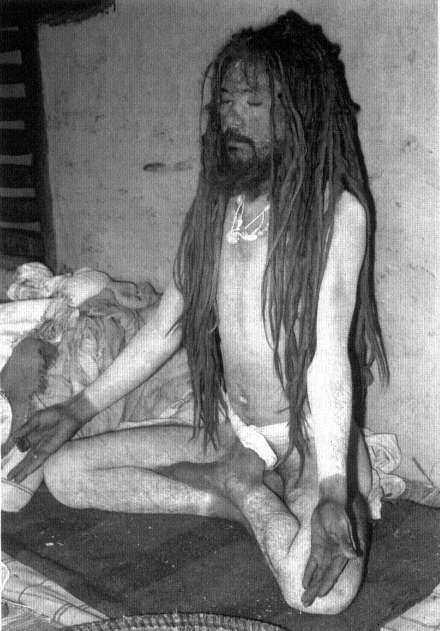
Figure 18.
Outside the city. A wandering Indian sadhu doing yoag on a public
porch in a mountain village.
practitioners—for those who "live an ordinary life within family and society," that is, within the Brahmanical order—comfortably bracketed into safe and nondisruptive contexts (ibid., 32):
The Kularnavatantra* states that anything which is despised in the world is honorable in the Kula [a particular school of Tantrism] path. On certain occasions, the texts even express a preference for anything which is associated with low social standing or with the breaking of taboos. . . . Of course, this was an important factor in creating for Tantrism its bad repute with the orthodox. But anti-caste statements should never be read outside their ritual context. Returned into ordinary life, no high caste Tantric would think of breaking the social taboos. One might even argue that the predilection for contact with low-caste people, especially women, in a ritual environment served to render the high-caste practicer still more conscious of the violent breakthrough of his ordinary situation which he had to make in order to proceed on the way to spiritual emancipation. Seen in this light, the ritual egalitarianism of Tantrism in practice acted as a caste-confirming and class-confirming force. One can compare the confirmatory and stabilizing role of festivals like Hob or Sabarotsava, during which caste or class relations are temporarily eliminated.
Bhaktapur has gone further in the use and transformation of Tantrism than as an exciting and cathartic antistructural fantasy for upper status men—although that is still one of its important uses. It has transformed the Tantrism of transcendence of Brahmanical order for the purposes of individual salvation and individual power and put it to the use of the civic order, in so doing complexifying that order. Legendary accounts of the capture of Bhaktapur's protective deities, the Nine Durgas (chap. 15), vividly portray this double movement. The stories tell how the demon-like deities who make up the group once lived in a jungle outside of Bhaktapur where they killed and ate the innocent passers-by whom they happened to encounter. Eventually the gods were captured by the spells and wiles of a powerful Tantric practitioner. He took them into the city, put them in a secret room in his house, and, using them for his own private amusement, "played with them" and made them dance for him. But then through the interference of his wife—representing one of the central symbolic mediators from private masculine pleasure to social order—the demon deities escaped his private control and fled the house. The Tantric practitioner was able to recapture them, but by now they had taken measures to prevent his taking them back into his house. Now unable to use them for his own purposes, he, in a compromise, forces them to pledge to protect the public city, to use their power against those external forces of disruption that they originally repre-
sented in themselves. The Tantric expert who presided over this transition (who in some versions is different from the magician who originally captured them) was, significantly, a Rajopadhyaya Brahman. However, once the secret was out, once the dangerous, blood and alcoholic spirit-swilling, order-destroying, and polluting1 gods were out in the visible public space of the city, special kinds of priests, Acajus (chap. 10) had to replace the Brahman to deal with them in public—although the Brahman's descendants would continue to be engaged with them in more esoteric arenas.
For Bhaktapur's "Newar Brahmans" (chap. 10) and Ksatriya-like* Chathariya and Pa(n)cthariya groups, Tantrism is not only, as it was for the Tantric master who captured the Nine Durgas in the self-indulgent time before his wife's interference, a source of private fascination but also central to the worship of their partilineal lineage deities. Their exclusive right to Tantric initiation is, in fact, one of the most important markers setting them off from middle-status and low-status groups in the city. This "gentrification" of Tantrism existed in other parts of South Asia. "The study of later Tantric literature seems to reveal an ever tightening grasp of Brahmans and other intellectuals on the movement—or, as one could as well say, an ever greater hold of Tantrism upon the traditional bearers of Indian literary culture" (Gupta, Hoens, and Goudriaan 1979, 27). This elite domestication existed and exists in a somewhat uneasy relation with Tantrism's asocial and, in fact, antisocial central thrust, as well as with the low origins and family connections of its central deities.
The problem is clarified by the situation of the dangerous deities in non-Tantric communities. In a consideration of ritual in the Indian village of Konduru in Andhra Pradesh, Paul Hiebert made a distinction between the "high religion" of the village and its "low religion." The "high religion" centers around the benevolent Hindu gods of the "great tradition." Its priests are Brahmans (for the higher castes), the offerings to the gods are vegetarian. The "low religion" centers around "regional Hindu gods and local gods linked to Hinduism" (1971, 133). Hiebert further notes (pp. 135-136):
Chief among these [supernatural beings] are the local and regional goddesses who reside in trees, rocks, streams and whirlwinds and are enshrined in crude rock shelters in the fields, beside the roads, and in the home. Capricious and bloodthirsty, they demand the sacrifice of animals to satisfy their desires; therefore, the Brahmans refuse to serve them. Their priests are Washermen, Potters, and Leatherworkers. . . . All villagers fear their anger
which can bring disease and death to those who neglect them, blight to crops, fires to houses, barrenness to wives, and plague and drought to the village. Even the local Brahmans who deny their existence take no chance and send their offerings by the hand of a family servant to be sacrificed to the goddesses of their fields.
This village arrangement reflects the hierarchical predominance of "Sanskritic" over the other deities in Indian village pantheons that we noted in the last chapter, but it also emphasizes the social peripherality of such "local and regional" deities whose worship and characteristics are those of Bhaktapur's dangerous deities. Even as the status of the dangerous deities—who have been, like the Nine Durgas, captured and taken into the city, albeit in an ambiguous incorporation—has changed in Bhaktapur, so has the social status of their cult and their priests. Yet, the Indian village situation clearly suggests the contradictions and tensions in the apparent urban respectability of these deities in Bhaktapur. The Newar Brahman, the Rajopadhyaya Brahman, has, as we will see below and in chapter 10, important Tantric functions, but these are hidden within private, esoteric arenas of the city's worship. Public Tantric worship is usually done by other priests, the Acajus (which has sometimes led to the erroneous statement in descriptions of the Newars that they are somehow the "Tantric priests" in some sharp opposition to the Brahmans as "Sanskritic priests"). As we will see in chapter 10, the interlocking roles and relations of Brahmans and Acajus in relation to Tantrism and ordinary Hinduism in Bhaktapur are complex. As he is in Hindu communities everywhere the Brahman is a central priestly figure in the "ordinary" Hinduism of Bhaktapur. In relation to the Tantric component of the city religion, however, he has special functions—as guru , giver of mantras , officiant at some Tantric ceremonies for clients, performer of his own private and family Tantric ceremonies, and as priest at the Royal temples of the dangerous deities (particularly Taleju)—which make him, the priestly master of Bhaktapur's urban, civilized Tantrism, a much more complex figure than the ideal Sanskritic Brahman.
Tantrism In Popular Fantasy
People in Bhaktapur without Tantric initiation have various interpretations and fantasies regarding Tantrism. Such fantasies are encouraged by the Tantric strategy of protecting esoteric doctrines through multiple veilings and obfuscations of its doctrinal and symbolic implications (cf. Bharati, 1965, chap. 6). Those veilings and obfuscations are, as we will
discuss below, often associated with some sort of an "advertisement" that there is , in fact, a secret that is being hidden. For the noninitiate, Tantrism means primarily "magic" practices, sometimes referred to as tantra-mantra , that is, to practices that are capable of direct manipulation of supernatural power for worldly ends. Noninitiates, particularly—although not exclusively—lower-status ones, assume that this magic power is used for legitimate, albeit usually private, ends, such as curing disease, chasing off evil spirits, and keeping wandering bulls out of cultivated fields.2 Occasionally, it is assumed, the power may be used for love magic or for harming an enemy. It is also popularly believed that particularly powerful Tantric experts can (and could more frequently in the past) levitate themselves or objects, travel through the air to distant places, and control and dominate powerful supernatural beings. From the viewpoint of the legitimate practitioner, such direct personal uses of "power" are possible but illegitimate and peripheral to their goals. However, even sophisticated initiates believe that outside the civic esoteric system, out of Brahmanical and civic moral control, there are such figures as sadhus (wandering "renouncers") witches, sorcerers, and healers who use a degree of Tantric power sometimes for good (in a struggle against a contrary harmful supernatural power), sometimes for evil.
Noninitiates often believe that Tantric pujas are associated with major violations of ordinary moral and religious regulations such as the eating of forbidden foods and overt sexual intercourse—including (according to one informant) even the incestuous intercourse between brothers and sisters. In general, however, noninitiates seem to believe that legitimate Tantric practice is, albeit strange, good behavior and in the pursuit of socially acceptable goals. These same people also seem to believe that most Brahmans, at least, do not know much Tantrism, their fantasies about the dharma -violating procedures of Tantrism are directed to the secular upper thars . This interpretation is, in fact, consonant with another essential aspect of Bhaktapur's Tantrism, its alliance with the realm of power of the king in opposition to the realm of moral order of the Brahman, in his role (for Bhaktapur only one of his roles) as a priest of the benign deities.
Upper-Status Tantrism
As we have noted in chapter 5, there is an upper segment of Bhaktapur's macrostatus system whose male members, after completing initiation as full members of their thar (and whose female members under certain
conditions and restrictions), have the right to Tantric initiation. These are the Rajopadhyaya Brahmans, all the thars at the Chathariya and Pa(n)cthariya levels, the Tini, and one Jyapu thar with some priestly functions, the Jyapu Acaju.3 All of these thars share certain rights and customs in contrast to other, lower, thars . Their male members have the exclusive right to wear the sacred thread, the jona ; they alone have a special kind of lineage deity, the Aga(n) God; they alone have the right to have Tantric gurus (who are Rajopadhyaya Brahmans), initiation, and practice. The worship of the dangerous deities by people of the middle and lower thars is not considered Tantrism by upper-level initiates, nor by members of the lower-level thars themselves.
We will follow this distinction and consider Tantrism per se as the practices of initiates. We will begin with Tantric worship, that is, Tantric puja , in Bhaktapur. We can then consider the uses of that worship. These are of two general kinds for upper-status initiates, worship directed to the phuki's lineage god and practices directed to mukti or "individual salvation." We will then turn to forms that span both esoteric initiate religion and the symbolism and religion of the larger city.
Upper-Status Tantrism: Puja
In part three of Gupta, Hoens, and Goudriaan's book Hindu Tantrism (1979), a section entitled "Modes of Worship and Meditation," Sanjukta Gupta presents the "fully developed" Tantric puja in detail. The "fully developed" Tantric pujas performed in Bhaktapur by priests and their upper-status clients are minor variations on the sequence Gupta describes and interprets.4 Descriptions such as Gupta's relieve us to some degree both of our ethnographic responsibility to record Bhaktapur's esoteric practices here and of our conflcting moral responsibility to keep them secret.
Tantric worship has many of the features and sequences of ordinary worship (app. 4), but there are additions, emphases, and occasional reversals, which take their force from their contrasts with those ordinary procedures. Acajus and Brahmans have manuals of instructions, paddhatis , often in the form of palm-leaf manuscripts, which outline the steps of all complex priest-conducted worship sequences used in Bhaktapur. For basic Tantric pujas , such as those held in conjunction with important family or phuki worship to the Tantric lineage deity (see
below), paddhatis include about a dozen major phases. We will follow one of these paddhatis in order to give a rough and superficial paraphrase of an illustrative sequence for our present limited purposes, namely to suggest the Tantric puja's special features.5
Prior to the puja there must be worship and offerings to the local areal Ganesa* and at the proper mandalic* pitha . The participants must purify themselves in preparation for performing puja , as they must for all important worship (chap. 11). The area in which the worship is to be done has also to be purified and marked out in colored powder with diagrams, mandalas* and yantras , and the proper utensils and materials for the worship are assembled.
The first preparatory phase of the worship is done by the principal worshiper, the jajaman , and will be done subsequently by the officiating priest. This is called a nyasa , a Sanskrit word that apparently originally included the meaning of "laying aside" and "renunciation" (Macdonell 1974, 148). The nyasa is a mimesis of yogic practices; the sorts of things that yogis do at length to produce altered states of awareness in conjunction with meditation and a quest for "escape" or mukti are done here as ritual gestures. "Nyasa " in Bhaktapur's usage seems to refer to a less specified range of yogic activities than the term does elsewhere (cf. Gupta, Hoens, and Goudriaan 1979, 143f.). "Nyasa " varies in the details of the procedure depending on the particular kind of puja in which it is used. It includes various gestures, movements, and hand signs, mudras , and meditative acts, which among other purposes, are said to be for the purpose of establishing the worshipers' bodies as the mandalas* , or sacred circles, in which the deity will be realized. It also includes rudimentary breath control procedures (pranayama* ), essentially the alternate closing of the right and left nostril during the inhalation and exhalation of air and the holding of the inhaled breath, with the various phases being accompanied and timed by the mental recitation of a mantra . The nyasa prepares the jajaman for the puja .
On the completion of the nyasa the jajaman dedicates the puja , identifying its central deity and its conventional purpose, for example, as part of a marriage, a death memorial ceremony, or as some focal worship of the Aga(n) lineage deity. After the dedication, the sa(n)kalpa , the jajaman touches and makes an offering to a ritual waterpot and to a container of various ritual items that will be used in the later worship and hands them to the priest.
The priest, in a purification and preparation for his part of the ceremony, washes his mouth and performs a nyasa . He now becomes the
central performer in the remainder of the puja , instructing the jajaman when the latter has to participate. The next step is snana , offerings of various kinds made to the primary and attendant deities of the puja . The attendant deities include an oil lamp (representing Ganesa* , Siva, and Sakti), "the deity dwelling in one's own heart," and the worshipers' quasi-deified gurus . Offerings to these deities include flowers, vegetarian foods, grain, and light, the same offerings that are given at all pujas . In a departure from ordinary pujas , some aspects of the snana sequence precede the worship of Ganesa* within the puja . (He has been worshiped at his neighborhood shrine prior to the puja .) This violation of the usual preliminary worship of Ganesa* as the siddhi -giving god is explained locally as showing that the Tantric goddess (the usual focus of the puja in one or another of her forms) "comes before all." The snana is followed by a puja to the officiating priest's own guru , and at this point he performs nyasa for the second time.
The next step begins a sequence in which there is worship by all assembled to, first, the secondary gods and goddesses and, then, to the main goddess through offerings of flowers, grains, colored powder, and the like. This sequence is concluded with an offering by the worshipers to themselves—to the internal representation of the deity in their body. In the course of these offerings uncooked polished rice, known in ritual contexts as kiga :, which is of central importance as an offering in all pujas (app. 4), is presented in a flicking motion to the deity by the left hand rather than with, as would be done in ordinary pujas , the right hand.
After an interlude in which the client performs japa meditation (see below) comes a sequence called "giving bali ." "Bali "—Sanskrit for a food offering—is used in the context of worship of the dangerous deities to designate an animal sacrifice. At this point there is no actual animal sacrifice; that will come later. What is offered now is samhae (a mixture of fish, meat, ginger, and grams; see section entitled "Symbolic Complexes: Sacrifices") and alcoholic spirits, either fermented rice beer, tho(n) or, more commonly, a clear distilled alcoholic spirit, aila (Kathmandu dialect, aela ).6 These offerings are a further reversal and violation of what would be the proper worship of an ordinary deity.
In the next episode oil-lamp wicks and incense are first worshiped to give them power, sakti , and then lit and presented to the gods by the priest as he rings a bell. The flaming wick and burning incense, used in all pujas , have here special meaning in relation to the Tantric use of the imagery of Sakti and Siva (below).
Now the priest, as the jajaman had previously, performs japa meditation. He covers his left hand, in which he holds flowers and kiga :, with a cloth and counts off a number of mantras , usually 108, which he mutters or says silently to himself. He then offers some of the kiga : and flowers he held during the japa meditation to the goddess. Next he puts some on his own head, as an offering to the internal goddess who dwells within him.
A stotra , a hymn of praise, is now read by the priest from one of the Tantric texts. He rings a bell in the course of this, and then worships the goddess with kiga :, throwing it three times, again from his left hand. As in all pujas , this presentation of kiga : accompanied by sound announces one of the major climaxes of the puja . The climax here is a blood sacrifice. This is usually a goat or a drake in upper-status phuki pujas . On some occasions, however (often for economic reasons), an egg or samhae may be substituted at this step. We will return to the procedures and interpretations of animal sacrifice in a later section.
Now the priest and the jajaman (and the other participants) take and eat some of the fish and meat-containing samhae that had previously been offered to the Goddess—which will now also have some of the sacrificial animal's blood splattered on it—and they also take some of the aila , the alcoholic spirits presented to the god and drink it. This is here not only prasada —the taking back of materials that have been offered to the gods and "contaminated" by the gods, and then by eating them putting oneself in a dependent but inferior hierarchical relation to that god (compare "cipa, " chap. 6)—but something more. The eating of the substances represent, in part, an offering to the participant's body and its internally dwelling Goddess, whose Tantric, nonordinary status, and contrast to the moral entity of the "self" (represented by another internal god, Visnu* , who dwells in the "soul" or "heart" [chap. 8]) is repeatedly emphasized.
If the Acaju were performing a Tantric puja for a client at a pitha , he would not himself eat part of the offering, for the pitha is a relatively public setting. In this case some of the offering, samhae , with blood and aila sprinkled on it would be sent to the client households. This mixture would be eaten by members of these upper thars who sponsor pitha pujas , including Brahmans, in the same way as they would eat the blood-spattered prasada in worship within their homes.
Now flowers are taken back from the Goddess as prasada. Daksina* , a gift of money, is given by the jajaman to the Acaju , and finally a farewell ceremony to the gods is performed, thus ending the puja .
This basic puja varies somewhat as it is used in different settings and for different purposes. However, variations are within this general pattern. The offering and sharing of meat and drink make this "left-handed, "or Vamacara Tantrism.7 These are two of the five "forbidden substances," the five makaras , whose use as witnesses of the true Tantric adept's supposed ability to be spiritually impervious to practices and substances that would represent dangerous and profound violations of the moral order for an ordinary person characterize the kaula school or tradition within Tantrism, a school that "is without doubt the most important—and certainly the most characteristic—movement within Tantrism" (Gupta, Hoens, and Goudriaan 1979, 45). Bhaktapur's upper-status Tantrism includes (in at least gestural form) these five makaras . The other three forbidden substances or actions (besides meat and alcohol) are fish, "mudra " (probably originally thought of as an aphrodisiac), and sexual intercourse. One of the substances presented to the gods, and tasted during the course of the puja, samhae , contains fish. "Mudra " is identified with some of the grain offered and eaten during the puja .8 Although there is speculation among noninitiates (which is characteristically not discouraged by initiates) that there is sexual intercourse during Tantric pujas , this does not normatively exist. The sexual act, like whatever sexual reference mudra may have, is a matter of symbolic reference. In many Tantric pujas that are performed for householders or phuki groups, one or more women who have the proper "half-dekha " or "half-initiation." may take part, as they do in ordinary pujas , but most Tantric pujas have only men participants. In all these pujas , the parts of the prayers and stotras that refer to sexual intercourse are read only in Sanskrit and, in contrast to some other Sanskrit passages, are not translated into Newai. References to the performance of sexual intercourse that occur in some of the puja sequences are represented by hand positions (also called mudras ) and are, it is said, not thought of as directed to a particular woman participant. Some initiate informants believe that sexual pujas were performed in the past, but this was privately by husband arid wife "for the purpose of procuring a son." This is in contrast to the fantasies of noninitiates about sex between nonspouses, including men with women of lower social levels, a fantasy that is closer to some reported actual practices of the kaula school, to which Bhaktapur's symbolic Tantric forms and a considerable portion of Tantric practice are related.9 Whether these sexual practices existed among Newar Tantric initiates in the past and
constituted an acceptable aspect of aristocratic Tantric practice seems unknowable now.10
The upper-status Tantric puja represents a struggle and a compromise between proper social behavior as defined in the ordinary civic dharma , the behavior that is necessary for the maintenance of social respectability, ijjat , and, in fact, for the maintenance of social status (for there is, or was, the threat of outcasting for serious violations of the dharma ), and the anti-dharmic , antinomian behavior, which in the context of Tantric ideology and practice, represents the transcendence of that dharma . The transcendence is suggested in the mimesis of Yoga, that attempted escape from the illusion of phenomenal reality. However, it is clearest in the transgressions of what would be fundamental violations of pujas to the moral deities. In Bhaktapur's moral system where reputation, rectitude, and proper behavior is closely monitored in what is for the middle and upper social levels, at least, a rather puritanical system, the violations inherent in the Tantric pujas , even if some of them are, in the case of sexual acts, "symbolic" (or more precisely a much weaker symbolic act than actual Tantric intercourse), are still presumably potentially moving and meaningful to the participants, as the rumors of these acts are to outsiders.
In comparison with Tantric rituals that take place in vegetarian Hindu communities, the eating of fish and meat and the drinking of alcoholic spirits is perhaps less powerful in that Newars do these things in other settings—although the offering of these products of slaughtered animals to gods in the context of the radical inappropriateness of this to the benign moral gods is still a clear antinomial reversal. As "slaughtered animals" suggest, however, the most significant aspect of meat eating is the taking of life, and this is quite overt in the animal sacrifice—which is at the climax of major Tantric pujas —whose blood splatters the prasada and whose flesh will be consumed by household members or the phuki group or some larger group of kin in the ceremonial feasts, bhwae , which follow many major Tantric pujas and are held in connection with auspicious rites of passage and some major calendrical occasions. The sacrifice is ideally done by the jajaman himself on behalf of his family group; he should himself cut the animal's throat. We will return to this central antinomial act, sacrifice, later in this chapter and in connection with urban symbolic enactments centering on Devi in chapter 15. For Bhaktapur, however, the violation of the ordinary dhar-
ma in the worship of the dangerous deities, which most resists becoming routine and trivialized during ritual repetition, is the sacrifice itself.
The participation of Brahmans in some of the most esoteric and "powerful" Tantric puja s is another profound violation of the implications of the city's ordinary religion. Newar Brahmans can eat certain meats, but are never supposed to drink alcohol, which would be a violation of their basic status regulations. In the course of the Tantric puja s in which their participation is essential, the worship of Taleju as the Malla lineage deity and as a central civic deity—which is witnessed by the auxiliary priests of Taleju, and in worship held for and witnessed by high-status clients in the most elaborate Aga(n) House puja s, and in their own phuki Aga(n) God worship, the tasting of alcoholic spirits by the Brahman priest as part of the five makara s is necessary. These spirits are specially prepared and purified, both physically and ritually. They are not called "aila ," "alcoholic spirits," but "Ga(n)ga jala " (app. 4), the purest of the various pure waters used in rituals, and considered in some contexts as amrta* or nectar, and in others as Sakti herself. Furthermore, in some Taleju ceremonies and in their own Aga(n) God puja s, Brahmans must perform animal sacrifice. All this involves a genuine risk for the Brahman, not only in the usual Tantric sense that what is clearly a violation and a sin in an ordinary context must somehow become transmuted into a proper religious act but also because their behavior (like all Tantric behavior, but the Brahman has the most to risk) can be used as an attack against the status of participants by those who discount the validity of the Tantric ritual.11
Upper-Status Tantrism: Family And Phuki Worship—Worship oF the Lineage Gods, The Aga(n) Gods, And the Digu Gods
We have remarked that the consideration of upper-status Tantrism may be divided into group worship and individually centered worship. Group worship is primarily that of the family—household or phuki —and centers on the lineage deity. The various kinds of internal esoteric worship at Taleju temple are closely related to such family worship, for Taleju is worshiped as the lineage deity of the Malla kings. Tantric worship of the lineage deity is amalgamated with and added to a worship of the lineage deity as the "Digu God" which is shared by all Newars.
We have introduced the basic Tantric group puja in the previous section. Such puja s are required for the rites of passage of family members, and in the course of certain annual events. They may be performed at the mandalic* pitha , rarely in the god-house of the Mandalic* Goddess, sometimes in a special room of a family's house—the Aga(n) Room, and most commonly in a special house for the phuki 's lineage deity, the Aga(n) House. Although a householder may perform or lead a perfunctory ritual by himself, most important Tantric family rituals are performed under the direction of, and in part by, an Acaju. On very important occasions a (sometimes more than one) Brahman may preside, and the Acaju will assist him. In the case of those upper-status families without initiates, or without an available one, an Acaju must perform the puja alone in the name of the family.
In addition to required Tantric puja s there are optional ones, and in these cases the household may be free to choose between a Tantric and an ordinary puja , the latter usually directed to Visnu* . The optional Tantric puja s are performed in relation to some "serious problem." Examples are a major disease of a family member; an outbreak of disease in the city from which the family wishes to be protected; a prolonged inability to have children for which lesser remedies have not worked; a period of bad luck thought to be due to astrological forces; or the wish for success in some major, risky undertaking. Tantric puja s are considered more powerful than puja s to a non-Tantric god. It is said that optional Tantric puja s are more directed toward the granting of a wish, while non-Tantric ones have to do with maintaining relationships with the gods. As a Brahman put it, the ideal attitude in an ordinary puja to the benign gods is, "We are here to serve and honor you. When you are here we have no problems." The distinction is important and emphasizes contrasts in the general meaning and uses of the two kinds of deities, although, in practice, favors are often hoped for from the ordinary gods and conversely one does not overtly confront the Tantric gods with the concrete goal of the Tantric puja , which is rather "kept in the mind."
An optional Tantric puja may have been given at the time of seeking help with a problem. More often a promise or pledge, a baca is given mentally to the Aga(n) God, to the effect that if the wish is granted, a puja will be performed. In these cases, in fact, even if the wish is not granted, a perfunctory puja is often given to the god; people may worry that perhaps the Aga(n) God was angry at them and that was why the favor was not granted, and that if they then neglect the proposed puja ,
they will have even worse luck. Misfortune is sometimes explained by some such neglected promise to a dangerous god, which may have just passed rapidly, even unconsciously, through someone's mind and which might even have resulted in the granting of the desire.
Once a decision to have a puja to solve some problem has been made, there is often (although not always)12 some choice, as we have noted, as whether to have a Tantric puja , or a Brahman-assisted non-Tantric puja . While a Tantric puja is said to be more powerful than a non-Tantric one, it is also liable to be more elaborate, time consuming, and expensive.13 Furthermore, the participants, in contrast to the participants who can be gathered in a major Brahman-assisted puja to the ordinary gods, must have the proper initiation. In recent decades non-Tantric puja s have become increasingly common as the upper-level groups have less money (and are less likely to devote it to religious activities), and less time, and are less liable to have received initiation. The Tantric puja , centering as it does on the lineage deity, is essentially a phuki activity. Thus the shift to the non-Tantric puja (a dhala[n] danegu ; app. 4) has the additional characteristic that it is less exclusive and is sometimes attended by non-initiates, friends, and invited neighbors.14
Most of the Tantric puja s performed now (as was probably the case in the past) are not optional but required ones. They were dedicated primarily to the Tantric lineage deity, with an associated emphasis on the areal Mandalic* Goddess.15 The Aga(n) God in the Aga(n) House is supposed to be given daily puja s by an initiated family member or an Acaju, and a more elaborate puja once a month (on the fourteenth day or "ca:re " of the dark half of the lunar month; see chap. 12). There is also special worship on the first, eighth, ninth, and tenth days of the autumn Mohani festival (chap. 15) and during the course of the lunar and solar New Year festivals. During all of a phuki 's rites of passage there is special worship by the Acaju and initiated males. Previously many phukis had also dedicated themselves to one or two large annual feasts—often in commemoration of the death of some important phuki ancestor—which must be preceded by elaborate Aga(n) House worship, and need the assistance of one or more Brahmans as well as an Acaju.
We have in the chapters on space and on deities discussed the Digu Gods, the stones placed outside of the city limits, which represent the lineage gods of various phuki groups. These deities are dangerous deities, variously identified, and require offerings of meats and alcohol.
The Digu Gods are, in turn, related to representations of the lineage gods within the city, which are for thar s with Tantric initiation, the "secret gods," the Aga(n) Gods.16 The Aga(n) Gods, in turn, are closely related to the Mandalic* Goddesses who preside over the sector in which the phuki members live or, rarely, in the case of movement of a family within the city, where they had their origin in the city. The relation of the stone lineage deity outside the city and the housed image within reflects the relationship of the Mandalic* Goddesses' external pithas and internal god-houses. The Digu God's stone is, as we have noted, sometimes referred to as a pitha , and its form and placement resembles the pitha s of the Mandalic* Goddesses. The pairing of the two locations also recalls a characteristic theme in the arrangements, legends, and symbolic enactments of the dangerous deities, that is, the description of a form related to and representative of the dangerous but generative forces surrounding the city and its society, on the one hand and, on the other, the introduction of that form into the city—for the city's protection—under the careful control of powerful Tantric ritual safeguards.17
From the point of view of sophisticated upper-status people, both the Digu God outside of the city and the Aga(n) God within it are representatives of the same deity, the lineage god, the Kula (or Kul ) devata . Families below the level of those that have elaborated Tantric secret gods and worship, often have a god image that they keep hidden somewhere in the house and which they often call their "Aga(n) God." That lower-status image is thought of as the family's secret lineage god and is often a yantra worked onto a metal plate, an image of Bhagavati, or a small stone. This image is hidden in cloth wrappings and kept in a safe place in the house, usually, of the leader of the phuki group. This house image is brought in a procession to the family's Digu God location outside the city on the proper day during Dewali, the annual occasion for the worship of the lineage god. Household members in these middle-status and lower-status families are allowed to see and know about the hidden god for the first time for boys after the Kaeta Puja ceremony, during which they are initiated into membership into their thar and for girls after their Ihi or mock-marriage ceremony (see app. 6).
The upper thar s, in fact, have similar portable deities, which they use during the external annual worship of their Digu Gods, but these are different from the main image of their Aga(n) God, the form that is thought of as the Aga(n) God. Ideally, that main Aga(n) God image is kept in a "secret (god-) house" an Aga (n ) che(n) , of its own, often an elaborate four-story structure18 belonging to the phuki .19 Sometimes,
the Aga(n) God is kept and worshiped in a special room, the aga (n ) kotha , "secret room," on the cwata floor (chap. 7) of the house of the leader of the phuki . Each household in the phuki group will have a secondary image of the Aga(n) God in their Aga(n) Room, which will serve as the locus of some of the individually centered worship of household members (below). The main image of the Aga(n) God requires daily worship, which is now usually done by an Acaju, who may have several such shrines to attend to each day. It is worshiped by male family members with proper initiation during major Tantric puja s, but in many families in recent years there are no members with the proper initiation, and only the Acaju attends the god in the Aga(n) House.20
In spite of the understanding by religious experts that the Digu God and the Aga(n) God are both "the same god," the lineage god, the two foci are, in general, regarded differently and have some important contrasts. The Digu God is often regarded as a specific deity, called "Digu God," and the Aga(n) God is sometimes also thought of as a separate deity, "the Aga(n) God," in its own right. The true identification of these gods is something that is revealed to members of the family during the course of various initiations. men (women have only perfunctory and limited initiations) learn during their initiation the name of their particular lineage god and the mantras appropriate to its worship. All lineage gods for the thar s with rights to Tantric initiation in Bhaktapur are, in fact, most probably forms of the Goddess, and the majority of them the form locally known as "Bhagavati," the goddess in the form of the slayer of the buffalo demon, that is, as Mahisasuramardini. The remainder of the lineage deities are probably the same as the Mandalic* Goddess of the area in which the family group is established or from which it moved in the city. Most families, however, not knowing what Aga(n) deities other phuki groups have, are able to think of their own Aga(n) God as uniquely special to their own lineage.
The Digu God is represented in and in a sense is the stone itself. However, there may be several images and representations of a phuki 's Aga(n) God. The central one, the focus of the phuki worship is, like Taleju is supposed to be, a yantra . There may be secondary images kept at the Aga(n) House. They include anthropomorphic figures, often elaborate images, which are the sorts of images usually carried to the Digu God location at the time of the annual Dewali lineage worship there. The image brought to the external shrine at Dewali may not necessarily be kept in the central Aga(n) House, it may be kept in the house of the phuki 's senior leader, or of the particular senior phuki
member whose turn it is to be principally responsible for the Aga(n) God worship. Other secondary images are kept in the Aga(n) Rooms in the houses of the individual phuki households. As we will see later, most individual Tantric worship among these upper-status families takes place not in the Aga(n) House, but in these household Aga(n) Rooms.
An important aspect of the meaning of—and the contrast between—the Aga(n) God and the Digu God is their relation to the lineage groups, which they and their symbolic enactments centrally define. Both define the phuki group, but there is a certain difference in emphasis, the Digu God serving to hold together a larger grouping. The core phuki group consists of those households who during the Dewali period go to the same Digu God shrine at the same time. This ceremony, a procession carrying an image of the Aga(n) God to the Digu God shrine, is an integration of the internal and external representations of the lineage deity. It must take place during the period of some seven weeks, beginning during the waning lunar fortnight of Caulaga in late April (chaps. 12 and 13), finishing seven weeks later prior to the day of Sithi Nakha (chaps. 13 and 15), which signals the ceremonial end of the dry season and the anticipation of the annual rains. The ceremony at the Digu God shrines is called either "Digu God puja " or "Dewali puja ."21 The core phuki group, those households who go to the same Digu God shrine together, is the phuki group (chap. 6) which is united in the rites of passage of all its members. Particularly salient for members of this group is their sharing of ritual pollution at the birth or death of members, the latter entailing the necessity of prolonged purifying rites. This group shares in ritual feasts and may act (albeit rarely) as a council to discuss problems concerning the group of related families. Its member households tend to live in close proximity to each other, sometimes around a common courtyard. This is also the same group which will have a common Aga(n) House, the house and its god belonging to the phuki groups as a whole. As we noted in chapter 6, these groups must always split when they become too large. What happens now in the case of the Aga(n) House and Digu God is not quite the same.
As the phuki becomes too large and splits, the members of the two newly formed groups still have the same Digu God, but they now go at different times. They have become two ba-phuki s, or "split-phuki s," who, although sharing common male patrilineal ancestors, are now no longer a ritual unit, and do not share the birth and death pollution of the other split-off group. They are no longer, in this sense, one body.
Through repeated splittings there may be a large number of phuki groups that worship the same Digu God at different times. As all these phuki groups worshiping one Digu God are assumed to have a common male ancestry, they are not supposed to intermarry.22 Thus the Digu God acts as a sign of the group that is subject to exogamy. The different phuki groups represented by the same Digu shrine have, through long periods of time, often become scattered throughout various areas of the city. It is thus believed that the Digu God protects the maximally extended patrilineal group within and throughout the city, and by extension in concert with other Digu God shrines (and in analogy with the protective ring of mandalic* pitha s), protects the entire city.
The Aga(n) House, with its central image of the lineage deity, is the center for each upper-status phuki group within the city. When a phuki group splits, ideally a new Aga(n) House will be built and a new representation of the Aga(n) God made, which is ritually "established" or consecrated (pratistha* ) in the new house so as to partake of the power and nature of the original deity.23 While in one sense the Aga(n) Gods which have become duplicated and established in various different Aga(n) Houses are the "same" god, the duplicated deity begins to lose its unifying identity. Once it is in different Aga(n) Houses, there are no longer any ritual enactments tying those houses and the various split-phuki segments together. The different Digu God ceremonies at the same shrine are tied together through the visible identity of the shrine; it is understood that the Digu deity is the same, and the proper mantra s used in its worship are also understood to be the same for each of the split-phuki groups. The Aga(n) Gods disappear from the view of other phuki sections, however, and each comes to be regarded as the protector of a special corporate group in a circumscribed area of space within the city.
Upper-Status Tantrism: Individually Centered Practices and Initiation
The aims of the Tantric tradition for the achievement of mukti , "spiritual emancipation," or bhukti , "domination," as the quotation from Gupta, Hoens, and Goudriaan (1979) at the beginning of the chapter epitomizes it, are aims to be achieved by individuals, not by groups of Tantric followers, and certainly not by traditional Hindu social units. This is the aspect of Tantrism that is emphasized in popular books directed toward the West and toward modern South Asians. Tantrism,
so conceived, is a practice that is supposed to alter the relation of the individual practitioner of Tantrism to the ordinary social, religious, and logical reality in which he or she lives. Able through Tantric practice to see that reality as maya , illusion, an individual achieves liberation from it.
Thus, as put in a passage typical of such books (L. P. Singh 1967, 2):
In an esoteric sense Tantra means "the spiritual cult by which divine knowledge is unfolded." . . . The mystic definition of Tantra is that It is the spiritual cult which liberates from the bondages of crudeness and ignorance. . . . Tantra is a process . . . which relieves one from the fetters of crudeness. Thus Tantra is an intuitional science which stands for the progressive realization of the divine. It liberates one from the cimmerian darkness and leads unto the divine effulgence. It is a path of salvation. It is a science of the soul. The authoritative definition of Tantra is, that which brings liberation, emancipation from the bondage of Maya.
This particular path to salvation among the several offered by Hinduism, a salvation centered on the nature of the individual, his or her personal and private effort and transcendence of maya , links Tantrism to those South Asian practices such as yoga, meditation, and social renunciation, which are based on temporary or permanent withdrawal from social relationships and modes. Such practices, like bhakti , devotion to a personal god, are antithetical to Hinduism's and Bhaktapur's dominant emphasis on submission to—and salvation by means of—the sacralized forms of social life, a submission phrased as adherence to the dharma . It is the very density of the familial and larger social world regulated by dharma that gives renunciation its special oppositional force and motivation in South Asia. In Bhaktapur the "reality" that is being seen through includes in large part the symbolically constructed mesocosm itself and the self that is to be dissolved is the socially constructed self. The salvation produced by escape from moral reality, the salvation of mukti or moksa* , is, on the face of it, quite different from and subversive of the idea of salvation produced by adherence to the moral and religious system of the city.
The technique for achieving mukti and its consequences is, like the goals of Tantric practice, typically described in effulgent terms even in the scholarly literature. Thus Gupta, in a discussion of nyasa and the associated practices of bhutasuddhi in Tantric puja s, describes the sequence in terms that are typical of Tantric commentary (Gupta, Hoens and Goudriaan 1979,136):
Using his yogic technique and his highly developed powers of Imagination and concentration, the Tantric practicer envisages all the ontological realities that go to make up his personality. He then proceeds to envisage within himself the process of cosmic creation . . . in reverse order. . . . He follows every single step, imagining the dissolution of each element into its preceding cause, until in the end he is ultimately dissolved or immersed m his cosmic source. He then envisages his own resurrection, retracing each step of cosmic creation. Only now, having burned away with cosmic fire and blown away with cosmic air all his human imperfections and limitations, he experiences bliss and, permeated with it, remains immersed in the cosmic source. . . . He now has a body made of pure substance . . . identical with that of the deity's and he is free to invite her to descend into it—to invoke the divine ego to descend on to his ego.
What is the relation of such ideal transcending procedures—these techniques for a blissful escape from self, family, and city in Bhaktapur—to the actual individual uses of individual Tantrism there? As we did in the yogic references in familial Tantric puja s, we will find echoes of these antistructural, reality-transcending, and self-altering programs in the goals and forms of individual practice and symbolism, transformed and tamed, as all Bhaktapur's Tantrism is, by a careful fitting into in the civic system.
Individually centered Tantrism is presented to upper-status males in conjuction with a sequence of initiations, dekha (sometimes dikha , both deriving from diksa in Sanskrit), which are conducted by the family's Brahman guru , the same Brahman who is also the family's purohita , or family priest. In the course of each initiation certain information is passed on by the guru to the pupil or initiate (sisya* in Sanskrit). There are three significant levels or stages in relation to Tantric knowledge for the upper-status thar s: (1) the initiation to "caste," the Kaeta ("loincloth") Puja (app. 6); (2) the initiation into the worship of the Aga(n) God; and (3), an initiation in preparation for dying, death, and "salvation," the moksa* or mukti initiation.
There are many kinds of initiation in Bhaktapur. They all entail the transmission of some esoteric knowledge by the guru , or his equivalent, and a solemn and sacred pledge of secrecy by the initiate. When, for example, a new wife comes to a household, or a new Acaju is employed, they are told the names and some of the mantras of the particular form or forms of the household lineage gods they must deal with, in a ceremony in which they pledge secrecy. Such initiations are sometimes called ba dekha (or "baga dekha ") or "half-initiations" by those familiar
with more advanced Tantric initiations. There are also many special initiations within those thar s that have a craft profession, such as the playing of some particular musical instrument, the making of masks, or the making of metal images. These initiations initiate and make sacred the teaching relation between guru and initiate, introduce the appropriate mantras and procedures of worship to the deity who will give effectiveness to the studies, and may introduce technical instructions or esoteric knowledge.
At all levels and in all thar s, now including the Po(n)s, there is an initiation of boys into their thar , the Kaeta Puja . All thar s have Kaeta Puja ceremonies that are associated with the idea of a radical change of status for a boy, his entry into his thar 's secrets, and his becoming fully morally responsible for following the dharma . The Kaeta Puja is a samskara , one of Bhaktapur's rites of passgage (app. 6) derived mostly from the Hindu tradition. In the upper thar s, the boy receives not only a loin cloth symbolizing his maturity but also the jona or sacred thread. For these upper-status boys this is the first in a potential series of initiations. For boys of other thar s it is the last (with the exception of craft initiation, which is sometimes given in conjunction with the Kaeta Puja ). During the Kaeta Puja boys are told something about their lineage god and are given some mantra s to use in worship. These mantra s, given by the guru (who in lower-status households may be a family member), like the mantra s given in more advanced initiation, are those shared by the larger phuki group and are thought by the phuki members to be their particular and special mantra , although they may, in fact, like the name of the phuki Aga(n) God, be common, not only to other groups that have split off from the lineage, but also to much larger groupings.
The next level of initiation, possible only to the upper thar s, is the one that is usually designated by the unqualified term "dekha ," the initiation to the phuki 's Aga(n) God practices. In previous times almost all men in the upper thar s took this initiation as young adults. Now, except for those Brahmans and Acaju priests who need this and other initiations for their priestly duties, many upper-status men delay taking this initiation until after the active years of their education and professional life—and some may never take it. Once having taken the Aga(n) dekha , one has time-consuming obligations in the ceremonies for worship of the Aga(n) God. In this second dekha the initiate enters into the secret Aga(n) religion of the phuki , is told the name of the god and its proper mantra , and can see it—or in those thar s where noninitiate family
members are able to see the Aga(n) God wrapped and hidden in cloths on some occasions, see it uncovered—for the first time. The initiate is now also told the proper procedures necessary in the worship of the Aga(n) God. He is introduced to japa meditation, where he repeats the same mantra for some given number of times, while counting off the repetitions by means of the beads of a special necklace. The new knowledge and practice is taught to the initiate over several days (depending on the student's quickness and ability) by the family guru , who has now become his guru . In the context of this initiation the phuki 's Aga(n) God is referred to as the student's istadevata , the student's own tutelary god.24 The initiate is also told something about cakra meditation, the idea that the Goddess can be brought into his body, or resides in his body, and can be moved through a series of internal cakras or centers. The meditative practices he is introduced to are not for his private purposes—for either power or for penetrating illusion in a quest for salvation—but as instruments in the worship of his lineage deity. These introductions to yogic procedures in conjunction with the remainder of the esoteric information he is given moves him into the group of initiates which constitutes his phuki in their focal shared relation to their secret lineage deity.
The third possible initiation is often called Nirban (Sanskrit, Nirvana* ) initiation. This is available to men in the upper thar s who had the previous initiations and who would typically take it in their forties or fifties. For Rajopadhyaya Brahmans, the techniques learned at this level of initiation are considered necessary for the really powerful forms of Tantric worship, particularly those associated with the Taleju temple,25 for conducting Brahman-assisted Aga(n) God worship of upper-status families, and for undertaking the role of guru to members of these families in their middle- and upper-level dekha s. Brahmans, like other upper-status men, also may undergo this stage of initiation for their own "salvation," for mrban , or mukti . Not all practicing Brahmans have this level of dekha ; some will undergo it later in life, while others—those with middle-level clients or temple pujari work—may never have it. Even fewer of the non-Brahman upper-status men now undergo it. Many of them do not even undergo the Aga(n) initiation, which is a necessary prerequisite to this one. However, for those men who are especially interested in continuing Tantric studies—either from interest in Tantrism in itself, or for the specific salvation promised by the initiation—this aristocratic option is available.
During the third-level initiation and studies, the initiate learns more
about his Aga(n) Goddess and her secret connections with the other Tantric deities in the city. He is instructed further in meditation technique, particularly cakra meditation. This is often in a limited form in comparison with the way this kind of meditation is known and used by Tantric practitioners and yogi s elsewhere, but is more elaborate than the initiate's previous meditation. It is considered to be a kind of Kundalini* Yoga for the purpose of moving the Goddess into the cakra located in the "heart," for meditation and worship. The instruction at this level requires daily study with a guru during a period of about one month. Following Nirban initiation, the initiate may now also read esoteric books, often in the possession of families, which deal with meditation, with Kundalini* Yoga, and with the secret connections and relations of Tantric deities in the city. It is said that the unauthorized reading of such books without initiation leads to insanity or blindness.
What has this to do with mukti , or nirban , that is, with "salvation"? The cosmic fire and cosmic air that the initiate experiences are considerably less freeing and transforming than our introductory quotations promised. He must await his death for their full effect, and even then his self, he hopes, will be only modestly transformed. People in Bhaktapur, like many South Asians, have various elaborate and inconsistent ideas about their fate after death. They believe, in one or another context, that it depends on their moral behavior during life (this life and previous ones), on their ritual activities and general actions at the time of dying, and on the proper ceremonies being performed by their family (particularly by their oldest son) after their death—especially during the first several days. Personal fate after death is also variously conceived. One joins the "fathers," the pitrs* . One wanders around somewhere for a period forming a spiritual body, and then goes to be judged by Yama, the King of the Dead, in his kingdom, whereupon one may be reincarnated or one may go to one of several heavens. Whatever mukti or nirban means to the people of Bhaktapur and to the Nirban initiate practicing meditation for "salvation," it does not mean that "highest [stage] . . . when the soul is absorbed in the Paramatman [the supreme soul] as the river is lost in the sea . . . [and where] there is no persistence of personality . . . and there is nothing left to do, or to attain to, or to gain" (Stevenson 1920, 187f.).26 Whatever the highest theological speculations about the dissolving of the self as salvation, mukti , for those people with whom we have discussed this (and in their understanding of what others believe), this is neither what they believe nor what they want mukti to entail. It seems to mean, rather, the avoidance
of painful new lives, and the chance to remain in some heavenly place, usually the particular heaven of the most unproblematic of the city's moral deities, Visnu-Narayana* . This implies, for many, being surrounded by their family and remmbering their present life. The main focus of Nirban studies is the preparation for the time of dying, the maran kal (Sanskrit, marana* kala ) the appointed time for "destruction." Tantric discipline leads to a control of mind which can be helpful at the maran kal in two ways. At the time of death, the spirit resists leaving the body easily, the dying person will suffer for a long time. If he uses the proper mantra s and meditates on the god Narayana* (never on a Tantric deity), however, the soul leaves the body more easily and the adept has a quicker and less painful death. Tantric education, sadhana , helps in this meditation. The other problematic aspect of dying is that bad thoughts during the maran kal —worries about money, angry or vengeful thoughts, a wish for alcoholic spirits, and the like, will cause a punitive distressing reincarnation. Tantric discipline allows the maintenance of a peaceful mind and thus prevents a bad rebirth, and ideally any rebirth less comfortable than in "Narayana's* heaven."
However trivialized these practices and goals may seem from the point of view of Tantrism's highest philosophical ideals, and however woven into larger social practices, the underlying direction is familiar—a detachment from the realities, concerns, and passions of social inter-relatedness, a detachment that will allow the practitioner to avoid, if only at the moment of death, becoming entangled in Bhaktapur's enveloping world.
Techniques learned during the Tantric dekha s are used in the phuki worship we discussed above. These include special mantra s, hand gestures, and meditative practices. An important technique taught in these initiations is the visualization as a clear image—following some canonical description—of the deity to be worshiped and, eventually, the ability to mentally place this image within the body or within a mandala* drawn on a purified area on the floor. The ability to perform a puja to a mental image, to be able to dispense with a material external image, is considered to be one of the essential achievements of advanced Tantric practice in Bhaktapur, and one of the factors separating Tantrism from the externally somewhat similar worshiping of the dangerous deities through the sacrificial offerings of noninitiates.
In the remainder of his life after his initiation, the Nirban initiate practices his cakra meditation during daily worship, which usually
takes place in the morning during, roughly, one hour in the Aga(n) Room on the back half of the civata floor of the house. This daily worship is to the Aga(n) God—(whose, most often, subsidiary image is in the Aga(n) Room)—and to the household gods, who will be represented there by secondary images.27 In the course of his worship through one or another meditative procedure, he is supposed to put himself in the state of concentration and ability to create an image called (both in Bhaktapur and in Tantric theory) dhyana . The imagined image has a specified form, color, number of arms, objects in its hands, significant gestures of some of its hands, a special vehicle, and so forth. Dhyana , here, is not a dissolution of consciousness, but a kind of control or concentration of it.28 The initiate may also come to the Aga(n) Room for silent meditation when he wishes to. He may now use japa meditation or some form of cakra meditation. Here the meditation in itself, the practice of sadhana in itself, is his goal.
Tantrism and the Public City
We have discussed Tantrism as the esoteric individual and familial practices of upper-status families.29 Tantrism and the experience of and worship of the dangerous deities by noninitiates are intimately and reciprocally related, influencing each other. In the top-down perspective, Tantrism affects the larger city in many ways. The complex of activities in and centering on the Taleju temple represents the expansion of Taleju as the Malla king's Aga(n) God into the tutelary deity of the king's city. The Tantric puja s performed in Taleju, above all those done at the climax of the autumnal Mohani festival, are, in part, for the "good of the city," as well as for the king himself. There are also other Tantric puja s performed under certain threatening circumstances for the protection of the city as a whole. These are called chema puja , puja s done for "forgiveness" (chema derives from the Sanskrit "Ksama* " in its sense as "pardon"), or more adequately, as Manandhar notes, "to restore the worshiper to a proper relationship to deity" (1976, p. 135). Chema pujas have been performed in the past, for example, because of epidemics of smallpox or cholera, prolonged droughts during the rice planting season, fires, and earth tremors with threatening earthquakes. The chema puja is addressed to the dangerous gods as a group. As we have noted, asking "forgiveness" of such gods is often associated with the idea that they may have been inadvertently offended, and therefore an act of redress may possibly placate them. Acajus, Josis, and Brah-
mans take part in these puja s, and offerings of prayer, music, meat, and alcohol are presented to the dangerous gods at their temples and shrines throughout the city. The food offerings are then distributed as prasada among the city's people to restore their relations with the gods and to protect them.30
Many of the images of the public city, above all many of the images and actions of the annual cycle,31 are the outward expression of Tantric forms whose inner meaning is supposedly known only to initiates. The public images, ideas, and practices surrounding the dangerous deities have their own qualities, however, and have some uses that are in marked contrast to Tantrism. Tantrism uses those images in a quest for control and transcendence; the exoteric religion uses them (as does Tantrism) to symbolize aspects of Newar experience, but, in contrast to Tantrism, it uses them entirely for the purposes of social integration and control, not to escape it. We will deal with much of this in later chapters on the annual cycles, but we may here consider two central clusters of ideas in relation to the dangerous deities, ideas that are related to both the esoteric and exoteric aspects of the worship of the dangerous deities. These are the conceptions of the relations of Siva and Sakti, and the ideas about and practices of animal sacrifice.
Symbolic Complexes: Siva/Sakti
In our account of the mythology of the dangerous goddesses we discussed how the goddesses were emitted as a kind of force, sakti , by Siva and by the other male benign divinities. These saktis operated sometimes independently, sometimes coalesced into one supreme Goddess. This supreme Goddess is quite independent of the gods who in some accounts emit her or her component goddesses; in other accounts she is, in fact, prior to them as the ultimate supreme creative deity. The tradition that emphasizes the worship of the Goddess as the supreme deity is Saktism* . Both historically and in the way they are made use of in Bhaktapur Saktism* and Tantrism are "two intersecting but not coinciding circles" (Gupta, Hoens, and Goudriaan 1979, 6). Within Bhaktapur's Tantrism there is an important difference between the images, conceptions, and uses of the Goddess in herself, and the images, conception, and use of "Sakti." Sakti's use both in Bhaktapur's esoteric and exoteric doctrine is based on her relation to Siva—here once again the supreme deity, albeit at a problematic moment in his supremacy—at the
time of her emission from him, and the precursors and consequences of that act.
In Bhaktapur's imagery, Sakti has two implications that are quite different when seen in ordinary common-sense contexts, but which are related in the theory of Siva/Sakti. These conflicting implications and their resolutions generate shifting ways of viewing certain forms and events that contribute greatly to the aesthetics and mystery of Tantric conceptions and symbols. These two implications derive from ideas about sakti as power, on the one hand, and sakti as passive, receptive female sexuality, on the other.
Local characterizations of sakti often begin with nonesoteric statements about the nature and interdependence of form and function. Any living and vital or potentially effective entity has both a containing form and a potential or ongoing function. The function is the object's sakti or "power." The sakti of an eye is seeing; of a bell, ringing.32 When the object has lost its sakti , it is dead or powerless, it cannot function, and the eye becomes blind. In contrast, a function, sakti , that becomes disconnected from its form becomes diffuse and transformed in some peculiar way, in some cases uncanny, such as the sound of a bell that is not there. Siva/Sakti conceptions are a divinized version of this idea. Siva represents, at one point in a cyclical process, a living entity, a container with contained vitality; that is, he has his sakti within him. He is full of potential power. But in order to exercise power in the world (and not just social influence—we are at the edge of the non-moral arena of the dangerous deities here) he must emit his sakti , who now becomes Sakti, a divinity in herself. This emitted Sakti, often portrayed as a ray or an impersonal force, does actual "work" in the world, work that changes affairs through force, not by means of moral and social influence. Sakti is the power that is one of the goals of Tantric practice. But having emitted the power, Siva is now empty and dead. Siva without Sakti, the saying (based on a play on Sanskrit orthography) goes, is Sava, a corpse. The living Siva is male, but he contains a female principle within him. The dead (or weakened or exhausted) Siva is male, but now the female principle is external to him. He is incomplete. For his own sake and for that of society, it is essential to recapture the Sakti.33 Now a second step and a partial transformation of the imagery occurs here. Siva, the male principle, and Sakti, the female principle, can become reintegrated through the act of union of sexual intercourse—as well as through other and variously represented
unifications, which never lose their coital implications. For this purpose Siva may be represented as a phallus, a linga* , and Sakti as a vagina, a yoni . But the phallus is active; the vagina is a passive receptacle, a container, in something like the way the form is the container for the force that gives it life. There has been a reversal in the signification of Siva and Sakti.
The Sukunda, an elaborately formed combined oil container and oil lamp used in major Hindu Newar rituals, consists of a semispherical container for oil to which is attached an oval or triangularly shaped shallow container, which is the oil lamp itself, and at whose apex a wick is placed. The oil container is the living Siva with his potential force, and both the burning wick and the triangular dish are Sakti, but in different ways. The burning wick is Sakti as energy; the triangular dish is Sakti as the sexual complement to the male, ready to restore his potential power. The oil from the container is put into the lamp dish as an act of union, and now the flame-Sakti can spring forth. Tantrism adds an emphasis on this vaginal and receptive Sakti as a consort in a sexualized act of union that is restitutive and which prepares the now enriched male for a new generation of power to the more general idea of the Sakti as Goddess and as an active and unrestrained (by civic order and morality) force in the world. Bhaktapur's religious, ritual, and festival imagery is replete with references to these ideas. Any pair of objects or events can be related to Siva and Sakti through one or the other of their interrelational meanings. Meat and alcohol presented to the dangerous deities are respectively Siva and Sakti: the flesh representing the embodied form and the alcoholic spirits, the vitalizing principle. A ritually presented grain of unhusked rice has Sakti as its potentially germinating kernel, Siva, as its husk. Dualisms of right and left, double lines (commonly used in marking out mandala* s on the ground for Tantric puja s), overlapping pairs (or sets) of triangles, are used to represent the splitting and complementarity of form and function, male and female. Such opposities are symbolically brought together in festival and ritual enactments. The joining and collapsing of these oppositions is shown in visual imagery as a dot or point, a bindu , often placed in the center of the pairs or in a central position in a complex image (such as a dangerous god's face, where it may be placed at the bridge of the nose). The bindu represents unity in contrast to dualism—the beginning of phenomenological diversity—and it represents, among other things, the union of the separated Siva and Sakti into a revitalized and rebalanced albeit now problematically self-contained, Siva.
The oscillating meanings of the polarities of Siva and Sakti and their necessary eternal couplings, condensations, and separations are very powerful symbolic resources for representing personal and social dilemmas. At the personal level these are resonances of vital, self-contained, self-sufficient, omnipotential fullness on the one hand—so well represented in the classical imagery of Siva—versus the divisions that initiate a society and social identity on the other. These personal meanings also echo problems about the sexual other and the sexual act, problems that have special South Asian forms and emphases. On the social level, however, which is our present concern, the complex of Siva/Sakti ideas and practices represents a tension between moral order, the heavenly order of the gods, with its static eternal balance, and the periodic need to mobilize an amoral power, a socially unrestrained force that becomes problematic once its job is done (even while it is doing it) as it is socially unrestrained and dangerous. The question then becomes how to get that power back under control, back into the heavenly quietude again. The Tantric interpretations and enactments of Siva and Sakti represent and mimic all this.
Symbolic Complexes: Sacrifice
The dangerous deities are usually distinguished from the ordinary ones in that their proper worship (as the legend of Taleju, for example, emphasized) requires that they be offered alcoholic spirits and animal flesh, (see, for example, fig. 19) which would be forbidden and sinful as offerings to the ordinary gods. The use of animal sacrifice in contrast to vegetarian offerings to mark a division and contrast among gods and types of ritual did not apparently exist in Vedic religion, where (contrary to what most nonscholarly Newar Hindus seem now to believe) there were both animal and vegetable offerings. "Ultimately," as Madeleine Biardeau put it, "the 'putting to death' of cereals or plants was scarcely less violent than the murder of animal victims" (Biardeau and Malamoud 1976, 139 [our translation]). The Laws of Manu (V, 40 [i.e., section V, verse 40]) includes plants in its attempt to justify the "murder" of various creatures. "Herbs, trees, cattle, birds, and (other) animals that have been destroyed for sacrifices, receive [in rebirth] higher existences" (Bühler 1969, 175). Biardeau points out that the Smrti* texts illustrate, however, a particular "embarrassment" in relation to the animal sacrifices, for animals were not to be eaten m non-sacrificial
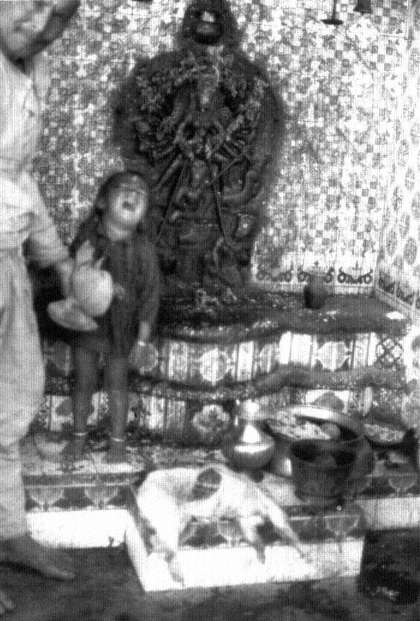
Figure 19.
Sacrifice of a young male goat to the goddess Bhagavati.
forms. Thus, according to Manu , (parentheses are Bühler's; Bühler 1969, p. 174; Manu V, 31, 32, 33):
"The consumption of meat (is befitting) for sacrifices," that is declared to be a rule made by the gods; but to persist (in using it) on other (occasions) is said to be a proceeding worthy of Rakshasas [malevolent demons].
He who eats meat when he honors the gods and . . . [ancestral spirits], commits no sin, whether he has bought it, or himself has killed (the animal). . . . A twice-born man who knows the law, must not eat meat except in conformity with the law; for if he has eaten it unlawfully, he will, unable to save himself, be eaten after death by his (victims).
Significantly, Brahmans are included among the meat eaters. "A Brahman must never eat animals unhallowed by Mantras; but obedient to the primeval law, he may eat it consecrated with Vedic text." Yet, with all these (and various other) attempts to distinguish sacrifice from murder duly made, the Laws state, "a man who, being duly engaged (to officiate or to dine at a sacred rite), refuses to eat meat, becomes after death an animal during twenty-one existences" (Manu V, 35, 36; Buhler* 1969, 174f. [emphasis added]). Sanctions were sometimes needed to force people to participate in the animal sacrifice. These ancient issues have persisted in full force in Bhaktapur.
Biardeau notes that the division between animal and vegetarian sacrifice has in recent millennia become associated with a hierarchy of lower and higher practices, deities, and priests. As we noted in descriptions of other South Asian communities (chap. 8 and above) the vegetarian gods there are higher than the meat eating ones, and their priests, Brahmans, are, in turn, vegetarian and superior to the priests of the flesh-eating gods, whose priests typically belong to lower and nonvegetarian castes (Biardeau and Malamoud 1976, 140). Bhaktapur, of course, has suppressed the hierarchy of the dangerous and benign gods, and hesitates, in fact, to decide which might be higher.34 The suppression is an uneasy one. Newar Brahmans, as they did in the times reflected in Manu's laws, participate in blood sacrifice and eat sacrificially prepared meat. For them and for all the upper thar s, however, sacrifice and meat eating takes its meaning from the various violations of the ordinary dharma that they represent.
Animal sacrifice or an equivalent meat offering is the proper offering to dangerous gods—which in most cases means a goddess—and is required in upper-status Tantric worship to the Aga(n) God and to other Tantric deities. Sacrificial worship of the dangerous gods is optional for those without Tantric initiation, with one essential exception. Every
household in the city must offer a yearly animal sacrifice or meat offering to Bhagavati during the course of the household ceremonies during the harvest festival, Mohani. Most households, if they can afford to at all, perform sacrifices several times during the course of the year. This is done during important rites of passage, during the ad hoc occasions when a worship of a dangerous deity may seem advisable, and during certain of the annual festivals that are occasions for large, semiritualized family feasts.
The kind of animal sacrificed is optional. An egg is considered a minimal but proper sacrifice to a dangerous deity, and it is offered often by very poor families, using the same terminology for the offering as is applied to other animal sacrifice. The offering of the egg is in fact sometimes called khe(n) syaegu , "killing the egg." A poor family may restrict itself to using a mixture, samhae , which is also used by upper-status families in the course of Tantric puja s in addition to the actual climactic killing of an animal. Samhae is a mixture of black soybeans, ginger, beaten and fried rice, "puffed" or "popped" roasted rice, dried fish, and pieces of water buffalo meat. The dried fish are purchased in shops that also sell grain; the buffalo meat is obtained from the Nae butchers whose thar profession is the ritual killing of water buffaloes. The water buffalo was traditionally the only animal that the butcher killed and sold as the only alternative kind of meat to an animal sacrificed in a family puja . These buffaloes are always killed by the butcher in the course of a perfunctory ritual sacrifice, and this makes the eating of their meat by others the taking of what is gesturally at least a consecrated prasada .
Samhae or eggs may also be used by families at any social and economic level for perfunctory worship of one or another dangerous deity. However, the animal most commonly sacrificed in important household or Aga(n) House puja s by people who can possibly afford one is the male goat. Poorer people may use a rooster on the occasion when a goat would otherwise be sacrificed. Other animals are sacrificed in special occasions and settings. Water buffalo are the focus of sacrifice at the Taleju temple and by the Nine Durgas group, where they symbolize the buffalo demon vanquished by Devi in the Devi Mahatmya . At certain sacrificial ceremonies, pa(n)ca bali , five kinds of animals are sacrificed: water buffaloes, goats, roosters, drakes, and rams. A sixth kind of animal, the pig, is sacrificed in special and limited contexts by the men who incarnate the Nine Durga deities. A castrated male goat, called a khasi , sometimes regarded as a unique type of animal, is consid-
ered the ideal animal for sacrifice to Ganesa* . Sacrificial animals are almost always male animals.35 There are some astrologically caused problems when the sacrifice of a female animal is required upon the advice of a Josi (astrologer), and there are Newar festivals in other communities in which female animals are reportedly sometimes sacrificed, but almost all sacrifice in Bhaktapur is of male animals.
The most generally used term for an animal sacrifice is bali , (from Sanskrit, meaning tax, tribute, offering) and in some contexts, bau , which is said to be a Newari derivation of bali . ("Bali " and "bau " are also used for nonmeat offerings in one restricted context, death ceremonies, where rice offerings to ancestors and to crows and dogs as representatives of Yama are so named. Daily offerings of rice to the deceased ancestors of a household are also called bali offerings.) The sacrificial animal is also sometimes referred to as a baha(n) (from Sanskrit vahana , the—most usually—animal vehicle of a god), and thus a sacrifice may be called a baha(n) puja.
As part of the attempt to distinguish sacrifice from murder ("Slaughtering for sacrifices is not slaughtering" [Manu V, 39]), the animal must indicate his assent to the sacrifice, so that he may (again echoing Manu) "receive a higher existence," and be freed of the bad karma that has caused him to be born as an animal.36 The sign is the shaking of the animal's head or body in certain ways.37 During the course of the dedication of the animal to the deity ritually pure water is sprinkled on it, often getting into the ear, which helps ensure the proper movement. Extremely rarely there are animals who are thought not to have assented and they are turned free to wander in the city, and must not be harmed. Throat cutting and death through the resulting exsanguination is considered the specifically Newar way of sacrificing. Rajopadhyaya Brahmans explain that the animal should have life in him to witness the sacrifice he is making as his gift to the deity, and this is not possible in sacrifice through decapitation. Non-Newar Nepalis who perform sacrifices do so by decapitating animals, and this is often referred to as one of the salient contrasts between Newars and others.38 Fowl are decapitated by the Newars, but in keeping with the way mammals are decapitated, with the cut starting at the throat rather than at the back of the neck. The stream of blood from the severed carotid arteries of the sacrificial animal is sprayed on the image of the deity.
The sacrifice of the animal, most typically a male goat, comes (as we have seen in the description of the Tantric puja ) in the course of a puja sequence, and at one of the major climaxes of the sequence. The animal
itself is worshiped. Colored pigments and flowers are put on its head; people make gestures of respect to it; a special pasu mantra, a "beast" mantra , is said for it. The goat is told by the presiding priest or family worshiper that if it agrees it will be able to go to heaven. Sacred water, uncooked rice, and flowers are thrown on its body and head. People then wait for the sign of assent from the animal. A chicken, duck, or water buffalo (when killed by a butcher) must shake its head; a goat must shake its entire body as a sign of acceptance. A buffalo of special ritual importance (that is, all except those routinely but sacrificially killed to be sold as meat by butchers) must, like the goat, shake its body as a sign of acceptance. Although, as we have noted, the animal almost always eventually gives the assent sign, people must sometimes wait a while for it. Once the sign of assent ms given, the animal may now be killed. After the throat is slit and the blood allowed to spray over the god image "to give drink to the deity," the head of the animal is cut off and placed on a metal plate, a puja bha: , which is placed in front of the deity as a food offering. Flowers and colored pigment are taken from the deity and placed on the puja bha: which will, bearing the head, be brought to the feast that always follows the animal sacrifice. Parts of this head will be distributed to the senior members of the phuki in a formal hierarchical pattern as we will recount below. At the time of the sacrifice the various offerings made to the god image previously, flowers, colored pigment, and food offerings become splattered with blood. Some of them are taken and distributed among the worshipers as prasada , and among these the food offerings taken back as prasada are eaten by the worshipers. In a goat sacrifice the abdomen may be opened and a length of intestine taken out, then knotted at one end and blown into to inflate it. The other end is tied, and the image of the deity is now garlanded with this intestinal balloon.
The body of the animal is now prepared for butchering. Its hair may be singed. This is considered necessary in some contexts, in pitha puja s, for example, but optional in others where instead the skin may be treated with boiling water to facilitate the removal of hair. The animal is now to be butchered, usually at or near the place of its sacrifice in preparation for a feast.
Who does the actual killing? This question illustrates the tension between slaughter as a sin and sacrifice as a religious duty. The two thar s whose traditional responsibilities include the killing of animals for food—(and, traditionally, in the case of untouchable Po(n) also the execution of criminals)—are among the very lowest in Bhaktapur.39
Fishing, the traditional source of the dried fish used in the samhae offerings, is one of the duties exclusively assigned to the Po(n)s, the untouchables. The Nae who kill the water buffaloes are also close to the bottom of the status system.
The ideal is for the chief worshiper to kill the sacrificial animal himself. For Aga(n) God puja s in the household or Aga(n) House the acting head of the household or representative of the phuki , whether he is king—or his contemporary Brahman surrogate in Taleju, the king's Aga(n) House—Brahman, or Josi, or any member of the upper thar s, must cut the throat of the sacrificial animals himself. In these cases it is not proper to delegate the sacrificial act to the Acaju, although that is done, as we have noted, in cases where no one in a group has the initiation, or is available to perform the sacrifice. In public settings, however, attended by people beyond the circle of initiates, the Acaju or one of the lowest thar s40 may do the killing, protecting the highest groups in the public arena from the possible stigma of slaughter. Middle and lower groups also do their own killing in family puja s, although the middle groups may use a member of the Jyapu Acaju, or "farmer Acaju" thar s on important or public occasions.
Sacrifice: The Hierarchical Division of the Head
The deities who receive sacrifice are for the most part those who are the tutelary deities of one or another of Bhaktapur's nested components—phuki, guthi , mandalic* segment, city as a whole—and thus the sacrifice represents the members of the unit. The sacrifice, above all those done in the course of Tantric worship, are done in contexts emphasizing the "equality"—which for Bhaktapur means the collapsing of hierarchical distinctions-of the participating group* . In the feast that follows phuki sacrifices large family groups are assembled. At the core is the patrilineal phuki group, but hatanata —the out-married daughters and their spouses and children and more distantly related kin—as well as family friends may also be invited. They all share in the sacrificial meal as guests of the phuki or household. However, within this communal egalitarian feast there is an important ceremonial fragment that recalls the male hierarchy of the phuki . This is the orderly distribution of segments of the head of the sacrificial animal.
The distribution of parts of the head is one of the customs that people in Bhaktapur consider to be specifically Newar, or at least specially important to the Newars.41 The parts of the head of the sacrificed animal are presented just before the fruit course (the arrangement of
courses in such feasts is always conventionally organized in detail), that is, toward the end of the feast. They are given and received in a non-solemn, informal, often joking manner, characteristic of the feast itself.
These hierarchically arranged portions are called siu (in Kathmandu Newari, si ). The particular parts of the head made use of and their hierarchical value varies in various communities and groups. For Bhaktapur, for most upper-level groups at least, the sequence of distribution from highest to lowest is as follows: right eye, left eye, right ear, left ear, nose, tongue, right mandible, and left mandible. Toffin gives for the predominantly Jyapu Newar village of Pyangaon the following sequence: right "muzzle," left "muzzle," right eye, left eye, right ear, left ear, right mandible, left mandible (1976, pp. 329-338; 1984, p. 104). Manandhar in his dictionary of Kathmandu Newari (1976) gives the sequence: right eye, left eye, right ear, left ear, nose (or muzzle), tongue (1976, p. 593). Reportedly, this sequence is not used in Bhaktapur. There are variations in the lowest parts of the status system in Bhaktapur. The Po(n)s, who usually eat pigs during their phuki feasts divide the pig up in the sequence snout, right eye, left eye, right ear, left ear, right mandible, left mandible—to which they add the tail, which in contrast to upper-level restriction of siu to males, is given to a woman, the ranking woman in the family.42 In some circumstances, particularly among lower levels, a chicken or a duck is used for a feast. Thus at the initiation of a member of the Jugi thar s in the learning of the thar 's traditional musical instrument, a chicken is divided. On this occasion the head is given to the guru , the right wing to the student's father, and the left wing to the student. Manandhar (1976, 593) gives the sequential order of distribution for a duck or a chicken as head, right wing, left wing, right leg, and left leg. All these sequences have some tendency to go from top down, or front to back, and always from right to left in the ranking of symmetrical parts. Upper-status Bhaktapur and Pyangaon, at least, divide their mammals into eight parts.
In the middle and upper levels in Bhaktapur the siu is presented in order to the eight highest members of the phuki group that is holding the feast. For upper-level and middle-level thar s, at least, the system of ranking among the phuki as symbolized by the siu division is arranged by age within a generation, rather than only by relative age. In other words, even if a member of an older generation is younger than a male in a descending generation, he has more status in the siu distribution system. If there has been an Acaju assisting the phuki at the sacrifice, he may be presented the fifth-ranked piece, the nose. The recipients of the
siu eat a mouthful of their portion. Sometimes one small piece of any of the portions of siu is taken and presented to a representation of the main deity to whom the sacrifice was presented. The remnants of the siu as well as other residues of the feast are brought, as we have noted, to the chwasa at the twa: crossroads after the feast by one of the household women.
Sacrifice: Human Sacrifice
People in Bhaktapur believe that human sacrifice was performed in Bhaktapur in the past and that it may still take place on certian occasions in remote Newar towns in the Kathmandu Valley. The chronicles contain scattered references to what seem to be actual, as well as rumored human sacrifices, in the past. Mary Slusser reviews some of these reports, remarking that "the late chronicles take . . . [human sacrifice] for granted in the Malla Period, and consider it an accepted Licchavi custom" (1982, vol. 1, p. 337), and adds that "the late chronicles offer several descriptions of human sacrifices that seem too specific and too graphic to be mere fantasy" (ibid., 338). As she sums it up, reflecting with her phrase "almost certainty" the kinds of rumors that persist in Bhaktapur about the distant reaches of the Valley, "Human sacrifice, a feature of blood sacrifice up to the very recent past, is almost certainly no longer practiced in Nepal" (ibid., 1, 217).
In Bhaktapur's civic symbolic enactments the idea of human sacrifice is associated predominantly with the legends and dramatic performances of the Nine Durgas (chap. 15). There are some historical accounts, as we will see in that chapter, indicating that their performances in the past in Bhaktapur once included real human sacrifices. The details of their contemporary performances clearly show that the blood sacrifice of an animal deflects the rage of the Goddess m her most terrifying form from those humans or ineffectual minor deities who have offended her. The idea of the animal sacrifice as surrogate for human sacrifice is overt in still other contexts. In discussion of spirits and dangerous gods it is sometimes said that the dangerous force wants a human death (perhaps manifested in the illness of an individual) and that some substitution, often an animal sacrifice, must be made to save the individual. It is said that an animal sacrifice must be made to a newly constructed house; otherwise it may take a sacrifice itself and someone in the house will die. Similarly, if a truck owned by some Newar family is not given a sacrifice during the Mohani festival, it may cause an accident, again taking the sacrifice for itself. The close relation of ani-
mal sacrifice and threats to humans is experienced by some, at the least, individuals in their late childhood in a deeply felt way. We will return to such personal interpretations and responses in the excursion that follows on the significance of sacrifice in Bhaktapur.
Sacrifice: Aspects of Its Significance in Bhaktapur
Sacrifice in Bhaktapur, as the foregoing sections suggest, has the characteristics that have made one or another variation of sacrifice a powerful and useful social resource, one that "has been found in the earliest known forms of worship and in all parts of the world" (R. Faherty 1974, 128). There is an offering of animals and once, probably, humans to a divine being; that offering is equivocal, as it risks being interpreted as murder; the sacrificial animal is in part a representative of and surrogate for humans, as a human sacrifice would have been a surrogate for other humans; and the life—or death—offered to the gods is in part taken back in a transformed state and shared in a communal meal by the sacrificer and the members of the social group he represents.
It is not our purpose here to attempt to relate these forms to the large literature attempting to explain the social, psychological, and historical functions and "origins" of sacrifice, much of it originating in late nineteenth-century and early twentieth-century social and psychological theory. We will here emphasize certain aspects of it that are highlighted in Bhaktapur's uses and in the responses and interpretations of some, at least, of its people. These considerations are in anticipation of later discussions of how some of the central symbolic forms and symbolic enactments of the annual festival cycle build on the implications of sacrifice to help bind individuals into the city's symbolically constituted mesocosm.
Blood sacrifice in Bhaktapur might be regarded as an extremely immoral act transformed by a powerful context, a "religious" one of a special kind. The immorality and, therefore, the power represented in transformation is greatly enhanced by the Hindu doctrine of reincarnation, which renders animals in this and other contexts of understanding morally continuous with humans. Not only the killing of animals, which is relegated to the lowest-status thar s, but even the eating of meat from animals unless they are sacrificial offerings is contrary to the ordinary dharma . Against the background of such understanding sacrifice in Bhaktapur is the antinomial act in which all levels of society participate, in distinction to those acts that exclusively characterize upper-
status Tantric puja s. The transformation produced by the context is equivocal; there is a conflict with not only "common sense" but also the tenets of "ordinary religion," a conflict within the realm of faith itself. The possibility of a characterization of sacrifice as murder is always there. Much of the significance of blood sacrifice derives from this. Peripheral people in Bhaktapur's society, adolescents, and members of lower thar s, as well as Nepalese outsiders—including vocal Buddhist reformers—are skeptically aware that the apparent transformation of murder into sacrifice may be only self-serving hypocrisy, motivated in such skeptical interpretations by "superstition" in the quest for a good meal.
The location in Bhaktapur of some, at least, of the skepticism in the minds of older children or younger adolescents is particularly significant. As one informant, a member of a shopkeeper family, put it: "at first when we were young we used to feel afraid." (Why?)43 "Killing is not good. Killing causes something to happen in your mind." (What?) "It is a kind of cruelty. Someone is doing something cruel to the animal and he may do something cruel to me. Every man is also like an animal. A man can kill with a knife. That's why I used to feel troubled. But afterward I got used to the religion and to all kinds of sacrifice. "He was about twelve years old when he began to "get used to" sacrifice. I [R. L.] then ask him what other feelings he had about sacrifice before that time. "The religious books were about peace and about not killing anything, not harming anything. But they [the adults] break all the customs of religion, or the reality of religion, and they kill the animals, they sacrifice the animals for their own satisfaction only, in order to eat the animal, that is why they sacrifice. I used to say that it is not really for the god, the god never told us to kill anybody. I used to say so at that time."
But then he grew up and he came to realize the "religious truth" about sacrifice. That is he had to make, as Kierkegaard ([1843] 1954) put it, a "leap into faith," a commitment to counterintuitive propositions, to the "absurdities" that mark membership in a "community of faith."44
The conflicts of meanings of sacrifice within the ordinary dharmic ethical system with the system of meanings and values of the worship of the dangerous deities means that the issues will be overt and conscious, that alternatives will be visible (i.e., to kill or not to kill), and that a choice is possible. The possibility of rejecting an adherence, on one or another level, to the symbolic forms is essential for the meaning of sac-
rifice, especially when the thing to be chosen or rejected involves a risk. Choice implies that for symbols of social importance (1) adherence must be motivated and (2) the act or state of adherence, being in some sense optional, means something in itself.
The acceptance of the religious interpretation that converts murder into sacrifice is not only a significant commitment to a system of doctrine; it is in part motivated by the powerful personal significance of animal sacrifice. The man we have just quoted has said, "someone is doing something cruel to the animal, and he may do something cruel to me. Every man is also like an animal." This overt association of not only "men" and "animals" but of one's self and the sacrificial animal is common in people's reflections on their thoughts and feelings about sacrifice when they were young. Another informant, a member of a high Chathar thar , said that when he was a child "I had pity for the goat, and I felt some sort of uneasiness which came into my mind. What if I were killed and given as sacrifice in that way, what would happen to me. That was the kind of feeling that came to my mind. If I were, you know, given as a sacrifice, you know, with my head turned up like that and a knife blade being put on my throat [he laughs] what would happen? That was the kind of feeling I had you know, a kind of gooseflesh, you know what that is, I can't express it. I used to have that kind of feeling, but these days I don't." Echoes of early understandings persist, although usually less clearly articulated in other adults. Thus, according to a man from the very low Jugi thar "we love the sacrificial animals like our own sons and daughters, because we brought them up and fed them and gave them drink."
These remarks show empathy for and identification with the animal as sacrificial victim. They also suggest a double psychological movement as individuals mature and fully enter the society, a movement that for boys roughly corresponds to their Kaeta Puja s, their initiation into their respective thars . The "leap into faith," the coming to "understand," the acceptance of the system of marked symbols as having its own legitimate reality, is motivated in part by a solidarity with adults, and hence the community, and that solidarity is aided, urged, by a sort of forced choice between an identification with the community of sacrificers and an identification with its sacrificial victims. One must not only accept the community's "ideology" but must also participate in sacrificial acts, and thus by implication in the whole mesocosmic symbolic system that they represent and protect. People are tempted by all kinds of oppositions to the full moral life of the city—memories of their
own childhood, the life of the lower thar s, and the freedom of the hill people. But these are also dirty, chaotic, animal-like. Sacrifice acts as a kind of continuing rite of passage, which emphasizes commitment to the costly order of household, phuki , and city. As we will see in chapter 15, the ritual performances of the Nine Durgas make the social implications of sacrifice quite clear—the wrath of the Goddess in her most destructive representation as Mahakali is aroused by violations of respect due to her by an inferior, that is, by a violation of the fundamental hierarchical social order. She threatens the hapless violator, and can be appeased only by the substitution of an animal, a cock, whose head she tears off and whose blood she drinks.
After their leading male member kills the animal, the corporate group eats it. This common and much discussed aspect of sacrifice has evoked various explanations—such as shared guilt and the absorption of the substance of the representative "totemic" animal—to explain the solidarity that presumably results from this. The Newar feast is a joyful event, usually associated with drinking as well as meat eating in a further participation in the Goddess's realm. The atmosphere of the feast is joyous and communal, a mild sociable softening of the proprieties of hierarchical order and of ordinary dietary restraints. The communal feast humanizes and socializes further the sorts of procedures which Tantrism performs as esoteric rituals. The act of sacrifice is modulated down into a dinner party. The ritual murder (which in some societies might be in the realm of mysteries, of black magic, of evil, of Satan) is conveniently and typically captured by the city and transformed and given a paradoxical propriety in the realm of the dangerous deities and their worship.
Secrecy and Mystery
Secrecy is a pervasive and fundamental aspect of Bhaktapur's life. Its major symbolic representation is in the worship of the dangerous deities—above all in the Tantric mode with its emphasis on esoteric secrets, swearing of oaths to keep those secrets, and levels of initiation into progressively deeper ones.
Secrecy is clearly associated with the cellular units of Bhaktapur and is, in fact, a condition of their cellularity.45 What separates their affairs from outsiders is, in large part, the confidentiality of those affairs. In
large part this confidentiality is to protect each unit from the moral scrutiny of larger units, to allow the unit to regulate its own affairs as far as possible. The moral scrutiny of a larger unit is liable to be censorious and carries a serious and consequential risk of the loss of the public prestige, the ijjat , of the unit.
On the religious level the secrecy is focused on the name, form, nature, and proper worship of the unit's tutelary deity, and on the special craft and professional knowledge of a thar . The revealing of any of a group's secrets by one of its members, usually implying a violation of an oath taken during an initiation, would be a very serious breach of an individual's relation to the group and, more generally, of his or her general status as an adequate "person." Secrecy makes the unit equivalent to a mandala* , a circle in which some sort of religious potency can be bound, collected, and isolated to some purpose. The boundary, which can be represented in space by a line, can in the life of a group be represented by a boundary of secrecy. In analogy to the mandala* , secrecy is similarly associated in the affairs of the units that have it with the concentration, boundedness and possession of some kind of "power" within the unit itself.
Many component units contribute elements to larger ritual or symbolic performances. Mask makers, ritual dancers, potters, image markers, astrologers, Brahmans, Acajus, and so forth may all contribute objects and/or actions. As we have repeatedly emphasized, it is essential that their outputs into the ritual or festival be effective. These outputs are public. However, the way that the mask maker gathers the proper clay, forms the mask in traditional ways, and brings the preliminary stages of siddhi into the mask are secret. It is essential that the cell perform properly, but the details hidden by secrecy are not the concern of the larger group.46 But the fact of the secrecy in itself, the knowledge that a group has its required initiations and hidden rituals, gives outsiders a conviction and a confidence that proper, effective, and powerful actions are being done within a unit to produce the efficacy of their contribution to the public city. This means that it is essential to know that there are secrets. A completely hidden secret, hidden so well that no one knew that a group had any would not convey this sign of corporate siddhi to outsiders. In Bhaktapur, knowledge by others that a group has secrets, or more precisely has the secrets it is supposed to have, is a sign that it is an effective and necessary component of the larger system .47
The secrecy of a group becomes a mystery for those who know there is a secret, but do not know what it is. To turn a secret into a mystery
means that there often have to be ways of signaling, of advertising the presence of secrets. While it is common knowledge that corporate groups have special mantra s, deities, and hidden rites, and that there are parts of temples and houses where no one but the initiate can enter, there are other ways of advertising secrets. One is to warn people to avoid stumbling on them, for they may, it is typically said, be dangerous to an outsider.48 People know, for example, that the Nine Durgas perform important secret dances in various parts of the city late at night during certain phases of their annual cycle and, knowing where they will dance, avoid these areas. For, it is said, if they are seen, the person who saw them would then have extremely bad luck or might die. We have noted the related idea in Tantrism that if improperly initiated and qualified people try to learn Tantric secrets and procedures, they would become blind or insane or would die.
Thus secrecy has to be advertised in order to be effective in the larger system and, sometimes, to prevent outsiders from stumbling on it. The advertisement sometimes takes flamboyant forms. During Biska:, the solar New Year festival (chap. 13), for example, where an image of a secret dangerous deity is to be brought out of its temple to some other part of the city, there is also a false secret image. While people are watching a procession carrying the portable public image of the deity, a priest will run through the crowd carrying something wrapped in cloths. People will say, with an air of special knowledge, that what is being carried is the "real" and secret image. The bundle that the priest is carrying is, in fact, just a decoy; the "real" image is being carried in true secrecy. This device of a false secret has the virtue of advertising the presence of a secret and at the same time protecting it.
The symbolically constituted dimension of Bhaktapur's life, its mesocosm, is in part structured through bounded information. These areas are the property of various corporate groups, and are organized into the larger hierarchical system of statuses. Secrecy is the means by which these bounded areas are maintained; and the possession of secrets is equivalent to the possession of economic and political force in the "material" realm. To tell the secrets is to destroy them as secrets essential to the special functions of differentiated, interrelated units, and thus is to destroy much of the effective structure of the city.49
The system of secrecy has one unintended consequence. It makes loss of traditional knowledge through time, knowledge located in a multitude of bounded groups, very much more likely than the loss of a widely
shared knowledge would be, and at the same time it may prevent an awareness that some aspects of cultural knowledge have, in fact, disappeared. People assume that the esoteric meaning of various symbolic forms is known by "someone" within some one of the city's units. Experts, not knowing the meaning of some form or the details of some ritual technique, will assume that it is known to someone elsewhere. Thus, for example, the nature and meaning of certain faces placed in the headband of some of the masks of the Nine Durgas dancers are thought by Brahmans, mask makers, and the Gatha dancers (see color illustrations) themselves to be known to one of the other of these three concerned groups, but the knowledge is apparently lost.
In Sum
The presence of Tantrism as a legitimate, socially integrated component of Bhaktapur's marked symbolic life, like the legitimate and integrated presence of the dangerous deities, has transformed both Tantrism and Bhaktapur. Esoteric Tantrism and the exoteric religion of the dangerous deities allow for the representation of emotions and ideas that are not represented in—and are often in opposition to—the ordinary moral order of the city. Because of this legitimate and central representation, the ideas and emotions are not totally relegated to such peripheral forms as ghost beliefs, witches and shamans, or to the "imaginary" world of fairy tales and wonder stories, or to private fantasy. All these modes exist in Bhaktapur, although some of them seemed played down in comparison with some other Nepalese groups. (Bhaktapur, for example, uses mostly hill tribe shamans for spirit healers; it treats sadhu renouncers as a "non-Newar" tradition.) The dominant alternative supernatural mode is not only legitimate but also, in some contexts, at the apex of the social system.
Tantrism is intimately connected with the meanings of the dangerous deities who are the objects of its worship, and it shares their implications and uses. Those implications are apparently contradictory to ordinary social order, but they are related to that order in an elaborate, mysterious higher unification. Tantrism and the dangerous deities represent amoral forces and the force that controls such forces, and thus the possibility of using this force to protect the moral system itself; they represent the possibility of escape from the civic system in both its dangers and its attractions and yet, at the same time, a tool for binding the members of a corporate group to the group under the shared protection
and threat of a dangerous deity; they represent danger and chaos, but also fertility and creativity, a realm that can destroy but that is necessary to the life of a community.
Tantric practice and the exoteric worship of the dangerous deities—although some of their symbolic forms may become routine and probably mostly empty of meaning for some or many of its practitioners—are nevertheless able to bring many of these meanings to repeated life, in ways that we have tried to suggest. Tantric practices, albeit somewhat timidly, violate some of the moral laws that are central markers of reputation and status in the public society. Blood sacrifice (less timidly) does this not only in Tantrism but also in the worship of the dangerous deities throughout the city.
Blood sacrifice and Tantrism's other antinomial moves have, among other meanings, a potential epistemological implication for people in Bhaktapur. The violations of the ordinary dharma which must necessarily be done in the worship of the dangerous deities are at the same time violations and not violations. They are "not violations" because they are done in the special transcendent contexts of Tantrism and sacrifice. The city's moral laws are thus valid only in a certain context. This is an important addition to Bhaktapur's large assortment of socially defined paradox-generating contexts, and of different kinds of realities which individuals experience. Tantra, however, in its doctrinal alliance with mysticism, carries the implications of shifting rules and definitions toward the implication that all contexts may be arbitrary and illusory. This is another way—alongside the direct category dissolving possibilities of the experience of meditation—that may lead to a sense of things in which an enlightened or "liberated" individual may come to see through (or, at any rate, peek through) the veil of illusion, maya , in which the moral world and ordinary logic exist.50 That is, the results of experience will support philosophical doctrine. The purposes of Tantric puja are conceived as either powerful action for the sake of the corporate group involved, which may in some cases be the whole city or, alternatively, personal "escape" as a transcendence of samsara* , the ordinary moral world. Power and escape may look to an outsider as different matters, but in the context of Bhaktapur (and Hinduism) they are strongly unified, for they both represent an escape from and a transcendence of the ordinary moral system, the network of pressures, limitations, and relations of ordinary life.
It is this transcendence of the ordinary moral and social world that makes Tantrism significant both for the renouncer (the sadhu or yogi )
and the upper nonpriestly strata51 (the Ksatriya* kings, court officials, and warriors). For this latter group, their power consists, or consisted, precisely in that they have, on proper occasions, to rise above and violate the ordinary dharma in the performance of their necessary protective functions (chap. 10). The alliance of aristocracy, royalty, power, mystic renunciation, and the social legitimacy of Tantrism and the dangerous deities is characteristic of Bhaktapur.
Chapter Ten
Priests
Preliminaries: Priests and Kings—The Relations of the Symbolic Order and Power
Bhaktapur—with its hallucinatory memories of its Newar king, its persisting Ksatriya-like* social segments, its continuing relation to the "new" centralized Saha royal dynasty, its elaborate collection of priests and quasi-priests, and of the other "nonpriestly" traditional social role players who may be contrasted with them, all placed within or in relationship to a traditional dharmic moral order—throws some light on the Hindu peculiarities, variously described and emphasized in the scholarly literature, of the relations of the conventional moral order and "power," of religious and political realms, of priest and king.
In this chapter we will be concerned mostly with details of the types and functions of Bhaktapur's priests and their auxiliary helpers, as well as with those thar -based social roles and functions that are priest-like in one or another more or less covert way. The priestly realm has not only its significant internal divisions but also external contrasts with non-priests which are essential for understanding how Bhaktapur's community life is organized. Those external contrasts are epitomized in the relation of Brahman and king.
It has long been evident to Western scholars that the realms and relations of king and Brahman in South Asian society were different
from those of similar functionaries in most other societies. As Kolenda (1978, 31) put it in a summary review:
As early as the eighth century B.C. , Hindu thought had separated worldly power from other-worldly power. Since then, the two realms have been in the hands of different specialists—worldly power in the hands of the king, other-worldly power in the hands of the priest. In the Hindu ideology, the ritual power of the Brahman priest was more important than the secular power of the king, who was expected to protect and depend upon the priest. . .. Indeed, it was the duty of the king . . . to protect the populace, to ensure conformity to the class system of the time, and to wage war—always under the guidance of his Brahman . . . preceptor. The king was carrying out the religious law (dharma) that was in the keeping of the Brahman priest.
The Hindu king and his fellow Ksatriya* allies, counselors, and warriors protect and enforce the dharma , but their relation to that customary law was, and is, ambiguous. In Robert Lingat's (1973, 210-211) epitome:
The kingship . . . belonged to him who possessed ksatra* ["warlike force," plus "sovereignty"] de facto, . . . i.e. the power to command, whatever might have been his birth and whatever might have been the circumstances which brought him to the throne. Ksatra* confers on the king independence, the right to act to suit himself without depending upon anyone else. The king is independent of his subjects, as is the spiritual preceptor of his pupils and the head of the family of the members of his household. . .. By contrast, Dharma is essentialy a rule of interdependence , founded on a hierarchy corresponding to the nature of things and necessary for the maintenance of the social order. To break away from it is to violate one's destiny and to expose onself to the loss of one's salvation. The peculiar dharma of the king is the protection of his subjects. If he is free to act as he pleases without having to account to anyone for his acts, he acquires merit only when acting in conformity with his dharma . . . . So finally the destroy of the king depends on the way in which he has been able to protect his subjects.
Although it is recognized that some kind of moral responsibility, some kind of "meta-dharma," must guide the king's freedom, his activities as king must, if they are to be successful, violate and transcend, and escape from that "ordinary" Hindu community dharma that is, it is worth repeating, "essentially a rule of interdependence, founded on a hierarchy corresponding to the nature of things and necessary for the maintenance of the social order." In his warrior's relation to the city's external enemies, his manipulative relations to the city's allies, and in his use of violence and power to enforce those internal violations of the civic dharma which that dharma 's sanctions of moral disapproval and karmic retribution cannot in themselves fully control, he must ignore
the morality of interdependence and must perform acts which within the ordinary civic order would be sins.1 In contrast, the king as citizen and as person operates within the ordinary dharma and, importantly for our present purposes, within the ordinary civic religion.
In Louis Dumont's statement contrasting the Indian king with kings in other ancient traditional societies where the king was either at the same time the supreme religious functionary or else superior in his status to "his" priests, the Indian king (1970, 68 [emphasis added]):
loses . . . hierarchical preeminence in favor of the priests, retaining for himself power only. . .. Through this dissociation, the function of the king m India has been secularized . It is from this point that a differentiation has occurred, the separation within the religious universe of a sphere or realm opposed to the religious, and roughly corresponding to what we call the political. As opposed to the realm of values and norms it is the realm of force. As opposed to the dharma or universal order of the Brahman, it is the realm of interest or advantage, artha. . . . All [the implications that follow from this] can, m my view be traced back to this initial step. In other words, they would have been impossible if the king had not from the beginning left the highest religious functions to the priest.
These classic discussions of king and Brahman and the "realms" epitomized by their functions illuminate and yet at the same time tend to obscure the relations and functions of king and priest, and the actual internal divisions and interrelations of realms of "religion" on the one hand and "force" on the other. They obscure the different kinds of religion and priestly functions that in Bhaktapur and many places historically like it in South Asia were differentially related to "values and norms" and to "force," and they do not take account of the wider implications of "force" for characterizing a vertical social segment of Bhaktapur's society, within which the king and his paradoxical dharma is a special case.
The hierarchical system of thar s in Bhaktapur assigns roles and functions of two sorts. The roles are sorted into two hierarchical segments of the macrostatus system. One segment—ranging from Brahman to untouchable—is concerned with the manipulation and maintenance of the dharma -supporting symbolically constituted civic social system, whose central organizing metaphor is purity and impurity. This is the nexus of the interdependent life of the civic community. Its proper religion is the religion of the ordinary deities. Its functionaries, grouped as priests in an extended usage suggested by Hocart ([1950] 1960), are the subject of this chapter. The other segment, ranging from king down via farmers through the lowest-status craftsmen, have their representative
functions within another realm that may be disentangled from the symbolically constructed, hierarchical, civic dharma . They deal, in comparison, with a more material world, and with symbolic forms other than those characteristic forms that organize the dharmic community—purity and impurity, karma , and the moral imperatives of the dharma itself. These are the potters, farmers, traders, wood carvers, dyers, and so on, as well as the king and other political and military functionaries. The cultural forms and symbols that shape and give meaning to their functions (in distinction to their status as citizens) have some qualities and relations different from those of the primary symbol technicians. The relation of their roles to hierarchy, and their work to the dharma , is a secondary addition. As citizens, their religion (like the king's) is the ordinary dharmic religion. However, as operatives in a world that has its own independent realities, forces, and forms, and which is necessary for the support, maintenance, and protection of the city's realm of values and norms, they share, in part, the classic situation of the king. Insofar, then, as they deal in "power," in one sense, and not in "norms and values," their realm is complexly related to the larger "religious universe." In relation to the dharmic religion of the ordinary deities, they perform "secular" functions. However, their relation to the religion of the dangerous deities is different. Those deities have the same sort of relation to the civic dharma as do the activities of the king, farmers, and craftsmen. They, and their special worship and meanings, express the realm of value-transcendent power in which the king and others like him operate, and they can be and are used in attempts to augment and protect that power. We have discussed the function of the dangerous deities and of their worship in earlier chapters; the chapters on symbolic enactments that follow will further indicate what they do, and how they do it. But for now we must note that these deities are precisely not "in the realm of values and norms" but, like the city's segment of "material technicians," are within the "realm of force," a force put to the service of those values and norms.
Bhaktapur's priests, including its Brahmans, operate in both these realms, both as the exemplary pure (and, in fact, exemplary impure) priests of the ordinary moral realm, the world of the dharmic , hierarchical, civic order and also as priests of the realm of power, where purity and impurity and the civic values of interdependency are irrelevant. In these two worlds the relations of Brahman to king, of priest to client, are basically different—and, thus, so is the meaning of the priest and his function.
Preliminaries: Kinds of Priests and Priestly Functions
The priests of Bhaktapur's civic moral realm have a central concern with correct moral behavior and the structuring efficacy of purity and pollution; the priests of the extramoral realm deal with a more direct power, a power that transcends morality as well as purity and pollution. The extramoral religion dealing with powers which transcend that civic moral realm, while at the same time ensuring its protection, is the special religion of Bhaktapur's version of the Ksatriyas* as Ksatriyas* , but has its echoes and uses throughout the city.
The Newar Brahman, the Rajopadhyaya Brahman, is at the summit of both these religious realms. Within the realm of civic ordering he is allied with a whole set of manipulators of purity, and thus of social order and of salvation-producing dharmic order. These allies are auxiliary priests and what we will call "para-priests," as well as various pollution-manipulating priest-like functionaries—purifiers such as barbers and collectors of impurity such as, above all, the untouchables.
In his role as Tantric guru and priest the Rajopadhyaya Brahman presides over that other world in which purity is not an issue, where the priests and practitioners of the world of the dangerous deities manipulate through those deities the extramoral world of physical events—a world of rain and drought, disease and cure, earthquake and war. Such priests manipulate the deities through devices of power, and the deities, in turn, manipulate the nonmoral world. The Rajopadhyaya Brahman's essential priestly ally in this realm is the Acaju, the priest who performs in public those actions that the Brahman can do only in secret.
The two sorts of religion—the socially constructive dharmic religion and the religion of power—converge once again, as they had in the Rajopahyaya* Brahmans, on the untouchable Po(n), and the near-untouchable Jugi. These are the ultimate collectors of impurity, facilitating the purity of all above them. Yet, their ability to do this, whatever the enormous stigma to their social status may be, is a sign of a power to transcend some, at least, of the implications of that impurity. This is clearest in the ascription of Tantric knowledge to the Jugi, but is also a latent aspect of the meaning of the Po(n).
We have been proceeding as if the term "priest" in itself were unproblematic. It was not problematic in the discussion of the priest's contrasts with the king insofar as the "priest" has been the idealized
figure of the Brahman. The Brahman in such discussions is subsumed comfortably under summary characterizations of "priests"—where the problem in characterization is usually to delineate the "priest" in contrast to other mediators with the "supernatural"—shamans, diviners, magicians, and prophets. Among these the "priest" is someone who "has a special and sometimes secret knowledge of the techniques of worship, including incantations, prayers, sacrificial acts, songs, and other acts that are believed to bridge the separation between the divine or sacred and the profane realms. . .. Because the priest gains his special knowledge from a school for priests, he is differentiated from other religious and cultic leaders . . . who obtain their positions by means of individual efforts. . .. As a member of the institution [the priesthood] that regulates the relationship between the divine or sacred and the profane realms through ritual, the priest is the accepted religious and spiritual leader in his society" (E. O. James 1974, 1007). Such an account emphasizes the social centrality and "routinization" of the institutionalized priesthood in making the priest the accepted "spiritual leader" of the community. In the terms of such a definition, we can discriminate among the functionaries who mediate between the sacred and profane and who belong to the central institutionalized civic order, certain "priests" who help the Brahman in conducting rituals or who act in lieu of Brahmans in rituals or who work for clients where Brahmans can or will not officiate. These are auxiliary priests . We are now left with one further distinction. In chapter 11 we will discuss activities, most particularly purification, that are "at the margins of the sacred." These activities are for the purpose of putting individuals in a proper state to enter into the sacred realm, the realm where priests operate, and do not in themselves entail "techniques of worship." The experts who perform these activities are not properly priests themselves. This is clear in the case of the vitally important purificatory work of the Nau, the "barber." The same claim may be made regarding the astrologers, the Josis. We will call those whose functions are to prepare people for their encounters with the sacred para-priests .
Bhaktapur's Brahmans
The Rajopadhyaya Brahmans
In the general perspective of modern Nepal the "Newar" Brahmans of Bhaktapur are a problematic group of Brahmans, in some sense second-
ary to those Brahmans associated with the ruling Gorkhali dynasty. In Bhaktapur, as in other Newar communities, the dominant Brahmans, who share the surname "Rajopadhyaya," must differentiate themselves not only from the Partya: or Khae(n), that is, the Indo-Nepalese Brahman, but also from two other kinds of "non-Newar" Brahmans—the Bhatta* and the Jha Brahmans—who live and work in Bhaktapur. For the most part they identify themselves in contrast to other Brahmans by their thar name, Rajopadhyaya,2 which identifies their connection with the Malla dynasty as the "king's counselor" (see fig. 20).
In their own legendary history the Rajopadhyaya Brahmans came from the great ancient Indian political, religious, and cultural center, Kanauj (also called Kanyakubja), in North India, the same city that they believe to have been the earlier seat of what became the Malla dynasty. Kanauj was in the area of India from which successive Muslim invasions in the eleventh and twelfth centuries drove many Hindus into nearby Nepal.
The Rajopadhyaya's historical legend tells how in the distant past two Brahman brothers came to Nepal from Kanyakubja. Their names were "Alias Raj" and "Ullas Raj." Ullas Raj settled in the mountains, while Alias Raj settled in the Kathmandu Valley. Ullas Raj became a Partya: (literally, a "hill dweller") because he settled in the mountains. Alias Raj became a Newar because he settled in the Valley. Ullas Raj mixed with the Partya: people. As he had done farming in Kanyakubja he remained in the hills, where his descendants continue to be farmers.3 His children spoke the Partya: language (Nepali). Alias Raj mixed with the Newar people, and thus his children spoke Nepal Bhasa* (Newari). Alias Raj and Ullas Raj had no more relations with each other because they now had different languages and customs. They did not keep up their family relations. After a few generations their descendants did not even know each other. When Harisimhadeva* came to Bhaktapur he brought new Kanyakubja Brahmans with him. Harisimhadeva* gave those Kanyakubja Brahmans who had been in Bhaktapur prior to his arrival a "substitute house,"4 which is now still used by the Rajopadhyayas* . As the Rajopadhyaya Brahmans who came with Harisimhadeva* from Kanyakubja and the Rajopadhyaya descendants of Allas Raj were the "same kinds" of Brahmans, they mixed very easily with each other. They both became Rajopadhyaya Brahmans.
However, the account continues, Harisimhadeva* also brought other Brahmans with him, these were Maithili Brahmans from the nearby area of Mithila whose descendants are the Jha Brahmans (one group
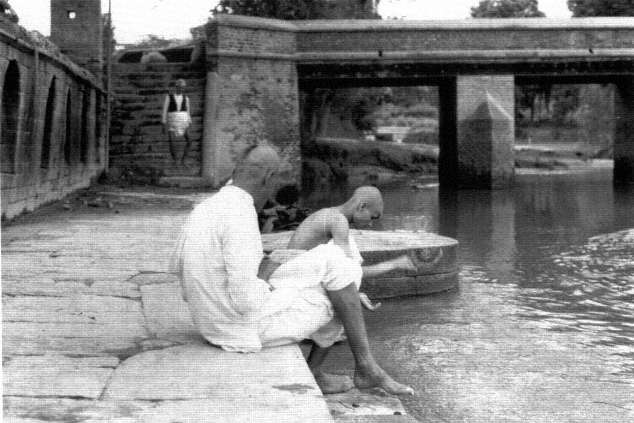
Figure 20.
Rajopadhyaya Brahmans in a purification ceremony at the river.
of Bhaktapur's "non-Newar" Brahmans). He brought them "because they came from a place close to his town of Simraun Gadh* ," but his own royal priests were the Rajopadhyaya Brahmans from Kanyakubja. As the Kanyakubja Brahmans did not have enough Kanyakubja Brahman families to marry with in "Nepal" (that is, the Kathmandu Valley),5 Harisimhadeva* repeatedly brought in new Brahmans from Kanyakubja. Even now, this particular account concludes, the Rajopadhyaya Brahmans have a barely adequately sized group for marriages.
The legend that we have paraphrased reflects some historical reality. It seems generally accepted by historians that the Rajopadhyaya are of Kanyakubja origin, that they were associated with the Malla court, that they were dominant in that court among other Brahmans, and that they were centrally associated with the worship of the royal tutelary goddess Taleju. As a result of the integration of the new Malla dynasty with the preexisting society of the city into the historical synthesis that Bhaktapur looks back on as "Newar," this group of Brahmans were to become the Newar Brahmans, the only one of the various kinds of Valley Brahmans to become the focal Brahmans of the integrated Newar caste system.6
From the earliest records of the Kathmandu Valley communities who were to become the Newars, there have been reports of Brahmans. Thus in the seventh century A.D. , the Chinese traveler Hiuen Tsang wrote that the Licchavi Valley society was ruled by a Ksatriya* dynasty, and that it had so many Brahman priests that he was unable to ascertain their exact number (D. R. Regmi 1969, 271). Inscriptions from Licchavi times refer to the "leadership" or eminent position of Brahmans (ibid., 272). What happened to these earlier Brahmans on the advent of the Kanyakubja Rajopadhyaya Brahmans? It is tempting to think of them as having become some of the lower-status auxiliary priests of Malla Nepal, but our own materials are silent on this.
Bhaktapur's Rajopadhyaya Brahmans consider themselves to belong to one exogamous lineage.7 There are two major groupings of this lineage within Bhaktapur, named in accordance with the areas in and close to which they live or, in the case of now scattered households, once lived. These are the Ipache(n) and the Cucache(n) branches. The Ipache(n) group are those who live in proximity to the Laeku or Durbar Square, and thus to the Taleju temple (map 6; above). Both of these sections contain certain families who have the hereditary rights to be Taleju priests. These "Taleju families" also are the ones whose jajaman s include those upper-level Chathariya families traditionally associated with the royal administration.8
The city's two geographically based groups of Rajopadhyaya Brahmans are partially separated lineage groups. They worship at the same Digu god shrine but at a different time. They have two different Aga(n) Houses for many purposes (but on some occasions make use of the same one). Their separation implies that they are not affected by each others phuki birth and death pollution, but the degree of relations they do have means that they cannot intermarry. Because there are no local Rajopadhyaya families into which they can marry, all Bhaktapur Rajopadhyaya men have to find their wives elsewhere, usually among the Rajopadhyaya women of Patan or Kathmandu. Similarly, all the Bhaktapur Rajopadhyaya girls have to leave Bhaktapur for marriages in Patan or Kathmandu.
At the time of this study almost all of the adult male Rajopadhyaya Brahmans of Bhaktapur did traditional Brahmanical work, in contrast to Brahmans elsewhere, whom they characterized as often being "only Brahmans through their descent."9 The Brahmans' internal religion is a variant of orthodox Brahmanical practices. In contrast to "Sanskritized" Brahmans elsewhere, the Rajopadhyaya Brahmans do eat certain meat, that of the goat and duck, but other kinds of meat and certain foods (such as garlic or mushrooms) are improper for them. They deviate from such Sanskritized Brahmans most markedly because of their participation in the Tantric aspects of Bhaktapur's religion, as we have described in chapter 9. Within their own group the Brahmans must provide their own priests, a situation they share with the lowest thar s in Bhaktapur, those below the level that one or another kind of external priest will serve. A Rajopadhyaya Brahman's family priest or purohita must be someone who is not a patrilineally linked member of the family, and thus he must be linked through marriage to one of the family's men, with the important exception that the paju , the mother's brothers, or their sons are also not acceptable.
Rajopadhyaya Brahman boys learn Sanskrit, the reading and chanting of the Vedas, traditional philosophical and scriptural aspects of Hinduism, and how to conduct ceremonies and the like from their fathers and uncles, beginning with a three-month orientation instruction at the time of their Upanayana initiation to full Brahman status. Until about fifteen years before this study, there was also a special school in Bhaktapur where the Brahman students received extra training in Sanskrit and the Vedas from scholarly teachers. Much of their training came more informally from observations, instructions, and discussion—first on the practice and meaning of the worship that took
place in their own houses, and later, after their Upanayana initiation, while accompanying and helping their fathers and uncles as they performed ceremonies for others.
The Rajopadhyaya Brahmans have various functions as priests in Bhaktapur. Some are narrowly related to specific client families; others to the religious and symbolic life of the larger civic system. They act as domestic priests, purohita s, to a wide span of unequivocally "clean" thar s; one definition of being fully "clean" is precisely that a Brahman will serve as the thar' s family priest. Those thar s whom the Brahmans will serve as purohita are generally those at and above the status level X, in our listing of social levels m chapter 5, that is, from the lowest levels of the Jyapu thar s and above. In another socially circumscibed function, they serve the Chathariya and Pa(n)cthariya thar s, as well as other families within the Brahman group, as guru s in the transmission of Tantric knowledge and in the conducting of some kinds of Tantric worship.
In addition to these services for client families, the Rajopadhyaya Brahmans have public functions. These include their essential representative position in the city at the summit of the purity-ranked aspect of the status system. In the terms of this system they represent the exemplary highest position. They help define, by means of contrast, king, aristocrats, and technicians of the ordinary, physical world in one kind of opposition, and the maximally impure, the untouchables, in another.
In the course of the public symbolic enactments of the annual festival calendar two major "focal" festivals (as we will call them) have as one central reference the royal palace in association with its temple complex, the king's tutelary goddess Taleju, the Malla king himself (represented by Taleju's chief Brahman), and the king's Rajopadhyaya "Guru-Purhohita. " The Taleju Brahmans are focal actors in these two major festival sequences Mohani and Biska:. In Mohani Taleju's chief Brahman presides over the sacrifices and the rites that bring the Goddess to her full power at the time of the agricultural harvest for "the protection of the city." In the Brahman's association here with king, palace, and Taleju, he is a focus of attention for the whole city. This royal context of power in a sense protects and isolates him as he represents publicly his role as a priest of the dangerous deities, a role that, as we saw in chapter 9, he usually performs in private arenas.
Some Rajopadhyaya Brahmans work as temple priests, pujari s, a function that, as we will note below, they share with other kinds of priests. Some also earn part of their living as public storytellers, re-
counting the stories of the Hindu tradition that form an important interpretive background for many of the city's ritual and festival activities.
In his central roles the Rajopadhyaya Brahman is a complex priest. On the one hand he is the exemplary pure figure of a "Brahmanical religion"; on the other he is the powerful priest of an extramoral religion of power.
Lakhae Brahmans
There are three or four families in Bhaktapur who have the thar name "Rajopadhyaya," but are considered to be of a separate and somewhat lower category. They are referred to as "Lakhae Brahmans," and do not seem to exist in other Newar communities (see chap. 5). They are interpreted in the way that intermediate-level thar s are usually interpreted as being the descendants of improper marriages, in this case of a Rajopadhyaya Brahman man to a Rajopadhyaya widow (these widows are not supposed to remarry) or to a previously married but separated Rajopadhyaya woman. The Lakhae cannot marry with the Rajopadhyaya proper and must find wives, with some difficulty, among village Brahman families. Their own priests are the ordinary high-status Rajopadhyayas* . They themselves are family priests for certain of the thar s at and just above marginally clean status—the Dwi(n), Nau, Gatha, and Kau.
Bhaktapur's Non-Newar Brahmans
As we have noted the Malla kings were said to have brought other Brahmans from India in addition to the Rajopadhyayas* . Since the Malla period there have been two such groups of Brahmans in Bhaktapur, who have lived there in separation from both the Newar Hindu and Buddhist community life. In this they resemble other such cultural isolates in Bhaktapur—the Muslims and the Matha* priests (chap. 5). These two groups of Brahmans do not consider themselves to be either Newars or Newar priests. They are the Jha Brahmans (whose family name is "Misra") and the Bhatta* Brahmans. Some Jha Brahmans work as temple pujari s and public storytellers in Bhaktapur, but most of them are professional workers in the modern political and economic sector of Bhaktapur and Kathmandu.
The Bhatta* Brahmans, whose origins were in Maharastra* , are found
in many Newar towns and villages. In Bhaktapur most of them are teachers and professionals, while members of some families are temple priests. Some work as purohita s for other Bhatta* families. Members of two Bhatta* Brahman families, however, have a closer, and in some respects curious, relation to Bhaktapur's Newar Hindu community life. They act as auxiliary priests to one group of families, a section of the Chathariya Kayasta* thar called "Nakanda." In certain Brahman-conducted puja s held to cure illness or misfortune thought to be due to bad planetary influences, a mixture of different kinds of grain are held to the head of the sufferer. The families in this group then have the option of sending the grain to a Po(n) untouchable so that he may absorb the misfortune (which is what families other than those in this particular group would do) or else to send it along with valuable gifts to a Bhatta* Brahman as an offering, a dana . Although the transaction may be phrased as a gift, a dana , it resembles in nature and function the offerings to lowest-status thar s, offerings that signal the inferiority and dependence of those thar s, and which serve to transfer pollution, as is suggested in the option of choosing either a Bhatta* or Po(n) here.10
This equivalence of Po(n) and Bhatta* Brahman here suggests the polluting implications of many priestly services, and is typical of the situation of the "auxiliary priests," to whom we will now turn.
Overt Auxiliary Priests and Para-Priests
Rajopadhyaya Brahmans in Bhaktapur in discussions of "religious work" identify a group of "Karmacari," that is, "workers" or in this context "religious workers," whom we will group as "overt auxiliary priests and para-priests." These make up an important segment of traditional Newar society. Their services as a group are to all the clean or marginally clean segments of that society. They perform services necessary in the performance of various religious rites, and usually do these services for hereditary patrons, jajaman s, as the Brahmans themselves do. The various types of Karmacari listed are all members of thar s whose distinguishing traditional and hereditary function are these services even though many of their members now do other things. They perform either priestly functions during the course of rituals, or in the case of the Nau and the Josi (in their major functions), activities that are preparatory and prerequisite to participation in rituals. The Rajopadhyaya Brahmans often describe those auxiliary priests who
perform ritual work (as opposed to the preparatory functions of the "para-priests") as "kinds of Brahmans," and often claim that their powers are, or were originally, passed on to them through Rajopadhyaya Brahmans as the guru s who provided esoteric teaching and mantra s. This group of workers assist the Rajopadhyaya Brahmans in three ways: (1) the preparation for rituals, (2) assistance in doing rituals, and (3) the performance of rituals or aspects of rituals that would be polluting to the Rajopadhyaya Brahmans, and which would compromise their ideal status. We will call this group of religious workers overt auxiliary priests, in distinction to the very low polluting thar s, whose essential priestly function is relatively covert and submerged and obscured by the more salient symbolic meanings and actualities of their traditional roles. We also find it useful to distinguish "para-priests" whose functions, in the terminology of the next chapter, are at the margins of the sacred.
Josi
There are presently in Bhaktapur two thar s whose name indicates that their members' traditional professions were astrology. The thar s and thus their members' surnames are "Josi" (often written in Newari as "Josi"), a name derived from "astrology," jyotisa* in Sanskrit. One of these thar s is in the highest segment of the Chathariya group. The other is at the Pa(n)cthariya level. As is true of most upper-level thar s, with the exception of the Brahmans, most members no longer follow traditional occupations. There are, however, a few families at each level, some of whose members perform astrological work for individuals, and who transmit professional knowledge about jyotisa* to new generations within their family. Some families in the Chathariya group have members who traditionally serve the Taleju temple, working there not specifically as astrologers, but for the most part as assistant priests.11 As astrologers, the Josis serve middle-status and upper-status people.12 They prepare a written record (jata :) of the time of the birth of children, an indication of their relation to the Nine graha , or "Planets," at their birth. The jata : in later life will be used by Josis in the determination of the proper sait , or astrologically proper time span, within which important activities should be initiated or avoided. The Josi's advice based on his interpretation of an individual's jata : is of particular importance in the determination of saits for rites of passage and also contributes to judgments regarding proper marriage partners. The Josi can also advise
on procedures for mitigating the ill effects of astrological conditions, and can help supervise the proper ameliorative worship. Finally, Josis help in determining the proper positioning and timing in propitiating the disturbed local forces when a home, temple, or other building is to be constructed.
Bhaktapur's Josis make their predictions and decisions for individual clients by comparing the information on an individual's jata : with a patra , an annually published astrological calendar. This generalized calendar, used throughout Nepal, is a reminder, in fact, that the Josi is concerned with worlds that are beyond Bhaktapur's civic mesocosmic system. He is concerned with the macrocosm represented by the graha s and with the individual microcosm. His function is to adjust those two realms so that the individual starting from his idiosyncratic position is able to periodically realign himself with the macrocosmic forces. In so doing he can then successfully fit into the ongoing moral, social, and religious patterns of Bhaktapur, the middle world properly presided over by the Brahman. The Brahman explains unfortunate events in terms of improper relations to the city's deities, or to bad karma caused by some moral error in this life or a previous one. The Josi ascribes unfortunate events most characteristically to a dasa , an astrological condition that can produce good or bad "luck," usually the latter.13 This luck, being astrologically produced, does not derive immediately from moral sources as bad karma usually does,14 nor does it derive from relations to the civic deities.
In his function as an astrologer the Josi is not, properly speaking, a priest. He puts individuals into a proper relation with a macrocosmic world whose divine representatives, the "astral deities" (chap. 8), have the most minimal meaning as "gods," being rather impersonal forces, and he characteristically does this through advice on timing and choices, which is not "worship" in any sense, not an attempt to influence the divine. He advises corrections and adjustments that allow people to get on with their ordinary lives, one aspect of which is the timing of puja s and ceremonies, the realm of the true priests. In his rectifying and enabling activities, he is like another "para-priest," the barber, who "mechanically" purifies people in a nonsacred procedure and prepares them for worship. As astrologers, the Josis do have second ary priestly functions. When bad fortune, or the possibility of bad fortune, is produced by a violation of order of certain types—those having to do with some reference to an astral deity, or, in the construction of a house, with the preexisting order of the space around and
under the house (symbolized as a disturbance of the supernatural serpents, naga s), the Josis advise on and often lead special restituting worship. They also act as auxiliary priests in some elaborate Brahman-led ceremonies, such as ceremonies for the cure of illness of high-status clients, and they participate as auxiliary priests to the Brahmans in the major Taleju ceremonies. In such helping roles they are not astrologers, but simply assistant priests.
Rajopadhyaya Brahmans claim that Brahmans could do astrological work (as they do in many parts of South Asia), but that they "have given this right to the Josis." Josis are considered by Rajopadhyaya Brahmans to have been derived by some sort of downfall from the Rajopadhyaya Brahmans.15 It is pointed out that they belong to the same gotra as the Rajopadhyayas* , the Bharadvaja gotra . This puts them into a more intimate relation with the Brahmans than some of the other priests who are distinguished as "a kind of Brahman" in terms of their function but not in terms of their descent. The theme of fall in status, for the Josis from Brahmanical status, recurs in a variety of ways, as we will see, in regard to other auxiliary priests.
Acajus
There are in Bhaktapur two thar s with the that name Karmacarya, one among the Pa(n)cthar16 and the other among the Jyapu. The traditional profession of the men of these thar s is as a kind of priest called "Acaju" in Newari (from the Sanskrit Acarya , "spiritual guide or teacher," plus the Newari honorific particle ju ). D. R. Regmi, in a discussion of the Josis and Acajus in Malla Nepal, gives a useful orienting account of their still persisting functions (1965-1966, part II, p. 715):
The Acaju functioned as an inferior priest in all Brahman led households. They accepted daksina* (gifts m money) as well as food m their host's house. . . . But they could not chant the Vedic mantras and also could not conduct the [Vedic] rituals. These were done by the Brahmans alone. The Acajus and Josi, however, were indispensable for any ritual. The Josi was concerned with the task of finding out an auspicious time for any kind of rites to be performed. The Acaju helped to arrange methodically the requirements of the ritual performance. He prepared the ground work for the actual rite. It was left for the Brahman priest to use them.
As the Josis, in addition to being assistants to the Brahmans, have their independent function as astrologers, the Acajus also have an independent function. The Acaju are Tantric priests in public settings. This
has lead to an impression in certain accounts of the Newars that only the Acajus work as Tantric priests and that the Rajopadhyaya Brahmans never do. Like many of the auxiliary priestly performers, they undertake tasks that would be improper for the Brahmans, at some cost in status for themselves. However, in this case it is not the function itself from which the Brahmans are protected, but, as we have discussed in chapter 9 in the Tantric context, its public performance. The Acajus also serve as surrogates for members of upper-status households in Tantric rituals in those cases where household members do not have the proper initiation or, sometimes in recent years, the available time to perform them. They also conduct ordinary Tantric puja s for their clients. In elaborate rituals with Tantric and sacrificial components (for example, the major rites of passage and rituals for the establishment of a new house), the Acaju is required, for well-to-do upper-status and middle-status families, at least, as one of the priests in the ceremony. Here he is not only an assistant to the Brahman priest but also (in keeping with the public nature of the sacrifice) the performer of the sacrificial part of the ritual.
Among the Pa(n)cthariya Karmacaryas there are approximately eight groups, who are differentiated in part according to where in the city they live and according to the particular kind of traditional work that they do. The Jyapu Karmacaryas are unique in the Jyapu group in that they, alone, have the right both to wear the sacred thread and to have Tantric initiations and practices. In spite of this they are not ranked in the upper levels of the Jyapus, and the thar s that are in those levels (and cannot wear the sacred thread) will not marry them. When people in the lower levels of the status system were asked to rank Bhaktapur's thar s, they usually placed Brahmans, Josi, and Karmacarya, in that order, at the top, because of their priestly status. In fact, among their peers the Pa(n)cthariya and Jyapu Karmacarya both have what would seem to be a more depressed status than their priestly status accords them in the point of view of those well below them.
Like many other kinds of priests, including the Rajopadhyaya Brahmans, members of the Karmacarya families also work as temple priests at many of the city's temples and shrines.
Tini
In Bhaktapur's status hierarchy there is one thar placed below the Pa(n)cthariya level and above the great mass of Jyapu or farming thar s.
This is the Sivacarya ("Acariya of Siva") thar , whose members are priests, in Brahmanical phrasing, "a kind of lower Brahman." The priests of these families (and their members in general) are called "Tini."17 It is said that the Tini exist only in Bhaktapur and in some surrounding villages. In the other Newar clues their special functions are performed by Karmacaryas.18 In Bhaktapur a Tini priest is required during two important rites of passage. He is necessary for the performance of a purificatory fire ceremony, the gha:su: jagye ceremony, among middle and upper thar s, performed (depending on the particular thar 's customs) on the eleventh or twelfth day after a death (app. 6). The Tini priest makes a fire on the cheli of the house. Offerings to the fire are considered as offerings to Siva (which is sometimes given in partial explanation of the thar name of the Tini, "Sivacarya"). In the course of this fire ceremony the Tini makes a meat-containing offering of samhae to the fire. It is believed that the smoke of the fire will penetrate the house and drive out the evil influences of illness and death.19 Members of the family and at least one representative from each household of the extended phuki (who have shared in the death pollution) hold their hands over this fire to purify themselves and the members of the households whom they represent. In the course of the gha:su: jagye ceremony the Tinis have (in contrast to Karmacarya priests) the right to read verses from the Veda, which they possess in a simplified version in manuscripts passed on in their families. They also have the right to transmit, know, and use Vedic mantra s. The other important general community use of the Tini is as one of the necessary assistant priests to the Brahman (the others being Acajus and Josis) during the mock-marriage ceremony, the Ihi ceremony (app. 6).
The Tinis are the purohita s, the family priests, of the families of the Bha thar , a thar of borderline clean status, whose members have, as we will see below, their own contaminating priest-like function. In terms of their right to know Vedic mantra s and read the Veda, their status, by traditional criteria, would approximate the Brahmans. Tinis are explained as being a "kind of Brahman" probably "fallen" because of some irregular marriage, although in contrast to the Josis with their Taleju functions, the connection to the Rajopadhyaya Brahmans themselves seems much vaguer. In contrast to the work of the Josis as astrologers, which Brahmans say that they could do but delegate to others, Brahmans say that they themselves could not perform the gha:su: jagye ceremony without losing their Brahman status. This is because that ceremony has to do with the removing of pollution, a pro-
cedure that always depresses the status of those who do it. This illuminates both the anomalously low status of the Tinis—they are lower than any of the other upper-status sections—Brahmans, Chathariya, and Pa(n)cthariya—and their protective or surrogate function for the high-status Rajopadhyaya Brahmans.
Purity Technicians With Limited Functions
The four Newar thar s we have considered so far—Brahmans, Josis (in the priestly component of their traditional functions), Acajus, and Tinis—are "priests" in the sense that they have the legitimate right and proper traditional knowledge to perform services for their clients that mediate for these clients in their relations with deities. Although, as we have argued, their statuses are depressed in their relation to the highest segments of the social hierarchy, their statuses are still high in the larger system and their polluting force and meaning for others is overtly simply the usual relations of higher and lower in the macrostatus system.
There are a number of other thar s whose traditional activities are necessary for the religious life of the city—both for that led by priests and for individual or household worship. Some of these are craftsmen, producers of objects necessary in worship. These include the Pu(n), painters of religious images and mask makers; the makers of images in metal (Tama: and the "Buddhist" Sakya), stone (Loha[n]ka:mi) or wood (Ka:mi); the growers of flowers for religious use (Gatha); and the potters (Kumha:). There are also shopkeepers whose shops sell supplies and equipment necessary for performing puja s. These craftsmen and suppliers occupy a span of statuses, and are not apparently differentiated from other craftsmen or suppliers—either elevated or depressed in status—because they happen to make or deal with religious objects as one of their services.
There is another group of thar s whose status is what we have called "marginally pure"; that is, they are all polluting to the highest thar s who will not accept water from them, although the middle groups will. They are in the same level in the macrostatus system (level XIII; see chap. 5), a level that is intermediate between the clearly clean thar s above them and the clearly polluting ones below them. There are miscellaneous justifications given for the low status of the various thar s in this level. Three of them, however, Bha, Nau, and Kata:, perform neces-
sary services for higher thar s that allow for the restoration of purity or in the case of the Bha a human form for the soul after death, and in so doing acquire pollution themselves. A fourth, Cala(n), carrying a torch and a pair of cymbals, walks at the head of funeral procession to warn people because of the danger of crossing in front of it.20 These four groups are included by Brahman informants as Karmacari, religious workers in contrast to the craftsmen and suppliers on the one hand, and the lowest thar s whose "priestly" functions are covert, on the other. Insofar as they may be defined as enabling , through their actions, the ritual states and behaviors presided over by priests, we may call them, as we did the Josi, "para-priests." In addition to the Bha, Nau, Kata:, and Cala(n), there was in the recent past an additional such group in Bhaktapur, the Pasi, whose function was to wash and thus purify the clothes of a family's "chief mourner" on the day of his purification after ten days of ritual mourning (app. 6).21
The Bha
The Bha, or Bha(n), have the thar name "Karanjit." In the course of death rituals for upper-status thar s, during the first ten days following death a Bha acts as an instructor and assistant to the chief mourner (the kriya putra , usually the oldest son) in a bereaved client household, and constructs some of the objects used during this period (app. 6).22
On the tenth day, the final day of the mourning period, the family makes a presentation of substantial gifts to the attending Bha for the special work he must now do on that day. During the ten days after death the spirit of the dead person, which has been in the dangerous and marginal form of a preta , has been forming its "spiritual body" piece by piece in a definite sequence, and by the tenth day that body is completely formed (app. 6). The relation of the Bha to this formation, and one of the reasons be is given substantial gifts on this day is not discussed publicly, in part to protect the public reputation of contemporary members of the thar and thus to ensure that the custom will continue.23 Chattopadhyay (1923, 468) quotes from Brian Hodgson's early nineteenth-century descriptions of the functions of the various Newar thar s that
The Bhat [Bha:] are also connected with funerals; they accept the death gifts made on the eleventh [now, for Bhaktapur's upper thar s, at least, the tenth] day after the funeral of Newars of any caste (excluding outcastes) [now in Bhaktapur only for Pa(n)cthariya and above]. In the case of the Ksatriyas*
[Pa(n)cthariya and Chathariya] it is mentioned that a piece of the brain of the deceased is kept covered with sweetmeats, the rest of the body being burnt, and this is eaten by the Bhat on the eleventh day as he accepts the death gifts.
The death gifts that the Bha is now given include such substantial items as clothes, shoes, hats, mattresses, kitchen pots, drinking vessels, and substantial quantities of food. The Bha, it is said, is now often given a bit of ordinary food to eat, rather than a part of the dead body, but this "ordinary food" may, in at least some, perhaps in most, high-status cases, be boiled rice previously touched to a fragment of one of the corpse's bones. This ingestion by the Bha is said to ensure the preta 's eventual reincarnation in a human rather than an animal form. Another possible function (and alternate explanation for the Bha's action) may be to ensure that the spirit itself has completed its change from preta to human-like form (app. 6).24
Brahmans say that if a Brahman were to go to the house of a mourner on the tenth day and were to eat anything, or to accept any offering, he would lose his status as a Brahman. In other parts of South Asia, similar ingestion is or was done by a Brahman himself on the death of people of very high status. The Brahman was then very highly compensated, but had then to live in exile outside of the community.25 The Bhas relieve the Rajopadhyaya Brahmans of such unpleasant responsibilities. The Bhas are said by Rajopadhyayas* to be a fallen Brahman group, and they are, in fact, referred to in some texts as Mahabrahmana* , "Great Brahmans."26
The Cala(n)
Members of the Cala(n) thar are placed second in upper-status funeral processions where—carrying a torch in one hand and small cymbals, which they clang together, in the other—they warn people that a funeral procession is coming, and thus prevent them from crossing in front of it at a crossroads, which would produce misfortune for all concerned.
The Kata:
The traditional function of the Kata: for upper-status families, performed by women of this thar , is to cut and tie the umbilical cord after birth, and to remove the polluting placenta and bury it outside of the city boundaries.
The Nau
The Nau are the barber thar . The men of this thar work as ordinary barbers, but both the men and women of the thar are necessary for the major purification procedures required by the middle-level and upper-level thar s following periods of pollution (usually the result of death or births within the phuki ) or in preparation for some major puja or rite of passage. The Nau's functions, as we will argue in the next chapter, are outside of the realm of priestly ritual as such. However, they, like those of the other para-priests, belong to the larger symbolic context of purity and impurity within which those rituals exist. The Nau remove impurity as an essential precursor to ritual action.
Hindu Use of Buddhist Priests
The Newar Buddhist Vajracarya priests have sometimes been referred to as "Buddhist Brahmans" (e.g., Greenwold 1974), but this is misleading. The roles they play within the Newar Buddhist community itself differs from that of the Rajopadhyaya Brahmans for the Hindu community in important respects. The Vajracaryas perform many of the functions (astrology, Tantric sacrifice, aspects of death ritual, etc.) that the non-Brahman priests and para-priests do in the Newar Hindu system, and they also perform healing procedures done in Hindu Bhaktapur by special thar s of healers. The fact that the Vajracaryas can perform these functions without compromising their status indicates an important difference between the Hindu Newar system and the "Hinduized" Buddhist Newar system. The Hindu Newar opposition and interplay between the traditional system of purity, headed and symbolized by the Brahman in his protected public image on the one hand and the "nonmoral" supernatural transactions, particularly those of the Tantric system, on the other, is blurred in the Newar Buddhist system, altering, among other things, the comparative significance of Newar Buddhist Tantra and of the Newar Buddhist high priests.27
There are various ways in which the Vajracarya participate in the Hindu-centered system. People in the middle and lower thar s may use Vajracaryas as astrologers or healers. Toffin (1984, 230) has reported of Newar communities elsewhere in the Kathmandu Valley that some thar s use Vajracarya priests in the purifying (and contaminating) gha:su jagye ceremony to remove the contamination of a death from a house, a ceremony that is performed by Tints in Bhaktapur. Some thar s in Bhak-
tapur (chap. 5) use Vajracaryas as family priests, either exclusively, or, in the case of middle-level thar s, in some combination with a Brahman purohita . These clients include both the more properly "Buddhist" thar s and marginally clean thar s. Some marginally clean thar s are served by the Vajracayas as family priests, as others are by Tini and Lakhae Brahmans. This service is, perhaps, in large part, an opportunistic profiting from an economic opportunity left open to Vajracaryas and these other priestly thar s by the purity constraints preventing the Rajopadhyaya Brahmans from working with families below the Jyapu level.
We must include one residual service of Buddhist priests to Hindu Bhaktapur. An important segment of one of Bhaktapur's major Hindu festivals, the climactic festival of Mohani, centers around the "living goddess" Kumari, incarnated in an upper-status Buddhist girl (chap. 15). Certain Vajracarya priests play a part in the selection and maintenance of that child deity.
Covert Para-Priests: The Pollution-Accumulating Thars—Po(n) and Jugi
The sector of Bhaktapur's symbolic civic order in which the Brahman has a supreme and ideal position is ordered through the idiom of purity and pollution. The auxiliary priests and para-priests in this system protect the Brahmans' position by performing the polluting and other unseemly actions that the civic ritual system requires. The ritual and enabling functions of these "religious workers" are clear, and centrally define their differentiated traditional thar duties. In contrast to this group are those lowest thar s in the city, whose polluting power is centrally and obsessively emphasized (see fig. 21). These groups, locally conceived in some contexts as the antithesis of the Brahman, can hardly be conceived of in Bhaktapur as "kinds of Brahmans" and in contrast to the other figures we have been discussing, including the Buddhist Vajracarya, are not included on Brahmans' lists of "religious workers." Their functions as "religious workers" are ideologically hidden. In an analytic view, however, they are clearly para-priests, essential enablers of ritual action.
It is now widely recognized, following Hocart ([1950] 1960), that an important function of the lower castes is to absorb pollution from the higher ones, and thus to maintain their relative purity and the hierarchical system dependent on it. Hocart notes the remark of a Tamil in-
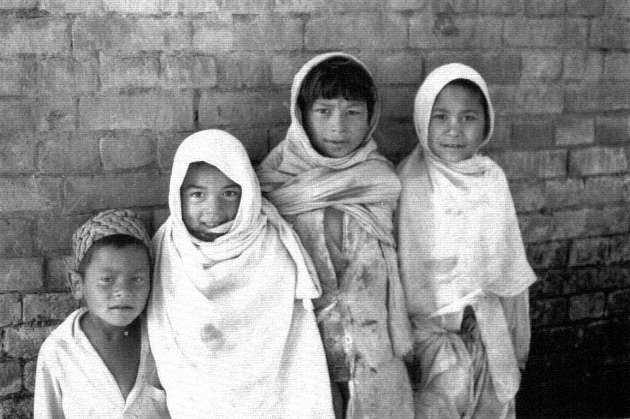
Figure 21.
Untouchable Po(n) children.
formant about the barbers' traditional function in cremations that the barber is "like a priest on the cremation ground." Giving other examples of such funeral functionaries, Hocart concludes, "The barber and the washerman, like the drummers, are not so much technicians as priests of a low grade, performing rites which the high-caste priest will not touch" (ibid., 11). Gould has called the whole class of low-status Sudra jati s "contra-priests." These were the groups "at the bottom of Hindu society who practiced such defiling occupations as washing clothes, barbering, sweeping, removing dead animals, midwifery, and cremating the dead. As it were, they absorbed the defilement in dealing with blood, death, and dirt so that the rest of Hindu society could be free of it and partake of the rituals that prepared the ground for rebirth into ever purer occupational categories" (Gould 1971, 11; see also Gould 1958). Gould notes Dumont and Pocock's remark that what is specifically Indian in the attempt to control defilement is "the employment of specialists who take upon themselves a part of the impurity, and to whom it remains permanently attached" (Dumont and Pocock 1959, 18; quoted in Gould 1971, 12).28 Such "contra-priests," "by virtue of their specialized ritual functions, live permanently in that state of impurity which they help others to abandon as rapidly as possible" (Dumont and Pocock 1959, 18).
Many of the auxiliary priests and para-priests perform polluting tasks, and this is related to their relatively depressed statuses. The polluting entailments of their tasks are secondary to the importance of those tasks, however, and seldom are salient; they are, in fact, usually muted in public discussions. If their statuses are relatively depressed, they are still found in all the clean ranks of the status system. The "impurity" of these people is simply the relative impurity that distinguishes each stratum of the macrostatus system from those above it. But there are some low thars whose "permanent state of impurity" is their major defining characteristic, their most salient meaning to others, and whose priestly functions are secondary or covert.
For all people in Bhaktapur the dramatically polluting thar s are represented by two, the Po(n) and the Jugi. There are other low thar s that are near them in status. The Nae, the butchers, are just above the Jugi in status, and in principle almost as polluting, and the remnants of some very low thar s—the Do(n), and Kulu—intermediate in status between the Jugi and the Po(n)—are also found in the city. However, these other thar s are almost never discussed in talk about the impure. That talk, often full of feeling, focuses on the Jugis and most emphatically on the
Po(n)s. People are deeply concerned (in ways that will be presented elsewhere) with the conditions of life and the nature of these two groups in an orienting and defining contrast with their own way of life and their own nature.
The Naes (like the borderline clean thar ) are unclean because of what they do, the necessary service they perform, namely, killing water buffaloes as the main source of meat not derived from family sacrifices. However, the central service that the Po(n)s (and, secondarily, the Jugis) perform is to accumulate pollution in particularly dramatic and—for the Po(n)—multiple ways, in short, to be unclean . The various polluting services that are assigned to them are in part justifications and attempts at objectification of their theoretical uncleanliness.
The Po(n)s in Bhaktapur have many of the functions that were classically associated with untouchables throughout much of South Asian history. They are fishermen; as the Naes kill water buffaloes, they kill fish, the fish being (traditionally) bartered and now often sold to other thar s for food The Po(n)s, in Malla times, were executioners, and thus also takers of human as well as animal life.29 Most saliently now the Po(n) are "sweepers." They clean the streets, which entails the cleaning of much human and animal feces, and they remove excrement from house latrines and from the special fields used in the city for defecation by people without access to latrines. Traditional Indian untouchables, the Candala* , in addition to being executioners, had "as their main task . . . the carrying and cremation of corpses" (Basham 1967, 146). Bhaktapur's Po(n)s have a narrower funerary function. They must remove the mats and cloths with which bodies are covered during funeral processions from the cremation grounds, after which it is generally believed they use them as ordinary cloths and mats in their houses. As elsewhere in South Asia (e.g., Stevenson, 1920, 352) the Po(n)s are prominent after eclipses, when they go throughout the city receiving alms from anxious householders, thus drawing on themselves the bad influences associated with eclipses. Similarly, as we have noted in conjunction with the Bhatta* Brahman, an offering may be made to a Po(n)—equivalently to the offer to the Bhatta* Brahman—in order to remove astrologically produced misfortune.
The Po(n) have the vital function of making the city's organizing pollution system real , in the sense that they bring it into contact at its lowest point with a sensorially accessible world of real pollutants, and with the most dramatic of these, feces. In their degraded conditions of life they also make real the penalties of bad karma , and they thus vali-
date the whole system of community dharma and help motivate people's adherence to it. Uniquely among the accumulators of pollution the Po(n)s must, as untouchables had to in South Asia since very early times (e.g., Basham 1967, 146), live outside the city, the city boundaries being in part defined by their external residence. In Malla and Rana Nepal they were not supposed to enter the cities after sundown, and there were strict limits on the kinds of houses they could build and clothes they could wear.
The Po(n)s were clearly marked and distinguished as those beyond the community who helped to define that community. However, in contrast to other images of the outside and beyond—other kingdoms, non-Newars, wild beasts—the Po(n)s are integrated into and controlled by the city, they are part of the city system, essential for its symbolic ordering. They belong to the defining, bordering outside. When people variously placed in Bhaktapur's social system talk about the Po(n)s, it is evident that the Po(n)s represent in a fantasy augmented even beyond the unpleasant reality of their condition what would happen if one ceased to follow the sometimes onerous duties and restrictions of the ordinary daily religious and moral code. Life would be disgusting, impoverished, without decency. People sometimes say, "Without the protection of the dharma we would all be like Po(n)s." The Po(n)s, in their maximal accumulation of poverty and social disability, represent the realization of the important sanction of the bad rebirth resulting from violations of dharma , as well as the "state of nature" resulting from the rejection of social order. While people tolerate and understand and feel helpless to prevent other groups rejecting their traditional stigmatizing thar duties, there is widespread and passionate agreement that the Po(n)s must continue their work, and stay in their proper place. They are (as reflective citizens of the city articulate) as essential to the organized city order as are the Brahmans. Their function in this order is, then, not only in their particular necessary cleaning (and, traditionally, murderous) activities but also in the general meaning, value, and emotion, which accrues to them, which is strongly supported by the realities of their life, and which helps maintain and make sense of the city system. The Po(n)s not only are the "contra-priests" par excellence to the Brahman but also are joined with him in a special segment of Bhaktapur's symbolic order, the realm of the priests and the ordinary civic dharma .
"Po(n)," the ordinary term used to refer to this group, has a pejorative quality. The members of the group use the relatively neutral term
"Pore" (in Kathmandu Newari, "Poriya"; in Nepali, "Pode* ") to refer to themselves. This term is also often used by others alternatively to Po(n). There is, as there is for almost all low thar s, an "honorable" and polite term that can be used in reference or in addressing them, namely, Dya:la. This refers to their activities at the Astamatrka* pitha s outside the city. "Dya: " means "deity," and "la " is of uncertain reference for our informants.30 Members of the Po(n) thar are assigned by their thar council in rotation to attend the pitha s, where they gather remnants of food offerings made to the deity and bring them to their households for food. The Po(n)s here, as the Jugis do for some food offerings within the city (see below), join the other protective absorbers of food offerings to deities that must be discarded—crows, dogs, the goddess of the crossroads or chwasa , and the river. They also have a responsibility for caring for some of the mandalic* pitha s and cleaning them.31 This has sometimes been interpreted as a duty in which the Po(n) is a guard or a "keeper" (e.g., Manandhar 1976, 222), or even a "priest" (D. R. Regmi 1965-1966, part II, p. 576), but now, at the least, it resembles the Po(n)'s other functions, the cleaning up and absorption of polluted materials.
The Po(n) is a para-priest in that he performs functions that permit the priest's activities, functions that are defined in the religious theory of the city. However, there is a final implication to his role, suggested, for example, by his alliance with the crows, dogs, the goddess of the crossroads, the river, and the Jugi in the absorption and rendering harmless of food offerings. In these functions the dogs and crows are often thought of as quasi-deified agents of Yama, the ruler of the underworld, and the river as the goddess Ganga* . As some Po(n)s as well as others are aware the Po(n) is very much like that class of deities who operate outside of the realm of dharma and pollution, who operate through power. While degraded in the moral world, there is present in the ideas and emotions about the Po(n) the uneasy sense that he has the power to transcend it.32
Inscriptions from the Malla period already indicate the presence of the "Jugis" in the kathmandu Valley society. The Jugis (Kathmandu Newari, Jogi), also known as "Darsandhari* ," their thar name, and as "Kapali" and "Kusle,"33 are believed (by themselves and others) to be descendants of followers of the Natha yogi Gorakhnath who may have been members of the Kanphata* yogic order (cf. Briggs 1938; Das Gupta 1969, part III).34 Bhaktapur's Jugis now consider Gorakhnath to be
their main deity, and their traditions and legends of their ancestry reflect something of these origins. Uniquely among Bhaktapur's Hindus they are not cremated but, in the ideal practice for Hindu renouncers, both men and women are buried in a sitting meditating position. Whatever dim remnants of their traditional practices still remain, they are an important part of Bhaktapur's craft and symbolic organization, and in the latter rank with the Po(n) as obsessively considered examples of pollution. One of their special thar professions within Newar society is that of tailors, work generally assigned to groups of very low status in traditional South Asia. They are also the traditional players of a musical instrument of special ritual and festival importance, the mwali , a double-reed instrument closely resembling the medieval shawm.35
The Jugi's main traditional function for the city is in connection with the ceremonies that take place at the time of a death and also (depending on the customs and status of the particular thar ) on the fifth or the seventh day after it.36 Immediately after death while the body is being prepared in the family house for cremation, clothing is removed from the corpse and is brought, often by a daughter-in-law or a member of the funeral guthi , to the neighborhood crossroads, the chwasa . If a person is wearing only a small amount of clothing at the time of death, sometimes another article of his or her clothing is touched to the corpse and then discarded on the chwasa . A man of the Jugi thar 37 must go to the chwasa and gather the clothes, presumably for his own family's use. On the fifth or seventh day after death a daughter of the bereaved household who has married out of the household returns. She boils rice on the cheli of the house. The rice is divided into three portions and worshiped by the household's chief mourner. One portion is placed under the eaves of the house and is later taken and thrown into the river, a second portion is offered to crows (messengers of the god of death) at the riverside, and a third portion is given to a Jugi, the same one who took the dead person's clothes earlier (see app. 6).
The Jugi's function here is clearly to receive and absorb death pollution and to dispose of problematic materials. As we have emphasized, in contrast to the "enablers of ritual purity" above him, he is, along with the Po(n), a focus for ideas and emotions about polluting thar s, whose person and conditions of life are disgusting. Upper-status discourse about pollution discriminates (or did discriminate in the years preceding this study) fine distinctions in the conditions in which Po(n) and Jugi could cause pollution, and the differences in purification procedures required.
The purifying workers above the Jugi and the Po(n) become polluted in the course of other activities. The barber, for example, in his cutting of hair and paring of finger and toe nails, helps separate those parts of the body, leaving the trimmed individual more "pure." The barber's low status is related to this work, but when he has finished, he discards the residues of hair and nails. The Jugis and Po(n), in distinction, must eat the polluted food that they collect and wear the death clothes. The pollution literally enters their being, accruing directly to their persons in a much more direct way than those above them.38 They are terminals for pollution.
The contrast between the Jugis and the Po(n)s, the classical untouchable, is, in part, quantitative—the Po(n) not only absorbs a part of the death pollution in taking the funeral clothes but also executes a wide range of polluting and sinful actions of use to the community. However, there are significant differences other than quantity. The Po(n) must live outside of the city (see map 4), which is an important part of his meaning. The Jugi not only lives within the city, but in contrast to many other groups who live in one or more enclaves in the city, the Jugis are widely scattered and distributed throughout the city (see map 10). Their contact with the clothes of a corpse is throughout the city at the chwasa s found in all the city's neighborhoods. In their outside/inside contrast the Po(n) and the Jugi reflect a difference we have seen in the placement and uses of the dangerous deities and, most particularly, the stone deities (chaps. 7 and 8). Some of those deities are located close to the outer borders of the city and represent the environing contrasts of the immediate exterior to the internal city as a whole. The pitha s of the Astamatrkas* —where the Po(n) are, in fact, Dya:la—are the main physical representation of these outer deities. The other placement of dangerous deities is within the city as markers and protectors of many of the significant nested spatial units within which moral communities of various kinds—neighborhood, phuki , and household—carry on their dharmic moral relations. One of these is the neighborhood chwasa , the site of a goddess who moves pollution out of the area into some other realm, the place where the Jugi collects the death clothes.
The Jugi and the Po(n) also represent the ambiguous similarities and contrasts of the historical renouncer, as the Kanphata* Yogis once were, and the outcaste. Both were beyond the civic dharma , beyond the differentiating system of pollution and hierarchy. It is not clear to ordinary folks at least (and that includes Bhaktapur's Brahmans in their attitude to visiting Sadhus from India, for example) whether the renouncer,
although he "transcended" pollution, might not be polluting to others. At the very least, people say in discussion of this issue, they are—as a result of their way of life—disgusting.
Po(n) and Jugi draw some of their meaning from groups that were "outside" the dharmic system but in different ways: the Po(n) from the untouchable groups beyond the moral pale of the traditional caste system, who became drawn into intimate and essential relations of service and meaning to it; the Jugis from the renouncers, who, rooted in the system, went beyond it, becoming ambiguous to those who remained "behind." The echos of these two contrasts to the city's ordinary citizens may be found in their contemporary similarities and contrasts.
The Jugis' main sources of income are as tailors and as musicians, playing instruments and music that are their thar specialties. Some families specialize in one or the other activity. Within the civic religious sphere the Jugis have thar rights and duties that are in contrast to their role as collectors and exemplars of pollution. The Jugis are thought to have their own Tantric tradition, knowledge, and initiation,39 and each year during a certain period (chap. 13) one Jugi dons a bone apron associated with Tantric "magicians" (both among the Newars and in Tibet) and walks around Bhaktapur accepting offerings and prayers as an incarnation of Siva as Mahadeva. Like the stone deities who accumulate and destroy pollution (among whom is the chwasa itself), the Jugi has the power to transcend the effect of pollution, and thus the system of ordinary dharma . At its lowest point, untouchable and renouncer become joined with king and Ksatriyas* in opposition to those trapped in the interdependencies of the city.
Temple and Shrine Priests
At the time of this study there were approximately 119 temples and shrines in active use in the Newar Hindu system throughout the city.40 Thirty-five of these had no attending priests. The others had priestly attendants, pujari s, whose duty, for the most part, is to worship the deity twice a day, in the morning and the evening. Those temples whose deity may be the focus of an annual festival (chaps. 12-16) will have an additional image, a jatra image, which may be carried in a festival procession or otherwise shown to the public by the pujari . In the larger temples, above all in the Taleju temple, there may be a staff of priests with more elaborate responsibilities.
At the time of the study the pujari s included twenty-four Ra-
jopadhyaya Brahmans, one Lakhae Brahman, twenty-one Jha Brahmans, two Bhatta* Brahmans, thirty-six Karmacaryas, and one Shaivite ascetic.41 The Karmacaryas are pujari s at those temples where blood sacrifice is required—the temples of Ganesa* , and the temples and god-houses of the dangerous deities. The other pujari s serve the temples and shrines of the various benign deities in a seemingly random way as far as their relations to particular deities are concerned. The relations of particular priests to particular temples is a matter of the history of each temple—who built it, and for what purposes, and what happened subsequently. Shrines and temples built by the Mallas or Chathariya often have Rajopadhyaya pujari s, even if they are now of minor use. Some temples reportedly had Rajopadhyaya pujari s in the past, but as relations with patrons and the economic desirability of the position changed, were given over to one of the other groups. Some other temples were built by farming-level thar s, notably the Kumha:, the potters, and had Jha pujari s from the time of their establishment. Most of the temples with Jha pujari s are minor ones whose deities do not have jatra s. The most important temple they officiate at is the Dattatreya Temple, whose major importance is as a pilgrimage site for non-Newar Hindu pilgrims. The Rajopadhyaya Brahmans, although they serve many presently unimportant temples of the benign deities, still also serve most of the important ones—important in terms of either the status of their builders or their ongoing city-wide importance.
Some Remarks on the Status Of The Rajopadhyaya Brahman In Bhaktapur
For Newar Hindu Bhaktapur, the Rajopadhyaya Brahman is the Brahman. Other priests, including other kinds of Brahmans, serve to enable his functions in one way or another, and to protect his status. Most of these other priests and priest-like figures protect the Brahman's status by performing necessary services for the management of pollution and thus the restoration or protection of "ritual purity" (chap. 11). One priest, the Tantric Acaju, also protects the Brahman's status, but in this case not directly from pollution itself, but rather from the publicly visible performance of the morally equivocal act of blood sacrifice, an act that is permissible in esoteric Tantric contexts but not in public contexts where the Brahman must be the exemplary priest of the ordinary, purity-based dharmic civic system.
The civic elaboration of auxiliary and para-priests, both overt and covert ones, is derived in part from the Brahman's vulnerability to impurity. This vulnerability is reflected in an ambiguity and ambivalence regarding the Brahman's status both in his own view and the views of others, particularly upper-status people.
Lynn Bennett makes an observation about Indo-Nepalese Brahmans, which describes what is also a widespread South Asian pattern. When Indo-Nepalese Brahmans become economically and politically powerful, they "tend to give up their priestly work. They expressed the view that accepting dana and daksina* [as purohita s] was somehow demeaning, like accepting charity" (1983, 251n.). It has been argued (and debated) that the acceptance of dana , a gift, is more demeaning or problematic than the acceptance of the ritually prescribed routine "offering" of daksina* (see discussion and references in Fuller [1984, chap. 3]). Whatever the problems of the purohita , the salaried temple priest had, in other parts of South Asia, even lower status among Brahmans themselves. As Stevenson wrote of Kathiawar* , although a temple priest in a big temple might become a wealthy man, "because he takes pay, he is not held in high esteem by other Brahmans" (1920, 377).
The reason why the dana or daksina* may somehow compromise the Brahman is variously explained. Receiving payment for a service implies servitude. And what the Brahman may be paid for may be thought of as including the removal from the client of some substance-like sin and impurity, as well as simply guiding the client in that removal. This implication is clear in similar gifts elsewhere within the Brahman's realm. Why the Brahman is, or should be, somehow impervious to this is the subject of much Hindu apologetics.
All this has been taken to be problematic for statements that associate the Brahmans, "supreme rank" with their priestly function42 "For Brahmans themselves, as well as in the Brahmanical tradition as elaborated in the classical texts, the general notion is that priestly Brahman subcastes rank below non-priestly Brahman subcastes, and that Brahman individuals or families engaged in the priesthood are considered demeaned or degraded by their caste-fellows who are not" (Fuller 1984, 49). The argument (summarized in Fuller [1984, 62ff.]) is that Brahmans represent an ideal of purity that is, in fact, compromised by their priesthood, that the Brahman as priest is in a paradoxical position.
In Bhaktapur the Brahman cannot escape his priestly functions. The Rajopadhyaya Brahman, proud of his aristocratic historical alliance with royal power, boasts of his commitment and restriction to priestly
work in contrast to non-Newar Brahmans. In a traditional community such as Bhaktapur the Brahman must fulfill his priestly responsibilities, although when conditions change, motivated by the contradictions in his role he may try to escape them. But within that traditional context, in Bhaktapur's version of a climax Hindu community, the ambiguities and paradoxes in the Brahman's role help generate an elaborate system of social roles and of complex actions, ideas, evaluations, and symbols that are the very stuff of traditional Hinduism.
Chapter Eleven
Purity and Impurity: On the Borders of the Sacred
Introduction
In our discussion of space, deities, Tantrism, and priests we have been concerned with elements of civic symbolic action in what we may as well call the "religious sphere" of Bhaktapur's life. In later chapters, adding time to these other elements, we will examine the city's integrated "symbolic enactments." The symbolic elements and enactments we are concerned with are for the most part, as we have asserted m chapter 1, "marked" in Bhaktapur as being extraordinary, somehow different from the banal, the "natural," the everyday. The dangerous and benign deities are creatures of that marked realm. In their proper homelands they inhabit mythic and transcendent space and time. Occasionally—and this is a major motif of many legends associated with annual festivals—they appear and wander in this world as ambiguous and uncanny violations of the ordinary, in historic encounters with kings and heroic citizens that have enduring significance for the city. In the ongoing civic actions in which the deities are encouraged to become immanent, and where they are repeatedly encountered by all of Bhaktapur's people, however, a separated arena is constructed for them, the arena of the "sacred." That arena's proper spaces are the temple or shrine, the purified, bounded, and isolated puja areas in houses, the ideal spaces of the city carved out through the positions and festival movements of the deities; its expert workers are the priests; its time is the calendrically determined eternally recurring times of festival
or that of rites of passage or of crisis-generated or prophylactic ad hoc worship; and its proper action is in ritual and the traditionally specified actions of the festivals.
But there is much activity at the margins of this sacred arena. There are things that must be done to prepare sacred objects and officiants and to prepare the worshipers themselves. Thus, icons of the deities must be properly made; sacred force or "life," as it is often phrased, must be put into them, the deity himself or herself must periodically be brought into them, ritually pure areas must be prepared for their worship, new temples must be consecrated, and so on.
We have differentiated "priestly" from "para-priestly" activities by differentiating the performance of a "religious" activity in itself from the necessary preparations for such an activity. Among the para-priests, so defined, we included the Naus, the members of the barber thar , one of whose traditional duties was to aid in what is sometimes (and we will argue misleadingly) called "ritual purification"—for the act of purification, in which for middle and upper thar s the Naus are of major importance, is not within the sacred realm but within the realm of the ordinary. The ordinary has its own symbolic construction, its "embedded symbolism," but that symbolism, in contrast to the marked realms, is naturalized as part of the locally constructed common sense everyday world.
In this chapter we will discuss purity, impurity, contamination, and purification as aspects of Bhaktapur's "natural" world in their relation to the expression, ordering, and motivation of that city's mesocosmic symbolic order. Essentially, their meaning and use among the Newars in Bhaktapur is no different from those in traditional Hindu societies elsewhere in space and time. Relative purity is related to hierarchical social ordering; some impurity is or is made to seem unalterable, and some may be rectified through purification, thereby supporting the order associated with purity and/or preparing individuals for ritual action. Various attempts have been made to define the central or "essential" import of purity, impurity, and purification in their South Asian elaborations, and the result is a tangle of interpretations. But we may use Bhaktapur's "climax community" and our particular approach to it to encounter some of these and to make some discriminations regarding the power, uses, and limitations of the "purity complex" in Bhaktapur's public and private worlds.
A Tangle of Interpretations
Bhaktapur has inherited in one form or another most of the concerns and ideas about purity set forth in the Hindu codes for proper behavior, the Dharmasastras* . The subject is, on the surface at least, diverse. "Suddhi (purification) is a very comprehensive topic including within it purification after asauca (impurity on birth and death), purification of a person after contact with an impure object or on account of certain occurrences, purification of pots, wells, food, etc., after they are polluted" (Kane 1968-1977, vol. IV, p. 267). Because among these, birth and death pollution make their carriers unfit for most worship and were traditionally "the most important subject under suddhi . therefore the Suddhi-kaumudi defines suddhi as the state of being fit for or capable of performing the rites that are understood from the Veda" (vol. IV, p. 267). The Sastras also refer to the impurities accrued by contact with the lowest social classes (included along with a multitude of other pollutants) and differentiate the required actions and tempos of purification by hierarchical social status, thus taking account of a "caste-differentiating pollution."
Anthropologists concerned with social structure and organization have selectively treated the complex of purity, impurity, and purification (which we may term the "purity complex") in its external relation to caste segmentation and hierarchy. Dumont, in an influential statement, argued that the opposition between "pure" and "impure" gives the caste system its "intellectual coherence." The opposition is the "single true principle" that underlies those features, which Bouglé's classic formulation (1908) proposed as the "essence" of caste, but which for Dumont are "analytic distinctions introduced by the observer" (Dumont 1980, 43). "It is by implicit reference to this opposition that the society of castes appears consistent and rational to those who live in it . The opposition underlies hierarchy, which is the superiority of the pure to the impure, underlies separation because the pure and the impure must be kept separate, and underlies the division of labor because pure and impure occupations must likewise be kept separate" (ibid., 43 [emphasis added]). Dumont's phrasing—"intellectual coherence," "consistant and rational" appearance, and the like—allows him to avoid giving any precise explanatory force to this intellectually satisfying opposition of pure and impure in the origin or, more relevant to our purposes, maintenance of caste.
Other writers, still centrally concerned on the one hand with Hinduism's exotic social order and on the other with an intellectualistic and cognitive approach to purity and impurity, emphasize the semantic or metaphorical force of purity and impurity: "Physiological pollutions become important as symbolic expressions of other undesirable contacts which would have repercussions on the structure of social or cosmological ideas" (Douglas 1968, 340). "Caste pollution," which is a special case, "is a symbolic system, based on the image of the body, whose primary concern is the ordering of a social hierarchy" (Douglas 1966, 125). For Douglas "pollution is the symbolic expression of an intellectual problem." She suggests that "we treat all pollution behavior as the reaction to any event likely to confuse or contradict cherished classifications" (1968, 338 [emphasis added]). Purity keeps categories separated; in the Hindu case, hierarchically ordered categories. Impurity is the blurring and the threatened collapse of categories.
One problem for Douglas's formulation is that although the blurring of any category is by definition problematic for order, "pollution" in its restricted sense of "dirtiness," as suggested by "physiological pollutions," applies only to some cases of the confusion of "cherished classifications." The problems, metaphors, uses, and rectifications of some other categories of confusion are quite different. Veena Das, following Douglas in asserting that "the symbolism of impurity serves basically as a metaphor for liminality" (1977, 115), makes one necessary (and fundamental) distinction. "Liminality" in Hindu social organization is not only the blurred, unpleasant, and polluting mess of contaminated social differentiation; it also represents the "creative transcendence" of the given categories of the social system, as in the religious life of Hindu ascetics. Here liminality and the destruction of "cherished classifications" results in a "transcendence" in which the purity complex is no longer an issue.1
Transcendence aside, "liminality," the state of being out of ordinary social categories, is not sufficient in itself to characterize (or explain) impurity. In certain liminal states, such as the early stages of rites of passages, individuals are in heightened states of purity, not in impurity. More problematically, as we have argued, only some kinds of confusion or collapse of categories are "polluting." If "pollution" is not to be endlessly extended in metaphor, many states of confusion, liminality, or mixture are neither pure, impure, nor "transcendent." The question of what kinds of confusion, of what kinds of "cherished classifications" is still open.
The escape from or blurring of social categories has another powerful metaphoric implication. "To have been in the margins is to have been in contact with danger, to have been at a source of power" (Douglas 1966, 97).2 Bhaktapur uses the different implications of the delineation and blurring of categories—purity and safety, impurity and danger, membership in the ordinary system of social categories or transcendence of it—in a differentiated way, isolating various implications of categorization for complex differentiated meanings and uses. The purity complex has its meaningful position in this larger context.
Various positions have been taken about the relations of the purity complex to the religious and sacred spheres of South Asian and other societies. Here much depends on the definition of "religious" and "sacred," but we are again in a tangle of assumptions and pronouncements. Thus Dumont proclaims flatly that "in reality, even though the notion [impurity] may be found to contain hygienic associations, these cannot account for it, as it is a religious notion" (1980, 47 [emphasis added]). Srinivas (1952) similarly ascribes impurity to the realm of the "sacred," albeit the "bad sacred" in opposition to the "good sacred." Such statements reflect the attempts made by such earlier social theorists as William Robertson Smith ([1889] 1927) and James Frazer ([1890] 1955) to include ideas regarding pollution and ideas about the sacred together within some larger encompassing "supernatural" realm to which the two sets of ideas were thought to belong.3 The claim that pollution and purity—that is, the aspects of pollution and purity that were of interest to these theorists—are within a "religious" or a "sacred" or a "supernatural" sphere encourages the implication that their manipulation through purification is a ritual act. Thus Sherry Ortner writes in an article summarizing the literature on the sociocultural aspects of pollution beliefs and practices in various cultures, "Because lost purity can be re-established only by ritual and also because purity is often a precondition for the performance of rituals of many kinds, anthropologists refer to this general field of cultural phenomena as 'ritual purity' and 'ritual pollution'" (1974, 299 [emphasis added]). The procedures used to "reestablish lost purity" in Bhaktapur are conventional but hardly rituals. Furthermore, although purification procedures are in a general sense "preconditions for rituals" in that a person has to be pure to participate in some (but by no means all) religious action,4 in some cases purification is a direct and immediate preparation for important rituals, while in other cases the immediate
motivation is to free people from the general social restrictions of birth and death impurity, or to remove the contamination produced by contact with a member of a low thar . Such purification is necessary for the eventual later performance of rituals, but is not directed toward a particular one. Later ritual performances will, in fact, require, in addition, the specific purification that always proceeds such rituals.
What Is Polluted, And What Is Polluting?
The Sastras traditionally treated polluted human bodies and polluted inanimate objects separately.5 There were proper cleansing procedures of various types for purifying objects; the proper procedure depended on the object or material that was to be purified. Ashes, soil of various kinds and water were the main purifying materials. Various other materials (mustard-seed paste, ground-up fruit, cows' urine and dung, whitewash, etc.) were also used for cleaning certain polluted materials (Manu V, 110-126; Bühler 1969, 188-191). The materials and objects whose purification are discussed in the Sastras are the materials and objects of everyday life—worked metal, stone and clay, cloth of various kinds, foodstuffs, houses, land, vessels for holding food and liquids, spoons, cups and so on. These are the materials and objects that are the unavoidable context of life, which must be touched, which envelop the body, which are foods, or which hold the foods that must enter the body through the mouth. Their purification is prophylactic, at the service of a central concern—the protection of the condition of the individuals that these objects and materials surround and with whom they may come in contact. The cleaning procedures are technically specified. "A man who knows (the law) must purify conch-shells, horn, bone and ivory like linen cloth (i.e., with mustard-seed paste) or with a mixture of cow's urine and water." This is all technical, mechanical, and mundane, whatever its distal religious justification might be. These materials and objects are in that segment of a person's world that the concerned person can control; they are extensions of his or her self, his or her body, and can be purified like the body itself. The impurities that threaten from outside this easily controllable circle of possessions can be produced by animals, by events (above all, birth and death of family members), or by other persons (above all, by those of lower and low status). These agents of pollution cannot be purified by scrubbing with an appropriate cleansing agent. Sources of pollution must be avoided
if possible, but in those cases where avoidance fails or where they cannot be avoided, then procedures for purification of the self become essential.
For objects and materials impurity is something that adheres to them, like the physical "dirt" that is one of the sources of the idea, and can be scrubbed off or (in the case of liquids) removed by filtration. The nature of the impurity produced by birth and death is more problematic; we will return to this. But what about the person who is concerned about the problem of pollution? What becomes polluted? Where does his or her pollution exist?
According to Kane, many Sastras differentiated "body" impurity into "external" and "inner" kinds (1968-1977, vol. IV, p. 310). The "inner purity" refers to the "mental attitude." For some commentators the inner "mental attitude" was more significant than "external purity." Kane states: "The Padma emphasizes that it is the mental attitude that is the highest thing and illustrates it by saying that a woman embraces her son and her husband with different mental states" (ibid., 310). Manu's Laws include references to this mental or spiritual purity. "Among all modes of purification, purity in the acquisition of wealth is declared to be the best; for he is pure who gains wealth with clean hands, not he who purifies himself with earth and water." "The body is cleansed by water, the internal organ is purified by truthfulness, the individual soul by sacred learning and austerities, the intellect by knowledge" (Manu V, 106, 109; Bühler 1969, 187f.).
The reference to "inner impurity" seems to be a "philosophical" extension. The major traditional emphasis, and the present emphasis in Bhaktapur is on the "external impurity." In relation to the organization of a community such as Bhaktapur, a primary emphasis on internal purity and impurity would, in fact, have a revolutionary implication. Like Bhakti religion, it represents the possibility of a detachment from and transcendence of the network of the interrelational controls of the civic dharma, a kind of movement to a direct, individual, "Protestant," encounter with an altered view of the divine, an escape from the control of the Brahmanical mesocosm.6 A Newar Brahman, queried, for example, as to what is affected when an individual is impure (asuddha ) replies that it is the mha , the physical body. The atma , the soul, he says, cannot be affected, it is always pure. Asked about the manas , the "mind," he says that mind is not affected directly ,when a person is asuddha —although it is affected indirectly insofar as a person is concerned about his state.
The body and its "physical impurities" is also an important reference in the traditional explanation of the sequence of rites of passage, samskara s, which entail, among much else, the progressive transformation of individuals to higher and purer states throughout their life. "Manu says, 'By performing the Samskaras [those dealing with] conception, birth-rites, tonsure, and Upanayana [full initiation into his caste group for a male], seminal and uterine impurities are washed away, . . . Yajna-valkya also endorses the same view. Some kind of impurity was attached to the physical side of procreation and lying in the womb. Therefore, it was thought necessary to remove that impurity from the body by performing various Samskaras" (Pandey 1969, 29f.).
Bodily pollution is usually thought of as "external," in part because of its contrast with "internal mental pollution," and also because of the emphasis on the surfaces of bodies and of objects to which impurity adheres and that can be purified by washing, scrubbing, and so forth. But bodily pollution itself can be "external" or "internal." The implications of external or surface and internal bodily pollution for any given individual differ. The external surface pollution has to do with an individual's presentation of self, his or her social meaning, as mediated by the elaborate uses the city makes of pollution as a condition for proper relations and social position. The internal aspect of pollution relates in part to the meanings of one's status and the threats to it, but here something else is added; namely, the meanings of the oral incorporation, the ingestion of pollution. These meanings, associated with feelings of abhorrence and disgust, not only help motivate adherence to the public system of relations ordered by purity but also add important aspects of "intellectual coherence" to it.
Pollution, Ingestion, And Disgust
In an attempt to differentiate the meaning of pollution to Hindus from other kinds of "dangerous contact" as conceived elsewhere, Louis Dumont argues for an "essential difference between the Indian and the tribal case. Elsewhere, the dangerous contact acts directly on the person involved, affecting his health for example, whereas with the Hindus it is a matter of impurity, that is, of fall in social status or risk of such a fall. This is quite different, although traces of the other conception can be found in India" (1980, 49). This assertion, tacitly based on and restricted to surface pollution, is misleading in its claim that impurity "does not act directly on the person involved." It is also misleading
insofar as it treats the implications of Hindu impurity of interest to Dumont, the risk of fall in status, as the predominant personal motivation for behavior in relation to purity and impurity. Although Hindu pollution may differ from "tribal" forms (such as the Polynesian fear of contact with a superior's mana , which is dangerous to one's physical state but not "polluting" in the Hindu sense) it acts very powerfully and directly on the "person involved," and does so in ways independent of and prior to the risk to status.
Pollution takes its meaning from the kind of contamination involved, a distinction blurred by structuralist attempts to put all contaminations in the same class. There is a difference in the personal meanings of swallowing, say, ground glass and swallowing feces, or contemplating food "contaminated" by one or the other. Both are "contaminating"; both are "matter out of place" (Mary Douglas's definition of "dirt"). However, glass is dangerous and is a "clean contaminant," while feces are disgusting and a "dirty contaminant." Similarly, someone whose body, self, or mind is disturbed by the adherence or entrance of such "contaminants" as a spirit, or disease, or "sin" is affected by something that we may designate by the oxymoron "clean contaminant."7 Clean contaminations in Bhaktapur have explanations, induce emotional responses, and call for techniques of rectification, all of which differ from those associated with pollution in its usual sense. The usual designation for someone who is polluted through "dirty contaminants" and who needs one of the sorts of purification used in such cases is that he or she is "not pure ," asudha (Sanskrit asuddha ). This term rarely is used for the other, the "clean contaminations," except occasionally in a rare metaphorical extension. The emphasis on being touched by "dirt," and above all by ingesting it, is precisely what gives the socially elaborated pollution beliefs their compelling special personal force, a force that is both emotional and conceptual.
According to some Newar Brahmans from the point of view of traditional law, the dharma , it is permissible for a high-caste person to accept water from wandering ascetics. It is, they say, nevertheless, a disgusting prospect. Private feelings and dharmic revelations usually converge, however; the case of the ascetic is an interesting and illuminating exception.
The impurity that may derive from birth and death, and from contaminated things, animals, or other people, and which then can affect one's body (and, secondarily and in varying ways, one's status) in an
unpleasant way, is conceived and dealt with as if it were a transferable substance of some kind, which can adhere to the body or some intermediate object, which can be often conducted through or flow through some intermediary object, and which can be removed through physical cleansing procedures. Pigs, nondomesticated carrion and feces-eating dogs, feces, clothes that have been in contact with a sick or dead body, and food that has been in contact with the saliva of others, are salient examples of sources of pollution that are both dharmically impure and sensed as repulsive. Other ideas about pollution, such as birth and death pollution, whose polluting substance is puzzling to contemporary informants, are intellectually associated (with more or less conviction) with ideas and feelings aroused by such directly disgusting and repulsive substances.
The "elementary" experience of dirtiness is vividly conveyed in traditional writings on pollution and its removal. "Food which has been pecked at by birds, smelt at by cows, touched with the foot, sneezed on, or defiled by hair or insects, becomes pure by scattering earth over it." "As long as the foul smell does not leave an object defiled by impure substances, and the stain caused by them does not disappear, so long must earth and water be applied in cleansing inanimate things" (Manu V, 125, 126; Bühler 1969, 190f.). Much of classical and contemporary discussions of pollution centers around foodstuff, and the possibility of ingesting polluted substances in contaminated food or drink. Here the powerful emotion of disgust in its core sense of "strong distaste for food or drink, nausea, loathing," becomes centrally salient.
The status-regulating aspects of purity and pollution are clearly related to eating, to food, and thus to the possibility of ingestion of pollution. To be touched by a polluting person while eating requires a higher degree of purification (for an upper-status person) than simply being touched, and prohibitions about contact with inferiors are connected with an elaborate doctrine about the various kinds of food (which have different vulnerabilities and resistances to pollution) that may or may not be accepted from them. Thus, foods, particularly boiled rice, are central markers of hierarchy, of social exclusion, and inclusion. If a high-status person is polluted through contacts with a low-status person or a contaminated object, purification must be accomplished before the ingestion of any further food. Even without special contamination, the failure to wash before a meal (on the assumption that one has inevitably incurred some kind of impurity) is a papa or "sin." An insistence that they must now wash before eating is one of the relatively few abrupt
changes required of boys who have undergone their Kaeta Puja , their movement into full ritual membership in their thar s.
The idea of disgusting substances that would be repellent to the body if ingested has an inverse, palatability, which implies and depends on the absence or the overcoming of disgust. Bhaktapur's entire status system—that of both the city and the family hierarchy (chaps. 5 and 6)—is, typically of South Asia, conceptualized and acted out in the rules and practices related to cipa , food that has been touched by someone else. It is considered proper to take cipa from superiors, but if taken from someone of lower status, the idea of ingestion of dirt becomes salient. Ideally this ingestion of cipa signals the acceptance of a protected incorporation and dependency in the organic system of hierarchy. The inferior takes of the substance of superiors as a baby takes its mother's milk. However, the ideologically suppressed contaminating and status-depressing implications of the acceptance and ingestion of the superior's substance, represented by vulnerable food such as boiled rice touched by him in the act of eating is perfectly clear to the lowest thar s, at least, who are frequently aware of such usually covert aspects of the hierarchical system. As an untouchable Po(n) put it, "Cipa is dirtier than feces. . . . When we hear that the sahu [merchants] have a feast we Po(n) , we poor people who have nothing to eat, go to the houses of our own patrons, and take their cipa , the food that has come out of their mouths, their leftover food. They collect the leftover food after they have eaten and give it to us. While they ate they mixed everything by hand, and when they chew the food they drop some of the food from their mouth. They mix and gather that kind of food for us, and we have to eat it. It may even have been on the floor. Their thrown away things are our meal, in which we get dust and hair, and everything. The main point is that we eat dirty food."
The Po(n) is expressing an implication of the flow of cipa down the system, which is usually muted. But he is consciously or unconsciously satirizing the conception that is associated with the prohibitions about the flow of foodstuffs, of cipa , in the reverse, the upward direction. What he describes as the disgusting characteristics of the food he takes from his superiors is, albeit here in broad overtness, what everyone fears—including, by the way, the Po(n) himself in relation to his inferiors, the Cyamakhala:—may characterize vulnerable food touched by inferiors.
The lowest thar s stand for pollution, and are its concrete manifestation. The pollution of low jati s is sometimes described in the literature
as being a "kind of inherited defilement" (e.g., Kolenda 1978, 65), often thought to be the result of some ancestral member's sinful behavior in the legendary past. This produces a kind of permanent pollution in contrast to the temporary pollution acquired, for example, following the death of a phuki member or the contamination due to encounters with an impure person or object. Yet, whatever karmic theory—made use of in Bhaktapur for certain important but delimited purposes—may argue, in most discussions of the lowest levels both by members of higher thar s and by members of the unclean thar s themselves, their lower status is explained not in terms of their history or karmic state, but of their various ongoing pollution-accumulating behaviors.8 Pollution-accumulating activities—such as by the Po(n) and Jugi in relation to death, by the Po(n) in relation to human and animal feces, by the Nae butcher in relation to killing animals for meat, by the Nau barber in cleaning bodies, and so on—not only keep higher thar s clean (and as such are "para-priestly" services) but also ensure, in conjunction with other regulations that once controlled their living places, dress, their possible accumulation of capital, their access to other kinds of work and so on, that their dirtiness, disgusting qualities, and pollution will be continually maintained and thus real in the natural world , as that world is understood in Bhaktapur. "Inherited substance," an idea that suggests racial theories of status insofar as the resulting social position is thought to be based on some permanent inherited substance, is misleading insofar as it does not take into account the overwhelming importance of continuing action in generating and maintaining the impurity of the unclean thar s. The continued performance of degrading action is ensured by the vigilance and application of sanctions by the middle and upper thar s.
Bodies and Corporate Bodies and Their Exuviae
Erudite Hindus in Bhaktapur, like other such Hindus elsewhere, frequently use the classically rooted metaphor of a human body and its component organs and members for the interrelated, interdependent, and hierarchically arranged elements of the social system. Another, more covert and less idyllic model of the body may be discerned, one that has both social and private symbolic force. The cipa system, with its unidirectional flow, suggests this. In this model one belongs to the group whose food can be unproblematically shared. In some cases these
are groups of relative equals, but as a member of the larger city social hierarchy, one can share the food of all above oneself, and belongs to an upper segment of the hierarchy, while one is at the lowest position within the segment. The food of the upper segment, so to speak, flows into, and succors the individual. One accepts not only succorance, but in respecting these upper groups, accepts their authority. One is a member of such a group in an intimate way, a way having some metaphorical resonance with the idea of palatability of food and the sense of one's own body boundaries.
Vulnerable food from people below an individual is forbidden, and becomes more and more clearly disgusting as the social distance increases and the bottom of the system is approached. The separation between an individual and these lower-status people is not mutual, however. They accept the upper-status person's cipa , or leavings—and are theoretically sustained by them (if covertly degraded)—but he or she would not take theirs. There is a valve in the system, sustenance, and—when things are working properly—pollution only flow downward.
If the incorporation of food into the body represents and enacts solidarity with the upper segment to which one belongs, the casting off of exuviae from the body represents not only a social opposition but a rejection of aspects of one's own self represented in the meanings given to the lower segments of the status system. Exuviae are "caste-off" bodily materials that are unproblematic while they are parts of the body but that are thought and felt to be more or less polluting and disgusting (as well as dangerous objects for the performance of "contagious magic" in some cultures) once they separate from the body. Newar Brahmans provide lists of polluting exuviae (including materials such as "dirt" on the teeth and the umbilicus, which seem closely related to the idea of exuviae) for which they use the Sanskrit word "mala, " "dirt, bodily excretion." These include spittle, nasal mucus, feces, urine, dirt on the teeth, ear wax, dirt in the umbilicus, and in some contexts finger and toe nails and hair. Nails may be considered polluting where they separate from the underlying skin at the ends of the fingers. A similar list in Manu (V, 135; Bühler 1969, 193) of the "twelve impurities of the body" does not include hair or finger nails, materials that can, in fact, be considered peripheral but integral parts of the body, and which are important loci of major purification procedures in the course of which they are trimmed.9 Hair and fingernails are detachable, rather than detached, and are not offensive in their attached
state (unless they harbor dirt and are allowed to grow beyond a certain length, as in the case of ascetics).
Exuviae are not problematic or disgusting while they are parts of one's own body. They become problematic when they appear at the surface, characteristically at the exit of bodily orifices. Cleanliness consists of separating such materials from the surface, and once separated, they are alien and usually become disgusting; that is, there is a deeply felt disinclination to bring them into new contact with the body, and above all to ingest them.
What Is Polluted and Polluting in Birth and Death?
The emphasis on dirt and cleanliness, on disgust and palatability, and on the boundaries of bodies—an emphasis that is central to hierarchy and solidarity and to procedures for removing pollution—is problematic in discussion of an important class of acquired pollutions, asauca , impurity caused by birth or death and in some thar s by menarche10 to the household and to the patrilineal extended family, the phuki .11 A Newar Brahman attempting to explain why family members become impure after births and deaths says (of death) "After a death and during the period of mourning the condition of the body is not right. People feel heavy and sad." It is, he says, this bodily condition which must be remedied by purification.12 As to birth pollution (which starts for the phuki members at the moment that the umbilical cord is cut and the infant has been separated from the mother), he says, "who knows who it [the infant] is, or where it comes from." Dirt and disgust is not the central issue here, and the reason for pollution is not intuitively obvious and requires philosophical speculation. As Kane writes in his review of birth and death pollution in the Dharmasastras* , "A question arises why birth and death should cause impurity to the members of the family or to relatives. Only a few [of the texts] have anything [to say] on this question. Harita says: 'The family incurs death impurity because by death the family feels overwhelmed (or frustrated), while when a new life appears the family increases (and there is gratification of joy)"' (Kane 1968-1977, vol. IV, p. 269f.). This echoes the uncertainty of the Newar Brahman's explanation, and its seeking for a naturalistic, physical, mechanical, and nonmoral explanation. Kane writes, as we have quoted, that the Mitaksara* defines "asauca ," birth and death pollution, "as an emergent attribute attaching to a person, which is got
rid of by lapse of time or a bath and the like . . ." (ibid., 268.) The "pollution" is dealt with in part as if it were dirty pollution, but it is only amalgamated to dirt by a kind of vague metaphorical extension.13
The Management of Pollution in Bhaktapur: Avoidance, Surrogation, and Cleaning
The large complex of ideas and feelings, of public doctrines and personal responses, of contradictions and rationalizations associated with the purity complex are very diffusely embodied in action in various aspects of the city's life. The area in which they are, perhaps, most focused, represented, and standardized in public action in Bhaktapur is that of purification and the management of pollution in general.
Pollution is managed by various combinations of avoidance, of absorption by surrogates, and of cleaning procedures. Food taboos, rules regarding what is unclean, and the status-structuring rules about what kinds of social contacts are permissible and impermissible in various contexts to people of various social statuses are made clear in traditional texts and in Bhaktapur's ongoing social dharma . A clear set of proscriptions for avoidance and for ways of life facilitating that avoidance become elaborated on the basis of these clearly defined and more or less avoidable class of contaminants.
Surrogate Absorption of Contaminants—Both Dirty and Clean
We have discussed the idea of the surrogate accumulation of pollution as a service to others as a priestly function in chapter 10. Surrogation has two distinct aspects. First, there is the performance of an essential act—the purification of a house after death, the execution of a criminal, the moving of feces from latrines out of the city—which would be uncongenial or status-threatening in one way or another to the higher-status people who use their status to avoid and delegate the action. However, lower-status people not only are delegated status-depressing actions, which then maintain their own lowered statuses, but in some services are clearly doing something else; they absorb into themselves a contaminant, freeing others from it. The idea of helpful surrogate absorption is widespread in Bhaktapur. What is absorbed is often a dangerous but not necessarily impure (in the sense of dirty) substance.
Thus animals placed "under" the house (on the cheli ) in Bhaktapur are said (according to Vogt [1977, 94]) to help protect the inhabitants of a house by contracting diseases that otherwise would affect the human inhabitants of the house. A piece of iron is sometimes used to draw dangerous spirits to it—for example, from the body of a bride who is to be newly introduced into a household. The special uses of the lowest thar s to absorb and draw to themselves the portentous dangers signaled by an eclipse or those inherent in the clothes and funeral objects of the dead involves the accumulation of more than "impurity." When the untouchable Po(n) begs, as he is traditionally required to do, for gifts from others following an eclipse, and, as he does on some other occasions of astrological trouble, he takes on not their status-threatening dirty impurity but their health or economically threatening astrologically produced "bad luck." In this and the other examples of the surrogate absorption of a dangerous substance, there is the implication of a limited quantity which can be moved from one locus to another.14 The idea of flow of quantitatively limited powerful substances is found in the idea of sakti in Bhaktapur's religion of the dangerous deities. Thus when Siva's power or sakti flows into his Goddess consort, he is emptied of it, and left as a corpse.
The idea of pollution—in the sense of dirty pollution—as a substance that flows, that has quantitative aspects, that can often be avoided, and that can be deflected and absorbed into others is thus a subcase of a larger category. The inverse idea of partaking of the substance of superiors through eating the prasada of deities and the cipa of superiors is in this larger group. So is the complex of ideas and feelings centering on dangerous and unpleasant substances other than dirty, status-affecting pollutants. Many of the ideas, feelings, and experiential resonances connected with this nondirty dangerous class are associated with another set of moral issues—danger, punishment, evil, sin, guilt, and fear—rather than those centrally germane to the purity complex. These nondirty transferable substances are also closely related to the world of power and magic, which in a sense lies under and at the edges of the ordinary world expressed and stabilized through purity.
Purification
The third aspect of the management of pollution is its removal once it has accumulated. Here the major emphasis is not on the management of the flow or ingestion of some sort of substance but on mechanical pro-
cedures for the removal of dirt from surfaces and, in more extensive personal purifying procedures, the trimming of hair and/or nails. These procedures are extensions of the ordinary cleaning of foodstuffs, cooking utensils, living and dining quarters, clothes, and the body. For inanimate objects, water collected to ensure its purity, ashes, mixtures of cow dung and soil, and so on may be used following traditional prescriptions.15 Such ordinary cleaning and scrubbing becomes loosely formalized into sets of procedures of various potency. The proper procedures are generally understood by ordinary people for most occasions, with the occasional advice of a Brahman. They depend on status, the kind of pollution undergone, and the goal of the purification (e.g., primarily for the removal of a pollution to restore ordinary purity, or for the removal of ordinary purity to prepare for a ritual, or the removal of asauca impurity). Thus such purifications must be done in particular ways, and their neglect, like the neglect of any aspect of the dharma of ordinary life, is a moral violation, a papa .16
Formalized procedures for purification of the body are called bya(n)kegu —alternatively written be(n)kegu —meaning literally "to cause to become untied" and thus to become loosened or freed. The term is not used for the purification of objects nor of ritual equipment or areas, where the ordinary Newari term for "to clean or to arrange neatly," "sapha yagu ," is used. "Bya(n)kegu " is generally divided into two kinds, which Brahmans sometimes distinguish as "ordinary" (sadharan ) or "special, important" (visesya* ). For the latter group of bya(n)kegu , the unequivocally clean thar s, that is, those above level XIII, require the services of a man (nau ) and woman (nauni ) from the Nau, or "barber" thar .17
In the usual course of events the main motivation for a major purification is after death in the phuki in all thar s, and after birth within the phuki for high-status groups—low-status groups performing only an ordinary bya(n)kegu . Major purification was traditionally required by the highest status thar s in preparation for all major puja s and for all rites of passage for family members, but in recent decades minor bya(n)kegu procedures have been used for most of these. In addition, Brahmans and devout upper-status Chathariyas purified themselves with major purifications following contaminating contacts with low thar s. For lower-status thar s such purifications were perfunctory.
For an ordinary or minor bya(n)kegu there are three common procedures used in Bhaktapur. One is bathing in or at the edge of the river with river water, in the course of which a person first washes his or her
feet, and then hands, then rinses the mouth and spits out the water, then washes the face, and finally washes the whole body or submerges it into the water. Another procedure is to use khau , mustard seed from which the oil has first been pressed. Khau can be used with nonriver water taken from wells or taps. Water is first used to clean sequentially the feet, hands, mouth, and face. Then khau is rubbed on the feet, the hands, the face, and then the rest of the body. Finally the body is rinsed with water again. A third procedure is to take tulsica , the earth (ca ) from around a basil plant (Ocimum sanctum ), tulsi ,18 and use it in the same way as khau is used.
In a major bya(n)kegu extra procedures are added to the basic washing and scrubbing activities that characterize all purifications from dirty pollution. For such procedures a nau and a nauni come to the house of the person or (as is usually the case) persons who are to undergo the purification. Occasionally people may go to the workplace or house of the nau . In a client's house the purification procedure is done on the cwata or mata(n) floor. In the case of a man, "new water," na:na ,19 is used to wet his head, which is then shaved.20 The nauni pares his toe and finger nails, and colors the tips of his toes with a red pigment, ala :. For women there is no hair cutting; the major bya(n)kegu consists only of having their nails pared by the nauni , and the ends of their toes painted with ala :, which is applied more extensively than for men. Unmarried women may have a wider area of the tops of their feet adjacent to their toes painted, a procedure that is interpreted as cosmetic as well as purificatory. The cut-off hair and nails are supposed to be thrown into the river,21 but they are often disposed of as ordinary waste. Following these pocedures by the nau and the nauni , the person must wash in the river or clean himself or herself with khua or tulsica in the manner of an ordinary bya(n)kegu .22 The entire procedure—the services of the nau and nauni , followed by the prescribed washing and cleaning—constitutes the major bya(n)kegu . These simple procedures are sufficient to remove dirty pollution.23
The Purity Complex: Psychological Resonances and Social Order
The purity complex weaves together complex sociocultural and personal meanings. It helps anchor Bhaktapur's realm of extraordinary religious symbols in a reality sensed both as natural and compelling.
We have noted that certain features of the purity complex place it
in a larger field of "contaminations" where socially and experientially defined objects are compromised. The ideas of contagion, of flow, of transformation, of ineffectual bounding conditions that characterize or are implied by all contaminations contrast with conceptions of "uncontaminated" or unblurred or cleanly presented and represented bounded persons and objects, fixed order, and the kinds of meanings derived from the existence and relationships of such fixed persons and objects. The first set of conceptions is closer to reverie, dream, magic, child-like understandings; the second, to the more fixed and bounded categories of everyday logic, a logic in which social definition and categorization play a large part, the realm of ordinary events. Considerations of impurity are, so to speak, at one, but only one, boundary between order and disorder. The approach of that boundary results in psychological discomfort that serves to keep people within those social boundaries. On the other side is an altogether different kind of world. At the margins of Bhaktapur the untouchables serve to keep the clean citizens within the city. Yet, just beyond them is not the disgusting mess that the ordinary dharma and its associated benign moral deities threaten, but a world for whose ordering, uses, and relationships, impurity is no longer relevant.
There are various procedures for trying to keep oneself and others in the ordinary social and mental universe. Procedures for the management of purity are among them. The purity complex helps to ensure the definition of individuals as socially defined persons , and emphasizes the body as the sign and locus of that person. It makes use of the idea of the clean body as a sign of that individual's perceptible, sensible, acceptable adequacy to others, and thus that person's acceptability as a unit in the hierarchical system of human and divine relationships. Purity as a marker of personhood is associated for any individual with a complex of ideas and feelings about his or her social definition—reputation and face, embarrassment, and shame. The purity complex is related to only one segment of moral emotions and ideas. People who have become contaminated have committed no moral error, no papa , unless they became contaminated through some mistake on their part.24 They have no cause to feel guilt. Guilt and repentance, their social sources, their personal meanings, and the procedures for rectifying them, in spite of their occasional labeling as inner impurities, have significantly different relations to social and personal order.
The uses of the delineation of body surfaces through purity and purification to define persons within the hierarchical system, echo a
traditional system of sumptuary laws and other external markers of status. They are in contrast to systems of defining status and person by differences in inner essence, such as racism. Such efforts at fixing categories through surface delineation and marking take much of their significance from and contribute to local doctrines and experiences of a shifting, context-dependent selfhood.25
The purity complex makes use not only of the imagery of the surface of the body but also of the flow of foods into it to be incorporated in it, and of exuviae—above all, feces—flowing out of it, to be separated and rejected. This imagery of flow is not related to the exterior surface of the body—the body as a sign of a person—but to its interior composition and to the acceptance, incorporation, excretion, and rejection of substances into and out of that interior. This imagery is not related to the static bounded category of the person as represented by that person's surface presentability, but rather to the dynamics of the construction of a socially defined individual in systematic relation to the larger hierarchically inclusive and exclusive social "bodies" to which he or she belongs. In this field of the purity complex, ideas and feelings associated with palatability, thirst, hunger, and thus desire on the one hand, are opposed to disgust on the other. Things that do not belong to one's extended body, particularly if they have been cast off by it, flowed through it—as so many of the substances that are passed down through the status system seem to do—risk being marked as repulsive. Palatable versus disgusting substances, desire versus disgust, add to the concerns about proper surface appearance (and thus conformity) a dynamic of flow, and encourage the maintenance of structure by countering the anarchic desires (and available cultural doctrines, which are potentially subversive to the social order) of being equal to all26 or else unrelated to all.
Interpretation of body symbolism and its cultural extensions is a particularly dangerous enterprise unless it is carefully related to its expression in particular peoples' personal discourse and experience—which we cannot do here. We can, however, offer a preliminary improvisation. The formula that determines the direction of flow, "palatable from equals and superiors, impalatable from inferiors," has a metaphorical implication that the body is in part constituted of substances flowing from above. Exuviae pollution is based on an opposition of inside and outside the body in which substances that are within body boundaries are unproblematic but once outside those boundaries become disgusting, that is, not to be reincorporated through eating. A corporate group
such as phuki or thar —extensions of the basic household group defined by sharing one cooking area—is a group most of whose food can be shared without concern about pollution. They are in that sense one body.27 However, the hierarchical cipa system adds further psychological resonance and social order to the more static group-defining shared commensality. It is during their infancy and childhood that people first encounter in the household cipa system the idea that all food is acceptable from all people higher in status. Feeding by others in the family begins, of course, in nursing, with its presumed experience of the infant's unbounded union with its mother whose milk and later feedings it shares, the two belonging in some sense to a single body. The model of the group within which cipa , "contaminated" by their substance, becomes sustaining food echoes not only the sustenance and support and dependence of such early experience with the mother but also, perhaps, a perception of one body within which all is acceptable, nothing disgusting.
This is the view looking up the system; looking down however something changes. You have a "maternal" relation to all below you because you feed them, and they are dependent on you. However, as such dependence moves out of the household, and to successively lower depths of the status system, an implication of the system that is muted elsewhere in it becomes more and more clear. The flow of substance and sustenance throughout the system is not only sustaining, it is progressively degrading and polluting. The excretion metaphor now gains an ever-increasing strength over the feeding metaphor. We may speculate that another of the many vital functions served by the lowest thar s is to isolate the stigmatizing implications of the cipa system, and to deflect them from the relationships in the upper reaches of the system onto themselves.
The pollution that affects surfaces, and the pollution that may enter into the body by ingestion have each their own specific clusters of personal meanings and public uses.
The purification procedures that restore the purity compromised by birth and death pollution and (for upper-status people particularly) contact with low status people,28 and which prepare people to remove "everyday" pollution in preparation for religious acts, are all bya(n)kegus —that is, purification is directed to "dirty contaminants," and, among these, to dirty contaminants on the body surface.
The rectifications of surfaces relates people to one aspect of the social
order—that segment symbolized by the polarity of Brahman and untouchable, the specific segment ordered by the symbolic resources of the dharmic order. Purification relates people in the realm of the deities to the moral gods, the representatives of that civic order. The moral gods are themselves subject to impurity—purification prior to worship, and the purification and care of the images of the deities and of the "sacred" area in which puja s are held protect the definition of the moral gods as well as the worshipers.29 One important legend in Bhaktapur (chap. 15) tells how that city's major group of dangerous deities, the Nine Durgas, are impervious to the impurities of feces and pig flesh, which would pollute a god such as Visnu* . Similarly, during worship the dangerous deities are offered foods (meat and alcoholic spirits) that if not "dirty," are nevertheless forbidden to Brahmans and would threaten their status.30
In the case of the dangerous deities power overcomes the importance of purity. The dangerous deities escape from the constraints ordering the civic moral dharma ; that is why they are dangerous, and that is why they are useful. This transcendence is allied to creativity and fecundity (as the agricultural meanings of the dangerous deities witness), to the protection of the perimeters of the civic system, and to danger. Even within the hierarchical order of separated and ranked units of Bhaktapur's city system, however, purity is of differentiated importance. Although the entire system of thar s is arranged in a hierarchy of purity with the Brahman and Po(n) at its extreme ends, it is possible, as we have argued in chapter 10, to discern two vertical divisions of that hierarchy. One segment—characterized by the Brahman, the untouchables, and the set of priestly functionaries, is central to that system. Not only are their functions related to the manipulation and uses of purity and impurity, but in their lives and status they are the representation of the socially constructive effects of the purity complex. A Brahman who becomes impure would no longer effectively be a Brahman, and were an untouchable to become pure he would no longer be an untouchable. But a farmer is a farmer and a king is a king no matter what their state of purity. The other vertical segment of the status system deals with realities beyond the construction of the mesocosmic symbolic order. Sometimes their effectiveness requires, as was clear in the case of the king, going beyond that order and contradicting it. Not only the king, but also the craftsmen, farmers, merchants, and others are fitted into the system by a kind of unstable tinkering. Their hierarchical position, rationalized into the purity system, is based in part on other often more
obscure factors, deriving from history and power and class. In this perspective the king is closer to the farmer than to the Brahman, and the Brahman is closer to the untouchable than to the king.
Placing the purity complex in the realm of the sacred is misleading in various ways. On the one hand, there are essential components of the religious sphere, the realm of the dangerous deities and that of the ascetic, for example, where purity is not at issue, although its transcendence helps define that realm. On the other hand, where purity is related to religious conception and action (and to social order), it is in itself within the realm of the ordinary. It is precisely this seemingly natural aspect with its powerful intellectual and emotional implications which is made use of to anchor, motivate, and preserve the constructions built of it.
The idea of impurity as a natural substance, not a natural essence, is associated with complex ideas about the nature and management of that substance, how to avoid it, and how to get rid of it. Because it is not an essence, because the status implications of the purity complex are not biological and racist, the conditions of life of individuals at various social levels must be constantly arranged to ensure that they have the proper amounts of impurity. It is precisely this open interactive aspect between pollution and social structure that does more than rationalize and justify the social order; it motivates action in that order insofar as it must constantly struggle actively to maintain the congruences between the ways of life and the order-constructing states of pollution of its members.
PART THREE
THE DANCE OF SYMBOLS
Chapter Twelve
The Civic Ballet: Annual Time and the Festival Cycles
Introduction
To bring Bhaktapur's symbolic order to coordinated life, a temporal system and a patterning of events within the tempos of that system are necessary. There are in Bhaktapur two large classes of symbolic enactments that tie together public space, individuals, social units, deities, and time into a larger assemblage. In these enactments, the various matters that we have dealt with in earlier chapters become elements in a civic performance . Social roles, significant space, the complexes of meaning represented by deities, priests, and modes of worship emerge and become realized m these performances, which, like their constituent aspects, follow traditional patterns. The first class of these civically significant enactments are the rites of passage, the samskara s (app. 6), whose sequence is determined—often with considerable leeway in their exact timing—by the stages of the life cycle, fine-tuned through astrological considerations. In Bhaktapur these rites entail references beyond the individual and household to the patrilineal extended family, the phuki , and beyond that to some larger civic units (primarily the twa : and the mandalic* area pitha ). But the samskara s’ central importance is in defining the individual in relation to household, extended family, and, with marriage, to an allied kin group within his or her status level. Their relation to the larger city is secondary, and for the most part simply emphasizes the phuki ’s relation to neighborhood and Mandalic* Segment, as all phuki worship does. It is the second class of temporally
coordinated ritual enactments that are the true civic enactments. That group is primarily constituted by those activities that take place in the city following the dictates of the calendar. These include practices that are appropriate—in many cases necessary—for particular days of the week, of the lunar fortnights or of the solar month. However, at the center of our concern in this study are those events whose occurrence depends on the annual cycle itself. This particular temporal set, the yearly events, has special urban emphases and uses in contrast to the smaller and larger cycles.1
Many of these annual events are associated with feasts encompassing one or another social unit, and are designated as nakha cakha (Kathmandu Newari, nakha: cakha: ), literally "to feed and associated activities."2 "Nakha cakha " may be glossed with appropriateness by "festival," with that word's connections to "feast" and "festive." The term "festival" also works well for some of the other major and public events of the year, particularly if "festival" is extended to include some restrained, minor, or routine "celebrations." However, there are other significant annual events—a day for the protective rubbing of bodies with oil, a day on which the moon should not be viewed, and so on—for which the term is inappropriate. Hindu calendrically determined events include two sorts of events that, although distinguished by classical terminology, are blurred in actual usage. These are vrata events and utsava events. "Vrata " implies a "religious duty," and is used often in Bhaktapur in the strong sense of "religious or ascetic observance taken upon oneself, austerity, vow, rule, holy work such as fasting and continence" (Macdonell 1974, 304). The other term, "utsava, " indicates, traditionally, "festival or holiday." Gnanambal, in a report on surveys of Indian "festivals," notes that the term "vrata " has a wider usage in many parts of India to include "festivals," especially where fasting is a necessary element (Gnanambal 1967). There is, nevertheless, in usage, he adds, a "faint distinction" of vrata and utsava as evidenced by the presence of the two terms in many parts of India. Kane (1968-1977, vol. V, p. 57) also remarks on the difficulty of using the termino-logical distinction for discriminating actual events.
The annual events we will consider contain among them elements of vrata and utsava and sometimes of neither, and we will use various glosses for them, all meaning no more than "calendrically determined event of general civic importance." During the course of the year in Bhaktapur there are some seventy-nine of these, and as on some days there are more than one and as, in contrast, a few last for two days,
there are a total of seventy-four days each year during which some part or all of the city is involved in one or another such event. This is in addition to weekly and monthly activities during the course of the year, as well as the pilgrimages and mela s or "fairs," taking place elsewhere in the Valley (or beyond) every year or every few years in which people in Bhaktapur may participate.3 These gross enumerations are, however, misleading as our discussions in later chapters and a more refined enumeration in chapter 16 will indicate. Later chapters will provide a clearer view of the types and density of calendrical events in Bhaktapur.
The calendrical events, derived from South Asian tradition and the Kathmandu Valley's long history, are, like the supernatural members of the city's pantheon, of interest to us primarily not as a collection of witnesses to that history but as aspects of an ongoing, meaningful contemporary urban life. We will say something, if only in passing, about each calendrical event, but we will treat certain events at much greater length, and among these we will be most particularly concerned with what we call the "Devi cycle" and its climaxes in Mohani, the Autumn Harvest festival sequence, and in the related performances throughout nine months of the year of the Nine Durgas troupe. The events we emphasize are, evidently, those we take to be of particular integrative importance.
The Calendar
Bhaktapur, typically of South Asia, has both a solar annual calendar and a lunar one.4 While the great majority of festivals are determined by the lunar calendar, there is one major festival sequence (Biska:, the solar New Year sequence) and one other annual event which are determined by the solar cycle. The lunar year is normally divided into twelve lunar months. The lunar month begins on the day following the new or dark moon, which ends the previous month.5 The Newar lunar month is divided into a first "bright" half, corresponding to the waxing of the moon, and ending with the full moon; and a second "dark" half, corresponding to the waning phase of the moon and ending with the new moon. The bright fortnight is called tumla ; the dark fortnight, khimla .6 To designate individual lunar fortnights, terms for the dark half and light half of the lunar month—ga and thwa , respectively—are added to the name for the particular month. The name of the month is itself a compound including the morpheme la , meaning lunar month. Thus the
|
TABLE 2 LUNAR FORTNIGHTS |
||
|
Month |
Newari |
Sanskrit |
|
October/November |
Kachalathwa |
Kartika |
|
November |
Kachalaga |
|
|
November/December |
Thi(n)lathwa |
Marga |
|
December |
Thi(n)laga |
|
|
December/January |
Pohelathwa |
Pausa |
|
January |
Pohelaga |
|
|
January/February |
Sillathwa |
Magha |
|
February |
Sillaga |
|
|
February/March |
Cillathwa |
Phalguna |
|
March |
Cillaga |
|
|
March/April |
Caulathwa |
Caitra |
|
April |
Caulaga |
|
|
April/May |
Bachalathwa |
Vaisakha |
|
May |
Bachalaga |
|
|
May/June |
Tachalathwa |
Jyestha* |
|
June |
Tachalaga |
|
|
June/July |
Dillathwa |
Asadha |
|
July |
Dillaga |
|
|
July/August |
Gu(n)lathwa |
Sravana* |
|
August |
Gu(n)laga |
|
|
August/September |
Ya(n)lathwa |
Bhadra |
|
September |
Ya(n)laga |
|
|
September/October |
Kaulathwa |
Asvma |
|
October |
Kaulaga |
|
|
"Thwa " is the waxing fortnight, ending with the full moon. "Ga" designates the waning fortnight, ending with the new moon. |
||
first lunar fortnight of the lunar year, Kachalathwa, means the bright or waxing fortnight (thwa ) of the lunar month (la ) of Kacha, which is followed by Kachalalaga, the dark fortnight (ga ) of the month of Kacha. Table 2 lists Bhaktapur's lunar fortnights, the Sanskritic equivalent months, and the approximate correspondences of the fortnights to the Western year. The table does not include the intercalary period, which has to be added every third year to adjust the lunar to the solar year, and which does not usually affect the ritual calendar.
The full-moon day, which ends the bright lunar fortnight (the first half of the month), is called punhi , and the dark or new-moon day, which ends the dark fortnight is called amai 7 The other days of each lunar fortnight are given ordinal numeric Sanskritic names, with the
exception of the fourteenth day of the dark fortnight, whose Sanskrit name, caturdasi , is usually replaced by the Newari term "ca:re ". The lunar days are called tithi . Although they vary in length (from about 21.5 to 26 hours), they are, for most purposes, made to correspond to ordinary solar days.
The solar year, which is of very much lesser importance for the ritual cycle, contains twelve months. The names of these months are the same as for the Lunar months,8 although there is, perhaps, a tendency to use the Sanskritic forms more for them. The days of the solar year, gate , begin at sunrise. They are arranged in a seven-day week deriving, as the solar calendar in general does, from the same sources thus sharing some of the same astral references as the Western days of the week. The occasional necessity of relating the solar and lunar years requires a complicated set of rectifying conventions that are not relevant here.
Approaches to Meaning
In the next three chapters (chaps. 13 to 15) we will describe the annual calendrical events. We will look for aspects of form and thematic content, and for similarities and contrasts that contribute to the meaning-fulness of clusters of and subcycles of calendrical events, as well as of the entire annual collection. We will introduce here some of the issues and approaches that will concern us in our detailed presentation of the festival year.
Cycles
There are many ways of sorting Bhaktapur's calendrical events. Our first rough sorting has been into events of the solar year and of the lunar year, and then a further division of the lunar year into one set that constitutes a clearly interrelated and extremely important group, the "Devi cycle," and another, residual, lunar group. The solar calendar has only one important festival sequence, Biska:. The lunar cycle as a whole (as opposed to the clearly integrated Devi cycle) seems on the surface at least to be a mixture of miscellaneous events. We will, however, be concerned with its deeper patterns insofar as they may—or may not—exist.
Marc Gaborieau (1982) has proposed a "structure" for the Indo-Nepalese calendar that, although problematic for the Newars at least,
provides a useful point of departure for a discussion of the meaning of the overall lunar cycle. He notes that some writings on Hindu time (he cites Mus [1932-1934] and Zimmer [1951]) represent it as having the following properties: (1) each of the different divisions of time (days, years, cosmic periods, etc.) is arranged in a cycle; (2) these cycles are formally similar; (3) each cycle has a beginning and an end; (4) each cycle has a movement from order toward disorder and culminates in a state of chaos that precedes the regeneration, which will mark the beginning of a new cycle; and (5) the stages of chaos and regeneration are not considered parts of the temporal cycle, but temporary escapes from time. They represent the "axis which communicates with eternity."
Gaborieau argues that this schema is reflected in the Indo-Nepalese festival cycle. For the Indo-Nepalis, he writes, the four-month period beginning with the summer solstice—the period of the monsoon and the major work prior to the rice harvest—are considered inauspicious months, but it is also the period for the majority of the year's festivals. The period begins with the festival of Hari Sayani, the time when Visnu* goes to sleep for a period of four months "leaving the earth to the demons." In Gaborieau's speculation, those months are out-of-ordinary secular time. The first two months correspond to the period of disorder, the second to the period of "regeneration." The festivals during this period "manifest radical disorders and reversals followed by profound restorations of order" (1982, 16). In contrast, he argues, the eight-month period beginning with the first winter month (Marga in November/December) is an auspicious period where life follows its normal course, and household ceremonies for good luck, and prosperity, and the like, take place as do lineage ceremonies. He further argues that those inauspicious events, the disorders and reversals, that do take place during this period primarily concern the lower castes. The "cyclical mystery" of the year as expressed in its festivals is the privileged experience of the upper, twice born castes.
How far this schema is adequate for the sorting of the Indo-Nepalese festival calendar is for others to judge; the involution of festival practices, the relative secularization of most of the Indo-Nepalese groups, will make an anthropological critique difficult. In its details, this schema does not work for Bhaktapur's calendar, but for certain aspects of that calendar and with different timings, it will provide (in chap. 16) a useful point of departure for an analysis of the possible implications of the arrangement of all the components of the annual cycle within that cycle.
Whatever the internal structure of the overall annual calendar of events may be, there is the partially related question of how the meanings of the events might be affected by external cyclical events of a different order. Is there any relation of the meanings of festival events to the phases of the moon and to the sun's course and seasons beyond their clock-like uses in coordinating the cycle? The kinds of data we deal with show only scanty echoes of these cosmic events. But when we consider still another external cycle (in turn, dependent on the seasons), the rice agricultural cycle, particularly in its relation to the Devi cycle, the connections are of central importance.
Selection from the Hindu Set of Festivals
Although most of the elements of Newar symbolic life are taken from the inventions and developments of South Asian history—supplemented by some significant bur quantitatively minor Newar and Himalayan forms—there is, as we have seen in relation to the urban pantheon, a necessary selection among these elements. There are quantitative considerations—only a certain number of elements can be understood and put to use in the civic system. There are also considerations of propriety; some forms do not fit in, or are redundant, have their places filled, as it were, by other symbolic elements. As is the case with all inventories of South Asian possibilities, the list of calendrically anchored events noted in the classical literature and religious texts is very large. Kane has what is presumably an almost exhaustive list of calendrical vratas and utsava containing well over one thousand events throughout India's vast history and extent (1968-1977, vol. V, pp. 253-462). These vary in their general importance and occurrence through out historic time, space, or class of devotees.9
Bhaktapur's calendar selects and rejects from this group, and invents—or often pieces together from existing fragments—its own festivals. The most salient contrast of the Bhaktapur calendar for Bhaktapur's citizens is with other Newar calendars and with Indo-Nepalese calendars. Not only does the presence or absence of calendrical events in Bhaktapur reflect an active selective in relation to other calendars, but so, and often more significantly, does their local importance. Thus a festival of general South Asian importance may be present in Bhaktapur, but only in some residual and unimportant manifestation. We will consider the questions of selection and emphasis in the following chapters.
Aspects of the Analysis of Calendrical Events
When we narrow our horizon to look at Bhaktapur's various calendrical events in themselves and in their similarities and contrasts to each other, we must seek appropriate and relevant aspects for analysis and contrast. We must attend to the social and spatial units involved. What are the static and dynamic uses of those units? Which deities are made use of? Is the deity or deities moved; do people move? Where? To what purpose? Who are the human actors and audiences? What are the different sorts of actions? What are the themes and narratives portrayed and recounted? Are there narrative "plots," with conflicts, tensions, climaxes, resolutions? What kinds of symbolic forms and rhetoric are used to contribute to meaning? What kinds of themes are there in various events? What problems seem to be dealt with? How do participants seem not only to act in but also to respond to particular calendrical events? How are various city units tied together—through "parallel" devices (with various units doing the same sorts of things at the same time) or through "serial" or "interactive" devices, with some sort of meaningful movements and encounters systematically interrelating different kinds of actors and social units in the course of the event?
Such questions are in the background of our considerations of calendrical events, but we have not dealt with these issues explicitly in relation to all the calendrical events noted in the following chapters, for many minor festivals many of them are irrelevant. These various elements of festival meaning become fully relevant only in the more developed festivals, those that are more important to Bhaktapur by various criteria, which we will present in the following chapters.
A catalogue of their potential resources for generating and expressing order and meaning, in fact, is liable to make the annual events seem more exhaustively integrative and constitutive of the city's symbolic system than they really are. That task falls on selected ones. The question of which potential resources are, in fact, used or neglected by particular individual events and throughout the course of the annual cycle is an empirical one.
We will see that the events vary in importance from "trivial" to what we call "focal" events, events of central importance to the city,10 and we will make an estimate of the relative importance of the various calendrical events as being of minor, moderate, or major importance. In the next three chapters we will lose ourselves among the trees of the annual cycle. In chapter 16 we will return to the view of the forest, and
the consideration of its differential contributions to urban order. What do these annual events do for Bhaktapur and its people? How do they do whatever it is that they do?
The Inclusion and Sequential Numbering of Calendrically Determined Events
Some arbitrary decisions regarding two issues were necessary. First, when is a day of the year that is given a particular name really to be considered an event of some civic importance and thus to be listed? In some cases, for example, a particular full-moon day, the day may be given a special differentiating name, but the activities characterizing it are no different than for other such days, the day being an unexceptional member of the, for the most part, internally undifferentiated set of twelve full-moon days. A particular day may have some special differentiating feature of very minor present importance, or be of interest in only a personal and optional way to some few individuals or households, or to some particular thar . It has been optional in some few cases whether to include or exclude an event; we have usually (but not consistently) excluded it unless there is some clear suggestion of civic importance according to our criteria. The minor processions of certain deities that we include and list among the "minor" festivals are also of very marginal importance, in this case because they have little or no present following or attendance—but they are clearly public urban events dictated by the calendar, echoes sometimes of events of some past importance and possible nuclei, in some interesting cases, for some future efflorescence.
A second problem is how to distinguish separate events for enumeration within some larger festival sequential complex, such as the autumn Mohani festival or the solar Biska:. We have dealt with this in somewhat different ways in those two cases, in large part following local conventions.
In should be noted that the sequential numbers that we use to designate festivals in the following chapters are derived from the sequence of the entire group of annual festivals starting with the lunar New Year's Day. Thus the numbering of the events in the three individual cycles indicate their position in the overall annual collection of events. (The annual festival calendar is given in summary form in app. 5.)
Chapter Thirteen
The Events of the Lunar Year
Introduction
The great majority of the annual events in Bhaktapur's yearly collection of calendrically determined events are determined by the lunar calendar. The sequence of these events constitutes a cycle in the dictionary sense of "a period in which a certain round of events or phenomena is completed, recurring in the same order in equal succeeding periods." So defined, the solar events form a cycle of their own, as their position within the lunar sequence varies from year to year. Do the events of the lunar year form a cycle in the literary sense of a group of poems, myths, tales, and the like with a common theme and, perhaps, some integrated structure? Quests for an overall structure of the events of the lunar year—such as Gaborieau's (1952), which we discussed in the previous chapter—suppose that they do form a cycle in this latter sense. One group of lunar events—which we call the "Devi cycle"—is of major and central importance to Bhaktapur precisely as a clearly integrated annual thematic cycle, taking much of its meaning and tempo from the cycle of rice agriculture, and carrying some of the most powerful "messages" in support (as we shall argue) of the symbolic integration of the city, and we have isolated it for extensive treatment in a later chapter. In the present chapter we will note when the events of the Devi cycle take place, but will defer their discussion. We may expect that some of the residual events of the lunar cycle with their historically determined calendrical position may have relatively isolated signifi-
cance. Others are related to each other and the larger cycle as smaller thematic groupings or, more significantly, in terms of formal similarities and contrasts, expressing some kind of structure or rhythm within the year.
In the chapters on calendrical events we face the problem of what to present about particular events. Any major calendrical event would in itself require special studies and a volume to describe and interpret it in something like full detail. We will present in this and the following two chapters the details necessary for the purposes of our arguments about Bhaktapur's civic religion, swollen by occasional additional ethnographic description, particularly in those events that are either unique to Bhaktapur or of special importance there.
The numbers given in brackets following the names of individual events in the next three chapters indicate the sequence of the events in the entire annual calendar. The solar events are numbered according to their position within the lunar calendar of 1973/76. Although this chapter discusses only those events of the lunar year aside from the Devi cycle, all lunar and solar events are noted in this chapter to take account of the overall collection of events (see also app. 5).
Swanti and the Lunar New Year [77, 78, 79, 1, 2]
It is the lunar New Year's Day1 that begins the fundamental year—the sequence of lunar months, the basic calendar within which the solar events are variously located from year to year. As P. V. Kane writes, the lunar New Year "in ancient times . . . began in different months in different countries [in South Asia] and for different purposes" (1968-1977, vol. V, p. 569). At present the lunar year begins in India, for the most part, in Caitra (March/April) or Kartika (October/November). The Indo-Nepalese year begins in Caitra. The Newar lunar year begins in Kartika, a time which, in its contrast to the Indo-Nepalese New Year, is considered in Bhaktapur to be a distinctively Newar practice, and with an event, Mha Puja [1], which is considered to be a uniquely Newar event. The New Year's Day falls on the fourth day of a five-day set of events called "Swanti."
Although "Swanti" refers to the five-day sequence, it is said to be derived from swanhi , "three days," that is, the last three days of the sequence—the day before the new year, the New Year's Day and the
succeeding day.2 Alternative scholarly names, such as Pa(n)carata, referring to the entire five days, are much less used. The festival is related to and derived from the South Asian Laksmi festival, Divali or Dipavali (the "Festival of lights"), a festival that is also associated with the lunar New Year in some other parts of South Asia such as Gujarat, where the lunar New Year is "inseparable from and part of the Diva1i celebrations" (Gnanambal 1967, 6).
The five days of Swanti are characterized by a unity of themes and significant forms. They emphasize in both form and in theme the existence and importance of relations within the household. The core reference is to the feminine—sisterly, wifely, maternal—centrality in the emotional and physical life and the economic management of the household. The supportive role of women is related to the benign goddess Laksmi, and placed in opposition to a destruction represented by the personification of death as Yama and his messengers. The Newars begin their month, and thus their new lunar year, with the bright, waxing lunar fortnight. Therefore, Swanti's first three days are at the end of the dark fortnight, ending in the dark, new moon, and the New Year's Day events of Mha Puja come at the first day of the waxing lunar fortnight of Kachalathwa.
During the weeks preceding and following Swanti there are activities in most households which set some of the context for the Swanti ceremonies. Oil lamps are placed on the ka:si , the open porch on an upper floor, which is also the principal site of the worship on the first two days of the Swanti sequence. In some households the pikha lakhu , the deified stone marking the boundary of the house, has also been worshiped during the preceding weeks as it will be in the course of the Swanti ceremonies. Family members go to the ka:si to worship swarga , "heaven." Children are expected to take important parts in this worship. In some houses during this period the individual rooms of the house are worshiped and offerings are made. Oil lamps are placed, often by children, on the pikha lakhu , in the various rooms of the house, and on the ka:si . Children, house, household, and the boundaries of the household with an encircling world are emphasized. The world encircling the household—in contrast, as we will see later, to the Devi cycle's world encircling the city—is a moral world.
These preliminary activities are echoed in the events of Swanti itself. The first two days of the sequence, which are the last two days of the lunar year, are respectively, Kwa (sometimes alternatively spelled Ko ) Puja [77] and Khica Puja [78], namely, "Crow Puja" and "Dog Puja."
Both of these creatures are understood here as "messengers" or agents of Yama, the ruler of the realm of death, as they are similarly conceived in the course of rituals following death. On the day of Crow Puja an offering is made on the ka:si . Flowers, oil-lamp wicks, incense, uncooked unhusked rice, ceremonial threads, and bits of cooked vegetarian food are placed within a mandala* that is drawn on the floor of the ka:si . Crows frequently come to carry off some of the food. There are no worship activities outside of the house. Kwa Puja, like all the events of Swanti, is related to the city in parallel fashion; similar units, households, are doing very much the same things everywhere throughout the city at about the same time.
On this first day of Swanti gambling begins, traditionally by casting cowrie shells and now also with card games.3 During this period the whole city gambles. Men gamble among groups of friends4 and fellow phuki members, and men, women, and children gamble in the household. In religious interpretation the gambling of this period is a sort of puja directed to Laksmi, the goddess of household wealth. If a gambler loses money it is an offering to Laksmi, which she will later return. If the gambler wins it is a kind of prasada , an offering to the deity that has been received and returned, a sharing in the deity's substance that affirms a dependent relationship—and a consequent protective responsibility for the now parental deity. This theme is repeated in the offering of money to Laksmi during household worship on the third day of Swanti. The festive gambling is also said to be distracting and pleasing to the messengers of Yama Raja, so that they forbear to carry off any victims, a theme that will surface again during a later day of Swanti. Gambling as a reversal of household economic order is also an "anti-structural" element of a kind that we find in several other annual events.
Khica Puja, "Dog Puja," on the second day of Swanti, is observed like the Crow Puja, except that the mandala* and offering are placed in front of the ground or cheli level of the house, and usually eaten by stray dogs.
On the following day, the last, the new-moon day of the waning fortnight of Kaulaga, the old lunar year ends with Laksmi Puja [79].5 Dipavali elsewhere in South Asia is (as indicated in its name), a festival of lights. Oil lamps and wicks have been important offerings on the earlier days. On this day in Bhaktapur householders place oil lamps at each window (at least two to each side of the window) two at the main door of the house, two lamps at the door of every room, two lamps on
the ka:si , and one at the pikha lakhu . In addition, lamps are put at the door to the dukhu :, the storeroom for valuable items, which will be the site for the household puja that is performed on this day, during which offerings of light will be made to Laksmi.
The puja on Laksmi Puja, Day is a kind of apasa(n) cwanegu , a relatively simple non-Brahman-assisted household puja (app. 4). Among the offerings made to Laksmi there is a prominent offering of money. This is related to the idea of gambling as an offering. The worship of Laksmi in the dukhu : is associated with the hope of wealth and good fortune for the household in the coming year.
On the day of Laksmi Puja some members of the household will first go, as they do preceding all important household puja s, to the local neighborhood Ganesa* temple, to ensure effectiveness for the later worship. Upper-status families send a portion of the offerings of the household puja to their Aga(n) God, and, for those who have Taleju as an auxiliary lineage deity, to Taleju.6 Aside from these minimal procedures, which are followed in all important household ceremonies, there is not—on this nor the other days of Swanti—any activities outside the boundaries of the household. There may be a special household dinner on this evening; it does not include the women who have married out of the household. They will return for a feast on the fifth day of the Swanti sequence.
Laksmi Puja is the first of the three main days of Swanti. On these three days the area between the pikha lakhu and the main doorway to the house is purified with cow dung. This represents a pathway for benevolent and protective deities to enter the house.
The fourth day of the five-day sequence, and the middle day of the focal final three days, is the lunar New Year's Day itself, the first day of the waxing fortnight Kachalathwa. This is Mha Puja [1], the one unit in the Swanti sequence that the Newars consider to be specific and special to themselves, not shared with other Nepalis. The term "Mha " (Kathmandu Newari, mha ), means "body," here representing the physical "seat" of each of the individuals living in the household. Essentially Mha Puja is the worshiping of each member of the household by the naki(n) , the senior active woman of the household.7 In preparation for this ceremony, a mandala* is first drawn on a purified surface of the floor for each of the attending members of the household, as well as for any temporarily absent members who will be worshiped in absentia . Some households make mandalas* for pets living in the house, such as turtles and pet dogs. The mandalas* represent the human or animal body. Five
piles of unhusked rice are placed on each mandala* . They represent the five mahabhuta , "great (or major) elements." This refers to the Hindu conception of "the gross elements, earth, water, fire, air, ether; of which the body is supposed to be composed and into which it is dissolved" (Macdonnell 1974, 208). A covering of leaves is placed over these piles, and various offerings are placed on it, such as beaten rice, water, ceremonial threads, flowers, incense, and lamp wicks.8 The naki(n) worships each member of the household, first males, then females, in order of descending age, in the same way in which the benign deities are worshiped. She repeats the same sequence for each household member. She begins by putting some swaga(n) (a mixture of husked rice, curds, and pigment; see app. 4) on his or her forehead, and then presents offerings of threads, flowers, garlands, sweets, and fruits. Next the naki(n) pours the contents of a rice measuring pot, in which have been placed husked rice, popped rice, flowers, and pieces of fruit, spilling it in three successive portions over the person's head. Next the naki(n) offers the meat and fish containing mixture, samhae . This is striking as a small sacrificial gesture to the body as deity, which is at this phase treated (albeit in a minimal fashion) as a dangerous deity. The mandala* , which had been drawn in colored rice powder, is swept up, sometimes before, sometimes after the samhae is given, depending on the family custom. After the puja there is a feast for members of the household. The Mha Puja is interpreted as helping to ensure long life and good fortune for the household members.
The final day of the Swanti sequence is Kija Puja [2], literally "younger brother puja ." Once again the sequence follows a general Nepalese and South Asian pattern. It is on this day in Swanti that the women who have been married out of the patrilineal household return to their natal homes. The puja is, as in many places, related to a tale about a sister who was able to protect her younger brother from death. She asked death's messenger if he would delay taking her brother until she had finished worshiping him, and until the flowers and fruits that she would present as offerings to her brother had wilted, faded, and spoiled. The messenger accepted her pious request. Through her prolonged puja , and through the presentation of special kinds of flowers and fruits that did not wilt, fade, or spoil, the sister was able to prevent Yama from taking her brother's life. Although the story and the name of the puja specify a sister's relation to a younger brother, and emphasizes her protective, "maternal" behavior, all the sisters in or related to a household worship both their elder and younger brothers.9 During the
Kija Puja all men in the household are worshiped by their sisters, if necessary by classificatory "sisters" from the mother's brother's (paju ) family. A mandala* is made in front of each man, and on it are placed a number of foods and flowers that resist decay and fading. These are presented to the men by the women present, who worship them in the apasa(n) cwanegu fashion (app. 4). After the puja , brothers give sisters presents of saris and money. There is a movement of married women throughout the city, as they try to return to their natal home during this day. Sometimes, for example, for those women whose husbands live in the Terai, long journeys are necessary. For the majority of women, however, their natal homes are elsewhere in Bhaktapur, and the older women will try to return again from their natal homes to their husbands' homes at some time during the day to intercept and see their own visiting daughters. The day, and thus Swanti as a whole, ends with a feast at each house, with the returned married-out daughters participating.
The old lunar year comes to an end, and the new lunar year and its festival cycle begins with a set of calendrically specified events that center about Bhaktapur's smallest corporate unit, the household. In contrast to the extended patrilineal phuki unit with its dangerous lineage deity worshiped by Tantric and sacrificial rites, the household worship of Swanti, reflecting the focus of almost all household pujas on benign deities, becomes focused on the benign deity Laksmi, the ideal figure of the good housekeeper, and the deified members of the household, who are worshiped as benign deities—with the minor, but interesting exception of a minimal meat offering to the bodies of the household individuals. The unit emphasized throughout is the household and its members. The space is the house. The boundaries of the house and its component units are repeatedly marked during the course of Swanti. Exterior pujas are minimal—worship at the neighborhood Ganesa* shrine, necessary before all major household worship, and a gesture to the Aga(n) Deity in upper-status households.
The realm that is emphasized is the moral realm, the ordinary civic world of social relations. The rewards in this world and the ideal conditions for its activities are physical well-being, wealth, and security. The ultimate opposition that is emphasized to this world is here not the outside world of the demonic forces and dangerous deities beyond the borders who are the symbols of the outside in many other events (above
all, those of the Devi cycle), but death as personified by Yama and his messengers and agents. Yama, the king of the realm of death, is a moral agent. Souls of the dead go first to his realm, where the reckoning is made as to whether they will proceed to heaven, a rebirth, or hell. The emphasis in relation to death here is on the movement of soul, not as it is in the dangers of the Devi cycle on the destruction of the body—quite a different kind of problem and threat. There are other symbols of destruction in Bhaktapur's festivals—they have to do with impersonal forces external to the human moral realm. However, Yama as death is an important part of that realm. He can be resisted by affection and solidarity; he and his agents have human characteristics—they can be fooled, and distracted by gambling. When he does prevail in time, the dead individual must leave the household but continues in his identity in a way that has been determined by his moral and dharmic activities. The temporary overcoming of Yama is through the emotional solidarity of the household, and this solidarity is represented by sororal emotional support and by the exchange of gifts. This is in contrast to the ideas, symbols, and emotions relating to the solidarity of the phuki group, guthis , and larger corporate units where impersonal power in relation to dangerous deities is most central to their representation and protection.
Swanti also illustrates a symbolic movement. There is a flowing into the household of the protective power of the benign deity, and a return of the women the household had generated and who had left it. While the elementary unit of solidarity is the household there is the secondary solidarity of a parallelism of similar units. All households in Bhaktapur are going through the same sequences, and while most of this sequence is known to be Hindu, and more saliently Nepalese, one segment, Mha Puja, the day of the new year, is thought to be uniquely Newar, an event that, typically of Newar specialties, has Tantric and Yogic references added to the interpersonal emphases of Swanti, albeit in very attenuated form.
The Swanti sequence is of major importance in Bhaktapur as a "focal" household festival.
Miscellaneous Events [3-7]
The lunar year contains many individual events of varying importance that are thematically independent units, in contrast, for example, to the
thematic integration of Swanti. Their patterning and relations with other events in the cycle, if any, involves more abstractly structured relations, which we will consider in the appropriate places.
Jugari Na:Mi [3]
The ninth day of the bright fortnight Kachalathwa is in October/ November. This is an event in commemoration of Visnu-Narayana's* victory—in the form of his avatar Vamana—over an Asura king. It is a time for a pilgrimage to shrines of Visnu* , ideally to the four major shrines of Visnu* in the Kathmandu Valley, although this is now limited to a visit to one of them and often, even more conveniently, to one of the two major Visnu* temples within Bhaktapur. The visits may be made by a group of family members or by one person representing the family. This special day is in the context of two fortnights (Kachalaga and Kachalathwa) specially dedicated to Visnu* . During this period, people who wish to may worship him daily at one of the Visnu* temples.
People who go to the valley shrines of Visnu* do this along with non-Newar Nepalese, joining them in a mela . In keeping with the theme of Vamana's outwitting of the Asura, people may pray at the shrine for protection against demons, evil spirits, earthquakes, destructive rains, and the like—the nonmoral dangers that are, in the system most properly centered on and localized to Bhaktapur, the concern of the dangerous deities. From the perspective of Bhaktapur's civic religion this is an event of moderate importance.
Hari Bodhini [4]
This, like Jugari Na:mi, which it follows by two days, is a valley-wide festival dedicated to Visnu* , celebrated in visits to his four Kathmandu Valley shrines. This day commemorates Visnu's* awakening after his four-month cosmic sleep, and is celebrated throughout South Asia. It is the last day of the four-month Caturmasa Vrata (see section entitled "Ya Marhi Punhi [9]"). The Valley's activities are described in some detail by Mary Anderson (1971, chap. 20). Thousands of people from Bhaktapur usually participate in these pilgrimages, as they participate in mela s in general, for the fair-like excitement of the event. The visit is given a less frivolous justification as a fulfillment of some pledge to Visnu* , or in order to gain some religious merit.
Gaborieau (1982) has, as we have noted, argued that for the Indo-Nepalese, Hari Bodhini and the waking of Visnu* marks the end of the four-month inauspicious period in which ordinary time is mythically held in abeyance. We will return to this suggestion in chapter 16, but may note here that, in contrast with other events, it is of no internal significance to Bhaktapur, and does not mark any immediate shift in festival events. (Moderate.)l0
Saki Mana Punhi [5]
The day and night of all full-moon days or punhi s, that is, the last day of the bright fortnight, is the regular monthly occasion for special activities in Bhaktapur. Some individual full-moon days are differentiated in some way, as are some other monthly occasions—such as the new-moon day, the fourteenth day of the dark fortnight, and the first day of the solar month.11 Only some of these specially named punhi s are listed in the written annual calendars; some are specially noted only because they precede an important calendrical event in the following fortnight. It is often arbitrary as to whether such relatively insignificant differentiated days should be considered as a special annual event. We have listed only those specially named full-moon days that seem associated with some activity or symbolism of more than routine differentiated importance. One of these is Saki Mana Punhi. "Saki mana" refers to the edible boiled root of a certain flower. Participation in the associated events of the day is optional. There are groups of men who go on the evening of all punhi s to various temples to play music as a religious offering. On this particular punhi evening they bring mixed grain and uncooked beans to the particular temple where they customarily play and construct an elaborate picture of the temple out of the grain and beans. This is the last day of the two fortnights dedicated to Visnu/Narayana* . Many people go from one shrine and temple to another, listening to music and inspecting the pictures, but the two major Narayana* temples are particular foci for visits and offerings. As this is a punhi evening, people also worship the moon at home, as they do on all punhi s. After the Visnu* and moon puja s many households eat special foods—as they do on many calendrical occasions. On this day it is saki mana , the boiled root that gives the punhi its name, and sweet potatoes. On this day, in which the household is emphasized as well as the benign deity Visnu* and the astral deity, the moon, there is a parallel participation of
households, not only in similar pujas , but in the eating of the same food. The movement out of the household is in a stroll to various nearby temples, which individuals, household groups, and close friends may decide to visit. There is no larger interactional civic form given to the day's events. (Moderate.)
Gopinatha Jatra [6]
This event is the first in the bright fortnight Kachalaga in November. While many calendrical events are associated with movement of people to one or another temple or pilgrimage site in a more or less haphazard manner some calendrical events are characterized by systematic and formalized movements through some unit of space. Sometimes a deity is moved through space, sometimes and more rarely devotees move to a temple or shrine, or to a series of them, in some prescribed order. Both the carrying of the deity and the more formalized movements of worshipers through the city is called, as it is elsewhere in South Asia, a jatra (from the Sanskrit, yatra , "journey, festive train, procession, pilgrimage"). These processions—most typically lead by special jatra images12 of the focal deity carried in the arms of a priest or in a palanquin, or sometimes in an enormous chariot—move over prescribed routes. The route is often the main festival route of the city, the pradaksinapatha* , but for many festivals it is one of the less extensive routes within some other significant unit of the city (chap. 7). The paths by which the image and the major participants move from a temple to join the festival route are themselves conventionally prescribed. It should be noted that the extensiveness of the jatra route is no necessary indication of the importance of the festival. Minor jatras may follow the main pradaksinapatha* , while important ones that become foci of interest for the entire city may occasionally move only through a local area.
Gopinatha Jatra is an example of a minor jatra that follows the main city route. "Gopinatha" is an appellation of Krsna* . The organization of the procession is the responsibility of the temple priest, the pujari , of the Krsna* temple in Laeku Square. Some men of the Jyapu Rajcal (also called "Kala") thar , members of families that had been granted tenancy of land in exchange for this service, accompany the image playing flutes, drums, and cymbals. Observers are usually casual bypassers who often must ask who the deity being carried is. Bypassers often give coins as offerings to the deity, and the members of the procession give them flowers as prasada in return. (Minor.)
Bala, Ca:Re [7]
Ca:re , the fourteenth day of the dark lunar fortnight, is always special to the Dangerous Goddess. On this particular ca:re members of families who have lost someone through death during the year join other Nepalese at the great Valley shrine and temple complex of Pasupatinatha (Anderson 1971, chap. 24). The various procedures on the day—bathing, visits to temples of Siva, Bhairava, and the goddess (at her Devi pitha as Guhyesvari), all associated with various traditional and local tales—are interpreted as protecting the dead person from trouble in the afterlife of the first year, and as aiding his or her entrance into heaven.13 Most people in Bhaktapur who have had a bereavement during the previous year try to join in this pilgrimage, which is a kind of mela . Those people who are unable to go to Pasupatinatha on that day may go to the equivalent temples and shrines of the "royal center" (see chap. 8, section entitled "Pilgrimage Gods of the Royal Center") on Bhaktapur's Laeku Square. This is one of the days within the lunar year with a central or secondary reference to "normal" death.
On Bala Ca:re a member of the Jugi thar begins to perform in Bhaktapur as Mahadeva, Siva as the "great god," performances that will continue until the beginning of the solar New Year sequence [20].
The day's major event concerns only some of Bhaktapur's people in any given year, but through their lifetimes as they become bereaved most people will take part in it. (Moderate.)
Sukhu(n) Bhisi(n)dya: Jatra [8]
This jatra begins on the fourteenth day of the waning lunar fortnight Kaulaga and ends on the last day, the fifteenth, the day of the new moon. It is special to Bhaktapur, and honors Bhimasena (in Newari, Bhisi[n] God), the special protective deity of Bhaktapur's tradesmen and shopkeepers. An image of the deity taken from the main Bhimasena temple in Dattatreya Square is carried part way around the city on the main festival route, the pradaksinapatha* . During the jatra procession straw mats—sukhu(n )—and piles of straw are burned along the route "to keep Bhisi(n)dya: warm." There are various legends about Bhimasena, one of the heroes of the Mahabharata epic, which are used to explain this and other details of the festival. The image is left in a protected shrine along the side of the festival route during the first night, and the procession proceeds around the remainder of the route the fol-
lowing morning. Shopkeepers and tradesmen perform sacrifices (most often of a male goat) to Bhimasena on these days and have bhwae , formal feasts, at their homes. These are nakha cakha , which include phuki members in addition to the household members, and the phuki ’s married-out women are invited. This jatra , then, is special to Bhaktapur, uses the main festival route, and involves all of Bhaktapur as a spatial unit, but concerns only one of its social components, the "sahu ," tradesmen and shopkeepers. It is the first of the year's important annual festivals taking place within the city to focus on a dangerous deity, and to entail blood sacrifice. It is the first important festival of the year to make use of—in its jatra aspect—the public civic space. (Moderate.)
Ya: Marhi Punhi [9]
Calendrical events are distributed throughout the year in clumps. The first two fortnights of the lunar year has a relatively high density of festivals. Now commencing with Thi(n)lathwa in November/December Bhaktapur has four lunar fortnights with only two very slightly differentiated full-moon days and a minor solar festival—a specially differentiated first day of a solar month. With the third fortnight of this period a month-long vrata , a period of special devotion important to all the Valley women, begins.
Ya: Marhi Punhi [9] is one of the differentiated punhi , or full-moon days. This particular one is related to the agricultural cycle, and is the first of a number of such festivals. Most of the other festivals connected with the agricultural cycle (this one being a significant exception) are tied together in the stories and actions of the "Devi cycle," which we will consider as a unit below. Ya: Marhi Punhi takes place at the end of the rice harvest (whose beginning was signaled in the major autumnal festival of Mohani [67-77]). At this time the rice harvest is usually entirely completed. During this day in most households a mixture of husked and unhusked rice is worshiped in the room used for storing grain. The purpose of the prayer is said to be that as the grain is used up the worshipers hope that the storeroom will be filled up again. The rice mixture is taken to represent Laksmi. A specially kind of sweetcake, ya: marhi , is presented as an offering to the deified rice, and after being left in the store room for four days, is eaten as prasada from Laksmi. Three of the cakes had been formed into images of Ganesa* , Laksmi, and Kubera, a quasi-deity who has little other reference in Bhaktapur and is
never worshiped at any other time, and who has as one of his legends the custodianship of wealth (Mani 1975, 435).14 This is the traditional day for the giving by a tenant farmer of a share of the rice harvest to the owner of the land—although the share may now, in fact, be paid before or after this time. In the evening of this festival there is a nakhatya , and married-out women are invited to their natal homes for a feast in which various kinds of food special to the occasion are added to the ordinary feast menu. This is a household centered feast, and the household is reconstructed in the invitation to the married-out daughters. The deities are benign ones. The emphasis here—in contrast to the agricultural meanings of the Devi cycle—is not on the growth of the grain but in its location in the household as part of the household's prosperity. This is a significant illustration of the difference between the relations of the Dangerous Goddess (and her Devi cycle) to fertility and the benign one, Laksmi, to household management and well-being. Ya: Marhi Punhi is considered to be an exclusively Newar festival. (Moderate.)
Miscellaneous Events [10-11]
Ghya: Caku Sa(n)lhu [10] is a festival in the solar cycle that fell on the thirteenth day of Pohelathwa—late December in 1974/75. It always falls within a few days of this lunar date, and is noteworthy in that it is associated with the winter solstice and the beginning of the "ascending half" of the solar year, the six-month period during which the days progressively lengthen. It will be discussed in the next chapter. (Moderate.)
Chyala Punhi [11] is an ordinary punhi , with the addition that it is customary on this day to discard clay kitchen pots that are unusable on the neighborhood chwasa . Chyala is "a curry made from bamboo shoots, potatoes, peas and other vegetables" (Manandhar 1976, 136) which it was presumably customary to prepare on this punhi . It is an arbitrary decision as to whether to include such minimally differentiated monthly occasions in a list of annual events. (Minor.)
The Month of the Swasthani Vrata
As we have noted in the last chapter, the term "vrata " is often used in South Asia for any calendrically prescribed religious activity, but it has a stronger sense of "religious or ascetic observance taken upon oneself, austerity, vow, rule, holy work, such as fasting and continence" (Mac-
donnell 1974, 304). Noting that Nepalese calendrical events can be sorted into jatra s, mela s, and vrata s in this stronger sense, Bouillier (1982) has noted that among upper-caste Indo-Nepalese while participation m jatra s and mela s is "collective," vrata s may be individual, and done at home. She notes that those calendrical events special to women are vrata s "performed for the most part discretely within the family group" (1982, 91). Traditionally in South Asia vrata s, in contrast to many other forms of worship, were proper to persons of all caste levels as well as to women (Kane 1968-1977, vol. V, p. 51), but Kane notes that the Puranas* and digests of ritual procedures prescribe several vrata s that were specifically to be performed by women. Although there are differences in the participation of Newar and Indo-Nepalese women in festivals, Bouillier's remarks have some relevance for Bhaktapur. Thus, while men do participate in vrata s in Bhaktapur, the city's major special annual event special to women is a vrata , the Swasthani (Sanskrit, svasthani ) Vrata.
Pohelathwa and Sillathwa, the two lunar fortnights in January and February that begin on the day following Chyala Punhi, constitute one of a number of two-fortnight periods in Bhaktapur's annual calendar devoted as a whole to some special theme and activities. Within such periods some specific calendrical events may be connected to the theme, but others that occur may be independent of it. These four weeks are the period of the Swasthani Vrata. This is an important festival month for the women of the Kathmandu Valley of various ethnic groups. It has been studied at length by Linda Iltis with a focus on participation by Newar women (1985) and by Lynn Bennett as an aspect of her study of Chetri women in the Valley (1977, 1983). The vrata is based on a group of legends (Swasthani Vrata Katha : See B. M. P. Sharma [1955]),15 which combines various traditional stories about Siva, Sati, and Parvati. The oldest known manuscript of this collection is in Newari (Iltis 1985, 8):
The Sri Swasthani Vrata Katha text is a compilation of 29-33 stones, some of which are unique versions of Puranic* stones popular in Hindu communities throughout South Asia, as well as others which are unique local legends which concern people and places m the Kathmandu Valley of Nepal, and explain the origins and benefits in rituals honoring the Goddess Swasthani.
Rooted in Newar language and culture, the worship of Swasthani has spread to other ethnic groups and cultures in Nepal via the trade networks of the Newars, and primarily through Newar scribes. . . . The Sri Swasthani
Vrata Katha text has been translated into Nepali, Hindi and perhaps Maithili.
The text is read aloud in successive portions, one each evening, in households in Bhaktapur in its Newari version. It is read traditionally by men, but its message, as Lynn Bennett emphasizes for the Chetris, is directed to women. Before turning to the actions of the Swasthani Vrata, something should be said of the text which is summarized in Bennett (1983, 274-306). The text deals with themes and especially conflicts of romantic love and arranged marriage; of sexuality and marriage; of sexual passion, jealousy, faithfulness, and duty; and of the transformation of a man, in this case Siva, from self-absorption to social usefulness through marriage. In the course of the stories, Parvati, the central human-like protagonist, must deal with these conflicts. She is able to get Siva, the man she loves, as husband through devotion and works (vrata ) dedicated to Swasthani (an appellation of the transcendent form of the Goddess), but it is her proper social behaviour, "her attention to the details of the ritual, her distribution of alms, and above all, her religious devotion [which are] stressed along with her asceticism" (Bennett 1983, 224). Bennett sums up the significance of Parvati in the Swasthani stories and their associated rituals (and in general) (ibid., 272f.):
The many contradictory elements which go into the Devi's role as perfect wife and mother are [now] apparent: she must be both sensual and ascetic: flirtatious and faithful; fertile and yet utterly pure. In the myths about her gentle aspects—most notably as Parvati—the goddess is all these things. She represents an ideal, a blending of opposing qualities which actual village women can never fully achieve. . . . In Hindu mythology [Parvati] . . . is the impossibly perfect model, embodying the contradictory values of Hinduism particularly as they affect women in Hindu patrilineal social structure. This, I maintain, is why the gentle side of the goddess is especially important to village women.
Like Durga, of course, Parvati is worshiped and greatly revered by both men and women. But, lust as men are largely responsible for the worship of Durga and more conversant than women with the texts about her, women are more involved with the rituals and texts concerning Parvati and the other gentle forms of the goddess.
Although Swasthani is the Goddess as full creative deity, in accordance with the emphasis on Parvati as the ideal woman centrally located in the social and moral world the festival is devoted to the ordinary deities, and in the stories and in the symbolic enactments, it is Parvati's
conventional relations to the benign male deities Siva and Visnu* that are emphasized. The events of this month are not part of the Devi cycle. We may note here that among other valley Hindu groups there is another very important women's festival connected with the Swasthani stories, Tij, which is not observed by the women of Bhaktapur (see section on miscellaneous minor events [52-58], below).
During this month the general Valley pattern is followed. Successive sections of the Swasthani Vrata Katha are read in the household each evening during the month. Girls and women past the Ihi ceremony, and, for those who had had a "social marriage" whose husbands are still living,16 will take part in the other ceremonies, the vrata s themselves. These "married" girls and women (in some, but not all thar s) may wear red sari s, the color of marriage sari s, during this period. Some of them fast by not eating meat. They worship Siva, usually as a linga* ,17 both at home and at various designated tirthas at the riverside. While a majority, perhaps, of women remain in Bhaktapur and do not participate in the major valley pilgrimages of the period, many women do participate in the valley-wide mela (described in detail in Iltis [1985]). The motives for womens' religious activities during the period are said to be ones similar to those Bennett (1983, 276) has noted for valley Chetri women—for example, for married women, to protect their households and their husbands; for unmarried girls, to help ensure a good husband in the future.18
Men in Bhaktapur also participate in the festival, but what was reported as having previously been daily participation had diminished greatly by the time of this study. The foci of the men's worship were Visnu* and Siva, important actors in the Swasthani story. On each day of the month men would go in groups, following a leader, to bathe in the river and then on to the city's main Visnu* and Siva temples to do puja . The leader of the group would call out the names of Visnu* and his avatar s and the various names of Siva, and the men in the group, carrying banners, would chant "Hari Madya:" ("Hari" is one of the appellations of Visnu/Narayana* and "Madya:," that is, Mahadya:, the Great God, a major appellation of Siva.) The activities of the Swastani month end on the full-moon day, with the Madya: Jatra [14], which we will discuss below.
Sarasvati Festivals [12, 13]
Sarasvati Jatra [12] takes place on the night of the fourth day of the fortnight, and is part of a unit or sequence that includes the events of
the following day ([13], below). On the day of Sarasvati Jatra students, for whom Sarasvati is a patron deity, go to her main temple, and massage the legs of her jatra image. It is said that she has just returned from a long journey from Lhasa in Tibet, and her legs are tired.19 In the course of the day the image, on this day referred to as "Sarasvati who has returned from Lhasa" is carried around the main festival route, in a small procession, or jatra . (Minor.)
Sri Pa(n)chami [13], which occurs the next day, continues the special worship of Sarasvati or (an alternate appellation) Sri, in common with other Nepalese Hindus. This is again primarily a festival for students and their households. The students fast by not eating meat on this day. They go to the main Sarasvati temple to pray for success in their studies. Prasada from the deity is brought back to the household to be shared. Men and women Jyapus also go on this day to the temple and pray to Sarasvati for aid in the weaving of cloth and in farmwork. People from other groups may worship her at her temple on that day, particularly those who, like the students, have or wish to have skills that require study and memory.
Jyapu bhajana groups play music at the Sarasvati temple on this day. They play special music called "Basanta" or "spring music"—although Basanta, starting in Caitra (Caulathwa), is still two months away, for this day is the traditional lunar event associated with the early part of the "ascending half" of the year, which had begun some three weeks earlier.
Sri Pa(n)chami is important to essential members of the city's society and is thus in our scale of "moderate" importance for the city.
Madya: Jatra [14] End of Swasthani Vrata
This jatra comes on the final day, the full-moon day, of Sillathwa. This day is also the last day of the four weeks of the Swasthani Vrata. This full-moon day is called "Swasthani Punhi" or "Si Punhi." The day is said to be an important event—but many of the activities previously associated with it have been discontinued. A procession honoring Siva begins at the riverside at the Khware ghat* and proceeds to the nearby Ga:hiti Square, where it joins the main festival route, and then proceeds around it. The procession stops temporarily at the two main Narayana* temples, one in the upper half of the city and the other in the lower half, then continuing its circumambulation of the festival route returns to
Ga:hiti Square, and then to the river, where it disbands.20 This jatra takes place during the day. Previously in the evening children and adults dressed as Siva and Parvati were carried around the city in palanquins, accompanied by torches and music. Still now on this day people often perform special puja s to Siva as "Madya:" (Mahadya:, the "Great God") in their homes and to his representations as linga* s at the riverside. These activities are an extension of the worship of Siva lingas* during the course of the Svasthani month. In the evening there are household suppers in which various sweets, including special forms of sweetcakes dedicated to Mahadya:, are eaten. Traditionally 108 of these tiny cakes were presented to wives, who would then eat one hundred of them, and present the remaining eight to her husband.21
The themes of the previous month are summed up with this act of wifely household devotion in the context of worship of the benign deities. What is added here is a jatra that emphasizes the integration of the city through its visits to the two Visnu* temples, and the circumambulation of the main festival route.
The procession is a relatively small one now. Most people do not join it but go about their ordinary activities during the day. (Moderate.)
Sila Ca:re (Sivaratri) [15]
The following waning fortnight, Sillaga (in February) has only one festival event, of moderate importance for Bhaktapur as a city—although of major importance for all Shaivite Hindus.
This ca:re , the fourteenth day of the dark fortnight, is—like all ca:re —special to the Goddess, and there are as on other ca:re s special ceremonies for the Aga(n) Gods and at the temples of the Tantric deities. This particular ca:re is also devoted to Siva.22 On this day the major valley shrine complex of Pasupatinatha becomes a center for Shaivite pilgrims from India and Nepal. Bhaktapur's Dattatreya temple is a secondary pilgrimage center at this time. Many Shaivite pilgrims from India and elsewhere in Nepal—both "householders" and sadhu s—come to Bhaktapur at this time. Some of the sadhu s are housed at one or another of the city's matha* s, "monasteries," for wandering Hindu renouncers, built as acts of piety by Malla kings. As we have noted, neither Dattatreya temple nor the matha s have "Newar" priests. These pilgrims (and others during the course of the year) come to Bhaktapur in a sort of benign invasion of interest to its citizens, but they are not, as such, part of the Newars' own city-centered symbolic life.
People in Bhaktapur may go themselves to the Dattatreya temple,
and, as pilgrims themselves, to the fair-like mela at Pasupatinatha. Within Bhaktapur in the evening fires are made along the roadside and in the main neighborhood squares. Many men—from thar s throughout Bhaktapur's social structure (except the untouchables)—sit by the fires all night chanting the name of Siva, some of them smoking cannabis, which is commonly smoked by Shaivite pilgrims during the festival, and which was, at the time of this study, sold by stall keepers at Pasupatinatha during the mela . The legends told to explain the fires are variants of a widespread Hindu tale associated with the day (cf. Kane 1968-1977, vol. V, p. 255). In summary, the legends recount that once upon a time a hunter caught in the woods at night sat shivering under the particular kind of tree whose wood is supposed to be burnt for the fires made that night. Siva, hearing the sounds "sh, sh" made by the shivering man, thought that the man was calling his name, and manifested himself to offer the hunter a boon. The hunter requested that he be able to stay forever with Siva in his heaven, and Siva granted his wish. The salvation of the shivering hunter under his tree, is said by some to be associated with the approach of spring when trees are beginning to bud again and that Siva who periodically destroys and recreates the world is bringing it to life again in its annual cycle of death and rebirth. There are no feasts or special household activities on this day.
This is one of the calendrical events in which the borders of the domestic moral realm is represented by means of the ideas and images associated with the benign deities. Siva responds, in his absentminded but recognizably human way, to the needs of the hunter. That response is produced by a misunderstanding, a kind of trickery, for the hunter23 has done nothing in the dharmic moral realm to earn it. The legend, the fires in the public spaces in whose warmth some men spend the night, the smoking of cannabis, the references to and mimicking of the absent-minded and yogic Siva probes at the human outer boundaries of the moral realm.
In the day's explorations of the "benign margins" of the moral realm, neither the household nor the integrated city are directly referred to but are present as that which is being, for the moment, escaped. (Moderate.)
The Minor Festivals of Krsna* (Holi) [16, 17]
Cillathwa, the bright fortnight of the following month (February/ March) includes a period—from the eighth day until the full-moon
day—which in the other Newar cities of the Valley as in South Asia in general is a time for major activities devoted to Krsna* . In Bhaktapur the activities of the period are comparatively quite minor. The first day, the eighth, is called "Cir Swaegu" [16], which means "to erect a cir ," that is, a bamboo pole to which a banner of varicolored cloths has been attached. The practice, which gives its name to the day is, significantly, not done in Bhaktapur now (although it was, on the evidence of the name, probably done sometime in the past), although it is still done in Kathmandu (Anderson 1971, 250). In Bhaktapur the day simply introduces the week, but has no special activities of its own. In both Kathmandu and, even more so, in Patan Krsna* is associated with major festivals. In Bhaktapur some of these are ignored, others given only minor importance. This is an example of the selection of deities and emphases that are open to each community.
In the period between the Cir Swaegu day and the full-moon day, called "Holi Punhi," some people go in processions around the city, and throw abhir , a red powder (app. 4). The men in these processions, few in number compared to the numbers participating in the city's major jatra s, are mostly from the Jyapu thar s. Their throwing of the powder is restrained in that they are, it is said, "afraid" to throw the abhir at men of superior thar status. This is in contrast to Anderson's account for elsewhere in the Valley that "the erection of the cir pole gives eight-day license to one and all to drench almost anyone he meets, including cows and dogs, with powder of the most brilliant vermilion" (1971, 251). She reports that the traditional license of the period was being brought under control in Kathmandu because it was becoming a public nuisance.
As we have argued previously in our discussion of Krsna* and Rama as objects of bhakti , personal devotion, bhakti religion is antithetical to the traditional community organization that Bhaktapur's Hinduism helps constitute and support. Gopal Singh Nepali found some evidence in the phrasing of a folk song about it, that Holi (as the week-long period is called elsewhere) is a "culture trait introduced from outside [Nepal]" (1965, 338). Its popularity in Kathmandu and Patan, along with that of other Krsna* festivals, may attest to a relative breaking away from traditional priestly Hindu civic organization at the time of its introduction in contrast to the more conservative and traditional Bhaktapur.
On the last day of the period, Holi Punhi, [17], or, as it is also called, Krsna* Jatra, in Bhaktapur an image of Krsna* that is kept in the Taleju
temple24 is carried around the city's main festival route. Not many people go out of their way to watch the procession. There are no other special activities on that day. (Both [16] and [17] are comparatively minor events in Bhaktapur.)
The Approach of the Season of Anxiety [18, 19]
The waning fortnight Sillaga (March) has no special events, with the exception of Pasa Ca:re [18], the fourteenth day, one of the ca:re s with special features. "Pasa " means "friend." In Bhaktapur the day is also called Pisac Ca:re, a pisaca being a ghoul-like evil spirit. In Kathmandu, where the day was traditionally the occasion for more elaborate celebrations than in Bhaktapur, the day is called "Paha(n) Ca:re," that is, "Guest Ca:re." In Bhaktapur there are special emphases on the day in the Tantric worship of tutelary goddesses required on all ca:re . Thus, in the Taleju temple it is necessary to offer an animal sacrifice to Taleju, while on most other ca:re the meat-containing mixture, samhae , is sufficient. In Aga(n) puja s people add references to the pisaca and ask for protection. Many farmers' guthis perform blood sacrifices to dangerous deities. Those people who have protective pollution-consuming deified stones, "Luku Mahadya:," in their courtyards (chap. 8), clean them on this day. The main idea on this day, is protection from vague evil forces. Anderson remarks that this ca:re comes at a time "when typhoid, dysentery, cholera and smallpox flourish with the advent of hot weather, prior to cleansing monsoon rains. It is a time of uneasiness" (1971, 264). The anxieties symbolized by spirits and the special worship of the dangerous tutelary gods, are thematically balanced by feasts in households, to which married-out women and friends are invited—hence the names "Pasa" and "Paha(n)." As Anderson puts it, "traditionally on this day homes and courtyards are thoroughly cleaned and decorated to welcome relatives and acquaintances in the hope that such a display of goodwill, generosity and mutual love will dispel evil thoughts and harmful spirits. Especially it is important to invite married daughters back to paternal homes for family feasts, that sisters may meet in good fellowship" (1971, 265).25 (Moderate.)
Two days later, on the first day of the following fortnight, the bright fortnight Caulathwa (March/April), is the day of Cika(n) Buyegu [19], the "oil-rubbing" day. For the upper thar s, the Chathariya and above, there are no special activities on this day, but the farming thar s and
some thar s below them in Bhaktapur and in other Newar communities rub mustard-seed oil, cika(n) , on their own and their children's bodies. It is thought that this will protect them from sickness during the following year.26 This is followed by a special household supper. (Minor.)
The themes of dangerous spirits and illness and of protection against them, which are introduced here, are the first anticipatory references in the lunar cycle to a time of the year in which a long season of disease and the critical early stages of the main agricultural cycle, the rice cycle, bringing major risks for individual and civic well-being, are approaching. These anxious themes become represented in later calendrical events (mostly within the Devi cycle) with increasing density and interrelation.
Biska:, The Solar New Year [20-29]
In 1975/76 the solar New Year sequence began on the eleventh day of the waxing lunar fortnight Caulathwa, during April. This sequence lasts for nine days, and includes several component events. We will present these in the following chapter in conjunction with the other events of the solar calendar. The sequence as a whole is of focal importance for Bhaktapur, in ways that we will specify. It centers around the dangerous deities, and is concerned with the integration of city units in the face of the passions that can destroy that unity.
The Dewali Period, the Worship of the Digu Lineage Deities [30]
The period starting on the first day of the dark fortnight, Caulaga (April) and ending some fifty days later on the day before Sithi Nakha [36], is the span during which the worship of each phuki ’s externally situated lineage deity, the Digu Dya:, must take place. Each phuki has a particular day within the Dewali period when it customarily does its Dewali puja . We have discussed the events of this period in chapter 9. The Dewali worship is to a dangerous deity through meat and alcoholic offerings. It is the most important ritual marker of the phuki (Major.)
The Minor Dasai(n) of Rama [31, 32]
In our consideration of the Krsna* ceremonies of Holi we had examples of ceremonial days in Bhaktapur's calendar which are of interest be-
cause they are unimportant in comparison with the way they are treated in other South Asian or Nepalese communities. While such comparative emphases may be due to factors that are tangential to the concerns of our study, certain examples of relative neglect or emphasis may be related to Bhaktapur's particular kind of symbolic organization. This seems to be the case in celebrations of Visnu's* avatar s, whose cult elsewhere in South Asia is a response to special needs and conditions that have not characterized traditional Bhaktapur. This is true not only of Krsna* but also of Rama, whose cult is important elsewhere throughout South Asia. Two calendrical events in the fortnight of Caulaga associated with Rama are of considerable importance elsewhere but of relatively minor importance in Bhaktapur's calendar of festivals.
The eighth day of the fortnight is called "Cait Dasai(n)" [31]. The name refers to a nine-day period observed elsewhere in South Asia, beginning on the first day of the fortnight and ending the following day, Rama Navami, a period during which portions of the Ramayana epic are read. The worship of this spring festival lasts m Bhaktapur for only one day. In Bhaktapur's Devi-centered interpretation, the importance of this day is said to be that on it Rama worshiped the Goddess for help in his battle against Ravana* . This gives it a thematic connection with Bhaktapur's major Dasai(n), Mohani [67-77], the autumn harvest festival. In accord with its reference to the Dangerous Goddess, many households sacrifice animals and have feasts, and there are sacrifices to the Aga(n) deities, to Taleju, and to other Tantric deities at temples. In contrast to the autumnal Mohani, animal sacrifice is optional. Although the Dangerous Goddess is a focus of worship, this festival is not integrated into the Devi cycle. (Moderate.)
The following day, the ninth day of the fortnight, is Rama Navami [32]. This, the birthday of Rama, was traditionally a very minor day in Bhaktapur, only commemorated by the temple priests of the Rama temples in their own worship at the temples. In recent years some followers of a new bhakti cult of Rama go in groups to pray at his temples on this day. (Minor.)
Honoring Mothers [33]
The last day of the dark fortnight, the new-moon day, is called Ma(n) ya khwa: swaegu [33], literally "looking at mother's face." This, like a
later parallel day for fathers [51], involves all Kathmandu Valley Hindus and Buddhists. People whose mother has died more than one year previously and who are thus beyond the first year's period of mourning and commemorative ceremonies go, if at all possible, to join other Nepalese at a pilgrimage site, Mata Tirtha, which is two adjoining ponds about six miles to the southwest of Kathmandu.27 They do a commemorative ceremony, a sofa sraddha* , with, for well-to-do farming and upper-level thar s, assistance from their family priest. An offering of food is given to their family Brahman as a special offering, a dana , for the mother. If unable to go to Mata Tirtha, people will bathe and make their offerings at a tirtha at the river in Bhaktapur itself.
Those whose mothers are living return to their mother's home,28 to "see their mother's face." The mother is worshiped as a deity. Men and women, boys and girls, bow their heads to their mother's feet, then wash them, and place offerings of small coins on them. In some thar s the worshipers take some of the water that has been used to wash the feet and drink it as prasada , which, as we have noted in our discussion of cipa , polluted food (chap. 11), dramatically symbolizes the worshiper's dependent and incorporated relationship to the mother and thus her continuing responsibility to them. Children who have left home try to return on this day, bringing with them offerings of sweet-cakes, curds, eggs, and swaga(n) . The mother returns some of these offerings to her children as prasada . If their mother is not living people on this day may offer beaten rice and sweetcakes to the wife of their family purohita . After a series of festivals devoted to dangerous deities this day returns to the household, with its benign deity—here the deified mother. The emphasis again is on the inside of the household, and the reaffirmation of its internal relations against an opposing theme of loss and death. (Moderate.)
Aksaya* Trtiya* [34]
The third day, the Trtiya* of the waxing fortnight Bachalathwa (April/ May), is a very minor holiday in Bhaktapur, but is of interest in at least one other Newar community. In Hindu tradition it is an ancient vrata , "one of the 3 and 1/2 days popularly believed to be most auspicious in the year" (Kane 1968-1977, vol. V, p. 89). In Bhaktapur on this day Siva is worshiped in many homes with a special offering of a sugar and water syrup. The day has the peculiarity—a residual of its traditional auspiciousness—that marriages and other rites of passages can be done
on it without the necessity of determining astrologically the proper sait , the exact propitious day and time for the ceremony, which would otherwise be necessary.
According to Toffin, in the Newar town of Panauti, Aksaya* Trtiya* is the day on which the Ihi , the mock-marriage of young girls, is annually performed (1984, 403). (Minor.)
Candesvari* Jatra [35]
On the last day of the fortnight there occurs one of the year's several local twa: jatras . Although they center in one particular neighborhood or twa :, they are listed in the annual calendar and are often of general city-wide interest. This one takes place in the Tibukche(n) twa : and is devoted to Candesvari* , a form of the Goddess, who has no other civic significance in Bhaktapur. The jatra image is carried around the twa : on that day, and there are, characteristically of such twa: jatra s, feasts, nakhatya , in many houses in the festival area in which not only relations but friends from other parts of the city are invited. (In comparison with certain other of the twa: jatra s, it is a minor event.)
Buddha Jaya(n)ti and a Note on "Buddhist" Festivals in Bhaktapur
In previous chapters we discussed the relations between the Hindu and Buddhist aspects of the Newar society and religion of Bhaktapur. For some purposes, as we emphasized, they can be considered separate components, while for others they blend or overlap. The case is similar with festivals. There are some that can be said to be Hindu, some Buddhist,30 some (the great majority) common to both, although in the latter case the interpretations may vary. These differentiations are, in any detail, beyond the scope of this study. There are a few festivals in Bhaktapur that are mostly of concern to the city's "Buddhists" (as we have defined them in chap. 5). In other festivals the same festival image will be defined differently by Buddhists and Hindus so that the jatra is relevant to both groups. An example is the predominantly Buddhist festival centering on images of the Five Dhyani Buddhas, which are identified by Hindus as the Five Pandava Brothers (see section on Gunhi Punhi, below).
This day, Buddha Jaya(n)ti, takes place on the full-moon day of Bachalathwa, the same day as the Candesvari* Jatra. It commemorates
the day that the historic Buddha was born, received enlightenment, and died—all having occurred on the same day of the year. An image of the Buddha is carried around the city's main festival route. While high-status Hindus say that this jatra has no significance for them, other Bhaktapur Hindus may view the jatra , make small offerings to the deity, and receive prasada .31 This is typical of all such "Buddhist" festivals in Bhaktapur.
Sithi Nakha [36]
The festival calendar has no events in the waning fortnight of Bachalaga in May. However, the following fortnight, the bright fortnight Tachalathwa, includes on its sixth day an event, Sithi Nakha, which signals the preparation for the ending of the year's relatively uneventful phase and introduces an anticipatory period of about one month until Bhagasti [40], when with the annual death of Bhaktapur's major protective goddesses, the Nine Durgas, a new phase of Bhaktapur's festival year will begin.
The seven-week Dewali period, the period within which the phuki lineage gods, the Digu Gods, are worshiped, is terminated on the evening of the day before Sithi Nakha.
Sithi Nakha [36] is the first occurrence within the lunar year of the Devi cycle, a set of closely interrelated annual events ([36], [40], [45], [67-76] and the Nine Durgas' performances) during a nine-month period, which reflect important stages of the rice agricultural cycle and whose imagery centers on the forms and activities of the dangerous goddess. We will devote a chapter to that cycle, but in this chapter will simply list and briefly characterize those events to indicate their position in the overall cycle. Sithi Nakha is the day by which the annual performances of the Nine Durgas must be completed. It is the day on which wells and ponds are traditionally to be cleaned in anticipation of the coming rains which will make that annual activity impossible. It is the day which anticipates the last weeks of the dry season and the time at which the planting of seed rice must begin. (Moderate.)
Candi* Bhagavati Jatra [37]
On the same day as Sithi Nakha Day, a local twa: jatra , that of Candi* Bhagavati, an appellation of Bhagavati, is held in the Kwache(n) twa :. A locally housed image of the goddesses is carried around the twa : fes-
tival route. This is a typical local twa: jatra of minor civic importance (compare Candesvari* Jatra [35]).
Dasa Hara [38]
This calendrical event of minor importance for Bhaktapur is common to all Hindus. It is on the tenth day, dasa (Sanskrit dasa ), of the month. In its traditional Indian version it was a day for removing "sins," through bathing in the Ganges, and later in other large rivers (Kane 1968-1977, vol. V, p. 90f.). In Bhaktapur the custom persists with, it would seem, an emphasis rather on protection from external misfortunes. People in Bhaktapur go to bathe in the river at the Kware ghat* , considering their ritual bath as worship to the river Ganges, and present certain vegetables—cucumber, red pepper, and an edible root, phakha(n) , to the river. This bathing and presentation is supposed to remove "bad luck" from the bathers. On this day there may be small family dinners in special commemoration of the day. Otherwise there are no special activities. (Minor.)
Panauti Jatra [39]
This annual event on the last, the full-moon day of Tachalathwa, is listed in Bhaktapur's annual lunar calendar. This is an occasion for a mela , starting with a pilgrimage out of the city to Panauti, a town to the east of Bhaktapur, which had been part of the hinterland state of Bhaktapur in the Malla period. Thousands of people from Bhaktapur join throngs of people from elsewhere in the valley to bathe in the river at Panauti and to worship at a hill-top shrine there.32 There are no ritual events in Bhaktapur on this day (apart from the regular full-moon worship). (Moderate.)
Bhagasti [40], the Death of the nine Durgas (Devi Cycle)
The eighth day, the astami* , of the following month, the waning month Tachalaga (June), is Bhagavati's astami* , or Bhagasti. In the weeks following this day as the rains start the young rice plants are transplanted into the muddy paddy fields. On this day the masks of the Nine Durgas are "cremated" and those deities die, to be reborn in the course of the Mohani festival, some three-and-one-half months later. (Moderate.)
Minor Festivals of Visnu* [41-43] and the Beginning of the Caturmasa Vrata
The bright fortnight Dillathwa (June/July) includes three events related to Visnu* . On the second day of the month is the Jagana God Jatra [41]. Jagana (Jagannatha) is an avatar of Visnu* , usually thought of as a form of Krsna* . For Bhaktapur this is a very minor city jatra The jatra image of Jagana God from the temple of Jagannatha near the Durbar Square is carried around the city by a small group of people, and the pujari of the temple must perform special worship on that day. (Minor.)
The eleventh day of Dillathwa, the ekadasi —which is in all fortnights special to Visnu* —is of differentiated importance in this fortnight. it is called, as everywhere in South Asia, "Hari Sayani [42]," Visnu's* sleeping." It is on this day that Visnu* begins his four-month cosmic sleep, from which he will awaken on the ekadasi of Kachalathwa four months later, on the day of Hari Bodhini [4], "Visnu's* awakening," in the following lunar year. This ekadasi marks the beginning of a four-month vrata called "Caturmasa," the "four months." Gaborieau (1982), who gives this period critical importance in his account of the structure of the Indo-Nepalese calendar, remarks that for Hindus the Caturmasa is considered an inauspicious period within which, for example, initiation and marriages, and worship for the protection of the village and lineage cannot take place.
For Bhaktapur the special status of this period of Visnu's* sleep is not salient in the annual festival cycle. Other major deities in Hindu tradition leave the world to sleep at various times, also typically for four months. For Bhaktapur the annual departure of the Nine Durgas at Bhagasti seems to be a more critical marker of transition, as are the events in the autumnal harvest festival that lead to their rebirth. The Caturmasa period is, however, of Sanskritic importance to people of the upper thar s. Individuals may decide to perform a vrata during the period, as is the case in all vrata s in fulfillment of a vow or in hope of some good result. Typically people may alter their diets—renouncing meat or salt, eating once a day, or eating from special leaves rather than dishes for the period of the vrata . They may do special worship, including elaborate puja s, to Visnu* during the period. During Caturmasa Brahman storytellers tell stories about Visnu* in the public squares.33
The twelfth day of the fortnight, also devoted to Visnu/Narayana* , is Tulasi Piye Day [43], the day of the planting (piyegu ) of the tulasi plant. Tulasi , a variety of basil, is a plant that has various mythic meanings in Hindu tradition, but which here has its major meaning as representing
Visnu* . On this day people everywhere in the city plant tulasi seedlings in small clay pots, using one pot for each person in the household. If the plant dies during the next month, that is a sign that the individual whom it represents may experience some misfortune. During this period people pray to the plant as Visnu/Narayana* , and after watering it take back a bit of water from one of the leaves and drink it as prasada . Some upper-status people put a bit of gold in the holes in which the seedlings are placed as part of the offering. Although it is only the duration of the first month that is significant as an omen, the plants are kept alive as long as possible. After they die, the leaves are kept for use in death ceremonies, where the leaves represent Visnu* as "Tulasi Narayana* ." They are joined with pindas* , representations of deceased ancestors, during the ceremonies. The day in itself is a minor event.
Guru Puja [44]
The last day in this fortnight, the full-moon day, is the day of Guru Puja, when people are supposed to worship their gurus . Although the day is included in local calendrical lists, it is observed—otherwise than as an ordinary full-moon day—by only a relatively few families in Bhaktapur. It is considered to be generally a Partya, a non-Newar Nepalese Hindu tradition. (Minor.)
Gatha Muga: Ca:re [45] (Devi Cycle)
This is the only festival in the waning fortnight of Dillaga, in July. It takes place on the fourteenth, the ca:re , and it is a major event in the phase of the Devi cycle characterized by the absence from Bhaktapur of the protective Nine* Durgas. Gatha Muga: Ca:re takes place when the rice plants have, ideally, been transplanted into the paddy fields. It is the culmination of a period of conventional shouting of obscenities, culminating in the chasing of effigies of demons out of the city where they are cremated. It is the last event in the Devi cycle before the focal Mohani harvest festival [67-76]. (Major.)
Naga Pa(n)cami [46]
The entire duration of the tenth lunar month, Gu(n)la (July/August), is of special importance to Newar Buddhists throughout the valley (Lewis 1984, 349ff.; Anderson 1971, chap. 7), and there are daily processions and other special events involving the Buddhist population of the city.
But in Bhaktapur's Hindu calendar the first half of the month, the bright fortnight Gu(n)lathwa, contains only two annual events: Naga Pa(n)cami, of moderate importance; and Gunhi Punhi [47], on the last day of the fortnight, introducting a sequence of focal importance. The fifth day, the pa(n)cami of the waxing fortnight Gu(n)lathwa, is Naga Pa(n)cami [46]. On this day the supernatural serpent, the naga , is worshipped, as it is in various ways on this day throughout South Asia. In Bhaktapur, drawings on paper of naga s are placed at the main doorway of each house, and at the entrance of each room of the house. The paintings are worshiped and offered a special mixture of grasses, rice, beans, and cow dung. This is said to help protect people from poisonous snakes, which have become more numerous at this season, and from the equivocally malevolent naga itself, who is often asked to refrain from troubling the house. (Moderate.)
Gunhi Punhi [47], Beginning of the Densest Festival Season
The four lunar fortnights starting with the last day of Gu(n)lathwa in August and ending with the last day of the elaborate autumn harvest festival, Mohani, on the tenth day of Kachalathwa (September/ October) contain thirty-one of the year's seventy-nine annual calendrical events, and thus constitute the year's densest season of such events. This is the quiet segment of the agricultural rice cycle. The rice planting has been completed at its beginning, and major harvesting will begin only at its end. The great farming segment of Bhaktapur's community has only routine maintenance work to do during this season, and is not fully engaged in the fields.
The full-moon day of Gu(n)lathwa, Gunhi (or, sometimes Guni)34 Punhi [47], is the time for a group of events m Bhaktapur. Two among them are of special interest. One of these is a variation of a pan-Hindu set of procedures customary on the day (Kane 1968-1977, vol. V, p. 127) that in Bhaktapur emphasizes the purification and rededication of Rajopadhyaya Brahmans. The other is the introduction of an annual carnival and festival of the dead, a festival that is specially elaborated in Bhaktapur. On the day before the full-moon day, that is, on the fourteenth day of the fortnight, Brahmans and some "orthodox" Chathariya shave their heads (as always, with the exception of the queue),35 and supervise the purification of their houses with cow dung. On the morning of the full-moon day the Chathariyas go to the river at Kware to
bathe and change their jona s, or sacred threads. Then, at a later time, all the Rajopadhyaya Brahman males who had their initiations as Brahmans go to the river at the same spot for a ritual bath. No one else is supposed to enter or cross the river when the Brahmans are in it. After bathing the Brahmans replace their jona s, while passages from the Vedas are being recited. They mark their foreheads with vertical and then horizontal triple parallel lines, and put small pieces of cow dung above their eyes, all of which is said to represent the Trisul and other symbols of Siva, and marks their vocation as Shaivite priests. The seven eldest Brahmans present represent the seven Rsis* , and the other Brahmans pray to them and to their pitr* s, their patrilineal ancestors, and make offerings. These proceedings are considered by the Brahmans as a reestablishment of their sacred authority through purification and rededication to the seven Rsis* from one or another of whom all Brahmans claim descent.
There are also symbolic actions of exchange and solidarity at this time. Each Brahman brings with him many yellow threads and small cloth bags containing a mixture of dried white flowers and two kinds of seeds. These represent the household from which the Brahman, or most often a group of Brahmans, come. The threads and bags are put in the purified area in which the Rsi* puja is to take place. Then, at the end of the puja , one of the Brahman leaders, fastens bags from all households on each of the Brahmans, tying them to their left wrists by means of the yellow threads. Then each Brahman takes threads and bags from his household, and ties one in turn onto the wrists of each of the other Brahmans.36
There are a miscellany of other customary activities during the day of Gunhi Punhi. Many people from Bhaktapur, including Hindus, go to the important valley Buddhist religious center, the great stupa Svayambhunatha, on this day. There are special ceremonies among farmers in Bhaktapur, including the worship of frogs (whom farmers inadvertently kill while working in the fields), who help protect those fields from malevolent spirits. On this day people traditionally eat a kind of soup prepared from nine varieties of beans, which is said to protect them from intestinal ailments.
On the late afternoon of the day there is an event that acts as a preamble to the focal festival, which will begin the following day. On the night of Gunhi Punhi there is a minor procession that is supported by funds from the Guthi Samsthan, the Central Government Committee which now provides the centralized and bureaucratically controlled
support of many cultural events. The participants, who receive funds from the committee for their costume and incidental expenses, are members of one of the Jyapu thar s, from a group of families living near Laeku Square. Some six or eight men from these families, wearing traditional Jyapu costumes and taking the roles of both men and women, perform traditional farmers' dances accompanied by thar musicians. This small group dances around the pradaksinapatha* in the late afternoon. Masses of people go to watch them. The procession is a preamble to the events of the next day, when similar but greatly more elaborate dances are elements in that day's festival. (Moderate.)
Saparu [48], the Cow Festivalof the Dead of the Previous Year, and the Annual Carnival
The first day of the waning fortnight Gu(n)laga (August) is the time for a major festival (see fig. 22) commemorating those who have died in Bhaktapur during the previous year. The festival includes two elements in an intimate mixture, commemorations of death and carnival. The day's events and the inaugural procession of the previous afternoon introduce a period of related activities lasting until the eighth day of the fortnight. The day is called "Saparu" (sometimes "Saparu") or "Saya" in Newari, and Gai Jatra in Nepali. "Sa " means cow, and paru (according to Manandhar [1975, 577]) may derive from parewa , the name of the first day of the lunar fortnight. In local speculation the word derives from sapa , "cow mask," with the ya of Saya supposedly deriving from jatra or yatra , "procession." All these terms refer more specifically to one of the day's elements (which gives the day its name) a procession of real and symbolic cows. The carnival that is mixed with this procession, but which is a distinguishable aspect, will be discussed below.
There are various stories that relate the cow, death and this particular day (Anderson 1971, chap. 10; Nepali 1965, 353ff.).37 The consensus is vague and the details vary but it is on this day that the "Cow Goddess" can help the wandering spirits of the dead who had died during the previous year to cross the river Vaitarani into death's realm.38 Once the spirit enters death's kingdom, Yama's realm, it can, in traditional doctrine, be "judged" and then transformed into its proper next stage. Much more usual in Bhaktapur seems to be the idea that it is on this day with the help of the Cow Goddess that the wandering spirits will enter "heaven," the idea of judgment in Yama's realm being ignored or suppressed.
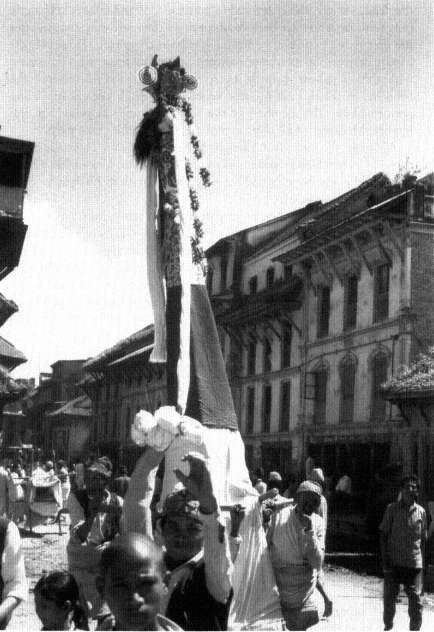
Figure 22.
The Saparu festival. An image in the form of the Cow Goddess
Vaitarani representing someone who has died during the previous year.
Some of the other annual calendrical commemorative ceremonies for the dead, namely, those devoted to mothers [33] and fathers [51] apply only to those who have been dead for more than one year, that is, after the first year's period of mourning has been completed. However, the Saparu festival, as its legend indicates, concerns those who have died within the past year, with the exception of the period just prior to the festivals, in which case the first sequence of death rites is still being performed and the members of the household and the phuki are still impure. Members of all thar s except the untouchables take part.
Although the cow jatra , thought to be a specifically Newar festival, exists in other Newar communities, in Bhaktapur it is highly elaborated, and many Newars and other Nepalese come to Bhaktapur from other places to watch it.
The procession is made up of constructions in the form of the Cow Goddess and, rarely, actual cows representing her, each of which represents a particular dead person. Each cow figure is preceded by a carnival group made up of friends or phuki of the household to which the dead person belonged.39 The groups vary in number, but in the case of important or particularly popular people they may include hundreds of participants. The symbolic cows may be either "long" or "short" ones, the long ones representing adults, the short ones children.40 Other aspects of their decoration indicate whether they were male or female. It is commonly said that in the Malla period officials standing at the palace—which the procession must pass on the festival route—could, by counting the figures, tell how many men, women, boys, and girls had died in Bhaktapur during the previous year. In the few cases now where living cows are used, they are not differentially marked. The long images have a mask of a cow mounted toward the top end of an elaborately decorated long pole. The pole, which requires four men to carry it, is carried in the procession by representatives of the family. The short cow is simply a basket with a mask on it, which is worn over the head of the family representative. Traditionally for the upper thar s these representations were carried or worn by farmers who farmed portions of the deceased person's family's land and performed various services for the family. Those of the middle and lower thar s were carried by phuki members.
Each family supervises the production of the figure that will represent them in the jatra . They are assisted by phuki members, friends, and neighbors. The day before the jatra the household members undergo a major purification. On the day of the festival the cow figure is wor-
shiped by all family members, male and female, as the Cow Goddess, in a puja that is referred to as tarae yagu , literally "crossing a bridge or river," in keeping with the legend explaining the day's events. The cow figure is asked to help the dead person get into Vaikunta* , Visnu/Narayana's* special heaven. Participation in the Saparu procession and the related worship is considered a necessary part of the long sequence of rituals done after the death of any individual (app. 6). In keeping with the legend associated with the festival, it is believed that the dead person will remain as a preta if this participation is neglected, as would also be the case if the various other essential death rituals were neglected.41 Most upper-status participating households have also on this day and prior to the procession, a gau dan , a special memorial ritual requiring a Brahman purohita ’s assistance, with the main ritual mourner, the kriya putra (ideally the eldest son) as the central worshiper. The Brahmans themselves, will—in contrast—have their gau dan following the termination of the procession.
The cow jatra procession moves around the city's main festival route. Each symbolic cow, preceded by revelers, enters the festival procession at a point on the pradaksinapatha* jatra route near each family's home. The group makes a circuit of the route, which takes roughly two hours, and then leaves the procession when they are back at the same point at which they entered it. Family members, consisting of the chief mourner, his brothers, and some pbuki members, close affinal relatives and friends, will walk as mourners behind the cow. This group consists of men and children of both sexes. Women watch from the sidelines of the procession. Each group enters the procession at its end as it passes their entrance point, but the result, because of the mixed social constitution of most twa :s, is that the various twa :s are represented in the line of the procession in more or less random social order.
When people from all other neighborhoods have entered the procession the people from the large Lakulache(n) sub-twa : in the Ta:marhi main twa : enter it. They then arrange themselves differently than the participants of the previous twa :s, in a way that makes an impressive visual climax to the procession. For this group all the carnival dancers and maskers representing all the participating households in that neighborhood enter the procession as one group. This group of carnival dancers is joined by anyone in Bhaktapur who wishes to join in the carnival whether or not they are connected to any bereaved household. The dancers are followed, in turn, by a large group of musicians playing the special dance and processional music associated with the jatra .
Behind the musicians men carry a tall image constructed of bamboo and rice straw in shape resembling the long cow images but painted and dressed to represent Bhairava rather than the Cow Goddess. Behind the Bhairava image all the cow images from the Lakulache(n) Twa: households are carried one after the other in a dense mass of images and followed by the household mourners. This large group constitutes the end of the procession. When it gets to Laeku Square, it circumambulates the statue of the Newar King Bhupatindra* Malla, which is located there, three times and then disbands.
Except for the Brahmans, who still have to do their gau dan puja , the day's religious activities are finished. People return to their houses, and the cow images are taken to the river and thrown into it. Household feasts are held m the bereaved households for all who have worked with the household on the image and/or accompanied it in the procession. The married-out household women are expected to return to the household for this feast.
Although the aspect of the Saparu jatra to which we have referred as "carnival" is, as we have seen, an integral part of the day's events, it is convenient to discuss it separately. It is often terminologically distinguished from the remainder of the jatra by referring to it as "Ghe(n)ta(n) Ghesi(n)42 Mhetegu." The term "Ghe(n)ta(n) Ghesi(n)" is said to refer onomatopoeically to the sound of a particular kind of drum beat. Mhetegu means to play, as to play at a game. The activities referred to by the term take place only at this time, beginning with the preliminary performances on Gunhi Punhi evening, which we have noted above. Traditionally only farmer thar s and above (including, it may be noted, young Brahmans) participated, but now people from lower groups, with the exception of the untouchables, do. Traditionally, and still, only men take part. This is an "antistructural" festival, but as always in Bhaktapur within strict limits.
On the Saparu day people are free to choose their costumes and their dance performances. Sometimes a subgroup of those preceding a cow image may work together as a thematic unit, but often individuals have their own individual theme. The "free choices," however, usually are among a conventional set of forms, which can be illustrated from the examples we have seen:
1. A popular group of costumes and performances portrays Jyapu activities, and is done both by Jyapus themselves and by upper-level
participants. Many of these are derived from traditional Jyapu dances. People may mimic breaking the soil with a hoe, or cutting grain stalks. Frequently the dance represents a Jyapu couple, with one man taking the man's part, and another the woman's.43 It is important to remark that these dances are not lampoons but serious and graceful dance forms.
2. A variant portrayal of Jyapu life shows a Jyapu and Jyapuni, represented by either dancers or puppets carried on the tops of poles by masked dancers. The farmer and his wife often carry sticks, and the couple performs a burlesque fight something like a Western Punch and Judy performance.
3. In addition to dancing Jyapunis, men may sometimes dress and dance as pretty girls of undetermined social status (see fig. 23). Sometimes they perform as a mother, cradling a doll baby (see fig. 24). Such dances, like the Jyapu-Jyapuni dances, are not done satirically but, often, with considerable grace, beauty, and seriousness.
4. There are gross and obscene sexual references in some portrayals, of a kind that would be publicly unacceptable otherwise except during the Devi cycle's Gatha Muga: Ca:re [45] celebrations. In these dances, for example, two men will dance as a heterosexual couple, embracing and moving their hips in coital movements. Others may construct a large model penis and vagina, banging them together in mimicry of sexual intercourse in time to the music of the festival musicians who accompany each group of mourner-revelers. Other men may add mock genitalia, such as a banana and two globular fruits or vegetables to their costumes.44
5. Some dances mimic drunkenness, the performer pretending to drink from a container, and staggering.
6. Another popular group is animals and supernatural forest creatures—bears, tigers, monkeys, Yetis, demons of various types, and so forth.c:\t
7. Participants frequently dress as sadhu s and other types of holy "renouncers."
8. Men dress as various deities, both male and female. These include most prominently Siva (who is perhaps the most frequent deity chosen) and Parvati, Krsna* and Radha, and Rama and Sita.
9. Performers often dress as Moghul Rajas, with turbans and robes.
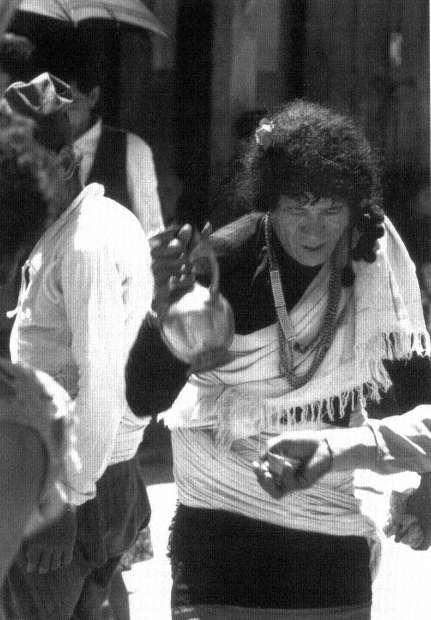
Figure 23.
Saparu carnival. Man dancing as a woman.
Figure 24.
Saparu carnival. Young man dancing as a mother and carrying a doll child.
10. Sometimes the costumes and decorations are purely abstract and decorative, such as a face painted half black and half white.
There is another category of role-taking that we have saved until last because it has been emphasized in some of the literature on this festival45 but seems, at least in Bhaktapur in the period of this study and the years preceding it, to be a minor and muted one. This is the category of satire with some possible political implication. There are some examples of this. People may carry a placard with a caricature of some unpopular figure in the government, sometimes as part of a mock-funeral procession. Most often the satire is more veiled. In one procession, for example, a man danced as a particular rhesus monkey that lived near (and often on) the Bhaktapur royal palace, which now houses some central government administrative offices. It was clear to the onlookers with a little coaching that this represented the chief administrative officer of the district at the time. But the political satire is carefully guarded, and really important figures would be represented, if at all, in most veiled, ambiguous, and—it is hoped—safe forms. Other upper-status figures are represented, but gently—Brahmans dressed in dhotis , public storytellers (who are traditionally Brahmans) represented as telling obscene stories, tourists complete with Western garb (or a reasonable facsimile thereof) and mock cameras hung over their shoulders. Although these representations are both muted and rare at present, one can imagine conditions in which they might become dominant.
The carnival performances of Saparu play with the constraints of Bhaktapur's social structure. Satire is only one small component of this. On this day the participants can express things that are usually difficult to express in ordinary civic life. Constraints of gender, role, decent behavior, and (more carefully) respect for hierarchy are overcome, within the usual limits that Bhaktapur imposes on such Dionysian behavior. It is said by older people that on Saparu anyone can be king; anyone can be anything he wants. In fact, however, social criticism and political criticism, is limited; women and the lowest-level thar s cannot take part; among those who do take part, upper thar s usually represent lower ones, and the reverse is less frequent. This latter constraint, however, indicates perhaps something more than some limit on lower-status people escaping the system even in fantasy. The lower-level thar s represent for the upper thar s not only the negative aspects of lower status but also a greater freedom from constraints, including the sexual constraints
whose fantasized overcoming is represented in many of the carnival performances. Upper thar s in Bhaktapur, conversely, represent greater constraints of propriety and self-control for people in the lower thar s looking up. Motives of satire and resentment aside, it would be contrary to the spirit of escape symbolized by the carnival to change ones role for what is, in a certain sense, a still more socially constrained one.
In its involvement of the entire city in public space, the procession on the pradaksinapatha* ; in its concern with the deaths that took place in the city during the preceding year; in its differentiated representation of those deaths by age, sex, and area; and in its carnival expression of the kind of fantasy that reveals something of the structure of the city's life through the freedom and constraints of its "antistructural" play, Saparu is a major festival of focal importance for Bhaktapur. However, its concern with ritual assistance for the preta s of its recently dead to enter heaven—based essentially on the individual work of each bereaved household and reflecting no social differentiation of any significance to the city beyond maturity and gender—as well as the antistructural play of its carnival, puts Saparu in marked contrast to the greatly more elaborate focal festivals of structure , Biska: and Mohani, that we will consider in later chapters. Saparu may be labeled as an "anti-structural focal festival."
The week following Saparu, coming to an end on the eighth day of the fortnight, is a period in which many pyakha(n) s, or "dance dramas," are presented throughout the city. These are of different kinds. One group is of particular interest in that the unmarried girls in a household may join in it, this being the only time in which women in Bhaktapur dance publicly now, although, as we have noted above, women and girls in some thar s must have danced at some time in the past. These particular dances, often called for some reason "Ramayana," usually danced to the music of the Indian instruments, tabla (small drums) and harmonium, accompany songs written by family members to commemorate a person in their family who has died during the year. Family groups, with their singers, dancers, and musicians, walk around the city festival route. Friends and relatives intercept them at various points and invite them to their houses where the group performs their pyakha(n) in the public space in front of the friend or relative's house watched by neighborhoods and bypassers.
Other pyakha(n) s are performed by various groups during this week.
Some of these are traditional stories, some newly created ones, some serious and sentimental, others comic, satirical, or farcical. This is one of the two periods during the year when such pyakha(n) s, are presented. The other is during the eight days of the Indra Jatra sequence [59-65] in the following lunar fortnight. Many of the pyakha(n) s done during the Indra Jatra period are the same or similar to those done following Saparu, but comic dances are done only in the Saparu period, extending the carnival emphasis as the "Ramayana" pyakha(n) s extend the commemoration of the year's deaths.
Miscellaneous Events: Krsna* Janmastami [49] and Sitala Puja [50]
On the eighth day of the month there is a small festival of Krsna* . A Krsna* image is taken from its god-house and carried around the festival route, and there is worship of Krsna* in some homes and by some devotees at the city's Krsna* shrines, which the devotees visit in turn in a procession. This jatra had, reportedly, been introduced into Bhaktapur only some eight to ten years before the study. The devotees were said to be the same people who had become bhakti devotees of Rama (compare Rama Navami [32] above). As is always the case with Bhaktapur's festivals for these avatars of Visnu* , the contrast with other parts of India is striking. Thus Janmastami is "probably the most important vrata and utsava celebrated throughout the whole of India" (Kane 1968-1977, vol. V, p. 128). (Minor.)
On the ninth day of the fortnight, the day of Sitala Puja [50], people, women for the most part, used to go to the statue at Hanuman Ghat* of Sitala, the goddess who represents and protects against smallpox, to ask for protection for the family. This calendrical event is thought to he specific to Bhaktapur. In recent years with the disappearance of smallpox these visits are rare. (Minor.)
On the fourteenth day of the fortnight, Pa(n)cara(n) Ca:re, there is an important Buddhist festival, that of the five Dipankara Buddhas. Five giant and dramatic images of these Buddhas (supported by and enclosing the body of a dancer) march through the city, each coming from a different direction to a central point. These images are associated by local Newar Hindus with the Five Pandava brothers of the Mahabharata epic. Hindus make respect gestures to the images as they are moved through the streets and take prasada from their attendants.
Gokarna* Au(n)si [51], Honoring Fathers
Exactly four months after the new-moon day on which mothers are honored and commemorated [33], on the new-moon day46 closing the waning fortnight of Gu(n)laga there is an equivalent symmetrical event honoring and commemorating fathers. People whose fathers have died more than one year previously try to join other Nepalis in a mela at the village of Gokarna* about five miles northeast of Kathmandu, at a spot on the Gokarna* River adjacent to a Siva linga* shrine.47 The pilgrims bathe in the river and perform a commemorative puja for their fathers and all their male deceased ancestors. People who cannot go to Gokarna* nevertheless bathe and make the offerings at one of the tirtha s at the river in Bhaktapur.
Those people whose father is living worship him at home, married-out daughters and sons separated from the household returning for this purpose if possible. In the evening there is a feast in the house. (Moderate.)
Miscellaneous Minor Events [52-58]: a Note on Tij, a Festival Which the Newars do not Have
The waxing fortnight of Ya(n)lathwa (August/September) contains eleven festival events, in some cases two different festivals taking place in the same day. In the latter part of the fortnight the complex festival set of events, Indra Jatra [59-65] begins. We will note here first those miscellaneous festivals that precede the beginning of the Indra Jatra. On the second day of the fortnight is the Surya Vinayaka Jatra [52]. The jatra image of the Surya Vinayaka Ganesa* (chap. 8) is carried around the city's main processional route, followed by its devotees. Most of these participants are people from the village, just outside of the city, where the god's shrine is located, but others, as is the case in all minor jatra s, but particularly for those of Narayana* and Ganesa* , are people who have taken the god as a "private god" for some period of time. The festival is held only in Bhaktapur. (Minor.)
On the same day is the Varahi Jatra [53], commemorating Varahi as the mandalic* goddess of her particular section of the city. Local people take the jatra image from the god-house and, accompanied by musicians, carry it around the city's main festival route. This is one of the few jatra s in which both married and unmarried women, dressed in
their better clothes, traditionally join men in their phuki group in following the deity. This festival is only held in Bhaktapur.
The third day of the fortnight also has two festivals. The first of these is the Dattatreya Jatra, [54]. This is primarily a local twa: jatra , but in the course of the day an image of Dattatreya, whose temple is located in the Tachapal twa :, is carried around the city's main festival route. The other festival of the day is a Bhairava Jatra [55]. An image of Bhairava from the main Bhairava temple48 is, in its turn, carried around the main festival route. These are minor jatra s, as are the others of this period.
The people of Bhaktapur define themselves differentially in part not only by the customs and festivals they emphasize, but by those followed by others, particularly those that are of great importance to others, which they do not observe. One such festival is Tij, which the Indo-Nepalese (and Hindus in general; see Kane [1968-1977, vol. V, p. 144f.) celebrate on the third day of the fortnight, and which the Newars ignore.49 The Tij events contribute to a ritual complex that is the-matically completed on the fifth day of the fortnight, Rsi* Pa(n)cami, according to Lynn Bennett's analysis (1983, 222f.). Some of the themes of Tij are present in attenuated form in Bhaktapur's Rsi* Pa(n)cami [58]; for example, women pray to be spared painful difficulties with menstruation, but other of the themes are not represented.
According to Bennett for the Chetri villagers she studied, "Tij is meant to ensure the long life of one's husband, while Rsi* Pa(n)cami is meant to purify women from the possible sin of having touched a man during their menstrual period. . .. In my view . . . the two are conceptually related" (1983, 222). Bennett (ibid., 225) emphasizes women's erotic activity during Tij, characterized by behavior that is a "virtual seduction of Siva" (the legendary reference is to the relations of Parvati and Siva, as set forth in the Swasthani Vrata Katha ):
The laughing, singing, and dancing at Tij . . . represents a complete reversal of the Hindu ideal of womanly behavior. To say that a girl is shy, embarrassed . . . is to prasise her highly. On Tij the high spirits, the flirtatiousness, the sexuality which women must ordinarily suppress are released en masse at Siva's temple. However, this display of the erotic side of female nature is only permissible because, on Tij, it is held in check by the strict purifying fast which the women are undergoing for the welfare of their husbands. On the morning after Tij, women must perform a puja and make offerings to a Brahman priest dedicating the merit of their fast to their husband (present, future, or in the next life) before they can break the fast. The dangers of
female sexuality are thus firmly bracketed by the mutually reinforcing ascetic and patrilineal ideals.
The Chetri women go as a group to the riverside on Rsi* Pa(n)cami for an elaborate purification ceremony that removes the impurities associated with menstrual blood so that they "may be pure enough to touch men" (Bennett 1983, 225). The bathing is followed by a ceremony (which has a reference to the Rsi* , who give the day its name) in which in Bennett's interpretation "women are purifying their own sexuality. They are channeling it in the only direction acceptable to Hindu patrilineal ideology—toward their own husbands" (ibid., 230). In the light of this discussion, the Newar nonadoption of Tij and the very minor echo of the Chetri women's procedures of Rsi* Pa(n)cami (below) is consonant with one of the main contrasts between the Newar Hindus and the non-Newar Hindus, the social position of their women. The relative freedom of the Newar women, centrally represented in the mock-marriage and their relations to their natal homes, makes for a context in which the carefully bounded ritual expression of women's sexuality and its subsequent restoration to patriarchal control, which is (following Bennett) the meaning of Tij, is much less significant. As a remnant, perhaps, of their northern Himalayan heritage, these tensions are structured, expressed and controlled among the Newars in, comparatively more diffuse and less oppressive ways.
The fourth day of the fortnight is the pan-Hindu Catha Ganesa* day [56]. "Catha" derives from the Sanskrit, Caturthi, the fourth day of the lunar month. This is the occasion in most households for a special puja to Ganesa* , and offerings of the foods that are supposed to be his favorites. The day is associated with stories associating Ganesa* and this fortnight's waxing crescent moon which is supposed to be dangerous if seen on this day. It is said that there are at least some people, at all social levels in Bhaktapur, who try to avoid seeing it. They reportedly go to less length than do those noted in Anderson (1971, 124) and Nepali (1965, 404) who seal the windows of their house and remain inside on this day in order to avoid seeing the moon. (Minor.)
The last event in this miscellaneous group is on the fifth day, the pa(n)cami , of the fortnight, Rsi* Pa(n)cami [57]. The Rsis* are worshiped in some households, particularly in upper-status ones, with a dhala(n) danegu puja (app. 4). On this day some women worship the Rsis*
for, it is said, good health, including protection against menstrual difficulties and for protection of the house and children in what is, apparently, an echo of the theme of the Chetri practice described by Bennett (1983), in that they are both derived from traditional Hindu vratas of the day.50 However, the Newar practices are individually performed in the household not in groups of women; they are minor pujas and not elaborate purification ceremonies, and they are not in the dramatic context of the Tij ceremonies, as are the Chetri women's practices of the day. (Minor.)
On the seventh day of the fortnight, the day of Uma/Mahesvara [58], in many households, but especially in Jyapu houses, there is special worship of Parvati and Siva in their manifestation as Uma/Mahesvara represented as an affectionate conjugal couple. Women present ceremonial threads to the idealized couple, and then take one back as prasada and tie it around their husband's wrist. (Minor.)
Events During the Period of Indra Jatra [59-65]: the Transformation of Festival Themes and Events in Different Newar Cities and Towns
From the twelfth day of Ya(n)lathwa to the fourth day of the following waning fortnight of Ya(n)laga is the eight-day period of Indra Jatra, which in some other Newar communities, most notably in Kathmandu, maintains aspects of an ancient Indian calendrical festival (V. S. Agrawala 1970, 55). In Kathmandu Indra Jatra is a thematically integrated sequence that is one of the focal festival events of that city's annual calendar. Each of the Newar cities and towns have one or more such festival events or sequences that are specially developed in the community and which attract people from other communities as spectators. Conversely, a festival cycle that is highly developed in one community appears, by contrast, to be relatively (and sometimes completely) ignored in another. Indra Jatra is an example of a festival that is comparatively ignored in Bhaktapur. The group of calendrical events that we are including together here as taking place during the span of Indra Jatra contain some events [59, 61, 65], which are clearly represented in Kathmandu as integrated by certain local legends about Indra, and are understood to be related to these stories by some people in Bhaktapur. For many or perhaps most people in Bhaktapur, however, they are simply independent events, of the same disconnected
kind as the other miscellaneous calendrical events that happen to fall within these eight days.
The equivocally component days of the Indra Jatra (i.e., days that have thematic connections with the integrated sequence as it has been described for Kathmandu) are Yama Dya: Thanigu [59], Indrani* Jatra [61], Yau Dya: Punhi [62], and Pulu Kisi Haigu [65].
In Kathmandu Indra Jatra is a major eight-day festival consisting of a number of dramatic and climactic events. Some of these events in Kathmandu are related to a legend of Indra's personal relation to that city. Others center on the dangerous deity Akas Bhairava (represented by huge dramatic masks), on Bhagavati, on the living goddess Kumari, and on other comparatively minor supernatural figures (Nepali 1965, 358-369; Anderson 1971, chap. 15).
We have suggested that some of the similar events of this period in Bhaktapur are transformed in meaning because they are not put in the context of a major integrative festival. Furthermore, it is noteworthy that some of the elements in Kathmandu's focal Indra Jatra are moved in Bhaktapur to other times of the year and, for the most part, amalgamated into Bhaktapur's own major and focal festivals. Thus, for example, the Kathmandu Indra Jatra festival is inaugurated and ends with the raising and then, eight days later, lowering of a forty-foot pole, the trunk of a particular kind of tree. The same kind of tree, gathered in the same place by members of Bhaktapur's branch of the same thar (the Sa:mi), is erected and lowered as one of the central symbolic foci in Bhaktapur's Biska: festival. During Kathmandu's Indra Jatra a procession (associated there with a group of legends about Indra and "Indra's mother") for the salvation of those who had died during the previous years is in some ways a transformation of Bhaktapur's Saparu procession. Indra Jatra in Kathmandu is the period in which the living goddess, Kumari, makes her main public appearance, and establishes her relationship to the Gorkha king. In Bhaktapur this happens, with Bhaktapur's own Kumari, during Mohani. Kathmandu's Indra Jatra period is the major time for the appearance of masked dancers representing demon-like gods who fight on the side of dharma against the Asuras and other antagonistic supernatual beings. One representation of this is the killing by the Kathmandu dancers of a buffalo representing an Asura king. All this is represented in Bhaktapur during the Mohani festival and in the subsequent nine-month cycle of the Nine Durgas dancers.
Many people in Bhaktapur seem to know some local version of the
Indra story. Here is a brief sketch of one of Bhaktapur's versions: Indra's mother sent him to get some white flowers of a special kind from a particular garden on earth. A demon caught Indra taking the flowers, accused him of stealing them, and captured him. "Indra's mother," who is not otherwise named in the tale, not knowing where Indra was, sent Indra's vehicle, an elephant, to earth to find him. The elephant found Indra and reported his whereabouts to Indra's mother, who came to earth to rescue him. The demon released Indra when his mother came, and she gave the demon clouds and fog as a reward, the clouds and fog necessary for protecting the rice, which is still growing at this period of the year. When Indra and his Mother returned to heaven, people on earth wanted to follow them and so some of them left a trail of grain on the gods' path so that the humans could later find their way there.
The twelfth day of the fortnight, the beginning of the Indra Jatra, period in Kathmandu, is called in Bhaktapur the "Yama Dya: Thanigu" day [59], the day of the erecting of the Yama God. In Kathmandu the raising of a pole made from a tall tree trunk in a central square signals the beginning of the festival there and marks a focal spatial point. In many of Bhaktapur's twa :s, tree poles are erected.51 They are said to represent the ruler of the kingdom of death, Yama. These local poles are left up, as is the Kathmandu central one, for the entire eight-day period. Flowers are placed at the top of the pole, and twa : people do daily pujas to it during the eight days. It is thought that this will help protect the local twa : people from death. (Moderate.)
On the fourteenth day of the fortnight—and with no reference to the Indra cycle—is the Ananta Narayana* Puja [60]. This is a local representation of a traditional South Asian Hindu event in honor of Visnu/Narayana* . Many people go to one of the Visnu* temples on this day, as they did on the other city-wide Visnu* festival, Tulasi Piye [43]. Some Chathariya families follow the traditional Hindu custom of pledging to do a Brahman-assisted household puja to Visnu* each year on this day for a period of fourteen years. (Minor.)
On the fourteenth day (the same day as Narayana* Puja) and continuing on the fifteenth and final day, the full-moon day, of the fortnight is Indrani* Jatra [61]. Additional events of the fifteenth day are designated as the festival of that full-moon day, Yau Dya: Punhi [62], but they also represent the completion of the two-day Indrani* Jatra. The Indrani* jatra image is taken from her local god-house and carried in a procession around the entire city, followed by people from the local
mandalic* area Indrani* is thought of, by some at least, on this occasion not as, or only as, the Indrani* of the Astamatrkas* group, but as Indra's consort. The image is carried to one of the artificial ponds in the city, the Ta Pukhu, and left there in an open building, a phalca , overnight. (Moderate.)
The next day is the full-moon day, called "Yau Dya: Punhi" [62]. The name "Yau Dya:," the Yau God, seems to come from a set of three torches called Ya matta (or Swarga ["heaven"] Ya matta ), which are carried around the city on a long stick by a member of the Sa:mi thar on the three days following this punhi . They are considered to be a manifestation of a god, and people try to see the lights, a view that is said to enable them to enter Swarga , heaven, at some time during the period. This reflects the Indra Jatra's legend's theme of the following of Indra and his mother into their heaven. On this day people come from surrounding villages and towns (particularly from the large town of Thimi) and from other parts of Bhaktapur for ritual baths in the Ta Pukhu and to worship the image of Indrani* . The day is, thus, a mela . In the afternoon the image is carried around the city festival route and then returned to its god-house. (Moderate.)
The span of Indra Jatra continues into the next fortnight, the waning fortnight Ya(n)laga (September). On the second day of the fortnight a man from a nearby village, paid by the central government's Guthi Samsthan, comes to Bhaktapur to begin three days of performance. He represents a demon called "Mu Patra," wears a metal crown (which is at other times kept in the Taleju temple), and dresses in the old Malla-period Moghul-style royal costume. He is accompanied by two demon attendants, called "Dhicas." He visits during these three days the poles that had been set up in the different twa :s on the Yama Dya: Thanigu day [59] representing Yama. He circumambulates each pole three times, hitting it with a traditional Malla period sword. People now are uncertain about the meaning of all this, although it seems to have been related both to the period's Indra legend and to another supernatural creature, the Pulu Kisi, who appears on the last day [65] of the period's set of events. G. S. Nepali wrote (of Bhaktapur) that the Mu Patra represented the demon enemy of Indra, and that the poles that he strikes thus represent Indra. According to Nepali, care is taken that Mu Patra does not encounter the Pulu Kisi, which "is the riding animal of Indra . . . [which] has come in search of its master. . .. In the event of their facing each other, there ensues a fight between the two, involving their respective supporters" (1965, 364). In fact, in recent memory they have
not met, and the significance and possibility of their encounter seems no longer an issue. The violence that, as we shall see, does sometimes occur in relation to the Pulu Kisi—whose relation to Indra is now vague—is not related to the Mu Patra, who is a symbolic form that has now lost much of its meaning and power.
On the third day of the fortnight there is a small local jatra , Chuma(n) Gandya: Jatra [63], in one of the city's main twa :s, Coche(n) twa: . It is noteworthy and peculiar in that it is a minor version of a more important event with the same name, the same associated legend, and in the same location that takes place on the eighth day of the solar New Year festival, Biska:. That event will be described in the next chapter. The one listed here is minor.
On the fourth day of the fortnight, the last day of the Indra Jatra span, there are two festivals. The first, Smasana* Bhailadya: Jatra, is not associated with the themes of the Indra story, although it reflects references to King Yama and to death. The second, Pulu Kisi Haigu, which ends this set of events, contains some reflections of the Indra story and some correspondences to its closing sequences in Kathmandu.
Smasana* Bhailadya: Jatra [64], refers to the Bhairava who inhabits the Mu Dip cremation grounds (see chap. 8). "Smasana* " means cremation grounds in Sanskrit and Nepali. An image representing this Bhairava is painted on a pulu , a reed mat, by a properly initiated member of the Pu(n) thar , the mask makers, and painters of religious images. Pulus are the mats used for covering dead bodies while they are being carried in funeral processions to cremation grounds. If the head priest of the Taleju temple has died during the previous year, his pulu is taken from his corpse, saved, and used in this procession; otherwise, it is a new and unused one. It is said that during the time of the Malla kings their pulus were kept after their death. The pulu of a deceased king would be used every year in this annual procession until replaced by the next king's pulu following the death of that king. On this day now the pulu is hung in front of the main Bhairava temple. People either passing by or coming to the temple for the purpose, make respectful gestures to the pulu . People who encounter it fear it and, as is the case generally for dangerous deities, fear that if they neglect to worship it or show it formal respect they will be harmed in some way. At a designated time during the day a goat is sacrificed in the square adjoining the temple. The pulu is then taken and carried by a member of the Dwi(n) thar (level XII; see chap. 5) in a procession around the main city festival route until the
Bhairava temple is once again reached and the pulu is once again hung on the wall for the remainder of the day. (Moderate.)
On the same day as the Smasana* Bhailadya: Jatra there is another event that makes for a kind of climax to the loosely grouped set of events of the eight-day period. This event is called "Pulu Kisi Haigu" [65]. (Pulu is the funeral mat, kisi means elephant, and haigu means to bring, thus the name means the bringing of the "Pulu Kisi.") The Pulu Kisi is an image of an elephant constructed of reed mats. The image is carried around the city, starting in the Lakulache(n) neighborhood, and is carried and attended by local people. The elephant has a bell around its neck, which is rung by the attendants during the procession. During this time other bells in the city are not to be rung. When the image passes by, bystanders, both men and women, must uncover their heads as a gesture of respect. If they do not the attendants of the elephant, often carrying the elephant with them, may charge into the crowd, and forcibly uncover the offender's head, removing the hat or shawl. The elephant also is occasionally made to charge into the crowd of bystanders even if there is no show of disrespect. This is frequently the occasion for a general fight between attendants and crowd, sometimes extending to and dividing groups or individuals within the crowd. This day is one of the times when people traditionally drink, and the attendants of the elephant and many in the crowd are drunk. When the elephant, in its movement around the city's festival route, now followed by crowds of people, approaches Dattatreya Square in the northern part of the city, it leaves the route to "drink at a well" where Indra's elephant once drank. This is often the occasion for fairly serious fights, characteristically between members of the upper and lower halves of the city. These are sometimes precipitated by someone from the upper city ringing a temple bell in the square in contravention of the custom of the day.
The Pulu Kisi refers now secondarily to Indra,52 but more clearly to death (the funeral mats, and its association with the Smasana* Bhailadya: Jatra of the same day), to danger, and to threat. Its attacks on the crowd randomly or for not showing respect have parallels in the Nine Durga pyakha(n)s during the Devi cycle. Its connection to intra-city fighting is an echo of the events of the Biska: sequence. However, the similar themes in those two focal festival groups are coherently related to themes not only of ritual conflict but also the symbolic resolution of that conflict. In contrast with such festival events, and as we have noted, in contrast with the simultaneous events in Kathmandu, the events of
the Indra Jatra period in Bhaktapur are not integrated. They seem in a sense to be fragments of what may have been once in Bhaktapur—and that is now elsewhere—a coherent set. In spite of its drama, its significance and the size of its audience probably are "moderate" in comparison to other more important events.
During these eight days pyakha(n) s, resembling some of those performed after Saparu, are given in some parts of the city. The period closes after the Pulu Kisi Haigu procession with the removal of the Indra/Yama poles in the twa :s
The Remainder of the Yearly Calendrical Cycle [66-79]
There is one more calendrical event during this fortnight. This is Dhala(n) Sala(n) [66], which may optionally be observed on either the ninth day of the fortnight or the fifteenth, the new-moon day. This is a day for one of the ceremonies in the long sequence following death (app. 6). The ceremony is for the "pitr s* ," in this case all deceased ancestors of a phuki group who have been dead for more than two years, and the ceremonies are performed ideally at the riverside by large groups of associated phuki members. Occasionally phuki members conduct a continuous series of sraddha* procedures on sixteen consecutive days, starting with the day on which they do the Dhala(n) Sala(n) ceremony. (Moderate.)
The first ten days of the next fortnight, the waxing fortnight of Kaulathwa (September/October), is the period of the focal autumnal rice harvest festival Mohani [67-76], which will be discussed in the presentation of the Devi cycle in chapter 16. During the last three days of the final fortnight of the lunar year, Kaulaga, three events take place which are the three introductory days of the Swanti sequence [77, 78, 79], which culminate and begin anew the lunar year, and which were described at the beginning of this chapter.
Chapter Fourteen
The Events of the Solar Cycle
Introduction
The vast majority of the annual events in Bhaktapur, as elsewhere in Hindu South Asia, are organized by the lunar calendrical cycle. Bhaktapur has a very few fortnightly and annual events whose timing is determined by the solar calendar. One set of these events, Biska:, however, is one of Bhaktapur's focal festivals, rivaled in its sheer quantity of activities, complexity, integration, and urban importance by only the Mohani festival [67-77].
Ghya: Caku Sa(n)lhu [10]
"Sa(n)lhu " is the old Newari for the first day of a solar month. The Nepali Sanskritic term sankranti* 1 is used in ordinary references to this day. This sankranti* , Ghya: Caku Sa(n)lhu [10],2 comes in the second week of January (in 1974/75 on the thirteenth day of Pohelathwa, in the Nepali month of Pausa* ). It was of special importance in traditional South Asia as Makara-Sankranti* (Kane 1968-1977, vol. V, p. 211ff.) in that it marked the winter solstice, and the beginning of the udagayana , the "ascending," brightening half of the year. Like other sankranti* in Bhaktapur, the day is special to Visnu* , but on this day there are some extra activities related to the story of Visnu's* dwarf avatar Vamana, in which form Visnu* recaptures heaven and the earth from the Asura Mahabali. On this day an offering is given by every middle-status and
upper-status household to its Brahman purohita , or family priest.3 The offering consists of jaki (unhusked, uncooked rice), vegetables, uncooked pulses, and ghya: caku , a mixture of clarified butter (ghya :, or ghee) and molasses (caku ), for which the day is named. The offering, at least according to Brahman and Chathariya informants, signifies that the Brahmans as heirs to Visnu/Narayana* were once the owners of all the land, an ownership that in some versions of the Vamana story, (e.g., Stutley and Stutley 1977, 321) was contested by the Asura, Mahabali, and restored through Visnu's* avatar . In the morning of this day there are offerings of ghya: caku to the household deities. People eat ghya: caku during the day, and it is served at the household feasts that take place during the evening. Friends and affinal family, as well as phuki , are invited to these feasts, called nakhatya . A peculiarity of these feasts is that on this occasion alone boiled rice is served rather than the beaten rice that is always otherwise served at feasts. Ghya: caku is poured over the boiled rice. This is a striking and to contemporary people in Bhaktapur a mysterious and unexplained reversal of the customary practice. The ghya: caku is also made into sweetmeats that (as well as a certain kind of wild yam) are also traditionally eaten on this day.4 (Moderate.)
Biska: [20-29]: The Solar New Year Festival
Three months after the winter solstice period of Ghya: Caku Sa(n)lhu, the sankranti* at the approximate time of the vernal equinox marks the beginning of the solar New Year. The solar New Year comes in the course of a nine-day festival, Biska: (also sometimes written "Biska") (see fig. 25). The New Year's Day, which in 1975/76 fell on the fourteenth day of the waxing lunar fortnight of Caulathwa (Caitra, in March/April), is the fifth, the midday, of the nine-day sequence. Biska:, which draws spectators from all over the valley, is unique to Bhaktapur,5 and one of the four annual festivals of focal importance for the city. The beginning of the solar New Year is signaled on the fifth, the central day of the sequence, with the pulling down of a great tree-trunk pole, the yasi(n) —also locally called lya:si(n) 6 —which had been erected on the previous day. In the course of the nine days themes of division, conflict, and reintegration are represented and enacted. Images of sexuality and images (and realities) of physical struggle embody these themes, which ultimately have as their reference the city as a whole. The themes are expressed through a pattern of interlocking im-
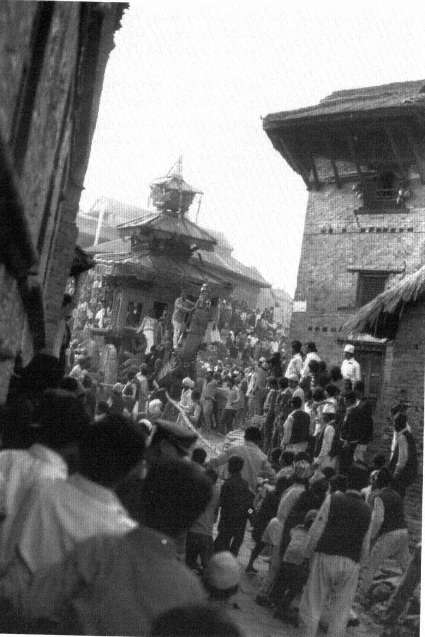
Figure 25.
Biska:. The struggle to pull the Bhairava chariot into the upper or
lower city.
ages, stories, and actions with three main foci: (1) the city's major space-protecting deities, (2) the adventures of two of Bhaktapur's dangerous deities (Bhairava and Bhadrakali* ) who are dominant during the festival, and (3) the "Yasi(n) God" whose actions mark the end of one year and the beginning of the next.
The chronicles have references to the supposed historical introduction of the Biska:7 festival into Bhaktapur (Wright [1877] 1972, 191):
[Jagajjyotir Malla, in the early seventeenth century] introduced at Bhatgaon [Bhaktapur] the custom of holding the rath-jatra [a chariot procession] of Adi-Bhairava on the anniversary of the Mesh [Mesa* ] Sankranti when a tall pole was erected in his honor as a flagstaff. . .. Having on one occasion suspected that the Bhairava of Bhatgaon had improper desires regarding a certain Sakti or female deity, he punished him by bringing the rath [chariot] of Kali into violent collision with the Bhairava's rath.
In the two large complex festival sequences, Biska: and Mohani, there is some arbitrariness in deciding which of the several component events should be listed as elements in themselves for the purposes of a catalogue of annual events. For Mohani (chap. 15) we were able to follow the conventional local festival calendar in listing component events. For Biska:, however, that calendar indicates only the central portions of the nine-day sequence, the raising [21] and lowering [24] of the Yasi(n) God to signal the ending of the old and the start of the new solar year. As the description of the sequence that follows indicates, there are approximately ten major component events,8 and many minor ones in the course of the sequence. One of these "events," the Bhairava/Bhadrakali Jatra, takes place intermittently m a set of component phases throughout most of the nine days of the Biska: sequence.
There is a further difficulty in comparing the components of the complex focal sequences (and the components of the Devi cycle) with the relatively disconnected events of the remainder of the annual cycle; this is in the evaluation of the importance of individual component events. Components of larger sequences are of varying importance in two ways—in themselves, in some sense, and in the extent and nature of their contribution to the meaning and significance of the larger sequence. For our purposes of providing an approximation of the quantity and significance of calendrical events we are conventionally designating the components of focal events as of "major" importance.
In our descriptions of the "structural focal sequences," here Biska:, and in the next chapter Mohani and its associated Nine Durgas performances, we are faced with the descriptive problems produced by a
change of the scale that is now of importance to us. In earlier chapters we have tried to filter out unnecessary details, sometimes placing them in appendixes, for the sake of keeping a narrative or an argument relatively clear. However, these focal festivals are not only relatively massive and complex, but their details are particularly meaningful in relation to the organization of the city at its own level. While the preceding chapters were able to build to a large extent on what had gone before, the reader who wishes to follow the meaningful patterning of the focal sequences of this and the next chapter must be faced with large quantities of fairly minute descriptive detail out of which the festivals' meanings slowly arise.
The Preliminary Preparations
1. The yasi(n).
A few days prior to the start of the sequence a group of men from the Sa:mi thar 9 go to a forest in the hills, about a two hours walk east of Bhaktapur.10 They select a tree for the large yasi(n) by releasing a goat and waiting to see which tree it rubs its head against. The goat is then sacrificed to the tree, and the tree is cut down. The trunk is cleared, except for selected branches at the top that will represent the Yasi(n) God's hair. A second smaller tree is also selected for a secondary yasi(n) , and its limbs are cut off. Ropes are attached to the shorn trees and they are then dragged along the river bed toward Bhaktapur by men chanting a rhythmic work chant to coordinate their efforts. Each evening at sundown the trees are left, the men returning the next day to begin dragging them again. They will finally, after two or three days, be dragged into Bhaktapur, respectively to the field, the Yasi(n) Khya:, where the large yasi(n) will be raised, and to the location in the potters' quarter where the smaller one will be raised.
2. Bhairava and Bhadrakali* .
Eight days prior to the solar New Year's Day, and thus three days before the festival sequence is to begin, the jatra image of the dangerous goddess Bhadrakali* is taken from the inner room of her god-house and brought to a front room where non-initiates may enter. The god-house of Bhadrakali* is the house that also houses the mandalic* goddess Vaisnavi* , and it is only during the Biska: festival that the goddess of this location is exclusively thought of as Bhadrakali* ,11 who is in her form, legend and consort quite distinct from the other goddess.12 Vaisnavi* , although a dangerous deity, is a beautiful form of the Goddess. For this particular festival she is trans-
formed into the terrible form of the Goddess as Bhadrakali* , and the jatra image represents this form, with its frightening face, fangs, and multiple arms. Our informants do not know why Bhadrakali* is associated with Vaisnavi* rather than another deity. The image of her coprotagonist, Bhairava, is also brought down from its ordinary hiding place in the main Bhairava temple into the public area of the temple, on the first day of the sequence.
During the days prior to the festival the chariot that will carry the public jatra image of Bhairava will have been refurbished.13 This is the responsibility of several craft guthis , including those of the painters, carpenters, and the Sa:mi, the traditional oil pressers, who have several important support functions in this festival.
3. The representation of Royalty.
On the day before the beginning of the festival an official of the central government's Guthi Samsthan comes to Bhaktapur from Kathmandu. Accompanied by musicians, he walks around the city festival route carrying an ancient sword representing "the king,"14 which will be used in later stages of the festivals.
The First Day Start of the Bhairava/Bhadrakali Jatra [20]; The Struggle Between the Upper and Lower Halves of the City
On the first day of the Biska: sequence, four days before the solar New Year's Day proper, some of the festival's central topics are introduced—two of its main actors, Bhairava and Bhadrakali* ; the representation and involvement in the festival of important segments of the city's macrostatus system; and the themes of division and struggle.
For this festival (and in Bhaktapur, only in this festival) chariots are used for the jatra procession. There are two of them, one for Bhairava and his high-status attendants, and another, a smaller one, for Bhadrakali* , and her lesser attendants. These chariots, kha :s,15 are of great size; the larger one, that of Bhairava, is about twenty-four feet in height.16
The larger of the two, that of Bhairava, is placed in Ta:marhi Square. This square is just "below" (i.e., to the southwest of) the line dividing the upper from the lower city, and at about the central point on that line (for the movements of the chariots see map 5, above, chap. 7). During Biska: it is considered to belong to neither the upper nor lower city and, thus, to he a neutral and central point. It is one of the central reference points in the festival sequence, and marks the starting point from which
Bhairava and Bhadrakali* will be displaced and to which, finally, after many adventures and dangers they will return on the ninth day of the festival sequence. The smaller chariot, that of Bhadrakali* , is placed in front of her god-house (the structure usually referred to as the "Vaisnavi* god-house" [see map 2]) in the western part of the city.
During the early part of the day the chariots are completed, decorated, and prepared for the jatra . An image of Bhairava's vahana or "vehicle," Betadya: ("Beta God"), is attached to the front of Bhairava's chariot by a member of the Sa:mi thar , and its face is painted by a member of the Chathar Dhaubhari thar , who worships the image at this time. Crowds of people come to the square to watch the preparations of the chariot. The jatra images of Bhairava and Bhadrakali* meanwhile are still in their god-houses.
The representative of the central government's Guthi Samsthan goes to the Taleju temple and presents the royal sword to Taleju's chief Rajopadhyaya Brahman priest. This priest represents—or rather becomes—the king for the remainder of the festival. He is, in traditional local perspective, the Newar's Malla king. It is said that in the past, when the Malla kings still reigned, it was the Malla king himself and not a surrogate who rode in the Bhairava chariot during Biska:, as his Brahman representative now prepares to do. Another Taleju Brahman will accompany the "king" throughout the many occasions in the festival sequence when the Bhairava chariot is in use, as the king's special priest, his "Guru-Purohit."
The king, as we will henceforth call him—dressed like all the others who will join him in the chariot in what is now understood in Bhaktapur to be the traditional clothes of the Malla period—and his priest, his Guru-Purohit, go from their royal palace and Taleju temple area, Laeku, to Ta:marhi Square by a traditional route. Throughout the day, and whenever they take part in the later festival, the king and the Guru-Purohit are always side by side, the king to the right, the Guru-Purohit to the left. They are accompanied by music, and shaded by a large ornate ceremonial umbrella. One attendant also carries a large and ornate ceremonial oil lamp, a sukunda .17 When the king arrives at the chariot at Ta:marhi Square, he orders that the jatra image of Bhairava be brought from its temple, and he and his party wait in the square. Messengers go to the Bhairava temple to ask the god's attendants that he be taken out.
At the time the Bhairava image is ready to be taken from the Bhairava temple another group leaves it on an ostentatious "secret mission."18
These are men from families at the Jyapu level that traditionally perform services for the Bhairava temple. One man precedes the group to clear onlookers out of the way. He carries a heavy iron chain that he swings in front of him as he walks. He is silent during the procession, but he has a bell hung on his back that sounds as he walks and swings the chain. The bell's sound and the dangerous chain are warnings to bystanders to stay out of the way of the group. The first man is followed by another man carrying a large oval object wrapped in cloths, called a "Jaki Gwa," a term whose literal meaning is a "ball of uncooked husked rice." This man is surrounded by other men who are conceived of as guards for the Jaki Gwa. The group moves through the crowd on their way to the Bhairava god-house—used only during Biska:—near the Ga:hiti (map 5) area to which the two gods in their chariots will eventually be brought. These three sites, Ta:marhi Square, Ga:hiti (and its adjacent Bhairava god-house), and the field just beyond Ga:hiti in which the Yasi(n) God will be eventually erected form the main spatial axis for the festival events. It is generally known to the onlookers that the group is carrying the "secret god," of which jatra image is a less powerful public representation. It is popularly believed by most bystanders that the major image is wrapped in the attention grabbing Jaki Gwa itself, which, it is believed, contains the head of Bhairava.19 Some few bystanders suspect that one of the other men in the group, probably the one who follows the man carrying the Jaki Gwa, is carrying what is perhaps the "true" secret image, that is, an image duplicating the form in which Bhairava is represented in his temple's inner and hidden sanctum.
Meanwhile the jatra image of Bhairava is brought from the Bhairava temple out into the adjoining Ta:marhi Square. This is the beginning of his kwaphaegu , his "being taken down"—the term used for the movement of the god out of his temple and "down" from Ta:marhi Square to the more southerly and peripheral Ga:hiti. This foreshadows the taking out of dangerous deities from temples and god-houses throughout the city, which will take place on the fourth day at the approach of the new year. Now the procession that had left Laeku, including the king, Guru-Purohit, umbrella, ceremonial sukunda , musicians, and attendants—who had been informally awaiting the arrival of the chariot—is reconstituted and now circumambulates the chariot. The Bhairava image is placed in the chariot facing toward its front. The king, doing a brief puja to the image and carrying the sword that had been brought to him by the representative of the Guthi Samsthan, enters the chariot, seating
himself to the right of the Bhairava image. The Guru-Purohit seats himself to the image's left. Now the representatives of other crafts and professions station themselves on the chariot in their proper stations. Four carpenters, representatives of the builders and repairers of the chariot, stand at the four corners. Two non-Brahman Taleju priests (a Josi and an Acaju), the Acaju pujari from the Bhairava temple, the leader of the Bhairava guthi , and a member of the Bhairava bhajana group (a group of Jyapu who play music as worship to the Bhairava of the main temple) sit to the rear of the king. Also seated behind the king is a Jyapu, the representative of the group of farming families who farm the granted land, a portion of whose revenues help support the expenses of the Bhairava jatra segments of the Biska: sequence. At both the front and at the rear of the chariot stands a member of one of the Maha(n) thars , representing both charioteers and royal guards.20 All these personages, like the king and his attendants, are dressed, as we have noted, in what are taken to be the traditional costumes of the Malla period. The chariot is facing south, in the direction in which it must eventually move so that Bhairava, the king, and the other riders of the chariot may witness the fall of the Yasi(n) God and the beginning of the new year.
Now the Bhadrakali* chariot, in which the Bhadrakali* jatra image, taken from its god-house, has been placed, is brought to Ta:marhi Square from in front of the Bhadrakali/Vaisnavi* god-house. The pujari of the god-house, who is a Jyapu Acaju, accompanies the image in her chariot, and another Jyapu sits on the front of the chariot, to call out the rhythmic chant that coordinates the joyful efforts of children who have come to the god-house to pull the chariot by means of long ropes attached to its front. When the Bhadrakali* chariot is brought to Ta:marhi Square, it is placed to the right side of the Bhairava chariot (a reversal of the ordinary relative positions of Tantric couples). It is said that Bhairava has now been able to get a glimpse of Bhadrakali* , and this introduces their later unfolding relations.
In contrast to the Bhadrakali* chariot, the Bhairava chariot has ropes attached both to its front and its back ends. Traditionally, it is said, there were eight ropes attached to the front of the chariot and only six ropes at the back. In more recent years, perhaps because fewer haulers took part, this had been reduced to six at the front, and four in back. The tug of war that will ensue as people pull the unequal number of ropes is thus biased toward the forward direction. This compensates in part for the comparative difficulties of the terrain in the two directions of the tug of war.
The Bhadrakali* chariot is pulled out of Ta:marhi Square in the direction of the Ga:hiti Square, in whose vicinity it will make an intermediate stop toward its ultimate destination in the "Yasi(n) Field" (map 5). The Bhairava chariot is also to be pulled to that square—but first there will be a major diversion often called the "playing" of Bhairava. The king tells the two Maha(n) charioteers to start, and after asking the king for a confirmation, the Maha(n)s, one at each end of the chariot, call out to the men who have come from the crowd of bystanders to take hold of the ropes at the two ends and begin to pull. (These men, usually young men, may come from any of the thars including the Brahmans except the untouchables and the groups just above them.) Men from the lower city take the ropes at the front of the chariot; men from the upper city, at the back. This is congruent with the direction—front to south—in which the chariot is facing. It is now the late afternoon or early evening of the first day. Ta:marhi Square is full of thousands of spectators, massed shoulder to shoulder in all the available spaces, including the stairs and terraces of the great temples adjoining the Square.
Now a tug of war begins to determine to which half of the city the chariot will go first. It is considered that the presence of the chariot represents a darsana , a manifestation or "showing himself" of the deity Bhairava to that city half. The men from the lower half of the city try to pull the chariot out of Ta:marhi Square into and along the Bazaar street to the south and then west as far as the Tekhaco twa: . The people from the upper city try to pull it out of the square along the Bazaar street to the north and east into their half of the city as far as Dattatreya Square. These two terminal goals are roughly equidistant from the central point (map 5). Access from the square to the southern route is much more obstructed and winding than the upper route and this gives the people from the upper city an advantage that balances their fewer ropes and participants. Ideally the main struggle is within Ta:marhi Square itself, which is the main arena and theater for the struggle, and once the chariot has reached the exit of the square leading to either the upper or lower city, the struggle should become perfunctory. Again ideally, when the chariot reaches its goal in either the upper or lower city, even the perfunctory struggle should be over. Then, when all goes well, the people from the losing half of the city either quit the struggle or join the people from the temporarily winning half, who now pull the chariot back through Ta:marhi Square into the other half of the city as far as the jatra 's traditional furthest point in that half for a darsana for the
losing half of the city. When the chariot has been to both halves of the city, all join together on the ropes at the front of it, and pull it back to its proper destination, Ga:hiti Square, which ideally should be reached during the course of the first night. During all this the king, the Guru-Purohit, and the other officials and representatives in the chariot are submitted to a long, tiring, bumpy, swaying, vertiginous, and dangerous ride, which at best takes several hours. Although, as we have noted, ideally the chariot should reach Ga:hiti during the first night, this often does not happen, the chariot is delayed. Whatever happens, however, the chariot and its god and riders must reach Ga:hiti Square before the time of the raising of the Yasi(n) on the fourth day of the sequence, the sankranti* , which marks the beginning of the solar New Year.
In chapter 7 in our discussion of Bhaktapur's city halves we noted references to serious conflicts, sometimes bloody ones, in other Newar cities beginning with some ritual event that eventually pitted one half of the city against the other. We argued that ritually organized antagonisms between the upper and lower city halves served to deflect antagonisms from within smaller local areas, particularly between the groups of economically and socially interrelated thars in such areas, antagonisms whose overt manifestations would have been considerably more serious in their consequences. The struggle with the chariot is the major manifestation in Bhaktapur's annual calendar of this conflict.21 We have emphasized the ideal timing and action of the movements of the Bhairava chariot. But the idealized struggle is liable to turn into a ritually uncontrolled one, and other accidents may also delay the movements of the chariot. In the course of the tug of war, fights sometimes break out. These are usually fights between individuals or small groups from the opposing halves of the city. Sometimes these fights may escalate, larger groups may become involved, stones may be thrown. In such cases the bystanders may flee to their homes, and the jatra may be temporarily discontinued. In the years preceding this study the outbreak of fighting was unusual. It is estimated that there were perhaps four or five occasions in the twenty years before this study in which fights broke out, but they did not interfere with the completion of the jatra .22 But the ever-present possibility of the eruption of dangerous conflict gives this phase of the festival a particular tone of anxiety for observers and participants, particularly for the entrapped riders in the chariot. On the occasions when a fight does break up the tug of war, or if the chariot becomes stuck in the narrow streets, requiring a long complicated pro-
cess of extrication, the chariot may be left, its riders returning to their homes for the remainder of the night, leaving behind only the deity and its pujari attendants. In such cases the chariot will be pulled directly to Ga:hiti on the next day, and the excursion into the city halves will be aborted.
Yet, ideally and almost always, in fact, the Bhairava chariot arrives at Ga:hiti on the evening of this first day of the festival sequence. Earlier the Bhadrakali* chariot had been pulled first to Ga:hiti, and then down the road toward the field where the Yasi(n) was to be erected on the fourth day. It was left at a point about half way along this road, where there is a special Bhadrakali* god-house used only during Biska:. Ga:hiti23 is an irregularly shaped square into which four crossroads enter. It is a part of the Lakulache(n) twa: , which adjoins the Ta:marhi twa: . It is bordered by shops and religious structures and contains some temples.
On the arrival of the Bhairava chariot at Ga:hiti the king and Guru-Purohit, followed by the other officials and crew of the chariot, take flowers from the Bhairava image as prasada and descend from the chariot. They circumambulate the Bhairava chariot and then walk on in a procession to the Bhadrakali* chariot, take flower prasada from her image, and circumambulate that chariot. Now shaded by the ceremonial umbrella, accompanied by the ceremonial sukunda , musicians, guards, and attendants, the king, bearing the royal sword, returns to the Taleju temple, the site of the Malla palace.
Now the god images are taken from their chariots with music and procession each to their respective special jatra god-houses, Bhairava's being some forty yards to the west of Bhadrakali's.
The Second Day
The chariots are where they had been left on the previous night. The deities are in the special jatra god-houses. This is a quiet day after the late-night events of the previous night, an interlude before the crowded days that are to follow. People go about their ordinary activities, although many may go to one or both god-houses and offer minor sacrifices.
The Third Day
The third day of sequence is the occasion for a feast, a bhwae , the first feast of Biska:, with meat eating and the drinking of alcohol. The day is
popularly called syakwa tya , a word of uncertain meaning now, but thought to have reference to the eating of large and thus stomach-disturbing quantities of food.24
There is an important secret puja in the Taleju temple on this day, during which several goats and a buffalo are sacrificed to one of the esoteric forms of the goddess contained in the temple.
The Fourth Day
Preliminaries
The events of the fourth day fall into three events or clusters of events, which occur sequentially. The first is the raising of the secondary yasi(n) . The second is the raising of the primary yasi(n) , one of the pivotal events of the Biska: sequence. The third is the "taking out" of certain god images, in preparation for the local areal jatras that will follow on succeeding days.
During the morning of the fourth day a yasi(n) , the shorter of the two tree trunks that had previously been dragged to Bhaktapur by the Sa:mi, is erected in the Talakwa area of the Bolache(n) twa: . Talakwa is the larger of the city's two potters' quarters. This yasi(n) is popularly known as the "Yasi(n) God without arms," in contrast to the main yasi(n) , which has a transverse crossbar toward its top representing, among other things, arms. The armless Yasi(n) God will remain standing until the final ninth day of the sequence. After the Armless Yasi(n) God is pulled into upright position by means of ropes and pushing, a local man acting as a priest quickly leads the god through the dasa karma , the ten basic samskaras or rites of passage, to bring it to its "mature" form.25
Meanwhile the Bhairava chariot has been moved into the proper position for Bhairava's next journey. It is arranged with its front end facing south toward the Yasi(n) Khya, the field where the main Yasi(n) is to be erected. Once again with the same processions and ceremonies as on the first day the king, his Guru-Purohit, and the rest of the chariot crew assemble and wait by the Bhairava chariot. Bhairava is brought from his jatra god-house to the chariot and placed in it and is followed into it by all the riders who take their positions as on the first day. The Bhadrakali* image is then brought from the special jatra Bhadrakali* god-house and placed in her chariot, which is also facing toward the Yasi(n) Khya. Now the Bhairava chariot, with the Bhadrakali* chariot following it, is pulled down the road to the upper end of the Yasi(n) Khya (map 5), "so that the two deities can watch the erection of the main Yasi(n)
God." This brings together the Bhairava/Bhadrakali pair and the Yasi(n) God, the deities around whom most of the stories, ideas and action of the festival are gathered.
The Raising Up of the Main Yasi(n) God—The Ending of the Old Year
The erection of the Yasi(n) God pole26 is one of the foci of the festival sequence (see fig. 26). The yasi(n) draws to itself, as we will see, diverse legends and meanings. These are, superficially at least, almost entirely separate from the Bhairava/Bhadrakali story, although there is a very tangential reference in some of the yasi(n) stories to Bhairava. The falling of the yasi(n) will indicate the coming to an end of the old year, and the beginning of the new. It marks a focal point not only in time, but in space for people throughout the city who, if at all possible, come to witness its raising and its bringing down.
In contrast to other points that are given a focal and central meaning in other events—such as the palace area, Ta:marhi Square, and the Tripurasundari pitha —Yasi(n) Field is in a vaguely defined boundary area. Not far to its east is the area where the Po(n) untouchables live in an area that is clearly outside of the symbolic city (map 4). The position of Yasi(n) Field; the peculiarity of the second Yasi(n) in the potters' area, which seems disconnected from other events and whose existence has no present doctrinal27 or legendary explanation; the presence of additional, secondary god-houses for Bhairava and Bhadrakali* ; and, for some observers, the struggle between the upper and lower city halves, have led to some attempts at historical rather than structural and functional explanations for these phenomena (e.g., Kölver 1980, 168; Guts-chow 1984). Such explanation takes these features as indications of residues of old, separate, and antagonistic communities, and witnesses of the locations of now forgotten centers of ancient once unamalgamated towns.28
As we have noted, the very tall tree, perhaps forty feet in height, which will be the Yasi(n) God has been divested of all its limbs, except for the branches at the summit, which represent the god's hair. A straight segment of another tree is attached at right angles some feet below the top of the trunk, giving it a cruciate form. This is said to be the yasi(n) 's arms, which, it will be recalled, differentiate it terminologically from the smaller yasi(n) . Some small branches and leaves are attached to the ends of the crosspiece to represent the god's hands and fingers. The yasi(n) 's form, then, is given an anthropomorphic inter-
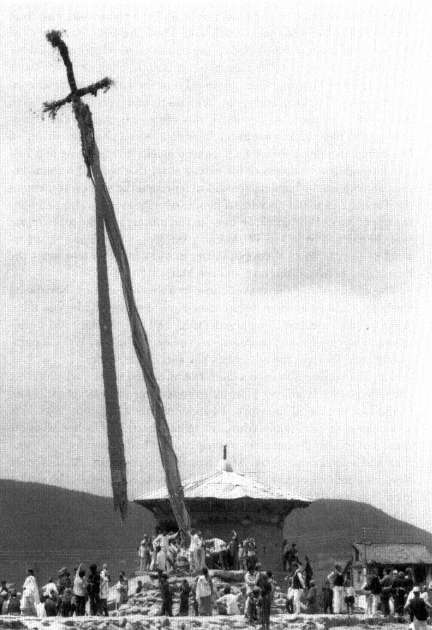
Figure 26.
Biska:. A stage in the raising of the Yasi(n) God to mark the solar
New Year.
pretation, in keeping with its designation as a deity, the Yasi(n) God. Toward the juncture of the crossbranch and the main trunk two long strips of cloth are tied, one at each side. These are pata , banners,29 of the sort that are sometimes tied to the pinnacles of religious structures and which, like many other aspects of the Yasi(n) God, are given more than one interpretation. Thus, in an echo of the later developments in the Bhairava/Bhadrakali plot, they are said to represent Siva and Sakti, and when they move in the wind, this represents their sexual intercourse. The two banners are also related to a legend about the saving of Bhaktapur from two snakes by a Tantric magician who came to a bad end through the weakness of his wife, a story that we will recount below. Sometimes the banners are said to represent the snakes; sometimes the Tantric Acaju and his wife. A bundle of eight ropes is also tied onto the upper part of the trunk. In one interpretation the eight ropes represent the eight Matrkas at Bhaktapur's borders, and the yasi(n) represents Bhairava. When the ropes flutter in the wind, this represents the intercourse between Bhairava and the Matrka* .30
The stories about the snakes come in different versions, borrowing freely and heavily from widespread and well-known Hindu folk tales. Some versions are quite long and detailed, and are popular local stories recounted by traditional Brahman storytellers in the city. We will paraphrase (and shorten) the two major variants of the stories.
The first version is in itself a cluster of unrelated stories, which rather clumsily gives a legendary warrant to miscellaneous aspects of Biska:. In the first version of the story, it happened that a long time ago there was a king in Bhaktapur whose daughter married. On her wedding night she and her groom went to their room, "had a friendly talk," and then had sexual intercourse. After that they slept deeply. As they were sleeping a pair of snakes came out of the princess's nose.31 The snakes grew bigger and bigger. They then bit the prince, who died. The snakes, shrinking to their original size, crawled back into the princess's nose. The princess, who was unaware of the snakes that she harbored, awoke and was distressed to see her dead husband. The king was also sad, and arranged for a funeral procession and cremation. This occurrence was repeated with many new husbands over the years.32 The local people, therefore, had to arrange for many expensive royal funeral processions and cremations, and they formed a special guthi to take care of them.
One day a prince came to a forest. He met an old woman there, at a river that flowed among the trees. He asked her what she was doing there, and she said that she had come to meet him to advise him to marry the princess. He asked what he should do and whether he would
have a happy marriage with the princess. The old woman told him about the snakes, and told him to stay awake and kill them with his sword. "Then you will have a beautiful wife, wealth, and a kingdom." She told him to go to the eastern part of the forest and that he would find a sword at a place where three rivers met. The story then recounts his meeting and marriage with the princess. "After the marriage they went to sleep in their room. The young man had great courage. It was a very difficult thing to do. They had a good conversation, then they had sexual intercourse and the princess went to sleep, but the young man did not sleep. He was very cautious. He remembered what the old woman had said." When the snakes appeared, he killed them. But before they died, the snakes said to him "You are a lucky and a great man. We have killed many princes and now we are going to die. That may be good or it may be bad. Please do a memorial for us every year." The story recounts the surprise and happiness in the city the next day at the prince's survival.
The prince established a festival on the last day of the solar month of Caitra. He erected a yasi(n) ), and attached the two patas to it to represent the two supernatural snakes or nagas . The festival is called bisket (the Nepali language version of the name), bi meaning "snake," and syat meaning "he killed." The old woman whom the prince met in the forest was really Bhadrakali* , which is why the festival is dedicated to her. In the forest where they met there were many tall trees and it is a tree taken every year from this forest which incarnates the Yasi(n) God. The tirtha , the place where the prince found the sword, is at the river Hanumante just at the Bhadrakali* (Vaisnavi* ) pitha . Because it was Bhadrakali* who helped the prince, it was decided to erect the pole in sight of Bhadrakali's pitha , which is just to the south of Yasi(n) Field.
Now the appearance of Bhadrakali* allows another piece of the story to be attached. One day, after the Bhadrakali* Jatra had been established, Bhairava came from Kasi (Benares) to see it. This particular Bhairava was called "Kasi Bhairavanatha," the chief of the Bhairavas. A local Tantric practitioner recognized Bhairava in the crowd and tried to trap him by means of a powerful mantra . But Bhairava tried to escape by sinking into the ground. When all of his body except his head had disappeared below the ground, Bhadrakali* recognized him and said, "That is my husband, we must keep him here. At least cut off and keep his head." That was done. The head was placed in the Bhairava temple in Ta:marhi Square, and the body was returned to Benares (where there is an important headless representation of Bhairava).
Thus, in memory of the meeting of Bhadrakali* and Bhairava, temples throughout Bhaktapur organized jatras for their gods and goddesses.33
There is another and different tale told about the Yasi(n) God. This one contains a theme that is echoed in the legends about the origin of the Nine Durgas (chap. 15). This theme concerns a man of great magical power whose power is lost through some error of his wife's, an error that is a sign of her weakness of character. If the story of the prince and the snakes is taken to mean in part that women are dangerous for domesticity until their dangerous "phallic" attributes have been brought under control by male action, then this story suggests that that control is always precarious. In a popular local version34 told by Brahman storytellers, the protagonist in a long story is Sesar* Acaju, a Karmacarya priest with exceptional Tantric powers, who was the guru of a Licchavi king of Bhaktapur, Siva Deva.35 The story tells how the priest protected Bhaktapur from an attack by the Kiratas by turning himself into one thousand tigers and chasing off the Kirati army. "But after I have chased off the Kiratas, I will return to you in the form of a tiger," said Sesar* Acaju to the king. "Don't be afraid. You must throw rice on me, and I will become a man again. The acaju gave the king some grains of husked rice to which the proper Tantric power had been added. He chased away the Kiratas, returned to the king, and was turned back into a man. The king welcomed him gratefully to his palace. The tale continues:
Sesar* Acaju returned to his own house. His wife was very happy to see him, she respected and loved him very much. One day Sesar* Acaju talked with his wife of his feats. His wife said, "Can you turn yourself into a python (aji[n]gar )?" Sesar* said, "Yes, I can." His wife said, "I am very curious to see you as a python." Sesar* Acaju agreed with her wish, and said "I will show you myself as a python, but don't be afraid." He gave her some magical polished rice (kiga: ) [given special power by a mantra] and said "I am going to become a python. You can see me as a python for as long as you like, but then you must throw the rice at me and I will become a man again." He showed himself to her as a python but she became frightened and forgot about the rice. She ran away. The python followed her in order to get the rice. While his wife, Nararupa, was running away in her fear she put her hand to her mouth and happening to swallow some of the rice she was carrying she also turned into a python.
The story goes on to say how the two great snakes moved through
Bhaktapur trying to find the proper kiga: to change them back into human form. They went to a Tantric temple in the hope that people with Tantric knowledge there could help them, but they had no luck. They then went to the palace in the hope that the king might help. The king did not know who they were, but he announced to the people that the two serpents (referred to at this point as naga and nagini , as supernatural serpents) had come for asylum, and therefore should not be harmed. But the snakes, not understanding this, were in despair and so commited suicide in front of the palace. And now a great famine came to Bhaktapur. The people consulted an astrologer, a Josi, who told them that the death of the naga and nagini was its cause. The king wished to do something to overcome the difficulties and went to seek Sesar* Acaju. But his house was empty and the door was unlocked. The king found the trail of naga there, and he followed it to the place where the naga and nagini had killed themselves. He thus finally came to understand the true nature of Sesar* and Nararupa's suicides. The king felt great sorrow. He remembered Sesar's* good qualities. He wanted the people to know about and remember Sesar* Acaju's great contributions to the city. Therefore the king organized the jatra of Sesar* and his wife Nararupa, which is called "Biska:." The two patas on the yasi(n) represent the two nagas .
The yasi(n) has been prepared and is lying in Yasi(n) Field. Earlier in the day ceremonies for installing divinity or "life" into it took place, and an Acaju administered to it as a newborn (or reborn) deity the entire set of samskaras , or life-cycle rites, necessary to bring the newborn god to his maturity. The arrival of the two chariots, that of Bhairava and Bhadrakali* , signals the time when people may begin the attempt to raise the yasi(n) . At the point where the yasi(n) will be erected there is a permanent hole, surrounded by a wall about five feet high, with an opening to the west. The pole is first put through the opening, and maneuvered into the hole. After the pole is raised, the edges of the hole and the wall will support it.36 The yasi(n) is very difficult to manipulate and raise. Scores of people come to cooperate in its raising, pulling on the ropes and pushing with their hands and with long poles. When, on the next day, the erect yasi(n) is rocked back and forth in preparation for its lowering as a sign of the beginning of the new solar year, it is said that the god is being rocked to sleep, as he is very tired from having stood up all year. The erection of the yasi(n) is to represent that old year—and it is only its taking down that marks a sharply transitional time. Now, at the approach of the transitional
point between two solar years, the Yasi(n) Field and the Yasi(n) God have become the focus of attention of the whole city, which has participated in and watched the erection of the pole in a coordinated cooperative act.37 When the Yasi(n) God has been raised, young men climb the ropes attached to it representing the Astamatrkas* , and present an offering of small coins at the knots where the ropes are attached to the pole.
Now the two chariots are pulled in front of the standing Yasi(n) God. In Yasi(n) Field there is a temple, the Cyasi Ma(n)dap, which is only used during this phase of Biska:, that has a small window in its north side. The Bhairava chariot, facing east, is placed parallel to the Cyasi Ma(n)dap, and aligned so that the window of the Ma(n)dap is at its right side and exactly in line with the side opening of the chariot. This exact ordering is said to facilitate the movement of the Bhairava image, which is always placed into the chariot from its left side, and removed from its right side. The Bhadrakali* chariot is placed at the other side, the southeastern side of the field, and lined up with similar precision alongside the Bhadrakali* pitha . Now most of the riders of the Bhairava chariot, who had remained there during the raising of the yasi(n) , descend and circumambulate the Bhairava chariot, and take a flower as prasada . They then circumambulate the Bhadrakali* chariot and take prasada there. Finally they circumambulate the Yasi(n) and the Cyasi Ma(n)dap at the same time. Then this group, including the king and his Guru-Purohit and most of the officials, return with music, sukunda , and umbrella first to Ga:hiti and then, after the others leave them there, the king, Guru-Purohit, and the two Maha(n) charioteers return to Laeku and the Taleju temple.
Certain priests and officials attached to the Bhairava temple, an Acaju and some assistants, had remained on the Bhairava chariot. Now they descend and take the jatra Bhairava and bring him to the Cyasi Ma(n)dap, where he joins the "true" Bhairava image and the Jaki Gwa that had been brought there on the first day of the sequence. Now there are offerings and sacrifices by many people at the temple to the jatra image, and to the enwrapped Jaki Gwa. The true image remains hidden from sight.
The Bhadrakali* jatra image is removed from her chariot by her priest. She is brought to an open building, a phalca , near the Bhadrakali* pitha , which adjoins Yasi(n) Field, where she will be kept during the night. Up until this point the two dangerous deities have been near each other, but there has been no direct contact.
That evening there are large feasts in people's houses, and guests and extended family are invited.
Taking Out the Gods: The VarahiJatra After the Yasi(n) God has been raised, the jatra images of certain deities throughout the city are taken from their god-houses and special rooms in temples and placed either on the cheli , the open ground floors of the god-houses, or on nearby phalca , open rest houses, each conventionally associated with a particular god-house. They will be left outside of their god-houses and temples for the next four days, to be brought in again on the eighth day of the cycle. The deities so brought out include all the Mandalic* Goddesses (except Vaisnavi* , who is represented by Bhadrakali* ), other dangerous goddess figures—particularly the ones identified as Bhagavati, some minor Bhairavas, and the major Ganesas* . These are, in short, the major dangerous city deities, and Ganesa* , who is as much of a Tantric god as he is an ordinary one.38 Blood sacrifices are routinely offered to these deities during this period, certain of whom become the foci for important local areal jatras that are considered major events, and which draw people from all over the city. Varahi is the focus for this night. The next day, the fifth, will belong again to Bhairava and Bhadrakali* . The sixth and seventh days, which echo some of the activities of the fifth day, have Mahakali and Mahalaksmi* as the central actors (on the sixth day) and Brahmani and Mahesvari (on the seventh). The eighth day centers around a form of Ganesa* , Chuma(n) Ganesa* . Seven of the nine Mandalic* Goddesses (if we take Bhadrakali* to represent Vaisnavi* ) are foci of jatras of city-wide interest (even though their movements are restricted to some limited area of the city), the remaining two, Kumari and Tripurasundari, have festivals in their own mandalic* areas at the same time as the mass of other deities who have been brought out of their god-houses and are not otherwise emphasized.39
The remainder of the deities who have been taken outside have small jatras of only local and sometimes very limited importance.40 On the evening of this day many people make sacrifices at their local Ganesa* shrines and at one or another local temple or shrine of a dangerous deity. Over the next four days the areas in which the various local areal jatras take place are sites for household feasts and sacrifices to the particular local deity who has been "brought outside."
Although there are now, as we have noted, activities at many Tantric temples and shrines, the city's focus is now at the god-house of the Mandalic* Goddess, Varahi. After the yasi(n) has been raised, a procession of some thirty or forty people who are members of the Varahi mandalic* area, and who belong to the Varahi guthi (which supervises and arranges Varahi ceremonies) or the Varahi bhajana , or music group, bring clumps of dry reeds, called ti or ti(n)pwa , to the cheli of the
Varahi god-house where her jatra image had been placed. Taking some fire from a votive oil lamp that had been set in front of the image, the reeds are set afire as an offering to Varahi. Then the image of Varahi, placed in a palanquin, is carried, followed by many hundreds of people, across the river to the Varahi pitha . As the procession moves toward the river through the mandalic* area it stops many times in front of houses, and householders make animal sacrifices to the goddess in front of their houses. When the procession reaches the river it stops and the Varahi Acaju touches the palanquin with river water, and then offers some water to the jatra image. The people accompanying the jatra drink river water, wash their faces with it, and splash each other with it. This water is prasada from Varahi. Now the procession continues to the Varahi pitha , where the jatra image is placed on the pitha stone.41 The goddess is worshiped by means of an animal sacrifice. Now the procession takes her back to the open cheli of her god-house.
The Fifth Day: Taking Down the Yasi(n) God—Beginning of the Solar New Year
The fifth day of Biska:, the central day of the sequence, is a sankranti* , the first day of the solar month, the day that begins the new solar year. Its ceremonial beginning will be at the fall of the yasi(n) in the late afternoon toward sunset.
On the morning of this fifth day everyone who can—that is, many thousands of people—go to the Hanumante River at the Cupi(n) Ga, which is the location of the tirtha associated with Bhadrakali* . There, in what is a kind of mela , people enter the river for a ritual bath.
During the course of this New Year's Day there are a number of esoteric activities in the Taleju temple. Among these is the worship by the "king" and his Guru-Purohit of the dangerous deity Dui(n) Maju, a deity said by some to be Taleju's own pitha goddess, and a deity of special historical interest (chap. 8). She is worshiped on this day as a "sister of Indrani* ," a deity to whom this day makes special reference. On this day, also, those Jugis who during the year play their special instruments at the Taleju temple come to the temple and are offered food on which the king throws masala (a mixture of betel nut, nuts, cinnamon, raisins, etc.), as a token of gratitude for their work.42
This is the day of the Indrani* Jatra,43 which involves, exactly like the Varahi Jatra of the previous day, the taking of the deity from its outside resting place to its external pitha . In addition, in the course of this jatra
the procession brings the Indrani* image to the front outer gate of the Taleju temple, opening on Laeku Square, where she is met by the king and the Guru-Purohit and worshiped by them.44
Now the king, carrying the royal sword, the Guru-Purohit, and the two Maha(n) charioteers, accompanied by musicians, the royal umbrella, and the ornamental sukunda , return to Yasi(n) Field, and meet the remainder of the chariot passengers there. All seat themselves on seats to the north side of the Cyasi Ma(n)dap. Meanwhile the Bhairava chariot has been turned around to face the west.45
The leader of the Bhairava guthi makes an offering of yellow pigment to the Yasi(n) God, and then gives some of it as prasada to bystanders. Now the Bhairava jatra image is placed in the chariot. All the passengers and the charioteers mount the chariot and take their proper positions in relation to the Bhairava image. Meanwhile the Bhadrakali* chariot has been readied near her pitha and her image put into it, and the riders of her chariot have mounted and entered the chariot. The secret Bhariava image and the Jaki Gwa had earlier been returned to the Bhairava jatra god-house (where the jatra image of Bhairava will later join them) by the same group of men running in the same order who had brought the two images down to Yasi(n) Field on the first day.
Now it is the time for bringing the Yasi(n) God down. First the Yasi(n) is rocked back and forth in an east-west direction, in a motion called "rocking to sleep." The god is said, as we have noted, to be tired for "he has been standing up all year." At the time of the rocking the eight ropes representing the Astamatrkas* and the two patas representing the Tantric guru and his wife move, and this is interpreted by religious specialists as representing the sexual intercourse of the Astamatrkas* and the Yasi(n) as Bhairava, and of the two nagas with each other. The pole is slowly rocked back and forth, and finally, after perhaps ten minutes to half an hour of swaying, eased down to the west so that it falls outward through the opening of its retaining wall. People who wish a son try to pull one of the leaves from the yasi(n) or its crossbar, and if they get one they will not only have a son, but he will be an important man. When the pole falls, the new year begins.
When the Yasi(n) God is down, the Bhairava Acaju and guthi leader decorate the Bhairava image again with yellow pigment, bhuismba(n) , which is then given as prasada to the other chariot riders. Now there is the beginning of a unique episode—the Po(n) untouchables become integrally involved with the sequence. The Bhairava Acaju and guthi leader, standing on the chariot, place some yellow pigment as prasada
taken from the Bhairava image, on the foreheads of Po(n)s who crowd around the chariot to receive it.46 At any other time this contact would be greatly contaminating to these two men, but at this one time in the year it is not.47 Now some of the Po(n)s take hold of the ropes at the back of the chariot, and other men, mostly Jyapus,48 take hold of the ropes at the front. Again a tug of war begins to determine the direction in which the chariot will move. The Jyapus are trying to pull the chariot back toward the city, while the Po(n)s are trying to keep the deity in Yasi(n) Field, which adjoins the "Po(n) twa: ," the area where they live, just outside of the symbolic boundaries of the city. This struggle does not (at least in the memory and expectation of present informants) lead to fights, and gradually the more numerous Jyapus with the advantage of the two extra ropes at the front of the chariot prevail. At the top of Yasi(n) Field, where the road to Ga:hiti enters it, the Po(n)s let go of the ropes, and return to their own area. The turning back of the Po(n)s indicates that the chariot is now within the symbolic boundaries of the city. The Bhadrakali* chariot, pulled only from the front, is drawn up after the Bhairava chariot is on its way. The chariots are hauled up the road that they had descended at the beginning of the sequence in the direction of Ta:marhi Square. But when they reach Ga:hiti there is an essential episode, a further interruption to Bhairava's civic journey.
The chariots are arranged in Ga:hiti Square, with the Bhairava chariot facing north toward Ta:marhi Square and the Bhadrakali* chariot moved in front of him blocking his path and facing south, in the direction from which they had just come. They are placed near the stone deity Swatuña Bhairava, which represents (among other things; see chap. 8) the body of Bhairava, at the place where Bhadrakali* first recognized him, where he sank into the ground in an attempt to escape, and where Bhadrakali* ordered that his head be cut off.49 Now the two chariots, with their passengers aboard, are pushed toward each other. Most of the movement is by the Bhadrakali* chariot, which is crashed into the comparatively immobile Bhairava chariot. This is in keeping with Bhadrakali's meaning as a Sakti, for the banging together represents sexual intercourse, and the Sakti is the active partner. Each time the chariots crash together the people in and on them throw flowers out into the crowd, and people rush to gather them as important prasada . The chariots are banged together three times. There is a certain hesitation in the interpretation of the meaning of this banging together between sexual intercourse and aggression. It is said by upper-status informants that the esoteric meaning is sexual intercourse. Although, such informants
say, lower-status people often understand this meaning, they also may be unaware of this, and may misinterpret it as the two gods fighting. The banging together is, in fact, called lwakegu , from a verb meaning "to fight, to quarrel" as well as "to collide, or to hit against each other."50 Even among those who hold the "correct" interpretation of sexual intercourse, however, it is believed that at the time of the sexual banging together Bhadrakali* becomes angry with Bhairava for reasons that are unclear to present informants. Perhaps, it is believed, her anger is for someting that Bhairava has done wrong—for he will later try to atone for this and quiet her by means of a gift.51 Now Bhadrakali* "returns in her anger to her home"; that is, her chariot is removed first from Ga:hiti to an area near Bhadrakali's jatra god-house where she will remain in angry seclusion until the seventh day of the sequence, when Bhairava will have to send her a present to placate her.
The Bhairava jatra image is now taken to its jatra god-house in Lakulache(n). His chariot is left in Ga:hiti, where it will remain until the ninth day. The evening of this New Year's Day, following the banging together of the chariots, is the occasion of major feasts in most households, with guests from other cities and towns who have come to watch the festival.
The Sixth Day: The Mahakali/Mahalaksmi Jatra
The previous day had continued the themes of struggle and still problematic unification, portrayed in ambiguous sexual and aggressive images. The events of the next two days echo these themes in an imagery which is said to show the "cooperation and friendship" of adjoining mandalic* sectors of the city.
The sixth day is the day for the special jatras of two of the Mandalic* Goddesses, Mahakali and Mahalaksmi* . In the morning of the day there are two important jatras in two nearby towns that are visited by many people from Bhaktapur. These are at Thimi, where there is a Ganesa* festival in which thirty-six chariots are paraded, and Bode, where there is an important Mahalaksmi* jatra . In Bhaktapur, in the afternoon, the jatra images of the two Mandalic* goddesses, Mahalaksmi* and Mahakali, who protect the two adjacent mandalic* zones of the north and northeast, are taken from the "outside" placements where all the Tantric deities had been brought on the fourth day of the cycle and taken on a jatra to their respective pithas . Their jatras resemble the Varahi and Indrani* Jatras, which we have described above, with an important addi-
tional feature. The Mahalaksmi* image is taken on the usual traditional path between her god-house and her pitha , but the Mahakali image is taken out of its usual path so that she encounters the Mahalaksmi* image just before they reach the border of the city. On their meeting the palanquins bearing the two deities are bumped together three times. This, it is said, is not considered a fighting, but a mating, signifying the bringing together or unification of the two zones. There is no doctrine as to which of the two goddesses is male or female during their intercourse.52 The goddesses then part, and continue on their respective jatras . That evening there are feasts in the households within these goddesses' mandalic* zones.
The Seventh Day: The Brahmani/Mahesvari* Jatra
During the afternoon of this day, the previous day's encounter of two neighboring Mandalic* Goddesses is repeated in exactly the same manner, including the encounter and the bumping together of the palanquins, but this time with the goddesses Brahmani and Mahesvari, of the adjacent eastern and southeastern mandalic* zones as the loci. That evening there are feasts in those two zones.
Earlier in the day, a member of the Bhairava temple staff has brought a sari to Bhadrakali* in her jatra god-house as a present from Bhairava—an offering to make peace with her and to appease her anger. On the evening of this day the jatra image of Bhadrakali* is brought to a special phalca , an open shed, adjacent to the western side of the Natapwa(n)la temple in Ta:marhi Square.53
Although the Bhairava jatra image is still in the jatra god-house in Lakulache(n), the main secret portable image, the "true" jatra image of Bhairava, is now in his temple in Ta:marhi Square, where it had been returned on the fifth day. The bringing of the Bhadrakali* image, now tranquil, to Ta:marhi Square represents, it is said, the visit of Bhadrakali* to her "husband's"54 home, and a brief, but in the flow of Biska:'s imagery significant, movement toward peaceful domesticity.
The Eighth Day. Feasting the Gods—Chuma(n) Gandya: Jatra
On the morning of this day, crowds of people dressed in some of their best clothes and often accompanied by neighborhood music groups,
visit the places adjoining those god-houses and temples throughout the city where deities had been taken out to public view on the fourth day of the Biska: sequence. As most of these places are on or near the main city festival route, the pradaksinapatha* , people are able to follow this route for the most part,55 moving along it in the auspicious clockwise direction. At each place people present symbolic "feasts" to the deity. They offer eggs, swaga(n) (a mixture of husked rice, curds, and pigment),56 sweets, alcoholic spirits, and beer.
One of the many local jatras of the Biska: period serves as a focus for the city on this day. This is the jatra of the local Ganesa* of the main Coche(n) twa: . This particular Ganesa* (or Gandya: in Newari) is called "Chuma(n) Gandya:, "Rat Ganesa* ."57 The jatra image of this deity is carried on the afternoon of the eighth day in several processions around the twa: , and many people come from all over the city to watch. The importance of this Ganesa* is suggested by his surviving legends, which seem to reflect important aspects of the city's history. We will sketch two versions known to contemporary storytellers.
A long time ago the Malla king Ananda Malla (referring probably to the early-fourteenth-century ruler, Anandadeva Malla) wanted to make Bhaktapur into a larger city by extending its boundaries. It was only a small town then. He walked around the various places outside of the town. He reached a place in a forest, which is the location of the present-day Bhadrakali* . There he saw a very thin old woman who resembled a skeleton. Ananda Malla was very frightened when he saw her. Nevertheless, he approached her and asked, "Who are you, old woman? Why are you alone in this forest?" "I came here because I wanted to give you advice about making a city," she replied. "If you go north from this place, then you will see a wonderful scene, something which you have never seen before. Then [after seeing this sight] you must go on, and you will see Ganesa* . You must worship Ganesa* , and then you will be successful." The goddess revealed herself to him, and then disappeared. She was Bhadrakali* .
The king followed the old woman's directions and went to the north. There he saw a wonderful scene. A cat and a rat [or mouse] were fighting. The rat finally defeated the cat, and ran off, carrying the cat in its mouth. The king followed the rat. It ran up into a tree with the cat in its mouth and then disappeared. Ananda Malla was full of wonder. How did the rat take the cat up into the tree? This was surprising. He went to look but could not find it. But then he saw Ganesa* there. The
king remembered what Bhadrakali* had said. He thus served [worshiped and respected] Ganesa* , and was given effectiveness [siddhi ] in many things. The place where the cat and the rat fought is called Bholache(n). The place where the rat ran up the tree is in Coche(n). [These are adjoining twa :s in the northern part of the city (see map 11)]. Ananda Malla built a temple for the rat in that place [where the rat climbed the tree]. Ananda Malla then divided the city into twenty-four twa:s, and he constructed the Astamatrka* pithas and god-houses. He established a festival [Biska:] for Bhadrakali* .
In another version of the story, Ananda Malla was hunting in a forest at the north of present-day Bhaktapur. There he saw a cat and a rat fighting. The rat vanquished the cat and then ran up a tree. The king went to find the animals, but could not find them. Both the cat and the rat had disappeared. The king thought the rat must be the vehicle of Ganesa* , otherwise he would not have been able to win the fight. The king, therefore, prayed to Ganesa* . Then Ganesa* showed himself to the king and said to him, "Go south from this place. There you will see an old woman. She is my mother [i.e., Parvati, but in the form of Bhadrakali* ]. When you see her, bow down to her and say that Ganesa* sent you. My mother will be pleased. We [Ganesa* and his mother] represent the north and the south. You should build a city between us [that is, the positions where the king encounters them] and we will help you." So Ananda Malla received help from Ganesa* and Bhadrakali* . He then built the enlarged city of Bhaktapur.
On the evening of the eighth day all deities are returned back into their god-houses, except the Bhairava and Bhadrakali* images, which are still, respectively, at the Bhairava jatra god-house, and the phalca in Ta:marhi Square. In the evening households throughout the city have feasts, often preceded by animal sacrifices.
The Ninth Day: Taking Down the Small Yasi(n) God—Final Phases of the Bhairava/Bhadrakali Jatra
In the morning of the ninth day the small Yasi(n) God in the potter's quarter, Talakwa, is pulled down with no special ceremony by the people of the area.
In the afternoon of the day the empty Bhairava chariot, which has been in Ga:hiti Square, is aligned so that it is facing west, with its left
side facing in the direction of Bhairava Jatra god-house, in preparation for the placing of the image into the chariot at its left side. The Bhadrakali* chariot has been left in Ta:marhi Square, where it had brought Bhadrakali* on the seventh day. Now, exactly as on the first day, the king, Guru-Purohit, attendants, and chariot crew meet at Ga:hiti and circumambulate and enter the Bhairava chariot. At the same time, in Ta:marhi Square, the Bhadrakali* image is taken from the phalca , and placed in her nearby chariot.
The people from the upper and lower city grasp the ropes at the Bhairava chariot's two ends, as they had on the first day of the festival. This time, though, the men from the upper city are at the front end of the chariot and those from the lower city, at the back. Again, as on the first day but this time because of the slope of the land in Ga:hiti, it is easier for the chariot to be pulled into the lower city, and this is compensated for by the fewer ropes on the lower city end of the chariot. The entire procedure of the first day is repeated, and, again, if all goes well, the struggle supposedly ceases at the exits to the two squares—that is, of Ga:hiti if the chariot is being successfully pulled into the lower city, and of Ta:marhi if it is being successfully pulled into the upper city. It is then pulled first toward the traditional far point in the victorious half, then brought to the end point in the other half, as it was on the first day. Then, for the last time, it is cooperatively pulled back to Ta:marhi Square, where the Bhadrakali* chariot has been waiting.
But, as on the first day, all this may not go smoothly. Many people have been drinking on this day, and there may be resentments smoldering from the conflicts and violence of the first day. There is always anxiety that the tug of war may not follow its conventional script and might turn into a fight.
When the chariot is returned to Ta:marhi Square, after Bhairava has been to the upper and lower cities once again and shown himself again in darsana , the chariot is pulled up to the north side of the Bhairava temple and the jatra image is taken from the right side of the chariot and returned to its dwelling within the temple. The Bhadrakali* image, which has been waiting at the Ta:marhi Square phalca , is taken in its chariot to its ordinary god-house, the Vaisnavi* god-house, where it will be kept for the remainder of the year. The two gods are welcomed into their homes with the laskusa ceremony, the traditionally welcoming and sanctifying ceremony for moving a focal participant into a sacred area. While the two gods are being taken back into their homes, by-
standers and the Acaju priest, who greets them in front of the temple to perform the lasakusa ceremony, tease them about their recent romantic and sexual adventures.
And now, finally, the passengers and crew of the Bhairava chariot descend. The king, carrying his sword, the king's Guru-Purohit, and the two charioteers, joined by the musicians, the carrier of the umbrella, and the carrier of the sukunda , take leave of the others, and, followed by representatives of the central government's Guthi Samsthan, return to the Taleju temple, where the king, becoming a Brahman once more, returns the sword to one of the Guthi's representatives, who will take it back to Kathmandu.
This final night is an occasion for feasts throughout the city.
Approaches to Meaning
Biska: is a complex symbolic enactment. A cast of human and divine actors moves through meaningful city space, in endlessly repeated annual performances in concert with the city's symbolically ordered and ordering time, in a context of legends and traditional interpretations. Against this background the actors do certain things; they enact dramas or, if all the events of the period are considered to have some possible overall pattern, they enact a single theatrical performance, albeit one whose dramatic unity is rather Shakespearian. Biska:'s significant contexts include the year's other festival enactments. When considered in relation to the entire group of festivals (chap. 16) or in comparison with particular other ones—say, the other great structural focal festival, Mohani, or the lunar New Year sequence, Swanti—certain of its peculiarities and relations within the larger cycle are highlighted. We can at this point approach the question of its meaning—that is, the meanings bearing on civic integration with which we are concerned—under some general rubrics that can be applied for comparison to still other annual events.
1. Biska: as a solar festival.
One of our questions is whether cyclical events that are "outside" the annual festival cycle affect that cycle. With the exception of the minor event Ghya: Caku Sa(n)lhu [10] and the minor observances of the first days of each solar month, "the events of the solar cycle" (as this chapter is entitled) really means the Biska: cycle. Biska: has, of course, some direct "solar" references. It takes place at the vernal equinox and begin a new year at the moment of the
balance between daylight and dark. The raising and lowering of the yasi(n) to mark the transition to the new year in an east-west direction has, perhaps, some now forgotten connection with the sun's direction. Otherwise, there is no evident direct reference to the sun and the seasons. In Biska:'s contrast with the lunar and agricultural Mohani sequence there is, however, an intriguing, if perhaps fortuitous, contrast, which relates Biska: to the modes of astral religious action, whose presiding figure is the deified sun. Biska:'s central narrative (although not all of its subsidiary legends) reflects the kinds of passive and self-adjustive relations that worshipers have with the astral deities and the transcendent macrocosm, rather than the active and manipulative interactions they have in some other annual events with the realms represented by the dangerous and ordinary civic deities. Thus, in Mohani the king and his Guru-Purohit actively participate in the struggle of the Goddess against forces of disorder, but in Biska: both king and deities are passive, moved by the forces of convention, affected only by a ripple of urban disorder, a thesis of disorder that tends to clarify the subsequent resolution of order. The king and his entourage and the god Bhairava are moved by immemorial ritual order, as the sun moves through the year. Even the tug of war that threatens to disrupt the movement of the chariot and that determines which half of the city it will move to first is in the realm of luck and chance, the neutral non-moral realm of the astral deities.
There are also marked contrasts in the emphases of Swanti, the lunar New Year's sequence, and Biska:. However, to anticipate chapter 16, the contrasts are internal to the entire annual cycle, and not in any obvious way semantically urged by the contrasts of the solar and lunar cycles, except perhaps in a contrast in personal effort in Swanti and passive witness in Biska:. Swanti's emphasis is on the affirmation of the family in the household, Biska:'s is on the integration of the city as a whole and in its relation to annual time.
2. Biska: as a structural focal sequence.
The Biska: sequence, as we have described it, differs sharply from the majority of miscellaneous annual events in ways that lead us to characterize it as of focal importance for Bhaktapur. The first evident difference is quantitative. It has more events and more deities and consumes more time than do the events we presented in the last chapter; the closest being the Saparu events. Biska:'s mass of events is not just a disconnected collection, however; its actions and themes are woven together and related in var-
ious ways. This adds formal complexity to quantity. In contrast to many other events, the entire city is represented, not just an area, and there is a representative range of actors from king to untouchable, not just some one or some few social segments. Furthermore, the themes and actions of the sequence make use of those representative actors and spaces to make general and basic statements about the city in itself , and not about just one element of life in the city, a shared anxiety, for example, about disease. We call such elaborated festivals "focal." While Saparu with its emphasis on death and carnival may be thought of as an antistructural focal festival, Biska:, like Mohani (in its own and different way), emphasizes urban order, and thus is a "structural focal festival."
3. Interactive versus parallel features: bases for solidarity.
The complex pattern of Biska: means that to the "parallel" relations of simpler festivals, where many of the city's units are doing the same sorts of things at the same time,58 there is added interactive or "syntagmatic" relations at the city level . In the major focal structural festivals—Biska: and Mohani—there is a central emphasis on interrelated actions on the public civic level, while parallel actions, such as household feasts and neighborhood jatras , are secondary. This is in contrast with, say, an important major festival sequence like Swanti, in which the major civic significance is in the parallel performance of the events within all households (events that may be interactive within the unit itself).
In contrast to parallel events—which have static structural significance—interactive events are dynamic, and can express relations, conflicts, dilemmas, resolutions and their failures; in short, they have the quality of narrative and drama. Actors, space, time, and plot combine to say something—if the proper rhetorical devices can be found to capture and hold the attention of the narrative's audience.
4. Human actors.
In Biska:'s parallel events individuals throughout the city participate as members of households, of mandalic* sections, and (less systematically) as members of twa :s and neighborhoods. At the level of the public urban performance, the city's central interactive narrative, The Adventures of Bhairava and Bhadrakali* , we have as our cast the Newar king, the chief Brahman, and representatives of the Josi, Acaju, Bha, Jugi, Po(n), Maha(n), Sa:mi, Ka:mi, and various Jyapu groups. Many of these personages are gathered into the Bhairava chariot, which is pulled and tugged at by men of various clean thars —
subdivided, however, at the chariot's two ends into representatives of the upper city and the lower city. The selection of thar s in the interactive public performances effectively samples and represents the city's traditional macrostructural, ritual, and productive structure. The two city halves represent by summation its entire space, but this particular way of representing it (rather than, say, by the sum of the mandalic* sections that represent the space of the city in Mohani) has special implications.
In Biska:'s action the king, priests, and thar representatives do not, in fact, act. They are passively moved. They are moved through the city on fixed routes, at fixed times, at the mercy of the tugs of war that represent the tensions in the city underneath the order that the chariot riders represent. They represent order, but they are not the active agents of that order. In Mohani they act, and the power of the Ksatriya* and of the Brahman as a Tantric practitioner are explored. While in Biska: the passive adventures of king, Brahman, and their company are in the public routes and spaces of the city, in Mohani, their actions are for the most part confined to the sacred and royal enclosure of the Taleju temple.
5. Divine actors.
The central deities in this festival are the powerful dangerous deities Bhairava and Bhadrakali* . The Mandalic* Goddesses and the remainder of the city's important dangerous deities are foci of important but secondary parallel activities. The Yasi(n) God has no independent existence in Bhaktapur aside from this special festival use and is rather a focal sacralized collection of important images, signs, and ideas, a kind of ad hoc deified object. While other deities contribute meaning because their identities transcend Biska: (although Biska:, in turn, contributes to their meanings), the Yasi(n) God is no more than a component, albeit an important one, in the festival sequence.
As in Mohani and in the Devi cycle the divine actors in Biska: are dangerous, not ordinary, gods. As we have repeatedly argued, they represent—in their contrast to the benign, personal, and familial moral and dharmic deities—forces that threaten the moral order on the one hand, but that can be captured through power and made to protect it on the other. In Biska: the male dangerous deities—Bhairava and the Yasi(n) God)—predominate. In Mohani the female deities are central. In keeping with the balance of male and female deities, which distinguishes the benign from the dangerous deities (chap. 8)—although here unusually represented within the realm of dangerous deities—Biska:'s
deities are portrayed as powerful but limited beings, rather like humans in the social world, in their irritations, ineffectual attempts to escape, and passivity. Instead of the complex rites that will bring the dangerous goddesses of Mohani into some useful relation to the city, Bhairava and Bhadrakali* and the Yasi(n) God are, like the chariot's representative social microcosm, simply manipulated and moved through space like puppets. The "deities" at issue here, far below the surface and beyond anthropomorphic gods, are order and chaos.
6. Space.
Throughout Biska: city space is carefully made use of to represent the city itself and the narrative movement of the festival sequence. Space, it is important to recall, is only one of the possible ways of representing Bhaktapur—or any community. A community can be represented, for example, by the sum of its citizens, or (as in Swanti) its family units. Furthermore, when spatial units are used in representation, Bhaktapur has various options for demarcating the whole city. In Biska:'s narrative aspect it is the city halves, areas whose antagonistic potentials are traditionally emphasized, which are used to represent the city. The "neutral" points between them (Ta:marhi Square and Ga:hiti Square and Yasi[n] Field), and the neutral axis connecting them is played against an axis of struggle between the upper and lower halves of the city defined by that axis. The neutral points and axis are "liminal," out of ordinary space and time. It is here that the adventures of the nonordinary deities Bhairava and Bhadrakali* unfold, and here that the Yasi(n) God waits to start the next year.
Independent of the central narrative other spaces are used starting, for the most part, on the fourth day of the sequence. The goddesses of the mandalic* sections are brought beyond the borders of the sectors to their pitha seats, enacting the essential meaning of these goddesses—their relation to the dangerous, amoral outside of the city. And throughout the city the major dangerous deities are, in a unique movement, taken outside of their "houses" and seated in the public city space. The city is represented through the parallel movement of all these deities, although the movements of two neighboring pairs of the goddesses include an echo of Bhairava and Bhadrakali's ambiguous enactment of unity and disunity. In another enactment of unification the city's people move on the eighth day in a jatra along the pradaksinapatha* to worship all the dangerous deities. This movement, like the movements of the chariot, is within the city boundaries in contrast to a similar sequential summating movement to the pithas of the Mandalic*
Goddesses to the bordering outside of the city, during Mohani. In the private realm, households—which can be considered either as social units or spaces—are having their feasts on the same designated days throughout the city's larger space and social hierarchy.
In the legend of the Chuma(n) Ganedya: the legitimate location and extent of the city itself is emphasized and given a divine charter. In keeping with the resolutions of the festival action itself, this legend is a supernatural warrant for civic unity—a warrant that serves to suppress the autonomy and divisive strife of preexisting and/or persisting smaller communities and segments.
In contrast with Mohani, the spatial emphasis is primarily on the internal integration of the spatial components of the city. In Mohani—and in the Devi cycle generally—the emphasis is on the city's defining and unifying contrasts and transactions with its environing outside.
7. Narrative content.
The festival sequence talks about, so to say, social order and disorder. So do all the major festivals, but with significant differences in the aspect of order and disorder at issue, and in the sources of disorder and the means of rectification portrayed.
The central public enactment is the movement of the king, priests, charioteer-warriors, Jyapu and craftsmen, and Bhairava in one chariot and Bhadrakali* and her attendants in another. The two chariots allow for an expression of one opposition. The movements of the first, the largest and most important chariot, makes use of the two halves of the city for another opposition directly representing the city and its divisions. The main actors in the hierarchical macrosocial system—including important representatives of the large middle-level and lower-middle-level groups—are gathered into the main chariot as a static unit and moved passively, in conjunction with Bhairava, in a movement along an interstitial axis from one "central" point to another. In the course of this journey they deviate to "show themselves" to the real space (existing in the everyday civic world, in contrast to the transcendent axis and points) of the two halves. This realization is accompanied by struggles between the halves which threaten disruption and danger. Disorder must be enacted so that the processes and forces that overcome it may, in their turn, be dramatically prepared for and meaningful. It must be remembered that in the chariot are real kings (at least they were in the Newar autonomous past), real chief Taleju Brahmans, and real representative citizens all exposed to real discomforts and dangers, to real risks. In the middle of their journey, that is, in the middle
of the festival sequence itself, they—in unison with the Bhadrakali* chariot—are brought into contact with the other main symbolic cluster of the sequence, the Yasi(n) God, at the moment when cooperative efforts raise, again with some risk, and then, at the interstitial moment between two years, lower it to mark the beginning once again of a new solar year and the recommencement of annual time.
Biska: in its central public enactment represents the order that is automatically and ineluctably imposed on the possibility of civic disorder in the ritually ordered movement of traditional forms through time. The chariot does not move through any activity of the king and priests. Mild disorder and reestablishment of order, with the latter emphasized, happen to those witnesses.
The achievement of unity is pervasively represented in Biska: through sexual intercourse, with its reminder of the division that the two sexes represent. This action, in the case of Bhadrakali* and Bhairava, reflects underlying anxieties, for it is not sure whether the encounter is in sexual union or in battle.
Although the male deity Bhairava takes precedence in the action of the festival, with Bhadrakali* a faint presence in his shadow, the legends associated with Biska: make her the dominant figure. She is responsible for the site of the city, and Biska: is in some accounts her festival. She must capture Bhairava—or the part of him that was unable to escape—to keep him in the city. In contrast to the major dramatic enactments of the Devi cycle where the dominant female dangerous deities are on center stage, Biska: relegates the Goddess to the legends describing the state of things prior to the establishment of the ordered city. She is here a potentially ominous shadow at the edges of social order as the king and Bhairava survey their socially ordered city, a reminder that Bhaktapur's social order is only a precarious clearing in a larger, different space.
The stories gathered around the Yasi(n) God explore the danger to men and the society they are taken centrally to constitute of women—both as sexual beings and as inadequately controlled wives. The domestication of the princess59 is accomplished by a man, a prince, but through the absolutely necessary aid of Bhadrakali* , who in the ambivalent use of dangerous deities both represents the same sorts of dangers as does the princess and can—and must—be used to bring them under control. But the transformation of the princess into an ordinary wife is—the fatal problems caused to the Tantric expert Sesar* Acaju by his wife remind Bhaktapurians—a problem that will never be fully solved, no more than the unity of the city will be. But in the moments of resolu-
tion in the Biska: sequence, at the achievement of the lowering of the Yasi(n) God and the final momentary reconciliation of Bhairava and Bhadrakali* , the problems somehow seem to be resolved. It will all need to be repeated yet again in each revolving year.
The emphasis in the stories that inform Biska: is on the legendary realm where the supernatural once made contact with Bhaktapur—at a particular moment of real historical time and at a point of earthly space—for the purposes of locating or ordering that city. The events of the legends happened only once, although they must be repeatedly memorialized. In Mohani the explanatory stories of the central narrative take place within a thoroughly transcendent and timeless mythic realm—with no relation to terrestrial time and space—where a battle is taking place in which the city must actively and magically participate each year, over and over again. The presence and force of the "supernatural" is quite different in the two structural focal festivals.
8. Rhetoric.
We are concerned everywhere in this study with those aspects of symbolic form in Bhaktapur that are presumably significant to its citizens. It is not enough for such forms to be meaningful, they must also be engaging . For this a sort of rhetoric of symbolic form is necessary. We have noted some miscellaneous engaging devices: the advertised mystery of the Jaki Gwa and the whereabouts of the "true" Bhairava jatra image, the ambiguity and psychic resonances stirred by the princess whose nose (or vagina) hides snakes, the hesitation between sex and aggression in the ambiguous banging together of Bhairava and Bhadrakali* , and the fascination of watching the major figures in the hierarchical order symbolized by themselves. To jeopardize the symbol of a king is one thing; to jeopardize the king himself is something more.
One of the sources of the fascination of Biska: for the participants and, often the onlookers, is that it involves real risk. In its symbolization of conflict a movement can always occur, a breakdown, into real physical and social danger. Here marked symbolism is m danger of collapsing into real life.
9. The message.
It is possible to tease out of the drama or dramas of the city's various complex symbolic enactments, a task simplified somewhat when they are compared with each other, something like a central import or message, a message that is simple and redundantly presented. For Biska: this seems to be something like this: admire and
celebrate the civic order. That order may momentarily and frighteningly sway and lurch, but when the city works together—or refrains, really, from not working together, for the task is not difficult—and accepts the traditional directives of the mesocosmic order, it will all hold together; the space and personnel of the city will remain unified both in itself and in relation to the pulse of annual cyclical time. The main danger to civic order, in Biska:'s main narrative, and in contrast to other narratives, is civic strife, the danger of something going awry in the balance of those human forces that constitute the city.
Other aspects of disorder, those beyond the moral sphere of the city, are alluded to in Biska:'s legends. But Biska: in itself is not centrally concerned with them. That is the concern of the Devi cycle.
Chapter Fifteen
The Devi Cycle
Introduction
In our presentation of the miscellaneous calendrical events of the lunar year we set aside a group of events distributed throughout the year for special treatment. This group, closely related to the rice agricultural cycle, makes up a thematically interrelated set in which the meaning of each unit is dependent on the entire group. While the meaning of the other events of the lunar cycle is often affected by their structural similarities and contrasts with other events in the cycle, the events in the Devi cycle are related by a central thread. This thread is a narrative of the states and activities of one group of supernatural beings, the "Nine Durgas," a group of dangerous deities thought locally to be uniquely associated with Bhaktapur (see fig. 27).
The Nine Durgas are, in part, manifestations of Devi, the Goddess. In the course of Mohani at the time of the climactic harvest of the rice cycle Devi is portrayed in all her complexity. Mohani brings her transcendent exploits as the conquering Mahisasuramardini in the mythic realm into concrete representation in Bhaktapur's mesocosm and, in so doing, brings the mythic Devi into empowering contact with the local legendary Nine Durgas.
In our listings of the annual calendrical events of the lunar cycle we were able to use the lunar New Year's Day as a place to enter it and to begin it. The Devi cycle has no conventional beginning, and there is more than one place where a descriptive beginning might be justified.
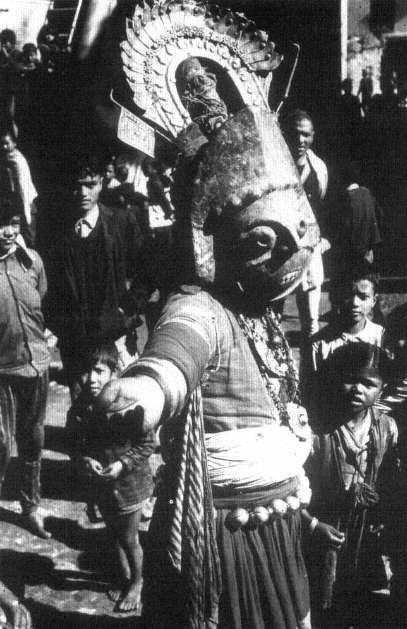
Figure 27.
The Nine Durgas' pyakha(n) . Duma dancing.
One might be with Mohani itself, in which, with the harvest, the presence and protection of the Goddess is returned to and into the city after a vital sojourn outside in the fields and away in other realms. Another entree to the cycle, the one we have chosen, is with the departure from the city of Devi's manifestations, the Nine Durgas. The results of that departure conveys the implications of her absence and thus the meaning of her return. We will preface our description of the cycle itself with a necessarily detailed introduction to the legend, membership, and iconography of the Nine Durgas troupe.1 For the Devi cycle, as they were for the focal Biska: festival, details are essential.
The Legend of the Nine Durgas
There are a number of variants of the tale or legend of how the Nine Durgas came to be introduced into Bhaktapur. A familiar version goes as follows: A long time ago during the reign of the Malla king Guna* Kamana Deva2 the Nine Durgas troupe inhabited a forest called Jwala (to the northeast of Bhaktapur).3 They used to catch people who happened to pass by, and they killed them and drank their blood as sacrifices to themselves. One day an Acaju whose name was Sunanda was walking through the forest and was captured by the Nine Durgas, who prepared to kill him. Sunanda Acaju told the deities that if they wished to take him as a living sacrificial offering, they should allow him to worship them first. They agreed.
Now it happened that Sunanda Acaju was not just an ordinary Acaju; he was a great expert in Tantric knowledge and mantras . So he was able to say a powerful mantra that bound the Durgas so that they were unable to move. The Nine Durgas were very ashamed. They asked him to forgive them and to release them from their immobility. They gave him their word that they would not sacrifice him. But Sunanda Acaju, shrinking them in size, put them in his carrying basket and brought them into his house in Bhaktapur. He kept them in his room in a secure chest and periodically looked at them and worshiped them.
After a certain period of time (which varies in different accounts from the short period of this account to two or three generations in others) Sunanda Acaju's guru , a Rajopadhyaya Brahman with deep Tantric knowledge who lived in the Palisache(n) neighborhood, came to Sunanda Acaju and told him that he (the Acaju) was unable to worship the Nine Durgas properly, but that he (the Brahman) could, and therefore he took them in their chest to his own house and hid them in a
room. Then the Brahman, Somara Rajopadhyaya, worshiped the Nine Durgas in great secrecy with Tantric bidya , or "secret arts," and made sacrifices to them. He made the Nine Durgas dance, telling stories through movements of their hands. (In other versions the Brahman also plays various games of skill with them.) At some point in the stories the Nine Durgas had warned the Brahman, or sometimes the Acaju before him, that they could only he kept under the spell if no one else saw them. Somara Rajopadhyaya had warned his wife that she must never look into this particular room. (In some versions he had given her the keys to all the rooms except this one, which was not to be unlocked.) One day he was absent (in some versions having gone by means of his Tantric powers through the air to Benares to bathe in the Ganges), and his wife (as it is significantly phrased in one version, "being a woman and having a small mind") either opened the door or looked through a hole in the door and saw the Nine Durgas, who in some versions were dancing. As the stories emphasize, Somara had spent most of his time in that forbidden room, and his wife was very curious to know what was going on. In some versions the Nine Durgas kill Somara's wife at this point as a sacrificial offering "because she had done wrong and Somara Rajopadhyaya did not keep his oath." In other versions she is only severely scolded by her husband.
Because the conditions of their entrapment and control have now been violated, the Nine Durgas escape the Brahman's house. The stories now give various details that "explain" aspects of the Nine Durgas' present ceremonial activities in Bhaktapur. On escaping from the Brahman's house the band of deities capture, sacrifice, and eat a pig at a place called "Bha: Dhwakha," which will prevent the Brahman from taking the now polluted gods back into his house. Then, the story continues, Somara returned to his house and finding the Nine Durgas missing pursues them intending to entrap them again through his Tantric power. He pursues them with mantras and the beating of a small drum, and causes them to freeze in their flight. He finds them in the upper part of the city at Swa(n)ga Lwaha(n).
Now, the story goes on, Somara Rajopadhyaya begged the Nine Durgas to return to his house. He says, "Where are you going now in leaving me? Do not leave me." He cried very much. The Nine Durgas were pleased to hear him but said, we have taken a pig as sacrifice. The pig is polluting, and therefore we cannot go back to your house because you are a Brahman. But you can make a dance-drama (a pyakha[n] ), and we will enter into the performers. Then everyone will be able to see
us and worship us. The Brahman then established a god-house for the Nine Durgas, and gave members of the Gatha thar the authority and duty to perform each year as the Nine Durgas and to embody them.
In a variant of the story, Somara Rajopadhyaya having heard on his return that the Nine Durgas had eaten a pig, and realizing that he could not take them back into his house, instructed one of his faithful students in the proper spells, and delegated the student, an Acaju, to capture them. This he did after some difficulty, and he put them in accordance with the Brahman's direction in a god-house in Ga:che(n), the area where the Gatha live. The Gatha, whose special thar vocation was growing flowers for worship, came to present flowers to the Nine Durgas. Then Somara Rajopadhyaya came and told the Gatha that he would be grateful to them if they would care for the Nine Durgas and would learn their dances. Somara Rajopadhyaya said he would teach them everything they needed to know about the Nine Durgas and about other necessary Tantric procedures as he had taught the Acaju.
And thus, still following these directions, the Gatha and the Acaju still perform their duties for the Nine Durgas.
An Introduction to Meaning
In this chapter, because of the interrelated complexities of the Devi cycle, we will interrupt its description from time to time for essays or remarks on its meaning as introduced or most clearly demonstrated by particular aspects of the cycle. We may start with some comments on these accounts of the introduction of the Nine Durgas into Bhaktapur.
These stories or legends relate the Nine Durgas to a particular period of time and to specific events in the history of Bhaktapur and to particular places in Bhaktapur's space. This quasi-historicity contrasts with the locally and historically transcendent Puranic* mythlike stories of Devi as Mahisasuramardini, which, while also contributing secondarily to the troupe's meaning, are central to Mohani. The themes in the legend are repeated and modulated throughout the Devi cycle. We may well begin with the now familiar distinction of outside and inside. This is in its major emphasis a distinction between outside and inside the city itself with the ritual boundaries of the city being understood as the significant border—thus the Nine Durgas are captured outside of the city and brought into it. But once inside they are still "outside" the city in a sense, for they are in the Acaju's or Brahman's inner secret room, and still separated from the public space of the city. That inner room is in
this sense outside of the house (where wife and family are), as the house itself (with its own secrets guarded from its surrounding neighborhood) is outside of the public space of the city itself. The Nine Durgas move from forest to secret room to the house and then, finally, to the public urban space of Bhaktapur. Both the outside of the city beyond its ritual boundaries and the nested, successively more private realms inside a household or inside a corporate group, are in different ways "outside" the city as a public realm.
The Nine Durgas live outside the city in a forest. They have many of the characteristics of predatory beasts which are reflected in the iconic details of their masks. Like such beasts, they are dangerous in that they kill and eat people. it is essential to note that they kill people not because of their "sins" or violations of the dharma , but simply because of accidental encounters. Sunanda Acaju simply chanced upon them. The Nine Durgas are threats to the bodies of those who happen to encounter them. They are not related to people's souls , to their moral behavior, and the manipulation of karma as are the ordinary gods of the inside of the city. In fact, as we have noted in our discussion of sacrifice, the death of the body in such encounters because it represents a sacrifice to a deity results—as does an animal sacrifice for that animal—in a great reward to the soul, phrased sometimes as mukti or moksa* , that is, salvation. The Nine Durgas, like all dangerous deities, are brought under control not through ordinary moral action nor the kind of devotion that influences ordinary deities but by an act of power, the Tantric mantra of a particularly skillful practitioner. Ordinary people, as we will see, can control them only through blood sacrifice.
In the legends, the Tantric control of the wild divinities of the outside is first used for the private and secret enjoyment of the Tantrikas. The action is still outside the city in the sense that it is hidden from the public realm and of no consequence to it. This private pleasure is disrupted through the prying of a wife who is pejoratively characterized as curious and small-minded and who in one version is even punished by death. Her violation of her husband's authority, of his injunction "do not look in this room," caused the escape of the dangerous forces and her immediate punishment. Through the wife's meddling an essential transformation takes place, however—the powerful amoral gods move from the private personal realm of the Tantric Brahman to the public space of the city for the use and good of the city as a whole.4 This legendary transformation reflects the way that Bhaktapur has turned Tantra into a Brahmanically controlled or at least supervised civic reli-
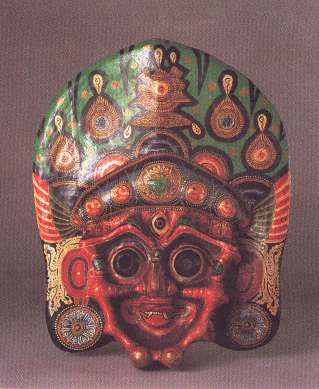
Mahakali H. 46 cm., W. 38 cm.
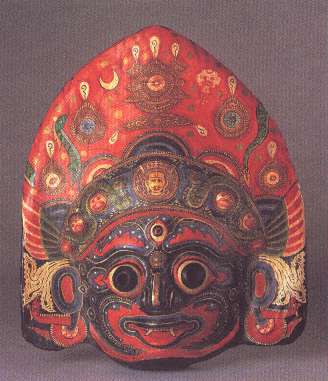
Bhairava H. 46 cm., W. 38 cm.
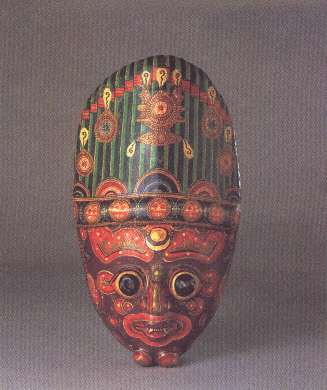
Kumari H. 42 cm., W. 24 cm.
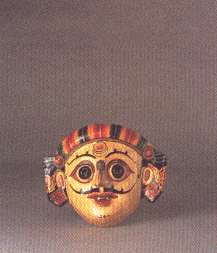
Sero Bhairava H. 22 cm.,W. 27 cm.
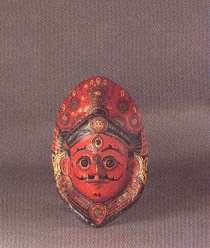
Siva H. 33 cm., W. 22 cm.
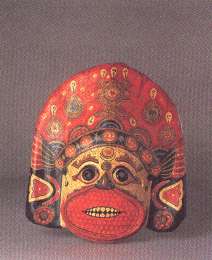
Sima H. 40 cm., W. 34 cm.
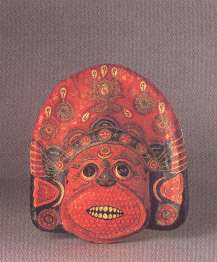
Duma H. 40 cm., W. 34 cm.
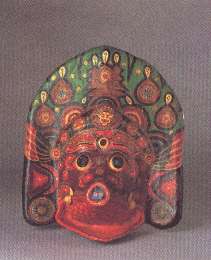
Varahi H.40 cm.,W. 34 cm.
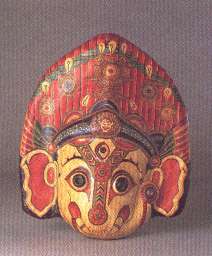
Ganesa* H. 43 cm., W. 36 cm.
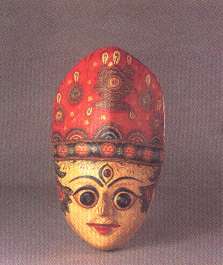
Mahesvari H. 42 cm., W. 24 cm.
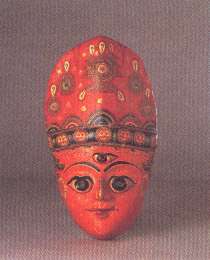
Indrani* H. 42 cm., W.24 cm.
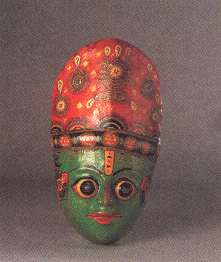
Vaisnavi* H. 42 cm., W. 24 cm.
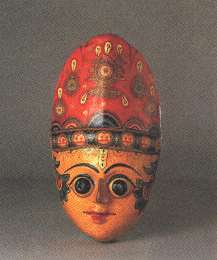
Brahmani H. 42 cm., W.24 cm.
gion, although a religion that continues to represent the exterior forces which surround, threaten, and sustain the interior moral and civic life of the city.
There is another story told to explain why the Nine Durgas ate the pig. This second story illuminates an important aspect of meaning of the Tantric gods in general and the Nine Durgas in particular—that is that the Tantric and dangerous deities represent a power that transcends purity and impurity. This power can absorb and neutralize problematic quantities and placements of impurity and thus help to maintain and restore that segment of social order that is differentiated by purity and which is the concern of the ordinary gods who partake of the ordering dependent on purity.
The story goes that in a past age the people of the earth had been polluting the earth with urination and defecation. Everywhere the world was dirty and everywhere there were bad smells. The gods consulted with Visnu* and asked him, as he had so often done, to come to the help of the world. The gods did not want to do anything to get rid of the feces themselves for fear of contaminating themselves. Finally Visnu* agreed to incarnate himself as a pig and to eat the feces. "But," he said to the gods, "if I do this I will become polluted, and it will be difficult for me to again escape from the world." The Nine Durgas said to him that they would agree to take and eat the pig as a sacrifice, and thus through the sacrifice of that pig make it possible for it (and the incarnate Visnu* ) to gain salvation.
The Nine Durgas—The Cast of Characters and Their Iconic Representation
We have followed the legends in referring to the group of the Nine Durgas without saying anything about the membership of that group. Whatever meanings that troupe as a whole draws from its legend, its membership and position in Bhaktapur's civic pantheon, and its position and activities in the annual cycle, the Nine Durgas give their local performances as a differentiated cast of characters. (We will discuss the local performances given by the troupe throughout the city during the nine months of each annual cycle, when the Nine Durgas are actively protecting the city, at length at the end of this chapter). Like the conventional characters in the European commedia dell'arte , the individual
members of the Nine Durgas troupe indicate their significance and relationship in large part by their appearance and their contrasts.
How many Durgas are there in the Nine Durgas group? This is a characteristic civic mystery. There are only seven goddesses or "Durgas" represented by the masks worn by the Gatha as the Nine Durgas. These goddesses are represented in the Puranic* text, the Devi Mahatmya, which is one of the mythic bases for the Mohani sequence, among the benign male deities' Saktis who join the fully powerful cosmic deity Devi in her battles against the order threatening Asuras (chap. 8). These seven Durgas are also represented in Bhaktapur as seven of the eight boundary-guarding pitha goddesses of Bhaktapur's borders, the Astamatrkas* . The eighth of Bhaktapur's boundary goddesses, Mahalaksmi* , is, as we have noted, not derived from the Devi Mahatmya, although she has other Puranic* representation as one of the "mothers." For the Nine Durgas she is present not as a member of the performing group, but as the Nine Durgas' "own god." She is represented at a shrine carried with the troupe where she is generally known because of her decoration with that plant, as the "oleander deity" or Siphadya:, and she is also represented by an image in the Nine Durgas' god-house. Mahalaksmi* is generally understood to be the eighth of the Durgas. But who is the ninth? At the center of the city's eight bounding "mothers" or Matrkas is a ninth goddess (Tripurasundari) who is not a Matrka* , nor a god's Sakti, but who represents the Tantric goddess in her full cosmic and creative form. The "nine" in reference to the Nine Durgas presumably refers to such a mandalic* schema (which is reflected in the city's nine Mandalic* Goddesses), but it is unclear as to just who the ninth Durga is. There are various proposals. Some Gatha believe that she is represented by their musical instruments, which they take to represent Tripurasundari. Others say that the ninth Durga is Bhairavi, the Sakti of Bhairava, but who is not represented in the masks or the drama.5 Like many Tantric secrets, it is probably not known definitely by anyone now, assuming that it was ever clearly known in the past. Everyone assumes that there must be someone who knows the real truth but, as is often the case, it is likely that no such person exists.
The goddesses represented by masks in the Nine Durgas troupe are Mahakali, Vaisnavi* , Brahmani, Indrani* , Mahesvari, Kumari, and Varahi. These masks are worn as part of the costume of the Gatha performers who will incarnate the deities. The troupe also includes five other masked dancers, Bhairava, Ganesa* , Seto Bhairava, Sima, and Duma, and is further supplemented by a mask of Siva, which is carried, but not
worn. Thus we have now seven performing Durgas, and five other performing deities, all of whom will be incarnated in Gatha performers, a total of twelve perfomers in the troupe. These are supplemented by two other nonperforming representations, Siva and Mahalaksmi* , and perhaps by some esoteric hidden deity, who is added to Mahalaksi* as a Ninth Durga.
The masks are loaded with iconographic details that allow them to be grouped and contrasted in several different ways (see color plates). Many of these details and the possible categorizations deriving from them are peripheral to their performance meanings. An example is the rotated third eye, which is prominently displayed on the foreheads of Siva, Mahakali, Bhairava, Ganesa* , Mahesvari (all thus marked as closely related to Siva) and also, curiously, the Vaisnavite deity Varahi. (On the other hand, the protagonist of the pyakha[n]s that are given in the city's neighborhoods, Seto Bhairava, who is conceptually related to Siva, and is in fact a copy of the mask of Siva with certain significant transformations, does not have such a third eye.)
The neighborhood dance-drama divides the twelve mask-wearing performers into principal performers and a remainder who act as a kind of chorus and who are restricted to formal geometric dances performed as a group. The masks of the major and individual performers all have jeweled bindus at the bases of their noses. The minor performers (Vaisnavi* , Brahmani, Indrani* , and Mahesvari) do not. Varahi, who does have a jeweled bindu at the base of her nose, is not a major performer in the dance-drama, but in contrast to the other members of the "chorus" she does perform an independent dance. Ganesa* , who also has a bindu at the base of his nose, this one painted as part of his harness, like Varahi does independent dances.
Within the group of major performers two masks dominate by their larger size, by their intensely saturated dark colors, and by the presence of prominent fangs. One of these is the dark blue Bhairava, the main actor in the ceremonies that are the immediate context of the dance-drama, and the other is the dark clotted-blood-red Mahakali, who is represented with emaciated flesh, deep-set eyes, and facial bones protruding in a cadaverous way through her skin. Mahakali is the main antagonistic figure of the dance-drama itself.
Kumari is visually clearly a transitional figure, and this is consistent with the role she plays. She is the same size and shape as the benign goddesses of the "chorus" (Mahesvari, Indrani* , Brahmani and Vaisnavi* ), and she shares with them the rounded features of a young woman in
full sexual attractiveness. Although she is smaller than Mahakali and full-fleshed rather than emaciated, she is painted in the same deep clotted-blood-red as Mahakali and has fangs that the other benign goddesses do not have. While Mahakali is emaciated and skeletal, Kumari is not—but Kumari's mask has the same exaggerated frontal protuberances (in anatomical terminology, the "mental tubercles" of the mandible) as does Mahakali's jaw, which signify and call attention to the underlying skeleton. It is much easier to see at a glance than it is to put it into words that Kumari is in a marginal position between the maximally frightening representation of the Tantric goddess and her exaggeratedly beautiful manifestations.
Two other masks whose features are very closely related to each other are those of Siva and Seto Bhairava. Many of their features are identical and do not occur on any other mask. They are represented as young men, with firm full flesh, identical stylized eyebrows, mustaches, and tiny beards. They differ in that the Siva mask is of a pastel orange color resembling the purely decorative colors of the secondary goddesses of the chorus. Seto Bhairava, as his name implies (seto , "white"), is white, and the contrast of his white with the blue-black and clotted-blood-reds of the Bhairava and Mahakali and Kumari masks reflects the color contrasts (male versus female, minimal power versus maximal power) of Tantric symbolism. Seto Bhairava lacks Siva's third eye icon on his forehead. His other obvious differences from the troupe's representation of Siva in his mask (a representation of Siva that is locally sometimes said to represent Siva in his aspect as a "young bachelor") is that Seto Bhairava his small fangs that associate him (even, as we shall see, in a comparatively ineffective manner) with the dangerous aspect of the Tantric gods. The Siva mask, which is small in size compared to the other masks, has no eyeholes and is not worn. During processions it is carried attached to the costume of the dancer who incarnates Ganesa* , and during the local performances the Siva mask is hung on the Oleander God's portable shrine. This peripheral reference to Siva is congruent with Siva's significant but peripheral relationship to the Tantric component of Bhaktapur's religion (chap. 9). Seto Bhairava, as a representation and transformation of the young Siva, is the protagonist of the neighborhood drama. He is the person who by his social awkwardness causes the drama to unfold as he stumbles into an encounter with Mahakali and the trouble he gets into and his efforts to get out of it all again provide the main thread of the plot around which the drama develops. Seto Bhairava is the focus for the audience's identification during that part of the drama concerning his conflict with Mahakali. The
things that happen to him also happen vicariously to the audience. The mask's general benignity encourages this identification in the way that, say, the mask of Bhairava strongly discourages it. But Seto Bhairava has another dramatic function in the drama. As Mahakali is to him, he is to the boys and young men in the audience during one phase of the proceedings. The fangs in his otherwise benign face serve to remind us of his danger to those who are even weaker than he is.
The remaining two divine actors are two masks that are identical except in the color of their faces (one white, the other a reddish-orange), respectively, in Newari, "Sima" and "Duma"—also known in popular speech as "Si(n)ba" and "Du(n)ba." These are said to be popular names for "Si(n)hini" and "Vyaghrini* " (variously pronounced). People know that they represent a lion and a tiger, but it is generally not known which is which, nor which mask goes with which name. They are sometimes said to be two goddesses, but sometimes they are thought of as a couple, with the white-faced Sima as the male. Sometimes they are said to be messengers of Yama Raja, the ruler of the Kingdom of the Dead. Their headbands of skulls identifty them as dangerous Tantric figures, as do their open mouths and sharp teeth. However, their decorative colors and relatively smaller size suggest, as does their action in the dance drama, that they represent a much less serious danger than the maximally frightening masks.
The Annual Cycle
The activities of the Nine Durgas are woven into the larger Devi cycle, providing one of the main plots that ties that cycle together. They also have a subcycle of their own, a cycle of performances that takes place during the nine months of their annual life, which we will present in a later section of this chapter. We must now turn to the annual Devi cycle arranged on the thread provided by the Nine Durgas' annual life and death. We may begin after their last annual performance, shortly before they disappear.
Sithi Nakha [36]
Sithi Nakha6 falls on the sixth day of the waxing fortnight Tachalathwa (May/June). The Nine Durgas have to perform their last dance drama7 on either the Sunday or the Thursday prior to Sithi Nakha, depending on the day of the week that Sithi Nakha will fall. Sithi Nakha, like all the annual calendrical events of the Devi cycle, has a significant connec-
tion to the events of the rice producing agricultural cycle, all being related either to the rice planting and harvesting activities themselves or to the phases of the rainy season on which they are dependent. Sithi Nakha marks the expected end of the dry season, the day when wells and ponds and roads are to be cleaned in preparation for the coming rains.8 Anderson notes that "Chronicles tell how the city of Bhadgaon [Bhaktapur] was once surrounded by a thick fortifying wall and moat, the maintenance, renovation, and cleaning of which were the responsibility of every citizen of the town, regardless of caste. Any person who failed to complete his assigned section by Sithi Nakha Day was duly punished" (1971, 70). This day also marks the beginning of the period during which rice seeds are to be planted to produce the rice paddy plants that will be transplanted in the next stage of the rice production. For farmers, this day anticipates the beginning of a long period of hard work and anxiety and traditionally was the (the only , it is sometimes said) day in the year when farmers bathed their bodies completely, as a kind of purifying preparation for the period to come. The evening before Sithi Nakha marks the termination of the seven-week Dewali [30] period during which, on their particular days, various phukis worship their lineage deities as Digu Gods.
Like most calendrical events, the day has a miscellaneous additional set of references and activities, some being derivations of its wider areal and historical uses. This day elsewhere in South Asia and Nepal commemorates the day on which the god Kumara was born,9 but this connection is largely lost for Bhaktapur. On this day a mandala* containing a six-petal design is made in the Taleju temple and in the homes of the Brahmans associated with Taleju. Although such a mandala* is in some other Nepalese communities thought of as representing Kumara, it is locally interpreted as the Goddess Prthivi* , that is, the earth, a reference that is closer to the agricultural implications of the Devi cycle.10 In Bhaktapur Prthivi* is thought of quite concretely as the actual earth, the soil in the fields and beneath human constructions. Pujas to Prthivi* are held in many homes on this day. In the evening many households have special dinners.
Sithi Nakha is a threshold day, the ending of some of the year's activities and a preparation for something new. What is being prepared for with the anticipation of the seasonal rains is an encounter with nature vital to agriculturally based Bhaktapur, an encounter full of risks. This "nature" is the environing and supporting realm of Bhaktapur's public moral, civic life.
Bhagasti [40]
Bhagasti, short for Bhagavati Astami* , "Bhagavati's eighth day," falls on the eighth day of the waning fortnight, Tachalaga, that is, in June, seventeen days after Sithi Nakha. In the period between Sithi Nakha and Bhagasti the seed rice is being planted and time rains are anticipated. During this time many people go to the god-house of the Nine Durgas to do pujas and to offer sacrifices. This is a respectful gesture of farewell. Soon the Nine Durgas will be disappearing.
The disappearance of the gods is signaled by the "cremation" of the masks that had represented them during the previous year. On the Sunday or Thursday Before Bhagasti (whichever is the closest) the Gathas go to each of the major and minor twa: s throughout the city where they had performed throughout the course of the year (map 14, below). They wear their masks turned to the side of their heads and thus not covering their faces, as they had done during their previous performances. They visit the twa: s by walking around the city's main jatra route, and proceeding to them in the order in which they lie on that route not in the formally prescribed order in which they had visited them during the course of the previous nine months.
When in the course of their procession around the city they reach the Taleju temple, they enter it. A secret ceremony is performed there, indicating that they have completed their work for the year. In the minds of the Gatha performers and of people in general (cf. Teilhet 1978, 95) it is thought that this represents the withdrawal of some of the power from the masks, a power that had been given to them at the beginning of the yearly cycle, but this is not the understanding of the priests who administer the ceremony. The ceremony is called the "Sija Nakegu," that is, "feeding the 'death rice'"11 , The exact meaning of this is not clear now to the priests, but seems to refer to the approaching death of the Nine Durgas. When the Nine Durgas troupe leaves the Taleju temple they continue on the jatra route and finally return to their god-house. When they reach there, in a significant contrast to what had always happened on the occasions of their return after performing earlier in the year, they are not met by their Naki(n), the senior Gatha woman ceremonially attached to the group, who would have led them into the god-house with a purifying and welcoming ceremony, the du kaegu , but they simply and unceremoniously enter the house.12
On the evening of Bhagasti the masks are secretly cremated at the Brahmani pitha , a pitha that has a particular importance in the ten-day
Mohani sequence and in the beginnings of the Nine Durgas' activities at the end of that sequence. Jehanne Teilhet (1978), on the basis of observations of the mask-making process and of interviews with the Pu(n) mask maker who was in charge of making the Nine Durgas masks each year, recorded many details and interpretations concerning the masks.13 According to Teilhet's informant, the ashes of the masks are collected and stored in a copper vessel that is placed in a secret spot on the river floor near the pitha (Teilhet 1978, 96f.).14 This is the "going into the water" of the Gods, dya: jale bijata . The vessel is left in the river until a month before Mohani, when it will be withdrawn and the ashes then used in the creation of new masks. According to the mask maker, the Nine Durgas "leave their masks and their Gathas [i.e., their vehicles] to go into the water because the water is necessary for the planting of rice; they help increase the water for the rice crops" (Teilhet 1978, 97). Their disappearance out of the city and back into "nature" underlines one of the important themes of the larger cycle.15
The idea of deities going into the earth for a four-month's sleep is a general one in Hindu South Asia (e.g., Stevenson 1920, 59; Kane 1968-1977, vol. V, pp. 110f., 158). Devi herself is traditionally thought to begin her sleep on the eighth day of the bright half of Asadha, that is, the eighth day of the Newar Dillathwa, which has no corresponding annual event in Bhaktapur's calendar. As she appears again only three months later in the autumnal harvest festival she must, in some local versions of that festival, be awakened (Kane 1968-1977, vol. V, p. 158; Shastri 1949, 259). The Nine Durgas' "sleep" or death or going into the waters precedes their reappearance in Mohani by only three-and-a-half months, and although their life will be renewed at that time, there is no overt reference to awakening, bodhana , as there is elsewhere in South Asia for Devi, or, as there is, for example, in Bhaktapur for Visnu* on Hari Bodhini [4]. Sithi Nakha [36] is, in fact, the event that precedes the reappearance of the Nine Durgas by four months, but this span does not seem related, now at least, to the general idea of a divine sleep of exactly one quarter of the year.
The Period Between Bhagasti [40] and Gatha Muga: Ca:Re [45], Human Sacrifice
Bhagasti is the time when the first rains of the summer monsoon are expected. The Nine Durgas are dormant. Now if the city is lucky, the rains will come, the rice fields will be flooded, and the rice seedlings will be replanted into the mud of the paddy fields to begin their growth into
mature plants. This is a period of risks—the danger of too much or too little water and of violent storms that may disrupt the planting. It is also a time of illness, particularly the gastrointestinal diseases that are common during the summer. It is said that because of the absence of the Nine Durgas, evil spirits freely enter into the city and are responsible for disease and troubles.16 Some nine weeks after Bhagasti the spirits will be driven from the city during the vivid and dramatic festival of Gatha Muga: Ca:re at which time the rice transplanting from the seed beds into the paddy fields is ideally completed—although it often may last for some more weeks depending on the weather conditions.
During the period between Bhagasti and Gatha Muga: Ca:re is the time when the Gathas who will later once again incarnate the Nine Durgas are believed to capture the human skullcaps or calvaria that they use as drinking vessels (patra ). They need three such skullcaps each year, one for their god-house, one for their dance performance, and one as an extra reserve "in case one of the others break." They take these skullcaps from living men by means of mantras. They are significantly never taken from women. Furthermore, the men from whom they take them must show auspicious signs, similar to the signs that were said to have characterized people who were taken for human sacrifice in earlier periods. When a man's skullcap has been removed by the Gatha's magic, the person dies within six months. This echoes the legends' Nine Durgas' random murderous activities before they were transformed into servants of the city; the tenuousness of this transformation is, as we will see later, an essential part of their civic use. In one sense, because the Nine Durgas are out of the city and no longer protecting it, the inside of the city develops, during this unprotected period, some of the qualities and dangers of the outside. Yet, these dangers of disease and disorder are the sorts of dangers that the Nine Durgas symbolize as well as protect against, and the Nine Durgas persist as shadowy representatives of dangers in the fantasized magical murderous activities of the Gathas at this time—who could have such powers only in some still active association with the now "dormant" Durgas.
These magical human sacrifices may very well be an echo of something else. Hamilton, in the early ninteenth century, reported information that he had obtained from a Gatha informant. According to his informant (Hamilton [1891] 1971, 35 [original parentheses]):17
From those who come to worship at the temple, the Got [Gatha] that represent these deities [the Nine Durgas] accept of spirituous liquors, which they drink out of human skulls until they become elevated, and dance in a furious manner, which is supposed to proceed from inspiration. In the same manner,
they drink the blood of animals which are offered as sacrifices. In these temples the priests (Pujaris) are Achars, who at the sacrifices read the forms of prayer (Mantras) proper for the occasion, but retire when the animal is about to be killed by the Got who represents Bhairavi. The shrine, in which the images of the gods are kept, is always shut, and no person is allowed to enter but the priest (Pujari) and the Gots, who personate in masks these deities. Once in twelve years the Raja offers a solemn sacrifice. It consists of two men, of such a rank that they wear a thread; of two buffaloes, two goats, two rams, two cocks, two ducks, and two fishes. The lower animals are first sacrificed in the outer part of the temple, and in the presence of the multitude their blood is drunk by the masked Gots. After this, the human victims are intoxicated, and carried into the shrine, where the masks representing Bhairavi cuts their throats, and sprinkles their blood on the idols. Their skulls are then formed into cups, which serve the masks for drinking in their horrid rites.
Hamilton then goes on to report that other informants denied that such human sacrifices took place. Newars in Bhaktapur do believe that human sacrifices were performed in the past, and may still be performed on certain occasions in remote Newar towns and villages. Whatever Hamilton's story has to do with a possible historical reality (and his other details are quite accurate), they point to the important psychological reality that the Tantric control of the Nine Durgas by no means meant the end of their threat to innocent humans, and that behind the animal sacrifices that are of central importance throughout the Devi cycle is, as we have argued in chapter 9, an essential reference to human sacrifice. We will return to this in our summary discussions of the meanings of the Devi cycle and the Nine Durgas.
During the period beginning after Bhagasti and coming to a climax at Gatha Muga: Ca:re, obscenity is extensively and publicly licensed and used. Obscenities are called out loudly by male farmers working in the fields and in public areas of the city, and by young men and boys of various social statuses. The remarks are grossly sexual, and at any other time of the year they would be considered (particularly for people of middle and upper status) extremely bad behavior. Obscene remarks are made loudly to others at a distance so that they can be heard by an audience, thus indicating the essential public significance of the behavior. The remarks are made mostly by young men, from roughly sixteen to forty, and only very rarely by a girl or woman, who would be considered to be particularly brazen and uncaring of her status. Like all of Bhaktapur's other ritualized behavior of the special sort that collapses and disturbs ordinary social order and conventions (such as the
public role switching that occurs during Saparu [48] and the otherwise forbidden activities represented and licensed in Tantric rituals), there are strict limits to the license exhibited. While the obscene remarks are addressed by young men to young women, they would not properly address them to an older woman, a high-status woman, or an acquaintance. Above all, they would not address these remarks to any girl from their immediate or extended family. Within the limits of propriety for obscenities they say such things as "Hello, you girl over there who is holding my penis in your hand" or "A penis put into you is going to make you pregnant and then you will eat a lot of beaten rice (a food that is thought to have special value for pregnancy) and that will give you diarrhea." Sometimes the remarks are directed by young men and boys to other young men and boys (again within the limits of propriety), and they would say such things as "go lick a vagina" or "go lick your mother's vagina," although the latter may be considered too strong, and may well offend the recipient of the insult. There is, then, a "safe" area of conventional obscenities, a forbidden area that would represent a violation of proper behavior, and a risky borderline area where differences in individual daring and judgment operate. There are many more such phrases, and they are usually followed by a conventional phrase "pae hwa, " which forms a kind of refrain and which is derived from the very strong and shocking term "paegu " for the act of intercourse and "hwa, " which means a hole.
What is being expressed during this period is not only erotic sexuality but also, in the use of obscenity, a violation of status restraints that in other contexts would be extremely aggressive and insulting. This all has a special force in view of Bhaktapur's extensive (in comparative perspective) controls on sexual talk outside of its proper limited familial forms—above all, in public arenas where family ijjat or reputation is crucially at issue.
The period of obscenity comes to a climax and conclusion in the events of Gatha Muga: Ca:re, the day by which the Gathas' searching for human victims also ceases.
Gatha Muga: Ca:Re [45]
On the ca:re , the fourteenth day of the waning fortnight of Dillaga in July, a little less than five weeks after Bhagasti, the events of Gatha Muga: Ca:re (see fig. 28) bring the events of the intermediate period to a climax and to a close. By this day the transplanting of the plants that
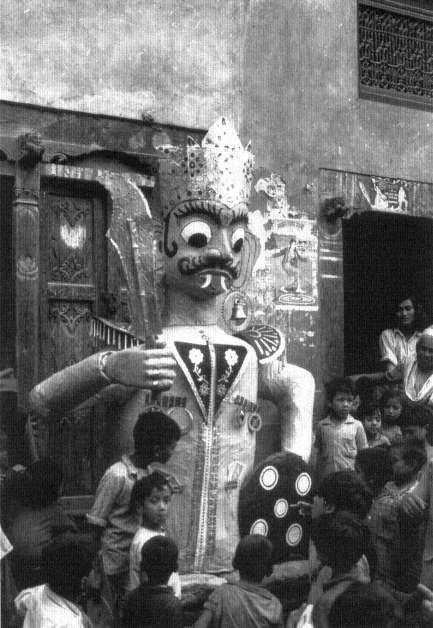
Figure 28.
The demon Gatha Muga:.
have been grown from the rice seed into the—if all has gone well—rain-flooded paddy fields has ideally been completed.18
Although the Nine Durgas themselves have departed, the Gathas whom they will possess again at Mohani continue their esoteric preparatory activities. On this day, according to some accounts, the Gathas take some black clay soil from the river bank and make a linga* representing Siva from it. Some of this soil will later be added to the new Nine Durgas' masks to be made by the mask maker before the reappearance of the Nine Durgas during Mohani (Teilhet 1978, 86).19
The main public activities of this day are related to the expulsion of the dangerous spirits, vaguely characterized as "bhut-pret " (chap. 8), which are conceived to have accumulated in the city and paddy fields at this time, and which can now be chased out of the city and fields and destroyed. The expulsion of the spirits—represented by a particular dangerous being, Gatha Muga:—comes at the time in the cycle when the complex events of nature necessary for the rice cycle have usually allowed for the firm establishment of the rice plants in the irrigated fields. Now some of the disorder associated with relinquishing control to the dangerous generative forces of the outside can be overcome in the humanly orchestrated expulsion of the demons and in the consequent cessation of the obscenity that mimics those generative and disorderly forces. There will continue to be risk from the weather until the rice harvest is completed, however, and a season of sometimes devastating gastrointestinal diseases is now at its height. In the language of the Devi cycle, the city still lacks the protection of the Nine Durgas. It will not be until Mohani and their reappearance—at the tension-reducing time of the rice harvest itself—that the danger will be once more fully under control. On this day, Gatha Muga: Ca:re, most households drive iron nails into the main doorway of their houses to protect them from bhut-prets , and some people put on iron finger rings20 and keep them on for days to protect their bodies.
The central imagery and legendary references of the day have to do with the giant demonic figure, Gatha Muga:, whose appearance and story overlap with that of a South Asian Raksasa* , a giant fairy tale type of ogre, named Ghantakarna. Gatha Muga:21 was a dangerous predatory being variously described in different accounts. According to Anderson, "he was so corrupt that he vilified the gods themselves, defiled and destroyed homes and fields, roaming the land, stealing children, maiming the weak, killing and devouring his captives. His
depraved sexual orgies and unspeakable excesses with his countless wives horrified the pious people" (1971, 72).22
There are, in addition, more human accounts of Gatha Muga: in Bhaktapur, which suggest its Newar urban complexity. In a story widely known in Bhaktapur, "Gatha Muga: was a man who believed in karma , and not in the power of the gods."23 The story continues, "he loved the poor people. He sat at the crossroads where he took money from the rich to give to the poor.24 If rich people refused to give money to him for this purpose, he would kill them. He also lived without concern about pollution. As he lay dying he hung bells on his ears, so as not to hear the gods' names called out.25 After his death [because of his failure to conform to traditional religion] no one was willing to cremate him, and his body was left at a crossroads. But then [ordinary] people joined together to donate money for his cremation, and they called a low caste man to perform it. Many people followed this procession because he had always protected the ordinary people." This legend throws an oblique light on a number of tensions, contradictions, and paradoxes in Bhaktapur's systems of moral control. For our present purposes, however, the story refers to aspects of the actions of the day, and illustrates an ambivalence, an attraction and repulsion, in what is symbolized by Gatha Muga:.
The events of the Gatha Muga: day, as well as the salient legends, differ somewhat in different Newar communities.26 In Bhaktapur each neighborhood area constructs representations for Gatha Muga:, interpreted in the neighborhoods as demons who once inhabited the local area. These vary in size, complexity, and elegance from vaguely anthropomorphic bundles of straw to elaborately masked, painted, and dressed figures (see fig. 28). The more elaborate figures have faces with fangs and often with bells at their ears, in reflection of the legends. Most of these figures are larger than life size; some have legs and will be carried, others are hollow papier-mâché constructed over wicker frames that are placed over a man who dances the demon. Some of these figures when carried or worn reach a height of eight or nine feet. Some are given crowns, mustaches, and beards, military jackets with epaulets, and rows of medals. This adds the imagery of a recent (in Bhaktapur's perspective) and alien authority to the demon's complex meanings. Whatever the variations in the figures, all are equipped with very prominent phalluses, often some two feet in length, and a pair of large globular fruits representing testicles. Sometimes red powder and strings of red beads are placed at the end of the phallus to represent ejaculated sperm.
In each neighborhood bundles of wheat straw are prepared which will later be used as torches in the processions chasing the demons, represented by the Gatha Muga:s, out of the city and, finally, for fire for their cremations. Throughout the city groups of small boys block various roads, in an echo of the legend, and demand coins from passersby before they are allowed to proceed along the road (see fig. 29). In the late afternoon and evening music is played in various neighborhoods, often by Jyapu music groups, and the giant figures are made to dance. Finally the time comes when the bhut-prets are to be expelled from the city. Processions form in each neighborhood and men and boys, holding torches in their hands, and shouting the sexual insults that they had been using since Bhagasti, chase the demons out of the city.27 The processions are called bha kayegu , which refers to processions accompanied by shouting of conventionalized phrases, but this is a travesty of such processions in which the phrase is often "victory" or the like. The figures are taken beyond the boundaries of the city and set on fire. In contrast to other major processions very few women watch the procession from the roadside or other public areas. They go into their houses "to avoid being insulted" and watch through the windows.28 After the cremation some people wash their faces and eyes in the river as a perfunctory purification. Then the members of the processions and the onlookers drift back to their homes. There are feasts in many households during the evening.
Gatha Muga: Ca:re culminates in a partial restoration of civic order. Obscenity, which had reached a crescendo on this day, will now cease. The Gatha Muga: figure in its form and legends combines in itself unsocialized sexual power, wanton destructiveness, and a mockery of authority. But all this is ambivalently viewed. He and his behavior are demonic and dangerous but fun, shameworthy and demonic but praiseworthy, rebellious against the gods and the rich but a support of "poor people" who love him in turn. He is driven from the city and his ashes returned to the bordering outside where the rice plants are growing and where the Nine Durgas had generatively gone to die and to sleep the month before.29
Not only does Gatha Muga: represent various kinds of threats to Bhaktapur's social and cultural structure in his legends; such antistructural emphases are reflected in the day's actions. The day dispenses with deities and with priests, and with references to any of the city's hierarchical roles. The only references to authority are the crowns and
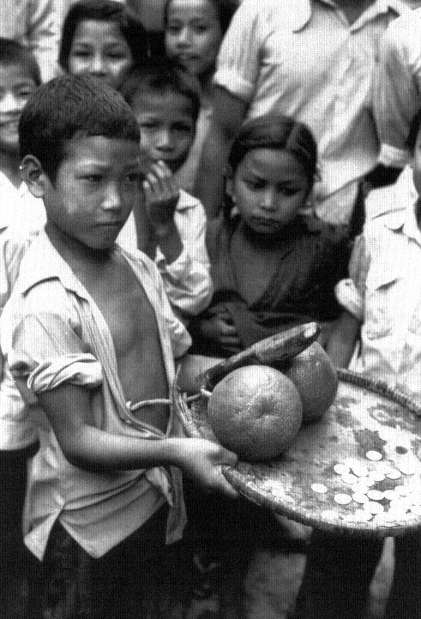
Figure 29.
Gatha Muga: Ca:re. Children holding a phallic representation of
Gatha Muga: block the streets and demand money for passage.
the medals, and military mustaches of Gatha Muga: himself—and he is destroyed. The city is represented, not in the kind of integrative events characteristic of structuring festivals such as Biska:, but in the parallel activities of the neighborhoods. But these are only loosely coordinated. Each neighborhood constructs Gatha Muga: after its own fashion and follows its own funeral routes out of the city.
The disorder mimed here is not the same kind of social disorder referred to in Biska:. This disorder, like all the disorder of the Devi cycle, has a vitality about it that represents the unruly and generative life—both of individuals and of the environing world—that the moral order must depend on as well as control.
Now for two months, between Gatha Muga: Ca:re and Mohani, the climactic festival sequence of the Devi cycle, during the slow growth of the rice plants to maturity, there are no events in the Devi cycle. Agriculture is left now, so to speak, to its own unfolding. The ordinary lunar cycle, however, is crammed with events. There are twenty-one of them in the intervening sixty days (chap. 13).
Mohani, The Autumnal Festival Sequence of the Rice Harvest [67-76]
The Mohani sequence begins on the first day of the waxing fortnight Kaulathwa (the bright half of Asvina) in late September. By this time the monsoon rains should have finished30 and the rice harvest been completed (see fig. 30). As with other complex festivals, it is somewhat arbitrary as to how many discrete calendrical units it may be said to contain. Calendars used by local Brahmans simply list each of the ten days of the festival, each named for its particular focal Mandalic* Goddess. We will follow this for our enumeration of festival events although there are more than ten major component elements in the sequence.
Within the Devi cycle the ten days of Mohani is the time for a concentrated and complex sequence that is the focal point and climax of many of the themes of the annual cycle as well as a summation of the relations and meanings of Bhaktapur's dangerous goddesses. It is also the period during which the Nine Durgas are given a new birth and launched on their annual careers. "Mohani"31 is the Newari name for the local version of the widespread South Asian harvest festival dedicated to Devi, which in Nepali and generally elsewhere in South Asia is called "Dasai(n)." It is, by all our criteria, one of the city's major focal sequences.
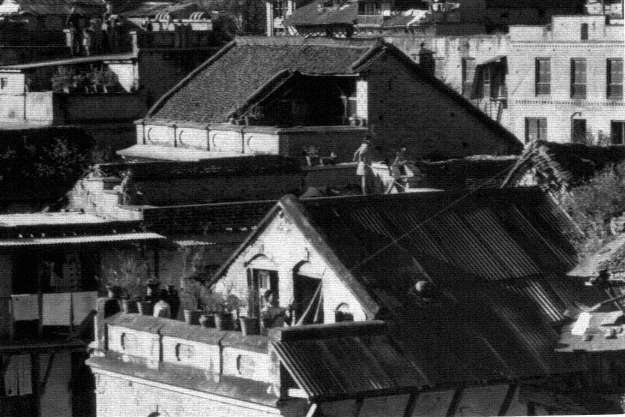
Figure 30.
Standing on the ka:sis, the open roof porches of houses, men fly kites during Mohani, said to be reminders to the
deifies to bring the monsoon rains to an end.
Bhaktapur, as it usually does in its relation to its South Asian context, selects, builds on, and adds to the materials out of which Dasai(n) is constructed elsewhere. The central thematic thread running through Bhaktapur's Mohani is the dramatization of, and civic participation in, the story recounting how Devi, represented most centrally as Bhagavati/Mahisasuramardini* , the conqueror of the great enemy of the gods, the Asura Mahisa* came into her full strength and achieved her victory,32 how that strength is amalgamated with the power of Bhaktapur's political goddess, Taleju, in the course of the festival, and then, finally, transferred by Taleju to the Nine Durgas, who will use it to protect Bhaktapur during the following nine months.
Each of the first nine days of the festival begins and ends with visits to the pitha of one of the nine Mandalic* Goddesses, starting with Brahmani in the east, and proceeding in the auspicious clockwise direction day by day around the periphery of Bhaktapur,33 ending on the ninth day at the pitha of the central goddess, Tripurasundari. On the tenth, the final day of the festival, a day of transition to a new phase, the Brahmani pitha once again becomes the focus, with an emphasis now on the newly emerged Nine Durgas.
Mohani: The First Day
On the first day of the festival, as they will again on each succeeding day, people from all over the city go at dawn to the pitha of the day's Mandalic* Goddess. On this day, as they will on each day, people dressed in their better clothes (see fig. 31) walk together in groups, often accompanied by musicians, from the city's neighborhoods to the Brahmani pitha , the protective goddess of the east. People move on this day, as they will on all the subsequent ones. That is, they join the main jatra route, the pradaksinapatha* , at a point convenient to their homes, and take it in either direction until they reach the god-house of the day's particular Mandalic* Goddess (map 2). They then follow the conventional route from the god-house to the pitha . On their way from god-house to pitha they go via the tirtha , the sacred spot at pond or river associated with the day's goddess. At the tirtha they sprinkle water on themselves in a ritual bath. They then proceed on to the pitha , which is always close to the tirtha , and hold a brief puja , offering coins, grains of rice, flowers, incense, and the like. They bow to the goddess, circumambulate the pitha , and quickly move on to accommodate the crowds behind them. Most people then go on to the Taleju temple, and circumambulate the inner courtyard, as they will on their return from the pithas of the goddesses of the following days.
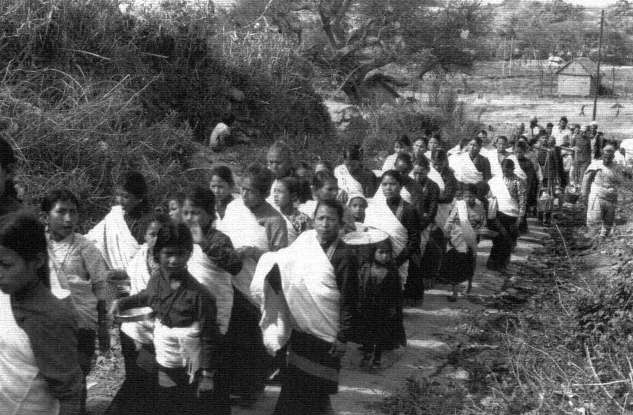
Figure 31.
Mohani. A group of Jyapu women going on the twice-daily visit to the day's mandalic*
pitha.
On this first day it is the god-house, tirtha and pitha of Brahmani to which the townspeople go.
In most houses, usually on the middle floor of the house, and also in each Tantric temple and god-house, a room or area is selected to be a locus of worship to Bhagavati (referred to in this setting sometimes simply as the "Mohani Dya:," the "Mohani God") during the Mohani sequence. During Mohani this room is called the "Na:la swa(n) " room, or simply "Na:la room.34 A layer of soil that has been gathered at one of the Mandalic* Goddesses' tirtha s is spread on an area of the floor of the room. Barley grains are to be planted in this soil in the course of an important puja later in the day. For the upper thars , Chathariya, Pa(n)cthariya, Brahmans, and those Jyapu thars that have some special relation to Taleju, the barley will include grains given to them at the Taleju temple on this day, mixed with other barley grains. A connection between the goddess Taleju and Devi as the warrior goddess Bhagavati is thus established for them at the start.
After the barley has been distributed at the Taleju temple, the Taleju priests gather in that temple's Na:la swa(n) area, which is in one of the temple's inner courtyards or cukas , the Kumari Courtyard, to begin chanting the verses of the Puranic* text the Devi Mahatmya in Sanskrit. The Devi Mahatmya will be read in successive divisions on each of the ten days of Mohani and completed on the final day. That text, as we have noted in chapter 8, provides many of the images and conceptions on which the forms, meanings, and arrangements of the dangerous goddesses in Bhaktapur are based. The sequences and images of Mohani follow it particularly closely. During and just prior to Mohani the stories of the Devi Mahatmya are told in Newari by storytellers in the public squares, and read out and recounted throughout the city by elders in many individual homes to assembled family members.
After the reading of the first portion of the Devi Mahatmya at the Taleju temple, barley will be planted in the soil in Taleju's Na:la swa(n) area in the course of a puja to Bhagavati. The planting must be done within a sait , a proper and auspicious span of time whose beginning and end are based on astrological considerations as determined by the Royal Astrologer of the central government in Kathmandu. The Na:la swa(n) planting in the Taleju temples of all three of the old Malla royal cities, Kathmandu, Patan, and Bhaktapur, will take place during this centrally determined span. There will be other such centrally determined saits on the seventh and the tenth days of Mohani.
There are common features in the contents and procedures in the Na:la swa(n) rooms in the Taleju temple, in the other temples and god-houses, and in private homes. We have noted the area of soil in which barley grains are planted on this first day. In the worship of the first day, prior to the time of the planting of the barley, it is also necessary to "establish" (sthapana ) the image that will represent Bhagavati most focally in the Na:la swa(n) room during the first phases of Mohani. Throughout most of Mohani Bhagavati is represented there by a particular kind of metal pot, a kalasa , or by a clay pot, thought of during Mohani as a kalasa , on which an image of Bhagavati as Mahisasuramardini has been painted on one side with, frequently, a pair of eyes painted on the other. On the eighth day of Mohani other images of Bhagavati will be added, usually a painted image on paper, and sometimes a metal image of the deity. As the barley sprouts the blades of the young plants will be a third reference to the warrior goddess. On this first day sacred water is poured into the kalasa and a small clay dish holding rice grains is placed as a cover over it. The kalasa is set on a bed of leaves of five different plants.35
Before the puja to be held in the Na:la swa(n) room to the properly established deity, people, as they always do prior to important household worship, go to their local Ganesa* shrine. Some people, in a reflection of the importance of the Mandalic* Goddesses during Mohani, also go for prelimimary worship at the local mandalic* areal pitha . The details of the home Na:la swa(n) puja vary for different thars and at different status levels. In general, the sequence has the following steps. The puja equipment and materials other than the kalasa have been gathered in an area in front of the patch of soil.
1. The sukunda , the oil lamp that contains representations of Ganesa* , Siva, and of Sakti, is first worshiped.
2. Then the kalasa , representing Bhagavati, which had been placed on the soil and arranged as noted above, is worshiped.
3. Now the barley is spread on the soil and worked into it.
4. The soil is worshiped.
5. The kalasa and the soil are then worshiped together by means of offerings of the light of an oil-soaked wick and with the smell of incense.
6. As is appropriate in the worship of dangerous deities, and introducing the theme of sacrifice, which is a dominant theme of Mohani and of the Nine Durgas, the meat-containing mixture samhae , as well as
sweetcakes, fruits, and flowers are offered to these combined representations of the Goddess—the kalasa and the mixture of soil and barley grains. There will be no actual blood sacrifice until the climactic ninth day.
7. The family takes back some of the offerings as prasada .
In contrast to Chetri women who, according to Lynn Bennett (1983, 138), are forbidden entrance into their equivalent of the Na:la swa(n) room until the tenth day of Dasai(n), Newar women take part in this worship.36
We may note here that the focus of worship is Devi, and not the Tantric Siva/Sakti relationship (although those upper-status families with Tantric initiations will, as in most pujas , add some reference to this relationship in a more or less peripheral fashion). The relation of the autonomous Goddess to the earth and to the processes of germination is established from the beginning.
The day introduces an activity that will reach a crescendo on the tenth day. Men, usually young men, from the mandalic* area of the first day's Mandalic* Goddess, Brahmani, who have made vows to that deity to perform a vrata on her special day during Mohani, perform a mata beigu , "a presentation of lights" at the Brahmani pitha . There are two varieties of this vrata . In one the man will sit on an armchair, with his forearms supported on the chair's arms. He wears a loincloth, a turban, and sunglasses (the latter two articles generally thought to suggest royalty). Seven oil lamps, small terracotta dishes with wicks floating in them, will be placed on his body,37 supported by an asana , a "seat" or base of cow dung mixed with mud. The lamps are lit and then kept full of oil by friends and family members. The devotee will sit relatively immobile for at least two or three, and sometimes as long as seven or eight, hours (see fig. 35). In the other major kind of mata beigu the devotee will lie covered with a thick mixture of mud and cow dung, on which 108 oil lamps have been placed. The man, also dressed in loin-cloth and sunglasses (although his position prevents his wearing a turban) will usually lie there for the full eight-hour period. This practice is both more expensive38 and more strenuous than the simpler mata beigu , and thus a greater offering.39 Both of these vratas are performed adjacent to the Brahmani pitha . On each successive day of Mohani, people of the particular mandalic* area that is the focus of the day have their turn to fulfill pledges to perform a mata beigu vrata at their area's
pitha . On the tenth, the final day, men from all over the city as well as from hinterland villages outside it, do these kinds of vratas —and also, as we shall see, much more dramatic ones—en masse at the Brahmani pitha , which is once again on the final day the focus of an important part of the day's activities.
In the evening the stone that represents the goddess and its framing arch or torana* , which together constitute the Brahmani pitha , are elaborately decorated with flowers, in patterns that are thought to resemble a flight of stairs. Thus the act of decoration is called swa(n) taki tanegu , "erecting a flower stairway." This form does not seem, at least to contemporary knowledge, to have any special significance aside from being a traditional decorative form. These decorations are made by local mandalic* area groups, including areal guthis and groups of musicians, in honor of the goddess. Once again in the evening, as they had in the early morning, masses of people, accompanied by music, walk from their neighborhoods in groups to the Brahmani pitha following the same routes. They now emphasize flowers in their presentations to the Brahmani pitha . In contrast to the morning's procession, in the evening they do not bathe at the goddess' tirtha but go directly to the pitha . The routes they take through Brahmani's* area had been previously cleaned by the local people in preparation for this day, and now lamps and decorations have been placed on shrines, open sheds, and various buildings along the routes. Arriving at the pitha , people quickly present their flowers and other offerings. Their offerings are part of the swa(n) taki tanegu . They then return to their homes.
The special events in the Taleju temple on this day begin a period of dense activity for that temple, much of which involves the "Malla king" as represented by the chief Taleju Brahman. The king is responsible for the ceremonial management of many temple activities. He is the central worshiper in the temple's Na:la swa(n) worship of this day, and will be important for the later activities that center in the Taleju temple,40 which also represents, as always when the Malla king is recreated, his palace. These activities require the assistance of representatives of many thars who perform what were their traditional specialities and responsibilities at the time of the Malla court.41 Mohani is the time in the annual festival cycle that the segment of Bhaktapur's society centering about the king, palace, and court is ceremonially reconstructed. This is done in large part within the Taleju temple as the "royal palace," and is hidden from the larger city. This represents, as so much symbolic
activity in Bhaktapur does, the reconstruction or maintenance of one of the city's cellular components, in this case one whose output was once essential to the traditional organization of the city.
The Second Day through the Sixth Day
On each of the next five days of Mohani the morning and evening processions and worship of the first day are exactly repeated, but on each day a new Mandalic* Goddess and her pitha is the goal of the worship. The sequence continues in its daily movement around the periphery of the city in the clockwise circle of the compass points represented by the pithas . The mandalic* pithas of these next five days are, in sequence, those of Mahesvari, Kumari, Vaisnavi* , Varahi, and Indrani* , that is, the pithas of the southeast, south, southwest, west, and northwest. On each day, following the morning visits, people return to their household Na:la swa(n) rooms to worship Bhagavati. Then, during the rest of the day they go about their ordinary affairs. In the evening they will once again go to the day's pitha , this time, again as on the first day, with the emphasis on flower offerings to augment the flower "stairway" constructed there by the people of the day's mandalic* area. On each day the focal pitha is a focus for mata beigu vratas for people from the local mandalic* area.
On the fifth day, the day of Varahi—the goddess in the form of a tusked wild boar—the bladed shoots of the barley planted in the Na:la swa(n) room usually begin to appear. The blades, which will eventually be taken to symbolize the sword of the conquering Bhagavati, are said to symbolize Varahi's tusks on this day.
The Seventh Day: Taking Down the Goddess Taleju
The systematic daily visits to the Mandalic* Goddesses continue on this day with processions to the northern boundary pitha , that of Mahakali, as the focal point. But on the seventh day a new phase of the festival sequence begins with events at the Taleju temple in preparation for the special events of the following, the eighth, day. The preparations begin with the "taking down" of the goddess Taleju. Many people go to the outer courtyards of the Taleju temple, which become tightly packed with viewers. Within the limits of the astrologically determined proper time span, the sait , determined—like the sait on the first day for the proper planting of the barley grains in the Na:la swa(n) room in the Taleju temple—by the central government's Royal Astrologer in Kathmandu, an image of the goddess Taleju, wrapped in cloth decorated with gold and jewels in order to conceal it, is brought down from the room where
it is usually kept on the second floor of the temple. It is carried in a procession led by the chief Taleju Brahman, representing both the king and his Guru-Purohit,42 who carries the wrapped image, followed by a Josi and three Acajus from the Taleju staff. They are accompanied by musicians, and seven sword bearers. All these officials are dressed in the costumes of the Malla period. The concealment of the image, leading to speculation among the spectators as to whether the concealed image is the "true image" representing, or more accurately embodying the goddess, or a decoy, and if not, where in the procession that image might be, is part of the use of secrecy and mystery which we have discussed in chapter 9 and which is an important part of the Taleju component of Mohani. Yet, somewhere in the procession, whether it be the wrapped image or not, is, in fact, the "true" Taleju, the embodying and living form that for the people of Bhaktapur began its career as Indra's personal deity, and was, as recounted in Taleju's legendary history (chap. 8), eventually brought to Bhaktapur by Harisimhadeva* . This procession, the taking down of Taleju, is thus considered a very powerful darsana , the showing herself to her devotees by the deity. Also included somewhere in the procession is Taleju's jatra image, which will be carried in a procession outside of the temple on the tenth and final day.43
The procession enters the Taleju temple's main internal courtyard, the Mucuka ("main courtyard") at its inner end through the inner "Golden Gate," which has access to the upper parts of the temple.44 It then proceeds into the Kumari courtyard, which adjoins the main courtyard to the west, where the two Taleju images will be left. As the procession moves through the inner courtyard, the man who is at the head of the procession turns at three points, and the others follow. These turns signify yantras , diagrams of esoteric significance and power, traced out by the movements of the deities in the procession. The Kumari courtyard is closed off by a door from the main courtyard, and it is there the Na:la swa(n) worship has been taking place. Now, therefore, the goddess Taleju has been brought together at the Taleju temple with the kalasa representing the goddess Bhagavati and with the symbolism of the Na:la swa(n) room.45 Taleju will be left there until the tenth, the final day.
After the procession has brought the images to the Na:la swa(n) room, Taleju is worshiped there by the Taleju priests, and, in an introduction to the great number of blood sacrifices of the following day, a number of male goats are sacrificed to her. These are said to give her strength in preparation for the battles of the next day, and suggest Tale-
ju's identification now with the warrior Devi of the Devi Mahatmya myth. The throat of the first goat must be cut by the chief Brahman himself, while the others are then sacrificed by Josis. The Brahman completes the sacrifice of the first goat by decapitating it. One reason given for this initial sacrifice by the Brahman is his representation here of the Malla king, who is now making a sacrifice to Taleju as his own lineage god. As we have noted, people should, if they have the proper initiation, do their own sacrificing to their Aga(n) gods, and not delegate it to an Acaju. In addition to this representation, the Taleju Josis and Brahmans make sacrifices to Taleju during Mohani in their own right, as they believe their thar forbears did during the Malla period. During these sacrifices, the "Malla king" makes a daksina* offering of gold coins to Taleju, as he will also do during subsequent sacrifices to her. The decapitated heads of these goats will be left in the Kumari court, along with the Taleju images, the kalasa , and the rest of the Na:la swa(n) room materials.
We have noted that the saits for certain Taleju activities during Mohani in each of the former Newar royal cities are set by the central government, that is, by the Saha king's astrologer, following a policy of the Saha kings from the time of the Valley's first one, Prthvi* Narayana* Saha, to maintain and support Newar festivals in the understanding that reference to royalty in them would now represent the new dynasty. During the "taking down" of the goddess Taleju at the proper sait , central government representatives who have come to Bhaktapur for this purpose and the staffs of the central government bureaus located (for local administrative purposes) in Bhaktapur are in attendance in the inner courtyard. This attendance is mandatory, and a roll call is taken to check their presence by a government official.
On this seventh day of Dasai(n) in Kathmandu, the seat of the central government, there is a procession honoring an image that is said to represent the lineage deity of the Saha kings46 (Anderson 1971, 146ff.; G. S. Nepali 1965, 406).47 This deity is said in Kathmandu to also represent Taleju who has become one of the Saha king's several protective deities. The procession there brings the image to the old royal palace, where it is placed in a Na:la swa(n) room, in the same way as is Bhaktapur's Taleju on this day.
The Eighth Day: Kalaratri
The Mandalic* Goddess of this day is Mahalaksmi* , at the northeast, and her pitha is the focus of the day's morning and
evening processions. But now additional activities are added to the continuing daily processions to the mandalic* pithas . On this and the following day in the Na:la swa(n) rooms in individual homes and at the Taleju temple the climactic mythic events will take place which reflect the two days of battle and the eventual cosmic victory of the Goddess over Mahisasura* , as recounted in the Devi Mahatmya .48 And on the final tenth day this victory, now completed, will be celebrated.
On this day in most of the Na:la swa(n) rooms in the city an image of Bhagavati in the form of Mahisasuramardi* , the warrior goddess of the Devi Mahatmya, raised sword in hand, foot on the body of the defeated Asura in his water buffalo form, is introduced into the room. This warrior image is thus brought together in the same room with the kalasa , representing Devi. The Bhagavati image, usually a painting on paper, often supplemented by a second metal image, is placed not on but in front of the area of earth in which the barley is growing and on which the kalasa had been placed. The Bhagavati image will be offered a blood sacrifice on this day in temples and Aga(n) houses, and on the next, the ninth day, in homes—and blood cannot be spilled on the soil. At this time Devi as the full creator deity seems in the barley shoots and kalasa on the soil to represent fertility, while her partial manifestation as Bhagavati represents her ferocious warrior form who protects the gods and the city against their enemies.
If possible one or more swords are also put into the Na:la swa(n) room, and Bhagavati is decorated with tiny flags. Bhagavati is preparing for her great battle against the Asuras which will begin during the approaching night. In addition to the worship that has been repeated daily in the Na:la swa(n) room since the first day, the newly introduced Bhagavati image and the swords are worshiped with an offering of the meat-containing samhae . In the Tantric temples and Aga(n) Houses, in contrast to homes, preliminary blood sacrifices are offered on this day. In these Tantric settings blood sacrifices are routinely made and the sacrifice on this day does not have the special meaning that the unusual—and, for many households, unique—domestic blood sacrifice will have in private homes on the following day.
In the course of the evening of this eighth day, fitted in among the evening's other events, large feasts are held in people's homes. This is the first49 of three major household feasts, which take place on this and the following two evenings. In the feasts on these three days, there is much drinking. People who are drunk sometimes joke that they have become the warrior goddess through their intoxication.
On the approach of the night between the eighth and ninth days the focus of events moves to the Taleju temple. Large numbers of goats and buffaloes are to be sacrificed. A flock of some thirty goats50 is first brought to the temple. The lead goat, called "Nikhudugu,"51 must be of an unbroken black color and without physical defects.
A male water buffalo, called "Nikhuthu,"52 which like the lead goat, the Nikhudugu, must be all black and without blemish or defects, has been kept in a special shelter in the Byasi area of the Kwache(n) twa: . On this day the buffalo is given alcoholic spirits to drink, and is made drunk.53 In the Byasi area local women station themselves along the main road holding lit sukundas , whose oil has been taken from the Taleju temple. At Laeku Square, a Taleju Brahman dressed in traditional Newar clothes and carrying a sword and who represents the Malla king seats himself at the outer Golden Gate of the Taleju temple. It is now evening, perhaps seven or eight o'clock. The king sends three members of the Taleju staff, one of whom is a Nae, or butcher, the traditional sacrificers of water buffaloes, to fetch the buffalo and conduct it to him. When the envoys arrive at the house where Nikhuthu has been kept, his Jyapu keeper worships him and flicking sacred water on his body, asks him for assent to what is to follow, which will lead to his sacrifice and death. The buffalo signals his assent by shaking his body (which is the buffalo's usual response to being splattered with water). Then the staggering buffalo, accompanied by these functionaries and large crowds of people, is run through the streets to Laeku Square. Twenty-four other water buffalo bulls have also been brought to the square, and the Nikhuthu joins them. Now a formalized dialogue takes place between the king and the Nae, in which the Nae, on being queried by the king, swears six times to the identity and proper condition of the Nikhuthu.54 The lead buffalo is now brought into the temple. Now, one by one, twenty-four other buffaloes are brought by the Nae to the king. These are said to represent the twenty-four twa: s that are believed to have traditionally constituted Bhaktapur.55 Some of these buffalo are given the names of particular twa: s; others are not named. The Nae is queried by the king about each buffalo in turn, and each time the Nae swears, six times, to its proper condition. The formula used for Nikhuthu is repeated for each. The lead buffalo, Nikhuthu, represents the Asura king, Mahisasura* . Each of the other buffaloes is said to represent one akshauhini* , or army, of Asuras.
The sacrifice of the goats begins in the Taleju temple on the afternoon of this eighth day. The goats are sacrificed in the various areas of
the temple where its host of Tantric deities are located and represented. A major site for goat sacrifices is the Na:la swa(n) area of the Kumari courtyard, where the true Taleju image is—and where the heads of the goats sacrificed on the previous day had been left. Some goats are sacrificed in the Mucuka, the main inner courtyard where the principal buffalo sacrifice will later be held. These goat sacrifices are said to provide strength for Bhagavati in her continuing battle. The buffaloes, meanwhile, are tied to stakes in the main courtyard.
Now the inner courtyard of the Taleju temple begins to fill up as people come to witness the climactic events of Kalaratri. These begin before midnight of this eighth day and last until dawn, thus spanning the ending of the eighth day and the beginning of the ninth day. They represent the two-day battle described in the Devi Mahatmya . The preparation for battle starts with the sacrificing of two goats at the threshold of the now open inner Golden Gate that separates the main courtyard from the inner, central and most sacred parts of the temple. After asking for (and receiving a sign of) their permission to be sacrificed, and after then worshiping them and dedicating them to Taleju, the throats of the sacrificial goats are cut and their blood sprayed on, that is, offered to, the jatra image of Taleju. These sacrifices, like the previous ones, represent the strengthening of the Goddess in preparation for her battles, and thus Taleju is here conjoined with Bhagavati. After each goat dies it is decapitated.56
At about this same time throughout the city in the upper thars ' Aga(n) houses one member of each phuki , or an Acaju (if there is no one with the proper initiation among the phuki ) sacrifices a male goat as an offering to the lineage deity. The phuki's Aga(n) Goddess is here, like Taleju, identified with Bhagavati, who herself is identified more and more clearly with Mahisasuramardini as Mohani proceeds.
Now in the Kumari courtyard, first the Nikhudugu, and then the remainder of the goats are being sacrificed. They must be killed by a Brahman or Josi, and not by an Acaju surrogate. The sacrifice of the goats takes several hours, the puja prior to the sacrifice of the Nikhudugu lasting, perhaps, some two hours. Each goat in turn must be asked permission to be sacrificed, and then be dedicated to Taleju and worshiped and then sacrificed with the proper ritual. The preparatory puja for the first sacrifice is considered to be the true beginning of the Kalaratri, the black night, in which in the mythic time of the Devi Mahatmya the goddess battles the Asuras.
In the main courtyard it is now time for the sacrifice of the buffaloes.
Two men from the Maha(n) Jyapu thars (which had provided the charioteers of Biska:), dressed only in short, apron-like loincloths and with their bodies rubbed with oil, stand on the elevated ledge that adjoins the two sides of the inner Golden Gate. These men are called the Hipha : men, the "receivers of blood."57 When these men are performing their ritual actions, they are called the "Hipha: gods." As Gods the two men represent a dangerous goddess and her consort whose names are esoteric secrets. (This goddess is represented elsewhere in Mohani as a member of the Gana* Kumari and also as a form of the goddess in Taleju's Na:la swa[n] area.) They also represent the "right and left hands" of the Malla king and of Taleju. In their hands each holds a kalasa .
The same procedure will now be followed with each of the twenty-five buffaloes, starting with the Nikhuthu. The Brahman-king is the offerer of the sacrifice, but now the killing is done by the low-status Nae. This is a public sacrifice and as we have noted in chapter 9, blood sacrifice is only done by Brahmans (and Josis) in nonpublic settings.58 The king must ask the assent of the buffalo to the sacrifice.59 The king throws uncooked husked rice, flowers, and sacred water on their heads and bodies, which usually produces the shaking motion that signals assent. If this does not work, a flower is placed in the buffalo's ear, which invariably causes the necessary motion. The sacrifices begin with the sacrifice of the Nikhuthu. He is led to the open gate leading to the inner temple. The jatra image of Taleju is in front of him, just behind the open gateway. The two Hipha: Gods stand facing the buffalo, at each side of the gate. The buffalo's throat is cut by the Nae. His blood is sprayed first on the Taleju jatra image, and then into the kalasas of the two Hipha: Gods,60 who become splattered with blood. The Nae then decapitates the animal. Now, in turn, one by one, the remaining twenty-four buffaloes are sacrificed in the same way.
The sequence of sacrifices and their accompanying ceremonies last until dawn. After the last buffalo has been killed,61 people leave the Taleju temple. The sacrificial area and adjoining parts of the courtyard are now soaked with blood. The purification and cleaning of the temple that now follows is considered to be deeply secret. It is said that if unauthorized people were to see this it would be extremely dangerous to them, that they would die. The Hipha: men go to bathe in a bathing place in an inner courtyard of the temple, said to be a pond associated with the goddess Dui Maju.62 Taleju representatives from several different thars (particularly from among the Jyapus) come to do the traditional cleaning up. Also at this time a Po(n) untouchable comes to the
temple and "does something" that facilitates purification by transferring some of the impurity onto himself This is the only time during the year that a Po(n) can enter the inner parts of the Taleju temple.
Now the jatra image of Taleju is just inside the inner Golden Gate, which has now been closed, surrounded by twenty-five water buffalo heads and by two goat heads. The true Taleju image is in the Kumari court surrounded by more than twenty goat heads, from some of the goats that had been brought in a flock to the temple, plus other ones that had been offered and sacrificed by Taleju priests and by Chathar families descended from Malla kings. All the buffaloes are now considered to be representative of the Asuras, which have now been thoroughly vanquished in the setting of the Taleju temple, although the battle is still to be resolved later in the day elsewhere in the city.
Continuation of the Ninth Day: The Living Goddess Kumari and Emergence of the Nine Durgas
The ninth day of Mohani, which had been introduced with the events of the previous night, is the climax to the events of the first eight days. On this day the sequence of daily processions to the pithas of the Mandalic* Goddesses reaches its central focus; the work at the Na:la swa(n) rooms comes to a climax; the living goddess Kumari makes her first major public appearance;63 and the Nine Durgas reappear, entering once again into the annual cycle, and preparing to carry forward the powerful meanings of Mohani.
The Mandalic* Goddess of this day is the civic mandala's* central goddess Tripurasundari. As we have discussed in chapter 8, she is not one of the host of goddesses of the Devi Mahatmya . In contrast to the peripheral Mandalic* Goddesses who are, in their Devi Mahatmya versions at least (although not, necessarily, in other Puranic* treatments), partial and limited goddesses, Tripurasundari represents the goddess as the full creator deity. Thus, as we have noted, she is not only a local areal Mandalic* Goddess in her own right, but as the center of the mandala* she concentrates and contains the partial forces of the peripheral goddesses in the same way that the Devi of the Devi Mahatmya does in that vivid narrative expression of this fundamental South Asian conception. In its focus on Tripurasundari the ninth day represents a completion of one important aspect of the cycle, while the tenth day, which returns once more to the first peripheral goddess Brahmani, is an opening out into the succeeding phase. The morning and evening processions to and worship of the Tripurasundari pitha is exactly like the worship
of the Mandalic* Goddesses of the prior eight days. There is a morning procession to her tirtha (which is at the river at Khware),64 followed by worship at her pitha . In the evening great masses of people walk to the pitha again with flower offerings. After the evening pilgrimage people will go to view the new masks of the Nine Durgas, which are the first public signs of their reappearance after their long sleep.
On returning home in the morning from their visit to the Tripurasundari pitha , people go to worship in their Na:la swa(n) rooms. This is the one time in the year in which all Hindu Newars in Bhaktapur are expected to perform a blood sacrifice. For the very poorest people it may be the presentation of only an egg; others will offer a chicken or a duck, but, for those who can afford it, the ideal sacrificial animal is a male goat.65 The sacrificial animal's head is kept and will be presented as siu , the hierarchically distributed parts of the head (chap. 9), during the family feast, which will be held on the tenth and final day.
While these sacrifices are going on in households throughout the city there is a sacrifice of a number of goats and buffaloes on Bhaktapur's Laeku Square. This is done by members of the Nepalese army, with accompanying rituals performed by non-Newar Brahmans.66 These public ceremonies are considered to have been introduced after the time of the Malla kings. Although the Taleju sacrifices of the Kalaratri and, in fact, of the Mohani period67 had previously come to an end, the Na:la swa(n) room sacrifices, and Laeku Square sacrifices, are considered to be representations of the ongoing mythic battle.
Associated with the Na:la swa(n) worship of this day is the worship of household members' tools and implements of trade. Some of these may be brought into the Na:la swa(n) room, but the larger implements are worshiped at their usual locations. Potters worship their wheels, women their looms, farmers and dyers their special tools, truck drivers their trucks, and so forth. The implements are thought of sometimes as Devi, sometimes as Visvakarma, whom the Puranas* describe as "the inventor of innumerable kinds of handicrafts, the architect of the gods, maker of all kinds of ornaments, and the most famous sculptor" (Mani 1975, 869). Blood sacrifices are generally made to the tools.68
As we have noted (chap. 8), Bhaktapur gives the same name to, and in part condenses,69 Kaumari, the Mandalic* Goddess derived from the Devi Mahatmya and other lists of Matrkas, and Kumari, the maiden goddess. Worship of the latter form is commonly associated with the
South Asian Dasai(n) Festival. The Devi Bhagavata Purana* , for example, specifies that young girls (in this case at two years of age) should be worshiped during the Navaratri puja . Traditionally for South Asia—and reflected in the events of the day in Bhaktapur—"there are no hard and fast rules as to how many Kumaris should be worshiped and as to the manner and method of the worship. . .. Age alone does not render [a] Kumari suitable for worship. They should be absolutely free from [skin] ulcers, leprosy, ugliness, squint-eyes, dwarfishness, lameness, bad odor, stigma of low birth, etc." (Mani 1975, 439). Chakravarty, however, writing of Kumari worship, emphasizes the unimportance of the "stigma of low birth." "Maidens of all castes not exceeding sixteen years in age may be worshipped without making any distinction of caste" (1972, 81). He adds that in contrast to the sometimes "hidden ritualistic orgies" that sometimes accompany the Tantric tradition of the worship of adult women "as forms of the Mother Goddess," the worship of the child Kumari is "quite sober."
Kumari worship, as the worship of girls who become princess-like "living Kumaris,"70 is highly developed in the three old Newar royal cities, and has been a subject of scholarly as well as popular interest.71 The various major "living Kumaris" of the Kathmandu Valley are really a heterogeneous group, Bhaktapur's main one differing, for example, in status and conditions of her life from the major Kathmandu Kumari.
On the morning of this ninth day, after completing the blood sacrifice and worship in the Na:la swa(n) room, most families at some other location in the house worship the young, premenstrual girls in the family. They may worship one girl alone as Kumari,72 and, sometimes, if there is more than one girl, as some set of goddesses. Thus three girls may represent the set of goddesses Mahalaksmi* , Mahakali, and Mahasarasvati, or nine girls, the Nine Mandalic* Goddesses. However the family girls worshiped, whatever their symbolism as a group, are thought of individually as Kumari. It is said that the motive of these pujas on this day is not to honor the girls, but to use them as vehicles to bring the Goddess into the home.
Kumari as a "living goddess" is worshiped in two representations at the Taleju Temple during the course of the day. In the first and less elaborate representation she is one member of the Gana* Kumari,73 the "retinue" of Kumari. This troupe consists of eleven young children of the high-status Buddhist Bare thar , the same thar that provides the main Kumari.74 These children are selected each year (a child may be reselected in succeeding years) by the Bare themselves and will have no
further ceremonial role to play, at least in the Hindu life of the city, aside from on this day. Two of them are boys representing, respectively Ganesa* and Bhairava.75 The nine girls in the group represent the nine Mandalic* Goddesses, with the exception that the girl who represents the ninth goddess is not Tripurasundari, but a goddess of esoteric importance in the Taleju temple, Ugracandi. In the course of their preparation and dressing by the Bare, monhi (the pigment derived from lamp black, and which is of Tantric importance for facilitating possession by a deity), which has been sent from the Taleju temple, is placed on the foreheads of the children. Members of the Taleju staff go to the Dipankara vihara , a Buddhist religious and social community in the northeastern part of the city, to conduct the Gana* Kumari to the Taleju temple. The king waits at an intermediate place along the processional route in the Sukuldhoka neighborhood and joins Kumari and his envoys there for the return to the Taleju temple. The details of this procession and its membership and procedures are generally the same as the one that will fetch the main Kumari, the Ekanta Kumari, later in the day, and will be described below. But in contrast with procedures for the selection of the Ekanta Kumari, the members of the Gana* Kumari group are selected and inspected for the proper physical state (whose characteristics we will note in connection with the main Kumari) by members of the Bare thar without having to have any additional examination and confirmation by Taleju priests.
The children are greeted at a special Kumari god-house in the Kwache(n) twa: by the delegation. Each one of them is taken and carried by a Jyapu woman (of one of the Jyapu groups traditionally associated with the Taleju temple) who carries them in her arms in a procession. They are first brought to the outside courtyard of the Taleju temple, and then with a greeting and purifying ceremony, the lasakusa , led into the main inner courtyard. The king welcomes them there and washes their feet, as he would visiting deities. The children are then led to a room within the temple on the northeast part of its upper floor, where they are worshiped by the king and the Taleju priests, and by members of the Malla and Pradhananga* thars . These are descendants of the Malla kings, whose lineage goddess is, thus, Taleju.76 In the course of the worship these living deities are asked to destroy the power of the Asura enemies of the king and the city. The king is considered the main worshiper, and the worship is for his protection as ruler and for the protection of the city. In contrast with the main Kumari, there is no legendary explanation of this group known to us (although, as we have
noted, such groupings of deities are elsewhere in South Asia associated with Dasai[n]), but the gathering of these representatives of the Mandalic* Matrkas into the Taleju Temple signifies not only the gathering together of the areal forces but also their association with and (as the subsequent Kumari worship indicates more clearly) their incorporation into the power and centrality of Taleju herself.
As they will with the main Kumari later in the day, the priests watch the behavior of the child deities for omens—messages from the deities. While the later omens from the main Kumari will be messages for the king himself concerning his own fate, these are considered messages for the people, for the city in general. That is, this group of Mandalic* Goddesses, plus Ganesa* and Bhairava, speak to and about the city, while the lone Kumari, who, as we will see later, is a manifestation of Taleju herself, speaks to the king, as the personification of traditional political power. It is the function of the main Taleju Josi to interpret the signs. In contrast to the main Kumari, who tends to act seriously in her role as goddess, the child deities of this group usually act like a group of children. They laugh, sometimes fight, tell the priests that they want to go to the toilet or want to go home. The omens are fairly generalized and simple to interpret. If the children fight or cry, it is a bad sign. If they laugh too much or act foolishly, it is also unpropitious, as it would be if they refused food offerings made to them or if they accept them but then eat them too hungrily or with evident greed. The ideal portent, in short, is if they behave properly as guests at a feast.
In contrast to the Gana* Kumari, the main living Kumari (see fig. 32) has her local legends. She is sometimes called the "Ekanta Kumari," the lone or solitary Kumari, to distinguish her from other forms,77 but more usually just Kumari. For local informants "Ekanta" implies, in reference to Kumari, that she is the "sole goddess," that is, the Goddess in her full and complete form, as is Taleju, whom she represents.
The Malla kings of Bhaktapur, the story goes, used to talk freely with the goddess Taleju, who often appeared to them in her divine form. One day the goddess saw the king watching her in the way a spy does when trying to discover something about someone without their knowing about it, something that they may wish to hide. Because of this Taleju became angry at the king, and said she would not return anymore. He pleaded with her to come again to him. She said, "Because of what you did I will never appear to you again. But I will talk to you now in the body of a candala* , an untouchable girl." There are other versions of the
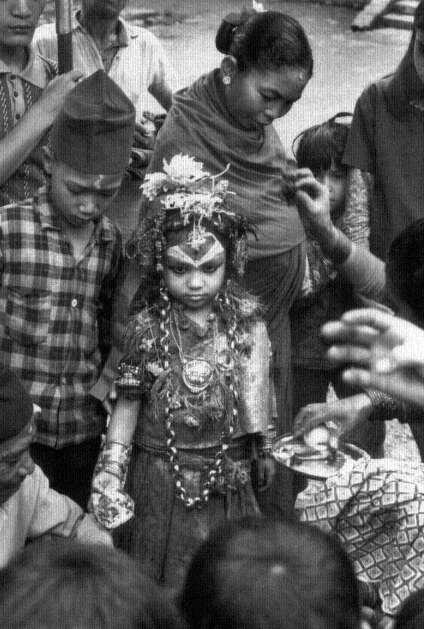
Figure 32.
The living goddess Kumari. People are making offerings and receiv-
ing prasada.
story, but they differ principally in the reason given for the anger of Taleju. Thus, in another telling, the king had a diamond that he cherished. Taleju advised him to keep that diamond secret from everyone. But one day the king's daughter somehow saw the diamond. Taleju became angry and the rest of the story followed.78 These stories go on to say that when the king told the Brahmans what had happened, they said, "We cannot bring a Po(n) girl (Bhaktapur's equivalent of a candala* ) here into the temple, but we can choose a Bare's daughter." Thus the water-unacceptable Bare became, according to these Hindu legends,79 a compromise substitute for the truly unclean girl with which the angry Taleju—and the Tantric tradition—threatened priestly Bhaktapur.
The child who is the Ekanta Kumari always comes from the same Bare lineage group. She is selected by members of that group among the girls of their phuki . She is usually about six or seven years of age (and thus premenarche) and must not yet have had her Ihi , mock-marriage, ceremony. She must not have lost any teeth (which is one reason that seven is a critical age), nor have any obvious physical defects or blemishes. In contrast to the living Kumaris of Patan and Kathmandu, who maintain their role as goddess for several years and who will find themselves in a permanently altered and disadvantaged state after their tenure as goddess (for they will be unable to marry), the Bhaktapur Kumari plays her part for only a year or two, and lives an ordinary Newar life after it is finished. Furthermore, her only function for the city as a whole is on this and the following day of Mohani, although she is an occasional focus of worship from time to time in her local area, where she and her family will inhabit the nearby special god-house of the living Kumari, in a place called "Casukhel," during her tenure.80 Even during this period, however, when not at the center of local worship she can play with other children and go to school.
In contrast with the children of the Gana* Kumari, whose physical propriety was not checked by the Taleju staff, the Ekanta Kumari is checked three times prior to the ninth day. Three days before the beginning of Mohani and again on the fourth and sixth day of the Mohani cycle, a Taleju Brahman—representing the king and the Brahmans—and a Josi and an Acaju from the temple go to the Dipankara vihara to inspect her. They check to see if she has the required physical characteristics. If not, another girl must be substituted. They do not, as a matter of fact, check her completely. She is clothed, and they examine only her face, teeth, and extremities. They ask the responsible Vajracarya
Buddhist priest to swear an oath that her entire state is proper for her to be Kumari, which he does on each of the three occasions.81
By now the children of the Gana* Kumari have finished their time at the Taleju temple, and have been carried back to the living Kumari's god-house in Casukhel. Now once again, the Brahman-king, the Josi, and the Acaju proceed from the Taleju temple to the Sukuldhoka area, to a position along the southern circumference of the city's main processional route as it enters the upper city and wait there. Now members of the Jyapu Kalu thar , thought to have been traditionally messengers for the Malla kings, go, accompanied by musicians, to the living Kumari god-house, where the girl is now staying. She is now elaborately dressed and decorated to represent the goddess, and her forehead has been marked with monhi . The messengers bring her back to the waiting king and priests. The king now takes her in his arms and carries her, accompanied by the other members of the procession, back along the processional route to the Taleju temple. When they arrive there she is met at the entrance to the temple's inner courtyard by another set of priests who welcome her and by means of a laskusa ceremony lead her to the door leading into the Kumari court. Now the king washes her feet, as the feet of the Gana* Kumari gods had earlier been washed, and bows down to her. He then lifts her again and carries her into the Kumari court. In that court is the Na:la swa(n) area, the true image of the goddess Taleju, and the decapitated goat heads from the preceding day.82 The blood, however, has been cleaned from the floor, making the scene less horrible, and the heads have been neatly arranged.83 Now Kumari becomes the focus of worship, with the king as the chief worshiper. During the worship, which takes perhaps two hours, the girl's behavior is carefully watched. This is the time of the annual darsana , or manifestation of Taleju in the form of the living Kumari to the king. The staff, under the leadership of the Josi, will later interpret her actions as a sign of future events, as they had interpreted the actions of the Gana* Kumari. The staff looks for two different things. First they look for some sign in the girl's behavior, something in her action that seems more knowing or mature than the ordinary behavior of a six-year-old girl that will confirm to them that the goddess is present. This is for their own satisfaction, for however the child acts, that action is taken as a manifestation of Taleju, and as a sign. More important (at least it was in the Malla times) is their search for omens. As with the Gana* Kumari, the child's measured acceptance of food and offerings, neither rejection nor gluttony are good signs, as is the quiet, good-natured acceptance of
the worship, manifesting neither silliness, tears, nor a desire to go home as soon as possible. Proper or improper behaviors are interpreted as giving some very general indication of the sort of year that is in store for the king. In the days of the Malla kings, it is said, the Kumari's behavior actually affected the kings' policy. Now if, and only if, there is some particularly dramatic or portentous occurrence, the Saha king's priest in Kathmandu is informed of it. Although the Ekanta Kumari, like the members of the Gana* Kumari, is a vehicle for a god, the deity does not possess her in the same way as it will the members of the Nine Durgas troupe, who become the deities in an uncanny transformation. She is a child through whose ordinary behavior the goddess manifests herself.
At the end of the worship the priests take prasada from the child goddess, and she is brought out of the Kumari courtyard into the main inner courtyard. Now the king calls for music, and musicians, who are in adjoining courtyards, begin to play. People, who have come in large numbers and now pack the inner courtyard, bow to her and take prasada from her if they can. In the main courtyard the priests transfer her to her Vajracarya priest, who conducts her back to her god-house along the main jatra route, where multitudes of people wait to see her and receive prasada from her (see fig. 32).
On the evening of this ninth day and on the following day there are a number of public events that signal the imminent return of the Nine Durgas to Bhaktapur. During the weeks before Mohani members of that family among the Pu(n) thar which has the hereditary right and responsibility to prepare the masks of the Nine Durgas troupe have been making the masks with the proper and traditional ritual and technical procedures (Teilhet 1978). The masks include among their ingredients a mixture of a specially gathered and prepared clay mixed with some of the ashes saved from the cremation of the previous year's masks. Also during this period the members of the Gatha thar who will perform and become the Nine Durgas are engaged in the secret activities that will ensure the successful and proper public effectiveness of their representation of the Nine Durgas.
On their return from their evening procession to the Tripurasundari pitha many people pass through the courtyard of a special house in the Yache(n) twa: , where the thirteen masks that will be used by the Gatha are arranged side by side on a platform. Many of them then wait along the route on which the Gathas will chase a bull water buffalo, in an echo of the running of the Nikhuthu to the Taleju temple on the previous day. This buffalo is called the "Kha(n) Me:." Me : means "water buffa-
lo," and Kha(n) is a term of uncertain meaning here, although the same term is used as one name of the Na:la swa(n) room, where it is locally interpreted to mean "sword." The Kha(n) Me: has been kept in a special room on the cheil , the ground floor, of the Nine Durgas' god-house. It has been made drunk, as had the Nikhuthu, and now staggering and lurching toward the bystanders, is chased by the Gathas—who are in their ordinary clothes and are not yet the Nine Durgas—from the god-house down to Dattatreya Square, where great crowds of people are waiting to watch it, and then on to the Brahmani pitha , which will be a focus of secret activities for the Gatha during the night, and one of the centers of the next, the tenth, day's activities. The Kha(n) Me:, like Nikhuthu, represents the great Asura, Mahisasura* . This echo of the previous days' events represents, with the involvement of the low-status, marginally clean Gatha, a movement of the Devi myth out of the Royal and aristocratic Taleju temple, and into the demotic realm of the city.
Later in the night, when people are asleep, the Gatha go to "steal" the masks. Those who happen to be abroad in the city during the night avoid the areas on the route from the house where the masks were displayed to the Brahmani pitha where the next Gatha activities will take place, because they fear that to see these things will cause death. The Kha(n) Me: will be secretly sacrificed at the Brahmani pitha by the Gatha during the night. The sacrifice follows the procedures for the Nine Durgas' sacrifices, which we will describe below. The Gathas as the Nine Durgas are at the same time the sacrificers and the deities to whom the sacrifices are offered, and they will drink some of the blood of the Kha(n) Me:. The drinking of this blood, the "life blood," is appropriate to dangerous deities but would be fatal to humans. This thus signals that the Gatha have become the Nine Durgas. It is said that at the Brahmani pitha on this night the Gatha, wearing their costumes as gods, do their first dances as deities for the new cycle. They have not yet, however, attained their full power. This is a preliminary stage during which their slowly waxing powers derive from their sacrifice and from their worship of Brahmani. They will attain their full siddhi , or supernatural effectiveness, from Taleju in the course of the events of the final, the tenth day of Mohani.
The Tenth Day: The Taleju Jatra, and the Transfer of Power to the Nine Durgas
On the morning of this day people dress in their best clothes, the women if possible wearing one of their most beautiful saris , and go
for the last time from their neighborhoods along the jatra route, joining in a great mass of people to visit one of the protective Mandalic* Goddesses of the city. This time they go once more, as they did on the first day of Mohani, to the eastern pitha , that of Brahmani, stopping as they had on the first day to wash or sprinkle themselves with water at her tirtha . Even people who might not have gone previously join in on this day, and large numbers of people from surrounding villages and towns also join in,84 so that many thousands of people converge. Seated near the pitha are scores of music groups, playing—each group its own music—at the same time. At the pitha the corpse of the Kha(n) Me: is lying. The Gatha, dressed in their Nine Durgas costumes, which are now splattered with blood, stand close to the buffalo's corpse. Their masks, which have been marked with monhi and other sacred pigments lie on the ground. As people file by the pitha they worship not only Brahmani as they did on the first day but also the Nine Durgas group, represented by the masks. Each person is given a bit of meat from the buffalo carcass, which they eat as prasada , thus sharing in the killing of the buffalo, and in Devi's victory over Mahisasura* .
This morning is the major time for the fulfillment of the pledges for the "offering of lights" vrata (see fig. 33). This is the sitting or lying supine of young men for many hours on end, supporting burning oil lamps, which we described in our discussion of the first day. On this tenth day another, a much more strenuous way of fulfilling such pledges is also done. The devotee will move starting from his home, and then join and proceed along the city jatra route to the Brahmani pitha in one of two ways. He may move forward by lying on the ground, and then alternately rolling himself up into a ball, then extending his body forward, and then rolling it up again by bringing his legs up toward his head while keeping his most forward position, slowly proceed along the jatra route. Another way of proceeding is by alternatively kneeling, prostrating himself, moving his knees forward, rising on his knees, making a gesture of respect, standing up, and then kneeling again. In this latter method a friend or family member may help support a burning oil lamp on his head as he proceeds. These vratas are performed for the same kinds of purposes as we have described for the much more ordinary offerings of lights, but are usually motivated by more severe problems. The devotees, dressed in loincloths, and wearing turbans, have their knees and elbows heavily bandaged to protect them from injury.85
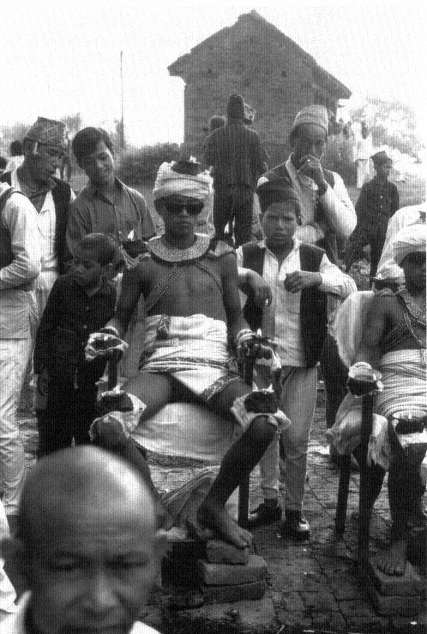
Figure 33.
A vrata, an offering of light at the Brahmani pitha on the tenth day
of the Mohani festival.
As people leave the Brahmani pitha and enter the main city festival route again, many of them proceed to the Taleju temple. When they pass Sukuldhoka on their way to that Temple they encounter the living goddess, the Ekanta Kumari, seated there at the side of the road. People stop and worship her and give her small offerings and take prasada from her (see fig. 32). When they reach the temple they enter the main courtyard. The fifteen buffalo heads have been arranged in three rows of five each just in front of the closed inner Golden Gate behind which is the jatra image of Taleju. The head in the center of the row just adjoining the gate is considered to be the Nikhuthu. People circumambulate the buffalo heads, walking along the raised ledge just in front of the inner gate in order to do so. The people will now return to their homes for their final activities in the household Na:la swa(n) rooms.
At Taleju the true Taleju image has been in the temple's Na:la swa(n) area, the Kumari court. The activities that will take place there must take place during the proper astrologically determined sait , one of three such saits that are important to the temple's activities during this tenth day. Two of these saits are locally determined by the Taleju Josis; one of them, the taking up of the true Taleju image is, like the two earlier saits of the Mohani period, determined by the central government's astrologer. The first event is a visarjan , a "taking leave" ceremony. During the proper sait the Taleju priests will now complete their reading of the Devi Mahatmya , and do a final puja to the combined Taleju-Bhagavati in the Kumari courtyard. At the end of the worship the goat heads are removed. They will be distributed to members of the Taleju staff, to be cooked and distributed as siu in their next household feast.86 All the other objects in the room are left in place until the second of the day's saits , the "tika sait ." This may come immediately after the "taking leave" worship, or may be some hours later. At this time the king gives a tika (a pigmented mixture that is placed on the image or specifically on the forehead if the offering is to an anthropomorphic representation or to a person) to Taleju. He also presents her with barley shoots brought from the Na:la swa(n) rooms in the homes of each of the Taleju priests. These shoots, conceived of now in part as swords, represent Devi's great victory. Then each of the priests takes back some of the tika mixture and barley shoots from the Taleju image. They are now prasada . Each priest then gives tika and some of the barley shoots to each of the others. The barley shoots in the temple's own Na:la swa(n) room are left undisturbed for the time being. During this tika sait the non-priest members of the Taleju staff and members of their families, as well
as the families of the priests, wait in the Taleju main courtyard, outside of the Kumari courtyard. The Taleju priests then leave the Kumari courtyard and give Taleju prasada to them.
Meanwhile the people who have returned from the Brahmani pitha , perhaps via Taleju, go to their Na:la swa(n) room for the final worship there. A puja is held for the representations of Devi, that is, for the kalasa and the Bhagavati image. During the course of this last puja the worshipers do something that is usually restricted to Tantric worship. Using a special oil lamp, often in the shape of a reclining skeleton with the lamp bowl over its genitals, they prepare the lamp-black pigment, monhi , which the worshipers then apply to their foreheads in a straight vertical black line. In esoteric Tantric practices, that monhi mark is used to facilitate the entrance of a deity into the worshiper's body, but here it is a routine ritual gesture. People take pieces of red cloth, which had been brought into the room on the eighth day, and tie them around their necks in another sign of Devi's victory. The blades of barley are now pulled out of the soil and offered to the Devi images, and then some of them are taken back by the worshipers who decorate themselves with them. On the eighth day a pumpkin-like gourd, a bhuiphasi ,87 had been placed in the Na:la swa(n) room to represent the Asura. Now the men and young boys in the household take the bhuiphasi out of the Na:la swa(n) room, along with one or more of the swords that had been kept there, and "kill" it by giving it three slashing cuts. They jokingly brandish the swords, pretending to be Ksatriya* warriors. This little domestic victory parade is a forerunner of the goddess Taleju's public victory jatra that will take place later in the evening. Now the men and boys, carrying the swords, return to the Na:la swa(n) room, and they and the other family members take prasada from the goddesses. The bhuiphasi will then be cut up and distributed to all people in the household to eat and once again to share in the killing and the victory.
The Na:la swa(n) worship, which has lasted throughout Mohani, is now over. The remnants of the barley plants are placed on the household pikha lakhu . The soil, the special kalasa , and the Bhagavati painting are left in the room until the fifth day following the end of Mohani, that is, until the next full-moon day. Then the soil is sent to be thrown into the river, the painting hung on a wall, the kalasa stored, and any metal Bhagavati image that might have been used returned to the household puja area.
On this or one of the immediately following nights many households
hold feasts. Married-out household women and their families are invited to the house for these feasts and offered various prasada items from the household Na:la swa(n) room.
Meanwhile in the Taleju temple the priests await the third sait of the day, which will be the proper time for Taleju's jatra . This consists of an internal jatra first within the temple, and a subsequent external one that moves out through the city. In both of these the details of the movements of the goddess Taleju are determined by the position of the moon at the time of the sait . She must be carried in such a way that the moon is either in front of her or at her right in the first movements of her procession.
Just before this sait an esoteric form of Devi88 in her warrior manifestation, which had been placed on the soil before the barley seeds were planted, is removed and taken to her quarters in the temple, and the remaining barley shoots are taken up. People have come to the Taleju temple and wait in the inner courtyard to watch the "taking up" of Taleju, the internal jatra . At the proper time a procession leaves the Kumari court. This includes seven people carrying swords, and three others carrying secret objects wrapped in cloth, and covered with flowers, jewels, and barley shoots. Among them is the true Taleju image. The procession goes through the main court and enters the inner Golden Gate. It is led by the king carrying one of the bundles in his hand. He again stops at three points within the main courtyard and turns in a movement that designates a yantra . The exact movements are determined by the position of the moon. The procession then proceeds to carry the true Taleju goddess upstairs again to her room, where she will remain until the next year's Mohani.
The final phase of Mohani is a literal and symbolic moving outward, both into the city and into the new cycle, which begins at this time of harvest. This is enacted in the public victory procession of the goddess Taleju, and is called "Paya(n) Nhyakegu." Nhyakegu means to "cause to move," "to be put into motion." The word "paya(n) " is now used only in this context in Bhaktapur, and its meaning is unknown to our informants.89
The procession assembles in the main courtyard of the Taleju temple. The Taleju jatra image is taken from behind the inner Golden Gate, where it had been left since the previous night. The king takes the jatra image, covered with cloths and ornaments, and goes to an external
courtyard of the temple, the Bekwa (or "zigzag") courtyard. He stands there holding the goddess, and now there begins a conventionalized little drama which takes its context from the legend of the origin and movements of the goddess Taleju, which we have presented in chapter 8. The king, "played" by the chief Taleju Brahman, now represents Harisimhadeva* , the exile from Kanauj who—according to local history—became king in Bhaktapur and established his lineage deity Taleju, whom he had brought with him, as the city's protective "political" deity. The king is met in the courtyard by a Jyapu who plays the part of a merchant visiting from the Indian city of Simraun Gadh* , the city from which Harisimhadeva* had come. The merchant has a carrying pole over his shoulder with baskets at either end, which is identified as "the Newar style" of carrying loads. The king asks the merchant where he comes from. The merchant tells him that he has been sent from Simraun Gadh* by the king Nandideva, who sends his respects and good wishes to the king of Bhaktapur and the goddess Taleju. Now in what is to all local people including the actors an incomprehensible part of the sequence, one that is believed to be a comic interlude, the king asks the merchant whether one can still buy nine pathi of rice for a one-dan coin in Simraun Gadh* . The messenger answers that one still can. The king then asks, "Everything is still cheap and untroubled there?" The Merchant answers affirmatively. He answers with a farcical double-meaning phrase. "Everything is fine; things are well up into other things," a sexual reference that makes the king and bystanders laugh. The king then asks him whether he brought anything with him from Nandideva in Simraun Gadh* . The merchant says he has, and then shows and presents some ta:syi fruits, a kind of citron, to the king and to Taleju. The little drama is then over. This episode, although vaguely naturalized into Bhaktapur's legendary history, is a mystery to the people of Bhaktapur.90
The Taleju jatra procession forms in front of the temple. First in order are two Jyapus, who will walk abreast carrying representations of Bhairava. Next comes a Pa(n)cthariya who carries a sword. He is followed by the two other high-status sword bearers, the second a member of the Chathar Ta:cabhari thar , and the third a Brahman. Each of the three sword bearers represents an esoteric warrior form of Devi. At the center of the procession is the Taleju jatra image carried by the king, and followed by a white horse, Taleju's vehicle. And, now, at the end of the procession come the Gatha, dressed as the Nine Durgas. The Nine Durgas have their own order in the procession. The portable shrine of
their own deity the Siphadya:, identified with Mahalaksmi* , is carried first. It is followed, in order, by Bhairava and Mahakali, the group's dominant deities, and they, in turn, by Varahi. The next group comes in the order of the sequence (in both their position around the city and their respective days during Mohani) of the peripheral Mandalic* Goddesses (except for Mahakali and Varahi, who have already appeared). This sequence is Brahmani, Mahesvari, Kumari, Vaisnavi* , and Indrani* . These goddesses are followed in turn by Sima, Duma, Seto Bhairava, and finally Ganesa* .
The direction that the procession will take was determined by the sait , which also determined the way in which the true Taleju image was carried within the temple. In this case the procession will go to either the upper or the lower part of the city depending on the position of the moon so that, as in the earlier procession within the temple, the moon will in the first out-moving phase of the procession, be either at Taleju's right or in front of her.91
Whichever route the procession takes, it loops back via Ga:hiti Square, the spatial focus of much of the Biska: festival. Here the focal point is the stone deity Swtuña Bhairava. When the procession reaches the stone, the entire procession circumambulates it. The Brahman carrying Taleju then stops at a designated point at the right side of a Siva temple92 in the square. It is at this point that the Nine Durgas will demonstrate their submission to Taleju. The members of the group, in the same order in which they have marched in the procession, come to "say farewell" to Taleju. They come to the wrapped image, bow and embrace it twice. In esoteric understanding it is through these embraces the power of the Nine Durgas is raised, each one in its turn, to their full power.93 Now the Nine Durgas, having said farewell, leave the procession and return to their god-house, stopping to perform formal dances at certain places along the route. Taleju, her work for this elaborate festival being completed for another year with the empowering of the Nine Durgas, returns directly to her temple. On their return there Taleju and her entourage are met just inside the external Golden Gate by a Brahman who had remained behind. He performs a welcoming and purifying laskusa ceremony, and leads the image back into her room in the inner temple, where it will be kept until the next Mohani.
While Taleju is being returned to her inner chamber, her white horse vehicle, which had left the procession at the entrance to Laeku Square and had been met there by a Taleju Acaju, is decorated with an offering of swaga(n) . Then it is led by the Acaju—who runs while leading it by a
rope—in three movements, first to the Golden Gate, then back to the entrance to the square, and then, finally, back to the Golden Gate, where it is taken into the temple.
Now the Devi cycle, insofar as it is a set of events within the annual lunar calendar, is finished. The cycle is continued now in the wanderings of the Nine Durgas over the next nine months, as they move throughout the entire city and many of its hinterland communities.
Mohani: Approaches to Meaning
The Mohani sequence is the complex climax of the Devi cycle. We must pause to discuss it before presenting the succeeding activities of the Nine Durgas regenerated in its course. We will follow the arrangement of issues we used in our discussion of Biska:'s meaning in chapter 15; the similarities and contrasts in the two focal festivals are often illuminating.
1. Mohani and the rice agricultural cycle.
One of our questions about annual calendrical events is their possible relations to cyclical events outside of the festival cycle itself. Such external relations are of paramount importance in the Devi cycle, both in the timing of its events and in a give and take of meaning. The events of the Devi cycle echo the planting of rice seeds and the transplanting of seedlings; the phases of growth of the seeds and of the replanted shoots; the anticipation, onset, and ceasing of the annual monsoon rains; and the cycles of disappearance, latency, and regeneration of the crops. At the successful climax of all this is the harvest, and that is where Mohani is situated. With the harvest the Nine Durgas are returned to the city to "protect" it yet once again, until they must disappear back into the wilds they originally inhabited as the earth prepares for its next cycle of regeneration.
In a metaphorical flow, symbols that express the relations of agriculture and weather to the city's inner order are extended to the quite similar relations of other vital realms—individuals' passions, the protective and destructive force of Ksatriyas* —to the city's moral order.
2. Mohani as a structural focal sequence.
In all the aspects that constitute festival events—time and resources used, extent of participation, extent of the city space that is ritually marked, quantity of symbolic resources put into use, and complexity and importance of the festival themes to the life of the community—Mohani is clearly of predominant importance in Bhaktapur's collection of calendrical events. Only Biska:
approaches it in these aspects. Like Biska:, Mohani has much to do with the representation and ordering of Bhaktapur as a city—but it does it with a signicantly different emphasis. The primary emphasis in Biska: is the ordering of the internal, the contained, structures of the city; the primary emphasis in Mohani is the relations of the city to its sustaining and threatening external environment—the city being delineated by its transactions, contrasts, and boundaries with that external environment. As we noted in our discussion of the legendary origins of the Nine Durgas, the bordering realms external to the orderly public realm of the city are not only in the forest wilderness outside the city boundaries but also in the secret reaches of houses, or (as the obscenities associated with Gatha Muga: suggest, and the neighborhood performances of the Nine Durgas, which we will discuss below clearly indicate) in the asocial or antisocial areas of the minds and passions of Bhaktapur's citizens.
3. Interactive versus parallel features.
In Biska: the dramas of disunity and unification take place in the public space of the city, and are only secondarily augmented by "parallel" household and neighborhood events throughout the city. Mohani's primary emphasis is also on the public civic dramas, but there is an important additional feature in Mohani. In addition to its public interactive narrative using socially defined actors, deities, time, and space for a complex dramatic performance, and its parallel household feasts, and its repetition of events on successive days in one internal mandalic* segment after another, each individual household also participates throughout the nine days of Mohani in its own complex and vivid drama echoing the larger civic drama. Thus, individuals busily participate in a drama that takes place in their homes, and again in the larger city, and still again in mythic space and time as the vivid cosmic battle of Devi and the Asura enemies of the gods. In Mohani individuals do not only watch the performances of other civic actors; they do not only interact with deities in their homes and at temples and along the paths of jatras in relations of honor, respect, and submission and the reaffirmation of vital relationships. In Mohani ordinary people, like the Taleju priests and the king, participate in the work of Devi. They kill with her, they work with her to produce life in their Na:la swa(n) rooms; they become Devi.
4. Human actors.
The human actors of Biska: passively represent Bhaktapur's hierarchical social order. Their main location is in a chariot moved through the city's public space and brought to rest at significant points. The king and his Brahman Guru-Purohit appear in Biska:
from the off-stage Taleju temple and royal palace complex to become passive doll-like figures joined with other representatives of the social hierarchy as static symbols and witnesses of Biska:'s events. There is very little human action in Biska: aside from the struggle of the city halves—an action produced by the nameless representatives of those halves—the remainder of the action is an automatic unfolding. In Mohani people must, as we have noted of the participation of ordinary citizens in household dramas, actively help in the unfolding of the festival's drama. In this the king now conflated into one figure with Taleju's chief Brahman has a central role.
The main arena of their action is the Taleju temple, the temple of the Royal Palace. That action takes place in the inner, often hidden, chambers and courts of that temple. Around the king and the Taleju priests the old Malla court life is recreated in the ceremonial attendance of the councilors, suppliers, and servants of that court.
The king is now an active figure in the encounter with the deities— trying to recreate an intimacy that he once had, but lost—and participating within their realm, or more specifically Devi's realm, through ritual and through blood sacrifices, in mimicry of Devi's battles and her slaughter of the enemies of the heavenly order. The priests, above all Taleju's chief priest, is, insofar as Tantric Brahman and king are differentiated, his ally in all this. This is another striking contrast with Biska:. The priests in Biska: are simply representatives of civic order. Here they are Tantric practitioners, joining with royalty in blood sacrifice. A complex of themes—king, court, warrior, Ksatriya* , Brahman as Tantric practitioner, human activity beyond social action and relationships—are amalgamated with those of the agricultural cycle and are explored in Mohani. They are all themes of power.
5. Divine actors.
In Biska: the main public deities are Bhairava and the vaguely deified Yasi(n) God, both masculine figures. Bhadrakali* is a very secondary figure in Biska:'s action—although in the legends associated with that festival sequence she stands in the shadows as a much more powerful figure than Bhairava. The Goddess must await Mohani to come from her shadowy presence in the wings to center stage. Both Bhairava and the Yasi(n) God are, like the human actors in Biska:, passive figures who are manipulated in space and time and, aside from whatever active participation Bhairava may possibly be thought to have in his sexual-aggressive encounter with Bhadrakali* , represent much but do little.
The deities in the public narrative of Mohani are Devi and her man-
ifestations and emanations. These forms are very active, indeed. They battle the Asura forces of disorder, cause the rice and barley to grow, inhabit the children of the Gana* Kumari and the Ekanta Kumari in order to bring oracles to king and city, and eventually embody themselves as the Nine Durgas. Bringing Devi and her forms into useful contact with the city requires the powerful ritual of Tantra, rather than the devotional ritual more or less appropriate to the comparatively tamed Bhairava of Biska:. Mohani is about the capturing of "natural" forces represented by Devi for civic use; Biska:, about the deployment of these already captured forms.
The Devi Mahatmya , tells of the alternating gathering together of components of the Goddess into her forms of maximum power, and their subsequent emanation and differentiation in order to do specialized tasks. In the sequence of Mohani the nine Mandalic* Goddesses of the city, Bhagavati, Kumari, several esoteric goddesses, the tutelary lineage Aga(n) Goddesses, and Taleju are repeatedly joined as one goddess, Devi, and then differentiated as special manifestations.
While the Devi Mahatmya 's Devi is the focus of Mohani's mythic realm, in the course of the events of the sequence it is Taleju who becomes progressively established as the central reference point for the gathering in and centralization of forces, and it is through Taleju that the momentum of the festival is handed over—from her point of view, delegated—to the Nine Durgas at its end. Taleju is the Malla king's lineage deity; her home is the united palace/temple complex. The in-gathering of powers on the completion of the harvest is a validation and renewal of the power of the king.
Biska:'s passive Bhairava and Bhadrakali* are powerful but limited, resembling socially limited humans in their irritations and ambivalences, their ineffectual attempts to escape, and their susceptibility to teasing. The goddesses of Mohani are quite different. They are uncanny and powerful beings, whose transformations and powers belong to some other than ordinary social world. In Hinduism's view of Royalty in its transcendence of the ordinary dharma (chap. 9) the king and these goddesses are natural allies.
Devi as the focal deity of Mohani is not the Sakti of Siva-Sakti theory, whose symbolism and manipulations are central to Bhaktapur's ordinary Tantric religion. Siva is here, as he is among the Nine Durgas, a faint, peripheral figure. This Devi, the full, creative Goddess, is in this harvest context the supreme, the only significant deity.
6. Space.
The public drama of Biska: moved through and took much of its meaning from the public space of the city. That movement centered on an axis and on points that, in their centrality, transcended and represented the divided components of the city. In Biska:'s main movement of masses of people—the visits to the dangerous deities of the city on the eighth day of that sequence—the procession moves within the city along the pradaksinapatha* . In Mohani the major spatial emphases are within the Taleju complex, within houses, and—in the mass movement of people to the pithas of the Mandalic* Goddesses—to the external borders of the city's boundaries and to the city's mandalic* center. These areas are all outside of the public spaces of the city and of its public society. In Mohani, and generally throughout the Devi cycle, the space of the public city is delineated by its edges, its inner and outer boundaries, its hidden cells—households and royal enclave. While Biska: emphasizes units of city space—city, city halves, mandalic* areas, twa: s—in themselves and in their relations to each other within the city, Mohani's main emphasis is on the boundaries of units and refers to what is beyond those boundaries—putting outside and inside in relation and opposition.
It is only at the end, the last day of Mohani, that there is a movement out of such peripheral spaces. The goddess Taleju, that is, her jatra image, is taken out of her temple into the city streets for her one yearly darsana . The representative of the Buffalo Asura is taken out of each house's Na:la swa(n) room in a little victory procession to be destroyed. And now the Nine Durgas prepare to move out into the city's neighborhoods and into the ordinary time of the next nine months.
7. The narrative.
Within the complex movements and events of Mohani we have suggested the presence of a central theme and narrative, clarified by its context in the Devi cycle and its contrasts with other festival narratives, particularly that of Biska:. Throughout Mohani the relation of the city and the outside is explored, and is represented in a coherent way.
The sequence begins with the processions, which continue each morning and evening throughout the sequence, to the pithas of the border-protecting goddesses, culminating in the sequence's climactic ninth day at their central representative, and then, on the morning following that climactic day, returning once again to the goddess of the first day, where the mass of moving people encounter the Nine Durgas. Throughout Mohani this motif—which we first encountered in the
Nine Durgas' legend—is repeatedly represented: a gathering in of external bordering forces to a climactic concentration in a ritually bounded space, and then, in a coda, their socially controlled moving out again into the public city's space and time. On a larger scale the movements of the processions are echoed in the movements of the Devi cycle, with its progressive concentration of the powers of soil, weather, and seed in the generation of the rice, which is now about to be gathered into the city and distributed within it. And in the largest scale of all they are represented in Devi's myth where the gods of the heavenly city generate her to share in the nature of the Asuras at their borders, and thus to conquer them and restore cosmic order. As the Devi Mahatmya puts it, after the final victorious battle "favorable winds began to blow; the sun shone with perfect brilliance, the sacred fire burnt in a tranquil manner; and the strange sounds that had filled the quarters of space also disappeared" (X, 27; Agrawala 1963, 127).
In their cumulative movements the twice daily processions mark the outer boundaries of the city and the central point where the protective forces at and just beyond the boundaries are concentrated. The people of Bhaktapur move en masse to the pithas nineteen times during the course of the sequence. They are active participants as they will be throughout. In the course of their daily processions they include the Taleju temple, the ultimate center for the in-gathering of forces for the city as a whole, in a movement that allies king, court, and temple with the forces of the bordering outside—and with the successful harvesting of their recalcitrant potentiality.
From the first day the agricultural resonances of the festival are made concrete in every household, Tantric temple, and god-house. Earth is placed in them and grain is planted. The Goddess in her aspect as the cosmic creator and here specifically as the genetrix of agricultural life both presides over the earth and grain and is represented in the plants themselves as they develop.94 But this generative goddess, as the sequence makes increasingly clear, is a warrior goddess, she is Bhagavati/Mahisasuramardini* , the bloody warrior goddess of the Devi Mahatmya . The success of the agricultural cycle, the generative powers of earth, seed, and weather are now allied with the force of the warrior, ksatra* , in the battle against the forces of disorder at the boundaries of the heavenly city of the moral gods. The use of Taleju's barley by the upper thars is a further reminder of the connection of ksatra* , Taleju, and Bhaktapur's traditional monarchy.
The central package of symbols is in place by the first day—the con-
flation of agricultural and warrior power, and the relation of that power to the inside of the city, to the moral city. The mata beigu vratas , which begin on the first day, introduces a further active way in which people will participate in and control these forces, that is, through sacrifice, through self-sacrifice and, above all, through the city-wide mass slaughter of represenative and surrogate animals. This sacrifice not only is a mimesis of the death and regeneration of the agricultural cycle but also has as one of its implications (as we will argue in our discussion of the activities of the Nine Durgas later in this chapter) the forceful binding of individuals—who represent another fertile and dangerous outside—to the city's social and cultural order.
Slowly at first and then gaining momentum throughout the sequence the forces of the outside are moved under the direction of traditional enactments and rituals into bounded areas of the city. The barley grain begins to grow in the houses and temples; the processions, after finally visiting all the bounding goddesses in their proper sequence, will move to the mandalic* center; and at the Taleju temple the Goddess herself —uniquely, not a jatra image—is manifest (albeit under wraps) to the spectators, and then brought together with Bhagavati and the growing grain. For the city as a whole all the forces now begin to amalgamate themselves to Taleju—agricultural growth, Bhagavati, and the cosmic warrior Devi, soon to be joined by representatives of the Mandalic* Goddesses as the Gana* Kumari, by Kumari herself, and eventually by the Nine Durgas.
All this comes to a climax in the Kalaratri, the "black night," between the eighth and ninth days, when Taleju/Bhagavati/Devi and the king and his priests participate vividly in the bloody cosmic mythic war of Devi against the disordering Asuras. That battle is replicated in each household on the following day with animal sacrifice. The city's citizens are not just witnesses; they continue to be active participants.
For the court and Taleju there is a further in-gathering. The Devi cycle tells of the moving out of the city of the deities and, then, of their return along with the harvest for the inner uses of the city. The tale of Kumari tells of how Taleju herself has fled the direct presence of the king, but now with the Gana* Kumari and the Ekanta Kumari she makes her annual return, once more to advise him.
Taleju's urban hegemony has now been established, but it is a hegemony in alliance with a peculiar collection of forces, the forces that are the concern of king and Tantric expert and farmer and craftsman—the worship of whose tools is an important part of the sequence. These are
not the forces, the arena, of concern to the Brahman as Brahman and to his auxiliary and covert priests (with the exception of his Tantric surrogate, the Acaju). Mohani is a celebration of the forces that are the support of the moral order, not of that order in itself.
The final episode in the story is the moving out of the concentrated forces from households and palace once again into the city. On the morning of the last day people once again go to the peripheral Bramani* pitha whence they had started on the first day, but now they find the Nine Durgas there, who have killed a buffalo in their mimesis of Mahisasuramardini's* battle, and are preparing for their full return to the city. In the households boys and men carrying swords storm out of the Na:la swa(n) rooms in a mini victory procession to kill the bhuiphasi gourd. And finally—the true Taleju having been returned to the recesses of her temple-palace—the jatra Taleju image, carried by the king, is brought out in a victory procession into the public city where Taleju delegates power to the Nine Durgas so that the manifestation and uses of the powers of Devi may be carried throughout the city for the next nine months until once again they must be returned to their proper and necessary places in the outside order.
8.Rhetoric and participation.
In our discussion of Biska:'s meanings we noted some of the rhetorical resources that are used in that festival sequence in attempts to ensure the engagement of people with its meaningful forms. Mohani uses some of the same ones. It uses mystery, pageantry, and the revelation of wonders as deities become manifestly embodied in living forms. However, Mohani's emphasis on participation shifts the problem of engagement from the engagement of an audience—the traditional problem to which rhetoric is devoted—to the engagement of the performers themselves. People become participants in the drama—in a participation with "magical" implications. Centrally in the Taleju temple, and throughout the city in the Na:la swa(n) rooms, they participate in the transformation of seeds into "weapons," and through the one annual blood sacrifice expected of all the city's citizens, in Devi's conquest of the antigods. They share in the killing—and eating—of the sacrifice, privately in the household sacrifice and publicly in the eating of the Kha(n) Me: Buffalo, sacrificed by the Nine Durgas at the festival's final day.
In Mohani, deities, king, priests, and householders all participate in Devi's battle, and in so doing partake in Devi's victorious—and necessary—power. As is everywhere evident in the worship of the dangerous deities, but above all in the Devi cycle, they achieve a limited
influence or control over that power by being like the gods. In a manner reminiscent of ancient Indian sacrifice, this participation in the restoration of cosmic order involves a necessary, active, and effective solidarity in action with the gods.
Through their active participation in Devi's battles people become , in a sense, Devi. In other festivals, or in other parts of Mohani itself they may relate themselves to a deity by visiting it, by watching a procession, following it, taking prasada , worshiping the deity through gestures or more elaborate pujas . Participating in the work of a deity, becoming in a sense that deity, has quite different social and personal implications than simply observing it, worshiping it, respecting it, interacting with it, fearing it, worrying about the values implied by it, and in part, identifying with it. It is the difference between (in the first case) participating in the protective and environing forces surrounding, protecting, threatening, and sustaining the moral civic order and (in the second case) acting properly within that order. It is the difference between the realms of Ksatriya* and of Brahman.
The Performances of the Nine Durgas
We have been concerned in the earlier sections of this chapter with the legend and membership of the Nine Durgas and with the Devi cycle within which they are a major component as well as a thread binding the individual calendrical events of that cycle into a larger thematic unit. Now with Mohani the Nine Durgas have emerged again to carry Devi's power and significance out into the city throughout the succeeding nine months of their annual life cycle until their disappearance once again at the following Bhagasti. We may now turn to a consideration of their performances throughout the city.
The dance drama, or pyakha(n) , which the Nine Durgas troupe performs throughout the city, comes to each of the neighborhoods in which it is performed as a kind of invasion. The troupe appears in each neighborhood in an order determined by a traditional annual sequence (map 14, p. 223). Local people must prepare for a visit that is beyond their control. Before turning to those systematic, sequential pyakha(n) s, however, we must consider another setting and form in which individuals encounter the Nine Durgas.
During much of the period when the Nine Durgas are active they
may be invited by a family, a group of extended-family members, or a larger neighborhood group, to come and dance for the "protection of the area," which is how the Nine Durgas" function is usually phrased. This invitation is often in fulfillment of some vow. In the case of these invited performances a messenger is sent from the Nine Durgas to the hosts to say that the Nine Durgas are ready to go to their quarter. Thereupon the men responsible for the invitation and the expenses of the performance go to the Nine Durgas" god-house to conduct the gods to the place where the ceremony will be held. This is in significant contrast with the formal systematic neighborhood sequence when the gods will come by themselves, uninvited and unconducted. In the course of their being worshiped in the local area, usually in the courtyard of a house, a domestic pig, called in this context amu vaha(n) , or "main offering," is given as an offering to the Nine Durgas. This pig represents the strategic pig of the Nine Durgas' legend.
The pig is killed by Bhairava, who is the only one of the Nine Durgas who performs blood sacrifice, with the important exception of the killing of a cock by Mahakali during the formal neighborhood dance-drama. He does this by splitting the skin of the young pig's foreleg with his fingernail (in a relatively thin area at the inner part of a joint) and separating the skin until he reaches the thoracic cage. He then forces his hand between two ribs and pulls out the heart and offers it to the Oleander shrine goddess, the Siphadya:. Now first Bhairava and then all the other gods (including demonic skeletal figures representing attendants of the Nine Durgas incarnated by Gatha children) take blood from the pig's open chest and drink it. The gods now begin to tremble. This is said to be in response to the "force" in the blood, and to be a sign of the Gathas" possession by the gods, but also to be a kind of intoxication. This image of the goddesses intoxicated with the blood of their Asura enemies, sometimes dancing as a result, is salient in the Devi Mahatmya . Now Bhairava gives a mixture of beaten rice and curds, dhaka baji , to each god to eat. He then offers dhaka baji as prasada to the onlookers, with a particular emphasis on the children, and among the children, especially the boys. It is thought that this offering will protect children from disease. Bhairava's hands are still contaminated with the blood of the pig, and the audience thus share in this sacrifice. (Brahman boys after initiation and adult Brahmans are not allowed to accept this prasada .) Following the sacrifice, the group of Durgas do formal dances. These dances describe certain geometric patterns and are said to be mystical diagrams or yantras that protect the locality through
supernatural power. Then the Nine Durgas troupe, taking the body of the pig with them, returns to its god-house accompanied by the important people of the inviting group. At the god-house the Gatha¡ dancers are said to cook and eat the pig.95 Occasionally for particularly important offerings the Nine Durgas are offered five kinds of male animals for a major sacrifice called a pa(n)ca bali .
In the course of their nine months of life the Nine Durgas troupe dances at twenty-one public squares (map 14) throughout Bhaktapur and in nineteen villages outside of the city (Gutschow and Basukala 1987). These villages are generally with a few exceptions within the boundaries of the old Malla kingdom of Bhaktapur.95 The pattern traced by the sequence of dances both outside and within the city are considered to form protective yantras , in the same way as the detailed patterns of the dance performances within each local area mark out a local protected space. Aside from the Gatha performers themselves, only a few specialists in the city are aware of the places and sequences in the larger cycle. All that the vast majority of the spectators to the local performance know is that somehow this local performance weaves their locality into a larger pattern of temporal and spatial relationships reiterated during each annual cycle, a pattern whose center is Bhaktapur.
In presenting the local performance, we must make the same choices we have made throughout this study. We will select out of the complex traditional performances, whose detailed description and elucidation would justify a volume in itself, those aspects that are presumptively meaningful in the particular and limited sense of this study. Thus we are here concerned with the "message" delivered by the performance to the neighborhood people and the purposes the performance serve in the symbolic organization of the city.
The relative position in the annual sequence of the visit to each neighborhood and village is fixed, but the Gatha performers make use of various calculations known to themselves to determine the exact day in which they will come, so that the local people are never sure exactly when to expect them, although the performances always take place on either a Sunday or a Thursday. As we have noted, in contrast to the invited performances the Nine Durgas thus enter the area as a kind of invasion beyond the determination of the local people. These sequential local performances are often referred as the "Na* lakegu" pyakha(n) , the "going fishing" pyakha(n) , using a reference to one element in the performance to stand for the whole. On the afternoon before the
pyakha(n) the group of Gatha—performers, musicians, and attendants—go to the twa : or neighborood area in which they will perform. Gutschow and Basukala (1987, 152ff.) have described this movement to the performance area in detail, and we will follow their description for the phases prior to the pyakha(n) itself. According to Gutschow and Basukala, on the occasion of one of the sequential visits the masks are brought from their hidden room in the Nine Durgas' god-house to the courtyard of that house, where the three frightening masks—Bhairava, Mahakali, and Varahi—are separated from the others, and hung facing west. These are the same three deities who preceded the other Nine Durgas in the Taleju procession of the tenth day of Mohani. Although the troupe itself may take several hours to reach their destination, the palanquin on which the Siphadya: will be placed is first brought directly to the square where the public performance of the following day is to be held. As Gutshow and Basukula write, "it [the arrival of the palanquin] is the first sign of the procession of the night . . . [as] the people are never sure when the gods [will] come" (1987, 152). The Gatha troupe leave the god-house at twilight. First comes a man carrying a human skullcap as a drinking cup97 in his left hand and a small drum, a damaru* , in the right. Next comes the man who carries the Siphadya:, accompained by another carrying a ceremonial umbrella to protect and honor that god. Then come three boys who at this point represent the deities Sima, Duma, and Kumari. They are followed by the masked men who incarnate Bhairava, Mahakali and Varahi. The goddesses of the "chorus" follow next—Brahmani, Mahesvari, Vaisnavi* , and Indrani* . Finally comes Ganesa* , wearing at his waist the mask of Siva.
On each occasion the group begins its procession in the same way. It goes first to worship at a shrine of Ganesa* , Sala(n) Ganesa* , in the upper city. Mahakali does a formal dance there. Now the procession proceeds to the Wa(n)laeku Taleju shrine near Dattatreya Square. Mahakali bows to the shrine, and is lifted twice into the air by an attendant. The procession proceeds along a main road that "serves as a kind of backbone from which the individual places are reached," and makes five further stops at various shrines, temples, and god-houses, where the Nine Durgas perform brief formal dances.
When they reach the particular quarter that is the goal of the day's procession, some of their activities are differentially determined according to the particular quarter. On their way to its main square they make from three to nine stops. The naki(n) , the senior woman of the troupe,
seats herself at each stop with some baskets and pots to receive offerings of food and drink. Often the troupe is invited into individual houses and given offerings.
In eleven of the twenty-one neighborhoods in which they perform there is an additional sequence, the chasing of a pig, as they had done in the legend to protect themselves from recapture by the Brahman Tantric practitioner. This is done, according to Gutschow, in areas peripheral to the various performance squares in the direction of the borders of the city. The pig that is intended for sacrifice to Mahalaksmi* by Bhairava is, instead, stolen by groups of young men and boys. "The youngsters run around carrying the squeaking pig under their jackets and passing it quickly from one to the other. The gods are obviously teased and asked to come and fight for the pig. . .. This kind of teasing may last for an hour or two" (Gutschow and Basukala 1987, 156). Finally the pig is released and Bhairava grabs it and carries it back to the main square where he tears its heart out and throws it to the Siphadya:, that is, to the goddess Mahalaksmi* . This teasing ending in a blood sacrifice anticipates the themes of the next day.
These preliminary activities take from two to six hours, when, finally, toward midnight, the troupe reaches the square where they will perform.98 It is said that the Gathas do secret dances and rituals on the square. Non-Gathas do not know what these are—it would be very dangerous to see them—but it is believed that they increase the power and effectiveness of the goddesses in preparation for their next morning's performances.
The next day's sessions are a mixture of formal dances (conceived as yantras ) and worship, interspersed with dance-dramas or pyakha(n) s.99 Following the first formal dances in the morning, there is a performance by the lion and tiger deities Sima and Duma (see fig. 27). Although generally conceived as goddesses, and derived from the goddesses Si(n)hini and Vyaghrini* , Duma is here considered as a woman and Sima as a man, her husband.100 Duma has a cup out of which she will drink beer, but at some point Sima steals it. During this sequence the younger boys among the spectators laugh and make mocking noises directed to Sima and Duma. Sima now begins to chase the children, occasionally catching one and holding him for a short time. If he catches the child he may bring the child to the shrine of the Sipha: God. If a child is caught, people may say this is the result of adverse planetary influences and his family may worship the Nine Durgas to remove the bad effect. This chase occurs several times during the course of the morning. These
Sima-Duma sequences are considered to be comic, more concerned with younger children, and less serious than the pyakha(n) that is to follow in the afternoon.
This afternoon pyakha(n) focuses and conveys much of the meaning of the Nine Durgas and of the Devi cycle, and systematically delivers the message of that cycle to localities and their people. It derives its force and significance from all that has preceded it, and also from certain background experiences and interpretations of its audience in relation to animal sacrifice (chap. 9).
The afternoon performance has as its principal characters Seto Bhairava, the small white-faced young man with a mustache and tiny fangs who is the protagonist; Mahakali, the largest and most frightening goddess, who is his antagonist; and Kumari who is, as we have noted, a transitional form between the benign-appearing goddesses of the chorus and Mahakali, acting as a mediator. These characters are augmented by Sima and Duma as comic figures.
The pyakha(n) begins with Mahakali doing a formal dance. Seto Bhairava seats himself on a woven straw mat, which he will later use to "go fishing." While Mahakali is dancing, Seto Bhairava smears himself with a white pigment (a mixture of oil and white powder that is used otherwise in marriage ceremonies as a cosmetic for the bride). He has been given this as well as ghya : (clarified butter), brown sugar, and a white shawl by one of the members of the local area who is responsible for local supplies and arrangements. Seto Bhairava puts the white pigment on his face and hands and puts on his mask. He then puts the shawl over his head, approaches the place where Mahakali is dancing and, seating himself with head still covered, slowly moves his head about in a fashion that is interpreted as a kind of mocking or making fun of the dancing Mahakali. Keeping one's head covered in this fashion in front of a deity (or in this case a superior deity) is to show disrespect. Mahakali becomes enraged and shakes her head in a quivering motion, indicating her great anger. She suddenly seizes the shawl from Seto Bhairava's head and holds it in her hand. Seto Bhairava wants to get his shawl back and the next part of the sequence has to do with his attempt to recover it. First he makes a gesture of respect to Mahakali, but she ignores it and turns her head away. This attempt having failed, Seto Bhairava turns to the onlookers and begs for small coins. Some people in the crowd give coins to him. Seto Bhairava now offers the money to Mahakali, asking her to take the coins as an offering. (His words now
and in later parts of the pyakha[n] are spoken for him by one of the musicians.) Mahakali takes the money from him, but does not return the shawl. All this ineffectiveness is amusing to the spectators. Now this part of the drama comes to a climax. Seto Bhairava takes a cock, which one of the onlookers hands to him, and offers it to Mahakali. At first she is angry; she keeps her head turned away and will not take it. Then suddenly she grabs the cock, and with an angry gesture throws the shawl back into Seto Bhairava's face. Now Mahakali bites the head off the living cock and drinks its gushing blood.
The pyakha(n) comes to an intermission. Now the twa : representatives do pujas to Kumari, Bhairava, Mahakali, Varahi, Seto Bhairava, Sima, and Duma and to the Oleander Goddess, the Sipha: god. The background deities of the chorus are not worshiped at this time. Thus the gods that are worshiped are all frightening forms, with fangs, tusks, or sharp teeth. Now the masks are placed in a specially designated place and only Seto Bhairava remains masked. He takes his mat, which is now to serve as a fishing net. This mat is a rectangle about two or three feet long, with seven or eight tiny dried fish placed in openings of the net. He will use this net to "go fishing," as his chasing of older boys and young men which is about to occur is called. The chase by Sima in the morning is also called "going fishing," although he does not use a symbolic fishing net. As we have noted, the performances of the day with their various scenes and elements are, in fact, often named as a unit in reference to these episodes, and referred to as the "fishing," or "Na* lakegu pyakha(n) ," suggesting the central significance of this element. Seto Bhairava now does a formal dance (see frontispiece), as Mahakali had been doing when Seto Bhairava showed disrespect to her. As he performs, the young men and older boys in the crowd begin to mock and taunt him by clapping their hands together and making sounds, rhythmically covering and uncovering their mouths with their hands to make a wavering noise. These young men are usually youths between fourteen and twenty, and include members of the clean thars , even Brahmans. This is considered to be a brave and daring thing to do, and people are said to admire them for it. Now Seto Bhairava "goes fishing," angrily chasing the offending boys and young men. Sometimes during the course of his chase he will stop and be invited into a nearby house, where he is given an offering of food, including meat and alcoholic spirits. The young men will wait outside and continue their mocking when he comes out. If he manages to catch one of them, Seto Bhairava will drag him toward the Oleander God's shrine, but if he is far away
from the shrine, he may let him go after dragging him for a while. This is considered bad luck for the boys and young men, and sometimes the younger ones cry with fear when they are caught. Seto Bhairava then returns to the shrine, and resumes his formal dance, only to be interrupted once more by the taunts and mockery of the boys and young men. The sequence of dancing and chasing occurs three times.
Now a new phase of the pyakha(n) begins, a comic phase. Seto Bhairava's stomach begins to hurt him. He is said to have an upset stomach from "eating fish," the boys and young men whom he has been chasing being those fish. He lies down on the mat and begins to rub his stomach. Sima and Duma, now danced by boys instead of men, come to feel his abdomen "to see where the pain is." Seto Bhairava wriggles around because this tickles him. He is still in pain, however, and he calls for Kumari (with one of the musicians again speaking for him). Kumari, now also danced by a boy, comes with a handful of parched beaten rice and holding it first to Seto Bhairava's head, chest, and stomach, throws it to the right and to the left.101 During these scenes in the dance-drama, Kumari (as she is danced in this scene by a child, she is now sometimes called Balakumari, the "child Kumari") is considered to be the wife of Seto Bhairava. As Kumari throws the parched beaten rice to the right and to the left, she throws it into the faces of Sima and Duma, who have been standing and looking on at either side of Seto Bhairava, and they react with gestures of discomfort. Now Seto Bhairava is cured of his affliction. He gets up and embraces the reluctant Kumari, which usually provokes much laughter. Now Seto Bhairava gives his shawl to Duma, asking her (through the Gatha musician who speaks for him) to wash it for him saying, "It is a little dirty, please wash it." Duma throws it down on the ground. Seto Bhairava says, "I should hit you," and makes a fighting gesture. He then picks up the shawl and goes through the same sequence, with the other member of the pair—Sima—and with the same results. Finally he picks up the shawl, which Sima has thrown down, and washes it himself in pantomime. He then walks away. The dance-drama segment is now finished. All the gods, except Sima and Duma and Seto Bhairava, perform a set of formal dances. This is the only time that the benign and beautiful forms of the goddesses also dance, and now Ganesa* also dances with the group for the first time during this day's proceedings.
Now the true Bhairava, as Bhairava is usually conceived in Bhaktapur, the large blue-black dangerous-looking male figure, comes to the fore.102 As in the informal invited ceremonies described above, Bhai-
rava is offered a pig to be sacrificed and returns beaten rice with his blood-stained hands as prasada to be eaten by the onlookers, who thus become participants in the sacrifice.
Now the dance-drama is over and the gods making music return to their god-house, now accompanied in their return procession by people from the locality. The locality has been protected.
The Significance of the Nine Durgas" Pyakha(n): Some Speculations on How The Nine Durgas Protect Bhaktapur
In Bhaktapur's characteristic "religious" language the Nine Durgas are said to be of major importance in the protection of the city. In our analytic language this is, indeed, what they are doing in their neighborhood pyakha(n) s through the significance of their performances to the people of the local neighborhoods. They protect the city by helping to assure the proper relation of individuals to the city's society.
As always, we are concerned with the significance of the Nine Durgas" performance for Bhaktapur's symbolic ordering, that is, with its impact on Bhaktapur's people. Much of the form of the Nine Durgas has no direct significance in this sense—although it would be significant analytically to, say, historians of South Asian culture. We must note, however, that many aspects of the Nine Durgas" form and action are indirectly significant in our limited sense even if the meaning of those forms and actions is, in some sense, unknown to most or all of the Newars who witness and engage in the performances. These aspects are significant in part precisely because their meaning is unknown. It is sufficient that the spectators have the conviction that there is meaning even if they do not know what it is. Thus the spectators to the Nine Durgas" pyakha(n) do not know what the overall sequence of visits by the Nine Durgas is in the spatial mandala* they create over nine months, but they do know that the visit to their neighborhood is an essential part of this pattern. They do not know what many of the iconic details of the masks signify, nor which of the minor goddesses is which. They do not know what the mask makers or the Gatha actually do to give proper siddhi to the performances. They do not know what the formal yantra dances of the Nine Durgas signify. Such unknown matters are in contrast with the very accessible and direct implications of other aspects of the masks, sacrifice, pyakha(n) , and so on. But the things they do not understand
have their own meaningful implications, they contribute to the performance's special sacred force.103
Although the great majority of the spectators to the local pyakha(n) may not understand such matters, they know that they are correct and necessary. The dances, masks, and procedures represent an order that is organized and guaranteed by something beyond ordinary contingent local human action, improvisation, and decision. This helps give the performance, in spite of its sometimes comic style, a deep seriousness and relates it to the sacred realm of Hinduism—a seemingly eternal and transcendent realm beyond the here and now. The forms that spectators do not understand, to a certain degree just because they are not understood, evoke—as do the transcendent ritual and ceremonial forms and sequences and their contexts—this other mysterious world. All that the spectator has to know or believe is that something is being done properly, that it is generated out of a sacred tradition, where it is rooted in myths and legends, and that it is properly passed down from generation to generation of priests, mask makers, and dancers through proper initiation, teaching, and mantras . The audience sees a performance that is a manifestation of something beyond the ordinary, something organized in some other order beyond the whims of the Gathas. These properties of the performance, allied to references to ultimate macrocosmic realms of order, powerfully evoke ideas and emotions characteristic of encounters with the "sacred."
Yet, within this larger frame is the pyakha(n) 's drama and the game-like "fishing" episodes of the pursuit of the mocking boys and young men by the gods. The messages here are direct and specific, completely dependent on peoples' understanding of the pyakha(n) 's symbolic forms. The dramas and fishing chases have a central theme or motif, which is elaborated in various ways. This theme is the violation of hierarchy, shown concretely through the violation of proper respect toward a superior. The young boys mime this to Sima and Duma, the older boys to Seto Bhairava, and Seto Bhairava to Mahakali. This violation of hierarchy and the response to that violation illustrated in the drama and fishing pursuit does not concern ordinary violations of the moral law, the dharma of civic life, any more than the struggle between the gods and the Asuras in the Devi Mahatmya concerns ordinary moral relations among deities. Ordinary moral violations, the arena of shame, loss of face, and the generation of bad karma , have their own symbols and myths, their own spatial location, their own religious modes and divinities. This pyakha(n) and its context
does not concern the moral problems of human beings with each other. In its offending of superior dangerous gods it concerns the violation by humans of the very order that makes the moral realm possible, and it shows the consequences of such a disruption.
Hierarchy, the central principle of social order in traditional Hindu societies, is, as we have shown in chapters 5 and 6, greatly elaborated in Bhaktapur's complex urban organization. The violation of the conventions of hierarchical relationship, therefore, strikes at the central organizing principle of Bhaktapur's society. Thus the Nine Durgas" pyakha(n) can be interpreted as being about the struggle between disorder and order, about what happens to individuals who violate order, and, finally, about what has to be done to restore that order. The contextual meaning of the Nine Durgas in the larger Devi cycle indicates that although this disorder is dangerous both to the ordinary moral gods and to humans as social beings it is at the same time a source of fertility and energy. Thus the boys and young men who mock the gods are admired for their courage and Seto Bhairava is a sympathetic Chaplinesque figure with whom one must empathize as he struggles against the terrifying Mahakali. Similarly, the boys and young men who called out order-threatening and immoral obscenities at the proper phase of the annual cycle were also doing something positive, amusing, and vital. The children and young men are pursued by the gods whom they mock and are sometimes caught without particularly serious consequences, but the potential consequences for the acts of rebellion that they have mimed are shown graphically in Seto Bhairava's encounter with Mahakali. He fails to show respect for the superior deity, who becomes enraged. He tries to restore relationships with her by the kinds of exchanges that are effective with the ordinary, the non-Tantric gods— gestures of respect, the offering of money or daksina* . But only an offering of blood sacrifice appeases this kind of a deity. The biting off of the head of the cock and the drinking of its blood signifies to the onlookers that it was Seto Bhairava who was to be killed, or at the very least castrated, if it were not for this convenient substitution. The sacrifice enables the return of the shawl and some social dignity to Seto Bhairava and atones for his violation of hierarchy.
The Nine Durgas are dangerous deities, and Mahakali is the dangerous goddess in her most frightening representation. As we have argued throughout, such deities have a special position in the maintenance of order in Bhaktapur, where Tantra and the worship of dangerous deities (as is widely the case in the history of South Asia) has been captured and
put to use by the social order as the legend of the origin of the Nine Durgas attests, rather than representing attempts by renouncers, magicians, and peripheral social groups to escape from that order. Like the traditional Hindu ruler in his ideal relationship to the priest, the dangerous deities are responsible for the protection of the traditional ritual and moral life, although they are beyond morality themselves. They are ambivalently made use of when that moral order is being threatened either by some internal force or by some external danger. Seto Bhairava's rebellion threatens the hierarchical basis of urban order, and a dangerous deity becomes activated.
The way Mahakali's threat is both manifested and avoided is in the blood sacrifice of the cock. This is in the context of the massive blood sacrifices of Mohani, the blood sacrifices by the Nine Durgas at other times, the legend of the Nine Durgas" murder and eating of humans before they were captured by Tantric priests, and the accounts of human sacrifices performed by the Gathas in the past. We have noted (chap. 9) that animal sacrifices are for some informants, at least, consciously and with deep emotion associated with vivid memories from their boyhoods when they felt that the sacrifices were in fact selfishly motivated murder, that they might be directed toward them if the adults became angry at them, and that the animals were somehow equivalent to themselves. "I could feel the knife on my own throat," as one man said in reminiscence.
The pyakha(n) thus makes use of a particularly powerful and complex local constellation of meanings. Its message is directed directly at males.104 Men are the critical actors in the public social organization of Hindu communities, and the largest component of the civic symbolic system is devoted to the expression and control of their problems, emotions, and orientations in the performance of their social roles. It is striking in view of this male prominence in the public life of the city, that that force which is represented as external to the city but vital to it, both as the energy of nature and as the force that both threatens and which, if properly placated and controlled, will protect the city against disruption, is represented primarily by the nonsocial, dream-like "Mother Goddess" and the images, concepts, and emotions associated with that powerful symbol.
Sacrifice is not only a powerful symbol of a threat, a potential punishment for violation of hierarchy, but as we have argued in chapter 9, an important motivation for accepting the social order, for identifying with and becoming one of the sacrificers, to escape the fate of being
one of the creatures that are sacrificed. This acceptance of order under the pressure of sacrifice is manifested in the acceptance, the "understanding," of the particular ideologies and dogmas of the group that would be hypocritical, problematic, and perhaps nonsensical to an innocent eye. Such items requiring faith are vividly represented in the mystifying dogmas about sacrifice itself.
The pyakha(n) plays with the theme of the vital impulses of the city's citizens that are socially disruptive and, making use of blood sacrifice, one of the very most powerful symbolic resources for restoring and maintaining individual assent to Bhaktapur's culture and society, restores order both within the drama, and, ideally, in the minds of its spectators. Seto Bhairava is not only the ineffectual protagonist who blunders into trouble with Mahakali and is saved only through a substitution of a sacrificial animal; in another phase of the pyakha(n) , the "going fishing," after which the whole event is significantly named, he is the one who is mocked by his inferiors and becomes, in turn, the agent of punishment. Similarly, the people of Bhaktapur are not only the passive objects of potential destruction in the face of violations of order. They themselves offer the sacrifice, perform them themselves on other occasions, share in the blood by feasting on the sacrificial animal, and, during the course of the Nine Durgas' performances, eating the bloodstained prasada . The people identify, then, not only with the victim but also with the dangerous deities, both in their wildness on the one hand, and as collaborators in slaughter for the sake of social order on the other, which results in a sense of community that psychoanalytically inclined observers might argue not only represents the mastery of switching from a passive to an active role and an identification with the punitive forces but also has something to do with a sense of shared guilt.
The last part of the drama may be thought of as a kind of moving downward from a more cosmic scale to a more domestic one, thus providing another bridge to the audience.105 Here Seto Bhairava is healed through his wife in a common magical healing procedure known to all people. The grain that he throws in the face of Sima and Duma has perhaps an added bit of meaning insofar as those two personages are also thought to represent Death's messengers. But in this little episode of healing domesticity, of Seto Bhairava having to turn to his wife for help, the wife, Kumari, is herself merely an attenuated form of that violent natural force, Mahakali. This reminder of the danger that persists even in domesticated women, the Kali that is said to dwell within
all women, crops up as we have seen, from time to time in Bhaktapur's stories, as a subdued and faintly comic counterpoint to the grand theme of the cosmic Devi. But with the help of Kumari Seto Bhairava is cured. Like Somara, the Tantric Brahman in the Nine Durgas legend, after the escape of the Nine Durgas brought about by the interference of his wife, Seto Bhairava is returned to ordinary civic life. He is safe, but as his inability to get Sima or Duma to wash his shawl for him reminds the audience, he is without power to alter the conventional order of things, and thus without, in fact, much power at all.
Chapter Sixteen
The Patterns and Meanings of the Festival Year
The state is concentric, man is eccentric. Thence arises an eternal struggle.
—James Joyce, conversation cited in James Joyce, by Richard Ellmann, 1982, p. 446.
Introduction
In our discussions of Bhaktapur's focal festivals, of the Devi cycle, and of the performances of the Nine Durgas, we have illustrated various ways in which social units, space, actual history and legendary history, gods, and time are woven together in an eternally returning annual cycle. The major festivals are surrounded by a mass of lesser calendrical events whose symbols and activities are more limited, often seemingly unrelated to other annual events or to the larger city order. Our task in this chapter is to examine the entire collection of annual events in a quest for possible order of one kind or another among them.
To facilitate such an overall view we have summarized the year's events, added comments on different phases within the yearly cycle, and placed events and comments in the context of the annual lunar calendar in appendix 5.
Distinctions and Enumerations and Their Implications
We can make a first approach to the year's collection of annual events by summarizing and enumerating, where possible, some of their distinguishing features.
1. In the course of a year there are seventy-nine named annual events, occasionally grouped so that there are more than one in a day, and with
one event lasting two days. The seventy-nine events thus occupy to some greater or lesser extent seventy-four days.1
2. These seventy-nine annual events are of greatly differing importance. On the basis of the comparative amounts of city personnel, space, resources, and time devoted to them, as well as our opinion of their significance to Bhaktapur as a city, we have sorted the annual events into those of major, moderate, and minor importance. It is fairly easy to discern at the two extremes major events and the often very trivial minor ones, but the inclusion of an event in the middle category, "moderate importance," is often somewhat arbitrary. At any rate, our sorting gives us twenty-five major events (many of which we grouped into "focal" festival sequences), twenty-eight events of moderate importance, and twenty-six events of minor importance among the year's seventy-nine annual events. Thus we have some fifty-three events that we take to be of some more than minor annual importance to the city.
3. If we sort the annual events by the social-spatial unit, which is emphasized, we find that only two such events are primarily occasions for individual activities, that is, vratas ([42] and [43]). Twenty of the seventy-nine annual events are of primary concern to the household —although many other events entail household activities that are secondary to some activity in the public city. In contrast to household-centered events (and in contrast to a predominant emphasis in rites of passage), only two events may be said to be directed primarily to the phuki , but one of these is the fundamental phuki -defining Dewali [30].2 The majority of annual events are those fifty festivals of various kinds located primarily in public city space . Four annual events have their loci out of the city , and there are an additional two such events attended by those whose loss of a parent makes them unable to worship a father or mother in the two annual household ceremonies devoted to their worship. Finally there are two events ([18] and [34]) whose spatial location is ambiguous for this classification, the latter case—not exactly an "event" in the same sense as other days—concerning both the household and the phuki .
The "primary" annual household events, in contrast to the household phases of rites of passage and to those household pujas motivated by some specific familial problem, are generally observed by all city households on the same day, and are in this sense "city-wide" events. Thus, almost all the annual events are either such parallel household
events or take place in the public city space, and may be amalgamated together into a class of civic events emphasizing the public city and households as units of that city. On closer inspection, as we shall see, these household events and events in public city space are differently related to civic life.
The primary household events insofar as they take place in parallel throughout the city are civic events, but in another distinction they take place below the level of the public city. In such a view, certain annual events—and segments of particular events—are occasionally above the city level, many more are below it, but most are at the level of the city, the fifty events located in public space being, by definition, at that level. Above the city level are the melas where individuals from Bhaktapur join with individuals from other cities and from other ethnic groups in pilgrimages to one or another Valley shrine, all, significantly, located out of the major Valley cities. In melas Bhaktapur's participants escape their city and its particular order. Individuals join in a larger human community, refracting themselves against another context than the city's public order, the city being reflected only in its absence. The characteristic annual events below the level of the public city are the calendrically determined household events, centered, for the most part, on the moral life of the household and its benign deities.
One important difference between household and public events requires a repeated comment. Competent members of a household must (as an index of that competence) participate in its ceremonies, as phuki members must participate in rites of passage and other phuki ceremonies. But participation in public ceremonies is, for the most part, voluntary for the mass of observers (although not for the central actors). Thus public ceremonies must have their own special ways of motivating attendance.3 We have discussed some of the sources of the attraction of the important performances in previous chapters. These include their aesthetic qualities, their mystery, their intriguing complexity, their sacred and supernatural auras and, in some cases, the thrill of their dangers. The vivid presence of a deity in human form, its living manifestation in the Kumari maiden or the Nine Durgas, is an almost irresistible attraction. Many of the stories, dramas, and symbolic forms of the festivals engage and fascinate because they have compelling psychodynamic interest and resonate with the personal psychological forms out of which the public citizen is constructed. The tales of the phallic snakes issuing from the princess's nose and the banging together of the chariots of Bhairava and Bhadrakali* in Biska:, the blood sac-
rifices of Mohani, and the echoes of human sacrifice in the Nine Durgas' pyakha(n) are vivid examples.4
4. The deities who are foci of the various annual events include all of the major members of the city pantheon, a few quasi-deities or supernatural figures who exist only for the purpose of a particular festival, and some social categories—e.g., father, mother—treated as deities. For the benign deities there are eight events devoted to Visnu/Narayana* (including here Dattatreya), four devoted to Krsna* , and one each to Jagana and Rama. There are four devoted to Siva—one as Pasupatinatha, two as Mahadeva, and one (his only primary appearance in a household event) as Mahesvara in conjunction with his consort Uma. Ganesa* is the focus of four festivals, Laksmi and Sarasvati of two each. Yama or his representatives have three; nagas , one; the Rsis* , one; the deified river, one; and the cow deity, Vaitarani, one. Family members are worshiped as quasi-deities in four events. The family priest is worshiped on one occasion as purohita , on another as guru .
The dangerous goddess Devi in one form or another is the focus of about twenty-two occasions of which ten are in the Devi cycle. (Three of the events in the Devi cycle do not refer directly to Devi but are essential components of that cycle.) Bhairava—in himself and not as the consort of Devi—is the focus of two festivals and in tandem with his consort, Bhadrakali* , at the center of the Biska: sequence, which lasts ten days. The dangerous deity Bhisi(n), who is conceptually isolated from the Devi-Bhairava group, is the central deity of one event.
All the city's major deities are thus the subject of one or more festivals during the year; they are all duly honored. But the extent and nature of the festival use of the various deities and types of deities are quite different. The dangerous deities are never the focus of primary household annual events,5 but they are the center of more than half of the events in the public city, and of all the urban structural focal sequences. The remaining minority of the public festivals, those of the benign deities, are divided among those deities, with Visnu* having the largest number, eight—or sixteen if his avatars are amalgamated to him. Siva, the putatively predominant deity of the Shaivite Hindu Newars, is, typically, hardly represented at all for the purposes of the on-the-ground concrete work of the festivals. His major festival Sila Ca:re (Sivaratri [15]) taking place, for the most part, at a pilgrimage site elsewhere in the valley.
While the festivals in the public city of the benign deities, whose
exemplary figure is Visnu* , are often said to be "in honor of" those morally representative figures, the public festivals of the dangerous deities not only honor and display those figures, but in contrast to the festivals of the benign deities, do something more. These are the public urban festivals, which are sometimes said to be not just for the gods but "for the people." These festivals make use of the special metamoral force of the dangerous deities as guarantors of order.
Not every event has a focal deity—some half dozen events are simply annual occasions for doing something or have some reference to a demonic or legendary figure (e.g., [45] and [65]) with references to major deities only in the far background.
5. Some annual calendrical events are of particular concern to certain categories of people in Bhaktapur—students, women, farmers, upper-level thars , merchants, Brahmans, people who have been bereaved during the previous year. The vast majority of the events concern all of Bhakatapur's people, however, with the traditional exception of the most polluting thars . A different question, however, is the representation of the city's various hierarchical macrosocial roles in the cast of characters of the festival enactments. In most cases the human actors on the public stage are simply the pujari attendants of the focal deities and the musicians (usually from one of the Jyapu thars ) who may accompany the deity in its procession. Thus the vast majority of public festivals do not represent the divisions of the city's elaborate differentiated macrostatus system. It is only in the year's two major festival sequences, Biska: and Mohani, that there is some complex and differentiated representation of Bhaktapur's macrosocial status system. Yet, even here the representation is sketchy. The king and his chief Brahman are given some centrality, and the court, other priests, farmers, and polluting thars are represented, but for the most part these actors are simply used as a clumped and static resume* of the city's ranks. The focal festivals do not, with one or two trivial exceptions, show any dramatic relations among actors characterized by their social statuses. Whatever the dilemmas, paradoxes, conflicts, and problems that are explored in the annual festivals, the components of Bhaktapur's social system are privileged and taken for granted. The levels and the other components of the macrostatus system are not used to provide agonists in the drama, not used to illustrate conflict and its possible resolutions. In the midst of all the drama of annual events the hierarchical system of social statuses is protected, represented only as a unified actor, an actor who
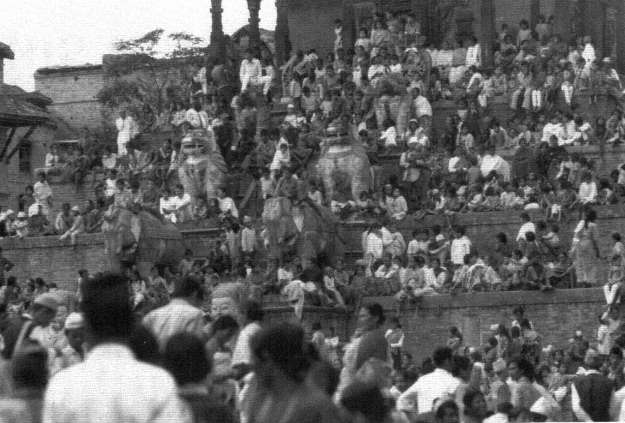
Figure 34.
Spectators seated on the steps of the Natapwa(n)la temple in Ta:marhi Square to watch the struggle to pull the
Bhairava chariot.
is, sometimes, as is the case pervasively throughout city symbolism, put in contrast with an "external" and oppositional social actor, the untouchable. The potential drama of the interplay and conflicts of macro-statuses is deflected and played out elsewhere—not in the symbolic enactments of the annual events, whose surfaces and middle depths, at least, speak of other dramas.6
It has been said of some of the festivals of the Hellenic pagan cities of the second and third centuries A.D. that they "showed off the city in its social hierarchy: people processed in a specified order of social rank, the magistrates, priests and councillors and even the city's athletic victors, if any" (Fox 1986, 80). Those festivals seem to have not only represented the city's statuses but also celebrated the particular citizens who temporarily captured roles in the hierarchy. The particular individuals who occupy the roles in Bhaktapur's largely ascribed—not achieved—status system do not need to be supported by such public advertisement. If Bhaktapur's social system is represented only in its unity, the individuals who happen to hold these statuses are completely dissolved in the immemorial roles they play in the annual festivals.
In summary, most (some 63%) of Bhaktapur's annual events are in the city's public space, with the calendrically coordinated household festivals following in quantity (25%). Almost, but not quite, all of the annual events have direct reference to deities, the annual calendar being largely a "religious calendar." The dangerous deities only appear when the primary or only locus of the event is in public space, but they are then dominant. And, in contrast to the minutely detailed dramatic interactions of various city spaces, of spatially located social units, of deities and times, the macrosocial system is portrayed only as a unified presence in the dramas of the yearly calendar.
A Note on Moving Deities Within the City
When the city's spaces and what they represent are tied together or contrasted in a serial, interactive manner rather than in a parallel summative way, the characteristic device used is the jatra . The deity is either moved systematically so that masses of people may be brought into contact with it, or else—less commonly—masses of people move systematically to encounter a deity or a sequential set of deities. These movements, jatra s, follow traditional routes, variously tying together
units of the city and, often, the city as a whole. They explore central points, axes, and boundaries, as people move or as focal deities are carried through space and time. In so doing the procession of people or of the deity is often brought into an encounter with other kinds of dramatic enactments.
By far the most common movement is that of those jatra s that move the deities themselves. Such movements would seem to be a utilization of an unremarkable resource for the enactment of symbols, for putting symbolic forms into effective relations with space and community. Yet, an observation by Walter Burkert suggests that such jatra s are, in fact, problematic in comparative perspective. Burkert writes of ancient Greece that "processions with images of gods—which play a major role in the Ancient Near East—are [in Greece] an exception. . .. Such a moving of the immovable is an uncanny breaking up of order " (1985, 92 [emphasis added]). Bhaktapur's gods leave their temples and their fixed positions, and although they do not wander at will in the course of the annual events, their order is a mobile order. The contrast with Greece suggests that the movement of Bhaktapur's gods—or at least of the jatra images they inhabit—out into the city from their fixed bases in the city are invasions, albeit controlled and not chaotic ones, of what in Greece was becoming a safely secular space.
Patterns in the Year
What happens if we reassemble the three cycles that we separated from each other in previous chapters and attempt to examine the narrative movement of the annual cycle as a whole (see app. 5)?7 We must now look for disjunctions suggesting phases and movements in the year's course, for frontiers indicating some difference in the festivals that precede and follow them. Let us begin by making a cut into the annual cycle after the ending of Mohani in early October. Although the successful rice harvest had been compellingly represented in the themes of Mohani, the actual harvesting continues. The work of Devi has now been given over to the Nine Durgas. Taleju returns to the secret inner recesses of her temple, and there will be no more festivals of the Goddess nor of any other dangerous deity (except for the merchants' Bhisi[n] festival)8 for a span of six lunar months, when the solar festival, Biska: will reintroduce the Dangerous Goddess and her consort Bhairava. Then, beginning with Biska:, will come the six months during which all the public festivals of Devi and her various forms and associates and
those few of the unaccompanied Bhairava will occur, as well as, in fact, the great majority of the year's festivals. The ending of Mohani, the symbolic culmination of the cycle of rice agriculture, then, returns Devi to the city in the form of the wandering Nine Durgas, but marks the end of her public presence in the annual calendrical events for the next six months.
The first annual event after Mohani is the lunar new year sequence, Swanti [77-2]. When considered in its contrast to the year's other events, Swanti begins the lunar calendrical year with a turning in and centering on the household and its members. Swanti's interactive solidarity is internal to the household, with a secondary parallel solidarity relating each household to all Hindu (and with Mha Puja to all Newar) households as well as to the households of Bhaktapur itself. The Swanti sequence uses as the antistructure that serves to define the household, not the city in which the household is embedded, but still another realm beyond the household, that of death personified as Yama, at the threshold of an afterlife determined by an individual's moral and ritual activities. The environing city is irrelevant to this opposition and to the resulting dialogue between household and Yama. The lunar New Year thus constitutes still another sort of annual frontier, beginning the voyage through the year that follows it with the positioning of individuals in the basic moral cell of the city, the household.
Swanti is followed first by a pilgrimage and mela at a Visnu* shrine out of the city [3] and then—nine days after the end of Swanti, and ten days after the New Year's Day itself—by Hari Bodhini [4], the day of Visnu's* awakening from his four month's cosmic sleep, which is celebrated by still another out of the city mela . Gaborieau (1982 [summarized above in chap. 12]) had proposed the falling off to sleep and awakening of Visnu* as marking off an annual period of four months, dividing off from the rest of the year a special segment, an out of the ordinary time, a period beginning with profound disorder and culminating in regeneration. In Bhaktapur Hari Bodhini in itself does not mark a shift in the year's activities from the extradordinary to the ordinary—Mohani did that. Nor does the day of the onset of Visnu's* sleep, Hari Sayani [42]. Yet, aside from its exact timing and duration, Gaborieau's proposals about the year's phases have some relevance to Bhaktapur and we will return to them.
From the end of Mohani in Kaulathwa through the lunar New Year some two weeks later and then on through the succeeding nine fortnights there are relatively few annual events, all of them, except for the
Suku(n) Bhisi(n) God Jatra, focused on the city's benign moral deities. This changes with Pasa, Ca:re on the fourteenth day of Cillaga (March), when, with an emphasis on protection from evil spirits, the first animal sacrifices since Mohani—again with the exception of those made by merchants to Sukhu(n) Bisi(n) God—are made to Taleju in the Taleju temple and to some Aga(n) Deities, initiating a "period of anxiety" that will last through the remainder of the year until the end of the following Mohani. In this period the festivals of the dangerous deities will take place. Thus Pasa Ca:re is or anticipates still another frontier for the year. That frontier is more clearly signaled in the elaborate public festivals of the Biska: sequence, which comes (depending on the relation of lunar and solar calendars) some twelve days later. Biska:, which comes about six months after the end of Mohani, is the first of the public urban festivals that after the six intervening months center once again around the dangerous deities. Biska:, the solar New Year festival, contrasts sharply with the lunar New Year sequence. While Swanti emphasizes the household and the relations of individuals in the household, and is characterized by a sort of withdrawal from the city into the household, the solar New Year festival—with its themes of urban division and reunification and of the sacred legitimization of the city's space—emphasizes the city itself. In the solar New Year the household is secondary. The deities emphasized in the lunar New Year's sequence are the benign moral gods—Laksmi and quasi-deified family members in the interior of the family and at its exterior and, in fact, continuation, death as Yama, the judge and executor of each individual's morally created and deserved fate. In Biska:, in contrast, the deities are the amoral dangerous one. In contrast to Swanti, what is contrasted with the household and given primacy in Biska: is the larger nested set of urban units that surround the household and enable its survival as an element in Bhaktapur's society. Thus, Biska: begins a six-month phase of the year when the ordering of the household's sustaining "lateral" environment,9 the public city and its environment is explored. This exploration has, in turn, two phases.
In the weeks following Biska: there are a few heterogeneous events of varying importance—worship of mothers in the household, jatra s of forms of Devi, and one especially auspicious day. Three fortnights after the end of Biska: comes Sithi Nakha [36], the first event with a reference to the annual rains and the rice growing cycle. Sithi Nakha is preparatory; it will be the second event in the Devi cycle, Bhagasti [40] in June, which marks the beginning of rice planting, and which is another im-
portant transition in the year. The annual festivals of dangerous deities had begun again with Biska:. Now on Bhagasti, Devi's agents in the city, the Nine Durgas who had begun their cycle nine months earlier with the last of the Devi festivals, the focal Mohani, disappear—in some versions go into the ground—for seven fortnights.10 With the disappearance of the Nine Durgas there is a shift of concern among the important "anxious festivals" of the period from the internal dangers to the integration of the city to the external environing dangers so clearly represented in the successes and failures of the monsoon rains and the rice cycle. These concerns with the city's external and supporting realms will endure for three-and-a-half months, during a period of an increasing density of annual events, until the end of Mohani. Bhagasti is followed by a five-week period of licensed obscenity, culminating in Gatha Muga: Ca:re [45]. During this period there is a minor jatra of an avatar of Visnu's* and then Hari Sayani [42], the beginning of Visnu's* four-month cosmic sleep. Like his awakening on Hari Bodhini, this is not in itself a transitional event in the annual cycle. Hari Sayani is followed by a minor event, Tulasi Piye [43], related to Visnu* (which gives an omen about the length of a worshiper's life), a minor household puja (Guru Puja [44]), and then by Gatha Muga: Ca:re [45], marking the ideal completion of the transplanting of rice to the flooded paddy fields.
Gatha Muga: Ca:re is followed by a fortnight with only one event. That one, Naga Pa(n)cami [41], is intended for the protection of houses and households from dangerous nagas . Then the next four lunar fortnights become filled with events; they contain thirty-one of the year's seventy-nine festivals and thus constitute the most concentrated festival span of the year. This period contains a mixture of types of events—public and household, devoted to both benign and dangerous deities. However, within this diverse group there are two major events. First comes Saparu, with its active support of the progression of the spirits of the recently dead into King Yama's realm and its accompanying "anti-structural" carnival. Second is the focal structural Mohani, culminating the year, celebrating and miming the power of Devi in Bhaktapur's supporting world, and drawing her into the city's center of royal power.
The festival cycle as a whole does, then, seem to have some overall patterning. One of its most striking aspects is the division of the year so that in the six months from Mohani until some twelve days before Biska: there are relatively few events (twenty of the year's seventy-nine). These are with one exception—the generally anomalous Sukhu(n) Bhi-
si(n) God Jatra [8]—devoted only to benign deities and lack the anxious themes of many of the annual events that will follow. Then, after an anticipation in events with reference to dangerous spirits and protection of the body (Pasa Ca:re [18] and Cika[n] Buyegu [19]), Biska: introduces the long season of the festivals of the dangerous deities, of the Devi cycle, and of events with primary and central references to protection and to death. Aside from the festivals of the Devi cycle, there are some fifteen additonal such events during this period. Mixed in with these events exclusively characterizing these six months are thirteen "ordinary" festivals, primarily minor ones "in honor of the gods" of the sort found throughout the other half of the year.
Within the span of six anxious months between Biska: and Mohani, the death and disappearance of the Nine Durgas during Bhagasti some two months after Biska: marks a shift in the emphasis on the dangerous deities, primarily Devi, from their roles as the representatives and protectors of urban spatial units (epitomized in Biska:) to their use in the representation of—and the mediation with—the noncivic encircling en-viroment. In this perspective there is a movement from household in Swanti to the public city in Biska:, and then to the city's vital environment after Biska:, this final shift having its resolution in Mohani.
To return finally to Gaborieau's specific suggestions about the structure of the Indo-Nepalese festival year (see chap. 12), the shifts within the six-month Biska:-Mohani, period, starting with Bhagasti and ending with the end of Mohani, three-and-a-half months later, correspond roughly, that is, within a few weeks, to the period of Visnu's* cosmic sleep. Visnu's* sleep and awakening do not in themselves delineate any shift, however, nor is the period of that sleep (Caturmasa) of the same significance in Bhaktapur as an "inauspicious period" as it is, reportedly, elsewhere. The span from Bhagasti to Mohani can, nevertheless, certainly be characterized (as Gaborieau does for the period of Visnu's* sleep) as a time when "the earth is left to the demons." In addition (further paralleling Gaborieau), there are major festivals of "reversal" early in the period (the five weeks between Bhagasti [40] and Gatha Muga: Ca:re [45], Gatha Muga: Ca:re itself, and the carnival phase of Saparu [48]) and a major festival of "regeneration" (Mohani itself) toward its end. The span does not divide neatly into a "reversal" half and a "regenerative" half, however, being full of a miscellaneous variety of festivals. It is really only certain events that are clearly (the first ones) reversals and (the last) regenerative. What Bhaktapur seems to show, in
contrast to Gaborieau's proposal of an Indo-Nepalese "normal" period of eight months followed by an "out of time" period of four, is an addition to the "normal" festival cycle that had held undisturbed for the prior six months of something more in the remaining six, an addition first of the urban ordering festivals of the dangerous deities, and then of a span that is "out of time" in the sense that attention turns to the exterior of the city, and its actors and its order. The last move seems prodded by the obsessions of the rice growing cycle and to be related to that cycle, as much as to the kind of abstract structural considerations argued by Gaborieau.
External Influences on the Annual Cycle
There are many possible external cyclical features beside the rice agricultural cycle that might have influenced the content and forms of the year's various annual events. These are the various aspects of the yearly solar cycle, the monthly lunar cycle with its phases of the moon and its bright and dark fortnights, and the various yearly patterns of weather and agriculture. The annual solar cycle, with its solar year, its seasons, its equinoxes and solstices, its "ascending" and "descending" halves, is almost unreflected in Bhaktapur's annual calendar. The great exception is Biska:, the focal solar New Year sequence centering on the vernal equinox.11 In Biska:'s symbolism, as we have discussed, the possible references to the sun's behavior and to the solar year are minimal or equivocal.12 There is only one other annual festival in the solar cycle—Ghya: Caku Sa(n)lhu [10]. It comes at a time which once elsewhere in South Asia traditionally marked the winter solstice and the beginning of the ascending half of the year, but such connections are entirely lost in the events of the day. Aside from a reference to "spring music" in anticipation of a spring still several weeks away in the course of the lunar event Sri Pa(n)cami [13] there are no other annual events which respond to, symbolize or express the solar year.
The lunar cycle provides, of course, the basic month and the basic structure of Bhaktapur's calendar. For the most part the days of the lunar month simply provide a counting device with no further meaning. Within each month the phases of the moon provide additional materials for possible symbolic elaboration. The full moon and the new moon (to a much lesser degree) are occasions for differentiated events as well as
regular monthly ones. Yet, once again these differentiated events seem to have no salient present symbolic reference to the light or the dark of the fortnight's culminating phase of the moon.
The phases of the moon allow, however, for a further differentiation of each month into waxing (or bright) and waning (or dark) fortnights. There is a marked difference in the quantity of events in the two kinds of fortnights. Thwa , the waxing fortnights, have throughout the year twice as many annual events as ga , the waning fortnights. The waning fortnights all contain a special day, the fourteenth or ca:re dedicated to Devi. This and the difference in quantities of events would suggest the possibility of some contrast of ordinary versus dangerous, or auspicious versus inauspicious between the two types of fortnights. Ancient Hindu South Asia was explicit regarding differences in the two half-months (paksa* ). . "The general rule is that the sukla paksa* [bright half] is recommended for rites in honor of gods and rites for prosperity; while the dark half is recommended for rites for deceased ancestors and for magic rites meant for a malevolent purpose" (Kane 1968-1977, vol. 5, p. 335). Bhaktapur's festivals do not sort neatly in such a way. There are festivals of the benign deities, of the dangerous deities and twa:s , and melas in both. Worship of living mothers and fathers is in the dark half, the Biska: sequence spans light and dark fortnights, and so does the Swanti sequence. Yet, the major festivals with reference to death, to the loss of order, and to "antistructure" are, in fact, found in dark fortnights, where they represent a large segment of those fortnights' relatively few events. These include Bala Ca:re [7], Sila Ca:re [15], Pasa Ca:re [18], Bhagasti [4], Gatha Muga: Ca:re [45], Saparu [52], Smasana* Bhailadya: Jatra [64], Pulu Kisi Haigu [65], Dhala(n) Sala(n) [66], Kwa Puja [77], and Kica Puja [78]. The events with reference to death in the bright fortnights are either secondary to the celebration of the household (as on the fifth day of Swanti),13 or very minor (as in Yama: Dya: Thaigu [59] and Yau Dya: Punhi [62]).
The patterning of festival events by light and dark fortnights is not discursively salient. That is, although this patterning presumably gives a sense of meaningful order to the year, can be recognized by people when pointed out, and is probably known to some scholarly citizens, it must be pried out for the most part by an inspection of the distribution of annual events. The rice agricultural cycle and its enabling conditions, in contrast, is a salient and overt influence on the annual cycle. It not
only influences the distribution and sequence of various events (as the bright and dark fortnights do) but also enters into the content, stories, and symbolism of those events in direct and obvious way. Images of fertility and generation, of cyclical appearance and disappearance, of protection and destruction in an equivocal balance, and of capricious vital forces just beyond the urban order and just beyond the social selves of its citizens—all this expresses, responds to, and builds on the implications of the rice and monsoon cycle and their phases.
The annual rice agricultural cycle has reflections elsewhere in the calendar beside in the Devi cycle itself. One event, Ya: Marhi Punhi [9], comes when the annual consumption of the newly gathered rice harvest is about to begin. The benign goddess Laksmi is asked on this day to ensure that the rice consumed by the household will eventually be replaced. With the successful gathering in of the harvest, the emphasis has moved from the dangerous goddess of fertility to the benign goddess of the household stores. A major reflection of the agricultural cycle is in the shift that we have discussed at length in the kinds of events that occur in the segment of the year between the beginning of the rains at Bhagasti [40] and the symbolic end of the harvest at Mohani. The concentration of all kinds of events during this period in a sort of crescendo of symbolic effort and the large number of events related to death and antistructure are congruent with the problematic nature of this period of the year.
A View of the Annual Events With the Citizen at Their Center
The symbolic forms, events, sequences, narratives, and structures of narratives of the year's cycle comprise a substantial library of South Asian forms and ideas transformed and modulated so as to place Bhaktapur at their center. Yet, the yearly events from their humblest members to their most developed sequences of interrelated events speak to each of Bhaktapur's people not only of the universe as refracted and centered in Bhaktapur but also of the auditor-actor himself or herself in an attempt, so to speak, to deal with their eccentricity. The annual events, along with the city's other symbolic enactments, speak of being a "person" in Bhaktapur, a socially defined and placed and judged to be competent individual, a proper citizen. The annual cycle talks to the person of his or her relation to the household and its contained family,
to the extended family, to the city and its significant components, to a moral world beyond the city, and to still another world, an amoral or meta-moral world, beyond that.
The household within its arena, the physical house, is represented in the contrasting perspectives of the mass of annual events as the place of affectionate solidarity. Relations with supportive, affectionate women (mothers, sisters, wives)—absent from the symbolism of the public city—are emphasized. Other primary household festivals are occasions for worshiping mothers and fathers and the benign deities, loci of human ideals, affection, and identifications—Laksmi as guardian of the storeroom, Siva and his benign consort, Ganesa* , Visnu* , the Rsis* . In the movement of women among households, the household and its persons are related to a particular larger network of households, those of the "mother's brothers," of the women's tha: che(n) s, their "own homes." This network, as we have discussed in chapter 6, is a nexus of warm personal support when seen in contrast to the austere patriarchal network, the phuki , which must ensure proper lineage, thar , and civic behavior. When the household in this thematic mode of affectionate relationship spills beyond its boundaries, it is primarily into the neighborhood, the twa :, with its neighborhood Ganesa* shrine, which acts as a kind of fringe of family-like relationships around the household.
The household person lives in a sort of tube within the walls of the household, a tube that is open at both ends into time. One is born into the household from some previous incarnation—a vague idea that is not represented in the festivals. One will finally leave it to move on, keeping much of one's household self, into Yama's realm and to a pleasant rebirth or social heaven beyond. Death—ordinary death14 within the household—is the threshold within this open-ended tube of personhood to a next moral stage, the stage where the person's morally earned soterial rewards or punishments will affect the conditions of his or her new life. Annual events comment on this threshold. They explore ways of holding on to household existence for as long as possible in the face of a humanized god of death, Yama, who honors his promises and whose messengers can be distracted and deceived. Household events also ensure the remembrance of the household's personal dead (not the distant unknown patrilineal "fathers" of the rites of passage) and, in conjunction with the public Saparu festival, ease their passage into Yama's realm. Thus the annual household events represent the career of the individual in his or her intimate personhood through a span of time encompassing both sides of death.
The household is a place of familiar refuge at the center of the systematic displacements an individual experiences in the course of the annual cycle. It is the here and now position within the "tube" of person-hood extending from distant past into the postmortem future. The annual events also explore the limits and the phases of the person in another direction, "laterally," through the walls of ordinary household personhood. They probe downward into the person's body, outward into the city, and beyond. The lunar new year begins on Mha Puja [1] with the worship of the "mha "—a word indicating both body and self—of each individual. In the course of its worship the mha 's elements, the mahabhuta , "of which the body is supposed to he composed and into which it is dissolved" (chap. 13), are represented. The body is given a meat-containing offering, and thus treated as if it were a meat-eating dangerous deity. This offering is not to the benign "indwelling god," usually thought of as Visnu* , who is or who inhabits an individual's soul, a soul habited somewhere in the body. This offering is to a deified something else, the supporting matrix that houses the soul, a matrix that exists everywhere beyond the bounds of the person and the household, and which represents everywhere in Bhaktapur's symbolism the threatening and sustaining amoral forces at the boundaries of the moral world.
Another move away from the household and household personhood, that from household to phuki , is little represented in annual festivals, although it is an aspect of all rites of passage and of all Tantric worship of upper-status lineage deities. There is a radical shift when an individual moves from household to phuki , as there is when he or she moves from the self to its bodily support. The move is from the affectionate moral order of household relations supported and represented by the benign deities to an order whose more burdensome morality is sternly enforced by means of the fear-inducing meanings, emotions, and practices associated with the dangerous deities and their sacrificial religion. Phuki worship makes use of symbolic resources similar to those used in urban festival integration, but in the annual cycle it is not represented so much as a nested unit of the city but as a kind of parallel to it. The locus of its main annual ceremony is not the Aga(n) House within the city, but the Digu God shrine beyond the city's boundaries. The phuki and the city are both in their own, different, ways at the perimeter of the household and share the same kinds of order-ensuring forces. It is in the rites of passage that the phuki 's force over the household is centrally emphasized, and in those rites the phuki 's relation to the orga-
nization of the larger city is also not particularly emphasized, but only sketched in movements to the mandalic* pithas .
Outside of the household people are reminded that the family-based moral order, the order of love and respect and of the forms of valid shame and guilt based on intimate family experience, is shared throughout the city where it is written large in support of king, Brahman and the social hierarchy as members of a great family. The festivals of the benign deities—primarily in the jatra processions along the main city festival route, the pradaksinapatha* , and secondarily in visit to temples of benign deities—display and honor these moral values. In this group of civic enactments the ordinary person of the houehold extends his or her imagery of the household to the larger city.
But this extension of household imagery is a minor move in Bhaktapur's festivals. For the most part the festivals in public space deal with something else, paralleling the shift in the move from household to phuki . The festivals which use dangerous deities to designate civic areas and their relations make use of forces and images different from those used by the household and its extensions. Here imagery and implications played down or hidden in the annual cycle's imagery of household and household person are brought forth, elaborated, shaped, distorted, and given a social placement in the representation of the fertile, dangerous, and enforcing borderlands of social order and personhood.
When people move still further out of the household, beyond the borders of the city, they encounter a new realm of a quite different kind. There are eight events ([3], [4], [7], [15], [33], [39], [46], and [51]) during the annual cycle where a shrine far outside of the city (as opposed to just outside of its borders) is the focus, sometimes for all who choose to go, or (in three cases) for those who have had a death in their family within some designated period of time. Women also may make pilgrimages to valley shrines during the period of the Swathani Vrata. The principal deities of these pilgrimage sites are, with one only apparent exception,15 once again benign deities. These out-of-the-city events bring people from Bhaktapur into crowds of Nepalis and, sometimes, North Indians from many different ethnic groups. They are movements out of Bhaktapur's particular order into a larger, less differentiated humanity. In these far out-of-the-city activities, Bhaktapur is represented negatively, as it were, in leaving it. What is found "out there" is a larger community of fully human beings—albeit on vacation from various kinds of local social orders—in a context of references to
moral orders beyond Bhaktapur's civic order, the cosmic realms of Visnu* and Siva, their heavenly cities and the realms of the remembered and beloved dead. Similar in meaning to the melas , and associated, as several of the annual melts are, with the fate of the souls of Bhaktapur's recent dead, is the Saparu carnival.
Melas and carnival are thoroughly within the moral realm. Here, in a familiar anthropological phrasing (Victor Turner 1969), there is a movement toward a generalized human "communitas " that is substituted for local division and categories of social ordering. In Bhaktapur's example of carnival , a characteristic universal genre for an escape from ordinary civic order, the carnival associated with Saparu [48], some privileged men playfully divest themselves of their roles and take on other familiar roles. Presumably in the process of shedding one role and pretending another—including some nonhuman ones—they enjoy for a few hours the brotherly excitement of shared being and omnipotentiality rather than the restrained pleasures of the security of social order. However, this escape from structure in Bhaktapur remains for the most part carefully within the bounds of the deeper categories of social order. Men switch roles, but do not reject the reality of role itself, nor, for the most part, of familiar culturally designated roles. Even in the farthest reaches of communitas the social category of "humanity" and its varieties is still kept. As Turner (1969, 131f.) puts it, suggesting the horizon of communitas , but going far beyond what Bhaktapur's melas , carnival, and other annual moral antistructural moves achieve:
Essentially, communitas is a relationship between concrete, historical, idiosyncratic individuals. These individuals are not segmentalized into roles and statuses but confront one another rather in the manner of Martin Buber's "I and Thou." Along with this direct, immediate, and total confrontation of human identities, there tends to go a model of society as a homogeneous, unstructured communitas, whose boundaries are ideally conterminous with those of the human species.
Some of the pleasures of the Saparu carnival are quite different from the escape from society into an unsegmented pan-human I-Thouness. There is also a darker possibility seen in some few of its images—those of demons and powerful beasts—of a more radical escape, this time from human identity itself. "Communitas " versus "social-structural order" is a tension, as the quotation from Turner points out, within "the social," a tension between "models of society," of aspects of "human identities." The tension here is between two moral orders , a "social-structural" one and a "communal" one. This particular dichot-
omy of "structural" and "antistructural" within the human realm is contained and represented in Bhaktapur in the terms of individuals' relations to the moral deities and to morally ordered death. In myth its prototypical mediating figure is Siva, who is a marginal moral actor within the realm of the gods and who is easily duped into giving morally unmerited rewards, familiar from many traditional stories, rewards that are misused by the unworthy recipients. Thus, during Sila Ca:re [15] people mimic a legendary "accident" in which a preoccupied Siva was deceived into taking someone directly and totally undeservedly into his heaven. Playing with chance and luck in festival gambling [Swanti] and the use of deceits and manipulations that distract and delay Yama's death-announcing messengers during the same sequence are examples of other human practices rehearsed in the course of the annual cycle that allow people to get around the heavy moral pressures of Bhaktapur's structured world.
Turner's 1969 treatment of structure and antistructure has a second antistructural option besides communitas , the Hobbesian "war of all against all" (1969, 131). Bhaktapur's festivals and symbolic resources also explore another kind of opposition to "structure" than communitas , bringing a subsidiary theme of carnival—its demons and beasts—to the fore. This opposition places yet another world in opposition to the realm shared by both communitas and social structure; it opposes a meta-moral or amoral world to a moral one. This is the nonsocial world around the city and within the individual, a realm in which communitas is irrelevant as the very categories of community and human are themselves dissolved. For Bhaktapur, however, this realm is not Hobbes's antisocial world. Life for humans within Bhaktapur's amoral realms might indeed have been conceived as "solitary, poor, nasty, brutish, and short"—or even worse, for the predatory dangers portrayed in Bhaktapur's civic environs are perhaps more ingeniously terrrible even than Hobbes's "nature." But Bhaktapur's antisocial realm is not the near chaos Hobbes feared if the then recently achieved balance between newly individualized citizens freed from a restraining medieval world view and the equally new nation-states were to be disturbed. The realm of the amoral in Bhaktapur—neither social-structural nor communitas —is extensively represented and encountered as consisting of underlying and environing forms and forces that have their own kind of mysterious, vital, often demonic order out of which the moral order draws its energies, whose forces the moral order depends on and uses to protect itself, against which it provides its own peculiar kind of order. This
balancing and restorative tension is clearly represented in the stories of the Devi Mahatmya and the festivals of the Devi cycle. The internal tension and oscillations between the benign (moral) and dangerous (amoral) deities is at the service of a larger order, which in its moments of exact balance is congenial to gods and humans, if not to that larger order's enemies, the Asuras. When the moral order and its context are in proper balance, as they become periodically as the result of Devi's bloody victories against the Asuras, then, as the Devi Mahatmya puts it, "favorable winds began to blow; the sun shone with perfect brilliance, the sacred fire burnt in a tranquil manner; and the strange sounds that had filled the quarters of space also disappeared" (X, 27; Agrawala 1963, 127). As represented in the imagery of the annual cycle, Bhaktapur's moral world and amoral worlds together assure, ultimately, a higher ordering. The "Asuras" are vague notations for still another, more radical, antiorder set against this balanced system, notations for some Nibelungian revolution that would plunge both gods and humans into chaos for the alien purposes of some other class of beings. And even this is only chaos from the limited point of view of gods and men.16
The annual cycle of events systematically defines certain aspects of their city and their personhood to individuals, but it does not celebrate a unified "individuality."17 In their relation to individuals, the different kinds of events in the cycle have to do with the different aspects of the person that are realized in the various arenas that are the concern of the annual cycle. The individual is portrayed as a dynamic and delicate interface, as constructed of constituent elements that can dissolve into something else, as shifting according to (and thus as being dependent on) his or her relation to different civic arenas, as located in, generated out of, and defended against the environing amoral worlds found outside of the various urban units and, in their internal relation to an individual's body and mind, beyond the inner boundaries of the individual's self.
In the course of the annual cycle individuals rehearse their membership in most of the nested units that define their complex citizenship in Bhaktapur—the cities beyond, the city itself, the city half, the mandalic* section, the twa :,18 the phuki and the household family. For the most part they do this directly, not via representatives. The use of representative actors to indicate the hierarchy is exceptional. In the course of the annual cycle Bhaktapur moves each of its citizens into each of the
arenas that are the essential units and varieties of their social experience and of phases of their selves. Positioned successively in each arena, citizens find the appropriate forms of the city's symbolic world rotating around them, engaging them in contemplation and action.
Bhaktapur's other symbolic enactments, driven by other tempos than the annual cycle, have other centers than the city itself, and from the points of view of their participants are local and private affairs. They concern the cellular components of the city that the larger public order of the city presupposes and with which it must deal, components whose outputs are necessary for the order of the larger city.19 It is the annual cycle that describes and, in part, makes the integrated civic order of city and citizen in which these smaller symbolic enactments find their place.
Chapter Seventeen
What Is Bhaktapur that a Newar May Know It?1
Theseus. And as imagination bodies forth The forms of things unknown, the poet's pen Turns them to shapes, and gives to aery nothing A local habitation and a name.
—Shakespeare, A Midsummer Night's Dream
Structures of the Imagination
We have been most centrally concerned in this book with one particular aspect of Bhaktapur's communal life, its poetic imagination, and we have emphasized, for the most part, only one of the subjects of that imagination, the city itself. Bhaktapur's imagination has worked over a span of several centuries, making use of the opportunities and constraints of its history and its context in the building of a world. As its citizens, at the same time poets and audience, strove to build a coherent civic world out of the opportunities provided by history, tradition, and accident, they became progressively enveloped in and shaped by what they were building.
Shakespeare's Theseus discovered a midsummer night's dream that he found "more strange than true," in contrast with the unstrange truths of Athens. Yet, as Puck reminds us at the end, Theseus, his dream and his truth, all is our dream. We have been concerned for the most part with Bhaktapur's dream within a dream—those particular aspects of Bhaktapur's order that were "marked," that is, precisely, made strange to Bhaktapurians, although as Hindus and not Athenians Bhaktapurians find them to be members of an order that is both strange and , in some sense, true. That order, the "religious realm," which is where most of Bhaktapur's marked symbols are situated, is there generally sharply distinguished from the "ordinary," the unstrange. As we characterized the marked realm (for the sake of considering its margins in
chap. 11) its "proper spaces are the temple or shrine, the purified, bounded and isolated puja areas in houses, the ideal spaces of the city carved out through the positions and festival movements of the deities; its expert workers are the priests; its time is the calendrically determined eternally recurring times of festival or that of rites of passage or of crisis-generated or prophylactic ad hoc worship; its proper action is in ritual and the traditionally specified actions of the festivals."
Bhaktapur's referral of most of its marked symbolic forms and enactments—myth, legend, drama, literature, poetry, and music—to the realm of the gods is one of the city's most striking features to a secularized Westerner. It is the city's way of making all these forms both strange and true, and thus giving them great seriousness and force. Not as is sometimes said of religious matters, "ultimate" seriousness and force, for there is in some of Bhaktapur's thought, particularly in the implications of its Tantrism, something else more profound beyond the realm and reality of the city's gods. But it is that system of deities that puts Bhaktapur at the center of a cosmos and that provides the characteristic emblems of the realm of strange symbols.
Alongside the strange world of marked symbols Bhaktapur has also constructed, as all communities do—sometimes yielding to, sometimes molding, sometimes denying recalcitrant "physical facts"—a world of self-serving common sense, a world meaningful in its "embedded symbolism." This world, illustrated in this book in our discussions of the city's larger and smaller social orders and by the ideas, feelings, and actions of the "purity complex," is the kind of order that Theseus confidently set as truth against dream. The strange and the ordinary are united in Bhaktapur's urban mesocosm in a common world mediating between the microcosm of each of its citizens and the macrocosm.2
We have been occupied throughout with details of that mesocosm. We wish now, in summary, to consider some of the most general aspects of Bhaktapur's order, the arrangements that give some overall coherence and characteristic style to Bhaktapur's multilayered and segmented world. We will make a working distinction between two interrelated issues. First we will consider some very general aspects of the city's symbolic forms that contribute to the particular meaningfulness , the particular coherence, of Bhaktapur's life. Then we will consider some of the arrangements of symbolic forms that serve to make, under Bhaktapur's special circumstances, potentially meaningful forms intelligible , and thus, ultimately, significant . Both are aspects of our orienting question, "What is Bhaktapur that a Newar may know it?"
"Meaningfulness" and "intelligibility" are really proposals toward an explanation for why, once many other features are in place, Bhaktapur is the way it is. We will in the final section of this chapter make some further probes at distinguishing the necessary from the contingent in Bhaktapur's order in a search for that city's typological and explainable features.
Spheres, Structures, and Oppositions
If it seems unproblematic to characterize Bhaktapur's strange order as mostly "religious," the symmetrical characterization of its ordinary, everyday order as "secular" is problematic. Louis Dumont approached this asymmetry by characterizing for Hindu societies one particular component of our strange order as a religious sphere within a larger religious universe , a universe that also encompasses a "secular" sphere.
Dumont was specifically trying to distinguish the functions of the king and the Brahman. He thus proposed (1970, 68) that Hindu religious universes were characterized by a royal, secular, political sphere of the king, a sphere characterized by power or force, opposed to a religious sphere of the Brahman, a realm of "values and norms." We argued in chapter 10 that this particular phrasing was problematic and even misleading for Bhaktapur.
We have in the course of this book encountered many contrasting terms, emphasizing some and touching on others. Among them are dangerous deities and benign deities; Tantric religion and ordinary religion; "secular" and "religious"; conventional and ritual; king (and court, merchants, farmers, craftsmen) and Brahman (and other kinds of priests, and polluting thars ); worldly power and other-worldly force; unclean (epitomized by the Po[n]) and clean (epitomized by the Brahman); orders where purity is irrelevant and orders where purity is central; amoral realms and moral realms; the bordering outside of the city (and of each of its component units) and the inside of the city (and of each of its component units); life stages for males prior to the Kaeta Puja ceremony and subsequent life stages. Among these heterogeneous oppositions, for any particular contrast the right hand term is that of the ordinary dharma and/or of one of the functions of the Rajopadhyaya Brahman as highlighted by the contrast. The collection of contrasts and oppositions to "Brahman" are not as a whole unified, at least not in their surface characteristics. Taken together, however, they help anatomize Bhaktapur's larger traditional ordering of meaning.
That order is more complex than a secular royalty versus a sphere of Brahmanical religiosity expressing the dharmic world of values and norms. Let us review some of the aspects of that order which are in some ways peculiar to Bhaktapur and South Asian places that are or were like it.
1. As we have noted in chapters 8 and 9, in many Hindu communities in South Asia the religion of the dangerous deities is thought by the upper-status Hindus in those communities (and by many modern Indians) as an inferior, illegitimate, superstitious folk religion, alien to true Hinduism and its Aryan roots. The legitimate religion of such communities is held by these elites to be the moral Brahmanical religion concerned with benign deities, representatives of an ideal patriarchal social order. In Bhaktapur, in contrast, the dangerous deities are fully legitimate, and not only legitimate but at the focus of aristocratic and royal Tantrism. Bhaktapur thus has two equally legitimate religious spheres within its religious universe, a religion of moral order (ordinary Brahmanical religion) and a religion of power (the cult of the dangerous deities both as Tantrism and as the practices of noninitiates). The religion of power variously supports, evades, and transcends the moral order.
We have repeatdly characterized the dangerous deities and their religion as representing the environing forces that both threaten and sustain the moral religion of the city. So viewed, the dangerous deities are at a systematically "higher" level than the benign ones in the sense that they provide the context for the moral religion, respond to problems that the moral system cannot deal with, and in so doing protect the moral realm. The polytheistic separation and discrimination of deities makes such a two-tiered representation possible, this being one aspect of the complex ordering of the city's pantheon into a fundamentally useful system of signs (chap. 8).3
2. Bhaktapur's splitting of religious spheres within the religious universe makes untenable a simple opposition of a religious sphere concerned with values and a secular, political sphere, that of the king, concerned with power. For there is a special religious precinct concerned with power and those who use it within the "secular" sphere. That secular power in Bhaktapur's world view includes much more than the political power of the king and ksatriya* ; it includes all direct operations
on the world that are not fully produced by the assent to the system of dharmic values. The religion of power is the proper religion of kings, ksatriyas* , merchants, farmers, and craftsmen—not as individuals who must follow the dharma , must worry about rebirths, and whose priest, serving them as generalized individuals is the Brahman as purohita —but in their particular functions as specialists in the "direct" manipulation of the world, through what Dumont calls "force" and places in opposition to the ordering of "values and norms."
3. The use of force in this sense thus characterizes not only the king's activities but also the activities of a large segment of the city's hierarchy cutting through from its top almost to its bottom. This vertical segment of Bhaktapur's social system is defined against a large group of what we have called (in chap. 10) "priests," "auxiliary priests," and "covert priests," who are united most saliently as manipulators of purity. The manipulation of purity characterizes this latter segment of Bhaktapur's organization, as the manipulation of force characterizes the former.
Tantric priests and Brahmans in their particular functions as Tantric priests (and, for different reasons, the Josi astrologers) do not belong with the group of purity manipulators and thus to the religion of "values and norms," but to the sphere of the manipulators of power. They deal with power in the universe through attempts at understanding, alliance, avoidance, and forceful coercion in close metaphorical alliance with the city's other technicians of power.
It is the Brahman as Brahman and the various sorts of purity manipulators who derive from him and support him who deal with that segment of Bhaktapur's life which is constituted through definitions of what persons and systems of persons are and should be. They manipulate that particular system of symbols that is effective because it shapes and helps constitute the arena of definition and value. They are primarily technicians of those symbolic forms that constitute actors and community in Bhaktapur.
The contrasting segment of Bhaktapur also makes use of symbols to represent and support their functions. But their primary functions, no matter how important their symbolic component, work directly on the world in a different way—through direct manipulation of materials and physical forces and of those psychological forces that make political threats and promises effective. They are thus allied with the priests of Tantrism who in local conception use power and who, viewed from
outside the phrasings of Hinduism, make use of mental forces beyond the self and the social person constituted with the aid of the religion of the benign gods to serve, sustain, control, or dissolve that person.
4. The symbolic forms and enactments of both the religion of power and the religion of norms and values are within the realm of the extraordinary. The roots of each in the ordinary are different. The moral religion augments, resonates with, and puts to social use images of ideal and tolerable social behavior; the religion of the dangerous deities augments, resonates with, and transforms for social purposes forms that are suppressed in ordinary awareness, that are unnamed and unspoken in ordinary discourse with others and within the self, that are relegated to and express the non-social aspects of the mind, alien to the person and to the proper logic and categories of everyday life.
This suppressed realm is represented with suitable transformations within the realm of dangerous religion, where its forces are tentatively captured for the purposes of social order itself. The original nature and dangers of these forces and their capturing and social transformation into tentatively domesticated forms are vividly portrayed in Bhaktapur's myths and, most concretely, in its legends,4 as well as in the city's symbolic enactments.
Legends bring together dangerous deities and heroic figures in a realm of the marvelous. They suggest that even the secularized sphere of power has, in fact, a certain uncanny quality, for it represents—as does the associated order of the dangerous deities—a violation and transcendence of the central dharmic moral order. Techniques of power, political force, magic, Tantra, wish and dream, dangerous deities, and demonic forces all inhabit—from the viewpoint of the morally organized city life—one metaphorically unified sphere. That sphere is not exactly what the modern world wishes to mean by the secular.
Yet, in Bhaktapur's world of shifting viewpoints the Brahman's religious sphere, at least as exemplified by the Brahman himself, is not always seen as an unproblematic heightening of the banal and ordinary. From some viewpoints the entanglement in the manipulation of the system of purity and impurity of the Brahman and his allies has something suspect about it, something encumbering and unpleasant, something that is not represented in contrast but, rather, directly by the state of the untouchable. The sphere of the Brahman's operations has in such perspectives, where the "secular" is privileged, a displacement from the
banal quite different from the displacement, from another viewpoint, of the realm of power.
5. It is not only the "sphere of power" that uses force. The realm of norms and values and its religion has, of course, characteristic "forces" at its disposal. These are the familiar forces that sustain the unity of any moral community—a great miscellaneous variety of agreements on what is real and what is sane, of definitions, identifications, values, goals, concerns for face and reputation and being loved or admired, and the wish to avoid guilt and shame and ostracism.
These forces are internal to the community. They help constitute it and keep it going from moment to moment. They are made, to a considerable degree, to seem ordinary and naturalized forces. This naturalization, generating the force of the taken for granted, is, as we have asserted in chapter 2, much more difficult to achieve in Bhaktapur than in some other simpler communities, and people often become potentially subversive skeptics who must be kept in line by the emergence of the superordinate forces of the marked realm.
6. Bhaktapur places most of its marked symbols in the religious sphere, which is the realm of the gods, a bounded domain of a still larger Hindu religious universe, a great mind in which gods along with all living, sentient things participate, out of which they are generated, whose immutable moral laws they are subject to, and whose ultimate nature they can come to glimpse. Other complex civilizations whose citizens shared the "symbol hunger" (chap. 2) of Bhaktapur's citizens have elaborated realms of marked symbols, but came to place them elsewhere. Thus, in the West, secular drama, literature and art, are marked as extraordinary—by setting, cadence, presentation, and other devices—but have come to represent a class of communication that is in some sense "imaginary," "only symbolic," not to be taken literally. Until its contemporary transformations most of Bhaktapur's extraordinary statements have not called themselves imaginary, but as belonging to another sort of reality, the reality of the gods' divine sphere. In a different bounding than the Western one, both Bhaktapur's everyday reality and the reality of the gods can be seen as imaginary, as maya , when grasped by the highest intuitions of religious awareness. But, for the most part, gods and Bhaktapurians are content to remain in their divine illusions and by putting the imagination of the extra-
ordinary in a religious subsphere to give it and its representations the strongest possible position in the life of the community and its citizen's minds.5
7. The ordinary masquerades as simple reality. Bhaktapur sometimes attempts to make problematic things natural by forcefully anchoring them in the sensually perceived world. The lives of the Po(n)s, in a vivid example, are manipulated so that their connection with real feces and the taking of life and their degraded living conditions become the perceptually based evidence for the reality of the system of pollution and purity and of the effects of bad (and thus, in contrast, good) karma . It is the problematic aspects of karmic and pollution theory, debatable and rethinkable in the terms of the other doctrines and viewpoints common in Bhaktapur, that makes such anchoring in the apparently objective useful.
8. Bhaktapur's sphere of the religious and of the ordinary have boundaries, boundaries of a peculiar permeability (see fig. 35). We have commented on the crossing of boundaries—the movements of the gods in their processions out of their temples into a carefully designated city space, and of the Nine Durgas in their somewhat more chaotic forays into the city's neighborhoods. These moves cross the boundaries of sacred enclosures and allow the usually isolated marked realm to spill, within some limits, over into the ordinary. The closeness to the ordinary of Bhaktapur's religious sphere—in contrast to the self-banishment of the Judeo-Christian-Islamic transcendent deity—as well as the air of autonomy and reality of those deities in their on-the-ground manifestations in comparison with the "imaginary" and "conventional" status of latter-day Western art and literature, give the boundaries between the ordinary and the strange realms a special and problematic permeability and make urgent the problem of defining places for the gods, keeping them in those places if possible, and dealing with them if they leave them. For Hindu deities, at least in Bhaktapur, do not need the force of a Western miracle to enter the secular realm.
9. Not only do symbolic constructions occasionally cross boundaries to invade the realm of the ordinary but, in another direction, the "real" may be thought of as occasionally crossing what in the West is often taken as an inviolable boundary into the symbolic. Westerners, as represented by Freud, expect the "overt" content of a symbol of emo-
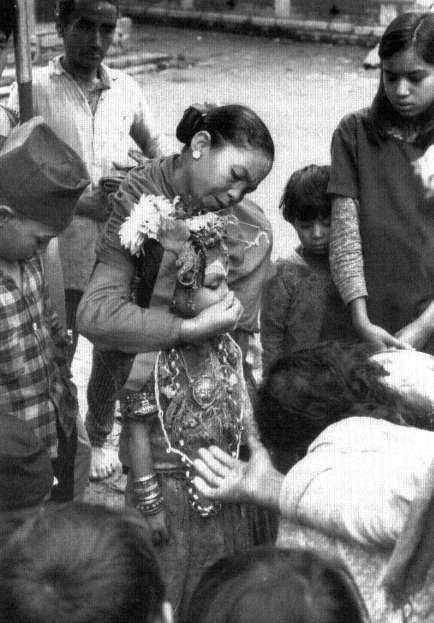
Figure 35.
Problems on the boundary between the ordinary and the extraordi-
nary. The living goddess Kumari has her running nose wiped by her attendant.
tional importance ideally to be a disguised transformation of some powerfully disruptive complex of ideas and emotions that is its latent meaning or reference. A censor holds the two kinds of meaning apart and helps accomplish the bowdlerization of the overt form. If the symbolic form seems to stand for itself, especially if it is as fearsome and unpalatable as the raw unconscious form is thought to be, then Westerners sense a problem, something has collapsed, some reference has disappeared.6 Bhaktapur uses many "symbolic forms" that are directly in themselves powerfully meaningful, representing exactly the sorts of things that are—or were—presumably relegated to Western unconsciousness. In one dramatic example, human sacrifice, Bhaktapur once used the actual murder/sacrifice of its citizens to "represent" murder/ sacrifice. It has had to give up this resource and the actual sexual intercourse of nonspouses in Tantrism, but it still uses direct and powerful images of sexual arousal (e.g., Tantric images of Bhairava with an erect penis, a wild look and a flaming halo [see fig. 17, above]), of sexual intercourse (for example in temple images and in the banging together of the chariots in Biska:), of cannibalistic women, of women who change from images of sexual desire to images of death, of murder and dismemberment of human bodies. It uses these images not so much to represent or symbolize something, as to do something.
Bhaktapur's symbols of this sort do not take their power from their references and latent meanings, they are directly meaningful in themselves. Their disguise is not in a transformation of form—sword or umbrella for penis—so much as in an isolation of such powerful forms from their experiential bases, above all their bases in the life of the family,7 and a new placement in the religious sphere.
10. As we noted in chapter 16, some matters of what might seem to be of great potential interest in Bhaktapur are ignored in the city's symbolic enactments. We have commented in previous chapters on the privileged status of certain solidarities—the family, the phuki , the internal membership of the twa :, and the hierarchically ranked thar s—whose members are not represented as antagonists in the year's many representations of conflict and antagonism. In this light, conflict and antagonism within these essential units is "not thought about" in the annual enactments, and is displaced to safer realms. Intrafamilial conflict is illustrated in some of the pyakha(n) s of Saparu, typically where two men represent a farmer and his wife fighting, and is amply and presumably safely represented in tales about unfaithful and dangerous
wives, wicked stepmothers, and weak kings usually set in a magical, fairy tale mode.8 These relatively permissive realms are more playful, less real, than the religious spheres of the city. They are only stories; in them fantasy may be taken to be just fantasy.
Resources for Making Meaning Intelligible
We have reviewed here, and throughout this volume, some of the arrangements of forms that contribute to the style of Bhaktapur's symbolic organization and make it seem familiar, coherent, engaging, meaningful, and important to many, most probably to most, of its people. Still more is required, however; that organization must be apprehensible. The mass of symbolic forms must be organized so that people can grasp and remember and understand something about them and find their way about in them. We introduced the problem of intelligibility in our discussion (in chap. 8) of the city's pantheon as an organized "system of signs." The pantheon is sorted into classes of supernaturals distinguished by simple oppositions, oppositions that are not arbitrary but are semantically related to the meaning of the class. Those oppositions distinguish the classes with the same sort of didactic efficiency as the opposition of the dangerous and forbidding, fiery and bloody red to the encouraging living green of traffic signals. The contrasts that distinguished the classes are further arranged in the form of a successively branching tree, leading step by step ultimately to the closest and most familiar class of deities, the benign deities. Within each class of supernaturals members are distinguished by family differences based on a complex variety of differentiated features requiring a concrete familiarity with the class, for some classes a specialist's knowledge, in order to distinguish one member from another.
These particular features of the city pantheon can be thought of as attempted solutions to Bhaktapur's considerable problem of the intelligibility of its hypertrophied symbolic world. Let us recall—and comment further on—some of the resources for intelligibility we have emphasized in our discussions of Bhaktapur's complexity, bearing in mind that these prevalent resources have implications in themselves not only for intelligibility but also for meaning.
1. Levels.
We have repeatedly encountered hierarchical arrangements of classes of forms—for example, among thar s, supernaturals,
spaces, systems of behavioral control, and aspects of "the person," into discontinuous, successively more inclusive, "higher" levels. Bhaktapur uses levels extensively for distinguishing and ordering classes (and, often, subgroupings within classes) of phenomena and ideas. The levels have both formal and semantic implications. Higher levels, by definition more inclusive, are also usually less specialized, have more potential and generative (in contrast to concrete, specialized, and applied) power, are corrective of the errors and problems of the next lower level, and thus are activated when the low level's autonomous self-controls do not work or are insufficient for that lower level's own purposes. But the higher levels have purposes of their own and are thus ambivalently viewed. Sometimes they are helpful and their resources are sought; sometimes they are punitively corrective or simply destructive, and they must be avoided.
In an exemplary contrast that we have repeatedly emphasized, the dangerous deities are related to the benign ones as being more powerful, as being on the outside, as actuated when the powers of the benign deities are insufficient, as being further away than the benign deifies from the concrete, human, and ordinary. We have usually called them "amoral," but they are more precisely "meta-moral," related to but "above" the urban system of morals. They protect it while being alien to it; that is, in a way typical of successive levels, they are intimately related to lower levels without sharing their characteristic qualities.9
Within the moral realm the behaviors and categories related to purity and the avoidance of shame and loss of face are similarly discontinuous from those related to power and the avoidance of danger, punishment, sin, guilt, and fear. This latter complex of moral forces is at a different, higher level, insofar as those forces come into operation when the controls of the purity system are not sufficient or are breached. These dangerous forces are closely related to the world of magic and of meta-moral power that lies at the edges of the ordinary world. In a way charactertistic of adjoining levels, the moral world organized through adherence to the dharma and through concerns with purity and proper behavior is a bulwark against these other forces and in the normal run of things prevents them from emerging.
There are hierarchical characteristics differentiating the stories told of deities in their existence in transcendent space and time, "myths," on the one hand from their appearances in the ordinary world, "legends," on the other. We have had many examples of both throughout the book. The myths are for the most part standard and ancient South
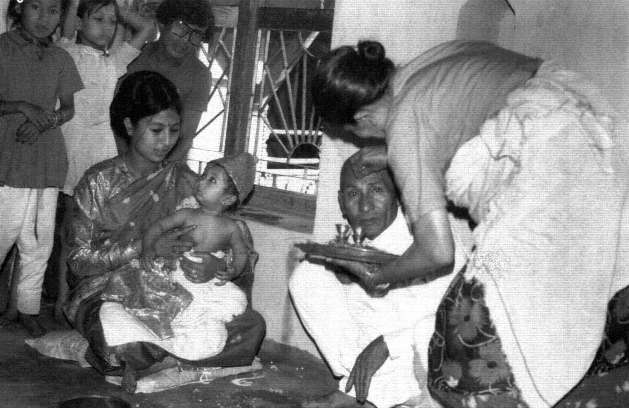
Figure 36.
Rites of passage. A young mother, her first son, and the family's Brahman purohita at the child's Maca Ja(n)ko,
the "rice feeding" samskara.
Asian forms. They are often formally told or read at some given point in a traditional formal religious sequence where they relate some ritual action to transcendent time and space. Legends, in contrast, usually have to do with the specific history, space, and social arrangements of Bhaktapur. They are often informally told by professional storytellers in the city's public space or by elders in households. Legends recount encounters between deities and high status humans who are citizens of Bhaktapur or else people of essential importance in its history, and they portray events of great importance not for the cosmos, as in myths, but for Bhaktapur. Legends border on another group of stories, "wonder tales" (the story of the princess and the snakes has qualities of both), that are more purely "recreational," but legends recount events that are supposed to have taken place in real time and real space, a time and space that take their importance from—and that are central to—Bhaktapur's special history, space, and location. Myths, in contrast, are concerned with events equidistant from all times and places. The essential movement in Bhaktapur's legends is the transition from an uncanny encounter with deities on the ground—a marginal and fleeting event belonging to neither the order of the transcendent world nor to the civic world—to a stable new state in which the events of the legend have come under civic control. While people may temporarily participate in a myth (as in Mohani), this is a kind of celebration of a juncture of two orders, civic and cosmic, and that celebration must be cyclically repeated in a continuing renewal. The events of legend produce a once and for all transformation into ordinary time, space, and order. Rarely, notably in the complex story of Taleju's origin and history, a story begins in a mythic mode and then modulates into a legend.
The unstable situations portrayed in legends are resolved by the overcoming of the uncanny transitional state through the actions of high-status figures—Bhaktapur's ambivalently viewed version of the hero—resulting in the transformation and civic "capturing" of the forces portrayed in the legend. The resolution of the legend thus explains and fortifies both city order and traditional high status. The high status justified in legends is always a status of power, a prince, king or Tantric practitioner, and not the high moral status of the Brahman as Brahman. Legends are thus related to the protection of the moral order rather than its internal operation.
There is thus a movement from a most abstract and general level in myth, to a more concrete and local mode in legend, and then a further descent into the present concrete symbolic enactments of the city. In that final move there is a passage from a "mere" recounting of events to
a fuller symbolic enactment in which much more than speech is involved, a participation through complex action as well as through listening and imagining.10 The deities are transformed as they move from myth to legend to their embodiment in plastic forms and their controlled engagement in the symbolic enactments of the city.11 Thus myth-legend-symbolic enactment represent, in many aspects, successively descending levels—cosmic, transitional, and civic.
The shared implications of steps in hierarchical classification allow for cross-cutting metaphorical bridges among particular classes in either the same or different hierarchies that can be made to seem to be at the same level. We noted in our discussion of the genealogies of various goddesses that forms considered to have the same level of abstraction, inclusiveness, and, thus., potential power, could be seen as in some sense equivalent, as being "sisters." King and total city and the full goddesses and behavioral controls related to power are all tied together through the shared implications of the equivalent level of each item in its particular hierarchy, and one can find other bridges both at humbler and at still higher levels.12
2. Redundancy and filtering.
We have commented, especially in chapter 16, on the redundant portrayal of a limited set of particularly significant statements throughout the myriad forms of symbols and symbolic enactments. Repetition in a sense creates the significant statements that are being repeated by filtering out through comparison and contrast a selected and simplified sample of the very complex cluster of meanings attached to many of the city's symbolic forms.
Siva in himself is, as we discussed in chapter 8, an enormously complex figure, but his position in any particular domain or context of Bhaktapur's gods selects and simplifies, for the purposes of that domain, his impact. The Nine Durgas' pyakha(n) is a very complicated performance, dense with meaning, full of historical and areal residues and of psychological resonances, but its psychosocial significance is much simpler when considered in comparion and contrast with the city's other symbolic enactments. The multitude of other meanings carried by the pyakha(n) contributes to its ability to fascinate and to engage a heterogeneous variety of community members, but this is another aspect of effectiveness of symbolic forms than their specific contribution to the construction of an urban order. In a Western analogy, returning once again to our simplistic traffic light, if we are concerned with the particular integrative relation of such lights to the urban order we are concerned solely or primarly with that particular aspect of the
redness of a light that means generally and powerfully "Stop!" in its contrast to that aspect of greenness that means "Go!"
3. Discrete categories.
Redundancy and filtering produce relatively simple and effective symbolic elements. Those symplified elements are for the most part "discrete" or "digital." For the purposes of the public order a Brahman is or is not a Brahman, a deity is Siva or not Siva. Thus they can be unambiguously recognized and do their work, and be placed in the domains and hierarchies that amplify and transform their meaning. The "more or less" and "sort of" calculations of the private realm are not adequate here.
It is this digital definition of elements in the public realm that is achieved through rites of passage, iconic criteria for icons, rituals of bringing effective life into statues, and by the emphasis on purity in the public realm of humans as social types. A polluted Brahman is not a Brahman in the dynamics of the public social realm whatever he may be known as concretely to family, friends, and neighbors.
4. Membership in a domain.
The discrete units of Bhaktapur's public system are, like all units of meaning, largely meaningful in their relationships and not in themselves. But those relationships are not the limitless shifting contexts of private experience, they are rather a matter of membership in clearly delineated domains and hierarchies whose other members are also discrete units. In Bhaktapur it is taken for granted that meaning accrues from such relationships. There is no attempt to escape from context dependency through doctrines of individuality and essence. Thus when the context changes a unit changes in meaning and may ultimately loose all its public meaning. A great deal of effort in Bhaktapur is devoted to maintaining the contexts of definition, particularly the definition of public social actors who are what they are not so much because of their private history nor of some inherited biological essence, but because of their ongoing contexts.
In those cases where a unit may belong to different domains or levels, its different positions and, thus, meanings are always clearly designated by some "context marker" that signifies whether, for example, killing an animal is murder or a sacrifice.
5. Boundaries.
Bhaktapur's proliferation of discrete categories, domains, and levels in the construction of an intelligible symbolically ordered public world requires the construction and maintenance of var-
ious different kinds of boundaries. We have been much concerned with boundaries throughout this study. The maintenance and breaching of boundaries relates many different ideas—purity, contagion, the carefully encircled realm of sacred power, the power of gods and powerful men to cross boundaries, secrets, initiation, magic, and so on. What is peculiar about Bhaktapur is the sheer quantity of such boundaries, the richness of the conceptions, emotions and operations associated with them and their particualr problematics. For not only are there many of them, not only are they problematically anchored in the more fixed qualities of perceivable nature, not only are objects and events located in shifting classes and hierarchies, but there is, as we have discussed above, a traditional and frequently used emphasis on their openness under certain conditions and on their illusoriness to a higher knowledge. Bhaktapur as a symbolically constituted social order must always strive through action to keep these boundaries and the categories they bound from dissolving, to protect through constant vigilant action an order that is not otherwise guaranteed in seemingly hard reality or in codes of laws.
6. Systematic ordering.
A further way that Bhaktapur's mesocosm responds to the demands of intelligibility is through attempts to fit as many symbolic bits and pieces as possible into larger and larger patterns of coherence, to strive to construct an aesthetic and philosophical unity, a Wagnerian multidimensional artwork. The few disconnected pieces (such as the little drama in the course of the tenth day of Mohani between the king and the merchant from Simraun Gadh* discussed in chap. 15) are striking in their very disconnectedness.
Insofar as a community's representations are coherently organized those phenomena that are represented but that do not fit easily into that order stand out against it. It is in such orders that paradoxes and mysteries—rather than just chaos—are able to appear. Such paradoxes and mysteries, any unexpected disconnectedness, motivate further elaborations of ideas and symbolic forms in attempts to save coherence. The striving for coherence in itself necessarily generates rococo elaboration.
Bhaktapur's Order, Stability, And Stasis
Bhaktapur has emphasized a certain way, one way among others, in which a community tries to hold flux, tries to make it seem meaningful
and knowable. In an essay on the relations of History and Anthropology Bernard Cohn (1980, 218) wrote:
We write of an event as being unique, something that happens only once; yet every culture has a means to convert the uniqueness into a general and transcendent meaningfulness through the language members of the society speak. To classify phenomena at a "commonsense" level is to recognize categories of events coded by the cultural system. An event becomes a marker within the cultural system. All societies have such markers, which can be public or private. The death of a ruler may be mourned by rituals which turn the biographic fact of a death into a public statement relating not only to a particular ruler but to rulership per se. In many societies ritual transforms uniqueness into structure.
Bhaktapur's system of marked symbols, its mesocosm, has been a powerful device for turning accident and history into structure, for trying to escape the contingencies and consequences of history, for trying to capture change, to make change seem illusory within an enduring order.
The very attempt to capture change, to deny a meandering history, to deny the effects of political will is—like the city's striving for coherence—in itself a fertile source of intellectual problems. Contact with a modern world is bringing problems of another order, much more difficult—and finally impossible—for Bhaktapur to absorb within its traditional order. For the implication of the ideas and the economic imperatives of that new world denies the city's central orienting value of birth-determined and fixed social hierarchy, assigns power and rewards by new principles, defines and values individuals in new and different ways, and treats a religiously anchored marked symbolism and its enactments as radically alien to a new and valued mobile secular
order.
Why Is Bhaktapur the Way It Is?
Why is Bhaktapur the way it is? Much that exists in Bhaktapur is a result of its long history and its location in a South Asia whose areal forms are the products of several millennia of creation and reaction. Thus one explanation of much that exists and goes on in Bhaktapur is historical and diffusionist. Yet, as we have emphasized repeatedly, throughout its history Bhaktapur selected among and shaped to its own purposes the offerings of history and the inventions of its neighbors. Its growth and its day-to-day life were determined by its internal struc-
tures, tensions, and requirements, internal forces that influenced the city's response to history and environment. From the city's own point of view, "history" was only a disturbance for better or worse of its natural order, only a contingency to be dealt with until its effects became rejected or else transformed and worked out within the order of the city. When we consider the city's inner order it becomes possible to discern not only the effects of Bhaktapur's historical and areal character as a "South Asian" or "Hindu" city, but also its characteristics—in a different sort of classification—as one of a limited number of possible forms of human community, in this case an "archaic city."
The settlements that became Bhaktapur and the conditions of its Valley context were propitious—"preadapted" in particular ways for the formation and efflorescence of Bhaktapur's peculiar order. Bhaktapur, in a mnemonic shorthand, ascribes its ordering to a particular transformative time and to the efforts of a particular heroic man, Jyasthiti Malla. What facilitated and made possible the transformation that the city ascribes to him was an enabling partial destruction of a previous haphazard spatial order, a destruction which at the same time spared the Valley's great wealth and its Newar culture and society—that relatively homogeneous areal "folk tradition" where, in the phrasing of Redfield and Singer (1954, 57 [quoted in chap. 2]) a long established local culture or civilization could be carried forward, developed, and elaborated. Yet—it is necessary to add to Redfield and Singer's schema—not all local cultures are able to facilitate such developments. There was something peculiar and fortuitous about the Kathmandu Valley's "folk culture." It was derived in large part from a medieval Hinduism that, as a result of its own historical genesis, was remarkably suitable for the purposes of the construction of Bhaktapur's order and, equally important, able to fortify it against the disorganizing stimulation of foreigners, who were, literally, put in their places and enveloped in an isolating pollution rather than welcomed into the transformative dialogues of Redfield and Singer's secular, heterogeneous cities where under the stimulus of competing and initially disconnected ideas "new states of mind [arise] . . . indifferent to . . . states of mind associated with local cultures and ancient civilizations" (1954, 57).13
It was also critical for what Bhaktapur was to become, that rather than develop, like many other cities, in concert with the control of a very large area whose administrative or imperial center it was, it expanded, essentially, in place. Bhaktapur's significant space could be walked and directly experienced and made use of in ways impossible in
such very large areas, and the city did not need to develop the modes of integration, such as force and abstract law, necessary for the management of states, nations, and empires controlled from a central city, modes of integration that might have flowed back to affect the inner life of the city itself.
It became possible, with all this, to construct an urban order in which naked force was secondary (or superordinate) to other systems of controls, secondary to the ordering force of a symbolic urban order—in a context in which the external uses of force and law for control of a heterogeneous large state, nation, or empire were minimal. The symbolic order was compelling in itself, and was much more than a mystifying support for and mask of another, somehow more basic, coercive power. It is emblematic of this order that within the civic arena the king was secondary to the priest.
In such an order there is a peculiar and necessary tension between the dominant sphere of symbolically constituted order and the sphere of more direct force. The king and the other technicians of power must look to an empirical reality which is resistant to symbolic manipulation if they are to adapt to changing conditions. They must understand this aspect of the world, and they must try to do what is necessary to deal with it. The priests worry about the moral implications of the power technicians' transcendence of the city's order, while those technicians sense that the priests and their allies are unpleasantly tangled up in something that they, the power technicians, have difficulty defining, something which clings to and encumbers the priests, something that is not quite clean. A balance is necessary. If the closed order of the constitutive symbolic system paralyzes the corrective perceptions and operations necessary for the proper uses of power, the city becomes vulnerable to decadence and decay. But if, on the contrary, pragmatism defeats the forces of the constitutive symbolic system, or alters it so that such symbolism becomes no more than a mobile mystifying ideology, then the old order collapses. For the city to be viable both systems have to work in difficult concert, a task for which Hinduism has exhibited considerable genius.
Let us recall Hinduism's fateful encounter with a differently constructed order, an order with its own and different necessities. It was, of course, Islam that was the particular variant of the Judeo-Christian-Islamic world revolution which made the first great iconoclastic invasion into South Asia, one of its furthest raids touching Bhaktapur itself in the fourteenth century. These invaders, unlike earlier ones, did not become
Ksatriyas* and fit themselves into a preexisting hierarchy and society—one of the classic ways in which South Asian kingdoms repeatedly changed accident and history into structure—but struggled to build a new and quite another kind of imperial and urban order.
Their iconoclasm was fundamental to their vision. The "idols" that they destroyed, that they sensed they had to destroy, were the seats of those immanent gods who, dancing civic order as Siva danced the universe itself, anchored each South Asian royal city at the center of the universe—thus generating innumerable local universes. In irreconcilable contrast, however, "the basic objective in the expansion of Islam was to acquire political control over an area and to set up the symbols of the Islamic sovereignty" (Halil Inalcik in an unpublished paper on the transformation of Constantinople into Islamic Istanbul [1984, p. 10]). Within this expanding and universal Islam, the Islamic world view "determined the physical and social landscape of the city. The city was supposed to become a space where the prescriptions of the Islamic religion could be performed fully and appropriately" (ibid., 9). Instead of the city being a center transcending secular history and geography in order to center itself in a mythic history and space, it became an off-center marker in a universal and presumptively objective and real grid of mundane space and history whose presiding god was incorrigibly transcendent. The tasks of symbols—and thus their form and nature—in such a transformed city are altered. They become thinned out, more universal, easier to read by the various kinds of people who were to belong more to a universal Islam than to a particular city. Law, standardized Islamic law interpreted and enforced by a bureaucracy, became central to the regulation of such cities, a law that "included not only those things related to ritual, social relationships and conduct, but also food, habitation and environment" (ibid., 18). Local symbolic forms—including local spatial constructions—had to be made to represent an abstract, rational, and universal political, social and ethical order. As far as possible local mesocosms had to be dissolved.
Bhaktapur seems to us to be representative of the kinds of places Islam tried to transform in India, having held out for still a few more centuries against the new kind of world that Islam represented. In one of the "conceits" that we entertained in chapter 2, we imagined that Bhaktapur and the kind of Hinduism it represents belonged to an untransformed "preaxial" world in its use of a mesocosmic construction in the service of social and personal order, a construction with pro-
found implications for individuality, for change, for the meaning of history itself.
Thus, a kind of an answer to "why is Bhaktapur the way it is," the problem of its particular form in comparison with other communities, is that when its economy and agricultural surplus and situation permitted, it grew into a city by making use of and transforming what it had at hand in the local settlements of the time. It was natural for its builders to assume that a community is a collection of people who share and are rooted in a coherent local world, and it was natural for them to make extended use of the powerful and relatively easy to craft marked symbols that small communities use for more restricted purposes. Bhaktapur—like the other Newar cities—following Indian models, elaborated a long-established local culture, converting it into its civilized dimension in the simplest and most self-evident way. in this conversion to a city and a civilization marked religious symbols became elaborated for the special tasks of the burgeoning community. It worked for a long time.
Most of its precursors in type were long gone when Bhaktapur was founded. The kind of wealth that made them possible attracted barbarians and empire builders, and thus they contained the seductions to their own often violent transformations. South Asian communities held out longer than most. As they, finally, under long and intense pressures began their transformations, accidents of location and history and, eventually, of national Nepalese policy allowed Bhaktapur to drift on for a while, a witness.
Appendix One
Transliterations Used in the Text
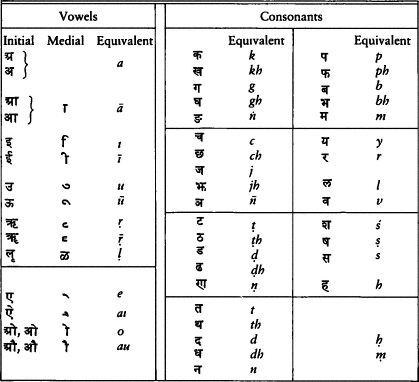
Translation of Sanskrit and Nepali
Transliteration of Bhaktapur Newari
The transliteration of the Bhakatpur dialect of the Newari language is based on the local scribal conventions for recording that dialect in Devanagari script. These conventions are not entirely consistent, and we have made some arbitrary choices. Where possible, Newari phonemes are represented m scribal Devanagari by their approximate Sanskrit equivalents. Spoken Newari lacks the retroflexed consonants of Nepali, , th* , , dh* , and , and the Sanskrit spirants represented as and . The written language sometimes, but not invariably, keeps these written--but not so pronounced--forms in some words of Sanskritic or North Indian origin. Many of them will be found in the lists of thar names. Newari has a short high phonemic midvowel [a ], a long high midvowel [a :], a short low frontal vowel [], and a long low frontal vowel [: ]. Our transcriptions, using the macron to indicate position and the colon (representing the Devanagari visarga ) for length, follow scribal conventions. For other vowels where it is thought necessary to indicate long vowels scribes use, sometimes erratically, the Sanskrit convention, which we have rendered (as is done for Sanskrit and Nepali) by the macron. Scribes hesitate between the written alternatives ay' (the apostrophe indicating that the consonant y is not followed, as the Sanskrit transcription would otherwise suggest, by a short a) and e ; and between ay' and ae . We have followed the second usage m each case. To avoid having to place two diacritical marks over vowels that are both long and nasalized, we use (n ) following a vowel to show nasalization of that vowel. Bhaktapur has a dorsovelar nasal that is not present in Kathmandu Newari which we represent by ñ . We follow the convention of transcribing the Devanagari , used in Newari for the bilabial glide [w ], as w . (See K. P. Malla [1985] for Kathmandu Newari.)
Appendix Two
Bhaktapur's Newar Hindu Thars Ranked By Macrosocial Status
We list here Bhaktapur's New Hindu thar s by the names usually used by others in reference to those thar s. In some cases members of a thar may use a different form of the reference name or a completely different name, or set of names, as surnames. Where we have some information about variant surnames, we have listed them in parentheses. Sometimes differences in surnames may indicate different sections of a particular thar , sometimes simply optional alternative names. Many thar s use Sanskrit or North Indian spelling for names of Indian derivation, even though the pronunciation has been changed.
Part 1. Thars Listed By Status Levels
I. Newar Brahmans
a. Brahman (Rajopadhyaya) (group 1)
b. Lakhae Brahman (Rajopadhyaya) (group 2)
II. Chathar
Josi; Malla; Pradhananga*
; Hada; Hoda*
; Amatya (also called "Mahaju"); Bhau (Bhaju); Kasaju (Kayasta*
); Ta:cabhari (Talcabhadel*
); Muna(n)karmi; Mulepati; Bhari (Rajbhandari*
); Ujha(n)thache(n); Jo(n)che(n);1 Go(n)ga:; Sa(n)gami; Dhaubhari (Dhaubhadel*
); Pakwa(n); Timla; Sae(n)ju; Kongasyo*
; Khe(n)dhaumaku; Baidhya (Rajbaidhya); Raya*
; Palikhel; Khaeguli (Khayargoli); Kapa:ta:go; Piya; Khwakhali; Basi; Pula(n)che(n)
III. Pa(n)cthar
a. The "Carthar" section
Maka:; Bramhalawat; Anu; Boche(n); Batas; Jaekama; Khumjajy; Jhanga; Ulak:; Sacinya; Bhadra; Badiya*
; Pasakala
b. The remainder
Acaju (Karmacarya); Maske; Baidhya; Madhika:mi (Madhikarmi*
); Banepali; Bhari (Ca[n]gubhari, Pujabhandari*
, Bhandari*
); Naeju; Phaiju; Dristi; Josi; Bhaju; Hoda*
; Bijukche(n); Go(n)ga:; Hyeju; Tapol; Yauca; Kachipati; Piya; Rajba(n)si; Mulmi
IV. Tini (Sivacarya)
V. Jyapu (group 1)
Suwal; Basukala; Koju; Dholaju; Lawa; Lageju; Dumaru; Twati; Acaju; Bya(n)ju; Bake; Kharbuja; Dhukhwa; Chuka(n); Maka:; Cawa: (Cawal); Gusai; Colekhwa:; Khaemali; Lakha; Twaena; Kawa(n); Kusi; Gwacha; Desemaru; Lasiwa; Laghuju; Nagaju; Khatakho; Nhinaenaemasa*
; Yakami; Khoteja; Dho(n)ju; Khaeguli; Duwal; Dhaugwara; Dela; Dupo(n)la; Gya(n)maru; Hya(n)goju; Hyau(n)mikha; Jyakhwa; Kibanayo; Kisi; Khinao; Ku(n)paka; Khusu; Khorja; Macamasi; Makhasya; Nhisutu; Nhuche(n); Nhemaphuki; Pau(n); Phasikeba; Pya(n)tago; Sitikhu; Simatwa; Sujakhu; Tacamoga; Talasi; Tadyoya; Tagora; Thike; Twanabasu; Twi(n)twi(n) Tyata; Wasaba(n)jar; Wa(n)gaeyo; Yakaduwa; Dekana; Do(n)ju; Chusyabaga; Colekhwa
VI. Tama: (Tamrakar)
VII. Kumha: (Prajapati); Awa: (Awal); Malekar (Malkaju, Nepali)
VIII. Jyapu (group 2)2
Rajacal;3 Caguthi*
;4 Muguthi*
;5 Dhauba(n)jar; Da(n)degulu; Galaju; Khaitu; Kutuwa:ju; Phelu; Khwalepala; Da(n)dekhya; Pachiju; Hyau(n)wa; Ka:mi (Silpakar); Kutuwa; Kusatha; Chu(n)ju; Pahi; Khitibaku; Kasula; Goja; Dhusu; Kulluju; Bajiko(n); Bakhadyo; Kaiti; Datheputhe; Mika; Twaena; Bidya; Loha(n)ka:mi (Lo[n]hala); Bakanani; Dhatucha; Machi; Bodel*
; Dwara; Jha(n)galthaku; Pampu; Baga:; Basuju; Bhilla; Bhele; Bhaiju; Bhuyo; Biao; Cho(n)ju; Daiju; Dhalapamaga; Dhampo; Dhobwa; Dhi(n)griju; Gasuca; Ganapati*
; Gaisi; Gharu; Gopi; Gopa; Gathe*
; Gorkhali; Guche(n); Gwae(n)maru; Gwae(n)masyu; Jugiju; Hamo; Ha(n)ju; Haleyojosi; Hamonayo; Ha(n)chethu; Jatadhari; Jaidaju; Jha(n)ga; Joharju; Joti; Jotisuwal; Ka(n)pa; Khaju; Khaiju; Khi(n)ju; Khwaiju; Khuju; Kila(n)bu; Kisa(n)kari; Ko(n)da; Kusma; Lakhemaru; Lachimasya; Libi; Ligiligi; Lu(n)ba(n)ja:; Mata(n); Marikhu(n); Malakasi; Mathya; Mogaju; Nakhetri; Naila; Naramuni; Naemasaphu(n); Ne(n)che(n); Paka; Pa(n)ca; Pa(n)ka; Pakha(n)ju; Pa(n)gulu; Phitiju; Puwa; Pyatha; Sa(n)dha; Si(n)kedathe; Si(n)kemani; Sibahari; Si(n)khwa; Si(n)ba(n)jar; Syama; Sulu; Sukhupayo; Swa(n)gamikha; Swanapa; Takra; Tahamati; Tajala; Tamakhu; Talache(n); Thakulawat*
; Thakuba(n)jar; Thuyaju; Tusibakhyo; Twa(n)ju; Tyochi(n)a; Wata(n)kachi; We(n)ju; Bhenatwa(n); Dubche(n); Da(n)dekhu; Cokami; Chusyakhi; Cho(n)ju; Che(n)gutala; Cakumani; Bakhu(n)che(n); Bweju; Bhola(n)dyo; Bhokhaju; Gora; Hakuduwa; Tuladhar
IX. Jyapu (group 3)
Kasti; Dhanachwa; Gane, Pha(n)ju; Hya(n)goju; Paluba(n)ja:; Khicaju; Kuchumani; Lakhe; Mata(n)gulu; Nalami; Nakhusi*
; Bathu; Gulmi
X. a. Chipi (Srestha* ; Sakha:karmi; Balla; Bhuju; Naebha; Dyoju)
b. Debabhandari; Khawaju
XI. Cyo (Phusikawa[n])
XII. Dwi(n)
XIII.6 a. Gatha (Banamala)
b. Bha (Karanjit)
c. Kata: (Sudhdakar)
d. Cala(n) (Diwakar)
e. Khusa:
f. Nau (Napit)
g. Kau (Nakarmi)
h. Pu(n) (Citrakari)
i. Sa:mi (Manandhar, Sahu)
j. Chipa (Ranjitkar)
XIII. Pasi
XIV. Nae (Kasai, Sahi, Khadgi* )
XV. a. Jugi (Darsandhari* , Kapali, Kusle)
b. Danya7
XVI. Do(n)
XVII. Kulu
XVIII. Po(n) (or Pode* or Pore) (Matangi* )
XIX. Cyamakhala:
XX. Halahulu
Part 2. Newar Hindu Thars In Bhaktapur Listed Alphabetically
Acaju (Karmacarya) [IIIb];8 Acaju [V]; Amatya (also called "Mahaju") [II]; Anu [IIIa]; Awa: (Awal) [VII]; Badiya* [IIIa]; Baga: [VIII]; Baidhya [IIIb]; Baidhya (Rajbaidhya) [II]; Bajiko(n) [VIII]; Bakanani [VIII]; Bake [V]; Bakhadyo [VIII]; Bakhu(n)che(n) [VIII]; Balla [Xa]; Banepali [IIIb]; Basi [II]; Basuju [VIII]; Basukala [V]; Batas [IIIa]; Bathu [IX]; Bha (Karanjit) [XIII]; Bhadra [IIIa]; Bhaiju [VIII]; Bhaju [IIIb]; Bhari (Rajbhandari* ) [II]; Bhari (Ca[n]gubhari, Pujabhandari* , Bhandari* ) [IIIb]; Bhau (Bhaju) [II]; Bhele [VIII]; Bhenatwa(n) [VIII]; Bhilla [VIII]; Bhokhaju [VIII]; Bhola(n)dyo [VIII]; Bhuju [Xa]; Bhuyo [VIII]; Biao [VIII]; Bidya [VIII]; Bijukche(n) [IIIb]; Boche(n) [IIIa]; Bodel* [VIII]; Bramhalawat [IIIa]; Brahman (Rajopadhyaya) [Ia]; Bweju [VIII]; Bya(n)ju [V]; Caguthi* [VIII]; Cakumani [VIII]; Cala(n) (Diwakar) [XIII]; Cawa:
(Cawal) [V]; Che(n)gutala [VIII]; Chipa (Ranjitkar) [XIII]; Cho(n)ju [VIII]; Cho(n)ju [VIII]; Chu(n)ju [VIII]; Chuka(n) [V]; Chusyabaga [V]; Chusyakhi [VIII]; Cokami [VIII]; Colekhwa [V]; Cyamakhala: [XIX]; Cyo (Phusikawa[n]) [XII]; Daiju [VIII]; Da(n)degulu [VIII]; Da(n)dekhu [VIII]; Da(n)dekhya [VIII]; Danya [XVb]; Datheputhe [VIII]; Debabhandari [Xb]; Dekana [V]; Dela [V]; Desemaru [V]; Dhalapamaga [VIII]; Dhampo [VIII]; Dhanachwa [IX]; Dhatucha [VIII]; Dhauba(n)jar [VIII]; Dhaubhari (Dhaubhadel* ) [II]; Dhaugwara [V]; Dhi(n)griju [VIII]; Dhobi [XVII]; Dhobwa [VIII]; Dho(n)ju [V]; Dholaju [V]; Dhukhwa [V]; Dhusu [VIII]; Do(n) [XVI]; Do(n)ju [V]; Dristi [IIIb]; Dubche(n) [VIII]; Dumaru [V]; Dupo(n)la [V]; Duwal [V]; Dwara [VIII]; Dwi(n) [XII]; Dyoju [Xa]; Gaisi [VIII]; Galaju [VIII]; Ganapati* [VIII]; Gane [IX]; Gasuca [VIII]; Gatha (Banamala) [XIII]; Gathe* [VIII]; Gharu [VIII]; Go(n)ga: [II]; Go(n)ga: [IIIb]; Goja [VIII]; Gopa [VIII]; Gopi [VIII]; Gora [VIII]; Gorkhali [VIII]; Guche(n) [VIII]; Gulmi [IX]; Gusai [V]; Gwae(n)maru [VIII]; Gwae(n)masyu [VIII]; Gwacha [V]; Gya(n)maru [V]; Hada [II]; Hakuduwa [VIII]; Halahulu [XX]; Haleyojosi [VIII]; Hamo [VIII]; Hamonayo [VIII]; Ha(n)chethu [VIII]; Ha(n)ju [VIII]; Hoda* [II]; Hoda* [IIIb]; Hya(n)goju [V]; Hya(n)goju [IX]; Hyau(n)mikha [V]; Hyau(n)wa [VIII]; Hyeju [IIIb]; Jaidaju [VIII]; Jatadhari [VIII]; Jaekama [IIIa]; Jhanga [IIIa]; Jha(n)ga [VIII]; Jha(n)galthaku [VIII]; Jo(n)che(n) [II]; Joharju [VIII]; Josi [II]; Josi [IIIb]; Joti [VIII]; Jotisuwal [VIII]; Jugi (Darsandhari* , Kapali, Kusle) [XVa]; Jugiju [VIII]; Jyakhwa [V]; Kachipati [IIIb]; Kaiti [VIII]; Ka:mi (Silpakar) [VIII]; Ka(n)pa [VIII]; Kapa: ta:go [II]; Kasaju (Kayasta* ) [II]; Kasula [VIII]; Kasti [IX]; Kata: (Sudhdakar) [XIII]; Kau (Nakarmi) [XIII]; Kawa(n) [V]; Khaiju [VIII]; Khaitu [VIII]; Khaju [VIII]; Kharbuja [V]; Khatakho [V]; Khawaju [Xb]; Khaeguli (Khayargoli) [II]; Khaeguli [V]; Khaemadli [V]; Khe(n)dhaumaku [II]; Khi(n)ju [VIII]; Khicaju [IX]; Khinao [V]; Khitibaku [VIII]; Khorja [V]; Khoteja [V]; Khuju [VIII]; Khumjajy [IIIa]; Khusa: [XIII]; Khusu [V]; Khwaiju [VIII]; Khwakhali [II]; Khwalepala [VIII]; Kibanayo [V]; Kila(n)bu [VIII]; Kisa(n)kari [VIII]; Kisi [V]; Koju [V]; Ko(n)da [VIII]; Kongasyo* [II]; Kuchumani [IX]; Kulluju [VIII]; Kulu [XVII]; Kumha: (Prajapati) [VII]; Ku(n)paka [V]; Kusatha [VIII]; Kusi [V]; Kusma [VIII]; Kutuwa [VIII]; Kutuwa:ju [VIII]; Lachimasya [VIII]; Lageju [V]; Laghuju [V]; Lakha [V]; Lakhe [IX]; Lakhe Brahman (Rajopadhyaya) [Ib]; Lakhemaru [VIII]; Lasiwa [V]; Lawa [V]; Libi [VIII]; Ligiligi [VIII]; Loha(n)ka:mi (Lo[n]hala) [VIII]; Lu(n)ba(n)ja: [VIII]; Macamasi [V]; Machi [VIII]; Madhika:mi (Madhikarmi* ) [IIIb]; Maka: [IIIa]; Maka: [V]; Maka: [VIII]; Makhasya [V]; Malakasi [VIII]; Malekar (Malkaju, Nepali) [VII]; Malla [II]; Marikhu(n) [VIII]; Maske [IIIb]; Mata(n) [VIII]; Mata(n)gulu [IX]; Mathya [VIII]; Mogaju [VIII]; Muguthi* [VIII]; Mulepati [II]; Mulmi [IIIb]; Muna(n)karmi [II]; Nagaju [V]; Naila [VIII]; Nakhetri [VIII]; Nakhusi* [IX]; Nalami [IX]; Naramuni [VIII]; Nau (Napit) [XIII]; Nae. (Kasai, Sahi, Khadgi* ) [XIV]; Naebha [Xa]; Naeju [IIIb]; Naemasaphu(n) [VIII]; Ne(n)che(n) [VIII]; Nhemaphuki [V]; Nhinaenaemasa* [V]; Nhisutu [V]; Nhuche(n) [V]; Pachiju [VIII]; Paka [VIII]; Pakha(n)ju [VIII]; Pakwa(n) [II]; Palikhel [II]; Paluba(n)ja: [IX]; Pampu [VIII]; Pa(n)ca [VIII]; Pa(n)gulu [VIII]; Pha(n)ju [IX]; Pa(n)ka [VIII]; Pasakala [IIIa]; Pasi [XIII ?] Pau(n) IV]; Phaiju [IIIb]; Phasikeba [V]; Phelu [VIII]; Phitiju [VIII]; Piya [II]; Piya [IIIb]; Po(n) [or Pode* or Pore] (Matangi* )
[XVIII]; Pradhananga* [II]; Pula(n)che(n) [II]; Pu(n) (Citrakari) [XIII]; Puwa [VIII]; Pyatha [VIII]; Pya(n)tago [V]; Rajacal [VIII]; Rajba(n)si [IIIb]; Raya* [II]; Sacinya [IIIa]; Sakha:karmi [Xa]; Sa:mi (Manandhar, Sahu) [XIII]; Sa(n)dha [VIII]; Sa(n)gami [II]; Sae(n)ju [II]; Sibahari [VIII]; Simatwa [V]; Si(n)ba(n)jar [VIII]; Si(n)kedathe [VIII]; Si(n)kemani [VIII]; Si(n)khwa [VIII]; Sitikhu [V]; Srestha* [Xa]; Sujakhu [V]; Sukhupayo [VIII]; Sulu [VIII]; Suwal [V]; Swanapa [VIII]; Swa(n)gamikha [VIII]; Syama [VIII]; Ta:cabhari (Talcabhadel* ) [II]; Tacamoga [V]; Tadyoya [V]; Tagora [V]; Tahamati [VIII]; Tajala [VIII]; Takra [VIII]; Talache(n) [VIII]; Talasi [V]; Tama: (Tamrakar) [VI]; Tamakhu [VIII]; Tapol [IIIb]; Thakuba(n)jar [VIII]; Thakulawat* [VIII]; Thike [V]; Thuyaju [VIII]; Timla [II]; Tini (Sivacarya) [IV]; Tuladhar [VIII]; Tusibakhyo [VIII]; Twanabasu [V]; Twa(n)ju [VIII]; Twati [V]; Twaena [V]; Twaena [VIII]; Twi(n)twi(n) [V]; Tyata [V]; Tyochi(n)a [VIII]; Ujha(n)thache(n) [II]; Ulak: [IIIa]; Wa(n)gaeyo [V]; Wasaba(n)jar [V]; Wata(n)kachi [VIII]; We(n)ju [VIII]; Yakaduwa [V]; Yakami [V]; Yauca [IIIb]
Appendix Three
Kinship Terminology
Bhaktapur's kinship terminology is a variant of the terminology used m other Newar communities (cf. Toffin 1975a ; Nepali 1965). Newar kinship terminology is closely related in both its structure1 and m much of its vocabulary2 to what Karve (1968) has called "North Indian" systems of kinship terminology. The details of Bhaktapur's kinship terminology and classification are not relevant to the concerns of this present study, but we will list here the terms and note some of their features for reference purposes.
We will first present Bhaktapur kin terms as arranged by generation and will then note some special terms for relations acquired by an individual through marriage.3 These terms are in relation to "ego," the conventional designation for an imagined individual on whom the various relations of another individual ("alter") or category of individuals designated by the terminology are centered. Each term's "focal" or "primary" genealogical referent, the individual or group of kin to whom it centrally refers, is given first,4 followed by terms used in address. Most Newar kin terms have extended references, sometimes to a very large group of "classificatory kin."5 Thus, for example, aja , whose focal genealogical referent is Father's Father6 and Mother's Father, is extended to all consanguineal male kin of the second generation senior to "ego," and also to a further group of men related to "ego" through marriage to his extended group of "grandmothers." The exact limits of the extension of these categories and an adequate statement of the principles on which that extension is based is beyond the scope of this study. Extension is similar in many respects to other North Indian systems and IS treated in some of the works referred to above. Toffin (1975a ) deals in a summary way with the principles of extension of Newar terms m the communities he studied. We may note that the nuclear set of kin terms abwa (Father), ama (Mother), kae (Son), mhyae (Daughter), bha:ta (Husband), and misa (Wife) are not extended beyond their focal reference, although
related extended terms (e.g., for Mother's Sisters) may be variations of the core term.
I.
A. Two or more generations senior to ego.
1 a. Aja .7 Genealogical referent: FF/M F.8 Address: bajya , and (rarely) aja .
b. Tapa aja .9 Genealogical referent: FFF, MFF, FMF, MMF. Address: same as for aja .
c. Aya: aja .10 Genealogical referent: FFFF, MFFF, FFMF, MFMF, FMFF, FMMF, etc.
d. Ghae(n)ghae(n) aja . This term includes for those speakers who use aya: aja all male members of those consanguineal and affinally related kin of the fifth and higher ascending generations. For those who do not use aya: aja , this term begins with the fourth ascending generation.
2. Aji .11 Genealogical referent: FM/MM.12 Address: aji, baje . Subsequent generations are designated as for aja , with the addition of tapa:, aya : (for some speakers), and ghae(n)ghae(n) .
B. One generation senior to ego.
3. a. Abwa . Genealogical position: F.13 Address: Ba, Yaba, Abwa .
b. -bwa . Genealogical position: FeB (tarhibwa, etc.); FyB (cicarhibwa, etc.).14 ,15 Address: same terms of address as for abwa . One may use if older than Father or else Mother,16 taribwa, tarhibwa , etc.; if younger than Father or else Mother, cicarhibwa , and related terms. If alter is considered as Father's youngest Brother, or as significantly younger than Father, special terms for "youngest Brother" may be used, such as aka, pui(n)cabwa , or kanchabwa .17
4. Jica paju .18 Genealogical position: FZH. Address: paju or jica paju .
5. a. Ama . Genealogical position: M. Address: ama, ma(n), yama .
b. Mama .19 Genealogical position: MZ. Address: Mama, Mamaca , or terms used for ama .
c. -ma(n) or -ama .20 Genealogical position: FBW. Address: the term of reference itself, or terms used for ama .
6. Paju . Genealogical referent: MB. Address: Paju. Sometimes terms designating older or younger than Mother are added.
7. Maleju . Genealogical referent: MBW. Address: Maleju, Malju .21
8. Nini . Genealogical referent: FZ.22 May be qualified optionally for older or younger than Father. Address: nini , with optional additions indicating age relative to Father.
C. Ego's generation.
9. Ara . Genealogical referent: eB. Address: Ara, dai, daju .
10. Kija . Genealogical referent: yB. Address: kija, bhaica .
11. Jica daju .23 Genealogical referent: eZH. Address: same as for ara , older Brother.
12. Jica bhaju .24 Genealogical referent: yZH. Also for DH, SDH, DDH.
Address: For ySH, addressed by name, or term for kija . For DH, etc., jica bhaju .
13. a. Ata .25 Genealogical referent: eZ. Address: ata, tata, didi (from Nepali).
b. Tata:ju .26 (also ta:ju ). Genealogical referent: eBW. Address: same as for Ata .
14. Kehe(n) . Genealogical referent: yZ. Address: name, kehe(n) , and various affectionate, diminutive terms.27
15. Bhau .28 Genealogical referent: yBW, also SW, SSW, etc. Address: name, or bhau , etc.
D. One generation junior to ego.
16. a. Kae . Genealogical referent: S. Address: name or affectionate terms such as Babu and babuca .
b. Kaeca. 29 , 30 Genealogical referent: BS (man speaking) or ZS (woman speaking). Address: same as for kae.
17. a. Mhyae . Genealogical referent: D. Address: name, Affectionate terms, Nani, Maya(n) , etc.
b. Mhyaeca* . 31 Genealogical referent: BD (man speaking), ZD (woman speaking). Address: same as for mhyae.
18. Bhe(n)ca .32 Genealogical referent: ZS/ZD (man speaking) or BS/BD (woman speaking).33 Address: Addressed to a male, bhe(n)ca or one of the terms of address for kae . in the case of female alters bhe(n)ca is not usually used for address, but one of the terms of address for mhyae is used.
E. Two or more generations junior to ego.
19. Chay . Genealogical referent: SS, SD, DD, DS. Address: same as for kae or for mhyae .
20. Chui . Genealogical referent: SSS, SSD, SDS, SDD, DDS, DDD, etc. Children of chay . Address: same as for kae or for mhyae .
21. Ui . Genealogical referent: Children of chui .
22. Kui . Genealogical referent: Children of ui .
23. Jhui . This term is reported by some informants but is unknown to others. Genealogical referent: Children of kui .
II. Terms for kin generated through ego's marriage.
24. Bha:ta .34 Genealogical referent: H. Address: kin terms and proper name are avoided.
25. Misa . Genealogical position: W. Address: kin terms and proper names are avoided.
26. The remainder of acquired affinal terms . Other affinally acquired terms of reference are usually based on the spouse's relation to alter, with the addition of prefixes or suffixes indicating the affinal relationship.
The husband uses the prefix sasa , indicating "Wife's family," and adds the kinship term derived from his Wife as ego. Thus Wife's Mother is sasa ma(n) , Wife's younger Brother is sasa kija , and so on. Toffin (1975a ) reports the term sasa in another Newari dialect as being used also by Wives for referring to
members of the Husband's family. In Bhaktapur, however, a Wife tends to use the term bhata 36 suffixed to a kin term based on the Husband's position as "ego." Thus the Husband's youngest Brother is kija bhata , Husband's Mother's Brother is paju bhata , and so on.37 A Wife, however, does not refer to her Husband's parents by means of the bhata form. Instead, the honorific suffix -ju is used. Husband's Father is referred to as ba:ju , and Husband's Mother as maju .
Terms of address used for spouse's kin may be the term of reference, but they are usually the same term of address used directly to one's own kin. Thus, for example, Paju bhata may be addressed as paju . A Wife is more likely to refer to her Husband's Sisters' Children (to whom she is maleju ) as bhe(n)ca rather than bhe(n)ca bhata , but a Husband will be more likely to refer to his Wife's Brothers' Children (for whom he is the ritually and socially less important FZH or jica paju ) more formally as sasa bhe(n)ca . Such differences, like the Wife's use of the terms ba:ju and maju (rather than sasa ma and sasa bwa ) for her Husband's Father and Mother, reflect the implication that for women marriage entails the acquisition of new kin—particularly her Husband's core kin, or syaphu(n) —through her radical transformation in that marriage and that these kin who are not supposed to be essentially different from the kin of her natal household, phuki , and tha:thiti . The Husband, in contrast, uses an affinal terminology that emphasizes that the new kin acquired through his marriage are, essentially, his Wife's kin.
Like other North Indian systems, the Newar kinship system names certain core family members unambiguously and without extension—Mother, Father, Son, Daughter, Husband, and Wife. In contrast, again as in other systems, there are extremely extended categories of Brother, Sisters, Father's Brothers, and Mother's Sisters, and of ascending and descending "Grandparents" and "Grandchildren." The Newar system goes beyond some other North Indian systems in lumping together both matrilineal and patrilineal ascendents. In contrast to most other North Indian systems, Newar systems amalgamate Mother's Sister's Husband to Father's Brother, and m some Newari dialects (but not Bhaktapur's) Father's Sister's Husband is also amalgamated to this category. In contrast to other North Indian systems, Mother's Brother's Wife is given a specific name (of both reference and address) of her own, maleju , and not just a feminine form of Mother's Brother. Finally, m contrast to most other North Indian systems, Father's Sister's Husband is given a name (jica paju ) that terminologically connects him to Mother's Brother (paju ) and to the "bridegrooms," jica , who marry into the patriline.38
The Newar system deals with the reciprocal terms to Mother's Brother and Father's Sister—a woman's Brother's Son and Daughter, and a man's Sister's Son and Daughter—in what is on the surface a radically different way from the North Indian systems. The Newar system calls all cross-nephews and nieces by the same name, bhe(n)ca , and calls parallel nephews and nieces "Sons" or "Daughters," adding, however, the diminutive particle -ca , to distinguish them from "focal" sons and daughters. The North Indian system, in contrast, simply separates Brother's Children from Sister's Children, independently of the sex of
ego, and does not provide a reciprocal term to Mother's Brother and Father's Sister, although when the sex of the speaker is known there is no ambiguity. These differentiations of cross and parallel uncles and aunts, and of cross and parallel nephews and nieces disappear, as they do in other North Indian systems in the next ascending and descending generations where they become amalgamated as "grandparents" and "grandchildren."
Most terms are strictly generational, with the equivocal exception of the affinal terms jica bhaju , which includes younger Sister's Husband and Daughter's Husband, and bhau , which includes younger Brother's Wife and Son's Wife. Generational terms include a wide range of consanguineal and affinal kin.
Appendix Four
Types of Worship and Materials Used in Worship
We have said something of the worship of the dangerous deities in chapter 9 but have not discussed personal and household acts of worship directed to benign deities.
"Worship" in its most general sense is often phrased as sewa yagu , "to serve," a term used to designate service to a superior, an employer, or a king as well as a deity. Specific, relatively formal, and circumscribed acts of worship are called, as generally m Hinduism, pujas . In formal pujas and in most of the more informal gestures of worship, the worshiper acts out respect, subordination, hospitality, and honor to the deity—implicitly giving the deity, in turn, responsibilities to the worshiper. Various kinds of daily worship are considered to be a duty, part of following the dharma , a way of maintaining relations with the deities. Many special acts of worship and special kinds of pujas are required or advisable or available options in various circumstances.
In addition to the daily pujas performed in households without the aid of Brahman purohitas (family priests), and the minor optional household and personal pujas that are also done without the assistance of Brahmans, Rajopadhyaya Brahman purohitas are able to list more than seventy specifically named pujas that they perform for their middle- and upper-status employers under various circumstances.
The offering of pure and unbroken husked rice, kiga :, is considered an elementary puja . People knowing that they will pass some favorite temple or shrine may carry some kiga : with them to offer to the deity. Other pujas add to and elaborate on this offering. Within more complex pujas there is often a climactic offering of kiga : in a component act that is specifically called (as is the larger sequence of which it is a part) puja yagu , "doing a puja ."
We will sketch some different pujas in a summary and incomplete way, using local terms for some materials and implements that will be defined and described in later sections of this appendix.
Pujas Not Conducted By A Brahman Purohita
Temple Visits
We have remarked the minimal puja act, the offering of kiga :, which may be added to respect gestures and circumambulation when passing temples and shrines. Purposeful visits to temples and shrines for worship, most commonly visits to the local Ganesa* shrine necessary before most other family worship, entail a more elaborate procedure that is essentially the same as the basic daily household puja . Women bring the necessary materials (kiga :, flowers, incense, a wick, which has been soaked m oil or purified butter, and other optional offerings) on a shallow metal dish, a puja bha :, or in a shallow bamboo container, a swalyaca , a grain winnowing basket. Men bring the supplies in a small box, a kiga: batta , a "kiga : box." The worshiper first washes himself or herself—ideally at the river—and then proceeds to the temple (or temples). First he1 presents kiga : and, usually, flowers, ideally visualizing the deity as seated or standing in his chest. Then he may offer other offerings—burning incense, a burning wick, and so on. Then, if it is spatially possible, the worshiper circumambulates the temple or shrine.
Home Pujas
Daily Worship. Nitya Puja The household deities who are the focus of daily worship have been listed in chapter 8 and the location of the worship area in houses noted in chapter 7. The worship area is purified each morning. Household members (including girls after their mock-marriage ceremony, and boys after their Kaeta Puja ceremony) come to worship at the household shrine before they have taken any food. They come in no particular order, depending on their daily schedules. Worship is usually done rapidly, and takes only several minutes. In contrast to other kinds of household pujas where there is usually one deity who is the central focus of worship, this puja is directed to all the household gods. The necessary equipment and supplies are arranged near the worshiper and in front of the god images. In a typical sequence the worshiper pours one kind of pure water, nina :, on his right hand, and using the dampened fingers of his right hand, washes the images' faces. He then applies either a white or yellow sinha(n ) pigment to the forehead of each image, using the ring finger or little finger of the right hand and then, using the same finger, applies a red pigment. Then he places some grains of kiga : on the sinha(n) spot. Next flowers or flower petals are placed on the images' heads, or a sprig of flowers long enough when placed on the ground to touch a deity's head may be leaned against the statue. Next burning incense is offered. The incense is constructed of fragrant materials twisted into a cord. The cord is folded in the middle and twisted again, so that one end is now constituted by the fold and the other by the two cut open ends. Newars, at least those with Brahman family purohitas , burn the rounded end, which quickly splits and separates
to produce two flames, representing Siva and Sakti. This is thought to be a specifically Newar (i.e., non-Indo-Nepalese) custom. When the incense is lit a bell is rung, and the incense is held m turn toward each god as an offering of a pleasant smell. The bell, an offering of music, also captures the attention of the god who is meditating or whose attention is elsewhere. Next the wick is lit, the bell is rung again, and the lit wick, as an offering of light, is held in turn toward each god. The incense and the wick are then placed on a mound of kiga : in front of any of the god images. A small bowl containing baji and sweetcakes is taken and, held in joined hands, presented to each deity m turn. This represents a feeding of the deifies, who are said to be hungry in the morning. The bowl is then placed somewhere in front of the images.
The next step is the climax of the puja . The bell (or sometimes a small drum, or a conch trumpet, instruments more usually used m Brahman-assisted pujas ) is sounded, then a respect gesture is made with joined palms, some grains of kiga : being held between the palms. If the worshiper knows an appropriate Sanskrit phrase or verse he will say it, otherwise he will say the god's name, trying to visualize the deity as present in his chest. The worshiper may call all the gods' names, he may just say bhagavan , "god," or may just name Visnu* or Siva as representing all the deities. He may add, "be happy," or "protect us," or mention some personal concern. He will then do the elemental puja yagu act, flicking some kiga : at the deity.2
Now the worshiper takes some of the water that had been offered to the deities and sprinkles it on his own head. He takes some of the pigments on the tray—which had been touched by his finger as he decorated each deity in turn, and puts it on his own forehead. He takes some of the flowers that have fallen to the feet of the gods and places them on his own head. If there had been a food offering he would also take a bit of the food and eat it. This taking of "prasada "3 concludes the puja .
Optional Household Worship When a household or one of its members feels that they should do some special worship beyond temple visits or daily pujas , but one that will not require a Brahman's participation, the puja variously named apasa(n) cwanegu, brata cwanegu , or, simply, dya puja , "god puja ," is done. The first two terms (the first term, derived apparently from the Sanskrit upavasa , "fasting," and the second from vrata , "austerity") mean to undergo a fast or an "austerity" of some kind. Typical motivations for such pujas might be to overcome an illness, to seek an improvement in farming or business affairs, for success in an upcoming school examination, so that a household girl will find a good husband, and so forth. These are usually done by the person concerned or by a household woman for the household. Often the supplicant vows to do a regular series of such pujas , once a week, twice a month, and so on, during a given period. Occasionally the family purohita may assist in the puja , but this is optional and does not make it equivalent to the more elaborate and costly pujas , which require a Brahman's participation. In contrast to the daily morning pujas , these pujas are principally addressed to a particular deity, usually Visnu/Narayana* or, sometimes, Ganesa* .
The puja is usually held in the late afternoon, and participants cannot eat or
drink before the puja ; hence the nominal fast or austerity suggested by the name. After the puja is completed the participants eat a meal usually constituted of rich, sweet foods, such as milk, curds, sugar, and sweetcakes. For this kind of worship additional steps or elements are added to the sequence of the basic daily household puja , essentially by adding more elegant offerings. These vary somewhat, but typically include the following. The gods' faces are washed in addition to the usual nina : with "five nectars" (milk, clarified butter, honey, curds and sugar), then with milk, then again with nina :, and finally with Ga(n)ga* jal . Instead of simple kiga :, a mixture of akye , barley, and sesame seeds, is added to the sinha(n) spot on the deities' foreheads. Before flowers are presented to the deities, white threads representing sacred threads are put over the shoulders of the images, and after the flower presentation flower garlands may be placed around their necks. If men are doing the puja , they are more likely to blow a conch shell or rattle a drum than they would be in a simple household puja . Fruit is always added to the food offerings. The light offering now will be not just wicks, but oil lamps and burning sticks of camphor, and an offering of small coins is added to other offerings. At the end of the puja , just before taking prasada , the worshiper will rise and circumambulate the puja area, or if the spatial arrangements make this impossible, he visualizes the act, or stands and rotates his body in the auspicious direction.
Pujas Conducted By A Brahman Purohita
The basic and most common Brahman-assisted household puja is usually called a dhala(n) danegu , or sometimes an "important" or "great" (tarha[n]gu ) apasa(n) cwanegu or brata cwanegu , to distinguish it from the non-Brahman-assisted special household pujas . The etymology of the term dhala(n) danegu is variously explained. In what may be folk etymology it is locally related to the term dhala :, a list or inventory, and said to mean to perform rigorously by following a list of procedures.4
These are the most elaborate pujas that a household without Tantric initiation (and thus all households at the Jyapu or lower levels) will usually do. Households in those upper-level thars who can do Tantric pujas often do dhala(n) danegu pujas rather than Tantric pujas for many purposes, because such pujas are easier to arrange and people within the family without Tantric initiation can participate. In contrast to simple household pujas , in dhala(n) danegu and other Brahman-assisted pujas groups of people, household members, relatives coming from outside of the household and, sometimes, friends often participate.
There are certain days in the annual calendar in which a dhala(n) danegu may traditionally be offered to one or another of the focal deities of the day (chaps. 13 to 15). The noncalendrical dhala(n) danegu pujas are generally directed to Visnu/Narayana* . The expressed motives for such pujas are various. They may be in fulfillment of a pledge, or more vaguely as an expression of thankfulness because the family's life has been going well, or to "support the dharma, " or for a good next life for the participants, and so on.
The Brahman's paddhatis , written guides for the performance of various kinds of pujas , give sixty stages in the sequence of dhala(n) danegu pujas . The first seventeen are the preliminary work to be done by the Brahman purohita , the remainder are for the client, the jajman , as instructed and sometimes aided by the purohita . The puja takes place in the late afternoon or evening. The participants must fast from the morning, and must have a bya(n)kegu purification (chap. 11). This was formerly a major purification, but in recent years it is often a minor one. The clothes worn by participants must all have been washed since their last use. As many people may attend, the puja will be held in an open area, not the crowded and restricted area of the household shrine. It may be given in the open area of the cwata floor or, sometimes, in a courtyard outside of the house. Depending on the number of people who participate and its optional elaborations, the puja may take from roughly two-and-one-half to five hours to complete.
Materials and Equipment
The equipment and supplies used in pujas in Bhaktapur are collectively called puja jola(n) . There are some thirty items of equipment used in addition to the murtis or god images. With the exception of two conch shells (one used as a container for water, the other as a trumpet) the other items are made of metal—of copper, iron, brass, "bell metal" or kae(n) , and other alloys.5 Most items must be made from the proper specific type (or a selection among limited specific types) of metal. Most of the thirty items come from the standard Hindu inventory of ritual equipment, but some of them are locally considered specifically Newar, which is to say that they are not used by the Indo-Nepalese Hindus. The equipment includes bowls and dishes of various sizes and shapes, spoons, containers for water or other fluids (some with spouts for pouring, some without), a funnel, tripods, oil lamps, containers for colored pigments, bells, a mirror, a conch shell container, and a conch shell trumpet. About half these items are used in ordinary pujas , the remainder in various types of specialized pujas . Ordinary Brahman-assisted household pujas use about ten items; ordinary Tantric pujas use some sixteen pieces of equipment.
Nine items are locally considered to be specifically Newar. The most prominent of these is an oil lamp, sukunda (a variant shape with the same usage is called mukunda ). This is an elaborate lamp of complex symbolism, much of it representing the various relations of Siva and Sakti. We have discussed it in chapter 9. The other special Newar items are the salai , a metal dish; the nya(n)thala , and the thapi(n)ca , flasks; the dhaupatu , a cup; the sinhamu, a container with a removable top used to hold one kind of pigment (bhus sin-ha[n] ); and the arghapatra , a container in the shape of a human skullcap.
Rajopadhyaya Brahmans list more than 200 materials that are necessary for various pujas . These include cleaning materials, leaves and grasses, pigments for decorating the deities and the puja equipment and other pigments for marking out the worship area with elaborate diagrams, flowers, various forms of rice, foodstuffs of many kinds (including sweetcakes of various shapes and ingre-
dients), alcoholic spirits and sacrificial animals (for Tantric puja s), products of the cow, threads of various sorts, oil-lamp wicks, cosmetic kits as gifts to the goddesses, small unglazed clay dishes, and other disposable pieces of equipment. Such materials are used in the preparation of the puja and in its course as offerings to various deities and to the officiating priests.
Some of the materials that are referred to in this volume warrant some special comment.
Pure Water
There are three kinds of progressively purer water.
1. Na:na is used (along with red clay and cow dung) for preparing the puja area for ordinary, non-Brahman-assisted puja s. It is used for washing the face and hands and rinsing the mouth in the morning, after excretion and before meals, and before puja s. It is used for a first rinsing of puja equipment, which is then washed with water of a higher degree of purity. It is the proper water for boiling rice. Na:na must be drawn on the same day it is used from the river, a well, or a tap, and it must not be touched by a menstruating woman, polluting animal, or member of the lowest-status thar s. Household women collect it in the early morning after they have swept the houses. When she returns home a woman will call out a warning to make sure that no one is above her on the stairway (which would pollute the na:na ) as she brings the water up to the floor of the house on which the puja is to take place or the cooking is to be done.
2. Nina is used for preparing puja areas for Brahman-assisted puja s. It is used for washing the images of deities, for mixing with pigments to be presented to deities, for cooking sweetcakes presented to the deities, as the water offering presented to deities for "drinking," and for rinsing puja equipment after it has been first washed with na:na . On the day that nina is to be collected, the women first clean the house and then purify the area in front of the front door with na:na , cow dung, and red clay. When the woman who is to carry the water reaches the source, she cleans her feet, legs, and hands and then washes her mouth and face. She scours the vessel that is to carry the water and then cleans the tap, edge of the well, or stone at the edge of the river with ashes or the proper kind of soil. She then once again cleans herself as she had before and draws the water, which is now considered nina . She returns home being careful that no one else touch the container or the water unless they are similarly purified. At home she calls out a warning, as she had done with the na:na , and for the same reason. Before placing the water container on the ground near the puja area she will pour out some of the water, and place the container on the wet area to prevent contamination.
3. There is water of still higher purity called "Ganges water" or Ga(n)ga jal . This is mixed with nina in the more elaborate pujas for washing the gods and giving them water offerings, and is used in death ceremonies. It is drawn with
the same precautions used for gathering nina from areas in the river that are considered to be tirtha s, where the water is considered to be of special purity and potency.
Pigments
Various pigments and fragrant woods are used in marking deities and individuals in the course of puja s. The marks made (and by extension the materials so used) are called sinha(n) (sinha: in Kathmandu Newari). Traditionally white and red pigments derived from fragrant white and red varieties of sandalwood were used, but now cheaper substitute pigments are often used. These are a saffron yellow pigment, mhasusinha(n) , and an orange pigment, bhuisinha(n) , used respectively as replacements for the white and red sandalwood pigments. A red powder derived from red sandalwood, called either Hyausinha(n) or Hikusinha(n) , is used as a cosmetic to be presented in a small box—along with such items as a comb, bracelet, a necklace, and mirror—to goddesses in certain puja s. The same red pigment was traditionally used as sinha (n) where bhuisinha(n) is now used. For Tantric puja s, monhi , a black pigment derived from lamp black, is also used.
Not only god images but also ten other pieces of equipment used in one or another puja are given sinha(n) markings. All objects so marked are considered as deities. Some of the pigment is taken back from the deities and placed on the heads of the officiants and worshipers as prasada . The white or yellow pigment is applied first, followed by orange or red pigment. Then three kernels of husked rice (jaki ) are placed on the worshiper's sinha(n) mark. The pigments and rice are given various exoteric and esoteric interpretations.
A vermilion pigment, abhir , is the pigment thrown during Holi festival in India, and in recent years on that occasion in Bhaktapur. Mixed with "popped" rice, tae(n) , it is given as an offering during joyful rites of passage, and is sprinkled on the heads and shoulders of the central participants in some processions and ceremonies.
Rice
Various forms and mixtures of rice are used in puja s. These are wa, uncooked, unhusked rice;6 jaki , uncooked husked rice; and akhye , husked rice selected so that it includes no broken grains. Akhye purified by prewashing in nina : and presented as an offering to deities is called kiga :.7 Mataki is a mixture of husked and unhusked rice (also called in nonreligious terminology wakijaki , "wa and jaki "). Other forms of rice are of secondary importance. Baji , rice that is cooked in oil and then flattened by beating, is, in contrast to rice boiled in water, acceptable by a superior if cooked or touched by a clean inferior. It is offered as a food offering to deities. Ja , boiled rice, is offered to deities in household puja s once a year, when it is acceptable because it has been cooked, on that occasion, in milk.
Tae(n) is "popped" rice, which is mixed with the red pigment abhir , and given as an offering in joyful rites of passage and some major puja s.
Mataki is used for the base on which two items of equipment—the Sukunda and the Kales (or Kalas)—are placed. Both these items represent Siva and Sakti (chap. 9). The husked rice in the mataki mixture represents Sakti (the potential force in the rice grain), and the unhusked rice, the combination of covering and kernel, represents Siva as the integration of form and energy. This use of mataki is considered specifically Newar, in contrast to Indo-Nepalese practice. Some other items of equipment, such as the main god image in non-Tantric puja , are placed on a base of unhusked rice.
Samhae
Samhae (in Kathmandu Newari, sometimes, samae ) is a "mixture of beaten rice [baji ], popped rice [tae(n) ], dried fish, roasted [water buffalo] meat, eggs, soy-beans and raw ginger pieces" (Manandhar 1976, 566), or some modification of such a mixture. It is presented to the meat eating dangerous deities, but is not equivalent to an animal sacrifice to such deities.
Swaga(n)
This is a mixture of kiga:, tae(n) , curds, and abhir , which is placed as a mark on a deity's forehead, and then taken back as prasada , and placed on the worshiper's forehead. The mixture is also presented to individuals who are the main subjects of auspicious rites of passage, and of some other household ceremonies. It is said to confer good luck, and protect against evil. In some interpretations the swaga(n) mark represents the moon, which should be in front of a person as an auspicious sign for a journey.
Appendix Five
A Catalogue of Annual Events and Their Distribution Throughout the Lunar Year
In this appendix calendrically determined annual events are placed within the consecutive fortnights of the lunar calendar. The numbers in square brackets represent the sequential numbering of events that is used throughout the book. Events within the solar calendar are designated "solar" and placed within the lunar calendar as they occurred m 1975/76. Events within the Devi cycle, a subset of the lunar cycle, are designated "Devi cycle."
Kachalathwa (October/November)
The year's first two events [1, 2] complete the five-day Swanti sequence, which began three days previously with Kwa Puja [77], Khica Puja [78], and Laksmi Puja [79]. Swanti is the lunar New Year sequence. It is a "focal" sequence concerned with the integration of city households .
1 [1] Mha Puja. The first day of the lunar New Year. Primarily concerns the household and individuals in it. Special focus is worship of self/body. (Major importance.)
2. [2] Kija Puja. Primarily concerns the household and individuals in it. Worship of individuals, with their household roles emphasized. Reconstitution of household with return of married-out women. Defense of members through deception against "moral death." (Major importance.)
In Swanti, the lunar New Year sequence, the household, its boundaries, and the relations of its members are emphasized and put m contrast with a larger moral world —the larger city and "moral death" as represented by Yama —beyond the household. The household deity emphasized is the benign goddess Laksmi. All city households do the same kinds of things at the same trines in a "parallel" integration .
3.
4.
6.
7.
8.
9. [3] Jugari Na:mi. Out-of-the-city pilgrimage and mela at a Visnu* shrine. (Moderate importance.)
10.
11. [4] Hari Bodhini. This day traditionally commemorates Visnu's* awakening from his four-mouths cosmic sleep. There is an out-of-the-city pilgrimage and mela at a Visnu* shrine. (Moderate importance.)
This day is the traditional end of the four-month Caturmasa vrata which bad begun on [42] Hart Sayani on the eleventh day of Dillathwa (June/July) in the previous lunar year .
12.
13.
14.
15. [5] Saki Mana. Punhi. Worship of Visnu* at city temples. Many households throughout the city eat special food. (Moderate importance.)
Kaulaga (November)
1. [6] Gopinatha jatra. A jatra of Krsna* on the pradaksinapatha* . (Minor importance.)
2.
3.
4.
5.
6.
7.
8.
9.
10.
11.
12.
13.
14. [7] Bala Ca:re. An out-of-the-city pilgrimage and mela to the Valley Pasupatinatha shrines by those who have had a death in the family during the previous twelve months. (Moderate importance.)
15. [8] Sukhu(n) Bhisi(n)dya: Jatra. (Begins with preliminary events on the evening of previous day). Jatra of Bhisi(n) God (Bhimasena) on the pradaksinapatha* . Special to shopkeepers and merchants for whom Bhisi(n) is a patron deity. They offer blood sacrifices to Bhisi(n). (Moderate importance.)
Thi(n)lathwa (November/December)
1.
2.
3.
4.
5.
6.
7.
8.
9.
10.
11.
12.
13.
14.
15. [9] Ya: Marhi Punhi. Concerns household. Worship of rice representing Laksmi to ask for replenishment of the grain that, having been supplied by the harvest, will now be consumed. (Moderate importance.)
This event is related to the final completion of the rice harvest. It is an event with agricultural implications not included in the Devi cycle .
Thi(n)laga (December)
1.
2.
3.
4.
5.
6.
7.
8.
9.
10.
11.
12.
13.
14.
15.
Pohelathwa (December/January)
1.
2.
3.
4.
5.
6.
7.
8.
9.
10.
11.
12.
13. [10] Ghyo caku sa(n)lhu. Solar cycle. Middle-status and upper-status households make special food offerings to their purohita . Most households have special food and feasts. Focal deity is Visnu* . (Moderate importance.)
This is the local version of the calendrical event traditionally associated in South Asia with the winter solstice and the beginning of the ascending bright half of the year .
14.
15. [11] Chyala Punhi. Unusable clay kitchen pots are discarded at the chwasa . Special foods are eaten in some households. (Minor Importance.)
Pohelaga (January)
1.
The thirty-day period of the Swastani Vrata begins here .
2.
3.
4.
5.
6.
7.
8.
9.
10.
11.
12.
13.
14.
15.
Sillathwa (January/February)
1.
2.
3.
4. [12] Sarasvati Jatra. A jatra of Sarasvati on the pradaksinapatha* . (Minor importance.)
5. [13] Sri Pa(n)cami People, particularly students and farmers, worship Sarasvati at her major temple for help in the acquisition of skills. (Moderate importance.)
6.
7.
8.
9.
10.
11.
12.
13.
14.
15. [14] Madya: Jatra. Jatra of Siva on the pradaksinapatha* and other activities devoted to Siva. There is a secondary reference to the Visnu* temples m the upper and lower cities. (Moderate importance.)
This is the last day of the period of the Swasthani Vrata. The Madya: Jatra has some thematic connections to it .
Sillaga (February)
1.
2.
3.
4.
5.
6.
7.
8.
9.
10.
11.
12.
13.
14. [15] Sila ca:re. Out-of-the-city Sivaratri mela at the Pasupatinatha shrine complex. Within the city some men sit by fires along the roadside all night chanting the name of Siva and sometimes smoking cannabis. An "anti-structural festival" in which "the borders of the domestic moral realm are represented by means of the ideas and images associated with benign deities." (Moderate importance.)
15.
Cillathwa (February/March)
1.
2.
3.
4.
5.
6.
7.
8. [16] Cir Swaegu. The first day of the Holi period devoted to Krsna* . Important elsewhere but of very minor importance in Bhaktapur. (Minor importance).
9.
10.
11.
12.
13.
14.
15. [17] Holi Punhi. End of Holi period. An image of Krsna* is carried around the pradaksinapatha* . (Minor importance.)
Cillaga (March)
1.
2.
3.
4.
5.
6.
7.
8.
9.
10.
11.
12.
13.
All the annual events to this point, with the equivocal exception of Sukhu(n) Bhisi(n)dya: Jatra, a deity of relatively independent status as the patron deity of one specialized group, have been associated with benign moral deities. The next festivals introduce a long segment of the year when the dangerous and nonmoral deities become of major importance. Pasa Ca:re comes at a time as Anderson (1971, 264) puts it "when typhoid, dysentery, cholera, and smallpox flourish with the advent of hot weather, prior to cleansing monsoon rains. It is a time of uneasiness."
14. [18] Pasa Ca:re. An animal sacrifice is made to Taleju in the Taleju temple. Farmers' guthi s make animal sacrifices. Aga(n) deities are asked for protection against pisaca s, ghoulish evil spirits. Pollution-consuming stone deities in courtyards are cleaned. (Moderate importance.)
15.
Caulathwa (March/April)
1. [19] Cika(n) Buyegu. Farming thar s and some lower thar s rub oil on household members' bodies to protect them against illness. (Minor importance.)
2.
3.
4.
5.
6.
7.
8.
9.
10.
The following nine-day period is Biska:, the solar New Year sequence. The main deities are Bhairava, Bbadrakali, the Yasi(n) God, the Mandalic* Goddesses, and Ganesa* , with secondary references to other dangerous deities. This is a "focal" sequence concerned with the division and integration of the city's spatially based units .
11. [20] Bhairava/Bhadrakali Jatra. Continues through the fifth day of Caulaga. Solar . (Major importance.)
12.
13.
14. [21] Raising the Yasi(n) God. Solar . (Major importance.)
[22] Taking the Dangerous Deities outside of their temples. Solar . (Major importance.)
[23] Varaji Jatra. Solar . (Major importance.)
15. [24] Taking down the Yasi(n) God. The beginning of the solar New Year . (Major importance.)
[25] Indrani*
Jatra. Solar . (Major importance.)
Caulaga (April)
On the first day of this fortnight the fifty-day Dewali period begins during which each phuki has a traditional time and place for its worship of its Digu God lineage deity. We list these collectively as one calendrical event, Dewali [30], as it is for any particular phuki (Major importance.)
1. [26] Mahakali/Mahalaksmi Jatra. Solar . (Major importance.)
2. [27] Brahmani/Mahesvari* Jatra. Solar . (Major importance.)
3. [28] Procession to worship the dangerous deities that were taken out on the fourth day. Solar . (Major importance.)
[29] Chuma(n) Gandya: Jatra. A twa: jatra . Solar . (Major importance.)
4. [30] The conclusion of the nine-day Bhairava/Bhadrakali Jatra and of the Biska: sequence. (Major importance.)
5.
6.
7.
8. [31] Cait Dasai(n). In many households animal sacrifices are given to Bhagavati. Sacrifices to Aga(n) deities and dangerous deities are made in temples. The day commemorates Devi's aid to Rama. The emphasis in Bhaktapur is on Devi rather than Rama. (Moderate importance.)
9. [32] Ram Navami. Special worship of Rama in his temples by the temple pujari . Recent worship at Rama temples by devotees. (Minor importance.)
10.
11.
12.
13.
14.
15. [33] Ma(n) ya khwa: swaegu. Primarily concerns the household. Household members worship mother as a deity. Married-out daughters and absent sons try to return to the natal household for this. Those individuals
whose mother has died more than one year before this date join other Kathmandu Valley Hindus at a pilgrimage site out of the city. (Moderate importance.)
Bachalathwa (April/May)
1.
2.
3. [34] Aksaya* Trtiya* . An annual auspicious day in which rites of passage can be performed without considering the proper astrological sait . (Minor importance.)
4.
5.
6.
7.
8.
9.
10.
11.
12.
13.
14.
15. [35] Candesvari* Jatra. A local twa: jatra . (Minor importance.)
Bachalaga (May)
1.
2.
3.
4.
5.
6.
7.
8.
9.
10.
11.
12.
13.
14.
15.
Tachalathwa (May/June)
1.
2.
3.
4.
5.
On the day before Sithi Nakha, the period for Dewali worship of the lineage Digu deities comes to an end. Sithi Nakha signals the preparation for the ending of the year's relatively uneventful phase, and introduces an anticipatory period of about one month until Bhagasti [40]. It designates a day safely located at the end of the dry period before the onset of the coming monsoon rains. It is the first event related to the rice agricultural cycle in the Devi cycle .
6. [36] Sithi Nakha. Devi cycle . Wells, ponds, and roads must be cleaned in preparation for the coming rains. Beginning of the planting of seed rice. The Nine Durgas must complete their nine-month dance cycle prior to this date. There is worship of the earth as the goddess Prthivi*
in the Taleju temple and in many homes. (Moderate importance.)
[37] Candi*
Bhagavati Jatra. A local twa: jatra . (Minor importance.)
7.
8.
9.
10. [38] Dasa Hara. People bathe in the river and worship it to prevent misfortune. (Minor importance.)
11.
12.
13.
14.
15. [39] Panauti Jatra. Out-of-the-city pilgrimage to attend a focal festival at another Valley town. Focal deities are Brahmani and Bhadrakali* . (Moderate importance.)
Tachalaga (June)
1.
2.
3.
4.
5.
6.
7.
Bhagasti marks the time by which the rains should have begun and replanting of rice seedlings into the paddy fields begins .
8. [40] Bhagasti. Devi cycle . The Nine Durgas disappear. The masks are cremated and the ashes placed in the river. (Moderate importance.)
In the period between Bhagasti and Gatha Muga: Ca:re [45] the rains should be under way and the rice fields and irrigation ponds flooded. The Gatha magically take calvaria from human victims. Conventionalized obscenity is used in the fields and public areas of the city .
9.
10.
11.
12.
13.
14.
15.
Dillathwa (June/July)
1.
2. [41] Jagana God Jatra. A jatra of an avatar of Visnu* on the pradaksinapatha* . (Minor importance.)
3.
4.
5.
6.
7.
8.
9.
10.
11. [42] Hari Sayani. The beginning of Visnu's* four-month cosmic sleep. People may perform special worship or vrata s directed to Visnu* starting on this day. (Minor importance.)
This is the beginning of the four-month Caturmasa period of Visnu's* sleep, which ends on Hari Bodhini [4] in the next lunar year .
12. [43] Tulasi Piye. Individuals plant tulasi seedlings representing Visnu* . The plants are omens about the length of the person's life, and their dried leaves are used in death ceremonies. (Minor importance.)
13.
14.
15. [44] Guru Puja. A few families worship their family guru s on this full-moon day. (Minor importance.)
Dillaga (July)
1.
2.
3.
4.
5.
6.
7.
8.
9.
10.
11.
12.
13.
The following day marks the period by which the transplanting of rice into the flooded paddy fields should be completed. The Gathas have by now taken their calvaria from human victims. The period of licensed obscenity will cease on the following day .
14. [45] Gatha Muga: Ca:re. Devi cycle . Demonic figures are chased out of the city's neighborhoods and then out of the city and cremated. (Major importance.)
15.
Gu(n)lathwa (July/August)
1.
2.
3.
4.
5. [46] Naga Pa(n)cami. Worship and propitiation of dangerous naga s (supernatural serpents) for the protection of the house and household. (Moderate importance.)
6.
7.
8.
9.
10.
11.
12.
13.
14.
The four lunar fortnights beginning with Gunhi Punhi contain thirty-one of the year's seventy-nine annual events. This period is a quiet one for farming work. The rice transplanting has been completed, and the harvesting will not begin until the last days of the period .
15. [47] Gunhi Punhi. Purification and renewal ceremonies by the Rajopadhyaya Brahmans. Farmers worship frogs inadvertently killed during farming work. Introductory events anticipating the carnival of the next day. (Moderate importance.)
Gu(n)laga (August)
1. [48] Saparu. A procession, the Cow Jatra, is held representing all people who have died in Bhaktapur during the past year to enable them with the help of the "Cow Goddess" to enter Yama's kingdom to be rewarded or punished according to their karma . Interspersed with the procession is a carnival. The procession moves around the pradaksinapatha* . (Major importance.)
The events of this day constitute the city's major public festival of its dead and its most extensive antistructural festival .
2
3.
4.
5.
6.
7.
8. [49] Krsna* Janmastami. A Krsna* image is carried in a procession around the pradaksinapatha* . Visits by Krsna* devotees to his city shrines. (Minor importance.)
9. [50] Sitala Puja. Visits by household members to the shrine of the goddess Sitala, traditionally for protection against smallpox. (Minor importance.)
10.
11.
12.
13.
14.
15. [51] Gokarna* Au(n)si. Primarily concerns the household. Household members worship their father as a deity. Married-out daughters and absent sons try to return to the natal household for this. Those individuals whose father has died more than one year before this date Iota other Kathmandu Valley Hindus at a pilgrimage site out of the city. (Moderate importance.)
Ya(n)lathwa (August/September)
1.
2. [52] Surya Vinayaka Jatra. A jatra of a Ganesa*
image—brought from an important shrine at a neighboring village—on Bhaktapur's pradaksinapatha*
. (Minor importance.)
[53] Varahi Jatra. The jatra image of the Mandalic*
Goddess Varahi is taken around the pradaksinapatha*
. (Minor importance.)
3. [54] Dattatreya Jatra. Pradaksinapatha*
. (Minor importance.)
[55] Bhairava Jatra. Pradaksinapatha*
. (Minor importance.)
On this day Tij is celebrated by Bhaktapur's non-Newar Hindu neighbors, but not by Bhaktapur .
4. [56] Catha Ganesa* . Household worship of Ganesa* and avoidance of the dangerous seeing of the crescent moon on this day. (Minor importance.)
5. [57] Rsi* Pa(n)cami. Household worship of Rsis* , particularly by women. (Minor importance.)
6.
7. [58] Uma/Mahesvara. Worship in households of a manifestation of Parvati and Siva as an affectionate conjugal couple. (Minor importance.)
8.
9.
10.
11.
The following eight days are the integrated focal sequence of Indra Jatra in Kathmandu. Certain of the otherwise independent events ([59], [61], [62], and [65]) in Bhaktapur during this period have thematic echoes of Kathmandu's sequence, but are not, for Bhaktapur, a connected sequence .
12. [59] Yama: Dya: Thanigu. Poles are erected in each twa: representing Yama, and worshiped during the next eight days to protect the local twa: people from death. (Moderate importance.)
13.
14. [60] Ananta Narayana*
Puja. Visits to the city's major Visnu*
temples. (Minor importance.)
[61] Indrani*
Jatra. The mandalic*
deity Indrani*
is carried around the pradaksinapatha*
and then left out in an open shelter near a pond overnight. (Moderate importance.)
15. [62] Yau Dya: Punhi. The name of this day refers to lights that will be carried around the city for three days, the sight of which will enable people to go to heaven when they die. People from Bhaktapur and surrounding villages go to the pond where the Indrani* image had been left on the previous night to worship it and bathe. (Moderate importance.)
Ya(n)laga (September)
1.
2.
3. [63] Chuma(n) Gandya: Jatra. A local twa: jatra . (Minor importance.)
4. [64] Smasana*
Bhailadya: Jatra A funeral mat representing the Bhairava of the cremation grounds is carried around the pradaksinapatha*
. (Moderate importance.)
[65] Pulu Kisi Haigu. An elephant made of funeral mats, associated with Indra's vehicle and with death, is carried around the pradaksinapatha*
. Sometimes this is an occasion for violence, including fights between the upper city and the lower city. (Moderate importance.)
5.
6.
7.
8.
9. [66] Dhala(n) Sala(n). (May be optionally observed on the fifteenth day of the fortnight instead of on this day.) The ceremony is for the "pitr* ," in this case all deceased ancestors of a phuki group who have been dead more than two years, and the ceremonies are done ideally at the river side by large groups of associated phuki members. (Moderate importance.)
10.
11.
12.
13.
14.
15.
Kaulathwa (September/October)
The next ten days are the complex focal sequence Mohani. Rather than attempting to enumerate here individually its complexly interwoven events, we follow the local practice of listing it by its successive days during any of which more
than one major event may be taking place. Mohani marks the period in the nee cycle when the rains should have finished and the rice harvest completed. The festival enacts the victory of Devi over forces of disorder, the gathering together of the forms of the goddess in central association with the political goddess Taleju, and the movement of Devi's powers into the Nine Durgas group that will move out into public city space during the next nine months. During these ten days important household events take place in the context of city-wide public events marking a large variety of significant city spatial elements. The full goddess Devi and her various subordinate forms are the central deities of the sequence .
1. [67] Mohani. Devi cycle . (Major importance.)
2. [68] Mohani. Devi cycle . (Major importance.)
3. [69] Mohani. Devi cycle . (Major importance.)
4. [70] Mohani. Devi cycle . (Major importance.)
5. [71] Mohani. Devi cycle . (Major importance.)
6. [72] Mohani. Devi cycle . (Major importance.)
7. [73] Mohani. Devi cycle . (Major importance.)
8. [74] Mohani. Devi cycle . (Major importance.)
9. [75] Mohani. Devi cycle . (Major importance.)
10. [76] Mohani. Devi cycle . (Major importance.)
11.
12.
13.
14.
15.
Kaulaga , (October)
1.
2.
3.
4.
5.
6.
7.
8.
9.
10.
11.
12.
The last three events of the year [77, 78, 79] are the first three days of the five-day Swanti sequence .
13. [77] Kwa Puja. Primarily concerns the household and individuals in it. Placation of Yama, the god of death. (Moderate importance.)
14. [78] Khica Puja. Primarily concerns the household and individuals in it. Placation of Yama. (Moderate importance.)
15. [79] Laksmi Puja. Primarily concerns the household and individuals in it. Worship of Laksmi for good fortune for the household. (Moderate importance.)
Appendix Six
Rites of Passage and Death Ceremonies
In this volume one major aspect of Newar religious life has been neglected—the sequence of samskara s, the rites of passage that each individual traditionally undergoes on passing from one culturally defined stage of life to the next. A consideration of these ceremonies with their emphasis on such matters as birth, maturation, menstruation, initiation, marriage, old age, and death is of central importance for the study of aspects of intimate individual experience and family organization to cultural tradition—matters that we hope to deal with more extensively elsewhere.
The timing of the rites of passage is generated by the tempos of each individual's life cycle, in contrast to the annual events that have preoccupied us in this volume which submit the entire city to the seemingly impersonal tempos of regular cosmic events, affecting all in the same way, bringing everyone's life into a common synchrony. Each citizen of Bhaktapur—and the family group clustering for the occasion around him or her—undergoes, m contrast, each of the samskara s in his or her own unique turn. In resonance with this individually determined tempo the samskara s are most centrally concerned with aspects of the representation, formation, and maintenance of certain of those urban "cellular units"—individuals, households, and components of the extended family—whose outer faces, whose specialized outputs and inputs, constitute and are integrated by the mesocosmic integrative processes of the larger city. The individual at the focus of the samskara s moves through them—or more precisely is moved by them—into larger and larger networks of other people, into more and more developed and responsible moral "personhood," and into wider and wider spaces. While there is some minor reference to the constituting spaces of the city, the movements marked by the samskara s are primarily those that we have designated in chapter 16 as within the "tubular" life of the family, a life whose main movement is from an opening into this present lifetime from a
previous birth, then to a progression through the stages of the moral life of the family and extended family, and finally on to an elaborately conceived postmortem state at the other end. In all this the family is central and the city only a peripheral environment.
Throughout the sequence of the samskara s there is first a gradual separation from the mother, a successive movement into larger sets of relations and spaces, an increase in the definition of personhood, and an associated emphasis on increasing purity and moral responsibility. Then in the later samskara s there is a movement toward a transcendence of ordinary personhood and responsibilities, and a preparation for postmortem life. Yet, underneath this theme of progressive growth and eventual transcendence there is an important common theme or implication running through all of the samskara s, an implication that is consonant with the implications of the annual festivals on the one hand and with the general shape of the experience and the informal and formal education of people in Bhaktapur on the other. This is the absolute dependence of the individual undergoing the rites of passage on the precise and often difficult work of others. In the samskara the essential workers are family members, who are necessary for the individual's development, beginning with the enabling mantra that will produce his or her ability to speak and ending with the collective work of forming a body for his or her spirit after death and moving it on to its place of judgment in Yama's kingdom. The subject of the samskara rites is dependent on the strenuous, traditionally specified activities of the performers of the samskara s to form his or her very self—and those responsible workers, for the most part members of household and phuki (abetted in the more complex rites such as cremation by specialists), must commit themselves over and over again to the performance of the traditional practices of the rites in the service of the rite's subject individual. As the subject of the samskara s needs the family workers and their assistants and comes to learn to depend on them, so do they in turn need the forms provided by tradition, and reiterate that dependence on tradition in the course of the mass of samskara s they perform for others in the course of a normal life cycle.
Not only is the locus of the samskara s in the matrix of household and extended family different from that of the annual festivals but the nature and place of the deities is also different. The deities involved are not the deities emphasized in the major city festivals, deities who are, to a large degree, both special and central to Bhaktapur as a city. In most rites the reference to deities—aside from the lineage gods who, in keeping with the emphasis on family, are emphasized—are minimal and peripheral. Where deities are present and emphasized they are the old major gods of the central Hindu tradition, the sun, Sarasvati, Visnu* , Siva as a linga* , gods from a time and place beyond the city. In the samskara s people are more Hindus than they are Newars or citizens of Bhaktapur.
However, there are certain exceptions to this within the group of samskara s. While most of Bhaktapur's samskara s are variants of traditional South Asian samskara s (cf., e.g., Pandey 1969) there are some (and some aspects of others) that are considered to be specifically Newar; that is, they are not performed by the Indo-Nepalese. Of these the most significant "Newar" rite is the Ihi or
mock-marriage. Because of the implications of mock-marriage, aspects of menarche rites and of "true" marriage must also be modified in ways locally thought to be distinctively Newar. The Ihi ceremony does have, not surprisingly, a local deity. This is Parvati as the patroness of the Kathmandu Valley. There are also included among the special Newar samskara s a set of old-age celebrations not performed by the Newar's Hindu neighbors.
Bhaktapur's samskara s are sufficiently complex in themselves, in their social distribution, and in their relations to traditional South Indian versions, that they would warrant a full study in themselves.1 We will list here the total collection of rites identified as Bhaktapur's Hindu samskara s by local Brahmans. We can only sketch some of their dimensions for reference purposes, giving relatively more details of the specifically Newar samskara s and of those aspects of others that are particularly relevant to the concerns of this study. While a few samskaras are done only by upper segments of the macrostatus hierarchy, and are thus socially differentiating, many of them are reportedly performed by all ranks, including the untouchables.2 We have no systematic information, however, on differences in the form of the procedures at different levels and among different thar s, nor on when various samskara s may have been introduced into middle or lower thar practices m a possible relatively recent gesture of "Sanskritization."
Bhaktapur does not have prenatal samskara s. The first samskara , the Jihvasodhan, takes place after birth. Cremation is considered to be the final samskara , and the many death ceremonies that follow cremation—and that we discuss in this appendix—are not included in the term. Some of the samskara s are usually given their traditional Sanskrit names, by upper-status speakers, at least, for others alternate or exclusively Newari names are used.
1. Writing a mantra on the tongue: Jihvasodhana.
The particular Hindu postnatal samskara emphasized in Bhaktapur by upper-level thar s, at least, is a variant of the traditional medhajanana , the "production of intelligence." Following birth, after the infant has been cleaned and before it is put to the mother's breast, a mantra representing the goddess of learning Sarasvati is written on the infant's tongue in honey, often by means of a silver stylus, by the infant's father. This is said to ensure that the child will be able to talk and to learn well.
2. Application of lamp black to the child's eyes by the father's sister.
On the sixth day after birth the father's sisters, the infant's nini s, and members of the phuki group come to the house. The nini s bring small gifts for the infant. Six oil lamps (usually small unglazed clay dishes with oil and two wicks in each of them) are placed on beds of unhusked rice and lit. Each nini , in turn, prepares lamp black by holding a metal container over each of the six flames sequentially to collect lamp black, which she then places on the infant's eyelids. This is said to strengthen the eyes, and to protect them from disease and blindness. The naked infant is rubbed with oil by each of the nini s in turn. When each has done her part, the infant is dressed in a shirt-like garment.
3. Name giving: Namakarana.
This takes place on the twelfth day after birth. The time of the cutting of the infant's umbilical cord, when it is thus separated from its mother, is considered the moment of birth, and is made note of. On the sixth day after birth the child's astrological status is supposed to be supernaturally inscribed on its forehead by the divine record-keeper Citragupta. On the sixth day (the day that lamp black is placed on the infant's eyes) a Josi, an astrologer, comes to the house and is told the time of birth—the day, hour, and minute. He tells the family something about the infant's astrological condition, and then returns to his house to prepare a written account, a jata :, which will be presented to the child on this twelfth day.3 At this time the child is given a secret name known to household members but not ordinarily used. This name is chosen by the household, but must begin with the proper first letter determined by the Josi from his reading of the infant's horoscope. The name is written on the birth record, the jata :, by the Josi, and is whispered into the infant's ear at this time by the head of the household.
In upper-status families, those who have the right to Tantric initiation, just after the phuki 's purification following the ten-day period of birth contamination the infant is taken to be presented to the family lineage deity, the Aga(n) God.4 As the place where this deity is kept, the Aga(n) House, is usually separate from the family house, among these families this is the first occasion on which the child is ceremonially taken out of the house.
4. The rice feeding ceremony: Ja(n)ko.
This ceremony takes place for girls when they are either five or seven months of age and for boys when they are six or eight months. The earlier time is the usually preferred date; the later one is used if there is some polluting condition in the family, or if the earlier date is considered astrologically inauspicious. This is (in the nomenclature used by the upper-level thar s) a maca ("child") ja(n)ko ; the term "ja(n)ko " is also used for certain old-age ceremonies. There is an alternate term used by many upper-status people (although seldom by Brahmans), and used as the ordinary term among Jyapus and lower thar s, Ja cipa(n) thiyekegu , "feeding [the infant] with boiled rice."5 The elements of this ceremony common to the various thar s are the "rice feeding" itself and the taking of the child out of the household to the neighboring Ganesa* shrine. Upper-level thar s add further elements.
In the first focus6 of the ritual, at the proper astrological time, the sait , the infant is fed boiled rice and other food (such as bread, fruit, curds, milk) by the phuki leader, the phuki naya :. In a common interpretation the mother's milk is not sufficient to feed the infant any more and it must be "taught" to eat other foods. The infant's diet had been mother's milk, typically supplemented by honey, rice flour, milk from other sources, and clarified butter. Now boiled rice and other mashed-up foods are added. It is said that with this shift in its diet the infant can now be taken care of by people other than its mother.
After the rice feeding and before the next major phase of the sequence other elements may be added to the ceremony. In upper-status families at this point the beak of a live and carefully held gander may be introduced into the infant's mouth so that it touches the tongue "in order to give the infant strength in
digesting its food as Agni (the fire deity) was able to digest the sacrifice." In a practice followed in many thar s (many more than do the gander ceremony) the child is now surrounded by various objects that represent interests and professions that would be appropriate given its gender and status, as well as by objects that would be inappropriate. These might included a book, a pen, soil, rice, ornaments, and items representing some particular trade. The child is now watched to see which objects seem to interest it. It is said that if it is interested in the wrong kinds of things it must be watched and guarded against the development of that interest.
In the next major movement of the samskara , done by all the thar s who do it at all, in another movement of separation from the mother the child is taken by its paju , one of its mother's brothers, and carried out of the house in a procession preceded by musicians and followed by men of the infant's father's phuki .7 Women will not join the procession, although young girls may join it. The paju carries the infant to the local Ganesa* shrine or temple—introducing the child, it is said, to the neighborhood—and then to other temples that are important to the family. Each temple is circumambulated and offerings are given in behalf of the infant (symbolized by being first held to the infant's head in mimicry of a respect gesture) to the temple or shrine deity. The procession then returns to the house where the paju returns the infant to its mother.
While in the previous samskara s the household and the patrilineal phuki members—the groups who had shared in the pollution of the infant's birth—were the ritual actors, in this samskara a new kind of participant is introduced, the mother's brother, the paju , representing the matriline. The paju will be of central importance in many of the subsequent samskara s. The paju now gives a symbolic gift of money to the mother "to compensate her for having taken the [paternal] household's child out of the house." Then as representative of the mother's natal household he gives substantial and valuable presents to the child, the mother, and other household members. (The paju will return again, echoing this first visit, with gifts at the time of a boy's second birthday, and of boys' and girls' fourth birthday.) Members of the phuki and affinally related kin and friends then present swaga(n) (app. 4) and other gifts to the infant.
The ceremony is followed by a major feast, a bhwae (which characteristically is attended by guests from a group wider than phuki ). This is the first of the samskara s in which such feasts are given. If a family is able to do it, in some cases, such as the birth of a first son, this feast may include hundreds of invited guests.
Now the sequence of samskara s separates for a while for boys and for girls. The boys will go on to the Busakha and Kaeta Puja rites; the girls, to the Ihi and Barhataegu rites.
5. Boy's hair shaving: Busakha.
The Busakha , or hair-shaving ceremony, like the following (and often intimately associated) rite for boys, the Kaeta Puja , not only moves the boy from one "Newar" or Hindu stage to the next but also, in so doing, differentiates him from the people of other thar s and, much more saliently, other status levels. At the same time it differentiates him from females.
Not only do girls not have these two ceremonies, but there are emphases on the boy's maleness within them.8 The Busakha represents the beginning of a boy's moral responsibility for the dharma of his thar , a responsibility that, however, is most clearly and fully introduced in the next samskara , the Kaeta Puja .
The Busakha and the Kaeta Puja are often associated conceptually and among many thar s are approximated m time. The Rajopadhyaya Brahmans separate the two widely. Among them the Busakha is often done when boys are five years of age; the Kaeta Puja (associated for the Brahmans with the traditional Upanayana initiation) comes much later, at eleven or thirteen years of age. For those other thar s who do the Busakha as well as the Kaeta Puja ,9 however, the Busakha may be done only three days prior to the Kaeta Puja —as is often the case with the Chathariyas and Pa(n)cthariyas—or immediately prior to the Kaeta Puja , on the same day, in a combined ceremony (as is the case with the Jyapus). The Busakha and the Kaeta Puja must be done when a boy is at an odd-numbered age, and is usually done at the ages of five, seven, or nine.10
The core act in this samskara is the shaving of the boy's head with, as is the traditional custom of "twice-born" Hindu men, the exception of an occipital queue of hair, called in Newari the angsa .11 Boys do not have their hair cut before this ceremony, and it is said that after the Busakha the boy, because he has had his hair cut, no longer looks like a girl. In the course of the elaborate ceremony the key moment of transition comes when the paju at the proper astrological sait shaves four patches of hair on the boy's head, representing, in sequence, east, south, north, and west, conventionally the front, right, left, and rear of his head, respectively. The paju will also much the boy's right and left earlobes with needles, to symbolize ear piercing, another traditional Hindu samskara that is done m Bhaktapur along with the hair shaving. A Nau, a member of the barber thar , does the full shaving of the head and the actual piercing of the ears. After the barber's work the boy is stripped naked in front of the onlookers and helped by family members in bathing.
In the course of the day representatives of the phuki go to worship at the mandalic* pitha as they will, starting with this samskara , at the time of all subsequent auspicious ones.
Ideally the Busakha is the first of the rites that ceremonially mark an increasing social responsibility—the others, for a boy or young man, being the Kaeta Puja and marriage. Traditionally in the course of South Asian samskara s "after the Cudakarana* or tonsure when the child grew into a boy, his duties were prescribed and his responsibilities explained . . . without encumbering his mind and body with book-knowledge and school discipline" (Pandey 1969, 33). Those disciplines were to follow later.
For most thar s it is the Kaeta Puja that almost immediately follows the Busahkha (and that in the lower thar s may be done without a Busakha ), which is the samskara most clearly associated with a change m the behavior expected of the boy, a change defined with Kaeta Puja as the boy's new status as a fully privileged and responsible member of his thar . Among the Rajopadhyaya Brahmans and the upper-status priestly thar s who emulate them (Josi, Tini, and Acariya) where there is a separation of some years between the two samskara s,
a boy after his Busakha is expected to begin to be cautious and responsible about polluting contacts in his play and other activities outside the family. It is said that he should now begin to represent the Brahmans and to act like one outside the family.12
6. Boy's full membership in their thar: Kaeta Puja.
This is one of the major samskara s and, in contrast to most of the preceding ones, is done by thar s throughout the macrosocial system, including the Po(n) untouchables. It takes its name from the giving of the Kaeta , a loincloth, and derives from the traditional Hindu Upanayana ceremony, that initiation into the knowledge, responsibilities, and full membership of one's jat or "caste" which entailed the "new birth" of the sacred thread-wearing, twice-born non-Sudra castes whose sacred threads were presented to them in this ceremony.
The Kaeta Puja varies in its timing, its elaboration, and its details among different thar s. But the presentation of the loincloth is always of focal importance. That presentation, like all the focal moments in samskara s, must be made at the astrologically proper sait . Those thar s that wear the sacred thread (Tim and above) have a second climactic sait , the proper moment for the presentation of the thread.13
The Kaeta Puja must be done in an odd-numbered year of age. It is usually performed by non-Brahmans at a relatively early age—five, seven, or nine. The Brahman customarily do the Kaeta Puja at the age of nine or eleven, their boys' Busakha having been done at the age of five or seven. Those upper-level thar s whose members have priestly functions, and who wear the sacred thread (i.e., Josi, Tini, and Acariya), usually follow the Brahman pattern of having the Busakha at an early age and the Kaeta Puja several years later. For non-Brahman nonpriestly upper-level thar s the Kaeta Puja usually follows on the fourth day after the Busakha . For Jyapus and other middle-level and lower-level thar s who do the Busakha , it is usually combined with the Busakha in one continuous sequence.
For the Brahmans the Kaeta Puja ceremony is part of a complex set of events called Bura(n) taegu ,14 which represent the traditional Brahmanical initiation, the Upanayana , which is followed by a now abbreviated period lasting for three months of further study and ritual activities representing the traditional period of Brahmanical studies, the Brahmacarya .
For Jyapu and other middle-level thar s served by Brahmans the Kaeta Puja (with its immediately preceding introductory Busakha ) is usually the first of the samskara s that employ Brahman purohita s., 15,16 The thar s that combine the two samskara s begin by the shaving of the boy's head, starting with a gestural cutting by the paju completed by the Nau.
Now among the middle-level thars after the hair shaving, and among upper-level thars at the beginning of the independently held Kaeta Puja , a special purification of the boy takes place. A Nauni, a woman of the barber thar , pares the boy's finger and toe nails, For the higher-level thar s this is done at an astrologically determined sait . The nail paring represents a further degree of purification than the boy has previously had, and thus a further degree of resulting purity. While in the case of phuki pollution, prior to the Busakha children only
need a simple purification and following it upper-status boys must have their hair shaven, now, following Kaeta Puja boys must also have their nails pared in a full participation in adult male major purification. They are now full "persons" in the sense defined by considerations of purity and impurity.
After the nail paring the boy is washed and brought naked to the previously prepared and purified puja area, where the ceremony will proceed under the direction of a purohita . In its course a ceremonial loincloth is presented to the naked boy and tied on him by the senior active male phuki member, the phuki naya :. The paju has, in this phase, only a secondary role; he brings additional loincloths as gifts to the now mature boy. After the kaeta is given, the upper-level non-Brahmanical thar s may then give the boy his sacred thread.17 But for all thar s, whether they have rights to wearing the sacred thread or not, it is the kaeta itself—the Kaupina , an important part of traditional Hindu Upanayana rites—which marks the transition of the boy into full membership in his thar .
The Kaeta Puja is also a dekha (Sanskrit diksa ), an initiation (chap. 9). The family purohita , now acting as the boy's guru , reveals to him one or more of the mantra s that the phuki gives to its boys in the course of various initiations (chap. 9). Among the upper thar s this is done at the time of the presentation of the sacred thread, and is the first of a series of dekha s that the upper-status boy and young man will be given—the later ones being related to the Tantric worship of the lineage gods and to the special knowledge that may be acquired in preparation for death. At the time of the Kaeta Puja the boy is also instructed about morning and evening worship and about ritual cleanliness, and—in the upper—level thar s—may be told about elementary meditation techniques using the mantra s he has been given.
After the Kaeta Puja the boy is theoretically a responsible and full member of his thar . He can now perform all the rituals, most importantly the death ceremonies for his parents, with the exception of those upper-status Tantric rituals that will need further initiation.
The Busakha and Kaeta Puja are devoted to the social and psychological formation and definition of boys.18 During childhood there are also two samskara s for girls, the mock-marriage and the menarche ceremony. Then, with the marriage ceremony, both men and women will again undergo the same samskara s.
7. Mock-marriage: Ihi.
The Newar samskara s in Bhaktapur are for the most part closely modeled on the traditional Hindu samskara s. The most dramatic exception is the Ihi , the mock marriage ceremony for girls.19 The implications of the Ihi require major changes in traditional menarche rites, and some changes m the traditional "true" marriage.20 Ihi and the related modified menarche and marriage rites were traditionally not done by the Rajopadhyaya Brahmans,21 nor, for different reasons, by the unclean thar s from level XIV, that is, the Nae, and below. "Ihi " is an old Newari word for marriage, but it is now used only for the mock-marriage, not the "true" marriage, the Byaha .22 The Ihi samskara must be done before the onset of menstruation, and can take place at any time between, approximately, five and eleven years of age. At the core of the Ihi is a traditional Hindu ceremony of marriage, but the spouse is
Visnu/Narayana* .23 The premenstrual virgin girl is given in marriage to the deity as a gift or offering in the traditional Hindu marriage act called kanya dana , "the giving of a virgin daughter." Because of this prior gift in the Newar mock-marriage, the kanya dana segment of the marriage ceremony is, in contrast to traditional South Asian practice, omitted in Bhaktapur's true marriage ceremony.
The legends told to explain the Ihi ceremony emphasize one of its central implications. Parvati was the daughter of Himavan, the deity of the Himalayas. When she was to be married to Siva, Himavan gave Nepal (that is, the present Kathmandu Valley) to her as her dowry. One day as Parvati was walking through the Valley she heard an old woman crying. Parvati asked her why she was crying. "My husband is dead. A husband is necessary for a woman; without a husband a woman's life is terrible." Parvati pitied her and asked Siva for a boon. "Can you do something for the women of my natal home so that they will not become widows?" Siva answered, "Narayana* and I will arrange it so that there will no longer be any widows in Nepal." Thus the Newars were given the Ihi ceremony. Narayana* was the groom, and Siva the witness.
The legend not only emphasizes a maneuver for avoiding the ritual disabilities of widowhood but places the scene in the setting of Parvati's natal home, her tha: che(n) , the setting where a woman is a relatively indulged child and daughter, rather than being in the greatly contrasting condition of wife and mother in the home of her husband's family and m the circle of his phuki . The women of "Nepal," that is, the Newar women of the Kathmandu Valley, are Parvati's sisters, not her sisters-in-law.
The Ihi ceremony is, as a marriage had to be in Hindu tradition, a premenarche marriage. This means that the second marriage, the one to a mortal, can be delayed as all second marriages can, until after menarche—often long after it. Thus both the necessity of child marriage24 and the full force of widow disability are ameliorated by the invention of this Newar samskara . The Ihi ceremony is, as we shall see, in some aspects of its form as well as in its legendary intent, somewhat subversive of the Hindu patriarchal and hierarchical principles that are central to other samskara s.
Ihi ceremonies involve a group of girls, often a large group. There are several Ihi ceremonies in Bhaktapur during the course of a year. Each is sponsored by a well-to-do man who has a (biological or classificatory) daughter, granddaughter, or younger sister to be given the samskara .25 The sponsor will gain religious merit and social prestige through his sponsorship. Traditionally sponsors were Chathariya and Pa(n)cthariya, but in recent years Brahmans and Jyapus (the latter made relatively wealthy through land reforms and beginning to follow upper-status religious practices) have also become sponsors. The exact range of thar s taking part in a particular ceremony is determined m part by the status level of the sponsor; thus the lower-level clean thar s are more likely to be found at a Jyapu-sponsored ceremony than at a Brahman-sponsored one.
In the days preceding the Ihi ceremony each girl who is to take part receives invitations from her tha:thiti (the kin acquired through out-marriages of the phuki women) and from her paju 's (mother's brother) households in
Bhaktapur—and sometimes in nearby towns—to visit them. She spends several days in these visits and is offered swaga(n) and food in each household. On the day before the main Ihi ceremony there are various preliminary activities. During the day the main Acaju priest who will loin with other priests in the ceremonies sacrifices a goat at the sponsor's local areal Ganesa* shrine, and then visits each of the city's nine mandalic* pitha s to make offerings of samhae and alcoholic spirits to the goddesses. He begins, as is always the case in such sequential visits, with Brahmani to the east, ending after a circuit of the periphery in a clockwise direction with Tripurasundari at the center. He worships, making the proper sacrificial offerings, at each pitha in turn. While there are visits to the particular mandalic areal pitha of phuki groups in the course of most of that phuki 's samskara s, this movement to all the pitha s reflects the amalgamation of the Ihi girls into a spatially and socially heterogeneous and at the same time integrated group.
During this preliminary day—as they would before any major samskara —the members of each involved household will have preparatory purification ceremonies, and those families with Aga(n) deities will make offerings of samhae to them. In the latter part of the day before the ceremony the sponsoring household, the one where the ceremony is to take place, performs a Duso (or Duswa ), "a looking in" ceremony, that is, a preparation for the visit of the deity. This is thought of as a notice and "invitation" to the deity to attend the ceremonies. This ceremony is done by Brahmans for all their own major auspicious samskara s, but by other thar s only m this preparation by the sponsor of the Ihi ceremony. The Duso begins when the main Brahman purohita (there are usually two or three Brahmans involved in the ceremony), and the two auxiliary priests (a Tini and a Josi), the sponsor of the Ihi , and, often, other senior males of his household, go in a procession accompanied by musicians to a location near the Jyatha Ganesa* shrine in the potter's quarter, where a purified puja area is prepared. A member of the Kumha: (potter) thar , accompanied by members of the procession, brings black clay to the ritual area. The black clay is formed into a ball, the "All(n) God," said to represent "Siva and all the (benign) gods." The Ali(n) God is now worshiped along with a clay pot, a Brahmakalasa , on which there is an image of Brahma, representing the trimurti —Brahma, Siva, and Visnu* . Another piece of black clay is set aside to represent Ganesa* in the next day's ceremony.26 Carrying the Ali(n) God, the Brahmakalasa, and the clay that will represent Ganesa* , the group returns to the house of the sponsor in a procession and is met at the house's pikha lakhu by the wife of the main purohita . She now performs a laskusa —a formal ceremony greeting the deities and the members of the procession and chasing off evil influences in a formal exorcism, followed by her leading the central participants into a sacred area, in this case the area in the house where the formal ceremonies will take place.27 Now the main purohita goes through the proceedings for ritually "establishing" (sthapana ) the Ali(n) God.
The girls who are to have the ceremony the next day are waiting at the house, and are each attended by at least one representive, (either male or female) of their phuki . The Ihi girls, are dressed in red, sometimes in a special red-and-yellow Ihi dress resembling a traditional marriage dress. One girl—
usually the sponsor's daughter, or perhaps niece or granddaughter—is chosen as the naki(n) , the "leader of the brides." A complex series of events follows, many of which mimic procedures from Brahmanical marriage ceremonies, which indicate in various ways the binding together of each girl with her divine groom and the divine witness.
These ceremonies are followed by a feast for the Ihi girls at the sponsor's house in which boiled rice, here called duso Ja prepared by the wives of the Brahman purohita s who are officiating at the ceremony, is eaten. This partaking by a group of mixed phuki s, thars, and macrostatus levels of boiled rice is unique. In other feasts where there are representatives of non-phuki groups, and above all, members of other thar s it is essential that boiled rice not be served—baji , beaten fried rice being served instead. Nevertheless, this apparent opposition to ordinary proper procedures is limited. First, the girls are not yet full members of their thar s. Second, the girls are separated into "eating groups" by floor space—so that some group separation is maintained. As in all ritual feasts, the leftover food is taken to the areal crossroads deity, the chwasa , and discarded. At the end of the ceremony the girls return to their homes. They are now considered to be in a state of purity. They must now fast until the next day.
The main events occur on the next day in an elaborate sequence requiring the services of Brahman, Josi, Tini, and Acaju priests. In the events of the day, as in those on the preliminary day, the Ihi mirrors many of the elements of South Asian upper-status traditional true marriage ceremonies, as well as having its unique aspects. The ceremony has three astrologically determined sait s, indicating the core transformative elements. This is the time for the preparatory purification by a nauni ;28 for the application of bhuisinha(n) , orange-red pigment, to the parting of the girl's hair;29 and for the presentation of the girls as gifts of a virgin, a kanya dana , to the deity.
In the course of the day's preparatory phases the Acaju does a puja called desa bali ,30 which is an offering to the gods of all the Tantric temples in the city, represented in the puja by grains of polished rice. There is nothing like this in ordinary samskara s.
The main images at the wedding—provided separately for each girl—are the bya (in Nepali, bel ) which is the fruit of the Bel plant (Aegle marmelos ), and a small gold image (or flat piece of gold with an image engraved on it). The bya represents Siva; the image represents Visnu/Narayana* . Each girl is accompanied by her father (or, if he is not available, an elder brother or one of her father's brothers). He will offer her as a kanya dana to Visnu/Narayana* . At the proper sait for the kanya dana each girl stands with her hand linked to her male donor's and the girl's mother (or, if necessary, a surrogate) pours ritually pure water and milk over their Joined hands. The donor says his name and (in the case of the upper-level thar s) the name of his gotra , his daughter's name, and the name of his father and grandfather. The daughter is to be presented "in the name of" these lineage members. At the exact astrological time—called out by a Josi—the donor gives his daughter to the god as manifested by pressing her thumb against the golden image. The image is held against the bya representing Siva as the witness to the marriage. The focal marriage is followed by a sequence of closing ceremonies, and ends with a supper of rich, sweet foods.
Many girls customarily establish bonds of fictive kinship with other girls during the Ihi ceremony by exchanging sinha(n) pigment and kisali , small pots containing husked rice grains. The pots and the rice are then used in offerings to a ceremonial sacrificial fire that had been made and worshiped at the beginning of the Ihi sequence by the attending priests. The bond friend or fictive sister is called a twae (chap. 6). During later life two young women may make themselves twae s in special ceremonies as men do, but the Ihi is the setting in which young girls characteristically form these bonds. It is noteworthy that in congruence with other implications of the Ihi ceremony, twae relations extend kinship beyond the phuki , and frequently beyond the thar , and, sometimes, even beyond the two girls' status levels.
The Ihi ceremony stands in a coherent contrast to the other city samskara s—all others (except the old-age ceremonies) variants of traditional Hindu rites of passage. In its main import it rationalizes an avoidance of premenarche marriages and of certain aspects, at least, of the stigmatization and disabling of widows in a society where, in consonance with its Himalayan roots, the status of women had long been relatively less constrained than m Indo-Nepalese and Indian Hindu societies. In keeping with its legendary reference to the Newar's homeland as Parvati's natal home and to Parvati as its tutelary goddess, the Ihi ceremony in itself has elements suggesting social integration blurring the central patriarchal order and differentiation of the phuki and its satellite alliances—an order emphasized or taken for granted in other samskara s. Such gestures of blurring of patriarchal order are the joining together m one ceremony of members of different phuki s, thar s, and status levels, the worship of all the city Tantric shrines and all the mandalic* pitha s in concert—in a representation of, among other things, all the city's lineages—and the creation of trans-familial, and sometimes trans-status-level fictive sororal bonds. These gestures are made within the context of a traditional Hindu marriage ceremony. in Michael Allen's epitome, "the mock marriages may be said to constitute a formal show of commitment to orthodoxy in Brahman dominated communities within which key values are still strongly unorthodox—especially as regards the status of women and female sexuality and reproductivity" (1982, 203).
It is usually said that a Hindu boys' transition to full adult "ritual" status begins after Upanayana —which means in Bhaktapur his Kaeta Puja —while a girl's transition begins after her marriage. Thus, for example, in traditional South Asia "the death of a boy after his Upanayana entails full fledged defilement, but a girl before her marriage is still regarded as a child and her death causes defilement for a period of three days only" (Pandey 1969, 258). The transformation made by marriage in a Newar girl's ritual life stage is more complex, for she has two marriages. After the first one, the Ihi , she is still a full member of her natal family, while the second one, her "real" marriage, brings membership in a new, a conjugal family.
In some ways the Ihi ceremony does have the same implications for a girl that the Kaeta Puja has for a boy. After her Ihi ceremony, the girl would receive full adult death rites if she were to die. She is now said to belong fully to her thar
and to be responsible for not becoming polluted by sharing vulnerable foods with children of lower thar s and for purificatory cleaning before eating. For middle-level thar s after Ihi a girl is presented to her phuki lineage deity, the Digu God, as a sort of initiation into the phuki at a special ceremony of initiation held at the time of the following Dewali Digu Puja31 (chap. 9).
While girls are notionally said to be fully responsible after the Ihi , many of them are still very young, and in fact it is at the time of their menarche ceremony that they are really expected to be able to understand and follow the thar rules for separation and purity, and it is that samskara that signals a girl's passing beyond some aspects, at least, of childish lack of responsibility.
8. Menarche ceremonies: Barha taegu and Barha cwa(n)gu.
The menarche rite differs significantly between those thar s who perform the Ihi ceremony and the Rajopadhyaya Brahmans, who traditionally did not. The contrast illustrates the influence of the mock-marriage on the Newar menarche samskara .
For the Brahmans, marriages were until a few years prior to this study necessarily completed ceremonially before the bride's first menstruation. Although the child bride continued to live in her natal home until after menarche, sometimes well after it, she was brought—usually temporarily, returning to her own home after the rite—to her husband's house in anticipation of the onset of her first menses so that her menarche rite would be held at her husband's home. If menses started unanticipatedly at her natal home. she was immediately brought to her husband's home, her head and face covered with a shawl. For the Rajopadhyaya Brahmans it was in accordance with standard Hindu traditions considered to be a serious violation of the dharma if (1) a girl was not married before menarche and (2) once so married, the married girl's first menstruation took place in her own home. In the Brahmanical (and traditional Hindu) case the menarche samskara , a ceremony lasting for twelve days, took place not only in the husband's home but at the time of actual menstruation.
For all the other thar s, those whose girls had Ihi marriages and who were thus "married" before menarche but who did not have a human husband's home to be brought to, the samskara takes place in the girl's natal household—or in a related phuki household. These ceremonies can be performed at the actual time of a girl's first menstruation—in which case they are called Barha cwa(n)gu , or prior to, often long before, menstruation, as a mock-menarche samskara , the procedure in these latter cases being called Barha taegu .32 There are various combinations of Barha taegu and Barha cwa(n)gu procedures. Upper-status thar s usually do a Barha cwa(n)gu , that is, a ceremony at the time of menarche, although this may be a relatively recent change from earlier Barha taegu , premenarche, practices.33 Traditionally middle-level thar s, that is, for the most part Jyapus, would link a group of premenarche girls in what was for those girls a Barha taegu to the Barha cwa(n)gu ceremonies for an actually menstruating girl. In recent times, among such middle-level thar s, the connection to actual menstruation has been often ignored and often only premenarche girls participate in a group ceremony. All these arrangements are considered effective menarche ceremonies, in that girls who have a premenarche Barha
taegu samskara will have no further ceremony at the time of their eventual first menstruation.
Traditionally the girls who were to have their Barha taegu had completed their Ihi marriage, and were perhaps seven or eight years of age, although now, it is said, there is some tendency at least for some of the girls to be older. While the Barha cwa(n)gu must be done at the time of actual menstruation, the optional range of timing of the Barha taegu calls for an astrological decision as to the auspicious timing. In contrast to other samskara s, the decision does not determine the sait for some focal action within the ceremony but, in this case, the proper lunar fortnight in which the twelve-day rite should take place.
The menstruating girl, or the group of premenstrual girls (who are usually sisters or girls of the same phuki ) are to be isolated for twelve days in a room in which the windows are covered so that no sunlight will enter.34 The Barha taegu girls are dealt with as if they were actually undergoing their first menstruation, that is, as if they were Barha cwa(n)gu girls. During this time the "menstruating girls" must not be seen by males (as the girls are within the house, this taboo primarily concerns male kin and, perhaps, their friends) who are beyond their Kaeta Puja samskara . The sight of the girls is said to be somehow dangerous to them. It was, reportedly, traditionally said that men would turn to ashes and die if they glimpsed the girls, and it is still said that it would, at the least, bring some sort of misfortune to a man who happened to see them. After twelve days of seclusion the girls are brought to the upper open porch, the ka:si , of the house to see and be seen by the sun. It is said that the girls are still full of power at this time, and that only the sun can resist their force, although it is said that, if the day is cloudy, even the sun resists seeing them. The isolation, then, is said to protect men and the sun from seeing the girls—not to protect the girls. During the girls' isolation from men household women enter the girls' room, and girl friends and young female relatives from other houses visit the girls. These visits, during which the girls play and laugh, are particularly important in the Barha cwa(n)gu , as the single girl would otherwise be relatively isolated. The visiting women and girls who are not phuki members are not polluted by these visits—in contrast to the household and phuki members, both male and female, who may share group impurity during this period (see below).
During the first four days the Barha girls have a restricted diet. On the fourth day they have the first of the two ceremonial purifications associated with the samskara . The girls go to the ka:si or cheli (chap. 7) of the house and bathe in a minor purification procedure. This marks the traditional end of actual menstruation. They then return to the room. Now, and for the remaining days, the girls are given rich foods to eat, including milk, meat, and beaten rice. On the fourth day in all thars served by Brahman purohitas the families of the girls send traditional substances—twelve betel nuts, twelve cloves, bhuisiha(n) pigment, rice powder, and mustard oil35 —to the family purohita . This is said to be a notification to the purohita that the girl has completed her first menstruation.36
On the twelfth day the confinement ends with the Barha pikaegu , "the taking outside," which is a ceremonial climax of the samskara . On this day, in
preparation, the Nau and Nauni come before sunrise to purify the girls in a house courtyard or on the cheli . Household members are also purified before sunrise but separately from the girls.37
After dawn the purohita does a Kalasa Puja on or near the open porch. The girls, their heads and faces covered with a cloth, are brought by household women to the edge of the puja area, where the purohita sprinkles sacred water and other purifying substances that had been used in the puja on them. The girls are then brought to the ka:si , where the cloths covering their heads are removed so that they can see—and be seen by—the sun (or, on a cloudy day, the sky). The girls' special power/contamination38 is now considered to be removed. The girls worship the sun with kiga : m an elementary puja (app. 4). They then do a second puja , this time a formal and elaborate one, to the sun with the help of the purohita , during which they worship the "twelve suns" of the twelve solar months. In the course of this puja the girls make offerings using a conch shell for the first time and will now be able to do so in subsequent worship on other occasions.
After the puja to the sun the household senior woman, the naki(n) , does a ceremonial act that anticipates a similar act occurring toward the end of the sequence of ceremonies in the "true" marriage sequence, and which on that occasion is said to signify that sexual intercourse has begun. This is the sa(n) pyakegu , the hair-parting ceremony. The naki(n) , as will the husband in the marriage ceremony, places a ceremonial cosmetic mixture (rice flour and oil) in the supine hands of each girl. The girls then rub the cosmetic mixture on their faces. The naki(n) then combs each gifts hair and braids it into three plaits, which are then woven together. Then for each girl in turn, the naki(n) places black pigment on the girl's eyelids and puts a spot of decorative bhuisinha(n) pigment on her forehead. Now the naki(n) holds up a mirror so that the girl may see herself, a gesture that has added force in that during the twelve days of seclusion the girls were forbidden to look at their reflections m a mirror.
The sa(n) pyakegu is followed by other pujas and offerings. In contrast to other auspicious samskaras , there is no worship of the mandalic* areal pitha . The ceremony is followed by a small feast for close phuki , affinal, and feminal kin, but there is no large feast for the larger phuki group as there is in many other samskara s. The phuki group in some thars has been polluted during the twelve days. That pollution is lifted at the time of the Barha Pikaegu , without any need for major purification procedures.
This samskara , as the sa(n) pyakegu makes clear, alludes to the traditional implication of the menarche ceremony as a married girl's transition to active sexuality. The delayed true marriage and, also, the inclusion of the Barha taegu preadolescent girls alters this meaning. But the implication of incipient sexual passions, if not active sexuality, is still there.
The Barha Pikaegu , the ceremonial exit from seclusion, represents the reintegration after a period of "liminal" isolation (during which the major danger is to the household males) of the now actually or notionally sexually mature girl with religious and social forms and controls. In the traditional context this all takes place within a girl's husband's family, and represents a significant addi-
tion to her role as the family's daughter-in-law to now also being her husband's sexual partner. All these implications of the menarche ceremony have been transformed for the Newars by the introduction of the Ihi mock-marriage.
9. Marriage: Byaha.
With the "true" marriage we begin the remainder of the sequence of samskara s that are now once again common to males and females.
The complex marriage sequence for the middle and upper thars is a variation of traditional Indian marriage patterns with adjustments made for the mock-marriage. Those Brahmans who do not perform the mock-marriage do not make these adjustments. There has, however, been some shift in recent decades even among non-Brahmans away from the traditional Newar sequence—which was adjusted to the mock-marriage—toward more ordinary South Asian marriage ceremonies.
A complete description of Newar marriage would have to take into account not only first marriages (that is, for the Newars, first "true" marriage) but also secondary marriages. It is only possible here to outline some of the major features of these complex sequences of ceremonies. Many descriptive details for other Newar groups are given in P. H. Bajracharya (1959), Nepali (1965, 198-231), and Toffin (1984, 401-420).
After the preliminary informal decisions about a marriage have been made (chap. 6) the betrothal is formalized in the first ceremonial act of the marriage sequence by a gift of ten betel nuts, gwae(n) ,39 and secondary gifts that are presented by the prospective groom's father to the prospective bride's father in a visit to the bride's household. The phuki naki(n) , representing the prospective groom's phuki , accompanies the groom's father. She puts two decorations on the girl's forehead—one a mark of swaga(n) and below it a gold decoration, which often has an image of Narayana* on it. Before these visits the prospective marriage could have been called off by either household without any impropriety, now the betrothal is considered formal and definite.
Sometime during the month prior to the wedding ceremony the prospective groom's family (but not the groom himself) will visit the betrothed girl's household to present gifts. In upper-level thars —and now also in many middle-level ones—this visit is formalized as the "lakha " visit, during which sweetcakes, lakhamari , and other presents are given. The members of the bride's household will eat some of the cakes; after the wedding they will return the remainder, supplemented by presents, to the groom's household. In some upper-level thars other traditional gifts are sent m the course of the month to the prospective bride's household.
In the four days preceding the wedding itself the prospective bride, echoing the visits of her long-ago Ihi marriage, visits the households of her phuki as well as of her mother's brothers, her pajus , where she is given ceremonial foods.
On the day before the wedding ceremony both the bride's and groom's households in middle-level and upper-level thars hold sraddha* ceremonies (see death ceremonies, below) to the lineage ancestors, "notifying" the ancestors of the event. Upper-level thars also worship at their mandalic* pitha .
For Newar Brahmans who do not have Ihi marriages, the core of the true
marriage is the kanya dana , the gift of the virgin girl. This must be done at the bride's home at the proper astrological sait . But among the other thars the kanya dana has already been given in the Ihi ceremony. For these thars the essential act of marriage union, which must be done at the auspicious sait , is a ceremony done at the groom's home, a ceremony called ho(n)kegu , "causing to be joined together." Among some families in recent years an additional South Asian marriage custom that did not exist among the Newars of Bhaktapur in previous decades has been adopted by some upper-status families and those Jyapu families who now emulate them. This is the swayambar (Sanskrit svayamvara* ), in which—again at the proper astrological sait —the bride is ceremonially given to the groom at the bride's household in a first phase of the marriage on the evening of the day preceding the ho(n)kegu . The traditional absence of the swayambar ceremony among the Newars is sometimes speculatively explained as not being necessary because "the girl was already married," that is, she has already been given away by her natal household. Several of the ceremonial acts in the Ihi ceremony, in fact, are versions of acts that are done among Indo-Nepalese (and traditionally in South Asia) in the course of the swayambar .40
In the traditional Newar sequence there is a ceremony at the prospective bride's household on the evening before the wedding. The groom's father and other representatives of his family, but not the prospective groom himself, attend the ceremony. The prospective bride presents sets of ten betel nuts, first to the family purohita , then to senior members of the household, and then to other assembled relatives and household members41 with the exception of her mother and father. After the bride has presented the betel nuts the household or phuki senior woman (other than her mother) decorates the bride and gives her offerings. Now her father presents her with a ceremonial mirror, a jyalanheka(n) , and she, in return, gives him a set of betel nuts. Her mother then gives her an ornate container for ceremonial pigment, a sinhamu , and the daughter, m return, gives ten betel nuts to her mother. The girl now takes pigment from the sinhamu and applies it to her own forehead. In some families at this point the groom's father places an anklet on each of the bride's legs. He must bend down and touch her feet to do it, reversing the usual action of respect of child to parent and, even more poignantly perhaps, bride to parent-in-law. Finally her mother's brother, the bride's paju , takes her on his back and carries her out of the house to the pikha lakhu of the house, its symbolic outer boundary, where he delivers her to the groom's representatives. In the past she was then taken—covered over and hidden from view—in a carrying sling carried by men from the Gatha thar .42 A procession is formed. Musicians come first, then the bride, next people carrying her dowry, and finally the representative of the groom's family. The bride is taken first to the neighborhood Ganesa* shrine, and (if carried) carried three times around it. Her family members have followed. Now there is a formalized exchange between representatives of the two households, in which the representative of the groom's family is asked to promise to take care of the new bride. Her family now leaves her and returns to the household.
The groom's representatives and the bride now proceed to the groom's household. The bride is met at the house pikha lakhu by the phuki or household naki(n) and is ceremonially "taken in" (du kaegu ) to the house in a ceremony in
which evil forces and spirits are driven from the new bride.43 The bride has had her head and face covered with a shawl since she left her parents' home, and it is still covered. On entering the house the women of the household may look under the shawl to see her face44 and will talk with her informally.
The next step is the actual marriage ritual, the ho(n)kegu . At the proper sait the bride, holding ten betel nuts and a garland, circumambulates the groom and presents him first with the garland and then the betel nuts. The transfer of the betel nuts is the focal moment of marriage. The groom then presents traditional presents to the bride. She then gives a set of ten betel nuts to each of the ritually adult members of the groom's household and to his family purohita . She is introduced to each of these, and bows to their feet as she presents the nuts. Each family member puts small coins in a dish kept near the bride in exchange for her presentation to them. The bride bows to each member superior in status to her, but those of inferior status45 bow to her. All this is done under the directions of the purohita .46 Throughout the ho(n)kegu he directs the actions of others and makes some offerings to the bride and groom, but he does not conduct a puja or perform formal worship to deities himself.
Now the naki(n) places a Swaga(n) sinha(n) mark on the bride's forehead and gives her presents of clothes. The naki(n) then gives the bride and groom water for washing their hands and purifying their mouths. According to various reports, in Newar marriages in other Valley cities and towns the bride and groom now take food offerings from a common metal dish—a thae(n) bhu —signaling through the eating of each other's cipa , a nonhierarchical sharing of substance. In the upper-level thars in Bhaktapur (and among those other thars that emulate them), however, two thae(n) bhu are used, as it is said that because the bride is no longer a kanya and has menstruated it is not proper for her husband to eat from her dish.47 The food in the two dishes and the sequence of eating is ascribed complex symbolism, and is associated with offerings and worship to the sun and the collective deities. After these offerings have been made the groom eats half of a hard-boiled egg and gives the other half to the bride. He does the same thing with a portion of fish and of meat that he has tasted and (in most families) of alcoholic spirits that he has previously sipped. The groom puts food into the bride's hands, and sometimes (often in response to joking requests from the onlookers) puts food directly into her mouth. The active feeding has overtones of erotic play and female receptivity and intimacy, as well as indicating the bride's subordinate and dependent status signaled by her sharing in the groom's cipa , that is, in his substance (chap. 11). The ho(n)kegu concludes with other ceremonial actions. The focal and essential elements in the ho(n)kegu are the bride's giving of betel nuts to the groom and her eating of his cipa . These are found m the variations of the ceremony among various thars . Thus the Jyapu ceremonies, which may dispense with most of the features of the upper-status ho(n)kegu , keep these two elements.
Following the ho(n)kegu the groom and males of the phuki go to the mandalic* pitha with an Acaju for worship to the Mandalic* Goddess. In the evening there is a large feast in the groom's household and family and friends of the household come to "see the bride."
There are various activities which may follow in the days after the wedding.
In Brahman and some upper-status non-Brahman families the bride will be brought to the groom's Digu God shrine and presented to that lineage deity a few days after the wedding. In families at most status levels, however, the new bride will be brought to the Digu God shrine for the first time during the phuki 's collective worship to the Digu God during the next Dewali period.
Usually within four days after the wedding members of the bride's family come to "see their daughter's face" in a visit to the groom's house. They bring gifts, including clothes and, perhaps, money. In the presence of women from the groom's household who offer them sweets and other hospitality, the members of the bride's family present the gifts and decorations of swaga(n) to the bride. After this visit the bride's family may conduct her hack to her natal home, where other members of her own family and friends and neighbors visit. The bride's family may now send a representative to invite the groom to visit his new wife's natal home. The groom returns to the bride's house accompanied by a friend (rarely a phuki member). The bride's mother or the household naki(n) gives gifts of clothes and decorations of swaga(n) to the couple. The husband, the wife's household's new jica bhaju , is introduced to the assembled guests and household members, traditionally meeting the family for the first time. At each introduction to household members and other relatives the husband presents a gift of ten betel nuts, and they, in return, make an offering of money to the couple. There are other ceremonial offerings and exchanges, and then a feast, during which there may be some teasing of the couple, and some mild practical jokes may be played on the jica bhaju .48
Now the husband, his accompanying friend, and the wife return to the husband's house, often led by someone (traditionally for the upper thars, a jyapu with a client relationship to the husband's household) carrying a very large and ornate oil lamp, a "marriage sukunda ."49
10. Tantric initiation: Dekha.
The initiation (Dekha or Diksa ) of upper-status males into their phuki 's Aga(n) God worship (chap. 9) is sometimes considered as a Newar samskara .
11. Old-age ceremonies: Buraburi ja(n)ko.
Another set of samskara s that are not done by the Indo-Nepalese and are thus identified as Newar samskara s are the old-age ceremonies called the Buraburi ja(n)ko .50 They are done by lower-middle-level, middle-level, and upper-level thars . These are first celebrated by a married couple when the husband reaches the age of "seventy-seven years, seven months, seven days, seven ghaus and seven palas ."51 If a man or woman is widowed, the ja(n)ko takes place when he or she52 has reached that age. There are preliminary phases of purification and other preparatory ceremonies that may, for the upper-level thars , be elaborate, lasting for several days and requiring the work of several priests. The core of the ceremony comes when the couple (or the widow or widower) dressed in "royal" clothes (the man wearing a turban) enter a small chariot at the proper astrological sait and are pulled by their children and grandchildren around the courtyard adjoining the house. Sometimes the chariot is pulled around the twa :. The ceremony, called the "Bhima ratharohan ," the Bhima chariot ride, takes its name from this epi-
sode. When the chariot ride is finished, the couple leave the chariot and family members and friends make offerings to them, take prasada from them, wash, and bow down to their feet. All this treats the man and woman not only as royalty but as gods. They are considered as quasi-divine after the ceremony—progressively so if they live to undergo the subsequent ones—and this divinity is ideally associated with the relinquishing of active control over family affairs. Three more ceremonies, all making use of a chariot, may follow, one at the age of eighty-one years (at which time it is said that a person has seen the full moon 1,000 times) one at eighty-eight years, eight months, eight days, eight ghaus and eight palas , and again at ninety-two years. These three ja(n)kos are called, respectively the Candra, Deva, and Maha Ratharohans .
These ja(n)kos progressively move individuals out of ordinary social "per-sonhood," allowing others in the family to assume positions of authority, while compensating the old people with an increased ceremonial status. The ceremonies may also be thought of, in part, as a disentanglement from ordinary life in a preparation for dying and death, a preparation that culminates in the procedures immediately prior to death.
12. Dying and cremation.
The ceremonial aspects of dying and the subsequent cremation is considered the last of the samskara s. There are a long set of rituals following death that are not considered to be samskara s. The sequence of ceremonies associated with dying and death are very elaborate, are related to various and sometimes contradictory doctrines about the fate of the soul after death, and vary somewhat in extent and detail among different thars . These ceremonies are closely related to other South Asian death practices, and we will treat them in a somewhat summary way here.53
Dying.
Among middle and upper thars when an individual is thought to be in danger of dying, various ceremonies may be performed. These include dana , offerings, sometimes very substantial ones, to a Brahman. These ceremonies and their accompanying offerings are made in the hope of healing or, if that fails, of facilitating dying and the fate of the individual after death.
When death is considered to be imminent, the dying person and his or her family have an option as to where the death will take place. This should be either on the cheli , the ground floor of the house (considered for this and other purposes to be outside the house), or at one of the sets of steps, ghats , descending into the river.54 It is said that most people prefer to die on the cheli of their own home, and that the great majority do so. An Ayurvedic physician is often in attendance, and when he decides that death is imminent, an area purified with cow dung and scattered with black barley grain is prepared. The dying person is placed on the purified area with his or her head facing toward the south, the direction of Yama's kingdom. Shoots of certain plants (tulasi , a variety of basil, and kusa [Sanskrit kusa ] grass, Demostachya bipinnata ) are placed under the body.
There is an emphasis on Visnu/Narayana* at the time of dying.55 The tulasi leaves placed under the person's body represent him.56 Water touched to a salagrama , a representation of Visnu* , is flicked into the dying person's mouth.
He or she is reminded (and this is done even if the person appears to be unconscious) to repeat the name of Narayana* over and over again.
If the person is dying at home, a vessel containing pure water, representing a tirtha , an area usually associated with a river or other body of water that has power to give merit, is placed near his or her feet. At what is presumed to be the moment of death, an attendant splashes water from the bowl on the person's feet, which may also be placed into the bowl. Some of the water is also poured into his or her umbilicus. When someone dies at the river, the feet, or sometimes the entire lower half of the body, may be plunged into the river. This act, represented during dying at home by the action with the "tirtha water," is said to be to prevent the vital principle, the prana , which leaves the body at the moment of death, from leaving it inauspiciously through one of its lower openings.57
Preparation of the body.
After death the body is prepared for cremation. (If the person has died at the river, the body is brought first to the top of the ghat* .) The body is prepared by phuki members and members of the death guthi —an association of fellow thar members who will assist the family of the dead person with the subsequent stages of preparation, funeral procession, and cremation (see Toffin 1975b ). The corpse's eyes are closed, its clothes removed, and the body washed. A piece of clay from the river is placed as a ceremonial mark, a tirtha si(n)ha , on the corpse's forehead. The individual's birth horoscope, or jata :, which was prepared at the time of the Namkarana* samskara , is placed on his or her forehead and fastened with a thread. The corpse's genitals are covered with a white cloth, which will be left in place during the subsequent cremation, when all other coverings are removed from the body. Four small clay dishes, containing oil and burning wicks, are placed at the body's right and left shoulders, head and feet. The body is now covered by two additional white cloths—one covers it from the waist to the neck, and the other is placed over the head and tied under the chin, leaving the face exposed. A burning wick from the dish at the corpse's head is given to a member of the Cala(n) thar (level XIII; see chap. 5), who uses it to light a twisted oil-soaked cloth supported in a bowl of oil to make a flaming torch that he will carry in the funeral procession, which is about to begin.
The clothes worn at the time of death (or under some conditions other clothes that had belonged to the person) are brought to the neighborhood crossroads chwasa . A member of the Jugi thar who has a traditional client relationship with the family and who will be used again during the mourning ceremonies of the fifth or seventh day after death, is notified, and then expected to go to the chwasa and take the clothes "for his own use."58
The funeral procession.
The body is now lifted by members of the death guthi and carried to the pikha lakhu boundary stone in front of the front door of the house. A bamboo carrier for the body, a kuta :, has been placed there, and covered with a woven reed mat, a pulu . The body is placed on the pulu , and the pulu is folded to wrap and enclose the body. Finally a colored cloth is placed over the pulu , and garlands of flowers and uncolored popped rice are placed on the cloth.
The kuta : is carried by four guthi members. The procession is headed by a
member of the guthi who throws unhusked rice and small coins along the road, in a procedure that mimics the jatra of a deity being carried m a procession in order to be housed for the first time in a temple, the corpse being likened to the god and the afterworld to the temple. Following the leader of the procession is the Cala(n) carrying the flaming torch in one hand, and a pair of small cymbals in the other, which he clangs together as he approaches each road crossing the funeral route to prevent anyone crossing in front of the funeral procession, which would be an ill omen for all concerned. Following the Cala(n) is the litter of the corpse, followed, in turn, by the chief mourner, ideally the eldest son of a man, or among some thars the youngest adult son of a woman. The chief mourner, generally referred to by the Sanskrit term "kriya putra ," "the son who does the [death-related ceremonial] work," is called at this stage the "fire setter," the one who will ignite the funeral pyre. Wearing only a loincloth (for the upper thars the traditional South Asian loincloth, the dhoti ), with his upper body naked, he walks with the support of two helpers who are client Jyapus for the upper thars , or friends or neighbors for the middle or lower ones. The kriya putra is followed by male phuki members, neighbors, friends, and affinal male relatives.59 The body is carried along the twa :’s traditional route to the particular cremation ground, where it is to be burned (chap. 7).
The cremation.
When the cremation ground is reached, the activities preliminary to the cremation itself are begun. This phase of events is called the liko kriya , "the [death] work done at the feet." For the upper thars a member of the Cyo thar (level XI) acts as, it is said, "a sort of a priest" to direct the activities during the liko kriya . For the other thars the work is directed by a phuki or death guthi member. The kuta : is placed on the ground so that the head of the corpse is to the south. A paste made of water and ma baji —fragments that are residues of the beating of fried rice to make baji , and which is used only on this occasion—is formed into three mounds at the feet of the body by the kriya putra , who, faring the body, kneels to its feet. The three mounds are considered to be sacrificial offerings, bali , to, respectively, crows (the mound to the left), to the preta (the spirit form that the soul of the dead person will take; the mound at the center), and to dogs (the mound to the right). The crow and the dog are considered as representatives or messengers of Yama, and are so represented in later death ceremonies. Now, as part of the offering, water is poured near each of the three mounds.
Four clumps of grass with soil still clinging to the roots are placed at the borders of the area on the cremation ground where the funeral pyre is to be erected. They are arranged so as to be at the head, feet, and right and left shoulders of the body, as the clay oil lamps had been at the time of death. The funeral pyre is assembled by the death guthi members. The cremation is considered by Brahmans to be a "Vedic fire sacrifice," a yajna* . The four clumps of grass and earth are said to represent the four Vedas. When the pyre is completed the kuta : is lifted and carried three times around it. The pulu and the cloths covering the body (except for the cloth covering the genitals) are removed, and the body is removed from the kuta :, placed on the funeral pyre, and covered with dry straw. Now the chief mourner takes a torch and, igniting it from the
flame of the torch held by the Cala(n), circumambulates the body three times. An inflammable mixture of sandalwood, camphor, and clarified butter is placed at the corpse's mouth, and it is here that the kriya putra applies the flame to begin the cremation. Now a bundle of straw is ignited at the flames at the mouth and then used to set fire to the pyre itself.
As the pyre and corpse burn, the climactic moment comes with the cracking of the head of the corpse, at which time the soul of the corpse leaves in the form of a preta to begin its postmortem journey and transformations.60 The kriya putra throws offerings (which may include barley, parched rice, kiga :, clarified butter, and leaves of the Ficus religiosa ) into the fire at the time of the cracking of the skull.61 When the body has been reduced to ashes and bone fragments, the fire is extinguished. The ashes and bone fragments are brought to a tirtha in the river near the cremation grounds. The kriya putra enters the water and throws some of the ashes in the four cardinal directions. He then puts some of the ashes and bone from the head into the clay soil at the river bottom.
The return to the house.
The men now return to the house where the procession had begun. A Po(n) will go to the cremation grounds to take the funeral cloths and mat and the kuta :.
The women of the household have remained at home during the procession and cremation. If a dead man leaves a widow, she breaks her bangles and they will be thrown away at the neighborhood chwasa . Women who are related to the family begin to come to the house at this time, as they will throughout the succeeding period of mourning, and conventionally begin to wail loudly as they approach the house.62
The members of the funeral procession return to the house, where the family members enter the upper floors. The kriya putra cannot enter the house. He goes to the cheli , the ground floor, which is in such situations considered to be outside of the house.63 He will remain there during the following period of mourning.
The activities of the mourning period.
The cremation is considered the last of the samskara s. What now follows continues the effect of the samskara s in effecting and signaling an individual's movement from one culturally defined stage of being to another, but now the locus of the individual's life, now his or her life in death, is removed progressively further and further from house, household, and city.
Following the cremation there is an elaborate cycle of postdeath ceremonies and procedures. Those taking place in the ten days immediately following the death and ending when the family is purified of its postdeath pollution are called the dasa kriya , the "ten works."64 In the subsequent months and years there is another series of special ceremonies on various anniversaries of the death, as well as the special observances incumbent on or optional for bereaved people during the course of the festival year, which we have noted in our discussions of the annual cycle. We will only outline these ceremonies here, noting some details that bear on other aspects of this study.
The dasa kriya period revolves around the activities of the kriya putra and the evolution of the spirit of the deceased person. The kriya putra remains on the cheli alone or, sometimes, accompanied by a male member of the household. During this period the kriya putra wears only a loincloth, wrapping himself in a shawl if it is cold, cooks his own food, sleeps on a straw or wool mat on the ground, and does not shave. He is unable to touch anyone except the man who may keep him company, and is thus even more polluted than the household and phuki members who also have been polluted by the death.
On each day of the mourning period the kriya putra boils rice at home and carries it to the river, taking care not to touch anyone. In upper-level thars the kriya putra is accompanied in his trips to the river by a man from the borderline clean Bha thar who will later, on the tenth day, consume rice that has been in contact with the corpse to ensure that the spirit will take a human form (chap. 10). The Bha carries flowers, colored pigment, and other materials that are to be used in worship. The Bha is also supposed to instruct the kriya putra at the riverside in the proper steps of the worship.65 The Bha makes a linga* out of a kind of clay that comes from some distance below the earth to represent Siva as the deity "Hatakesvara* ,"66 a god said to dwell under the earth. Offerings of milk and water are poured into small terracotta dishes placed on either side of the linga* . A clay waterpot with a hole in the bottom is placed on a tripod over the linga* and an "umbrella" formed from kusa grass is placed in the pot. Each morning the kriya putra takes river water and puts it into the clay pot, where it slowly drips through the hole onto the linga* . It is said that the Siva linga* represents the deceased person. The water is said to cool the spirit of the dead person, which is in its preta form.67 Now the kriya putra forms the rice into three bails—called pya(n) in Newari or pinda* in Sanskrit68 —as offerings to (in the following order) the crow, the dog, and, finally, the preta . The pinda* offered to the preta is both an offering to and a representation of the dead person, as is the case with pindas* in all the subsequent death ceremonies.69 The three pindas* are then given various offerings. Finally, the kriya putra throws the crow pinda* across the river as food for the crows, puts the dog pinda* on the near river bank as food for the dogs, and throws the preta pinda* onto the mud in the center of the river (if the river is low as it is during much of the year), where it is supposed to be picked up and supposedly eaten by the same Po(n) who was also responsible for taking the funeral cloths from the cremation grounds.
The kriya putra then returns to his home. He cooks his own food, restricting himself to one meal a day. He is supposed to spend his time there reading sections of the Garuda* Purana* dealing with life after death.
On the fourth day of the mourning period close friends, relatives, and members of the death guthi come to the cheli to talk with the kriya putra .70 A focal day in the course of the dasa kriya is, depending on the thar , the fifth or seventh day.71 On this day a married-out daughter of the household (or, if there is none, of the phuki ) returns to the house, and goes to the cheli , where she boils rice. She forms the rice into three portions, and places them in three bamboo baskets. Two of the portions are simply lumps (in contrast to the variously shaped pinda* ), but the third is often formed into the shape of a body. This third por-
tion is given to a Jugi who will come to the house on this day, the same Jugi who earlier gathered the death clothes at the chwasa . This offering is called the "giving of the fifth-day (or seventh-day) body." The three portions of rice are offerings, but the portion offered to the Jugi, which is called the preta bali , the preta sacrificial offering, also represents the preta itself. The Jugi's act might be thought to represent an agent in the forming of the preta's body, as are in that case explicitly, the activities of the Bha on the tenth day after death. One of the other two portions is brought by the daughter to the riverside, where it is left as an offering to the crows. Late at night the third portion, called the pakha ja , or the "boiled rice of the roof eaves,"72 is brought from the cheli and placed outside of the house at the pikha lakhu boundary. It is left there for a while, sometimes only a few minutes, and sometimes throughout the night. It is said that the hungry preta is waiting outside the house to be fed. Household members keep watch in order to prevent dogs from disturbing the rice. Then, in a further distancing movement, the pakha ja is brought to the river—for upper-status thars by a Jyapu client—and thrown into it.
The kriya putra continues his daily dasa kriya activities on the fifth or seventh day, and on the following days. On the tenth day following the cremation a ceremony is held at the riverbank, an elaboration of the kriya putra's daily morning offering. The ceremony, which includes offerings of food and drink to the spirit and the construction of pindas* , is the first of a long series of such ceremonies called sraddhas ,73 rites characterized by offerings and the making of pindas* .74 For the upper-level thars the Bha who has attended the kriya putra on each morning is again present to help prepare and (traditionally) to direct the offerings. All members of the phuki are supposed to attend this tenth-day sraddha* .
Now, in part because of the successful performance of the dasa kriya , the spirit of the dead person is said to have its full human form, and to be no longer a preta .75 The purification procedures that terminate the period of the dasa kriya begin at this point. These purifications are called du bya(n)nkegu , the "du " purification.76 At least one man and woman representing each of the phuki households is supposed to come to the river for purification. After they have all purified themselves, the kriya putra , finally, does his own purification. Other members of the phuki will be purified at home or at the house of a Nau.
After the du bya(n)kegu at the river there is a ceremony during which the kriya putra , facing west toward the setting sun, makes an offering of water and guta grass (Cynodon dactylon ) to the sun. The kriya putra's purohita stands in front of him, and thus also, to his west, and the kriya putra circumambulates him three times, "being careful not to step on the purohita's shadow." A Nau stands near by with a ceremonial mirror. He hands it to the purohita , bowing in respect, and the purohita presents it to the kriya putra , who shows the mirror to the sun, and then looks into it at himself.77 The other phuki members now worship the sun. Now, having become purified and having worshiped the sun, they will be able to worship (but still not touch until the time of the still-to-come sapinda* sraddha* ) other deities.78 Now the purohita hands the kriya putra a set of white mourning clothes that he will wear during the following year until the first annual anniversary of the death.79
At sunset on this tenth day, the du bya(n)nkegu purification having been completed earlier in the day, the kriya putrs accompanied by two or three phuki members goes to the river. They place on the riverbank on the river's far side, fragments of beaten rice (the same material that was offered to the preta just prior to cremation), two oil-lamp wicks, and some sprigs of kusa . These are offerings to the dead person who is now beginning a journey to the realm of Yama, where his or her karma -based post-death transformation will be effected. On the fifth or seventh day after death the preta had been given offerings in the cremation grounds, outside the house, and at the near bank of the river. It now moves still further off in its more human, less uncanny, ethereally embodied state.
After the river offerings have been made, substantial gifts80 are given to the Bha. These include the item of food that he is to eat that will aid the human formation of the spirit's ethereal and, in some accounts, its eventually reincarnated body.
Death related activities following the dasa kriya mourning period.
There will be further offerings to the humanoid spirit in the next few days, and the house itself must be further cleansed of its death pollution. During the year following a death, men who have lost a parent will wear white and will not wear leather shoes or belts. If a mother is lost, men are not supposed to drink milk for one year; if it is a father, they are nor supposed to eat curds.81 If a male phuki member other than a man's father dies, men are supposed to wear a white cap for forty-five days; if it ,s a female household member other than a man's mother, the household men are supposed to wear white caps until the twelfth day after the death.82
The end of the ten-day mourning period is the beginning of a long series of sraddha* ceremonies, centering on offerings to the spirit, whose condition is now variously understood. The exact number, timing, and details of procedures vary according to the level and Brahmanical orthodoxy of various thars .83 Some of these are considered to be of predominant importance, and thus are more generally done. These are the ceremonies of the eleventh, twelfth,84 and thirteenth days, the forty-fifth day, the sixth month, the first yearly anniversary of the death, and each subsequent yearly anniversary of the death. In the same way as the events of the dasa kriya period helped form the preta's body, the sraddha* ceremonies of the first year aid the formed spirit's movement through its ensuing adventures.
On the eleventh day after death there is a ceremony called swama lhuyegu , the "washing away of sorrow." Males of the household and of the phuki go to the river, where the kriya putra offers a single pinda* 85 made of wheat flour, to which other substances are added, to the dead person. Although the sprit is supposed to be in its human form by this day, this offering is still called a preta pinda* , and this procedure is a kind of redundant coda to the dasa kriya . The pindas* formed on the next, the twelfth (or for many thars the forty-fifth) day will have a different name and significance, and the ceremonies associated with them will be within the dry.
In this eleventh-day ceremony the kriya putra , facing south, worships an oil
lamp said to represent the deity "Siddhikesvara." in the course of the worship the preta pinda* made by the kriya putra is worshiped and given offerings including flowers, cloths, sinha(n) powder, fruits, incense, and an oil wick. When the puja is finished, the kriya putra places the pinda* on a patch of exposed soil in the river, whence a Po(n) is supposed to come and take it. Now the attending family and phuki members wash in the river. Then in an act of purification the family purohita sprinkles water and milk, which had first been poured over a Siva linga* , on each person in turn, starting with the phuki naya : and ending with the kriya putra . The kriya putra takes water of high purity, Ga(n)ga jal , and parities the area where the daily morning dasa kriya worship had taken place. The men now return to the kriya putra's house on the path he had used each day during the dasa kriya . As they go, the kriya putra sprinkles Ga(n)ga jal along the path. On reaching his house he walks around it, continuing to sprinkle the water.
These acts of purification of the residues of the death are followed later in this day or on the next, the twelfth day,86 by another important act of purification called the gha:su yajña 87 or, in ordinary Newar reference, the lha panegu , "hand drying." The gha:su yajña is done among the upper-level thars in Bhaktapur by a special class of priests, the Tini (chap. 10).88 Lower thars perform this ceremony with the aid of a daughter who had married out of the house (and whose household had thus not been contaminated by the death), who returns to the household to light the fire, and so now do many upper-level families because of a shortage of Tini priests in Bhaktapur in recent years.
In the course of this ceremony the Tim performs a simplified fire sacrifice, or yajña , on the cheli of the house, in the course of which, in contrast to ordinary fire sacrifices, a meat-containing offer of samhae is made. The focal deity of the offering is Siva.89 People of the household, joined by a man or woman representing each of the phuki families, hold their hands toward the fire—the act of lha panegu itself. The fire, or its smoke, is thought to purify them and—through the medium of the representative—each of their households. The smoke of the fire moves up through the kriya putra's house, thus purifying it of dangerous influences.90
Brahman households, and a few upper-level Chathariya households, perform a complex set of additional ceremonies on this day. These are thought to be "Vedic" ceremonies, and include a fire ceremony, offerings of the five auspicious products of the cow, and a Vrsotsarga* ceremony, the setting of a cow and a bull "free to roam." These ceremonies are thought to enhance the dead person's chances of going to a "good place" after reaching Yama's realm.
If there is time on the eleventh day, and if not, then on the twelfth day, a ceremony called an apadutaegu will be done. An apa is a small clay waterpot with a spout.91 In the course of the ceremony five or (for upper-level thars ) seven apas are made use of. One, dedicated to Surya, is placed in the sunlight; one in the neighborhood Ganesa* temple; one at a nearby well; one, dedicated to Siva, at the side of the river; and one within the house. Upper-level thars place two additional apas , one at their Aga(n) House, and one "dedicated to all the deifies" outside of their houses in the courtyard of the house.
During the apadutaegu fourteen preta pindas* are made. These fourteen pindas* are conceptually grouped with the preta pinda* made on the eleventh day, and with one that will be made during the sapinda* sraddha* (which will be held later either on this day or else on the forty-fifth day) as a set of sixteen preta pindas* . The sixteen preta pindas* are said to make a full body for the deceased person's preta , the body being completed with the making of the last pinda* during the sapinda* sraddha* . The preta pindas* are also said to represent the stage of the journey of the preta , a journey that in one sense or version ends at the time of the sapinda* sraddha* when the preta's body is complete and—no longer a preta as it is now in its ethereally embodied form—joins with the pitrs* , the "ancestors." While these ideas are not consistent with the doctrine that this formation had been completed during the dasa kriya period, they reflect not only some general inconsistency in doctrines about details of postmortem happenings but also, perhaps, an effort to ensure that the formation and progress of the spirit be in accord with all the various ambient doctrines about the spirit's whereabouts, forms, and tasks.
The work of the first twelve days is said to summarize what was in some distant past a full year of death work, during which the kriya putra had to remain on the cheli and perform mourning ceremonies. Each day in this view represents a month.
The essential ceremony of the twelfth or forty-fifth day92 is the sapinda sraddha* . "Sapinda* " refers to a group of living and dead kin who are thought to share the same body (pinda* ) or body particles.93 The "sapinda* sraddha* " is a variant of the traditional South Asian sapindikarana* sraddha* ceremony (cf. Kane 1968-1977). This is the time when, in one of the parallel conceptions of the fate of the soul, the soul changes from its preta form and enters into the community of the pitrs* , the "fathers" or "ancestors." In the course of the sapinda* sraddha* a pinda* representing the dead person—a pinda* considered still to be a preta pinda* , the final one in the series of death ceremonies—is, in the course of an elaborate and largely traditional ceremony, physically joined with three pinda* s representing the ancestors of three ascending generations.94 This represents the transformation of the preta not only into an embodied spirit but also into an ancestor—the spirit of the deceased person having now reached the pitr* loka , the realm of the ancestors.95 The sraddha* ceremonies that will follow the sapinda* sraddha* during the first year also represent a journey, the journey of the soul now in its ethereal body, its second, "bhogadeha, " form, toward Yama's realm.
The timing of the subsequent sraddha* ceremonies depends on when the sapinda* sraddha* had been done. When it is done on the twelfth day, it is followed by another sraddha* ceremony on the thirteenth day, and then subsequent ones at one month, forty-five days, six months and one year after the death.96 For those who do the sapinda* sraddha* on the forty-fifth day, the sequence of subsequent sraddhas begin with the sixth-month ceremony.
The spirit's journey to Yama's realm continues during the first year. In the ceremonies of the annual Saparu festival [45] activities by the community and the relatives of the deceased person help the spirit to cross over the river bounding that kingdom on its eventual arrival there. Finally, safely arrived in King
Yama's realm, the person's fate will be announced, the reward or punishment not only for his or her own moral and ritual actions during this and previous lives but, in a somewhat uneasy relationship to this idea, also for the adequacy of the enormous ritual efforts of kriya putra , household, extended family, and the people of Bhaktapur.
Notes
GLOSSARY
We list those Newari and Sanskrit terms that are used frequently throughout the book. Although many of these terms have wider historical and contemporary meanings, we gloss them here in the way they are usually used in Bhaktapur and in this book. The other Newari, Nepali, and Sanskrit terms used in the book are defined as they are used, or are made clear by their contexts.
Acaju. An auxiliary priest specializing in Tantric ritual. Their thar name is Karmacarya.
Aga(n) Dya:, or Aga(n) God. One of the two forms of the lineage deity of upper-level thar s. See "Digu Dya:."
Astamatrkas* . The eight "mother goddesses" placed in a protective ring around Bhaktapur.
Asuras. A class of powerful supernatural beings who are the enemies of the gods.
Atma . The soul, the divine element in each individual.
Bhajana . Music played as an act of worship to a deity.
Bhakti . Loving devotion to a particular deity.
Bhe(n)ca . A man's sister's son or daughter. See "Paju ."
Bhuta . A spirit, usually one that is not the ghost of a dead person (see "Preta ").
Bya(n)kegu . A purification procedure.
Ca:re . The fourteenth day of the dark fortnight of a lunar month.
Chathat. A group of thar s originally consisting of the royal family, related families, and the families of high court officials.
Chathariya. A member of one of Chathat thar s (see "Chathat").
Cheli . The bottom story of a house, for many purposes considered to be outside of the house.
Che(n) . House.
Chetrapal . A deified stone acting as the protector of a spatial area.
Chetri. The upper-level, non-Brahmanical, section of Indo-Nepalese society.
Chwasa . A deified stone, usually found at major crossroads, on which certain polluted materials are discarded.
Cipa . Food that has been contaminated by contact with some source of pollution.
Cwata . The third story of a house counting from the ground.
Darsana . An epiphany. The showing of itself by a deity to its worshipers.
Dega :. A temple.
Dekha . Initiation. See "Diksa ."
Devi. The name of the Goddess as the supreme Creator deity.
Dewali. The annual ceremony of worship by a phuki group to its Digu God.
Dharma . Religion, law, proper conduct.
Digu Dya: or Digu God. A form of the lineage deity. See "Aga(n) Dya:."
Diksa . Initiation. See "Dekha ."
Dip. Cremation ground. Sanskrit dipa .
Dya: . A god.
Gather. The thar whose members incarnate the deities of the group of the Nine Durgas.
Ghat* . Steps leading down to the river.
Graha . A heavenly body having an astrological influence.
Guru . A teacher of esoteric knowledge.
Guthi* . A formal association formed for some special purpose.
Ihi . A girl's mock-marriage to Visnu* .
Ijjat . Respectability, public reputation.
Jajaman . A patron.
Jatra . A religious procession.
Jona . The sacred thread worn by upper-status, "twice-born" men.
Josi. An astrologer and assistant priest.
Jugi. One of the lowest thar s, whose members are musicians, tailors, and have various pollution-removing duties.
Jyapu. A farmer.
Kaeta . A ceremonial loincloth presented to boys during the Kaeta Puja rite of passage.
Kalasa . A flask-like vessel used in worship.
Karma . An individual's condition or destiny as affected by that individual's actions in his or her current or previous lives.
Kiga :. Purified uncooked husked rice grain, a basic material used in worship.
Karmacarya. The thar name of Acajus.
Ka:si . An open porch attached to an upper story of a house.
Ksatriya* . The ruling and warrior class.
Laeku. Royal Palace. In Bhaktapur the "Laeku" or "Durbar" Square is the square in front of the Royal Palace and the adjoining Taleju temple.
Laskusa . A welcoming ceremony in which a person or deity is met and conducted into a sacred area.
Linga* . A representation of Siva in an abstract phallic form.
Mahisasuramardini. A representation of the Goddess Devi in the form of the layer of the "King of the Asuras" in his buffalo form.
Mandala* . A circle, often thought to have special power concentrated within it.
Mandalic* Goddesses. The eight Astamatrkas* plus an additional ninth, centrally located, goddess, who as a group protect Bhaktapur's inner space.
Mantra . A sound, word, or phrase having special power.
Masan . Cremation group. See "Dipa ."
Mata(n) . The second story of a house counting from the ground. It is lust above the cheli and is the first interior story of the house.
Matha* . An ornate building used as a shelter and gathering place for Hindu wandering ascetics.
Maya Illusion.
Mela A mass religious gathering, attracting pilgrims from distant places.
Mha . Body or self.
Moksa* Release from the cycle of rebirths. See "Mukti ."
Mukti . Release from the cycle of rebirths. See "Moksa* ."
Murti A material image of a god.
NaeThe thar whose members slaughter and butcher water buffaloes.
Naga A supernatural serpent.
Nagini female naga
Naki(n) . A female leader.
Nau. A thar whose members are barbers and who perform purification procedures.
NauniA female Nau.
Naya : A male leader.
Paju . A person's mother's brother. See "Bhe(n)ca ."
Pa(n)cthar. A high-status group of thar s just below the Chathar group.
Pa(n)cthariya. A member of the Pa(n)cthar group of thar s.
Papa . A violation of the dharma , a sin.
Phuki . A group of patrilineally related households which acts as a ritual, moral, and social unit for many purposes.
Pikha lakhu . A deified stone marking the front symbolic boundary of a house.
Pitha . An open shrine lacking an image of a deity. For Bhaktapur the pitha s are primarily the shrines of the Mandalic* Goddesses.
Po(n). The untouchable thar .
Pradaksinapatha* . A traditional processional route. "The Pradaksinapatha* " refers to Bhaktapur's main, city-wide, processional route.
Prasada . A portion of food, or other materials, which had been offered to a deity and then taken back by a worshiper and eaten, or applied to his or her own body.
Preta . A ghost. A stage in the transformation of a person's spirit after death. See "Bhuta ."
Puja . Worship.
Pujari . A priest acting as an attendant to a deity at a shrine or temple.
Punhi . The full moon. The day of the full moon.
Purana* . A class of Hindu texts, dating from the first millennium A.D. , recounting stories of deities.
Purohita . A family priest.
Pyakha(n) . A dance-drama.
Rajopadhyaya. The family or thar name of Newar Brahmans.
Sadhu . A Hindu ascetic.
Saha. The present dynasty of Nepalese kings.
Sahu . A merchant or shopkeeper.
Sait . The astrologically determined proper time for something to take place.
Sakti . Power. An emanation of god's power conceived as an independent female deity.
Samhae . A mixture of foods, including meat and fish, presented to meat-eating deities.
Samskara . A rite of passage.
Sastra . A treatise specifying proper action in accord with the dharma .
Siddhi . The power to be effective, of a deity or religious procedure.
Sinha(n) . Pigment used in religious ceremonies or for personal decoration.
Sraddha* . A ceremony commemorating deceased ancestors that includes offerings to them.
Swaga(n) . A mixture of curds, rice, pigment, etc., used as a decorative mark for the foreheads of deities and worshipers.
Thar . A clan-like social unit whose members share the same surname.
Tirtha . A place in a body of water where the water has special power.
Twa :. A village-like spatial segment of a Newar town or city.
Twae . A ritually created fictive brother or sister.
Vajracarya. A Newar Vajrayana Buddhist priest.
Vajrayana. A type of Buddhism that is similar to Tantric Hinduism in its pantheon, concepts, and practices.
Vamsavali . A chronicle.
Vihara . A building or group of buildings acting as a center for Newar Buddhist religious and social activities. Derived from ancient Buddhist monastic buildings and activities.
Vrata . An austerity, such as fasting.
Yantra . A complex diagram of mystic significance and power.
REFERENCES
Acharya, Rajeshwar, and Hamid Ansari. Basic Needs and Government Services: An Area Study of Bhaktapur Town Panchayat, Nepal . Kathmandu: Centre for Economic Development and Administration, Tribhuvan University, 1980.
Agrawala, Vasudeva. Devi-Mahatmya: The Glorification of the Great Goddess . Varanasi: All-India Kahiraj Trust, 1963.
———. Ancient Indian Folk Cults . Varanasi: Prithivi Prakashan, 1970.
Allen, Michael. The Cult of Kumari . Kathmandu: Tribhuvan University Press, 1975.
———. "Kumari or 'Virgin' worship in Kathmandu Valley." Contributions to Indian Sociology (n.s.), 10, 2 (1976): 293-316.
———. "Girl's Pre-Puberty Rites amongst the Newars of the Kathmandu Valley." In Women in India and Nepal . Eds. Michael Allen and S. N. Mukherjee. Canberra: Australian National University, 1982.
Anderson, Mary M. The Festivals of Nepal . London: George Allen &: Unwin, 1971.
Atkinson, Edwin T. Religion in the Himalayas . (Reprinted from the Himalayan Gazetteer. vol. II. chaps. VIII-X.) New Delhi: Cosmo Publications, 1974.
Auer, Gerhard, and Niels Gutschow. Bhaktapur . Darmstadt: Technische Hochschule, 1974.
Babb, Lawrence A. The Divine Hierarchy: Popular Hinduism in Central India . New York: Columbia University Press, 1975.
Bajracharya, Purna Harsha. "Newar Marriage Customs and Festivals." Southwestern Journal of Anthropology , 15 (1959): 418-428.
Banerjea, Jitendra Nath. The Development of Hindu Iconography . Second edition. Calcutta: Calcutta University Press, 1956.
Barnett, Marguerite Ross, and Steve Barnett. "Contemporary Peasant and Post-
peasant Alternatives in South India: The Ideas of a Militant Untouchable." Annals of the New York Academy of Sciences , 220 (1974): 385-410.
Berré, Vincent, Patrick Berger, Laurence Feveile, and Gérard Toffin. Panauti; Une Ville au Nepal . Paris: Berger-Levrault, 1981.
Basham, A. L. The Wonder that was India . London: Sidgwick and Jackson, 1967.
Basnet, Buddhi Man Singh. Vamsavali . [1878.] Translated by Kamal P. Malla. Manuscript, 1981.
Beck, Brenda E. F. "The Vacillating Goddess: Sexual Control and Social Rank in the Indian Pantheon." Paper presented at the Association for Asian Studies Meetings, Boston, March 1969.
Benedict, P. K. "Kinship in Southeastern Asia." Cambridge, Mass.: Harvard Universtiy, Department of Anthropology, Ph.D. thesis, 1941.
Bennett, Lynn. "Mother's Milk and Mother's Blood: The Social and Symbolic Roles of Women among the Brahmans and Chetris of Nepal." New York: Faculty of Philosophy, Columbia University, Ph.D. thesis, 1977.
———. Tradition and Change in the Legal Status of Nepalese Women . Vol. 1, part 2 of The Status of Women in Nepal . Kathmandu: Centre for Economic Development and Administration, Tribhuvan University, 1979.
———. Dangerous Wives and Sacred Sisters: Social and Symbolic Roles of High-Caste Women in Nepal . New York: Columbia University Press, 1983.
Bernier, Ronald M. The Temples of Nepal: An Introductory Survey . Kathmandu: Voice of Nepal, 1970.
Berreman, Gerald. Hindus of the Himalayas . Berkeley and Los Angeles: University of California Press, 1963. (This first edition includes an appendix on Sirkanda kin terms, which is not included in the second edition, 1972.)
Beyer, Stephan. The Cult of Tara . Berkeley, Los Angeles, London: University of California Press, 1973.
Bharati, Agehananda. The Tantric Tradition . Garden City, N.Y.: Anchor Books, 1965.
Biardeau, Madeleine, and Charles Malamoud. Le Sacrifice dans L'Inde Ancenne . Paris: Presses Universitaires de France, 1976.
Bista, Dor Bahadur. People of Nepal . Second edition. Kathmandu: Ratna Pustak Bhandar, 1972.
Bista, Khem Bahadur. Le culte du Kuldevata au Nepal en particulier chéz certains Ksatri de la valleée de Kathmandu . Paris: Editions Nové, 1972.
Blair, Katherine. The Relationship between Traditional Housing and Traditional Settlement Patterns and Urban Housing in Nepal . Nepal: Fulbright-Hays Scholarship report, 1975.
Bouglé, Célestin. Essai sur le régime des caste . Paris: Alcan, 1908.
Bouillier, Véronique. "Si les Femmes faisaient la fête. . . . A propos des fêtes féminines dan les hautes castes Indo-Népalaises." L'Homme XXII, 3 (1982): 91-118.
Braudel, F. Civilisation matérielle et capitalisme . Paris: Armand Colin, 1967.
Briggs, George W. Gorakhnath and the Kanphata* Yogis . [1938.] New Delhi: Motilal Banarsidass, 1973.
Bühler, George. The Laws of Manu . [1886.] Reprint edition. New York: Dover, 1969.
Burkert, Walter. Greek Religion . Oxford: Basil Blackwell, 1985.
Campbell, J. Gabriel. Saints and Householders. A Study of Hindu Ritual and Myth among the Kangra Rajputs . Kathmandu: Ratna Pustak Bandar, 1976.
Carroll, Vern, Ed. Adoption in Eastern Oceania . Honolulu: University of Hawaii Press, 1970.
Central Bureau of Statistics. Statistical Pocket Book, Nepal . Kathmandu: Central Bureau of Statistics, 1974.
Chakravarty, Chintaharan. Tantras, Studies on Their Religion and Literature . Calcutta: Punthi Pustak, 1972.
Chattopadhyay, K. P. "An Essay on the History of Newar Culture." Journal of the Asiatic Society of Bengal (n.s.), XIX (1923): 465-560.
Cohn, Bernard S. "History and Anthropology: The state of play." Comparative Studies in Society and History , XXII (1980): 198-221.
Daniélou, Alain. Hindu Polytheism . Bollingen Series, Vol. LXXIII. New York: Pantheon. 1964.
Das, Veena. Structure and Cognition, Aspects of Hindu Caste and Ritual . New Delhi: Oxford University Press, 1977.
———. "The Culinary Codes of the Hindus." Reviews in Anthropology 8, 2 (Spring 1981): 138-145.
Das Gupta, Shashibhusan. Obscure Religious Cults . Calcutta: Firma K. L. Mukhopadhyaya, 1969.
Deo, S. P. "Glimpses of Nepal Woodwork." The Journal of the Indian Society of Oriental Art (n.s.), III (1968-1969).
Desideri, Ippolito. An Account of Tibet. The Travels of Ippolito Desideri of Pistoia, S. J. 1712-1727 . Translated and prepared by Janet Ross. Ed. Filippo de Fillippi. London: Routledge, 1932.
Dickey, Sara. "Differential Attraction to the DMK: Scheduled Castes Backward, Castes and Contradictions in Ideology." San Diego: Department of Anthropology, University of California, unpublished Master's thesis, 1984.
Dolgin, Janet L., David S. Kemnitzer, and David M. Schneider. Symbolic Anthropology . New York: Columbia University Press, 1977.
Douglas, Mary. Purity and Danger . London: Routledge & Kegan Paul, 1966.
———. "Pollution." In The International Encyclopedia of the Social Sciences , vol. 12. Ed. David Sills. New York: Macmillan and the Free Press, 1968.
Dubois, Jean Antoine. Hindi Manners, Customs and Ceremonies [1906.] Third edition. Oxford: Clarendon Press, 1968.
Dumont, Louis. "Le vocabulaire de parenté dans l'Inde du Nord." L'Homme , II (2) (1962): 5-48.
———. "Marriage in India: The Present State of the Question." Contributions to Indian Sociology , VII (March 1964): 77-98.
———. Religion, Politics and History in India . The Hague: Mouton, 1970.
———. Homo Hierarchicus, The Caste System and Its Implications . Complete revised English edition. Chicago: University of Chicago Press, 1980.
Dumont, Louis, and David Pocock. "Pure and Impure." Contributions to Indian Sociology , III (1959): 9-39.
Dutt, Binode Bihari. Town Planning in Ancient India . [1925.] New Delhi: New Asian Publishers, 1977.
Faherty, Robert I. "Sacrifice." In Macropaedia , vol. 16, Encyclopaedia Britannica . Fifteenth edition. Chicago: Encyclopaedia Britannica, 1974.
Finley, M. I. "The Ancient City: From Fustel de Coulanges to Max Weber and Beyond." Comparative Studies in Society and History , 19, 3 (July 1977): 305-327.
Fox, Robin Lane. Pagans and Christians . New York: Viking, 1986.
Frazer, James. The Golden Bough: A Study in Magic and Religion . [1890.] New York: Macmillan, 1955.
Freed, Ruth S., and Stanley A. Freed. "Calendars, ceremonies and festivals in a North Indian Village: Necessary Calendric Information for Fieldwork." Southwestern, Journal of Anthropology , 20 (Spring 1964): 67-95.
Fruzzetti, Lina, and Akos Òstör. "Is There a Structure to North Indian Kinship Terminology?" Contributions to Indian Sociology (n.s.), 10 (1976): 63-95.
Fuller, C. J. Servants of the Goddess . Cambrige: Cambridge University Press, 1984.
Fürer-Haimendorf, Christoph yon. "Elements of Newar Social Structure." The Journal of the Royal Anthropological Institute of Great Britain and Ireland , 86, 2 (1956): 15-38.
———. "Unity and Diversity in the Chetri Caste of Nepal." In Caste and Kin in Nepal, India and Ceylon . Ed. Christoph run Fürer-Haimendorf. London: Asia Publishing House, 1966.
Fustel de Coulanges, Numa Denis. The Ancient City . (Translation of La Citeé Antique , 1864.) Garden City, N.Y.: Doubleday Anchor Books, 1956.
———. The Ancient City . (Translation of La Cité Antique , 1864.) With a foreword by Arnaldo Momigliano and S. C. Humphreys. Baltimore: John Hopkins University Press, 1980.
Gaborieau, Marc. Minorités Musulmanes dan le Royaume Hindou du Nepal . Nanterre: Laboratoire d'Ethnologie, 1977.
———. "Les Fêtes, le temps et l'espace: Structure du calendrier hindou dans sa version indo-népalaise." L'Homme XXII, 3 (1982): 11-29.
Gellner, Ernest. Legitimation of Belief . Cambridge: Cambridge University Press, 1974.
Gennep, Arnold van. Les Rites de Passage . Paris: Nourry, 1909.
Gewali, Surya Bikram. "Political History." In Nepal in Perspective . Eds. Pashupati S. J. B. Rana and Kamal P. Malla. Kathmandu: Centre for Economic Development and Administration, 1973.
Gnanambal, K. Festivals of India . Calcutta: Anthropological Survey of India (Government of India), 1967.
Goffman, Erving. Asylums . Garden City, N.Y.: Doubleday Anchor Books, 1956.
Gould, Harold A. "The Hindu Jajmani System: A Case of Economic Particularism." Southwestern Journal of Anthropology 14 (1958): 428-437.
———. Caste and Class: A Comparative View . A McCaleb Module in Anthropology (pamphlet series). Reading, Mass.: Addison-Wesley, 1971.
Gray, John N. "Hypergamy, Kinship and Caste among the Chettris of
Nepal." Contributions to Indian Sociology (n.s.), 14 (1980): 1-34.
Greenwold, Stephan. "Monkhood versus Priesthood in Newar Buddhism." The Anthropology of Nepal . Ed. C. yon Fürer-Haimendorf. Warminster, England: Aris and Phillips, 1973.
———. "Buddhist Brahivans." Archwes Européenes de Sociologie , XV (1974): 101-123.
———. "The Role of the Priest in Newar Society." In Himalayan Anthropolo gy. Ed. James Fisher. The Hague: Mouton, 1978.
Gupta, Sanjikta, Dirk Jan Hoens, and Teun Goudriaan. Hindu Tantrism . Leiden and Cologne: E. J. Brill, 1979.
Gurung, Harka. "The Land." In Nepal in Perspective . Eds. Pashupati S. J. B. Rana and Kamal P. Malla. Kathmandu: Centre for Economic Development and Administration, 1973.
Gutschow, Niels. Bhaktapur/Nepal-Development Project; Kasten: Hierarchie und Standort . Darmstadt: Gesellschaft fur Stadtsanierung, 1975.
———. Die Städtebaulich —Räumliche Structure der Newar-Städte im Kathmandu-Tal/Nepal* . Münster: unpublished dissertation. 1979a .
———. "The Ritual Chariots of Nepal." In Mobile Architecture in Asia . Art and Archeology Research Papers, vol. 16. 102 St. Paul's Road, London. 1979b .
———. Stadtraum und Ritual der newarischen Städte im Kathmandu-Tal . Stuttgart: Kohlhammer, 1982.
———. Bhaktapur. "The Urban Symbolism of a Traditional Nepalese Town." Unpublished paper prepared for a Wingspread conference, The Meanings of the City . Racine, Wisc., October 1984.
Gutschow, Niels, and Ganesh Man Basukala. "The Navaduraga of Bhaktapur—Spatial Implications of an Urban Ritual." In Heritage of the Kathmandu Valley . Sankt Augustin: VGH Wissenschaftsverlag, 1987.
Gutschow, Niels, and Bernhard Kö1ver. Ordered Space, Concepts and Functions in a Town of Nepal . Wiesbaden: Kommissions Verlag Franz Sterner, 1975.
Hagen, Toni. Nepal, The Kingdom in the Himalayas . Third edition. Chicago: Rand McNally, 1971.
Hale, Austin. "Newari Higher Levels." in Tibeto-Burman Linguistics , vol. 111. Occasional Papers of the Wolfenden Society. Ed. F. K. Lehman. Urbana: University of Illinois, 1970a .
———. "Newari Segmental Synopsis." In Tibeto-Burman Linguistics , Vol. III. Occasional papers of the Wolfenden Society. Ed. F. K. Lehman. Urbana University of Illinois, 1970b .
Hale, Austin, and Margrit, Hale. "Newari Texts." In Tibeto-Burman Linguistics , Vol. III. Occasional Papers of the Wolfenden Society. Ed. F. K. Lehman. Urbana: University of Illinois, 1970.
Hamilton, Francis Buchanan. An Account of the Kingdom of Nepal . (Reprint edition of 1819.) Bibliotheca Himalayca Series I, vol. 10. New Delhi: Manjusri, 1971.
Harper, Edward B. "A Hindu Village Pantheon." Southwestern Journal of Anthropology , 15, 3 (1959): 227-234.
Hasrat, Bikrama Jit. History of Nepal, as Told by Its Own and Contemporary Chroniclers . Hoshiarpur: V. V. Research Institute Press, 1970.
Heesterman, J. C. The Inner Conflict of Tradition . Chicago: University of Chicago Press, 1985.
Hiebert, Paul G. Kondura: Structure and Integration in a South Indian Village . Minneapolis: University of Minnesota Press, 1971.
His Majesty's Government, Nepal. The Physical Development Plan for the Kathmandu Valley . Kathmandu: Ministry of Public Works, 1969.
Hocart, A. M. Caste. A Comparative Study . [1950.] New York: Russell and Russell, 1960.
Hodgson, Brian Houghton. The Hodgson Collection. Miscellaneous manuscripts bound into numbered volumes. Written and collected while Hodgson was British Resident in Nepal Between 1820 and 1844. In the collection of the India Office Library. London, n.d.
Hoerburger, Felix. Studien zur Musik in Nepal . Regensburg: Gustav Bosse Verlag, 1975.
Höfer András. The Caste Hierarchy and the State in Nepal, A Study of the Muluki Am of 1854 . Innsbruck: Universitätsverlag Wagner, 1979.
Hooper, Antony. "Review Article of Tahitians , by Robert Levy." The Journal of the Polynesian Society , 84, 3, 1975, pp. 369-378.
Hutton, J. H. Caste In India . Third edition. London: Oxford University Press, 1961.
Iltis, Linda. The Swasthani Vrata: Newar Women and Ritual in Nepal . Ann Arbor, Mich.: University Microfilms International. 1985.
Inalcik, Halil. "Istanbul as an Islamic City." Unpublished paper for a conference, "Meanings of the City," Wingspread Conference Center, Racine, Wisconsin. October 25-27, 1984.
INAS (Institute of Nepal and Asian Studies). Seminar Papers in Linguistics . Kathmandu: INAS, 1976.
Inden, Ronald. "Tradition against itself. Review of Heesterman (1985)." American Ethnologist , 13, 4 (November 1986): 762-775.
James, Edwin Oliver. "Priesthood." In Macropaedia , vol. 14, Encyclopaedia Britannica . Fifteenth edition. Chicago: Encyclopaedia Britannica, 1974.
Jha, Hit Narayan. The Licchavis (of Vaisali ). Varanasi: Chowkhamba Sanskrit Series Office, 1970.
Joshi, Bhuwan Lal, and Leo E. Rose. Democratic Innovations in Nepal . Berkeley and Los Angeles: University of California Press, 1966.
Kane, Pandurange Vaman. History of Dharmasastra . Second edition. Five volumes. Poona: Bhandarkar Oriental Research Institute, 1968-1977.
Karan, Pradyumna P. Nepal, A Cultural and Physical Geography . Lexington: University of Kentucky Press, 1960.
Karve, Irawail. Kinship Organization in India . Third edition. Bombay: Asia Publishing House, 1968.
Kermode, Frank. Essays on Fiction . London: Routledge & Kegan Paul, 1983.
Kierkegaard, Søren. Fear and Trembling . [1843.] Revised edition. New York: Doubleday, 1954.
Kirkpatrick, Colonel. An Account of the Kingdom of Nepaul . (Reprint of 1811
volume.) Bibliotheca Himalayica Series I, vol. 3. New Delhi: Manjusri, 1969.
Kolenda, Pauline. Caste in Contemporarty India: Beyond Organic Solidarity . Menlo Park, Calif.: Benjamin/Cummings, 1978.
Kölver, Bernhard. "A Ritual Map from Nepal." Folia Rara . Eds. H. Franke, W. Heissig, and W. Treue. Weisbaden: Franz Sterner Verlag, 1976.
———. "Aspects of Nepalese Culture: Ancient Inscriptions and Modern Yatras." In Proceedings of the First Symposium of Nepali and German Sanskritists, 1978 . Kathmandu: Institute of Sanskrit Studies, Tribhuvan University, Dang, Nepal Resarch Center, 1980.
Korn, Wolfgang. The Traditional Architecture of the Kathmandu Valley . Bibliotheca Himalayica, Series III, vol. II. Kathmandu: Ratna Pustak Bhandar, 1976.
Kosambi, Damodar Dharmanand. "At the Crossroads—Mother Goddess Cult Sites in Ancient India." Journal of the Royal Asiatic Society of Great Britain and Ireland (1960): 17-31, 135-144.
Kramrisch, Stella. The Hindu Temple . Two volumes. Calcutta: University of Calcutta, 1946.
Landon, Perceval. Nepal . (Reprint of 1928 edition.) Bibliotheca Himalayica Series I, vol. 16, 1976.
Lévi, Sylvain. Le Népal, Étude Historique d'Un Royaume Hindou . Paris: Ernest Leroux, 1905.
Levy, Robert I. Personality Studies in Polynesia and Micronesia: Stability and Change . Working Papers, No. 8. Honolulu: University of Hawaii, Social Science Research Institute, 1969.
———. Tahitians: Mind and Experience m the Society Islands . Chicago: University of Chicago Press, 1973.
———. "Tahitian Gentleness and Redundant Controls." In The Socialization of Aggression . Ed. Ashley Montague. New York: Oxford University Press, 1977.
———. "Horror and Tragedy: The Wings and Center of the Moral Stage." Ethos 13, 2 (Summer 1985): 175-187.
Lewis, Todd. The Tuladhars of Kathmandu: A Study of Buddhist Tradition in a Newar Merchant Community . Ann Arbor, Mich.: University Microfilms International, 1984.
Lingat, Robert. The Classical Law of India . Berkeley, Los Angeles, London: University of California Press, 1973.
Locke, John K. "The Cult of Avalokitesvara—Matsyendranath in the Valley of Nepal." Kathmandu: Tribhuvan University, Ph. D. dissertation, 1976.
Loomis, Charles P. "Geselleschaft." In A Dictionary of the Social Sciences . Eds. Julius Gould and William L. Kolb. New York: The Free Press, 1964.
McCulloch, Warren. Embodiments of Mind . Cambridge, Mass.: Massachusetts Institute of Technology Press, 1965.
Macdonald, A. W., and Anne Vergati Stahl. Newar Art . New Delhi: Vikas. 1979.
Macdonell, Arthur A. A Practical Sanskrit Dictionary . [First published in 1924.] London: Oxford University Press, 1974.
Majumdar, R. C., A. D. Pusalker, and A. K. Majumdar, Eds. The Age of Imperial Unity . Volume 2 of The History and Culture of the Indian People . Bombay: Bharatiya Vidya Bhavan, 1951.
———. The Struggle for Empire . Volume 5 of The History and Culture of the Indian People Bombay: Bharatiya Vidya Bhavan, 1957.
Malla, Kamal P. "Language." In Nepal in Perspective . Eds. Pashupati S. J. B. Rana and Kamal P. Malla. Kathmandu: Centre for Economic Development and Administration, 1973.
———. The Newars, Their Formation and Future . Manuscript. Kathmandu: Nepal Research Center, 1979a .
———. Classical Newart Literature: A Sketch . Manuscript. Kathmandu: Nepal Study Center, 1979b .
———. "Linguistic Archeology of the Nepal Valley, a Preliminary Report." Kailash , VIII, 1-2 (1981a ).
———. Contemporary Newari a Working Outline . Manuscript. Berkeley: University of California, Department of Linguistics, 1981b .
———. The Newari Language: A Working Outline . Tokyo: Institute for the Study of Languages and Culture of Asia and Africa, 1985.
———. Newar Ethnicity . Manuscript. Kathmandu, n.d.
Manandhar, Thakurlal. A Brief Newari-English Dictionary . Prepublication draft. Kirtipur, Nepal: Summer Institute of Linguistics, and Institute of Nepal and Asian Studies, 1976.
Mandlebaum, David G. Society in India . Two volumes. Berkeley, Los Angeles, London: University of California Press, 1970.
Mani, Vettam. Puranic* Encyclopaedia . First English edition. New Delhi: Motilal Banarsidass, 1975.
Marriot, McKim. "Hindu Transactions: Diversity without Dualism." In Transaction and Meaning: Directions in the Anthropology of Exchange and Symbolic Behavior . Ed. Bruce Kapferer. Philadelphia: Institute For the Study of Human Issues, 1976.
———. "The Open Hindu Person and Interpersonal Fluidity." Unpublished paper presented at the meeting of the Association for Asian Studies, Washington, D.C., March 21, 1980.
Marriot, McKim, and Ronald Inden. "Toward an Ethnosociology of South Asian Caste Systems." In The New Wind . Ed. Kenneth A David. Chicago: Aldine. 1977.
Maskay, P. L. Guide to Bhaktapur . Kathmandu: Maskey, 1962.
Momigliano, Arnaldo. "The Ancient City of Fustel de Coulanges." In Essays in Ancient and Modern Historiography . Ed. Momigliano. Middletown, Conn.: Wesleyan University Press, 1977.
Monier-Williams, Monier. A Sanscrit-English Dictionary . [London: Oxford University Press, 1899.] New edition. New Delhi: Oriental Publishers, n.d.
Morris, Charles. Foundations of the Theory of Signs. International Encyclopedia of Unified Science . Vol. 1, no. 2. Chicago: University of Chicago Press, 1938.
Müller, Ulrike. Thimi, Social and Economic Studies on a Newar Settlement in the Kathmandu Valley . Giessen: Selbstverlag des Geographischen Instituts der Justus Liebig-Universitat Giessen, 1981.
———. Die ländlichen Newar-Siedlungen im Kathmandu-Tal* . Giessen: Selbstverlag des Geographischen Instituts der Justus Liebig-Universität Giessen, 1984.
Mus, Paul. Barabudur* . Les origines du stupa et la transmigration. Essai d'archéologie religieuse comparée . Paris: École Française d'Extrême-Orient, 1932-1934.
———. "Symbolism á Ankor Thom. Le 'grand miracle' du Bayon." Académie des Inscriptions et Belles-Lettres: Comptes-rendus des Séances (1936): 57-68.
———. "Angkor in the time of Jayavarman VII." Indian Art and Letters (n.s.), 11 (1937): 65-75.
Nepal Rastra* Bank. Draft Report on Household Budget Survey, Bhaktapur . 1974a .
———. Draft Summary Report on Household Budget Survey, Kathmandu, Lalitpur, Bhaktapur . 1974b .
———. The Household Budget Survey . Kathmandu: The Nepal Rastra Bank. 1978.
Nepali, Gopal Singh. The Newars, An Ethno-Sociological Survey of a Himalayan Community . Bombay: United Asia Publications, 1965.
Nippon Institute of Technology. The Royal Buildings in Nepal . Saitama-Ken (Japan): Nippon Institute of Technology, 1981.
———. Cities and Royal Palaces of Nepal . Saitama-Ken (Japan): Nippon Institute of Technology. 1983.
O'Flaherty, Wendy Doniger. Aesceticism and Eroticism in the Mythology of Siva . London: Oxford University Press, 1973.
Oldfield, H. Ambrose. Sketches from Nepal . [Original edition, 1880.] Two volumes. New Delhi: Cosmo, 1974.
Ortner, Sherry. "Purification Rites and Customs." In Macropaedia , vol. 15, Encyclopaedia Britannica . Fifteenth edition. Chicago: Encyclopaedia Britannica, 1974.
Pal, Pratapaditya. Vaisnava Iconology in Nepal: A Study in Art and Religion . Calcutta: Asiatic Society, 1970.
———. The Arts of Nepal . Part I, Sculpture . Leiden and Cologne: E. J. Brill, 1974.
———. Nepal. Where the Gods are Young . New York: Asia Society, 1975.
———. The Arts of Nepal . Part II, Painting . Leiden and Cologne: Brill, 1978.
Pal, Pratapaditya, and Dipak Chandra Bhattacharyya. The Astral Divinities of Nepal . Varanasi: Prithvi Prakashan, 1969.
Pandey, Raj Bali Hindu Samskaras . Second revised edition. New Delhi: Motilal Banarsidass, 1969.
Pant, Y. P., and S. C. Jain. Agricultural Development in Nepal . Bombay: Vora and Company, 1969.
Parish, Steven M. "Hierarchy and Person in the Moral World of the Newars." La Jolla: University of California, San Diego, doctoral dissertation in anthropology, 1987.
Petech, Luciano. Medieval History of Nepal . Serie Orientale Roma X. Materials for the Study of Nepalese History and Culture, vol. 3. Rome: Instituto Italiano per il medio ed exremo oriente, 1958.
Pradhan, Krishna Prasad. Government and Administration and Local Govern-
ment of the Kingdom of Nepal . Kathmandu: New Printing Press, 1968.
Pradhan, Prachanda. "Political Institutions since 1951." In Nepal in Perspective . Eds. Pashupati S. J. B. Rana and Kamal P. Malla. Kathmandu: Centre for Economic Development and Administration, 1973.
Quigley, Declan. "Introversion and Isogamy: Marriage Patterns of the Newars of Nepal." Contributions to Indian Sociology (n.s.), 20, 1 (1986): 75-95.
Rao, T. A. Gopinatha. Elements of Hindu Iconography . Two volumes. [1914.] Reprint edition. Benares: Indological Book House, 1971.
Rappaport, Roy. "The Obvious Aspects of Ritual," In R. Rappaport, Ecology, Meaning and Religion . Richmond, Calif.: North Atlantic Books, 1979.
Ray, Amita. Art of Nepal . New Delhi: Indian Council for Cultural Relations. 1973.
Redfield, Robert. The Primitive Worm and Its Transformations . Ithaca, N.Y.: Cornell University Press, 1953.
Redfield, Robert, and Milton Singer. "The Cultural Role of Cities." Economic Development and Cultural Change , II, 1 (1954): 53-73, 1954.
Redman, Charles L. The Rise of Civilization . San Francisco: W. H. Freeman and Company, 1978.
Regmi, D. R. Medieval Nepal . Issued in four parts. Calcutta: Firma K. L. Mukhopadhyay, 1965-1966.
———. Ancient Nepal . Third edition. Calcutta: Firma K. L. Mukhopadhyay, 1969.
Regmi, Mahesh C. A Study in Nepali Economic History, 1768-1846 . Bibliotheca Himalayica Series 1, vol. 14. New Delhi: Manjusri Publishing House, 1971.
———. Landownership in Nepal . Berkeley, Los Angeles, London: University of California Press, 1976.
———. Thatched Huts and Stucco Palaces, Peasants and Landlords in 19th Century Nepal . New Delhi: Vikas Publishing Company, 1978.
Ricoeur, Paul. "Existence and Hermeneutics." In Contemporary Hermeneutics . Ed. Josef Bleicher. London: Routledge & Kegan Paul, 1980.
Roberts, J., C. Chiao, and T. N. Pandey. "Meaningful God Sets from a Chinese Personal Pantheon and a Hindu Personal Pantheon." Ethnology , XIV, 2 (April 1975): 121-148.
Rose, Leo E. Nepal, Strategy for Survival . Berkeley, Los Angeles, London: University of California Press, 1971.
———. "The History of Nepal." In Macropaedia , vol. 12, Encyclopaedia Britannica . Fifteenth edition. Chicago: Encyclopaedia Britannica, 1974.
Rose, Leo, and Margaret Fisher. The Politics of Nepal, Persistence and Change in an Asian Monarchy . Ithaca, N.Y.: Cornell University Press, 1970.
Rosser, Colin. "Social Mobility m the Newar Caste System." In Caste and Kin in Nepal, India and Ceylon . Ed. Christoph von Fürer-Haimendorf. London: Asia Publishing House, 1966.
Russell, R. V. and Lal, R. B. H. The Tribes and Castes of the Central Provinces of India . [1916.] Reprint edition. New Delhi: Cosmo Publications, 1975.
Sahai, Bhagwant. Iconography of Minor Hindu and Buddhist Deities . New Delhi: Abhinav Publications, 1975.
Sanday, John. The Hanuman Dhoka Royal Palace Kathmandu . Art and
Archaeology Research Papers (AARP). Building Conservation and Local Traditional Crafts. London: AARP, December 1974.
Schwartz, Benjamin I. "The Age of Transcendence." Daedalus. Proceedings of the American Academy of Arts and Science , 104, 2 (Spring 1975): 1-7.
Schwartzberg, Joseph E, Ed. A Historical Atlas of South Asia . Chicago: University of Chicago Press, 1978.
Shaha, Rishikesh. An Introduction to Nepal . Kathmandu: Ratna Pustak Bhandar, 1975a .
———. Nepali Politics: Retrospect and Prospect . London: Oxford University Press, 1975b .
Sharma, Babu Madhav Prasad. Swasthani Vrata Katha . Varanasi: Dudhvinayak, 1955.
Sharma, Prayag Raj. "Art and Architecture." In Nepal in Perspective . Eds. Pashupati S. J. B. Rana Kamai P. Malla. Kathmandu: Centre for Economic Development and Administration, 1973.
Sharma, Pushpendara Kumar. Sakti Cult in Ancient India . Varansai: Bhartiya Publishing House, 1974.
Shastri, Ashokanath. "Durga-puja." Bhar Vidya , 10 (1949): 241-262.
Shrestha, S. H. Modern Geography of Nepal . Kathmandu: Educational Enterprise Ltd., 1968.
Singh, Lalan Prasad. Tantra . New Delhi: Concept Publishing Company, 1967.
Singh, Madanjeet. Himalayan Art . Greenwich, Conn.: New York Graphic Society. 1968. (Reprinted 1971, Macmillan, New York.)
Sinha, U. N. Panchayat Democracy of Nepal . Kathmandu: Department of Information, Ministry of Communications, His Majesty's Government, Nepal, 1972.
Slusser, Mary Shepherd. Nepal Mandala, A Cultural Study of the Kathmandu Valley . Two volumes. Princeton: Princeton University Press, 1982.
Smith, William Robertson. Lectures on the Religion of the Semites . [1889.] Third edition. New York: Macmillan, 1927.
Snellgrove, David L. Buddhist Himalaya, Travels and Studies in Quest of the Origins and Nature of Tibetan Religion . Oxford: Bruno Cassirer, 1957.
———. Himalayan Pilgrimage . Oxford: Bruno Cassirer, 1961a .
———. "Shrines and Temples of Nepal." Arts Asiatica , VIII, 1-2 (1961b ): 3-10, 269-270.
Sresthacharya, Iswaranand, Jagan Nath Maskey, and Austin Hale. Conversational Newari . Kathmandu: Summer Institute of Linguistics, Institute for Nepal Studies, Tribhuvan University, 1971.
Srinivas, M. N. Religion and Society Among the Coorgs of South India . New York: Asia Publishing House, 1952.
Srivastave, Ram P. "Tribe-caste Mobility in India, and the Case of Kumaon Bhotias." In Caste and Kin m Nepal, India and Ceylon . Ed. Christoph von Fürer-Haimendorf. London: Asia Publishing House, 1966.
Stevenson, Sinclair. The Rites of the Twice-Born . [1920.] London: Oxford University Press, 1971.
Stiller, Ludwig F. Prithwinarayan Shah m the Light of Dibya Upadesh . Bihar, India: Catholic Press, 1968.
———. The Rise of the House of Gorkha . New Delhi: Manjusri, 1973.
Stutley, Margaret, and James Stutley. A Dictionary of Hinduism . London: Routledge & Kegan Paul, 1977.
Teilhet, Jehanne. "The Tradition of the Nava Durga in Bhaktapur, Nepal." Kailash , VI, 1 (1978): 81-98.
Toffin, Gérard. "La Terminologie de Parenté Newar." L'Homme , XV (3-4) (1975a ): 129-153.
———. "Études sur les Newar de la Vallée de Kathmandou: Guthi, Funérailles et Castes." In L'Ethnographie (Revue de la Société d'Ethnographie de Paris) (n.s), no. 70, 1975b .
———. "Le si ka bheay , festin de la tête chez le Néwar." Kailash , IV, 4 (1976): 329-338.
———. Pyangaon, Communauté Newar de la Vallée de Kathmandu. La vie Matérielle . Paris: Éditions du Centre National de la Recherche Scientifique, 1977.
———. "L' organisation social at religeuse d'une communauté Néwar (Népal)." L'Homme , XVIII, 1-2 (1978): 109-134.
———. Sociéte et Religion chez les Néwar du Népal . Paris: Éditions du Centre National de la Recherche Scientifique, 1984.
Turner, Ralph L. A Comparatwe and Etymological Dictionary of the Nepali Language . Corrected edition. London: Routledge & Kegan Paul, 1965.
Turner, Victor. The Forest of Symbols . Ithaca, N.Y.: Cornell University Press, 1967.
———. Myth and Symbol. International Encyclopedia of the Social Sciences , vol. 10. Ed. David Sills. New York: Macmillan and the Free Press, 1968, pp. 516-582.
———. The Ritual Process. Structure and Anti-Structure . Chicago: Aldine, 1969.
Underhill, M. M. The Hindu Religious Year . London: Oxford University Press, 1921
Vajracarya, Dhanavajra. "The Development of Settlements in the Kathmandu Valley—an Historical Introduction." Paper presented to the conference, "Heritage of the Kathmandu Valley." Lübeck, Germany, 1985.
Vajracarya, Dhanavajra, and Kamal P. Malla. The Gopalarajavamsavali . Wiesbaden: Franz Steiner Verlag, 1985.
Van Kooij, K. R. Worship of the Goddess According to the Kalikapurana* . Leiden and Cologne: E. J. Brill, 1972.
Vatuk, Sylvia. "A Structural Analysts of Hlndi Kinship Terminology." Contributions to Indian Sociology (n.s.), 3 (1969): 94-115.
Venkateswaran, T. K. "Radha-Krishna Bhajanas of South India: A Phenomenological, Theological, and Philosophical Study." In Krishna: Myths, Rites, and Attitudes . Ed. Milton Singer. Chicago: University of Chicago Press, 1968.
Vernant, Jean-Pierre. Myth and Thought among the Greeks . London: Rout-ledge &; Kegan Paul, 1983.
Vogt, Jay Woodworth. The Religious Dimension in Newar Domestic Architecture . Amherst, Mass.: Hampshire College, Master's thesis, 1977.
Wachi, Yasuko. "The Newar Peasants of Bhaktapur Nagar, Kathmandu Valley,
Nepal." The Journal of Social Science (International University Publications) (Mitaka, Toyko), No. 199-(1) (October 1980).
Wadley, Susan Snow. Shakti: Power in the Conceptual Structure of Karimpur Religion . The University of Chicago Studies In Anthropology. Series m Social, Cultural and Linguistic Anthropology, No. 2. Chicago: Department of Anthropology, University of Chicago, 1975.
Webster, Peter. "To Plough or Not to Plough? A Newar Dilemma, Tabu and Technology in Kathmandu Valley, Nepal." Pacific Viewpoint 22, 3 (October 1981): 99-135.
Weil, Eric. "What is a Breakthrough in History?" Daedalus. Proceedings of the American Academy of Arts and Science , 104, 1 (1975).
Weisner, Ulrich. Nepalese Temple Architecture: Its Characteristics and its Relations to Indian Development . Leiden and Cologne: E. J. Brill, 1978.
Wheatley, Paul. The Pivot of the Four Quarters . Chicago: Aldine, 1971.
Witzel, Michael. "On the History and the Present State of Vedic Tradition in Nepal." Vasudha , XV, 12 (October-November 1976): 17-39.
Wright, Daniel. History of Nepal . [1877.] Kathmandu: Nepal Antiquated Book Publishers, 1972.
Zimmer, H. Mythes at symboles dans l'art et la civilisation de l'Inde . Paris: Payot, 1951.
GENERAL INDEX
A
The numbers in square brackets are annual festival calender numbers, as listed in Appendix Five. Please see Appendix One for an explanation of the transliteration characters used for the Newari and Sanskrit words appearing in this index.
Abhir. See Worship materials
Acaju (priests), 94 , 95 , 207 , 626 , 667 , 736 n. 7, 771
public Tantrism of the, 300 -319 passim, 356 -357, 372 , 725 n. 40
See also Priests
Acaju, Sesar* , story of Nararupa and, 480 -481, 745 n. 4, 752 n. 78
Acaju, Sunanda, 503
Acts of worship. See Puja (worship); Worship
Adoption. See Children
Affinal kin. See Kinship
household Aga(n) Room for, 189 -190, 310 , 723 n. 20
Tantric worship of, 306 -312
See also Digu Dya: (gods); Phuki groups
Aga(n) House (Aga(n) che(n )), 308 -310, 661 , 722 nn. 18-19, 723 n. 23
Age,
Buraburi ja(n)ko ceremonies for old, 676 -677, 766 n. 50
counting system, 676 , 763 n. 10
household hierarchy and, 117 -120
kinship terminology and, 631 -634
marriage and, 114 -115, 127 -128, 136 , 705 -706 n. 17, 706 nn. 18-20
population, 57
See also Kinship
Aggression. See Conflict, ritual
Agnihotra Brahman, 236 -237, 266
Agriculture,
cyclical festivals connected with, 422 -423, 436 , 440 , 501 -576 passim, 512 , 560 -561, 590 -591, 645 , 745 n. 8
as the economic base, 62 -66, 695 nn. 6-8
See also Devi cycle; Mohani festival [67-76]; Plants
Akasa Bhaila Dya: See Bhairava (god)
Aksaya* Trtiya* [34], 434 -435, 578 , 650
Ali(n) God, 667
Ananta Narayana* Puja [60], 458 , 655
Ancient Indo-European city type, 19 -23
Aniconic shrines. See Shrines; Stone gods
Animals,
as food according to status, 103 -104
hierarchical division of the sacrificial, 328 -331, 539
as pets, 189
sacrificial, 144 , 189 , 324 -331, 326 -331, 504 -505, 507 , 516 , 532 -539, 561 , 567 , 569 , 724 n. 35, 725 n. 38
sacrificial water buffalo, 236 , 716 n. 33
as surrogates, 331 , 390 , 561
as vehicles of the gods, 250 -251, 269 , 280 , 282 , 368 , 369 , 679 , 681 , 744 n. 57
See also Blood sacrifice
Annapurna* (goddess), 243 , 269 , 719 n. 64
Annual events. See Festivals and city events
Antagonism, ritual,
of city halves, 168 -174
in other communities, 170 , 173 -174
Anthropology, 4 , 24 , 27 , 31 , 377 , 616 , 689 n. 8
Antinomial act,
importance of the, 305 -306, 338 -340
sacrifice as the , 332 -335
See also Tantrism
Apadutaegu ceremony, 684 -685
Apasa(n) cwanegu worship, 414 , 416
Archaic city, the, 18 -19, 25 -26, 617
Architecture, 54 , 716 n. 30-31
bottom floor symbolism (cheli ), 188 -189, 483 , 484 , 677 , 680 -683, 771
carved arch torana , 255 , 261 , 530 , 718 -719 n. 56
household floor names, 189 -190, 310
household purity areas, 188 -192
Newar house (che(n) ), 103 , 111 -112, 186 -192, 524 , 747 n. 28, 771
open roof porch (ka:si ), 188 , 524 , 671 -672, 748 n. 30, 772
temples (dega: s), 202 -204, 205 , 213 , 218 , 712 n. 3
trellis windows, 189 , 521 , 747 n. 28
Art history, Newar, 216 , 712 n. 1
Asauca (impurity). See Pollution
Ascetic observance. See Vrata (religious austerity)
Ascetics. See Sadhu (Hindu ascetic)
Astamatrkas* (Eight Mothers), 158 -159, 216 , 482 , 715 n. 25, 771
as city octant protectors, 154 -155, 166 -168, 229 -231
the Nine Durgas and, 231 -232, 508 -509
See also Mandalic* Goddesses, the nine; Matrkas (goddesses)
Astral divinities, 207 , 265 -266, 278 , 493
Astrologers, 265 , 527 , 661 , 727 n. 12
Royal government, 527 , 531 , 727 n. 11
See also Josi thar
Astrology, 145
jata : (birth horoscope), 661 , 678 , 762 n. 3
See also Chance and luck; Graha (heavenly bodies); Sait (auspicious time spans)
Asudhalasuddha (impurity). See Purity and impurity
Asuras (antigod or demon), 216 , 534 -538, 547 , 597 , 751 n. 59, 756 n. 16, 771
See also Devi Mahatmya
Autonomy, individual. See Psychological characteristics of individuals; Self, views of the
Avatars , of Visnu* , 215 -218, 713 n. 10
Awa: thar , 81 , 91 , 95 , 96 , 180 , 626
Axial age, India and the concept of, 22 -23
Ayurvedic physicians (Baidhya thar ), 95
B
Babies. See Children
Baccala (goddess), 243 , 717 n. 44
Bachalathwa fortnight, 434 , 650
Baga dekha. See Diksa (initiation)
Baidhya thar , 95
Baiga (top floor). See Che(n) (house)
Baisnabi. See Vaisnavi* (goddess)
Bala Ca:re [7], 421
Balakhu Ganesa* . See Ganesa* (god)
Bali. See Blood sacrifice
Balkumari (goddess), 244
Banja 66, 696 n. 14
Baphukis. See Phuki groups
Barbers thar. See Nau barbers thar
Bare Buddhists,
Kumariliving goddess, children of the, 95 , 363 , 540 -546, 607
ranking of and by, 105 -106, 704 n. 51
Barha pikaegu , 671 -672
Barha taegulcwa(n)gu , 670 -673, 765 n. 32-33
Barter. See Economy of Bhaktapur
Barter marriages. See Marriage, barter (hilabula )
Bathing, ritual, 391 -392, 441 , 453 , 484 , 537 , 684 , 731 n. 6, 751 n. 62
See also Purification; River; Worship
Beggars, 85 , 701 n. 30; Halahulu (out-castes)
Beko courtyard, Taleju temple, 237 -238
dangerous compared with, 279 -282, 495 , 580 -581, 602 , 610 , 648
as persons, 282 -284, 287 -288
worship of, 635 -642
See also Deities
Beta Dya: (god), 257
Betel nuts (gwae(n) ), 765 n. 36, 766 n. 39
marriage symbol, 671 -676 passim
Betrothal. See Marriage
Bha thar , 83 , 94 , 360 -361, 627 , 681 ,
728 nn. 22, 24, 729 n. 38, 767 -768 n. 65, 769 n. 80
Bhadrakali* (goddess), 166 -167, 257 , 489 -490, 740 n. 12
Biska: Jatra of, 467 -468, 468 -474, 479 -480, 482 , 484 , 498 , 557 , 649 , 740 n. 11
Bhagasti [40]. See Devi cycle
Bhagavan (class of gods), 289 , 720 n. 75
Bhagavati (goddess), 241 -242, 250 , 257 , 324 , 718 n. 49
as Devi with Taleju in the Mohani festival, 525 -558 passim
festivals for, 436 -437
Bhaila Dya: (god). See Bhairava (god)
Bhairava (god), 205 , 446 , 460 -461
as Akasa Bhaila Dya:, 257 , 718 n. 52
forms of, 255 -259, 261 , 718 n. 53
Swatuna (stone deity), 262 , 264 , 486 , 554 , 719 n. 60, 744 n. 49
as threshhold god, 192 , 261 -262
See also Seto Bhairava (god)
Bhairava Jatra [20], Biska, 467 -468, 468 -474, 649 , 739 n. 48
chariot events, 170 -171, 464 , 468 -498 passim, 469 , 582 , 740 n. 13
Bhairava Jatra [55], 454 , 655
Bhajana (music group), 471 , 483 , 771
Bhaktapur, as an archaic city, 18 -19, 25 -26, 617
Bhaktapur, city of,
1971 population of, 35 , 56 -57, 67
boundaries and the bordering outside, 156 -166, 614 -615
city walls, 156 -157, 693 -694 n. 29
concentric circles of, 174 -182, 714 n. 16
crossroads within, 192 -194, 271
cultural evolution of the, 616 -620
gateways of, 149 -150, 157 , 185 -186
Gorkhali conquest of, 14 -15, 68 , 704 n. 55
iconic images of the, 151
infrastructure of the, 53
macrostatus organization of, 69 -71, 107 -108
non-Newars in, 59 , 87 -88, 730 n. 40
number of thars in, 71
overviews of, 4 , 59 , 67 -68, 616 -620
the pantheon of, 272 -292
political history of, 13 -15, 39 -42, 616 -619, 690 n. 7
sacrifice and the commitment to, 332 -335
spatial divisions of, 55 -56, 150 -151, 174 -182, 182 -186, 490
the stable order of, 615 -620
study of, 4 -5
Tantrism's importance in, 319 -335, 338 -340
upper and lower halves of, 152 , 168 -174, 176 , 184 , 198 , 461 , 468 , 472 -473, 495 , 737 n. 20, 741 n. 21, 755 n. 6
as a yantra within a mandala* , 153 -156, 166 -168, 228 -231, 709 n. 2
See also Statistics on Bhaktapur; Twa: areas; Typology of Bhaktapur
Bhaktapur festivals. See Festivals and city events
Bhaktapur Newari (dialect). See Newari language
Bhakti (religion or devotion), 381 , 430 , 771
Rama as focus of, 433
Bhari thar , 95
Bhatta* Brahmans, 87 , 95 , 97 , 352 -353, 366
Bhau thar , 95
Bhavani, 718 n. 49
Bhe(n)ca , 125 -126, 632 , 771
See also Paju
Bhisi(n) Dya:/Bhimasena (god), 252 -254, 258 , 421 , 718 n. 50
number of shrines of, 205
Bhote. See Tibetans
Bhuisinha(n). See Pigments, ritual; Worship materials
Bhutal Bhut-pret (spirit), 270 -272, 519 , 719 -720 n. 66, 771
See also Preta (ghost)
Bhwae. See Feasts
Bindu , 322
Birta ownership, 693 n. 27
Birth,
and death pollution (asauca ), 358 , 377 , 388 -389, 391 , 661 , 731 n. 11, 732 nn. 12-13
mothers and, 116 -117, 125 -126, 660 -661, 705 n. 6
See also Children; Rites of passage (samskaras )
Biska: festival [20-30], 167 , 222 , 432 , 649 , 692 n. 19, 740 n. 8
Bhairava chariot events, 170 -171,
Biska: festival (continued )
464 , 468 -498 passim, 469 , 582 , 740 n. 13
city halves' struggle during the, 170 -171, 471 -473, 755 n. 6
city space use by the, 496 -497
divine actors of, 495 -496
eighth day, 488 -490, 649 , 740 n. 8
fourth day of the, 475 -484, 740 n. 8
human actors of, 494 -495
interactive vs. parallel features of, 494
major themes and foci of, 464 , 466 -467, 476 , 487 , 492 -500, 589 , 649 , 740 n. 8, 755 n. 11
message of, 337 , 499 -500, 586 , 755 n. 4
Mohani festival compared with, 492 -500 passim, 555 -563
the name of, 478 , 479 , 740 n. 7, 742 n. 29
narrative content of, 497 -499
ninth day conclusion of, 490 -492, 649
preliminary preparations for the, 467 -468
rhetoric for engagement in, 499
scholarly views of, 476 , 742 n. 28
second and third days of the, 474 -475
seventh day, 488 , 649 , 740 n. 8
sixth day, 487 -488, 649 , 740 n. 8
as a solar festival, 492 -493
spatial axis for the, 470 , 476 , 496 -497
Swarm festival compared to, 492 -500 passim, 586
Yasin god, 464 , 467 , 475 , 476 -477, 480 -482, 495 -496, 740 nn. 6, 9-10, 742 n. 27, 743 nn. 36-37
Biswakarma (god). See Siva (god), of crafts and trades
"Black night." See Mohani festival [67-76]
Blacksmiths thar (Kau), 83 , 95 , 627
Blood, menstrual. See Menses
Blood relationships. See Kinship
Blood sacrifice, 3 , 32 , 285 , 431 , 484
during Mohani, 186 , 532 -550 passim, 750 nn. 50-57, 751 nn. 58-62, 65 -68, 752 nn, 82-83
hierarchical division (siu ) of the, 328 -331, 539 , 550 , 753 n. 86
human, 331 -332, 514 -516, 722 n. 10, 746 n. 17
killing contrasted to, 323 , 327 -329, 333 -334, 574 -575, 725 n. 44, 741 n. 24
Nine Durgas cycle, 335 , 507 , 564 -565, 567 , 569 , 571 , 574 , 754 nn. 102, 104
offering (bali ), 302 , 679 , 682
significance of in Bhaktapur, 332 -335, 574 -575, 608
Tantrism and, 323 -335
Bode, town of, 487
Body elements (mahabhuta ), 415
Body, the ethereal (bhogadeha ), 685 , 768 n. 75
Body, the physical,
exuviae pollution by, 386 -388, 392 -395, 732 -733 n. 23
symbolism and cultural extensions of the, 394 -395
See also Phallus; Vagina (yoni )
Body purification. See Purification
Bonfires,
Sila Ca:re, 429
straw mat, 421
Boundaries, symbolic,
maintenance and breaching of, 614 -615
ordinary reality and, 606 -608
Boundaries, symbolic city, 156 -166, 337 , 496 -497, 556 , 559 , 693 n. 29
bordering vs. distant, 157 , 165 -166, 559 -562
cremation outside the, 161 -162, 513 -514, 679 -680, 730 n. 1, 746 n. 14, 767 nn. 60-61
goddesses protecting the, 158 -159, 285 -286, 571 -575, 748 n. 33
lineage gods outside the, 159 -161
the Nine Durgas and, 505 -506, 571 -575
untouchables and the, 162 -165, 711 nn. 14, 15
See also Spatial symbolism
hair-shaving ceremony (busakha ), 662 -664
samskaras for, 662 -665
See also Children; Siblings
Bracketed numbers ([ ]). See Numbering; Appendix Five
Brahmani (goddess), 155 , 166 -167, 230 , 508 , 525 , 748 n. 33
Mohani vrata for, 529 -549 passim
Brahmani/Mahesvari* Jatra, Biska: [27], 488 , 649
Bhatta* , 87 , 95 , 97 , 352 -353, 366
contradictory roles of the, 340 , 352 ,
372 -374, 614 , 726 n. 51, 758 -759 n. 12
contrasts and oppositions to, 601 -602
differentiated rites of passage of the, 661 , 663 -664, 763 n. 12
food and water acceptance by, 102 -103, 383
Indo-Nepalese, 708 n. 36, 722 n. 11
kings and, 341 -344, 601 , 602 -603, 618
Lakhe, 78 , 94 , 352 , 699 n. 13, 727 n. 7
marriage rituals of, 665 , 670 , 673 -676 passim, 764 n. 21
non-Newar, 76 , 87 , 106 , 352 -353, 539 , 732 n. 14
polarity of untouchables and the, 395 -396, 733 n. 28, 734 n. 30
worship assisted by, 638 -639
See also Priests; Rajopadhyaya thar (Brahmans)
Bride. See Marriage
Brothers. See Paju (mother's brother); Siblings
Buddha Jaya(n)ti, 435 -436
Buddhism of the Himalayas, 205 , 439 , 689 n. 9, 701 n. 32
See also Vajrayana Buddhism
Buddhism in India. See India
Buddhists of Bhaktapur, 59
Bare, 95 , 105 -106, 704 n. 51
festivals of, 435 -436, 441 , 452 , 738 n. 31
the Hindu system and, 362 -363
sakya, 97
thar groups, 77 , 85 -87, 435 -436, 701 n. 31
Buffalo butchers. See Nae thar
Buffalo demon. See Mahisasuramardini
Buffalo, water, sacrificial, 186 , 236 , 716 n. 33
Buraburi ja(n)ko (old-age ceremonies), 676 -677, 766 n. 50
Bura(n) taegu (Brahmanical initiation), 664 -665
Burial. See Death rituals
Busakha (boy's hair shaving), 662 -664
Busakha ceremony, 662 -664
Butchers thar. See Nae thar
Byaha. See Marriage
Byan(n)kegu (purification), 390 -392, 395 -396, 639 , 732 n. 22, 769 n. 90, 770 n. 95, 771
C
Caguthi thar , 95 , 626 , 741 n. 20, 758 n. 4
Cala(n) thar , 83 , 94 , 361 , 627 , 678 , 679 -680
Calendar,
astrological (patra ), 355
festival, 406 -407, 409 , 523 , 584 -589, 589 -591, 643 -657
Indo-Nepalese, 405 -407, 735 nn. 4-5
lunar, 403 -405, 410 -462, 585 -586, 589 -591, 643 -657, 773
numbering the festivals, 402 -403, 409 , 411 , 577 -578, 643 -657, 734 n. 3, 739 n. 2, 745 n. 6, 754 -755 n. 1
solar, 403 , 405 , 419 , 463 , 492 -493, 586 , 589 , 736 n. 11
See also Time; Names of individual festivals and events
Calvaria vessels, 515 , 566 , 639 , 651 , 653 , 754 n. 97
Cambodia, 268
See also Mahakali (goddess)
Candi* Bhagavati Jatra [37], 436 -437, 651
Candesvari* Jatra [35], 435 , 650 , 737 -738 n. 29
Candika* . See Parvati (goddess)
Carnival, 442 , 446 -452, 595 -596
See also Saparu Jatra [48]
Carpenters thar (Ka:mi), 81 , 91 , 95 , 758 n. 2
Carthar, Pa(n)cthar, 625
Cash income. See Economy of Bhaktapur
Caste,
Brahman status and, 372 -374, 730 n. 42
class and varna and, 73 -75
territorial entrees and, 28
Caste system. See Hinduism; Macrostatus levels; Thar groups
Castration symbolism, 569 , 573 , 754 n. 104
Categories, discreteness of, 614
Caturmasa vrata period, 438 , 588 , 644 , 652
Caulathwa fortnight, 431 -433, 648 -649
Cells, urban. See Microcosms
Central Bureau of Statistics (Nepal), 35 , 56 , 777
Chance and luck,
dasa (fortune), 355 , 727 n. 13
views of, 17 , 390 , 596 , 732 n. 14
See also Karma (individual destiny)
Change, social, 755 n. 3
historical control of, 15 , 16 , 24 , 27 -28, 68 , 373 -374, 499 -500, 616
recent, 15 , 74 -75, 134 , 727 n. 9, 741 n. 22
See also Typology of Bhaktapur
Chaos. See Moral order
Chariots (kha:s ), ritual Newar, 468 , 487 -488, 740 n. 13, 741 nn. 15-16
Bhima ratharohan , 676 -677
Biska:, 170 -171, 464 , 468 -498 passim, 469 , 582 , 740 n. 13
See also Routes, ceremonial
Chathar thar group, 79 -80, 300 , 469 , 625 , 758 n. 1, 771
food and water acceptance by, 102 -103
households, 97 , 135 , 176 -177, 180
Chathariya, 79 -80, 349 , 440 -441, 699 n. 16, 727 n. 8, 749 n. 41, 771
Cheli (bottom floor). See Che(n) (house)
Chelpa gods. See Chetrapal (deified stone)
Chema puja. See Puja (worship)
Che(n) (house), 188 -189, 747 n. 28, 771
baiga (top floor), 190
cheli (bottom floor), 188 -189, 483 , 484 , 677 , 680 -683, 771
cwata (third floor), 189 -190, 310 , 772
mata(n) (second floor), 189 , 773
spatial symbolism of the, 103 , 111 -112, 186 -192
See also Dya che(n) (god-houses); Household, the
Chetrapal (deified stone), 237 , 261 , 264 , 369 -370, 729 n. 37, 771
Jugi rights to, 369 -370, 729 n. 37
definition of, 772
thar concept unranked by, 71 -72, 698 n. 3
See also Indo-Nepalese; Ksatriya class
Chhattisgarh region (Madhya Pradesh), 290 -291
Child marriage. See Ihi (mock marriage); Marriage
Children, 364
adoption of, 137 -138, 707 n. 28, 708 n. 35
the birth of, 116 -117, 125 -126, 660 -661, 705 n. 6
the death of, 766 n. 53
Nine Durgas activities with, 566 -570 passim
purity categories and, 730 n. 1
rites of passage for baby, 660 -661
Sarasvati and, 224
separation and divorce and, 133 -134, 707 n. 28
worship by, 412
worship of, 542 -546 passim
See also Boys, roles of; Family organization; Girls, roles off Rites of passage (samskaras )
Chinnamasta (goddess), 244
Chipi thar , 82 , 83 , 95 , 97 , 180 , 627 , 700 n. 21
Choice, free, 17 , 265 , 333 -334
See also Psychological characteristics of individuals
Chronicle (vamsavali ), 774
Gopalarajavamsavali, 41
Padmagiri, 39
See also Legends
Chronicles, foreign visitor's, 131 -132, 699 n. 11
Wright's Chronicle , 40 , 43 , 44 , 45 , 241 -242, 466 , 691 n. 15, 693 n. 28, 745 n. 2, 787
See also Hodgson, Brian Houghton (Names Index )
Chuma(n) Gandya: Jatra, 743 n. 43
lunar cycle twa : [63], 460 , 655
See also Ganesa* (god)
Chwasa (deified crossroads stone), 193 -194, 195 , 262 -263, 423 , 678 , 719 nn. 58-59, 772
locations of, 711 -712 n. 26, 712 n. 28
Cika(n) Buyegu [19], 431 -432, 648
Cillaga fortnight, 431 -432, 648
Cillathwa fortnight, 429 -431, 647 -648
Cipa (contaminated food) customs, 772
family, 118 -120, 434 , 661 , 675 , 705 n. 9, 762 n. 5
unidirectionalism of the, 385 , 386 -387, 390 , 394 -395
See also Hierarchy; Pollution; Purity
Cir Swaegu festival [16], 430 , 647
City of Bhaktapur. See Bhaktapur, city of
City-states, Hindu, 28
City-wide festivals. See Festivals and city events
Civic order, symbolic. See Symbolic order of the city
Clan, patrilineal exogamous, 138 -139
Class system. See Macrostatus levels: Thar groups
Classical civilization, 583
the Greek pantheon of, 273 , 282 , 584 , 720 n. 69
preclassical cities and, 20
Cleaning. See Purification
Climate, 34 -35
Climax community, Hindu, 2 , 27 -28, 59 , 619
Common sense,
embedded symbolism and, 26 -27
See also Faith
Community,
communitas and, 594 -596
egalitarian, 162
Compass orientations, 191 , 531 , 711 n. 25, 748 n. 33
See also Spatial symbolism
Conflict, household, 116 , 126 , 134
Conflict, ritual,
ambiguity of, 487 , 499 , 744 n. 50
Biska: festival, 170 -171, 464 , 468 -498 passim, 469 , 471 -473, 582 , 740 n. 13
elements ignored in, 608
intra-city, 170 -171, 461 , 473 , 741 nn. 21-22
the macrostatus system and, 581 , 583 , 608 -609
See also Symbolic enactments
Consanguineal kin. See Kinship
Construction, house, 191 -192
Contaminants. See Polluting materials
Contamination. See Pollution; Purity and impurity
Context, meaning from, 614
Cooking activities, sacred, 110 , 190 , 395 , 712 n. 31
See also Foods, ritual; Household, the
Cord wearers. See Jona (sacred thread)
Corporate groups, 311 -312, 386 -387
secrecy and siddhi of, 336 -337
See also Phuki groups
Corpse (preta ), 270
See also Preta (ghost)
Cosmetics. See Pigments, ritual
Costume, 667
death clothing, 366 , 369 -370, 678 , 680 , 682
Saparu Jatra [48], 446 -450
See also Festivals and city events, divine actors in; Mask making
Councils,
See also Panchayat system; Phuki groups
Court, royal. See Malla court
Cow freedom ceremony (Vrsotsarga ), 684
Cow Goddess,
jatra, 444 -446
See also Saparu Jatra [48]
Cremation. See Death rituals
Cremation grounds (dip ), 56 , 161 -162, 258 , 264 , 460
Crops. See Agriculture
Crossroads (dwaka ),
chwasa at, 193 -194, 195 , 262 -263, 423 , 678 , 711 -712 n. 26, 712 n. 28, 719 nn. 58-59, 772
symbolism of the, 192 -194, 361
trickster spirits at, 194 , 271 , 712 n. 29
See also Spatial symbolism
Crow Puja. See Kwa Puja [77]
Cupi(n)ga: dipa , 264
Cwata (third floor). See Che(n) (house)
Cyamakhala: thar , 85 , 385 , 627
Cyasi Ma(n)dap temple, 482
Cycles, time. See Calendar; Time
D
Dana ,
kanya , 130
offerings to priests, 353 , 373 , 727 n. 10
See also Gifts
Dance performances (pyakha(n) ), 233 , 451 -452, 462 , 563 -571, 608 , 613 , 745 n. 7, 754 n. 99, 773
Indra Jatra, 452
Ramayana, 451
Saparu Jatra, 447 -450, 608 , 738 n. 43, 739 n. 44
See also Nine Durgas cycle
Dangerous deities (gya(n)pugu ), 226 -227, 744 n. 54
anthropomorphic, 284 -286
the Astamatrkas* (Eight Mothers), 158 -159, 228 -231
benign vs ., 279 -282, 495 , 580 -581, 603 , 610 , 648
compared to ordinary, 207 -208, 225 -226, 279 -286, 297 -298, 584 -589 passim, 602 , 610 , 726 n. 50
miscellaneous female, 243 -244
in non-Tantric communities, 297 -298
principles of classification of, 244 -252
Dangerous deities (continued )
prominent female, 234 -244
protection by the, 158 -159, 285 -286, 505 -506, 571 -575, 602 , 610 , 748 n. 33
purity complex transcendence by, 396
the suppressed realm and the, 604
Taking Outside the (Biska:) [22], 483 , 496 , 649
Tantrism and the, 338 -340, 602
See also Deities: Goddess, the Dangerous; Mohani festival [67-76]; Tantric goddesses
Danya thar , 84 , 627 , 758 n. 7
Darsana (deity manifestation), 472 -473, 491 , 532 , 545 , 772
Dasa (fortune). See Chance and luck
Dasai(n). See Mohani festival [67-76]
Dattatreya (god), 205 , 213 -214
Dattatreya Jatra [54], 454 , 654
Daughter roles, 112 -113
See also Marriage
Death,
fate after, 317 -318, 680 -686 passim, 685 -686, 767 nn. 58, 60, 768 nn. 69-70, 75
ordinary or normal, 421 , 592 , 756 n. 14
pollution and purification, 358 , 388 -389, 391 , 661 , 731 n. 11, 732 nn. 12-13
Yama Raja and "ordinary", 222 -223, 317 , 685 -686
Death rituals,
Apadutaegu ceremony, 684 -685
the Bha and, 360 -361, 681 , 767 -768 n. 65, 769 n. 80
body preparation, 678
burial, 730 n. 1
calendrical, 433 -434, 442 , 442 -452, 444 , 462 , 590 , 653
clothing collection, 366 , 369 -370, 678 , 680 , 682
cremation, 161 -162, 264 , 513 -514, 679 -680, 730 n. 1, 746 n. 14, 767 nn. 60-61
dasa kriya period, 680 -683, 767 n. 64
dying person, 677 -678, 767 n. 54
family roles in, 137 , 140 , 679 -686 passim
first twelve days of, 683 -685
funeral procession, 162 , 361 , 678 -679, 767 n. 59
Gha:su jagye ceremony, 358 , 362 , 727 n. 19
Kriya putra mourning, 679 -683
memorial (Gau dan ), 445 -446
Phuki mourners, 139 -140, 446 -450, 462
postdeath cycle of, 680 -683
reed mats, 366 , 460 , 678 , 680
Sapinda sraddha* , 685 , 770 n. 95
Sora sraddha* (commemorative), 434
sraddha* , 270 , 462 , 673 , 682 , 719 n. 65, 768 nn. 73-74, 769 nn. 83-85, 770 n. 96, 774
twa: area funeral processions, 162 , 442 -452, 595 , 653
year after, 683 -686
See also Purification; Saparu Jatra [48]
Death's personification. See Yama Raj (Lord of the Dead)
Dega:. See Temples (dega: s)
Dega (temple), 772
Deities , 17
asymmetries among, 259 , 287 , 602
gender differentiation among, 289 -292, 744 n. 52, 754 n. 100, 757 -758 n. 12
hierarchical and horizontal relations of, 287 , 613 , 757 n. 12
Hipha: Gods, 537 , 750 -751 n. 57, 751 n. 62
housing and settings of, 202 -205
Mohani period child, 539 -546, 550 , 607 , 751 nn. 69-74, 752 nn. 75-83
number of shrines and temples for the, 205
ontological status of, 613 , 757 n. 11
other Hindu systems of, 288 -292
other religions and, 274 , 584 , 606 , 720 n. 71, 738 n. 31, 757 n. 3
realms and levels of the, 606 , 608 , 613
Sanskritic names of, 202 , 288 -289, 688 n. 4
sleeping, 406 , 438 , 514 , 585 , 587 -588, 652 , 755 n. 10
temporary pairings of, 488 , 744 n. 52
transitions to dangerous, 225 -226, 584 -589 passim, 714 n. 19
See also Names of individual deities
Deity groups,
anthropomorphic dangerous, 284 -286
anthropomorphic ordinary person-like, 280 -284
astral divinities, 207 , 265 -266, 277 , 493
Biska: festival [20-30], 495 -496
Brahman Vedic, 266 -267
classes of meaningful, 275 -286, 580 -581, 602 , 610 , 613
dangerous female, 225 -252, 495 , 757 -758 n. 12
dangerous male, 225 -227, 252 -259, 495
distinctions within types of, 286 -288 female compared to male, 207 -208, 227 , 252 , 321 -322, 724 n. 33
female dangerous, 225 -252, 495 , 757 -758 n. 12
female ordinary, 223 -225
ghost and spirit, 207 , 269 -272
groupings of Bhaktapur, 205 -207, 226 -227, 228 , 244 -252, 275 -286, 286 -288, 580 -581
household pantheon of, 268 -269
major ordinary deities, 207 -226
male compared to female, 207 -208, 227 , 252 , 321 -322, 724 n. 33
male dangerous, 223 -227, 252 -259, 495
Mesocosm, the urban, two sets of gods and the, 226 -227, 307
Mohani festival [67-76], 554 , 557 -558
in the Nine Durgas, 232 , 507 -511, 716 n. 29
order and chaos and, 495 -496, 571 -576 passim, 580 -581
ordinary compared to dangerous, 207 -208, 225 -226, 279 -286, 297 -298, 584 -589 passim, 602 , 610 , 726 n. 50
ordinary female, 223 -225
ordinary male, 208 -223
outside the boundaries, 165 -166, 284 -286
royal center pilgrimage, 267 -268
typological schema of, 277 -282
Vedic compared to Tantric, 207 -208
See also Benign deities; Dangerous deities (gya(n)pugu) ; Pantheon, the Bhaktapur; Stone gods
Deity images, 447
Brahmakalasa pot, 667
of Gatha Muga:, 520 -521
idolatry and, 274 -275
of Mohani Bhagavati, 528
murti , 773
of the Nine Durgas, 507 -511
portable, 200 , 204 , 309 , 337 , 420 ,431, 461 , 467 -468, 470 , 483 -484, 488 , 583 -584, 736 n. 12, 737 n. 24
powerful use of, 608
salagrama , 677
Taking Outside the, Biska: [22], 337 , 483 , 496 , 649 , 743 nn. 38-40
of Taleju, 531 -533, 537 -538, 749 n. 43
worship of, 636 -642 passim
See also Iconography
Dekha initiation. See Diksa (initiation)
Demographics,
Bhaktapur twa :, 183
household, 110 -112, 704 n. 1, 704 -705 n. 2
Kathmandu Valley, 34 -35, 690 nn. 3-6
population density, 18 , 57 , 58 -59, 694 n. 2
thar and macrostatus, 96 -99
See also Bhaktapur, city of; Statistics on Bhaktapur
Bhagasi, [40], 437 , 513 -514, 514 -517, 586 -587, 651
Gatha Muga: Ca:re [45], 272 , 439 , 514 -517, 517 -523, 581 , 587 , 651 , 653 , 747 n. 22
meanings of the, 505 -507, 522 -523, 559 -562, 584 -589 passim, 656
overviews of [36, 40 , 45 , 67 -76], 436 , 501 , 503 , 580 , 656
rice agriculture events and, 512
See also Mohani festival [67-76]; Nine Durgas cycle
Devi Mahatmya , 266 , 285 , 290 , 326 , 597 , 717 -718 n. 47, 718 n. 48, 745 n. 59, 748 n. 31
on the dangerous goddesses, 244 , 246 -247, 249 -251, 508 , 538 , 558
Mandalic* Goddesses m the, 508 , 525 , 748 n. 33
Mohani activities and the, 527 -563 passim
Devi, Rajalla. See Malla, Jayasthiti
Devi (the creator goddess), 208 , 241 , 423 , 772
as the focal deity of Mohani, 525 -558 passim
number of pitas sacred to, 231
Dewali period [30], 309 , 310 , 432 -436, 512 , 578 , 649 , 651 , 772
See also Lineage god
Dhala(n) danegu worship, 308 , 455 -456, 638 -639, 762 n. 4
Dhala(n) Sala(n) [66], 462 , 655
Dharma (moral law), 215 , 383 , 389 , 610 , 635
bad rebirth and, 367
responsibility for thar , 659 , 663
secular power and, 342 -344
transcendence of, 305 , 333 -334, 339 -340
See also Moral order; Worship
Dharmasatra. See Sastra
Dhobi washer group, 88
Dhyana , 319
Diacritical marks, 623 -624
See also Newari language, the; Appendix One
Dictionaries, Newari-English, 687 n. 2
Digu Dya: (gods), 139 , 260 -261, 432 , 649 , 772
shrines outside Bhaktapur, 159 -161, 260 -261, 676
Tantric worship of, 306 -312
See also Aga(n) Dya: (gods); Dewali period [30]; Stone gods
Diksa (initiation), 772
baga (half-full), 239 , 304 , 314 -315
Tantric, 314 -317, 661 , 665 , 676
See also Rites of passage (samskaras )
Dillaga fortnight, 439 , 517 , 652 -653
Dillathwa fortnight, 438 -439, 652
Dip (cremation ground), 161 -162, 264 , 460 , 772
See also Masan (cremation ground)
Dipankara Buddhas. See Five Pandava Brothers
Dipavali festival of lights, 412 -414
Disease,
anxiety season and, 431 -432, 519 , 586 , 648
healing ritual for, 570 , 575 , 754 n. 101
Disgust. See Pollution, disgust and
Divinities. See Deities
Divorce. See Marriage
Dog Puja. See Khica Puja [78]
Domestic architecture. See Architecture
Do(n) thar , 87 , 95 , 627 , 701 n. 28
Dowry. See Marriage
Drinking, alcohol,
during festivals, 461 , 491 , 534
Drummakers thar (Kulu), 84 , 627
Dugu God. See Digu Dya: (gods)
Dui Maju (goddess), 243 , 250 , 537 , 717 n. 43
Duma, Nine Durgas character of, 232 , 502 , 566 -571 passim, 572 , 576 , 611 , 716 n. 29, 744 n. 52, 754 n. 100
Dumaju (goddess), 711 n. 13
See also Taleju (goddess)
Durbar Square. See Laeku Square
Durupo (goddess), 244
Duso/Duswa ("looking in" ceremony), 667
Dwaka. See Crossroads (dwaka )
Dwi(n) thar , 82 , 95 , 460 -461, 627 , 700 n. 22
Dya: (god, divinity or deity), 269 -270, 278 -279, 772
Dya che(n) (god-houses), 204 , 483 , 484
images kept at the, 231 , 467 -468, 469 , 490
map of, 155
of the nine Mandalic* Goddesses, 155 , 204 , 231
See also Che(n) (house)
Dyers thar (Chipa), 82 , 83 , 95 , 97 , 180 , 627 , 700 n. 21
Dying. See Death; Death rituals
E
Earth,
basil plant (tulsica ), 392
Mobani barley, 527 -529, 531 , 534 , 551
prthivi* (deified), 192 , 512 , 746 n. 10
See also Agriculture; Plants
Eating. See Cipa (contaminated food) customs; Foods, household
agricultural, 62 -66, 695 nn. 6-8
barter and in-kind income, 67 , 696 n. 11, 697 n. 18
non-agricultural, 66 -68, 696 -697 n. 15, 697 nn. 16-17
Ego. See Kinship
Eight Mothers. See Astamatrkas* (Eight Mothers)
Ekadasi , 438
Elements of the universe, 415 , 768 n. 75
Elephant, Indra's. See Pulu Kisi
Elephant-headed god. See Ganesa* (god)
Emanation. See Nis:saran (emanations)
Endogamy and exogamy,
Newar thars and, 72 , 104 -105, 129 , 312 , 703 -704 nn. 48-50, 708 n. 36, 723 n. 22
See also Hypergamy; Kinship
Entrances, Ganesa* and Kumara at, 220
Epic, the Mahabharata , 252 , 254 , 421 , 452
Epistemology,
crises of, 31
Tahitian vs . that of Bhaktapur, 28 -32
Ethnic groups. See Non-Newar groups
European society, dichotomies m contrast to, 23 -25
Excretion metaphor. See Purity and impurity
Extraordinary symbols. See Symbolism, marked
F
Face. See Ijjat (face)
Faith,
blood sacrifice and, 332 -335
marked symbolism and, 27 , 30 , 32
See also Common sense
Family organization,
freedom of Newar women within the, 120 -125
household, 110 -112, 704 nn. 1-2
Indo-European, 20 -21
kinship terminology and, 631 -634, 758 -761 nn. 1-38
rites of passage centrality of the, 658 -659
roles, 112 -120, 134 , 705 n. 3
worship and, 635 -642 passim
See also Children; Kinship; Marriage; Rites of passage (samskara s)
Farmers. See Jyapu thar s
Farming. See Agriculture
Fasting. See Vrata (religious austerity)
Father worship. See Gokarna Au(n)si [51]
Feasts,
food for, 335 , 419 , 422 , 423 , 428 , 434 , 437 , 464 , 534 , 552 , 636 -642 passim, 673 , 750 n. 49, 751 n. 61
nakha cakha , 402 , 422 , 734 n. 2
nakhatya , 117 , 422 , 435 , 464 , 705 n. 7, 734 n. 2
rites of passage, 661 , 662 , 668 , 675
sacrificial (siu ), 328 -331, 539 , 550 , 753
See also Foods, household
Feminal kin. See Tha:thiti (feminal kin)
Festival routes. See Jatra (religious procession)
Festivals and city events, 58 -59, 755 n. 3
agricultural cycle, 422 -423, 436 , 440 , 501 -576 passim, 512 , 560 -561, 590 -591, 645 , 745 n. 8
annual pattern of, 584 -589, 643 -657
anti-structural functions of, 446 , 450 -451, 494 , 590 , 653
anxious, 586 -588
approaches to meanings of, 405 -409, 492 -500, 555 -563, 571 -576, 591 -598, 616
Buddhist, 435 -436
calendrically determined, 401 -409, 555 , 577 -581, 583 , 584 -589, 643 -657
the citizen perspective on, 591 -598
comparative importance of, 407 , 408 -409, 430 -431, 432 -433, 453 -456, 578 , 591 -598
compelling ambiguities of, 487 , 499 , 571 -572, 744 n. 51
densest season of, 440 , 587 , 653
divine actors in, 494 -496, 507 -511, 554 , 557 -558, 566 , 568 -571, 579 -581, 648 , 649 , 656
external cyclical influences on the, 589 -591
focal structural, 408 , 466 -467, 493 -494, 555 -556, 578 , 580 -581, 649 , 735 n. 10
government support of, 441 -442, 459 , 468 , 492 , 740 n. 14, 750 n. 55
human actors in, 494 -495, 556 -557, 581 , 583 , 591 -598
lunar cycle, 410 -411, 585 -586, 589 -590
narrative or thematic cycle, 408 , 410 , 464 , 466 -467, 559 -562, 735 n. 10
number of, 17 , 402 -403, 577 -583 passim, 583 , 589 -590, 688 n. 3, 754 -755 n. 1
numbering system for, 402 -403, 409 , 411 , 577 -578, 643 -657, 734 n. 3, 739 n. 2, 745 n. 6, 754 -755 n. 1
parallel city-wide, 197 -198, 408 , 419 -420, 494 , 539 , 578 -579, 744 n. 58, 751 n. 65
parallel valley, 426
parallel vs . interactive features of, 408 , 494 , 556
public compared with household, 578 -580, 591 -598
ranking and describing, 466 -467, 492 , 578 , 736 n. 10
rhetoric for engagement in, 499 , 562 -563, 571 -575, 579 -580
selection among Hindu, 407 , 525 , 735 n. 9
social units participating in, 578 -580, 591 -598
solar cycle, 463 , 464 -467, 492 -493, 586 , 589
spatial emphases of, 470 , 476 , 496 -497, 559 , 578 -580, 591 -598
Festivals and city events (continued )
twa :-based, 186 , 435 , 436 -437, 445 , 460 , 483 -484, 565 , 569 , 571
uniquely Newar, 411 , 417 , 421 , 444 , 456 -462, 464 , 466 -467
worship and, 635 -642 passim
See also Names of individual events and fortnights: Appendix five
Fighting. See Conflict, ritual
Fishermen thar. See Po(n) thar
Five Pandava Brothers, 435 , 452
See also Mahabharata epic, the
Folk culture, archaic cities and, 18 -19, 615 -620
Foods, household, 190
contamination of, 368 , 380 , 384 -386
pulses (boiled legumes), 100 -101
sharing of, 335 , 394 -395, 661 -662 status differences and, 100 -101, 103 -105
See also Cipa (contaminated food) customs; Cooking activities, sacred
Foods, ritual, 636 -642 passim
Tantric meat and alcohol, 305 , 306 , 325 , 329 -331, 350 , 396 , 565 , 734 n. 30, 753 n. 95
See also Feasts: Offerings, worship
Forbidden substances (makaras ), 304 , 306
Foreign visitors,
isolation of, 617
reports on Newar Nepal by, 699 n. l1
views of Newar women, 131 -132
Fortnights, lunar, 403 -405, 590 -591, 643 -657, 755 n. 13
See also Names of individual fortnights
Fortune. See Chance and luck
Friend,
pasa , 431
ritual (twae ), 142 , 669 , 709 nn. 45-46, 774
Frogs, worship of, 441
Full moon days. See Punhi (full moon)
Funerals. See Death rituals
Furnishings, household, 190
G
Gai Jatra. See Saparu Jatra [48]
Ga:. See Ghat* (river steps)
Ga:hiti Square, 427 -428, 470 , 473 -474, 486 -487, 554
Gambling, during Swanti, 413 -414, 417
Gandya:. See Ganesa* (god)
Ganesa* , Catha Ganesa* [56], 455 , 654
Ganesa* (god), 219 -222, 252 , 453 , 483 , 566 , 570 , 636 , 637 , 713 -714 nn. 12-16
number of shrines of, 205 , 221 , 219 -222, 713 -714 nn. 12-16
Rat Ganesa* legends of, 489 -490, 744 n. 57
twa: shrines to local (sthan ), 185 , 220 -222, 662 , 667 , 674
See also Chuma(n) Gandya: Jatra
Ga(n)ga jal (Ganges water), 640 -641, 684
Gateways, city. See Bhaktapur, city of
Gatha Muga: Ca:re [45]. See Devi cycle
Gatha thar , 83 , 95 , 627 , 674 , 772
as Nine Durgas performers, 505 -514 passim, 546 -548, 553 -572 passim, 746 n. 13
Gau dan memorial ritual, 445 -446
Gemeinschaft vs. Gesellschaft , 23 -24
Gender, divine. See Deities, gender differentiation among
Gender relationships, 57 , 631 -634, 694 n. 3
assymmetries of, 120
independence of Bhaktapur's women within, 112 -113, 120 -125, 131 -132, 291 -292, 455 , 669
Geneaological referents. See Kinship
Generational roles. See Age; Kinship
Geography of Bhaktapur, 52 -56, 58 -60
See also Bhaktapur, city of; Names of individual areas and places
Gha:su jagye ceremony, 684 , 769 n. 87
See also Purification
Ghantakarna. See Devi cycle, Gatha Muga: Ca:re [45]
Ghat* (river steps), 56 , 161 -162, 427 , 437 , 484 , 677 , 767 n. 54
See also Death rituals
Ghe(n)ta(n) Ghesi(n), 446 , 738 n. 32
See also Carnival
Ghosts and spirits, 207 , 269 -272, 278
twa(n) , 271
See also Deities
Ghya: Caku Sa(n)lhu [10], 423 , 463 -464, 492 , 589 , 646
Gifts,
cash, 130
husband-wife, 115 , 126 , 705 n. 16
marriage, 129 -131
See also Offerings, worship
Girastha , 79
Giri. See Matha* priests
Girls, as dangerous to men, 671 , 765 n. 38
Girls, roles of, 113 , 128 , 665 -669
Kumari Bare, 95 , 363 , 540 -546, 607
See also Ihi (mock marriage); Siblings
Given names. See Names
Goats, sacrificial, 324 , 532 -533, 535 -537
castrated male (khasi ), 220 , 326 -328, 539 , 751 n. 65
God-houses. See Dya che(n) (god-houses)
Goddess, the Dangerous,
appearance and transformations of, 227 -228, 244 -247, 249 -252
as Chandika or Kali, 247 -250, 290
as Devi/Mahamayha, 247
Laksmi contrasted to, 423
See also Dangerous deities (gya(n)pugu ); Mohani festival [67-76]
Gods. See Deities; Pantheon, the Bhaktapur
Gokarna Au(n)si [51], 444 , 453 , 654
Golden Gate (Taleju temple), 237
Go(n)ga thar , 95
Goods and services. See Economy of Bhaktapur; Occupations,
Gopalarajavamsavali Chronicle, 41
Gopinatha Jatra [6], 420 , 644
Gorkhali language. See Languages of Nepal
Gorkha people, 14 -15, 68 , 704 n. 55
Gotra , 356 , 708 n. 36, 768 n. 71
Government of Nepal, 60 -62, 68 , 533 , 620 , 709 n. 48, 750 n. 46
Guthi* Samsthan of the, 441 -442, 459 , 468 , 492 , 740 n. 14, 750 n. 55
See also Nepal
Graha (heavenly bodies), 265 -266, 354 -355, 715 n. 25, 724 n. 30
See also Astrology; Deity groups, astral divinities
Grama locality units, 182 -183, 711 nn. 17, 20
See also Twa : areas
Greece. See Classical civilization
Groom. See Marriage
Guhyesvari (goddess), 231 , 243 , 260 , 267 , 715 -716 n. 26
Gunhi Punhi, [47], 440 -442, 653 , 738 n. 34
Gu(n)laga fortnight, 442 -453, 653 -654
Gu(n)lathwa fortnight, 439 -441, 653
Tantric initiation and the, 314 -317
Guru-Purohita priests, 351 , 469 , 475 -493 passim, 532 , 556 -557, 749 n. 42
Guthi* association, 141 , 144 -145, 468 , 483 , 709 nn. 47-50, 772
Guthi* Samsthan, the, 709 n. 48, 751 n. 61
festival support by, 441 -442, 459 , 468 , 492 , 740 n. 14, 750 n. 55
Gya(n)pugu. See Dangerous deities (gya(n)pugu ); Deities
H
Hada thar , 95
Hadigaon (Harigaon), 55 , 159 , 709 n. 5
Hair,
boy's shaving ceremony (busakha ), 662 -664, 763 nn. 11-12
girl's hair-parting ceremony (Sa(n)) pyakegu ), 672 -673
and nails cutting, 362 , 387 -388, 392 , 664 -665, 732 -733 n. 23
Halahulu (outcastes), 85 , 627 , 701 n. 30
Haleyojosi thar , 95
Halves, city. See under Bhaktapur, city of
Hanuman (god), 205 , 216 , 718 n. 54
Hanumante River, 55 , 56 , 152 -153, 169 , 171 , 184 , 348 , 484 , 514
Hari. See Visnu-Narayana* (god)
Hari Bodhini [4], 418 -419, 438 , 585 , 644 , 652
Hari Sayani [42], 406 , 438 , 585 , 587 , 644 , 652
Harisimhadeva* , 41 , 347 , 349
Taleju and, 234 -238, 553 , 722 n. 17
Harvest festival. See Mohani festival
Siva's, 215
swarga , 459
Visnu's* , 215 , 318 , 445 , 767 n. 55
See also Reincarnation
Heramba. See Ganesa* (god)
Hereditary status system. See Macrostatus levels; Thar groups
Heroes, 612
Hierarchies of deities. See Deities
Hierarchy,
household, 117 -120
the Nine Durgas cycle and, 572 -576
phenomena and Idea classes of, 609 -613
rules concerning, 99 -102
thar ranks, 625 -627
See also Cipa (contaminated food) customs; Macrostatus levels
Himalaya/Himavan* (god), Parvati as the daughter of, 225 , 666
Hinduism,
as ahistorical, 27 -28
as an archaic symbol system, 27 -28, 617
Bhaktapur as a climax community of, 2 , 27 -28, 59 , 619
Hinduism (continued )
Bhaktapur's pantheon and, 205 -207, 288 -292
Buddhist priests and, 362 -363
calendrically anchored events of, 406 -407
entailments and markers of, 99 -105, 606
family patterns of, 114 -117
static social order of, 23 , 99 , 572 -576
See also Deities; Macrostatus levels; Vedic religion
Hipha: Gods, 537 , 750 -751 n. 57, 751 n. 62
History, political, 35 -52, 616 -619, 690 n. 7
early Newar, 35 -39
legendary, 489 -490, 499 , 610 , 612
of the Newars in Bhaktapur, 13 -15, 39 -42
See also Malla court
Hiti (water fountain), 741 n. 23
Holi Punhi festival [17], 430 -431, 648
Ho(n)kegu marriage ceremony, 674 -675
Horoscope. See Astrology
Horror storines, 720 n. 72
House, the Newar. See Architecture; Che(n) (house)
Household, the,
gods of, 215 , 218 -219, 224 , 268 -269, 306 -312
hierarchy, 117 -120
lateral environment of, 586 , 755 n. 9
moral beyond contrasted with amoral outside of, 223
natal households and, 117 , 121 -122, 125 -126, 133 -134, 141 , 415 -417, 423 , 431 , 453 , 669 , 670 , 681 , 705 n. 6
roles within, 112 -113, 705 n. 3
Swanti worship of, 411 -417
worship rituals in, 636 -642 passim
Households,
festivals primarily for, 578 -579, 592 -593
macrostatus and city locations of, 164 , 173
macrostatus level demographics on, 97 , 111 -112
macrostatus level and spatial access to, 103
macrostatus level and thar numbers of, 96 -99
as microstatus units, 69 -70, 110 -112, 335 -336, 559 , 658 -660, 725 n. 45
past numbers of, 59 , 97 , 694 n. 31
See also Microcosms
Human sacrifice, 331 -332
Humor, ritualized, 534 , 750 n. 49
satire during Saparu, 450 -451, 739 n. 45
Husbands. See Marriage
Hypergamy, 114 , 122 , 130 , 704 n. 49-50, 766 n. 48
isogamy and, 130 , 136 -137, 707 n. 33, 707 -708 n. 34
See also Endogamy and exogamy; Kinship
I
Iconoclasm, Islamic, 618 -619
Iconography, 275 , 276 , 720 n. 73
of the Nine Durgas, 507 -511
and relationships among deities, 286 -287
See also Deity images
Idolatry, 274 -275, 720 n. 71, 757 n. 5
Ihi (mock marriage), 127 , 142 , 220 , 309 , 426 , 435 , 707 n. 25, 709 n. 45, 715 n. 23, 772
ceremonies, 666 -670
implications of the, 665 -666, 669
preliminary activities before the, 667 -668
sponsorship of the, 666
Tini roles in the, 358
Visnu* the divine spouse of, 665 -666, 764 n. 23
widowhood and, 122 , 736 n. 16
See also Marriage; Rites of passage (samskaras)
Illusion (maya ), 313 , 339 , 605 , 773
Images, sacred. See Deity images; Iconography
In-kind exchanges. See Economy of Bhaktapur
In-kind income. See Economy of Bhaktapur
In-laws. See Family organization; Kinship; Marriage
Inara Dya: (Inara God), 222 , 714 n. 15
Income. See Economy of Bhaktapur
India, 704 n. 55
impact of Buddhism m, 23 , 688 -689 n. 7
Kwane term for, 169
North, 625 , 630 , 631 -634, 758 -759 nn. 1-3
Individualism. See Psychological charac-
teristics of individuals; Self, views of the
annual festival cycle, 406 -407, 585 , 588 -589
status ranking of and by the, 105 -107, 136 -137, 708 n. 36
the thar concept and the, 71 -72, 722 n. 11
women' status among the, 120 -125
See also Chetri
Indra (god), story of, 458
Indra Jatra period [59-65], 452 , 654 -655, 740 n. 5
Newar variations of, 456 -462, 740 n. 9
Indrani* (goddess), 155 , 166 -167, 230 , 237 , 716 n. 35, 743 n. 44, 748 n. 33
lunar cycle [61], 458 -459, 655
Initiations. See Rites of passage (samskaras )
Insults, public, 516 -517, 521
Intelligentsia, 18 -19, 688 n. 5
See also Literati
Interviews, Bhaktapur study, 6 -7, 687 n. 2, 725 n. 43
Irrigation, agricultural, 14 , 35
Islam,
contrast and conflict with Hinduism, 618 -620
See also Judeo-Christian-Islamic religions; Muslims
Isogamy. See Hypergamy
Istadevata. See . See Tutelary god
J
Ja cipa(n) thiyekegu ceremony, 661 -662
Jagana God Jatra [41], 438 , 652
Jagannatha (god), 205
Jahan (household family), 110
Jajaman (patron/principal worshiper), 301 -304, 353 , 639 , 772
Ja(n)gam. See Matha* priests
Ja(n)ko ceremonies, 611 , 661 -662, 676 -677
Jat groups, 664
Jata : (birth record), 661 , 678 , 762 n. 3
Jatadhari thar , 95
Jatra image. See Deity images, portable
Jatra (religious procession), 420 , 424 , 496 , 743 n. 43, 772
implications of the, 583 -584, 756 n. 15
local twa :, 435 , 436 -437, 445 , 460 , 483 -484
Mohani period daily, 525 -555 passim, 559 -560
the Nine Durgas troupe, 566 -567
See also Routes, ceremonial
Jayasthiti Paddhati. See Newar people, the
Jha Brahmans, 87 , 347 -348, 352 , 372
Jica bhaju (son-in-law), 631 , 676
Jihvasodhana postnatal ceremony, 660
Jona (sacred thread), 81 , 300 , 315 , 357 , 441 , 699 n. 17, 738 n. 36, 772
presentation of the, 664 -665, 763 n. 17
Josi thar , 94 , 95 , 278 , 727 n. 15, 772
of Chathar, 80 , 699 -700 n. 18
roles of the, 354 -356, 661 , 727 n. 14
Judeo-Christian-Islamic religions, Hinduism and the, 274 , 606 , 618 -619, 720 n. 71, 757 n. 3
Jugi thar , 83 , 84 , 95 , 201 , 255 , 627 , 717 n. 40, 758 n. 7
as absorbers of pollution, 181 , 263 , 345 , 369 -371, 386 , 678 , 682 , 729 n. 37, 731 n. 8
distribution of the, 180 -182
origin of, 368 -369, 729 nn. 33-34
Po(n) compared to the, 370 -371, 627
roles of the, 94 , 421 , 721 n. 3, 743 n. 42, 749 n. 41, 772
water unacceptability of the, 83
Jugis, Tantrism and the, 371 , 372
Jyapu thars , 74 , 81 -82, 700 n. 20, 758 nn. 2-5, 772
classes of, 356 -357, 626 -627, 700 n. 19, 749 n. 41
festival activities of, 420 , 442 , 446 -447, 486 , 526 , 749 n. 39
K
Kali (goddess). See Goddess, the Dangerous; Mahakali (goddess)
Kami thar , wood carvers, 81 , 95
Ka:si (porch), 188 , 524 , 671 -672, 748 n. 30, 772
Kachalathwa fortnight, 404 , 412 , 415 -420, 643 -644
Kaeta (loincloth), 772
Kaeta Puja (initiation), 309 , 315 , 662 -665, 669 , 733 n. 26, 762 n. 9
Kalaratri (Black Night) [74]. Mohani, 533 -538, 561
Kalasa (ritual flask), 528 , 534 , 551 , 672 , 772
Kalu thar , 95
Kanya dana (gift of a virgin daughter), 666 , 668 , 674 , 764 n. 21
Karimpur village (Uttar Pradesh), 289
Karma (individual destiny), 727 n. 14, 733 n. 24, 747 n. 23, 772
See also Chance and luck
Karmacarya. See Acaju (priests)
Kata: thar , 83 , 94 , 361 , 627
Kathmandu, city of, 35 , 68 , 157 , 169 , 194 , 350 , 430 , 625 , 728 n. 27
Dasai(n) in, 533
Indra Jatra in, 457 -458, 654 , 740 n. 5
political history of, 13 -15
ritual antagonism in, 173 -174
Kathmandu Valley, the, 122 -123, 195 , 197 , 225 , 666
as center of Newar life, 34 -35, 617
demographics of, 56 -58
Ganesa* shrines in, 222 , 714 n. 15
Pasupatinatha shrine complex, 214 , 231 , 243 , 255 , 260 , 267 , 421 , 429 -430
political history of, 13 -15, 616 -618, 690 n. 7
shrines in the, 418
villages and towns in, 690 n. 6
See also Pilgrimage centers
Kaulaga fortnight, 462 , 644 , 656 -657
Kaulathwa fortnight, 462 , 523 -555, 655 -656
Kaumari (goddess). See Devi Mahatmya ; Kumari (goddess)
Kawa(n) spirit, 271
Kha groups, 106 -107, 704 n. 54, 55
Khae(n) people, 75
See also Indo-Nepalese
Kha(n) Me: (Mohani buffalo), 546 -549, 562
Khasi. See Goats, sacrificial
Khica Puja [78], 412 -413, 657
Kiga :, 302 -303, 641 , 642 , 762 n. 7, 772
temple worship offering of, 635 , 636
Kija Puja [2], 113 , 415 -417, 643 , 705 n. 5, 736 n. 9
See also Siblings
Killing, attitudes toward. See Blood sacrifice
King,
Brahman relationship to the, 341 -344, 601 , 602 -603, 618
Karnataka dynasty, 692 n. 22
Saha kingship, 51 , 533 , 546 , 694 n. 32, 774
and sword of the Biska: festival, 469 -492 passim, 556 -557
Taleju Brahman as Mohani period Malla, 530 -555 passim, 557
See also Names of individual kings
Kingdoms,
little Hindu, 28
Newar and Bhaktapur, 13 -15, 57 , 59 -60, 617
See also History, political
Kini/Kikini spirit, 271
Kinship, 121 -122
categories and terminology of, 142 -144, 631 -634, 758 -761 nn. 1-38
fictive (twae ), 142 , 669 , 709 nn. 45-46, 774
kul , 128 , 138 -139, 141 , 708 n. 36
the paju , 113 , 125 -126, 138 , 631 , 662 , 664 -665, 674 , 705 nn. 14-15, 773
See also Phuki groups; Thar groups; Appendix Three
Knowledge, loss of cultural, 337 -338
See also Occupations
Kriya putra mourner activities, 679 -683
as avatar of Visnu* , 215 -216
minor festivals of, 429 -431, 452 , 647 -648
Krsna Janmastami [49], 452 , 654
Ksatriya* class, 79 , 340 , 342 , 349 , 602 -603, 704 n. 55, 725 n. 39, 729 n. 29, 737 n. 23, 772
See also Chetri
Kul. See Kinship, kul
Kulachimi/Ku Laksmi (goddess), 243 , 717 n. 45
Kumara (god), 220
Kumari (goddess), 155 , 166 -167, 230 , 241 , 715 n. 24, 748 n. 33, 758 -759 n. 12
Bare girls as, 95 , 363 , 540 -546, 607
Ekanta, 542 -546, 550 , 752 n. 77
Mohani period worship of, 539 -546, 550 , 561 , 751 nn. 69-74, 752 nn. 75-83
the Nine Durgas and, 509 -510, 568 -570 passim, 575 -576
Sero Bhairava and, 570 , 575 -576
Kumha: thar , 81 , 90 , 95 , 97 , 216 , 372 , 475 , 476 , 626 , 667
Kusa: thar , 83
Kwane. See India
Kwaphaegu , 470
L
Lami , 129
Labor. See Economy of Bhaktapur
Laeku (Royal Palace), 772
Laeku Square, 175 , 213 , 216 , 349 , 446 , 535 , 539 , 772
Lakha visit, 673
Lakhe Brahmans, 78 , 94 , 352 , 699 n. 13, 727 n. 7
Laksmi (goddess), 290 , 735 -736 n. 5
Devi contrasted to, 423
See also Mahalaksmi* (goddess)
Laksmi Puja [79], Swanti, 224 , 413 -414, 416 , 657
Lakulache(n) Twa:, 445 -446, 461 , 474
Lalitpur. See Patan
Lamps. See Lights and lamps
Land Acts and reforms, 63 -64, 696 n. 13
Land use and tenure, 62 -66, 68 , 144 , 695 -696 nn. 9-13, 709 n. 47
See also Agriculture
Language,
obscenity and forbidden, 439 , 516 -517, 521 , 556 , 573 , 651 , 653 , 747 n. 27
respect levels in, 103 , 115 -116, 368 , 625 , 631 -634
sacred and everyday vocabularies, 688 n. 4
spoken twa :, 185
Languages of Nepal, 5 , 13 -14, 15 , 34 , 623 , 690 n. 1
Gorkhali, 15
Sanskrit, 202 , 288 -289, 688 n. 4
See also Newari language; Sanskrit language, the
Laskusa (welcome ceremony), 491 -492, 545 , 554 , 667 , 772
Laws of Manu , 323 , 325 , 327 , 380 , 381 , 384 , 387 , 731 n. 5, 732 n. 15, 777
Leaders,
Naki(n) (female), 113 , 414 -415, 513 , 566 -567, 668 , 672 , 675 , 708 n. 41, 736 n. 7, 773
Learning. See Knowledge; Sarasvati (goddess)
Legal status/caste system. See Muluki Ain
Legal system,
the Islamic, 619
marriage and the, 132 -136
Legends, 604 , 610 , 612 -613, 757 n. 11
See also Names of individual deities and festwals
Levels of meaning, 609 -613
See also Hierarchy; Macrostatus levels
Lha panegu ceremony, 684 , 769 n. 87
Licchavi period, 349 , 691 nn. 9-11, 743 n. 35
Life-cycle ceremonies. See Rites of passage (samskaras )
festival, 530
funeral torch, 678 -680
offering of (mata beigu ), 529 -548 passim, 749 nn. 37-40
sukunda (ceremonial lamp), 322 , 469 , 482 , 528 , 535 , 639 , 642 , 676
Liko kriya , 679
Liminality, 378 -379, 672 , 730 n. 2, 731 n. 9, 732 n. 13, 732 -733 n. 23, 733 -734 n. 29
Lineage god,
Kula (or Kul ) devata , 309
See also aga(n) Dya: (gods); Digu Dya: (gods)
Linga* (phallus),
Siva as, 208 , 210 , 213 , 322 , 426 , 453 , 681 , 728 n. 22, 737 n. 22, 743 n. 3.6, 768 n. 66, 772
worship of Siva as, 428 , 736 -737 n. 17
See also Sexuality, portrayals of; Siva (god)
Literati,
cities of, 18 -19, 31 -32, 688 n. 5
See also Intelligentsia
Little kingdoms. See Kingdoms
Loha(n)kami thar , 81 , 758 n. 2
Love,
familial (maya ), 31 , 141 , 690 n. 12
See also Kinship; Marriage
Luck. See Chance and luck
Lunar calendar, 403 -405, 410 -462, 585 -586, 589 -591, 643 -657, 773
punhi full-moon days, 419 , 422 , 773
See also Calendar; Fortnights, lunar
Lunar New Year. See Swanti [77-79, 1-2]
Lya:si(n). See Poles, ceremonial, Yasi(n) God
M
Maca Ja(n)ko. See Ja(n)ko ceremonies
Macrostatus levels, 625 -629
borderline clean thar , 82 -83, 96 , 352 , 359 -360, 363 , 728 n. 23, 732 n. 22
ceremonies involving mixed, 666 , 668 -669
clean thar , 78 -82, 391 , 494 -495
concentric circles distribution of, 174 -182
contaminating segments of the, 84 -85, 363 -371
dominant high, 78 -80, 111 -112, 119 , 625 -626
entailments of, 99 -102, 365 , 377
festivals' nonemphasis of, 581 , 583
markers of, 103 -105, 120 , 384 -385, 614
occupational/ritual roles and, 67 , 89 -96, 98 , 389 -390, 395 , 696 -697 n. 15, 728 n. 23
previous descriptions of, 83 , 377 -379, 700 -701 n. 26
Rajopadhyaya Brahman status and the, 372 -374
rites of passage differentiation among, 660 , 663 -665
thar demographics and, 63 , 67 , 96 -99
thar s and, 69 -71, 107 -108, 625 -627
thar s described by other, 77 -85, 132 , 625 -627, 728 n. 27, 758 n. 6-7
twa:s and, 162
twae relations and, 142
vertical divisions of the, 343 -344, 396 , 603
See also Hierarchy; Purity and impurity
Madhya Pradesh, 274 , 290 -291
Madikami thar , 95
Madya:. See Siva (god)
Madya: Jatra festival [14], 214 , 427 -428, 647
Magic, realms of, 608 -609, 610
Maha aparadha (sin), 129
Mahabharata epic, the, 252 , 254 , 421 , 452
See also Chronicle; Mani, Vettam (Names Index )
Mahabhuta (elements of the body), 415
Mahadya:. See Siva (god)
Mahakali (goddess), 155 , 166 -167, 230 , 487 -488, 694 . 1, 748 n. 33
the Nine Durgas and, 232 , 251 , 258 , 508 -510, 568 -571
Seto Bhairava and, 510 -511, 568 -571, 572 -575
See also Camunda* (goddess); Goddess, the Dangerous
Mahakali/Mahalaksmi Jatra, Biska: [26], 487 -488, 649
Mahalaksmi* (goddess), 155 , 166 -167, 230 -231, 232 , 250 , 251 , 487 -488, 715 n. 25, 748 n. 33
in Kalaratri, 533 -536
the Nine Durgas and, 232 , 564 -569 passim
as Sipha Dya: (Oleander goddess), 232 , 564 -569 passim
See also Laksmi (goddess)
Maha(n) thar , 471 , 472 , 537 , 741 n. 20, 758 n. 4
Mahesvari (goddess), 155 , 166 -167, 230 , 243 , 508 , 748 n. 33
Mahesvari/Brahmani* Jatra, Biska: [27], 488 , 649
Mahisasura* (Asura king). See Devi Mahatmya
Mahisasuramardini (goddess),
Bhagavati as, 310 , 528 , 534 , 536
Devi as, 242 , 326 , 501 , 505 , 562 , 772
Taleju as, 241
Maithili language, 692 n. 22
Mightili, the, history of, 692 n. 22, 693 n. 24
Makara. See Forbidden substances (makara s)
Malekar thar , 626
Malla, Ananda, 39 , 489 -490, 691 nn. 15-16
Malla, Anandadeva, 489 -490
Malla, Bhupatindra* , 47 , 175 , 446
Malla court, 68 , 159 , 216 , 267 , 349 , 356 , 459 , 460
symbolic reconstruction of the, 79 -80, 95 , 469 , 530 -531, 557 , 730 n. 41, 740 n. 14
Taleju as lineage goddess of the, 234 , 239 -240, 542 , 544
See also History, political; King; Royal center of Bhaktapur
Malla, Jaya Prakash, 52
Malla, Jayasthiti, 39 , 41 , 42 -45, 161 , 163 , 238 , 617 , 693 n. 25
Rajalla Devi the wife of, 692 n. 21
Malla Royal center. See Royal center of Bhaktapur
Malla, Yaksa, 45 -46
Bhaktapur as a, 153 -154, 166 -168, 228 -231, 496 , 565 , 571 , 709 nn. 2, 4, 714 n. 16
for household members, 336 , 414 -415
Mandalic* Goddesses, the nine, 487 -488, 692 n. 18, 773
god-houses of the, 155 , 204 , 231
the Nine Durgas and, 746 n. 16
pithas of the, 155 , 158 -159, 231 , 260 , 303 , 496 , 525 , 529 -530, 531 , 667 , 694 n. 1, 722 n. 15, 748 n. 33, 773
Taking Outside [22] (Biska:), 483 -484, 487 -488, 649 , 743 nn. 8-40
worship during Mohani, 155 , 229 -230, 266 , 525 -555 passim, 748 n. 33
See also Astamatrkas* (Eight Mothers); Names of individual goddesses
Ma(n) ya khwa: swaegu [33], 433 -434, 649 -650
Manas (the mind), 381 -382
Manu. See Laws of Manu
Maps of Bhaktapur, 155 , 160 , 164 , 170 , 171 , 172 , 177 -179, 181 , 184 , 198 , 201 , 221
shrines, 154 -156
thar group location, 165 , 172 , 177 -179, 181
Markandeya Purana* scripture, 227
Marked symbolism. See Symbolism, marked
Marriage, 126 -134, 434 -435, 755 n. 4
adoption and, 137 -138, 707 n. 28, 708 n. 35
age of, 114 -115, 127 -128, 705 -706n. 17, 706 nn. 18-19
asymmetrical controls on, 104 -105
barter (hilabula ), 131 , 707 n. 24
betel nuts (gwae(n) ), 671 -676 passim
betrothal, 673
brides and grooms and, 114 , 128 -131, 673 -676 passim
ceremonies (byaha ), 129 -131, 673 -676, 705 n. 14
child, 127 , 666 , 670 , 705 -706 n. 17, 706 n. 18, 764 n. 21
divorce and separation and, 130 -134, 707 n. 26-29
dress, 667
freedom of Newar women within, 112 -113, 120 -125, 131 -132, 291 -292, 455 , 669
gifts, 115 , 126 , 129 -131, 705 n. 16
husband roles m, 112 -120
hypergamy and, 114 , 122 , 130 , 136 -137, 704 nn. 49-50, 707 n. 33, 707 -708 n. 34, 766 n. 48
kinship categories and, 142 -144, 630 -634
post-wedding events of, 675 -676
primary and secondary, 104 , 127 , 134 -135, 666 , 673 , 707 n. 29
remarriage and, 134 -135
Sinba(n) chaekegu , 764 n. 21
Swasthani festival themes on, 425
thar level, 104 -105
weddings and, 705 n. 14
widowhood and, 122 , 132 , 135 , 666 , 669 , 676 , 736 n. 16, 737 n. 21, 766 n. 52
wife roles in, 112 -120, 120 -125, 707
See also Family organization; Ihsi (mock marriage); Kinship
Masan (cremation ground), 264 , 773
See also Dip (cremation ground)
Mask making,
Pu(n) thar , 83 , 94 , 95 , 460 , 546 , 627
See also Nine Durgas cycle, characters in the
Masons thar (Awa:), 81 , 91 , 95 , 96 , 180 , 626
Mata beigu (offering of lights), 529 -548 passim, 749 nn. 37-39
Mata Tirtha, 434
Mataki rice. See Rice
Mata(n) (second floor). See Che(n) (house)
Matangi* (Po(n) thar name), 627
Materials, worship. See Worship materials; Names of individual materials
Matha* . See Pilgrimage centers, Hindu matha
Matha* priests, 87 -88, 97 , 106 , 730 n. 40
Matrkas (goddesses), 229 -231, 266 , 478 , 542 , 715 n.25, 742 n.30
See also Astamatrkas* (Eight Mothers)
Matwa:. See Twa : areas
Meaning, intelligible,
boundaries of, 614 -615
discrete categories of, 614
levels of, 609 -613
membership in a domain and, 614
redundancy and filtering, 613 -614
resources for, 609 -615
systematic ordering of, 615
Meat consumption. See Foods
Meditative practices, 303 , 316 -319, 724 n. 28
Mela (pilgrimge gathering), 195 , 418 , 419 , 424 , 426 , 429 , 459 , 484 , 594 -595, 773
number and types of, 403 , 579 , 734 nn. 1, 3, 754 -755 n. 1
See also Pilgrimage centers
Men, ratio of women to, 57 , 694 n. 3
Men, symbolism for, 574 -576
Menses, 705 nn. 11-13
marriage and menarche, 113 , 127 - 128, 265 , 665 , 764 n. 21
menarche ceremonies and, 670 -673, 765 nn. 34-35, 38
purification rituals and, 454 -455, 731 n. 10
status of Newar women and, 123 -125
See also Marriage; Women
Mesocosm, the urban,
definitions of, 2 , 28 , 32 , 337 , 499 -500, 600 -601, 615 -616, 757 n. 2
demography of, 96 -99
escaping the control of, 381 , 731 n. 6
heterogeneous oppositions within, 601 -602
individual autonomy and, 32 , 381 , 392 -397, 562 -563, 575 -576, 731 n. 6
paradox-generating contexts of the, 339 -340, 615
preaxial world of, 22 -23, 619
the purity complex and, 375 -376, 395 -397, 600
the religious and the ordinary within the, 605 -606
resources for intelligibility of, 609 -615
spheres, structures and oppositions within, 601 -609
See also Deties; Pantheon, the Bhaktapur
Metal god images, 268 -269
See also Worship materials
Metalworkers thar (Tamrakar), 81 , 95 , 97 , 626
Mha (the physical body), 381 , 414 , 773
Microcosms,
households as, 69 -70, 110 -112, 335 -336, 559 , 658 -660, 725 n. 45
sub-thar level of, 70
symbolic order of the city and, 145 , 559 , 658 -660
See also Households; Phuki groups; Rites of passage samskaras )
Migration, 57 -58, 350 , 706 n. 22
Mirrors, 672 , 674 , 682 , 769 nn. 77-78
Misa , 707 n. 30
See also Marriage, wife roles in
Misra Brahmans. See Jha Brahmans
Mithila, 238
Mlechlas, 235
Modern world, the,
Bhaktapur compared to, 16
influences of, 15 , 134 , 616 , 727 n. 9
primitive civilizations compared to, 24
Mohani festival [67-76], 326 , 433 , 457 , 655 -656
Astamatrkas* shrines visits during, 155 , 167
Bhagavati/Taleju and the, 240 -241
Biska: festival compared wroth, 492 -500 passim, 555 -563
black night (Kalaratri), 533 -538, 561
blood sacrifice during, 186 , 532 -550 passim, 750 nn. 50-57, 751 nn. 58-62, 65 -68, 752 nn. 82-83
divine actors of, 554 , 557 -558
eighth day: Kalaratri, 533 -536
first day, 525 -531
human actors of, 556 -557
interactive vs . parallel features of, 556
Kumari the "living goddess" in, 95 , 363
Mandalic* Goddesses worship cycle during, 155 , 229 -230, 266 , 525 -555 passim, 748 n. 33
meanings of the, 523 , 525 , 555 -563, 584 -589 passim
narrative of the, 559 -562, 754 n. 105
ninth day, 537 -547
Paya(n) Nhyakegu, 552 -555, 753 nn. 89, 91
rhetoric for engagement m, 562 -563
rice agricultural cycle and the, 555
second through sixth days, 531
seventh day, 531 -533
spatial emphasis of, 559
as a structural focal sequence, 555 -556
Taleju Brahman actors m the, 351
See also Devi cycle
Tantrism and, 313 -314, 317 -318, 507
See also Mukti
Mongoloid peoples, 704 n. 55
See also Sae(n) peoples
Monhi See Worship materials
Moon, phases of the. See Fortnights, lunar; Lunar calendar
amoral power and, 323 , 339 , 596 -597, 601 , 602 , 618
of archaic cities, 19
benign margins of the, 429 , 594 -596
chaos and regeneration of, 406 -407
of the interior of Bhaktapur, 215 , 282 , 284 -286, 591 -594
naturalization of the, 605
the purity complex and, 392 -397
Swanti and the, 416 -417
Tantrism and the, 338 -340, 602
transcendence or escape from, 338 -340, 726 n. 50
See also Dharma (moral law); Symbolic order of the city
Mother worship. See Ma(n) ya khwa: swaegu [33]
Mothers,
childbirth and, 116 -117, 125 -126, 660 -661, 705 n. 6
See also Children; Matrkas (goddesses)
Mother's brother. See Paju (mother's brother)
Mothers, Eight. See Astamatrkas* (Eight Mothers)
Mount Kailash, 211
Mourning. See Death rituals
Mourning procession. See Saparu Jatra [48]
Mrdaharana ceremony, 764 n. 26
Mrtyum Jaya (god), 214
See also Siva (god)
Mu Patra demon, 459 -460
Mudra ,
hand position, 304
as one of five makaras, 304 , 721 n. 8
Muguthi thar , 95 , 626 , 741 n. 20, 758 n. 4
Mukti , 312 -314, 317 -318, 773
See also Moksa
Muluki Am of 1854, 78 , 88 , 699 nn. 10, 17, 703 n. 46
as the Nepalese national status system, 107
Muna(n)karmi thar , 95
Murder. See Blood sacrifice, killing contrasted to
Murti , 773
Music, 548
bhajana group, 471 , 483 , 771
Ramayana, 451
Saparu Jatra, 445
spring (Basanta), 427
See also Dance performances (pyakha(n) )
Musicians, Gaine, 88 , 702 n. 36
Musicians thar ,
trumpet players (Do(n)), 87 , 95 , 627 , 701 n. 28
See also Jugi thar
Muslims, 274
in Bhaktapur, 88 , 97 , 107 , 702 n. 35
conquest of N. India by the, 618 -619, 704 n. 55
Mustard seed (khau ), 392
Mustard seed pressers. See Sa:mi thar
Mustard-seed oil (cika(n) ), 431 -432
Mysore State, 288 -289
N
Na:la swa(n) puja , 527 -552 passim, 748 n. 34, 748 -749 n. 36, 749 n. 40
See also Purification, materials used in
Na* lakegu pyakha(n) ) See Nine Durgas cycle
as buffalo butchers, 326 , 329 , 365 -366, 716 n. 34, 753 n. 86
residence areas, 56 , 163 , 710 n. 10
roles of the, 84 , 94 , 386 , 535 -537, 750 n. 54, 751 n. 58, 773
women of the, 701 n. 27
Naga Pa(n)cami [46], 439 -440, 587 , 653
Nagas (supernatural serpents), 195 , 263 , 440 , 718 n. 54, 719 n. 57, 773
aspects of, 272
Biska: stories about, 478 -481, 575 , 742 nn. 31-35
Nail paring. See Hair, and nails cutting
Nakhatya (feasts), 117 , 422 , 435 , 464 , 705 n. 7, 734 n. 2
nakha cakha , 402 , 422 , 734 n. 2
Naki(n) , 708 n. 41
roles of the, 113 , 668 , 672 , 675
worship of household members by the, 414 -415, 736 n. 7
See also Leaders; Women, Newar
Naki(n) Ajima, 740 n. 11
Names,
lunar fortnight, 403 -405, 590 -591
postnatal giving of, 661
terms of address and, 103 , 115 -116, 368 , 625 , 631 -634
thar surname, 71 , 625 -629, 697 -698 n. 1
Nana (new water), 392 , 640 , 732 n. 19
Nandi the bull, Siva as, 211
Nanyadeva (King), 716 n. 32
Taleju and, 235 -238
Narayana* (god). See Visnu-Narayana* (god)
Nasa Dya: (god), 254 -255, 258
See also Nataraja (god)
Natal household. See Household, the, natal households and
See also Siva (god)
Natapwa(n)la temple, 203 , 241 -242, 257 -258, 488 , 582 , 744 n. 53
Nau barbers thar , 83 , 97 , 180 , 391 , 627 , 773
roles of the, 94 , 362 , 370 , 376 , 386 , 392 , 663 , 664 -665, 672 , 732 n. 22, 769 n. 79
Naudurga. See Nine Durgas (goddesses of the)
Nauni (female Nau), 664 , 668 , 765 n. 28, 773
Navagraha, 265 -266, 719 n. 61-62
Neighborhoods (matwa ). See Twa : areas
Nepal,
political history of, 13 -15, 617 , 620
the population of, 33 -34
See also Government of Nepal
Nepali language. See Languages of Nepal
Nepali national status system. See Muluki Am of 1854
Nephew. See Bhe(n)ca ; Kinship
New Year, solar. See Biska: festival [20-30]
New Year's Day, 411 , 643 , 735 n. 1
See also Swanti [77-79, 1-2]
Newar Buddhism. See Buddhism of the Himalayas
Newar culture,
historical isolation of, 14 -15, 617
political history of, 13 -15
Newar festivals. See Festivals and city events
Newar Hindus, the,
thars in Bhaktapur, 77 -85
Newar people, the,
Bhaktapur designations of, 75 -77
early history of, 35 -39
kinship system of, 121 -122
Nepal and, 33 -34
See also Women, Newar
Newar status levels. See Macrostatus levels
Newari language, the, 687 n. 2, 691 n. 8
Bhaktapur dialect of, 5 -6, 687 n. 2, 688 n.4
interviewing m, 6 -7, 687 n. 2
local variations of, 5 -6, 625
transliterations used for, 623 -624
See also Languages of Nepal
Niece. See Bhe(n)ca ; Kinship
Nikhuthu (Mohani buffalo), 535 -537, 550 , 750 nn. 52-54
Nina (pure water), 640
Nine Durgas cycle, 258 , 656 , 753 nn. 95-96, 754 nn. 97-105
21 dance dramas (pyakha(n)s ) of, 233 , 335 , 503 , 563 , 565 -571, 613 , 688 n. 3, 745 n. 7, 754 n. 99
afternoon dance-dramas, 568 -571
blood sacrifices, 335 , 507 , 564 -565, 567 , 569 , 571 , 574 , 754 n. 102, 104
characters in the, 232 , 507 -511, 716 n. 29
disappearance during the, 437 , 513 -514, 587 , 755 n. 10
fishing chases and dancing, 567 -570, 572 -573
iconography of the, 507 -511, 571 -572
invited performances, 563 -565
morning dance-dramas, 567 -568
night processions of the, 566 -567
reappearance during the, 546 -547
sacrifice during the, 335 , 507 , 564 -565, 567
sequential local performances (na* lakegu pyakha(n) ), 565 -571
seven villages of, 691 n. 16
Sima and Duma characters of, 232 . 502, 566 -571 passim, 572 , 576 , 611 , 716 n. 29, 744 n. 52, 754 n. 100
submission to Taleju, 554
See also Dance performances (pyakha(n) ); Devi cycle
Nine Durgas (goddesses of the), 231 -234, 716 nn. 28-29
the Astamatrkas* and, 231 -232, 508 -509
legends of the, 296 -297, 396 , 503 -507, 576 , 745 nn. 2-3
Nini (father's sister), 138 , 660
See also Siblings
Nirban , 316 -318
Nis:saran (emanations), 225
Non-Newar groups, 75 -76, 87 -88, 205
hereditary professions of, 696 -697 n. 15
number of households of, 59 , 97
status ranking of and by, 105 -107
See also Indo-Nepalese; Names of other individual groups
Non-Western communities, 4
Numbering,
of events ( ccc ), 402 -403, 409 , 411 , 577 -578, 643 -657, 734 n. 3, 739 n. 2, 754 n. 6, 754 -755 n. 1
macrostatus level, 625 -629, 758 n. 8
Numerical information. See Statistics
Nyasa , 301
O
Obscenity, conventionalized, 439 , 516 -517, 521 , 556 , 573 , 651 , 653 , 747 n. 27
Occupations, 377 , 662 , 727 n. 9
agricultural, 62 -66
city settlements by, 180 -182
crafts and trades, 214 , 315 , 336 , 359 , 539 , 751 n. 68, 763 -764 n. 18
non-agricultural, 66 -68
nonstigmatizing, 95 , 728 n. 23
ritual or cermonial function, 95 , 98 , 359 , 530 -531, 749 n. 41
stigmatized thar , 94 -96, 98 , 389 -390, 395 , 728 n. 23
stigmatizing non-ritual, 95 , 98
stigmatizing ritual-symbolic, 94 -95, 98
thar -ascribed types of, 74 , 83 , 89 -96, 315 , 696 -697 n. 15, 749 n. 41
Offerings, worship, 302 , 635 -642 passim, 765 n. 30
mata beigu , 529 -548 passim, 749 nn. 37-40
to the dangerous gods, 220 , 226 -227, 642
See also Puja (worship); Worship materials
Oil-rubbing day. See Cika(n) Buyegu [19]
Oleander Goddess. See Mahalaksmi* (goddess)
Order, moral. See Moral order
Order, urban. See Festivals and city events; Symbolic order of the city
Organizations,
See also Guthi* association
Outside. See Boundaries, symbolic city
Outsiders. See Non-Newar groups; Po(n) thar
P
Paddhati manual, 639 , 767 -768 n. 65
Padmagiri Chronicle, 39
Paha(n) Ca:re. See Pasa Ca:re [18]
Paju (mother's brother), 113 , 125 -126, 138 , 631 , 705 nn. 14-15, 773
rites of passage roles of the, 662 , 664 -665, 674
See also Bhe(n)ca ; Siblings
Palace, Bhaktapur Royal, 170 , 172 , 177 , 530 -532
Palanquins. See Chariots (kha:s ), ritual Newar
Palisa che(n) (substitute house), 237
Palu(n)palu(n) (goddess), 243 -244
Panauti Jatra festival, 437 , 756 n. 15
Panauti, town of, 163 , 165 , 169 , 194 , 688 n. 4
festivals in, 435 , 437 , 651 , 738 n. 32
Taleju and, 236 -237
Pa(n)cara(n) Ca:re, 452
Pa(n)carata. See Swanti [77-79, 1 -2]
Panchayat system, 60 -62, 694 -695 n. 4
Pa(n)cthar thar group, 79 -80, 300 , 625 -626, 749 n. 41, 773
households, 97 , 135 , 176 -177, 180
Pa(n)cthariya, 114 , 356 -357, 773
Pantheon, the Bhaktapur, 272 -292, 600
benign vs . dangerous deities of, 279 -282, 495 , 580 -581, 603 , 610 , 648
distinctions within types of gods, 286 -288
divine actors of, 494 -496, 507 -511, 554 , 557 -558, 566 , 568 -571, 579 -581, 648 , 649 , 656
"idols" and, 274 -275
material vs . immaterial, 277 , 278 -279
meaningful god sets within, 272 -273, 609
other Hindu systems compared to, 288 -292
proximate vs . distant, 277 , 278
resources for the intelligibility of, 609 -615
as a system of signs, 272 -274, 609 -615
typological schema for, 277 -282
worked vs . natural, 277 , 279
See also Benign deities; Deities; Deity images
Papa (moral violation), 391 , 393 , 732 n. 16, 773
Parents. See Kinship
Partya (hill-dwellers), 439
status ranking of and by, 106 -107
Parvati (goddess), 224 -225, 714 n. 18
the Ihi ceremony and, 660 , 666 , 669
as Siva's wife or consort, 210 -211, 225 , 246 -247, 454 , 456
in the Swasthani stories, 425 -426
Pasa Ca:re [18], 431 -432, 648
Past thar , 83 , 360 , 627 , 700 n. 25, 758 n. 6
Pasupatinatha shrine complex, 214 , 231 , 243 , 255 , 260 , 267 , 421 , 429 -430
Pata (banners), 478 , 740 n. 7, 742 n. 29
Patan, city of, 35 , 194 , 350 , 430 , 690 n. 4, 737 n. 24
political history of, 14
Patriarchy, 121 -122, 141 -145 passim, 329 -330, 454 -455
Patriarchy (continued )
See also Family organization; Marriage
Patrilineal groups. See Thar groups
Pavitra , 733 -734 n. 29
Paya(n) Nhyakegu, 552 -555, 753 nn. 89, 91
Person. See Body; Self, views of the
Personal names. See Names
linga* of Siva, 208 , 210 , 213 , 322 , 426 , 453 , 681 , 728 n. 22, 737 n. 22, 743 n. 36, 768 n. 66, 772
See also Body, the physical
Photographs, sources of, xxii
Phratry of several families, 20
Phuki groups, 128 , 129 , 401 , 536 , 773
cow jatra, 444
Digu Dya: puja , 432
Digu lineage god shrines of the, 159 -161, 260 -261, 593
features of, 138 , 139 -140, 395 , 594 , 708 nn. 39-44
houses of, 186 -187
as mourners, 139 -140, 446 -450, 462
thar groups and, 141 -142, 145
See also Aga(n) Dya: (gods); Dewali period [30];
Rites of passage (samskaras )
Phuki naya :, 665
Pigments, ritual, 55 , 430 , 485 , 541 , 545 , 641 -642, 668 , 671 , 672
Pikha lakhu (deified house boundary stone), 190 -191, 262 , 412 , 773
Pilgrimage centers, 195 -197, 267 , 418 , 434 , 437 , 441 , 595 , 773
Hindu matha , 87 -88, 205 , 428 , 730 n. 40, 773
Pasupatinatha, 214 , 231 , 243 , 255 , 260 , 267 , 421 , 429 -430
See also Mela (pilgrimage gathering)
Pilgrims, Shaivite, 88 , 428 -429, 730 n. 40
Pinda. See Rice
Piri. See Tahiti, commumities in
Pisac Ca:re. See Pasa Ca:re [18]
Pisacas (evil ghouls), 264 , 271 , 431
Pitha (hypaethral shrines), 158 -159, 167 , 204 , 231 , 243 , 260 , 368 , 484 , 529 -530, 709 n. 3, 722 n. 15, 743 n. 41
Pithas , of the Mandalic Goddesses, 155 , 158 -159, 231 , 260 , 303 , 496 , 525 , 529 -530, 531 , 667 , 694 n. 1, 722 n. 15
Pitr (ancestor spirit), 270 , 462 , 685
Plants, 639
barley, 527 -529, 531 , 550 -551, 560 -561
basil (tulasi ), 438 -439, 677
bel fruit (bya ), 668
oleander (sipha ) garland, 232
See also Agriculture; Earth; Rice
Plebians class, 710 n. 9
Pohelathwa fortnight, 423 -424, 645 -646
Poles, ceremonial, 457 , 458 , 462 , 739 n. 51, 742 n. 26
Biska: Yasin, 464 , 467 , 475 , 476 -477, 480 -482, 495 -496, 740 nn. 6, 9 -10, 742 n. 27, 743 nn. 36-37
cow jatra, 444
Yasi(n) God, 193 , 464 , 557 , 740 n. 6, 757 n. 11
Political orgamzation. See Bhaktapur, city of; Kathmandu Valley; Power
body exuviae as, 365 -366, 386 -388
clean vs . dirty, 383 , 732 n. 12
cleanup and absorption of, 368 -371
locations for disposal of, 193 -194, 712 n. 27
touching and ingestion of, 382 -386
transferability of, 353 , 383 -384, 390 , 507 , 732 n. 14
Pollution,
agents of, 380 -382
birth and death (asauca ), 358 , 377 , 384 , 388 -389, 391 , 661 , 681 , 712 n. 27, 731 n. 11, 732 nn. 12-13
Brahman vulnerability to, 372 -374
contextual vs . inherited, 385 -386, 729 n. 28, 731 n. 8
disgust and, 124 , 369 , 382 -386, 394 -395, 733 n. 26
external or internal bodily (asudha ), 381 -382
household status and, 116
household zones and, 188 -192
shared phuki , 139 -140, 311 , 388 , 731 n. 10, 765 n. 37
surrogate absorption of, 363 -371, 389 -390, 678 , 680 , 681
thars and degree of, 101 , 365 -371, 377 , 395 , 702 n. 44, 731 nn. 6, 8
transcendence of normal, 396 -397, 485 -486
See also Purity and impurity
Polygamy. See Marriage, multiple
Polytheism. See Deities; Pantheon, the Bhaktapur
Po(n) thar , 84 -85, 95 , 701 n. 29, 731 n. 8, 757 n. 9
children, 364
households, 97 , 124 , 164 , 180 , 743 n. 46
Jugis compared to the, 370 -371, 627
outside the city boundaries, 56 , 162 -165, 485 -486
polarity of Brahmans and the, 395 -396, 733 n. 28, 734 n. 30
and the purity/impurity complex, 84 -85, 345 , 365 -368, 385 -386, 395 -396, 606 , 731 n. 6
roles of the, 94 , 328 -329, 365 -368, 370 -371, 485 -486, 537 -538, 681 , 749 n. 41, 773
Population of Bhaktapur. See Demographics
Porch (ka:si ). See Architecture
Pore thar (Poriya). See Po(n) thar
Potters thar , 81 , 90 , 95 , 97 , 216 , 372 , 475 , 476 , 626 , 667
Powders, colored. See Pigments, ritual
Power,
Brahman vs . kingly, 341 -344, 601 , 602 -603, 618
the symbolic order and worldly, 341 -344, 601
See also Dangerous deities (gya(n)pugu ); Government of Nepal
Pradaksinapatha* (processional route), 163 , 198 -199, 420 , 421 -422, 442 , 489 , 496 , 525 , 594 , 710 n. 10, 773
Prakit. See Sanskrit language
Prana (vital principle), 678
Prasada (returned worship substances), 303 , 328 , 390 , 434 , 543 , 546 , 548 , 571 , 575 , 636 -642 passim, 642 , 761 -762 n. 3, 773
Prestations. See Gifts
Preta (ghost), 270 -272, 445 , 680 , 681 -685 passim, 719 n. 65, 719 -720 n. 66, 732 n. 13, 768 n. 67, 773
See also Bhuta/Bhut-pret (spirit)
Priests,
Acaju, 94 , 95 , 207 , 298 , 300 -319 passim, 345 , 356 -357, 372 , 626 , 667 , 725 n. 40, 736 n. 7, 771
auxiliary (overt), 346 , 353 -356, 728 n. 26
contra-priests and, 365
dana offerings to, 353 , 373 , 727 n. 10
family (purohita ), 7 , 351 , 358 , 373 , 611 , 635 , 638 -639, 664 -665, 667 , 671 , 675
Guru-Purohita, 351 , 469 , 475 -493 passim, 532 , 556 -557, 749 n. 42
Karmacari and, 353 -359
kinds and functions of, 345 -346, 354 , 603 , 668
Lakhe , 78 , 94 , 352 , 699 n. 13, 727 n. 7
Mahantas , 730 n. 40
Matha , 87 -88, 97 , 106 , 730 n. 40
non-Newar, 730 n. 40
para-priests and, 345 -346, 376
para-priests (covert) and, 363 -371, 729 n. 28
Pujari (temple or deity), 205 , 351 , 371 -372, 729 n. 31, 773
stigmatizing roles of, 94 , 702 n. 37, 727 n. 10
Taleju, 239 , 351 , 557 , 716 -717 n. 38
temple and shrine, 371 -372, 729 n. 31
Tini thar , 80 -81, 94 , 97 , 300 , 357 -359, 626 , 684 , 727 nn. 17-18, 769 nn. 88-89
Vajracarya (Newar Vajrayana Buddhist), 86 -87, 362 -363, 703 n. 46, 730 n. 40, 763 n. 11, 774
See also Acaju (priests); Brahmans
Private life. See Microcosms; Psychological characteristics of individuals
Processional routes. See Routes, ceremonial
Professions. See Occupations
Prthivi* . See Earth
Psychological characteristics of individuals, 17 , 114 , 689 -690 n. 11, 730 n. 1
annual events and, 591 -598
in Bhaktapur and Tahiti, 25 , 28 -32, 689 n. 11
Nine Durgas pyakha(n) and, 571 -576
and the personal acceptance of civic symbolism, 32 , 333 -334, 556 , 562 -563, 591 -598
purity and pollution and, 381 , 392 -397
rites of passage interdependence and, 659
sacrifice and, 322 -335
the vrata and, 423 -424, 756 n. 17
See also Self, views of the
Puberty rites,
boy's Kaeta Puja , 309 , 315 , 662 -665, 669 , 733 n. 26, 762 n. 9
Puberty rites (continued )
See also Menses; Rites of passage (samskaras )
Public life. See Festivals and city events; Mesocosm, the urban
basic Tantric, 300 -306
Brahman-assisted household (dhala(n) danegu ), 638 -639
daily (nitya ), 636 -637
forgiveness (chema ), 319 , 724 n. 30
household, 190 , 215 , 218 -219, 268 -269, 578 -579, 636 -638
materials and equipment for, 639 -642, 721 n. 14, 733 n. 29
optional household, 269 , 307 -308, 637 -638
ordinary vs . Tantric, 308 , 721 n. 4, 722 nn. 12-14
temple visit, 636
tha , 239
See also Vrata (religious austerity); Worship
Pujaris priests, 205 , 351 , 371 -372, 729 n. 31, 773
See also Priests
Pulses. See Foods, household
Pulu Kisi Haigu [65], 461 , 581 , 655 , 741 n. 21
Pulu Kisi, Indra's elephant, 459 -460, 739 n. 52
Pulu (reed mat), 366 , 460 , 678 , 680
Pu(n) thar , 83 , 94 , 95 , 460 , 546 , 627
Punhi (full moon), 419 , 422 , 773
Purana* (Hindu texts), 266 , 681 , 773
Puri. See Matha priests
byan(n)kegu , 390 -392, 395 -396, 639 , 732 n. 22, 769 n. 90, 770 n. 95, 771
Gha:su jagye ceremony of, 358 , 362 , 727 n. 19
materials used in, 380 , 384 , 391 -392, 640 , 684 , 732 n. 15
procedures, 387 -386, 389 -392, 395 - 396, 731 nn. 8-9, 732 n. 20
rites of passage, 659 , 664 , 671 -672, 684
suddhi , 379 , 731 n. 5, 733 -734 n. 29
of the Taleju temple, 537 , 751 n. 62
See also Rites of passage (samskara s); Worship
Purity and impurity, 3 , 26 , 375 -376, 600 , 601
asauca (birth/death impurity), 377 , 388
caste system and, 369 , 377 , 731 n. 11, 733 n. 26
classes of, 102 -105
feeding and excretion metaphors of, 394 -395
household hierarchy and, 117 -120, 395
interpretations of, 377 -380, 392 -397
manipulation of, 359 -362, 370 , 603 -604, 606 , 664 -665
menses and, 123 -125, 388 , 730 -731 n. 4, 731 n. 10
rice acceptance and, 100 -101, 384
rites of passage progressive, 659 , 664 -665
salt acceptance and, 102 -103
semantic and metaphorical force of, 378 -379, 397
technicians of, 359 -362, 370 , 603 -604, 664 -665
thars representing, 365 -371, 369 -370, 396 -397
transcendence of, 378 , 396 -397, 730 n. 1
untouchability and, 84 -85, 345 , 365 -368, 385 -386, 395 -396, 606 , 731 n. 6
in various cultures, 379 -380
water unacceptability and, 83 , 102 -103, 383 , 702 -703 nn. 45, 46
See also Pollution; Names of individual thar groups
Purohita (family priest), 7 , 351 , 358 , 373 , 611 , 635 , 638 -639, 664 -665, 667 , 671 , 675
See also Brahmans; Priests; Vajrayana Buddhism
Pyakha(n). See Dance performances (pyakha(n) )
R
Rainfall, 35
Rajopadhyaya, Somara, and the Nine Durgas, 503 -505, 752 n. 78
Rajopadhyaya thar (Brahmans), 76 , 78 -80, 94 , 699 n. 12, 708 n. 36, 774
Agnihotra Brahman of the, 236 -237, 266
Biska: festival kingship of, 469 -492 passim, 556 -557
contradictory roles of the, 372 -374
Gunhi Punhi and, 440 -442
households of, 55 , 172 , 174 , 176
legendary origins of, 347 , 349
as Malla kings' priests, 239 -240, 267 , 372 , 469 , 532 , 557 , 749 n. 42
marriage customs, 127 , 706 nn. 20-22
overt auxiliary priests and, 346 , 353 -356, 728 n. 26
practices of, 350 -352
public and private functions of, 351 -352, 637 , 638 -639
surrogates for, 361
as Tantric priests, 300 -319 passim, 345 , 557 , 734 n. 30
Vedic gods of the, 266 -267
See also Brahmans; Priests
Rama (god), 750 n. 48
minor festivals of, 432 -433, 649
number of shrines of, 205
Sita (goddess) and, 205 , 216 -217
Rat Ganesa* . See Chuma(n) Gandya: Jatra
Ratharohan ceremonies, 676 -677
Rdha (goddess), 224
See also Laksmi (goddess)
Reality, psychological. See Psychological characteristics of individuals; Self, views of the
Reincarnation, 215 , 223 , 318 , 332 , 361 , 367
See also Heaven
Relatives. See Kinship; Phuki groups; Thar groups
Religious rituals. See Festivals and city events; Rites of passage (samskara s)
Religious spheres,
secular and, 601 -609
See also Deity groups; Pantheon, the Bhaktapur; Worship
Renouncers, Indian, 79 , 88 , 294 -295, 299 , 338 , 370 -371, 699 n. 15
See also Sadhu (Hindu ascetic)
Reputation See Ijjat (face)
Rice,
acceptance hierarchy, 100 -101, 384
agricultural cycle of, 407 , 512 , 517 , 519 , 555 , 590 -591, 653 , 746 n. 18
baby feeding ceremony (ja(n)ko ), 611 , 661 -662
harvest festival, 422 -423, 555 , 656 , 750 n. 49
importance of, 62 , 64 -66, 695 n. 7
mataki , 641 -642
Pinda , 681 -685 passim
Sija Nakegu , 513
use m death ceremonies, 513 , 681 -685 passim
use in pujas , 641 -642
See also Devi cycle; Worship materials
Rites of passage (samskaras ), 17 , 197 , 199 , 265 , 401 , 475 , 481 , 611 , 756 n. 19, 774
after birth, 388 -389, 611 , 660 -661
boy's hair shaving, 662 -664
boy's Kaeta Puja (initiation), 309 , 315 , 662 -665, 669 , 733 n. 26, 762 n. 9
Brahmanical initiation (Bura(n) taegu ), 664 -665
Buraburi ja(n)ko (old-age), 676 -677
death, 388 -389
deities for the, 659 -660
Diksa initiation, 239 , 304 , 314 -315, 661 , 665 , 676 , 772
Fustel on, 20
gender differentiated, 662 -673
Ho(n)kegu ceremony, 674
household ceremonies for, 189 -190
Ja(n)ko ceremonies, 611 , 661 -662, 676 -677
Jthvasodhana postnatal ceremony, 660
Kanya dana , 666 , 668 , 674 , 764 n. 21
menarche (Barha taegulcwa(n)gu ), 670 -673
Newar-specific, 659 -660, 676 -677
parallel or thar differentiated, 660 , 663 -665
phuki participants in the, 140 , 593 -594, 679 , 731 n. 10
progressive networks of the, 658 -660
progressive purification of the, 382 , 659 , 731 n. 10
sait times for, 354 , 661 , 668 , 671 , 762 n. 6, 774
Sa(n) pyakegu (hair-parting ceremony), 672 -673
Swama lhuyegu , 683 -684
Swayambar ceremony, 674 , 766 n. 40
See also Death; Ihi (mock marriage); Purification; Symbolic enactments; Appendix Six
Ritual functions,
thar level and occupational, 89 -96
thar level and polluting, 82 -85, 139 -140, 731 nn. 6, 8
See also Names of specific thar groups
Rituals, death. See Death rituals
River, 746 nn. 14-15
Gokarna, 453
Hanumante, 55 , 56 , 152 -153, 169 , 171 , 184 , 348 , 484 , 514
Kasan, 56
symbolism, 153 , 680 , 681 , 683 , 767 n. 54
Vaitarani river, 442 , 738 n. 38
See also Ghat* (river steps); Tirtha (sacred area of water)
Rome. See Classical civilization
Rooms, household. See Che(n) (house)
Roto. See Tahiti, communities in
Routes, ceremonial, 521 , 548 , 679 , 753 n. 91
Bhairava chariot contest, 171
funeral procession, 162 , 361 , 678 -679, 767 n. 59
main Pradaksinapatha* , 163 , 198 -199, 221 , 420 , 421 -422, 442 , 489 , 496 , 525 , 594 , 710 n. 10, 773
marriage procession, 674
See also Chariots (kha: s), ritual Newar; Jatra (religious procession)
Royal center of Bhaktapur, 55 , 180 , 193 , 234 , 243 , 772
pilgrimage gods of the, 267 -268, 421
Taleju temple as, 530 -531
S
festival activities of the, 457 , 459 , 467 , 468 , 740 n. 9
roles of the, 83 , 94 , 700 n. 24
Sacred, the. See Deity groups; Pantheon, the Bhaktapur; Worship
Sacrifice,
fire (yajna* ), 684 , 769 n. 87
See also Blood sacrifice
Sadhana. See Tantrism
Sadhu (Hindu ascetic), 295 , 299 , 338 -339, 370 -371, 383 , 397 , 428 , 447 , 730 n. 1, 763 n. 11, 774
Sae(n) peoples, 75 , 106 -107, 704 n. 52
Saha (Nepalese kings), 51 , 533 , 546 , 694 n. 32, 774
Saha, Prthvinarayana, 33 , 34 , 47 -49, 51 , 52
Sahu (merchants), 66 , 74 , 128 , 252 , 385 , 421 -422, 696 n. 14, 698 n. 7, 774
Sait (auspicious time spans), 354 , 527 , 531 , 550 , 552 , 661 , 668 , 671 , 762 n. 6, 774
See also Astrologers
Saki Mana Punbi [5], 419 -420, 644
Sakti (energy = goddess), 223 , 241 , 260 , 774
consorts as, 223
Siva and, 210 , 223 , 320 , 390 , 637 , 639 , 642 , 724 n. 32
Tantrism and, 320 -323
Sakya. See Buddhists of Bhaktapur
Salagram, Visnu* as, 215 , 713 n. 5
Salt acceptance. See Purity and impurity
Salvation. See Moksa (salvation)
Samhae (worship offering), 302 , 326 , 415 , 642 , 774
Samsara ordinary moral world, 339 , 572 , 604 , 606
Samskara. See Rites of passage (samskara s)
Sankranti* , 463 , 484 , 739 n. 1
Sanskrit language, the, 13 -14, 623 , 625
religious and philosophical vocabulary of, 202 , 688 n.4
terms for Hindu deities, 288 -289, 710 n. 7, 710 -711 n. 12
Saparu Jatra [48], 442 -452, 595 , 653
costumes and performances, 446 -450
Sarasvati (goddess), 291 , 660
festivals [12, 13] for, 426 -427, 646 , 756 n. 17
number of shrines of, 205 , 224
Sarayu river, 235
Sarki people, 88
Sastra , 377 -381 passim, 388 , 774
See also Dharma
SasuDya:. See Sarasvati (goddess)
Sati (goddess), 204 , 231 , 260
Satire. See Humor
Scale, urban, communication and, 26 , 57
Scribes, Bhaktapur study, 6
Secrecy and privacy, 335 -338, 546 -547, 726 nn. 47-49
advertised, 336 -337, 469 -470, 499 , 532 , 741 n. 18
Bhaktapur emphasis on, 6
household, 21 , 115 , 725 nn. 45-46
of the Nine Durgas rituals, 567
Tantric, 314 -319
See also Diksa (initiation)
Secular realms,
religious and, 341 -344, 601 , 605 , 617
Self, views of the, 3 , 28 -32, 334 , 574 -576, 758 n. 13
annual events context of, 591 -598
the purity complex and, 381 , 392 -395, 733 n. 25
rites of passage and, 659 , 663 -664, 677 , 763 -764 n. 18
states of mind and, 617 , 758 n. 13
See also Psychological characteristics of individuals
Serpent spirits. See Nagas (supernatural serpents)
Services sector. See Economy of Bhaktapur
Sesar* Acaju. See Acaju, Sesar*
Sero Bhairava (god),
Mahakali and, 510 -511, 568 -571, 572 -575
the Nine Durgas and, 509 -510, 571 -576 passim
See also Bhairava (god)
Sewa yagu. See Worship
Sexuality, portrayals of, 488 , 744 n. 52, 757 n. 7
Biska:'s Bhairava/Bhadrakali, 478 , 486 -487, 495 -496, 498
by outsiders, 131 -132
Devi cycle, 516 -517, 520 -521, 747 n. 26
linga* and, 208 , 210 , 213 , 322 , 426 , 453 , 681 , 728 n. 22, 737 n. 22, 743 n. 36, 768 n. 66, 772
Saparu Jatra, 447
seductiveness and arousal, 280 -281, 608
Siva/Sakti, 320 -323
Tantrism and, 304 , 721 -722 n. 9
Tij, 454 -455
Shaivite Hindus, 88 , 428 -429, 440 -441, 730 n. 40
See also Sila Ca:re festival [15]
Shams ud-Din Ilyas (Sultan), 42
Shaving, purification and, 392 , 732 n. 20
Shoemakers, Sarki, 88
Shopkeepers. See Sahu (merchants)
Shrines,
of the dangerous goddesses, 228
Digu lineage gods, 159 -161
pitha (hypaethral), 158 -159, 167 , 204 , 231 , 243 , 260 , 368 , 484 , 529 -530, 709 n. 3, 722 n. 15, 743 n. 41
twa: 6 Ganesa* , 185 , 220 -222
See also Pilgrimage centers
Siblings,
Kija Puja worship between, 113 , 415 -417, 643 , 705 n. 5, 736 n. 9
relationships of, 113 , 125 -126, 631 -632
ritual (twae ), 142 , 669 , 709 nn. 45-46, 774
See also Nini (father's sister); Paju (mother's brother)
Siddhi (religious effectiveness), 224 , 774
Signs,
repertoire of civic, 273 -274, 278 -279, 602 , 605 -606, 609
resources for intelligibility of, 609 -615
See also Pantheon, the Bhaktapur; Symbolism
Sila Ca:re festival [15], 214 , 428 -429, 580 , 596 , 647
Silathwa fortnight, 424 , 646 -647
Sillaga fortnight, 647
Sima, Nine Durgas character of, 232 , 502 , 566 -571 passim, 572 , 576 , 611 , 716 n. 29, 744 n. 52, 754 n. 100
Simraun Gadh, 235 , 236 -237, 349 , 553 , 615 , 716 n.32
Sinha(n). See Worship materials
Sinha(n) chaekegu marriage, 764 n. 21
Sipha Dya: (goddess). See Mahalaksmi* (goddess)
Sisters. See Siblings
Sita (goddess), 205 , 216 -217, 224
See also Laksmi (goddess)
Sitala (goddess), 244
Sitala Puja [50], 452 , 654 , 755 n. 5
Sithi Nakha [36], 263 , 436 , 511 -512, 586 , 651
Siu. See Blood sacrifice
Siva Deva (King), 480
Siva (god), 205 -206, 208 -209, 259 , 421
in the central group of ordinary gods, 210 -215
of crafts and trades, 214
as the creative principle, 208 , 210
as easily duped, 596
festival worship of, 425 -426, 428 , 737 n. 22
as first among gods, 210
as generator of the dangerous gods, 210 , 225 -226
hiding (Luku Mahadya:), 263 -264, 719 n. 59
as Mahadeva, 371
Siva (god) (continued )
moksa (salvation) and, 215
the Nine Durgas and, 232 , 258 , 509
Sakti and, 210 , 223 , 320 , 390 , 637 , 639 , 642 , 724 n. 32
temples and shrines of, 205 , 213 -214
the third eye of, 212 , 509 -510
transformations of, 211 -213, 216
Sivacarya thar. See Tini thar
Sivaratri* . See Sila Ca:re festival [15]
Skullcap vessels. See Calvaria vessels
Slaughter. See Blood sacrifice; Nae thar
Smasana* Bhailadya: Jatra [64], 460 -461, 655
Snake spirits. See Nagas (supernatural serpents)
Society Islands of French Polynesia, 1
Sociocultural system, 379 -380, 392 -397
Bhaktapur as a unified, 5 , 68
Solar calendar. See Calendar, solar
Solar New Year. See Biska: festival [20-30]
Solstices. See Time
Sons, as Kriya putra mourners, 679 -680
Sophistication. See Psychological characteristics of individuals
Soul, divine individual. See atma (soul); Prana (vital principle)
Spatial symbolism, 279
beyond the city, 59 -60, 195 -197, 594 -595
Bhaktapur as a yantra , 153 -156
of the city boundaries and outside, 156 -166, 367 , 370 , 496 -497
of entrances m space, 220
macrostatus levels and, 103 , 755 n. 6
of Newar houses, 103 , 111 -112, 186 -192
overviews of Bhaktapur's, 149 -151, 197 -199, 496 -497, 584 , 586 , 591 -598, 614 -615, 617 -618, 649
See also Boundaries, symbolic city; Crossroads (dwaka )
Spelling. See Newari language, the; Appendix One
Spirit. See Bhuta/Bhut-pret (spirit); Ghosts and spirits
Spouses. See Kinship; Marriage
Squares, city, 54 , 58 , 566 , 754 n. 98
Ga:hiti, 427 -428, 470 , 473 -474, 486 -487, 554
Laeku, 175 , 213 , 216 , 349 , 446 , 535 , 539 , 772
Ta:marhi, 170 , 203 , 213 , 257 , 468 , 471 -491 passim, 582
Sraddha* . See Death rituals, sraddha*
Srestha* surname, 66 , 71 , 79 , 82 , 698 n. 2, 699 n. 14,17
Sri. See Sarasvati (goddess)
Sri Pa(n)cami festival [13], 224 , 427 , 646
Statistics on Bhaktapur,
1971 population of, 35 , 57 , 59 , 87
agricultural economy, 62 -66
annual events, 17 , 402 -403, 577 -578, 579 -583 passim, 589 -590, 688 n. 3, 754 -755 n. 1
demographic, 56 -59
Hindus and Buddhists, 87
households, 111 , 704 -705 nn. 1-2
marriage and divorce, 132 -133, 136 , 706 n. 20, 707 n. 27
temples and shrines, 205 , 213 , 215 -216, 228 , 371 -372
thar s (number of), 17 , 71 , 73 , 95 -96, 96 -99
See also Bhaktapur, city of; Demographics
Kathmandu Valley population, 35 , 57 , 690 nn. 3-6, 694 n. 31
Status system codification. See Macrostatus levels; Muluki Am
Steps, river. See Ghat* (river steps)
Sthan Ganesa* . See Ganesa* (god)
Sthitimalla. See Malla, Jayasthiti
Stigmatization. See Occupations; Purity and impurity
Stone carvers thar (Loha(n)kami), 81 , 758 n.2
Stone gods, 195 , 204 , 206 -207, 258 , 279
chetrapal , 237 , 261 ,264, 369 -370, 729 n. 37, 771
chwasa, 193 -194, 195 , 262 -263, 423 , 678 , 711 -712 n. 26, 712 n. 28, 719 nn. 58-59, 772
luku mahadya :, 431
Masan Bhairava , 264
natural stones as, 259 -265
pikha lakhu , 190 -191, 262 , 412 , 773
pithas , 260 , 368 , 484 , 529 -530, 722 n. 15, 743 n. 41
Swatuna Bhairava, 262 , 264 , 486 , 554 , 719 n. 60, 744 n. 49
Visnu* as Salagram, 215 , 713 n. 5
See also Deities
Storytelling, 351 -352, 527 , 610 , 612
Students, 224
festivals for, 426 -427
Study of Bhaktapur, the,
background of, 1 -5
by other scholars, 687 -688 n. 3
content and limits of, 8 -10
the work of, 5 -10
Subjectivity. See Psychological characteristics of individuals; Self, views of the
Suddhi. See Purification
Sukhu(n) Bhisi(n)dya: Jatra [8], 421 -422, 644 , 648
Sukunda. See Lights and lamps
Sun, worship of the, 265 -266, 672 , 682
Sunanda Acaju. See Acaju, Sunanda
Supernatural beings. See Deities; Ghosts and spirits
Surnames. See Names; That groups; Appendix Two
Surya Vinayaka Jatra [52], 453 , 654
Surya Vinayaka temple, 729 n. 31
Suwal thar , 95
Svayambhunatha, Buddhist stupa, 441
Swaga(n). See Worship materials
Swama Ihuyegu ceremony, 683 -684
Swa(n) taki tanegu , 530
Swanti [77-79, 1-2], 411 -417, 585 , 643 , 656 -657
compared to Biska:, 492 -500 passim, 585 -586
Laksmi Puja [79], 224 , 413 -414, 416 , 657
See also New Year's Day
Swatga. See Heaven
Swasthani Vrata Katha :, 454
Swasthani Vrata period, 423 -428, 646 -647
Swatuña Bhairava. See Bhairava (god)
Swayambar ceremony, 674 , 766 n. 40
Sweepers thar. See Po(n) thar
Sword,
of the Biska: festival, 469 -492 passim
of the Mohani festival, 531 ,534, 550 , 553 , 740 -741 n. 14, 748 n. 34
Syakwa tya , 474 -475, 741 n. 24
Syaphu(n) , 138
Symbolic enactments,
approaches to meaning of, 334 -335, 336 -337, 492 -500, 556 , 562 -563, 583 -584, 604
arenas of, 591 -598, 608 -609, 613
calendrically determined, 401 -409, 402 -405, 555 , 577 -581, 583 , 584 -589, 643 -657
as change of status signals, 30 , 333
classes of, 375 -376, 401 -403, 577 -581, 583 , 591 -598
See also Conflict, ritual; Festivals and city events; Rites of passage (samskara s)
Symbolic order of the city, 494 , 495 , 498 -500
change counteracted by, 15 , 24 , 27 -28, 68 , 373 -374, 499 -500, 616
function of, 19 , 25 -26, 615 -616
local vs . universal, 619 -620
microcosms and the, 145 , 559 , 658 -660
oppositions within the, 601 -609
paradoxes and the coherence of, 339 -340, 615
personal acceptance of the, 32 , 333 -334, 556 , 562 -563, 591 -598
the purity complex and, 392 -397, 603 -604
Tantrism and, 296 -298, 603 -604
two sets of gods and the, 226 -227, 307
See also Moral order; Psychological characteristics of individuals
Symbolism, 19
dangerous vs . disgusting distinctions and, 124 , 382 -386, 394 -395, 733 n. 26
embedded, 26 -27
marked, 2 , 26 -27, 32 , 53 , 375 , 499 , 599 -602, 616 -618
See also Mesocosm, the urban
Symbols,
bipolar, 755 n. 4
digital definition of, 614
extraordinary and ordinary, 604 -608
See also Signs
T
Ta:marhi Square, 170 , 203 , 213 , 257
Biska: events in, 468 , 471 -491 passim, 582
Tacabhari thar , 95
Tachalaga fortnight, 513
Tachalathwa fortnight, 436 -437, 511 , 650 -651
Tahiti, communities in, 1 -4 passim, 688 n. 1
psychological structure in, 25 , 28 -32
Taking Out the Gods [22]. Biska:, 483 , 649
Taleju (goddess), 176 , 250 , 512 , 692 n. 21, 711 n. 13
as Bhaktapur's tutelary deity, 319
and Devi in the Mohani festival, 525 -558 passim, 560 -562, 656
Taleju (goddess)(continued )
external Tantric functions of, 240 -241
Harisimhadeva* and, 234 -238, 553 , 722 n. 17
history and worship of, 238 -240, 414 , 736 n. 6
images of, 531 -533, 537 -538, 749 n. 43
Paya(n) Nhyakegu jatra of, 552 -555, 753 n. 89, 91
taking up of, 552
See also Dumaju (goddess)
Taleju priests, 7 , 239 -240, 349
Taleju temple, 55 , 234 , 239 -240, 243 , 475
areas of the, 532 , 535 -538, 545 -546, 550 , 552 -553, 749 -750 n. 44
Mohani activities at the, 234 , 239 -240, 243 , 475 , 525 , 530 -555 passim, 557 , 558 , 749 nn. 40-41, 43, 749 -750 n. 44
thars serving the, 95
Tama: thar (Tamrakar), 81 , 95 , 97 , 626
Tantric Buddhism. See Buddhism of the Himalayas, Tantric
Tantric goddesses,
ca:re worship of, 431
number of shrines of, 205
See also Dangerous deities (gya(n)pugu ); Names of indwidual goddesses
Tantric theory, 225 -226, 284 , 285 , 318
Taleju and, 240 -241
Tantrism,
civic order and the transformation of, 296 -298
family and phuki , 300 -312
individual practice of, 294 , 312 -319
initiation levels of, 314 -317
introduction to, 293 -294, 296
Kaula, 304 , 721 n. 8, 721 -722 n. 9
lineage gods worship in, 306 -312
in popular fantasy, 298 -299
the public city and, 319 -335 passim
puja base of, 300 -305, 638 -640 passim
puja options within, 307 -312
Rajopadhyaya as priests of, 300 -319 passim, 345 , 557 , 734 n. 30
as a religious mode, 294 -298
sacrifice and, 323 -335, 515 -516
summary of, 338 -340
upper-status, 299 -319
See also Antinomial act
Temples (dega:s ), 201 -205, 712 n. 3
natapwa(n)la, 203 , 241 -242, 257 -258, 488 , 582 , 744 n. 53
priests (Pujari ) of shrines and, 205 , 351 , 371 -372, 729 n. 31, 773
Surya Vinayaka, 729 n. 31
Tenancy. See Land use and tenure
Tha: che(n) (natal home), 125 -126, 666
wife returns to, 117 , 121 -122, 125 -126, 133 -134, 141 , 415 -417, 423 , 431 , 453 , 669 , 670 , 681 , 705 n. 6
Tha:thiti (feminal kin), 138 , 140 -141, 666 -667, 707 -708 nn. 43-44, 708 n. 37
Tha puja. See Puja (worship), tha
Tha taegu (elevation worship), 239 -240
Thar groups,
Buddhist, 77 , 85 -87, 95 , 105 -106, 362 -363, 435 -436, 701 n. 31, 704 n. 51
city confines and the, 162 -165
conflict between, 473
hereditary ritual functions of, 93 -96, 98 , 240 , 471 , 494 -495
hierarchy of, 17 , 77 -78, 625 -629
as jati clusters, 74 , 698 n. 6
lists of, 77 -85, 94 -95, 97 , 625 -629
macrostatus demography, 96 -99
macrostatus public sphere organization of, 69 -71
as Malla court participants, 530 -531
maps locating, 165 , 172 , 177 -179, 181
moral and power groupins of the, 343 -344
number of, 17 , 71 , 73 , 95 -96, 96 -99
occupational role relationships of the, 67 , 83 , 89 -96, 139 , 144 -145, 696 -697 n. 15
origins of, 72 , 625 , 698 n. 4
overviews of, 71 -73, 107 -108, 625 -629
phuki and, 141 -142
protective functions of the lowest, 363 -371, 385 -386, 395 , 711 n.23
secrecy of, 335 -338
settlement patterns of the, 176 -182
specialized vs . non-specialized, 98 , 343 -344, 756 n. 18
status ranking by, 77 -85, 132 , 625 -627, 728 n. 27, 758 nn. 6-7
as Tantric initiates, 299 -319
See also Occupations
Thar names, 697 -698 n. 1
alphabetical listing of, 627 -629
by status levels, 625 -627
changing, 71
Newar vs . Chetri, usage of, 72
as surnames, 71
See also Appendix Two
Thimi, town of, 59 , 64 , 66 , 487
Thi(n)lathwa fortnight, 422 -423, 644 -645
Third eye. See Siva (god)
Thread, sacred. See Jona (sacred thread)
Threshhold god (Bhairava), 192 , 261 -262
See also Pikha lakhu (deified house boundary stone)
Tibet, trade with, 14 , 692 n. 20
Tibetans, 106 -107, 704 n. 52, 758 n. 2
See also Sae(n)
Tij festival, 426 , 454 -455, 739 n. 49
Tika sait ceremony, 550 -551
Time,
annual cycle of, 17 , 584 -589, 589 -591
astrological, 17 , 355 , 735 n. 8
auspicious (sait ), 354 , 527 , 531 , 550 , 552 , 661 , 668 , 671 , 762 n. 6, 774
life cycle event, 17 , 401 , 664
summer solstice, 406
winter solstice, 423 , 463 , 589 , 646
See also Calendar; Rites of passage (samskara s); Worship
Tint thar , 80 -81, 94 , 97 , 300 , 357 -359, 626 , 684 , 727 nn. 17-18, 769 nn. 88-89
Tirthut, history of, 692 n. 22
Tirtha (sacred area of water), 434 , 453 , 484 , 525 , 527 , 641 , 678 , 680 , 709 n. 3, 719 n. 63, 774
See also River
Tools,
agricultural, 62 , 64 , 695 -696 n. 9
worship of, 539 , 561 , 751 n. 68
Torana. See Architecture
Totagadde village, 288 -289, 720 n. 74
Touching, restrictions on. See Pollution; Purity
Tourists, occupations serving, 66 , 88
Town (Nagar) Panchayat. See Panchayat system
Tradition and secrecy, 337 -338
Transliteration. See Newari language, the; Appendix One
Tribhuvan (Saha king), 51 , 694 n. 32
Tripura palace compound, 180
Tripurasundari (goddess), 250 , 251 , 287 , 508
as city center protector, 154 -155, 167 -168, 229 -230
pitha (shrine) of, 155 , 180 , 193 , 237 , 525 , 538 -539, 748 n. 33, 751 n. 64
Tuladhar that , 758 n. 2
Tulasi Piye Day [43], 438 -439, 652 , 767 n. 56
Tutelary god, personal,
See also Tantric goddesses
Ganesa* shrines in the, 220 -222
jatra activities of, 435 , 436 -437, 445 , 460 , 483 -484
map of the named, 184
mixed macrostatus levels in, 162
as villages in the city, 55 -56, 182 -186
See also Crossroads (dwaka )
Twae. See Friend; Siblings
Twa(n) spirits, 271
Typology of Bhaktapur,
as an ancient Indo-European city, 19 -23, 56
as an archaic city, 18 -19, 617
as a ballet, 16 -18, 28 , 401 -403
civic function of symbolism and the, 19 , 25 -26, 615 -616
as a Hindu climax community, 27 -28, 68 , 373 -374, 615 -616
individual psychological structure and the, 28 -32, 145 , 333 -335, 392 -397, 591 -598
as intermediate between sociocultural dichotomies, 23 -25
See also Bhaktapur, city of
U
Udayadeva (King), 691 n. 12
Ugracandi (goddess), 243 , 541
Uncle. See Kinship; Paju (mother's brother)
United Nations Fund for Population Activities, 57 -58
Untouchables,
identification and separation of, 102 -
Untonchables (continued )
as outside the symbolic city boundaries, 162 -165, 711 nn. 14, 15
violence by, 173 -174
See also Po(n) thar
Upanayana ceremony. See Kaeta Puja initiation
Urban order, symbolic. See Symbolic order of the city
Urban typology,
dichotomies m characterizations of, 23 -25
morally vs . technically ordered, 19
orthogenetic vs . heterogenic transformations of, 19
See also Typology of Bhaktapur
Uttar Pradesh, 289
V
Vagina (yoni ), 322 , 743 n. 36
See also Body, the physical
Vaisnavi* (goddess), 155 , 166 , 230 , 467 , 508 , 740 n. 12, 748 n. 33
See also Bhadrakali* (goddess)
Vaitarani river, 442 , 738 n. 38
Vajracarya (Buddhist priests). See Priests
Vajrayana Buddhism, 27 , 85 -87, 689 n. 9, 774
See also Buddhism of the Himalayas
Vamsavali , 774
Varahi (goddess), 155 , 166 -167, 216 , 230 , 531 , 713 n. 7
Varahi Jatra, 508 , 743 n. 43, 748 n. 33
lunar cycle [53], 453 -454, 654
Vedic religion, 265 -266, 266 -267, 679 , 684
varna hierarchy, 75 , 698 -699 n. 9
See also Hinduism
Vehicles. See Chariots (kha:s ), ritual Newar
Vetala (god), 257
Vihara (Buddhist religious center), 205 , 774
Villages, urban. See Twa : areas
Visarjan ceremony, 550
Visnu-Narayana* (god), 215 -219
avatars of, 215 -218, 433 , 452 , 463 , 713 n. 10
the cosmic sleep of, 406 , 438 , 514 , 585 , 587 -588, 652
events dedicated to, 418 , 418 -419, 438 -439, 458 , 463 , 580 -581, 637 , 638
Hari Bodhini [4], 418 -419, 438 , 585 , 644 , 652
Hari Sayani [42], 406 , 438 , 585 , 587 , 644 , 652
Ihi mock-marriage to, 665 -666, 764 n. 23
Laksmi as consort of, 215
number of shrines of, 205 , 218 , 418
temples of, 42 .7
Visvakarma. See Siva (god), of crafts and trades
Vocabularies. See Language
Vrata (religious austerity), 402 , 407 , 422 , 637 , 774
during Mohani, 529 -549 passim, 753 n. 85
individuality of, 423 -424, 756 n. 17
mata beigu , 529 -548 passim, 749 nn. 37-39
See also Puja (worship)
W
Walls, city. See Bhaktapur, city of
Wards, 61 , 182 -183, 695 n. 5
See also Twa : areas
Washers of clothes, Dhobi, 88
Washrag. See Bathing, ritual; Purification
Water,
unacceptability of, 83 , 102 -103, 383 , 702 -703 nn. 45, 46
See also Purity and impurity; Appendix Four
Water buffalo. See Animals, sacrificial; Nae thar
Wealth. See Economy of Bhaktapur
Weddings. See Marriage, weddings and
Wells and ponds cleaning, 436 , 512
West, the,
compared with non-Western communities, 4 , 23 -25, 605 -606, 608 , 613 -612
influences of in Bhaktapur, 4 , 15
religions of, 274 , 606 , 618 -619, 720 n. 71, 757 n. 3
Widowhood. See Marriage, widowhood and
Wives. See Marriage
Women, 757 -758 n. 12
as dangerous to men, 480 -481, 498 -499, 506 , 575 -576, 671 , 745 n. 4, 755 n. 4, 765 n. 38
as mothers, 125 -126, 661 -662
sexual attitudes and, 454 -455, 480 -481, 498 , 671 , 672 -673
See also Marriage; Sexuality, portrayals of
Women, Newar, 680
calendrical events special to, 424 -426, 433 -434, 736 n. 16, 737 n. 18
and the cipa system, 119 -120
comparative freedom of Bhaktapur, 112 -113, 120 -125, 131 -132, 291 -292, 455 , 669
jatra activities of, 450 -451, 453 -454, 526 , 738 n. 43, 767 n. 59, 62
naki(n) (household leader), 113 , 414 -415, 668 , 672 , 675 , 708 n. 41, 736 n. 7
natal home relationships of, 117 , 121 -122, 125 -126, 133 -134, 141 , 415 -417, 423 , 431 , 453 , 669 , 670 , 681 , 705 n. 6
Parvati and, 225
phuki , 140
ratio of men to, 57 , 694 n. 3
thar specialization and, 99 , 330 , 664 , 725 n. 42
worship activities of, 529 , 748 -749 n. 36
See also Newar people, the
Wonder tales, 612
Woodworkers thar (Kami), 81 , 91 , 95 , 758 n. 2
Worship,
during menses, 123 -124
equipment purification, 733 -734 n. 29
home, 636 -642 passim
moon, 419
temple, 636
to household members, 414 -416, 433 -434, 677
types of, 635 -639
See also Offerings, worship; Puja (worship); Appendix Four
Worship materials,
barley, 527 -552 passim
basil leaves (tulasi ), 438 -439
bhuisinba(n) pigment, 485 , 668 , 671 , 672
Brahmakalasa pot, 667
cika(n) , 431 -432
and equipment, 639 -642
flowers, 530
kalasa flask, 528 , 534 , 551 , 672 , 772
kiga :, 302 -303, 635 , 636 , 641 , 642 , 762 n. 7, 772
monhi pigment, 541 , 545 , 551 , 641
mudra , 304
pigments, 55 , 430 , 485 , 541 , 545 , 641 -642, 668 , 671 , 672
prasada , 303 , 328 , 390 , 434 , 543 , 546 , 548 , 571 , 575 , 636 -642 passim, 642 , 761 -762 n. 3, 773
samhae , 302 , 326 , 415 , 642 , 774
swaga(n) , 415 , 434 , 489 , 642 , 774
See also Rice; Water; Appendix Four
Y
Ya: Marhi Punhi [9], 422 -423, 591 , 645
Yajna* fire sacrifice, 684 , 769 n. 87
Yama Dya: Thanigu [59], 458 -459, 655
Yama Raj (Lord of the Dead), 215 , 222 -223, 413 , 417 , 458 , 656 -657, 679 , 685 -686
Ya(n)laga fortnight, 456 , 459 -461, 655
Ya(n)lathwa fortnight, 456 -459, 654 -655
Yantra , 261 , 532 , 564 -565, 571 , 774
Bhaktapur's space as a, 153 -156, 166 -168, 228 -231, 709 n. 2
Yasi(n) God. See Poles, ceremonial, Yasi(n) God
Yasi(n) Khya field, 470 , 475 -482 passim
Yatra . See Jatra
Yatu Ganesa* . See Ganesa* (god)
Yau Dya: Punhi [62], 458 -459, 655
Yellow thread. See Jona (sacred thread)
Yoga, practice of, 295 , 301 , 317 , 368 , 37 .0, 729 nn. 33-34, 729 -730 n. 39
Yoni. See Body, the physical
NAMES INDEX
A
Acharya, Karidar Baburam, 52
Acharya, Rajeshwar, 58 , 67 , 697 nn. 16, 18, 775
Agrawala, Vasudeva,
(1963), 230 , 246 , 247 , 249 , 597 , 718 n. 48, 753 n. 94, 775
Allen, Michael,
(1975), 751 n. 71, 752 n. 79, 775
(1976), 751 n. 71, 752 n. 78, 775
(1982), 113 , 669 , 764 n. 23, 775
Anderson, Mary M., 418 , 421 , 430 , 431 , 439 , 442 , 455 , 457 , 512 , 519 -520, 533 , 648 , 775
in Notes, 737 nn. 25, 27 , 739 nn. 45, 47, 742 n. 32, 747 n. 26, 753 n. 89
Ansari, Hamid, 58 , 67 , 697 nn. 16, 18, 775
Atkinson, Edwin T., 211 , 713 n. 9, 775
Auer, Gerhard, 40 , 156 , 183 , 197 , 222 , 258 , 709 n. 2, 711 n. 21, 714 n. 16, 775
B
Babb, Lawrence A., 274 , 283 , 289 , 290 , 291 , 775
Bajracharya, Puma Harsha, 673 , 775
Banerjea, Jitendra Nath, 206 , 231 , 260 , 720 n. 73, 775
Barnett, Marguerite Ross, 731 n. 6, 775 -776
Barnett, Steve, 731 n. 6, 775 -776
Barre, Vincent, 59 , 163 , 169 , 194 , 711 n. 21, 776
Basham, A. L., 366 , 367 , 735 n. 8, 776
Basnet, Buddhi Man Singh, 163 , 699 n. 18, 727 n. 15, 776
Basukala, Ganesh Man, Niels Gutschow and, 565 , 566 , 567 , 754 n. 97, 779
Batacharji, Ramajai, 131
Benedict, P. K., 758 -759 n. 2, 776
Bennett, Lynn, xxii
(1977), 72 , 107 , 136 , 424 , 708 n. 36, 776
(1983), 122 -123, 125 , 247 , 373 , 425 , 426 , 454 -456, 736 -737 n. 17, 765 n. 34, 776
Berger, Patrick, 59 , 163 , 169 , 194 , 711 n. 21, 776
Berreman, Gerald, 761 n. 38, 776
Bharati, Agehananda, 298 , 776
Bhattacharyya, Dipak Chandra, 265 , 266 , 712 n. 1, 715 n. 25, 783
Biardeau, Madeleine, 323 , 325 , 776
Bista, Khem Bahadur, 72 , 159 , 704 n. 55, 708 n. 36, 718 n. 55, 725 n. 41, 776
Blair, Katherine, 711 n. 24, 776
Bouglé, Célestin, 73 , 107 , 377 , 776
Boudlier, Véronique, 424 , 776
Briggs, George W., 368 , 729 n. 34, 729 -730 n. 39, 776
Bühler, George, Laws of Manu [1886]
C
Campbell, J. Gabriel, 730 n. 1, 777
Chakravarty, Chintaharan, 540 , 777
Chattopadhyay, K. P., 85 , 86 , 360 , 699 n. 11, 700 n. 22, 700 -701 n. 26, 727 n. 18, 777
Chiao, C., 273 , 720 n. 68, 784
Crawford, Colonel, 173
D
Das, Veena,
(1977), 378 , 730 n. 2, 731 nn. 9, 11, 732 n. 13, 732 -733 n. 23, 777
Das Gupta, Shashibhusan, 368 , 777
Desideri, Ippolito, 47 , 693 n. 29, 777
Deva, Ananda, 39 , 691 nn. 15-16
Devi, Rajalla. See under Malla, Jayasthiti (Subject Index )
Dolgin, Janet L., 689 n. 8, 777
Douglas, Mary, 383
(1966), 777
Dubois, Jean Antoine (Abbé), 173 , 274 , 777
Dumont, Louis,
(1962), 777
(1980), 28 , 73 , 126 , 130 , 377 , 379 , 382 -383, 698 n. 5, 703 -704 n. 48, 730 n. 42, 777
F
Feveile, Laurence, 59 , 163 , 169 , 194 , 711 n. 21, 776
Fisher, Margaret, 60 , 694 n. 32, 784
Fox, Robin Lane, 583 , 588 -589, 778
Freed, Stanley A., 735 n. 4, 778
Freud, Sigmund, 606
Fruzzetti, Lina, and Akos Ostor* , 759 n. 3, 760 n. 22, 778
Furer-Haimendorf, Christoph von, xxi , 72 , 86 , 138 , 699 n. 3, 708 n. 42, 778
Fustel de Coulanges, Numa Denis, (1980), 725 n. 45, 778
La Cité Antique [1864] (1956), 19 -22, 69 , 688 n. 6, 709 -710 n. 6, 710 n. 9, 715 n. 21, 778
G
Gaborieau, Marc, 405 -406, 410 , 419 , 438 , 585 , 702 n. 35, 735 n. 4, 778
Garung, Harka, 779
Gellner, Ernest, 24 , 29 , 778
Gewali, Surya Bikram, 46 , 690 n. 2, 778
Gnanambal, K., 402 , 412 , 735 n. 9, 778
Goudriaan, Teun, 294 , 296 , 297 , 300 , 301 , 304 , 312 , 313 -314, 320 , 721 nn. 5, 7-9, 724 n. 28, 779
Gray, Jon N., 707 -708 n. 34, 778 -779
Greenwold, Stephan, 362 , 703 n. 46, 779
Gupta, Sanjikta, 294 , 296 , 297 , 300 , 301 , 304 , 312 , 313 -314, 320 , 721 nn. 5, 7-9, 724 n. 28, 779
Gutschow, Niels, 180 , 197 , 701 n. 30, 709 n. 1, 779
(1984), 476 , 742 n. 28, 743 nn. 36, 38, 40, 744 n. 55, 779
and Bernhard Kolver, 40 , 96 , 150 , 162 , 165 , 170 , 180 , 182 , 183 , 186 , 259 , 779
Bhaktapur maps by, xxii , 155 , 160 , 164 , 170 , 171 , 172 , 177 -179, 181 , 184 , 198 , 201 , 221 , 233
and Ganesh Man Basukala, 565 , 566 , 567 , 754 n. 97, 779
Gerhard Auer and, 40 , 156 , 183 , 197 , 222 , 258 , 709 n. 2, 711 n. 21, 714 n. 16, 775
personal communications by, xxii , 254 , 694 n. 30, 700 n. 22, 701 n. 28, 702 n. 36, 711 -712 n. 26, 719 n. 57, 729 nn. 31, 37, 739 nn. 51-52, 746 nn. 12, 15, 752 n. 80
H
Hagen, Tom, 779
Hale, Austin, 687 n. 2, 742 n. 32, 757 n. 8, 779 , 785
Hale, Margrit, 687 n. 2, 742 n. 32, 757 n. 8, 779
Hamilton, Francis Buchanan, 85 , 131 , 132 , 173 , 239 , 515 -516, 699 -700 n. 18, 700 -701 n. 26, 716 n. 29, 727 n. 15, 728 n. 26, 746 n. 17, 779
Harisimhadeva* (King). See Subject Index-
Harper, Edward B., 274 , 288 , 289 , 779
Hasrat, Bikrama Jit, 39 , 42 , 45 , 161 -162, 243 , 690 n. 7, 780
Heesterman, J. C., 688 n. 7, 780
His Majesty's Government, Nepal, The Physical Development Plan for the Kathmandu Valley , 59 , 780
Hocart, A. M., 343 , 363 , 365 , 780
Hodgson, Brian Houghton, The Hodgson Collection , 85 , 86 , 163 , 360 , 699 n. 11, 700 n. 19, 700 -701 n. 26, 780
Hoens, Dirk Jan, 294 , 295 , 296 , 297 , 300 , 301 , 304 , 312 , 313 -314, 320 , 721 nn. 5, 7-9, 724 n. 28, 779
Hoerburger, Felix, 702 n. 36, 780
Hofer, András, 88 , 107 , 699 n. 17, 703 n. 46, 780
I
Iltis, Linda, 424 -425, 426 , 736 n. 15, 737 n. 18, 780
Inden, Ronald, 733 n. 25, 780 , 782
Institute of Nepal and Asian Studies (INAS), 780
J
James, Edwin Oliver, 346 , 780
Jaspers, Karl, 22
Jha, Hit Narayan, 691 n. 13, 780
Joshi, Bhuwan Lal, and Leo E. Rose, 60 , 694 n. 32, 780
Joyce, James, 757 n. 6
K
Kane, Pandurange Vaman, 377 , 381 , 388 -389, 402 , 407 , 411 , 424 , 429 , 434 , 437 , 440 , 452 , 454 , 463 , 514 , 590 , 685 , 780
in Notes, 724 n. 35, 724 -725 n. 36, 730 n. 4, 735 nn. 2, 3, 4, 736 n. 9, 737 nn. 22, 26, 739 nn. 3-4, 747 n. 27, 768 n. 75, 770 n. 93
Karve, Irawati, 121 , 630 , 780
Kemnitzer, David S., 689 n. 8, 777
Kierkegaard, Søren, 333 , 725 n. 44, 780
Kirkpatrick, Colonel, 49 , 57 , 131 , 151 , 694 n. 31, 780 -781
Kolenda, Pauline, 342 , 386 , 781
Kölver, Bernhard, 197 , 258 , 260 , 476 , 709 n. 2, 714 n. 16, 781
Niels Gutschow and, 40 , 96 , 150 , 162 , 165 , 170 , 180 , 182 , 183 , 186 , 259 , 779
Korn, Wolfgang, 88 , 190 , 202 , 711 n. 21, 716 n. 30, 781
L
Lévi, Sylvain, 38 , 86 , 87 , 88 , 699 n. 18, 700 -701 n. 26, 727 n. 15, 781
Levy, Robert I., 3 , 25 , 29 , 720 n. 72, 781
first person accounts, 33
Lewis, Todd, 86 , 439 , 728 -729 n. 27, 738 n. 30, 739 n. 49, 781
M
McCulloch, Warren, 2 , 756 n. 1, 781
Macdonald, A. W., 712 n. 1, 781
Macdonell, Arthur A., 261 , 301 , 402 , 415 , 423 -424, 781
Majumdar, A. K., 691 n. 10, 782
Majumdar, R. C., 691 n. 10, 782
Malamoud, Charles, 323 , 325 , 776
Malla, Ananda. See Subject Index
Malla, Bhupatindra* . See Subject Index
Malla, Jaya Prakash. See Subject Index
Malla, Jayasthiti. See Subject Index
Malla, Kamal P., 623 , 687 n. 2, 690 n. 5, 691 n. 8, 782
Dhanavajra Vajracarya and, 41 , 786
personal communications by, 40 , 52
Malla, Yaksa. See Subject Index
Manandhar, Thakurlal, 85 , 188 , 255 , 319 , 330 , 368 , 423 , 442 , 642 , 782
in Notes, 687 n. 2, 699 n. 14, 719 nn. 59, 66, 734 n. 2, 735 n. 6, 738 n. 34, 741 nn. 20, 23-24, 744 n. 50, 753 nn. 87, 89, 762 n. 4
Mandlebaum, David G., 74 , 139 , 141 , 698 n. 6, 782
Main, Vettam, 206 , 211 , 219 , 231 , 241 , 261 , 423 , 539 , 540 , 713 -714 n. 14, 718 n. 52, 747 n. 25, 782
Marriot, McKim, 733 n. 25, 782
Maskay, P. L., 782
Maskey, Jagan Nath, 687 n. 2, 785
Momigliano, Arnaldo, 782
Momer-Williams, Monier, 699 n. 14, 733 -734 n. 29, 782
Müller, Ulrike, 59 , 64 , 782 , 783
N
Nepal Rastyra* Bank, 111 , 697 nn. 17-18, 704 n. 1, 783
Nepali, Gopal Singh,
(1965), 124 , 130 , 131 , 132 -133, 134 , 136 , 138 , 139 , 270 , 430 , 442 , 455 , 457 , 459 , 533 , 630 , 673 , 783
(1965), in Notes, 700 -701 n. 26, 706 nn. 20-21, 707 n. 26, 722 n. 11, 736 n. 8, 739 -740 n. 4, 740 n. 9, 747 n. 26, 748 nn. 35, 36 , 750 n. 46, 753 n. 89, 762 n. 1, 765 n. 33
O
O'Flaherty, Wendy Doruger, 206 , 211 -212, 213 , 257 , 718 n. 52, 783
Oldfield, H. Ambrose, 50 , 85 , 86 , 149 -150, 151 , 162 , 163 , 185 -186, 699 n. 13, 700 n. 19, 700 -701 n. 26, 783
O'Malley, L. S. S., 130
P
Pal, Pratapaditya, 691 n. 13, 712 n. 1, 713 n. 8, 783
and Dipak Chandra Bhattacharyya, 265 , 266 , 712 n. 1, 715 n. 25, 783
Pandey, Raj Bali, 382 , 659 , 663 , 669 , 762 n. 7, 764 n. 26, 768 n. 69, 783
Pandey, T. N., 273 , 720 n. 68, 770 n. 92, 784
Parish, Steven M., xxii , 708 n. 40, 754 n. 99, 783
Pradhan, Krishna Prasad, 60 , 61 , 784
R
Rajopadhyaya, Kedar Raj, 6 , 7 -8
Rajopadhyaya, Upendra Raj, 7
Rao, T. A. Gopinatha, 206 , 720 n. 73, 784
Rappaport, Roy, 720 n. 70, 754 n. 103, 757 n. 10, 784
Ray, Amita, 784
Redfield, Robert, 22 , 26 , 784
and Milton Singer, 18 , 23 , 31 , 617 , 784
Regmi, D. R.,
(1965-1966), 39 , 44 , 45 , 47 , 103 , 169 -170, 185 , 254 , 356 , 368 , 692 nn. 17, 20, 693 -694 n. 29, 703 n. 46, 711 n. 18, 716 n. 37, 716 -717 n. 38, 726 -727 n. 6, 729 n. 34, 735 n. 4, 784
(1969), 35 , 144 , 349 , 720 n. 67, 740 n. 7, 742 n. 32, 747 n. 26, 753 n. 89, 784
Regmi, Mahesh C.,
(1976), 63 , 693 n. 27, 696 nn. 12-13, 709 n. 47, 784
Roberts, J., 273 , 720 n. 68, 784
Rose, Leo E., xxi , 694 n. 32, 784
Bhuwan Lal Joshi and, 60 , 694 n. 32, 780
and Margaret Fisher, 60 , 694 n. 32, 784
S
Saha, Prthvinarayana. See Subject Index
Sahai, Bhagwant, 257 , 718 nn. 52, 53 , 720 n. 73, 785
Schneider, David M., 689 n. 8, 777
Schwartz, Benjamin I, 22 , 785
Schwartzberg, Joseph E., 691 n. 9, 785
Shaha, Rishikesh, 51 , 60 , 785
Shakespeare, William, 599
Shams ud-Din Ilyas (Sultan* ). See Subject Index
Sharma, Babu Madhay Prasad, 424 , 785
Sharma, Prayag Raj, 36 , 37 , 692 n. 21, 785
Sharma, Pushpendara Kumar, 227 , 229 , 230 , 231 , 785
Shrestha, S. H., 785
Singer, Milton, 18 , 23 , 31 , 617 , 784
Singh, Lalan Prasad, 313 , 785
Singh, Madanjeet, 712 n. 1, 716 n. 31, 749 -750 n. 44, 785
Singh, Shilu, 134
Slusser, Mary Shepherd, 6 , 41 , 44 , 85 , 156 , 157 , 163 , 168 , 173 , 180 , 183 , 194 , 197 , 202 , 204 , 222 , 231 , 238 , 244 , 250 , 254 , 255 , 260 , 331 , 785
in Notes, 690 n. 6, 691 nn. 9, 10, 692 n. 21, 693 nn. 24, 25 , 29 , 702 n. 35, 709 n. 1, 710 n. 10, 712 n. 3, 714 n. 17, 715 n. 24, 716 nn. 29-30, 32, 36, 717 n. 41, 735 n. 4, 745 n. 2
Smith, William Robertson, 379 , 785
Snellgrove, David L., 38 , 86 , 252 , 701 n. 32, 785
Sresthacharya, Iswaranand, 687 n. 2, 785
Srinivas, M. N., 379 , 732 n. 22, 785
Srivastave, Ran P., 785
Stahl, Anne Vergati, 712 n. 1, 781
Stevenson, Sinclair, 317 , 366 , 373 , 514 , 712 n. 29, 713 n. 12, 719 nn. 65, 66, 725 n. 37, 732 n. 14, 753 n. 90, 764 n. 26, 786
Stiller, Ludwig F., 47 , 48 , 690 n. 2, 693 n. 29, 786
Stone, Linda, 123
Stutley, James, 153 -154, 244 , 254 , 257 , 261 , 464 , 718 n. 49, 719 n. 64, 719 -720 n. 66, 738 n. 38, 756 n. 16, 786
Stutley, Margaret, 153 -154, 244 , 254 , 257 , 261 , 464 , 718 n. 49, 719 n. 64, 719 -720 n. 66, 738 n. 38, 756 n. 16, 786
T
Teilhet, Jehanne, 513 , 514 , 519 , 546 , 746 n. 13, 786
Toffin, Gérard,
(1975a ), 630 , 758 nn. 2, 760 nn. 18, 25, 761 n. 38, 786
(1975b ), 678 , 709 n. 50, 786
(1977), 59 , 159 , 193 , 711 n. 21, 786
(1984), 6 , 169 , 173 -174, 362 , 435 , 673 , 688 n. 4, 718 n. 51, 719 n. 58, 722 n. 16, 728 n. 24, 737 n. 29, 738 n. 32, 739 n. 49, 762 n. 1, 786
et al (1981), 59 , 163 , 169 , 194 , 711 n. 21, 776
Tribhuvan (King). See Subject Index
V
Vajracarya, Dhanavajra, 41 , 711 n. 18, 786
Vajracharya, Devi, 7
Vajracharya, Gautam, 7
personal communications by, 740 n. 6, 748 n. 31
Van Gennep, Arnold, 730 n. 2, 778
Van Kooij, K. R., 786
Vatuk, Sylvia, 759 n. 3, 760 n. 22, 786
Venkateswaran, T. K., 723 n. 24, 786
Vernant, Jean-Pierre, 282 , 284 , 787
Vogt, Jay Woodworth, 191 , 263 -264, 390 , 711 nn. 21, 24-25, 787