
The Performance
The setting is a mandap[*] , a brightly canopied enclosure for festive observances, erected in a small square in the heart of Banaras (see fig. 2). The ground within is spread with cotton rugs on which hundreds of people are seated, men and women on opposite sides of a central aisle. At the far end of the enclosure stands a lofty dais draped with rich brocades, on which an oversized book, covered with flowers, is enshrined on an ornate stand. A dignified looking man, immaculately clad in a crisply pleated dhoti and silk kurta[*] , reverences and then mounts the dais, whereupon he is garlanded by another man. Closing his eyes, he composes himself in a brief meditation and then begins murmuring an invocation. He salutes Shiva, primal guru of the world and special patron of this city, Valmiki, the first singer of Ram's deeds, and Tulsidas, who brought the divine song into the language of ordinary people; he also venerates his own teacher, and Hanuman, the beneficent patron of all retellers of the Ramayan[*] . Finally he opens his eyes and begins to chant: "Sita-Ram, Hail Sita-Ram!" The crowd takes it up after him, beginning many rounds of antiphonal exchange, until the speaker senses that the proper atmosphere of devotion has been created. Then at last he begins to speak, reciting from the book that lies before him, though he never opens its petal-strewn cover. The listeners know that he has no need to read from this book, for he has studied it so deeply and internalized it so completely that he has it, as they say, "in the throat"[1] —he has himself become its living voice. Now he invites his listeners to enter the special world of this book, an entry that may be made at any point, since the whole story is a divine revelation charged with the pro-
[1] Kanthastha[*] , the Hindi idiom for "memorized."
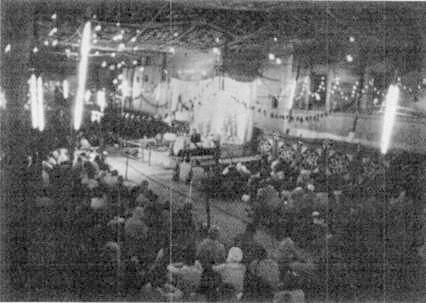
Fig. 2
The podium and a section of the crowd at the Manas-katha[*] festival held annually
at Gyan[*] Vapi[*] (November 1982). Photograph by Philip Lutgendorf.
foundest significance. Selecting a single line, the speaker begins to muse and expand upon it; to "play" with it as a classical Indian musician might play upon a raga. But here the improvisations consist not of musical tones but of words and ideas, images and anecdotes, folk sayings, scriptural injunctions, and snatches of song from great devotional poets, all interspersed with numerous chanted quotations from the book itself. The speaker has no single theme, constructs no systematic argument; instead he evokes a succession of moods and invites his audience to savor them. His purpose is less to analyze than to celebrate, and when a fresh insight occurs to him he "digresses" to explore it.
As he performs he engages his audience in numerous ways: making a particularly striking point, he turns to certain listeners near the front of the crowd to solicit their approval and is rewarded by exclamations of delight; chanting a well-known verse from the book, he stops midway and motions for listeners to supply the last few words, evoking a rhythmic and enthusiastic response. A particularly poignant anecdote brings tears to many eyes, but these give way in the next moment to hearty laughter over an earthy recasting of the story and its divine characters. Narrating dialogue, the speaker assumes the various parts and acts them expertly, with vivid facial expressions and gestures.
The speaker's verbal tapestry envelopes the crowd for nearly an
hour, and then with expert timing he ends it with a resounding benediction: "Hail Sita's bridegroom, Ramchandra!" just as a priest appears before the dais bearing a brass lamp, which he waves in worship before the book. The listeners rise to sing a hymn in its praise, and when this concludes many come forward to place an offering on the book, to touch the speaker's feet reverently, and to receive from him a blessing of prasad[*] in the form of sacred tulsi[*] leaves from a sprig that has been resting on the book.
Performances resembling the one just described have been an important part of life in Banaras for many centuries. They are hardly unique to that city, of course, for similar forms of oral exegesis, perhaps differing in certain details or based on other texts, are found throughout much of India.[2] But Banaras has a special connection with the "book" in the present example, the Hindi epic Ramcharitmanas[*] —commonly called the Manas[*] , or simply the Ramayan[*] (since most Hindi speakers have no direct knowledge of the older Sanskrit work by this name) and generally acknowledged as the most popular text of north Indian Hinduism—for it was in this city that Gosvami Tulsidas (1532–1623) was said to have completed his epic and to have personally initiated its public performance through katha[*] (oral exegesis) and lila[*] (dramatic enactment).[3] During the eighteenth and nineteenth centuries the religious and political elite of Banaras enthusiastically cultivated these traditions, establishing patterns of Manas patronage and performance that were emulated in other areas of northern India. While the annual cycle of Ramlila[*] plays has been the subject of a number of studies, the rhetorical art of katha , which occurs throughout the year, has received little scholarly notice, perhaps in part because its performances are less conventionally "theatrical." Yet such programs are held in virtually every neighborhood of Banaras, and a number of largescale ones have in recent years become important events for the whole city. This chapter will outline the development of this performance tradition, giving particular emphasis to the cultural and political context of its patronage.